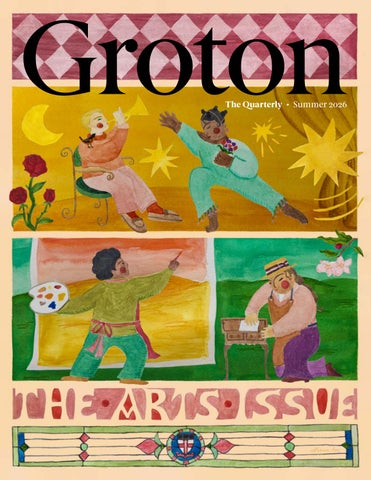
The Quarterly • Summer 2026
Groton School The Quarterly • Summer 2026 Volume LXXXVII, No. 1
22 The state of the arts Groton students and faculty share their reasons why the arts are such a critical part of a well-rounded life on the Circle.
34 A most unusual Grotonian George Biddle (Form of 1904) and art’s power to give meaning to life.
d e pa r t m e n t s 2
Message from the Headmaster
3
Circiter / Around the Circle
12 Personae / Profiles 40 Voces / Chapel Talks 51 De Libris / New Releases 52 Grotoniana / Athletics 62 Grotoniana / Arts 74 In Memoriam 78 Form Notes
Cover: illustration/design by Haruka Aoki ’08 Left: photo by Alyssa Mattei
www.groton.org
1
HE A DM ASTER TEM BA M AQU BEL A
Message from the Headmaster w e ta lk a lot a bou t Groton’s elite
Editor Sean Kerrigan P’29 Design Stoltze Design Group
Senior Editorial Advisors Kate Machan Alyssa Mattei Christopher Temerson Form Notes Editor Jessica M. Hart
Advisory Committee Susan Daniells Giulia King Allison S. MacBride P’30 Mark Melchior
Editorial Assistant John Donovan ’20
2
Groton School The Quarterly • Summer 2026
Photo by Mitch Weiss
academic standing and our students’ intellectual prowess. But our students’ talents outside of the classroom often amaze me just as much. Take the brilliant science student who is also an award-winning organist on the international stage. Or the multi-talented classicist who punctuated his chapel talk with a rousing performance of Frank Sinatra’s “My Way.” There’s the Third Former who mesmerized audiences as the lead in our joint production of West Side Story with Lawrence Academy. Or the visual artists whose work is featured on the annual birthday cards I send to alumni. Every year, dozens of Groton students master Advanced Placement exams with one side of their brain and earn Scholastic Arts awards with the other. Through coursework in the arts required to earn a Groton diploma, and the many ways to participate in the arts outside of the classroom, at some point every student on the Circle complements their incredible academic mind with great artistry and creativity. Part of this, naturally, is due to their inherent gifts. But credit can also go to the faculty who ensure that every student has the chance to infuse their Groton experience with the arts. The Visual Arts Department offers coursework in ceramics and sculpture, photography, drawing and painting, printmaking, and mixed media. The Mudge Fellow and other visiting artists share their art and the process of making through hands-on experiential learning with student creators. The woodworking shop provides training to build pieces
spanning basic tables to sophisticated works like grandfather clocks. Seventy percent of Groton students study music, whether in class, through private lessons, or as a member of the choir, orchestra, or various other formal or student-created ensembles. Student musicians and vocalists are constantly performing in recitals, at Parents Weekend or Reunion, during Lessons & Carols and chapel services, open mics, our annual Jazz Festival, and a host of other special events. When they’re not learning from our esteemed Music Department faculty and roster of outside coaches, our students are treated to visits by world-class musicians: In recent years, singer-songwriter Dar Williams and our own Tom Rush ’59 have given masterclasses on campus and, earlier this year, violin virtuoso Midori worked with our chamber and orchestral musicians in a special workshop. The Theater and Dance Department pulls back the curtain and shows students every aspect of drama and movement, from stagecraft and design to playwriting and direction to acting, improvisation, and public speaking. These are skills that transcend the stage to help our students express themselves with confidence no matter where they are, on campus or in the years that follow. As art is meant to be shared, we open up our campus arts community to public exhibitions each term in both the de Menil and Brodigan galleries, student recitals and other musical performances, including the free Gammons Concert Series, and drama and dance in the Marion D. Campbell Performing Arts Center, ranging from full-blown semi-annual productions to one-act plays and student-written and -directed performances in the Black Box.
Even being around art has shown to calm minds during times of stress. So this year, for the first time, the Academic Skills Office and the Visual Arts Department sponsored a joint initiative to provide a space for students to curate constructive academic habits ahead of exams and other assessments, in one of the most beautiful places on campus: the de Menil Gallery in our Dillon Art Center. Yet as we celebrate the creation of art on the Circle, we are also conscious of the art we’ve been left to steward. That’s why, this summer, we begin a multi-year conservation (and fundraising) effort to ensure the beautiful stainedglass windows in St. John’s Chapel continue in their current great shape for future generations of Grotonians to enjoy. The best art tells a story when everyone else is gone. Thanks to arts offerings at Groton, and the students who bring them to life, those stories will be told across the Circle for years to come.
Temba Maqubela Headmaster
Editorial Offices The Schoolhouse Groton School Groton, MA 01450 978 - 448 - 7506 quarterly@groton.org Send feedback, ideas, or letters to the editor to quarterly@groton.org.
Other School Offices Alumni Office: 978 - 448 - 7520 Admission Office: 978 - 448 - 7510 Groton School publishes the Groton School Quarterly three times a year, in the fall, winter, and spring/summer, and the Annual Report once a year.
CIRCITER
Circiter
Below: Members of the Black and Latinx Alliance open the 2026 MLK Day celebration with a performance of the gospel spiritual “The Storm Is Passing Over.”
MLK Day celebration spotlights the ‘immortal life’ of Henrietta Lacks groton school celebr ated Martin Luther King Jr. Day with a traditional day of introspection and community building. The day kicked off with an all-school gathering in the Campbell Performing Arts Center (CPAC), sponsored by the Cultural Alliance. The Black and Latinx Alliance opened the event by performing the gospel spiritual, “The Storm Is Passing Over,” after which Chaplain Allison Read led an opening prayer.
www.groton.org
3
CIRCITER
that—despite the innovations the HeLa “We give thanks this day for those cells have allowed—the family still who strive for justice, for the prophets, struggles with mistrust of the medical for the day-by-day lifelong resistors to community. violence, injustice, and oppression,” said “Henrietta is still helping mankind up Chaplain Read. “We give thanks for the until this day in 2026,” said Ms. Baptiste, children, the students at Groton School, who is a registered nurse. “The family is brave and courageous, to center morality, so proud of Henrietta: Through her death spirituality, their religious wisdom, a lot of people’s lives were saved.” and bring that to bear. That’s who King “We are in a very tenuous situation with was, after all. That’s what he did.” health care, with the current administration The morning’s keynote speakers were and different bills that are being passed Victoria Baptiste and Shirley Lacks, the that are stripping certain things away great-granddaughter and daughter-infrom health care,” she added. “I just feel law, respectively, of Henrietta Lacks. In like we’re taking several steps backward 1951, while being treated for cervical in the wrong direction. I think, for cancer that would eventually kill her, those of us who do care—those of us who Ms. Lacks gave birth to what’s considered want people to have access to health the first immortal cell line. After a tissue care regardless of their socioeconomic sample was taken without her knowledge, background—we have to keep fighting the cancer cells contained within the good fight.” continued to grow, where other samples The Essence step team closed out had withered and died. The cells—code the morning activities with a performance named HeLa—would change the face on stage. of scientific research, playing a part in After lunch, students broke up into nearly 75,000 studies and breakthroughs smaller groups for a series of Cultural in the creation of vaccines for polio, Alliance workshops largely led by and HPV, and COVID-19, as well as advances designed by their peers and covering in gene mapping and in vitro fertilization a wide range of topics, ranging from and treatment for such diseases as HIV, “The History of Black Music” to “More cancer, and Crone’s. Than the Game: Black Activism in Sports” However, few people—including the to “The ‘Memeification’ of the Black Lacks family—knew the true story behind Experience,” among many others. those magical cells until the publication of Faculty members were invited to gather the best-selling book The Immortal Life of for discussion of portions of Eleanor Henrietta Lacks by Rebecca Skloot in 2010. Roosevelt’s address to the school in 1949 Both Ms. Baptiste and Ms. Lacks said and Dr. King’s speech at Groton in 1965. (Continued from page 3)
After a campus community gathering in the CPAC, students broke up into smaller groups for an afternoon of Cultural Alliance workshops.
Spring 2026 Science and Engineering Fair during spring break, four students from Groton School—Damien Li ’29, Rory Hu ’28, Juwon Lee ’27, and Ethan Yan ’27—represented the school at the Massachusetts Region IV Science and Engineering Fair. Their projects explored topics including Alzheimer’s disease, diabetes, blood disorders, and DNA damage. Prior to the regional competition, they presented their work at the Groton School Science Fair before a panel of faculty judges, including Alexander Jordon, PhD, Sandra Kelly, PhD, Michael Gnozzio, and Bert Hall. All four students advanced from regionals and moved on to the Massachusetts State Science and Engineering Fair this past April.
Above, from left: Juwon Lee ’27, Ethan Yan ’27, Damien Li ’29, and Rory Hu ’28, at the Massachusetts Region IV Science and Engineering Fair.
CIRCITER
Fifth Form families begin their college application process with Kickoff to College Counseling event groton w elcomed sixty-nine Fifth Form families to the Circle January 30–31 to mark the informal start of their students’ college application process at the school’s annual Kickoff to College Counseling event. The event, hosted by Groton’s College Counseling Office, included panel discussions and workshops, a keynote speaker, one-on-one meetings with counselors, and lunch with Headmaster Temba Maqubela. Groton students meet with the College Counseling Office in the spring of their Fourth Form year to look ahead at courses they might want to take, but the college application process begins in earnest with the Fifth Form. After the kickoff event, counselors will have regular meetings throughout the rest of the year to get to know students better, learn what they’re looking for in a college, and start building an initial list of potential targets. The support follows through to Sixth Form, as students complete their applications and start thinking about things like early decision and financial aid. Workshop topics this year ranged from college essay tips to “Making the Most of the College Visit” and “Financial Aid.” In addition, a “Lessons Learned” session featured a group of current Groton Sixth Formers sharing their experiences with the college admissions process. On Friday night, Dartmouth College Assistant Vice President and Dean of Undergraduate Admissions Kathryn Bezella spoke to families in the Hundred House Reading Room. Before her keynote, Ms. Bezella explained why some families end up having trouble with the college admissions process. “Number one, most families are structured around two decision-makers—
caregivers or parents—who sort of download decisions onto the student,” Ms. Bezella said. “They figure out the logistics and the planning, and the student is the recipient of those directives. “So one big change is now you’re looking at not only needing to include the student in the decision-making process, but often let them drive the process or take a real significant thought-leadership role,” she added. “That’s a completely new dynamic for a lot of families.” The sheer scope and complexity of the modern college admissions process can also challenge a family, Ms. Bezella said.
many deadlines. There’s a huge financial investment. So to me, to be really clear as a family about why this is hard also helps you then have different strategies to approach it.” Ms. Bezella applauded Groton’s College Counseling Office, and urged parents to take advantage of the resources available to them. “One of the things I hope I do successfully is set people up to really appreciate the talented staff that they have here who are guiding them in the counseling process,” she said. “The team here knows about these schools. They’ve
Fifth Formers and their families officially started their college application journey with the Kickoff to College Counseling event this past January.
“Think about how hard it is just to get somebody to clean their room or take out the garbage or remember to fill the gas tank. And this is multitudes more complicated. It sometimes lasts for years between the time someone starts exploring and applying. There are so
helped students apply to these schools over time. They’ve seen results and outcomes. They are such a valuable resource and they have so much more authority and depth of knowledge. And so I’m here to tell some good stories and to certainly offer my perspective, but they’re really the experts.”
www.groton.org
5
CIRCITER
Winter Circle Talk explores the idea of an expanded Reconstruction the w in ter circle ta lk featured Manisha Sinha, PhD, a scholar who looks at the post–Civil War era commonly known as the Reconstruction through a longer lens that connects history to what’s happening in America today. Born in India, Dr. Sinha received her PhD from Columbia University. She currently teaches at the University of Connecticut, where she’s the James L. and Shirley A. Draper Chair in American History. Dr. Sinha based much of her talk on her 2025 book, The Rise and Fall of the Second American Republic, one that the New York Review of Books said “sheds fresh light on the period that fleetingly opened a door to a different America.” “This book focuses on a pretty timely debate today in the United States, which is the debate over who is a citizen and the role of the state in expanding or constricting our rights,” she explained. “Usually Reconstruction is seen as the period immediately after the Civil War starting from 1865 to the so-called Compromise of 1877, which led to the election of Rutherford B. Hayes to the presidency and the fall of the last reconstruction state governments in the South.” Dr. Sinha’s book expands the scope of Reconstruction, both chronologically— from the election of Abraham Lincoln to the early 20th century, when the Nineteenth Amendment was passed, giving women the vote—and spatially, beyond the newly reunited states to the country’s expansion westward and colonization overseas. “The crucial question of Reconstruction or understanding the history of this period is this: How did interracial democracy progress under the impetus of the Civil War and emancipation, and why did that effort unravel?” she said. The answer is complicated and nuanced, and Dr. Sinha dove as deeply into the subject as her hour in the Campbell Performing Arts Center allowed (several history classes took advantage of advanced access to the book to take a
6
longer look at her ideas in the days leading up to the Circle Talk). But, by taking this longer view of Reconstruction and its legacy, she connects the dots from the United States’ post–Civil War struggles through the debates over birthright citizenship and what makes an American that are happening today. “The overturning of course [after the Civil War] affected other groups as well,” said Dr. Sinha. “It affected women, where
Groton School The Quarterly • Summer 2026
the Suffragette movement got divided and didn’t come together until the early 20th century. It affected immigrants, it affected workers, it affected everyone. Now, our own era is one of the new challenges to American democracy, including the revival of voter suppression, unprecedented economic inequality, and the overturning of women’s rights, like reproductive freedom, and a resurge in domestic and global authoritarianism in various decisions. Below: The winter Circle Talk featured American history scholar Manisha Sinha, PhD, who shared her views on the Reconstruction.
CIRCITER
“In fact, the history of Reconstruction shows us, in its rise and its overthrow, that this is the crucible when many of our modern political traditions were made—both liberal and conservative—and we continue to shape our present in ways, sorry, little understood by many Americans today,” Dr. Sinha concluded. “The attempt to undo the New Deal state and the civil rights laws, the advent of the new Gilded Age all reveal that the great contest between democracy and unregulated capitalism, equality and inequality, racialism and racisms, authoritarianism, feminism, and patriarchy, is far from over.”
Record number of Groton student musicians earn spots in MMEA All-State Festival by mary ann lanier, phd ten groton school studentmusicians scored high enough to earn a spot in the Massachusetts Music Educators Association All-State Festival, the highest number of All-State musicians in school history. This journey began on Saturday, January 17, when sixteen Groton students performed in the Massachusetts Music Educators Association Central District Music Festival. Groton students performed in three of the four ensembles that gave an outstanding concert in Worcester’s beautiful Mechanics Hall. Singers from Groton School’s choir—namely Newton De Silva ’27, Michelle Manza ’26, Sade Pickering ’26, Niccolo Samson ’27, and Charlotte West ’28—lent their voices to the glorious sounds of the 183-voice chorus. Instrumentalists from Groton’s Chamber Orchestra contributed to thrilling performances given by the orchestra and concert band. David Yu ’28 served as principal oboe and Ethan Yan ’27 as principal double bass.
Others in the orchestra were violinists Nick Kan ’28, Amy Meng ’29, Mia Li ’28, Aaron duFrend ’28, and Cora Loomis ’28; cellists Brendan Koh ’28 and Youju Lee ’29; and violist Saanvi Rai ’29. Rose Lee ’27 added her flute playing to the powerful tones of the concert band. On Saturday, January 24, All-State Festival auditions were held, with a chance to perform at the Hanover Theatre in Worcester later in the year on the line. The record number of Groton musicians advancing include: • Charlotte West and Sade Pickering singing with the SSAA (soprano, soprano, alto, alto) choir. • Michelle Manza, Newton De Silva, and Niccolo Samson singing with the SATB (soprano, alto, tenor, bass) choir. • Violinists Aaron duFrend, Nicholas Kan, Mia Li, and Amy Meng performing in the orchestra. • David Yu serving as principal oboe in the Concert Band.
www.groton.org
7
CIRCITER
Groton delegates earn honors at Yale Model United Nations Conference eleven groton school students attended the Yale Model United Nations (YMUN) Conference January 15–18 in New Haven, CT, with two earning individual honors. Leah Bay ’27 was recognized as Best Delegate for her work representing the Democratic Republic of the Congo in the Social, Humanitarian, and Cultural Committee, and Sena Browning ’29 received an Outstanding Delegate award for her work representing Pakistan in the South Asian Association for Regional Cooperation Committee.
Groton School announces faculty retirements and promotions
Both Leah and Sena were making their YMUN debuts, something Groton Model UN Faculty Advisor Azmar Williams, PhD, said was “really exceptional.” Two other students—Nikhil Luthra ’27 and Zachary Lim ’28—participated in the Yale Global Exchange Program (GEP). The GEP presents the opportunity for YMUN delegates from around the world to interact with distinguished Yale faculty in small seminar formats. It requires an application, and selects twenty-five to thirty-five students annually. “Beyond the awards, the students represented Groton well and engaged seriously with the work of the conference,” Dr. Williams said. “Many thanks to the students for their preparation and commitment—and congratulations on a weekend well spent.”
Temba Maqubela has announced the retirements of Dean of Admission and Financial Aid Ian Gracey P’12, ’14, Dean of Students Elizabeth Petroskey P’12, and English Department faculty member Martha Gracey P’12, ’14, effective at the end of the academic year. Mr. Gracey has led the Admission Office at Groton since fall 2007. One of the most senior deans of admission among the country’s top boarding schools, Mr. Gracey was founding president of the Gateway to Prep Schools, an online common application system used by more than fifty schools; served on the Admission Directors Institute and the Character Skills Assessment Committee for the Enrollment Management System (formerly SSATB); and served on The Association of Boarding Schools (TABS) Admission Advisory Board, presenting at TABS annual meetings. He also has been on the faculty of the Crow’s Nest Institute, an annual retreat for experienced admission directors. At Groton, Mr. Gracey has taught an interdisciplinary course on the Italian Renaissance, led tutorials in the study of film, and coached the varsity baseball team. Preceding his
groton school he a dm a ster
8
Groton School The Quarterly • Summer 2026
tenure at Groton, he was an associate dean of admission, coach, and teacher at the Lawrenceville School. He has also taught and served in admissions at Avon Old Farms School and New York University. Mrs. Gracey teaches English, coaches field hockey, and serves on a variety of committees that benefit from her long-time involvement in boarding schools. Her passion in the classroom is American Literature, ranging from Southern writers—such as Twain, Faulkner, and Welty—to New England writers, including Dickinson, Emerson, Hawthorne, and Frost. Before working at Groton School, Mrs. Gracey spent most of her teaching career at the Lawrenceville School, where she served as dean of students, English teacher, house parent, and varsity field hockey and lacrosse coach. “Throughout their careers, Martha and Ian have had an outsized positive impact on two great American boarding schools, Lawrenceville and Groton,” said Mr. Maqubela, “and in so doing they laid the path for success for generations of students in our country and abroad. Ian opened doors to many who were unfamiliar with boarding schools and Martha nurtured the thousands who attended these schools. A champion for access and affordability, Ian communicated GRAIN [the GRoton Affordability and INclusion initiative] to prospective applicants, while Martha took them beyond the access to these schools to success at Groton and beyond. Could there be a more impactful couple for the
CIRCITER
Left: This year’s retiring faculty includes (clockwise from top left) Dean of Admission and Financial Aid Ian Gracey P’12, ’14, English Department faculty member Martha Gracey P’12, ’14. and Dean of Students Elizabeth Petroskey P’12.
greater good? I doubt it. We celebrate how they served the school with distinction.” Dean of Students Elizabeth Petroskey has been on the Circle for more than twenty years. She began her tenure at Groton in 2004, joining the Deans Office in a part-time role. She became associate dean of students in 2010, and ran a dorm from 2011 to 2023. In 2023, she was appointed the school’s chief safety officer. “As a dean, Libby has also been a nurturer who shielded the school administrators from difficult conversations,” said Mr. Maqubela. “As safety officer she serves as a go-between between the school and the local fire department and police. Libby is a shield that keeps us safe and employs the principles of restorative justice in dealing with students who interact with our disciplinary process.” The Groton School community looks forward to celebrating the legacy of these three long-tenured faculty members in the months to come. Mr. Maqubela has also announced that Director of Admission Jamie Funnell P’13
and Director of Enrollment Management and Director of GRACE (the GRoton Accelerate Challenge Enrich summer program) Cort Pomeroy P’23 will take over for Mr. Gracey upon his retirement, as they did during his sabbatical in 2017–18. Long-term plans for the dean of admission position will be established in the future. Mr. Funnell came to Groton in 2011 after twenty-one years at Cardigan Mountain School in New Hampshire. While there, he served in a variety of roles, including director of secondary school placement, assistant headmaster, science teacher, and coach of lacrosse and hockey. At Groton, Mr. Funnell coaches junior varsity lacrosse and is an Upper School dorm affiliate. Mr. Pomeroy arrived at Groton in 2001, after serving as director of admission at Applewild School in Fitchburg, MA. At Groton, he serves as an Upper School dorm affiliate, a faculty advisor, and head coach of boys junior varsity tennis and ice hockey. He is also the founder and commissioner of the Groton School Evening Softball League (GESL), a coed, intramural league that takes place each spring. In addition, current Assistant Dean of Students Tim LeRoy will be promoted to dean of students upon Ms. Petroskey’s
retirement, and Assistant Director of Globalism and Experiential Learning and Classics Department faculty member Mary Frances Bannard P’29 will become the associate dean of students at the start of the 2026–27 academic year. Mr. LeRoy joined the Groton faculty in 2013. In addition to his current role as assistant dean of students, he has served as director of the Student Activities Committee (SAC), a member of the Mathematics and Computer Science Department, a Lower School boys dorm head, and a coach of girls varsity ice hockey. Mrs. Bannard joined the Classics teaching faculty at Groton in 2016. Before coming to Groton, she taught middle and high school Classics and served as a grade-level dean at the Agnes Irwin School in Rosemont, PA; she has also taught Latin at Nashoba Brooks School in Concord, MA. At Groton, Mrs. Bannard currently serves as the assistant director of globalism and experiential learning, teaches Latin, and runs a Third Form girls’ dorm. She also serves as an assistant coach for the girls cross country team, helps with technical theater, and teaches the occasional yoga class.
Winter Running Club dashes through the snow for 13.1 miles the winter running club wrapped up its term of training on March 1 with a 13.1-mile tour of the town of Groton, starting at the Groton School Athletic Center and finishing on the Circle just in front of the Schoolhouse. The club had planned on taking on their annual halfmarathon challenge at the Hampton (NH) Half Marathon, but race organizers canceled the race on February 25, after local police said the “significant
snow accumulation remaining after cleanup efforts” made safe operation of the course impossible. A February 23 blizzard hit New England with as much as three feet of snow in some places. March 1 didn’t feature blizzard conditions, but persistent snow throughout the morning made for a picturesque wintry background—and a slippery track in some spots. Philip Holland ’27 was top
finisher in the friendly race at 1 hour, 30 minutes. Sebastian Ventilla Abelsnes ’27 (1:44) and George Taggart ’27 (1:45) rounded out the podium. Other finishers included Kevin Kerrigan ’29 (1:55), Izzy Skulte ’28 (1:58), Samara
Gorton ’26 (2:25) and Claire Travis ’26 (2:25). Club advisors Mary Frances Bannard and Luke Tichi also ran, and advisor Nathan Lamarre-Vincent manned the halfway aid station outside the Athletic Center.
www.groton.org
9
CIRCITER
Left: Boys swimmers celebrating their first team championship this past February. Below: Girls swimming finished second at the EIL/ISL Invitational Championships.
Groton School swim team takes home top honors at league championships a f ter just a dozen y e a r s
competing at the varsity level, the Groton School swim team pulled in its first team championship win this past February. Originally established in 2008 competing at the club level, the team’s growth and dedication ultimately boosted it into the varsity scene in 2014. On February 22, the team competed in the Eastern Independent League (EIL)/Independent School League (ISL) Invitational Championships against ten teams from the New England area. The boys team took home the EIL/ISL trophy, which they presented to Headmaster Temba Maqubela during the following Wednesday’s Roll Call. “Callum was instrumental to the Groton boys swimming’s first-place finish at the EIL/ISL Invitational Championship Meet,” swim team coaches David Fei, Tom Tringale, and Irenae Aigbedion wrote of the accomplishment. “He placed first in both of his individual events (200 free, 100 free), twice edging out top seed and second
10
place finishing St. George’s by 0.40 second and 0.14 second respectively. Both swims were personal bests and Groton School records. He was also a member of the winning 200 free relay (school record) and the second-place finishing 400 free relay.” The girls team also had a strong finish, placing second, with a significant lead—over 130 points—ahead of the third-place team. Originally under the impression that the team overall took home second place, later tabulations calculated that Groton School actually won the meet for combined teams as well, ultimately finishing with 858 points to Milton’s 843. “Swimmers up and down the roster swam personal bests throughout the championship meet with everyone contributing points to the team,” the coaches said. The combined overall victory is particularly special as the celebration of the fiftieth anniversary of coeducation at Groton continues throughout this year.
Groton School The Quarterly • Summer 2026
CIRCITER
Girls hockey wins first-ever NEPSAC championship a f ter a tota l shu t ou t in the
first two periods of the game, it came down to one last-minute goal, and Groton School girls varsity hockey team became NEPSAC champions for the first time in the school’s history on March 8. The team has qualified for NEPSAC tournament play for the last four seasons, but has come up short each previous year. This year, the team entered the Dorothy Howard Tournament (small school bracket) as the top seed, and took down Frederick Gunn on March 4 with an overtime goal at home during the quarterfinals. Victorious, Groton hosted the semi-finals at home against St. Mark’s three days later, pulling a 2–0 victory over their historic rivals. The girls headed to Dexter Southfield in Brookline, MA, on Sunday to face New Hampton, a team looking to secure their fourth tournament victory in a row, having defeated Groton in the finals of the 2023 and 2024 championship. (In 2025, Groton fell to Williston Northampton School in the quarterfinals while playing in the Chuck Vernon “Elite” bracket.) “It was very fitting that Groton would face off against No. 7 seed New Hampton in the NEPSAC Small School
championship,” Coach Jaqueline Diffley said. “Our Sixth Formers and captains were determined to defeat the team that had stood in their way two times before.” After both goalies kept any scores from going up on the board in the first two periods, Groton scored a goal on New Hampton with six minutes remaining on the clock. The announcer-pronounced “controversial” goal, scored by Caroline Matusovich ’28, occurred after a member of the New Hampton team fell into their
Members of the girls hockey team present Headmaster Temba Maqubela with their first-ever NEPSAC championship trophy.
own goalie, and the referees did not blow the whistle to call the play. After some deliberation, the goal was validated, and ended up being the only, and thereby decisive, goal of the game. As the buzzer rang, the team stormed the ice, gunning for a group hug that ended in a pig pile around the goalie. “It was almost like a story book ending,” Head Coach Tim LeRoy said of the historic win over the rivals who had defeated the team twice before. “It made the win so much more enjoyable and memorable.”
Nora Wilson ’27 was named MVP of the game for her skills as goalkeeper, keeping out twenty goal attempts from New Hampton. The championship trophy was presented to Sixth Form Captains Tina Scalese ’26, Sydney Nelson ’26, Jamie Noonan ’26, and Ella Nannene ’26. After students returned from spring break, the trophy was presented to Headmaster Temba Maqubela during Roll Call on April 1. This victory capped off the girls’ winningest season in the school’s history with nineteen victories. The team also won the Watkins Tournament, an annual holiday invitational, this year for the first time in program history.
www.groton.org
11
12
Groton School The Quarterly • Summer 2026
PER SONA E
James Bundy ’77 A Director’s Ear by n i c h o l e b e r n i e r
I
n december , James Bundy ’77 had the
pleasure of watching one of his former students perform a demanding role. When Marianna Gailus took the stage as Ibsen’s complicated heroine, Hedda Gabler, it was with a confidence that radiated depth and complexity. “She moves with astonishing grace and transparency,” recalls James, dean of the David Geffen School of Drama at Yale University. “She was simply an unalloyed pleasure to work with.” But this isn’t the first time James has been impressed by her talent. He’d seen Marianna perform years before at Groton, then a Third Former (Form of 2013) being shaped by the same drama program that had been so influential in his own early years. Having her in this performance at Yale was doubly meaningful, as it was one of his last shows before retiring after twenty-four years as dean of the school. To mark the occasion, Laurie Sales—head of theater and dance at Groton—brought her class on a Hedda Gabler field trip to see two of Groton’s own. After the
Left: James Bundy ’77 retires this year after twenty-four years as dean of the David Geffen School of Drama at Yale.
performance, they got a chance to meet with James and Marianna for a Q&A session that offered an inside look at bringing the play from page to stage. It was a full-circle moment for James, who as a Groton student discovered the same spark and meaning backstage. Sweeping floors and carrying props for a 1973 production of Ondine, he realized that theater was not just an extracurricular pursuit. It was a way of seeing the world. “I was completely smitten with everything about the theater, just being backstage for that production,” he says. “This place completely changed the course of my life in art.” Groton’s culture of curiosity and rigor allowed him to immerse himself in a growing range of roles, until a leading actor in one production left the school mid-rehearsal, and James found himself promoted with just two weeks to prepare. Then he was cast in the role of Henry David Thoreau in The Night Thoreau Spent in Jail. By the time he graduated, he had both a passion for theater and the confidence to continue in college. At Harvard, James gravitated toward the Loeb Drama Center and the vibrant ecosystem of undergraduate theater. He describes his academic path as “ridiculously uninvested,” but his extracurricular experience as transformative. There he directed his first play, discovering both the exhilaration and the uncertainty of artistic leadership. “I knew I wanted to be a director, but after graduating I had no idea how to be one,” he says. “And I wasn’t astute enough to ask anybody what might be a path forward.” He attended acting school in London, followed by five years working professionally as an actor on the West Coast, then producing with Cornerstone Theater Company, a collaborative ensemble founded by fellow Harvard graduates. When he began directing at Cornerstone as well as producing, the pieces began to align. Recognizing that directing required its own rigorous training, he enrolled in the MFA program at the Yale School of Drama. That decision would shape the rest of his career. After completing his degree, Bundy spent several years directing and producing professionally before returning to Yale, where he would eventually become dean of what is now the David Geffen School of Drama. Over the course of twenty-four years as artistic director of Yale Repertory Theatre, he has helped guide one of the most comprehensive graduate theater conservatories in the world, a program offering training across every theatrical discipline— from acting and directing to design, dramaturgy, stage management, and theater management. The school produces around thirty-five plays annually, five of them at Yale Repertory Theatre, a Tony
www.groton.org
13
PER SONA E
Award–winning professional company that integrates student training with professional practice. It’s a model not unlike a medical school and teaching hospital: rigorous classroom instruction complemented by real-world experience. During his tenure, the school has developed an increasingly inclusive artistic practice, has strengthened its commissioning program for new plays, and thanks to a transformational gift, began offering tuition-free enrollment. It’s a bittersweet time to be retiring as dean; groundbreaking is expected soon on a new 200,000-square-foot performing arts complex to bring the graduate school, Yale Repertory Theatre, and undergraduate theater programs under one roof. On an institutional level, Bundy’s multifaceted role reflects an astute weaving of the business and creative skills needed to be dean. But on the creative side, subtle distinctions in communication are needed to be effective in the classroom or directing productions. In a classroom setting, a teacher may invite students to experiment, disrupt habits, and expand their toolkit. “Different people respond to different kinds of appeals—some people might really respond to a purely technical appeal, some people might respond to an imaginative appeal. You can offer words, but they have to receive it.” In rehearsals, a director’s role is often more focused, helping actors to fine-tune elements of their performance that will clarify meaning for an audience. Not to impose a single method, but to identify what helps a performer access clarity and authenticity. “In my experience when you’re working with an actor in a production, it’s best not to try to teach them. It’s best just to direct them, because you want them to be a fully functioning artist in the room, not somebody whose primary relationship is with your pedagogy.” Underlying all of these roles—teacher, director, administrator—is the practice of active listening. “I don’t know that there’s any collaborative enterprise
14
Below: James leading a text analysis class at Yale in 2018. Photo by Joan Marcus.
Groton School The Quarterly • Summer 2026
that doesn’t depend on active listening and observational accuracy and respect for others,” Bundy says. “Our interdependence is foregrounded. If you pull a thread in the directing program, it’s felt in seven other programs. The rug goes, the carpet comes up. So navigating the shared interests and the conflicts of the various constituencies is endlessly challenging, and also deeply rewarding.” As he prepares to step down from his role as dean at the end of the academic year, Bundy looks forward to devoting more time to teaching and fostering young talent. Even though his career has unfolded across international stages, Bundy traces his appreciation of talent itself—as something young, innate, and limitless—to his formative years at Groton. He recalls the time he attended a local youth theater performance of A Christmas Carol, a show featuring the son of longtime faculty member Peter Camp. “Bill Camp [Form of ’82] could not have been more than 12, and I was five years older, and I remember thinking, ‘Oh my God that kid can act.’ I have a vivid
PER SONA E
memory of his brilliance to this day,” Bundy recalls. “Except for Alastair Sim himself, he’s still the best Scrooge I’ve ever seen.” William Camp ’82 went on to act in the films Lincoln and 12 Years a Slave, and receive award nominations for roles in the television series The Queen’s Gambit and The Night Of, and a Tony nomination for a Broadway revival of The Crucible. Watching Camp as Scrooge gave Bundy the sense of witnessing true talent in the making—with an awareness that if this person wanted to become an actor, he would succeed. Bundy says he’s had that feeling only one other time seeing a young person perform: Watching Marianna Gailus. Children, he says, instinctively possess the capacities so useful in acting: imagination, curiosity, and the willingness to inhabit another person’s perspective. The most supportive educational environments are the ones that have the ethical conditions that let those capacities flourish. Groton did, Bundy says, and its values continue to resonate with him deeply.
Above left: James and Dianne Wiest in rehearsals for the 2016 Yale Repertory Theatre’s production of Samuel Beckett’s Happy Days. Above right: Yale alumnus Paul Giamatti in the 2013 Yale Repertory Theatre production of Hamlet, directed by James.
“Although I’m not a practicing Christian, the ethical framework has underpinned every significant event of my life.” Bundy recognizes that creating that sort of atmosphere—one that succeeds across a diverse community of beliefs—represents a lot of hard work by a lot of talented people. He witnessed some of it firsthand as a chair of the search committee that brought Temba Maqubela as headmaster, a privilege he calls the “absolute pinnacle” of his volunteer life. “It was extraordinary. It’s an incredible gift.”
www.groton.org
15
16
Groton School The Quarterly • Summer 2026
PER SONA E
Haruka Aoki ’08 Sitting with the ‘Shoulds’ by a lys s a m at t e i
A
In undergrad, the Art History route seemed the more practical major. After just a year at the small liberal arts school, Haruka knew the school wasn’t the right fit. On top of her regular college work, she began studying again for the college entrance exams. After retaking the SATs and then the ACTs, she ended up transferring to Brown University. Haruka credits Groton for giving her the tenacity to keep pushing through. “I don’t think I could have done any of that if I hadn’t gotten some of that Groton training . . . there’s so many times where I think I could have stopped.” After graduating, she had trouble finding jobs in the art history field, and took it as a sign to go back to school, attending the Pratt Institute. She decided to study design but confessed, “That was not a truly honest thought. I thought again, ‘OK: what would make me money?’ . . . I was just so preoccupied with my stability.” It was there, though, that she discovered illustration through a class offering. “That made me understand: ‘Oh, perhaps this is a possible route for me.’ But then after graduation, I’m like, ‘OK I need a job, I have this wonderful design background now, how can I use it?’” After finishing her schooling, Haruka pursued a graphic design career, growing up the corporate ladder into art direction. But she found herself unhappy in her day-to-day work; she had the stability she always thought she needed, but it wasn’t fulfilling.
sta n da r d - size pr in t ou t
hangs Scotch-taped on the wall of Haruka Aoki’s studio. The homeprinted image of the New Yorker cover represents a continuous journey of self-discovery in her artistic career. Like many artists, Haruka (she/they) has grappled with the decisions between creative freedom and stability. And the journey is ever evolving. Over time the perceived need for practicality and following a more standard line of work has become blurred and eroded. During the years Haruka was at Groton, she wasn’t aware of any students going off to art school, so she didn’t even consider it as a possibility. Throughout her schooling and early life she was encouraged to pursue a stable career. “Like a lot of people living in this capitalist society, I was encouraged 100 percent to pursue something that would pay the bills,” she said. “Which in this realistic way of thinking, sure it makes sense. So I did go down that route. I think I felt that pressure just from people around me at the time. At least in college, I began to feel the pressure.”
Left: Haruka Aoki ’08 at a 2024 artistinitiated residency at Casa Fuzetta in Portugal. Right: Early versions of Haruka’s 2025 New Yorker cover.
www.groton.org
17
PER SONA E
So she gave herself a year to explore, to rest, and to reset. During this time she started to draw again— every day. Haruka’s first big break was in 2022, when she pitched a ten-panel comic to the Washington Post’s Gender and Identity column about her experiences of Asian-American hate in New York City. “Since it was also about a community I really cared about and a subject that was important to me, I really wanted to do it,” she explained. “And that was a really powerful seed for my career to grow from, because I think everything I do now pretty much flows from the same place.” In addition to accepting the comic, the Post asked if she would like to include a short essay on the work. Haruka was ecstatic to have a chance to present the work.
Above: “Protection from Mental Violence,” for the Rights of Every Child organization. Left: Haruka has done frequent writing and illustration work for the New York Times’ Arts and Leisure section.
18
Groton School The Quarterly • Summer 2026
“As an Asian artist, I’ve realized that expressing my true feelings through art is also an important path to regaining balance in these difficult times,” she wrote for the Post. “Each time I share painful, uncomfortable truths through art, I’m surprised to be met with deep, loving connection from the people who see my work. I keep doing this work because art fosters caring and nurtures our communities. This is where I believe healing and hope can emerge.” Since being published in the Washington Post, Haruka has had a number of editorial projects and is learning what kind of schedule she needs to maintain to keep her creative soul filled as an independent artist. She admits, “It’s not like you become an artist and then everything falls in place, right?” Haruka’s creative process begins with a sketch— and often lots of background music. She starts with gestural drawings, just getting movement of pencil and paper, “letting all the ideas out.” The next step may take one of the sketches into a digital format, which is then printed, traced using sunlight, and brought back into the physical media world. These days Haruka enjoys working with watercolor and gauche, and reserves the ease of digital work mostly for preparation, saying: “I think there’s something special about the hand and the human touch.” After the Post piece, Haruka continued to pitch pieces to papers and establish relationships with various publications. She’s spent time curating connections with art directors and editors who fit her
PER SONA E
energy, which includes frequent work with the New York Times’ Arts and Leisure section. Then, after years of work that comes out only one day per year, Haruka decided she wanted to pursue art that was less ephemeral. She began looking toward the New Yorker: “The strategy—if you can call it that—is that if you get a cover, they make cards, stationery cards, and posters of your work.” Haruka has been familiar with the New Yorker since long before her work in publication, crediting all the way back to her Groton days for her familiarity with the magazine. She remembers former English faculty member Theodore Goodrich had the covers plastered on his classroom walls. It was at Groton that Haruka first began reading the magazines (cartoons first), as “The New Yorker could be found everywhere: crumpled, months-old issues stuck in the crack of a couch in the science wing, a fresh copy neatly rolled into the pocket of a dinner jacket,” she wrote in a blog post. To her, the magazine has always felt cozy, as would be the way in which she connected with an editor there. Serendipitously, Haruka happened upon a networking opportunity during a children’s book author and illustrator retreat, where she ended up in the same cohort as an art director for the magazine. The two had gotten along well “eating cake and chasing ducks,” so she began pitching the editor. Haruka’s illustration “Nothing to See,” of a cat pushing a wine glass off a table, was selected for the cover of the June 16, 2025, issue of the New Yorker. “When I received the news from the art editors that my cover art was greenlit, my heart did a hundred flips, and I started dancing!” she said. It was the start to another iteration of growth for Haruka’s artistic journey. “As an artist—whatever your job might be—I realized, oh, but there’s more that I could do.”
20
Below: “The Cloak of Healing: Visions for Climate Justice,” a giant tapestry Haruka created for Systemic Justice, an organization that partners with communities fighting for racial, social, and economic justice.
Groton School The Quarterly • Summer 2026
It didn’t occur to Haruka that she could just create art for the sake of creating art until the assistant of a Hollywood director reached out about buying the original painting of her New Yorker cover. “I realized, I don’t need to wait for a client—like the New Yorker or the New York Times—I can just start making art myself without a client,” she said of the epiphany. “I don’t need to be doing editorial illustration, I don’t need a deadline, I can just be doing this for myself. So that’s what I am working on now.” Recently, Haruka has rounded out a year-long endeavor of writing and illustrating her own children’s book, and having completed the proposal, is working to find a literary agent. Haruka’s next project is creating 100 pieces of work related to a positive future of alternative, natural energy sources. The imagined pieces may depict subjects such as air-powered buses, or household appliances run entirely on solar power. “We don’t have to wait for the future for beautiful things to happen.” After years of trying to take the safe, practical, route Haruka is finally learning how to live with the shoulds: “It’s so funny, there are all these ‘should’ statements that I think we pick up as we get older and go through life, like ‘Oh, I should get a job,’ ‘An artist should do this X, Y, Z,’ and I feel like maybe my life project is maybe just to sit would the shoulds and be like, ‘Do I really need this?’” As she reflects on her accomplishments and future endeavors, she notes, “Being an artist, so much of it is just believing in yourself. Truly. You have to face yourself every day, right? Because no one else is telling you what to do usually. So I actually think it’s quite brave. A lot of people think it’s selfish to be an artist, because you get to make whatever you want. I think it’s a profession that requires a lot of bravery because you do have to look at yourself, and all parts of it, every single day, and work with that.”
PER SONA E
MAKING THE COVER my artmaking process begins by preparing the soil from which the artwork can grow. For me, that means absorbing any imagery, sounds, and text related to the subject. My research included looking at old photographs of life on the Circle, reading essays and chapel talks from the Quarterly, watching videos of recent roll call and Surprise Holiday announcements, and poring through hundreds of inspiring artworks I have saved in a folder on my computer. After letting that information marinate for a few days, it became clear that I wanted to celebrate the passion, love, and dedication that students bring to their art. In the aforementioned folder of inspiring artworks, a Portuguese stamp from 1981 caught my attention. The composition is made up of horizontal bands of illustrated scenes, shapes, and text that are stacked on top of each other. As you can see, I borrowed that frieze-like structure for this cover. During my research, I was delighted to have come across the Groton History Center’s conversation with beloved shop teacher and archivist Doug Brown ’57, whose stories kept me company as I sketched, mixed the watercolors, and cut and pasted the paper moon and stars. Some readers may have noticed the little nods to Groton I have included, like the checkerboard floor from the chapel, the Prize Day boater, the stained glass windows in the schoolroom, the oriole, who can be spotted through Massachusetts from springtime, and blossoms from the apple tree on the Circle. — h a r u k a ao k i ’0 8
www.groton.org
21
STATE OF THE A RTS
state of the
Groton students and faculty share their reasons why the arts are such a critical part of a well-rounded life on the Circle. By Sean Kerrigan
22
Groton School The Quarterly • Summer 2026
STATE OF THE A RTS
The last week of winter term was a busy one for Groton student-artists. Musicians performed at an FSA (faculty-sponsored activity) recital and student composers concert. Painters, sculptors, and other visual arts students showed off their work at a special exhibit in the Dillon Arts Center. And actors, stagehands, and the theater tech crew were readying for the biggest on-stage event in school history, a co-production of West Side Story with their counterparts at Lawrence Academy.
A busy week for sure, but hardly atypical on the Circle. Every Groton School graduate today meets an arts requirement but, for many students, the arts play a larger role—and a critical one—in their time here, whether as a creative outlet, some relief from the rigors of Groton’s academic demands, or as the foundation of a future career. “I think the arts in general are about what it means to be human,” says Music Department Head Mary Ann Lanier, PhD. “And it’s not that you can’t explore that in other courses, but you explore it in a different way.” “The most compelling thing about Groton for me was the extensive amount of art that they offer and how they prioritize it,” says Sophia Zarrinkoub ’29. “I feel like the arts departments are very prominent here. At other schools, you had to do a team sport in the afternoon, but Groton treats theater as a team sport, which I thought was very heartwarming. This is a school that really prioritizes the arts.”
art requirements, taken at any time from Fourth to Sixth Form. “We meet with Fourth Formers in the spring to help advise on course selection along with their advisors and teachers,” explains Director of College Counseling Peter Newcomb. “Not just for the next year, but looking out through graduation and seeing what they’re interested in. And, if arts are a big part of that, making sure we can figure out how they can fit that in.” In addition, Upper School students have the option to take an FSA, or Faculty-Sponsored Activity, which is specialized, student-led afternoon work that allows expanded exploration of personal interests under the mentorship of a faculty member. “I would say the music FSA program has been really beneficial because, for kids that need a lot of time, it gives them so many more opportunities for practice,” says Dr. Lanier.
“Kids are figuring out a lot of stuff out through their art, whether it’s that cello piece or a painting or a script,” says Assistant Head for Academics Kathy Leggat. “There’s an extraordinary amount of problem solving that goes along with that. It’s a very different way of looking about things and thinking about things.” It’s clear that—beyond the Circle’s classrooms, laboratories, and athletics fields—the arts are alive and well at Groton.
T
he Groton arts experience starts by building a broad foundation in the lower forms. All Second Formers spend the year exploring different art disciplines: a term each of visual arts, drama, and music. Students entering Groton in Third Form take a half-credit, year-long art course in music, woodworking, or visual arts. In Upper School, all students take a minimum of three credits of art in any discipline (or disciplines) to fulfill their
The music FSA meets once a week, spending time on things like improvisation and including community engagement such as recitals at local retirement homes. “I’ve tried to make the music FSA something that is more substantial,” says Dr. Lanier. “But I think it’s really helpful to the people that play the non-traditional instruments and to the really serious people.”
www.groton.org
23
STATE OF THE A RTS
The visual arts FSA allows students time in the Dillon Art Center to work on their craft outside of class. “We have students who might not have the time to take art during the school day because they’re busy,” says Visual Arts Department Head and Director of the Christopher Brodigan Gallery Jennifer Ho. “Art is important to them. So they maintain that by spending time in the afternoon with us.” Whether working in class or on their own, students who explore the arts are opening up a world of creativity that can expand upon and complement their academic work. “Arts—like sports or other extracurriculars—are a different kind of work,” adds Ms. Leggat. “For some kids, it’s a huge release from what they’re doing when they’re writing English papers or doing math problems or science labs. And I think that, for a lot of kids—whether it’s taking piano lessons or whether it’s working on visual arts—the time they spend in practice rooms is incredibly valuable. It’s an activity that provides a totally different and creative approach to thinking about things and problemsolving.”
A
mong other things, COVID was a disaster for the theater world. “I got a couple years of kids post COVID where no one had ever been to a show because there weren’t any to go to,” says Theater and Dance Department Head Laurie Sales. “The hardest thing was suddenly getting students who’d never seen a play, been to the theater, or had any idea how to behave in the theater, because theaters just shuttered for years.” The silver lining was that some of those kids were at home dreaming about the stage, waiting for their chance. Kids like Sophia Zarrinkoub ’29, from Southborough, MA, who during Sofia Zarrinkoub ’29 played Maria in Groton’s joint production of West Side Story with Lawrence Academy. She says embracing the sometimes chaotic nature of theater has helped her see the world, and herself, differently. (Photos by Adam Richins)
24
Groton School The Quarterly • Summer 2026
STATE OF THE A RTS
the pandemic saw news of a new Steven Spielberg film adaptation of a classic Broadway musical by one of her father’s favorite composers, Leonard Bernstein. “My dad said, ‘Oh my gosh, Sophia, I love this composer and he came out with this new modern movie with the same music,’” she recalls. “It was West Side Story and when I saw it, I fell in love with the music, but most importantly I fell in love with the performing and the acting. So from there, I did some summer programs and got more and more into theater. And when we did West Side Story at Groton, it was almost like a memory for me like, ‘Oh, I can tie that back into my first love for this.’ It’s why I really put a lot of heart into my performances as Maria.” Performing the lead in the biggest theater production in your new school’s history (see West Side Story, page 62) is a heck of a way to make your Groton debut, but that’s what Sophia did this past year as a Third Former. “I truly think that this experience was just so worth it because I feel like it really grounded me,” she says. “When you’re in theater, it’s like you pour yourself into this whole completely different world, like a transformation or a reflection. Being in that moment, watching a world come to life—as chaotic as it would get sometimes—it makes you feel very present. And I feel like a lot of times Groton students are always looking towards the next thing, the next assignment, and we’re not taking the time to truly sink into the chaos. “Theater really let me slow down and savor every moment on stage, every mistake,” Sophia adds. “You can embrace all of it. You’re just in that moment. And so I think theater lets me slow things down. And I think everybody should have a theater-like activity in their lives, to really help them reflect on the world and who they are.” Third Formers who study drama take a class called Storytelling and Stagecraft, covering the basics of acting, directing, envisioning theater in different spaces, and understanding design, leading to an annual series of plays in the spring about climate change. “It’s meant to be
foundational for the work that we do here at Groton,” says Ms. Sales. From there, Upper Schoolers can select from a host of rotating electives— including choreography, costume design, lighting design, advanced acting, directing, and improvisation—taught by Technical Director Brandt Belknap, Theater Tech Emma Covert, Movement Director Nicole Harris, and Theater Teaching Fellow Elizabeth Phan. Each term’s theater production is also offered as an afternoon activity. Sophia says studying theater beyond acting has helped her better understand and master the craft as a whole. “I wanted to explore the other aspects of theater, really getting into how you can tell stories not only through voice or through performing, but also through lighting and the atmosphere,” she says. “Number one, it grows my appreciation for the art form. But I’m also looking forward to making my own pieces, getting into playwriting. And I think it’s important to understand stage directions or how the lighting creates the atmosphere, or how the physical theatrical elements enhance and really tell the story.” For Ms. Sales, creating an unstructured space that’s open to everyone helps nurture a more vital, vibrant theater community at Groton. “When you’re in a boarding school community, you have to have so much structure in order for students to thrive, more so than at day schools,” she says. “They’re constantly being asked to stay within the lines, to color within the lines, in order for us to manage them effectively and to really give them the safety net that they need psychologically and physically. So when we ask them to draw outside the lines, it feels so crazy to them, but ultimately satisfying. “I think a lot of kids come to the theater program because they need a place to be, and maybe they need to self-express in ways that aren’t necessarily comfortable in mainstream spaces like the Dining Hall or the dorm,” she adds. “I try to make my space as non-competitive as possible. Some people think the arts are so competitive. Sure, there’s some of that,
but on this last show, every time Sophia would sing, all these kids would just come and sit and listen. I mean, that’s so cool.” “I actually love the balance,” says Sophia. “I feel like in the school day, everything’s just so timely and organized and sometimes you have to really focus on every little detail at hand and complete it in that moment. But with theater, sometimes you can allow yourself to revisit things or explore things more carefreely. So you’re really just exploring the play without rigidly following a set of instructions. It’s coming to you naturally, whatever’s in the moment.”
Organist Sarah Ku ’26 says playing with other students has taught her communication and collaboration skills.
G
rowing up in South Korea, Sarah Ku ’26 lived in a musical household. Her mother studied piano in college and taught her how to play at age 6. Classical music regularly echoed through the house. It wasn’t until she went away to middle school in the United Kingdom at Clifton College, however, that she discovered her gift for another keyboard instrument, the organ. “They had a magnificent organ,” says Sarah. “I met the organ teacher there and started taking lessons. I think playing the
www.groton.org
25
STATE OF THE A RTS
A sampling of class offerings in the arts at Groton School music After Modernism, 1930 to Today AP Music Theory Bach to Beethoven Plus Chamber Orchestra Choir Evensong Choir Forging New Pathways in Music Introduction to Music Theory Jazz Combo Jazz Ensemble Music Technology Second Form Musicianship Second Form Steel Drums Select Chamber Music The Musical Improvisation Laboratory
piano really helped me have good technique on the organ because I used to do a lot of finger strength practices for the piano, so transferring to the organ, it made me play more precisely.” The switch paid off. Sarah finished second in both the 2020 St. Edmundsbury Cathedral Virtual Organ Competition and the 2023 Albert Schweitzer Organ Festival Hartford, the latter being one of the top competitions for young organists in North America. This past year, she was named a 2026 YoungArts award winner, placing her among the nation’s most accomplished young visual, literary, and performing artists.
and orchestra—or taking lessons for credit. The latter includes one lesson a week with instructors from throughout the Central Massachusetts and Greater Boston regions, a music jury in front of a panel of teachers in the fall, and performances at the winter and spring recitals. As students gain more experience, select groups—jazz combos and smaller classical ensembles—become options. “Maybe 25 percent of students have never played anything,” says Dr. Lanier. “And then we have people who do more than one instrument. They’ll do guitar and voice or they play violin and piano and they take lessons in both.”
“I hope we’re doing a little bit of everything: teaching you what is expected, teaching you what’s possible, showing you that if you use your imagination, maybe you’ll find a new possibility.”
The Songwriting Workshop music department head mary ann lanier
theater and dance Acting Shakespeare Choreography and Performance Costume Design and Construction Improvisation Second Form Theater Storytelling and Stagecraft
visual arts Advanced Portfolio Art and Design Art Exploration Ceramics 1 Ceramics 2 Comics, Editorial Cartoons, and Graphic Novel Drawing Framing Faces: Portrait Photography Graffiti and Street Art Graphic Design Oil Painting Painting Photo 1 Photo 2 Sculpture Third Form Shop Upper School Shop
Besides lessons with Director of Choral Music Dan Moriarty, from Fourth Form on Sarah took advantage of the FSA program once or twice a year to carve out an extra couple of hours a day for practicing. Accommodating student musicians of all types is a priority at Groton, says Dr. Lanier, the Music Department head. “I want to think about what I think they need and what would be helpful for them,” she says, “and then looking at what they would like to do, and then how we can deliver on both those things with what we’re offering.” Second Form students start with a musicianship class where they learn a little bit of music theory and use the GarageBand app to express themselves musically. Second Formers also take part in steel drum lessons and perform as an ensemble. In Third Form, students have the option of joining or auditioning for an ensemble—including the choir, jazz band,
Additional coursework in such subjects as music theory, music technology, and songwriting are also offered to Upper Schoolers. “What I want to see is the students engaging with the music in a creative way, not just in performance and reproduction,” says Dr. Lanier. “I want us to be doing more of what they do in visual arts and what they do in playwriting and what they do in their English classes where students are writing their own work that’s not just analytical. “In individual lessons, my philosophy is I want you to use your imagination, but you need a technique to be able to realize that,” she adds. “I hope we’re doing a little bit of everything: teaching you what is expected, teaching you what’s possible, showing you that if you use your imagination, maybe you’ll find a new possibility.” Despite its size—besides Dr. Lanier and Mr. Moriarty, Director of Jazz
STATE OF THE A RTS
Ensembles Kenji Kikuchi and Chamber Orchestra Conductor Timothy Terranella round out the team of four— the Music Department’s support for Groton’s student musicians is remarkable, says Sarah. “I think first of all, there are so many opportunities to perform,” she says. “I play for the choir as well as sing. And I’m also in the chamber group. It’s great because it connects you with so many other musicians. Whenever I ask Mr. Moriarty, ‘Can I play this?’ he never says no. With chamber music, Dr. Lanier does a lot of work in arranging what groups play together. That’s one of the things that I spend most of my time on because we have something to work toward as a group. “Playing with other people, in a way, it humbles you,” Sarah adds. “You’re not the only person who’s playing, so you have to match your sound and musicianship with other people. And also there are definitely elements of the unknown as to if you’re
entering a new chamber group, you don’t know what their personality is like, you don’t know how they play. In that way, it is challenging, but I enjoy doing it.” Sarah says that prospective student musicians—whether already enrolled or those considering Groton—should look for enjoyment in the process of performing something you love. “It is so easy to be stressed out with quantitative things,” she says. “There are competitions and people try to join outside orchestras and other groups and I’ve seen a lot of Lower Schoolers stress about it, but I honestly don’t think it comes down to that. I really think that music really shouldn’t be like something that you do on the side because it makes your profile better. “At Groton, it is very important to have something that you really like to do. For me, that is music. And most days music practice is me being alone just doing my own thing. That’s really central to grounding me every day.”
A
s far back as he can remember, Logan Hu ’27 was drawing. “Visual arts have always been a big part of who I am,” he says. “I started off with Pokemon and these little soldiers and whatever, because my dad liked to draw them for me.” Logan came to Groton from New Orleans in Fourth Form and immediately immersed himself into the visual arts scene: sculpture that fall with Kristen Donovan, ceramics in the winter with department head Jennifer Ho, and drawing in the spring with Ms. Donovan. He also took Advanced Portfolio this past year for two-dimensional art and plans on taking the course again next year to pursue a 3D portfolio. “When a student has found an interest in a particular medium they really enjoy, Logan Hu ’27, here working on a piece for his portfolio class (seen finished above), says Groton has everything he needs to thrive as an artist: “the materials, classes, and most importantly the support from the teachers.”
www.groton.org
27
STATE OF THE A RTS
they can take it again,” explains Ms. Ho. “It’s unlike academics in the way where if you’ve taken Algebra 2, you won’t take that again, you’re going to advance to the next level. But what’s really nice about being in visual arts is you can take painting over and over and over again, and you’re just working on your craft and your skill, even though the projects might be the same, you can still extend yourself.” Like other mediums, the Visual Arts Department welcomes student-artists of all experience levels and backgrounds. “What’s different about Groton is we have students coming from not just different backgrounds and cultures, but also experience in terms of their skillset,” says Ms. Ho. “Some of our students are really highly trained, some might go to afternoon arts programs, and then we get students who have not taken art since middle or elementary school. So if they’re all joining our class at the same time, how do we cater our curriculum to them? “I think our ultimate motto is to include as many students as possible and to expose as many students as we can to the mediums,” she adds. “For those who are more advanced, we can push them
with our projects: Say we’re doing a still life, maybe yours is more complex, maybe you’re throwing in some fabric, as opposed to just the simple objects. So we’re able to help shape those experiences for the advanced students as well.” Logan says Groton’s arts facilities, including the Dillon Art Center— which features a darkroom photography lab and multiple painting, drawing, printmaking, and ceramic studios, as well as gallery space—played a big part in his enrolling here. “The arts were definitely what drew me to Groton,” he says. “Upon applying here, I was super impressed with the artistic resources that Groton had. I realized that this school could provide me with everything I needed to thrive as an artist: the materials, classes, and most importantly the support from the teachers.” Those teachers include Ms. Ho and Ms. Donovan, as well as Blake Fitch, who teaches photography and is director of the de Menil Gallery. The team puts an emphasis on balancing their teaching talents with the interests of their studentartists each year.
“I would say we want to ensure that our teachers love what they teach,” Ms. Ho says. “So if they’re leaning on their skillset and their strengths, that will emerge in their instruction and their lesson planning and in what students are able to experience.” As students advance, they’re encouraged to find the medium that works best with their ideas, concepts, and themes, says Ms. Ho: “Sometimes it might be graffiti and spray paint. Sometimes it might be wire and sculpture and those pairings kind of have to have a little dance for it to be effective.” “These days, when choosing a medium, I just choose whatever I think might be fun to work with,” says Logan. “Lately it has been pastels and gouache. Luckily I have Ms. Donovan to show me the ropes for any new medium I may be curious to use.” At a place like Groton, where students have a reputation for being driven, is it hard encouraging them to take chances in the studio that might get sloppy? “What we are doing kind of rebels against that a little bit, right?” says Ms. Ho. “A lot of it involves encouraging students to break out of their typical shell. And I think part of it is simply just being in the building and being in a separate space. “The students are encouraged to get messy and use their hands and dive right in. But I think that leaning into who our students are and the fact that they want things to be precise and technically strong helps to build our curriculum. So knowing that they want something to look really good and showing them how to get there is part of how we teach it.” The visual arts program’s alumni network is robust and growing. (For more on one of them—this issue’s cover artist, Haruka Aoki ’08, and the inspiration behind their cover image—check out “Making the cover,” page 21.) “We have a lot of students who do go on to become artists, and that’s something that we want to emphasize here at Groton,” says Ms. Ho. “Not a lot of people Left: Kaysan Marinez ’26 says his four years in the woodshop have helped him plan and pace his work better, and to ask for help when he needs it.
28
Groton School The Quarterly • Summer 2026
know about our alumni artists who are successful or who end up in that career path a different way, but we do get a lot of alums who come back to us after they’ve majored in something else and they say, ‘Hey, I’ve thought a lot about what I want to do and I’ve come back to art.’ That’s what we’re building towards with our advanced curriculum, too. It’s relatively new but that’s where we’re heading: training the artists of the 21st century.” Logan says his art has become a central pillar in his life and something he’ll continue after graduation. The overall accessibility of the arts facilities and the support of the faculty has created places he can go, literally and figuratively, when he needs to unwind. “For me, and I suspect many others who take art here, art classes are a
much-needed break from the school day,” he says. “I find that it’s quite nice to have an opportunity to really tap into the more creative side of your mind.”
A
s someone who always enjoyed building things, Kaysan Marinez ’26 was excited to take woodworking at Groton, even if he had to wait a year. “I’ve always been someone who loves to work with their hands,” says Kaysan. “I love STEM and physics and understanding how things operate. I think building things is a massive part of that. So the second I saw an opportunity to take wood shop, I said, ‘Oh, I have to jump at that.’ I was bummed out that I couldn’t take it in Second Form, but so excited when I had the chance in Third Form.
A native of New York City, Kaysan had some basic exposure to woodworking at summer camp, where he assembled prefab birdhouses, but the step up in facilities and opportunities at Groton were eye opening to him. “I thought it was going to be more screws and more hinges and stuff like that,” he explains. “It’s a lot more complex than I thought it was going to be. And I loved that part. It’s a lot more attention to detail, and you have to understand that there’s not a quicker way to do everything. You just have to take the time, whether that’s the planning process or the sanding process. “I tend not to like when processes are slow or there’s no easy way to get from point A to point B,” adds Kaysan, “but I think it’s important to appreciate that this is going to take time, but that once you put time
www.groton.org
29
STATE OF THE A RTS
into it, it actually will pay off. I think that’s the biggest thing you can grasp from it.” That slowing down is one of the things that makes woodworking so special at a place like Groton, says woodworking teacher Peter Benedict. “It’s fun to just show them what’s possible,” says Mr. Benedict. “And furniture is one of these things that we interact with every day. We all sit in chairs,
we all use tables, but you never really think about how that is made. So it’s a nice eye-opening experience for them.” Third Formers all make the same project, a Shaker table. “That was my first time making a real piece of furniture,” says Kaysan. “I felt so accomplished with what I made.” From there, Upper Schoolers have a little more flexibility: In his three years since that table, Kaysan has made a skateboard, some cutting boards and cooking utensils for his family, and a ukulele, all in addition to a more elaborate, three-year slant-front desk project. Some other students’ higher-end projects have included grandfather clocks and secretaries. “They come up with crazy ideas, so sometimes we have to come to a compromise,” says Mr. Benedict. “It’s
30
just a joyful space. By nature, the classes are small just for safety. I think my biggest class is eight kids, and even that’s a little crazy if you have eight people on eight different machines all at the same time. But they get to actually talk with each other. In my mind, it’s a nice atmosphere there for them to be kids.” The learning curve for woodworking, especially with students who haven’t
done it much, can be steep, so as a result, mistakes happen. How the kids avoid or deal with that adversity adds to the experience. “It’s a little tricky with woodworking because it’s actually super technical to get everything to work properly,” says Mr. Benedict. “You have to be super precise, which is hard for some of the kids to learn because they think, ‘Oh, this will be fun. I’m just kind of carving stuff.’ I explain to them that you can be working on a piece and maybe you’ve got forty hours into this one part of the project and, because of ten seconds where you’re not thinking you just threw away forty hours. Before spring break, the Dillon Art Center displayed work completed in visual art classes through the winter term.
Groton School The Quarterly • Summer 2026
The pressure’s on. It can be tricky, but it’s all part of the process, saying, ‘All right, hey, you made a mistake. No worries. Let’s fix that.’” “I had many missteps with my dovetails,” adds Kaysan. “Starting out, I hated, hated, hated doing dovetails because if you hit it too hard, it’ll break the wood. If you do it too softly, it won’t get anywhere. And I broke a few. I had to glue some back on, but it was 100 percent worth it.” “That’s part of the process,” says Mr. Benedict. “That’s another thing I try and work on because the kids here are such perfectionists.” Sometimes, it’s hard to ask for help. For Kaysan, opening up when mistakes happened has been one of the biggest takeaways from his four years in the wood shop. “I walked in thinking everything would go very quickly,” he explains. “So when I got there and made mistakes, it taught me when to say, ‘Hey, can someone help me over here? I need help.’” In an increasingly virtual world, the tactile nature of woodworking—mistakes and all—gives students the opportunity to stretch their mind in different ways, says Mr. Benedict. “When we actually start making sawdust and it’s time to sweep the floor, some kids have never used a broom or a dust pan,” he says. “A lot of them have never done anything with their hands. “So they get to use a different part of your brain,” Mr. Benedict adds. “Here, in every class, they work. They actually see
STATE OF THE A RTS
that they physically did something, and I think that’s missing in a lot of people’s lives. You actually feel an accomplishment of actually doing something. Do I think any of these kids will be professional furniture makers? Probably not, but we’re at a college prep school, so that’s not why we’re here. Do I have some kids who could absolutely be furniture makers? One hundred and ten percent. There are some kids that are super into it.”
“There’s something about the sensory experience of art that enables us to embody the process of learning in a way that academics may not always help us do.” director of academic skills anna martinez
Count Kaysan among that group. “I do plan on continuing this, whether it’s in college or later in my life,” he says. “I love the feeling of making stuff, one for myself, but also for other people.”
B
eyond the rewards of pursuing a creative passion, exposure to the arts has less obvious benefits for young people, especially at a place like Groton School. “The arts help us clarify our goals,” says Director of Academic Skills Anna Martinez. “In academics, we often think about progress versus product. And at a school where the product is often thought to be the source that is most aligned with goal attainment, it can be easy to lose sight of the process that gets you there. The arts are a space where you can experience through your senses the process of learning. So in visual arts, you’re seeing your process. In theater arts, you’re feeling your process through your body. In music, you get to hear how you are making progress. And in each of those cases, there’s ultimately a product as well, but there’s something about the sensory experience of art that enables us to embody the process of learning in a way that academics may not always help us do.”
Ms. Martinez points to anecdotal evidence that shows young minds who engage in the pursuit of excellence and rigor—whether in the classroom, on the playing field, or in the arts—can transfer those skills to other areas of their lives. “I think that the same sort of process that I’ve just described that you can embody in the arts leads a person to be more metacognitive about their learning and experience in learning, and that they can bring that with them into other settings,” she says. “And that the likelihood of that awareness is improved through the engagement with the arts. “Art allows us to exercise the noveltyseeking part of our brain and adolescents specifically have a drive to understand the world and their place in it,” adds Ms. Martinez. “And we’ve come to understand that culturally as adolescents being impulsive or being driven by raging hormones, but actually they’re just sort of going out to the edge of their learning ability and seeing how far they can go and feel safe and secure and interested. I think the arts allow that. “I think about the way that these kids move through their day, sitting and listening. In art, you get to explore color and shapes and sounds. The sensory piece
STATE OF THE A RTS
Whether through drama and dance, music, the visual arts, or woodworking, Groton students find myriad value in their artistic pursuits.
is a really big deal because you can’t exercise your mind without exercising your body. And when you get to move with the stuff, that’s learning. They’ve learned to learn using a very particular modality, but it’s not how our bodies and brains are actually wired to learn.” Mr. Newcomb says the College Counseling staff works with many students in incorporating the arts into their college application. “It can definitely help if it’s a big part of the student’s story and their interests and what they want to do in college, whether it’s majoring in that area or just being involved in another way,” he says. “We have students who are very serious about visual or performing arts and might pursue a dual degree program. Students like that do a lot in terms of coursework and extracurriculars in that area. And they show it off to the college through a
32
portfolio and they often have an extra recommendation from an arts teacher. So it’s a big piece.” Even students who don’t plan on pursuing study in the arts can strengthen their application with arts supplements like portfolios. In the end, however, the most important thing is that the student is doing something they enjoy. “It’s not all about college and the arts can be a meaningful and challenging experience no matter if it factors into your college search or your application at all,” Mr. Newcomb says. Considering the arts as an option for electives or afternoon activities can help
Groton students blossom beyond a more traditional education, says Ms. Leggat. “Why is English important?” she asks. “They’re not just reading books or doing some writing. One of the things about reading is that you are learning to view the world or you’re getting a different perspective, somebody else’s perspective on how things might be viewed. In the Dillon Arts Center, they’re seeing things in different ways. They’re doing some incredible work over there. The same thing is happening in the music wing and the theater. You watch West Side Story and all I can think is, ‘Oh my God, I could never do anything like that.’ It’s amazing. “We’re not just one-dimensional here when it comes to thinking about how we’re educating kids, what we’re teaching them, how we want them to view things, how we want them to resolve issues, how we want them to solve problems, how we want them to be viewing whatever it is that they’re looking at.” Department heads agree. Whether as a means of finding mindfulness or stress release, as a creative outlet, or as a way to round out their classroom work, the arts have immense value for Groton students, both during their time on the Circle and in their adult lives after. “As an actor, you are using creativity and creative methods and tools to stand in the shoes of somebody that is not you,” says Ms. Sales. “We can’t do our craft if we are not focused on building empathy. And by empathy, I really mean the ability
STATE OF THE A RTS
to understand a person’s worldview, an emotional makeup that is not you. I would not want a Groton student to graduate without having developed some concrete tools that they can rely on to help them build empathy. Not just like ooshy, gooshy, but actually when I need to tap into my empathetic self, I have some real skills that I’ve practiced.”
“When you’re playing in an ensemble— whether it be really small or something larger—it’s a true collaboration,” says Dr. Lanier. “And it’s a collaboration where some of it is planned and some of it’s in the moment. So you really have to be open and paying attention. And then, as in many of our courses here, we’re using critical-thinking skills. We have to think about what this means and where can it take us? We know that music expresses things that we can’t put into words. It’s a sensory thing, something you can feel, and not just emotionally.” “It just taps into a completely different part of your brain to be creative,” says Ms. Ho. “There’s problem-solving when you’re trying to figure out how to maybe cut a particular leg in an angle. There’s math.
There are so many different components that students don’t realize they’re using from their different classes in our classroom. We often pair wellness with art, or mindfulness with art, because they are tapping into that side of themselves where they can be focused, they’re working with their hands, and maybe their mind is drifting off as they’re thinking about something else while
they’re still creating art. So our class structure is very much very open-ended, where students are having conversations with each other, not just about their work, but other things in life as well, and maybe that can spark an idea for another project.” “Why do we have art in society?” asks Mr. Benedict. “It’s to enrich people’s lives. And in this high-paced world that these kids are entering, you need—besides just a fun outlet—you need to exercise your brain and be creative. Being a creative artist is going to help you in your career. So if you can nurture that—even though a kid may not realize that a ceramics class or a woodworking class is going to help them in science—it just opens up your brain. I think it’s the same with music. It’s just another piece that, how could you not grow from that? We may not be known as an art school, but we have a lot of amazing artistic kids here.”
www.groton.org
33
George Biddle A Most Unusual Groton an by john tyler
PER SONA E
Left: Self-Portrait, 1933, Courtesy of the Philadelphia Museum of Art.
eorge biddle was a most unusual Grotonian. Although the school in its earlier years rapidly acquired a reputation for producing statesmen, financiers, and diplomats, it numbered very few professional artists among its graduates. Nor were this artist’s politics and subsequent career exactly what one would expect from a Philadelphia Biddle. His father died when he was 7 years old, and his mother, at age 33, had four small sons to raise all on a slender income. (Moncure, George, Francis, and Sydney all eventually attended Groton.) She had just enough money to pay for their education with nothing left over for herself. The Biddles lived in Ardmore, Pennsylvania, at the edge of the Haverford College campus, then an area of farmland and woods. Mrs. Biddle thought her children lacked “proper discipline, which as a woman she could not give her boys, who were getting a bit out of hand in the country, running wild.” Before she committed to send Moncure, her eldest, away to Groton, she made an exploratory visit to the new school, then barely 10 years old. Sitting next to Endicott Peabody at luncheon, she was charmed by his accent (a combination of his native Salem and a British upbringing), but was completely won over, when the handsome young headmaster (more or less her contemporary) declared that, above all, he believed in inculcating, from the outset, a sense of tone among the boys.1 George had spent four happy years at the Haverford School, but in 1898, he too was “yanked away from oil paints and lead soldiers, my shotgun, cricket bats, birds’ eggs, butterflies, bicycles, fishing tackle, white mice, Belgian hares, stuffed birds, dogs, and ponies” to join his older brother at Groton. Like many of his generation, he did not find the school a particularly welcoming place. According to his brother Francis (who later became Franklin Roosevelt’s attorney general and chief judge at the post–World War II Nuremberg Trials), George perhaps
1. Francis Biddle, A Casual Past, (NY: Doubleday, 1961), 55, 167–68.
suffered most of all the four brothers who attended Groton, because “he was the most ambitious, and his sense of failure was consequently more acute, failure to measure up to the standards to which he tried so hard to conform.” George always felt himself “something of a stranger at Groton.” Even though he almost always ranked at the top of his form, he was paralyzed with apprehension and would hide his face behind the folding lid of his Schoolroom desk when the headmaster read out the grades publicly. After three years, the strain proved too much, and his mother withdrew him from Groton, in order to spend eight months together in the San Ysidro Mountains of California, where a friendly vaquero taught young George how to use a lariat, ride astride a Mexican saddle, herd cattle, and buck horses. He returned to Massachusetts a much more self-confident young man, less anxious to please both his peers and his teachers, a bit of a thorn in Peabody’s side. He was, as yet, not enough of a non-conformist to ignore his family’s expectations that he should spend the next few years after Groton at Harvard, instead of art school. Still eager to fit in socially, during his initiation for membership in Dickey (the most socially elite circle of the already-select Institute of 1770), he submitted to dressing as Old Mother Hubbard, complete with a straw hat with long blue streamers, and leading a cow down Commonwealth Avenue, stopping at every other block to draw milk from its udders. He graduated from Harvard College cum laude in 1908, but was still uncertain about the future direction of his career, so he elected to return temporarily to life as a cowboy. (“It will be fun, but hardly profitable later on,” commented his skeptical mother.) First, he traveled in steerage to New Orleans before spending twelve to fifteen hours a day in the saddle at a ranch in East Texas. His wanderlust not yet satisfied, he rode solo five hundred miles across northern Mexico to Durango, where he proceeded to gamble away $418, his entire savings, in a single game of cards. Now completely broke, he continued to wander an additional five
www.groton.org
35
PER SONA E
hundred and fifty miles over the Sierra Madre Mountains to Culiacán near the coast, narrowly escaping foul play at the hands of a couple of vagrants, who contemplated stealing his horse, if not taking his life.2 Biddle eventually returned to Cambridge for law school and was admitted to the Pennsylvania Bar in 1911, but that same summer he set off for France to study painting at the Académie Julian. His arrival in Paris in 1911 coincided with the virtual birth of modernism in French art. That year, he visited path-breaking exhibitions of both Cubism and Futurism and glimpsed works by Picasso and Matisse at the home of Gertrude Stein. Although he was deeply intrigued by French modernism, Biddle’s art remained largely untouched by it. He described his “own twin forbears as Japanese prints and French Impressionism,” particularly the work of Degas, his fellow Philadelphian Mary Cassatt, and his American ex-patriate teacher Frederick Frieseke. 3 Returning to his native city in 1912, he spent two years studying at the Pennsylvania Academy of Fine Arts, but he also found time to visit New York to view the iconoclastic 1913 Armory Show, which he later described as a “vitalizing influence on the creative impulse in America.” 4 [Twenty-first century viewers
may perceive in Biddle’s mature style more kinship with the works of the Ashcan School, also on display in the same exhibition, than they will with either Impressionism or the Post-Impressionist works the Armory Show introduced to viewers in the United States.] By early 1914, he was back in Europe studying lithography (a new area of interest) in Munich and went on a painting tour with a group of artist friends to Spain. The outbreak of the First World War troubled him deeply. Recollecting that moment in his autobiography, he wrote, “I knew I should have to fight. But I didn’t hate anyone. I loved the French and I liked the Germans. I knew these two people. Each had given me much. The English had given me nothing. I disliked their mentality; I avoided their women; I dreaded their cooking; and I loathed their manners.” Initially, he chose to remain in Germany, climbing in the Bavarian Alps, but as the United States became increasingly drawn into the war, he returned home, attending voluntarily in 1917 one of the Plattsburgh Military Training Camps for future officers, even though he was beyond draft age. Just before embarking for Europe, he married his first wife, Ann Coleman, which turned out to be an ill-advised decision. Having resolved to join the army, he, like many of his generation, was eager to see combat, but his language skills (he was fluent in both French and German) caused him to be slotted for behind-thetrenches intelligence work, interrogating prisoners. He eventually saw four months of combat, as the German army began its retreat from the Marne. 5 “One might suppose that the Armistice was a tremendous relief after the strain of the war,” he wrote subsequently, but “this was not the case.” As soon as the war ended, “Then began the immediate disintegration of discipline, [and] the crumbling of individual morale.” While still abroad, Biddle received a letter from his wife, saying she believed their marriage had been a mistake. He immediately asked for leave to return home, but her letter precipitated an emotional crisis: “sanity, courage, ideals, and faith all disappeared during the war.” Like several
2. G. Biddle, Artist’s Life, 89, 96, 112. 3. George Biddle, Tahitian Journal (St Paul: University of Minnesota Press, 1968), 81; George Biddle, The Yes and No of Contemporary Art: An Artist’s Evaluation (Cambridge: Harvard University Press, 1957), 156, 173. 4. G. Biddle, Yes and No, 130.
36
Groton School The Quarterly • Summer 2026
Above: The Tahitians, ca. 1920, Courtesy of the Pennsylvania Academy of Fine Arts. Left: The Convalescent, 1916.
PER SONA E
Above: Whoopee at Sloppy Joe’s, 1933, Courtesy of the Philadelphia Museum of Art. Right: In Memoriam: Sacco and Vanzetti, 1930, Courtesy of the Philadelphia Museum of Art.
well-known artists and writers before him, who had been disillusioned with Western civilization, Biddle sought new inspiration in the island of Tahiti, spending two years there: “I knew too that to isolate myself from my past, from every diversion and every association, and to concentrate my entire energy and love on my art was the only road to happiness.” He was not only overwhelmed by the beauty of the island with its lush vegetation and tapestry of brilliant colors, but he also developed great admiration for the island’s people, believing “primitive” was “by no means inferior.” 6 Biddle returned to New York in the midst of the Jazz Age, sharing a house with Hunt Diederich, a friend from childhood and a fellow student at the Académie Julian. Their parties were legendary; their friends included Georgia O’Keefe, Charles Demuth, Guy Pène du Bois, Elie Nadelman, Paul Manship, Gaston Lachaise, Man Ray, and Rockwell Kent. Although Biddle claimed to be repelled by the violent colors of German Expressionism, his pictures during this period have some of the satiric bite of George Grosz or the bitter pathos of Käthe Kollwitz. During a short-lived marriage with his second wife, Jane Belo, he built, beginning in 1927, a massive stone house and studio of his own design in Crotonon-Hudson, NY. The town had become an outpost of left-leaning artists and intellectuals from Greenwich Village, so much so that Mount Airy Road, where the Biddles lived, became known by locals as “Red Hill.” In 1928, he made the first of several extended artistic excursions to Mexico, sketching first with Diego Rivera and eventually developing close friendships with Frida Kahlo and José Clemente Orozco. Although Biddle found Rivera personally “uncouth and unscrupulous,” he admired the murals being painted by Rivera and others under government sponsorship, which Biddle believed left artists free to follow their own creative instincts independent from the subtle influences both art dealers and private collectors exerted over style and subject matter. Mexico had demonstrated that art didn’t need to be expensive: all that was needed was to offer a muralist an uncensored wall and a living wage. Such murals, as a form of national cultural expression, could be enjoyed by all levels of society, at the same time they served the government’s purpose by spreading the ideas and symbols of Mexican socialism.7 As economic conditions worsened after the Stock Market Crash of 1929, many of Biddle’s artist friends found themselves
out of work. Biddle had known and admired Franklin Roosevelt, who was just three years ahead of him when he first entered Groton. On May 3, 1932, within two months after FDR’s inauguration, Biddle wrote a letter to “Dear Franklin,” suggesting a mural painting program similar to what he had seen in Mexico. The harried president responded quickly, suggesting Biddle make an appointment with the assistant secretary of the treasury, who was in charge of government buildings. Biddle later refined and broadened his proposal into what eventually became known as the Federal Art Project, employing over 5,000 artists at its height, including such notable figures as Arshile Gorky, Ben Shahn, Thomas Hart Benton, Mark Rothko, Jackson Pollock, and Willem de Kooning. The FAP paid $23.52 per week in return for a painting every four to six weeks; by comparison, a department store clerk working a fifty-hour week was lucky to get $20 a week. Concerning the program’s goals, Biddle wrote, “It rarely expects to obtain great art;” but “it does expect to use its art to greatest social advantage.”
5. G. Biddle, Artist’s Story, 151, 155, 160, 168; G. Biddle, Tahitian Journal, 32. 6. G. Biddle, Tahitian Journal, 19, 93. 7. John Taylor Williams, The Shores of Bohemia: A Cape Cod Story, 1910–1960 (NY; Farrar, Strauss & Giroux, 2022), 123, 183; G. Biddle, Artist’s Story, 261, 265; G. Biddle, Yes and No, 116.
www.groton.org
37
PER SONA E
Left: Fresco painting Society Freed Through Justice, 1936, George Biddle, fifth floor stairway, Department of Justice, Washington, D.C. Library of Congress Prints and Photographs Division. Below: Civilian Dead, 1944.
“It rarely censors artists,” he stated. “It has the liberal, democratic ideals of the New Deal, it stirred virulent not got the bureaucratic facilities to do so.” anti-Semitic and racist criticism. One anonymous letter “So the Project often gets very bad pictures,” writer asked, “Why did Mr. Biddle deface the walls of the justice he admitted, “but it is the first time in building with characters from New York’s ghetto?” Another history that many thousands of artists are claimed it was part of “the poisonous pattern of Moscow being working completely without censorship forced down the American throat,” while a third called it “a bad [Biddle’s italics].” 8 copy of the lowest Congo Negro symbolism.” Biddle also faced In 1936, Biddle completed his own more subtle criticism from his best known work, “Society Freed through former classmates at Groton Justice,” for the Department of Justice and Harvard: “Am I a traitor Building. (A multi-panel work, the to my class?” he once asked. left-hand wall illustrates scenes from “It would be a more serious tenement life, while the central panel matter, if I were a traitor to shows a middle-class family seated at an my country, to my profession, abundant dinner table. (The model for to my beliefs.” “If my class the paterfamilias of the scene was his means the Somerset and the brother Francis, the attorney general.) Knickerbocker,” he retorted, The first of two panels on the right depicts “it is a completely negligible various types of dignified, productive fraction of America.” 9 The labor, including housewives, farm workers, political radicalism of many New Deal artists, some and industrial laborers marching of whom had joined the purposefully off to distant mills, while American Federation of Labor and other unions, as well as the the final panel represents pre–New Deal Communist Party, eventually proved the undoing of the FAP. sweatshop conditions and a huddle of In 1943, right-wing members of Congress demanded that the unemployed workers standing outside a program be shut down, denouncing it as a “front for communists, factory wall. Although Biddle believed the deviants, and Jews.” mural gave him an opportunity to express
8. G. Biddle, Artist’s Story, 268, 270, 279; Williams, Shores of Bohemia, 182–84. 9. G. Biddle, Artist’s Story, 304, 306–07.
38
Groton School The Quarterly • Summer 2026
PER SONA E
Above: Indian Village Scene, 1960, Courtesy of the Woodmere Art Museum. Right: Woodcutters, 1928, Courtesy of the Philadelphia Museum of Art.
Opening a new phase in his life in 1940, the State Department asked Biddle to serve on its Committee on InterAmerican Cultural Affairs, during which time he completed, together with his third wife, the sculptor Hélène Sardeau, two other important murals: for the National Library in Rio de Janeiro, he created “The Contrast of War and Fascism with Education and Democracy” and for the Supreme Court in Mexico City “The Cannibalism of War Contrasted with the Creative Elements of Peace.” In early 1943, Biddle once again journeyed to Washington to lobby for the establishment of a War Artists Committee. Eventually becoming its chair, he was not only responsible for the selection and recruitment of some sixty other artists, but he himself also spent six months accompanying front-line troops in Tunisia and southern Italy. Biddle believed that artists could convey “the mood, the inner illumination, the explosive force” of war better than even the best photography and newspaper reporting.10 His collected sketches and wartime experiences appeared in two books published in 1944: George Biddle’s War Drawings and Artist at War. Following the German surrender, Look Magazine dispatched Biddle to cover the Nuremberg trials where his brother Francis was chief judge. Though his work was widely exhibited during the 1950s and ’60s, and he received many fellowships and honors, Biddle fit uncomfortably into the post-war American art scene. In Paris during the 1920s, he had welcomed the way in which increasing abstraction freed art from serving a utilitarian purpose, but the abstract expressionism of the New York School, as epitomized by Jackson Pollock and Mark Rothko, left him cold. It not only abandoned the careful draftsmanship of his early training, but turned its back on a search for meaning. “Expressionism can be a powerful force,” he wrote, “but it can be obnoxious when it has nothing to say.” 11 Throughout the rest of his life, Biddle continued to be an advocate and exemplar for figurative art with a progressive social purpose. Biddle’s social conscience was troubled by news coverage of the Civil Rights Movement and the treatment of AfricanAmericans, primarily in the South but also throughout the United States. Even though he himself had never been religious,
he was attracted to Mohandas Gandhi’s ideas of non-violence, prompting him to make a four-month sojourn to India in 1958. Although the great man himself had been assassinated ten years earlier, Biddle believed newly-independent India was at “a creative moment” and was experiencing a “flowering of genius,” and he set out to interview and make sketches of the country’s leading politicians and religious leaders. He and Hélène Sardeau also chose to spend an extended time in a primitive village where there would be no toilets, no stoves, no electricity, and no clean water, so that they could better understand “the heart of India.” 12 George Biddle died at his home in Croton-on-Hudson in 1973. Despite having endured the austerities of Peabody’s Groton, the horrors of combat
in two World Wars, and the widespread hardships of the Great Depression, and having been a witness to poverty and suffering throughout the world, he still believed in the power of art to transform and give meaning to life. Even though “the dark ages should be upon us,” he wrote, “only art—meager, shrunken and starved though it may be—will survive. Art, more than ever, is important today.” 13 John Tyler taught history at Groton from 1978 until 2014 and was the first director of the de Menil Gallery.
10. George Biddle, George Biddle’s War Drawings (NY: Hyperion, 1944) and George Biddle, Artist at War (NY: Viking, 1944). 11. George Biddle, Yes and No, 7, 106. 12. George Biddle, Indian Impressions (NY: Orion, 1960), 1, 13, 180. 13. G. Biddle, Yes and No, 5.
www.groton.org
39
40
VOCES
A C H A P E L TA L K
By Natchavee Kosolpisit ’26 February 26, 2026
Smile differently Sawadee ka! Hello! Ni hao! Welcome back to another smile that appeared every time Juwon and I laughed episode of doo pak natcha na ka. Today I’m going about “da biggest beefsteak.” It is the smile I have to teach you one of my favorite words—one that is a every time I complete an assignment before the concept all Thai people live by. Smile. In Thai, you realization that I have a lot more sets in. That smile pronounce it as yim. Ready? Repeat after me. Yim! didn’t perform. It just happened. And for years, Great job. In Chinese, you say wei xiao. Let’s do it I believed that was the only smile that mattered. together now. Wei xiao! Super! However, I began to notice something else—a Some of you may have smiled just now. Maybe third type of smile. The one I give Mr. Maq when you were thinking, “What is this girl doing? It’s 8 a.m., he asks me what the next step in a mechanism is, give me a rest.” Or maybe you looked to the person and my mind goes completely blank. “Uhm . . . beta next to you and felt socially obligated. Honestly, both elimination?” The one I offer Mr. Spring in U.S. of those count. History while I’m still catching up to the question. I grew up smiling for a living. Literally. Under “So . . . which amendment is which?” The one I tried bright lights that made my face feel warm. Cameras to keep as my seniors walked away on Prize Day— that followed me even when I forgot they were watching people I loved move forward while I stayed there. Adults counting down—three, two, one—and standing still. The “It’s not the time to smile, but I suddenly, no matter how tired I was, my face had smile anyway” smile. to wake up before the rest of me did. That was my life as I managed elementary school alongside TV show shoots. There were days when my cheeks hurt more than my feet. Days when my smile stayed frozen long after the cameras stopped rolling. At big events, people expected energy. At theme parks, people expected magic. When I became the “new attraction,” people expected joy on demand. And so I smiled. I smiled when I was overstimulated. I smiled when I wanted to be quiet. I smiled because it was my job. After all, kids were watching, and someone had decided that my face could be a source of happiness. For a long time, I told myself that the smile wasn’t real. But then there was another smile. One that no one ever asked me for. This one lived at home. It showed up when my brothers and I fought over food— standing in the kitchen, elbows out, laughing even as we argued about who got the last piece. It was the
That’s when I learned that smiling isn’t always an indication of joy. Sometimes it means endurance.”
Left: Natcha with mother Nattsinee Ksolpisit at 2023 Parents Weekend. Photo by Adam Richins
www.groton.org
41
VOCES
For a long time, I felt guilty about my unnatural smiles. It felt dishonest. Like I was hiding behind it. Like I wasn’t being brave enough to admit confusion or sadness or fear or fatigue. There’s one moment from my TV show that I think about a lot when I feel guilty about smiling. One episode followed a day in the life of frog farmers. The premise of the show was simple: kids exploring adult worlds—learning how things work, meeting people who do hard, unseen labor, and proving that children are capable of more than we’re often given credit for. Natcha the explorer. I wonder where that came from. To “complete” the episode, my brothers and I had to each catch a frog. Just one. That was it. But the moment we stepped into the muddy fields, my brothers froze. They cried. They whined. They begged to leave. And honestly, I was scared too. But someone had to go first. So I stepped forward. I grabbed a frog. My hands reached forward to hold the middle of the lower spine, right above the legs. The slime in my hands was thick and cold and immediately disgusting, and every part of me wanted to drop it and run. But I didn’t. I had to be brave—for my brothers, and for the hundreds of thousands of Thai kids watching at home, rooting for the idea that children could do hard things too. The frog squirmed, kicked, and attempted to wiggle free. It felt like pure mush was about to slip out of my hands. There was no way I could convince my brothers to touch the frogs. Until my producer yelled, “KISS THE FROG.” For a moment, I stared at the frog, into its blank eyes of nothingness and acceptance of any fate.
42
EW. I glanced back at my producer, with his smug smile and double thumbs up, encouraging me to do what no other sane child would do. I had to do it, for my brothers, for the mission, for the fans. And so I did. I leaned in, gave it a quick peck, and smiled. At first, it was the same smile I had worn for years— the practiced one, the performative one. But then something shifted. I wasn’t enjoying the kiss— absolutely not—but I was enjoying the sound of laughter behind the camera. The way my brothers’ faces lit up. The way their fear loosened just enough for courage to slip in. In that moment, my smile became real. Not because I was happy—but because I had endured something uncomfortable, and because that endurance gave someone else the strength to try. That’s when I learned that smiling isn’t always an indication of joy. Sometimes it means endurance. Sometimes it means kindness. Sometimes it simply means choosing not to “be soft.” More importantly, smiling changes other people. I saw it that day in the frog fields. The moment I smiled—really smiled—something shifted around me. My brothers stopped crying as hard. Their shoulders relaxed. They laughed, not because the frogs were suddenly less slimy, but because fear felt less lonely. That smile didn’t erase the mud, or the fear, or the discomfort—but it made the moment survivable. And I’ve noticed that same quiet shift everywhere since. A smile lowers people’s guards. It tells them they’re not facing something alone. It permits breathing, to try, to stay. I’ve watched how a smile can interrupt a bad day without asking for an explanation, how it can make space without demanding vulnerability.
Groton School The Quarterly • Summer 2026
Left: Natcha with her brother Prom Kosolpisit during the frog mission. Below: Natcha from her time on Thai television.
VOCES
Smiles don’t fix everything—they open doors. They say, “You are welcome here,” even if only for a moment. And sometimes, that moment is enough to change how someone chooses to keep going. That’s why I’ve learned to smile in places that feel strange. I smile when I’m nervous, because it reminds my body that fear doesn’t get to decide everything. I smile when I mess up, because mistakes don’t mean I’m done. I smile when I don’t know the answer, because learning begins there. Smiling has never erased my problems. But it has helped me face them. It reminds me that discomfort is temporary. That growth often looks awkward. And I want to be clear: this isn’t about pretending. We should cry. We should grieve. We should be angry. We should sit with pain when it’s real and necessary. But smiling doesn’t cancel those feelings. It lives beside them. You can smile and be hurting.
You can smile and be unsure. You can smile and still be scared. So maybe my message isn’t “smile more.” Maybe it’s “give yourself permission to smile differently.” Smile when it’s easy. Smile when it’s brave. Smile when it’s all you have. Because every smile—real, staged, or “It’s not the time to smile, but I smile anyway”— is proof that you’re still open—to the moment, to the people in it, and to what might come next. So yes, smile. Smile for the good times with your friends. Smile in front of your haters. Smile at every opportunity, every failure, and every person, because, at the end of the day, when we smile, we are sharing a glimpse of happiness with the next person and ourselves. We are reminding ourselves that in the next minute, day, or week, something good will come. It may just begin with a smile. Or kissing a frog.
Above: Natcha and friends after her chapel talk.
www.groton.org
43
VOCES
A C H A P E L TA L K
By Juan “JC” Minda Chiriboga ’26 February 24, 2026
Golden ticket “He said these things to me with great earnestness and great gentleness and in the light from the portal I could see that he was crying and I knew that it was my soul he wept for. I had never been esteemed in this way. To have a man place himself in such a position. I did not know what to say. That night I thought long and not without despair about what must become of me. I wanted very much to be a person of value and I had to ask myself how this could be possible if there were not something like a soul or like a spirit that is in the life of a person and which could endure any misfortune or disfigurement and yet be no less for it. If one were to be a person of value that value could not be a condition subject to the hazards of fortune. It had to be a quality that could not change. No matter what. Long before morning I knew that what I was seeking to discover was a thing I’d always known. That all courage was a form of constancy. That it was always himself that the coward abandoned first. After this all other betrayals came easily. I knew that courage came with less struggle for some than for others but I believed that anyone who desired it could have it. That the desire was the thing itself. The thing itself. I could think of nothing else of which that was true.” ― c o r m ac m c c a r t h y, a l l t h e p r e t t y h o r s e s it wa sn ’ t u n til ju n ior y e a r came around
that I realized the level of competition that occurs at this school. Once the questions from my classmates came pouring in about GPA, extracurriculars, and how good my writing skills were, I came to the soul-crushing conclusion that a good amount of what I do here was being condensed into a couple of numbers. You may be thinking, “Wow, this guy was pretty clueless,” and I guess I was because the beauty
44
Groton School The Quarterly • Summer 2026
of my high school experience was tainted further and further as I felt myself being reduced to a statistic. Suddenly I was a high GPA with leadership positions, not a human being or friend. This realization trapped me for a long time. On the erg[ometer], sometimes in class, walking outside, my thoughts really consumed me. Then, one day, I sat down and asked myself: “If I am these numbers, if it is all about college, what would my life look like?” Let’s say I invested every ounce of my being into collegemaxxing and it worked, what would I do then? What would I be after I invested my time in highschool not into myself but into what a Top 10 school would want to see in an application? I think at Groton these are questions that all students have to face. After a lot of thought, I came to the conclusion that if I did not take the time to create a foundation for myself, I would be left to drift through my years in college without purpose, depending on some connection to get a job. For me, that is falling short of having a meaningful, well, life really. But if my time at a COLLEGE PREP high school is not only about college, then what else is it about? What makes this school worth the amount of money it requires of my family? With an admission rate like ours, it seems like Groton is a Golden Ticket, but in what way? I considered the common saying that high school years are some of the most memorable or influential in a lifetime and decided that if that was true, these years could shape the man I will become. So . . . who do I want that man to be? Simple question, I know, right? But I would say that it’s easier than one might think to start answering it. I started with an overarching goal: I want to be a man who can put the people around them in a better place. I’m pretty certain that a life in which people know they can reach out to me should they need help would make me proud. Next I had to ask myself what kind of man can elevate those around him. In my opinion, that man is reliable, driven, follows through, is guided by his own sense of right and wrong, can trade comfort now for a chance at something better in the future, can listen, laugh, has passions, and is not afraid to love. With this clearer idea of the future I wanted, I started to realize that maybe Groton was my Golden Ticket. In this school I saw—and still see—the space, resources, and environment to build habits which will guide me in the right direction. In truth it was always a matter of choosing to make Groton an environment for the growth I wanted to see. Ever since I figured out what I wanted to take away from Groton, my time here has been a mix of the variability that comes with life and the habits I
VOCES
I want to be a man who can put the people around them in a better place. I’m pretty certain that a life in which people know they can reach out to me should they need help would make me proud.”
have chosen to build. And these habits are conscious decisions and systems that I hope will be valuable to me in twenty, thirty, or forty years. Yes, while it’s easy to brush off much of what I do now as insignificant, I prefer to accept that actions always have the potential to influence the person I will become. That’s why I spend hours rowing, building my physical strength and ability, studying, caring for my friends and family, writing, looking out for my brother, and questioning my thoughts. A rational thought some of you may have right now is that a life spent looking towards the future causes you to miss what’s happening right in front of you. And I think the tension this warranted perspective brings has created distance between some of my classmates and me. I want to make it clear that living
Above: JC as a child with his father, Juan Carlos Minda Benalcazar.
in the moment is not something I spite or look down on. I have traded away a considerable portion of the things that some find fun, engaging, and necessary to the Groton experience, which is—unsurprisingly— not the most popular decision. My experience of Groton will vary from that of my peers, and that’s OK. I must admit that in the past, every time I heard the classic “make the most of the present” or “enjoy your time here while you can,” I’d find myself uneasy at the thought of missing out. But what got me out of that whirlpool every time was the acknowledgement that I would not be happy if my time was spent doing things that would not contribute to who I want to be—If I wasn’t working towards that vision. That’s just the way I am. This truth is what binds me to the sport of rowing and what allows me to pretty shamelessly spend time on myself. Now, just as I questioned one of the other pathways through Groton, it only makes sense to ask myself what might happen once I go down my path. Let’s say I continue my trajectory through Groton and college. What happens if it doesn’t work out, right? What happens when I’ve done everything I can to put myself in the position to be that man who can be of resource . . . and it doesn’t happen?
www.groton.org
45
VOCES
What if I do everything I think is right to get what I want and the chance aspect of life causes me to still fall short? Would my high school and college years be filled with missed opportunities to mess around, do something silly, or spend my time on other things? Honestly, yeah, to some extent it could look that way. But I will never consider time spent working on myself as wasted. And what seems monotonous to some of us could captivate someone else for hours on end. That’s one of the beautiful things about personal perspective. Out of the countless decisions I have made and will make in my lifetime, a large portion of them will challenge the things I’ve said I want to achieve. These crossroads will make it incredibly easy to make a choice that will stray me away from the path I want to follow, and make it considerably harder to continue chasing that version of me I’m looking for. After every crossroad, after the dust has settled, I have to ask myself, “Hey, have I reached my goal yet?” As I make decisions which are collinear to the path I want to follow, a little voice will tell me, “Not yet, but it looks like you’re headed in the right direction.” Imagine each decision as a pixel in an image which increases in resolution as you grow up. Ultimately, your choices are what determine what that image ends up looking like.
46
Above: JC with brother Aron ’28 and sister Kyra ’23. Below: From left, Kyra, JC, Aron, Maria Chiriboga Maldonado, and Juan Carlos.
Groton School The Quarterly • Summer 2026
Here’s the thing though, it is impossible to make every right decision. There have been and will be times in my life where I decide to do, say, or think something that would not add to the future I want to have. Things that would not make me into that man I want to be. So what can I do in order to minimize the number of times this happens? Chris Voss, a psychology and business author, once wrote, “When the pressure is on, you don’t rise to the occasion—you fall to the highest level of your preparation.” For me, what this means is that when those crossroads I mentioned earlier come, I won’t suddenly summon the visionary power of Ghandi or anything like that, I will operate like a couple lines of code, as scary as that may sound. That code is made up of the beliefs and habits that I’ve built and will build throughout my life. To be happy with my choices, I have to build a foundation strong enough so that when I fall, whatever’s left aligns with the road I want to follow. Groton has given me what I need to start building that foundation. I prepare to fall with my rowing training, my schoolwork, my time writing, conversations with friends, and my time in the gym—while I’m listing only a couple of scenarios, the possibilities for the application of this principle are truly endless. Groton is my Golden Ticket, my prep school, because it has acted as a growth solution filled with almost everything I could possibly need to take action and begin my life’s work. Which, at the end of the day, is . . . the man I hope to be. I’m nowhere near that yet, but looking back, thanks to this school, I’ve already made it further than I could have ever dreamed. My final question to you all is this: how will you make Groton your Golden Ticket? What are you preparing for?
VOCES
A C H A P E L TA L K
By Michelle Manza ’26 February 20, 2026
Let them all in i thin k th at i w ill have some degree of
permanent hearing loss by the age of 25. My headphones almost always over my ears, set on noise-cancellation mode and playing tunes at concerningly loud volumes. If someone is behind me while I’m in this state, the only way to get my attention is to scream my name at a ridiculous volume until I turn around. My habit of listening started when I was 8. It was only my mother and me growing up, so she would string me along everywhere she went in her small, gray, 2001 Lexus. I loved these car rides, particularly for the radio station, which was usually tuned to 100.3, Z100, playing pop hits and hosting the Elvis Duran Morning Show (who I’d constantly confuse for Elvis Presley). I consumed the generic pop music the station would play, and wanted it on 24/7. The one thing stopping me, however, was my mom’s love for Swahili Gospel music. She’d automatically connect the car to worship music that hadn’t reminded me of much, other than long Sundays in a church, packed with Kenyans swaying with their eyes closed and yelling out random syllables under the supernatural powers of “THE HOLY GHOST.” To her, though, it was home. The music that connected her to those memories brought great joy. But . . . I didn’t see that joy. Because how could I interact with music I didn’t understand? And, it was interrupting my Katy Perry. So, after months of bickering and pleading for radio rights, she gifted me a set of headphones. That day, I made my first ever playlist on YouTube Music with the Z100 hits, called “Michelle’s Playlist #1.” I didn’t have to bother my mom anymore! But I wasn’t stopping there. I took inspiration from those around me to make playlists. One time, my older male cousins, Johnson and Keith, came to
my house. They were about 17 and 14. And I was 12, brace-faced and desperate for their approval, so I attempted to impress them with “Michelle’s Playlist #1.” They were in hysterics, and each hyper-feminine pop song only made them laugh harder. They soon snatched my phone and made a “Michelle’s Playlist #2.” When they left that night, and I checked the new playlist, I was intrigued by the names of Fetty Wap, Nicki Minaj, and City Girls. I didn’t understand half the lyrics—they rapped too fast, and the profanity definitely flew over my head. (Sorry, Mom.) But I listened anyways. Because I noticed I didn’t like the feeling of being laughed at.
Above: Michelle with her mother, Catherine.
www.groton.org
47
I’ve been able to have the relationships I cherish and the memories I’ve made because I let myself open up. I’ve been beautifully bent by all those around me.”
Then COVID hit. Stuck at home, no car radio or cousins to replenish my music taste, I turned to social media. There, I found . . . K-POP. BTS and TWICE became my favorite groups, and I memorized the lyrics to all of their top songs. (Yes, even the Korean ones.) So when I came into Brooks House in Second Form, I wanted to find people in my dorm that shared my infatuation. . . . No one did. I sensed that it was seen as weird and, in turn, I would be seen as weird, so I tucked it away. I wanted to blend in. I tried learning what music my dorm mates listened to. Kayla had a Tyler the Creator poster in her room, and so I looked at his profile. Ava Meyer wore a SZA shirt one day, and so I checked her out. I leeched, because I wanted to assimilate. I wanted someone to go, “Oh, I listen to them too!” I made a playlist, now on Spotify because no one here used YouTube Music, called “For the People.” The Groton people, that is. For Groton music, I felt, was different. I remember my first dance in Second Form. Back at home, dance music has drums, set dance patterns, and lyrics throughout. But here, it felt like—oonce-oonce-oonce. I couldn’t understand how to move to it, how to process it, or most importantly, how to have fun with it. But everyone else seemed to be having fun. So I told myself I had to as well. And though these instances of me blending in technically worked, music started to feel less about passion and more like a performance. It wasn’t until a Sunday in Third Form winter, where two close friends and I were in the outer common room debriefing the previous night’s dance. We all looked at each other with a dazed expression, only able to slightly say “Yeah . . . I had fun.” Eventually,
48
Above: Michelle and formmates outside St. John’s Chapel following her chapel talk. Bottom: Michelle on a trip to Kenya.
Groton School The Quarterly • Summer 2026
we paused, looked at each other, and burst out laughing. Because . . . we all knew that none of us knew, or felt familiar with, most of the mosh songs. That day, we made our very first shared playlist. It’s called “Like, Your Baby Daddy Ain’t a DJ” (if you get the reference). It’s twelve hours and twenty minutes of songs that at least one of us could dance or sing to if we heard them at a dance. I wasn’t familiar with every track they added, but I saw the songs meant something to them. If one of them played in the student center, I’d feel the same delight as them. And suddenly, Saturday moshes became a bit more fun. You’re probably sitting here in this chapel and wondering . . . why is she going on and on about the history of her playlists?
VOCES
Well, I was facilitating the D&I “Crossing the Room” activity for the Third Formers (including Victoria James, who requested a shout out, and Amaia Mertz, whose birthday is today, so wish her a good one if you see her). One question was “Cross the room if people at Groton see you for who you truly are.” Naturally, my mind went to music. Music is a form of expression and identity, and through my playlists I’ve come to find two things about my own character. The first is that I’m not afraid to be who I am. I feel less inclined to shy away, less inclined to hide aspects of myself that I feel are “different” than the flow of Groton’s. I’d always had this hardened picture that I wasn’t a true Grotonian. How can a middleclass, first-generation Kenyan-American girl fit inside that box? That’s unheard of in West Orange, New Jersey. But it took a lot of self-love—some forced, some earned—to see that image was outdated, only continuing to be updated by myself. In our Inclusion Scholar dinners, a trustee always says something about how each person’s uniqueness is what keeps Groton alive. I’ve realized that by hiding my interests, my likes, and my strengths, I dim more than just me, but the Circle too. And by letting that light show, I bring out the lights in others. Natcha and I wouldn’t have our bonding time on her iPad, playing a piano-tiles KPOP game, if I’d never shared my love for TWICE and BTS. The same songs I belt with Saniya to and from theater are on Michelle’s Playlist #2. All these experiences and joys would have been denied from me. Yet, by opening myself up, I’ve let them all in. Secondly, my musical taste has expanded. Music is a universal language, and even if I can’t understand exact dialects, I can appreciate similar motifs. I learned that oonce-oonce-oonce music was just one corner of the larger world of house. Through the passion my close friend, Ava Dwyer, had for the genre, I slowly learned how to move to it, how to process it, and especially how to have fun with it. And . . . there’s also country. It took some of my friends a few weeks to believe me when I admitted I didn’t absolutely hate a country song, which shocks me to say because back home . . . no one likes country. But I learned its elements, its roots, and most importantly, how it made those around me feel. And now, certain songs remind me of them, and put a smile on my face. So, returning to that D&I question, I’m not quite sure who I “truly” am. Because at some point, I stopped code-switching. I stopped putting on masks. I let myself become an ingredient in the mixing pot that is this school. And though scary, it was liberating.
I’ve been able to have the relationships I cherish and the memories I’ve made because I let myself open up. I’ve been beautifully bent by all those around me. And strangely, it wasn’t until I glanced at my playlists, a small facet of my busy life here, that I saw how I’ve transformed due to letting others in. Change is a funny thing. It’s almost never immediate, not a light-switch that brings you from dark to light. It’s more of an ombre, where you can’t really tell which hue you’re leaning towards until you are there. And though I can’t exactly track that shift for myself, I know that somewhere along the way, I found myself.
I know now that the best playlists don’t stick to one genre. The best ones are layered, different types of sounds and histories stacked wonderfully on top of each other. So I made the playlist I play most, simply titled “Songs I Like.” It’s a collection of everything that’s landed on my Spotify “On Repeat” and “Repeat Rewind” since July 17, 2024. It reflects all that I’ve experienced and interacted with: my 2020 era, our Second Form dorm playlist, my mom’s Swahili Gospel (which I’ve come to love because now it feels like home to me, too), jazz, disco, K-pop, salsa (or . . . mambo music), choral music, neo-soul, and . . . one country song. And it’s crazy, and sporadic, and unfiltered. But it’s me. Because I am a mosaic of everyone I’ve ever met and loved, and I’ve met so many of you sitting here. So when I have my headphones on full blast, I am not tuning the world out. Know that, most of the time, I am being reminded of you.
Above: Michelle performing with fellow student-musicians at Parents Weekend this past fall.
www.groton.org
49
ITI N ER A
Class cs GEO Greece Classics students visited Greece over March break through a GEO (Global Education Opportunity) designed to explore the sanctuaries, cities, theaters, and temples that helped shape ancient Greek and Roman cultures. The ten-day GEO—led by faculty members Mary-Frances Bannard, Scott Giampetruzzi, Celene Ibrahim, PhD, and Luke Tichi—included stops in Athens, Nafplio, Mycenae, Olympia, Delphi, and Crete.
50
DE LIBR IS
new releases
Sean Palfrey ’63 Imagine
Imagine showcases Sean Palfrey’s artistic vision in a stunning collection of images and ideas created from his photographic archive, exploring color, abstraction, and the power of the imagination. Imagine, the third volume in Mr. Palfrey’s photography book series, is filled with the mysterious, the beautiful, and the abstract: a suite of pictures of expressive shapes, strong patterns, and ideas in color. Whether it’s a single, framed shot of a patch of sand, or a composition of multiple exposures taken to make the familiar new, Mr. Palfrey’s images and musings on them stimulate our imaginations into taking flight. Tom La Farge ’65 The Crimson Bears
The Crimson Bears is an adult fantasy novel in which young bear siblings Edgar and Alice embark on a journey to visit their uncle in the bustling, multi-species city of Bargeton, where they encounter a diverse array of anthropomorphic creatures and become entangled in rising political
tensions and an impending invasion by the fearsome titular bears. Its sequel, A Hundred Doors, continues their story amid the escalating civil war in Bargeton. It was Mr. La Farge’s preference that his lengthy manuscript be published in one volume, and this new Tough Poets edition does that for the first time in English. It also includes a new introduction by Wendy Walker, Tom’s wife and literary partner, in which she elaborates on the genesis of the novel. Daniyal Mueenuddin ’81 This Is Where the Serpent Lives
Moving from Pakistan’s dazzling chaotic cities to its lawless feudal countryside, This Is Where the Serpent Lives powerfully evokes contemporary feudal Pakistan, following the destinies of a dozen unforgettable characters whose lives are linked through violence and tragedy, triumph, and love. In matters of power and money and the heart, Mr. Mueenuddin’s characters struggle to choose between paths that are moral and just and more worldly choices that allow them to survive in the systems of caste, capital, and social power that
so tightly grip their culture. Intimate and epic, elegiac and profoundly moving, This Is Where the Serpent Lives is a tour de force destined to become a classic of contemporary literature. David Chapin ’84 The Auglaize Conspiracy: A Novel of Early America
The year is 1766. The Seven Years War and Pontiac’s War are over, but scars remain. At the junction of the Auglaize and Maumee Rivers, southwest of Lake Erie, métis interpreter Marguerite Boyer discovers six headless bodies. Marguerite reports the deaths to British authorities in Detroit, who assign Phineas Philbrook, a New Hampshire—born ensign, to investigate. New to the Upper Country, Philbrook knows little of the region or its people, so Marguerite is hired as his interpreter and guide. Can Marguerite and Philbrook discover what happened at Auglaize? Only if they recognize that not everyone wants them to succeed, and only if they listen to the diverse voices of the people who call the Pays d’en Haut home.
► Please send information about your new releases to quarterly@groton.org. Book summaries were provided by the authors and/or publishers.
www.groton.org
51
GROTON I A NA
52
Groton School The Quarterly • Summer 2026
GROTON I A NA
WINTER SPORTS photography by adam richins
www.groton.org
53
GROTON I A NA
GIRL S HOCKEY The girls varsity hockey team enjoyed another historic season on the ice this winter, finishing with a 19–6–2 overall record. For the first time in program history, the team captured the NEPSAC Championship in the Dorothy Howard Tournament. This title not only secured the team’s place in Groton hockey history but also marked the most successful season the program has ever seen, as the group set a new record with 19 wins. The season began with mixed results, as the team went 2–2 through its first four games. However, the group quickly found its rhythm entering the Watkins Holiday Tournament at Cushing Academy in
54
December, determined to prove itself against strong competition. The girls put together an impressive run, winning three consecutive games—defeating Millbrook 1–0, Berkshire 2–1 in overtime, and host Cushing 4–1 in the championship game. It marked the first Watkins Tournament title in program history, a notable achievement in a tournament that annually features some of the strongest teams in New England. Following the New Year, the team battled through injuries and illness that lingered into mid-February. As the roster returned to full strength, the timing could not have been better. Groton earned the top seed in the NEPSAC Playoffs for the Dorothy Howard (Small School)
Groton School The Quarterly • Summer 2026
Tournament and delivered an outstanding postseason performance. The girls defeated Frederick Gunn 2–1 in OT, shut out rival St. Mark’s 2–0, and got their revenge against New Hampton 1–0 in the finals. This remarkable season was guided by a talented and supportive group of Sixth Formers who helped set the tone both on and off the ice. Their leadership and commitment were central to the program’s success. The team now looks forward to celebrating this championship together throughout the spring and during Reunion Weekend. — c oac h t i m l e r oy
BOYS HOCKEY The boys varsity hockey team turned in another competitive season, narrowly missing a playoff berth and finishing fourth in the ISL Eberhart Division. Competing in the ISL is always a challenge, and this year was no exception. Seven ISL teams once again qualified for the NEPSAC playoffs, a testament to the high level of competition we faced throughout the season. As we do every year, we opened the season with three scrimmages at the annual St. Paul’s Jamboree, which proved to be an excellent tune-up. That preparation paid off, as we began the season with three impressive wins—a resounding 7–1 win against North Yarmouth Academy, a thrilling 2–1 overtime victory over Deerfield, and a decisive 5–1 win versus Roxbury Latin. We then encountered a stretch of adversity, suffering losses to Rivers, Andover, and a high-powered St. Andrew’s
College (Toronto) team in a 3–1 game during our fifty-first annual holiday tournament. We were able to regroup with a key win over Proctor and headed into the December break at 4–4, knowing we needed to return with greater focus and determination. The response was outstanding. We went on an eight-game winning streak, highlighted by a dramatic 6–5 overtime victory over St. George’s. During that stretch, we outscored our opponents 45–13 and established strong habits that defined our play. By the end of January, we had improved our record to 12–7 and were firmly in the playoff hunt. February proved more challenging, as we went 2–5–1 during that stretch. Needing a win against St. Mark’s to secure a playoff spot, we came up short in a 3–1 loss against what was arguably the strongest St. Mark’s team in the past two decades. While disappointing, the season
was filled with valuable lessons and exceptional leadership. The Groton boys varsity hockey team will greatly miss our graduating Sixth Formers: Owen Cronan, Wes DiModica, Kaiden Donia, Alejandro Hassan, Henry Lepri, Nolan Wilson, Conner Wig, and Elliot Wood. I am incredibly proud of how this group embraced our team values— holding one another accountable, playing with grit and relentlessness, and trusting each other. They helped lead the team through a strong and enjoyable season. Each of these student-athletes has left an indelible mark on the program. While they will be missed, we are excited about the future and look forward to seeing many of the Zebras back at the rink next winter. — c oac h b i l l r i l e y
www.groton.org
55
GROTON I A NA
SWIM MING Groton swimming started off the season against St. George’s with a strong showing by the boys in a short-handed loss and the girls putting up a close six-point upset win. Many swimmers matched their times from the end of the year before, if not faster, setting the tone for the rest of the season. After the winter break, Groton repeatedly showed their depth of roster
56
with decisive victories over Berwick Academy, Thayer, Austin Prep, Dana Hall, and Pingree and close losses to Milton (nine points) and Andover’s girls (four points). The success at these meets were a testament to the consistent efforts at practice and cohesion across the roster to contribute from top to bottom week in and week out. At the EIL/ISL Invitational Championship, Groton put up best times across the roster to pull off a win, narrowly outscoring powerhouse Milton with Groton scoring 858 points to
Groton School The Quarterly • Summer 2026
Milton’s 843 points. Individually, the boys team won the ISL placing first (462 points) beating a strong St. George’s team (456 points) with the girls team placing second (396 points) behind Milton (548 points). To close out the season, Groton sent seventeen swimmers to compete at the DIII NEPSAC swimming championships. — c oac h dav i d f e i
GIRL S BA SKETBALL
BOYS BA SKETBALL
The girls varsity basketball team had a tough season in terms of wins, but it was a year filled with growth and undying effort in pursuit for progress. We struggled with injury for the better part of the beginning of the season. Once we became a pretty healthy team, we were able to put together a series of really nice competitive games. While only one of them—our Tuesday night game at Concord Academy—turned into a win, we had a number of really awesome showings. — c oac h j u l i a r o w l a n d
The 2025–26 basketball season was a season of growth for the team. After last season, the boys came into the winter with the goal of being a better team than last year no matter what. Though we returned many of the same students, the boys felt that we were a better team. Again, we had a great preseason and the boys were prepared to start the season strong. Unfortunately, our W-L record remained the same as last year. The team, however, will unanimously tell you we were better than the previous year. We scored more points this season, we had closer games, and decreased our turnovers by a significant amount. In fact, we held second-half leads late into numerous games, but just couldn’t quite cross the finish line. Those metrics, along
with the attitude and demeanor of our team throughout the season, proved that the boys achieved their goal. Our six Sixth Formers are leaving this program better than they found it and I am extremely proud of them for this. These boys are all part of a much larger Groton Basketball family and I am excited to continue working with these young men to help them mature, not only as student-athletes but as individuals off the court as well. — c oac h h a r o l d f r a n c i s
www.groton.org
57
GROTON I A NA
GIRL S SQUA SH The girls varsity squash team enjoyed one of its strongest seasons in recent memory, finishing the regular season with an impressive 10–2 record and securing second place in the ISL, our highest finish in many years. The team went on to place ninth at the High School Nationals and sixth in New England’s Division A, marking improvement in every major competitive arena over last year. This was, without question, a deeper and stronger squad. Interestingly, the season revealed a clear competitive pattern. All ten of our regular-season victories were decisive, nine by 7–0 margins and one 6–1, while our two losses were equally comprehensive (0–7 and 1–6). In many ways, we were a team of clear margins. The true competitive drama came at the end-ofseason tournaments, where the players demonstrated both resilience and composure under pressure. At nationals,
58
the team secured a hard-fought 4–3 victory over Lawrenceville, and at New Englands delivered another thrilling 4–3 win against Choate. Those matches reflected the grit and mental toughness that defined the group. Individually, there were several standout performances. Emma Xi ’29 delivered one of the highlights of the season with a remarkable win over Westover’s No. 1 player—a significant achievement given Westover’s eventual fourth-place finish at nationals. Charlotte Ghaeli ’26 nearly engineered a major upset against the highly rated Hotchkiss No. 1, narrowly falling 10–12 in the fifth game in one of the most exciting matches of the winter. Throughout the lineup, players continued to develop their games, and the team peaked at exactly the right moment heading into tournament play.
Groton School The Quarterly • Summer 2026
Injuries were mercifully limited. Aside from one concussion and a few minor setbacks, the team remained largely healthy, allowing us to train consistently and build momentum late in the season. We will graduate our three Sixth Form captains, Kayla Zheng, Charlotte Ghaeli, and Chloe McAuliffe, whose leadership, competitive spirit, and steady presence shaped the tone of the year. At the same time, nearly half of the roster is currently in Second or Third form, underscoring how young this team truly is. The future is exceptionally promising. If this season was a step forward in every measurable way, it may well prove to be a foundation for even greater achievements ahead. The team should take immense pride in what it accomplished: a season of growth, resilience, and rising standards— and a clear signal that Groton girls squash is firmly on an upward trajectory. —coach nishad das
GROTON I A NA
BOYS SQUA SH The boys varsity squash team had a strong and competitive season, finishing third in ISL league play. The year began with an impressive showing at the Jackson Tournament on our home courts, where the team swept their division with wins over St. Mark’s and St. George’s. Throughout the season, the team demonstrated resilience and determination, bouncing back from tough matches with decisive victories against
Brookline, Brooks, St. Sebastian’s, BB&N, and Middlesex, while also earning wins over Milton and Nobles. At the High School Nationals in Philadelphia, the team competed in the second division. After a narrow 4–3 loss to Nobles in a rematch, they secured a hard-fought 4–3 victory over the Owls of Brooklyn before a snowstorm forced the team to default their remaining matches. The following week at the New England Championships (Division B), the boys rebounded from an opening loss to win the consolation draw with victories
over Loomis Chaffee and Hopkins. Their efforts and conduct throughout the event earned them recognition as the Most Sportsmanlike Team. Led by two dedicated Sixth Form captains—Jamie Abramson and Kevin Cai—the team built a strong culture of teamwork and camaraderie that defined the season both on and off the court. — c oac h f r e d e r i c b r u s s e l
www.groton.org
59
GROTON I A NA
60
Groton School The Quarterly • Summer 2026
GROTON I A NA
Winter Sports girls basketball
girls hockey
boys squash
swimming
Coaches’ Award Zoe Hardwick ’27
Coaches’ Award Sydney Nelson ’26 Jamie Noonan ’26
Coaches’ Award Jamie Abramson ’26 Kevin Cai ’26
Coaches’ Award Teddy Kelleher ’27 (Boys) Bibi Miotke ’30 (Girls)
Most Valuable Player Tyler Martens ’27
Most Valuable Player Christina Scalese ’26
Most Valuable Player Samuel Lu ’27
Most Improved Erika Gonzalez ’26
ISL Co-MVP Christina Scalese ’26
Most Improved Yanbo Pei ’29
Most Valuable Swimmers Callum Musto ’26 (Boys) Guaiguai Zhang ’28 (Girls)
ISL Honorable Mention Cameryn Dunn ’26 Tyler Martens ’27
All-ISL Ava Barbour ’29 Jamie Noonan ’26 Christina Scalese ’26
All-ISL Brighten Ng ’27
boys basketball
ISL Honorable Mention Tatum Friedholm ’27 Oona Kathan ’26
Coaches’ Award JC Minda Chiriboga ’26 ISL Honorable Mention Jordan Zhang ’28 Captains-Elect Archer Daniels ’27 Sam Kim ’27 Davis Meng ’27
ISL Honorable Mention Jamie Abramson ’26 Kevin Cai ’26 Captains-Elect Samuel Lu ’26 Brighten Ng ’27
boys hockey Coaches’ Award Owen Cronan ’26 Most Valuable Player Wes DiModica ’26 Seventh Player Award Elliot Wood ’26 All-ISL Owen Cronan ’26 Kaiden Donia ’26 Nate Moons ’27 Elliot Wood ’26 ISL Honorable Mention Wes DiModica ’26 Alejandro Hassan ’26 Davis Jamison ’27 Bruce Li ’28 Connor Wig ’26
Most Improved Jeffrey Wu ’28 (Boys) Izzy Hall ’28 (Girls) Captains-Elect (Boys) Victor Fat ’28 Jeffrey Wu ’28 Ethan Yan ’27 Captains-Elect (Girls) Carina Li ’27 Sasha Kwon ’27 Ash Vaillancourt ’27
girls squash Coaches’ Award Charlotte Ghaeli ’26 Chloe McAuliffe ’26 Kayla Zheng ’26 All-ISL Charlotte Ghaeli ’26 Emma Xi ’29 ISL Honorable Mention Serena Lescott ’27 Kayla Zheng ’26 Captains-Elect Olivia Herr ’27 Serena Lescott ’27
ISL Flood Shield Award Wes DiModica ’26 Captains-Elect Davis Jamison ’27 Bruce Li ’28 Nate Moons ’27
www.groton.org
61
DE M EN IL GA LLERY
WEST SIDE STORY
W EST SIDE STORY
Groton School’s winter theater joins forces with Lawrence Academy for first-ever co-production of West Side Story p h o t o g r a p h y by a da m r i c h i n s groton school’s winter theater event was the largest in school history, a co-production of West Side Story with cross-town neighbors Lawrence Academy in the Marion D. Campbell Performing Arts Center. The first-of-its-kind co-production featured a cast of fifty students from the two schools—including Groton’s Sophia Zarrinkoub ’29 (Maria) and Lawrence Academy’s Maxwell McCusker ’27 (Tony) as leads—and a twenty-five-person live orchestra. Performances ran from February 26 to March 1. “It was a career high for me,” said Groton Theater Department Head Laurie Sales. “Across the board, it was everything I dreamed—we, our team, dreamed—and more, and better. “Halfway through rehearsals, we said, ‘If it’s not that good, it doesn’t matter. It was an experiment. It’s fine,’” she added. “But it was that good. It was a beautiful piece of theater that I’m incredibly proud of.” Based on Romeo and Juliet, the musical is a contemporary take on Shakespeare’s tragic love story. The original 1957 Broadway production was directed and choreographed by Jerome Robbins, with music by Leonard Bernstein and lyrics by Stephen Sondheim in his Broadway debut. It was nominated for six Tony Awards, winning two. A 1961 film adaptation was nominated for eleven Academy Awards and won ten, including Best Picture. Steven Spielberg adapted the story again in 2021, earning another Oscar nomination for Best Picture and a win for Best Supporting Actress. Ms. Sales said she’d been thinking about doing a large-scale production since COVID put a pause on shows of any kind.
www.groton.org
63
W EST SIDE STORY
After some informal conversations with colleagues at Lawrence Academy over the past few years, the desire to find the cast to put on something bigger met with some infrastructure work at LA that would prohibit them from hosting theater productions in 2025–26. Working together not only solved both problems but brought together a production team from the two schools that checked off all the boxes needed to present a work with equally challenging acting, singing, and dancing. “We put our resources together,” explained Ms. Sales. “We have a director and a choreographer (Nicole Harris). They have a director (Anthony Giovino) and a musical director (Jennifer Cooper). The four of us were the creative team and we found a really lovely way of working together.” That cross-town cooperation has the potential to teach bigger lessons, too, said Ms. Sales. “I work with the Global Education Program and I do a lot of cross-cultural competency building. We do most of it globally, but sometimes you can go across town and build those same skills,” she said. “I have found that—no matter where
I’ve worked—theater kids are theater kids. So they’re going to have something magical that connects them: They love to sing and dance and act. They know how to put something on that is non-competitive. And so what a cool way to open up our gates to inclusivity, diversity, diversity of thought, diversity of experience? This is a cool way to do it.” With Groton School Third Formers reading Romeo and Juliet in English classes and the current national spotlight on immigration, Ms. Sales said a more modern take on the story that examines cultural identity through the eyes of young people seemed like a perfect choice. “I’m always interested in the idea of bringing curriculum to life on stage,” she said. “So this was a very cool and creative way that kids who are studying Romeo and Juliet, which will be every ninth grader here, could come see that story told in a contemporary context. That’s important to me. Also, it’s a play that’s about what happens when people are jockeying for power and positionality and race becomes a factor. “What’s interesting about West Side Story is that the Jets and the Sharks are
both immigrant cultures, but they’re the white immigrants against the immigrants of color. That’s what’s happening in this country right now. We’re all immigrants, basically. So we are looking at what happens when we use race to differentiate one group of people from another. I think we have to think about that as a society, so that’s why we chose the play. And it’s got some really great singing and dancing.” Ms. Sales said the bonds formed between performers from the two schools transcended all expectations. “I walked into rehearsal and stopped knowing who was from LA and who was from Groton,” she said. “My goal was that every kid made a new friend, and they ended up making a new community. I mean, the last thing I heard one of the freshman boys who was in the show walking out with his parents was him saying, ‘I just made so many great friends.’ And a kid whose dad is a New York City cop who was sobbing in the audience—I mean, it was awesome. “This show was so satisfying,” Ms. Sales added. “It was challenging, but it was worth the challenge.”
Co-produced with students and faculty from Lawrence Academy, West Side Story was Groton’s largest theater production ever.
64
Groton School The Quarterly • Summer 2026
YOU NGA RTS AWA R D
2026 YoungArts Award Winner
Organist Sarah Ku ’26
sa r a h ku ’26 has been named a 2026 YoungArts award winner for her organ playing, placing her among the nation’s most accomplished young visual, literary, and performing artists. Bestowed annually since 1981, the YoungArts Award is the only award in the nation that recognizes exceptional young talent across disciplines and affirms their pursuit of a professional life in the arts. Recipients become part of a lifelong community of peers and mentors, with access to critical resources that help sustain their creative practices throughout their careers. The 2026 YoungArts award winners included 734 students representing thirty-nine states and the District of Columbia. YoungArts award winners, all ages 15–18 or in grades 10–12, are selected through a highly competitive application reviewed by panels of esteemed artists in a rigorous adjudication process. All YoungArts winners have demonstrated exceptional technique, a strong sense of artistry, and an extraordinary commitment to developing their craft. Winners were selected from a record number of nearly 13,000 applications
across ten artistic disciplines: classical music, dance, design, film, jazz, photography, theater, visual arts, voice, and writing. The winners join a distinguished community of artists who receive creative and professional development support throughout their careers, including microgrants and financial awards, mentorship and professional development opportunities, and collaborations with major cultural partners nationwide. “Sarah has the technical skill to play most anything a composer has written on the page and the discipline and musicality to bring the music off the page into dazzling musical life,” said Music Department Head Mary Ann Lanier. “As a soloist or musical collaborator, Sarah demonstrates skill, diligence, inspiration, and humility.” Sarah’s journey into the world of organ music began at the age of 12,
achieving distinction in both organ and piano through the Associated Board of the Royal Schools of Music. Notably, she finished second in both the 2020 St. Edmundsbury Cathedral Virtual Organ Competition and the 2023 Albert Schweitzer Organ Festival Hartford, the latter being one of the top competitions for young organists in North America. As a student member of the Bristol and District Organists’ Association (BDOA), Sarah actively participated in various performances, including a virtual recital, and was honored with financial awards from the Edgar Joyce Fund of the BDOA. Since arriving on the Circle, Sarah has seamlessly integrated herself into the Groton musical community. She studies organ with Daniel Moriarty and frequently accompanies and contributes her voice to the choir, while also playing a significant role in
Sarah has the technical skill to play most anything a composer has written on the page and the discipline and musicality to bring the music off the page into dazzling musical life.” — m a ry a n n l a n i e r , p h d when her music instructor at elementary school introduced her to the instrument during her role as a piano accompanist. After being awarded the Britton Organ Scholarship, she moved to Bristol, UK, to study organ at Clifton College under the tutelage of James Drinkwater. Sarah acquired a strong foundation in the fundamentals,
the activities of the Groton Chamber ensembles as a pianist. “I’m very proud of Sarah and all she has accomplished,” said Mr. Moriarty. “Hard work equals good results!” Beyond her musical interests, Sarah enjoys computer programming, solving logic puzzles and escape rooms, running cross country, and playing tennis.
www.groton.org
65
M IDOR I V ISIT
Members of Groton’s Chamber Orchestra with renowned violinist Midori (bottom right) during her March visit to campus.
Groton student musicians enjoy coaching from world-famous violinist Midori member s of groton school’s Chamber Orchestra and
Select Chamber Music arrived early to their March 4 rehearsal to tune and warm up for an intimate masterclass with one of the great violinists of our time, Midori. In the four decades since her debut with the New York Philharmonic at age 11, Midori has performed with many of the world’s most prestigious orchestras and has collaborated with world-renowned musicians including Leonard Bernstein, Yo-Yo Ma, and many others. Groton was invited to host the artist and Clara Kim, director of Midori’s Orchestra Residencies Program, as part of the Worcester Joy of Music Program’s youth orchestra residency, March 3–7. Timothy Terranella, Groton School’s orchestra conductor, also conducts the Joy of Music Program’s Youth Orchestra and helped organize the Circle’s stop on the residency. Midori and Ms. Kim noted that Groton musicians were doing a great job of watching their conductor as they played the first movement of Beethoven’s Symphony No. 7, but urged students to be more aware of communicating visually and listening more intently within and across sections of the orchestra. In addition,
66
Groton School The Quarterly • Summer 2026
players were urged to consider that dynamic markings such as f mean more than their surface definitions. For example, f means loud but also strong. As Groton musicians applied these and other suggestions, they began to play with more life and became a more cohesive ensemble. After the orchestra played, a chamber quintet played Mozart’s String Quintet in G minor. Again their performance improved as they thought more deeply about the character of the music and listened to each other more carefully. One chamber musician, Mia Li ’28, commented that she had never considered a musical tempo marking so carefully. Both the orchestra and the chamber group showed marked improvement by the end of the session. Everyone learned from Midori to be hyper aware of other players, the score, and what they are aiming for with each musical gesture. They also considered the mystery and power of music. When violist Liv Ding ’26 asked Midori what she thinks about when she plays, Midori shared that she thinks about many things when she is playing, but much of it cannot be expressed in words. — m a ry a n n l a n i e r , p h d
SCHOL ASTIC A RTS
Thirty-seven keys awarded to Groton students in annual Scholastic Art and Writing Awards thirt y - four st uden ts received
seventy-two accolades in the regional Scholastic Art and Writing Awards this year, including thirteen gold keys—the highest award, which qualifies the work to be judged on a national level. Rebecca Wu ’29 received seven acknowledgements for her art work: three gold keys for “Bath Thoughts,” “Higher Powers,” and “Lunchtime,” a silver key for “ABCs” and “Twelfth Night,” as well as an honorable mention for “3000”—all painting works. She also received an honorable mention for her mixed media work “Online.” Kristin Qin ’27 took home gold for her drawing “Dad and Me” as well as three silvers for her paintings “Grandma and Me,” “Shark and Me,” and “Are You Okay.” Evelyn Cai ’27 won a gold (“Mug Shot”) and silver (“Generations”) key in the Painting category, as well as an honorable mention in Illustration for “Glow.” Evelyn was also recognized in the writing division with three silver keys: for her short story “A Bedtime Story for My Granddaughter,” and for her screen plays “POP!” and “The Art of Making Tea.” Sebastian Lewin ’26 received four acknowledgements for his photography: gold for “Pomeranians,” silver for “The Morning After” and two honorable mentions for “Umbrella Girl” and “On Beauty.” Mia Li ’28 was awarded a gold key for her painting “The Wash” and a silver key for her mixed-media piece “Nature’s Embrace.” Her painting “Red Barn” received an honorable mention. Parnaz Kaur ’29 got a gold (“Glass Between Worlds”) and silver key (“Crocodile Gaze: The Nihangs of Punjab”) for her photography. She also received a silver key for her poem “Corridor.” Archer Daniels ’27 was recognized for his photography with a silver key for
“A Family of Elephants Having a Drink” and an honorable mention for “A Lonely Tree in a Vast Frontier.” Anna Favero ’26 received two honorable mentions for her sculptures “La munequinha y la muneca” and “The Return.” Favero was also acknowledged with writing awards for her personal essays, receiving a silver key for “Lesson 1: How to Shoot” and an honorable mention for “Learning to Fly.” Alex Doctoroff ’28 was also acknowledged in both the Art and Writing contest: his photograph “Orbiting the Ordinary” received a gold key, and his short story “The Last Page” earned a silver key. Alejandro Hassan ’26 received an honorable mention for his photography portfolio “Remnants.” Ava Meyer ’26 was also recognized with an honorable mention in Photography for “Fog.” Rory Hu ’28 was awarded a gold key in Critical Essay for “Sanewashing: How News Normalizes the Unacceptable,” a silver key in Short Story for “The Very
Bad Hunter,” an honorable mention in Journalism for “Humanitarianism: A Journey of Two Worlds,” and an honorable mention in Film & Animation for “Cliches: Innocent Until Proven Guilty.” Ethan Yan ’26 took home writing honors with a gold (“Harmony Without Justice: Where Patriotism Falls Short”) and silver key (“Saboteur and The Swimmer: Our Decisions To Be Helpless”) in the Critical Essay category. Daniel Mao ’26 was honored with three acknowledgements in three different categories: a silver key for his personal essay “Misty Mirages,” an honorable mention in Poetry for “Some Old Stuffed Bear,” and an honorable mention in Flash Fiction for “Misty Phantoms.” An exhibition featuring the gold key art award winners was held at the Tufts Medford campus March 14–22. For more coverage of the 2026 Scholastic Art and Writing Awards, please visit the Groton News page at groton.org/news.
Below: Rebecca Wu ’29 “Bath Thoughts”
www.groton.org
67
SCHOL ASTIC A RTS
Scholastic Art and Writing Awards 1 Archer Daniels ’27 “A Family of Elephants Having a Drink”
6 Alex Doctoroff ’28 “Orbiting the Ordinary” 7 Mia Li ’28 “The Wash”
2 Parnaz Kaur ’29 “Glass Between Worlds”
8 Rebecca Wu ’29 “Twelfth Night” 9 Kristin Qin ’27 “Shark and Me”
3 Evelyn Cai ’27 “Mug Shot”
10 Seb Lewin ’26 “Pomeranians”
4 Alejandro Hassan ‘26 “Remnants” (Art Portfolio)
11 Anna Favero ’26 “The Return”
5 Ava Meyer ’26 “Fog”
1
4
6
5
68
2
Groton School The Quarterly • Summer 2026
3
SCHOL ASTIC A RTS
8
7
9
10
11
www.groton.org
69
DE M EN IL GA LLERY
ja n ua ry 7–a p r i l 2 9
“Aftermath” Deborah Bai-Lannon de Menil Gallery Photographer portrays hope and recovery through documentary portraiture “ i don ’ t k now how you can look at these photos and not be moved,” Sasha Kwon ’27 commented at the opening of “Aftermath.” Artist Deborah Bai-Lannon visited the Circle on January 15 for a drop-in artist’s reception at the de Menil Gallery to interact with students and discuss her exhibition: a twenty-six-image installation challenging onlookers to see past stereotypes of veterans while viewing images of the journey to recovery from traumatic experiences. The series took form while Ms. Bai-Lannon volunteered with the Home Base Veterans and Family Program. This program, a partnership between the Red Sox Foundation and
70
Massachusetts General Hospital, offers veterans receiving treatment for post-traumatic stress disorder (PTSD) a Respite Weekend between the intensive two week session. The organization works with several farms to connect patients with a relaxed environment to decompress between the stages of the therapy. Ms. Bai-Lannon’s photographs are all taken at Harvard University’s polo farm, where she documented more than fifty veterans, from Navy SEALS and Special Forces personnel to enlisted service members. According to her artist statement, Ms. BaiLannon worked with each individual “to create intimate images which reflect the
Groton School The Quarterly • Summer 2026
person they are, who they want to be, their hopes for the future and the experiences they’re trying so hard to process.” The four-year project began after Ms. Bai-Lannon fell in love with one of the horses at the Harvard University farm, just down the street from where she lives. As she began taking photos there, she befriended the polo coach, who invited her to come take photos of the program. The series developed over her time there from just photographing the veterans interacting with the horses to something deeper: portraying the effects of combat and military service.
At the reception, Ms. Bai-Lannon spoke of her own experience with an extended family member who suffered from PTSD, making the project even more personal. Even though she was young, the trauma her family member suffered was an enduring memory; “it stuck with me my whole life,” she reflected. The deeply intimate portraits, intentionally displayed in black and white, portray both suffering and healing, capturing the connection between the program members, the horses, and the photographer. “The mission that these people entrusted me with is that you understand—that you come to the understanding— of what trauma and sacrifice that our military members often make,” Ms. Bai-Lennon explained. “And if you come away with that understanding my work is done.” —a lys s a m at t e i The de Menil Gallery, in the Dillon Art Center at Groton School, is open 9:00 a.m. to 3:00 p.m. on weekdays (except Wednesdays) and 11:00 a.m. to 4:00 p.m. on weekends (except school holidays). The gallery is free and open to the public.
CHR ISTOPHER BRODIGA N GA LLERY
ja n ua ry 1 7– m a r c h 1 6
“Between Worlds” 2026 Mudge Fellow: Sebastian Ebarb Christopher Brodigan Gallery 2026 Mudge Fellow explores the duality of individual identity through art
a speci a l t wo - w eek
Mudge Fellowship kicked off on January 17 with an artist’s reception at the Brodigan Gallery, and concluded with open studio sessions on January 30. Students’ first introduction to Sebastian Ebarb—a member of the ChoctawApache Tribe of Ebarb and professor of art and design at Northeastern—was at the Sunday reception, where they could view the exhibit and ask the artist about his work. Mr. Ebarb introduced this exhibition, “Between Worlds,” as an exploration of the duality of his work as a designer and as an artist. Mr. Ebarb does
extensive commercially driven graphic design, often with municipalities, but also creates his own visual art focused on his Indigenous roots. “As an artist, I speak freely, engaging with my Native culture, personal history, and the stories I carry. As a designer, I navigate structure, client expectations, and the ethical considerations of working within and beyond my own community,” Mr. Ebarb’s artist statement explains. Half of the gallery displays print outs of work Mr. Ebarb has done redesigning Massachusetts city seals and creating logos and typefaces. In contrast, the other half of the gallery bursts with highly colorful and multidisciplinary pieces, including quilts, tapestry, and beadwork. Most of the works display bold statements like “Water Remembers,” and “Make Your Liberation.” During his time on campus, Mr. Ebarb continued to play on the idea of multiple presentations of self in his work with the Groton School community, including workshops and drop-in sessions in the gallery. “This format has also been super helpful to me to see alternative ways to support
longer residencies,” said Jennifer Ho, Visual Arts department head and director of the Christopher Brodigan Gallery. “A lot of the time for the art workshops, we are either doing pre-work, so that the fellows’ work with them during that week is developing ideas or seeing the project through to the end. Or they’re starting the project and then we finish them with our students by ourselves.” Mr. Ebarb’s main project challenged students to create self-portraits that showed different versions of themselves: how they view themselves versus how they believe others perceive them. While the workshops typically ran during art classes, the drop-in sessions were available to all members of the community—classes including Kristen Donovan’s “Comics, Editorial Cartoons, and Graphic Novel” and John Capen’s “Poetry Reading and Writing” attended to work on this project of identity and self-exploration, often creating mixed media pieces from the variety of materials provided in the Dillon Art Center. Mr. Ebarb also hosted drop-in open studio sessions, where students could interact
with the artist within the gallery setting. The area outside the gallery was set up for sketching, so students could work on designing a logo. The Mudge Fellowship is made possible by funding from the Mudge family, who established the program in 1992. —a lys s a m at t e i The Christopher Brodigan Gallery, on the ground floor of the Groton School Dining Hall, features contemporary artists who often conduct master classes and workshops while their exhibits are on display. It is open Monday to Friday, 9:00 a.m. to 3:00 p.m.; Saturday from 10:00 a.m. to 8:00 p.m.; and Sunday from 10:00 a.m. to 3:00 p.m. Parking is available at the Dining Hall. The gallery is free and open to the public.
www.groton.org
71
STUDENT A RT EX HIBIT
Winter Term Student Art Exhibit Before classes let out for spring break, the Dillon Art Center hosted an art exhibition featuring work completed in visual art classes through the winter term. Students and faculty enjoyed cupcakes and sweets while viewing the artwork displayed in the classrooms and hallways.
72
Groton School The Quarterly • Summer 2026
STUDENT A RT EX HIBIT
www.groton.org
73
I N M EMOR I A M
Ian Alsop ’65 July 28, 1947–December 30, 2025
handmade paper. He soon became fascinated with the Newars, the original inhabitants of the Kathmandu Valley who produced the vibrant mandala of Buddhist and Hindu art and architecture. Immersing himself in the ancient traditions of lost-wax bronze casting and mineral-pigment painting techniques, he became a friend and supporter of the artists who revived these arts. Fluent in the Newari language, Ian was a founding member of the Asa Archives, a manuscript preservation project named after the father of his Newari teacher, Prem Bahadur Kansakar. Ian and Prem established the Nepal Bhasa Dictionary Committee and, with the support of the Toyota Foundation of Japan, published the first Dictionary of Classical Newari, compiled from manuscript sources. He was awarded a National Endowment for the Humanities grant for his contributions to Nepalese studies. When Tibet opened to individual travelers in 1985, Ian left for the Roof of the World. This was the first of many visits to Lhasa and the Tibetan Plateau, where he studied mural paintings and sculpture in remote monasteries and pilgrimage sites. In 1988, Ian moved with his family to Santa Fe and a year later opened the Peaceful Wind Gallery. In the early 1990s,
By Lois Alsop
i a n a le x a n der dougl a s a l sop passed away peacefully,
surrounded by his family, on December 30, 2025, in Santa Fe, NM, after a brief illness. Ian was born on July 28, 1947, in Washington, D.C, the son of Patricia and Stewart ’32 Alsop. Ian graduated from Groton in 1965 and Dartmouth College, Phi Beta Kappa, in 1969. Following graduation during the turbulent sixties, Ian traveled to Vietnam as a reporter for the Northern Virginia Sun. He spent a few months on the ground and in the air writing articles on the war. Instead of returning home, he continued to India and Nepal, where he spent the next eighteen years. In Kathmandu, he and I met and began our lifelong partnership. Ian felt at home in the Himalayas and began his journey as a lover of the region’s art, language, and culture. He began by commissioning Tibetan woodblocks of exquisite workmanship from master draftsmen and carvers and printing them on
74
Groton School The Quarterly • Summer 2026
Ian loved the skies of New Mexico, which reminded him of Tibet. His brilliant wit, diamond mind, irresistible charm, and humility will be remembered by all who knew him.” —lois alsop
I N M EMOR I A M
he founded, edited, and published an online journal of Asian art (asianart.com), which has become the leading resource for scholarly articles and research in the field of Himalayan art and culture. He continued to travel to Asia annually, and while in Tibet, he met the young contemporary artists of the Gedun Choephel Artists’ Guild and became an
enthusiastic promoter of their innovative painting styles internationally. Ian loved the skies of New Mexico, which reminded him of Tibet. His brilliant wit, diamond mind, irresistible charm, and humility will be remembered by all who knew him. He is survived by his family, including his children, Vajra and Vasundhara, daughter-in-law, Arlene Ayunting, granddaughter, Louisiana; and his Alsop siblings, Joseph Alsop ’63, Elizabeth, Stewart Alsop ’70, Nick, Andy, and their extended families.
Top left: Ian and his wife Lois. Bottom right: Ian in his 1965 yearbook photo.
www.groton.org
75
Wanda C. Hill P’80, ’83, FTR’90–’02 September 19, 1927–March 8, 2026 By Bill Polk ’58 / Headmaster, 1978–2003
wa n da c . hill was an example of the faithful servant, always
making certain that all voices were heard, while hers was clear, forceful, and rarely raised. I first met Wanda in 1978, when I began my tenure as headmaster and she was a Groton parent to Stephen ’80, FTR’05–’17 and Gary ’83, TR’17–. She remained involved in life on the Circle following her sons’ graduation and served on the school’s Board of Trustees for twelve of my last thirteen years as headmaster. As a trustee, Wanda could always be relied upon to remind her fellow board members that they were involved in something greater than their own individual egos and interests. She spoke humbly but from experience, having helped hundreds of children attend independent boarding schools through Project Match, the nonprofit she founded in 1979.
76
Groton School The Quarterly • Summer 2026
Born on September 19, 1927, in Piqua, OH, the daughter of the late Emerson and Viola Clemens, Wanda graduated from Piqua Central High and earned a degree in Music Education from Capital University in Columbus. After graduation, she taught music at Voorhees Junior College for several years, attended Columbia University for special study, and then attended Ohio State University, where she received a master’s degree in Elementary Education. Following her marriage in 1955 to the late Caesar G. Hill, she taught music for five years in Arlington County, VA. When her first son, Stephen, was born, Wanda stayed home to care for her growing family. She enjoyed occasional substitute teaching in public schools throughout Washington, D.C., and she also volunteered at her church, the parents’ organizations at her children’s schools, and at the National Symphony Orchestra’s children’s concerts. Wanda’s interest in boarding schools and the opportunities they provided began in 1976, when Stephen started exploring high school options before settling on Groton. When Gary followed his older brother to the Circle three years later, she founded Project Match as a way to expose children of color from the D.C. area to the boarding school world. Through Project Match, Wanda guided and shepherded nearly 500 children through the boarding school application and selection process at more than eighty schools, continuing to support the students throughout their secondary school enrollment. She remained executive director of Project Match for twenty-five years and was fulfilled by the work she did to further the education of children of color. This work earned Wanda two of the highest awards given in the independent school industry: the Bretnall Award in 1991, given annually by the Secondary School Admission Test Board for “exemplary contribution” to independent schools; and the Association for Boarding Schools’ Ruzicka Award in 2016, which celebrates “outstanding individuals . . . who are dedicated to the mission of
I N M EMOR I A M
boarding schools and enriching the boarding school experience for faculty, staff, students and families.” Wanda also became a secondary school consultant on diversity and multiculturalism. In addition to her service as a Groton trustee from 1990 to 2002, she also served on the boards of Potomac School, Marvelwood, St. Timothy’s, and Foxcroft, as well as on two national boards: the Secondary School Admission Test Board and the Association of Boarding Schools Board. Wanda’s life emphasis was always on education. During her chapel talk in February 1995, Wanda mentioned the sense of reverence, awe, and joy she felt standing in St. John’s Chapel, where her sons had spoken previously. As always, she passed up the spotlight to shine it on Groton and its students. “Although I probably lack the wordsmanship and eloquence both my sons had,” she said, “my presence here allows me to share with you my passion for Groton School.” Wanda urged the students to find their passion, and to make a positive difference in the world. “Please live now!” she said. “And it will help you to live today and every day if you find something to feel passionate about. The important thing is to find the things you enjoy—to recognize and be consciously aware that they give you the happiness which gives your young lives balance and meaning.” Ever the change agent, Wanda challenged those present that morning to
make a daily pledge to “making a difference today.” “You need not be the prefect of your class or a slam dunker on the basketball team,” she said. “You only need to think of and be sensitive to others, both teachers and students. Making a difference means being confident enough to compliment a good presentation, a ceramic pot well thrown, a race well run, or the highest scorer on the test even though you wish it had been you. “Committing random acts of kindness whenever possible—these are the things that make a difference.” Project Match worked with more than eighty schools but, to Wanda, Groton was always her boarding school “home.” And so, in September 2021, a faculty house at Groton was named in her honor by her sons, in celebration of the impact of her work on the students she helped and the trailblazing work she did in making independent schools more diverse and inclusive. Upon the dedication of the Wanda C. Hill House—the first campus location named for a person of color—family, friends, residents of the new home, and alumni, many of whom benefited from Project Match, gathered with Wanda to celebrate her life accomplishments. Stephen and Gary put their mother’s legacy into perspective as the faculty residence’s exuberant namesake looked on. “While 475 students went through her Project Match program, it doesn’t come close to recognizing the thousands of students she impacted directly and indirectly as well as the generational effect of her work,” said Gary. “She altered trajectories.” “Project Match,” Stephen added, “did nothing less than break the cycle of poverty in hundreds of families.” Indeed, Wanda changed the school as she changed the lives of many students at Groton and beyond. May she rest in peace.
Above: Wanda celebrating the dedication of the Wanda C. Hill House at Groton School. Below: Wanda with the late Archbishop Desmond Tutu.
www.groton.org
77
Form notes
R Form Notes are password-protected. Members of the Groton community may read them online by signing into GrotonConnect at www.grotonalumni.network.
Save the Dates 2026–27 Regional events
September 16 NYC Reception at University Club October 6 Boston Reception at Ropes & Gray October 23–25 Parents Weekend at Groton December 13 Service of Lessons & Carols for Alumni and Parents January 17, 2027 Alumni Basketball for Men and Women at Groton April 23, 2027 Sixth Form Welcome to the Alumni Association Dinner at Groton May 21–23, 2027 Reunion for forms ending in 2 and 7 June 6, 2027 Prize Day for the Form of 2027
New family welcome events September 1 at 5:30 p.m. ET Day Family at Groton September 2 at 6:00 p.m. ET New York City
Stay tuned for the following (dates TBD) Groton Women’s Network (GWN) events Boston new family welcome event San Francisco Reception March 2027: Alumni hockey game
Groton School
Non-profit Org. U.S. Postage
282 Farmers Row Groton, Massachusetts 01450
PAID North Reading, MA Permit 215
G
BA
CK
CIRC
LI
N
Change Service Requested
this ticket stub—pasted between the pages of one of Fannie Peabody’s scrapbooks—is that of the very first play put on by Groton School. A cast of seven students put on Beauty and the Beast for one night only on May 19, 1886, in the “Library Hall.” According to the May 1887 edition of the Grotonian, the “peanut gallery,” which this ticket admits entrance to, was a “high and somewhat conspicuous object” composed of “the long library table with a row of chairs upon it.” The set seen in the photograph—kept in a different album of early Groton productions—was “painted on a large sheet of canvas, which stretched entirely across the rear of the stage,” presumably by Mr. Jackson, who is credited for the scenery construction. The cast of the six-scene play included: Cushing 1887 (eldest sister), Carter (middle sister), A.H. Potter 1890 (Merchant), F. Chauncey 1892 (Beauty), R.B. Potter 1887 (Beast), Stickney (fairy aunt), and Gray 1891 (goblin page).
FOLLOW GROTON:
You can see more selected segments of Fannie’s scrapbooks at groton.org/coed-at-50.