


ENVIRONMENT, SOCIAL, GOVERNANCE

"Sustainable development is the development that meets the needs of the present, without compromising the ability of the future’


Government regulators and corporations apply ESG practices to manage risks and identify ethical and sustainable practices for long-term benefits. These practices seek to improve the longevity of what is being built or implemented, so that it can better support businesses, people, and the environment.
GRNSW has taken a practical and informed approach in the space of ESG -Environment, Social and Governance.
Our commitment towards ESG practices are pragmatic and realistic for our business. Whilst we are not obligated to report under ESG requirements, we seek to be good stewards in sustainability and longevity. What that looks like for GRNSW is operating with a mindset that invests in delivering a quality environment that supports our people, pups, and participants.
This is not about slogans or statements; this is a practical and straightforward framework that we will operate by the following (3) Three Pillars;
This focus supports a modern, safe, and inclusive workplace and considers the management of our environmental impact with solutions that are efficient and fit for purpose.
This approach reflects where we are today, and where we need be.
Steve Griffin Chief Executive Officer
ENVIRONMENT, SOCIAL, GOVERNANCE

“For GRNSW, ESG is about practical stewardship making informed, proportionate decisions that support our people, pups and the long-term sustainability of our industry.”



ENVIRONMENT, SOCIAL, GOVERNANCE
ESG - Climate & Sustainability Reporting (general reporting - not as it relates to GRNSW) ESG is a framework for how organisations manage governance, environmental and social impacts. Providing information for stakeholders to see how decisions are made and risks are managed over time.
AASB S2 (Australia’s mandatory climate disclosure standard) Sets the climate reporting requirements for entities that must lodge a statutory “sustainability report” under the Corporations Act. Reporting is phased in over time, starting with the largest entities.
(Information for reference only – not related to GRNSW)
TPG24-33 (NSW Treasury climate disclosure framework) NSW Treasury’s minimum content requirements for climate-related financial disclosures by NSW government and guidance on how to present disclosures.
(Information for reference only – not related to GRNSW)
NB: Greyhound Racing NSW (GRNSW) is not mandated to report under either AASB S2 or NSW Treasury TPG24-33.
Why GRNSW is not required to report but will report to our Board. GRNSW does not lodge annual financial reports with ASIC under Chapter 2M of the Corporations Act (so the AASB S2 sustainability reporting regime does not apply), and GRNSW is not currently listed as a mandatory agency under NSW Treasury’s TD25-04 / Appendix A framework for TPG24-33.
While GRNSW is not required to report under mandatory ESG, what we do cover in relation to Governance we will report to the Board of Greyhound Racing New South Wales.
NB: For reference and interest only: The matrix below provides an at-a-glance view of the phased implementation schedule, outlining the reporting groups and the criteria that determine when an entity must start reporting.
First annual reporting period begins
Group 1: 1 January 2025
Group 2: 1 January 2026
Group 3: 1 January 2027
$200 million or more
at the end of fiscal year
(FTE) employees at end of fiscal year
$500 million or more
or more All NGER reporters AU $5 billion or more AUM
Understanding what applies to GRNSW, what does not, ensures we apply a fit-for-purpose ESG commitment that is relevant for us.
GRNSW Good ESG stewardship of our industry. Whilst mandatory reporting is not applicable to GRNSW, we are still committed to ESG practices that are relevant to our own operations.
GRNSW’s practical and proportionate approach to ESG is to focus on governance and readiness, rather than misaligned compliance-driven reporting.
This will include;
• Compliance with current obligations we have already adopted.
• Avoidance of unnecessary reporting burden.
• Informed and responsible ESG decision-making.
Awareness and readiness
Consistent with this ESG Program, GRNSW will:
• Maintain awareness of emerging ESG and climate-related regulatory developments.
• Leverage existing governance, risk and compliance processes.
• Remain prepared to respond proportionately if reporting expectations change.
Action Management will continue to:
• Monitor Commonwealth and NSW ESG-related regulatory developments.
• Assess impacts on GRNSW as part of business-as-usual governance processes.
• Inform ELT and the Board if GRNSW’s reporting status changes.
This approach ensures ESG remains practical, proportionate and aligned to GRNSW’s risk profile and operating context.
Strategic Priority
ENABLE 15 ORGANISATIONAL CAPABILITY
i GOVERNANCE, RISK AND COMPLIANCE
Governance Risk and Compliance
Proactive governance, risk and compliance management across all business units. Improving transparency, knowledge sharing and reporting metrics
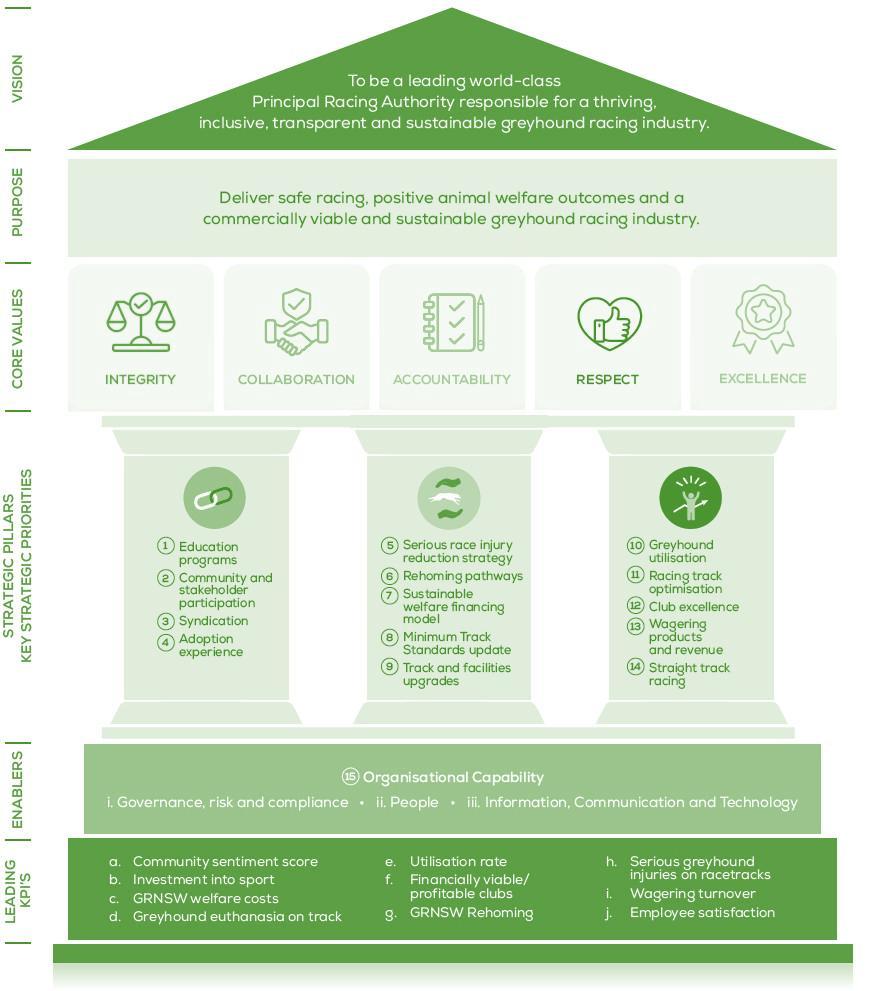
ESG integrates ethical, environmental, and social considerations into corporate strategy, risk management, and stakeholder engagement, making it a critical tool for modern business and legislative compliance requirements.

ENVIRONMENT
Compliance areas commonly reflected in ESG reporting include:
Complying with applicable NSW environmental protection legislation and regulatory requirements.
Managing working environments and any associated materials as per legislative requirements.
Continue to reduce the use of paper and increase digital documentation.
Identify possible materials that lend to improved ESG considerations, that are relevant to our operations, sustainability and longevity.
Continue to provide equipment and workspaces that meet the needs of the role.

SOCIAL
Requirements relate to workplace safety and employment law:
Work Health and Safety (WHS) obligations under SafeWork NSW

GOVERNANCE
Governance requirements include:
Governance and financial reporting obligations under applicable legislation and policy (including entity-specific requirements).
Fair Work Act compliance: wages, conditions, record-keeping
Anti-discrimination laws (state and federal).
Modern slavery: To assess revenue thresholds, customers/partners may request supplier statements.
ASIC compliance for business registration and filings
Sound risk management and internal controls expected for responsible operations
Whistleblower protections and reporting pathways in line with applicable legislation and internal policy (or if adopted voluntarily).
Privacy Act compliance. Improve transparency and accountability.
Support informed and responsible decision-making.
Engage staff through various communication and training exercises to build skills, knowledge and connection.
Aligns with legislative and regulatory obligations we are already committed to.
Further to the Executive Summary, this table captures key ESG requirements as per the new legislation. GRNSW is not subject to these requirements; however, we have developed our own commitments and associated time-lines.

ENVIRONMENT
A net-zero or emissions reduction strategy

SOCIAL
Broad social programs unrelated to GRNSW’s operations.

GOVERNANCE
Mandatory ESG reporting under AASB Sustainability Standards (e.g. AASB S1/S2).
Climate scenario modelling or complex climate forecasting.
Greenwashing – inauthentic sustainability and/or marketing initiative
Environmental initiatives beyond what is reasonable, proportionate and relevant to our activities.
Initiatives that duplicate existing WHS, HR or welfare obligations.
Responsibility for standalone ESG metrics, disclosures or assurance programs.
Additional reporting beyond what is required or proportionate to GRNSW’s size, risk profile and regulatory obligations.
This approach ensures ESG supports sound decision-making without adding unnecessary complexity.
ENVIRONMENT, SOCIAL, GOVERNANCE
“The best way to predict the future is to create it.” –Peter
Drucker
The ESG Program translates regulatory and governance obligations into practical, business-as-usual actions.
Our approach
• Assess what is material to GRNSW.
• Implement actions aligned to existing processes.
• Monitor, review and improve over time.
ENVIRONMENT, SOCIAL, GOVERNANCE
GRNSW will continue to apply ESG practices against three key pillars Environment, Social, Current reporting already includes these applications and will continue to report to the FAR Committee and Board.
ENVIRONMENT
Mindset to consider how these issues influence priorities, planning and decision-making.
Work Health and Safety (WHS) audits
Regular audits identify risks and drive continuous improvement.
How ESG considerations are reflected in social management, engagement, and planning for our people, pups and participants.
Industry recognition and engagement
ESG considerations embedded in planning for people, pups and participants.
WHS Committee oversight and uplift
Structured oversight, escalation and improvement of WHS matters.
Facility and infrastructure improvements (environmental and safety focus)
Environmental and safety factors considered in track and facility upgrades.
Incident reporting and hazard identification
Environmental hazards and incidents are identified and addressed.
Training and development Awards, summits and forums support recognition, engagement and collaboration.
Annual Employee Satisfaction Survey
Capability development across individuals, teams and leaders.
Employee Value Proposition (EVP) initiatives
Surveys and EVP initiatives support wellbeing and workforce planning.
External cultural assessment audit
Independent cultural assessments provide insight into organisational culture and inform targeted improvement actions.
Staff engagement and events
Department team-building days, all-staff events (mid-year and Christmas), key awareness days (International Women’s Day), monthly birthday celebrations, quarterly Town Halls and the annual Senior Management Strategy Session.
GOVERNANCE
How GRNSW oversees Governance and risk matters.
Enterprise Risk Register
Clear structures oversee risk, compliance and performance.
MOL Obligations Register
Risks are identified, managed and reviewed by management and the Board.
Board and Committee reporting
Licence obligations are documented, monitored and reported.
Compliance reporting
Regular reporting supports effective oversight and assurance.
Standard Operating Procedures (SOPs)
Key processes are documented to promote consistency, accountability and control.
Frameworks, policies and charters
Governance is underpinned by approved frameworks, policies and charters aligned to GRNSW’s operating context and better practice.
2026–2027 Focus: Embed → Review → Maintain → Confirm
2027 Confirm the ongoing approach remains proportionate and appropriate for GRNSW.
2026
Note ESG related activities in current and any future reporting. GRC and People Culture reporting to note ESG practice so as to highlight ESG action, without doubling up on reporting.
2027
Ensure policies, procedures and registers remain fit-for-purpose and compliant.
2026
Note ESG-related activities on our current Risk Register to align with our own ESG commitments. Also to capture in a current system without doubling up on reporting.
Understand how ESG obligations apply to their role and day-to-day activities.
Comply with policies, procedures and controls that support environmental, social and governance outcomes.
Set expectations for ESG performance across the organisation.
Provide oversight of material ESG risks, obligations and controls.
Ensure ESG considerations are embedded into governance, risk and reporting processes.
Identify, manage and escalate ESG-related risks, incidents or improvement opportunities through established channels.
Monitor, coordinate and report on ESG matters through existing management and Board reporting cycles.
Review and endorse the ESG Program and approach.
Contribute to a culture of integrity, accountability and responsible decision-making.
Integrate ESG considerations into strategic planning and executive decision-making.
Receive regular reporting on ESG-related risks, regulatory developments and compliance status.
Provide counsel and challenge to ensure ESG remains proportionate, fit-for-purpose and aligned to GRNSW’s risk profile.
‘Let’s get it Done.’
Steve Griffin CEO GRNSW