THE
ROTUNDA
LONGWOOD COLI^EGE, FARMVILLE, VIRGINIA, TUESDAY. DECEMBER 6.1977
VOL. LIII
NO. 11
President Willett's Tenth Year At Longwood
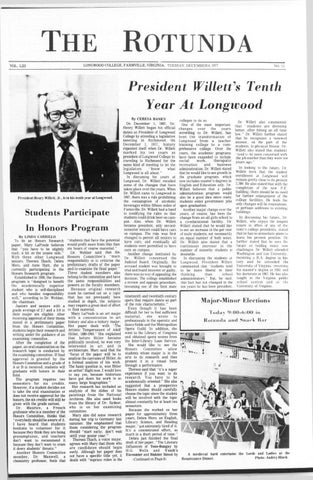
President Henry Willett, Jr., is in his tenth year at Longwood.
Students Participate In Honors Program By LINDA CARRILLO To do an Honors Research paper. Mary I^aPrade believes that 'you have to be slightly mad; a bit on the insane side." With three other Longwood seniors. Therees Tkach. Debra Mero. and Anne Hunt, she is currently participating in the Honors Research program. Kstablished in 1930. the Honors program is "designed to benefit the academically superior student who is self-disciplined and who handles responsibility well." according to Dr. Webber, the chairman. Juniors and seniors with a grade average of 2.7 and a 3.0 in their major are eligible. After receiving approval of their thesis stated in a preliminary paper from the Honors Committee, students begin their research and writing under the guidance of an examining committee. After the completion of the paper, an oral examination on the research topic is conducted by the examining committee. If final approval is granted by the Honors Committee and a grade of A or B is received, students will graduate with honors in their field. The program requires two semesters for six credits. However, if a student decides not to take the oral examination or does not receive approval for the honors, the six credits will still be given with the grade earned. Dr. Maurice, a French professor who is a member of the Honors Committee, thinks that "everybody should be aware of it. I have heard that students hesitate to volunteer for it because they think they are being presumptuous, and teachers don't want to recommend it because they don't want to cram it down students' throats." Another Honors Committee member. Dr. Maxwell, a chemistry professor, feels that
•students that have the potential would profit more from this than six hours of course material." Dr. Webber said that the Honors Committee's 'main responsibility is to criticize the preliminary drafts of the paper and to examine the final paper." Three student members also belong to the committee and have the same responsibilities and powers as the faculty members. Because original research must be carried out on a topic that has not previously been studied in depth, the subjects may require a great deal of effort to find material. Mary IxiPrade is an art major with a concentration in art history and also a history major. Her paper deals with "The Artistic Temperament of Adolf Hitler, 1889-1949." She explained that before Hitler became politically involved, he was very interested in art and in architecture. Mary said that the "focus of the paper will be to analyze the canvases of Hitler, do a formal analysis of his work. The basic question is, was Hitler an artist? Right now, I would love to say yes, because historians have put down his work in so many large biographies." Her research has included an analysis of the slides of his paintings from the National Archives. She also used books from the library of Dr. Sydnor, who is on her examining committee. Mary also did some research during her trip to Germany last summer. She emphasized that those considering the program should "start early; don't wait until your senior year." Therees Tkach, a voice major, agrees with Mary that those who are candidates should begin early. Although her paper does not have a specific title yet, it deals with "soprano roles in the
By CERESA HANEY On December 1, 1967, Dr. Henry Willett began his official duties as President of IiOngwood College by attending a legislative meeting in Richmond. On December 1, 1977, history repeated itself when Dr. Willett marked his ten years as president of Ix>ngwood College by traveling to Richmond for the same kind of meeting to let the legislators "know what longwood is all about." In discussing his years at IxHigwood, Dr. Willett recalled some of the changes that have taken place over the years. When Dr. Willett came to longwood in 1967. there was a rule prohibiting the consumption of alcoholic beverages within fifteen miles of Farmville. Dr. Willett had a hand in modifying the rules so that students could drink beer on campus. Also, when Dr. Willett became president, only secondsemester seniors could have cars on campus. The rule was first changed to permit all seniors to have cars, and eventually all students were permitted to have cars on campus. Another change instituted by Dr. Willett concerned the Judicial Board. Originally, the accused student was brought to trial and found innocent or guilty, there was no way of appealing the decision. The college established a review and appeals procedure, becoming one of the first state nineteenth and twentieth century opera that require dance as part of the role characteristic." Even though it has been difficult for her to find sufficient material, she wrote to professionals in the operatic and dance fields and the Metropolitan Opera Guild. In addition, she went to the Library of Congress and obtained opera scores from the Inter-Library Ix>an Service. She would like to see the Honors Committee allow students whose major is in the arts to do research and then present it in a visual form through a performance. Therees said that "it's a super experience if you want to do research. You have to be academically oriented." She also suggested that a prospective Honors student should carefully choose the topic since the student will be involved with the topic almost constantly for at least two semesters. Because she worked on her paper for approximately three years, Debra Mero, an English, Library Science, and Reading major, "got extremely tired of it. It's a concentrated effort, so much in a short period of time." Debra just finished the final draft of her paper, "The Literary Influences of Tono-Bungay by H.G. Wells and Youth's Encounter and Sinister Street by (Continuedon Page8)
colleges to do so. One of the most important changes over the years according to Dr. Willett. has been the transformation of Longwood from a teacher training college to a comprehensive college. Over the years, the academic programs have been expanded to include social work, theraputic recreation and business administration. Dr. Willett stated that he would like to see growth in the graduate program, which now includes master's degrees in English and Education only. Dr. Willett believes that a publicadministration program would also be a good idea since many students enter government jobs upon graduation. Another major change over the years, of course, has been the change from an all girls school to a co-educational facility. Dr. Willett stated that he would like to see an increase in the per cent of male students, not necessarily an equal number of both sexes. Dr. Willett also stated that a continuous increase in the number of minority students is desirable. In discussing the students at Longwood, President Willett commented ihat students tend to be more liberal in their thinking than school administrators." But, he said, this fact has not changed in the ten years he has been president.
Dr. Willett also commented that "students are dressing better, after hitting an all time low." Dr. Willett further stated that he recognizes a renewed interest, on the part of the students, in physical fitness Dr. Willett also slated that students tend to be more concerned with the job market than they were ten years ago." In looking to the future. Dr. Willett feels that the student enrollment at Ixmgwood will remain pretty close to its present 2.300. He also stated thai with the completion of the new P.E. building, there should be no need for further enlargement of the college facilities. He feels the only changes will be renovations, or perhaps additions to existing buildings In discussing his future. I)r Willett. who enjoys the longest tenure in office of any of tinstate's college presidents, stated that he has no immediate plans to leave his present position lie further stated that he sees the future as holding many new challenges I)r Willett attended Washington and Lee University. receiving a B.A. degree in history and he attended the University of Virginia, receiving his master's degree in 1955 and his doctorate in 1967. He has also taught in the Virginia public school system and at the University of Virginia
Major-Minor Elections Todtt) 9:00-6:00 in Kotiiiidn and Snack liar
mi
A medieval bard entertains the I-ords and Indies at the Renaissance Dinner. Photo Audrey Hinck
Page 2
THE ROTUNDA
Tuesday, December 6,1977
Various Crafts Displayed In Bedford By CONNIE BARBOUR In continuation of a newly begun tradition, Craft Collectables, III, is being held in Bedford Gallery, December 1-16. Displayed are crafts in jewelry, pottery, enamels, fibers and batiks. These crafts have been contributed by twelve craftspeople throughout Virginia with varied degrees of art education and a good deal of background experience. Contributing jewelry work is Peter Wreden from Koanoke where he owns a studio. Part of his art education was obtained from studying at Kcole National Superior deBeaux Arts and liOUvre in Paris, France. Mr. Wreden's Collection includes several necklaces in sterling and one which is bronze electroplate in 24 K gold. He also has sterling silver rings on display. Professionally, he has been a free-lance artist-designer, printmaker, portrait painter and sculptor and held the position of art director with several companies. He has exhibited his collections in several large Virginia colleges and banks as well as in the Virginia Museum of Fine Arts He has participated in several art and craft shows and jurored shows in Florida, West Virginia and Virginia winning several awards and honorable mentions Gabriel Ofiesh, HI has also entered jewelry work in the Exhibit. Mr. Ofiesh was born in Sacramento, California, but now resides in North Garden, Virginia He has a studio at McGuffy Art Center in CharlottesviUe. He is a self* taught craftsman. He has had exhibitions with the First Goldsmiths Invitational and the l.yn Yeatts Gallery. Mr. Ofiesh works mainly with sterling silver. In the exhibit you can see several rings, a multistrand choker and two reversible pendants, one of montana agate and sterling silver, the other of jaspar and sterling silver. Lyn Yeatts resides in Koanoke. She received her B.S. from the State University of New York and her M.S. from Kadford College. In addition she has taken several art courses at the University of Virginia and the Virginia
Polytechnical Institute. In addition to using copper, brass, bronze and sterling silver for her jewelry, she also uses unique accessories such as a doll's eye in a necklace and guinnea feathers in another. She also has on display a cast brass buckle in relief form of a woman's face. A few of her many accomplishments include being executive director of the Roanoke Fine Arts ('enter, being named to the listing of outstanding, "Young Women in America and being a professional affiliate of the National Society of Interior Designers. The last jewelry exhibitor is Linda Burton Van der Linde. Ms. Van der Linde received her B.S. in Biology from Longwood College ard has studied to be a research technician and done neurosurgery research at the University of Virginia. Since 1974 she has been working in clay and designing and making jewelry. She has a studio in the McGuffy Art ('enter. Ms. Van der linde has participated in exhibitions in the Philadelphia Museum, the Virginia Museum of Fine Arts, Saks Fifth Avenue and others. Her jewelry includes stick pins and ribbons of delicate rose shaped clay in soft pastel colors, clay earrings and beautiful clay beaded necklaces in natural earthy clay colors. Entering works of pottery is Susan G. Carden. Ms. Carden received her B.S. in art from Longwood College. She is a former art teacher in Virginia Beach Public Schools. Ms. Carden's work "combines the wheel thrown pot with the hand built slab." In her words she says, "pottery is an extension of the potter's vision and spirit." She says, "I like the natural color of the clay and hesitate to cover a piece with a heavy glaze. As I work, I learn." Ms. Carden's collection includes several platters, bottles, hanging planters and mugs. Jim I ,ane is a self-taught potter who began at age 16. He has been an understudy with Julia Phillips and Emily Schaffer at the Potter's ('enter in Richmond. He has had exhibits with the Virginia Museum Crafts Biennial, Crafts Fair &I & II and Craft
Collectables I & II at longwood College. At the present he is a free-lance potter doing woodfired stoneware at his studio in Farnham, Virginia. His pieces are practical and useful as well as beautiful. They range from canister sets, salt and pepper shakers, and mugs, to soap dishes, oil lamps and dwarf figurines. He uses blue, green, brown and white glazes as well as leaving his pieces natural. Julia Phillips is specialized in the ancient Japanese art of I^aku pottery and is from Richmond. "The technique is physically and emotionally demanding and involves a mentality willing to concentrate totally while accepting totally what the shock of fire followed immediately by immersion in water or wood chips will do to a pot," she says. Her forms are hand built and sculptural, enhanced by glazes that glow and crackle, proud of their origin in flame. In the
I find the contrasting elements of the somewhat uncontrolled spontaniety arising from the reduction firing, and the control of discipline of the metallic oxides in the enamels very exciting to work with." Ms.Tudor uses vibrant colored glazes of red, blue and yellow. She makes enamel disks and plates and fine necklaces. One very attractive necklace is made up of four rectangular plates, each with a scene of the four seasons on them. Kenneth and Hulda Bridgeman are a husband-wife team working with fibers. Mr. Bridgeman is an attorney whose interest is loom making. He makes harness table looms, harness frame looms, tapestry frame looms and 1-sided inkle looms. The price range is $18-$100. Mrs. Bridgeman is a fiber artist. She received her B.A. in Biology from Oberlin College, studied studio art at the
SWAP SHOP MEETING Tomorrow 8:30 P.M. Reading Room I^ankford Come help for a Successful Swap Shop.
Students Film Festival
By LINDA CARRILLO The students of the filmmaking classes are transforming everyday life into artistic presentations for the Student Film Festival. Directed by Dr. Charlotte Schrader-Hooker, this will be the "second such festival that we have had of student-made films. All the students in my filmmaking classes will be showing their films. Each student has done an animated film and a short documentary." Dr. Schrader-Hooker also explained that the "filmmaking program is still relatively new on the campus, and it's being taught in conjunction with the film studies classes. The students study other people's films and then make their own." One of the students, Debbie Breeden, is producing her version of 'The Sound of Music." She. her family, and friends have been working on the film for more than two years. They have been to Austria to film on location. Dr. Schrader-Hooker Susan Carden designs a pot. remarked that Linda Day based Photo: Courtesy Of Art Department her documentary on Ixjngwood exhibition you can see squash University of Minnesota and art tennis players, and David pots and smoked pots. She has at University of North Carolina. Hamilton's film deals with auto used orange and yellow glazes. Her special interests in weaving repair. Tricia Smalley's film is Suzanne Kraman attended are tapestry, home furnishings on Hampden Stables and the Hofstra University in New York. including woven furniture, equestrian team. She stated that She has worked with the Potter's hangings and rugs, fiber sculp- a filmmaking course gives one an Center in Richmond, taught ture, and clothing. The exhibition awareness of art and "makes you pottery at J. Sargeant Reynolds displays several of her weaving appreciate what filmmakers all Community College and in ponchos, tunics and shawls. over the world are doing." Dr. Schrader-Hooker added instructed two laku workshops. Most of the fabric is of wool and She has participated in cotton, are striped, and are that "we would like to encourage exhibitions in Florida and bright greens, reds or neutral all students to come see the throughout Virginia winning colors. She also makes guitar program." which will be in Bedford several prizes. Her works include straps and several wall hangings presented Auditorium. December 12 at 7:30 pedestal mugs, clay planters and and tapestries, one titled p.m. saucers, casseroles, tea pots and Sunflower Tapestry', which is a juicer. Her pieces are both colored with black walnut hulls. unglazed and glazed in light Theresa S. van Groll does v,n iety Of Music browns, gold and blues. She has beautiful works of art in batiks. been represented in the private She has a M. A. in Art History and i vonts Upcoming collections of Mr. and Mrs. Jack a minor in studio from Wit. Ms. Edith Schermerhorn Washington University in St. and many others. Within the next two weeks the Ixwis, Missouri. Her batiked Jean Tudor is a professional pillows are of animals, plants and music department will present craftsperson working with abstract designs. She uses bright the following attractions. vitreous enamels. She has yellows, greens and blues. Also The annual Christmas Concert worked with enamels on a on display is her Amsterdam presented by the Longwood "cookie-bake" hobby level, at- Hanging, which is done in purple, College Concert Choir and tended the Penland School and blue, green and orange dyes. Camerata Singers will be held on Crafts, studied under Fern Cole Ms. Bishop and MsJ*ine have Sunday. December 11 at 4:00 and Mary Ellen McDermott of done a wonderful job of p.m. in the Farmville Baptist the Cleveland Institute of Art and arranging the crafts in a pleasing Church. Both groups are under William Harper of Florida State way for your viewing. Go by and the direction of Dr. James University, with an emphasis on see the exhibition and maybe buy McCray. chairman of the music cloissone. "I have worked some something. These crafts have department. The public is in almost all the enameling been made by some of the best cordially invited to attend; there techniques, but particularly craftspersons in Virginia. You is no admission fee. enjoy cloisonne...I have been have a large variety from which The Camerata Singers will also experimenting with applying the to choose. Don't miss this be presenting off campus fixing techniques of raku pottery opportunity to see or buy quality performances during the to the making of enameled bowls. crafts. Christmas season for the patients of Holly Manor Nursing Home, SENIORS ORDER ANNOUNCEMENTS the Farmville Rotary Club, the Farm Credit Union, and for the Wed., Dec. 7 12Noon-5P.M. visiting counselors throughout the state of Virginia. In Rotunda The Departmental Recital will Pay In Full be held December 13 at 1:00 p.m. in Molnar Recital Hall. This Senior Informals recital will feature music I.A.A. Room JIM DUNN DECORATES THE TREE. performed by the music majors. The other 1977 Elves are linda Pascal, Cappy Kennon. Kit The longwood College Band Thurs.. Dee. 8 - Fri.. Dec. 9 Hughes. Boo Elliot. Sarah Hazelgrove. Stephanie Wright. Cathy will hold an informal concert Manger. Madeline Kannon. Micah Alderman. Sarah Stump, Yenetia Tuesday. December 13 in the 12-5 6-10 12-4 Gold Room at 8:00 p.m. They will Raines, and Heidi Ferner. Photo: Neil Sullivan perform a wide variety of music.
Page 3
THE ROTUNDA
Tuesday. December 6.1977
It's ROTC. ..
. MAKE SOMETHING OF IT! For the Freshmen or Sophomores it isn't too late to make something of ROTC while you are still at Longwood. Add Military Science to your schedule next semester! There is no obligation during your first two years in the program. So stop procrastinating and start thinking about your future.
Think about adding a new dimension to your present and your future. Add Military Science to your schedule — you can register just as you would for any other class. Stop by the Military .Science office and talk to Major Hamaker about the details of the ROTC program. Or call 392-9259. Military Science could be your most important decision next semester.
Army ROTC LEARN What It Takes To Lead
THE ROTUNDA
Page 4
Tuesday, December 6,1977
FROM THE EDITOR
en
O
8
tj
oJ ^ >
I
o
Activities Fees Provide Background Music By BRIDGET SCHERZ Each August along with tuition, and housing fees, students dutifully plunk $35 into that proverbial change slot over in East Ruffner to hear Ixwigwood campus wind up another chorus of "'I>et Me Entertain You" for the coming academic year. If it's not going too far to compare Student Activities Eee to a song, you might as well call it background music—the kind that's seemingly on all the time but not really noticed until someone turns it off. Lynn Sullivan, chairwoman of Student Activities Committee, recently discussed some of the committee's fundtions, procedures and obstacles. The Student Activities Fund, according to Lynn, provides supplementary funds to service groups on campus. The recipient of Student Activities moneys must have organization status recognized by the campus, and must be non-denominational in compliance with state law. Typical examples of organizations operating in part through fund appropriations include Student Union, Dance Company, Ixmgwood Players, Artist Series, and the Rotunda. Equipment and fixtures for I^ankford building do not fall under the auspicies of the Committee, Lynn said, as I.ankford is simply a physical structure and not an organization. The Student Activities Committee, is the administrative body that acts as a supervisor and clearing house for money it receives each school year. The Committee is comprised of students, faculty and members of the administration. Faculty members such as Sandra Breil of the science department and administrative personnel such as Dean Wells, Betty Parnell (treasurer of the college) I^awrence Martin (auditor) and Raphael Stevens (who is holding Dean Swann's slot on the board) serve for a period of three years. Two students from each class are members in either a temporary or long-term status. A representative is elected from each successive freshman class who serves through her (his) entire four years at school. Student committee members who for some reason must drop out of the committee, are replaced by
THE ROTUNDA ESTABLISHED 1920 EDITOR NEWS EDITOR BUSINESS MANAGER OOPYEDITOR I .A YOUT
Margaret Hammersley DaveGates Amy Blanks DaveGates Mary Dunavant, Cindy Cumins, Kim I^auterbach, Debbie Northern. Dave Gates ART I/.n helland Kathy Rogers CIRCU1 ATION Bridget Scherz. Connie Barbour ADVERTISING DaveGates PHOTOGRAPHY Uri Felland. Nancy Cosier. Dave Phillips. Kendall Adams. Howard Fox, Jo Woo, John Badger, Neil Sullivan STAFF WRITERS Pam McDowell. Frances Hall. Pennj Robinson, Debbie Northern, Paula Johnson, Bridget Scherz, Iinda Carrillo. Sandra I assiter, Jan Turner. Pam Kellett. Judy Faires, Ann Ruotolo. Debbie Moul Barbara Slough Karen shelton I*ublished weekly during the college year with the exception of holidays and examination periods by the students of Ix>ngwood College, Farmville, Virginia. Printed by the Farmville Herald. Opinions expressed are those of the weekly editorial board and its columnists, and do not necessarily reflect the views of the student body or the administration. letters to the editor are welcome. They must be typed, signed and submitted to the editor by the Friday preceding publication date. All letters are subject to editing.
tne process of election. These elected members then are the stationary segment representing the students. The other four student committee members are installed on a temporary basis as one of their obligations as treasurer of their class. Lynn sees this mix of stationary and transcient members as a basis for providing fresh perspectives as well as a seasoned understanding. "Student activities procedures," says Lynn, "take a long time to understand." Watching the Student Activities penny roll from estimation in late Spring to destination in May of the following year, it travels something like this: In the spring Mrs. Kidder submits a hypothetical budget to the Committee based on a headcount of returning students and an estimate of the anticipated size of the incoming freshman class. At this time organizations also apply to the committee for funds for the following school year. After the committee has reviewed the written requests, they interview spokespeople from the various organizations to clarify any questions that the committee may have as to their applications and to sell to them any new programs they may want to initiate in the approaching academic year. In light of these face to face requests, the committee reviews the applications a second time and conducts a formal vote. "The committee chairman," explains Lynn, "does not vote. It is not single power centered only in the rare case of a tie." The committee also operates by standard parliamentary procedure observing the "34 quorum to vote" rule and approval as defined by a majority. Groups are then informed of the amount of their appropriation by letter and are also given an explanation for any budget cutbacks if they happen to apply. For those organizations who feel financially slighted, there is always the appeal. Many times it involves only that "the organization rework it so it does come under our jurisdiction," says Lynn. New organizations in the funds must first have their constitution approved through Legislative Board. After they have established themselves through the board as an official campus entity they should contact Lynn Sullivan or any other committee member and ask for an appropriations sheet. They then meet with the Student Activities Committee to familiarize them with their type of membership,
A Request From CHI December 6,1977 This is not a letter of commendation, or of condemnation, but a request. CHI is making an appeal to the student body for all campus organizations. Publicity articles such as signs, posters, and banners are put up by individual groups for student information. Please allow all publicity material to remain intact until the event is over. Thank you for your co-operation and support; it will result in a more informed campus. Sincerely, CHI of 1978
their objectives as a group and their plans. Lynn offers a word of practical advice to evolving campus groups; "(they) have a better shot if they are open to all and reach the largest number of students." Duplicating their appropriations ritual of the spring, the committee then votes and informs the new organization by mail. Mr. Martin distributes the bookkeeping materials and explains their keeping to the representatives of the new group. •Often they can pick up the money the same affternoon as its voted on" the chairwoman said. A practice that often carries the brundt of some misunderstanding is the committee's use of a contingency fund. Whereas individual organizations carry over excess funds from one year to the next, the Activities Committee reserves a certain percentage of their present budget and places any remaining moneys from a previous year into another spearate fund. There are then two contingency funds; the first is designed to provide for any large unexpected projects that may evolve, for any new organizations that may emerge during the year, and to bail out any groups that may have financially dug themselves into a hole. According to Lynn $2,500 per semester usually allows them enough slack, and seems to be an important consideration as it is usually spent. What isn't used up in the course of the year is deposited in the other, more general contingency fund which is "set aside for larger projects." President Willet has supervision over a fund that has recently provided for the universal gym and will finance the inter-campus phone system. Most discrepancies though usually lie within bookkeeping errors made by the organizations. "Some organizations have two accounts. If they transfer money from one to another in the amount over $100, they have to notify Student Appropriations." If they don't it is often the basis of confusion." explained Lynn. Lynn feels that for its size Ixmgwood does an admirable job in providing on campus entertainment. On the subject of booking big name brands, Lynn recalled the FATEFUL Jo Jo Gunn concert of several years ago "when we were burnt." LC apparently lacks the seating or the track record of overwhelming concert participation that are necessary for a large concert not to spell financial suicide. Lynn also feels that the $35 paid at the beginning of the year may very well be an economic way of preserving your sanity at a budget price. "If you paid for everything as you go, it would far outdistance the $35 fee."
OFF THE URLL ID era
"yk •v t=3
LTD
cq
Page 5
THE ROTUNDA
Tuesday. December 6.1977
Technical Crews Set Stage For Little Eyolf By BRIDGET SCHERZ It is a night somewhere in the middle of the week — late — maybe 10:30. Standing in the parking lot behind Jarman its windows glow in an almost perfect array, like a gallery of lighted pictures. Occasionally someone inside will pass in front of one of the lighted squares, but the vantage point is poor where I am standing. At best I get a glimpse of shadow, sometimes form. Inside, the banshee scream of a table saw seems to vie with an offbeat ensemble of hammers whacking away at nails. Voices fill in the void when they are quiet. Standing outside I have a sense of the activity within: but the sights and sounds are fragmented and tell little. In order to understand what the seepage of noise and light has to do with the making of the next play. Little Eyolf, you have to step into its source. The source of Little Eyolf, or any play, is within a group of people and a system of "crews" which organizes them so that all acting and technical considerations have a specific group responsible for them. A crew chief is chosen through a screening process (based on experience and the ability to work well with other people) conducted by the executive board of the IiOngwood Players. Rather than having the different crews run independently along with their hammers, needles, cables and paints, crew chiefs keep the lines open between themselves and the director. Weekly production meetings, along with random daily exchanges, provide the technical cohesiveness that gives a well-produced play a sense of aesthetic unity. What the audience sees then, is less the work of the hand of chance than an exacting artistic shaping of a manufactured reality. The most massive physical element of I ittle Eyolf is the set.
What is now a ghostly chorus line of flats that drift back and forth gently from the batons will be by the hands of Theater Arts professor Ben Emerson and his stage craft class and set crew, an outdoor setting of trees, water and ground foliage. Mr. Emerson is also the scene designer whose job entails "drawing up" the overall setting as well as providing the construction specifics in the form of scale drawings sketched from different perspectives. In determining the overall approach to a scene, according to Mr. Emerson, there are "a combination of things . . . You read the script and think about what the playwrite is trying to say." The next step involves a "conference with the director and other designers to work out a concept for the show . . . The director has the overriding decision." The setting in Little Eyolf is not merely incedental, but in itself expresses something about the play: The goal of the scene designer appears to be able to create a "design that reveals the meaning of the play i and that) the actors can move in and use." During an afternoon with stage craft class I alternate between milling ginerly around some scenery lying on the floor and frantically dodging an occasional flat (a muslin covered wooden frame) that comes swooping down from the rafters on a giant dowl or "baton." Standard size flats are saved from one show to the next and are used as building blocks on which curved or jagged portions of the scenery are added on. The set crew pounds together, paints over, pastes up, and saws in two all the flat and three dimensional scenery on stage. Theater, no exception from other professions, also has its own jargon for describing techniques indiginous to its artform and for sort of general activities that seem to be done with at least some frequency by theater personnel. An illustration
of the second point is when I heard that Barbara Woods was in the shop "ripping 1 x 3's." Expecting to find her viciously disassembling a board splinter by splinter with her bare hands, I was more than surprised to see Barbara guiding a long plank along the table saw. Props is the sometimes annoying stepchild of set. Buddy Borne, along with having to come up with an oval rug, a Norwegian flag and two plush straightbacked chairs, has to borrow and care for thirty live plants. Props are usually made, pulled from the storage room and revised to suit the particular production, or borrowed. As lighting is a medium in its own right, it too requ'res a special designer. Vicky Mann has worked out the lighting design for IJttle Eyolf and described its process. The designer first goes through the script and notes the intensity of light and dark in the various scenes. In IJttle Eyolf the tendancy runs from light to dark, symbolic of "the lack of hope . . . the dying of the relationship," as Vicky observes. Next a direction scale is made indicating by arrows the sources of the light on stage. A story board is then sketched depicting the placement of highlight. An instrument setup chart lists the instruments used along with any related data about them. The lighting schedule consists of a drawing of each lamp used on a baton. Lighting cues, says Vicky, "are written up at dry tech (run through of lights, sound, etc. without actors) and redone . . . and redone . . . and . . ." During a lights crew session Linda Kulp and Merle Phelps connected by cable a series of instruments suspended on a pipe from the ceiling over the very foot of the stage. Linda was doing some kind of splicing work on the cables as Merle scrambled up to the extension rungs of the huge steel ladder. Draping herself over the topmost rung like a pair of folded pants over a chairback to catch a loop of cable we were hurling up from below, she attributed her behavior to the fact that "I ain't got no sense." Merle recounted her famous drill drop episode which is surely destined to go down among Jarman s distinguished wealth of ladder lure. Standing on a ladder one day in Jarman, fisting a drill, she lost her balance and took an unplanned dive off the thing. Enroute to the sawdust gracing the floor she threw the drill onto a shelf and landed, only kneebruised, in a trash can. Climbing up to third floor and the recording studio I began the first few minutes of my interview with the sound man by watching George Bennet hyperventilate. Discounting my theory that he was trying to establish some sort of empathy with asmatics, I learned that he was adjusting his breath in the attempt to imitate the sound of a gentle wind rushing through the trees. Asking for total silence while he breathed into the mike I selfconsciously induced myself into a state of auditory nirvana. After the playback, which didn't work out quite right, George was willing to make an emphatic comment, That's the beautiful thing about sound," he said as he stepped around the studio without really going anywhere," everything can and will go
Lisa Hughes as Rita in a scene from Little Eyolf. Photo: Dr. Lockwood wrong. "Working sound," according to George, "is a one man job." An extra person may be needed to run the recorder in the booth, but the cataloging of sound effects on tape is conceivably, a solo operation. "The idea is to make sound as lifelike as possible." This involves watching for "pops and scratches" on records and using a fade-in technique in recording rather than an abrupt sound-silence recording. Also in observance of realism George does all of his taping in the studio to avoid ambient noise although he may create his own effects. Costumes, like scenery, serve more than a utilitarian purpose Susan Clift, costume designer for Little Eyolf, described some of the considerations she employed in her sketches. What the actors will wear is contingent upon "the mood of the play, the time of the play, and what the director wants . . . you and the scene designer collaborate." Susan has also done some research on the time period of the play and was conscious of the symbolic strains in the different acts relating to the forces of nature such as, Earth. Water, Air, and Fire. Although in professional theater the costumes designer does "no sewing what-so-ever," Susan is also serving in a large capacity on costumes crew. While the costumes crew chief will remain backstage during the performance, she will "be in the audience with the set designer, making sure the lights complement the costumes." Handling the publicity footwork is Susan Kay Williams. To meet the demands that a relatively unknown play poses Susan and crew member Paulette Daniels will put up posters, write promotional news copy for the school and actor's hometown newspapers and (with the assistance of Dr. lockwoodi design the program. In the studio theater, a small shoebox painted black the actors move through the blocking (stage movements) and dialouge. Transcending blue jeans and metal folding chairs Lisa Hughes and Ken Neimo thrash out the crisis between their characters Rita and Allmers. The director. Dr. lockwood is seated on a paint crusted wooden bench, leaning
against the wall. His Instructions are given in a quiet level lone, lake another step . . . place your hand on his arm . . much better." Two girls sitting on the couch next to Dr. lockwood are glancing at notes, occasional!) scribbling something, seemingl) reguarding the drama before them with the indifference usually reserved for TV. until someone misses or calls for a line, in which case it is fed immediately to them Nina I-effue, seated on the aforementioned couch, was doing her job as stage manager, which includes checking blocking, attendance and keeping notes Ann Via, as assistant stage manager, was acting as prompter. During the performance Nina will be doing light cues while the assistant will be cuing the actors a half page before they go on." Reflecting on the rehearsal schedule Sun Thurs. 2 hours a night for about 7 weeks Nina says that "if I didn't have that I'd be bored to death." As a freshman, this is her first experience backstage about which she feels that, "you don't need special talent just interest." In the role of Rita. Lisa Hughes, is able to concentrate on her character by thinking about the relationships between characters." She finds in fact that "other character substitutes can often throw you off." When asked if the audience is in any way a distraction, she said, "from the stage, you don't see them. When they react, such as laughing at a comedy, it acts as a reinforcement." If any comment came up consistently all across the board, it was that more people can, should and are needed to become involved in the productions The concensus too is that I/mgwood Players and the Department of Speech and Dramatic Arts sponsor educational, not professional theater and that students, novices and veterans as well become involved with the intention to learn something and maybe pass something they know on to someone else. IJttle Eyolf will be produced Dec. 7-10, 8 o'clock curtain-lime. Admission is free to students with ID; $2.00 for the general public.
Page 6
THE ROTUNDA
Tuesday, December fi, 1977
J.V. 1-1
Lady Lancers Drop First Two Games; Defeat WC-6 By DEBBIE NORTHERN The lady I oncers played their first regular season basketball game November 22 with a loss to Virginia State College 63-76. The first minutes of the game indicated that the officials were going to call a tight game. Violations on both teams kept anyone from scoring for a good while, until DCs Sue Roma sank the first bucket. At half time Ixmgwood trailed by only four points, but Mary Jane Smith faced early foul trouble, with four fouls. Throughout the first half the I-incers were charged with 35 turnovers due to hasty plays. Longwood settled down somewhat in the second half and lied tin- score 43 all after the first feu minutes, but the team still ended with 1!) turnovers after this half Virginia State was called for three technicals in the second half, mainly because of their aggressiveness on the court and flaring tempers. Two IjBncers fouled out in the second half. Sue Roma left with 13:20 in the game and Cindy I.,IM(IOII touled out with 5:48 remaining. Virginia State had seven players with four fouls and .1 total of 38.
Sue Koma led the I-ancers, rebounding by pulling down 10. Hrenda Kettrow was high sdirer with 17 points. Also in double figures were Mary Jane Smith with 15 and Sue Roma with 14. Coach Karlene I-ang called the game Sloppy!" She added, "we threw the ball away on ridiculous turnovers." list Tuesday, the varsity team took on Norfolk State and took an 81-64 loss. Longwood, under pressure from Norfolk State, had several turnovers. With 11:00 left to pla> in the first half, the
I oncers were able to tie the score at 18 all. Hut then Norfolk State pulled away with a 12 point lead in the remaining 5:00. At halftime, Norfolk State was ahead 46-33. The second half of the game was not much better for Ixmgwood. L.C. was not moving the ball offensively. Sue Rama, Brenda Kettrow, and Melissa Wiggins were in foul trouble with four fouls. Norfolk State went into the bonus situation early, but I xmgwood was unable to go to the line for the bonus. Three I oncers were in double figures; Mary Jane Smith with 14 points, Sue Rama with 19, and Brenda Kettrow with 17. Sue Rama led with 14 rebounds, closely followed by M. J. Smith with 12. Thursday night the J.V. defeated Kerrum 62-59 in a close, exciting game. At half time Ixmgwood led by a slim two points. In the second half. Kerrum took a !) point lead with 10:00 remaining, but through consistent play by the I oncers, it was tied with 2:25 left in the half. A one-point lead was traded between the two teams for several minutes, until Linda Pullen opened the lead to three points by sinking foul shots in the final seconds. High scorer for the lancers was Debbie Hood with 16, Linda I'ullen followed with 12. The scoring was pretty evenly divided between the other players. Ixmgwood sank 35.4 per cent of their field goals and 58.3 of their free throws, compared to Kerrum's 52 per cent from the floor and 46.6 per cent from the line. Coach Iiang commented that the team "did a really good job." They kept their composure under pressure, even though they were inexperienced and did a great
Men's Team Beats Eastern Mennonite By CARLTON WHITE The Ixincer's Men's basketball had three players in double team opens the season with a 1-3 figures, lead by Kevin Newton record, with losses due to the lack with 20 points; Earl Witcher with of board strength. The lancers 16 points, and Byron Bracey with were very well played, being the 13. Longwood turned the ball over first contest in which the squad 29 times in this game. operated as one. When Longwood played The first two games were Eastern Mennonite college played away November 25 and 26 however the tide turned. This against Virginia Wesleyan and game was one in which team play Christopher Newport. Shooting was very well executed. Several only 30 per cent from the field, players were in double figures. the lack of board strength They were Kevin Newton with 28 previously mentioned hurt the points; Jimmy Yarbrough with lancers. Virginia Wesleyan had 24 points; Byron Bracey with 17 a 101-81 victory over Ixmgwood, pointe and I^awrence Pleasants Jerry Crammer being the high with 11 points. An interesting scorer with 17 points. In the game point of note is that at the foul line with Christopher Newport, most of the formentioned players rebound ills again hampered the shoot well under stress. The final lancers. Though lacking the score was 96-81. needed board strength Ixmgwood On Saturday, the men's did give Christopher Newport a basketball team played in the Al scare. Keuled by the scoring Morgan Classic against Concord power of Jimmy Yarbrough the College in Athens, West Virginia. lancers led twice in the second The Uncers fell to the more half. Dale Travis, with 20 points, experienced Concord team 91-67. and Conway, with 19 were thehigh Concord had a height and size scorers for Christopher Newport advantage over Ixmgwood. in their win of 98-83 over Coach Bill McAdams said the Ixmgwood. team never gave up. Even though The third game, November 29 Concord took the lead at halfat Ixmgwood against Saint Pauls time, L.C. came back to the make was a 100-67 loss for the I-uuers it a close match in the third Five of the opposing players were quarter. Coach McAdams felt the in double figures, lead by James game was a good experience for Goodwin' s 20 points. Ixmgwood the team.
deal of hustling under the boards. Both teams traveled to compete against University of North Carolina at Greensboro on Saturday. The varsity came away with a 75-64 win. Mary Jane Smith fouled out early in the second half. Iinda Baumler and Brenda Kettrow each had four. High scorer for the game was Sue Rama with 18 points. MaryJane Smith followed with 13 points, Brenda Kettrow with 11, and Cindy Saunders with 10. The J.V. team dropped their game 85-57. Darlene Douglas and Marie "Ree Cee" Steel led the scoring with 9 points. The rest of the scoring was spread evenly. Nancy Wilson fouled out in the final second of the game.
Cindy Landon drives for two points in the Virginia State game. Photo: Debbie Northern
SPORTS Heisman Winner To Be Announced On Television Special By DEBBIE NORTHERN Kor the first time, the winner of the Heisman Trophy will be announced by an entertainment special, "The Heisman Trophy Awards Special". The winners of six new football awards will also be announced at this time. The broadcast will be live from the New York Hilton Hotel by CBS on Thursday, December 8. Elliot Gould and O. J. Simpson, New Spirit A new addition to the Ixmgwood Basketball games are the 16 spirited cheerleaders. They are Dawn Reish. Keith Noone, Dana Kenton, Jack Thomas, Ron Stalling, Barbara Brogdon, Ellen Ellenski, Brenda Black well, Kathy Downey, Cyndy Downey, Debbie Sims, Pat Carens, Jane Bruce, Shelia Gallahardt, Donna Nuckols, and Trina Garcha.
the 1968 Hiseman Trophy winner from Southern California University and a current Dlayer for the Detroit Lions, will host the special. There will be entertainment segments with a theme of college life and college football. Among the performers and celebrities who will appear on the show are Ix^slie Uggams and Connie Stevens. The Heisman Trophy is awarded to the most outstanding college football player in the United States. Sportswriters and sportscasters vote on the recipient of this honor. I^ast year Tony Dorset of the University of Pittsburgh, now a player for the Dallas Cowboys, received this award. Past winners include John Cappelletti (1973, Penn State), Rodger Staubach (1963, Navy), and the only two-time winner, Archie Griffin (1974 and 1975, Ohio State). This award is given by the Downtown Athletic Club in New
Jimmy Yarbough leaps for a shot. Photo: Neil Sullivan
York in memory of John W. Heisman. Heisman, a football coach from 1892-1927, introduced the center snap and legalized the forward pass. His innovations added more excitement to the game of football. This year six new awards will be presented. They are called DACS, after the Heisman sponsors, and will be awarded to the outstanding players of the following positions: offensive back, offensive lineman, receiver, defensive lineman, linebacker, and defensive back.
Lancers Apply
To NCAA By DEBBIE NORTHERN Ixmgwood College has applied for membership in the NCAA Division III. The application was mailed Wednesday, November 23 by Dr. Judy Johnson. Normally it takes six weeks for the NCAA to process applications, but Dr. Johnson said that Ixmgwood has been told that their applications will be rushed through in order to give the school voting privileges at the NCAA Conference in January. A representative of the college will attend the conference in Atlanta even if the application has not been accepted by this time. Dr. Johnson feels that membership in the NCAA is taking a "right step". Kor one thing, it "gives the boys some goal" by being able to compete in tournaments and a possibility of championship play. Also Ixmgwood's male sports program will gain respectability with other schools because the same rules and regulations will apply to Longwood, as they do to many of the schools Longwood competes against. There are no foreseeable problems of becoming a member of Division III, according to Dr. Johnson.
Page?
THE ROTUNDA
Tuesday. December 6,1977
Investigations
Holiday TV Viewing That 'Happy Jolly SouF
Roots In Christmas Special
the happy-go-lucky snowman with the corncob pipe, the button nose and two eyes made out of coal, features Billy DeWolfe as the voice of the villainous Professor Hinkle, a magician whose stovepipe topper transforms the lifeless snow figure into an enchanting songand-dance man. Pursued by the hatless professor and rising temperatures, Frosty sets off for the North Pole to keep from melting. En route, the indomitable snowman weathers a whirl of adventures and overcomes the threat of evaporation.
fc
Twas The Night Before Christmas'
A kindly clockmaker, a friendly family of mice and a sensitive Santa Claus join together to add holiday cheer during the coming Yuletide season when " 'Twas the Night Before Christmas," a half-hour musical special narrated by Joel Grey and adapted from Clement Moore's famous Christmas poem, is rebroadcast Monday, Dec. 12 18:30-9:00 p.m., ET) on the CBS Television Network. (It will be following "A Charlie Brown Christmas" at 8:00-8:30 p.m. i Featured in the special are the voices of Tammy Grimes as
Passes
Love And Friendship Find
Returns To Television Frosty, that "happy, jolly soul" whose old silk hat full of magic has turned him into a musical Christmas legend, demonstrates his unique snowmanship in the popular holiday perennial "Frosty the Snowman," animated musical special, narrated by Jimmy Durante, to be rebroadcast Saturday, Dec. 10 (8:30-9:00 p.m., ET) on the CBS Television Network. Comedian Jackie Vernon provides the voice for F'rosty on the musical Christmas fable, originally broadcast on the Network December 7, 1969. The special, based on the popular song of the same title by Jack Rollins and Steve Nelson, about
Committee
Albert Mouse, John McGiver as the Mayor of Junctionville, and George Gobel as Father Mouse. The town of Junctionville is troubled that Santa Claus will pass over their village when they find that his feelings have been hurt by an unsigned letter to the editor of the local paper denouncing him as a myth. Sensitive Santa has returned the town children's letters marked "Not Accepted by Addressee." Only the scholarly Albert Mouse, who resides in the walls of Trundle House, seems to ignore the situation. Could he have written the letter to the editor?
Children and Christmas trees are a natural pairing at Yuletide, but a little girl particularly in need of a merry Christmas is treated to one by a very unique pine tree, on "The Tiny Tree," an animated special to be broadcast on Sunday, Dec. 18 (7:30-8.00 p.m., ET) on the CBS Television Network. As Squire Badger, the narrator of the tale, says, "The Tiny Tree" is about "love and sharing, not just at Christmas but all the year round." The tree of the title is a small whispering pine standing in a meadow by an abandoned farmhouse. One spring, a lonely little girl, prevented by an accident from running and playing with other children, moves with her family into the farmhouse. All the animals of the neighboring forest and the small pine tree befriend the girl as they enjoy the joys of the seasons together. Then winter comes. It is just before Christmas and big snowstorm has isolated the farm from town, where the little girl's Christmas presents are waiting.
For the animals, it means a difficult time finding food. Together, the child and her forest friends, especially the tree, find a way to make their holiday a joyous one. Johnny Marks, who has been called "Mr. Christmas of the Music World," wrote the music and lyrics for the special. Marks' most famous Christmas classic is the ever popular Rudolph the Red Nosed Reindeer." More than 115 million recordings of this perennial holiday favorite have been sold. Other familiar Marks' Christmas tunes include "I Heard the Bells on Christmas Day," "Rockin' Around the Christmas Tree" and "A Holly, Jolly Christmas." Featured on the special are the voices of Buddy Ebsen, star of •'Barnaby Jones" on the Network, and Roberta Flack. Ebsen sings and speaks for Squire Badger, the animated narrator of this story. Miss Flack sings the show's theme, "To Ixive and Be Ixwed," and "When Autumn Comes."
SNACK BAR NEWS Chicken Fillet Sandwich French Fries
96c
By DEBBIE NORTHERN I<ast Thursday, the students approved constitution changes in the Residence and Judicial Boards to make provisions for an Investigations Committee. The Judicial Board constitutional change was approved with 706 for, 44 against and two abstentions. Residence Board's change was approved with (i86 for, 67 against, and 1 abstention. The concept for an Investigations Committee wu approved in a student election last year. The Boards have been working on the proposal since then and passed the necessar) constitution changes The Judicial Constitution change reads as follows: "There shall be three representatives elected from the sophomore, junior, and senior classes." One representative from each class is to act as an investigator. Two investigators will work on each case. They will decide if there is enough evidence for a trial. If so. the investigators will enter with the defendant, present the case and leave the deliberations If there are not enough investigators to handle the number of investigations, the investigators will be taken from the Board. No one investigating a case will he allowed to he present at the trial or have a vote on I he case. The Residence Board Constitution will he changed to read: "Two investigators shall he elected by the student bod) to serve as members of Residence Board." These members will lathe Vice-Chairman of the Board and the hire Warden. They will perform the same duties as the i Continued on Page Ki
ROCHETTE'S FLORIST Let the Christmas spirit bloom this year. ..with flowers from Rmhette's. H9N.MainSt..Farmville
Phone M2-4154
J&W SALES CO Lynchburg, Vc
MRS. DORIS ISP PAI.M READER AM) ADVISOR Advice given on all affairs of life such as love, marriagi courtship and business transactions of all kinds.
/
There is no problem so big she cannot solve All readings are private and strictly confidential. Mi Dons is located in her private home on LI. S. 60, just 2 miles west of (Cumberland Courthouse.
''
vl*S
For further information and directions call Mrs. Doris at 1-492-4571.
*V\<tv<Tfhlii4 A special senkl ' NÂŤ* "w' Bridal Ser\let
FA-15
.
Full Life Reading $3.00
Page 8
THK ROTUNDA
Tuesday, December 6,1977
Honors I* r op ram
"Gifts That Are Different
(Continued from Page 1) Sale On Jackets —
Lined and L'nlined
LANSCOTT GIFT SHOP 408 High Street Farmville. Va. OPENMON.-SAT.9A.M.-5P.M.
CLOSED THURSDAY MORNING
EVERYONE AT
CARTER'S FLOWER SHOP GIVE YOUR FAMILY WHAT THEY'VE ALWAYS WANTED FOR CHRISTMAS. YOU.
WISHES THE L0NGW00D STUDENTS,
Virginia's highway death toll is rising faster than it has in years because more drivers are speeding, more drivers are drinking and fewer people are wearing safetybelts. It's as simple-and as horrible-as that. The 1 lighway Safety Division of Virginia urges y< >u to drive airefully and soberly. Because it wouldn't be Christmas without you.
AND GOOD FORTUNE
THE COVEMOrS HIGHWAY CRASH ALERT.
FACULTY AND STAFF A VERY MERRY CHRISTMAS
DURING THE COMING YEAR.
CARTER'S FLOWER SHOP 711 W. 3rd St. Farmville, Va. Phone 392-3151
THE DEAN OF BEER'S
FMALEXAM
(Or, was yeast really responsible for the fall of the Roman Empire?) \s 1.11111 Drain "I Beer, il is m\ s< linl.uk uninion lhal jusi knowing ihe one wtwd for HI i! is nni enough You mini <iK<> know I he reasons whv. rVi ause mik ihen will I. SMIIIIHI.I Steinfuller, !>•• satisfied thai ynu haw graduated from Remedial Beet Drinking
QUESTIONS I I In- best water loi beet nmies from: .1' Ui'i |)II< k Mountain till ndergroundfrom Hjuana . i A small store in M.u on, (>.i (I) Ninit- nl the above A: i(li No mallei whal von heai about "naiuralK pure" waters, virtually .ill hrewers Hllei and hirthet purify iheii walei Bui Si IIIH/ duesn'l sligj there Ibev hllei theit watei and ihen Hllei H again Sn when il»*-v. re through, it's |Mirei than the purest s|iriiigwalei
O
Q: 2 Wages and I irlbetklll .... ,ii i nmposers ol famous heei «lrniUni>i songs like I I efl M\ Shoes in Heidelberg! Ii) (toners ol the worlds largest unknown lll('U('t\
i) Serving lime in *■» ma, < .ilil lot iiii|irisiiii.iiiin| Arnold il»' Wnndei Sea (|i More enpensive barleys A: Ull S« hlii/ blends Kl.iu.rs .IIKI I nil-. . k harlevs u nh ihe si.Hid,ml i.ihclv niosl brewers use hei ause lhe\ helieve 11 <|i\ 11 it'll l« II siijn i tin 11.nni
S*9<ind<i Slcinluikr Dean of B«« t
O
Q: 3. Hups .ire noloriout lot .il Their lack of intelln|rnc t bl Always getting to work late. (i Losing then keys ill Being dtffk ull to keep fresh A: Ull The tieshesl hops make the best beet I h.n's whv S< hill/ v.<« uum-pM ks <md rehigeralei iheh hops. So they're <«s fresh ,u brewing lime <is Ihev «'"' ai harvest time. Q-. I I he best adjum t lo beet is
<il Rice, III ( 1)111.
i ) I ithet in c oi i inn dl What's .in ad)unt I? A: i( I vei\ American brewer usea rice or in lighten Ihe ll.iv.oi nl theli beei I Ins is tailed .in adjunct. Bm S< hlii/ knows how. lo use either grain inter i hangeabkj So they're never al the mercy ol .in unfavorable crop. And neither is ihe laste ol theji beer.
Q: 5. The higgest inisi one eption about yeast is a) Carrying some in your pocket is good
luck. hi 11 is good for hernias. c) It was responsible for the fall of the Roman Lmpire. d) To ferment beer, all you have to do is drop it in the vat. A: Id) To make beer taste nghl consistently. Schliu believes the yeast has to be evenly distributed during fermentation. That's why Schliu gently stirs in their yeast It's part of their Balanced Fermentation process, And they're the only American brewer who does it
Compton Mackenzie on F. Scott Fitzgerald's This Side of Paradise." Debra explained that she began on her paper early and took three years because she only worked on it during vacations and summers since she had so many courses during the school year. Although several times she was discouraged, she said that "you have to do Honors for the knowledge and are going to get out of it, do it for yourself." Dr. Webber indicated that there is often a problem of organization and time. For example, he commented that a "person planning to both student teach and do Honors work must plan his or her schedule very carefully, and the Honors Committee would be very glad to hear suggestions on improving the situation." Dr. Webber also pointed out that the faculty members become very involved. He remarked that they "direct Honors students strictly as a labor of love. They are not paid any money nor given any release from normal duties." He added that "directing an Honors paper requires a great deal of time and energy; I speak from experience! But most faculty members feel it is a most rewarding and enjoyable experience, and we welcome the opportunity to do it."
Investigation Committee i Continued from Page 71 Judicial Board Investigators and also will have no vote on Residence Board trial which they have investigated. Petitions for the offices of chairman and vice-chairman of Judicial and Residence Boards and Fire Warden were reopened until Monday, December 5. Voting for these offices, along with the other major-minor offices, will be today.
Q: 6 C hill-Ligering is: a I A popular German country and western singer b) A Si andlnaviart winter sport played without (lothes. cl A new ethnic TV comedy about the nwnei of an i< e cube factory, dl The right way 10 age fieer. A: Id) When Si hlit/ ages beer, they age il cold-very cold-down to 29.5 degrees Its ( ailed ( hill-Ligering. And its wh<n makes Schlil/ crisp, clean and bright. Q: 7. A mini-brewery is: a) Hidden in <i li.isenienl somewhere in dreektown bl The result of trying to make Broken Ine, Idaho, the beer capital of the world. ( I Ihe right way 10 pretest beer
Ingredients d) Both la) and fc) ( I S( hlit/ has a mini-brewery where they esl-brew the quality of the ingredients thai go into Schlitz-before they go into
SchUti SPECIAL BONUS QUESTION: Q: True or false, the one word for beei is Duffelbrau. A: False There is no beer called Duffelbrau. lust .is there is no beer like Schliu If you answered this question true, perhaps you should look Into turkey ranching
II TOO OOTTMAVl SCHLIU.
TOO DOT T H * VI 6UST0.
Delicate wispy neckchams interrupted by a shimmering bead, a tawny tigereye or kaleidoscopic colors Dramatically different in Sterling Silver. 1 2012K Gold Filled or 14K Gold
W<t?&W SIMS WHOLESALE COMPANY Lynohburg, Va.