VOL. XLIX
NO. IS
LONGWOOD COLLEGE, FARMVILLE, VIRGINIA, WEDNESDAY, JANUARY 30, 1974
News Report False That Longwood Will Close By JANE BLOODWORTH News accounts stating that a recently concluded study of Virginia state colleges recommended that Longwood be closed are false, according to Dr. Willett. "There have never been any reports, either by the State Council of Higher Education, or by the Shaner Study, about Longwood being closed," Dr. Willett said on Wednesday, January 24, after reading the earliest accounts of the study in the RICHMOND TIMES DISPATCH. Donald Shaner and Associates of Chicago conducted a two-year study of Virginia's 39 public colleges and universities for the legislature's Commission on Higher Education, which is composed of eight state legislators. It accused the state colleges of wasting at least $48 million, on unneeded facilities, and it lists Longwood as one of the six forerunners, stating that although it enrolls approximately 2400, it has classroom space for 7 700. Longwood Under Attack According to Shaner's report, excess space exists at Longwood, William and Mary, and the University of Virginia because they "have decided not to grow." Radford, Mary Washington and Virginia State have excess space because their programs will not attract students. "The existence of excess gen-
eral classroom space does not rule out the possible coexistence of a general need for other kinds of buildings on campus,' said Dr. Willett in response to this. "According to the formula we have some average in general classroom space," Dr. Willett said. However, he added that he does not want enrollment to increase. If enrollment were increased to the extent that the report suggested, new dormitories, as well as a new dining hall and a new library, would be necessary. Construction of these buildings would involve millions of dollars, according to Dr. Willett. Dr. Willett does not anticipate this study to harm Longwood's chances for a new physical education building. At present, the school has 2,417 students enrolled, with only enough physical education classroom space for 651, according to reports by the Commission on Higher Education. There is also some shortage of library space needed for the number of students enrolled at Longwood. The years between 1966-1969 was a period of rapid growth for Longwood, and the building done during that time was an effort to keep up with the increased enrollment. After December of 1969, it was decided to level off the enrollment, primarily because the number of young people
approaching college age was not as great. There are plans for Longwood to increase the number of male day students, in an effort to lessen the amount of wasted classroom space. Tighter Central Control Suggested The study also charged statesupported schools with wasting tax money by offering duplication of courses and degrees. Some master's and doctoral programs continue to be offered, although they have produced no degrees in the past five years. According toShaner, some college libraries within the state are wasting space by storing obsolete or rarely used books. There is also a geographical imbalance of Virginia's institutions. Nine of the seventy public and private colleges in the state are located within fifty miles of Roanoke, and nine are located within twenty-five miles of Norfolk. Shaner cites a lack of effective, comprehensive state policies concerning higher education as a major reason for the wasted state funds. According to THE WASHINGTON POST, the Commission endorsed the general ideas, but not all of the specific findings of the consultant. Its recommendations will probably carry significant weight in the General Assembly.
Commission's Proposal As a result of Shaner's statements that much waste was due to a lack of some sort of centralized authority, the commission has recommended that the State Council on Higher Education be given new powers. The State Council of Higher Education is now primarily an advisory group. However, if the recommendations of the Commission are accepted, the State Council will have some authority in determining enrollment and goals for each college, in approving and rejecting state schools' proposed academic programs, and in reviewing their budgets. The Council would not function as a "superboard', however, but rather as a system of centralized coordination. The individual colleges and universities will stiU be able to present their requests before the General Assembly, and it will weigh them with the council's recommendations.
The Commission rejected the Consultant's advice that Christopher Newport College in Newport News be closed. It did agree to study a possibility of merger between Radford and Virginia Polytechnic Institute. Private Institutions The Shaner Report also threatened that many private institutions in Virginia would be forced to close their doors if not given more aid by the State, As a result, the Commission has recommended tliat the General Assembly give its final approval to a constitutional change which would allow the state to give more aid to private colleges. This could have a direct effect on Longwood and Hampden-Sydney students, particuliarly in the area of the library. The two libraries are available to students at both schools. However, they have not been cross-indexed because of a law forbidding expenditure of state limits to private institutions.
Longwood Women United A New Sounding Board By BETH RAFFERTY There is a general misconception not only around the country, but also here at Longwood about any group which symbolizes itself with women's rights. The term women's lib both scares and disgusts many people. A group of concerned women is springing up on campus which is running across the problem of being stigmatized as a Women's Lib Group. This group which has called themselves Longwood Women United, was approved by Legislative Board last semester. They have the impression from Legislative Board that President Willett has also approved them, but as of now, they are "wondering whether we are recognized or not." According to Sara Savage one of the founders of the group, '•! just now turned in the form for a sponsor. We've named four people. As of now we still have no sponsor officially." Donna Davis, another founder, stated that as of now, "there is no organization per se. We have just made the constitution; there is no president. Here's the recipe-put it together, please," stated Donna.
The purpose of this group is if there is any issue on campus, this is a sounding board. «■ The Student Government is not for this. There's so much that women are just beginning to think about.'' She stated that this group was •not in the way you usually think about Women's Lib. It's more of a women's awareness group. This organization has been developed for the girls. I guess technically it is a Women's Lib thing but not in the agressive scenes. There are so many opportunities in jobs and life, not that Longwood College stifles it, you just don't see it." Donna also added that "we don't want to set any goals because it wasn't our place to, it depends on the interest of the girls. I always want it to be open." Sara Savage proposed that one of the objectives the group could have would be "to be an advocate group for people who are sick of screaming at the top of their lungs." Sara stated that she would like to see the group becomes united behind an objective and propose changes to the Boards. "A lot of the regulations we have are based on
the male oriented society. We could be forceful but at the same time be correct in the way we do it.' This group really has no set goals at this point. They are resisting the idea of becoming a structured organized group. The course this group takes will depend entirely on the support they get not only from the students but also from the faculty. Some members have been in contact with several faculty members and Donna Davis summed up their feelings by saying « they're just about topop.theyaresoexcited." According to Dean Heintz the group is "officially recognized as of now. I haven't seen their consitution or talked to any of their members about what their goals are,* so Dr. Heintz felt that she has to reserve comment about the group until she is better acquainted with their goals. They are coming up with new form sand procedures, ' so we will know when an organization is coming up." This group is offering the students a way to express their opinions without fear of the Boards' reactions.
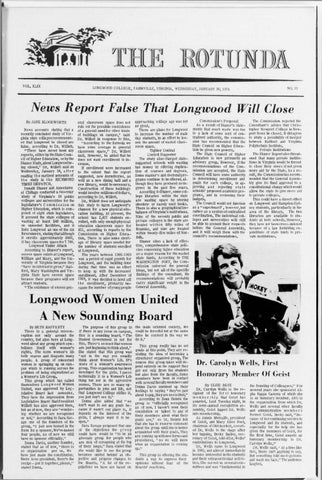
Dr. Carolyn Wells, First Honorary Member Of Geist By ELSIE BLUE Dr. Carolyn Wells is the recipient of the first honorary membership that Geist has awarded. Last Tuesday night, in its semi-annual recognition assembly, Geist tapped Dr. Wells into membership. As Jennie Metcalfe, president of Geist, and Mary Alice Noel, chairman of Oktoberfest, escorted Dr. Wells to the stage after her tapping, Becky Bailey, secretary of Geist, told of Dr. Wells' contributions to Longwood. Dr. Wells came to Longwood in 1960, and almost immediately became interested in the students and their extracurricular activities. She served on several committees and was "fundamental in
the founding of Colleagues," For several years she sponsored Alpha Kappa (jamma of which she is an honorary member. AKG is the organization from which Dr. Wells and several other faculty and administrative rn e m b 11 I formed Geist. Becky said, "Because of her continuing service to Longwood and its students, and especially for the help she has given the members of Geist, lot the first time, Geist awards an honorary membership to Dr. Carolyn Wells." Dt, Wells said,' At a time like this, there isn't anything to say. But something told me to go home and wash my hair/'Theaudienci laughed.
Page 2
THE ROTUNDA
Wednesday, January 30, 1974
Consumer Symposium-One Of Longwood's Better Events Longwood ladies have often been accused (and with some justification) of being so involved in their own little play world of sororities and blue and white spirit that they fail to notice anything that is happening on the outside. Yes, Longwood, there is a world, and one of the hottest issues in this world at present is consumerism. This subject is not just another opportunity for radicals "with nothing better to do than criticize the American way" to hassle big businessmen. With swelling prices and repeated reports concerning the quality of merchandise, it is the responsibility of everyone who ever intends to buy anything to keep himself alert on consumerism. Next week, Longwood students shall have a unique opportunity to do so. The Symposium on Consumerism is not just another campus event, but is rather a unique and highly valuable educational opportunity for anyone, young or old, male or female. And, judging from the number of girls on campus who are planning marriage in the not too distant future, it shall perhaps become one of the most valuable aspects of their education when faced with the task of shopping for a family. Whether or not you agree with Ralph Nader's accusation, you owe it to yourself, as well as to society, to be as well informed and objective as possible on any matter affecting the cost of living. Therefore, it is vital that you attend the Symposium, weigh the lectures carefully, and participate in any discussion. Certainly those who worked so hard to bring about this Symposium are to be commended for their concern. It is an event which promises to be well worth the time and effort spent on it, and deserving of participation by the entire student hody. Jane
Longwood Doubled A Land Devouring Beast? A recent study has stated that Longwood, by keeping its enrollment small, is wasting state money. The study claims that Longwood has classroom space for 5,000-more than twice its current enrollment. That this would require a great deal of costly construction in terms of new dormitories and a new library, and therefore defeat its own purpose, is obvious. Something equally obvious is that this would be undesirable in terms of the landspace this construction would require. Aside from the space necessary for the new buildings, the increased enrollment would demand additional parking space, which in itself would occupy a great deal of land. To obtain this additional space, it would be necessary to do one of two things - either move our boundaries farther into the town, or find someplace to squeeze them in on the campus. Longwood has already swallowed a great deal of the town, to the dismay of many. (There was much opposition a few years ago when two old and rather beautiful houses on High Street were demolished for construction of a parking lot). Were the enrollment to double, the campus boundaries would push farther out - undoubtedly demolishing more homesites and dislocating more residents. I feel that this is hardly fair to the townspeople, for, after all, it is their home and their community. While Longwood's campus is perhaps not the most beautiful one in the state, it does have a sort of quiet appeal. This is due, primarily, to the amount of open space. Many students enjoy studying or talking outside on the vast lawns, and the numerous trees provide beauty, shade, and a home for squirrels. Crowding new buildings on the campus would require destruction of all this. Thus, we would be left with a "concrete jungle", an appalling site, and one which can be prevented at Longwood. If Longwood has an average of classroom space, this can be best remedied by additional day students, or offering night classes. A radically increased enrollment would mean an overcrowding, detrimental to students, the town, and the environment. - Jane -
Commentary
Open HoUSe Violations
Endangering Privileges times in the dorm. Guests are to be signed in at the main desk and a card with Open House regulations will be given to them. The suite and room doors must be completely open during visitation. There are to be no alcoholic beverages consumed during Open House by the student or guest and no alcoholic beverages are to be brought on campus by the male guest. These rules are all clearly stated on page 84 of the Student Handbook and if clarification is needed, members of Residence Board will be glad to answer any questions. The consequences of violating Open House regulations can include a campus, denial of Open
House privileges, social probation, or suspension depending on tne extent of the offense. Unauthorized persons in the residence halls are trespassers and can be prosecuted. Open House is a privilege extended to the students by the Board of Visitors. It can be eliminated. If Open House regulations continue to be ignored this privilege will be placed in jeopardy. We feel that the great majority of the students on campus are aware of and are following these regulations. The loss of this privilege would be a terrible price for the entire student body to pay because of the actions of a few individuals.
this week end and be subjected to that terrible, terrible sewage Dear Editor, odor. When they asked what was What is going to be done about causing it, I had to tell them I the parking situation in the Cur- didn't know. Then I was humiliry-Frazer parking lot? ated even further by having to Many times I have parked my tell them that I didn't know car on the back row only to find anything that was being done it blocked in by someone who about it. It's bad enough that couldn't find another space and I have to endure that awful stench had to make it difficult for others. but - my parents! Then I had to call campus police, Can you imagine what an awful find out who the car was regis- impression that would make on tered to, and then try to find the any visitor to the college! person. Sometimes I couldn't find Name Withheld By Request her. Then I had to take the chance of driving over the logs on the Longwood Hypocrisy back row and damaging my car. Also, cars sometimes park in Dear Editor, As a concerned student, I want the exits making it virtually impossible to come in or go out of to express my concern over the the lot unless you own a motor- recruiting expedition (or flood) cycle. You run the risk of scrap- from Virginia Beach. Not only ing your own car and getting into did the students arrive on a Coltrouble by messing up someone lege bus (if I am not mistaken) but think of the expense of the else's. I am tired of having to fight activities planned for them. Granted, the Alies and the for parking places and risking my car by parking it on the back Meshejians may have donated row - and I am sick of the block- their time. But think of the electrical energy used during their ed entrances. Debbie Richardson coffeehouse! And all these signs all over the campus instructing Sewer Problems us to conserve energy! SomeDear Editor, times the dorms are so dark that I was so embarrassed for my we can hardly find our way to the parents to com? to my campus elevator.
And, if I am correct in saying that the students arrived on a Longwood College bus, think of the gas - precious gas - used for this trip! Then, again, all the signs all over campus (the memos and announcements in the daily bulletin) about conserving gasDRIVING 50 M.P.H. SAVES A MILE PER GALLON! and ride with someone else. Also, this gas was used on Sunday when everyone is encouraged to stay home and save gas! How can the College turn down our heat and cut off our lights to put on such a big campaign about saving energy when they squandered so much energy in one day - for recruiting! Furthermore, I do not even want to hear about the importance of recruiting to the College. Especially when we have to suffer with the low heat, fewer lights, and limited use of state cars. This is not even mentioning the luxuries like no more parties at the cabin and the locking of the light boxes at the tennis courts! Name Withheld By Request
By KELLY HUNT It has come to the attention of Residence Board that many students on campus are unclear about the rules that are in effect during Open House. We felt that an article in the Rotunda might help to clarify some of the regulations that are confusing to the student body. Open House is in effect from 7:00 p.m. to midnight on Fri. and Sat. and Sun. It is mandatory that the hostess meet her guests in the lobby and accompany them to the main door of the residence hall when they leave. The hostess must accompany her guest at all
Unorganized Parking
THE HOTUNDA Established 1920 Jd-
EDITOR Jane Bloodworth FEATURE WRITER Beth Rafferty BUSINESS MANAGER (Acting) Wanda Trent
An End To Speculation Dear Editor, Over the past term, we have seen a series of articles in the Rotunda concerning the way in which black students are treated at Longwood. We have had the opinion of the Administration on how black students at Longwood feel. Could we please have an article on the way BLACK STUDENTS at Longwood think black students feel. I think that will end the speculation. Thank you. Debbie Stellato
SHAPE Needs Help CIRCULATION Melinda Heneson
ADVERTISING Beryl Dixon Jane Chalkley
Rcportc•rs Bettic Boss, Karen Foster, Judith Moffirt, Lorene Spencer, Lynne Johnson, Cheryl Jenkins, Jean Tate.
Dear Editor, Here in Farmville, we have an opportunity to reach out and help someone who needs us. We have ' the chance to touch the life of a child and make it richer for our presence. The SHAPE program needs volunteers to provide sound recreational and creative experiences for the local children in i the after-school hours. There is at least one child in Farmville eager to learn whatever you may have the ability to teach. Contact Kim Ackermanat3926876 and share in SHAPE. Thank you. Debbie Stellato
Wednesday, January 30, 1974
THE
ROTUNDA
Page 3
Consumerism AB al curve e By ELSIE BLUE Last year, a group of students from the Student Union and a few invited members formed a committee to bring a symposium to campus. The committee decided that it was time that Longwood presented to the students a concentrated program of both academic and contemporary interest. With the help of Tom Hamilton, Director of Developmental Research for Longwood, the committee started an idea to present a symposium on consumerism. There were two goals that were kept in mind as the symposium was planned. The committee wanted the program to be of interest to women, planned by women, and executed by women, fhe lectures and debates were chosen to be on the topic of consumerism because the committee felt that the women of Longwood could use information gained from this type of presentation. The ideas were created and realized by the Student Union, and volunteers from the student body. The speakers for the symposium are predominately women. There are 11 female speakers and three male.
reflects the theme of the symposium, "Consumerism: A Bal anced Approach." LYNN JORDAN
The next day, Thursday, at 10:45, there will be workshops known as "Public Interest Sessions." Lynn Jordan, persident of the Virginia Citizens' Consumer Council, will be speaking on "Organizing for Consumer Protection." Ms. Jordan has been active in consumer affairs for soms time, but in 1972 she resigned her job as computer programmer with the federal government to devote herself full time to her interests in the area. She has worked with the Virginia Citizens Consumer Council, having been on the Board of Directors since May 1971. She was a founder of the Metropolitan Washington Con sumer Survey Committee. She helped with the National Consumers Congress and the Consumer Federation of America. She was instrumental in the Giant Food, Over-the-Counter Drug, and Cosmetic Labeling Committee and the Virginia Department of Agriculture and Commerce's ad THE IDEA hoc Committee on Ground Beef and Sausage Labeling. Other acThe idea for a consumer sym- tivities were the Northern Virposium came from the Student ginia Conservation Council, the Union. Tom Hamilton presented Fairfax County Animal Commisthe proposal to the Sperry & sion, and she attended a workHutchinson Company, which looks shop-study program at the Unifor public lectures of sympo- versity of Wisconsin Center for siums to sponsor each year. The Consumer Affairs. idea was rejected, but Mr. Hamilton and the Student Union decided KANIUKA to go ahead with the idea, looking elsewhere for the necessary Mary Jane Kaniuka, a confunds. They found a source in the sumer representative for SafeLongwood Foundation, through way Stores, will be speaking at the contributions of the alumnae, the same time on "The Food Infriends of the college, and par - dustry, Feast or Famine Bearents. There were funds available er." Ms. Kaniuka, a home econto the college for a purpose such omist, has been active in consumas this, and the Student Union er affairs since graduate school contributed to help with the cost where her thesis subject was of the publicity, programs, and consumer credit. Prior to joining other support. Safeway, she was a home ecoAfter the ideas had been formu- nomics instructor in the Washlated and the money seem ad to be ington, D. C, high schools. attainable, Mr. Hamilton started Ms. Kaniuka began her profeslooking for speakers who might be sional career in 1958 teaching available. The women of the Stu- home management and household dent Union selected the speakers equipment at West Virginia Uniwho seemed to be of the most in- versity and then moved to Pennterest, and the work began. It has sylvania State University where been going on since April of last she taught family financial management for three years. During year. The keynote speech will be pre- this time, she also taught in the sented on February 6, by Mary Family Financial Workshops Kay Ryan who is a consumer sponsored by the Institute of Life counselor for the President's Insurance. These summer workCost of Living Council. Her topic shops were held at 16 univerwill be "There's More to Con- sities throughout the U. S. to sumerism Than Nader" which improve high school teaching of
approach
personal finance. In 1963, Ms. Kaniuka became Assistant to the Executive Secretary of the National Consumers' League, the nation's oldest consumer organization. Here she compiled material for the monthly bulletin and covered hearings on Capitol Hill and other meetings of interest to consumers. Ms. Kaniuka has done free lance consulting and writing, including assignments for Head Start and the National Committee on Household Employment. Under her by - line professional articles have appeared in the journal of HOME ECONOMICS and FORUM. She has also written for the NEW YORK TIMES, the CHRISTIAN SCIENCE MONITOR, and the NEW YORK HERALD TRIBUNE.
editor of the Consumer Educator and is now director of the Data Center of the National Board of the Young Women's Christian Association of the U.S.A. She taught economics at Washington Square CoUege, N.Y.U., andyueensCollege of the City University. She was a staff economist to the Consumer Counsel to the Governor of New York, and was a planner in the Department of Labor as a labor research analyst and as the director of labor research. Her publications include GET YOUR MONEY'S WORTH (Holt, Rinehart & Winston) a consumer education textbook for adult education courses; and articles relating to the problems of lowincome consumers in the JOURNAL OF CONSUMER AFFAIRS. JOYCE BRYANT
HOPE FRANK A graduate of Longwood College, Hope Frank is a Richmond field officer for the Food and Drug Administration. She will speak Thursday, February 7, on "The Government and the Consumer, FDA: Consumers, Concerns, Conflicts." She is responsible for keeping area consumers informed on what the FDA is doing, and on how federal laws help assure safety of the nation's foods and drugs. She records consumer complaints and interprets concerns, attitudes and trends. She works with organizations interested in consumer protection information. Ms. Frank has held responsible positions in industry, public utilities, another government agency, and education. Developing consumer education programs was an integral part of each of her positions. JILL BAXTER Jill Baxter will also be speaking Thursday morning. Ms. Baxter's topic will be toy product safety, or the "Consumer in Toyland." During the course of her discussion, Ms. Baxter will be demonstrating some of the dangerous toys that she has found in the line of her research and work. While in college and in her graduate studies, Ms. Baxter has concentrated on early childhood education, government and political science. DR. A. T. MILLER "The Role of Consumer Education in Developing Consumer Consciousness" is the topic Dr. Aurelia Toyer Miller has chosen to speak on. Dr. Miller is the
The director of the Money Management Institute of Household Finance Corporation, Joyce Bryant will be speaking on the "Finance Industry and Consumer Education." Her talk will include a background of consumer education, and her philosophy of the consumer education program. She will explain the extent of the program and ways of putting the program to work through planning, knowing one's audience, and choosing a method of teaching money management or consumer education. MINI-DEBATES i
That afternoon there will be mini-debates with people of opposing views discussing the same subjects with Longwood faculty members as moderators. The topics that will be debated are, "Does It Do Any Good To Complain?" "Survival in the Supermarket," "The Low Income Consumer," and "Consumers and " Their Demands on the Media Another Short Fall." Again that afternoon, at 3:30, will be "Student Interest Sessions," with Jim Turner, the original Nader's Raider, discussing "Investigating the Market Place," and Sandy Dement Sterling with "Nader's Raiders Today." RALPH NADER Thursday, February 7, at 8:00 p.m., there will be the main address of the symposium. Ralph Nader, Public Citizen, Inc., will speak in Jarman Auditorium on "Corporate Responsibility and Consumer Protection."
One-third of the Nader tickets will be available to nonstudents. Alumnae, press representatives, and the people of Farmville are being offered these tickets. Those students from Longwood who attend Sections II or III will be given first preference of the two-thirds of the tickets reserved for the student body. These tickets can be picked up at the end of the sessions. If tickets are remaining, students who were unable to attend the earlier sessions may pick them up the night iit Nader's lecture at 6:45 in the Rotunda. Forty tickets have been reserved for student teachers, who may reserve them by getting in touch with Tom Hamilton before February 4. MARKET SURVEY Friday, February 8, there will be a market basket survey of the grocery and drug stores in Farmville. Students who have attended the symposium may volunteer to participate in the survey that will be conducted by the students of Public Interest Research Group from George Washington University. Mr. Hamilton gave two objectives in the planning of the symposium. The first, he said, was to provide students and the general public with information on all facets of the consumer movement. This includes the government protective agencies, professional consumer advocates, industry, and amateur consumer groups. Mr. Hamilton also said they planned to provide ttie students with experience in "symposium going." He said that in any profession the women from Longwood will have to attend symposia and conventions. He added that these programs can !• "verydemanding and tiring work. Learning to do it could prove to be invaluable experience." There was some hope that classes would be canceled so more students would bo able to attend the lympoi lum. Although Dr. Henry I. Willett said, "I feel the effort (of the symposium) will be significant both for the institution generally and for those who avail themselves ol the opportunity to participate," he also .aid, "students will be excused from classes, but prolessors will be asked where applicable, to have their clas attend their various events." The committee is hoping to have at least 1,000 people in attendance, In order to do justice to the program as planned. This goal will require strong student support and cooperation of the entire college.
Page 4
THE ROTUNDA
Wednesday, January 30, 1974
Stewart Udall Presents Lecture At Hampden-Sydney Tonight Experimental Program For Elementary Majors Begins Trends in education are changIng, and this year for the first time at Appalachian State University, an experimental program for elementary education majors is underway. According to Mrs. (.race Lilly who is chairman of the Childhood Education Department, those freshmen participating in this experiment will teach their entire sophomore and senior years in a nearby elementary school. In describing the program, Mrs. Lilly explained that its purpose is to find out the best means ol producing an effective teacher. "We hope to maintain a balance of practice teaching and theory during the entire four year program," continued Mrs. Lilly. The students will spend their freshman and junior years taking carefully chosen subjects. Their sophomore and senior years will be spent off campus teaching in the public schools. Graduate Rolls Rise 7-8 Per Cent In A Year Graduate school enrollments, which had been growing at only a modest pace in the previous two years, increased by 4.8 per cent this fall. The largest increases were at . public universities and those granting the masters as their highest degree, according to a survey of 281 institutions by the Educational Testing Service for the Council of Graduate Schools in the U. S. and the Graduate Record Examinations Board. This year's 4.8 per cent jump indicates that "the prophets of doom have had their comeuppance," J. Boyd Page, president of the Council of Graduate Schools, told the council's annual meeting, where the results of the survey were released.
HAMPDEN-SYDNEY - Stewart Udall, former Secretary of the Interior and one of the country's Lading conservationists, will present a lecture on 'The Energy-Environmental Crisis" at Hampden -Sydney College on Wednesday evening. As Secretary of the Interior under Presidents Kennedy and Johnson, Udall has been one of the prime leaders of the environmental movement for more than a decade.
' The U. S. is currently using 35 per cent of the world's resources, and our increasing, gluttonous demands for oil, electricity and natural gas have produced a serious energy crisis," Udall notes. • We have elected to become a
consumer society which measures its success by the fulfillment of private 'wants' (however frivolous or greedy); and we have, in the process, neglected those common necessities that build healthy, balanced communities." Udall proposes a reorientation of American life, from new lifestyles to the end of all-electric homes to the building of bicycle paths and efficient mass transit systems to the exploration of new energy sources.
CONSUMERISM
The environmental and energy crisis is no longer a problem for technologists to solve, says Udall. In fact, leaving all our problems to specialists is one of this country's gravest errors. ^Technological optimism" has caused us to lose sight of humanistic values, "you cannot save the land unless you save the people," he says. Udall's lecture will be held in Johns Auditorium on Wednesday, January 30, at 7:30 p.m. The lecture will be open to the public.
FEBRUARY 7, 1974
A BALANCED VIEW
10:30 - 5:00
Public Interest Sessions
Viewpoints
10:45 - 12:00
12:45 - 2:00
"Organizing for Consumer Protection" Lynn Jordan, Virginia Citizens' Consumer Council "The Finance Industry and Consumer Education" Joyce Bryant, Household Finance Corporation "The Scientist and the Consumer" Barbara Hogan, Center for Science in the Public Interest "The Consumer In Toyland" Jill Baxter, Virginia Citizens' Consumer Council "Consumer Education and Consumer Consciousness" Aurelia Miller, editor. The Consumer Educator "The Food Industry: Feast or Famine Bearei" Mary Jane Kaniuka, Si'feway Stores "The Government and the Consume'" Hope Frank. FDA Consumer Affairs Officer
"Does It Do Any Good To Complain" Laura Horowitz, Virginia Citizens' Consumer Council Hope Frank, FDA Consumer Affairs Officer Robert Coleberd, Longwood College "The Low Income Consumer" Agnes Bryant, Consumer Research Council of Detro't
' Survival In The Supermarket" Lynn Jordan, Virginia Citizens' Consumer Council Mary Jane Kaniuka, Safeway Stores "Consumer Demands on the Media. Another Shortfall?" Franc** Poilock. ed;tor. Media and the Consumer "Consume! Education' Savings or Losses for You?" Aorelit Milier, editor, Consumer Educator Joyce Bryant Hcu^hold pinance Corporation Maun??" Blsnkenburger, Longwood College
Consumer Activists' Sessions 3:30-5:00 "Investigating The Marketplace" Jim Turner, first 'Nader's Raider' "Nader's Raiders Today" Sandy Sterling, Public. Citizen, Inc.
Hampden-Sydney Receives College Grant The Department of Chemistry at Hampden-Sydney College has been awarded $2,700 by the National Science Foundation to help purcliase equipment needed to improve undergraduate instruction. Hampden-Sydney was one of 100 colleges and universities chosen to receive an NSK Undergraduate Instructional Scientific Equipment Grant. The equipment program is an NSK activity designed to aid colleges in Improving the quality of instruction by updating courses and teaching laboratories. "Laboratory courses at Hampden-Sydney are based entirely upon individualized projects, designed to introduce students to the modern practice of chemistry," said Dr. Herbert J. Sipe of the chemistry department. Individualized study provides the student with a higher degree of independence and sophistication necessary to the career-minded chemistry major. Therefore, an upperclassman is encouraged to carry on problem - solving tasks by independent experimentation and research. This move from the more traditional laboratory has resulted in greater student interest.
Udall affirms that our national waste and greed must be stopped, or it will stop us. He is the author of two books, "1976: Agenda for Tomorrow" and 'The Quiet Crisis."
"The College Student and the Consumer" Public Interest Research Group George Washington University Ralph Nader will speak at 8:00 p.m. A limited number of tickets for his speech are still available. However, in the event you cannot secure a ticket, you will be able to watch Mr. Nader on closed circuit television.
COLLEGE SH0PPE
Now at OTIje Jfastfnon $o*t
Steaks-Pizzas Seafood 5:30am -8pm
ROCHETTE'S FLORIST FLOWERS FOR ALL OCCASIONS
Jeans Low cut and Mraiqht leq egeAtiention New Pledges-Come buy your Sorority T-shirts from us.
Dr. Webber Wrote A Book On Consumer Math informed Dr. Webber that there By KAREN FOSTER was no market for his book; An idea conceived "five or others said there was a definsix years ago" by Dr. Robert ate market. One of these latter P. Webber of Longwood's Math was Houghton Mifflin to whom the Department, finally took root in text is now contracted and tenwritten form "sometime last tatively set for publication in spring" and "over the summer December of 1975. bloomed into the manuscript form CONSUMER MATHEMATICS of his new textbook CONSUMER is basically a college level textMATHEMATICS. book because, "high school "We wanted to offer the course courses of this type are mainly (Math 114-Mathematics for the arthemetic," and Dr. Webber's Consumer), and we couldn't find book requires a background of a good book." Dr. Webber cited algebra. as one of his reasons for writing Neither the publisher nor Dr. the text. This semester is the Webber's two consumer classes first time that the course has have seen the finished manuscript been taught here. as the students are using only Consumer math is ' extra im- about two thirds of the finished portant for anybody who has to do product. Their use of the manuany financial business at all," script is the author's testing Dr. Webber continued. There is ground for the book. The most difficult part of the "absolutely'' a need for a book of this type, one geared toward actual writing, Dr. Webber said, the consumer rather than toward is "trying to make things consistant from one chapter to the the businessman. Several potential publishers next.' "It's kind of hard to teach from his own text as "it's
Recommendations Made At Legislative Meeting At the Legislative Board meeting Mon., Jan. 21, it was moved and passed to recommend Sue Scarborough and Joanne LeStourgin to the Academic Policy committee. Gay Harrington has been recommended to the position of Chairman of the Freshman Summer Reading Program Committee. The possibility of forming a committee that would handle the passage of bad checks by Longwood students is being discussed. No decision has been reached as yet concerning the question of the snack bar being open only to Longwood/Hampden-Sydney students. Dr. Gussett and Mr. Dalton were unanimously reelected as advisors to the Legislative Board.
hard to prepare a lecture because I've put my lecture notes Into the book already." Dr. Webber joined the Longwood faculty in September of 1972 after working as a teaching assistant at the University of Tennessee, as a summer teacher for Project Upward Bound at Knoxville College and as mathematician at the U. S. Naval Weapons Lab. He received his B. A. from the University of Richmond and the M. S. from Stephen P. Austin State. In 1972, Dr. Webber completed his Ph. D. at The University of Tennessee. He is a member of the American Mathematical Society, Mathematics Assocation of America, American Council on Consumer Interests and the American Association of University Professors. Dr. Webber has previously written "Semigroups Determined by Martix Forms." His hobbies include music and drama.
L.C. Library Received Grant For Black Studies Material By ELLEN CASSADA A total of $5,000 has been granted to Longwood's Library $3,000 of which will be used for improvement of black studies. According to Mrs. Martha LeStourgeon and Mrs. Rebecca Laine, the remaining $2,000 will be used for reading materials. The library has already received many books and more order* are being filled daily. A great number of the newly possessed books are recommendations of professors of related courses. Such titles as HEARTS OF GOLD, By Ellen Johnson, A LITTLE DREAMING, and BY SANCTION OF LAW, by Joshua Jones, have already been placed in stock. The books on black studies deal with the black tradition in
American fiction, with varied topics such as communications in urban black America, black experience, racial tolerance, and black images. There are also many containing articles on art, worksongs, spirituals and children's literature, and some are written in French. Louis Armstrong and Duke Ellington are several of the famous black musicians whose stories are presented. Books are likewise being ordered that will contain multimedia materials for Afro-American studies and dealing with various curriculum orientations. Books concentrated on reading materials are based on improving the reading program, corrective reading, and the teacher-learner process.
Wednesday, January 30, 1974
THE
ROTUNDA
Page 5
Survey Shows Pass/Fail Hurts Grad School Applicants (CPS) - A recent survey indicates undergraduates with more than 10 percent of their courses graded on a pass-fail basis will be disadvantaged when applying to graduate and professional schools. According to the EDUCATIONAL RECORD, the survey also indicated students with a majority of pass-fail courses will also face difficulties in transferring to other schools, obtaining financial aid, and finding employment. The poll of 200 graduate schools, 50 law schools, and 50 medical schools showed that admissions directors feel evaluation of pass-fail is "extremely difficult, if not impossible." 1 The greater the proportion of the students' record which is reported in terms of a nontraditional grading system," the EDUCATIONAL RECORD reported, "the greater the potential for difficulty in entering
another institution." The majority of undergraduate institutions liave some form of nontraditional grading and students who utilize these systems generally like them but "when more than 10 percent of student's grades are nontraditional, he or she is likely to experience problems." The survey revealed that when law schools are faced with a largely pass-fail record, they rely heavily on Law School Aptitude Test (LSAT) scores to determine a student's aptitude. Grade point averages based upon a combination of the traditional and pass-fail grading are regarded as inflated, according to the survey. A statement by the LSAT Council on Pass-Fail Grading Systems said grade point averages based on a combination of grading systems "seem to overstate in a compound way the student's general academic abi(Continued on Page 6)
BEDFORD GALLERY LONGWOOD COLLECE/FARMVILLE,VIRGINIA Gallery Hours: Monday-Friday 8:30a.m.to 5p.m. Saturday & Sunday 2 to 6 p.m.
JANUARY 18 thru FEBRUARYH1974
1
Page 6
THE ROTUNDA
Rope Sculpture Drawing Exhibit In Bedford The rope sculptures, boxes and drawings of H. Gilda HinterReiter are currently featured in an exhibit which opened January 18 at Bedford Gallery, Longwood College, Farmvillc. An associate professor of Art History at Virginia Commonwealth University for the past seven years. Miss Hinter-Reiter has received awards at major exhibitions in Richmond, Virginia; Louisville, Kentucky; and in Austria for her work of knotted ropes and wool. During 1973, her work was displayed in a one-woman show at the Virginia Museum's Robinson House and at the Hand Work Shop in Richmond. Born and educated in Austria, Miss Hinter-Reiter studied at the School of Fine and Applied Arts in Linz and the Academy of Fine Arts in Vienna. She worked and Studied in Montreal before traveling to the United States to begin graduate studies. Miss Hinter-Reiter's work reflects her ability to work with ideas as well as her hands. In regard to her recent work she states, 'it does not really matter what media one uses as one solves a problem in some concrete form . . .one always expresses a feeling or an idea in some way or other. I think a single knot can be a piece of sculpture..'
Surve/ Show:'S (Continued from Page 5) lity and achievement." Medical school admissions committees dislike pass- fail grading due to the extra time involved in reviewing applications, according to the survey. One admissions officer wrote, • At. present the task of evaluation requires much reading and interpretation of grades, recommendations and activities. To add copious evaluations in lieu of grades would be frowned upon in light of 5,500 applications.' The survey also found students with large numbers of passfail grades will face problems in applying to grad schools of arts and sciences. One admissions officer noted those submitting transcripts with nontraditional grades might be admitted, but "will probably be assigned a probationary status." He added that such applicants '-'encounter serious difficulties in competing for financial aid where candidates are rated on tlie basis of their grade point avenges,' Nationwide admissions officers expressed general agreement with the survey's findings and noted a preference for graded emir.se work. Due at Harvard said, "Pass-fellgrades. . .are of no help to us. We don't even trj t>> evaluate them."
Wednesday, January 30, 1974
Preparations Almost Complete For Ring Dance Weekend The Junior Ring Dance is juniors getting their rings, but and "Honky Tonk Woman", as at 1 p.m. "The Royal Kings" will highscheduled for March 8-9, the now it is more or less some- well as variety of old hymns are light the formal dance in the a sampling of the songs played week end before Spring Break. thing to carry on a tradition.'' downstairs dining hall on Satby this band. Preparations are almost comThe week end will begin with urday night. This band plays a •Laurel and Hardy", 'The plete for this week end, which a performance by • Bluegrass promises to offer "something Express" in the downstairs din- Little Rascals", and ' Spanky wide variety of music, includfor everybody," according to ing hall. * This is different from and Our Gang" will occupy Sat- ing some songs by Santana," Jane Chalkley, publicity chair- previous ring dances in that they urday afternoon. Old movies will ' Chicago", and the "Allman man for Ring Dance committee. usually had a concert on Friday be shown in Jeffers, beginning Brothers.' The major difference in the dance night," said Jane. ■ At this event, this year is that there is no foryou can either sit and watch, mal ring ceremony. or dance. You can also either "This is not a ring dance as come stag or drag." such." ' In the past, it celebrated "Foggy Mountain Breakdown,"
CRUTE'S
Col. Carr Presents Speech TYPEWRITER REBMRS On Teacher's Contract By BETH RAFFERTY LTC. John E. Carr IH, the vice-president for administration here at Longwood College presented a speech on Jan. 21, in Jarman, entitled CONTRACTS, SALARIES AND SALARY DEDUCTIONS. The meeting was open to all seniors. Colonel Carr defined a contract as a series of stipulations between two parties. It becomes a legal binding document when signed by both parties. When a person signs a teachers contract they must agree with the general provisions such as you will perform duties required by the school board and principal, you must swear allegiance to the constitutions of the U. S. and Virginia, and you understand that you may be transferred within the state. If the school board fires you with a two weeks notice you have the right to appeal your dismissal; and you may resign with a two weeks notice. If your reasons are not valid the State Board may revoke your certificate. A contract must cite date of effectiveness with the number of months in the contract, and there are 180 actual teaching days. Col. Carr also stressed the importance that future teachers must attend special meetings called by the administrations,
and if they're hired by a federal funded program then the contracts end when the funds end. He also warned the students that if their absence was not chargeable to sickness or if they overrun their sick days then they will lose a day's pay. Teachers must serve three years probation on an annual contract before they are considered for tenure. There are three types of contracts. Most teachers are given a ten month contract, while people in guidance are given an eleven month one. Twelve month contracts are given to principals. There is a general salary increase according to Colonel Carr. The reason for this is the increase in the cost of living. Consumer awareness was also stressed during his speech.
THE DOOKNOOK L
*»K*vo«l
j
pjs
• u Now Is)
WAS $225 NOW.,.7?
WHERE THERE ARE HEARTS, THERE ARE FLOWERS. Joie BE de Fleur perfume.
Lanscotts Gift Shop
$00.00 FTD LoveBundle" with Joie de Fleur "perfume Hearts and flowers add up to the FTD LoveBundle. A beautiful bouquet of fresh flowers ...with a surprise. A capsule of Joie de Fleur, FTD's exclusive new perfume. And we can send flowers to your Valentine girls across the street or across the country. Stop in or phone us today. But hurry! Don't be disappointed-send early!
Itvms
Sorority Jewelry For all Longwood Sororities^
««Snun unu
Rings -Lavaliers Emblem: Miniature Badges Chapter Guards
Cumbey Jewelers
Wllh |tej
te&al size
Special Sale! Manv
JvUa,
TTXIH «/*/ST
barters Slower ^nop On* Block From Hospital
711 West 3rd St.
FREE ENGRAVING
'
Phone 392-3151
Farmville, Va. 23901
You're always welcome
If you're rolling cigarette like you've got 5 thumb well give you a hand.
at
FIDELITY NATIONAL
BANK No mere feeling like
e-z wider:
a rvdt clumsy oaf No more sticking
Main Street
Wo'ro the original high
together 7 poperi
quality, slow burning
and hoping that
paper ol double width
while you're rolling
Farmville, Virginia
Try e-i wider papers They're
they don't split
big enough to you only lick once
open again With e-i wider
sobest twit** eiiei • >. lie
you can roll a line •moke every tingle lime
double width paper.
W ••■■ llik ,i
Wednesday, January 30, 1974
Longwood Brings Home Double Wins Over
THE ROTUNDA
Page 7
Lynchburg Varsity, Junior Varsity Teams Longwood Woman's Basketball Teams traveled to Lynchburg College and brought home wins of 60-29 and 69-22. In the Varsity game Longwood shot 40% from the floor first half and took leads of 14-9 first quarter and 28-20 in the second quarter. Longwood played a tight defense which caused a lot of turnovers and fastbreaks resulting in points. The offense played together better than they had in their loss to UNC-G. Longwood was also 53fc from the free throw lane connecting 12 of 23. Second half Longwood put the game away by outscoring Lynchburg 18-5 3rd quarter and 14-4
fourth quarter to give them their 60-29 win and second win in three outings. Nanette Fisher and Anita Stowe were in double figures with 11 and 10 points apiece. Nanette Fisher also had 13 rebounds followed by Diane Jones with 12. Longwood's Junior Varsity made it two wins as they handed Lynchburg's J. V. a 69-22 loss. In the first quarter Longwood came out with a slight lead outscoring Lynchburg 9-8 but in the second quarter outscored Lynchburg 23-6 to take a 32-14 lead at the half. The Junior Varsity played superb defense as they
H.S. Sponsored Christian Emphasis Weak-We!I Prepared By LORENE SPENCER The Interdenominational Hampden-Sydney Fellowship of Christian Students is sponsoring a spring "Christian Emphasis Week" for February 4-7. Nightly programs will start at 7:30 p.m. The guest speaker will be Dick Little. Mr. Little is a dynamic, youthful, and nationally known Presbyterian evangelist from Richmond. Four Farmville area Christian collegiate groups will be providing music and testimonies on the following nights: February 4: Wesley Choir February 5: Tafara, BSU Folk Group February 6: Newman Folk Group February 7: Y.W.C.A. Gospel Team "Morning Devotions"on WFLO will feature Dick Little, B-S F. C. S. members, and taped music by the above groups daily from February 4 through 8. The F.C.S. invites all Longwood students to attend the programs. A bus will be available nightly to provide transportation to interested students. "This week will offer students an exciting and unique opportunity to learn and grown in their knowledge of what Jesus Christ is all about." said Mike Rowland. "The F.C.S. feels this week can be the greatest week in individual students lives, by their accepting Christ as their life's Lord and thereby being beneficiaries of the joy, peace, hope, and love that only comes through Him."
Sparked by Rita Wiggs, UNC-G broke away in the fourth quarter and beat Longwood's Varsity Basketball Team 51-36. Rita Wiggs was the games' leading scorer with 19 points followed by teammate Donna Morris who had 13 points. The lead seesawed point for point during the first half and with 5 seconds left Diane Jones hit the basket giving Longwood a 20-19 lead. Longwood was 33% (7-21) from the floor while UNC-G was 26% (27-7). Second half UNC-G's 2-1 -2 defense pressured Longwood to take alot of outside shots, many of which were missed bringing the 3rd quarter score to a 30-35 lead for UNC-G. Despite only a five point deficit going into the 4th quarter Longwood failed to maintain a tight defense which allowed UNC-G to score 22 points while only scoring six themselves. UNC-G was 54% from the floor fourth quarter. Longwood did well at the foul line shooting 75% (12-16). Anita Stowe was the team's leading scorer with 8 points and leading rebounder with 11. Diane Minor followed with 6 points
second half Longwood Lynchburg to only 8 points scored 37 points and at the had an outstanding 69-22
Three Longwood players were in double figures, Kim Steacy had 14 points and Carol Lewis and Roxann Fox had 13 and 12 points respectively. Carol Lewis was leading rebounder with 15 rebounds followed by Roxann Fox with 11.
while Nanette Fisher had 9 rebounds. In the second game, UNC-G used their second string Varsity and beat Longwood's Junior Varsity 51-27. UNC-G allowed only 6 points in the first quarter and 10 in the second quarter for Longwood as they scored 22 points to give them a 16-22 lead at the half. Second half Longwood was
February 15 21 March 8 Tentative 4 February 25
U.N.C. East Carolina U.Va. Madison V.P.I. V.P.I. Duke
Away Home Away Away
ODU Randolph-Macon
Away Home Madison
Gipgett "Your happy shopping store" We welcome your business
4:00 4:00 4:00 3:30
Longwood Swim: vng An I OWing Team Members Are Chosen
Home
7:00 P.M.
Home
7:00 P.M.
Away
7:00 P.M.
Home
7:00 P.M.
Away
6:00 P.M.
Fencing Team CtJtMS Its Season Hsre On Saturday With Meet P.M. P.M. P.M. P.M.
12:00 P.M. 4:00 P.M.
40rj from the floor but UNC-G outscored them 16-6 and came out on top 51-27. D. D. Hulvey was the team's leading scorer and rebounder with 10 points and 9 rebounds. Kathy Riggins, Kim Steacy and Colleen Blakley had 7 rebounds apiece. Tuesday, January 22 Longwood is on the road again for a game with Lynchburg College.
Longwood's Men's Basketball Team Segin First Season At this point, Longwood's men's basketball team has played Lynchburg and St. Paul's, and have lost to both schools. Most of the players on the team have had experience previous to joining the Longwood squad, either in high school, at a community college, or on a college freshmen team. Co-captains Kelly Powell and Bruce Seamster have played t<>gether for ten years, starting at the old Victoria High School. Then, they progressed to the Hamjxlen-Sydney freshmen team. Besides Powell, a forward; and Seamster, a guard, the team includes Bobby Thomas, torward; Terry Springkle, guard; Gary DeBiasi, forward; Steve Womack, center; David Elder, forward; and Larry Funkhouser, guard. The team is coached by Mr. Tom Dougan and Mr. E. T. Noone
Gymnastics Team Names Now Members For Coming Season
1974 GYMNASTICS TEAM SCHEDULE
Randolph-Macon Westhampton Mary Washington Madison and Rollins
State Meet
The limited as they buzzer win.
Carolina Scores Upset Over Longwood
1973-74 SWIMMING AND DIVING SCHEDULE February 7 11 19 25 March 2 14 April 5-6
blocked many of Lynchburg's shots at the goal. They had a total of 51 offensive and defensive rebounds.
By CHERYL JENKINS The Varsity Fencing Team will open its season here on Saturday, February 2. The Longwood Team holds the current State Fencing Championship. They have held the Championship twice during the past three years. The meet here on Saturday is a four-way meet with Madison, Radford, and the University of North Carolina at Chapel Hill as guests. It will be held in Der Gym starting at 10 a.m. and will last until 4:30. There will be seats in the gym for spectators. The team is coached by Miss Sally Bush, Assistant Professor of Health and Physical Education. The members of the team are Robin Fekety, Susan Ferguson, Candace Graves, Debbie Hughes, Brenda Jordan, and Mary Thornhill. Cheryl Jenkins manages the team.
The members of the 1973-74 Longwood Swimming and Diving Team are Debbie Acker, Linda Burgdorf, Emily Burgwyn, Karen Cutler, Chris Dickrneyer, Beryl Dixon, Cathy Holt, Molly Lee, Terry Thomas, Susan Turner, Pam Walker, Robin Wallmeyer, and Carol Walsh. The managers of the team are Clare Baxter, Libby Campfield, Jane Chalkley, Audrey Griliches, Kathy Nesbitt, and Judy Steber. Coach Carolyn Calloway, Assistant Professor of Health and Physical Education, is "looking forward to a successful season." Returning swimmers are Debbie Acker, Linda Burgdorf, Beryl Dixon, Molly Lee, Pam V.'alker, and diver Robin Wallmeyer. This year the team expects to be especially strong in the freestyle events, relays, and diving.
By CHERYL JENKINS The new members ol the 1974 Gymnastics Team are Sheree Bond, Pat Caudle, Sandy Conkwright, Patty Merrill, Debbie Moreland, Nina Shornak, and Beth Tomlinson. The managers for the team are Amy Davis and B. I. Moss. The team is coached by Miss Judy Johnson, Assistant Professor of Health and Physical Education. According to members of the team, the team is looking forward to a very successful season. The out-of-state teams are already in the middle of their seasons and will prove to be very good competition. University of Virginia and Virginia Polytechnic Institute are new on the schedule and might prove to be difficult because the team hat not seen them perform before. They feel that if the Longwood team members work hard and really push themselves, this will be a very successful season.
THE ROTUNDA
Page 8
Wednesday, January 30, 1974
Reaction To Energy Crisis Varies Among Students By JUDITH MOFFITT This country is in the middle of what is known as the energy crisis. Whether this crisis is a result of the Arab oil embai an actual scarcity, or an attempt of the oil companies to raise prices has yet to be determined. No matter what the cause, the fact that a shortage exists is true and the government has been trying to alleviate the shortage with such measures as reducing the speed limit and asking people et their thermostats at al temperature. What do the students at Longwood think about this crisis? The comments ol some of them follow. Kleanor White, a freshman math major, said, "1 can see it two different ways and I don't know which to believe yet. It could be big business trying to push prices up or there really could be a scarcity of natural resources. So far what's been done, I like. I enjoy going slower on the highways or wearing a few more clothes to keep warm. It's too soon to see how it aflects the country from an economic viewpoint because you have unem ployment rising and various other shortages combined with the energy shortage In this crisis." I he
IWw
Rnunil-l 'p
l\i st .lilt ..111
i\. Main St -Town ( i | lOi I
1'OlHl
One student, who did not wish to I* named, said, ' I think it's a farce. Some other people I know think it is deliberately switching the local point of concern in our country from Watergate. The whole thing is a business scheme." Another student felt that there wasn't a crisis but that it was good that we were starting to conserve energy now so that there may not be a crisis in the future. "I wouldn't want to predict or say whether it is a crisis. I know I've felt it, especially in driving from New York. I think it hurts the little guy like the student and the person who needs gas to get to work. Somebody's making a mint out of it." This is what Bobbsie Bannin, former Student Government President, said on the subject. Mona De Hart said, "I think it's for real." This was also the opinion of Fran Lippincott. Julie Williard said, "I think that if the U. S. got off its butt and went to work there wouldn't be an energy crisis." Many of the students interviewed said that they didn't know anything about the subject or that they didn't care about it one way or the other. Dr. Robert Webber, teacher of mathematics, summed up his feelings by saying, "I suspect it's a big fake to get bigger profits for the oil companies and greater ease of operation. In general, I think it's to fight the environmentalists. I don't like it."
Sorority Jewelry 10 different styles of sorority rings ranging from $ 14.50 up. All sororities lavaliers at "6.50 each. Sorority charms with crests and pendants .
TKwttiH H&e favele* Farmville, Va.
The gasoline shortage could have a definite effect on Longwood students.
"Energy Crisis May Day 'Frightening" Effects On College Students' By KAY JOSLIN (CPS>- Most of the effects of the energy crisis on college students are, so far, trivial, limited mainly to colder, darker campuses, though education officials across the country are just beginning to verbalize some of the potentially disastrous effects, including revised calendars, extended vacations and higher costs of living and education. In testimony before the Senate Education subcommittee last week, a HEW official said the energy crisis will hurt low-income students attending community colleges, vocational and technical schools much more severely than others. Among problems low-income students in particular will have to face are rising fuel bills resulting in higher tuition and higher gasoline costs for commuters. Part-time and evening students will suffer if schools close or curtail schedules in order to conserve fuel or reduce operating costs. According to the President's National Commission on Financing Postsecondary Education every $100 increase in tuition forces at least 2 1/2 per cent of 175,000 public college students out of school. The National Student Lobby (NSL) said the <ncrease in cost for the average commuter who travels ten miles to school and pays a 20 cent increase in the price of gasoline equals a $100 increase intuition. NSL president Arthur Rodbell, in a letter to energy chief William Simon, listed nine effects of the energy crisis on students: winter term closings; summer employment losses due to forced makeup sessions; breakup of school year employment with no compensation, increased costs of commuting to and from campuses; threats of parking taxes levied by the Environmental Prointerstate travel with the phasing out of youth standby fare discounts on airlines; rising costs of materials to produce student educational tools; Committee for Economic Development and Carnegie Commission recommendations to double tuitions and too little financial aid to compensate for increased costs of education. Over an extended period of time the problems of the energy cirsis are "frightening,' Stephen K. Bailey, vice president of the American Council on Education, said. Bailey cited two problems due to the energy crisis: schools that opt for schedule adjustments concentrate classes during day -
light hours causing difficulties for part-time and night students. "The elimination of night and week end classes would almost destroy opportunities for parttime students, who number in the millions . . . Women, particularly, could be hurt by any substantial reduction in part-time educational opportunity,' he said. The second problem Bailey mentioned is gasoline rationing and the problems it would pose for commuting students. A prolonged energy crisis could convert the traditional summer vacation for Northern students to a winter vacation in order to save fuel, the Association of American Colleges said. On the other hand Southern colleges may have to give up summer terms because of high air conditioning costs. Harold Webb, a representative from the National School Board Association, told a Senate committee vocational training and adult education programs utilizing high powered machinery and electronic equipment could be endangered. "Indeed," Webb said, "many workers may first find themselves without a job because of the energy crisis and then without a public institution to help them qualify for other employment." College and university administrators also worry that major sources of revenue, namely private philanthropy and income from endowments will be threatened by an unstable stock market. Cancelled or rescheduled sporting events and extracurricular activities are another result of the energy crisis. Bowdoin College in Maine has rescheduled all varsity and junior varsity basketball, hockey, track and squash events from January to other months and has cancelled January wrestling and swimming meets. Brandeis University in Massachusetts switched five varsity basketball games, a fencing meet and an indoor track
meet while American International has changed two basketball games. Harvard and Bates also announced schedule changes because of the energy squeeze. Many schools are holding indoor and outdoor athletic events during the day to save lighting costs and activities such as travel for athletics and debate teams have been cancelled or cut back. Cancellation of athletics may cause athletes who are on athletic scholarships or other aid to drop out of school or find other sources of aid. Fuel shortages caused a number of colleges and universities in the northeast to end their first terms before Christmas and delay the opening of their second terms until late January or early February. Bowdoin College in Maine ended its first semester on December 22, a month ahead of schedule and officials said the start of the second semester could be delayed beyond the scheduled January 30 opening date. The college provost noted the college's fuel supply will be cut "even more than expected." The University of New Hampshire at Durham also ended its first term December 22, a month ahead of schedule and will not reconvene until February 4. Evening and Saturday classes, take home exams and adjusted grading procedures were introduced to compensate for lost time, according to the university president. The University of Massachusetts reduced by one week the length of its formal intersession activities in January and the University of Maine delayed the start of its spring semester by one week.
We need you. The National Center tor Voluntary Action.
CLIP AND SAVE 50$ AT BOB'S Regular 99C Value Returnable Quart
Coca Cola With Coupon
4 QTS 49c
Limit 4 Qts. Per Coupon - 1 Coupon Per Person Coupon Valid Thru Wed., Feb. 6, 1974 REDEEMABLE ONLY AT BOB'S SUPER MARKET