•
VOL.XLvn
I
LONGWOOD COLLEGE, FARMVILLE, VIRGINIA WEDNESDAY, FEBRUARY 16, 1972
NO. 14
Glasheen Only Student At Legislature
g _ How many students are there on campus now? There seem to be more than before the student teachers left. D.E.L. A - Col. Gilchrist, the Registrar, says that he does not have the final totals for this semester yet, but that there are approximately the same number of students as in September, give or take 25 Students. The September total was 2,373, which included 81 graduate and 29 special students. Col. Gilchrist will notify the Catalyst when he has the final totals. Cy - How many hour s does it take to graduate? A.P. A - Col. Gilchrist says many students are confused on this point and find out their last semester that they do not have sufficient hours to graduate. The required number is 126 hours. Col. Gilchrist reminds students that they are responsible for keeping track of their hours and if they have any questions, they may consult the catalog or his office. ^ - What are the rooms on the second floor of the library, called carrells, used for and why can't they be used for study rooms0 The study rooms downstairs are not heated. D.E.L. A - The rooms on second floor were originally to be used by faculty members working on their dissertations and have been expanded to include use by graduate students. Mr. Butler said he wasn't aware that the heat in the study rooms was not working and that he would check into having it repaired immediately.
News Briefs Merger Planning Shifted RICHMOND - April 10 is the date set for the appeals hearing agreed upon by 4th U. S. Circuit Court of Appeals. However, planning by the State Board of Education must continue to avoid unnecessary delay. Chief Judge Clement Haynesworth overturned the merger timetable laid down by District Court Judge Robert R. Merhige. Under Merhige's plan the state and county defendents who opposed the merger were to appoint an acting metro school superintendent and school board. However, under the Circuit Court's order, the merger planning lies with the state board. The state board may form a provisional school board and bring in other administrators and assistants, if they feel the need. Both parties involved feel the (Continued on page 5)
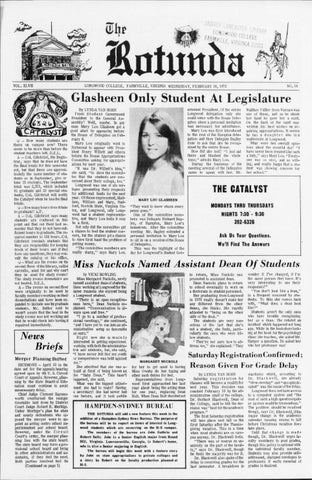
By LYNDA VAN HORN From Student Government President to the General Assembly? Well, maybe. In any case Mary Lou Glasheen got a good start by appearing before the House of Delegates on February 8. Mary Lou originally went to Richmond to appear with President Henry Willett and others before the House Appropriations Committee asking for appropriations for next year. "It was Dr. Willett's idea," she said, "to show the committee that the students are concerned about their college, too." Longwood was one of six colleges presenting their requests for additional funds for the next year. Of those represented, Madison, William and Mary, Radford, Norfolk State, Virginia Union, and Longwood, only Longwood had a student representative, and Mary Lou feels it may be a first. Not only did the committee get a chance to feel the student concern, but the student got a chance to view first hand the problem of getting money. "The committee members are really sharp," says Mary Lou.
â–
ernment President. Of the entire Longwood delegation only she could enter with the House Delegates since a personal invitation was necessary for admittance. Mary Lou was first introduced to the rest of the Hampton delegation and then Delegate Bagley rose to ask that she be recognized by the entire House. How did she feel? "I just sat there and blushed the whole time," admits Mary l.ou. During the business of the meeting several of the Delegates came to speak with tier. Mr.
Walther Fidler from Warsaw was one of those, and as he shook her hand he gave her a card. On the back of the card was written his best wishes on acquiring appropriations. It seems he has a daughter who is a sophomore at Longwood. What were her overall opinions about the eventful day'.1 "I have never been treated like such a lady," says Mary Lou. "Everyone was so nice, and so willing, and really happy that a student was showing concern lor her school."
THE CATALYST MARY LOU GLASHEEN "They want to know where every penny goes." One of the committee members was Delegate Richard Bagley, of Hampton, Mary Lou's hometown. After the committee meeting Mr. Bagley extended a personal invitation to Mary Lou to sit in on a session of the House of Delegates. This was the highlight of the day for Longwood's Student Gov-
MONDAYS THRU THURSDAYS NIGHTS 7:30 - 9:30 392-6326 Ask Us Your Questions. We'll Find The Answers
Miss Nuckols Named Assistant Dean Of Students by VICKI BOWLING Miss Margaret Nuckols, newly named assistant dean of students, likes working at Longwood for the same reasons she enjoyed being a Longwood student. "There is an open receptiveness here," Dean Nuckols explained. "Communication is always open and free." "I go to a number of professional meetings," she continued, "and I have yet to run into an administrative setup as favorable as ours." Right now she is mainly interested in getting experience working with both the administration and students, but, she said, "I have never felt that my youth or inexperience was held against me." She admitted that she was afraid at first of being known as the "Baby Dean." This hasn't happened, she said. What was the biggest adjustment she had to make? Having a secretary! She had never had one before, and it took awhile
to return, Miss Nuckols was promoted to assistant dean. Dean Nuckols plans to return to school eventually to work on a doctorate in student personnel. Her graduating from Longwood in 1970 really doesn't make her any different from the other deans, she thinks. She rapidly adjusted to "being on the other side of the desk." The students are very conscious of the fact that she's not a student, she finds, particularly the ones who were fellow students. ' They're not sure how to address me," she explained. "They
MARGARET NUCKOLS for her to get used to having Miss Ownby do her typing and other such duties for her. Representatives from Longwood first approached her last year about being the acting dean for one year, replacing Dean Holt. When Dean Holt decided not
HAMPDEN-SYDNEY BUREAU THE ROTUNDA will add a new feature this week in the addition of a Hampden -Sydney News Bureau. The purpose of the bureau will be to report on items of interest to Longwood students which are occurring on the H-S campus. The members of the bureau are John Guthrie and Robert Sells. John is a Senior English major from Round Hill, Virginia. Lawrenceville, Georgia, is Robert's home, who is also a Senior majoring in English. The bureau will begin this week with a feature story by John on state appropriations to private colleges and a story by Robert on the faculty production planned at H-S.
wonder if I've changed, if I'm the same person they knew. It's very interesting to see their responses!" "You don't look like a dean," is a frequent comment by students. To this she comes back with, "What does a dean look like?" Students aren't the only ones who have trouble recognizing her as a dean. She related an incident which happened not long ago. While in the bookstore looking at the book for the psychology class she teaches, she asked Mr. Harper a question. He asked her who her professor was!
Saturday Registration Confirmed; Reason Given For Grade Delay By LYNDA VAN HORN
Saturday registration for classes will become a reality for next year. This decision was reached February 10 by the administrative staff of the college. Dr. Herbert Blackwell, Dean of the College, said he felt the decision was' best for the academic program." The first Saturday registration will take place next fall on the first Saturday after the Thanksgiving vacation. This is a time when most students are on campus anyway, Dr. Blackwell feels. "There was of course no unanimity on the part of the faculty," says Dr. Blackwell, though he feels the majority was for it. Dr. Blackwell also spoke of the delay in receiving grades for the last semester. A breakdown in
machines which, according to Dr. Blackwell, are already "slow-moving" and "unsophisticated" was the cause of the delay. Longwood does not have access to a computer system and "the cost of such a high speed computer system would be tremendous." The problem should be resolved though, says Dr. Blackwell, if the major change in the academic calendar causing exams to fall before Christmas vacation does take place. Until that change is made though, Dr. Blackwell urges faculty members to post grades, though this policy is optional with the individual faculty member. Students may also provide selfaddressed, stamped envelopes to professors if early receival of grades is desired.
Page 2
THE ROTUNDA
Wednesday, February 16, 1972
Guest Commentary.
Vital Support Needed (EDITOR'S NOTE: This editorial comes from the December 3, 1971 issue of THE TIGER AT Hampden-Sydney. If you replace THE TIGER and H-SC with THE ROTUNDA and Longwood in the appropriate places, the message remains the same and just as important. There is nothing I can add to Bill's statements to make them any more potent.)
J1/OLUMHRK
The Easy Way Out A common complaint voiced by "student leaders" is that not enough students volunteer to help with projects or to work on committees. They always include apathy and disinterest as the reasons, which I'm sure they are to some extent, but where do these causes come from? To a great extent they're caused by the leaders themselves, of which the first letter to the editor is a prime example. Organizations on this campus remind me greatly of the industrial scandals in this country in the late 1800's. At this time, it was common for several big companies to have exactly the same men on their supervisory boards, with a different man as chairman of each. This led to vast monopolies of power being established. If you look at the list of Longwood organizations and committees, you see the same names over and over again. One girl will be chairman of one group and a member of another. Perhaps this can be justified by saying these girls are willing to work and will do a good job. This can't be denied but neither can the fact that they are friends of the people making the appointments be put aside. Why should students volunteer when they know that someone's friend is going to get the position or even worse, if they are appointed, there is a good chance that the committee or group will not function? How can the efficiency of the job they will do be judged if they are never given a chance to show their capabilities'" After a system like this exists for long enough, it is a wonder that any interest in organizations exists at all. We should all be aware by the time we reach college that one person can only do so much work and do it well The more jobs one person has to do, the less efficient she becomes. The time should be past when students get honors or positions because they are someone's friend. It's time for the "leaders" to get out and actively cultivate student interests on a personal level. Of course, it isn't easy, but then I've never read a definition of leadership that included the word "easy" either. LYNNE
Kp
J1M£ PHOTOGRAPHY EDITOR Lynne Pierce BUSINESS Christine Sharpc
Susie Carter CIRCULATION Tricia Alley Sylvie Lawlor
FEATURE Lynda Wan Horn
ADVERTISING Evelyn Long Leigh Pierce
LAY OUT Volcrie Blanks
ART Mary Ann Bentley Susan Baylcss
By BILL WATSON The motto of THE TIGER used to be "The Student Voice of Hampden-Sydney College." Although the motto changed, the spirit did not, hopefully. THE TIGER has been and always should be a student organization. This gives students a stimulating freedom, but it also gives them a responsibility to turn out the best possible newspaper. This year has, regrettably, seen some issues of THE TIGER that were less than exemplary. Part of this is my fault, but a significant part is the fault of the student body. The apathy that we hear about so often on the campus has seriously affect-
ed THE TIGER this year; finding people to work on the newspaper has been at times impossible. At best the number of workers has usually been no more than adequate. The newspaper has therefore necessarily sometimes been deficient in quality. A solution to the problem is obvious and would seem easily attainable. Everyone in this college can write in sentences, and many are talented writers in the literary sense. With these facts as a basis, it is correct to say that anyone here could be easily trained to be a good newspaper writer. Training for the numerous nonwriting jobs on THE TIGER would similarly be short and would produce a horde of students who could help the paper. With the reservoir of student talent at H-SC and the relatively simple know-how required, there is no excuse for us not to have a consistently topgrade student newspaper. Theory is useless, however, if the possibilities are not realized. If THE TIGER continues to get the insufficient support that
has been characteristic so far this year, there is no way that the staff can make a quality newspaper a reality. The handful of nonstaff students that have taken an interest in the paper have done wonders, but many more are needed. THE TIGER provides opportunity for expression by everyone on the campus, and in turn it needs a majority of students to take this opportunity for expression by everyone on the campus, and in turn it needs a majority of students to take this opportunity to make it an exceptional paper. It is essential, therefore, that a change take place in general student attitude toward the paper. Everyone should take a vital interest in making THE TIGER a better paper. It's your paper and you have the power to make it whatever you want it to be. With student support, THE TIGER could easily be an excellent college newspaper; with the lack of support that has prevailed so far, it can only degenerate into a meaningless jumble that will be of no use or pride to the students.
jEetttt* i& tta (&ii*r Why Volunteer? Dear Editor, A few weeks ago Legislative Board announced that students interested in working on its committees should sign up on a list in the smoker. At this time, I signed up to serve on a committe and expected to be notified about it shortly. Last week I saw a listing of the newly appointed committees and noticed that my name was on none of the lists. When I asked about this at the head table, I was told that the committees had been appointed and that my name must have been overlooked. Although the answers were rather vague, it now seems that I will not be working on any committee. Why did Legislative Board ask people to volunteer for committees if they are not going to let them participate? Also I served on a committee last semester which never had one meeting. Why are students placed on committees which do not function? These seem to be very important questions to me. Diane Weymouth
Broken Toilet Dear Editor, On Wednesday, Feb. 9, my table was closed for dinner so I sought a place elsewhere. The company was friendly and quite humorous. It became even funnier when one girl told us that her toilet had been broken since
November. (November ?!) Fortunately, the suite next to them was generous. It was hysterical to hear the problems of nine girls sharing one John. One of the girls has moved out so now it's only eight. Whoopee! In talking with these girls it seemed apparent that they had tried every channel open to them but one. One of the girls'mothers was supposed to call Dr. Willet. They were hoping that he might exert the proper pressure to get the toilet fixed. As of this writing, I do not know whether it was fixed or not. The fact that those girls have been waiting since November is disgusting. They reported the failure of the flush and visited a dean. Why shouldn't they have seen some real action long ago? They pay for room and board, and I've always assumed, perhaps erroneously, that a functional toilet was included. Leigh Pierce
Community Service Dear Editor, For those students whose interests center around community action, an organization, designed to coordinate volunteer interests with community needs, has been formed. The committee is made up of students from Longwood and Hampden-Sydney and has been named Students for Community Services. The organization has been divided up into five particular
areas, each of which is under the direction of the head coordinator, Bob Williams, a student from Hampden-Sydney and is advised by Rev. William Vassey. The five divisions are headed by 2 coordinators from Longwood and Hampden-Sydney. 1) Housing — Robin Hill and Jim Phillips; 2) Tutoring -Lance Vandecastle and Moogie Terrell; 3) Recreation for Deprived Children - Chris Yates, Wendy Burkhart and Sara Frederick; 4) Companionship Therapy - John Rendzio; 5) Day Care - Barbara Radford. We hope to involve students from Hampden-Sydney and Longwood in community services through these five areas. If you wish further information either write to, "Students for Community Services" at Box 282, Hampden-Sydney, Va. 23943, or caU 223-4381 extension 98. Our office is on 2nd floor Johns Auditorium at Hampden-Sydney and the hours are from 2-5 p.m. Monday through Friday. If you need to reach us at night, please call 574-6521. This is your chance to become involved, please contact us if you are interested. There are many improvements that need to be made in Prince Edward County, that have been delayed. Through Students for Community Services, the opportunity to help is now available. Sara Frederick Wendy Burkhart
BLOODMOBILE SCORE Geist: over 250 pints Apathy: O Geist would like to thank all of those students
a
OpilliOM I"> I1""-'•''■' ""' |l"1'-' "f '**•' u.vku editorial board and Ita to lumnhrtl and ilo nul mvi-ssnrilv reflect flu* \ it-ws df Mir Btudanl body or th<Hilniiiiiitm! IKI,
who gave Blood and who helped with the work during the day
Wednesday, February 16, 1972
THE ROTUNDA
Page 3
Niece Of Famous Artist Donates Art Work To Establish Sully Gallery The equestrian painting by Thomas Sully, dated 1848.
(EDITOR'S NOTE: The following is a joint release from Public Relations and the Art Department concering the acquisition of the Sully Gallery. The background material on the Sully letters was researched by Miss Elizabeth Flynn.) Longwood College has recently been named the recipient of a gift from Mrs. Jeanne Sully West of Gravel Hill in Buckingham County and New Orleans, Louisiana. Included in the gift are four pieces of art work combined with a generous sum of money to be used toward establishing what will be called the Sully Gallery. This gift will be used to perpetuate the name of Thomas Sully (1783-1872), the leading portrait painter of Philadelphia in the middle of the 19th century, and to enrich art programs here at Longwood and in the state. The valuable art objects - an equestrian painting by Thomas Sully and three letters written by the artist to Mrs. West's grandfather, G. W. Sully - will be exhibited in a showing to be held in the Bedford Art Building in the spring of 1973. The college is presently seeking other paintings by Sully and his contemporaries to include in the exhibit. Mrs. West's contacts with Longwood originated through her
father whose business partner was a brother of Frank Stone, head of the architectural firm who designed the Weyanoke Hotel and several buildings on the Longwood campus. This contact has been continued through mutual friends and activities involving the college. Active in the world of art for a number of years, Mrs. West was secretary of the Delgado Museum (now called the New Orleans Museum of Art) and has continued to support that museum by giving them Thomas Sully's portrait of his older brother.She has also donated a self portrait (Thomas Sully by Himself) to the Smithsonian Institute. The painting by Sully, a 19th century "fancy painting" of a cavalry officer on a white horse, is signed with the initials TS and dated 1848. Only 20" by 15", the oil on canvas-board painting is a good example of Thomas Sully's composition of equestrian subjects. The artist has managed to convey the idea of the space of a rolling countryside and the dark hills in the background through color and composition. The artist's use of color is even more fascinating than his composition of masses. Soft pinks combined with browns and reds provide an appealing visual ef-
fect. The reverse side of this canvas had been used by the artist as a sketchboard and palette, and the painting has been framed in such a manner as to display both views. The combination on the back side of a drape, hand with curling fingers, and a lacy sleeve adds to the interest of this view by providing what could be termed a touch of 20th century expressionism. The letters of Thomas Sully to his nephew George W. Sully of New Orleans are dated September 13, 1850, October 1, 1850, and June 15, 1851. In this correspondence, Sully mentions his portrait of Andrew Jackson for which the General posed shortly after the battle of New Orleans, and his equestrian painting of George Washington. In the first of these letters, Sully asked his nephew if anything had transpired concerning the sale of his painting of Washington and requested that the correspondence with the officials of Washington City be returned to him. In the second letter, Thomas Sully had received the correspondence and said it "had come at a good time" but gave no further particulars. It would seem from this cor-
Mrs. West is shown late last summer with President and Mrs. Willett and Miss Barbara Bishop at the entrance to Longwood House.
respondence and from the notes in the biography of Thomas Sully by Edward Biddle and Mantle Fielding (1921) that the equestrian painting referred to is the famous 'Passage of the Delaware' now owned by the Boston Museum of Fine Arts. Sully had been commissioned by the North Carolina Legislature to paint a portrait of Washington. The Legislature wanted something rather
Freshman Class To Present 'Something Fishy' February 17 sister class, the Juniors. The By BECKY NICHOLSON "Something Fishy Is GoingOn" Freshman class has been planis the theme for this year's ning and working since ChristFreshman Production. D. A. Tay- mas, especially the past three lor is "Goldy Fish", the star. weeks. The Production will have Goldy Fish is from a Midwestern its debut on February 17 at 7:30 Pond and is the "homey" type. in Jarman Auditorium. AdmisShe meets different people (fish) sion is $.25 for each student. such as militants, and is influenced by them. Goldy's finale song is "My Way," and the cast ends the show by singing "I've We Have All The Got To Be Me." The cast provides a variety of entertainment during the ten Supplies That A acts. Nan Pace performs a dance to the music from "Love Story", and Tommy Thibideux tap dances Student Needs to "Yankee Doodle"; Flene Pearson dances to "Thoroughly Modern Millie"; Cindy Parr plays Come By And "Tara's Theme" on the piano; Melony Taylor is the Production's "One Man Band"; Brid- Let Us Serve You gette MacKillop sings "The Sea Gull" which she composed herself, and Nancy Minick, Diane Covington, Ro Rutherford, Mariette Zucchi, and Karen Smith also perform various acts. The sponsor of the Production is Mr. Meshejian with Debbie Martell as chairman. The coCorner Of Main chairmen are Janice Pool and Susan Davis. The play will be And High Streets preceded by some "Green and White" songs provided by their
CRUTE'S
large but did not tell Sully the exact size. Sully began the work in 1818, and not having heard to the contrary, painted the scene on a canvas 17'4" by 12*5". The dimensions were too much for the Legislature and Sully was left with the painting. After several years, he sold it to a frame-maker in Boston for $500, who in turn sold it to the old Boston Museum and Theatre. Also included in Mrs. West's gift are a print by Whistler; a line drawing by her father, Thomas O. Sully; a small sketch of Thomas Sully by John Neagle; and a sketch of Robert Sully by his friend John Neagle. Both sketches were done in Philadelphia around 1823. The establishment of the Sully Gallery here at Longwood College will be the first such gallery devoted to Sully and his contemporaries in the state.
BEWARE OF TNE BUGS IN BEDFORD! 1ST FLOOR IS CRAWLING WITH SCULPTURES Photography By ISt. Semester Students Is On Exhibit In ISt Floor Hallway
Page 4
THE ROTUNDA
Wednesday, February 16, 1972
Independent Colleges Ask For Assistance By JOHN U. GUTHRIE Haui|>d(>n-Sydney Correspondent (EDITOR'S NOTE: The bill for aid to private colleges was approved by the State Senate Friday. It now goes to the State House of Representatives to be voted on before it can become a law.) The Council of Independent Colleges in Virginia, which includes Hampden-Sydney College, is asking the 1972 General Assembly to establish a program of Tuition Assistance for Virginia students who attend private colleges in the state. The Council believes that state aid to students wishing to attend one of Virginia's 26 private colleges and universities will prove beneficial to the college student, and that it will also relieve the current problem of over-enrollment in the state institutions. Need For Aid The need for financial aid to students desiring to attend private colleges and universities has been growing steadily in recent years. The tuition charges at public colleges at present average only $301, while at private
colleges in Virginia the tuition charges average $1,585. For example, Longwood College is charging $400 for tuition during the school year 1971-72. Hampden-Sydney College, in comparison, is charging $2,000 for tuition for the 1971-1972 school year. Affects Enrollment This widening gap in tuition charges has had its effect in college enrollments. In 1964, onethird of Virginia's college population was enrolled in private institutions; in 1970, these same private colleges accounted for only one-fifth of the total state enrollments. Mr. John H. Waters, Director of Admissions and Financial Aid of Hampden-Sydney College, in an interview concerning the decrease in applications for admissions over the last four years, said, "We have not lowered our academic standards of acceptance. What has changed, due to the decrease of applications, is that we have taken more of the borderline student applicants in order to maintain a reasonable college enrollment."
Reasons For A Gap An explanation for this large gap in tuition charges can be found in considering the sources of funds which sustain the operations of colleges. Operating revenues for a private institution come from tuition and fees, earnings from endowment, and gift income from various sources. The only source over which the institution has any real effective control is tuition. The public college, on the other hand, draws operating funds from tuition and fees, legislative appropriations, endowment earnings, and gift income from private donors. The sources subject to effective control here are tuition and legislative appropriations. Plea For Aid Faced with this need, the Council of Independent Colleges in Virginia is asking the 1972 General Assembly for state aid to each Virginia student at a private college based on the subsidy paid to students attending public colleges from the General Fund for the annual operating costs (not capital costs). Last year, this subsidy was slightly over $800
per student for the 26 public colleges. Awards for the assistance of students attending private colleges would be given only to institutions whose primary purpose is to provide collegiate or graduate education and not to provide religious training or theological education. No student would receive assistance for more than a total of four years.
ing private institutions would be determined so that it would be no more than the state would have spent for operating costs for students attending public institutions. The state also would be relieved of the large capital expenditures which the pressure of those students at public institutions would necessitate.
Evaluation Of Proposal In evaluating this proposal, one realizes that it will affect all citizens of Virginia. There are 16,000 Virginia residents attending Virginia's 26 private colleges and universities. There is unused capacity in these institutions that would permit them to accommodate several thousand more Virginia residents without additional expenditures for capital improvements of physical facilities. To the extent that Virginia's private institutions relieve the State's public sector of the necessity of accommodating this significant fraction of the state's college population, there is an important cost savings potential for the Commonwealth and its citizens, say the private colleges. The amount of the award the state would make to residents attend-
The outlook for the private colleges of Virginia today is limited to two possible solutions should higher tuition rates continue: they may try to recruit more non-Virginians, or they may abruptly, or by a slow debilitating process, close their doors. In either instance, the private colleges feel that Virginia and its citizens may be the real losers. They believe that a wider variety of choice in educational opportunity would be lost if private institutions began to shut down. They feel that one solution to the problem is the moderation of differences in tuition costs betweer. the public and private colleges, and they believe that the proposal now before the General Assembly will help to provide that solution.
Outlook
A "Personalized" Atmosphere For Out-Of-State Students By DEBBIE BASTEK In keeping with Longwood's "personalized'* atmosphere, a series of meetings has been held with out-of-state students in order to find out how things might be made more comfortable for them on campus. Mr. Hamilton, Assistant Registrar.held luncheons with students from Maryland, New Jersey, and New York during December to discuss the particular problems facing these students at Longwood. Those brought up during the informal luncheons included problems dealing with transportation home, week end
activities, knowing other out-of- tioned the transition from a su- ed. Dean Wilson pointed out that staters, and making the transition burban environment to Long- this was a matter to be decided wood's as the most important on by the individual dorm, a fact to Longwood. In order to help ease the sit- problem facing the out-of-state many students were not aware of. Immediate action was taken in uation. Col. Abrams has arrang- student. As a result, a meeting was held North Cunningham, that rec is ed for free transportation to the Richmond airport for stu- on January 6 with Dean Wilson, now opened to family, friends, dents beginning with spring va- Dean Blackwell, Mrs. Brooks, and dates between 1 and 5 p.m. cation this year. A list of all Director of Ad missions, Mr. Saturdays. out-of-state students has been Hamilton, and 10 students. Topics Dean Blackwell asked the stucompiled and will be distribut- discussed were those listed ed this week to help solve the above, the general social atmos- dents if they saw "a role for problem of who to contact for phere on campus, and some aca- yourselves here?" as out-ofrides to specific areas. Some demic issues. From the discus- staters. Mary Frances Dunn, a students felt that since out-of- sion came various suggestions, sophomore from New York, felt state students were such a small including opening dorm recs on she had something to say to those percentage of the student body, Saturdays to provide some place interested in social welfare havtheir special input to Longwood other than Lankford in which vis- ing been born and reared in New would go unnoticed. Others men- iting friends might be entertain- York. Lesley Franclemont, a
freshman from Maryland's Washington suburbs, said she felt she could contribute her experiences in the suburban classroom to prospective teachers. The students expressed a desire to become involved in all aspects of campus life. Notes have already been sent to those interested in working on next fall's orientation program. A ride board indicating out-of-state as well as Virginia rides was also suggested. The suggested availability of buses traveling to places of historic interest on week ends is now being considered.
Wednesday, February 16, 1972
News
Viewed By Board Of Visitors
(Continued from page 1) U. S. Supreme Court will have to make the final decision on the merger. U.S., U.S.S.R. Near Pact WASHINGTON - According to President Nixon, the U. S. and the Soviet Union are on the verge of a first-phase agreement on the limitation of strategic weapons. This agreement could slow down or stop the arms race without endangering national security. However, Nixon warned that if the Russians continued missile deployment and threatened national security, he would increase spending on strategic forces. The agreement was part of Nixon's foreign policy report sent to Congress February 9.
D-Day Dies BELFAST - D-Day for Disruption which was caUed by Roman Catholic civil rights leaders to paralyze Northern Ireland with 24 hours of civic chaos collapsed in confusion. There were a few flareups, but basically business was carried on as usual. The Catholic Civil Rights Association had called for massive protests against the governmental policy of confining suspected gunman without trial. Even with these pleas, thousands of Catholics ignored them. The only real evidence of a protest was a march through the city of a group of 500 children chanting, "Free the Internes."
Page 5
Proposed Budget For 1973
Brief*
Campaign Spending Limited WASHINGTON - President Nixon signed legislation on February 7 to limit political advertising expenses and to seal campaign finance -reporting loopholes. Nixon hailed the bill as "realistic and enforceable." The law goes into effect in 60 days and will limit to $8.4 million the amount a presidential candidate can spend for radio and television advertising.
THE ROTUNDA
LC Represented At Conference Held For Virginia's Colleges By DEBBIE BASTEK Debbie Chapman and Kay Oliver recently attended a formational meeting of the Union of Virginia Students, held at Old Dominion University. The Union of Virginia Students is to be a lobbying group composed of representatives from Virginia colleges. The purpose of the meeting was to organize the Union and to lay down basic ground rules. When asked why she attended the conference, Debbie said it i was out of curiosity. The program of guest speakers for the conference included one whom Debbie found particularly interesting. This speaker, Baxton Bryant, who was near his fifties, had white hair down to his shoulders, a long white beard, and was wearing a buff colored jumpsuit with a red, white, and blue scarf. Debbie said he looked like Uncle Sam. This was the only similarity Mr. Bryant and Uncle Sam shared. Debbie said Mr. Bryant's speach was a virtual
Waitresses Present Petition To Raise Salary And Hours By JANET LYNN TENNYSON A petition with 181 signatures in favor of changes over the present situation of waitressing was given by a group of 20 waitresses to the financial aid office. The waitresses presented the petition after lunch on Tuesday, February 7, to Mr. Gary C. Groneweg, director of financial aid. The waitresses aired several gripes, pertaining especially to salary. At this meeting, it was stated that most of the girls are receiving only ten hours of work; the scholarship calls for an average of twelve hours of work a week. Though there is dissatisfaction with the current pay, the waitresses would be more content if they would receive the full working hours and pay. "Mr. Groneweg, who goes over the time cards, said he was unaware of the shortage," said Sue Davis, who is leader of the group. "He also asked us to write down any criticisms we have so that he could be aware of these," she said. Mrs. Jo Trout, said the time would be conducted and the results turned into Mr. Groneweg. The waitresses suggested that Mr. Groneweg ask if the group could appear at a staff meeting to present their grievances. Mrs.
Trout also has started having meetings during the waitresses' meals to learn the gripes of the girls and to recommend changes. "I am trying to go through the correct channels to have changes made," Sue Davis said. "I want to take our gripes to the right people," she concluded. The situation concerns all students, because the meals in our dining hall are affected. If nothing else, the waitresses have made known their grievances and have taken official steps to change things and find a better way.
By LYNDA VAN HORN Discussion of the budget for the 1972-73 year was the main order of business at the February 3, Board of Visitors' meeting. The Board could only review the proposed budget, as its acceptance is based on Governor Holton's recommendation and action on the part of the General Assembly. Several items have already been recommended by the Governor. Nine new faculty positions are in the plans for the 197274 biennium. Dr. Henry Willett, President of Longwood, voiced his hope that these positions would help eliminate the problem of having to close classes. Also in the proposed budget are plans which have been recommended by the Governor for a new Physical Education building and a plan to convert the present coal heating system to oil, eliminating the pollution problem now caused by the heating. In other business the board passed the "Proposed Policy on Campus Advertising, Distribution, and Solicitation." This proposal passed earlier in the year by Legislative Board aims to "protect the campus community" against unauthorized sales and advertising. Dr. Willett said he felt approval of such a proposal was
condemnation of the United States. He berated the Decalration of Independence and the Constitution, said America was stagnant, and attacked the Christian religion. After Mr. Bryant's speech, the conference began to discuss problems on today's college campuses. Topics dealt with included voter registration on campus, curfew, tolls some Old Dominion students have to pay going and coming from school, and strip mining. When asked how she felt these things pertained to Longwood, Debbie said she felt LongBy PAM WATSON wood was fortunate in not having Getting up two hours early in these problems. Debbie also said order to travel to school by bithat at the conference it became cycle . . . Writing a long forobvious that the Union of Vir- gotten relative asking if she has ginia Students was going to deal a spare bedroom . . . Spending mainly with problems found on many a night alone grading papers larger campuses. It was this that or studying. caused Bridge water College to These may have been some of leave after the first night's the thoughts of students last Wedevents. Other schools represent- nesday night when the locations ed at the conference were Mary for those student teaching first Washington, George Mason, Vir- block next fall were posted. Afginia Commonwealth, Virginia ter dinner a line quickly formed Tech, Northen Virginia Commun- in Hiner to see the results of ity College, Tidewater Communi- this long-awaited list. ty College and Emory and Henry. One girl who had signed up
necessary since students have been "beseiged by merchants and advertising." He also said the proposal was "a lot directed toward the faculty and staff." The Board in further business approved 14 faculty promotions, and 18 faculty members were granted tenure. The Board also approved three new appointments for the 1972-73 session. These include Mr. Jerry E. Brown, Assistant Professor of English; Mr. Otis W. Douglas, in, Assistant Professor of English, and Dr. Arthur Poister, Visiting Professor of Music. Election of officers for the Board of Visitors for next year resulted in the reelection of Dr. Duvahl Ridgway-Hull as Rector, the elections of Mr. William K. Daniel, Jr. as Vice Rector, and Mrs. Raymond M. Brown, Jr. as Secretary. Members of the Board present at the President's Press Conference of the same day also commented on the action that took place there. Dr. Willett said he felt it was "one of the most rewardinj'. experiences fur the Board members since serving on the Board." The Board members, he went on to say, were impressed with the students' fairness in presenting views opposing those of the administration.
Concerned Student Teachers Demonstrate Varied Emotions for Chesterfield, Henrico, or the city of Richmond seemed puzzled, but at the same time she wondered how things were going to be in Roanoke. Another walked away in a trance and kept repeating to herself, 'But I've never even been to Danville." Finally, there was one girl who would have no problem with travel, or a spare room, or grading papers, or a disappointing placement. After searching carefully through the list of names and places, she turned away with a smile and said, "They forgot my name."
Wednesday, February 16, 1972
Residence Board Proposes
THE ROTUNDA
Page 7
Opening New Recreation Halls Legislative Board Elects Committee By JANET LYNN TENNYSON other dishes to disappear. It was stressed that for Sun- Officials; Donates To A Charity Fund A proposal to open the recreation halls in French, North and Main Cunningham on Saturday afternoons will be presented for the head residents' approval. Residence Board made this proposal and plans to take the suggestion to Legislative Board and the dean's office for consideration. The only stipulation is that girls would have to greet their dates and then enter the recs through the proper doors. This was decided during the board's meeting on February 7. The board will be sponsoring a paper drive for the Humane Society of Farmville. Mrs. Jean W. Carr is an active member in the society and suggested the drive be held. Terry Jones said, "Boxes will be placed on each hall for old newspapers and magazines." Students are urged to donate paper for the society's work of caring for lost and stray animals. Fire Marshal Paula Williams stated that there would be more fire drills this semester. Weather permitting, the plan is to have at least two fire drills a month. At a previous meeting, the board stated, "Residence Board will be in charge of complaints concerning waitresses." Denise Morris, vice chairman, asked that the statement be revised to include all complaints concerning the dining hall. The members passed the change. Denise Morris also explained that a box would be placed on each hall so that dishes and silverware that were removed from the dining hall could be placed in these boxes and returned. She added, "No one will be punished if the dishes are returned." Denise Morris asked dorm presidents to tell their dorms that no pie plates, even the thin aluminum ones, are to be removed from the dining hall. She said Slater felt that to allow some dishes to be taken would cause
Bible Study Groups Offer Insight Into Biblical Literature By JANET LYNN TENNYSON Are you interested in Bible study-? Have you ever wondered where to meet with people to discuss ideas on religion? The YWCA sponsors several Bible studies and prayer services throughout the week. The newest is the Bible Study Program held on Thursday evenings from 9:30 until 10:00. The Rev. Willard Kiser from the Wesleyan Methodist Church of Farmville leads the discussions into the Biblical literature. Students and members from the Fellowship of Christian Athletes at Hampden-Sydney College meet jointly with students from Longwood in the YWCA Room in the Lankford Building. Each evening at 6:45 at the Episcopal Church in Farmville, the "Y" holds vesper services. The fifteen minute meetings commemorate the closing of the day. Another gathering for religious consideration is on Sunday night. There is a prayer meeting from 8:30 until 9:30 in the YWCA Room in Lankford. The meeting consists of singing, prayers and Bible study. These studies and services are part of the YWCA's program to emphasize religion during the week. The meetings are devoted strictly to discussion and study and students from all denominations are welcome.
day dinner no blue jeans would be allowed and that persons who are wearing such will be asked to leave the dining hall. Girls are also asked by the board not to wear hair curlers during meals. The board passed a resolution to discontinue sorority tables. Terry Jones asked dorm presidents to think about handbook changes and sugeestions. She also stated that the board officers would meet to discuss changes and additions to the handbook. A permanent meeting time was selected to be on each Monday night at 7:00 in the student government room. Residence Board meetings are open and students are allowed to attend all sessions,
By BECKY NICHOLSON Various committee officials were elected at the Legislative Board meeting Monday, February 7. Certain projects such as the Charity Fund Raising drive, also interested members. After much discussion the Legislative Board decided to give donations to the Meherrin Day Care Center. In addition, they will still maintain their contributions to the Heart Fund at basketball games. The officials and members of various committees were appointed at this meeting. Lee Sharr was appointed Chairman of Evaluations Committee; Joyce
Morene was appointed Representative for the Artists series. Virginia Metcalf, chairman of the Book Store Committee; Cindy Parr and Debbie Bastek were appointed to Student Activities Fees Committee; Becky Bailey, Chairman of the Academic Curriculum Committee; Becky Payne and Ellen Morrison were appointed to the Committee on Scholarships and Financial Assistance. Robin Glascock was appointed as Chairman of Academic Affairs with a committee including Kay Oliver, Becky Bailey, Ruth Dobbin, Karen Grub, and Susan Clark. The Registration Committee included MelonyStev-
Works By Wier For Publication By LYNNE PIERCE Allen Wier, a member of the English Department, lias had two short stories and a poem accepted for publication within the next month. "An Elegy," one of the stories, will appear in the winter issue of the CAROLINA QUARTERLY and the other story, "Bob and the Other Man," will appear in the GEORGIA REVIEW in March. "January on State Street," a fantasy poem, is being published in "Spirit Magazine." Mr. Wier described "An Elegy" as a short fiction which uses the standard form of an elegy and depends heavily on language devices. The story is a nostalgic view, told partly in flashback, of a person of great potential who is forced into a domesticated life by the birth of his first child. The story contains a triple elegy centered around the father, baby and the narrator. "Bob and the Other Man" is about a boy growing up in Texas and his make-believe friend, who is actually his alter ego. The
theme of the story is the "blood catch," a phrase coined by Mrs. Wier to describe the obligation most people feel to love their parents and other relatives. The
X
story was inspired by one of Mr. Wier's earlier poems entitled "1883 in the Heat." The first lines of the story and the poem are the same and much of the material is autobiographical. In "January on State Street," a man is speculating about his lover's childhood in the Bayou country of Louisiana and is trying to imagine himself in that context. The poem developed from Mr. and Mrs. Wier taking the same idea and seeing how each would develop it. The stories, along with two which were published last year, are part of a collection of stories which Mr. Wier is compiling for future publication. The collection will also contain a section of a novel, STOPPING PLACE, which Mr. Wier wrote for his thesis at Louisiana State University.
ALLEN WIER
MEN'S & WOMEN'S
SPORTSWEAR
"Silver Opinion Competition'
Across From Courthouse
The competition consists of an entry form illustrating twelve designs of sterling with eight designs of both china and crystal. All you have to do is list the three best combinations of sterling, china and crystal from these patterns. Miss Lynda Collier is the student representative on campus for the "Silver Opinion Competition" and she has entry blanks and complete details concerning the contest. She also has Reed & Barton designs samples so that you can see the sterling patterns. First grand award is $1,000 scholarship, second grand award is a $500 scholarship, and third grand award is a $300 scholarship and there are seven grand awards to be made of$ 100 scholarships each. In addition, there will be 100 other awards of sterling silver, fine china and crystal. Scholarships and awards will be made to those entries matching or coming closest to the unanimous selections of tablesetting editors from three of the nation's leading magazines.
WfiEHtflD SCHcEDULt
NEWMAN'S
Scholarship Money Offered In Reed & Barton is sponsoring a "Silver Opinion Competition," in which selected colleges are asked to participate. Longwood has been asked to compete for the scholarship money totaling $2,500.
enson, Cindy Bradley, and Mary Alice Noel. The Legislature Board decided to eliminate the title of Ex»Officiomembers from the Standing Committee . Ginger King was appointed editor of the Student Handbook for the summer edition. The Board also discussed grade point averages for its officers. An officer of the Legislative Board must have a 2.5 cumulative average while a representative must nave .» 2.2 cumulative average, at the minimum. The board decided, since it was not discussed in the handbook, that if an officer or representative gets on academic probation, she should relinquish her office and seat on the board. The grade average of dorm presidents was referred to Residence Board. The final issue on the agenda was concerned with the Virginia Union Conference which was held at Old Dominion University. Debbie Chapman and Kay Oliver represented Longwood at the conference. Mary Washington, VPI, Emory and Henry, and George Mason were represented at the conference also. Longwood's representative felt that the points of discussion did not concern Longwood College (for example, Toll Fares). Since it was vague as to whom the Union represented — the desires of the college as a unit or the desires of a group of individuals — Longwood decided not to join this union. Longwood will watch the progress of the union as an observer for the present time.
Through the opinions on silver design expressed by college women competing for these scholarships, Reed & Barton hopes to find out the ideas and tastes of the young American person. SUMMER WORK The Financial Aid Office will certify twenty students for off-campus work study during the summer of 1972. Students will earn $1.80 per hour and will work forty hours per week, and may work from eight to twelve weeks. Earnings for the summer will range from $576 to $864. Students will be placed in jobs within commuting distance of their homes; therefore, they can live at home and incur reduced living expenses. Maximum effort will be exerted to place students in work situtions where they have academic or vocational interest so that summer employment becomes an extension and complement to classroom studies. Students who are eligible for financial aid under the College Work Study Program and interested in summer employment, should contact Mr. Gary Groneweg, Director of Financial Aid, before March 1.
111 Main St. Farmville, Va.
Charlie Brown Says:
Lv Ar
Farmville Richmond Norfolk
2:10 p.m. 3:50 p.m. 1:30 p.m.
Lv Ar
Farmville Lynchburg Roanoke
1:25 p.m. 2:30 p.m. 4:05 p.m.
Convenient connecting schedules to all America and back-again
GREYHOUOD CfiflGcTYOU AWRY FROfTl IT ALL
START THE SEMESTER RIGHT BY SHOPPING
IT
..and leave the driving to ar.
Page 8
THE ROTUNDA
Wednesday, February 16, 1972
Sophomore Week-End And Parent's Day Are Scheduled For March
Yearbooks To Arrive In March; Delay Causes Canceled Contract By VICKI BOWLING The 1971 VIRGINIAN should arrive in March, says Tim Brown, director of student activities, following a delay of several months. In addition, a letter has been sent to the printing company canceling our 1972 contract. "We felt that the company was at fault with the delay and wouldn't represent us faithfully," Mr. Brown said. The problem with the delay began last summer when several pages were lost in the mail, he explained. About that time Mr. Frank Doyle, the area representative of the printing company, the American Yearbook Company, was hospitalized as a result of an accident. There was no communication between Mr. Doyle and the yearbook staff. Last fall it was discovered which pages were missing, Mr. Brown continued. During the next few months these pages were replaced and sent to the printing company. Shortly afterwards, Mr. Doyle reported that the pages
still had not been replaced. Meanwhile, a different sort of problem arose. The company with which Longwood had a contract sold its Cambridge plant to another company and moved to Topeka, he said. The Longwood yearbook had to stay in Cambridge. Last week Mr. Doyle came to Longwood to discuss the problem. He reported that 84 pages were missing. According to Mr. Brown, these are the same pages that were replaced. Mr. Brown said that the pages might have been sent to Topeka instead of to Cambridge. If this is the situation, the pages can be regained. He and Joyce Saunders, editor of the 1972 VIRGINIAN, went to Cambridge earlier this week to see exactly what was missing from the yearbook, and to determine what needed to be replaced. The printing company has promised delivery three weeks after the book is completed, which should be in March, he reported.
I lampden-Sydney Faculty Players Rehearse For "Anything Goes' By ROBERT H. SELLS Hampden-Sydney Correspondent The Hampden-Sydney Faculty flayers are busily rehearsing for this year's production of the Cole Porter musical, "Anything Goes," under the direction of Mrs. Nancy Iverson, wife of Philosophy professor Dr. Vincent Iverson. Enthusiasm is running high this year among the Players, according to Reference Librarian Rooda Slmms, after a very sucful production last year of Farquhar's "The Beau Stratagem." Parts have been cast for
Students And Stylists Present "Total Look Of Today" Show By PAM WATSON Hair stylists, the latest fashions, and somewhat reluctant Longwood volunteers set the stage for the Student Union's presentation ot the "Total Look of Today'- held Tuesday, February 8, in Lankford. Almost 300 students gathered for a free show given by "Canned Ego," a nationwide chain of beauty salons geared to the youth. The show began as five volunteers came out dressed in bright green smocks with dripping wet hair. As the stylists began cutting their hair, however, the girls seemed more and more reluctant to see the final results. All had looks of surpirse when
People are not just the cause of the"population problem." They're also the victims.
the production scheduled to be presented on March 15 and 16 in Johns Auditorium on the campus. Some 44 faculty members and administrators and their wives have turned out to participate in the production. Those who do not have acting roles are busy with behind-the-scenes work in makeup, props, lighting, etc. Musical accompaniment for the play is being provided by Mr. Amos Lee Laine, Professor of History, and Mr. Frank Archer, a junior at Hampden-Sydney.
Traffic jams. Overcrowded schools. Inadequate housing. Increasing unemployment. Pollution. Almost any urban, social and environmental problem you can name is fast becoming a nightmare. And in one way or another affects us all. Of course, these problems would still exist even if population growth were zero, because population growth is not their basic cause. Therefore solving them must obviously become society's number one priority. However, the pressures of an ever-increasing population tend to intensify our problems. And make them harder to solve. (By the year 2000, Census Bureau projections estimate our population could grow close to 300 million. That's about 100 million more people to house, transport, educate, feed and clean up after!) This intensifying of problems by sheer numbers of people can also occur in individual households. For just as "too many people" make society's problems more difficult to solve, the problems of raising a family are not made easier when there are "too many children." Under the circumstances, we feel there's only one reason for a couple to have a child: because they really want it. And are ready for it— emotionally, and not just financially.
Junior Class Discuss Plans For Long Awaited Ring Dance By SHARON CURLING The Ring Dance was the major topic of discussion at the Junior Class meeting on Tuesday, February 8. It was announced that the "Royal Kings" will play for the dance. Having Open House over the Ring Dance week end at certain times was discutMd, however it will have to l»e presented to and approved by Residence Board. It was also voted on to have individual programs printed and to do away with favors. Food for the dance was discussed and agreement was readied to have drinks, mints and nuts. The dance shall be semiformal with certain clarifications being made. Termination of the receiving line was also talked about.
The junior class members were urged to help with Faculty Follies, especially with writing the skits. The Follies, will be held Wednesday, February 23. According to the committee, there seems to be adequate faculty participation. Elected to fill the vacancy of Dining Hall representative was Mary Ann Booth. Discussed also was whether to help pay for the May Court dresses. It was decided to wait and find out how much money is made off of Faculty Follies before reaching a final decision. Other business was the nomination of girls to the Miss Longwood Pageant. Those girls nominated were Gail Thompson, Gail Bagly, Brenda Griffin, Diane Derrick, and Kathy Webb.
First Lady Of H-S Meets Mrs. Nixon By ROBERT H. SELLS Hampden-Sydney Cm respondent Mrs. Marie Reveley, wife of Hampden-Sydney President W. Taylor Reveley and a 1940 graduate of Longwood, was among a number of wives of educators who wore guests of Mrs. Richard Nixon at the White House on January 21. The afternoon tea given by Mrs. Nixon entertained some 100 ladies while their husbands attended the National Educators Association meeting in Washington, D. C. While in Washington
Mrs. Reveley also attended a panel discussion led by Dr. Ruth H. Osborn, Director of Continuing Education for Women at Georga Washington University. Commenting on her trip to the White House, Mrs. Reveley stated that the practical aspects of running a large home in which there is much entertaining done was especially interesting to her. She noted specifically the cordiality and efficiency of Mrs. Nixon and the Official Host and the Aides and the beauty of the fresh flowers in each room and the landscaping.
they were finally given a mirror to view their 'total look.' Miller and Rhoads furnished the latest in fashions that were modeled by Longwood girls during the styling demonstration. Completely unrehearsed and thoroughly interesting to college girls, the program proved to be quite different and most enjoyable for the large turnout. According to Dragon Chandler, President of the Student Union, this show is the first in a series of student-oriented programs to interest the student body. Miller and Rhoads of Richmond will also sponsor the Union's Bridal Fashion Show on March 23 and the formals for the May Day Court.
By BECKY NICHOLSON Sophomore week-end was the focal point of interest at their class meeting last Thursday night. Bobbsie Bannim is the chairman of Sophomore weekend, which will take place on March 3, 4, and 5. A pajama party is scheduled in Lankford on Friday, March 3, with doughnuts provided Saturday for those who attend. The Sophomores will spend Saturday afternoon at the Meherrin Day Care Center. Saturday evening, there will be a concert with a $.25 admission fee. Sunday, March 5, will be Parents Day with a banquet at 1:00 in the downstairs dining hall. Admission to the banquet will be $1.25 per ticket for all those except students. Sunday afternoon a skit will be given in Jarman Auditorium with a reception afterwards for parents, faculty, and administration. During the meeting Becky Bailey was elected chairman of the Sophomore Roadshow on April 27. Susan Clark was elected chairman of the Senior Banquet The Sophomore class gives this banquet in order to honor the seniors who are their sister class.
.
Photo by L«on«fd Non«t
There's also only one time to have that child: when it's wanted. When it can be a welcome addition rather than an accidental burden. Unfortunately, research has consistently shown that not enough Americans (from every walk of life) are aware of the benefits of family planning. Or even how to go about it. That's what we're all about. And frankly, we can use all the help we can get. Especially from thoughtful people who understand how unplanned pregnancies can intensify the already severe problems society has still to solve. People who will, at the very least, help others understand that the population problem not only has a cause. It has victims.
Planned Parenthood Children by choice. Not chance. For further information, write Planned Parenthood, Box 581, Radio City Station, N.Y., N.Y. 10019