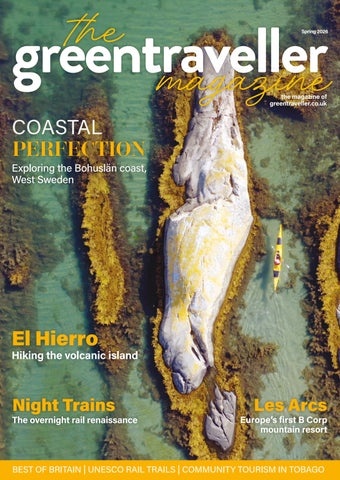
The Green Traveller magazine, Spring 2026

Page 1


COASTAL PERFECTION

Exploring the Bohuslän coast, West Sweden

El Hierro

Hiking the volcanic island

Night Trains

The overnight rail renaissance

greentraveller

green traveller

©GREENTRAVELLER 2026. Greentraveller Limited, Glove Factory Studios, 1 Brook Lane, Holt, Bradford on Avon BA14 6RL T: 07557 025542, E: info@greentraveller.co.uk W: greentraveller.co.uk

While every effort is made to ensure accuracy, GREENTRAVELLER cannot be held responsible for any errors or omissions.

FRONT COVER: Richard Hammond

ICONS: flaticon.com Graphics: freepik.com MAPS: freevectormaps.com

MAGAZINE EDITOR: Richard Hammond richard@greentraveller.com

MAGAZINE DESIGNER: Claire Gates clairegatesdesign@gmail.com

GOOD TO KNOW

Where you see these symbols throughout the magazine you can be assured that the destinations featured can be reached without flying or that the activities featured aim to have a positive impact for the community, environment or wildlife in the region.

Welcome to green traveller

Welcome to the spring issue of The Green Traveller magazine –the magazine of the website greentraveller.co.uk

You’ll hopefully find lots of inspiration in this issue, from hiking in the little-known Canary Island El Hierro (p28) and skiing in Les Arcs – Europe’s first B Corp Mountain Resort (p24) to exploring the beautiful Bohuslän coast of West Sweden (p16), and an inspiring feature on community-based conservation travel on the beautiful Caribbean island of Tobago by Mark Frary (p32).

The renaissance of Europe’s rail network has seen a major boost to overnight train services that is opening up long distance travel right across the continent from hubs in Paris, Brussels and Amsterdam. On p12-14 are some of the most popular overnight sleeper routes within the UK and across Europe – save having to stay overnight in a hotel: whether for business or leisure, leave late in the evening and wake up in the morning in another world.

Happy green travelling!

Editor, Green Traveller Magazine

SPRING 2026

Get the PICTURE

Winter is a good time for otter spotting in the Shetland Islands. Pups born in midsummer are just beginning to learn how to fish in the shallows near their holts and nocturnal fish in their diet is easier to catch during the day while sleeping. I took a trip with James from Shetland Nature to photograph these cute (but fiercely carnivorous) creatures. His in-depth knowledge of the landscape along with otter behaviour allowed me to get straight to the action without them even getting a whiff of my presence.

3views of RESPONSIBLE PHOTOGRAPHY

Words & pictures by Diana

In Shetland, otters often build their holts in the peaty coastal crevices among the Voes (inlets and inland sea lochs) or the stone jetties near mussel floats of these most northerly British Isles. You’re less likely to see otters during summer months because hyper vigilant new mums will only hunt under the cover of darkness.

We first saw fresh otter tracks on a sandy beach at low tide. Other tell-tale signs of otter activity James told me to look out for include sea gulls, perched looking out to sea as they’re waiting for any leftover fish the otters may leave.

Eurasian otters are Red Listed as Near Threatened by the International Union for the Conservation of Nature (IUCN). Though there’s a pretty healthy 800–1000 in the Shetland Islands, James asks us not to share any of the locations in which we’ve seen them, to keep them safe.

Global good news FOR SMARTER TRAVEL

EUROCAMP DOUBLES NUMBER OF ECO PARCS

Eurocamp has announced that 64 of its parcs across Europe have achieved a leading environmental certification, double the number of just a year ago.

Some 59 of the holiday parcs have been awarded a Green Key certification, supported by the World Tourism Organisation, for their commitment to sustainability, including five star La Croix du Vieux Pont near Paris and five star La Chapelle in Roussillon, Southern France.

Four more have been awarded a Travelife certification, including Alannia Els Prats and Alannia Costa Dorada, and La Côte Sauvage has been awarded EU Ecolabel certification.

Eurocamp owner ECG (European Camping Group) says it is determined to further reduce its environmental footprint by measuring its impact across four key areas: monitoring the amount of daily water and energy consumed per person; tracking the quantity of waste produced and recycled by parcs; and taking

actions to protect biodiversity.

“We offer holidays that bring people closer to nature. It is our duty to protect this heritage so that families can enjoy it for years to come,” says Philippe de Trémiolles, Managing Director of Eurocamp owner ECG.

ECG has also joined the “Communauté du Coq Vert”, launched by the French Public Investment Bank (BPI France) in partnership with the Ecological Transition Agency, and the French Ministry of Ecological Transition.

LA CÔTE SAUVAGE CAMPSITE, CHARENTE-MARITIME

UNESCO UK LAUNCHES RAIL TRAILS

A new campaign and digital platform, Explore UNESCO South West Trails, has launched, offering visitors an inspiring and sustainable way to discover the rich cultural and natural heritage of South West England including Bath and Bristol.

Launched in partnership with Great Western Railway (GWR), the initiative offers a curated collection of two-day trails inspiring

HF HOLIDAYS INVESTS IN BIOPHILIC DESIGN

HF Holidays has reopened Dolserau Hall in the Eryri National Park, marking the first milestone in an programme to invest in all sixteen of its UK Country Houses. The new approach will be brought to life by Biophilic interior designer Jana Robinson’s framework: ‘From Forest Floor to Tree Canopy’, which will be rolled out across the estate. Dolserau Hall’s reopening sees the start of a new estate strategy that focuses on a £10.5 million investment programme over the next six years, which the company says will focus on the front-of-house experience.

opportunities to discover eight UNESCOdesignated sites across the region, from dramatic coastlines and historic cities to globally significant landscapes.

The campaign highlights how rail travel can unlock easy access to multiple trail starting points, “supporting low-carbon travel while celebrating the rich diversity of heritage across the South West”.

Promotional posters will be displayed at key GWR railway stations, encouraging passengers to ’start their journey by rail’.

Through interactive content, route ideas, and practical information, users can plan journeys that not only enrich their own experience but also support local communities and reduce their environmental footprint. exploreunescosouthwesttrails.co.uk

Photo: Riviera BID Company Ltd
BROADSANDS BEACH
Photo: Chris Wakefield
THE ROMAN BATHS, BATH
THE MATTHEW, CUMBERLAND BASIN, BRISTOL
Photo: Nick Greville
DOLSERAU HALL, ERYRI NATIONAL PARK
HF Holdiays

National Forest reaches 10 million trees

The National Forest – spanning 200 square miles across Derbyshire, Leicestershire and Staffordshire – has reached the landmark milestone of planting ten million trees, marking thirty years of “one of the most ambitious and successful regeneration stories in the country”, transforming a scarred post-industrial landscape of coal mines and clay pits into a thriving, productive and accessible forest landscape.

The National Forest is now also working with government to support and develop new national forests across England, including the Western Forest in the South West, developing plans for another in the Oxford–Cambridge corridor, and a third forest to be announced.

Trees transforming lives — not just landscapes

As the world marks Earth Day on 22 April, international tour operator G Adventures is shining a light on a climate solution: one where tree growing does more than restore ecosystems, it helps “rebuild livelihoods, strengthen communities and create long-term resilience for those living on the frontlines of the climate crisis”.

Trees for Days has been built on a model that works in partnership with communities rather than in isolation from them. The initiative is designed to address “the interconnected challenges communities face from the climate emergency, from food insecurity and unemployment to biodiversity loss and climate resilience”. gadventures.com/ community-tourism/trees-for-days

A Gorilla Story: Told by David Attenborough

Due to premiere in London on 21st April, the documentary A Gorilla Story: Told by David Attenborough revisits the mountain gorillas of Volcanoes National Park – the same gorillas first encountered by David Attenborough nearly 50 years ago – and follows their descendants today.

The production team spent over 250 days filming on location in Rwanda, capturing unprecedented access to gorilla families, their behaviour, and their habitats. Beyond intimate wildlife footage, the documentary tells a compelling story of conservation, resilience, and transformation. It highlights how Rwanda’s sustainable tourism model has enabled the recovery of endangered species while supporting local communities through education, infrastructure, and livelihoods. The film also showcases Rwanda itself: the lush landscapes, national parks, and the dedication of rangers and conservationists working to protect these iconic species. By combining breathtaking visuals, compelling storytelling, and a focus on conservation success, Rwanda Tourism is hoping it will help position Rwanda as a global leader in sustainable wildlife tourism. The film will be available globally on Netflix.

Tywi Valley Path opens

A new 13-mile traffic-free trail has opened connecting Carmarthen to Llandeilo along a former railway line which follows the gentle sweep of the River Tywi in West Wales. The fully tarmacked Tywi Valley Path provides a car-free route for cyclists, walkers and families through a swathe of Carmarthenshire’s spectacular scenery across the Tywi Valley peppered with historic buildings such as Paxton’s Tower and Dinefwr Castle. discovercarmarthenshire.com

SIWASH LAKE: FROM ASHES TO ASPEN

Nearly a decade after a wild fire swept through Siwash Lake Wilderness Resort & Ranch in British Colombia, Canada, a new Wildland interpretive trail has been launched “as a personal and storied tribute to the land’s recovery”.

The carefully crafted path guides guests through the landscapes reshaped by the 2017 wildfire. Along the way, interpretive storytelling shares the land’s natural history, the unique story of the founding family, and the broader forces of climate change that shaped the transformation that opens up new possibilities for wildlife viewing, immersive learning, and deep connection with the land’s ongoing recovery.

Guests are guided along a path of “living regeneration and discovery”, from soft meadow grasses “through a narrative of renewal” – where charred trunks rise from the earth to give way to bright shoots of fireweed, wild rose, and willow.

Spanning grassland, wetland, and recovering forest, the trail features interpretive signs that invite guests to pause, reflect, and learn. Visual and textual storytelling — personally crafted by Siwash Lake’s founding family — guides visitors through the area’s history and ecology, the story of the epic defense of the resort in 2017, the resilience and vulnerability of the natural world, and many other integral

chapters in the evolving story of the land. “This trail is the land’s story made manifest,” says Marshall Fremlin, GM and Owner at Siwash Lake. “But more than anything, it’s a celebration. Of nature. Of resilience. Of time. Of what happens when we let nature lead.” Wildlife blinds allow guests to “rest and meditate” – from within a log lean-to, crafted from burnt wood and roofed with native bulrush, visitors can shelter from the weather while remaining hidden from view. They can enjoy a quiet break, pull out binoculars, and observe the subtle bustle of a rejuvenated wetland. www.siwashlake.com

Photos: Siwash Lake
SIWASH LAKE WILDERNESS RESORT & RANCH

3 BEST OF BRITAIN GREEN PLACES TO STAY OR EAT

Tap in ‘green hotels’ or ‘sustainable restaurant’ into a search engine and you’ll be presented with a bewildering range of options, some more eco-friendly than others. It can be hard to know the green from the green wash. Here are three places Richard Hammond picks out that are going the extra mile to reduce the impact of your visit on the environment.

WILD RESTAURANT

WILD Restaurant in Berkhamsted, Hertfordshire, led by Chef Patron Matt Larcombe, is celebrating its first spring season since opening on Berkhamsted High Street in October 2025. Much of the restaurant’s produce is drawn from its own nearby farm project, Wild Farm in Radlett, just minutes from the restaurant, which follows regenerative farming principles, focusing on soil health, biodiversity and crop rotation. Signature starters include crab on hash brown, mushroom dishes, and butternut squash agnolotti with goat’s curd and sage, as well as pollock crudo with citrus and grapes, red mullet, sea bream and moules marinière. wildrestaurant.co.uk

ONE CAT FARM

A collection of cosy, hand-built, off-grid remote cabins on a secluded 3-acre woodland nature reserve in Ceredigion, West Wales. It’s an idyllic setting: go wild swimming in the ponds, cook over a firepit, gaze up at the dark skies of this remote area, and endulge in outdoor baths. If you can stir from the idyll, there are footpaths from the doorstep –with the Cambrian Mountains to the east and the hidden coves of Cardigan Bay to the west –else it’s just 5 minutes drive to the beautiful coastline. The cosy cabins have been individually styled to create a beautifully simple yet luxurious experience that aims to immerse guests in nature. onecatfarm.com

PENHEIN

A family-run farm and glampsite near Chepstow in the Monmouthshire hills, South Wales that’s won a string of national green awards for its commitment to minimising its ecological footprint. Eight beautiful custommade Persian alachigh tents with domed ceilings so it’s cosy yet spacious, with a woodburning stove and a kitchen that has running water. There’s a shared drying room and a shower block with underfloor heating, hot monsoon showers and a Victorian roll-top bath. Those who require extra pampering, can treat themselves to a range of relaxation treatments including cold and hot stone aromatherapy massages and facials. The onsite pantry is mainly stocked with Welsh produce through the company Blas ar Fwyd. New for 2026 is a mini adventurers nature-based arts and crafts club for 2-8 year olds run by a qualified child minder. penhein.co.uk

WILD RESTAURANT

NIGHT TRAINS

OF UK & EUROPE

The renaissance of Europe’s rail network has see a major boost to overnight train services that is opening up long distance travel across the continent from hubs in Paris, Brussels and Amsterdam. Here are some of the most popular sleeper routes within the UK and across Europe - save having to stay overnight in a hotel: whether for business or leisure, leave late in the evening and wake up in the morning in another world.

London to Scotland

Travel on the overnight sleeper train from London Euston and arrive in Edinburgh, Glasgow, Inverness, Aberdeen and Fort William the following morning.

The Caledonian Sleeper is the collective name for several overnight night train services from London Euston to Scotland:

The Lowlander travels direct to Glasgow and Edinburgh – the train splits in the early hours of the morning to Edinburgh Waverley or Glasgow Central.

The Highlander travels further, to Aberdeen, Inverness, Aviemore, and Fort William.

You can also board the train for both services from Watford Junction, Carlisle, Crewe and Preston. It’s a great way to travel from England to the mountainous fresh and wild of Scotland, and vice-versa. A great place to get off en route is Corrour (4 stops before Fort William) and walk a mile to Loch Ossian hostel on the edge of Rannoch Moor.

Book the Caledonia Sleeper >>

London

to Penzance, Cornwall

The Great Western Railway ‘Night Riviera’ overnight sleeper night train travels from London Paddington to Penzance at the very southwest tip of Cornwall.

The cabins have plug sockets, USB sockets, a sink with a tabletop, wardrobe and storage space under the bottom bunk (which converts into a sofa), plus there’s an onboard lounge bar. Those travelling first class can use GWR’s first class lounges (including the showers) at Paddington, Penzance and Truro.

Book the Night Riviera >>

Paris to Nice, Latour-de-Carol, Lourdes, and Briançon

The Intercités de Nuit night train is the French domestic service run by state operator SNCF that connects Paris to the south and southwest of France, including Nice, Cannes, Antibes, Briançon (for the southern French Alps), Toulouse (for the Pyrenees), Perpignan, and Latour-de-Carol on the Spanish border.

All Intercités de Nuit trains depart in Paris from Gare d’Austerlitz, see: How to transfer between train stations in Paris

Book Intercités de Nuit >>

Tina Smith

Brussels to Berlin and Prague (European Sleeper)

‘The Good Night Train’ run by the cooperative operator ‘European Sleeper’, connects Brussels to Berlin (and on to Prague) via Antwerp, Roosendaal, Rotterdam, Den Haag, Amsterdam and Deventer.

European Sleeper was founded in 2021 by two entrepreneurs with a passion for night trains: Elmer van Buuren of Train2EU and Chris Engelsman of Noord West Express, with one clear mission: “to make night train travel a comfortable, sustainable, and adventurous alternative once again”. Since then, it has connected thousands of travellers across Europe with its night trains. There are several sleeping arrangements on board: the ‘Budget’ option is just seats in a 6-person compartment; ‘Classic’ is a 5-bed compartment where seats durin g the day convert into couchettes at night ; ‘Comfort Standard’ is a 3-bed couchette ; and ‘Comfort Plus’ is a more spaciou s 3-bed couchette that includes privat e wash basin.

Book the European Sleeper >>

Milan to Sicily

The Intercity Notte overnight sleeper night train, run by the Italian state operator Trenitalia, connects Milan all the way through Italy via Bologna, Florence and Messina to several places in Siciliy including Catania, Syracuse, and Palermo.

Book the Intercity Notte >>

Amsterdam to Zurich

The Nightjet overnight sleeper night train, run by the Austria operator OBB, connects Amsterdam to Zurich picking up passengers along the way in Cologne, Bonn, and Koblenz, and dropping off the following morning in Freiburg, Basel, and Zurich.

Book the Nightjet sleeper >>

CONVERTABLE SEATS ON THE EUROPEAN SLEEPER
THE LIMMAT RIVER RUNS THROUGH THE HEART OF ZURICH
Cemil
Erkoc / Zürich Tourismus
Richard Hammond

Berlin to Stockholm (SJ)

The Euronight overnight sleeper night train, run by the Swedish operator SJ, connects Berlin to Stockholm picking up passengers along the way in Hamburg, and dropping off the following morning in Copenhagen, Malmo, Linköping, and Stockholm.

Book ths sleeper to Stockholm >>

Brussels to Vienna

The Nightjet overnight sleeper night train, run by the Austria operator OBB, connects Brussels overnight through to Austria’s capital, picking up passengers along the way in Cologne, Bonn, and Koblenz, dropping off the following morning in Munich, Salzburb, and Vienna.

Book the Nightjet sleeper >>

Budapest to Bucharest (Ister)

The ‘Ister’ overnight sleeper night train departs from Budapest in the early evening and arrives in to Bucharest at a very civilised time of 10.37am the following morning. Book the Ister sleeper >> Budapest to Bucharest tickets provided by both Hungarian Railways www.mavcsoport.hu and Romanian Railways bileteinternationale. cfrcalatori.ro. Alternatively, buy an Interrail ticket, which covers both Hungary and Romania.

Sofia to Istanbul

The Sofia-Istanbul Express overnight sleeper night train (also known as the Balkan Express) connects Sofia Central Station (Bulgaria) to Istanbul Halkali (Turkey).

Book Sofia-Istanbul Express >>

[You can buy tickets at the railway station in Sofia, but if you want to book ahead, we suggest you do so via Discover by Rail who can organise the ticket for you.]

Book night trains with Interrail No longer just for students, the Interrail pass now provides multi-trip rail passes in 33 countries for all ages. It is possible to use the pass on most European sleeper trains but you will need to reserve the seat or bed in a secure berth, couchette or private cabin for an additional fee, which you can do through the Interrail booking service:

Book interrail at interrail.eu >>

WINDOW VIEW ON THE EUROPEAN SLEEPER
READING LIGHT ON THE EUROPEAN SLEEPER
BEDS ON THE EUROPEAN SLEEPER
Richard Hammond

EXPLORING THE BOHUSLÄN COAST, WEST SWEDEN

Sarah Baxter goes on an off-season, eco-focused adventure, hopping between some of Bohuslän’s 8,000 isles and skerries. taking part in a seaweed safari and witnessing a spectacular island light festival

Photo: Island of Light Smögen
All other photos by Richard Hammond

The graceful white villa shone in the early-evening light. Its lawn, confettied with the season’s first fall of leaves, sloped to two Adirondack chairs – I took a seat. Beyond, the land dropped down a forested ridge to the lake-like inner fjord. The sinking sun painted the sky peachy, caught the water’s ruffles, cast shadows on the scattered isles. A spectacular scene.

Ellika Mogenfelt interrupted my moment. “Would you like a glass of champagne?” she asked. “I’ve got a bottle open.” Well, if you insist.

Villa Sjötorp was built as a summerhouse by Ellika’s great-grandfather in 1901, when Lyckorna, on West Sweden’s Bohuslän coast, was a newly fashionable spa town. It was sold by the family when Ellika was little but, in 1995, she bought it back. Following a painstaking restoration, it’s now a rustic-chic retreat by the sea, with an exquisite restaurant:

food is organic and local-sourced – ethicallyreared chickens, grass-fed beef, foraged mushrooms and berries – and served on organic Ekelund tablecloths, woven in Sweden. Not only has Ellika salvaged a magnificent old building, she’s opened it for others to enjoy, year-round.

Villa Sjötorp is also a member of West Sweden’s Stepping up Sustainability initiative,

SARAH DRINKING IN THE VIEW AT VILLA SJÖTORP
BEDROOM AT VILLA SJÖTORP
VILLA SJÖTORP WAS BUILT AS A SUMMERHOUSE IN 1901 WHEN LYCKORNA WAS A NEWLY FASHIONABLE SPA TOWN

which aims to limit tourism’s environmental impact, ensure the industry works for both residents and visitors, and encourage visits outside peak months. Lazing on that chair, with that view, drinking champagne on a dazzling autumn evening, I felt I’d found green-travel heaven.

However, Sjötorp was just one stop on my off-season, eco-focused adventure, hopping between some of Bohuslän’s 8,000 isles and skerries. It was an adventure that had begun a few days before, with a Eurostar ride and a night in Brussels, then a day –book-reading, day-dreaming – on the train to Copenhagen; here, the Capsule Hotel in trendy Vesterbro provided a confined but low-cost sleep. By lunchtime the following day, I was on the ferry from Gothenburg to my first port of call: Styrsö, in the southern Gothenburg archipelago.

The island won me over immediately. It was quiet, leafy, car-free and cost less than £3 to

reach – quite the change from the 19th century, when Styrsö was a fancy wellness resort for the city’s elite. Karolina Martinson filled me in on some history as we cycled the winding lanes. But ultimately she wanted to show me something else: the beauty of seaweed.

Karolina is a seaweed diver and passionate advocate for “connecting people with the ocean again”. Her tours can involve foraging by snorkel, then creating beach picnics using this most sustainable of ingredients: seaweeds are full of nutrients, but also nurture biodiversity, improve water quality and store greenhouse gases.

“There are so many things that are tasty, good for us and good for nature,” she told me as we scrambled to a tucked-away bay and she pulled on her wetsuit. “When I first came here, people thought I was strange,” she admitted. “I talked to older people about seaweed; some remembered using it as fertiliser, but they’d never thought of eating it.”

KAROLINA MARTINSON
KUSSTHOTELLET, STYRSÖ

SMÖGEN ISLAND OF LIGHT FESTIVAL

The world-renowned digital artist Miguel Chevalier is to take part in the Smögen Island of Light Festival this autumn, which is due to run from 4th-13th September. The island’s beautiful rock formations among a coastal urban setting, alongside the open skies of the Nordic sea make for a fascinating backdrop for light art – several of the works include projecting lights and films onto the cliffs. Since it launched in 2018, the festival has hosted several of the world’s leading light artists presenting their light works among this unique environment, often telling stories of fairytales and ancient myths through their art.

Miguel Chevalier will create a new, site-specific large-scale audiovisual artwork in the Hästen/Vallevik area of the island.

Three British artists will also feature at the festival: Craig Morrison will present am immersive audiovisual artwork and live performance, Andrew Scott will create an interactive laser installation involving live performance and public participation, and Matt and Rob Vale of Illuminos will show an audiovisual artwork on a fishing boat moving across the sea.

The festival will also feature works from artists from Finland, Latvia, France, Greece, the Netherlands and Poland. www.islandoflight.art

WHAT KAROLINA IS DOING FOR SEAWEED, JANNE IS DOING FOR BOHUSLÄN’S BLUE MUSSELS: THAT IS, BIG UP

THE BENEFITS OF THE

‘BLUE

GOLD OF THE SEA’

This is a mind-set Karolina would like to change – and it’s an easy sell when you taste the spoils. After harvesting various wracks and weeds, she whipped up a feast of spicy sugarkelp salad, cheese wrapped in fried gutweed and rose-hip soup with caramelised kelp. Being eco-friendly never tasted so good. After leaving Styrsö, I hired a hybrid car and headed up the coast, first for a blissful

night at Villa Sjötorp, then to meet Janne Bark at Musselbaren, his restaurant in the converted old clocktower in Lyckorna. What Karolina is doing for seaweed, Janne is doing for Bohuslän’s blue mussels: that is, big up the benefits of the ‘blue gold of the sea’.

“They’re packed with vitamins and minerals but have a really low climate impact,” Janne explained when I joined one of his boat

trips to the mussel farms offshore. “It’s a no-brainer to eat them – literally, they don’t have a brain.” Janne is also keen to show their versatility: “You can fry them, steam them, do risotto, make mussel meatballs.” Janne even tried concocting a mussel gin in his microdistillery. “It was… strange,” he admits; however, one of his best-sellers is Fräkne Tång, the distillery’s seaweed gin.

Belly full of blue superfoods, I continued north, and over the bridge to Smögen. The history was starting to sound familiar: like Styrsö and Lyckorna, during the 19th century this small fishing isle became a popular health resort. Smögens Hafvsbad opened as a seaside sanatorium in 1900, but has modernised since, with a large spa and a commitment to sustainability, including the use of geothermal energy. It’s also open year-round, helping to encourage visitors off-season.

This is what Dulce Ahlberg is trying to do too. Dulce is the founder of Island of Light, a light-art festival held here every September. “It’s about beauty, creativity and working not just in nature, but with nature,” she told me. “We don’t pollute anything, and we collaborate with the marine recycling centre, which collects tonnes of discarded fishing gear – at least one artist uses materials from the centre in their work.”

That evening, as darkness fell, I walked the art trail from Smögen’s picture-perfect

WATERSIDE RESTAURANT AT MUSSELBAREN

Top row: Dulce Sales Ahlberg, Creative Director, Smögen Island of Light; Janne Bark, co-founder, Musselbaren.

Centre: Karolina Martinsson, Seaweed diver and nature guide, Algblomman, Styrsö.

Bottom row: Martin Nilsson, Co-founder & Chef, Kläpphagen, Koster Islands; Gustav Waldås, kayaking guide, Koster Adventures, Koster Islands

harbour. It was part playful fluorescence, part shimmering reflections; it was eons evoked in choreographed sound and light. I’ll say no more: it’s better to turn up and be wowed.

If the Island of Light festival used nature as a backdrop, my final destination, Kosterhavet, let nature take centre stage. This is Sweden’s first marine national park, where cars are banned, the is pace blissfully slow and the underwater world is home to species found nowhere else.

I took the ferry to South Koster and checked into Kläpphagen, a hip retreat that’s upped the food game on this time-warp isle: local, organic and seasonal ingredients are cooked from scratch, over fire, in incredible ways. But that was for later. First, I grabbed a bicycle and rode down leafy lanes to meet Gustav Waldås of Koster Adventures, for a kayak trip into the marine park.

The sun was blazing and there was barely a soul in sight as we paddled amid a maze of islets and skerries. I was glad to have Gustav leading the way – I’d soon have gotten lost. We squeezed through gullies, skimmed oyster beds, poked into crevices and eventually hauled up on a sandy cove. The water sparkled so invitingly that I couldn’t resist a dip.

Indeed, the only thing that dragged me out was the temptation of fika. Tucking into hot coffee and a hunk of Gustav’s Mum’s banana bread, I looked out across the white sand,

KLÄPPHAGEN, KOSTER HAS A BOUTIQUE B&B, GLAMPSITE, BREWERY & RESTAURANT

How to travel by train to West Sweden

smooth granite and crystal-clear ripples. No champagne this time, but another spectacular West Sweden scene.

More information:

Seaweed tours: www.algblomman.com, West Sweden: www.vastsverige.com/en

Disclosure: Sarah Baxter was a guest of West Sweden Tourism Board. She had full editorial control of this feature, which has been written in her own words based on her experience of visiting the Bohuslän coast. All opinions are the authors’ own.

WATCH OUR VIDEO OF SARAH’S TRIP TO THE BOHUSLÄN COAST: greentraveller.co.uk/post/exploring-the-bohuslan-coast-west-sweden

It is possible to travel flight-free by train from London to Gothenburg in West Sweden with just one overnight stop en route by travelling on Eurostar from London St Pancras via Brussels, Cologne, Hamburg and Copenhagen. Take an afternoon or evening Eurostar to Brussels Midi station (or if you’re coming from the East of England, take the ferry from Harwich to Hoek van Holland and then train to Brussels) where you stay overnight then in the morning take the high-speed Thalys or ICE trains to Cologne where there’s an easy same-station platform change to take another train to Hamburg and then on to Copenhagen. Alternatively, you could take a morning Eurostar to Brussels to change (within the station) to the train to Hamburg where you stay overnight then catch the morning train to Gothenburg, arriving about 6.30pm. For more details, and to book tickets for the trip, see our guide to How to travel flight-free from the UK to West Sweden

SARAH ON NORTH KOSTER
SARAH KAYAKING AT KOSTER WITH KOSTER ADVENTURES

LES ARCS

EUROPE’S FIRST B CORP

MOUNTAIN RESORT

Richard Hammond takes the train from London to Les Arcs in the French Alps to see how the resort is adapting to the climate emergency

Surveying the vast alpine slopes of the Haute Tarentaise from the top of the Varet gondola, everything seemed to be in miniature; skiers on the Aiguille Rouge black run looked like match-stick animations, piste-side cafes looked like toy boxes, and the end of my forthcoming zip ride seemed an awful long way off. Without much time to dwell on my predicament, the safety catch was released followed by a jolt, a yelp, and what felt like super-sonic acceleration, I hurtled down the 1.8km vertiginous wire at 122km/h, surprised at just how much I was enjoying it.

The Aiguille Rouge Zip Line is the latest installation at Les Arcs 2000 in the vast Les Arcs – Peisey-Vallandry territory in the heart of the Tarentaise Valley, Savoie facing Mont Blanc and at the gateway to the Hauts de Villaroger Nature Reserve and the Vanoise National Park. I’d come here by train from London sampling one of a collection of ski resorts by train packages offered by the tour operator Inghams, designed to “offer customers a low hassle, sustainable option to three countries and 18 resorts across Europe in France, Austria and Switzerland”.

The overland journey was a joy: Eurostar to Lille then a short same-platform change to take the snow train direct to Bourg-SaintMaurice from where it was a few minutes’ walk to an electric-powered funicular that travelled up to Les Arcs 1600 in just 7 minutes. Exiting the funicular, it was just a short walk to my hotel, the four-star La Cachette. I later learned that the ease with which it is possible to reach Les Arcs without

a car has meant that 25% of holidaymakers now travel to it by train, compared to a national average of just 10%.

Les Arcs – a mountain resort

While some other ski resorts in the Alps seem to be relentlessly building more lifts, hotels and gondolas higher up the mountains, the emphasis at Les Arcs is on widening the appeal of current infrastructure, providing a host of alternative activities, such as the zip wire, snow parks and piste-side attractions, as well as opening up the mountains all year round. My ski instructor Ivan told me Les Arcs now calls itself a ‘mountain resort’ rather than a ski resort, packing its summer months with a multitude of outdoor options, from hiking and cycling to paragliding and whitewater rafting.

A 2030 vision for sustainability

Les Arcs had attained certification with B Corp – the international assessment scheme that assesses companies on their social and environmental performance, accountability, and transparency, balancing profit with purpose. It scored 90 points (out of a possible 200) and is the first mountain area in Europe to gain this certification. I met up with Laura Brisebourg, Communications Officer for ADS (Les Arcs Domaine Skiable – the company that manages the ski area) and Léo Tixier, Mountain Resort Development Manager for ADS, who explained to me that their success with the certification was down to a range of initiatives that have been earmarked throughout the mountain resort, notably across five key areas: governance, reducing their carbon footprint, sustainable management

Alban Guerry-Suire/Office du Tourisme Les Arcs
Richard Hammond
LES ARC’S FUNCTIONAL YET HARMONIOUS APPARTMENTS, DESIGNED BY CHARLOTTE PERRIAND
AIGUILLE ROUTE ZIP LINE

of water, preserving biodiversity, and raising awareness particularly among staff.

The resort has set out aims for 2030 to produce 25% of all its electricity needs using a combination of hydroelectricity and solar panels, reducing its emissions of carbon dioxide to zero by using HVO fuel and electric car fleets, restoring wetlands and protecting the habitats of the endangered black grouse, and training staff in a range of climate, environmental and social actions. It has already reduced its carbon footprint from 10,000 tonnes to 3,000 tonnes over the past five years by addressing its scope 1 and 2 emissions.

“We know with climate change that we have the responsibility to change the game”, Léo Tixier told me.

One of the educational elements that took place earlier this year was the 3-day Agir pour les Glaciers festival to raise awareness of the plight of glaciers, not least the nearby retreating Varet glacier. At more than 3,226 m above sea level, the peak of the Aiguille Rouge is currently the highest point of the Les Arcs / Peisey-Vallandry mountain area and attracts over 400,000 visitors per year, yet if it continues to lose 2 to 3 metres in thickness per year, the glacier will probably disappear over the next decade. A second festival is slated for 15–18 October 2026.

Educating climate action isn’t just confined to resort staff, Laura said ADS is keen for those that use its lifts to better understand the mountain environment, including its geology and wildlife. I was taken to two exhibitions on the slopes – a minerals gallery on the ascent to Col de la Chal and a mountain animals museum at top of the Vallandry cable car, as well as to a light show showing the mountains through the seasons at the top of the Valet gondola adjacent to the zip wire.

“We know with climate change that we have the responsibility to change the game”
Léo

After my morning’s exertion on the zip wire, I had a relaxed lunch enjoying the marvellous piste-side views of the Haute Tarentaise from the large terrace at Chalet Grillette between the Transarc gondola and the Villards cable car in Arc 1800 before spending the afternoon skiing in blissful sunshine and blue skies, followed by a long soak in the hot tubs at La Cachette. The following morning, local historian Jean-Marie Chevronnt took me on a tour of the architecture of Arc 1600. Built in 1968,

LES ARC’S ELECTRIC POWERED FUNICULAR
Maxime
Bouclier/Les Arcs Paradiski
Richard Hammond
Richard Hammond
CHEZ LÉONTINE AT LES ARCS 1950

the owners brought in renowned architect Charlotte Perriand, a pioneer of urban and architectural design, to create a functional yet harmonious look to the resorts. What she created may be a huge block of apartments, but her modernist design aimed to blend them into the mountains while opening up the highaltitude slopes to the masses.

On my final day, I went up to Arc 1950 to have lunch at Chez Léontine, a chic, oldfashioned characterful restaurant renowned

for a wide selection of fondues cooked in front of customers. That evening, I was taken on a torchlit snowshoe hike up into the woods behind the resort stopping for a picnic of cheese and local wine among the pine trees and freshly fallen snow. It was a nod to how things have always been here in the mountains, yet the feeling here is that it’s all part of progressing to a new kind of winter mountain resort that’s trying to adapt to the nature and climate emergencies.

More information

For information about Les Arcs, visit lesarcs.com. Inghams offers 7 nights half board at La Cachette, Les Arcs departing 4th April 2026 from London St Pancras from £1,689 per person. Based on 2 adults sharing. All trains and transfers included.

www.inghams.co.uk . Tel: 01483 938047

Lift pass prices at Les Arcs:

6-day ski pass: 348 euros (Classic pass) 1-day ski pass: 68 euros (Classic pass)

Disclosure: Richard Hammond was a guest of Inghams and Les Arcs Peisey-Vallandry. He had full editorial control of this feature, which has been written in his own words based on his experience of visiting Les Arcs in the winter of 2025. All opinions are the author’s own.

WATCH OUR VIDEO OF OUR TRIP TO LES ARCS:
Richard Hammond
SHOWSHOEING FROM LES ARCS 1600

VOLCANIC island e

Teresa Machan explores the little-visited island of El Hierro, the westernmost of the Canary Islands, swimming in sea pools, hiking its verdant age-old forests, and joining a boat tour to learn more about the island’s rich underwater marine life.

Photos & video by Richard Hammond

Ididn’t take too kindly to my guide Paolo’s suggestion that we go and look at a windfarm. My first day on El Hierro had been filled with unusual and extraordinary sights and, well, I stare at 116 wind turbines every day in the English Channel. Did I really need to see five more?

Paolo’s confused expression said it all, but he agreed to move our visit and round off the day with a dip at La Maceta – a trio of lava-hooped sea pools (charcos) scoured by the North Atlantic Ocean. El Hierro has six beaches –one of them sandy – but the sea is mostly accessed via boardwalks, rails and ladders that drop down into clear, black-green water

You don’t need to stay in fancy hotel to enjoy sublime infinity-edge views. I tiptoed around the lava rim just as the setting sun began gilding the surface of the ocean and found a viewing perch on a natural sea ledge. Wallowing in the warm wave-washed water (around 22 C in mid-October), I waited until the afterglow had tinted the pools peach and pink.

Hailing from northern Italy, Paolo Baudino came to El Hiero for a long weekend with his wife, Enrica. Having set up the guiding company Atlántida, the pair is still here almost 25 years later, living the dream under one of the island’s 10,000 volcanoes. Not a bad advert for a European island many have never heard of.

The youngest and most westerly of the Spanish archipelago, El Hierro was declared a Geopark in 2014 by UNESCO and a World Biosphere Reserve in 2000. Scarred by cones and craters, while swathes of the island are

ruggedly sparse, their fire-hewn birth story told in folds of crumpled lava, elsewhere are intriguing pockets of deep and verdant forest. It peaks at 1,501 metres and roads that hairpin through several microclimates can take you from prickly-pear orchard to pungent pine forest in the blink of an eye. From loamy laurisilva to black-sand calderas and cowdotted pastures that are reminiscent of the Yorkshire Dales, the island is full of surprises. Scarred by cones and craters, while swathes of the island are ruggedly sparse, their fire-hewn birth story told in folds of crumpled lava, elsewhere are intriguing pockets of deep and verdant forest.

The absence of direct flights, big hotels and sandy beaches keeps El Hierro well under the under the radar. Of the 30,000 to 40,000 visitors it receives annually, most are from Spain. From Mirador El Pena, a north-westerly clifftop viewpoint chiselled out by César Manrique, Paolo pointed out neighbouring La Gomera, La Palma and, on Tenerife, Mt Teide –the Canaries’ emblematic peak. A solitar y ferry bound for Tenerife rippled the Atlantic’s silky surface and, not for the first time during my short visit I felt the sensation of being adrift in a place far from Europe.

Sustainability roadmap

The island’s quest for self-sufficiency and its sustainability achievements stem in part from its location. Anyone who wants to see what a blueprint for self-sufficiency in renewable energy really looks like should visit El Hierro,

where electricity based on clean, renewable energy sources saves thousands of tons of diesel fuel each year (over 6,000 tons in 2024).

In October 2025, a Climate Action Plan for El Hierro was launched with support from the UK-based charity The Travel Foundation. It was conceived as a pilot for developing similar projects on other Canary islands. “El Hierro’s strong sustainability track record made it the most suitable and feasible place to begin,” said Isabel Florido Martel, environmental sustainability technician at Turismo de Islas Canarias.

The roadmap will include improvements in sustainable mobility, preventive measures to protect sensitive areas and the introduction of incentives for renewable energy, water efficiency and better waste management in tourism businesses.

When we eventually visited the wind farm, I understood see why Paulo was so keen for us to see it; remarkably, there are just five generators that produce double what the island’s inhabitants – around 10,000 people – need to be self-sufficient in electricity.

Excess energy is used to pump water between two reservoirs at different altitudes. “This means that on days that we don’t have wind we have energy produced by water,” said Paolo. “Either you consume it or it’s lost.”

GUIDE PAOLO BAUDINO IN THE LLANÍA TRAIL
HOTEL PUNTAGRANDE WAS ONCE CROWNED THE SMALLEST HOTEL

According to Jesus Perez Quintero, environmental councillor at the municipal council, the island is looking to photovoltaics and robotics to reach its long-term goal of achieving 100% renewable energy year-round. Walking trails traditionally used for pastoral work and transhumance fan out across the island, traversing more kilometres of paths than road. Once every four years the nearly 29 km-long Camino de la Virgen (Path of the Virgin) is used for the day-long processional descent of the Virgen de Los Reyes in which the island’s patron saint is carried from her white-walled, bell-tower-topped hermitage, in Dehesa, to the Church of Santa Maria de la Concepcion, in the island’s diminutive capital, Valverde.

An ancient land

History and cultural heritage can be explored at a handful of museums including the openair Guinea Ecomuseum, where visitors can see how the Bimbaches – pre-Hispanic settlers who colonised the island over 2,000 years ago, lived. A sub-species of the El Hierro giant lizard, one of a 112 endemic species, can be seen (behind glass) at the museum’s Recovery Centre. The Bimbaches left their mark in a series of spiral, alphabetic and geometric rock engravings that are preserved at El Julan

Cultural Park. Petroglyphs aside, it is worth visiting just to see this vast and empty lava slope that was graffitied by the early settlers sliding away into the sparkling sea.

Early one morning we left sunshine behind on the north-east coast and drove into centre of the island to join a short, forested section of the Llanía Trail, which crams several of the island’s geographical features into a two-hour hike. As we plunged into the lichen and mossdraped fayal-brezal, a wooded area of waxmyrtle or “fire” trees and Canarian heather,

moisture clung to my hair and face.

Created by the Tradewinds, the mists that roll around this elevated habitat preserve some of the Canarian archipelago’s last remaining laurel forest. The three of us on the walk took it in turns to wrap our arms around the voluptuous girth of a Canary Island Pine, leaning into its mottled, fire-adapted trunk.

Not long after leaving the trail we were zigzagging down hairpin bends towards the juniper forest of El Sabinar. These curious, wind-warped trees, some more than 20 feet

Richard Hammond
HOTEL IN THE WORLD
ANCIENT CAVE DWELLING IN EL JULAN CULTURAL PARK
While swathes of the island are ruggedly sparse, their re-hewn birth story told in folds of crumpled lava, elsewhere are intriguing pockets of deep and verdant forest

high, are the island’s unofficial emblem. Trunks hinged in an inverted V, their spiny crowns sweeping the ground, these specimens are the tree version of Downward Dog pose.

Although the island is the largest producer of pineapples in Spain (with bananas not far behind) food production is generally smallscale. The island employs regenerative farming techniques and holds the highest proportion of land – 3,995 hectares – and registered under organic production systems within the Canary Islands. El Hierro produces Designation of Origin wines, delicious goat, cow and sheep’s cheeses and has swapped nets for line fishing. “We fish in the traditional way, at dawn, with rods, hooks and live bait,” says David Pavón, president of the cooperative, Pescarestinga. Not long after leaving the trail we were zigzagging down hairpin bends towards the juniper forest of El Sabinar. These curious, wind-warped trees, some more than 20 feet high, are the island’s unofficial emblem.

Underwater mecca

The village of La Restinga, on the island’s southwestern tip, is a busy fishing harbour and a springboard to several dive sites in the Mar de Las Calmas (calm sea). Divers can hover over lava tongues, black coral, caves, craters and arches. Visibility here is excellent, and the waters here are home to marine life including manta rays and one of the world’s most important

communities of beaked whales.

The area has been a protected marine fishing reserve since the mid-90s and in 2024, the government proposed a bill which, if successful, would create Spain’s first marine national park. Extending several miles offshore, the Mar de las Calmas National Park would support species including sperm whales and whale sharks and set a precedent for marine conservation in Spain.

In the hope of spotting bottlenose dolphins, I joined a boat trip from La Restinga. From the water, the island’s rugged beauty came into sharp focus. Near-perfect cones rose like chocolate hills while caves and sea pools puddled in the island’s blackened, broiled skirt. Instead of dolphins, we were joined by scores of flapping-tailed flying fish, their pectoral fins gliding on the wind. It was a first for most on the boat and dolphins were soon forgotten. That evening, we dined at La Refugio, one of a handful of fish restaurants in La Restinga. As we tucked into a pile of shrimp and slurped limpets drenched in garlic, vinegar and parsley from their shells, our neighbours, a bunch of Welsh divers, pored over their underwater photo haul of seahorses, giant groupers, Moray eels, rays and nudibranchs.

Prime Meridian

I ended my time on El Hierro with another sunset, off Spain’s most westerly tip. Orchilla

lighthouse marked the edge of the known world for over two hundred years. A monument nearby marks the Prime Meridian that was, before it moved to Greenwich in 1884. Even now, as we picked our way across a field of cavity-pocked pahoehoe lava toward the lighthouse, I found my bearings tested. Paolo asked where I thought a bird would make land if it continued west. I would never have guessed Orlando.

I sat on the smoothest bit of lava I could find and stretched my feet out towards the ocean, bathed in the silvery beam of the sun’s descent. For the last time – on this visit at least – I savoured the sense of solitude and the feeling of being deliciously and somehow secretly, off grid.

WILD GOAT ROAMING THE SCRUBLAND
ENDANGERED ENDEMIC EL HIERRO GIANT LIZARD

How to travel flight-free to El Hierro

There are two ferry routes from mainland Spain to the Canary Islands, from Huelva (near Seville) operated by Baleria, and from Cadiz, operated by Armas Trasmediterránea.

For how to travel to these ports from the UK without flying, see Green Traveller’s Guide to How to travel overland to Spain

The ferries from Huelva run to the Port of Santa Cruz de Tenerife (which takes about 40 hours) and stop at the Port of La Luz in Las Palmas de Gran Canaria en route.

The ferries from Cadiz run to Fuerteventura, Gran Canaria, La Palma, Lanzarote and Tenerife, taking 28–35 hours.

Ferries travel several times a week from Tenerife to El Hierro and take about two hours, operated by Armas Trasmediterranea.

TERESA AT ONE OF SEVERAL SEA POOLS ON EL HIERRO
CHAPEL LA DEHESA THAT’S HOME TO EL HIERRO’S PATRON SAINT VIRGEN DE LOS REYES
VEGETATION IN BIOSPHERE
SEAFOOD IN RESTINGA

Hiking in El Hierro

Journey to the ‘Ends of the Earth’

Travel o the beaten track on the little-known island of El Hierro, the westernmost of the Canary Islands, and discover laurisilva forests, mountains, volcanoes and verdant meadows

NATURAL MAGNIFICENCE

El Hierro, the youngest and smallest of the Canary Islands, is so special that 60% of the island is a UNESCO World Biosphere Reserve. It’s home to over 2,600 species of ora and fauna, 101 of which are endemic to the island. El Hierro’s highest point is at 1,501 metres and although large parts of the island are strewn with crumpled lava, there are pockets of grassy meadows and ancient verdant forests.

FRONTIER LAND

For centuries, El Hierro was seen as the ‘Ends of the Earth’ before adventurers and other intrepid explorers began to use it as a jumping-o point for even greater discoveries. Today, it remains largely unspoiled by the trappings of modern tourism, making it an ideal destination for those wishing to spend time well o the beaten track.

VOLCANIC BEAUTY

El Hierro is dotted by hundreds of volcanic cones and craters, including at the lava-coated Punta de la Dehesa on the rugged western coast that’s home to the island’s iconic gnarled juniper trees sculpted by trade winds.What’s more, a cataclysmic landslip 50,000 years ago saw a huge section of land fall into the sea, leaving the immense El Golfo bay dominated by an epic escarpment.

REWARDING HIKING

e varried terrain is both beautiful and dramatic – rocky mountain routes, forest trails, coastal paths and stone-walled meadows. Up above the bay of El Golfo there are wonderful sea views, deeper inland are some of the Canarian archipelago’s last remaining laurel forests, while at sea level at Las Puntas you can enjoy a dip in one of several seawater pools on the island.

EL GOLFO BAY
HIKING AMONG THE ANCIENT LAVA FIELDS
NATURAL STONE ARCH AT CHARCO MANSO

Walking holidays with everything but the boots

With Inntravel, it’s more than just a walking holiday.

All Inntravel holidays are self-guided: no groups to hold you back or hurry you along. Instead, you have the freedom to set your own pace and the space to enjoy every moment.

We’ve walked the walks, visited the hotels, spoken to the locals, and marvelled at the views. And now we want you to see the things we’ve seen.

All you need to do is bring your boots.

To request a free brochure visit inntravel.co.uk or call us on 01653 617777

Community tourism in TOBAGO

Mark Frary sees regenerative tourism in action in Tobago

Photo by Jono Hirst on Unsplash

Aloud bang woke me rudely. For a fleeting moment I thought I was in my bed at home and that a tipsy reveller from a nearby pub was playing knock down ginger at closing time. My vision cleared and I saw that my fourposter bed was surrounded by a diaphanous veil and I could see fireflies twinkling beyond. Then it all came back to me. I was in an eco-lodge hugging the edge of the Tobago rainforest. The bang was no hooligan but a reminder of the country’s bountiful nature – a breadfruit falling from a laden tree onto the lodge’s metal roof.

My lodge is part of a huddle of 17 treehouses clinging to the hillside overlooking the Caribbean that form Castara Retreats. Nature is never far away. Many of the lodges have open sitting rooms which get visited by fruit bats while colourful motmot birds which sit on the balustrade. The winding walkways on the hillside are colourfully punctuated by nature’s exclamation marks – yellow, red and black tetrio sphinx caterpillars. The rainforest air heavy with petrichor.

Tobago is a green traveller’s dream and, unlike many destinations these days, you can’t accuse

the island of jumping on any eco-bandwagon.

The Caribbean island’s Main Ridge Forest Reserve, founded in 1776, is the oldest legally protected forest reserve geared specifically towards a conservation purpose in the world and celebrates its 250th anniversary this year. Scientific American calls the establishment of the reserve “the first act in the modern environmental movement”.

The reserve is Tobago’s spine and includes almost 10,000 acres of tropical rainforest and

national bird, the cocrico or rufous-vented chachalaca. The island of Little Tobago is a haven for countless seabirds. All told, Tobago is home to more species of bird than the rest of the Caribbean put together.

Tobago is also an unspoilt haven for giant leatherback turtles coming to nest.

As a result, Tobago, smaller and less industrial than its sister island Trinidad, is well placed to benefit from the increasing interest in ecotourism. It is one of the least developed

Castara is still a “simply shing village”, with shermen sitll pushing their boats o the beach and returning to sell their catch. It is not unusual to see cooks lleting their sh as they look out to sea.

is home to 16 species of mammals, 24 types of snake, 16 lizards and hundreds of species of birds, including the rarely seen whitetailed sabre-wing hummingbird and Tobago’s

islands in the Caribbean and has shifted its focus away from large hotel developments with a focus on sun worship, drinking and eating to one that showcases its undeveloped status, natural beauty and smaller, sustainable ecofocused properties.

Castara Retreats is one such property, a cluster of eco-lodges in a fishing village on Tobago’s northern coast, which won the silver award for best eco family resort in the Junior Travel Awards 2026.

Steve Felgate, Castara Retreats’ founder and owner, came to ecotourism after an epiphany.

He told me, “I was very depressed 18 years ago when I understood the impact of climate change for the first time. I realised this is the peak, the harm is already in there. It’s just taking decades to impact. - the number of insects. the number of fish in the oceans reduced.”

He came on holiday to Tobago staying in a shack on Castara beach. He realised he had found a new purpose.

Castara is still a “simple fishing village” with fishermen still pushing their boats off the beach and returning to sell their catch. It is not

unusual to see cooks filleting their fish as they look out to sea. Bread is still baked in a clay oven by the beach.

“I was running on professionalism but my oomph was no longer there and I didn’t know if I’d ever get it back. But here that energy all came back again.”

He set about developing Castara Retreats one treehouse at a time.

“I didn’t want something that stood out. I wanted it to sit very quietly in the landscape,” he said. “We built it out of wood with a green tin roof. When you look now, and there’s 17 buildings on the side of the hill, when you’re down in the village with quite integrated soft natural vibe rather than this strong, successful, powerful business on the side of the hill.”

Castara Retreats then, was a “sort of a retirement project” but Felgate shows few signs of slowing down.

Felgate is passionate about the value of regenerative tourism

“I realised that although we wanted to make a living from the accommodation, there’s a lot of other things people want when they come to Tobago, they want tours, they want bread, they want groceries, they want oak food, they want the people.”

Three years ago, Steve developed a regenerative tourism strategy for the property, building strong partnerships with local individuals and

businesses rather than keeping guests locked away and sucking money from the village.

“It’s a set of principles around capacity building. Instead of just giving, we need to actually help people stand on their own feet, make their own livelihoods, be independent and free of needing to have any gratitude,” he said. There are many examples of how Felgate is doing this in practice.

“We organise and book the people picking up our guests at the airport, but the driver keeps all of the fee,” he said.

“It’s not servitude,” he said. “It’s choosing to be available to you and to give you services for which they charge money.”

He has the same deal with tour guide Giovanni, a former prospect for Reading FC until Covid intervened, who runs the hotel’s signature culture, history and birding tours to the rainforest that backs onto the property. He is now being trained as an expert birding tour leader by one of the Caribbean’s leading experts, writer and photographer Faraaz Abdool.

Every guest is also provided with a rum cake made by one of the housekeepers who bakes them as a side-hustle. “I buy 600 of those a year,” he said. The same goes for the soap in the guest rooms, it’s handmade by septuagenarian Qwyneth down the road.

The hotel doesn’t force people to eat at its restaurant. “We recommend in our handbook

GOAT ISLAND AND LITTLE TOBAGO

all the different places in the village to eat. When our guests go to the village, they get a pretty nice welcome.”

These are not its only eco-credentials. The resort has been in the Green Key programme for three years.

“They have hundreds of things they audit and they’re very tough. If you get their certificate in year two, you’ve moved on. If you get it in year three, you’ve moved on again.”

The hotel also sponsors the environmental research institute in Charlotteville, in the north-east of the island, helping them with core costs as well as projects on reef and rainforest protection.

Last October, the hotel hosted a yoga retreat where the teacher was also a professor in regenerative tourism from the UK.

Sheena des Vignes, the hotel’s green lead, organised a workshop with staff from the kitchen, housekeeping, the garden and maintenance.

“The extent to which they were able to walk the talk of sustainability and regenerative tourism, was what fascinated that group,” said Felgate.

General manager Maisha Oben said, “The team wasn’t coached but they were able to articulate. This allowed the group to get vivid pictures of what we do. They also got the opportunity to move through the kitchen after they’ve been dining with us to see the farm-

to-fork experience, they were able to taste the seasonality of things that we put on the table.”

Felgate is now turning his sights on energy.

“I’ve resisted putting solar in for 20 years because I didn’t meet anybody technical over here that they gave me any confidence that when we had a problem six months later that we’d be able to fix whatever piece of hardware we put in. We could easily put in hot water provision, you know and they would cost a bunch of money per accommodation. I’ve said to Sheena, please don’t put it in this coming year. We’ve also got various bonus and profit share schemes and again it will be talking to people saying, you realise our profit share disappears that year.”

He estimates installing such a system might cost £200,000.

Tobago is belatedly waking up to the value of its rich natural heritage. In 2021, Trinidad and Tobago identified ecotourism (alongside sports tourism and community-based tourism) as one of three main pillars for its tourism strategy to 2030.

A recently announced investment in ecotourism in Tobago may also help.

Last July, the United Nations Industrial Development Organization (UNIDO) announced $5 million in funding for a six-year initiative. This will provide visitors with “more sustainable accommodation and hospitality

The initial funding will go towards reducing the environmental footprint of tourismrelated supply chains (i.e. construction, cooling/heating, food and beverage, furnishing, textiles, packaging and toiletries, retail and services) by supporting tourism sub-sectors to phase out harmful chemicals. It is also planned to help reduce waste and pollution, decrease and prevent GHG emissions, source materials and products locally and responsibly, promote climateresilient infrastructure, reverse biodiversity loss, and transition to renewable energy.

Unlike many destinations, Tobago has both the natural credentials and now the will – from the private and public sector – to enable its 250-year-old green shoots to thrive.

Photos & Text by Mark Frary who is a regular contributor to newspapers and magazines on travel, technology and human rights. His latest book Wonders in the Deep, is a history of the world told through shipwrecks, written with maritime archaeologist Mensun Bound. options while supporting hotels and resorts on a range of environmental issues, including chemicals and waste management”. Other countries receiving funding through the programme include the Seychelles, Vanuatu and Honduras.

withcontentpurpose

for the

visitor economy

Green Traveller is our go-to film production company. They instinctively understand how to handle delicate and complex issues, how to tell our story in a way that will motivate our audiences, and how to get the best from the people and places we work with.

Shining a light on sustainability, life stories and adventure through writing, photography and film, since 2006

Green Traveller Media specialises in film production — storytelling, aerial (we are licensed by the CAA to operate drones in the UK and by the EASA in Europe), interviews and interactive videos — and produce online visitor guides and social promotions.

We also provide content and distribution services for campaigns, working with established PR Agencies to promote specific projects to targeted consumer and trade media.

Turn static files into dynamic content formats.

Create a flipbook
The Green Traveller magazine, Spring 2026 by Green Traveller - Issuu