Power Dynamics in the Deep: The Stakes for the ISA and Deep Sea Mining in 2026 and Beyond
— Solomon Kahoʻohalahala, Hawaiian Indigenous leader and cultural advocate, speaking on the deep spiritual connection to the high seas.
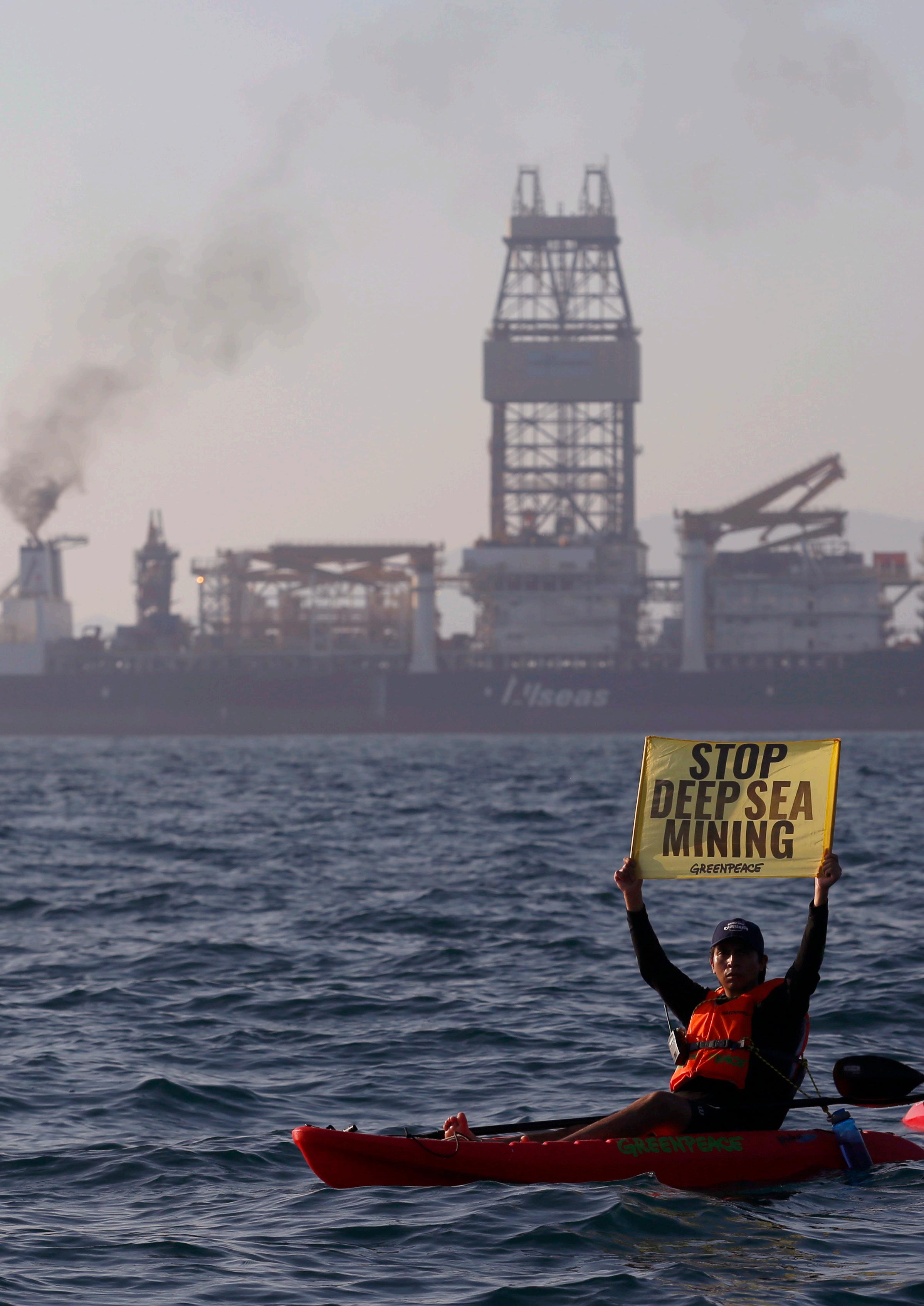
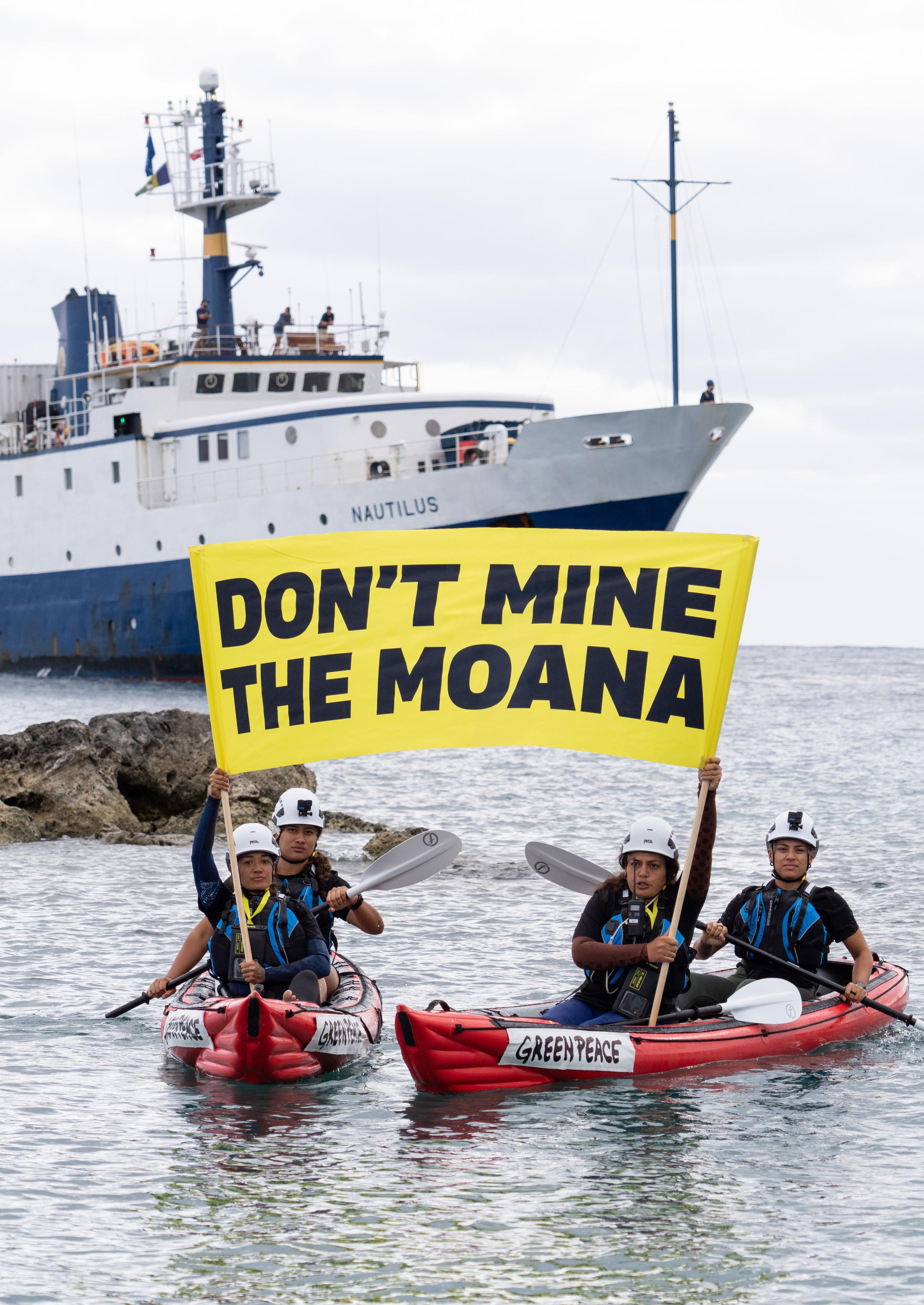
Cook Islands. Robin Hammond / Greenpeace
UNPRECEDENTED TERRITORY GRAB FOR EXTRACTION
Deep sea mining: a history of failure, a financial mirage, and the rise of blue colonization.
Deep sea mining is a speculative industry. Everywhere it has tried to launch, it has failed. From Norway to New Zealand, efforts to exploit the seabed have crashed into a wall of opposition: legal challenges, parliamentary blocks, and fierce resistance from local communities, scientists, the fishing industry, and environmental groups. The world is not waiting for deep sea mining; it is actively mobilizing against it.
As scientists increasingly warn of potentially irreversible ecological destruction to the planet’s last pristine wilderness, independent financial audits have exposed the industry’s underlying economic model as it underestimates its own financial and legal risks.2 A powerful coalition of over 43 governments, Indigenous activists, hundreds of scientists, and corporate giants— from the fishing industry to major automakers—has formed a global line of defence to keep the deep ocean off-limits to mining.3
The financial oxygen is being cut off: major global banks such as BNP Paribas, Deutsche Bank,4 and the Asian Development Bank5 have refused to finance these projects. Faced with international deadlock and financial stress, key players in an increasingly desperate industry have abandoned multilateral diplomacy. Instead, they have pivoted to a dangerous geopolitical gamble: teaming up with the Trump administration to unilaterally claim the global commons in blatant defiance of international law.
Deep sea mining isn’t just an environmental disaster—it is a unilateral power grab disguised as a resource war, and a modern iteration of colonial history in the Pacific. For centuries, Western empires exploited Pacific nations; today, Global North corporations are attempting a new wave of “blue colonization.” By treating the Pacific Ocean as an empty warehouse of commodities, tech ventures are undermining the sovereign rights, cultural heritage, and birthright guardianship of Indigenous Pacific peoples who have protected and been sustained by these waters for generations.
“Time and time again we’ve been reminded that decisions are already being made about us, without us. It’s a never-ending pattern of colonial oppression and extraction... The people of Guam [are] not asking for slow progress. They are asking not to be sacrificed.”
Sheila Babauta (Northern Marianas) / Delegate James Moylan (Guam)6
But the rush by global superpowers and corporations to seize deep sea minerals has become a critical catalyst for unity across the Pacific. While a few states (such as Nauru, Cook Islands, and Tonga) sponsor exploration contracts, a powerful regional front is forming to resist what local leaders and Indigenous advocates describe as a new wave of resource exploitation.
This dossier exposes how a speculative industry is trying to colonize the ocean floor—and highlights the critical, fleeting window the international community has to stop this resource grab before it starts.
2 For example, Michael Barnard and Lyle Trytten (August 2025) A Techno-Economic Assessment of Seabed Mining, available at https://drive.google.com/file/d/1RettUw5s1sn0rHeyDDj6VzcBcimieY9e/view; and Steven Emerman (February 2026) Implications of The Metals Company Pre-Feasibility Study for Next Steps by the Company, available at https://miningwatch.ca/sites/default/files/implications-of-the-metals-company-pre-feasibility-study-for-next-steps-by-the-company.pdf
3 Deep Sea Conservation Coalition, Momentum for a Moratorium, available at https://deep-sea-conservation.org/solutions/no-deep-sea-mining/momentum-for-a-moratorium/ 4 Deep Sea Conservation Coalition, Voices calling for a moratorium - Companies and finance. Available at https://deep-sea-conservation.org/solutions/no-deep-sea-mining/momentum-for-a-moratorium/companies-and-finance/ 5 Asian Development Bank (July 2025) Critical Minerals-to-Manufacturing Value Chains for Powering Progress, 2025–2029. Available at https://www.adb.org/sites/default/files/institutional-document/1071356/cmm-value-chains-2025-2029-board-direction.pdf
6 Mongabay (June 2026) American Samoa said ‘no’ to deep sea mining, Washington heard ‘faster’ (commentary) Available at https://news.mongabay.com/2026/04/american-samoa-said-no-to-deep-sea-mining-washington-heard-faster-commentary/ + https://www.youtube.com/watch?v=U2LUYaC30Ps from Forbes news
POWER PLAY: NORTHERN CAPITAL, PACIFIC RISK
The Main Players
The deep sea mining industry is tightly controlled by a tiny handful of private entities from the Global North. While these firms market themselves as independent, cutting-edge tech pioneers, they operate through a maze of shifting subsidiaries and subcontractors designed to
exploit a glaring structural imbalance. By partnering with Small Island Developing States (SIDS) like Nauru, Tonga, and the Cook Islands, these corporate actors gained diplomatic entry to the UN framework while offloading the immense environmental and financial liabilities of the project onto vulnerable Pacific economies.
Company Registration/structure Current Status
TMC (The Metals Company)
Canadian-registered. TMC USA is a wholly-owned subsidiary. Sponsored by Nauru for wholly-owned subsidiary NORI and Tonga for wholly-owned subsidiary TOML at the ISA. Pushing to mine by early 2028; heavily banking on U.S. backing to bypass the ISA.
Allseas Swiss-Dutch offshore giant. Strategic partner/shareholder to TMC.
Allseas’ holding company owns Blue Minerals Jamaica. Plans to provide the Hidden Gem, the world’s only operational mineral extraction vessel, to TMC USA operations.
Impossible Metals US Start-up, applied for ISA contract sponsored by Bahrain7
GSR (Global Sea Mineral Resources)
Building autonomous underwater vehicles (AUVs). Targeting operations in American Samoa8 and international waters of the Pacific.
Sponsored by Belgium at ISA.
Subsidiary of DEME group.
Glomar Minerals (formerly UK Seabed Resources)
Subsidiary of DEME group. DEME has frozen further capital investments until an ISA Mining Code is adopted, pushing GSR’s next major system integration test operations out to the 2030s.9 However, it remains actively funded by DEME and its offshore partner Transocean—the drilling giant widely known for its complicity in the 2010 Deepwater Horizon disaster. GSR has completely withdrawn its involvement from national waters exploration in the Cook Islands.10
Sponsored by UK at ISA UKSR was divested by Lockheed Martin, bought by Norwegian Loke Marine Minerals, which went bankrupt in April 2025.11 Resurrected by management as Glomar Minerals in late 2025; facing legal scrutiny over the license transfer.12
7 International Seabed Authority (10 September 2025) The Kingdom of Bahrain sponsors Impossible Metals to apply for a deep-sea mining exploration contract in international waters. Available at: https://isa.org.jm/news/the-kingdom-of-bahrain-sponsors-impossible-metals-to-apply-for-a-deep-sea-mining-exploration-contract-in-international-waters/
8 Impossible Metals (15 April 2025) Impossible Metals Applies for Deep Sea Mining Lease in U.S. Federal Waters. Available at https://impossiblemetals.com/blog/impossible-metals-applies-for-deep-sea-mining-lease-in-u-s-federal-waters/ 9 DEME Group (30 March 2026) GSR signs memorandum of understanding with Japan’s DORD to conduct joint demonstration test in the Clarion-Clipperton Zone. Available at https://www.deme-group.com/news/gsr-signs-memorandum-understanding-japans-dord-conduct-joint-demonstration-test-clarion
10 DEME (28 November 2025) GSR announces strategic review of its seabed mineral interests to advance priority initiatives in the CCZ. Available at https://deme-gsr.com/news/gsr-announces-strategic-review-of-its-seabed-mineral-interests-to-advance-priority-initiatives-in-the-ccz/ 11 DN (3 April 2025) Mineraldrøm knas: Konkurs for selskapet som skulle bli størst i verden. Available at https://www.dn.no/industri/hans-olav-hide/walter-sognnes/loke-marine-minerals/mineraldrom-i-knas-konkurs-for-selskapet-somskulle-bli-storst-i-verden/2-1-1802090
12 Greenpeace UK (30 January 2026) Greenpeace challenges UK government transfer of licences to ‘shady’ deep sea mining company. Available at https://www.greenpeace.org.uk/news/greenpeace-challenges-uk-government-transfer-of-licences-to-shady-deep-sea-mining-company/
LIABILITY LOOPHOLE THE ISDS WEAPON
The Due Diligence Trap: Under international law, if a private contractor causes environmental damage or unlawfully harms a third party (like a coastal state or regional fishery), the Sponsoring State can face the financial and legal liability if they have not taken necessary steps to prevent this.13
If a contractor defaults or triggers a disaster for a project in national waters, the local economy can face a potentially bankrupting bill, while the corporate executives walk away (see Papua New Guinea case below).
The threat isn’t just about environmental failure; it’s about corporate powerplay via Investor-State Dispute Settlement (ISDS) mechanisms. These closed-door arbitrations mechanisms highly favor business over governments.
The Mexico vs. Odyssey Precedent: When the Mexican government denied an environmental permit to Odyssey Marine Exploration for a seabed phosphate project in its national waters, the company weaponized NAFTA to sue Mexico for billions in damages.
14
The Tonga-TOML Vulnerability: Civil society groups like the Pacific Network on Globalisation (PANG) have raised alarms over updated sponsorship laws in Tonga regarding TOML (TMC’s subsidiary).15 The terms are effectively shielding corporate profits while legally binding developing states to pro-industry timelines under threat of international litigation.
SMOKE, MIRRORS, AND SLIPPING DEADLINES
Every time the deep sea mining industry has set a hard target for commercial extraction to start, the deadline has dissolved. From the Arctic to the South Pacific, the industry faces a wall of community pushback, scientific condemnation, and legal defeats.
• 2019 | The PNG Cautionary Tale: The industry’s pioneer, Nautilus Minerals, promised to begin deep sea mining in Papua New Guinea’s waters. The company collapsed into bankruptcy, leaving the government of PNG holding a US$120 million bill in lost investments.16
• 2021 | The GSR Failure: Belgian contractor GSR got its 25-ton seabed tractor stuck on the Pacific floor for several days during a test.17 With no commercial operations in sight for the foreseeable future, parent company DEME froze critical funding for further testing. GSR has formally stated it will not test a new machine until the 2030s.18
• 2021–2025 | The TMC Retreat: In 2021, Nauru on behalf of TMC subsidiary NORI triggered the “twoyear rule,”19 with the company declaring it would start mining by 2024 whether there were any international regulations in place or not.20,21 When that failed to pressure governments into rushing a ISA Mining Code, they threatened to submit a mining application by June 2025.22 Recognizing a lack of political support within the ISA, TMC then walked out of the international process.23 They are now aiming for commercial mining in 2028,24 completely dependent on a highly controversial U.S. unilateral route, which even the company admits faces significant hurdles.25
• 2023–2025 | The Lockheed/Loke Collapse: Lockheed Martin divested from the sector by selling its UK Seabed Resources (UKSR) subsidiary to Norwegian Loke Marine Minerals.26 Within two years, Loke went bankrupt,27 citing a failure to attract investor capital. The remnants were bought by an investment vehicle called Glomar Minerals, which is currently mired in a legal challenge over the legitimacy of its license acquisition.28
16 DevPolicy Blog (28 April 2020). How PNG lost US$120 million and the future of deep-sea mining. Available at https://devpolicy.org/how-png-lost-us120-million-and-the-future-of-deep-sea-mining-20200428/
17 BBC (28 April 2021). Accident leaves deep sea mining machine stranded. https://www.bbc.co.uk/news/science-environment-56921773
18 DEME Group (30 March 2026) GSR signs memorandum of understanding with Japan’s DORD to conduct joint demonstration test in the Clarion-Clipperton Zone. Available at https://www.deme-group.com/news/gsr-signs-memorandum-understanding-japans-dord-conduct-joint-demonstration-test-clarion
19 Republic of Nauru. Office of the President (25 June 2021). Letter from the President of the Republic of Nauru to the President of the Council of the 26th Session to the International Seabed Authority. Available at https://isa.org.jm/wp-content/uploads/2022/06/NauruLetter-Notification.pdf. The ‘two-year rule’ is a provision in the Law of the Sea Convention (specifically Section 1(15) of the Annex to the 1994 Agreement Relating to the Implementation of Part XI of UNCLOS) which, if triggered, allows a State to submit for approval a ‘plan of work’ (essentially a request to start commercial mining operations) even if the mining code that would regulate commercial deep sea mining has not been adopted, 2 years after such provision has been triggered. It could potentially lead to mining in the absence of internationally agreed regulations. 20 “The International Seabed Authority continues to work against a two-year deadline to finalize regulations regarding deep sea mining by July 9, 2023, pursuant to the Republic of Nauru exercising its sovereign rights under Section 1, paragraph 15 of the 1994 Agreement relating to the Implementation of Part XI of the United Nations Convention on the Law of the Sea (“UNCLOS”). This notice has obliged the ISA to complete the adoption of exploitation regulations within two years of the request made by the member state. If the ISA has not completed the adoption of such regulations within the prescribed time and an application for approval of a plan of work for exploitation, as TMC’s subsidiary NORI intends to submit, is pending before the ISA, the ISA shall nonetheless consider and provisionally approve such plan of work” The Metals Company (4 October 2021) The Metals Company Provides Business Update as It Advances Plan to Unlock Critical Battery Metal Resource. Available at https://investors.metals.co/news-releases/news-release-details/metals-company-provides-business-update-it-advances-plan-unlock/ 21 “an executive from TMC has said it expects to file an application in the second half of 2023 with the goal of receiving an ISA mining licence in 2024. Production would start by the end of that year or early 2025” The Guardian (8 July 2023) Future of deep-sea mining hangs in balance as opposition grows. Available at https://www.theguardian.com/environment/2023/jul/08/future-of-deep-sea-mining-hangs-in-balance-as-opposition-grows
22 The company’s chief financial officer, Craig Shesky, told media that TMC would not wait for governments at the ISA to finalise a Mining Code, saying: “Whether they’ve finalized what the legal framework for deep-sea mining will look like or not, we’ll file our permit application and force them to process it.” See The Northern Miner (22 September 2023). Navigating the deep: The Metals Company eyes late 2025 ocean mining start, available at https://www.northernminer.com/stock-markets-investing/navigating-the-deep-the-metals-company-barrels-towards-late-2025-ocean-mining-start/1003858951/ The Metals Company (12 November 2024). TMC Announces June 27, 2025 Submission Date for Subsidiary NORI’s ISA Application, and Expanded Company Strategy. Available at; https://investors.metals.co/news-releases/news-release-details/tmc-announces-june-27-2025-submission-date-subsidiary-norisisa
23 The Metals Company (March 2025). CEO Statement on ISA and USA. Available at https://metals.co/ceo-statement-on-isa-and-usa/
24 “Gerard Barron^ Yes. We are still standing by our guidance of commissioning Q4 next year. It will -- we’ve elected to run with a two-collector model. So that basically gives us the opportunity to get out on the water in early 2028.” The Metals Company (26 March 2026) Q4 2025 results call transcript. Available at https://investors.metals.co/static-files/8e86c301-bb59-4b26-ab67-eff44fb9ceb4
25 “a commercial recovery permit issued to us under DSHMRA, if any, may not be recognized by countries that are parties to UNCLOS or by the ISA and may be regarded by UNCLOS parties and the ISA as a violation of international law, including UNCLOS, which could affect international perceptions of the project, and could have implications for logistics, processing, and market access in UNCLOS parties for seabed
• 2023–2025 | The Arctic Postponement: Norway’s highly publicized push to open its Arctic waters to seabed mining has completely stalled. Following immense international backlash and intense political scrutiny, the Norwegian parliament first delayed the first licensing round for a year,29 then suspended plans for the entirety of the current parliamentary term,30 sending local deep sea mining start-ups into financial freefall.31
• 2025 | The Cook Islands Retreat: Bowing to intense local pressure from traditional leaders and environmental groups, the Cook Islands government officially pushed back any potential start of commercial seabed mining until next decade.32 Belgian company GSR dropped its involvement in Cook Islands’ national waters exploration in the same year, because of the limited prospects of commercial viability under regulatory uncertainty.33
• 2026 | The Japanese Mirage: Japan launched highly publicized rare-earth mud collection tests in early 2026. However, several experts have flagged the project as a purely symbolic, resource-nationalist political play with doubtful commercial viability.34
• February 2026 | The Taranaki Defeat: TransTasman Resources spent over a decade trying to get seabed mining plans approved for New Zealand’s South Taranaki Bight, losing repeatedly up to the Supreme Court. In a desperate final move, the company pinned its hopes on the government’s new pro-industry Fast-Track Approvals panel. On 4 February, 2026, the Expert Panel issued a draft decision to decline the application, citing a complete failure to prove the mine would not cause irreversible environmental and cultural damage.35 Trans-Tasman cut and run, withdrawing its bid entirely.
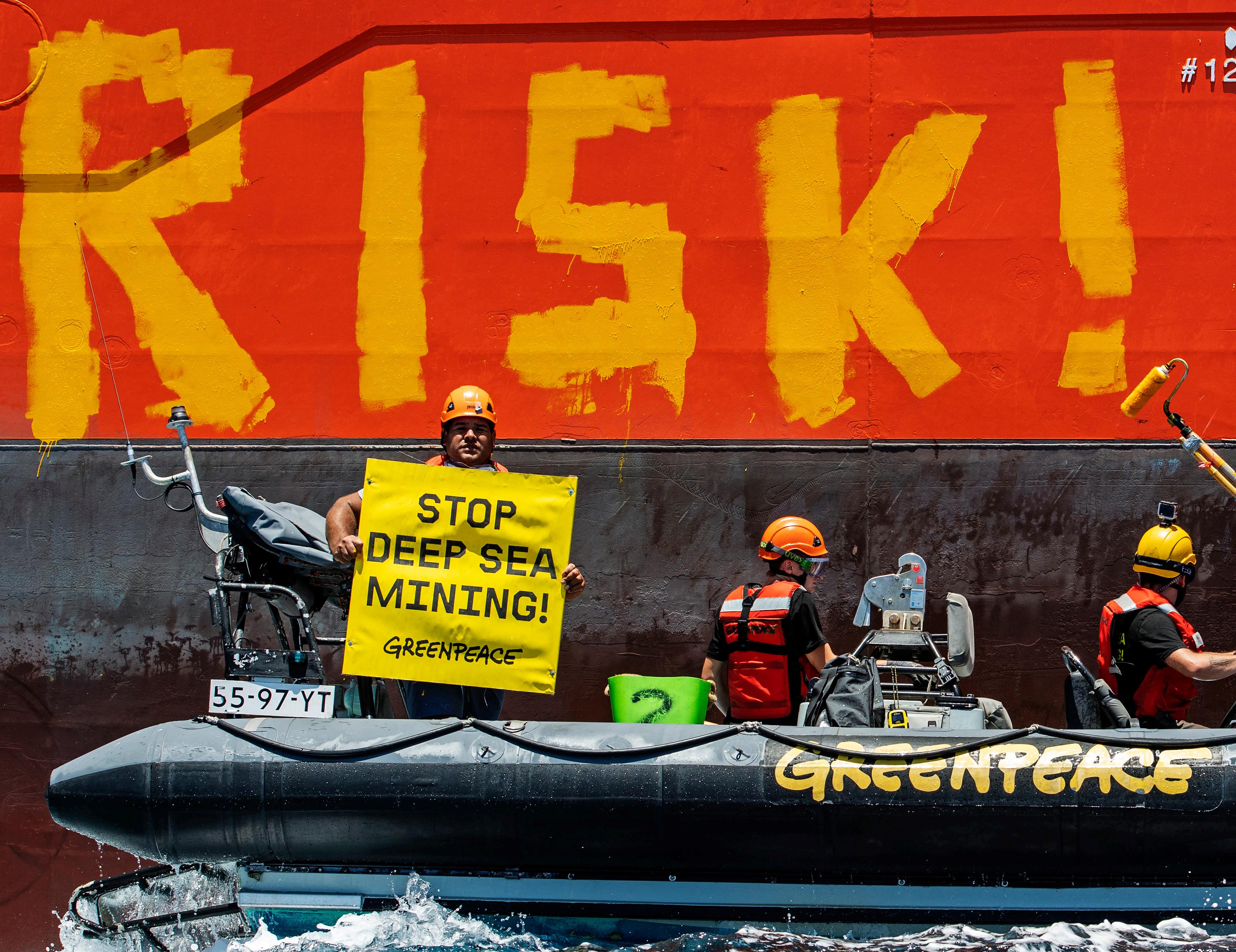
Protest against deep sea mining.
Marten van Dijl / Greenpeace
26 Reuters (16 March 2023) Lockheed Martin sells deep-sea mining firm to Norway’s Loke. Available at https://www.reuters.com/markets/deals/norways-loke-buys-uk-deep-sea-mining-firm-lockheed-2023-03-16/
27 DN (3 April 2025) Mineraldrøm knas: Konkurs for selskapet som skulle bli størst i verden. Available at https://www.dn.no/industri/hans-olav-hide/walter-sognnes/loke-marine-minerals/mineraldrom-i-knas-konkurs-for-selskapet-somskulle-bli-storst-i-verden/2-1-1802090
28 Greenpeace UK (30 January 2026) Greenpeace challenges UK government transfer of licences to ‘shady’ deep sea mining company. Available at https://www.greenpeace.org.uk/news/greenpeace-challenges-uk-government-transfer-of-licences-to-shady-deep-sea-mining-company/
29 BBC (2 December 2024) Norway suspends controversial deep-sea mining plan. Available at https://www.bbc.co.uk/news/articles/c9wlj8l8kr7o
30 Mongabay (8 December 2025) Norway pauses deep-sea mining for four years. Available at https://news.mongabay.com/2025/04/with-deep-sea-mining-plans-in-limbo-norwegian-companies-fold-or-dig-in/
31 Mongabay (22 April 2025) With deep-sea mining plans in limbo, Norwegian companies fold or dig in. Available at https://news.mongabay.com/2025/04/with-deep-sea-mining-plans-in-limbo-norwegian-companies-fold-or-dig-in/
32 Radio New Zealand (13 November 2025). Cook Islands delays seabed mining decision, extends exploration to 2032. Available at https://www.rnz.co.nz/news/pacific/578735/cook-islands-delays-seabed-mining-decision-extends-exploration-to-2032
33 DEME (28 November 2025) GSR announces strategic review of its seabed mineral interests to advance priority initiatives in the CCZ. Available at https://deme-gsr.com/news/gsr-announces-strategic-review-of-its-seabed-mineral-interests-to-advance-priority-initiatives-in-the-ccz/ 34 For example, Ren Xinyuan (29 March 2026) The 6,000-Meter Mirage: Is Japan Extracting Rare Earths or Political Capital? Available at https://www.chinausfocus.com/finance-economy/the-6000-meter-mirage-is-japan-extracting-rare-earths-or-political-capital
35 New Zealand Government (4 February 2026). Draft decision in the the deliberations and draft decision of the Expert Panel appointed under section 50 and Schedule 3 of the FTAA for the Taranaki VTM application. Available at https://www.fasttrack.govt.nz/__data/assets/pdf_file/0010/20053/FINAL-Draft-decision-4-February-2026.pdf
INTERNATIONAL POLITICS
An overwhelming international public consensus has emerged, together with growing voices of member states of the International Seabed Authority (ISA): deep sea mining must not begin. With critical scientific and
legal questions unanswered, a broad global movement is actively resisting commercial pressure to open up one of the planet’s last remaining wildernesses to exploitation.
I. THE GLOBAL COALITION FOR A MORATORIUM
The call for a deep sea mining moratorium or precautionary pause has transformed from a niche environmental stance into a widely-held political position.
• 43 countries and growing: 43 nations now formally call for a moratorium or precautionary pause. This diverse bloc spans geographic and economic divides, outnumbering the 36-member rotating ISA Council negotiating the Mining Code.36
• Europe: Half of all European Union member states, alongside consistent, cross-party backing from the European Parliament, despite changing composition
• The G7: Four out of seven G7 member nations.
• Latin America: Anchored by major regional economies including Brazil and Chile.
• Africa: Driven by a new wave of leadership, with Malawi, Kenya, and Madagascar becoming the first African nations to join the call.
• The Pacific: Widespread resistance across most Pacific Island states, including a formal commitment to a moratorium within regional waters by the Melanesian Spearhead Group (including Papua New Guinea and the Solomon Islands).
• A Shift in Political Intent: Crucially, this coalition includes states like France, the UK and Germany, that currently hold exploration contracts at the ISA. Holding an exploration contract no longer signals a political intent to proceed to active extraction.
• Rigorous Foundation: These national policies are not arbitrary; they are often the result of rigorous due diligence, legal analysis, and extensive consultations with independent scientists, businesses, and civil society.
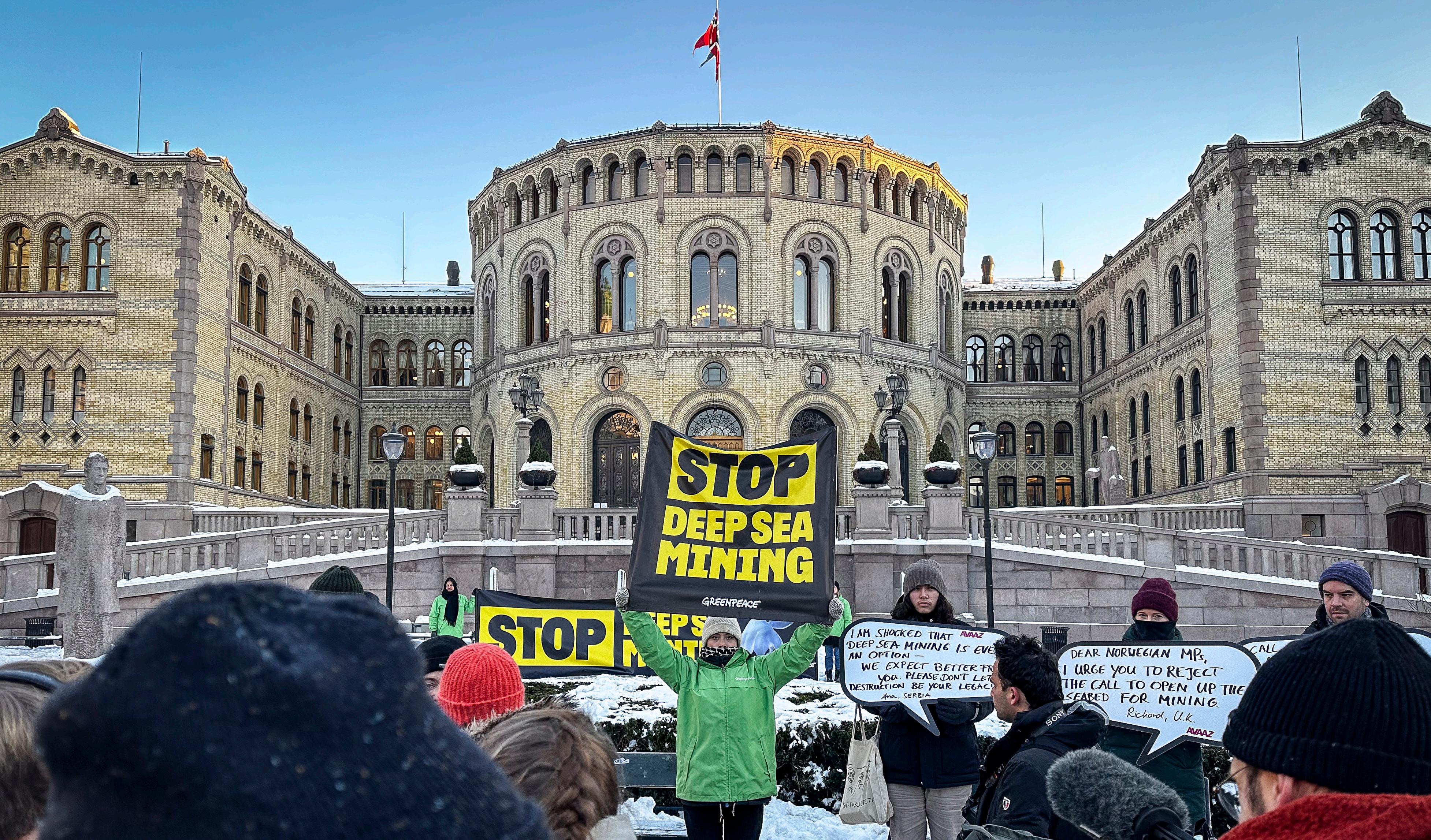
Protest against deep sea mining, Oslo, Norway. Will Rose / Greenpeace
36 Deep Sea Conservation Coalition, Momentum for a Moratorium, available at https://deep-sea-conservation.org/solutions/no-deep-sea-mining/momentum-for-a-moratorium/ 37 Le Monde (9 June 2025), Macron says imposing a moratorium on seabed mining is ‘an international necessity’ Available at https://www.lemonde.fr/en/environment/article/2025/06/09/macron-says-imposing-a-moratorium-on-seabed-mining-is-an-international-necessity_6742172_114. html?srsltid=AfmBOopJTwcdTz6a3IC42SqWnBz90jMnUdeFN4lyuH6OK138cjM835zZ
38 A line in the seabed (22 July 2025) Statement Delivered by H.E. Surangel S. Whipps Jr., of The Republic of Palau ISA General Assembly, Kingston, Jamaica. Available at President https://www.isa.org.jm/wp-content/uploads/2025/02/Palau-Item_8-22.07.2025.pdf
HIGH-LEVEL POLITICAL STATEMENTS
President Emmanuel Macron (France) at UNOC: told the ocean summit that a moratorium on deep sea mining was an “international necessity”. “I think it’s madness to launch predatory economic action that will disrupt the deep seabed, disrupt biodiversity, destroy it and release irrecoverable carbon sinks – when we know nothing about it.” 37
President Surangel Whipps Jr. (Palau): attended the ISA twice and told delegates, “Exploiting the seabed is not a necessity – it is a choice. And it is reckless. It is gambling with the future of Pacific Island children, who will inherit the dire consequences of decisions made far from their shores.”
“This is a line in the seabed. We are not calling for delay on progress, we are calling for wisdom. For science over speculation. For guardianship over greed.”38
II. CORPORATE PRESSURE & THE “TWO-YEAR ULTIMATUM”
During the COVID-19 pandemic, Nauru on behalf of TMC subsidiary NORI triggered an obscure legal provision (the “two-year rule”). This move was seen to issue an ultimatum to the ISA: finalize exploitation rules within two years or be forced to consider commercial mining applications with no agreed regulations.39
• The Backfire Effect: Rather than forcing a rushed opening of the seabed, this aggressive manoeuvring backfired. It alarmed world leaders and diplomats, driving a massive wave of sovereign states to officially support a moratorium or a precautionary pause to protect international waters from legal loopholes.
AND REGULATORY CAPTURE AT THE ISA
The ISA has historically faced questions regarding its integrity, transparency, and functionality as an international regulator. The Legal and Technical Commission (LTC)—the ISA’s advisory body responsible for reviewing mining applications—operates entirely behind closed doors.
The boundaries between the regulator and the commercial entities they regulate have repeatedly blurred, sparking international concern:
• Former ISA Secretary-General Michael Lodge faced severe criticism from diplomats and ministers for stepping outside his neutral mandate to advocate for the industry. Lodge publicly labeled a moratorium as “anti-science, anti-knowledge, anti-development and anti-international law.”40 Following his tenure, reports indicate his alignment with the deep sea mining company Wetstone and he appeared on NORI and TOML’s legal team in the case against the ISA at the International Tribunal on the Law of the Sea.’41
• In highly unusual moves, corporate executives have literally taken the seats of sovereign nations at the ISA. In 2019, the CEO of DEME addressed the floor from Belgium’s seat,42 while TMC’s CEO, Gerard Barron, spoke directly from Nauru’s seat.43
• For two consecutive years, mining contractors have sent aggressive, threatening letters to the ISA to pressure negotiations on a Mining Code to conclusion44—prompting Indigenous groups to sharply remind governments that these companies “are the regulated, not the regulators.”45
Under Article 154 of the UN Convention on the Law of the Sea, the ISA is legally required to conduct an independent review of its internal operations every five years. However, the last review occurred 10 years ago. This mandatory review has therefore been overdue since 2022. For three consecutive years, this periodic review has been systematically postponed, raising a significant accountability gap.
40 Comments to Belgian parliamentary hearing. De Kamer (24 June 2020) Energie, Leefmilieu en Klimaat (Erasmus) : Voorstel van resolutie 887 - Hoorzitting. Available at https://media.dekamer.be/meeting/55-011183-U0739?offset=8849
41 Mongabay (8 July 2025) U.S. federal agency clears ways for deep-sea mining — and companies are lining up. Available at: https://news.mongabay.com/2025/07/u-s-federal-agency-clears-ways-for-deep-sea-mining-and-companies-are-lining-up/ ITLOS/PV.26/C34-C35/2 (2 July 2026) Available at https://www.itlos.org/fileadmin/itlos/documents/cases/34/Provisional_Measures/verbatim_records_34_and_35/ITLOS_PV26_C34-35_2_E.pdf
42 Alain Bernard, CEO of DEME, Address to ISA Council, 27 Feb 2019. Available online: https://www.isa.org.jm/wp-content/uploads/2022/06/belgium-ab.pdf
43 Gerard Barron, CEO & Chairman of DeepGreen Metals, Address to ISA Council, 27 Feb 2019. Available online: https://www.isa.org.jm/wp-content/uploads/2022/06/nauru-gb.pdf
44 Contractors letter to Mr. Olav Myklebust, President of the Council (14 January 2025). Available at https://www.isa.org.jm/wp-content/uploads/2025/03/Letter_of_Contractors_to_Council-14012025.pdf ITLOS/PV.26/C34-C35/2 (2 July 2026) Letter from GSR (3 March 2026). Available at https://isa.org.jm/wp-content/uploads/2026/03/20260303_GSR-Response-to-ISA-Delay-Regs.pdf
45 Letter by non-governmental organisations, 18 February 2025 https://www.isa.org.jm/wp-content/uploads/2025/03/Ltr-from-various-ISA-Observer-Indigenous-Representatives-to-Council-President-18022025.pdf
Mining Code - the clue is in the name
The Mining Code is a set of environmental, financial, and technical rules, regulations and procedures being negotiated at the International Seabed Authority (ISA). Its job is to dictate how, where, and when companies and countries can move from just exploring the global ocean floor to commercially mining it.
While campaigning to become the ISA’s SecretaryGeneral, Letícia Carvalho emphasised the importance of multilateral governance, transparent decisionmaking, and the role’s neutrality. But this year, she has been framing the completion of the Mining Code as an urgent task.46 Now, it seems Carvalho’s administration is effectively bypassing the fundamental debate over deep sea mining: Should we be doing this at all?
The moment the international community signs off on a completed Code, the transition from the era of “exploration” to “exploitation” becomes a procedural certainty. It shifts the question from “Is this safe?” to “Did the contractor fill out the paperwork correctly?” It legally legitimizes an industry that over 40 countries, financial institutions representing approximately €24 trillion in combined assets,47 and hundreds of scientists48 are actively trying to pause.
It is completely natural that governments are taking time to deliberate. Reaching a final Code means giving a green light to the inherent harm that will follow, and governments will be held politically accountable for that
choice. A Mining Code is not a conservation tool; it is a blueprint for how to mine.
Pushing for a Mining Code right now is like writing a comprehensive highway safety code for a vehicle that hasn’t been safety-tested, to be driven on a road that hasn’t been mapped yet, through dense fog. The Code itself creates a false illusion of safety while guaranteeing a crash.
Furthermore, enforcing it under these conditions is a regulatory fantasy. The target zones sit in the middle of the Pacific Ocean, four to six kilometres beneath the surface—an environment so hostile, remote, and technically challenging that simply operating there is a logistical nightmare, let alone independently overseeing and regulating it.
It is no surprise, therefore, that the exploitation regulations remain entirely unfit for adoption. Major unresolved issues are rooted in deep political differences, a lack of understanding of deep sea ecosystems and growing questions over the industry’s feasibility. There is still no agreement on what the regulations are actually regulating—whether it applies to all mineral types or strictly to polymetallic nodules. Furthermore, a Code is essentially meaningless without binding standards. For many of these standards, text does not even exist because the ISA’s own Legal and Technical Commission has accepted that there is insufficient data to formulate adequate environmental thresholds and indicators.
Violating legal obligations and environmental treaties
If governments rush the adoption of this Code, they risk violating their own legal obligations. Under the United Nations Convention on the Law of the Sea (UNCLOS), states have strict duties to protect and preserve the marine environment. Proceeding with deep sea mining right now fails to ensure the effective protection of the oceans from harmful effects under Article 145, and fails to protect the common heritage of humankind designated under Article 136.
The recent advisory opinion by the International Tribunal for the Law of the Sea (ITLOS) reinforced the gravity of these laws, reiterating that the obligation to protect and preserve contains two distinct elements:49
1. The duty to prevent environmental harm.
2. The requirement to maintain ecosystem health and the natural balance of the marine environment.
ITLOS made it clear that states have a “positive obligation to take active measures to protect and preserve the marine environment, and by logical implication, entails the negative obligation not to degrade the marine environment.” The focus of governments at the ISA should not be a bureaucratic exercise in minimizing damage; it must be a binding commitment to actually maintain and restore ecosystem health.
Proceeding with deep sea mining now would completely undermine new, historic global commitments—such as the pledge to halt and reverse biodiversity loss.50 The ISA cannot operate in a vacuum, ignoring the very environmental frameworks and treaties its member states just adopted.
Marine animals found on Deep Arctic expedition.
Zankl / Greenpeace
The asymmetry of “Benefit to Humankind”
The exploitation regime is legally premised upon delivering a benefit to humankind (UNCLOS Article 140), yet this key priority is currently receiving scant attention in ISA negotiations. But what will be delivered to Global South governments amounts to little more than scraps, while the environmental costs are pushed onto all of us.
According to economists’ analysis, a scenario where six deep sea mining sites begin operating in the early 2030s would leave many countries receiving a meager 0.001% of their respective GDP as revenue in the medium-term.51 The returns to states would barely register in national accounts. After administrative costs, institutional expenses, and compensation funds are deducted, little, if anything, remains to distribute to the public.
By contrast, the private sector would capture the overwhelming share of economic value. While net profits for private companies are not guaranteed, given the staggering capital and operating costs, the structural asymmetry is undeniable: private actors internalise the upstream value, while public benefits remain narrow, uncertain, and deferred.
As Dr. Harvey Mpoto Bombaka from the Centro Universitário de Brasília notes:52
“What’s described as global benefit-sharing based on equity and intergenerational justice increasingly looks like a framework for managing scarcity that would deliver almost no real benefits to anyone other than the deep sea mining industry. The structural limitations of the proposed mechanism would offer little more than symbolic returns to the rest of the world, particularly developing countries lacking technological and financial capacity.”
Deep sea mining companies are thus pushing an untested industry that would pocket the gains while offering developing nations only symbolic crumbs in return. A whole country receiving the same payment as an individual CEO in a wealthy country is an insulting echo of extractivist colonialism. It is nowhere near enough to justify tearing open the deep sea.
What’s more, the risk of unilateral mining authorised solely by the U.S. authorities risks the seizure of this global commons to benefit an America-First agenda,53 casting aside any benefit to the rest of humankind.
51 Harvey Mpoto Bombaka & Ben Tippet (25 February 2026) Equity, Benefit-Sharing and Financial Architecture in the International Seabed Area. Available at https://www.greenpeace.org/static/planet4-international-stateless/2026/02/8e05dcaa-greenpeace_benefitsharingdeepseaminingreport_final.pdf
52 Quoted in Greenpeace International (25 February 2026) Developing countries on deep sea mining front line stand to gain almost nothing if mining goes ahead – new independent analysis. Available at https://www.greenpeace.org/international/press-release/81726/developing-countries-deep-sea-mining-gain-nothing-mining-newindependent-analysis/ 53 See comments by Neil Jacobs, NOAA administrator: “Deep
Minerals. Available at https://thebreakthrough.org/issues/energy/an-america-first-challenge-over-seafloor-minerals
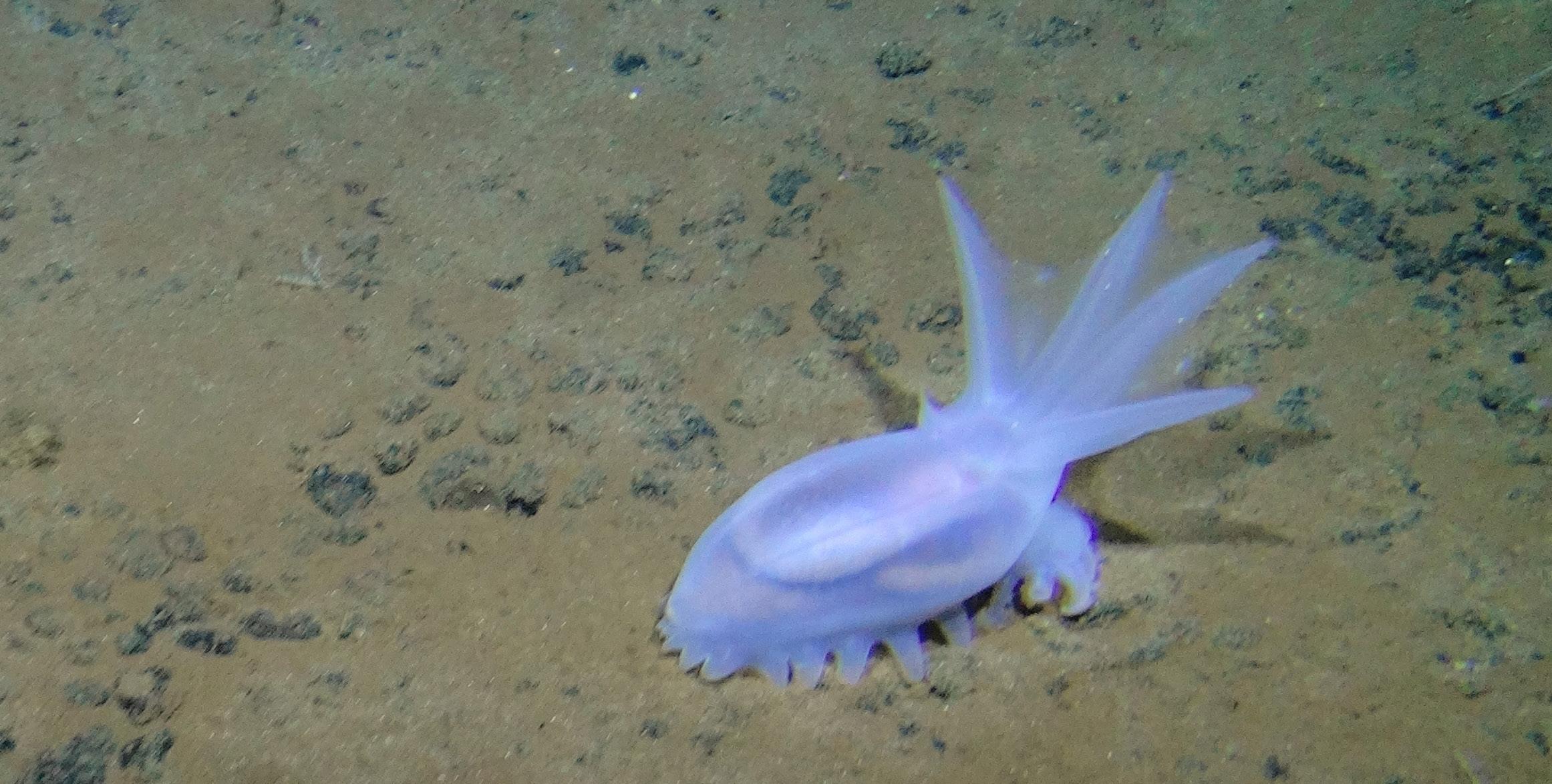
Amperima sp. on
Fracture
Craig Smith and Diva Amon / ABYSSLINE Project / NOAA
Solvin
RISING GLOBAL DRUMBEAT FOR PRECAUTION
Despite corporate pressure to push the Mining Code through, there is increasing interest among states in using existing ISA tools to put clear precautionary measures in place. Several states, led by Chile, successfully secured critical debates on a general environmental policy at the ISA Assembly in 2024 and 2025, with strong support voiced by France, Germany, Panama, Brazil, Costa Rica, Vanuatu and Palau among others.
While a total consensus has not yet been reached within the ISA halls, this political opposition is deep-rooted, expanding, and actively being raised across multiple international fora:
• IUCN: A powerful majority voted in favor of a moratorium on deep sea mining.54
• UN Environment Assembly (UNEA): Vanuatu tabled a deep-sea science resolution in 2025. They are actively pressing ahead with this crucial scientific work, backed by a dedicated coalition of willing states, independent scientists, and global philanthropy.55
• CMS & IWC: The Convention on the Conservation of Migratory Species of Wild Animals (CMS) has issued decisions regarding the industry’s threat to migratory species,56 while experts in the International Whaling Commission (IWC) are expressing growing concern over how deep sea mining noise and disruption will impact whales.57
54 The Guardian (9 September 2021) Conservationists call for urgent ban on deep-sea mining. Available at https://www.theguardian.com/environment/2021/sep/09/marseille-biodiversity-summit-adopts-motion-to-ban-deep-sea-mining 55 Daily Post (19 June 2026) Vanuatu launches Global Scientific Assessment of Deep-Sea Ecosystems. Available at https://www.dailypost.vu/news/vanuatu-launches-global-scientific-assessment-of-deep-sea-ecosystems/article_6d32ef23-36dc-556c-86e9-bed10b4debc6.html
56 Convention on the Conservation of Migratory Species of Wild Animals (26 March 2026) UNEP/CMS/COP15/CRP25.2.3 and (17 February 2024)
THE GEOPOLITICAL PIVOT
How the re-election of Trump enabled a lone corporate entity to try to execute an unprecedented land grab in international waters, bypassing international law.
When it became clear that The Metals Company (TMC) would not quickly secure the broad international political support required to greenlight exploitation, and as the company continued to burn through cash, they abruptly pivoted.
Their long-standing corporate narrative shifted following two major election outcomes. First, Michael Lodge—the former ISA Secretary-General frequently criticized by civil society for being overly aligned with corporate mining interests—failed to win re-election. He was replaced by an oceanographer and scientist, Letícia Carvalho, who entered office promising transparency and neutrality.
But TMC found a lifeline in Donald Trump’s re-election. Trump’s transactional view of international law and aims for resource dominance provided an ideal bandwagon for TMC to hitch their fortunes to. Out went the carefully crafted corporate image of deep sea minerals fuelling electric vehicle batteries; in came the deliberate whipping up of geopolitical tensions and critical mineral competition designed to win over the MAGA administration and salvage an industry that had failed to secure a mining licence in the dedicated international forum.
On 27 March 2025, TMC announced they would apply for unilateral permission from the U.S. administration via an 1980 law,58 with CEO Gerard Barron claiming, “commercial industry is not welcome at the ISA.”59 On 24 April 2025, President Trump signed an executive order titled “Unleashing America’s Offshore Critical Minerals and Resources,” supporting deep sea mining.60 Days later, TMC USA submitted the first ever application to mine the international seabed to the U.S. authorities,61 attempting to entirely bypass the need for multilateral approval for their unprecedented land grab in the deep ocean.
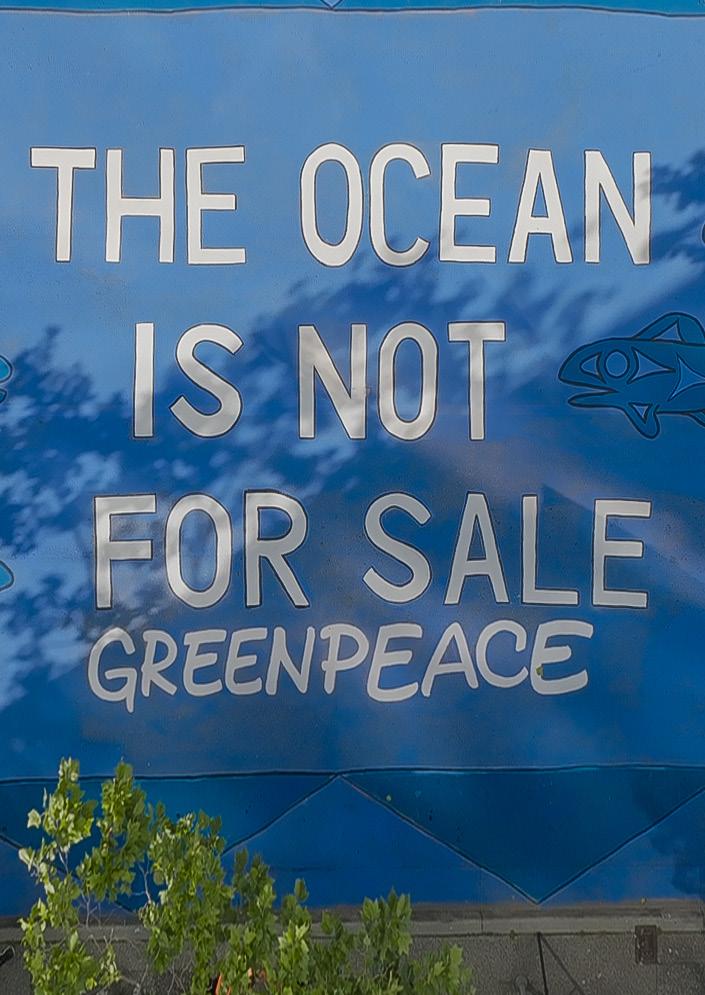
“For centuries, the Pacific has been exploited by external powers, including the US and corporations like TMC. Our people have been ignored, and our communities have been excluded from decisions that threaten the very fabric of our existence – our cultural, spiritual and historical connection to the ocean. The Pacific Ocean is not for sale; what Donald Trump and TMC CEO Gerard Barron steal from the Pacific, they steal from all humankind. Deep sea mining will not bring prosperity to the Pacific – the already rich will profit from our loss.” Greenpeace Australia Pacific’s Head of Pacific, Shiva Gounden
This alliance reaches deep into the US Cabinet. Commerce Secretary Howard Lutnick, who oversees the National Oceanic and Atmospheric Administration (NOAA)— the agency tasked with issuing these controversial permits—was previously the head of Cantor Fitzgerald, the financial firm that served as TMC’s lead banker.
62
TMC’s leadership has openly admitted that they abandoned the ISA because they fear its standards will be too constraining, in a CEO statement:
“After 16 years of engaging with the Authority in good faith, we are increasingly concerned that the ISA may not adopt the Exploitation Regulations in a timely manner and that the regulations may be written in a way so as to not allow commercial enterprises to operate.”
63
This admission lays bare the reality: rogue corporate actors are trying to force a global race to the bottom in regulatory standards, using unilateral policy to escape international oversight.
58 The Metals Company (27 March 2025). The Metals Company to Apply for Permits under Existing U.S. Mining Code for Deep-Sea Minerals in the High Seas in Second Quarter of 2025. Available at https://investors.metals.co/news-releases/news-release-details/metals-company-apply-permits-under-existing-us-mining-code-deep
59 The Metals Company (March 2025). CEO Statement on ISA and USA. Available at https://metals.co/ceo-statement-on-isa-and-usa/
60 Executive Orders (April 24, 2025). Unleashing America’s off shore critical minerals and resources. Available at https://www.whitehouse.gov/presidential-actions/2025/04/unleashing-americas-off shore-critical-minerals-and-resources/
61 The Metals Company (May 2025). World First: TMC USA Submits Application for Commercial Recovery of Deep-Sea Minerals in the High Seas Under U.S. Seabed Mining Code. Available at https://metals.co/news-release-details-world-first-tmc-usa-submits-application-commercial-recovery-deep
62 Mongabay (28 March 2025) Deep-sea miner TMC seeks U.S. approval, potentially bypassing global regulator. Available at https://news.mongabay.com/2025/03/deep-sea-miner-tmc-seeks-u-s-approval-potentially-bypassing-global-regulator/
63 The Metals Company (March 2025). CEO Statement on ISA and USA. Available at https://metals.co/ceo-statement-on-isa-and-usa/
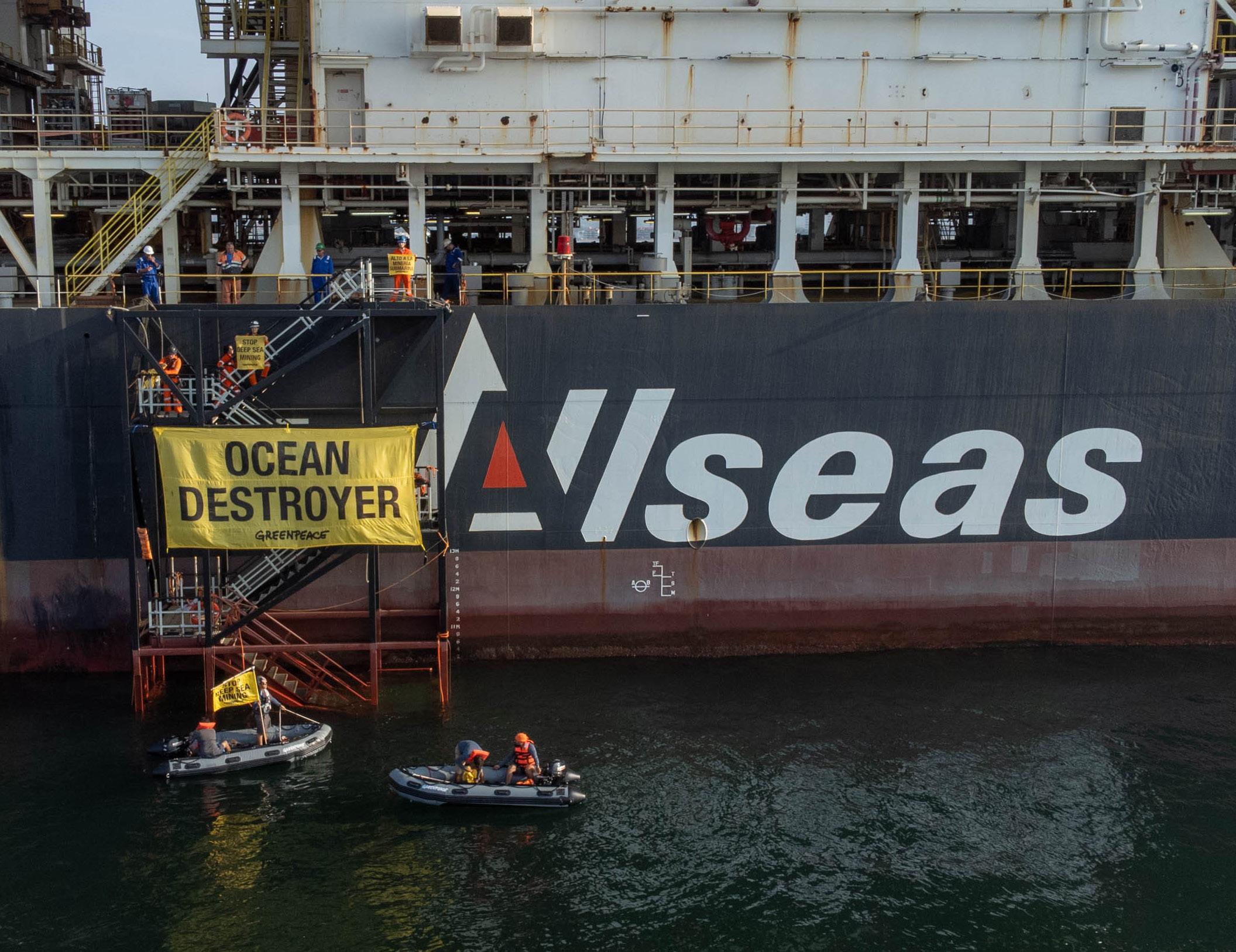
Greenpeace Netherlands activists hang a banner reading ‘Don’t Go Deep with Trump’ on the front of Allseas’ office building in Delft. Marten van Dijl / Greenpeace
AN INTERNATIONALLY ILLEGITIMATE PATHWAY
The entire strategy is fatally flawed. For TMC and the start-ups jumping on this new bandwagon, resting their business model entirely on a single, highly unpredictable administration is an extreme risk—one that has already been raised during TMC investor calls.
TMC does not plan to have operational mining vessels in the water until early 2028.64 This timeline places their deployment just months away from the next US presidential election cycle. Because Trump cannot run for another term, the risk of a swift change in administration—to one perhaps unwilling to violate international law to prop up an untested industry— presents an existential, material risk to investors.
More importantly, unilateral deep sea mining is legally and logistically implausible as long as the global community defends international law. In line with UNCLOS Article 136, the international seabed Area and its mineral resources are universally recognized as the common heritage of humankind. Because of this and Article 137, any unilateral mining license issued by the United States will completely fail to provide recognized, lawful title to the extracted minerals.
The moment TMC announced its intent to seek unilateral U.S. approval, it was met with fierce international condemnation. Over 170 states are bound by UNCLOS provisions to take active measures to prevent any unilateral appropriation of international seabed resources.
65
The political and legal barriers to operating an international supply chain under a rogue U.S. license are immense:
• No closed loop: TMC’s operations cannot exist entirely within a U.S. vacuum. Their mining machinery, vessels, processing, and refining plans depend on multiple non-U.S. companies breaching international law. The U.S. does not have these facilities ready domestically
• European and global pushback: Parliamentary and legal pressure to prevent supply chain partners from participating in unlawful deep sea mining is rapidly compounding across the globe. A resolution passed through the European Parliament,66 and parliamentary challenges are mounting in Switzerland,67 Canada,68 and the Netherlands69 (where government ministers have formally engaged with TMC’s offshore engineering partner Allseas regarding the legal risks).
70
• Superpower opposition: This rogue effort faces resistance at the highest diplomatic levels. During the 2025 United Nations Ocean Conference (UNOC), global leaders took a definitive stand, with critical statements from French President Emmanuel Macron and Brazilian President Luiz Inácio Lula da Silva,71 while the Chinese Foreign Ministry has publicly condemned this move.72
64 “Gerard Barron^ Yes. We are still standing by our guidance of commissioning Q4 next year. It will -- we’ve elected to run with a two-collector model. So that basically gives us the opportunity to get out on the water in early 2028.” The Metals Company (26 March 2026) Q4 2025 results call transcript. Available at https://investors.metals.co/static-files/8e86c301-bb59-4b26-ab67-eff44fb9ceb4
65 Greenpeace International (July 2026) Corporate Capture of the Deep Sea. A call for action to protect the commons against unlawful deep sea mining. Available at https://www.greenpeace.org/static/planet4-international-stateless/2026/07/1ae0383d-corporate-capture-of-the-deep-sea-itlos-unclos-isa-tmc.pdf
66 “32. Calls for support for an international moratorium on deep-sea mining and reminds the EU and its Member States, as members of the International Seabed Authority and in accordance with the UNCLOS, of their legal obligation to respond with appropriate measures to any attempts to bypass the International Seabed Authority as the competent international body for regulating deep-sea mining activities beyond national jurisdictions, as such attempts might have an impact on international ocean governance” European Parliament (28 April 2026) European Parliament resolution of 28 April 2026 on the role of ocean diplomacy for the competitiveness of EU fisheries and aquaculture (2025/2054(INI)) Available at https://www.europarl.europa.eu/doceo/document/TA-10-2026-0121_EN.html
67 L’Assemblée fédérale — Le Parlement suisse (19 June 2026) Interpellation: Allseas et exploitation minière des fonds marins contraire au droit international: que fait le Conseil fédéral? Available at https://www.parlament.ch/fr/ratsbetrieb/suche-curia-vista/geschaeft?AffairId=20263987
68 Parliament of Canada (25 June 2026) Petition e-7533. Available at https://www.ourcommons.ca/petitions/en/Petition/Details?Petition=e-7533
69 Tweede Kamer (11 June 2025) Motie van het lid Postma c.s. over de VS en The Metals Company aanspreken opdiepzeemijnbouw en elke mogelijke (juridische) actie ondersteunen. Available at https://www.tweedekamer.nl/kamerstukken/moties/detail?id=2025Z11835&did=2025D27100 and Tweede Kamer (29 August 2025) Het mijnbouwbedrijf dat sneller wil beginnen met het mijnen in de Stille Oceaan. Available at https://www.tweedekamer.nl/kamerstukken/kamervragen/detail?id=2025D36028&did=2025D36028
70 Trouw (13 June 2025) Kabinet bezorgd over de rol van Nederlands bedrijf Allseas bij omstreden zeemijnbouw. Available at https://www.trouw.nl/duurzaamheid-economie/kabinet-bezorgd-over-de-rol-van-nederlands-bedrijf-allseas-bij-omstreden-zeemijnbouw~b98c4a6c/
71 France 24 (9 June 2025) Deep seas, Greenland, Antarctica ‘not for sale’, Macron tells UN oceans summit. Available at https://www.france24.com/en/environment/20250609-%F0%9F%94%B4-live-macron-opens-un-ocean-summit-in-nice-to-tackle-threats
72 “The US authorisation... violates international law and harms the overall interests of the international community,” Chinese foreign ministry spokesman Guo Jiakun quoted in BBC (25 April 2025) Trump deep sea mining order violates law, China says. Available at https://www.bbc.co.uk/news/articles/cx2v37z333lo
The crisis facing modern multilateralism does not stem from a slow regulatory process; it comes from rogue actors attempting to exploit global commons for private profit at the expense of international law and the common good.
The entry into force of the historic Global Ocean Treaty proved that true multilateralism can win public trust only when environmental integrity and equity are placed
squarely at the centre of the text. Responsible states have a collective duty to stand firm, as multilateralism that inspires public faith won’t be rebuilt by giving rogue actors what they want.
Unilateral deep sea mining is an illegitimate path—and international law remains the ultimate barrier to its execution.
A MORATORIUM IS ABOUT FAIRNESS
In this context, establishing a formal moratorium is not an act of bureaucratic obstruction; it is the only appropriate, logical global response to unilateral mining. A moratorium is a direct demand for fairness, restraint, and deep respect for independent science, international cooperation, and the sovereign rights of all nations—not just the most powerful.
A moratorium sends a clear, unshakeable message to rogue corporate actors and unilateral states: no one gets to take from the global commons until the international community collectively agrees on how it should be
managed, protected, and equitably shared. We must pause to allow independent science to properly inform decision-making, before irreversible damage is done to an ecosystem we are legally bound to protect.
The ISA Secretary-General should ensure all perspectives are given space and not focus so fiercely on rapidly concluding the Mining Code. Her public comments criticising a moratorium73 dismiss the voices of over 40 governments, civil society, and scientists who argue that the safest regulatory framework is one that says no to extraction starting imminently in the deep sea.
SHAPE-SHIFTING PR LINES AND THE DECEPTION OF THE GREEN TRANSITION
To gain political favour amid governments setting net-zero plans and growing public concern over the climate emergency, deep sea miners counter-intuitively presented themselves as climate heroes. This narrative became impossible to sustain when the environmental movement, Pacific communities on the front lines of climate impacts, clean energy companies and scientists thoroughly debunked it.
Multiple studies make it very clear: we do not need deep sea metals to power the energy transition.74 Deep sea mining for nodules is highly limited in the minerals it can economically extract; mainly nickel, cobalt, copper, and manganese. Because of these constraints, leading proponents of deep sea mining have repeatedly shifted focus to whichever mineral grabs the political fashion of the moment:
• The Cobalt Shift: In the wake of human rights scandals over terrestrial cobalt mining in the Democratic Republic of Congo (DRC),75 Barron’s 2019 talking points positioned deep sea nodules as the ethical solution for cobalt.76 However, instead of turning to the ocean floor, major tech and automotive buyers are looking at the rapid development in battery energy storage technology, especially for alternative types of Lithium-Ion batteries.77
• The Nickel Pivot: Miners subsequently shifted their focus to nickel, capitalising on global media attention surrounding deforestation for terrestrial nickel mining in Indonesia.78 Yet battery technologies evolved faster than the mining industry’s PR lines. Lithium iron phosphate (LFP) batteries rapidly overtook traditional Nickel Manganese Cobalt Oxide (NMC) chemistries for electric vehicles. Additionally, the emerging development of Sodium-Ion batteries (SIB) presents a potential alternative that could help diversify battery technologies and reduce reliance on lithium.79
• The Manganese Mirage: Most recently, TMC has turned its marketing attention toward manganese.80 However, land-based global reserves of manganese are already vastly abundant, more diversified than cobalt or nickel, and more than sufficient to meet global industrial demands for the foreseeable future.81
The demand for critical minerals is expected to increase as the transition to renewable energy technologies progresses and the electrification of mobility, mainly driven by EV batteries, accelerates. Yet shares of the demand for renewable energy technology are largely driven by technological choices. For example, the share of cobalt demand in renewable energy is expected to grow at a minimum rate until 2040, or to return to its current 2024 rate given the projected trend towards cobalt-free batteries.
82
The renewable energy and electric vehicle sectors are simply not calling for deep sea metals. Not a single major EV producer or battery manufacturer has publicly supported deep sea mining. In fact, household-name companies have stated publicly that they will not source deep-sea minerals and have joined the call for a global moratorium due to the catastrophic environmental risks.83
Deep sea mining will not replace land-based mining; it will simply add a second frontier of destruction. Comparing the biodiversity impact of deep-sea extraction with terrestrial mining is like comparing apples and pears. Multiple scientific papers, including formal findings from the European Academies’ Science Advisory Council (EASAC),84 have rejected the legitimacy of these industry claims—and even TMC’s own financial reporting admits that comparing the impacts of land-based mining via seabed extraction is not possible.
85
73 “For example, “Sharing from my perspective, a moratorium on deep-sea mining as a claim would not align with the principle of the rule of law as defined by UNCLOS.” Geneva Environment Network (4 February 2026) The International Seabed Authority: Governing the Common Heritage of Humankind, Protecting the Marine Environment, and Regulating DeepSea Mining. Available at https://www.genevaenvironmentnetwork.org/events/the-international-seabed-authority-governing-the-common-heritage-of-huma nkind-protecting-the-marine environment-and-regulating-deep-sea-mining/; and “in the current context believe the moratorium position that is stated in the IUCN Resolution from 2020 is now counterproductive because it takes money away from scientific research into deep sea ecosystems and delays the Authority from establishing strict environmental standards.” International Seabed Authority (27 March 2026). Madam Secretary-General’s Reflections from Her Recent Mission to the United Kingdom and Switzerland at the Start of 2026. Available at https://isa.org.jm/news/madam-secretary-generals-reflections-from-her-missions-to-the-united-kingdom-and-switzerland-at-thestart-of-2026/
74 For example, Greenpeace International and UTS Institute for Sustainable Futures (March 2026) Beyond Extraction: Pathways for a 1.5°C-aligned Energy Transition with Less Minerals. Available at https://www.greenpeace.org/international/publication/82073/beyond-extraction-pathways-for-a-1-5c-aligned-energy-transition-with-less-minerals/; and European Academies’ Science Advisory Council (June2023) Deep-Sea Mining: assessing evidence on future needs and environmental impacts. Available at https://easac.eu/fi leadmin/user_upload/EASAC_Deep_Sea_Mining_Web_publication_.pdf
75 Humans Right Watch, World Report 2018 Available at https://www.hrw.org/world-report/2018/country-chapters/democratic-republic-congo
76 Address to ISA Council by Gerard Barron (27 February 2019). Available at https://www.isa.org.jm/wp-content/uploads/2022/06/nauru-gb.pdf 77 IEA
Them. Available at https://www.greenpeace.org/static/planet4-international-stateless/2025/11/e80b309e-batteries-in-transition-report.pdf
80 See ‘TMC Pioneers Process to Produce Battery-Grade Manganese Sulfate from Seafloor Nodules, Opening New Frontier for Potential U.S. Manganese Independence’ in The Metals Company Announces Third Quarter 2025 Corporate Update (13 November 2025) Available at https://investors.metals.co/news-releases/news-release-details/metals-company-announces-third-quarter-2025-corporate-update-0
81 United States Geological Survey Mineral Commodity Summaries 2026, Manganese: Available at https://pubs.usgs.gov/periodicals/mcs2026/mcs2026-manganese.pdf
82 Beyond Extraction: Pathways for a 1.5°C-aligned Energy Transition with Less Minerals https://www.greenpeace.org/static/planet4-international-stateless/2026/02/677b279a-beyond-extraction_energy-transition-with-less-minerals_2026.pdf
83 Deep Sea Conservation Coalition, Voices calling for a moratorium - Companies and finance, available at https://deep-sea-conservation.org/solutions/no-deep-sea-mining/momentum-for-a-moratorium/companies-and-finance/
84 European Academies’ Science Advisory Council (June 2023) Deep-Sea Mining: assessing evidence on future needs and environmental impacts. Available at https://easac.eu/publications/details/deep-sea-mining-assessing-evidence-on-future-needs-and-environmental-impacts
85 “it may also not be possible to
22 FROM PR TO GEOPOLITICS, AI, AND MILITARIZATION
As the green transition narrative collapsed, deep sea mining companies increasingly diversified their rhetoric away from a sole focus on the energy transition toward national security, artificial intelligence, and militarisation.
Greenpeace USA’s report, Deep Deception: How the Deep Sea Mining Industry is Manipulating Geopolitics to Profit from Ocean Destruction,86 documents this intentional marketing pivot. Facing financial pressure and no international approval to mine, TMC began aggressively courting military circles, U.S. defence hawks, and whipping up fears of a Cold War-style “gold rush” where the U.S. might fall behind Chinesedominated supply chains.
This geopolitical rationale has been thoroughly debunked by military veterans and intelligence experts alike. Retired U.S. Army Major General Randy Manner and retired U.S. Navy Vice Admiral Kevin Green have pointed out that “money and business” are the only real drivers here;87
This manufactured security narrative has further eroded the social license for deep sea mining. Pacific communities and campaigners are actively opposing deals framed around critical minerals—such as Trumpaligned proposals to explore the seabed for vanadium— linking this corporate exploitation directly to historical trauma from nuclear testing in the Pacific.88
In 2026, GSR have started claiming that deep sea metals are essential for data center infrastructure for the Artificial Intelligence boom.89 Now claiming that deep-sea metals are mandatory to feed the power grids and data centers for the Artificial Intelligence boom. These shifts show how extractive interests have been trying to co-opt the green transition, national defense, and technological advancement at the expense of marginalized communities and the marine ecosystems humanity relies on.
Furthermore, no U.S. National Defense Strategy has identified these four target metals—manganese, nickel, copper, and cobalt—as required acquisition targets, nor are any of them currently subject to Chinese export controls.
86 Greenpeace USA (21 July 2025). Available at https://www.greenpeace.org/static/planet4-usa-stateless/2025/07/9b462ecb-deep-deception-how-the-deep-sea-mining-industry-is-manipulating-geopolitics-to-profit-from-ocean-destruction-greenpeace-usa-report.pdf
87 Newsweek (5 August 2025) Deep-Sea Mining Threatens U.S. Security and Ocean Peace | Opinion. Available at https://www.newsweek.com/deep-sea-mining-threatens-us-security-ocean-peace-opinion-2108778
THE COLLAPSE OF COMMERCIAL MOMENTUM
Deep sea miners consistently attempt to project a sense of unstoppable momentum, yet their claims fall apart under scrutiny. For example, while the Japanese government generated significant domestic headlines after a research vessel successfully retrieved rare earthbearing mud from a depth of nearly 6,000 meters near Minamitorishima Island, the reality behind the engineering feat reveals a steep economic chasm. Financial analysts have pointed out that the cost of domestic deep-sea extraction, transport, and complex refining from these extreme depths could reach $70,000 per ton—nearly 20 times the 2013 market price of land-processed alternatives.90 Without astronomical, unverified state subsidies, the project remains an economically unviable “mirage” designed more for political signaling than industrial utility.
Similarly, at the end of 2025, commercial actors talked up the prospect of imminent leasing in the
Arctic waters of Norway, but this push was met with a powerful parliamentary block that keeps Norway’s Arctic deep ocean strictly off-limits until almost the end of this decade.91
Deep sea miners have consistently underestimated public resistance, scientific warnings, and political opposition. Now deep sea mining companies are showing their true colors: attempting to exploit the global commons without international permission through politically controversial rogue action.
The message to governments is clear: it is time to show whose side you are on. Do you choose to stand with international law, the common heritage of humankind, and independent science—or do you want to be on the wrong side of history?
A TERRIBLE IDEA, GETTING WORSE
What is already clear is that deep sea mining is not—and can never be—an environmentally responsible industry. Based on everything the scientific community has uncovered, deep sea mining is already widely recognized by independent scientists, environmental coalitions, cross-sector businesses, and major global financial institutions as too ecologically risky to be acceptable.92 This consensus will not change; as the data accumulates, the outlook only darkens.
We are already living through an unprecedented climate and nature crisis, where the global ocean is struggling to absorb the cumulative shocks of multiple human pressures. Into this overburdened mix, a handful of speculative companies are now proposing to unleash tank-sized excavators into the deep. This would represent the opening of an entirely new industrial frontier in one of our planet’s last remaining pristine wildernesses.
Deep sea mining targets and physically removes parts of the habitat that deep sea life physically and/or biochemically centers around. Habitat destruction is not a side effect of the process; it is the process itself. It is the mechanism required to make this industry work.
According to the United Nations World Ocean Assessment, the vast deep-sea realm constitutes the “largest source of species and ecosystem diversity on Earth.”93 The primary target for commercial exploitation
is the Clarion-Clipperton Zone (CCZ), a vast abyssal plain stretching between Mexico and Hawaii in the Pacific Ocean. Scientists describe the CCZ as a unique and biodiverse ecosystem in the deep ocean worldwide, harbouring thousands of species many of which remain unidentified and potentially new to science.
A series of small-scale scientific tests and historic benthic disturbance experiments have already given us warnings over the long-term impacts of deep sea extraction: the deep seabed does not recover in any meaningful way, even after half a century.94
Moreover, commercial deep sea mining would introduce continuous, 24/7 noise and light pollution into an environment that has evolved in pitch-black, near-silent conditions. This unceasing roar would overlap with areas and acoustic frequencies used by more than 20 species of whales and cetaceans that migrate through or inhabit the CCZ, including endangered blue whales, humpback whales, and sperm whales.95
The status of the deep sea as one of our planet’s last intact ecosystems confers a profound, non-negotiable political responsibility onto the world’s governments. They face a unique historical duty to act with precaution regarding what is allowed to happen here, rather than rubberstamping its destruction for short-term corporate profit.
90 Ren Xinyuan (29 March 2026) The 6,000-Meter Mirage: Is Japan Extracting Rare Earths or Political Capital? Available at https://www.chinausfocus.com/finance-economy/the-6000-meter-mirage-is-japan-extracting-rare-earths-or-political-capital 91 Mongabay (8 December 2025) Norway pauses deep-sea mining for four years. Available at https://news.mongabay.com/short-article/2025/12/norway-pauses-deep-sea-mining-for-four-years-in-policy-u-turn/ 92 Deep Sea Conservation Coalition, Momentum for a Moratorium, available at https://deep-sea-conservation.org/solutions/no-deep-sea-mining/momentum-for-a-moratorium/
93 United Nation (2015) First World Ocean Assessment (WOA I)
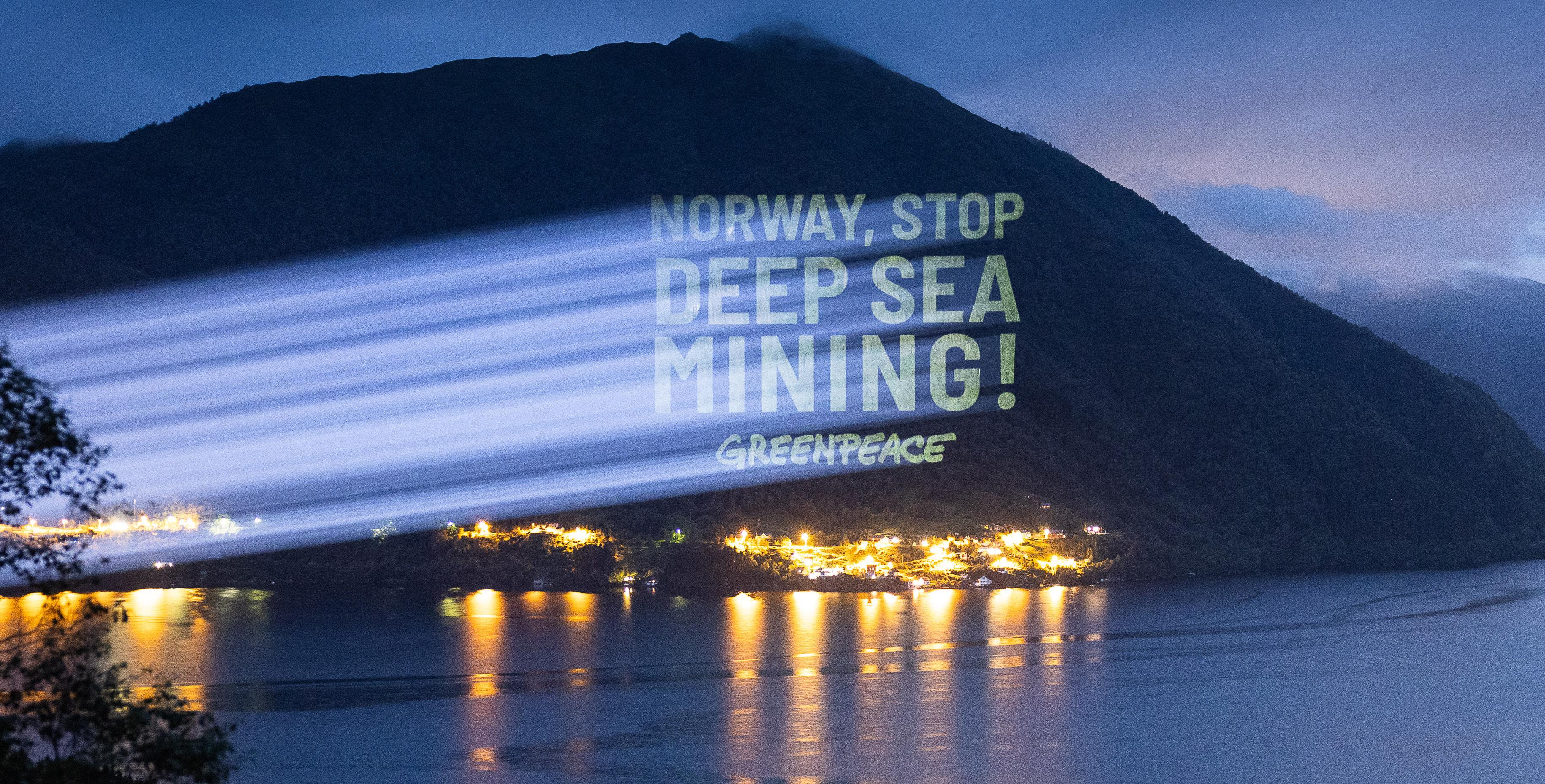
Projection against deep sea mining, Norway. Daniel Muller / Greenpeace
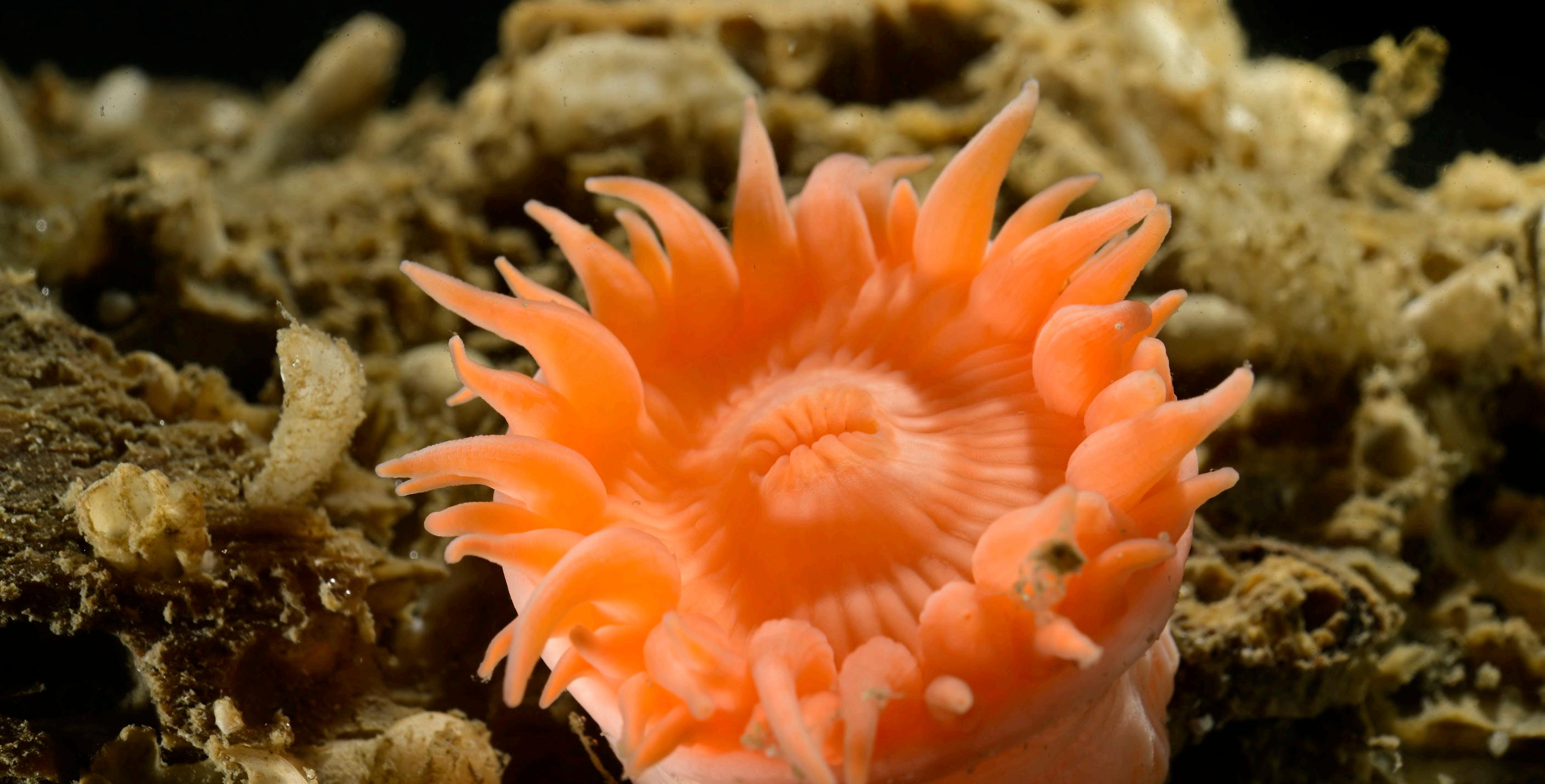
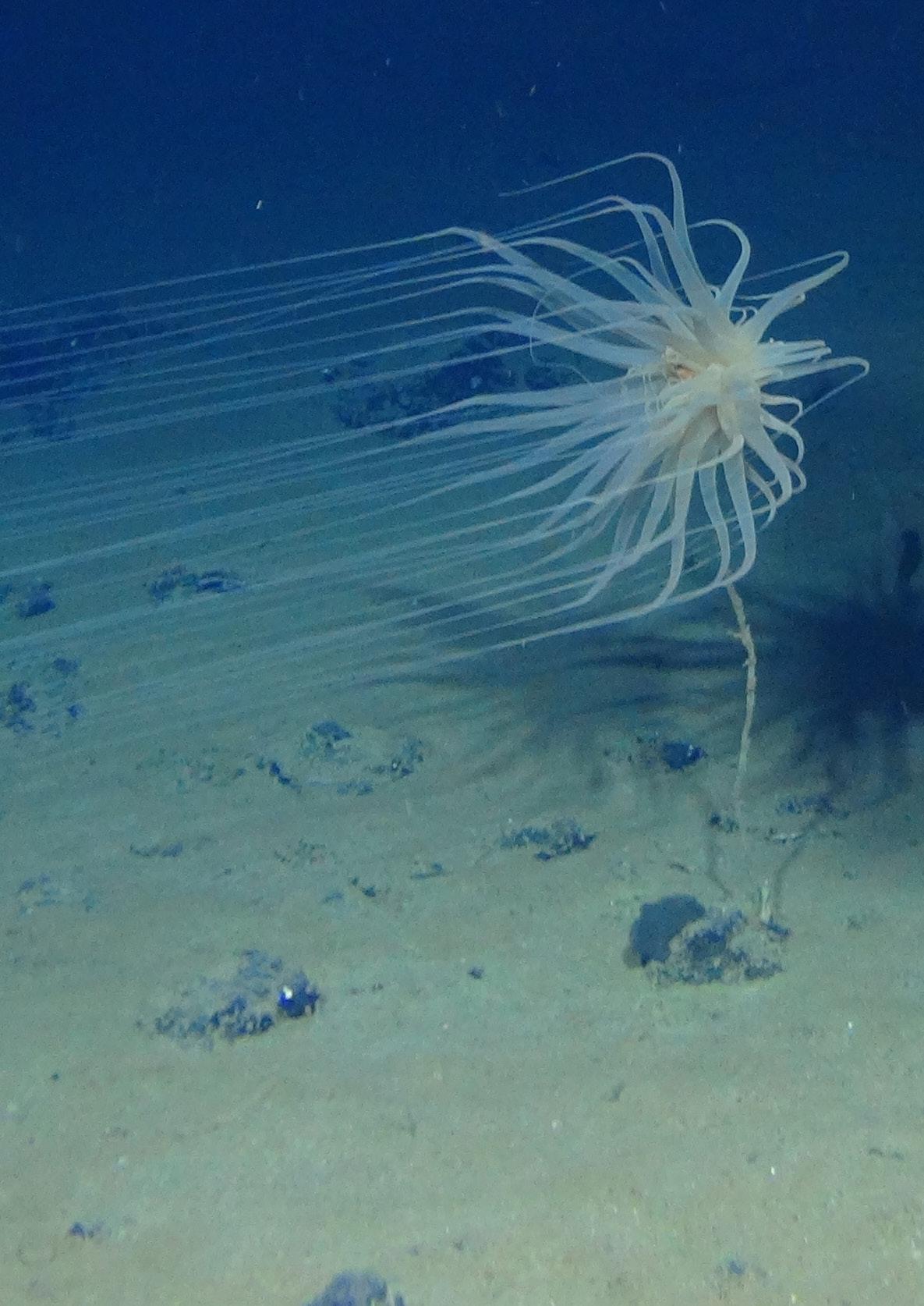
A sea anemone. Solvin Zankl / Greenpeace
The reality of High Seas engineering failures
It is critical to remember that this entire catalog of ecological destruction is what will happen if everything goes exactly to plan. The corporate marketing materials produced by deep sea mining start-ups describe a seamless, perfectly controlled, closed-loop engineering process. Real-world ocean operations tell a vastly different story.
When the Belgian deep sea mining company Global Sea Mineral Resources (GSR) deployed its 25-ton prototype nodule-mining machine, Patania II, during seafloor trials in 2021, the vehicle suffered a catastrophic umbilical cable failure.96 The machine became stuck on the abyssal floor, thousands of meters below the surface, remaining stranded for days.
Operating commercial machinery on the high seas at depths three times deeper than the Deepwater Horizon disaster and fifteen times deeper than traditional North Sea oil rigs is a logistical and engineering nightmare.97 The immense pressure, corrosive saltwater, and sheer isolation mean that technical failures are not a rare exception—they are fully to be expected. If a prototype machine can be lost on the seafloor during a highly monitored, brief test run, the international community must expect that full-scale, unceasing commercial operations would inevitably suffer incidents such as severe structural failures, line snaps, and toxic spills.
The great unknown: burning a library before it is read
The deep ocean remains one of the last great unexplored frontiers on Earth, a realm of profound mysteries that we are only beginning to glimpse.
A groundbreaking biodiversity inventory of the CCZ highlighted the staggering scale of our ignorance: an estimated 88% to 92% of the species living in this targeted mining region are completely new to science.98 Out of thousands of unique organisms documented by researchers, only a tiny fraction have been formally named and categorized.
Our understanding of this alien environment is shifting beneath our feet. For instance, researchers recently announced the discovery of an entirely new superfamily of deep-sea amphipod crustaceans (Mirabestioidea) in the CCZ.99 Discovering a new superfamily is not just finding a new species; it represents the unearthing of an entirely new, major branch of evolution—the biological equivalent of only just realizing that dogs exist.
Furthermore, oceanographers are still reeling from the revelation of the “dark oxygen” phenomenon.100 In the complete absence of sunlight or photosynthetic plants, polymetallic nodules on the seafloor appear to act as natural “geobatteries,” generating oxygen 13,000 feet below the surface through the spontaneous electrolysis of seawater. This paradigm-shifting discovery has completely upended centuries of established scientific consensus regarding how oxygen is generated on our planet. It highlights how little we understand about baseline abyssal mechanics, and provides critical clues that could even inform our search for life on other planets.
Independent scientists estimate that it will take at least 10 to 15 years of research just to fill fundamental knowledge gaps regarding the current state of the deep sea environment.101 We still do not understand the basic connections between these fragile populations, their shifting habitats, or the overarching ecosystem structures that keep them alive.
96 BBC (28 April 2021). Accident leaves deep sea mining machine stranded https://www.bbc.co.uk/news/science-environment-56921773
97 Lyle Trytten (9 December 2025), Economic potential of seabed manganese nodules in the Cook Islands. Available at https://www.greenpeace.org/static/planet4-international-stateless/2025/12/a9952321-economic-potential-of-seabed-nodules-in-the-cook-islands-dec-2025.pdf
98 Muriel Rabone et al. Current Biology (25 May 2023) How many metazoan species live in the world’s largest mineral exploration region? Available at https://www.sciencedirect.com/science/article/pii/S0960982223005341
99 Anna M. Jażdżewska and Tammy Horton. ZooKeys (24 March 2026). New deep-sea Amphipoda from the Clarion-Clipperton Zone: 24 new species described under the Sustainable Seabed Knowledge Initiative: One Thousand Reasons campaign. Available at https://zookeys.pensoft.net/article/176711/list/9/
100 Sweetman, A.K., Smith, A.J., de Jonge, D.S.W. et al. Evidence of dark oxygen production at the abyssal seafloor. Nat. Geosci. 17, 737–739 (2024). https://doi.org/10.1038/s41561-024-01480-8
101 “The recommendation of the Global Deep-Sea Consultation is to support a moratorium on deep-sea mining for a minimum of 10-15 years or until there is sufficient knowledge to make informed decisions” IPOS (2025) The Global Deep Sea Consultation Scientific Proclamation. Available at https://ipos.earth/global-deep-sea-consultation-pilot-project
THE PRECAUTIONARY IMPERATIVE VS. POLICY BLINDNESS
This gaping chasm in scientific knowledge means that policymakers simply do not possess the baseline information required to calculate the true scale of the harm or food chain disruption they would be authorizing—and legally held responsible for—if they allow deep sea mining to proceed.
At Greenpeace, we believe that deep sea mining has no place in a sustainable future and that it is unacceptable for operations to start, given the biodiversity and climate crisis we live in. Greenpeace believes that the deep sea should stay off-limits to the mining industry, which means: deep sea mining should never be authorised to start.
A BORDERLESS MOVEMENT: THE ABSENCE OF SOCIAL LICENSE
The industry is already discovering that it possesses no social license to operate. A massive, diverse wall of global opposition is rapidly hardening across scientific, corporate, and financial sectors, creating an environment where deep sea mining companies are increasingly isolated.
• The Financial Retreat: Financial markets are actively turning their backs on the sector due to severe environmental, regulatory, economic and reputational risks. To date, 82 major financial institutions—representing roughly €24 trillion in combined assets—have formally adopted policies that exclude, restrict, or express deep concern about financing deep-sea mining.102 Crucially, almost half of these exclusion policies were adopted within the past 12 months, signaling an accelerating loss of investor confidence. High-street banks and institutional giants like Standard Chartered, NatWest, and Lloyds have ruled out funding the sector.103
• The Insurance Void: Two of the world’s three largest re-insurers, Swiss Re and Hannover Re, are actively refusing to underwrite deep sea mining operations, leaving prospective miners exposed to catastrophic liabilities.104
• The Corporate Boycott: Leading automotive and technology innovators—including BMW, Volkswagen, and Volvo—have explicitly pledged to exclude deep sea minerals from their supply chains.105
• The Scientific Consensus: 1000 independent marine scientists and policy experts have signed a unified call to halt the industry, warning of irreversible planetary damage.106
Greenpeace welcomes the fact that 43 visionary governments have now officially heeded these warnings. By proposing and championing progressive regulatory tools such as a formal moratorium or a precautionary pause, these nations are stepping up to fulfill their collective responsibility.
The momentum has shifted. The science is definitive, the financial backing is drying up, and the political will to protect our oceans is rising. It is time to lock the door on this destructive industry once and for all and safeguard the global commons for generations to come.
102 Seas at Risk (March 2026), Red lines in the abyss. Available at https://seas-at-risk.org/wp-content/uploads/2026/03/Red-Lines-in-the-Abyss-DIgital.pdf
103 Mining Technology (23 June 2023), Banks representing a third of UK assets vow not to invest in deep-sea mining. Available at https://www.mining-technology.com/news/banks-one-third-uk-assets-deep-sea-mining/
104 Insurance Business (20 July 2024), Major insurers withdraw support for deep sea mining. Available at https://www.insurancebusinessmag.com/nz/news/environmental/major-insurers-withdraw-support-fordeep-sea-mining-498048.aspx
105 Reuters (31 March 2024) Google, BMW, AB Volvo, Samsung back environmental call for pause on deep-sea mining. Available at https://www.reuters.com/business/sustainable-business/google-bmw-volvo-samsung-sdi-sign-up-wwf-call-temporary-ban-deep-sea-mining-2021-03-31/ 106 Deep-Sea Mining Science Statement, available at https://seabedminingsciencestatement.org/
THE DODGY FINANCIAL CASE: AN ABSURD GAMBLE
A comprehensive sector review by Benchmark Mineral Intelligence concluded that: “The absence of a finalised international mining code continues to be a central bottleneck, hampering investments and complicating governance. Shifting demand patterns, especially the rise of LFP batteries and alternative next-gen battery technologies such as sodium-ion, risk weakening the long-term outlooks for some key minerals such as cobalt. Taken together, these factors mean that deep-sea mining is currently not yet commercially viable at scale” (emphasis added).107
At the same time, shifting consumer demand patterns have weakened the long-term outlook for the very minerals that deep sea mining seeks to extract.
“I think it’s just simply not a good investment. To invest in a company involved in deep-sea mining is believing there will be no major technological change in battery chemistry for the next 25 years—and that’s simply not credible, because it’s happening already. With realistic assumptions about what will actually happen, I don’t know if the financial math works.”
— Victor Vescovo, Private Equity Investor, Industrialist, and record-setting Deep-Ocean Explorer108
Vescovo emphasizes that operating heavy, complex mechanical and electrical systems under thousands of pounds of pressure per square inch in corrosive, nearfreezing seawater is an engineering nightmare. He notes that the deep ocean “rips up anything mechanical almost like it has a will to do so.”
The only time commercial deep sea mining was attempted on a large scale—by Nautilus Minerals in the national seabed of Papua New Guinea—it collapsed into bankruptcy, leaving the developing host nation with a devastating debt of over $100 million. This loss was equivalent to roughly one-third of the country’s annual national health budget.109 There are several documented links between Nautilus senior staff and subsidiaries and those of TMC.110
107 Benchmark Mineral Intelligence (15 April 2026) The emergence of deep-sea mining: a viable critical mineral source? Available at https://source.benchmarkminerals.com/publications/special-issues/the-emergence-of-deep-sea-mining-a-viable-critical-mineral-source 108 Available at https://www.youtube.com/watch?v=VIemroLodso
109 The Guardian (30 September 2021), ‘Shark calling’: locals claim ancient custom threatened by seabed mining. Available at https://www.theguardian.com/world/2021/sep/30/sharks-hiding-locals-claim-deep-sea-mining-off-papua-new-guinea-has-stirred-up-trouble 110 See Greenpeace International (December 2020) Deep Trouble. Available at https://www.greenpeace.org/static/planet4-international-stateless/c86ff110-pto-deep-trouble-report-final-1.pdf
I. THE METALS COMPANY
PRE-FEASIBILITY STUDY (PFS)
TMC’s financial models rest on a fragile foundation of near-best-case assumptions rather than prudent planning. An external financial analysis of TMC’s flagship Pre-Feasibility Study (PFS) reveals that the project is mathematically structured to terminate after just eight years with zero net profit. 111
Because the PFS admits the operation must dredge up 50.7 million metric tons just to break even, the analysis concludes TMC’s deep sea mining operation in the NORI-D area cannot achieve commercial profitability based upon mineral reserves alone. The PFS itself raises concerns for investors or potential investors, as it includes inconsistent estimates of resources and reserves, raising serious questions over the validity of this PFS on one of the most crucial issues for mining project disclosure, and includes some resources as economically mineable, which the analyst notes is “inconsistent with SEC regulations”.
Moreover, according to the analysis, the PFS exhibits severe flaws that challenge its validity:
• Artificially Inflated Revenues: Over a quarter (28.4%) of the project’s projected revenue relies on selling manganese silicate at a premium price into a market that does not actually exist. No industrial silico-manganese smelting facilities currently accept manganese silicate as a primary feedstock; outside of this speculative use, it is a low-value byproduct.
II. DOUBTS OVER COOK ISLANDS PROJECTS’ ECONOMIC FEASIBILITY
A separate economic analysis of the Cook Islands’ nodule mining prospects concluded that, once immense capital expenditures, volatile market factors, and deepwater technical challenges are fully accounted for, deep sea mining in this region is highly likely to result in a severe net economic loss. 112
“Capital and operating costs suggested by project proponents show a high likelihood of economic losses for extraction and sale of Cook Island nodules. A sensitivity analysis for picking technology suggests the average outcome is negative. Estimated operating costs for a crawler project (PFS-level) are at or above nodule estimated market value, also indicating negative economics.”—
Lyle Trytten
This systemic unprofitability is driven by a global absence of processing facilities capable of refining raw, multimetal marine nodules into saleable, pure-grade metals. Establishing a brand-new, specialized global supply chain from scratch introduces immense financial risks.
Compounding this, the long-term market outlook is weakest for cobalt and manganese—the two minerals that make up the primary material value of the Cook Islands’ deposits. The review found that the realistic market value of these raw nodules is just US$100 to US$140 per dry tonne, a figure far below the soaring operational costs required to extract them from the abyss. Highlighting this grim outlook, Belgium’s Global Sea Mineral Resources (GSR) abruptly announced it was divesting its deep sea mining interests in the Cook Islands in late 2025.113
111 Steven Emerman (February 2026) Implications of The Metals Company Pre-Feasibility Study for Next Steps by the Company, available at https://miningwatch.ca/sites/default/files/implications-of-the-metals-company-pre-feasibility-study-for-next-steps-by-the-company.pdf
112 Lyle Trytten (9 December 2025), Economic potential of seabed manganese nodules in the Cook Islands. Available at https://www.greenpeace.org/static/planet4-international-stateless/2025/12/a9952321-economic-potential-of-seabed-nodules-in-the-cook-islands-dec-2025.pdf
113 DEME (28 November 2025) GSR announces strategic review of its seabed mineral interests to advance priority initiatives in the CCZ. Available at https://deme-gsr.com/news/gsr-announces-strategic-review-of-its-seabed-mineral-interests-to-advance-priority-initiatives-in-the-ccz/
THE FISHERIES RISK
The financial vulnerabilities of deep-sea mining extend far beyond corporate balance sheets; they threaten the multi-billion dollar global seafood sector, including the foundational blue economies of Pacific Island nations. Scientists have warned that climate impacts may drive increasing conflict between tuna fisheries in the Pacific Ocean and areas targeted for deep sea mining,114 and flagged risks from mid-water discharge plumes and metals bioaccumulation for high seas fisheries.115 Major seafood players have called for a pause on deep sea mining,116 while warnings from the fishing sector were a vocal part of the opposition to Norway’s deep sea mining plans.117
WHAT HAPPENS NEXT?
After TMC USA submitted its applications to the U.S. regulator, in July 2025 the ISA Council unanimously launched an inquiry into the activities of ISA contractors and their affiliates that may be in breach of their contractual obligations by not acting in accordance with the multilateral legal framework.118 Public information strongly suggests potential breaches of ISA contracts by TMC’s subsidiaries NORI and TOML119 While the inquiry gathered information, NORI and TOML initiated proceedings against the ISA at the International Tribunal on the Law of the Sea (ITLOS), requesting provisional measures (akin to an injunction) to suspend the ISA inquiry.120
These are the first contentious cases to be brought to ITLOS’s Seabed Disputes Chamber. These lawsuits against the ISA appear designed to prevent oversight and adverse decisions by the regulator, specifically to prevent these companies’ exploration contracts from not being extended or being terminated by the ISA following the inquiry.
The legal battle to protect the deep sea must not be fought only in the halls of the ISA, or the Chamber where deep sea miners are suing the ISA, but also in national jurisdictions.
The corporate network of The Metals Company (TMC) and its primary partner, Allseas Group, links a wide range of countries through parent companies, subsidiaries, technical partners, directors and strategic investors. Where these companies and their directors are connected to TMC USA’s pursuit of unilateral mining, governments around the world have both an obligation and an opportunity to take action to ensure their natural and juridical persons, and those under their effective control, do not participate in this violation of international law. Potential service providers based in the Netherlands, Switzerland, Canada, Malta, Australia, the UK, Belgium, Japan, Korea, Singapore, Nauru and Tonga among others require attention from governments to prevent their participation in any activities that may be in breach of UNCLOS.121
The prospect of unilateral, unlawful deep sea mining is not simply a ‘problem for the U.S.’ - it can be effectively constrained and limited by action to uphold international law across the globe.
114 Amon, D.J., Palacios-Abrantes, J., Drazen, J.C. et al. Climate change to drive increasing overlap between Pacific tuna fisheries and emerging deep-sea mining industry. npj Ocean Sustain 2, 9 (2023). https://doi.org/10.1038/s44183-023-00016-8
115 J.M.A. van der Grient, J.C. Drazen, Potential spatial intersection between high-seas fisheries and deep-sea mining in international waters, Marine Policy, Volume 129 (2021) https://doi.org/10.1016/j.marpol.2021.104564
116 Seafood Market Statement Supporting a Pause on Deep-Sea Mining (2023) https://www.seabedminingseafoodstatement.org/
117 “Sverre Johansen, general secretary of the Norwegian Fishermen’s Association, said Norway’s fishing industry was “not at all impressed” by the proposal” and “Jane Sandell, chief executive of UK Fisheries… said she was “deeply concerned” about the possibility of toxic heavy metal particles being released.” in Financial Times (9 June 2023) Norway seeks to open vast ocean area to deep-sea mining. Available at https://www.ft.com/content/44855d32-82c2-4f4c-b77c-1c21d3c1279f
It is time for decisive political action to prevent deep sea mining from starting imminently, rather than technical debates on how to rip up the ocean floor.
The upcoming International Seabed Authority (ISA) Council session this July represents a critical crossroads for the protection of our global commons. This gathering offers a pivotal opportunity for responsible governments to wrest control of the timeline away from commercial actors, reject corporate bullying, and prioritise precaution for the common good. Fasttracking the Mining Code is not a neutral administrative step; it is a monumental, irreversible trigger that opens the floodgates to commercial exploitation. The only way to finalize these regulations this year would be for governments to abandon their legal obligations to protect the marine environment and deny safeguarding global equity. Rushing this process would permanently erode multilateral norms and inadvertently validate lax, unilateral mining pathways.
The threat of deep sea mining represents a new potential source of conflict over minerals, environmental degradation, and unilateral efforts to seize resources and territories in breach of international law. This is the last thing the world needs right now. This July, governments have the opportunity and tools to diffuse this threat and demonstrate global cooperation for the common good at the International Seabed Authority.
• Governments have the tools to create major barriers to unlawful mining efforts and defend this global commons.122 The legal obligations of 170+ governments to constrain any companies or nationals from participating in unlawful deep sea mining are clear. This provides the opportunity to shut off access to personnel, offshore engineering, ports, financing, processing, refining, and markets for unlawful mining. A recent legal opinion concludes that Allseas’ May 2026 contract to operate deep sea
mining machinery for The Metals Company under unilateral U.S. authorisation triggered the obligation under international and Dutch law for the Dutch government to intervene against this corporate violation.123 Failing to do so would constitute a breach of its binding obligations under UNCLOS.
• Unless the ITLOS Seabed Disputes Chamber decides to order a suspension of the ISA’s inquiry into any contractors involved in unilateral mining, the ISA’s advisory commission and governments should conclude the ISA inquiry into whether any contractors are supporting unilateral efforts, and support punitive consequences for any companies breaching their obligations. It would be untenable for contractors to retain internationally legitimate rights to exploration while simultaneously participating in a violation of international law.
• This common ground across delegations is that the international community does not want mining to start right now, and is not ready to adopt a Mining Code that would open the gates to exploitation applications. Governments can join the 43-strong coalition calling for a moratorium, and show their support for the centrality of science-based decisionmaking at the Assembly by supporting a resolution tabled by Vanuatu.
• The ISA Council is due to establish a roadmap for the next phase of its work. Progressive governments must stand united to ensure this decision formalizes strong pre-conditions before any mining can begin - including having enough scientific knowledge to make informed decisions. Adopting flawed, premature regulations will not stop unilateralism; it will only legitimize bad faith action. Rushing to adopt weak regulations means falling into a trap set by corporate actors who are trying to make a mockery of international law. Whereas agreeing a clear set of conditions for international approval of mining would help the ISA to shield itself from receiving commercial mining applications submitted under false expectations of the Mining Code being ready for adoption.
Protest against deep sea mining in Mexico. Ivan Castaneira / Greenpeace
Activists paint deep sea mining operation vessel in the Pacific Ocean. Marten van Dijl / Greenpeace
CONCLUSION: A LINE IN THE SAND
As geopolitical tensions rise and the erosion of international norms by a few rogue actors breeds global instability, it is vital that governments act decisively to safeguard the collective interest. There is no better place to demonstrate the power of international cooperation than over the high seas—the waters that connect all continents. This collective strength is already proven, buoyed by the historic success story of the Global Ocean Treaty dedicated to protection, which triumphantly entered into force in January 2026.
The biggest threat to our oceans is not industrial fisheries or deep sea mining machines. It is the infection of doom and gloom that fools us into thinking we are powerless to stop things from getting worse.
But people power and international cooperation are showing their resilience. Despite intense corporate headwinds, the Global Ocean Treaty is now law, and deep sea mining has been successfully held back from the Arctic to the Pacific. We can win big together—even in the toughest of times.
As Greenpeace, we know we can win historic victories for the oceans. People before us in our movement had a harder time and they fought - and won. Putting Antarctica off-limits to mining and drilling during the Cold War. Stopping whaling to provide what whalers described as a critical product for the global economy. Even when it looked like the giants of our ocean would inevitably go
extinct, the ‘Save the Whales’ campaign captured public attention around the world and resulted in a global moratorium on commercial whaling that came into force 40 years ago.124 Political action based on science and public concern decisively changed the future for these icons of the oceans, bringing them back from the brink to recovering, flourishing populations.
Four decades on, stopping deep sea mining through international agreement can signal a shift. It builds on the growing momentum that when Indigenous peoples are included and involved in decision-making, nature and the life-support system it provides for us all win. It’s a site battle where we can agree to limit private greed for the common good.
Governments who believe in the importance of international cooperation, the rule of law and science need to stand up and make progress where they can.
An empty or abstract defence of multilateralism is worthless. When anti-environment, pro-extraction politicians go low, everyone else needs to aim higher in our ambitions and accomplish more with our actions. We must not let them win by limiting our hopes. This threat to international cooperation can galvanise a signature multilateral victory against extraction - showing protection, not exploitation, is where the future lies.
Published by Greenpeace International, July 2026
https://www.greenpeace.org/international/
Greenpeace International Surinameplein 118 1058 GV Amsterdam
The Netherlands
Ground mural against deep sea mining in Vancouver. Ollie Richards / Greenpeace