Cleanchips,clearair: Publichealthimpactsfromelectronics
industryelectricityconsumptioninTaiwan
Inthisstudy,weassesstheair-qualityimpactsofTaiwanʼsprojected2030electricity demandfromitselectronicsmanufacturing(EM)industryunderarangeofenergy scenarios.
Keyfindings
● Undera“current-mix”scenario,assumingrenewableenergy(RE)procurementby TaiwanEMcompaniespersistsatthe2023level,weestimatethatairpollution attributabletoTaiwanʼsEMindustryin2030wouldbelinkedto90premature deaths,277childrensufferingfromasthma,nearly19,000workabsences,and almostUSD500millioninhealth-relatedeconomicdamages.
● Inthisscenario,thelargestimpactsareconcentratedinTaiwanʼshighly industrialisedandurbanisedcounties,includingKaohsiung(USD114million),New Taipei(USD64million),Taichung(USD52million),Taoyuan(USD48million),and Tainan(USD47million)
● Threeleadingsemiconductorcompanies,TSMC,Micron,andUMCinTaiwanhave setrenewableenergyprocurementtargetsorhavemadepurchasesfor2030.If thesetargetscanbefurtheraccelerated,theair-qualityimpactswouldbe substantiallyreduced,savingaround41livesperyear,130childrensufferingfrom asthma andUSD229millionperyear.
● TSMC,whichhasthehighestrenewableelectricitytargetfor2030(60%),would accountforalmostUSD169millioninavoidedhealthdamages
● Overall,weconcludethatasTaiwanʼselectricitydemandriseswiththeexpansion oftheartificialintelligence(AI)industry,replacingfossilfuelswithcleanrenewable energysourcesdeliverssubstantialpublichealthbenefitsbyreducingairpollution exposure.
Introduction
Fossilpowergenerationandburdenofairpollution
Airpollutionisaglobalpublichealthcrisis,responsibleforover6milliondeathsevery year,exceedingthetollfromtobaccouseorpoordiet(Lelieveldetal.,2023;HealthEffects Institute,2024).Childrenareparticularlyvulnerable,with2millionpediatricasthmacases eachyeargloballyand709,000resultingdeathsin2021(Anenbergetal.,2022;Health EffectsInstitute,2024) InternationalbodiesincludingtheWorldHealthOrganization (WHO)andUnitedNations(UN)haverecognisedthisasaviolationofchildrenʼsrights (WHO,2018;UNICEF,2019) Theeconomicburdenisalsosevere Airpollutioncauses18 billionlostworkdaysandcoststheglobaleconomyUSD8trillioneachyear(Greenpeace, 2020;WorldBankGroup,2022).Addressingthesourcesofthispollutionisthereforebotha healthandaneconomicimperative.
Amajordriverofairpollutionistheburningoffossilfuels.Globally,fossilfuelcombustion causesaround5millionprematuredeathsannually(Lelieveldetal.,2023).These emissionsalsofuelclimatechange,compoundingthethreattohumanhealthand planetarystability.
Taiwanʼsfossil-poweredgridandrisingAIdemand
Taiwanhaslongbeenacentralhubintheglobalelectronicsandsemiconductorindustry. AccordingtoaTrendforcereport,fouroftheworldʼstoptenwaferfoundriesareTaiwanese companies,collectivelyaccountingforover70%oftheglobalmarket(TrendForce,2025). Amongthem,TaiwanSemiconductorManufacturingCompany(TSMC)ranksfirstglobally, whileUnitedMicroelectronicsCorporation(UMC)isrankedfourth.Asartificialintelligence developmentaccelerates,ithasfurtherexpandedthisindustry:Taiwannowalsoproduces thehardwarethatpowersartificialintelligence(AI)datacenters,includingadvanced semiconductorsandserverunits.Thismanufacturingisextremelyelectricity-intensive, placinggrowingpressureonTaiwanʼsalreadyheavilyburdenednationalpowergrid
In2023,Taiwanʼsgovernment-ownedutility,TaiwanPowerCompany(Taipower)generated 34%ofitselectricityfromcoaland44%fromnaturalgas,withrenewablesmakinguponly
amodestshareofthemix(Taipower,2025) UnderthegovernmentʼsEnergyTransition Goals,theshareofcoalisplannedtofallto20%by2030,whilegasisexpectedtoriseto around50%(MOEA,2025).Renewableenergy,ledbyoffshorewindandsolar photovoltaics,isprojectedtoexpandrapidly:theMinistryofEconomicAffairs(MOEA)has setatargetof20GWofsolarPVby2025and40–80GWby2050,alongside5.7GWof offshorewindby2025and15GWby2035(MOEA,2022) Evenwiththeseexpansions, renewableenergy(RE)isonlyexpectedtomakeuparound30%oftheelectricitymixby 2030,leavingTaiwanheavilyreliantonfossilfuels(ExecutiveYuan,2023).Thistrajectory riskslockinginairpollutionandcarbonemissionsatatimewhencleanalternativesare increasinglyaffordable.
ThehiddenhealthandeconomiccostofAIdevelopment
Therapidgrowthandenergydemandsofelectronicsmanufacturing spurredbyAI developmentisthreateningtoexacerbateairpollutionandemissions.Taiwanʼselectricity demandfromAItechnologiesisprojectedtoincreasebyapproximately2millionkWby 2028,representinganeightfoldgrowthcomparedwith2023(BureauofEnergy,Ministryof EconomicAffairs,2024).Between2024and2028,theincreaseinelectricityconsumption fromtheAIandsemiconductorindustriesaccountsfor857%ofthetotalgrowth ,withthe 1 semiconductorindustrybeingtheprimarycontributor.Specifically,in2024,electricity consumptionfromAIsemiconductors manufacturinginTaiwanaloneincreasedby350% comparedtothepreviousyear(Greenpeace,2025).
Severalleadingfirms–suchasTSMCandUMC–havepledgedtotransitiontoward renewableenergy.Yet,progressremainsslow.Mostoftheelectricityconsumedby TaiwanʼsEMindustryisstilldrawnfromthenationalgrid,whichasnotedaboveisheavily reliantonfossilfuels.Asaresult,theEMsectorʼsdependenceonfossilfuel–basedpower makesitasignificantcontributortotoxicairpollution
1 CalculationsarebasedonthemethodologypresentedinClimateChangeandInfrastructureResilience:An AnalysisofWaterResourcesandElectricityUseinTaiwanʼsSemiconductorIndustry,publishedbytheCenter forTechnologyDemocracyandSocialResearchandtheEnvironmentalRightsProtectionFoundation(2025) TheunderlyingdataaredrawnfrompresentationslidessubmittedbyTaiwanPowerCompany(Taipower)to theFirstMeetingoftheNationalClimateChangeResponseCommittee;see https://wwwpresidentgovtw/Page/714
PreviousresearchhasalreadylinkedtheEMindustryʼselectricitydemandtosignificant healthconsequences.In2016,fossil-fuelledpowergenerationforthesectorwasestimated tocausearound100prematuredeathsperyear(Farrow,AnhäuserandMyllyvirta,2019).
Morerecently,asAI-drivenexpansionhasintensifiedelectricitydemand,similarstudies haveturnedtodatacenters,documentingairpollutionimpactsfromelectricity consumptiononlargelyfossilfuel-dependentgrids(Hanetal,2025) Thisresearchalso callsforgreatercorporatedisclosureofenergyuseassociatedwithenvironmentaland healthimpacts.Sincethen,Taiwanʼsenergymixhasshiftedsomewhat,withcoalcapacity graduallydeclining,gasgenerationincreasing,andseveralmajorcompaniesmaking publiccommitmentstorenewableenergyby2030.Atthesametime,electricitydemand fromtheelectronicsindustrycontinuestorisesharply,drivenbyglobaldemandfor semiconductorsalongwiththerapidgrowthofAIandotheremergingtechnologies.
DespitetheeconomicpotentialofAI,itsenvironmentalimpactscouldalsotranslateinto significanteconomiccosts,particularlyinhealthcareandlaborproductivity Moreover,the governmentandTaipowerhavelongsubsidisedelectricityconsumptionthrough infrastructureinvestmentsandtariffsubsidies,leavingTaipowerheavilyindebt.
ThesetrendsindicatethatalthoughTaiwanʼselectronicsmanufacturingsectorplaysakey roleineconomicgrowth,itsenergy-intensiveoperationsmayhavesignificantimpactson airquality,publichealth,andrelatedeconomiccosts,underscoringtheimportanceof examiningthehiddentrade-offsofAI-drivenindustrialexpansion.
Studyscopeandscenarios
Theobjectiveofthisstudyistoquantifytheprojected2030healthandeconomicimpacts oftheTaiwanEMindustryʼsrelianceonfossilfuel–basedelectricity,andtoestimatethe benefitsofreplacingthatelectricitywithrenewablesources.Wefocusonemissionsfrom coal-andgas-firedpowerplantssupplyingtheEMsectorthroughTaiwanʼspowergrid,and attributetheresultingairpollution,healthoutcomes,andeconomicdamagestothesector andtoselectedmajorcompanies
The2030electricitydemandfortheEMsectorandindividualcompanieswasprojected usingtwoapproaches.ForsemiconductorfirmsTSMC,UMC,andMicron,
production-basedprojectionsfromGreenpeaceEastAsiaʼsInvisibleEmissionsreport (GreenpeaceEastAsia,2023)wereapplied.FortheEMsector,projectionsweremade by applyingCAGR2.8%growthratetothe2023electricityconsumption,usingdatafrom Taiwanʼs2023PowerResourcesSupplyandDemandReport(BureauofEnergy,Ministryof EconomicAffairs,2024)andinconsiderationofthehistoricalgrowthrateoftheelectronics industryoverthelastthreeyears(EnergyAdministration,MinistryofEconomicAffairs, n.d.).Fulldetailsofdatasourcesandmodellingassumptionsareprovidedinthe Methodologysection.
Weevaluatethreeelectricity-sourcingscenariosfortheEMindustryinTaiwanin2030,all assumingthesametotalelectricitydemand:
•Scenario1–NoTransition:TheEMindustrymakesnoadditionalrenewableenergy(RE) procurementbeyondcurrent2023levels,andremaining2030electricitydemandismet fromTaiwanʼsprojected2030gridmix,dominatedbycoalandfossilgas.
•Scenario2–2030RECommitments:TheEMindustryandindividualcompaniesmeet theirstated2030renewableelectricitytargets(forexample,TSMCʼs60%REtarget),while thegridevolvesaccordingtogovernmentplans.Theremainingelectricitydemandis suppliedbyfossil-fuelledgeneration.
•Scenario3–100%RE:TheTaiwanEMindustryandindividualcompaniesʼentire2030 electricitydemandismetwithrenewableelectricity,representingacompletephase-outof fossil-fuel–basedpowerforthissector.
Comparingthesescenariosallowsustoquantifytheadditionalhealthandeconomic benefitsofmovingfromtodayʼslimitedcommitmentstoafullrenewabletransitionin Taiwanʼs EMindustry.
ScopeClarificationandLimitations:
Thisstudyfocusesspecificallyontheimmediatepublichealthimpactsfromcriteriaair pollutants(PM2.5,NO2,andSO2)attributabletotheEMindustryʼselectricityconsumption (Scope2emissions).Directhealthimpactsassociatedwithmanufacturingactivities(Scope 1emissions)arenotincludedinthisanalysis,althoughabriefdiscussionofthesepotential
impactscanbefoundavailablein(Hanetal,2025) Furthermore,thescopeislimitedto thepublichealthbenefitsoftherenewableelectricityuseandexplicitlyexcludesthe second-orthird-orderhealthimpactsassociatedwithgreenhousegasemissionsandthe potentialhealthimpactsfromthemanufacturingofrenewableenergyinfrastructureitself, whichmayoccurinothercountries.
FossilpowerplantsdriveTaiwanʼsair
Publichealthandeconomicimpactsoffossil powergenerationinTaiwan
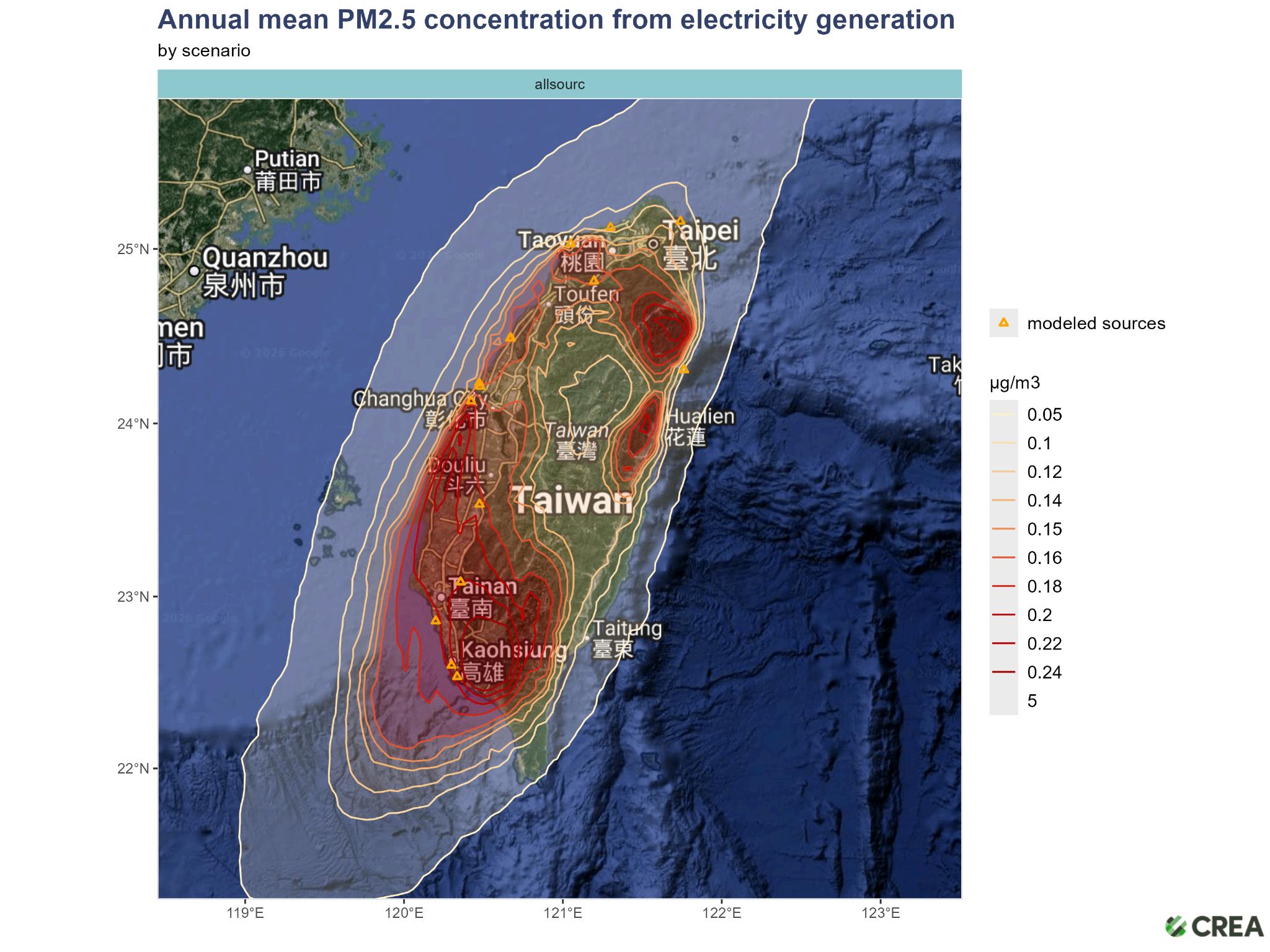
In2030,electricityusebyTaiwanʼsEMindustryisprojectedtoimposeasubstantialtollon publichealthandtheeconomy,butthescaleofthisburdendependsdirectlyonhow quicklycompaniesshiftfromfossil-fuelledpowertorenewables.Usingsimulatedpollutant concentrationsfromfossilfuelpowerplants(Figure1),combinedwithEMsectorelectricity demandprojectionsandourhealthimpactassessmentframework,wequantifydeaths, lostworkdays,andeconomicdamagesattributabletothesectorʼselectricityuseunder eachscenario.
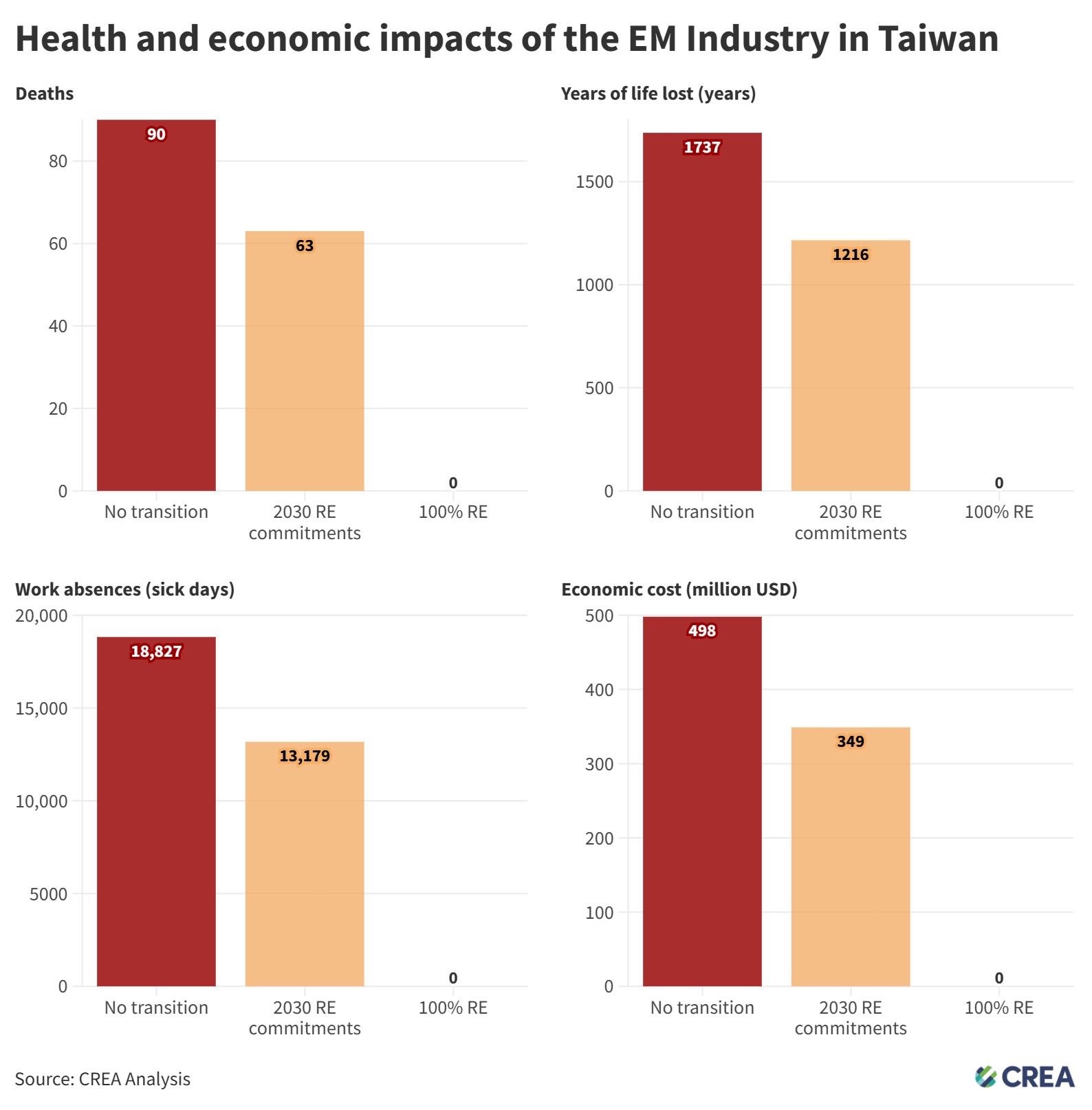
Figure2summarisestheresultsforthethree2030electricity-sourcingscenarios Inall cases,totalEMelectricitydemandisthesame;whatchangesisthesharesuppliedbyfossil fuelsversusrenewables.IntheʻNoTransitionʼscenario,almostallofthesectorʼsdemand continuestobemetbycoal-andgas-firedgeneration.Intheʻ2030RECommitmentsʼ scenario,partofthedemand(typically20–60%forleadingcompanies)ismetby renewableprocurement,withtheremaindersuppliedbythegrid(Table3) Intheʻ100% REʼscenario,theEMindustryʼsdemandisfullymetbyrenewableenergy,effectively eliminatingitsfossilpower–relatedhealthimpacts.
Figure2–HealthandeconomicimpactsofelectricitysupplyscenariosfortheEM industryin2030
Taiwanʼscurrentenergymixcausesmajorhealthburden
By2030,electricityusebytheEMindustryaloneisprojectedtobeassociatedwithasevere healthandeconomicburden.UndertheʻNoTransitionʼscenario,wherecompaniesmake noadditionalprogressonrenewableenergyprocurement,thesectorʼselectricitydemand islinkedtoaround90(4-180)deaths,277(69-597)childrensufferingfromasthma,1,737 (899-3541)yearsoflifelost and18,827(16017-21619)workabsenceseachyear(Figure 2).Theseoutcomesreflectpollutionfromcoal-andgas-firedpowerplantssupplyingthe sector.Thisillustrateshowstronglytheindustryʼsrelianceonfossilpowertranslatesinto avoidableharmforworkers,families,andcommunities Fulldetailsonthehealthimpacts canbefoundinAppendixA.
Theassociatedeconomiccostisalsosignificant In2030,airpollutionfromtheEM industryʼsfossilelectricityusewillimposeanestimatedUSD498(264-986)millionin damagesannually.Figure3showsthedistributionoftheeconomiccostsofairpollution fromtheEMindustryacrossTaiwanin2030underthecurrentenergymix(ʻNoTransitionʼ scenario).Thelargestimpactsareconcentratedinheavilyindustrialisedandurbanised municipalitiessuchasKaohsiung(USD114million),NewTaipei(USD64million),Taichung (USD52million),Taoyuan(USD48million),andTainan(USD47million).Theseregions hostbothmajorindustrialfacilitiesanddensepopulationsdownwindofpowerplants, amplifyingexposureandworseninghealthoutcomes.Bycontrast,lesspopulatedorrural areassuchasPenghu(USD0.4million)andKinmen(USD0.04million)facecomparatively smallerabsolutecosts,thoughthelocalimpactsremainsignificant.Fulldetailsonthe economicimpactscanbefoundinAppendixB.


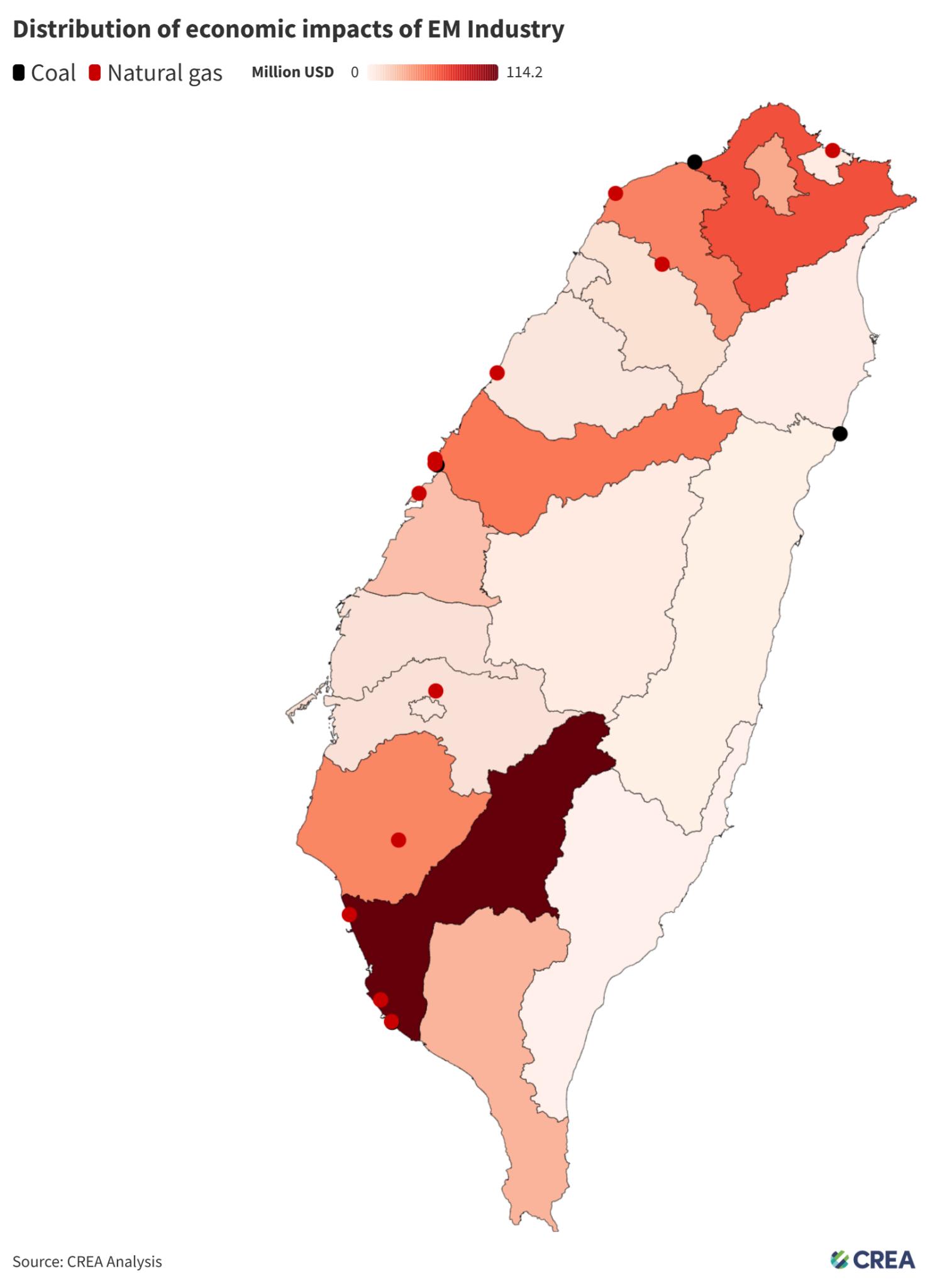
Figure3–DistributionofeconomicimpactsofairpollutionfromtheEMindustry acrossTaiwanbycountyin2030underthecurrentenergymix(ʻNoTransitionʼ scenario).Coalandnaturalgaspowerplants operatingin2030highlighted Takentogether,theresultshighlightbothanationalandalocalisedequityconcern The burdenoffossilelectricityisconcentratedinTaiwanʼsindustrialandurbancorridors,
wherepollutionaddstoexistingpublichealthpressures Communitiesintheseregions shoulderthegreatestshareofdeaths,illness,andeconomiclosses,underscoringthe urgencyofacceleratingatransitionawayfromfossilpower.Cleanenergypolicyandpublic healthinterventionsthatprioritisethesehotspotswoulddeliverthegreatestbenefits.
BenefitsoftheREtransition
IndividualEMcompaniesinTaiwanhaveannounced2030renewableelectricitytargets rangingfrom0%toaround60% (Table3).Meetingthesecommitmentswoulddeliver 2 substantialbenefitsforTaiwanʼsairquality,publichealth,andeconomy.Comparedwith theʻNoTransitionʼscenario,achievingthepledgedtargets(ʻ2030RECommitmentsʼ scenario)wouldpreventanestimated27(14-54)prematuredeaths,avoid521(270-1062) yearsoflifelost,reduceworkabsencesby5,648(4805-6486)andgenerateeconomic savingsofaboutUSD149(79-296)millioneachyear(Figure2).
Whilepartialprogressunderexistingcommitmentsbringssomebenefits,afulltransition morethantriplestheavoideddeaths,yearsoflifelost,andeconomicsavings.Underafull phaseoutoffossilfuelpowergeneration(ʻ100%REʼscenario),thetransitionpreventsall oftheassociatedcostsfromfossilfuelpowerreliance:anestimated90prematuredeaths, anavoided1,737yearsoflifelost, sickleavereducedby18,827workabsences,andan eliminated annualeconomicburdenofUSD498million(Figure2;ʻ100%REʼscenario).
Overall,wefindthattheEMindustryhasasubstantialimpactonairquality,humanhealth, andtheeconomy,andthattherenewableenergytransitioncanleadtosubstantial benefits.Inthefollowingsection,weexplorewhichcompaniesaredrivingtheseimpacts andholdthemostpotentialforchange.
2 Forthepurposeofthisanalysis,weassumethattheindustryasawholeachievesanaveragerenewable electricityshareof30%
Companyspecific-insights
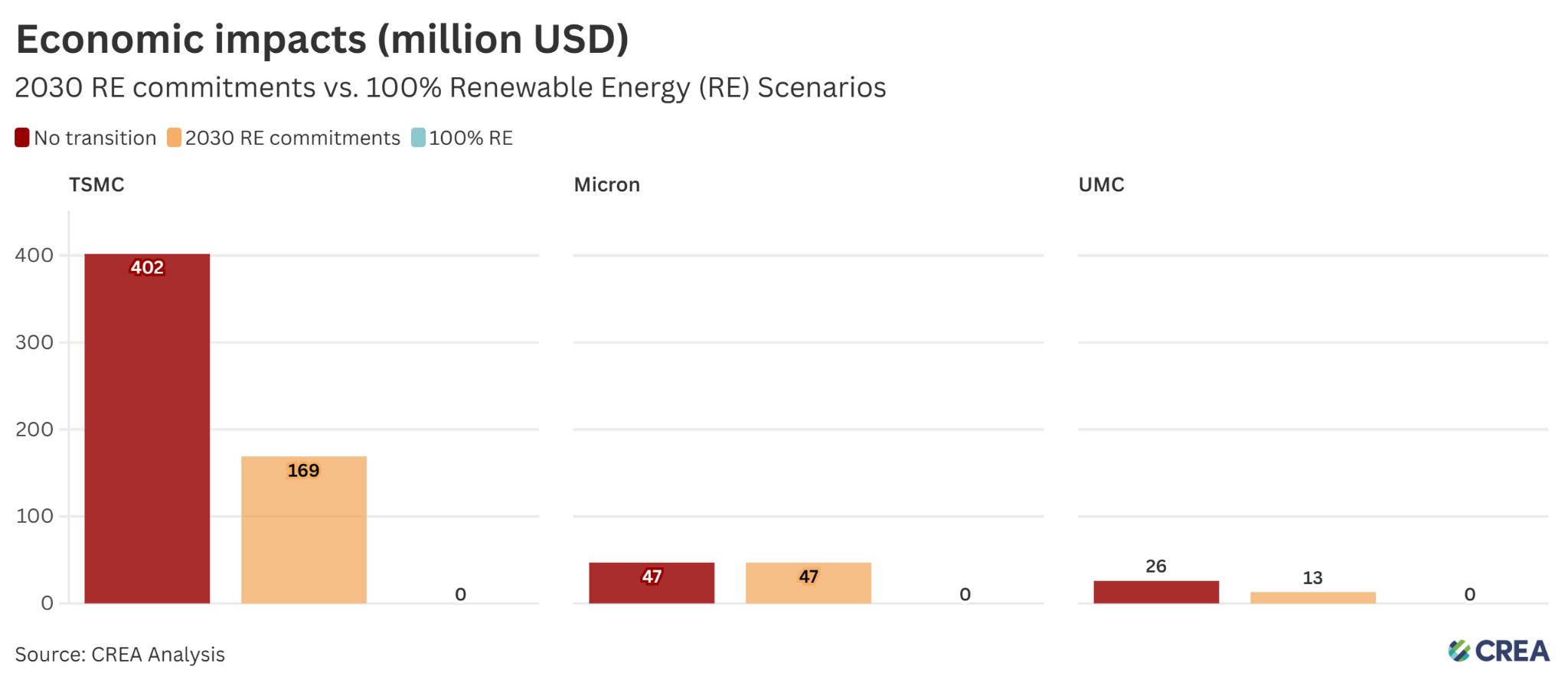
NotallEMcompaniesinTaiwancontributeequallytothesectorʼsairqualityimpactsand theprojectedbenefitsofreducingrelianceonfossilfuel-basedpower.Figure4showsthe economiccostsofairpollutionfromtheEMindustryin2030underdifferentrenewable energyscenarios.Asnotedearlier,Taiwanʼssemiconductorindustryaccountsfora significantportionoftheelectricitydemanddrivenbyAIexpansion.Accordingly,wefocus onthethreeleadingsemiconductorcompaniesinTaiwan:TSMC,UMC,andMicron.Despite theircommitments,muchhealthandeconomicsavingscouldstillbeyieldedifmore acceleratedeffortsweretaken
UndertheREcommitmentscenarioin2030,evenwithanambitious60%renewable energyshare,TSMCremainsthelargestcontributortoairqualityimpacts Weestimate thatemissionsfromTSMCareassociatedwithanannualeconomiccostofUSD169million (88–341million),primarilyduetoitshighelectricityconsumptionfromthegrid.Micron,a US-basedsemiconductorfirmwhichhasmadenoformalrenewableenergycommitment andreliesonlyonpowerpurchases,isprojectedtocontributeUSD47million(26–88 million)ineconomiccosts,whileUMCisestimatedtocauseUSD13million(7–27million) ineconomicdamages.
Adoptingamoreambitiousrenewableenergypathwaycouldsignificantlyincreasethese benefits.Ifthethreecompaniesacceleratetheirtransitionto100%renewableelectricity (“RE100%”),theremainingimpactsundertheircurrent2030renewablecommitments couldbeavoided,preventingupto41prematuredeaths,avoiding130casesofpediatric asthma,recovering8503lostworkdays,andsavingUSD229millioninannualeconomic damages.
Figure4–Economicimpactsofthethreeleadingcompanies in2030;underthree differentrenewableenergyscenarios.
Thesefindingsunderlinethedisproportionateroleofthelargestmanufacturersinshaping thepublichealthimpactsoffossilpower.Whileallcompaniescontribute,themost energy-intensiveactors,particularlyTSMC, havethegreatestcapacity,andthereforethe greatestresponsibility,toreducerelianceonfossilfuelsandacceleratethetransitionto renewableelectricity.
Conclusion
ThisstudyshowsthatTaiwanʼselectronicsmanufacturingsector,whilecentraltothe globaltechnologysupplychainandAIdevelopment,alsodrivesasignificantshareoffossil fuel–relatedairpollutionandpublichealthharmacrosstheisland.Underthecurrent energymix(ʻNoTransitionʼscenario),electricityusebythesectorisprojectedtocause substantialhealthburdensin2030,includingprematuredeaths,chronicdisease,and thousandsoflostworkdays
Afulltransitionto100%renewableelectricityby2030wouldavert90deathseachyear, preventthousandsofyearsoflifelost,andsaveoverUSD498millionannuallyinavoided healthandproductivitycosts.Company-levelresultsdemonstratethatthelargestgains comefromthemostelectricity-intensivefirms,particularlyTSMCandMicron,butthat everymajormanufacturerhasaroletoplay.
Theevidenceisclear.Advancingbeyondcurrentcommitmentstoacompleterenewable transitionisnotonlyaclimateimperativebutalsoapublichealthnecessity.Achievingthis goalwoulddelivercleanerair,healthiercommunities,andsignificanteconomic savings solidifyingTaiwanʼsgloballeadershipintechnologywhilesafeguardingthe healthofitspeople.
Policyandcorporateactionrecommendations
1. Accelerateexistingtargets:Achieve100%renewableenergyby2030and strengthenlocalgreenpower
ReviewandenhanceTaiwanʼscurrentenergytransitiontargets,setting2030asthe milestonefor100%renewableenergy(RE100)andprovidingatransparent, trackableroadmaptoreducefossilpowerrelatedhealthandeconomicimpacts.
2. SteadilyincreaseREusetoreducehealthandeconomicimpacts
Energytransitionshouldnotfocusonlyonlong-termgoals;REuseshouldincrease yearbyyear.Annualimprovementscanimmediatelyreducepollutionfromfossil fuelswhiledecreasingrelatedhealthcareandeconomiccosts,delivering measurablepublichealthbenefits.
3. InvestinlocalREandstoragetoreducepollutionandensurestablepower supply
DirectinvestmentinTaiwanʼslocalREandstoragecanreduceairpollutionand publichealthrisks,increasegreenpowersupply,andmitigateelectricityshortages Coupledwithenergystorage,thesemeasuresenhancegridresilience,ensurestable electricitysupply,andsupportthegrowingdemandfromAIandelectronics manufacturing.
4. Protectmorevulnerablegroups.
Childrenbearadisproportionateburdenfromfossilfuelpollution,withhighrates ofasthmaincidenceandprevalence.PoliciestargetingreductionsinTaiwanʼsNO₂ emissionsandinvestmentsincleanerairshouldbeframedasamatterofchildrenʼs rightsaswellaspublichealth.
Methodology
FossilfuelelectricitygenerationinTaiwanin2030
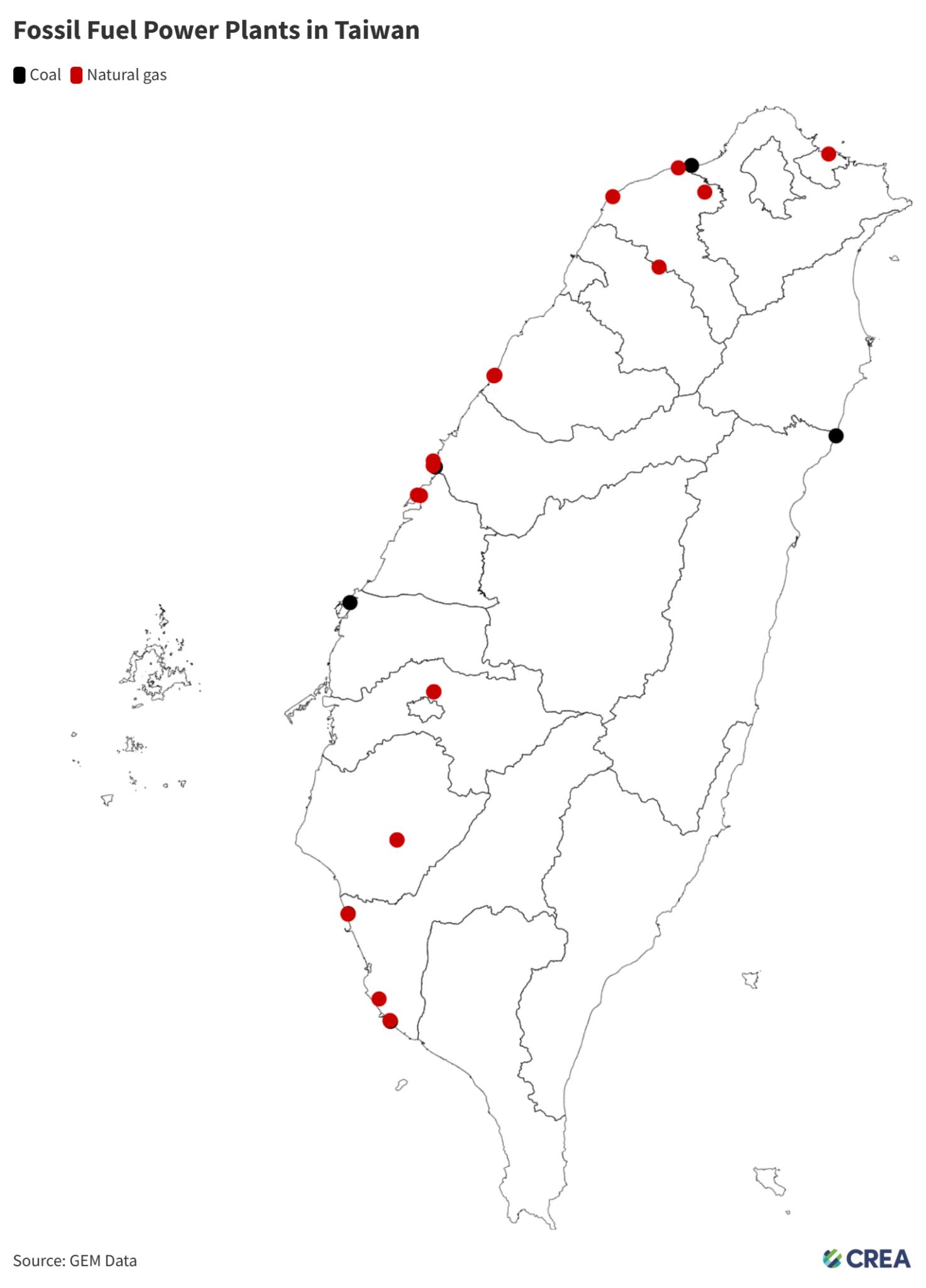
Figure5–DistributionoffossilfuelpowerplantsinTaiwanbyfueltype
Inthisstudy,weassesstheimpactofairpollutionfromtheelectronicsindustry'sreliance onfossil-fueledelectricity.Companiesinthissectorhavetwoprimarysourcesof electricity:Taipower,thegovernment-ownedutilitycompany,andrenewableenergy(RE) procurement.Fossil-fuelelectricityisprimarilysourcedfromTaipower,whichcontinuesto dependsignificantlyoncoalandnaturalgasforpowergeneration.In2023,34%of Taipower'selectricitywasgeneratedfromcoal-firedplants,and44%camefromnatural gas-firedplants.By2030,asperTaiwan'sgovernmenttargets,coalʼsshareisexpectedto decreaseto20%,whilenaturalgaswillaccountfor50%oftheelectricitymix,and renewable30%(MOEA,2025).Figure7showsthedistributionoffossilfuelpowerplants acrossTaiwanwhichwereusedinthisanalysis.
Taipowerʼselectricitygenerationisprovidedbyacombinationofgovernment-owned powerplantsoperatedbyTaipowerandfacilitiesownedbyIndependentPowerProducers (IPPs).Powerplantdataincludingitscapacityandemissionforthisanalysiswassourced fromseveralreports,includingTaipowerʼs2023AnnualReport(Taipower,2023),the2023 NationalElectricitySupplyandDemandReport(MOAEA,2024),Taipowerʼswebsite (Taipower,nd),the2023AnnualReportsofindividualIPPs(Hoping,2024;Mailiao,2024; HsinTao,2024,KuoKuang,2024;StarBuck,2024;StarEnergy,2024;ChiaHui,2024), EnvironmentalImpactAssessmentforfutureplannedpowerplants(Ministryof Environment,2018;2020;2021;2022)andtheTaiwanEmissionDataSystem(Ministryof Environment,n.d.-a).Thestudywasbasedonthedatasourcesreferencedabove,which representedthebestavailableinformationatthetimeofanalysis Itisacknowledgedthat powerplantdevelopmentplansmaychangeovertime.Theassessmentincludesallpower plantsprojectedtobeoperationalby2030thatwerepubliclydisclosedatthetimeofthe study.Plannedcapacityfiguresthatwerereportedwithoutidentificationofspecificpower plantswereexcludedfromtheanalysis.Table1listsallthepowerplantswhoseemissions weremodelledforthisanalysis
Table1–ListoffossilfuelpowerplantsinTaiwanwithassociatedelectricalgrid location,fueltypeandinstalledcapacity.
Gridlocation
Middle
Hsieh-Ho
South Chia-Hui3
PowerconsumptionofTaiwanʼselectronicsindustry
First,weretrieveandcalculate totalelectricityconsumptionforeachEMcompanyinthe present-day(2023).ElectronicsindustriesinTaiwanpurchaseelectricityfromthe government-ownedutility,Taipower,andacquirerenewableenergythroughtheprivate market.WeretrieveTaiwan-specificcompany-levelelectricityconsumptionfromthe companysustainabilityreportforTSMC(TSMC,2024).Fortheremainingcompanies (Micron,UMC),whichdonotbreakdowntheirelectricityconsumptionspecificallyfor Taiwan,wecalculateelectricityconsumptionbyusingtheir Taiwan-specificScope2CO2e emissionsreportedon(MinistryofEnvironment,nd-b)andacarbonintensityfactorof electricityof2023(BureauofEnergy,MinistryofEconomicAffairs).AlthoughScope2 emissionsoftenincludethepurchaseofheatandsteam,ithasbeenverifiedthatthese accountforonly0%to0.75%oftotalemissionsinthesecompanies.Thebaseline2023 consumptionofrenewableenergyofTaiwanʼsEMindustryiscalculatedbyaddingupthe RenewableEnergyCertificates(REC)soldandissuedontheNationalRenewableEnergy CertificationCenterʼswebsite.
Toevaluatetheimpactofelectricitypurchasedfromthestate-ownedutilityin2030, projectedfossil-fueledelectricityconsumptionwasestimatedbysubtractingeach companyʼscommittedREusagefromtheirtotalanticipatedelectricitydemand.TheRE commitmentsusedinthisanalysiswerederivedfrompubliclydisclosedpressreleasesand sustainabilityreportsavailableatthetimeofthestudy. The2030powerprojectionswere derivedusingtwoapproaches.Production-basedprojectionswereusedforcompany-level demand;otherwise,government-providedgrowthrateswereapplied Specifically,the 2030electricitydemandwasbasedonGreenpeaceʼsInvisibleEmissionsreport(Greenpeace EastAsia,2023)whichprojectedtheelectricitydemandofTSMC,UMC,andMicronbased ontheiranticipatedmarketshareandtheenergyrequirementsofupcomingproducts.
Fortheoverallelectronicsindustry,2030gridelectricityconsumptionisprojectedbyfirst determiningthefuturetotalelectricityconsumptionbyapplying growthrateaspredicted byTaiwanʼsNationalElectricityDemandReport(2023),undertheconditionsofthe growingAIindustry.Thecommittedrenewableenergy(RE)usageissubtractedfromtotal electricitydemandtoestimatefossil-fueledelectricityconsumption For2030,itisassumed
that30%ofREwillbeallocatedtotheelectronicsmanufacturing(EM)industry,reflectingthe sectorʼsalignmentwiththegovernmentʼs30%REtarget.
Powerconsumptionandgriddistribution
Forthisstudy,weallocatedthecompanyʼspowerconsumptionandthepowerplants' electricitygenerationacrossthethreeregionalgridstoaccuratelyattributeemissions.In Taiwan,thegridisdividedintothreeregions:North,Central,andSouth.Becausedifferent powerplantssupplyelectricitytodifferentregionalgrids,eachpowerplantisassignedto agridbasedonitsgeographiclocation.Thecompanyʼspowerconsumptionwasthen distributedamongthesegridsusingaproportionalallocation,basedonthe2023 factory-levelScope2emissiondatafromtheMinistryofEnvironment(n.d.),whichwasthe mostrecentdataavailableatthetimeofthestudy.Table2liststhepowerconsumptionof thesecompaniesbygridandtheirrenewableenergycommitments.
Table2–PowerconsumptionofwholeEMindustryandselectedcompaniesinTaiwan byelectricalgrid
Inparallel,eachcompanyʼsrenewableenergycommitmentwasassessedtoestablish projectedcleanenergyuptakeby2030.Thesetargetswerecompiledfrompublicly availablesources,includingcorporatesustainabilityreports,CDPdisclosures,andmedia statements,asofOctober30,2025.Wherenoformaltargetwasreported,adefault assumptionof0%renewableenergyuptakewasapplied.Thesedatawereusedtodevelop acomparativeemissionsscenarioframework
ScenarioDesign
Thisstudyevaluatesthreefutureelectricity-sourcingscenariostoassessthepotential publichealthimpactsassociatedwiththeelectricityconsumptionofTaiwanʼselectronics manufacturingsector Allscenarioscoverthebaseyear2023andprojecttotheyear2030, incorporatingcompany-levelelectricityuseestimates,Taiwanʼsprojectedpower generationmix,andcorrespondingemissionfactors.
Scenario1–NoTransition
TheʻNoTransitionʼscenarioassumesthattheEMindustrymakesnofurtherprogressin increasingitsrenewableenergysharebeyondcurrentlevels.All2030electricitydemandis thereforesuppliedfromTaiwanʼsprojected2030gridmix,dominatedbyfossilfuels(coal andfossilgas)withalimitedshareofrenewables.
● Companyelectricitydemandisprojectedusinganassumedannualgrowthrateof approximatelyCAGR2.8%inlinewithgovernmentprojections.Forselected companies TSMC,UMC,andMicron growthratesfollowprojectionsfrom GreenpeaceEastAsiaʼsInvisibleEmissionsreport.
● AllofTaiwanʼsEMelectricitydemandismetbythegrid,takingintoaccount renewableenergypurchasesreportedintheT-RECsystem.
● Emissionsarecalculatedusing2023emissionfactorsforSO₂,NOₓandPM₂.₅,held constantthrough2030.
● Thisscenarioprovidesabaselineestimateofhealthimpactsifnofurtherrenewable energyuptakeoccursintheEMindustry
Scenario2–2030RECommitments
Theʻ2030RECommitmentsʼscenarioassumesthateachcompanyfollowsitscurrently announced2030renewableelectricitytarget.
● ElectricitydemandisprojectedusingthesameapproachasinScenario1
● Theshareofeachcompanyʼs2030demandthatismetbyrenewablesisaligned withitsstatedREtargets(forexample,TSMC60%,UMC50%),withtheremainder suppliedfromthe2030gridmix.
● TheEMsectorasawholeisassumedtoreacharound30%renewableelectricity, consistentwiththegovernmentʼs2030targetforthepowersystem.
● EmissionfactorsforpowerplantsarethesameasinScenario1.
Thisscenarioreflectsacontinuationofcurrentplansandtargets
Scenario3:RenewableEnergyTransition(REScenario)
Theʻ100%REʼscenariomodelsthehealthbenefitsthatcouldberealisediftheEMindustry accelerateditsrenewableelectricityprocurementtoreach100%by2030.
● ElectricitydemandisprojectedasinScenarios1and2.
● Eachcompanyʼs2030demandisassumedtobefullymetbyrenewableelectricity; nofossil-fuelledpowerisusedtosupplyEMdemand.
● EmissionsfrompowerplantsattributabletoEMelectricitydemandarereducedto zero;electricityuseinothersectorsisunchanged.
● ComparingScenario3withtheotherscenariosquantifiestheadditionalhealthand economicbenefitsofacompleterenewabletransitionintheEMsector.”
Table3–SummaryofScenarioofEMindustryandIndividualCompanyCommitment
Scenario1No Transition2023
Noadditional renewableenergy hasbeenprocured since2023
Scenario2: Business-as-Usual (BAU)–2030 RenewableEnergy Commitment(%of TotalConsumption fromRE) Scenario3:100% Transition–%of TotalConsumption fromRE
TheREscenarioallowsforquantificationoftheavoidedemissionsandassociatedhealth impactsattributabletopartialorfullrenewableenergyadoption.Thehealthco-benefits arecalculatedbycomparingpollutantexposureandhealthoutcomeestimatesunderthis scenarioagainsttheBusiness-as-Usual(BAU)referencecase.
Atmosphericmodelling
Forthisstudy,wesimulatedairpollutantconcentrationsusingtheCALPUFFairdispersion model, version 7 (Scire et al, 2000; Exponent, 2015) CALPUFF has been a widely-used industry standard model for long-range air quality impacts of point sources. Due to its capability of capturing the complex chemical processes and atmospheric transport of pollutants, this modeling system is approvedforusebyregulators,suchastheMaryland
3Thisinformationisbasedonthepressreleaseregardingthenewrenewableenergypurchaseagreement. https://investors.micron.com/news-releases/news-release-details/meiguangfabu2022nianduyongxujingying baogao-chixuqudejinzhan-0
DepartmentoftheEnvironment(TRCEnvironmentalCorporation,2024),andinacademic research (Zhang et al., 2020). The model has been evaluated extensively by the US Environmental Protection Agency, is open-source, and fully documented. The CALPUFF model has been applied in many regions around the world, including the United States (Rzeszutek,2019),Europe(Holnickietal.,2016),CentralAmerica(Hernández-Garcésetal., 2020),SouthAmerica(Arregocésetal,2023),theMiddleEast(Ghannametal,2013),Asia (Zhouetal.,2003;Jittraetal.,2015),andAfrica(Affumetal.,2016).
CALPUFF calculates the atmospheric transport,dispersion,chemicaltransformation,and deposition of the pollutants, and the resulting incremental ground-level concentrations, attributed to the studied emissions sources ChemicaltransformationsofSO2 andNO2 to PM2.5 are calculated using ISORROPIA. Background concentrations of oxidants (ozone, ammonia, hydrogen peroxide) are taken from a global atmospheric chemistry model. Meteorological input data for the year 2021 are generated from the Weather Research Forecasting (WRF) model (Skamarock et al., 2008), version4.2.2.WRFwassetupwith33 verticallevelsand2nestedgrids Themothernesthasagridresolutionof15kmandthe innernesthasagridresolutionof3km,andiscentredonTaiwan.
Mother and inner domains use a two-way nesting technique which ensures dynamic interaction between them. WRF simulations use initial and lateral boundary conditions from the National Centers for Environmental Prediction (NCEP) Climate ForecastSystem Reanalysis(CFRS)datasetoftheNationalOceanicandAtmosphericAdministration(NOAA) producing three-dimensional, hourly meteorological data covering the fullcalendaryear of2023
For assessment of annual average pollutant concentrations, emissions are assumed constant throughout the year. Emissions from each of the fourteen power plants were modelled as separate area sources. The power plants were modelled as buoyant point sources,takingintoaccountthestackheightandthermalplumerisefromthestacks
Healthandeconomicimpactassessment
Wecalculatethecorrespondingpublichealthandeconomicimpactsforeachscenarioby combining modelled pollutant concentrations with population, baseline health, and
economicdataforTaiwan Theanalysisfocusesonannualimpactsin2030attributableto airpollutionfromfossil-fuelledpowerplantssupplyingtheEMindustry.
CREA has developed a detailed globally implementable health impact assessment (HIA) framework based on the latest science (Myllyvirta, 2020). This framework includes as completeasetofhealthoutcomesaspossiblewithoutobviousoverlaps Healthoutcomes covered in this framework are those that have been identified in the peer-reviewed academic literature from metastudies covering multiple different populations, and in whichincidencedataisavailableatthenationallevelfromglobaldatasets.
For each health outcome, we use aconcentration-responserelationshipthathasalready been used in academic peer-reviewed literature to quantify the health burden from air pollution at the global level. This indicates that the evidence is mature enough to be appliedacrossvaryinggeographiesandexposurelevels Weestimatethenumberofcases foreachhealthoutcomefollowingastandardepidemiologicalcalculation:
Where:
Popisthetotalpopulationinthegridcell;
ageisthespecificagegroupforwhichtheepidemiologicalstudieshaveestablished ahealthrisk;
Fracageisthefractionofthepopulationbelongingtothespecificagegroup;
Incidenceage is the baseline rate of occurrence of the health outcome for the populationbelongingtothespecificagegroup;
c is the pollutant concentration from the baseline combinedwithemissionsfrom coal and gas power plants with cbase referring to the baseline concentration or currentambientconcentration;and,
RRc, age is the function giving the risk ratio of the health outcome at the given concentrationforthegivenagegroupcomparedwithcleanair.
In the case of a log-linear, non-age specific concentration-response function the RR functionbecomes:
Where:
RR0 istheriskratiofoundinepidemiologicalresearch;
Δc0 istheconcentrationchangethatRR0 refersto;and,
c0 is the assumed no-harm threshold concentration in general, the lowest concentrationfoundinthestudydata.
Weusenational-levelpopulationdatafortheyear2019fromtheGlobalBurdenofDisease resultsfor2019(Murrayetal.,2020),whichweaccessfromtheInstituteforHealthMetrics andEvaluation(IHME,2020) WemapthisontoagridusingtheGriddedPopulationofthe World v4 from the Center for International Earth Science Information Network (CIESIN, 2018). We scale this to different years using changes in population anddeathratesfrom theWorldPopulationProspectdatasetoftheUN(UN,2019).
Table5showsthehealthoutcomesincludedinthisstudyandtherelativeriskvaluesused for each. Adult premature deaths were estimated using the risk functions developed by Burnett et al. (2022). Premature deaths of smallchildrenunderfiveyearsoldfromlower respiratory infections linked to PM25 pollution were assessed usingtheGlobalBurdenof Disease risk function forlowerrespiratorydiseases(IHME,2020).Forallmortalityresults,
cause-specific data are taken from the Global Burden of Disease project results for2019 (IHME,2020).
Health impact modelling projectstheeffectsofpollutantexposureduringthestudyyear. Some health impacts are immediate, suchasexacerbationofasthmasymptomsandlost working days, whereas other chronic impacts may have a latency of several years Concentration-response relationships for emergency room visits for asthma and work absenceswerebasedonstudiesthatevaluateddailyvariationsinpollutantconcentrations and health outcomes; these relationships were applied to changes in annual average concentrations.
Table4–Inputparametersanddatausedtoestimatephysicalhealthimpacts
Newcases ofasthma
(2017) Achakulwisut etal.(2019) People suffering from
Khreisetal. (2017) Achakulwisut etal.(2019)
(1.013–1.03 7) per10 µg/m3 6µg/m3 Zhengetal. (2015) Anenberget al.(2018) AsthmaER visits 18–99
25 1.023 (1.015–1.03 1) 6µg/m3 Zhengetal. (2015) Anenberget al.(2018)
per10 µg/m3
Preterm birth Infant PM25 1.15 (1.07–1.16) per10 µg/m3
8.8µg/m3 Sapkotaet al.(2012) Chawanpaibo onetal. (2018)
Work absence 20–65 PM25 1.046 (1039–105 3) per10 µg/m3 0.0 WHO(2013) EEA(2014)
Premature deaths 0–4 PM25 Burnettet al (2022) 0µg/m3 Burnettetal. (2022) IHME(2020)
Premature deaths 25–99 PM25 Burnettet al (2022) 0µg/m3 Burnettetal (2022) IHME(2020)
Yearslived with disability 25–99 PM2.5 IHME (2020)
2.4µg/m3 Burnettetal. (2018) IHME(2020)
Premature deaths 25–99 NO2 102 (101–104) per10 µg/m3 45µg/m3 Huangfu& Atkinson (2020);NRT fromStiebet al.(2021) IHME(2020)
Note: Numeric values in the column ʻValueʼ refertooddsratio(OR)correspondingtothe increase in concentrations given in the column ʻconcentration changeʼ. Literature references indicate the use of a non-linear concentration-response function. No-harm threshold refers to a concentration below which the health impact is not quantified, generally becausethestudiesonwhichthefunctionisbaseddidnotincludepeoplewith lower exposure levels. Data on concentration-response relationships do not exist for all
geographies, so a global risk model is applied to all cities Incidence data are generally unavailableatthecitylevelsonationalaverageshavetobeapplied.PM25 deathsin25–99 year-olds are from non-communicable diseases, disaggregated bycause,andfromlower respiratoryinfections.PM25 deathsin0–4yearsoldareduetolowerrespiratoryinfections. PM25 years lived with disability are disaggregated by diabetes, stroke and chronic respiratorydisease
This study calculates the economic costs of health impacts resulting from air pollution, followingasimilarmethodologytoMyllyvirta(2020).Theanalysisaccountsforrespiratory and cardiovascular diseases, including their complications, which significantly reduce quality of life, lower economic productivity, and increase healthcare costs The health impactswiththeirvaluationsaresummarizedinTable6.
Table6–Healthimpactcostsincludedinthisstudyandtheireconomicvaluation
Healthoutcome
Valuationat worldaverage GDP/GNIper capita(2017 int.USD) 2023valuation adjustedfor Taiwan(USD)
Reference
Workabsence(sickleave days) 85perday 172perday EEA(2014)
Numberofchildren sufferingfromasthma duetopollution exposure(increased prevalence) 1,077percase 2,164percase Brandtetal.(2012)
Prematuredeaths (adults) 2,637,000per death 5,574,000per death Viscusi&Masterman(2017)
Prematuredeathsof
OECD(2012)
childrenunder5
Pretermbirths
Yearslivedwith disability
asthmaemergency roomvisits
107,700per birth 216,400per birth
Trasandeetal.(2016)
28,480per year-lived-with -disability 60,210per year-lived-withdisability Birchby(2019)
232percase 467percase Brandtetal.2012
Note: The deaths of young children (under 5) are valued at twice the valuation of adult deaths,followingtheOECDʼsrecommendations(2012).
Thevaluationforadultprematuredeaths(ViscusiandMasterman,2017)isbasedonlabour market data, and we multiply it by two to estimate the value for children, following the recommendation of the OECD (2012). The economic cost of disability is assessed using disability valuations from the UKʼs Department for Environment, Food & Rural Affairs (Birchbyetal.,2019).ʻDisabilityweightsʼcalculatedbytheGlobalBurdenofDisease(GBD) allows comparison of economic costs across different illnesses. Disabilities considered includediabetes,chronicobstructivepulmonarydisease(COPD),andstroke
The original studies referenced in Table 6 arebasedondifferentcountries,timeperiods, andcurrencies.Futurevaluations(year2030)areadjustedusinga3%annualdiscountrate toreflectthetimevalueofmoneyandarefurtherscaledbyprojectedchangesinGDP.GDP data and projection for Taiwan are obtained from the International MonetaryFund(IMF, (2025)). This approach ensures that future economic costs are expressed in terms of a currency value approximately contemporary tothisreport(2024),allowingforconsistent comparisonovertime.
Appendices
AppendixA:EMindustryinTaiwanhealthimpacts
Deaths 90(48-180) 63(33-126)
Yearsoflifelost 1,737(899-3,541) 1,216(630-2,479)
YearslivedwithCOPD 14(5-27) 10(4-19)
Yearslivedwithdiabetes 36(22-12) 25(16-9)
Yearsliveswithstroke 31(10-63) 22(7-44)
Asthmaemergencyroom visits 23(14-31) 16(10-22)
Newcasesofasthmain children 60(13-134) 16(10-22)
Workabsences 18,827(16,017-21,619) 13,179(11,212-15,133)
Economiccost(million USD)
AppendixB:DistributionofEMindustryinTaiwaneconomicimpactsbycountry/city
Changhua
ChiayiCounty
HsinchuCity
Kaohsiung
Keelung 66(39-117) 46(27-82)
Kinmen 00(00-01) 00(00-00)
Miaoli 91(49-178) 64(34-125)
Nantou
NewTaipei
Penghu
Pingtung
Taichung
Tainan
Taipei
Taitung
Taoyuan
Yilan
Yulin
GrandTotal
5.4(3.1-9.7)
3.8(2.2-6.8)
64.0(36.3-117.2) 44.8(25.4-82.1)
0.4(0.2-0.7)
0.3(0.2-0.5)
29.5(15.4-59.0) 20.6(10.8-41.3)
52.1(27.6-102.9)
46.8(24.0-96.0)
33.8(19.1-61.8)
1.8(1.1-2.8)
47.5(25.5-92.3)
4.7(2.9-7.5)
11.4(6.0-22.7)
36.5(19.3-72.1)
32.8(16.8-67.2)
23.6(13.4-43.3)
1.2(0.8-2.0)
33.2(17.8-64.6)
3.3(2.0-5.2)
8.0(4.2-15.9)
4979(2635-9863) 3485(1845-6904)
AppendixC:Healthandeconomicimpacts
References
Anenberg,S.C.etal.(2022)“Long-termtrendsinurbanNO2concentrationsandassociated paediatricasthmaincidence:estimatesfromglobaldatasets,”TheLancetPlanetary Health,6(1),pp e49–e58 Availableat:https://doiorg/101016/S2542-5196(21)00255-2
ASETechnologyHolding.(2024).2023CSRReport. https://www.aseglobal.com/ch/pdf/aseh-2023-csr-ch-final.pdf
AUOCorporation.(2024).2023SustainabilityReport. https://www.auo.com/upload/media/sustainability/CSR/AUO-2023%20Sustainability-Repo rt-EN-Full.pdf
Burnett,R.etal.(2018)“Globalestimatesofmortalityassociatedwithlong-termexposure tooutdoorfineparticulatematter,”ProceedingsoftheNationalAcademyofSciencesof theUnitedStatesofAmerica,115(38),pp.9592–9597.Availableat: https://doi.org/10.1073/pnas.1803222115.
BureauofClimateChange,MinistryofEnvironment.(n.d.).GHGRegistry Mandatory GreenhouseGasReportingSystem.Availableat: https://ghgregistrymoenvgovtw/epa ghg/
BureauofEnergy,MinistryofEconomicAffairs.(n.d.).Electricityemissionfactorfor2023 (112年度電力排碳係數).Availableat: https://www.moeaea.gov.tw/ecw/populace/content/ContentDesc.aspx?menu_id=26391
ChiahuiPowerCorporation.(2024).2023annualreport[嘉惠電力股份有限公司112年度年 報].RetrievedFebruary15,2025,fromhttps://www.chiahui.com.tw/doc/112Y.pdf
ChungChiaPowerCorp(2023,April11).Environmentalimpactassessmentdocument [ArchivedPDF].ArchivedattheWaybackMachine.RetrievedFebruary15,2025,from
https://webarchiveorg/web/20230415034204/https://eiadocepagovtw/eiaweb/Downloa dFiles.ashx?sHcode=&sDir=eiaetc&sType=i&sFileName=I04_20230411003.pdf
EnergyAdministration,MinistryofEconomicAffairs,Taiwan.(n.d.).Electricitystatistics database.EnergyStatisticsInquirySystem.RetrievedJanuary29,2025,from https://wwwesistorgtw/a0303/02/database/search/?tab=電力統計
EverpowerIndependentPowerProducer.(2024).112annualreport[112年年報].Retrieved February15,2025,fromhttp://wwweverpowerippcomtw/annual/112html
Farrow,A.,Anhäuser,A.andMyllyvirta,L.(2019)“TaiwanʼsElectronicsIndustryandCoal FiredPowerPlant.”
GreenpeaceEastAsia.(2023)“InvisibleEmissions.AForecastofTechSupplyChain EmissionsandElectricityConsumption.”
GreenpeaceEastAsia (2025)“ChippingPointTrackingElectricityConsumptionand EmissionsfromAIChipManufacturing.”
Han,Y,Wu,Z,Li,P,Wierman,A,&Ren,S (2025) Theunpaidtoll:Quantifyingand addressingthepublichealthimpactofdatacenters.arXiv. https://arxiv.org/abs/2412.06288
HealthEffectsInstitute(2024)StateofGlobalAir2024.Boston,MA.Availableat: https://wwwhealthdataorg/sites/default/files/2024-06/soga-2024-reportpdf(Accessed: April27,2025).
HsinTaoPowerCorp (2024) AnnualReportof2023[112年年報] RetrievedFebruary15, 2025,from https://resource.iyp.tw/static.iyp.tw/38392/files/22adc4fd-60c7-4153-9843-ce9bebe2beb5. pdf
HopingPowerCorp (2024) Annualreport2023[112年度簡明月報] RetrievedFebruary15, 2025,from
https://mediataiwancementcom/web hppc/report/power/%E7%B0%A1%E6%98%8E%E 6%9C%88%E5%A0%B12023all.pdf
InnoluxCorporation.(2024).2023ESGReport. https://www.innolux.com/Uploads/CsrReport/INNOLUX%202023%20ESG%20Report%20e -book%20EN 768472pdf
InternationalMonetaryFund.(2025).WorldEconomicOutlookDatabase(October2025). https://wwwimforg/external/datamapper/NGDPD@WEO/TWN/CHN
KuoKuangPowerCorp.(2024).2023reportAnnualReportof2023[112年年報].Retrieved February15,2025,fromhttps://www.kkpc.com.tw/upload/year/112.pdf
Lelieveld,J.etal.(2019)“Effectsoffossilfuelandtotalanthropogenicemissionremovalon publichealthandclimate,”ProceedingsoftheNationalAcademyofSciencesoftheUnited StatesofAmerica,116(15),pp.7192–7197.Availableat: https://doiorg/101073/pnas1819989116
Lelieveld,J.etal.(2023)“Airpollutiondeathsattributabletofossilfuels:observationaland modellingstudy,”BMJ(Clinicalresearched.),383,p.e077784.Availableat: https://doi.org/10.1136/bmj-2023-077784.
MailiaoPowerCorporation.(2024).AnnualReportof2023[112年年報].RetrievedFebruary 15,2025,from https://wwwmlmpccomtw/mpcfile/att/art/operation/DOC1710922123017PDF
MicronTechnology,Inc.(2024).2024SustainabilityReport. https://www.micron.com/content/dam/micron/global/public/documents/about/sustainab ility/2024-micron-sustainability-report.pdf
MinistryofEconomicAffairs(MOEA),(2025).Energytransitionpolicydirectionremains unchanged;steadyprogressthroughdiversifiedlayout[Pressrelease].Ministryof EconomicAffairs Availableat:
https://wwwmoeagovtw/Mns/populace/news/Newsaspx?kind=1&menu_id=40&news_id =120882
MinistryofEconomicAffairs,EnergyAdministration(MOEAEA)(2024),“2023Power ResourcesSupplyandDemandReport,”July15,2024,accessedMarch5,2025, https://wwwmoeaeagovtw/ECW/populace/news/Newsaspx?kind=1&menu_id=41&news id=33815.
MinistryofEnvironment,Taiwan (2018) Environmentalimpactassessmentforum document[森霸電力第二期燃氣負循環發電計畫].RetrievedFebruary15,2025,from https://eiadoc.moenv.gov.tw/eiaforum/40_View.aspx?para=41D98611606F35A3BA20FD33 B9F17D0061F55C36ED10E16AE28793707C001A99
MinistryofEnvironment,Taiwan (2020) Environmentalimpactassessmentinquirysystem document[(1090821A) 通霄電廠第二期更新改建計畫環境影響說明書].Retrieved February15,2025,from https://eiadoc.moenv.gov.tw/eiaweb/11.aspx?hcode=1090821A&srctype=0
MinistryofEnvironment.(2021).Environmentalimpactassessmentinquirysystem document[(1101051A) 中佳燃氣複循環電廠興建計畫環境影響說明書].Retrieved February15,2025,from https://webarchiveorg/web/20230415034031/https://eiadocepagovtw/eiaweb/11aspx? hcode=1101051A&srctype=0
MinistryofEnvironment,Taiwan.(2022).Environmentalimpactassessmentinquirysystem document[(1110461A) 大林發電廠燃氣機組更新改建計畫環境影響說明書].Retrieved February15,2025,from https://eiadoc.moenv.gov.tw/eiaweb/11.aspx?hcode=1110461A&srctype=0
MinistryofEnvironment,Taiwan (nd-a) 空氣污染物排放量清冊 (Airpollutantemissions inventory:TEDS12.0).RetrievedFebruary15,2025,from https://air.moenv.gov.tw/envtopics/AirQuality 6.aspx
MinistryofEnvironment,Taiwan (nd-b) Greenhousegasemissionregistry:Public information.RetrievedFebruary15,2025,from https://ghgregistry.moenv.gov.tw/epa ghg/Accession/PublicInformation.aspx
PegatronCorporation.(2024).2023SustainabilityReport. https://official2pegatroncorpcom/files/backend/csr_file/b4e4c53b250733cd1da4dc0a506 55530.pdf
Roussilhe,G etal (2022)“FromSiliconShieldtoCarbonLock-in?TheEnvironmental FootprintofElectronicComponentsManufacturinginTaiwan(2015-2020).”arXiv.Available at:https://doi.org/10.48550/arXiv.2209.12523.
StarBuckPowerCorporation.(2024,March21).2023annualreport[2023年年報]. RetrievedFebruary15,2025,fromhttps://wwwstarbuckpowercomtw/newsphp?id=111
StarEnergyPowerCo.,Ltd.(2024).2023annualreport[星能電力112年年報].Retrieved February15,2025,from https://starenergypower.com.tw/ckfinder/userfiles/files/20240327/星能電力112年年報. pdf
SunbaPowerCo.,Ltd.(2024.).2023annualreport[森霸電力股份有限公司112年度簡明年 報] RetrievedFebruary15,2025,from https://www.sunbapower.com.tw/investors/report-detail/34/
Taipower(2024) TaipowerAnnualReport2023 TaiwanPowerCompany https://www.taipower.com.tw
TaiwanPowerCompany.(2025).Historicalshareofgeneratedvspurchasedelectricity[歷 年發購電量占比].Availableat: https://wwwtaipowercomtw/2289/2363/2367/2372/10312/normalPost
TaiwanPowerCompany.(n.d.).Airpollutantemissionsourcesandambientairqualityat thermalpowerplants[火力電廠環境保護空氣
] Taiwan
PowerCompany RetrievedFebruary15,2025,from https://www.taipower.com.tw/2289/2363/2391/2393/10789/normalPost
TaiwanSemiconductorManufacturingCompanyLimited.(2024).TSMCESG2023 SustainabilityReport.Retrievedfrom https://esgtsmccom/en-US/file/public/e-all_2023pdf
TRCEnvironmentalCorporation.(2024).MarylandOffshoreWindProjectClassIAQRV AssessmentModelingProtocol
https://mde.maryland.gov/programs/permits/AirManagementPermits/Documents/US%20 Wind/USWindClassIAQRVProtocolMay2024.pdf
T-REC(2025)“TREC
https://www.trec.org.tw/certification trade_situation/direct_supply.
TrendForce (2025) 2Q25foundryrevenuesurges146%torecordhigh;TSMCʼsmarket sharereaches70%[Pressrelease].TrendForce.
https://www.trendforce.com.tw/presscenter/news/20250901-12689.html
UMC.(2024).2023CSRReport.
https://wwwumccom/upload/media/07_Sustainability/72_Reports and_Results/1_Corp orate Sustainability Reports/CSR Reports/CS_Report_English_pdf/2023_CSR_report_eng /UMC-2023-EN-0730-1-elink.pdf