
IN COLLABORATION WITH
FORCED TO THE BOTTOM:
SQUEEZING INDONESIAN FISHERS AND OCEANS FOR DIRTY TUNA PROFITS
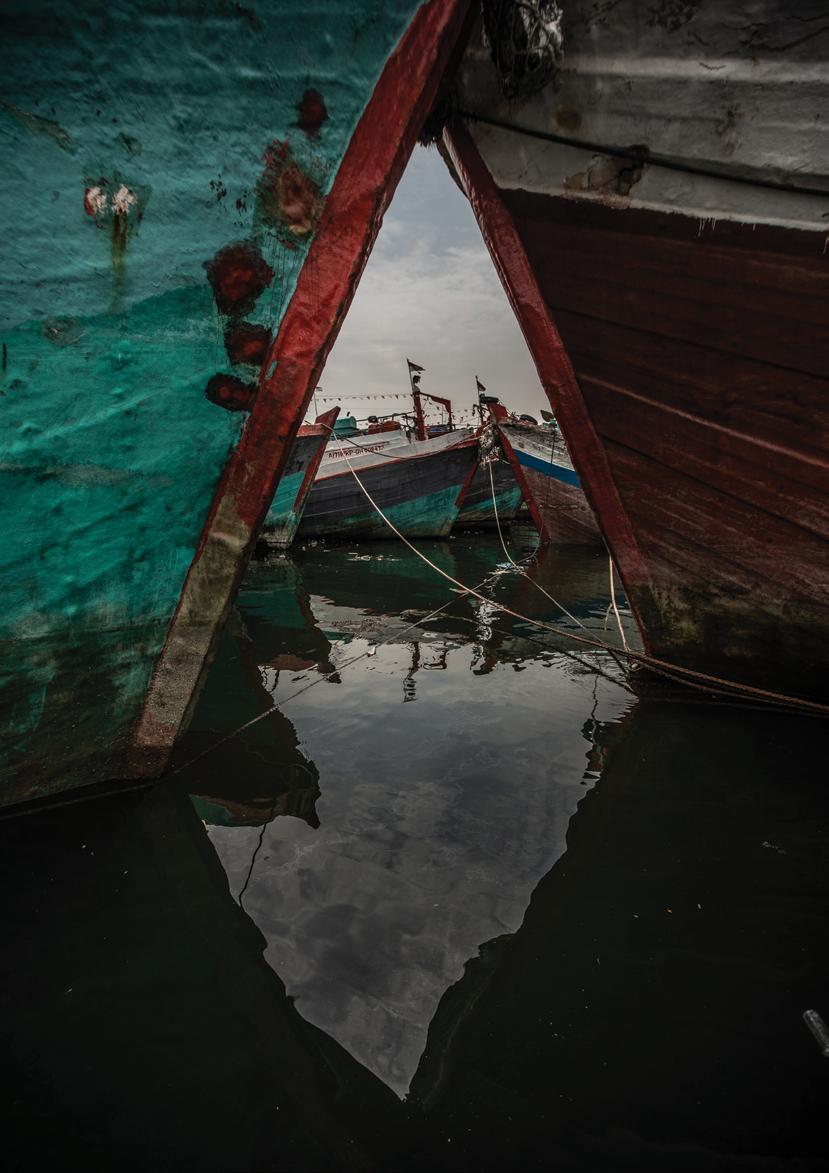

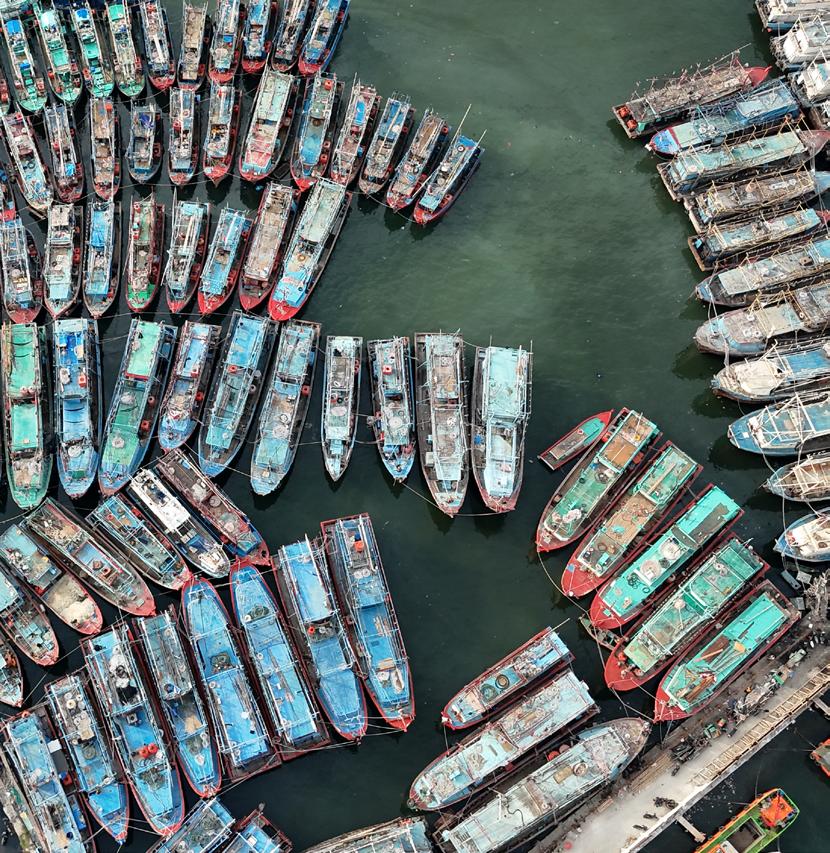
Photo Credit: © Jurnasyanto Sukarno / Greenpeace


IN COLLABORATION WITH
The report is intended to provide investigative analysis of the global labour value chain of the Indonesian tuna industry with a focus on the Australian market. It is not intended to provide legal and financial advice. By accessing or using this report, the recipient acknowledges and agrees to the terms of this disclaimer.



Greenpeace Southeast Asia and the Uniting Church in Australia, Synod of Melbourne and Tasmania, wish to extend our deepest gratitude to the Indonesian fishers who bravely shared their experience and entrusted us

with their stories. Their fearlessness and willingness to shed light on the harsh realities of exploitation at sea have been instrumental in exposing human rights and environmental injustices as well as in accelerating and shaping just and effective solutions for ethical fisheries. This report and all progressive changes we advocate would not have been possible without their voices. We honor their courage, resilience and dedication to justice. We stand in solidarity with them in protecting human rights and pursuing dignity, fairness, and sustainability in the global fishing and seafood industries.



Special thanks to the Uniting Church in Australia, Synod of Victoria and Tasmania
The Synod of Victoria and Tasmania is part of the Uniting Church in Australia, the country’s third largest Christian denomination. The Synod comprises of 405 congregations and more than 60,000 members. Its congregations worship every week in more than 40 languages. Through worship, sharing the story of Jesus, and service in the community, the Synod witnesses to the belief that life is most fully found in God. The Synod works for justice and peace and seeks to act in solidarity with the oppressed.
ACKNOWLEDGEMENTS
DESIGN: Jasadharma Tjandra
ILLUSTRATIONS: Lavira Andaridefia
PHOTOS: Tommy W. Utomo, Gilang Ramadhan, Made Nagi, and Jurnasyanto Sukarno.
All photographic images have been used to illustrate the content of the
and are unrelated to the specific cases depicted.

Advance loan: loans given to fishers by fishing vessel owners before the start of a fishing trip.
Calo: brokers that recruit fishers; could be direct recruiter, online recruiter, or fishing vessel administrator. (Note: this is an indonesian word and is the same in singular and plural forms.)
Direct recruiter: an individual that directly recruits fishers in-person and transfers the workers to calo.
Fish aggregating device (FAD): a human-made structure, either anchored or drifting, that is strategically placed in the ocean to attract pelagic fish and other marine life.
Fisher: per ILO convention 188: “every person employed or engaged in any capacity or carrying out an occupation on board any fishing vessel, including persons working on board who are paid on the basis of a share of the catch but excluding pilots, naval personnel, other persons in the permanent service of a government, shore-based persons carrying out work aboard a fishing vessel and fisheries observers.”
Fishery improvement project (FIP): multistakeholder initiative aimed at improving fishing practices and fisheries management.
Fishery management area (FMA): a specific, designated area of indonesian waters for the purpose of sustainable fisheries management, including fishing, farming, conservation, research, and development. These areas are defined by the ministry of maritime affairs and fisheries (MMAF) and are used as the basis for dividing the nation's vast fisheries resources, ensuring their long-term sustainability and productivity.
Fishing vessel operator: the individual or legal entity that has assumed the legal responsibility for the operation of the vessel from the owner and who, on assuming such responsibility,
has agreed to take over the duties and responsibilities imposed on owners. The vessel operator may be the vessel owner, the captain, skipper, manager, agent, or bareboat charter.
Fishing vessel owner: the owner of the fishing vessel or any other organization or person, such as the manager, agent or bareboat charter, who has assumed the responsibility for the operation of the vessel from the owner and who, on assuming such responsibility, has agreed to take over the duties and responsibilities imposed on fishing vessel owners in accordance with the convention, regardless of whether any other organization or person fulfils certain of the duties or responsibilities on behalf of the fishing vessel owner.
Fishing vessel administrator: staff hired by fishing vessel owners to administrate fishing licenses, and fishers recruitment and placement.
Frozen tuna: whole tuna of yellowfin, albacore, big eye, and skipjack (HS code: 030341, 030342, 030343, 030344, 030349).
Handline: any of several comparatively simple arrangements of hooks and line designed for use in the hands of or under the immediate and continuous supervision of a fisher.
Individual fishing: a fishing activity conducted on fishing vessels, outside of required working hours, and done by the fishers to obtain catch that they own in full.
Market states: countries that predominantly receive, distribute and sell canned tuna products.
Marine stewardship council (MSC): a nonprofit organisation which sets standards for sustainable fishing.
Monthly-based salary: method of fishers payment by paying the fishers a salary each month.
Online recruiter: an individual that recruits fishers from digital platforms, such as facebook, and transfers the relationship with the fisher to the main recruiter.
Prepared or preserved tuna: product consisting of the flesh of yellowfin tuna, skipjack, albacore, and tuna-like products in the form of canned, cooked, or pouched product [HS code: 1601414].
Profit-sharing: method of fishers payment determined by deducting operational cost from total revenue, and splitting the profit among the fishing vessel owner, captain, and fishers.
Purse seine: a large wall of netting used to encircle and catch schools of fish.
Regional Fisheries Management Organization (RFMO): an international organisation that has a mandate to establish conservation and management measures and/or regulate regional fishing activities in its competence area.
Retailer: an entity that distributes and sells (not limited to) canned tuna products.
ASEAN: Association of Southeast Asian Nations
AUD: Australian Dollars
BPS: Indonesia National Bureau of Statistics
C-188: International Labour Organization Work in Fishing Convention (No. 188)
C-29: International Labour Organization Forced Labour Convention (No. 29)
CV: Commanditaire Venootschap (limited partnership)
EEZ: Exclusive Economic Zone
FAD: Fish Aggregation Device
FAO: Food and Agriculture Organization
FIP: Fisheries Improvement Project
FMA: Fisheries Management Area
Seafood company: a company that operates in the business of producing, processing, packaging or selling of marine-aquatic products.
Frozen tuna fillet: frozen fillet of tunas, skipjack or stripe-bellied bonito [HS code: 030487]
Tuna industry: a branch of the seafood industry that specializes in producing, processing, packaging, and selling tuna and tuna-like products.
Tuna longline: a passive, commercial fishing method that uses a very long main fishing line, sometimes hundreds of kilometers long, with thousands of baited hooks attached at intervals via shorter branch lines.
Wild capture industry: this industry focuses on catching fish, shellfish, and other aquatic animals that develop in their natural habitats without significant human intervention to control their environment or growth.
HS Code: Harmonized System Code
ILO: International Labour Organization
IDR: Indonesian Rupiah
IOTC: Indian Ocean Tuna Commission
IUU(F): Illegal, Unreported, Unregulated (fishing)
KM: Motorized Vessels (Kapal Motor)
MMAF: Ministry of Marine Affairs and Fisheries
MSC: Marine Stewardship Council
PT: Limited Corporation (Perusahaan Terbatas)
RFMO: Regional Fishers Management Organization (RFMO)
UD: Trading Company (Usaha Dagang)
USD: United States Dollars
The Indonesian tuna fishing fleet is a major supplier of tuna to premium markets, such as Australia. However, the sector is thriving at the expense of environmentally destructive fishing methods and abusive labour practices, including deception and debt bondage.
A 2025 Greenpeace Southeast Asia investigation, done in collaboration with Uniting Church in Australia, Synod of Victoria and Tasmania, found that 25 fishers onboard 17 Indonesian tuna fishing vessels that supply the Australian market allegedly experienced International Labour Organization (ILO) indicators of forced labour. Among the 11 indicators analyzed, fishers most frequently encountered abuse of vulnerability (56%), debt bondage (56%), and deception (40%).
Based on the investigation team’s analysis of Fishery Improvement Project (FIP) vessel lists, these 17 fishing vessels suspected supply five processing companies in Indonesia such as PT Aneka Tuna Indonesia, PT Samudera Mandiri Sentosa, PT Pahala Bahari Nusantara, and PT Intimas Surya and PT Sinar Pure Food International. The trade analysis found the five processing companies export to 10 Australian seafood companies, including brands such as Sirena, Safcol, and JFC Australia.
A multi-layered fishers’ recruitment network in Indonesia channels vulnerable people from rural areas into situations of labour exploitation and/or forced labour. Brokers (Calo), allegedly colaborate with vessel administrators, and deal with the fishers’ hiring process. According to the testimonies we received, the calo lured fishers with promises of big salaries and flexible advance loans. But then the calo charged illegal and inflated fees for travel, training, and documents. Fishers reported that the calo also withheld fishers’ identification documents and personal belongings upon arrival at port to ensure that the fishers remained under total control once deployed to sea.
Onboard conditions are a further human cost of this system. Fishers report working 15-18 hours a day, often without proper rest, pay, or access to communication. Some of them were out at sea for 10 to 18 months without a port visit. In both distant water and territorial fleets, profit-sharing schemes and wage systems are unjustly designed to suppress the income of fishers.
The situation is exacerbated by Illegal, Unreported, and Unregulated (IUU) fishing. Companies push fishing vessels and fishers to engage in banned practices, such as shark finning and deploying illegal fish aggregating devices (FADs). Most Indonesian fishing vessels participating in FIPs also show weak catch reporting compliance. The link between labour abuses and environmental crimes underscores an extractive system that externalizes human and ecological costs to sustain profit margins.
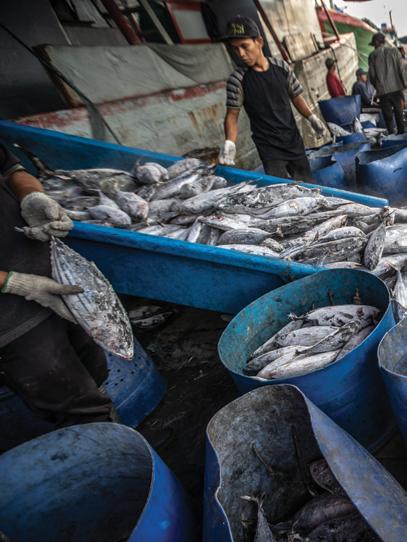

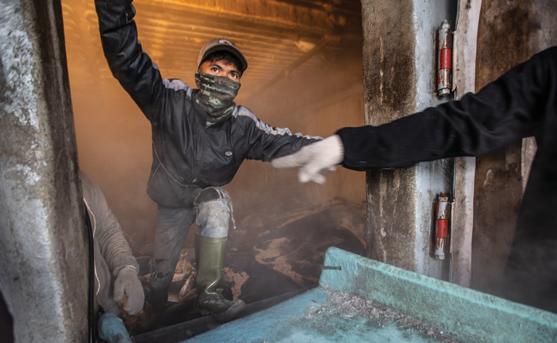
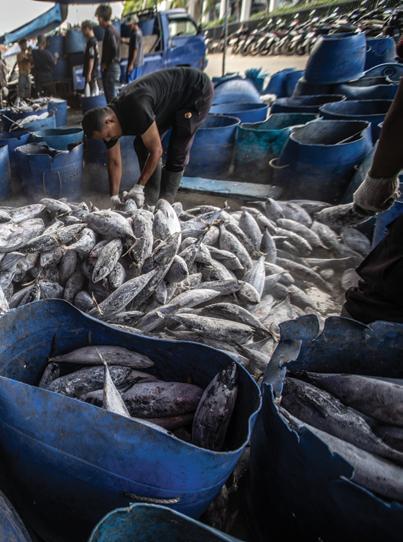
Left
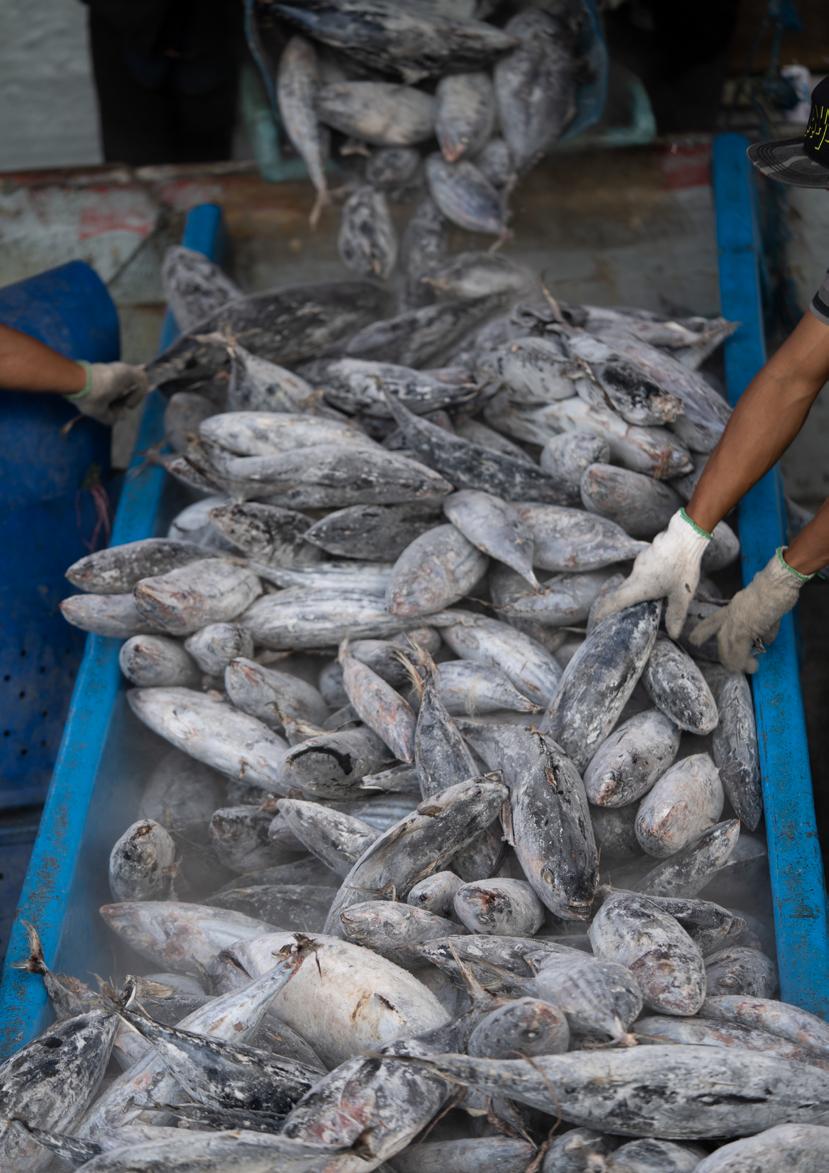
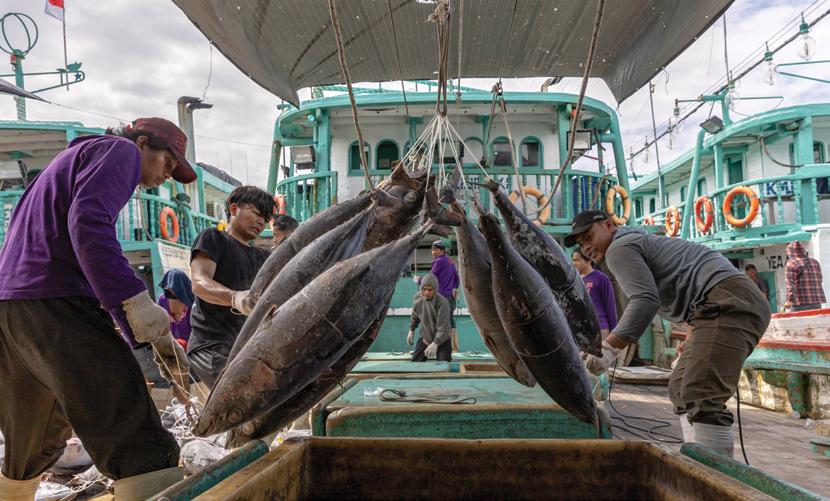
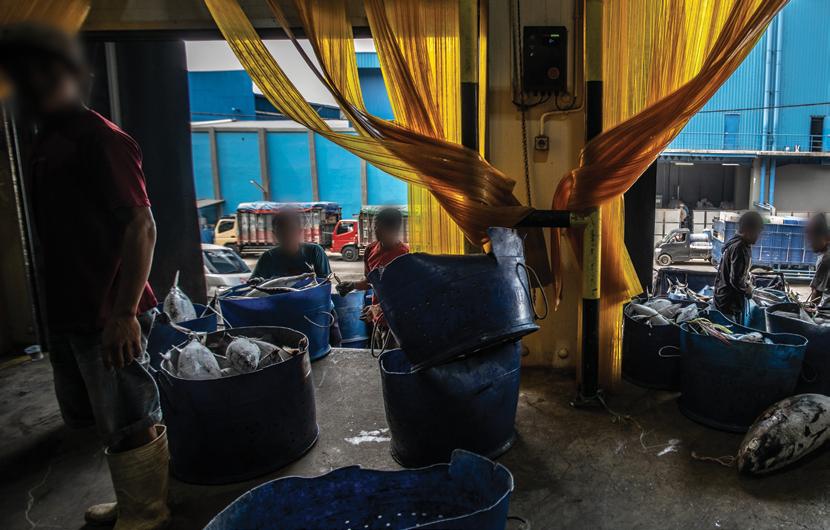
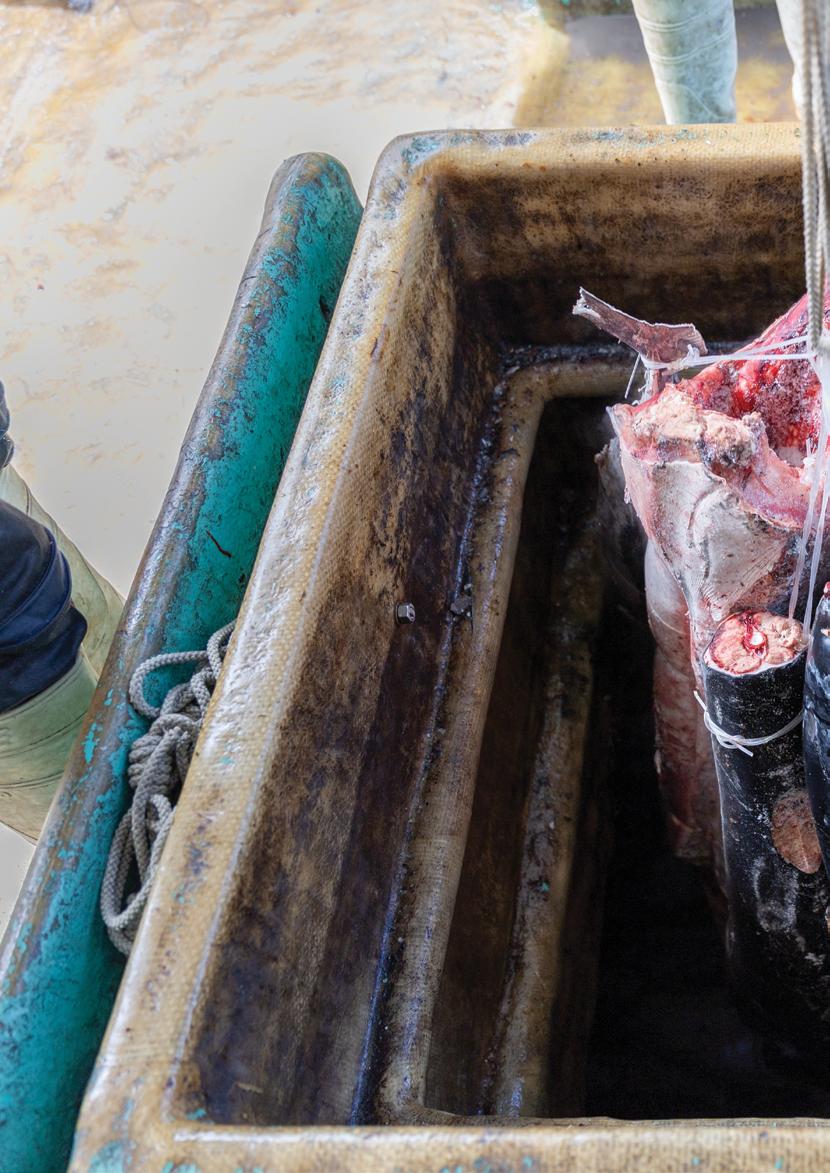
A worker appears from a fishing vessel's freezer to unload its catch.
Bottom
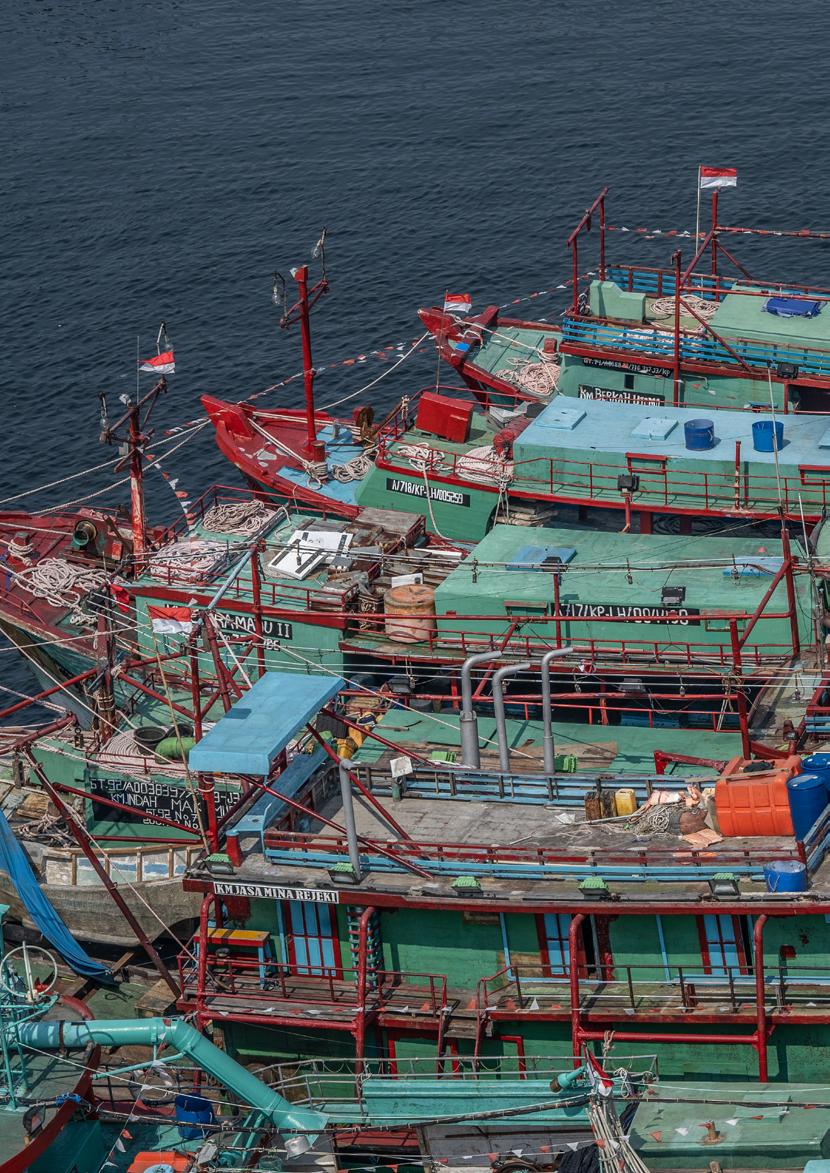
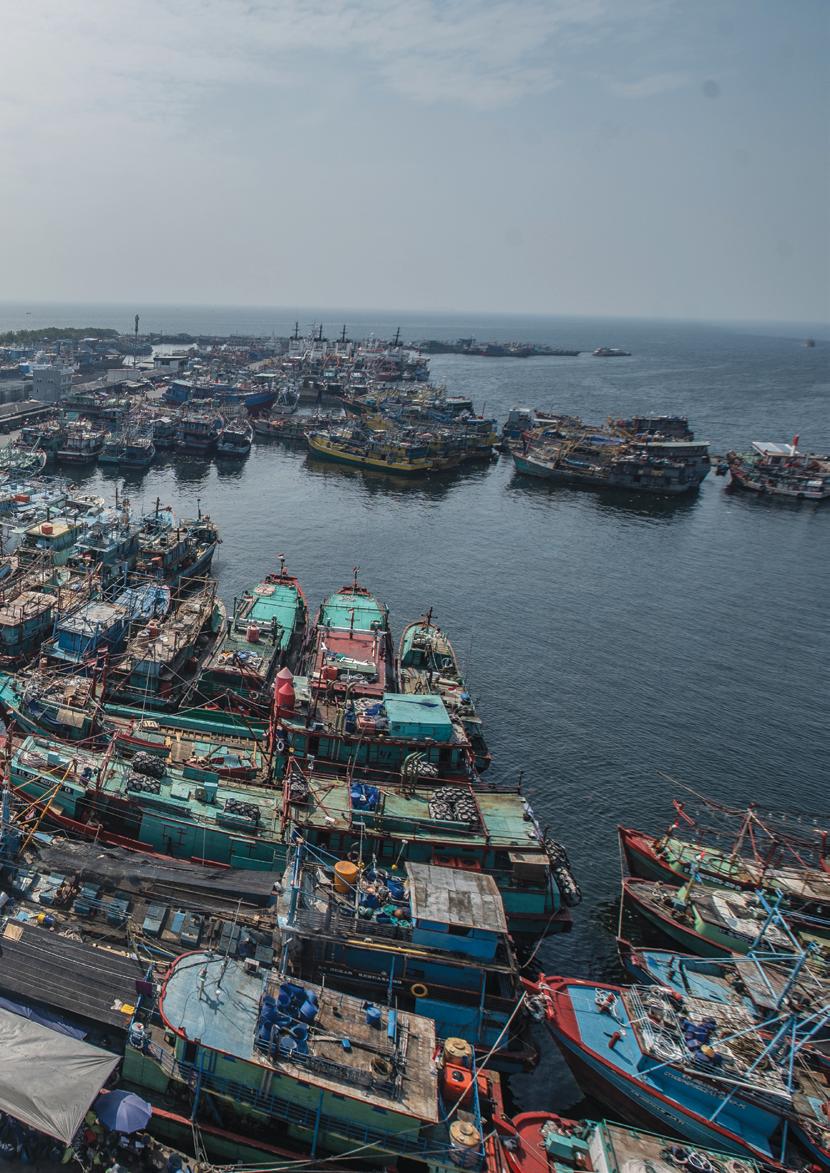
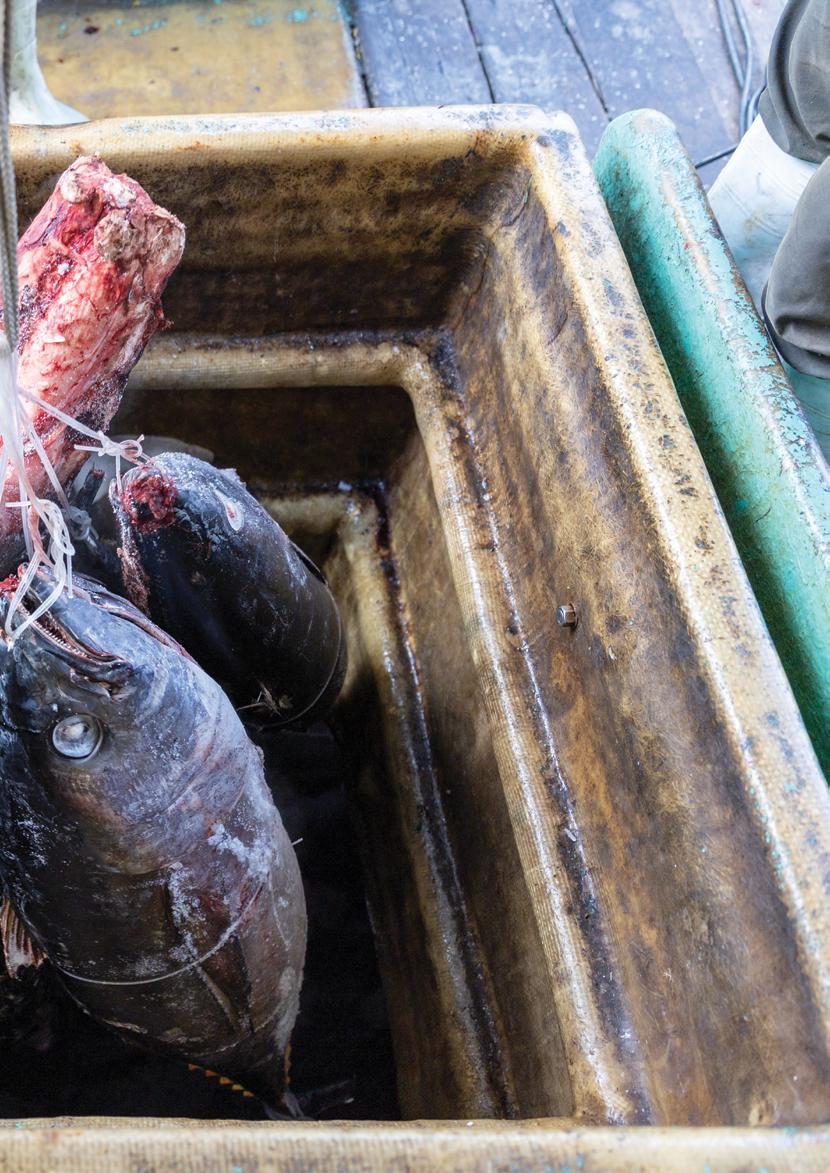
Workers sort tuna catch at Nizam Zachman Port, Jakarta.
In order to bring justice to fishers and oceans, Greenpeace Southeast Asia and Uniting Church Synod demand that:
The Indonesian government enforces decent work at sea policies in line with international standards, including the ethical recruitment and fair wages that protect Indonesian fishers’ rights;
The Australian government prohibits seafood products linked to labour exploitation and forced labour from entering Australian markets;
The Indonesian and Australian seafood companies conduct human rights and environmental due diligence within their supply chains.
Unless both Indonesian and Australian regulators enact and enforce binding due diligence and labour protections, the true cost of tuna will continue to be borne by those at the very bottom of the chain, which are the Indonesian fishers trapped in debt and stripped of their rights. There is an urgent need for both governments to establish more accountable, transparent and effective partnership by ensuring the meaningful participation and collaboration with fishers, unions and other key stakeholders in addressing forced labour at sea.
One sunny day, Randi1 excitedly steps foot in Bali for the first time—but not for a vacation. He jumps off a bus and boards a fishing vessel that will become his new “home” for the next year and a half. From his hometown in rural West Java, Randi has brought nothing but a bag full of clothes and his National Identity Card, which was then taken away by a man in a corporate uniform.

Randi knows nothing about the ocean. He was a blue-collar worker with a lot of debt, desperate to find a job that would bring fortune for him and his family. Then one day he saw a job ad on Facebook offering quick and easy money: an IDR 6,000,000 (AUD 549)2 loan and guaranteed big salary if he signed up as a worker in a longline tuna vessel. Randi seized the opportunity.
His time in the Benoa Port of Bali was easy. He did not have to pay for anything in advance, such as food, beverages, and personal needs. Everyone was ecstatic until just one day before the fishing trip when they were supposed to receive the promised loan from the company.
A long-anticipated day turned into one of frustration and regret. They were told that they would only receive IDR 800,000 (AUD 73), finding
out for the first time that the transportation from their home to Bali, the required training they had taken, and their work documents, were not free but would be paid by deductions from their future salary.
Meanwhile, Randi had planned to send the money to his family. His boss offered to lend him even more money and take it out of his future salary. He accepted this, feeling motivated to work harder so that he could earn more money that not only covered his debts but also enough to take some back home.
Eighteen months passed. Randi is much thinner now and his hands are scarred from pulling in tons of tuna without proper safety gear for 15 hours a day. But he perseveres, thinking of the money he was promised.. In his calculation, he was supposed to receive at least IDR 52,000,000 (AUD 4,273). But in the end he only received IDR 5,000,000 (AUD 462) due to the personal loan,




loan for pre-departure costs and additional onboard debt. He was too ashamed to return home, so he decided to embark on the fishing vessel again. He had no other choice – in too much debt and with too many unfulfilled promises to his family.
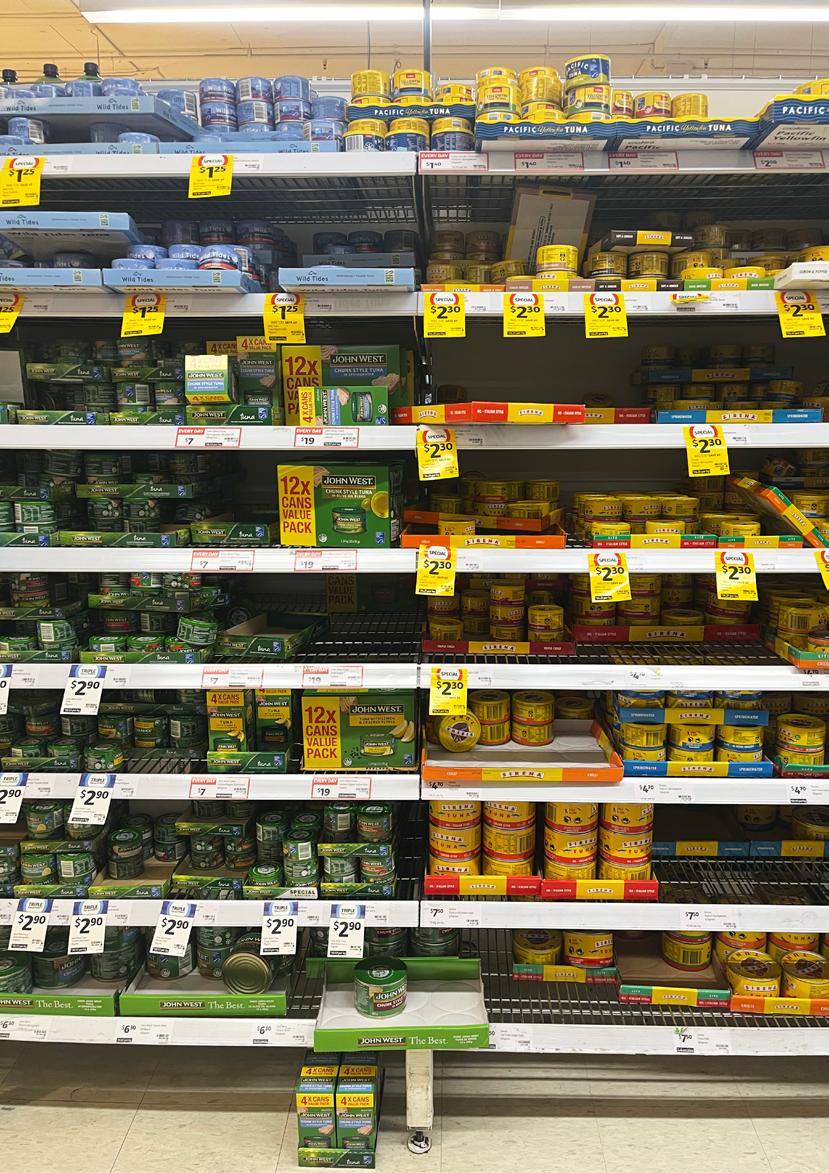
Just across the ocean, in Australia, a family bought a can of tuna for AUD 2.95 3 The label says the tuna was sustainably caught and packed in Indonesia, but a consumer cannot easily find out where and by which vessel the fish was caught—because the corporations do not provide such information. These big corporations behind the canned tuna brand benefit from the claim that their tuna is sustainably sourced. For all we know, it could have been caught by Randi.

Randi's story is not at all unique, there are many more Randis across Indonesia. The forced labour situation that Randi and other fishers experience means tuna
products are artificially cheap, and companies enjoy bigger profit margins. Instead of improving accountability, many seafood business actors shift their risks and responsibility up the supply chain. On top of all that, the Indonesian government’s weak law enforcement has enabled labour exploitation to continue happening. There needs to be a systemic change, commitment and action from the government and corporations to bring more justice to the fishers and the ocean.


The investigation began by identifying Indonesian seafood companies that export canned tuna, frozen fillet, and frozen tuna products such as skipjack, albacore, big eye, and yellowfin tuna to the Australian market.4 General information on Indonesian tuna trade values was obtained from Statistics Indonesia (BPS)5 and Trademap6, covering national export and import value alongside the destination country.
Furthermore, Tradedata.pro7, a market-intelligence platform that sources its trade data from Indonesia Customs, was used to identify Indonesian tuna exporters and their Australian counterparts, along with the total trade volume and value of shipments, between January 2020 and April 2025. In total, 51 Indonesian seafood companies and 88 Australian seafood companies or entities were identified having trade relationships. However, it should be noted that some of the shipments were sample products without value added.
Most of the Indonesian seafood companies that export to Australia do not directly own or operate fishing vessels, nor does Indonesian or Australian law require seafood companies to disclose the suppliers and fishing vessels within their supply chains. Therefore fishing vessels that supply processing companies that then export to Australia, including its owners and operators, were identified from their participation in a Fisheries Improvement Project (FIP). A FIP is a voluntary initiative that companies participate in as a preliminary step to obtaining Marine Stewardship Council (MSC) certification. The FIP’s website provided information on the seafood companies involved, whether as the leads or participants in each FIP.8
Other than the FIP Directory, this research also sources the fishing vessel database on MSC’s Indonesian Skipjack, Yellowfin, and Albacore Tuna of Western and Central Pacific archipelagic water and Indian Ocean Pole and Line and Handline. In the appendix to MSC F-31498, there are 2,227 pole and line and handline registered.9 The document details list of vessels, landing site, supplier, and listed processing company. In the list, there are at least six processing companies exporting to Australia.
Based on trade analysis, out of 51 Indonesian seafood companies that exported to Australia, at least 9 Indonesian seafood companies were recorded as participating in the FIP from 2018 - 2025, including 2,271 pole and line and handline vessels across 44 landing ports. Other than pole and line and handline, the research also tracked 307 purse seiners that participated in the FIP program in major ports such as Kendari (Southeast Sulawesi), Bitung (North Sulawesi), Benoa (Bali), and Nizam Zachman (Jakarta). These four ports are Indonesia's major hubs of tuna production, and they have the most vessels in the FIP vessel list.
The field investigation at the four fishing ports took place in May and August 2025. We investigated working conditions and interviewed fishers. To select fishers for interview, the research team qualified fishers that were previously or currently employed on fishing vessels that are found on the FIP and MSC list and suspected to supply to several Indonesian seafood processing companies and exported its tuna products to Australia. Of the fishers that met the qualification, the researchers randomly selected those who were available on the fishing vessels. In total, we interviewed 25 fishers from 17 fishing vessels.
The interviews focused on identifying the presence of the International Labour Organization (ILO)’s 11 indicators of forced labour (which are based on ILO Forced Labor Convention [C-29]). Interviews were informal and lasted 30 - 120 min. The interviews focused on recruitment process, working conditions, and salary payment method, while acknowledging that they were not exhaustive of all topics necessary to fully assess forced labour indicators or other labour violations.
This forced labour analysis is presented qualitatively and quantitatively. When it is presented quantitatively, such as in Table 3, it is important to note that the absence of an indicator does not necessarily mean that it was not present.
Depending on the situation, it could mean that the topic was not covered in the interview at all, or without enough depth, to confidently determine the indicator’s presence.
Aside from interviewing the fishers, we also interviewed fishing vessel association staff based in Denpasar, Jakarta, Bitung, and Kendari, as well as fishing vessel captains, and calo. For the fishing vessel association, the scope of the interview is the business model of the tuna industry, and perspective on the protection of the fishers. Fishing vessel administrators provide more detail regarding recruitment and placement, while an investigation into calo aims to understand how the recruitment mechanism operates. Interviews with portmasters were conducted to confirm the responsibility of recruitment and placement, and the business procedure of fishers recruitment.
Indonesia claimed to be the world's biggest tuna producer by volume with a total catch of 1.5 million tons in 2023 or 19% of the total world tuna production.10 Significant tuna production from Indonesia makes it the fifth biggest exporter globally of tuna products such as yellowfin, skipjack, albacore, and big eye with a total value of USD 992,451 million in 2024.11
In the global tuna value chain, canned tuna is considered as the end product of tuna.12 As Figure 1 shows, Thailand is the biggest global tuna exporter with prepared and preserved tuna as their biggest exported commodity. Meanwhile,
Indonesia, along with Vietnam, dominates in frozen tuna fillet products. As for frozen tuna products, Papua New Guinea, Taiwan, and Indonesia are the three biggest exporters by value.
Global tuna export value (by USD million)
Sources: Trademap.org HS Code 160414, 030342, 030343, 030487, 030341, 030344, 030347, 030349
In Figure 2, by 2024, Thailand, Vietnam, and the Philippines were among the top global importers of frozen tuna and frozen tuna fillet products. In other words, these countries are the major Southeast Asian hubs of tuna processing. They depend greatly on imports for their raw tuna
materials before re-export in significant amounts and values as prepared and preserved tuna into other global market states. Meanwhile, importers of prepared and preserved tuna are dominated by market states such as the United States (US), Japan, European Union (EU), and Australia.
United States of America
France
United Kingdom
Germany
Vietnam
Netherlands
Philippines
Portugal
Australia
Sources: Trademap.org HS Code 160414, 030341, 030343, 030487, 030342, 030344, 030349
Ironically, Figure 3, confirms that the majority of Indonesia frozen tuna export goes to the major tuna processing hubs in Asia such as Vietnam, Thailand, and Japan. Meanwhile, market states in the US and EU also import frozen tuna fillet from Indonesia before turning it into high-end products. As for Indonesian prepared and preserved tuna exports,
Saudi Arabia is the biggest destination, followed by Thailand, Japan, US, and Australia. Being the fifth biggest tuna exporter, but exporting the least processed tuna products, demonstrates Indonesia's orientation towards extracting tuna resources. It also confirms its position on the bottom tier of the global tuna value chain.

FIGURE 3. INDONESIA TUNA EXPORT 2024 (ARRANGED IN ORDER BASED ON THE BIGGEST FROZEN TUNA EXPORT)
Destination country of Indonesia tuna export by value, 2024 (by USD thousand)
1. United States of America
7. Spain
8. Australia




Sources: Trademap.org
HS Code 160414, 030342, 030487, 030341, 030343, 030344, 030349

As of 2025, Indonesia has registered 7,367 tuna fishing vessels owned by 3,602 entities, a combination of corporations and individuals.13 Of this total, 1,662 vessels are owned by 353 corporations, while the other 5,705 vessels are owned by 3,249 individuals. However, some individuals' ownership is actually also affiliated with several corporations. For instance, individual vessel owners register their vessels that are in fact operated by a corporation, or the corporations register their vessels in the name of their director or their subsidiary company representative.
The biggest corporate fishing vessel owner, PT Bintang Mandiri Bersaudara (BMB), based in Bitung, owns 79 fishing vessels mainly purse seiners and handline fleets based in Bitung Port, North Sulawesi. Moreover, BMB is heavily linked to canning company PT Samudra Mandiri Sentosa (SMS) as the two companies share the
same director and commissioners.14 SMS does not own fishing vessels yet is part of the top ten tuna exporters. In second place is PT Bandar Nelayan, a Benoa-based tuna processing company that owns 59 tuna longline vessels.
Based on our analysis of the fishing vessels listed in 10 Indonesian Fishery Improvement Projects (FIP), three companies are also supposed to be among the top ten tuna vessel owners: PT Gabungan Era Mandiri (38 vessels), PT Kilat Maju Jaya (46 vessels) and PT Tuna Indonesia Mandiri (35 vessels). The three companies are listed as ‘vessel operators’ and defined as responsible for the operation of the fishing vessels. However, the owner of the vessels varies between subsidiaries of respective companies and individual owners. Out of the three companies, PT Gabungan Era Mandiri and PT Indonesia Mandiri supply the processor PT Aneka Tuna Indonesia, which exports to Australian processing companies.15
Sources: Ministry of Marine and Fisheries Affairs (MMAF), Fishery Business Licensing Service, Subsector Wild Capture Fishery and Transshipment, 2025
Individual ownership
5 fishing vessels
5 purse seine
PT Fajar Jaya Kota
9 fishing vessels
9 purse seine
PT Ajin Liu Samudera
9 fishing vessels
9 purse seine
PT Mahkota Maritime Makmur
16 fishing vessels
16 purse seine
PT Bandar Nelayan
69 fishing vessels
69 tuna longline
Within Indonesian territorial waters, PT Bintang Mandiri Bersaudara has the most tuna fishing vessels with 57 of their fishing vessels operating in both Fisheries Management Area (FMA) 716 and 717, while 22 of their fishing vessels operate in FMA 715. In the high seas, Benoa-based company PT Bandar Nelayan dominates where all of their 69 tuna longline vessels operate in the Food and Agriculture Organization (FAO) Area 57 or Southern Indian Ocean. Meanwhile, Western Indian Ocean, or FAO 51 is dominated by PT Mahkota Maritim Makmur, 16 purse seine
WHO
Fishing vessels ownership in Indonesia does not determine trade dominance, as most catch is transferred to processing companies or traders before reaching international markets. Table 2 shows how the majority of valuable products are frozen tuna fillet and prepared and preserved tuna tuna produced by processing companies. However, prepared and preserved tuna tuna processors often do not own fishing vessels directly and instead source their supplies from multiple
PT Bintang Harapan Jaya 17 purse seine
FMA 572
operators. Yet, there is no publicly available data identifying which fishing vessel operators supply these exporters, limiting supply chain traceability and transparency assessments.
Bitung-based PT Deho Canning Company is the biggest tuna exporter with control over 37% of Indonesia’s total tuna exports. Their major commodity includes frozen tuna fillet and preserved and prepared tuna and the main market destinations are the United States, East Timor, and Japan. The second biggest is PT Pahala Bahari Nusantara, which contributes 13.9% of total Indonesian trade and mainly exports frozen tuna products. In third place is PT Aneka Tuna Indonesia that contributes 9.15% of Indonesian total trade value and exports prepared and preserved tuna tuna to markets in Saudi Arabia, Japan, and Australia.

PT Bintang Mandiri Bersaudara
57 fishing vessels
39 Handline
13 Purse Seine
4 Tuna Longline

22 fishing vessels
8 Purse Seine
9 Handline
5 Pole and line
57 fishing vessels
39 Handline
13 Purse Seine
4 Tuna Longline

Individual ownnership
7 fishing vessels
7 purse seine
PT Intimas Surya
20 fishing vessels
20 tuna longline
1 purse seine
Koperasi Produsen
Marindo Citra Bahari
5 fishing vessels
5 purse seine
PT Indo Mina Grasia 19 fishing vessels
handline 5 purse seine
PT Maluku Prima Makmur
8 fishing vessels
8 tuna longline
Source: Ministry of Marine and Fisheries Affairs (MMAF), Fishery Business Licensing Service, Subsector Wild
Capture Fishery and Transshipment, 2025; vessel in IOTC retrieve from Record Authorized Vessel, Indian Ocean Tuna Commission, 2025, https://rav.iotc.org/
“Our tuna brand is certified for protecting the ocean and the well-being of fishers!”

“My vessel has to pass the audit, otherwise the processing company won't
buy our catch.”

“Audits? Oh yeah yeah. We only source from fully audited vessels! For sure, our tuna was well sourced.”
“I owe the captain so much money now, I have no choice but to keep working. I don't want my family to be ashamed of me.”

Australia relies heavily on imports to meet its domestic tuna demand16 and ranks as the tenth largest importer of prepared or canned tuna globally, accounting for 2.7% of total world canned tuna imports.17 Southeast Asia serves as the primary supply hub for the Australian market, with Thailand and Indonesia contributing 80% and 16% respectively of the total import value of canned tuna in 2025.18
Between 2020 to April 2025, at least 51 Indonesian companies exported both frozen, fillet tuna and prepared and preserved tuna products to Australia. PT Iambeu Mina Utama is the largest exporter, contributing 38.8%, followed by an individual who is affiliated with PT Damena Sumber Rejeki, a processing company based in Bali.19 Both of them specialise in exporting pre-cooked tuna products such as frozen fillet. However, frozen tuna fillet exports to Australia significantly decreased from 364 shipments in 2020, to 133 shipments in 2024.20
When it comes to prepared and preserved tuna products, Australia is Indonesia's sixth largest export destination, representing 10.1% of Indonesia’s total prepared and preserved tuna export value. PT Aneka Tuna Indonesia is the largest exporter, contributing 87% of Indonesia’s total prepared and preserved tuna trade value to Australia.
On the importers side, Conway Fish Trading is the largest importer of Indonesian tuna, contributing 25.7% of import values. The second largest is Iconic Food Distribution with 24.6%, specializing in prepared and preserved tuna products. At the third place is Salt Water Seafood with 19.9%.
Among Indonesia’s exporters to Australia, only PT Intimas Surya, PT Perintis Jaya International and PT Iambeu Mina Utama directly own fishing
vessels. Other processing companies rely on external suppliers, whose vessels can be traced through their participation in the FIP. Although FIP registration is voluntary, many vessel owners consider participation essential to maintain access to export markets and demonstrate compliance with international sustainability standards, especially Marine Stewardship Council (MSC).21
“So, in the end, it was up to the market. In the market, there is a term called 'proceed to table', which means the responsibility lies in the market. Well, entrepreneurs have begun to realize this, hoping that their fish will be competitive in any way, they began to ask questions and the government began to inform them. If you don't join the FIP, I'll not accept the fish or (I’ll) pay less.”
(Seafood companies association representative)
Furthermore, another seafood companies association admitted the buyers do not want to take their products if they were tainted by forced labour.22 Its representative said that fish caught by FIP vessels will be given “MSC tags” every time they land in the port, but the catches could be mixed with those from the other non-FIP vessels.23
Out of 51 Indonesian tuna exporters supplying the Australian market, only nine are participants in Fisheries Improvement Projects (FIP). Two of these companies, PT Aneka Tuna Indonesia and PT Pahala Bahari Nusantara, act as lead FIP implementers for purse seine fisheries in the Indian Ocean and Banda Sea.


As lead for the purse seine FIP, PT Aneka Tuna Indonesia registered 118 fishing vessels, consisting of 83 based in Jakarta and 35 in Tanjung Wangi Port, East Java.24 PT Aneka Tuna Indonesia collaborates with several major vessel operators, including PT Gabungan Era Mandiri with 38 vessels, PT Tuna Indonesia Mandiri with 35 vessels, and PT Karya Mandiri Citramina with 30 vessels operating out of Jakarta. The FIP assessment stated that those three vessel operators sell their tuna to PT Aneka Tuna Indonesia.25 In its role, PT Aneka Tuna Indonesia conducts regular supplier audits that cover product traceability, company profiles, fishing operations, catch documentation, and basic assessments of crew welfare and social responsibility.26
PT Pahala Bahari Nusantara leads the handline yellowfin tuna FIP in the Banda Sea, which involves 161 individually owned fishing vessels based in Kendari Port.27 In its human rights policy statement, the company commits to “ensure the FIP current and future participants are aware of the statement”.28 However, the practical implementation of labour training, human rights
improvements, and engagement with trade unions is delegated to PT Abadi Makmur Ocean, a cold storage company also based in Kendari.28
Alongside PT Aneka Tuna Indonesia and PT Pahala Bahari Nusantara, two Bitung-based processing companies, PT Sinar Pure Food International and PT Samudra Mandiri Sentosa, also participate in the same initiative as a participant in the FIP led by the fishing vessel association, linking the association’s sustainability agenda with key exporters and processors in the region.


Sources: Tradedata.pro , Indonesia export to Australia HS Code 030341, 030342, 030343, 030344, 030349, 0303487, 160414, January 2020-April 2025
Fishing vessel Fishing Ground Fish landing port
Maluku Sea
Bitung fishery port
Banda Sea
Kendari fishery port
KM Dioskuri 08
KM Jaya Bali Bersaudara 10
Saint Lucia Cahaya Pangkep 01 Adriel 07
PT Bintang Mandiri Bersaudara Fishing vessel owner/operator
Individual ownership
Indian Ocean
Nizam Zachman fishery port, Jakarta
KM Cari Selamat 01
KM Terbit
KM Anugerah Jaya Samudra 03
KM Cahaya Bintang 888
KM Maccini Baji 02
KM Anugrah Putera Mandiri
KM Duta Mas 5
KM Era Mas III
PT Gabungan Era Mandiri
Benoa port, Bali
KM Permata 32
KM Permata 188
KM Mutiara 09
KM Mutiara 27
PT Intimas Surya

frozen fillet tuna processor
Canned tuna processor
PT Samudra
Mandiri
Sentosa
PT Sinar
Pure Food
International
Australian canned tuna and pre-cooked tuna brand
Shaffer Haggart Ltd.
PT Pahala Bahari Nusantara
PT Intimas Surya
PT Aneka Tuna Indonesia
Iconic Food Distribution
Nippon Food Supplies Pty Ltd
Sushi Sushi Pty Ltd
Jun Pacific Corporation
New West Food
Safcol Tuna Australia
JFC Australia Co Pty Ltd
Entyce Food Ingredients
Coral Sea Fishing Pty Ltd


The International Labour Organization’s Forced Labour Convention (C-29) defines forced labour as work or service extracted from any person under the menace of penalty or where the person and where the person has not engaged in the work voluntarily. Here are the 11 indicators.

ABUSE OF VULNERABILITY
DECEPTION

RESTRICTION OF MOVEMENT
ISOLATION SEXUAL VIOLENCE AND THREATS

PHYSICAL AND INTIMIDATION


RETENTION OF IDENTITY DOCUMENTS


WITHOLDING
ABUSE LIVING AND EXCESSIVE
DEBT WORKING CONDITIONS WORKING HOURS OF WAGES BONDAGES
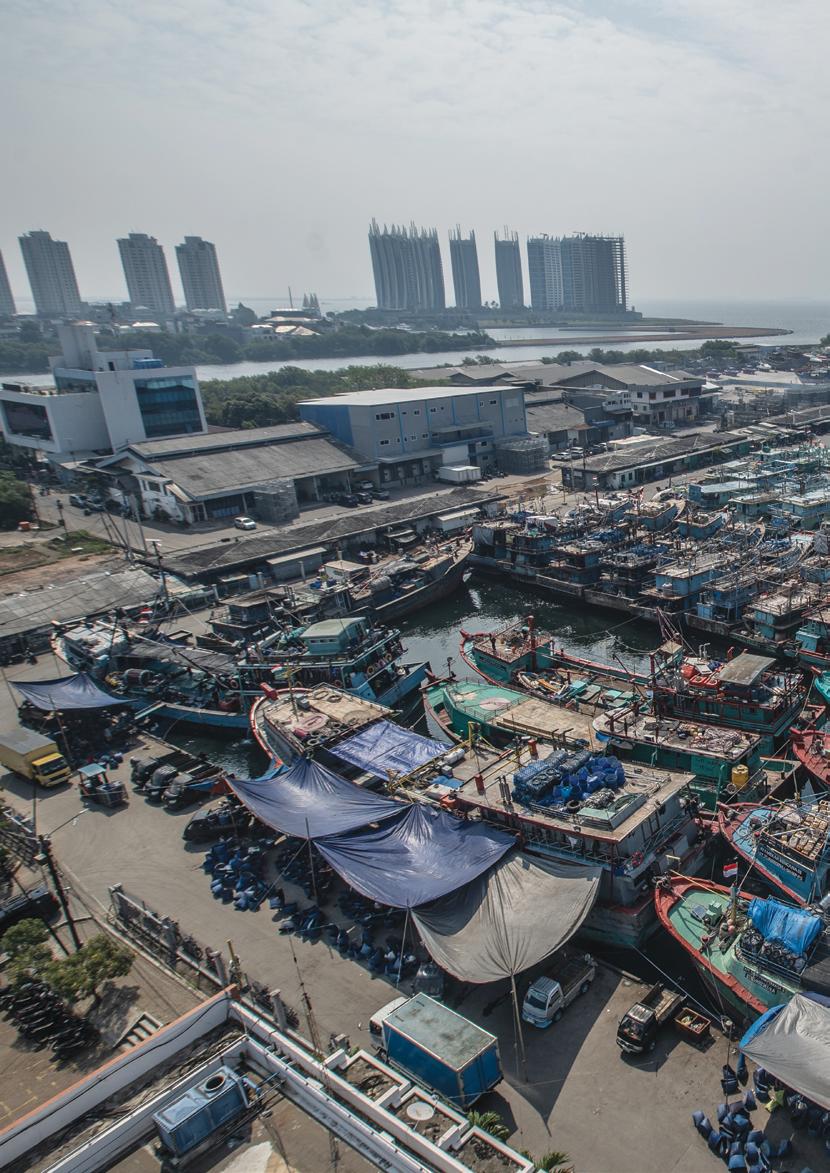
Indonesia's significant contribution to global tuna production should not be considered as a national achievement.
During a field investigation conducted in Kendari, Bitung, Benoa, and Jakarta – hubs that allegedly supply the Australian market – we reportedly found alleged forced labour indicator on 17 fishing vessels that were suspected to supply five indonesian procesing company to supply four Indonesian processing companies that export to 10 Australian tuna distributors and processing companies (Table 3). The percentage of the forced labour indicators is accounted based on the total interviewed vessels.
We analysed testimonies of 25 fishers from 17 fishing vessels linked to the Australian market using the International Labour Organization’s (ILO) 11 Forced Labour Indicators (which are based on C-29), ILO C-188, and the ILO Handbook for Detection of Forced Labour in Commercial Fishing. The three most common indicators experienced were abuse of vulnerability (56%), debt bondage (56%), and deception (40%). This reflects how the seafood companies designed the workforce: financially struggling workers were lured in with promises of a loan, only to end up with new debt. Meanwhile, the tuna they caught would be turned into profits for traders and brand owners in Australia.
Labour exploitation and forced labour should be considered symptoms of the exploitative fishing industry business model where the corporations externalize their business operational risks onto the workforce. Rather than directly employing and managing crew members, corporations allegedly rely on calo to recruit fishers and transfer the financial burden of failed or unprofitable trips onto them, often through the charging of recruitment fees or withheld or unpaid wages. In effect, the structural economic risks inherent in the fishing industry appear to be shifted onto the fishers

Indonesia’s regulation of employment on board fishing vessels, MMAF Regulation No. 33 of 2021, still lacks several technical guidelines, and implementation remains weak – especially in relation to contracts for the territorial fishers.30 The existing regulation does not cover how companies hire their fishers.31 High demand for fishers and turnover are combined with weak enforcement, unclear recruitment mechanisms, and the fishing companies allegedly relying on calo, to find fishers, resulting in a system that is rife with deception and debt bondage.
This research analyzed labour conditions on vessels with three distinct types of fishing gear: purse seine, handline, and longline. We found that the pattern of exploitation was allegedly different on each type of vessel. For example, longline vessels spent more time at sea – 16-18 months in the Indian Ocean – with longer working hours,
compared to those on handline vessels. As a result, fishers working on fishing vessels operating in the high seas from Jakarta and Benoa reported experiencing isolation while fishers on territorial vessels operating out of Kendari and Bitung do not. Moreover, samples from Jakarta and Benoa also highlight excessive working hours and abusive working conditions more than on territorial vessels.
With longer duration of work and higher production target, fishing vessels operating in the high seas implement a variety of means of control towards fishers that are not as prevalent as in the territorial vessels. Interviews found that fishers’ documents
Indonesia’s regulation of employment on board fishing vessels, MMAF Regulation No. 33 of 2021, still lacks several technical guidelines, and implementation remains weak – especially in relation to contracts for the territorial fishers.29

were reportedly retained on 100% of vessels studied in Jakarta and 75% in Benoa (ports serving high seas vessels) while it only allegedly occurred on 20% of vessels studied in Bitung and none in Kendari (ports serving territorial vessels). Similarly, everyone interviewed on the vessels in Jakarta and Benoa reportedly experienced debt bondage, while 83% of those in Kendari and 60% of those in Bitung reported allegedly experiencing debt bondage.
In territorial fishing vessels, withholding of wage is reportedly more prevalent and allegedly comes in the form of fishers receiving no salary if the fishing trip was unprofitable. Fishers were then made to recover, or attempt to recover, these losses on the next trip. The situation worsened as fishers experienced deception by not getting a contract or proof of payment, resulting in reports that the profit-sharing payments were being manipulated by the captain and fishing vessel
owners. Such payment manipulation is made possible due to a lack of transparency in vessel profits.
Across all fishing gears, ports, and payment system fishing vessel allegedly rely on coercion. Aside from physical coercion, fishers reportedly experienced financial and economical coercion in the form of debt bondage (56%) and withholding of wages (28%). This is further allegedly exacerbated by the abuse of the vulnerable situation of the fishers (56%) with many reportedly deceived before, during, and after the fishing operation (40%).
Bottom left
A line of snack stalls in Benoa Port, Bali, where calo usually hangout.
Bottom
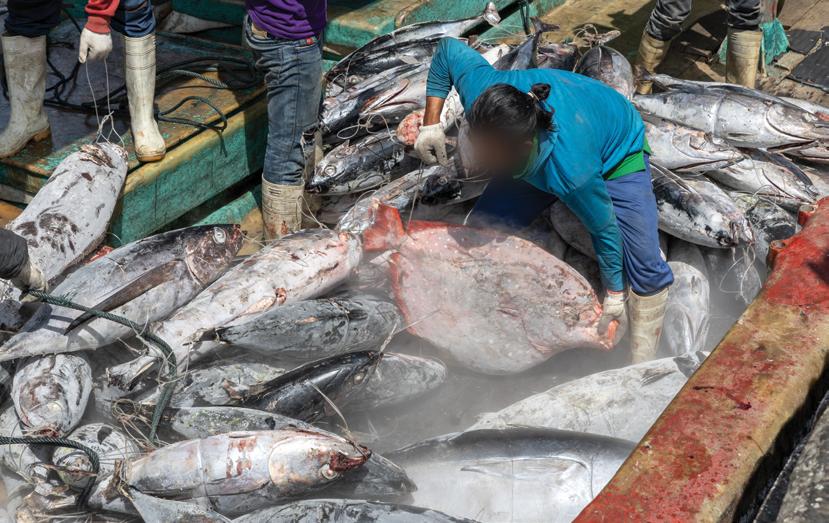
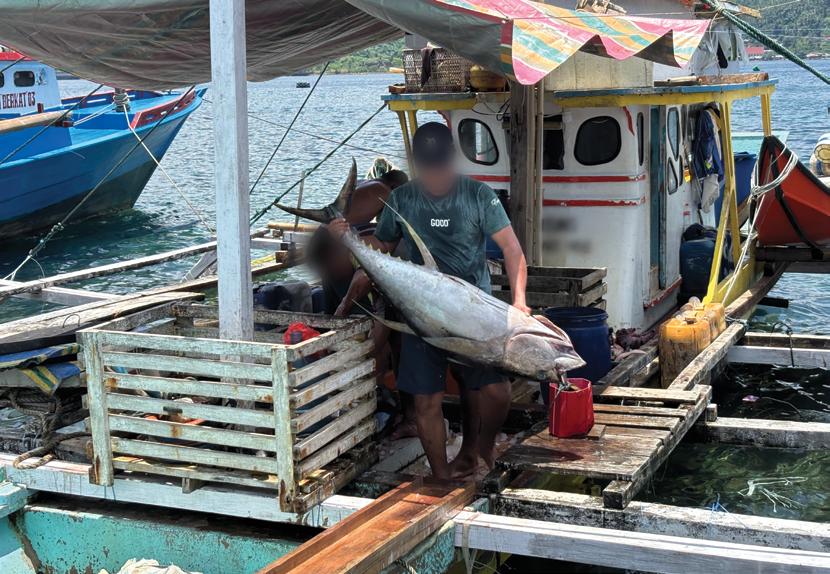
A fisher unloads his catch.
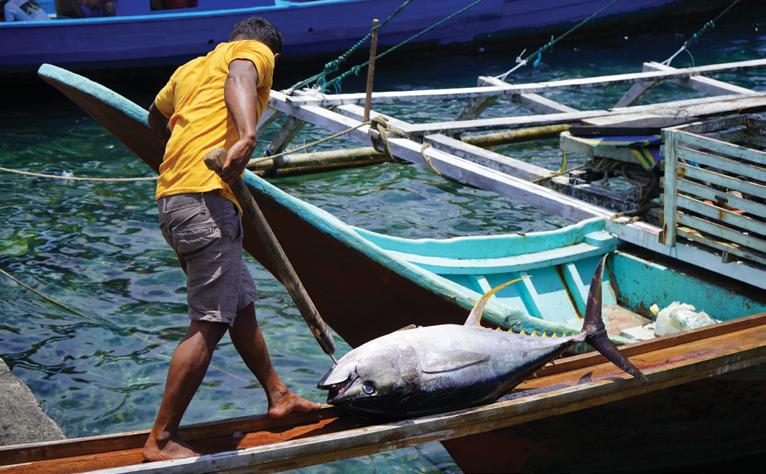
TABLE 3. FORCED LABOUR INDICATOR: BASED ON 25 INTERVIEWS WITH FISHERS FROM 17 VESSELS LINKED TO THE AUSTRALIAN MARKET
Vessel Name Owner/ operator
KM Dioskuri 08
KM Jaya Bali Bersaudara 10
PT Jaya Bitung Mandiri
PT Samudra Mandiri Sentosa
Cahaya Pangkep 01 Individual owner PT Sinar Pure Food International
Saint Lucia Individual owner
PT Aneka Tuna Indonesia
PT Pahala Bahari Nusantara
Adriel 07 Individual owner
Isolation
Physical and sexual violence
Intimidation and threats
Retention of identity documents
Withholding
Abusive working and living conditions
TABLE 3. FORCED LABOUR INDICATOR: BASED ON 26 INTERVIEWS WITH FISHERS FROM 18 VESSELS LINKED TO THE AUSTRALIAN MARKET
Vessel Name
KM Anugerah Jaya Samudera 03
KMN Anugerah Putra Mandiri
KMN Cahaya Bintang 888
KM Maccini Baji 02
Terbit
PT Pahala Bahari Nusantara
KM Cari Selamat
PT Pahala Bahari Nusantara
PT Aneka Tuna Indonesia
Isolation
Physical and sexual violence
Intimidation and threats
Retention of identity documents
Withholding of wages
Debt bondage
Abusive working and living conditions
Excessive overtime
TABLE 3. FORCED LABOUR INDICATOR: BASED ON 26 INTERVIEWS WITH FISHERS FROM 18 VESSELS LINKED TO THE AUSTRALIAN MARKET
KM Duta mas 5
KM Era Mas III PT Gabungan Era Mandiri
KM Mutiara 16 PT Intimas Surya
KM Mutiara 9 PT Intimas Surya
KM Permata 188 PT Intimas Surya
KM Permata 32 PT Intimas Surya
Isolation
Physical and sexual violence
Intimidation and threats
Retention of identity documents
Withholding of wages
Debt bondage
Abusive working and living conditions
Excessive overtime
Fishers often chose to work at sea because of financial, social, and legal vulnerability.32 Hence, abuse of vulnerability is the most prevalent indicator with 56% of the respondents reporting being recruited while they were in vulnerable conditions, such as job scarcity, lack of formal education, and past criminal records. One of the fishers mentioned he was trapped in a vicious cycle of debt. He had debt from the previous vessels he had worked on, so he had to continue working as a fisher to pay it off.
Tuna industry players appear to leverage this situation, as it allegedly enables them to pay low wages to workers instead of paying decent wages for formally educated or certified fishers.
“Today, the workers on Indonesian-made fishing boats are the remaining people who are not needed on land.Why do I call them the remaining people? If they have a diploma, they might not want to go to sea. Let’s focus on this: how far does the education of seafarers on Indonesian ships go? …. I go to sea for six months, maybe when I come home I can bring tens of millions [much more than I’d make on land]. The salary could be two million, so at least 12 million (1,084 AUD) for six months. All meals at sea are free, so you bring home the full 12 million (1,084 AUD), plus bonuses. So for him, this is the best option. Sorry, that’s why I said it’s personal. People take advantage, thinking, “Oh, there’s cheap labour.”.
(Seafood companies association representative)
Another aspect of vulnerability is that fishers were recruited without a formal contract, which was experienced by 14 out of 25 fishers and was more prevalent in territorial fisheries. As a result, it allegedly puts them in a deeper vulnerable situation, in which they reportedly have problems in getting payment, face excessive working hours, and have a minimal bargaining position due to no formal written clauses stating their rights.
Even in larger fishing vessels in Benoa and Jakarta, fishers from three fishing vessels allegedly stated they did not receive a copy of their contracts as these documents were reportedly retained by the company as a guarantee. Other fishers from longliners based in Bali allegedly stated that they signed contracts for a 12-month fishing trip, but the trip reportedly ended up being 16 months. Meanwhile, two fishers from two purse seiners based in Jakarta allegedly stated the contract was merely a formality as they were not given the opportunity to properly review or understand the content.
Recruitment mechanisms differ between fishing ports based on the size of fishing vessels and nature of the fishing operation. Territorial vessels
in Bitung and Kendari are typically 5-30 Gross Tonnage (GT) and employ 10-15 fishers per fishing trip. As Bitung and Kendari fishing ports are close to the fishing ground, a fishing trip would last for 5-20 days. Most fishers have worked with the same vessel or company for years. They worked without formal contracts, but instead relied on kinship ties and personal relationships with the captain or other fishers. To join a fishing vessel, fishers in Kendari and Bitung stated they only needed an ID card, to prove that they were not underage and they were not given working contracts.
Meanwhile, recruitment mechanisms in Jakarta and Benoa are even more complex as the fishing vessel owners need 30-40 fishers per fishing trip lasting 10-18 months. Each owner sends four to five fishing fleets in one fishing trip, meaning one owner will require 150-200 fishers per fishing trip. To meet high demand of fishers and a quick turnaround, fishing vessel owners recruit fishers through the captain and a network of calo. Based on our interviews, all three fishers in Jakarta and one out of five fishers in Benoa were recruited by the captain, while the other four were arranged by a calo.

One fisher stated that, without calo, they would not know that there were job opportunities on fishing vessels. This signals high dependency between fishers and calo, with calo controlling the labour market of fishers. Meanwhile, the fishing industry association and fishing vessel administrators claimed that calo ‘damaged’ the reputation of the companies.33 However, one fishing vessel administrator admitted that fishing vessels could not operate without calo providing them with large numbers of fishers at short notice, especially without someone who is actually in the field:
“Without brokers, it can’t operate. Because sometimes vessel administrators don’t have the money for the fees, so calo provide it. The point is, they also need it, especially since there are seafarers there, 500 of them, but after they stop working. That’s it. If they’re extorted, no. Just once like that.”
(Fishing vessel administrator of wild capture company)
In Benoa Port, a fishing vessel owner hired a fishing vessel administrator to oversee all vessel related matters, such as administration and recruitment of fishers. The company sent money to the fishing vessel administrator which was meant as a loan for the fishers. In Benoa, for example, the company allocated from IDR 4,000,000 up to IDR 7,000,000 (AUD 367 to AUD 642) for each fisher.
The fishing vessel administrator later asked the calo to hire fishers, and paid the recruiter approximately IDR 500,000 (AUD 45) for each fisher they hired. The main recruiters are also responsible for ensuring the fishers remain at the port while waiting for the vessel to depart. If any of the fishers flee from the fishing vessels, the calo bears the resulting financial loss.34 As 75% of our findings in Benoa suggest, the recruiter confiscated the National Identity Card and personal belongings to prevent fishers from leaving.
The main recruiter organised and coordinated additional field or online recruiters through personal networks. One online recruiter reported receiving compensation of IDR 200,000–500,000 (approximately AUD 19-45) from the main recruiter for each fisher recruited.
The fishers we interviewed at Benoa Port stated that they were forced to pay inflated fees for accommodation and transportation costs. Meanwhile, the fishing vessel administrators got money from at least two sources: from the company in the form of the recruitment fees for each fisher hired and as a bonus if they meet recruitment targets; and from the fishers in the form of allegedly illegal additional charges. According to the Ministry of Manpower Regulation No. 18 of 2024, charging a fee for recruitment is considered illegal.35
Extra loan from the company

Distribute IDR 7,000,000 (Fishers loan)
IDR 500,000 (recruiting fee) for the fishing vessel administrator
IDR 4,000,000 Administration fee Training fee
IDR 500,000 (recruiting fee) for the calo
IDR 200,000 recruiting fee (for direct recruiter)
IDR 1,000,000 Recruitment fee Transport
Sources: Researcher analysis based on the interview with the recruiter and fishers
IDR 5,000,000 (loan for fisher)
Figure 7 describes the recruitment process and illustrates how the fishers recruitment business has evolved into digitally-mediated, calo who transcend geographic boundaries and are suspected of placing fishers into situations of forced labour, helping to facilitate debt bondage. This also underscores how labour value is extracted from the fisher even before they start work, and the fishing vessel company, administrator, and recruiters gain profit from the process. Hence, the fishers recruitment can be considered an industry where labour supply is commodified using informal channels.
According to the Indonesian MMAF’s Ministerial Regulation No. 33 of 2021, fishing port masters should read working contracts to the fishers and check their documents.36 Due to the limited capacity of port staff combined with high and fast demand of fishers and total amount of vessels, one fishery portmaster reported struggle to read, check, and even take a picture of the fishers’ contracts:
“To be honest, I won't be able to do it either, because I said, I once had 800 cases in one day. That's two copies each, two copies, counting 30 people per ship. If there are 10 ships, that's already 300 people we have to summon. And that’s probably beyond my capacity to handle, having to read it to them one by one.”
(Fishery Portmaster)
Further, the system of having the portmaster verify contracts is failing to protect fishers in the vulnerable period between when they arrive at port and when they depart on the vessel. Moreover, as the Ministerial Regulation does not regulate recruitment and placement of the fishers, the fishing portmaster reportedly considered recruitment as beyond the responsibility of the portmaster, as they allegedly only began the process of checking the working contract one day before the fishing trip starts, rather than when fishers arrive at port. This means, fishers’ rights are not protected during their waiting period at the port, paving the way for the companies to allegedly charge extractive fees and avoid their responsibility for providing transportation and accommodation.
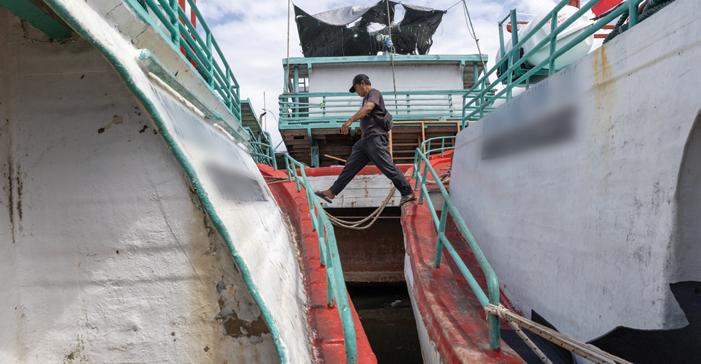
A complex system of debt bondage exists among fishers aboard Indonesian tuna fishing vessels. Debt bondage originates with the charging of recruitment fees, which is explicitly prohibited according to international standards which dictate that employers must bear all recruitment-related costs.37 The charging of recruitment fees and related costs to workers is a strong risk factor for forced labour and in all of the cases we examined this resulted in debt bondage.
Recruiters attract fishers with the promise of an “advance loan”—commonly utilized by fishers to cover family needs and living expenses before departure. This pre-departure incentive places fishers in debt, which grows as additional costs are imposed, including recruitment fees, transportation, accommodation, food, and other expenses incurred while awaiting deployment. Ultimately, these accumulated debts bind fishers to their employers, leaving them vulnerable to exploitation and unable to freely leave their employment.
The financial vulnerability of fishers is a key factor driving them to work on fishing vessels, as the promise of immediate cash provides short-term relief for those arriving at port with little to no money. Nineteen out of the 25 fishers interviewed were found to be in situations of debt bondage, originating from the “advance loan” and recruitment fees. They were forced to pay back this debt via salary deductions while at sea. The amount of the debt varied. In Benoa fishers were typically promised loans ranging from IDR 5–6 million (AUD 457–549), while small-scale fishers in Kendari and Bitung received smaller advances, between IDR 500,000 and IDR 1,000,000 (AUD 45–91) per operation.
Some workers were unaware that recruitment fees had been deducted from their promised loans. On 6 of the 17 fishing vessels, fishers had expenses for transportation, administrative costs, and Basic Safety Training (BST) deducted from their loan. These are expenses they thought the company had covered – and which the company should have according to international standards.
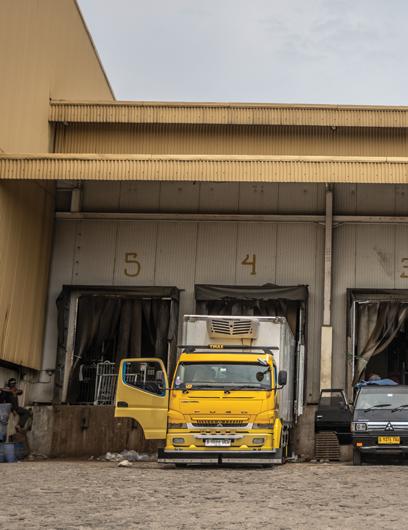
“The
[administrative] fee is IDR 500,000.The company actually reimburses that for the workers, but then the broker also gets IDR 500,000 from the company but they still tell workers they need to pay entrance fees. Therefore, the broker earns about IDR 1-1.5 million per worker, that includes IDR 500,000 for (the) bus, which the workers would not pay for
the actual bus cost.”
(Fisher from Benoa Port)
Other deceptive practices were also reported by fishers aboard two fishing vessels in Benoa, where recruiters charged them for BST and Seafarer’s Book. This payment was taken as a deduction from their promised loan. Fishers from Benoa Port stated that they were charged between IDR 2–2.5 million (AUD 185–232) for these documents, despite the official fees according to the Government Regulation No. 85 of 2021, being only IDR 1,350,000 (AUD 112) for BST
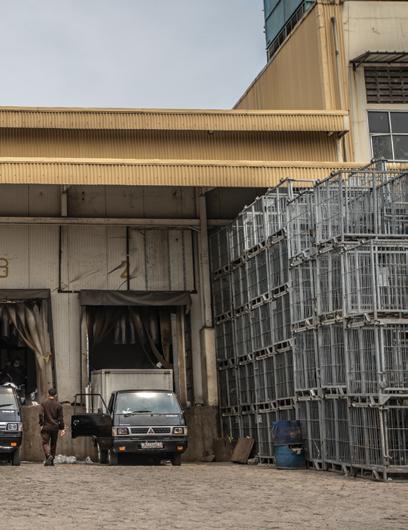
and IDR 100,000 (AUD 9.15) for the Seafarer’s Book.38
Fishers in Benoa and Jakarta also reported experiencing salary deduction for personal expenses incurred during the waiting period before departure. Fishers in Benoa reported that during the waiting period before sailing, they typically incurred debts ranging from IDR 1–2 million (AUD 93–185) for food, beverages, soap, and other personal necessities. This practice violates international standards and the Ministry of Maritime Affairs and Fisheries Regulation No. 33 of 2021, which stipulates that companies are responsible for covering workers accommodation and basic needs prior to the start of a voyage.40 These debts are repaid to the shop owners, who visit the fishers the day before departure after the fishers received their “advanced loan” from the vessel owners. If fishers fail to repay their debts, the shop owners turn to the vessel owners to recover the amount, who in turn deduct the equivalent value from the fishers’ future wages.
In Jakarta, one fisher aboard stated that he had accumulated total debts of up to IDR 16 million (AUD 1,486) to the vessel owner. These debts were subsequently repaid through wage deductions from the fishers share of the vessel revenue, significantly

reducing their overall income.
As the worker says:
“I had a lot of debt [from my previous trip]—say, 10 million rupiah. Yesterday, to be honest, I couldn’t pay it off. I was considering joining the Merauke trip with the previous vessel. It was a 9-month trip. I took a cash advance of 16 million before even departing.”
(Fisher from Jakarta)
A fishing vessel administrator in Benoa claimed the captain asked the fishing vessel company the amount of advance loan that needed to be paid to the workers, making it a captain's responsibility to provide and distribute the advance loan and distancing the corporation’s involvement. In this regard, the fishery vessel administrator also claims the captain has the power to approve or not approve advance loan requests by the workers and is responsible to cover the expense of any workers that he recruited directly
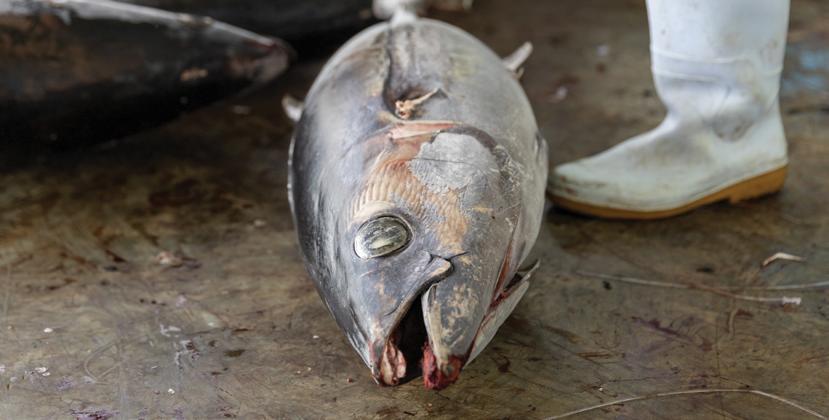
if they leave before the fishing trip starts.40
“The captain is responsible, because before he comes on board, for example, if he wants to bring something, we've already coordinated that if it's stolen, it's the captain's responsibility, because it's his own people. If it's not his own people, we don't hold the captain responsible, because he's the one carrying it, and if it's the captain's own people, the compensation is different.” (Fishing vessel administrator)
LABOUR CONDITIONS: PUSH TO MEET STANDARDS AMID TUNA UNPREDICTABILITY
Due to unpredictable weather conditions, increasing competition, and depleted fish population, vessels are often unable to break even with a single fishing operation.41 This results in longer working hours, impacting workers' rest time. Fishers on at least four of the 17 fishing vessels said they experienced excessive working hours, resulting in sleep deprivation.
“When we work, we can't count the hours. Because the sea situation is sometimes unpredictable. It can happen suddenly, just like that from the currents, waves, wind. Sometimes we predict the wind will still be like that on a certain date, but the captain says we can't pass it. But suddenly the wind from behind just came.Well, it's a fatal risk. The safety of the boat, the safety of all of us, because the boat must be stable. When we pull in the fish, the boat stops. Waves from the side are dangerous. That's why it's safer to stop at that time. Sometimes we also stop in the middle of the trip. It's better to be cautious”. (A Fisher from Benoa Port)
Meanwhile, fishers on purse seine and handline fishing vessels in Kendari and Bitung also experience unpredictable and inconsistent working hours due to weather conditions. Handline fishers in Kendari stated that during the rainy season, their vessels could only catch 300-400 kilograms of tuna per trip, half their total catch during the peak fishing season, which reached 700-1,000 kilograms. Further, Kendari Port data shows that overall annual production volume decreased from 18,000 tons in 2020 to 13,000 tons in 2024.42



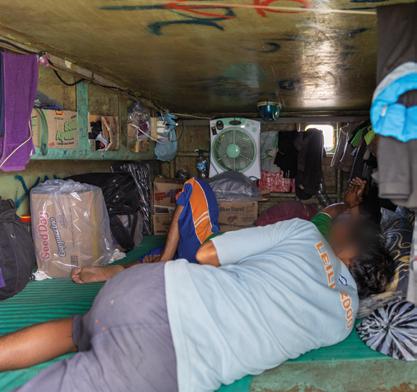
The living conditions reported to have been experienced by the interviewees onboard fishing vessels would also not meet C188. Poor air circulation and cramped sleeping quarters were inadequate for the number of fishers on board, forcing many to sleep on the open deck. Such extreme conditions—combined with low
temperatures—expose workers to respiratory illnesses such as asthma and pneumonia, while access to proper medical treatment remains limited.43 A fisher from Jakarta Port reported that only basic cold medicine was available on board, insufficient to address serious injuries or illnesses that may occur during fishing operations.
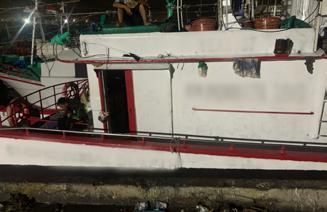
The conditions are most severe for fishers on purse seine and longline vessels, which operate on the high seas for periods of up to 16–18 months. Longliner vessels prefer to use transhipment rather than the vessel returning back to the dock, extending time at sea for the workers.44 In addition to inadequate living conditions, fishers face extreme isolation due to limited or restricted communication. Fishers from a fishing vessel in Benoa and a purse seine vessel in Jakarta reported that while their vessels were equipped with Wi-Fi, they were not permitted to access the network or communicate with their families.
Fishers on board are also vulnerable to violence.
One fisher on the fishing vessel from Benoa Port reported he was injured by the captain for encouraging his crew members to rest after working a full 24-hour shift. When the worker was injured, he received no medical attention.
“I’d already worked 24 hours straight, and he told me to keep going. So I told the guys to go to sleep. They all went to sleep. The captain came and got mad, like, “Who told you guys to sleep?” It turned out it was me, so he started picking a fight. I went along with it. At first, he wasn’t holding anything. Then suddenly, he picked up a fish bone and stabbed me with a sharp fish bone until it left a hole. It didn’t get stitches and just healed recently.”
(Fisher from Benoa Port)
In Indonesia, fishers may be paid through either a profit-sharing scheme or a monthly salary, as stipulated under MMAF Regulation No. 33 of 2021.45 Field findings indicate that the payment method used is related to the fishing gear—with owners of purse seine and handline vessels preferring profit-sharing, while owners of longliners choose monthly salary. However, both systems posed vulnerability and risks of deception and wage withholding, particularly given the lack of transparency in how total profits are reported by captains and companies.
All fishers that we interviewed who were paid by a profit-sharing payment system said their salary was unpredictable due to changes in season and catch. Fishers also reported they have no access to transparent information on the vessel’s total revenue, which is used for profit calculations. On vessels that use a profit sharing payment system, financial transparency is absolutely necessary to ensure crew are paid fairly. A lack of transparency is a strong indicator for deception.
Those employed on territorial fishing vessels faced additional challenges, as they often lacked written contracts specifying payment amounts and schedules, further increasing their risk of exploitation. 50% of profit-sharing fishers we interviewed experienced the ILO forced labor indicator of deception, as they did not have a contract or access to vessel financial information, practices that are considered deception.
In Bitung, handline fishers were also exposed to potential fraud during the assessment of their tuna catch by company-appointed inspectors or “checkers”. These checkers, who represented the company, held the authority to grade the quality of the tuna, which directly determines its
price, and consequently the fishers’ earnings. On handline vessels, fishers receive a share of the fish that they individually catch. Fishers interviewed expressed a lack of confidence in the accuracy and fairness of these assessments, as the checker’s position is not independent. Any manipulation in documentation of grading directly reduces fishers' payment.
Under this system, for instance, as of May 2025, Grade A yellowfin tuna is valued at IDR 60,000, Grade B at IDR 55,000, and Grade C at IDR 40,000 per kilogram. Each of the fishers receive 30% of the total catch value based on these grades (see price chart for details).

In cases where the fishing trip was unprofitable and failed to cover operational costs, fishers received only bonuses or even zero rupiah— depending entirely on the captain’s subjective assessment of each worker’s performance. At least 46% of fishers from profit-sharing vessels said they experienced withholding of wages. If the trip was
unprofitable, they did not get paid and felt they had no choice but to board the vessel again hoping for better luck in the next trip. The absence of clear and transparent standards, written agreements, and independent oversight mean fishers operating under this system are highly vulnerable to manipulation and abuse.

The potential for manipulation also existed in Kendari, where fishers were paid after ten fishing trips, usually every 3-4 months, based on a profitsharing system. This is a clear indicator of forced labour, as fishers are obligated to continue working in order to receive already accrued wages. Fishers reported a lack of transparency, as profit calculations are determined entirely by the vessel owner, with some not informed of the total profit at all.
In Kendari, fishers working aboard purseiners, were invited to “invest” by contributing to vessel operating costs such as fuel, ice, and food, with higher contributions promising greater profit shares. However, fishers reported having no knowledge of how their money was managed, the actual operational costs, or the vessel’s net profits. Since these arrangements were only verbal and lacked formal agreements, fishers had no means of legal recourse, leaving them vulnerable to fraud and
As a result of unpredictable payment and withholding of wages, fishers we interviewed in Kendari brought their own fishing equipment and cool box to catch their own fish, including yellowfin tuna and and by-catch sharks. The fishers did their individual fishing during the rest hours. Their individual catches were sold to local markets and cold storage based in Kendari. According to the fishers, the income from individual fishing was bigger than the money they got from profit-sharing.
In Benoa, longline vessels applied a monthly wage system—IDR 3.2 million (AUD 294) per month, aligned with the Bali provincial minimum wage. However, all of the salary-based fishers we interviewed experienced the debt from recruitment fees and “advanced loans”, which bind fishers to the job as they are forced to pay the debt through wage deductions. So, even though the nominal wage matches the minimum standards, deductions render the actual income significantly lower.
Top Left
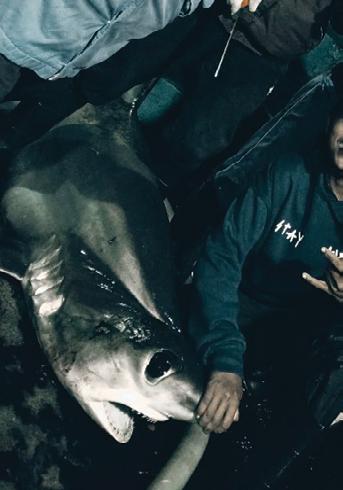
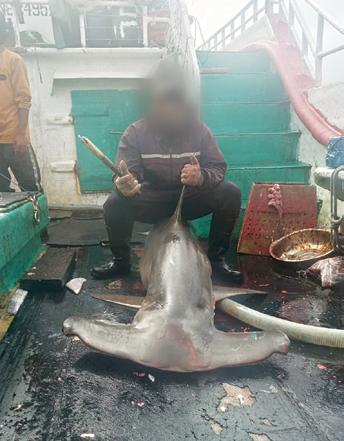
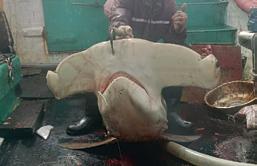
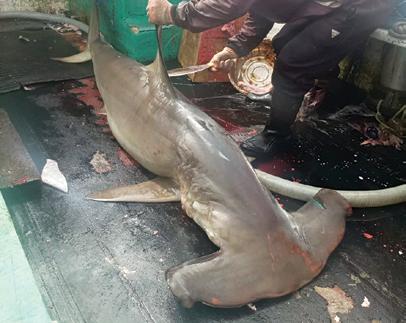
A shark caught as a by-catch.
Top Right
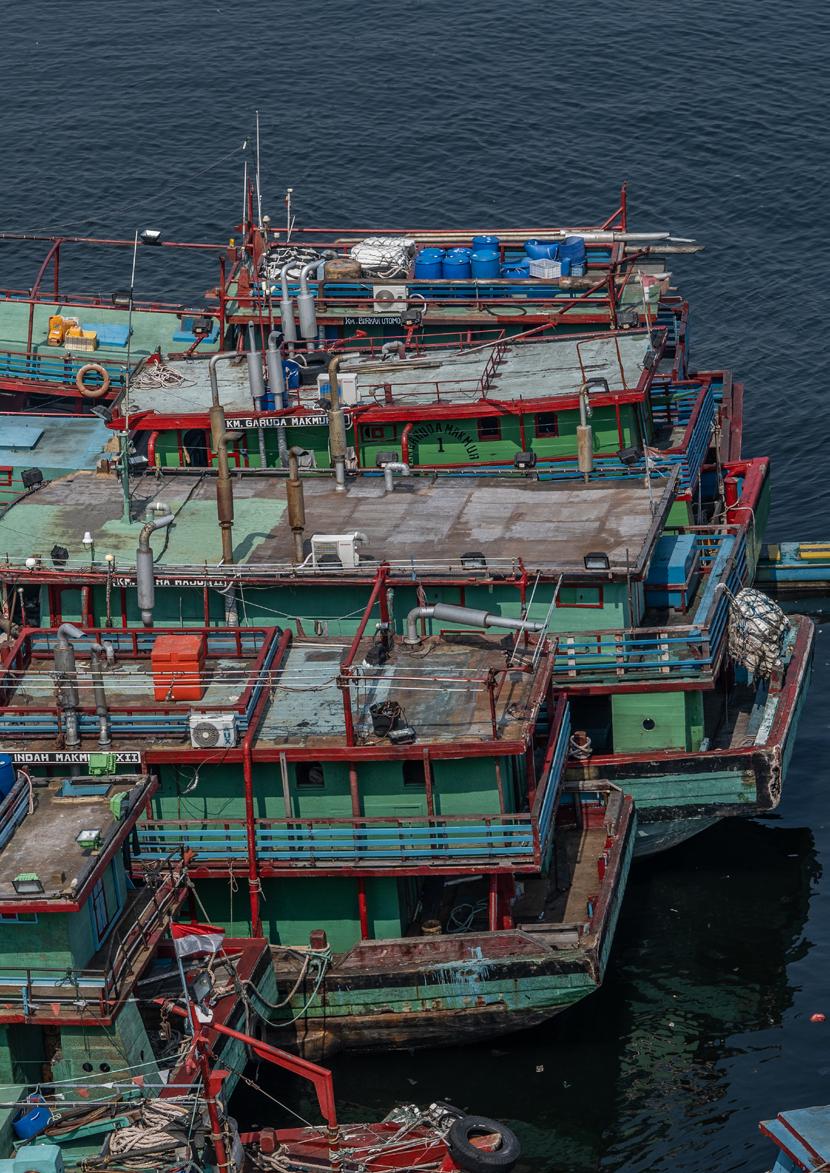
A line of fishing vessels at Nizam

The isolated nature of fishing activities created loopholes for not only for human rights violations, but also for Illegal, Unreported, and Unregulated (IUU) fishing.
In the Indian Ocean, for example, one fisher from Benoa Port stated that they practiced shark finning. The fishers on from tuna longline vessel from Benoa, which operated in the same fishing ground, said their vessel caught various marine species as bycatch, such as penguins, seals, and even a false killer whale (pseudorca crassidents)¸ whose teeth were removed before being thrown back into the ocean. Similarly, one purse seiner in Kendari caught silky sharks (Charcharhinus falciformis) and sold them to a local market for a cheap price (IDR 50,000 or AUD 2.77).46
According to the MMAF Regulation No. 33 of 2021, fishing vessels are obligated to record their catches in a logbook.47 In MMAF assessment of FIP Benoa longline vessels in 2025, gaps of logbook compliance are reportedly still present. Only 15.7% of trips were reported, 0.5% of setting points (the location of fishing operation) were reported on land instead of at ocean, and there were reportedly at least 4.5% setting points not aligned with permitted fishing areas.48 The quality and accuracy of logbooks remain an issue. The FIP also admitted there are still gaps between the total catch reported in the logbook versus with the actual landing in port, as the logbook only contains an estimation.49
Logbook compliance for fishing vessels that registered under the FIP led by PT Aneka Tuna Indonesia, which includes purse seine vessel from Jakarta Port, are also noted as needing improvement.50 Meanwhile, Indian Ocean Tuna Commission (IOTC) declared that yellowfin tuna stocks in the Indian Ocean, particularly FAO51 where this FIP operates, are already overfished.51
Aside from the logbook, another way to curb IUU fishing is by deploying onboard fishery observers. Indonesian law requires having a fishery observer onboard to record fishing ground, catch per unit efforts, and bycatch. In the Indonesian Tuna and Large Pelagics FIP that PT Intimas Surya is part of, the number of observers mandated by the government remains low.52 In 2025, MMAF reported that some observers were under the procurement of private sectors.53 Moreover, the MMAF letter in 2025 stated that observer deployment in both territorial and high seas should be funded by the fishing vessel owner or carrier vessel owner, and that the payment should be made to the observer deployment agency.54 This creates the potential for conflict of interest for observers.
According to the MMAF’s Ministerial Regulation No 18 of 2021 on Fishing Gears, all FADs deployment shall have permission and be registered.55 In 2022, MMAF listed a total of 3,443 registered FADs across territorial waters—with FMA 572 having the most FADs and FMA
714 as the only FMA without any registered FADs. However, we found at least four purse seiners in Kendari, used FADs that covered between 800-1,000 metres. In one fishing operation, the fishers admitted FADs could gather 2-3 tonnes of fish. Aside from FADs, one purse seine from Kendari also practiced transhipment at sea with other purse seiners, despite the fact that it is not registered as a transhipment vessel. Based on our interviews with fishers from purse seiners in Kendari, we learned that they used FADs to catch fish and the locations were based on agreement among fishing vessel owners.
According to a community-based organization in Bitung, the proliferation of FADs by industrial fishers in Bitung has caused the small-scale fishers to only get ‘leftover’ fish as the FADs were installed near their fishing territories.56 They estimated that building a FAD requires IDR 40 million (AUD 3,680), which is not affordable for most small-scale fishers. This indicated that the fishing ground is controlled by fishing companies.
8.
Sources: MMAF Decree No. 7 of 2022 on the Allocation of FAD on the Track-III Fishing Ground in the National Fishery Management Area
In the global tuna industry, labour is treated as a commodity and the exploitation of fishers through predatory debt is common, benefitting the whole system.
Its purpose appears to be to control fishers and ensure the availability of cheap labour while maintaining low tuna prices. At this stage, fishing vessel owners allegedly profit from paying less on recruitment and vessel conditions, while the fishers reportedly provide labour to meet target production, and the break even of expenses.
Meanwhile, the processing companies based in Indonesia can profit from tuna supply without taking any responsibility to protect fishers or oceans and fish populations, relying on the excuse that they do not directly own the fishing vessels.
At the top of the value chain, retailers and brand owners appear to hold the biggest sshare of power and profit but allegedly underutilize it: they have the economic power to greatly influence price and large scale market access, while they allegedly externalize supply chain responsibility to the processing plants and vessels in Indonesia. On top of all that, ecolabels and certifications claimed by brand owners and retailers are appear to be no more than a marketing strategy it allegedly does very little in actually protecting fishers and the ocean
To maintain this system, the tuna industry operates in the shadows. Outside of fishing grounds in the middle of the ocean, without providing WiFi to the crew, it’s not possible for many to know what is happening; if a fisher is being forced to work or endangered species are being caught. The majority of fishing operations still remain unrecorded and without an official observer on board. Transparency failures protect the tuna industry from scrutiny allowing it to earn more profit rather than protecting the environment and the workers who provide the backbone of the whole endeavour.

To end the exploitation, systemic change is needed, and key players such as retailers, brands, and governments, have the biggest responsibility to improve the situation. The Greenpeace global network’s Beyond Seafood Campaign has called for concerted action by all stakeholders and governments along the seafood supply chain TO END ISOLATION AT SEA. This includes:

Freedom of association and access to unions for workers are key enabling rights to ensure a strong worker voice and protections across the various stages of the supply chain. It is essential to have accessible grievance mechanisms, including those
Free, accessible, and secure Wi-Fi on all fishing vessels to allow fishers to have contact with their families, unions, and governments. Capping time at sea to three months to reduce the risk of human rights abuse, forced labour, and human trafficking. 100% human or electronic observer coverage to ensure vital data on catch composition, bycatch, interactions with protected species, and overall fishing practices are reported by independent and impartial parties.
available at sea, that are secure and responsive. These mechanisms should allow workers to raise issues as they arise, and companies must respond promptly, providing remedies and directly addressing the root causes of the problems.
Fishers become ensnared by the debt market caused by shelter, training and transport fees that get charged to the fisher resulting in instant debt to the vessel owners.
Labour market that is dominated by the layers of brokers.
Fishing vessel owners that force fishers to meet targets.
Processing companies who maintain their reputation with a series of audits and certifications.
And finally retailers who decide which product can be marketized.
Supplier Audit
Sells
Wild Capture Fishery operator
Canned tuna industry
Process and Packaged canned tuna
Non-branded tuna industry
Ecolabelling standards Sourcing standards
Foreign canning
Exports
Exports
Exports
Ecolabelling standards
Sourcing standards
Competitive Disadvantage
Sourcing standards:
100% electronic monitoring Third party certification
Foreign processing company
Process and Packaged canned tuna
Branded Product
International retails
Exports
Reputational damage Less sale
Ecolabelling standards Sourcing standards

Greenpeace Southeast Asia and Uniting Church in Australia, Synod of Victoria and Tasmania, have the following demands:
Negotiate in good faith with fishers unions to sign collective bargaining agreements
Mandate fishing vessels to install WiFi, thus enabling the creation of fishers unions and ending isolation at sea. States should provide effective and appropriate non-judicial grievance mechanisms, alongside judicial mechanisms, as part of a comprehensive state-based system for the remedy of business-related human rights abuse.
Mandate direct hiring for fishing companies with technical assistance from the Ministry of Manpower.
Prohibit charging of all recruitment fees and related costs to fishers; require employers to bear the full cost of placement and deployment; monitor and enforce regulations related to recruitment fees.
Mandate the Ministry of Marine Affairs and Fisheries to maintain a public blacklist of companies involved in recruitment-related debt or wage violations.
Provide open, public access to full fishing vessel data, including licenses, gear, beneficial ownership, catch volume, and transshipment authorizations.
Mandate and implement mandatory Human Rights and Environmental Due Diligence (mHREDD) across all seafood supply chains.
Suspend or revoke the membership of vessel owners involved in perpetrating forced labour indicators, including but not limited to, wage withholding, document confiscation, or debt-based recruitment.
Build business relationships exclusively with suppliers that are verified to operate free from forced labour.
Publish regular sustainability and labour compliance reports accessible to buyers and the public.
Limit fishing vessel operation time at sea to three months and end transshipment at sea.
Increase the personnel and fair distribution of fishery observers according to the FMAs.

Mandate full traceability and public transparency of tuna products from recruitment agency to retail shelf. Ensure that trade agreements between Indonesia and Australia explicitly prohibit forced labour and IUU fishing, including its monitoring and enforcement.
Take necessary actions to allow importation data from the Australian Government’s Integrated Cargo System (ICS) to be publicly accessible, helping to identify Australian importers sourcing from businesses overseas involved in modern slavery.
Introduce and pass legislation to include forced labour in the definition of IUU Fishing in Australian law, to ensure that seafood produced with the involvement of forced labour is subject to the same sanctions and restrictions as other IUU seafood.
Integrate forced labour and human trafficking indicators into regional anti–IUU fishing frameworks and port inspection protocols.
Introduce, pass and implement mandatory Human Rights and Environmental Due Diligence (mHREDD).
Introduce, pass and implement legislation making it illegal to import products produced with forced labour, including instituting a forced labour import ban.
Empower the Australian Border Force to seize goods before they enter the country when there is strong evidence the goods have been produced through modern slavery.
Introduce, pass and implement legislation making it illegal to import seafood produced with IUU fishing. Such a requirement should be modelled on the Illegal Logging Prohibition Act and the Fisheries Import Control Scheme
Establish an import control scheme to prevent seafood products tainted with IUU Fishing and forced labour from entering the Australian Market.
Require seafood processors and exporters to trace and disclose the original source of imported raw materials, including vessels and recruitment chains.
Ratify and effectively implement ILO Convention 188 (Work in Fishing Convention, 2007).
1. Randi is a fictional character based on the stories of fishers interviewed in Benoa Port, including researcher observations on the conditions in the port
2. Conversion based on the November 2025 exchange rate: 1 AUD = 10,734 IDR
3. Sirena Tuna La Vita Lite in Oil 95g. https://www.woolworths.com.au/shop/productdetails/263409/sirenatuna-la-vita-lite-in-oil
4. Harmonized code 03034 (frozen albacore), 030342 (frozen yellowfin tuna), 030343 (frozen skipjack), 030344 (frozen big eye tuna), 030487 (frozen fillet tuna), 160414 (prepared and preserved tuna tuna)
5. Indonesia Bureau of Statistics, https://bps.go.id
6. Trademap, https://www.trademap.org/,
7. Tradedata, https://tradedata.pro/
8. Fishery improvement project, https://fisheryprogress.org/fip-directory
9. Indonesian Skipjack, Yellowfin and Albacore tuna of Western and Central Pacific archipelagic waters and Indian Ocean pole-and-line and handline, MSC Fisheries, certified since 26 January 2021 (certificate expires 25 July 2026), accessed February 18, 2026, https://fisheries.msc.org/en/fisheries/indonesianskipjack-yellowfin-and-albacore-tuna-of-western-and-central-pacific-archipelagic-waters-and-indianocean-pole-and-line-and-handline/
10. Ministry of Marine Affairs and Fisheries (MMAF). (2024, May 2). World Tuna Day, MMAF will improve the quality and market outreach of Indonesia Tuna. https://kkp.go.id/news/news-detail/hari-tuna-sedunia-kkpakan-tingkatkan-kualitas-dan-jangkauan-pasar-tuna-indonesia.html
11. Aggregate of albacore, frozen yellowfin tuna, frozen skipjack, big eye tuna, frozen fillet, and canned tuna.
12. Havice, E., & Campling, L. (2017). Where chain governance and environmental governance meet: Interfirm strategies in the canned tuna global value chain. Economic Geography, 93(3), 292–313. https://doi.org/10.10 80/00130095.2017.1301939
13. Ministry of Marine Affairs and Fisheries. (2025) Business Licensing Services for Fishing and Fish Transport Sub-sector (Indonesian: Layanan Perizinan Berusaha Subsektor Penangkapan dan Pengangkutan Ikan) https://perizinan.kkp.go.id/grid.php?target=aktif&doc=6&q
14. PT Samudra Mandiri Sentosa and PT Bintang Mandiri Bersaudara company certificates.
15. Fishery Improvement Project No 24611. Indonesian Skipjack, Yellowfin, and Big Eye Tuna – purse seine (Vessel list). https://fisheryprogress.org/system/files/documents_vl/Indonesia%20Indian%20Ocean%20 skipjack%2C%20yellowfin%20and%20bigeye%20tuna_purse%20seine_0724_FP%20Vessel%20List_v1.2_ FINAL_rev.xlsx
16. Tuna Australia. Tuna Australia Trading: Diversifying the tuna industry. https://tunaaustralia.org.au/tunaaustralia-trading-diversifying-the-tuna-industry/
17. TradeMap (2025). Harmonized code 16041411 import to Australia. September 2025
18. TradeMap (2025). Harmonized code 16041411 import to Australia. September 2025.
19. Company Certificate of PT Damena Sumber Rejeki.
20. Analysis based on Tradedata.pro on HS Code 03034200, 03034300, 03034700, 03034900, and 16041414, 03048700 (2020–2025).
21. Interview with seafood company association, August 2025.
22. Interview with seafood company association, September 2025.
23. Interview with seafood company association, September 2025
24. Fishery Improvement Project No 24611. Indonesian Skipjack, Yellowfin, and Big Eye Tuna – purse seine, Vessel list. https://fisheryprogress.org/system/files/documents_vl/Indonesia%20Indian%20Ocean%20 skipjack%2C%20yellowfin%20and%20bigeye%20tuna_purse%20seine_0724_FP%20Vessel%20List_v1.2_ FINAL_rev.xlsx (duplicate retained)

25. Fishery Progress. (2024). Indonesia Indian Ocean skipjack, yellowfin and bigeye tuna purse seine fishery pre-assessment report. https://fisheryprogress.org/system/files/documents_assessment/MSC-PreAssessment-Reporting-Template-v4.1_PS%20Tuna%20IO_010824_rev.pdf
26. ATI Supplier Audit. (2025). Fishery Improvement Project 24611. https://fisheryprogress.org/system/files/ ATI%20Suppliers%20audit%20on%20February%202025.pdf
27. Fishery Improvement Project No 9336. Indonesian Southeast Sulawesi Yellowfin Tuna and Skipjack –purse seine. https://fisheryprogress.org/system/files/documents_vl/Vessel%20List%20-%20Fishery%20 Progress%2014.02.2025.xlsx
28. Human Rights and Social Responsibility Statement. Fishery Improvement Project 9336 https:// fisheryprogress.org/system/files/ATI%20Suppliers%20audit%20on%20February%202025.pdf
29. Human Rights and Social Responsibility Statement. Fishery Improvement Project 9336 https:// fisheryprogress.org/system/files/ATI%20Suppliers%20audit%20on%20February%202025.pdf
30. MMAF admits paying attention to fishers with some regulation. Antara News, March 15, 2024, https:// www.antaranews.com/berita/4012203/kkp-akui-perhatikan-pekerja-kapal-perikanan-lewat-sejumlahregulasi
31. Mochtar, M. Z., Suhufan, M. A., Nugroho, F. E., & Choir, M. (2023). The Precarity at the Sea: The Experience of the Domestic Fishery Vessel Workers in Indonesia. Journal of Human Rights and Peace Studies, 9(2), 158–185.
32. Mochtar, M. Z., Suhufan, M. A., Nugroho, F. E., & Choir, M. (2023). The Precarity at the Sea: The Experience of the Domestic Fishery Vessel Workers in Indonesia. Journal of Human Rights and Peace Studies, 9(2), 158–185.
33. Interview with fishing vessel administrator, Benoa Port, August 2025.
34. This is a result of the fishing vessel company not paying the broker for a worker who leaves; meanwhile the broker has already paid for that worker’s transportation, advance loan, and training.
35. Ministry of Manpower Regulation No. 18 of 2024 on Placement of Indonesian Workers
36. MMAF Regulation No. 33 of 2021 on Fishery Logbook, Observer in the Fishing and Transshipment Vessel, Inspection, and Governance of Fishing Vessel Crew
37. Interview with fishing vessel administrator, Denpasar, August 2025.
38. Government Regulation No. 85 of 2021 on Type and Tariff that Applicable in the Ministry of Marine Affairs and Fisheries
39. Ministry of Maritime Affairs and Fisheries Regulation No. 33 of 2021
40. Interview with fishing vessel administrator, August 2025
41. Campling, L. (2012). The tuna ‘commodity frontier’: Business strategies and environment in the industrial tuna fisheries of the Western Indian Ocean. Journal of Agrarian Change, 12(2–3), 252–278. https://doi.org/10.1111/j.1471-0366.2011.00354.x
42. FisheryProgress. (2024).Implementing of PIT Policy at Fishing Port Kendari Ocean, https:// fisheryprogress.org/system/files/2024_12_10%20PPS%20Kendari%20VMS_SpotTrace_catch%20data.id_. en_.pdf
43. Imron, M., Tawaqal, M. I., & Yusfiandayani, R. (2021). Fishing ground and tuna productivity by tuna longline based on Benoa Bay, Bali, Indonesia. Biodiversitas, 22(2), 961–968. https://doi.org/10.13057/ biodiv/d220252
44. Campling, L. (2025). Labour regimes in industrial tuna fisheries. Journal of Economic Geography. https://doi.org/10.1093/jeg/lbaf018
45. MMAF Regulation No. 33 of 2021 on Fishery Logbook, Observer in the Fishing and Transshipment Vessel, Inspection, and Governance of Fishing Vessel Crew
46. The investigation team tracked fishing vessels landing in Kendari and the distribution of sharks in Kendari Port market; findings supported by interviews with shark traders.
47. MMAF Regulation No. 33 of 2021 on Fishery Logbook, Observer in the Fishing and Transshipment Vessel, Inspection, and Governance of Fishing Vessel Crew
48. Fishery Improvement Project. (2025). Meeting Notes – Coordination Workshop for Indonesia Tuna Longline FIP https://fisheryprogress.org/system/files/260625%20-%20Notulensi%20Tuna_Longline_FIP_ Coordination_Meeting_MoM%20ENG_26_June_2025.pdf
49. FisheryProgress. (2024). MoM feedback and evaluation e-logbook and observer onboard meeting with Head of Fishing Port Pengambengan [Meeting minutes]. https://fisheryprogress.org/sites/default/files/ documents_actions/100624%20-%20MoM%20Feedback%20and%20evaluation%20e-logbook%20and%20 observer%20onboard%20meeting%20with%20Head%20of%20Fishing%20Port%20Pengambengan_0.pdf
50. FisheryProgress. (2024). E-Logbook Submission Compliance 2022–2024 https://fisheryprogress.org/ system/files/ELogbook%20SubmissionCompliance%202022_2024_1.pdf
51. IOTC. (2023). Stock Status Executive Summary: Yellowfin Tuna (2023). https://iotc.org/sites/default/files/ content/Stock_status/2023/Yellowfin_ES_2023.pdf
52. FisheryProgress. (2025). FIP letter to PSDI stating FIP support to observer program [Letter]. https:// fisheryprogress.org/system/files/300625%20-%20FIP%20letter%20to%20PSDI%20stating%20FIP%20 support%20to%20observer%20program.pdf
53. https://fisheryprogress.org/system/files/260625%20-%20Notulensi%20Hasil%20Pertemuan%20 Koordinasi%20FIP%20Tuna%20Longline%20Indonesia.pdf
54. Circular Letter of Directory of Wild Capture Fishery No. B784/DJPT/HK.410/VII/2025
55. MMAF’s Ministerial Regulation No. 18 of 2021 on the Placement of Fishing Gears and Fishery Aggregating Devices in Indonesian Fisheries Management Area and High Seas Fishing Gears
56. Interview with Community-based organization, Bitung, May 2025

Greenpeace Southeast Asia sent the rights-to-reply letter on January 30, 2026, to 7 Indonesian companies, and 10 Australian companies.

PT SAMUDERA MANDIRI SENTOSA
On Feb. 6 , 2026, PT Samudera Mandiri Sentosa sent a reply confirming that the company receives supply from two vessels (KM Dioskuri 8 and KM Jaya Bali Bersaudara). They also sent a document explaining supplier code of conduct, supplier audit checklist, approved fish supplier, and whistle blower procedure.

On Feb. 2, 2026, PT Intimas Surya sent a response confirming the mentioned vessels supplied to Coral Sea Fishing Pty Ltd. PT Intimas Surya also cooperatively disclosed their list of vessels, human rights improvement standards, and evidence of improvement on the recruitment system.

PT ANEKA TUNA INDONESIA
On Feb. 12, 2026, PT Aneka Tuna Indonesia sent a response stating that their vessel, KM Terbit, has undergone due diligence under the FIP Scheme.
PT Aneka Tuna Indonesia did not comment on the remaining vessels: KM Dioskuri 08, KM Jaya Bali Bersaudara 10, Cahaya Pangkep 01, Adriel 07, Saint Lucia, Cari Selamat, Duta Mas 5, and Era Mas III.

PT SINAR PURE FOODS INTERNATIONAL
On Feb. 12, 2026, PT Sinar Pure Food International sent a response stating the alleged vessels did not supply to their company. According to PT Sinar Pure Food International, their supplying vessels are all equipped with complete legal documents required by MMAF and Fishing Port Authority and that they have a traceability policy that enables tracing t o vessels.

PT PAHALA BAHARI NUSANTARA
On Feb. 12, 2026, PT Pahala Bahari Nusantara sent a response stating their suppliers are small-scale fishers that are currently engaged in fisheries improvement efforts.

PT GABUNGAN ERA MANDIRI
The company did not respond to Greenpeace Southeast Asia’s letter by Feb. 13, 2026. On 28 Feb. 2026 the company informed us that it does not have ownership of the Duta Mas 5 and Era Mas 3 vessels, and that it does not own or operate any vessels. The company stated it was committed to maintaining transparency and compliance in all its operations.

PT BINTANG MANDIRI BERSAUDARA
The two companies did not respond to Greenpeace Southeast Asia’s letter as of Feb. 13, 2026.

SAFCOL TUNA AUSTRALIA
On Feb. 4, 2026, Safcol Tuna Australia sent a reply denying that their tuna is supplied by mentioned vessels.

JFC AUSTRALIA
Greenpeace Southeast Asia’s letter bounced back due to invalid email address.

CORAL SEA FISHING PTY LTD
On Feb. 4, 2026, Coral Sea Fishing Pty. Ltd. sent a reply denying forced labour indication in their supply chain.

ICONIC FOOD DISTRIBUTION

SHAFFER HAGGART, ENTYCE FOOD INGREDIENT, NEW WEST FOOD PTY LTD, AND JUN PACIFIC CORPORATION
The four companies did not respond to Greenpeace Southeast Asia’s letter as of Feb. 13, 2026.
On Feb. 13, 2026, Iconic Food Distribution sent a reply stating Iconic Food Distribution does not source from the alleged vessel and denied forced labour indication in KM Terbit.


NIPPON FOOD SUPPLY COMPANY & SUSHI SUSHI PTY LTD
Greenpeace Southeast Asia could not find the two companies’ official email addresses.

Thailand Office 1371 Capital Mansion, 1st Floor, Phahonyothin Road., Phayathai, Bangkok 10400 Thailand
Tel: +66-2-357 1921
Fax: +66-2-357 1929 info.th@greenpeace.org
Indonesia Office
Jl. HOS. Cokroaminoto No.19, RT.1/RW.3, Gondangdia, Menteng, Jakarta Pusat, Jakarta 10350
Tel : +62 21 3148521 info.id@greenpeace.org

Philippines Office Room 201 JGS Building, #30 Scout Tuason Street, 1103 Quezon City
Tel: +63-2-332-1807
Fax: +63-2-332-1806 info.ph@greenpeace.org
Malaysia Office
L5-3A Menara Sentral Vista 150 Jalan Sultan Abdul Samad Brickfields, 50470 Kuala Lumpur
Tel: +603-22762022
Fax: +603-22762025 info.my@greenpeace.org
www.greenpeace.org/seasia