G REEN Magazine ®
September 2026
In This Issue… 630 Ignition
The 720
Seat Repair
WHAT A DEAL! SPECIAL BUNDLE PRICE Book bundle: Green Magazine
on these TWO books published by Green Magazine
A Specialized Look Into
The Unstyled Model A The Handbook of the John Deere Model A 1934-1938
Fourth Edition • By Wes Malcolm Now in its fourth printing with 15 more pages, this is the handbook of the John Deere model “A,” 1934-1938. A book that should be on the “must read” list of any unstyled “A” owner. There is probably no other book on the market that goes into so much detail on a single model of tractor. Shows illustrations of nearly every change made in the parts that make up the unstyled “A.” 95 pages, 11x8-1/2 inches, soft cover.
Both books include history, specifications, serial numbers, original prices and much more
A Specialized Look Into
The Unstyled Model B The Handbook of the John Deere Model B 1934-1938
The same types of information as available in the book above, except now about the model “B,” written and compiled by a panel of experts who have spent decades collecting and restoring the unstyled version of Deere’s most popular tractor. This book shows nearly every change made in the parts that make up the unstyled “B.” 84 pages, 11”x8 ½”, soft cover, over 200 photos - most in color.
Order GMAB: $63.95 U.S.
$76.95 Canada (US funds ONLY) • $89.95 Foreign (US funds ONLY) The prices shown here are for BOTH books shown above - the first time for this BUNDLE DEAL. •• Prices in this BUNDLE DEAL are up to 20% OFF the regular price •• Visa, Mastercard, Discover, American Express accepted
Call
402-643-6269 • Email info@greenmagazine.com Online www.GreenMagazine.com
Mail Green Magazine® • PO Box 165, Perryville, MO 63775
2027 Calendars
This is one of the 12 photos that will appear in the 2027 Green Magazine calendar.
Tractors pictured in Green Magazine’s 2027 calendar are from 1937 — the whole calendar is designed to resemble one from that era.
• Only a limited number of calendars are produced so ORDER EARLY before they are gone! •12 high quality, professional photos on each calendar • Photo size is 11” wide x 8-1/2” deep • Calendar when fully displayed is 11” wide by 18” deep • Price includes shipping • Proudly printed in the USA • Call, go online or send a check to place your order Green Magazine’s calendar is a customer favorite— order now before they are gone!!
ORDER CODE: 27CA Canada PRICES: PRICES :
U.S. PRICES: PRICES :
1 calendar: 15. $
00
2 calendars: 30. $
00
3 or more: $13.00 each
1: 32. $
00
2: 45. $
00
Foreign PRICES: PRICES : 1: $45.00
2: $55.00
3 or more: $18.00 each 3 or more: $22.00 each
• Prices include shipping • U.S. funds ONLY, please!
Canadian Orders: ONLY credit card and US Bank drafts accepted! • Multiple calendars must be sent to the SAME ADDRESS to receive the discounted price
Phone: 402-643-6269 Mail: Green Magazine
PO Box 165 • Perryville, MO 63775
www.GreenMagazine.com Email: info@greenmagazine.com Web:
Visa, Mastercard, Discover, and American Express accepted Missouri residents add 6.6% sales tax
Each March issue of Green Magazine includes an index of major articles from past issues. The March 2026 issue featured the newest index.
The monthly publication for John Deere enthusiasts
September 2026 • Volume 42 Number 9 8
Editor Tyler Buchheit Managing Editor Teresa Buchheit Layout/Design Teresa Buchheit/ Collin Smith Order Fulfillment Teresa Buchheit
Cindy Ladage
16
John Deere model 720 Benjamin Hain
Mail subscriptions, articles payments and correspondence to:
24
Green Magazine®
Green Paint Texas Pride
PO Box 165 Perryville, MO 63775 Hours: 9 AM to 3 PM M-T-Th-Fr
Eugene Ashley
32
Dan Peterman
Phone: 402-643-6269 email: info@greenmagazine.com www.GreenMagazine.com
Departments
NOTE: VISITS TO OUR OFFICE BY APPOINTMENT ONLY! Please call prior to visiting so we can be here to talk with you. At that time we can also give you our location. Thank you!
Tyler's Column
5 6
Deere John
12
Rates:
U.S.: $39.95 / 1 year - 12 issues $76.95 / 2 years - 24 issues
Too Much Resistance
First Class/Airmail delivery available: See page 5
28
The Young Timer
Canada: $59.95 / 1 year - 12 issues Foreign: $69.95 / 1 year - 12 issues
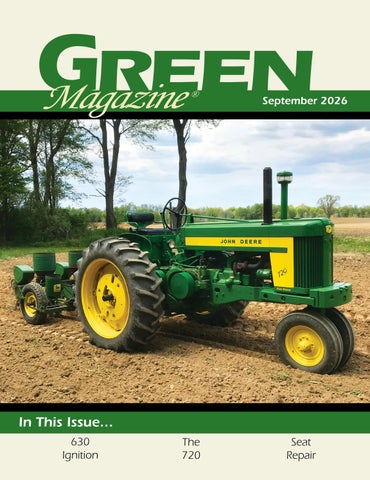
This 720 gas tractor, owned by Keith Eyre of Ceresco, Michigan, is pulling a 290 planter while planting sweet corn.
Do You Have One?
42
New Product Highlight
43
Auction Highlight
New Generation Models Lead The Way in Wisconsin Eric W. Mickelson
46
The Big Question
Closed Wednesday
ON THE COVER:
40
A 45 Year Wait
Tyler Buchheit
Saw It Online Pocket Picks
Tyler Buchheit & Adam Smith
48
What's New—and Old? Tractor Seat Restoration & Repair Ken Nicklas
52
Scale Models
Summer Toy Show And New 1/64th Scale Items Bill Proft
56
The Old Timer
Tractors I Have Known But Wish I Hadn't Richard Hain
35 What's new --- and old?
Tractor Doctor
From The Shop Ain't Life Something Ron O'Neill
69
Desk Drawer Deere Discoveries
Advertiser index
38
Mr. Thinker
Greg Stephen
Deere & There
72
“GREEN MAGAZINE®” (ISSN 0883-5462) is published monthly and released 12 times a year on or about the first of each month
for $39.95 per year (Canada: $59.95 per year; Foreign: $69.95 per year) by Green Iron LLC, 7687 South Hwy 61, Perryville, MO 63775-6207. Periodicals postage paid at Perryville, MO and additional mailing offices.
POSTMASTER: Send address changes to “GREEN MAGAZINE®, PO Box 165, Perryville, MO 63775-0165.” GREEN MAGAZINE® reserves all rights regarding reprints of this publication. Our phone number is (402) 643-6269. Copyright © 2026 Green Iron LLC All rights reserved. Page 4 September 2026 • Green Magazine®
Wow! Moving on to the second issue of producing GM is now under our belts. Time has flown by, and we are getting the office better organized and developing a bit of a routine. Please note that our office hours are Monday, Tuesday, Thursday, and Friday from 9 am to 3 pm Central Standard Time. Wednesdays, we are closed to allow Teresa to focus on homeschooling our four children and to catch up in the office when the phones are not ringing. The corn and soybeans are looking much better here on our southeast Missouri farm after some timely rains. What began as an exceptionally dry spring and early summer has taken a welcome turn. According to our local weather folks, El Niño conditions in the Pacific Ocean have helped shift the weather pattern back in our favor. Our wheat and triticale harvest wrapped up early in June, giving us the opportunity to plant our second-crop soybeans several weeks ahead of schedule. With a little cooperation from Mother Nature, they may even yield well enough to keep that venture in the black. Grain and hay farming in 2026 remain challenging, as many of you know all too well. Low commodity prices, rising input costs, and plenty of uncertainty make it difficult to predict what lies ahead. Agriculture has always adapted to changing times, and this period will likely be no different. That is one reason I enjoy spending time with vintage green and yellow iron. It offers a welcome reminder of an earlier era when the challenges were different, but the satisfaction of working the land remained much the
same. If you know a farmer who could use a break from worrying about today’s markets and tomorrow’s weather forecast, perhaps pass along your copy of Green Magazine or better yet, gift them a subscription. For a little while, it just might remind them why they fell in love with farming in the first place. The 2027 calendar is now available for ordering. There are some really beautiful tractors in this one! 1937 was the 100th-Year Centennial Anniversary of Deere & Company, making it quite an occasion. Could John Deere himself ever imagine his company would be producing tractors small enough to be used on the average farm? It is recorded that John Deere personally attended a demonstration of a 30-horsepower Fawkes steam plow at the Illinois State Fair in 1858. That event surely sparked a lot of ideas in Deere’s mind, making it entirely possible he could have imagined traction engines on many farms and that perhaps his company would engage in the pursuit. Because taking on the magazine business, creating calendars (with the help of some great photographers) and a new school year starting soon didn't quite seem like enough on our plates, we also have three ring binders available again for those subscribers who need to organize their stacks of Green Magazines laying around! Both the calendars and binders will arrive in time for the upcoming holiday season - yes, we too are still enjoying summer and soon fall, but as I noted in the second sentence -- time sure does fly!
Missing an issue? We mail every issue by the first of the month. Please contact your post office if you suspect a problem with delivery. We will not replace missed issues three or more months past original mail date (four or more months for foreign subscribers) free of charge.
receive such a call, it is most likely from another publication—NOT Green Magazine® for John Deere enthusiasts.
U.S. subscribers: If it is on or after the 20th of the month and you haven’t received your issue, call us for a replacement. Canadian subscribers: Due to postage costs, we are forced to ask for a $2 postage fee (U.S. funds, please) for re-sending issues that do not arrive by the end of the published month OR we can add an issue onto your subscription for the missed issue. First Class/Airmail delivery: Call for rates for First Class in the U.S. or Airmail to foreign countries. Foreign subscribers: We will add an issue onto your subscription OR for a $7 airmail postage fee (U.S. funds), we will resend the missed issue two months after publication date. Notice: If your address label shows an expiration date of “9/26” above your name, this is your last issue. Renew immediately for continuous service. If your address label reads “10/26,” you have one more issue on your subscription. Renewal notice: We send postcards to let you know your subscription is about to expire (or has expired). We NEVER call to ask if you would like to renew your subscription. If you
Address Changes: Please send or call with notification of an address change as soon as you know what your new address will be. Periodical mail cannot be forwarded. Green Magazine will not replace issues missed due to late notice of address change. Those missed issues will have to be bought at back issue price. See the back issue listing and prices elsewhere in this issue. Looking for your photos and stories! Accepted material is subject to such revi-
sion as to meet the requirements of this publication. Payment will be made at our current rate within 90 days of publication to current subscribers. Submission of manuscript implies that the material is original and in no way an infringement upon the rights of others. Please send good, clear photographs. If you would like these returned, send us a stamped return envelope to help us get them back to you.
Free Issue Offer: It seems you, our subscribers, are our best form of advertising!
More people find out about this publication by “word of mouth” than other forms of advertising. So if you're enjoying Green Magazine®, why not spread the word? Telling others about it can pay benefits. When you tell a friend about Green Magazine® and they subscribe, make sure they tell us who let them know about it. When they do, you will get an issue added to your subscription. These must be new subscribers, not renewals.
Green Magazine® • September 2026 Page 5
I wanted to share a vintage photo that recently brought back so many memories for me. It was July 1986, on our way to a tractor show in Michigan. My dad bought the J10 Jeep Pickup new in 1984. Hooked behind that was a homemade trailer, which was a popular thing to do at the time. The 1935 “D” is still owned by us, while the 1938 “L” was sold to a John Deere dealer in 1991. Thank you, Eric Sherman
This photo brings back so many good memories. It is of my grandpa, Vernon Dunn, on his beloved 830 plowing corn stalks with a F620H 4-16s plow. This was taken April 24th, 1990, by a professional photographer, Richard A Rygh, and was on the front page of the afternoon paper. Josh Dunn Fitchburg, Wisconsin
I wanted to share a tip for a common problem with the nameplates on the 10- and 20-series New Generation tractors. If your clips are finally rusted off or broken on the hood side of your tractor, a 12-24 die is the right size to thread the aluminum pins for a 12-24 nut and washer. Daylen Borders Pirtle, Texas
Page 6 September 2026 • Green Magazine®
Jim Lundell
family collection auction 1536 380TH STREET, KIRON, IA 51448
AUCTION PREVIEW DATES: Friday, August 21ST, 12-5pm Friday, September 4TH, 12-5pm
BEGINS CLOSING: Wednesday, September 9th, 5:30pm
Auction: Jim Lundell Family Collection
ONLI NE ONLY
712-870-8182 • PAULSENAUCTION.COM Auction: Jim Lundell Family Collection Auction
1990 John Deere 4055 4 post Quad range shows 4865hrs • 1977 John Deere 4630 Power shift shows 7540hrs • 1967 John Deere 2510 diesel power shift 10 hours on overhaul • 1981 John Deere 4440 quad range 4 post shows 0532Hrs • 1981 John Deere 4040 open station quad Range shows 6058hrs • 1972 John Deere 4000 syncro range narrow front shows 1907hrs • 1962 John Deere 4010 Diesel syncro 18.4-34 rears • 1965 John Deere 2010 gas 13.6-36 rears 6.00-14 • 1966 John Deere 3020 Gas Power Shift standard shows 8100hrs • 1975 John Deere 4030 diesel quad rage sound guard • 1975 John Deere 4430 open station quad shows 8651hrs • 1977 John Deere 4230 syncro range open station with WL-40 loader • 1959 John Deere 630 power steering narrow front shows 556hrs • 1959 John Deere 530 has fenders 3 point shows 2529hrs • 1959 John Deere 630 serial# 6314339 has 3 point shows 1158hrs • 1971 John Deere 3020 diesel power shift new tires 10hrs on eng and trans overhaul • John Deere 60 skid loader new tires runs and • John Deere Model L non running engine is loose • 1977 John Deere 4030 diesel quad range shows 0462hrs • 1957 John Deere 420 3 point newer tires ser 118663 • 16-40 rims for an 18.4-30 tire • 9 bolt duals coop 18.4-38 tires • 1981 John Deere 4040 Quad range open station ser 1917 • 1971 John Deere 4320 ser 009110r • 1952 John Deeere 60 ser 6006497 • John Deere 80 3pt blade • John Deere 412-14 2 bottom plow • John Deere 810A 3 bottom mounted plow • 1981 John Deere 4040. Quad range open station • 1964 Farmall 806 diesel shows 8606 hrs • 1963 Farmall 460 gas narrow front 15.5-38 rears • 1955 Farmall 300 narrow front 12.4-38 rears • 1959 International 240 utility • 1953 Super M 13.6-38 rears • 1960 Farmall 560 has 2 point and fenders 15.5-38 shows 5713hrs • 1958 Ford 801 Powermaster 3 point 13.6-28 rears • International 350 Utility
•1958 Farmall 460 THIS IS THE VERY FIRST 460 EVER Made Serial #501
L
ong-time John Deere enthusiast Mark Berkel is a proud member of the Southern Illinois Green Iron Club. Chartered in 2009, the club, commonly known as SIGIC, has a mission to educate preserve, and share farming culture. Part of the fun of collecting, Mark says, “is bringing out the antique tractors, and their implements, and sharing them with the public.” Mark has even been interviewed by Max Armstrong at Rantoul about his John Deere “G” Hi-Crop that he and his father Lawrence owned together. He has promoted the hobby for many years and was instrumental in organizing the National John Deere Model “G” Reunion in 2017, celebrating the tractor ’s 80th anniversary. The event took place in 2017, at the Greenville American Farm Heritage Museum during their Heritage Days. Growing up on John Deere and collecting with his late father, Lawrence Berkel, Mark bleeds John Deere green. While every tractor in his collection holds special meaning, his latest acquisition, a John Deere Waterloo Boy, may be the most significant yet. He recently added a 1920 Waterloo Boy model “N”. “I have always wanted a Waterloo Boy my whole life since I was about 18 years old,” Mark shared. The Waterloo Boy was one of Deere’s early tractors. Developed not long after farmers began Page 8 September 2026 • Green Magazine®
switching from horses to tractors, this was considered a bit of a risky buy at the time. In 1916, four years before Mark’s tractor was built, more than 100 companies were competing in the rapidly growing tractor industry. Deere and Co. jumped into the tractor manufacturing ring when they purchased the Waterloo Gasoline Engine Co. in 1918 for $2.35 million. This date marked Deere’s entrance into the tractor and engine business. Prior to this time, Deere primarily manufactured horse drawn equipment and plows. The Waterloo Gasoline Engine Co. was founded by the inventor of the first gasoline engine tractor John Froelich. He started the company in 1893 with several investors; the
company was officially called the Waterloo Gasoline Traction Engine Company. In 1895, John W. Miller bought the company and shifted its focus toward manufacturing gasoline engines. The Waterloo Gasoline Co. in 1911 started designing tractors again. They first introduced the model “R” Waterloo Boy in 1914. It was a success; they sold over 9,000 model “R” tractors. It was in 1918 that they introduced the model “N” tractor like the one that Mark later purchased. Over the years they sold over 30,000 Waterloo Boy model “R” and “N” tractors until production ended in 1924. Although Deere had purchased the company in 1918, tractors were still produced under the Waterloo Gasoline Engine name, but in 1923 they changed the name to the John
Deere Tractor Company. At this time, they introduced the John Deere model “D”. Advertised as a “One Man Tractor”, the Waterloo Boy had a good run. An original John Deere ad from 1918 stated that the Waterloo Boy Kerosene Tractor sold for $750. In the ad it was claimed, “(The tractor) Is built for the average farm. It is a proven success- Adapted for every power use of field, road and farm. It does the following; plowing, drilling, disking, reaping, binding, threshing, hauling, road work, bridge work, silo filling, any belt work, and heavy sawing AND MAKES YOU MONEY
DOING CUSTOM WORK FOR NEIGHBORS.”(Ad not included with article) The kerosene-burning tractor had long captured Mark’s eye. Several opportunities to purchase one had come and gone over the years, but somehow, they always slipped away. This Waterloo Boy came about in a unique way. He learned about it last year at a show in Pinckneyville, Illinois; it had not yet been advertised. Rochester, Indiana resident James Fred was hired by the owners to get the tractor running and it was James that shared the news with Mark. According to the seller, the tractor had been discovered in
a storage unit near Winamac, Indiana. After the owner’s death, the family stopped making payments and the contents were eventually sold to satisfy the storage fees. Included in the purchase were the Waterloo Boy, a John Deere “B,” and several Firestone tires. The previous owner had begun restoring the Waterloo Boy but never completed the project. As a result, it sat untouched in storage until it was sold. The gas tank on this model “N” was missing when James began working to get it running before it could be put up for sale. James reached out to Mark’s friend Dan Thomas for a Waterloo Boy fuel tank. Dan found a tank along with some other items before coming to help to get the tractor tuned up and running. When the owner decided to sell, James informed Dan, who immediately passed this news onto Mark. He was then able to purchase both the Waterloo Boy and the John Deere “B”. Today the beautiful tractor occupies a special place in Mark’s collection. With the addition of the Waterloo Boy, a dream that began when he was 18 years old has finally come full circle, some 45 years later.
Green Magazine® • September 2026 Page 9
ANTIQUE TRACTOR AND IMPLEMENT AUCTION
JOHN DEERE COLLECTION BELONGING TO THE LATE DAVID THOMAS
Saturday, September 12 @ 10 AM
LOCATION: BLYMYER FARM, 16670 TR 166, ARLINGTON, OH 45814
Just south of Findlay, OH, and SR 15 interchange on SR 37 to TR 166, then east watch for signs.
Owners: THOMAS FAMILY Walter Real Estate & Auctioneers Matt Walter, Katelyn Walter & Kris Gosche Auctioneers 901 N. Main St., Findlay, OH 45840 419-424-0944 Auction: David Thomas Collection
Preview For Auction: September 11 @ 9 AM – 5 PM LIVE AND STREAMING AUCTION Find Complete Listing @ www.walter-auctions.com
Tractors: JD 840 w/ Hancock scraper 8400453 ’59; JD 840 w/ Hancock scraper 8400293 ’59; JD 830I 8303888 ’59 bareback; JD 830 8303030 ’59 disassembled, PTO, dual hyd, PS, pony, restoration started; JD 820 8206475 ’58 no PTO, hyd, PS; JD 820 8204038 ’58 PTO, hyd, PS; JD R 4866 ’50 PTO, hyd; JD 620 6216502 ’58 PS, PTO, hyd, runs needs finished; JD 60 ’53 6016543 aftermarket PS; JD 440I 451691 ’59 parts tractor; JD 430U w/Henry forklift 141626 ’58; JD GM 17187 ’46 w/800 hitch; JD A 649430 ’50 stuck; JD A 502597 ’41 w/loader; JD A parts 674528 ’51 crankcase back parts Dozer: JD 450C ’83, 6-way blade, rebuilt injection pump, unknown hours. Consecutive SN’s JD 80 8000373 ’55 hyd, PS; JD 80 8000374 ’55 dual hyd, PS, PTO, creeper. Garden Tractors: Two JD 110s and Three JD 112s. Trucks and trailer: ’91 IH 4900, DT466, 5 spd, 18’ flatbed; ’59 Chevrolet Viking 60, grain bed; ’97 Hudson HTD18 +5 tandem axle duals trailer, pintle hitch. Many Implements & Misc: complete listing found at www.walter-auctions.com Terms: Cash or check with acceptable ID on sale day. Credit Cards accepted with 4%. Not responsible for accidents or for items after sold. Online terms will be posted on Auction Time.
McDonald: 4020 "Powershift" Diesel
Page 10 September 2026 • Green Magazine®
Auction: Gene Bicknese Estate
Central Fuel Injection Service Martin Repair
MARTIN REPAIR, LLC (574) 862-3910 25720 CR 38 • Goshen, IN 46526
JD 5020, Syncro, dual hydraulics, 3-point, bad engine
JD 6410, 2 WD, cab, PQ trans, runs and drives
Call for more information on these tractors
Green Magazine® • September 2026 Page 11
After countless hours diagnosing, repairing, and restoring a tractor and getting it up and running well, there is a feeling of elation. All that work and effort have paid off, and it can now be appreciated and enjoyed. Knowing how poorly a system on your tractor worked in the past and seeing how much it has improved leaves one with a true sense of accomplishment. You pat yourself on the back for a job well done. Several years go by after enjoying the fruits of your labor. In this case, the topic is my 630 gas row-crop tractor, which has been featured in the YoungTimer countless times over the years. Since overhauling the engine to add horsepower beyond the factory number, the tractor has run excellently in every way. Whether at slow or fast idle, or when pulling any load, the engine never missed a beat. While the tractor was running well, over time there were little things about the 630 that changed. I overlooked the signs and kept on going. The delayed starting that took extra time to crank was the first indication of any problems. After perhaps a few months of not starting and staying running on the first try, the problem worsened: the engine would hit on the crank but die immediately when the starter button was released. I assumed it was fuel-related and would often loosen the knob on the oil pressure shutoff to manually allow fuel to complete filling the carburetor Page 12 September 2026 • Green Magazine®
As any good plowman knows, rusty moldboards aren’t ready for the field.
(Top) View of the fuel system. (Bottom) This carburetor was replaced with a rebuild and worked well for several years. bowl. This helped a little, or at least that is what I told myself. While raking hay this April, the 630 repeatedly fell on its face and died unexpectedly. I managed to finish raking the hay, but while driving back
up to the farm, I had to go in 2nd gear because the engine would die in any higher gear I tried. I kept thinking it was a fuel issue, but now, looking back, I realize there was never any black smoke to indicate one. After pondering the symptoms, I considered it was an ignition issue, but since I had converted it to electronic ignition from the original breaker points many years before without problems, I chose to explore the fuel system. Fuel flow was excellent at not only the drain cock on the carburetor bowl, but also at the fuel sediment bowl. The oil pressure fuel shutoff worked as it should, which was easy to
(Left) View from the seat upon arrival at the neighbor’s field. (Right) The opening furrow from the 630 and 1000 plow. observe while cranking and running. I noticed some fine, rusty sediment at the bottom of the glass bowl and cleaned it out during the fuel flow test. After trying the engine once again, the problems of starting, running, and dying persisted. When discussing my 630 woes with a few fellow tractor buddies, I decided to check the carburetor. I left it on the tractor but removed the bowl and nozzles, only to find everything clean and rust-free. I state this confidently, as the carburetor body and fuel bolt showed evidence of being bead- or sand-blasted; any water, which is lighter than gasoline, would have left its mark as rust or corrosion. Disappointed that I had not
found a ‘smoking gun’ for a problem in the fuel system, I decided to testdrive the 630. The neighbor allowed me to plow about 30 acres of land that had been out of row crops for a year and had cattle on it during the winter. The soil was packed tight, and there were some weeds growing around 16 inches tall. I had been out plowing with the 720 diesel and the 4020 some days prior. I wanted to try out my John Deere 1000-series plow (see GM from August 2025 for more detail on the plow) for the first time, so I hooked it to the 630 and headed to the field. For the nearly one-mile drive from our farm to the neighbor’s place, the 630 ran just fine; even up a long hill in 6th gear, the engine never faltered. I
began to build my confidence and pondered whether I had somehow fixed the 630’s issue. I got into the furrow and, after some adjustments, managed to get the plow working well enough to keep plowing. After one pass down and halfway back, the engine began sputtering and eventually slowed to a dead stop! It was almost as if there was a lack of fuel or the ignition switch had a faulty connection. I started the engine back up after only a few seconds and took off once again; this time, I proceeded perhaps 100 yards before the exact same scenario repeated. It was as if the engine gave up the moment a load was put on it. Was it something in the governor? Could it be more dire, like (Left) Zachary heading my way after the first pass, stopping to help me diagnose the 630. (Right) One unique feature of the Metric series John Deere plow bottoms is the use of an eccentric adjusting bolt (rectangular head) that allowed the pitch of the bottom to be tipped downward, compensating for wear on the plowshare.
Green Magazine® • September 2026 Page 13
(Left) The ignition coil was checked out as good, and the polarity was correct. (Right) Mr. Surprise was waiting inside the battery box. Also, let it be known that the battery was on sale for $60 less than the equivalent item at my local JD dealer. something wrong in the valve train? Convinced that fuel flow was still the issue, I checked this once again and found nothing amiss. At this point, I shifted my focus from fuel to electrical systems. I needed to finish the plowing so the neighbor could plant soybeans, so I switched to the 720 diesel and the 1250 3-16 plow to complete the job while the 630 waited in silence, only watching its brother tractor carry on the work without missing a lick. Teresa stopped by the field while passing by to see how things were going, just as I was nearly done plowing. I had her follow me home in her car in case I had trouble with the 630 on the road. The 630 fired up, and I made it about 300 yards before it began spitting and sputtering. As soon as I pulled out onto US Hwy 61, it died right in the middle of the road. Frustrated, I started it back up as soon as I could and put it in 3rd gear to try Page 14 September 2026 • Green Magazine®
to keep going. Thankfully, there was no traffic at that moment that could have made this a dangerous situation. I babied the 630 along the road and, once at a level spot in the road, decided to switch into 5th gear. It nearly died, but I pulled back on the throttle while feathering the clutch, keeping it moving. Just at that moment it was backfiring through the muffler and the engine speed dropped, and then as if someone aimed a 12-gauge shotgun near my head…KABOOM! All the unburnt gas fumes held up in the muffler ignited. My saving grace was that I was wearing earplugs! I immediately noticed the muffler had changed shape: approximately 1 inch wider in the middle than at the top and bottom. Darn the luck; that was a new old stock John Deere muffler I had snagged at an auction some years prior. At least the muffler did not blow out as I have seen happen in other instances
similar to mine. I moved much more slowly than usual throughout the drive back to my shop. After letting my temper and the engine cool off overnight and consulting a friend from northern Missouri, I moved forward with checking the electrical and ignition systems. As is often the case when you are searching out a specific tool, it evades the search. I spent most of an hour looking for the trusty digital multimeter that I purchased shortly after getting married and buying our first house. Without any luck searching, I moved on to isolating some possibilities. One of the most obvious potential causes of the 630’s problems is the ignition coil. I began with my spark plug tester, using it in line with one of the spark plugs. Every time that cylinder fired, it would briefly light up. After running the tractor for less than a minute, I was able to replicate
(Top Left) Memory was incorrect…a resistor was indeed wired up under the dash. (Bottom Left) Full voltage with the resistor bypassed. (Right) New heavy-duty ground cable installed. the issue and noticed that the spark was definitely getting weak or gone altogether. At least this way, I felt more confident that the fuel system was not the culprit. Both spark plugs tested good, but I swapped them for new plugs that also produced a visible spark. The next step was to check the ignition coil. I have an old Snap-On coil and condenser tester, but with the electronic ignition system I was unsure how to hook it up. I managed to get the coil to fire somehow with the tester, and it would jump a gap of nearly half an inch, telling me I had likely not found the problem. Still without a multimeter to check the exact voltage, I traced my battery cables and the supply wires to the starter and ignition switch. Immediately, when checking the battery terminals, I found a problem: the positive terminal was loose. A closer look revealed a broken end; how long it had been this way was unclear, but it did not appear to be a recent event. I replaced the cable, thinking I had found the smoking gun, but unfortunately, upon testing, nothing had changed.
Next, I traced the power back to the switch. One small detail I noticed a few months ago is that sometimes, when starting the tractor, it would fire right off but instantly die when I let go of the starter switch. It normally only lasted for one or two cycles, and then the engine would keep running normally. I considered that the bypass 12-Volt jumper wire might be connected, but then I recalled that with electronic ignition there was no longer a resistor; or at least that is what I expected to see. With the lower dash panel removed, the presumed culprit of the 630’s engine trouble was right in front of me. There, attached to the back of the dash panel, was the resistor with wires hooked up to both ends. The wire to the ignition module in the distributor was coming off the end opposite the feed to the rotary switch. There was another wire hooked up to the same terminal as the module’s power; this was the bypass-starting jumper from the starter solenoid. My test was to connect all the wires together (thus eliminating the resistor) and try again. This time, it was clear that the culprit had been found
as the engine fired immediately and was strong. No longer did snapping in the clutch too fast in gear cause the engine to simply die. Finding and eliminating the problem elicited the same emotion as hitting the gamewinning RBI! It was simply amazing! I may have found the problem quicker if I had only paid closer attention to the subtle symptoms of the previous months. What I found truly amazing was that the ignition module’s power had been going through the resistor for several years and at least 150 engine hours, most of which without any issues. Perhaps the resistor was breaking down, or my voltage regulator was not keeping the battery charged at the proper voltage. Just before sitting down to write this article, I hooked up the old resistor as before. With my new digital multimeter, I found that the 12.24 volts applied to the resistor dropped to 11.2 volts at the output when no load was present. With the engine running at low idle, it was even less: 9.8 volts to the ignition module. With some help from the internet, I learned that a 2 Ohm resistor like what I had plus the 3.0 Ohm internally resisted coil would = 5.0 ohms, and the coil would only see about 7.4 volts; not enough for my Pertronix ignition module to work correctly. Why it worked for so long before is not truly known, but something changed; the incorrect wiring with the resistor caused problems for my 630. I am grateful to have found the issue and hope that perhaps someone else reading this can benefit. Yes, surely to great surprise…even the YoungTimer gets it wrong!
REMEMBER
If you move—call, write or e-mail Green Magazine with your new address FOUR WEEKS PRIOR to your move. If your magazine has an outdated address, the U.S. Postal Service may not deliver it to you. An outdated address also means we will not resend a missed issue to you free of charge.
Ph. 402-643-6269 PO Box 165, Perryville, MO 63775 info@greenmagazine.com Green Magazine® • September 2026 Page 15
If there has been one constant in farming over the last century, it is that farms have been growing in size. To remain profitable, farms in the United States have consistently grown to stay ahead, thanks in large part to crop prices that fail to keep pace with inflation. To work more land, farms needed larger tractors and equipment. Getting more horsepower was always on the wish list so that more work could get done in a day. Deere always had their finger on the pulse of the American farmer, and knew that more horsepower was the demand. In 1956, Deere introduced its Twenty-Series tractors. These machines delivered the increased power the public wanted and supplemented it with other improvements that enhanced the machine’s utility and the operator’s comfort.
This 720 row crop is owned by Wayne Rhode. Page 16 September 2026 • Green Magazine®
The redesign started with the engine. Deere’s engineers had learned a great deal from the numbered series, especially in the area of combustion, and they applied that knowledge directly to the 720. One of the biggest innovations was a redesigned combustion chamber. Deere kept the cyclonic combustion principle used in earlier tractors, but combined it with a new chamber design and a revised piston shape. Those changes allowed for a higher compression ratio, which in turn produced more power and torque and better fuel economy. In a period when farmers were watching fuel costs closely and expecting more from every gallon, that mattered a great deal. Ignition timing was improved too. Deere relocated the distributor to the main case and drove it directly from the camshaft, making timing more accurate and consistent.
Its previous location on the governor housing was less were still significant. The combustion chamber shape optimal and had left more room for timing drift. Deere was updated, the intake valves were slightly enlarged, clearly wanted to eliminate that weakness. Most 720 tractors and the engine was made to breathe more freely in and used Delco-Remy distributors, though a small number— out, allowing a larger charge to enter the cylinder. Deere about one in a hundred—were equipped with Wico units also added a dedicated oil supply line to the center main instead. Deere also adopted bypass starting for the 720. This bearing, improving overall lubrication. Those refinements system still sent a full 12 volts to the coil during startup, helped the diesel run more smoothly and more reliably but once the starter stopped turning, the coil was fed just 6 under load, which was exactly what farmers needed from volts through a resistor in the power supply. That reduced a tractor built for serious work. voltage helped extend The results were the life of the points and impressive. The 720 condensers, another sign diesel became known that Deere was thinking as the most efficient not just about power diesel tractor engine but about durability and ever tested in Nebraska, maintenance as well. and that record held Internal engine for nearly thirty years. design was updated It also produced about to incorporate several eight more horsepower changes compared to than the Model 70. Deere the 70, which the 720 had not simply built replaced. To begin with, a stronger tractor; it the stroke was shortened had built one that made by 5/8ths inches, making more power without a total of 6-3/8th inches, a significant increase while the bore increased in input costs. That by 1/8th inch for an even Jesse Larson and his dad, Roger, restored this 720 Gas combination of power six-inch piston diameter. Standard. It was originally sold new in Canada. and efficiency helped This change resulted in make the 720 especially a new decrease of 19.5 attractive to farmers who cubic inches (360 versus were under pressure to the Model 70 Gas of do more with less. 379.5), but it was not to The transmission be a shortcoming. The was improved in the same crankshaft was revised to spirit. Deere redesigned use a new steel alloy that it and reworked the increased strength while gear spacing to make it reducing weight. Gaining more useful in real field weight, however, were conditions. First gear the connecting rods; the was lowered enough to 70 gas/propane/all-fuel achieve a true creeper F1047R weighed 10.65lbs speed of just 1 mph, versus the improved 720 making slow, careful gas/propane/all-fuel work like corn picking rods F2712R, coming in at and hay baling much 1957 720 Gas owned by Kevin Bishop, McConnellsburg, 16.87 lbs (Thanks to Ryan easier. Second through Pennsylvania. & Dale Lind @ Lind Bros. fifth gears were evenly for this detail). The shortened stroke allowed the engine spaced across the working range of 2.3 to 5.8 mph, while to run at higher speed than before. This improvement was sixth gear topped out at 11.5 mph for transport. That was a big part of the secret sauce that led to improved power a bit slower than the Model 70, so if the question was and performance. The fast idle on the 70 gas was 1115 rpm which tractor would win a race, the older machine still with a rated load of 975 rpm, while the 720 was 1260 rpm had the advantage. But farming was not about racing. It fast idle and 1125 rpm at rated load. was about control, traction, and having the right speed for The diesel engine received its own set of the task at hand, and in that respect the 720 was indeed improvements. Though Deere did not completely redesign an improvement. it as it did with the spark-ignited versions, the changes Other mechanical changes were scattered throughout Green Magazine® • September 2026 Page 17
the tractor. The brakes were enlarged by an inch to improve stopping power, and Deere added an oil dipstick to make checking engine oil easier. Around the tractor, various parts were strengthened or made heavier to improve longevity. Deere was clearly designing for the long haul, not just for first impressions on the dealer lot. The tractor ’s appearance was also carefully considered. Deere continued its relationship with Henry Dreyfuss and Associates to shape the sheet metal and Page 18 September 2026 • Green Magazine®
overall styling. Rather than giving the Twenty Series a dramatic visual overhaul, Deere wanted something fresher that still looked like a Deere tractor. That made sense, because the 720 was meant to bridge the gap between the numbered series and the multi-cylinder New Generation tractors already under development. Dreyfuss delivered exactly that: a look that remained familiar, but cleaner and more modern, with a new two-tone paint scheme that made the tractor appear strikingly new. New decals and a squared oval front medallion finished the job. It was not an extreme redesign, but it worked, and it gave the 720 a more premium feel without abandoning the company’s established identity. Comfort was another area where Deere made a real effort to move forward. The Float-Ride seat, one of the best-known options on the tractor, was introduced on the Waterloo Works-built 20 series tractors. It used rubber torsion springs and a shock absorber to soften the ride across rough ground, and it could be adjusted to match the operator’s weight. That meant it was comfortable for both heavier and lighter drivers, something the older boxframe seat had never quite managed. The Float-Ride seat quickly became popular, and it is easy to see why: long days in the field were hard enough without being bounced around unnecessarily. The 720 was offered in three distinct chassis styles,
each designed for a different kind of work. The most popular was the row-crop version, which was also the most powerful row-crop tractor Deere had built up to that point. It was a highly adaptable machine, with many possible front-end configurations, and it could be set up to suit a wide range of crops and field conditions. The standard version was aimed more at small grain and rice growers, where straight-ahead pulling and a stable chassis were especially useful. Finally, the Hi-Crop served specialty-crop farmers who needed additional ground clearance. Vegetable growers and others working around taller plants found that model especially practical. Because the row-crop version was the most versatile, it also had the longest list of options. Double front wheels were standard, but buyers could order regular or heavy-duty Roll-O-Matic fronts, regular or heavy-duty single fronts, a fixed 38-inch front axle, or an adjustable square-tube axle that stretched from 48 to 80 inches. The standard rear axle adjusted from 60 to 88 inches, with 66-98-inch and extra-long 66-104-inch axles available for an added charge. Dish-shaped rear wheels could also widen the tread by six inches on either side depending on how they were mounted. Rear tire choices included 14.9-38, 13.6-38, and 15.5-38 sizes, with the largest also available in rice and cane tread. For those who wanted steel wheels, Deere offered AF1713R rims with five-inch spade or “A” shaped lugs by special order. These could bolt to the standard rear wheel casting, making it relatively easy to switch between rubber and steel. Tricycle tractors used front wheel part AA2345R, while wide-front tractors used JD1279R. Extension rims were also available for Green Magazine® • September 2026 Page 19
cane tread. That was a smaller list, but it made sense for a tractor built for a specialized job. Above the tires, Deere offered a long list of useful options. Power steering had improved so much that one-finger steering was no longer an exaggeration in ad copy–it was real, and it was one of the options that practically sold itself once a farmer tried it. The FloatRide seat was another popular choice. Custom PowrTrol, which had been tested on the model 80, made its row crop debut with the Twenty Series. It allowed up to three hydraulic circuits to be controlled separately and gave the three-point hitch better load and depth control than any tractor had ever offered before. Buyers could order tractors with a rockshaft and/or single or dual hydraulics, and Hi-Crop models could be fitted with a special three-point hitch. A front-mounted rockshaft was also available for row crop and Hi-Crop tractors. With Most, but not all, 720s were assembled in Waterloo, that much flexibility, the 720 could be set up to work Iowa. This 720 all-fuel made its way from Mexico with just about any implement on the market. to Indiana. The smaller options rounded out the package: added traction. rear exhaust, a fuel gauge for gas and all-fuel tractors, a The standard tractor had its own set of choices. It speed-hour meter, one or two remote cylinders, several came with a 55-1/2-inch fixed front tread, though buyers weight packages for front and rear mounting, and even a could choose an adjustable 52-68-inch front axle instead. cigarette lighter. Deere also offered a steel cab for standard Front tire sizes included 6.50-18 and 7.60-18 in single-rib tractors and canvas weather brakes or weather-brake cabs or multiple-rib styles. Rear tires came in 16.9-30, 18.4- for row-crop models, though those were dealer-installed 30, or 23.1-26 sizes, with regular or rice-and-cane tread rather than factory-installed. options. A low-profile 23.1-26 tire was also available. After all testing, refinement, and approval were For steel-wheel buyers, Deere used AF1884R for 30-inch completed, production began following the Waterloo rear wheels and AF1885R for 26-inch rear wheels, while factory’s summer shutdown in 1956. The first 720 was JD1279R fit the front wheels. built on July 2, 1956, though it is considered a 1957 The Hi-Crop, by contrast, had just two tire choices: model. The public response was strong, and the tractor 13.6-38 and 14.9-38, each offered in regular or rice-and- sold better than the Model 70, quickly becoming Deere’s Waterloo Works tractor sales leader. The first production year brought only a few changes, but Deere made more noticeable updates for the second year. The first tractor in the revised run carried serial number 7214900. The dash panels were changed from green to black, a visual difference so obvious that it became a nickname for the 1958 models. A mounting step was added as standard equipment, having previously been optional. Deere also introduced a new muffler, part AF3770R, featuring Deere was quick to share their power and fuel-efficiency records set at stainless-steel internal the University of Nebraska Tests with the 720. components for added Page 20 September 2026 • Green Magazine®
durability. Sealed-beam headlights were added too, though opinion may still be divided on whether that was truly an improvement. Internal components in the clutch, pulley brake, and power steering system were upgraded for longevity, and a new plastic steering wheel was installed in hopes of greater comfort. Row-crop tractors also gained a new option: power-adjusted rear wheels, which were rarely ordered and are therefore prized today. The diesel engine, lightly updated at the 720’s onset, was updated again for 1958. Deere revised the crankshaft, flywheel, and left-hand main bearing to make the engine stronger and longer lasting. A new cylinder head eliminated the copper injector sleeves used in the earlier version, which had occasionally given trouble. New pistons were also introduced, using keystone rings for a better seal. The starting engine received updates as well, including larger main bearings, an improved valve train, increased oil capacity, and other refinements. It is impressive to see just how many updates were done to the 720 since Deere was simultaneously investing in the New Generation tractors and preparing the Thirty Series for the year ahead. Those two projects alone could have taken all of Deere’s time, but the company remained committed to making the 720 as good as it could be, and kept working on it as long as it was in production. Deere introduced a new high-speed transmission option early in the 1958 model year. It slightly increased the speed in each gear, making the tractor a better fit for lighter work where getting the job done faster mattered more than maximum low-end pulling power. That change did reduce the number of transmission speeds in the prime working range, but the standard six-speed already offered more versatility than many tractors on the market. A kit was also offered for ‘field-conversion’ to update older tractors to the new transmission. Electric starting for diesel tractors arrived at serial number 7222600. The starting engine had its advantages, especially in cold weather, but electric start was so convenient that it quickly became a favorite. Deere did not recommend it for very cold climates because the engine could take longer to start and because the tractor would need to warm up through its exhaust. Still, for farmers in northern areas who wanted electric start anyway, Deere offered heating elements for the crankcase oil and cooling system for an additional cost. The final change to the 720 came at serial number 7223364, when Deere installed a new camshaft. This shaft had specially designed lobes that prevented the engine from turning backward, which could obviously cause serious damage. The diesel had a slight chance of spinning backward if the operator let off the starter and decompression lever in the wrong sequence, or if it was drawn down too close to stall speed. Deere’s camshaft fix eliminated that risk once and for all. In just two years of production, more than 27,000
model 720 tractors were built, making it the series leader by a wide margin. That success reflected the growing appetite for power among farmers and helped point Deere toward the much larger tractors that would follow. With four and a half engine variants and three chassis types, the 720 also produced some rare combinations. Only 500 all-fuel tractors were built, and most of them were exported. That scarcity is easy to understand: the all-fuel engine was relatively weak, producing only about three-quarters of the gasoline engine’s output, and gasoline and diesel were becoming more economical anyway. Finding one of those tractors today, especially in an uncommon chassis, would be a real score. HiCrop tractors are also scarce, with just 125 built in total, including only nine diesel electric-start machines and five gasoline tractors. Deere’s industrial division also used the 720, since its strength and efficiency made it useful far beyond the farm. A special decal set was offered for non-green tractors, and a few yellow 720s are known to exist, though no one can say how many were actually painted that way. Mechanically, they were identical to their agricultural cousins. The 720 was replaced in 1959 by the 730. The newer tractor’s main differences were mostly external, but its rounded sheet metal and lower production numbers helped make it more popular today than the squareshouldered machine that came before it. Mechanically, though, the 720 had already established the formula. It had the same core strengths that would later define the 730, and it did so first. Many 720s continued working for decades, long after newer tractors had arrived, because they were efficient, durable, and capable of serious pulling power. Even long after the days of the twocylinder tractor, old farmers still talk about how their 720 could handle more work than the newer machines that replaced it. Some of those anecdotes may be true, but others are likely based more on farmers’ fond memories of their tractors. The 720, like many John Deere tractors, has remained popular not only for its reliability but also for the connection farmers have developed with the machine. After hundreds of hours in the seat, it became more than a tractor—it became a trusted partner that helped keep the family fed while helping feed the world. Green Magazine® • September 2026 Page 21
Page 22 September 2026 • Green Magazine®
Green Magazine® • September 2026 Page 23
and I met, and he gave me a once in a shows downtown Giddings in the T h e r e a r e n ’ t m a n y lifetime experience. First, we looked mid-1930s. Unfortunately, there are no opportunities to go on an adventure like I did today, especially at my age. Today, in mid-April, I headed out to the middle of Texas to a location between Austin and Houston. I visited the son, Jim Jaeger, of a family-owned John Deere dealership in Giddings, Texas, whom I called on in the 1980s. Now, it is known as Shoppa Farm Supply and is part of a large corporate dealer group. Jim Jaeger, son of Al Jaeger of Jaeger, Inc., gave me the privilege of his time and a chance to look at the history of Jaeger Inc. Originally, the dealership was Jacob and Jaeger, starting around 1932. At that time, it was an International Harvester dealer located in Carmine, Texas. In 1936 IHC told them they would also be required to sell trucks. However, they only wanted to sell implements and tractors. So off they went to Dallas and talked to the John Deere people. Soon, they were a full fledge John Deere dealer in 1936. Upon arrival in Giddings, Jim
at written ledgers that contained three columns listing tractor sales (Photo 1) by month and year. This card shows July 1952 through 1953 where there are many “MT” and a few “B” tractors listed. Notice the year of the model changes. It lists both 40s and 50s. They also had each sale recorded alphabetically. Photo 2 is a really old card that shows a “B” sold in 1938, and a “LA” sold in 1944. These records are incredible! In 1947, the dealership was moved from Carmine to Giddings. Notice back in photo 1 it has written on the card 16 Carmine and 29 Giddings. This is because they had locations in both towns for a while. Looking back in time, photo 3
PHOTO 3
PHOTO 1
PHOTO 1 Page 24 September 2026 • Green Magazine®
pictures of the buildings in Carmine or Giddings in the early years. It’s unknown the exact date when the company became only Jaeger Inc., and Mr. Edwin (E.G) Jaeger (Photo 4), Jim’s grandfather, became sole owner. Photo 5 is of the inside view of the store around late the 40s or early 50s. It shows the parts counter and showroom. Wow! There right across from the parts counter are new “A” tractors and a styled “B” with front cultivators! Notice on the parts counter the large stack of what appears to be implement paint with the 40’s era leaping deer on the front. I would surely like to have some of those cans in my collection today. Photo 6 shows the parts counter today. Notice the “John Deere Parts” lettering. If you look back at photo 5, you’ll see the same letters only renewed and painted green. It is simply amazing that these remain yet today. I was priveleged to see some fascinating material and paperwork
PHOTO 5
PHOTO 4
PHOTO 6
PHOTO 8
PHOTO 9
PHOTO 10 PHOTO 7
during my visit, too. Photo 7 shows a copy of The Furrow dated July/Aug 1950 compliments of Jacob & Jaeger, Giddings and Carmine, Texas, that the family saved. During that same year, they kept the original signed dealer contract and letters from John Deere. In the letters, John Deere expressed pleasure in this contract with the Jaeger family. The letters are signed by E.J. Roberts (Photos 8 and 9). Photo 10 shows the dealership on Highway 290 in the 1950s. Fast forward to the late 1980s, photo 11 shows the 150th anniversary dealer plaque in 1987. At that time, they had been a John Deere dealer for 51 years. Jumping to the 90s, photos 12 is of Al Jaegers. A little side note about photo 12. Looking past the hood of the truck and to the left of the red v-ripper, there is a yellow tool: a root grabber. The company I once worked
PHOTO 12
PHOTO 13
PHOTO 14
for sold this root grabber to Jaeger. Lastly, but in no way the least surprising is a John Deere Neon Sign (Photo 13 and 14.) They are both stored up in the lofts of the shop. A kind man named Mr. Shoemaker saw it and offered to restore it. So, there it
PHOTO 11
is in its majesty! I wish Al Jaegers was here today, so I could thank him for the business he gave me back then and for the caliber of a dealer he represented. Working with those dealers when I traveled was truly a great experience. They taught me so much and many were great customers. Jaegers was one of those. Jim Jaeger has been working at the dealership since his school days. Even after the buy-out, in 2016, by Shoppa Farm Supply, he is still working today. Thanks to the generosity of Jim Jaeger, I viewed all those incredible pages and artifacts of yesteryear for the last single store dealership in Texas and wrote this article to share with you. Our visit was a real treat and I’m grateful for the chance to share it here in Green Magazine with you! Eugene Ashley Hillsboro, Texas Green Magazine® • September 2026 Page 25
Collector Binders Green Magazine binders
Keep your favorite magazines organized, protected, and ready to enjoy with our specially designed magazine binders. Unlike tradtional three-ring binders, there's no need to damage your magazines by punching holes. Our inserts securely hold each magazine in place while allowing you to easily add, remove, and read your magazine right in the binder.
Order Online @greenmagazine.com/product/green-magazine-binders/
PO Box 165 Perryville, MO 63775-0165
Ph. 402-643-6269
info@greenmagazine.com www.greenmagazine.com All prices include shipping/postage
UNITED STATES: $48.95 for set of two binders w/12 inserts each OR $85.95 for set of four binders w/12 inserts
CANADIAN & INTERNATIONAL: Due to varying shipping costs, please contact our office for a current shipping quote and pricing to place your order. Visa, Master Card, Discover, American Express accepted • Missouri residents, add 6.6% sales tax Only Credit Card, US Bank Drafts/Checks are accepted• U.S. funds only
Available Parts in Stock
* Nameplates $290 per set * Complete battery tray assembly * Decals Headlights SMV emblem support bracket - K&K Antique Tractors Step kit Hood ornament * Pre-cleaner bowl * Gauges * 3-piece seat kit Radiator core * Battery boxes * Safety plate * Rockshaft covers * Front & rear side panels Fuel cap & radiator cap Hydraulic outlet plugs Steering wheels & centers * Raincap for late side console * Side & front grille screens
*inMade USA
K & K Antique Tractors
Kent Kaster • 5995 N. 100 W, Shelbyville, IN 46176
Phone 317-398-9883
NEW ITEM * SMV Emblem Support
* Original part number AR46282 * Selling bracket
ONLY Order today!
Website: www.kkantiquetractors.com • Email: info@kkantiquetractors.com Page 26 September 2026 • Green Magazine®
Mountain View Tractor
Iron Bull Mfg.
Show: Classic Green Reunion 2027
Green Magazine® • September 2026 Page 27
People have been asking me how retirement is going, and while I would like to say the old adage, “every day is Saturday”, it’s not a perfect analogy. You see, I seem to have gone from a management position to labor. Instead of sitting around all day talking to people on the phone, drinking coffee, and doing about 15 minutes of actual work, I’m now outside or in the shop fixing things, and building things and doing some actual hard work, until at the end of the day, I’m tired and sore and moving nothing like the 24 year old that I think I am in my head. Anyway, on with the subject at hand. Back in the 1990s, I decided that my greatest aspiration was to own every example of the 10-series tractors. I succeeded in owning at least one example of all models, except the 2510, which I never got around to. Included were a few somewhat rare models, such as a 2010 and 4010 Hi-Crop, a 4010 gas standard, and an 8020. More on it later. Today, though, we are going to concentrate on the 1010. I don’t exactly remember how I found out about a 1010 single row crop for sale in a neighboring state; it might have been through an ad in Green Magazine, or it might have been some other way. At any rate, I went to see it one day, trailer in tow, and upon arrival was somewhat underwhelmed. I didn’t think it Page 28 September 2026 • Green Magazine®
Here’s the 1010 with the hood repaired but not yet painted. That’s a 2010 Hi-Crop in the background, which I eventually got started, and my Dad’s old “WC” Allis that is still waiting its turn.
was as good as described. It did seem to run fairly well and shift through all gears, but the hood was in bad shape and missing several other pieces of sheet metal. Yellow overspray on the tires didn’t add to its curb appeal either. I kind of wanted to pass on the deal, but I had already sort of committed to the deal, and I needed a 1010, something not easy to find in my area of the country, so I bought it and brought it home.
After I got to my place, I took the hood off, took it to a body shop willing to work on it, replaced the exhaust pipe with an original-style muffler, and purchased the new front grill screen from Deere. Yes, they still had them at the time, and if I recall correctly, there were something like a dozen left in the system. I should have bought them all. I changed the fluids, had a leak in the radiator fixed, and did a general tune-up. Of course, my
intention was to eventually restore the tractor to like-new condition, but in the meantime, I used it to mow around the yard with a sixfoot finish mower. It worked okay for this, I guess, but eventually “Dubuqueitis” set in. That means oil leaks. Everywhere. I swear, if you had poured a liquid into the radiator, it would eventually have leaked out around the PTO shaft. I survived for a while by keeping the fluids topped off, but then one day it wouldn’t start. No spark. I looked at all the usual suspects, even replaced a few parts, but nothing seemed to bring the tractor back to life. By this time, I also had a 1010 crawler, which I figured could be the model’s representative in my 10 series collection, so I decided to punt and put the RUS up for sale. A high school teacher from not too far away bought it. I didn’t hide any of its faults, but still felt bad about this. Don’t teachers suffer enough teaching our bratty kids? I am still a little surprised that over the last 40 years, I didn’t get more calls from people who knew that I published a Deere collector magazine, saying, “Hey, I got this old John Deere here I want to sell. Do you want to buy it?” I can only think of one instance, and that was when an older guy from about ten miles away called and said that he had a 40 for sale. I wasn’t really in the market for one, but since he wasn’t far away, I thought that it was worth taking a look. What I found was a pretty nice 40 T with good sheet metal and tires, but it
hadn’t been running lately because it had a knock in the engine. I wrote that it had good tires, though one of the rear wheels had been removed and was presently being used on a Massey Harris, which was also nearby. I asked the man what he wanted for it, and he said, “Well, more than scrap price, at least $100.” I told him that I would give him more than that for it, though I don’t exactly remember what I paid him; I believe that it was around $300. I was told that I would have to switch the wheel from the Massey back to the 40 myself because he
I guess I never bothered taking a photo of my 40 T, but here’s an archival photo of a similar tractor. If you own a 40 T that looks similar and has a pronounced knock, it might be my old tractor.
was too old to do it. A few days later, I hooked up to my trailer and headed to the man’s place. So that I’d have some help with the tire exchange, I picked up my sister-in-law’s boyfriend, who was visiting the area at the time and wasn’t doing much. He was a college football player, and it’s always good to have some extra muscle. The tire exchange went well; we winched it on the trailer, and I soon had the little tractor home. With fresh gas and a battery, it didn’t take much to get the 40
running. And yes, it did have a very noticeable knock. The first move was to remove the oil pan and the rod caps. It didn’t take long to find the problem. One of the rods had been shimmed up with what appeared to be tin foil. Nothing to do now but tear the whole darn thing apart, which I did, taking the crank and rods to a machine shop for grinding to match new bearings. While I was at it, I also removed the head and ground the valves. After hours of labor and fistfuls of dollars, I had everything back and installed in the tractor. The moment of truth came; everything was back together, fluids all filled, b a t t e r y c h a rg e d , and hooked up. I hit the starter, and the engine roared to life. And to my anguish a n d frustration, it still had the same knock! Are you telling me that the foilshimmed rod wasn’t the source of the knock? Apparently. To this day, I still don’t know what the problem was- maybe something to do with the camshaft? I later sold the tractor to a man in northwest Iowa. The last time I talked to him, he had never tried to figure out what the problem was; he just considered the 40 a static display tractor. So, to sum up, I was a nice guy who paid a man $300 for what he would have taken $100 for, and I ended up regretting the deal at any price. I like to say, “No good deed goes unpunished.” Carol assures me that the actual saying is “No good deed goes unnoticed.” Contact Richard Hain by email at green40109@yahoo.com Green Magazine® • September 2026 Page 29
Fisk Carburetor and Ignition
Dennis Polk
POLKY SEZ:
BUYING all types of signs and memorabila
Jorde’s Decals
He’s still buyin’ and sellin’ Just doing it on a smaller scale.
CASH BUYER of one piece or entire collection.
Looking to sell?
Give Dennis a call:
773-294-1596 Page 30 September 2026 • Green Magazine®
NEW, USED & REBUILT
2 CYLINDER PARTS A&L Parts Hundreds of tractors parted: Wide fronts, 3-point, carbs, starters, etc. • NOS parts
NEW • We ship MODELS A THROUGH 730 PISTON KITS DAILY and • Major credit cards 432 N. Flat Street • Penn Yan, NY 14527 RADIATOR accepted CORES
A&L PARTS
Phone 315-536-0543
Lind Bros Tractor and Parts, LLC
• New aftermarket, rebuilt and used parts for JD A, B , D, G, H, M, R, 320, 330, 40, 420, 430, 50, 520, 530, 60, 620, 630, 70, 720, 730, 80, 820, 830, 3010 3020, 4010, 4020. • Used parts include: weights, 3-pts., toplinks, dual hydraulics, float ride seats, clutch parts, hubs, transmission gears, sheet tires andand rims,Parts 720-730 ES parts, all-fuel Lind metal, Bros Tractors manifolds, brake parts, square and round tube WFEs, heads, blocks and PTO parts. • New parts include: manifolds, battery boxes, carburetor kits, air stacks, mufflers, grill screens, radiator cores, lights and overhaul kits. • Rebuilt parts include: Taper-Loc flywheels, electric start conversion kits, float ride seats, starters, carburetors, cleaned and lined gas tanks. Also have crack checked heads and blocks.
Lind830Bros Tractors and Parts, LLC Saint Peter’s Church Road SE • Corydon, IN 47112 sales@lindbros.com • www.lindbros.com 812-952-3010 • 833-952-3010
Call or email today! Orders can also be placed online.
Kit Cleans Up Older Deere Hydraulic Mess
Scott Grove cleaned up leaky hydraulic valves on his older Deere tractors with a simple insert. The long-standing problem is one the company has yet to fix. Grove says it forces him and other owners of Deere tractors to replace Orings on a regular basis, only to have the mess return. Grove’s fix eliminated the mess and the need to replace parts. With the Grove Conversion kit: • Convert to ISO with easy push-pull connection • Couplers connect under residual pressure with breakaway feature • Kits available for 10 through 70 series JD tractors manufactured from 1961 through 1996 Wapsi Innovations • Inserts are made in the USA. This product is protected under US Patent 10,760,725 B2 and other patents pending. Installation consists of stripping the OEM outlets down to the block, removing the barrels and O-rings, and replacing them with the inserts. Grove then adds the aftermarket ISO coupler that threads into the insert. Installation instructions can be found on the Wapsi website. Kits for 10 series are priced at $315, kits for 20-40 series are priced at $329, and kits for 50-70 series are priced at $355. Also watch the website for more additions coming soon. Grove suggests checking with local Deere dealers & local repair shops or Wapsi Innovations directly.
DON’T BE FOOLED BY THE “COPYCAT” version! Purchase “THE ORIGINAL” GROVE CONVERSION.
We 100% guarantee our product from leaking or your money back!
PH: 641-229-7413 • Wapsiinnovations.com Green Magazine® • September 2026 Page 31
By Dan Peterman Those are the two biggest questions I get asked. If I want to answer honestly, it will take a minute or two. You must hear a bit of family history to know the full story. It all starts with my dad. I think he was born to build and repair just about anything with a motor. He had a love of airplanes, old cars, and anything mechanical from an early age. He built an airplane when I was very young and got his pilot’s license. Steve was my older brother who loved to fly with Dad. In 1978, when he was fourteen, he went up with a family friend in his plane and died when that plane crashed. My dad saw it all. How do you recover from a tragedy like that? Tractors were the answer, of course. To him, it was even better if it was a John Deere. Dad had always had an interest. His father had worked at John Deere in Waterloo, and so had he for a time. Dad had worked on the assembly line building the model “R” and 80. Still two of my favorites and a part of our collection to this day. He needed a way to distract himself after losing a son, and old tractors were how he intended to do it. I was there as the faithful sidekick, following, listening, and watching every move he made, learning as I went. Dad was a machinist by trade and had done body work and painted vintage and wrecked cars. How hard could a tractor be? His first tractor restoration was a “GP.” Our family still has that tractor. He was an artist at all that he tried, and to him, tractors were no different. For me, restorations all started in the early 1980s. I was about eight when I got my first gas engine; a Briggs and Stratton on trucks. Dad gave me my first real tractor when I was about 11; it was a 1936 unstyled “B”. The tractor Page 32 September 2026 • Green Magazine®
My 1936 “B”: the first tractor I received from my dad at a very young age.
had already been restored but needed a facelift and a bit of mechanical TLC. My great-uncle had purchased the tractor new, and Dad thought it would be a good project for me to start with. Acouple of years later I purchased my first tractor on my own. I paid $25 for it from the local junk man. It is another brand that I don’t care to talk about (not green). When I got the tractor home, I put it in the shop to start my ground-up restoration. Dad was always around to answer questions, but he let me lead the way. I got all the mechanical work, bodywork, and cleanup done. Dad says, “Well, it’s ready for painting; get to it." He had always done the bodywork and paint until now, and he wanted me to do what? I was a little panicked, well maybe a lot panicked. He just looked at me and said, “You can
do it; it’s only paint," then shrugged and walked away. I had been watching Dad for years and jumped in headfirst. I finished and showed him, waiting for his reaction. All he said was, “I guess you are the head painter now." I was 13 years old and have not stopped painting for 39 years. My dad had been restoring tractors and cars part-time for many years. He also taught Farm Power and Diesel Mechanics at the local community college. I started working for him in the shop after finishing my tractor. The school bus would hit the yard in the afternoon, and I flew off to change clothes and get to work. Summers were a full-time gig. When I graduated from high school in 1992, Dad had a career change, and we both went full-time into the restoration business. My mom was the secretary
and bookkeeper until my wife came along years later. My nephew worked for us during the summer months, along with many other high schoolaged kids. Dad passed away in 2000, and I was at a crossroads. Should I keep going with restorations or try something new? Tractors are all I know. The work is still there. There really was no choice. I have been on my own for the last 26 years. These days I am part-time at the shop and part-time at Jorde’s Decals. Yes, you heard that right, but that story is for another article. I think the biggest reason I restore tractors, aside from it being my business, is that I love old tractors. Pretty simple. There is nothing like going to a show. Hearing the pop of a gas engine, seeing the smoke rise up from an oil pull, and shaking hands with an old friend. It has been an honor to preserve some agricultural history. I love talking with customers and hearing the stories behind their projects. I think I was born with green in my veins but have worked on just about anything you can think of. What started as a hobby for our family grew into a business. That is an opportunity not everyone has been given. Dealing with customers can be a struggle some days (can’t make everyone happy). Seeing a customer shed some tears when they see their project at the finish line makes it all worth it. I cannot explain how rewarding it is to take a diamond in the rough and polish it to make someone’s dream a reality. That is my favorite part. I have restored projects for many people over the years. Rusty Acres Restoration has completed over 500 tractors in 39 years. My proudest moments are when tractors I have restored for myself or others are chosen for a calendar, a book, videos, or even television. We have even had a few on RFD TV. That’s how you know you did something right. Years have gone by, and when the episodes are replayed, I still get a text or email that says, “Hey, I saw you on TV last night.” I do not think I will
(Top) Dad and I pictured in our last photo together. (Middle) A customer's 4020 diesel ready to paint. (Bottom) Restoring a customer's 1937 “A”. Green Magazine® • September 2026 Page 33
(Left) 330 Standard that I restored for a customer. (Middle) Mid-restoration of a 720 Diesel. (Right)I restored this 420 with Henry Loader and Backhoe for John Deere Archives. ever get used to seeing my work on TV. Local news channels have interviewed us, and our shop was even in a Charles Freitag print called Restoration. My dad and I were honored to restore a cotton picker for John Deere Des Moines Works, and then I also completed a 420 with a Henry Loader and backhoe for John Deere Archives. I have restored tractors for the founder of the Kum and Go franchise, a retired NFL player, a construction giant from Long Island, and the neighbor down the road. We all have one thing in common. We love the history of agriculture. Making new friends, sharing memories, and bringing the next generation into this hobby. It really is all about the people. My older brother and sister did their penance in the tractor hobby too. Connie loved driving the “GP” and drove an antique pulling tractor. Brother Kent loved those Massey Fergusons and dabbled in the pulling circuit as well. Nephew Josh grew up in our shop. Spent summers learning and working alongside Dad and me. He attended DMACC, worked for John Deere and Caterpillar, and is now a Sales Engineer at Raven Industries. He has made us all very proud. His two young sons are now driving the
This print, Restoration 2, painted by Charles Freitag, shows our shop and my dad in the picture working on a customer’s 730. tractors that their great-great grandpa and grandpa drove. This is the legacy we leave; how cool is that? I am blessed to be part of this hobby that has spanned five generations in my family. Let’s keep sharing memories and teaching kids how to start a hand-cranked John
Deere “H,” enjoy ice cream made at a show with a gas engine, and plow a few rounds while inhaling the essence of freshly tilled soil. Dan Peterman owns and operates Rusty Acres Restoration along with Jorde’s Decals based in Webster City, Iowa.
Send your question to Mr. Thinker Send by mail: Mr. Thinker / Green Magazine PO Box 165 • Perryville, MO 63775 Email: info@greenmagazine.com Page 34 September 2026 • Green Magazine®
PHOTO 1
I came across a few different things I thought I would share with you this month. First up I have a bunch of portfolios, not a common item by any means. Take a look. Picture 1 is a portfolio. It has an embossed old 2-Leg Deere logo and handles. I remember these but do not think I ever sold one. This one is in decent shape. It is large enough to hold legal-size papers. Picture 2 is a close-up of the embossed 2-Leg Deere logo. I found the portfolio in a catalog page from Lee Wayne. It is undated, but if I remember correctly, this catalog was from the 1990s. This portfolio is the circled item in the upper middle. Shown are versions with handles, like the one I first shared, and one without handles. The other circled item to the far right is our next item. See picture 3. Picture 4 is what was referred to as an Executor Desk Folder. I still call it a portfolio. This is not quite the same as the one in the catalog. It has the embossed logo, while on this one the logo is printed in gold. They both
PHOTO 2
have the brass reinforcements on the corners, though. It is a standard-size notebook. Picture 5 is a close-up of the gold logo and brass corner reinforcement. Inside, we have a surprise: a calculator and a notepad. The calculator is solar-powered, so guess what? It works! See picture 6. These next items surprised me. This is a plastic zip-top folder to hold needed papers. It has the 1950s 4-Leg Deere logo printed in yellow, so I consider it an agricultural folder because of its green-and-yellow color scheme. It is large enough to hold 8.5 x 11-inch papers. See picture 7.
PHOTO 4
PHOTO 5
PHOTO 3
PHOTO 6 Green Magazine® • September 2026 Page 35
PHOTO 9
Picture 8 shows the plastic zipper at the top. I tried it, and I believe it would have unzipped, but I did not force it. Seventy-year-old plastic can be a bit unforgiving, I have found. Picture 9 is another plastic zipper folder. This one is obviously in the Industrial color scheme of black and Industrial yellow, as used for the 19561968 logo. Not many of this type of item have survived to this day. I recently sold this exceptionally clean little clipboard from R.D. Thomas Hardware of Grass Creek, Indiana. It did not appear to have been used, as the printing was in great shape, as were the vintage Deere and DeLaval logos. See picture 10. A better picture of the printing. This will make a nice addition to the buyer’s collection and display. See picture 11. This is a small item, a pocket screwdriver. I have always liked these little screwdrivers. I got this one recently. The old 2-Leg Deere logo is
PHOTO 10 Page 36 September 2026 • Green Magazine®
PHOTO 8
PHOTO 7
in terrific condition. See picture 12. This screwdriver is from John Deere dealer Scott Farm Equipment Company of Lakin, Kansas. From what I can find online, Scott Farm Equipment is now a Case IH dealer but continues to operate at two locations. As it is an online answer, I am not sure how much I trust it, as they are now over an hour away from Lakin, Kansas. Who knows? Stranger things have happened. See picture 13. Picture 14 shows two John Deere coin purses with the old 2-Leg Deere logo. I included this because it brought back a strong childhood memory. My grandfather, Earl Stephen, was a farmer. He was older as I was growing up and passed away when I was around twelve years old, having lived with us his final few years of life. I remember he carried a coin purse like this in his pocket. As a child, I was fascinated by him opening it to take a coin out. I had never seen one before and, to this day, have seen very few.
PHOTO 11
PHOTO 12
PHOTO 13
I do not think I ever carried a John Deere coin purse for sale as a dealer. Another interesting fact is that these two coin purses are different. One is oval, and the other is round; both are made of soft plastic. Our last picture, Picture 15, shows something fairly common when collecting John Deere items. It is an imposter! That is right, it is not legitimate. When I first saw this, I thought it was until I looked closer. It turns out it is simply a generic notebook with a large John Deere decal applied to it. I have shown an old clipboard box we had with a John
PHOTO 15
PHOTO 14
Deere decal on it. Our parts runner used it, and I even used it myself when I first started at the dealership in 1976. Believe me, that board went many places with me, all over Denver and Colorado, on my daily runs to pick up parts. So, although items like this look neat, I myself do not collect them, as they are not official or legitimate John Deere items. That is it for this article. I was surprised to see the variations in the 4-Leg Deere logo portfolios or folders,
two of which I had never seen before. The larger portfolio with handles and the smaller one were nice, well-made items. The pocket screwdriver made me think of the one I had made for our dealership. Ours had the white pearl plastic handles, the John Deere logo, and our name on them. They were not expensive. If I remember correctly, I sold them for about $3. However, to get our imprint on them, I had to have one hundred made. That is why I remember them so well. The bin
they were in was full of that particular pocket screwdriver. Factor in the fact that they were slow sellers, to put it kindly, and I had them for many, many years. The coin purse memory surprised me. I had not thought about my grandfather in a long time. I enjoyed sharing these with you. Until next time! Write Greg Stephen at The Old Tractor Company, Box 89, Franktown, CO 80116; phone 231-846-8243 or email deeredr@hotmail.com
www.GreenMagazine.com
Links to museum information, old dealership photos, selected articles, online advertising and more CHECK IT OUT TODAY! Green Magazine® • September 2026 Page 37
This is a 1984 model 8450 pulling a 1982 model 7721 pull-type combine. The owner of the tractor is Jason Huisenga of Storm Lake, Iowa, and the owner of the combine is a member of the “Open Station Mafia.”
This 1937 unstyled Model "A" is owned and restored by Pete Gladysz of Gladysz Farms in Terryville, New York (Long Island).
This 1963 Model 5010 is ready to plow with the F690H hooked behind. The tractor had been sitting in a barn for at least 10 years, along with two other 5010’s before we purchased it. Owned by Isaac Bowersock from Middle Point, Ohio.
Page 38 September 2026 • Green Magazine®
DEE & TH
ERE HERE
Dave Koeppendoerfer and family had their tractors lined up for the 4th of July. Dave and Helen own the 1936 “B”, their grandson Jacks owns the 1956 520, and the 1958 530 is owned by their son Josh.
Scott Hunter owns this black dash 1958 720 gas.
Michael McGhee of Kingdom City, Missouri, owns this 1958 720 diesel.
Green Magazine® • September 2026 Page 39
The need to perform earth moving on the farm has been obvious since man first engaged in farming. Beginning in 1947, John Deere Killefer Works in Los Angeles, California, produced a line of pull-type Farm Scraper-Levelers in 6-, 8-, 10-, and 12-foot sizes. They were operated with a dual-acting remote cylinder (not included with the implement) and could move from 25 to 90 cubic feet of material at once. Notable features include a swivel hitch clevis, adjustable axles that allow tires to be positioned inside or outside the scraper bowl, and a reversible cutting edge. Whether filling in old ditches or low spots in the field, these scrapers were designed to help Mr. Farmer perform small earthmoving operations without needing to hire a bulldozer. They were heavily built, and thus it is likely that there are some survivors out there today. Be the one to get your photo into us first to show us what you have and to receive 12 months of Green Magazine added to your subscription. Mail your photos to Green Magazine, PO Box 165, Perryville, MO 63775, or email them to editor@ greenmagazine.com Page 40 September 2026 • Green Magazine®
This front dolly wheel attachment would have been neat to see but would have made backing up nearly impossible.
DETWILER TRACTOR PARTS INTRODUCING: 206191 State Hwy.Parts 13 • Spencer, WI 54479 Detwiler Tractor 30 years in the same location • 9 AM - 5 PM CT Mon - Fri
Competitive Pricing and Quality
Ph. 715-659-4174 • 715-659-4252
QUALITY NEW & USED PARTS
Call for FREE DELIVERY of JD 2-cyl fenders, hoods, weights, new and used parts to this 2026 show: Tri-State Gas Engine Show • Portland, IN Aug. 26-27-28-29, 2026
Exhaust Pipes • U.S. Made Radiator Cores • Front Weights • Engine Parts • Manifolds • Mufflers • Airstacks • Battery Boxes • Fenders & Hoods • PTO Shields • Steering Wheels • Flywheels • Grill Screens • Clutch Parts • Grill Guards for D & GP • Airstacks - D & GP
We do carb, magneto, tractor repair & restoration Rerimming Factory Round & Flat Spoke Wheels • Any brand tractor We can rebuild cutoffs back to steel High quality / very accurate reproductions
We can also replace damaged spokes • The only source of original style rear rims Rear wheels can be custom sized for pullers • Will also rerim cutoffs front and rear
ALSO: NEW JD FRONT AND REAR WHEELS TEXT FOR DETAILS • DETWILER MACHINE Text 715-613-1520 • Email patdetwiler@gmail.com or call numbers listed
Scenic View Engine
UPGRADE your tractor, skid GreenLight Products LLCloader or combine to LED lighting • Call for more information on these lights!
Remanufactured stepper motor Fits models: 6000 SRS tractors ‘00, ‘05, ‘10, ‘15 & ‘20 SRS OEM part #AL181805
$495.00 exchange $100.00 core value GreenLight Products
Ph. 315-536-3737 GreenLight Products LLC
Rebuilt in our facility
Countryside Tractor
Green Magazine® • September 2026 Page 41
NEW PRODUCT SPOTLIGHT New Floats are GUARANTEED to Float By: Tyler Buchheit While at the Gathering of the Green in March of 2026, I came across Sand Hills Carburetor in the vendor area. I spotted some unusual-looking carburetor floats on his table and struck up a conversation with the owner, David Sall. At the time, Zachary and I were planning on going through the DLTX-46 carburetor on his 1941 “H” tractor. It had been running rougher over the last few months, and we decided it was a good idea to see if the carburetor was worn or dirty. Knowing that a leaky float can be a real source of frustration on any carburetor, we decided to try one of Dave’s lifetime guaranteed floats. We learned that they are CNC machined from a unique material that is impervious to gasoline and other fuels such as alcohol, racing fuel, diesel, and kerosene, to name a few. He guarantees they won’t shrink, swell, or sink. Dave began collecting antique John Deere tractors back in 1987 and since that time has built a collection of 40+ models. He got into carburetor rebuilding by working on his own tractors and quickly realized the need for better parts. He told me that the need for a quality float came from years of fighting with his 1927 Model D leaking fuel every time he wanted to start it & it seemed that no one knew Page 42 September 2026 • Green Magazine®
how to fix it. He identified the best material to use for float manufacturing and makes each float to the original shape and size. While the DLTX46 float on our “H” is not a rare part to source, Dave sells a lot of floats for rare carburetors, which in most cases were originally made from cork. He can measure the original float and make it if he does not already have the design loaded into his CNC machine. Sand Hills Carburetor has floats for common DLTX models as well as for early brass body carburetors for Spoker “D” and “GP” models and for other brands of tractors. We have been running the Hank, Zachary’s model “H”, with the Sand Hills float for several months now without any problem. Personally, after my experience in the past with a couple of new production floats that were leaky and did not float for long, I would buy one of these for the next carburetor overhaul for my tractors. More information is available on their website, www.sandhillcarbs.com or by phone at 218-902-0179. Do you offer a new service or product that you’d like us to consider in the New Product Spotlight? Send information and pictures to info@ greenmagazine.com. Available one time only for a business or subscriber.
NEW GENERATION MODELS IN WISCONSIN
LEAD THE WAY
I hope everyone’s summer has been as tractor fun as mine. Last fall, I picked up two “A”s and a “G” from a neighbor. All had been sitting outside for several years, but the price was right. In June I decided to get to work on the one that seemed like the best shot at getting going. It was loose and turned over, but there was no spark. I happened to have another Type C Wico mag on hand, so I swapped the mag, cleaned the carburetor a little, and lo and behold, she fired up. Fun times! After that, I pulled a 1940 “A” and a 1949 “B” out of the shed. I couldn’t get the “A” started last year, and when I put the “B” back in the shed, it would only run at an idle no matter what I did. Well, a little tinkering and they were both going. That’s what I call a little summer fun for a two-cylinder John Deere guy! This month, readers shared quite a few New Generation tractors for this column. I can’t help but start with the ever-popular model 4020. The Live and Online Collector Tractor Auction in Arcadia, Wisconsin, conducted by Hamilton-Maring Auction Group, yielded three 4020s, plus a few others. The first one that grabbed my attention was a 1972 4020 Diesel, SN: 264843R. It features a side console, Syncro-Range transmission, 3-pt, two remotes, PTO, and 6,009 hours. That seems like a pretty good deal at $13,750. Following that one, here is a
1970 model with a side console and Power-Shift, SN: T613R223536R. The tractor has 5,828 actual hours, an M&W turbo, two hydraulic remotes, and a 3-pt hitch. The 18.4-34 rear tires are listed at about 90%, and it is also adorned with five-piece front weights and a pair of rear wheel weights. This tractor was sold new at Arcadia, WI, and had an overhaul in the 1990s. This is a great, clean, original 4020 that sold for $19,500. There was another 4020 Diesel side-console tractor that sold at the sale. SN: 225304R has 18.4-34 rears, 3-pt, a single remote, Syncro-Range
transmission, and 7,498 hours showing on the tach. The gavel dropped on this one at $8,200. Although I have never been around high-crop tractors, this next one is a fun tractor to me. This 4020 John Deere Diesel high-crop tractor has a Power-Shift transmission. It has 3-pt with the top link and 4,737 hours showing. It is one of 698 high-crops built. Best of all, someone became the owner of this unique 4020 for just $5,900! The Collector Auction in Arcadia, WI, didn’t just have 4020s. There was much more. One tractor on my bucket list is a 4000, so naturally I pay close Green Magazine® • September 2026 Page 43
attention. Here we have a 1972 4000 John Deere Diesel. It is equipped with a side console, Syncro-Range transmission, wide front, 3-pt, dual hydraulics, and 18.4-38 rubber. This running and driving 4000 has 6,802 hours showing and sold for $18,750. How about a nice 1972 3020 Diesel with a side console, PowerShift, dual remotes, and a Roll-Gard canopy? This 3020 has 16.9-38 rear rubber with a set of rear weights. Top it off with a new seat, and this goodrunning, good-driving tractor reached a $20,000 selling price. 1972 seems to be the year with a few of these New Generation tractors. Next, we have a 1972 John Deere 4320 Diesel, SN: T613R008873. It has the side console, wide front, and 3-pt. It is an open-station tractor showing 9,909 hours. A respectable $14,000 sent this one down the road. We’ll get a little bigger, this time with a 1971 4620 diesel tractor. The tractor was overhauled, including work on the injection pump. On the rear, it has big 20.8-38 tires, a 3-pt, and two hydraulic remotes. Another open-station, sideconsole tractor; this one sold for a final bid of $10,500. There were a couple of sales just down the road from me, so that was a bit exciting. Steffes Auctions held the
Page 44 September 2026 • Green Magazine®
Dean Philipp Estate Sale. This sale had a 1968 5020 row-Crop tractor with 4,222 hours. The big brute has two hydraulic remotes, a 3-pt with quick hitch, an adjustable front axle, flat-top fenders, and rear duals. I do believe I saw this heading down the road on a lowboy. The new happy owner paid $18,500. Another local sale was the Orrin Linder Sale conducted by McMullen Auctioneers. Orrin is a neighbor and friend of mine. He had several nice tractors that we will highlight. The first nice little machine was a 1968 John Deere 2020 gas with single hydraulics and a John Deere 48 loader. The tractor has nice 16.9-30 rear tires and 7.5L-15 front tires. The 2020 had 4,470 hours, a 540 PTO, mid PTO, differential lock, and a 3-pt. The loader had a 5-foot bucket with an extension, six manure teeth, and tire chains. The tractor’s serial number is 0WE72935T.
It included the operator manual. What a great 2020 that sold for $17,500. Next, we’ll look at a 1975 4430 Diesel, SN: 4430H046502R. This nice, clean 4430 has a 3-pt, two hydraulic remotes, 18.4-38 tires, and 10.00-16 fronts. It also has two rear wheel weights on each side and a front-weight bracket with six suitcase weights. The tractor has 9,201 hours, and a new lower cab kit has been installed. Someone got a nice 4430 for $25,500. I often don’t report on newer John Deere tractors, but I happened to see a couple that I thought would be good sellers. That same Orrin Linder Sale gave us a 2010 John Deere 6430 Diesel with MFWD and cab. It has a 16-speed transmission with four-speed Power-Shift, a left-hand reverser, a 3-pt, and a John Deere quick hitch. Other features include two hydraulic remotes, a buddy seat, mirrors, a foot throttle,
and a John Deere 563 hydraulic loader with an 8-foot bucket. The list continues with front poly fenders, a block heater, 460/85R38 rear tires, and 340/85R28 front tires. The tractor has 6,825 hours and sold for $69,500. The next newer tractor came from the 17th Annual Round-Up Sale conducted by Aasness Auctions. This time we had a 2002 John Deere 6410
Diesel with MFWD and a 640 loader with grapple and bucket. It has a Power-Quad transmission, cab, and Firestone 18.4-38 rear tires listed at 90%, along with new front tires. This super-sharp tractor has 3,080 actual hours and sold for $63,000. That was a fun run of newer tractors, but now on to my favorite variety, two-cylinders! The Collector Auction in Arcadia, Wisconsin, had some of the ones I mentioned last month, along with a couple more popular collector tractors. Here are a couple of Dubuque-built 330s. The first is a 1959 Model 330, SN: 330287. It was a gasoline-powered standard-configuration tractor that was restored in 1992. It was listed in good running condition and included the original three-point hitch and fenders. There were 844 built, and the
sale price was $8,100. On to number two. Another 330 John Deere, but this time a utility model, one of only 247 built. The tractor was completely restored in 2025. The cute little utility has front and rear wheel weights, a 3-pt, PTO, new 9.524 rear tires, and very nice tin and paint. There are 207 hours showing on the tachometer. You would have had to pony up more than the top bid of $20,000 to take this one home. We’ll finish with a couple more. I even threw a bid in on this one. Aasness Auctions’ Summer Round-Up Sale had an “R” John Deere with good tin work and good Firestone 18.4-34 tires. The pony motor was described as needing work, and the seller had been pullstarting the diesel engine as recently as last year. For the sale, the engine would not start by pull-starting; the motor was loose, but it would not fire up. The R managed a bid of $2,200. The last two-cylinder tractor I found this month was a nice-looking 1937 Model “B” John Deere, SN: 36997. The motor was loose but not running. The best feature of this repainted “B” was its new 5.00-15 front tires and new 11.2-36 rear tires. The ’37 “B” sold for $2,050. Thanks for the calls and messages; I appreciate them. If you run across a sale with some good old John Deeres, let me know. You can message me at mickelsonauctions@gmail.com. Happy Auctioning! Email Eric W. Mickelson at mickelsonauctions@gmail.com
PLEASE NOTE • NEW DEADLINE
CLASSIFIED ads are now due the 1 of the month st DISPLAY ads are also due the 1 of the month st
Green Magazine® • September 2026 Page 45
Adam and I have found some interesting items that are something that you can hold in one hand and fit in your pocket (ok, well maybe large pockets like what would be on a pair of Bib Overalls). eBay was the sales platform of choice this month. The variety of Deere-related items is really quite good, but it requires regular monitoring to keep up with the good stuff, especially if you intend to purchase. An original 1878 pocket diary (later referred to as pocket ledgers) from a John Deere dealer is not an everyday find. Survival of nearly 150 years is quite a feat. With the Gilpin one-bottom sulky plow shown on the cover, it no doubt would command a good number of bids. One page had a list of various people, including Wesley, Frank, Harry, and George, for their time spent laboring and even some tidbits of the work they performed. The hammer dropped at 119.50 with 13 bids from 5 bidders. Tape measures, in my opinion, are one of the best and most useful give-away items a business could give a farmer, especially if it is of good quality. Call it a measure of success and quality. The most important job of any give-away is to remind the customer where it came from. In the case of the tape measure, it would, in most cases, Page 46 September 2026 • Green Magazine®
reside in the front pocket, ready for action when needed by Mr. Farmer or his best hired man. This one is interesting because not only is it from a John Deere dealer, but that dealer was also from the San Francisco Bay Area and a Caterpillar dealer as well. Made in the USA by Master Brand tape measures, it was compact at only 1-3/4” wide, and the seller did not indicate the length. It
started at $19.99, and after 12 bids from 6 unique bidders, this one brought $199.50 on an eBay auction listing. For an item not having any Caterpillar or John Deere logos, the final price was a bit of a surprise, but the sale price sure tells us that it is a unique item. Designed to fit in a pocket, this vintage John Deere Moline, ILL. “TITEWAD” leather billfold/wallet in excellent condition was offered in an eBay auction with a starting price of $49.95. The seller stated that it measures 4”x1-3/4” closed and 7-1/2” by 3-1/2” open. The outside is embossed with a bust-type image of John Deere himself. Inside the first fold is a pressed picture of the John Deere Plow Works “Largest in the World” and a pressed “TITEWAD” and “Trademark U.S.PAT.011, Patented Nov 23, 1909”. One can imagine the items stored in this wallet when it was in use; likely, the notes were for Silver or perhaps Gold. It is amazing that such an item still exists, and one wonders who it belonged to. There were 3 bids from only two unique bidders, with the auction ending with a price of $51.99. Rounding out this installment it another pocket ledger. This one is a bit newer, being of 1903 vintage. The plows shown were a bit newer and larger, including gang-type models, but still focused on primary tillage for the items showcased. The bad cover was damaged, but the front and inside were quite decent for the age. This owner made notes inside on several pages concerning the milk cows, when they were bred, and how many lbs of milk they produced. Holly was a 7-year-old making 40 lbs while Julie and Queen were younger and gave less milk. The milk numbers may sound a little light, but overhead was likely much lower. Aside from the milk needed on the farm and in the household, keep in mind that in 1903 there was
no income tax, so Mr. Farmer got to keep all he earned. For an auction that began with a $9.99 starting bid, it took six bidders and 10 bids to end at $72.02. Green Magazine® • September 2026 Page 47
Tr a c t o r S e a t Restoration & Repair G’day Mates! As I write this month’s article at the end of June, we are going through to the end of the first month of winter. The weather here has been good, with a few cooler nights. The coldest days here are like a nice Autumn day in Ontario. We are using the woodstove to take the chill off in the house. There has been a small amount of rainfall around home, enough to keep the grass green. Many farmers in the grain-growing areas delayed planting their winter crops, which include barley, wheat, and chickpeas. Those areas were simply too dry for seeds planted to germinate, but thanks to recent rains, they have begun to grow. Janis and I have decided, for personal reasons, to sell the takeaway shop to one of the partners. The shop was an experience that we always wanted to try. We are happy we gave it a go but are also happy to be out of the food service industry. I enjoyed working my shifts with Janis and making pizzas. If we had not given the shop a go, we would have regretted it for a long time. Anyways, we are looking toward more free weekend time and hopefully some trips together now that we are not tied down to the shop. The shop changed hands to the partner on July 1, which is the first day of the new financial year. In Australia, the financial year goes from July 1 to June 30th of the following year. This is much less stressful than it was in Canada, where the financial year-end was typically December 31st, right in Page 48 September 2026 • Green Magazine®
The aftermarket seat assembly bolted on my 1969 model 4020. the middle of the Christmas holiday season. Several projects other than wheels have been keeping me busy. I apologize for the extended coverage of my wheel work in the last few articles. I like to tell a story, and I always find it interesting when people discuss wheels and wheel repairs. As I mentioned last month, the 1010 diesel water pump impellers I purchased on eBay arrived from Germany. I opened the shipping box and was pleasantly surprised. Both impellers are in perfect new-old-stock condition. The boxes they came in were interesting. Both boxes are the twolegged 1969 onwards John Deere yellow-and-black-style parts boxes. Also written on the oldest box are the words “Schoepen wiel water pump 700”. “Schoepenwiel” is also printed on the eBay sales tag that the seller sadly stuck to the vintage parts box. I guess they did not see the value in a vintage parts box! I did a Google Translate
Return to the original seat is quite refreshing!
Two T574T water pump impeller boxes ordered on eBay from Germany. lookup of the word “Schoepenwiel”. Google says it is Dutch and translates to “paddle wheel”. On the same parts box is another great sticker. This one is a four-legged deer logo (1958-1968). On the sticker, it is written – Type 700. The part number of the impeller, T574T, and the word “Schaufelrad”. Google translates this word as a German word also meaning “paddle wheel”. I checked the parts manual for the Waterloo, Iowa, factory-built John Deere 700 tractor. This parts lookup verified what I already expected. That Waterloo-built 700 Industrial has a
much larger impeller and a different part number. The 700 referred to on the box is a John Deere-Lanz 700 tractor, built at the Mannheim, Germany, factory. An online lookup on the Tractor Data website shows that the John Deere 700 was produced from 1962-1966 as a 53hp tractor. Since I have been unable to locate a John Deere-Lanz 700 parts manual, I will assume that John Deere used the impeller in the water pump when producing the 700-diesel tractor. The timeline certainly aligns with the 1010 and the water pump, as they were built in the same years. The model 510 and 710 we saw in Canada still have the parts manual available on John Deere Parts Advisor. The water pump impeller on the 510 and 710 is the same part number, but not T574T. These impellers appear to have been sitting somewhere for a long time, based on the damage to the ends of the box. Tractor seats are always an interesting topic. Over the years, many Australian tractors have had worn-out seats removed and other seat assemblies installed. When I bought my 1969 model 4020, the seat suspension was still installed, but where the seat cushion should bolt onto, the previous owner had bolted on a complete universal seat assembly including suspension and cushions. I replaced this incorrect seat with the correct cushions and mounting plates. The 5020 was purchased with a completely fabricated frame to which a truck seat was bolted. I tossed the whole thing when I was able to buy the correct suspension from the tractor wrecking yard here. Three guys have inquired about the suspension and correct seat cushions for their newgeneration tractors. Over the past couple of years, I have been picking up suspension assemblies when I see them for sale. I currently have six suspension assemblies here. Back in April, I decided to take on these requests and have suspension units refurbished for sale. I needed some torch heat to get all three first suspension assemblies apart. One thing that is common on all
these units: everything is completely worn out! These seat suspensions were worn sloppy a long time ago, and the operators just kept driving. The seat arm that holds the strut and the four bushings for the linkages have all the bushing holes worn past their original positions into an oval shape. All three suspensions had the strut/ shock absorber blown apart, and it came apart in pieces. The spring and the end pieces look fine, so I could just buy the new strut. I reviewed the seat rebuild procedure in the service manual. I found the information in a 3010-service manual. The 3010-service manual shows the proper John Deere procedure for replacing the strut in the coil spring. I fabricated a tool to compress the spring. While the spring is compressed, the tool holds the spring end in the press so it cannot slip out and hit me. It worked great and saved money, as the coil springs were all still fine. I will fabricate a jig to reclaim the holes that are worn past the bushing circumference in the seat arm. The jig is needed to have the exact-size hole in the correct position. The MIG welder will be used to fill in the worn oval holes on the seat arm. Then the jig will be clamped on top, and a flat bottom drill bit will re-drill the hole to the correct diameter. The utility John Deere tractors built in Mannheim, Germany, came from the factory with a Grammer seat suspension. Grammer is a seat manufacturer that, over the years, produced good seats. As things go, the cushions only last so long, and when they became bad enough to replace, owners went to the John Deere dealer for a replacement. I checked when writing this article; currently, the back wrap-around cushion is priced at $760 Australian, and the seat cushion is priced at $730 Australian. These prices are ridiculous for seat cushions! Greg Stephen and I have discussed these cushion prices, and he mentioned that he used to have a hard time selling these expensive cushions as a dealer. In Australia, we have several aftermarket suppliers that all sell the same seat for these Mannheim-built
tractors. It is a universal seat suspension that can mount on any tractor. The frame is a hinged design that uses a set of holes to adjust the mounting angle. The Mannheim tractors have an angled seat mount, whereas other brands have flat or angled mounts. The whole seat, including cushions, sells for approximately $200 Australian online. That is a far cry from the price to just buy the cushions for the original Grammer seat. These seats come in an array of cushion colors: yellow, red, blue and black. You can also just buy the cushions, but they only come in black. These cushions are made with a padded vinyl that looks good when new. The issue is that these cushions seem to deteriorate very quickly in the Australian sun. Within three years, most of these cushions are completely shot. So, the owners take the whole assembly off and buy a new one for $200. This process can be repeated 7 times before you reach the value of the replacement seat cushions from John Deere. The original Grammer seat on
Three New Generation seat suspension assemblies awaiting rebuild.
Evidence of the multitude of parts required to provide operator comfort. Green Magazine® • September 2026 Page 49
My 2250 with another aftermarket seat and worn-out cushions.
NewGenerationseat&Mannheim suspension mounted on the 2250. The cushions still require some cleaning. my 2250 was long gone by the time I bought the tractor. I had one of these cheaper seats installed and, a few years ago, replaced the seat cushions with a yellow set that was available at the time. That set of cushions lasted several years and started to fall apart again. When I was a service technician, I had replaced one of these seats for a customer on their 1040 tractor. They gave me the old one as the cushions were shot and the suspension needed work. It has been sitting around here since then. A while ago, I came up with the idea of mounting a new three-piece seat cushion set on this old seat. I had a used cushion set that I replaced on my 3020 tractor when I sold it. The seat suspension needed some work first to put it back into shape. The main seat frame was broken; a bit of weld smartened that up. The suspension rides up and down on plastic rollers. The rollers were completely shot, with Page 50 September 2026 • Green Magazine®
larger flat spots worn on one side. I checked with the aftermarket parts company that sells the seats. They list a rebuild kit on their website, but of course it is not available. I inquired at the industrial supply shop about a bushing I could alter to use as a roller. The shop sells large plastic dowels that are approximately 10 inches long and 1-1/2 inches in diameter. This dowel is sold so people can build their own plastic bushings on a lathe. I was able to mount the dowel in my steel lathe and turned out two perfect replacement rollers for the seat! The seat cushion was not too hard to mount to this suspension frame. I made an adapter plate to use the original threaded weld nuts in the cushion base with the narrower holes in the frame. The wraparound back cushion mounted to the seat cushion with the original brackets. For the rear of the seat, I built a bracket to hold the centre of the back cushion and a second bracket to hold the upper small cushion. I mounted the seat on the 2250, and it looks and works great! I posted that seat on my Facebook page, and a member of the page asked if I wanted a Grammer seat frame from his 1040. He had removed the frame when the cushions failed, and it was replaced with a $200 complete seat. I did some checking and found that my parts supplier in the USA sold replacement seat cushions for the Grammer style seat. What I always liked about the Grammer seat was that the seat cushion could be tilted up in wet weather for the rain to run off the seat. That seat cushion had a frame underneath that bolted to the seat frame, and a track underneath where two rollers ran. I ordered one set of these cushion sets from my supplier. They arrived, and after inspection I was happy with my decision. The seat cushions have the same type of leatherette as the newgeneration seats. When I received the 1040’s Grammer seat, I inspected it first to verify what was needed to get it back into shape. The top two plastic rollers and the seat frame rollers were very worn. One plastic knob for the vertical
Original Grammer seat from the 1040 with worn-out cushions.
Grammer seat restored with new USA cushions. adjustment was seized and had to be sacrificed to get it apart. The two pivot pins in the suspension were rusty and very pitted. I ordered new seat rollers, frame rollers, and one knob. The long pivot pin was fabricated from round steel rod. The short pivot pin was made from the original long pin by removing the ends and drilling holes for the roll pins. The whole seat frame was painted blitz black and then reassembled. The seat cushions mounted perfectly, and it all looks like a new seat! I am very happy with the results! It will fit perfectly on my 1020, 2020, or 2250. That’s all for this month. Stay tuned for carburetor and magneto repair stories as well as other tractor adventures. I am hoping to get the newly repaired Model B crankshaft and flywheel returned and start putting that large restoration project back together. Until next time, Cheers Mates! Contact Ken Nicklas by email at kenanicklas@gmail.com
K&K Antique Tractors
Wiring Harnesses - Cables - Switches
Agri-Services We build restoration quality wiring harnesses to fit these John Deere models and their variations: AG Models: A, B, D, G, GM, L, LA, M, R, 40, Harnesses available for 50, 60, 70,80, 320, 420, 430, 435, 440, 520, other models & brands 530, 620, 630, 720, 730, 820 2 cyl, 820 3 cyl, See website for complete listing Due to numerous 830 2 cyl, 830 3 cyl, 920, 1010, 1020, 1520, variations, call to order 1830, 2010, 2020, 2030, 2040, 2040, 2130, Shipping/handling not included 2240, 2350, 2355, 2440, 2520, 2550, 2555, Visa, MC & Discover accepted 2630, 2640, 2840, 2855, 2950, 2955, 3010, 3020, 3150, 3255, 4000, 4010, 4020, 4030, Prices subject to change without notice 4040, 4050, 4250, 4230, 4240, 4430, 4440, Circuit protection kits 4455 Mexico, 4630, 4640, 4840, 5010, for Diesel tractors 5020, 6030, 7020, 7520, 8010, 8020, 8430, From $35 (2 cylinder) 8630, 8440, 8640, 8560, 8760, 8960, 8770 From $60 (New Gen) Industrial Models: Al, Bl, DI, 300, 301, 302, 302A, 310A, 350, 350B, 350C, 380, 400, 400 Scraper, 400B, 400C, 401, 410, 410C, 410D, 440I, 450, 4508, 450C, 450E, 455E, 480B, 500, 500A, 500C, 510D, 540E, 544A, 548E, 600, 7E Scraper, 700, 700A, 710D, 750, 755, 840, 1010C, 1010W, 2010C, 2010W, 3010I, 4010I AG Machinery: 45, 55, 4710, 5730, 5830 Lawn and Garden: Commercial mowers: 38”, 48”, 54”, GX1320, 727 Z-Trak, 60, 70, 110, 112, 120, 140, 200, 208, 210, 212, 216, 245, 300, 312, 314, 316, 318, 285, 320, 322, 330, 332, 420 Compact Tractor: 790, 850 Snowmobiles: 340 Cyclone
We also carry: Starters, Regulators, Generators, Alternators, Relays, Coils, Lights, Alternator Brackets, Pulleys
We make alternator conversion harnesses
Call for a FREE 100 PAGE CATALOG! CALL: 716-937-6618 • WORLDWIDE SHIPPING International phone: 001-716-937-6618 Email: jim@wiringharnesses.com Agri-Services 13899 North Road, Alden, New York 14004
www.wiringharnesses.com
OBSOLETE PARTS CHECK YOUR PART NUMBERS
against one of the largest inventories of obsolete and Obsolete parts - The Old Tractor reproduction John Deere parts in the world Company
www.theoldtractorcompany.com The Old Tractor Company • Box 89 • Franktown, CO 80116
TEXT: 303-594-3074 (texting preferred) Ph. 231-846-8243
Tractor Parts We Fabricate
Weight Bracket 5010, 5020, 6030: AR58358, Pr $460 Rear Engine Panels 4620 Right, AR43290, $155 4620 Left, AR51804, $255 2510 Right, DaveAR38206, Haala $300 2510 Left, AR38207, $220 2520 Right, AR38838, AR38202, $300 2520 Left, AR38839, AR38203, $220 5010, 5020 R, AR35023, $300 L, AR35024 OR AR36796 $300 6030 Right, AR53645, $350 6030 Left, AR53646, $350 Dust Shields 5010 Right, AR35334, $320 5010 Left, AR35335, $320 5020, 6030 RC Right, AR40930, $350 5020, 6030 RC Left, AR40931, $350 5020, 6030 Whd R, AR36772, $350 5020, 6030 Whd L, AR36773, $350 Rock Shaft Cover 5010, 5020 Right, R36420, $295 5010,5020 Left, R36422, $160 5010, 5020, 6030 Center, AR55756, $70 6030 Right, AR55755, $295 6030 Left, R51485, $160 Toolbox Cover 5010, 5020, 6030 - AR35050, $65 Hood Air Cleaner Cover 4050, 4520, 7020 - AR43256, $165 Hydraulic Dipstick Cover 5010, 5020, 6030 - R36421, $80
Step w/Pads 5010, 5020, 6030 - AR40914, $165 Step U Bolts $18 Seat Base Cover for Tractor w/o Rock Shaft - AR26846, $295 4000 & 4020 Std SN 201,000 & Above AR40773 LH Rear Eng Panel = $80 AR40774 RH Rear Eng Panel = $80 AR40871 Platform (can modify AR48727) = $155 AR41097 Platform Support = $84 AR41098 Platform Support = $84 AR41137 Dust Shield RH = $315 AR41138 Dust Shield LH = $315 AR41174 Support To Dust Shield=$27 R41253 Ext Front Right = $156 AR41451 Ext. (RH) = $74 AR42594 Step Bracket w/2 pads = $215 F3195R Step Pad = $30 AR42989 Cover Battery Box = $80 AR45129 Battery Box Support = $75 AR45130 Battery Box Support = $75 AR45131 Ext L Ft AR48964 = $184 AR45207 Battery Box = $340 AR46289 Weight Bracket = $102 AR48964 Ext L Ft AR45131 = $176 3020 Standard Tractor R34944 Floor Panel 3020 Std PS R34943 Floor Panel 3020 Std PS AR34801L Dust Shield = $325 AR34801R Dust Shield = $325 R42893 Fastener Pin for Battery Box = $36
Dave Haala: dave@haalaproperties.com or 507-920-9181
Green Magazine® • September 2026 Page 51
My friend Stann and I decided to go to the Summer Farm Toy Show in Dyersville, Iowa, again this year. As you may recall, Stann collects vintage Tonka trucks along with buying and selling all kinds of stamped steel toys. We don’t necessarily plan this as an annual event like the National Show in November, but we do go to the Summer Show once in a while when time permits. This year, there was a second toy show in one of the buildings in the Commercial Club Park in Dyersville. One of Stann’s toy truck-collecting friends decided to start this show, which focuses more on toys produced by Tonka, Nylint, Structo, Smith Miller, Doepke, and the like. Stann decided to set up at that show with some of his items, and I chose to go along and help him. I was also able to spend a few hours at the main Summer Show. This month, I will share a little bit about what I saw, along with a quick introduction to a relatively new collector’s set in 1/64th scale. I think the original purpose of farm toy shows was to give collectors the opportunity to display and “show” their collections. While some shows have more displays than others, many of them have more sellers than items on display. That’s just how the hobby has evolved. At both the Summer Farm Toy Show and the National Farm Toy Show, there is a noticeable focus on displays and on competitions to encourage more participants. One display that caught my attention at the Summer Show is shown in Photo 1. This was created in 1/64th scale and featured a Page 52 September 2026 • Green Magazine®
PHOTO 1
PHOTO 2
1/64th scale display with combine on fire.
1/64th scale harvest display with John Deere equipment.
harvest scene with a combine on fire in the field. Tiny lights had been used to simulate the fire, and a wonderful job was done in creating the smoke. Fire trucks were on the scene, and a tractor with a disk tiller had made a pass around the combine to prevent the fire from spreading. The combine was black and grey from the fire and smoke, and the unloading auger had fallen off. This was a great display depicting one of those situations every farmer hopes never to face. Photo 2 shows another 1/64thscale display featuring a John Deere combine finishing up a corn field. The combine is unloading into a grain cart pulled by an articulated tracked tractor. A semi-truck is leaving the field with a load, and another tractor is in another
part of the field starting on tillage work. A grain storage facility is along one side of the display, along with a train pulling grain cars. An interesting feature of the display is that all of the machines are lit. The headlights and taillights of the combine, tractors, and semi-truck all work. In addition, tiny details have been added to the display, including “wires” on the power lines, a culvert under the entrance to the field, and corn-cob-shaped pins used to hold the skirt around the base of the display. The imagination and creativity of some collectors are simply amazing, and I was happy to have seen these displays. 3-D printing continues to be used in an increasing number of applications. I have shared some 3-D-printed miniatures in the past,
but at the Summer Show, one vendor was set up with all kinds of 1/64thscale farm buildings that are 3-D printed. The company, Deppe Design and Fabrication, was founded by Jeff Deppe in 2021. Jeff also had some really interesting 1/8-scale tractors and implements that he made for himself. Photo 3 shows a 1/8 scale John Deere 2510 tractor as an example. Jeff created the computer models and printed all of the parts. He also had a sticker on the tractor stating that it was not for sale since he did not have licensing rights to produce it. But I thought it was really neat to see what could be done with 3-D printing on such a large scale. Photo 4 is another example of Jeff’s work, this time being a 4320 tractor with a rollover protective structure. In this case, his brother painted the tractor, which made it look like it was made of metal. Down the road, we could see many more 3-D printed items for farm toy collectors. While I was at the Summer Show, I spent some time with a collector friend, Mark Vornholt, who sells allnew-in-the-box farm toys. Looking through what he had on his tables, I found a two-cylinder “20-Series” 70th Anniversary collector’s set in 1/64th scale (Photo 5). This set is shown in the Ertl 2026 John Deere toy catalog, which states it would be released in
PHOTO 3
PHOTO 4
1/8th scale 2510 tractor made with 3D printed parts.
1/8th scale 4320 tractor with ROPs made with 3D printed parts.
March 2026. The catalog also listed this under the Prestige series of miniatures and stated that the set was to have a one-time production run. That simply means that the quantity produced was somewhat limited. Included in the set are a 720 and an 820 tractor. Since I own a real 820 tractor, I decided that I needed to purchase this item. As you can see in Photo 5, the carton is a fully enclosed cardboard box with a clear plastic viewing window. A green-and-white background with a yellow stripe covers the front and top, and the same basic color scheme is used on the end panels and the back panel as well. On most of the panels, the set is identified as “720/820 70th Anniversary Edition”. Photos 6 and 7 show the right end panel and the rear panel, respectively. Pictures from original sales and advertising material
were reproduced here, which I think is a really nice addition to the carton. They help to designate this as a special set. Interestingly enough, there is no indication anywhere on the carton that this is a Prestige set of miniatures. I suppose that most collector’s edition or anniversary edition toys are considered to be Prestige items by default, but in my opinion, this set is not quite up to that level of quality and detail. I will explain why in the coming paragraphs. The tractors are packaged on an inner sleeve that slides out of the carton (Photo 8). A clear plastic cradle is glued to the base of the sleeve, and the tractors sit on it. Plastic wire ties were used to keep the tractors secure. Photo 9 provides a closer view of the 820. At first glance, the tractor looks fairly decent, with a reasonable amount of detail in the engine area and sharp
(Top Left) 70th anniversary 720 and 820 tractor set in 1/64th scale. (Bottom Left) End panel of carton. (Middle top) Rear panel of carton. (Middle Bottom) Tractors out of carton. (Right) Close-up view of 820 tractor.
PHOTO 5
PHOTO 7
PHOTO 6
PHOTO 8
PHOTO 9 Green Magazine® • September 2026 Page 53
PHOTO 10
PHOTO 11
PHOTO 12
Front view of 820 tractor.
Top view of both tractors.
Close-up of left side of 720 tractor.
graphics on the hood. However, upon closer examination, I noticed that the fenders are much too narrow. They look more like those that would have been on a Model R or 80. The rear tires and wheels are sized well, but the center hubs are incorrect. The hubs resemble those on a New Generation tractor. To make matters worse, the hubs have been highlighted in black. On the real 820 tractors, the axles do not stick out through the wheels. Nothing is black on the wheels of the real tractors. Looking at the flywheel cover, I noticed that it is round, rather than “teardrop” shaped. It should be round at the bottom and then tapered at the top. Then there is the yellow hood stripe. It appears that the yellow paint was offset from where it should be. The real tractors have the yellow stripe between two bands of green. In fact, the lower green band extends into the yellow area at the front. On the toy, the yellow completely covers the lower band and looks more like a 30-Series two-cylinder paint scheme than a 20-Series. Photo 10 provides a front view of the 820 tractor. You can see that an attempt was made to incorporate the front grille screen into the body casting. However, the Ertl team made it look much more like the smaller tractors in the series rather than a full-width screen like the real 820 has. The front axle is huge, most likely to keep it from breaking. In my opinion, it is much too large for this model. The muffler and air
intake stack appear to be separate items that were added. The muffler is painted black, which is a nice touch. However, both items have an unusual shape, being wider at the top. The real ones are straight with a slightly narrowed taper at the top. A nice leaping deer trademark is printed on the front with a silver outline to resemble the “chrome” plate used on the real tractor. A couple of final details include the radiator cap and hood parting lines, cast directly into the body of the tractor. A top view of both tractors is shown in Photo 11. Note the yellow seat cushions and black steering wheels, which help to make these toys more realistic. In my opinion, the 720 is the better of the two tractors. The wheels and tires seem better suited to the tractor, and the overall size and shape of the main casting are more accurate. The radiator cap and gasoline fill cap are included, with the gas cap highlighted in red. Note that I said gasoline cap. Although the 720 Diesel tractor was much more popular than the gas version, Ertl chose to use a gas model as the representative for this anniversary set. Photo 12 provides a close-up view of the left side of the 720 tractor. The muffler and air intake stack are plastic components added to the model. In this case, the muffler looks much more realistic, and I wish that a similar one had been used on the 820. The air intake includes a pre-cleaner with the glass
bowl highlighted in silver. Also, take note of the graphics on the hood. Here, the yellow stripe is positioned correctly, and the letters and numbers are very crisp and sharp overall. One additional point to mention is that the Ertl catalog mentions that “70th Anniversary” is printed on the bottom of each tractor. I decided not to remove my tractors from the carton, so I cannot confirm that, but I have no reason to doubt it. I try not to be too critical when reviewing toys since mistakes can and do happen, and no one is perfect. Ertl has made some absolutely beautiful models over the years, but I am disappointed in this case. I think that Ertl did a nice job with the 720 tractor. However, I also believe that they could have done a much better job with the 820. It appears to me that this anniversary set was produced on a limited-time and limited-budget basis. Sure, the retail price is only approximately $15-$20, but that’s still quite a bit of money for two 1/64th scale toys. One final reminder before I close. The National Farm Toy Show will take place on November 6, 7, and 8 in Dyersville, Iowa. I have reviewed and discussed it many times and think that it is one of the best shows that a farm toy collector can attend. It’s not too early to start making plans now. Enjoy.
Page 54 September 2026 • Green Magazine®
Contact Bill Proft at N1366 Woodland Dr., Greenville, WI 54942 or email billproft@sbcglobal.net
New & Used Parts to Fit JD Plows Tyler Buchheit The Plow Guy• Perryville, Missouri 63775
Ph. 573-768-4092 • tyler@mrbtractors.com Moldboard extension, $40
New enclosed clutch lever: replaces JD part 27412A: $40
UPS shipping available. Call for information. Notched trash board, $50
26” disk plow blade w/bolts, $110 Disk scraper w/bolts, $60
Lift assist spring, $60 Hydraulic hose holder, $75
Complete plows available: 415, 415A, 416A, F45, 810, F145, 4B, 51,444H, 66H, F620H, 822 two-way, 55H
Heavy duty 14-16 inch shares, $45, bolts included ALSO: Safety-trip spring, $15 17“ notched coulter blades, $50
Safety-trip bushing kit, $20
Enclosed Clutch Rebuild Kit: Fits 4B, 52, 51, 22, 44, 55, 555, 101, F620, $65
CALL or EMAIL for more information
Tractors pictured in Green Magazine’s 2027 calendar are from 1937 — the whole calendar is designed to resemble one from that era. The days in 1937 match up with those in 2027 so the calendar works for next year. 2027 Calendars
ORDER CODE: 27CA
U.S. PRICES: PRICES :
Canada PRICES: PRICES :
Foreign PRICES: PRICES :
2 calendars: $30.00
2: $45.00
2: $55.00
1 calendar: $15.00
3 or more: $13.00 each
1: $32.00
1: $45.00
3 or more: $18.00 each 3 or more: $22.00 each
• Prices include shipping • U.S. funds ONLY, please!
Canadian Orders: ONLY credit card and US Bank drafts accepted! This is one of the 12 photos that will appear in the 2027 Green Magazine calendar.
• Multiple calendars must be sent to the SAME ADDRESS to receive the discounted price
Phone: 402-643-6269 Mail: Green Magazine
PO Box 165 • Perryville, MO 63775
www.GreenMagazine.com Email: info@greenmagazine.com Web:
Visa, Mastercard, Discover, and American Express accepted Missouri residents add 6.6% sales tax
Green Magazine® • September 2026 Page 55
Spring in Wisconsin started off looking like it might become a memorable year, weather-wise; it would likely be remembered in the record books as a crop disaster. April was mainly cold and rainy, with very little fieldwork or planting taking place. We watched and listened as other states were well on their way, while all we could do was look out the window and hear the less-thandesirable weather forecasts. In midMay, things changed, and the wheels began to turn. The weather became dry and pleasant, and the seeds of food hit the dirt. Better late than never.
PHOTO 1
PHOTO 2 Page 56 September 2026 • Green Magazine®
Somehow God and “Mother Nature” have a way of making things right when the crops catch up to where they should be. This is our twenty-fifth year of making yet another attempt at having a pumpkin business. Some varieties have a long growing season to reach maturity. We planted late, and then we kept our fingers crossed. But isn’t that the way it is for a lot of farming? Now, here it is, the end of June, and the crops are looking good, possibly even better than average. We have gone from weeks of pleasant temperatures in the 70s to the mid-90s, and it is humid, so much so that we have had an “extreme heat warning” for the last couple of days. I took a look at one of my small areas of field corn to estimate how things were shaping up (photo 1). The corn next to the 420 says it all. If we are blessed with enough rain in the days to come, all is going to be just fine. If you see a few weeds in the corn rows, it is because we do not spray; I still CULTIVATE. It is a farm practice that has vanished for nearly everyone. Also, this corn is living on rotated, plowed-down crops and will NOT get any commercial fertilizer this year. We have also started planting a cover crop, Crimson Clover, which, when mature and plowed under, provides many of the nutrients a crop needs to grow. It returns nutrients instead of depleting them. As long as we are on a field tour, let’s see how the pumpkin crop is doing (photo 2). This
field has 180 hills of assorted varieties, colors, and sizes of cucurbits (the common name for fruit of this type); just Google that word if you want to learn more. Our planted seeds range from gourds that fit in the palm of your hand to average 35- to 40-pound pumpkins that give us a real workout when it is time for harvest. Anyway, these plants could use a good drink of rainwater but are actually doing well. This year, we have also added yet another ingredient to help our crops reach maturity. The KNOX HONEY FARM maintains and tends beehives around our state. They contacted us about “fostering” some hives on our land. They do all of the caretaking, and we simply host them with the promise of honey when the season is over. Of course, we said yes. We are hoping that the biggest reward will be the little bees’ expertise in pollinating our pumpkin plants when those beautiful yellow blossoms appear. In the past few years, we have seen fewer and fewer bees in our pumpkin patches, so we are hoping they enjoy their stay here on our farm and that they will BEE a big natural help for us and anyone whose crops need pollinating, as we are told they travel within a two-mile radius to find pollen. The bee owners stop in often to smoke the hives, which helps control mites that may enter and harm the bees. Truly, this is a very interesting endeavor for us; we are learning a lot!
PHOTO 8
PHOTO 4
PHOTO 3
I wish we could send a video so you could enjoy the “beezyness” in our backyard. But we can’t, so here are a couple of pictures (photos 3 and 4). We are not sure of the exact number, but we would guess ... thousands of bees. As if we have not already said enough about our gratitude for things going on in our corner of the world, we must also tell you that we have a bumper crop of purple martins nesting with us. If you have never heard
of a purple martin, that is another worthwhile Google search. Purple martins are members of the swallow family. They spend their summers in North America, where they raise their young. Then, in mid- to late August, after their babies have fledged, they overwinter in South America. They nest in a special type of house; we have two (photo 5). Inside each house are 14 nesting boxes (photo 6), for a total of 28, many of which contain several eggs or already-hatched babies. We are blessed in many ways with the 2026 summer season. Now, regarding the “I just need one more thing” category, there happened to be this old steel wagon down the road a piece from our farm with a $100 price tag on it (photo 7). There are no welds, and the wheels are sound. The steering mechanism appears to have been designed for a horse-drawn setup and later converted to a single-pole hitch. I am trying to figure out how old it is and who made it. I love these old wagons because they never get a flat tire! Of course, I had to have it, but how did I get approval from the Mrs.? I simply told her I would put a wooden flat rack on it and use it to display pumpkins and potted mums during the fall season.
PHOTO 5
PHOTO 6
PHOTO 7
PHOTO 9
My purchase passed with flying colors. Wait until you see the finished product ... coming soon. In last month’s article, I was working on a John Deere 955 and spoke about replacing its worn-out rubber mounts in hopes of calming the tractor’s shakes and rattles. I ordered rivets from John Deere to install the front rubber mount to its bracket. I also ordered new torque-to-yield rod bolts for the engine before reassembly. These bolts are recommended for replacement every time they are removed and should not be reused. With the possibility that they could fail in the future if reused, who am I to take that chance? The rivets and bolts took a while to arrive, but eventually I was told they would be at the John Deere drop-off shack at our local truck stop. It had been some time since I had picked up parts there, and what I found around the shack (photo 8) was a mess (photo 9). It is at the very end of the truck stop parking lot, and people are now using the area as a dump. Junk, old tires, broken glass, and more are everywhere. I wonder if it is even safe to leave parts there any longer. Why do people do this, and why do the truck stop owners allow it to happen? I guess it is time to look for a different Green Magazine® • September 2026 Page 57
PHOTO 10 PHOTO 12
way to have parts drop-shipped to me. OK, so now the rivets fit the mount pad as they should, and it was time to get out the rivet tool and select the correct-size adapter to fit the rivet’s shank (photo 10). The rubber mount is directional, so be sure the correct end faces the tractor’s frame where the engine weight and vibration will be. I used two tapered punches and a Vise-Grip to hold the mount in place (photo 11) while the first rivet was drawn in to keep the other three holes aligned (photo 12). I could hardly believe how difficult it was to pull these rivets through until they broke off in
PHOTO 11
place. But all turned out well, as you can see (photo 13). Well ... all turned out all right. That is, until I attempted to reinstall the bracket with the mount on the engine block and realized I had installed the rubber mount on the WRONG side of the steel bracket! It is time to start over. These little Yanmars are a challenge for me, to put it mildly. Until we meet again, and as Porky Pig
PHOTO 13
used to say, “Th-th-th-that’s all for now, folks!” BEE BLESSED. This column is written by Ron and Jo Anne O’Neill.
The John Deere Hi-Crop Book This book provides serial number lists for models A, G, 60, 70, 620, 720, 430, 630, 730, 2010, 2510, 4010, 2520, 3020 and 4020. Book: The John Deere Hi-Crop Book and shipping locations in a pocketVerify Hi-Crop serial numbers, build dates sized book that’s easy to carry anywhere. Production summaries of two cylinder Hi-Crop tractors provided, as well as Hi-Crop totals by state—and more.
72 pages • 5.5 x 8.5 inches • Paperback Limited quantity
The John Deere Hi-Crop Book Order GMHC $19.95 shipped to the U.S. $26.95 Canada/Foreign (all other countries • US funds only, please)
All prices include postage Visa, MC, Discover, AmExp accepted
Available ONLY from Green Magazine • PO Box 165, Perryville, MO 63775 Phone 402-643-6269 • Email info@greenmagazine.com ORDER Website for online orders: www.greenmagazine.com TODAY! Page 58 September 2026 • Green Magazine®
The John Deere Unstyled Letter Series By J.R. Hobbs
Book: The John Deere Unstyled Letter Series
Covers unstyled GP, D, B, A, L, G, AR, AO, AI, BO, BR, BI, BO Lindeman, DI, 62, Y, W, AOS, Waterloo Boys and predecessors. Production numbers, year/SN breaks, original prices, matched working equipment, magnetos, carbs, wheels, history. 8-1/2 x 11,” soft cover, 160 pages.
Order GM10 • NOW ON SALE! $18.00 US $30.00 Canada / Foreign
$18
Call: 402-643-6269 ORDER Email: info@greenmagazine.com TODAY! Online: www.greenmagazine.com Green Magazine® PO Box 165, Perryville, MO 63775 Visa, Mastercard, Discover, American Express accepted
Book: The Green Experience
Approximately 96 pages of the best articles taken from Green Magazine’s first 15 years. Every member of the family will enjoy this book of restorations gone awry, trips that didn’t go as planned, cherished memories and sometimes profound situations. Not a technical or historical book, but a book about the lives and experiences of those who enjoy John Deere tractors.
• Approximately 96 pages • 11x8-1/2 inches • Soft cover • Prices includes postage
Order GREX
A
$20 U.S. • $30 Canada • $40 Foreign
402-643-6269 • info@greenmagazine.com www.greenmagazine.com gift ideorade!r Place your Canadian Orders: ONLY credit card today! Green Magazine • PO Box 165, Perryville, MO 63775 and US Bank drafts accepted!
GREAT
Visa, Mastercard, Discover, Am Express accepted
U.S. funds only
Green Magazine® • September 2026 Page 59
SUPPLYING PARTS for your CLASSIC JOHN DEERE Martin Parts & Repair
NEW & USED • IN STOCK • READY TO SHIP Call or e-mail with all your parts & restoration needs or for a FREE CATALOG
PTO clutch kits & parts
Complete carburetors, kits and parts
Sheet metal bolt kits
Complete clutch rebuild kits and clutch lining kits
Chrome stacks
Lights & light parts
Radiator cores, water pumps, bolt kits
Emblems
Wide front parts
Battery boxes
Fuel sediment bowls
Full round main bearings for 2 cylinder tractors
Tachometers and cables
Grill screens
Valve train parts & kits
Brake rebuild parts
Ignition parts
Seats and seat parts
Gasket kits
Manifolds & exhaust pipes
420W w/good front axle
720 w/730 sheet metal
Electric start kits
PARTS TRACTORS 720 w/730 sheet metal, 420W w/good front axle, 70 gas, late B w/
water pump, 820, styled AR, 720D, 2010G, late A, 530, 720D pony start, 50, 1020G, LA ES, 50 w/801 hitch, G, uns A, 730G, 5020, uns G, 430T, 2510G, 730 LP, 2010D, 530, late 520, ’39 B, BN, 40U, ’53 AO, ’41 H, ‘46 A, late A’s, ‘46 B, late Bs, slant dash B, uns B, sty D, G, uns L, M, MT, R, 40T, 40U, 40W, 70D std., 70G, 420U, 420W, 440 w/reverser and PS, 440 gas, early & late 50s, early 60, 60 w/power block, 620, 620 LP, 630, 70G, 720G, 720 LP, 720D pony, 730D, 730G, 820, 1010, 2010, 2010D, 2010RU, 2020, 3010D, 3020, 4020D. Most of these tractors are parted out & on the shelf—ready for quick shipment!
Oversize pistons available again for many two cylinder tractors
LOTS
OF NOS PARTS
Email for a price list
Now stocking
USA MADE GAUGES
7487 E. 450 N. • Rochester, IN 46975
574-598-6083 • 844-720-2510
Email: sales@martinparts.net
BACK BY POPULAR DEMAND AGAIN ... AND AGAIN!
A Specialized Look Into
The Unstyled Model A Book: A Specialized Look Into The Unstyled Model A
The Handbook of the John Deere Model A 1934-1938
Fourth Edition • By Wes Malcolm Published by Green Magazine® • Printed in the USA Now in its fourth printing with 15 more pages, this is the handbook of the John Deere model “A,” 1934-1938. A book that should be on the “must read” list of any unstyled “A” owner. There is probably no other book on the market that goes into so much detail on a single model of tractor. Shows illustrations of nearly every change made in the parts that make up the unstyled “A.” 95 pages, 11x8-1/2 inches, soft cover.
Order GM7A: $39.95 US • $47.95 Canada (US funds) • $52.95 All others (US funds) Call 402-643-6269 • Email: info@greenmagazine.com Online: www.GreenMagazine.com Mail: Green Magazine® • PO Box 165 • Perryville, MO 63775 Visa, Mastercard, Discover, American Express accepted • Price includes S/H
A Specialized Look Into
The Unstyled Model B
The Handbook of the John Deere Model B 1934-1938 For years now, thousands of you have relied on the Specialized Look into the Model A book written by Wes Malcolm and published by Green Magazine. Now we offerInto theThe same types of Model information, Book: A Specialized Look Unstyled B except about the model “B,” written and compiled by a panel of experts who have spent decades collecting and restoring the unstyled version of Deere’s most popular tractor. This book shows nearly every change made in the parts that make up the unstyled “B.” It also has history, specifications, serial numbers, original prices and much, much more.
84 pages, 11”x8 ½”, soft cover, over 200 photos most of them in color
Order GM8B: $39.95 US • $47.95 Canada (US funds) • $52.95 Foreign (US funds) Call 402-643-6269 • Email info@greenmagazine.com Online www.GreenMagazine.com Mail Green Magazine® • PO Box 165 • Perryville, MO 63775 Visa, Mastercard, Discover, American Express accepted • Price includes S/H Green Magazine® • September 2026 Page 61
New, used & reproduction
JD Lawn &G arden Lundell Tractor
USED PARTS & TRACTORS
Voltage regulators
Steering clutch parts, brake bands, bearings, final drive gears, engine kits, carb kits, radiators, fans, water pumps, battery sheet metal, seat cushions, gauges, light switches and more
LUNDELL TRACTOR 6583 310th Street • Kiron, IA 51448
712-675-4341 Evenings: 712-675-4339 Fax: 712-675-4301
www.jdcrawlers.com
Daytime:
FOR SALE
ALL NOS – 34– AR28620 injectors for 3010 or 4010. 18 – AR51985 injectors for 4320, 4430, 4520, 4620. Radiator AT 28849 fits small Dubuque tractors. AB 3599R radiator core for unstyled B. AR31583 complete radiator. R31407 muffler fits 3010 4010 3020 4020. AR43752 complete heat houser. 2 – R69921 and 2 – R52363 plastic nose hood pieces for 1020/1040 Dubuque tractors. Air cleaner AR21698. Call for prices. Ph. 712-269-1700. IA.
Crawler parts: Lavoy Wilcox JD CRAWLER PARTS
Lavoy Wilcox • Horace, ND Phone 701-361-1006 • 8-5 CST No Sunday Calls
JD 316 and JD 140 w/ mower. Make offer. Ph. 419-566-9952. OH
Nice 4010 JD, not running, $5000, will trade. Western WI. Call 612-718-9750, evenings.
Eight 110 JD lawn mowers, not running. $500 for all OBO. Ph. 508-858-9007. Norfolk, MA. 1949 “B”, runs great with like new Firestone tires, newer paint and fenders. $2500. Ph 616-836-5837 MI Parting out JD M-MT-40-420-430 and A-B50-60-70 tractors. Call us for new, used and reproduction/replacement 2 cylinder parts. John Shepard, 715-265-4988. WI
1450 6-18” Moldboard Plow, excellent cond., field-ready. $1,950 Ph. 573-7684092. MO JD435 V Twin lawn w/rotor tiller, motor doesn’t run, new tires. Ph 316-425-1936 KS
Payment
• All ads are to be paid in advance. Ads sent without payment and needing to be billed will be assessed a $4.00 service charge.
Rates: 50¢ per word, minimum charge $5 classifieds limited to 200 words ($100) Photos: $40 per photo 2-1/4 inches wide or $20 per photo 1-1/4 inches wide Discounts: 10% off for any ad running in three issues. No material changes allowed; payment must accompany ad
Classified & Display ad info
•Green Magazine is mailed about the first of each month. •Only John Deere items will be advertised. •Positioning of ads is at publisher’s discretion. •Green Magazine will not print any ads which it considers to be: •offensive or proven to be dishonest; •from competing publications or organizations
Phone 402-643-6269 Email: ads@greenmagazine.com Website: www.GreenMagazine.com Mailing address: Green Magazine, PO Box 165 • Perryville, MO 63775
Page 62 September 2026 • Green Magazine®
• Classified ads will be taken over the phone, if accompanied by a credit card payment. We are not responsible for errors in ads taken over the phone or for illegible ads received in mail. Display ads will not be taken over the phone.
Display Ad Rates Full page: 7-1/4” x 9-1/2”............ $800 Includes full color • Limit 800 words Half page: 7-1/4” x 4-1/2”...........$450 Includes full color • Limit 400 words Quarter page: 3-1/2” x 4-1/2” .... $250 Includes full color • Limit 200 words Business card: 2” x 3-1/2”........... $125 Includes full color • Limit 100 words 2 column inch: 1/12th pg...............$85 Includes full color • Limit 40 words Bordered ads: per column inch..... $30 Full color, add $25 per photo Limit 20 words per column inch
• We do not send checking copies or tearsheets. Send $6.00 extra for a copy of the issue in which your ad appears.
Discounts
1) 10% discount - for any ad running in three consecutive issues. No material changes allowed. Payment for entire ad run should accompany ad. 2) 5% discount for camera ready - ad must be typeset, clear and at the proper size. 3) 5% cash discount - payment in full by check, without being billed.
Word limits
When preparing display ads, please take note of the word limits. We can place only so many words into a given area and still make a readable ad. If ads exceed word limits, advertiser will be billed for extra space.
John Reed Antique Tractor Parts Phone 580-651-5646 • 806-733-5646 Parts
M&D Reproduction Parts
John Reed Antique Tractor
14475 FM 1262 • Gruver, TX 79040 johnreedtractorparts@yahoo.com
www.johnreedtractorparts.com “H” GOV BEARINGS
Fits H, R, 80, 820/830: $45.00 plus S/H
SHEET METAL BOLT SETS
Early styled tractors (pan seated models) A, B hand start • A, B long hood • G, GM & H $35.00 plus S/H
RADIATOR BOLT SETS
Unstyled tractors: $45.00 Styled A, B, G and H + 50, 60 & 70: $40.00 520-up: $30.00 • plus S/H We specialize in JD model H tractor parts— new, used and reproduction
THOUSANDS of model H parts!
1939 JD Model B, for parts. Powerblock fits Model A, needs rebuilt, SN 584000647999. Ph 563-578-5360 IA
1942 John Deere style D hand start PTO wartime Tractor runs good $4000. Ph 586530-4657. MI JD 4 row mounted cultivator, last used on JD60, $300. Ph. 440-774-1754 (calls only, no texts). OH I2X
1967 JD 2510 G, NF, SH, new tires, field ready, really clean tractor. $6800. 1965 JD 3020 G PS, WF, SH, clean tractor. $6800. 1955 JD 60 factory PS, complete overhaul 4 years ago, good paint. $3200. KBA 10 ft disk $750. JD 727 14 ft Gyramor $800. Just for parts – 1967 JD 4020, D, all good parts, JD 2510 D, PS, needs lots of TLC, only 800 made. Many more parts tractors and approximately 30 good running tractors from JD AR to JD 4230. Larry’s Tractor Ph. 563-886-2469 or 563-452-2469 Carr’s Repair: JD R and 730/830D overbore piston kits. Ph. 807-487-2548. International Falls, MN. No Sunday calls. Website: www. carrsrepairvintageparts.com I3X
1947 JD B, everything there, straight sheet metal, needs some TLC. $2250 OBO 618615-3460. IL I3X Big gas tank on All Fuel, nice, clean. $500. Ph. 641-982-4203. IA I2X Reproduced aluminum WARNING PLATES for 3-pt. Quick Hitches. Motorola alternator and amp regulator plates, 35-55-72 amp. Hydraulic cylinder stop pins with chains, spring steel clip, like original, three sizes – 3/8,” 7/16” and ½.” Ph. 712660-8447 cell. IA H3X 2005 John Deere GT 235 Lawn and Garden tractor, with 48 inch mower deck, with @150 original hours. Owned and serviced by former John Deere agricultural technician. Sold house and no longer needed $2500 PICTURES AVAILABLE. Phone/Text 325214-5867 cementerAD5@Reagan.com H2X
PLEASE NOTE • NEW DEADLINE
CLASSIFIED ads are now due the 1 of the month st DISPLAY ads are also due the 1 of the month st
Green Magazine® • September 2026 Page 63
PAUL’S ROD & BEARING
Specializing in JD babbitt bearings Paul's Rod & Bearing
Let us repour your rod & mains for models A, B, D, G, H, L & LA
Two Cylinder Diesel Fuel Systems - Stock & Modified Garry Power
Ph. 816-587-4747 6212 N.W. Bell Road Parkville, MO 64152
1950 styled AR, many unstyled G parts. 70 diesel just fresh in! Parting out: 70 gas burner, 630, good tin; styled G, also H. Parts for unstyled A, B, GP, D. Styled A, B, D, G, 50, 60, 520 and 620. Some R parts. Call Larry Frederick, 308-520-7416. NE F6X
•• Transfer Pump Gears ••
Also: Bosch 14mm Barrels & Plungers • Bendix 13.5mm Barrels & Plungers • Bosch & Bendix Injector Tips • New with Increased Flow • Injector Springs • Needle & Guides • Many Obsolete Parts
970-554-2108 hendrichfarmtractors.com
DILLNER TRACTORS HIGH QUALITY
• Brake lining for A-730 brake pads A-730 • Clutch Dillner Tractors • GP, D, LA brake bands • New Generation brake pads 2510-4320 • Carburetor rebuilding & tested • Tool boxes BOB DILLNER
973 Corley Rd. • Manns Choice, PA 15550
814-733-4397
Large inventory of good used two cylinder parts. Call for parts needed casting numbers and/or parts numbers appreciated when you call. Detwiler Tractor Parts, Spencer, WI. Ph. 715-6594174 or 715-659-4252 weekdays 9-5. C12X
New parts for L, LA and LI. Bases, propeller shaft guards and shield assemblies. Leave message and phone number, will call you back. Ron Brungart, cell 570-660-4573. PA G3X We have parts for your 45 combine! www.45combineparts.com. Ph. 417-2592520. MO G6X Fender grommets – part #R44619 and #R44621, left and right side for JD 4520, 4620, 5020, 6030 with roll bar and fenders. $149.95 per set plus freight. Ph. 712252-0423. IA I3X
Page 64 September 2026 • Green Magazine®
1957 JD 520 excellent tires, Roll-O-Matic front, power steering, clamshell fenders, sandblasted and painted. $6500. Ph. 717735-3812 WI
1960 JD 630 tractor, gas, PS, LPTO, flat top fenders, cushion ride seat, tractor like new condition, new rubber, $8950. 1191 Canyon Rd SE, Carrollton OH. Ph. 330806-0145. OH I3X
• Two Cylinder Diesels—Our Specialty We also have good sources for aftermarket products for two cylinder John Deeres including Taper-Lock flywheels, • Complete Two Cylinder Diesel Renaissance Tractor engine parts, grilles, battery boxes, manifolds, mufflers, • Fuel Injection Repair and C alibration pony motor ignition parts, etc. • Cylinder Block Boring up to 8” • 2 cyl. & later JD air cleaner conversions, Lindeman through 430C trunion bushings • 70-830 diesel piston kits in stock, STD, .045, .090, .125 os
Renaissance Tractor 120 Cabe Road • Chehalis, WA 98532
800-784-0026 • 360-748-0026 New Generation fuel gauges for 10 and early 20 series tractors, negative or positive ground, comes with new fuel tank sending unit, $160 for set. All our New Generation gauges fit in dash w i t h o u t modifications to the clamp bracket. Also have temperature and pressure gauges for same tractors. EverGreen Restoration, 715-5207876; www.evergreengauges.com. WI I3X
Enclosed Clutch Repair Kit for John Deere Plows- fits 22 44 55 52 51 4B 4C 4D 15-subsoiler, 402 403 disk plows $80 inc. shipping in USA. Ph. 573-768-4092 H3X R e c o v e r i n g original tractor steering wheels for 14, 15 and 17” three spoke flat or round wheels, $95; 19” four spoke wheels, $110. Please send your core or call for information. EverGreen Restoration, W7619 Walnut Dr., Spooner, WI 54801. Ph. 715-520-7876. Made in USA. WI I3X John Deere High Crops 4440, 4050, 4230, 3020, 2520, 4010 ALL from California, all excellent condition. John Deere 620 gasoline high crop. 620 gasoline std. both full restored. Ph. 763-434-6547 or 651-2386830. H2X Taper-Loc F3570R flywheel for 720-730 new. Also, F1913R Taper-Loc flywheel for 70-720 new. We can also rebuild your original. Shipping available. Ph. 717-4459465. PA G3X
New and used John Deere small square baler parts. Knotter rebuilding service. Our free catalog makes it easy to figure out what your baler needs. Call Finger Lakes Equipment, 585-526-6705. NY C12X
Parting out A, B, G, H, 50, 60, 70, 520-820, 530-730, 2510, 3010, 4010, 3020 and 4020. John Brawner, Ph. 270-799-1883. KY. F6X DUBUQUE TRACTOR PARTS - top links, hood bolts, wheel bolts, front and rear, PTO shields, tie rods. Ph. 217-502-4504, email shinola@royell.org IL F6X Berry Cam Service: For your 2, 4 and 6 cylinder camshafts, stock or antique pullers. Ph. 320-395-2377. Location: 2466 Gabler Ave SE, Buffalo, MN 55313. G12X Buddy seat! For 20 and 30 series two cylinders. Will fit float ride seat or bat box. Looks like the original buddy seat! $525 plus S/H, i n c l u d e s cushions. Ph. 260-901-3076. Callaway Restorations, IN. H3X New and used parts for JD two cylinder tractors and crawlers and some NOS parts. Models A, B, D, G, H, LA, M, 40, 50, 60, 70, 70D, 440, 520, 620, 720D, 530, 630, 730, etc. A&L Parts, 315-536-0543. NY C12X 530 restored, loaded with options, $12,000. Ph. 989-467-0211. MI G3X
F45 2-14” Category 2, 3pt Moldboard Plow, excellent cond., field-ready with new shares. $850. Ph. 573-768-4092. MO ELECTRIC STARTER KIT for R, includes 12 volt starter, bracket with battery box, breather, water manifold, water pipe. Alternator with top and bottom brackets, mounting hardware and battery cables. $1625. Free shipping. Ph. 717-445-9465. PA G3X Panels for 2520 tractor AR38838-AR38839, AR38524-AR38525. Ph. 507-920-9181 dave@haalaproperties.com I3X New and used JD two cylinder parts. Specializing in H, M, MT, 40, 420, 430, GP, 800 and 801 3-points and parts. Also: See my eBay store for specials and NOS parts. Some NOS parts, many reproduction parts. Dave Cook Tractor Parts, 715-373-2092. Morning calls are BEST. WI H6X Many magnetos and carburetors ready to go! Many makes and models. We will fix yours! Just call EZ Tractor Shop, ask for Eldon, phone 785-332-5482. KS I3X
Green Magazine® • September 2026 Page 65
THREE PIECE FRONT WEIGHTS for JD 520-730. Good reproduction. U.S. made. $1000. Also numbers 4, 5 and 6 are available, $350 each. Detwiler Tractor Parts, Spencer, WI. Call 715-659-4174, 715-6594252 or 715-659-4525 (office) 9-5 M-F. H6X Automatic release brake locks for two cylinders. Parts: 420W, 50 and 630 RC, 520630 LP, and A-730, air stacks, 3-points. Hose and breakaway kits for dual hydraulics 520-730, also Behlen overdrives, round spokes and lugs. Upper pedestal only for a JD mid-‘40s B, B1492R. 800/801 hitches and parts. Aftermarket parts. Heavy duty Roll-O-Matic for 4010. 825 rollover plow parts. Marlin Smith, Pine Valley Farm Equipment. Ph. 712-579-9922. IA G4X
1960 JD 730 Gas tractor. $9500. P h. 316-806-3884. KS
John Deere 60 new tires aftermarket three point narrow front good paint $3950. 1936 unstyled A, round spokes $3650. 1967 112 garden Tractor hydraulic lift runs good $1250. Original three piece front weights fits 530-730 $1650. Square wide front $1500. NOS 720/730 Gas block $550. Men's and Women's JD bicycles best offer. 586-5304657. MI 1450 5-20” Moldboard Plow, excellent cond., fieldready. $2,150. Ph. 573-7684092. MO H3X
Restored 1952 MI tractor (serial # 11028) with highway sickle mower painted in Highway orange. New tires, belts and gauges. Mower is in working condition. $5000. Ph. 701-520-2192 ND Electric starter kit for 70/720/730. Includes 12 volt starter, bracket, alternator and brackets, engine cover, breather standpipe, plug and caps for water ports, $1325. Kit for 80/820/830, $1395. Battery box now available. Free shipping. Also battery cable kit now available. Ph. 717-445-9465. PA G3X PARTS AND DECKS for older Deeres. 110, 140, 200s, 300s, 400s and over 150 lawn tractors for sale. Ph. 219-942-2242, website: tractorsalesandparts.com. IN I6X
Fuel gauges for J o h n D e e re 2 cylinders with original face. Six or 12 volt positive and negative ground comes with new fuel tank sending unit. $135 for the set. See our ¼ page display ad for other gauges. EverGreen Restoration, 715-5207876; www.evergreengauges.com WI G3X Page 66 September 2026 • Green Magazine®
Scott’s Tractor Restoration, 14025 Haumesser Road, Shabbona, IL 60550. We offer complete restoration and mechanical repair on all makes and models of tractors. Showroom quality. Ph. 815-762-0851, website: www. scottstractorrestoration.com or email: twocylindersh@aol.com. A12X
WIRING HARNESSES, battery cables and spark plug wires made to order for restoration or repair. Covering models from the 1930s to the 1980s. Electrical parts including: switches, regulators, lights, relays, alternators. Wiring harness repair/ rebuild service. Worldwide shipping. See our display ad in this issue. Call or email for a free catalog. Agri-Services, 13899 North Road, Alden, NY 14004. Ph. Website: www.wiringharnesses.com. Email: jim@ wiringharnesses.com. I3X New Generation seat extended brackets, 4 inches longer than stock, not painted, 4 piece set, $148. A L S O : T h e original wedge removal tool since 2004, 5304620, four sizes, $298 each. Free S&H in USA. Brett, call or text 402-429-5311. NE I3X Rear axle extensions and replacement extended cross members for JD 350 series crawlers. $2500. Ph 701-520-2192. ND
Currently parting out styled and unstyled A, AR, styled and unstyled B, styled and unstyled D, G,H, R, 40, 50, 60, 70 gas, 80, 420, 435, 620, 630, 720, 730, 820, 840, 1010, 2010, 3010, 4010, 3020, 4020 and 2030. Countryside Tractor, 618-731-6625. IL H3X New and used JD two cylinder parts. Specializing in H, M, MT, 40, 420, 430, GP, 800 and 801 3-points and parts. Also: See my eBay store for specials and NOS parts. Some NOS parts, many reproduction parts. Dave Cook Tractor Parts, 715-373-2092. Morning calls are BEST. WI H6X
As nice a 730 gas standard as you’ll find anywhere. SN 7316424. Most extras. $15,900 OBO. Ph. 419-2309640. Ohio. G3X
1934 JD D. More information, call 810-7050259. MI I3X
25 – Year John Deere Collection! Includes toys, signs, memorabilia, advertising, collectibles, and much more. For a complete inventory and pricing, please email dclorenz@yahoo.com MO I6X 1951 B tractor narrow front, serial 255812. Original owner, tractor needs nothing. $1950. Also 2 wheel caddy for narrow front transport $300. 402-764-3190 Stromsburg NE. JD 95 Combine, square back, original, shed kept, 12 foot header w/ reel, variable speed transmission, fairly new clutch, gas engine needs rebuilt. Engine runs. $100 Ph. 717903-6431 Dauphin County, PN
Used John Deere two-cylinder tractor parts. Wide variety. Also, some New Generation parts. 30 years’ experience. Call or text Darwin Gingerich, 620-386-0071. KS
1959 John Deere 430 T, fully restored, runs perfect, have document from John Deere with all the information: Serial number and date of manufacture. $6000. 928-3684971 AZ Unstyled 1936 B, good running hand start tractor with fenders on good tires. $3200. Ph 616-836-5837 MI We have clutch covers, grill screens, manifolds, battery boxes, water pumps, steering wheels and more, plus a yard full of used 2 cylinder parts tractors. Over 25 years of experience. We also have battery boxes, grills, steering wheels and other parts for New Generation tractors. Call Shepard’s Tractor Parts, 715-928-1039 (cell) or 715-265-4988. WI Piston ring sets: A, B, D, G, GP, H. D 6-1/2” std., .045, .090. D 6-3/4” std., .045, .090, .125. G 6-1/8” std., .045, .090, .125. Piston kits for most two cylinder JD. ALSO AVAILABLE: Two cylinder tractor parts; valves, guides and valve springs; 2 and 4 cylinder pony motor parts; injector tubes OEM, AF3190R; brass push rod tubes, $28; oversized wrist pins. H&J Machining, 701-652-3289 (NDE3X alt), www.handjmachining.com or racinghenry@hotmail.com
Wanted: Masthead for JD pallet mover to be used with 800 series hitch part ADS8FC. Ph. 816-262-8929. H2X
Wanted: Fuel converter for John Deere 3010 propane tractor. boudreaux4620@yahoo. com or call Bruce Ph. 580-317-7517. H3X Plow wheel bearing kit, fits most 22, 51, 52, 53 plows - steel gauge wheels used on 802, 803, 805, 812, 813, 814, 810, 810A, F120 plows. Included w/kit: new bearing and attaching pin, spring steel sleeve, gaskets, felts, shim washers. $160 inc. shipping in USA. Ph. 573-768-4092 MO H3X
Toys
TRACTOR MANUALS AND LITERATURE, large selection, ag, industrial, L&G. Jim Robinett, 5141 Kimball Road, Ontario, OR 97914. Ph. 206-713-3441, email: tractrmnul@aol.com. OR C12X
Wanted & Announcements
Wanted: Small and large tractor collections. John Deere tractor parts. Guaranteed funds. No hassle. We do all the work from start to finish. Ph. 605-464-4683 IX3 Wanted: 1934 JDA – rear spoke wheels, flat or round. Ph. 785-633-1048. KS I3X
$500 reward for info on (64) JD 4020 PS, D, SN#87008. Ph. 815-266-4630. H3X Wanted: Waterloo Boy tractor model R in good condition. Ph. 613-229-5788. ON I3X Wanted: 1969 to 1972 4020, propane or diesel, Power Shift. Ph. 620-923-3364. KS D6X Wanted: JD 24T or JD 224T square baler. Must be in nice working condition. Ph. 701-437-3176. ND G3X
Wanted: John Deere 300 corn picker. Corn head size not important. New Idea three row narrow corn picker. Must be good. Ph. 605-352-9788. SD D4X (A,M,A,S) Announcing: North Texas Antique Tractor and Engine Show: Antique tractor show and pull, antique engines, and kiddie tractor driving. September 18-19 at Ridin’ High Cowboy Church, 8771 FM35, Royse City, TX. Contact Lyle at 214-497-1611 or Carol at 214-384-8543, www.north-texasantique-tractor-and-engine-club.net
GREAT gifts for John Deere enthusiast!!
www.greenmagazine.com Print & Digital Subscriptions 2027 Calendars & Binders Green Magazine® • September 2026 Page 67
Oil, amp and temperature
GAUGES with white or black faces for most 2-cylinder models for the unstyled to the EverGreen 30 series, Waterloo Restoration and Dubuque built models
Made in the USA • All gauges have real glass • On hand, ready for shipping • Painted, ready to install • Gauges come with mounting clamp and hardware • Faces made by Jorde Decals and have all details of the original gauges • All gauges are calibrated
2-Cylinder Plus Tractor Salvage 2-Cylinder Plus Tractor Salvage
A’s, Bs, 420s, 430 thru 4010, Hs & Ms Hay Equipment, Balers, Disk Binders & Hay Bines
David and Robin Marlin
Gauge prices:
$70 for oil/amp $90 - $100 for temp,
depending on length of the lead
Jerry Trcka
Cell 715-520-7876
Oil, amp and temp gauges available for
now available!
W7619 Walnut Dr Spooner, WI 54801
tractorgauges@yahoo.com www.evergreengauges.com
Only 70 miles northeast of Branson, Missouri
NEW ITEMS!
NEW GENERATION GAUGES
EverGreen Restoration
417-589-2634 • 417-589-3337 322 Marlin Prairie Dr • Conway, MO 65632
OTHER BRANDS of antique tractors
RECOVERING ORIGINAL STEERING WHEELS - CALL!
Moving?
LEFT: Rod with loop at one end—a key extension so it’s easier Key extension. rear to turn ignition key on wheel puller - Dave and off Haala $29.75 plus $6 shipping RIGHT: Rear wheel puller designed to fit JD A, B, G and H tractors $274 plus shipping (call for shipping cost)
Dave Haala • Ph. 507-920-9181 dave@haalaproperties.com
PLEASE
let us know!
Heading south for the winter? Going back home in the spring? Making a permanent address change? No matter what the circumstances, if you are moving, remember to contact Green Magazine® FOUR WEEKS in advance.
Missed issues will NOT be resent free if your address has not been changed with us.
Please send the new address FOUR WEEKS IN ADVANCE of your move!
Call: 402-643-6269 Email: info@greenmagazine.com
Mail: Green Magazine • PO Box 165 • Perryville, MO 63775 Page 68 September 2026 • Green Magazine®
Brillman Company
SEPTEMBER 2026 Green Magazine
DISPLAY ADVERTISER INDEX
2-Cylinder Plus Tractor Salvage, 68 2027 Green Magazine Calendars, 3 & 55 Agri-Services, 51 A&L Parts, 30 Auction: D. Thomas Collection, 10 Auction: Gene Bicknese Estate, 11 Auction: Jim Lundell Family Collection, 7 Book: A Specialized Look Into The Unstyled Model A, 61 Book: A Specialized Look Into The Unstyled Model B, 61 Book bundle: Green Magazine, 2 Book: The Green Experience, 59 Book: The John Deere Hi-Crop Book, 58 Book: The John Deere Unstyled Letter Series, 59 Brillman Company, 69 Central Fuel Injection Service, 11 Countryside Tractor, 41 Crawler parts: Lavoy Wilcox, 62 Dave Haala, 51 & 68 Decals: QuipCal.com, 63 Dennis Polk, 30 Detwiler Tractor Parts, 41 Dillner Tractors, 64 EverGreen Restoration, 68 Fisk Carburetor and Ignition, 30 Garry Power, 64 GreenLight Products, 41 Green Magazine back issues, 71
Green Magazine binders, 26 & 71 Green Magazine Bookstore, 70 Iron Bull Mfg., 27 John Reed Antique Tractor Parts, 71 Jorde’s Decals, 30 Key extension. rear wheel puller Dave Haala, 51 & 68 K&K Antique Tractors, 26 & 51 L and LA parts - Ron Brungart, 64 Lind Bros Tractors and Parts, 31 Lundell Tractor, 62 Martin Parts & Repair, 60 Martin Repair, 11 McDonald: 4020 "Powershift" Diesel, 10 M&D Reproduction Parts, 63 Mountain View Tractor, 27 Obsolete parts - The Old Tractor Company, 51 Paul's Rod & Bearing, 64 Renaissance Tractor, 65 Scenic View Engine, 41 Show: Classic Green Reunion 2027, 27 SMV emplem support bracket K&K Antique Tractors, 26 The Plow Guy, 55 Steiner Tractors, 75 Voltage regulators, 62 Wapsi Innovations, 31
CONTACT US to be included on this list of Green Magazine display advertisers 402-643-6269 info@greenmagazine.com
Green Magazine® • September 2026 Page 69
Green Magazine Bookstore
A Specialized Look Into The Unstyled Model B: The Handbook of the John Deere Model B 1934-1938 This book should be on the “must read” list of any unstyled “B” owner. Offers the same type of info as the unstyled “A” book (at right). Written by experts who have collected and restored the unstyled version of Deere’s most popular tractor, 84 pages, 11x8-1/2,” soft cover. GM8B - $39.95 US, $47.95 C, $52.95 F The John Deere Unstyled Letter Series Covers the JD unstyled GP, D, B, A, L, G, AR, AO, AI, BO, BR, BI, BO Lindeman, DI, 62, Y, W, AOS, Waterloo Boys and predecessors. Production numbers, year/SN breaks, original prices, matched working equipment, magnetos, carbs, wheels, history. 8-1/2 x 11,” soft cover, 160 pages. GM10: $24.00 US/C, $31.00 F NOW ON SALE! $18.00 US, $30.00 C/F Mr. Thinker’s John Deere Almanac, Fourth Edition All the same info found in earlier editions plus now Dan Brotzman’s New Gen and Gen II SN guide. For all models built from 1918 to 1972: history, SN/year breaks, accurate production numbers (no 820 three cylinder, 1020, 1520, 2020), notes on some significant changes, charts on tractor fluid capacities, cubic inches, compression ratios, torque specs, list of plow beam numbers. Info on proper colors of mufflers, axles, horse drawn equipment, fuels/lubricants, E/W stationary engines, L&G tractors. Chart on heights, weights and top speeds; SN/year charts for models 45 through 105 combines; tractor/loader application chart; SN/year charts for all tractors built from 1973 to 1990; and production numbers for models 4030 and 4230. 8-1/2”x5-1/2,” soft cover, black/white. MRT4 - $19.95 US, $28.00 C, $36.00 F US = United States • C = Canada price • F = Foreign price Please use stock numbers when ordering books To place an order, give us a call, send by mail or go online Shipping UPS & First Class Mail daily • ALL PRICES INCLUDE SHIPPING
Green Magazine • PO Box 165 • Perryville, MO 63775 Phone 402-643-6269 info@greenmagazine.com www.GreenMagazine.com Please send all remittances in U.S. funds Visa, Mastercard, Discover & American Express accepted
e r o t s k o Bo for accurate The place to go
e books and informativ
A Specialized Look Into The Unstyled Model A: The Handbook of the John Deere A 1934-1938 Now in its fourth printing, no other book goes into so much detail on a single model of tractor. Shows illustrations of nearly every change made in the parts that make up the unstyled “A.” Written by Wes Malcolm, 95 pages, 11x81/2,” soft cover. GM7A - $39.95 US, $47.95 C, $52.95 F THE GREEN EXPERIENCE Articles first seen in Green Magazine 1984-2000 Approximately 96 pages of the best articles taken from Green Magazine’s first 15 years. Every member of the family will enjoy this book of restorations gone awry, trips that didn’t go as planned, cherished memories and sometimes profound situations. Not a technical or historical book, but a book about the lives and experiences of those who enjoy John Deere tractors. 11”x8-1/2,” about 96 pages, soft cover. GREX - $20.00 US, $30.00 Canada, $40.00 Foreign The John Deere Hi-Crop Book This book provides serial number lists for JD models A, G, 60, 70, 620, 720, 430, 630, 730, 2010, 2510, 4010, 2520, 3020 and 4020. Verify Hi-Crop serial numbers, build dates and shipping locations in a pocket-sized book that’s easy to carry anywhere. Production summaries of two cylinder Hi-Crop tractors provided, as well as Hi-Crop totals by state and more. 72 pages, 5.5 x 8.5,” paperback, limited quantity. Order GMHC - $19.95 US, $26.95 C/F
A Tractor Goes Farming Author Roy Harrington
(co-author of John Deere Tractors & Equipment, Vol. 2) has put together a book that places the child in the driver's seat of a variety of tractor makes and models. Short sentences that kids will be able to read alone or with help and full color photos to please everyone. 32 pages, 7 x 8-1/2, hardbound. AS6T - $15.95 US, $22.95 C/F
Grandpa’s John Deere Tractors This book for kids tells the history
of Deere and Company starting with John Deere and his steel plow. Then in 48 pages with 50 color photos, it talks about how farming and JD tractors have changed. Best for kids 5 to 10 years. 7 x 8-1/2, hardbound, written by Roy Harrington. AS8K - $13.95 US, $19.95 C/F
How John Deere Tractors and Implements Work Kids are always asking questions, especially
about big machines. This book will give kids the answers they crave as they step into the field with impressive John Deere tractors and implements. Ages 8 to adult. 8-1/2 x 11, hardbound, 48 pages. AS9H - $14.95 US, $21.95 C/F
Page 70 September 2026 • Green Magazine®
SET 2: 2016-2018 (feature article listed after each issue)
Feb 2016 4010 • March 2016 Uns L• April 2016 2010 • May 2016 440 July 2016 H • Aug 2016 820 • Nov 2016 40 combine • Dec 2016 E engines Antique Green MagazineJohn backReed issues Jan 2017 3010 • March 2017 2520 • April 2017 R Tractor Parts May 2017 4630 • July 2017 2030 Sept 2017 G • Oct 2017 W power units • Nov 2017 4430 Dec 2017 840 • Jan 2018 7020
NO issues from 2019 through 2022
SET 3: 2023 and newer (feature article listed after each issue)
SET 1: 2015 and older (feature article listed after each issue) May 2013 4230 • June 2013 40 Aug 2013 R • Nov 2013 8010 Feb 2014 420 • March 2014 Waterloo Boy, 1 April 2014 Waterloo Boy, 2 • May 2014 4620 July 2014 530 • Aug 2014 1020 Sept 2014 Unsty G • Oct 2014 1520 April 2015 1010 • May 2015 330 June 2015 BR/BO • July 2015 3020
Dec 2023 440 • Jan 2024 WA 14-17 • Feb 2024 4010 • March 2024 Early sty B July 2024 Late styled B • Sept 2024 430 • Oct 2024 520 • Nov 2024 2010 Dec 2024 4000 • Jan 2025 Late G • Feb 2025 2520 • March 2025 M, Pt 1 April 2025 M, Pt 2 • May 2025 80 • June 2025 4320 • July 2025 AR/AO Aug 2025 730 spark ignition • Sept 2025 3020 • Oct 2025 5010 • Nov 2025 AOS Dec 2025 L • Jan 2026 GM • Feb 2026 4620 March 2026 530 • April 2026 H May 2026 50 • June 2026 435 • July 2026 5020 • August 2026 BR BO BI
Cost for single back issues of Green Magazine:
$7.00 each U.S. $9. each Canada (U.S. funds) • $17.00 each other foreign countries (U.S. funds) 00
COST FOR BACK ISSUES, ISSUE S, NOW AVAILABLE PER SET :
U.S., PER SET: $29.00 CANADA, PER SET: $70.00 U.S. funds • OTHER FOREIGN COUNTRIES, PER SET: $100.00 U.S. funds Number of magazines in each set will vary as inventory changes
For more information or to place an order, call 402-643-6269 Green Magazine • PO Box 165 • Perryville, MO 63775 www.GreenMagazine.com • info@greenmagazine.com
Visa, Mastercard, Discover, AmExp accepted
Collector Binders Green Magazine binders
Keep your favorite magazines organized, protected, and ready to enjoy with our specially designed magazine binders. Unlike tradtional three-ring binders, there's no need to damage your magazines by punching holes. Our inserts securely hold each magazine in place while allowing you to easily add, remove, and read your magazine right in the binder.
PO Box 165 Perryville, MO 63775-0165
Ph. 402-643-6269
info@greenmagazine.com www.greenmagazine.com All prices include shipping/postage
Order Online @greenmagazine.com/product/green-magazine-binders/
UNITED STATES: $48.95 for set of two binders w/12 inserts each OR $85.95 for set of four binders w/12 inserts
CANADIAN & INTERNATIONAL: Due to varying shipping costs, please contact our office for a current shipping quote and pricing to place your order. Visa, Master Card, Discover, American Express accepted • Missouri residents, add 6.6% sales tax Only Credit Card, US Bank Drafts/Checks are accepted• U.S. funds only Green Magazine® • September 2026 Page 71
Dear Mr. Thinker, Several years ago, I bought a 630 at an estate auction. It had good engine power, but I found it was transferring engine oil into the transmission. Upon taking it apart, I found it had a NOS block and standard high-altitude pistons. I replaced badly worn main bearings and had the crank reground. I also had the cylinder head redone and new rings installed. Naturally, it had even more power after break-in. Unfortunately, I found excess vibration above 75-80% fast idle. I believe that with worn mains, vibration was not being transferred to the rest of the tractor. Do you know of places that can rebalance the crank, drive disk, and flywheel? Using pony weights to represent high-altitude pistons and rods? I found a place on the north edge of Iowa towards SD, but it would be over a year out. Thanks, A.S. Minnesota Mr. Thinker personally knows of several Waterloo-built two-cylinder tractors whose crankshafts were balanced. The trick with them is to include the flywheel and the clutch driver, as these would have been balanced together at the factory before installation into production tractors. Over time, as parts of the rotating crankshaft assembly were replaced, it would go out of balance. Pistons and connecting rods were also originally weighed and balanced together, so when a flywheel or crankshaft was changed without the original matched mate, it would, in concept, be unbalanced. The resulting imbalance would not usually cause any major malfunctions as the overall rpm’s were low. There are some machine shops out there who can competently perform rotating assembly balancing. You have to ask yourself if waiting another year is a big deal. Your best bet is to warm up your fingers and start calling advertisers right here in GM, and you might be surprised what you find. MT
Page 72 September 2026 • Green Magazine®
Dear Mr. Thinker, Do you think that Deere was worried about the lack of sales of the D in 1932 and 1933? J.B. Wisconsin Yes, you can bet that they were worried about lackluster sales in those years. “GPs” weren’t exactly flying out the door either. It is no surprise that the “A” and “B” models arrived shortly after the worst years of the depression. When Mr. Farmer actually had some money, he wanted a new tractor, but something smaller and less expensive than what Deere had been offering. MT Mr. Thinker About a year ago I bought a 2510 serial number T713R 014611R. It has excessive blow-by and starts hard. I plan on overhauling it this winter. It has block casting number T26933. According to the online parts book, the 2520 also used that block number. My question is, can I use 2520 pistons and liners in my 2510? Thanks for any help you can give. D.G. – Tennessee Your 2510 diesel, with engine block number T26933, is the same engine block used on early 2520 tractors up to engine serial number 157575. Notice: engine serial number, not tractor serial number. Your 2510 and the early 2520 diesel tractors also use the same cylinder head marked T24756. The cylinder liners and pistons are also the same up to engine serial number 157575 for both the 2510 and 2520. After engine serial number 157575, Deere changed the wrist pin diameter to match a larger piston diameter, so you will need to be careful buying pistons for your 2510. The cylinder bore is different for a 2510 diesel at 3.86” and 4.02” for later 2520 diesel engines according to TractorData. com. The larger cylinder bore came into existence at the same time the wrist pin was enlarged at engine serial number 157575. With the different wrist pin diameters in the later 2520 engines, your safest bet is to buy a 2510 piston-liner kit. To add a little more confusion to your situation, Deere did not change the engine block until engine serial number 157575, but Deere changed piston part numbers at engine serial number
145530. This makes Mr. Thinker wonder if there wasn’t a short run of 2520’s that had the 4.02” cylinder bore with the early smaller diameter wrist pin. You will also find that at engine serial number 157575 the O-ring combination for the cylinder liners was changed from 2 packing rings and 1 O-ring, to 2 O-rings and 1 packing ring. If your heart is set on putting the larger 4.02” bore liners in your 2510, then you will need to make sure the wrist pin diameter of the new piston matches the diameter of your current wrist pins. As you decide which path to take, just keep in mind all the changes that occurred at engine serial number 157575. Putting late-2520 pistons and cylinder liners into a 2510 is not as easy as it first appears. MT Dear Mister Thinker, We have a John Deere 2-bottom plow with 623 on the long beam and 583 on the short beam. What is the model and years of production? Thanks, M.Y. – Minnesota Ah, yet another John Deere collector who obviously doesn’t own a copy of Mr. Thinker’s Almanac (now in the 4th edition). If you owned one, you would know that on pages 104 & 105, the plow beam index shows you have a number-4 series plow. The number 4 was produced from 1929-1930. Its successor, the No. 4A, was produced from 1930-1935 and was replaced by the much more common No. 4B in 1936. The No. 4B was quite popular and was Deere’s heavy-duty two-bottom drawn plow for the era. It ceased production shortly after the conclusion of the Second World War, about 1945. There were some variations, such as the 4C and 4D, that were built concurrently with the 4B. If you can find a copy of David Wolfe’s book, “The John Deere Moldboard Tractor Plow”, it would surely expand your knowledge on the topic. MT Mister Thinker, I have a John Deere 300 turf tractor. There is not much information about this model out there. I would like to know what years they were made and how many turf tractors there were. T.H. - Pennsylvania Mr. Thinker would imagine that owning a 300 Industrial Turf Tractor would be a real thrill. The 300 industrial turf model is basically a 1020 tractor painted yellow with unique wheels. An interesting aspect of the standard equipment was that the whole hydraulic system was optional. If the base model was ordered, only a 6.5gpm pump was included to supply pressurized oil to the transmission and brakes, while rockshaft and remote hydraulics were optional. The production records for Dubuque Works are in such a mess that Nikola Tesla, Albert Einstein, and John Deere together would not be able to figure them out. So, if anyone thinks they know how many were built, they would only be guessing; fooling themselves. MT
Mr. Thinker, Now that Green Magazine has been sold, does this mean my stacks of Green Magazines are a high-value collection? B.M. – Mississippi After 42 years producing GM, the owners must have been planning this all along. It is almost like insider trading knowing the values would soon shoot up with a change in ownership. It would be prudent to start construction of a super secure vault to keep them safe from criminals who will no doubt come for your stacks! MT Dear Mister Thinker, Inherited a Model 1959 Model 430 from family, Mostly good condition, farm garage kept, great, except for critters. I found a mouse next up under dashboard casting, resulting in heavy corrosion around the throttle lever assembly. Most of the pieces caked with rust. See attached exploded view of assembly. Part number (12) AT10757T broke during disassembly. Looking to replace part numbers 5-14 in the attached picture. Been having difficulty locating these across internet sites. Not a typical rebuild part that is readily available. I am looking for suggestions on where to find a replacement. W.W. – Indiana
Green Magazine® • September 2026 Page 73
It is hard to imagine that with all of the advertisers in GM, none would have this part available to offer you. Have you tried reaching out to them?? Others have gotten creative by adapting a regular 3/8” universal/swivel from any tool supplier to replace the original. The nice part about this one is that with the hood in place, it is not visible. MT
Dear Mr. Thinker, I am 16 and own a 1981 JD 314 garden tractor SN 156553 with a 54» front blade that I use almost every day to push up my beef feed. I got this tractor from a guy and it had been sitting outside, not running for more than a year because he didn›t need it. I changed all the fluids, cleaned the carb, and it fired right up. One issue it had was that you had to run it on a partial choke. I figured this meant it was running lean on fuel, so after finding that adjusting
the carb made no difference, I put an electric fuel pump with an inline fuel filter on it to replace the mechanical one to make sure fuel flow was adequate. It ran great for about 3 weeks, then started really running rough: surging, etc. So to eliminate carburetor problems, I installed a new carburetor and adjusted it by the manual, with much the same results. It has good compression. The only thing I figure that’s left is the valves. Oh, and I do have the manuals for it: PC1618, SM2104, and OMM83207. It runs too bad to push up feed so it is sitting right now. Any advice is appreciated. Many thanks in advance! I look forward to each issue of Green Magazine. K.M. location not provided Mr. Thinker will assume your Model 314 garden tractor still has the original 14-hp Kohler engine. The problem you describe still sounds like a fuel issue. Since your tractor sat out in the weather for a considerable period before you purchased it, there is a good chance the gas tank contains varnish residue or fine particles of dirt. On September 13, 1984, Deere changed to a 25-micron fuel filter, AM101126. This replaced the previous 75-micron filter, AM38708, for better filtration and protection of the carburetor passages. While the AM101126 fuel filter does a better job of filtering, it also plugs up faster if there is debris in the gas tank or fuel line. Even if you installed an electric fuel pump, if the fuel filter gets clogged, the engine will starve for fuel. On November 29, 1984, in Service Bulletin M84-10-49, Deere issued a recommendation against using gasoline containing alcohol, commonly referred to today as ethanol-blended gasoline. According to their “Service Information”, alcohol, methanol, and ethanol “may be harmful to engine performance and to fuel system components”. For a garden tractor like yours that has sat for a period of time, if you are using an ethanol-blended gasoline, the ethanol is a very strong solvent and will loosen any old deposits in your fuel system. These loosened deposits can and will plug filters and carburetor passages. Mr. Thinker is going to recommend a thorough cleaning of your fuel tank, fuel line, and carburetor (double-check this, even though it was replaced), and installing a new fuel filter.
Answers to Mr. Thinker are provided by a variety of “experts.” Mail a question to Mr. Thinker/Green Magazine PO Box 165 • Perryville, MO 63775
Email editor@greenmagazine.com Page 74 September 2026 • Green Magazine®
®
1660 S M 13, Lennon, Michigan 48449-9325 • 800-234-3280 • www.SteinerTractor.com
Tell us about your tractor! Share your story to inspire others to begin a project or continue one they set aside. Submit your picture(s) and story about an experience with your tractor, interesting facts about
1 YEAR
its history, or a restoration project.
PARTS WARRANTY
SUBMIT YOUR PHOTO(S) AND STORY AT : www.AntiqueTractorBlog.com/tractor-story-submission or scan the QR code.
This 1973 model 6030 with 6712 hours is owned by Joe Hankins. It was sold new in Pontiac, Illinois.