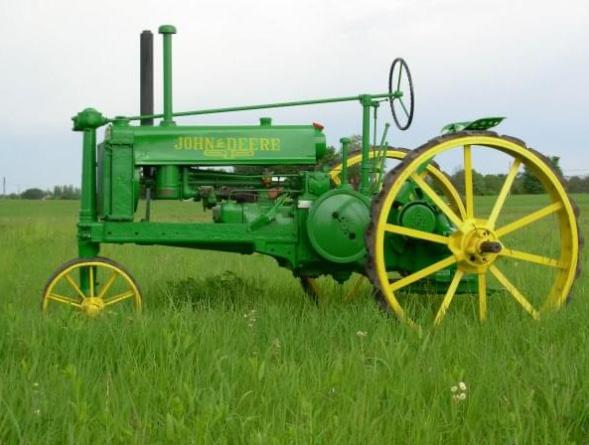
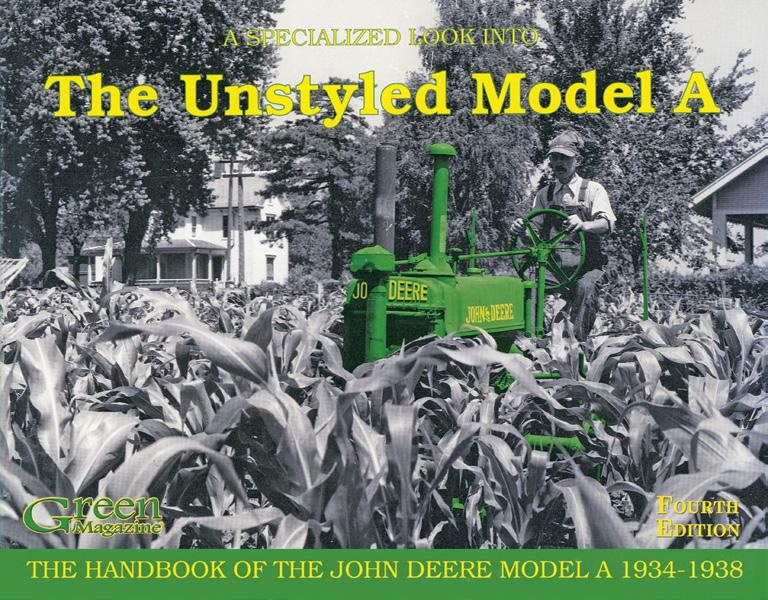
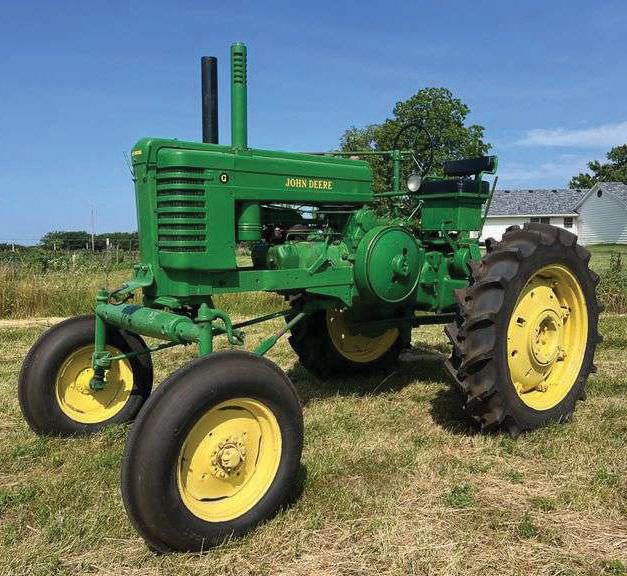
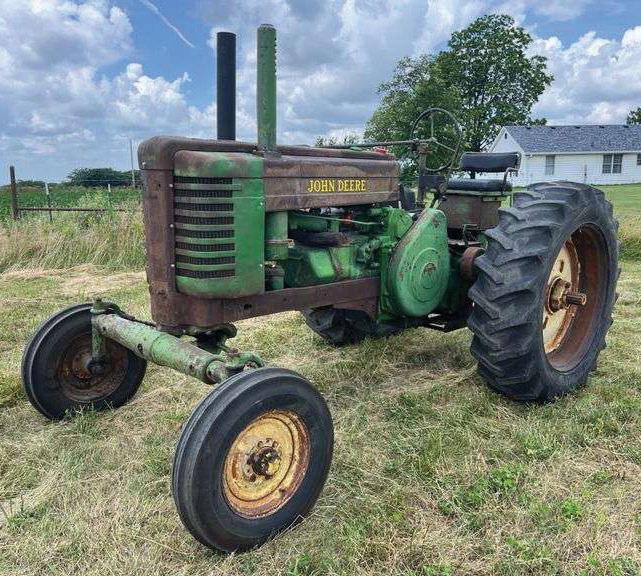
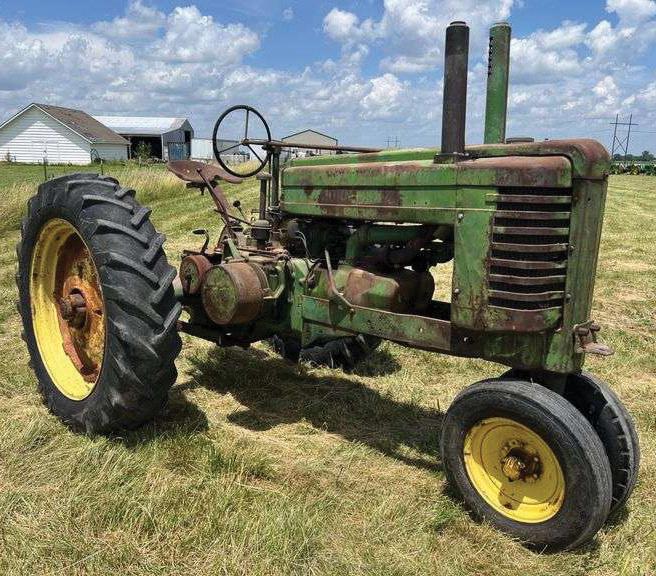
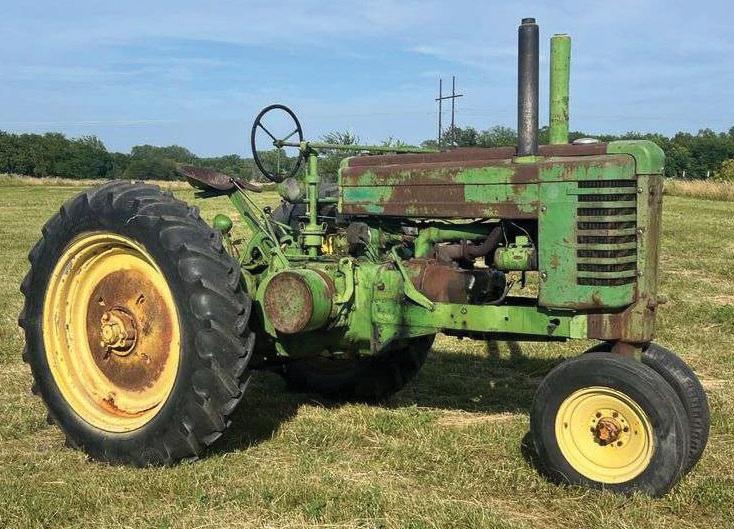
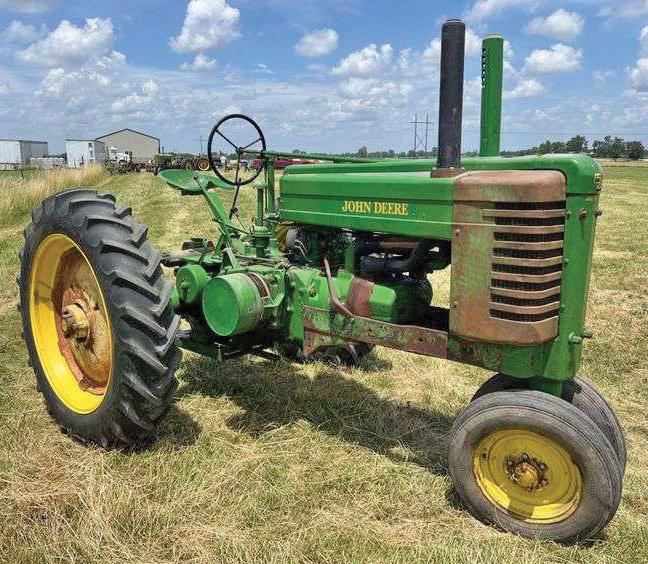
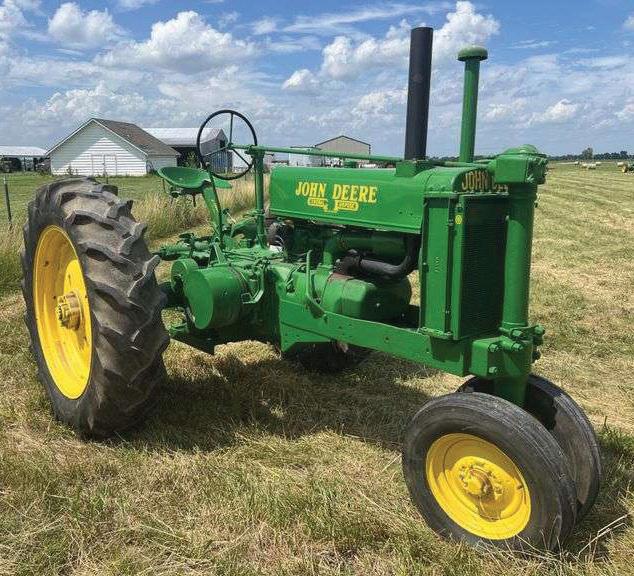
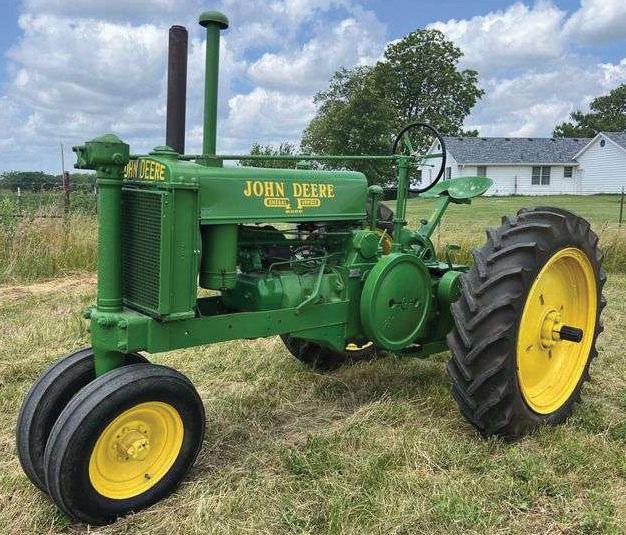
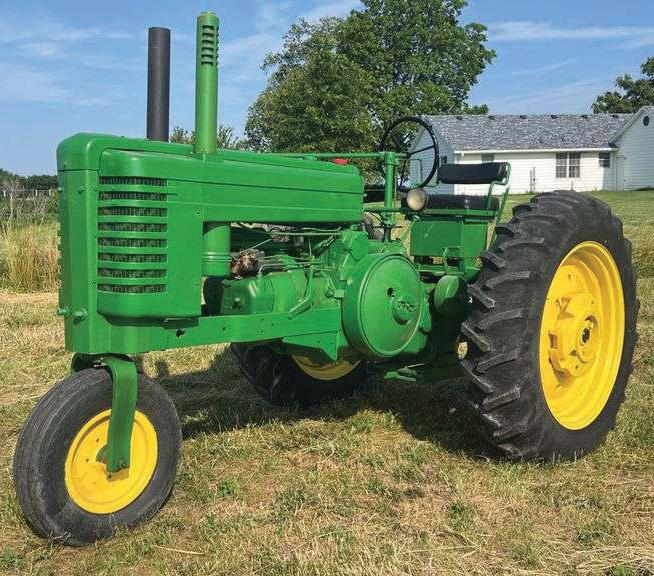
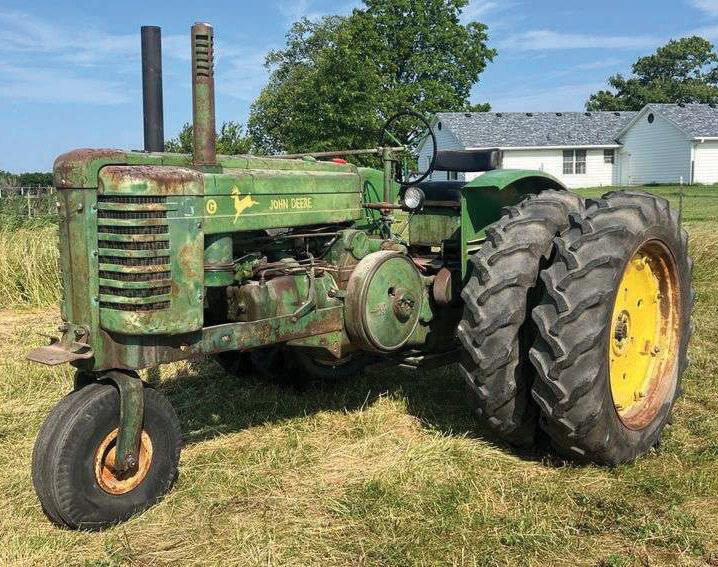
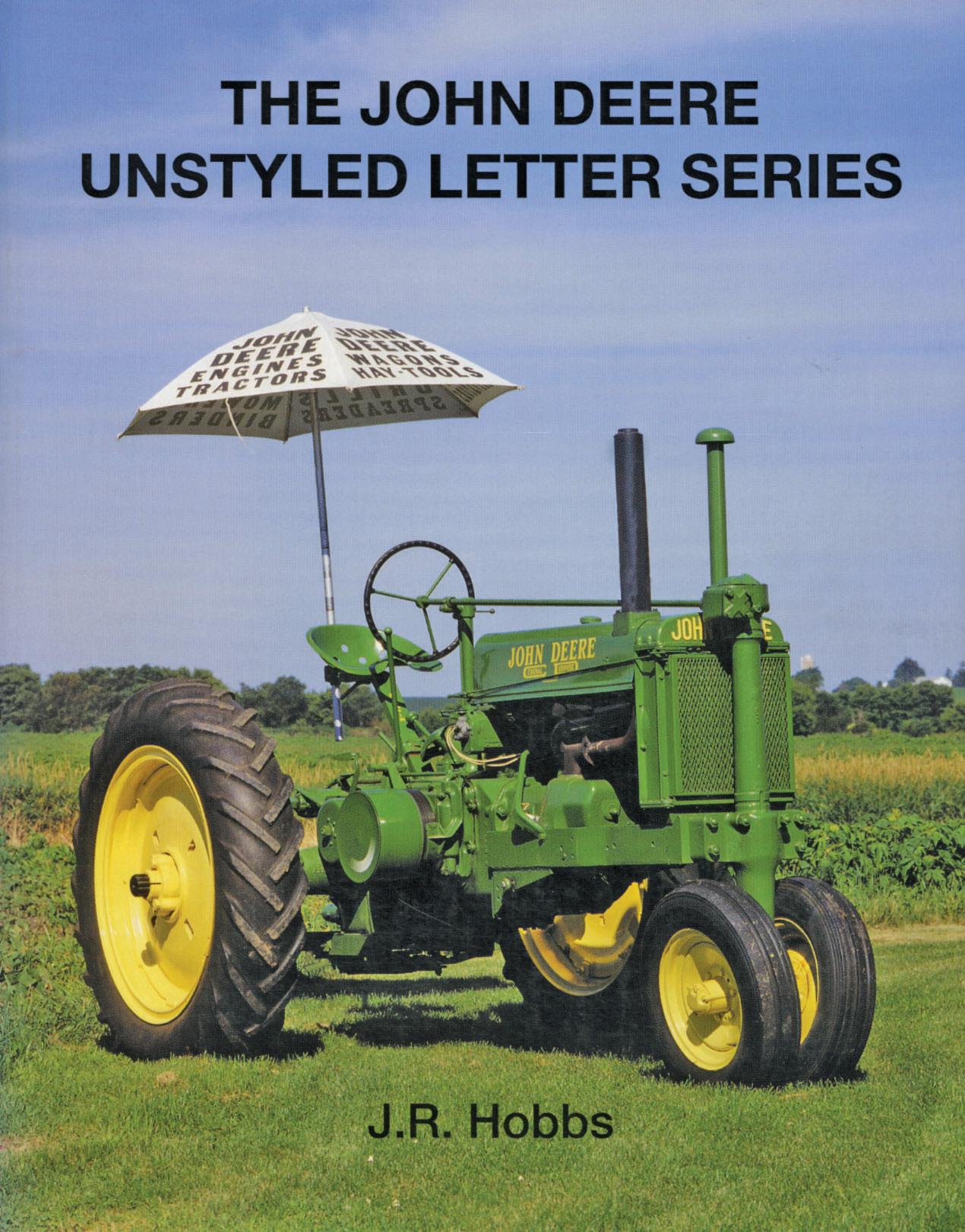
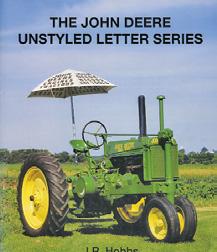
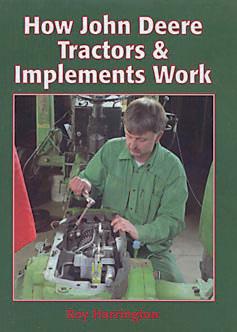
Now in its fourth printing with 15 more pages, this is the handbook of the John Deere model “A,” 1934-1938. A book that should be on the “must read” list of any unstyled “A” owner. There is probably no other book on the market that goes into so much detail on a single model of tractor. Shows illustrations of nearly every change made in the parts that make up the unstyled “A.” 95 pages, 11x8-1/2 inches, soft cover.
Both books include history, specifications, serial numbers, original prices and much more A Specialized Look Into
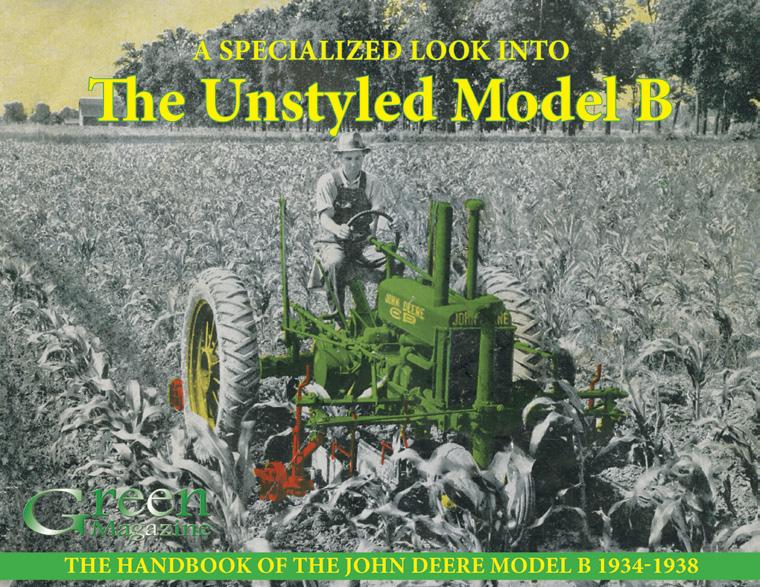
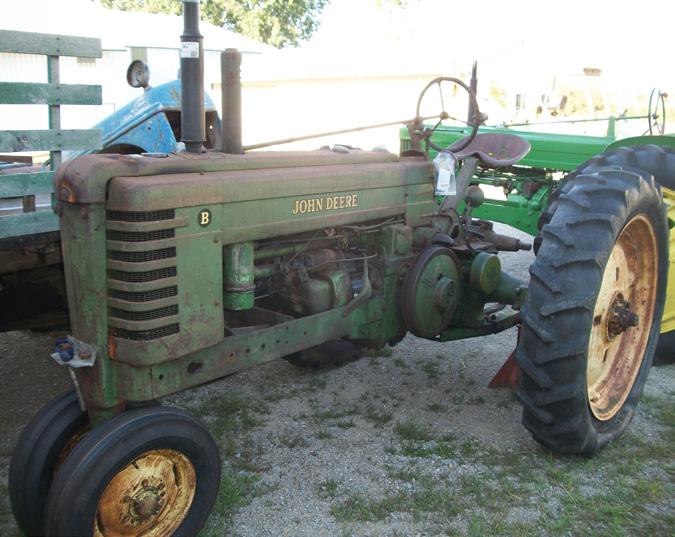
The Handbook of the John Deere Model B 1934-1938
The same types of information as available in the book above, except now about the model “B,” written and compiled by a panel of experts who have spent decades collecting and restoring the unstyled version of Deere’s most popular tractor. This book shows nearly every change made in the parts that make up the unstyled “B.” 84 pages, 11”x8 ½”, soft cover, over 200 photos - most in color.
Tractors pictured in Green Magazine’s
with
• Only a limited number of calendars are produced so ORDER EARLY before they are gone!
• 12 high quality, professional photos on each calendar
• Photo size is 11” wide x 8-1/2” deep
• Calendar when fully displayed is 11” wide by 18” deep
• Price includes shipping
• Proudly printed in the USA
• Call, go online or send a check to place your order
Green Magazine’s calendar is a customer favorite— order now before they are gone
“GREEN MAGAZINE®” (ISSN 0883-5462) is published monthly and released 12 times a year on or about the first of each month for $39.95 per year (Canada: $59.95 per year; Foreign: $69.95 per year) by Hain Publishing, Inc., 2652 Davey Road, Bee, NE 68314-9132. Periodicals postage paid at Bee, NE and additional mailing offices.
POSTMASTER: Send address changes to “GREEN MAGAZINE®, PO Box 95, NE 68314-0095.”
I was pondering one day that for me, collecting and restoring has come full circle. My first solo restoration project was a 1931 “D,” and now, some 40 years later, I’m working on a 1933 “D.” Since that time, I’ve worked on every series, if not every model of two-cylinder up to 1958. Somehow, I’ve never owned a 30 series tractor. At one time, I owned and worked on at least to some degree every 10 series tractor from a 110 to an 8020, except I never got around to buying a 2510. I don’t have a lot of experience with 20 series New Generation tractors, but I have done a fair amount of work on Generation II 30 and 40 series.
I’ve worked on row crops, utilities, standards, HiCrops, and crawlers. I hate working on crawlers, and it was one of them that made me institute my first one-hour-a-day rule. This is for that tractor or job you hate that you keep finding reasons not to work on, so you make a deal with yourself that you will work on it one hour a day, even if
it’s Christmas or you have a compound fracture. Besides crawlers, my least favorite tractors to work on are probably the styled two-cylinders, like the 1951 “A” that I completed recently, and it’s mostly the sheet metal and the way it goes together. Besides having to remove the steering wheel to change the muffler on a few models, it just seems impossible to do a complete paint job on them without having them in a hundred pieces, and then not scratching something when putting them back together.
My favorites to work on are unstyled because they are simple, and they don’t have much sheet metal. I tend to like diesels better than gas, because if everything is correct, they will run. Gas burners tend to be more temperamental. Now that the show season is about over, send us photos, letters or emails about the best things you saw this summer. Oh, and don’t forget to order your 2026 calendar.
See you next month.
Hey, snowbirds
Missing an issue? We mail every issue by the first of the month. Please contact your post office if you suspect a problem with delivery. We will not replace missed issues three or more months past original mail date (four or more months for foreign subscribers) free of charge.
U.S. subscribers: If it is on or after the 20th of the month and you haven’t received your issue, call us for a replacement.
Canadian subscribers: Due to postage costs, we are forced to ask for a $2 postage fee (U.S. funds, please) for re-sending issues that do not arrive by the end of the published month OR we can add an issue onto your subscription for the missed issue.
First Class/Airmail delivery: Call for rates for First Class in the U.S. or Airmail to foreign countries.
Foreign subscribers: We will add an issue onto your subscription OR for a $7 airmail postage fee (U.S. funds), we will resend the missed issue two months after publication date.
Notice: If your address label shows an expiration date of “10/25” above your name, this is your last issue. Renew immediately for continuous service. If your address label reads “11/25,” you have one more issue on your subscription.
Renewal notice: We send postcards to let you know your subscription is about to expire (or has expired). We NEVER call to ask if you would like to renew your subscription. If you
receive such a call, it is most likely from another publication—NOT Green Magazine® for John Deere enthusiasts.
Address Changes: Please send or call with notification of an address change as soon as you know what your new address will be. Periodical mail cannot be forwarded. Green Magazine will not replace issues missed due to late notice of address change. Those missed issues will have to be bought at back issue price. See the back issue listing and prices elsewhere in this issue.
Looking for your photos and stories! Accepted material is subject to such revision as to meet the requirements of this publication. Payment will be made at our current rate within 90 days of publication to current subscribers. Submission of manuscript implies that the material is original and in no way an infringement upon the rights of others. Please send good, clear photographs. If you would like these returned, send us a stamped return envelope to help us get them back to you.
Free Issue Offer: It seems you, our subscribers, are our best form of advertising! More people find out about this publication by “word of mouth” than other forms of advertising. So if you're enjoying Green Magazine®, why not spread the word? Telling others about it can pay benefits. When you tell a friend about Green Magazine® and they subscribe, make sure they tell us who let them know about it. When they do, you will get an issue added to your subscription. These must be new subscribers, not renewals.
Reading the columns on the 4010 with 48 loader on routing of hydraulic oil—but his major problem was the jerking of the loader with auxiliary valve. When using the 4010’s SCV valves, it worked fine; his problem is he might be using an open center valve instead of a closed center auxiliary valve which the New Generation tractors are supposed to have. If he keeps using the open center valve, the oil is going to get red hot in the valve, oil cooler and radiator from the oil cooler.
The 70 diesel with the fixed clutch—they might have forgotten to put in a new bearing and bushing, which can make the flywheel spacing farther and the clutch locks to the crankshaft so when the tractor starts, if in gear, will go and can’t be stopped except by shutting the engine off. Make sure when replacing the bearing to pack with wheel bearing grease and when taking out the bushing, watch where it sits in the clutch so when pressing in new a bushing, you don’t get it in too far. Make sure the timing mark on the crankshaft and clutch line up. The bolt that holds the clutch on has to be hammered tight which you hammer on the wrench.
Gerald Bartlow, MN
This is not a story about a tractor I once owned, but a story about two tractors being united again. My brother, Ty, purchased a 1935 John Deere “AR” from Gary Schroller in northern Kansas. This was in the late 1980s. It was in
good running condition, serial number 250547. Remember that number!
There were only 1,242 “ARs” made in 1935, compared to 11,152 “A’s.” With the high probability that many had been scrapped due to old age and World War II, we were happy to find this tractor and get it home to Arizona.
Several years went by when we received a phone call from Gary. He was in North Dakota at a tractor salvage yard and standing next to a 1935 “AR.” Gary, being one of those gifted collectors who remembers serial numbers, said, “It’s serial number 250546, one number lower than the one I sold you. Do you want me to buy it?” Of course we said yes! Gary hauled it back to Kansas and we eventually got it to Arizona.
We wanted it repaired and running so we called our good friend, the late Warren Helms. He said he had lots of parts and would rebuild it for us. Add a few reproduction “AR” parts and we were up and running!
All this because Gary happened to be far from home looking for tractors to buy and stopped at Grosz Salvage Antiques in North Dakota. He happened to see a stripped JD “AR,” read the serial number, and remembered, “Heck, that's one number away from my old ‘AR’.” They are now sitting next to each other. What are the odds of that happening?
Dennis Weckerly, AZ
•
Weight Bracket
5010, 5020, 6030: AR58358, Pr $460
Rear Engine Panels
4620 Right, AR43290, $155
4620 Left, AR51804, $255
2510 Right, AR38206, $300
2510 Left, AR38207, $220
2520 Right, AR38838, AR38202, $300
2520 Left, AR38839, AR38203, $220
5010, 5020 R, AR35023, $300 L, AR35024 OR AR36796 $300
Seat Base Cover for Tractor w/o Rock Shaft - AR26846, $295
4000 & 4020 Std SN 201,000 & Above
AR40773 LH Rear Eng Panel = $80
AR40774 RH Rear Eng Panel = $80
AR40871 Platform (can modify AR48727) = $155
AR41097 Platform Support = $84
AR41098 Platform Support = $84
AR41137 Dust Shield RH = $315
AR41138 Dust Shield LH = $315
AR41174 Support To Dust Shield=$27
R41253 Ext Front Right = $156
AR41451 Ext. (RH) = $74
AR42594 Step Bracket w/2 pads = $215
F3195R Step Pad = $30
AR42989 Cover Battery Box = $80
AR45129 Battery Box Support = $75
AR45130 Battery Box Support = $75
AR45131 Ext L Ft AR48964 = $184
AR45207 Battery Box = $340
AR46289 Weight Bracket = $102
AR48964 Ext L Ft AR45131 = $176
3020 Standard Tractor
R34944 Floor Panel 3020 Std PS
R34943 Floor Panel 3020 Std PS
AR34801L Dust Shield = $325
AR34801R Dust Shield = $325
R42893 Fastener Pin for Battery Box = $36
Dave Haala: dave@haalaproperties.com or 507-920-9181
In mid-July, I posted a photo of my freshly washed “BO” on Facebook, writing that it was shined up and ready for the Bos Brothers’ plow day. Someone commented, “The tractor seems to be well-maintained.”
Sort of a generic statement, but it caused me to consider that for the 77 years before I owned it, this little tractor apparently hadn’t spent much time outside, received regular maintenance and whatever needed to be fixed internally or externally was done. This is the look I would like to achieve with the ’33 “D,” not like it just rolled off the factory floor, but like it had been maintained and cared for since Herbert Hoover was in the White House.
As much as I like showing people the two-cylinder tractor, running on a four-cylinder magneto, I think it is time for it to go. I can barely get a “pop” out of this tractor while turning it by hand, but it will start if it is pulled. Hardly a surprise—I was informed of this when I purchased it. This phenomenon is often the symptom of weak magnets in the magneto. While the impulse,
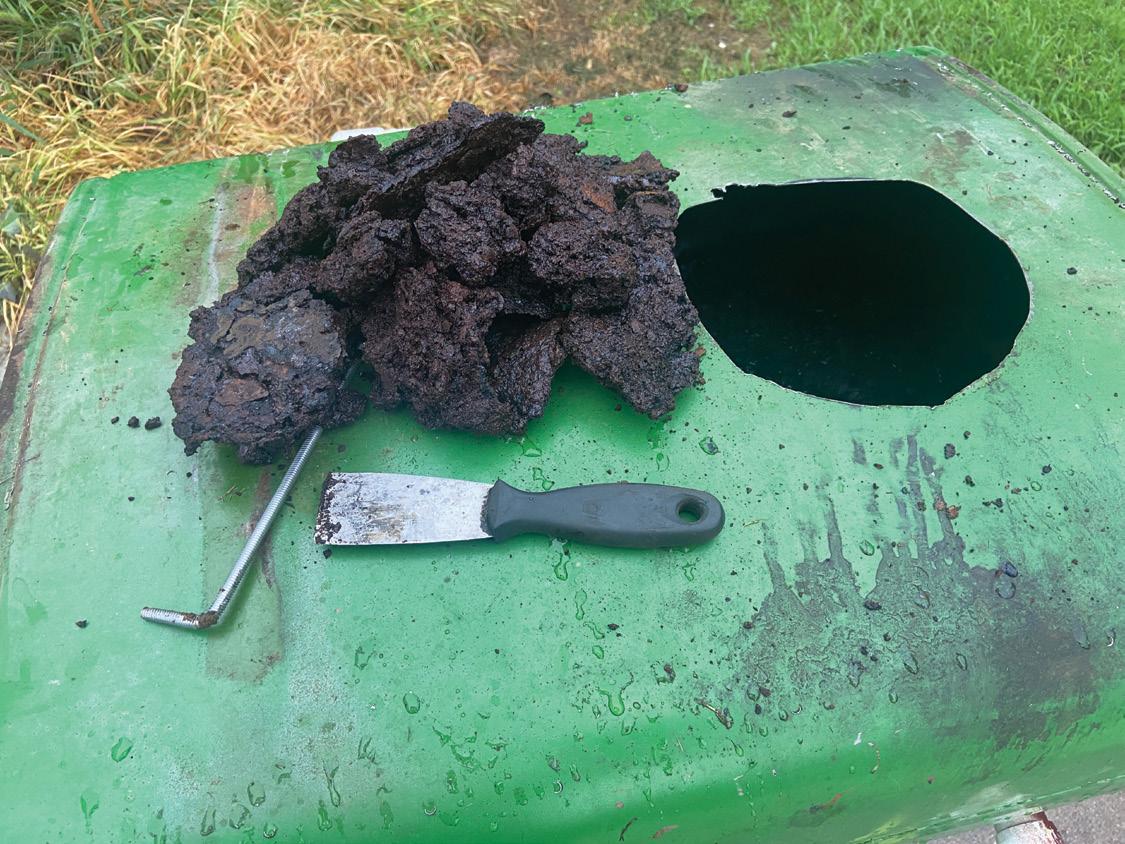
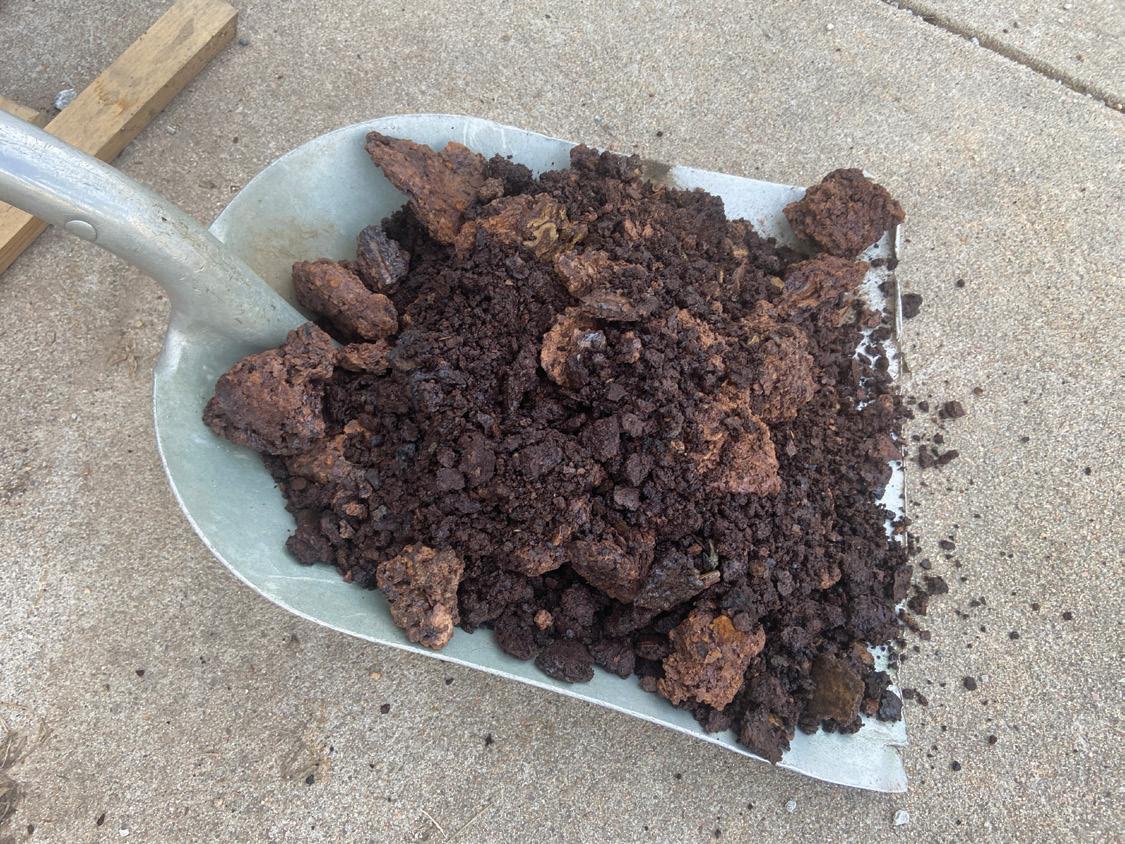
Here’s what I found in the old tank when I removed the bottom fitting. This is just the big chunks.
assuming it is working properly, may try to give the rotor a good, quick spin, it needs continued rotation to generate enough juice to get the engine running. There are also a few worn internal impulse parts that could prevent the impulse from spinning the rotor quickly enough. So while the mag may still be “clicky,” it’s not clicky enough. Then there is our old friend the condenser, which also might be part of the problem. If it were the type of magneto this tractor is supposed to have, I would probably have an expert rebuild it, but since it is not, I’ll probably be shopping for an original type Splitdorf 246, though pricing them has given me magneto sticker shock (no pun intended). Or maybe I’ll give in to my cheapskate impulses and find a base mount Wico “C,” which is what my old 1931 “D” ran on.
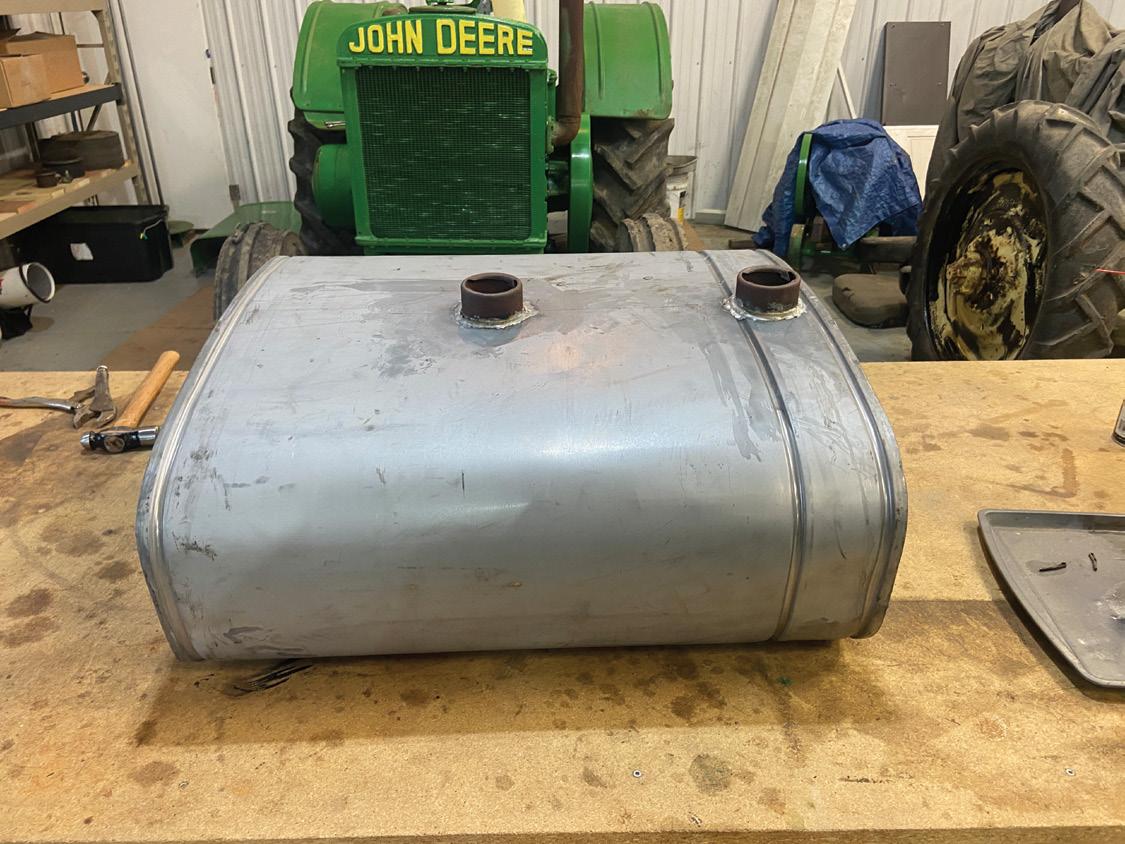
In the August issue, I mentioned that this tractor had the wrong fuel tank. It has the three-speed style, with the starting tank hanging off the back, rather than the 1931-33 style that has the two round fillers through the top. Kent Kaster told me that he could build me a
That’s a No. 16 grain scoop with the complete contents of the tank.
new tank, but he would need the fitting from the bottom of mine. At first, I was a bit hesitant about ruining this old tank, which seemed to be in relatively good condition. It did seem a bit heavy and clunked a bit when I rolled it around, but I thought that all it needed was a good cleaning and sealing. After I cut the bottom fitting out, I was able to reach inside and pull out handful after handful of some sort of crystallized stuff. I thought that the tank was inordinately heavy, and after pulling it all out, we set it on the official postal scale at the Green Magazine corporate headquarters, and it came to just over 10 pounds. I have been around tractor restoration for over 50 years and have never seen anything nearly this bad. I don’t feel so bad about ruining this tank now, though it could probably be repaired by a good weldor. No matter what methods I had used, there is no way I would have ever gotten all of this stuff out through the filler hole. Someone with a degree in chemistry is going to have to tell me how this stuff forms. And I’ve already heard the one about the fuel turning back into dinosaurs.
The reason I was so bold in cutting this big hole in the bottom of the tank to begin with was that Kent from K&K Antique Tractors told me that he could make the correct type of tank for my tractor, but he needed the fitting from the old one.
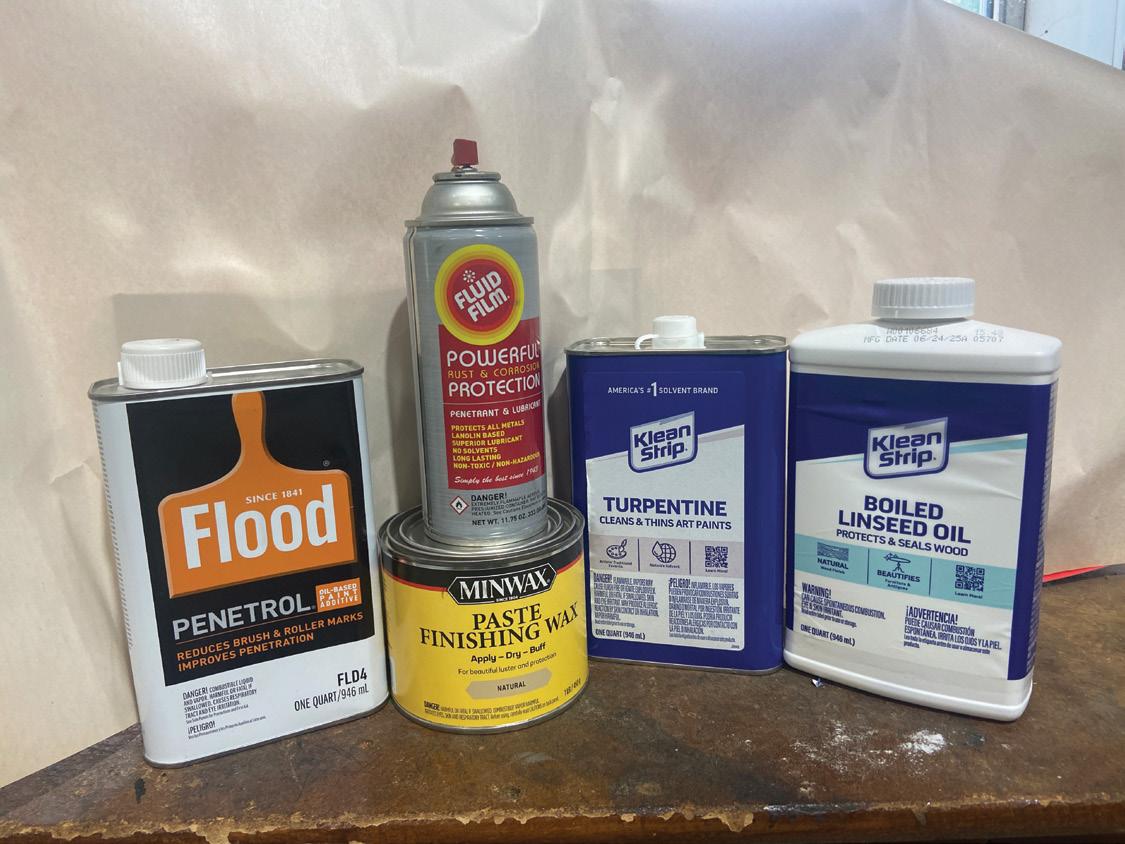
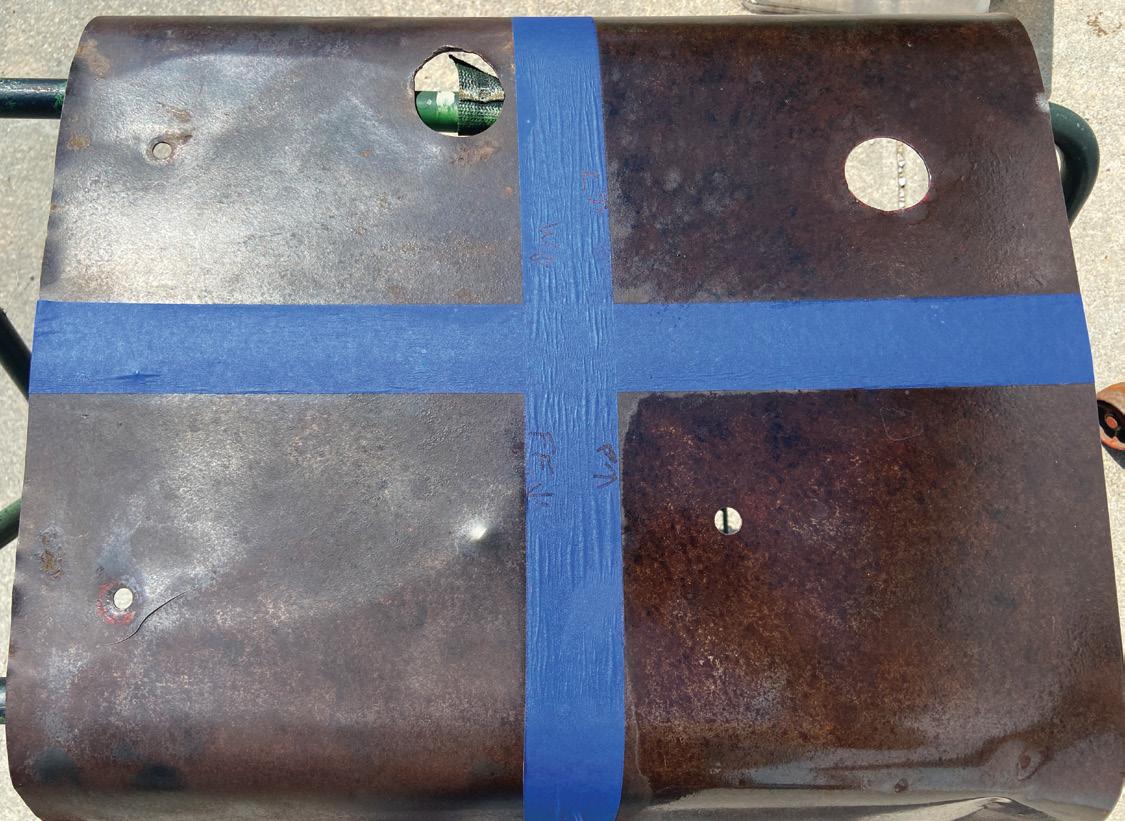
I’ve narrowed down the possible coating for this tractor to four: Penetrol, Fluid Film, a mixture of turpentine and linseed oil, and paste wax. The test subject is an old hood that I found, which is divided into four sections. The paste wax dried quickly, but it seems to have the least shine. Whether that is good or bad depends on your preference. Slightly more shiny is the Fluid Film, and though I’m not sure it will ever really “dry,” it took a couple of days to get to the point where a tissue rubbed on it wasn’t noticeably oily. I was told by a man
who has some rather nice original patina cars that if you are going to use linseed oil, it must be mixed with turpentine and comprise less than 50 percent of the finished product. I have also been told that mineral spirits is another suitable mixer. At any rate, the solution went on easily and has stayed shiny, but has a bit of a mottled appearance. The Penetrol took several days to dry, even in the hot August weather, and has thus far provided the most shine.
After each section was coated and has had a chance to dry, I put the hood in the back of my pickup to see which formula picks up the most dust as I travel the dusty roads of southeast Nebraska. Stay tuned.
Clockwise from upper left—paste wax, linseed oil, Penetrol and Fluid Film.
The new tank from K&K.
The four products I will be trying out on the sheet metal. The turpentine and linseed oil get mixed together.
DECALS
Our vinyl computer cut decals are a Licensed Product of Deere & Company.
• For John Deere tractors & equipment!
• Looks like silk screening.
• Pressure sensitive die cut vinyl.
• No film between the letters...they are on pre-spaced application tape.
REPRODUCED PARTS
• Nameplate for 1010 thru 7520, stamped, raised letters, like original.
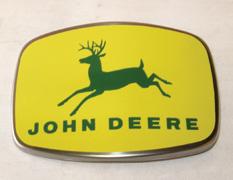
• Medallions for styled AR through 830, including industrial tractors. Also medallions for steering wheels, power steering and non power steering.
• Correct size medallion: 320, 420, 520 USA made.
• D306R D manifold gasket.
• F55R early G head gasket.
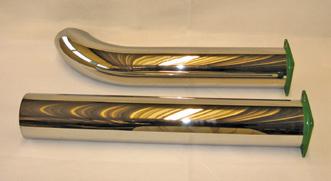
• Air stacks for A, AR, AOs & B, BR & G unstyled tractors; also styled A, B, G, R, 80, 820.
• Air stack adaptors for 620-630 & 720-730.
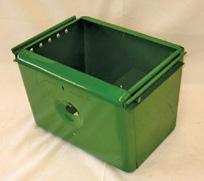
• Tool boxes.
• New valves and guides: GP, D, G, A, B.
• Replacement upper and lower water pipe for 2 cyls.
• BO Lindeman side plates and fenders.
• PTO shields & castings 520-730.
• PTO shields H-70
• GP dust shields for brakes and muffler parts.
• Grill screens, back and seat cushions, arm rest.
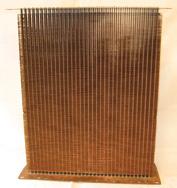
• New radiator cores for John Deere and other tractors that use bolt up type radiators.
• Wire hose clamps for unstyled A, B, G, 50-630 & 80-830.
• Reproduction steering wheels A-830 and New Gen.
• Early D & GP fuel tanks, while supplies last.
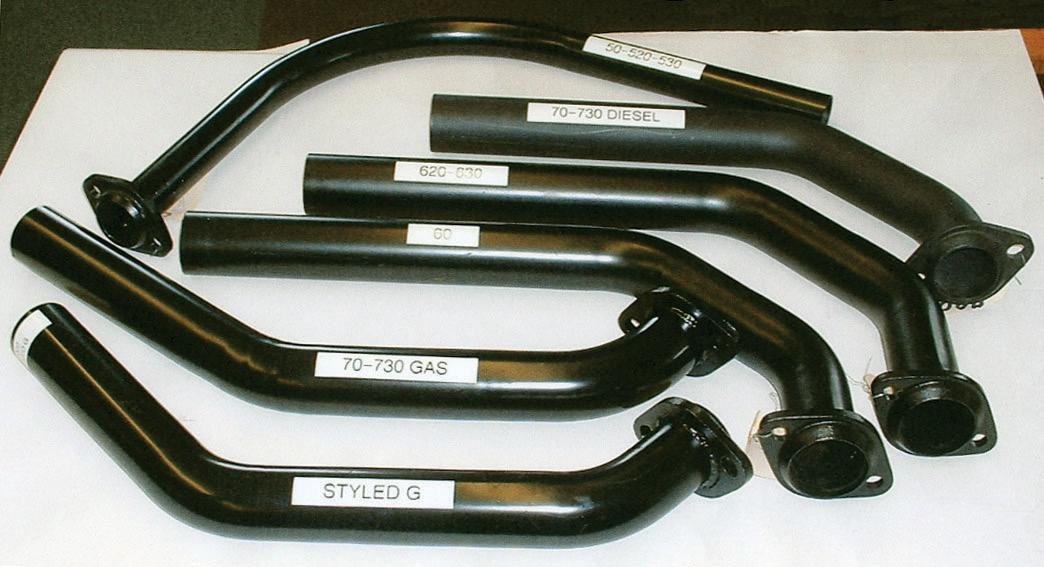
These exhaust pipes are made with smooth mandrel bends like the originals
MADE IN USA
We make styled and unstyled A, B, G, GP Top Steer and 50 through 730D.
4 MUFFLERS
D, AO, AOS, BR, BO A, AR, B, G Styled and Unstyled 50 through 730D
50 through 530 horizontal, 60, 620 Orchard Made in USA
Restoration Quality
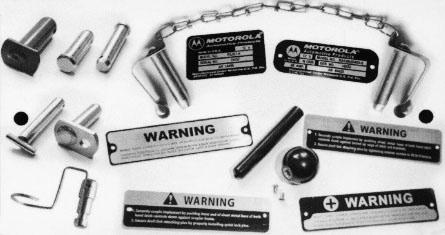
4 AR28048, AR28049 NAMEPLATE
Stamped, polished aluminum like originals Fits 1010 through early 7020
4 T10551 NAMEPLATE
• We bore and sleeve JD 2 cylinder blocks.
• We carry new parts for Wico mags, also for pony motors.
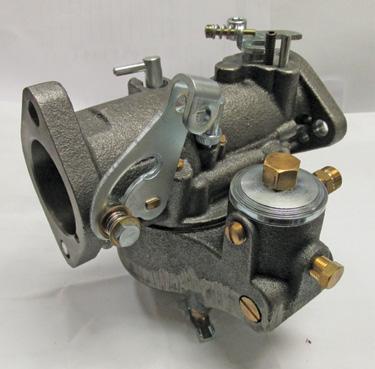
• Rebuilt mags and carbs for sale.
Like original, stamped polished aluminum with raised lettters, flat black background Each 3-3/8” x 27-3/4” • $140.00 per set plus S/H
4 HYDRAULIC OUTLET PLUG
AF3001R, steel w/chain - 2 cylinder AR52623, plastic w/chain - New Gen
4 AR45915 RAIN CAP Fits 3020-4020 side console models
4 CHROME STACKS
Double walled, straight or curved 4 “ NEW” BATTERY TRAY For 4000 model with brackets
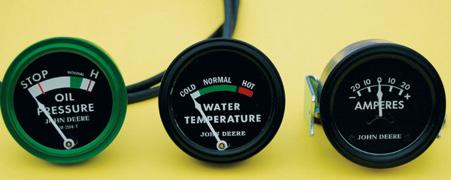
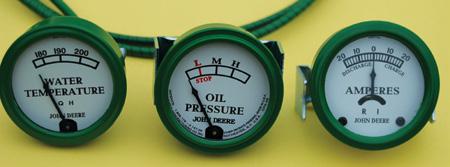
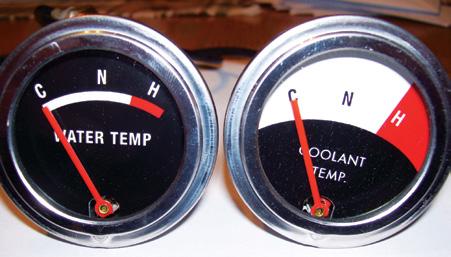
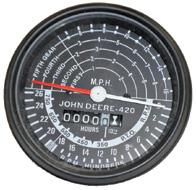
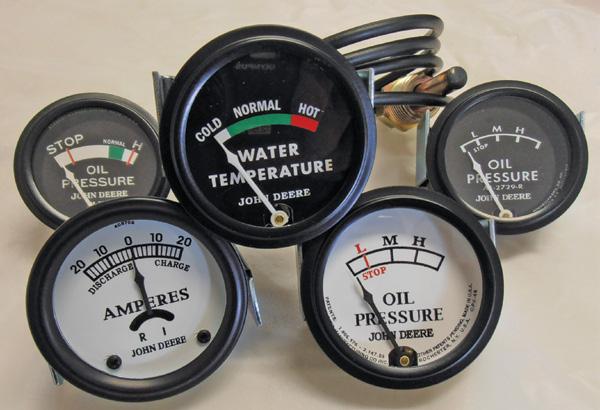
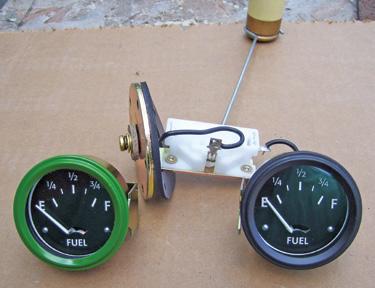
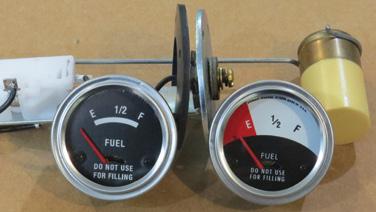
Oil, amp and temperature GAUGES
with white or black faces for most 2-cylinder models for the unstyled to the 30 series, Waterloo and Dubuque built models Made in the USA
EverGreen Restoration Gauge prices:
• All gauges have real glass
• On hand, ready for shipping
• Painted, ready to install
• Gauges come with mounting clamp and hardware
• Faces made by Jorde Decals and have all details of the original gauges
• All gauges are calibrated
EverGreen Restoration
Jerry Trcka W7619 Walnut Dr Spooner, WI 54801
Cell 715-520-7876
tractorgauges@yahoo.com www.evergreengauges.com
$70 for oil/amp
$90 - $100 for temp, depending on length of the lead
Oil, amp and temp gauges available for
RECOVERING ORIGINAL STEERING WHEELS - CALL!
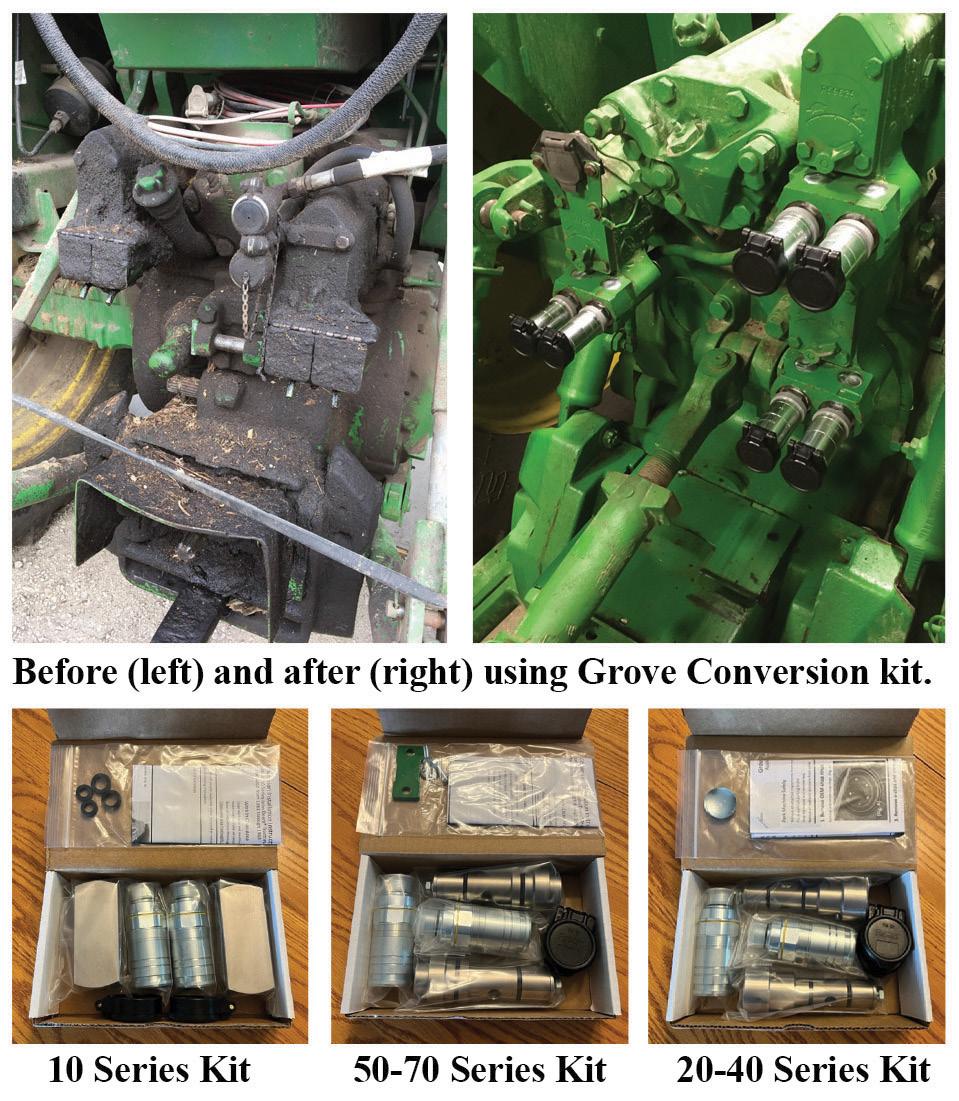
Kit Cleans Up Older Deere Hydraulic Mess
Scott Grove cleaned up leaky hydraulic valves on his older Deere tractors with a simple insert. The long-standing problem is one the company has yet to fix. Grove says it forces him and other owners of Deere tractors to replace O-rings on a regular basis, only to have the mess return. Grove’s fix eliminated the mess and the need to replace parts. With the Grove Conversion kit:
• Convert to ISO with easy push-pull connection
• Couplers connect under residual pressure with breakaway feature
of antique tractors Wapsi Innovations
• Kits available for 10 through 70 series JD tractors manufactured from 1961 through 1996
• Inserts are made in the USA. This product is protected under US Patent 10,760,725 B2 and other patents pending.
Installation consists of stripping the OEM outlets down to the block, removing the barrels and O-rings, and replacing them with the inserts. Grove then adds the aftermarket ISO coupler that threads into the insert. Installation instructions can be found on the Wapsi website.
Kits for 10 series are priced at $315, kits for 20-40 series are priced at $329, and kits for 50-70 series are priced at $355. Also watch the website for more additions coming soon. Grove suggests checking with local Deere dealers & local repair shops or Wapsi Innovations directly. DON’T
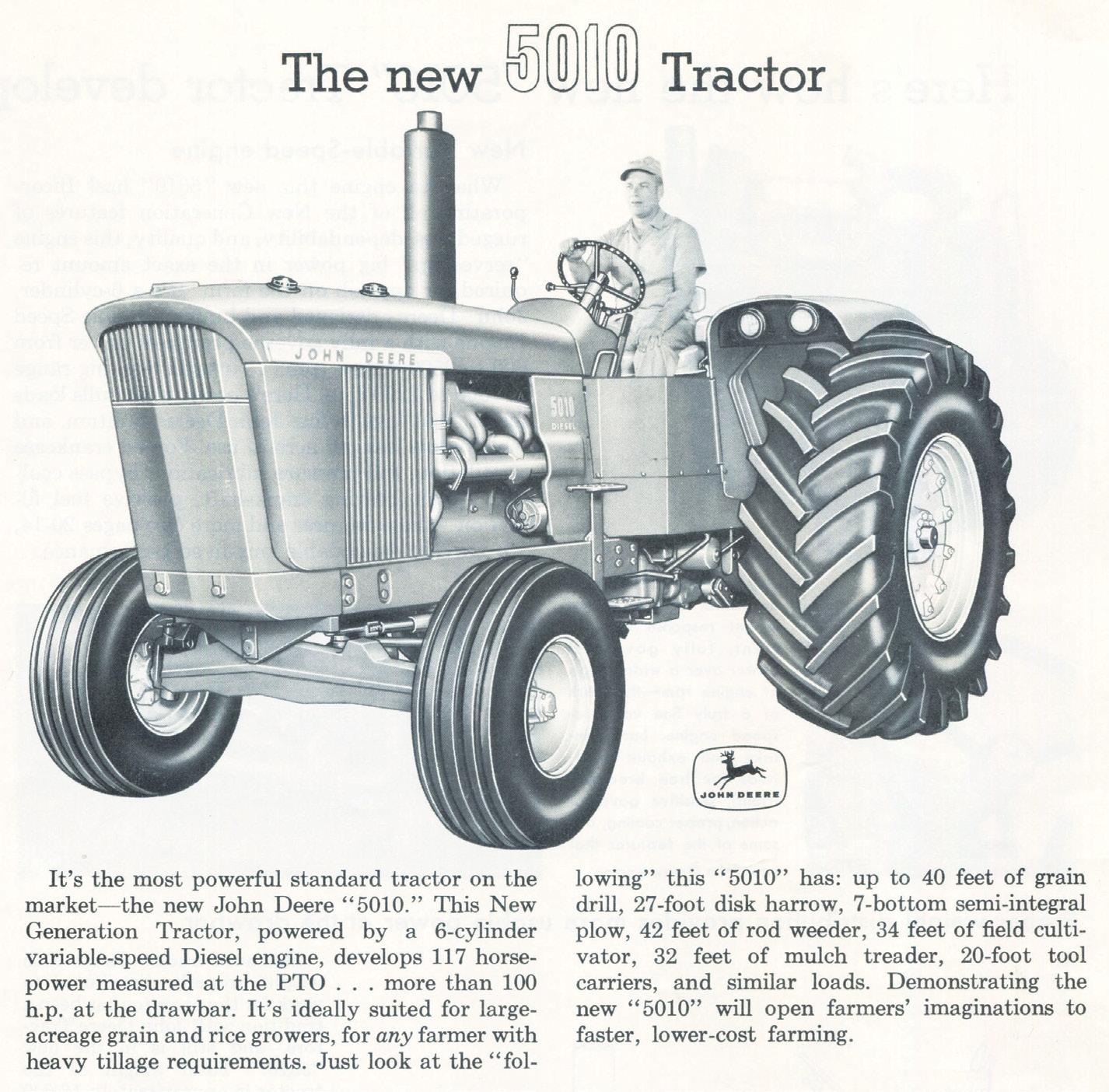
For decades, Deere’s competitors argued that the two-cylinder engine was an obsolete piece of machinery. For decades, Deere stood by their engines, constantly improving the power, reliability, and efficiency of their tractors to meet or exceed their competition. It was never the competition that could put an end to the two-cylinder engine. Customer opinion stood behind Deere’s machines as well. What finally put the dagger in it was physics. The actual physical limitations of putting a two-cylinder engine large enough to satisfy the increasing power demands of the agricultural world would soon be met. The engineers at Deere knew that this was coming and that the company needed to make a change before it was too late; therefore, research into different engine types was initiated.
Deere began with several engines of a “V” configuration. A V-6 engine was the first proposed for the tractor that would later become the 4010, and a V-4 was considered for the 3010. Several issues with the “V” engines ended that experiment, however. The engines were too wide, too complicated, and had too narrow a power band for Deere’s liking. So, the engineers moved on to straight-configured engines and
built these for each of their new machines.
The largest of the tractors that Deere had in mind when creating these new engines was known during experimentation as the “OZ.” The “OZ” was to be bigger than
the rest of the lineup—the spiritual successor to the 830. A straight sixcylinder engine was used for the tractor, and Deere went big. Where the 830 had 460 cubic inches, the new engine had 531. This was done by building a 4-3/4 inch bore and
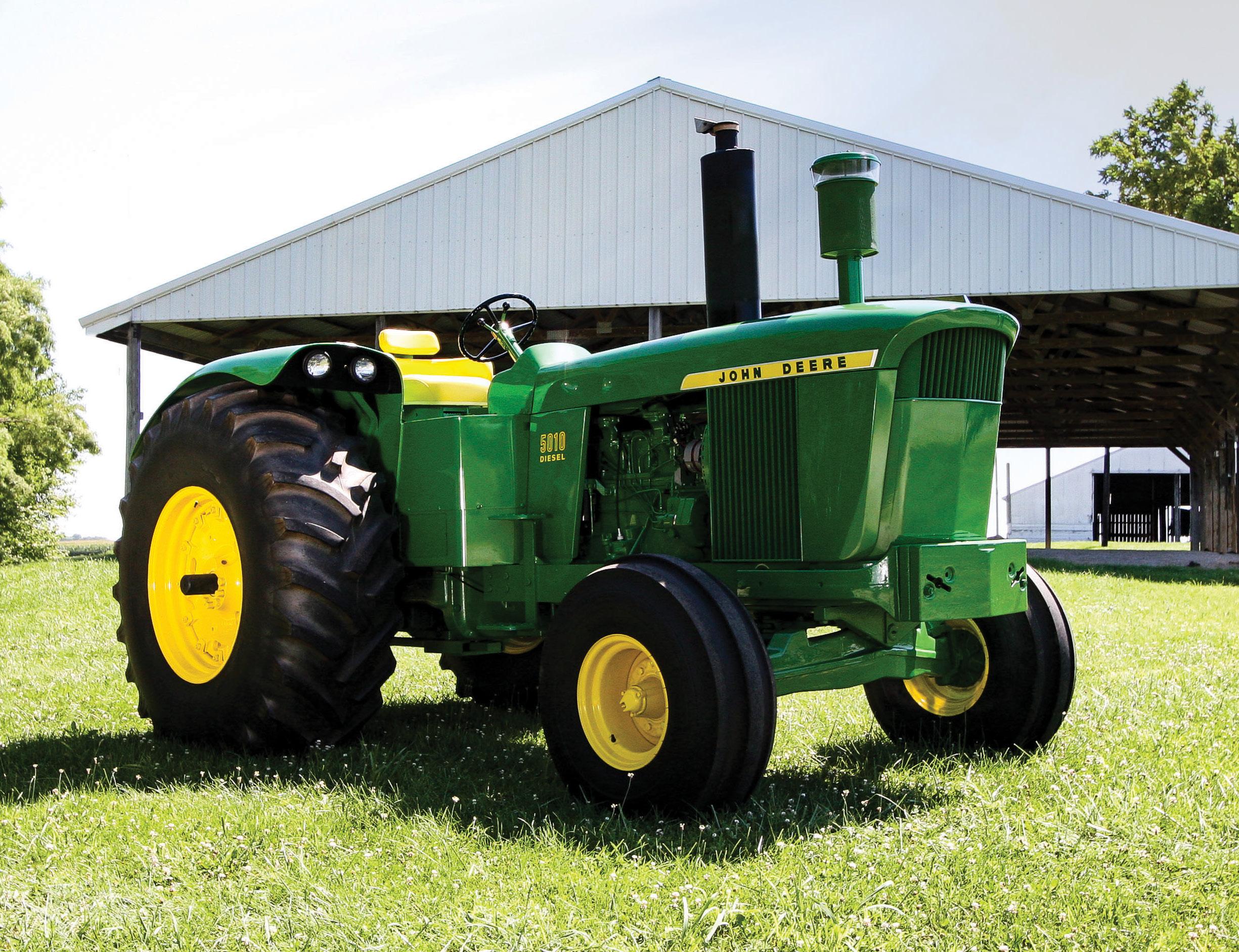
5-inch stroke engine. The engine provided the operator with over 121 horsepower at the PTO. The tractor built up around this engine was officially designated the model 5010.
The 5010 did not get to join in the big reveal of the New Generation in 1960. It was not ready yet. Instead, experimental units were
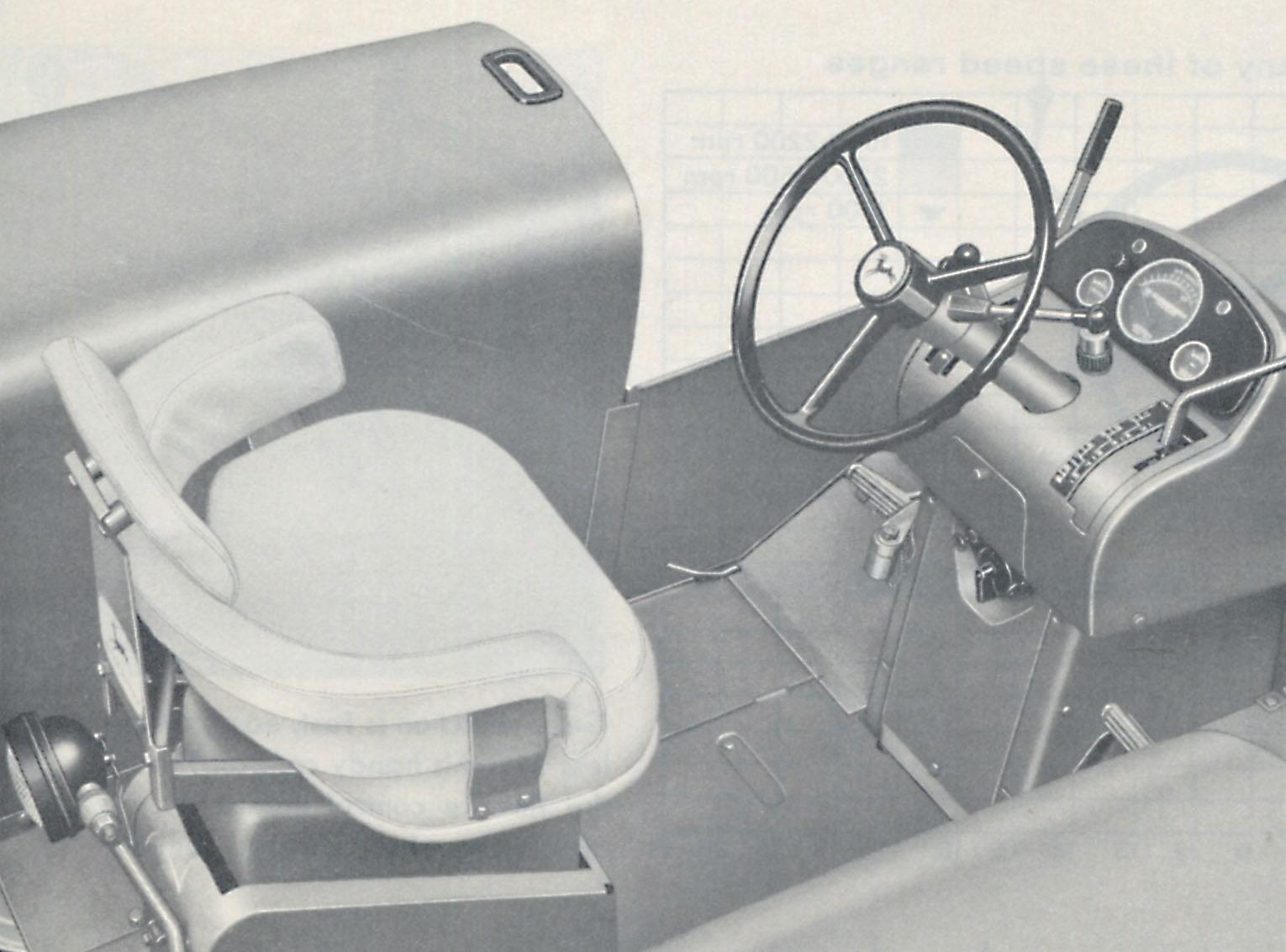
Compare the operator’s station of a 5010 to any other tractor of the time, and you will quickly notice how clean and well thought out it is. No shift lever between your knees or hard-to-reach levers.
working through testing while engineers found ways to improve upon them. The big tractors were sent to a couple of the most difficult-to-farm places in the United States. Some were sent to rice fields in Arkansas to see how they would handle fighting equipment through the bottomless mud. Others were shipped to the Palouse of the northwestern United States—one of the hilliest agricultural areas of the world. At the time, tracked machines and a few four-wheel-drive tractors were the only things in the fields there. Did the 5010 have what it took to work that ground and establish a foothold for Deere in that area? If Deere could build the 5010 to thrive in these two extreme environments, it would surely be able to serve the needs of the average farmer without breaking a sweat.
Just as Deere had done with the big tractors from generations past, they built the 5010 to be as stout and robust as they reasonably could. They wanted to be sure that the tractor would be ready to work day in and day out. Any part that had a problem during testing, or even only appeared to be marginally underbuilt, was improved by making it larger. More iron was the solution to most of the problems that the 5010 had. When it was finished, it was a tractor that defined brawn, and weighed in at over 75 percent more than the 4010 even before any ballast was added. The 5010 was sent to be tested at the
tered tough spots in the field, the 5010 would keep right on pulling through.
That big engine had a big thirst, and it sucked down the fuel. Deere was able to fit a 48-gallon fuel tank at the front of the tractor. This was enough for about six hours of use at full power. It definitely put the diesel down, but it also actually made more horsepower-hours per gallon than the 4010 diesel did. Operators of the 5010 were certainly getting out what they were putting in.
Somewhat ironically, the big power of the 5010 did impose some limitations on the tractor. Deere did not put a 540 RPM PTO on the tractor, and instead incorporated only a 1000 RPM PTO. This helpfully followed the new ASAE standards and, at the time, was considered safer as
University of Nebraska in October of 1962. When it was, it was the first two-wheel-drive tractor tested there that was rated at over 100 horsepower at the drawbar. It was found that the tractor made maximum torque at 1,400 RPM and had a rated engine speed of 2,200 RPM, creating a very wide power band. This put some flexibility into the hands of the operator. With lighter loads, the farmer could shift up and drop the throttle down, running more efficiently over ground without sacrificing speed. The engine was also willing to keep pulling as it was lugged down. So when it encoun-
it was thought that the power would lead to failure of some 540 RPM PTO equipment. This was an unpopular move, however, as some buyers were upset by the fact that they could not use the 5010 to run some of the equipment that they already owned. The versatility of the tractor was slightly impaired due to this limitation.
Deere’s new Syncro-Range transmission was installed on the 5010. This transmission was one of the most exciting parts of the New Generation tractors. It was composed of a four-speed transmission with a Hi/Lo range transmission in
front of it. Synchronizers were installed on the Hi/Lo, allowing range shifts to be made on the go. The operator could bump the tractor down to the lower range when he met a rough spot in the field, then pop it up again when he was through it. He no longer needed to stop or pull the throttle down out of the power band. He just kept on going, maintaining momentum and saving some time. The Syncro-Range also featured collar shifting, which kept the gears in mesh with each other, making shifts smooth and reducing transmission wear.
Since the 5010 was nearly double the weight of the 4010, Deere’s engineers had to do more than just build a bigger version of the New Generation tractor. A few adjustments to the pattern were made to ensure the 5010 worked properly. While the power steering in the 5010 was fully hydrostatic, just like in the smaller tractors, it did not use a steering motor. Instead, a pair of hydraulic cylinders, mounted externally, did the hard work of the steering. The operator still enjoyed a light touch at the wheel.
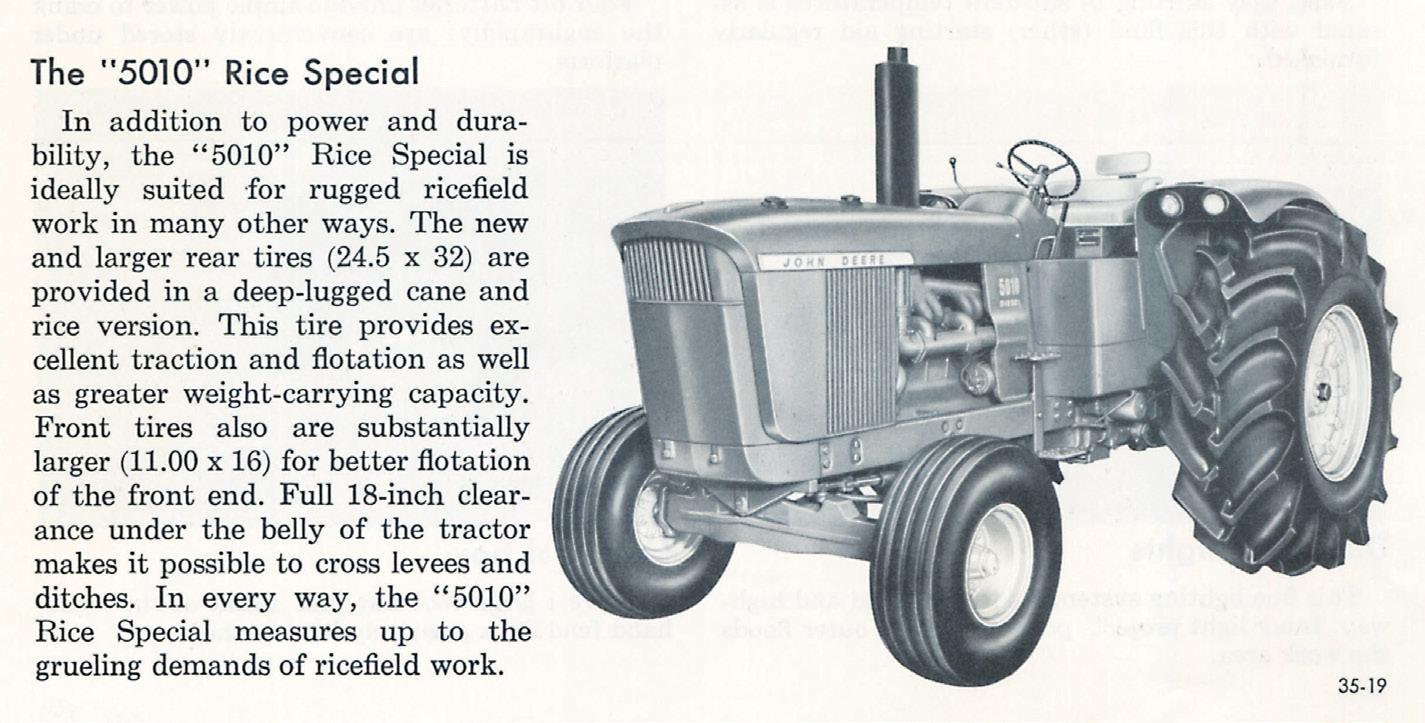
The rear fenders of the 5010 were of a different design from the rest of the series. They were wider and rounded downward on their way toward the rear, following the tire. There was room for two lights at the front and one at the rear, and they did a better job of protecting the operator from dirt and debris. Shields at the front side of the fenders helped to enclose the operator’s platform even more. A new size of tire,
Deere
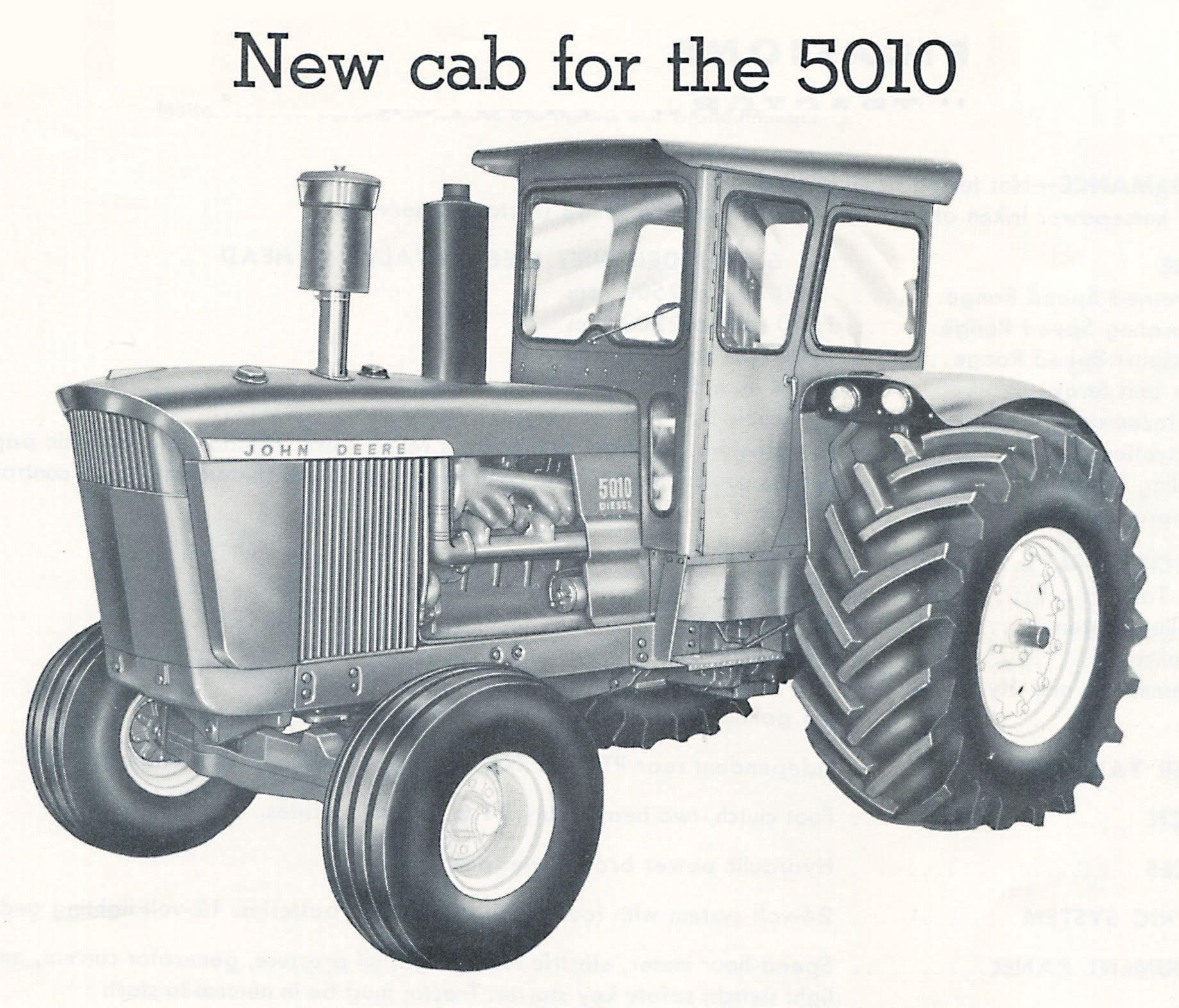
called the optional cab “modern, functional, and attractive.” Note the roof. Was this the first sighting of the design soon to be seen on ROPS?
The 5010 scraper tractor. Does anyone else find it odd that this version was still named the 5010, while the industrial wheel tractor was the 700?
developed by Deere specifically for the 5010, was an option for the 5010. 24.5x32 inch tires put the power to the ground without the slippage that smaller tires had caused during testing.
The 5010 used hydraulically actuated brakes, just as did the rest of the New Generation lineup, but they were larger, of course. These
brakes were a major improvement over the mechanical brakes of the two-cylinder tractors. The engineers at Deere found a brake material on the market that worked well in oil. They then adjusted the makeup of the oil until the brakes did not chatter. Working in oil, the brakes kept cool and wore very little. With these, the 5010 could stop safely and turn
well even on loose ground.
5010 and 700
Production Numbers
Model Number Built
5010 standard 5,438
5010 offset 2,036
700 63
Total 7,537
5010 Serial Number Breaks
Year Beginning/Ending
1963 1000-4500
1964 4501-7999
1965 8000-10681
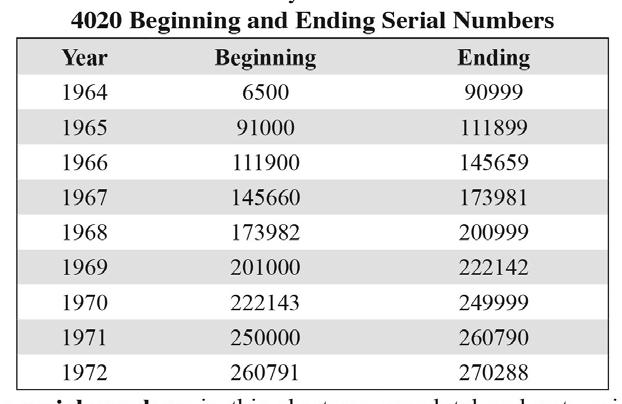
Deere was not able to release the 5010 until the summer of 1962. There were farmers who were excited to get their hands on a tractor with so much power and potential, but they were in the minority. For most farmers, the 5010 was a bit too big, heavy, awkward, limited, and expensive. The 5010 was a bit more of a specialty tractor than most might assume, which is why only 3,500 tractors were sold in its first year of production.
While there were options available to the 5010 to help make it fit into your farm, they, too, were limited in scope. Deere recognized that most of the 5010 tractors that they sold would be purchased to pull large equipment across wide
open spaces. There weren’t many farmers who would try to set one up to do something else, so Deere didn’t bother to spend the energy creating the options to try to make the 5010 into something that it was not. What was on the options list was the 1,000 RPM PTO, as this was not standard equipment, single or dual hydraulics, and a category 2 and 3 three-point hitch. Deere created the category 3 hitch as a new designation, especially for the 5010. Special longer axles were available that would allow the 5010 to be outfitted with dual 18.4x34 inch tires. Single 18.4x34 inch tires were standard equipment; 24.5x32 inch tires were an option. Rice and cane tires could be purchased. A deluxe seat, an air precleaner, and a horn were other options. Deere also provided the option of two different all-steel cabs. One allowed entry from the rear and the other from the side. Either could be outfitted with a pressurizer, heater, and windshield wipers. Neither was popular then, so both are rare today.
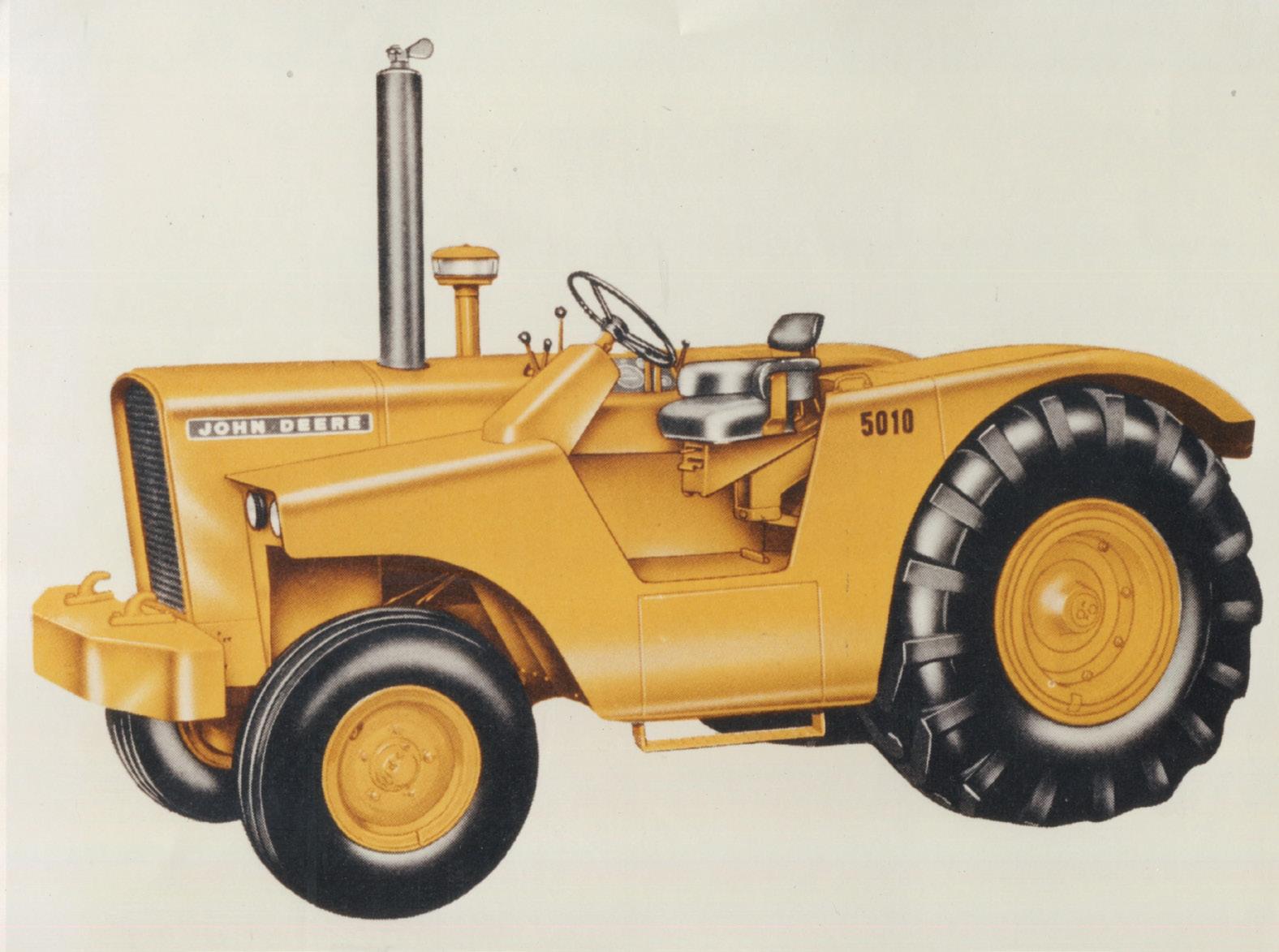
Deere anticipated that the 5010 would have appeal to industrial firms, and the 5010-I, an industrial version of the tractor, was released a few months into production. The 5010-I had an offset operator’s station. This made room for a fifth wheel hitch setup to operate certain equipment, especially an elevating scraper. The 840, which had remained in production until the 5010-I came into being, had been engineered to be the perfect tractor to pull an elevating scraper, and the 5010-I improved upon that. The new tractor had 60 percent more horsepower than the 840, and it had the new Syncro-Range transmission, better power steering, better hydraulics, and stronger brakes. Deere offered 18.00x25 and 23.5x25 inch rear tires with earthmover treads as rear tire options, and 10.00x15 inch truck-style tires or 11.00x16 inch flotation tires in the front.
Within a year, the 5010-I had a new name. Deere decided that the
The heavy duty industrial 700.
industrial tractors should have their own model designations that separated them somewhat from the agricultural tractors. The 3010, 4010, and 5010 became the JD500, JD600, and JD700. The whole line of industrial tractors was improved at that time, as well. For the JD700, Deere strengthened the frame rails and front axle and added a cast iron “nose” to protect the front end of the tractor and add some weight to keep the front wheels on the ground and improve steering and control. Since the JD700 was not expected to do much loader work or other maneuvers that required a lot of direction changes, Deere did not build a two-lever transmission for it. Only 63 of these tractors were made, as Deere sold them for only a brief period.
The 5010 is probably less common than most people realize. The tractor was built for a shorter time than the rest of the series. It was built for a small audience of people who needed big power to cover a lot of ground and who did not need a machine that could do row crop work. If, however, you needed to do some major tillage or sow small grain at a record pace, the 5010 was the tractor for you. There was not a lot of competition at the power level of the 5010, and
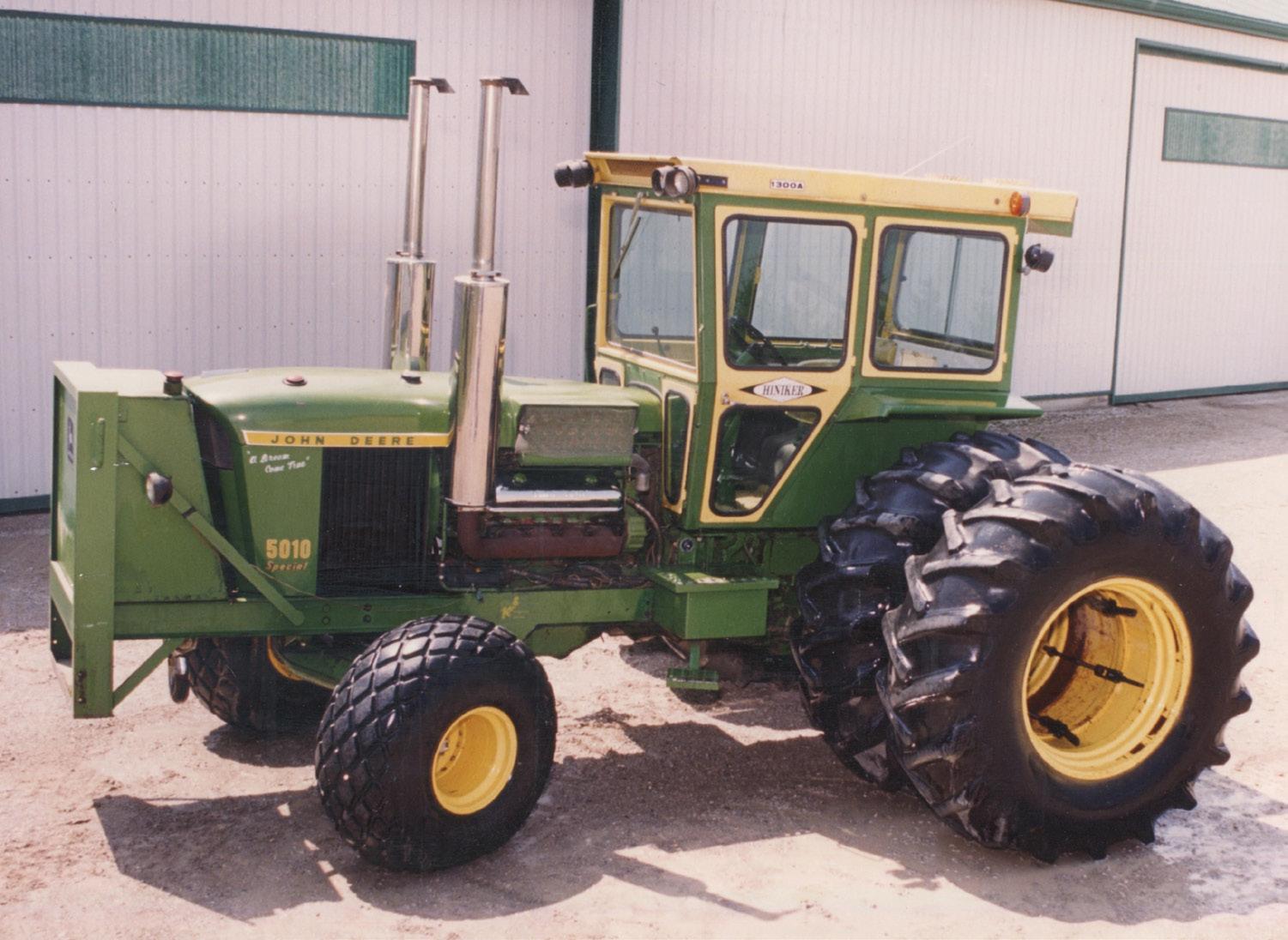
With its rugged drivetrain, the 5010 was capable of handling conversions to much higher horsepower engines.
it was the only tractor that also had the host of features that only John Deere’s New Generation tractors had. Deere sold about 7,500 5010 tractors, and only about 5,400 of those were agricultural machines. Many of those were exported, leaving only about 4,000 in the United States and Canada. All of this means that seeing a 5010 is actually a rather uncommon treat.
If you manage to find a 5010 that seems like a bargain that just
needs a little TLC to get back to working order, don’t jump into the task without some consideration. A tractor as big as a 5010 is not the project for a beginner. Working on one will require some hard wrenching and some heavy lifting. If you soldier on, however, and persevere in the big project, you will be rewarded with a handsome, hard-working brute of a tractor ready for plow days, parade routes, or maybe a few more years of work on the farm.
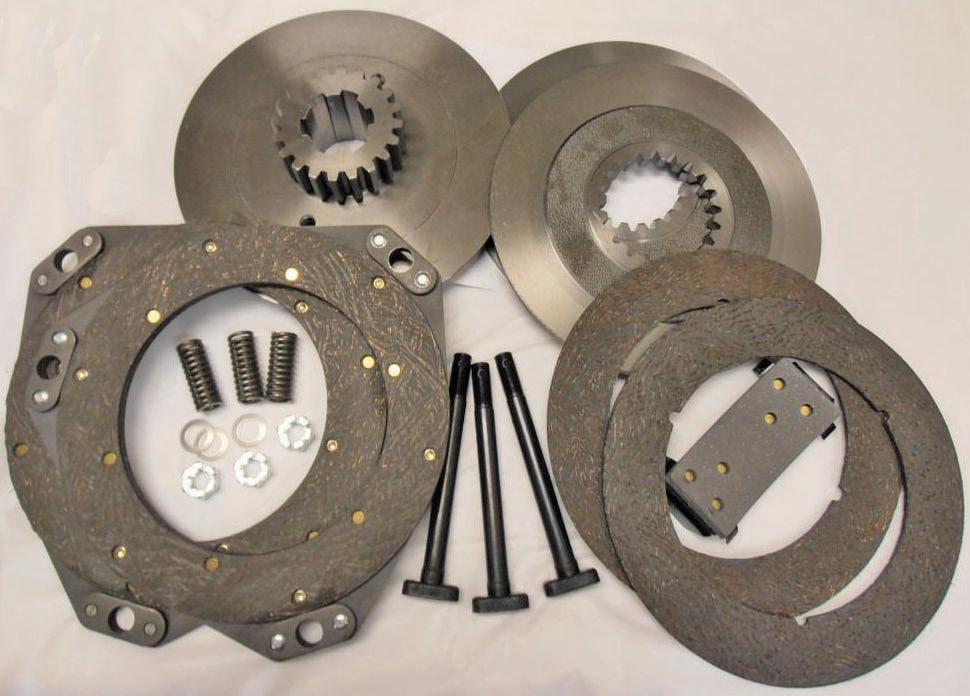
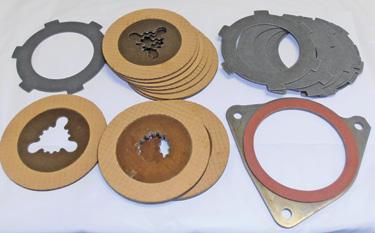
clutch
PARTS
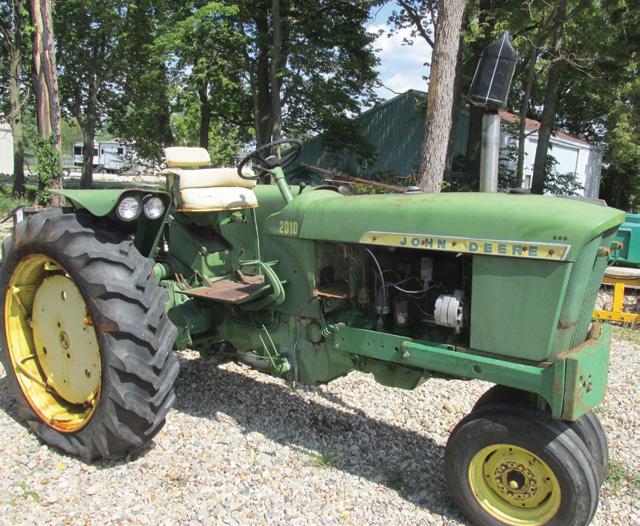
TRACTORS 720D, 2010G, late A, 530, 720D pony start, 50, 1020G, LA ES, 50 w/801 hitch, G, uns A, 730G, 5020, uns G, 430T, 2510G, 730 LP, 2010D, 530, late 520, ’39 B, BN, 40U, ’53 AO, ’41 H, ‘46 A, late A’s, ‘46 B, late Bs, slant dash B, uns B, sty D, G, uns L, M, MT, R, 40T, 40U, 40W, 70D std., 70G, 420U, 420W, 440 w/reverser and PS, 440 gas, early & late 50s, early 60, 60 w/power block, 620, 620 LP, 630, 70G, 720G, 720 LP, 720D pony, 730D, 730G, 820, 1010, 2010, 2010D, 2010RU, 2020, 3010D, 3020, 4020D. Most of these tractors are parted out & on the shelf—ready for quick shipment!
Oversize pistons available again for many two cylinder tractors
Wiring Harnesses - Cables - Switches
We build restoration quality wiring harnesses to fit these John Deere models and their variations:
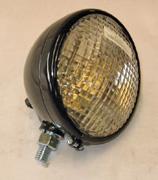
We also carry: Starters, Regulators, Generators, Alternators, Relays, Coils, Lights,
Lind Bros Tractor and Parts, LLC
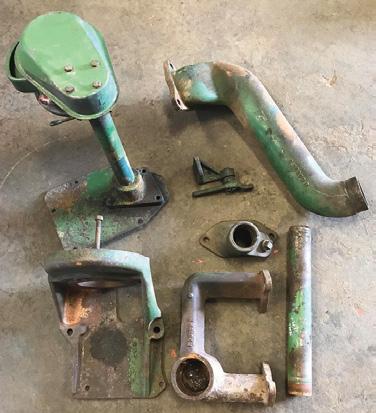
• New aftermarket, rebuilt and used parts for JD A, B , D, G, H, M, R, 320, 330, 40, 420, 430, 50, 520, 530, 60, 620, 630, 70, 720, 730, 80, 820, 830, 3010 3020, 4010, 4020.
• Used parts include: weights, 3-pts., toplinks, dual hydraulics, float ride seats, clutch parts, hubs, transmission gears, sheet metal, tires and rims, 720-730 ES parts, all-fuel manifolds, brake parts, square and round tube WFEs, heads, blocks and PTO parts.
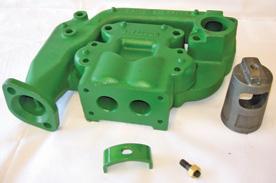
• New parts include: manifolds, battery boxes, carburetor kits, air stacks, mufflers, grill screens, radiator cores, lights and overhaul kits.
• Rebuilt parts include: Taper-Loc flywheels, electric start conversion kits, float ride seats, starters, carburetors, cleaned and lined gas tanks. Also have crack checked heads and blocks.
The Classic Green Reunion was a great opportunity for JD collectors to show off their favorite items from memorabilia to tractors. Vendors brought everything from manuals and toys to every vintage tractor part imaginable. The lawn and garden “double 00” series of tractors was one of the features, from the small model 100 up to the mighty 400, as was the model “B” tractor. The West Bend, Wisconsin show location was only half hour from Horicon, Wisconsin, where Deere built their garden tractors, therefore another piece of Horicon’s past was given a little space in the fairgrounds “small animal barn” alongside the L&G collectors. And of course, we are talking about my favorite topic: John Deere snowmobiles.
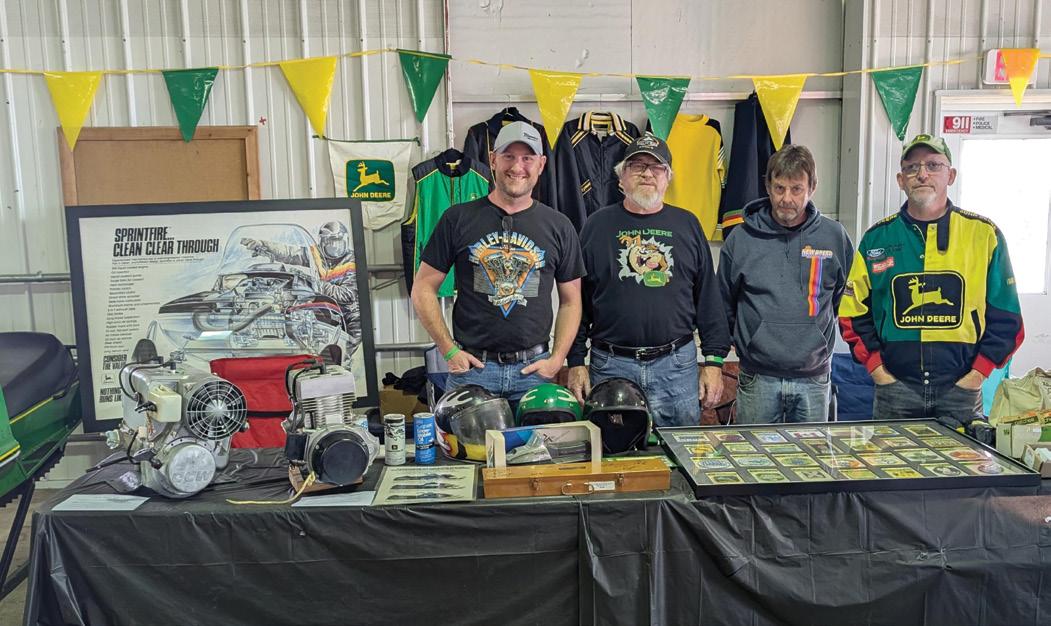
Tom Rehberg and Brian Lindner were recruited by the show organization to gather the Deere sled heads and organize a display. Indoor space was limited, with more space available outside. Tom and Brian got to work, bringing snowmobile collectors together from far and wide to get nice representation of Deere’s snowmobile line up from beginning to end. Brian liked the idea of having two tables set up in the middle of the display for smaller items and memorabilia. It also gave the guys working the event a central location to visit with the show attendees. It turned out a be a good place for
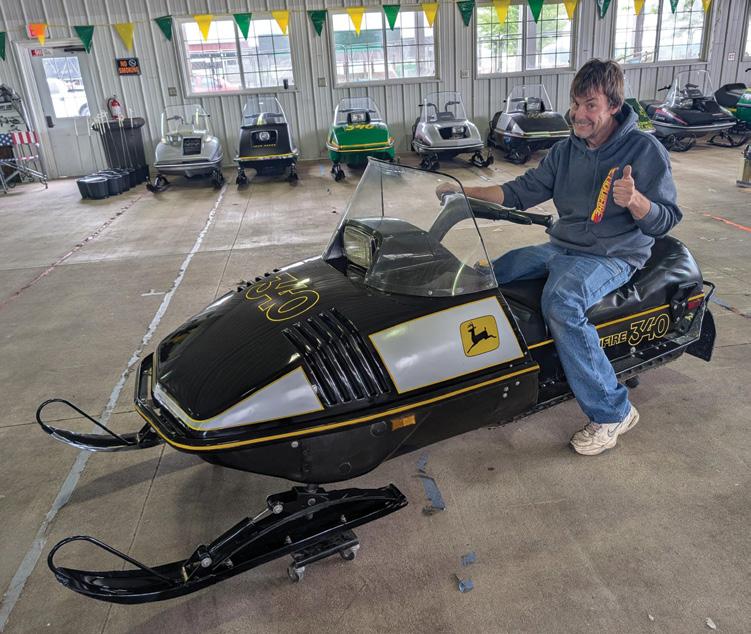
Wade Bennett was either really, really happy to be at the show or just thrilled to be displaying his excellent ’77 340 Liquifire. You decide!
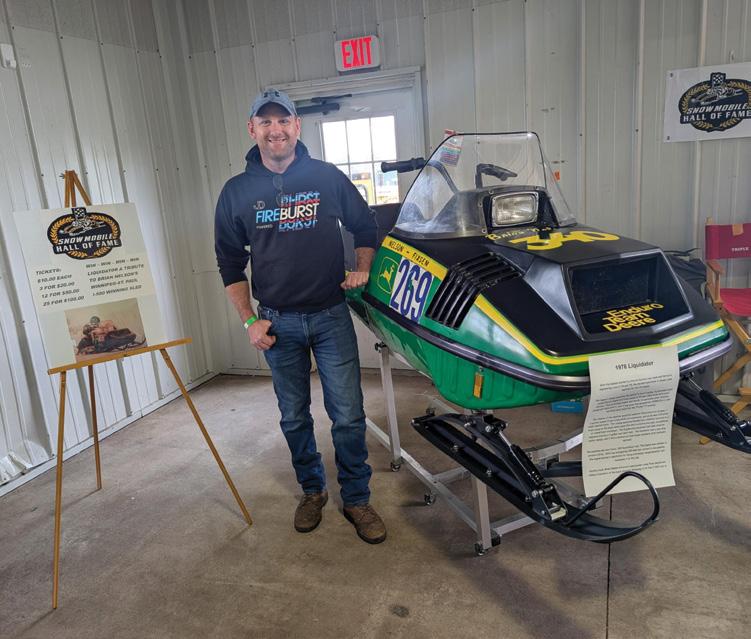
Aside from helping organize the entire display, Tom Rehberg loaned the Hall of Fame his ’76 Liquidator 340 to be a stand in for the replica they are restoring to help sell raffle tickets. It was a popular attraction and helped encourage sales.
snowmobile related discussions and impromptu Q&A sessions.
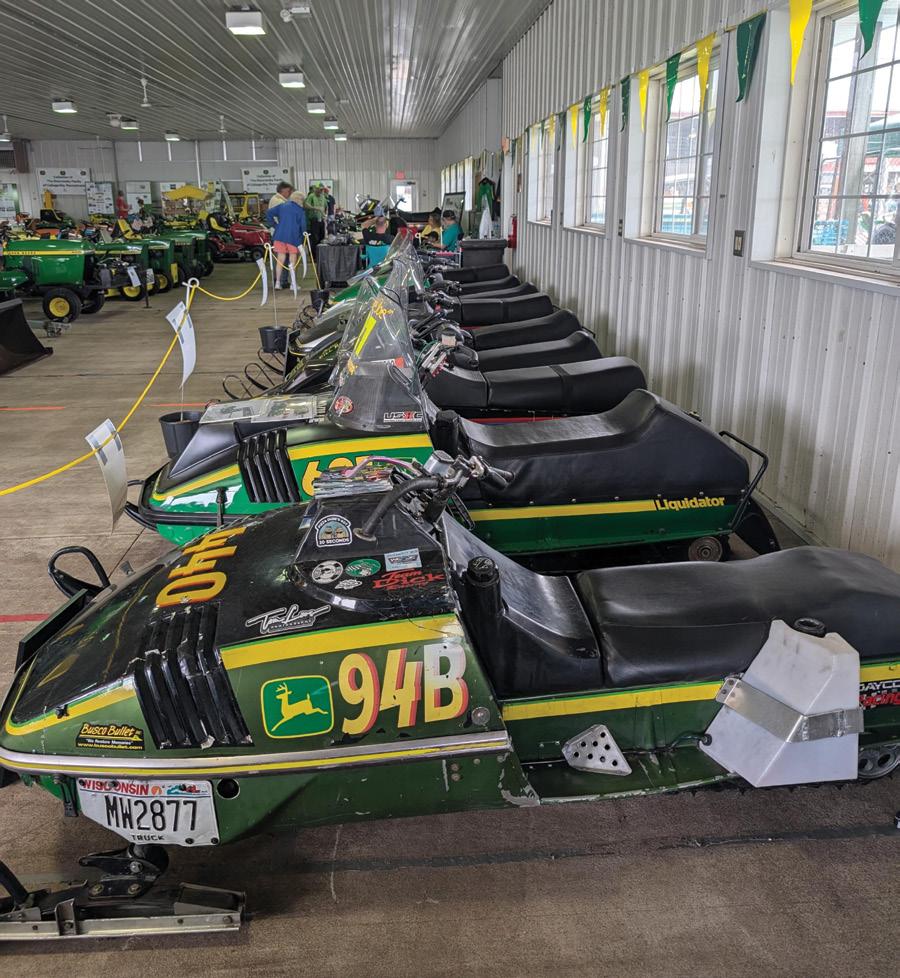
After Brian inspected the building at the spring planning meeting, he and Tom felt there could be room for 22 to 24 sleds on one side of the barn. They made a list of machines that would be a good representation of the line up, plus a few customs and racers to keep it interesting. That set off a flurry of phone calls and emails to get machines to the fairgrounds in West Bend for the three-day event. Many of the JD snowmobile collectors are a pretty tight knit group, so it only took a few well-placed calls to get the needed commitments to fill the side of the barn with a wide assortment of Deere sleds, ranging from the first-year model 400s to the last year Liquifire and Sportfire models.
In addition to co-organizing the show, Lindner brought out three of his machines, including his restored ’72 model 400, and ’73 and ’74 JDX8s. Brian also picked up a green ’79 Spitfire from Matt Gabler so we had a Kohler powered Spitty represented. Rehberg brought his Liquidator to loan to the Hall of Fame for their display, plus he trailered down a few of his Uncle Mike’s machines for display, including a ’75 model 800, a ’78 Cross Country Liquifire, and very nice ’84 Sportfire. Tom brought up sweaters and jackets to hang up on the wall behind us. Wade Bennett made the trip from central Indiana
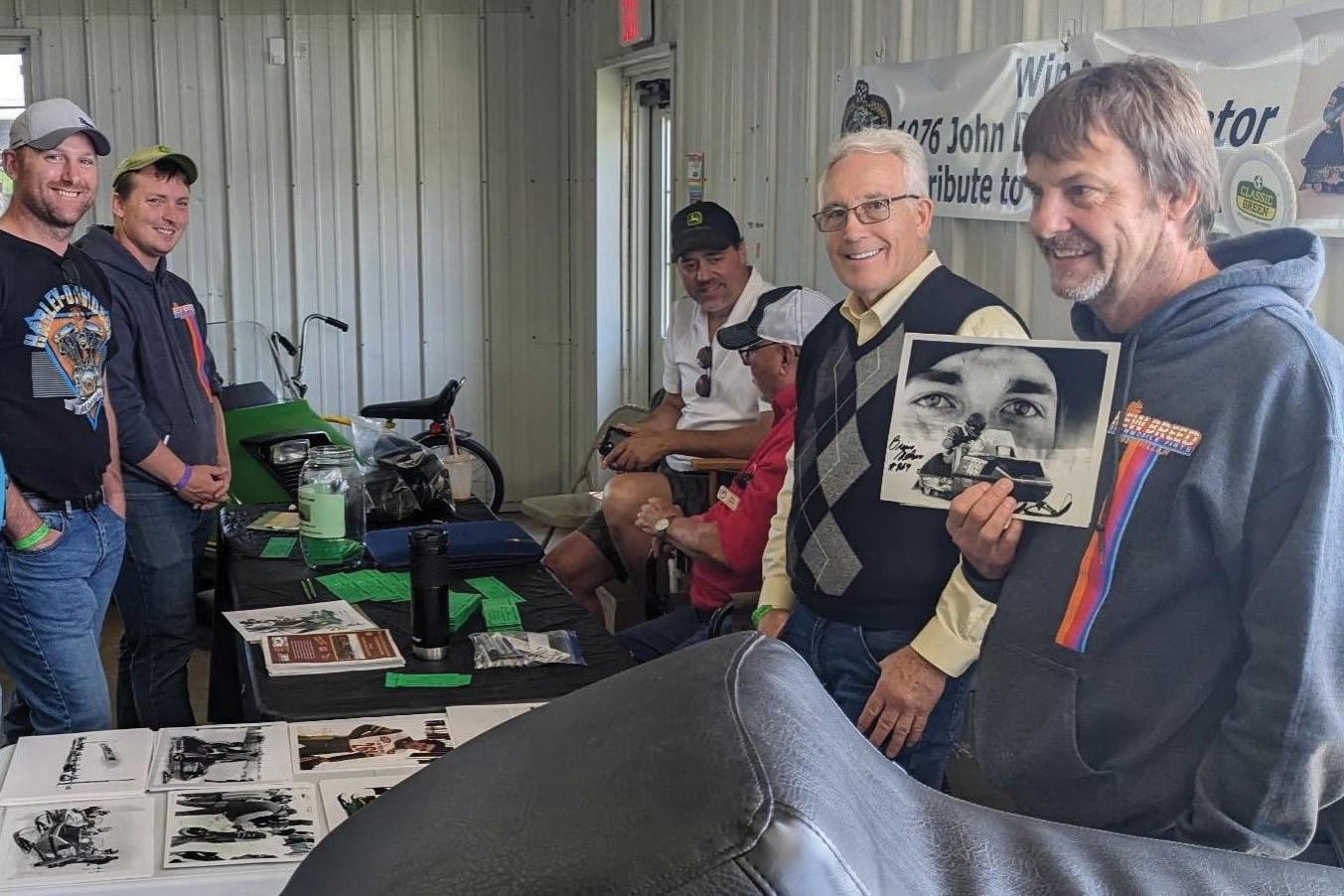
Despite the “murderer’s row” look, we were all actually having a great time at the show. From left: Tom Rehberg, Brian Lindner, Wade Bennett and your author, Joe Rainville.
with a freshly restored and stunning 1974 JD295/s that looked showroom new. He also brought a very nice ’77 Liquifire 340 that will no doubt be the subject of a future article. Wade also pulled a freshly restored 1975 model 400 out of his trailer, but this one confused me because it had tires and a 20 horsepower four-stroke Kohler under the hood. Seems Wade had his father’s original garden tractor restored and brought it to show. All was well once I figured out it was the other “model 400.”
with four other Deeres including a grass drag racer that belonged to the late Lee Hardesty, Deere’s “engine guy,” a 340/s racer formally owned by factory technical Ed Kruel. Luke Abiz, owner of “New Breed Parts,” brought out a nice pair of direct drive Deeres, an ’83 Snowfire and ’83 Sprintfire, plus a very cool patch sign board his wife Bethanie made to display all the various snowmobile patches Deere made. Jesse Cypher brought out his oval racing Cyclone and race memorabilia plus a nice ’77 Liquifire 440 and a bright emerald green ’78 Cyclone.
In total, we ended up with 23 machines displayed indoors, owned by nine different collectors. Tom, Brian, Wade, and I manned the booth for the duration of the show, with several other guys coming in for hours or days at a time. Once we had the sleds and booth set up, the Snowmobile Hall of Fame had also set up their booth to sell raffle
As for your author, well, I was not going to miss a week of talking sleds and hanging out with my buddies, so I made the 1,000 mile trip with a few sleds and some memorabilia in the trailer. I brought along a lightweight custom Liquifire called “The Ultimate Liquifire” by the dealer that built it back in the early ’80s, and my vintage class cross country racing Liquidator to display. Lindner also asked me to bring my “rider” ’72 400 up earlier that summer as he was going to “spiff it up” for the show to help the local Horicon FFA kids sell tickets for the one they are in the middle of restoring. Brian did a lot more than “spiff it up” so it ended up being shown in addition to some posters, a few NOS motors and such to help decorate the booth.
Another one of Deere’s “long green lines” starting with Jesse Cypher’s vintage oval racer Cyclone and my I-500 vintage class cross country racer Liquidator added some variety to the factory stock machines.
Darren Redding stopped by to visit our display, and checked out my now shiny 1972 JD model 400. Brian and his grandson applied fresh paint and decals after the HOF show in May to loan to the local FFA, but they weren’t quite ready for it. I am going to be afraid to ride it next winter—it looks so nice.
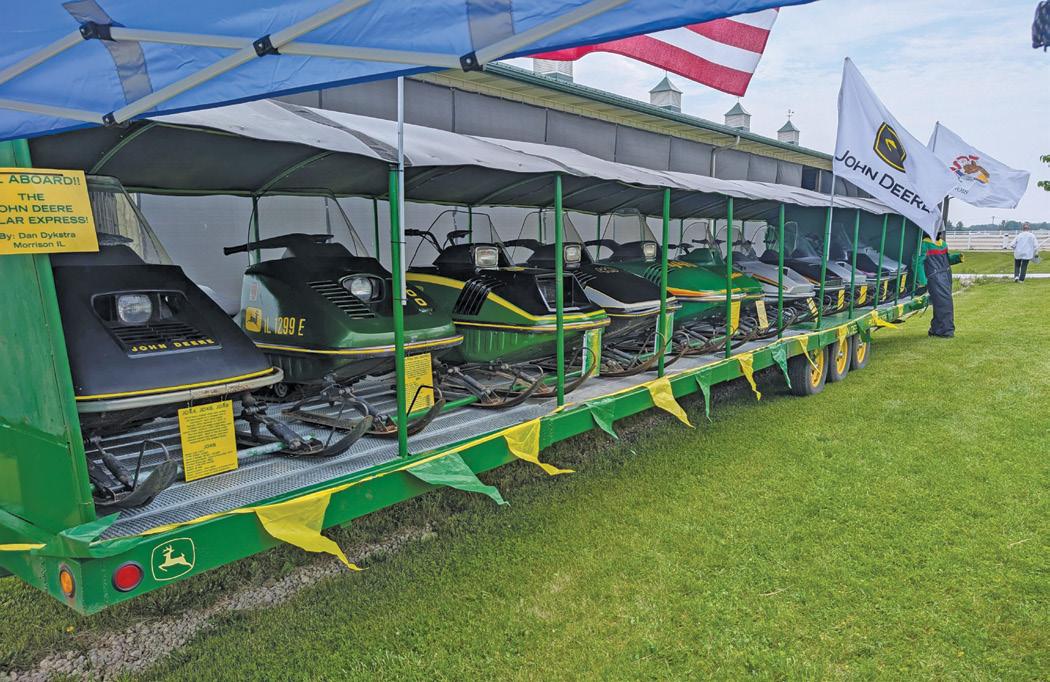
tickets for a tribute sled being built to commemorate Brian Nelon’s I-500 win in January of 1976. Additional outdoor displays included Dan Dykstra’s trailer full of snowmobiles, a nice pair of low milage 1976 model 300 and 400s, and another gentleman brought out a ’78 Cyclone 440 and clothing he displayed in his clamshell trailer. Saturday, Brian Nelson even showed up to sign autographs and share his many great racing stories with the Deere faithful.
Joe Wanie, of Horicon, brought out serial number 285,420, the very last ’84 Liquifire built, to put on display
With our display set up, the four of us generally took turns watching the booth and walking the show. The outdoor swappers and the indoor vendor building were popular area to hit. But Wade kicked off a somewhat amusing trend by showing up with a Ertl Trailfire toy snowmobile which he added to the display table. Not long after, I made a deal on a neat looking ‘77 era “Beautiful
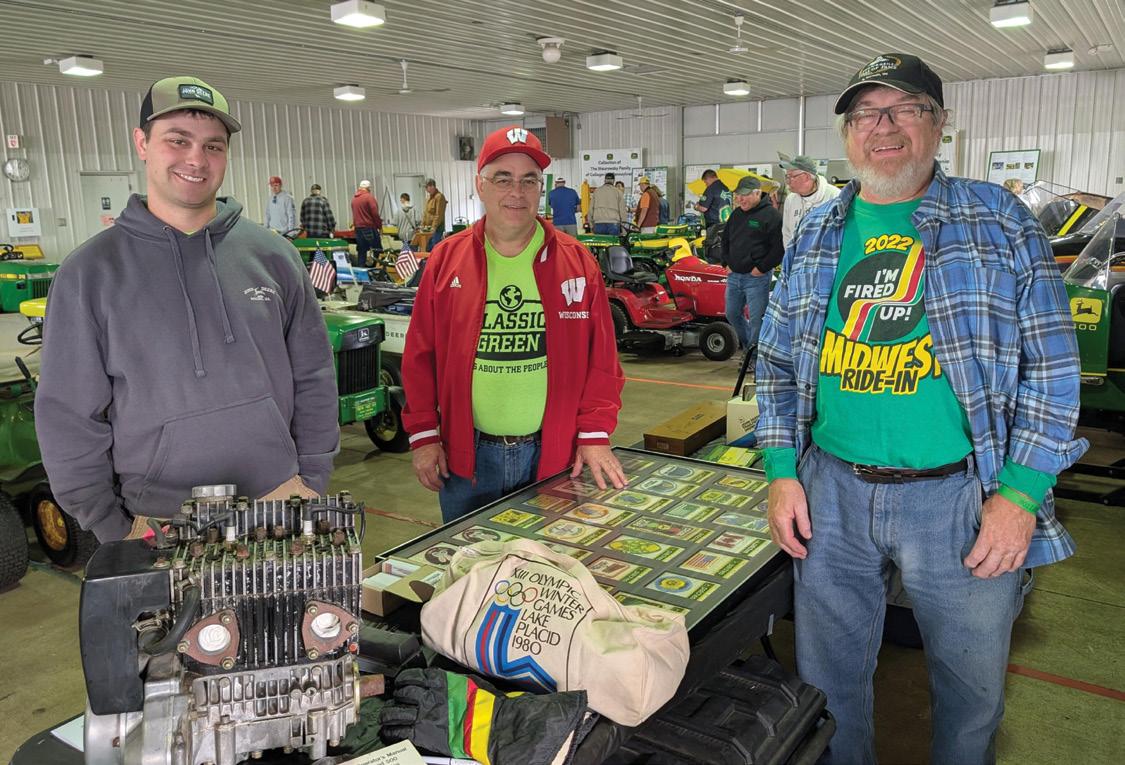
Bodyguards” metallic green vest and a few snowmobile oil cans, which were also added to our display. Tom bought a green “flaming antler” helmet he found at an outdoor vendor. Later on, Wade walked up with a very cool and desirable JD Olympic gear bag from when John Deere was the “Official Snowmobile of the 1980 Lake Placid Winter Olympics” and of course that was added to the display tables. And this continued throughout the show. I found a snowmobile gas can that was missing most of its paint, but the price was right; then I found a newer version with 85 percent of its original paint, with a correspondingly higher price tag. Both were added to the display along with a book of “Ride the New Breed of Deere” matches.
Tom and Brian did a great job coordinating with the show organization, rallying the troops to get the various sleds on display and getting the booth put together. The four of us enjoyed meeting show attendees and talking with a few folks from Horicon that worked on building sleds back in the day. Overall, we had an excellent time and we enjoyed all the show had to offer. Thanks to the CGR for hosting a snowmobile display, as we had a great time showing off our sleds and taking in the event. It’s always a treat to see Brian Nelson come out and talk about his Liquidator, but that’s a story for another time…
Joe Rainville is from Fort Worth, Texas. To contact him, send an email: joerainville@hotmail.com
Dan Dykstra of Morrison, Illinois brought his own one-man show of 11 sleds plus memorabilia on his custom trailer. The sleds and the display looked great!
Mike and Jonathan Doll stopped by to say hello and talk sleds. They both rode the “Vintage Challenge” with Brian and I at the HOF’s “Ride with the Champs” this past February. It was nice to visit and talk sleds with them again.
The Hall of Fame invited Enduro Team Deere Champion Brian Nelson, second from right, to the CGR, and we were glad to have him visit, tell stories and sign autographs. From left: Tom Rehberg, Luke Abiz, Joe Wanie, Don Amber, Brian Nelson, and a smiling Wade Bennett holding a freshly autographed picture of Brian’s I-500 win aboard a Liquidator.
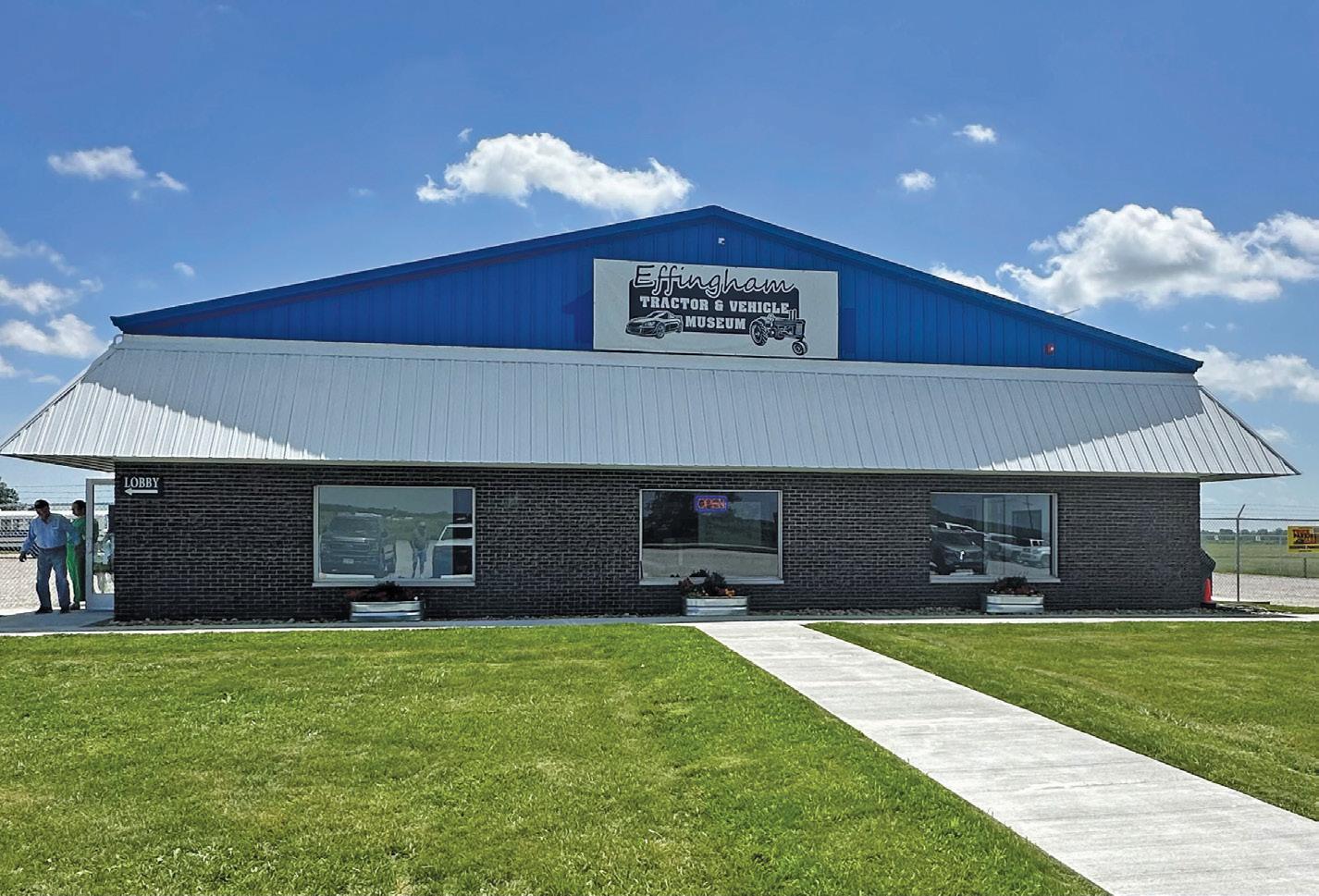
June 21st was the grand opening of the Effingham Tractor & Vehicle Museum.
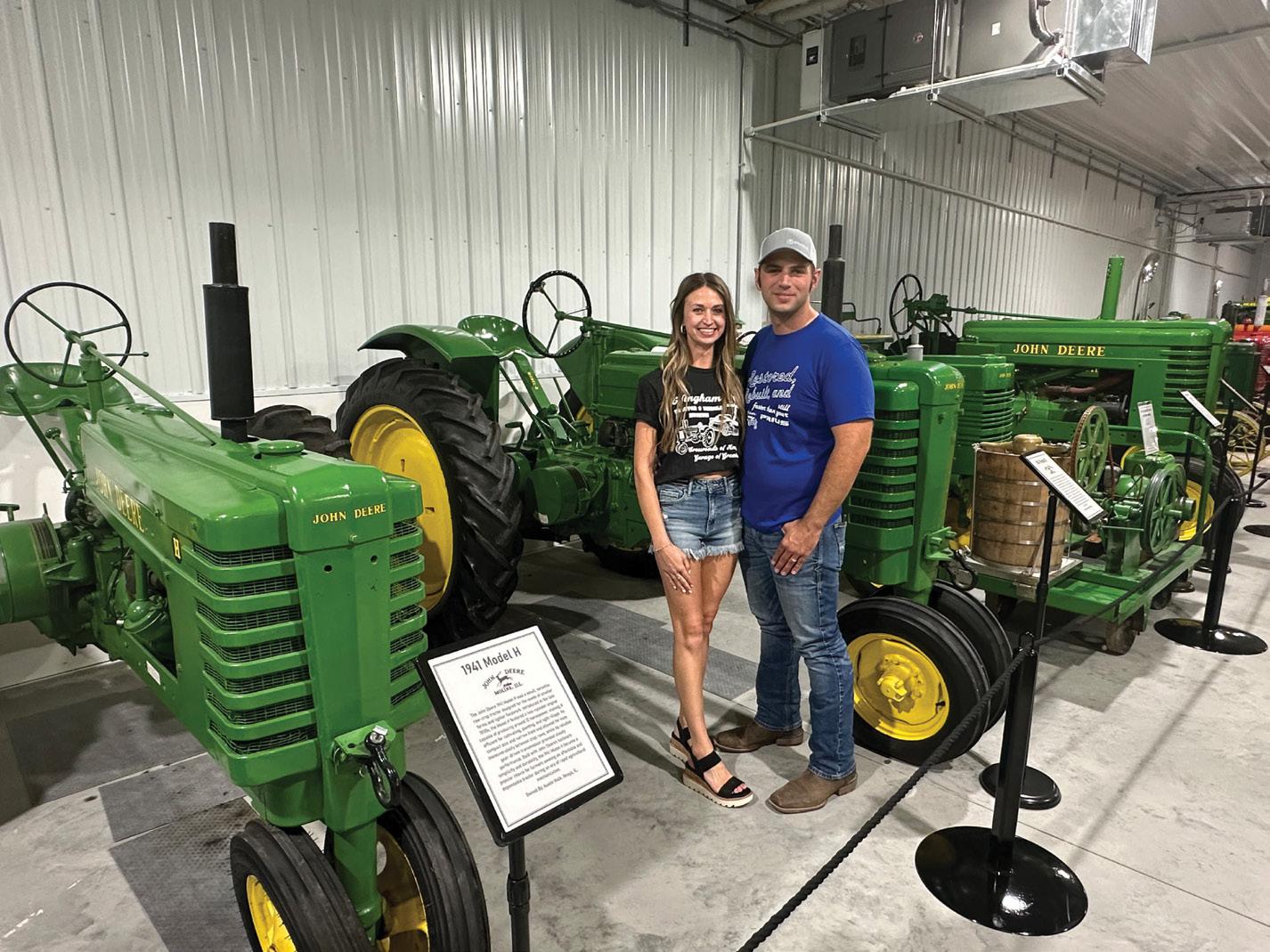
Owned by Austin and Oliva Walk, the two have come up with a unique concept with this museum/storage 10,000 square foot facility. Besides offering a museum to see tractors and vehicles on display, this is a great place for Austin to share his 1941 John Deere tractor collection.
For this fourth generation farmer, he began collecting tractors at an early age. “When I was 16, I went to an auction, and bought a 1941 John Deere model ‘B’.”
After discovering that there are a lot of JD options in that year, Austin decided to focus on tractors from 1941. Today he has two tractors he restored himself. After seeing how much work and expense went into the restoration, he decided from then on to purchase tractors already restored. In his collection, Austin (and his family) have a John Deere “B” tractor, an “A,” “AR,” “BR,” “H,” “LA,” “D” and a beautiful hit and miss engine with an ice cream machine.
Besides enjoying the antique tractor hobby, he also likes to pull and has a John Deere 5010 for the sport.
Austin’s collection is in their newly opened museum and storage facility. The Walks came up with a novel concept; they offer a climate-controlled and impeccably maintained facility for enthusiasts and collectors of classic cars, jeeps, antique tractors, garden tractors, and motorcycles to keep their collectibles. Collectors can store their tractors and vehicles in the building that also serves as a museum at the same time. On their website www.effinghamtractorandvehiclemuseum.com, they share, “For a fixed monthly rate, you can store your tractor or vehicle on display in our secure, climate-controlled facility. We offer both month-to-month and longterm storage options for antique tractors, garden tractors, classic cars, jeeps and motorcycles and more.”
Besides the inside 10,000 square feet, the Walks also have outdoor parking lot storage for items like trailers, boats, campers and RVs. These outside parking lot sites can be accessed 24/7 with an access gate code. For those tractors and vehicles inside the climate-controlled building, an appointment must be set for a time for Austin or
Olivia to open the building.
Purchasing the building in June of 2024, “Just a little over a year ago, we opened today,” Austin said, starting the day with a ribbon cutting.
Olivia and Austin are almost newlyweds, tying the knot in 2022 after Austin proposed in a wheat field. The two met through Olivia’s college roommate, who was in FFA with Austin. Olivia, previously a Minnesota girl, moved to the area, and worked for ADM before settling down and starting this new journey together. When asked why he collected John Deere, Austin replied, “Why not?”
“He farms with John Deere, too,” Olivia said, making it obvious that Deere is his brand of choice.
The Walks are embedded in agricultural preservation, and their love of FFA led them to offer groups like FFA and 4-H clubs a chance to fund raise by working at the museum on the weekends.
The morning of June 21, 2024, the Walks officially opened their museum/ storage building. At the grand opening, the museum offered displays of his own 1941 John Deere series, some lovely Farmalls, a rare 1928 Stinson Heavy Duty 18-34 model, a1909 Sears Auto Buggy, pedal tractors, Allis Chalmers tractors, a few cars and trucks, an Army jeep and more.
The museum is open Monday through Thursday by appointment, and Friday, Saturday and Sundays from 10 a.m. until 8 p.m. Admission is $6 for adults, $3 for children, and $1 for military. For more information about the Effingham Tractor and Vehicle Museum, call 217-994-0504 or check out their website.
Reading the magazines devoted to vintage John Deere tractors, talking with many folks involved with them both as a hobby and as functioning machines, and watching videos and demonstrations—not to mention having three two-cylinder tractors of our own—I have learned about many, many kinds of repairs to nearly every part of the tractors, from engine and transmission internals to front end supports and wheels. I have read about or seen repairs to the steering pedestal, the steering gearbox, and the steering wheel but, until July of this year, I had never heard or seen any reference to repairs needed for a broken steering shaft.
I was using my ‘51 “A” to pull some small stumps along both sides of our creek. I had gotten down as far as I could into a corner between the creek and a boundary fence, so I had to turn around and the front wheels must have gotten wedged against two stumps in the rocks (lots of rocks down there, head-sized and bigger). The wheels wouldn’t turn, so I tugged hard. All of a sudden, the wheel was spinning freely in my hands, and it was sliding toward me. But the front wheels weren’t doing anything at all. Oops.
So I trudged back up the hill to my shed and shop on foot, pulled the steering shaft out of our other “A,” and took it and some tools back down to swap into the stranded ’51. All went well, and when I was done, the tractor steered as it should. I even took the road home so that I could test in fourth gear: no wobble, only about three inches of steering wheel play in either direction (manual calls for two inches, if I remember correctly).
But then we needed a permanent fix so I could give the ‘49 “A” his shaft back.
The steering shaft for this vintage tractor, at least, is a tube. Moreover, the wall is reasonably, but not apparently not sufficiently, thick. This fact surprises me! I would have bet just about anything that the shaft would have been a solid rod and failure-proof. But the fact that it is not at least enabled me to make this repair. Talking with a friend, we conceived an idea: clean up the broken ends so that they mate and find a steel rod whose OD matches the ID of the tube. Insert rod, put the two halves together, and have them welded.
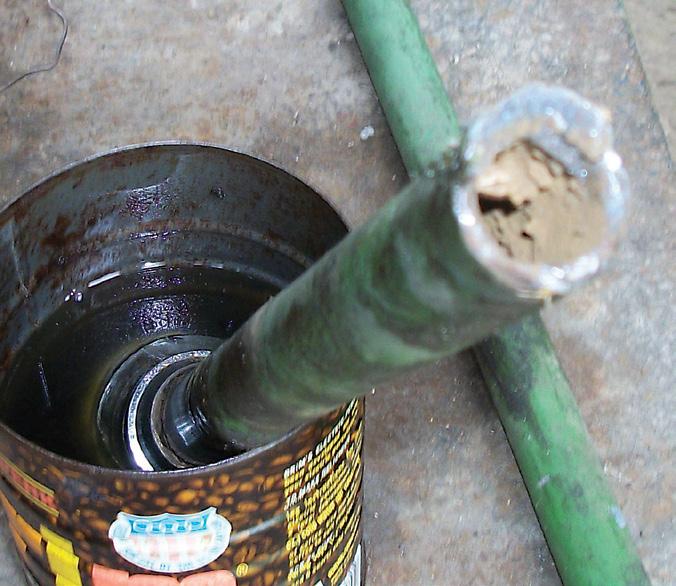
First job: clean up shaft so I can handle it. As I put the short worm end into a can of solvent to get the grease
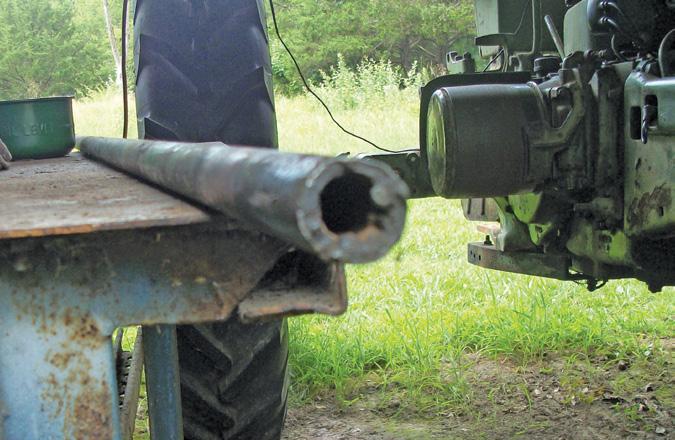
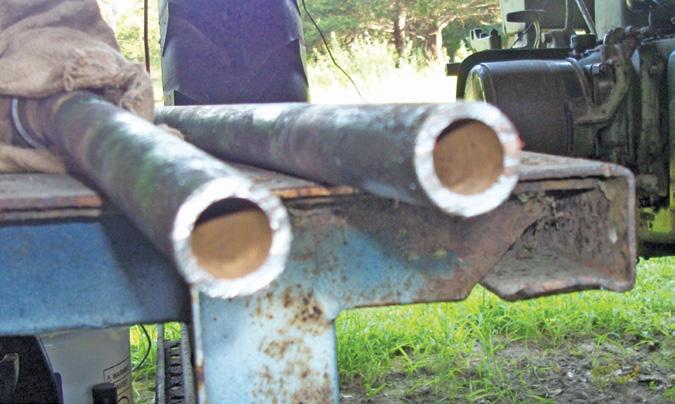
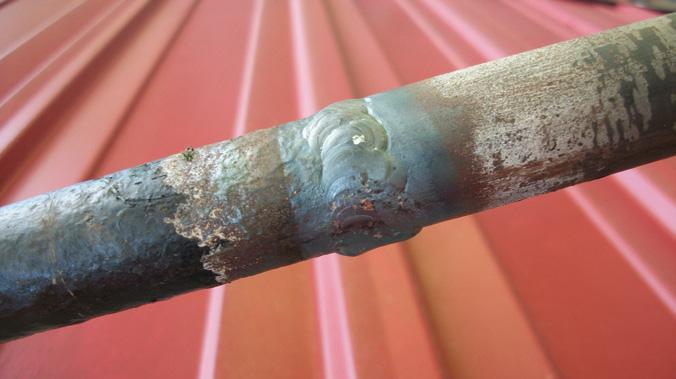
off, I noticed something: this shaft had been broken and welded back together before! There is ample evidence of a previous break and an inadequate fix (Photos A and B).
There was little hope of cleaning those ends up and being able to insert a solid rod in there to stiffen the joint, so the next job was to cut the ends square, back a half inch or so. I didn’t think that having a steering shaft a part of an inch shorter would be of any consequence. Before cutting, I placed the broken ends loosely together and drew a line in permanent marker along the axis of the shaft to provide a register mark for reassembly (not visible in the photos). I don’t think the relation of the Woodruff Key to the worm is critical, but I hope to keep the orientation of
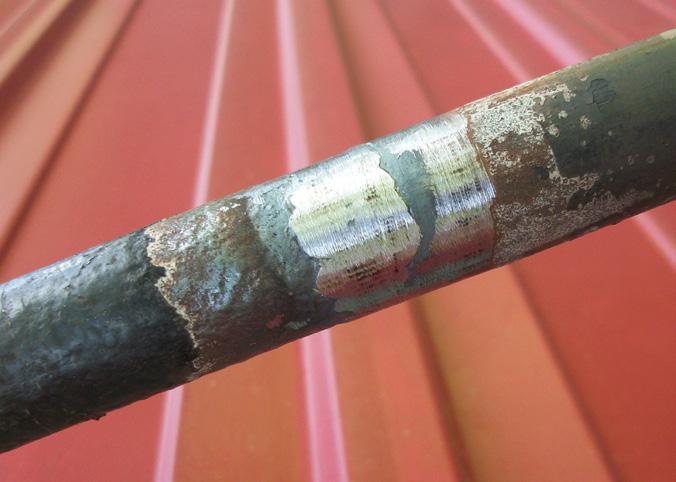
the steering wheel as close as possible to what it had been. My cuts were not perfect, but they were pretty good for having just a bench vise and a hacksaw to work with (Photo C).
I used a machinist’s Vernier Scale caliper to measure the ID at just a very fine hair over 5/8ths of an inch: close enough for this kind of work. A quick search at the local farm store turned up a suitable rod for the purpose, three feet in length, which was more than enough. I delivered the pieces—the long end of the shaft, the short end of
Photo A • Photo B, below
Photo C
the shaft, and the rod—to a friend who knows how to weld and has the necessary equipment.
When I got the shaft back, the weld was strong and clean but in need of a quick date with the grinder (Photo D). Given the quality of the weld, it took only a few minutes to have the shaft as smooth as it needed to be for the application (Photo E).
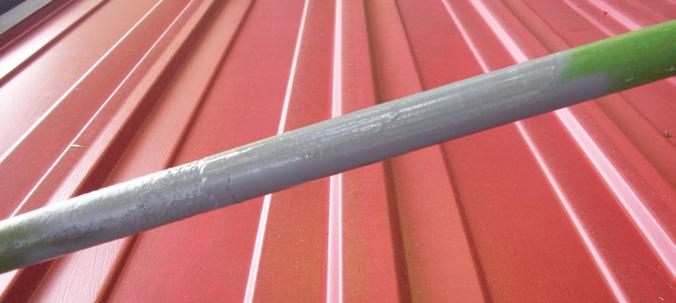
He is my go-to machine for many jobs around our place, and he is so dependable that we call him “Old Reliable.” I can’t afford to turn him into a museum piece—not only because I don’t have money to spend on that but because I would then need another working tractor. So I didn’t strip the shaft, sand or otherwise pretty it up, but I did wipe down the welded portion with mineral spirits and primed (Photo F) and painted it (Photo G) to keep the bare metal from rusting. One other repair I did made was to touch up the steering wheel threads with a thread file (16 tpi) because the end had apparently been mistreated at some point. I was gratified to see, by the way, that the worm gear is in superb shape.
I am not restoring this tractor.
I cleaned a goodly portion of the grease out of the steering gear box so that I could be sure that there were no other problems lurking inside (Photo H). Everything looked great: the sector gear teeth
looked undamaged, and there were no bits of metal floating around inside. Both bearings were clean, undamaged, and smooth. Reinserting the shaft, adding in replacement grease, and putting it all back together was the work of a few minutes (Photo I). Steering wheel play is well within tolerances. Honestly, the whole repair was about as quick and easy as one could hope a repair to be (facilitated by having a donor handy to share a shaft and recover the stranded tractor). But the failure still flummoxes me. Oh, I get why the shaft failed on me—it was previously repaired poorly. But why did it fail in the first place? And why did Deere make the shaft out of tube to begin with? I’ll never know, I am sure, but I can at least now say I have made a very uncommon kind of repair on one of these tractors, and I will never again offer to bet that any part on one is failure proof!
Submitted by,
Steve Allen St. James, MO
Photo D • Photo E, below
Photo F • G, right
Photo I
Photo H
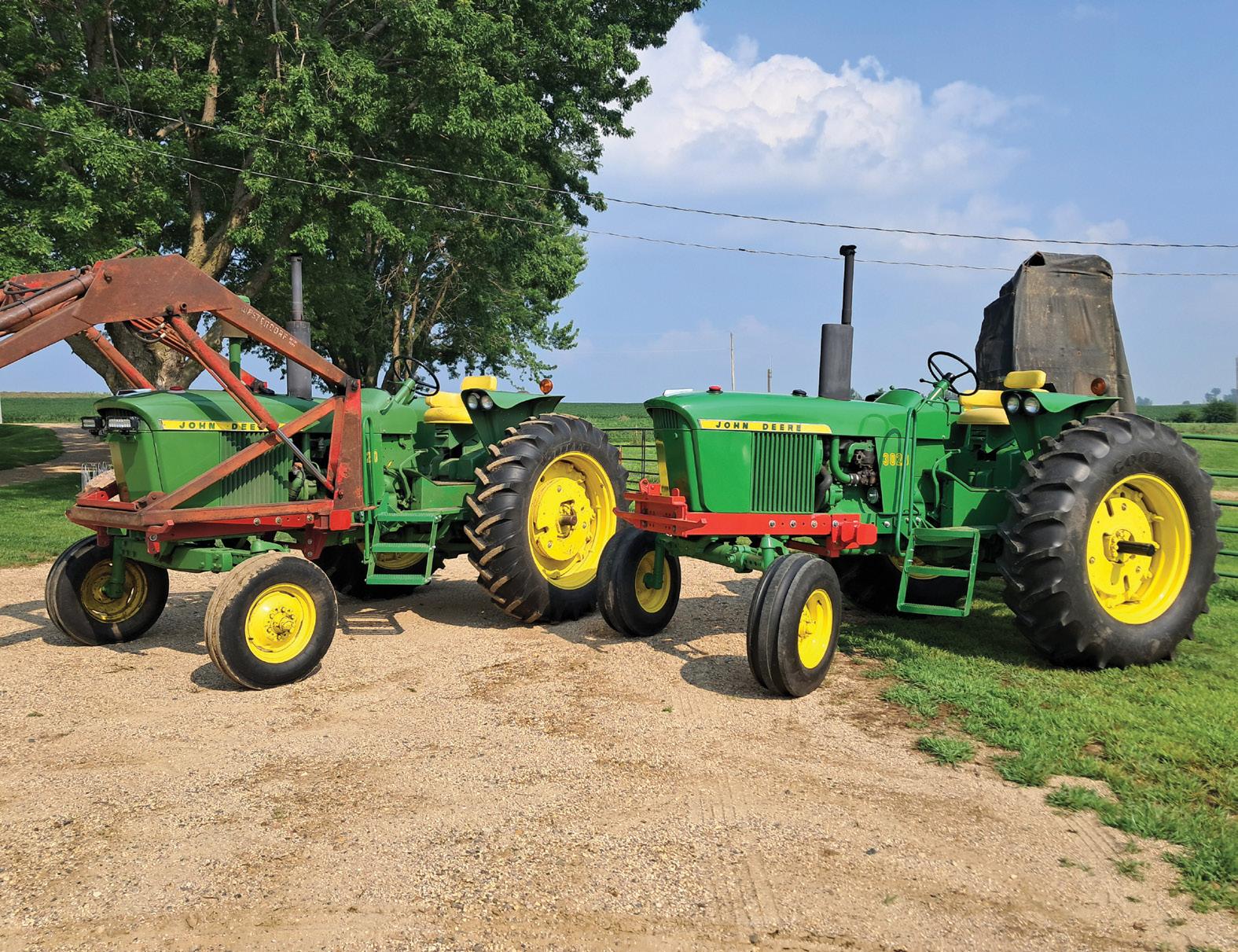
Right: Bill and Sue Schwaller of Cherokee, Iowa own this 1968 3020 Syncro shift, gas, with dual remote outlets, and 1970 Syncro shift, gas, with dual remote outlets.
Right: Dave Zimmerman of Lincoln, Nebraska owns this 1950 “GW.”
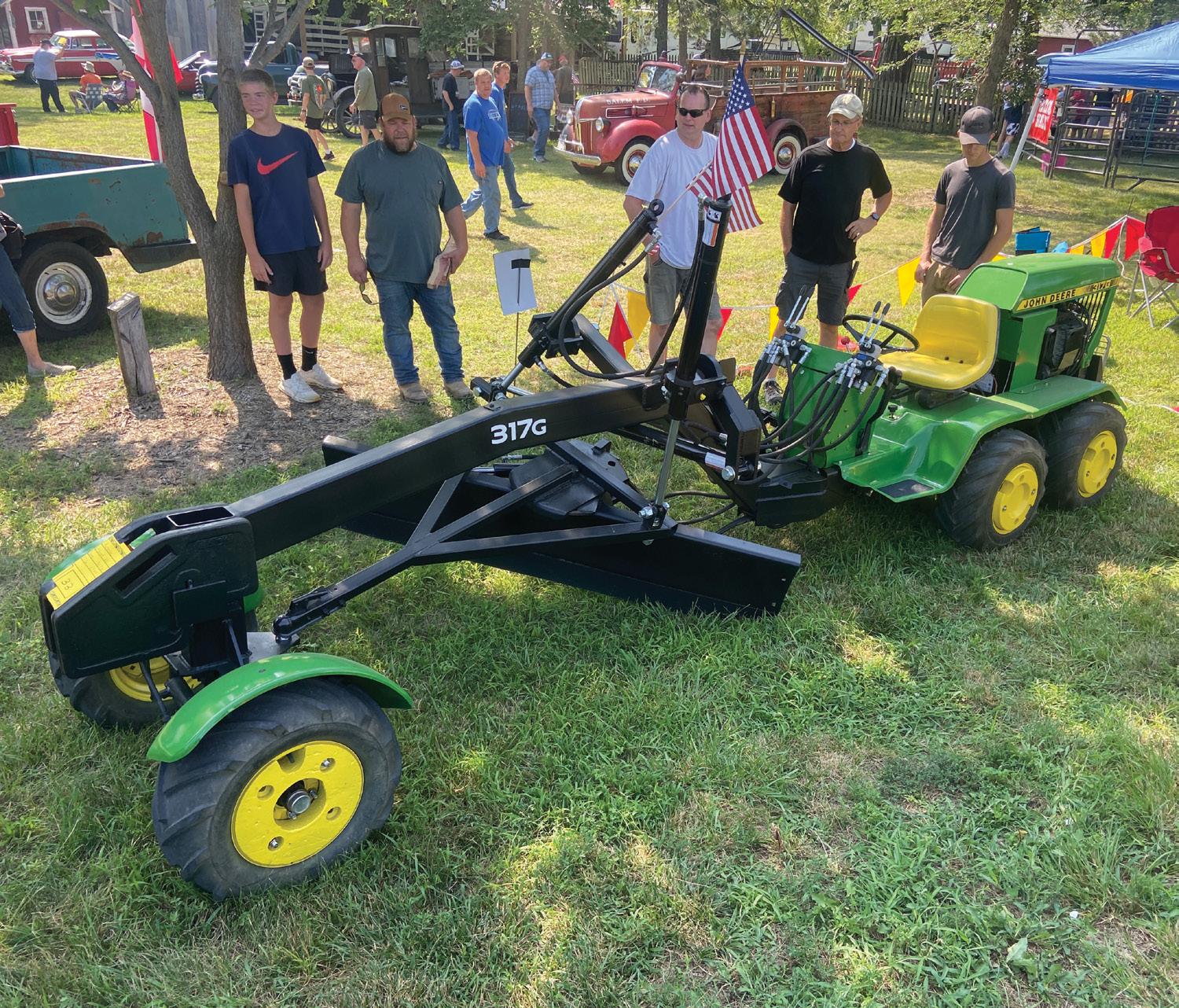
Below: Jon Rosene of Cortland, Nebraska built this 317 grader.
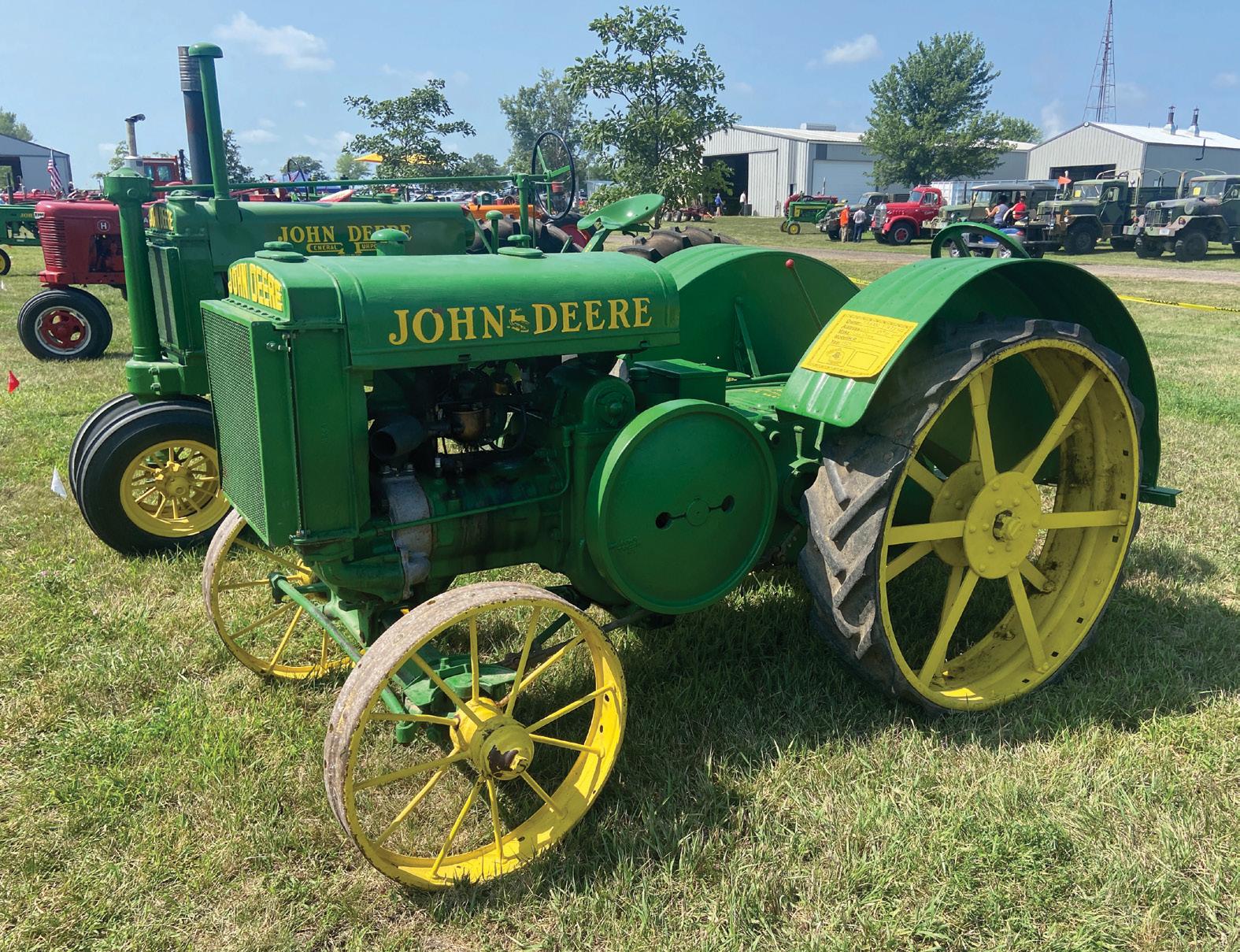
Left: Jahan Fatemi of Lincoln, Nebraska owns this 1925 “D.”
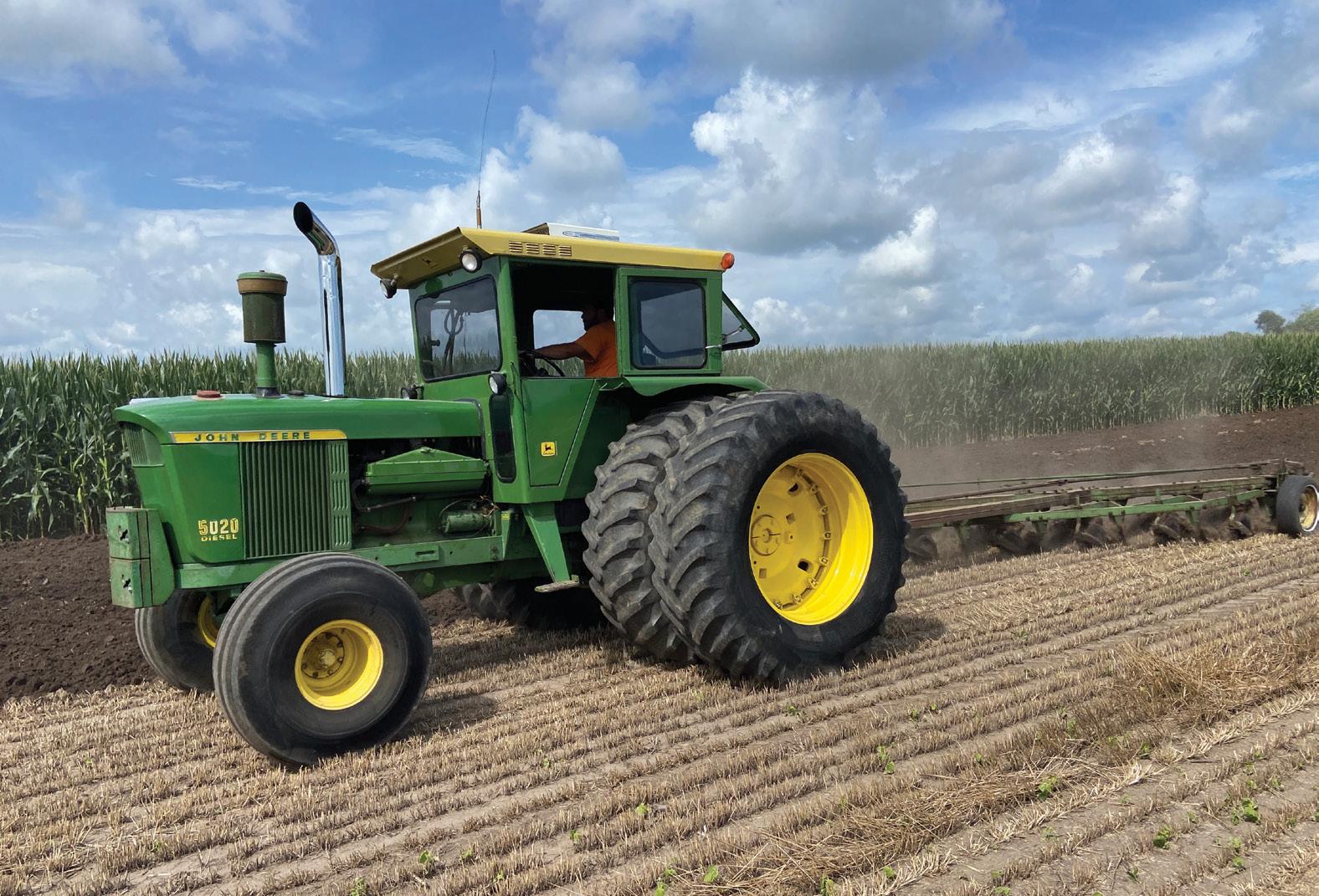
Left: Here is Jacob Smith’s 5020, with a little engine modification, plowing at the Bos Brothers’ summer show.
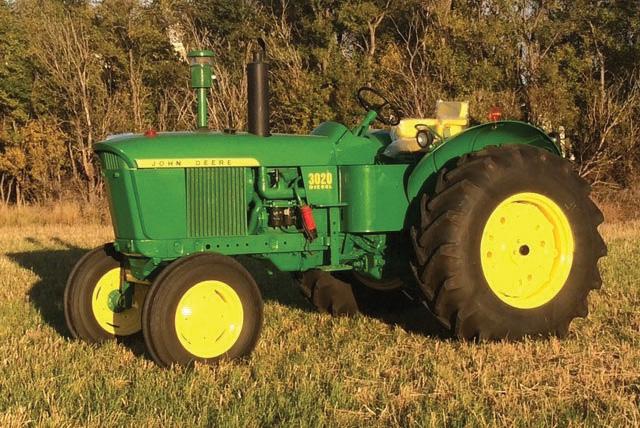
Below: Brian Varloe owns this 1968 3020 diesel standard.
I changed my mind on the topic of this month’s article just as I was beginning to write it. I will tell you why.
I imagine the majority of you reading this belong to Facebook or you are at least familiar with it. I have said before, I did not join Facebook for many years, but the darn tractors ended up pulling me in. For those of you who are not familiar with Facebook, it is basically a method for people to interact with friends, family, and people they do not know on almost any subject that can be imagined, subject to the rules of Facebook. Many use it as a way to keep up with family, friends from long ago, former work friends and business acquaintances. It is also a means of getting your message, whatever that may be, out in front of the world and businesses use it also as a way to advertise, as if any of us need any more of that but it is what it is.
For me, it has allowed me to stay in touch with many who I otherwise might not have. That is beneficial. I have also met many new friends/acquaintances and some I stay connected with regularly while others are more casual. You are able to exchange messages, both public and private, as well as pictures, announcements, videos, whatever you deem appropriate.
The other aspect of Facebook that has kept me engaged is Facebook Groups. Groups are set up by an individual or an organization or company and the main purpose of a Group is to focus on a certain area. You can imagine how many groups exist for dogs, Camaros, fine wine, travel, Harleys, music and more. Basically, if you can think of it, there is already a Group or 10 even for it. In these Groups, you join one that interests you and then people post on the subject of the group, and you can choose to read or respond. It can lead to some lively, and also sadly sometimes inappropriate, conversations. The administrator of the Group
polices groups, so things are kept in check and on topic. Anyway, I have found many Groups that cover areas that I was only semi-interested in, and I have enjoyed reading and following along on these topics. I myself belong to hundreds of groups so there is always something to read up on or join in.
Now, John Deere, well, you can only begin to imagine how many John Deere oriented Groups there are, likely thousands. I hope you now have a basic grasp of how Facebook works and what it is all about, those of you who are not familiar with it.
All of this is the background for what I am going to talk about this month. The Group I am referring to for this article is named Classic Green and it covers, you guessed it, green tractors, and related items. It is devoted to uniting all John Deere collectors and enthusiasts. I am talking about our green, John Deere, not the “other” green. Currently, there are more than 129,000 members, so it is a large and busy Group. I post in this Group, as do many, when I have something to say or want to clarify something or just like what has been said. For clarification, if you post something and another member likes it or even does not like it, they can post a “like” or a “sad” or even an “angry” to show their response. Normally, you post, and it goes into the discussion with little or no other interaction unless someone chooses to reply to your comment. Other times, if you have posted helpful information or some particularly interesting item, then you can get a lot of action or response. A response from five to 20 replies is a good interaction and you know others have enjoyed what you posted. This is what happened to me in one of my latest posts.
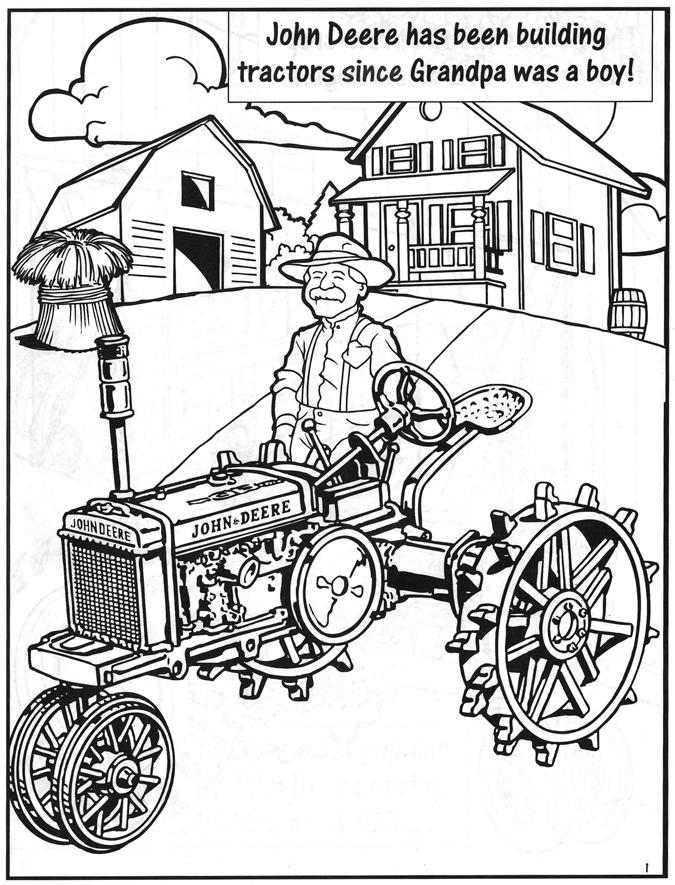
This is the picture I posted in the Classic Green Group on Facebook (Photo 1). I titled it “For all the ‘big’ kids out there.” I was working with some of my
Photo 1
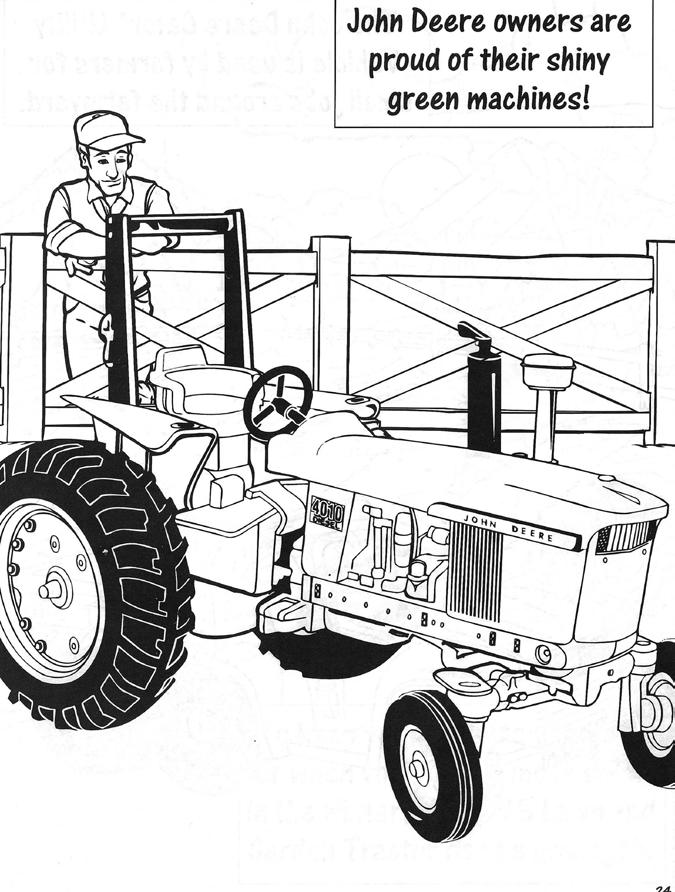
older literature, and I just really liked this picture. It is from a coloring book that Ertl published, and I found it interesting that they chose to use a model “GPWT” tractor as typically the “GPWT” does not get a lot of love as it was a less common model. I liked how simple it was and yet how well drawn and clear it was. Grandpa being on it was a plus in my book. What surprised me was the response. I thought a few people would enjoy it and like to see it, but it has so far received over 375 responses and likes. That is a lot in most cases as a popular post may get 25 replies. I could not believe so many liked a simple page from a coloring book, but they did. There were quite a few comments also and I was asked to show some more pages. That is when I decided it would be fun to share the book with all of you. Let us get started.
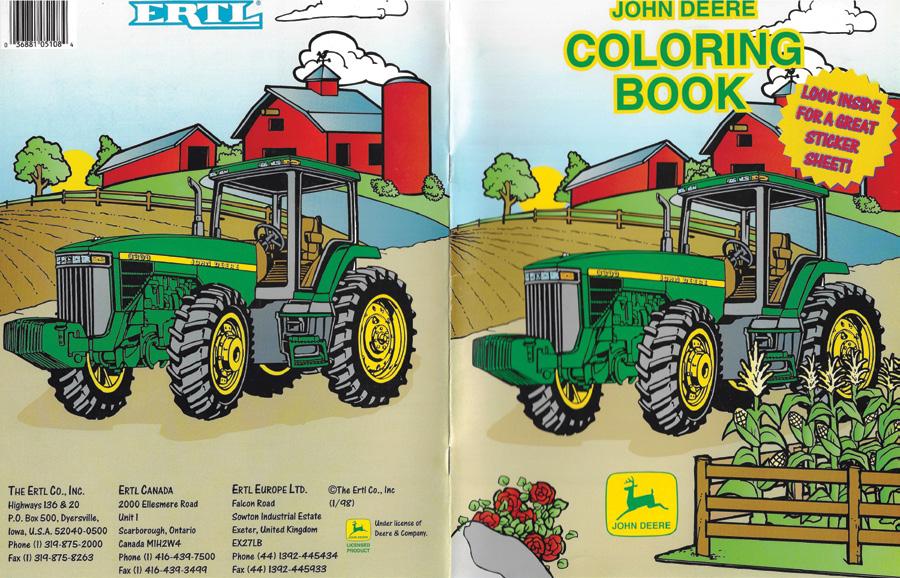
Photo 2 is the front and back cover. The graphics are simple yet colorful and the old two legged deer logo is prominently placed on the front. Ertl produced this coloring book for John Deere and, from the back cover, we can see it was published in 1998. This is the old Ertl, not today’s version where it has been bought and sold, then resold multiple times. I vaguely remember this coloring book from back then and I assume it was offered to dealers for a fairly low price so dealers could afford to give them away possibly.
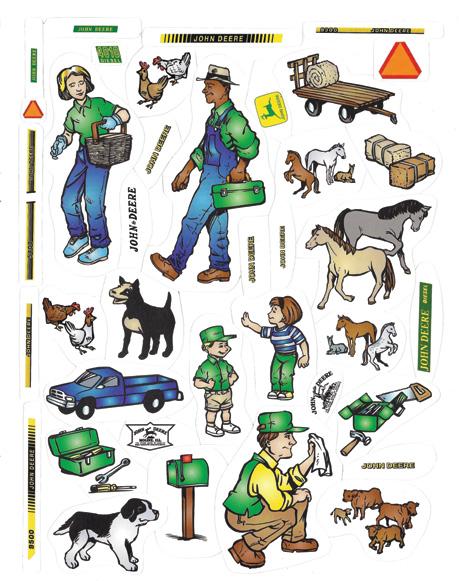
Inside the cover is a page of stickers. Kids could not only color the pages but could also use these stickers to dress up their page and customize it. I found it funny that the men engaged in working whereas the woman was carrying a picnic basket. She does have work gloves on as we all know how hard women on a farm work (Photo 3).
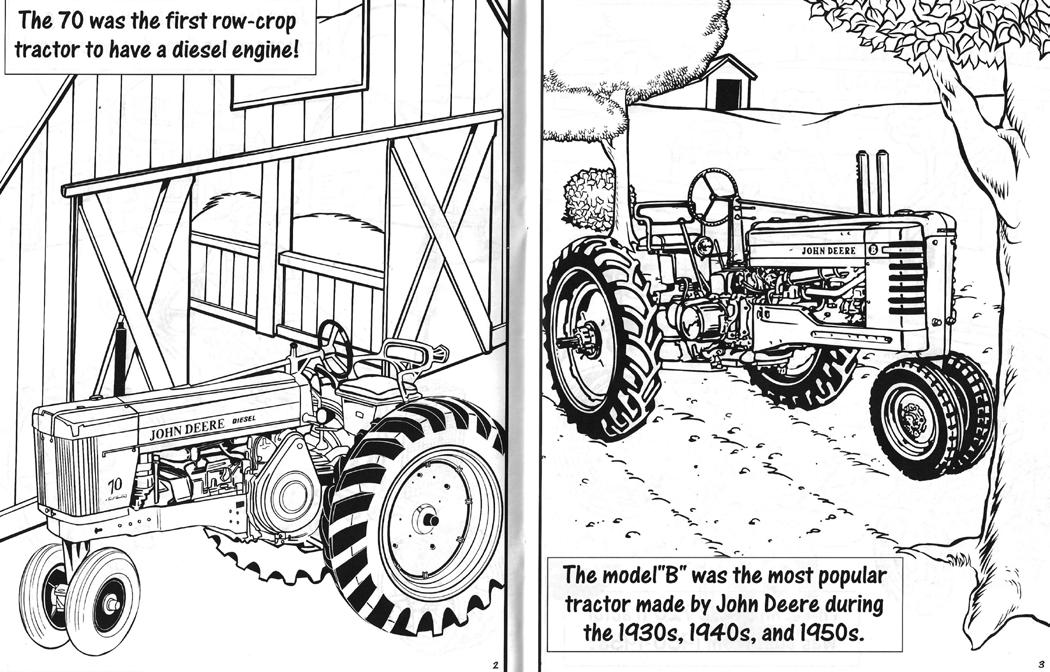
Photo 4 is the first two pages of pages to color. Shown is a model 70 and a styled “B” tractor. The tractors are rather good and the scenery around them would give the children more to color. It is also nice that a bit of history about each model is included so who knows, the children might actually learn something while coloring.
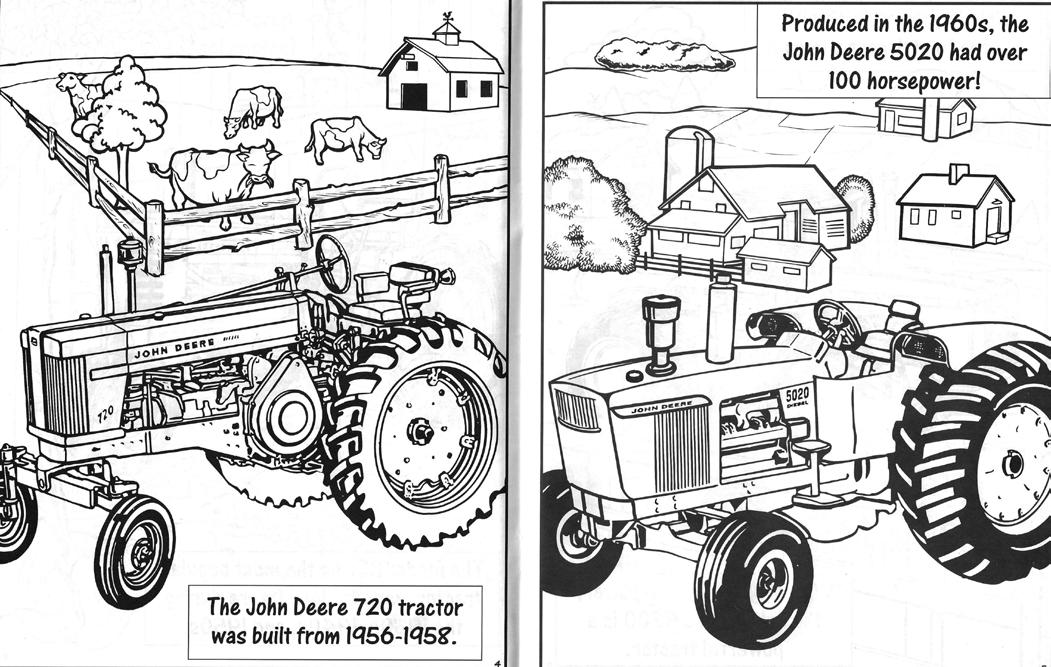
The 720 and 5020 are the next tractors (Photo 5). These were both popular tractors in our area with the number series of two-cylinders almost always having wide front ends as we were mainly haying country, so a wide front was beneficial for stability and for using a loader.
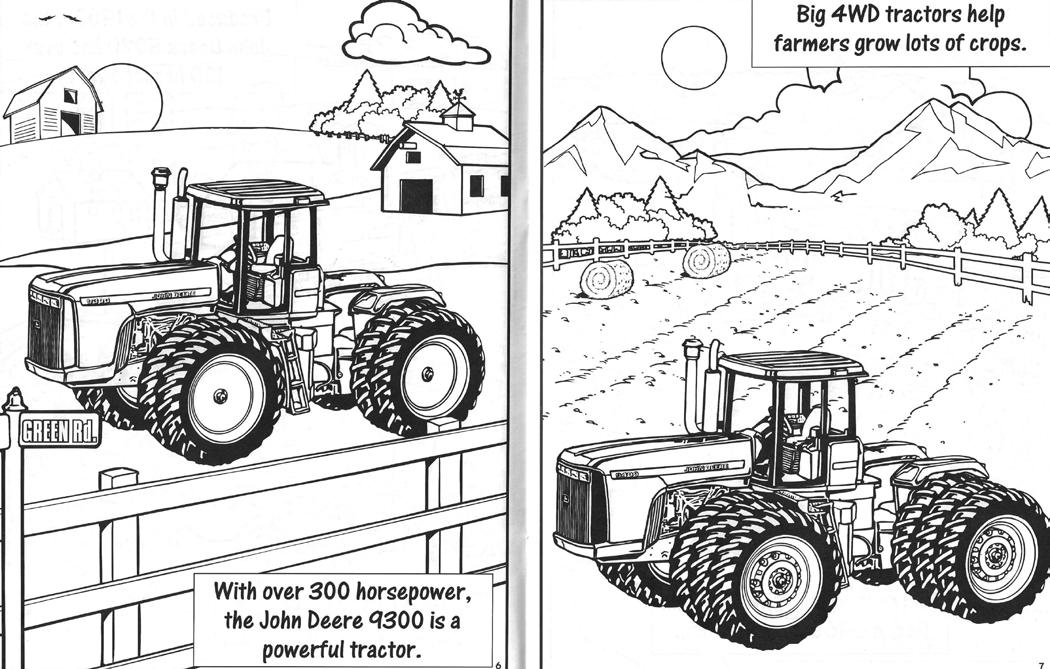
The coloring book then offers up the model 9300 four wheel drive tractor, which was in production when this book was published in 1998 (Photo 6). At 302 horsepower, this big tractor would have fulfilled many young farmers’ dreams, and I assume would have been a popular picture to color.
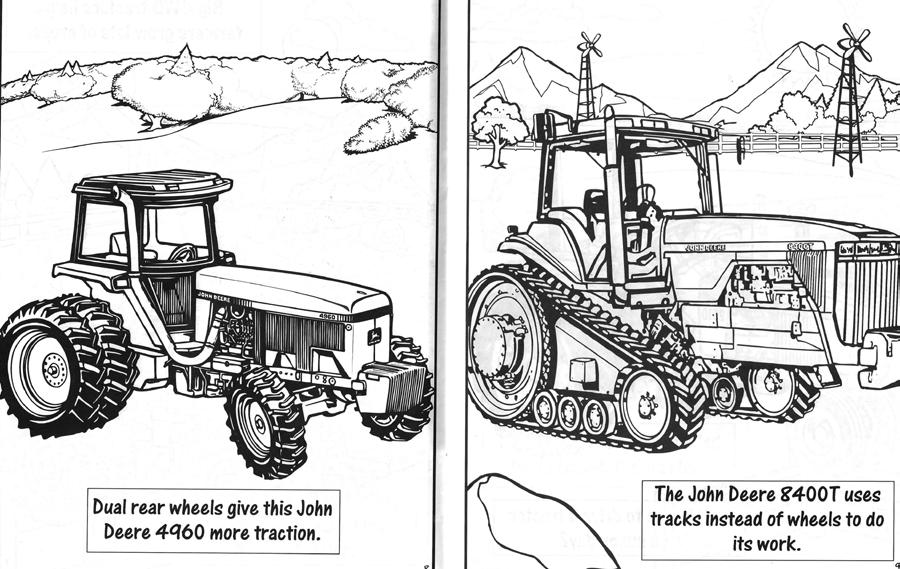
Photo 7 shows the 4960 row crop with duals and the 8400T tracked tractor. By the time this coloring book was
Photo 2
Photo 4 • Photo 5, below
Photo 6
Photo 3
published in 1998, the 4960 would have been discontinued while the 8400T would have been current production.
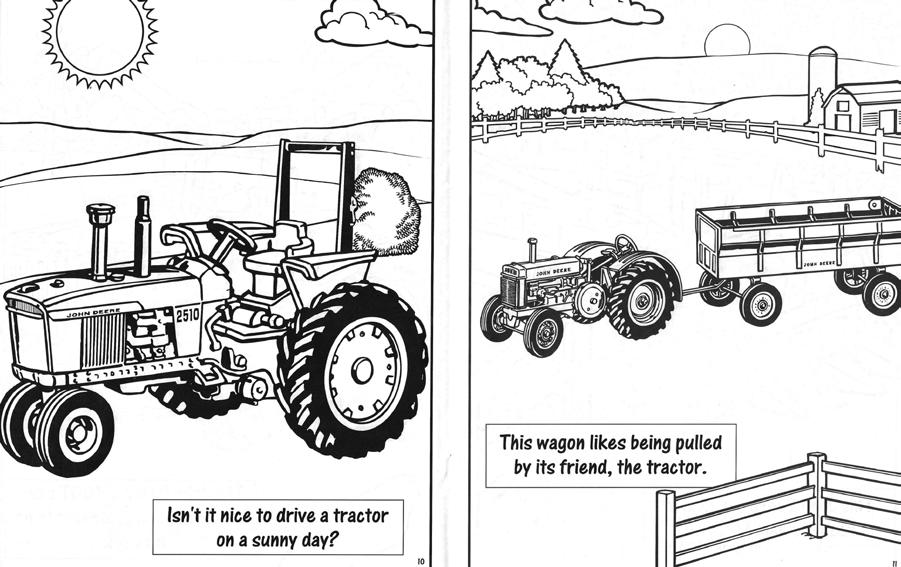
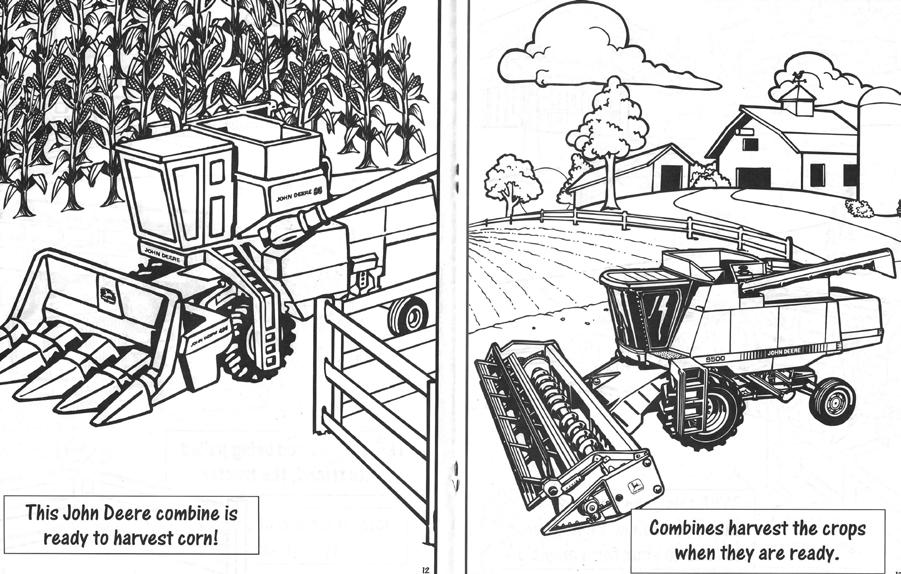
Then it is back to vintage tractors for the next few pages—one is pulling a wagon (Photo 8). It is old and new combines for these pages. Shown is a model 95 with corn head and a new at that time 9500 combine.
Another especially important machine for a farm to have—see Photo 9.
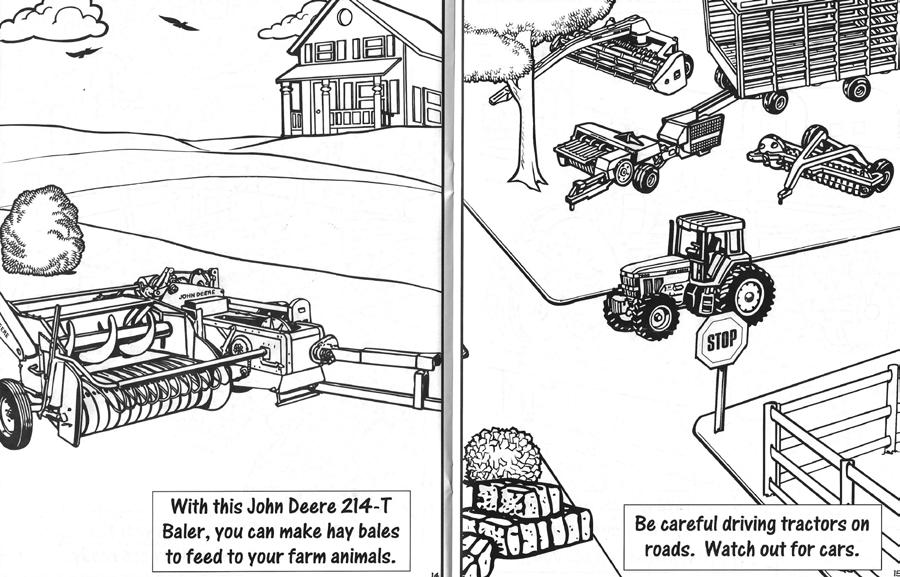
Photo 10 surprised me as I am definitely not familiar with seeing a model 214T baler at all, much less in a coloring book. The 214T baler is another machine that gets little to no attention, no idea why it was chosen for inclusion in this coloring book, but I was glad to see it. I had many hours put in operating a 214T baler in my younger days. The intersection in the next page looks pretty busy to me with a fence, machinery, and bales on three of the corners.
The 5400 utility tractor would have just gone out of
Photo 7
Photo 13
Photo 14
Photo 8
Photo 9
Photo 10
Photo 11
Photo 12
production in 1997 while the 7810 row crop was current. Looks like more barns in the background, too (Photo 11).
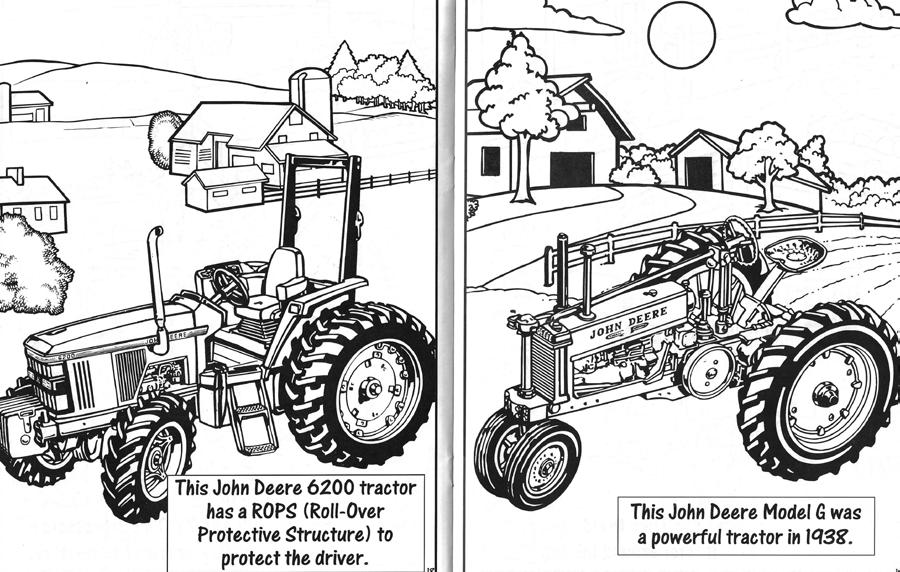
The model 6200 was in its last year of production in 1998. The unstyled model “G” was offered until the early 1940s when it was also styled like the other John Deere two-cylinder tractors already were (Photo 12).
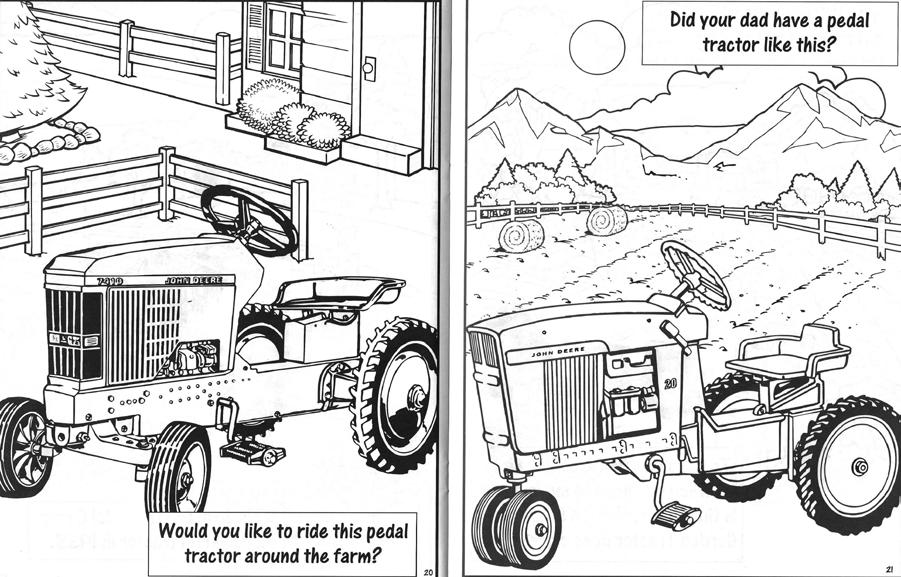
I really liked this page (Photo 13). Who would have thought about including John Deere pedal tractors in a coloring book? And there is an early and a late to top it all off! I wonder how many kids who got this coloring book had their own pedal tractor setting at home.
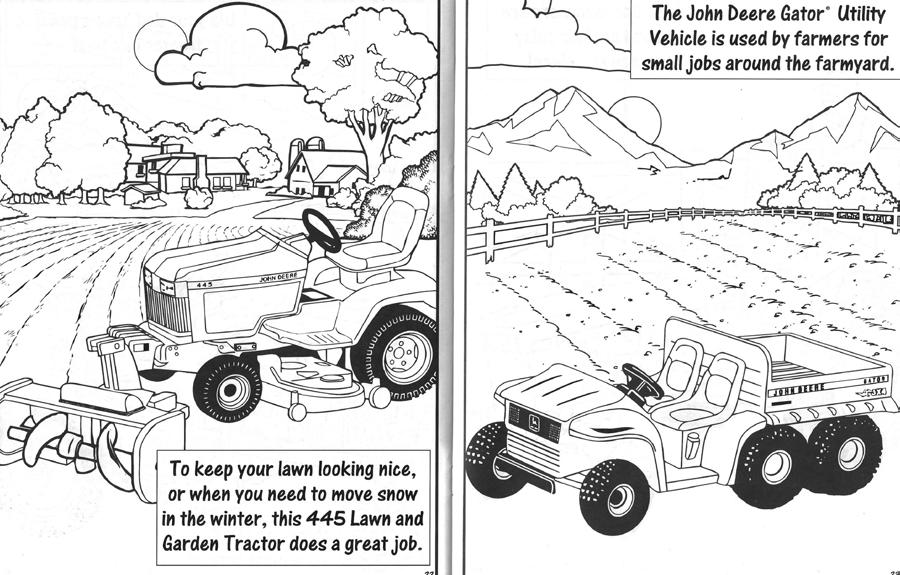
Then Ertl added a lawn tractor and a Gator, too! If a child was not a farm kid, then maybe he would be familiar with Deere’s lawn equipment or a Gator. No matter, all would have been great fun to color (Photo 14).
This is the final page in the coloring book, and a 4010 diesel is certainly a great tractor to use to finish it all up (Photo 15).
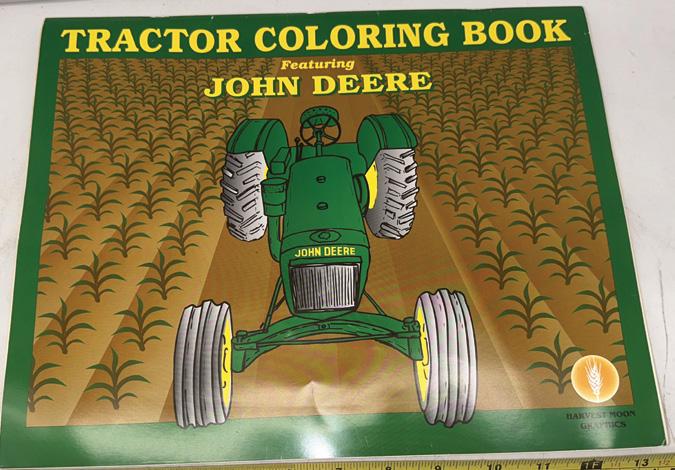
I then grabbed a few pictures I had of another John Deere coloring book I had come across. It is called “Tractor Coloring Book—Featuring John Deere.” The color cover shows a model “GP” tractor in the field (Photo 16). I may have shown this one before; I can not recall. If I have, then please follow along anyway.
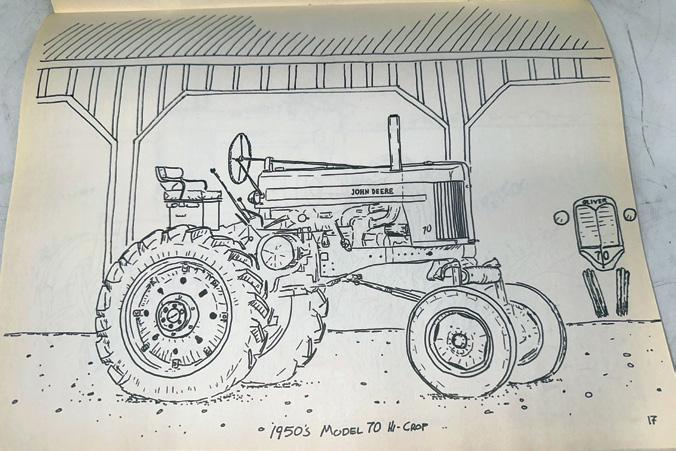
Harvest Moon Graphics published this coloring book. Inside is a model 70 Hi-Crop tractor. I do see the Oliver poking its nose out of the barn in the background (Photo 17).
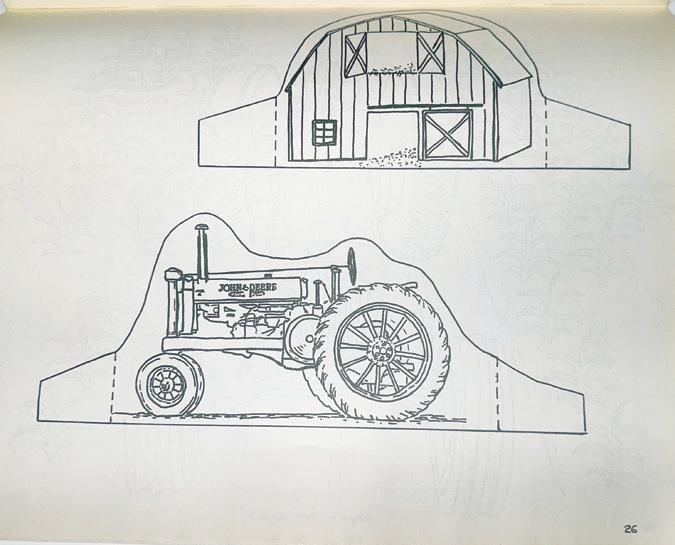
Photo 18 has an early model “A” and a barn. They appear to have been meant to have been cut out and used to play with possibly.
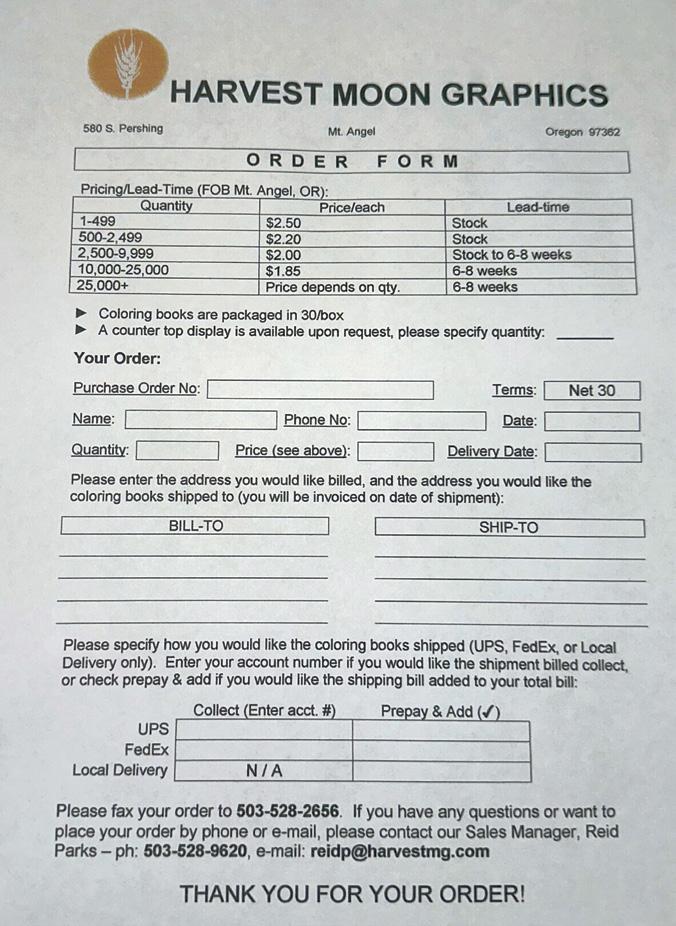
Photo 19 is the order form for the coloring book from Harvest Moon Graphics. The envelope it came in says I ordered these coloring book in May of 2000 so that is already 25 years ago, too. I did some internet searching and can not locate a thing on Harvest Moon Graphics. I tried the phone number, and it is disconnected. The address shows it to be a residential address. From all of this, I would guess that it was a small business that likely produced this coloring book entirely in house. I would
not be surprised to find out they also drew the pictures. I can not find anywhere where it said it was licensed by Deere, so it makes me think maybe Deere contacted them and told them to stop? I do not know but it does not appear that it was offered for very long. I ordered 10 maybe and still had four left, so they were not good sellers for me either. Overall, it is interesting to think about and an interesting footnote in Deere’s collecting history.
I apologize for the lesson on Facebook but not everyone is a participant, so a little background was in order. I liked the Ertl coloring book more than the one from Harvest Moon Graphics although I can appreciate the latter’s effort as being more of an individual effort versus the corporate entry from Ertl. As I write this, the people responding to the post on Facebook continue to grow. It certainly seems like this coloring book would have been popular to have available today based on the interest that has been shown. There are a lot of items Deere used to offer that would have been great sellers today, I think, if they still had them available. As I have said before, Deere never listened to me when I was a dealer, and they certainly do not listen to me now. Hope you all enjoyed this—until next time!
Write Greg Stephen at The Old Tractor Company, Box 89, Franktown, CO 80116; phone 231-846-8243 or email deeredr@hotmail.com
Photo 15 • Photo 16, below
Photo 17 • Photo 18, below
Photo 19
5020 row crop tractor
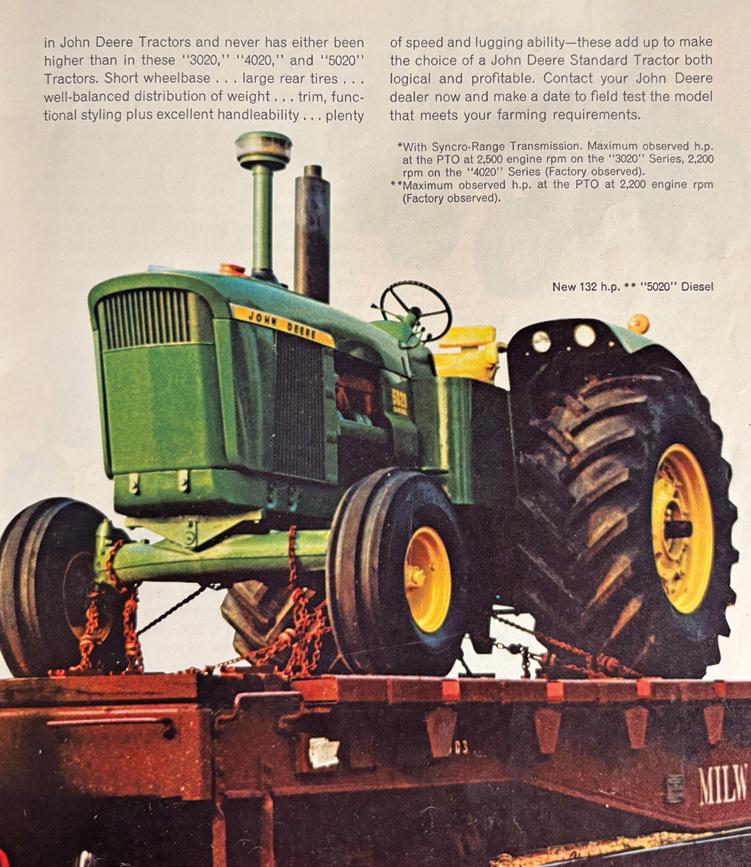
One of my favorite John Deere tractors in the post two-cylinder era is the 5020. I have never had the opportunity to drive one, but I have always liked the big, powerful look of the machine. When we were kids, my brother Larry and I had several tractor brochures that we had picked up when visiting the local dealerships. We had (and I still have) a 1966 John Deere full-line catalog. Page 9 from that catalog is shown in Photo 1. We were both amazed at the size of the 5020
tractors since we were used to seeing the 3010/20 and 4010/20 machines. In fact, we already had a couple of those toys in our collection. When the toy 5020 tractors came out in the late 1960s, we had to have one. So, we pooled our money together and purchased one at the local John Deere store which was called Fenwood Implement, located in
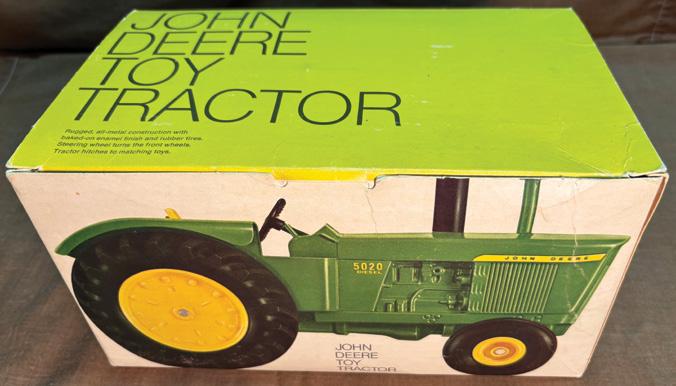
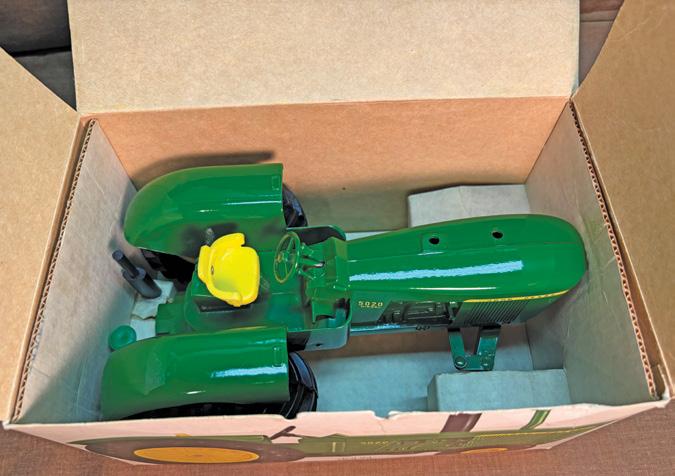
the tiny town of Fenwood, Wisconsin. The box for that tractor is shown in Photo 2, and you can see the tractor in Photo 3. The building that was the store for Fenwood Implement is still standing, but I don’t know what is in it at this time. The dealership was shut down many years ago when a larger dealership was established about 10 miles away. That one is also gone, and a Kwik-Trip gas station stands where it once was.
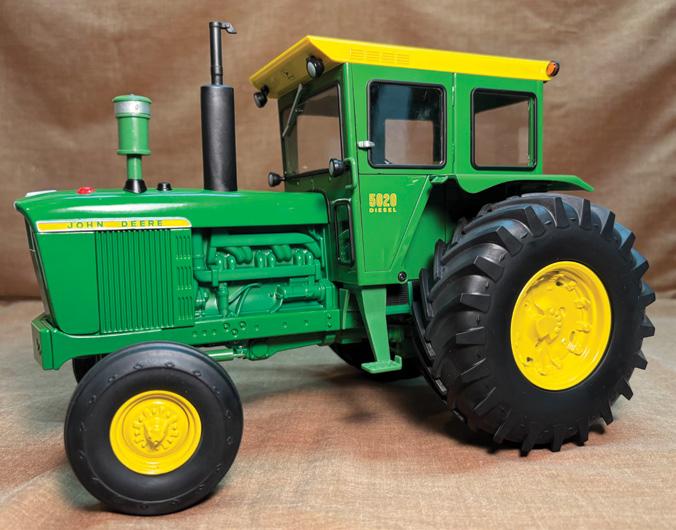
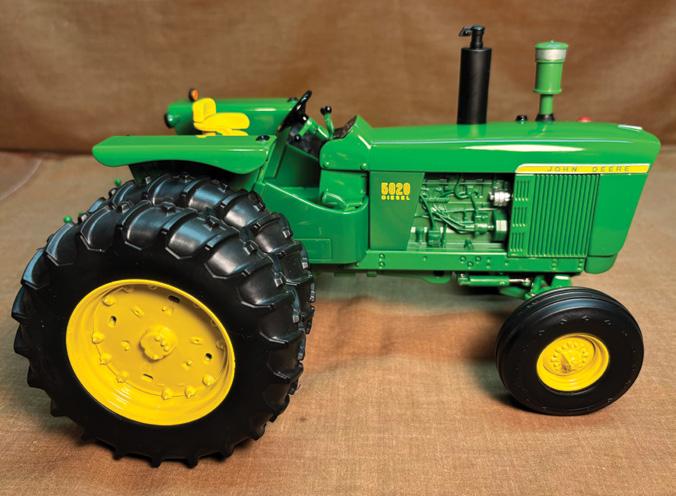
Earlier this year, Ertl released a 1/16th scale version of a 5020 row crop tractor as a 60th anniversary commemorative in the Prestige series of miniatures. John Deere began production of the real 5020 tractors (standard tread version) in July of 1965. The row crop version came out starting in July of 1966. The original toy 5020, like the one shown in Photo 3, was produced
for many years by Ertl as a standard tractor. There are a number of variations, and several different cartons, in which they were packaged. As you may recall, Ertl released a version of the 5020 with a cab for the Two-Cylinder Club in 2023 (Photo 4). The current row crop model uses some of the parts from that tractor.
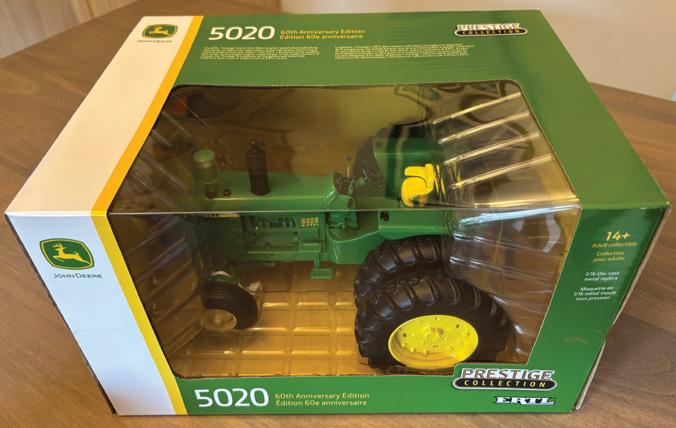
So, let’s take a closer look at the 5020 row crop tractor. Photo 5 shows the carton with the tractor inside. This is a fully enclosed cardboard box with a clear plastic window on the top and front. The background colors are green and white with a yellow stripe separating them on each side. The current John Deere trademark, the PRESTIGE COLLECTION identifier, and lettering calling out the 5020 tractor and the 60th
Photo 1
Photo 2 • Photo 3, below
Photo 4 • Photo 5, below
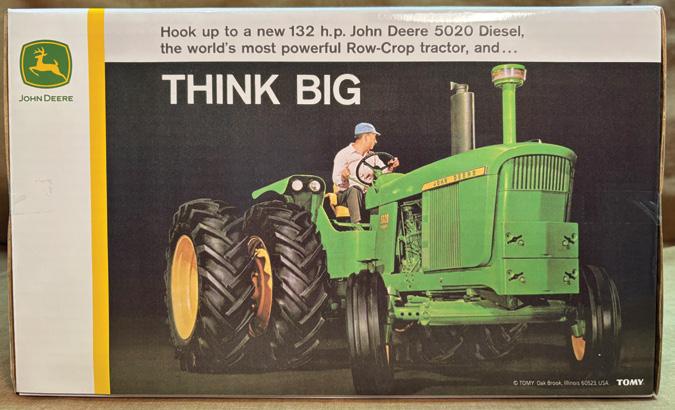
anniversary are printed on most of the sides as well. There is a reprint from advertising material reproduced on the rear panel (Photo 6). It has a great picture of a real 5020 row crop tractor with a message to “THINK BIG.” Inside the carton is a clear plastic sleeve to which the toy is attached with four paper ties.
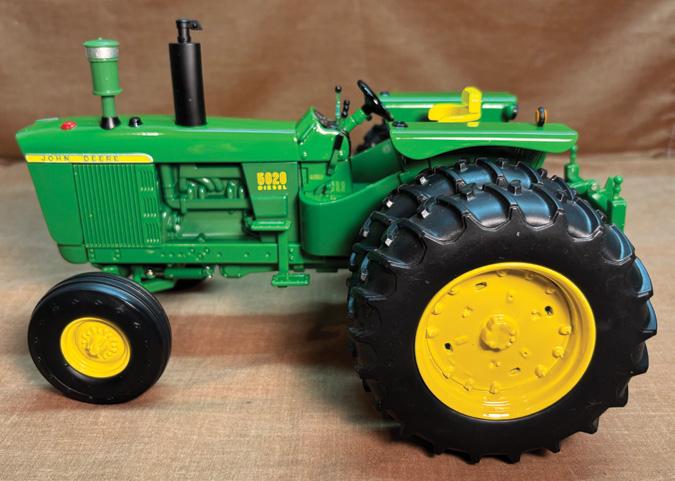
Photos 7 and 8 provide left and right side views of the toy. Most of the components on this model are made from die-cast metal. However, the engine, the side shields with the model designation, and the shields around the operator’s platform are made of die-cast plastic. In Photos 7 and 8, these items show up as being darker green in color, but that is from the camera. When you look at the model, the color difference is much less noticeable.
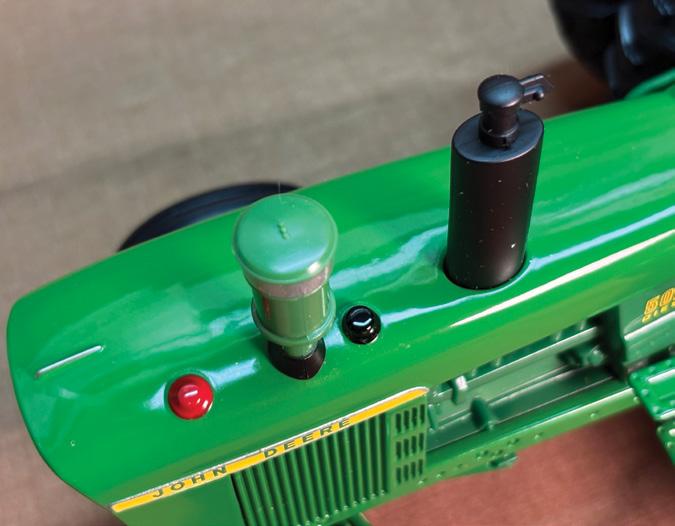
The top of the hood is shown in Photo 9. The hood ornament, fuel fill
cap and radiator cap are cast directly into the hood. They are painted silver, red and black, respectively. The air intake is a separate component, complete with a pre-cleaner and pre-screener and a rubber boot around the base. A rain cap (non-moveable) is on the top of the muffler, which fits through an oval hole in the top of the hood.
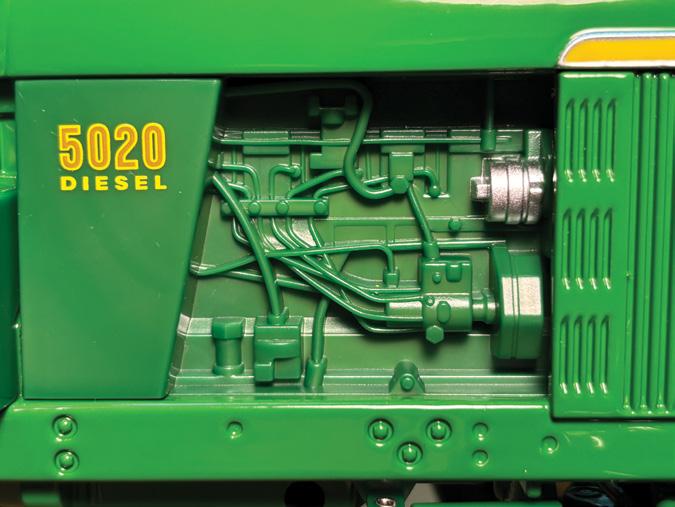
A close-up view of the left side of the engine is provided in Photo 10. Note the intake and exhaust manifolds and lower radiator hose. A portion of the starter is visible just ahead of the side shield. Below the frame, you can see the access cover for the engine oil filter. The fuel delivery system, the crankcase dipstick and oil fill, and the alternator (highlighted in silver) are visible on the right side of the engine (Photo 11). The detail is fairly good considering the fact that everything is cast in place. A die-cast metal engine would have made for a slightly better model.
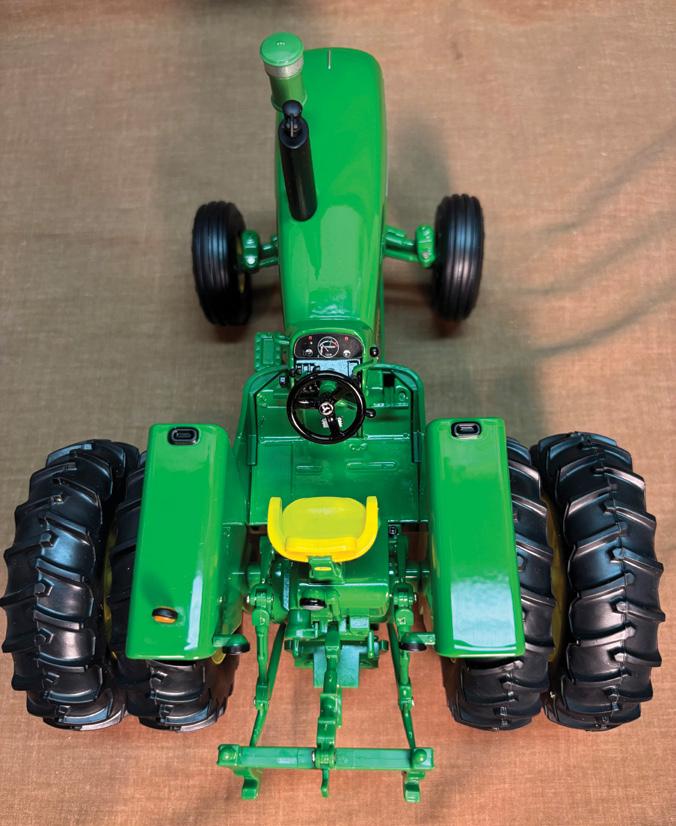
I included a top view of the tractor (Photo 12) to give you an overall idea of what is included on this model. In addition to the items already mentioned, there is a pair of flat top fenders, each of which has a hand hold near the front with a raised
“rubber” insert cast in place. There are two forward-facing work lights under the front of each fender and a single rear work light on the inside of each fender. Another one is mounted to a tube attached to the rear of the seat pedestal. Each work light has a black housing and a silver lens. An amber warning light is attached to the rear of the left fender.
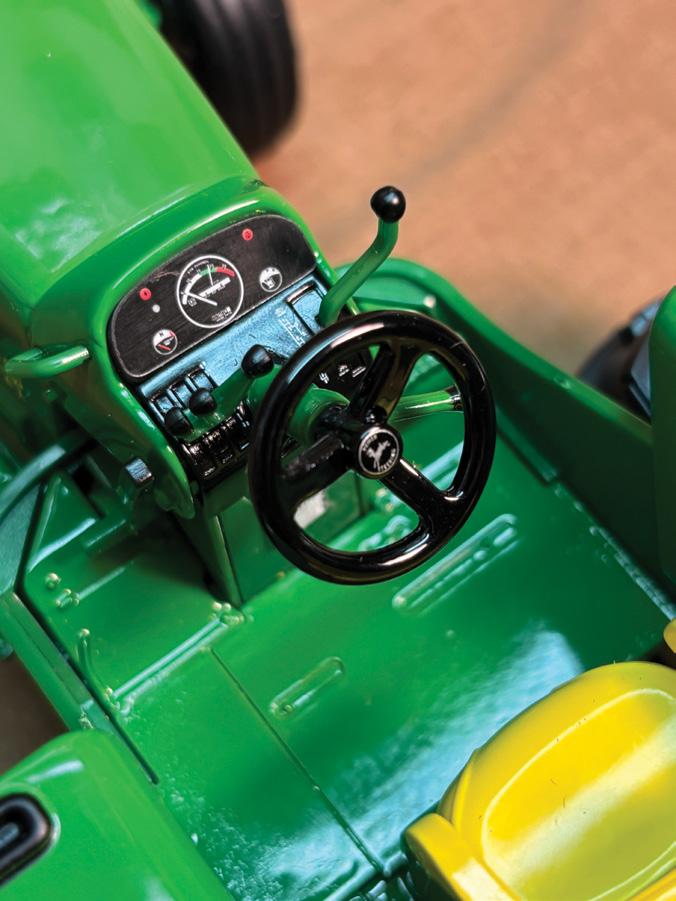
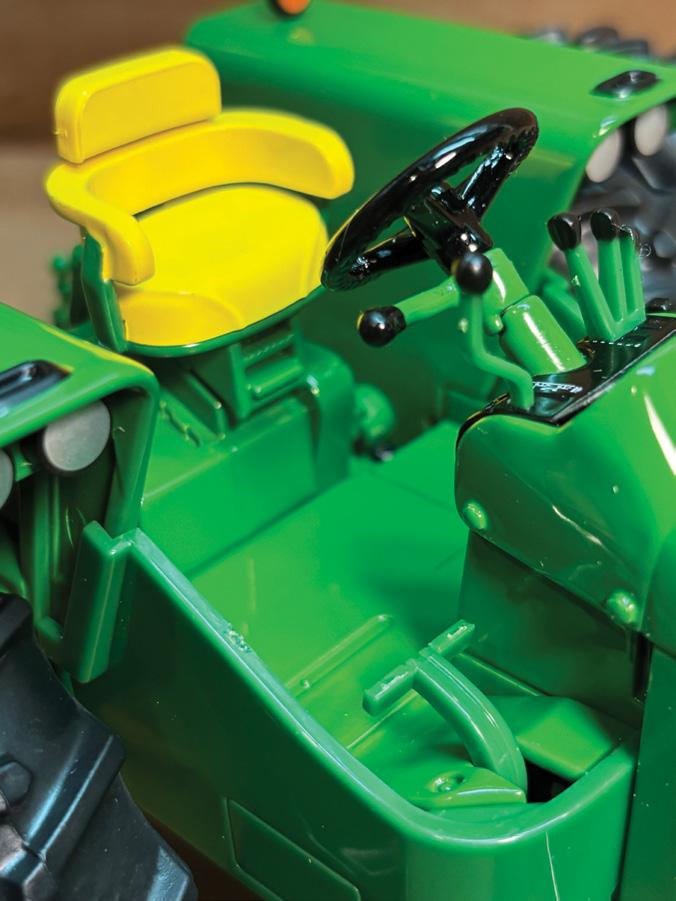
Photo 13 shows a portion of the dash area. Levers are included for the gear shift, throttle, remote hydraulic outlets, PTO, and the rockshaft. Each of these is green with a black knob on the end, but only the throttle lever is moveable. The dash is finished off with a black background and full color gauges, lights, and instructions. Included are the alternator and oil pressure indicator lamps, coolant temperature and fuel gauges, and the speed-hour meter. Below the dash are the key switch, light switch, and air cleaner indicator light. A view of the operator’s station is shown in Photo
Photo 9 • Photo 10, below
Photo 6
Photo 11 • Photo 12, below
Photo 7 • Photo 8, below
14. The seat is actually made from three separate pieces for the bottom, arm rest, and back. Some of the seat controls are cast directly into the seat pedestal.
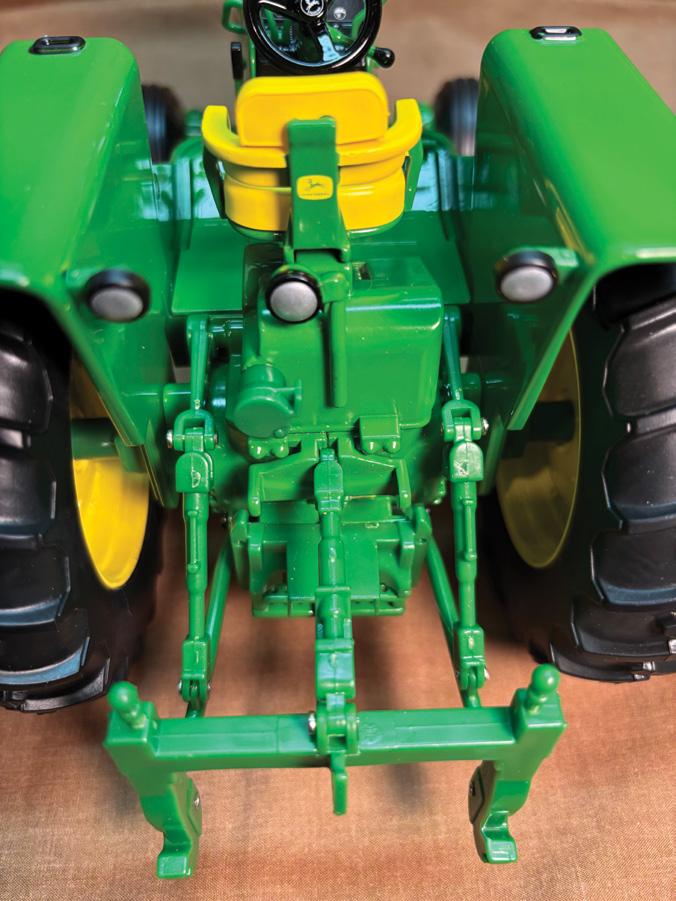
There is a nice amount of detail at the rear of the tractor (Photo 15). The rockshaft housing is attached to the left side of the seat pedestal. There are two remote hydraulic outlets and a bracket for carrying two remote hydraulic cylinders. The PTO shaft is not visible since it appears that a shaft cover is cast in place instead. Also included is the PTO shield, drawbar, and a complete three-point hitch with Quik-Coupler. Immediately above the PTO shield is
a tiny serial number plate printed in black and silver and a WARNING sign printed in green and yellow.
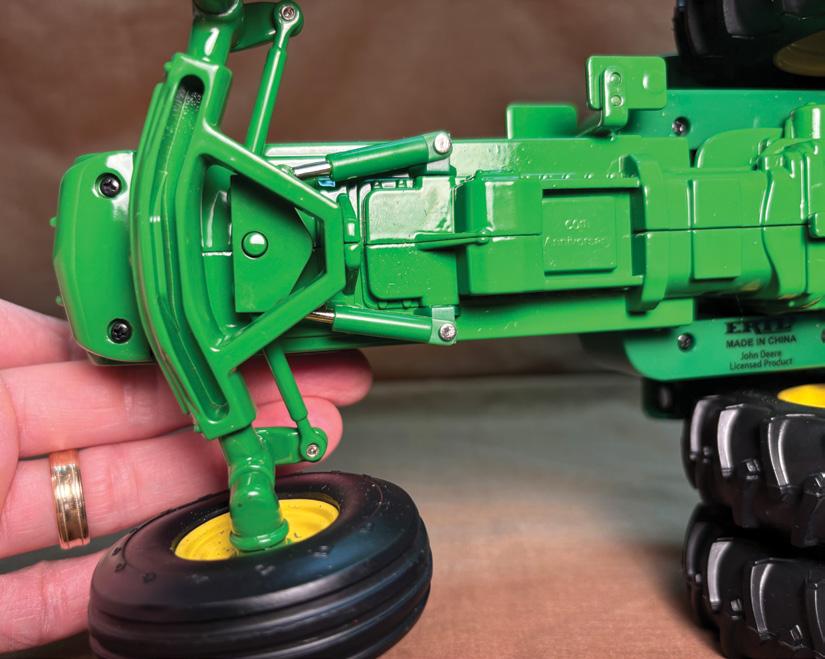
This tractor has die-cast metal wheels all around, including the inner rears. That makes for a rather heavy “toy.” While four-rib front tires were used, I would have preferred threerib. The front wheels can be “steered” with the steering wheel, and there is a complete steering system with steering cylinders and arms. The underside of the tractor is shown in Photo 16 where you can see these components. Everything is riveted together to allow the system to operate in a very realistic fashion.
The fit and finish on my model are near excellent. All of the components are assembled correctly and the muffler and air intake stack are straight. The paint and printed graphics really make for a beautiful tractor. Photo 17 provides a close-up view of the name plate on the right side of the tractor. First, note the high gloss green paint on the hood. Second, take a close look at the name plate. It is a raised portion of the cast hood with the center painted in yellow, green letters printed in place, and a silver highlight around the periphery. I think that the level of detail and the quality of these graphics is incredible.
You should be able to find this
model at John Deere dealerships and with toy dealers or outlets for approximately $125 to $140. I think that it is a really nice model that represents the real 5020 row crop tractor well. Some front weights and a ROPS canopy might be nice additions for those that like to customize. But otherwise, it is a great piece for anyone interested in the New Generation of John Deere tractors.
One other item I need to mention is the National Farm Toy Show. This year it will take place on November 7, 8, and 9 in Dyersville, Iowa. As I have mentioned in the past, if you are interested in farm toys and have never been to this show, I highly recommend that you add it to your “bucket list.” There is so much to see and so many people to meet who share a common interest. I think that collecting should be something to share and this is great place to do so. Enjoy.
Contact Bill Proft at N1366 Woodland Dr., Greenville, WI 54942 or email billproft@sbcglobal.net
Photo 13 • Photo 14, below
Photo 15
Photo 16 • Photo 17, below
G’day, mates!
As I write this month’s article, winter 2025 finished up on September 1st. It was another great Australian winter for me, temperature wise. The mornings were cool at sunrise, with a few days near zero Celsius/32 Fahrenheit. Our area was quite dry with only a few days of rain through the winter season. The southern states have been suffering from very dry weather, but most areas have received some rain to help with the winter cereal crops.
This month, I would like to cover some Australian terms or “slang.” A lot of our slang here is British influenced, and I certainly was confused the first time I heard these. In the first sentence of the article, I used the term “finished up.” This is a term used for another situation as well. When people quit a job here, they say they “finished up.” When I first heard this, I had to ask what they meant, as I had never heard that term refer to quitting a job.
Another term I had to ask about was “shot through.” This is not a nice slang reference, but it is said just the same. I talked to a man , and he said his father “shot through when I was five years old and then we had to move.” This term refers to his father moving out of the family home.
I was at a training course this week, and one guy in the course said, “The repair went well, then spotted dog.” I had to ask Google as the Aussies I asked never heard of the spotted dog slang term. Google refers to spotted dog as a British slang term, used as an adjective to describe something excellent or of high quality.
Another term that is used a lot here is “playing up.” Farmers will use this term when their equipment is not working correctly. They refer to the tractor operating fine and then, a few minutes later, it starts “playing up.” I have also heard this situation repeated, with the saying, “The tractor is playing up like a second-hand lawn mower.”
An article of clothing that gets slanged up is pants. The main slang term is “daks.” Google said: “Daks was a British clothing brand that produced trousers in the 1930s.” When that term refers to track pants, it is called “trackie daks.” Sandals worn on your feet, especially the rubber
backless style with the big toe strap, are called “thongs.” All North Americans use that thong term for another article of clothing, hence the confusion on my part here!
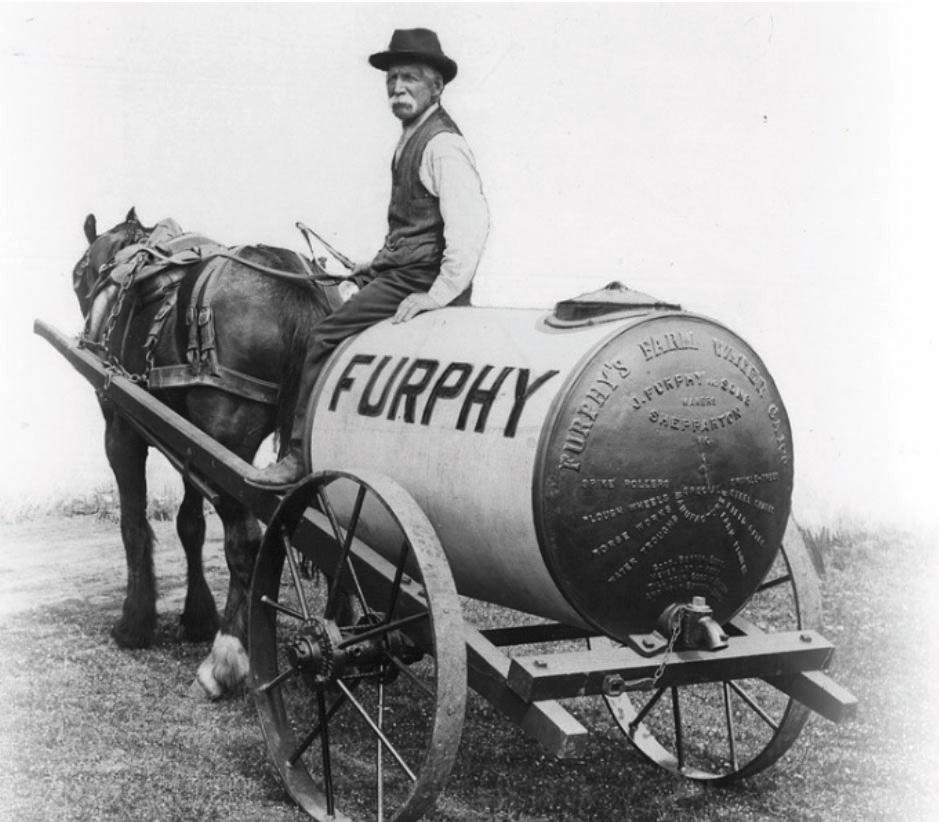
A company called Furphy here manufactured small steel tanks for years. The main body of the tank was sheet
steel, with the ends being cast iron. These tanks were usually mounted on a two wheeled trailer, and some were used to haul animal and human waste. The scenario here is that if you believe someone is telling a rumor or is not telling the truth, the statement is referred to as “he was telling a Furphy.”
The last slang I will use this month is “ooroo,” pronounced “oo-roo.” It can also appear as “hooroo” or “tooroo.” This was another borrowed bit of British slang, which stands for goodbye.
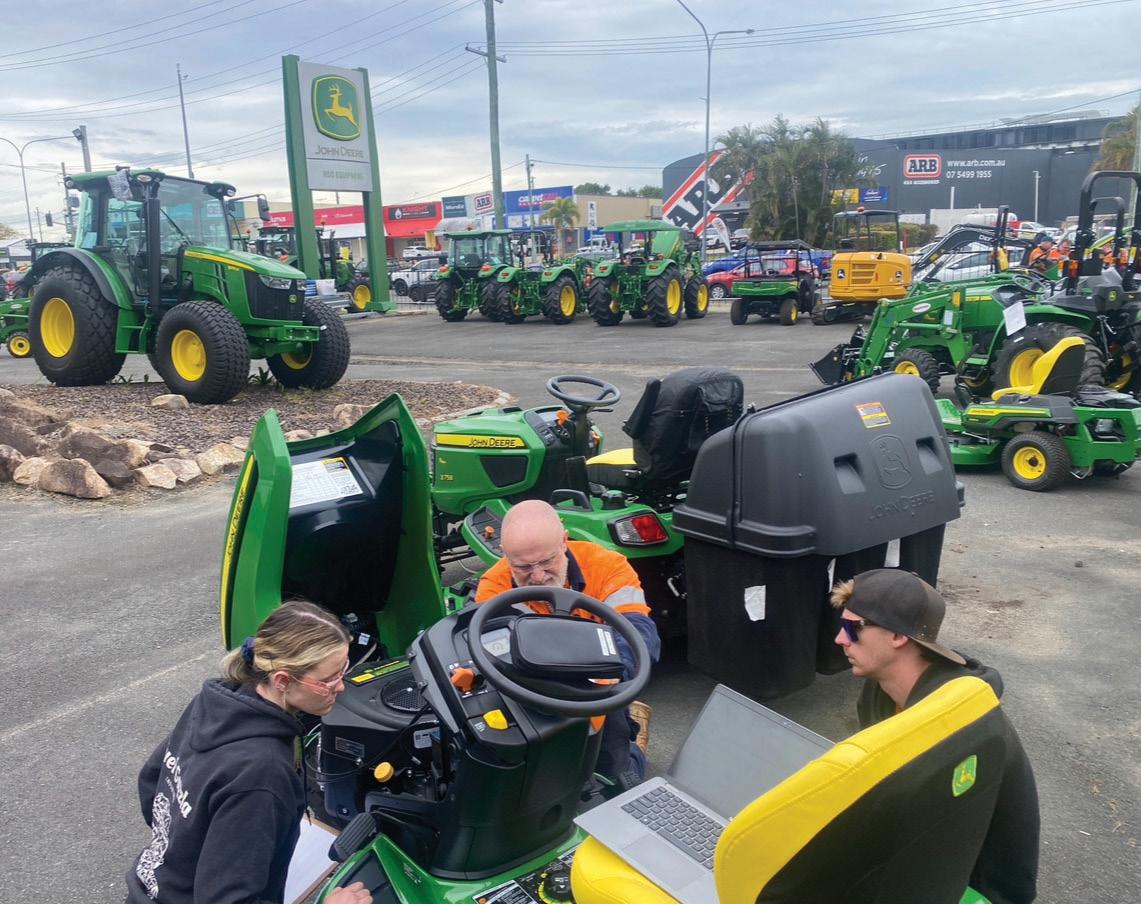
Last month I talked about my job as training instructor with RDO in Australia. As a Certified Dealer Instructor with John Deere, I can deliver their training courses. The Furphy tank and horse.
main courses I am presenting to service technicians who need to complete Level 3 in the John Deere certified technician training program cover service adviser, electrical and hydraulic fundamentals. This month I will cover the electrical part of the course.
The course consists of a PowerPoint presentation that I cover, which includes all aspects of the electrical and electronic systems in John Deere equipment. The class talks at length about different electrical faults that can happen and how to diagnose them. On the presentation, there are slides showing basic series and parallel electrical circuits. The slide shows a multi-meter being used to test the parts of the circuit. We have electrical circuit project kits, called “Snap” kits. The kit includes a plastic board and components to build circuits. I instruct the service technicians to build the circuit that is shown on the presentation slide. Then they use a multi-meter to test the circuit as it is tested in the presentation. This type of hands-on testing really helps the student understand what they are looking at. There are also fill in the blank questions in the workbook that the students need to use their laptop computers to research the diagnostic and test manuals from John Deere to find the answers. Once the activities are completed, we go over the answers to make sure everyone did the questions correctly.
the problem as if it was a repair at the shop, and the story is being submitted to the service manager to explain what they did to solve the issue. Next month I will cover the hydraulic part of the course.
I have not done any tractor repairs in the past month. Work has been very busy, with me being away a few nights each week presenting training courses. The second reason for no tractor repairs is that Janis and I have purchased the Kooralbyn takeaway food shop in our community! The food shop was selling a variety of traditional fast foods and was for sale by the owners. The shop has been through a few owners in the 10 years that we have lived in Kooralbyn. Every time the shop has been for sale, we have discussed in length the possibly of trying our hands at it. This venture is not new to us. After we stopped dairy farming in 2003, we opened an ice cream store in my hometown in Ontario. We operated it for several years before selling it to another family.
When the presentation is completed, I have hands on exercises on new John Deere equipment. I use exercises that test the technicians as well as exercises that allow them to practice repairing issues with special John Deere electrical test equipment that we have. The exercises cover high resistance, open circuits, shorts, and grounds in electrical circuits. After the exercises, the students write an assessment with 25 multiple choice questions, and two hands-on assessments. These hands-on assessments are electrical “problems” that I have put in the equipment that they need to solve. After they solve the problem, they must write up a story on
This time when the local shop was for sale, the thought process was different. Janis’ friend, Narelle, will be in the business as well as the cook. Narelle was working as the cook at the café that is in the same shopping complex. Janis was also working for the same café, baking desserts. That café recently sold and the menu has been changed to the new owner’s tastes. Our shop is called “Blue Tree Café & Takeaway.” We have renamed the shop to reflect on the surroundings of the shop. In front of the shop stands a tall stump of a large deceased blue gum tree. There is a mental depression-based organization here with the acronym “RUOK?” which stands for “Are you okay?” The premise is that deceased trees around Australia are painted a distinctive blue color to ask the question RUOK? and try to relay the message to people that talking about depression is okay.
The whole interior of the shop needed an update. The floor tiles had been patched a couple times on top of the cement floor base. The interior walls were not in the correct
Blue painted RUOK? tree in front of our new shop, Blue Tree Cafe & Takeaway.
Electrical activities at training course.
places to make the best use of the interior space. The former owners had the equipment and layout set up to have far too much walking for items, and no space for two people to work in the cooking area. I enjoy demolition and wood construction work, so I have covered this part with assistance from my tractor repair assistant “Frenchie.”
The front customer floor area tiles were removed down to the cement floor. Then we sanded the cement floors with the same sander we used in our house last December. The floor will get a polyurethane coat to seal it. The walls are finished, an electrician has done his magic, and this weekend’s job is to paint the interior walls. Hopefully by next month’s article, we will be up and running, and I will report on the progress!
One thing I have done in the tractor repairs is come up with a game plan to fix the flywheel/crankshaft issue
in the 1948 model “B” I have here. I checked in the parts book, and a model 50 tractor shared the same electric start flywheel as this electric start model “B.” I knew where there was a model 50 parked in a person’s yard as “garden art.” Peter Sands knew the owner of the 50, and the owner had sent pictures previously to me. The pictures showed a neglected, used and abused model 50 tractor. I thought that maybe under the flywheel cover, the flywheel might be usable.
A couple weeks ago, I was presenting a training course in our dealership branch that is in the same area as the model 50. I contacted the owner to see if he would let me come look at it. After a bit of hesitation, the owner gave me their address. I arrived at dark with a flashlight. The owner was pleasant but did not seem too interested in parting with the tractor. He said that it was found at a former dairy farm not far from where it currently sat. It had been parked in a forest of thorn trees in its current condition. The tractor has power steering and a Roll-OMatic front axle. The front frame had been broken in two above the front axle and welded back together. How this would get broken is hard to say, but some tractors have a
hard life. The muffler and exhaust pipe are rusted off, and there are rust holes in a lot of the panels.
The owner said he liked the model 50 sitting in the yard, so he was not keen to give the tractor away. I said I did not expect him to give it to me but gave him an option. The flywheel was the main part I was interested in. I asked him if he could remove the flywheel cover, and make sure the flywheel was not cracked. Then the flywheel could be removed and sold to me, and the flywheel cover reinstalled to show the same garden art appearance as before. The owner said he would rather sell the whole tractor and not the flywheel and I needed to give him a price. I said this might make him mad, but I would give him $500 for the whole tractor. The owner went into a speech on how he obtained the tractor and the trucking costs to get it to his place. He said he had double that price invested. So, I said, well, I would go to $1,000 but not anymore. Of course, he then said, “Well, I need to think about it and will let you know,” so I do not expect a response.
I know Glenn, a fellow tractor collector who operates a machine shop in Victoria. He can take the crankshaft and repair the broken splines. Graeme Howden from New Zealand stopped in last week for a visit here as he was in Australia for the National Machinery Rally/Show that was held about three hours from my place. I was planning on taking my two 110 mowers I imported to the Rally, but the café purchase took priority for me. We discussed the flywheel issue and he came up with a possible option. A model “B” recently sold in New Zealand and the new owner removed the flywheel cover to inspect the condition. The flywheel had been broken like this one and repaired by a former owner, with the center flywheel section cut out in a lathe, and then a ring and hub manufactured to fit the crankshaft. The ring was then bolted into the original flywheel. I talked to Glenn in Victoria and sent him the picture that Graeme had on his phone of the repaired flywheel. Glenn said that he could do this alteration! Once the café is up and running, I will pull the crankshaft and send the crankshaft and flywheel to the machine shop for the repairs.
That’s all for this month. Stay tuned next month for more Aussie slang, tractor adventures and the grand opening of our new shop! ’Til next time, cheers, mates! Contact Ken Nicklas by email at kenanicklas@ gmail.com
The garden art model 50.
Picture from Greame Howden showing the model “B” flywheel repair.
I was told that there was a long hood John Deere model “B” over in New London, Wisconsin with magneto trouble and it came with only one mount bolt. Could I fix the magneto and could I figure out how to get the model X Wico out of the governor housing because it was badly corroded into the cast mounting and would not come out? Now in my 78-plus years on this good earth, I have never heard of such a thing, but I HAVE also learned along the way to “never say never.” Let’s cut to the chase and give a look at this nice old “barn find B” (Photo 1) and its new owner, Al Killam. Let’s
also get right at that ailing model X Wico and see what’s holding it from coming out of the tractor.
It was easy to see that the magneto’s lower mount bolt had a lot of attention before I got to it, and the mag’s housing had been pried on and poked at in an unsuccessful attempt to remove it. But is this a one-bolt Wico or is there an upper mount with a bolt
through it that is holding onto this Wico C magneto? Sure enough (Photo 2), under the battery cover, and below the battery’s floor, we can see an untouched mounting bolt holding onto the top of the magneto. I must admit, it is hard to see and even harder to get out, but when it WAS out, the magneto fell out (Photo 3) in two pieces. Now then, I can see that it has been pounded and pried on at its bottom mount until it broke. My plans to fix this thing just went out the window because I cannot fix a broken white metal housing. One thing for sure is that there is no such thing as a one-bolt Wico.
Now, in order to get some spark in to this “barn find B,” I must come up with a replacement magneto that has a good spark. I could order a new one for the cost somewhere in the neighborhood of $500, or I could rebuild a model C unit that is on my shelf. I decided to rebuild the one off the shelf. The model C has the same drive hub as the X, and its rotor magnetism seems very strong, so it’s a good candidate for a shop rebuild. Sometimes, that is just the better way to go in order to get everything tight and right if you know what I mean.
Let’s start with a new coil. This part will set you back about $100 for this model, but it is a MUST to get a good spark. Take note when installing the coil bar as to how snug it fits in the coil’s center. If there is any air gap between the coil bar and the center of the coil, I suggest that it get shimmed to take up the air gap shimming it from the top as shown (Photo 4). This will allow better contact for the coil and the metal poles. Upon reassembly, the
Photo 1
Photo 2 • Photo 3, below
Photo 4
use of dielectric gel (Photo 5) on any contact points will aid in the magneto’s primary current flow getting to where it needs to go. Apply only a small amount at each point. Next, we will install a new set of points and condenser. Always groom the points with light emery cloth before installing them. The correct gap is always stamped into the casting near the points, and it is VERY important to hit that gap number on the head. This unit wants .014 for its gap. I like to use a short gauge (Photo 6) to allow a better feel for it. With that done, a new cap and rotor (Photo 7) are in order to finish off the job. When one adds up all these parts, I wonder if it would have been better to send in for a catalog magneto, but sometimes doing things for yourself works out for the best. Giving the magneto a bench test (Photo 8) shows a nice blue spark every time the impulse trips. So, let’s see if this old “B” has any life in it. Yes…the long hood “B” runs again.
This summer in Wisconsin has been hot, humid, and on the wet side of the spectrum. It has also been a twice-a-week job of mowing grass to keep it looking good and not creating windrows of grass. Our John Deere Z445 zero turn has been working over-
time and should I add so has Jo Anne, doing what she can to keep it all cut and looking good. The mower now has 900 hours on it and has been a VERY reliable mower UNTIL Jo Anne came to get me out from under a tractor to tell me that the mower’s engine runs but the mower deck does not.
This unit has an electric clutch that drives the blades, and when the button is pulled up to start the deck, nothing is happening. It had been running just fine and she was about half finished mowing. She stopped to add some gas and blow grass and debris off the top of the deck but now the deck would not start up again. Needless to say, my work schedule changed from what I WAS doing to get this mower so that she could finish the lawn; no one likes a half mowed front lawn.
Here’s where Paul Harvey would say “and now for the rest of the story.”
Let’s just do the most logical thing first and check the clutch circuit’s fuse. Behind the back of the seat is the fuse bank and everything is clearly marked and color coded. The red fuse is labeled the PTO drive clutch. But the fuse was not blown, so the easy fix…it is not. Next, I ran a wire from the positive part of the battery to the wire connector under the engine on the electric clutch.
When I touched the red wire on the clutch, it immediately engaged the clutch so I now know that the clutch itself is okay. The wires all look good as do the connectors. I lifted the dash plate to get a look at the PTO switch’s wires. All looked just fine there as well. But it still would not engage the clutch when the button was pulled. For now, and to get this mowing job finished for the day, I installed a jumper wire to the clutch; this is a temporary “fix” but it will have to do.
Never fear…we still have that John Deere 955 compact tractor. If you remember, I put a new crankshaft in it a few years back and its job has been to help with some of our mowing. That 955 compact has just 100 hours of run time on it now. Do you recall that old saying “when it rains, it pours”? Well, long story short; the 955 started aborting its antifreeze out of the overflow. Now we all know what that means. You guessed it; Mr. Head Gasket gave up the ghost (Photo 9). For now, I stripped the head and sent it in for a surface job. “My bad” for not doing that when the engine was out. I have already ordered a head gasket set from John Deere and this story will have “to be continued.”
Does anyone out there have one of those old reel-type push mowers from years ago? That may soon be our last resort. Using one of those this year, we will be able to finish mowing and then start right back at the beginning. Until we meet again, hang in there! As always, may God bless you and yours ’til we meet again.
This column is written by Ron and Jo Anne O’Neill.
Photo 7 • Photo 8, below
Photo 5 • Photo 6, below
Photo 9
What Brought More?—a red cloth safety flag with a dealership name and number on it or a scratchbuilt, mostly 3d printed 1:64 model of a 2270 swather?
The cloth safety flag is pretty much just what it sounds like. It’s a flag that could have been used to mark a wide or long load on a truck. It includes the late 20th century Deere trademark and the phone number of a dealership from Kings, Illinois. It appears that this flag had never been used. It would now make a good display flag in a garage or with a collection.
The model 2270 swather is brand new. It was built by the seller whose description of it states that it has free rolling wheels, a spinning reel, and the head can raise and lower. The parts were 3d printed and small screws were used to connect the movable joints, which allows them to be adjusted for tightness. The builder also put on a couple of custom decals to finish the model. It must be a mite fragile, as the seller says it is for display or light play. Do you think this little model can bring more than a vintage safety flag? Find out at the end of the article.
Good news for the fans of the little tractors: there were a lot of lawn and garden-related items selling on eBay this month. From toys to parts and more, sellers were filling the internet with things for the little vintage workhorse in your yard.
Several sets of chrome hub caps were available on eBay this month. The first set was a pair of 5-1/2 inch hub caps that had some rusting and pitting. One was a bit worse than the other with a small spot of scaly rust right on the letters around the center. This set sold for $58.45.
The next listing included two 8-inch and two 12-inch hub caps.
These also included some rust and pitting, though none of them had rust that was beginning to eat through to the front side. A couple of these also showed some dents. I would guess that a good restorer could bring these up to a smooth shine again. They brought $195.
The final hubcaps were also a pair of 8-inch and two 12-inch caps, but these were brand new and in their boxes. They shined with a smooth
chrome finish on both sides. They would have been a perfect final touch to a like-new restoration. They cost the buyer $297.
Now, if you need a good fuel gauge/cap for your little tractor, two sellers were listing them this month. Each sold one of these that would have fit on a 110, 112, 120, or 140 tractor. Each of them was used but in good condition. The glass and gauge face at the top looked to be clean, clear, and in good shape. The floats were a bit stained from sitting in fuel for years, but that’s what they’re supposed to do. One of these sold for $150 (as a Buy it Now listing); the other was listed for and sold at $219. A strong value for a couple of parts that are important to the function of your tractor, but that Deere has stopped carrying.
Next up was a group of three Ertl-built 1:16 scale Deere lawn and garden tractors in Deere’s Custom Colors. Included here was a tractor in Patio Red, one in Spruce Blue, and one in Sunset Orange. An April Yellow tractor was sadly missing from the group. These toys were in good shape. Blue and red were especially clean, while orange had apparently seen a rougher life and had a few scrapes and dings in the paint and decals. The toys sold as a group, and the seller accepted a “Best Offer” bid under his list price of $300. Lastly in the lawn and garden tractor listings was a pedal tractor. This cute little John Deere “LGT” was in great condition. There was not much for a description so it is not clear whether this was in original like-new condition or if it had been restored. The fact that it came with a copy of the original assembly instructions from Ertl makes me think that it probably was original. This tractor
sold on AuctionTime, and it brought $1,310.
If you’ve lost the lid to your glass ketchup bottle or just like to drink your bottle of beer slowly, you’ll appreciate the item that Bagley Implement Company handed out at some point about 60 years ago. This little bottle cap is ready to put the lid on whatever needs it. It’s not in perfect condition. It’s a little dirty and someone repaired the broken retainer with a piece of wire. But, hey, it only cost $11.50.
Next is a tiny
little 3/4-inch pinback with a Waterloo Boy on the front. I wonder how many of these were made. Were they made for customers? Salesmen? This little pin is really neat and in very good condition for something over a
century old. Bidders loved it, and it sold for $293.
Many John Deere oil cans show up on eBay each month. I often ignore them unless they stand out from the crowd in some way. This blue oiler
does just that. Its color and condition made me pause, then its final price guaranteed it a place in this article. This attractive little can sold for $511.01. Okay. Back, now, to What Brought More? The safety flag is a pretty simple piece of cloth with a couple of grommets in it, but of course what gives it value is what’s printed on it, and especially the John Deere trademark. Anything with that on it sells for just a bit more. This one went to auction and sold for $49. The hand-built model 2270 swather is most likely a one-of-a-kind (or at least oneof-a-very-few.) The creator appeared to do a good job with his work. The model looks like a good representation of the real deal. He got paid for his handiwork, as the model sold for $92, beating out the flag.
See something interesting on eBay? Forward it to sawitonebay@ yahoo.com
Christopher Collins of Oneida, New York was the first to send an entry for our August search. Not only does he have new-old-stock seat adjusting washers, but he has the instructions and the bag it came in. He therefore gets one year added to his subscription.
Nellie Deter, the granddaughter of Henry Deter of Guelph, Ontario, is holding the instructions for installing the complete NOS seat adjusting kit.
Don Dufner of Buxton, North Dakota also has a new set of adjusting washers.
We also received entries from Lucas Vaughan and Joel Martin.
Wayne Blackford of Marion, Iowa shows us how the washers attach to the seat.
Chopping corn stalks serves two main purposes: destroying the winter home of insect pests and making it easier to plow. Back before tractors commonly had PTOs, or even before most farmers had tractors, the most common way to chop stalks was with a rolling stalk cutter on which the blades came down vertically, rather than horizontally. Deere and Company offered both one and two-row Steel Frame Stalk Cutters for farmers still using horses that cut stalks into pieces from
eight to 11 inches long. The operator sat on a comfortable seat, safely shielded from the blades and flying debris. It was suggested that a two-horse team be used to pull the single-row machine, while a three-horse evener was supplied with the two-row.
Do you have a John Deere Steel Frame Stalk Cutterhorse type with a seat? If so, be the first to get a photo of yourself with it to us and we will add one year to your subscription.
A BUNCH of John Deere “Gs”
I love tractors! This summer, my sister was helping load up some old tractors from Mom and Dad’s farm. My sister now lives there and was “cleaning up” around the farm. Last month, I mentioned the 1942 “B” John Deere my grandfather bought new at Rolandson Implement in my hometown of Oklee, Minnesota. This “B” is one of my next (of many) projects!
Another tractor that was brought home was a “ZB” Minneapolis Moline. This was the first tractor I ever
purchased. Both tractors have been sitting and the engines are stuck. The “ZB” also has one side with no rear tire and a—destroyed by time—tire on the other side. I lined up the “ZB” with the trailer and began to push it up on the trailer with the 4640. As we just about got on the trailer, I began to push the whole trailer and pick-up ahead. With the lack of rear tires, the drawbar was hitting on the trailer. Solution… remove the drawbar. The bolts probably had not been removed in the life
of the tractor so I crawled under and began wrenching. It was a hot day in June in Minnesota, in the low 90s. My sister was watching me grunt on the bolts, lying in the hot sun. She then said, “Eric, you really love tractors, don’t you?” I laughed, understanding what she was getting at and said, “Yes, I really do love tractors!”
Summer always seems to fly by but we also had visitors from Iowa— my wife’s uncle, Steve Frese, and cousin, Larry Follmann. They came up and took a peek at a few of my tractors but I had a great idea. Maybe Don Dufner could spare an hour or
two to show us some of his tractors! Lucky for us, he was between raking and baling some hay and did have some time. Steve and Larry were in awe at some of the Dufner creations and we had a GREAT time. Thanks for making time for us, Don! Can’t wait to stop again! We better get to auctions! If you follow any of the auction companies, you probably saw the Steve Alkire Collection Auction conducted by Aumann Auctions. It was literally a “G”-o-rama! If I counted correctly, there were 21 “Gs” of many different configurations at this sale,
which caught my attention because I love “Gs”! Let’s start from the “top” with a 1953 “G” Hi-Crop tractor. There were 235 of these tractors made with 115 being exported and 120 staying in the United States. The Hi-Crop “G” has Powr-Trol, white face gauges, a cylinder hanger, cultivator mount, steps, and straight pipe exhaust. On the rear, it has like new 13.6x38 Firestones and on the front it is equipped with 7.50x20SL American Farmer single rib tires. The tractor has a good paint job and nice seat cushion. What do you think? Sold for $29,150.
Next we have what is billed is a “G” diesel. I saw some scuttlebutt on the computer…John Deere didn’t make a “G” diesel—yes, this we know! But, somebody decided to make one and I thought it was pretty cool. I assume a 70 diesel or 720 was used to make the transformation. It is a running and driving machine although not cosmetically restored. The tractor has electric start, lights,
and a straight pipe muffler. On the rear tires are 15.5x38 Firestones with a few cracks. There are 6.00x16 BKT tri ribs on the front that are like new. Sheet metal is good with a few dings. The serial number tag is missing on this one. To own this “G diesel” it took $11,550.
Next, we’ll talk about a few “GM” tractors. The first one that
caught my eye was a 1942 model. This one is kind of in its work clothes with a Wico X magneto and white face gauges. The negatives of a dings on the grill and torn grill screens, dent in the hood, leaky water pump, and weather checked tires didn’t seem to detour the bidders as serial number 13412 sold for a bid of $9,680.
The next “GM” is a 1943 model,
serial number 13500l. Although the 13.6x38 rear tires are cracking and the rims are showing rust, this “GM” was advertised as having reasonably straight sheet metal and has front and rear lights. There were only 330 “GMs” built in 1943. This one captured a bid of $4,510.
Moving on to a 1947 “GM” tractor, serial number 24095. Another running and driving “GM” featured
a Wico X magneto and at some point most of the tractor was painted. The sheet metal was advertised as having a few dings and the tires are 12.4x38 Uni Royals showing some weather checking. Wish I had a “GM”! A bid of $5,060 brought this one home!
Like I said, there were many “Gs” at this sale—now a couple of unstyled models. I think you would have been pretty lucky to take home this first one back in 1939. The serial number is 8274. It is equipped with a Wico X magneto, white face gauges, and big 14.9x38 Goodyears and 6.00x16 Harvest Kings on the front. “Gs” always sound nice to me but I’ll bet this one has a bark with straight pipe exhaust.
If you were after an unstyled “G,” this one would have set you back $5,720. Backing up a year to 1938, we have serial number 3072. The trac-
tor has been repainted and sits on 13.9x36 Armstrong tires. This one has cast centers, a Wico mag, and a brand new carburetor. The gavel dropped at $7,150 on this one.
Bear with me, I will only add two more “Gs” to the list—a couple styled “GNs.” Serial number 63894
is a 1953 model. This one has a single front wheel, Powr-Trol hydraulics, straight pipe, one set of rear wheel weights, step, distributor, lights, and black water temperature, oil pressure, and amp gauges. Tractor has been repainted but no decals have been applied. On the rear are mismatched 13.6x38 tires and the front is 7.50x16. This is one of my favorites and $5,720 brought it to a new home. Thanks for hanging in there on the “G” escapade!
Finally, another “GN” with a single front wheel. I love the long axles with duals and fenders. 13.6x38s are on the rear and the single front is a 9.00x16. The unique “G” is serial number 46069 and sold for a bid of
$4,400 despite coolant getting into the cylinders.
Firestone tires, PTO, two hydraulic outlets, 6,990 hours and a selling price of $8,600.
Since I just brought home a model 50, I saw two similar tractors and had to take a look! The Alan Schneider Estate online farm auction held by Dean/Edwards and Associated had a model 50 much like mine. The good running 50 has a Roll-O-Matic front end 12.4x38 tires at about 60 percent. It could have been yours for $1,700.
Here are a few more big standards from the same sale. The first one is a 1960 John Deere 730, serial number 7323449. It is a gas standard tractor, in restored condition. Some features include power steering, electric start,
draulic, 18.4x30s on the rear and big 10.00x16SL tires on the front. All tires listed at 95 percent. The serial number is 7226028 and the price, $15,500.
I found another couple tractors from this sale that I thought would grab some attention. First one of those was a unique little 435 diesels with serial number 437341, which makes this one a 1959 model. Features include
A step up the tractor ladder leads us to a 520 with power steering, threepoint with top link, and also a Roll-O-Matic front end. This one took a bid of $3,775 to sell.
Now we’ll move to a couple big boys that came from the John Deere tractor auction for the Arlyn Baerg
Estate conducted by Hamilton Maring Auction Group. I would like to have either of these two! First a 1959 830 diesel, serial number 8301574, with electric start. This has always been one of my favorites. I love the look of these 23.1x26 new by the way. The 830 has single hydraulic and PTO. Sold for a high bid of $12,000.
Now a 1958 820 diesel tractor, serial number 8205874, also with electric start. This one has like new 18.4x34
18.4-30 tires at 80 percent, three-point, 540 PTO and single hydraulic. The meter reads 1,121 hours and it runs and drives well. This nice looking tractor sold for $13,500.
Another beautiful standard is this nice restored 1958 720 diesel standard with electric start. Listed as one of 142 produced, it has 18.4x30 tires, fenders, power steering, PTO
and single hydraulics. How much, you say? It sold for $15,000.
The last standard that caught my eye was another 1958 720, this time a gas model. This one is also nicely restored, with three-point, single hy-
13.6x28 rear tires, three-point, PTO, single hydraulics, power steering, and price: $15,000.
4020s are somewhat of the rage and especially a nice 1972 4020 diesel, with factory hydraulic front wheel drive! This tractor has 10,265 hours,
Power Shift transmission, side console, 18.4x34 tires at 90 percent. Furthermore—wheel weights, three-point, dual hydraulics, 540/1000 PTO. The tractor is original and was originally out of Arkansas. It took $46,000 to bring this 4020 to a new home!
I am excited for a couple of local sales coming up in the next month or two. As always, let me know if you see something interesting. I would love to hear from you at mickelsonauctions@ gmail.com. Happy auctioning!
Email Eric W. Mickelson at mickelsonauctions@gmail.com
• Two Cylinder diesels—our speCialTy
• CompleTe Two Cylinder diesel
• Fuel injeCTion repair and CalibraTion
• Cylinder bloCk boring up To 8”
We also have good sources for aftermarket products for two cylinder John Deeres including Taper-Lock flywheels, engine parts, grilles, battery boxes, manifolds, mufflers, pony motor ignition parts, etc.
• 2 cyl. & later JD air cleaner conversions, Lindeman through 430C trunion bushings • 70-830 diesel piston kits in stock, STD, .045, .090, .125 os
Renaissance Tractor
120 Cabe
For Sale
1957 John Deere 520, excellent tires, RollO-Matic front, power steering, clam shell fenders, sandblasted and painted. $6500. Ph. 715-735-3812. WI
435 JD, all original, motor stuck, $6500 OBO. Also, a used block and new head for a 320 JD, make offer. Ph. 740-225-2277. OH
JD 140 with mower. JD 316 tractor only. Three JD 110 tractors only. All in excellent
Rates: 50¢ per word, minimum charge
$5 classifieds limited to 200 words ($100)
Photos: $40 per photo 2-1/4 inches wide or $20 per photo 1-1/4 inches wide
Discounts: 10% off for any ad running in three issues. No material changes allowed; payment must accompany ad
Classified & display ad info
•Green Magazine is mailed about the first of each month.
•Only John Deere items will be advertised.
•Positioning of ads is at publisher’s discretion.
•Green Magazine will not print any ads which it considers to be:
•offensive or proven to be dishonest;
•from competing publications or organizations
Phone 402-643-6269
Email: info@greenmagazine.com
Website: www.greenmagazine.com
Mailing address: Green Magazine, PO Box 95, Bee, NE 68314-0095
condition. Ph. 419-566-9952. Mansfield, Ohio.
Parting out JD M-MT-40-420-430 and A-B50-60-70 tractors. Call us for new, used and reproduction/replacement 2 cylinder parts. John Shepard, 715-265-4988. WI
Used John Deere two-cylinder tractor parts. Wide variety. Also, some New Generation parts. 30 years’ experience. Call or text Darwin Gingerich, 620-386-0071. KS
display ad Rates
Full page: 7-1/4” x 9-1/2”
$800
Includes full color • Limit 800 words
Half page: 7-1/4” x 4-1/2”
$450
Includes full color • Limit 400 words
Quarter page: 3-1/2” x 4-1/2” ... $250 Includes full color • Limit 200 words
Business card: 2” x 3-1/2” $125
Includes full color • Limit 100 words
2 column inch: 1/12th pg. ............. $85
Includes full color • Limit 40 words
Bordered ads: per column inch
Full color, add $25 per photo
Limit 20 words per column inch
$30
THREE PIECE FRONT WEIGHTS for JD 520-730. Good reproduction. U.S. made. $1000. Also numbers 4, 5 and 6 are available, $350 each. Detwiler Tractor Parts, Spencer, WI. Call 715-659-4174, 715-659-4252 or 715-659-4525 (office) 9-5 M-F. H6X
730 final drive with extra long axles, 112” tread. Can be used to install axle mount duals. Martin Parts, 574-598-6083. J2X IN
Payment
• All ads are to be paid in advance. Ads sent without payment and needing to be billed will be assessed a $4.00 service charge.
• Classified ads will be taken over the phone, if accompanied by a credit card payment. We are not responsible for errors in ads taken over the phone or for illegible ads received in mail. Display ads will not be taken over the phone.
• We do not send checking copies or tearsheets. Send $6.00 extra for a copy of the issue in which your ad appears.
Discounts
1) 10% discount - for any ad running in three consecutive issues. No material changes allowed. Payment for entire ad run should accompany ad.
2) 5% discount for camera ready - ad must be typeset, clear and at the proper size.
3) 5% cash discount - payment in full by check, without being billed.
Word limits
When preparing display ads, please take note of the word limits. We can place only so many words into a given area and still make a readable ad. If ads exceed word limits, advertiser will be billed for extra space.
t ractor
LOOKING for a small tractor for fun, to pull a kid’s barrel train, etc. John Deere two cylinder: L, M, H or 40 or Farmall A, B, C. WOULD LIKE it to be in good condition, preferably running, good sheet metal and decent rubber. Contact: Father Kenneth Borowiak 405 S. Main St. Friend, Nebraska 68359 frborowiak@cdolinc.net 402- 525-2566
John Deere 4020, Power Shift, runs good, SN 265465R, $45,000. Ph. 316-616-5651. KS
John Deere 60, 1954, runs good, brand new tires, lots of new parts. Needs paint. $5000. Ph. 248-884-6082. MI
Have lots of model R and model D parts. And some other models as well, all John Deere. Call Dale. Ph 785-821-2600. KS I3X
810 3x14 John Deere plow, two No. 48N JD loaders, all hardware, $3300 each, make offer. Ph. 785-2554423 or 785-893-2815. KS
Fuel gauges for John Deere 2 cylinders with original face. Six or 12 volt positive and negative ground comes with new fuel tank sending unit. $135 for the set. See our ¼ page display ad for other gauges. EverGreen Restoration, 715-5207876; www.evergreengauges.com WI D3X
John Deere 530, flat top fenders. PS, LPTO, 3-pt, deluxe seat, excellent tires, no dents, excellent paint. $8500. Please call. Do not text. Ph. 330-806-0145. OH
1958 320, runs good with 3-point and weights, brand new battery, lights work, nice paint job, $9000 or best offer. Ph. 717613-5168. PA
JD 520, SN 7230, narrow front with 3-pt., restored 2023: rings, valves, carburetor, radiator, generator, wiring, tires, fenders, $6500. Ph 479293-4590 or 479-880-6151. AR
SERVICE INSTRUCTION CARDS. Reproduced sets of 3 for 3010 RC and RC utility; 4010 RC and standard. $45 postpaid. Green Iron Farms, 1320 Hwy. 92, Keota, IA 52248. Ph. 319-560-9508, tesieren@gmail.com. B6X-ALT
Rare bird 825 B rollover plow, Category I hitch, one bottom has a crack in it, has new hoses and land slides. Hard to find. Roll over works. $2500. Ph. 217-502-4504. IL
John Deere 4020, console, injectors and pump work done on it, Syncro-Range, field ready. SN 2256274. $16,900 OBO. Ph. 316-616-5651. KS
Very original 1944 GM (SN 14001), shipped to Anamoose, ND. Rebuilt carb and mag. Flat back. Runs well. Call for additional photos. $8000 OBO. Ph. 701-400-8603. ND
New Generation fuel gauges for 10 and early 20 series tractors, negative or positive ground, comes with new fuel tank sending unit, $160 for set. All our New Generation gauges fit in dash without modifications to the clamp bracket. Also have temperature and pressure gauges for same tractors. EverGreen Restoration, 715-520-7876; www. evergreengauges.com. WI F3X
Berry Cam Service: For your 2, 4 and 6 cylinder camshafts, stock or antique pullers. Ph. 320-395-2377. Location: 2466 Gabler Ave SE, Buffalo, MN 55313. G12X
Parting out A, B, G, H, 50, 60, 70, 520-820, 530-730, 2510, 3010, 4010, 3020 and 4020. John Brawner, ph. 270-799-1883. KY. I3X
Automatic release brake locks for two cylinders. Parts: 420W, 50 and 630 RC; 520-630 LP and A-730: air stacks, 3-points. Hose and breakaway kits for dual hydraulics 520-730; also Behlen overdrives, round spokes and lugs. 800/801 hitches and parts. Aftermarket parts. Heavy duty RollO-Matic for 4010. 820, 825 rollover plows and plow parts. Marlin Smith, Pine Valley Farm Equipment. Ph. 712-579-9922. IA J3X
John Deere model 10 high density baler. Running, complete, baler runs smooth, good needles, good wire twisters. Right side of needle carrier is cracked, water got inside and froze. Chains and gearbox in good shape, as is driveline. Asking $5500 OBO. Ph. 918-859-0399. OK
For John Deere 45 combine. Bean head for parts. $150. 55 combine quick attach feederhouse. Ph. 260-517-8492. IN J2X
New, used & reproduction
Crawler parts: Lavoy Wilcox
JD CRAWLER PARTS
Steering clutch parts, brake bands, bearings, final drive gears, engine kits, carb kits, radiators, fans, water pumps, battery sheet metal, seat cushions, gauges, light switches and more www.jdcrawlers.com
Lavoy Wilcox • Horace, ND
Phone 701-361-1006 • 8-5 CST No Sunday Calls
Reproduced aluminum WARNING PLATES for 3-pt. Quick Hitches. Motorola alternator and amp regulator plates, 35-55-72 amp. Hydraulic cylinder stop pins with chains, spring steel clip, like original, three sizes – 3/8,” 7/16” and ½.” Ph. 712-660-8447 cell. IA H3X
Carr’s Repair: JD R and 730/830D overbore piston kits. Ph. 807-487-2548. International Falls, MN. No Sunday calls. Website: www. carrsrepairvintageparts.com (I3X)
New Generation seat extended brackets, 4 inches longer than stock, not painted, 4 piece set, $125. ALSO: Axle wedge removal tool, 530-4620, three sizes, $270 each. Brett, 402429-5311. NE I3X
Early styled tractors (pan seated models) A, B hand start • A, B long hood • G, GM & H $35.00 plus S/H
John Reed Antique
Tractor Parts
RADIATOR BOLT SETS
Unstyled tractors: $45.00
Styled A, B, G and H + 50, 60 & 70: $40.00 520-up: $30.00 • plus S/H
We specialize in JD model H tractor parts— new, used and reproduction THOUSANDS of model H parts!
John Deere 3010, gas with loader, SN T18790, $3800. Ph. 316-616-5651. KS
John Deere 5020 diesel tractor with intercooler, turbo charged, long axles, PTO, 3-pt, SN T313R022992R. Excellent rubber and excellent condition! $27,500. Ph. 608482-0437. WI
Recovering original tractor steering wheels for 14, 15 and 17” three spoke flat or round wheels, $95; 19” four spoke wheels, $110. Please send your core or call for information. EverGreen Restoration, W7619
Walnut Dr., Spooner, WI 54801. Ph. 715520-7876. Made in USA. WI F3X
Reproduction front eye bolts for JD models AO/AR, BO/BR, $68. Ph. 717-314-5249. PA I2X
Buddy seat! For 20 and 30 series two cylinders. Will fit float ride seat or bat box. Looks like the original buddy seat! $495 plus S/H, includes cushions. Ph. 260-901-3076. Callaway Restorations, IN. H3X
New and used John Deere small square baler parts. Knotter rebuilding service. Our free catalog makes it easy to figure out what your baler needs. Call Finger Lakes Equipment, 585-526-6705. NY C12X
Electric starter kit for 70/720/730. Includes 12 volt starter, bracket, alternator and brackets, engine cover, breather standpipe, plug and caps for water ports, $1325. Kit for 80/820/830, $1395. Battery box now available. Free shipping. Also battery cable kit now available. Ph. 717-445-9465. PA J3X
Antique corn binder in working order, $1000. Ph. 269-832-6058. MI E3X
John Deere 730 and 830 tractors for sale. Will consider a 435 in part of the exchange. Please call 660-351-1261 for information. Will not answer text messages. MO
John Deere 730 gas, 3-pt, cushion ride seat, flat top fenders, PS, LPTO, excellent tires, excellent paint and no dents, $12,000. Please call me with questions or interest. No texting. Ph. 330-806-0145. OH
New parts for L, LA and LI. Bases, propeller shaft guards and shield assemblies. Leave message and phone number, will call you back. Ron Brungart, cell 570-6604573. PA J3X
Crankshaft for late 4020 gas cast #R40730, $600. Parting out 3010 diesel, 70 diesel and 620. Ph. 641-228-4282. IA F6X
JD LA tractor, solid, running, electric start, clean, Midwest area preferred. Ph. 316-2047059. KS J2X
1957 John Deere 520, excellent tires, RollO-Matic front, power steering, clam shell fenders, sandblasted and painted. $6500. Ph. 715-735-3812. WI
JD 530, SN 0682, narrow front with 3-pt., restored 2024: rings, valves, carburetor, starter, alternator, wiring, tires, fenders, $10,500. Ph 479-293-4590 or 479-8806151. AR
Carburetor, water pump, distributor rebuilding. Farmers Service Incorporated. Ph. 330-482-4180, www.farmersserviceinc. com OH F6X
Many magnetos and carburetors ready to go! Many makes and models. We will also fix yours! Just call EZ Tractor Shop, ask for Eldon, phone 785-332-5482. KS I3X
Polymatrix for your tractors or vehicles of all types, classic, modern, working or show! Buy one 22 oz. Ultra-Clean, receive a 4 oz. UltraCoat FREE $74.95 value for only $49.95! For restored and new tractors, semis, autos of every type and many types of surfaces. Phone orders only, 208-5099319. SD
DUBUQUE TRACTOR PARTS - top links, hood bolts, wheel bolts, front and rear, PTO shields, tie rods. Ph. 217-502-4504, email shinola@royell.org IL F6X
ADVERTISING DEADLINES
1959 JD 830 diesel, Green Magazine cover pic Dec 2016. Also, JD 730 diesel, everyday worker. 1953 JD 50, restored. JD 40. 1952 JD A, square axle housing. All very nice. Ph. 715-677-4298. WI
John Deere tractor repairs and restoration. Specializing in John Deere 2 cylinder, New Gen and Gen II tractors, all models welcome. New and used parts for JD 2 cylinder tractors. Ph. 717-940-1303. Christiana, PA. F6X
Currently parting out styled and unstyled A, AR, styled and unstyled B, styled and unstyled D, G,H, R, 40, 50, 60, 70 gas, 80, 420, 720, 820, 840, 1010, 2010, 3010, 4010, 3020, 4020 and 2030. Countryside Tractor, 618-731-6625. IL H3X
John Deere 4020, side console, SyncroRange, injectors and pump work done on it. SN 227921R, $12,500. Ph. 316-616-5651. KS
1938 JD A, unstyled, very good condition. New rear tires. Ph. 845-361-2480. NY H3X
WIRING HARNESSES, battery cables and spark plug wires made to order for restoration or repair. Covering models from the 1930s to the 1980s. Electrical parts including: switches, regulators, lights, relays, alternators. Wiring harness repair/ rebuild service. Worldwide shipping. See our display ad in this issue. Call or email for a free catalog. Agri-Services, 13899 North Road, Alden, NY 14004. Ph. Website: www. wiringharnesses.com. Email: agriserv@ rochester.rr.com. J3X
#47 snowblower for a X750 JD, Quik-Tatch front, soft side cab and chains. 20 HP Kohler engine off a JD 400 with 218 hours. JD generator, front mount for a 400 JD, model GB, SN 7500SDV. Ph. 904-755-1763. WI J2X
ELECTRIC STARTER KIT for R, includes 12 volt starter, bracket with battery box, breather, water manifold, water pipe. Alternator with top and bottom brackets, mounting hardware and battery cables. $1625. Free shipping. Ph. 717-445-9465. PA J3X
PARTS AND DECKS for older Deeres. 110, 140, 200s, 300s, 400s and over 150 lawn tractors for sale. Ph. 219-942-2242, website: tractorsalesandparts.com. IN H6X
Scott’s Tractor Restoration, 14025 Haumesser Road, Shabbona, IL 60550. We offer complete restoration and mechanical repair on all makes and models of tractors. Showroom quality. Ph. 815-762-0851, website: www.scottstractorrestoration.com or email: twocylindersh@aol.com. A12X
FOR SALE: Hubs for taper-lock JD flywheels. Also new old stock JD tractors and machinery bearings and high-speed gears for tractor rides. Ph. 701-942-3102. ND I3X
We have parts for your 45 combine! www.45combineparts.com. Ph. 417-2592520. MO G6X
6-3/4” standard sized block for a JD D, #D962R, fits a ‘28, ‘29, and ‘30 D, pressure washed, pressure tested and honed. Call Dale. Ph 785-821-2600. KS I3X
New and used parts for JD two cylinder tractors and crawlers and some NOS parts. Models A, B, D, G, H, LA, M, 40, 50, 60, 70, 70D, 440, 520, 620, 720D, 530, 630, 730, etc. A&L Parts, 315-536-0543. NY C12X
We have clutch covers, grill screens, manifolds, battery boxes, water pumps, steering wheels and more, plus a yard full of used 2 cylinder parts tractors. Over 25 years of experience. We also have battery boxes, grills, steering wheels and other parts for New Generation tractors. Call Shepard’s Tractor Parts, 715-928-1039 (cell) or 715265-4988. WI
New and used JD two cylinder parts. Specializing in H, M, MT, 40, 420, 430, GP, 800 and 801 3-points and parts. Also: See my eBay store for specials and NOS parts. Some NOS parts, many reproduction parts. Dave Cook Tractor Parts, 715-373-2092. Morning calls are BEST. WI H6X
Taper-Loc flywheels. We manufacture and sell the original Allen Machine Works flywheels and supply hubs for the same. Also rebuild options available. Ph. 717445-9465. PA J3X
1950 styled AR, many unstyled G parts. 70 diesel just fresh in! Parting out: 70 gas burner, 630, good tin; styled G, also H. Parts for unstyled A, B, GP, D. Styled A, B, D, G, 50, 60, 520 and 620. Some R parts. Call Larry Frederick, 308-520-7416. NE L6X
Canopies for JD 3020, 4020, etc. Powder coated yellow. $1135. Quantity discounts. Ships truck freight. Nelson Horning, 585526-6705. NY C12X
Large inventory of good used two cylinder parts. Call for parts needed - casting numbers and/or parts numbers appreciated when you call. Detwiler Tractor Parts, Spencer, WI. Ph. 715-659-4174 or 715-6594252 weekdays 9-5. I3X
Toys, Books, Manuals & Videos
TRACTOR MANUALS AND LITERATURE, large selection, ag, industrial, L&G. Jim Robinett, 5141 Kimball Road, Ontario, OR 97914. Ph. 206-713-3441, send an email: tractrmnul@aol.com. OR C12X
Wanted & Announcements
Wanted: Front mounted corn picker for 720 two cylinder. Also sheller for corn picker. Call Nelson 607-678-4015. NY
Wanted: Want to talk to someone who has a 2 horse JD/Dain hay press, have questions about one. Ph. 208-313-3020. ID
Wanted: 1930 GP grill, and front radiator grill cover. Ph. 209-629-3718. CA
Wanted: 1969 to 1972 4020, propane or diesel, Power Shift. Ph. 620-923-3364. KS I3X
Wanted: Looking for information on a 1964 4020, SN 87008, possibly to buy. Will give finder’s fee. Ph. 815-266-4630 IL H3X
Book: The John Deere Hi-Crop Book This book provides serial number lists for models A, G, 60, 70, 620, 720, 430, 630, 730, 2010, 2510, 4010, 2520, 3020 and 4020.
Verify Hi-Crop serial numbers, build dates and shipping locations in a pocket-sized book that’s easy to carry anywhere. Production summaries of two cylinder Hi-Crop tractors provided, as well as Hi-Crop totals by state—and more. 72 pages • 5.5 x 8.5 inches • Paperback • Limited quantity
Books just for kids!
ALL AVAILABLE FROM GREEN MAGAZINE
A Tractor Goes Farming
Author Roy Harrington (co-author of John Deere Tractors & Equipment, Vol. 2) has put together a book that places the child in the driver’s seat of a variety of tractor makes and models. Short sentences that kids will be able to read alone or with help and full color photos to please everyone. 32 pages, 7 x 8-1/2, hardbound.
AS6T - $10.95 U.S./Canada • $16.95 Foreign
Grandpa’s John Deere Tractors
This book for kids tells the history of Deere and Company starting with John Deere and his steel plow. Then in 48 pages with 50 color photos, it talks about how farming and JD tractors have changed. Best for kids 5 to 10 years. 7 x 8-1/2, hardbound, written by Roy Harrington. AS8K - $13.95 U.S./ Canada • $19.95 Foreign
How John Deere Tractors and Implements Work
Kids are always asking questions, especially about big machines. This book will give kids the answers they crave as they step into the field with impressive John Deere tractors and implements. Ages 8 to adult. 8-1/2 x 11, hardbound, 48 pages.
AS9H - $14.95 U.S./Canada
$21.95 Foreign
2-Cylinder Plus Tractor Salvage, 27
2026/1959 calendar, Green Magazine, 3
Agri-Services, 26
A&L Parts, 27
Auction: Alfred Tenholder Family, 7
Book: A Specialized Look Into The Unstyled Model A, 74
Book: A Specialized Look Into The Unstyled Model B, 74
Book: A Tractor Goes Farming, 69
Book bundle: Green Magazine, 2
Book: Grandpa's John Deere Tractors, 69
Book: How John Deere Tractors and Implements Work, 69
Book: Mr. Thinker’s John Deere Almanac, Fourth Edition, 67
Book: The Green Experience, 31
Book: The John Deere Hi-Crop Book, 67
Book: The John Deere Unstyled Letter Series, 59 Brillman Company, 68
Burrey Carburetor Repair, 8
Central Fuel Injection Service, 36
Countryside Tractor, 26
Crawler parts: Lavoy Wilcox, 63
Decals: QuipCal.com, 61
Dennis Polk, 19
Dillner's Tractors, 65
EverGreen Restoration, 19
Fabricated parts-Dave Haala, 15
Fisk Carburetor and Ignition, 37
For Sale: 1962 4010 diesel, 65
Garry Power, 61
GreenLight Products, 66 Green Magazine back issues, 71 Green Magazine Bookstore, 70 GreenMagazine.com, 68 Iron Bull Mfg., 66
John Reed Antique Tractor Parts, 63
Jorde’s Decals, 36
K&K Antique Tractors, 18 L and LA parts - Ron Brungart, 64 Lind Bros Tractor and Parts, 27
A Specialized Look Into The Unstyled Model B: The Handbook of the John Deere Model B 1934-1938 This book should be on the “must read” list of any unstyled “B” owner. Offers the same type of info as the unstyled “A” book (at right). Written by experts who have collected and restored the unstyled version of Deere’s most popular tractor, 84 pages, 11x8-1/2,” soft cover. GM8B - $39.95 US, $47.95 C, $52.95 F
Bookstore
The place to go for accurate and informative books
A Specialized Look Into The Unstyled Model A: The Handbook of the John Deere A 1934-1938 Now in its fourth printing, no other book goes into so much detail on a single model of tractor. Shows illustrations of nearly every change made in the parts that make up the unstyled “A.”
Written by Wes Malcolm, 95 pages, 11x81/2,” soft cover. GM7A - $39.95 US, $47.95 C, $52.95 F
THE GREEN EXPERIENCE
The John Deere Unstyled Letter Series Covers the JD unstyled GP, D, B, A, L, G, AR, AO, AI, BO, BR, BI, BO Lindeman, DI, 62, Y, W, AOS, Waterloo Boys and predecessors. Production numbers, year/SN breaks, original prices, matched working equipment, magnetos, carbs, wheels, history. 8-1/2 x 11,” soft cover, 160 pages. GM10: $24.00 US/C, $31.00 F NOW ON SALE! $18.00 US, $30.00 C/F
Articles first seen in Green Magazine 1984-2000
Mr. Thinker’s John Deere Almanac, Fourth Edition All the same info found in earlier editions plus now Dan Brotzman’s New Gen and Gen II SN guide. For all models built from 1918 to 1972: history, SN/year breaks, accurate production numbers (no 820 three cylinder, 1020, 1520, 2020), notes on some significant changes, charts on tractor fluid capacities, cubic inches, compression ratios, torque specs, list of plow beam numbers. Info on proper colors of mufflers, axles, horse drawn equipment, fuels/lubricants, E/W stationary engines, L&G tractors. Chart on heights, weights and top speeds; SN/year charts for models 45 through 105 combines; tractor/loader application chart; SN/year charts for all tractors built from 1973 to 1990; and production numbers for models 4030 and 4230. 8-1/2”x5-1/2,” soft cover, black/white. MRT4 - $19.95 US, $28.00 C, $36.00 F
Approximately 96 pages of the best articles taken from Green Magazine’s first 15 years. Every member of the family will enjoy this book of restorations gone awry, trips that didn’t go as planned, cherished memories and sometimes profound situations. Not a technical or historical book, but a book about the lives and experiences of those who enjoy John Deere tractors. 11”x8-1/2,” about 96 pages, soft cover. GREX - $20.00 US, $30.00 Canada, $40.00 Foreign
The John Deere Hi-Crop Book This book provides serial number lists for JD models A, G, 60, 70, 620, 720, 430, 630, 730, 2010, 2510, 4010, 2520, 3020 and 4020. Verify Hi-Crop serial numbers, build dates and shipping locations in a pocket-sized book that’s easy to carry anywhere. Production summaries of two cylinder Hi-Crop tractors provided, as well as Hi-Crop totals by state and more. 72 pages, 5.5 x 8.5,” paperback, limited quantity. Order GMHC - $19.95 US, $26.95 C/F
A Tractor Goes Farming Author Roy Harrington (co-author of John Deere Tractors & Equipment, Vol. 2) has put together a book that places the child in the driver's seat of a variety of tractor makes and models. Short sentences that kids will be able to read alone or with help and full color photos to please everyone. 32 pages, 7 x 8-1/2, hardbound. AS6T - $10.95 US, $16.95 C/F
Grandpa’s John Deere Tractors This book for kids tells the history of Deere and Company starting with John Deere and his steel plow. Then in 48 pages with 50 color photos, it talks about how farming and JD tractors have changed. Best for kids 5 to 10 years. 7 x 8-1/2, hardbound, written by Roy Harrington. AS8K - $13.95 US, $19.95 C/F
How John Deere Tractors and Implements
Work Kids are always asking questions, especially about big machines. This book will give kids the answers they crave as they step into the field with impressive John Deere tractors and implements. Ages 8 to adult. 8-1/2 x 11, hardbound, 48 pages.
AS9H - $14.95 US, $21.95 C/F
Mr.Thinker,
I have a 1948 JD “A” that I got set up as a pulling tractor this summer. Believe it was manufactured before JD put granny gears in, so it is going too fast in first gear, as I run out of power. I have heard there is a way to change some gears on the right side of the transmission to slow it down. Is this true, and if it is, what gears change?
J.S., Vermont
The first reduction gear and belt pulley gear can be installed from an “A” tractor after serial number 648,000. You will reduce your ground speed in the neighborhood of about .25 miles per hour, assuming you are pulling 3.5 mph to begin with, which would be second gear. If you are pulling in low, the speed reduction would be correspondingly less. The swap is worth doing, however, even if the speed reduction isn’t a lot. If you use the complete pulley from the later tractor, you gain a much better clutch with additional disks that hold better and is easier to use. Just remember to replace the reduction gear and belt pulley gear at the same time. You can’t just do one. MT
Mr. Thinker,
the 45W loader on page 73? Thank you.
Yes, and Richard swears that he caught the mistake while proofreading, but forgot to point it out to Deb when sending her the fixes. MT
Mr. Thinker,
I recently bought a 530 in Wyoming, serial number 5306560, with dished rear centers, but has had the front replaced. Wondering what the original front end was? The tractor is painted all green, and wondering where it was originally shipped to and what was shipped with it?
V.M., Minnesota
I am writing in regard to Benjamin Hain’s article on the 3020. First off, great article…very enjoyable read. My question—is there any more information concerning production? I have a gas row crop utility built in 1967, according to your chart, which is one of 50 that year. However, mine has a Power Shift with factory dual SCV remotes. Is there any more information to narrow down just how many were built in this configuration in total? Again, I enjoyed the article and look forward to your response. Thank you for your time.
S.P., Indiana
The short answer is “no.” Beyond the type such as row crop, standard, etcetera, and the fuel type, Deere apparently didn’t think it important enough to record all of the other options. MT
Mr. Thinker,
In today’s new August magazine, did Mr. Thinker mean to say “wide front tractors” when writing about
Your tractor went through the Omaha Branch house and then to a dealer in Bayard, Nebraska. That’s way out west in the panhandle, not far from Wyoming. It’s also sugar beet country, so while there is no way to know for sure, Mr. Thinker would say that given the area it was shipped to and the dished rear wheels, there’s a good chance your tractor once had an adjustable front axle spread wide. The other good possibility is that it had a single front. It might be all green now, but it likely wasn’t when it left the factory. MT
Mr. Thinker,
Regarding most of the gasoline John Deere twocylinder tractors up to 1952, what is the advantage of
having the pistons 90 degrees on the crank rather than 180 degrees, besides the notorious popping sound? I’m serious. Seems they had a purpose in designing it that way. My son worked in the John Deere plant in Ankeny, Iowa, and asked the question, but all of the engineers who made those decisions are long gone.
B.S., Texas
First of all, a little geometry lesson here, the crankcase throws on Deere two-cylinder tractors are 180 degrees apart, not 90. What Mr. Thinker thinks that you are trying to ask is why these tractors fire 180 degrees apart, followed by 560 degrees before they fire again, rather than firing every 360 degrees. If you had a 360 firing order, both crank throws would need to be beside each other with both pistons traveling in the same direction at the same time. That would require massive counterweights. It also sets up some pressure issues in the crankcase. Think of the back of the pistons like a syringe, producing a huge amount of vacuum when they move toward compression, then pushing it all back out
again like a pump when they return. It might make the oil in the crankcase as frothy as something from Starbucks. When you have one piston moving forward and the other back, the pressure in the crankcase remains relatively static. True, some of the older tractors did fire every 360 degrees, but for the most part, they ran at much slower revolutions per minute, while some had an open crankshaft or the pistons ran in opposed directions. MT
Dear Mr. Thinker,
I have a model 60 that does not have power steering. How difficult would it be to add factory type?
G.G., Pennsylvania
It depends upon what you’re used to. It’s easier than teaching a dog to read, but harder than boiling water. You will need an entire steering pedestal, fan shaft, and pump assembly, and a bunch of miscellaneous. But the first thing you will need, if you don’t already have one, is a parts book. MT
Mr. Thinker,
I enjoy reading farm magazines from the 1930s through the 1960s, and one of the things often seen is plow manufacturers claiming that their plows pull easier than those of other brands. My question is—what makes a plow pull easier or harder?
R.M., Virginia
Plow bottoms are a complicated collection of angles, curves, and edges all working together. Change one and it will affect the other. It’s also a series of trade-offs. Change something to make it go deeper, and it might pull harder. Do something to make it pull easier, and now it doesn’t cover as well. Like most tools, it all comes down to preferences. MT
Mr. Thinker,
I have a model 70 gas with a cracked manifold that I’ve been planning to fix. The other day I noticed that the manifold on an old 60 parts tractor I have here looks like it might fit. Will it? I’m all for saving money when I can.
W.R., Nebraska
No, it will not fit, and even if it did, why would you want to install a used manifold on your tractor? Mr. Thinker can understand utilizing used parts where they are easy to install and not prone to wear, but neither of those applies to a manifold. It’s not a job that you want to do again in a couple of years because you installed an already worn part. MT
Answers to Mr. Thinker are provided by a variety of “experts.” Mail a question to Mr. Thinker/Green Magazine • PO Box 95 • Bee, NE 68314 • Email: info@greenmagazine.com
Unstyled Model A
The Handbook of the John Deere Model A 1934-1938
Fourth Edition • By Wes Malcolm
Published by Green Magazine® • Printed in the USA
Now in its fourth printing with 15 more pages, this is the handbook of the John Deere model “A,” 1934-1938. A book that should be on the “must read” list of any unstyled “A” owner. There is probably no other book on the market that goes into so much detail on a single model of tractor. Shows illustrations of nearly every change made in the parts that make up the unstyled “A.” 95 pages, 11x8-1/2 inches, soft cover.
The Handbook of the John Deere Model B 1934-1938 For years now, thousands of you have relied on the Specialized Look into the Model A book written by Wes Malcolm and published by Green Magazine. Now we offer the same types of information, except about the model “B,” written and compiled by a panel of experts who have spent decades collecting and restoring the unstyled version of Deere’s most popular tractor. This book shows nearly every change made in the parts that make up the unstyled “B.” It also has history, specifications, serial numbers, original prices and much, much more.
Brett Morrison harvests with his 830 and 42 combine in Victoria, Australia.