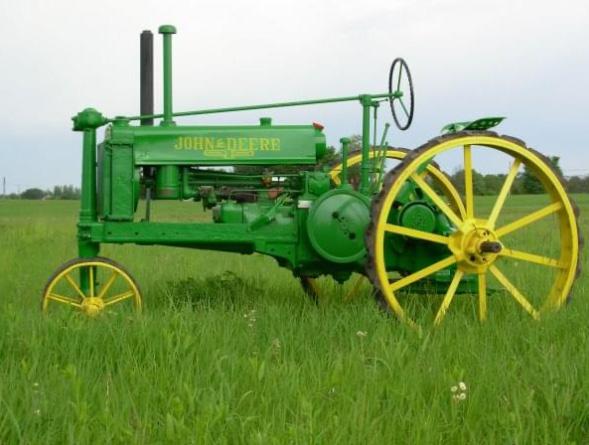
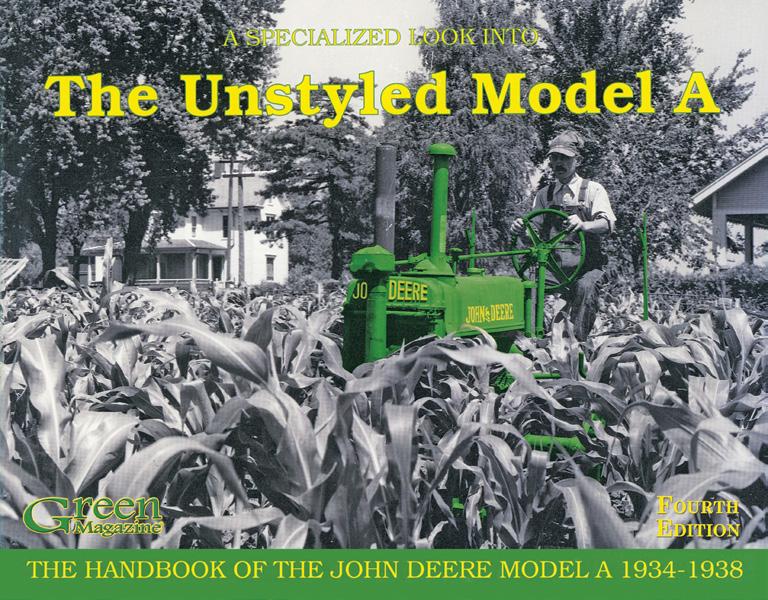
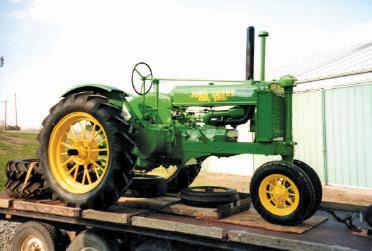
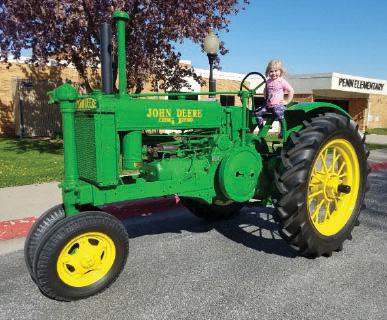
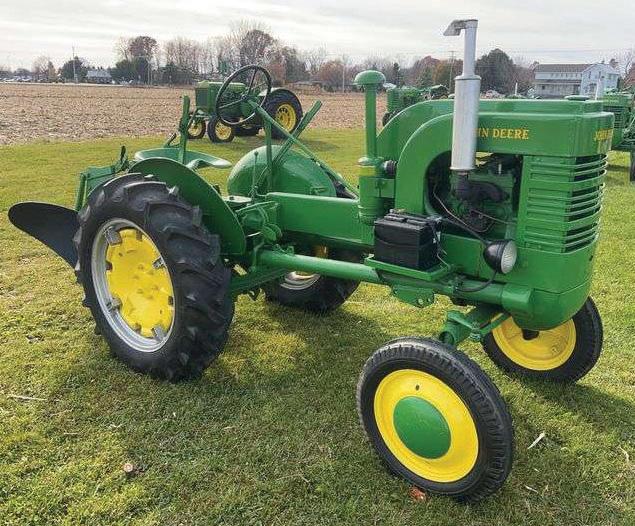
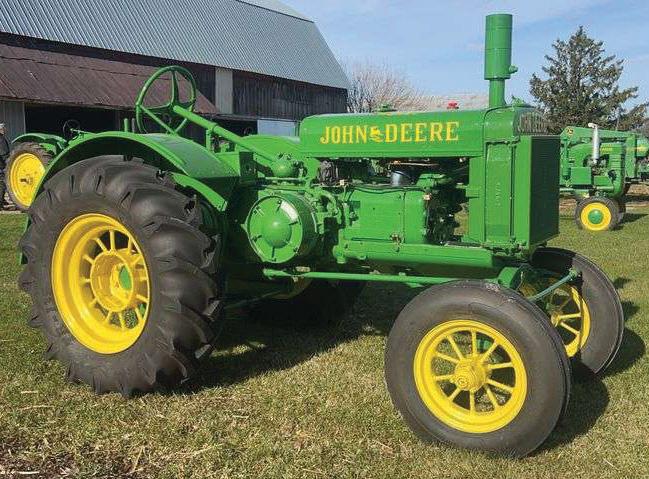
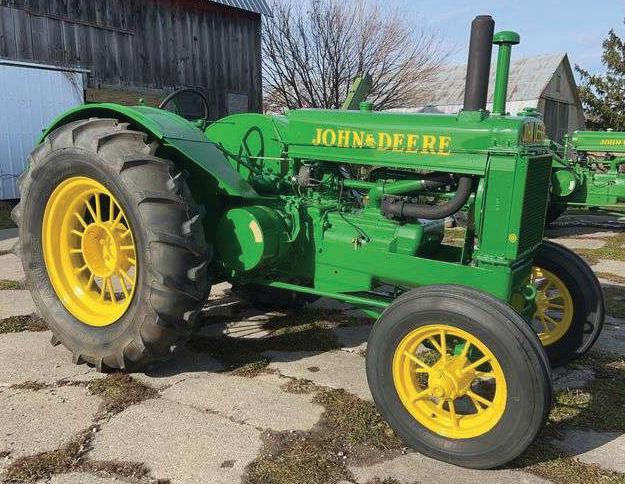
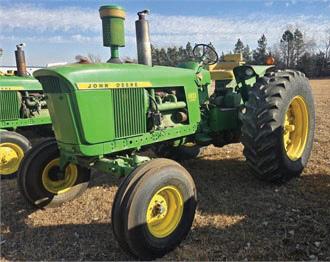
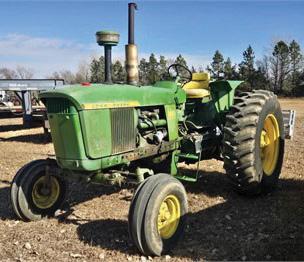
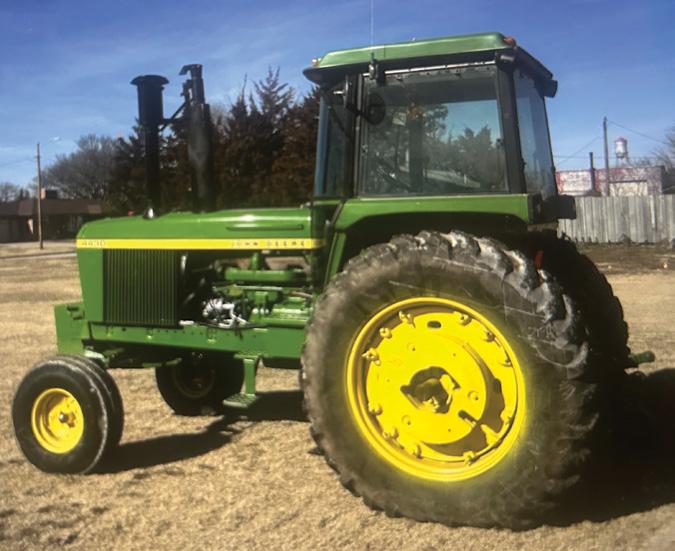
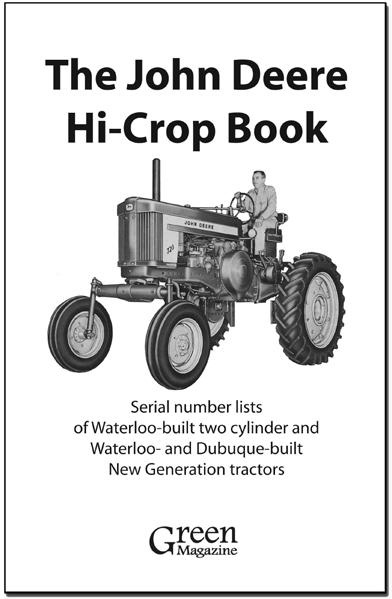
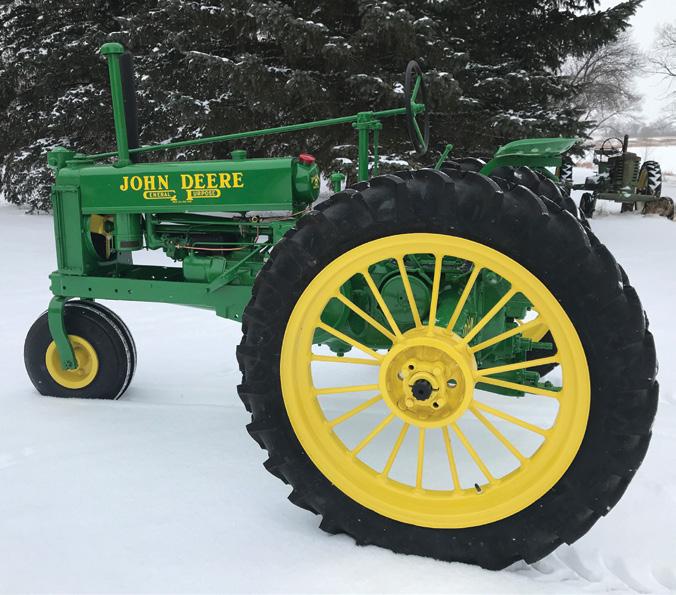
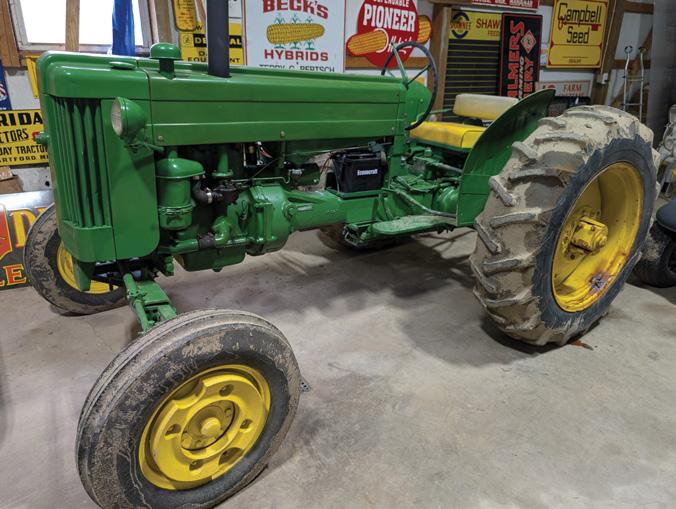
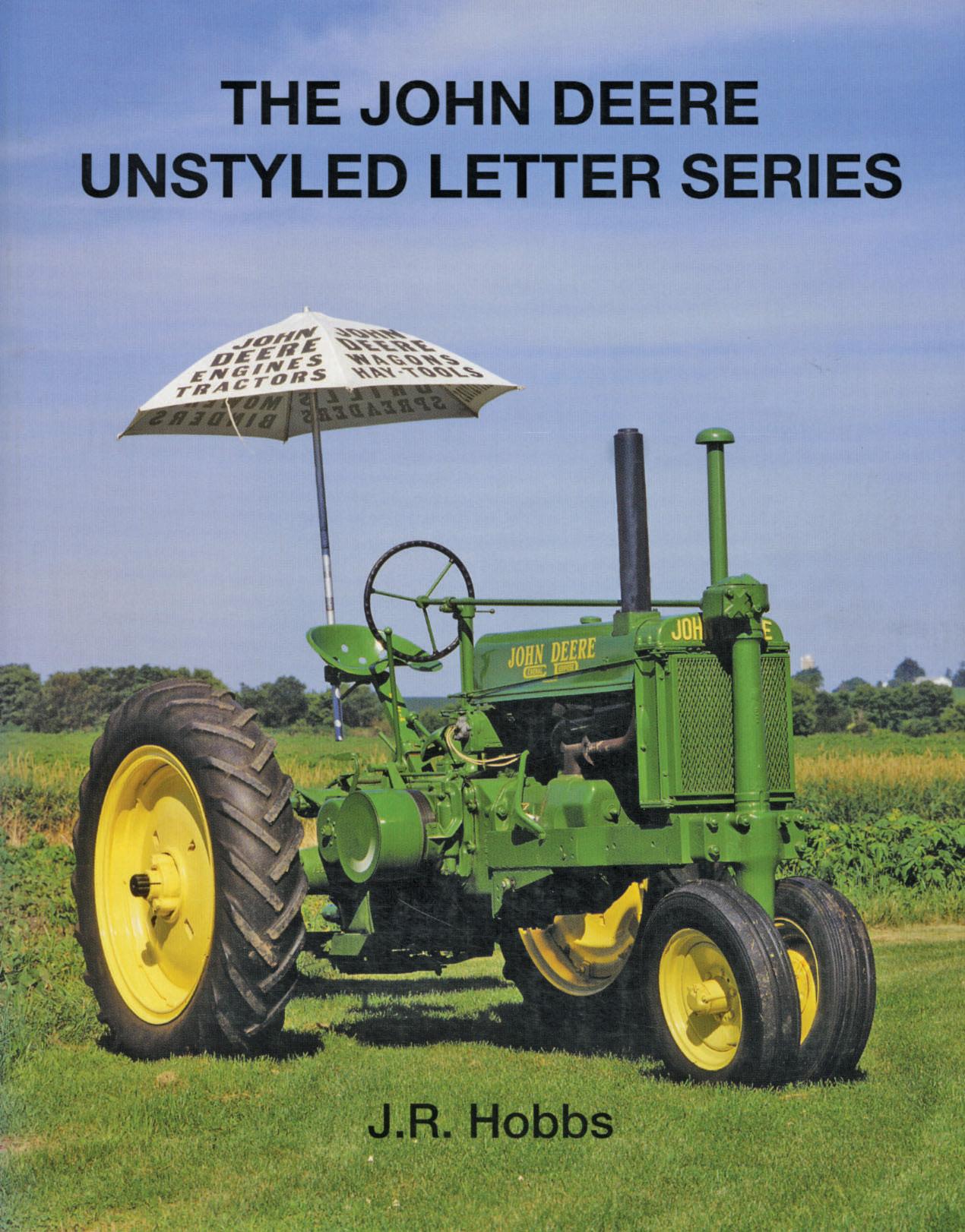
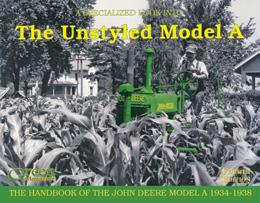
Now in its fourth printing with 15 more pages, this is the handbook of the John Deere model “A,” 1934-1938. A book that should be on the “must read” list of any unstyled “A” owner. There is probably no other book on the market that goes into so much detail on a single model of tractor. Shows illustrations of nearly every change made in the parts that make up the unstyled “A.” 95 pages, 11x8-1/2 inches, soft cover.
Both books include history, specifications, serial numbers, original prices and much more A Specialized Look Into
The Handbook of the John Deere Model B 1934-1938
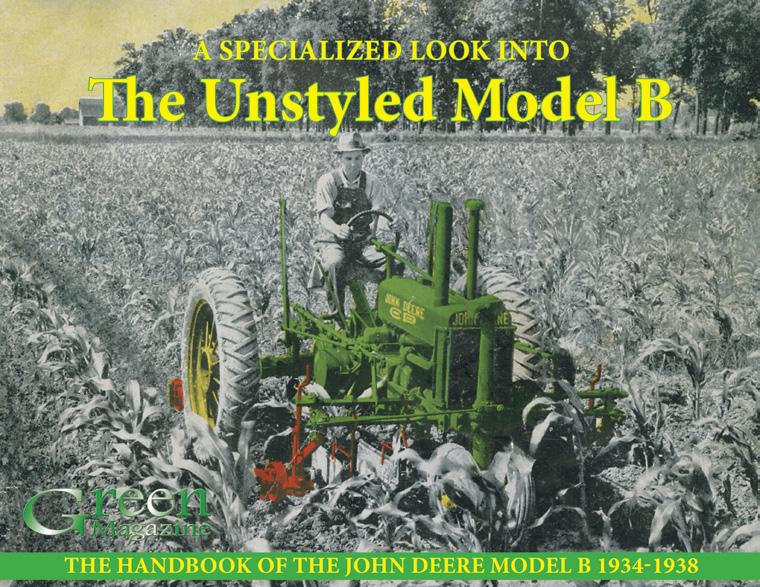
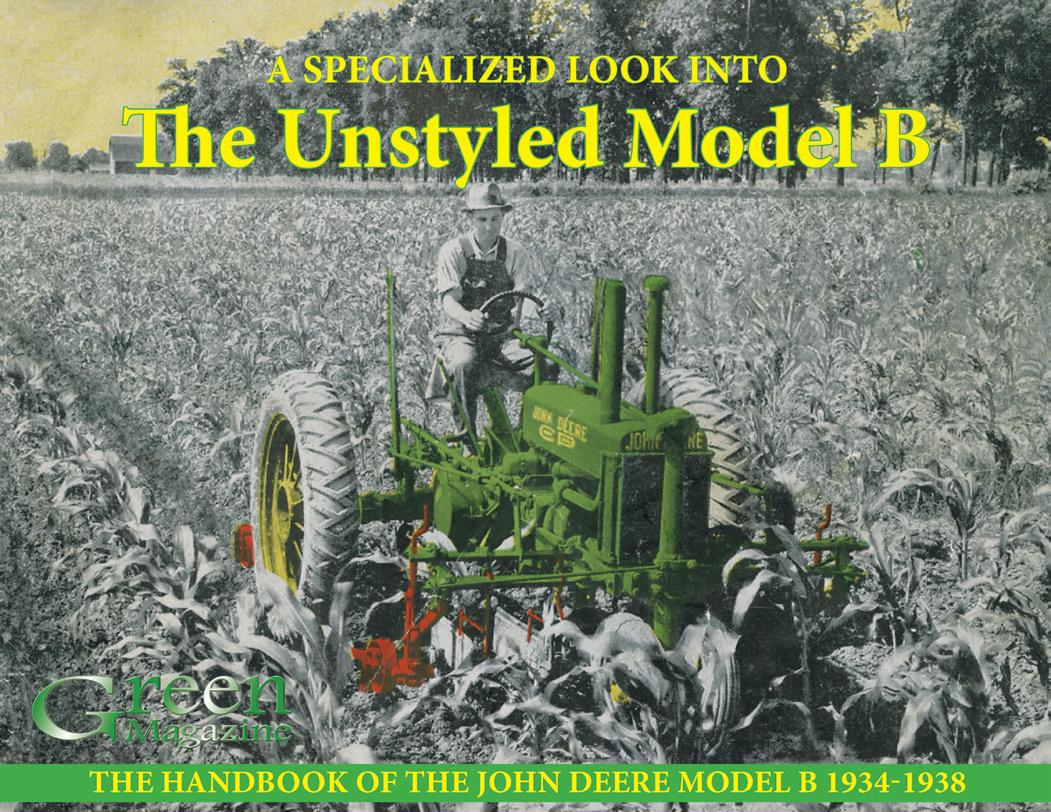
The same types of information as available in the book above, except now about the model “B,” written and compiled by a panel of experts who have spent decades collecting and restoring the unstyled version of Deere’s most popular tractor. This book shows nearly every change made in the parts that make up the unstyled “B.” 84 pages, 11”x8 ½”, soft cover, over 200 photos - most in color.
The monthly publication for John Deere enthusiasts
Jack’s Tractors: Museum houses Jack Purinton’s collection Donna Parker
John Deere model 50 Benjamin Hain
“G” guy from the beginning: The story of my first
“GREEN MAGAZINE®” (ISSN 0883-5462) is published monthly and released 12 times a year on or about the first of each month for $39.95 per year (Canada: $59.95 per year; Foreign: $69.95 per year) by Hain Publishing, Inc., 2652 Davey Road, Bee, NE 68314-9132. Periodicals postage paid at Bee, NE and additional mailing offices.
POSTMASTER: Send address changes to “GREEN MAGAZINE®, PO Box 95, NE 68314-0095.”
GREEN MAGAZINE® reserves all rights regarding reprints of this publication. Our phone number is (402) 643-6269.
It was so good to see so many of you again at the Gathering of the Green! After a four-year hiatus, the big event was as good or better than ever. I haven’t gotten the final numbers yet, but from what I heard, attendance was close to the highest ever, and a good percentage of the Deere enthusiasts were at their first event. Congratulations to all involved in putting on this big extravaganza. And extravaganza is a good word to describe it when you consider the displays, vendors, tours, seminars, auction, banquet, and all of the other activities.
The word got out at the Gathering that Tyler and Teresa Buchheit would be taking over publishing this magazine. No doubt the sign we had at our table had something to do with that. At any rate, I did a little research and mathematics one day, and found that when we send out the July issue, which will be the last one published in the sprawling metropolis of Bee, Nebraska, we will have published a total of 461 issues. Now, if you estimate that the average number of subscribers during that time was 20,000, that means we have mailed 9,220,000 issues over almost 42 years. If we say that the average size of an issue was 60 pages, it comes to a total of 553,200,000, or over half a billion with a “B”
pages. I think I’ll go take a nap.
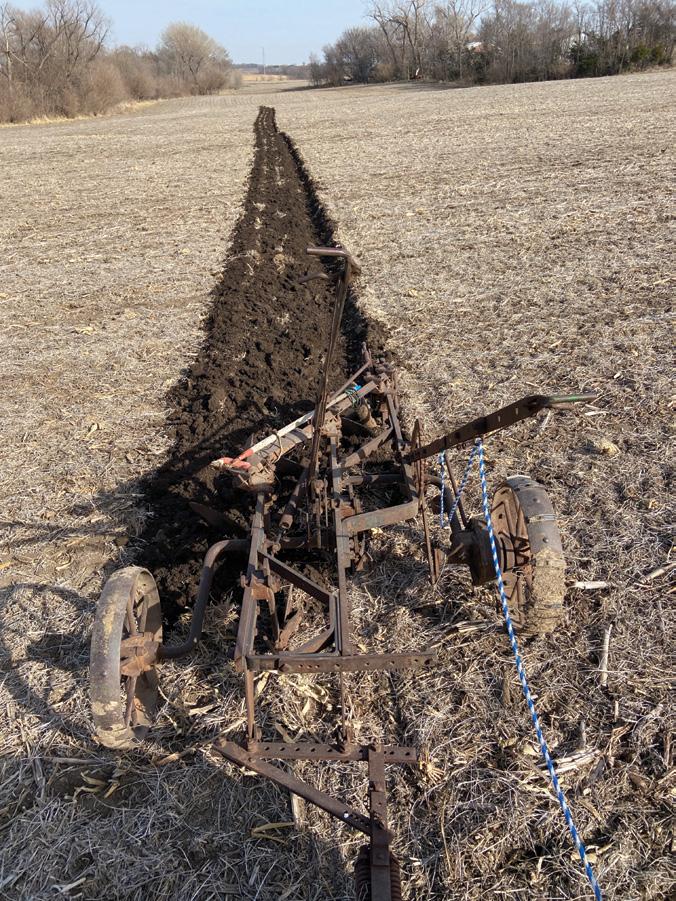
A few issues ago, I wrote about pulling a No. 55 plow out of the tree line to get it ready for use with my “D.” My dad had converted it from clutch lift to hydraulic, and I converted it back again. I had initially planned to take the lift mechanism apart and give it a good cleaning since it hadn’t been used in at least half a century, but after talking to a few others, I decided that my chances of messing something up in taking it apart and putting it back together again were greater than my chances of actually doing any good. One beautiful March afternoon, when the ground was dry, I couldn’t resist trying it out even though the “D” was still without front wheels. So I hooked it up to the 4010 and headed for the field. The lift mechanism worked perfectly, and the plowing went great, though if you look closely, you will notice that I had a floor scraper strapped to the beam, which I needed to use a couple of times on the moldboards because I had yet to do anything to help them scour. The 4010 in fifth gear had no problem pulling three 14s, though the plow seemed to do a better job when I downshifted to fourth. I am now looking forward to hooking the plow to the “D.”
See you next month.
Missing an issue? We mail every issue by the first of the month. Please contact your post office if you suspect a problem with delivery. We will not replace missed issues three or more months past original mail date (four or more months for foreign subscribers) free of charge.
U.S. subscribers: If it is on or after the 20th of the month and you haven’t received your issue, call us for a replacement.
Canadian subscribers: Due to postage costs, we are forced to ask for a $2 postage fee (U.S. funds, please) for re-sending issues that do not arrive by the end of the published month OR we can add an issue onto your subscription for the missed issue.
First Class/Airmail delivery: Call for rates for First Class in the U.S. or Airmail to foreign countries.
Foreign subscribers: We will add an issue onto your subscription OR for a $7 airmail postage fee (U.S. funds), we will resend the missed issue two months after publication date.
Notice: If your address label shows an expiration date of “5/26” above your name, this is your last issue. Renew immediately for continuous service. If your address label reads “6/26,” you have one more issue on your subscription.
Renewal notice: We send postcards to let you know your subscription is about to expire (or has expired). We NEVER call to ask if you would like to renew your subscription. If you
receive such a call, it is most likely from another publication—NOT Green Magazine® for John Deere enthusiasts.
Address Changes: Please send or call with notification of an address change as soon as you know what your new address will be. Periodical mail cannot be forwarded. Green Magazine will not replace issues missed due to late notice of address change. Those missed issues will have to be bought at back issue price. See the back issue listing and prices elsewhere in this issue.
Looking for your photos and stories! Accepted material is subject to such revision as to meet the requirements of this publication. Payment will be made at our current rate within 90 days of publication to current subscribers. Submission of manuscript implies that the material is original and in no way an infringement upon the rights of others. Please send good, clear photographs. If you would like these returned, send us a stamped return envelope to help us get them back to you.
Free Issue Offer: It seems you, our subscribers, are our best form of advertising! More people find out about this publication by “word of mouth” than other forms of advertising. So if you're enjoying Green Magazine®, why not spread the word? Telling others about it can pay benefits. When you tell a friend about Green Magazine® and they subscribe, make sure they tell us who let them know about it. When they do, you will get an issue added to your subscription. These must be new subscribers, not renewals.
I just was reading the March issue. I have two 1929 “GPs.” My dad and his younger brother got one new in 1929, put lights on it and had 1,800 acres in two weeks. My dad got the other one used. We were raising potatoes and, during the war years, we dug over 400 acres with a John Deere PTO one row digger. They got $2 a hundred from the government.
Alvin Nelson, NE
In the mid 1950s, I was a young dirt farmer (YDF). I farmed a strip of dirt between the sidewalk and the house foundation. Every time it rained, I had to start over.
My equipment line was quite thin. I farmed with a model 60 with a three-point hitch, a four bottom three-point plow, a disk and a baler. It is hard to believe, but I was smart enough to leave the baler in the house, out of the dirt. I realized that I needed more equipment—I needed a wagon. I worked the 60 hard, to the extent that the rear wheels on the inside were worn so much that they had an extreme wobble. As every YDF knows, you have to push down hard to leave those nice bar tire tracks in the dirt.
One summer day, I rode to town with my mother, where she was to “run her errands.” Our last stop was the local John Deere dealer: Westwood Implement Company, on Orchard Street in Grand Ledge, Michigan.
My favorite display at the dealership was the cultivator sweeps and points. Shiny black, with a logo decal on each one. To me, it was almost criminal to put them into the ground and wear off that paint and logo.
After ogling the cultivator display, I headed to the parts counter where my mother was. And there IT was, on a display shelf, at the end of the parts bins aisle: a wagon. I immediately started working/begging my mother for it. Looking back, the parts guy must have taken a dislike to me for the begging.
The wagon’s price was $1.39 plus sales tax of five cents for a total of $1.44.
My mother finally gave in. Remember this was our last stop. She counted out all the money she had left: $1.43.
My friend, the parts guy, said, “Sorry, no sale.” The parts guy had just taught the YDF an important life
lesson: the value of a penny. We left wagonless.
That fall, my parents bought a used model 50 from Westwood. They were to service and repaint it prior to delivery. One day, the phone rang. It was the salesman/delivery truck driver saying he was on his way out. I heard my dad tell him to bring along a wagon.
I don’t remember too much about the tractor delivery; my mind was on what was still in the truck cab.
My dad asked, “How much?”
The salesman/delivery truck driver said, “No charge.”
The YDF just learned about valuable life lesson: Timing is everything.
Taking quality tractor and related consignments. To consign and take advantage of advertising, call Jonas Stutzman (440)-636-2617 or Sam Fisher (440)-321-8756.
Early John Deere Consignments Include: Scale 4020, 5020, 4230, 4010 diesel, A (unstyled), L unstyled, 855, 70, D, unstyled B, A, 435, 2-AR, 620, Yanmar 2020D. Watch our website for updates. Parts pallets will begin at 9 and cataloged tractor portion will start at 10 AM.
Other makes & models to be sold • See website for more details
5% buyers premium for onsite purchases. See website for online terms. Cash, check, wire transfer, credit card. Cards have a $2,000 max.
John Deere, The Man, Needs No Introduction
His name still graces the green and yellow machines known around the world. But what do we really know about the man? What do we know about his inner life? Was he a Godly young man? How was he shaped and molded into the iconic man that spawned a world-wide corporation? What was the driving force in his life? Is there enough evidence to convict John Deere of being a Christian?
Take a fresh and deeper look into the man, John Deere, and find the true secret and source of his strength. Paperback $20.49 • E-book $6.99 • 150 pages Available Now! Get your copy today!
No Internet? Contact your local bookstore to order
A fateful day in the life of Jack Purinton was April of 1956. Jack was in high school the day his dad got the John Deere dealership in Lamar, Missouri, the beginning of the Barton County Implement dealership. The John Deere dealership became a family project as Jack worked for his dad in the parts department and he and his brother were in charge of putting together the tractors that came in crates, arriving by rail car. Jack left for a year of college but then returned full time to the dealership. He continued to be a big part of the dealership, eventually taking over when his parents, Jack and Olene, passed away in 2003.
The dealership, under Jack and his wife, Betty, included locations in Lamar, Joplin, Lockwood, and Nevada, all in the state of Missouri and was rebranded Legacy Farm and Lawn. The additional locations were all John Deere dealerships within 40 miles of each other that came together to better serve customers in 2008. The Lamar location, owned and managed by the Purintons, included a Firestone tire shop.
Fast forward to 2019, a mere 11 years after the merger of the four Missouri dealerships that made up Legacy Farm and Lawn. The John Deere dealerships became a part of an even larger group owned by the name of Heritage Tractor, a John Deere dealership covering a four state swath in Illinois, Missouri, Arkansas, and Kansas. As Jack entered his 80s, his 63 year run as a John Deere dealer came
to an end but his love for John Deere tractors continued on.
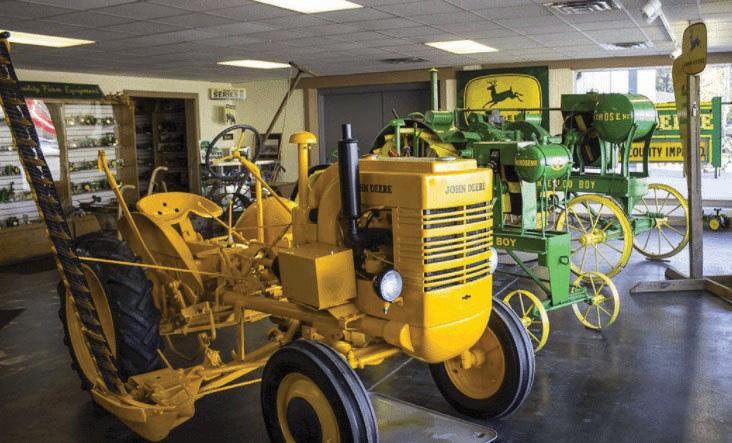
Just down the road and around the corner from the Barton County Implement dealership is a building that houses Jack’s collection of John Deere memorabilia. This was his dream collection—many John Deere items and farming related pieces. The collection started with his father and continued to grow over time with him. Displayed prominently in the front windows of the building are a Waterloo Boy and a half scale Waterloo Boy replica. The Waterloo Boy is a 1918 model and was given in exchange
for work on a John Deere model 730. The replica Waterloo Boy runs and drives. It’s made from lawn mower parts and manure spreader wheels. Jack made connections at a sale with a man who made replicas and that’s how he acquired the half size version of the real thing.
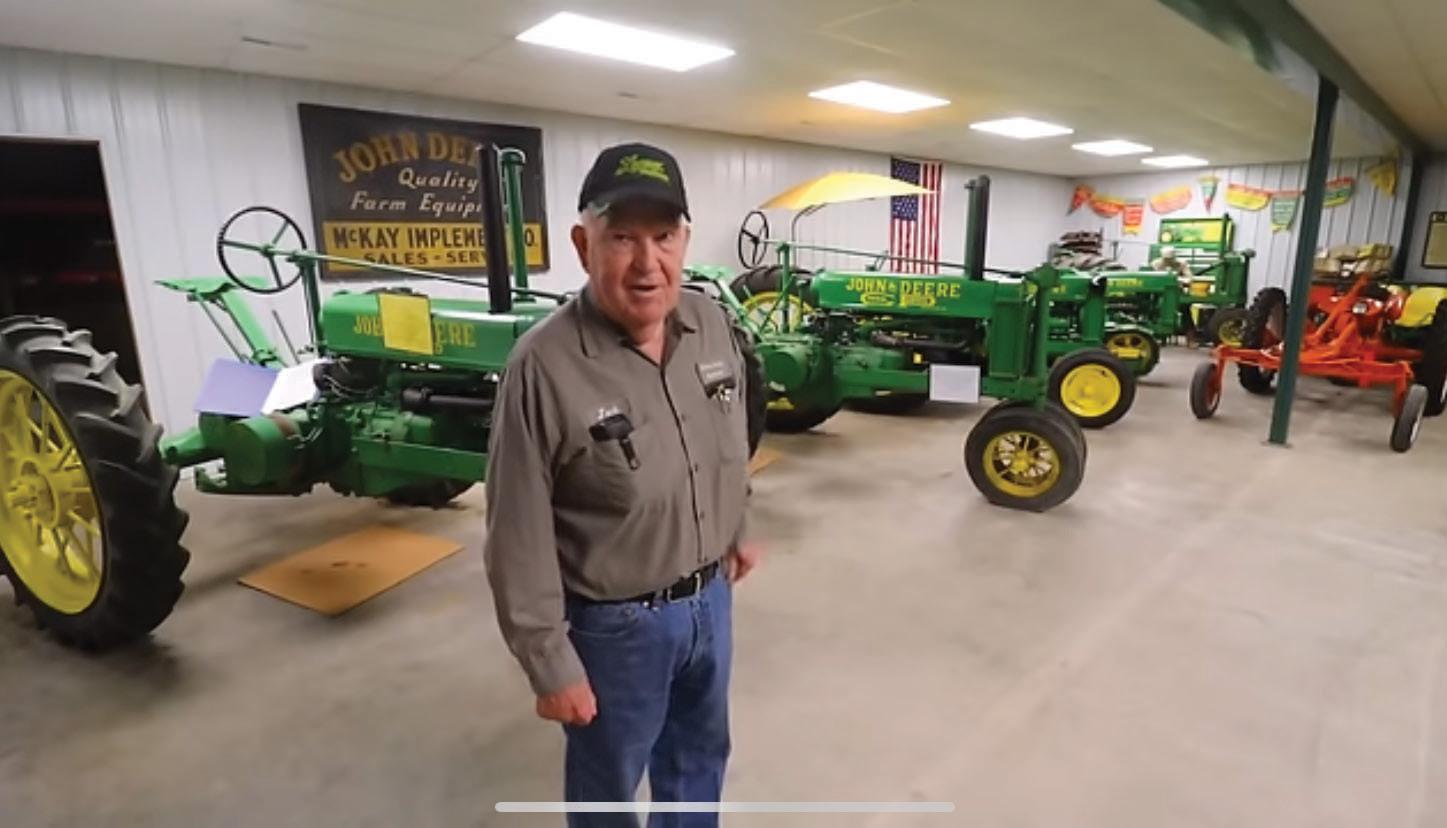
The building is full of tractors including, to name only a few, the entire 30 series: 330 to 830 John Deeres, a 720 LP, a 430 and 530 LP, the “LI” that was restored by his grandson, a Lindeman “BO” crawler, a “DI” on steel (third built), a 1933 “GP,” more than a dozen Hi-Crops, and his prized possession,
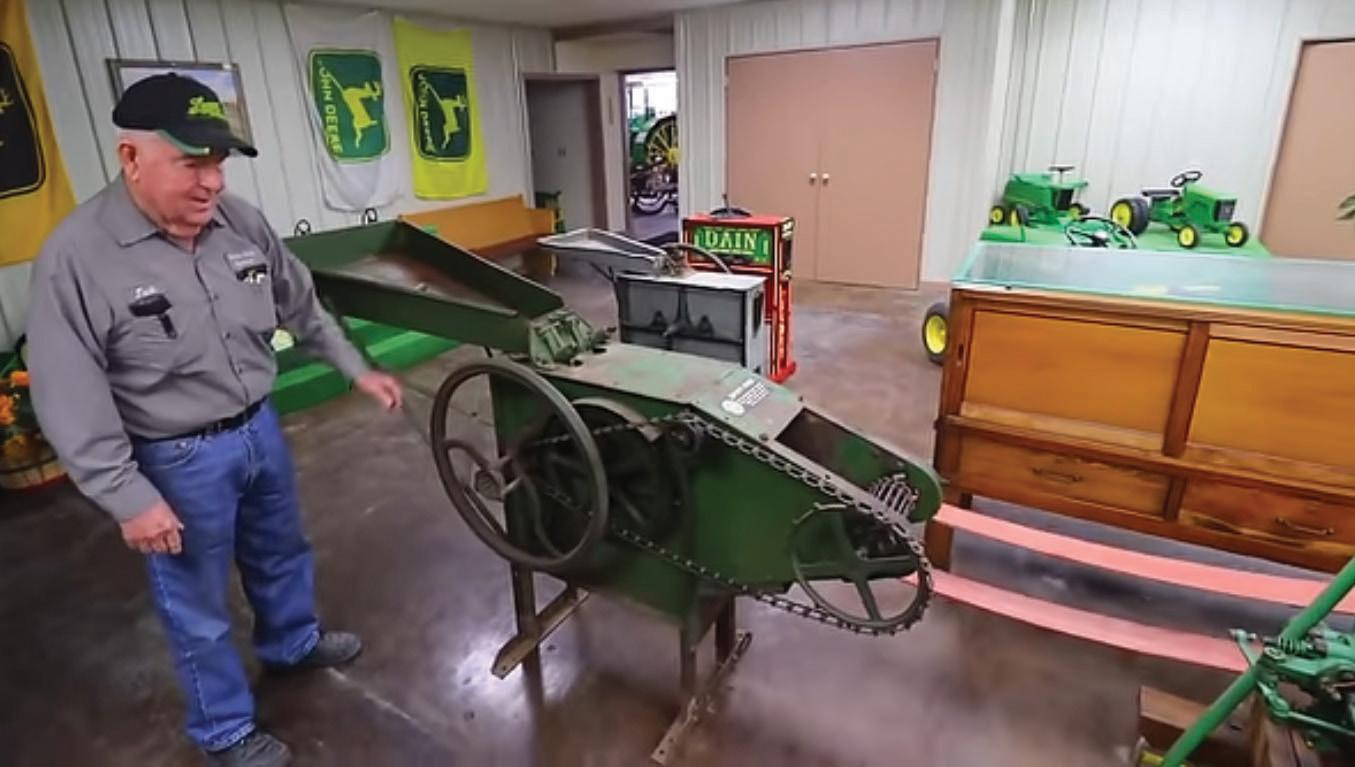
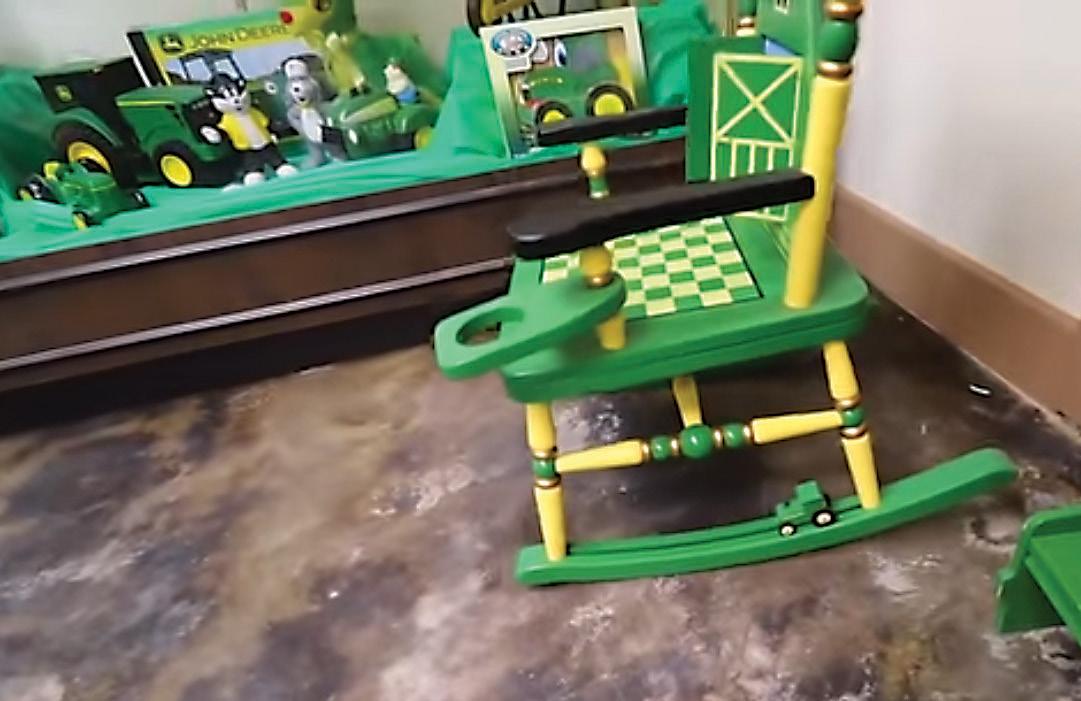
a 1964 John Deere 4020 Power Shift—the first one off the assembly line. It was a demonstrator with very few hours on it. Jack used it for 15 years then retired it to the museum. Jack’s museum also houses toys, plows, hats, bicycles, lawn tractors, tool boxes, engines, pedal tractors, flags, signs, pictures, dishes, books, parts books, a Dain corn sheller, and a rocking chair with a miniature tractor that drives back and forth on the rocker legs. Of particular local interest are the records from the dealership sales.
Purinton family alive. Janet also has a good job at Dollywood, even though there are no John Deeres involved with her job. Jack is proud of all his children as well as his grandchildren. Jack shares that they have a pool at their house and he looks forward to his family coming over in the summer to visit and enjoy cooling down in the pool.
Jack keeps a portion of his collection at his “Jack’s Tractors” museum, noting he displays six of his 20 pedal tractors, and around a third of his 150 tractors. The museum has a room for the “GPs” and “Ds,” the older tractors, many of which his dad collected. There’s another room for his Hi-Crops, and it also houses his 30 series tractors.
Jack says his collection was acquired one trade at a time and was accumulated over the 63 years while serving the community as a John Deere dealership. His dad would restore tractors at the dealership so he could get the occasional help when a bolt was stuck or he needed more than two hands. Some of Jack’s tractors have come and gone, but most stay. He likes the newer tractors because they’re easier to start and he can’t always crank over the older ones and get them going. He had someone very interested in the 4020 and he briefly
considered selling but two parties have to meet at a price and that didn’t happen.
When Jack isn’t conducting tours at “Jack’s Tractors” museum, he stays busy with his warehouse full of antique John Deere parts and the tire business. His wife, Betty, along with Sheri keep the books and ship out parts. Sheri was hired 45 years ago as a young go-getter and she has an extensive knowledge of parts.
Jack and Betty have four grown children: a son, Mark, and three daughters, Debbie, Lisa, and Janet. Mark is a salesman for Heritage John Deere dealerships. Debbie and Lisa also work for John Deere so they’ve kept the John Deere background in the
Jack opens the museum by appointment so if you find yourself in the southwest corner of Missouri just beyond Springfield and you have a hankering to see some old John Deere tractors and share a memory or two with the owner, give him a call at 417-682-1903. The museum is located at 1106 Maple Street, Lamar, Missouri.
There are also several YouTube videos of the museum and Jack’s collection if you want to visit online. Search for Farm Alarm “He owns a Waterloo Boy & the 1st John Deere 4020 Power Shift,” a short video by Tracy and Ashley Friedrich of Booneville, Missouri. This video is shared on Jack’s business website (https://bartoncountyimplement.webnamesandnumbers.com). The other video of note is by Rockhill Farms: “He Owns 150 Tractors,” a longer video by Brock Maggard of Columbus, Kansas. Brock Maggard’s video is a visit to the museum.
Jack says he’s had visitors from Texas, New York, Nebraska, Florida, Alabama, and as far away as Holland, due to the internet, to note a few. He enjoys sharing his collection and stories with visitors.
Wiring Harnesses - Cables - Switches
We build restoration quality wiring harnesses to fit these John Deere models and their variations:
See website for complete listing Due to numerous variations, call to order Shipping/handling not included Visa, MC & Discover accepted Prices subject to change without notice
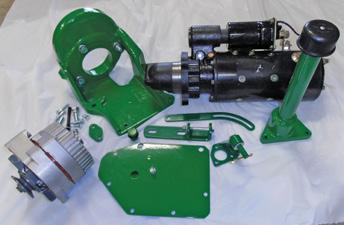
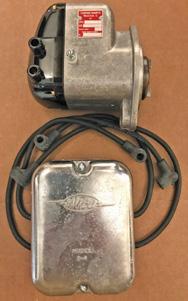
We also carry: Starters, Regulators, Generators, Alternators, Relays, Coils, Lights, Alternator Brackets, Pulleys
We make alternator conversion harnesses
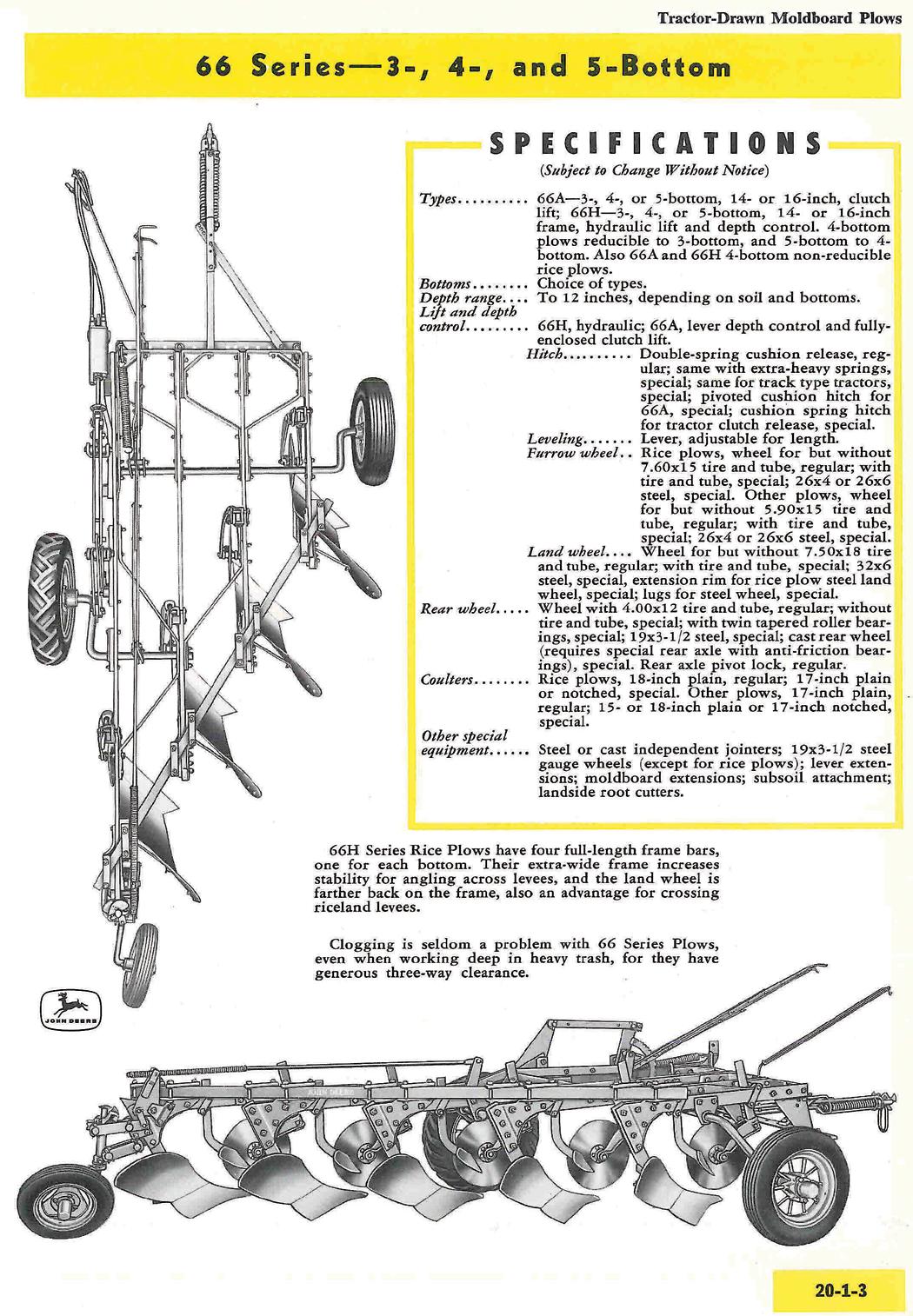
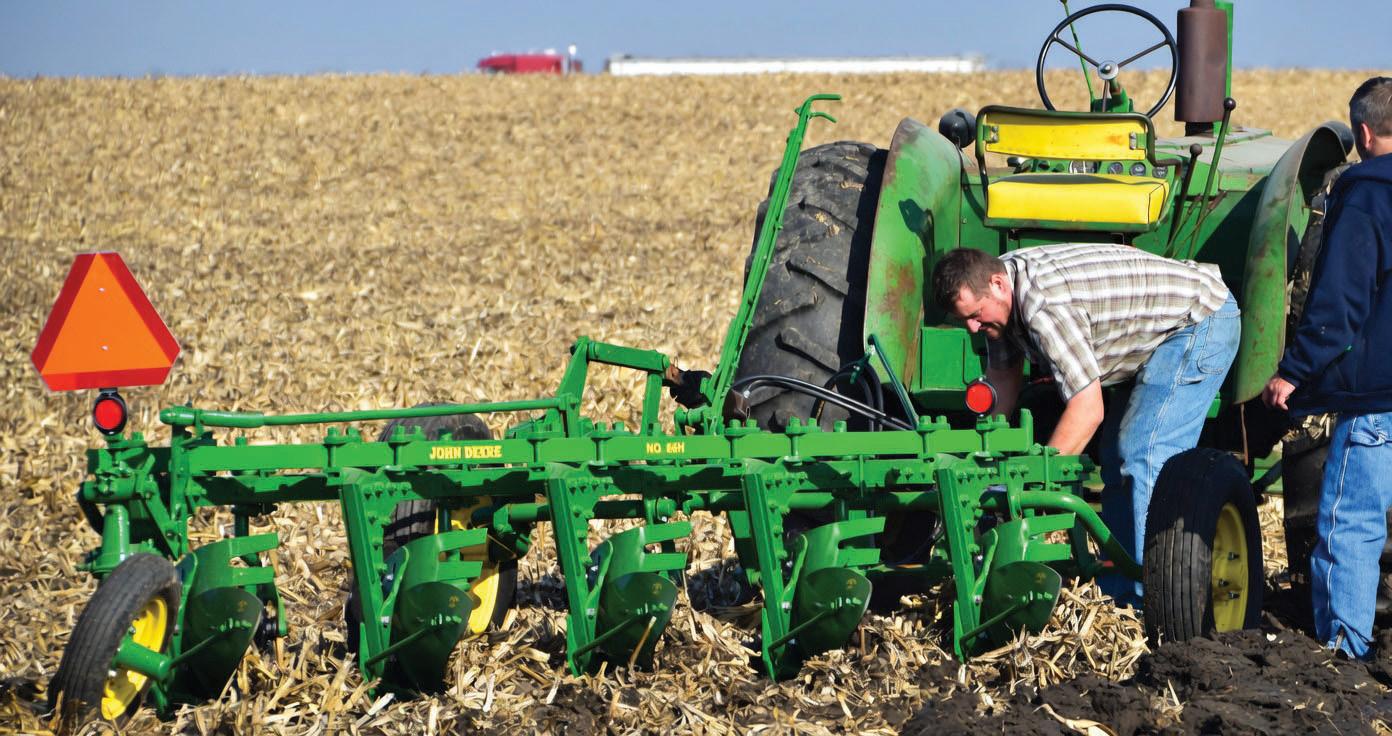
A straight-piped John Deere “R” diesel barks out exhaust notes loud enough to make bystanders 100 feet away cover their ears as the five bottom plow turns the soil at the FFA-sponsored plow day. For a 75-year-old two-cylinder diesel, the tractor looked better than it did when new, thanks to a fresh, beautiful paint job that was part of a five-year restoration. This “R” had been gone through thoroughly: it received updated 20/30 series diesel pistons, a rebuilt fuel system, countless new bearings in the transmission, and new tires; the final piece needed to get the engine’s power to the ground. After some time on the dyno and at summer shows, Sam (the tractor’s owner) decided it was time to get it in the field to continue the “break-in” period, this time with help from his trusty old John Deere No. 66H 5-14 inch pulltype moldboard plow.
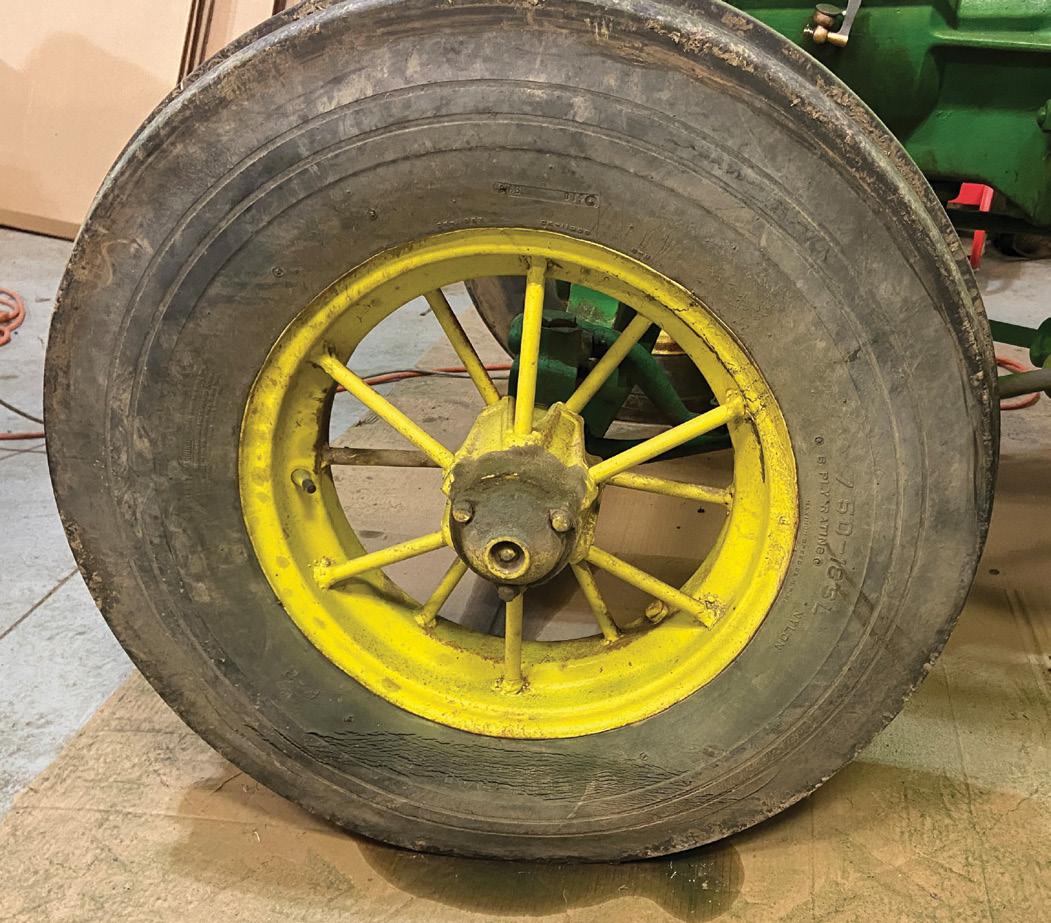
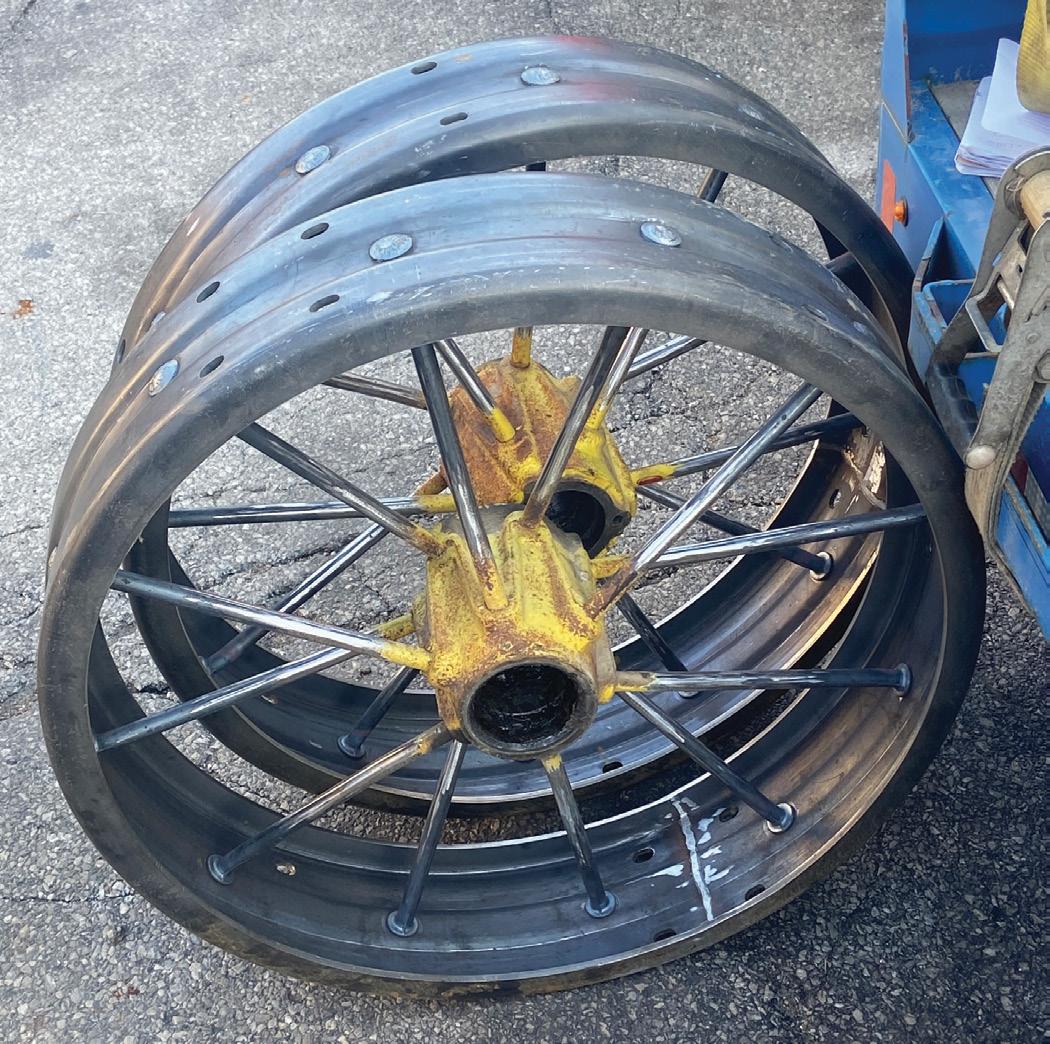
The 66H had not seen a field in the last 20 years—or maybe Uncle Joe’s memory was a bit fuzzy and it had been the early ’80s, making it over 40 years. Sam spent a few minutes looking the plow over after rescuing it from the hallway of the 100-year-old corn crib. It seemed to be in good shape, and thankfully it still had all its coulters, unlike some of the ones parked in the fencerow whose coulters had been “borrowed.” Sam took off the wheels and dropped them at the local farm tire shop. The guys there knew him well; he usually brought in spoked rims, something they did not see every day. Lucky for Sam, the rims were still in good shape (unlike the ones that had been parked out under the big blue shed), so new tires and inner tubes were all that was needed.
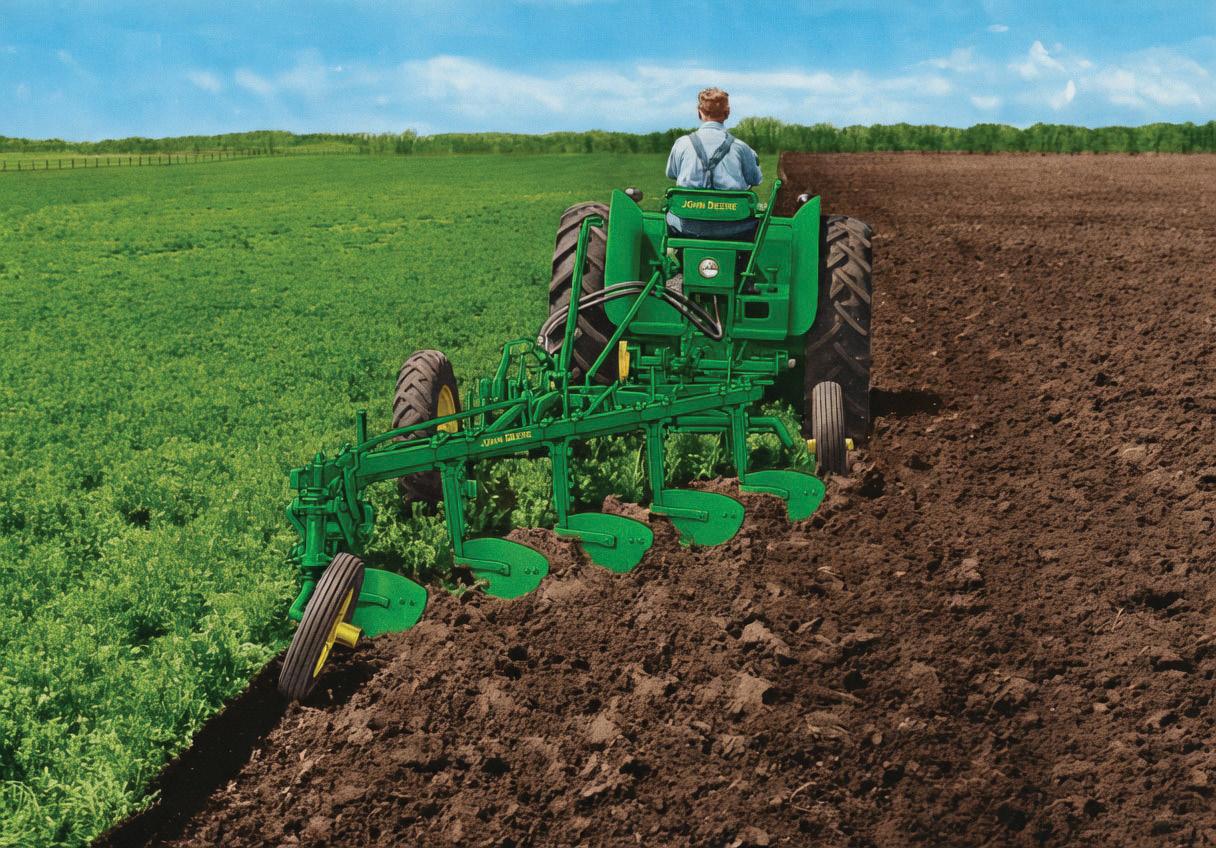
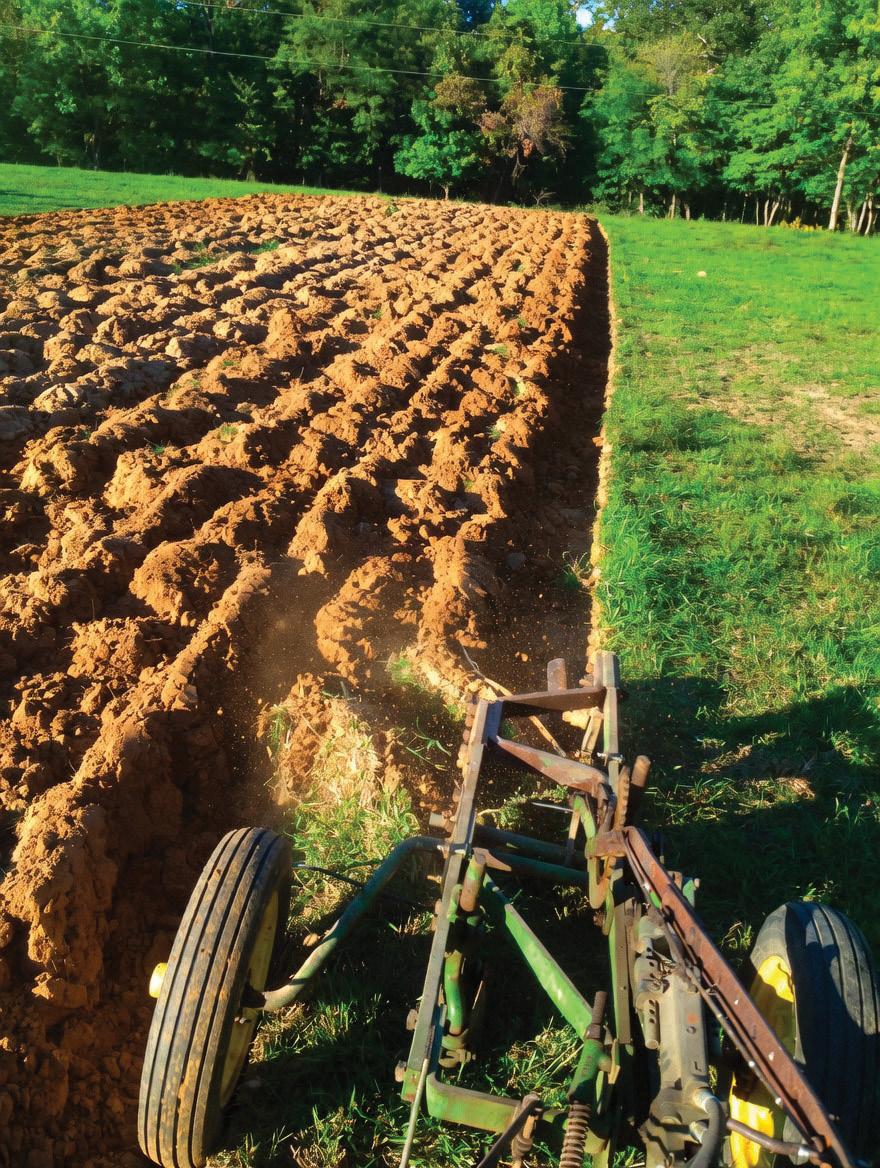
Perfection as seen in the dreams of the plowman!
He pumped fresh grease into every fitting that would take it, though a few stubborn ones were left for another day when he had more time. He shook the aerosol can of chain and cable lube and gave a shot to the rear axle bail and the latch on the master lever. That stubborn grease fitting on the cylinder mounting bell crank also got a generous dose of chain lube, in hopes it would eventually work its way into the bushing until he could pull it apart and recondition it properly.
When he was a boy, Sam had the job of cleaning rusty moldboards on his Great Uncle Alfonz’s three-bottom plow using a wet clay brick. Some of his shoulder pain in this century may well be a result of that experience. Uncle Joe had likely coated the 66H with used oil applied with a wooden-handled paintbrush, but that protective coating had long since disappeared with time. That left the steel and moisture free to chemically react, leaving behind iron oxide.
Thankfully, with more modern methods, Sam cleaned up the moldboards on his 66H using a cordless angle grinder fitted with a flap sanding
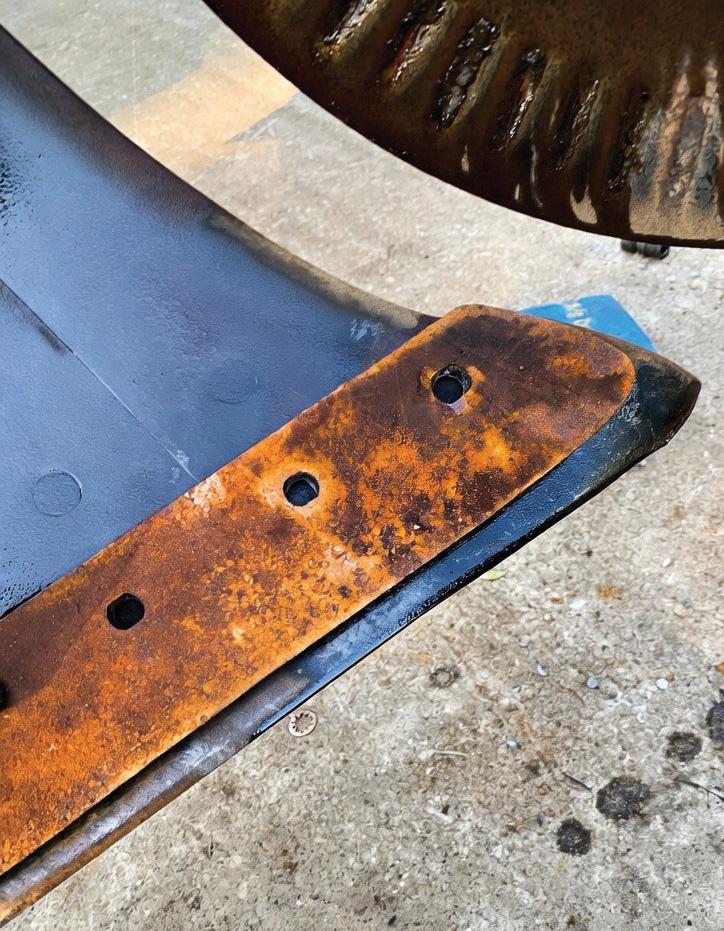
Rounded plow share nose (rusty) compared to a new share (black) below.
disc. After an hour-and-a-half session, he pulled off his dust mask and grabbed a cold drink from the shop fridge. With the first sip, the taste of iron hit his tongue like a mouthful of rusty nails. He grimaced at the shock but kept drinking until the can was empty. It seems no matter how good the mask, that rusty iron taste after sanding always finds its way past the filter and into the sinuses.
Refreshed from the cool drink, he looked closer at the bottoms. The moldboards were still sharp along the outer edges and showed no chipping. This was a good sign, since Sam was not even sure new moldboards were available for this plow anymore. None of the wear parts were worn completely through, so he decided the plow was good enough to be plow-day ready.
The late summer weather had been hot and dry, with only a few tenths of an inch of rain in early fall, leaving the soil hard as concrete. Sam had been discussing the upcoming plow day with his buddies, worried about how well the old plow would perform and whether it would take away from the great looks of the restored “R.” “It
should go in the ground,” said one of the guys. Another added, “That plow is heavy enough that even with worn shares it should work okay.” Sam decided he would take his chances with the plow as is.
It became evident after the first 20 minutes of trying to get the 66H to pull straight and hold depth that some plow parts really should have been replaced. The shares had looked okay, even if their tips were rounded. They might have been fine for spring plowing, but the tough, sunbaked September soil was unforgiving. Besides the shares, the coulters were all there, but the blades were worn down badly. Corn stalks scooted in front of the dull blades and piled up ahead of them, causing the plow to plug at times. Sam would have to lift the plow, turn out of the furrow, and hope the mess of debris would drop so he could continue. This of course would leave piles of stalks for another plowman to contend with, likely causing the same problem for someone else. Sam was not happy with it, but that is how plow days go.
Keeping the plow in the ground
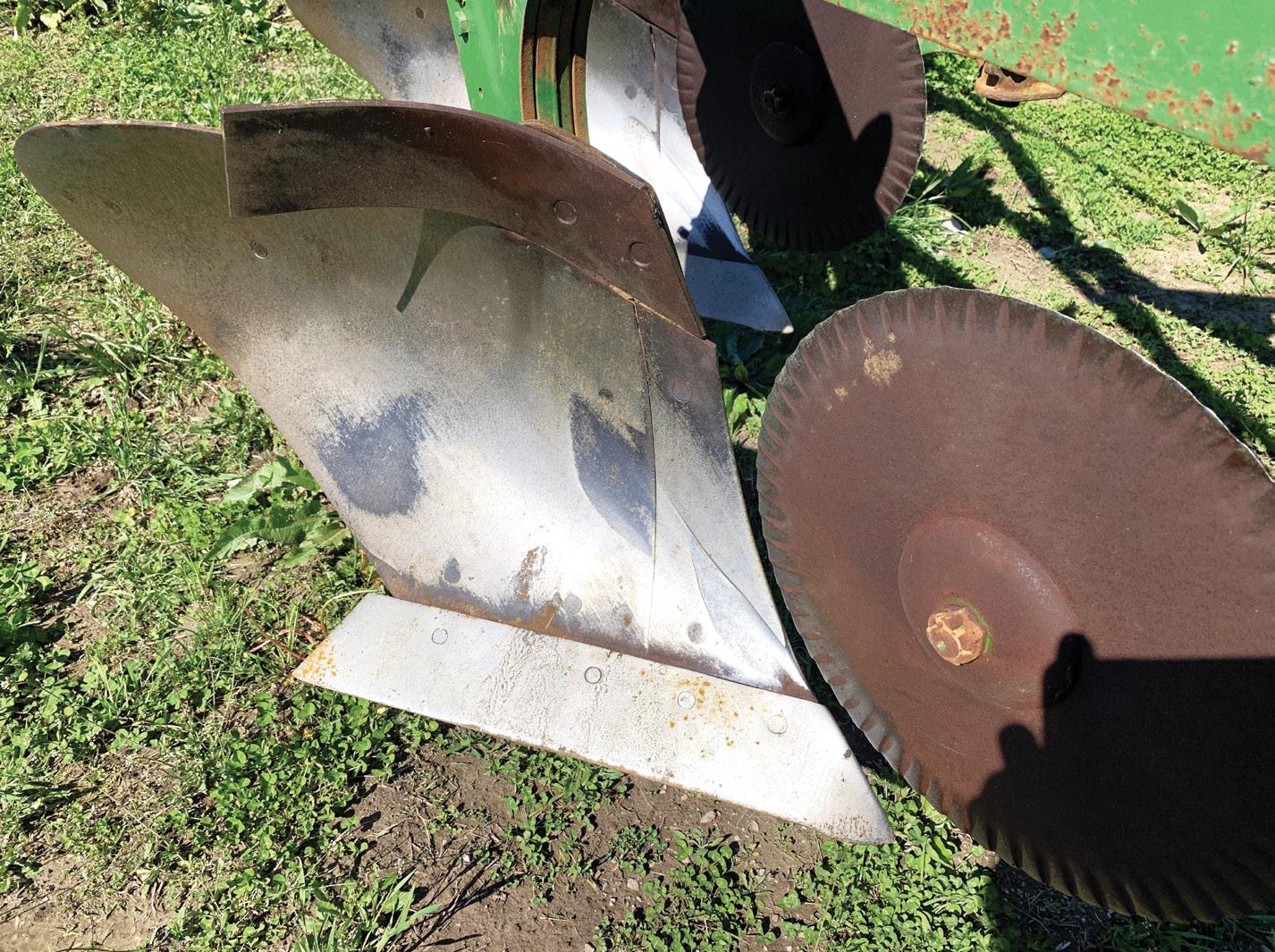
This plow bottom is a little worn but the share is in excellent condition. The nose/point is the critical area to keep the plow sucked into the ground doing good work.
at a consistent depth was another real challenge. Every time he crossed a drainage ditch, he had to lift the plow to avoid plowing through it. When he dropped it back in on the far side, it would dive below the old plow pan, causing the “R” to dig in hard until the wheels spun excessively. Two quick bumps of the Powr-Trol lever brought the 66H up fast, but once the shares cut above the hard pan, all it would do was skim the top three inches of drought-loosened soil.
After a couple of hours of attempted plowing, Sam had enough. He headed home with the “R” and the 66H in tow, frustrated that his setup had not performed as well as he had hoped. Other operators had faced similar challenges in the difficult conditions, but not everyone shared his frustration. One guy with a Moline GVI was pulling the same model 66H plow and keeping it in the ground nicely, even though it pulled hard on the big six-cylinder tractor. Sam talked with him and learned the man had just installed new shins, shares, and landsides. He had also plowed enough on the farm beforehand that the new parts were already shined up and scoured. Sam agreed that was likely why it performed so well.
Knowing worn parts were the real reason for his frustration, Sam vowed that the next time he plowed, the 66H would be in better condition just in case he had to deal with hard ground again.
In the spirit of the ’90s TV show Unsolved Mysteries, the names have been changed to protect the innocent, but the story is real. It can be difficult to know exactly when to replace plow parts. Many of today’s plow day operators have not thought seriously about moldboard plowing for years. The little things like knowing what to look for when deciding whether a part still has life or needs changing have been forgotten. For those in the Boomer generation, swapping out parts that “could still go a little longer” often feels almost sacrilegious. Of course, there is also the insurance factor of changing wear parts to avoid
poor performance, as Sam learned the hard way.
From nearly two decades of plowing experience (I am sure some readers will chuckle at what they consider a short time), regularly working with many different models in a variety of conditions, I have learned that plow shares are the number one item most often overlooked when getting a plow ready. It seems plows were rarely rebuilt just before or after
Plowing old sod in late summer with this 44H was only possible with brand new shares. It was an old horse pasture that was compacted and super dry.
Below: Even with excellent plow parts, proper adjustment is required every time when in the field.
their last use. Instead, the last person to use them usually got all the “good” life out of the wear parts before parking the plow for good. This creates a challenge for folks today who want to take an old plow back to the field and enjoy reminiscing about their youth. A close inspection of any plow headed back into service should always be done, especially before bringing it to a public plow day where others will be watching.
Shifting gears from the topic of plowing, here I sit in my office on this fine spring Missouri morning, pondering the quickly ticking clock until Teresa and I take the helm of the ship Green Magazine (as announced last month here in GM). The task seems enormous when viewed as a whole, but Richard and Carol have been incredibly helpful in making the transition as smooth as possible. So far, the response from GM readers has been overwhelmingly positive as they learn the torch is being passed to the next generation. I remain steadfast in my commitment to preserving the legacy of Green Magazine and delivering the same quality content you have come to love and enjoy each month in your mailbox. The enormity of the challenge of becoming a publisher can best be understood through something one of my first work managers once told me: “How do you eat an elephant? One bite at a time.”
Contact Tyler Buchheit by email at tyler@mrbtractors.com. His website is www.mrbtractors.com
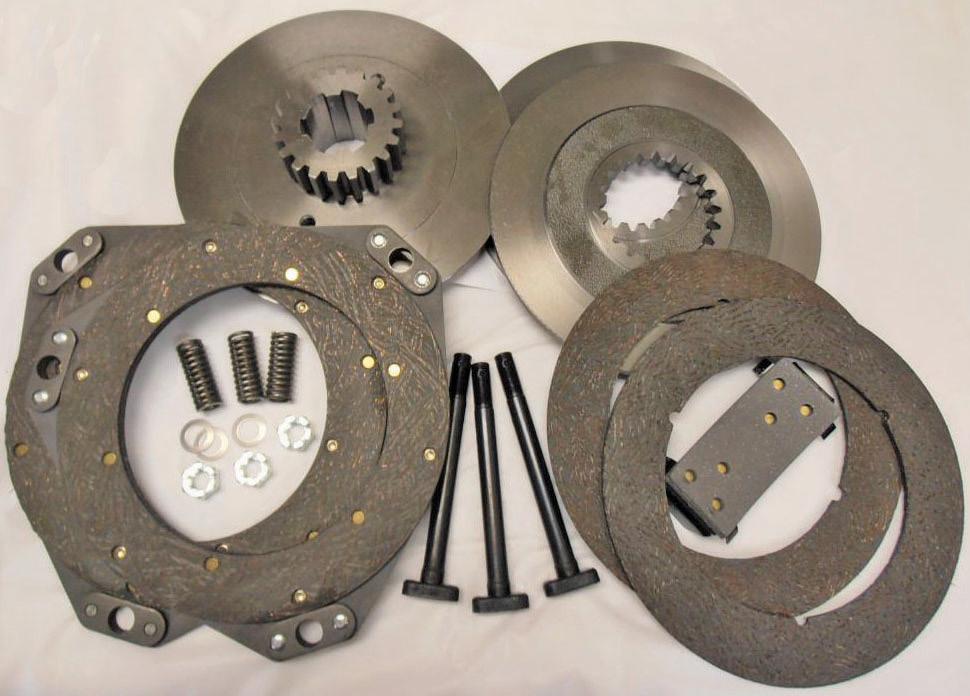
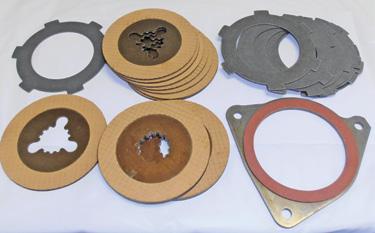
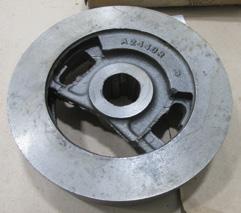
Complete clutch rebuild kits and clutch lining kits
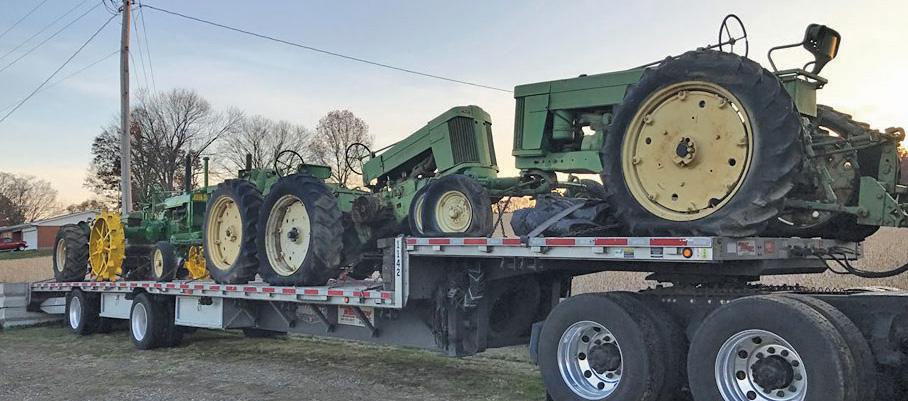
PARTS TRACTORS
70 gas, late B w/water pump, 820, styled AR, 720D, 2010G, late A, 530, 720D pony start, 50, 1020G, LA ES, 50 w/801 hitch, G, uns A, 730G, 5020, uns G, 430T, 2510G, 730 LP, 2010D, 530, late 520, ’39 B, BN, 40U, ’53 AO, ’41 H, ‘46 A, late A’s, ‘46 B, late Bs, slant dash B, uns B, sty D, G, uns L, M, MT, R, 40T, 40U, 40W, 70D std., 70G, 420U, 420W, 440 w/reverser and PS, 440 gas, early & late 50s, early 60, 60 w/power block, 620, 620 LP, 630, 70G, 720G, 720 LP, 720D pony, 730D, 730G, 820, 1010, 2010, 2010D, 2010RU, 2020, 3010D, 3020, 4020D. Most of these tractors are parted out & on the shelf— ready for quick shipment!
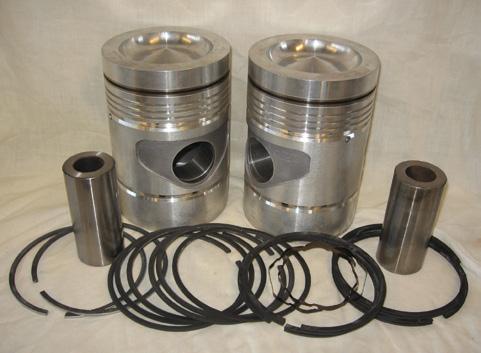
Oversize pistons available again for many two cylinder tractors
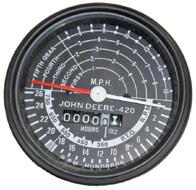
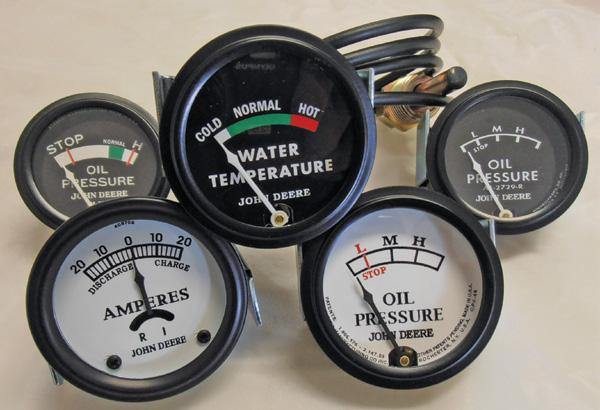
Tachometers and cables
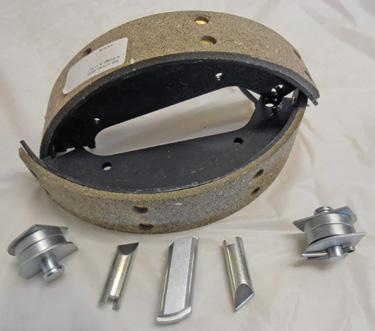
Brake rebuild parts
• New aftermarket, rebuilt and used parts for JD A, B , D, G, H, M, R, 320, 330, 40, 420, 430, 50, 520, 530, 60, 620, 630, 70, 720, 730, 80, 820, 830, 3010 3020, 4010, 4020.
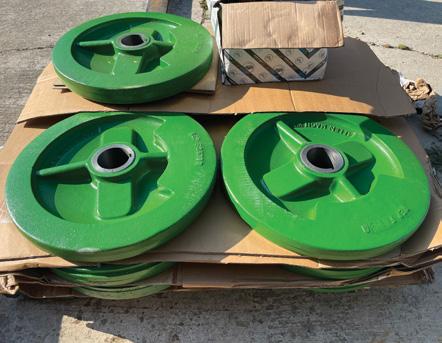
• Used parts include: weights, 3-pts., toplinks, dual hydraulics, float ride seats, clutch parts, hubs, transmission gears, sheet metal, tires and rims, 720-730 ES parts, all-fuel manifolds, brake parts, square and round tube WFEs, heads, blocks and PTO parts.
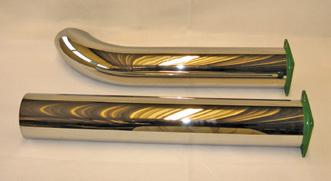
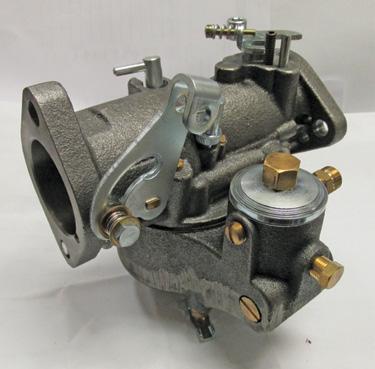
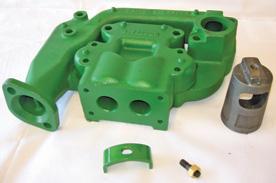
• New parts include: manifolds, battery boxes, carburetor kits, air stacks, mufflers, grill screens, radiator cores, lights and overhaul kits.
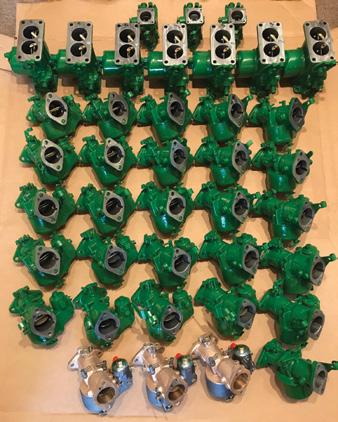
• Rebuilt parts include: Taper-Loc flywheels, electric start conversion kits, float ride seats, starters, carburetors, cleaned and lined gas tanks. Also have crack checked heads and blocks.
Deere proved early on that it was far more than an implement maker the moment it stepped into the tractor business. From that first tractor and through the 1930s and 1940s, the company’s machines advanced rapidly, offering affordable tractors packed with features many rivals simply didn’t have, and delivering power, economy, and reliability that much of the competition could only envy. During the war years, Deere quietly doubled down, refining its tractors inside and out so it would be ready when demand surged when peace returned.
For years, the John Deere model “B” was the darling of the lineup. Only recently had its sales begun to soften, thanks in part to the growth in the average farm size and the rising popularity of the larger model “A.” Even so, the “B” continued to sell strongly, and it was easy to believe that only modest tweaks would keep it competitive. The tractor needed to stay current, certainly, but how drastic did those updates really have to be?
By the 1940s, many in the industry had already written Deere’s tractors off as outdated. Two-cylinder engines, they insisted, were relics of another era, yet Deere kept selling tractors by the trainload. Still, most observers assumed the company’s next big model would finally carry a “modern” multi-cylinder engine. Rumors spread that Deere was pouring serious money
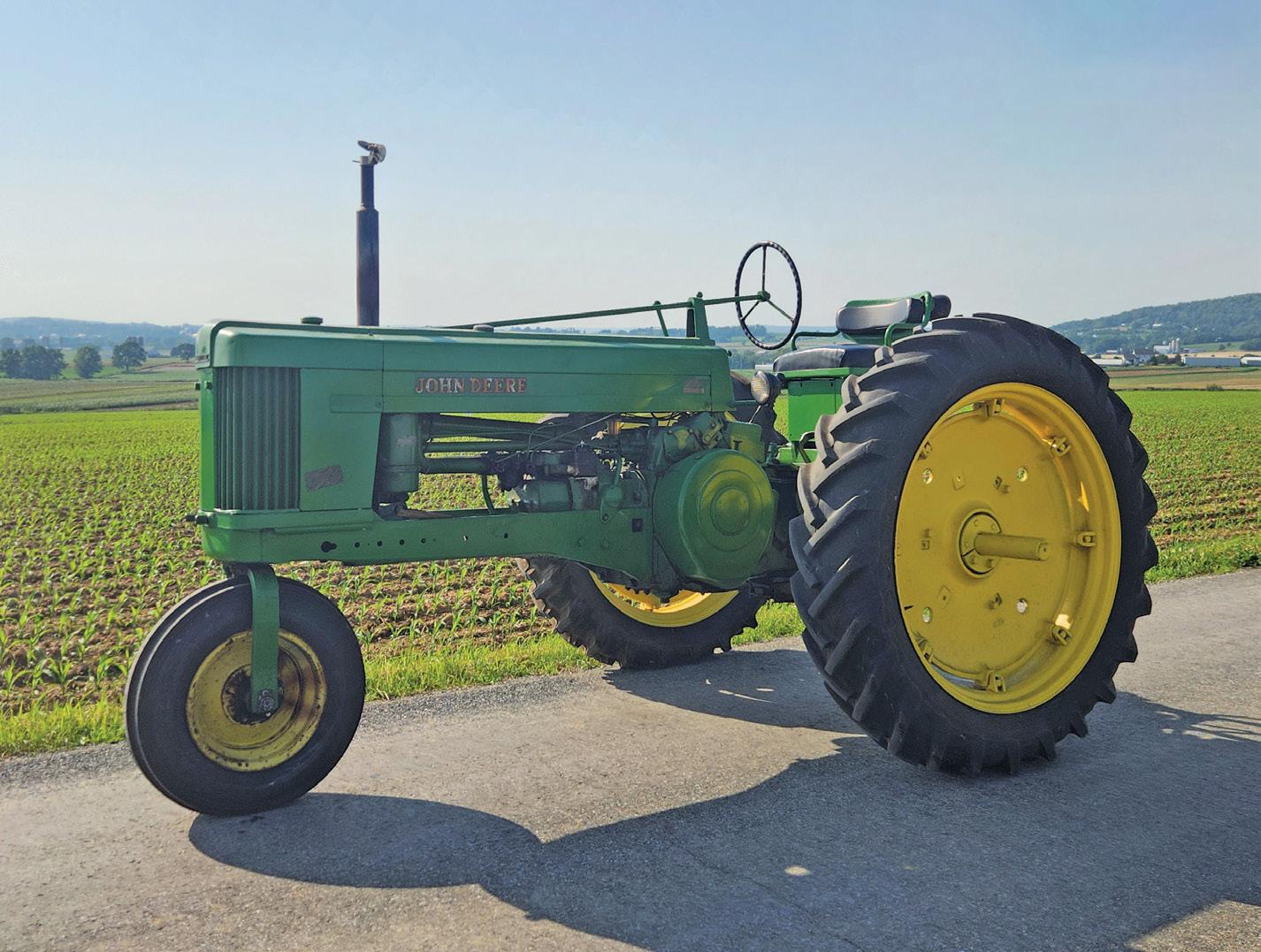
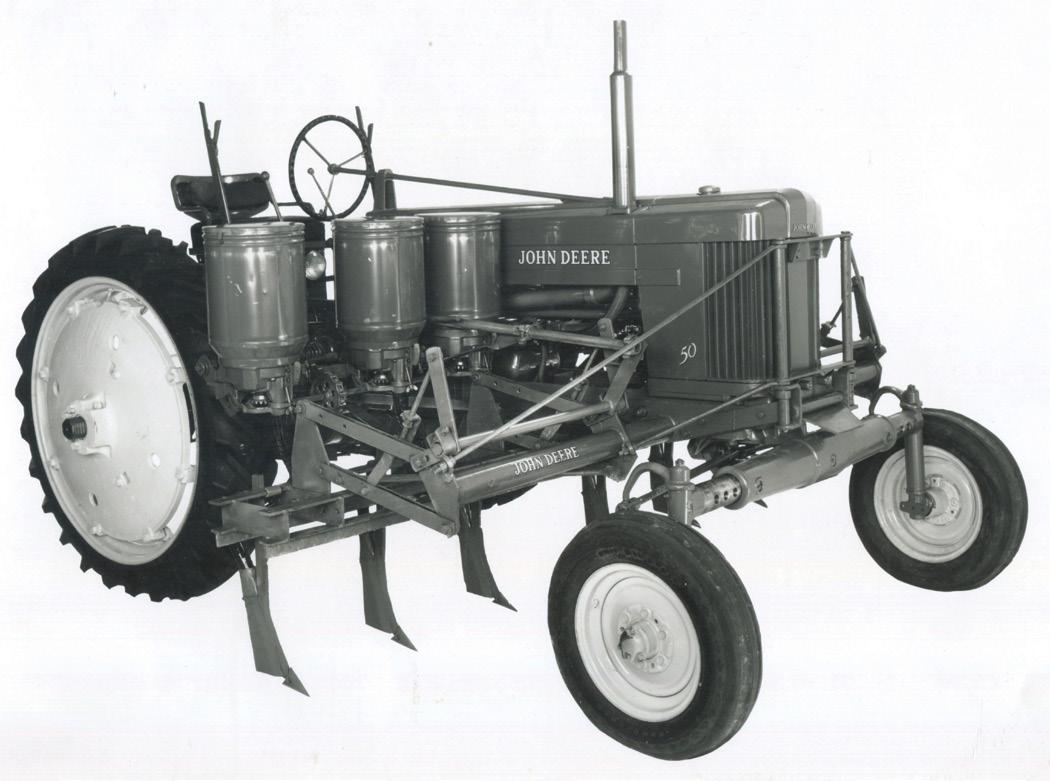
Mike Trazzera’s 1953 “veggie” 50 with 42 inch tires, long axles, and single front wheel. This was an asparagus cultivating tractor that spent most of its life in southern New Jersey and now lives in Lancaster County, Pennsylvania.
into research and development, and for many, the death of the two-cylinder tractor felt inevitable. Those doubts weren’t confined to outsiders, either.
Inside Deere, plenty of voices were calling for change. As tractors grew larger and more powerful, it seemed obvious that a two-cylinder engine would eventually have to balloon to impractical proportions to deliver the horsepower farmers wanted.
There was only so far the basic layout could be stretched. Many of Deere’s engineers believed this, and so did company president C. D. Wiman. The feeling was that Deere had to evolve or be left behind—and the sooner that evolution began, the better.
But the two-cylinder layout still had its champions. The sales department was one of its staunchest defenders. For years, Deere salesmen
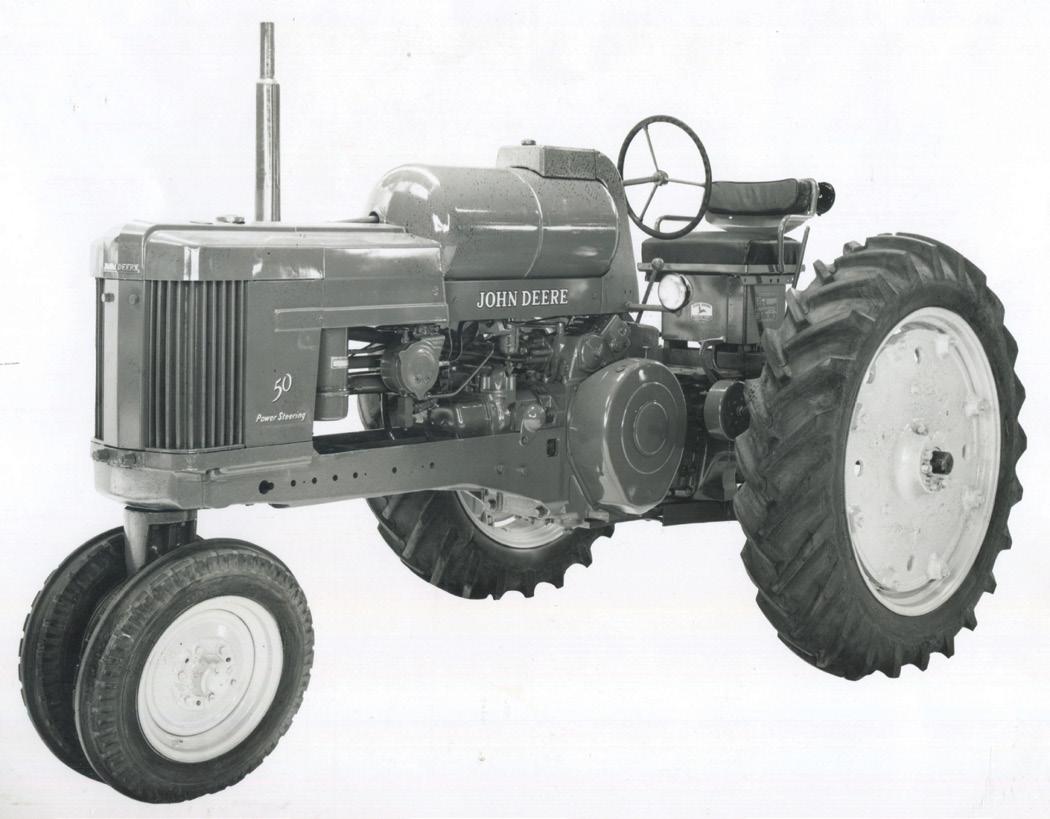
Here we have a photo of a prototype 50 LP taken in May of 1954. Note the later style rear wheels. It looks as if they hadn’t quite decided where to put the “JOHN DEERE” decals.
had closed deals by touting the simplicity and punch of the two-cylinder engine. How were they now supposed to go back to those same customers—many of whom had just invested in a new tractor on the salesman’s promises—and try to sell them a machine that seemed to shy away from everything they had been told? And despite the jabs from rival companies about “outdated” engines, Deere’s tractor sales kept climbing every year. For the sales team, the logic was simple: you don’t throw away a winning formula. No one believed in that formula more than L. A. “Duke” Rowland. As manager of the Waterloo Tractor Works and a Deere vice president, Rowland was deeply invested in the two-cylinder platform. He fiercely resisted any move that would disrupt Waterloo’s production flow. The factory had been carefully streamlined into one of the most efficient plants in the country, and that efficiency translated directly into lower costs and higher profits. To Rowland, any major redesign that upset that balance risked higher prices and the loss of Deere’s competitive edge. Rowland also understood just how much work had already gone into refining the two-cylinder engines. Many of the improvements that engineers had developed were still waiting to find their way onto a production tractor. Abandoning the design now would mean throwing away years of hard earned progress. With more power and better efficiency about to be unleashed, Rowland believed the tractors could stay at the front of the pack without a radical change. For him, keeping the two-cylinder wasn’t just a question of practicality—it would have been shooting themselves in the foot.
Debate raged for some time, with both camps digging in. President Wiman sided philosophically with those who wanted to move beyond the two-cylinder layout, but he did not see it as an emergency. Ultimately, a compromise
emerged. Deere would continue with the two-cylinder design, refining and improving it for the next generation of tractors, while also directing new research toward multi-cylinder concepts. With that decision in place, the company turned its attention to developing an all-new line of row crop machines.
Work on the new tractors began in the fall of 1949. Deere’s engineers concluded that most farmers already had more than enough drawbar power for the jobs at hand, so a big bump in horsepower wasn’t the first priority. Instead, they concentrated on operator comfort, day-to-day convenience, and greater versatility. In their view, two main features would bring these values to farmers and would be critical for success: a “live” PTO and “live” hydraulics.
Deere’s Powr-Trol system, introduced in late 1945, had already proven how hungry farmers were for better hydraulic control—Deere could hardly build the units fast enough. It was a breakthrough in its time, and still led the industry, but engineers knew there was one obvious way to make it better: keep the hydraulics powered all the time. That meant adding an engine-driven hydraulic pump, turning Powr-Trol into a truly “live” system.
The PTO posed a similar challenge. By the early 1950s, there were PTO-driven implements for nearly every job on the farm. Deere tractors easily had the muscle to run them, but there was a serious limitation: the PTO was tied to the transmission. Disengage the clutch and the PTO stopped. That made some operations frustrating, if not impossible, and could even create dangerous situations, as heavy, momentum-laden equipment driven by a transmissiondriven PTO could drive the tractor forward through the transmission and differential even after the PTO was disengaged. Oliver had pioneered the “live” PTO concept, and Deere had followed with its model “R.” Bringing the
A Deere photo taken in September of 1952 of a model 50 with an 880 front-mounted cultivator equipped with a fertilizer attachment. The tractor is equipped with 42 inch rear wheels and a wide adjustable front axle.
same capability to the new row crop series would be tougher than starting from scratch on a clean sheet tractor like the “R,” but the engineers were up to the task.
Their solution was ingenious. An extra gear went into the first reduction cover, routing engine power to a right angle gear set and then back to a handoperated PTO clutch at the rear of the tractor. A secondary gear set after that clutch provided the proper PTO speed and direction. With this arrangement, the tractor’s motion and the PTO’s operation were finally separated—and “live” PTO became a reality on Deere’s row crop line.
Horsepower figures themselves didn’t change much in these new machines, but Deere’s customers wanted more than raw numbers. Operators wanted tractors that started more easily, used less fuel, and ran more smoothly. In answering those requests, Deere’s engineers also took the opportunity to attack some quirks that had dogged the two-cylinder design from the beginning.
Because Deere’s two-cylinders fired 180 degrees apart—one cylinder firing right after the other—the righthand cylinder tended to run slightly lean because the carburetor did not have time to completely replenish itself before the second cylinder needed its charge. The result was a rough idle, uneven running, and occasional flooding. The stopgap fix had always been to set the carburetor a bit rich, sacrificing some fuel economy to smooth things out. As multi-barrel carburetors became more common in automobiles, Deere’s engineers began to wonder if a similar approach might cure the two-cylinder’s woes. They turned to Marvel-Schebler, their longtime carburetor supplier, and together the two companies developed a duplex, or two-barrel, carburetor for the tractors.
Paired with a redesigned cylinder head, this new carburetor effectively separated the two cylinders, allowing each to be fed—and tuned— independently. It was a relatively simple remedy for a problem that had lingered for more than 25 years, but its
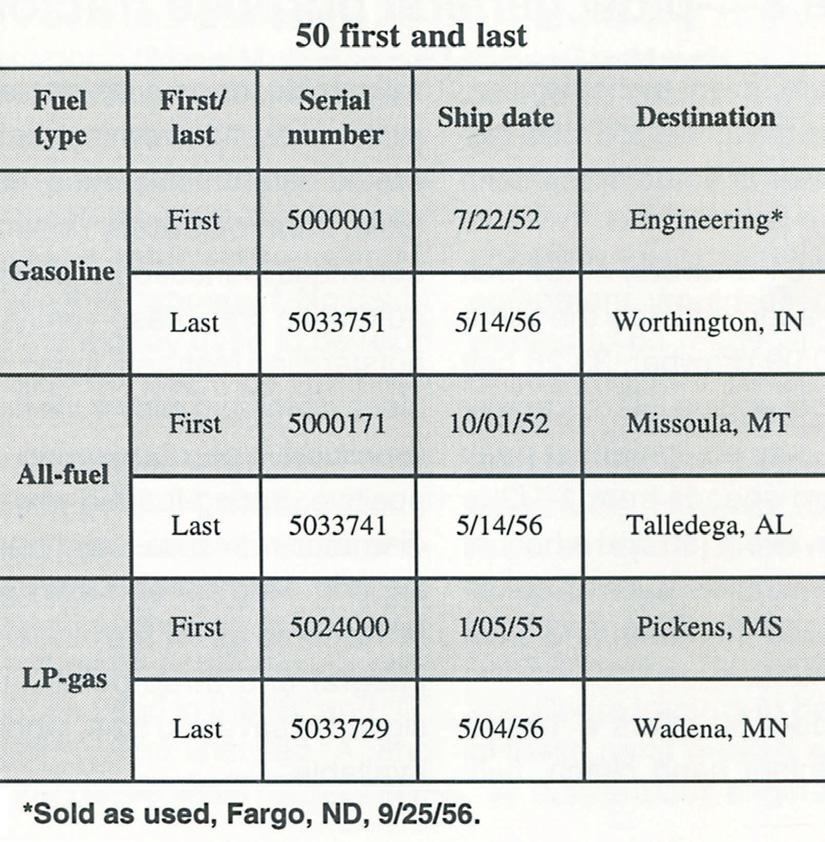
50 Production and Serial Number Breaks
impact went far beyond smoothing the exhaust note. The tractors became easier to start, idled and pulled more smoothly, accelerated better, burned less fuel, and even picked up about three and a half extra horsepower.
A new manifold rounded out the package. Earlier intake manifolds had been “cold,” unheated designs that sometimes allowed the carburetor to ice up. The updated exhaust manifold featured a diverter valve that could be set to “cold,” sending exhaust directly out the stack in warm weather, or to “hot,” where it detoured first to preheat the intake air before exiting through the muffler. That warmed intake charge cured the icing issue and made the tractors more reliable in all conditions.
Up front, Deere revisited a recent experiment that hadn’t panned out. The last model “A” and “B” tractors had used pressed steel front end supports, thought to be both stronger and cheaper than their cast iron predecessors, while also conveniently shielding the spark plugs. Real-world use told a different story. Even after several attempts to beef them up, the pressed supports proved more fragile than the old castings. Deere ultimately reversed course and returned to cast iron. Ironically, the new castings turned out not only to be stronger in the field but also less expensive to produce.
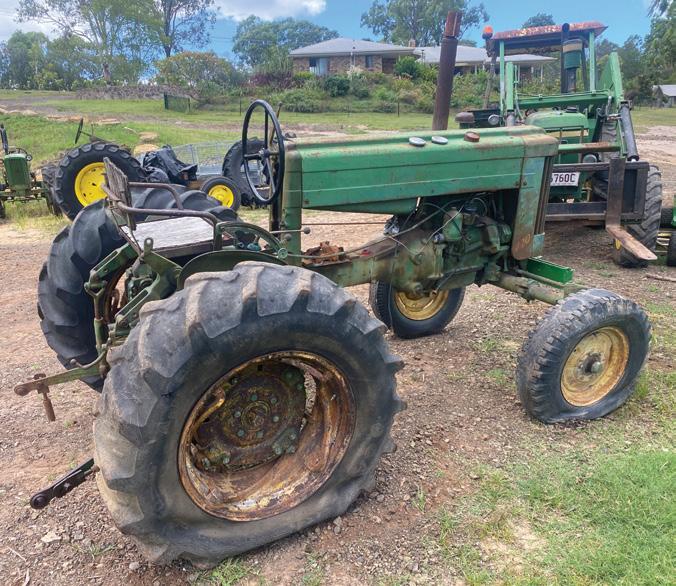
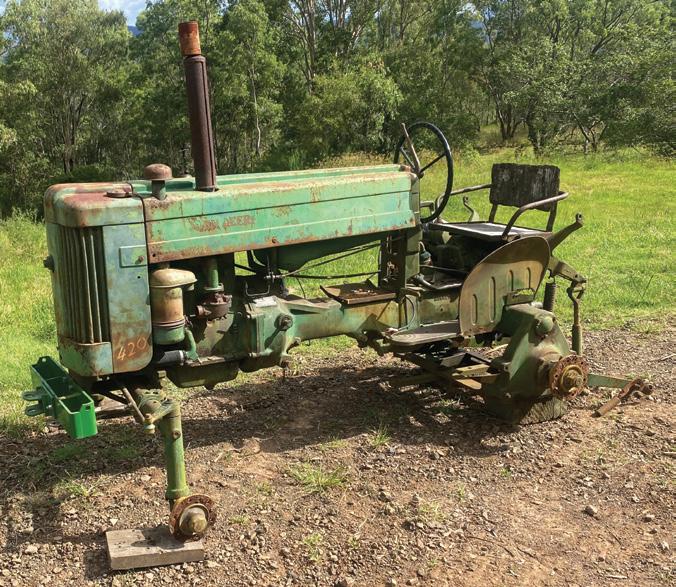
At the rear, Deere addressed another long-standing annoyance: adjustable wheels that had a habit of seizing in place. Since the first model “A,” Deere had built its tractors with splined rear axles and split hubs that clamped firmly in place, creating
a strong, dependable rear end that held alignment well. The catch was that if wheels sat in one position for any length of time, rust often locked them in place. Changing tread settings could mean wrestling with stubborn wheels or, in the case of setting minimum or maximum tread, swapping wheels from one side of the tractor to the other—a job that was anything but casual.
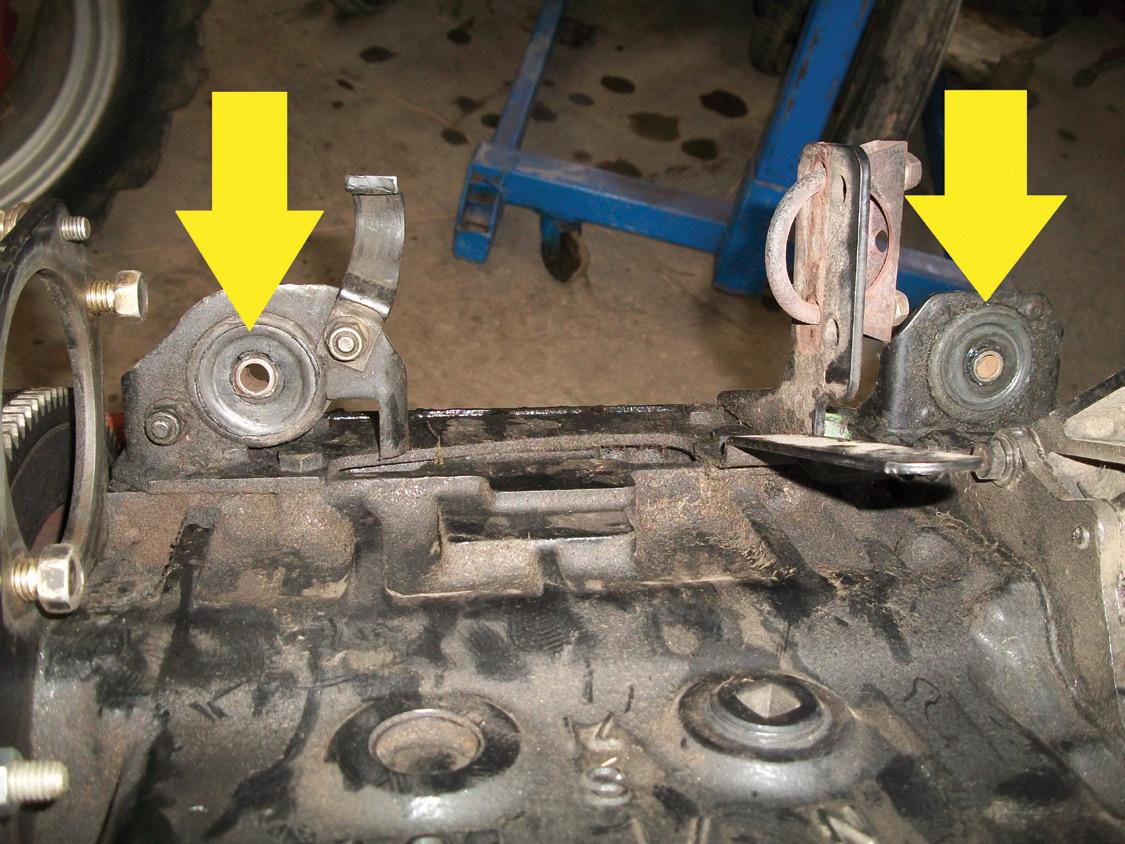
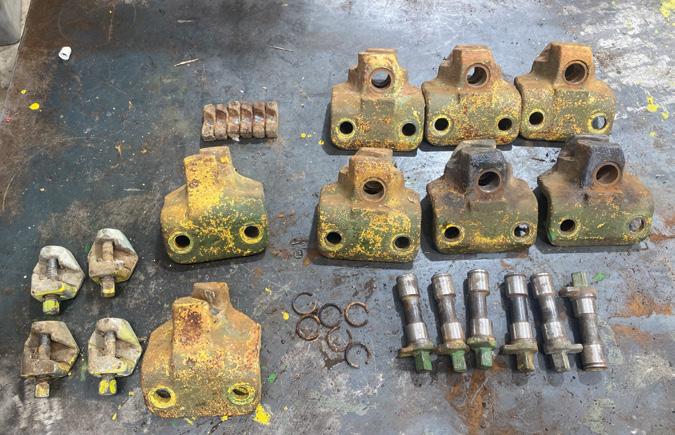
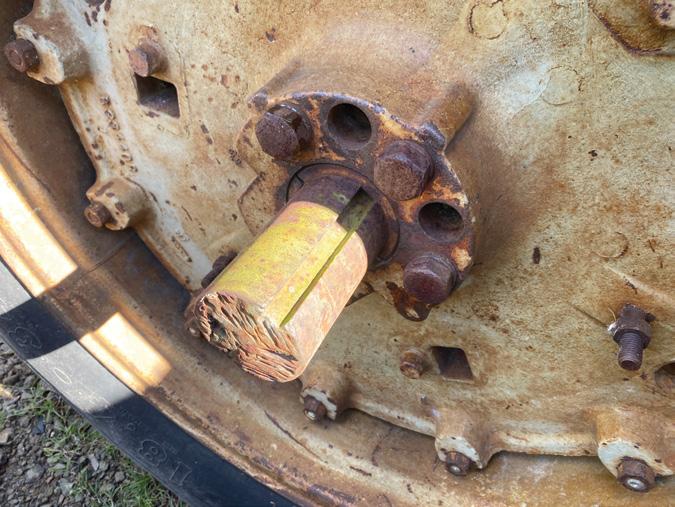
The kernel of a solution already existed in earlier experimental work by Deere engineer Theo Brown, who had used a rack-and-pinion setup for tread adjustment on wide track “GP” prototypes. For the new tractors, engineers updated Brown’s idea for modern production. They replaced the splined axle with a single keyway and cut a rack 180 degrees opposite it. A pinion gear built into the cast iron wheel center engaged this rack, while tapered sleeves clamped the wheel securely to the axle. One sleeve was bolted solidly in place; the other was locked down with three clamp screws.
To change tread width, the operator simply loosened the screws, backed off the jackscrews to free the sleeve, and turned the pinion to walk the wheel in or out along the axle. Once set, tightening everything back down held the wheel firmly. Compared with the old method, it required very little effort, and rusted-up wheels became a thing of the past.
A new style of rear rim finished the job. Special clamps allowed the wheels to slide within the rims, providing a wider range of tread settings without having to swap wheels side to side. Those same rims also simplified
water pumps to maintain sufficient coolant flow, giving the company valuable experience with pumped systems. By the time the new tractors were being designed, it was clear that a pump-fed system was the way forward, and Deere embraced it for the next generation.
The operator’s station was redesigned with equal care. A new rear steering shaft was incorporated into a casting that bolted to the shift quadrant and housed the instrumentation. This casting provided a sturdy mounting point for the headlights and included a removable panel for the oil pressure,
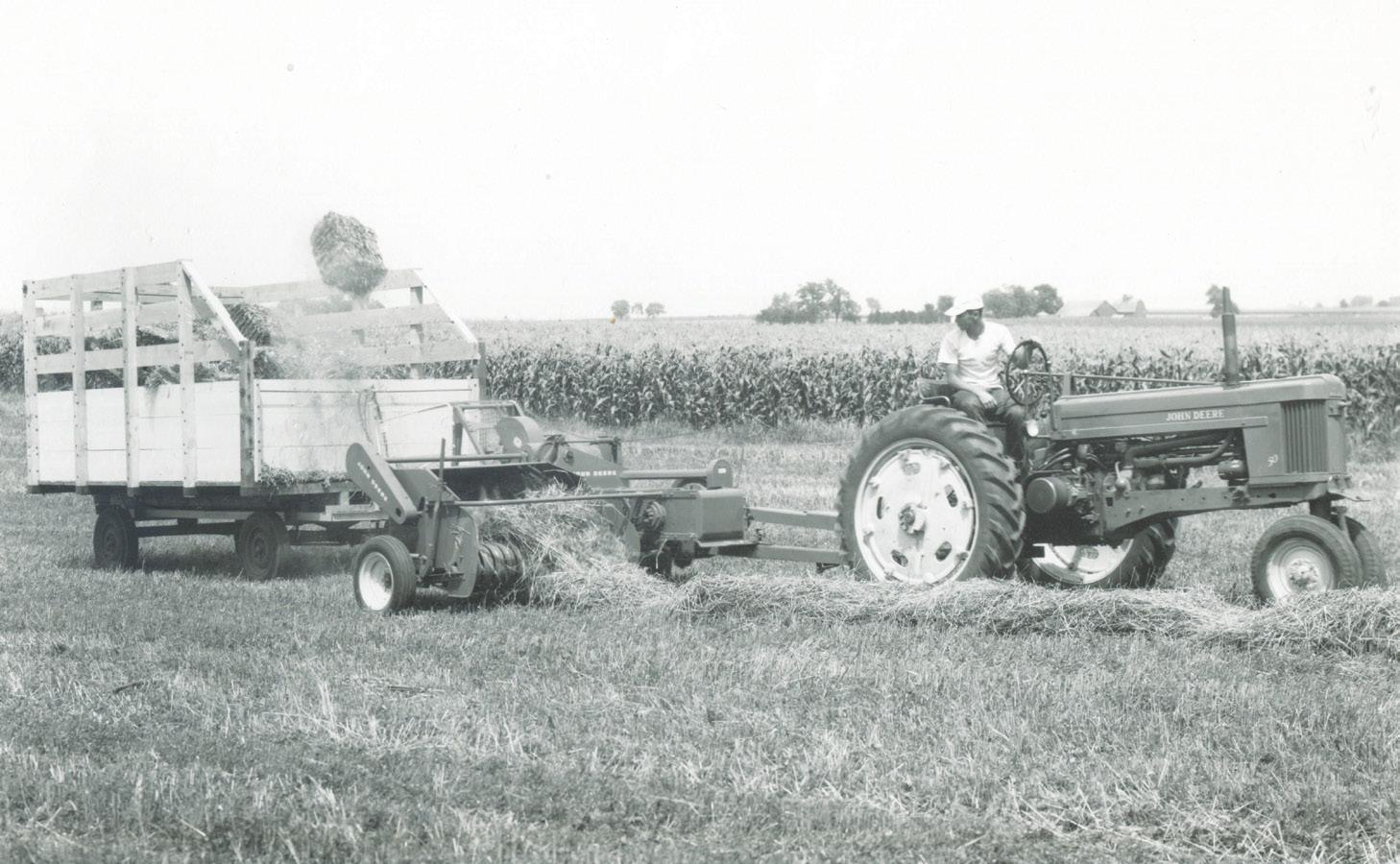
Small but mighty! This 50 had enough power to operate a 214 baler with ejector and a wagon loaded with hay. The 214 baler wasn’t introduced until 1957, so this early 50 likely had a few hours under its belt.
tire and rim removal, making service work much less of a chore.
Cooling also received a thorough rethink. Traditional radiator shutters, common on older tractors, had been controlled by linkages that were prone to seizing from rust. In the new design, a bellows mechanism and linkage automatically opened and closed the shutters in response to engine temperature. When cold, the shutters stayed shut; as the engine warmed to its ideal range, they gradually opened, maintaining consistent operating temperature without the driver’s intervention.
Long-used thermo-siphon cooling, which had served Deere well since the model “D,” had also reached its limits. Wartime shortages had forced Deere to build steel radiators and add
ammeter, and temperature gauges, along with the ignition and light switch. The throttle lever also moved to this casting, where it was easier to reach and more intuitive to use.
Small changes made a big difference in daily use. The clutch lever, for instance, was lengthened by six inches, reducing the effort required to engage and disengage it by about 15 percent. Steering was lightened as well, thanks to a higher steering ratio and refinements throughout the linkage. Together, these changes made the new tractor noticeably easier to handle.
Styling-wise, the upcoming row crop tractor would carry forward the look first seen on the “R” and “AR” models, giving the line a modern, unified appearance. That left one big decision: what to call it. Most assumed
the new machine would simply continue as the model “B,” perhaps with an extra letter appended to distinguish it from its predecessor—a scheme that might have started with a “BA.” But it didn’t take long to realize that such a naming system would quickly become unwieldy as new generations and special versions came along.
In the end, Deere opted for a clean break. To highlight the extent of the changes, the company chose an all-new designation. On December 7, 1951, the decision was made: the next tractor would be called the model 50. At the same time, Deere dropped the familiar “N” and “W” suffixes for narrow and wide front ends. From then on, every configuration would simply be known as the model 50.
The model 50, with its array of refinements and upgrades, made its public debut in the spring of 1952. True production, however, didn’t begin until July, and the assembly line didn’t really hit its stride until October. The lag between introduction and full production had a simple explanation: the model “B” was still in high demand. Deere had to keep building “Bs” until outstanding orders were filled, which took until the end of May. Only then could the company pause production, spend two months retooling for the 50, and restart the line. The factory managed just two months of 50 production before a nationwide steel strike forced another shutdown.
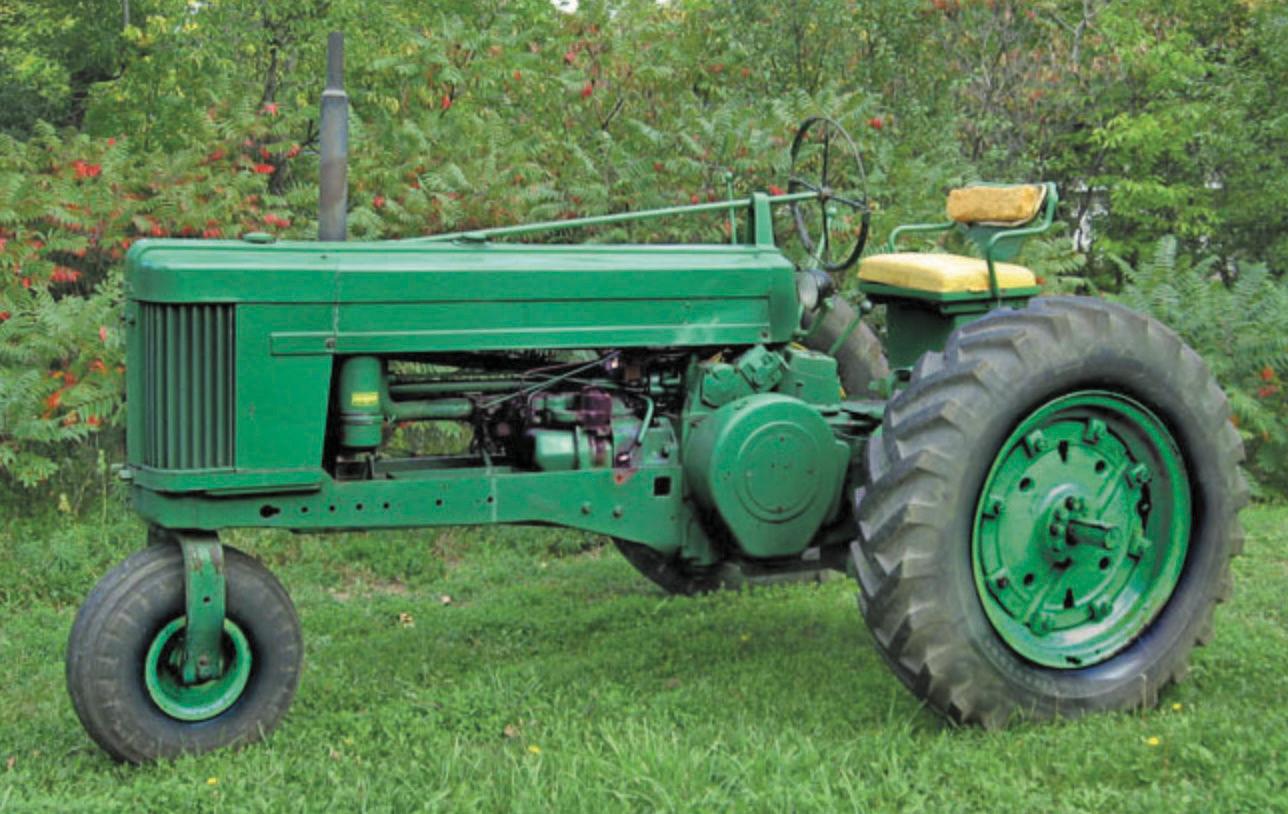
Under the hood, the most common version of the model 50 was powered by a gasoline engine closely related to that on the late “B.” It retained the same 4-11/16 inch bore and 5-1/2 inch stroke, but with the addition of duplex carburetion, it felt like a completely new powerplant. An all-fuel engine was also offered, again based on the “B,” though curiously without the duplex carburetor system. Up front, a non-convertible pedestal with dual front wheels came standard, and buyers could order Deere’s Roll-O-Matic system for that pedestal if they wished. Alternatively, farmers could choose a convertible front pedestal, which could be outfit-
ted with fixed double front wheels, Roll-O-Matic, single front wheels in 6.50-16 or 9.00-10 sizes, a wide adjustable front axle, or a fixed tread front axle set at 38 inches. For those who preferred them, steel front wheels were still available.
At the rear, the 50 offered a broad menu of tire and axle choices. Farmers could choose 10-38 or 11-38 tires, with options for special offset wheels or rice and cane tread. Larger 9-42 or 11-42 tires were also on the list. Specialty operators could order extended axles that provided tread widths of 98 inches with standard wheels or 104 inches with offset wheels, supported by a special rear axle housing designed for larger bearings and axles. Steel rear wheels in the 38-inch size rounded out the choices.
The tractor’s driveline and hydraulics were equally flexible. Buyers could specify no PTO at all, a traditional transmission-driven PTO, or the new live PTO. Live Powr-Trol hydraulics were now available on the 50 and could be deleted if not needed, but the earlier hydraulic setup was no longer offered. The new system delivered a 114 percent increase in hydraulic capacity and a 90 percent boost in rockshaft capacity over the “B,” dramatically improving implement control.
Comfort and convenience options reflected the realities of long days in the field and offered help to make them easier to take. The 50 could be fitted with fenders, a foam rubber seat cushion, 12-volt accessory outlets, rear exhaust, and a variety of Weather Brake enclosures and cabs. Front frame weights, rear wheel weights, and a No. 2100 integral tool carrier, known as the “Yakima Hitch,” were available options that were there to increase your tractor’s capabilities.
The first production year passed with very few changes needed on the line, but customer, dealer, and sales feedback soon began to shape refinements for the 1954 model year. At its outset, Deere introduced the model 800 three-point hitch as a dealerinstalled option on the 50. Shortly
after production began that year, the non-convertible front pedestal was dropped altogether, making the twopiece convertible pedestal standard equipment starting at serial number 5014633. Deere also revised its product coding at that time, no longer marking tractors by front end type—leaving collectors today unable to determine how many of each configuration were built after 1953.
Technical upgrades followed as well. At serial number 5015951, duplex carburetion was extended to all-fuel tractors, using the same cylinder block and head castings as the gasoline engines. Later, at serial number 5016133, an automatic fuel shutoff was added. This system closed the fuel valve when engine oil pressure dropped, helping prevent fuel from flooding into the crankcase during a malfunction.
Ignition proved to be another area ripe for improvement. Early model 50s used the Wico XB distributor, but field reports soon flagged problems ranging from hard starting to complete distributor failure within the first year of service. Deere offered an update kit, but the issues persisted. Finally, at serial number 5016500, the company switched to a Delco distributor, putting the matter to rest.
Cooling control also evolved. The thermostatically operated radiator shutters on the 50, though clever in theory, proved vulnerable to dirt and corrosion. At serial number 5016615, Deere abandoned this arrangement in favor of a straightforward thermostat, which did the job more simply and reliably. Around the same time, a vertical air intake stack was added as an option.
For 1955, Deere focused on making the tractor even easier to handle, particularly with front-mounted equipment. While the engineers had already done a respectable job of lightening the manual steering, heavy front implements could still make the 50 a handful. Beginning at serial number 5020400, Deere introduced an integrated factory power steering system on the model 50. Aftermarket add-on kits already existed in the marketplace,
and a few manufacturers had built power steering into their tractors, but Deere’s system was designed into the machine from the ground up. It wasn’t as refined as the power steering that would appear on later tractors, but at the time it was a revelation—far ahead of anything else on the market. Deere also produced field installation kits so owners of earlier 50s could upgrade.
Engine options expanded again in early 1955. Having added LP-gas engines to the 60 and 70 for 1954, Deere brought a similar option to the 50 in January 1955. At serial number 5024000, farmers could order a 50 with an LP-gas engine. This engine featured higher compression, hardened valve seats, bypass starting, and other changes to run on the fuel. In Nebraska testing, the LP-gas 50 posted the highest belt horsepower figures of any model 50 at 31.20. Even so, the LP-gas version proved to be the least popular of the line, selling in smaller numbers than the LP variants of the 60 and 70.
By 1956, only minor tweaks were being made. Deere’s engineering team was already deeply engaged with the next generation of tractors slated for 1957. One notable change that year was the replacement of the model 800 hitch with the improved 801 Traction-Trol three-point hitch.
When production ended on May 14, 1956, Deere had built 32,754 model 50 tractors. Of these, 29,756 were gasoline-powered, 2,097 carried all-fuel engines, and the remainder were LPgas machines. Every 50 was a row crop tractor, and after 1953, any front-end style could be fitted to any tractor with relative ease. That flexibility means there are few truly rare combinations among model 50s—though there is one notable exception.
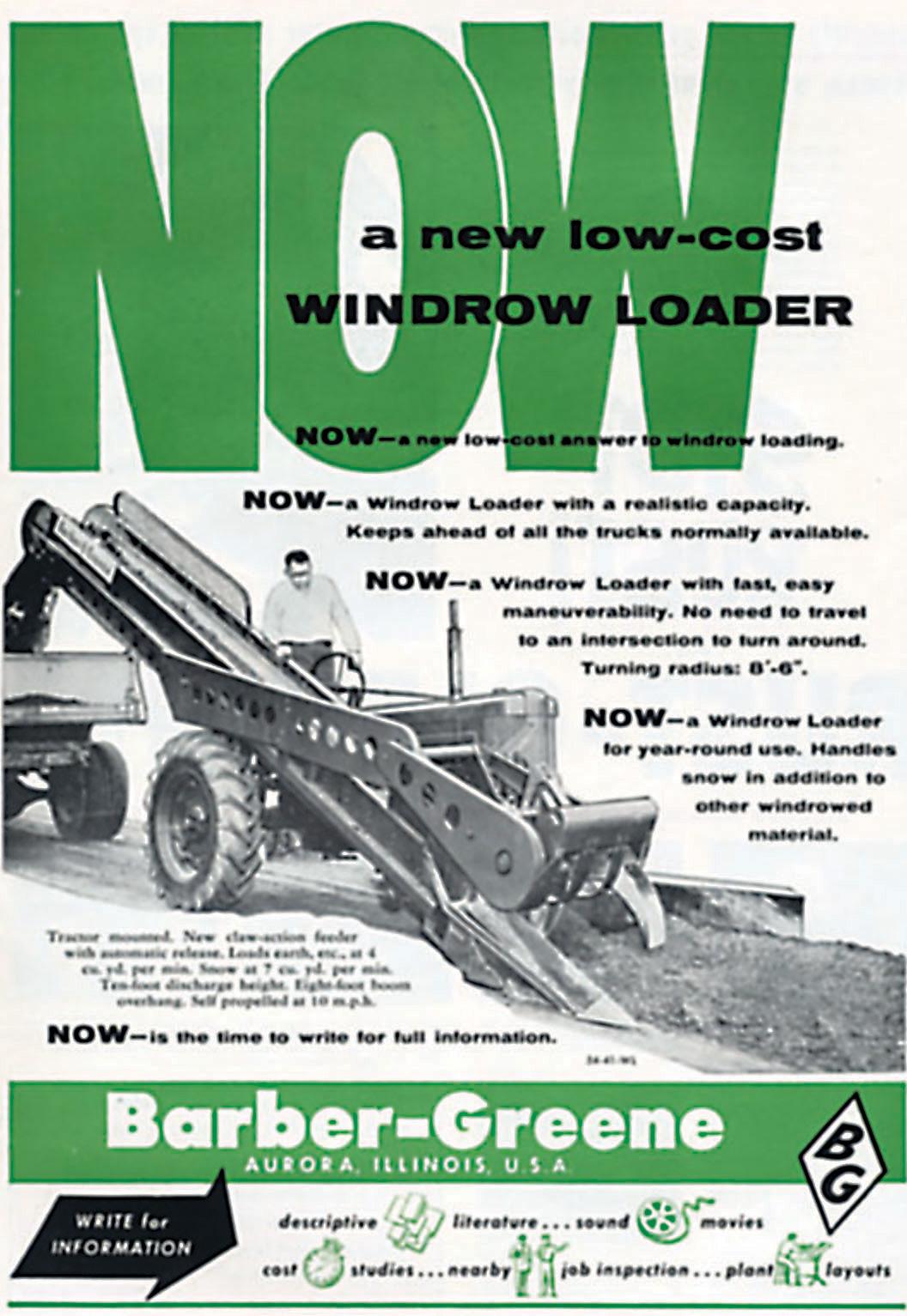
That exception came from the Barber-Greene Company of Aurora, Illinois, founded in 1916 and known for its material handling equipment. After starting with conveyors and bucket loaders, Barber-Greene became particularly prominent in asphalt machinery. When the company needed a power unit for its model 550 windrow
loader—a machine designed to pick up windrows of dirt, snow, leaves, gravel, and other materials and load them into dump trucks—it turned to John Deere.
Deere supplied to Barber-Greene gasoline-powered model 50 tractors that were heavily modified. These tractors wore special cast 28 inch rear wheels, a single front wheel on a shortened yoke to lower and level the machine, a reworked rockshaft housing and rockshaft, and no PTO, among other changes. Early units used the AR505R four-spoke steering wheel; later machines could be had with power steering. At Barber-Greene’s plant, the tractors were repainted in the company’s dark green house color, covering Deere’s familiar green and yellow, wheels included.
Barber-Greene then mounted its 550 windrow loader, driven from the tractor’s crankshaft through a multi–V-belt system and a special clutch that turned the belt pulley. In operation, the tractor’s standard clutch was disengaged and the unique “crowder” clutch engaged, powering the loader and, through the belt pulley, driving the tractor forward at about onequarter of its usual speed.
The resulting machine was impressive. The conveyor stretched more than 20 feet end to end, projecting over seven feet behind the tractor and providing eight feet, four inches of rear clearance. The feeder’s width could be adjusted to either 38 or 44 inches. In use, the unit could shift roughly four cubic yards of earth or gravel per minute, and up to seven cubic yards of snow in the same time. With the crowder clutch engaged at full throttle in first gear, forward speed dropped to a crawl—about four-tenths of a mile per hour—ideal for deliberate, controlled loading. It’s easy to imagine easing one of these dark green machines along a rural roadside, steadily widening a ditch or clearing a snow-choked lane.
No precise production figure is known for the Barber-Greene 50s, but it’s clear that far fewer than 200 were built. Painted in Barber-Greene’s
dark green, they may well have been the only model 50s to leave service in anything other than traditional John Deere green with yellow wheels. While it’s possible that Deere may have painted a few 50s in industrial yellow, no firm documentation has surfaced.
This lack of clarity has occasionally led restorers astray. More than a few have been thrilled to uncover yellow paint on an old 50, convinced they’ve stumbled onto a rare industrial variant. After some excitement—and perhaps a few calls to a few certain publications—they eventually discover the truth: Deere used yellow primer on tractors of that era, and what they’re seeing is not a special paint scheme at all. Deere painted the generators and seat cushions on the model 50 in black.
In the end, the model 50 took everything farmers loved about the wildly successful model “B” and polished it. A farmer in 1955 would have been hard-pressed, outside of sheer stubbornness, to claim his trusty “B” was better than a new 50. The new tractor kept all the strengths of its predecessor while shedding many of its weaknesses.
Today, the 50’s popularity sits a bit behind both its larger and smaller siblings. Perhaps that’s because it was
built in healthy numbers, leaving few ultra-rare configurations for collectors to chase. Or maybe it’s simply the fate of the “middle child” to be overlooked. Whatever the reason, it’s hardly a fair assessment. The John Deere 50 was—and remains—a thoroughly capable machine. It’s compact enough to be easy to handle and to fit in most shops and garages, yet stout enough to turn serious ground. And with its clean lines and classic styling, it looks right at home in a parade. For many enthusiasts, that balance of practicality, power, and good looks is exactly what you would ask for in a vintage tractor.
A Barber-Greene 50 sans the loader, and an ad for the same.
As one gets older, reflections of the past become more commonplace during daily daydreaming. Having just had a birthday before the Gathering of the Green, it suddenly occurred to me during one of those dreaming sessions that I’ve been involved with old two-cylinder tractors for more than 40 years now. I have trouble grasping that notion as I still feel like a kid at heart, but it’s impossible to deny all the wonderful, and otherwise, developments of growing older. When I think of specific old tractors, it’s hard to fathom the number of people involved in each one of them, and that’s just the folks I’ve been involved with since I’ve owned them. If these tractors could just talk, oh the stories they could tell about the lives they’ve influenced over the years. I’ve touched countless individual antique tractors during my time, and I work on the new ones daily as an engineer for Deere & Co., but the one that still means the most to me is the first one. For me, that was an unstyled model “G,” and this is its story.
No story of myself as a John Deere enthusiast can be told without first mentioning my father. Without his previous farm experiences and interest in the hobby, I likely wouldn’t have even heard of an antique tractor, let alone own some. Dad was born and raised on the family farm in northwest Iowa near the small town of Craig. They were Deere people and they used many. There was an unstyled “A,” “B” and
“D,” but his real love was his dad’s 1949 styled “G.” When Dad was old enough to buy his own, he purchased a 1947 “G” from a farm sale near Pender, Nebraska. It had a pan seat, but to this day, we have no idea if it was a “G” or possibly a “GM.” Regardless, that pan seat quickly came off and modifications were promptly made for a square box seat in order to be just like his dads ’49. I’ve heard many a story about the family farm “Gs,” but everything including the farm was sold shortly after Dad was drafted for the Vietnam War. Only a few photos and memories remain of those family tractors, but it was natural that when Dad started collecting tractors in the early 1980s, he gravitated towards the model “G.” He had several model “Gs” over the years. His beloved 1939 unstyled “G” was sold once when he needed the money, and I only recently rediscovered it in Oil City, Pennsylvania after 30-plus years of searching, alive and well and being loved and cared for
by a new family. After that, Dad got interested in hand start “GMs,” and we still have many of those to this day. The first tractor I was able to hand start by myself was his first “GM,” a 1946 version.
By the time I began thinking about a tractor of my own, the prices of these old tractors, especially the model “Gs,” were starting to rise into ranges that a young kid had no business being part of. Instead, Dad and I were content to scour the salvage yards and auctions for “G” parts, simply planning for the future. One of our favorite hang outs was Jerry Everitt’s salvage yard in Strawberry Point, Iowa. It was about an hour and a half drive away and we spent many early Saturday mornings during the summer there, digging for “G” parts before the temperature got unruly. Adjacent to his salvage yard, Jerry had an antique farm equipment museum with a tremendous assortment of old farm relics, tractors, implements and just cool old stuff. Outside this museum were three rows of tractors terraced along
1938 “G” in its resting spot, sporting the “GM” flywheel.
the hillside. In the front row, close to the north end, was an unstyled “G.” During one of our tours of the museum, we looked closer at the “G”— it was a very late 1938 model, serial number 6973, and lo and behold, it had a hand start “GM” flywheel! Later that morning, upon settling up with our salvage yard treasures, Dad inquired with Jerry about trading that “GM” flywheel on the museum “G” for the proper unstyled “G” version. Dad had several “GMs” and needed that flywheel. Jerry’s comment was something to the order of, “I suppose I could do that; I just don’t know why anybody doesn’t buy that tractor?”
Those were the wrong words to say to a teenager who bled green, or maybe the right words, I’m not sure. But that started things in motion and the chain of events that followed was nothing short of great luck and wonderful people. On our next trip up to Strawberry Point, we quickly made a deal to swap those flywheels, and I inquired if Jerry would sell that tractor to me. He was very agreeable and the price of $2,500 was agreed upon. My income was terribly small, as my job was delivering the daily newspaper back home. I signed a contract with Jerry to pay $200 per month for one year, with the final $100 payment coming when Jerry personally delivered the tractor to our house in town! I was very humbled and grateful that Jerry had come up with a plan for a young person to get into the game! I believe it was the fall of 1993 when the “G” finally arrived at our house, and I’ve officially been a “G guy” ever since! The story of my first “G” doesn’t end there, nor does the string of connections with the wonderful people across our hobby.
The tractor was complete, minus the PTO shaft that some low life had stolen, but she was stuck tight. She was pulled into our brand new shop and disassembly quickly followed with the help and guidance of our dear lifelong friend,
Bill Litton of Iowa City. Bill was a “G guy” too and had rebuilt many, and his expertise was appreciated and absorbed. The rear wheels were junk and removed; not having any model “G” wheels quickly handy we decided to use a set of bolt-inhub factory flat spokes and a trick from another “G guy” in Minnesota by the name of Rodney Wilson. Rod had come up with a way to modify a late “G” bolt-in-hub so that it would fit into a bolt-in-hub wheel that was actually intended only for an “A” or “B” model. Using Rod’s hubs, we were halfway home making the “G” movable again.
Now moving to the front wheels and studying things a little closer, we discovered something rather odd. The front wheels, having the typical zigzag hub pattern of a factory steel wheel, had previously been dismissed as cut off front steel wheels. Looking closer, these were factory round spoke wheels and not knowing what they were, research was underway. Finally, in Wes Malcolm’s book about the unstyled model “A,” it was determined that these were indeed the very scarce round spoke fronts made by the Electric Wheel Corporation of Quincy, Illinois. Likely the only super rare item we had ever acquired to date, we left the wheels on the “G” and only replaced the tires. Now we were rolling. As it turns out, Wes knew about the “Strawberry G,” and was surprised to hear that it had been sold, likely also assuming as we did that it was part of Jerry
EWC fronts, factory flat rears and dairy farm fenders.
Everitt’s museum collection.
Back to the engine, she was stuck solid. Lots of fluid soaking and flywheel bar hanging and she did break loose. Amazingly enough, the cylinders must not have been pitted as all we ever did was use a hone to polish them really good and I put in NOS oversized rings made for used cylinders. The head, however, was cracked badly and the intake valve was seized solid in the guide—it still is to this day, kind of a memento on my parts shelf.
Enter another gentleman by the name of Otto Kunze. Otto was heavy into JDs and always had a vendor trailer at various swap meets and shows. I can’t remember exactly which event it was at, roughly 1994 or so, Otto had a rebuilt F49R head that was previously cracked and was fixed by pinning. I believe the price was $350, and many people shied away from pinned heads. I either didn’t know better or didn’t care, purchased the head for my “G,” and you know, it has never leaked a single drop!
Bill and I redid the fan bearings and the governor, the radiator didn’t leak, I can’t remember where the magneto came from, but Harold Scherer likely rebuilt the carburetor, as he did most of our carburetors. We fabricated up a little slave fuel tank with some flat iron and a standalone gasoline starting tank, and she started right up. I ran her like that for over a year, maybe two, slave tank and all, and she started and ran like a fine Swiss watch—as good as any “G” I had ever seen or even heard of. And then, trouble…or as Bill liked to call them, setbacks!
The one major mistake I made was not disconnecting the block from the main case. It was all in such nice shape that we left it alone, and eventually the gasket gave out and developed a nasty oil leak between the main case and the bottom of the cylinder block. What to do? She ran so well, and I mean just perfectly, that I didn’t want to take her apart
for fear she would never be the same again. Thus, we got creative! I don’t remember how we accomplished it, but water pipes, oil pipes, air pipes and all auxiliary parts were removed, leaving the head, block, pistons, rods and tappets all assembled; we were able to lift with a chain hoist and nudge the whole assembly forward enough to strip out the old gasket, clean the case face, and insert and new block gasket. We then used a hydraulic jack against the fan support cross member to jack the assembly back into place against the main case. It worked! She ran just as good after the catastrophe as she did before. I don’t recommend this process and don’t plan on making this mistake again.
The number of folks who either directly or indirectly became associated with this tractor just kept growing after I decided to have the tractor restoration finished and painted as we approached year 2000. The fuel tank was repaired at a local radiator shop and, for not having a clue what they were doing, they did an amazing job. A new hood was purchased from David Geyer, who became famous among the community for the quality of his hoods’ fit. Bill Litton had the most perfect set of original big “G” shutters we had ever seen on his early 1937 “G.” When he rebuilt it back to low radiator, he sold me those perfect big “G” shutters.
Another good friend, John McGowan, road tripped with us up to a local dairy farm auction in southwest Wisconsin for some fenders. Why Wisconsin, you might ask? Well, the rumor we had heard was that it was state law in Wisconsin to supply tractors with fenders, and that most were taken off and hung in the barn. The set I got on that auction certainly played along with the rumor, mint perfect and required nothing but paint. It wasn’t until many years later that I actually confirmed that law—it’s true, and it’s stated something like “any farm equipment to be driven on roadways must have fenders or guards.”
Finished product loaded for home.
The rear wheels had to be addressed, as the factory flats were not “G correct” for a restoration. Dad had been hoarding a set of cherry mint factory “G” round spokes for years saving them for something special; they sat on a bench in our parts stash in the basement of our house. He had purchased them from the widow of a well known collector in northwest Iowa by the name of Eldon Frank. After Eldon had passed, one of his good friends, the legendary Lloyd Bellin from Minnesota, had come down and priced his stuff so it could be sold. I suppose $400 back in the 1980s was a lot, but by the late 1990s standards, that was cheap for “G” rear spokes! Dad graciously gave me those round spokes, as this was the first tractor we ever had “officially” restored.
At about the same time as all of this was going on, another lifelong friend, Robert Donohue of West Branch, was having a model 630 tractor restored by another good friend in Nebraska by the name of Jim Slama. Seeing Jim’s results on the 630 materialize, arrangements were made for my “G” to be his next project the following winter. The tractor, round spoke wheels and all the other parts were hauled out to Jim’s machine shed before harvest started that fall, so it would be ready to go when harvest was complete.
Jim was meticulously picky with his restorations. If it wasn’t done right, he wasn’t going to do it. I expressly remember him saying, “This tractor will get a new radiator core!” As fate would have it, we
had a NOS unstyled “G” radiator core in our parts stash that we had purchased from our favorite salvage yard, Van Noort’s in Rock Valley, Iowa. That core was in the box and sat at the top of a metal rack of radiators for years until we hauled it down one day. We never understood why until later; more to follow on that. As the current radiator didn’t leak, we told Jim to leave it intact for a future project, and I would find replacement radiator castings. Not long after, there was a JD collection auction near Buda, Illinois and by sheer coincidence, a full set of unstyled “G” radiator castings were available and were rehomed to my tractor project. This started the first of many blitzkrieg trips to Jim’s shop in Crete, Nebraska to deliver parts. Remember that NOS radiator core? As it turned out, one of the flanges was installed backwards, had to be cut off and reattached the proper way. I guess that’s why it stayed up on Van Noort’s parts rack for all those years.
Near the end of the project, after final painting, the plan was to have Mr. Lawrence Van Zante perform his magical silk screening, just like the factory did. Lawrence was terribly hard to get a hold of, and the project stalled just a bit. Eventually, arrangements were made to hand deliver the hood, fuel tank and seat channel to Lawrence’s shop, which was actually just the corner space of another business in town. So, another fly by night trip to Crete, Nebraska and then to Pella, Iowa to Lawrence’s shop. And the most amazing part, he did the whole thing in person as we watched! Talk about the master of his craft. No paint was applied until the templates were aligned just perfectly. It still looks like a million bucks today.
Remarkably, I remember his workspace in the corner of that building to be very dark and dreary, and I remember him using halogen flood lamps on a tripod stand as his primary source of light. Hard to believe given the stellar quality of his
work. And another long drive back to Jim’s place to deliver the finished silk-screened parts.
The finished tractor project was simply amazing. It was perfect in every sense of the word, and it still is as it’s stored inside a climate controlled building. Before we drove away from Jim’s yard with my prize, one of his last pieces of “encouragement” for me was, “It’s all downhill from here!” Those first few years I couldn’t bear to see it dirty; it was covered with bed sheets all the time in the shed.
It went to two cylinder shows in Waterloo and Peosta many times. The worst thing happened one time at Waterloo when I went to start it and forgot to take the can off the muffler. The metal can came crashing down out of orbit and hit the hood leaving a mark, and I about cried. It was actually the best thing that could have happened, as from that point on, I wasn’t afraid to get it out of the shed and use it. My father-in-law, my son, even my daughters love to drive that thing. It really is a family treasure.
Fast forward 10 years, we were very fortunate to purchase my holy grail tractor, a “GPWT” with overhead steering. Saw my first one back around 1990 and it was always an impossible goal. This particular “GPWT” was even more special in that it had Electric Wheel Corporation round spokes on the rear. It didn’t take too much debate to convince me to swap the EWC front spokes from my “G” to the “GPWT.” My only stipulation was that I had to replace them with something equally unique. This was about the time online auctions were really starting to catch on, and I purchased a set of scare F&H “moon wheels” from the estate auction of Mr. Ron Lock of Pennsylvania. Mr. Lock was well known for his model “Bs,” early “As” and such. I even remember helping him push his “BWH-40” onto his trailer in Colorado at the “Red” Gaede auction. So, I bought these wheels for a pretty penny
from the comfort of my apartment, and made arrangements with Kurt Aumann to bring them back to his HQ in Nokomis, Illinois. As it turns out, Rebecca and I were dating at the time, and her extended family lived not too far from Nokomis. I believe it might have been Christmas time or close, there was snow on the ground, and we were driving my little rear wheel drive S10 pickup. We did some unintentional ditch diving to say the least, Rebecca learned how crazy I am about JDs, the pickup survived, and I was able to retrieve those front wheels from the Aumann complex. And she even agreed to marry me after all that! I ended up painting those “moon wheels” inside her garage shortly after we were married.
Fast forward another decade plus, and I spend more time that ever now reflecting back on these cherished relics of historical agriculture. Each and every tractor, plow, combine or insert whatever piece of equipment you want, has a purpose and helps tell the stories of our
journeys through life. Within the collecting community, the major gap or disconnect that I’ve noticed, myself included, is that we tend to discredit the common and/or cheap stuff to focus solely on the rare, unusual, low production or high quality stuff. The interest in our hobby is very strong, but the reality is that not everyone will be able to participate at the same level, and that doesn’t make it right or wrong. But as long as folks are participating in any capacity, that’s a huge victory for a hobby’s long term survivability. My recommendation to the youngsters of our hobby is to get involved because you love it, not for fame or a desire to make your fortune. Your styled “A” is just as important to our future as somebody else’s Hi-Crop. We need the novice folks to be engaged, motivated and willing to learn so that someday you can be the caretakers of our farming heritage.
My advice to the aging generation of folks is to pay it forward and get the youngsters involved, in any way possible. As the baby boomers continue to disappear, it’s our responsibility to ensure that our hobby will live on long after our time on Earth is done. Take the neighbor kid for a tractor ride, make a deal, mark a discount, give some restoration advice, whatever you can do to help a youngster who is learning. There could be a time not too far in the future when that “Waterloo Boy” in the barn will not be worth $50k, but if we don’t want it heading to the iron pile, we need the next generation of collectors prepped and ready to preserve these treasures. I was blessed to have my two oldest kids willing to help run the parts trailer at the Gathering of the Green, and they loved it. I know Jackson made some deals while I was away from the trailer, observing from afar, and I don’t really care what the deals were, he is trying and learning, and the only way to figure it out is to jump in a give it a go. This is the way! God bless the model “G” and the long green line! Cheers.
Moon wheels and memories, Miss Savannah at the wheel.
The future.
Gathering of the Green 1000
By Donna Parker
The 2026 Gathering of the Green theme, “An American Original,” brings many thoughts to mind, including old barns, original tractors and equipment, and the grit of the farmer who has determination and passion for working the land. In this year of celebrating the 250th year of American independence, farming is at the forefront, being one of the most common jobs held in early America. Rural America relied on farming to feed families and communities. In the early 1900s, farming was forever changed when the transition from horse drawn equipment to mechanization took place. This change reached its tipping point in favor of tractors in 1954.
Imagine…a group of people who lived when farming with horses was still common. A group made up of individuals who remember the first tractor on the farm and the changes it brought. A group that collectively has a grand worth of knowledge, memories, and expertise.
The occasion was the Gathering of the Green in Davenport, Iowa, March 2026. An idea took shape to gather together individuals who were instrumental in starting the Gathering of the Green in the year 2000. That idea gained traction but grew into more; not only should the group be exclusively Gathering of the Green founders, but also people who were early trendsetters in the antique tractor collecting hobby. The group would include collectors with the foresight to buy old tractors when everyone else considered them junk. The group would be people who took the antique tractor hobby to the next level and
made businesses, helping others to restore tractors.
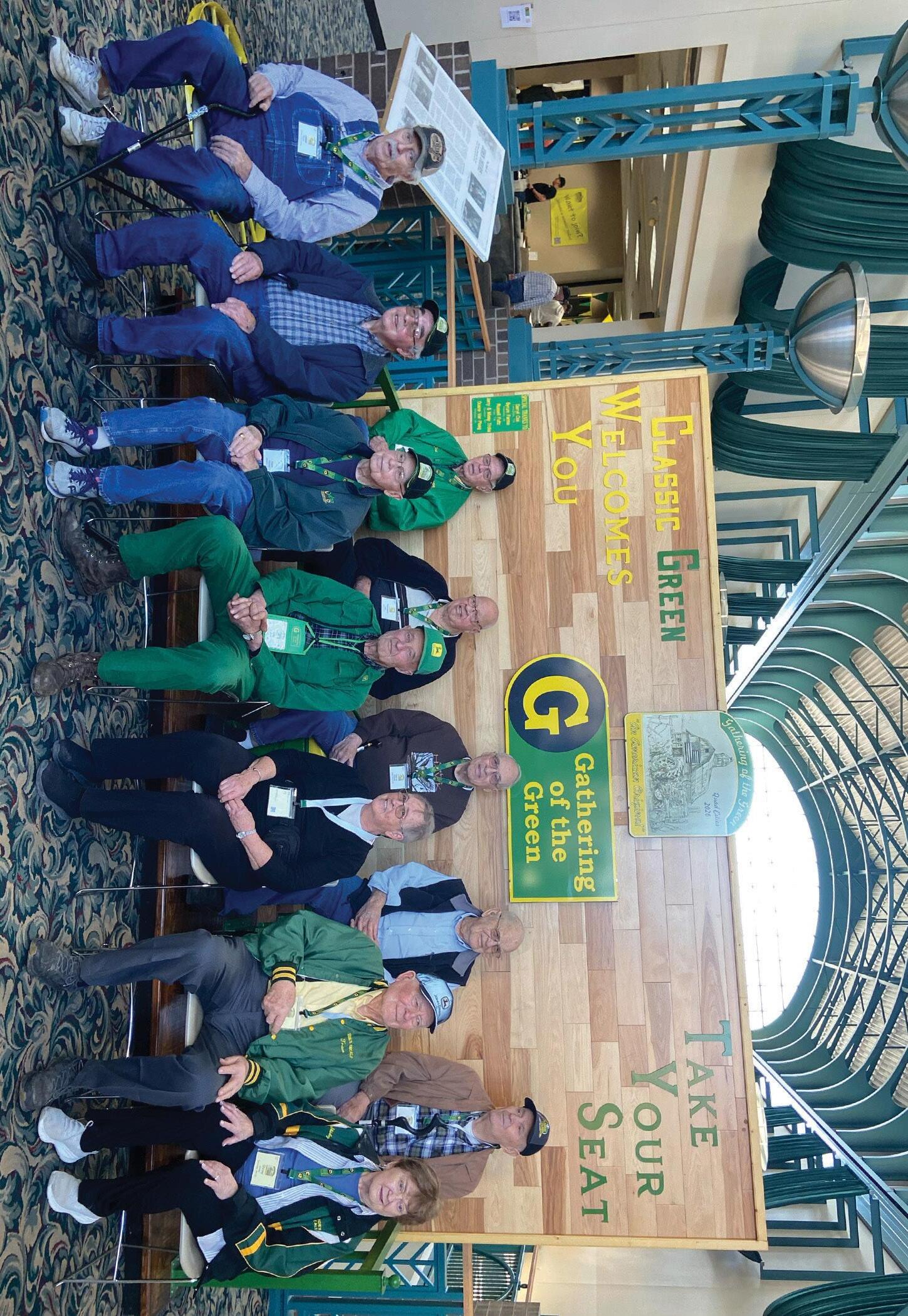
Organized by Dan Misener and others, the group came together at the appointed time to sit at the “Take Your Seat” sign located on the upper level at the show. This “Take Your Seat” is the moving Classic Green sign that travels from show to show. It has five different tractor seats ranging from the hard pan seat to the cushioned and more modern seats. With only five seats and what ended up being 12 people, some additional seating was scavenged from the children’s activity area.
As group members began taking their seats, a tally began. Among the group, the oldest two were born the year that the John Deere model “GP” was introduced in 1928, and two more were born the year the John Deere model “B” was introduced in 1935. The years represented were added together and precariously neared 1,000. Mentions began of who else was present that could be added to surpass the millennial mark. Richard took off with an idea in mind.
While the gathered group waited, a small audience of friends and family had congregated. One person in the audience called out, “How many of you were raised on a farm?” Hands went up. This was followed by, “How many of you farmed?” A few hands went down. Several minutes passed as we waited for Richard to return with the final member in tow. Someone else in the audience asked, “How many remember World War II?” Most hands went up. Next question, “How many remember Vietnam?” All hands went
up. That was the last group question. A short discussion took place about the complications of getting fuel to tractors and the farm in the early days, then Richard arrived with the final person, rounding out the group of 12 people and totaling 1,068 years of tractor knowledge.
This cross-section of John Deere enthusiasts spans three different decades and comes from at least four different states. A special thanks to the ladies who support their tractor guys and were willing to disclose their ages to contribute to the amazing and inspiring 1,000 year number.
The group as a whole are children of the Greatest Generation and known for being hardworking. They are identified as the “Silent Generation” but they were anything but silent. Perhaps the other names for this generation fit this group better—traditionalists and builders. They are definitely builders, dedicated and faithful in their endeavors.
We’ve all heard the early stories and been a smidge jealous of their $40 tractor purchases. Fortunately, these “junk collectors” had visions for an antique tractor hobby. We’re forever grateful for their foresight and tenacity in forging time and making the tractor collecting vision happen. Each member of this picture is a history maker in their own unique way. Those who participated in the picture are a tribute to those who have already gone on to glory and a representation of all those who could also be a part of this picture. They are a historic snapshot in time of our hobby.
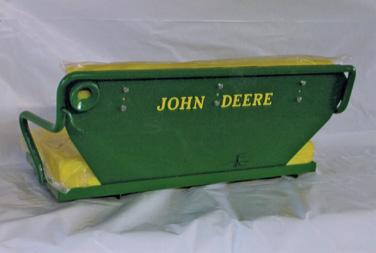
Seat Base Cover for Tractor w/o Rock Shaft - AR26846, $295
4000 & 4020 Std SN 201,000 & Above
AR40773 LH Rear Eng Panel = $80
AR40774 RH Rear Eng Panel = $80
AR40871 Platform (can modify AR48727) = $155
AR41097 Platform Support = $84
AR41098 Platform Support = $84
AR41137 Dust Shield RH = $315
AR41138 Dust Shield LH = $315
AR41174 Support To Dust Shield=$27
R41253 Ext Front Right = $156
AR41451 Ext. (RH) = $74
AR42594 Step Bracket w/2 pads = $215
F3195R Step Pad = $30
AR42989 Cover Battery Box = $80
AR45129 Battery Box Support = $75
AR45130 Battery Box Support = $75
AR45131 Ext L Ft AR48964 = $184
AR45207 Battery Box = $340
AR46289 Weight Bracket = $102
AR48964 Ext L Ft AR45131 = $176
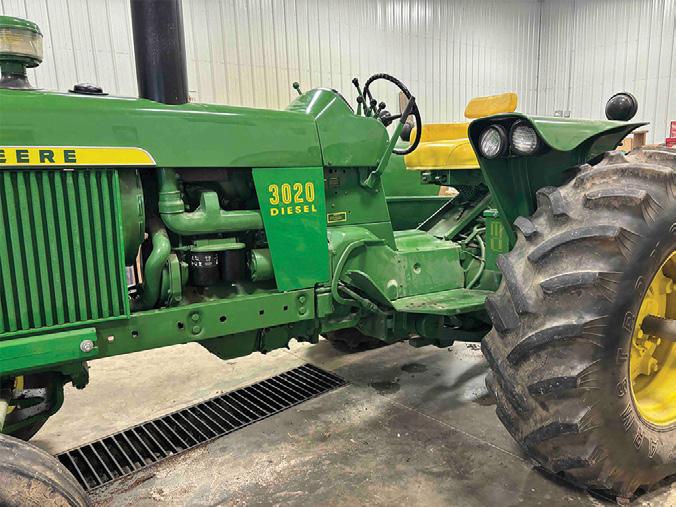
3020 Standard Tractor
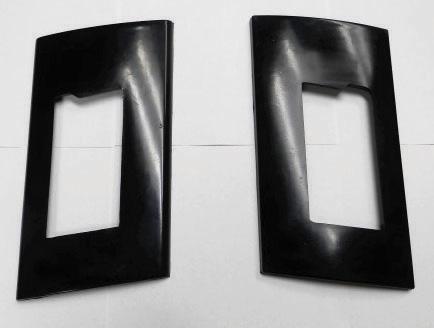
R34944 Floor Panel 3020 Std PS
R34943 Floor Panel 3020 Std PS
AR34801L Dust Shield = $325
AR34801R Dust Shield = $325
R42893 Fastener Pin for Battery Box = $36 Dave Haala: dave@haalaproperties.com or 507-920-9181
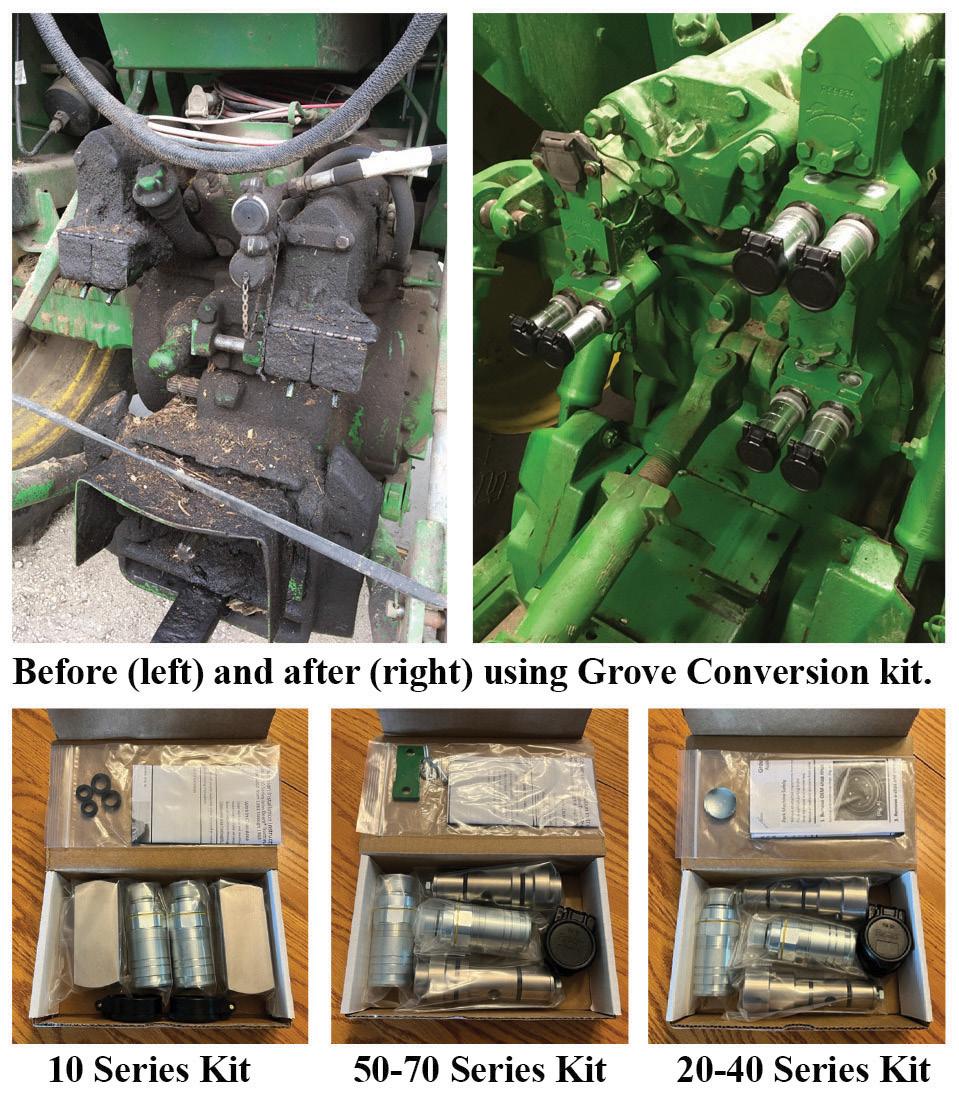
Kit Cleans Up Older Deere Hydraulic Mess
Scott Grove cleaned up leaky hydraulic valves on his older Deere tractors with a simple insert. The long-standing problem is one the company has yet to fix. Grove says it forces him and other owners of Deere tractors to replace O-rings on a regular basis, only to have the mess return. Grove’s fix eliminated the mess and the need to replace parts. With the Grove Conversion kit:
• Convert to ISO with easy push-pull connection
Wapsi Innovations
• Couplers connect under residual pressure with breakaway feature
• Kits available for 10 through 70 series JD tractors manufactured from 1961 through 1996
• Inserts are made in the USA. This product is protected under US Patent 10,760,725 B2 and other patents pending.
Installation consists of stripping the OEM outlets down to the block, removing the barrels and O-rings, and replacing them with the inserts. Grove then adds the aftermarket ISO coupler that threads into the insert. Installation instructions can be found on the Wapsi website.
Kits for 10 series are priced at $315, kits for 20-40 series are priced at $329, and kits for 50-70 series are priced at $355. Also watch the website for more additions coming soon. Grove suggests checking with local Deere dealers & local repair shops or Wapsi Innovations directly.
DON’T BE FOOLED
3,000 field miles on a ’48 “B”?
What about the total miles I probably put on that “B”—say, in the six years from ages 12 through 17? No way to know for sure, but we can make a conservative estimate using just our row crops as an example.
A 1948 “B” John Deere was Dad’s first new tractor and the one I spent the most time on after I attained “field age” and Dad bought a used Farmall “M” as his “big” tractor. By then, I had already logged many hours on the “B,” sitting on a flat fender and hanging on to the cultivator lever he kept there for me. Although I enjoyed field work in small doses, the long days grinding back and forth across fields on that “B” soon became boring for a young fellow with lots of other things on his mind.
We had a farming and beef cattle operation on an upland creek bottom in the Kansas Flint Hills and our 140 or so farmed acres were in one to 40 acre patches. With two-row planters and cultivators, an eight-foot grain drill, a five-foot 11A combine, a one-row model 72 chopper and a 118W baler, we raised corn for silage, milo (grain sorghum), alfalfa and oats for feed, and wheat and soybeans for cash. In some fields, we would spend almost as much time turning as we did plowing, disking, etc. and because the fields were edged by trees, creek banks and barbed wire fences, turns were often the only excitement of the day. Although I envied folks with larger fields and bigger equipment, Dad was mighty proud pulling a 3-14 plow with the “M” followed by me pulling a 2-16 plow with the “B.” Turning a little over 12 feet of ground with each round was big farming compared to his youth!
I’ve been reflecting on the miles we must have put on our tractors in those small fields. Of course, our equipment was a big improvement over the days when a man using a 12-inch plow (if the soil was easy and the mule was big) had
to walk 8.25 miles to plow one acre—plus turns and walking to and from the field. Still, I must have put a lot of miles on that “B,“ all in patches scattered along a mile of creek bottom. Let’s look at some examples.
First, let’s plow a theoretical 20 acre perfectly square field with that 1948 “B.” The field would be 933.4 feet per side and assuming a full 32-inch cut with the 2-16 plow, it would take 350 passes, or 175 rounds, to finish with that rig (not counting plowing out the ends). Those 175 rounds would total 61.8 miles plus turns. If you kept the width of the lands to 75 feet, you would travel another 2.5 miles in turns. If you plowed in third gear (3.5 mph), you could do the job in 18 hours and 22 minutes of plowing, plus time for grease and fuel stops, drinks from the canvas water bag hanging in a tree at one end of the field, answering calls of nature, lunch, and driving to and from the field. If you didn’t have too many other chores to do and nothing broke down, you could get the job done in two days (unlike the guy with the mule, who would need 20 days).
We usually followed plowing with disking twice on diagonals, and I did that with the “B” in third gear and a six-foot tandem disk weighted with old engine heads. Regardless of the disking pattern, I would have traveled a minimum of 55.2 miles in around 16 hours, discounting extra passes on ends or multiple passes over small areas because the disk didn’t lift out of the ground. I would then harrow the field before planting, pulling a 12-foot spike tooth drag harrow with the “B” in fourth gear. That would require traveling a minimum of 13.8 miles, which would take about three hours, with all the above caveats. For this example, we’ll plant corn for silage in 38 inch rows using the “B” and a two-row planter, and let’s assume we did that in third gear. We would travel 26.2 miles, planting 294 rows in 147 passes and then dead-head back to the gate on the last round, all in about 7.5 hours plus time to refill the seed cans several times and other stops as above.
Because we didn’t have herbicide-ready corn, we cultivated a minimum of twice
before the corn got too tall. I did that with the “B” and a two-row ABG-202 Quick-Tach cultivator, and again we’ll assume third gear, although it could be slower or faster depending on conditions. Cultivating twice would cover 52.4 miles and take about 15 hours—again, discounting turns, down time, etc. We would pull the ensilage chopper with the “M,” although the “B” could have done it if the chopper had an engine. Regardless, we can assume the same 294 rows and about the same travel speed. We would chop for 52 miles in about 15 hours, not counting turns, truck exchanges and other stops. Adding up the above, we can estimate very conservatively that, with the equipment we used in the ‘50s, we traveled at least 264 miles in a 20 acre field to get one year’s crop of corn silage. That required at least 75 hours of tractor time and if we used the “B” for all of it, would burn at least 180 gallons of gasoline. Interesting numbers, but what about the total miles I probably put on that “B”—say, in the six years from ages 12 through 17?
No way to know for sure, but we can make a conservative estimate using just our row crops as an example. About half of our 140 acres were usually in row crops. With me on the “B” and Dad on the “M,” we usually shared the plowing and disking, so with the smaller equipment I would have accomplished 43 percent of those operations. I usually did all of the harrowing and cultivating with the “B,” and he usually did the planting and harvesting using the “B” and “M.” Using those factors and scaling up from our 20 acre example to 70 acres, we can safely estimate that I drove that “B” for at least 2,473 miles, just turning dirt for our row crops. The “B” and I participated similarly in tillage for the other crops and I also did some of the alfalfa mowing and lots of the raking with the “B.” Aside from non-field travel doing other jobs therefore, there is no question that I drove that “B” for well over 3,000 field miles!
Submitted
by,
Joe Mauderly Albuquerque, NM
Unrestoring a “D” Part 10 • By Richard Hain
A month or two ago, I wrote that the front wheels of my tractor were spending the winter in Wisconsin, but I didn’t say why. The answer is that I was having Pat Detwiler convert them back to steel. Somewhere, sometime in the past 90 or so years, the original steel wheels had been cut off and replaced with rims for rubber tires, but now it’s back to steel. Pat did an amazing job on them, and the spot where I cut the old spokes off and he attached the new ones is basically undetectable. You can see the before in Photo 1, and the after when I picked them up at Gathering of the Green in Photo 2. After cleaning the old bearings and repacking them with grease, the “D” is sitting on front steel again.
If you go back to one of the first articles I wrote about this tractor, you will see how much of a mess the fuel system was. Besides the stalactites in the tank, the sediment bowl and fuel shut-off valves were a mess I didn't want to deal with. So I turned to George Persinger at Green Parts of Virginia for a completely new sediment bowl and valve (3). The valve uses a poppet-type action that opens and closes with a half turn of the knob. The seals are made from Viton
GF, which, according to Google, is designed for “extreme heat and chemical resistance.” Photo 4 shows a close-up of the valve. This, along with the new tank, should be a vast improvement over what the tractor arrived with. See the August and October issues if you want to review. Since the tractor had a fuel tank from a later model when I got it, none of the old steel fuel lines would fit, and bending of them to fit by someone of my skill level is an impossibility, so a few trips to the hardware store to find the parts to make a new line are going to be necessary.
An unexpected find at the Gathering of the Green was a hood, better than the one I have, which has quite a bit of body filler. On a painted tractor, that might not be
Photo 1
Photo 2
Photo 4
Photo 3
such a bad thing, but it causes a problem when trying to achieve a rusty patina. The recently acquired hood has no filler and no major dents or damage, and should just require some fairly minor work to match the rest of the tractor. Finding this hood style isn’t always easy because it was used only on the 1931, 1932, and 1933 models, and, as we discussed before, Deere didn’t build many tractors during those last two years. I’m too lazy to do the research, but I would guess Deere might have made less of this style hood than any other. One thing I’ve been pondering a lot is how to get a “JOHN DEERE” decal back on the side of the hood that matches the rest of the tractor's look and condition. To that end, Dan Peterman of Jorde Decals supplied me with a set of decals in which the yellow is several shades lighter and duller than the normal color. He tells me that faded decals are something
that he is getting more and more requests for. This is a step in the right direction, and I will consider what else I might do to age them.
That’s mostly it for this month. Preparing for and going to Gathering of the Green took most of a week from the time I could work on it, so I didn’t make a lot of progress, but before I leave you, let’s open a new can of worms. Have you ever taken a look at the area where the front axle pivots on the front support? As you can see in Photo 6, there is at least an inch of gap between the axle and the front part of the support. Did it come from the factory this way, or has there been gradual wear at the rear, causing the axle to move back over the years? If anyone has a low-hour “D,” like the one that Aumann Auction had at Gathering of the Green a few years ago, let us know what yours is like.
Photo 6
Photo 5
The barn and tractor on the Gathering of the Green logo (above) made a real life appearance in the lobby of the River Center (right).
Right: Chris and Kinley Cobler’s 1932 “GP” and picker were at the show. The display even included hill-planted corn.
Left: A 111 peanut combine owned by Kevin and Karen Bos was on display in the Mississippi River hall.
This 1936 “B” with No. 15 cotton stripper was brought for display by Ron Kreider.
Left: Brian Patterson provided this 1930 “GP” with 301 cultivator.
This month’s article came to me in a somewhat unusual manner. I am in a group on Facebook that is named Classic Green. It deals with everything John Deere; many John Deere collectors are in the group. It is a fun group, and I learn a lot from everyone. Each month, they have a theme; past months have been toys, snowmobiles, Christmas and winter. People post pictures and stories dealing with the current month’s theme. The theme that just ended was two cylinder. I posted a few things and for two cylinder month, I posted this.
The reason I posted this was because I thought this ad summed up the reasons John Deere felt a two cylinder was the right choice for farmers to buy (Photo 1). It had great reactions from mem-
bers and a lot of comments. Now this is why I am talking about this for this month’s article. I mentioned that the ad was from The Furrow February/ March 1942 edition and the dealer it was from was the Frank Nett Company of Peebles, Wisconsin. There were a few comments about the Frank Nett Company, so I looked further. When discussions about old dealers come up, I often search my records to see if I might have anything to help. I searched for more on the Frank Nett Company and I did have more information so, here we are, with this month’s article!
I will take this opportunity to say that one time, someone had commented about their old family dealership and that they did not have anything from them. I
searched and found I had an image of a matchbook with their family dealer name on it. Unfortunately, I had no idea where the actual matchbook was, but I forwarded the picture to them, and they were happy I had that at least. So often items like matchbooks, magazines and ads are literally the only surviving evidence that an old dealer ever existed.
We are going to take a look at a few things that survive from the Frank Nett Company. I will start off and say that there is some information online but not a lot, as is typical for older dealers. From what I could find, Frank Nett, the founder, was born in 1877 and passed away in 1927 so that was a long time ago, but his company continued after his death. Initially the company carried lumber, grain and general merchant goods and eventually began selling the John Deere line. Since this article began with an ad from a Furrow magazine, let us take a look at a few more.
Photo 2 is a terrible picture—my
Photo 1
Photo 2
Photo 3
Photo 4
Photo 5
Photo 6
apologies. It is the earliest Furrow from Frank Nett Company I have; it is the September/October 1937 issue, and this was Deere’s centennial year, so I am certain it had centennial advertising inside. The prairie schooner on the cover has been used on many items, including later belt buckles.
Photo 3 is the February/March 1942 issue of The Furrow. This is the issue I took the ad in Photo 1 from.
Photo 4 is the December/January 1941-1942 issue.
Photo 5 is the June/July 1942 issue. But boy, oh boy, look at what is going on in the cover picture. These young men are SCRAPPING farm machinery! It is enough to make today’s collectors nearly faint. By this time, the U.S. had been involved in World War II for a year, so materials were desperately needed for the war effort. Patriotism was extremely high so everyone did what they could, including scrapping and recycling old farm machinery to use in producing new items for the war. It is easy to sit here from today’s vantage point and moan about all the great old machinery that was lost the scrap metal drive of World War II, but the reality is that in 1942, victory was not assured and it would not be for a few more years. People did what they could to help, which culminated in the eventual victory over the Axis. Also, I think that if the old machinery had never been scrapped, then there would have been a lot more that survived and today’s collecting hobby would be vastly different.
Photo 6 is the December/January 1942-1943 issue. The war was still
raging on, and the cover shows a serviceman eating his meal with the words “Thanks Mr. Farmer” on it. It is a simple image that conveys so much— especially at Christmas when so many people were unable to be home with their families. I like this picture a lot for what it shows.
Photo 7 is the November/December 1945 issue, and it has a simple message “Peace—the greatest gift of all.” WWII had ended and the world rejoiced.
Photo 8 is the February/March 1949 issue. I like this picture; it shows the front porch of a farmhouse. The farmer’s work coat and chore boots are on the porch and so is the family dog. It is a very typical picture of that time on the farm.
Photo 9 is the April/May 1949 issue and a dog and puppy are shown. As always, the sponsoring dealer’s name is shown on the front.
Photo 10 is the issue of October/ November 1953. This picture reminds me of my grandmother. She and my grandfather had moved to Denver when they retired. Even in this suburban setting, she had a room out back of the house that was full of canned and preserved fruits and meats. I always thought how hard it is to ever take the farm completely out of someone.
This is the last of the Furrows from the Frank Nett Company that I have (Photo 11). It is the August/ September 1954 issue. From 1927 to 1954, that is 27 years of The Furrow from this dealer. And they were not done yet, although I do not have any more Furrows from them.
Now we are going to look at a
few other items I found from them. I found these pictures online and on Worthpoint so my thanks and credit is given to those whose pictures these may be.
First up is this one: Photo 12 is the Frank Nett Company. Shown are company trucks and I assume the motorcycle was also used at the business. I am not up on my vintage truck and motorcycle identification although I am sure many reading this will know. What I do see is the “GP” sitting to the side but just take a look at those signs on the roof! They are incredibly old and very scarce today. And here sits two of them with a later sign below! I can tell you this is a Dodge truck, but only because of the nameplate on the side (Photo 13). I did notice that the exhaust stack had been taken off the tractor in the back, no doubt it was on the way to being delivered. I also
Photo 11
Photo 10
Photo 9
Photo 8
Photo 7
Photo 12 • Photo 13, below
see the pallets in the back which I am guessing were to aid in the unloading of the tractor at the farm. Such a great picture.
Photo 14 is of the Frank Nett Company in the 1980s. I used AI to make this picture viewable at all so excuse the “ghost” teams and wagons. At least the structure was now able to be seen.
I used AI again to clean up Photo 15. Some of the cars were altered but overall, the meaning of the picture is able to be seen. This was John Deere Day 1935 at the Frank Nett company.
Photo 16 is a lot later obviously. The employees of the Frank Nett Company John Deere dealership are shown in this picture. AI was used
again to recover enough detail to be able to show it. The lawn tractor was an LX176 so between this and old two legged deer logo sign, we can date this picture to the late 1990s most probably. It was getting close to the end for the John Deere portion of the business. I was unable to locate a date for when the Frank Nett John Deere dealership closed. As I am not familiar with Wisconsin, I finally figured out that Peebles, Wisconsin is actually Fond Du Lac, Wisconsin. In the discussion on the ad I posted on Facebook, someone commented they lived not too far from this location and had purchased an item there in 2000. I can only guess that the Frank Nett Company ended in the very late 1990s to early 2000s. The location still exists today and is home to an Edward Jones financial adviser as well as a country market store and a few other companies. Here are a few more items I found online from them and that I have.
Photo 17 is a postcard. I assume it was to be returned as it already has postage on it. It may have been in one of the Furrows I have, I do not remember. This is a postcard I have.
Photo 18 is a letter from John Deere Plow Company to Mr. Orville Rather of Malone, Iowa. It is dated April 1938, and it concerns a 42-page folder Deere had mailed to him with the features of the two cylinder tractor. Deere wrote “The John Deere dealer in Peebles is the Frank Nett Company.” Deere often does this, contacting the customer and referring them to their local dealer. This letter is actually one I have.
Photo 19 is another letter, this time from the Frank Nett Company to a farmer. It is dated June of 1950 and
Photo 14 • Photo 15, below
Photo 16
Photo 17
Photo 18 • Photo 19, below
discusses the models “M,” “MT” and “MC.” At the bottom is underlined “Mail the Postal Card Today.” I am thinking that maybe it is the postcard I showed in Photo 17. Dealers also mailed out literature to customers, not just John Deere did. This is mine also.
Photo 20 is another letter from John Deere Plow Company. It is dated March 1952 and was mailed to Mr. George S. Keys of Fond Du Lac, Wisconsin. It tells him about the model “R” diesel tractor and all the advantages it has. Once again, Frank Nett Company is listed as his John Deere dealer. This letter is also in my collection.
Photo 21 is the 74th edition of the Farmer’s Pocket Ledger, courtesy of the Frank Nett Company. Deere began offering pocket ledgers in 1866 and this one is from 1940. I believe Deere discontinued the pocket ledgers although I am unsure as to the exact year. This is another decision I do not understand, if only for the over 100 years of tradition that it represented. It seems like discontinuing the ledgers
with their history to save a dollar is just another typical corporate shortsighted decision.
Photo 22 is the 87th and 90th editions.
Photo 23 is of two Purina Chow patches for the company I found. I know their grain and feed business went on for decades also.
Photo 24 is a nice example of a thermometer the Frank Nett Company produced. Note the old two legged deer logo.
Photos 25 and 26 are a bullet pencil with their name on it. These pencils were very popular, and countless thousands were offered by John Deere dealers over the years. This pencil looks like it is in excellent condition
and has the old four legged deer logo on it.
That is the end of my John Deere dealer Frank Nett Company story. I was surprised that I had that many items from them in my collection. I almost always have one item and rarely two from a particular dealer. There have been so many dealers over the years, and it is a large span of time so there are thousands of items out there with long gone dealers’ names on them. As I have said before, it is so exceedingly difficult to locate information on John Deere dealers that have been out of business for years. Even dealers from the 1980s and 1990s are difficult. I like finding items like these; to me it verifies that a particular dealer once existed, did business in his community and was part of local history. Family members often know a lot more, but their information is usually not accessible. And every passing year makes what information does remain that much harder to find.
The Frank Nett Company seems to have followed the pattern of so many early dealers. Many started out selling grain, feed, groceries and such and at some point, decided to take on a farm machinery line. For many, it was Deere. A lot of them continued on for generations, some only lasted while the original owner was alive. All are part of Deere’s history and every single one of them helped to build Deere into the company it is today. I have respect for all of them. Until next month.
Write Greg Stephen at The Old Tractor Company, Box 89, Franktown, CO 80116; phone 231-8468243 or email deeredr@ hotmail.com
Photo 20 • Photo 21, below
Photo 22 • Photo 23, below
Photo 24, right
Photo 25 • Photo 26, below
The year is 1963; the country is reeling from our then President John F. Kennedy’s assassination. I am a sophomore at Omro High School. My favorite class is “shop.” We are learning how to weld and the mechanics of a four-cycle internal combustion engine. It is the only thing that interests me (well, except girls). And besides…I already know all about everything else.
Our shop had three project engines on stands that we worked on. One was a Chev 235 inline six, another Ford 351 V-8, and the third…a Chev 265 V-8. I had a new driver’s license and a ’55 Chev two-door with a blown up six-cylinder engine and a junkyard 283 that would be replacing that sixcylinder engine. I needed to have one of those fancy engine stands that had the capability to hold an engine and also enable it to be turned around and upside down to be worked on. The welding corner of the shop had all sorts of assorted metal on shelves to serve as a supply for learning those welding skills. What good is it to just practice laying weld beads, making butt welds etc., and then toss that nice piece of metal out the back door where it would end up in the scrapyard? How about I use my charm and talk the shop class teacher into letting me use the facility and some of that scrap metal to build myself an engine stand during the shop class hour?
After a few white lies and promises, the project was under way. Actually, it was a “piece of cake,” because I just copied what was in front of me,
and because I was enrolled as a student, the materials and metals that I needed were supplied by the taxpayers. My shop teacher was impressed and I got an A. That A slightly offset the lower grades for some of the other classes that I knew all about anyway. That was 1963. How time flies! And here we are in the year 2026.
How is that same homemade engine stand (Photo 1) still in use at this time, holding up a Chev 283 engine? It is still usable but a little clumsy to operate compared to the stands that are out there these days. My only mistake with making this stand was to not allow a feature to turn and hold the engine at different angles. Just think—at that time, there were no cell phones or internet, front wheel drive cars had not yet been invented, the idea that you didn’t have to get a job to afford what you needed, just put it on a charge card …you get my point. Enough of that. Now, there are FOUR engine stands in use around my shop.
The second engine stand to join my arsenal was this one (Photo 2). At this time, it is holding a Massey Harris 44 gas engine, a Continental H-260. It is here for an in-depth restoration and oil leak repair before it gets a paint job and new tires. Yes, there is life out there beyond John Deeres. This stand has been with me for quite some time. It has a capacity of holding up to 2,000 pounds and has a control handle that allows the engine’s turning to be pinned in place at every 45 degrees of rotation. It can be folded up vertically and stood against a wall like a soldier at attention when not in use. It is a good engine stand and the price tag was just under $200.
Moving on to the third type of engine stand; this one rolls around our shop floor often. It has a 1,500-pound capacity gear driven rotating stand. So, it has slightly less in capacity but
Photo 1 • Photo 2, below
features a gear driven 360-degree rotating and locking feature for anything mounted on to it. Turning the handle rotates the engine or anything mounted to it at any angle that an old over-the-hill gearhead like myself would need to see what you are doing and to be able to get at it with tools to get the job done. This stand is currently at work holding an IH 706 291 cubic inch gas engine (Photo 3) that is here for a complete out-of-the-frame engine rebuild. The cost for this one was just a touch under $300 and I consider it worth every penny when doing engine work such as this.
Are we done with this engine stand stuff? There is the matter of our John Deere compact tractor that I spoke of in the April issue. It seems that the 955 got a little hot under the collar last summer and spit out its head gasket. The head is all checked out and planed and should be good to go. I am hesitant to install the head and hope the best for the engine’s sleeves and pistons for fear of damage to the pistons and rings and cylinder sleeves. I must admit that there are some linear visible scratch marks on the sleeves. And if I pull the engine out
and give it a good check that will allow for replacement of the motor mounts (Photo 4), they are collapsed. At that time, I can even replace the leaking front crankshaft seal. So, sometimes one has to get a little deeper into a project to be certain that everything is all right before the tractor gets put back in to service. Therefore, the little Yanmar engine needs to be out of the 955 in order to thoroughly check it out (Photo 5).
Oh, but wait, I am out of engine stands! Working on this thing while hanging on a chain suspended from a shop crane is out of the question for me now. As the man at the bar has said more than once: “Just one more, then I gotta go.” So then, what’s in THIS box (Photo 6)? Why it’s another engine stand with a crank to allow it to be turned around and held at any angle 360 degrees. Let’s have just one more so that I can work on this Yanmar engine. Once everything is out of the box, here applies that cringeworthy expression “some assembly required” (Photo 7). It seems to me that’s easy for you to say. If the amount of time needed to assemble one of these things is taken out of the equation, when it’s
all said and done, and for the second time, I would have to give this piece a Tractor Doctor thumbs up. All of the parts were there, all the bolts, nuts, special hardware items, washers and so on were included. Each of the drilled and threaded holes lined up.
Let’s take a look at this stand and see all that it has to offer. Six caster wheels on the floor; four of them lock (Photo 8). There are four turn down stabilizer pads that will hold everything steady as you work on the engine. The pull pins on the lower legs allow the stand to fold up and stand in the corner of the shop when not in use. The upper gear box and turn mechanism have grease zerks on three points as it will rotate whatever is mounted to it and held in place with a lock bolt (Photo 9). The attachment plate and arms are slotted and have two differ-
Photo 3 • Photo 4, below
Photo 5 • Photo 6, below
Photo 7 • Photo 8, below
Photo 9
ent sets of locating holes from the turn plate, allowing numerous mounting options (Photo 10).
I must admit that from the first engine stand that I built to this one that now stands assembled in front of me, there is no way that I could duplicate this for under $300. Let’s put it to work. When one starts hooking an engine up to a stand such as this, you wonder is this all worth it, especially if it’s the first time for an engine on your stand. The correct length bolts and spacers, washers, nuts, and, in this case, I could leave the flywheel and drive plate on; I drilled two holes in the lower engine’s back plate to mount the engine stand’s bolts in Photo 11. Why not just put the thing on a cart and start undressing it? Would you be time ahead? But when all is said and done and the engine is at a perfect level to work on, and additionally it rotates at a 360-degree angle, you soon catch up to and surpass your time rolling it around on a table (Photo 12).
Now in no time, we can get at the connecting rods, unhook them, and pop out the pistons to see their condition. Here, in Photo 13, is the front one which would likely be called number one, but for some reason, the powers that be call it number three. As you can see, it is badly damaged from heat with a scored wall and rings that are welded to their grooves from that heat. Let’s move on to the center piston. This one has a little less piston wall damage, but its top compression ring has “left town” (Photo 14) and has welded itself tight in its ring groove. The rear piston, (which is actually cylinder number one), is in the same
condition with a scored piston skirt and the top two compression rings welded tight in their grooves (Photo 15). One thing is for sure…there is no saving the pistons or rings; they are “kaput.”
As for the cylinder walls, they are slightly scored but I think that most of their damage is from the piston skirts transferring the aluminum to them and not the other way around. Rigid honing with 180 grit stones will indicate whether or not they are still usable. The damage is done. What came first, or what CAUSED the damage? Did the bad head gasket cause antifreeze to get into the cylinders and ruin the pistons, or did heat cause it all to happen? As I mentioned before, this tractor’s radiator is the size of a box of cereal, and there is an oil cooler in front of it that cools the hydro transmission and hydraulic oil. There is very little cooling reserve left, should the radiator become restricted. And when the dash warning light fails to work, things such as this can happen in a short period of time. As for the crankshaft and bearings that I installed 130 hours ago, they look like new. So it is back to the drawing board in order to get this thing repaired as the grass will soon
be getting green and growing. Along the way, I will see if I can score a set of motor mounts for the tractor (Photo 16). That should end the violent engine shake at slow and idle speed…I hope. Now it is time to locate some Yanmar engine parts.
I usually do not comment much about the weather in our area, but we recently had an event here in Wisconsin in the middle of March that reset the record books. We had already had some nice weather and ALL of the winter snow was a distant memory. We had had temperatures in the 40s and 50s and even a few days now and then in the 60s. Jimmy the groundhog DID see his shadow on February 2nd which foretells SIX more weeks of winter for us, but what exactly does a groundhog know anyway? Along about March 13th, the weather forecasters were predicting a major snowstorm that would likely develop for our area. On the 14th, the forecast changed to a winter storm warning, and on the 15th it became a blizzard warning. March 15th and 16th there it was; snow and wind pummeled us for two days and nights at an unprecedented rate. Everything closed, especially most major highways. The upper part of our state received some 34 inches of snow with
Photo 13 • Photo 14, below
Photo 11 • Photo 12, below
Photo
slightly less to the south. March 17th was significant for two reasons…here it is, St. Patrick’s Day, and I am O’NEILL. The second reason—it was a clear blue sky, sunny kind of day and now the top priority project for the day was to move all of that snow. Just how deep was the snow in our farm yard? They say that a picture is worth a thousand words (Photo 17).
Keep smiling. May God bless. And we send a very big shout out and HAPPY TRAILS to retiring Richard
and Carol Hain. We must include our IRISH BLESSING. It just seems appropriate:
May love and laughter light your days and warm your heart and home. May good and faithful friends be yours wherever you may roam. May peace and plenty bless your world with joy that long endures. May all of life’s passing seasons bring the best to you and yours—Ron and Jo Anne O’Neill.
This column is written by Ron and Jo Anne O’Neill.
Photo 16
Photo 15
Photo 17
In the March issue, I wrote that I tend to see quite a few more No. 5, 7 and 17 combines than the No. 9. Little wonder then, I suppose, that we received only one entry in our search for a No. 9. Richard Luebke of Parkston, South Dakota has two of these seemingly rare machines, one on rubber and one on steel. Richard has received a one-year extension to his subscription.
I know that at least one of the next items we are looking for exists, because Randy Weiland of Davenport, Iowa,
gave me a photo of the one he owns. It is a 37 mower with a rope lift. This seems like a clash of two different eras, since the 37 was introduced in 1965, and by then, hydraulic lift had been around for about a quarter century. If you look closely, you will see that it does not have a clutch lift like a plow, but a lever lift like the old cultivators. Do you have a 37 mower with a rope lift? If so, be the first to get a photo of it and yourself to us, and we will add one year to your subscription.
As I sit down to write for the May issue, I can’t help but bask in the afterglow of a great time at the Gathering of the Green. I have made the last three Classic Green shows but this was my first time at the Gathering—perhaps because I recently retired from a 36 year career as a teacher. Getting to the summer show fit easily into my schedule, but during the school year… it was a little harder! Thank God for retirement!
My favorite part, it is hard to say—I loved the vendors and had to work hard to keep my spending under control, but I anticipated the sessions and was not disappointed. I enjoyed totally enjoyed them. The only hard part was picking which ones to attend! Thanks to all the presenters for sharing your wisdom on a variety of John Deere subjects. I was able to attend Dan Price’s “H” John Deere session as well as both great workshops on the model “G.” I was able to sneak in the ones on the model “B” and “R,” too. I very much looked forward to Dan and Don Dufner’s talk on two-cylinder farming. This was the second time I have been able to hear them. The history of Don Dufner’s lifetime of buying two-cylinders and all the amazing engineering projects he created have always captured my interest! Thanks again to all involved; the Gathering was great.
We’ll start with my favorite tractor, a model “R.” The Donald Rein Estate Antique Tractor & Tool Auction by Kraupie’s Real Estate & Auctioneers
had one. This was a 1951 model “R,” serial number 9928. It was listed as being in the final stages of restoration, but at the same time had not been started at the time of the sale. A plus was all new rubber, 18.4-34s on the rear and 7.50-18s on the front. This “R” sold for an affordable price of $4,625.
After the “R,” let’s step up to an 830. The same estate sale produced one. This restored 830 shows serial number 8300459, making it a 1958 model showing 2,347 hours. The big standard has dual hydraulics, power steering, and my personal favorite feature…new 23.1-26 rear tires! It took a bid of $11,700 to take this 830 home.
Triple B Ranch from Springfield, South Dakota gave us a another one, a 1960 model with serial number
8305391. This 830 diesel with electric start shows 2,035 hours. It has 18434 Firestone deep tread tires, PTO, drawbar hammer strap, new batteries, and power steering. The tractor has no known problems and runs and drives good. I am glad someone happily took this 830 to a new home after bidding $13,300.
I know it is not a standard but since we are talking about the 30 series,
let’s add a restored 730 diesel tractor that also came from the Donald Rein estate sale mentioned earlier. The nice wide front 730 diesel has three-point, PTO, single hydraulics, and new 15.538 tires. This also was not started before sale time; it had serial number 7325866,
a 1960 model. SOLD for $8,000.
I thought I was done with the 30 series but I found one more worth mention. This is a beautiful 530 tractor with wide front, flat top fenders,
lights and a three piece weight set, as well a wheel weights. How about a three-point hitch with the original top link? New parts added include white face gauges, battery box, new grill screens, steering wheel, radiator and front and rear tires! It has been converted to a 12 volt negative ground with an alternator and also a PerTronix electronic ignition system. The 530 also comes with an owner’s manual, service manual, and a parts catalog. No wonder it grabbed a nice bid of $8,800.
The 2026 Aumann Spring Tractor and Automobile Auction produced a lot of fun items, too many to mention here, but I did find a few fun ones. I love tractors,, but I enjoy seeing them with some equipment added. Here is one of those—a John Deere 60 in good running and driving condition with a 227 two row mounted corn picker. Being from “up north,” we did not see very many cornpickers and even fewer mounted models. The 60 has PowrTrol, rockshaft, Roll-O-Matic front end, power steering, and an M&W
super snoot. The fuel tank was recently sealed and the radiator has a new core. The 60 and the cornpicker are pretty straight and have been repainted. It looks like a a fun machine to own and you could have owned this one if you would have topped the high bid of $7,810.
Here’s a few more from the Aumann sale. Here is a very sharp 1960 model 435 John Deere diesel with serial number 437466. The tractor comes with three-point hitch , PTO, rear work light, and manuals. Don’t forget all new tires. What’s your guess? The gavel dropped at $11,275 on this one. Now we are going back in time a bit.
Remember I said I liked implements, maybe you do, too. Now an “H” John Deere with two row cultivator. The tractor runs and drives great! The whole unit was taken apart, painted, and clear coated. The “H” also has a new battery and all fluids were recently changed. The tractor and cultivator are advertised as “show ready!” What’ll you give me on this one? SOLD for $5,610.
We’re not stopping here. Another little gem is this 1944 model “LA” tractor, serial number 6221. Extra
equipment here is a mounted twoway 12 inch plow. The tractor also has fenders, lights, generator, white face gauges, and electric start. On the rear are 9.5-24 Uniroyal tires and 4.00-15 Firestone on front. The right spindle on the front end has been welded and the left rear rim has rust around the valve stem. Not a bad deal for a selling bid of $3,410.
Continuing with a “GP” John Deere, serial number 217270. All tires are in great shape and has swinging
drawbar, toolbox, Edison magneto, and F&H round spoke fronts. This grabbed a great bid of $8,140.
Let’s finish the Aumann auction with a 1935 “AR” John Deere, serial number 250310. The tractor has a PTO, umbrella mount, white face gauges, and round spoke wheels. Rear tires are 14.9-28 Akurets in excellent condition.
Nice sheet metal and nice paint and a nice price of $7,810—fun stuff!
Next we’ll move to the Ken & Jill Johnson Auction conducted by Wieman Land & Auction Co., Inc of Mitchell, South Dakota. We will also move to some New Generation tractors, 4020s to be exact. There were even a couple more but I picked out
three good selling 4020 tractors. First we have a 1966 model, serial number T213R128775R. The tach shows 1,517 hours, Syncro transmission, one hydraulic, and three-point hitch. This one does have mismatched 18.4-34 rubber and 7.50-18 fronts. How about a good running 4020 for $11,000?
The second 4020 diesel on this sale is a 1965 model with serial number T213P107514R. This one shows 1,046 hours, single hydraulics, three-point 18.4-34 rears with new 10.00-16 tri ribs on the front. This one would look pretty good in someone’s field. Price: $14,100. Last of the 4020s is another
1966 4020 diesel, serial number T213P121197R. This tractor shows 607 hours and has two hydraulics, threepoint, 540/1000 PTO, 18.4-34 rubber, as well as a new style step. This is a second owner tractor in good running condition and has been converted to 12V. This turned out to be a $17,900 4020.
We’ve got one more Gen II tractor, a John Deere 4430. This tractor has a 466 engine, Quad-Range transmission, two hydraulic remotes, 540 and
1000 PTO, front weights, rear wheel weights, and three-point hitch. The front tires are like new and it has 18.438 rear tires. Much work was done on this tractor in 2025. The list includes complete engine overhaul with paper work, also new fuel pump, new hydraulic pump, new radiator, and a reman. head and starter. New LED light system was added along with updated AC system and new cab kit. Double D Auctions of Osborne, Kansas was proud to sell this 4430 for a bid of $26,250!
Another fun month of research along with fun memories of the Gathering of the Green still in my mind. Thanks for the phone calls; they are really appreciated. If you hear about a great sale, I would love to know about it. You can contact me at mickelsonauctions@gamil.com. Happy auctioning.
Email Eric W. Mickelson at mickelsonauctions@gmail.com
G’day, mates!
As I write this month’s article, we are already to the end of the first month in autumn here in Australia. Aussies do not refer to it as “fall.” In Canada, it was referred to as “fall” as the leaves fall from the trees in this time of year. We do get some trees that drop their leaves here, but most of the trees do not.
The takeaway shop is still going well. Only one breakdown this past month, which was a small bar size freezer that was purchased used at startup of the shop. A new one was purchased to replace it. We have recently seen a surge of business, I feel due in part to the issues of the world causing the fuel prices going through the roof. This causes people not wanting to drive to Beaudesert or further from home for a meal.
This past month, our fuel prices here have gone to the state of ridicu-
lous. This morning, the local service station has diesel priced at $3.20 per liter. A conversion for liters to U.S. gallons—one U.S. gallon converts to 3.785 liters. So quick math shows 3.785 liters costing Aussies $12.11 Australian. The Australian dollar is undervalued against the U.S. dollar. The conversion to U.S. dollars is $8.07 U.S./gallon of diesel fuel. For my fellow Canadians, $12.11 Australian converts to $11.20 CDN.
My work as training instructor is going well. Two weeks ago, I assisted a John Deere company training instructor with a cotton picker technical course called “Cotton Picker Capstone.” John Deere Capstone training certification means that the technicians, when completing and passing the training, are then considered a John Deere “certified technician” in that piece of equipment. We had eight service technicians in the course, five
from RDO and three from Hutcheon & Pearce, our John Deere dealer group to the south of us. Technicians were tested on electrical and hydraulic components on the pickers and how to diagnose and repair the “problems” that we put in the machines. It was a great week. This coming week, I am assisting RDO with construction equipment salesman training days. I also enjoying instructing on our construction line of equipment. I have carried on this past month with more tire work on my tractors. The 1957 model John Deere standard I have was the next one in line to get tire attention. One rear and one front tire have had inner tube failures. These were both on the right side, which makes it a pain to move the tractor, as I always needed to pump up the tires before moving the tractor. I would block up the rear tire so it did not look so bad as a tipped tractor with a flat rear tire. I removed the front wheels, which were equipped with old vehicle
420 with flat tires on right side.
Cake fridge full of Janis’ creations.
Cotton picker training course.
tread tires and set the front hubs down on wooden blocks. The rear wheels were a little harder to get off as the wheel disks were stuck to the hubs with rust. These rear wheels are the power adjusted or “spin out” style rims with the diagonal steel bars that allow quick adjustment of the rear wheel tread width.
The assembly that connects the center wheel disc to the rims is called a “body” by John Deere. I removed the bolts holding the four separate wheel bodies to the wheel disc. Three of these wheel bodies on each wheel have an eccentric pin that tightens and centers the rim on the wheel disc. The fourth wheel body does not have an eccentric pin. It has two “stop body” clamps that clamp to the rails on each side of that body to hold the wheel from adjusting. Several of these eccentric pins were seized on the body part from years of non-use. A little torch heat warmed things up and got everything moving again.
The power adjust rear wheels on these tractors are a bit of a discussion point. Most collectors know that these rims were painted a gray color from new. I have not found out whether John
Deere was supplied with this type of wheel from an outside supplier that produced these wheels with the gray paint. Maybe John Deere painted them gray to set them apart, as this power adjust idea was quite new to the tractor industry. These wheels on my 420 are currently painted yellow over the original gray paint. There are spots on the inside where the yellow is chipped off, exposing the gray. I will be getting the rear wheels blasted and repainted before installing the new rear tires. My plan is to have the gray paint like the original. I have been told by people that they are galvanized/silver/gray paint, with several shades suggested. I have also been told that Massey Ferguson flint gray is a good color. I think I will try to get more gray paint exposed on my rims before buying a paint and use a paint chip from the paint shop to find the closest color.
The next tractor to get wheel attention was my 1964 model 3020. This tractor is a Power Shift row crop model. This tractor was sold new with extra-long row crop rear axles. The axles were cut off with a torch long before I bought the tractor. This tractor also currently has a nonadjustable front axle that would have been sold on a standard tractor. I would bet that this tractor was sold new with a RollO-Matic narrow front axle. Most of the rear wheels on these New Generation tractors feature a rack and pinion style adjusting principle. One side of the axle has a long keyway machined into the axle. The opposite side of the axle has teeth or a “rack” machined in for adjusting. The wheels are held in place with a wedge type center hub called a sleeve. The wheels drive from the axle due to the wheel lock sleeve locking into the axle keyway when the sleeve is tightened to hold the wheel at the specific wheel tread. The top sleeve on the wheel center features a slot where a pinion gear and pinion shaft are located to adjust the wheel tread. Someone in engineering decided that on extra long axles, they would only machine the rack teeth into the axle starting at 10 inches out from the final drives. The keyway is machined
all the way into the step in the axle by the final drive. On standard short rear axles, the rack teeth are machined in all the way as far in as the keyway. One of the former owners decided that they wanted the rear 34-inch tires in at a narrow tread. The only way to do this, with the rack teeth not cut in the axle, was to remove the cast centers, remove the pinion gear, and shove the wheels all the way in past the rack teeth. The rear wheels were not locked on the same spot on both axles, the right one was in further than the left. I decided that I would like it back to the original set up, so I would attempt to loosen the lock sleeves and get the rear wheel pinion gears installed again. This looked like an impossible task to get the lock sleeves loose. The left wheel was missing the two sleeve loosening jack screws all together. The right wheel jack screws were seized in position. I started on the right wheel jack screws with my air impact gun. Slowly, the jackscrews started to move. After a few minutes of turning in and out, the screws did come out. The jack screws were quite rusty on the thread areas. After the jack screws were out, I use a 7/8 inch bottoming/straight thread tap and ran the tap in the jackscrews hole with threading paste to clean up the old threads.
It took a bit of time, but I was able to get the threads cleaned up to the bottom of both jackscrew holes. The bottoming/straight thread tap is used as you are cleaning up the thread in a blind hole where a tapered tap would not finish the job all the way in. I did the same process on the left wheel jackscrew holes with the thread tap. Once the threads are cleaned up,
All the bodies, locks and pins cleaned up.
420 after wheel removal.
Left wheel missing the jack screws.
stopped draining, I pumped the tire back up and drove the tractor until the other rear tire’s valve was in the bottom position.
I used new jack screws with lubricant on the thread. The theory I use is that you use your fingers to turn the jack screws all the way in to the shoulder on the locking sleeves. With the screws turning this easy, you have removed a lot of resistance to getting the lock sleeves loose. I think some guys that have issues and end up breaking off jack screws do not do this threaded hole cleanup first. If there is a lot of resistance to the jack screws turning, you lose a lot of mechanical advantage to getting the lock sleeves loose.
I started on the right wheel first to loosen the lock sleeve. The three bolts that hold the bottom sleeve were loosened and left threaded in the holes about one-quarter inch. The wheel was jacked up off the ground. I installed both new jack screws I had until they were tight against the lock sleeve shoulder. There is a special John Deere produced wheel bolt wrench that I have here, which most collectors also own. I kept tightening the two jack screws a little at a time until the John Deere wrench would not tighten any more using my strength. It was hard to keep the right wheel from turning while tightening the jackscrews. I grabbed the wheel sleeve driver I have here. It came with the used parts I purchased a few years ago. It is made from a thick-walled steel pipe and a
flat plate welded on the end. The pipe is notched so it only contacts the lock sleeve and not the top pinion sleeve. I put the driver on the axle and into position. Five big hits on the flat plate on the end of the driver with a heavy sledgehammer, and “bang,” the sleeve was loose!
The left wheel I tried a little different approach to loosening the sleeve. I jacked up the left rear wheel and turned it so the locking sleeve was at the top, then lowered the wheel back down. The tractor weight was sitting on the bottom pinion sleeve and the lock sleeve sitting on the top was free to loosen as no weight was on it. I screwed in the jack screws, and barely had them tight, when I heard a noise from the sleeve moving. A couple more tightening repetitions and “bang,” the left sleeve was loose! I left the centers loose, then removed the clamp bolts holding the wheel rims to the center disk. Both rims and tires came off easily.
The third and last tractor that is getting rear wheel attention is my 1968 model 1020. The rear wheels on this tractor are the basic utility type with the pressed steel center disk. There is one set of rear weights on the rear wheels. I really do like the looks of a wheel weight on the back wheels, so they will go back on. This tractor had water ballast in the rear tires from a previous owner. The first step was rotating the wheels on the tractor so the valve stems are to the bottom. Then, I removed the tire valve from the tube and let the water ballast out onto the gravel yard. Once the water
Once both tires were drained of water and pumped back up, I tackled the weights. The nuts holding the weights looked very rusty and did not look like they would unthread. I was surprised when the air impact gun took the nuts off easily. Turned out that it was old repaint that made the nuts look poor. I jacked up the rear of the tractor to remove the wheels from the hubs. The right one was very tough and it took a bit of time with a long prybar prying the front and then rear of the wheel to rock it back and forth to get the wheel off the hub.
I then attempted to remove the left rear wheel. I took the wheel bolts out and used the prybar. My mistake was that I did not check this wheel to see if it was loose on the hub first. The first pull with the prybar caused the left wheel to fly off and ended up flat on the ground. I used the tractor loader to flip the wheel back up. The wheel discs came off easily from the rims. All the rear wheels have had a trip to the tire shop to be stripped from the rims. I inspected the rims after I returned home from the tire shop. The worst rims are the power adjust ones from my 420. The one valve stem hole needs some repairs as well as the outer edges of the rims. It looks like the tire was quite stuck to the wheel and that caused some bending of the rims edge while coming off.
That’s all for this month. Stay tuned for the next chapter of the wheel work, blasting of the old paint, repainting the rims and the installation of the new tires. Other activities that will be covered include load shaft replacement on the 1020, work on the model “B,” hydrostatic transmission repairs on a S100 mower, and other topics.
Until next time, cheers, mates! Contact Ken Nicklas by email at kenanicklas@gmail.com
Square drive of the thread top visible while tap is at bottom of threads.
Sleeve driver in place on axle. Right: View of sleeve driver.
Stick pin versus balloon: Who wins?
(The answer might surprise you)
Two small items make up What Brought More? this month. First, we have a small stick pin. This pin was gold and green. It had a leaping deer logo on the front and was marked both “John Deere” and “Lanz.” While a bit tarnished with age, the condition of the pin was decent overall. This pin was offered by a seller in Germany, but shipping to the United States was quite reasonable.
The second item was a single, simple latex balloon. The balloon had a number of things printed on it, including images of lawn mowers, snowmobiles, a chainsaw, and other small Deere equipment. It advertised Nikodym Implement of Red Cloud, Nebraska. It was a bit dirty, probably just attracting dirt as rubber tends to do. The seller advertised that it was from the 1960s, but I think it was more likely from the 1970s or ’80s. It appeared the balloon had never been
inflated—or at least never tied off. Do you think the price of this balloon floated away from the pin, or did the pin burst the balloon?
When it comes to toy tractors, the later toys made by Ertl seem to draw the most attention and the highest prices. There were earlier toys, though. Many of those were just as fun for the kids who had them as the later ones, and they seem to be a little less common at the toy shows. Still, only the truly rare birds command
high prices, as this set of three toys shows. It is a pretty standard set of a row crop tractor, flarebox wagon, and a manure spreader. The condition is good for toys pushing 80 years old. They sold for only $61.
A nice three-blade pocket knife showed up on ebay this month but before you start guessing its value, you should know that it advertised John Deere’s “Quality Fertilizers” on the side. The handle was yellow with the trademark and printing in green. The seller said the knife was like new except that there was no box or packaging. The blades look pristine but there are some light scratches on the steel on the outside of the knife. It drew in quite an audience and sold for $525.
If that knife looked nice, but you’re afraid that the rest of your pockets would be jealous, this next item might be for you. Sold on ebay this month was a set of nine pocket knives set in a display case. This set appears to have been part of a limited edition set, with 250 of these having been made. From the information that I can gather, the knives would each have a number engraved on them to represent which one of the 250 this particular set was. The case has “1 of 250” printed on it, but this does not mean that it was the first one of them. It is a nice set, with Deere logos on each knife and handles of yellow or green. The seller says these were
from 2003. The set sold for $3,250. That’s a pretty healthy sum for nine modern pocket knives.
Once more, an old John Deere thumb oiler came up on ebay this month. This one was in yellow, and it showed a bit of rust, wear, and a dent or two. Still, these remain a favorite among collectors, and the yellow ones are a harder color to find, so a buyer coughed up $950 to win it.
Interested in a bit of trivia? No? Then skip the next sentence. Did you know that the Fairbanks Morse R2 magneto was the only one that had the John Deere name on it? Now you do. That mag was used on every “GP” tractor and on 100 model “D” tractors. They
are fairly rare due to that limited use, but one was sold this month on ebay. It was untested but looked pretty clean. Even if it needed all new internals, I didn’t think the $524.99 price tag was too terrible.
We’ll now reveal the prices for the two items in What Brought More? The stick pin, uncommon in its addition of the “Lanz” name along with “John Deere,” was something that an enthusiast could wear to show his affiliation nearly anywhere and any time. I would be hopeful that a little cleaning would brighten the pin up and help it to stand out. Bidders were not so thrilled, and the final price ended at just €8.50, or about $9.85. The balloon, on the other hand, drew a much larger crowd and 27 bids, ending at an astounding $238.05. It’s not every day that the balloon wins the fight against a stick pin, but this one did so handily.
See something interesting on eBay? Forward it to sawitonebay@ yahoo.com
Oil, amp and temperature GAUGES
with white or black faces for most 2-cylinder models for the unstyled to the 30 series, Waterloo and Dubuque built models Made in the USA
EverGreen Restoration Gauge prices:
• All gauges have real glass
• On hand, ready for shipping
• Painted, ready to install
• Gauges come with mounting clamp and hardware
• Faces made by Jorde Decals and have all details of the original gauges
• All gauges are calibrated
EverGreen Restoration
Jerry Trcka W7619 Walnut Dr Spooner, WI 54801 Cell 715-520-7876 tractorgauges@yahoo.com www.evergreengauges.com
$70 for oil/amp
$90 - $100 for temp, depending on length of the lead
• Two Cylinder diesels—our speCialTy
• CompleTe Two Cylinder diesel
• Fuel injeCTion repair and CalibraTion
• Cylinder bloCk boring up To 8”
We also have good sources for aftermarket products for two cylinder John Deeres including Taper-Lock flywheels, engine parts, grilles, battery boxes, manifolds, mufflers, pony motor ignition parts, etc.
• 2 cyl. & later JD air cleaner conversions, Lindeman through 430C trunion bushings • 70-830 diesel piston kits in stock, STD, .045, .090, .125 os
For Sale
John Deere Hi-Crops: 4440, 4050, 4230, 4010, 3020, 2520, all from California, excellent condition. JD 620 gas, Hi-Crop, fully restored. 620 gasoline standard, fully restored. Ph. 763-434-6547 or 651238-6830. MN
JD 830 diesel, pony start, both engines run good, fair original condition, $12,300. Ph. 641-394-2763. IA
Rates: 50¢ per word, minimum charge $5 classifieds limited to 200 words ($100)
Photos: $40 per photo 2-1/4 inches wide or $20 per photo 1-1/4 inches wide
Discounts: 10% off for any ad running in three issues. No material changes allowed; payment must accompany ad
Classified & display ad info
•Green Magazine is mailed about the first of each month.
•Only John Deere items will be advertised.
•Positioning of ads is at publisher’s discretion.
•Green Magazine will not print any ads which it considers to be:
•offensive or proven to be dishonest;
•from competing publications or organizations
Phone 402-643-6269
Email: info@greenmagazine.com
Website: www.greenmagazine.com
Mailing address: Green Magazine, PO Box 95, Bee, NE 68314-0095
26-foot field cultivator, $2650. Late model 4020, $10,500. 2020, new engine, $5950. PTO for H, $125. Hundreds of 3-pt. hitch third arms, $95 each. Weights for 830 and 330. Steering wheels, side panels. The more you buy, the cheaper they get. Ph. 920-878-0005, no messages, no texts, keep trying. WI
Set of 3 John Deere E-series hit and miss gas engines: 6, 3, and 1.5 HP on JD trucks from '35, '38 and '39. Hard to find better ones than these, $15,000 in Oregon. Ph. 503-454-8047. OR
display ad Rates
Full page: 7-1/4” x 9-1/2” $800
Includes full color • Limit 800 words
Half page: 7-1/4” x 4-1/2” .......... $450
Includes full color • Limit 400 words
Quarter page: 3-1/2” x 4-1/2” ... $250
Includes full color • Limit 200 words
Business card: 2” x 3-1/2” $125
Includes full color • Limit 100 words
2 column inch: 1/12th pg. ............. $85
Includes full color • Limit 40 words
Bordered ads: per column inch $30
Full color, add $25 per photo
Limit 20 words per column inch
Used John Deere two-cylinder tractor parts. Wide variety. Also, some New Generation parts. 30 years’ experience. Call or text Darwin Gingerich, 620-386-0071. KS
1937 JD A. Very few hours on engine overhaul, all new tires, good paint and tin, $3000. Located in NW Iowa. Please no texts, call Brad, ph. 712-584-6816. IA
• All ads are to be paid in advance. Ads sent without payment and needing to be billed will be assessed a $4.00 service charge.
• Classified ads will be taken over the phone, if accompanied by a credit card payment. We are not responsible for errors in ads taken over the phone or for illegible ads received in mail. Display ads will not be taken over the phone.
• We do not send checking copies or tearsheets. Send $6.00 extra for a copy of the issue in which your ad appears.
Discounts
1) 10% discount - for any ad running in three consecutive issues. No material changes allowed. Payment for entire ad run should accompany ad.
2) 5% discount for camera ready - ad must be typeset, clear and at the proper size.
3) 5% cash discount - payment in full by check, without being billed.
Word limits
When preparing display ads, please take note of the word limits. We can place only so many words into a given area and still make a readable ad. If ads exceed word limits, advertiser will be billed for extra space.
Paul's Rod & Bearing
PAUL’S ROD & BEARING Specializing in JD babbitt bearings
Let us repour your rod & mains for models A, B, D, G, H, L & LA Ph. 816-587-4747
Since 1952
6212 N.W. Bell Road Parkville, MO 64152
1976 JD 4400 diesel, 3166 hrs., with 15’ flex head, nice clean machine $3750 OBO. Ph. 573-378-4116. MO
Lundell Tractor J d l awn & G a R den
LUNDELL TRACTOR
6583 310th Street • Kiron, iA 51448
Daytime: 712-675-4341
Evenings: 712-675-4339 Fax: 712-675-4301
DILLNER TRACTORS
QUALITY
• BRake lininG foR a-730 B
• ClUtCh BRake pads a-730 C
• Gp, d, la BRake Bands
• new GeneRation BRake pads n 2510-4320
• CaRBURetoR ReBUildinG & tested
• tool Boxes
BOB DILLNER
973 Corley Rd. • Manns Choice, PA 15550 814-733-4397
Fuel gauges for John Deere 2 cylinders with original face. Six or 12 volt positive and negative ground comes with new fuel tank sending unit. $135 for the set. See our ¼ page display ad for other gauges. EverGreen Restoration, 715-5207876; www.evergreengauges.com WI D3X
1946 John Deere D, restored, SN 181347, $8000. Ph. 209-629-3718. CA
1964 JD 3020 diesel Power Shift. Runs and drives good. Dual hydraulics, good tires, rear wheel weights. Tin is very straight with both side shields. Air stack. Great tractor. Needs ignition switch. $9750. Ph. 608-347-3814. Marshall, WI.
JD sweep head, fits 148-158 loader, for stacking loose hay, $200 OBO. Ph. 402684-2201. NE
1938 JD AOS, only about 800 made from 1936-1940. $12,000. Phone calls only, 716772-2165. NY
New Generation seat extended brackets, 4 inches longer than stock, not painted, 4 piece set, $125. ALSO: Axle wedge removal tool, 530-4620, three sizes, $270 each. Brett, 402429-5311. NE C3X
360 swinger disc, 78 blades, 9" spacing, see Green Magazine Nov 2021 issue, $2500. Four 9-bolt wedge hubs with flange rings, good threads, new bolts 3 3/8", $550/pair. Four 16x34 9 bolt dual rims, $450/pair all off a 7520. Front weight #A5345R, $150. Call/talk/leave message Mon-Sat, Ph. 812-564-9459. Paul Wilkey, Sullivan, IN.
2010 propane, 630 wide front propane. Both tractors’ engines stuck. $2400 each. Ph. 405-574-5413. OK
1960 JD 630 tractor, gas, PS, LPTO, flat top fenders, cushion seat, tractor like new condition, air tract, new rubber, $8950. 1191 Canyon Rd SE, Carrollton, OH. Ph. 330-806-0145. OH
JD 1952 M and Kraftsman 16' trailer. Both are in show condition. Also M-1A plow, M-2A plow, M-3A plow, M-30 snow plow, M-102 cultivator set complete, 404 Killefer disc, w/scrapers, M-7 disc, w/scrapers, road wheel and cast wheel w/center weights, M-51 sickle mower, two M-5 attachment bars, M-21 middle buster, MA -41 field tillage tool, and a 23-B JD planter. All are fully restored and operational. Prefer to sell as a package to a serious collector. Buyer must arrange transportation. Ph. 919-795-2391. NC
1956 JD 720 gas wheatland, one of 500 made. New battery and battery box, starter is weak but still starts tractor. Sheet metal is straight and screens are 100%. Tires weather checked but still hold air. Runs good, power steering is 100%. Clutch redone. Zero leaks, very solid tractor! Ph. 715-289-1991. WI
1973 John Deere 4430, one owner, QR, 18.4x38 new rear tires and batteries, DH, $18,000. 1969 John Deere 3020 diesel SR, DH, WF, 3-point $16,000. 1960 John Deere 730 diesel, electric start, DH, 3-point $9000. 1958 John Deere 720 diesel, pony start, one owner, both engines run excellent, $5500. John Deere R ground driven spreader in great shape, $1400. Two John Deere sickle mowers, No. 5 and 8, both work good and have cylinders, $600 each. John Deere 10 foot wheel disc KBA, excellent condition, $1400. John Deere AR, restored and runs good, $3000. 1960 630, new rear tires, $5500. 1974 4230, Sound Gard cab, one owner, $14,000. 1961 John Deere 4010 diesel, SR, DG, WF, 3-point, just in. Ph. 563-886-2469. IA
Two DLTX carburetors. 1) DLTX 10 and 1) DLTX 53. Both in good-used condition. The DLTX 10 should be rebuilt. The DLTX 53 was rebuilt in March 2005. Both were never installed. Selling BOTH for $375.00 includes shipping. Ph. 605-641-6084. SD
JD H, w/ H1 factory mounted plow, new tires and tubes, older paint, good condition, $5900. Ph. 586-337-2203. Almont, MI.
New, used & reproduction
Crawler parts: Lavoy Wilcox
JD CRAWLER PARTS
Steering clutch parts, brake bands, bearings, final drive gears, engine kits, carb kits, radiators, fans, water pumps, battery sheet metal, seat cushions, gauges, light switches and more www.jdcrawlers.com
Lavoy Wilcox • Horace, ND
Phone 701-361-1006 • 8-5 CST No Sunday Calls
Recovering original tractor steering wheels for 14, 15 and 17” three spoke flat or round wheels, $95; 19” four spoke wheels, $110. Please send your core or call for information. EverGreen Restoration, W7619 Walnut Dr., Spooner, WI 54801. Ph. 715-520-7876. Made in USA. WI C3X
Buddy seat! For 20 and 30 series two cylinders. Will fit float ride seat or bat box. Looks like the original buddy seat! $495 plus S/H, includes cushions. Ph. 260-901-3076. Callaway Restorations, IN. E3X
John Deere tractors: JD 435, SN 437266; JD 2010 Hi-Crop, diesel, SN 51896; JD 4020 Hi-Crop, diesel Power Shift, SN 2T73008, $17,500. Ph. 864-918-1650. SC
JD front weight M1854T for 420-430 or whatever, not rusty, good paint, $300. JD rear weights, two sets, M343T, not rusty, $150 per set. Ph. 270-230-5596. KY
John Deere 435, diesel 1959 model. Good working condition. For more info, contact Ethan Martin. Ph. 660-639-2511. MO
Restored 4620 Power Shift. Nice original 4520 Power Shift. Nice 4000 narrow front. 4010 diesel, narrow front, needs overhaul. 3020 gas standard. Nice original 2010. Ph. 712-269-1700. IA
Fender grommets – part #R44619 and #R44621, left and right side for JD 4520, 4620, 5020, 6030 with roll bar and fenders. $149.95 per set plus freight. Ph. 712252-0423. IA C3X
3020 diesel utility, SN 113554, front weight, one slab, two hydraulic outlets. 3010 standard diesel, SN 23630, two rear weights each side plus front slab. 730 standard, SN 7301263, with pony motor, both motors gone through. 1941 H, electric start, good tires. All of these have straight tin, New Generation tractors have excellent paint, two cylinders have good paint. Ph. 712330-4896. IA
for upcoming issues of Green Magazine® June 2026 issue: May 1, 2026 - display ads due May 5, 2026 - classified ads due July 2026 issue: June 1, 2026 - display ads due June 5, 2026 - classified ads due
See page 61 of this issue Call 402-643-6269 or email: info@greenmagazine.com
A nicely restored 1936 John Deere BN with round spoke rears and new tires. Call for additional info and photos. $7500 OBO. Call 701-400-8603. ND
Just in! Many new old stock model B and model A JD parts, including tin work, blocks, heads, etc. Also model D and R parts. Call Dale for details. Ph. 785-8212600. KS C3X
Electric starter kit for 70/720/730. Includes 12 volt starter, bracket, alternator and brackets, engine cover, breather standpipe, plug and caps for water ports, $1325. Kit for 80/820/830, $1395. Battery box now available. Free shipping. Also battery cable kit now available. Ph. 717-445-9465. PA D3X
Many magnetos and carburetors ready to go! Many makes and models. We will also fix yours! Just call EZ Tractor Shop, ask for Eldon, phone 785-332-5482. KS C3X
Obsolete parts - The Old Tractor Company
CHECK YOUR PART NUMBERS against one of the largest inventories of obsolete and reproduction John Deere parts in the world www.theoldtractorcompany.com
The Old Tractor Company • Box 89 • Franktown, CO 80116 TEXT: 303-594-3074 (texting preferred) Ph. 231-846-8243
New Generation fuel gauges for 10 and early 20 series tractors, negative or positive ground, comes with new fuel tank sending unit, $160 for set. All our New Generation gauges fit in dash without modifications to the clamp bracket. Also have temperature and pressure gauges for same tractors. EverGreen Restoration, 715-520-7876; www. evergreengauges.com. WI C3X
Automatic release brake locks for two cylinders. Parts: 420W, 50 and 630 RC, 520-630 LP, and A-730, air stacks, 3-points. Hose and breakaway kits for dual hydraulics 520-730, also Behlen overdrives, round spokes and lugs. 800/801 hitches and parts. Aftermarket parts. Heavy duty Roll-O-Matic for 4010. 825 rollover plow parts. Marlin Smith, Pine Valley Farm Equipment. Ph. 712-579-9922. IA E3X
1928 GP. GPO. GP Beaner. Unstyled BN. Brass tag BO. AOS. M. MI (yellow). L (orange). LA. M (yellow). 40-S. 420-S. 430-S. Ph. 269-461-3449. MI D3X
Hundreds of tractors parted: Wide fronts, 3-point, carbs, starters, etc. • NOS parts MODELS A THROUGH 730 A&L PARTS 432 N. Flat Street • Penn Yan, NY 14527 Phone 315-536-0543
A&L Parts
1984 JD 4420 diesel, 3966 hrs., with JD 215 head, nice clean machine, used last fall, $6500 OBO. Ph. 573-378-4116. MO
Piston ring sets: A, B, D, G, GP, H. D 6-1/2” std., .045, .090. D 6-3/4” std., .045, .090, .125. G 6-1/8” std., .045, .090, .125. Piston kits for most two cylinder JD. ALSO AVAILABLE: Two cylinder tractor parts; valves, guides and valve springs; 2 and 4 cylinder pony motor parts; injector tubes OEM, AF3190R; brass push rod tubes, $28; oversized wrist pins. H&J Machining, 701-652-3289 (NDE3X alt), www.handjmachining.com or racinghenry@hotmail.com
JD Van Brunt 10-hole grain drill, has a tractor hitch. Ph. 740-819-4471. OH C3X
1952 JD B, water pump, all new tires, new gauges and more, parade ready, paint is good. No texting (due to age), phone 320979-0138. MN D3X
Currently parting out styled and unstyled A, AR, styled and unstyled B, styled and unstyled D, G,H, R, 40, 50, 60, 70 gas, 80, 420, 620, 720, 820, 840, 1010, 2010, 3010, 4010, 3020, 4020 and 2030. Countryside Tractor, 618-731-6625. IL E3X
JD 70 antique puller, has been pulling 6000 lbs. and 6500 lbs. Ph. 217-923-1947. IL
Carburetors: DLTX-10; DLTX-18; DLTX-46; DLTX-51; DLTX-53; TCX-12 replacement; TSX-13. TSX-60; TSX-245; TSX-514; TSX530; TSX-641; TSX-688; Ensign BJ. GP water valve. Ph. 269-461-3449. MI D3X
We have parts for your 45 combine! www.45combineparts.com. Ph. 417-2592520. MO A6X
THREE PIECE FRONT WEIGHTS for JD 520-730. Good reproduction. U.S. made. $1000. Also numbers 4, 5 and 6 are available, $350 each. Detwiler Tractor Parts, Spencer, WI. Call 715-659-4174, 715-6594252 or 715-659-4525 (office) 9-5 M-F. B6X
Parting out A, B, G, H, 50, 60, 70, 520-820, 530-730, 2510, 3010, 4010, 3020 and 4020. John Brawner, ph. 270-799-1883. KY. L6X
1926 John Deere nickel hole flywheel D. Ph. 780-914-5246. AB D2X
Reproduced aluminum WARNING PLATES for 3-pt. Quick Hitches. Motorola alternator and amp regulator plates, 35-55-72 amp. Hydraulic cylinder stop pins with chains, spring steel clip, like original, three sizes – 3/8,” 7/16” and ½.” Ph. 712660-8447 cell. IA E3X
440C undercarriage parts, chains, sprockets and rollers, all about 80%, 2.53 Detroit for 440, parting out 440ICD. Ph. 641-228-4282. Ionia, IA 50645. E4X
Wheels: A-1106R; styled L rears; L/LA deep dish fronts; GP round spokes; GPO front steel; GP lister front spokes; BO/BR front spokes; BO/BR rear steel extensions. BR/AR 24” rear rims; D/DI front spokes; 1010 turf 9.5 X 24” duals; 4520/4630 14 L X 16.1” fronts; 28L X 26” wheels w/tires. Ph. 269-461-3449. MI D3X
Unstyled G cylinder head, crack checked, includes new guides, valves, springs and a manifold. Ph. 712-229-8035. IA C3X
New and used parts for JD two cylinder tractors and crawlers and some NOS parts. Models A, B, D, G, H, LA, M, 40, 50, 60, 70, 70D, 440, 520, 620, 720D, 530, 630, 730, etc. A&L Parts, 315-536-0543. NY C12X
Berry Cam Service: For your 2, 4 and 6 cylinder camshafts, stock or antique pullers. Ph. 320-395-2377. Location: 2466 Gabler Ave SE, Buffalo, MN 55313. G12X
1953 JD 70 gas, new tires, 3-pt hitch, $3800. Ph. 920-836-1822. WI C3X
LGT tractors: Early 110; 400. 120/140 front wheel weights. 400 rear wheel weights. 430 diesel side engine panels. 1977 Liquifire 340 snowmobile. Koiritz 440 L/C motor. Ph. 269-461-3449. MI D3X
1952 John Deere B. Good paint good tires. Used to rake hay. Northern Illinois. $2000 OBO. Ph. 331-223-5174. IL C3X
New and used John Deere small square baler parts. Knotter rebuilding service. Our free catalog makes it easy to figure out what your baler needs. Call Finger Lakes Equipment, 585-526-6705. NY C12X
WIRING HARNESSES, battery cables and spark plug wires made to order for restoration or repair. Covering models from the 1930s to the 1980s. Electrical parts including: switches, regulators, lights, relays, alternators. Wiring harness repair/ rebuild service. Worldwide shipping. See our display ad in this issue. Call or email for a free catalog. Agri-Services, 13899 North Road, Alden, NY 14004. Ph. Website: www. wiringharnesses.com. Email: agriserv@ rochester.rr.com. D3X
Complete 531 engine, SN 6531TT-02 307309R6, factory turbo, turns over, not started but complete, $2500 OBO. Ph. 605934-2737 evenings. SD C3X
BUYING
all types of signs and memorabila
diesel, console, Power Shift, 4,300 actual hours, original paint
ELECTRIC STARTER KIT for R, includes 12 volt starter, bracket with battery box, breather, water manifold, water pipe. Alternator with top and bottom brackets, mounting hardware and battery cables. $1625. Free shipping. Ph. 717-445-9465. PA D3X
PARTS AND DECKS for older Deeres. 110, 140, 200s, 300s, 400s and over 150 lawn tractors for sale. Ph. 219-942-2242, website: tractorsalesandparts.com. IN B6X
Implements: Model 7000 6 row planter. Plows: #411; #412; #415; #416, 3 X 14”; #1250, 4 X 16”; F-145, 3 X 16” semi-mounted. Disks: KBA; KBL; Model E; #31 offset. New Gen boom crane. F-1150 harrow. Hi-Crop lister. TP-16 subsoiler. #80 blade. #22 Subsoiler. 953 Wagon. TP-26 Forklift. #12/ #14 rotary hoes, 3-pt. cultivators, 3-pt. toolbar rippers. Synchronous 100-K series toolbar thinner. #20 scoop. Ph. 269461-3449. MI D3X
1964 105 combine, hydro, quik attach feeder house, 341 gas engine. 1969 105 corn special for parts. Lots of parts for 105s. Ph. 937-533-3644. OH C3X
Dubuque parts: 330 motor; top links; New Gen top links; 40/320/330 utility drawbar; utility anchor yoke assembly; Hi-Crop transmission spacer. Orchard manifolds. PTO shafts. Sway bars and brackets. PTO belt pulleys. PTO shields. 40-W drawbar assembly. 40/320/430 standard drawbar assembly. M/40/420 crawler bumper. 1010/2010/3010 industrial, crawler grills. Ph. 269-461-3449. MI D3X
Scott’s Tractor Restoration, 14025 Haumesser Road, Shabbona, IL 60550. We offer complete restoration and mechanical repair on all makes and models of tractors. Showroom quality. Ph. 815-762-0851, website: www.scottstractorrestoration.com or email: twocylindersh@aol.com. A12X
Pedal tractors: small 60; large 60; three hole 10; 130; 4020 (D-63); early 4430; LGT; dealer pedal car. Operation, Care, Repair farm machinery books. Toys. Literature. Manuals. Signs. Memorabilia. Caterpillar farm tractors sign. Ph. 269-461-3449. MI D3X
1950 styled AR, many unstyled G parts. 70 diesel just fresh in! Parting out: 70 gas burner, 630, good tin; styled G, also H. Parts for unstyled A, B, GP, D. Styled A, B, D, G, 50, 60, 520 and 620. Some R parts. Call Larry Frederick, 308-520-7416. NE L6X
Carr’s Repair: JD R and 730/830D overbore piston kits. Ph. 807-487-2548. International Falls, MN. No Sunday calls. Website: www. carrsrepairvintageparts.com (C3X)
L-4100T motor. Depression D air cleaner. GPO air cleaner. GP Beaner front axle. Big bore GP gas tank. AO/60/620 orchard sheet metal w/support bracket. 1010/2010 side panels. 2020 grove hood and PTO shield. New Gen orchard manifolds and exhaust pipes. Ph. 269-461-3449. MI D3X
New parts for L, LA and LI. Bases, propeller shaft guards and shield assemblies. Leave message and phone number, will call you back. Ron Brungart, cell 570-6604573. PA D3X
Taper-Loc F3570R flywheel for 720-730 new. Also, F1913R Taper-Loc flywheel for 70-720 new. We can also rebuild your original. Shipping available. Ph. 717-4459465. PA D3X
New and used JD two cylinder parts. Specializing in H, M, MT, 40, 420, 430, GP, 800 and 801 3-points and parts. Also: See my eBay store for specials and NOS parts. Some NOS parts, many reproduction parts. Dave Cook Tractor Parts, 715-373-2092. Morning calls are BEST. WI B6X
JD 435 diesel, has new overhaul and new injectors, spin out rear wheels, fenders, 3-pt. JD 730 diesel, electric start, wide front, 3-pt. No texts please (due to age), phone 320-979-0138. MN D3X
1938 model D, new block with .045 oversized pistons and new rings, excellent running shape, new old stock correct 1938 radiator screen with shutters. Call for details. Ph. 785-821-2600. KS C3X
DUBUQUE TRACTOR PARTS - top links, hood bolts, wheel bolts, front and rear, PTO shields, tie rods. Ph. 217-502-4504, email shinola@royell.org IL L6X
Large inventory of good used two cylinder parts. Call for parts needed - casting numbers and/or parts numbers appreciated when you call. Detwiler Tractor Parts, Spencer, WI. Ph. 715-659-4174 or 715-6594252 weekdays 9-5. I3X
Toys, Books, Manuals & Videos
TRACTOR MANUALS AND LITERA-
TURE, large selection, ag, industrial, L&G. Jim Robinett, 5141 Kimball Road, Ontario, OR 97914. Ph. 206-713-3441,send email: tractrmnul@aol.com. OR C12X
Wanted & Announcements
Wanted: Looking for a John Deere P-175 series disk in working condition. Also looking for a Ford 3-bottom plow. Ph. 815-291-7555 texting preferred. Located in Northern, IL.
Wanted: John Deere diesel 4030 or 4230 or 4040 with open station and dual hydraulics for farm use. Ph. 715-478-1014, leave message. WI E3X
Wanted: 1969 to 1972 4020, propane or diesel, Power Shift. Ph. 620-923-3364. KS D6X
Wanted: 10-foot grain platform for a JD 40 combine. Must be in working condition. Ph. 815-482-8125. IL C4X
Wanted: JD 5020 diesel, manufactured 1970/1971/1972, for general farm use regularly. Ph. 943-260-7767 (no voice mail). GA C3X
Wanted: John Deere 300 corn picker. Corn head size not important. New Idea three row narrow corn picker. Must be good. Ph. 605-352-9788. SD D4X (A,M,A,S)
Wanted: Looking for 1977 4430, SN 75095. Is it still out there, still running? My first JD would buy back if possible. Ph. 605-9342737 evenings, leave message, will return calls. SD C3X
Wanted: Model MT wanted, with wide adjustable front end, in usable condition. Ph. 920-672-7230. WI C3X
Wanted: JD 2020 or 2030 tractor, w/rear hydraulics. Email: specificneed@gmail. com or phone 678-699-3164 calls or text. GA C3X
Announcing: 7th Annual Gospel and Gas Engines on May 29-31, 2026, Craig, Iowa. Live engine show, live music, kids’ activities and model engine building, plus more. For more info: GospelandGasEngines.com, ph. 866-657-5335.
Announcing: ESTATE FARM AUCTION. July 11, 2026; 10 AM. Location: 5500 North Branch Road, Coloma, Michigan 49038. Tractors: 40 utility; 50 w/PS; styled A w/ power block; H w/ H-3 two-way mounted plow; LUC w/540 PTO; M w/attachments and others. Snowmobiles: JDX-4, Trailfire, and others. Garden tractors: 110 w/ #80 trailer. 112 w/thatcher. 300 w/mower. 316 w/mower. 325 w/snowblower. 400 w/snowblower and others. Implements: #51 plow, #415 plow, #22 subsoiler, 3-pt. rotary hoe, toolbar cultivator. Suitcase weights. Other brands of tractors, LGTs, implements, orchard equipment. Horse drawn carriage. Primitives, signs, toys, collectibles. www.glassmanauctions.com or www. auctionzip.com or also www. gotoauction.com D4X
It’s easy to place an ad in Green Magazine and a great way to reach John Deere enthusiasts, whether in the print magazine or online. For more info, call Green Magazine at 402-643-6269 or email info@greenmagazine.com. You can also go online to GreenMagazine.com and look for “Advertising" or “Classifieds” on the home page.
2-Cylinder Plus Tractor Salvage, 37
Agri-Services, 12
A&L Parts, 65
Auction: Consignment tractors & equipment, 7
Auction: Live and Online, 17
Auction: Public Auction, 8
Book: A Specialized Look Into The Unstyled Model A, 74
Book: A Specialized Look Into The Unstyled Model B, 74
Book bundle: Green Magazine, 2
Book: The Gospel According to John Deere, 7
Book: The Green Experience, 37
Book: The John Deere Hi-Crop Book, 60
Book: The John Deere Unstyled Letter Series, 67
Brillman Company, 69
Central Fuel Injection Service, 12
Countryside Tractor, 31
Crawler parts: Lavoy Wilcox, 64
Decals: QuipCal.com, 63
Dennis Polk, 66
Dillner Tractors, 62
EverGreen Restoration, 60
Fabricated tractor partsDave Haala, 31
Fisk Carburetor and Ignition, 36
Garry Power, 63
GreenLight Products, 66
Green Magazine back issues, 71
Green Magazine Bookstore, 70
Hats from tractor photos, 13
Iron Bull Mfg., 12
John Reed Antique Tractor Parts, 63
Jorde’s Decals, 12
K&K Antique Tractor Parts, 19 & 36
Key extension. rear wheel pullerDave Haala, 37
L and LA parts - Ron Brungart, 68
Lind Bros Tractor and Parts, 19
Lundell Tractor, 62
Martin Parts & Repair, 18
Martin Repair, 19
M&D Reproduction Parts, 64
Obsolete parts - The Old Tractor Company, 65
Paul's Rod & Bearing, 62
Renaissance Tractor, 61
Scenic View Engine, 60
Show: Classic Green Reunion 2027, 37
Show: Gospel and Gas Engines 7th Annual Show, 3
Show: National Threshers 81st Annual Reunion, 17
SMV emblem support bracketK&K Antique Tractors, 36
Steiner Tractor, 75
TP Tools & Equipment, 9
Wapsi Innovations, 31
A Specialized Look Into The Unstyled Model B: The Handbook of the John Deere Model B 1934-1938 This book should be on the “must read” list of any unstyled “B” owner. Offers the same type of info as the unstyled “A” book (at right). Written by experts who have collected and restored the unstyled version of Deere’s most popular tractor, 84 pages, 11x8-1/2,” soft cover. GM8B - $39.95 US, $47.95 C, $52.95 F
Bookstore
The place to go for accurate and informative books
A Specialized Look Into The Unstyled Model A: The Handbook of the John Deere A 1934-1938 Now in its fourth printing, no other book goes into so much detail on a single model of tractor. Shows illustrations of nearly every change made in the parts that make up the unstyled “A.”
Written by Wes Malcolm, 95 pages, 11x81/2,” soft cover. GM7A - $39.95 US, $47.95 C, $52.95 F
THE GREEN EXPERIENCE
The John Deere Unstyled Letter Series Covers the JD unstyled GP, D, B, A, L, G, AR, AO, AI, BO, BR, BI, BO Lindeman, DI, 62, Y, W, AOS, Waterloo Boys and predecessors. Production numbers, year/SN breaks, original prices, matched working equipment, magnetos, carbs, wheels, history. 8-1/2 x 11,” soft cover, 160 pages. GM10: $24.00 US/C, $31.00 F NOW ON SALE! $18.00 US, $30.00 C/F
Articles first seen in Green Magazine 1984-2000
Mr. Thinker’s John Deere Almanac, Fourth Edition All the same info found in earlier editions plus now Dan Brotzman’s New Gen and Gen II SN guide. For all models built from 1918 to 1972: history, SN/year breaks, accurate production numbers (no 820 three cylinder, 1020, 1520, 2020), notes on some significant changes, charts on tractor fluid capacities, cubic inches, compression ratios, torque specs, list of plow beam numbers. Info on proper colors of mufflers, axles, horse drawn equipment, fuels/lubricants, E/W stationary engines, L&G tractors. Chart on heights, weights and top speeds; SN/year charts for models 45 through 105 combines; tractor/loader application chart; SN/year charts for all tractors built from 1973 to 1990; and production numbers for models 4030 and 4230. 8-1/2”x5-1/2,” soft cover, black/white. MRT4 - $19.95 US, $28.00 C, $36.00 F
Approximately 96 pages of the best articles taken from Green Magazine’s first 15 years. Every member of the family will enjoy this book of restorations gone awry, trips that didn’t go as planned, cherished memories and sometimes profound situations. Not a technical or historical book, but a book about the lives and experiences of those who enjoy John Deere tractors. 11”x8-1/2,” about 96 pages, soft cover. GREX - $20.00 US, $30.00 Canada, $40.00 Foreign
The John Deere Hi-Crop Book This book provides serial number lists for JD models A, G, 60, 70, 620, 720, 430, 630, 730, 2010, 2510, 4010, 2520, 3020 and 4020. Verify Hi-Crop serial numbers, build dates and shipping locations in a pocket-sized book that’s easy to carry anywhere. Production summaries of two cylinder Hi-Crop tractors provided, as well as Hi-Crop totals by state and more. 72 pages, 5.5 x 8.5,” paperback, limited quantity. Order GMHC - $19.95 US, $26.95 C/F
A Tractor Goes Farming Author Roy Harrington (co-author of John Deere Tractors & Equipment, Vol. 2) has put together a book that places the child in the driver's seat of a variety of tractor makes and models. Short sentences that kids will be able to read alone or with help and full color photos to please everyone. 32 pages, 7 x 8-1/2, hardbound. AS6T - $10.95 US, $16.95 C/F
Grandpa’s John Deere Tractors This book for kids tells the history of Deere and Company starting with John Deere and his steel plow. Then in 48 pages with 50 color photos, it talks about how farming and JD tractors have changed. Best for kids 5 to 10 years. 7 x 8-1/2, hardbound, written by Roy Harrington. AS8K - $13.95 US, $19.95 C/F
How John Deere Tractors and Implements
Work Kids are always asking questions, especially about big machines. This book will give kids the answers they crave as they step into the field with impressive John Deere tractors and implements. Ages 8 to adult. 8-1/2 x 11, hardbound, 48 pages.
AS9H - $14.95 US, $21.95 C/F
Mr. Thinker,
In the January 2026 classified ads, there is a 1934 “G” for sale, and it says it’s a “thin frame.” I have never heard of a thin frame. I have been getting Green Magazine for a long time and have never seen it in print. Please explain.
B.W., Indiana
Clearly a typo since there is no such thing as a “1934 G,” and if we turn our copies of A Specialized Look Into the Unstyled Model “A,” by Wes Malcolm, to page 21, we see the following: “The very early front-end support (frame) was made from a lighter material (3/8ths inch) and had a tendency to twist. In April of 1934, a memo was issued from the Waterloo Tractor Works that the side rails of the front end support (again frame) would be increased from 3/8ths inch to one-half inch.” MT
Dear Mr. Thinker, Did Heisler make their high compression heads for the model “B”?
J.K., Iowa
Yes, at least three different models, as you can see in this section from a Heisler catalog. How do you like those prices? MT
Mr. Thinker,
One day while spreading manure with my 3020 diesel Syncro, I came to a small hill and the tractor quit moving. The engine and PTO were working fine though. I turned the PTO off and the tractor started moving again. When I turned the PTO back on, it stopped again. When I am on flat ground, it is fine. What is going on?
E.K., Ohio
With the engine clutch and PTO clutch basically together as one unit, Deere uses a tube to actuate the engine clutch that slides inside a different tube that actuates the PTO clutch. In the normal running position, the engine clutch is squeezed between the flywheel and pressure plate, while the PTO clutch freewheels.
To engage the PTO clutch, the outer tube and PTO bearing slide forward toward the engine, pressing the PTO clutch fingers to squeeze the PTO clutch disk. To disengage the engine clutch, the inner tube and bearing slide forward toward the engine clutch. If the inner steel tube for the engine clutch and the outer steel tube for the PTO clutch get rusty or built up with crud or worn too much, it is possible for the PTO tube to drag on the inner clutch tube, causing the tubes to move together as you push the PTO tube forward to engage the PTO. This will cause the inner engine clutch tube to try to move forward with the PTO tube when you engage the PTO, causing the engine clutch to partially release. This will give you the same effect as trying to drive the tractor while holding the clutch pedal partially down, slipping the clutch. Since you say that the tractor pulls good when the PTO is not being used, that is because the PTO clutch tube has moved back towards the transmission, allowing the engine clutch tube to also move back. With the engine clutch tube moved back, the throw-out bearing is no longer touching the engine clutch fingers, so the clutch springs can squeeze the engine clutch disk between the flywheel and pressure plate. MT
Hello MT,
I have a ’37 “A” row crop. Probably a wartime rework with cutoffs, an electric system and a David Bradley hydraulic unit. It has the optional oil filter drip I would like to stop. I have JD-4 and think all-thread and a fourpound hammer will carefully adjust this after removal of oil plumbing. A friend, we both worked at Plow Planter Works, says I need to watch for something, but he forgot what. Any help or hints appreciated. I punched plow shares but haven’t done this before.
G.J., Illinois
Um……what? MT
Mr. Thinker,
What is the major difference between a Power-Lift and a Powr-Trol on a John Deere “B” and can a Power-Lift be set up to operate the rockshaft as well as a hydraulic
cylinder? The tractor in question is a 1951 model, which had Powr-Trol when bought new but was switched later. I cannot imagine why.
R.D., Indiana
The major difference is that the Power-Lift works on a cam and dog system with the piston’s full stroke used as the unlocking of the latch dog. A Powr-Trol uses a control valve that can be raised or lowered to any point between full up and full down and holds the system with check valves. Installing a Baker valve between your Power-Lift and your tractor is the way to go for what you want. MT
Mr. Thinker,
To make a long story short, I'm helping my dad fix up his John Deere 60 that was his dad's tractor back in the day. We are wondering what color the dash panel should be along with the gauges and the bezel color around the gauge?
J.P., Nebraska
The dash panel should be green, it wasn’t until the late 20 series that panels were painted black. Though you didn’t ask, a green dash panel means that the generator should be black. The gauges should be white faced with green bezels. MT
Mr. Thinker,
Can you help settle a debate? What was the first year that pneumatic rubber tires were available on the “GP” from the factory?
G.E., Michigan
From all indications, it was 1932 like this model from that year, sporting F&H spokes. MT
Mr. Thinker,
The model “G” has a reputation of being a gas hog, but one day, out of curiosity, I dug out my old Nebraska Tractor Test book and found that it has nearly the same fuel consumption ratings as a lot of the other tractors. How and why did the “G” get this reputation?
J.C., Ohio
You caused Mr. Thinker to pull out his copy of the same book, and as you say, the initial test of the “A” showed 10.5 horsepower hours per gallon, the “B” 10.28 and the “G” 10.66. Of course, those results came from working the tractor. Now, while driving in a parade or tractor drive, the “G” with its much larger displacement, and carrying around an extra thousand pounds, is at a big disadvantage. MT
Unstyled Model A
The Handbook of the John Deere Model A 1934-1938 Fourth Edition • By Wes Malcolm
Published by Green Magazine® • Printed in the USA
Now in its fourth printing with 15 more pages, this is the handbook of the John Deere model “A,” 1934-1938. A book that should be on the “must read” list of any unstyled “A” owner. There is probably no other book on the market that goes into so much detail on a single model of tractor. Shows illustrations of nearly every change made in the parts that make up the unstyled “A.” 95 pages, 11x8-1/2 inches, soft cover.
GM7A: $39.95
The Handbook of the John Deere Model B 1934-1938 For years now, thousands of you have relied on the Specialized Look into the Model A book written by Wes Malcolm and published by Green Magazine. Now we offer the same types of information, except about the model “B,” written and compiled by a panel of experts who have spent decades collecting and restoring the unstyled version of Deere’s most popular tractor. This book shows nearly every change made in the parts that make up the unstyled “B.” It also has history, specifications, serial numbers, original prices and much, much more.
Gene Holmes 98, Don McKinley 98, John Boyens 88. Also in attendance but not in the photo were Eugene Olson 86, Marvin Swanson 87, and Robert Beaver 86. Our apologies to any other veteran collectors at the show whom we missed. See more on page 30.
Over a millennium of Deere collectors pose for a photo at the 2026 Gathering of the Green. Front row: Jake Rens 82, Larry Mack 87, Ken Reese 86, Don Dufner 88, Sylvia Dufner 85, Travis Jorde 87, Shirley Jorde 87. Back row: Dick Bockwoldt 91, Kenneth Lage 91,