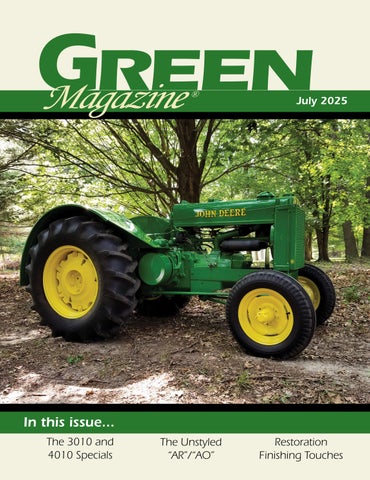
G REEN Magazine ®
July 2025
In this issue... The 3010 and 4010 Specials
The Unstyled “AR”/“AO”
Restoration Finishing Touches
WHAT A DEAL! SPECIAL BUNDLE PRICE Book bundle: Green Magazine
on these TWO books published by Green Magazine
A Specialized Look Into
The Unstyled Model A The Handbook of the John Deere Model A 1934-1938
Fourth Edition • By Wes Malcolm Now in its fourth printing with 15 more pages, this is the handbook of the John Deere model “A,” 1934-1938. A book that should be on the “must read” list of any unstyled “A” owner. There is probably no other book on the market that goes into so much detail on a single model of tractor. Shows illustrations of nearly every change made in the parts that make up the unstyled “A.” 95 pages, 11x8-1/2 inches, soft cover.
Both books include history, specifications, serial numbers, original prices and much more
A Specialized Look Into
The Unstyled Model B The Handbook of the John Deere Model B 1934-1938
The same types of information as available in the book above, except now about the model “B,” written and compiled by a panel of experts who have spent decades collecting and restoring the unstyled version of Deere’s most popular tractor. This book shows nearly every change made in the parts that make up the unstyled “B.” 84 pages, 11”x8 ½”, soft cover, over 200 photos - most in color.
Order GMAB: $63.95 U.S. (Nebraska residents add 5.5% state tax)
$76.95 Canada (US funds) • $89.95 Foreign (US funds)
The prices shown here are for BOTH books shown above - the first time for this BUNDLE DEAL. •• Prices in this BUNDLE DEAL are up to 20% OFF the regular price •• Visa, Mastercard, Discover, American Express accepted • Nebraska residents add 5.5% sales tax • Price includes S/H
Call
402-643-6269 • Email info@greenmagazine.com Online www.GreenMagazine.com
Mail Green Magazine® • PO Box 95, Bee, NE 68314-0095
Auction: Burkhart tractor collection
Each March issue of Green Magazine includes an index of major articles from past issues. The March 2025 issue featured the newest index.
The monthly publication for John Deere enthusiasts Editor Richard Hain Managing Editor Carol Hain Layout/Design Debbie Behne Order Fulfillment Karen Mayo
Green Magazine®
July 2025 • Volume 41 Number 7 10
38
Whitney Stith and his model “C”
Deere & There
20
The tractor doctor
Benjamin Hain
Ron O’Neill
Donna Parker
John Deere model “AR” / “AO”
40
620 dyno run
PO Box 95 Bee, NE 68314-0095 Hours: 8:30 AM to 4 PM M-Th Closed Friday
More on crankshaft end play
Bill Proft
email: info@greenmagazine.com web: www.greenmagazine.com
34
R.V. (Ron) Satterthwaite
What’s new—and old? Checks, invoices and more
Phone: 402-643-6269
Check out the sample articles, catalog, ads and other features!
NOTE: VISITS TO OUR OFFICE BY APPOINTMENT ONLY! Please call prior to visiting so we can be here to talk with you. At that time we can also give you our location. Thank you!
28
Dan Price
Tale of two crawlers
Departments 5
Richard’s Column
6
Deere John
Rates:
14
U.S.: $39.95 / 1 year - 12 issues $76.95 / 2 years - 24 issues
The Young Timer
New toys
Nebraska residents, add 5.5% sales tax ($42.15 or $81.18)
Tyler Buchheit
Canada: $59.95 / 1 year - 12 issues Foreign: $69.95 / 1 year - 12 issues
31
First Class/Airmail delivery available: See page 5
ON THE COVER:
Brian VanDragt of Fennville, Michigan owns this 1945 John Deere “AO.”
Digging Deeper
3010 and 4010 Special tractors Richard Hain
33
Do you have one?
36
Tip of the month
Finishing touches
42
Scale models
Ertl’s 6030 series
45
Greg Stephen
50
Auction highlight
Two-cylinder fun Eric W. Mickelson
53
Aussie Ken
Challenges of Australia Ken Nicklas
56
Saw it online
An empty box comes up for bid
Adam Smith and Benjamin Hain
69
Advertiser index
72
Mr. Thinker
Dan Brotzman
“GREEN MAGAZINE®” (ISSN 0883-5462) is published monthly and released 12 times a year on or about the first of each month for
$39.95 per year (Canada: $59.95 per year; Foreign: $69.95 per year) by Hain Publishing, Inc., 2652 Davey Road, Bee, NE 68314-9132. Periodicals postage paid at Bee, NE and additional mailing offices.
POSTMASTER: Send address changes to “GREEN MAGAZINE®, PO Box 95, NE 68314-0095.” GREEN MAGAZINE® reserves all rights regarding reprints of this publication. Our phone number is (402) 643-6269. Copyright © 2025 Hain Publishing, Inc. All rights reserved. Page 4 July 2025 • Green Magazine®
Looking through an old grain bin that I use to store tractor parts, I came across the casting shown here. It’s the bottom section of a spark arrestor type muffler used on “D” and “GP” tractors from 1931 to 1934. Many in the Deere world call them “hood burners” because of the propensity of the rings used in the middle section to leak and ruin a good paint job. You might notice that there are no holes, either for where it bolts to the manifold, or for the three rods that hold the whole thing together. That’s because it is a raw casting, left over from a little project I dove into many years ago. Last month, I wrote about the 1931 “D” that was my first solo restoration project. It needed the correct muffler, so instead of restoring a few somewhat rough pieces that Jack Law gave me, I decided to use them to get more cast. I had to get a pattern and core box made, and rollers to form the rings. When I got all the pieces back, I put them all together and sold complete mufflers. Thirty plus years later, I’m not sure why I decided to go through all of this, maybe I thought I might make a few bucks, but as I have often
said about various things I’ve gotten into, “It seemed like a good idea at the time.” Back then I sold the complete muffler for $95. No, I don’t have any left, especially at that price. I wish I did for a new project, which I will write about in the next issue. Regrettably, I didn’t keep around a top casting and a set of rings to go with this bottom elbow. One more thing on this subject, if any of you remember buying a spark arrestor muffler from me many years ago, let me know. If you think you might, I can tell you a way to tell if it is one of mine. By the time you read this, Classic Green Reunion 2025 will be history, but since this issue had to go to the printer before we left for the show, there are no photos, or story in this issue. We will have complete details
next month. Right now, I plan to attend the Bos Brother’s summer show in Illinois later this month and another show featuring Deere that I was recently made aware of, The Old Trusty show in Clay Center, Nebraska in early September. See you next month.
Green Magazine announces its spring/summer hours, in effect now through Labor Day: Day:
Monday through Thursday 8:30 AM - 4 PM • Friday: CLOSED
Those who want to call to place orders for magazine subscriptions or renewals, gift items or ads, please note this schedule. Our website, www.greenmagazine.com www.greenmagazine.com, is always open for orders and ads. Email info@greenmagazine.com with questions, if needed. Thank you!
Missing an issue? We mail every issue by the first of the month. Please contact your post office if you suspect a problem with delivery. We will not replace missed issues three or more months past original mail date (four or more months for foreign subscribers) free of charge. U.S. subscribers: If it is on or after the 20th of the month and you haven’t received your issue, call us for a replacement. Canadian subscribers: Due to postage costs, we are forced to ask for a $2 postage fee (U.S. funds, please) for re-sending issues that do not arrive by the end of the published month OR we can add an issue onto your subscription for the missed issue. First Class/Airmail delivery: Call for rates for First Class in the U.S. or Airmail to foreign countries. Foreign subscribers: We will add an issue onto your subscription OR for a $7 airmail postage fee (U.S. funds), we will resend the missed issue two months after publication date. Notice: If your address label shows an expiration date of “7/25” above your name, this is your last issue. Renew immediately for continuous service. If your address label reads “8/25,” you have one more issue on your subscription. Renewal notice: We send postcards to let you know your subscription is about to expire (or has expired). We NEVER call to ask if you would like to renew your subscription. If you
receive such a call, it is most likely from another publication—NOT Green Magazine® for John Deere enthusiasts.
Address Changes: Please send or call with notification of an address change as soon as you know what your new address will be. Periodical mail cannot be forwarded. Green Magazine will not replace issues missed due to late notice of address change. Those missed issues will have to be bought at back issue price. See the back issue listing and prices elsewhere in this issue. Looking for your photos and stories! Accepted material is subject to such revi-
sion as to meet the requirements of this publication. Payment will be made at our current rate within 90 days of publication to current subscribers. Submission of manuscript implies that the material is original and in no way an infringement upon the rights of others. Please send good, clear photographs. If you would like these returned, send us a stamped return envelope to help us get them back to you.
Free Issue Offer: It seems you, our subscribers, are our best form of advertising!
More people find out about this publication by “word of mouth” than other forms of advertising. So if you're enjoying Green Magazine®, why not spread the word? Telling others about it can pay benefits. When you tell a friend about Green Magazine® and they subscribe, make sure they tell us who let them know about it. When they do, you will get an issue added to your subscription. These must be new subscribers, not renewals.
Green Magazine® • July 2025 Page 5
I’m guessing many homes have a “junk” drawer where odds and ends tend to accumulate for the day when that odd screw may be needed again, or a rubber band, paper clip, screw cap that doesn’t seem to fit any known sports bottle—the possibilities are endless. The junk drawer in our home is in the kitchen and has been completely taken over by my wife. At last count, there were five pair of scissors for various purposes, several screwdrivers (I bought her a set for herself after she once used one of my wood chisels to tighten a screw and I spent several hours honing it back into shape), a partial box of wooden kitchen matches and much, much more; if only I could get the drawer to completely open. This, of course, led to me making my own “junk” drawer, not to be confused with the box in the garage for oddball bolts, “salvagable” bits and pieces deemed have some life left if push came to shove and other items that just didn’t belong any place specific. But what to do with all my keys? There are old vehicle keys to cars and trucks long gone to be recycled. For this, I blame my dad. When he sold my very first car, he saved me a set of keys, for sentimental reasons I guess. That led to me keeping one set of keys as each vehicle passed through my hands, and since keys have changed over the decades, I can pretty much tell which vehicle each key went to even now. That first car was a $100 well used 1956 Oldsmobile and there were three keys in the full set, door and ignition, glovebox and trunk. Today I drive a Jeep Gladiator and I nearly need a shoulder sling to carry the single key that performs so many tasks (or so they tell me). Now I supPage 6 July 2025 • Green Magazine®
pose keyless entry and panic buttons can be considered improvements but the simple keys of “simpler” times took up much less space and didn’t require batteries. In fact I still have equipment around that uses the generic Indak key; the last time I bought one, I think it cost a buck at Walmart. With an Indak key I can start my 1968 110, my 1984 212, my Snapper rototiller and more. Of course, I don’t store them outdoors because a thief can easily buy one of these keys, too. But that doesn’t mean electronic keys are safer—technology marches on and they can be defeated as well. Gosh I got way off topic here— sorry about that. In my personal junk drawer were these key rings from various John Deere dealerships I have done business with, but only ONE remains. In my younger years (I’m now 78), to the best of my knowledge, each John Deere dealership was a stand alone, although I wouldn’t doubt in other parts of the country, there may have been multiple outlet dealerships. I did notice even back in the 1960s that corporate John Deere no longer wanted small dealerships; they wanted large, full-line agencies. Long gone were the
corner room in the local hardware store or livery; Deere had an image it wanted to project and size did matter. And so today, dealerships such as Winfield Farm Supply, Inc., where I once worked part-time as a college student, have either closed or been swallowed by larger, multi-location dealerships. Locally to me now, there was Laneway John Deere and when the owner wanted to retire, he had the business listed for over a year, but none of the prospective buyers could meet corporate John Deere’s demands. So the inventory and buildings were sold and it ceased to exist. Temporarily, another JD agency moved in to fill the void, but after a few years, they too were swallowed by a regional JD chain, Cazenovia Equipment Co. (that’s the reverse side of their fob with the phone numbers). In the past year, they too have been absorbed into the Sydenstricker Nobbe group, which I understand spans several states and an unknown number of outlets. I guess this is all part of “big” business and so far I haven’t witnessed a change in the relationship with us consumers. I still see the same faces (usually, although employees do come and go) and receive the same good service. I hope for the employees, the increase in the size of the parent organization means they have better health and retirement benefits. Personally I don’t expect to be purchasing any new equipment other than lawn and garden; in fact, on a recent visit, I spent more on gifts for the grandkids than oil filters, blades etc. for myself. So progress, well I guess, and yet I miss the hometown feel of locally owned and operated outlets. It was just different somehow. Frank Capristo, Jr.
Richard, I really enjoyed your article on the Liberty Ship John Deere, but I would like to point out one error in your report.You state Liberty Ships were renamed Victory Ships after the war—not so. There were two types of cargo ships made during World War II–Liberty and Victory Ships. Victory Ships were a totally different class of cargo ship
built during World War II in 1944 and 1945. They were a much better, improved cargo ship that were larger and faster than Liberty Ships. They made a little over 500 Victory Ships during the war. They made more than 2,700 Liberty Ships. There is one restored Victory Ship, the S.S. American Victory. Jim Seavey, Maine
I have an old tractor that came home (Richard’s Column, June). It is a 1941 “B” purchased in 1942 by my father and his brother. I was three years old at the time. The tractor was sold in the 1950s to a man to haul freight from the train station; he converted it to rubber. I bought it back recently. It spent its entire life at Carrot River, Saskatchewan, Canada. Bob Gilmour
Send a letter by mail or email:
Green Magazine PO Box 95 Bee, NE 68314-0095
info@greenmagazine.com
We like to hear from you!
1) Call 402-643-6269 with credit card in hand 2) Go online: www.GreenMagazine.com Send a check by mail with the subscriber’s name 3) and address to Green Magazine, PO Box 95, Bee, NE 68314
A subscription or a subscription renewal makes a great gift!
For more info on subscription rates, see page 4. Questions? Call 402-643-6269 for great customer service! Green Magazine® • July 2025 Page 7
JIM & FAYE MILLIGAN TRACTOR COLLECTION ONLINE ONLY AUCTION
BIDDING ENDS THURSDAY, JULY 10, AT 9 AM LOCATION: 21702 Co Hwy A, Richland Center, WI (1.5 miles north of Richland Center on St Hwy 80 to Co RD A, then west 2 miles on County Rd A to farm)
NOTE: Jim & Faye are selling their farm and for that reason are dispersing their impressive Hi-Crop tractor collection. For more information, contact Jim at 608-604-1656. This is a partial list. Online bidding, catalog, & detailed information:
www.gavinbros.com
PREVIEW: Wednesday, July 9th 11 AM to 1 PM – or by appointment PICKUP: Friday, July 11th 9 AM to 2 PM JD HI-CROP TRACTORS: 2520 Hi-Crop, diesel, dual hyd, 420/85R38 rears, runs, SN T733R019007R; 4020 Hi-Crop, diesel, single hyd w/ rear belt pulley, 18.4-38 rears, console shift, runs, SN T233R134314R; 3020 Hi-Crop, diesel, single hyd, console shift, runs, SN T133R069174R; 3020 diesel Hi-Crop, side console, runs, SN T133R125533R; 4020 Hi-Crop, runs, being redone, SN T233P206128R; 720 LP standard, runs; also IH Hydro 70 Hi-Crop, runs OTHER ITEMS: JD collector lawn mowers; parts; tools; farm primitive items & other collectibles TERMS: 10% Buyer’s Premium. Sales tax applies unless exempt. Cash or good check, ACH, wire transfer, or Visa/MasterCard w/convenience fee
WISCONSIN REGISTERED AUCTIONEERS: James R. Gavin (#2387) & Matthew C. Gavin (#2389)
GAVIN BROS. AUCTIONEERS | REAL ESTATE • Reedsburg, WI 53959 • gavinbros.com
Page 8 July 2025 • Green Magazine®
Bos Brothers Summer Show Featuring a John Deere unstyled field day in the tradition Show: Bos Brothers Summer Show of Nappanee and Albert City
ERIE, ILLINOIS July 25 through 27, 2025 Bosbroshistoricalfarm.com Chuck Bos, 309-781-6394 See website or call for more information!
Dubuque top links - Bill Miller
Join us for a 2 day tractor ride in beautiful southeast Minnesota! Sept 13 & 14, 2025
Call 507-272-5830
Preston Historical Society
Donald Demon Sr. Retirement Auction July 19, 2025 • Live & Online
• John Deere Model 50 Tractor, Serial No. 5017730 • John Deere Model B Tractor, Serial No. 151934 • John Deere Model A (No Serial no.) • John Deere 430W, Serial No. 159584 • John Deere Model M Tractor (No Serial no.) • John Deere Model R Tractor, Serial No. 18043 • John Deere Model 70, Serial No.7014889 • John Deere 567 Baler Silage • John Deere Moline IL Wagon • John Deere Crawler (No Serial no.)
• John Deere Model D (No Serial no.) • John Deere Model H (No Serial no.) • John Deere Model M (No Serial no.) • John Deere Model 40 (No Serial no.) • JD B Tractor, Serial No. 326111 • John Deere Model LA • John Deere 720 • JD D, Serial No. 96134 • John Deere Parts Tractors • This and More
Thornburg Auction Company • thornburgauction.com Auctioneer Zoltan Thornburg License Numbers NCAL 8889 SCAL 4300 Phone: 704-472-4688 928-2 Oak Grove Rd, Kings Mt, NC 28086
Green Magazine® • July 2025 Page 9
When planning and publicizing the Albert City, Iowa show, Colin Johnson had a vision to bring together some of the unique and rare John Deere tractors. One model he especially wanted to see at the show was the “C” or the “All Crop” as it was referred to during development. Built in 1927 and 1928, the “C” was a predecessor to the model “GP,” with 92 regular production “Cs” built. The John Deere company communicated the decision in a letter dated June 20, 1928 to change the model “C” to the “GP,” leaving behind the “C” name to John Deere history. Essentially Deere did away with the “C” because it sounded so much like “D.”
As Colin worked through his contacts to locate a model “C” to invite to the Albert City show, he landed on “C” owner Whitney Stith of Union, Kentucky, a mere 10 hours away. Would he consider coming to Albert City with his “C”? Colin called Whitney out of the blue that spring of 2024 and personally invited him to come. Colin shared his vision with Whitney and did his best to draw him in but Whitney had commitments and was hesitant. Whitney Stith is a businessman with varied interests that include being a CPA, owning a Papa Johns, partnering in hotel ownership, and he was currently enrolled in Hamburger University (McDonalds school) to become an owner/ Page 10 July 2025 • Green Magazine®
operator. He didn’t know if he could get away but it sure sounded good. Whitney Stith became the owner of the 1928 serial number 200113 model “C” in 2019. He says he was lucky to be in the right place at the right time. The tractor needed some attention, the worst of it being a cracked block, but the tractor was by far correct and that was great news. To Whitney, chasing parts is the most enjoyable part of the hobby. When parts are missing, something’s incomplete or worn out, connections and friends are made. He quips, “The fun’s in the hunt!” and this is because it’s how you get to meet and know other collectors. Whitney had the tractor restored in time for its maiden voyage to Classic Green at Lebanon Tennessee in 2023. He hopes to display his model “C” at the John Deere Tractor and Engine Museum in Waterloo Iowa in the near future.
Whitney’s tractor hobby began around 1980 when his father, a farmer and seed dealer, purchased a 1934 John Deere “A.” Together they worked on it and brought it back to life. Spending time together and having a tractor to show for it was rewarding. The next purchase was a 1931 “GP.” They tried to purchase complete tractors, then they worked on them as a team. Over time, they were able to acquire a Spoker “D” and a Waterloo Boy. Whitney has been focusing on implements like a planter, a wagon, and some of the little extras like the K-W light system on his “B” as of late. The model “C” is the one that brings a gleam to Whitney’s eye though. He still has to pinch himself, wondering if owning the model “C” is really real, considering only 16 still exist. Whitney says of his collection that he became a 30 year overnight success. His advice to the new collector is to hang in there. Start in budget. Try to purchase complete tractors. The old John Deeres are simple to work on and it’s a friendly hobby. Most everyone wants to help someone who’s willing to learn. One of Whitney’s favorite local tractor shows is the Lanesville, Indiana Heritage Weekend. This is a show where his hobby started, where he first showed tractors, where people know him. To Whitney, shows are all about the food, fellowship, and fun and this show has it all. This year marks the show’s 50th year. A favorite memory Whitney has is when he and his dad took the Waterloo Boy to a show at Rantoul, Illinois. Whitney’s wife had packed them a lunch that included sandwiches and Bugles, a type of corn chip. They each ate their sandwiches and Whitney placed the bag of Bugles on the dash so they could share them. He saw his dad reach into the bag and take a handful, and shortly another handful, then his dad just took the whole bag. He had never had Bugles before and he was hooked. Whitney still chuckles recalling this story today. He is glad for the tractor connection he and his dad had and the memories he still carries. His dad passed away in 2018 at the fine age of 103. As the Albert City show drew near (August 2024), another encouraging call came in to Whitney from Colin. Whitney had checked on his McDonalds schooling and thought the time was right to get away. Colin quotes him as saying, “I can’t stand it! I’m coming!” When Whitney arrived with the model “C” at the Albert City show, Colin made a dash to his trailer and threw his arm across his shoulder before he could unload. Colin was amazed that Whitney, who had never seen Colin, would come to a little Iowa town just because he asked him. Thanks to Whitney (and, in part, Colin), the model “C” has made tractor tracks on Albert City, Iowa soil.
Whitney’s 1928 John Deere “C” has a ship date of March 17, 1928, and lists a destination of Deere & Mansur Works and JD Plow Works, Moline Illinois. It comes with its own fan club, as his brother, Kyle, wished the tractor a happy birthday in a post this past March. In a few short years, it will celebrate the big one and I suspect there will be another happy birthday post with extra fanfare. In the months that have passed since the Albert City show, Colin and Mary Johnson looked for opportunity to reconnect with Whitney and keep their friendship going strong. They happened through Kentucky on a trip to the Great Smoky Mountains. They called Whitney, who met up with them in Florence, Kentucky at the Ford’s Garage for dinner. Not only did the restaurant have character, they enjoyed a fresh dose of Whitney’s great humor and companionship. Whitney Stith lives in Union, Kentucky with his wife of 27 years who is very supportive of his tractor hobby. They have a daughter, who is a student at the University of Cincinnati. His daughter likes to drive their John Deere “BW” and wagon in the local Memorial Day parade so it sounds like she has a little green in her veins, too. Whitney enjoys the family interest in his tractor hobby and the times he’s shared it with his daughter, dad, and brothers. It’s a special hobby that unites some of his favorite things: fun, fellowship, food, and family. Green Magazine® • July 2025 Page 11
Celebrating a Lifetime of Collecting
Dennis Polk
Bob & Pat Cooper Family Farms Wiota, Wisconsin Saturday, August 16, 2025 Featuring:
• 20+ Collector Tractors • 30+ Plows • 7 Combines • 4 John Deere Barge Boxes • Self Propelled Sprayer • Many Other Implements • Pallets of Parts
Live and Online Bidding! Visit teasdale-gill.com for pictures
Call 608-482-4479 For More Information
Available Parts in Stock * Nameplates $245 per set * Complete battery tray assembly Headlights * Decals SMV emblem support bracket - K&K Antique Tractors Fenders Hood ornament Pre-cleaner bowl * Step kit * 3-piece seat kit * Gauges Radiator core * Battery boxes * Rockshaft covers * Safety plate Fuel cap & radiator cap * Front & rear side panels Steering wheels & centers Hydraulic outlet plugs * Side & front grille screens * Raincap for late side console
*inMade USA
K & K Antique Tractors
Kent Kaster • 5995 N. 100 W, Shelbyville, IN 46176
Phone 317-398-9883
NEW ITEM * SMV Emblem Support
* Original part number AR46282 * Selling bracket
ONLY Order today!
Website: www.kkantiquetractors.com • Email: info@kkantiquetractors.com Page 12 July 2025 • Green Magazine®
DETWILER TRACTOR PARTS 206191 Hwy. 13 • Spencer, WI 54479 DetwilerState Tractor Parts 30 years in the same location • 9 AM - 5 PM CT Mon - Fri
Ph. 715-659-4174 Detwiler Tractor Parts • 715-659-4252
QUALITY NEW & USED PARTS
Call for FREE DELIVERY of JD 2-cyl fenders, hoods, weights, new and used parts to this 2025 show: Tri-State Gas Engine Show • Portland, IN Aug. 20, 21, 22, 23, 2025
Exhaust Pipes • U.S. Made Radiator Cores • Front Weights • Engine Parts • Manifolds • Mufflers • Airstacks • Battery Boxes • Fenders & Hoods • PTO Shields • Steering Wheels • Flywheels • Grill Screens • Clutch Parts • Grill Guards for D & GP • Airstacks - D & GP
Auction: Ken Rexroth
We do carb, magneto, tractor repair & restoration Rerimming Factory Round & Flat Spoke Wheels • Any brand tractor We can rebuild cutoffs back to steel High quality / very accurate reproductions
We can also replace damaged spokes • The only source of original style rear rims Rear wheels can be custom sized for pullers • Will also rerim cutoffs front and rear
ALSO: NEW JD FRONT AND REAR WHEELS TEXT FOR DETAILS • DETWILER MACHINE Text 715-613-1520 • Email patdetwiler@gmail.com or call numbers listed
Kit Cleans Up Older Deere Hydraulic Mess
Scott Grove cleaned up leaky hydraulic valves on his older Deere tractors with a simple insert. The long-standing problem is one the company has yet to fix. Grove says it forces him and other owners of Deere tractors to replace O-rings on a regular basis, only to have the mess return. Grove’s fix eliminated the mess and the need to replace parts. With the Grove Conversion kit: • Convert to ISO with easy push-pull connection Wapsiunder Innovations • Couplers connect residual pressure with breakaway feature • Kits available for 10 through 70 series JD tractors manufactured from 1961 through 1996 • Inserts are made in the USA. This product is protected under US Patent 10,760,725 B2 and other patents pending. Installation consists of stripping the OEM outlets down to the block, removing the barrels and O-rings, and replacing them with the inserts. Grove then adds the aftermarket ISO coupler that threads into the insert. Installation instructions can be found on the Wapsi website. Kits for 10 series are priced at $315, kits for 20-40 series are priced at $329, and kits for 50-70 series are priced at $355. Also watch the website for more additions coming soon. Grove suggests checking with local Deere dealers & local repair shops or Wapsi Innovations directly.
DON’T BE FOOLED BY THE “COPYCAT” version! Purchase “THE ORIGINAL” GROVE CONVERSION.
We 100% guarantee our product from leaking or your money back!
PH: 641-229-7413 • Wapsiinnovations.com Green Magazine® • July 2025 Page 13
Over the years of collecting vintage John Deere moldboard plows, I have had many offers of trades that usually involves another plow. A common example is the collector would like a four bottom 66H to pair with an “R” but he has a three bottom 55H plow he would like to trade for mine to make a better match to his tractor. I have made several trades with similar changes in size or vintage of plows (common to trade for a plow to match
The F690H shined up from plowing 20-plus acres of clayloam. Below: Zachary did not mind getting to drive Claude’s 40 utility tractor after six hours of riding in the pickup.
Page 14 July 2025 • Green Magazine®
a tractor to be “period correct”). Also, there have been other offers to trade different implements like manure spreaders, cultivators, disk harrows, and even sickle mowers for plows that I have owned. Just over a year ago, a good friend of mine, Claude Butt of Monticello, Indiana, asked if I might help him find a four bottom hydraulic lift trailer plow to pair with his 1968 model 4020D tractor. He wanted something quick and easy to hook up for local plow days and wanted the model to be the correct vintage as his tractor. I asked him what his budget was and he proposed an unusual trade rather than just putting a dollar figure to it. Claude, knowing my son, Zachary, is about the right age to spur his creative engineering spirit by creating with Erector Sets, proposed a trade for a whole collection of vintage Erector Sets for a “field ready” plow. I pondered the offer for a couple days and Thankfully Claude’s mini-bikes were not for sale or trade!
decided that it would be something to benefit Zachary and agreed to the deal. Perhaps we could sell a portion of the Erector Sets to offset my costs but time would tell. My plan was to locate a John Deere four-bottom pull-type moldboard plow with 16 inch High Speed or New Universal bottoms. I was looking for F650H/F660H or F680H/F690H trailer plow to match up to Claude’s 1968 4020D. After a few months of looking around for a plow, I found an F690H in need of repair in Ohio.
The 4020 with the 148 loader had no problem lifting the super heavy F690H plow. Below: Zachary checking out the first real vintage (not plastic parts) Erector set.
I traded a complete F650H 14 inch four-bottom plow for the F690H which needed coulters and plow bottoms. Like many projects of mine, the F690H returned home to my plow yard and sat waiting patiently for me to find the motivation to begin work (this was July 2023). I made a mental list of what all the plow needed to be field ready: 4x bottoms in good condition, 4x original JD round shank coulters and mounting brackets, new tires on good factory rims, hitch cross bar needed to be replaced (the original was bent), rear axle rocker and lift straps required replacement, the lift rod arm on the land axle had been broken and repaired (welded on crooked and with what looked like a coat hanger weld job). As I hunted the parts, the plow sat outside the back of my shop for the rest of 2023. It was moved around a few times using my 4020 and 148 loader with pallet forks several times in the
Claude was showing Zachary his articulated tractor and disk he built from Erector and a few other parts. Below: We made a stop at Titus Bakery at Reynolds Equipment (the only restaurant/café in a John Deere dealership that I know of) in Atlanta, Indiana. We had delicious doughnuts and sandwiches.
spring of 2024 when I finally got to work making the F690H field ready. I had a good set of factory one-arm roller bearing coulters and had piles of the U-bolt type coulter clamps (the plow came to me with flat shank coulter brackets and were swapped out as Claude wanted the round type). The F690H came to me without plow bottoms so I managed to find a matched set of High Speed 16 inch bottoms. They required new shins, shares, and landsides. I had new bushings and linkage parts for the rear axle lift so it was quite simple to remove and replace the parts. The repairs took place over a couple weeks, working for an hour or two in the evenings before it was all coming back together. Zachary helped me with some small things like installing the wheels with brand new
Zachary receiving operating instructions from Paul Jordan on the Oliver Super 88.
implement tires. By the time the plow was ready to use, I secured a field to plow at a neighbor’s farm that had not been planted and needed to be tilled to keep the weeds buried. I decided that if my 1968 4020D Syncro would pull the plow, then Claude’s 4020D Power Shift should pull it as well. Plowing with the F690H went well as I adjusted the hitch and coulters ensuring a good job of plowing. Soil conditions in southeast Missouri in August were dry but fortunately had enough moisture to crumble the furrow slice without turning up huge five-gallon bucket sized balls of soil. The bottoms scoured in no time and pulled quite well turning nine to 10 inches deep in third gear. I could pull the plow in fourth gear but the heat gauge climbed higher than I preferred and when in third, it was stable right in the normal range. It was fair to say we dialed in the plow with well over 20 acres plowed. Zachary helped, too, with his “H” and H1 1-16” plow and we had a blast. Fall of 2024 arrived and I had hoped to get the plow up to northwest Indiana at Claude’s farm. However, he was not yet ready for the plow. Zachary and I had cleaned the plow from the field work and took care to coat the bottoms with black paint to ensure the wear parts would still be Another first—driving an unstyled “A” tractor (this one is hopped-up and quite strong).
Below: Like most 10-year-old boys, Zach was climbing all over the tractors in the Jordan collection.
Green Magazine® • July 2025 Page 15
The F120 3-12 frame plow with the mulch bottom conversions. Bill said he tried pulling it with a 2010 but had to buy a 2510D as he needed more power. shiny when heading to those Indiana Plow Days. Claude phoned me in late winter 2025, letting me know he was ready with some of his Erector Set collection to trade. He suggested that we might take some of them to get started and see how Zachary took to building with them. We headed out on May 19th for a four-day trip that would lead us across Illinois, Indiana, Kentucky and back. The first day of our trip was getting the plow to Monticello, Indiana. We arrived at the farm to deliver the plow in the evening and were treated to the grand tour of Claude’s collection of vintage John Deere stuff along with a dinner put on for us by his wife, Bonnie (we were very thankful for a tasty supper). After supper, Claude showed Zachary his garage full of Erector Sets that ranged from collector pieces in complete kits to partial kits and a lot of spare parts. Claude explained that he received his first Erector Set as a child about Zachary’s age and that it shaped his creative mind for all things mechanical. Claude sent us home with a handful of Erector Sets with the plan to deliver many more sometime later this summer. Zachary was thrilled to
have a new set of toys that he could build with and see where his imagination would lead. It was hard for him to have to wait until our return home to get to work building. We departed Claude’s farm and stayed overnight in Logansport, Indiana. The next day, I had to stop by my work headquarters near Wabash, Indiana. Zachary got to tour my company and meet some of my colleagues for the day. Afterward we headed down in the afternoon to pick up some plows I had agreed to purchase near Greenfield, Indiana. Once we loaded a John Deere 814 four-bottom and a model 416 three-bottom plow, we headed to New Palestine to catch up with Patrick Jordan and his dad, Paul, and to deliver an 820A two-way plow he wanted from me. Zachary was quite happy when Paul started up an Oliver Super 88 for him to drive. It was his first time driving an Oliver and he was impressed with the ease of handling along with the smooth six-cylinder gasoline engine. We inspected their collection of assorted tractors and plows before heading to Columbus, Indiana for the night after meeting one of my customers in the area for a dinner meeting.
Zachary checking out the old tobacco barn and its contents. Even after 20 years without growing tobacco, there was still the scent being held by the wood. Below: It is not a John Deere but it will no doubt get some use being pulled behind one.
Zachary checking out this lineup of parts tractors at the Lind Brothers.
Ever see a 630 on steel next to a factory orange 630? It was too neat to pass up the chance for a picture. Thanks to this inspiration Zach now wants a set of these for our 630. The next morning, we headed for Maysville, Kentucky to pick up a couple more plows that I had purchased. One of these plows, owned by Bill Newell, was one that I had my eye on for several years. The F120 threebottom plow was a 12 inch frame spacing, which was quite unusual as very few plows made in the New Generation era were this frame size. Equally unusual was that it was equipped with mulch bottoms that John Deere offered in the ’80s for farmers wanting to give up moldboard plowing for chisel plowing. The trend never gained much traction as converting moldboard plows for mulch tillage. Bill purchased the plow on auction and converted it to mulch bottoms for use in plowing tobacco on his farm. Once loaded up with a couple more plows, we headed west toward Corydon, Indiana. We met with a fellow I had purchased a six-foot IHC drag disk harrow for use with Zachary’s model “H” John Deere tractor. We had been looking for a good disk and of course preferred a Deere, but all I found were rusty and in poor condition. This IHC disk was always shed kept and has original paint. The story was that it was purchased new with a Super “A” and only used on a four-acre garden patch. Purchasing a field ready disk turned out to be a good choice.
My motto is—why come home with an empty trailer? Trip total: Seven plows, one disk, one walk behind snow blower.
The next morning after a hearty breakfast, we headed to see the Lind Brothers, Ryan and Dale, at their business nearby. Dale had some plow parts he wanted to show me and it gave us a good excuse for Zachary to see some of their tractors. After we spent a couple hours digging out plow parts from pallet crates in a barn, we struck a deal and loaded them on my trailer. The Lind Bros. were quite hospitable and even sent us home with some hats and tee-shirts. With two more stops before heading home, we picked up a plow in Owensboro, Kentucky along with a flat of tobacco plants (Facebook Marketplace will turn up things you never even knew you were looking for). In case you might be wondering, none us use tobacco, but my oldest daughter, Adeline, has about 10 goats and told me that they supposedly love to eat cigarettes as tobacco is a natural dewormer. For the first time I know of on our farm, we planted some tobacco plants to see what happens (with the help of the Internet we know only a little bit about growing the plant). Perhaps we will have enough to cure out to last us many years of keeping her goats worm-free. It was quite a whirlwind trip, starting with delivering a plow to trade for a lifetime supply of Erector Sets and
Thousands of little tobacco plants in the green house. We shall see if I can grow a few of them to use for goat dewormer. ending with a trailer load of plows, a disk, and even a snowblower given to Zachary to see if he could get it running (which we did). I should mention that my wife, Teresa, was surprisingly impressed with the horticultural project and was happy to see the men of the family return home after three nights on the road. Contact Tyler Buchheit by email at tyler@mrbtractors.com. His website is www.mrbtractors.com Green Magazine® • July 2025 Page 17
2-Cylinder Plus Tractor Salvage 2-Cylinder Plus Tractor Salvage
A’s, Bs, 420s, 430 thru 4010, Hs & Ms Hay Equipment, Balers, Disk Binders & Hay Bines
David and Robin Marlin
417-589-2634 • 417-589-3337 322 Marlin Prairie Dr • Conway, MO 65632 Only 70 miles northeast of Branson, Missouri
OBSOLETE PARTS CHECK YOUR PART NUMBERS
against one of theparts largest inventories of obsolete and Obsolete - The Old Tractor reproduction John Deere parts in the world Company
www.theoldtractorcompany.com The Old Tractor Company • Box 89 • Franktown, CO 80116
TEXT: 303-594-3074 (texting preferred) Ph. 231-846-8243
Fisk Carburetor and Ignition
Page 18 July 2025 • Green Magazine®
Medallion AR77663 K&K Antique Tractors
Auction: Polk Labor Day Weekend
New & Used Parts to Fit JD Plows
Tyler Buchheit • 7687 S. Hwy. 61 • Perryville, Missouri 63775
Ph. 573-768-4092 • tyler@mrbtractors.com
Tyler will be at the 50 Years of Progress Show in Rantoul, IL Aug 21-24th. Pre-orders welcome!
Moldboard extension, $40 UPS shipping available. Call for information. Notched trash board, $45
New BA10146 Cast Landside: Fits HS & NU bottoms, $65 ea. w/bolts
26” disk plow blade w/bolts, $110 Disk scraper w/bolts, $60
Lift assist spring, $60
New 3-pt. Hitch Crossbar Lock Pins
Hydraulic hose holder, $75
F145 semi-integral plow parts available: axles, steering, hydraulic landing hitches, gauge wheels, etc.
Heavy duty 14-16 inch shares, $45, bolts included ALSO: Safety-trip spring, $15 17“ notched coulter blades, $50
Safety-trip bushing kit, $20
Factory equipment for semi-integral plows. They are used in place of snaptype lynch pins to prevent unwanted uncoupling of lower draft arms while plowing in corn stalks. $35/pr. Green Magazine® • July 2025 Page 19
In the 1920s, the IHC Farmall was the tractor that other manufacturers aspired to make. It was adaptable to several different kinds of fieldwork. It was simple both in design and in operation. It was affordable. Most importantly, though, it was selling very, very well. Deere’s “GP” tractor was their first attempt at dethroning the Farmall. With the “GP,” Deere had a tractor that made five more horsepower than the Farmall and was intended for three-row work versus the Farmall’s two-row ability. The cost was comparable to the Farmall, as well. The problem was that the “GP” was a bit late to the party and was plagued by a few issues. While it was only a fraction of the sales of the Farmall, the “GP” did sell well for Deere. Interestingly, the “GP” sold well in both the corn belt and in small grain country, while the Farmall’s sales were nearly restricted to row crop areas. The narrower and lower “GP” made it the better plow tractor, and its more powerful engine helped it in that respect, as well. Furthermore, the specialized orchard version of the tractor, the “GPO,” was also selling well in its small market. When Deere brought out the “A” as the replacement for the “GP,” they found that it was worthwhile to continue building the “GP” for the standard tread markets. Still, the “GP” was an outdated tractor that needed a complete replacement. There were many technological advancements on the model “A” tractor that could not just be tacked onto the “GP.” It was decided to build a standard tread version of the “A” so Deere could finally retire the older tractor. Doing so would streamline production at Page 20 July 2025 • Green Magazine®
Rodger Haulman’s 1936 “AR” with factory gas manifold and DLTX 9 brass carburetor. the factory since there would be fewer models to build, resulting in less tooling and fewer castings to make room for. Salesmen and parts departments would also have an easier time with fewer models to concern themselves with. Salesmen would also likely find it easier to sell another version of a successful and popular tractor. The “A” was quickly becoming one of those machines. Deere’s engineers began the transformation of the model “A” to a standard tread tractor in the late spring of 1934. During early development, Deere called the tractor the “AS” for “A” Standard. Before long, though, the name
is listed as an “AO” in the production counts, though. The “AO” significantly outsold the “GPO.” Just as the “AR” improved upon the “GP,” the “AO” improved upon the “GPO.” Both the “AR” and “AO” proved themselves in the field, and sales and production numbers of both tractors improved as time went on and the public got to know them. The national economy was also improving at this time, which helped sales of all tractors. Deere having a strong entry to take advantage of the better economy was a great situation Brian VanDragt’s grandpa, Roy VanDragt, driving his newish “AOS” for the company to be in. Sales of the with his son and Brian’s dad, Ron VanDragt, on the fender. Ron is “AO” were particularly impressive. A total of 176 “GPO” tractors were 79 years old now. sold in 1934. 248 “AO” tractors were was changed to “AR” for “A” Regular. sold in just a few months in 1935, and 613 were sold in It took less than a year of development for Deere to the shortened 1936 model year. These numbers are a bit produce the first production “AR” tractor. Serial number misleading, however, as Deere only offered differential 250002 was the first of these, built on April 25, 1935. Se- brakes on the “AO.” Quite a few farmers wanted to have rial numbers 250000 and 250001 had already been taken, these brakes on their tractors, but had no intention of ever likely by experimental tractors. Production of the “GP” and farming under or around trees. In these cases, they would “GPO” tractors ended earlier that year to make room for order an “AO” with “AR” intake and exhaust equipment. the new machines. Demand for the “AR” was immediately The tractor that they got would be identical to an “AR” higher than it had been for the “GP,” and production of in every way except for the brakes. Deere did eventually the new tractor jumped ahead of the old. make kits to put these brakes on an “AR.” The engine and transmission in the “AR” were exactly The “AR” and “AO” tractors were updated alongside the same as those that were in the model “A.” The “GP” the “A.” The main case and most of the engine were identiand “AR” were rated at about the same horsepower, but cal across each of these tractors, so when an improvement the “AR” engine was much better. Some “GP” tractors came out for one, it was automatically applied to the rest. were not able to reach their rated horsepower. The “AR” Deere improved the engine oiling and governor systems for did not have that problem. While the “GP” was rated for the three tractors. This change required a new main case. two plows, there were times and tractors where it struggled The “AR” and “AO” got this at serial number 251486. The to get that work done. The “AR” did not have that issue. As the plan had always been to also use the “AR” A nice restored “AR” owned by Cody Kaup. to replace the “GPO,” Deere created it to be capable of orchard work. Optional equipment was developed and produced that would transform the “AR” into an orchard tractor. Special fenders, differential brakes, a low air intake, and a side discharge muffler and spark arrestor were all designed and built. With all of these on a tractor, the “AR” had a very low profile, the ability to turn quickly to weave around trees, and plenty of shields to protect the trees and equipment. Just after production of the “AR” began, it was decided that the orchard version of the tractor should become a separate model. Deere created the “AO” tractor in June. This was simply the “AR” with the orchard accessories installed as standard equipment. The special fenders stayed on the options list to keep the initial cost down a bit and because not every orchard farmer needed them. Tractor number 250075 was the first tractor built like this, but it was built before the official name change to the “AO.” This tractor Green Magazine® • July 2025 Page 21
front end support gained an eyebolt at serial number 252644, and at 252654 Deere added a slow speed transmission assembly option. The production life of the “AO” was a short one, as it was removed from the lineup at serial number 253482, before the end of the 1936 model year. In its place, Deere introduced the “AOS” streamlined tractor. The “AOS” sat even lower than the “AO,” and its shielding was more complete than the optional additions for the “AO.” This tractor was built on the chassis designed for industrial service and the tractor known as the “AI.” The first of these machines was built in April of 1936. The “AOS” was numbered separately from other tractors. Deere replaced the radiator curtain assembly with radiator shutters early in the 1937 model year. The shutters could be adjusted from the operator’s seat. The curtain could not. This difference alone made it easier to maintain proper engine temperature. It helped even more that the shutters allowed more precise adjustment than did the curtain. The round spoke front wheels were replaced by a pressed steel wheel, part JD1232R, near the end of the 1937 model year. The oil level plug and the serial number tag were moved from the left side of the main case to the right side in 1938. This change made room for the addition of an electric starter, which
Andrew Meier owns this 1935 “AO.” was an option for the “AR” beginning in September of 1939. Early “AR” tractors had a hump in the operator’s platform. In 1940, Deere re-engineered the PTO, adding a larger opening and shield. These changes let them remove the awkward hump. The “AR” lagged a year behind the “A” when it came to the engine improvements in 1940. The engine’s stroke was increased from 6-1/2 inches to 6-3/4 inches, which increased the total displacement to 321 cubic inches. A new “ramp” design cylinder head was added, and new pistons were used. The compression ratio was
From a 1940 Deere catalog. Notice that what we refer today as an “AOS” was only referred to as an “AO” at that time.
Page 22 July 2025 • Green Magazine®
cranked up to 4.45:1. A new DLTX-41 carburetor was now used on the engine. All of these changes combined to add five horsepower to the engine. The 1941 “AR” tractors gained these improvements. Deere added a few more improvements to the “AR” to make it work better with this new engine. They put a larger radiator on the tractor and revised the top tank to have the filler cap in the center. The main case, transmission, and final drives were all bulked up to guarantee their dependability when teamed up with this new power. One more change for 1941 was the return of the model “AO.” The “AOS” was not a good seller. It was a very specialized machine and had a small market, which easily explained its low sales. Furthermore, the “AOS” was based upon the “AI,” and the “AI” was also struggling to sell. Instead of continuing to nurse the “AI” line along and spending time and resources to continue updating it, Deere decided to eliminate it and focus on the more successful tractors. The “AR” based version of the “AO” returned to the lineup. Deere decided that the return of the “AO” was an important enough event that they would do a few things that were out of the ordinary. First, they skipped nearly 700 serial numbers to
start again at the even number of 260000. This first “new AO” was built in late November of 1941, and Deere opted to call this the start of the 1942 model year. Normally, the model year turnover happens in the summer when Deere shuts its plants down for a short time. Twenty-eight tractors were built between that date in 1941 and serial number 260000. These would normally be considered 1942 model year tractors, but Deere decided instead to draw the line this year at the release of the “AO.” The new “AR” and “AO,” with their five more horsepower, were capable of three-bottom plow work in lighter soils and able to do heavier work than they could
So cute you want to reach out and pet it. Actually the man in the tie is showing how low the “AOS” is to get under low branches. Below: Drone’s eye view of the “AR.”
Green Magazine® • July 2025 Page 23
before. The tractors were better than ever before, but the timing was terrible, as World War II put one of the hardest hits on production and sales that the company would ever see. Wartime tractors were altered by several restrictions and shortages. Rubber tires were now equipped on the vast majority of tractors, but some wartime customers were forced to accept steel wheels due to a rubber shortage. A pressure cooling system was put on the “AR” to help the cooling keep up when a copper shortage forced Deere to use steel radiator cores. These were used on tractors 262700 through 264999. Deere also changed the drawbar and PTO shaft lengths at serial number 262700. These now fit ASAE standards that would allow equipment and tractors from different manufacturers to work together. The option for rear wheel brakes was cancelled at serial number 264738. Shortly afterward, at serial number 264936, Deere changed to 12-26-inch tires as their standard equipment on the “AR.” These tires had been an option since shortly after the new engines were installed, and they were eventually seen as necessary because the increased power caused the smaller tires to slip in some conditions. Powr-Trol was an extremely popular option on row crop tractors since its release in 1945. It allowed the operator precise control over the rockshaft and a remote cylinder. It was so popular that Deere was unable to build it quickly enough to keep up with the demand for the system. It took until 1947 for Deere to offer it for the “AR” and “AO,” probably at least partially due to the high demand and low supply. These systems not being available for the standard tractors caused them to lag behind in sales. Customers liked Powr-Trol so much that they chose to either wait until it was available or make do with a different tractor with Powr-Trol. It also did not help the tractors that they were still rolling along in an unstyled version, while other Deere tractors had been styled for a decade. Their appearance made them look outdated compared to other Page 24 July 2025 • Green Magazine
®
Deere tractors. Some customers may have felt that the company’s support for the machines was low. Deere’s salespeople also wanted to see the “AR” and “AO” styled. They believed that this was a major reason why the tractors sold so slowly. The row crop machines had also gained more powerful engines and six-speed transmissions, and the standard tread tractors had not. In reality, Deere was supporting these tractors. They simply had other projects that had taken priority over them. It was coming time to finally update the tractors, though. It would take some development and engineering time to incorporate the new engines. It made sense for Deere to have the tractors styled at the same time. The work was done, slowly but surely, and styled versions of the “AR” and “AO” were produced and made ready to meet the public on May 18, 1949. Deere sold the unstyled “AR” for 15 years. During that time, sales were slow but consistent, and over 17,000 were built. A total of 2,686 “AO” tractors were built and sold during its off-and-on production life. Despite their relatively large numbers, these tractors can be a bit difficult to find these days. A higher proportion of them were exported than was true
of most models of tractor. Some were scrapped. The “AO” tractors that survived are often found battered and beaten by years of working under trees. Fortunately, parts for them are comparatively easy to find because most are shared with the “A” tractors, and reproduction parts are available for needed sheet metal. Most likely, every “AR” and “AO” tractor left the factory painted green with yellow wheels. It is possible that the industrial division got hold of one or two and painted them yellow, but since the “AI” was available for at least part of the time, industrial sales were minuscule, and there are no records of this happening, so it is not very likely. Any tractor equipped with electric starting or lighting would have had black-painted generators and headlight housings. These two tractors are unique in many ways. They stand out even in a crowd of John Deere tractors because they simply look like almost nothing else there. They look a bit like a sketch artist’s version of a model “D.” They were unabashedly function over form, and yet, there is something adorable about them. Perhaps it is just their uniqueness that draws the eye, but it works.
AR/AO Serial Number Breaks and Production Year
Beginning
Ending
1935
250000
251485
1937
253521
255415
1936 1938 1939
1940 1941 1942
251486 255416 256700 257647
1949
1,866 1,263 935
0 0
0
262156
870
262755
264197
1,227
181
266642
1,019
163
264198
1948
613
248
261125
260000
1945 1947
257646
1,369
1,242
1,308
262157
1946
256699
AO Tractors Produced
259999
1943 1944
253520
AR Tractors Produced
265535 266643 268410 270131
261124
262754 265534 268409 270130 271573
0
964
181
359
35
1,029 1,446 1,363 1,134
165
199 229 380 292
INTRODUCING:
Competitive Pricing and Quality
UPGRADE your tractor, skid loader or combine to LED lighting • Call for more information on these lights! Iron Bull Mfg.
Remanufactured stepper motor Fits models: 6000 SRS tractors ‘00, ‘05, ‘10, ‘15 & ‘20 SRS OEM part #AL181805
$495.00 exchange $100.00 core value
Ph. 315-536-3737 GreenLight Products LLC
Rebuilt in our facility
Lind Bros Tractor and Parts, LLC
• New aftermarket, rebuilt and used parts for JD A, B , D, G, H, M, R, 320, 330, 40, 420, 430, 50, 520, 530, 60, 620, 630, 70, 720, 730, 80, 820, 830, 3010 3020, 4010, 4020. • Used parts include: weights, 3-pts., toplinks, dual hydraulics, float ride seats, clutch parts, hubs, transmission gears, sheet metal, tires and rims, 720-730 ES parts, all-fuel manifolds, brake parts, square and round tube WFEs, heads, blocks and PTO parts. • New parts include: manifolds, battery boxes, carburetor kits, air stacks, mufflers, grill screens, radiator cores, lights and overhaul kits. • Rebuilt parts include: Taper-Loc flywheels, electric start conversion kits, float ride seats, starters, carburetors, cleaned and lined gas tanks. Also have crack checked heads and blocks.
Lind830Bros Tractors and Parts, LLC Saint Peter’s Church Road SE • Corydon, IN 47112 sales@lindbros.com • www.lindbros.com 812-952-3010 • 833-952-3010
Call or email today! Orders can also be placed online. Green Magazine® • July 2025 Page 25
SUPPLYING PARTS for your CLASSIC JOHN DEERE Martin Parts & Repair
NEW & USED • IN STOCK • READY TO SHIP Call or e-mail with all your parts & restoration needs or for a FREE CATALOG
PTO clutch kits & parts Complete carburetors, kits and parts
Sheet metal bolt kits
Complete clutch rebuild kits and clutch lining kits
Chrome stacks
Lights & light parts
Radiator cores, water pumps, bolt kits
Emblems
Fuel sediment bowls
Wide front parts
Battery boxes
Full round main bearings for 2 cylinder tractors
Tachometers and cables
Grill screens
Valve train parts & kits
Brake rebuild parts
Ignition parts
Seats and seat parts
Gasket kits
Electric start kits
Manifolds & exhaust pipes
Late A
Oversize pistons available again for many two cylinder tractors
530
PARTS TRACTORS Late A, 530, 720D pony start, 50, 1020G, LA ES, 50 w/801 hitch, G, uns A, 730G, 5020, uns G, 430T, 2510G, 730 LP, 2010D, 530, late 520, ’39 B, BN, 40U, ’53 AO, ’41 H, ‘46 A, late A’s, ‘46 B, late Bs, slant dash B, uns B, sty D, G, uns L, M, MT, R, 40T, 40U, 40W, 70D std., 70G, 420U, 420W, 440 w/ reverser and PS, 440 gas, early & late 50s, early 60, 60 w/power block, 620, 620 LP, 630, 630 single front, 70G, 720G, 720 LP, 720D pony, 730D, 730G, 820, 1010, 2010, 2010D, 2010RU, 2020, 3010D, 3020, 4020D. Most of these tractors are parted out & on the shelf—ready for quick shipment!
LOTS
OF NOS PARTS
Email for a price list
Now stocking
USA MADE GAUGES
7487 E. 450 N. • Rochester, IN 46975
574-598-6083 • 844-720-2510
Email: sales@martinparts.net
McDonald Carb & Ignition McDonald Carb & Ignition
Jorde’s Decals
1001 Commerce Rd. • Jefferson, GA 30549 Ph. 706-367-4179 info@mcdonaldcarb.com Guaranteed Quality Parts and Service Virtually All Makes and Models Stock or Modified Buy, Sell, Trade Check us out on the web for info and online ordering:
www.mcdonaldcarb.com Wiring Harnesses - Cables - Switches
We build restoration quality wiring harnesses to fit these John Deere models and their variations: AG Models: A, B, D, G, GM, L, LA, M, R, 40, Harnesses available for 50, 60, 70,80, 320, 420, 430, 435, 440, 520, other models & brands 530, 620, 630, 720, 730, 820 2 cyl, 820 3 cyl, See website for complete listing Due to numerous 830 2 cyl, 830 3 cyl, 920, 1010, 1020, 1520, variations, call to order 1830, 2010, 2020, 2030, 2040, 2040, 2130, Shipping/handling not included 2240, 2350, 2355, 2440, 2520, 2550, 2555, Visa, MC & Discover accepted 2630, 2640, 2840, 2855, 2950, 2955, 3010, Prices subject to change 3020, 3150, 3255, 4000, 4010, 4020, 4030, without notice 4040, 4050, 4250, 4230, 4240, 4430, 4440, Circuit protection kits 4455 Mexico, 4630, 4640, 4840, 5010, for Diesel tractors 5020, 6030, 7020, 7520, 8010, 8020, 8430, From $35 (2 cylinder) 8630, 8440, 8640, 8560, 8760, 8960, 8770 From $60 (New Gen) Industrial Models: Al, Bl, DI, 300, 301, 302, 302A, 310A, 350, 350B, 350C, 380, 400, 400 Scraper, 400B, 400C, 401, 410, 410C, 410D, 440I, 450, 4508, 450C, 450E, 455E, 480B, 500, 500A, 500C, 510D, 540E, 544A, 548E, 600, 7E Scraper, 700, 700A, 710D, 750, 755, 840, 1010C, 1010W, 2010C, 2010W, 3010I, 4010I AG Machinery: 45, 55, 4710, 5730, 5830 Lawn and Garden: Commercial mowers: 38”, 48”, 54”, GX1320, 727 Z-Trak, 60, 70, 110, 112, 120, 140, 200, 208, 210, 212, 216, 245, 300, 312, 314, 316, 318, 285, 320, 322, 330, 332, 420 Compact Tractor: 790, 850 Snowmobiles: 340 Cyclone
We also carry: Starters, Regulators, Generators, Alternators, Relays, Coils, Lights, Alternator Brackets, Pulleys
We make alternator conversion harnesses
Call for a FREE 100 PAGE CATALOG! CALL: 716-937-6618 • WORLDWIDE SHIPPING International phone: 001-716-937-6618 Email: agriserv@rochester.rr.com Agri-Services 13899 North Road, Alden, New York 14004
www.wiringharnesses.com
Lakeside Service & Supply
New and Used Parts for Vintage JD Two Cylinder Tractors We ship parts daily!
Lakeside Service & Supply
325 S. Main Street • Elmer, NJ 08318
856-358-2444 deereblaze@verizon.net
Like us on Facebook! Visa/Mastercard/Paypal accepted
NEW, USED & REBUILT
2 CYLINDER PARTS Hundreds of tractors parted: Wide fronts, 3-point, carbs, starters, etc. • NOS parts
• We ship MODELS A THROUGH 730 DAILY A&L Parts • Major credit cards 432 N. Flat Street • Penn Yan, NY 14527 accepted
A&L PARTS
Phone 315-536-0543
NEW PISTON KITS and
RADIATOR CORES
Green Magazine® • July 2025 Page 27
In the June 2025 edition of Green Magazine, Ken Nicklas wrote a very informative article about “Setting crankshaft end play” for Waterloo-built two-cylinder tractors. However, there’s one model that wasn’t mentioned in the article—the John Deere model “H.” As the late comedian Rodney Dangerfield would say, “I don’t get no respect” and that seems to apply to the “H.” But to us “H” owners, that little tractor deserves a certain amount of recognition as 58,604 units were built, which is very close to the number of model “Gs” built (58,773, both quantities from Mr. Thinker’s Almanac). And it filled a noticeable gap in Deere’s line of general-purpose tractors. For most other Waterloo two-cylinder tractors, as Ken describes in his article, the crankshaft end play can be detected and measured by engaging the clutch and carefully moving the clutch handle back and forth (with the clutch engaged). But this isn’t possible with the “H” because the clutch is on the camshaft, not the crankshaft. In fact, only the flywheel end of the crankshaft is exposed as the opposite end is enclosed and concealed within the right hand main bearing housing. If the flywheel is clamped to the crankshaft, one can easily detect end play by physically grabbing the flywheel and moving the flywheel/crankshaft assembly axially and that movement can be measured with a dial indicator. But to adjust end play, how does one move the crankshaft out while simultaneously trying to move the flywheel in to adjust crankshaft end play since only the flywheel end of the crankshaft is accessible? Fortunately, Deere engineers recognized this dilemma and provided an easy solution. They made a groove around the crankshaft near the flywheel end and provided notches in the flywheel to access that groove. These details permit a large screwdriver or prying tool to “pull” the crankshaft farther out of the flywheel (Photo 1). So with this knowledge, one can perform the adjustment. But it can be time consuming and frustrating to do a bunch of trial and error attempts—adjusting the flywheel along the crankshaft, tightening the bolts while trying not to let the flywheel slide on the crankshaft, then checking the result with a dial indicator, then doing it all over again several times until the desired end play is established. And as Ken noted, it is important to have the correct end play. Page 28 July 2025 • Green Magazine®
For the model “H,” there is a much simpler adjustment and measurement method than using a dial indicator. First, we need to understand what we are dealing with. Photo 2 shows an unmounted flywheel next to the end of a crankshaft. The H229R spacer protrudes beyond the main bearing housing cover, and when the flywheel is mounted on the crankshaft and is pushed inward, it will move along the crankshaft and in turn will push the spacer inward until the spacer hits the outer surface of the main
bearing housing (see parts diagram). However, the spacer will still protrude a bit beyond the main bearing housing cover. Although the flywheel is against the spacer (#23), and the spacer is against the outer surface of the main bearing (#20), the crankshaft might be pushed inward farther than desired, leaving a big gap where the thrust washer (#18) resides between the inner surface of the main bearing housing (#20) and the crankshaft gear (#17). So the idea then would be to move the crankshaft outward while holding the flywheel and spacer against the main bearing housing to create the desired 0.005 inch to 0.010 inch clearance for the thrust washer. For me, the easiest and most accurate way of doing this is to use a feeler gauge. The midpoint of the specified end play clearance is 0.075 inch, but my feeler gauge set jumps from 0.007 inch to 0.008 inch (Photo 3). So I chose the 0.007 inch leaf, figuring that it is certainly within the specified tolerance range and positioned it onto the crankshaft, making sure that it was between the exposed end of the H229R spacer and the contact surface of the flywheel (Photo 4). Then, using a big screwdriver as a prying tool, the flywheel was moved along the crankshaft (or was the crankshaft pulled into the flywheel?) until the feeler gauge was slightly pinched between the spacer
Green Magazine® • July 2025 Page 29
and the flywheel. While holding the screwdriver in place to make sure nothing moved, the flywheel bolts were tightened using the proper tool, the handy-dandy H512R flywheel wrench. After the flywheel bolts were tightened, the feeler gauge was removed —and presto!—the crankshaft end play was set to exactly the feeler gauge thickness. No dial indicator was needed, and it only took one attempt to get the end play set correctly. Quick and simple. Related matters: Since we’re near the flywheel, we should discuss that oil leaking out of the crankshaft bearing and getting all over your flywheel. The cause is that troublesome cork seal (#22) inside the spacer. New owners of these tractors may not realize there is no conventional lip seal typically found on crankshafts of many other engines. Instead, Deere designed the spacer to be a “flinger” that throws the oil escaping from the main bearing outward radially and because of somewhat of a labyrinth-like clearance path between the spacer and the outer cover of the main bearing, all the engine oil is flung off, captured, and returned to the crankcase. However, Deere still needed a seal between the crankshaft and the bore of the spacer and used that infamous cork seal as a solution. Unfortunately, over time, a cork
Page 30 July 2025 • Green Magazine®
seal gets hard, stops sealing, and lets oil seep along the crankshaft, making your tractor look messy and creating a slippery flywheel that makes hand starting a challenge. And replacing the cork seal can be difficult because you can crack and destroy the seal while bending it to fit inside the groove in the spacer bore, even after soaking it in oil to soften it. And those seals are expensive—Deere wants around $20 for one, and even the aftermarket guys get around $9 to $10 for one. Instead of using another cork seal, try using an O-ring. An industry standard number 329 (nominal dimensions of 3/16ths inch width, 2 inch ID, 2-3/8 inch OD) works nicely. (This is only valid for the model “H,” of course.) Although the O-ring is round and the groove in the spacer is rectangular, which results in what appears to be excessive lateral clearance for the O-ring,
there is enough “squeeze” between the crankshaft and the spacer groove that the O-ring will seal perfectly (Photo 5). We’re not dealing with any oil pressure here, just something to prevent oil from migrating along the crankshaft—and that O-ring is very inexpensive and will last a long, long time. And for those who have noticed and are wondering why the “H” has only one thrust washer for the crankshaft, the answer is two-fold. First, the angle of the helical crankshaft gear is oriented so that when the engine is delivering power, the angle of the gear teeth tends to “screw” the crankshaft outward toward the flywheel, and that thrust is toward the thrust washer. Secondly, the right hand main bearing is fed by pressurized oil applied directly to the end of the crankshaft journal instead of the conventional arrangement of oil being introduced through the side of the main bearing. Since the area of the end of the 2-1/16 inch diameter crankshaft journal is around 3.341 square inches, a nominal 10 PSI oil pressure on its end will result in a push force on the end of the crankshaft of 33.41 LB. So those two forces tend to continuously push the crankshaft toward the flywheel end, and that’s where the thrust washer resides and absorbs that thrust. Accordingly, there’s no need for another thrust bearing for the other direction.
If you are looking for the rarest of the rare New Generation tractors, you need to look no further than the 3010 Special Row Crop Utility, and the 4010 Special Standard. In the early 1960s, Dunell, Ebden and Company Ltd., were the importers of John Deere tractors to South Africa, where these tractors were sent. To keep the tractors affordable,
The three-point hitch draft links were one piece with no telescoping feature for easier attaching to implements. Clamshell type fenders like those on the early letter series tractors and 3020 and 4020 Hi-Crops were used. There were also no chromed name plates on the sides of the hood, but instead merely decals. The front plate had no threaded holes for attaching
cultivator brackets, etcetera. The 3010 had pressed steel wheels without rack and pinion adjustment. The 3010 Special Utility serial numbers began with “16 T” and the engine numbers with “13 T.” These were the engines without balancers. Engines with balancers started with “13 E.” A 4010 Special Standard serial number began with “26 T” and the engine numbers with “23 E,” which was the same engine as used in domestic tractors. The 3010 and 4010 specials were all diesels and came with a regular parts catalog and supplement that covered their low cost features. A total of 118 of the 3010s were built, but only 35 of the 4010s. Much of the information for this article comes from Gideon Malherbe from the Republic of South Africa, who sent us an article on these tractors way back in 1994. He’s still a subscriber today.
several changes were made over their North American counterparts, which included the AD1606R steel pan seat, supported by a flat steel spring. The transmission was an eight-speed collar shift type, with no synchronizers, and the PTO was only available in 540 RPM, with no front shaft. The 3010 had no crankshaft balancer gear like the domestic tractors. Green Magazine® • July 2025 Page 31
Oil, amp and temperature
GAUGES with white or black faces for most 2-cylinder models for the unstyled to theEverGreen 30 series, Waterloo Restoration and Dubuque built models
Made in the USA • All gauges have real glass • On hand, ready for shipping • Painted, ready to install • Gauges come with mounting clamp and hardware • Faces made by Jorde Decals and have all details of the original gauges • All gauges are calibrated
EverGreen Restoration Jerry Trcka
Scenic View Engine
Gauge prices: $70 for oil/amp $90 - $100 for temp,
depending on length of the lead
NEW GENERATION GAUGES now available!
W7619 Walnut Dr Spooner, WI 54801
Cell 715-520-7876
Oil, amp and temp gauges available for
tractorgauges@yahoo.com OTHER BRANDS of antique tractors www.evergreengauges.com
RECOVERING ORIGINAL STEERING WHEELS - CALL!
Book: The Green Experience
Approximately 96 pages of the best articles taken from Green Magazine’s first 15 years. Every member of the family will enjoy this book of restorations gone awry, trips that didn’t go as planned, cherished memories and sometimes profound situations. Not a technical or historical book, but a book about the lives and experiences of those who enjoy John Deere tractors.
• Approximately 96 pages • 11x8-1/2 inches • Soft cover • Prices includes postage
Order GREX $20 U.S. • $30 Canada • $40 Foreign
A
GREAaT!
gift ideorder
Place your today!
Visa, Mastercard, Discover, Am Express accepted
Nebraska residents, add 5.5% sales tax U.S. funds only
Page 32 July 2025 • Green Magazine®
402-643-6269 • info@greenmagazine.com www.greenmagazine.com Green Magazine • PO Box 95, Bee, NE 68314-0095
I’m a bit shocked that no one out there seems to have the No. 26 Flail Shredder we looked for in our May issue. As wet as it is in some parts of the country, maybe anyone who owns one is busy keeping the grass short. We will keep trying. When I was a kid, my dad was still picking corn in ear, and it seems as if the majority of it was shelled sometime after wheat harvest the next summer, so perhaps this next search is kind of timely. We are looking for either a four or six hole John Deere spring sheller. What’s the difference between a spring sheller and a cylinder sheller like the No. 5 or 6? The cylinder shellers use a threshing system something like a modern rotary combine, whereas the spring shellers are more like several of the one hole corn shellers I ran black walnuts through as a kid lined up side to side. The four-hole sheller required 12 horsepower to run, and could shell 150 to 250 bushels in an hour. The six-hole needed 14 horsepower and could shell 250 to 350 bushels per hour. Looks like an “H” or larger could power either one. If you are wondering about the “dustless” feature, it is apparently because the blower sent a significant amount of the dust away from the machine. Do you have a four or six-hole John Deere spring sheller? If so, be the first to get a photo of it and yourself to us and we will add one year to your subscription.
Send in your entries for “Do you have one?” email: info@greenmagazine.com email: mail:: GreenMagazine • PO Box 95 Bee, NE 68314-0095 mail Green Magazine® • July 2025 Page 33
Back in 2015, at the age of 77, after restoring five or six old John Deeres—two model 50s, two model “A’s,” one 1020 and one “H”—I got the bug to get a crawler. After going to several auctions, I had no luck. At one auction, I was standing next to a gentlemen who was more interested in visiting than buying. He said he had a JD “MC” crawler. He also said he wouldn’t sell it but might trade it for something. I went to look at it—the machine had sat outside for 15-plus years, covered with a tarp. It was missing several parts, no sheet metal, no carburetor, no battery plus the engine was seized up. I told him I would think about it. After a couple of days, I called him and said I would trade a Winchester M-12 12 gauge shotgun for the crawler. He took me up on the offer. With no carburetor on this machine, I needed to get it to turn over first. So I removed the head—number one piston was up, number two piston was down. The cavity was filled with ice. Out came the engine and off to the machine shop. They checked the head and block for cracks. At the machine shop, they also did the head with new valves and springs, bored the block out .045 over, put in new cam and bearings. Now I was on the hunt for sheet metal and a carburetor.
Page 34 July 2025 • Green Magazine®
Then I saw an ad in Green Magazine with a JD “MC” for sale about 40 miles away. I went to look at it. The crawler was in the basement of a barn, mostly covered up with dirt from woodchucks. We made a deal. I got this one home and the work started. Several people stopped by and said, “You’ll never get this back together.” My main goal was to complete the project by the time I was 80 years old. To back up this wagon. I purchased all publications (owner’s manual, repair manual, parts catalog and even a manual on the blade), plus Mr. Thinker’s Almanac, which states that 1949 was John Deere’s first year to make their own crawler. Prior to that, Lindeman Brothers in Yakima, Washington assembled them. John Deere made 1,094 in 1949. This one is 1082. Did I get this finished by my 80th birthday? No, but I did finish it the same year. (I’m now 87 years young.) P.S. I sold the extra parts online. And to complete this story, the gentleman who traded the crawler for the model 12 shotgun—it seems he had a severe woodchuck problem. He then took out a basement window to shoot them. When he left the gun downstairs, with the window open, we had three-plus inches of rain in the next few days. Anyone want a waterlogged M-12 shotgun? Submitted by, R.V. (Ron) Satterthwaite
Above: The original crawler.
Right: In the restoration process.
Below: Complete—now to the woods to bulldoze something?
Green Magazine® • July 2025 Page 35
It’s the little things that can make a nice restoration go from “nice” to “great.” Now, if you are a 100 percent purist, I can save you some time and recommend you move on to the next page. If you appreciate the finer points of making your hard work stand out, rather than just look average, you may find these small tips helpful. Let’s face it, restoring a tractor or piece of machinery is nothing short of just hard work. Making your hard work and expense just look average is okay, but the effort and time to make it very nice is just a few small details. I believe it’s safe to say that a tractor finished with several small details catches the eye of nearly everyone that passes by, even people who don’t have any interest in our hobby. Not to bore anyone with too many details, we’ll just look at a few that don’t take any additional time nor expense. At this phase of a restoration, “no additional expense” is music to most anyone’s ears! After putting many hours into body work and the expense of laying down a nice coat of hardened, glossy paint, the last thing you want is to scratch and chip the paint as you assemble your parts and pieces back together. One of the more difficult things to do is to get the hood back on without scratching or chipping anything. A little paper and tape will allow you Page 36 July 2025 • Green Magazine®
Photo 1
Photo 2
to accomplish this task with perfect results, and basically no additional expense (unless you are down to counting the cost of a few inches of masking tape). The radiator neck, gas tank fill tube, muffler, and on some tractors the air cleaner stack, and crankcase filler/breather tube are all items that must protrude through the holes in the hood. Each one has the potential to get scratched, or scratch/chip that nice glossy paint. A simple wrapping of newspaper and masking tape around these items will do the trick protecting your hard
work as you put the hood back on (Photo 1). On some John Deere tractors, the hood and nose assembly are held on with one-quarter turn fasteners. These one-quarter turn fasteners have a provision for using a flat blade screw driver to turn them into place. The unfortunate thing about using flat blade screw drivers is that they tend to slip out of the slot on the fastener. It doesn’t take a rocket scientist to figure out what can happen if your screw driver should happen to slip out of your one-quarter turn fastener as you
Photo 3 • Photo 4, below
Photo 6
Photo 5 put that nicely painted hood or nose on. To stack the odds in your favor, just simply put several layers of tape around each fastener before you try to tighten them in place. If your screw driver should do the unthinkable, and slip out as you try to turn these fasteners in place, the tape will protect the paint around the fastener (Photo 2). You would think something as simple as the bolts that hold the wheel weights on this John Deere “M” would still be available from Deere, but no such luck. When these bolts were removed, they were solid, but rusty. If memory serves me correctly, they are 3/4 inch by 5 inch bolts with a square head. To make the tractor look detailed, you can sand blast the bolts, prime and paint them gloss black. Install a new lock washer and nut. As we can see in
Photo 3, the finished result gives the tractor a nicely detailed look. When you paint a tractor, it can be a temptation to leave as much of the tractor assembled as possible. The downfall to this approach is the finished result is “just average.” For best results, disassemble as much of the tractor as possible, paint the tractor and individual parts, then add the finish painted parts during final assembly. When you do your final assembly, you can add details like new hoses and clamps, fuel line, and new brass load screw as seen in Photo 4. Is this “original”? No, but the final result will look much nicer than having all of these parts just painted green. I would have to ask the “purist collector,” what’s wrong with this level of detail? When you get to the final stage of putting decals on your project, the simple task of getting the decal separated from the decal backer can be a challenge. If you feel like me sometimes, I’m all thumbs trying to separate these small delicate pieces. The risk you run of fumbling too much with the corners of your new decals is that you can damage the decal to the point where it may not stick at the
corner you worked on so long trying to get it off the backer. An easier way to separate a decal from the backer is to begin by slipping a razor blade into one corner, then lift the decal from the backer and apply it on your treasure (Photo 5). Now some will say this is going too far, and I would tend to agree with them. But, if you need to get a completed tractor delivered, let the owner put the first scratch in it, not you! This can be as easy as putting paper and masking tape over the pedals, and on the foot platform (Photo 6). Simple and obvious? Yes, but easily overlooked. These are a few simple steps to making your restoration work stand above an “average” restoration, and in most cases will add value to your hard work. If our goal in restoring a tractor is to bring back the aesthetic appeal of your treasure, also known as “eye candy,” why not do all you can to add the details that will give your hard work eye appeal? As always, enjoy this great hobby of ours! This article first ran in the February 2007 issue of Green Magazine. Contact Dan Brotzman at W14729 Meisner Rd., Tigerton, WI 54486; cell 920-784-4029; email danb4230hc@yahoo.com. Green Magazine® • July 2025 Page 37
Right: Joe Autry from Leigh, Nebraska sent us this photo of his 4320.
Jim Slechta of Vail, Iowa is shown with his 1953 low seat standard 60. Right: Jim Cieply’s 4320 plowing near Manhattan, Illinois.
Page 38 July 2025 • Green Magazine®
Left: 1958 black dash 820, owned by Garry Senkel of Lyman, Nebraska. It was originally shipped to Potter, Nebraska.
Gary Long’s granddaughter Olivia is theoretically pulling her brother Gavin on the 620. Left: Randy Jacobson’s grandchildren having fun with his one-third scale “D.” Green Magazine® • July 2025 Page 39
It is mid-May as we compose our August article. One of last winter’s shop projects was that of a 620’s engine repair, or should I have said that it was time to get a whole bunch of hard parts replaced. Two-cylinder John Deeres are “tough as boiled owl,” but eventually their engines need to be rebuilt to bring them back to life. Such was the case with this tractor because under load, there was a lot of huffing and puffing coming out of the crankcase breather pipe while pulling its model “RWA” disk and drag around in the field (Photo 1). In fourth gear, it was more than the 620 could handle. After a few years of denial, there was only one thing to do, and that was a rebored block at .090 oversize, new pistons, rings, and then a different cylinder head WITHOUT cracks, all new valves and springs. I would finish things off with a comprehensive carburetor rebuild kit and a few other tune-up details and we are back in business. When all of this has been accomplished and the tractor runs good again, it is a natural tendency to want to know if the tractor is up to its full power potential; for this 620, that is 46.8 horsepower at 1,125 engine RPMs. With a fresh fill of 10W40 engine oil and filter, new antifreeze, and a temporary auxiliary paper gas line filter, it is time to put some time on this engine and bypass that dynamometer sitting in the shop (Photo 2). Many times, it is a fatal mistake to get too excited about that horsepower thing before the engine has had its share Page 40 July 2025 • Green Magazine®
Photo 1 • Photo 2, below
Photo 3 of break-in run time. This engine has piston-to-cylinder wall run clearance of .009 on cylinder one, and .007 on cylinder two, which is a good number. The ring end gaps of .022; that is also a good starting number. But until the engine and its new parts have been put through a number of “heat sinks,” it is susceptible to damage with too heavy of a “load” applied too fast or too soon. Heat sink refers to starting the engine, allowing an initial warmup, and then running it through varying light loads at varying RPMs. One could do this procedure on the dyno, but I prefer instead to just use the tractor for light duty chores or taking a little road trip and enjoying God’s springtime beauty a bit. The act of the cold startup and then shut down after the engine is up to temperature is (in my opinion) the best way to mate all of those new engine parts that you have just put in. The month of May had arrived here in east central Wisconsin, and finally the land had dried and it was time to “hit the dirt.” I felt that by this time, the 620 had a few hours of part time run on it, and now it could be put to work…enough of this part time stuff. The 620 took to disking in fourth gear like a new tractor, and after a few hours of that, adding the drag behind the disk did not bother the 620 at all. Now after about six hours of field work comes the next important step in an overhauled engine—that is, getting that break-in oil and filter out and putting in its summer fill. I will go from the 10W40 to a series 3, 15W40
Photo 4 diesel oil in the 620. All those piston rings mating up with the block’s crosshatch hone pattern will contaminate the engine oil rather quickly and now is the time, before a horsepower test dyno run, to change the oil to what will be in the engine for the rest of the summer. Engine projects like this are not cheap to do, so doing it correctly IS worth the effort. The 620 pulled 48 horsepower on the dyno. If you remember, I used liquid Permatex on the 620’s head gasket to help seal it to the block and head surface, taking Mr. Thinker’s advice THIS time, rather than using my favorite… spray on Copper-Spray-a-Gasket. The real test to determine whether or not the gasket leaks comes after some disking on a hot day. Many times, these two-cylinder gaskets are hard to seal even if the block and head surfaces are as they should be. And if the head resurface process is too coarse, a gasket will most often leak to the outside under load. I have to give Mr. Thinker a wink and a nod on this one, because all seems well with this gasket, and as you can see in a few places (Photos 3 and 4), some of that gooey black Permatex has “boiled” out from the gasket area a bit, but there were no antifreeze leaks. I will still keep my Copper Spray-a-Gasket sealer around for other head gaskets. In closing, or as some would call it, “landing the plane,” I must say the times …they are a’ changin’ for agriculture around these parts. Before the land here dried out, I had to bend an ear listening to my neighborhood farmers
tell me a tale of despair about the low milk price and the commodity prices being below the cost of production. It was surely going to be a “doomsday Armageddon” for all farmers. Now that planting has resumed for this year, I am learning of farm folks engaging in a near fist-fight over who gets to rent or buy MORE farm land in our neighborhood. A 40-acre farm just down the road from me is for sale with a price tag of $15,000 per acre. Land RENT this spring has hit the $300 per acre mark. The machines and machinery trying to maneuver our narrow roads have reached a size such that no two can pass, and in most cases, traffic must wait for an intersection to get around. And let’s not forget our city’s bicycle traffic! Our area has designated bike only lanes throughout the city and thousands of miles of maintained cycling paths across state owned land, BUT many choose to go for that “scenic country ride” meandering up and down our already crowded, too narrow, worn-out country roads. I can’t help but wonder where we are headed and where this will all end up someday. I guess that it would be best to not fret over the outcome because I have some dirt to flirt with and some pumpkin seeds to get in the ground. I am trying to compose my articles in a method known as “the inverted pyramid”—it is said that it’s helpful to the reader to better hold your interest; I hope it’s working. Until we meet again, may God bless. This column is written by Ron and Jo Anne O’Neill. Green Magazine® • July 2025 Page 41
While attending a local toy show earlier this year, I decided to purchase one of Ertl’s Replica Play series of tractors. In this case, it was a more recent version of the 6030 tractor (Photo 1). I already have four other versions of this tractor from Ertl, but I thought it would be a nice tractor for my grandsons to play with when they get just a little older. This toy is large, has wide rear tires, and no cab. That makes it perfect for little kids to play with. The only drawback is the price. These models range from $70 to $80, and for a child’s toy, that seems ridiculous to me. Before we look at the details of this most recent 6030 tractor, let’s take a quick look at some of the other ver-
Photo 1 • Photo 2, below
Page 42 July 2025 • Green Magazine®
sions that Ertl has produced. Photo 2 shows the Precision Elite 6030 that was released in 2013. I want to touch on this one first since it is a Precision model and is very different from the rest of the 6030s. This tractor features a highly detailed cab with opening door and working lights. The air intake stack is painted black and there is a long hood stripe on each side. The front tires include a diamond pattern and the rear bar-tread tires are extra wide. There are no front end weights, but there is a die-cast weight on each rear wheel. The engine is the turbocharged version found on most of the real 6030 machines. The tractor is loaded with many tiny details that we have all come to expect on any of the Ertl Precision miniatures. In today’s auction market, expect a perfect, new in the box (NIB) example of this tractor to bring approximately $270 to $280. Next is a collector’s edition version of the 6030 that was released in 2004 (Photo 3). While this tractor has a single-piece hood, the main part of the tractor is made from two separate castings forming the left and right halves. Ertl did an outstanding job of hiding most of the casting seams, in my opinion. Included are a cab with clear plastic “windows” but no opening door, short hood side stripes, a green air intake stack, front weights, dual rear wheels, and ribbed front tires. A collector’s edition cast insert is located under the left side fender. The engine is also the turbocharged version, but unlike the Precision model, all of the detail is cast in place. Expect to pay
in the neighborhood of $130 to $140 for a nice NIB version of this tractor. Photo 4 is of another version released in 2004 but as a commemorative for the Plow City Toy Show held in Moline, Illinois that year. This tractor has many similarities to the collector’s edition version, but a few notable exceptions. First, the rear tires have been changed to single, extrawide flotation tires. Second, the short hood side stripes have been replaced with the long version. So, the model designations were moved from the rear cowl to the stripe. There are a couple of additional warning lights on the cab and the cast inscription below the right fender was changed to reflect the
Photo 3 • Photo 4, below
Plow City show. Current auction prices suggest an average between $130 and $140 for this tractor as well. The “odd man out” in the 6030 line-up from Ertl is shown in Photo 5. In 2005 and 2006, Ertl offered this non-turbocharged or naturally aspirated version of the 6030 as a shelf model. The engine casting details were changed to add a louvered panel behind each side screen, the air cleaner filter canister was removed from the top of the hood and replaced with an access “door,” and the turbocharger and intercooler were removed. The air intake stack was changed in size and shape and was moved ahead of the muffler. Flotation-style rear tires were used and the fenders were changed to reflect the non-cab version of the tractor. At auction today, NIB versions of this toy bring $90 to $100. From 2007 to 2009, Ertl changed the shelf model version of the openstation 6030 to one with a turbocharged engine. While I don’t own one and do not have a picture to share with you, suffice it to say that this tractor is the same as the collector’s edition version minus the cab and front weights. There are some other subtle differences, but that is essentially it. NIB examples of this specific toy will bring approximately $130 at auction. So, that brings us to the main
model for this month. This miniature was produced from 2020 through 2023, so while it is not brand new, it is fairly recent. Photo 6 provides a top view of the carton with the tractor inside. The carton has a partially open top and front, and there is no clear plastic viewing window as on many of the Prestige or special models. The panels have green, yellow, and white backgrounds with similar colors for the text. The current John Deere trademark is on all sides along with reference to the tractor model and indicators that this toy is intended for the ages of eight years and up. The end panels have pictures of the sides of real 6030 tractors, the right panel showing a turbocharged engine and the left a non-turbocharged example. The rear panel has a picture of a 6030 with a cab at work in a field. The toy tractor is secured to a clear plastic cradle inside the carton with paper ties. Removing the tractor is a little bit of a process due to the amount of tape and the tight fit between the inner sleeve and the carton. But, it can be done with some patience.
Photo 7 provides a left side view of the toy. This is essentially a “refresh” of the toy produced from 2007 to 2009. Diamond pattern front tires and wide flotation rear tires replace the ribbed front and dual rears on the earlier model. The front wheels are metal while the rears are plastic. The hood side stripes have also been changed from the short version to the long. It seems like this was an attempt to use up some parts already in existence from other tractors. The front of the tractor is shown in Photo 8. A separate, single-piece hood was also used here along with a single piece for the nose. The upper grille features the individual screen flutes, but the removal of the front weights really leaves the casting seam of the main body halves visible. Photo 9 shows the top of the hood. Note that the air cleaner filter canister, the radiator and fuel fill caps, and the hood ornament are cast in place as part of the hood. These are details that were often left off of toy tractors in the past, but here the re-use of castings from the collector’s edition and special edition models provides the added detail. Views of the left and right side of the engine area are included in Photos 10 and 11, respectively. Visible on the left are the intercooler, lower coolant
Photo 7 • Photo 8, below
Photo 9 • Photo 10, below Photo 5 • Photo 6, below
Green Magazine® • July 2025 Page 43
hose, a portion of the starter, and even the engine block drain. Unfortunately, Ertl left the air conditioning air compressor in place despite the fact that there is no cab on this tractor. On the right side, it is possible to see the fuel injection pump and many of the fuel lines, the radiator fan shroud, and the alternator. The operator’s station (Photo 12) is rather plain since there are no levers present, even on the side console. The brake and clutch pedals are cast into the sides of the tractor. The dash (Photo 13) is a single self-adhesive decal printed with a complete set of indicator lights and gauges for the alternator, oil pressure, high-beam, fuel level, and coolant temperature. There is also a speed-hour meter and shift pattern identifier. The steering wheel is painted black and includes a John Deere trademark and the words “POWER STEERING” printed in the center in silver. The seat appears to be made from two pieces. One forms the arm rests and the seat back, while the other is the cushion. I like the detail here, but the seat leans way to the right and there is a big scratch in the paint
Photo 11 • 12, below
Page 44 July 2025 • Green Magazine®
on the outer left side of the arm rest on my tractor. Photo 14 shows the rear of the tractor. This area is also rather sparse with details, but that’s not surprising given that this is a Replica or shelf model. Sway blocks are provided in the castings despite the fact that there is no three-point hitch. Two remote hydraulic outlets, brackets for two remote cylinders, and a PTO shaft and shield are also included. The drawbar was made a little bit smaller than what is often used on other Replica models. However, the hole in the center is large enough to attach nearly any 1/16th scale implement. My only big complaint about the rear of the tractor is the visibility of the casting seam from top to bottom. The assemblers certainly didn’t take their time to ensure this tractor was put together properly. An overall right side view of the tractor is provided in Photo 15. For the most part, other than what I noted earlier, the fit and finish are fairly good. The decals were applied straight and the muffler and air intake stack are straight as well. For a child’s toy, this is a really cool model, except for the price. But, is this something that collectors might be interested in, especially since there were three versions with cabs? Well, here is a thought. Since the casting details were very good on this tractor, I decided to “dress it up” a little bit. I took some silver, red, and black acrylic model paint, and using a very small artist’s brush, I highlighted the rear axles, the fender hand holds,
Photo 13, below
Photo 15 • Photo 16, below
the air filter canister cover knob, the fuel and radiator caps, and the hood ornament (Photo 16). I think this really adds to the model and makes it look much more realistic. With a little more time and ingenuity, levers could certainly be added to the operator’s station and weights added to the front. However, I am going to stop here since the grandkids will be playing with this in a few years and I don’t see any point in adding things that will most likely get broken down the road. The real turbocharged 6030 tractors were the most powerful two-wheel drive machines made by John Deere in the mid-1970s. They look big and powerful, Photo 14, below and certainly command some attention. This specific toy is not going to be on every collector’s list of something that they need to have. However, with a few added details, it just might be a solid choice. Enjoy. Contact Bill Proft at N1366 Woodland Dr., Greenville, WI 54942 or send an email billproft@ sbcglobal.net
I recently received a few new items and thought I would share them with you. There are a few older items and a few newer. Photo 1 is four different checks and paid invoices from John Deere Plow Company in 1927.
Photo 1 • Photo 2, below
Photo 2 is the first packet. It includes the check, the vendor’s invoice, and the accounting entries. Photo 3 is the cancelled check. It, as well as the other three, are all dated August 5, 1927. Just two years
short of being 100 years old, I felt that was pretty incredible. Of course, the first thing I, and probably you too, noticed was the main guy himself—John Deere. His picture is in the left-hand corner of Photo 3 • Photo 4, below the check. I have told you before I call this style of Deere’s picture his Roman picture due to the toga like clothing and the side view. Underneath it has the ”He Gave To The World The Steel Plow,” which was used quite often during this time. This would not be relevant today as Deere has discontinued manufacturing plows all together. This check is labeled as voucher number 397, and this is the earliest of the four I received, although all are very close. It was paid to Clark Equipment Company and was in the amount of $78.03. The bank it was drawn on was Continental & Commercial National Bank in Chicago, Illinois. It is Photo 5 punched and cancelled. The cashier who signed it appears to sent to John Deere Plow Company. It be E.L. Taylor. appears Deere purchased Celfor drill Photo 4 is the back of the check. bits from Clark Equipment. Checking It has stamps of both the bank and online, I found that Celfor drills were Clark Equipment. claimed to be far more productive Photo 5 is the vendor’s invoice than other regular drills around this Green Magazine® • July 2025 Page 45
time, the 1920s, and gave more for the money they cost. No doubt this is why Deere purchased them. Clark Equipment eventually added forklifts and material handling equipment to their product line over the years and became known the world over. The company has sold several times over
Photo 6
the years. I like old invoices, and this is a good one. Deere enjoyed excellent discounts from Clark as their pricing reflected 50 and a 5, that is a 50 percent discount and then an additional 5 percent discount. Believe me, that is a great discount; as a dealer, we rarely had any parts prices approach a discount of this magnitude, no matter what farmers might think. Photo 6 is the supporting paperwork for this voucher for the parts from Clark Equipment Company. Photo 7 is for the second check, voucher 401, also on August 5, 1927. This one is for $86.40 for parts Deere purchased from Endicott Johnson Corporation. Photo 8 is the invoice to Deere from Endicott Johnson Corporation. Deere had purchased $86.40 of items from Endicott Johnson but we are unable to see what it was they purchased as Endicott Johnson only referenced their stock number. Endicott Johnson is an interesting company. The company began as Lester Brothers Boot and Show Company in 1854. Financial problems in 1890 forced the company to sell to another shoemaker and creditor, Henry Endicott. Endicott
along with partner, George F. Johnson, founded the company in 1890. George F. Johnson is the one who transformed the company until, in the 1920s, the company had 20,000 employees and by the 1940s, due to contracts with the military during World War II, they were producing 52 million pairs of shoes a year. During the 1950s, the company still had around 17,000 employees, but the decline had begun, which eventually resulted in the sale of the company in 1995 and again in 2000 and again in 2004. Today their former headquarters is a church and most of the factories have been torn down. I just found it surprising that one of Deere’s vendors was such a large player in the world economy. Photo 9 is for the third check; this one is voucher 392 and once again, on August 5, 1927. This vendor is the Grip Nut Company of Chicago, Illinois. It looks like Deere purchased 3000 5/8ths inch square nuts at $15 per thousand, so $45 total. Deere was given a 25 percent discount of $11.25 for a total of $33.75. Additionally, a one percent discount for cash within 10 days was used by
Photo 7 • Photo 8, below
Photo 9 • Photo 10, below
Page 46 July 2025 • Green Magazine®
Photo 11 • Photo 12, below
Deere, making a final total of $33.41. Freight was $1.38 and the date the nuts were received was July 3, 1927. Additionally, a clerk has initialed a space saying that the pricing had been checked. A lot of information on this transaction and this and even more were done on every transaction. Online I found that between 1904 and 1966, Grip Nut/Gripco had thousands of employees. At its peak, it used 20 million pounds of steel annually and manufactured 5 million parts each day. Today, they are no more (Photo 10). Photo 11 is the final check we will be looking at. This check is for voucher 390 and is again dated August 5, 1927. It appears Deere purchased 25 compression springs. The vendor for the 25 compression springs was the William D. Gibson Company of Chicago, Illinois. The 25 number 1228 compression springs were 25 cents each. We cannot see a discount so maybe this was the discounted price; I am not sure. Deere took the offered two percent discount within 10 days so that brought their price down to $6.23. Today the $6.23 in 1927 is roughly equivalent to just over $114 in 2025 dollars. The William D. Gibson Company was founded in 1908 to build springs. The company’s original site was eventually replaced by a factory that manu-
factured Turtle Wax and then a retail court by 1990. It was foreclosed in 1993, purchased and remodeled yet again. Today it houses several retail companies like Patagonia and GapKids and also had Bed, Bath and Beyond before that company’s eventual bankruptcy in 2023. Quite the history on that property, I think. I often think that people who frequent a place or live in a house rarely, if ever, have any idea of the history of what that property might have been before it became what it is today. A good example today is all of the housing developments. How often does anyone stop and wonder about the farm that might have been there before? Or maybe it was warehouses where companies plied their trade that were knocked down and redeveloped? I think about this type of stuff all the time; most people I guarantee you do not (Photo 12). We are going to leave the world of vintage corporate financials for now and take a look at a few other items. Photo 13 shows what I call a change tray. It was put out by the John Deere Credit Unions of East Moline, Illinois. This included the Deere Foundry, Harvester Works, and Spreader Works. At one time, Deere offered a credit union to their employees in these factories. Deere had several credit unions; today
this one is known as Empeople. This change tray is black glass and is in great shape; I am not sure it was even used but it might have been. It measures about seven inches long. Photo 14 is a closer view of the printing on the change tray. Photo 15 is a different change tray; this time it commemorates the Plow & Planter Employee Credit Union and dates from 1977. Vibrant Credit Union acquired the Plow & Planter credit union in November of 1986. This change tray is also in excellent condition. A better view of the printing on the tray is shown here in Photo 16. Photo 17 is of a white milk glass coffee cup that was put out by Manson Implement Company of Manson, Iowa in 1980. Manson Implement was founded in 1946 and was bought out by Calhoun County Implement, which was then purchased by K.C. Nielsen Limited, a dealership group that has 11 locations. Manson Implement offered these coffee cups starting in the 1970s
Photo 17 • Photo 18, below Photo 13 • Photo 14, below
Photo 15 • Photo 16, below
Green Magazine® • July 2025 Page 47
Photo 19 from what I was able to find. This cup has a model 2040 MFWD utility tractor on it and the tag line “With Us, Service Is A Profession Not A Sideline.” This type of dealer coffee cup has become quite collectible and there was a 1974 cup from Manson with a Generation ll 4430 tractor on it that sold on eBay for $44.95. Other series by other dealers have sold for even more. The white material makes for a colorful coffee cup, I think, and the green and yellow printing really stands out (Photo 18). Photo 19 is a yellow coffee cup with an 8960 four-wheel drive with duals on it. It is from 1988, and it looks like Calhoun County has offered cups similar to this since at least the early 1980s. Calhoun County Implement purchased Manson Implement so must have decided to continue these cups for a few years. Today K.C. Nielsen Limited owns the Manson, Iowa location. We are going to switch it up again and now are taking a look at a work order from F.J. Eichler Implement Company of Pocahontas, Iowa. There is always so much information on old dealer paperwork like this one. The work order was written on January 17, 1957. The customer, John Barnhardt, had brought his 1951 model “A” tractor to have a few things worked on. Work to do consisted of grinding the valves, installing piston rings, greasing the clutch and repair, and adjusting the generator. Looking at the parts list, it appears that a few more items were found when the Page 48 July 2025 • Green Magazine®
engine was being worked on. A new connecting rod was needed as was the rod bearing. Of course, the 1957 parts prices are fun to look at today, too. The AA5350R connecting rod was $21.75 in 1957. AA5305R is long discontinued by Deere but I can tell that the last list price I can remember from when it was available was somewhere in the neighborhood of $550 or so. Needless to say, pricing like this fuels the obsolescence cycle. As Deere raises parts prices higher and higher, demand drops. Soon, Deere looks at the part, sees the softening demand and the age of the machine and makes the decision to make the part obsolete. I have seen this happen time after time over the years. When I was young and foolish, I used to try to explain to Deere how their policy of raising the prices simply due to the age of the machine would lead to falling demand and the eventual loss of the part being available, which resulted in less money for John Deere. I finally figured out that Deere simply did not care. So many, many parts were discontinued this way. I thought and still do think that it was beyond short Photo 20, below
sighted on Deere’s part to do this. But I suppose when your end goal is to eventually drop every old vintage part, then that logic becomes clearer. I cannot even begin to count how many two-cylinder and two-cylinder era parts are obsolete today that I used to routinely order in the 1990s and 2000s. Yes, yes, I know it has been decades since then but if your goal is to make money, then honestly, does the age of the machine really matter? Who cares if a part is originally from a 1950 tractor so long as the company is making a good profit from it? Maybe Deere simply lacked the room to continue stocking all these parts as well as the modern parts also. The rod is obsolete and yet the rod bearing, AA5351R, is still available. AA5351R was $2 in 1957 and today it is $94.66. An inflation calculator shows that $2 in 1957 should equate to around $20 to $30 today and yet it is $94.66. This is where Deere’s parts pricing strategies have altered the reality of parts today. And yet, if Deere is still offering these rod bearings, that means someone has to be paying the $94.66 for them. The model “A” rod bearing in the aftermarket is around $27. You
Photo 21 do the math and make that decision—I know what I would do. It is a similar situation with the AA4079R piston rings. They were $5.95 in 1957. The inflation calculator would expect them to sell for $60 to $70 today in 2025 but Deere, although at least Deere still offers them, has them at $217. A pattern is emerging. Today’s list price is far beyond what it would have been expected to be. I had grown quite frustrated with this price creep when I was a dealer. It literally forced me to leave Deere as a supplier on many parts and source them elsewhere so a fair price could be offered to my customers. It was concerning to me and irritating as I felt it did not have to be that way. Today all bets on pricing are off, I think; I am constantly amazed at what parts cost. This work order shows that exchange credit was offered for the connecting rod of $6.85. During the two-cylinder days, Deere was actively involved in rebuilding rods and offering them to dealers to sell as rebuilt so a used rod would be traded in to be rebuilt and then offered for sale at a lesser price. We can also see that oil was 30 cents a quart in 1957—now that is not too bad, is it? The total labor charge was $38.50 but nowhere are the hours or hourly rate listed so we are left with just the total. One more interesting thing I thought was the “hauling charge.” It says, “one trip” and the charge was $1.50. I do not think any dealer anywhere would even look for the keys today for $1.50, would you? But this
Photo 22 was 68 years ago, and generations of dealers and customers have come and gone since then. It is fun to look back at though for certain. I also really like the work order itself as it is colorful with the green and yellow colors on the four legged deer logos at the top of the page. This logo dates from the 1950 to 1956 era, which matches up with the old format phone number and of course the date of the work order as they no doubt had more than a few work orders left to use when the logo changed in 1956 (Photo 20). Photo 21 is the back side of the work order. This area is where typically the hours worked on the repairs would have been entered and from which the final labor bill would have been calculated. As there is nothing entered on this page, I have no idea how this dealer tracked the hours— perhaps a separate time slip system, I do not know. Now we will jump up more than a few years, clear up to the year 2018. In 2018, Deere celebrated 100 years of John Deere tractors. After experimenting with a few very early Deere built unsuccessful models, Deere found itself in 1918 still needing their first tractor to add to their company. The failed experiments with Deereproduced tractors convinced Deere to step up and buy the Waterloo Gasoline Engine Company in 1918. Just like that, Deere had the Waterloo Boy tractor to sell, and it was added to their lineup as the first tractor Deere offered for
general sale. That meant that 2018 was the 100th year of John Deere tractors. Deere commemorated it in several ways, by displaying vintage tractors and a small celebration during the year. In addition, these special badges were installed on some 6, 7, 8 and 9 series tractors as a nod to Deere’s tractor history. They are a nice badge and made of plastic material. It is a nice memory to have of a great time in Deere’s history. So far as I know, this part is obsolete now but if interested, you might check with your dealer. I enjoyed the items I showed you this time. As I said, I really like old paper and have even collected quite a bit of non-Deere literature, as it is all so interesting. Vintage literature tells a tale of times long gone and gives us a view of the history behind the companies who produced this equipment, the majority of which have long passed into history. Deere is one of the exceptions as it continues on strong to this day. I have found that locating old corporate literature from Deere the company, like the checks we looked at, is very difficult. I cannot help but think, as I hold an old invoice or catalog, or anything that has writing on it, that the people who handled the paper, looked at it and wrote on it themselves are long passed. As I said, it is a breath from the past for me to think about this while I examine the item. I have found scribbled notes, names, tractor information, addresses, prices, and a lot more written in parts catalogs, pocket ledgers, owner’s manuals, letterhead, and other pieces and again, each one has a story to tell. The people may have left us, but they left behind a part of themselves if we only care enough to look for it, think about it and think about those who wrote it. I also liked the old change trays, which I had not seen before, the coffee cups and the 100-year badge. All are very neat and, to me, special items. Until next time! Write Greg Stephen at The Old Tractor Company, Box 89, Franktown, CO 80116; phone 231-846-8243 or email deeredr@hotmail.com Green Magazine® • July 2025 Page 49
LOTS of two-cylinder fun One of my favorite fun activities in the spring is deciding what tractor I can use to do a little seeding. I have a 12 foot Van Brunt grain drill. It was my dad’s drill that he used to the end of the years he farmed. I bought myself the same drill from a neighbor, which I used many years, but dad’s drill is featured fenders, wheel weights, side console, Syncro, three-point, dual hydraulics and 16.9 by 34 rear tires. This nice John Deere sold for $17,000. This sale was conducted by Mid American Auctions, Inc. Another fun New Generation tractor that came up for sale is a 3020 in a little better shape. So over the last several years, I slowly robbed parts off my drill to keep dad’s going. In 2015, I pulled it with a 1940 “A” John Deere that I bought that year. A few years later, I had purchased a 1949 “H” Farmall at a sale so that was the tractor I used. I love all the old tractors but this year I had one of my recent purchases on the drill and it was the nicest tractor to operate on the drill! This year, I used the 1520. The wide front and power steering made it quite a great tractor on the little drill. So 15 acres of oats and alfalfa went into the ground easily…now if it grows! The Lloyd and Sally Grove retirement Auction at Staples, Minnesota starts us off with a fun New Generation tractor! It was a 1970 4000 John Deere diesel open station. The tractor Page 50 July 2025 • Green Magazine®
gas tractor. This one is a Power Shift model with 5,478 hours. It has a wide front, front slab weights, and like new 480/85R34 radial tires. The super clean 3020 was sold by Jack Nitz Auctions. Selling price was $8,200. Last month I had many tractors from the 20 series of two cylinder tractors. The B.L. Oberholtzer Auction
Service LLC provided many at the Collector Reduction Auction. There were many others that came up at the same sale that I would like to share some of them now. I only have one unstyled tractor so they always make me take a second look. Here appeared a four bolt model “B” John Deere on round spoke wheels. This nice tractor has serial number 24949 with a freshly rebuilt carb and a new clutch driver. The gavel dropped at a selling bid of $4,400. Talk about a fun tractor—a 1935 unstyled John Deere “A” with a wide front, serial number 416088. If you are
into unstyled tractors, this was a good one. Sold: $7,250! Another fun unstyled “A” was on this sale. This “A” was a 1934 open fan shaft. Serial number 410891 has the correct magneto and factory round front spokes. The desirable “A”
brought $4,750! More two-cylinders followed at this Collector Reduction Auction. Here is a great one to restore. A John Deere “AOS,” serial number 1436, starts, runs, and drives. It has nice
fenders and “bat wings!” The tractor starts on the starting tank but the big tank needs cleaning. This “AOS” sold for $4250. I have not been around many “GPWT” tractors but they are such a “cool” tractor if you ask me. This one
has HC26 rear wheels but unfortunately the engine is stuck. It is a great restoration project for “GP” fans. It brought a bid of $3,500. The fun doesn’t stop here! From “GPWT” to “GPO”! Here we go with a 1935 “GPO,” serial number 15680. It
has the correct R2 magneto and muffler. It has a coolant leak at the top of the radiator and sold for $5,500. The B.L. Oberholtzer Auction Service sale now moves on to some styled tractors. Yes, of course one of my favorites again. A 1949 John
Deere “G,” serial number 332935, featuring new Titan 13.6 by 38 tires is up next. The tractor was rebuilt from the bare case. Nice tractor, nice price: $11,000! How about the first production electric start model “H” John Deere? The 1941 tractor with a serial number
27000 was a pretty good deal at a final bid of $3,750. Not much was said about this tractor but I found it to be a pretty
interesting machine. A styled “BW” with hand start. I love the “anteater” look. If you were willing to bid more than $2,900, you may have brought this one home. One last tractor from the Oberholtzer sale. It is a nice straight 1942
styled “D” John Deere, serial number 152334. The magneto was rebuilt and it starts and runs well. The downfall is it gets coolant in the left cylinder and has some repair on the bottom of the radiator. It has factory round spokes on the front and brought in $2,000! I also found another John Deere “D” sold at the Steve Every Sale in Ma-
Green Magazine® • July 2025 Page 51
son, Michigan. The “D” was driven to the site where it was sold by Sheridan Realty and Auctions. This one sold for $1,870. The last tractor for the month is a 1946 “GM,” serial number 162101. The tractor has a little story. It was sold at the Walter Hovatter Estate Auction in Graettinger, Iowa. When I saw a post about the sale of a “GM,” I had to inquire. The tractor was purchased by Marshall Broadie on May 17, 2025, for a bid of $2,500. The backstory was what got me interested. The tractor was purchased by Ray Christain, Marshall’s godfather, in 2019. The tractor was sold to Walter Hovatter in 2022. Unfortunately, Walter passed away and the Marshall came across the tractor again. I love a good story to go with a good tractor. Thanks for the communication, Marshall, and enjoy your GM. Another month of fun for me
researching John Deeres. If you come across any great tractor stories, let me know at mickelsonauctions@gmail.
com. Happy auctioning! Email Eric W. Mickelson at mickelsonauctions@gmail.com
If you see interesting auction results for John Deere items, submit that information for possible publication. Email: mickelsonauctions@gmail.com or info@greenmagazine.com Mail: Green Magazine/Auction Highlight PO Box 95 • Bee, NE 68314-0095
www.GreenMagazine.com GreenMagazine.com Check it out!
Page 52 July 2025 • Green Magazine®
Wood, nuts and bolt challenges of AUSTRALIA
G’day, mates! As I write the article this month, it is a couple days away from the first day of winter in Australia. On June 1st, the season rolls over into the coldest part of the year. One of the most enjoyable things about our move to the southeast part of the state of Queensland is the weather and temperatures. As I have said before, winter in my part of Australia is like a nice fall harvest day in October in Canada. It feels cold when you wake up, a few degrees above zero C/32F, but by 10 a.m., it is back up to shirt sleeve temperatures for the day. I have also mentioned previously that we have a woodstove in the house for heat. There is also one of those reverse cycle air conditioning/ heat units on the living room wall that has the outside power unit. The unit that was original to the house decided last summer to not work anymore. We installed a new larger unit in March, which works great to also heat the living area of the house, but it is not the same heat. As everyone knows, nothing beats the warmth and atmosphere of a wood fire. It is a bit of a joke in our house, as Aussie Canadians, that we have become climatized to the Australian climate. We fire up the woodstove here when the outside temperatures at night are still 10C/50F! The wood we burn in the woodstove is hardwood. There are softwood species here in Australia, such as pines and cedars. The woods we burn are called ironbark, blue and red gum. The ironbark trees grow very tough
Log splitter attached to my JD 1020, right side view. and hard and are a great heat source in the wood stove during winter. This wood is impossible to split with an axe. The grain style and sap content in the wood make power splitting the only way to separate the wood slices. If I compare splitting firewood in Canada as to here, the wood in Ontario was a breeze. The spruce, maple, white ash and oak trees in Ontario had quite straight grain. With some pressure with the wood splitter or an axe, the blocks were quite easy to break down to wood stove size. Over the years on our farm, we never used a powered log splitter. My late father always thought it was not necessary to buy a splitter as we had a “Chopper 1 USA” splitting axe. This axe has a wide head design with two spring loaded dogs that when the axe hits the wood, the dogs would move and help split the blocks. A quick Google search revealed the website for the company. It listed 1975 as the year the axe was introduced. I still
remember when our local hardware store received these axes in stock to sell. I was going to say I was 10 years old, which lines up to 1976. The store had large wooden blocks out behind the store, and invited all interested buyers to try the axe out on the blocks before they bought the axe. I remember my father’s expression when he first tried the axe and was sold on the idea. I was the axeman for firewood as soon as I could swing it. Dad and I would cut the logs up to start, and then he would continue cutting while I then started standing up the blocks on end. I quite enjoyed the exercise the Chopper 1 gave me. Most times a 12 inch in diameter block was in four pieces after three swings: once in the middle, and once on each side. When our son, Kyle, was in high school, he wanted a project for manufacturing/welding class. I asked him to work with his teacher to design and build a vertical hydraulic log splitter. His teacher sourced a large steel “I” beam, and then he built the log splitter. I purchased a “40 ton rated” hydraulic cylinder. We mounted the splitter on our John Deere 2155 tractor and attached a long rod to the hydraulic remote valve. The splitter worked great! When I loaded the sea container in 2023 with our tractors, household items and everything else, there was a spot in the sea container for the log splitter. We have not used it here yet, but I have some logs waiting to be cut and then split. I think I will install a hydraulic valve on the splitter so it is Green Magazine® • July 2025 Page 53
easier to use with several tractors in my collection. Also, in the items brought to Australia was the Chopper 1 axe. I was afraid that the wooden handle would cause issues with the import of the axe, so I removed the handle and imported just the axe head. It Chopper 1 axe head. hurt to do this as it was still the original axe handle since 1976, but I did not want to have the axe seized due to possible insects in the wooden handle. I have since installed a new handle. Richard Hain sent me an email with some article ideas to cover. This is the second idea, which relates to nuts, bolts and hardware issues in Australia. Since Australia is a British influenced country, we have a lot of British based equipment. I did a little research with the help of Google, and it explains it this way. “Imperial threads can be associated with both British and American standards. British Standard Whitworth (BSW) and British Standard Fine (BSF) are British standards, while Unified National Fine (UNF) and Unified National Coarse (UNC) are American standards.” “BSW and BSF—are based on a 55-degree V-thread form with a truncated V-thread, while UNF and UNC have a similar but slightly different thread profile.” “BSW—is a coarse thread, while UNC is a coarse thread, and BSF and
Page 54 July 2025 • Green Magazine®
UNF are fine threads.” “BSP—(British Standard Pipe) and NPT (National Pipe Thread) are also imperial threads but are specifically for pipe connections, with BSP being more common internationally and NPT being favored in North America”. We have British Whitworth wrenches as well as imperial and metric. Whitworth is listed as the measurement across the flats of a bolt, so very close to imperial. Sorry, the “wrench” is referred to as a “spanner” here. I believe the only time I heard the term “spanner” in Canada was a tool that removed the caps/plugs/bungs from a steel barrel. I asked Google again and it refers to a spanner as a “British term for the original function of the tool which is spanning or turning nuts and bolts.” The machine hardware or nuts and bolts are also a challenge here. All the current John Deere equipment is metric hardware. I think this change happened around the late 1980s. My Mannheim, Germany built John Deere 2250 tractor (2355 in North America) is partly metric and partly imperial bolts and nuts. This can be a challenge when working on these tractors and equipment of that era. British built tractors are very popular in Austra-
Thread comparisons, above and two illustrations below.
Thread sizes. lia. Field Marshall tractors are quite popular vintage tractors here. These are the tractors that can be started with a shotgun style shell. The Field Marshalls are put together mostly with BSF thread bolts. Most of the other British built brands—Fordson, Massey and IHC—were put together with a combination of BSF and Whitworth. The challenge that Aussie multi brand vintage tractor collectors have over the North American collectors is the need for three sets of sockets and spanners in the toolbox! The vintage John Deere tractors from Waterloo Boy up through to the 50 series were predominantly American imperial thread. One exception was spark plug threads on some twocylinder tractors were metric. There are imperial spark plug threads on some of the tractors. The early John Deere “D” that was built up to the 1930 model year had spark plugs with ½-14 National Pipe Thread. After 1930, the size 7/8 -18 was used on “A,” “B” and “G” tractors as well as the model “D,” which used this thread size until the end of production in 1953. We have a very good industrial
5/8 imperial versus Whitworth wrenches. supply store in my local town, Beaudesert. They stock all types of bolt threads. They do stock imperial nuts and bolts. I am in there quite often purchasing 5/16 and 3/8 inch hardware, to use when repairing vintage John Deeres. One thing that the local bolt shop does is only supply grade 8 UNC bolts with six radial lines on the bolt head. Vintage John Deere tractors use grade 5 with three radial lines on the bolt head. Other bolt shops I have checked only carry grade 8 UNC bolts as well, so it must be an Australia wide thing. According to Google, “In applications where vibration and shock loading are resulting in grade 8 bolt breakage, grade 5 can actually prove to be more durable. The grade 8 has greater absolute strength but it is relatively brittle. Grade 5 is high tensile strength (though less than grade 8 ) with greater ductility.” I know if I want to drill a hole in a grade 5 bolt, it is easier to do than with a grade 8 bolt. I have mentioned previously about using a 10mm bolt as a machine pin in brake pedals and other linkage points. A lot of the pins with a cotter pin hole at the end were 3/8 inch in diameter from the factory. Over time, the pins wore as well as the hole the pin slides through. A conversion from 3/8 inch to metric is 9.53 mm. So, by using a 10 mm bolt and drilling the worn holes from 3/8 inch to 10mm, this tightens up the pedals or linkages
back to factory specifications. One thing that I battled on with is the threads on fluid pipe fittings. All vintage John Deere tractors used National Pipe Thread (NPT). Australia and the British influence use British Standard Pipe Thread (BSP). The threads look very close, but there is one thread per inch difference on the BSP to NPT. A lot of shops try selling and telling me that the John Deere thread is BSP. The NPT thread starts nice on a BSP thread, for about 1-1/2 threads, and then the thread goes tight. As soon as this happens, you know that the threads are not a matching, and you need to try harder to get the right thread. Recently, I was able to get a win on my 1965 John Deere 2010R US row crop special utility. This tractor was the third sold new at our local dealer in Beaudesert, called Wards Driveway. In 2019, Brian Ward, who was the dealership owner, located this 2010 at a local farm and helped with the purchase from the owners. It had sat for several years outside in the long grass with a mounted post auger. The engine turned over, but the left brake was seized in the “on” position. I was able to get the brake housing loosened to relieve the seized brake and then winched it onto the workshop tilt tray truck. I have talked about this 2010 before in previous articles. I have spent a fair bit of time working on it. I have moved in the wheels, fixed the brakes, seat, steering wheel, gauges, full service etc. I have removed the injection pump and freed up the internal stop valve, and replaced the rubber fuel lines. After reinstalling the pump, it would not start, not even a pop with brake cleaner that I used as starting fluid. I also added a 12 volt electric fuel pump to help push the fuel from the overhead fuel tank to the injection pump. These tractors never had the side mounted camshaft driven lift pump, but the opening in the cylinder block is there for it. I would say that in other engine applications, such as combines, the fuel tank was mounted below the engine, which then needed
My newly running 2010, temporary oil pressure gauge hose still attached. the lift pump. A month ago, I pulled it back to the shed for another starting attempt. A good strong new battery was installed and the electric fuel pump was turned on and left running for 10 minutes to hopefully push the fuel through the injection pump. I connected a mechanical oil pressure gauge to verify that I was getting oil pressure while cranking. The first attempt to start, after a short time of cranking, I had 30 psi oil pressure, which was good. The second spin of the starter I used some brake cleaner in the air intake. There was no offer of a start. During the third attempt with the starter, suddenly there was a” pop” out the muffler! Then a few more pops, and the engine roared to life! I could not believe it! The engine ran well, and I took it for a drive around the backyard. There is power steering on the tractor, but the steering was completely manual and stiff. I parked the 2010 back at the shed and realized that none of the hydraulic functions were working. The hydraulic pump disconnect was engaged and the transmission/rear end was full of new JD Hy-Gard oil. This hydraulic pump powers the steering and three-point hitch, neither of which were working. That will be the next adventure that I will investigate in the future! That’s all for this month. Stayed tuned for more tractor and property adventures. I will also cover a yacht engine repair which I was part of, and training course adventures at work. Until next time, cheers, mates! Contact Ken Nicklas by email at kenanicklas@gmail.com Green Magazine® • July 2025 Page 55
What is the value of the leaping deer logo? That’s a big part of the equation this month in What Brought More? The first item is a rain gauge for entry level collectors. It’s from E.V. Tangen Implement of
Blue Grass, Iowa. The rain gauge is a simple one. It is white with black writing and red-painted graduation marks and border design. The rain gauge is painted tin with a glass tube and probably dates from the 1950s or 1960s. This rain gauge has no imagery, though. There are no tractors, no equipment, and no leaping deer. It is in good condition, however. There is no obvious rust or paint loss. The second item is a simple cardboard box. This box was once used to ship parts from the Omaha Branch House to someone in David City, Nebraska. The box is approximately 24 inches by 12 inches by nine inches in size. It is in near perfect condition, which is pretty impressive Page 56 July 2025 • Green Magazine®
considering that it is around 60 years old. How can I tell that, you ask? The box was sealed with Deere and Company tape. The tape is printed with the branch house’s address and has the four-legged deer logo. Without this tape, this would just be a box. With it, it’s a collector’s item. What do you think it brought when it was sold on eBay? Find out how much it sold for, and if it went for more than the rain gauge, at the end of the article. I can hardly think of anything that has never been advertised, but this is the first time I can remember seeing a pamphlet for starting fluid. Deere was trying to show what made their starting fluid special, and I suppose
this little single-fold pamphlet was cheap to produce and print, so there was no harm in trying. There probably weren’t a lot of these around, though. Do you need to take home a pamphlet that only has about two paragraphs on it? I guess if you had another company’s starting fluid pamphlet at home and you wanted to compare and contrast, then you might. Anyway, this pamphlet, in decent condition, sold for $117.50. Deere wasn’t just advertising to customers. They advertised to salesmen and dealerships, as well. The next brochure was for those people. It tried to sell them on the power of direct mail. If you send your customers the brochures, then you will be sure that they’ve seen them. Maybe one or two will come in and buy something because they saw it in a piece of mail. This was a larger brochure with 20 pages. It included a bunch of quirky drawings that fit its 1961 publication date. It was in
This month on eBay, there was a hat badge once worn by Deere’s aircraft inspector. This red and beige badge had one of Deere’s older trademarks, dating it to possibly the 1940s. I would like to know what kind of aircraft Deere had back at that time. This hat badge was a little scuffed with a few small areas of paint loss. It once had a band of some sort to attach it to a
3020, new in box, sold on eBay. The tractor and box were in very good shape, as can be expected for a toy tractor that has been held in its original state by someone who was surely a collector. It brought $639.88. Okay. Enough suspense. Which of the first two items brought more money? The rain gauge is simple but in very good shape. It sold for
hat, but that is gone. This must be a very rare item, and I doubt more than a few were ever made. It would be a great conversation piece. It brought $522.12. An older Ertl 1:16 scale model
$39. This was very much a budget friendly option for a rain gauge collector. The box was also in good shape, but the real story here was the tape that it was closed up with. Some of the tape had been cut and written upon, but it had the John Deere logo on it, and that brought the bidders. The box sold for $48.99. I can hardly imagine another world in which an empty box sells for more than a functional collectible rain gauge. See something interesting on eBay? Forward it to sawitonebay@ yahoo.com
very good shape. It brought just $40. A few awards for top tractor and machinery salesmen have been seen in this article over the years. Watches and pins, model tractors and more have been handed out. In 1958, one lucky
salesman in Nebraska won a luggage tag. I guess someone thought he should get out more. It sold for $60. If you had asked me to list all of the job titles of Deere and Company employees, I’m sure that I never would have come up with “aircraft inspector.” I doubt Deere still has such a position, as I believe only the FAA currently employs aircraft inspectors.
If you see interesting JD items for sale online, forward that information:
Email: sawitonebay@yahoo.com or info@greenmagazine.com Email: Mail:: Green Magazine/Saw It Online • PO Box 95 • Bee, NE 68314-0095 Mail Green Magazine® • July 2025 Page 57
PAUL’S ROD & BEARING Specializing in JD babbitt bearings Paul's Rod & Bearing
Let us repour your rod & mains for models A, B, D, G, H, L & LA
Ph. 816-587-4747
Since 1952
6212 N.W. Bell Road Parkville, MO 64152
For Sale 1956 John Deere 720 gas, SN 7201823. Power steering, newer paint and tires, new battery, rebuilt carburetor, clean, runs great, $9000. Ph. 309-429-7281. IA 30 John Deere tractor collection. Sell as a group only. Located western Wisconsin. Call 612-718-9750. WI
John Deere L, LA, LI Ridenours - L parts and Unstyled L Parts SOME NEW AND USED New parts include battery box, seat, metal belly pans, light brackets and more
The Ridenours Trenton, OH Ph. 513-988-0390
Visit our website: www.antiquejohndeere.com
1939 JD H, purchased 35 years ago, stored inside, started restoration, more than a parts tractor, very nice parts ready for further restoration, new rubber tires, fenders and hood are immaculate, selling along with one-bottom plow. $2500 for all. Ph. 330-525-7001. OH 1951 JD A, SN 686448, newer paint and tires, new battery, runs great, $4000. Ph. 309-429-7281. IL
New, used & reproduction
Crawler parts: Lavoy Wilcox JD CRAWLER PARTS
Steering clutch parts, brake bands, bearings, final drive gears, engine kits, carb kits, radiators, fans, water pumps, battery sheet metal, seat cushions, gauges, light switches and more
www.jdcrawlers.com
Lavoy Wilcox • Horace, ND Phone 701-361-1006 • 8-5 CST No Sunday Calls
Behlen overdrive unit, complete, for John Deere B, taken from non-running B (1939 or 1940). Told it will work on unstyled Bs as well, $1800. Ph. 260-704-1322. IN Used John Deere two-cylinder tractor parts. Wide variety. Also, some New Generation parts. 30 years’ experience. Call or text Darwin Gingerich, 620-386-0071. KS
Payment
• All ads are to be paid in advance. Ads sent without payment and needing to be billed will be assessed a $4.00 service charge.
Rates: 50¢ per word, minimum charge $5 classifieds limited to 200 words ($100) Photos: $40 per photo 2-1/4 inches wide or $20 per photo 1-1/4 inches wide Discounts: 10% off for any ad running in three issues. No material changes allowed; payment must accompany ad
Classified & Display ad info
•Green Magazine is mailed about the first of each month. •Only John Deere items will be advertised. •Positioning of ads is at publisher’s discretion. •Green Magazine will not print any ads which it considers to be: •offensive or proven to be dishonest; •from competing publications or organizations
Phone 402-643-6269 Email: info@greenmagazine.com Website: www.greenmagazine.com Mailing address: Green Magazine, PO Box 95, Bee, NE 68314-0095
Page 58 July 2025 • Green Magazine®
• Classified ads will be taken over the phone, if accompanied by a credit card payment. We are not responsible for errors in ads taken over the phone or for illegible ads received in mail. Display ads will not be taken over the phone.
Display Ad Rates Full page: 7-1/4” x 9-1/2”............ $800 Includes full color • Limit 800 words Half page: 7-1/4” x 4-1/2”...........$450 Includes full color • Limit 400 words Quarter page: 3-1/2” x 4-1/2” .... $250 Includes full color • Limit 200 words Business card: 2” x 3-1/2”........... $125 Includes full color • Limit 100 words 2 column inch: 1/12th pg...............$85 Includes full color • Limit 40 words Bordered ads: per column inch..... $30 Full color, add $25 per photo Limit 20 words per column inch
• We do not send checking copies or tearsheets. Send $6.00 extra for a copy of the issue in which your ad appears.
Discounts
1) 10% discount - for any ad running in three consecutive issues. No material changes allowed. Payment for entire ad run should accompany ad. 2) 5% discount for camera ready - ad must be typeset, clear and at the proper size. 3) 5% cash discount - payment in full by check, without being billed.
Word limits
When preparing display ads, please take note of the word limits. We can place only so many words into a given area and still make a readable ad. If ads exceed word limits, advertiser will be billed for extra space.
1951 R, SN 7091. Ran when shedded in 2023. Appeared on back cover of the Nov 1998 Green Magazine. Similar condition yet today. Pony motor needs work. Good tires, good sheet metal. Asking $5500. Ph. 308-883-1962. NE G2X 1943 JD B, war tractor, all original, one owner, has complete set of cultivators. Call Jim for pics and info, located in Kirkville, NY. Ph. 315-656-7568. NY G3X Crankshaft for late 4020 gas cast #R40730, $600. Parting out 3010 diesel, 70 diesel and 620. Ph. 641-228-4282. IA F6X
1940 JD A. Completely restored and 100% original. Retiring and downsizing. Tractor runs beautifully, all new rubber, new radiator core, overhauled engine with original bore. 1940 was the second year of the styled John Deere model A. $6000 OBO. Ph. 605-999-0093. SD Carburetor, water pump, distributor rebuilding. Farmers Service Incorporated. Ph. 330-482-4180, www.farmersserviceinc. com OH F6X
Custom built tandem trailer for large John Deere plows. Easy load/unload custom built plow trailer with Tor Flex electric brake axles available for $1300. Ph. 651788-2591. MN Antique corn binder in working order, $1500. Ph. 269-832-6058. MI E3X 1941 AR, electric start, restored. Arnold, Missouri, phone 636-296-3112. MO G3X
The John Deere Unstyled Letter Series By J.R. Hobbs
Book: The John Deere Unstyled Letter Series
Covers unstyled GP, D, B, A, L, G, AR, AO, AI, BO, BR, BI, BO Lindeman, DI, 62, Y, W, AOS, Waterloo Boys and predecessors. Production numbers, year/SN breaks, original prices, matched working equipment, magnetos, carbs, wheels, history. 8-1/2 x 11,” soft cover, 160 pages.
Order GM10 • NOW ON SALE! $18.00 US $30.00 Canada / Foreign
Inventory reduction
SALE
Call: 402-643-6269 ORDER Email: info@greenmagazine.com TODAY! Online: www.greenmagazine.com Green Magazine® • PO Box 95, Bee, NE 68314-0095 Visa, Mastercard, Discover, American Express accepted Nebraska residents add 5.5% sales tax
Green Magazine® • July 2025 Page 59
Carr’s Repair: JD R and 730/830D overbore piston kits. Ph. 807-487-2548. International Falls, MN. No Sunday calls. Website: www. carrsrepairvintageparts.com (F3X) Buddy seat! For 20 and 30 series two cylinders. Will fit float ride seat or bat box. Looks like the original buddy seat! $495 plus S/H, includes cushions. Ph. 260-901-3076. Callaway Restorations, IN. E3X
Recovering original tractor steering wheels for 14, 15 and 17” three spoke flat or round wheels, $95; 19” four spoke wheels, $110. Please send your core or call for information. EverGreen Restoration, W7619 Walnut Dr., Spooner, WI 54801. Ph. 715-520-7876. Made in USA. WI F3X Reproduced aluminum WARNING PLATES for 3-pt. Quick Hitches. Motorola alternator and amp regulator plates, 35-55-72 amp. Hydraulic cylinder stop pins with chains, spring steel clip, like original, three sizes – 3/8,” 7/16” and ½.” Ph. 712-660-8447 cell. IA E3X ELECTRIC STARTER KIT for R, includes 12 volt starter, bracket with battery box, breather, water manifold, water pipe. Alternator with top and bottom brackets,
mounting hardware and battery cables. $1625. Free shipping. Ph. 717-445-9465. PA G3X New and used John Deere small square baler parts. Knotter rebuilding service. Our free catalog makes it easy to figure out what your baler needs. Call Finger Lakes Equipment, 585-526-6705. NY C12X New parts for L, LA and LI. Bases, propeller shaft guards and shield assemblies. Leave message and phone number, will call you back. Ron Brungart, cell 570-6604573. PA G3X New and used JD two cylinder parts. Specializing in H, M, MT, 40, 420, 430, GP, 800 and 801 3-points and parts. Also: See my eBay store for specials and NOS parts. Some NOS parts, many reproduction parts. Dave Cook Tractor Parts, 715-373-2092. Morning calls are BEST. WI B6X DUBUQUE TRACTOR PARTS - top links, hood bolts, wheel bolts, front and rear, PTO shields, tie rods. Ph. 217-502-4504, email shinola@royell.org IL F3X
The John Deere Hi-Crop Book This book provides serial number lists for models A, G, 60, 70, The630, John Deere 620, 720,Book: 430, 730,Hi-Crop 2010,Book 2510, 4010, 2520, 3020 and 4020. Verify Hi-Crop serial numbers, build dates and shipping locations in a pocket-sized book that’s easy to carry anywhere. Production summaries of two cylinder Hi-Crop tractors provided, as well as Hi-Crop totals by state—and more.
72 pages • 5.5 x 8.5 inches • Paperback • Limited quantity
The John Deere Hi-Crop Book Order GMHC $19.95 shipped to the U.S. $26.95 Canada/Foreign (all other countries • US funds only, please)
All prices include postage Visa, MC, Discover, AmExp accepted Nebraska residents, add 5.5% sales tax
Available ONLY from Green Magazine • PO Box 95, Bee, NE 68314-0095 Phone 402-643-6269 • Email info@greenmagazine.com ORDER TODAY! Website for online orders: www.greenmagazine.com Page 60 July 2025 • Green Magazine®
John Reed Antique ractor Parts T Phone 580-651-5646 • 806-733-5646 14475 FM 1262 • Gruver, TX 79040 johnreedtractorparts@yahoo.com
Show: Prairie Homestead
www.johnreedtractorparts.com “H” GOV BEARINGS
Fits H, R, 80, 820/830: $45.00 plus S/H
SHEET METAL BOLT SETS
Early styled tractors (pan seated models) A, B hand startReed • A, B long hood • G, GM & H John Antique 00 $35. plus S/H Tractor Parts
RADIATOR BOLT SETS
Unstyled tractors: $45.00 Styled A, B, G and H + 50, 60 & 70: $40.00 520-up: $30.00 • plus S/H We specialize in JD model H tractor parts— new, used and reproduction
THOUSANDS of model H parts!
John Deere tractor repairs and restoration. Specializing in John Deere 2 cylinder, New Gen and Gen II tractors, all models welcome. New and used parts for JD 2 cylinder tractors. Ph. 717-940-1303. Christiana, PA. F6X
1983 model 2255, 3600hrs, orchard version of 2150, cast iron nose cone, narrow chassis, new engine overhaul, 3 pt., pto, 1 scv, diff lock, PS, like new 18.4x16.1 tires, runs out great. $8000. Phone 715-294-3837 WI New Generation fuel gauges for 10 and early 20 series tractors, negative or positive ground, comes with new fuel tank sending unit, $160 for set. All our New Generation gauges fit in dash without modifications to the clamp bracket. Also have temperature and pressure gauges for same tractors. EverGreen Restoration, 715-520-7876; www.evergreengauges. com. WI F3X
1959 830 ES, SN 8300876, PTO, foot throttle, dual hydraulics, front weights. Rebuilt engine, differential, clutch, generator, steering pump and sector and vein seals, float ride seat. New radiator, “0” hour meter, drawbar, hammerstrap, brake linings, original equipment BF Goodrich front/ rear tires, front axle bushings and kingpins, AgriServices electrical wiring, JD belts. $29,000. Ph. 651-788-2591. MN Piston ring sets: A, B, D, G, GP, H. D 6-1/2” std., .045, .090. D 6-3/4” std., .045, .090, .125. G 6-1/8” std., .045, .090, .125. Piston kits for most two cylinder JD. ALSO AVAILABLE: Two cylinder tractor parts; valves, guides and valve springs; 2 and 4 cylinder pony motor parts; injector tubes OEM, AF3190R; brass push rod tubes, $28; oversized wrist pins. H&J Machining, 701-652-3289 (NDE3X alt), www.handjmachining.com or racinghenry@hotmail.com
WIRING HARNESSES, battery cables and spark plug wires made to order for restoration or repair. Covering models from the 1930s to the 1980s. Electrical parts including: switches, regulators, lights, relays, alternators. Wiring harness repair/ rebuild service. Worldwide shipping. See our display ad in this issue. Call or email for a free catalog. Agri-Services, 13899 North Road, Alden, NY 14004. Ph. Website: www. wiringharnesses.com. Email: agriserv@ rochester.rr.com. G3X Six cylinder gas engine, 340 cubic inch, low hour, running take out. From 1964 John Deere 4020. With 4226 hours. $2500 OBO or trade. Ph. 660-458-6747. MO D6X Electric starter kit for 70/720/730. Includes 12 volt starter, bracket, alternator and brackets, engine cover, breather standpipe, plug and caps for water ports, $1325. Kit for 80/820/830, $1395. Battery box now available. Free shipping. Also battery cable kit now available. Ph. 717-445-9465. PA G3X
Green Magazine® • July 2025 Page 61
JD Lawn &G arden Lundell Tractor
USED PARTS & TRACTORS
LUNDELL TRACTOR
Decals: QuipCal.com
6583 310th Street • Kiron, IA 51448
712-675-4341 Evenings: 712-675-4339 Fax: 712-675-4301 Daytime:
ADVERTISING DEADLINES for upcoming issues of Green Magazine®
August 2025 issue: July 1, 2025 - display ads due July 5, 2025 - classified ads due
September 2025 issue: August 1, 2025 - display ads due August 5, 2025 - classified ads due
FOR MORE INFO:
Two 1953 John Deere 40s, both in good running condition. Both have 3-point and one has new rear tires. Will sell separately or as a pair. Call early mornings or after 6 PM. P 563-212-3809 (no text). IA F3X Fuel gauges for John Deere 2 cylinders with original face. Six or 12 volt positive and negative ground comes with new fuel tank sending unit. $135 for the set. See our ¼ page display ad for other gauges. EverGreen Restoration, 715-5207876; www.evergreengauges.com WI D3X 1951 JD G, SN 51239, newer paint and tires, new battery, new coil, plugs and wires, rebuilt carburetor, runs great, $8000. Ph. 309-429-7281. IL Automatic release brake locks for two cylinders. Parts: 420W, 50 and 630 RC; 520-630 LP and A-730: air stacks, 3-points. Hose and breakaway kits for dual hydraulics 520-730; also Behlen overdrives, round spokes and lugs. 800/801 hitches and parts. Aftermarket parts. 3-16s 825 rollover plow; 820, 825 rollover plows and plow parts. Marlin Smith, Pine Valley Farm Equipment. Ph. 712-579-9922. IA G3X
Page 62 July 2025 • Green Magazine®
New Generation s e at e xte nde d brackets, 4 inches longer than stock, not painted, 4 piece set, $125. ALSO: Axle wedge removal tool, 530-4620, three sizes, $270 each. Brett, 402429-5311. NE F3X Currently parting out styled and unstyled A, AR, styled and unstyled B, styled and unstyled D, G,H, R, 40, 50, 60, 70 gas, 80, 420, 720, 820, 840, 1010, 2010, 3010, 4010, 3020, 4020 and 2030. Countryside Tractor, 618-731-6625. IL E3X Scott’s Tractor Restoration, 14025 Haumesser Road, Shabbona, IL 60550. We offer complete restoration and mechanical repair on all makes and models of tractors. Showroom quality. Ph. 815-762-0851, website: www.scottstractorrestoration.com or email: twocylindersh@aol.com. A12X FOR SALE: Hubs for taper-lock JD flywheels. Also new old stock JD tractors and machinery bearings and high-speed gears for tractor rides. Ph. 701-942-3102. ND F3X Many magnetos and carburetors for sale including two big nut carbs, No. 3 carburetor for model Ds and many others. Call EZ Tractor Shop, ask for Eldon, 785-332 5482. F3X
See page 60 of this issue Call 402-643-6269 Email: info@greenmagazine.com
Taper-Loc flywheels. We manufacture and sell the original Allen Machine Works flywheels and supply hubs for the same. Also rebuild options available. Ph. 717445-9465. PA G3X Large inventory of good used two cylinder parts. Call for parts needed - casting numbers and/or parts numbers appreciated when you call. Detwiler Tractor Parts, Spencer, WI. Ph. 715-659-4174 or 715-6594252 weekdays 9-5. C6X Model R head, two pony motor magnetos, and pony motor block (nice), No. 3 carburetors for model Ds. Ph. 785-821-2600. KS F3X JD 50I, SN 5021397, with Barber Greene tag, w/various pieces of JD M implements. Ph. 605-201-9933 (no texts). SD F2X We have parts for your 45 combine! www.45combineparts.com. Ph. 417-2592520. MO A6X 1952 JD G, SN 57057, newer paint and tires, new battery, rebuilt carb, runs great, $8000. Ph. 309-429-7281. IL PARTS AND DECKS for older Deeres. 110, 140, 200s, 300s, 400s and over 150 lawn tractors for sale. Ph. 219-942-2242, website: tractorsalesandparts.com. IN B6X
• Two Cylinder Diesels—Our Specialty We also have good sources for aftermarket products for two cylinder John Deeres including Taper-Lock flywheels, • Complete Two Cylinder Diesel Renaissance Tractor engine parts, grilles, battery boxes, manifolds, mufflers, • Fuel Injection Repair and C alibration pony motor ignition parts, etc. • Cylinder Block Boring up to 8” • 2 cyl. & later JD air cleaner conversions, Lindeman through 430C trunion bushings • 70-830 diesel piston kits in stock, STD, .045, .090, .125 os
Renaissance Tractor 120 Cabe Road • Chehalis, WA 98532
800-784-0026 • 360-748-0026
New and used parts for JD two cylinder tractors and crawlers and some NOS parts. Models A, B, D, G, H, LA, M, 40, 50, 60, 70, 70D, 440, 520, 620, 720D, 530, 630, 730, etc. A&L Parts, 315-536-0543. NY C12X 1938 JD A, complete tractor, flat back, call for pics and info after 5 PM. Near Burnsville MS. Call Jim, phone 865-607-1190. MS G3X Berry Cam Service: For your 2, 4 and 6 cylinder camshafts, stock or antique pullers. Ph. 320-395-2377. Location: 2466 Gabler Ave SE, Buffalo, MN 55313. G6X
1950 styled AR, many unstyled G parts. 70 diesel just fresh in! Parting out: 70 gas burner, 630, good tin; styled G, also H. Parts for unstyled A, B, GP, D. Styled A, B, D, G, 50, 60, 520 and 620. Some R parts. Call Larry Frederick, 308-520-7416. NE L6X Canopies for JD 3020, 4020, etc. Powder coated yellow. $1135. Quantity discounts. Ships truck freight. Nelson Horning, 585526-6705. NY C12X
For Sale: JD 1939 G, SN 8457
Restored in 2006 • New old stock engine block installed • Purchased from Don Dufner, Buxton, North Dakota • Original bore and length! • All new BF Goodrich tires on round spoke wheels • Super sharp tractor! Runs excellent! $12,500
For Sale: JD 555 plow
3 bottom rope trip 3x14 plow, restored • Match to a 1939 G • All new moldboards, shares and tires • Ready for show or use • $2,500
Ph. 712-830-5756 (IA)
Gear reduction starter built for 3010 JD through xx60 series. Adaptable to some 8000 series JD tractors and some JD loaders. Starts easier. About $100 cheaper than OEM. No core charge. Call 218-234-6500. NE F3X THREE PIECE FRONT WEIGHTS for JD 520-730. Good reproduction. U.S. made. $1000. Also numbers 4, 5 and 6 are available, $350 each. Detwiler Tractor Parts, Spencer, WI. Call 715-659-4174, 715-6594252 or 715-659-4525 (office) 9-5 M-F. B6X
1972 Tractors For Sale 1972 tractors for sale - Tim Curry
’72 4000, SN 26972, 6031 hrs. ’72 4020, SN 268231R, 4552 hrs.
Do You Have One? See page 33 in this issue
Send in your entries! Green Magazine’s email and postal addresses: email: email: info@greenmagazine.com mail: mail: GreenMagazine • PO Box 95 • Bee, NE 68314-0095
’72 4020, SN 260332R, 5732 hrs.
’72 4020, SN 260978, 698 hrs.
All tractors are diesel Syncros
Tim Curry • Pulaski, Tennessee
931-607-6249
Green Magazine® • July 2025 Page 63
www.GreenMagazine.com Links to museum information, old dealership photos, selected articles, online advertising and more
CHECK IT OUT TODAY!
Page 64 July 2025 • Green Magazine®
Two Cylinder Diesel Fuel Systems - Stock & Modified
Excellent reproduction
A thru 730D
TOOL BOXES
ALSO: New Generation tool boxes Dillner's Tractors
Garry Power
M&D Reproduction Parts
• GP, D & LA brake linings • Carburetor rebuilding • H773R dust shields • Clutch brake pads • Governor springs
CALL
or see
website for more info
BOB DILLNER
973 Corley Rd. • Manns Choice, PA 15550
814-733-4397 www.dillnerstractors.com
•• Transfer Pump Gears ••
Also: Bosch 14mm Barrels & Plungers • Bendix 13.5mm Barrels & Plungers • Bosch & Bendix Injector Tips • New with Increased Flow • Injector Springs • Needle & Guides • Many Obsolete Parts
Wanted: Pair of wheel weights for 5010 w/ 24.5x32” wheels, part number R28520R. Ph. 309-337-2619. IL
970-554-2108 hendrichfarmtractors.com
Toys, Books, Manuals & Videos
Wanted: JD 343 combine-picker head, prefer good condition, call with price, phone 570-522-0910 evenings. PA
Wanted & Announcements
John Deere operators’ manuals: 4010, 4000, 4020, 3010, 3020, 2520, 2510, 1010, 2010, 4620, good used, $20. Very good used original, $30. Service manuals: 3020, 4020, 4620, 4640, 2155, 2570, 2020, 2630, 4520, 1020, 830, $35 to $90 each. Some parts catalogs available. Can ship. Call Nelson, 585-526-6705. NY F3X TRACTOR MANUALS AND LITERATURE, large selection, ag, industrial, L&G. Jim Robinett, 5141 Kimball Road, Ontario, OR 97914. Ph. 206-713-3441, send email: tractrmnul@aol.com. OR C12X Green Magazines for sale from January 1986 to the present, in one lot. Ph. 308-7625925 after 5 pm. NE E3X It’s easy to place an ad in Green Magazine. See the information on page 58 of this issue, email info@GreenMagazine.com or call 402-643-6269. To place an ad online, go to GreenMagazine.com
Wanted: Looking for a nice working condition John Deere model L manure spreader, must by in nice original condition. Ph. 701-437-3176. ND F3X Wanted: Small and large tractor collections. John Deere tractor parts. Vintage farm primitives. Guaranteed funds. No hassle. We do all the work from start to finish. Ph. 605-464-4683. SD D6X Wanted: 1969 to 1972 4020, propane or diesel, Power Shift. Ph. 620-923-3364. KS G3X
Wanted: John Deere ground driven corn picker in any condition for parts. Please help this crazy old man finish his picker. Call or text CornPickerBob at 815-761-3709; or email mrcornpicker@aol.com Thank you. WI Wanted: Looking for an unstyled A or B on rubber with spoke wheels and a model AR with electric start. Only interested in very good to excellent. Email pictures to bradfordgregory@bellsouth.net, phone 270-253-2615. KY
Announcing: Auction July 12, 2025, central Kansas. 1971 4020, SN 251753, Power Shift. 1971 3020, SN 152249, Power Shift. 1978 4440, SN 10179, Power Shift. Ph. 303472-8120 for more information. KS Announcing: Join us for the Annual Dacusville Farm Show in upstate South Carolina! Tractors, steam engines, farm exhibits, car show, kids zone, food, vendors and entertainment. August 30th & 31st, 2025. Free parking! $10 cash admission, (children, military, and exhibitors get FREE admission!). Visit our website at: dacusvilleheritageassociation.org for more info or call 864-351-8520 or text 864-4146063. G2X
Advertising deadlines: 1st of the month for display ads 5th of the month for classifieds ads Green Magazine® • July 2025 Page 65
BACK BY POPULAR DEMAND AGAIN ... AND AGAIN!
A Specialized Look Into
The Unstyled Model A Book: A Specialized Look Into The Unstyled Model A
The Handbook of the John Deere Model A 1934-1938
Fourth Edition • By Wes Malcolm Published by Green Magazine® • Printed in the USA Now in its fourth printing with 15 more pages, this is the handbook of the John Deere model “A,” 1934-1938. A book that should be on the “must read” list of any unstyled “A” owner. There is probably no other book on the market that goes into so much detail on a single model of tractor. Shows illustrations of nearly every change made in the parts that make up the unstyled “A.” 95 pages, 11x8-1/2 inches, soft cover.
Order GM7A: $39.95 US • $47.95 Canada (US funds) • $52.95 All others (US funds) Call 402-643-6269 • Email: info@greenmagazine.com Online: www.GreenMagazine.com Mail: Green Magazine® • PO Box 95, Bee, NE 68314-0095 Visa, Mastercard, Discover, American Express accepted • Nebraska residents add 5.5% sales tax • Price includes S/H
A Specialized Look Into
The Unstyled Model B
The Handbook of the John Deere Model B 1934-1938 For years now, thousands of you have relied on the Specialized Look into the Model A book written by Wes Malcolm and published by Green Magazine. Now we offerInto theThe same types of Model information, Book: A Specialized Look Unstyled B except about the model “B,” written and compiled by a panel of experts who have spent decades collecting and restoring the unstyled version of Deere’s most popular tractor. This book shows nearly every change made in the parts that make up the unstyled “B.” It also has history, specifications, serial numbers, original prices and much, much more.
84 pages, 11”x8 ½”, soft cover, over 200 photos most of them in color
Order GM8B: $39.95 US • $47.95 Canada (US funds) • $52.95 Foreign (US funds) Call 402-643-6269 • Email info@greenmagazine.com Online www.GreenMagazine.com Mail Green Magazine® • PO Box 95, Bee, NE 68314-0095 Visa, Mastercard, Discover, American Express accepted • Nebraska residents add 5.5% sales tax • Price includes S/H Page 66 July 2025 • Green Magazine®
Have a question?
Mr. Thinker has an answer. Send in your question today.
Green Magazine PO Box 95 Bee, NE 68314-0095
Central Fuel Injection Service
info@greenmagazine.com
Looking
for an article you read in Green Magazine? Check the March 2025 issue of Green Magazine for the most recent index of articles Green Magazine® • July 2025 Page 67
Brillman Company
Books just for kids!
ALL AVAILABLE FROM GREEN MAGAZINE A Tractor Farming Book: A Goes Tractor Goes Farming
Author Roy Harrington (co-author of John Deere Tractors & Equipment, Vol. 2) has put together a book that places the child in the driver’s seat of a variety of tractor makes and models. Short sentences that kids will be able to read alone or with help and full color photos to please everyone. 32 pages, 7 x 8-1/2, hardbound.
AS6T - $10.95 U.S. • $16.95 Canada /Foreign
Grandpa’s John Deere Tractors
This book for kids tells the history of Deere and Company starting with John Deere andDeere his steel plow. Book: Grandpa’s John Then in 48 pages with 50 color photos, Tractors it talks about how farming and JD tractors have changed. Best for kids 5 to 10 years. 7 x 8-1/2, hardbound, written by Roy Harrington.
AS8K - $13.95 U.S. • $19.95 Canada/Foreign
How John Deere Tractors and Implements Work
Kids are always asking questions, especially about big machines. How Deere TracThis bookBook: will give kidsJohn the answers they tors step and into Implements Work crave as they the field with impressive John Deere tractors and implements. Ages 8 to adult. 8-1/2 x 11, hardbound, 48 pages.
AS9H - $14.95 U.S. • $21.95 Canada/Foreign
To order: Call 402-643-6269 Email info@greenmagazine.com Online: www.greenmagazine.com Mail: Green Magazine® PO Box 95, Bee, NE 68314-0095 Visa, Mastercard, Discover, American Express accepted Nebraska residents add 5.5% sales tax
Order today and please the kids in your life! Page 68 July 2025 • Green Magazine®
JULY 2025 Green Magazine
DISPLAY ADVERTISER INDEX
Countryside Tractor
Martin Repair
MARTIN REPAIR, LLC (574) 862-3910
25720 CR 38 • Goshen, IN 46526
2-Cylinder Plus Tractor Salvage, 18 Agri-Services, 27 A&L Parts, 27 Auction: Burkhart collection, 3 Auction: Cooper Family Farms, 12 Auction: Donald Demon Sr. Auction: Jim & Faye Milligan, 8 Auction: Ken Rexroth, 13 Auction: Polk Labor Day, 19 Book: A Specialized Look Into The Unstyled Model A, 66 Book: A Specialized Look Into The Unstyled Model B, 66 Book: A Tractor Goes Farming, 68 Book bundle: Green Magazine, 2 Book: Grandpa’s John Deere Tractors, 68 Book: How John Deere Tractors and Implements Work, 68 Book: Mr. Thinker’s John Deere Almanac, Fourth Edition, 74 Book: The Green Experience, 32 Book: The John Deere Hi-Crop Book, 60 Book: The John Deere Unstyled Letter Series, 59 Brillman Company, 68 Central Fuel Injection Service, 67 Countryside Tractor, 69 Crawler parts: Lavoy Wilcox, 58 Decals: QuipCal.com, 62 Dennis Polk, 12 Detwiler Tractor Parts, 13 Dillner's Tractors, 65 Dubuque top links - Bill Miller, 9 EverGreen Restoration, 32 Fisk Carburetor and Ignition, 18
For sale: 1972 tractors Tim Curry, 64 For sale: 1939 G, 555 plow, 64 Garry Power, 65 Green Magazine back issues, 71 Green Magazine Bookstore, 70 GreenLight Products, 25 Iron Bull Mfg., 25 John Reed Antique Tractor Parts, 61 Jorde’s Decals, 27 K&K Antique Tractors, 12 & 18 L and LA parts - Ron Brungart, 60 Lakeside Service & Supply, 27 Lind Bros Tractor and Parts, 25 Lundell Tractor, 62 Martin Parts & Repair, 26 Martin Repair, 69 McDonald Carb & Ignition, 27 M&D Reproduction Parts, 65 Medallion AR77663 K&K Antique Tractors, 18 Obsolete parts - The Old Tractor Company, 18 Paul's Rod & Bearing, 58 Plow parts - Tyler Buchheit, 19 Renaissance Tractor, 63 Ridenours - L parts, 58 Scenic View Engine, 32 Show: Bos Brothers Summer Show, 9 Show: Old Trusty, 8 Show: Prairie Homestead, 61 SMV emblem support bracket K&K Antique Tractors, 12 Steiner Tractor Parts, 75 Tractor ride - Preston Historical Society, 9 Wapsi Innovations, 13
CONTACT US
6300, running engine, Syncro transmission: PARTING OUT!
2640 late, Hi-Lo
PARTING OUT!
Call for more information on these tractors
to be included on this list of Green Magazine display advertisers
402-643-6269 info@greenmagazine.com
Green Magazine® • July 2025 Page 69
Green Magazine Bookstore
e r o t s k o o B ive books
informat r accurate and
fo The place to go
A Specialized Look Into The Unstyled Model B: The Handbook of the John Deere Model B 1934-1938 This book should be on the “must read” list of any unstyled “B” owner. Offers the same type of info as the unstyled “A” book (at right). Written by experts who have collected and restored the unstyled version of Deere’s most popular tractor, 84 pages, 11x8-1/2,” soft cover. GM8B - $39.95 US, $47.95 C, $52.95 F
A Specialized Look Into The Unstyled Model A: The Handbook of the John Deere A 1934-1938 Now in its fourth printing, no other book goes into so much detail on a single model of tractor. Shows illustrations of nearly every change made in the parts that make up the unstyled “A.” Written by Wes Malcolm, 95 pages, 11x81/2,” soft cover. GM7A - $39.95 US, $47.95 C, $52.95 F
The John Deere Unstyled Letter Series Covers the JD unstyled GP, D, B, A, L, G, AR, AO, AI, BO, BR, BI, BO Lindeman, DI, 62, Y, W, AOS, Waterloo Boys and predecessors. Production numbers, year/SN breaks, original prices, matched working equipment, magnetos, carbs, wheels, history. 8-1/2 x 11,” soft cover, 160 pages. GM10: $24.00 US/C, $31.00 F NOW ON SALE! $18.00 US, $30.00 C/F
THE GREEN EXPERIENCE Articles first seen in Green Magazine 1984-2000 Approximately 96 pages of the best articles taken from Green Magazine’s first 15 years. Every member of the family will enjoy this book of restorations gone awry, trips that didn’t go as planned, cherished memories and sometimes profound situations. Not a technical or historical book, but a book about the lives and experiences of those who enjoy John Deere tractors. 11”x8-1/2,” about 96 pages, soft cover. GREX - $20.00 US, $30.00 Canada, $40.00 Foreign
Mr. Thinker’s John Deere Almanac, Fourth Edition All the same info found in earlier editions plus now Dan Brotzman’s New Gen and Gen II SN guide. For all models built from 1918 to 1972: history, SN/year breaks, accurate production numbers (no 820 three cylinder, 1020, 1520, 2020), notes on some significant changes, charts on tractor fluid capacities, cubic inches, compression ratios, torque specs, list of plow beam numbers. Info on proper colors of mufflers, axles, horse drawn equipment, fuels/lubricants, E/W stationary engines, L&G tractors. Chart on heights, weights and top speeds; SN/year charts for models 45 through 105 combines; tractor/loader application chart; SN/year charts for all tractors built from 1973 to 1990; and production numbers for models 4030 and 4230. 8-1/2”x5-1/2,” soft cover, black/white. MRT4 - $19.95 US, $28.00 C, $36.00 F US = United States • C = Canada price • F = Foreign price Please use stock numbers when ordering books To place an order, give us a call, send by mail or go online Shipping UPS & First Class Mail daily • ALL PRICES INCLUDE SHIPPING
Green Magazine • PO Box 95 • Bee, NE 68314-0095 Phone 402-643-6269 info@greenmagazine.com www.GreenMagazine.com Please send all remittances in U.S. funds • Nebraska residents add 5.5% sales tax Visa, Mastercard, Discover & American Express accepted
The John Deere Hi-Crop Book This book provides serial number lists for JD models A, G, 60, 70, 620, 720, 430, 630, 730, 2010, 2510, 4010, 2520, 3020 and 4020. Verify Hi-Crop serial numbers, build dates and shipping locations in a pocket-sized book that’s easy to carry anywhere. Production summaries of two cylinder Hi-Crop tractors provided, as well as Hi-Crop totals by state and more. 72 pages, 5.5 x 8.5,” paperback, limited quantity. Order GMHC - $19.95 US, $26.95 C/F
A Tractor Goes Farming Author Roy Harrington
(co-author of John Deere Tractors & Equipment, Vol. 2) has put together a book that places the child in the driver's seat of a variety of tractor makes and models. Short sentences that kids will be able to read alone or with help and full color photos to please everyone. 32 pages, 7 x 8-1/2, hardbound. AS6T - $10.95 US, $16.95 C/F
Grandpa’s John Deere Tractors This book for kids tells the history
of Deere and Company starting with John Deere and his steel plow. Then in 48 pages with 50 color photos, it talks about how farming and JD tractors have changed. Best for kids 5 to 10 years. 7 x 8-1/2, hardbound, written by Roy Harrington. AS8K - $13.95 US, $19.95 C/F
How John Deere Tractors and Implements Work Kids are always asking questions, especially
about big machines. This book will give kids the answers they crave as they step into the field with impressive John Deere tractors and implements. Ages 8 to adult. 8-1/2 x 11, hardbound, 48 pages. AS9H - $14.95 US, $21.95 C/F
Page 70 July 2025 • Green Magazine®
SET 2: 2016-2018 (feature article listed after each issue) Feb 2016 4010 • March 2016 Uns L April 2016 2010 • May 2016 440 • July 2016 H Green Magazine back issues Aug 2016 820 • Nov 2016 40 combine • Dec 2016 E engines Jan 2017 3010 • March 2017 2520 • April 2017 R May 2017 4630 • July 2017 2030 Sept 2017 G • Oct 2017 W power units • Nov 2017 4430 Dec 2017 840 • Jan 2018 7020
NO issues from 2019 through 2022
SET 1: 2015 and older (feature article listed after each issue) Apr 2011 Lost models May 2013 4230 • June 2013 40 • July 2013 6600 combine Aug 2013 R • Nov 2013 8010 Feb 2014 420 • March 2014 Waterloo Boy, 1 April 2014 Waterloo Boy, 2 • May 2014 4620 June 2014 720 • July 2014 530 • Aug 2014 1020 Sept 2014 Unsty G • April 2015 1010 • May 2015 330 June 2015 BR/BO • July 2015 3020
SET 3: 2023 and newer (feature article listed after each issue)
June 2023 3010 series • Dec 2023 440 • Jan 2024 WA 14-17 Feb 2024 4010 • March 2024 Early styled B May 2024 840 • June 2024 60 series • July 2024 Late styled B Aug 2024 7020 • Sept 2024 430 • Oct 2024 520 • Nov 2024 2010 Dec 2024 4000 • Jan 2025 Late G • Feb 2025 2520 March 2025 M, Pt 1 • April 2025 M, Pt 2 • May 2025 80 • June 2025 4320
Cost for single back issues of Green Magazine:
$7.00 each U.S. (Nebraska residents add 5.5% sales tax) $9. each Canada (U.S. funds) • $11.00 each other foreign countries (U.S. funds) 00
COST FOR BACK ISSUES, ISSUE S, NOW AVAILABLE PER SET :
U.S., PER SET: $29.00 • Nebraska residents, add 5.5 percent sales tax CANADA, PER SET: $70.00 U.S. funds • OTHER FOREIGN COUNTRIES, PER SET: $100.00 U.S. funds Number of magazines in each set will vary as inventory changes
For more information or to place an order, call 402-643-6269 Green Magazine • PO Box 95 • Bee, NE 68314-0095 www.GreenMagazine.com • info@greenmagazine.com
Moving?
Visa, Mastercard, Discover, AmExp accepted
PLEASE
let us know!
Heading south for the winter? Going back home in the spring? Making a permanent address change? No matter what the circumstances, if you are moving, remember to contact Green Magazine® FOUR WEEKS in advance.
Missed issues will NOT be resent free if your address has not been changed with us.
Please send the new address FOUR WEEKS IN ADVANCE of your move!
Call: 402-643-6269 Email: info@greenmagazine.com
Mail: Green Magazine • PO Box 95 • Bee, NE 68314-0095 Green Magazine® • July 2025 Page 71
Mr. Thinker, I think that you have been asked this question before, but I can’t seem to find it now that I need it. When did the high pressure remote cylinders begin to be painted black? J.F., Georgia From everything that we have been able to gather, the change from green to black took place with the 1969 model year, or at the same time as the console tractors. MT Mr. Thinker, In the March issue of Mr. Thinker, the answer about rotating piston rings opened a few questions. Where does the force to rotate the rings come from? The piston is going up and down but the rotational force on the rings is unknown to me. Also, after an engine rebuild, it is typically run under some amount of resistance to “set the rings.” How does that figure in? Finally, do the rings rotate clockwise or counter-clockwise? Thanks for your indulgence. G.B., Virginia According to the latest scientific data, the primary cause of piston rotation is the interaction of the piston's lateral, tilting, and up-and-down motions with the rings. This movement creates a circumferential force that causes the rings to rotate. Additionally, the rings' gaps and the pressure changes within the cylinder also influence the rotation. Also, piston rings in the northern hemisphere rotate clockwise, while in the southern hemisphere they rotate counter-clockwise, Maybe. Maybe not. MT Mr. Thinker, What oil should I use in my JD 630 oil bath air cleaner? Thanks. L.N., Missouri Page 63 of the operator’s manuals states, “…same grade oil used in engine crankcase…”. MT Mr. Thinker, I own a 1964 John Deere 3020 tricycle, row crop, gas engine, Power Shift tractor. The park feature is inoperable.
Page 72 July 2025 • Green Magazine®
I read an article online that said this problem can be repaired by accessing through the rear part of the tractor, under the seat and three-point, without splitting the tractor. My local repairman said he was not aware of this remedy. To your knowledge, is this possible? F.D., Ohio Before digging into the top of the transmission, double check that your parking cable between the shifting lever on the dash and right side of the transmission is moving freely. This cable is pulled into the “Park” position by a spring under the dash between the park cable and shift lever. You can easily see this after removing the dash cowl. If the parking cable is moving freely, then you can access the parking pawl by removing the rockshaft and transmission cover. You do not need to split the tractor. While removing the seat, operator’s platform, rockshaft, and transmission cover isn’t exactly an easy project, it’s still easier than splitting the tractor. Your John Deere Technical Manual will cover this task quite thoroughly. MT Mr. Thinker, This inquiry concerns a John Deere 60 with one hour on it. I saw the tractor a couple of decades ago when I visited Iowa, I think. I would like to know its present location and some history on this tractor. R.D., Illinois Mr. Thinker doesn’t like to share that type of information on tractors without the owner’s permission, but if whoever owns the 60 now would like to let us know, we will certainly publish whatever you want us to know. MT Mr. Thinker, I have a John Deere 720 Hi-Crop. It has axle adjust rear wheels and I’m wondering if this is correct on this tractor or has it been modified. It’s serial number 7223946. T.T., Wisconsin Mr. Thinker spoke with one of the world’s leading authorities on Hi-Crops, both foreign and domestic, who
You are on the right track with the feed line near the brake pedals, but the more common method for sending the oil back to the tractor is with a special transmission oil filter cover that has a fitting to receive oil. Mr. Thinker would also ditch the couplers, which are just causing restriction. MT told him that while 730 Hi-Crops with rack and pinion axles are reasonably common, especially in cane country, he has never seen a 720 so equipped. Your tractor is listed as having been exported, so it’s hard to tell what it has been doing for the past 65 or so years and it is also the thirteenth to the last one, which might also be a factor in its unusual feature. MT Mr. Thinker, I have a JD 48 loader with Independent Control Valve (ICV) on a JD 4010. The ICV hoses are connected to the Select Control Valve (SCV) at the rear of the tractor and the loader operates properly. I want to free up the SCV. The operator’s manual instructs how to plumb the IVC directly to the hydraulic system of a JD 2020 and similar Dubuque built tractors. I installed a tee in the 4010’s pressure line located under the brake pedals and installed a fitting for the return line on the back of the rear end above the serial number plate. (See pictures.) That hookup causes violent jerking and banging action. Why? Is there a way to hookup the ICV without using the SCV? M.S., Ohio
Dear Mr. Thinker, In the May 2025 issue of Green Magazine, R.C. from Illinois asked Mr. Thinker if there was a way to lower the front end of his 1950 “A” an inch or two to make it easier to get in his garage. He also asked if the standard narrow front end is the same height as the Roll-O-Matic front. Mr. Thinker’s reply said he “doesn’t believe that a non-Roll-O-Matic front axle would help his situation.”
In fact, the Roll-O-Matic front end on two-cylinder tractors does make the front of the tractor higher by a few inches. JD needed to do this so there was room under the frame for the front wheels to travel up and down. I’ve noticed that these tractors with the Roll-O-Matic front appear to be headed “uphill” even when on level ground. As further confirmation that the Roll-O-Matic makes the front of these tractors higher, take a look at a parts book for a front mounted cultivator such as the ABG-200 series. You will find an adaptor part for use on tractors with the Roll-O-Matic front end. The part is to lower the cultivator gangs a few inches to compensate for the higher front end height. C.F., Minnesota Thanks for the good information. MT Green Magazine® • July 2025 Page 73
Mr. Thinker’s John Deere Almanac Book: Mr. Thinker’s John Deere Almanac, Fourth Edition
ORDER TODAY! A book makes a great gift— for yourself or someone else!
4th Edition
Book: Mr. Thinker’s John Deere Almanac, Fourth Edition
All of the same great information you’ve found in earlier editions • Plus MORE A few samples of the info in this 4th edition can be seen here ... but there’s so much more!
Order MRT4
$19.95 U.S. $28.00 Canada (US funds only) $36.00 Foreign (US funds only) • US funds only, please • Prices include postage • Visa, MC, Dis, AmExp accepted • Nebraska residents, add 5.5% sales tax
Green Magazine PO Box 95 Bee, NE 68314-0095
Ph. 402-643-6269 www.GreenMagazine.com info@greenmagazine.com Page 74 July 2025 • Green Magazine®
Steiner Tractor Parts
This 1948 "AO" was originally shipped to California and is now owned by Aubren Budden of Sanborn, Iowa.