GREEN LIVING your conscious life
AUGUST 2026
greenlivingmag.com
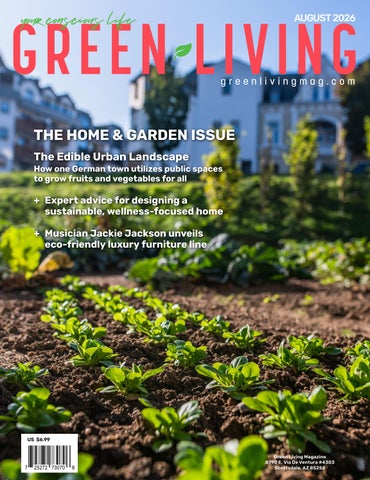
THE HOME & GARDEN ISSUE The Edible Urban Landscape How one German town utilizes public spaces to grow fruits and vegetables for all
+ Expert advice for designing a sustainable, wellness-focused home + Musician Jackie Jackson unveils eco-friendly luxury furniture line
US $6.99 Green Living Magazine 8790 E. Via De Ventura #4303 Scottsdale, AZ 85258
GREEN-LIVING
BEST OF
ARIZONA 2026
BEST OF ARIZONA CAST YOUR VOTE V OTE BY AUGUST 7, 2026
Vote Here greenlivingmag.com/best-of-arizona-2026/
Scan here to Vote
In Sedona F or 30 years, we believe in honoring the land that is not ours. We are dedicated to our guests to provide the highest level sourcing, environmental stewardship, and sustainability.
W e want our guests to enjoy our restaurants as more than just places to eat, because they are about making lasting memories. “In food we trust.” Visit LISADAHLFOUNDATION.ORG to learn more about our mission to fight food insecurity.
Dahl & Di Luca Cucina Rustica Mariposa Butterfly Burger Pisa Lisa CHEFLISADAHL.COM
CONTENTS
August 2026 GOOD
12 From Stage to Sofa
Jackson 5 member Jackie Jackson launches circular luxury furniture brand.
HEALTH & WELLNESS
14 A Kinder Portfolio
Vegan financial planning offers cruelty-free, sustainable, and conscious investing.
STYLE
16 Blue Jeans Go Green
Sustainable designers transform basic denim into high fashion.
HOME
Secret to a Thriving 18 The Landscape
Healthy plants, lower water bills, and a more eco-friendly home all start with watering wisely.
SAVOR
28 Fresh to Your Door
Eat Clean PHX proves that healthy meals can be convenient, craveable, and built for real life.
30 Recipes
Sample summer’s freshest flavors with a tomato-forward iced tea and a chopped salad bursting with farmers market finds.
24 Courtesy Sesshu Design Associates
FEATURE
20
Sowing the Seeds of Change
24
Designing with Purpose
How one German town became an international example of urban green space management.
For Arizona’s top green designers, style and sustainability go hand in hand.
On the cover: The edible city of Andernach, Germany. Photo by 90Grad Photography – Hilger & Schneider GbR
2 GR E E N L I V I N G | greenlivingmag.com
TRAVEL
32 California Dreamin’
At The Ranch and Laguna Beach, high-end guest experiences and resource conservation are mutually exclusive.
DESIGN
34 Re-Making History
GH2 Architects finds a passion in historic preservation and adaptive reuse.
TECHNOLOGY
36 The Deadliest Thing You Can't See
Researchers at ASU have developed an online navigation tool that will mitigate pedestrian heat exposure.
IN EVERY ISSUE
4 4 6 8 10 40 42
Editor’s Letter Contributors On the Web Trending Green Cool Outrageous Stuff She's Green/He's Green Green Scenes
TAKE THE GUESSWORK OUT OF WATERING IN THE ARIZONA DESERT. The newly updated Landscape Watering by the Numbers guide is here! View it online. The numbers. The know-how. The confidence to water smarter. WaterUseItWisely.com/HowToWater
AUGUST 2026
| GREEN LI V I NG 3
EDITOR'S
Letter
Photo by Scott Baxter
Contributors
We’ve all heard the saying, “Home is where the heart is.” But perhaps a new way to think of it is “Home is where Earth is.” The way we live, the products we consume, and even the way we water our gardens have a profound effect on not just our personal well-being but also on the health of our planet. This month’s issue looks at the people and places that are doing their part to make our lives — and our environment — a better place. We introduce you to three interior designers who share their tips for creating a healthy, sustainable home, and take you to a small town in Germany that transformed its public spaces into edible gardens filled with fresh, organic fruits and vegetables that anyone can harvest for free.
Nora Burba Trulsson, writer Nora Burba Trulsson is a Scottsdalebased writer specializing in design, landscapes, sustainability, travel, food, and lifestyle. Her articles have appeared in numerous local, national, and international publications. She is the author of Taliesin West: At Home with Frank Lloyd Wright (Rizzoli, 2024), Living Homes: Sustainable Architecture and Design (Chronicle Books, 2001; paperback, 2008), and other books. www.noraburbatrulsson.com
As you flip through the pages, you’ll find stories designed to inspire and inform. Check out our Q&A with Ana Olaya, a vegan financial advisor who ensures that your personal savings match your personal ethics (Page 14). Learn how your landscape can thrive while conserving water (Page 18). And explore a selection of eco-friendly goods that are made from renewable resources, reduce environmental impact, and add style to your living spaces (Page 10). If you’re a Motown fan — or you just have a penchant for elegant home decor — we have a special treat for you. Former Jackson 5 member Jackie Jackson recently launched a line of sustainable furnishings that blend sculptural, minimalist aesthetics with circular design and eco-friendly materials. Jackson and his business partner, environmentalist and furniture designer Robert Milder, recently sat down for an exclusive interview with Green Living to discuss how their plush sofas, love seats, and armchairs transform plastic ocean waste into timeless luxury. Check it out on Page 12. We hope this issue motivates you to look at your home and your surroundings and find ways that you can make a difference. Living a sustainable life doesn’t mean living a boring life.
Rebecca L. Rhoades Managing Editor Got a burning question or comment? Reach out at editor@greenlivingmag.com.
4 G R E E N L I V I N G | greenlivingmag.com
Jackie Alpers, recipe creator Jackie Alpers is a food photographer, recipe developer, and cookbook author who lives in Tucson. Her book Taste of Tucson: Sonoran-Style Recipes Inspired by the Rich Culture of Southern Arizona (West Margin Press) is a RUSA award winner and UNESCO City of Gastronomy official selection. An expert on Sonoran and Southwest cuisine, Alpers was inducted into the Taste Awards Hall of Fame in 2024. Learn more at www.jackiealpers.com.
your conscious life
GREEN LIVING greenlivingmag.com
PUBLISHER MANAGING EDITOR ONLINE EDITOR ART DIRECTION & DESIGN EXECUTIVE VP OF STRATEGIC PARTNERSHIPS GRAPHIC DESIGNER COPY EDITOR STAFF PHOTOGRAPHER EVENT MANAGER CONTRIBUTORS Melanie Albert Jackie Alpers Nora Burba Trulsson Jennifer Burkhart John Burkhart
Dorie Morales Rebecca L. Rhoades Alice Hafer Sly Panda Design Cynthia Pierce Melat Alebachew Erin Wilson Brett Prince Monique Smith
Donna DiFrancesco Michelle Talsma Everson Teresa Traverse Beth Weitzman
INTERNS Penelope Tsiopos Joyce Wriden BUSINESS DEVELOPMENT & PARTNERSHIPS Cynthia Pierce - cynthia.p@greenlivingmag.com Don Fergus - don.f@greenlivingmag.com George Heussner - george.h@greenlivingmag.com sales@greenlivingmag.com Event Manager - events@greenlivingmag.com
SUBSCRIBE TODAY! NEWSLETTER
CONTACT US AT:
Subscriptions: hello@greenlivingmag.com Advertising: sales@greenlivingmag.com Editorial: editor@greenlivingmag.com
480.840.1589 • www.greenlivingmag.com 13845 N Scottsdale Rd, Ste. 201, Scottsdale, AZ 85254
MAGAZINE
Please recycle this magazine Green Living magazine is a monthly publication by Traditional Media Group, LLC. Periodical rate postage paid at Scottsdale, AZ. Publisher assumes no responsibility for contributed manuscripts, editorial content, claims, reviews, photographs, artwork or advertisements. The opinions, beliefs and viewpoints expressed by the various authors and forum participants do not necessarily reflect the opinions, beliefs and viewpoints of the company or official policies. Every effort is made to avoid errors. misspellings and omissions. However, if an error comes to your attention, please accept our sincere apologies and notify us. Entire contents ©2026 Traditional Media Group. All rights reserved. Reproduction or use of content in any manner without permission by the publisher is strictly prohibited. Opinions expressed in signed columns and articles do not necessarily reflect the views of the publisher. Submissions will not be returned unless arranged to do so in writing. One print subscription is $39.99 per year or digital subscription is $15.99 per year. Canadian orders please add $25 per year for shipping and handling. International orders add $24.99 per year for shipping and handling. Bulk and/or corporate rates available. No representation is made as to the accuracy hereof and is printed subject to errors and omissions.
AUGUST 2026
| GREEN LI V I NG 5
ON THE
Web
This month on greenlivingmag.com and social media. /greenlivingazmag
@greenlivingmag @greenlivingmagazine
@greenlivingaz
@greenlivingmag
/green-living-az-magazine
HOME
GOOD
HOME
Plant a Garden That Drinks Less and Gives More
The Secret to Harding Spring, Sedona’s Free Natural Water Source
Up to 70% of household water use occurs outdoors. Planting these five drought-tolerant plants — lavender, agave, rosemary, juniper, and salvia — will conserve water in summer, as each has evolved in places where rain is scarce and the sun is relentless.
About 8 miles north of Sedona on Highway 89A, a spring releases water straight out of the ground. This water is thought to have been filtered through rock for centuries. Some visitors come for the taste, some to avoid the use of plastic bottles, and some for the water’s mystic energy.
Earthship Homes: What They Are, What They Cost, and Whether They’re Worth It
6 GR E E N L I V I N G | greenlivingmag.com
First introduced by architect Michael Reynolds in the 1970s, Earthship homes are built from tires, bottles, and earth. Designed to produce their own power, water, and food entirely off the grid, they have complete energy independence. Financing is hard to come by, but it’s worth it for some.
OUR SUMMER HARVEST IS HERE AND IT’S FIRE! EASILY THE FINEST FRUITS AND OUR HEIRLOOM TOMATOES ARE ROLLING SOON!
Farm Fresh To You and Green Living have partnered to offer a 10% discount on your entire order, including artisanal products and ongoing deliveries of organic farm boxes, when you use the promo code GREENLIVING at checkout.
WWW.FARMFRESHTOYOU.COM
Peaceful, Pristine Paradise! This exceptional home on 63 acres was built by a visionary electrical engineer to demonstrate the can-do alternative of an EMF-free and toxin-free living environment. It is a model of green healthy living and off-grid independence, with all the conveniences and connectivity of the modern world but without the wireless electrosmog and environmental illness. Quality construction costs surpassed $900k for a self-sustaining lifestyle that also offers potential income, now yours for $594k. Paradise Awaits! Request Your Info Package:
Kevin Dunn, Realty Execs, 928 243-0313
AUGUST 2026
| GREEN LI V I NG 7
TRENDING
Green
Jeremy Bishop | Unsplash
Oak Trees May Store Less Carbon Than Expected
Terence Voller | Unsplash
Study Shows Common Pesticide May Be Harming Bumblebee Reproduction A new study by researchers at Georgia Tech has found that sulfoxaflor — a pesticide introduced in 2013 to protect crops such as soybeans and corn from sap-feeding insects — may be undermining bees’ ability to reproduce. Bumblebees support roughly one-third of the world’s food production, highlighting the need to protect crops without harming the insects that make harvests possible.
Trees fight climate change by converting absorbed carbon into wood for long-term storage. But a new Columbia University study found that oak trees keep absorbing carbon long after their growth stops — meaning that carbon never becomes wood. If forests store less than models predict, current emissions offset strategies may need to be fundamentally rethought.
D-Koi | Unsplash
Scientists Find a Weakness in “Forever Chemicals” PFAS or “forever chemicals” accumulate in drinking water, food packaging, and human blood, and almost nothing can break them down. A new study by researchers at Aarhus University in Denmark found that intense ultraviolet light generates hydrogen radicals from water that can destroy PFAS entirely, without added chemicals — the first real path to elimination rather than filtration.
Iggii | Unsplash
Scientists Just Mapped 68 Quadrillion Miles of Underground Fungal Networks Scientists have newly mapped a vast network of fungal threads stretching 68 quadrillion miles — about a third of the way to the Milky Way’s center — beneath every forest and grassland on Earth. These underground networks move an estimated 4 billion tons of carbon dioxide into the soil each year. That’s equal to approximately 11% of all humanrelated emissions.
8 GR E E N L I V I N G | greenlivingmag.com
Radhey Khandelwal | Unsplash
The Ocean Acts as a Natural Brake on Global Drought A study led by the Indian Institute of Technology Gandhinagar found that synchronized droughts affect only 1.8% to 6.5% of the planet’s land area at any one time. Shifting ocean temperature cycles create regional drought hotspots in some areas while simultaneously reducing drought risk in others, creating a natural planetary thermostat.
THE VALLEY'S EASY LOCAL COMPOST PICKUP SERVICE We're Now Offering Soft Plastics Recycling to All R.City Clients
480-269-5149
3950 E Indian School Rd Suite 130
602-595-4310
arcadiameatmarket.com
Free Range 100% Grass Fed, Finished Beef No Hormones No Antibiotics Delivered to your Doorstep or pick up locally at Arcadia Meat Market.
Open Range Market 12075 State Route Az 69 Suite F Dewey, Arizona 86327
Your Local Source for Pastured Meats, Responsibly Raised Beef, Chicken, Pork, Lamb Arizona local food supporting local ranchers and producers. New Customers
Mention Green Living and get 1st pound of ground beef for $7.50.
AUGUST 2026
| GREEN LI V I NG 9
CoolOUTRAGEOUS Stuff Home Goods That Do Good It’s no secret that trying to get your house to “go green” can be a challenge. With so many products on the market today, from cleaning supplies to furnishings, it’s easy to become overwhelmed when trying to choose eco-friendly options that benefit both your home and the planet. That’s why we’ve put together this collection of sustainable home goods that we hope will help you make your life a little bit more environmentally friendly.
The MK Free Board Plastic cutting boards slough microplastics and chemicals into our food, while wood ones absorb odors and can’t be sanitized in a dishwasher. The new Free Board by Material combines the ease of plastic with the nontoxic and sustainable construction of wood. This sleek lightweight board is made from an innovative plant-based material that’s a mix of clay and 100% USDA-certified biobased biopolymers. Nonporous, dishwasher-safe, and textured for controlled cutting, it’s also free of fossil fuels, PFAS, and food allergens. www.materialkitchen.com
Whalebuk Why settle for a boring basket when you can conceal your clutter in a cheery, brightly hued sea creature. Part of B Corp-certified Swiss shoemaker Baabuk’s Chalet Collection, the Whalebuk is handcrafted from mulesingfree New Zealand wool by artisans in Nepal. Mulesing is a painful procedure that removes strips of skin from a lamb’s backside to help prevent a common parasitic infection known as “flystrike.” The felted wool, colored with REACHcertified dyes, is soft, durable, and stain-resistant, making it easy to clean. With an inviting shape and lovable grin, Whalebuk makes cleanup fun for all ages. Cats love it, too! www.baabuk.com
Bamboo Sheet Set We spend one-third of our life in bed, so we might as well sleep with the knowledge that our sheets are earthfriendly. Vesta Sleep’s Bamboo Sheet Set is made from FSC-certified ultra-long organic bamboo fibers instead of synthetic materials and colored with plant-based dyes for silky smooth comfort that’s gentle on the skin, breathable, and naturally hypoallergenic. And it’s from a company that is committed to making its entire footprint — from its supply chain to the products it makes — carbon neutral by 2030. Use coupon code GREENLIVING for 10% off any Vesta Sleep purchase. www.vesta-sleep.com
10 G R E E N L I V I N G | greenlivingmag.com
ur Win yo boo m a b own set ! sheet
Check out our Instagram to learn more: @greenlivingmag
Plantable Pencil At first glance, the Plantable Pencil looks like a standard writing utensil. Made from sustainably harvested wood by SproutWorld, a certified B Corp, it features a 100% natural and nontoxic graphite core. But instead of an eraser, hidden at its end is a plant-based capsule filled with seeds. Once the pencil gets too short to use, simply plant it capsule-end down, and you’ll end up with cherry tomatoes for your garden, forget-me-nots for your windowsill, or even a Christmas tree. Each Plantable Pencil contains a single variety of flower, vegetable, or herb, and the labeled stub serves as a plant identification marker. www.sproutworld.com
Charlie Chair Each year, more than 1.3 billion pounds of plastic toys are discarded, with an estimated 80% ending up in landfills and oceans. Belgian company ecoBirdy transforms these unwanted playthings into colorful furnishings that are sturdy enough for children yet stylish enough for modern homes. With its rounded edges, wide stance, and large seating surface, the Charlie Chair is safe and comfortable for little ones. Crafted from ecothylene — ecoBirdy’s patented material made from recycled post-consumer plastic — it’s lightweight, stable, and easy to clean. And its unique speckled pattern, created from remnants of the source toys, ensures that no two chairs are ever the same. www.ecoBirdy.com
Laundry Powder You wash your clothes to get them clean, so why use products that coat them with harsh chemicals and synthetic fragrances? This powder detergent by women-owned B Corp Meliora contains only what’s needed: an all-natural MADE SAFE-certified formula of baking soda, washing soda, and vegetable soap made with organic coconut oil. But don’t let its simple ingredient list fool you. It’s as effective as a liquid detergent. And, it’s Leaping Bunnycertified cruelty-free and vegan. Choose from unscented or lavender, lemon, lemon-lavender clove, or peppermint, all made with organic essential oils. Each comes in a paper-and-steel canister that can be replenished with low-waste refills. www.meliorameansbetter.com
Kobble Task Light Great lighting can transform a space — and Californiabased innovator Gantri has transformed the way lighting is made. Designs are 3D printed on demand using a proprietary biodegradable polymer derived from non-GMO sugarcane and free from phthalates and BPA. This removes the need for large inventories and prevents unsold products from ending up in landfills. It also allows Gantri to partner with a range of designers from around the world, such as internationally renowned industrial designer Karim Rashid. The award-winning Kobble Task Light showcases Rashid’s signature “blobject” style, combining biomorphic shapes with a touch of futuristic whimsy to evoke a sense of harmony and energy. www.gantri.com
AUGUST 2026
| GREEN LI V I NG 11
GOOD
From Stage to Sofa Jackson 5 member Jackie Jackson launches circular luxury furniture brand. BY REBECCA L. RHOADES
A
As the oldest member of the legendary musical group The Jackson 5, Jackie Jackson achieved global fame when he was just a teenager, selling millions of records that included such classic hits as “I’ll Be There” and “ABC” and helping establish Motown as one of the world’s most famous music labels. But his travels, which included staying at some of the best hotels in the world, sparked another interest.
“The furniture industry was always something I wanted to get involved with,” he says. “Even when I was traveling with my brothers, doing concerts, I would always stop into all the newsstands throughout the airports and buy all kinds of design magazines, such as Architectural Digest. And now that I’m finally here, now that I’m making furniture, I’m really excited about it.” Here, for Jackson, is at the helm of Hayvenhurst, a sustainable luxury furniture brand he co-founded with his wife, Emily, and Dutch designer Robert Milder. Named after the historic Jackson family compound in Encino, California, the brand debuted at Milan Design Week in 2025 to critical acclaim. BUILDING A DREAM The idea for Hayvenhurst came to the Jacksons when they were remodeling their Las Vegas home
12 G R E E N L I V I N G | greenlivingmag.com
and couldn’t find sustainable furniture options that they liked. Recognizing the gap in the market, they decided to develop their own product line that was not only beautiful but that also supported their values. But they needed a partner who knew how to navigate the industry. Emily had heard about Milder, who in 2018 had founded the sustainable brand Van de Sant, and was impressed by his use of recycled ocean plastics. A former graphic designer, Milder always had an interest in the environment and sustainable solutions. It was during a vacation in the Caribbean that he was inspired to develop furnishings. “I went for a swim, and I was literally swimming in plastics,” he explains. “There’s a bay in Curacao — they call it ‘plastic bay’ — where marine trash and plastics wash ashore. I thought to myself that something needs to be done.”
Inspired, Milder began experimenting and developed a furniture frame made from recycled ocean plastics. He covered it with alternative eco-friendly padding and upholstery, creating the first sustainable soft seating. Today, his furnishings are found in high-end hotels, corporate offices, and luxury locations across the globe.
Hayvenhurst’s oversize rounded, sculptured silhouettes offer a refined nod to the 1980s and ’90s but with an elevated appeal that adapts well to clean, modernist architecture. The fabrics, in soft hues of taupes, creams, grays, and greens, balance the minimalism and bring a quiet sophistication to the designs.
Jackson recalls, “My wife introduced me to Robert, and he was on the same wavelength, doing the same thing I was trying to do. Taking waste from our oceans and lakes and turning it into sustainable furniture — to me, that’s the future.”
“The fabrics are made with a lot of recycled and recovered materials, but we can compete with all of the high-end brands when it comes to quality and comfort,” Milder says. Jackson adds, “They pretty much blow your mind when you sit on them and feel the comfort of them. It’s unbelievable.”
WHERE SUSTAINABILITY AND LUXURY MEET
DESIGNING LASTING GROWTH
The traditional furniture industry takes a significant environmental toll. From widespread deforestation to toxic chemical use and overflowing landfills, it has devastating consequences for our planet.
All of Hayvenhurst’s furnishings are crafted in Holland, in part because that’s where Milder lives, but also because the country has strict laws which mandate that manufacturers are responsible for managing the entire life cycle of the products they produce.
For example, the industry is the primary driver of global deforestation, clear-cutting more than 15 million hectares of forest annually. Many pieces are made with low-quality materials that can’t be readily recycled or repurposed. They also contain harmful chemicals, including formaldehyde and volatile organic compounds (VOCs). Furthermore, Americans alone discard more than 12 million tons of furniture each year, with approximately 80% ending up in landfills. Milder adds, “One kilogram of cotton needs [almost 800 gallons] of water to grow. But if you use recycled and recovered materials, you don’t have that process. Reducing water usage, reducing materials, using recovered materials: That’s how we end pollution in the world.” Like Milder’s Van de Sant line, Hayvenhurst pieces begin with a recycled plastic frame and are covered with bio-based and organic materials. Natural latex rubber and bio-based synthetics lend plush comfort. They’re topped with layers of coconut fibers, horsehair, sheep wool, and recycled denim and then cloaked in organic textiles, such as linen and hemp.
“In Holland, we have a whole system in order, from collections, to pickups, to recycling. It’s quite a process, and it’s not something you’ll find in every country,” Milder says. “Our furniture is also circular, so at the end of its life cycle, we can take it back. We use every part of that piece so that the whole cycle starts over again,” Milder continues. “Designing the old-fashioned way is not possible if you want to change the world.” Jackson agrees. “It’s about honoring the past while looking at where we’re going,” he says. “Hayvenhurst is the way of the future. The modular Calabasas collection combines oversize proportions and relaxed style.
The Galapagos Chair, which features Savian by BioFluff, the world’s first 100% plant-based, plastic-free, vegan alternative to fur and shearling, is an example of how sustainability can be had without compromising on comfort and style. AUGUST 2026
| GREEN LI V I NG 13
HEALTH &
Wellness
A Kinder Portfolio
Photos by Dave Pisani
Vegan financial planning offers cruelty-free, sustainable, and conscious investing. BY MICHELLE TALSMA EVERSON
A
For Ana Olaya, values are not separate from financial planning. They are part of it. As a vegan financial professional — a term used to describe wealth managers or consultants who adhere to vegan principles in life and career — Olaya brings together experience in finance, impact investing, and environmental work with a commitment to animal welfare and sustainability. She works with clients who want their financial lives to reflect more than numbers on a page. For many, that means looking closely at where their money goes, what it supports, and whether or not their investments align with the kind of future they want to help build. Here, Olaya shares what vegan financial advising means, why clients seek it out, and how money can reflect personal values. For those who may not be familiar with the term, what does a vegan financial advisor do? I help people and organizations invest in ways that are consistent with their values. For a vegan client or animal nonprofit, that may mean building a portfolio that avoids activities they do not agree with, such as factory farming, animal testing, or products that harm animals.
14 G R E E N L I V I N G | greenlivingmag.com
At the end of the day, I do what every good financial advisor does: help people and organizations make better decisions about money. For clients with deeply held ethical values, that means making choices that stay true to those values. At first glance, veganism and financial planning may seem like two separate worlds. How do those values come together in your work? Values-aligned investing asks, “What if the way we invest reflects the kind of world we want to create from the beginning?” My role is not to tell people what their values should be. It is to help them invest in a way that is consistent with the values they already have, whether that is animal welfare, social justice, or environmental sustainability. My approach still uses fundamental principles of finance, including longterm wealth building, risk management, and goalsbased planning.
When you’re helping someone build a portfolio, what kinds of companies or practices are you looking to avoid, and what kinds are you hoping to support? Some people assume vegan investing means investing only in alternative food companies. But putting all of your investments into a single company is not generally a sound strategy. It is more of a risky bet.
Habitat for Humanity Central Arizona
From my perspective, a better approach is one that excludes cruelty and is built on diversification and quality. So for a vegan portfolio, that means avoiding companies tied to animal food production, leather or fur, animal testing, or breeding animals for entertainment. I also look at broader issues, including human rights violations and prison labor.
every donation makes a difference Why do clients usually seek you out? Are they specifically looking for a vegan advisor, or are they more broadly looking for someone who understands values-based investing? It is a mix, but many clients have been vegan or vegetarian for years and eventually wonder whether their investments can reflect those same values. They search for terms like “cruelty-free investing” or “vegan financial advisor,” not always knowing if that exists, and they’re excited to discover that it does. What do you hope people take away from your work about the connection between money, personal values, and impact? People seek out values-aligned investing because they want to create a financial path that feels more coherent with the world they envision. I am here to be a partner in that. To learn more, visit www.uncagedimpact.com or email ana@uncagedimpact.com.
By donating gently used items to your Habitat ReStore, you’re not just clearing out your home; you’re helping to build homes, strengthen communities, and instill hope throughout Arizona.
When you recycle your old home goods, you help Habitat for Humanity Central Arizona build more homes in your local community. Learn more at habitatcaz.org/restore AUGUST 2026 half-page ad Green Living 2025-2026.indd 7
| GREEN L I V I NG 15
9/9/25 3:49 PM
STYLE
Blue Jeans Go Green
Photos by Cullen Coughlin
Sustainable designers transform basic denim into high fashion. BY TERESA K. TRAVERSE
A
Denim is a staple of the American closet, but the sturdy textile also happens to have a hugely negative impact on the environment. One of the biggest culprits is indigo dye, which gives jeans their signature blue hue. The denim industry uses roughly 50,000 tons of synthetic indigo annually. Dying just one pair of jeans can require up to 30 gallons of water. And from start to finish, it takes an estimated 790 gallons of water to make a single pair of the timeless trousers. It doesn’t have to be this way, though. At least not if fashion designer Angela Johnson has anything to say about it.
reducing waste, creating products that last, manufacturing responsibly, and educating consumers to value quality over quantity.”
“The fashion industry is one of the largest contributors to waste and pollution, but it also has incredible potential to become part of the solution,” she explains. “Sustainability isn’t just about using ecofriendly materials. It’s about designing thoughtfully,
Johnson is the CEO of Arizona-based nonprofit incubator FABRIC (Fashion and Business Resource Innovation Center). She co-founded FABRIC along with former design entrepreneur and business executive Sherri Barry in 2016 to help emerging fashion designers
16 G R E E N L I V I N G | greenlivingmag.com
create and launch their own businesses. Since its inception, FABRIC has helped more than 2,500 entrepreneurs realize their design dreams.
to make a complete kimono infused with Western elements, including embroidered pockets and a vertical slit in the back.
One way it does so is through its annual ReFABRICate Fashion Show, which challenges designers to create a new runway-ready piece made from upcycled denim. The show, which is held in April, kicks off FABRIC’s signature event, Eco Fashion Week.
“I think my outfit stood out because it was a kimono. I believe the judges appreciated how I harmonized the fabric colors to create an artistic atmosphere,” Widlow says. With her company, she strives to create pieces with flexible sizing options that are made from highquality fabrics that will last and also produces small production runs to reduce waste.
“Denim was chosen because it’s universally recognizable and widely available as a post-consumer textile. It’s durable, versatile, and often overlooked once it’s no longer wearable,” Johnson says. More than just a fashion parade, ReFABRICate also is a competition, with the winner receiving the RunzWithScissors award and a $250 gift card to Tempe Marketplace stores. This year, Hiroko “Roko” Widlow commanded the runway with her upcycled kimono. She applied the process of kintsugi — a Japanese artform in which gold or silver lacquer is used to repair broken pottery — to her winning denim creation by applying gold paint to the seams. “It was an unexpected and incredibly creative interpretation of the challenge that remained true to her own brand aesthetic while fully embracing the competition’s theme,” says Johnson, when discussing why Widlow took top honors. Widlow is behind the Phoenix-based fashion line Captivation by Roko. She’s known for her comfortable, flexible designs that blend Japanese and American/Western style. This was her first time entering the competition. Her husband suggested she make an “obi” or kimono sash. Instead, she decided
“Sustainability is important to me because I believe clothing should bring lasting value to people’s lives rather than being disposable,” Widlow continues. “Fashion has the power to inspire confidence and self-expression, but it also has a responsibility to reduce unnecessary waste and overconsumption. For me, sustainability is not just about using eco-friendly materials. It is about thoughtful design, responsible production, and creating garments that people will love and wear for years.” Johnson adds, “At FABRIC, we believe sustainability should be built into every step of the product development process. Even small changes made by thousands of brands can have a significant impact. We want to prove that small-batch, ethical, and sustainable manufacturing is not only possible, but profitable.” This year marked the 10th anniversary of the reFABRICate Fashion Show. Thirty-three designers showcased 40 stylish, eco-friendly ensembles. Designers were evaluated on creativity, craftsmanship, innovation, wearability, overall presentation, and how well the material was transformed into something new. Visit www.fabricincubator.com for more information.
Optimal Wellness. Designed From the Ground Up.
WELL Designed™ | Sesshu Design Associates
Studio 480-275-2968 | SesshuDesign.com
Interiors engineered for recovery, sleep, and longevity.
AUGUST 2026
| GREEN LI V I NG 17
HOME
The Secret to a Thriving Landscape
Healthy plants, lower water bills, and a more eco-friendly home all start with watering wisely. BY DONNA DIFRANCESCO
A
Arizonans spend countless hours choosing plants and creating beautiful outdoor spaces that reflect the Sonoran Desert’s unique beauty. But once everything is planted, one decision matters more than almost any other: how you water.
More than half of a typical household’s annual water consumption stems from outdoor use. Yet many Valley yards and gardens receive far more water than they actually need — not because homeowners don’t care but because watering often becomes habit instead of intention. We water because it’s Tuesday. We water because that’s what we’ve always done. We water because that’s the schedule the landscaper or previous homeowner programmed years ago. So, what’s the problem? Water needs change with the seasons, the weather, and the plants themselves — but many irrigation schedules never fluctuate. That’s just one reason landscapes are often watered far more than they need to be. And with ongoing reductions in Colorado River supplies, learning to water wisely has never been more important.
18 G R E E N L I V I N G | greenlivingmag.com
MAKING EVERY DROP COUNT Healthy landscapes thrive when they’re watered deeply, infrequently, and seasonally. Deep watering encourages roots to grow farther into the soil, making plants more resilient during Arizona’s long, hot summers. Frequent shallow watering, on the other hand, produces weaker root systems, allows more water waste through evaporation, and can stress plants over time. But there’s some good news! Watering smarter doesn’t necessarily mean watering more — or less. It means watering the right amount, in the right place, at the right time. How deep should water soak into the soil? How long should your irrigation system run? How many emitters — the drippers that deliver water to the plants
and soil — does a growing tree really need? When should you adjust your controller as the seasons change? Knowing these answers can help you grow a healthier landscape while saving water and money. Even small adjustments can save thousands of gallons of water each year without sacrificing the beauty of your yard.
Fortunately, homeowners don’t have to figure it out alone. Landscape Watering by the Numbers: A Guide for the Arizona Desert is a trusted resource for landscape watering. First published in 2001, this interactive guide received a comprehensive update in June 2026. It brings together the latest University of Arizona research with the expertise of irrigation specialists, horticulturists, and water conservation professionals from communities across the Grand Canyon State. Inside, step-by-step watering guidance, helpful diagrams, quick-reference guides, and online resources cover everything from watering trees and shrubs to rainwater harvesting, graywater, mulch, and other strategies for creating a more resilient, water-efficient landscape. And every recommendation reflects today’s best practices while remaining practical and easy for homeowners to put into action. A truly sustainable landscape isn’t simply one filled with desert-adapted plants. It’s one that’s watered wisely. Request a free printed copy of Landscape Watering by the Numbers at www.WaterUseItWisely.com/ HowToWater.
SUMMER IS HERE. YOUR BODY WILL
$
100
OFF YOUR FIRST PREMIUM IV
NEW CUSTOMERS ONLY Valid until September 15, 2026
MEET THE CITRUS SPRITZ IV
a refreshing blend designed to support hydration, immunity, energy, mental clarity, and focus. Perfect for busy professionals, parents, athletes, and anyone wanting to feel their best this summer. Relax in our zero-gravity massage chairs and enjoy the ultimate one-hour wellness escape.
HIGH STREET
HIGH STREET
5310 E High St, Suite 103, Phoenix, AZ 85054 46022 97554918
BASELINE & GILBERT
BASELINE & GILBERT
2048 E. Baseline Rd., Suite 6, Mesa, AZ 85204 44800 57119824
AUGUST 2026
| GREEN LI V I NG 19
20 G R E E N L I V I N G | greenlivingmag.com
Courtesy of Deutschland.de
Sowing the Seeds of Change By making fruit and vegetable gardens available to everyone, the small town of Andernach, Germany, became an international example of urban green space management. BY REBECCA L. RHOADES
C
Community gardens are increasing in popularity, blossoming from a niche hobby into a widespread movement that’s transforming cityscapes across the country. In New York City, Brooklyn Grange operates the world’s largest rooftop soil farms, spanning almost 5 acres across multiple buildings and producing more than 80,000 pounds of organically grown vegetables each year. In Colorado, Denver Urban Gardens stewards about 200 community gardens and food forests across seven counties, providing fresh, healthy produce to underserved populations. And in Detroit, the Michigan Urban Farming Initiative has produced and distributed more than 50,000 pounds of organic produce to about 2,000 households since the project began 15 years ago.
While these programs create green spaces and provide free or low-cost food, they’re just a small segment of the downtown landscape. Now imagine an entire town where fruits and vegetables grow throughout the streets. A place where anyone can open their door and pick fresh produce, free of charge. A veritable WonkaLand of berries, nuts, herbs, legumes, leafy greens, and even edible blooms. Welcome to Andernach, Germany, the world’s first “edible city,” In 2010 — the International Year of Biodiversity — the small town of about 30,000 residents on the left bank of the Rhine river, took a bold gamble: It turned its public parks into a free open-air grocery store, replacing ornamental flowers and unused lawns with lush gardens filled with edible produce that anyone can harvest for free. The goal was simple: to make biodiversity and food production visible and tangible in public spaces and to get residents more engaged in their community. Today, the town is a model of urban agriculture that has inspired similar undertakings in other destinations across Europe, Africa, and South America.
PICKING ALLOWED The project began with tomatoes. The city planted 101 varieties of the juicy red salad staple, highlighting the importance of biodiversity in the city center. Each year since, a different edible plant has been the focus: 2011 showcased 100 types of beans, 2012 was 20 onion varieties, and 2013 was the year of the cabbage. “This year, the focus is on fruit,” says Jonas Gesell, head of environment and sustainability for the Andernach city administration. “For example, apple espaliers have been placed on the market square, berry bushes have been integrated into existing beds and raised beds, and mobile fruit trees are being placed on sealed surfaces in the city center. The idea is to bring more greenery, shade, and edible plants into areas where traditional tree planting is often difficult. “In the beginning, there was some skepticism, and people first had to understand that they were really allowed to harvest from public beds,” Gesell adds. “Today, however, residents appreciate the gardens, stop to look at the plants, talk to the gardeners, and harvest fruits, vegetables, or herbs when they’re ripe.” AUGUST 2026
| GREEN LI V I NG 21
In addition to the annual featured produce, crops include zucchini, lettuce, beans, onions, pumpkins, and berries. Fruit trees include apples, pears, quinces, Mirabelle plums, cherries, and peaches. There are even more climate-adapted species, such as figs, persimmons, bitter oranges, kiwis, Indian bananas, almonds, and chokecherries. No pesticides are used, and the edible plants are interspersed with pollinator- and bird-friendly blooms and seedbearing flora.
According to Gesell, the project has developed into a broader concept of sustainable urban green space management. It combines biodiversity, climate adaptation, environmental education, urban agriculture, public space quality, and social aspects. While raised beds, fruit trees, and other edible offerings are scattered throughout the city, the most visible areas are located in the city center and along the medieval city wall. About 2 acres along the walls are planted with leafy greens, root vegetables, table grapes, brassicas, and nuts. Another acre in the Historic Garden is planted exclusively with medicinal herbs, heirloom crops common to the Roman diet, and grapevines. These plots are complemented by a community garden on the outskirts of the city and a 34-acre permaculture garden outside of the city where rare breeds of livestock such a Coburg fox sheep and saddleback pigs are reared. Chickens are raised for their eggs, and bees make up to 90 pounds of honey a year. These products are sold in a shop in the city center.
22 G R E E N L I V I N G | greenlivingmag.com
Signs stating “Picking Allowed” are scattered around the town, encouraging residents and visitors to grab an apple, pull a carrot, or twist off a plump strawberry. A “traffic-light” system of colored cards placed in the beds announce when the crops are ready to harvest. Red means “not ready for harvest,” yellow is “harvest only if very hungry,” and green signifies “ready for harvest.” Gesell notes, “For tourists, the gardens are part of the overall experience of the city center, especially because the edible areas are integrated in public spaces rather than being located in one separate garden.” Photos by 90Grad Photography - Hilger & Schneider GbR
CIVIC PRIDE Andernach’s “edible city” program isn’t just a horticulture initiative — it’s a social initiative, as well. The program is managed by Perspektive gGmbH, a local nonprofit that offers employment and training opportunities for socially disadvantaged individuals and those with mental health conditions. Professional gardeners from the town’s urban planning office oversee the project, and they are assisted by workers referred by Perspektive. The project also provides opportunities to educate people about nutrition and nature. Local primary schools have created their own gardens, which helps to foster a respect for nature and raise awareness of sustainability among young children. And despite concerns early on about vandalism, “serious vandalism or misuse has remained limited,” Gesell explains. “Our experience is that most people are respectful of the areas, especially because they understand that these are useful and valuable public spaces. “Of course, there have been some challenges in maintaining the gardens,” he continues. “The main ones are regular care, watering during hot and dry periods, choosing the right plants for each location, soil quality, and dealing with the fact that public spaces are used in many ways. Some fruits are occasionally harvested too early, and in some areas, animals, such as geese, can also be a challenge.”
cities,” he says. “The basic idea is very transferable: public green spaces can be more than decorative. They can support biodiversity, make food production visible, create more attractive public spaces, contribute to environmental education, and strengthen people’s identification with their city. The key factors are clear responsibilities, long-term maintenance, suitable locations, and the willingness to start with visible pilot projects.”
In 2018, Andernach joined the Edible Cities Network, an EU-funded project that ran until 2023. Member cities were encouraged to exchange experiences and lessons learned with each other. It also assisted municipalities that wanted to develop their own edible programs. Fifteen years after it implemented its edible initiative, Andernach continues to attract attention from municipalities and environmental organizations regarding replicating this approach to urban gardening elsewhere. Gesell notes that upward of 100 guided research tours of the gardens take place each year as interest in the project continues to spread. “I would definitely recommend this program to other AUGUST 2026
| GREEN L I V I NG 23
Designing with Purpose For Arizona’s top green designers, style and sustainability go hand in hand. BY REBECCA L. RHOADES
T
Today’s interior designers are redefining what it means to live beautifully and responsibly. Instead of simply incorporating the trends of the moment, they’re crafting spaces that not only reduce negative impacts on the environment, but that also increase the health and comfort of those who reside within them. From incorporating eco-friendly materials and eliminating unnecessary waste to choosing healthier, lowemission finishes and reducing a home’s carbon footprint, interior designers do more than make rooms look good. In this article, we celebrate three of Arizona’s top purpose-driven design professionals. Whether you’re redesigning a single room, building new, or simply curious about sustainable living, they will show you how to transform your home into a space that’s functional, aesthetically pleasing, and has a positive impact on both you and the outside world. Incorporating nature into a room, whether through colors, live plants, or a visible connection to the outdoors, is key to creating a healthy home. Courtesy of Shannon Harris
24 G R E E N L I V I N G | greenlivingmag.com
A Happy, Healthy Home Tanya Shively has been at the forefront of green design in Arizona for more than 20 years. In fact, if you Google “sustainable interior designers,” her name pops up on lists of the best, not just in the state but around the country. As the founder of Scottsdale-based Sesshu Design Associates, Shively believes that style and luxury design should also be environmentally responsible. Recently, she’s moved beyond simply being eco-friendly to creating spaces that also enhance the homeowners’ well-being. “We have what we call our ‘Well Designed’ philosophy, which focuses on wellness, well-being, eco-conscious selections, and luxury livability,” she says. “Being eco-conscious is still a big part of what we do. We’re always looking for nontoxic materials; renewable, recycled, sustainable woods; natural fibers; all of those kinds of things. But then we’re also looking at ways that these materials and products help improve your wellness, as well.” A main focus of Shively’s approach is incorporating biophilic principles into her designs. Biophilic design is the integration of natural materials and elements into built spaces, blending architecture and the outside world. “Biophilic design simply means taking cues from nature,” Shively explains. “Sometimes that means using patterns and textures that are natural or mimic nature, creating architecture that increases air movement, or taking advantage of natural light and views of the outside. Biophilic design can be really technical or it can just be decorative. “It really does affect your mental and emotional well-being,” she continues. “That connection to nature can improve sleep, increase productivity, reduce stress, and improve your focus. Shively’s work has been recognized nationwide, and she’s won numerous accolades for her approach to design. She was named Best Sustainable Designer in Green Living’s inaugural Best Of Arizona awards in 2022, an honor she repeated in 2023.
Tanya Shively’s Top 3 Tips for Creating a Sustainable Home 1. Use natural fibers: “When purchasing textiles, such as sheets, carpets, upholstery, or draperies, steer away from man-made materials, especially the petroleum-based nylons and polyesters. Instead, look for linen, wool, silk, or cotton.” 2. Bring nature indoors: “Whether it’s a live-edge wood table that gives you a hint of the tree from which it came or a natural stone wall, incorporate items that remind you of their true origins.” 3. Maximize natural light: “Natural daylight affects our body’s circadian rhythm, letting us know when to be active and when to slow down. Large windows and floor-to-ceiling sliding glass doors connect your home with the outdoors.”
AUGUST 2026
| GREEN L I V I NG 25
Whole Person Design When it comes to interior design, there are a lot of approaches that guide how a space is shaped. From Wabi-Sabi, which celebrates natural flaws, to Feng Shui, which optimizes energy flow, these concepts not only elevate aesthetics but infuse healing energy into a home. One of the fastest-growing fields is neurodesign, which sits at the intersection of neuroscience, psychology, and interior design. And it’s at the core of Shannon Harris’ design strategy. “Neurodesign is a topic that I’m very passionate about,” says Phoenix-based Harris, the founder of HomeSelf (formerly known as Fuse Living). “Every way that we experience our world and our environment is through our senses. So the neuroscience of who we are and how we behave comes through a direct association with the types of environments we’re around.” She adds, “When it comes to designing spaces and homes, it’s really about what type of sensory experience are we providing, and how we can design it to support us in our daily functions, our current phase of life, and our cognitive load.” According to Harris, too many people design their homes around what others like or what they think they should do based on current trends. “They’re not truly leaning into what speaks to them because they fear it’s too different or it’s not going to be accepted by others. Using science-backed information, I try to break that barrier,” she says. For each client, Harris conducts a home analysis that assesses everything from temperature, natural lighting, and noise control to colors and patterns and even spatial flow. “You learn how to read your internal cues that say things like, ‘I always thought I would love this color, but I feel my body getting really tense in this room,” she explains. “Home design is very nuanced,” she says. “Once you learn how those cues are really affecting you, you can begin to find ways to make your home feel better.”
Shannon Harris’ Top 3 Tips for Creating a Sustainable Home 1. Start with bedding: “A third of our time is spent in bed, so our sheets and our mattresses play a big role in what chemicals we’re inhaling. Choose natural fiber linens made without harsh dyes or softeners.” 2. Pay attention to lighting: “Lighting connects the dots in a lot of ways. It gets into home biology, human biology, and mood enhancement. Pay attention to natural lighting patterns that speak to circadian rhythms." 3. Create a sense of permanence: “There’s something to be said about the psychology of permanence. Even if it’s not your forever home, you’re going to feel more grounded and lean into your space if it feels like it is yours rather than looking or feeling temporary.”
26 G R E E N L I V I N G | greenlivingmag.com
Function Over Form When Stephanie Ebner first tours a client’s home, she looks for ways to reuse and repurpose what is already in the rooms. “I try not to say, ‘Well, we’ve got to take everything out and start fresh,’” she says. “I really try to meet people where they’re at and see what things I can keep that they already have.” In fact, one of the biggest issues Ebner sees when it comes to homes is that we all just have too much stuff. We buy things because we like the look of them, but once we get them home, we realize they don’t fit into our space or they don’t support our lifestyle or needs. “Ultimately, the piece that we loved so much ends up not functioning in our home,” she says. “So I like to start with, ‘How does the space function for you?’ I want to make sure that the pieces I’m recommending and selecting are going to make sense for what you need them for.” As a relative newcomer to Arizona — Ebner moved here from Philadelphia in 2023, expanding Down2Earth Interior Design to the West — she brought with her the firm’s strong belief in sustainability that includes working with what the client already has and eliminating unnecessary landfill waste. And if new products are needed or wanted, she focuses on longevity. “I don’t want you to have to always be replacing things because they don’t hold up over time,” she explains. “Any investment you make in your home should last a really long time.” This approach earned Ebner the title of Green Living’s Best Sustainable Interior Home Designer in 2025.
Stephanie Ebner’s Top 3 Tips for Creating a Sustainable Home 1. Have a plan: “Having a plan is one of the most sustainable things you can do, because it stops you from buying things that you don’t love or don’t need. Putting together mood boards, getting correct measurements, and knowing your storage needs ensure you’re finding pieces that fit the function of your space.” 2. Look at what you already have: “You can update your home simply by repurposing or giving new life to what you already have. Move an item to another room, update the frame on a piece of art, paint your cabinetry instead of replacing it, or change out hardware for a fresh look.” 3. Recognize greenwashing: “If a company talks about sustainability and being eco-friendly but doesn’t give specifics, it’s probably not that sustainable. Look at how vendors are manufacturing their products, what their processes are, and what kinds of materials they’re using. The more specific they are, the more likely they are to be truly sustainable.”
AUGUST 2026
| GREEN L I V I NG 27
SAVOR
Fresh to Your Door
Eat Clean PHX proves that healthy meals can be convenient, craveable, and built for real life. BY BETH WEITZMAN
H
Healthy eating often falls apart in the space between intention and reality. A farmers market haul looks beautiful on Saturday. By Tuesday, the week is moving too fast, and cooking is the first casualty. Takeout is the easy fallback but rarely meets the same standard. That is the gap Ryan and Brittany Powell set out to fill when they launched Eat Clean PHX in 2018. The meal delivery service was built around the idea that better food should fit real life.
The Powells came up with the idea for their business after trying multiple meal services and finding that most options were “either bland, overly restrictive, or marketed as healthy while still using ingredients we did not feel good about,” they explain. Their answer was not simply to create another meal prep company, but to build one people could trust. “Healthy food should not be so hard to find, and it should not feel like a sacrifice,” they say. “When we create meals, we think about real households,” the couple adds. “Would our kids eat this? Would we serve it to our own family? Would someone be excited to eat this again?” Meeting those requirements means using organic ingredients and organic extra virgin olive oil — no seed oils here — and showcasing proteins such as wild-caught Argentinian shrimp, wild-caught salmon from Alaska, organic chicken, and grass-fed beef, including local Arizona beef from Cottonwood. Even sauces, marinades, and other components are crafted from scratch. Many ingredients, such as herbs, vegetables, eggs, and chicken, come from local
28 G R E E N L I V I N G | greenlivingmag.com
growers, including Duncan Family Farms in Goodyear and Blue Sky Organic Farms in Litchfield Park. These relationships “help keep us connected to the agricultural side of the business,” the Powells say. “That matters to us. Sustainability is not just something you say. It shows up in sourcing, freshness, transportation, waste reduction, and how you plan menus.” Such a commitment to quality doesn’t always come easily. The Powells note that better ingredients cost more, and organic or premium sourcing is not always as predictable as conventional sourcing. That sometimes means adjusting menus, absorbing higher costs, or saying no to ingredients that would be easier or cheaper to use. It’s all part of protecting the brand, which is, at its core, a family business. “When your family name is tied to the company, it feels very personal,” the couple says. Customers appreciate this attention to freshness, balance, and nutritional value, in addition to convenience. “A lot of people come to us because they want consistency,” the Powells explain. “Some are trying to lose weight, some want to build muscle, some are busy
parents, and some are just tired of relying on takeout. The common thread is that they want food they can trust. They’re asking about oils, ingredients, protein, sodium, organic sourcing, gluten, dairy, gut health, energy, inflammation, and how food makes them feel.” What started as a small home-based service, with the Powells doing all of the cooking and deliveries themselves, has grown to include a North Scottsdale storefront with a commercial kitchen. In late 2025, they renovated and expanded the location, adding a smoothie bar and an enhanced grab-and-go experience with expansive walk-in coolers filled with meals, as well as seating for in-house dining. And the company recently announced plans to open a second location in Gilbert in November.
Invest Boldly Impact Wildly Align your investments and financial life with your values. S TA R T T H E C O N V E R S AT I O N
UncagedImpact.com
Photos by Ethan Hill Media
“We are not just a meal prep company anymore,” the Powells say. “We are building a clean food platform for the Valley through delivery, grab-and-go, retail, catering, community partnerships, and future locations.” In a food landscape full of shortcuts, Eat Clean PHX has built its following by doing the opposite: making fresh, high-quality food easy to access without lowering the bar. “Eating clean does not have to be extreme,” the Powells say. “It does not have to be boring, and it does not have to feel impossible.”
SIGN UP FOR OUR WEEKLY NEWSLETTER! Get a curated roundup of our newest article posts the highlights you may have missed
AUGUST 2026
| GREEN L IV I NG 29
SAVOR
Recipes
Jackie Alper’s Tomato-Basil Iced Tea Brewed tea infused with muddled fresh basil and tomatoes tastes like summer in a glass. The sweetness of the tomatoes, sharpness of the basil, and splash of apple cider balance the black tea’s tannins and add health benefits. Muddlers made with unvarnished hardwood or bamboo are eco-friendly and won’t scratch glassware.
Ingredients 5 cherry tomatoes, halved 5 fresh basil leaves 1 teaspoon apple cider vinegar 1 teaspoon sugar (optional) 8 to 12 ounces cold, brewed black iced tea Ice for serving Directions Using an eco-friendly muddler, smash the cherry tomatoes and basil until the tomatoes have released their juice and seeds and the basil is well bruised. Stir in a teaspoon of apple cider vinegar and sugar (if using), top with brewed black iced tea, and add ice to fill.
30 G R E E N L I V I N G | greenlivingmag.com
Melanie Albert’s Summer Chopped Salad Cooking on a hot stove is the last thing you want to do when summer temps soar into the triple digits. But that doesn’t mean you have to settle for boring meals. Head to your local farmers market for fresh, colorful vegetables. You’ll not only be supporting local farmers, but you’ll also be getting the best products of the season — ones that are rich in flavor and peak nutritional value. This bright, crunchy salad features the tastiest farmers market finds. Serve it as-is for a light, healthy lunch, or pair it with your favorite protein for a beautiful, filling summer dinner. SERVES 1 - 2
Ingredients Salad 1 large tomato 2 small cucumbers 1 large sweet pepper 1 handful beans 1 corn on cob 3-Ingredient Salad Dressing 1 lemon (for juice and zest) ¼ cup olive oil Sea salt to taste Minced garlic (optional) Fresh oregano, dehydrated tomatoes, dehydrated starfruit, summer marigold, or edible flowers for garnish
Directions For salad, rough chop veggies into unique shapes and sizes. For the dressing, squeeze lemon juice and zest into a small jar. Add twice as much olive oil. Shake. Add extra lemon juice, olive oil, or garlic to suit your taste. Add a pinch of sea salt. Shake. Plating Place veggies on a plate or in a bowl. Toss for a colorful mix or arrange in rows for a visually appealing Cobbstyle presentation. Drizzle with 3-Ingredient Salad Dressing. Garnish with fresh herbs, such as oregano, or dehydrated heirloom tomatoes or starfruit, for added flavor and beauty. Top with a summer marigold for an extra burst of color.
AUGUST 2026
| GREEN LI V I NG 31
TRAVEL
California Dreamin’
Photos by Brett Prince
At The Ranch at Laguna Beach, high-end guest experiences and resource conservation are mutually inclusive. BY DORIE MORALES
J
Just south of Los Angeles and minutes from the Pacific Coast Highway sits The Ranch at Laguna Beach. A former 150-year-old homestead nestled among the verdant cliffs of Aliso Canyon, the resort is renowned for both its luxury and sustainability.
“We sit on 87 acres surrounded by untouched wilderness and steep canyon walls. When you’re the steward of a place like this, sustainability isn’t a campaign, it’s a responsibility that comes with the land we operate on,” says Kurt Bjorkman, COO of The Ranch. The resort stands behind this philosophy. It is a founding member of Beyond Green, a global portfolio of luxury hotels, resorts, and lodges recognized for their sustainability standards. More than just a label, Beyond Green is the embodiment of sustainability put into practice. Member properties are vetted on globally recognized sustainability standards aligned with the United Nations Sustainable Development Goals — these focus on basic needs, social rights, and environmental protections — as well as three development pillars: nature, culture, and community.
32 G R E E N L I V I N G | greenlivingmag.com
SUSTAINABILITY IN ACTION “Bottles to Bunkers” is a core sustainability initiative. An on-site glass crusher recycles glass waste, transforming it into sand that’s used on the resort’s GEO Certified — officially accredited by the GEO Foundation for Sustainable Golf — nine-hole golf course. Water conservation is another important goal. One hundred percent of the property’s irrigation — including the golf course — uses reclaimed water. This saves approximately 21 million to 22 million gallons of potable water each year. Sustainable small touches are found throughout the property. Biodegradable bamboo room keys have replaced plastic keys. Refillable glass and aluminum water bottles are provided for guest use. Eco-friendly straws are available on request. And plastic straws,
plastic laundry bags, and plastic dry-cleaning covers are forbidden. Recently, the resort partnered with Fox Fold to introduce sustainable, reusable bamboo tissue boxes in guestrooms. These initiatives reduce landfill waste and help keep plastics and cardboard from entering the waste stream. Because the resort is located in a semi-urban area, light pollution is a concern. As such, exterior lighting is limited. Every light fixture on the property is LED, and outdoor lighting is low lux — that is, engineered for minimal brightness. This allows for a clearer view of the night sky, while minimizing any impact on night creatures. These are just a few of the many environmentally friendly practices — from using only fair trade and locally produced coffee and tea to removing trash and debris from Aliso Creek and protecting pollinator habitats — that are part of everyday life at The Ranch.
Growing its own produce allows the resort to reduce transportation-based produce delivery. It also composts all wet food waste, except for proteins and paper. The process eliminates 20,000 pounds of food waste from landfills and reduces methane gas emissions. The nutrient-rich end material is then returned to the garden. “At Harvest, the philosophy is simple: use what we have, limit what we buy from far away, and limit our waste. We compost everything that we can, and it goes right back into the farm soil,” Bjorkman says. Guests can also dine on sustainably sourced local line-caught fish, a benefit of being located about a 10-minute walk from the Pacific Ocean. The Ranch was named California’s first Ocean Friendly Hotel by the Surfrider Foundation, a nonprofit dedicated to the protection of the world’s oceans and beaches. Harvest was named the first Ocean Friendly Restaurant in
GREEN DINING A stay at The Ranch doesn’t just feel good. It also tastes good. Signature restaurant Harvest is a culinary celebration of local farming. Executive Chef Kyle St. John creates seasonal California cuisine using ingredients from the resort’s on-property biodynamic garden. “Farmer Leo” Goldsmith operates the half-acre garden, growing a variety of fruits, vegetables, microgreens, and herbs. “In August, we are in full swing with our summer ingredients. Right now, we’re harvesting sweet summer corn that’s being used in one of our favorite dishes, Sweet Corn Agnolotti, and we’re also using the eggs from the farm to hand-make our pasta dough. We’re highlighting everything summer has to offer here in Southern California: lots of fresh heirloom variety tomatoes, eggplants, summer squashes, and zucchinis, and tons of different pepper varieties. Some other summer dishes on the menu include our Smoked Baba Ghanoush with miso-tahini, chile roasted pine nuts, and warm naan. We use eggplants from the farm to make the baba ghanoush,” St. John explains. “We tend to go all in on our seasonal ingredients, sourcing from our farm and local farms. We want to highlight the ingredients in different preparations and use them all throughout the menu, so no matter what time of day it is, our guests can experience farm-fresh ingredients grown right here on site.”
"Farmer Leo" Goldsmith.
Laguna Beach. And in June, the Ranch was honored with a Poppy Award for Best Sustainability or Resilience by Visit California. “From reclaiming 21 million gallons of water a year to crushing every bottle into sand for our golf bunkers, we’ve made sustainability measurable, not aspirational,” Bjorkman says. “Great hospitality and serious environmental commitment aren’t a trade-off. You can and should have both.” For more information, see www.theranchlb.com. AUGUST 2026
| GREEN L I V I NG 33
DESIGN
Architecture
Re-Making History
GH2 Architects finds a passion in historic preservation and adaptive reuse. BY NORA BURBA TRULSSON
I
Maricopa County Kids Club.
In the midst of the Warehouse District in downtown Phoenix, a low-slung brick building once hosted raves and EDM parties, its black-painted walls pulsating with bass beats. Today, the 12,000-square-foot structure — which began life in 1930 as a printing facility and later as an electrical supply warehouse — rings with the sound of children’s chatter and laughter. The building has been reborn as the Maricopa County Kids Club childcare center, designed for the young children of county employees who work nearby.
The building’s transformation is thanks to the work of GH2 Architects. Founded in Oklahoma in 1973, the multidisciplinary firm opened a satellite office in Scottsdale in 2018. “We started out in general architecture,” notes architect and principal Timothy Herzer, who leads the firm’s historic preservation practice nationwide. “We now specialize in hospitality, equine architecture, and historic preservation, which has always been a passion for us.” In Arizona, architect Matt Jennings heads up the area’s historic preservation work. The Kids Club project, he notes, was as much about preserving the classic warehouse exterior as it was delving into adaptive reuse. “We think that the next life of an old building is a way of preserving it,” Jennings notes. “Here, we didn’t change the exterior, but we added a new entry and outdoor playground off the back.”
34 G R E E N L I V I N G | greenlivingmag.com
Now airy, bright, and kid-friendly, the project won a Texas/Oklahoma Chapter IIDA design award and was a finalist in Arizona’s 2026 RED (Real Estate Development) Awards. It’s one of many high-profile preservation and adaptive reuse Arizona projects GH2 has tackled recently. In downtown Mesa, the team transformed the 1936 post office and its adjoining parking lot into The Post, a community event space, and Neon Garden, an outdoor “museum” for some 20 historic neon signs. “When I lived in Mesa 20 years ago, this is where I bought stamps,” says Jennings with a laugh. “I have personal history here.” GH2 transformed the decommissioned, three-level federal property into a space for everything from concerts and lectures to weddings and holiday festivals, reusing old doors and cladding walls with the salvaged original wood
flooring. Outdoors, the post office’s loading dock now serves as a concert stage for the Neon Garden. “We had to make this building ADA-compliant,” Jennings explains, “and we added bathrooms that could work for both the community center and the outdoor space.” GH2’s efforts paid off. The Post and Neon Garden won Arizona Governor’s Heritage Preservation Honor awards, while The Post also received an Arizona Forward Environmental Excellence Award. Other Arizona projects include preservation work at Riordan Mansion State Historic Park in Flagstaff, where the state has mandated fire-proofing the 1904 mansion’s exterior with a new metal roof and fire-resistant wood shingles in the first phase before tackling interior projects. “We’ve got some persnickety plaster that’s cracking in there,” Jennings says of the grand home designed by architect Charles Whittlesey, who also did the Grand Canyon’s El Tovar Hotel. “We also have a wallpaper conservator coming to date the layers in the rooms.”
Join the fastest growing sustainable lifestyle publication in Arizona! We are looking for experienced newspaper, magazine, and digital media Advertising Sales Representatives. We are seeking candidates who have demonstrated skills in the following areas: • Direct, in-person, B2B sales, especially in the advertising field • The ideal candidate will have two to five years of sales experience • The Ad Rep will report directly to the Publisher Responsibilities include the following: direct, inperson B2B sales of advertising for print, website, and e-Marketing formats in addition to sponsorships for eco events and summit events, through a relationship-based approach, being articulate and professional in both communication and appearance.
To apply, visit
www.greenlivingmag.com/careers
The Post
A new climbing structure for the children’s museum in downtown Mesa is also on the boards. “One of the greatest things we can do is preserve our old buildings,” Herzer says, summing up GH2’s mission. “All that energy has already been spent designing and constructing the structures. This is sustainability in practice.” Adds Jennings, “Old buildings are part of our cultural identity. They are important as history tools for a community.” AUGUST 2026
| GREEN L IV I NG 35
TECHNOLOGY
The Deadliest Thing You Can’t See
Ariane Middel, an associate professor at ASU, collects heat load data using MaRTY, a mobile biometeorological instrument that measures air temperature, humidity, wind speed, and direction, GPS coordinates, and mean radiant temperature.
Researchers at ASU have developed an online navigation tool that will mitigate pedestrian heat exposure. BY JOYCE WRIDEN
S
Smoke, a virus, or pollution can transform breathable air into something deadly. In Arizona, however, there’s another more dangerous threat, one that can’t be seen: extreme heat. A thermometer may read 105°F, but that number only captures part of the picture. The human body absorbs intense heat from direct sunlight, scorching pavement, buildings, and other surfaces, often making outdoor conditions far more dangerous than the temperature alone. Now, researchers at Arizona State University are trying to make that invisible threat visible.
A RESPONSE TO THE URBAN HEAT PROBLEM Ariane Middel, an urban climatologist at ASU’s SHaDE Lab, studies how extreme heat is experienced at street level and how cities can be designed to reduce exposure. Her research is shaping new ways of thinking about how people move through and navigate urban heat. That work has taken shape in Cool Routes, a webbased prototype developed at the university that maps walking paths based on heat absorption, helping users find cooler and more comfortable routes across campus. THE GAP BETWEEN RISK AND PERCEPTION For Middel, the disconnect between what people think heat feels like and what they actually experience
36 G R E E N L I V I N G | greenlivingmag.com
on the ground is central to her work. It is also what she noticed playing out in real time on campus. “The idea really started from watching students on campus, especially freshmen at the beginning of the semester, trying to find their classrooms,” Middel explains. Many would take long detours through unfamiliar paths in extreme heat, often without realizing the damage they were potentially doing. “I remember thinking they are getting a lot of heat exposure just trying to get from one place to another,” Middel adds. The students’ everyday walks take place against a much larger public health reality. Every summer, extreme heat sends more than 235,000 people to emergency departments across the U.S. and leads to approximately 56,000 hospitalizations, making it one of the nation’s deadliest weather-related hazards.
READER SURVEY TAKE OUR SURVEY & WIN! Share what inspires you
Help us create better content
Together for a greener tomorrow
Share your thoughts. Make an impact. Thank you for being part of our community.
Scan to take the survey
Yet despite heat being one of the leading causes of weather-related deaths in the U.S, public concern remains relatively low. According to a recent survey by the American Public Health Association, only 37% of Americans say they are concerned about heat waves. That gap in perception is exactly what Middel and her team are working to close. “People also often think of heat as an inconvenience rather than a health risk,” Middel points out. “But extreme heat can affect your body very quickly, especially for children, older adults, outdoor workers, people with health conditions, and anyone walking, biking, or waiting for transit.” That risk is exactly what makes small decisions about daily movement more important than they may seem. TRANSLATING HEAT INTO DATA What sounds simple on the surface is far more complex in practice. When the concept was first proposed, the researchers involved recognized the scale of the challenge. Where do you even begin when you are trying to map something as invisible and constantly changing as heat?
“The biggest challenge was making cooler route suggestions fast enough for real-time use,” says Waqar Khan, a doctoral student working on the project. To address this issue, the team precomputed heat exposure across ASU’s campus using hourly weather forecasts, allowing the app to generate lower-heat routes quickly on demand. DESIGNING CITIES FOR EXTREME HEAT While tools like Cool Routes can help people avoid dangerous heat in the short term, Middel believes the greatest impact will come from reshaping the built environment. She sees the future of urban planning in multifunctional solutions such as photovoltaic shade, which cools residents while generating energy, as well as engineered shade from structures, canopies, transit shelters, and thoughtful building design. These strategies matter because shade reduces direct sun exposure and radiant heat, two of the biggest factors influencing how hot the outdoors actually feels to people. Still, Middel believes the most effective heat mitigation will come not from a single innovation but instead from a ‘networked’ approach. By designing cities as interconnected cooling zones, with continuous shade, greenery, and water features, urban planners can create comfortable, walkable environments even during periods of extreme heat. That networked approach also is reflected in the way Cool Routes is being used. Beyond guiding individual pedestrians, the platform can model different urban design scenarios, helping cities estimate how trees, shade structures, and other green infrastructure could reduce heat exposure across entire neighborhoods.
Researchers measure pedestrian-level heat exposure across ASU’s Tempe campus.
Middel says the answer starts with perception. “You begin by thinking about heat the way a person experiences it,” she explains. “Then you map the environment in enough detail to understand where the sun hits, where shade is created, and how those conditions change over time. From there, you can calculate heat exposure at a very fine scale.” That framework forms the foundation of Cool Routes. The system uses detailed data on trees, buildings, and weather forecasts to compute heat exposure along pedestrian pathways. When a user enters a starting point and a destination, the app compares possible routes and identifies those with lower heat exposure.
38 G R E E N L I V I N G | greenlivingmag.com
Researchers also are developing a mobile app to make Cool Routes more accessible. While the current system is limited to ASU's campus because city-scale routing requires far greater computing power, future versions are expected to use more efficient AI models to deliver real-time cooling routes across entire cities. Despite these limitations, the underlying data infrastructure already exists for Phoenix and several other major U.S. cities, suggesting a real-time version of Cool Routes could become possible in the near future. Beyond ASU, the project becomes something larger: a way of designing cities that makes an otherwise invisible condition something people can actively navigate.
Luxury Fitness. Unmatched Experience.
A FREE MONTHLY EXPERIENCE WITH LYNN M. BUNCH
Tennis • Social • Fitness • Golf • Spa We’re a vibrant community providing all you need for luxury wellness. Visit us to experience it firsthand. Reach out to schedule your tour.
You are not stuck. You are disconnected from your truth. Intuitive Insights is Lynn's free monthly live call — 90 minutes of direct guidance, pattern-breaking tools, and real answers to what is keeping you from moving forward. No fluff. No pitch. Just the work.
OCOTILLO VILLAGE Chandler, AZ 85248 480.656.0045
GAINEY VILLAGE Scottsdale, AZ 85258 480.609.6979
CAMELBACK VILLAGE Phoenix, AZ 85018 602.840.6412
Lynn blends over 30 years of intuitive development into direct, and transformational guidance. This is structured, strategic, and delivered with zero apology. Expect to be seen. Expect to shift. Expect results.
Free · Every 3rd Wednesday · 4 PM Arizona Time
DC RANCH VILLAGE Scottsdale, AZ 85255 480.502.8844
“You don’t need to be perfect. Just willing.” — Lynn M. Bunch
Scan to reserve your spot
WWW.LYNNMBUNCH. COM
VILLAGECLUBS.COM
Never Miss an Issue Get your guide to an eco-conscious lifestyle
Join the eco-conscious community and subscribe to Green Living for all the latest on living eco-conciously and sustainably.
$7.99 Single Print Issue $15.99 1 Year Digital Subscription $39.99 1 Year Print + Digital Subscription $64.99 2 Years Greenie Membership* *Includes exclusive benefits and organic cotton t-shirt
ORDER TODAY
greenlivingmag.com/store AUGUST 2026
| GREEN L I V I NG 39
She’s GREEN He’s GREEN BY JENNIFER & JOHN BURKHART
The Handmade Tale
Instead of buying mass-produced decor, we made our own art. Don't run around town, wasting your time and gas in pursuit of that perfect wall hanging or accent piece for your corner table. Instead, visit a DIY art studio. These spaces not only provide people of all ages with the opportunity to explore their creative side, but they also often prioritize using ecofriendly, upcycled, or repurposed materials. Making your own art is more satisfying and more sustainable than simply purchasing a mass-produced piece that’s devoid of any personal meaning. Best of all, you’ll end up with a one-ofa-kind item in exactly the colors you need. And you don’t have to be Picasso, either. Most DIY art studios have a wide selection of ceramics, picture frames, wood planks, and canvases just waiting to be customized.
She
She Said: When John and I decided to visit our local art studio, I was both excited — because crafting — and anxious — because, well, crafting — about creating something for our home. I had a vague idea of what I wanted to make: something sweet with a heart or “Mr & Mrs” on it, but something that also wasn’t so cliched. But at the studio, I got a bit overwhelmed by the large selection of ceramics, wood planks, canvases, plant pots, trays — you name it — and I ended up wandering around in a daze. Several finished artworks were displayed alongside the raw materials. This was both helpful and intimidating — after all, how am I supposed to make my project look cute and whimsical when I never got further than elementary school art class? After agonizing for what seemed like an eternity — because I must see all the options — I finally settled on a raw-edge wood picture frame that I could paint and decorate with some string art accents. By the time I brought my frame to the table, John was already in the zone, painting away. I still needed to figure out my color scheme, but my mind was racing with indecision: “Do I make it an accent color? Should it match the bedspread? But then what if we swap out the bedding? Then the artwork won't match. Hunter green obviously looks great with the wood’s bark edge, so maybe I should choose that even though it doesn't match the room. Ok, now how do I draw a perfect heart for the string art?” And that was just in the few minutes after I sat down. I also felt the pressure of time. A staff member said it usually takes about one hour to complete a project. But that person had never met me before! Once I made all the hard decisions, I enjoyed creating my custom wall art — even though I put a lot of pressure on myself to make something that was display-worthy. But that’s just the way I am. If you’re looking for something fun to do, whether with your family, friend group, or even on a date night, I suggest making some art at a DIY studio.
40 G R E E N L I V I N G | greenlivingmag.com
He
He Said: We decided to test our artistic skills by making string art at a local art studio. This place was basically a “choose your own art adventure” studio with everything from pottery to painting, clay to wood. You pick a project that looks fun, and the studio provides the supplies, instructions, and place to create. I had seen string art before, and it always looked pretty simple: Hammer in some nails, wrap string around them, and — boom! — art. “I can do that,” I thought to myself. I started with a blank piece of wood, a hammer, some nails, and string. Now, there may have been a proper way to approach this activity, but I didn't ask. Instead, I started hammering nails into the wood and wrapping string around them. No plan. No real design focus. Just confidence. This strategy has worked out poorly for me many times in the past, but today felt different — for about five minutes. At that point, I realized there actually is some technique to this craft. My string was going everywhere. I kept missing nails, and at one point I somehow tied the string to itself. I looked over at Jen. She was calmly making art, while my project looked like a spider had a nervous breakdown. I kept going, though. The nice thing about string art is the more string you add, the harder it is to see your previous mistakes. (This is how I approach most home improvement projects, too.) Eventually my project started to actually look like something. I stepped back, squinted a little, and thought, “Hey, that's not bad.” Was it perfect? Nope. But it was recognizable, so I considered that a win. In the end, Jen and I had a fun time, learned something new, and left with some art we could actually hang in our home — just in a place where guests are discouraged from inspecting it closely.
Connecting women where they work, live or play!
JoAnn Holland . President & CEO 480-809-3779
Your Key to the Community
Community, Philanthropy & Lifestyle
AUGUST 2026
| GREEN LI V I NG 41
GREEN
Scenes
Upcoming Events Throughout Arizona CENTRAL ARIZONA August 26 INTERWOVEN: Where Design, Fashion & Sustainability Meet Join Green Living for a one-of-a-kind experience in which innovators from the design and construction, fashion, and lifestyle industries celebrate creativity, sustainability, and beauty and redefine the way we create and consume. Engage with leaders in architecture and interior design, enjoy a curated presentation of upcycled and vintage fashions, and explore a thoughtfully selected marketplace showcasing locally made and sustainable lifestyle products. Handcrafted cocktails and light bites included. Tickets start at $45; VIP $125. 5:30-8:30 p.m. DLR Group, 6225 N. 24th St., Suite 250, Phoenix.
August 5
August 8
Water: Rising to the Challenge
Infinity Day: Explore the Infinite Universe at Flashlight Nights
Water is Arizona’s most precious resource and one of its greatest challenges. Join leaders from across government, water management, conservation, and infrastructure for a breakfast conversation focused on the policies, partnerships, and innovations shaping Arizona’s water future. Presented by Arizona Forward, the program will feature opening remarks from U.S. Congressman Greg Stanton, followed by a moderated panel discussion. Member $75, nonmember $85. 7:309:30 a.m. Phoenix Zoo Stone House Pavilion, 455 N. Galvin Parkway, Phoenix.
Part of the nationwide Math in Bloom and Simons Foundation Infinite Sums initiative, this evening event explores endless patterns, cycles, and mathematical concepts woven into nature. Discover the garden by flashlight, enjoy a scavenger hunt, and meet Garden conservation specialists who are working to protect desert plants for future generations. Price included in Garden admission. Desert Botanical Garden, 1201 N. Galvin Parkway, Phoenix.
August 16-21 National Tribal Health Conference 2026 This week-long National Indian Health Board event showcases the interconnectedness of policy, advocacy, and Indian health best practices. Programming includes tribal listening and consultation sessions, hands-on training opportunities, plenary sessions, and workshops that cover timely topics such as funding for Indian Health, the business of medicine, health equity, Indigenous determinants of health, tribal public health, behavioral health, culture, environmental health, and climate change. The conference also includes focus areas on Native youth, tribal veterans, and elders, a fitness event, exhibit hall and marketplace, culture night, poster sessions, and gala celebration. General registration $1,100. Sheraton Grand at Wild Horse Pass, 5594 W. Wild Horse Pass Blvd., Chandler.
42 G R E E N L I V I N G | greenlivingmag.com
NORTHERN ARIZONA
SOUTHERN ARIZONA
August 13
August 5-8
Innovating for Resilience
Southwest Wings Birding and Nature Festival
Arizona Forward welcomes leaders in local government, business, education, utilities, planning, transportation, environmental stewardship, and community development to this half-day workshop that looks at some of Northern Arizona’s most pressing issues, including housing and affordability, climate and energy resilience, forest health and fire adaptation, and transportation. Member $40, nonmember $55. 9 a.m. to 1:30 p.m. High Country Conference Center, 201 W. Butler Ave., Flagstaff.
Celebrating 35 years in 2026, Arizona's oldest birding festival delights in our feathered friends of The Sky Islands. Bring your binoculars because upwards of 200 species can be spotted during the four-day event. In addition to morning bird walks, the free festival includes educational talks, workshops, kids’ programming, exhibitors, live music, and much more. See the program schedule for exact times and locations of events. Sierra Vista.
August 26-27
August 8
2026 Summer Policy Summit
Photovoice Exhibition: Greenspaces & Health
Hosted by the Arizona Chamber of Commerce & Industry and Arizona Manufacturers Council, this summit brings together experts in manufacturing, business, and government to discuss key environmental sustainability and economic development policy issues impacting the state. Presentations focus on topics such as the energy ecosystem, water security, education choices for Arizona families, and growing Arizona’s talent economy. Arizona Chamber members $300, general $450. Wednesday 10 a.m. to 5 p.m., Thursday 8 a.m. to 12:30 p.m. Little America Hotel, 2515 E. Butler Ave., Flagstaff.
August 21 Pronghorns: Spirit of the Grasslands
Join the University of Arizona’s Southwest Center on Resilience for Climate & Health for a Photovoice exhibition showcasing community-driven research on how green spaces impact health in Southern Arizona. Photographs and insights from local participants examine the benefits and tradeoffs of these spaces in our region. Enjoy a brief presentation at 11 a.m., followed by discussions on green infrastructure. Woods Memorial Library, 3455 N. First Ave., Tucson.
August 12-16 Southeast Arizona Birding Festival
Help Central Arizona Wildlife Alliance celebrate pronghorns and the grasslands they call home. The film festival includes a screening of short documentaries about pronghorns, the presentation of the Spirit of the Grasslands Award, a raffle of pronghorn-themed items, and more. Don’t miss CAWA’s “Protecting Pronghorns” exhibit on display in the Natural History Institute lobby through Sept. 24. $12. 6-8 p.m., doors open at 5 p.m. Natural History Institute, 126 Marina St., Prescott.
Now in its 15th year, this five-day event, sponsored by the Tucson Bird Alliance, includes expert-guided birding, wildlife and cultural field trips, photography workshops, nature and live animal presentations, a vendor expo, children’s activities, and more. Featured guests include award-winning author and photographer Paul Bannick, singer/songwriter Bonner Black, and author and illustrator Rosemary Mosco. Times and events vary. DoubleTree by Hilton Hotel Tucson-Reid Park, 445 S. Alvernon Way, Tucson.
August 31- September 4
August 16
Green Transportation Week Northern Arizona University students, faculty, and staff are encouraged to ditch the car and use alternative forms of transportation for the week. Powered by Green NAU, this week of fun, sustainability, and community building includes daily events, ranging from a green transportation expo to bike maintenance clinics and helmet decorating classes to a forum on sustainable transportation. Visit the website for event times and locations.
Prickly Pear Harvest During this hands-on workshop, you’ll discover the many species of prickly pear cactus that grow in Arizona and Mexico. Learn how to harvest and clean the fruit, render juice, and make jelly, as well as select, clean, grill, and pickle the tender green pads, called nopalitos. Member $65, nonmember $72. 7:30-11:30 a.m. Arizona-Sonora Desert Museum, 2021 N. Kinney Road, Tucson.
AUGUST 2026
| GREEN L I V I NG 43
Uncertainty is just the flip side of opportunity The markets are inherently volatile. It’s in their nature, whether in response to world events, rising inflation, or a change in interest rates. But sometimes that volatility can work to your advantage. Reviewing your investment strategy and altering it, if necessary, can help you weather economic uncertainty and keep you on track to achieving your objectives. Contact us today. We can help keep your goals in focus, no matter what mood the markets are in.
The Ewing-Morales Group of Wells Fargo Advisors 18700 N. Hayden Road Suite 525 Scottsdale , AZ 85255 Direct: (480) 419-2016 mark.morales@wellsfargoadvisors.com https://home.wellsfargoadvisors.com/mark. morales CA Insurance # 0D34255
Investment and Insurance Products: NOT FDIC Insured NO Bank Guarantee
MAY Lose Value
Wells Fargo Advisors is a trade name used by Wells Fargo Clearing Services, LLC, Member SIPC, a registered broker-dealer and non-bank affiliate of Wells Fargo & Company. ©2023 Wells Fargo Clearing Services, LLC. CAR-0323-04417
Experience a Highly Oxygenated Swimming Environment Utilizing Natural Elements to Balance Water
As Seen On Joe Rogan!
Aquadei is dedicated to providing healthy water for humanity! Visit AQUADEI.NET to learn more! Call today at 480-694-4709 75 W. Baseline Rd. Ste 49 Gilbert, Az 85233