




BY TIM MASSEY
When writing about the Spirit of 76, we often think of Boston, Philadelphia, and New York. Yet, that same spirit of patriotism ran just as deep here in the Carolinas. We didn’t have Washington, Adams, Jefferson, or Henry, but we did have patriots whose inner fire for freedom burned just as bright.
1780 became a pivotal year of the American Revolution; it was the fifth year of the war, and both sides were at a stalemate in the
north. British General William Howe resigned his commission as overall commander and returned to England. He was replaced by Sir Henry Clinton, who quickly devised his “Southern Strategy” to bring an end to the war and regain control of the rebellious colonies.
Clinton shifted the British focus from the northern colonies to the South, believing the southern colonies were more loyalistfriendly and economically valuable due to cash crops like rice, indigo, and tobacco. This Southern
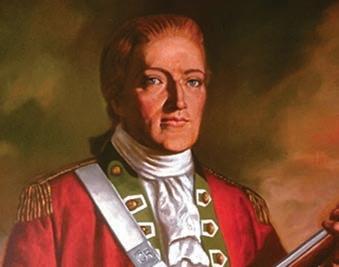
One of the innovative bright young stars of the British military, Patrick Ferguson held the fate of the American Revolution in his hands twice. While his act of chivalry likely saves General Washington at Brandywine, his arrogance toward the Overmountain Men cost him his life at Kings Mountain. He is viewed as villain by many, while his personal correspondence reveals a man of intelligence, humor and charm.
Strategy aimed to rally Loyalist support and secure key ports that benefited the British.
In May 1780, the British captured Charleston, South Carolina,
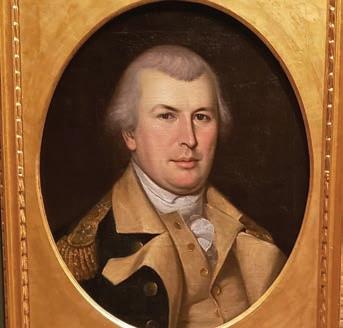
Our county is named for
came to the south in late 1780 to stem the British Southern Strategy which planned to roll up the south and trap Washington’s army in the north in a vise. Greene, however, wore the British down forcing them to go north seeking supplies and more troops only to find themselves in a vise and surrendered.
resulting in a major Patriot loss of over 5,500 soldiers. They had already taken Savannah on






December 29, 1778. With the politicians not wanting their city destroyed, General Benjamin Lincoln surrendered Charleston and his entire army without firing a shot. Losing this number of troops and equipment was a major blow for the Continental Army. The British now controlled two of the major southern port cities.
The Southern Campaign of 1780 was a pivotal series of battles in the American Revolutionary War, where British forces initially dominated the South but ultimately faced strategic setbacks that contributed to the Patriot victory. Interestingly, more battles occurred in the Carolinas than anywhere in the colonies. They are too numerous to name, and many would be referred to as minor skirmishes in today’s terms.
Key Battles of 1780
The battle of Camden was fought on August 16, 1780, when British
forces under General Cornwallis defeated the Continental Army, solidifying British control over South Carolina. It demonstrated the vulnerability of the Patriot forces in the region, standing toe-to-toe with a trained professional army. Patriot General Gates led undertrained, sick soldiers into a poorly planned attack with devastating results. Gates fled the scene and rode back to the northern army in humiliation. This opened the door for General Washington to send Nathanael Greene south.
The Battle of Musgrove’s Mill on August 19, 1780, saw Patriot militias successfully defeat Loyalist forces, demonstrating the effectiveness of local militia in disrupting British operations.
The Battle of Cowpens, January 17, 1781, was a masterpiece of planning and tactics by General Daniel Morgan. He used tactical

ingenuity to exploit British overconfidence, inflicting heavy casualties and capturing many British, marking it another turning point in the Southern Campaign. This action destroyed the right wing of Cornwallis’ army, with its only downside being that British commander Banastre Tarleton, nicknamed “the green dragon” and “bloody Ban” by the patriots, escaped.
General Nathanael Greene took command of the Continental Army in the South in October 1780 and implemented a Fabian strategy, avoiding large-scale confrontations while harassing British supply lines and stretching their forces thin. Militia leaders like Thomas Sumter, “the Fighting Gamecock,” and Francis Marion, the “Swamp Fox,” conducted guerrilla operations that continually disrupted British operations and logistics.
Cornwallis moved to intercept
and capture Daniel Morgan’s command, but Morgan moved quickly over the 200 miles to link up with Greene’s army.
Greene led Cornwallis on a merry chase across the Carolinas, staying just a step ahead of the British. Cornwallis struggled with poor roads, rivers, and logistical challenges, which slowed his advance and exhausted his men. At one point, he burned his baggage trains in order to move faster to catch Greene. The Americans’ ability to stay ahead and regroup was critical in maintaining the strength of the Southern Continental Army. The retreat culminated at the Dan River, along the North Carolina-Virginia border, where Greene’s forces linked up with Virginia militia.
Greene turned and fought the Battle of Guilford Courthouse on March 15, 1781, although technically a British victory, Cornwallis’s




forces suffered significant losses, weakening their army further and forcing a strategic retreat to Wilmington, North Carolina.
Charles James Fox, addressing the House of Commons after news of the Battle of Guilford Courthouse reached London, shouted, “Another such victory would ruin the British army.”
Unable to be resupplied and harassed by Greene, Cornwallis moved north to Yorktown, Virginia, where he hoped to be resupplied and gain fresh troops. At the worst, he could board British ships and sail to New York. Thanks to a blockade by the French Navy and a joint operation by Washington’s army and French troops, the war for Cornwallis would end in humiliating surrender. Cornwallis would later describe fighting in the South as “sitting naked on a hornet’s nest.”
One battle not mentioned above was one sandwiched between the battles of Camden and Musgrove’s
Mill. Thomas Jefferson would call it “The turn of the tide of success for the American cause during the Revolutionary War.” George Washington also credited the battle as the critical turning point that eventually led to the British surrender at Yorktown.
Following a string of British victories in the South, this decisive Patriot victory over Loyalist forces completely disrupted the British southern strategy.
This decisive battle was fought on October 7, 1780, on a small hilltop called “Kings Mountain” on the border of North and South Carolina, and fought entirely between Americans. Patriot militia, mostly frontiersmen from presentday Tennessee, Virginia, and the Carolinas, defeated the British-led Loyalist forces under Major Patrick Ferguson.
The Carolina patriot militia had retreated across the mountains into what is now East Tennessee. Here, they found rest and supplies
before going back across the mountains to hit the British again. Some left their families in the care of these Overmountain peoples.
Major Patrick Ferguson was named Inspector of Militia by General Clinton before he returned to New York. This action had riled Cornwallis and especially Tarleton. Unlike Tarelton, Ferguson was personable and well-liked by his men. He quickly gathered as many as 4,000 men into the loyalist ranks.
Ferguson’s men captured Samuel Phillips at the Battle of Musgrove’s Mill. He was a relative of Colonel Isaac Shelby of the Overmountain country. They sent him home with the following message for Shelby, saying that if they did not “desist from their opposition to British arms,” he would “march his army over the mountains, hang their leaders, and lay their country to waste with fire and sword.”
Ferguson may seem brash, but he was well-liked and tried to protect
the civilian population and their property. He even arrested some of Tarleton’s men for atrocities, which again did not sit well with Tarleton. He had held the fate of the American Revolution in his hand at the Battle of Brandywine, where the 33-year-old Scotsman, reputed to be the finest shot in the British army, commanded the British sharpshooters, who were equipped with fast-firing, breech-loading rifles of Ferguson’s own design. He shouted to an American officer who rode near his line on a bay horse to surrender. The American looked his way for a moment and turned to ride on. Before his men were in place, he felt disgust at the idea of such an ambush and ordered them not to fire. Ferguson learned that the American officer he let ride off was most likely General George Washington. “I could have lodged half a dozen balls in or about him, before he was out of my reach,” Ferguson recalled, “but it was not










pleasant to fire at the back of an unoffending individual, who was acquitting himself very coolly of his duty—so I let him alone.”
Ferguson could have changed the course of the revolution on that day, and three years later, he was about to change it again, and again for the worse for his side.
Ferguson’s threat reached Shelby, who rode to visit John Sevier. At first, this seemed like a scare tactic. But for Shelby and Sevier, it was the opposite — a rallying cry. Both men were seasoned frontier leaders: Shelby, a tireless and reserved frontiersman with experience in Indian warfare, and Sevier, a charismatic and fearless fighter with deep roots in the Watauga settlement.
Ferguson’s words only inflamed rather than intimidated them. Instead of retreating, Shelby and Sevier linked up with other Patriot leaders and began assembling militias of frontier partisans. Shelby rode to Virginia to meet with Col. William Campbell, Patrick Henry’s brother-in-law, and his cousin Arthur Campbell. Neither wanted to get involved, but Shelby convinced them that if Ferguson did cross the mountains, they would be in his line of destruction, and Shelby asked, “Then who will come to your aid?”
The cry went out to come to the muster grounds at Sycamore Shoals in present-day Elizabethton, TN. Campbell agreed to have his men
there on September 25. Shelby sent word to Benjamin Cleveland, Joseph McDowell, and others, and soon received reinforcements from South Carolina and 30 men from Georgia.
Men came out of the mountains and valleys to gather at Sycamore Shoals to answer the threat. That evening, with 400 Virginians among them, as many as 1600 patriots sat by campfires, some talking with friends, some with family, and some by themselves staring into the fire, wondering what the coming day would bring.
The next morning, they lined up inside the fort where the Rev. Samuel Doak offered a rousing sermon followed by a prayer which built a fire in their bellies and cloaked them in the shield of the Lord, sending them off with the “sword of the Lord and of Gideon!”
The march across the mountain was difficult and cold, with snow on top of the Roan Mountain. They waded rivers and crossed creeks; a hurricane sent wind and rain, slowing them for a couple of days, but they persevered. Some wanted to return home, but they marched on. It is amazing today that they found Ferguson and that his unaccustomed arrogance is what got him killed.
Ferguson, the man who could have changed the trajectory of the war had he unleashed the fatal shot at Washington, was now once again

the central figure in the fate of the revolution.
The patriots made their way to the Cowpens, where in three months, fate would again catch up to the British. Here, they ate well thanks to the generosity of the loyalist owner who had fled with their approach.
The leaders picked the 900 best men and the 900 freshest horses and headed off toward Kings Mountain in a driving rain in which they could only see when it lightened. On they pushed throughout the night. One man asked Shelby if they could stop to rest, to which he replied, “Rest?, I will not rest until I ride into the lines of Cornwallis himself.”
They arrived at Kings Mountain, where the rain had subsided, and the wet ground muffled the sound of horses and provided no dust clouds for the British to see. Ferguson had sent dispatches to Cornwallis asking for reinforcements. Cornwallis and Tarleton both claimed illnesses, therefore not sending reinforcements, leaving Ferguson to himself. Ferguson could have ridden into Cornwallis’ lines at Charlotte but chose not to.
Ferguson proclaimed that “God Almighty and all the angels in hell cannot drive me from this mountain.” Ferguson stood his ground and, in an hour and five minutes, his entire force was
captured or killed, and Ferguson was right; he was not driven from the mountain. He received 8-9 wounds from musket balls and was buried on the mountain, and he is still there today. A nice monument marks his grave.
Ferguson’s threat to Shelby and Sevier backfired — it turned them into the leaders of a united Patriot force that would go on to secure a pivotal victory in the Southern theater. Lyman Draper would write in the 1880s, “No man, perhaps, of his rank and years, ever attained more military distinction in his day than Patrick Ferguson.” Many months after Brandywine, when the Revolutionary War turned south, it also turned to partisan combat, especially in the thinly settled country back of the Carolinas. There, Ferguson rode into a darker chapter of history in a battlefield finale that was anything but glorious.
In this 250th year of independence, take a road trip down to Kings Mountain National Battlefield Park and walk the trails to see where history was changed. There are activities at Sycamore Shoals State Park related to the Overmountain Men, and I plan to visit those also. This is our story; those Overmountain Men are our ancestors, their blood courses through the veins of many in Greene County.
BY AMY ROSE | Staff Writer
Downtown Greeneville has been looking red, white, and blue with the installation of new banners to celebrate the nation’s 250th anniversary.
The project of the Greene County Heritage Trust features sponsored commemorative America 250 banners, some of which have names of their sponsors and others dedicated in honor or memory of a service member.
The Heritage Trust partnered with Main Street: Greeneville and the

Greene CountyPartnership to offer 50 banners for sponsorship.
These weather-resistant vinyl banners (27.5” x 60”) are being displayed on Downtown Greeneville light poles on Depot and Main streets for 10 months.
At the conclusion of the display period, sponsors will receive their banner as a keepsake.
The Heritage Trust thanked their partners and Artistic Printers for executing the design, along with Greeneville Public Works for installing the banners.



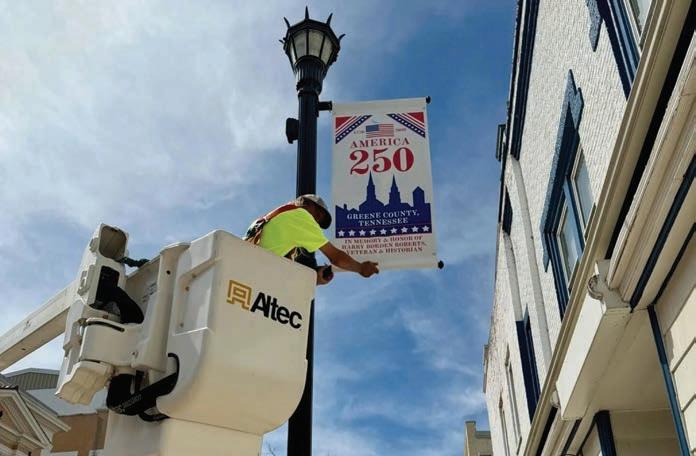
Discover Greeneville, the tourism arm of the Partnership, is inviting sponsors of the banners to snap a photo of themselves with their banners and share their patriotic pride on social media.
See more photos on Facebook at “The Greene County Heritage Trust.”






BY AMY ROSE | Staff Writer
America 250 has been featured in exhibits and programs at local museums.
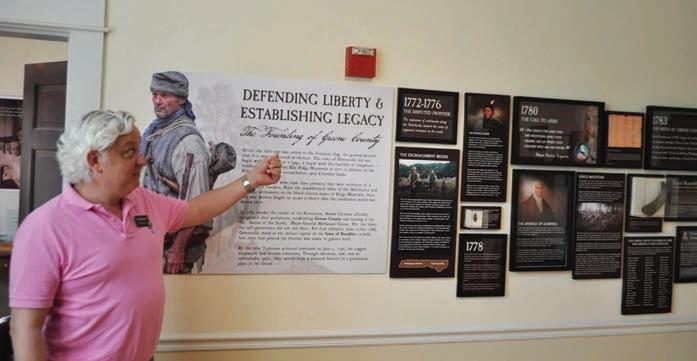
The T. Elmer Cox Genealogical & Historical Library is commemorating the 250-year legacy of the Overmountain Men and the indomitable pioneers who transitioned from Revolutionary War heroes to the founders of the Tennessee frontier with an exhibit running all year long.
An open house was held July 1.
According to Chris Gose, director of the library, this display traces the journey from a Revolutionary War battlefield to the founding of Greeneville, the bold, short-lived dream of the State of Franklin, to finally becoming the 16th state.
After the Battle of Kings Mountain, many notable figures emerged in Greene County to establish a homestead on the fertile lands they defended, including: Anthony Moore, recognized as the first settler in the vicinity; The Rev. Samuel





Abby Crawford Milton, pathbreaking Tennessee Supreme Court Chief Justice Adolpho A. Birch, and astronaut Barry Wilmore.
Developed from the “Tennessee Voices, American Stories” exhibit, this exhibit explores how Tennesseans have contributed to the broader American story and encourages visitors to reflect on one important question: How will you make history?
For more information, visit tnmuseum.org/tennessee-voicesroad-trip .
Doak, a pioneer in education and religion; Robert Kerr, a veteran of the revolution who settled on the banks of Richland Creek in what is now Downtown Greeneville; and Daniel Kennedy, a veteran of the Battle of Kings Mountain and the first Clerk of Court for Greene County who was instrumental in the administrative birth of the town and served as a pillar of the community for decades.
The library is located at 229 N. Main St.
For more information, visit greenecountyheritagetrust.org .
The Greeneville Greene County History Museum hosted “Our American Story: Voices from Tennessee,” a Tennessee 250 traveling exhibit from May 7 to June 17.
According to the Tennessee State Museum’s website, this


traveling exhibit shares the stories of remarkable Tennesseans from throughout the state’s history, including: Cherokee leader Ostenaco, Battle of Kings Mountain messenger Joseph Greer, Tennessee’s first governor John Sevier, suffragist

The Andrew Johnson National Historic Site Visitor Center is featuring a special edition stamp with the “250th” logo and the park’s name as part of the Passport To Your National Parks program.
The Visitor Center at 101 N. College St. is open daily from 9 a.m. to 4 p.m.
For more information, visit americasnationalparks.org/americas250th .






























BY AUDREY SHOEMAKER
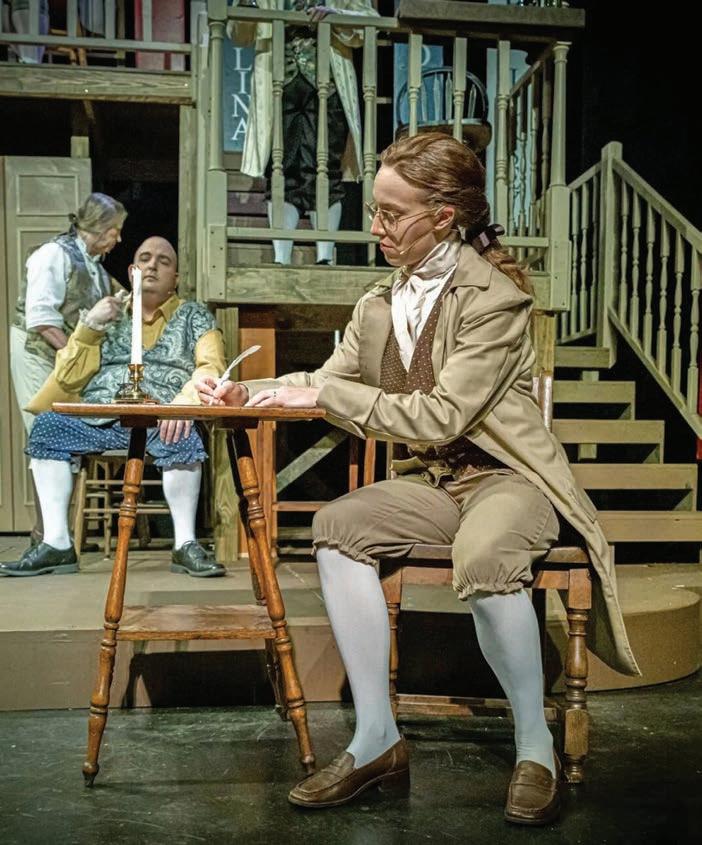
This summer, the United States of America is celebrating 250 years since the signing of the Declaration of Independence, the document which laid out for the world the many reasons why the Second Continental Congress was pursuing independence from Great Britain. Amid the pomp and circumstance of this year’s national celebration, the Greeneville Theatre Guild’s production of “1776 the Musical” brings to life the heated contention, the sharp humor, and the human cost of independence.
Directed by Faith Rader, a cast of 29 tells the story of the days and weeks leading up to the signing of the Declaration of Independence and the fierce rhetorical battles that took place as the Congress met.
GTG’s production of “1776” is led by Amelie Gentit as fiery patriot John Adams, whose strong convictions and self-described “obnoxious, disliked” demeanor force him to quarrel and compromise until the Congress can reach unanimity. Gentit delivers both commanding physical presence and an ironic self-awareness to the role of Adams.
Gentit is joined by Vicky Livesay in the role of Dr. Benjamin Franklin, the Congress’s residential jokester. Lurking beneath Franklin’s witty facade is a fierce procedural mind and a commitment to the cause. Livesay is funny and charming in the role, delivering both dramatic weight and comedic relief.
Amy Bailey, who portrays a young and scholarly Thomas Jefferson,
brings sweet earnestness to the role, while Brittany Brooks, in her role as Jefferson’s wife Martha, floats onto the stage like a cool breeze amid the stifling heat of a Philadelphia summer.
The cast for GTG’s production of “1776” is gender-blind. While the casting of roles without regard to gender may be a non-traditional choice for staging this musical, I found myself far more interested in the story the cast was telling than in their unconventional casting. The cast, regardless of gender, delivers a story worth watching.
A series of sharply timed comedic performances, delivered by cast members Peyton Bergquist, Moe McCollum, Kendra Hinkle, Hillery Griffin, Melissa Koehler, Jonah Kirkland, and Nakara Brown lighten the atmosphere of the stifling meeting house in Pennsylvania. Dramatic turns by Christy Potts, Marja Hughes, Brenda Litchfield, Gracie Moore, Josie Norton, Izzy Wilson (in a notably terrifying turn as Col. Thomas McKean), RJ McCollum, Sam McCamey, and Rachel Harrison remind the audience of the gravity of the situation at hand.
Throughout the debate, two villains emerge, and both are played with admirable gravitas. As Edward Rutledge, the delegate from South Carolina, Natalie Rundblade delivers a notably menacing, confident, and complicating performance. Melody Tunnell portrays Pennsylvania delegate John Dickinson, whose loyalties to the British Empire stem from both deep feeling and calculated practicality.
A few vocal performances deserve special mention. Tillman Travis, who plays the Courier, delivers a deeply haunting performance, backed up by Paige Mengel as Andrew McNair and Sadie Parman as A Leather Apron (a sort of teenage apprentice to McNair), of the song Momma Look Sharp. As a pin in the end of Act I, the song leaves the audience with the deep-seated feeling that the men of the Continental Congress are making
a monumental decision that will necessarily come at a terrible human cost.
Magdalen Zinky, in the role of silly, suggestable Richard Henry Lee (of the Virginia Lees), delivers the kind of lighthearted goofiness that keeps the show afloat. And finally, Holly Marshall brings warmth, wit, and gentle support in the role of Abigail Adams, John Adams’ charming, intelligent wife.
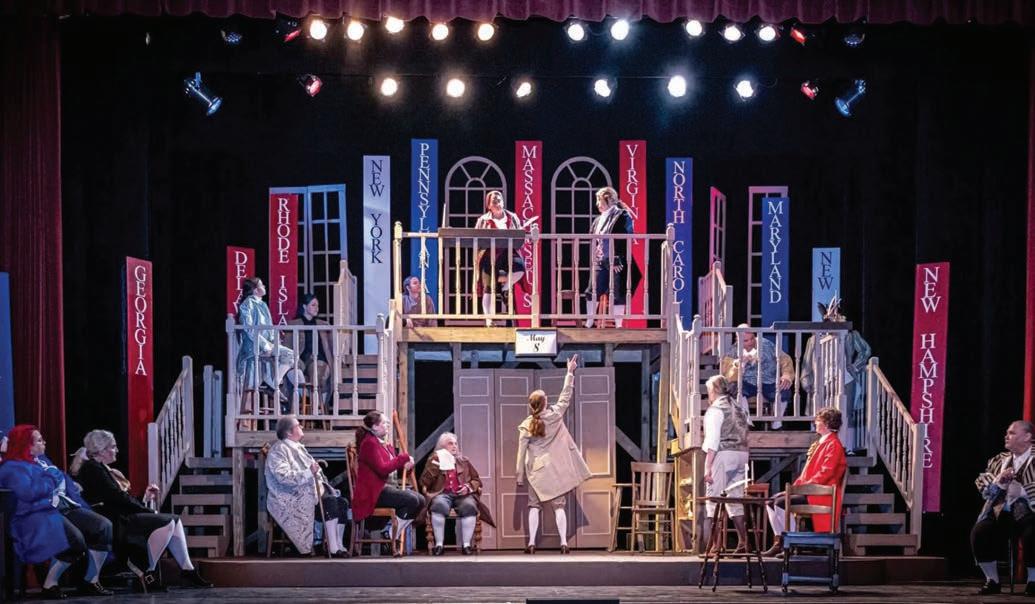
All these actors, each portraying a separate, identifiable historical character, move around on a multilevel set designed by Frank Mengel. The set’s rough, wooden aesthetic is broken by colorful turnstiles for each colony, helping the audience track
the state of the argument as the show progresses. Dramatic lighting by David Horton highlights not only the performances (and clever, often witty choreography by Christa DelSorbo), but also Whitney Marshall’s detailed costumes. The actors move through the set in fitted jackets and waistcoats, with earthy patterns that hint at the period and pops of color that allude to character and mood.
“1776” is not a play-by-play, perfectly historical representation of the Second Continental Congress’s fierce debate. It contains historical inaccuracies and combined characters, and it treats rather gently some of the deeply complicated, problematic parts of the nation’s founding.
It is, instead, a profoundly human story about compromise and commitment. Its original Broadway producer noted that “1776” intentionally doesn’t treat Adams and the others as “gods or cardboard characters.” No myths and legends here, just a group of intensely fallible people who made a dangerous commitment to forge a future together, against the odds. Put that way, I can’t imagine a more compelling basis for either a story or performance, and GTG and its cast delivers on the promise inherent in the premise.
The Greeneville Theatre Guild’s production of “1776” opened the weekend of June 19. Final performances are set Friday and Saturday, June 2627, at 2 p.m. and Sunday, June 28, at 2 p.m., at the Capitol Theatre, 104 S. Main St., in downtown Greeneville. Tickets are available at https:// greenevilletheatreguild.org/ or at the door.










t a t e pe l lmen te e e e t rs t abolis ciple tat t er t


i a , l w i r s l s t e es a t h dir ctt e t
e t . sf i o to u b h ,h e sr fo i , n of e i i e an i b t . l di e , o or for e s i h s i at s so s e ; la r , n ation, averet
e at r f n as o o w u dc swithin. ; s i a t c n n r r t t a s , t s n t e mo tof e es. o , o t p e, n e t e. in e u . r e tu o u dby Asse to : s y m n ha tan ates: n in b gt fre s rovince,establishingt er an ver , r ncean a e bsoluterul nt eseColo ayou h u theFo so o n endi ouro v o t di tedGover a s n edours l ti trans s ti u lty&a e of i d . constrainedour hr ,ortofallthe s

e asexciteddo sti e r e nruleofwar e, I erystageofthese u eated i arke v e of ee w t n totim a s t ejurisdi n r tion e e m mit a rco to the us sandcorresp voice e o c san i e t e e t e c ourS arati s of em esi r,in eace n r s meri , a o e ns,d t , nlypubl cla r an t s; t , c e ain t d d S wer o , nces, er n s p . fo lia t ea ho r s,o s dour o e a o r ary a














BY NELSON MORAIS | Staff Writer
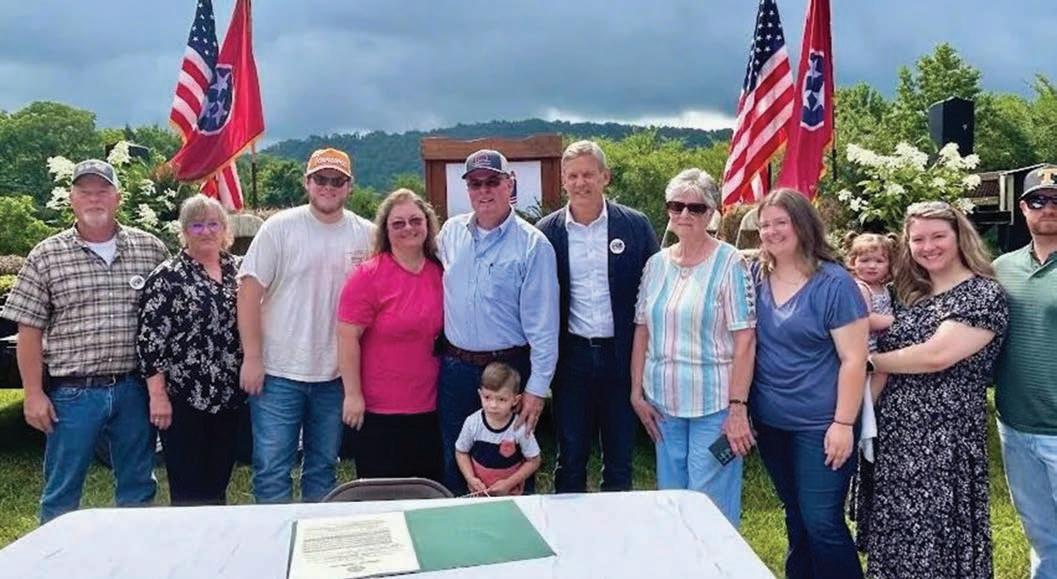
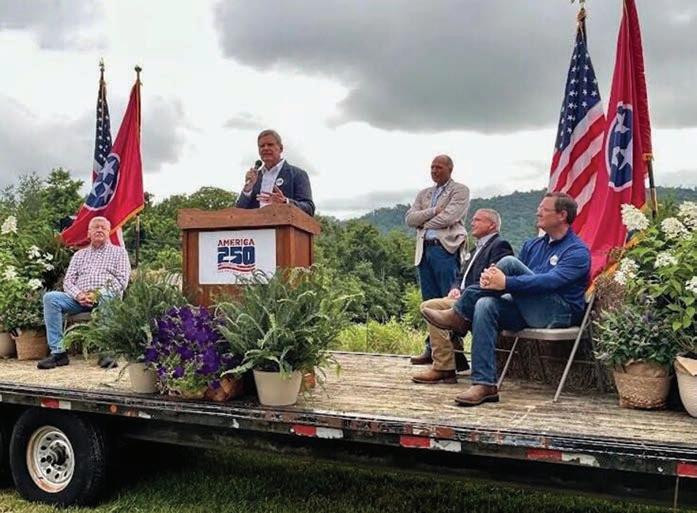
Tennessee Gov. Bill Lee visited a historic farm in Greene County July 1, 2025 to kick off a year-long 95-county tour to honor the state’s heritage and ceremonially sign legislation to help preserve agriculture and forestland in Tennessee.
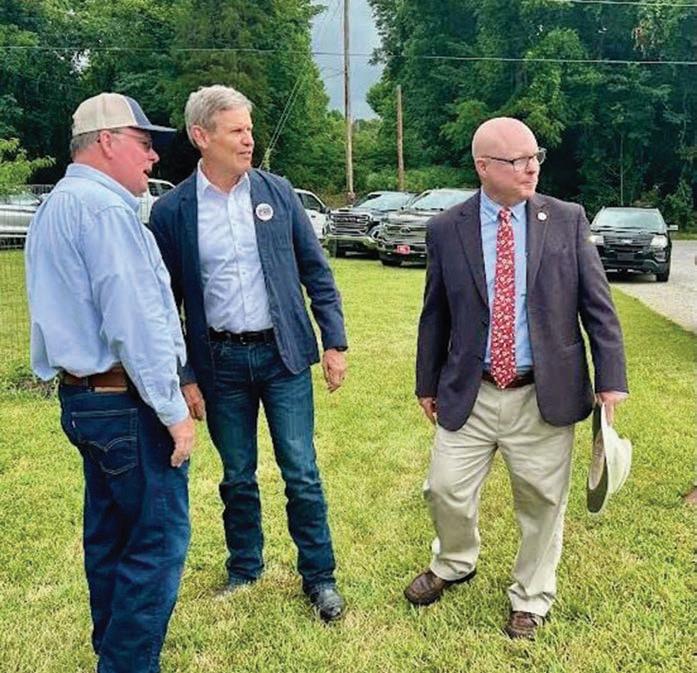
“This is a cool spot,” said Lee to Wayne Hughes, owner of Rocky Field Farm in Afton, shortly after his arrival Tuesday morning.
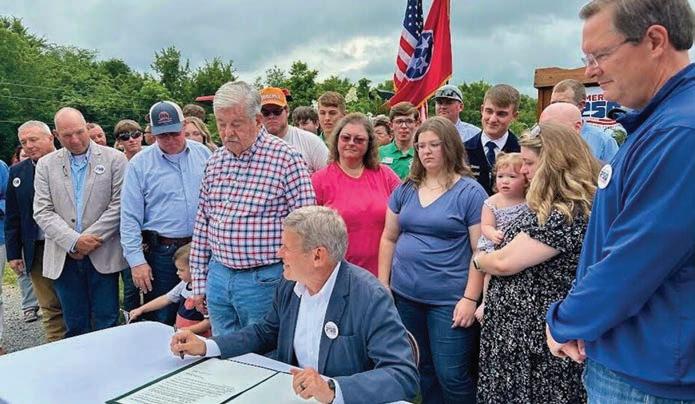
Surrounded by farmers young and old, as well as some Greene County officials, Lee signed the Farmland Preservation Act that was passed with bipartisan support in the General Assembly.
“At this spectacular Century farm, it’s fitting to sign the act,” Lee stated.
The Farmland Preservation Act establishes a permanent conservation easement and creates a grant fund to support farmers who voluntarily choose to protect their farmland.
Lee noted that Rocky Field Farm started operation in 1796, the same year as the founding of Tennessee, “the greatest state in the U.S.”
“We are very fortunate in this state for so many reasons,” Lee said, including the cooperation of local and state leaders.
He noted many people, including businesses and their employees, are moving to Tennessee.
“As stewards, this Farmland Preservation Act is an example of what good stewardship looks like,” Lee stated.
Lee said agriculture “is number one” in the state’s economy, but also warned that Tennessee is in “the top 5 states for loss of farmland,” losing
an estimated 10 acres per hour to development.
Preserving farmland and forests, yet growing economically, “isn’t easy,” Lee stated.
Later, Lee told reporters, “While we are a state rapidly growing, the Farmland Preservation Act finds the balance between development and farmland. It is a challenge to find that balance. It took a couple of years to write the legislation and get the General Assembly to approve it.”
Lee also said, “This act creates an incentive for farmers to put their lands into trusts.”
Lee also announced the start of a statewide America 250 celebration as the country prepares to celebrate its independence milestone next year.
“This is what we decided we want to do to kick off” the country’s 250th birthday in 2026, Lee said.
“We’re going to every county over the next year” to highlight the people, places and events that define Tennessee’s contributions to the United States, he stated.
Sexton.
Local officials on hand included Greene County Mayor Kevin Morrison, State Rep. David Hawk and Greene County Attorney Roger Woolsey.
Members of the Eastern Region
of the National Future Farmers of America Organization, 4-H and Farm Bureau were present, as well.
Lee was at Rocky Field Farm just under an hour, before departing to speak at historic farms in Williamson and Tipton counties.






BY NELSON MORAIS | Staff Writer
Are you ready to celebrate America’s 250th birthday in Greene County?
There are several events planned this month.
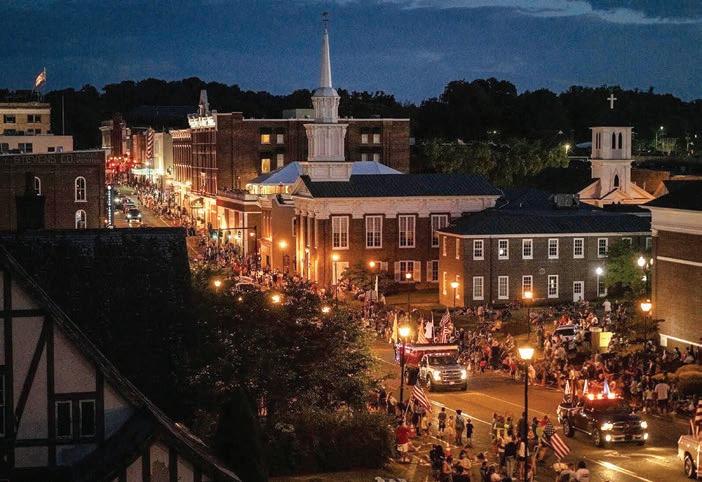
In Greeneville, on July 4, the 14th annual America Downtown Celebration will be a day filled with music, food, family fun and fireworks near the Big Spring in Bicentennial Park, behind the town’s public library. This year’s theme is, “Stars, Stripes & Small-Town Spirit.”
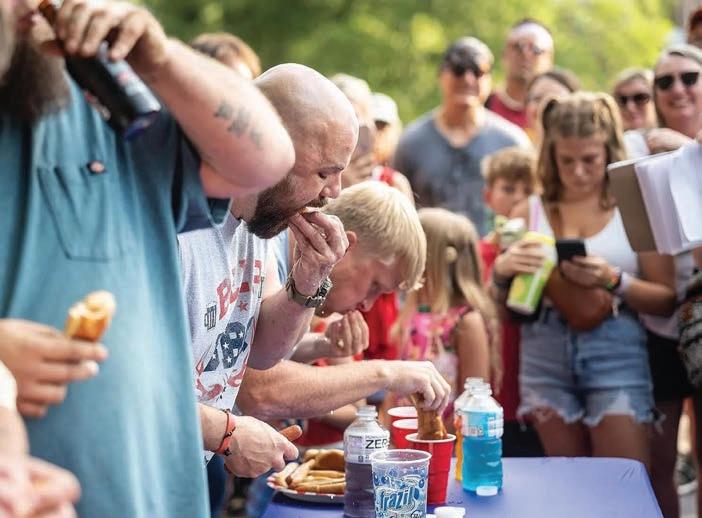
The celebration begins at 4 p.m. with live entertainment, a Kids’ Zone and a wide variety of food vendors. As evening approaches, there will a hot dog eating contest, a nighttime parade and a most-likely spectacular fireworks display, if past years are any indication.
The evening begins with the Greeneville Swing Band performing patriotic favorites, classic jazz and big band music under a large red, white and blue tent.
Taking the main stage first will be The Backrow Brothers, which features local songwriter Josh Dean and Oklahoma native Braxton Rogers. Their sound blends the spirit of Appalachia with the soul of the Western Plains through rich harmonies and timeless original lyrics, according to a press release from the town.
Next, Zach McNabb will bring his signature voice and charisma to the stage with a style rooted in country
music while also drawing inspiration from multiple genres.
Holly Ann & Dirt Road Rising will energize the crowd with a mix of classic and Southern rock, followed by Exit 8 closing out the night with a wide-ranging set featuring classic rock, country and blues favorites.
Top Dog Hot Dog Stand will again host the annual hot dog eating contest. Contestants may register on the Town of Greeneville website for $15.
This year’s 4th of July parade will recognize both America’s 250th anniversary and the 30th anniversary of the USS Greeneville.
The USS Greeneville is a Los Angeles-class nuclear-powered attack submarine named after Greeneville, Tennessee, following a successful grassroots campaign led by local residents. The effort was inspired by the fact that components for the submarine were manufactured by Greeneville Metal Manufacturing.
The parade begins at 9 p.m. at Towne Square Shopping Center and will travel through downtown before ending at Greeneville High School. Spectators can expect marching bands, floats, classic cars, community organizations and more.
The fireworks display will be launched from the hill behind Burley Stadium.
For more information and updates follow the Town of Greeneville on Facebook, visit www.greenevilletn. gov or contact Christina Potts at cpotts@greenevilletn.gov .
There are two other noteworthy events in Greene County: one in
Bulls Gap, on July 3, and a parade in Baileyton in the morning of July 4.
In Bulls Gap, Friends of the Park is presenting “Stars, Stripes & Summer Nights” on Friday, July 3, from 5 p.m. to 9 p.m.
Free hamburgers, hotdogs, popsicles, chips and drinks will be handed out at 5 p.m. at Bulls Gap City Park, which is located at 229 N. VFW Road.
At 6 p.m., there will be a duck race, cake walk, watermelon eating contest and much more, organizers say.
There will also be a DJ and activities for kids.
A highlight of the evening will be the “Stars and Stripes Showdown” tug-of-war contest between competing volunteer fire departments in the area. Teams of six volunteer firefighters will compete for a prize of $500 to go to support their fire department.
It is the first year such a tug-ofwar contest to support volunteer firefighters will take place, but an official said they hope to make it an annual event.
For more information, call the Bulls Gap City Hall at 423-235-5216 or Pete Shipley at 423-754-5407.
In Baileyton, line up for the 4th of July parade that Saturday begins at 9 a.m. The parade starts at 10 a.m. from Baileyton Elementary School.
It will feature floats, bands, vintage vehicles, community groups “and more,” according to an event organizer.
For more information, call 423-5523140.
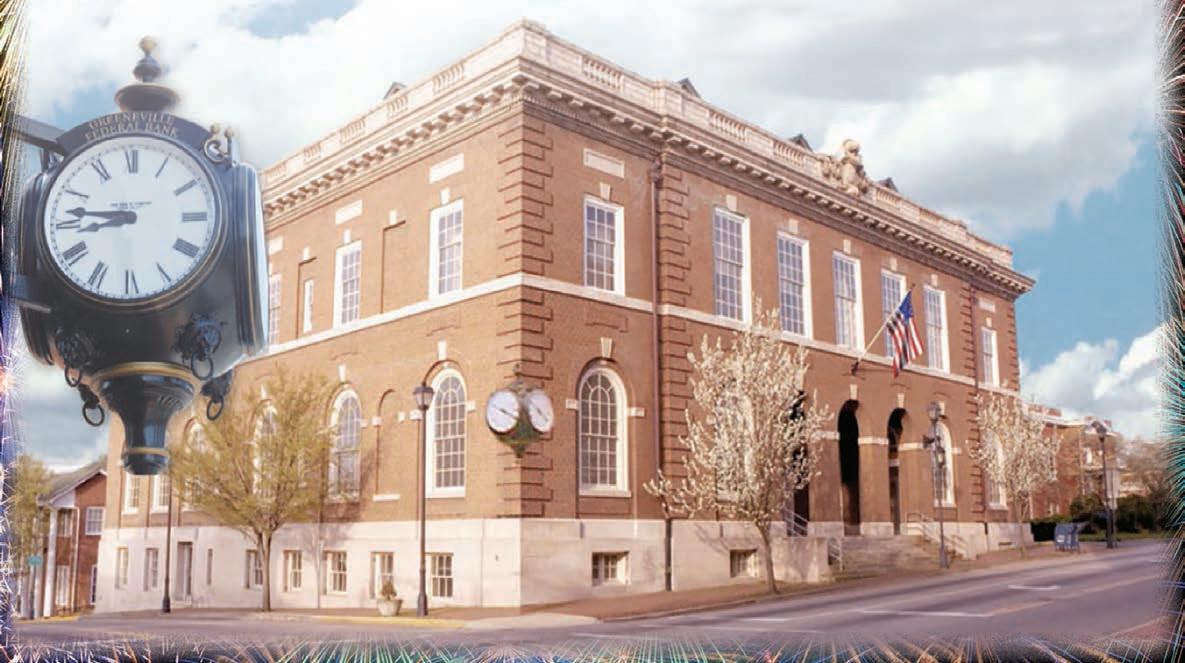
On Wednesday, July 8, Greeneville and Greene County will celebrate the 250th anniversary of the United States in front of the Greene County Courthouse at 101 S. Main St. in Greeneville.
Sponsored by the Greene County Heritage Trust, there will be opening remarks at 5:30 p.m. and free apple pie for the first 250 people.
Top Dog Hot Dog will be selling hot dogs and sausages, and there will be a great lineup of patriotic music. It is part of a statewide initiative where Tennesseans will join communities across the U.S. in reading the Declaration of
Independence aloud together at 6 p.m. Eastern Standard Time.
Sharing the Spirit of America was developed by the Hawaii 250 Commission.
The Tennessee Society of the Sons of the American Revolution will be leading the initiative in Tennessee this year.
Tennesseans who participate are asked to take photos of their groups and post them to social media, tag @tennessee250 on Instagram and Facebook, and use the hashtags #SharingTheSpiritOfAmerica, #TennesseeAmerica250, and #America250.
Patriotic movies will be shown in July at The Capitol Theatre of Greeneville at 104 S. Main St., across from the courthouse in downtown Greeneville: “Born on the Fourth of July” with Tom Cruise, on Thursday, July 9, at 7 p.m., and “The Patriot” with Mel Gibson, on Saturday, July 25, also at 7 p.m. “Lincoln” will be shown on Friday, July 31, also at 7 p.m.
Tickets are $5 each.
The Famous Lost State of Franklin Ride “for freedom, brotherhood and our future” will take place on Saturday, July 18.
Registration begins at 9 a.m. at Greeneville Masonic Lodge #3, which is located at 540 E. Andrew Johnson Hwy.
Breakfast featuring biscuits and gravy, and coffee, will be available, with donations appreciated, organizers say.
The ride fees are $20 for riders, and $10 for passengers.
Kick Stands Up (KSU) is at 10 a.m.
The event is a fundraiser to purchase Halo head protection for local schools’ football teams.
The ride route is from Greeneville Lodge #3, through Newport, with the first stop in Dandridge at the Brazelton Masonic Lodge #190, for fuel and refreshments.
It then continues to Jefferson City and then to the second stop, in Morristown at the Morristown Lodge #231, for refreshments.
The final stop is at the Wrecking Crew Harley-Davidson dealership in Johnson City, at 3518 Bristol Highway, for food, music, refreshments and door prizes.
For more information, contact Karl
“Union Jack” Sabey at 423-470-2690 or unionjack1066@gmail.com .
“Come ride the historic Lost State of Franklin route and help protect our local athletes,” a flyer on the ride states.






BY TIM MASSEY
As we are now just days away from what should be the most monumental celebration in our nation’s history, I cannot help but remember the bicentennial celebrations of 1976.
As early as 1974 CBS televised an evening “Bicentennial Minute” which highlighted events leading to

American independence.
Those same years Christopher George hosted a half hour program “You Are There” on Saturday mornings that took us back to the time of the Revolution. School children were encouraged to read Esther Forbes “Johnny Tremain” a 14-year-old Boston apprentice forced to answer his country’s call as a soldier. It is said to be “among the 20 best-selling children’s books of the 20th century.” I have it on DVD.
I remember the tall ships sailing into Boston Harbor to great fanfare and fireworks, which by the way is planned again for this year. McDonalds had placemats that illustrated moments from the American Revolution. They had
glasses with Revolutionary War scenes for purchase with a soft drink. A friend of mine recently paid $50 on eBay for one of the placemats which depicted Valley Forge.
Countries around the world paid tribute with special postage stamps and first day covers. The United States Congress had federally approved Congressional projects which included the Bicentennial wagon train and even the founding of the Society of the Descendants of Washington’s Army at Valley Forge which will celebrate its 50th anniversary this summer.
There was a Revolutionary War Commission which provided $100,000 in funds to help the Greene County Heritage Trust save the Doak
House at Tusculum University. The Greeneville Sun had a large newsprint edition honoring 200 years of our nation and Greene County. This is not to be confused with the Bicentennial of Greene County, a green book the Sun printed in 1983.
I saved a lot of items from the 1976 celebration, and have collected many more, truthfully, I have been disappointed at the buildup for the 250th. It seems that the relevance of 1776 has largely been forgotten in many, if not most parts of our society.
Shockingly, educators report that a significant portion of students arrive at college with at best a vague sense of the American Revolution and what it has meant to the modern world. They too have little knowledge of


early America, or for that matter little to no knowledge of anything that happened before 1929.
What is sad is that those students that know something about the year of our independence view it with indifference or contempt. This is especially true of their views of revolutionary leadership. These revolutionary leaders appear to be strange men in strange clothing wearing weird wigs espousing strange ideas to upset what seemed to be an orderly world society.
It seems too, in the academic world, those in the intellectual community educating our leaders of tomorrow feel the Spirit of ’76 has outlived its usefulness. I have read and listened to those thinking we need a new American order, that the Constitution has outlived its usefulness and that new principles should be adopted or systems that have failed in every country where tried be implemented here.
These academics see the values inherited from our long-ago Revolutionaries believing they need to be cataloged in the graveyard of failed systems among the other experiments that have run their course. They espouse the founders, Washington, Jefferson etc., as flawed individuals, and indeed they were, but they were only human.
It is beyond my comprehension as to how some in modern times can seek to demonize and tear down some of the greatest minds ever assembled, giving us the most prolific government ever devised.
I disagree with this line of thinking believing we have become too eager to deny the relevance of 1776 for us today. Many, especially in acidemia, are too sure of our own superiority to listen to the revolutionary generation’s advice about society, human nature, and government. They are too quick to disparage or simply ignore the national past that began
in those desperate and idealistic days 250 years ago. They are too quick to tear down men by exposing their flaws, these men who were some of the most brilliant minds ever assembled.
Many today are more concerned with the “now” and are more smugly comfortable with itself than perhaps it should be. They seem happy emptying the vault of history robbing future generations of the knowledge that can prevent them from repeating past mistakes.
I have often noted that we can’t judge those in the past by our modern standards. Yet, a modern habit has developed of hauling up a person, event, value, or culture from the past then crucifying them with our modern standards. We have those who have become the moral police that can’t live up to their own manufactured standards.
The tearing down of our history
has reduced rather than increased interest in our Revolutionary generation and distorted our understanding of change over time in that central period of our history.
The past 250 years have not been a utopia. There are the legacies of those who resisted the revolution. Those who resisted taking sides, as I have written before the revolution was divided by thirds, one-third supported the revolution, one third supported the crown, and one third didn’t give a darn either way. There is the British side of the story as well as their Loyalist supporters. Let us not forget all the German mercenaries who couldn’t understand why the Americans were rebelling.
We forget the relentless warfare that took place here in the Carolinas. We forget all the churches burned in South Carolina. These are now mostly forgotten shadows in the collective mind of the nation. I write about the Overmountain Men and Kings









Mountain that seems generations away to most, if they even know what I’m talking about.
It is these men, the revolutionary generation that have given us our national values. It is them who led us to independence and led us to the practical application of a host of philosophical concepts. Independence led Americans to reconfigure practices and values to serve a nation based on popular sovereignty. The most radical of these were concerning natural rights.
A belief in God was a cornerstone in the founding of our nation. Every ethnic group whether it be Scots Irish, German or English first gave praise to God and based their coming to America on religious liberty. Many modern writers claim most founding fathers were deists, but reviewing their writings shows they held strong beliefs.
Zig Ziglar, America’s Motivator, used to encourage folks to be a “Good Finder” in other words to look for the good in all situations and not be critical of everything. A Good Finder, according to Ziglar, “Is someone who consciously chooses to focus on the positive aspects of people, situations, and experiences, rather than dwelling on the negatives. This habit not only enhances your outlook on life but also fosters stronger relationships, greater resilience, and a more fulfilling existence.”
During the 250th we should focus on the good of our country, down to our local government and those around us. Reflecting on the good will magnify the pride we have in our country, our communities, and make our lives more rewarding while allowing us to be a light unto others.
As I started this column, I noted we are just 90 days from celebrating the 250th anniversary of our country on July 4th. I must tip my hat to the Greene County Heritage Trust who saw the 250th as not just another July 4th. They formed a 250th committee led by Marcia Parsons which has partnered with the Greene County Partnership, MainStreet and the
Town of Greeneville and others. It is a collection of local leaders who are seeking to make this year the celebration to be remembered for another 50 years. Time will tell if it tops the 1976 bicentennial celebration.
So, what can we do to celebrate the 250th? The internet tells us we can “Celebrate the United States’ 250th anniversary (Semiquincentennial) in 2026 by attending major historical events in cities like Philadelphia, Washington D.C., and Boston, or by joining local community initiatives. Key activities include visiting national parks, participating in volunteer efforts through America Gives, and engaging with educational projects like America’s Field Trip.”
I personally go to Philadelphia every summer, as I like to say, it’s one of my favorite Yankee cities. This year we are going on a walking tour with a Revolutionary War soldier. This year will be special, and I respect that not everyone can go to places like Philadelphia, Boston, Charleston, Savannah, or Williamsburg. If you can, make the most of it, this is the year to do so.
If you plan to stay at home, there is much happening across the area. There are events at Sycamore Shoals, Tipton-Haynes, and Rocky Mount historic sites. Greene County will celebrate history/heritage month on April 25 at the Greeneville/ Greene County History Museum. Independence Day, Home for the 4th, will be a major local celebration with the nighttime parade and fireworks. Tennessee’s oldest town, Jonesborough, will be alive with activities within easy driving distance. I encourage you to take it all in.
Blue Springs Decoration Day is coming up on May 9, it is a chance to see the old Lutheran church that is being beautifully restored.
I always go to James Whites Fort in Knoxville on July 4, for the annual Sons of the American Revolution (SAR) and Daughters of the American Revolution (DAR) commemoration. Afterward we gather at the John
Sevier monument at the old courthouse to pay tribute to the Sevier’s.
On July 8 there will be a special reading of the Declaration of Independence at the Federal Courthouse, that will be a special time to come share.
The SAR has monthly grave markings this year to honor Revolutionary War veterans. Here in Greeneville, we plan to reorganize the Nathanael Greene Chapter, Sons of the Revolution. More information on that is forthcoming. There is no better way to honor your own patriot ancestor than to be a part of one of these organizations.
The Trust 250 committee and the Partnership in conjunction with MainStreet has banners up in the downtown celebrating the 250th. There will be posters, pins and challenge coins commemorating the event for sale soon. These will be treasured keepsakes in another 50 years.
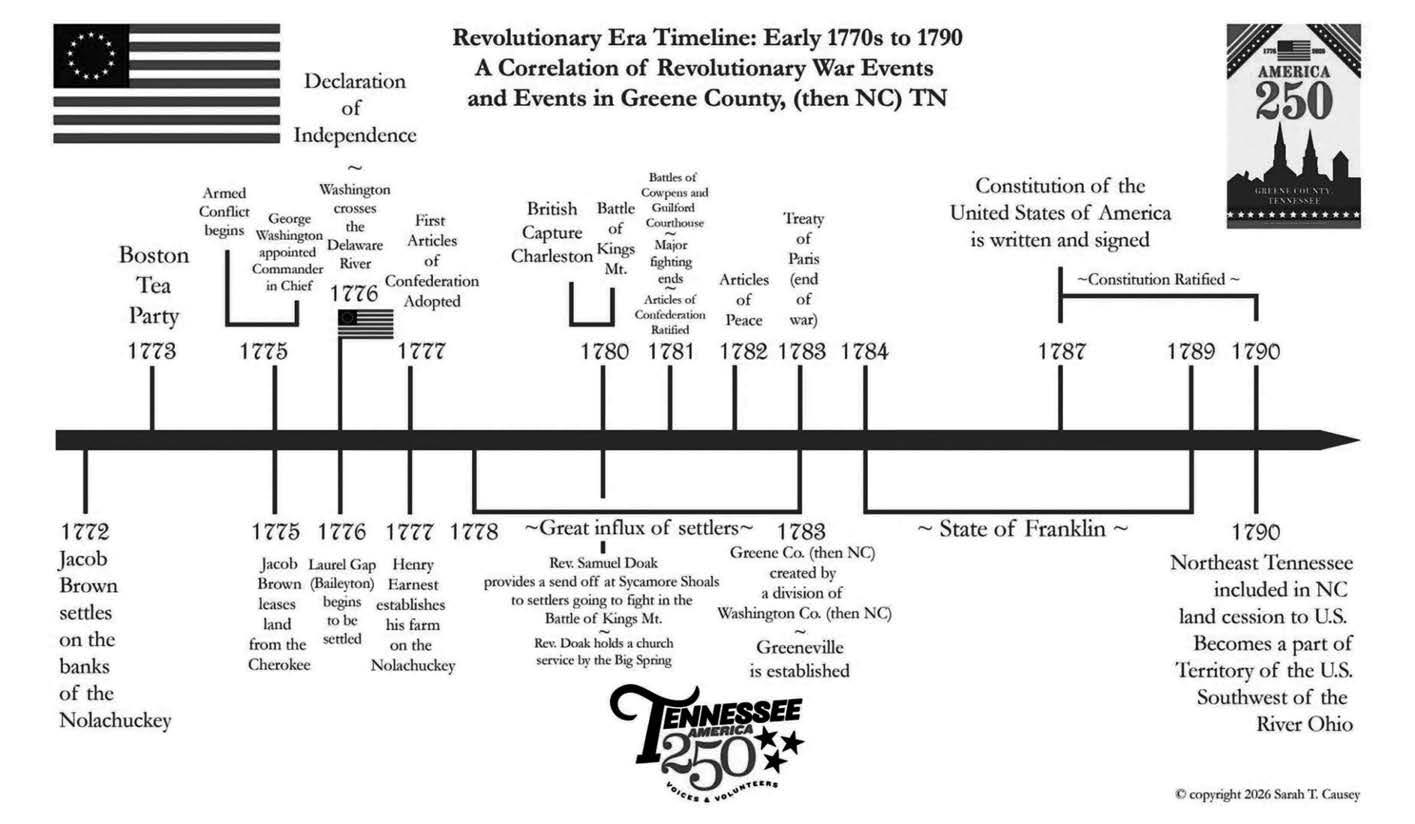
Sally Causey has developed a timeline map of the revolutionary period that she is happy to share.
In conclusion, today, whether we realize it or not, whether we like it or not, we live in a political world that was born in 1776. We still live on the ideas, and political values that the founders restructured, rethought, and that were given public legitimacy in 1776, the year of revolution and independence.
Those revolutionaries, flawed as they were, began a transformation in the human condition when they unleashed the idea of the rule of the people on a hierarchical, monarchial world. Their heirs would go on in the decades and centuries that followed to offer at least one kind of liberation to an oppressed and suffering humanity. That so many have grasped at this unique, yet not a utopian experiment over the last 250 years stands as a real testament to the enduring power of its message of hope.
I believe those celebrating in 1976 realized this and believed this. I think
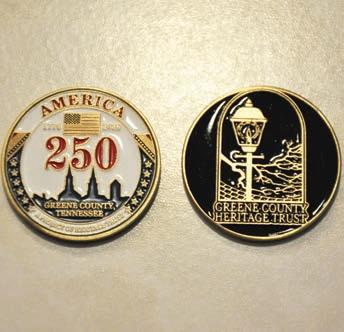
In honor of the 250th the Greene County Heritage Trust has a challenge coin featuring the local 250 logo on the front and the Trust logo on the back. These are available at the Greene County Partnership for $10 each.
they realized just how fragile this American experiment is. They were a generation touched by war and hardships.
We today should revisit the words of Jefferson, Washington, Adams, Henry, to name but a few, then read Thomas Paines “Common Sence.” I always think of founding father Benjamin Franklin’s response to Elizabeth Willing Powel’s question: “Well, Doctor, what have we got, a republic or a monarchy?” Franklin famously replied, “A Republic, If You Can Keep It.”
Many today want to paint a bleak picture of our country. With all its flaws, it is still the greatest country on earth and in the annals of history. We should embrace what we have and work tirelessly to save, perpetuate and improve our country. In 1776 it took a handfull of Patriots to start a revolution, today all of us are needed to bring about needed change while upholding all given us by the founders.
In a time when few know their history, its up to us to ring the bell of liberty and be leaders in our communities as we all come together to celebrate the 250th and let us not hesitate to make a celebration grander than in 1976, and let’s make it one to be remembered the next 50 years.


an old American pickup truck becomes more than a workhorse
BY HOLLY MEYER | Associated Press
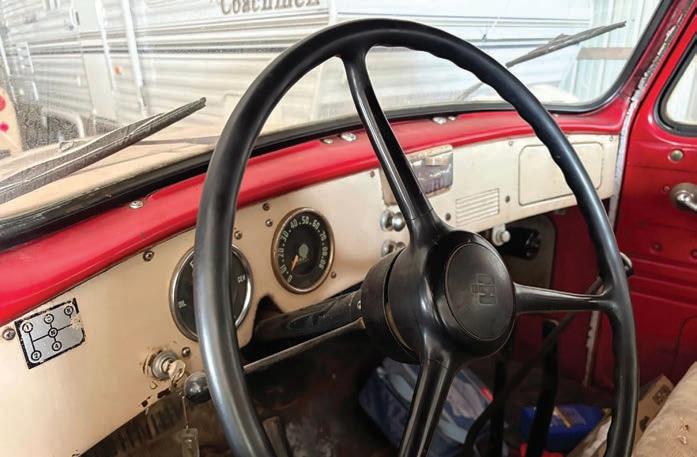
EFFINGHAM, Illinois — In Illinois farm country, there’s a 70-year-old pickup truck waiting on a fresh coat of canary yellow paint.
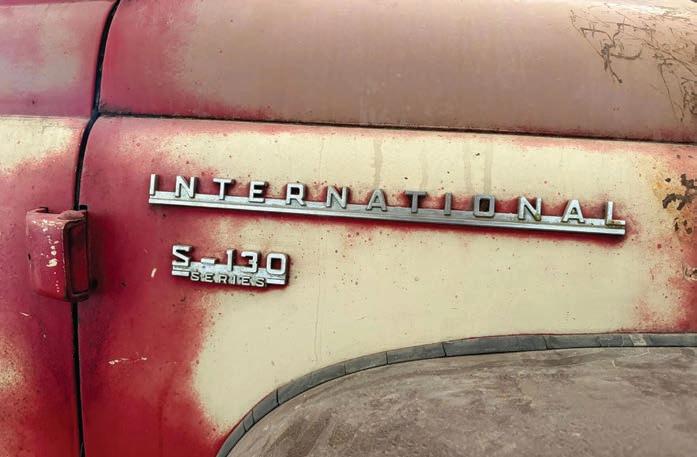
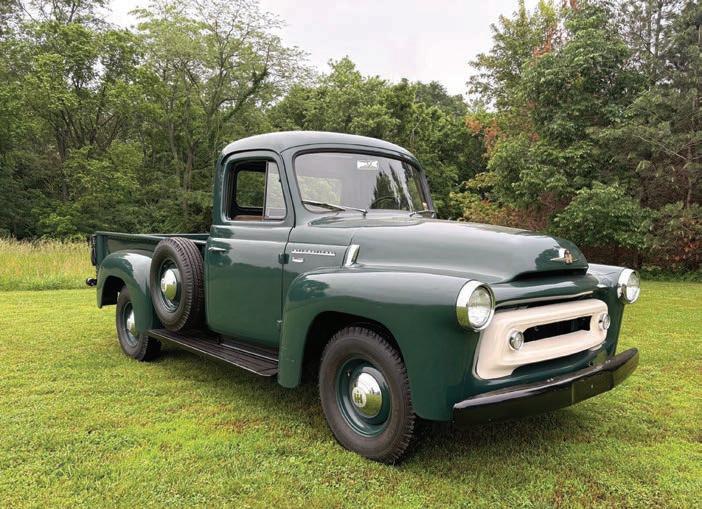
It’s the first vehicle my dad learned to drive, as a young boy helping with farm chores during the day and adventuring with friends at night. At the time, the 1956 International Harvester S-130 had no sentimental value. Its worth was tied to its usefulness.
Or as my dad explains, “it was just a truck.”
Pickups were made for work. Until the first purpose-built ones rolled off American assembly lines in the early
20th century, people DIY-ed their own. They became icons of a rural ideal, potent enough to inspire and populate many a country song.
Today, they are mainstays on American roadways. While they’re still used to haul things, some are more luxury than workhorse; cool enough to be lifted or lowered and comfortable enough for Sunday drives.
As for the pickup that once powered the now-defunct Meyer family farm, it will soon have just one job: to look pretty.
It’s an unexpected turnabout. If it had been planned, my dad might have picked an easier truck to restore.
International’s S series from the 1950s had a blink-and-you-miss-it production life. Practically speaking, that means sourcing replacement parts is a challenge — even for my brother Andy, who is good at finding things that are hard to find.
He’s the one who spotted the truck for sale. And though it was worse for wear, he couldn’t resist hauling it back home. In the years since, he and my dad have embarked on a replacement-parts treasure hunt that’s unearthed my dad’s childhood memories along the way. Stories of my dad behind the wheel
as a child taking the neighbor boys on late-night hunting trips, the precarious ways he and his siblings accomplished their farm chores and the uncle whose prom date rode shotgun.
Their odyssey through online auctions and Illinois backroads has taken on a life of its own. What started with restoring one 1956
International Harvester has turned into owning five 1956 International Harvesters in various states of repair. Only one is too far gone to fix up.
I asked my dad why he keeps hauling them home. “I’m possessed,” he joked dryly.
But if I’m honest, I already knew the answer. There’s joy in the journey. So why not?