Policy insight January 2026
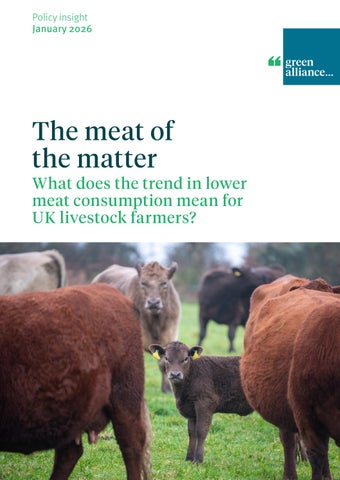
The meat of the matter
What does the trend in lower meat consumption mean for UK livestock farmers?
Introduction
58%
of people in the UK report having made some effort to eat less meat.
Eating less meat is recommended to improve public health and reduce environmental impacts. The NHS advises a 33 per cent reduction in red and processed meat for the average consumer to reduce risks of heart disease and cancer, equivalent to swapping one beef burger and two pork sausages with plant-based alternatives every week.1 The independent Climate Change Committee (CCC) recommends an 18 per cent reduction in the consumption of red meat by 2030 and a 40 per cent reduction by 2050, to reduce the greenhouse gas emissions associated with livestock farming.2,3 The need to reduce meat consumption has resonated with the public: 58 per cent of people in the UK report having made some effort to eat less meat.4 Data suggests this has translated into notable reductions, to which the cost of living crisis and meat price inflation are also likely to have contributed. But, for some, any action by the government to reduce meat consumption further would be political overreach, while others are worried about the impact it would have on farmers. In the context of dietary changes over the past 20 years, we have explored the impact of falling meat consumption on UK livestock farmers. We have drawn insights on how different farm businesses are being affected by the trends and can be supported to weather the changes. Here, we summarise the results of our research presented in a longer background paper.5
1
Summary of our analysis
“
People in the UK are eating less pork and beef, although production has still grown.”
Meat consumption has fallen over the past 20 years, but this trend hasn’t been matched by a fall in production. Self-reported national data shows that, across the UK, people are eating eight per cent less meat than 20 years ago, despite population growth.6 However, this picture varies for different meats. People in the UK are eating less pork and beef, both at the population level and per person, although production has still grown.7 Lamb consumption has fallen eight times faster than production. Poultry bucks the trend as the only meat people in the UK are eating more of, with production exceeding consumption.
There has been little correlation between UK meat production and consumption over the past 20 years Percentage change over 20 years 30% 20% 10% 0% -10% -20% -30% -40% Beef
Production
Pork
Lamb
Poultry
Consumption
This data suggests no strong link between how much meat the UK has eaten and how much it has produced over the past two decades. Export opportunities mean production has grown, despite falling domestic demand.8 2
Meat exports rose between 2003 and 2023 Exports tonnes ‘000s 250
200
150
“
Expanding beef or lamb production isn’t likely to provide a resilient income for many farms.”
100
50
0 Beef
Pork
2003
Lamb
Poultry
2023
Despite domestic demand, expanding beef or lamb production isn’t likely to provide a resilient income for many farms. Our analysis of farm income data shows that producing beef and lamb alone does not generally make a grazing livestock business profitable. On average, these activities are loss-making.9 The EU legacy farm support mechanism, the Basic Payment Scheme, which will end in 2027, has kept many of these farms profitable, alongside income from agri-environment schemes and diversification, like energy generation and tourism. Reducing livestock numbers can help to create more space and time for farmers to increase other lucrative income streams. Therefore, aligning the level of production with reduced beef and lamb consumption could, in fact, increase the profitability of these farms. But, to realise this, the government must give these farms more opportunity to earn income through delivering public goods under its agri-environment support schemes, as the Basic Payment Scheme is phased out.
0
200
400
600
800
1000
1200
1400
1600
3
1800
Pork and poultry production tends to be profitable, unlike beef and lamb
“
Regulation will be needed to reduce the health and environmental impacts of pork and poultry production.”
Four year average income from livestock production from 2020-21 to 2023-24
£70,000 £60,000 £50,000 £40,000 £30,000 £20,000 £10,000 £0 -£10,000 Upland grazing (beef and lamb)
Lowland grazing (beef and lamb)
Poultry
Pork
Farm type
In contrast, pork and poultry production, which tends to take place in specialist units, is generally profitable, and increasingly so.10 In 2024-25, the average profit made from food production by a poultry farm was £160,700 and a pork farm was £85,700.11 Pork and poultry have lower greenhouse gas emissions and a smaller land use footprint than beef and lamb. But the most commonly eaten processed meats are pork and poultry, and their environmental impact is still substantially greater than plant‑based proteins, so some reduction is still necessary.12 Ultimately, regulation will be needed to reduce the health and environmental impacts of pork and poultry production as, unlike grazing farms, they are driven by profit to keep expanding. Regulation must be accompanied by lower consumption, to avoid any curbs on domestic output leading to higher imports and offshoring the environmental impacts of food production, particularly as poultry consumption continues to rise.
0
4
200
400
600
800
1000
1200
1400
1600
1800
Upland farms could increase their incomes by
50%
Four year average upland grazing farm business income from 2020-21 to 2023-24
Upland grazing livestock farms rely on government schemes and diversification to be profitable
£40,000
£30,000
Agri-environment schemes Diversification away from agriculture
£20,000
£10,000
Basic payment scheme
0 Agriculture -£10,000 Income
if paid to store carbon in woodland planted on two thirds of their land.
Policy supporting farms to provide wider environmental benefits is the key to future profitability for many livestock grazing farms. Policies should work in tandem to support farmers while making it easier for people to eat a little less meat for health and environmental reasons. The government’s Environmental Land Management schemes, which provide payment for public goods, have the potential to increase incomes for grazing farms, including those in the uplands, despite the withdrawal of area-based subsidies under the Basic Payment Scheme. Our past analysis found upland farms could increase their incomes by 50 per cent if paid to store carbon in woodland planted on two thirds of their land, whilst continuing to graze the remaining third.13 To support farmers to develop more profitable, resilient businesses, the government should: —
significantly expand the Higher Tier and Landscape Recovery schemes, particularly in upland areas and where food production isn’t profitable; these schemes pay for changes to land use and management practices on farms that benefit water quality, climate change mitigation and adaptation, and wildlife;
—
publish a Land Use Framework to guide the Environmental Land Management schemes to support delivery of public goods, particularly in areas where profitability and food production are lower;
—
use its food strategy to give more people access to healthy, sustainable diets; as part of this, the government should publish a horticulture growth plan to increase the consumption and production of fruit and vegetables in the UK; this could simultaneously deliver economic growth, create jobs and raise farm profits.14
5
Conclusion
“
Food strategy encouraging healthier, more sustainable diets is needed to support a futureproofed UK farming industry.”
People in the UK are eating less beef, lamb and pork, but consumption of poultry is still rising. Reducing meat consumption further to improve public health will also reduce climate impacts and help to restore nature, but only if combined with a simultaneous fall in meat production. For grazing livestock farmers, this is in keeping with changes necessary to make their businesses more financially resilient. Opportunities to increase their delivery of public goods will be more critical to their profitability than meat sales. But pork and poultry production is highly profitable, so regulation, rather than opportunities through agri-environment schemes, will be crucial to addressing their impacts. Measures are needed to limit the rise in poultry consumption to avoid increased demand for imports which have negative environmental and animal welfare impacts abroad. Food strategy encouraging healthier, more sustainable diets is needed to support a futureproofed UK farming industry.
This briefing is based on our longer technical paper, The meat of the matter: what does the trend in lower meat consumption mean for UK livestock farmers?: technical paper available at bit.ly/3N6Abzz.
6
Endnotes
1
2
This is based on the analysis that the average consumer would need to reduce their red and processed meat consumption by 242 grams per week to meet NHS guidelines and a quarter pounder burger weighs 113 grams and two pork sausages weigh 133 grams. National Health Service (NHS) ‘Meat in your diet’, www.nhs.uk/live-well/ eat-well/food-types/meat-nutrition (last accessed 6 November 2025)
3
Climate Change Committee (CCC), 26 February 2025, The seventh carbon budget
4
Social Market Foundation, 14 September 2023, ‘Three-fifths of British people have tried to cut down on meat’
5
M Dunn, L Hardy and L Collas, 2026, The meat of the matter: what does the trend in lower meat consumption mean for UK livestock farmers?: technical paper, Green Alliance, bit.ly/3N6Abzz
8 Ibid 9 Analysis based on: Defra, 11 March 2025, ‘Farm business Income by type of farm in England 2023/24’. https://www.gov.uk/government/ statistics/farm-business-income See bit.ly/3N6Abzz for full details. 10 Ibid 11 Ibid 12 See: CCC, 26 February 2025, op cit, and further discussion of this in our technical paper at bit.ly/3N6Abzz; Food Foundation, 1 May 2025, ‘Meat facts’, foodfoundation.org. uk/sites/default/files/2025-05/ TFF_Meat%20Facts.pdf 13 L Collas and D Benton, November 2023, Farming for the future: how paying for public goods can create a thriving rural economy, Green Alliance 14 L Collas, April 2025, briefing, ‘The strong economic case for expanding UK horticulture’, Green Alliance
6 Analysis based on: Department for the Environment, Food and Rural Affairs (Defra), 17 October 2024, ‘Family food dataset’, www.gov.uk/ government/statistical-data-sets/ family-food-datasets. See bit.ly/3N6Abzz for full details. 7
Analysis based on: Defra, 22 July 2024, ‘Agriculture in the United Kingdom 2023’, www.gov.uk/ government/statistics/agriculturein-the-united-kingdom-2023 employing three-year rolling averages to smooth out year to year fluctuations. See bit.ly/3N6Abzz for full details.
7
8
9
Green Alliance 18th Floor Millbank Tower 21-24 Millbank London SW1P 4QP 020 7233 7433 ga@green-alliance.org.uk www.green-alliance.org.uk @GreenAllianceUK blog: www.greenallianceblog.org.uk
The meat of the matter: what does the trend in lower meat consumption mean for UK livestock farmers? Authors Matilda Dunn, Liam Hardy and Lydia Collas Acknowledgements We are grateful to the Tilt Foundation for funding this work. Thanks also to Heather Plumpton, Cath Smith and Blanche Shackleton at Green Alliance for their support and guidance.
Green Alliance Green Alliance is an independent think tank and charity focused on ambitious leadership for the environment. Since 1979, we have been working with the most influential leaders in business, NGOs and politics to accelerate political action and create transformative policy for a green and prosperous UK. The Green Alliance Trust Registered charity no 1045395 Company limited by guarantee (England and Wales) no. 3037633 Published by Green Alliance January 2026 ISBN: 978-1-915754-70-7 Designed by Howdy
© Green Alliance, January 2026 The text and original graphics in this work are licensed under the Creative Commons AttributionNonCommercial-NoDerivatives 4.0 International licence. To view a copy, visit http://creativecommons.org/ licenses/by-nc-nd/4.0/. Any use of this content should credit Green Alliance as the original author and source. Photographic images are subject to separate copyright and are not covered by this licence.