
The State of Greek Luxury Property
A semi-annual institutional review of demand patterns, pricing dynamics, and buyer composition in the Greek luxury residential market, drawn from a transaction record exceeding €650 million in tracked property value.
Period Covered
Comparison Window
Jan 1 – Jun 30, 2026 vs H1 2025 + 5-yr baseline
Methodology
POA-normalised aggregate demand

Mid-Year reflections on the State of the Greek Luxury Property Market

Dear Partners, Clients, and Friends of Greece Sotheby’s International Realty,
The Greek luxury property market at mid-year 2026 is a market that has been tested, and that has proven its structural health. The empirical evidence from our books is unambiguous.
The most consequential event of the half-year was the Iran conflict. The market experienced a measurable demand disruption in its first forty days: enquiry rates compressed from a pre-war trajectory of strong growth into brief countrate compression in the first twenty days (with value volume holding strong at +36% YoY), with only partial count-rate recovery through the following twenty. From mid-April onwards, however, the rebound was decisive. Enquiry volume in the latter half of April registered growth of nearly fifty percent yearon-year, and the elevated pace accelerated into the close of the half, June ended at +64% YoY in value terms. This is the signature of a structurally healthy luxury market, one that absorbs genuine geopolitical disruption without capitulating to it.
Looking beyond the war episode, the broader picture is one of return to longterm trend, with margin. The 2025 moderation is now visible as exactly what it was: a moderation, not a structural break. Aggregate buyer demand in H1 2026 is operating nineteen percent above our five-year baseline. Demand has returned to trend after the 2025 pause, and it has returned with a higher quality profile than before. The average property value enquired about is materially larger than in any prior period in our history.
The clearest single pattern in this market is the rationalisation of pricing. Properties priced realistically, at levels supported by actual transaction comparables, are being absorbed by the market within reasonable cycle times. Properties marketed at exploratory prices are being burned. There is no third path. A seller who holds an optimistic price for six or twelve months without serious offers will find that the market remembers the property as unsold, not as undervalued. The decision of how to price a property at listing is the decision of how the market will treat it for years to come.
The most important structural development of the last twenty-four months is the emergence of the non-domiciled resident segment. From a category that did not exist in our transaction records before 2024, non-domiciled buyers contributed nearly a third of our 2025 transaction volume. The majority of this segment is British, reflecting the documented relocation of wealth from London following the abolition of the UK non-dom regime. The Greek non-dom programme is functioning exactly as designed.
The five-million-euro-and-above price tier continues to anchor the market, contributing more than two-thirds of aggregate enquiry volume across every period we measure. The Athens Riviera has emerged as the defining structural category of the current cycle, with active luxury listings asking a median of approximately €10,000 per square metre, and branded off-plan product extending materially above this level. The category now sets the institutional luxury benchmark for the Greek mainland.
Greece itself has changed. Full sovereign investment grade across all five rating agencies, debt-to-GDP reduced by fifty percentage points from the peak. This is the macroeconomic backdrop against which our market now operates, and against which we now compete for institutional global wealth.
Sincerely,
Savvas Savvaidis President & CEO, Greece Sotheby’s International Realty
EXECUTIVE SUMMARY
A market that has returned to trend
Greece Sotheby's International Realty observes a Greek luxury residential market in H1 2026 that has returned to its long-term trajectory following the 2025 moderation, absorbed the demand disruption of the Iran conflict in the first forty days, and rebounded with conviction through the second quarter.
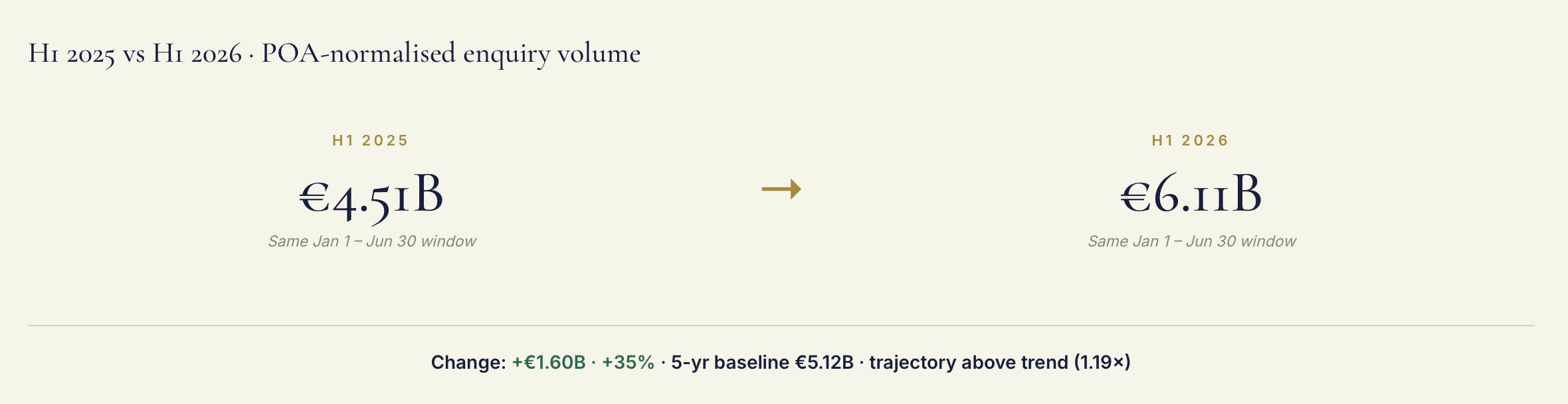
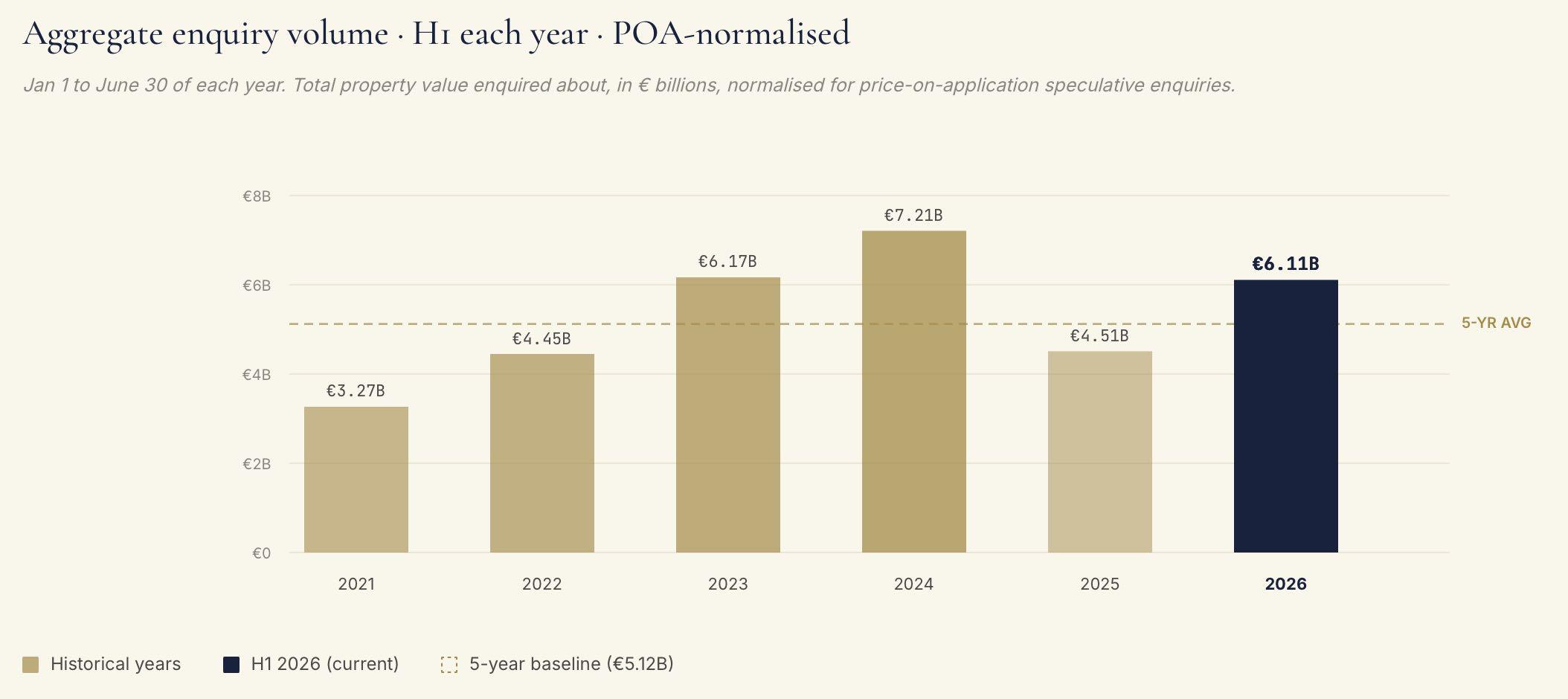
The aggregate POA-normalised buyer demand expressed through the firm's channels reached €6.11 billion in property value during H1 2026, nineteen percent above the five-year baseline. Enquiry composition has shifted toward materially larger average ticket sizes, the non-domiciled resident segment has emerged as a structurally distinct buyer category, and ultra-luxury buyers above €5 million continue to anchor more than two-thirds of total demand volume.
Three observations the H1 2026 data establishes
First, the Iran conflict produced a measurable but bounded demand shock. Enquiry count-rates compressed mildly in the first twenty days following the outbreak of hostilities, the only period of rate compression in the half-year. Demand volume in value terms, meanwhile, registered +36% YoY growth, reflecting a rising average enquiry size. By mid-April, six weeks after the conflict began, demand had not only recovered but exceeded prewar growth trajectories. The market absorbed the geopolitical disruption within a forty-day window.
Second, the Non-Domiciled resident segment has emerged as a structural buyer category. From zero presence in the firm's
transaction records before 2024, non-domiciled buyers contributed twenty-nine percent of 2025 transaction volume. The majority of this segment is British, reflecting the documented effect of the UK non-dom regime abolition on capital relocation toward Greece. The category warrants dedicated examination and is treated in Section 9.
Third, the price rationalisation pattern is now empirically inescapable. Properties priced realistically against actual transaction comparables continue to convert at the firm's established cycle times. Properties marketed at exploratory prices are accumulating on the market without serious engagement and progressively losing institutional standing among buyers. The bifurcation between rationally-priced and aspirationally-priced product is the single most consequential pattern of the half-year.
“Demand has returned to long-term trend after the 2025 moderation. The buyers arriving in 2026 are larger, more institutional, and more committed than the buyers we welcomed five years ago.”
— SAVVAS SAVVAIDIS, PRESIDENT & CEO


AGGREGATE ENQUIRY VOLUME
Greece Sotheby's International Realty quantifies market demand on a volume basis, the aggregate property value associated with each buyer enquiry, normalised for price-on-application enquiries to remove the distortion of speculative interest from the structural measure of demand.
The five-year trajectory
The normalised volume series reveals the post-2020 expansion phase, peak demand in 2024, the 2025 moderation, and the H1 2026 return to trend with margin. The H1 2026 volume of €6.11 billion sits nineteen percent above the firm's five-year baseline of €5.12 billion, the clearest possible empirical signature of a
market that has not only resumed its structural trajectory following the 2025 pause but has done so at a level meaningfully above long-term trend.
Average enquiry size has shifted materially upward
The structural conclusion is unambiguous: buyers active in 2026 are enquiring on materially larger properties than in any prior comparable period. The median enquiry value moved from €2.30 million in 2025 to €2.95 million in 2026, a 28 percent upward shift. The average enquiry value rose from €5.12 million to €5.89 million. Demand has not simply returned in volume; it has returned at a higher quality tier.

A methodological note
Enquiry volume measures buyer-expressed interest, not concluded transactions. Each enquiry is associated with a property of a given indicative value. Enquiries flagged as price-on-application, where the listing price is not publicly disclosed and the buyer is responding to product presentation rather than to a specific known price, are normalised to sixty-eight percent of nominal value under a twenty / forty / forty rule (twenty percent assumed pure curiosity, forty percent assumed serious buyers at seventy percent of stated price, forty percent assumed at full stated price). This adjustment is applied consistently to all comparison years. Full methodology in Section 8.
THE IRAN CONFLICT & MARKET RECOVERY
A documented forty-day demand shock followed by decisive rebound
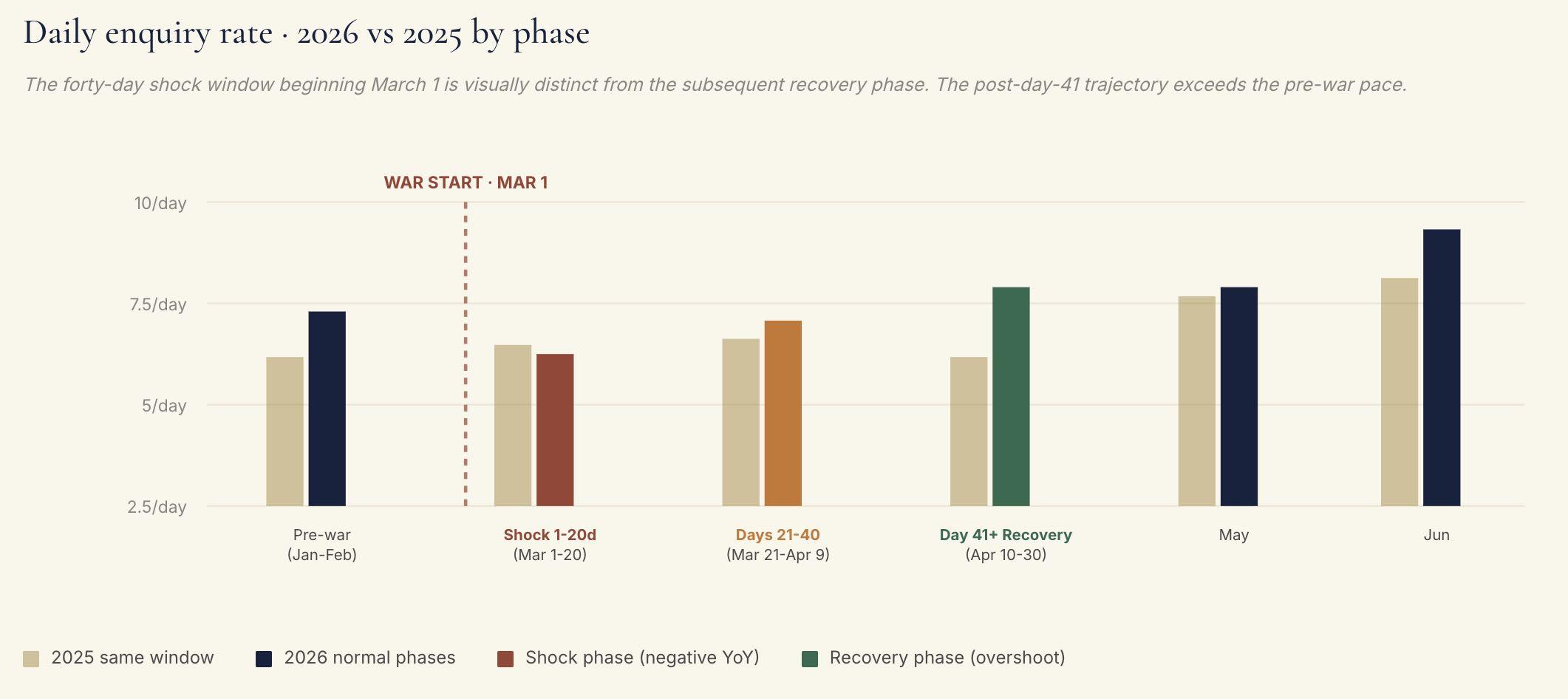
The outbreak of the Iran conflict on March 1, 2026 produced the only measurable demand disruption in the Greek luxury residential market during H1 2026. The disruption was bounded, the recovery was decisive, and the post-recovery trajectory has exceeded pre-war demand levels, a textbook signature of a structurally resilient luxury market.
The phased pattern of disruption and recovery
Greek Sotheby's International Realty's daily enquiry data permits a granular reconstruction of the market's response to the geopolitical shock. The pattern divides cleanly into four phases:
What the response pattern reveals about market structure
Three structural observations emerge from this empirical signature.
First, the disruption was bounded. Only the first twenty days following the conflict's outbreak produced a mildly negative year-on-year movement in enquiry count-rates ( 5%), the volume of buyer-expressed interest in value terms held strongly through this window, registering +36% YoY growth on the back of a rising average enquiry size. By day twenty-one, growth had resumed, and by day forty-one the market had not only recovered but materially exceeded its pre-war pace. The aggregate duration of measurable disruption was approximately forty days, a remarkably contained response window for a luxury market exposed to a major geopolitical event in its immediate Mediterranean neighbourhood.
Second, the post-disruption rebound has been compositionally healthier than the pre-war pace. Enquiry count-rates in the recovery window have averaged 7.2 to 10.4 per day, with daily value volumes between €30M and €50M, meaningfully above the pre-war averages of 6.4 enquiries and €26M per day. Average enquiry size has continued to drift upward through the recovery, indicating that the buyers reengaging after the shock are at the high end of the buyer distribution rather than at the speculative low end.
Third, the absence of a Mediterranean-security discount. Despite Greece's proximity to the affected region and the Mediterranean energy infrastructure context, the H1 2026 enquiry data shows no measurable Greek-specific risk premium. Buyers continue to enquire on Greek properties at the same elevated rates that characterise other safe-haven European luxury markets. The Greek market has decoupled from regional security narratives that historically constrained Mediterranean-periphery property demand.
The structural implication
A luxury property market that processes a major geopolitical shock with a forty-day disruption window, and then exceeds preshock demand levels in the recovery phase, exhibits the resilience characteristics of a mature institutional asset class. The Greek market's response to the Iran conflict places it squarely within the response profile of established Northern European and North Atlantic luxury residential markets, not the response profile of emerging-market property categories.
PRICE DYNAMICS & RATIONALISATION
The market absorbs realistic pricing; exploratory pricing accumulates
Greece Sotheby's International Realty maintains an active inventory of more than four hundred luxury residential listings across the principal Greek luxury submarkets. The empirical record of this inventory, combined with the documented price-revision patterns and days-on-market data, produces a direct, quantified view of how the Greek luxury market is forming prices and absorbing product in H1 2026.
Current asking €/m² by region | active inventory snapshot
The following figures reflect the median and average asking price per square metre across the firm's active luxury inventory as of mid-year 2026. Each regional benchmark is computed from a sample large enough to support institutional confidence. Athens Riviera, Mykonos, and Athens Center anchor the upper-mid range; Corfu (the largest single sample at seventy listings) defines the Ionian premium benchmark; Athens North and the lesser Cycladic islands sit at the accessible luxury floor.
Three regional observations emerge with empirical clarity. Mykonos and Athens Riviera anchor the top tier at €10,213 to €10,938 per square metre median, establishing the institutional luxury benchmarks for island and mainland coastal product respectively. The Athens Riviera distribution extends materially higher, with branded off-plan product reaching the €26,000 per square metre range. The Ionian (Corfu and Lefkada) operates as a structurally lower-priced premium category than the Cyclades, with Corfu median at €8,716 and Lefkada at €9,130 per square metre. Crete, Kefalonia, and Zakynthos comprise the accessible luxury floor, with medians in the €6,000 to €7,000 range, a segment that has remained materially undervalued relative to amenity and infrastructure quality.
An important imperative note
The asking prices reported above reflect the firm's active inventory in its current state, inclusive of all price revisions that have occurred during the marketing cycles of individual listings. The figures represent the post-rationalisation pricing landscape, not asking prices at any historical snapshot. The persistent days-onmarket data discussed below should be read against this fact: the inventory is sitting on the market even after any pricing adjustments sellers have already made.
Asking €/m² by price tier | active inventory
The price-tier progression in asking €/m² is approximately linear: every step up in absolute price corresponds to a meaningful step up in per-square-metre valuation. The €5M+ tier asks approximately twice the price per square metre of the sub-€2M tier, a function of both physical product specification (location, build quality, finishes) and the institutional buyer profile of the upper tier.
The empirical evidence of price rationalisation
Two empirical findings from the firm's transactional record provide direct quantitative support for the price rationalisation thesis developed in the Foreword and the Executive Summary.
First, days-on-market data on closed sales reveals a highly heterogeneous market with a healthy median velocity. median time from publication to signed agreement across the firm's completed sales runs at approximately 238 days, 7.8 months. Forty-one percent of sales close within six months of listing; a further twenty percent close within twelve months; while thirty-nine percent require more than a year to reach agreement. The fast segment of the distribution represents rationally-priced product moving into transaction at natural market velocity; the extended segment represents the time required for exploratory pricing to be resolved through eventual rationalisation.
Second, price-revision patterns provide a directional indicator of the rationalisation dynamic in motion. Among the subset of listings for which both 2025 and 2026 asking prices are explicitly tracked and differ, seventy-two percent of recorded revisions have been downward, with a median reduction of approximately eight percent. The downward revisions span the full price distribution, from sub-€2 million product through €20 million-plus trophy estates, indicating that the rationalisation pressure operates across the entire luxury market, not at any single tier. The broader rationalisation embedded in the current asking-price landscape extends beyond this explicitly tracked subset the figures above represent the current post-rationalisation state of the inventory.
CLOSING
N SOLDPROPERTY DOM
Average time from publication to signed agreement across completed sales, approximately 7.8 months
Realisticallypriced product being absorbed at natural market velocity
Properties initially priced exploratorily, resolved through extended exposure and rationalisation
A direct observation from the firms inventory record
A seller who maintains an exploratory price for six or twelve months without serious offers will find that the market remembers the property as unsold, not as undervalued. The institutional memory of the luxury buyer base in any given submarket is sufficient that a property which has visibly failed to transact at one price level cannot subsequently transact at a higher price level. The price-at-listing decision is the price-positioning decision for the lifetime of the marketing cycle. The heterogeneity in days-on-market, with thirty-nine percent of sales requiring more than a year and nineteen percent requiring more than two years, against a median of eight months, is the empirical record of this dynamic in operation. This is the most consequential strategic observation in the firm's H1 2026 record.

BUYER ORIGINS
The national composition of luxury demand
The empirical composition of buyer origin in H1 2026 reveals patterns that diverge materially from the conventional framing of Greek luxury property as a foreign-buyer category. Greek domestic buyers constitute the largest single national segment of luxury enquiry, the British high-net-worth segment has recovered
with intensified momentum (+60% YoY), and the European buyer pool is broadening materially with Netherlands, Spain, and Australia accelerating.
Three patterns worth structural attention
UAE share has moderated from earlier-period peaks while remaining above its five-year baseline. Following an intense acceleration phase during 2024–2025, when UAE buyer share reached double its five-year average, demand has normalised to 2.2 percent in H1 2026, compared with 3.6 percent in H1 2025 and 1.8 percent on the five-year baseline. The Gulf buyer remains concentrated in Athens Riviera ultra-luxury product, at price points typically three to five times the all-market average enquiry size, so the strategic weight of the segment materially exceeds its quantitative share. Alongside this normalisation, the European buyer pool is broadening with force: the Netherlands (+199%), Spain (+470%), Belgium (+101%), and South Africa (+264%) have emerged as the fastest-growing origins of the halfyear.
The British position has recovered with conviction beyond its long-term baseline. The UK share at 17.4 percent in H1 2026 sits clearly above the 15.1 percent five-year baseline, and the year-on-year growth rate of +60 percent represents the strongest recovery in any of the top-five origin segments. The UK buyer is back, and is back at elevated commitment levels. This pattern is most plausibly explained by the documented effect of the UK non-dom regime abolition on outbound luxury property acquisition, treated in dedicated detail in Section 10.
The German share has stabilised at sub-baseline levels. Germany has moved from a 5.1 percent five-year baseline share to a 3.3 percent H1 2026 share, with a marginally negative year-on-year movement ( 1%), effectively a stabilisation after several halves of compression. The pattern reflects the broader weakening of German outbound luxury property acquisition observable across European Mediterranean markets and aligns with the documented macroeconomic pressures on the German upper-middle-class wealth segment.
The diaspora origins, Australia at +60 percent year-on-year and Canada at +54 percent, represent a structurally distinct buyer category: Greek-heritage families acquiring property in their ancestral country for eventual relocation or generational asset positioning. Australia has now overtaken the UAE in cumulative share, settling into the fifth-largest origin position. The diaspora category is acquiring at materially smaller average ticket sizes than the Northern European categories but at materially longer expected holding periods.
The top thirteen buyer origins | H1 2026 vs H1 2025 vs 5-year baseline
ATHENS RIVIERA
The defining structural development of the cycle
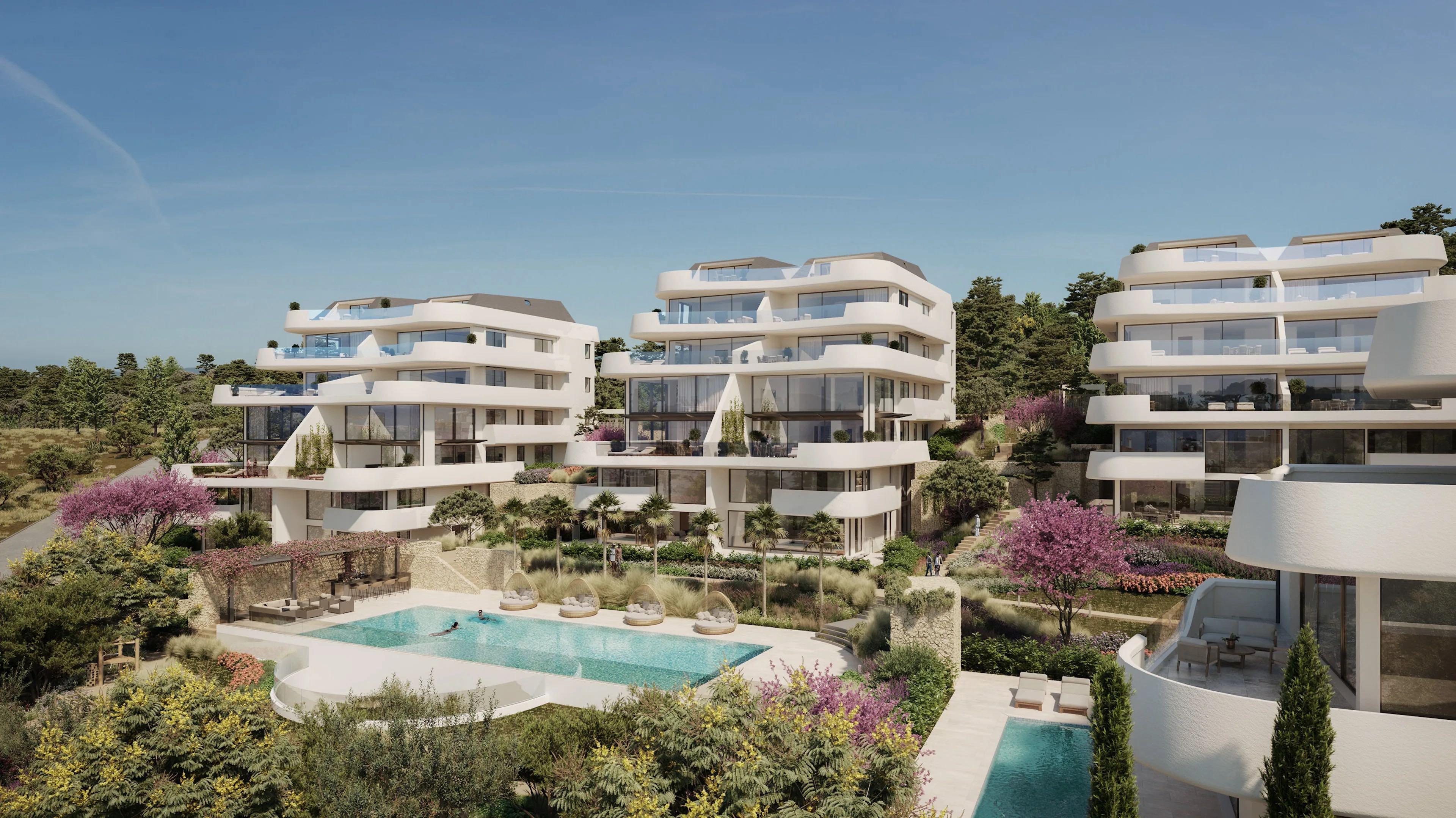
The convergence of the Hellinikon megaproject, the Apollo Hills branded residences programme, and the broader regeneration of the southern Attica coastline has produced a uniquely concentrated luxury submarket. The Athens Riviera is now the structurally defining category of the Greek luxury property cycle.
Athens Riviera as an institutional luxury market
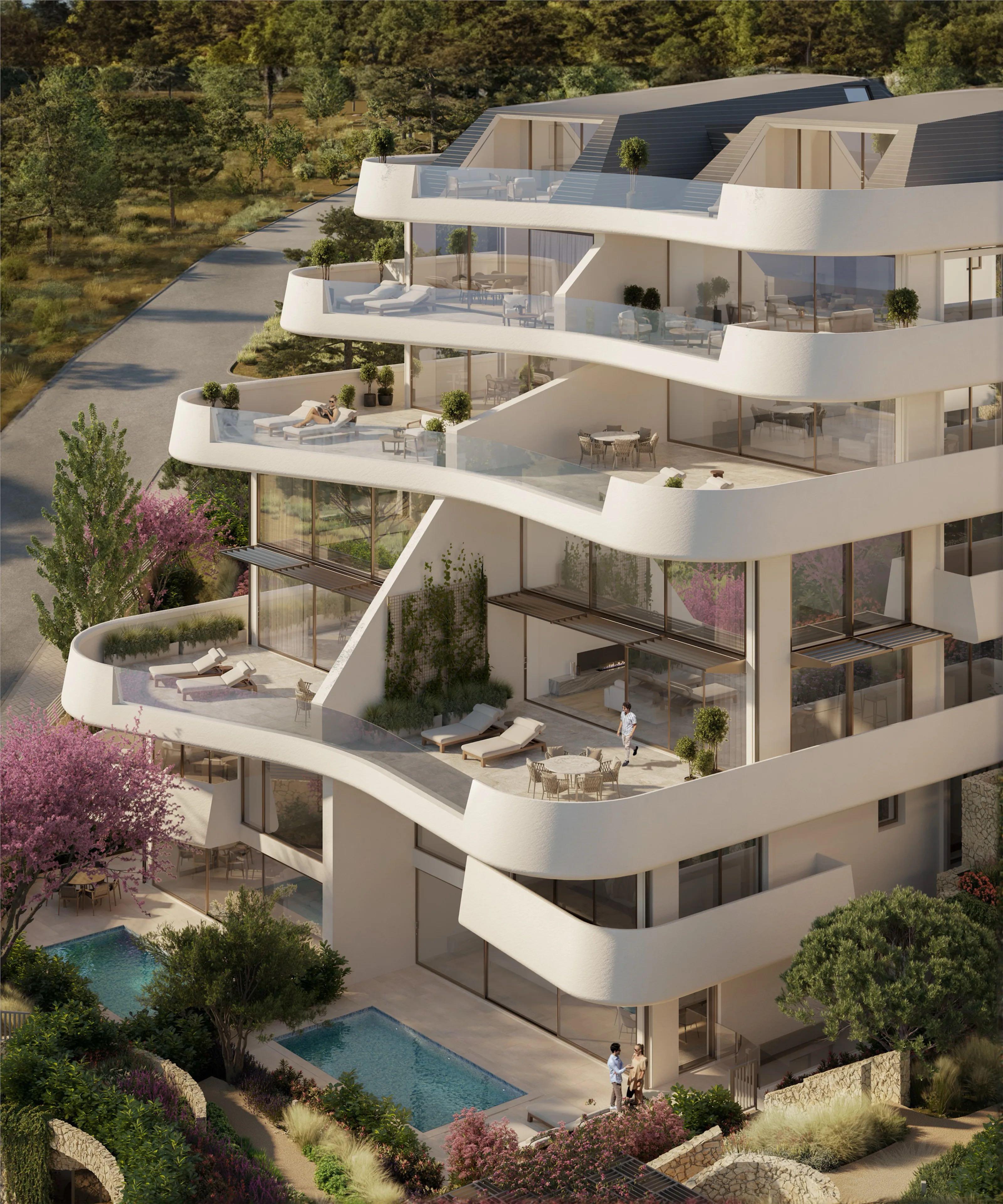
The product type, off-plan, branded, architecturally curated, delivered to international hospitality standards, aligns precisely with the buyer profile defined by the contemporary Mediterranean wealth pool: Gulf family offices, Northern European institutional wealth, repatriating Greek-heritage executives, and London-based finance professionals.
The category is categorically distinct from the traditional Greek property narrative. It is not a heritage purchase, a restoration project, or a holiday-rental yield play. It is a primary or secondary residence in a curated, brand-led urban-coastal
environment, with concierge, security infrastructure, and amenity programming aligned with the most established Mediterranean luxury benchmarks.
The Athens Riviera direct-enquiry channel, buyer contact via the Apollo Hills developer interface, has expanded from a position of negligible presence in 2023 to a structurally significant channel of qualified enquiry by H1 2026. No other source channel has demonstrated comparable growth velocity within the firm's measurement framework

Two structurally distinct buyer profiles
The Athens Riviera buyer profile differs materially from the traditional island buyer profile in decision criteria, holdingperiod expectations, and product preferences. The traditional island buyer purchases identity, lifestyle association, and aesthetic context. The Athens Riviera buyer purchases infrastructure, brand-led residential excellence, and proximityto-amenity. The decision frameworks operate on different axes. Proximity to Athens International Airport, international school networks, year-round amenity programming, and developer reputation outweigh the romantic considerations that dominate the island purchase decision. The Athens Riviera segment is consequently more aligned with the global mobile-wealth purchasing pattern observable in established Mediterranean institutional residential markets.
The Athens Riviera segment also aligns most closely with the post-2023 Greek residency-permit programme. The majority of Athens Riviera off-plan transactions clear the €800,000 minimum threshold comfortably, qualifying for residency permits while delivering quality of life that materially distinguishes the Greek proposition.
The strategic implication for the broader Greek market is any analytical framework that focuses exclusively on island destinations is structurally incomplete. The Athens Riviera represents the most active and developmentally significant zone of the current Greek luxury cycle, and the category will define the next decade of the institutional Greek luxury market.
THE CONVERSION FUNNEL
The luxury buyer journey in aggregate
Buyer enquiry volume represents the top of an extended conversion funnel. The Greek luxury market exhibits highly stable conversion ratios across the principal stages of the buyer journey. These ratios are observable across multi-year aggregated transaction data and are presented for illustrative purposes.
Greece Sotheby's International Realty does not disclose specific transaction counts in this publication. What is reported below is the funnel geometry, the typical conversion ratios that the luxury Greek property market produces. These figures are aggregated across the firm's transaction history since 2017.

The blended conversion ratio that combines all stages, from initial enquiry to closed transaction, approximates 1 percent for the luxury Greek property market. This figure is consistent with established global luxury benchmarks. The high-net-worth buyer journey is structurally slower, more deliberative, and more selective than the broader residential real estate market.
The Stage 04 fallout rate, signed agreements that fail to close, runs at 22 percent in aggregate across the firm's transaction history. Typical fallout drivers include financing complications, legal due-diligence findings, cadastral or planning issues identified post-LOI, and buyer reconsideration. The 22 percent rate has been remarkably stable across cycles and represents a structural feature of the Greek luxury transaction process rather than a function of market conditions.
An important note on time
The full conversion funnel does not collapse within a single half-year window. An enquiry received in January typically becomes a signed agreement in April or May at earliest; an agreement signed in May typically does not close before August or September. Half-year reports always capture multiple cycles in different stages. The €6.11 billion enquiry volume observed in H1 2026 will produce signed agreements through end-2026 and into early 2027.
THE GREEK DOMESTIC SEGMENT
The largest single national segment, materially under-acknowledged
Conventional treatments of Greek luxury property frame the asset class as an export category. The H1 2026 enquiry data does not support this framing.
In H1 2026, Greek domestic buyers represented 18 percent of all enquiries received by Greece Sotheby's International Realty, the largest single national share in the period. By comparison, the United Kingdom contributed 18 percent of enquiries and the United States 15 percent. The Greek domestic segment constitutes the largest demographic plurality in the firm's H1 2026 demand pool.
The Greek domestic luxury buyer base divides into three structurally distinct sub-segments.
The Athens-based ultra-high-net-worth household
Established Athenian wealth, typically associated with multigenerational family businesses or established professional services, diversifying property holdings beyond the primary residence. The Athens Riviera off-plan product attracts meaningful demand from this segment, alongside second-home acquisitions in the closer Saronic islands (Hydra, Spetses) or the western Peloponnese. This represents the largest sub-segment within the Greek 18 percent share.
The repatriating Greek diaspora
Greek-American, Greek-Australian, Greek-British, and GreekCanadian buyers acquiring Greek property either for primary residence, typically in the context of remote work or nearretirement relocation, or in preparation for eventual return. The structural weight of this sub-segment is rising as remote work arrangements normalise for senior international professionals.
The Greek shipping and entrepreneurial class
A smaller but financially weightier sub-segment. Frequently invisible in conventional enquiry data because transactions are intermediated through advisors and legal counsel, but well represented within the firm's Private Office channel. Geographically concentrated in the Athens Riviera, Mykonos, and the higher-end Argolis (Porto Heli) market.
The combined Greek domestic segment exhibits not only the largest demographic weight but also distinctly higher conversion velocity than the international segment. Domestic buyers possess market familiarity, established legal-process knowledge, and the cultural fluency to move from enquiry to viewing to agreement on materially compressed timeframes. The Greek domestic segment consequently exerts disproportionate influence on actual transaction outcomes relative to its 18 percent demographic share.
ULTRA-LUXURY RESILIENCE
The €5 million-plus tier anchors the market
Greece Sotheby's International Realty's tier-segmented enquiry data provides direct empirical evidence for the structural floor characteristic of mature luxury markets: the ultra-luxury price tier consistently contributes more than sixty percent of total demand volume in every comparison period, and exhibits the most resilient recovery trajectory through cyclical moderation.
Volume share by tier | the structural floor
The volume composition of enquiries has remained heavily skewed toward the ultra-luxury tier across the entire observation window. This is the structural-floor characteristic that distinguishes mature luxury markets:
Properties above €5 million have contributed between 66 and 74 percent of total POA-normalised enquiry volume in every H1 period observed. The figure is structurally stable, it does not move materially with the broader market cycle. This consistency is the empirical signature of a mature luxury market.
Recovery dynamics by tier | 2025 to 2026
The 2026 recovery from the 2025 moderation has demonstrated structurally distinct behaviour at each price tier:
The structural implication
The Greek luxury market exhibits the resilience-by-tier pattern observable in established global luxury real estate markets. Buyers at the €5 million-plus price point are materially less rate-sensitive, less macro-sensitive, and less cycle-sensitive than buyers below this threshold. The ultra-luxury segment functions as the market's structural anchor, contributing the dominant share of demand volume in both expansion and moderation phases. The Greek market is now sufficiently mature to exhibit this developedmarket characteristic.

The ultra-luxury segment has rebounded at roughly two-and-ahalf times the rate of the mass-luxury tier. The mid-luxury tier (€2M–€5M) demonstrated the most stability throughout the 2025 moderation and continues to reinforce steadily through 2026, a finding worth structural attention, as the segment is frequently characterised as the most volatile in luxury market commentary.
A structural buyer category that did not exist before 2024
The most consequential structural development in Greece Sotheby's International Realty's transactional record over the last twenty-four months is the emergence of the Non-Domiciled resident buyer segment. From an effectively zero presence in the firm's transaction records through 2023, the category contributed nearly thirty percent of 2025 transaction volume, a step-change without precedent in the firm's recorded history.
The empirical emergence
The 2024 emergence and 2025 acceleration trace a step-change of empirical clarity unusual in luxury property data. The H1 2026 share reflects the standard mid-year compositional drift, full-year 2026 figures will become measurable only against full-year comparable windows, but the underlying trajectory remains consistent with the 2024–2025 emergence pattern.
The national composition of the Non-Dom segment
Greek Sotheby's International Realty's Non-Domiciled buyer base is dominated by a single national origin to a degree that is itself empirically remarkable:
First, the maturation of the Greek Non-Domiciled resident tax regime. Greece introduced its Non-Dom programme in 2020, offering qualifying new tax residents a €100,000 annual flat-tax election on foreign-source income for a fifteen-year window. The programme required several years of institutional awareness to reach the wealth-advisory and family-office networks that mediate ultra-high-net-worth relocation decisions. The 2024 emergence of the segment in the firm's data corresponds precisely with the period of programme awareness reaching critical mass within these advisory networks.
Second, the announced abolition of the United Kingdom's Non-Domiciled regime. The UK Government's announcement of the removal of the historical UK non-dom tax framework, phased through 2024 and effective in April 2025, produced a documented capital and residency relocation response among UK-based ultra-high-net-worth households. Greece has emerged as one of the principal beneficiary jurisdictions in this relocation flow, alongside the United Arab Emirates and Switzerland. The fifty-three percent British share of the firm's Non-Dom transactional record is the empirical signature of this regulatorydriven flow.
The strategic implications
Three implications follow directly from the Non-Dom data:
First, the Non-Dom segment is structurally additive to the Greek luxury market, not substitutive. The buyers entering through this channel are not redirecting from other Greek luxury categories, they are net new institutional wealth that previously had no compelling reason to acquire Greek property. The aggregate Greek luxury market opportunity is therefore meaningfully expanded by the programme's continuing institutional uptake.
Second, the average transaction size in the Non-Dom segment exceeds the all-market average. Non-Dom buyers are by definition wealth-relocating high-net-worth individuals, who typically acquire principal-residence-quality property at the upper end of the luxury distribution. The 14 percent deal-share that produced 29 percent of 2025 volume reflects the pertransaction weight of this segment.
Third, the regulatory framework on which the Non-Dom emergence depends is institutionally stable. The Greek programme has cross-party support, sits within a broader Greek macro-stability narrative reinforced by the 2026 sovereign rating upgrade, and is unlikely to face the kind of regulatory reversal that has affected programmes in other Mediterranean jurisdictions. The category will continue to compound through 2026 and 2027.
The
structural conclusion
More than half of all Non-Domiciled resident transactions in the firm's record are British. This concentration is not coincidental and reflects a documented regulatory-arbitrage dynamic between the United Kingdom and Greece that has accelerated through 2024 and 2025.
The regulatory mechanism driving the emergence
Two regulatory developments operate together to produce the Non-Dom emergence observed in the firm's data:
The Non-Domiciled resident segment is now a permanent and structurally significant component of the Greek luxury property market. The 2024 emergence and 2025 acceleration are not transitional features, they represent the establishment of a new institutional buyer category that will materially influence the market's composition, transaction volumes, and product positioning for the next decade. Greek luxury property has acquired a wealth-relocation function that did not exist in its pre-2024 institutional profile.
MACROECONOMIC & GEOPOLITICAL CONTEXT
The institutional backdrop to H1 2026
The H1 2026 Greek luxury market has operated against a transformed macroeconomic and geopolitical backdrop. Three structural developments, the completion of Greece's sovereign rating rehabilitation, the reversal of the European Central Bank's rate-cutting cycle, and the structural shift in Gulf wealth allocation patterns,each independently support the empirical conclusions developed in the preceding sections.
Greece's full return to sovereign investment grade
In March 2026, Moody's upgraded the Government of Greece's long-term issuer rating from Ba1 to Baa3, completing the country's return to investment grade across all five major rating agencies (Moody's, S&P, Fitch, DBRS, Scope) for the first time since 2010. The upgrade followed a structural reduction in Greece's debt-to-GDP ratio of approximately fifty percentage points from its 2020 peak, with the metric projected to fall further to 140.6 percent by end-2026 from 156.1 percent at end-2024.
Supporting metrics include real GDP growth of 2.3 percent in recent years, primary surpluses of 2.0 to 2.5 percent of GDP, sustained NATO defense spending compliance, and an average debt maturity of 18.8 years at predominantly fixed interest rates. For institutional and family-office buyers, the rating-agency endorsement is materially significant: Greek property is no longer classified as a peripheral-EU asset for portfolio-allocation purposes.
The reversal of the ECB rate-cutting cycle
The European Central Bank delivered the first interest rate increase of the post-2023 cycle on 11 June 2026, raising the deposit facility rate by 25 basis points to 2.25 percent. The decision reflects the inflation pressure generated by the Iran conflict and the associated disruptions to oil shipments through the Strait of Hormuz. ECB staff have revised the 2026 headline inflation forecast upward to 3.0 percent and the 2027 forecast to 2.3 percent.
For the Greek luxury property market, the rate environment retains structurally accommodative characteristics relative to the 2023–2024 peak (when the deposit rate reached 4.0 percent). Most Greek luxury transactions are not financed at the margin, high-net-worth buyers typically transact in cash or with materially under-leveraged positions, so the direct ratetransmission channel is weak. The indirect effects, however, are meaningful: a sustained ECB tightening cycle would moderate broader European wealth-creation dynamics and could affect international buyer purchasing power in 2027.
The Iran conflict
and Gulf wealth diversification
The intensification of the Iran conflict through Q2 2026 has reinforced an existing structural trend: the diversification of Gulf wealth out of Middle Eastern asset concentrations and into European luxury real estate. Greece's geographic positioning, Mediterranean character, sovereign rating rehabilitation, and Athens Riviera product pipeline have positioned it advantageously within this flow. The UAE share of Greece Sotheby's International Realty's H1 2026 enquiry base settled at 2.2 percent of total enquiries, a normalisation from 2024–2025 peaks while still slightly above the 1.8 percent five-year average. Given the segment's concentration in Athens Riviera ultra-luxury product at price points typically three to five times the all-market average, its strategic weight materially exceeds its quantitative share.
Greek tax regime stability and the Non-Dom programme
The Greek Non-Domiciled resident tax regime, offering a €100,000 annual flat-tax election on foreign-source income for new tax residents over a fifteen-year window, has matured into a functioning wealth-relocation framework. The programme has cross-party institutional support, sits within the broader Greek macro-stability narrative, and faces no immediate reform risk. The emergence of this regime as a functioning mechanism is the principal regulatory driver of the Non-Domiciled buyer category discussed in Section 10.
The €800,000 minimum residency-permit threshold in the central Athens, Thessaloniki, Mykonos, and Santorini zones positions Greek demand at a higher-quality price point than legacy programmes elsewhere, a structural advantage for the institutional buyer segment that increasingly dominates the firm's transactional record.
Currency dynamics
The euro has traded in a range of approximately $1.10 to $1.17 against the US dollar through H1 2026, supporting US buyer purchasing power relative to the 2024 lows. The currency environment has not been a structural drag on US buyer participation, which holds at 15 percent of H1 2026 enquiries. Sterling weakness against the euro has been a more meaningful factor in the UK buyer calculus, though the H1 2026 enquiry data shows the UK segment recovering with conviction, most plausibly explained by the Non-Dom relocation flow discussed in Section 10 overwhelming the currency-translation drag.
Synthesis
The H1 2026 Greek luxury market has benefitted from a structurally favourable combination of macroeconomic and geopolitical conditions: completion of sovereign rehabilitation, still-accommodative monetary policy, structural Gulf wealth diversification, and a mature Non-Domiciled resident framework attracting wealthrelocation flows. None of these factors is in immediate reversal. The H2 2026 outlook is therefore biased toward continuation of current demand patterns rather than deterioration, subject to the specific risk variables addressed in Section 12 below.
OUTLOOK FOR H2 2026
Variables defining the secondhalf trajectory
Five variables observable in the H1 2026 data and the macroeconomic context developed in Section 11 are likely to shape outcomes through the second half of the year. The basecase outlook is constructive, the market structure has demonstrated empirical resilience and the macro tailwinds remain in place.
Athens Riviera supply delivery is the year's defining variable
The pace at which new branded developments deliver completed inventory through H2 2026 will materially determine whether the segment's exceptional H1 demand translates to closed transactions or accumulates as deferred demand into 2027. The relevant indicators are the Hellinikon delivery schedule, the Apollo Hills phase completions, and the broader mainland development pipeline. A scenario of meaningfully accelerated delivery produces a transaction step-change. A scenario of delivery slippage results in demand queuing at progressively higher prices, a dynamic already observable at the price-persquare-metre level in the H1 2026 data.
The post-normalisation UAE buyer trajectory
Demand from the United Arab Emirates has normalised from 2024–2025 peaks while remaining slightly above its five-year baseline, concentrated, as discussed in Section 6, in the Athens Riviera ultra-luxury product. The post-war trajectory will determine whether the normalisation is transitional or structural. The Iran conflict context developed in Section 11 has accelerated the underlying Gulf-wealth diversification trend, and Greece is structurally positioned to benefit from a renewed acceleration. The next twelve months represent the decisive window.
The Non-Dom segment will continue to compound
The Non-Domiciled emergence discussed in Section 10 is the most directionally clear forward variable in the firm's outlook. The UK Non-Dom regime abolition continues to drive outbound wealth relocation; the Greek Non-Dom programme continues to mature in institutional awareness; the macro environment continues to reinforce the safe-haven positioning. The expectation is for the Non-Dom share of transactional volume to consolidate at or above the 2025 high-water mark of twenty-nine percent through 2026 and 2027.
The ECB rate path and energy shock duration
The Iran conflict has reversed the ECB rate-cutting cycle. Should the energy shock prove persistent and require additional rate increases, the indirect effects on European wealth-creation
dynamics could moderate luxury demand through 2027, though, as noted in Section 6, the direct rate-transmission channel to ultra-high-net-worth property transactions is weak. The ultraluxury resilience analysis in Section 9 suggests that even a meaningful tightening cycle would affect the mass-luxury and mid-luxury tiers more than the €5 million-plus segment that contributes the majority of demand volume.
The pricing discipline question
The price rationalisation thesis developed in Section 4 constitutes the most operationally consequential variable for the second half. Properties listing in H2 2026 at exploratory prices will face the same structural absorption failure observed in H1 2026, and the inventory-accumulation effect will compound. The market's capacity to absorb realistically-priced product remains intact and is supported by elevated demand levels; the market's capacity to absorb aspirationally-priced product is materially weaker than at any prior point in the firm's transactional record. Sellers entering the market in H2 2026 should expect a binary outcome distribution: realistic pricing transacts, exploratory pricing accumulates.
Concluding observation
The empirical H1 2026 picture is materially healthier than shortform market commentary has captured. Demand has not only returned to but exceeded the long-term baseline following the 2025 moderation; the Iran conflict disruption was bounded to a forty-day window; the Non-Domiciled segment has emerged as a structurally significant new buyer category; the ultra-luxury tier continues to anchor more than two-thirds of demand volume; the Athens Riviera continues to define the structural premium category; and the macroeconomic backdrop is the most favourable in Greek property history. The Greek luxury property market is operating above trend, with structural composition shifting toward more institutional buyer profiles, higher product specifications, and more rigorous price discipline.
METHODOLOGY
The analytical framework
This report draws from the proprietary buyer enquiry and transaction records of Greece Sotheby's International Realty, covering the period January 1, 2026 to June 30, 2026. Year-onyear comparative figures use the same equal-maturity window in prior years (January 1 to June 30 in each comparison year) to eliminate the structural bias of comparing partial-period 2026 data against full-year prior periods.
POA-normalised enquiry volume metric. The aggregate enquiry volume measure represents the sum of indicative property values associated with all buyer enquiries received in the period, with a normalisation rule applied to enquiries flagged as price-on-application (POA). POA-flagged enquiries, where the listing price is not publicly disclosed and the buyer is responding to product presentation rather than to a specific known price, are subject to a twenty / forty / forty rule reflecting the empirical composition of POA buyer intent: twenty percent treated as pure curiosity (zero weight), forty percent treated as serious buyers operating at seventy percent of stated price, and forty percent treated as at full stated price. The resulting effective POA weight is 0.68 per POA-flagged enquiry. This normalisation is applied consistently to all comparison years to ensure apples-to-apples period-on-period analysis. Multi-enquiry buyers are additionally normalised via a saturation curve: the first two enquiries from any unique buyer are counted at full weight, the third at 0.6, the fourth at 0.4, and subsequent enquiries at 0.2.
Price-per-m² metric. Median and average price-per-squaremetre figures are computed from the firm's active luxury listings inventory as of mid-year 2026, comprising more than four hundred properties across all principal Greek luxury submarkets. The metric uses asking listing price divided by recorded property size in square metres. The listings-based methodology provides materially larger sample sizes than transaction-based methodologies at the regional level and supports statistically meaningful regional and tier-level breakdowns. Regional benchmarks are reported only for submarkets where the active inventory sample exceeds ten listings. One outlier listing exceeding €50,000 per square metre was excluded from the aggregate calculations to avoid distortion of the central tendency measures.
Days-on-market metric. Days-on-market figures reflect the elapsed time from first publication to signed agreement, computed across the firm's completed sales with valid publication and agreement dates. Properties that were temporarily withdrawn and re-listed are measured from the original listing date. The metric is computed on closed transactions rather than active inventory: active-listing tenure is an adversely-selected sample, it measures only what has not yet sold, and systematically overstates true market cycle times.
Price-revision metric. The price-revision analysis is based on the subset of active listings (twenty-five in number) where the 2026 asking price differs from the 2025 asking price for the same property. Upward and downward revisions are measured against the prior-year asking price.
Geographic and nationality classification. Buyer-origin classifications use the country code submitted by buyers at the point of enquiry. Geographic property classifications follow the firm's internal regional taxonomy.
Iran conflict window analysis. The pre-war / shock / recovery windows used in Section 3 are defined relative to the outbreak of hostilities on March 1, 2026. Window definitions: pre-war (Jan 1 – Feb 28), shock first twenty days (Mar 1 – Mar 20), partial recovery (Mar 21 – Apr 9), decisive rebound (Apr 10 – Apr 30), sustained elevated demand (May 1 – Jun 30). Comparison is to the identical calendar windows in 2025.
Non-Dom classification. The Non-Domiciled segment identifier in the firm's transactional record reflects buyer self-disclosure at the point of enquiry or contract, validated against subsequent legal documentation where available. The 2020–2023 zeropercent figures reflect the absence of the category in the firm's record during this period; the 2024 emergence reflects both the maturation of the Greek programme and the initial UK Non-Dom regime abolition response.
Conversion ratios. The funnel ratios disclosed in Section 7 represent rolling multi-year aggregate ratios derived from the firm's transaction history since 2017. They are presented for illustrative purposes and do not constitute guarantees of future conversion performance for new properties or new enquiries.
Tracked transaction volume. The €650 million+ aggregate tracked transaction volume cited in cover and footer references the cumulative gross transacted value of properties handled by Greece Sotheby's International Realty since the firm's inception. Period-level transaction volumes, brokerage revenues, and individual transaction counts are not disclosed in this publication.

Copyright ©
The State of Greek Luxury Property is published by Greece Sotheby's International Realty. All rights reserved. Full or partial reproduction without written permission is strictly prohibited.
Disclaimer
Although every effort has been made to provide data that is current and verified, the author of this document does not guarantee or take responsibility for the accuracy of any information included in the report. The content is for informational purposes only and it should not be construed as investment advice.
Contact us
11 Voukourestiou st. Athens 10671. Greece
Tel. +30 210 968 1070
e-mail: enquiries@sothebysrealty.gr https://sothebysrealty.gr/