Great Smoky Mountains National Park
National Park Service U.S. Department of the Interior
SMOKIES GUIDE The Official Newspaper of the Smokies • Fall 2026
ny
ke
D
an
r
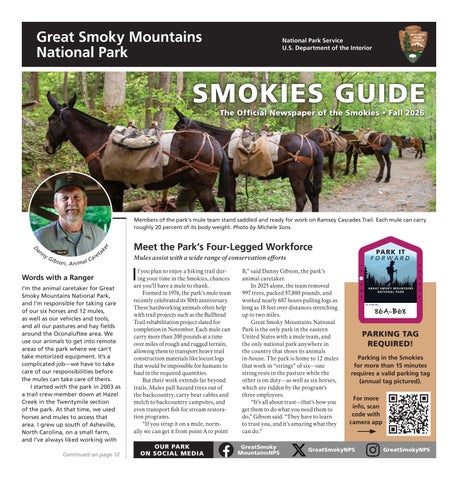
Members of the park’s mule team stand saddled and ready for work on Ramsey Cascades Trail. Each mule can carry roughly 20 percent of its body weight. Photo by Michele Sons.
G ib
s o n , A n i m al C
e ar
ta
Words with a Ranger I’m the animal caretaker for Great Smoky Mountains National Park, and I’m responsible for taking care of our six horses and 12 mules, as well as our vehicles and tools, and all our pastures and hay fields around the Oconaluftee area. We use our animals to get into remote areas of the park where we can’t take motorized equipment. It’s a complicated job—we have to take care of our responsibilities before the mules can take care of theirs. I started with the park in 2003 as a trail crew member down at Hazel Creek in the Twentymile section of the park. At that time, we used horses and mules to access that area. I grew up south of Asheville, North Carolina, on a small farm, and I’ve always liked working with Continued on page 12
Meet the Park’s Four-Legged Workforce Mules assist with a wide range of conservation efforts
I
f you plan to enjoy a hiking trail during your time in the Smokies, chances are you’ll have a mule to thank. Formed in 1976, the park’s mule team recently celebrated its 50th anniversary. These hardworking animals often help with trail projects such as the Bullhead Trail rehabilitation project slated for completion in November. Each mule can carry more than 200 pounds at a time over miles of rough and rugged terrain, allowing them to transport heavy trail construction materials like locust logs that would be impossible for humans to haul in the required quantities. But their work extends far beyond trails. Mules pull hazard trees out of the backcountry, carry bear cables and mulch to backcountry campsites, and even transport fish for stream restoration programs. “If you strap it on a mule, normally we can get it from point A to point
OUR PARK ON SOCIAL MEDIA
B,” said Danny Gibson, the park’s animal caretaker. In 2025 alone, the team removed 997 trees, packed 57,800 pounds, and worked nearly 687 hours pulling logs as long as 18 feet over distances stretching up to two miles. Great Smoky Mountains National Park is the only park in the eastern United States with a mule team, and the only national park anywhere in the country that shoes its animals in-house. The park is home to 12 mules that work in “strings” of six—one string rests in the pasture while the other is on duty—as well as six horses, which are ridden by the program’s three employees. “It’s all about trust—that’s how you get them to do what you need them to do,” Gibson said. “They have to learn to trust you, and it’s amazing what they can do.” GreatSmoky MountainsNPS
2027 86A-B68
PARKING TAG REQUIRED! Parking in the Smokies for more than 15 minutes requires a valid parking tag (annual tag pictured). For more info, scan code with camera app
GreatSmokyNPS
GreatSmokyNPS
S M O K I E S Closures For full closure information on all park roads, trails, and facilities, visit nps.gov/grsm and click “Alerts.” • Cades Cove Loop Road is closed to vehicles on Wednesdays from May 6 through September 30 to allow for walking and biking. • Heintooga/Round Bottom Road and Straight Fork Road are closed due to hurricane impacts. • Many secondary and high- elevation roads close in late fall. Dates are listed on pages 8–9.
Visitor centers
The National Park Service maintains developed campgrounds at ten locations in the park, two of which are open yearround. There are no showers, and hookups are available only at Look Rock Campground (closed in winter). Circuits for special medical uses are offered at Cades Cove, Elkmont, and Smokemont. Campsite reservations are required at all park campgrounds. Sites may be reserved up to six months in advance. Camping is permitted only in designated sites.
Campground
Shuttle services
Firewood
Make your reservation online at recreation.gov or call 877.444.6777. Site occupancy is limited to six people and two vehicles (a trailer is considered one vehicle). The maximum stay is 14 days. Campsites for larger groups are located at Big Creek, Cades Cove, Cataloochee, Cosby, Deep Creek, Elkmont, and Smokemont. Reservations are required and may be secured up to a year in advance. For more information, visit nps.gov/grsm.
No. of Sites
Elevation
Expected Open Dates 2026
Nightly Fees
Max RV Length
Abrams Creek
16
1,125'
5/8–10/25
$30
12'
Balsam Mountain
43
5,310'
5/15–10/12
$30
30'
Big Creek
12
1,700'
5/15–10/25
$30
tents only
Cades Cove
159
1,807'
open year-round
$30
35–40'
Cataloochee
27
2,610'
5/1–10/25
$30
31'
Cosby
157
2,459'
5/15–10/25
$30
25'
Deep Creek
92
1,800'
5/1–10/25
$30
26'
Elkmont
220
2,150'
4/3–11/29
$30
32–35'
Weather In autumn, a pattern of warm, sunny days and crisp, clear nights emerges by mid-September. However, cool, rainy days may also occur. Snow may fall at higher elevations beginning in November. As winter arrives, days can be sunny and 65°F or snowy with highs in the 20s.
P L A N N E R
Campgrounds in the national park
Sugarlands, Oconaluftee, and Cades Cove: open 9 a.m.–5 p.m. Sept.–Nov.; 9 a.m.–4:30 p.m. Dec. (Cades Cove 7 a.m.–3:30 p.m. on Wednesdays through Sept. 30). Kuwohi: open 9:30 a.m.– 5 p.m. Sept.– Nov.; closed Dec. GSM Institute at Tremont: open 10 a.m.–4 p.m. Monday–Saturday.
Local shuttle services offer convenient transportation to and from the park’s most iconic destinations. Routes, schedules, pricing, and pick-up/drop-off locations vary. Visit go.nps.gov/grsmshuttles for a list of authorized concessioners.
T R I P
Look Rock
69
2,600'
5/8–10/25
$30–36
no limit
Smokemont
142
2,198'
open year-round
$30
35–40'
To prevent the spread of destructive pests, only USDA- or state-certified heat-treated firewood may be brought into the park. Campers may gather dead and down wood in the park for campfires. Find purchase locations at firewoodscout.org.
Picnic areas Picnic areas at Cades Cove, Deep Creek, Greenbrier, and Metcalf Bottoms are open year-round. Heintooga closes October 12; Big Creek, Cosby, and Look Rock close October 25; Twin Creeks closes October 31; Chimneys closes November 30. Reserve pavilions at recreation.gov.
Accommodations LeConte Lodge (accessible by trail only, closes November 25) provides the only lodging in the park. Reservations required. 865.429.5704, lecontelodge.com.
Services There are no gas stations, charging stations, showers, or restaurants in the national park. Limited food options are available in visitor centers and camp stores. See map on pages 8 and 9 for restroom locations.
Event reservations Reserve the Appalachian Clubhouse or Spence Cabin at Elkmont for daytime events at recreation.gov. Cabin and clubhouse close October 31.
Pets Pets are allowed in campgrounds and along roads as long as they are restrained on a leash no longer than six feet. Pets are not allowed on park trails, except for Gatlinburg and Oconaluftee River trails.
SMOKIES GUIDE Smokies Guide is produced four times per year by Smokies Life and Great Smoky Mountains National Park. nps.gov/grsm SmokiesLife.org
Publication dates Spring: March Summer: June Fall: September Winter: December
Editor Holly Kays
Designer Emma Oxford
Editorial support Jennifer Fulford Valerie Polk
Design support Karen Key Miranda Bemis
Smokies Guide Fall 2026 • 2
NPS coordinators Stephanie Kyriazis Stephanie Sutton ©2026 Smokies Life P.O. Box 130 Gatlinburg, TN 37738
Available in digital format at issuu.com/ greatsmokymountains association
Printed on recycled paper
Bicycling Most park roads are too narrow and heavily traveled for safe or enjoyable bicycling. Bicycles are permitted on park roads but prohibited on trails except Gatlinburg, Oconaluftee River, and lower Deep Creek and Indian Creek trails. Helmets are required by law for persons age 16 or under and strongly recommended for all. Cades Cove Loop Road is open exclusively to cyclists and pedestrians on Wednesdays from May 6 through September 30. Bikes may be rented at the Cades Cove C ampground Store from 9 a.m. to 3 p.m. Bike rental opens early at 7 a.m. on vehicle-free Wednesdays. 865.448.9034.
Horseback riding Some 550 miles of park trails are open to horses. See park trail map for trails and rules. The Anthony Creek, Cataloochee, and Tow String horse camps are open. Camps at Big Creek and Round Bottom remain closed due to storm damage. Visit recreation.gov for availability. Three concession horseback riding stables offer rides from March through November. • Cades Cove 865.448.9009 cadescovestables.com •S mokemont 828.497.2373 smokemontridingstable.com • Sugarlands 865.436.5470 sugarlandsstables.com
Fishing Fishing is permitted year-round in the park, but a Tennessee or North Carolina fishing license is required. Either state license is valid throughout the park, and no trout stamp is required. Fishing with bait is prohibited. Special permits are required for the Qualla Boundary and Gatlinburg, and licenses are available in nearby towns. A free fishing map with a complete list of all park fishing regulations is available at visitor centers.
Backcountry camping In the Smokies backcountry, the greatest challenge might be deciding where to go. The park service maintains more than 100 campsites and shelters dispersed throughout the park’s trail network. All overnight stays require a permit and reservation at a designated campsite. See below for help as you prepare for your next adventure: 1. Get the map. Go online to view the park’s official trail map (go.nps.gov/grsmmaps), which shows all park trails, campsites, and shelters. Park rules and regulations are also listed here. You can purchase the printed version of the trail map for $1 at any park visitor center or online at SmokiesLife.org. 2. Plan your trip. Call the park’s Backcountry Office at 865.436.1297 any day between
GSMNP BY THE NUMBERS
8 a.m. and 5 p.m. or drop into the office located within Sugarlands Visitor Center for trip planning help during visitor center hours, 9 a.m. to 5 p.m. 3. Get a permit. Make your reservation and get your permit online at recreation.gov, or by calling or visiting the Backcountry Office at Sugarlands Visitor Center. Reservations and permits are required for all overnight stays in the backcountry. The cost is $8 per person per night, with a $6 processing fee for each permit. Reservations may be made up to one month in advance. Backcountry camping permit holders are not exempt from parking tag requirements. Fall hikers should be especially aware of abrupt weather changes and the danger of hypothermia—the dangerous lowering of body temperature. The combination of rain, cold, and wind (especially at higher elevations) is extremely dangerous. See page 11 for more hiking tips and trip essentials.
Special events and ranger activities See pages 4–7 for events and ranger activities, inquire at visitor centers, or visit go.nps. gov/grsmcalendar for a full calendar of events.
The only two pet-friendly trails in the Smokies are the Gatlinburg Trail in Tennessee and the Oconaluftee River Trail in North Carolina.
Learn the BARK principles so you and your pet can have a safe and fun visit in the Smokies.
Take the BARK pledge:
B ag and bin your
pet’s waste
A lways leash your pet R espect wildlife K now where you can go
~12 million 1,000 +species visits per year new to science found in the park
MOVING ROCKS HARMS AQUATIC LIFE.
bark ranger
great smoky mountains national park
species of species mtns. higher 31 species salamanders 70 of mammals 10,500+of insects 16 than 6,000' Smokies Guide Fall 2026 • 3
Download the free NPS App for interactive maps, tours, and more!
RANGER ACTIVITIES Fall programs begin September 12. Event schedules are weather-dependent and subject to change. More programs listed on pages 6–7. For a full list, inquire at a visitor center or visit:
go.nps.gov/grsmcalendar A ranger leads a program in Cades Cove. Photo courtesy of NPS.
NORTH DISTRICT (near Gatlinburg, TN)
PROGRAMS RUN THROUGH OCT. 31
Bear with Us!: Come learn all about an iconic symbol of Great Smoky Mountains National Park—black bears! Vital Signs of the Smokies: Join a ranger for a walk or talk about the Smokies’ “vital signs,” observations that can help us better understand the challenges this fragile ecosystem faces and appreciate the beauty around us. A Walk Through the Past—History of Daisy Town: Visit the popular non-ghost town of the Smokies and learn about the birth of tourism in these mountains, before the national park was formed. Junior Ranger Ramble: Join a ranger for a walk, talk, or guided activity to learn more about natural and cultural history and become a steward of the park. Topics vary daily. Check Sugarlands Visitor Center for more information.
MEETING LOCATION
DURATION/ ACCESSIBILITY
Sunday, Monday
Sugarlands Visitor Center patio
1 hour
Tuesday, Thursday
Newfound Gap Overlook parking area
1 hour
Tuesday, Saturday
Jakes Creek parking area (Elkmont)
1 hour
Thursday, Saturday
Sugarlands Visitor Center patio
1 hour
Monday
Little River Trail parking area
1.5 hours
Wednesday
Little Greenbrier Schoolhouse parking area
1.5 hours
Sugarlands Visitor Center
1.5 hours
Sugarlands Visitor Center
3 hours
Sugarlands Visitor Center
1 hour
WHEN?
12 p.m.
12 p.m.
11 a.m.
Following the River—Nature and History Intertwined: Ever wanted to be a history detective? Join a ranger on a two-mile roundtrip hike to search for signs of early settlers of the Smokies, learning about natural and cultural history along the way. Life in the Appalachians—Walker Sisters Cabin Hike: Take a 2.2-mile roundtrip hike through the woods to the Walker Sisters Cabin, learning about the communities, religion, education, and “modern” conveniences of the folks who once lived in these mountains. Hands-on Citizen Science: Join a ranger on an exciting science adventure to learn about tracking blooming trees, searching for lichens, spotting birds, and sampling stream life. Find out how data collection is done in the park. Built Then, Enjoyed Now—The CCC’s Lasting Legacy: Embark on a three-mile hike with a ranger on Old Sugarlands Trail. There you’ll discover how the Civilian Conservation Corps helped establish the park’s iconic trails, overlooks, and infrastructure while leaving a lasting conservation legacy for future generations. Wildlife Wonders: Wondering about wildlife in Great Smoky Mountains National Park? Come learn about some of the animals that call the Smokies home. Smokies Guide Fall 2026 • 4
12 p.m.
11 a.m.
11 a.m.
Wednesday
12 p.m.
Friday
11 a.m. Friday
12 p.m.
SOUTH DISTRICT (near Cherokee, NC)
PROGRAMS RUN THROUGH OCT. 31
Wild about the Smokies: Join a ranger to get the inside scoop on where to spot wildlife like bears and elk—and how to do it safely. Learn about their behavior, habitat, and ongoing conservation efforts. Down on the Farm: Immerse yourself in Smokies history! Rangers and living history demonstrators will showcase skills like blacksmithing, fence-making, and hearth cooking on which families once depended to make their living in the Smokies. Program topic varies. Check Oconaluftee Visitor Center for more information.
MEETING LOCATION
DURATION/ ACCESSIBILITY
Oconaluftee Visitor Center porch
30 minutes
Mountain Farm Museum
Drop in
Kuwohi Tower Trail overlook across from Kuwohi Visitor Center
30 minutes
WHEN?
Daily
3 p.m.
Monday through Friday
10 a.m.–12 p.m.
Kuwohi Unveiled—Wild Wonders and Culture Await: Discover Kuwohi’s ranger program, where engaging talks illuminate the wonders of local wildlife, ecology, and cultural heritage. Gain unique insights into the area’s natural and historical riches while deepening your appreciation of Kuwohi.
Tuesday, Wednesday, Thursday, Saturday, Sunday
Stream Splashers: Get ready for a splashing good time discovering the magic of local streams, learning about aquatic life, and connecting with the environment. Water shoes recommended.
Sunday
1 p.m.
Mountain Farm Museum pig pen
1 hour
Evening Program: Grab your chair or blanket and gather at the grassy area between C and D loop at Smokemont Campground for an unforgettable evening program featuring the ranger’s favorite Smokies topic.
Saturday (first and third week of the month)
Smokemont Campground
45 minutes
Old-Time Music Jam: Join in with local musicians playing old-time songs on traditional Appalachian instruments such as the mountain dulcimer. All experience levels and instruments welcome.
Sunday (third week of the month)
Oconaluftee Visitor Center porch
2 hours
11 a.m.
7 p.m.
2:30 p.m.
DUE TO HEAVY FALL TRAFFIC, REGULARLY SCHEDULED RANGER ACTIVITIES IN CADES COVE WILL END ON SEPTEMBER 30. Some programming may continue on a day-to-day basis. Check a visitor center or the online calendar (see opposite page) for the most up-to-date information, and please allow extra time for your visit to Cades Cove.
CADES COVE (near Townsend, TN)
PROGRAMS RUN THROUGH SEPT. 30
Drop into History: Watch (and possibly try) historic demonstrations related to life in Cades Cove. Offerings vary from day to day but may include blacksmithing, music, quilting, storytelling, doll-making, or weaving.
MEETING LOCATION
DURATION/ ACCESSIBILITY
Cable Mill Historic Area
Drop in
Sunday
Cades Cove Methodist Church
Drop in
Monday
Cades Cove Campground Ampitheater
1.5 hours
John Oliver Cabin
Drop in
Abrams Falls Trailhead
Drop in
WHEN?
Thursday, Saturday
Churches of the Cove: Join a ranger to learn about the history and impact of churches in Cades Cove, as well as the music of the people who once lived there. Lichen Hikin’: Take a walk with a ranger to learn about lichen species that grow in the Smokies and why they are important to ecosystems around the world. Cove Life: Step into the past and learn more about what it was like to live in the Cades Cove community by exploring the cabin where the Cove’s first permanent European settlers lived. Seedy Species in the Smokies: Join a ranger to learn more about harmful invasive species being monitored in the park, how they are managed, and what you can do to help prevent their spread. Smokies Guide Fall 2026 • 5
10 a.m.–1 p.m.
1–2:30 p.m.
1 p.m.
Tuesday
9–11 a.m.
Friday
1–3 p.m.
THINGS TO DO I N T H E F A L L Enjoy elk—safely!
T
here are few experiences more awe-inspiring than watching a herd of elk during the fall mating season, called the rut. Males show off by clashing their racks together or letting loose with a loud, haunting bugle as they compete for females. Though native to the Smokies, elk were absent for more than 200 years due to overhunting and reintroduced in 2001. Safety is important when watching these amazing creatures—males can weigh up to 1,000 pounds. Always stay at least 25 yards away, and be aware that some situations may call for more distance. If the animal is reacting to your presence, you’re too close. Leave a barrier like a car or tree between you where possible, and retreat if it approaches you. Never block an animal’s escape route, and don’t park or otherwise behave in such a way that you create a hazardous situation for other park visitors. Photo by Eddie Johnson.
Festivals offer autumn adventures
F
all is festival time in the Smokies! Stargaze with rangers, make a quilt amid the trappings of Appalachian harvest time, experience Smoky Mountain sorghum-making, and see what life was like in the historic community of Daisy Town with weekend events you won’t want to miss.
FALL SPECIAL EVENTS Sorghum-Making Demonstrations: Learn all about how this Smoky Mountain staple was grown, harvested, and preserved with live demonstrations. September and November dates are in Cades Cove; October dates are in Townsend. Mountain Life Festival: Come on down to the farm for a glimpse into the past, featuring interactive cultural demonstrations and live music. Sorghum molasses processing and blacksmithing were important parts of rural family life in these Southern mountains, and the festival will celebrate these and other autumn traditions. Through 2 p.m., a stitching bee celebrating traditional Smoky Mountain quilting patterns will be held on the visitor center’s porch, the last installment of the Fabric of Appalachia quilt-along project. Cades Cove Star Party: Join rangers and local astronomy club members to see stars and learn about the night sky. The experience will last about two hours and include approximately half a mile of walking. Participants should bring a red flashlight, binoculars, water, snacks, warm layers, and a picnic blanket or chair. If the sky is cloudy, the event will be postponed to November 14. Daisy Town Days: Explore Daisy Town, a community within the historic Elkmont district, and celebrate those who lived, worked, and played in the Smokies before the park’s creation.
WHEN? Sept. 18–20 Oct. 16–18, 23–25 Nov. 19–22, 27–29
10 a.m.–5 p.m.
September 19
10 a.m.–4 p.m.
September 19
Sunset
November 7
10 a.m.–2 p.m.
MEETING LOCATION Cable Mill Historic Area; Great Smokies Welcome Center
Mountain Farm Museum at Oconaluftee Visitor Center
Cades Cove Orientation Shelter
Jakes Creek parking area in Elkmont
Smokies Guide Fall 2026 • 6
Live music at the Mountain Life Festival. Photo courtesy of NPS.
I N THE FA L L Adaptive programs make Smokies trails more accessible
A
dventure awaits all visitors in Great Smoky Mountains National Park, regardless of ability or accessibility needs. Through a partnership with Catalyst Sports and Friends of the Smokies, the park will offer four ranger-led adaptive excursions this fall, with a free wheelchair checkout program allowing visitors to explore the park on their own schedule. These manual, offroad-capable GRIT Freedom Chairs are designed to navigate uneven terrain, including dirt, rocky areas and even some water crossings. Adult chairs have an 18-inch seat width and junior chairs have a 12-inch seat width. To ensure safety, users must have a companion with them. This can
FALL 2026 ADAPTIVE PROGRAMS
be either a park volunteer or a friend or family member. Chairs are available on a first-come, first-served basis at Sugarlands Visitor Center near Gatlinburg and Oconaluftee Visitor Center near Cherokee. Through the end of October, they can be reserved ahead of time by emailing GRSM_ Mobility_Device_Checkout@nps.gov three to 30 business days in advance. Registration is required for ranger-led programs, and group size is limited. Registered participants may also bring their own adaptive equipment. Planned programs are shown in the table below. To register, visit catalystsports.org/greatsmoky-mountain-adaptive-hike-bike.
WHEN?
LOCATION
September 16
Cades Cove Loop Road
Backcountry Overnight
September 26–27
Abrams Creek Campground to Backcountry Campsite 1
Mountain Bike
October 17
Deep Creek and Indian Creek Trails
Hike
October 24
Porters Creek Trail
Mountain Bike
An adaptive backcountry camping trip in 2025. Photo courtesy of NPS.
Cruise the Foothills Parkway
E
xperience breathtaking views and fall foliage without the crowds by taking a scenic drive along the Foothills Parkway this autumn. This gorgeous road skirts the northern side of Great Smoky Mountains National Park, offering rugged mountain scenery to the east and expansive piedmont vistas to the west. The longest section of the Foothills Parkway stretches more than 30 miles from Chilhowee Lake to Wears Valley, with an additional six miles connecting Cosby to the Pigeon River Gorge. As fall colors strike the mountaintops and climb down into the valleys, a drive along the Foothills Parkway allows visitors to take in the entire gradient. The road offers unparalleled panoramas of the East Tennessee landscape, featuring awe-inspiring overlooks and a 360-degree vista accessible via a short hike to Look Rock Tower. To plan your trip, visit nps.gov/grsm/planyourvisit/index. htm or stop by a visitor center. Foothills Parkway West photo by Joye Ardyn Durham.
Smokies Guide Fall 2026 • 7
To Knoxville
Parking tag purchase locations within the park
To
SEASONAL ROAD CLOSURES
411
Heintooga Ridge Road closes October 31 Rich Mountain Road and Parson Branch Road close November 9 Kuwohi Road, Little Greenbrier Road, and Roaring Fork Motor Nature Trail close November 29 Forge Creek Road closes December 31
321
All roads are subject to temporary closures due to dangerous driving conditions. Visit nps.gov/grsm/alerts for the most up-to-date information.
129
Parking tags may be purchased at locations designated by these symbols on the map:
MARYVILLE
PIG 321
Ga
321
F o ot
ay rk w Pa
Located at Sugarlands Visitor Center, Cades Cove Loop Entrance, Metcalf Bottoms Picnic Area, Newfound Gap, Oconaluftee Visitor Center, Deep Creek Picnic Area, Kuwohi, Greenbrier, Cosby, Big Creek, Townsend Wye, Look Rock, and Cataloochee.
Laurel Fall closed for con through spri Wears
ay
Metcalf Bottoms
ll s
To Chattanooga
h
Park w ills
Great Smokies Welcome Center
t hi
Elkmon
d
in
wi
d
(clo Ab ram
se
sF a
GSM Institute at Tremont Lynn Camp Prong Cascades
G R E AT
il Tra lls
Abrams Falls
• Open business hours (see page 2) • Accepts cash or credit/debit • Daily, weekly, and annual tags available
c ra n
h
Ro
Deals Gap
I
Trail l
ty m
il
Twentymile Cascade
Fontana
Twentymile
CA
OL
NA
Hazel Creek Trail
ra i
Tw e n
Lake Cheoah
E SE
R
Wolf Ridge Trail
eT
CHEROKEE NATIONAL FOREST
App al
Twentymile Loop Trail
Calderwood Lake
NN
Bone Valley Trail
ac h i a n
129
TE
Thunderhead Mountain
Loop Road closed to motor vehicles on Wednesdays May 6– September 30.
ad
er) B int n in w r so Pa osed (cl
ES
Cades Cove
Forge Creek Road (closed in winter)
Chilhowee
Ap p
al a
28 ch ia
NO
RT
H
FONTANA VILLAGE
n Trail
JOYCE KILMER - SLICKROCK WILDERNESS AREA
129 Lake Santeetlah
©Smokies Life 2025
143
Little
Lake
Middle Prong Trail
SMOKY
Daisy Town re sC ke
e
Schoolhouse Gap Trail
n t e r)
un t ai
n
R
l op Trai ut T stn Ch e
tR
Rich
Meigs Falls
Heritage Center
d
on
Look Rock Tower
oa
Tre m
Abrams Falls Trail closed for construction through September 30
Visitor Center
For all purchase locations, see go.nps.gov/grsmfees.
Little Greenbrier Road
Little Greenbrier Laure School Falls
Cades Cove Visitor Center
Parking tags are available outside the park at Great Smokies Welcome Center in Townsend, Gatlinburg Welcome Center, Swain County Visitor Center in Bryson City, and select area businesses.
Little Brier Gap Trail
73
Abrams Creek
Located at Sugarlands, Great Smoky Mountains Institute at Tremont, Cades Cove, Oconaluftee, and Kuwohi.
Valley
321
Townsend
Mo
• Available 24 hours per day • Accepts credit/debit only • Daily and weekly tags only
Walland 129 411
Fo o
Parking Tag Machine
Ja
o I-40
SEVIERVILLE
To Newport
321
32 o Fo
Cosby
th
i ll
y wa ar k sP
Exit 443
Hartford
CHEROKEE NATIONAL FOREST
Exit 447
416 441
GEON FORGE
Cosby
Pittman Center
73
321
a il
Mount Cammerer Trail
40
es M ounta i n
a Ramsey C
Road
r i ll iu Tra m Gap il
in Ra
lls
nt
b er Ga
p Trail
ek T
Fern Branch Falls
Charlies Bunion
Alum Cave Bluffs
an
Newfound Gap
Chimney Tops Chimney
Trail
IO N AT
P
NAL
K AR H
Tr
Chasteen Creek Falls
rk
Fo
e
Straight Fork Rd closed due to hurricane impacts
Kan
at
i
Smokemont
Juney Whank Falls La
ke
vie
r)
Balsam Mountain
ad
g e R id
e
Parkw ay
Q UA L L A B O U N DA RY (Eastern Band of Cherokee Indians land)
Soco Gap
Museum of the Cherokee People
Parking tag purchase locations (see left column)
Soco Falls
Current/upcoming construction (see nps.gov/grsm)
19
Deep Creek
BRYSON CITY
Picnic Areas Camping B
Major Hwys Major Roads
SYLVA
NANTAHALA
NATIONAL
FOREST
441
23
Select Trails Closed Roads
rk w
Gravel Roads
e Pa
Paved Roads
id g lue R
Great Smoky Mountains National Park occupies the traditional lands of the Cherokee (ᏣᎳᎩ, Tsalagi), now the Eastern Band of Cherokee Indians, the Cherokee Nation, and the United Keetoowah Band of the Cherokee. 23 74
28
WAYNESVILLE
Horseback Riding (rental)
441
74
To Asheville
Dellwood
Restrooms
r
Swain County Visitor Center
Exit 20
276
Maggie Valley
Juney Whank Falls Trail
wD
Co v Ro e Cre ad ek
19 Oconaluftee River Trail
CHEROKEE
Boogerman Loop Trail
Heintooga/Round Bottom Rd. (Balsam Mountain Rd.) closed due to hurricane impacts
Co ve
Bi g
Trail ek
Cre Deep
Indian Creek Falls Tom Branch Falls
/Rou
Mingo Falls Blu
441
Goldmine Loop Trail
Ro
Mingus
Oconaluftee Mill Visitor Center
Mountain Farm Museum Loop Trail
wi
e nt
ga
Smokemont Loop Trail
Kuwohi Andrews Bald
in
too ein
Heintooga Ridge Rd (closed in winter . )
(cl Kuw os d hi R in o w o
ed os
PISGAH NATIONAL FOREST
Cataloochee
(cl
Kephart Prong Trail
ad ter) in
Kuwohi Visitor Center
I-40 lane closures in effect
Mount Guyot
Tops Trail
M O U N TA I N S
Big Creek
Bottom Rd nd .
cu m
il Tra
ek Tra il
Alum Cave Trail
r ve
Cu
Mount Le Conte
Rainbow Falls
Ri
y n
Lit tle
re
il ra
b Traow F il a
Ramsey Cascades
Mouse Creek Falls
Porters Flat
Grotto Falls T
r Rive
des Trail sca
ek Trail
i
Sugarlands Visitor Center
Po r t e r s C
Laurel Falls Trail
Red light #8
ch
Fighting Creek Trail
el
Roaring Fork Motor Nature Trail (closed in winter)
al a
d
Greenbrier
Ap p
Cataract Falls
Lo w Tra Gap il
Big
Cre
ls Trail nstruction ing 2027 GATLINBURG
NA
Tr
Gab
NOR TH CAROL I
Mount Cammerer
Hen Wallow Falls
atlinburg Welcome Center National Park Information Center
TENNESSEE
Exit 451
32
ay
THINGS TO DO
I N THE FA L L , CO N T.
Explore Smokies trails
I
f there’s one thing you can be sure of when visiting Great Smoky Mountains National Park, it’s that there’s no shortage of trails for those seeking a gorgeous autumn hike. The park’s 800-plus miles of maintained trails range from leisurely, quiet walkways to challenging mountain ascents. Laurel Falls, Bullhead, and Abrams Falls trails are undergoing rehabilitation. Laurel Falls Trail is closed through spring and Abrams Falls Trail through September 30. Bullhead Trail is closed Monday through Thursday, weekly through November 19. While these closures are in place, consider trying a new adventure. Walk along a rushing stream amid the remains of a Civilian Conservation Corps camp on Kephart Prong Trail, visit three waterfalls with the 2.4-mile Deep Creek Waterfalls Loop, or take Little River Trail to Huskey Branch Falls. Leashed pets are permitted on only two park trails: Gatlinburg Trail in Tennessee and Oconaluftee River Trail in North Carolina. The fall months are busy in the Smokies, so flexibility is key. To improve your chances
of finding a parking spot, aim to arrive at the trailhead outside the peak hours of 10 a.m. to 5 p.m., and remember that parking outside of designated areas is both dangerous and illegal. Have an alternative destination in mind in case your first choice is full. For more hiking options, including pet-friendly trails, consider exploring the national forests surrounding the Smokies. Use the “dog-friendly” search filter on the AllTrails app to search nearby trails. Visit the forest website or call a district ranger office to learn more about current trail conditions before starting your trip. No matter where you roam, bring a pack with rain gear, layers, water, snacks, a light source, and a map, and always follow posted rules and regulations. The park’s trail map is available for free download at nps.gov/grsm, with physical copies sold for $1 at visitor centers and kiosks. Hiking references such as Day Hikes of the Smokies and Hiking Trails of the Smokies are available at visitor center bookstores. Trillium Gap Trail photo by Frank Kehren.
Hike to a historic barn
V
isit the newly rebuilt John Messer Barn this fall with a two-mile roundtrip hike on Porters Creek Trail. The 156-year-old double-cantilever barn, located in the once-thriving Greenbrier community, is one of the few remaining examples of architecture and life there. It was nearly destroyed when a powerful windstorm caused the roof to collapse in 2023. Park crews preserved all the materials they could from the ravaged barn, and Friends of the Smokies funded a rebuilding effort. Contractors preserved the original style of architecture and construction to ensure the structure’s look and feel remained true to its historic character. Work finishes this fall, offering visitors a chance to be part of the barn’s next chapter. Photo by Aspen Williams.
Smokies Guide Fall 2026 • 10
Keep it SMOKIES SMART:
S Stay hydrated M Map your hike A Always wear proper clothing/footwear R Remember your flashlight T Turn back when conditions change PACK ESSENTIALS
Tell someone where you’re going, stay on established trails, pack the essentials, and know what to do in case of an emergency. Let the NPS Backcountry Office help you plan and prepare for your hike. Call 865.436.1297, 8 a.m.–5 p.m. daily
Trail maps and many more of these items can be purchased at any park visitor center. Visit nps.gov/grsm/planyourvisit/hikingsafety for more hike planning tips.
• Traction support like microspikes and hiking poles
IN AN EMERGENCY
• Navigation—map, compass, and knowledge of how to use them
• Call 911 if you can acquire a signal.
• Water and food
• Remain with any injured parties until help arrives. Use what basic first-aid techniques you know, but do not attempt invasive intervention unless you are medically trained.
• Warm extra layers • First aid kit • Headlamp or flashlight • Rain gear and pack cover or waterproof bags
•U se an emergency whistle to issue a series of three spaced blasts every few minutes to alert rescue crews. If you are in an open area, display brightly colored clothing or gear.
• Emergency whistle • Sun protection with sunscreen, sunglasses, and hat
FOR A LONGER HIKE • Repair kit with multi-tool or knife
YOUR CELL PHONE IS NOT • a strong light source • always going to have service • always going to be charged
• Fire starter • Shelter—emergency tent or tarp Smokies Guide Fall 2026 • 11
Words with a Ranger Continued from page 1
animals. So in 2007 I came to work with Sonny Freshour, who was the animal packer then, and I’ve been the lead packer since he retired in 2010. We usually show up early at 4:30 or 5 a.m., because our animals work better while it’s cool. They eat their breakfast, and then I pick out the ones I need for that day. We saddle them, put them in the trailer, and go to meet the crew we’re packing for. We pack equipment, clear trails, and drag in building materials for different projects. They carry 20 percent of their body weight, so each 1,200-pound animal can handle more than 200 pounds. This summer we pulled a lot of equipment for several trails that got hammered by Helene, and for repairs to Deep Creek and Bullhead trails. Those projects are winding down this fall, so we’ll be helping them get their gear out. North District is going to replace all the footlogs on the Abrams Falls Trail this September, so we’ll be packing all their gear and getting their materials. We try to schedule one day a week to take care of stuff at “home.” We make sure all the animals have shoes in good condition, maintain our tack, make repairs, and maintain the pastures and hayfields. It’s like owning a home—you never say, “I’m all done.” But it’s just a really rewarding job. The mules enjoy their work, and it’s fun to work with them and learn what their strengths are, what their weaknesses are, and get them used to doing what you do.
BIN IT FO R TH E B E A R S Help protect bears by packing out all trash and food waste and using bear-proof dumpsters in the park.
Firewood and dog on trail illustrations by Lisa Horstman. All others by Emma Oxford.
LE AV E O N LY FOOT PRINT S Writing on or carving into trees, stones, or structures can cause permanent damage—it’s also a crime! Taking a photo is always a better way to remember your time in the Smokies and helps preserve the park for others too.
K E E P PE T S O N D ESIG N AT E D T R AI L S Remember that the Gatlinburg Trail and Oconaluftee River Trail are the only pet-friendly trails in the park. All pets must be kept on a leash no longer than six feet at all times.
Smokies Guide Fall 2026 • 12
PLE A S E LE AV E YO U R F I R E WOO D AT H O M E Use only heat-treated or dead and down wood within the park. Harmful pests can hitchhike into the park on your firewood, which could kill millions of trees.
A LWAYS U S E TH E R U LE O F TH U M B
When viewing wildlife, hold your arm out straight. If you can’t cover the animal in your line of sight with your thumb, you’re too close!
Smokies Guide Fall 2026 • 13
IF YOU LOVE THE SMOKIES Help protect this special place for future generations! Consider joining our nonprofit park partners described on this page. They, along with over 1,600 National Park Service volunteers, help serve park staff and address many needs across the park’s 522,000 acres, maintaining this natural resource for millions like you who visit each year.
Smokies Life
Smokies Life operates the park’s bookstores and publishes books and other media about natural and cultural resources. Since 1953, Smokies Life has given more than $55 million toward scientific and historic preservation efforts. Members, known as Park Keepers, stay informed through: • a subscription to the award-winning semi-annual, full-color Smokies Life Journal •d igital access to this quarterly newspaper and the Smokies LIVE blog, which includes “Word from the Smokies” •1 5 percent off books and other products at visitor centers and on the web store • a ccess to expert-led group hikes, backpacking excursions, and educational sessions Join by visiting SmokiesLife.org, or call 888.898.9102, ext. 257.
Friends of the Smokies As the park’s philanthropic partner, Friends has raised more than $108 million to give to the park since 1993, helping: • Trails Forever crews improve hiking trails • Forever Places crews preserve historic structures • protect bears, elk, and other animals • supply search and rescue crews with training and equipment • improve park access for people with mobility needs • fund educational programs and transportation for school children • monitor air and water quality while restoring native species’ habitats • protect trees from invasive insects Friends raises money through events, business sponsorships, memorials and honorariums, private gifts, and specialty license plate sales in North Carolina and Tennessee. Visit FriendsOfTheSmokies.org to donate.
Tremont
Discover Life in America
Great Smoky Mountains Institute at Tremont is an environmental education center inside the park that connects people to nature through immersive, multi-day experiences. The institute promotes curiosity and inspires learning for thousands of students and adults each year. Adult programming includes the Southern Appalachian Naturalist Certification program, photography courses, a writer’s conference, backpacking adventures, professional development for teachers, wilderness first responder training, and a naturalist-led adult summer camp. Youth summer camps and school field trips allow kids ages 4 to 17 (and sometimes their families) to explore the national park for days at a time and connect with nature through new, empowering, discoveryoriented experiences. Visit GSMIT.org for program information. Photo by Rich Bryant.
Since 1998, DLiA has collaborated with the National Park Service, scientists, and community members on the All Taxa Biodiversity Inventory. This ambitious effort aims to identify every species living in the park and understand their roles in relation to one another and within the ecosystem. The ATBI has documented more than 12,000 species previously unrecorded in the Smokies, including over 1,000 new to science. This research informs critical conservation decisions. DLiA engages people of all ages through outreach and education programs, inspiring stewardship of the natural world and fostering the next generation of nature advocates. Learn more and join the effort at DLiA.org.
Record life in the park with the iNaturalist app! DLiA.org
GSMNP BY THE NUMBERS
+ 2,900 135 250 species of trees species of birds miles of streams
miles
acres species 90 + historic structures 3,500 +of fungi 500,000 + of land 848 of
trails
Smokies Guide Fall 2026 • 14
What’s the date on the oldest stone you can find? Illustration by Jesse White
How about the newest stone?
How many people are buried there?
What DO YOU notice about this cemetery? What does it tell you about history?
People have lived in the Smokies for thousands of years. Archeologists and historians study the things left behind to learn who was here and what their lives were like. Archeologists map these things to make sure we know what needs to be protected. Cemeteries are great places to start learning about the past. Try exploring a cemetery in the park and answering these questions!
This activity is adapted from great smoky mountains national park’s jr. ranger activity guide! work as a team to fill out the guide and earn a jr. ranger badge. available at any park visitor center!
Smokies Guide Fall 2026 • 15
CAUTION: Some regional roads have closures or delays due to storm damage. Check smartway.tn.gov/traffic and drivenc.gov for information. See center map for park road closures.
S M O K I E S I N F O R M AT I O N
Primary Alt. Rt. Secondary Alt. Rt.
Heintooga/ Round Bottom Rd. (Balsam Mountain Rd.)
Kuwohi Rd. (closed in winter)
in sed
(clo
KUWOHI 6643'
ter)
win
SWAIN COUNTY VISITOR CENTER
©
Information General park info: 865.436.1200 nps.gov/grsm Backcountry info: 865.436.1297 smokiespermits.nps.gov
Emergencies 911 Cherokee Police 828.497.4131 Gatlinburg Police 865.436.5181
Avoid the fine A valid parking tag must be displayed when parked for more than 15 minutes anywhere in the park. Pets are permitted only on the Gatlinburg and Oconaluftee River trails, which allow dogs on a leash. Persons feeding wildlife are subject to a $5,000 fine. Picking or digging plants is prohibited in the park. Accessibility Restrooms at Cades Cove, Oconaluftee, and Sugarlands visitor centers are fully accessible. For more information about accessibility, go to nps.gov/grsm/planyourvisit/accessibility.htm.