Cleveland Magazine - March 2026

Page 1


IN THE RED

Statewide Political Races Continue Ohio’s Slide Toward Becoming a One-Party State

MARCH 2026

AMBITIOUS DINING

Coppia Brings Its Carefully Crafted Cuisine Concept to a Wider Audience in a New Spot

SPACED OUT

Visible Voice Books Takes Center Stage With Books and Entertainment in Ohio City

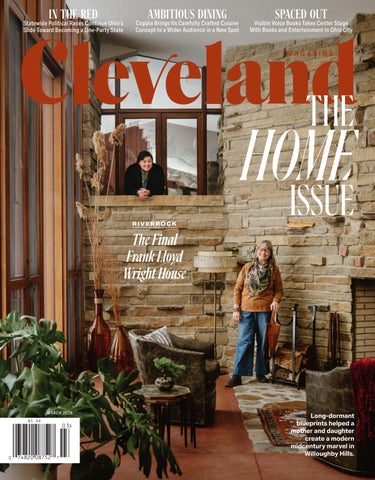
The Final Frank Lloyd Wright House

Long-dormant blueprints helped a mother and daughter create a modern midcentury marvel in Willoughby Hills.

30

/ issue 3

ON THE COVER

FINAL FRANK A Willoughby Hills pair construct RiverRock, architect Frank Lloyd Wright's last home design. Plus, a guide to understanding the midcentury modern movement. By Julia Lombardo

Photographed by Suzuran Photography Makeup by Riley Gable-Fleming

FEATURED

44 HOME RUN Longtime Cleveland Guardians reporter Paul Hoynes gets big honors from the National Baseball Hall of Fame this year. By Jennifer Pignolet 4 FROM THE EDITOR

LAY

OF

THE LAND 9 FUNNY GIRL Cleveland native Megan Stalter is a hit on HBO show Hacks and Netflix series Too Much 14 FOR THE BOOKS Visible Voice Books' stunning new shop revitalizes a piece of Ohio City history. 16 RED POLITICS Recent races confirm Ohio's shift into a deep-red, one-party state.

FOOD & DRINK

CURATED TASTE Coppia combines two chefs' passions in composed plates and tasting menus.

MIDTOWN MIGHT Food, beer and live entertainment are a winning combination at the new MidTown Collaboration Center.

HOME

91 SECOND LIFE An opulent home library recycles the oak paneling from a former New York City penthouse.

buzzards make their annual flight back to Hinckley, drawing spectators for the event.

63 CUYAHOGA COUNTY BOARD OF DEVELOPMENTAL DISABILITIES

Learn how Cuyahoga DD empowers individuals with disabilities to thrive in their communities.

67 CLEVELAND HOME & REMODELING EXPO

Explore fresh ideas and meet more than 300 exhibitors who can bring your home projects to life.

Creating Spaces

If you can name one famous architect, it’s probably Frank Lloyd Wright.

The designer’s modernist approach laid the groundwork for America’s prevailing contemporary design movement and one of the buzziest buzzwords in decor: midcentury modern. Active from the late 1800s through his death in 1959, Wright designed more than 1,000 buildings, most notably Fallingwater in Pennsylvania and the Solomon R. Guggenheim Museum in New York City.

Wright believed everyone deserved to exist in beautiful spaces. His Usonian homes, including the Louis Penfield House and the recently built RiverRock, both in Willoughby Hills, were designed to provide middle-class residents with a more affordable way to access this style of abode. (He might be dismayed if he knew they now often sell for $1 million to $8 million.)

Wright’s work is definitely art, but it’s different from the paintings we hang on our walls, meant to be viewed but not touched. A more apt description is functional art, a form that blends aesthetic appeal with everyday utility, like clothes, food and furniture. These homes are designed to be lived in, shaped by the lives of their occupants.

The print product in your hands, and even our digital offerings that you consume on your phone daily, are similar, in

my view. We design the magazine to be beautiful, with large original photos, gorgeous design that delights and surprises, and sharp, creative storytelling. Yet, it’s also meant to keep you informed through reporting, clear writing and visual communication, and to provide you service, such as sharing the city’s Best Restaurants, Best Places to Live and home inspiration, like you’ll find in this issue.

After spending the last month in Wright’s world, I believe this month’s cover story (Page 30), is inspiring on multiple levels. Sure, on the surface, we share ways to work elements of modernist touches and midcentury modern decor into your home. We take you inside Sarah and Debbie Dykstra’s journey to completing Wright’s long-dormant final residential blueprints, found on his drawing board after his death and posthumously built on the same property as the architect’s 71-year-old Penfield House. It’s a tale of obsessive detail, resilience and dedication to fulfilling the creative vision of America’s great architect.

Even readers who are not moved by architecture or decor can find inspiration in Wright’s work. His functional art reminds us to think deeply about why things exist and how we interact with them. That form follows function, but that beauty is functional, too. It reminds us, just as I hope this magazine does, that a creative life is a life worth living.

Dillon Stewart, editor

First Down

After the conclusion of the Cleveland Browns season in early January, head coach Kevin Stefanski was fired after six seasons. After a few weeks of searching and multiple interviews, the Baltimore Ravens offensive coordinator Todd Monken was hired to his first stint as an NFL head coach. Our readers quickly sounded off on social media following the news.

@cameronvitug Low key good choice.

@johnrigby50 What a joke ��

Bonnie Kehn I had no reaction to this news… wtf is right. I just don’t understand why this team just can’t get a break.

Scott Horstman He took the Ravens offense from a formidable force to #16. Brace yourself for another three or four win season again ��

Ernest Grider Love it… Shedeur will be in the MVP conversation next year!

Julie Cardona Probably last pick left no one else wanted the spot

Debi Horbal And he will only last one season

WANT

Fin-tastic

Fish fry season has finally docked in Cleveland. Get hooked on local catches like Rowley Inn in Cleveland, a favorite of Cleveland Magazine staff, plus others like St. Andrew Ukrainian Catholic Church (Parma), The Rustic Grill at StoneWater (Highland Heights), Prosperity Social Club (Cleveland) and Brennan’s Fish House (Grand River). Dig into these and many more on our interactive map at clevelandmagazine.com/fish-fry

CORRECTION:

February’s “Ring Masters” incorrectly named Red Gerard’s hometown as Westlake. Gerard is from Rocky River.

Scan the QR code below or go to clevelandmagazine.com/subscribe

Wake up to daily news, food, style and events in your inbox. Get great journalism at your doorstep. Purchase our print edition for 12 months of magazines. Newsletters Print Subscription Talk to Us

Have a question or comment about what you’re reading? Got a good story to tell? Reach out, and let us know at conversation@clevelandmagazine.com

Denise Polverine publisher Dillon Stewart editor

managing editor Ron Ledgard

senior editor Annie Nickoloff

associate editor Julia Lombardo

editorial assistants Christina Rufo, Jaden Stambolia

contributing writers Vince Guerrieri, Kristen Hampshire, Kate Bigam Kaput, Nate Paige, Jennifer Pignolet, Travis Sawchik, Lynne Thompson

editorial interns Kirsten Kimbler, Liza Marra

art director Erin Stinard

associate art director Abigail Archer

contributing artists John Jay Cabuay, Riley Gable-Fleming, Suzuran Photography, Kaitlin Walsh editorial@clevelandmagazine.com

advertising

vice president Paul Klein

senior account managers Sarah Desmond, Tiffany Myroniak

account managers Julie Bialowas, Jessica Thomas event manager Jennifer Roberts

audience manager Kristen Brickner traffic coordinator Paige Schuller adsales@clevelandmagazine.com

cleveland studios

managing editor Jennifer Bowen Sima senior editor Ann-Marie Vazzano

managing art director Jenny Perdue art director Megan Rosta-Walcutt video producer Carrie Largent

production

production manager Alyson Moutz production@clevelandmagazine.com

digital media

director of digital strategy Jacquie Chakirelis development manager Daniel Klinzing

digital campaign coordinator Kate Wildenthaler

Lute Harmon Sr. founder

Lute Harmon Jr. president & ceo

Cleveland Magazine | Cleveland Scene Ohio Magazine | Lake Erie Living Cleveland Studios

chief financial officer George Sedlak

finance director Perry Zohos

operations manager Corey Galloway accounts payable coordinator Geli Valli accounting@glpublishing.com 1422 Euclid Ave., Suite 730, Cleveland, OH 44115 glstudios.com

Subscription services clevelandmagazine@sfsdayton.com or 1-800-453-1009

Prosperity Social Club
Brennan’s Fish House

844.701.5923 www.ResidencesAt55.com

www.ResidencesAtLeader.com

FUNNY GIRL

Cleveland native Megan Stalter has given a standout performance on Hacks, which enters its fifth (and final) season this year. CONTINUED ON

Megan Stalter’s late-night interviews and red carpet moments are all parts of the bit.

At the Las Culturistas Awards in 2025, she wore a corset made of Diet Coke cartons in a joking attempt to get a brand deal. She appeared on The Late Show With Stephen Colbert wearing a ridiculously long blond wig and a tank top that read “Meg Stalter: Prettiest Girl in America.” In January, she and fellow Hacks castmate Paul W. Downs went viral for their Critics Choice Awards outfits: near-perfect dupes of the orange ensembles Timothee Chalamet and Kylie Jenner wore to the Marty Supreme world premiere.

“My really close friend — I’m not gonna name any names — but she let me borrow this dress,” Stalter said in a red carpet interview, then smirked at the camera. “Fits like a glove.”

She hopes you get her sense of humor.

“I love making fun of the industry,” Stalter says. “It’s really fun to make fun of things that you’re a part of.”

The rising actress and comedian is best known for her performances as the talent manager Kayla on HBO hit series Hacks, which is set to premiere its fifth and reportedly final season this year, along with her starring role as Jessica in the Lena Dunhamcreated rom-com Too Much. Before her burgeoning career in Los Angeles, she got her start in Chicago and New York City’s comedy scenes.

Long before that, she was making home videos with her siblings and cousins in her hometown of Cleveland and, later, Dayton, where she grew up. (For the record: She says Cleveland’s cooler.)

She regularly visits Northeast Ohio; her father, Dave Stalter, owns Voodoo Monkey Tattoo, and he inked Stalter’s three tats. There’s a rabbit head, a wolf head on a bee’s body (a matching set with her sister), and, alongside a shimmering star done by her brother Nick, the phrase “Baby, I’m a Star.”

She traces that stardom back to her roots in Ohio, and her family members’ unique senses of humor.

“My parents aren’t together, but they’re both really funny in really different ways,” Stalter says. “I’m really lucky that I grew up in such a funny, creative family.”

Comedian and actress Megan Stalter grew up in Cleveland and Dayton before landing big roles in Hacks and Too Much.

Win. Place. And show you care.

Don’t miss your chance to be part of the most exciting two minutes in sports and support the youngest and bravest patients receiving care at Cleveland Clinic Children’s. Dress to impress in your Derby finest, and take part in our brand-new Best Hat Showdown.

05 | 02 | 26

RSVP AND LEARN MORE:

Get Your Green On

ST. PATRICK’S DAY PARADE

MARCH 17

CLEVELAND’S 184TH ANNUAL St. Patrick’s Day Parade transforms Downtown into a vibrant celebration of Irish heritage and community. As the city’s largest single-day event of the year, the parade will draw thousands of green-clad families to claim their favorite spots along Superior Avenue for the final time, before the parade shifts to a new route in 2027. “It is truly a family event,” says John Togher, executive director of the parade committee. “You’ll see families that are in the same areas on the streets time and time again.” This year the parade takes on a theme connecting America’s 250th birthday with Irish American contributions in Northeast Ohio and across the country. “It’s a great way to see what the Irish in Cleveland do,” says Togher. stpatricksdaycleveland.com

SAVE THE DATE

FAN EXPO CLEVELAND

MARCH 13-15

Head to the city’s ultimate gathering of all things pop culture and see major stars like William Shatner, Hayden Christensen and more. $12+, 300 Lakeside Ave. E., Cleveland, fanexpohq.com

WINTER

WARMER FEST

MARCH 7

The 19th annual Winter Warmer Fest returns to Windows on the River. Enjoy seasonal and limited edition beers from more than 55 Ohio breweries. $58.99+, 2000 Sycamore St., Cleveland, ohiocraftbeer.org

CLEVELAND HOME & REMODELING EXPO

MARCH 20-22

This expo is a one-stop shop for home products and services. Explore rows of booths and find inspiration for your next project. $8+, 1 I-X Center Drive, Cleveland, homeandremodelingexpo.com

USA FENCING NORTH AMERICAN CUP

MARCH 6-9

En garde! Cleveland hosts USA Fencing’s March North American Cup, featuring top athletes of all ages. Free to attend, 300 Lakeside Ave. E., Cleveland, usafencing.org

CLEV E LAND

FISH FRY GUIDE

CLEVELAND’s OFFICIAL FISH FRY APP

Discover Northeast Ohio’s best fish fries all in one place. The Cleveland Fish Fry Guide app is your go-to resource to find the bars, restaurants, churches, halls and clubs who will be serving up lenten specials this season. Browse full menus, hours, photos and links, then plan your Friday route and check in as you go to earn points and win prizes.

Lit Hubs

THE WANDERING LANTERN

Since opening on Nov. 29, this Lakewood bookstore has fostered a creative community for bringing children’s literature to life through books, personalized recommendations and a vibrant space that inspires curiosity. Families and kids of all ages can gather to explore new and classic stories among both established titles and up-and-coming releases. 15729 Madison Ave., Lakewood, 216-999-4462, thewanderinglantern.com

PARALLEL UNIVERSE BOOKSTORE

This Ohio City shop is a haven for otherworldly sci-fi, fantasy and romantasy novels — offering a sizable collection for all kinds of readers. Located in The Creative Hangars, it joins a neighborhood thriving on local business and invites visitors to dive fully into immersive storytelling, whether through novels, role-playing games or shared fandom. 1436 W. 28th St., Cleveland, paralleluniversebooks.com

THE VIRIDIAN BOOKSHOP

This Downtown Willoughby bookstore is less about quick browsing and more about settling in. Designed as a third space, it blends books, conversation and community into one buzzing spot. Two dedicated game rooms host tabletop play and Dungeons & Dragons campaigns, while a multipurpose space welcomes book clubs, crafting workshops and open mic nights. Find a healthy mix of new, used, rare and vintage fiction titles, with some inventory shaped by donations. 4081 Erie St., Willoughby, 440-525-5185, viridianbookshop.com

Next Chapter

Dave Ferrante moved his bookstore from Tremont to a more engaging location in Ohio City that features a stage for events.

WHEN VISIBLE VOICE BOOKS moved from its original home in Tremont to a larger space on Lorain Avenue in Ohio City late last year, the nearly 20-year-old bookstore opened the door to new opportunities in a location full of Cleveland history.

Today, Visible Voice sits in a 6,000-squarefoot brick building, built in the 1890s, that was once the home of the Lorain Palace Theatre. The store still offers a wide selection of new and used books, but it now hosts live music to complement book browsing.

Step beyond the cafe and bookshelves to find a stage and tiered rows of benches for audience seating. Though seemingly intentional, the 150-person performance space was actually a happy accident. Owner Dave Ferrante originally intended to use the space next door, now occupied by Guitar Riot, until he encountered the old theater.

“It was like it was meant to be,” Ferrante says.

Ferrante and his team executed an extensive renovation of the building, working to maintain the historic elements such as artwork and murals while also retrofitting the

space for enough retail shelving to triple its inventory and a cafe offering sandwiches, snacks, coffee and cocktails.

Initially, Ferrante planned out the space’s new cafe and book areas before focusing attention on programming music and other events like poetry readings and author engagements, to fully “release the potential of the stage.”

So far, it’s hosted book clubs, jazz performers, a Grateful Dead cover band and even a lecture by Tibetan monks.

Since opening in November, the booklovers’ paradise has drawn Northeast Ohioans and out-of-towners to the Ohio City shop. Ferrante hopes it can also drive foot traffic to the surrounding neighborhood.

“I see people coming in here and they’re proud. They feel like they’re a part of something,” Ferrante says. “I’m investing in the city because I want to help make it better in my own small way. This is our city, and it’s a part of us.”

Aviation Elevated

Flexjet is rewriting the story of private aviation with bespoke interiors, crafted journeys and a commitment to its Cleveland home base.

When Kenn Ricci began Directional Aviation more than 40 years ago, he couldn’t think of a better place to start his business than in his hometown. Today, the Northeast Ohio company owns Flexjet, which offers unique private aircraft that offer distinct luxury experiences for their passengers.

“It’s just our home,” says Michael Silvestro, Flexjet CEO. “(Ricci) was born here. I was born here. Mike Rossi (Flexjet CFO) was born here. You end up just investing where you are and building the business, and Cleveland’s been a great place to live and work.”

Ricci founded the company in 1981 as a small charter service. In 2013, Directional Aviation acquired Flexjet for $195 million. Customers of Flexjet buy shares or lease private planes that are decked out in ultramodern decor and technology, such as satellite internet provider Starlink. The fleet of more than 300 planes is tracked from an operations center based at the Cuyahoga County airport.

Now, the company is reaching new heights. This past year, it secured an $800 million equity investment from consumer-focused

This Flexjet Gulfstream G650 interior is inspired by Kenn Ricci’s Bentley Bacalar. This interior debuted in 2022 with the G650 and Sikorsky S-76 helicopter.

investment firm L Catterton, the largest in the history of private aviation. This infusion enables Flexjet to modernize and differentiate its flying experience among competitors.

Flexjet offers more than 50 unique custom decors that are exclusive to customers who fly with them. The 15-passenger Gulfstream G700, for example, is fitted for luxury and comfort, with amenities such as sleek interior design, a circadian lighting system that mimics the sun, and a queen-size bed. Meanwhile, the Sikorsky S-76 is an eight-person helicopter with sleek black and walnut interior and gold accents. These designs are either crafted by Flexjet’s in-house team or through collaborations with experts as diverse as the Ferretti Group, known for its iconic Riva motor yachts, and a winner of a design contest, a student from Embry-Riddle Aeronautical University.

“It’s the difference between staying at a chain motel and staying at a very high-end, luxurious boutique hotel,” Silvestro says. “Every room isn’t the same.”

Unique vessels and interior designs only begin the journey. Flexjet offers exclusive travel experiences, only available to owners of its aircraft.

“We’re not just about a utilitarian transporting people from point A to point B,” Silvestro says. “We are all about these luxurious, memorable experiences.”

Flying comes in many forms at Flexjet. Spending more than 50 hours in the sky this year? Fractional jet ownership or jet leasing might be for you. Or, dip your toes with the Flexjet 25, a jet card membership for those who expect to fly less than 25 hours a year.

The customer base for private aviation is trending younger, Flexjet says, which aligns with the investments in modern amenities that it is making. Now, the $800 million boost will help the company do it in style.

“(This investment) solidifies this concept that time is the ultimate luxury, only followed by health and wellness. And none of us can buy any more hours in a day than what 24 hours yield us,” Silvestro says. “But in terms of moving yourself around in a fashion that private aviation affords you, as well as to be transported in a luxurious way, plays right into what our strength is here at Flexjet.”

GOP DOMINATION

WILL OHIO CONTINUE ITS MOVE TO BECOMING PERMANENTLY RED?

Governor and U.S. Senate races will show if Ohio has lost its place as the country’s bellwether and solidified itself a one-party state.

IN 2018, SHERROD BROWN stood before a jubilant Columbus crowd to declare a decisive 6.3-point win over former U.S. Representative Jim Renacci.

“You all showed the country that progressives can win and win decisively in the heartland,” he said. “By honoring the dignity of work, we carried a state that Donald Trump won by almost double digits.”

On an otherwise dark day for Democrats, with Ohio continuing its shift to the right, Brown’s victory offered the party hope that Ohio could still have shades of purple. Six years later, that hope no longer remained.

Overall, the state’s rightward shift in 2024 was the third-greatest such move in the Midwest. Each of its 88 counties moved to the right in terms of voting margin. Ohioans voted for Donald Trump over Kamala Harris by an 11% margin in the last election, marking a greater gap than Trump’s eight-point edge over Joe Biden in 2020 in the state.

Even Brown, who had been an outlier when he was re-elected twice to the U.S. Senate during the reddening trend, was defeated by Bernie Moreno. Republicans have won

SHERROD’S EFFECT

Until 2024, Sherrod Brown, who is back on the ballot for U.S. Senate in 2026, was the only recent Democrat to find success in statewide elections by good margins.

The Republicans have won all the other U.S. Senate races in which Sherrod Brown was not the opponent by fairly wide margins.

Barack Obama won the county and state twice. The Democratic won the county but not by as much in the past three races, and Donald Trump won the state.

every statewide executive office since 2006, when Ted Strickland became governor.

“It’s a red state,” says Republican strategist Matt Dole. “The issues lean right in Ohio right now. Even Independents in Ohio lean right. … The last time Ohio went heavily blue, the only time in 35 years we’ve elected a Democrat governor in the state of Ohio, there were scandals that pushed that in 2006. So, it wasn’t even really a policy matter.”

Despite this Republican stronghold, Ohio is one of the most important states on the political map as we approach next year’s midterm elections. Can the Buckeye State shift back to being what it once was: a purple battleground? The answers carry great weight locally and nationally as the state could be a pivot point for power.

There is a particular focus on the state’s U.S. Senate race. Brown is again throwing his hat in the ring, and the battle between him and Republican U.S. Sen. Jon Husted holds the potential to decide control of the chamber. Republicans hold a 53-47 edge in the Senate. Democratic strategists are confident about their chances to flip seats in places like North Carolina and Maine, but the party must also win seats in 2024 red states to control the Senate.

“Ohio is the tipping point, potentially, for the whole Senate,” says David Pepper, who is running for lieutenant governor in Ohio and former Democratic strategist. “Sherrod running makes this a huge opportunity. It’s sort of a must-have opportunity if you’re going to have a chance at getting a majority.”

Dole notes Republicans are typically even stronger in midterm years in Ohio. In the 2022 midterms, Republicans swept all statewide offices.

“In a presidential year, 75% of Ohioans will vote. In a gubernatorial election year, 50% will vote,” Dole says. “Democrats lose more people in a midterm election year than Republicans do.”

But Ohio has not always been a red state, and there are new variables at play in every cycle, including a considerable elephant that will not be in the room: Donald Trump. The sitting president will (most likely) not be atop a future ballot. His potential endorsements now figure to carry less weight, and there is potentially less voter enthusiasm from conservatives.

National tailwinds also favor Democrats entering 2026.

On Nov. 4, New York City elected democratic socialist Zohran Mamdani, largely on the strength of younger voters. It was the highest voter turnout in New York City since

1969. On the same night in Cleveland, another democratic socialist, Tanmay Shah, edged Danny Kelly by just nine votes in the race for City Council’s Ward 12 seat, also on the strength of the younger vote. Voters in Virginia aged 18-29 delivered a 35-point edge for Governor Abigail Spanberger. Democrats won governors’ races in New Jersey and Virginia, and two Democrats flipped Republican seats in state-wide elections in Georgia, a traditionally solid red state that is trending to become more purple. Those races are seen as potential bellwethers.

For Democrats in Ohio in 2026, there are those tailwinds, and what former senior FiveThirtyEight elections analyst Nathaniel Rakich says is a particularly strong candidate in Brown. While Brown lost in 2024, he only fell by a four-point margin, demonstrating relative strength compared to the top of the ballot (Harris to Trump by 11 points).

Bush, was in his second term. That year, Brown defeated two-term Republican incumbent Mike DeWine for a Senate seat.

While conditions appear favorable for Democrats entering 2026, there are still many variables at play. A government shutdown of record length loomed over this election cycle. While inflation has cooled, personal incomes have not caught up to the total costof-living increases since 2020. Affordability was a major issue in November in races in the country.

1The number of governor races the Democrats have won in Ohio since 1986.

“Democrats will attack Republicans on economic issues,” Dole says. “Of course, they did that in 2024, saying that Biden’s financial woes were Trump’s fault. The reality is that Joe Biden put this country in a hole, and no president is going to dig out in a year — but signs point to continued progress on inflation, jobs, and certainly things like extending the Trump tax policy.”

“Brown is certainly the strongest candidate the Democrats put up, and you can make an argument that 2024 was pretty Republican,” says Rakich, a former fellow at The Syracuse University Institute for Democracy, Journalism and Citizenship. “Trump turned in the best Republican performance in 20 years. It’s probably not gonna be like that again.”

Rakich noted another macro-level factor that could raise the tide for all Democrats is that midterms often swing against the party in control of the White House.

There have been notable shoots of blue in the state, too. Ohioans voted in favor of Issue 1 in November 2023, which created a state constitutional right to protect abortion. While Rakich still views Brown as a slight underdog, the polls are mixed but favor Husted; he says there is a viable path to victory.

Rakich believes Brown would have had an easier path to victory in the Ohio gubernatorial race, as such contests are typically less partisan. Brown polled stronger than Amy Acton versus tech billionaire Vivek Ramaswamy in the race for governor. Polling consensus has Ramaswamy ahead by an average of six points. But Brown’s past wins and relative strength versus Harris in 2024 made him such an important candidate for Senate control that minority leader Chuck Schumer traveled to Ohio multiple times this past summer to convince Brown to run.

Pepper made the analogy that 2026 could be like 2006 for Democrats. That was the party’s last strong showing in Ohio, when another polarizing Republican, George W.

As results came in on Nov. 4, Ramaswamy warned the GOP that the election night was a loud data point in favor of focusing more on affordability and less on identity politics.

Immigration was a winning issue in 2024 for Republicans in Ohio, but with poor polling from both parties around the actions of Immigration and Customs Enforcement in Minneapolis, it might be less relevant in the next election cycle or even flip in favor of the Democrats. Artificial intelligence was cited as a reason for job cuts by CEOs during this past earnings season, and a weak economy generally trumps any other issue. While there is an AI investing boom, the Main Street economy might already be in recession. Ohio has become a haven for data centers, but they don’t employ a high volume of employees.

Pepper believes the economy will be an issue in favor of Democrats due to rising health care, food and energy costs.

“It’s not an academic debate,” Pepper notes. “People are seeing they are having to pay more for groceries.”

The other unknown is what the success of progressive candidates in coastal regions in November means for the Midwest in 2026.

“That’s the $1 million question,” Rakich says. “We’re seeing this huge fight within the Democratic Party about which direction to take. Do we moderate on issues like immigration, because that’s what a lot of people are worked up about. Or do we lean into progressive ideas?”

Those big questions are just a taste of what’s on the ballot in Ohio in 2026.

MINDFUL CREATION

Two as-seen-on-TV chefs walk the line between restraint and indulgence in this special occasion spot. CONTINUED ON PAGE 20

MidTown’s Culinary Collab PG 22
What Sora’s Chef Savors PG 24
Best Bites in North Olmsted PG 26

Coppia Presents an Ambitious Dining Experience on the East Side

After moving their restaurant from Chesterland to Willoughby, chefs Talia and Hedy Trovato have introduced their creative, carefully assembled concept to a wider audience.

Coppia isn’t a restaurant you visit on a whim. It doesn’t come up in one of those spur-of-the-moment “Where should we go tonight?” dinner discussions. No, everything about the dining experience at the Willoughby eatery is intentional and thoughtfully planned — including your decision to visit.

“Our restaurant may not appeal to someone just looking for a quick snack and to go home,” says chef Talia Trovato, who coowns Coppia with her wife, chef Hedy Trovato. “It appeals to people who love food, people who are excited by trying new things.”

In other words, Coppia is centered as much on experience as it is on execution. It’s a place of deliberate, deluxe dining — a place for celebrating, for creating formative memories through food.

All that makes even more sense given that both chefs got their culinary starts in a place renowned for its immersive experiences: Disney World. The Trovatos met while working in fine dining at the Grand Floridian Resort and Spa, which is home to Victoria and Albert’s — the only theme park-based restaurant in the U.S. to earn a Michelin star.

“Being in that fine dining environment for many years was something that challenged me and kept me growing as a chef,” says Hedy. “I never

stopped learning, never stopped thinking of new ideas and new ways of doing things.”

Coppia first opened in Chesterland in 2022 near the International Culinary Arts and Sciences Institute, which Talia attended. They quickly outgrew the 35-seat restaurant. In 2025, after winning the Food Network show Chopped, the chefs relocated to Willoughby in a new building that also houses the Legends Aviation Museum. Lost Nation Sports Park sits on the same campus.

Don’t let the word “airport” trick you into thinking of pre-flight fare, nor should the Trovatos’ history with “The Mouse” conjure images of cartoonish presentations. Both chefs are masters of the understated, eschewing big shows of creativity in favor of measured restraint.

Coppia, which is Italian for “pair,” is

Coppia 1731 Lost Nation Road, Willoughby, 440-375-5956, coppiarestaurant.com

the embodiment of that shared approach, evident in everything from the decor (clean lines, neutral colors) to the building itself — quiet and peaceful, glowing like a glass beacon on Lost Nation Road.

“It’s a very calm restaurant,” Talia says. “We like to present it as a sanctuary.”

Coppia offers four menus. The signature and seasonal menus, both a la carte, are curated to make every dish a star. The Steak Bravo ($60), a staple that the chefs have long considered a signature, features an 8-ounce grass-fed filet mignon piled high with sweet onions and greens, atop a pillow of creamy Parmesan risotto. The Fur Alice ($35), named for their daughter, offers tiny hazelnut ricotta gnocchi in a luscious Comte cheeseand-spinach cream sauce, with a sprinkling of maize flour for crunch. The Nectar of the Gods ($13) might be the most perfectly balanced salad you’ve ever savored — a divine marriage of peppery arugula, creamy burrata, sugared pecans and thinly sliced pear.

All told, the Trovatos specialize in rich, indulgent dishes that somehow manage to retain an airiness and elegance that would be lost to heavier-handed chefs.

“Every menu we put out inches toward

STAKE YOUR CLAIM

With 55 seats, Coppia fills up fast. Make reservations ahead of time, particularly for the exclusive chef’s table experience.

Coppia developed a quiet following at its 35-seat Chesterland location before expanding its menu and moving to a larger space in Willoughby.

what inspires us, how we want to be perceived as chefs,” Talia muses. “It’s comfort food made into seasonally inspired fine dining.”

While the chefs put their all into each dish, they have a particular passion for tasting menus. Coppia offers two prix-fixe experiences: a seasonal chefs’ tasting menu, available at any dinner service ($125 per person), and the chefs’ table menu, only available over the weekend via private bookings ($200 per person, plus a $100-per-table booking fee).

“Tasting menus inspire us the most (because) we’re able to tell everything we want to tell,” Talia says. “We even write poems or stories to the guests at our chef’s table, so they start with a story about where we’re going to be taking them with the food.”

The current tasting menu opens with a dish so beautiful it could be lifted from the pages of a coffee table book: thin folds of pine-cured Norwegian salmon with deep purple beets, milky stracciatella and glossy globes of roe. As the meal continues, each plate more stunning than the next, both chefs’ favorite proteins take a turn in the spotlight: light and airy scallops from Talia (in this case, rosemary-smoked with hazelnuts and “snow,” made from buttermilk and Nigori sake) and heavier, classic dishes like duck breast and venison from Hedy. Each course is paired with wine, which is included in the price of the chef’s table. Hedy became a certified sommelier four years ago and approaches each grouping with care.

“Food and wine pairing is a true art, in my opinion,” she says. “When they’re paired right, both the food and the wine taste so different than either does on its own.”

And whatever you do, don’t even think about skipping dessert — or “last impressions,” as the menu dubs its offerings from

WHEN YOU GO

FIRST TASTE

What Abuela’s Having ($13) nods to Hedy’s Venezuelan heritage with three cornmeal arepitas, a perfect amuse-bouche.

pastry chef Kevin Schlappal. Like the Trovatos, he is a designer of edible oeuvres, creating standouts like the Caffè Notte ($15), a fluffy chocolate souffle served with Chantilly cream and toffee sauce. Because it takes 20 minutes to perfect, it must be ordered early in the meal so it can arrive at your table in a timely fashion. But there’s no rush. Coppia is committed to the art of unhurried, takeyour-time dining.

You could say it’s fancy, sure — because it is. More than that, though, it’s special. And that feeling is only compounded by the collection of pristine, privately owned aircraft visible through the dining room windows. Just steps away from your meal, the aviation museum’s hangar displays such vintage gems as the “Lady B,” a 1944 military craft-turnedracing plane, and a 1938 monoplane that is one of less than 50 of its kind ever made.

The Trovatos see the aircraft as further inspiration for their craft — just another element of beauty and prestige that makes the Coppia experience everything it is.

ASK FOR HELP

Not a wine connoisseur? Coppia’s highly trained staff can guide you to the perfect pairing for any dish and any taste.

“When you’re surrounded by such hallmark pieces, you want to make your mark, too,” Talia says. “These aircraft are one of a kind, they’re beautiful, they’re timeless. And we hope people feel the same about our food.”

Community Fare

As the Cleveland Foundation works to revive MidTown, an inclusive food, beer and event space energizes the neighborhood.

THE CLEVELAND FOUNDATION has a big idea: What if revitalizing MidTown could be the tie that binds University Circle to Downtown?

“The Cleveland Foundation’s vision is that of a barbell city — where there’s an established Downtown, an established University Circle and then there’s where we are,” says Michael Hood, senior manager of MidTown placemaking and community development. “The choice to be here on Euclid Avenue is to really connect the two downtowns, by understanding and building upon the legacy that was here before.”

Just as it did with Playhouse Square in the 1970s, Cleveland Foundation, the world’s first and one of the largest community foundations, started by placing itself at the center. The nonprofit opened a new headquarters on East 66th Street in 2023. Opened last year just across the street, The MidTown Collaboration Center, which features restaurants, event spaces and nonprofits, is the next step. Here are a few of the tenants attracting diners and visitors to the new space.

Black Frog Brewery

Owner Chris Harris started Black Frog as a home-brewing project, expanding to a brick-and-mortar craft brewery near Toledo in 2016. Harris wasn’t planning a second location until the Cleveland Foundation invited him to help launch the Collaboration Center. “Cleveland kinda chose me,” says Harris. “The Cleveland Foundation wanted someone who looks like the neighborhood to represent the brewery.” The location has grown into a family affair, with Harris’ son managing the brewing and his daughter serving as taproom manager. Flying Frog, an IPA named in honor of his dad who spent 35 years as part of the Toledo International Guard, brings over a Toledo staple, and Midtown Lager is a new love letter to the neighborhood. “I’m looking forward to more of the community discovering us because we’re truly here for them,” Harris says. blackfrogbrewery.com

Pearl’s Kitchen

Chef Tiwanna Scott-Williams, a former nurse, gets excited when customers wearing scrubs visit from nearby hospitals. “It’s a sign that word is getting out that we’re here,” she says. Her Pearl Flower Catering and Pearl’s Kitchen, which has locations in Rocket Arena and on Case Western Reserve University’s campus, deliver elevated Southern comfort food. This new kitchen puts Scott-Williams’ spin on gastropub fare. Dishes such as the blackened salmon BLT ($16) with fried green tomatoes and beer-brined, buttermilkbattered chicken tenders ($10) pair perfectly with Black Frog’s suds. “The Sixty6 has lived up to its name as a collaborative space,” Scott-Williams says. pearlskitchen.com

MidTown Collaboration Center’s Blackowned businesses complement each other and represent their neighborhood.

The Sixty6 Music Lounge & Studio

The Collaboration Center isn’t all grub. The Sixty6 event venue offers free concerts and DJ sets several nights a week, as well as other community programming. The Music Lounge hosted about 130 events last year, including line dancing on the first Friday of each month and weekly Sunday concerts. “It’s quite a vibe watching multigenerational families having a fun, safe experience,” says Michael Hood of MidTown thesixty6.com

Concord native Eric Hess ventured to North Carolina for five years before returning in 2024 with sharpened skills and a renewed pull toward family. His culinary path runs counter to tradition, beginning in country clubs and resorts before evolving into bold, experimental small plates and creative risk-taking. That sensibility, rooted in curiosity, precision and deep respect for ingredients, ultimately led him to Sora.

Mia Bella Restaurant

The Big Egg

Dining Guide

BEST RESTAURANTS IN NORTH OLMSTED AND OLMSTED FALLS

Gunselman's Steakhouse & Bar

WHY WE LOVE IT: With the longtime Downtown location now closed, this outpost carries on a Cleveland diner tradition that dates back decades. Open from morning through early evening, the menu goes beyond breakfast staples, making it an easy stop any time of day. TRY THIS: The Monte Cristo ($14.99) is a well-rounded bite, stacking ham, turkey, eggs and Swiss cheese between two slices of French toast, served with a side of hash browns. 24111 Lorain Road, North Olmsted, 440-455-9207, bigeggrestaurant.com

Black Seed Cafe

WHY WE LOVE IT: Tucked away in a suburban shopping plaza, this cafe serves shawarma, Middle Eastern snacks and iced coffee drinks in a relaxed setting. Moody tones and wood paneling set a warm tone, anchored by a striking hand-painted mural. TRY THIS: The zaatar and cheese pie ($3) is earthy and aromatic, with savory herbal notes, toasted nuttiness and a bright, lemony tang that lingers on the palate. 28879 Lorain Road, North Olmsted, 440-455-1319, instagram.com/blackseedcafecle

Cilantro Taqueria

WHY WE LOVE IT: If you’re looking for authentic Mexican street food, Cilantro Taqueria has become a go-to for bold, craveable flavor. Now with six locations, the quick-service spot has steadily won over Northeast Ohio, earning a place on Cleveland Magazine’s Best Restaurants list in both 2023 and 2025. TRY THIS: Don’t skip the birria tacos with consomme ($14), three cheese-stuffed beef cheek tacos served with a rich, dunkable broth that delivers on every bite. 24950 Lorain Road, North Olmsted, 440-496-7971, cilantrotaqueria.com

Clementine’s Victorian Restaurant

WHY WE LOVE IT: This charming, old-timey teahouse in Olmsted Falls feels tailor-made for a leisurely girls’ lunch or a special afternoon out. Inside, you’ll find a cozy scene with country-style decor and more than 20 teas served by the pot. The food menu includes salads, sandwiches and homestyle food specials for all ages. Its Cherry on Top Bakery offers custom cakes and fresh confections to-go. TRY THIS: Clementine’s Chicken Salad ($12.99) is a unanimous customer favorite, served on French bread with a choice of macaroni salad or kettle chips. 8092 Columbia Road, Olmsted Falls, 440-235-1223, clementinesrestaurant.getbento.com

Fat Head’s Brewery & Saloon

WHY WE LOVE IT: This flagship brewpub helped put Fat Head’s on the map and remains a go-to for craft beer lovers and casual diners alike, with a laid-back pub vibe that works for lunch, dinner or catching a game. The massive space features a sprawling dining room anchored by an impressively long, energetic bar, with brewing operations on full display. Rotating house beers and TVs throughout help make this suburban staple an easy pick. TRY THIS: The Southside Slopes Headwich ($17) lives up to its name, stacking chargrilled kielbasa with sauteed pierogi and onions, melted American cheese and a kick of horseradish sauce, all served alongside a hearty portion of fries.

24581 Lorain Road, North Olmsted, 440-801-1001, fatheads.com/north-olmsted

Fire and Dough Bakery

WHY WE LOVE IT: This Middle Eastern bakery and kitchen brings regional flavors to the forefront, pairing freshly baked breads and manakish with pizzas that layer cultural spices, herbs and unlikely toppings. The space feels grounded and welcoming, with cool-toned brick, arched details and greenery that nod to tradition. Open from morning through late evening, the menu moves easily from breakfast favorites to hearty plates and shareable snacks. TRY THIS: The cheeseburger ($10.99) wraps seasoned beef, sauteed mushrooms and onions with melted cheese inside house-made dough for a rich, savory bite you don’t want to miss. 26721 Brookpark Extension, North Olmsted, 440-455-1777, facebook.com/firedoughbakery

Danny Boy’s Pizza

WHY WE LOVE IT: One of the largest Danny Boy locations, this spot leans into nostalgia and family-friendly fun. Red-and-black booths, checkered lamps and walls of memorabilia keep the space vibrant. With a full bar, ample seating and board games back in the mix, it’s easy for groups to settle in and linger. TRY THIS: The Honey Bee pizza ($12–$27.75) hits the spot, layering homemade sauce, a five-cheese blend, pepperoni, bacon, jalapeno and ricotta, finished with a drizzle of honey on traditional crust. 24129 Lorain Road, North Olmsted, 440-360-7800, dannyboyspizza.com

Gibbs Butcher and Brews

WHY WE LOVE IT: Born out of Gibbs Butcher Block, the long-standing butcher shop in Columbia Station, this spot brings the market’s reputation for fresh, local meats straight to the table. The menu leans into hearty, high-quality comfort food. Upstairs, Jimmy’s Place shifts the mood, channeling a 1930s speakeasy feel with a vintage bar, old-timey photographs, craft cocktails and seasonal jazz. TRY THIS: The filet sliders ($24) pair tender beef medallions with lettuce, tomato and horseradish cream, plus your choice of side — go for the Amish baked beans, thick with onions and bacon for a sweet, savory finish. 8154 Columbia Road, Olmsted Falls, 440-793-6700, gibbsbutcherbrews.com

Gunselman's Steakhouse & Bar

WHY WE LOVE IT: This scenic steakhouse delivers serious quality without the stiffness. The menu highlights premium cuts, including Hall of Fame Beef from Six Springs Farm, founded by former Browns player Joe Thomas. Downstairs, St. Kevin’s Kitchen keeps things relaxed with pub favorites, making it easy to move between elevated dining and comfort food in one destination. “We want to create a place the neighborhood can really be proud of,” says proprietor David Grace. TRY THIS: The 73 ($110), a 12-ounce Full Blood Wagyu strip steak, features deep marbling that delivers a rich, savory bite. 7928 Main St., Olmsted Falls, 440-202-9705, gunselmanssteakhouse.com

Imperial Garden

WHY WE LOVE IT: Bright and comfortable, the spacious dining room of the Chinese and Japanese restaurant pairs brown quilted leather chairs and soft blue-gray walls with subtle Asian-inspired details. A full bar with seating anchors the space, while the menu covers all the classics, from mei fun and lo mein to spring rolls and crab rangoon, along with a full sushi bar that rounds out the offerings. TRY THIS: The General Tso’s chicken lunch special ($10.50) is served with steamed or fried rice and includes a choice of soup or egg roll. 24201 Lorain Road, North Olmsted, 440-471-4888, imperialgarden888.com

Matteo’s

WHY WE LOVE IT: Tucked into the historic Grand Pacific Junction district, this longstanding Italian favorite strikes an easy balance between casual and specialoccasion worthy. White tablecloths and rustic plank walls provide a warm, inviting feel. “We’re focused on our community,” says partner Jessica Cliff. TRY THIS: The Parmigiana ($28+) is notable for its savory marinara sauce, served over breaded chicken, eggplant or veal, topped with fresh tomatoes, ricotta and provolone, accompanied by spaghetti. 8072 Columbia Road, Olmsted Falls, 440-427-5400, matteoscleveland.com

Moosehead Hoof & Ladder

WHY WE LOVE IT: Located inside a restored firehouse, this family-owned Olmsted Falls staple embraces its history with exposed brick walls, tin ceilings and original firehouse touches throughout. Burgundy tablecloths, warm wood finishes and ambient lighting give the dining rooms a cozy, lodge feel. TRY THIS: The Moosehead baby back ribs ($23–$32) are a house signature, slathered in the restaurant’s special barbecue sauce and served with coleslaw and your choice of french fries or chips. 7989 Columbia Road, Olmsted Falls, 440-235-5511, mooseheadolmstedfalls.com

Ohashi

WHY WE LOVE IT: This neighborhood sushi spot is intimate, with a compact dining room and six-person sushi bar. Japanese-inspired artwork and wave-patterned wallpaper add subtle character to the relaxed space, while a surprisingly extensive menu offers more than 30 different rolls ranging from classic to playful. TRY THIS: The Dragon Roll ($13.50) layers barbecue eel, avocado and glossy eel sauce over a California roll for a rich, savory bite that hits all the right notes. 24539 Lorain Road, North Olmsted, 440-716-0988, ohashi-sushi.restaurants-world.net

Parilya

WHY WE LOVE IT: Built on the success of its popular food truck, a Best of CLE editors' pick in 2020, this family-owned Filipino restaurant launched its brick-and-mortar in 2023, giving Northeast Ohio a permanent place to enjoy its bold, comforting cooking. The same authentic flavors that made the truck a local favorite now shine in a welcoming, sit-down setting. TRY THIS: The Chicken Tocino ($17+) features pineapplemarinated chicken grilled on the flat top and caramelized with a house-made tocino pineapple glaze, finished with a fried egg. 8155 Columbia Road, Olmsted Falls, 440-427-5544, parilyacle.com

Phnom Penh Restaurant

WHY WE LOVE IT: Authentic Cambodian cooking delivers comfort, tradition and flavor at this low-key staple. The menu spans Cambodian and Southeast Asian classics, with noodle dishes, soups, curries and stir-fries offering some variety from the usual take-out scene. TRY THIS: Kuy Teav Chha Kreoung Tek Trey Phoem ($17.49) is a vermicelli dish tossed with house-made kreoung, a fragrant Southeast Asian spice paste, chopped spring roll, sliced onion, lettuce, peanuts and coconut whip, all stirfried into a layered, savory-sweet bowl. 27080 Lorain Road, North Olmsted, 216-251-0210, facebook.com/phnompenhres

Shibam Coffee Co.

WHY WE LOVE IT: Bright and luxe, Shibam brings a modern cafe experience with plenty of visual shine. The space glows with gold accents, geometric wall details and marble-style tables. A packed pastry case steals the show by offering classics like baklava, sabaya and more. TRY THIS: The Spanish latte ($6.50+) stands out with its rich, earthy sweetness from condensed milk. Pair it with the caramel milk cake ($7), a moist, leche-style treat made for dessert lovers. 26745 Brookpark Extension, North Olmsted, 440-385-7032, shibamcoffee.com

Travelers Grille

Sitoo’s

WHY WE LOVE IT: Inspired by recipes shared around family tables, this quick-service Lebanese spot delivers balanced, casual and comforting Mediterranean favorites across multiple Cleveland-area locations. It turns a quick lunch into a warm, satisfying escape. TRY THIS: The Sittoo’s Combo ($12.75) brings it all together, with shish kabob, kafta, chicken shawarma and falafel served alongside crisp salad, warm pita and cinnamon-sprinkled rice pilaf for a well-rounded, craveable plate. 24930 Lorain Road, North Olmsted, 440-716-8755, mysittoos.com

WHY WE LOVE IT: If you’re after a simple, hometown bar, this spot leans into classic dive charm with a pool table, darts and a patio that makes it easy to settle in. New owners Melissa Hatton and Steven Spencer took over in November, refreshing the interior, revamping the menu and introducing a more community-driven calendar with bingo and karaoke nights. “We love to cook. We love to serve,” says Spencer, who is hands-on in the kitchen, preparing many of the dishes himself. “We thought this would be the perfect choice for us.” TRY THIS: The bacon barbecue wings ($8–$15) are tossed in a house sauce that’s sweet, smoky and loaded with chunky bacon that clings to every bite. 24532 Lorain Road, North Olmsted, 440-617-6848, facebook.com/travelersgrille

The Wright Place

Last year, daughter-mother duo Sarah and Debbie Dykstra and a team of local architects took on a historic challenge: building the final residential design commission from the famed architect Frank Lloyd Wright. Find out how they stayed true to the blueprint while adapting to modern needs.

julia lombardo photographed by suzuran photography

Wright brought luxurious midcentury modern appeal to affordable family homes. Decades after his death, discover how the design movement remains relevant.

Use a local or regional stone to echo the forest that surrounds RiverRock.

Through a fog of foliage, down a long and winding driveway toward the banks of the Chagrin River in Willoughby Hills, a quaint house called RiverRock lies tucked into the landscape. It appears small, though punctuated by a jutting seafoam blue roof. Rustic stone covers nearly the whole of the exterior; it feels simple. It’s an intriguing, humble outlier to today’s most grandiose houses, but RiverRock is perhaps greater than all of them for its stunning defiance of the century’s architectural style.

After all, it’s one of the last houses designed by Frank Lloyd Wright, one of America’s greatest architects.

Wright was born in Richland Center, Wisconsin, in 1867, shortly after the Civil War. After a stint in engineering at the University of Wisconsin in Madison, he moved to Chicago, where he started designing in the 1880s. He’s remembered through projects like his Taliesin West studio in Arizona, the Solomon R. Guggenheim Museum in New York, the Imperial Hotel in Tokyo and Fallingwater in Pennsylvania.

Working in the aftermath of three wars, and facing his own spouts of grief and creative blocks, Wright was tested with a constant cycle of folks wanting to start fresh, reconnect with a torn environment and feel at home again.

“He’s thinking of good design as a metaphor for how to lead one’s life well,” says Henry Adams, an art history professor at Case Western

Reserve University. “There’s a certain discipline to living, and a Frank Lloyd Wright house encourages you to focus clearly on the things that matter in life.”

RiverRock’s streamlined, single-story layout features quintessential attributes of Wright’s Usonian homes, a group of projects he built primarily in the Midwest, including nine in Ohio. With flat roofs, low ceilings and an L-shaped floor plan, Usonian homes were functional and affordable abodes for the middle class — yet just as grand and cohesive as Wright’s largest projects. He accomplished this through a “compression and release” technique, often with a narrow walkway leading to an open-concept dining and living room.

Built-in shelves behind banquette seating help maximize RiverRock’s 2,000 square feet, doubling as a thoughtful display of books, plants, statues and trinkets. When the steps from the foyer break out into an expansive living space, you’re flooded with overwhelming awe.

A motif of stone mirrors itself from the outside, vulnerable to a wall of floor-to-ceiling glass doors shaped by sapele mahogany frames. The room feels transparent, like a bubble in the middle of the woods. One look out into the open field of trees, leaves and endless sky, and the buzz of life melts away. Suddenly, you’re somewhere you have never been before; it’s a new perspective on a familiar landscape.

Despite feeling like a step back in time, RiverRock was built just

Install large, unshaded windows to let nature be the room’s artwork.

the home issue: the wright place

Before RiverRock, There Was Penfield

Located on the same property as RiverRock, the Louis Penfield House in Willoughby Hills is one of only three Frank Lloyd Wright-built homes in Ohio that is open to the public. BY JULIA LOMBARDO

RiverRock’s older and wiser neighbor is named after its original owner, a former Mayfield High School art teacher and architecture student at Ohio State University who commissioned both homes from Frank Lloyd Wright. The Louis Penfield House, built in 1955, is unique for its two-floor design, 12-foot ceilings, and open-concept kitchen and living space, all designed to accommodate Penfield’s 6-foot-8 stature. Despite being less compressed and more spread out than most of Wright’s Usonian projects, the home still upholds the same design principles for its deep connections to nature.

“The first time I walked in this house, I felt hugged by something,” says Sarah Dykstra, the current homeowner. “It’s always had a very emotional feel.”

Some restoration efforts by Louis’s son, Paul, emphasized this even more, bringing in black cherry hardwood from fallen trees to update furniture and cabinetry in 2003.

“Not all the shelves and built-ins were what (Paul) grew up with,” Dykstra says. “The banquette seating wasn’t there. He also taught himself how to do veneer and made his own veneer press.”

Located just some yards away from

RiverRock, the Louis Penfield House shares the same landscape on the outskirts of the Chagrin River. But the Louis Penfield House employs a warmer color scheme of reds and yellows, contrary to RiverRock’s blues and greens. Its walls and foundation are primarily textured wood and concrete block, while RiverRock highlights natural stones sourced locally from Van Ness Stone Inc. in Newbury, and others that Louis himself pulled from the river.

At the Louis Penfield House, Buddhist statues in the living room and a bamboo garden just outside the windows, added in the late 2000s to shield the nearby freeway, channel Wright’s enamoration with Japanese culture and architecture while creating globally inspired design that takes your senses to a climate far beyond Ohio’s winters.

“If you look at the house from the outside, it almost looks like a pagoda,” Dykstra says of how the home’s stories are uniquely stacked and broken up with wooden beams. “It goes with the Asian flair.”

But it’s still cohesive, cozy and right at home in Willoughby Hills.

last year. It sits on the same property as the Louis Penfield House, built by Wright in 1955. Shortly after its completion, the house faced the threat of demolition due to the forthcoming Interstate 90, so Louis Penfield commissioned Wright, nearing the age of 91, to build RiverRock next door, farther from the pending obstruction. But the plans hadn’t progressed by the time Wright died in 1959.

In picking up pieces after his passing, the blueprint for RiverRock was discovered still on his drawing board as Project #5909 and given to the Penfield family around the time of the architect’s funeral. It is considered Wright’s final residential commission.

“This was the only building that he designed for which there was a full set of drawings and specifications, and the original site was still available,” says Rob Shearer of RWS Architectural Consulting, RiverRock’s onsite architect.

Louis’s son, Paul, kept a grainy copy of the Project #5909 plans in storage. He and his wife, Donna, hoped to save enough money to one day build the house and have them both open to the public.

They never did. In 2018, they sold the Louis Penfield House for a little more than $1 million.

That’s how Sarah Dykstra became the steward of Wright’s local legacy. The Concord Township native was living in Florida at the time with her mother, Debbie, who wanted a house in Ohio for visiting family. Amid a scarce search, Sarah found exactly what she was looking for in two fixer-upper homes off River Road in Willoughby Hills. But a vacant Louis Penfield House sat mere yards away, an enticing offer for a Wright fan like Sarah. It took only one photo of a staircase to pique her interest to buy the entire property with the intention of living in Penfield’s house.

“And then we read the guest book,” Sarah says, “and we decided that we needed to keep it as a guest house. There were so many people who had written stories about coming here, and there’s just a lot of emotions and events that are wrapped up in this house. It didn’t seem quite right to take that away.”

The Louis Penfield House’s listing also included the inheritance of Paul Penfield’s copy of the RiverRock plans — just nine pieces of paper and a lone spec book to some, but to Sarah, it was a polarizing responsibility.

How do you build a Frank Lloyd Wright house without Frank Lloyd Wright?

“We’re very competitive,” Sarah says of her and her mother, “And people kept saying we couldn’t do it. Somebody told me that when we started to build it, we’d hear from all

the Frank Lloyd Wright superfans that, ‘You can’t do it,’ ‘He’s not here,’ ‘It’ll never be considered.’ And that had me even more like, ‘Watch me.’”

FROM DAY ONE, the Dykstras had an ultimatum: RiverRock was only going up if it stayed true to Wright’s plans. But whether that was possible still came into question as the house was being staked.

Shearer and lead architect Joseph Myers of Joseph Myers Architects oversaw the project, and Sarah and Debbie stepped in as the general contractors after struggling to find one fit for the job. They had a goal of finishing the house in one year, the same amount of time it took to build Wright’s Fallingwater.

“It was a new topic because I’m not into construction,” Sarah says.

A compressed hallway will elicit a grand entrance into the living room.

“I wasn’t at that point. We weren’t thinking; we were just pressed and pushed. But looking back on it, I don’t see how a contractor could have done it on our timeline and within our certain budget.”

The architects worked with the Penfields’ low-resolution blueprints all the way through the permitting process, needing to go as far as 3D-rendering the design to figure out dimensions.

“There were very few dimensions on the planes,” Myers says. “He set up gridlines through the project, and everything fell on that grid. But he didn’t put dimensions as to where things had to be to fall on the grid.”

“He just kind of made them figure it out,” Shearer adds.

Then, an early breakthrough came when the team was able to acquire a copy of RiverRock’s original files from Columbia University’s

Provide ample seating areas to create a natural gathering space in the home.

Avery Architectural & Fine Arts Library in New York. They received scanned versions of the larger, clearer plans, mending an eyesore that could have clouded the process.

“We just sat there for a day, like, ‘Gosh! That’s what that says!’” Shearer recalls.

“If you look at the plans of Frank Lloyd Wright’s buildings, they’re beautiful in the way that a painting would be a beautiful composition,” Adams says. “There’s a wonderful inventiveness with geometry and shapes. He thinks very creatively about practical issues.”

On the blueprint from 1959, a small tulip tree anchors the entire project. It aligns with the sun’s equinoctial positions in a way that helps it control how light hits the roof’s overhang, which shadows the window line. It cools the space on the hottest days and heats it through the colder months (known as passive solar design). An underfloor heating system adapted from Japanese architectural practices efficiently distributes warmth throughout the house.

That same tulip tree was now sprawling and butting up concerningly close to the home. Before breaking ground, Sarah was advised to reorient the building for the sake of breathing room, but she knew the tree was a pillar in the project’s purpose. She couldn’t reconcile with changing that.

“I always liked the art of his buildings,” Sarah says. “I think that’s why we were so adamant about it looking the same outside on the skin, and how we weren’t going to rotate the house.”

Other modifications came easier. When the concrete color and wood shade that Wright included in his spec book were deemed no longer available, the team workshopped a slew of swatches to find the closest alternative.

It’s impossible to know how Wright would have adapted to the overflux of man-made materials by the time construction began on

RiverRock in the fall of 2023. Even as industrialization and factoryproduced materials like steel, concrete and fiberglass ramped up in the 1940s, architects of the postwar era were tasked with creating living spaces that didn’t feel like cogs in a machine. Wright stayed grounded through a continuous prioritization of natural resources, in tandem with manufactured counterparts.

“I think a key word for Frank Lloyd Wright is ‘organic,’” Adams says. “He likes to use materials in a way that reveals what they are, rather than covering them up with historical decoration. He does sometimes use materials that are not organic in the usual sense, but every part is integrated with the whole.”

Wright’s plans also required a “regional or local stone,” which the team gathered from cuts called Indian Creek and Meadow Ridge at Van Ness Stone Inc. in Newbury, and they even incorporated stones from the Penfields’ backyard, which Louis pulled out of the Chagrin River with the intention of using them to build RiverRock. No detail was left behind.

The house was only going up if it stayed true to Wright’s plans. But it was only staying up if it could support itself. When it came to making changes for the sake of sustainability, the Dykstras, Myers and Shearer were challenged by the reality that they couldn’t ask Wright for input.

“We were given a pretty clear direction to not change the aesthetic,” Shearer says.

He notes that the most major structural changes weren’t that major at all, such as selecting a more durable and weatherproof metal for the 164-foot roof, widening the mullions at the front of the house for stability, and opting for double-pane windows. The latter, Shearer recounts, posed larger questions about changing the windows’ stops, a tweak that could have simplified installation, but ultimately would interrupt Wright’s gridlines

What Is Midcentury Modern?

Brett Tippey defines “modern” and “midcentury modern” by giving a history lesson. Modernism, the professor and program coordinator for architectural studies at Kent State University explains, is rooted in the late-19th-century industrial revolution, when materials like reinforced concrete, steel and glass became plentiful and mass migration to the cities spurred the development of building up, not out, in the form of skyscrapers. He cites as a major influence Swiss-French architect Le Corbusier’s 1923 text, Toward an Architecture, which defined the modern building as a boxy structure devoid of ornamentation. “Ornament becomes anathema to modern architecture,” he stresses. Interiors were — and, by the definition of “modern,” are — similarly austere, which initially limited their appeal to the most progressive of wealthy homeowners. Tippey describes furniture with chrome and tubular steel frames. “The upholstery (was) often either rattan or leather,” he says. Color generally was limited to accents in expanses of black, white and gray. But the addition of wood and stone in the 1930s and 1940s made modernism more approachable. Developers began offering affordable versions of modern homes being built by the likes of Frank Sinatra and Lucille Ball. This version of modern, eventually coined midcentury modern, was infinitely more colorful. Lindsey Putzier of Lindsey Putzier Design Studio in Hudson describes a palette that included avocado green, harvest gold, flame orange, magenta and turquoise, patterns that ran the gamut from geometrics to bold florals. Furniture design ranged from what Adam Hoover, owner of vintage furniture store Main Street Modern in Canton, describes as “atomic” (think boomerang laminate coffee table) to the more traditional. Hoover attributes modern and midcentury modern’s popularity to a streamlined design that allows pieces to be mixed with a variety of styles. Heirloom-quality construction is another draw. “When we restore furniture,” he says, “we’re restoring it so it can be passed on to the next generation.”

Designers and educators simplify the enduring architectural and interior design style. BY LYNNE THOMPSON

Make It

Midcentury

Inject a shot of modern or midcentury modern style into your decor like a pro by following the dos and don’ts offered by local interior design experts. BY

DO: Start with a statement piece. Lindsey Putzier of Lindsey Putzier Design Studio in Hudson suggests a sideboard, coffee table or accent chair. Both she and Nancy Kraig, assistant professor of interior design at Cuyahoga Community College, generally encourage an artful blending of styles. “Design today is very flexible in that mixing things is not a bad thing,” Kraig says.

DON’T: Purchase online without checking measurements. Putzier explains that a piece can appear larger or smaller than it actually is, particularly when pictured alone. “A buyer gets it, and they’re like, ‘This is a third smaller than I thought it was going to be,’” she says, “and then they are stuck with it, usually.”

DO: Shop thrift and vintage stores. Putzier scores most midcentury modern pieces from Main Street Modern in Canton, billed as one of the largest midcentury modern furniture stores in the country. “We carry everything from (items for) the college apartment to the New York City penthouse,” owner Adam Hoover says.

DON’T: Go too matchymatchy. Putzier doesn’t discourage recreating an entire period home. But she warns against filling every room with, say, casement pieces in the same wood stain or chairs in the same style. “It starts to get into that weird retro look,” she says, “or into a look that wasn’t even popular back then.”

DO: Scour Facebook Marketplace. This and other online resale shops offer great bargains. “A lot of people don’t know what they have,” Putzier says. “They’re just willing to pretty much give it away.”

DON’T: Buy a sofa without considering its scale. Putzier explains that the seat height on a midcentury modern sofa, for example, generally is lower to the ground than today’s counterparts. “If it doesn’t fit right on your body, it’s never going to fit right,” she says. Kraig adds that those who prefer buying new can check out lines by MillerKnoll, a merger of two high-quality midcentury modern furniture manufacturers still in operation.

Bedroom walls are simply stone or wood, with no additional paint or decoration.
A Juliet balcony will face the living room’s windows for an unrivaled view of the river and trees outside.

and overall design.

“Those kinds of things were the challenge of bringing it up to modern technology, but keeping that 1959 look and feel to it,” Shearer says.

“It’s not like anything that we’re doing now, in terms of the layout,” Myers says of the house.

Throughout the process, they were consoled by blessings from visitors like Ashley Mendelsohn, a former assistant curator at the Guggenheim Museum, and Bing Hu, a former apprentice at Wright’s Taliesin studio who helped restore one of the architect’s projects in Arizona. For Sarah, this was as close as she could get to Wright’s approval.

Other touches remained very “Frank,” such as the underfloor heating system and his “one-to-five” rule, which required that stones were never square and were cut five inches wider than every inch in height. An indoor Juliet balcony sits off the first of three bedrooms, which Sarah quips has doubled as a theater stage for children visiting the house. The unique feature overlooks the living room, where two leather chairs are positioned in front of a hearth. While today’s homes center around a television, Wright created gathering places around a fire to bring focus to nature’s grounding ambiance.

The third bedroom, which meets the end of the roof, comes together into an intriguing, asymmetrical shape. Shearer calls it his favorite room for the way it “resolves all the different angles of the house.”

“Every single piece of the plans had a purpose,” Sarah says, “That was mesmerizing to me.”

The spec book even included plans for building wooden furniture, instructions on where to place it in the house, and guidance on specific models for certain fixtures. But with no exact direction for the interior design, the Dykstras got to make their own personal touches.

“There were three ways we could go,” Debbie says. “The Jetsons look, midcentury modern, strictly, or as if a real family was living there. And I felt that it should be a real family, because with people coming to stay, things are going to remind them of growing up. And that’s what we found out right away. They go into the kids’ room, and they see all this stuff that they had when they were kids. With all the rock in there, it’s warm already, so you just need to make it feel like it belonged to somebody, not just a museum.”

From a combination of Facebook Marketplace and vintage stores, the Dykstras used their eye for design and keen intuition to collect almost everything secondhand: furniture, decor and appliances. Sarah and Debbie recall driving all the way to Kansas just to pick up the exact bathroom sink from Wright’s specs, then stopping at antique and thrift stores all along the route to shop for more decor.

The mother and daughter continue down memory lane, recounting a flood just a few days after the home’s concrete floor was laid, staining its Roycroft copper red hue and forcing them to scrub the surface with baking soda and a toothbrush.

While the two despised the cleanup, the moment proved pivotal for Sarah.

“I felt pressure both from Wright as well as Louis,” she admits. “Probably somewhere around when the floor was poured, it started to change to ours, where I didn’t feel like it was Louis’s house anymore. Because at first, I really did. I mean, he commissioned it, and Paul sold the house to me with the hope that we would (build) it, and the promise that we would try to get it done the best we could.”

CONTRARY TO WRIGHT’S PHILOSOPHY of livable and functional homes, today the architect’s spaces can feel like museums that you’re almost scared to touch.

Sarah sees beyond that sanctity. As RiverRock’s owner, she’s constantly upkeeping each room and tidying for the overnight guests that she coordinates year-round. She’s comfortable moving through this space, mindlessly picking up stray blankets or grazing a straight of cabinet doors with her fingertips.

In the dining area, she pushes out one of four custom-made wood

chairs and traces a row of red, square cutouts on its rectangular back. Sarah hand-painted each cutout alongside her mother, who scoffs at the memory of taking off all the strips of painter’s tape. Debbie then stops to rearrange some decorations near the kitchen, noticing one cluster of four items.

“It’s easier on the eyes to accept an odd number,” she asserts as RiverRock’s decor expert.

Sarah simultaneously opens up a row of magazines in the living room as she continues to find bookmarks she didn’t place there. Each

Build dining chairs with carved details painted a signature red to accentuate tints in the wood.

displays some Mandarin text over different images. She concedes it’s just another Easter egg left by a guest. Those visitors range from architects to casual enthusiasts, folks that have never lost touch with the gravity of Wright’s work.

RiverRock opened to the public with a ribbon cutting on Feb. 28, 2025. The massive scissors are still perched on an exposed stone shelf in the living room. It was 18 months of labor and love done seemingly under the radar, until The Last Wright debuted on HBO Max in September, which brought a professional production crew to a small slice

of Northeast Ohio and detailed nearly the entire experience in four 40-minute episodes.

Though the Dykstras had always planned on documenting RiverRock’s construction process in a series of photos and videos, they never intended to play the starring role.

“We wanted Brad Pitt to host,” Debbie exclaims.

“We thought that he should either be the narrator of a documentary or be a host,” Sarah continues. “He’s very much into Frank Lloyd Wright and architecture. But then our second executive producer said,

the home issue: the wright place

‘That’s not how they do it these days. You guys are in it.’ I thought, They’ll fire us after one episode.”

But they made it through, and did it with grace and poise. The cozy family feel that brings RiverRock to life shines through every candid moment that the mother and daughter show on camera.

“We created memories we’ll never forget, that we would have never had the opportunity to,” Debbie says, conceding that above all, she loved the experience simply because she got to do it with Sarah.

RiverRock is already cherished like other Frank Lloyd Wright projects, receiving lots of love from his online fan clubs and Facebook groups, and guests have flocked from France, England, Seattle, Philadelphia and beyond for an overnight stay. But it falls short on formal recognition due to its posthumous nature.

The Frank Lloyd Wright Foundation famously supports Wright-built projects through events, donations and volunteer opportunities. While RiverRock’s plans are mentioned in conjunction with the Louis Penfield House on the Foundation’s site, the completed home is compromised due to the Unbuilt Projects Policy.

“While contemporary architectural designs by others inspired by the work Wright created during his lifetime continue to broaden his legacy, newly constructed or reconstructed projects that are based on designs, sketches, working drawings, and/ or photographs of Wright’s work cannot faithfully represent the intentions of Wright himself,” the Foundation’s policy says. “Historically, the process of construction of his many built works was typically facilitated by his own on-site representatives so as to ensure conformity to working drawings and their intentions. This is, of course, not possible today.”

Missing this one gold ribbon doesn’t make the achievement any less sweet for RiverRock’s build team. It was never the motive; it was always for the love of the craft.

“It’s fun being a living part of your hero’s dream,” says Myers, who’s been an architect for almost 40 years.

Start Your Midcentury Mood Board

From rare finds to handmade classics, find inspiration in this carefully curated mix suited for distinct modern living.

Homestead Furniture

Lada Series

“These pieces are rooted in clean lines and honest materials, just like the classics,” says Homestead Furniture’s Ernest Hershberger. “We build everything to the inch, made to last.”

Lada Desk

A 72-inch workspace in curly maple, defined by tapered legs and discreet pencil drawers. Architectural, elegant and built for everyday use. $2,820

Lada Dresser

Six flush-front drawers create a sleek horizontal profile. Brushed nickel hardware and custom sizing options blend midcentury style with modern function. $2,882

Lada Bed

Solid maple construction with a low-profile footboard and optional upholstered headboard. Cleanlined, grounded and crafted for a calm, uncluttered bedroom. $2,354 for a queen bed 8233 OH-241, Mount Hope, 866-674-4902, homesteadfurnitureonline.com

“Martial arts people say, ‘You don’t know somebody until you fight them,’ right?” Shearer says. “For an architect, to build something from somebody else’s plans, that’s getting to know them in a very intimate way.”

Sarah has made this adage part of her own life as the caretaker of both RiverRock and the Louis Penfield House, on call for cracks, scratches, crannies to clean and other mishaps. In fact, maintaining both a 1955 and 2025 home leaves her with fewer regrets about her team’s design modifications on the latter project.

“(Wright) would not like the fact that people have pinned him with leaky roofs and saggy cantilevers,” Sarah asserts. “If he could improve upon his designs with better technology and products, he would have done that. There’s no doubt in my mind.”

The preservation of Wright’s remaining projects is proof of why design movements like midcentury modern and modernism remain relevant today, even decades after his death. Their timeless style ironically honors the same organic, fluid and minimalist principles that Wright prioritized, but in a more commercialized way.

lada dresser
lada bed

Pamela Girls

Discovered through a local collector, this rare set of dolls by artist Pamela Weir-Quiton carries a serious pedigree. Originally created for a New York fashion exhibit, “only a couple hundred were ever made, each unique in design,” says John Owens of Rook Modern. After tracking down the artist to hear her story, Owens was captivated by the narrative. The former fashion designer found her true calling in woodworking. “They’re masterfully crafted and would be the envy of any woodworker,” he says of the sculptural conversation starters. $500 each, 2415 Tremont Ave., 216-543-2394, instagram.com/rookmodern

Adrian Pearsall Sofa

This sculptural sofa by Adrian Pearsall stands apart even among the designer’s celebrated work. “It’s the only example of this model we’ve ever seen on the market,” says Ron Higgins of Sweet Modern, whose team is known for restoring Pearsall designs. Created by Pearsall’s Pennsylvania-based Craft Associates, the piece is distinguished by dramatically tall, carved walnut legs. “They were likely too challenging to produce at scale,” Higgins says, explaining why this restored rarity is such an uncommon find. $6,000-$7,000 for a similar piece, 2 N. Summit St., Akron, 330923-9230, sweetmodern.com

When he created houses to break the mold of each one looking the same, he dreamt big — perhaps too ahead of his time — as contemporary architecture returned to monotony and left expression to the interior.

“He was thinking of technical possibilities with new materials that hadn’t been explored before,” Adams says. “He was creating houses that encourage you to turn your life into a work of art.”

Most days, Sarah finds herself still caught up in the busyness of the past two years. RiverRock is an ongoing project, she says. She doesn’t

Teak Hi-Fi Stereo Cabinet

This refined cabinet by Danish architect Arne Vodder pairs remarkable provenance with enduring style. “The original owner purchased it directly from the workshop in Denmark while stationed in Europe after World War II,” says John Owens of Rook Modern. With limited production and meticulous craftsmanship, the piece feels more custom commission than catalog item. “We carefully restored the woodwork in-house,” Owens says of preserving the artifact, designed when hi-fi systems were true centerpieces. $4,000, 2415 Tremont Ave., 216-543-2394, instagram.com/rookmodern

think about her favorites in rooms, but rather, moments when the everchanging landscape slows and the muse starts to make sense.

“Winter,” she says simply. “It’s really quiet. The snow absorbs the sound, you can see out to the river, and you can see more of the animals in the woods. I love it.”

RiverRock is the last of Wright’s residential works, as we know it, but it isn’t as final as it seems. It’s a stop in a cycle of the architect’s infinite influence on the world of design, both in ways we see — and things we might miss if we don’t stop to pay attention.

pamela girls lada desk
adrian pearsall sofa
stereo cabinet

THROUGH CONSISTENCY, PERSEVERANCE AND A WILLINGNESS TO ASK THE TOUGH QUESTIONS, BEAT WRITER PAUL HOYNES HAS EARNED THE RESPECT OF PLAYERS, READERS AND NOW COOPERSTOWN.

‘Always Something New To Write’

MARCH 2026

Cleveland Guardians manager Stephen Vogt walked into the press room at Progressive Field, took one look at the front row of chairs, and stopped.

Even with two dozen people in the room ahead of Game 1 of the Wild Card playoff series, Vogt could tell someone was missing. For a brief minute, Vogt appeared to consider the possibility that he was early.

“Where’s Hoynes?” Vogt asked quietly. “I can’t do this without Hoynsie.”

Paul Hoynes, the Cleveland Guardians beat writer for the Cleveland Plain Dealer, affectionately known as “Hoynsie,” was just upstairs typing away in his usual seat in the press box. But you could forgive Vogt for being thrown off. Cleveland managers have been giving press conferences with Hoynes in the audience since 1983.

Hoynes is a fixture in the Guardians press box and in the next day’s paper. And after 42 years, he says he’s not ready to go anywhere — except Cooperstown.

Hoynes was elected to the Baseball Hall of Fame in December, earning the BBWAA

Career Excellence Award for his decades of service to baseball writing. He will be honored July 23-27 in Cooperstown, New York, during Hall of Fame weekend.

Sports writing, Hoynes said in an interview during Wild Card weekend, was “the only thing I did halfway decent.”

“There’s always something new to write,” he says.

Hoynes has garnered a rare level of respect over four decades on the beat. It comes from every corner of the sport: his sources, his readers and his peers who work alongside him. He was a finalist twice for admission to Cooperstown, missing the Hall of Fame last year by just seven votes. His peers were convinced this was Hoynes’ year.

“I think he should have been (inducted) years ago,” Guardians radio broadcaster Tom Hamilton says.

Hamilton should know. He was inducted into the Baseball Hall of Fame last summer.

“I don’t think anybody in the business is more respected by his peers than Paul is,” Hamilton says. “And that’s the highest compliment you can get.”

It’s also likely no one makes his peers laugh as much as Hoynes does, whether he’s cracking a joke, unplugging the radio broadcast or showing up to work in two belts. And everyone has a favorite Hoynes story.

HOYNES CAME TO BASEBALL by accident. Maybe it was always meant to be. His father was scouted by the St. Louis Cardinals before joining the Navy ahead of World War II.

Growing up in Cleveland Heights, Hoynes said his father used to take him to a park and hit grounders and fly balls his way. The old rubber balls would sometimes end up inverted in Hoynes’ glove, smashed inward by his father’s power.

That skillset appears to have skipped a generation.

“I was terrible,” Hoynes says.

The skill that didn’t skip a generation: comedy. Hoynes, known for his impeccable timing with a comment or joke, said he gets his humor from his father, a lover of the Three Stooges and W.C. Fields movies.

He played club rugby at Marquette University, which would come in handy later when a player shoved him into a locker after he didn’t like something Hoynes wrote. That player liked Hoynes much better after Hoynes shoved him back.

Now 74, Hoynes came to Cleveland baseball games as a kid in the days of Rocky Colavito, when going to the ballpark still called for dressing your best.

He began his sports writing career in 1973 for the Painesville Telegraph, covering every Northeast Ohio high school sport possible. Football being his first love, the Cleveland Press hired him to cover the Cleveland Browns not long before the paper folded. In need of a job, he learned the The News Herald was hiring a baseball writer.

“I’d heard terrible things about being a baseball writer,” he says. “Every baseball writer I knew was either an alcoholic or getting divorced. And I was sitting there thinking, this is not a good thing. But I had no other options, so I said, ‘yeah.’ And it turned out to be the best move I ever made.”

By 1984, he was the Cleveland Indians beat writer for the Plain Dealer

HOYNES WAS SURE it was a safe bet to make, even for one made over the internet.

He had just written a column declaring the team’s season dead and buried. The fan base exploded with rage and indignation, but he was still confident.

But if he was wrong, someone on Twitter asked, if the Indians went to the World Series, would Hoynes jump into Lake Erie?

“It’s a deal,” Hoynes replied.

The year was 2016 — the Indians made it to the World Series.

One slightly chilly October morning, Hoynes lay in bed with his wife, Jackie, trying to figure out what he was going to do about this bet.

“She says, ‘You’re jumping in the lake right now,’” Hoynes said.

They drove down to Fairport Harbor Beach, and in black shorts and a black T-shirt, Hoynes carefully waded out into the waves, then dove in. He popped right back up. He swears the water “wasn’t that bad.”

“There’s these geese walking by,” he says. “They didn’t even go in

the water, they just kinda looked at me like, Who is this idiot?”

His wife filmed the event for posterity and proof.

“That got everybody off my back, at least for a while,” he says.

A year later, when the Browns’ head coach promised to jump in the lake if they didn’t win more than one game, Hoynes filmed another video on the beach — this time in considerably warmer clothing — to give the coach some tips from a pro about jumping in the lake on a cold day. Bring some water wings, or your own lifeguard, he advised, and maybe a drill to get through the ice.

WHEN ASKED ABOUT Vogt waiting for him to start the press conference, Hoynes laughed it off. Vogt is just superstitious, he says.

Not so fast, Hamilton says.

Paul Hoynes becomes the fourth Cleveland beat writer in Cooperstown following, Gordon Cobbledick, Hal Lebovitz and Sheldon Ocker.

What To Expect From Guardians This Season

1

The Cleveland Guardians ranked 28th in run scoring last season. Not great. Given the ownership's unwillingness to spend, improvement must come from within. The good news? The Guardians will enjoy their greatest infusion of young hitting talent in a decade. Chase DeLauter, C.J. Kayfus and George Valera are each projected to be league-average or better hitters by fangraphs.com in their first full seasons. Travis Bazzana, the No. 1 overall pick in 2024, should also debut. They are all left-handed bats, which is perfect for Progressive Field.

2

Tanner Bibee closed the season with a 1.30 ERA in September (20 K-BB%) after altering his pitch mix. Lefty Joey Cantillo began trusting his stuff in the strike zone in the second half (3% increase in strike rate), unlocking his elite change-up. Slade Cecconi flashed plus command and a big curveball. Beyond Gavin Williams, there is reason for optimism within the young rotation.

3

Value signing Shawn Armstrong can help fill the void Emmanuel Clase left in the bullpen. Armstrong owns four above-average pitches, rare for a reliever, and posted a 0.81 WHIP in ’25. He can be a bridge to the endgame. – travis sawchik

“That tells you something right there,” he continues. “And it’s been that way with every manager that has managed our ballclub in my 36 years. They know who Paul is and they have a great deal of respect for him.”

Those same managers know Hoynes will ask the tough questions, Hamilton says. They may not like it, but they know Hoynes isn’t asking because he wants to get clicks on his story or likes on social media.

Hamilton says other reporters know Hoynes won’t back down, either.

“I’ve seen it time and time again,” Hamilton says. “Other people won’t ask the tough question; they’re waiting for Paul to ask it and do all the dirty work. Paul knows that somebody has to ask it, and if nobody else is going to, he’s going to, because he’s trying to get to the bottom of something.

“He’s trying to get an honest answer to why something may have happened or why a decision may have been made. Those are the true professionals.”

Sheldon Ocker, a former Akron Beacon Journal baseball reporter who overlapped with Hoynes on the beat for over 30 years and is also a member of the Baseball Hall of Fame, says his friend Hoynes was relentless about getting a story.

One year, he says, the manager had been fired with little explanation just before a game on the road. In about the second inning, Ocker says, Hoynes stood up and left.

Hoynes went to the team hotel and banged on that fired manager’s door at least 20 times, Ocker says. He didn’t get the story, but it wasn’t going to be for a lack of trying.

“If Hoynes had a story he had to do, it’s like he had to do it no matter what,” Ocker says.

Sportswriter Marla Ridenour, who has contributed to Cleveland Magazine, says Hoynes once wrote a full-page story about Albert Belle, without Belle talking to him.

“He doesn’t let it get him down when he gets rebuffed by somebody he really wants to talk to,” Ridenour says. “He’ll find a story one way or another, no matter who he talks to.”

Plain Dealer columnist Terry Pluto described Hoynes as having a “childlike joy” for the job.

“He doesn’t seem bored with this; he’s not really jaded,” Pluto says. “He still wants to get stories.”

In the press box, Ridenour says, Hoynes is “always pounding on his computer.”

“He’s always operating like deadline is in two minutes,” she says.

The gruff-looking exterior doesn’t last long before he’s found a reason to laugh. With his white-gray beard, Hoynes looks like Sean Connery if he had smiled more.

He can be “a hard-ass,” Ridenour says, asking sources why they did this or that during a game.

“Because it’s him and because of his smiling and friendly demeanor, it doesn’t always seem as accusatory,” Ridenour says. “That way of relating to people, even when he’s asking the tough questions — they don’t seem quite as tough.”

HOYNES HAS HAD MANY serious moments on the job. In 1993, two Cleveland players died in a boating accident during spring

Tanner Bibee

training. The wife of one of the players, Steve Olin, came to speak with the media after the accident.

“God, it was heart-wrenching,” Hoynes says. “I was crying listening to it. I was like, I don’t know if I’m made out for this.”

For days and weeks, he says, “We were just writing and writing and writing.”

Did it help anyone process their grief? He doesn’t know.

He tries, he says, with his writing, to make a connection with readers. He hopes that’s part of his legacy.

“I would like to think that people would look back and think I tried as hard as I could, I did the job as well as I could,” Hoynes says, adding he wants to give them more than “Steven Kwan hit a two-run double in the second inning.”

“I hope there’s something that they read my stuff and kind of chuckle, get a laugh out of it,” he says. “See, there’s a little humor in there, too.”

HOYNES MAKES HIS coworkers laugh regularly, most often without trying.

Hamilton remembered one spring training game when Hoynes tried to set up a workstation in the booth next door. He went to plug in his laptop and unplugged the entire radio broadcast.

“Our engineer was going crazy because he couldn’t figure out why we had suddenly gone off the air,” Hamilton says. “Nobody felt worse about it than Paul. We laughed about it because it was like, ‘Paul, it’s a spring training game. Whatever.’”

Hoynes always seems to have rough luck, his friends say, but always finds his way out of a pickle. He’s been locked inside a baseball stadium and had to crawl his way out. He once accidentally wore two belts to work.

On one West Coast road trip, he lost his plane ticket at the airport. Back then, a physical paper ticket was the only way they would let you board the plane. He went up to a counter, and the woman from the airline just asked, “Are you by chance Paul Hoynes?” There was his ticket. The other writers thought for sure they were leaving Hoynes behind in Anaheim, California.

“it’s been that way with every manager that has managed our ballclub in my 36 years. They know who Paul is and they have a great deal of respect for him.”
– Tom Hamilton, Guardians radio broadcaster

One time during a late-night gathering, Hoynes made a loud, deep, guttural noise, one apparently left over from his rugby days that Ocker described as “the combination of a wild bird — a big one — and somebody who has a stomachache.” It later was dubbed the “Hawk Call.”

Ocker pulled strings at the local radio station to have the noise professionally recorded. In the middle of Cleveland’s batting practice one day, a public relations guy let it rip over the sound system.

“The players just stopped what they were doing and looked around and couldn’t believe what the hell was that?” Ocker says.

THE BASEBALL SEASON IS a grind, with 162 games over six months. Half of those are on the road, and that’s not including six weeks of spring training or playoffs, should the team make it that far.

Pluto says after six years on the beat himself, he couldn’t do it anymore. Somehow, Hoynes has made it work.

Hoynes credited his wife and now-adult kids for adapting to the schedule early on, finding ways to make it work.

He knows he missed time with them, he says. He once returned home after spring training and a season-opening road trip, and woke up his young son, who promptly asked, “Who are you?”

By September, he says, whether the team has won 100 games or lost 100 games, “it starts to wear you down.”

And yet, he keeps finding more stories to write. Wins and losses. Trades. Scoops. Three World Series runs.

“This year we had the two pitchers suspended for gambling, who would think of that?” he says.

Hoynes notes he’s old enough to be a player’s grandfather. Some of the current players are the sons of players he used to cover. He’s embraced change in the game, especially the pitch clock, which has him able to leave work much earlier these days. It’s lessened the grind, just enough for him to keep going.

“I’m going to fall over dead, right in here, I’ll just keel over on my laptop,” Hoynes says, a laugh barreling out of his chest. “Then maybe I wouldn’t have to make deadline.”

EDUCATION GUIDE TO

UNDER PRESSURE

We’re not talking about ‘School Scaries.’ Anxiety is mounting across schools, and students are tapping into layers of support and creative programs to reset boundaries and refresh their focus.

The school day ends, but the pressure’s always on.

Group chats buzz. Notifications stack. A test score appears in an app before the backpack hits the floor. Between digital classrooms, performance pressure, athletics schedules, family stress and a flood of heavy news that hits in real-time updates, where is the off button?

What about boundaries? And what’s the net effect on today’s students?

“We’re seeing multiple pressures converge, and stress has become more chronic and not necessarily situational,” says Cassey Fye, deputy director of Greater Cleveland’s National Alliance on Mental Illness, which provides mental health education, early intervention tools and support programs for students, families and educators. “There is a constant loop of school life, social life and home life with blurred lines and very little separation.”

No wonder the character Anxiety was added to the cast of Pixar’s Inside Out 2.

The cumulative weight of layered stressors onto students’ developing brains and nervous systems — kids still learning how to cope — is driving anxiety into the center of student mental health concerns.

This isn’t just a case of School Scaries.

The Centers for Disease Control and Prevention reports 11% of children ages 3 to 17 have diagnosed anxiety, based on data from 2022 to 2023. Nearly 1 in 5 children in this age group had been diagnosed with a mental, emotional or behavioral health condition. And in a 2023 CDC Youth Risk Behavior Survey, 28.5% of high schoolers self-reported frequent anxiety and depression symptoms.

But the good news is, this school-aged generation, often referred to as Gen Alpha, is more open to talking about how they feel and why — along with asking for help and supporting peers.

‘PRETTY HEAVY INFORMATION’

So, what’s driving an increased wave of anxiety across all school grades?

For young learners, activities ramp up earlier, eating into free-play time that’s foundational for developing social-emotional skills.

“We are seeing increased rates of stress and anxiety at younger ages, and this is a national trend that has been on an upswing for some time,” says Laurel School’s Tori Cordiano, Ph.D., a consulting psychologist and co-director of Laurel School’s Center for Research on Girls. “A culture of doing more and doing better has crowded out time for play and establishing developmental skills that we know support kids’ wellbeing.”

Lakewood City School District’s Stephanie Morgan, director of student services, says equipping schools with wellness specialists has been integral to social-emotional instruction. And at the preschool level, there’s more structured emphasis on inclu-

sion and social skills.

“The implicit learning is not happening to the degree it used to,” she says.

Older students face performance pressure on academics, social activities, athletics, college choices and future careers.

“Some anxiety is self-imposed because these students have high expectations for themselves, and they’re trying to balance everything successfully,” says Kelly Andrews, a school social worker at St. Edward High School and moderator of the school’s Life Improvement & Mental Empowerment club, more commonly referred to as LIME.

Across the K-12 continuum, technology piles on more emotional baggage.

“These are kids who have basically grown up with some kind of social media, and we are realizing its long-term effects,” Andrews says.

Freedom to forge his own path.

At University School, boys thrive in an environment with the freedom to explore, create, and innovate. They think deeper, embrace challenge, and discover new passions. Visit US to find out why we are the #1 Private School in Northeast Ohio!

www.us.edu/visit

St. Edward High School’s Life Improvement & Mental Empowerment Club helps students navigate the challenges of the modern, digital world.

She points to a “comparison factor” that triggers self-worth battles. Streams of status updates often fuel insecurity and worry.

“There’s a big push to teach kids about responsible digital footprints and to set limits,” she says

St. Ed’s has even had programs that address the topic of responsible digital use.

“There are a lot of big things in the world that kids are aware of at younger ages,” Cordiano says, “and while that can be fantastic for finding areas of interest, it also means they’re engaging with some pretty heavy information they may not be ready to handle.”

Meanwhile, being always “on” online can make navigating tough relationship situations real messy.

“Fifteen years ago, there could be conflict at school or with friends, which is totally normal and healthy,” Cordiano says, “but today because of technology, kids are still engaged and it’s harder to create boundaries.”

The aftershock of pandemic social distancing is real: more time online, less time in the hands-on world.

“Across the board, we see increased anxi-

ety, reduced tolerance for the uncertain and unpredictable, and a lingering increase in screen time and constant exposure to social media and news,” Morgan says.

What’s more, kids are facing more economic insecurity related to housing, food and employment.

“There are shifting societal expectations and basic needs are more of a challenge than they’ve been in recent history,” Morgan notes, citing attendance as a potential signal of mental health battle.

‘THERE IS NO WRONG DOOR’

With all this high-frequency noise coming from all directions, schools are addressing anxiety head on.

At St. Ed’s, 25 students received mental health first-aid responder training last fall. Monthly Zoom workshops for parents span topics from substance use and suicide prevention to executive functioning.

The LIME club focuses on eliminating the stigma of seeking help.

“Because it is student-driven, they come up with the ideas, and it has been very

StrivingKeep

well-received,” Andrews says.

LIME holds town halls for students and outreach events such as a No Shave November to recognize men’s mental health needs, and affirmation “fun stuff” such as a Cocoa Comfort Station and “Best Part of Your Day” testimonials. The grassroots club bubbled up from the student body.

“A group of students were interested in changing the culture of mental health,” Andrews says.

Breaking down barriers in an all-boys school calls for creativity, she adds. Last year, St. Ed’s hosted an Out of the Darkness Walk in partnership with the American Foundation for Suicide Prevention to raise money for suicide awareness. The school plans to host the event again this year.

“Historically, it was like, ‘We don’t talk about feelings. I’m supposed to be tough and suck it up,’” she says. “We’re role modeling to these kids that you can be a strong guy and have emotions.”

At the top, LCRG offers parent forums that tackle topics in a research-backed format based on the school’s data and global

Ready to turn your dream into a reality?

Take the next step at Cuyahoga Community College (Tri-C®).

Gain in-demand job skills or earn an affordable, transfer-friendly degree.

Tri-C can even help you launch your own business.

Knowledgeable instructors and advisors will help you create a customized plan that puts you on the fast track to your dream job, a four-year degree or whatever your next step in life is.

So keep moving forward. Keep striving. Keep your eye on the prize. Keep after that dream. Tri-C® Where futures beginSM

now.

LEAN IN TO SUPPORT

Anxiety often appears before students have words for it. One of the earliest signals is a shift in persistence. “Most people are pretty consistent in how long they’ll push through something hard,” says Bethany Friedlander, president and CEO of NewBridge Cleveland Center for Arts & Technology. “When that changes, it can be a warning sign, even before the student recognizes it.” Educators often see missed classes, late arrivals, disappearing after lunch or sudden irritability.

Here are a few strategies for overcoming these challenges.

GET CURIOUS, NOT CONFRONTATIONAL. When speaking to a youngster, sit at eye level. “Ask what’s going on — and mean it,” says Friedlander.

SHOW UP. “Anxiety is a self-feeding monster,” says Stephanie Morgan, director of student services for Lakewood City School District. “Skipping school to avoid discomfort can actually make anxiety worse. Attendance changes are often one of the earliest signs we see.”

USE YOUR (SPECIFIC) WORDS. “We need more than ‘good’ or ‘bad,’” Friedlander says. Naming “frustrated” or “overwhelmed” can help students reset. Be specific with the good, too. “So when the bad happens, you can say, ‘Here are seven different kinds of good I’ve had,’ and that’s important.”

REFRAME AND RESET. Short breaks, movement, hydration and breathing can interrupt spirals.

CREATE CONNECTION POINTS. Carve out low-pressure moments like talking in the car, sitting side by side while working or walking the dog. “Small, consistent checkins often open bigger conversations,” says Tori Cordiano, Ph.D., Laurel School’s consulting psychologist.

ACCEPT HELP. “Families don’t need another thing to Google,” says Cassey Fye, deputy director of NAMI Greater Cleveland. The NAMI HelpLine (1-800-950-6264) offers free, confidential guidance and local resources.

insights. Last fall, a seminar covered the impact of AI. Others included sleep, growth mindset, anxiety and stress.

Parent coffees provide smaller group sessions for connecting. In school, mental health awareness and strategies are baked into the curriculum. For Laurel students in kindergarten through fifth grade, GatorAid (named after the school’s mascot) addresses socialemotional topics delivered weekly by the inhouse school psychologist in the classroom.

Laurel’s Upper School girls participate in seminar weekly activities centered on issues such as disordered eating, depression, suicidality, self-harm, and safe and unsafe relationships. Some seniors at Laurel School have completed capstone projects centered on well-being and life “beyond the screen.”

“They have hard-fought social and emotional relationships,” Cordiano says, “and they want to put that knowledge to good use and think about how to make a tricky developmental period more manageable.”

Overall, schools are deploying tiers of support through partnerships with community organizations, health care providers and

The Whole Child. Every Child. Your Child.

Ruffing’s thoughtfully designed curriculum fosters creativity, engagement, and a genuine joy of learning. Discover all Ruffing has to offer, including Ruffing Design House —5,000 square feet of innovative learning space with programming rooted in Montessori principles, focused on sustainability and repair, and designed to promote collaboration and confidence. To schedule an admissions tour, visit ruffingmontessori.net.

At Laurel, the school’s Gator mascot, partnered with an in-house psychologist, serves as a conduit to teach young students about complex emotions.

nonprofits. In Lakewood, this includes Cleveland Clinic and partners such as OhioGuidestone, Bellefaire, Educational Service Center of Northeast Ohio, the Healthy Lakewood Foundation and Bridge for Resilient Youth in Transition. This offers school-based intensive, short-term support for students experiencing serious mental health challenges or medical issues.

Certain supports are required by House Bill 123, the SAVE (Safety and Violence Education) Students Act, which also mandates assessments and trainings. Mental health and risk surveys help schools gather data to inform intervention, in conjunction with teacher and parent/guardian referrals.

“There is no wrong door,” says Morgan, for getting help, and no judging. “We want the best for kids and families.

Parents

“Lawrence

FINANCE 101: ADULTIN g

Hands-on lessons, digital tools and real-life scenarios are helping students build confidence with money.

The lesson doesn’t begin with a worksheet. It starts with a role.

Students step into Junior Achievement of Greater Cleveland’s new Downtown learning facility, are handed an iPad and assigned a persona: a career, a salary, a credit score, maybe student loans, maybe kids.

For the day, they’re adulting.

“They get this whole persona,” says Wendy Mark, vice president of education. “It gives them a career, a gross monthly and

annual salary, whether they have debt, a credit score, whether they’re married or have children.”

From there, the simulation unfolds in pseudo storefronts.

“They calculate their net monthly income based on their gross and the taxes come out,” Mark says. “Then they move along, stopping at the businesses, and they start creating their budget.”

The experience is immersive by design.

“They can’t close out the simulation

until they are at a zero budget,” Mark says. “If they’re over, they have to go back and make choices.”

LESSONS ARE TANGIBLE

The Downtown facility, set to welcome its first students on March 26, reflects what Mark says students consistently ask for: lessons that get real. Junior Achievement’s approach builds from early grades to high school and beyond.

“In kindergarten, the program is JA Ourselves,” Mark says. “It talks about needs versus wants.”

From there, lessons expand to families, communities, cities and the global marketplace. In elementary classrooms, money lessons are tangible.

“For example, third graders may learn about how we go to work and earn money,” Mark says.

A supply chain activity centers on a dollar bill circulating around the room to learn how money moves.

A student earns a buck to feed the family. Next, the dollar is spent at the store and the

GAMIFYING FINANCES

Financial literacy clicks when students can work out the consequences. Simulations allow students to experiment with budgeting, investing and trade-offs without real-world fallout. Instead of memorizing terms, they’re forced to make choices: spend or save, sell or wait, adjust expectations or rebalance a budget?

Here are some of the digital platforms mirroring real financial systems that teachers are introducing into their classrooms.

NEXTGEN PERSONAL FINANCE: Interactive lessons and exercises that gamify budgeting, insurance and investing concepts.

BUILD YOUR STAX: A fast-paced net-worth game where each minute represents a year, helping students visualize long-term growth.

SPENT: A decision-based game that challenges players to survive one month on $1,000, highlighting trade-offs tied to housing, food and health care.

INTUIT FOR EDUCATION: Tax simulations modeled after TurboTax, guiding students through W-2s, 1099s, deductions and credits.

HOW THE MARKET WORKS: A stock market simulation where students buy, sell and track investments over time.

SCHOOL REDEFINED

Plan your visit today:

Early Childhood, Lower, and Middle School

Saturday, 4/11/26, 10:00 am, Open House Toddler – Grade 8 | Lyndhurst Campus

Birchwood School

Sunday, 4/26/26, 2:00 pm, Open House Preschool – Grade 8 | Cleveland-West Campus

Upper School

Saturday, 4/18/26, 1:00 pm, Open House Grades 9 – 12 | Gates Mills Campus

Mastery School

Saturday, 4/25/26, 1:00 pm, Open House Grades 9 – 12 | University Circle Campus

TOP: Build Your Stax / BOTTOM: Spent

Junior Achievement of Greater Cleveland designs programs that teach real-life lessons, such as money management and entrepreneurship.

manager there buys supplies from a vendor, who pays employees. The final stop is at the bank for a deposit: $1 pay for a bill that traveled many stops.

“It shows students physically how our economy is interconnected,” Mark says.

MORE THAN MONEY

Now, in the State of Ohio, there is a graduation requirement that all students take one semester of financial literacy.

Money matters, but it’s much more. At Normandy High School in Parma, teacher Chris Thomas says the financial literacy course is designed for immediate relevance.

“We don’t just teach money,” he says. “We’re teaching confidence and decisionmaking.”

The a-ha moments unfold.

SUMMER CAMPS

Kids of all ages can experience top-tier teaching and coaching this summer at St. Edward High School. From technology to athletics and enrichment— there’s something for everyone! Space is limited; sign up today: SEHS.net/camp

For many students, the first shock comes with the paycheck lesson and what all those deductions are about. Classes walk through real pay stubs line by line, breaking down taxes, benefits and take-home pay. A job interview role play activity helps students land part-time jobs, and the lessons that go with this also inspire family conversations.

“I’ve had students say, ‘What we did in class going over W-2s and 1099s helped me out. And I was able to even help my parents out,’” Thomas says.

THE ACTUAL COST

With digital dollars ruling the earn-andspend teen world, there’s a basics gap that is a megaphone reason these skills need to be taught. The obvious isn’t necessarily so.

Debit or credit? Many students aren’t sure of the difference, says Sean Fisher, financial literacy and AP economics teacher at Solon High School. When investing enters the conversation, compound interest often changes minds about credit card use. And saving early resonates.

“When we show them saving at 20 versus

waiting until 35, it changes how they think,” he says.

Simulations allow students to watch balances grow or stall over a decade. As they participate in online challenges, each minute equals a year of investing.

A big focus: creating a budget for life after high school, whether in college or the workforce.

“It’s eye-opening for students because they realize how much everything actually costs, from transportation to groceries to just going to the movies,” Fisher says.

“WE DON’T JUST TEACH MONEY. WE’RE TEACHING CONFIDENCE AND DECISION-MAKING.”
– CHRIS THOMAS, NORMANDY HIGH SCHOOL TEACHER

GRADE SCHOOLERS BANK

At Dentzler Elementary in Parma, financial literacy starts with real money.

“We partnered with the Parma Schools Employee Credit Union for students to open a real account and make deposits,” says principal Renee Dzurnak. “Every week on Wednesday is banking day.”

Students bring deposit slips, track balances in bank books and watch their savings grow from year to year. With adult oversight, the children collect deposits and log transactions. The program puts the kids in charge.

“We have student bankers. Two fourthgrade students act as the bank tellers,” Dzurnak says. “It helps students understand the importance of saving money at a young age.”

Dentzler Elementary reinforces those lessons through its schoolwide incentive system. Students earn “Dentzler Dollars” that they can spend every six weeks at the school’s Eagle Exchange Store.

Kids decide whether to spend or save.

“This isn’t Walmart,” Dzurnak adds. “You can’t return things.”

Live. Learn. Work. Play.

Cuyahoga DD empowers more than 15,000 individuals to belong, grow and thrive in the communities they call home.

Support for Every Stage

Cuyahoga DD empowers individuals with developmental disabilities — from early childhood through adulthood — to live full, connected lives in the community.

The Cuyahoga County Board of Developmental Disabilities (Cuyahoga DD) supports and empowers over 15,000 residents of Cuyahoga County with developmental disabilities (DD) to live, learn, work and play in the community. Funded primarily (78%) by a property tax levy last passed by Cuyahoga County voters in 2005, Cuyahoga DD helps people of all ages and stages reach their goals and works to make Cuyahoga County more accessible, inclusive and welcoming to individuals of all abilities.

SUPPORTING PEOPLE ACROSS THEIR LIFESPANS

EARLY CHILDHOOD: BUILDING STRONG FOUNDATIONS

Early Intervention services support infants and toddlers (birth to age 3) who have developmental delays or disabilities. These services aim to help families develop skills to support their child’s growth through coaching, therapy and personalized plans delivered during their daily routines at home or in the community.

SCHOOL-AGE SUPPORT: PARTNERING FOR SUCCESS

Cuyahoga DD supports school-aged children by coordinating services that help them succeed both inside and

outside the classroom. The Board consults with schools to support students with disabilities, connects families to community resources, and helps families with transition planning for what comes after high school. Cuyahoga DD also helps connect individuals to inclusive programs that foster learning, independence and social development.

ADULT SERVICES: INDEPENDENCE, SKILLS & BELONGING

Supports for adults with DD promote independence, community engagement and personal choice. Cuyahoga DD coordinates employment and day-program supports, housing and independent-living options, behavioral health services and connections to community opportunities that align with each individual’s goals and unique needs.

HEALTH & SAFETY SUPPORTS

Cuyahoga DD provides health and behavioral supports aimed at helping individuals stay safe, stable and healthy. These services may include nursing and behavioral health consultation, crisis intervention planning and referrals to specialized providers to ensure individuals get the care and support they need to succeed.

The year the Cuyahoga County Board of Developmental Disabilities was founded.

Year Cuyahoga DD’s last property tax levy was passed 78%

THE IMPACT IN NUMBERS 2005

Percentage of Cuyahoga DD’s budget funded by property taxes

20%

Cuyahoga DD serves 20% more people than it did in 2005 without an increase in funding

These figures show the scale and reach of Cuyahoga DD’s work across Cuyahoga County, from early intervention to adult supports.*

2,809

5,650

People enrolled in the Family Supports Program

6,842 People supported by Support Administrators

15,530

Number of people supported by Cuyahoga DD

NUMBER OF CHILDREN SERVED THROUGH EARLY INTERVENTION

1,228

5,618

Number of people who received behavioral health services Referrals made for services to help people find providers/caregivers

1,340

ITEMS BORROWED FROM EQUIPMENT LENDING LIBRARY

*As reported at the end of 2024. 2025 data is not yet available.

Stronger Through Partnership

By working with employers, housing partners, providers and community organizations, Cuyahoga DD helps build inclusive systems that benefit the entire county.

INCLUSIVE EMPLOYMENT

Cuyahoga DD helps employers by connecting them with qualified job seekers who have developmental disabilities and by providing guidance throughout the hiring and onboarding process. Cuyahoga DD offers resources such as job coaching, workplace accessibility support and ongoing collaboration to help businesses create inclusive, successful work environments.

ACCESSIBLE HOUSING & COMMUNITY LIVING

Safe, affordable and inclusive housing options help people with disabilities live as independently as possible. Cuyahoga DD helps individuals and families explore housing choices, partners with housing organizations, offers guidance on accessibility and support needs and connects people to resources that foster independence and community participation.

TRAINING & EDUCATION FOR THE COMMUNITY

Cuyahoga DD educates the community on disability issues through trainings, outreach events and resources that promote understanding, inclusion and respectful interactions. Cuyahoga DD also collaborates with schools, businesses and local organizations to raise awareness, reduce stigma and create a community where people of all abilities are valued and supported.

A STRONG PROVIDER NETWORK

A network of agency and independent providers helps Cuyahoga DD support people with disabilities. Cuyahoga DD offers oversight, support and training for hundreds of service providers. A strong and extensive network of providers ensures quality and options for individuals and families.

THE CLEVELAND HOME + REMODELING EXPO BRINGS TOGETHER hundreds of experts and over 300 exhibitors offering renovation ideas, tips, innovative products and deals on home improvement, decor and outdoor spaces. Shop, compare and get your questions answered as you plan your next project. We hope you enjoy the show!

Location: Cleveland I-X Center

One I-X Center Drive Cleveland, OH 44135

Ticket Information:

THEME DAYS:

HERO DAY

Friday, March 20

Active military personnel, veterans, fire, police, health care workers and first responders receive free admission to the show with a valid ID.

GREATER

CLEVELAND FOOD

BANK DAY

Friday, March 20

Bring two cans of vegetables and receive $5 off the regular admission price. All items collected will help the Greater Cleveland Food Bank provide needed food to our Northeast Ohio neighbors.

PARKING: $12

Note: The Cleveland Home + Remodeling Expo benefits in no way from any parking fee collected by the I-X Center.

Use the promo code “GUIDE ” when purchasing online to receive $3 off.

$10 Box Office (Adult Admission)

$8 Online at homeandremodelingexpo.com (Adult Admission)

$7 Seniors 65+ with ID (tickets must be purchased at show box office)

$7 Group Tickets (20 minimum)

$5 Children ages 6-12 years

5Children & Under FREE

Coat Check: A coat check is conveniently located near the east entrance box office for a donation. All proceeds benefit the Prayers from Maria Foundation that is dedicated to honoring childhood cancer patients with the attention they rightfully deserve by reversing the tragic lack of funding and advancing the most promising children’s brain cancer research. prayersfrommaria.org

Charitable Partners:

Jimmy Malone Scholarship Fund

Help send a deserving local student to the college of their choice for four years by supporting the Jimmy Malone Scholarship Fund of the Cleveland Scholarship Program. When purchasing tickets online, visitors to the site will have the opportunity to donate to this deserving charity. For more information on the charity, visit jimmymalone.com or call 440-520-3039.

The Greater Cleveland Habitat for Humanity

The Greater Cleveland Habitat for Humanity builds homes to strengthen neighborhoods and bring urban and suburban communities together.

2026 SHOW TE AM: Cathy Berthold, Kelsey Christopher, Rosanna Hrabnicky and Rese Pardue

Show Features

STREET OF TINY LIVING

THERE’S NO PLACE LIKE HOME! Whether you’re looking for a cabin in the woods or the freedom to bring your living space with you, there are multiple tiny home options on the Street of Tiny Living that will have you thinking about the benefits of a smaller home.

Great Lakes Tiny Homes Baltic, 330-407-7528 greatlakestinyhome.com

Great Lakes Tiny Homes is a family-owned business in Baltic, Ohio, the heart of Amish country. We manufacture our homes in-house and have over 30 years of experience in the homebuilding industry. We offer park model/tiny homes RVIA certified, as well as modular homes built to IRC codes. We have many standard model homes to choose from, or you can bring us your ideas for the custom home of your dreams! Our sales experts are here to help you with the

design all the way through the completion process. Our homes are the perfect solution for your affordable permanent home or ADU, vacation home, studio, backyard office, glamping or rental property. All of our homes are built in our factory in Baltic, and we offer delivery from California to Maine and everywhere in between. Schedule a factory visit or a call with one of our experts by visiting our website, greatlakestinyhome.com We look forward to helping you build your next home — whether it’s a tiny home on wheels or a modular home on a permanent foundation.

AW Brothers

Salem, 330-531-3449 awbros.com

AW Brothers is a brother-owned custom woodworking company dedicated to building beautiful, functional spaces for life on the road. Specializing in handcrafted van conversions, they transform vehicles into adventure-ready homes designed for travel, comfort and durability. Every build is custom — featuring thoughtfully designed cabinetry, smart storage and quality materials built to last wherever the journey leads. Rooted in skilled craftsmanship and a passion for exploration, AW Brothers creates one-of-a-kind builds that support both everyday living and unforgettable adventures.

Maverick Tiny Homes

New Paris, 937-506-0302

mavericktinyhomes.com

Maverick Tiny Homes is a premier tiny house builder specializing in turn-key tiny homes on wheels for both private residences and commercial projects. Known for exceptional craftsmanship and thoughtful design, every Maverick build is constructed to NOAH Certification Standards, ensuring quality, safety and long-term peace of mind.

Expanding the possibilities of tiny living, Maverick has partnered with The ITH Group to offer foundation-based homes as well. ITH’s prefabricated construction process delivers consistent quality, reduced material waste and highly efficient living spaces that balance sustainability with modern design.

Together, Maverick and ITH are redefining what homebuilding can be — blending innovation, efficiency and sustainability into beautifully built spaces. From initial concept and design through delivery and move-in day, our team is dedicated to bringing your tiny home vision to life with clarity, care and craftsmanship.

Northwoods Cabin Co.

Newbury, 440-666-6229, northwoodscabinco.com

Welcome to the woods! At Northwoods Cabin Co., we handcraft high-quality, premanufactured log cabins, timber frame pavilions and custom outdoor structures from our home base in Middlefield, Ohio. As a small family business, we take pride in connecting people and the outdoors through unique living and gathering spaces. This March, we’re proud to unveil our new park model cabin, the Allegany — a mobile, beautifully designed unit ideal for campgrounds, short-term rentals or seasonal living. With a focus on community and sustainability, every Northwoods build celebrates craftsmanship, tradition and unforgettable memories made in the great outdoors.

Weaver Barns

Sugarcreek, 330-521-3156 weaverbarns.com

With over 30 years in business, Weaver Barns has evolved from a humble storage shed company to the ultimate backyard solution. Offering everything from storage sheds to beautiful garages, shade pavilions and even backyard offices, Weaver Barns has you covered.

With an eye for design, our team will help you with one of many stunning designs or models and lay out your custom, one-of-a-kind structure.

This 12-foot-by-16-foot personalized backyard office includes a transitional exterior design along

with a sleek yet open and inviting interior. With the option of personalizing your structure, this office is only scratching the surface of what your project could be.

One Night Stand — Upcycle Challenge!

Armed with a small budget, local design experts and DIY bloggers will upcycle a nightstand from Habitat for Humanity: ReStore. Entries will be displayed at the Expo with attendees given the opportunity to bid on their favorites. All proceeds benefit the Greater Cleveland Habitat for Humanity. Booths 1029 & 1030 clevelandhabitat.org

ADDITIONAL Show Features

Bloom Into Spring by Artist for a Day

Proceeds benefit the North Olmsted Schools

Art Department

Vote on your favorite local celebrity-designed ceramic floral vase and bid on a chance to take one home, courtesy of Artist for a Day, a premier paintit-yourself pottery studio located in North Olmsted.

At Artist for a Day, the possibilities are as vast as your imagination. With a selection of over 1,600 pottery pieces, guests can create the perfect ceramic item for home decor or gifting. In addition to pottery painting, we also offer walk-in clay projects (Mudbags), ceramic painting classes, clay classes, canvas classes, our splatter room, themed events, summer classes and more — there’s truly something for everyone.

Learn more at artistforaday.com.

Student Contest — Let’s Build Blocks!

Presented by HBA’s Charitable & Education Foundation

Presented by the HBA’s Charitable & Education Foundation, students in kindergarten through sixth grade will compete in a contest where they can put their construction skills and creativity to the test. Prizes will be awarded to the top three winners in each session. For more information, call the HBA office at 216-400-0481 or email Colleen Ramm at cramm@hbacleveland.com. Booth 1900

Contest dates: March 21 & 22

Modular Shed

Design by Cuyahoga Valley Career Center

See the winning 8-footby-12-foot modular shed designed by 11th- and 12th-grade Cuyahoga Valley Career Center students. Their architectural and mechanical designs were judged, with the top choice built by construction students and then reassembled at the Expo. CVCC offers career-technical education to nearly 1,000 high schoolers annually. Booth 1954. cvccworks.edu

The Marketplace

Who doesn’t like a little shopping? The Marketplace offers unique home products, food and goods for purchase!

The Plant Shop

The Plant Shop is a woman-owned mobile plant business specializing in houseplants and tropicals. Operating out of a traveling plant truck, we bring thoughtfully selected, healthy plants to different locations and communities throughout Lorain County and more. Rooted in a love for greenery and connection, our mission is to make plant ownership feel welcoming, accessible and joyful — wherever the road takes us.

440-219-1161

Kid Zone

Let your kids have some fun playing on the Kids World Play Systems featuring slides, swings, basketball hoops and the world’s safest, fully enclosed Springfree™ Trampoline. Kids World Play Systems aims to be America’s No. 1 choice for outdoor swing sets. Almost all items come assembled and feature only the highest quality galvanized, stainless steel or plated hardware. kidsworldplay.com

Bradley Stone features an extensive array of stone and tile for floors, walls and countertops.

Stone features an extensive array of stone and tile for floors, walls and countertops.

Quartz | Quartzite
Granite
Tile
Marble
Soapstone
Porcelain Slabs
Quartz | Quartzite | Granite
Tile | Marble
Soapstone
Bradley
Photo courtesy of Hurst Design Build Remodel
“Finding the balance between too little and too much is sort of a ‘Goldilocks’ zone and important to consider thoroughly.”

Q&A with Christopher Knight

CHRISTOPHER KNIGHT, BEST KNOWN AS PETER BRADY from the beloved TV series The Brady Bunch, has built a remarkable career that spans entertainment, technology and entrepreneurship. From his early days on screen to leading a successful home decor brand and co-founding a production company, Knight continues to inspire with his creativity and versatility. In this Q&A, he shares insights on home improvement and design.

Q: Best home purchase for under $100?

A: Best home purchase for under $100 is a video doorbell like RING. It is a simple, cost-effective way to boost your sense of security — from knowing who’s entering and leaving your home to seeing packages arrive and, in some cases, disappear, from your porch, to avoiding unwanted solicitations. Video doorbells are an easy way to improve your awareness of your surroundings.

Q: What’s one outdoor tip for a big impact on landscaping or curb appeal?

A: I would have to say lighting. Good exterior lighting can add a magical quality to a home. It infuses your home with drama and architectural depth. It can be cleverly used to emphasize your home’s architectural strengths while drawing attention away from any shortcomings.

Q: What’s your next home project?

A: My next home project is an office conversion, taking my office from a traditional “office” workspace to a multifunctioning office/ recording studio. I’m working on equipping the space with proper soundproofing and a ceiling grid for lights, greenscreen and appropriate backdrops for at-home video production. If the pandemic has taught me anything, it has illuminated the ability we all now have to self-produce content at home effectively and affordably.

Q: Which HGTV/DIY Network star would you most like to work with and why?

A: My favorite HGTV stars are all those who worked on A Very Brady Renovation — The Property Brothers (Drew and Jonathan Scott), Jasmine Roth, Leanne & Steve Ford, mother/ daughter dynamic duo Karen & Mina Starsiak and Lara Spencer. Everyone is not only creative and industrious but they’re all incredible people. They were an inspiration to work with and fun to get to know personally.

Q: When you design a room, what is the most important interior design advice you give?

A: Less is more. Be mindful of scale! Take measurements and give at least four feet of space around furniture that serves as a traffic area. I’ve learned that not all people are able to think in an imagined 3-dimensional space. As a result, some have a hard time anticipating the fit and flow of a room. Finding the balance between too little and too much is sort of a “Goldilocks” zone and important to consider thoroughly.

Q: What is one project you tell people NOT to do as DIY?

A: Removing popcorn ceiling or doing your own hazardous material remediation.

THE MAIN STAGE Features

Christopher Knight of The Brady Bunch

Appearance sponsored by Home Genius Exteriors

Forever known as a “Brady,” Christopher Knight rose to fame as Peter Brady on the iconic television series The Brady Bunch. Though the role made him a cultural touchstone, Knight spent much of his early adulthood pursuing interests beyond entertainment. Drawn to science and technology, he immersed himself in the early personal computer industry, building a successful 25-year career as a computer industry executive during the tech boom.

At a career crossroads, Knight returned to entertainment with a goal of blending entrepreneurship and creativity. That vision led to the launch of Christopher Knight Home, a home decor brand that quickly became one of the most recognizable online furnishings brands, reaching millions of homes worldwide and earning international media attention.

Despite success beyond showbiz, Knight’s Brady legacy remained

ever-present. In the early 2000s, he re-established himself as an actor, host and spokesperson, appearing on shows such as That ’70s Show, Blue Collar TV and Dragging the Classics, and hosting the syndicated game show Trivial Pursuit – America Plays. In 2019, he reunited with his Brady castmates for HGTV’s record-breaking A Very Brady Renovation, followed by a surprise appearance on FOX’s The Masked Singer in 2022. He also co-hosts The Real Brady Bros podcast with Barry Williams.

In 2019, Knight cofounded production company Former Prodigy, debuting with the award-winning documentary Truelove: The Film and later co-producing the animated feature The Inventor. With new projects in development, Knight continues to evolve creatively, embracing whatever comes next.

He will be appearing on stage Friday, March 20 at 4 p.m. and Saturday, March 21 at noon.

Matt Fox

A show favorite, Matt Fox returns as this year’s main stage emcee, where he will delight show visitors with his quick wit, home improvement knowledge and special educational presentations. Fox is best known for creating and co-hosting the first and longest-running show to air on HGTV, Room by Room, as well as hosting and producing the public television series, Around the House with Matt and Shari Learn more from his website, mattandshari.com

The Main Stage Furnished & Decorated by Ora Designs

Ora Designs Medina, 330-227-4129 oradesignsohio.com

The Main Stage features the best of home improvement celebrity appearances and local experts sharing tips and tricks to improve your home and life! It is furnished and designed by Ora Designs.

Ora Designs is an interior design studio creating spaces for the human brain and heart. Grounded in faith, neuroscience and led by deep intention, we design environments that support the nervous system, strengthen connection and elevate daily life — transforming homes and businesses beyond aesthetics into places where people heal, thrive and flourish.

Christopher Knight will be appearing on the Main Stage Friday, March 20 at 4 p.m. and Saturday, March 21 at noon.

2026 MAIN STAGE Schedule

Friday, March 20

11 a.m. Matt Fox, Great Weekend Projects Noon Build Trades ImPACT

1 p.m. Brianna Peacock, Ora Design, The Mind in the Room: How Design Speaks to the Nervous System

2 p.m. Matt Fox, Great Weekend Projects

3 p.m. Brenda Love, Real Estate Showcase TV and Friends

4 p.m. Christopher Knight appearance sponsored by Home Genius Exteriors

5 p.m. Christopher Knight Meet & Greet autograph signing

6 p.m. Laura Mineff, Designing the Way We Live

Saturday, March 21

10:30 a.m. Student Model Home Design Awards

11 a.m. Brenda Love, Real Estate Showcase TV and Friends

Noon Christopher Knight appearance sponsored by Home Genius Exteriors

1 p.m. Christopher Knight Meet & Greet autograph signing

2 p.m. Brianna Peacock, Ora Design, The Mind in the Room: How Design Speaks to the Nervous System

3 p.m. Laura Mineff, Designing the Way We Live

4 p.m. Build Trades ImPACT

5 p.m. Matt Fox, Great Weekend Projects

Sunday, March 22

11 a.m. Matt Fox, Great Weekend Projects Noon Brianna Peacock, Ora Design, The Mind in the Room: How Design Speaks to the Nervous System

1 p.m. Brenda Love, Real Estate Showcase TV and Friends

2 p.m. Laura Mineff, Designing the Way We Live

3 p.m. Build Trades ImPACT

4 p.m. Matt Fox, Great Weekend Projects

Exhibitor List

Beech Brook 813

Best Choice Roofing 415

Better Business Bureau .......................................... 913

Big Picture Cleveland 1045, 1046

Biltmore Exteriors Inc. 745

Bo Lacey Construction 1216

216 Painting 443

360 Painting 733

3rd Generation Home Improvements 145

4-Home 402, 405

A Glass Block Vision 133

AB Outdoor Creations 441

Absolute Roofing and Construction Inc. 801

Absolutely Custom Closets & Home Solutions 616

Acme Fence 615

ADW Construction 810

All American Gutter Protection 119

All Weather Heating & Cooling 249

Alpine Structures LLC 410

Amish Pie Pantry 1416

Ampol Home Improvement 1200

Apex Window Werks 732

Apollo Heating & Cooling 827

Apple Creek Roofing 435

AQUA DOC Lake & Pond Management .................... 811

Arco Comfort Air LLC 613

Ark Basement Services 537

Ark Bath.................................................................. 855

AromaBuild LLC 1311

Array Design Studio 1130

Arrow Lift ................................................................ 755

Artist for a Day BLOOM INTO SPRING! LOBBY

Artistic Renovations of Ohio LLC……………. 1335

Art of Drawers .......................................................1115

Ascend Installations LLC 711

Ashwinis Krafts N Creations 1400

Asteria Jewelry & Eyeglass Cleaner .........................1318

Avalon Kitchen + Bath 543

AW Brothers STREET OF TINY LIVING

A-Wing Visuals .......................................................1922

Bath Experts - Jacuzzi Bath Remodel 800

Bath Authority, The 212

Bath Fitter............................................................... 938

Baths R Us 622

BATHSRUS.com 723

Borowske Builders Inc. 843

BrightCovers 612

Cabinet-S-Top 611

Caliope Crochet 1407

Campo Roof 1233

Capozzi

*The Cleveland Home + Remodeling Expo is not responsible for errors and omissions.

for more exhibitor information

Hometown

Hurst

Innovate

Innovation

JMH Exteriors

Joyce

JScapes Design & Installation 333, 1106

K&A

Kallas

Kidron

Koala

Leaf

Leaf

Cleveland Home + Remodeling Expo

A-Wing Visuals

A-Wing Visuals’ goal is to create impactful stories that get the heart of your brand and its message connected with the right audience. We got into this business to tell compelling stories, collaborate with great thinkers and connect ideas with people. We bring fearless and burning passion for our work and the challenges we are asked to solve. Collaborative partnerships matter to us because it’s not about being right but rather about discovering the right idea. Booth 1922 awingvisuals.com

Home Genius Exteriors

Home Genius Exteriors is a top-rated home improvement company specializing in roofing, siding, windows, doors, gutters and insulation. Known for exceptional craftsmanship, Home Genius Exteriors combines expertise with quality materials to deliver reliable, lasting solutions for homeowners. With a focus on customer satisfaction, we offer customized services that improve energy efficiency, curb appeal and home value. Dedicated project teams work with homeowners to ensure each project aligns with their vision and unique needs. With a 4.8 Google rating and an A+ BBB rating, Home Genius Exteriors is a trusted name for homeowners looking to enhance and protect their homes. Booth 444 homegeniusexteriors.com

Stone® is the trusted leader in

garage and indoor/outdoor living space flooring, offering a beautiful, durable surface built to last. Our stoneand-epoxy flooring inhibits the growth of mold and mildew, is not affected by water — including flooding — and is fire resistant, easy to clean and naturally slip resistant. It takes on the air temperature of the room, creating a more comfortable space in any season. Installed year-round and professionally applied in as little as one day. We offer a Lifetime Unconditional Warranty. Schedule your free estimate at Schedule.NatureStone.com. Booth 1138 naturestone.com

Ohio State Waterproofing

Ohio State Waterproofing has provided quality waterproofing and foundation repair services since 1978. We are committed to providing honest, courteous and guaranteed service to every customer. We are members of the National Association of Waterproofing Contractors and work alongside NARI, NAHB, NHIA, the BIA and the FHA, and a number of consumer advocacy groups. Our patented processes and our stellar reputation make us the clear choice for all your waterproofing needs. Visit us at Booths 522 and 1242 for more information.

ohiostatewaterproofing.com

Universal Windows Direct

Universal Windows Direct is Cleveland’s top source of quality replacement windows, vinyl siding, entry doors and roofing. Established in 2002 by William Barr and Michael Strmac, UWD holds an A+ rating with the BBB, is No. 2 on Qualified Remodeler’s Hip 200, holds the No. 3 spot on the Qualified Remodeler Top 500, is No. 6 on Remodeling 550, and is an Angie’s List Super Service Award recipient and a Nextdoor Neighborhood Fave. The company is one of cleveland.com’s Top Workplaces in Northeast Ohio. Universal Windows Direct is committed to offering outstanding products at an incredible value, and satisfied recurring and referral customers are the main component of the company’s success. Booths 112 & 1322

universalwindowsdirect.com

Westminster Technologies LLC

Westminster Technologies LLC is Northeast Ohio’s leading supplier of event technology support and audiovisual services. We provide services for corporate events, expos, trainings, product launches and more. You’ll get access to the newest, cutting-edge AV and event technologies and more than 50 years of experience in event management. Whatever your needs, we have you covered. Call us at 216-310-9712 or visit us online.

westminsterav.com

Pella Windows and Doors is locally owned and operated and has been serving the Northeast Ohio area since 1932. With an impressive average Google Review rating of 4.9, our reputation speaks for itself through our exceptional products and quality of service. Visit one of our nearby Pella Experience Centers listed below, or schedule a FREE in-home consultation to explore our product lines and get expert guidance to bring your home improvement dreams to life!

03.26

Inspiring spaces of character and revival

READ THE ROOM

A Shaker Heights library repurposes the panelings from a famous New York City penthouse. CONTINUED ON PAGE 92

An eclectic mix of furnishings and accessories revitalizes the paneling and accompanying architectural elements installed just as they were in Marjorie Merriweather Post’s penthouse.

David Bauders and his wife Dolores had been adding antique finishes and fixtures to their 15,000-square-foot Shaker Heights home — a 1920s French Regency-style residence built by Halle Bros. department store co-founder Salmon Halle — ever since they bought it in 2011. So his interest was piqued when an architectural salvage store he’d patronized reached out to inform him of a recent acquisition: the hand-carved solid oak paneling, built-ins and parquet floor, along with the breccia marble fireplace, that graced one of the 54 rooms in Post cereal heiress Marjorie Merriweather Post’s legendary New York City penthouse.

In 1924, Post announced that she’d sold her Fifth Avenue mansion to a developer with the stipulation that the firm recreate her opulent residence on the top three floors of the 14-story apartment building to be constructed on the site. Workers removed rooms of architectural elements from the home before its demolition and installed them in Post’s new digs. In the years after Post’s lease expired, the penthouse was split into multiple units. Bauders believes the paneling was a casualty of a more recent COVID-era division. He snapped it up after seeing the store’s listing pictures.

“We had this space above our master (suite), this whole wing of our house that never had anything finished,” the founder and chief executive officer of data analytics company SPARXiQ says. “I thought, Oh, that’s a good use of that.”

The area above the primary suite was much bigger than the 550-square-foot room from which the paneling had been removed. Chardon-based general contractor Residence Artists framed a like-sized space for it, then reassembled the architectural elements.

“They weren’t numbered or labeled or anything,” Bauders remembers. “It was like a giant puzzle that they had to figure out how to put together.”

Marissa Matiyasic, owner of Reflections Interior Design in Oakwood Village, recalls that the parquet floor arrived in 2-inch-by12-inch pieces, some of which were damaged. Fabricators replicated the unusable

A collection of art and artifacts — including this skeleton of an extinct marine reptile — reflects homeowner David Bauders’ personal taste.

BY LYNNE THOMPSON

blocks, along with a ruined wall panel, and fashioned wood sections to replace breccia marble missing from the bottom of the fireplace surround.

“We couldn’t source (the marble), and it was just as easy for our faux finishers to replicate it,” Matiyasic explains. “I mean, you cannot tell. It’s gorgeous.”

Bauders insisted on retaining the original layout of the penthouse room, a challenge considering it had two large windows and the new space had none. Matiyasic and her team resolved the issue by putting the entrance in the spot once occupied by a window and tucking a closet behind the original entrance’s double doors. The area where a window overlooking Central Park had been was left bare. Bauders plans to hire an artist to replicate the view.

Matiyasic furnished the room in an eclectic style consistent with the rest of the home’s decor. The color palette was dictated by

a 1960s Oushak rug and new pair of Taylor King slipper chairs in a chinoiserie-inspired orchard-themed pattern on orange velvet. She rounded out the seating group with a Highland House sofa ordered in a teal damask-patterned cut velvet, a 1970s Isabelle Faure coffee table with a sculptural brass base, vintage swivel club chairs reupholstered in gold velvet, and a new solid marble side table. The mix of old and new, together with vibrantly colored and patterned upholstery, injected vitality into a space that Matiyasic admits could’ve become stuffy.

“(David) didn’t want it to feel new,” she adds. “He wanted it to feel collected.”

Bauders uses the room as a library where he displays acquisitions such as a painting by Cuban artist Wifredo Lam, two watercolors by the late British prime minister Winston Churchill, and the skeleton of an extinct marine reptile called a mosasaurus.

“With the skeleton and other artifacts that I’m going to be putting in there,” he says, “it’s like a little private museum.”

The library boasts items ranging from vintage wall sconces to a painting by Cuban artist Wifredo Lam.
Thousands jammed the roads of Medina County in March of 1981 for the trek to Hinckley to view the buzzards’ annual return.

Local lore had it that the birds’ return dated to 1818, the year of the “Great Hinckley Hunt.”

On Christmas Eve, a bunch of settlers in the area, troubled by bears and coyotes, enlisted the help of hunters from as far north as Cleveland. They killed dozens of bears and wolves — and hundreds of deer — more than they could eat. The carcasses were left in the wilderness and, following the spring thaw, were feasted on by migrating turkey vultures in the spring. Other accounts from the same time suggested that buzzards were a frequent sight at a nearby Native American gallows.

In 1957, Cleveland Press reporter Robert Bordner

wrote a story saying that for decades, not only had the buzzards been coming to Hinckley, they’d been doing so on March 15. And what had been a day out for a dedicated group of birders and local scout troops became an honest-to-goodness event, drawing 9,000 spectators.

Afterward, the municipality threw out the welcome mat in anticipation of crowds, including a pancake breakfast, T-shirts and other souvenirs on what was proclaimed “Buzzard Day.” Events now include a craft show. Crowds started to stretch the municipality nearly to its breaking point and making some wonder if it’s worth it year in and year out.

It was estimated that more than 45,000 people came to look for the birds in 1981, with 3,000 stopping at the pancake breakfast. Except for a couple years off during the COVID-19 pandemic, crowds still turn out every March in Hinckley Township to watch the buzzards return.

Turn static files into dynamic content formats.

Create a flipbook