AMERICA'S 250TH HAAN MUSEUM TO REPRESENT INDIANA ARTS
MARKET ON MAIN DOWNTOWN COLLAB EMPHASIZES WELLNESS
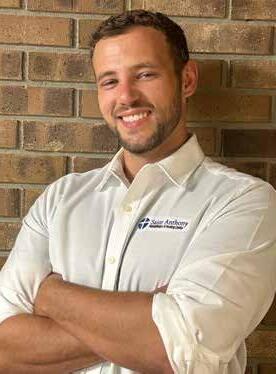
Joseph Hubbard, DO Peter Seymour,
Eric M. Orenstein, MD, MBA, FACS, FAAOS Rayhan Jalal, MD, FRCSC Jeffrey Wang, MD
Jonathan Sahawneh, MD
Jonathan Mongold, DO
Editor
- Carol Bangert
Art Director/Graphic Designer
- Kara Bishop
Content Marketing Specialist
- Shelby White
MISSION
Greater Lafayette Magazine captures the spirit and vitality of the people who call Greater Lafayette home and what it means to live, work and thrive here. It tells the region’s success stories, from business expansions, entrepreneurship, leadership and philanthropy to quality of life, arts and cultural events. Our hope is that readers of Greater Lafayette Magazine will become active participants in the world around them and join in our mission to make Greater Lafayette the place where progress, creativity and community come together.
AUDIENCE
Greater Lafayette Magazine serves as the leading quality-of-life and business trade publication for the area. Leveraging our award-winning team of writers and designers, Greater Lafayette Magazine attracts a diverse group of readers who are engaged in the community as consumers, visitors, business leaders, volunteers, residents and future residents of Tippecanoe County. This publication is for anyone that appreciates a good story that not only reveals something new about our community but offers insight and pride for the place we call home.
ADVERTISING
To advertise or receive information about advertising in Greater Lafayette Magazine, contact Amy Sundell at (765) 742-4044 or amy.sundell@greaterlafayettecommerce.com
PRINTER
The National Group
CIRCULATION
Greater Lafayette Magazine is published four times a year (January/April/July/October), with a print distribution of 4,000, and up to 10,000 online subscribers/views. Distribution channels will include online, mobile, various newsstands, and pass-along venues including restaurants, businesses, organizations, community centers, hotel lobbies and healthcare facilities.
Greater Lafayette Magazine is a publication of Greater Lafayette Commerce
337 Columbia St., Lafayette, IN 47901
• (765)742-4044
• info@greaterlafayettecommerce.com
• greaterlafayettecommerce.com
If there's a need, this community steps up
I’ve shared this story before, but as warmer weather rolls around, it always comes to mind.
Years ago when our daughter was young, our church hosted a youth choir from Africa. Church families – those with children, in particular – were encouraged to host three or four children from the choir along with their adult chaperone for dinner and an overnight stay. We were happy to participate and enjoyed the company of three energetic boys who told stories about their home while playing with our daughter and dog.
At one point, the chaperone asked us what the biggest issues were in Lafayette. It was mid-summer, and without hesitation, we explained that everywhere we turned massive amounts of road and building construction were causing headaches to no end. I remember vividly his response. He leaned his head back and let out a big laugh: “You’re complaining because they are improving your city?” Ouch.
I think that’s what you call a First World problem.
I bring this up because if you look beyond the traffic cones and “Road Closed” signs – which will be everywhere soon — you’ll also see myriad ways that people and businesses are improving Greater Lafayette.
Take Greater Lafayette’s popular summer farmers markets. Not content with watching them end when cold weather set in, two entities have found ways to extend the market experience. The first has been Greater Lafayette Commerce’s Winter Market, held once a month over the winter at the Bistro 501 Atrium at the Lahr. Granted, the stalls may not have been brimming with summer-ripe tomatoes and sweet corn, but several familiar vendors set up shop, offering winter produce and pastries, sauces, drinks and artisan crafts. The atmosphere had a definite farmers market vibe.
Market on Main, which opened in October, also recognized the void left by the farmers markets and makes space in its shop on Main Street to feature produce and meats from area farmers and growers, along with health supplements and locally made gifts. Read all about the endeavor on Page 10.
Greater Lafayette has a reputation for finding creative solutions to challenges big and small. From repurposing historic schoolhouses to enhancing the downtown shopping and dining experience to innovative home designs in forgotten neighborhoods, we solve problems and make things happen.
You’ll find stories like this throughout this issue of GLM, and those stories only scratch the surface of the amazing things the Greater Lafayette community can accomplish.
No complaints here.
Editor, Greater Lafayette Magazine
SUBSCRIBE TO GLM
Get to know the Greater Lafayette community by subscribing to Greater Lafayette Magazine. It’s easy! Go to greaterlafayettecommerce.com and click on the About Us tab. Then click on Greater Lafayette Magazine to view past issues and subscribe.
Old National Bank would like to thank everyone who helped make this year’s 100 Cooks Who Cook, Carnival for a Cause event a success. Special appreciation goes to our Sponsors, Cooks, Volunteers and Attendees. We’re proud to be part of such a unique event and to partner with the Greater Lafayette Community in raising more than $222,000 for Lyn Treece Boys & Girls Club.
The Lyn Treece Boys & Girls Club is an after-school and summer youth development organization providing positive, educational, leadership, and character-building programs for youth ages 6 to 18. Lyn Treece Boys & Girls Club has two locations. By having the 10th St. and Beck Lane Club locations, they are able to accommodate children all over the Lafayette area. Their mission is to inspire and enable all young people, especially those from disadvantaged circumstances, to realize their full potential as productive, responsible and caring citizens.
Bob Anderson
Heather Anderson
Dustin Balser
Dwight Barricks
Shelly Bays
Mikel Berger
Brittany Bergman
Dawn Berry
Kyle Berryman
Baylee Best
Kyle Bledsoe
Tracy Brown
Lindsay Buck
Tabitha Casto
Cindy Cockerill
Sal Cornejo
Taylor Crabtree
Jill Davis
Julieann Davis
Rob Davis
Jen Edwards
Amanda Findlay
John Foster
Heather Glick
Steve Goff
Shelley Gross
Trent Hanthorn
Bryon Haverstick
Rachel Hazaray
Mark Hendryx
Dock Henry
Caleb Hoff
Matt Huckstep
David Huff
John Hughey
Alex Johnston
Tracy Kleber
Clay Koehler
Josh Lolling
Michael McCarty
Nate Metz
Annie Miller
Joe Milligan
Mike Momberger
Brittany Montez
Abbigayle Mudrick
Gina Mundell
Shelley Phillips-Breece
Josh Plue
Jered Price
Nick Rambo
Clayton Richard
Lisa Roberts
Ted Robertson
Tony Roswarski
Mario Salgado
Yeniferd Salgado
Bob Sambolin
Nikki Schooler
Tim Schooler
Bryan Smith
Tim Snoeberger
Steve Snyder
Jamie Solomon
Tom Swinford
Ian Thomas
Kim Thomas
Heather Thompson
Jon Thompson
Wes Tillett
Dale Trapp
Carlos Vasquez
Bambrah Walker
Shane Weist
Molly Welch
Katie Westfall
Andrew Whittaker
Dave Winter
Rebecca Wright
Dagny Zupin
Photo Credit: Robert Granoff
ON THE COVER:
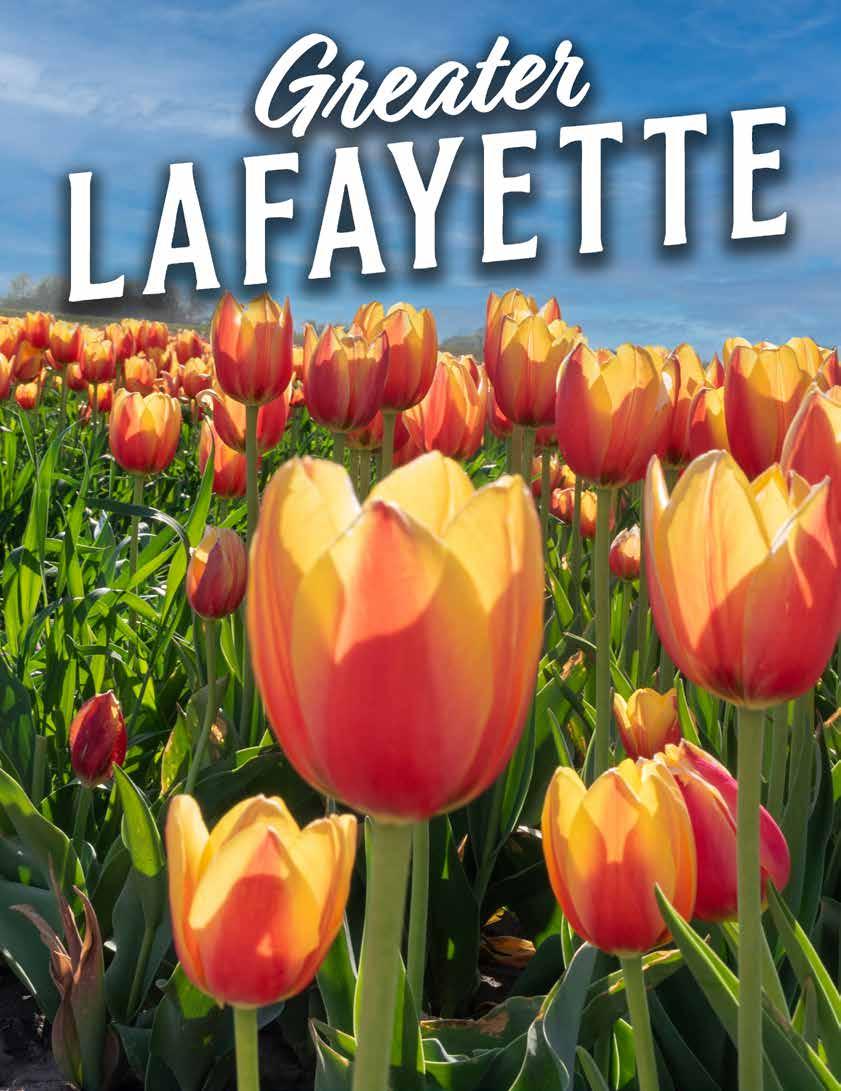
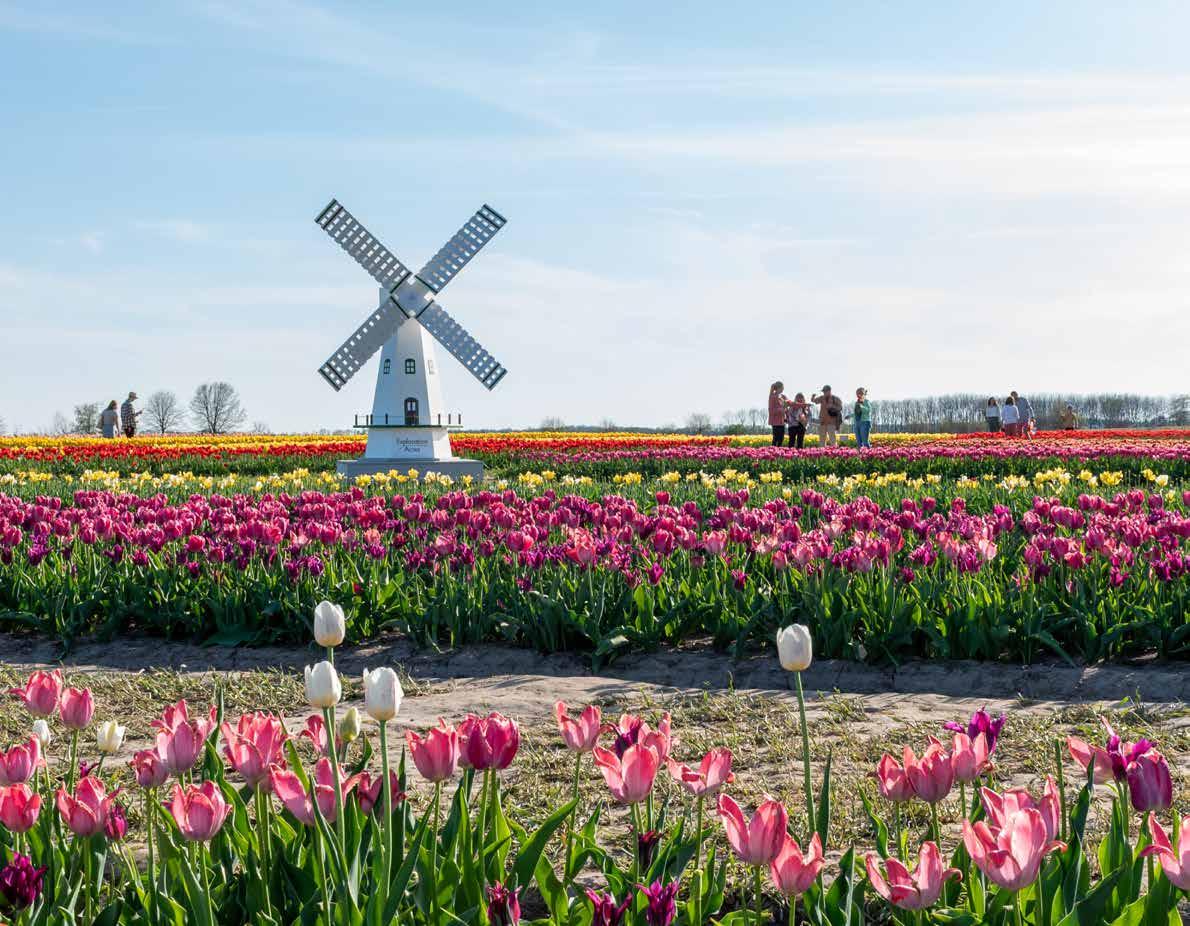
Exploration Acres explodes with the colors of spring during Tulip Days.
|page 46
Photo by Christine Petkov
LEFT:
Check out artisan crafts at Market on Main. |page 10
Photo by Christine Petkov
Welcome Note|page 4
From Editor Carol Bangert
A note from Mikel Berger |page 8
Market on Main: A wellness hub |page 10
DORA 3rd year expands downtown experience |page 18
Historic school buildings re-imagined |page 22
Making the Wabash River more enjoyable, accessible |page 32
Architect Sam Kim's mission: Beautiful, affordable design |page 36
Ask the Experts: Visit Lafayette-West Lafayette |page 56
Haan Museum participates in Kennedy Center celebration |page 58
Flustered by your business internet? You should get to know Jason Monroe. As Wintek Business Solutions’ customer experience practice leader, Jason is passionate about exceeding expectations and discussions that help you discover the best ways to achieve your goals. Talk to Jason today to learn about our new service packages and begin building a business network based on hard work, vision and innovation.
Let Wintek build your business network the way it should be.
765-742-8428 sales@wintek.com wintekbusiness.com
Mikel's Mindset...
A note from Greater Lafayette Commerce president and CEO Mikel Berger
A few weeks ago, I had the chance to participate in career day at Klondike Middle School with Junior Achievement. When it was my turn to speak, I asked the students a slightly different question than the one many of us heard growing up.
Instead of “What do you want to be when you grow up?” I asked them:
“What problems in the world do you want to help make better?” It’s a small shift, but it changes the way you think about the future. Instead of starting with job titles, the conversation begins with purpose. With the idea that our work is ultimately about helping make something better for other people.
That question has stayed with me.
Because in many ways, communities face the same challenge. Every generation eventually must ask not only what it wants to become, but what problems it wants to help solve.
I’ve started noticing that question show up in conversations across Greater Lafayette.
Sometimes it appears close to home. My son, Gunnar, is a junior in high school, and lately when people learn that, the first thing they ask is simple: “Is he thinking about Purdue?” It’s a natural question in a community where education, innovation and opportunity are closely connected. Other times the question comes
of opportunity. New industries are investing here. Our university continues to attract talent from across the country and around the world. Companies, entrepreneurs and investors are spending more time in our community trying to understand what makes this place work.
Visitors often notice something that longtime residents sometimes take for granted. In Greater Lafayette, people tend to work together. Local governments, schools, nonprofits and businesses collaborate in ways that are harder to find in many communities our size.
That culture did not appear overnight.
Workforce shortages. Rapid technological change. Housing and infrastructure needed to support growth. Welcoming new neighbors who are choosing to build their lives here.
These are not problems any one organization can solve alone. They require the same spirit that has always moved this community forward: neighbors in commerce working together, building something that lasts.
That perspective also shapes how I think about the role of Greater Lafayette Commerce.
opportunities emerging here. Different scale. Different industries.
The same belief that something meaningful is being built here. Which brings me back to that question.
from much farther away. Recently an international executive visiting our region asked me something equally practical: “Do you really have enough talented people here?” he said. “Can we hire them, or do we need to bring them in from somewhere else?”
And in conversations with local employers, I often hear another version of the same idea: How do we prepare the next generation for careers that didn’t exist here 10 years ago?
Different questions. Different perspectives.
But they are all really asking the same thing: what kind of future are we building here?
Greater Lafayette is entering a once-in-a-generation moment
For generations, this community has been shaped by people who are hardworking, intelligent and practical about solving problems. Farmers, engineers, teachers, manufacturers, entrepreneurs and families built this place by focusing less on recognition and more on getting the work done. They raised families here. They invested in their neighbors. And over time they built a community where people trust each other enough to tackle challenges together. They may not have used the word ‘ecosystem,’ but they knew how to work together.
Those qualities still define Greater Lafayette today.
The opportunity in front of us now is not to become a different community, but to apply those same values to the problems of our time.
In many communities, chambers of commerce focus on supporting existing businesses while economic development organizations concentrate on attracting new ones. Here, those responsibilities are intentionally connected. Our goal is to support businesses and people from the moment of their first visit to Greater Lafayette through decades, even generations, of growth.
I was reminded of that recently at the ribbon cutting for Market on Main. A group of Lafayette Farmers Market vendors came together to create a year-round space built on entrepreneurship, collaboration and belief in this community.
Their excitement about Greater Lafayette was unmistakable.
And it felt familiar. I have seen the same sense of possibility from international executives who traveled more than 12 hours to visit our region because of the
If we asked a room full of middle school students what problems they want to help make better, perhaps our community should ask a similar question. Not simply what Greater Lafayette wants to become—but how this generation wants to live out the values that built this community to solve the challenges in front of us.
The future of Greater Lafayette will not be shaped by any single announcement or organization. It will be shaped by thousands of everyday decisions. How businesses invest in people, how institutions collaborate, how families choose to build their lives here, and how neighbors continue to look out for one another.
The story of Greater Lafayette has always been one of people building something meaningful together.
This generation now has the opportunity, and the responsibility, to continue that work. ★
Essentially local
How Aurora Wilson built a wellness hub on Main Street
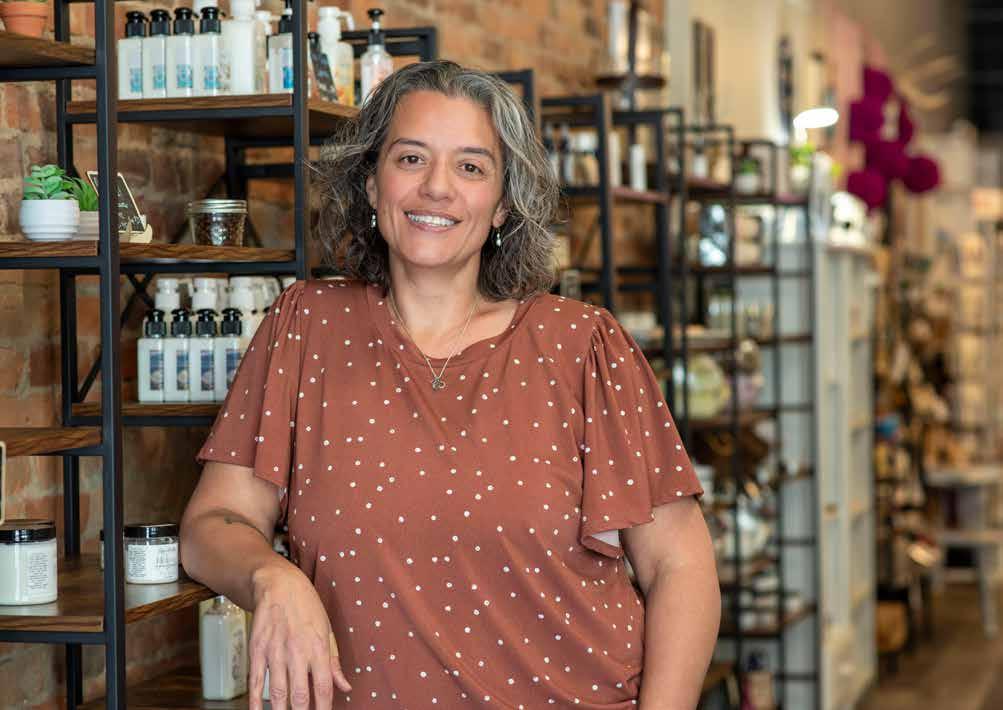
Aurora Wilson didn’t set out to become an entrepreneur. She was just trying to feel better.
Years ago, Wilson was managing chronic migraines, fibromyalgia and Hashimoto’s disease — conditions that sent her searching for answers beyond what traditional medicine was offering at the time.
“I kept asking for solutions, and they just weren’t there,” she says. So she began researching on her own, drawn to the idea that plants could be medicine and that the body, given the right support, could heal.
Around that same time, Wilson was introduced to essential oils. Curious and cautiously hopeful, she invested in a starter kit and began experimenting — diffusing oils, learning their properties and paying closer attention to how her body responded. But it was her youngest daughter who unknowingly sparked what would become a business.
During a winter cold snap, Wilson’s daughter came to her with painfully dry hands, the skin on her knuckles cracked and bleeding. Searching for a solution, Wilson found a simple recipe for a lotion bar made with shea butter, coconut oil, beeswax and lavender. With the ingredients already on hand, she made a small batch and rubbed it into her daughter’s hands.
“Two days later, they were completely healed,” Wilson says. “Like they had never been bleeding at all.”
That moment changed everything.
What started as a single lotion bar turned into a quiet obsession. Wilson began making lip balms, soaps and bath products for her family and friends. She paid close attention to ingredients, intentionally avoiding the chemicals and synthetic additives she had learned could disrupt hormones and irritate skin. Over time, her “fun little hobby” became something more refined, more scientific and more in demand than she ever expected.
Aurora Wilson
Three Tips for Healthy Skin
1) Drink more water. Your body — and your skin — need it. Hydration starts from the inside.
2) Use real sunscreen. Handmade sunscreen isn’t safe or regulated.
Buy a tested, FDA-approved product and use it consistently.
3) Stay informed. Awareness matters. Understanding ingredients, triggers and habits is key to long-term skin health.
Encouraged by friends, Wilson decided to test the waters. During the 2018 holiday season, she listed just four products on Facebook: lotion bars, lip balm, rose water and bath bombs. Within a day, she had made $300. She was fresh out of college with a background in computer information systems and web development, but the traditional job search wasn’t clicking. Her husband encouraged her to try selling her products at farmers markets, and business boomed. Customers lined up not just for soap, but for solutions — for products that felt good, smelled good and aligned with a growing interest in natural ingredients that support wellness. Then COVID-19 shut everything down.
Rather than closing the chapter, Wilson and her husband made a bold decision: if markets were gone, they would open a store. In November 2020, in the middle of a pandemic, Wilson unlocked the doors to Essentially Aqua in her first brick-and-mortar space on Main Street in downtown Lafayette.
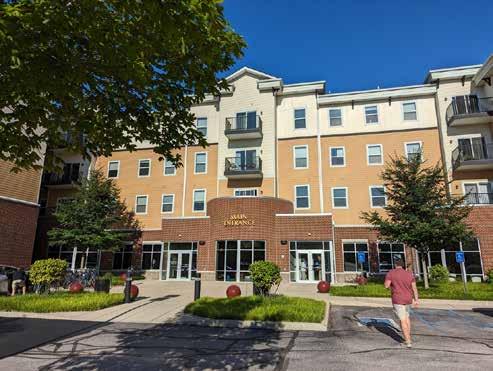
Five years later, now located just a few doors down at 525 Main St., the shop has become a fixture — celebrated for its inclusive atmosphere, delightfully scented
offerings and Wilson’s stalwart commitment to wellness.
"WELLNESS ISN'T JUST SOAP. IT'S FOOD, IT'S SUSTAINABILITY, IT'S COMMUNITY."
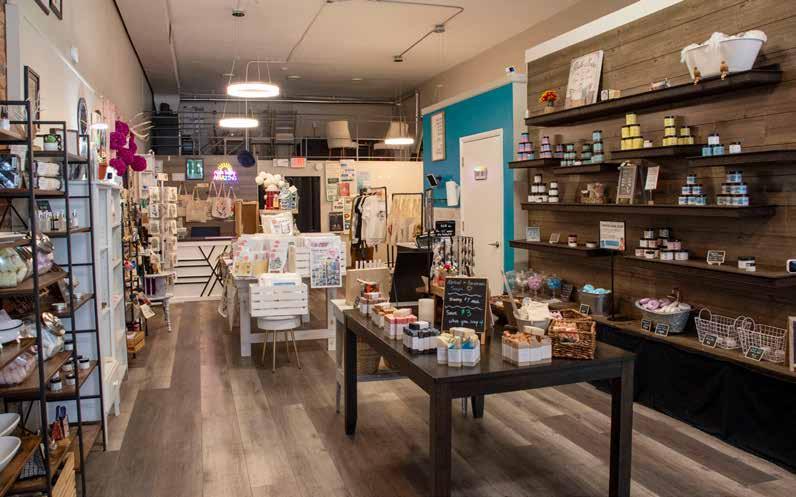
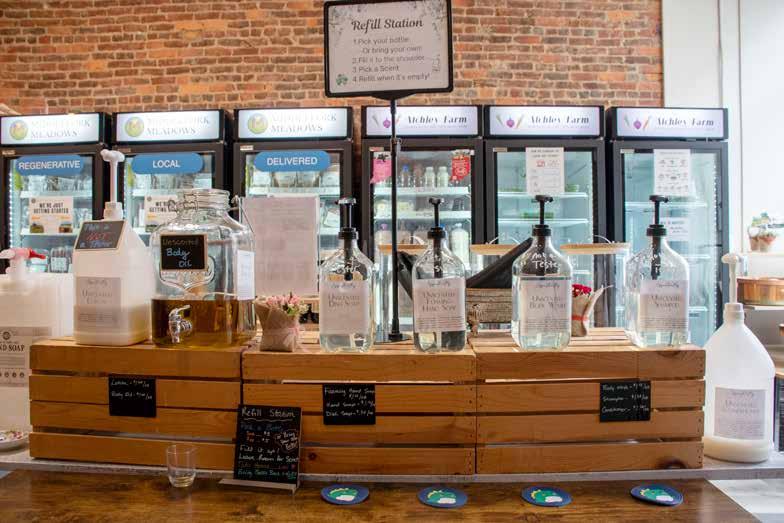
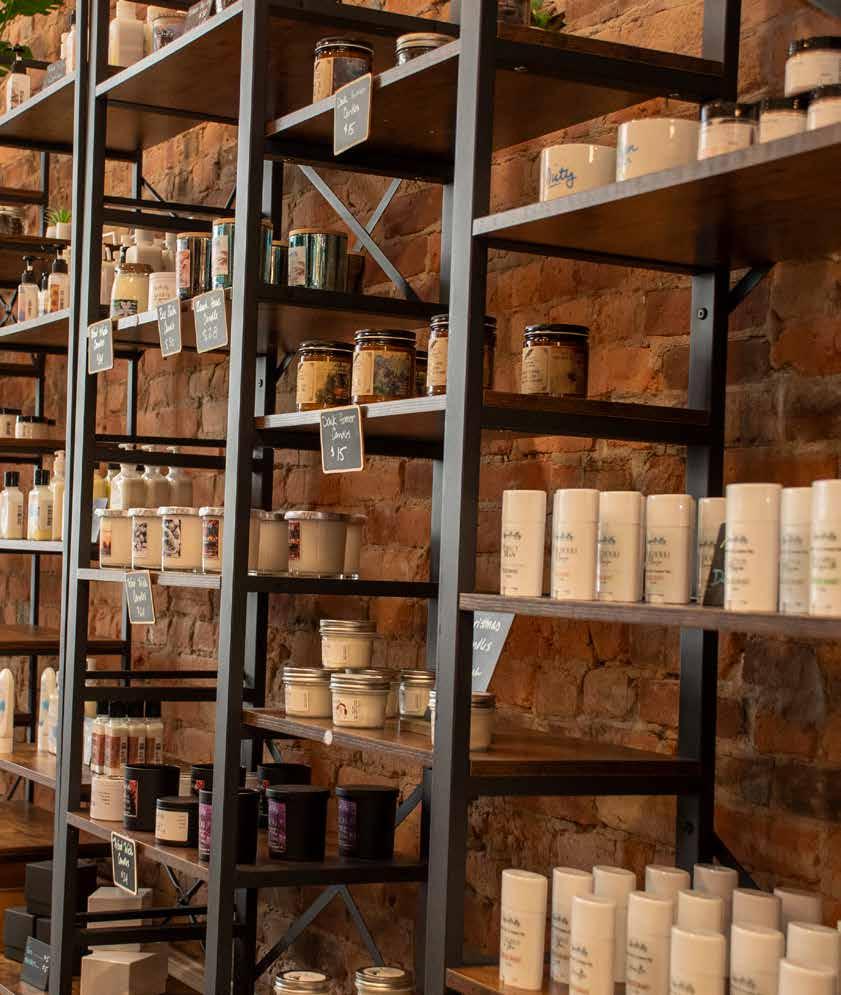
Wilson produces her products on site in the basement below the store. The operation is less craft time and more chemistry lab: precise recipes, weighed ingredients and meticulous consistency. Her product lineup includes cold-process bar soaps, shower steamers, bath bombs, lotions, body butters, body oils, shampoo and conditioner bars and foaming sugar scrubs with seasonal scent collections launched four times a year.
Soaps remain the foundation. “If your skin feels tight or itchy when you get out of the shower, it’s usually the soap,” Wilson explains. Her bars are superfatted — made with extra oils and butters — so they cleanse without stripping the skin. For customers new to wellness-focused skincare, she encourages starting small, just one bar of soap, and building from there.
The shop also features a refillery, where customers can bring in a bottle to refill everyday essentials such as hand soap, dish soap, body oil and lotion — all available unscented. But beyond the products, what customers
often observe is how the space makes them feel.
“The goal is that everybody feels welcome,” Wilson says. “It doesn’t matter what you look like or where you’re from.” The store is intentionally homey, inviting people to explore at their own pace. Many linger. Some come just to breathe.
That sense of care and community inspired Wilson’s next chapter: Market on Main.
Launched in October, Market on Main is a cooperative housed within the same space — a year-round, indoor take on a farmers market designed to support local makers and producers. The idea came from fellow vendor Nick Atchley of Atchley Farms who noticed Wilson’s shop had room to grow and asked a simple question: what if downtown had a permanent market?
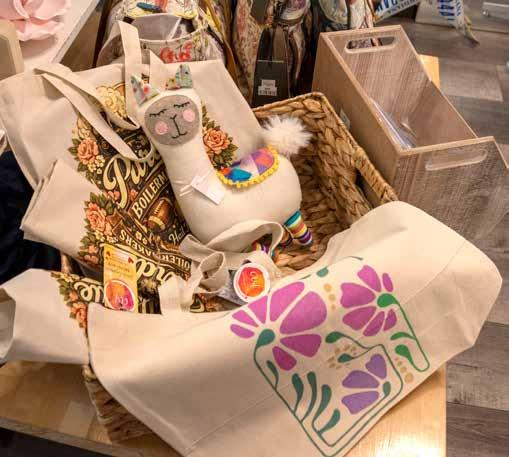
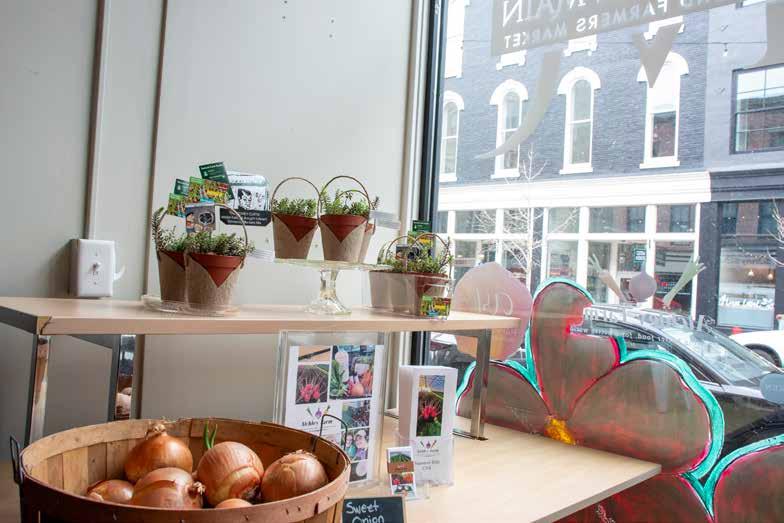
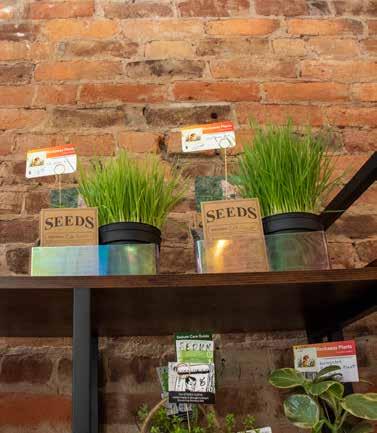
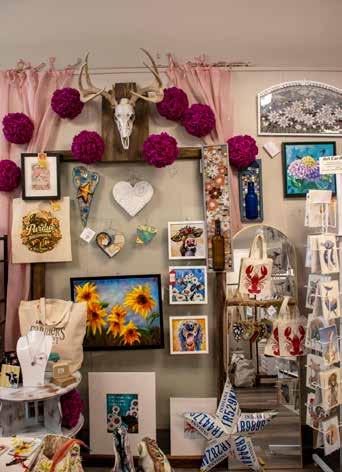
Today, Market on Main includes a curated mix of vendors offering local meat, farm products, whole food supplements and handmade gifts. Refrigerators stocked with locally sourced food sit alongside shelves of artisan goods, drawing in curious passersby and helping
address what many consider a downtown food desert.
More importantly, it lowers the barrier for small businesses. Vendors can gain a brick-and-mortar presence without the financial risk of leasing their own storefront. The cooperative model gives each partner a voice, while shared staffing and seven-day-a-week hours offer stability and visibility.
For Wilson, it’s a natural extension of her original mission.
“Wellness isn’t just soap,” she says. “It’s food, it’s sustainability, it’s community.”
In a city she describes as deeply rooted in connection, Wilson credits Lafayette’s support for her longevity. Customers know her name. She knows theirs. And even in uncertain economic times, she sees people choosing local — understanding that every purchase supports families, not faceless corporations.
What began as a mother trying to soothe her daughter’s cracked hands has grown into a downtown hub for healthier living, thoughtful consumption and shared success. On Main Street, wellness isn’t a trend — it’s a community practice, built one bar of soap at a time. ★
“We received a lot of positive feedback from patrons, saying that this has been much needed as a way to get out during the colder months,” Welch says.
“The Bistro 501 Atrium is a beautiful space that a lot of people forget is downtown. I’m glad that we could get the community back in there for at least one Saturday a month.”
Welch says she received helpful feedback from vendors about layout, time and overall feasibility of a winter market. “I’m excited to see how we can continue to grow our winter market,” she says.
-
Carol Bangert
Market On Main Vendors
Current partners include:
10:10 & Healthy: Whole food supplements
Art with a Happy Heart: Take and make art kits, original art and unique gifts
Atchley Farms: Certified naturally grown produce
Essentially Aqua: Natural skincare, bath, body and home products
Middlefork Meadows Locally raised beef, pork and chicken
Interested In Becoming A Vendor?
Market on Main is actively seeking additional partners for its year-round farmer’s market concept. Local producers and makers looking for a low-risk entry into a brick-and-mortar space are encouraged to reach out directly at the shop at 525 Main St.
Area Farmers Markets Open In May
West Lafayette Farmers Market: 3:30-7:30 p.m. Wednesdays, through October. The market is held at Cumberland Park in West Lafayette with more than 50 vendors.
Lafayette Farmers Market: 8 a.m.-12:30 p.m. Saturdays, through October, on Fifth Street between Columbia Street and mid-block to Ferry Street, and Main Street between Fourth and Sixth streets.
:
Thursdays, through October.
The winter market was held at the Bistro 501 Atrium at the Lahr one Saturday a month, January through April. Molly Welch, quality of life manager at Greater Lafayette Commerce, says there were consistently 20 vendors at each market, with an estimated total of 1,200 visitors.
Winter Market Update
Third year expands on unique downtown experience
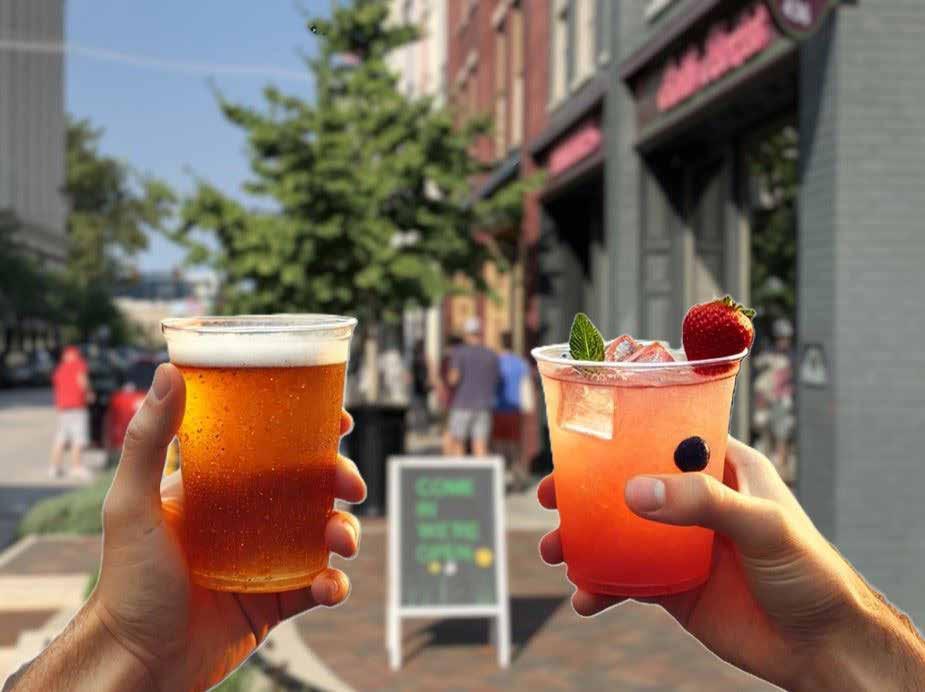
If you’ve spent any time in downtown Lafayette, you’re familiar with the diverse mix of establishments to dine, grab a drink and explore. A couple of years ago, the city made an effort to enhance that experience even more, launching what’s known as the Designated Outdoor Refreshment Area (DORA).
Introduced in summer 2024, the pilot program allowed individuals of legal drinking age to purchase an alcoholic beverage from participating businesses within the approved area. Visitors could then stroll through a defined section of downtown, enjoying their drink during various hours throughout the week. The initial DORA began on a modest scale, spanning just a single block along Main Street, from 10th and 11th streets.
Following what was dubbed a successful launch of the pilot, the area was expanded in summer 2025, encompassing a much larger portion of Main Street, stretching from Second Street all the way east to 11th Street. This includes landmarks such as the courthouse square and the area that makes up the farmers market.
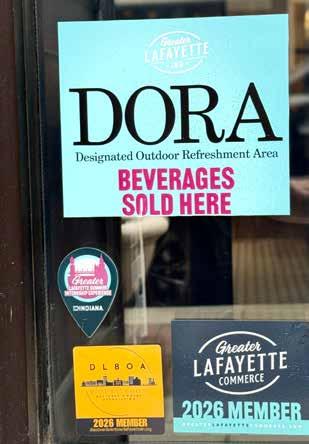
DORA boundaries are clearly posted with signage throughout downtown. Rules state that beverages must remain outdoors and are not allowed to be brought into businesses unless the establishment explicitly allows it, which will be indicated by posted signs.
As the temperatures begin to rise and we begin to spend more time outdoors, heading into the third year of offering a DORA, city leaders are looking ahead and touting the success of years past.
“With last year’s expansion the feedback has been entirely positive,” says Myles Holtsclaw, senior community development manager at the City of Lafayette’s Economic Development Department. “I have received positive feedback about the program from business owners, downtown employees and people purchasing beverages from the DORA locations.”
Holtsclaw says that more downtown businesses have shown interest, and he hopes even more will choose to join. Currently, 15 establishments are actively participating in the DORA.
“I have encouraged all downtown businesses to share any issues they have with the DORA, and so far I haven’t received any,” he says. “My hope is that continues.”
Along with businesses, downtown event organizers also are expressing interest in using the DORA to facilitate their beverage needs, creating an easier and streamlined process.
Holtsclaw says as of now, there are no plans to expand the current boundaries.
“Our last expansion covered all qualifying vendors in the downtown area, and we haven’t received any requests to expand the DORA footprint,” he says. “Communities are allowed to have multiple DORAs, but we do not have any plans to create an additional DORA currently.”
Broadening DORA’s appeal
To further enhance the vibrancy and charm of downtown, the city is looking to broaden its appeal to visitors of all ages, exploring the addition of live entertainment within the DORA boundaries, creating a dynamic and welcoming atmosphere for everyone.
“For a long time, the mayor [Lafayette Mayor Tony Roswarski] has envisioned having live entertainment downtown in the evenings as
residents and guests enjoyed our historic downtown for shopping, shows and events, and our wonderful restaurants and eateries,” says David Huhnke, director of marketing and communications for the City of Lafayette.
Huhnke says the plan is to offer live music performances at least once a month, creating regular opportunities for people to come together and experience the vibrant atmosphere of downtown.
“We want this live entertainment to be family friendly to draw an audience of all ages so visitors can appreciate what Lafayette has to offer while enjoying the sights and sounds of our historic downtown,” he says.
The plan calls for scheduled performances on designated dates (e.g., the first and third Thursday of each month) or based on the availability of a specific group. Huhnke says these performances will not compete with scheduled events or annual festivals that are already scheduled downtown.
Huhnke says there will be a variety of entertainment, from live bands that encompass high school music departments; dance studio groups; bands of all genres, or performing arts groups from around Greater Lafayette.
Performances will pop up at varioius locations throughout the designated area, from Riehle Plaza to open-air spots along Main Street, in front of local storefronts, and the former train stop at Main and 11th streets, bringing energy to all corners of downtown.
To ensure a positive experience for everyone, shows will begin around 7 p.m. and conclude by 10 p.m., striking a balance between lively entertainment and respect for nearby residents and businesses. Additionally, Huhnke says the city is open to partnerships with businesses or
organizations interested in helping offset the costs of hosting live entertainment.
“So far, we have evaluated the live entertainment by the feedback we have received and the number of attendees,” he says. “It has been appreciated by those who have attended in the past and the feedback that has been shared on the city’s social media sites.”
For individuals or groups that are interested in performing, they can contact the city at LafayetteLive@lafayette.in.gov
“We are still in the beginning stages of this program, so there will be adjustments as we go forward,” Huhnke says.
For more information regarding hours, guidelines and participating businesses, visit: lafayette.in.gov ★
The rebirth of Tippecanoe County’s {lesson plans for a new era} historic school buildings
BY ANGELA K. ROBERTS PHOTOS BY CHRISTINE PETKOV
Farmers Institute Morris Schoolhouse
The ring of the school bell once signaled the start of the day for generations of Tippecanoe County students, echoing through city blocks and wooded groves. From the grand brick structures of early 20th century urban high schools to the simpler construction of 19th century rural outposts, the buildings shaped the region’s early educational history. While many of these landmarks have succumbed to the passage of time, some are experiencing a second chapter. Including a Quaker meeting house, a community park centerpiece and a senior apartment complex with a faithful addition, these repurposed school buildings demonstrate how preservation can offer new purpose long after classes have ended.
The county’s first rural academy
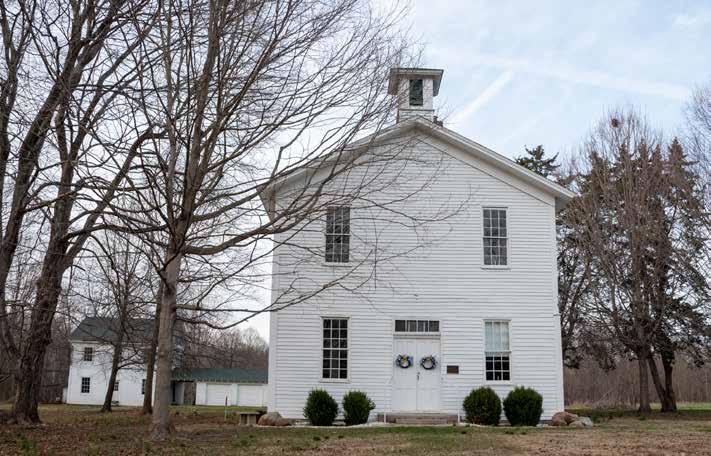
In a shady grove along a quiet stretch of Shadeland, a white two-story frame building stands as a monument to early Indiana education.
In 1851, the Society of Friends opened Farmers Institute, considered to be the first academy in rural Tippecanoe County. Drawing boys and girls from the neighboring towns of Lafayette, Thorntown and Stockwell and from as far away as Ohio, the school offered a boarding house for residential students.
The curriculum included reading, writing, spelling, arithmetic, English, grammar, geography, history, chemistry, physiology, algebra, geometry, trigonometry, Greek and Latin. At the school’s busiest, 75 to 125 students attended each year. According to a historical marker in front of the meeting house, “The library was large and of exceptional quality.”
When the school closed its doors after the founding of Purdue University, the building eventually became a Quaker meeting house, which was later renamed Farmers Institute Friends Meeting.
Saving an endangered building
In 2012, Indiana Landmarks listed Farmers Institute among Indiana’s most endangered historic buildings, citing structural deterioration. By then, the institute had been “laid down” – a Quaker term for a meeting that has closed its doors.
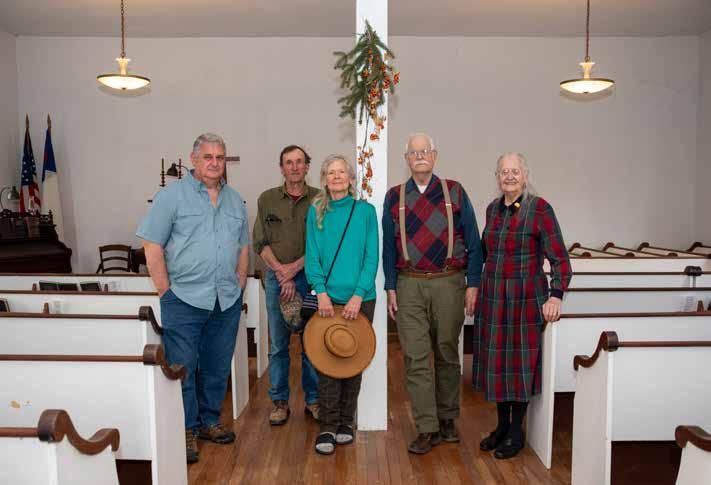
Above, left to right: David Loser, Tom Sosbe, Sunny Miller, John Mills and Karen Mills at the Farmers Institute.
Farmers Institute
Farmers Institute
That year, a group of locals vowed to save the structures. They began meeting again for silent worship on the first Sunday of each month and gathering regularly to work on the buildings and grounds.
After tackling critical repairs to the exterior and interior of the meeting house, they turned their attention to the section of boarding house that remains.
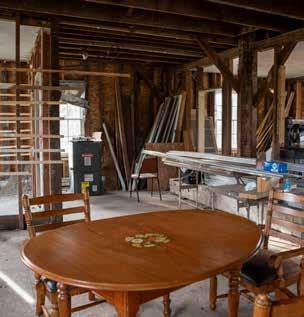
Volunteers like Karla Ross, a retired clinical assistant professor from Purdue University, are part of the institute’s renaissance. With the foundation of the boarding house now shored up, they are currently replacing its windows and re-siding the building with southern Indiana poplar, which they are painting and nailing by hand. By this fall, Ross says, they hope to have the exterior of the boarding house completed so that they may tackle the inside.
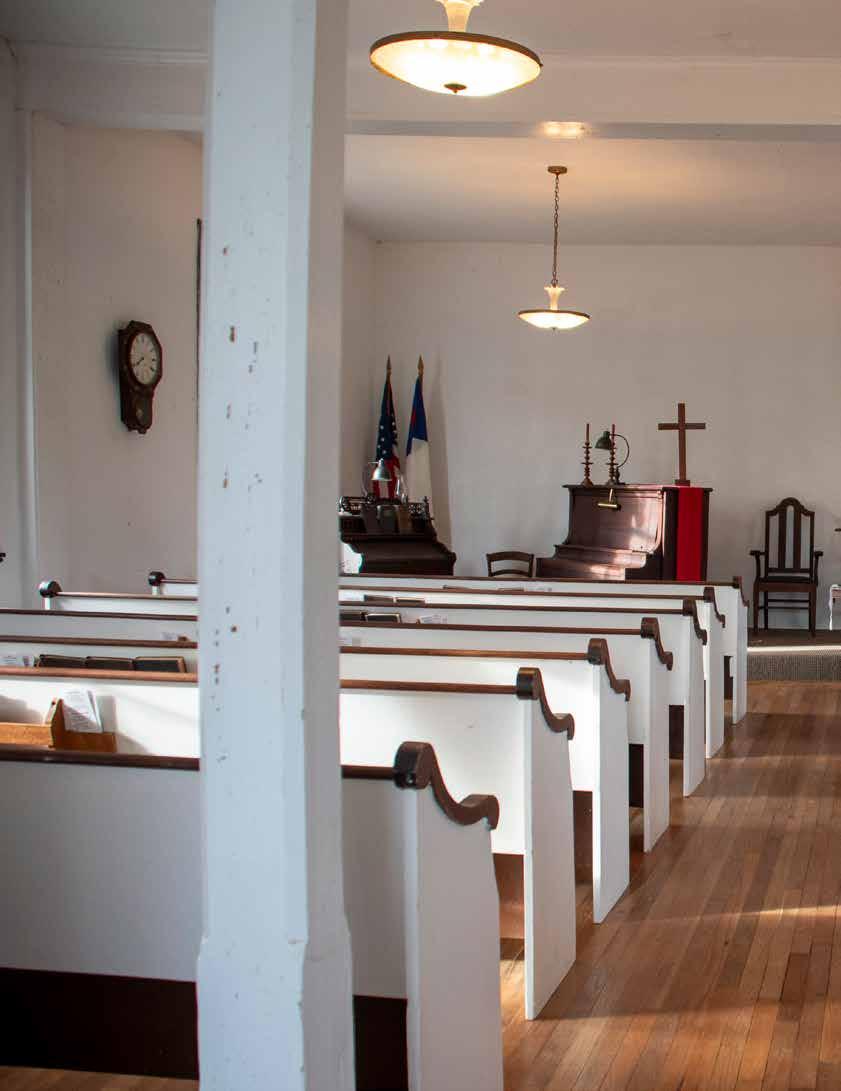
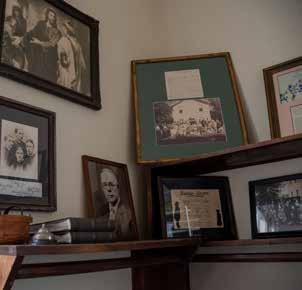
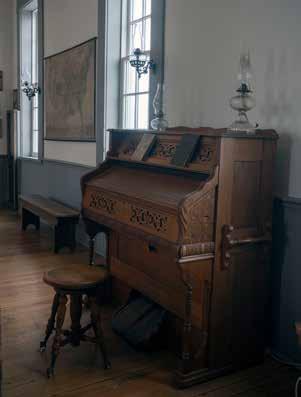
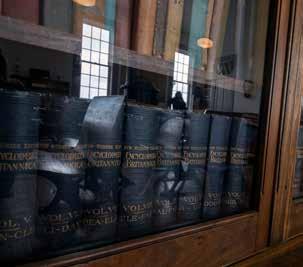
Next door, the meeting house has retained much of its 19th century aesthetic. Inside a quiet vestibule, glass bookcases preserve a collection of vintage books and photos. The entryway opens into a bright meeting room defined by glazed windows, wide-plank wood flooring and soft white walls.
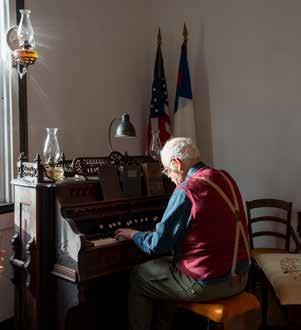
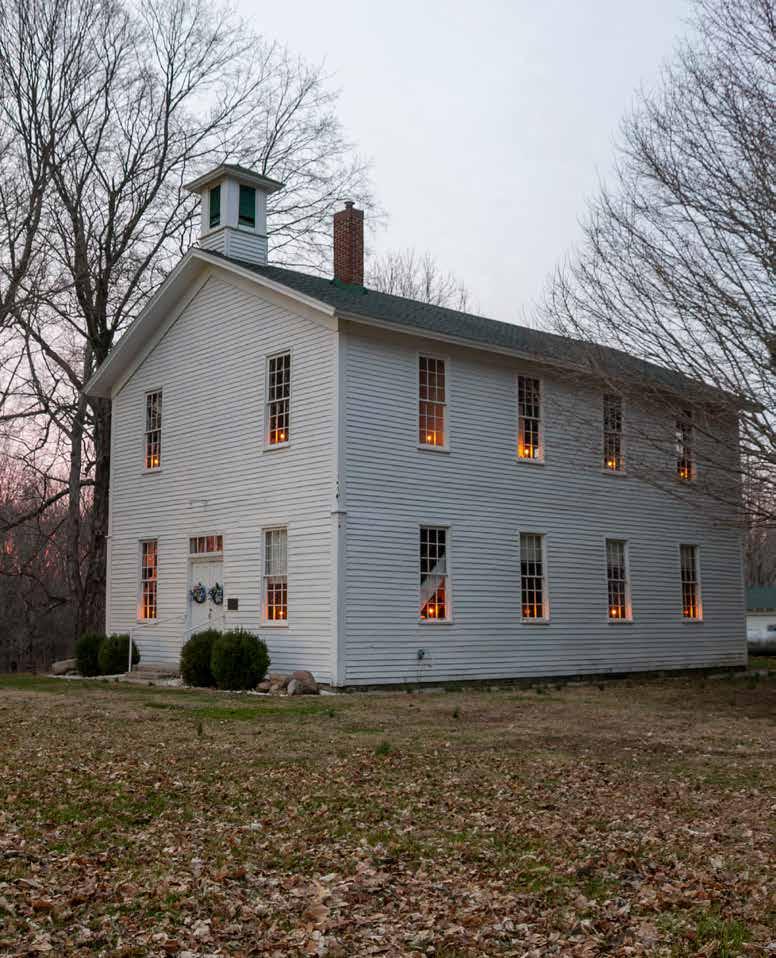
On either side of a center aisle, wooden pews await folks gathering for silent worship once a month, the quiet sometimes punctuated by hymn singing and piano music. During evening events, kerosene lamps mounted on the walls offer a soft amber glow, supplementing electrical lighting.
Despite a small monthly attendance of 10 to 15 people, the group remains active in its mission. “It’s one thing I’ve learned, which is humbling. It isn’t the size of the group. It’s the commitment to what they’re doing,” Ross says.
Each fall, Farmers Institute puts on a Quaker Fair. Drawing hundreds, the fundraising event features an old-fashioned bean dinner, historical talks and displays, music, quilt exhibits and handmade crafts.
In early December, the meeting hosts an annual carol sing. As guests arrive in the dark of winter, electric candles illuminate each window of the meeting house, guiding them toward the double front doors and the communal warmth waiting inside.
History, on the move and hands on
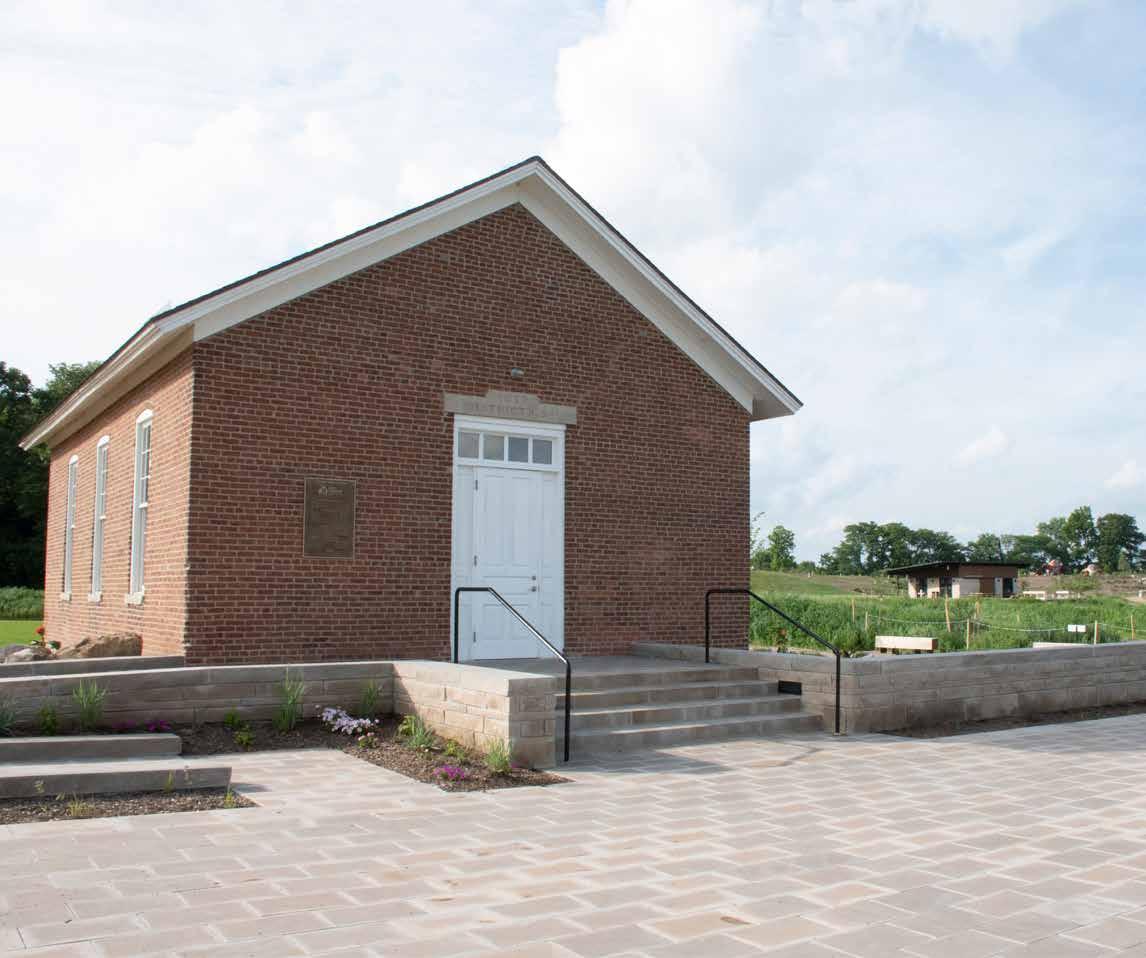
While many historic structures remain tethered to their original foundations, the Morris Schoolhouse, built in 1879, embarked on a unique journey to ensure its preservation. Situated on land slated for new development by Franciscan Health, the schoolhouse required a new home to avoid being lost to history.
Lynn Cason, a local resident, donated 13.6 acres of retired farmland along Cumberland Avenue to serve as a permanent sanctuary for the building. On a clear, late-winter day in 2017, as hundreds of spectators watched, the schoolhouse was lifted with hydraulic jacks, placed on steel beams and driven across a barren soybean field to its current location.
Today, the red brick landmark stands as the centerpiece of the new Cason Family Park, nestled among prairie grasses and connected to West Lafayette’s 27-mile trail system.
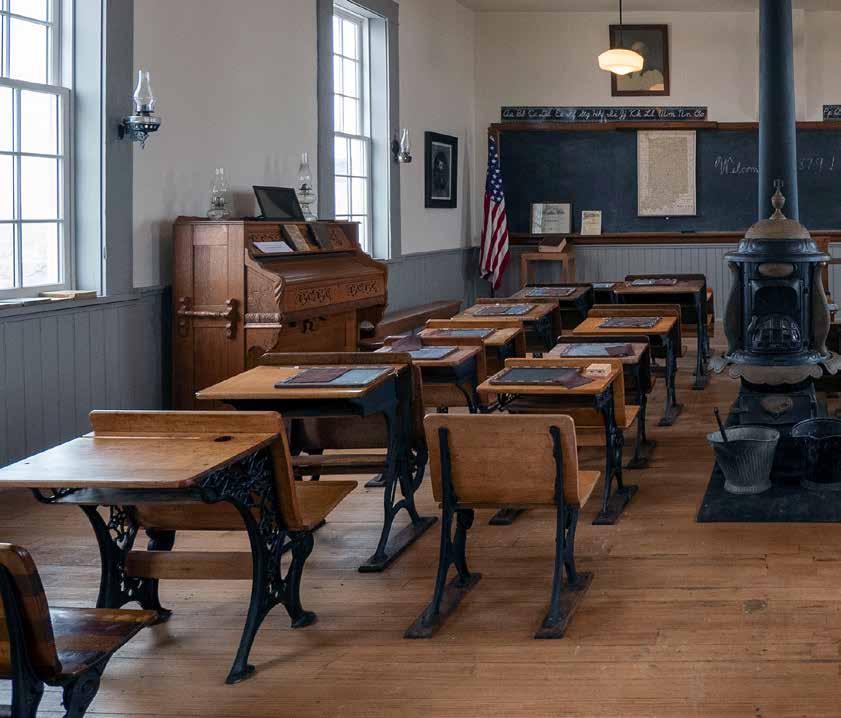
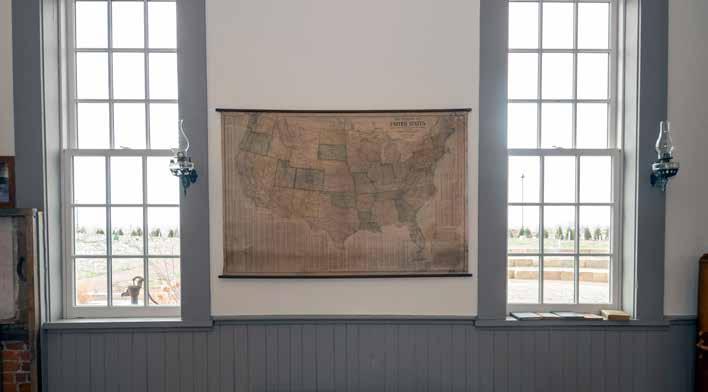
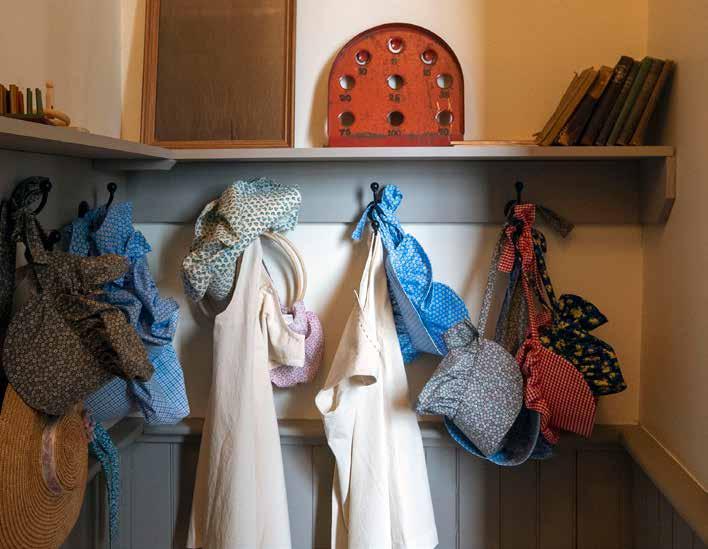
Walking into the restored schoolhouse feels like stepping back 150 years. A cast-iron stove presides over the room, flanked by rows of wooden desks standing on ornate legs. Stretching across the back wall is a chalkboard with the phrase “Welcome to 1879!” written in cursive letters. In the tiny cloakroom, bonnets, lunch pails and caps hang on black pegs, harking back to an earlier generation of students. Wood floors and beadboard complete the scene.
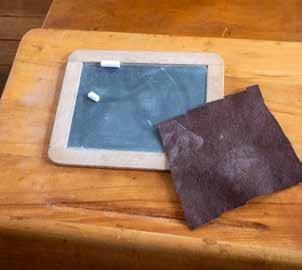
“We have slate boards at each desk. Visitors are welcome to sit in the desks and write on the slates,” says Amanda Jeffries, recreation coordinator at West Lafayette Parks and Recreation Department. “There are many books that can be looked through. There are maps and photos around the room to look at. There are some replica toys in the closet as well.”
Starting in April, the building will be open for weekend tours, with future plans for immersive field trips where 21st century students can experience the rhythms of a 19th century school day.
Preservation and historic reproduction in the Old City
The Historic Jeff Centre Senior Apartments represent a meticulous preservation of the Old City’s architectural and educational heritage. Built in the 1910s and expanded
in the 1920s to include a gymnasium, the brick Tudor Revival served as Lafayette’s public high school for nearly 60 years before transitioning into a junior high and then a home for Ivy Tech Community College of Indiana. In 2000, the landmark reopened after an adaptive reuse transformation, finding new purpose as an affordable senior apartment complex with 74 units. Last December, Homestead Resources debuted a nearly $13 million addition. Named after the school’s newspaper, the new Jeffersonian contains 50 affordable senior housing units.
Rising from the site of the old Jeff gymnasium that had been demolished decades before, the new apartment building was designed with input from residents of the Historic Jefferson Neighborhood. “We did work with the neighborhood – and they’re an integral part of our partners – to make sure we got them something they could be proud of, to look outside their windows every day at,” said Marie Morse, executive director of Homestead Resources, at the grand opening in December.
Physically separated from the historic school building by a parking lot, the Jeffersonian complements its next-door neighbor in an updated traditional style. Like its historic predecessor, the new building is three stories high. Brick masonry veneer mimicking the older building’s exterior mixes with modern fiber cement panels. Double-hung windows, a staple of early 20th century architecture, are embellished with cast stone lintels and soldier course brickwork, evoking the ornamental details of surrounding historic homes.
Inside, contemporary furnishings such as vinyl plank flooring, glass public doors and stainless-steel appliances offer modern comforts. Memorabilia from past athletic events are on display, showcasing the land’s historical significance.
Located on North Ninth Street, the Historic Jeff Centre Senior Apartments and the Jeffersonian offer up-to-date living within a historic framework, ensuring that the site where high schoolers once wrote on chalkboards and tossed basketballs continues to play a meaningful role in the life of Greater Lafayette residents. ★
On the banks of the Wabash
Wabash Riverfront projects keep rolling along
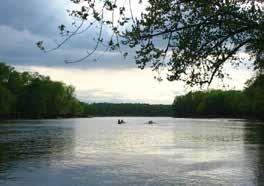
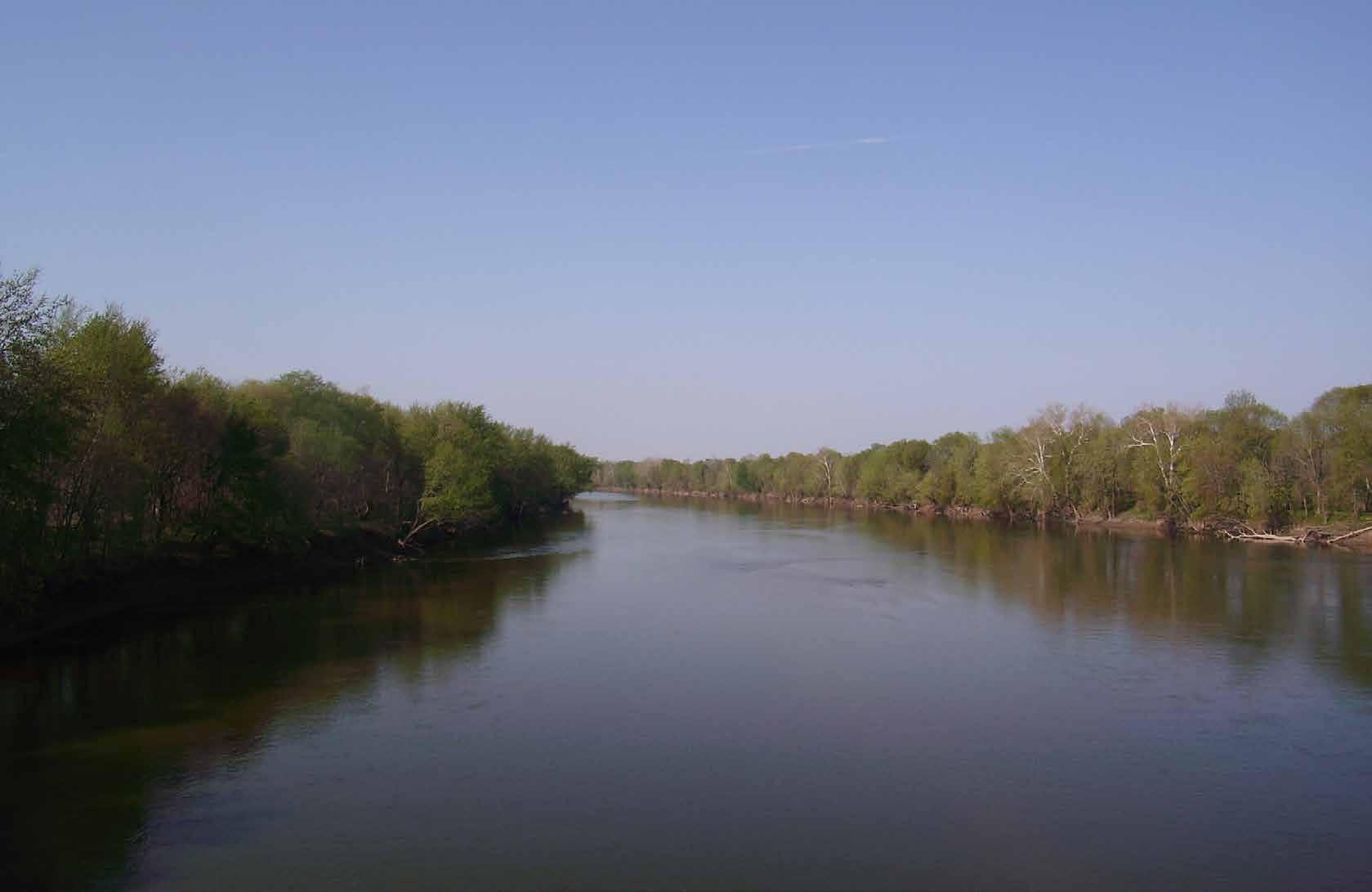
Several projects are underway along the Wabash River in Tippecanoe County, aimed at enhancing and revitalizing the riverfront and making it more accessible and enjoyable for everyone.
Spearheading these projects is the Wabash River Enhancement Corporation (WREC). Established in 2004 as a 501(c)(3) nonprofit, WREC was created by the City of Lafayette, the City of West Lafayette, Tippecanoe County and Purdue University to serve as the point agency for planning and implementing enhancement of the Wabash River corridor.
Its mission is to enhance the quality of life in the Wabash River corridor by providing sustainable opportunities to improve health, recreation, education, economic development and environmental management to promote the longterm sustainability of the Wabash River through environmental stewardship, recreational development and economic growth.
WREC is leading a regional effort that has developed a Corridor Master Plan to develop a 5-county, 90 river-mile Wabash River Greenway (WRG), and development projects are underway throughout the WRG region.
Three current projects are supported primarily by a $2.9 million Regional Economic Acceleration & Development Initiative (READI) grant awarded by the state, along with $5 million from the Lilly Endowment’s College and Community Collaboration Initiative grant through Purdue University, and matched with an additional $1.47 million from North Central Health Services.
According to Stan Lambert, executive director for WREC, these projects, all expected to wrap up in May of this year, aim to expand and enhance the WRG trail network on both sides of the river.
Trailheads and connectors
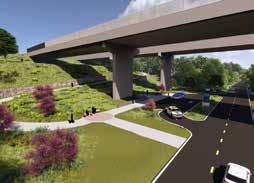
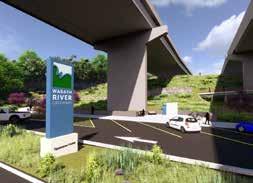
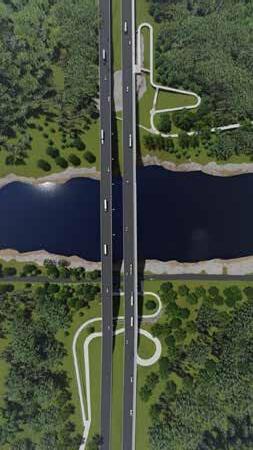
The first project, the North River Road Trailhead & Connector Trail, is located on the West Lafayette side of the river, beneath the Sagamore Parkway bridges along North River Road. Plans call for constructing a new trailhead with a small parking lot, a rest area with benches and bike racks, a bike repair station and a connector trail linking to the West Lafayette Sagamore Parkway Connector Trail. Lafayette Rotary funded the development of the bike repair station and trailhead components.
According to Lambert, this connection will provide access to the City of West Lafayette’s trail system and the existing protected bike lane attached to the Sagamore Parkway vehicular bridge, allowing cyclists and pedestrians to travel into Lafayette and connect with its trail system.
The second project, the Wabash River Greenway Connector Trail, is located on the Lafayette side of the river and will strengthen connections between Lafayette and West Lafayette’s trail systems.
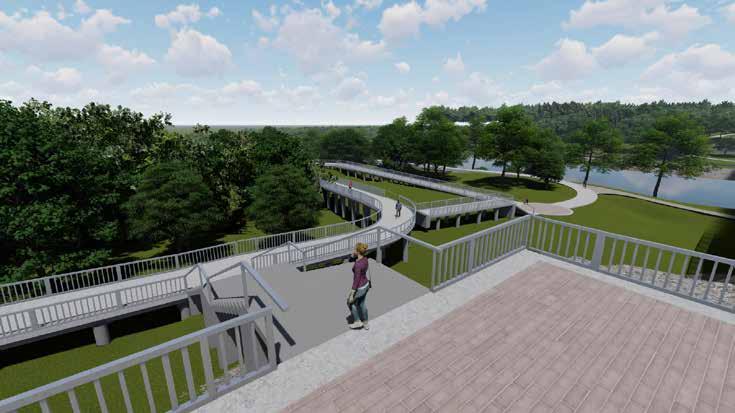
This includes the construction of a boardwalk extending from Lafayette’s Sagamore Parkway Connector Trail and overlook, and the protected bike lane on the Sagamore Parkway bridge, down to the Wabash River Heritage Trail that extends along the river.
This will allow for a continuous route into downtown Lafayette, connecting the Lafayette Sagamore Parkway Connector Trail, the Wabash River Heritage Trail, the protected bike lane on the Sagamore Parkway bridge, the WL Sagamore Parkway Connector Trail, the North River Road Trailhead, and the future Wabash River Greenway trail along North River Road.
Canoe and kayak dock
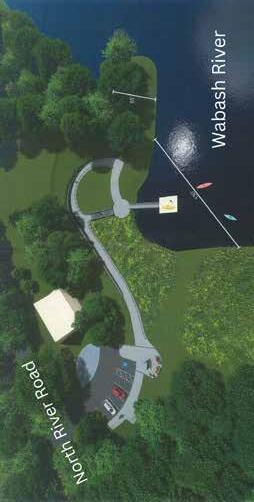
The third project, the Wabash River Greenway Trailhead and ADA-Accessible Canoe and Kayak Facility, will construct a new trailhead along North River Road and an ADA-accessible canoe and kayak put-in/take-out dock and harbor. The trailhead will include a small parking lot, benches and bike racks and a bike repair station
The canoe and kayak facility will be accessible via a ramp and floating gangway connecting to an ADA-accessible dock.
Additionally, a $25 million federal Rebuilding American Infrastructure with Sustainability and Equity (RAISE) grant will help fund another large project: the construction of the North Ninth Street and North River Road segment of the Wabash River Greenway Active Transportation Loop. That will extend along the North River Road and North Ninth Street Road corridors to eventually connect to Prophetstown State Park in Tippecanoe County.
Safety improvements and ADA upgrades are planned for the existing North Ninth Street trail that extends south into Lafayette. The project will include construction of a new trail beginning at the end of the current path. From there, the trail will continue south to Canal Road before turning west toward the Wabash River. It will then connect to a new bicycle and pedestrian bridge across the Wabash River, landing at the intersection of Happy Hollow Road and North River Road.
“We’ll have signalized crossing so that bikers or hikers will be able to get across to that trail on Happy Hollow Road and go to Happy Hollow Park. Or to get onto the existing Wabash River Heritage Trail that’s on the west side of North River Road, and take the south end to downtown West Lafayette,” Lambert says.
From the new Wabash River bike/pedestrian bridge West Lafayette landing, the new trail will extend north along the east side of North River Road. It will then pass beneath the Sagamore Parkway bridges with a signalized crossing for safe access to the WRG Trailhead and connector trail. It will continue north through the new WRG Trailhead and ADA canoe/kayak facility and extend to Tecumseh Trails County Park.
At Tecumseh Trails, a new bike and pedestrian bridge will cross the ravine connecting to Tippecanoe County Amphitheater Park, and the trail will end at the Amphitheater Park parking lot.
“This project is in design development and is set to go out to bid in June 2027,” Lambert says.
Lambert says updates about the ongoing projects will be posted on wabashriver.net and on WREC’s Facebook page.
West Lafayette's shopping and housing ventures
As for housing and retail development along the riverfront, Lambert says, “That calls for enhancing and increasing the existing green space, mixed use development and improved multi-modal connectivity in and along the riverfront, and we identify areas where we think these components would be best suited.”
He says WREC has worked closely with both Lafayette and West Lafayette on envisioning the future of development in the urban river corridor.
“The West Lafayette downtown plan pretty much incorporates our vision for
the central reach of the Lafayette-West Lafayette riverfront with mixed use development, enhanced and increased green space, connectivity to the river and multimodal connectivity,” he says. “If developers see that there’s going to be riverfront activity and vitality occurring and being developed along the riverfront and drawing people down to the riverfront, through trails and increased park space, that’s going to spur people to take that chance and do that development project on the West Lafayette side and/or on the Lafayette side of the riverfront.”
Pedestrian bridge: Closed for repairs
Another upcoming project includes improvements to the John T. Myers Pedestrian Bridge between Lafayette and West Lafayette, which will close the majority of the bridge for several months.
“This bridge was built in 1914, and It has been over 50 years since the last major paint job,” says Jeromy Grenard, city engineer for the City of Lafayette. “There has been an overcoat about 30 years ago. This project will remove the paint down to the metal, then repair any corrosion on the stiffeners, and then repaint it.”
Additionally, there will be very minor deck surface paver repair, but Grenard says that’s not the focus of the project, which is under the deck, and mainly out of sight. The contractor will need to tent off the underside of the bridge and stage some materials and equipment on the bridge. At this point, the plan is to leave a path open for everyday pedestrians and bicyclists, but summer events traditionally hosted on the bridge will need to be relocated.
“There was another time that the bridge was closed about 10 years ago and the Beers Across the Wabash was held adjacent to the bridge and was called Beers Along the Wabash,” Grenard says. “It sounds like the Friends of Downtown are considering something similar to that this year. During the Stars and Stripes, people will be allowed to gather in the Riehle Plaza area, the Depot and on the Promenade. They will not be allowed to congregate on the bridge. Riverfest is also considering alternate layouts that do not require
Designing more than houses
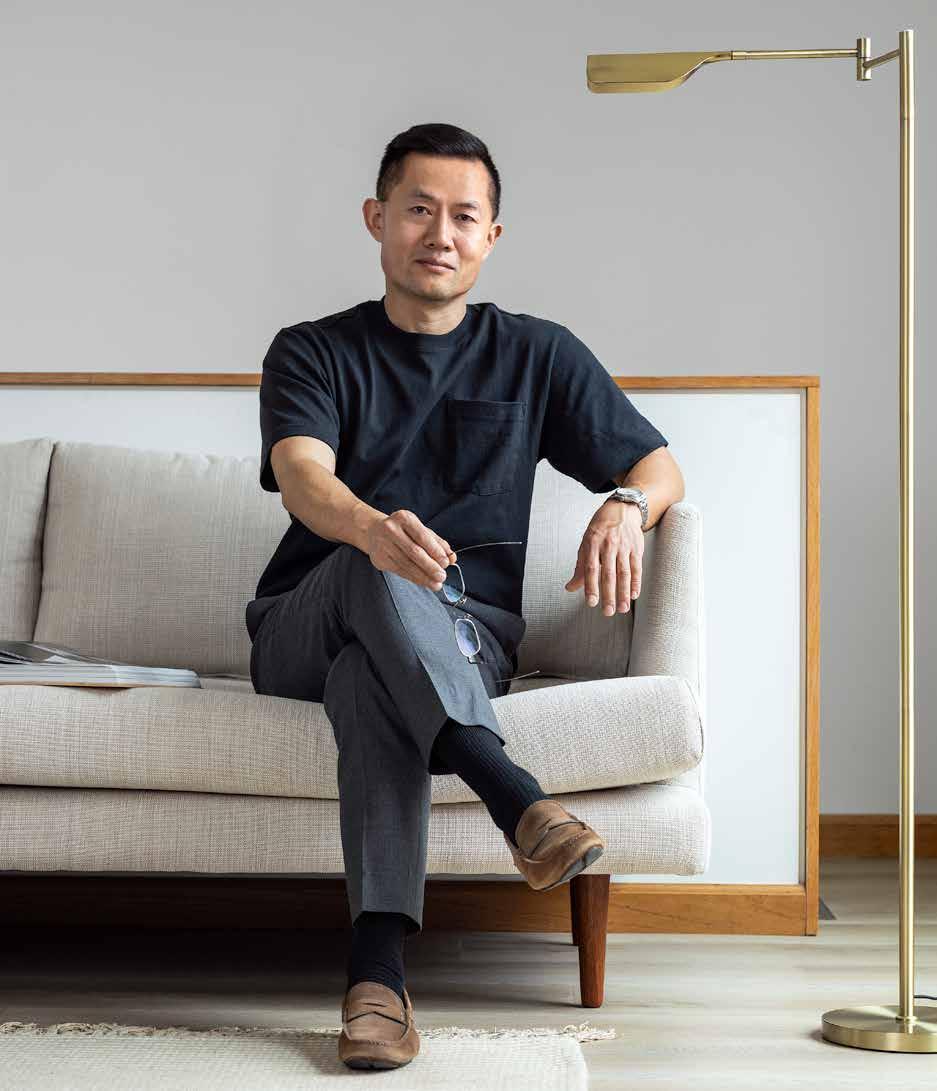
Architect Sam Kim’s vision embraces relationships, simplicity
or almost 19 years Byunghoo Jung, a Purdue University professor of electrical and computer engineering, and his wife, Jeeyeon Ku, raised their family in a traditional twostory home in West Lafayette’s Amberleigh Village subdivision. But three years ago, after their younger daughter left for college, the couple decided it was time to move – and set their sights on a house with a clean, modern design.
“After becoming empty-nesters, we thought maybe it’s time to move to a new place that is just for us – me and my wife,” Jung says. “We really wanted to have a house that is modern, simple and not too big –just good for the two of us.”
Jung and Ku toured about 50 existing homes but didn’t see any that fit their style. They met with local builders but didn’t find an outfit that could cater to their taste.
And then through a friend they met Seungsu (Sam) Kim, a design architect from New York and the director of Studio Seung, an emerging design-build firm based in Lafayette. Since 2019, the business has been slowly building a portfolio of new home designs, additions and renovations and introducing Kim’s take on Midwest modernism – a simple, elegant aesthetic that emphasizes authenticity, sustainability and affordability – to a local residential landscape packed with cookie-cutter spec homes and traditional suburban designs.
Like modernist architecture in New York and California, hallmarks of Midwest modernism include large windows; bright, airy interiors; indoor-outdoor flow; and a focus on practicality over excessive
Sam Kim
decoration. The style distinguishes itself in part by integrating with the Midwest landscape and accentuating locally sourced, natural materials, such as wood and stone, for warmth and durability.
When Jung and Ku first met him, Kim had not yet accomplished a complete ground-up custom build. Still, they hired him to build their new home on Pawnee Place in West Lafayette – on one of the last remaining lots bordering Happy Hollow Park – and, with a budget of $600,000, they embarked with him on the process of siting, designing and constructing the house.
“I was nervous,” Jung chuckles. “If I say I was not, that is a lie. But we couldn’t find any local builder that has such a strong architect background. No one in the local area could show us a style that we really wanted. Sam showed us a few potential designs that he had in his mind, and we really, really liked it.”
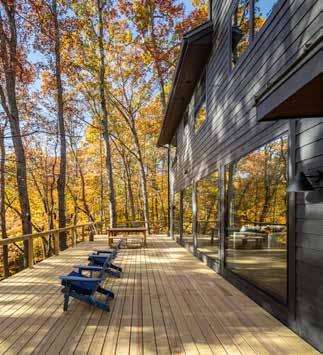
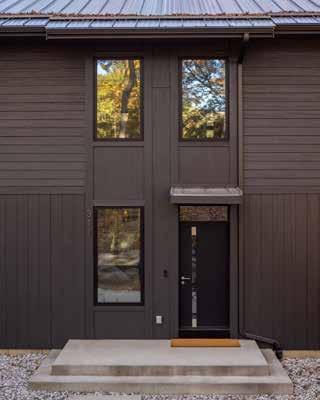
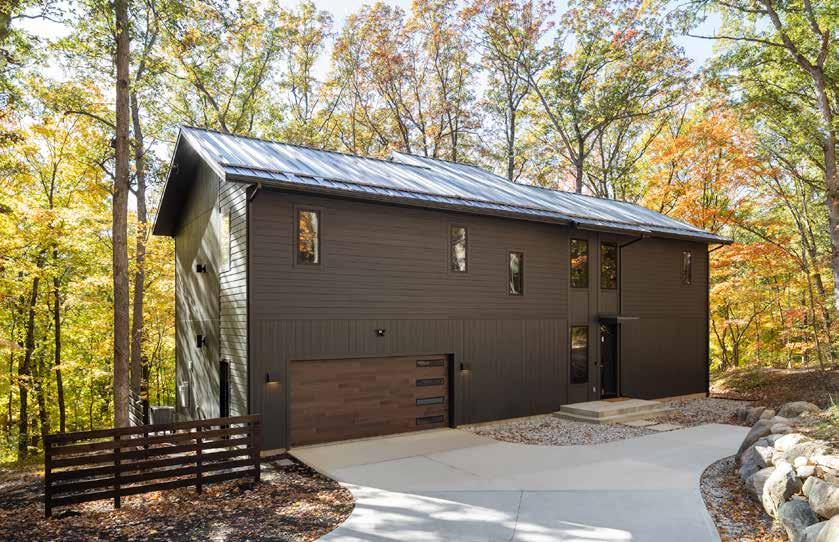
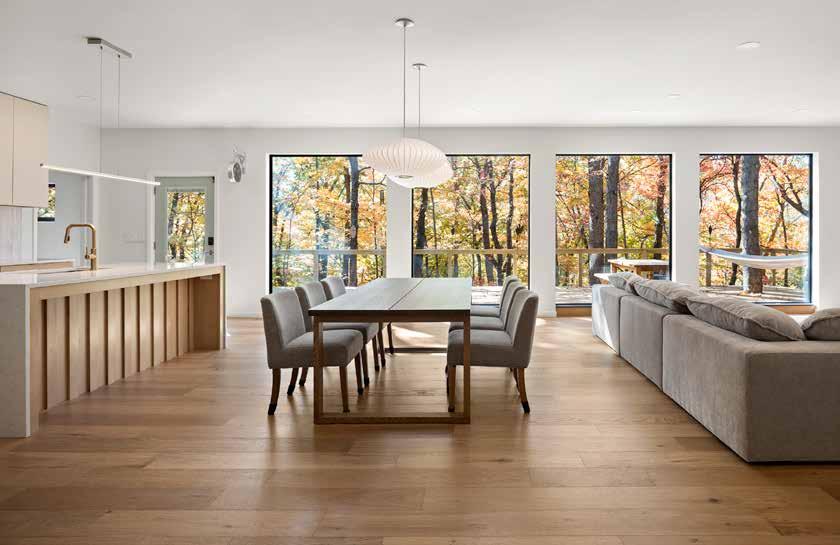
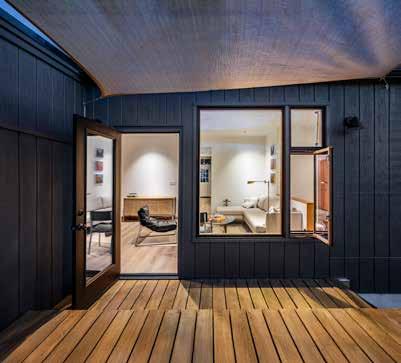
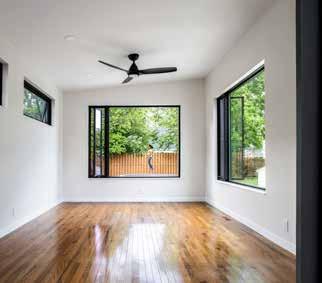
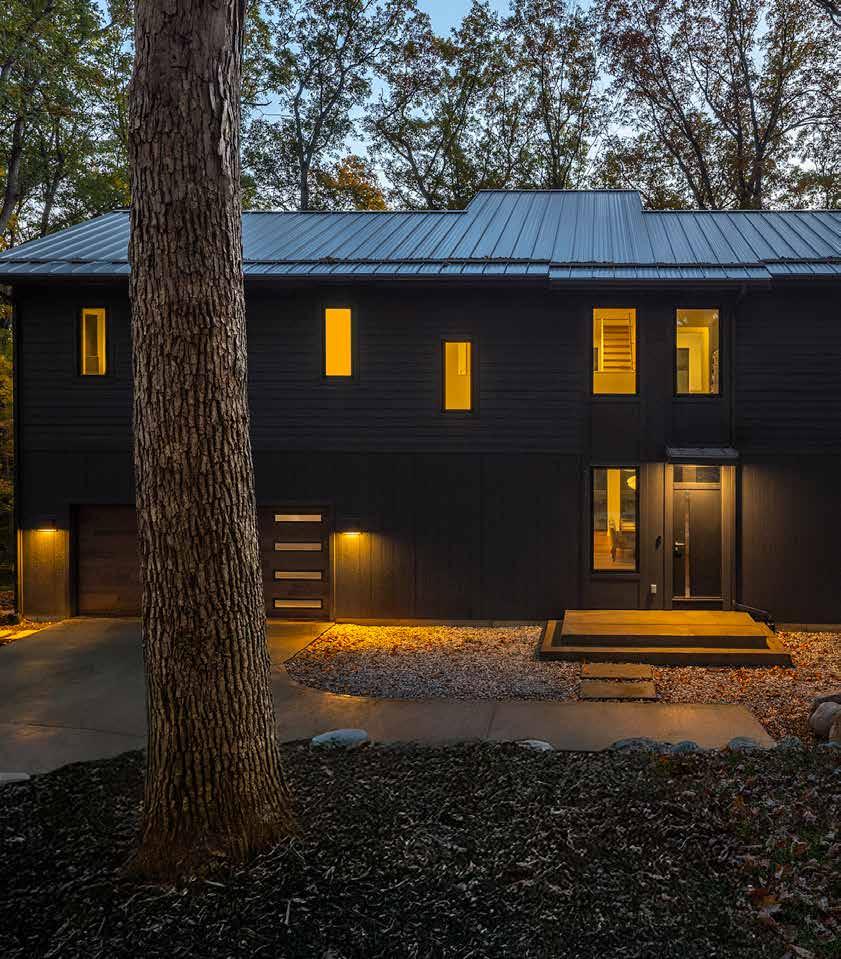
The 2,950-square-foot, four-bedroom home, which was completed in 2025, stands as one of the newest examples of Kim’s clean, modern style. The understated exterior blends into its surroundings – with siding the color of tree bark and a metal roof that reflects the sky. Inside, large windows frame views of the surrounding woods and allow sunlight to stream in and illuminate the whitewashed walls and the warm wood floors. The heart of the home is a 750-square-foot deck that extends the living space and provides privacy, blocking the view of the home from the public trail below.
“I wanted those homeowners to love nature, and the nature to love the people who live there,” Kim says.
The house is the result of Kim’s painstaking approach to design, which involves hours of reflection – observing the site and the neighborhood, pondering scale and proportion and considering the needs of the family – before he even starts his preliminary sketches. The goal, he says, is to design a home that subtly and tastefully serves as the backdrop to the homeowners’ life and lifestyle.
“I try to create the house that was meant to be there. If God created something, it would be something like this. It’s not really coming from my own ideas. I’m just filtering and re-shuffling and then creating something that has harmony and balance,” Kim says.
“One of my favorite Japanese architects, Yoshio Taniguchi compares good modern architecture to a teacup. If it’s doing its job, you don’t notice that it’s there. So it is with a house: Its job is simply to contain the life of a family.When it does that well, without flourish or embellishment, it’s a thing of beauty.
“To me as well a house is just a little container to contain the life of the homeowner,” he says. “When you have a good background, it becomes the gallery of their life.
To me a house is just a little container to contain the life of the homeowner. When you have a good background, it becomes the gallery of their life.
Finding a purpose
The completion of the “Pawnee House,” as Kim calls it, was a major milestone for the fledgling Studio Seung. It is even more remarkable, given Kim’s rocky introduction into Lafayette only 10 years ago.
Born and raised in South Korea, Kim studied sculpture at the University of Seoul before moving to the U.S. and enrolling in a Master of Architecture program at the City College of New York. There, he was steeped in the study of critical regionalism under professor Kenneth Frampton, the idea that architectural design should be rooted in the local culture, climate and topography and reflect local character, as he began to develop his clean, unembellished modern style.
After receiving his degree in 2007, Kim went to work for McKean architecture, a small, very high-end architectural design firm that offered plenty of hands-on experience and then the award-winning interior design firm Pembrooke & Ives.
One of his highest-profile professional projects involved designing the exterior façade of a three-level Fifth Avenue penthouse while he was at Pembrooke & Ives – a home that was eventually purchased by Amazon founder Jeff Bezos for $80 million. It is a point of pride for Kim, though he would eventually realize that he is drawn to more modest-scale projects that can be accessible to more people.
“I was exhausted doing too much high-end,” Kim says “It doesn’t really improve the world. I like to provide affordable, modern housing for a lot of people.”
In 2016, Kim relocated to Lafayette, following his girlfriend, who was a Ph.D. student at Purdue. Quickly, though, the relationship fell apart, and Kim found himself essentially homeless, jobless and deeply in debt. Needing not only a place to live but also a project that would showcase his work, Kim searched
Zillow for the cheapest available houses – eventually buying a ramshackle cottage on Oregon Street, in the Ellsworth Historic District, with $26,000 borrowed from friends in South Korea. Bounded by Fourth, Eighth, South and Romig streets, the Ellsworth neighborhood includes an eclectic mix of grand brick homes, row houses, Craftsman bungalows and workers cottages built in the late 1800s. In recent decades, the area has become known more for absentee landlords and derelict properties than for its historical character. At the time he bought the house, Kim thought, “The whole neighborhood is sick. And this house is the sickest house. I need to heal this house first. It’s small enough. I can handle it. I can make a good impact in the neighborhood.”
True to his process, when he first arrived on the block Kim spent hours each week just walking around the area, assessing, observing and trying to figure out how to improve it. He spent so much time lurking that one anxious neighbor mistook him for an undercover narcotics officer – a misunderstanding that underscores the condition of the neighborhood at the time.
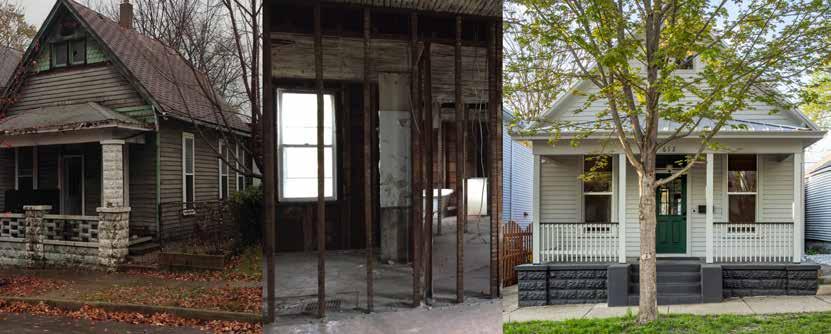
His 1,200-square-foot cottage had been gutted by previous owners, and for the first 12 months of the renovation, it was completely unlivable. Ultimately, the project dragged on for nearly seven years as Kim – supported by a small rotating cast of subcontractors – painstakingly renovated the house room by room. Work included peeling off aluminum siding and salvaging the 100-year-old poplar planks they found underneath; relocating the kitchen; adding a bathroom; and moving bearing walls to open up the living space. The project – officially finished in 2024 – transformed the house into a bright, modern cottage with clean lines, tall ceilings, whitewashed walls and natural finishes.
Once he started work on the Oregon Street cottage, Kim discovered that he is not only a designer but also a builder. He had come to the project homesick and heartbroken, but working with his hands and connecting to the community offered Kim a sense of redemption. Neighbors noticed the work at the cottage and stopped to introduce themselves. At his office in the Matchbox Coworking Studio, Kim
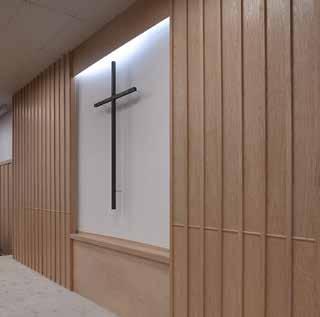
met other Lafayette business owners and entrepreneurs. He joined a church – the Korean Presbyterian Church of Purdue – and volunteered his time and talent to construct a new chancel and altar.
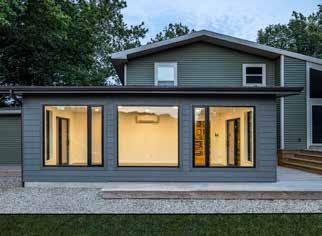
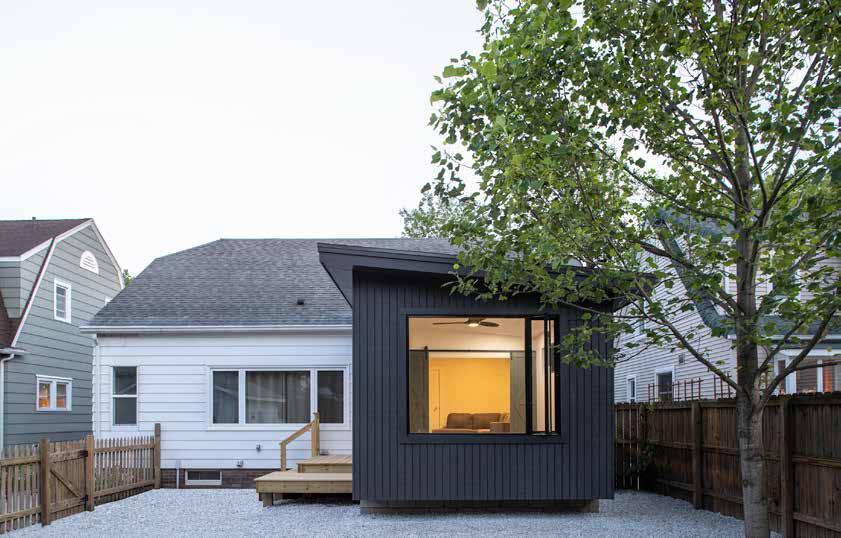
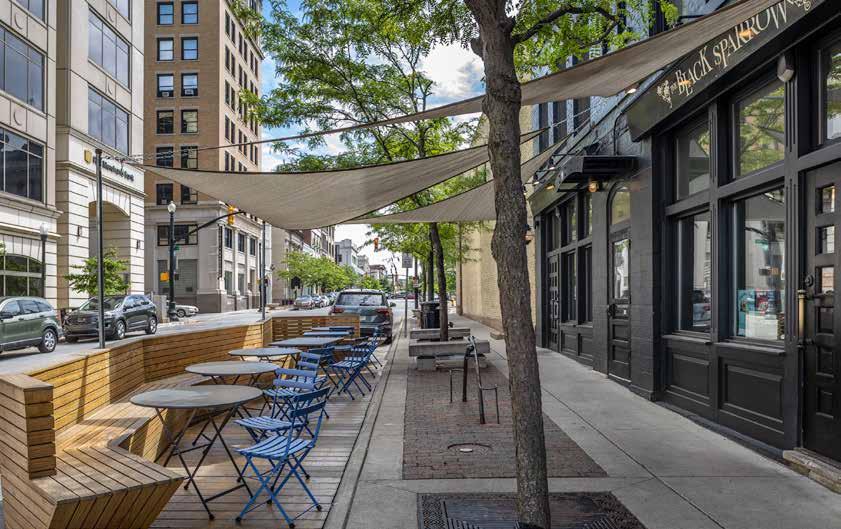
Slowly, through friends and friends of friends, Kim took on paid work and established his own design-build firm, Studio Seung, in 2019. Projects included a yoga-studio home addition in Rossville; a couple of sunroom additions in West Lafayette; a primary bathroom renovation in Lafayette’s Ninth Street Hill neighborhood; and the Black Sparrow parklet – the outdoor dining space that unfurls over the curb and onto Main Street in front of the Lafayette eatery during the summer months. As he got back on his feet and repaid his debts, Kim nurtured in himself a sense of calm and control.
“It wasn’t just a financial victory,” he says. “It was more, to me, a spiritual victory. I spiritually got better and stronger. And I had the confidence that whatever happens to me, I’m able to do it.”
Kim says he also discovered a sense of purpose that would anchor him in Lafayette. He is now on a mission to elevate and enrich the lives of the residents of Greater Lafayette by designing and building beautiful, unique, affordable housing. With each nail that he pounded and each room that he built, he says, his spirit felt nourished. “I feel like I owe something to Lafayette.”
He adds, “I strongly feel that I was brought to this town for the purpose of celebrating 200 years of history in Lafayette. I knew I was brought here for a purpose but didn’t really think it would change my whole career path. I want to create a new housing prototype that is affordable and sustainable yet expresses regional character. My design and creation process for a custom home is like a journey with a new friend. I study the relationship between clients, their needs, the site and the neighborhood, and try to contain their life in a simple but balanced form of enclosure that will make their life better, healthier, more peaceful and closer to nature.”
Kim compares modern design to Levi’s jeans: high quality, classic and affordable –respected by salt-of-the-earth folks and one-percenters alike. “We don’t have anything like that in housing [in Greater Lafayette],” he says, noting that the only options tend to be inexpensive cookie-cutter spec homes or exorbitant, sprawling custom builds. “We need somebody to provide interesting, nice, affordable modern homes [for everyone]. That’s what I’m going to do.”
Developing a vision
Kim has been especially focused on the Ellsworth district, where his business got started, and where he maintains an office at Matchbox; the area is kind of Ground Zero for this mission.
The neighborhood, Kim says, is ripe for renovation and reconstruction. He wants to see it thrive as a place where Purdue graduates and young professionals buy their first homes and put down their roots.
...I want Lafayette to be the city where everyone wants to stay.
Below, and right: Connoly Street addition
Korean Presbyterian Church of Purdue Wild Hearts Yoga Studio in Rossvile
Black Sparrow parklet
“They can live there, and then they can walk just like me to Matchbox to work, and then share their ideas and create, and develop not just the neighborhood but the whole city,” Kim says. “We have so many talented people at Purdue, but they all leave. I want Lafayette to be the city where everyone wants to stay.”
To date, Kim has been involved in five different projects in the four blocks between Alabama and Romig streets, including renovations on a few aging properties and the design of a new home built on an empty lot, as well as the Oregon Street cottage, which is now Kim’s home and also serves as his showroom. And in partnership with Paul Baldwin, a downtown business owner and rental property owner, plans are in the works for one more project – a new multi-home development (Kim’s first) on a lot on New York Street in downtown Lafayette. By introducing modern design into an historic neighborhood, Kim has raised some eyebrows. Sean Lutes, the vice president of Lafayette Historic Preservation and the founder of the Preserve Historic Lafayette Facebook group says that he’d rather see renovations that are historically faithful, although he appreciates Kim’s vision and his commitment to the neighborhood.
“I don’t agree with him on some of the architecture that he’s implemented,” Lutes says. “But he’s a good guy improving the neighborhood, putting his energy, time, passion and skill where his mouth is.”
Although Kim understands the criticism, he considers historic reproductions to be dishonest.
“You never want to create a fake history,” Kim says. Instead, he carefully and deliberately blends old and new into something altogether different and of-the-moment. “You have to reflect the current time. You have to respect the context and just rewrite it in a modern sense.
“The key is to intentionally create a contrast that is very, very balanced,” he adds. “It’s really beautiful to see two completely different things [side by side], like a man and a woman at a wedding.”
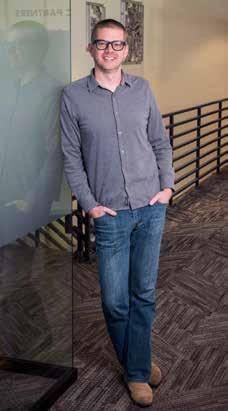
Jeff Rider, a local property developer, also has been working to revitalize the neighborhood, albeit on a much larger scale, for more than a decade. His company, Rider Partners already has built three new high-end single-family homes on a large tract
near Eighth and Oregon streets, with plans to build up to 20 total.
Friends for 10 years, since Kim moved into the neighborhood to start the Oregon Street cottage renovation, Rider and Kim share the same vision for the Ellsworth blocks. “If we get all these pieces of the puzzle together, this neighborhood could be really, really cool,” Rider says. “It’s just adjacent to the main heart of downtown. It just seems perfect for owner occupancy – people buying in and living downtown. It’s just a perfect little neighborhood, I think.”
Rider feels a deep respect for Kim and for his contributions to the area. “He’s invested his time and money, which is a big deal,” Rider says. “If you go back six, seven, eight years ago, not too many people want to put money into that neighborhood. It just seemed too risky.
To me, that's my mission: to heal the whole city.
“He’s just been a big influence in bringing in modern architecture with some new ideas because he believes – and I believe – that good architecture stands the test of time. Every era has its own type of architecture. And if it’s done right, it’s going to be a beautiful thing forever, really.”
Looking ahead, Kim finds himself at a crossroads. He strives to make a bigger impact on the community than he can building single homes one at a time. He’s worked as a designer and as a builder – the next logical step, he says, might be to take on a job as a developer. Soon, Kim says, he’d like to start to develop entire neighborhoods and, under his supervision, cultivate a new generation of designers and builders who can create and execute modern architecture and make it available to the masses.
“My end goal is to see those middle-class people flourish and succeed. They don’t have to live in a spec home or a McMansion anymore,” he says. “To me, that’s my mission: to heal the whole city.” ★
BY
iptoeing Into Spring
Color-packed tulip fields welcome the season with vibrant displays
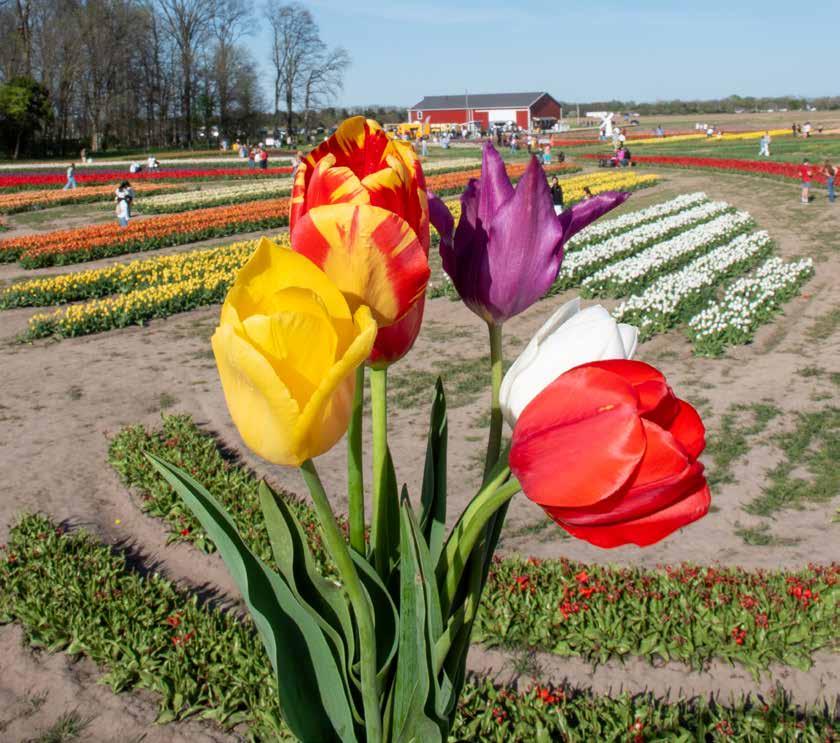
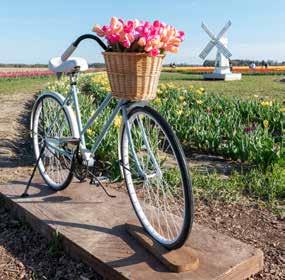
What better way to bid goodbye to winter than to meander through a field of tulips? Especially if those tulips are planted in the shape of a butterfly and a hummingbird.
Now’s your chance! For the second year, Exploration Acres is hosting Tulip Days, a three-week celebration of this cheerful flower that has long been a symbol of perfect love and rebirth. For people of a certain age, Tiny Tim’s campy and inexplicably popular 1968 song “Tiptoe Through the Tulipsˮ also comes to mind, but wandering, ambling or strolling through the eight acres of blooms is also completely appropriate.
Tim Fitzgerald, who co-owns Exploration Acres along with his sister Mary Branstetter, says Tulip Days is an effort to offer an educational and entertaining event in the spring at the venue that has hosted a corn maze each fall since 2008. The 15-acre corn maze now attracts more than 45,000 people annually and includes a pumpkin patch, hayrides, fire pits and other activities on land southeast of Lafayette that was the Fitzgerald family farm.
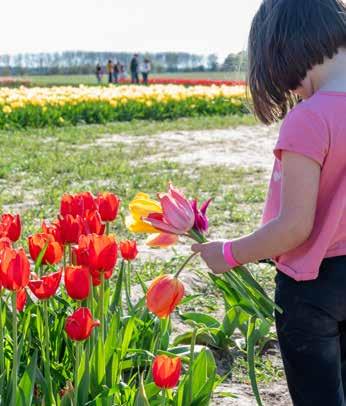
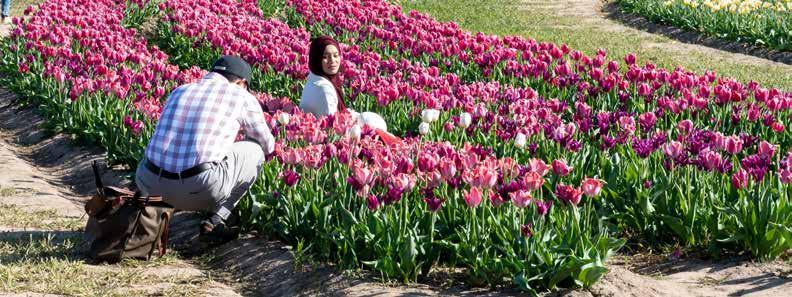
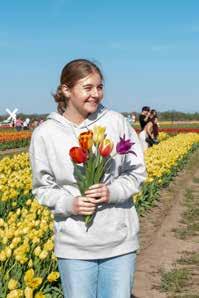
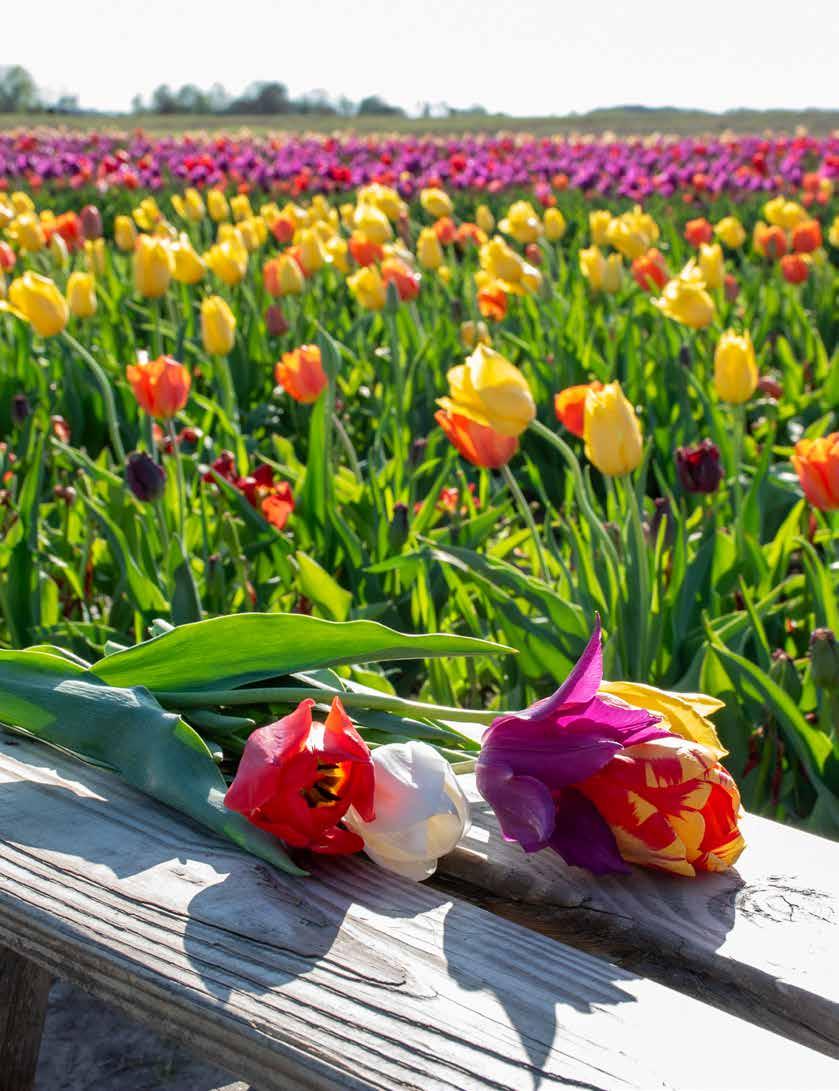
Tulip Days is a less expansive offering without many add-ons, but it offers a unique opportunity to see 55 varieties of tulips sprouting from more than 600,000 bulbs. Fitzgerald hopes to open Tulip Days in mid-April and welcome guests for at least three weeks. The opening date will be determined by unpredictable spring weather, and if coolish temperatures prevail and the blooms are still coming, the season
RADONNA FIORINI PHOTOS BY CHRISTINE PETKOV
might be extended. The event is a somewhat risky business proposition for Fitzgerald and company.
“One tragic weather event and there’s no return on our investment,” he says, adding that in 2025, rain plagued Tulip Days for two of the three weeks the flowers were blooming. In spite of the inclement weather, some 13,000 people came out to take pictures and harvest blooms to take home. Visitors came from throughout the region including Kokomo and Indianapolis, and Fitzgerald is lowering ticket prices this year after receiving feedback from guests. The weather did not deter Lorralyn Wallen and her boyfriend from visiting Tulip Days last year, and since they attended the final week of the event, the paths were dry and the weather decent.
“I love flowers and I’m always looking for local, easy and cheap things to do around Lafayette,” Wallen says. “When I saw the ads on Facebook, we decided to go.”
Wallen noticed tulip varieties she had not seen before and says the butterfly design in which the flowers were planted was very full and colorful. The paths were wide and easy to navigate, and she enjoyed taking a bouquet home.
“We spent about 40 minutes there and although it was a little chilly, it was so pretty and really enjoyable,” she says. “I cut about six tulips in a mix of colors to take home.”
For the 2026 event, some 300,000 tulip bulbs were planted last fall in the shape of a hummingbird across a four-acre field. Grass was planted between flower beds
to form walkable paths. Because tulips usually bloom more than one year, the 2025 butterfly field should also be resplendent with a variety of colors and forms, including yellows, pinks, reds and some with feathery and variegated petals.
The mastermind behind the field designs and actual planting is Shawn Stolworthy, owner of Mazeplay, an Idaho-based company that designs and plants corn mazes across the country and has expanded into designing flower fields. Stolworthy has worked with Fitzgerald from the beginning of Exploration Acres and says the interest in tulip fields is expanding.
“We’ve been doing tulip fields for about five years, and a lot of people really like them,” he says, adding that Mazeplay has designed fields in eight states, including Indiana.
“We figure out the best bulb varieties for each area and create designs that will make a neat display that is interactive.”
After using computer programs to design the display, Mazeplay brings special equipment in to plant the bulbs and create a parklike area with walking paths.
“These kinds of displays really haven’t been done before, so walking through them and enjoying the flowers is a unique experience,” says Stolworthy. “Because tulips are not very tall, you can see a lot of the design from the ground.”
As with any agricultural endeavor, including agro-tourism, weather determines the outcome. Early spring flowers are particularly susceptible to changeable weather: a late, hard freeze can kill the buds, but unseasonably warm weather means the blooms come early and don’t last long. Tulip bulbs need extended cold and plenty of winter moisture to produce good blooms, so the outcome of the event is really up to Mother Nature.
Each flower blooms for about 10 days but because the many tulip varieties produce blooms at different times, guests will likely not see all the varieties flowering at once, Fitzgerald says. About 20% of the planted bulbs bloom early, around 60% are intermediate bloomers, and the remaining 20% bloom later, so a repeat visit will provide new vistas of color and form.
But guests likely will see all the stages of growth a tulip bloom goes through, from the emerging bud to full bloom to falling petals, providing a good learning opportunity for children. If the weather is on the cool side, the show may extend further into May.
Each bed of tulips containing
the same type of bulb will include markers identifying the variety, and a map of the field’s design also will list varieties, Fitzgerald says. Part of the designs include beds of mixed varieties for an explosion of color.
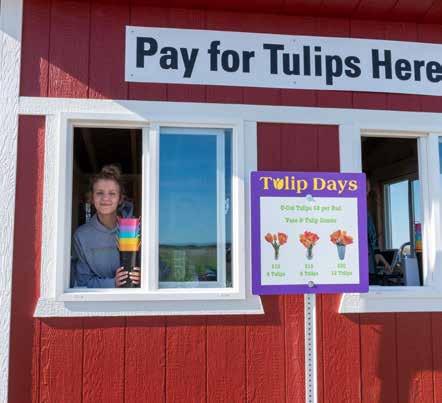
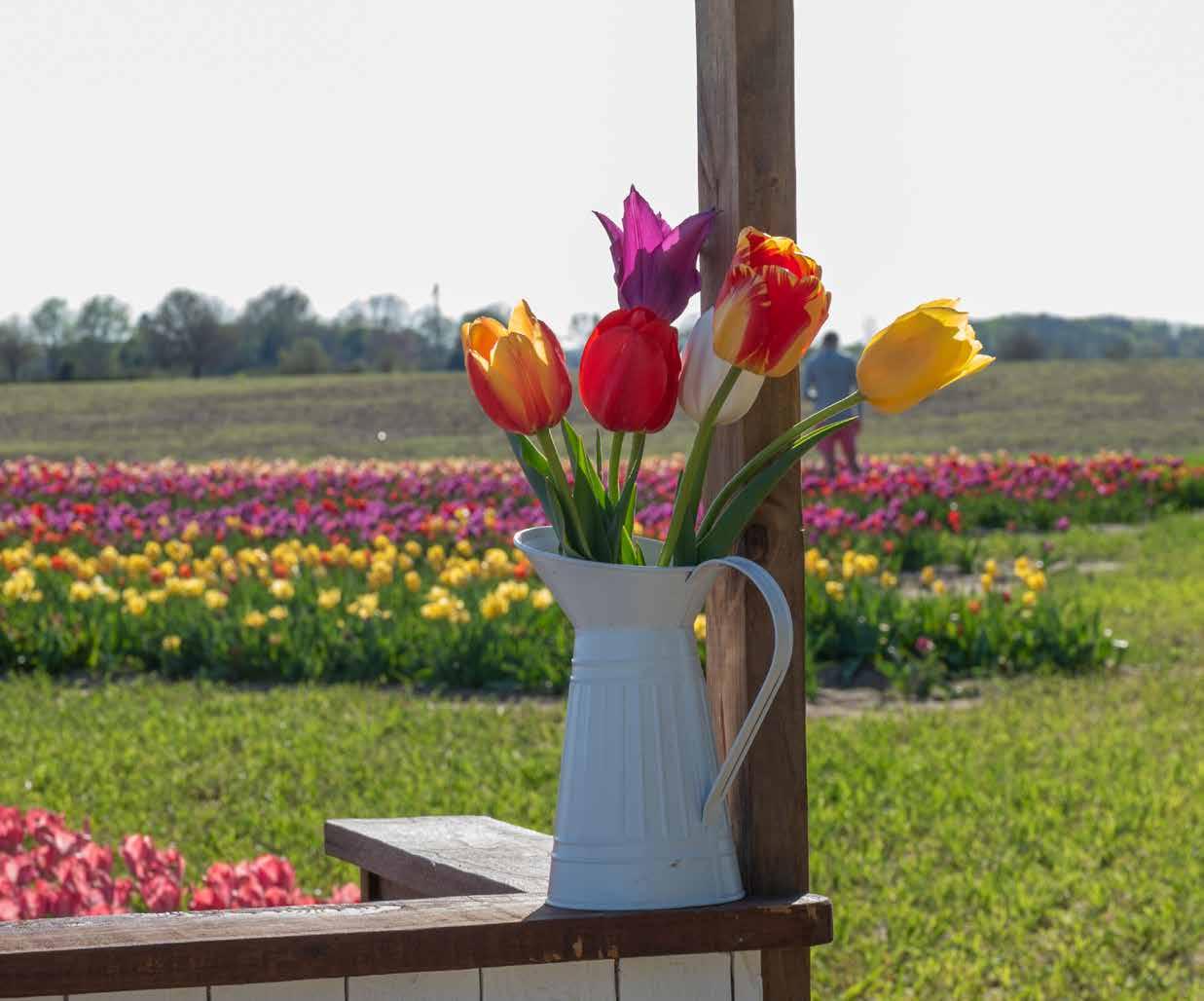
Scissors are available for guests to cut their own bouquet, with flowers priced by the stem. This year, vases and pastel containers will be available for purchase, or people can bring their own.
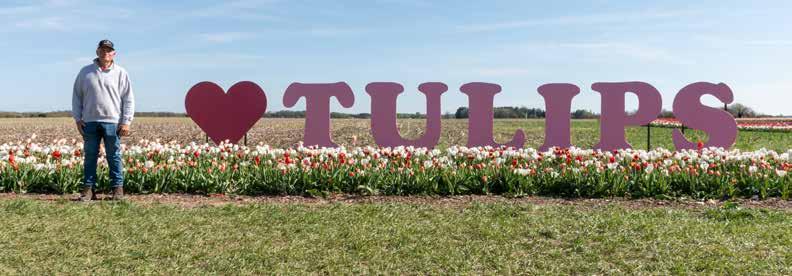
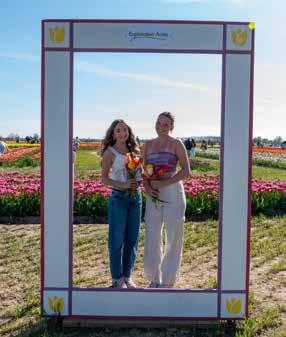
While Tulip Days does not offer other activities, guests will be able to take pictures with fun props in the fields such as a giant picture frame, a Dutch windmill, giant chair, and butterfly wings. A frame with the words “Class of 2026” makes the flower field a great place for senior pictures, Fitzgerald says. Children are welcome at Tulip Days and those younger than two get in free, but Fitzgerald emphasizes that no playgrounds are open and there are no special activities for kids. Portable toilets will be available near the fields, and the permanent bathrooms will be open, although those are a distance away.
Food trucks will be available on weekends, and other special activities may be planned, depending on the weather. The best way to keep up with changes or additions to Tulip Days is to follow Exploration Acres on social media or check the website.
And planners are hoping the weather cooperates this year.
A three-year effort at planting sunflower fields proved too costly and unpredictable, Fitzgerald said. While the first year with sunflowers was a success, the second year brought a drought, so the plants didn’t produce many flowers. The third year was so hot and humid
people didn’t come out to walk through the fields. Add to that the proliferation of festivals and outdoor events in the area and such ventures become more financially risky.
The tulip fields are very expensive to design and create and the future of the event rests on whether it’s sustainable.
“We may have to rotate the tulips to different fields just like we have to rotate the corn maze,” Fitzgerald says. “We have to be responsible in how we rotate crops and sustain the soil, and we’re always thinking about fertilizer and weed control.”
Best agriculture practices are still required to keep the lavish displays fresh and inviting.
“I don’t know what’s going to happen,” he says. “It’s all an experiment, but we’re trying to create a really special customer experience.” ★
Exploration Acres Tulip Days at a Glance
For the latest news and details about Tulip Days, follow Exploration Acres on Facebook or check out the Exploration Acres website: explorationacres.com/tulips
f Location: 6042 Newcastle Rd., Lafayette Planning to open mid-April and continue into early May, weather permitting
f Hours of operation: Daily, noon – 7 p.m.
f Tickets: Range between $12.95 and $17 for adults, and between $7.95 and $9 for children ages 3-12, depending on whether you buy online or at the gate. Weekend tickets are more expensive. Children two and younger are free. Pet policy: No pets other than trained, identified service dogs
f Food: Food trucks available on Saturdays and Sundays
f Purchasing tulips: You cut $2 per stem wrapped in paper with adjusted pricing for larger amounts; vases and decorative containers available for sale
Pro tips for tulips:
f If weather is a concern, purchase your ticket online from the Exploration Acres parking lot when you arrive. Online prices are cheaper than gate prices and entry is quicker for online ticket holders.
f Once cut, tulips will last about an hour without water, but feel free to bring a container or purchase a vase there.
f Tulip blooms open in daylight and close at night. They last up to 10 days in a vase under ideal conditions.
f If the weather is hot, come earlier in the day before the blooms open fully.
Ask The Experts:
The Greater Lafayette Commerce Ask the Experts program is perfect for you. Greater Lafayette Commerce is teaming with experienced professionals who have the skills you’re looking for to help you overcome challenges and provide you with perspective and direction.
Ask the Experts provides small business owners with the information they need while also facilitating the development of lasting professional relationships.
What is Visit Lafayette - West Lafayette?
This is a question many people ask and an understandable one. Even longtime residents are sometimes surprised by how much there is to see and do in Greater Lafayette. Some have lived here for years without venturing downtown, visiting Wolf Park or catching an Aviators game. That’s where the team at Visit Lafayette-West Lafayette (VLWL) comes in.
VLWL exists to share the story of our community, its experiences, places and people, with both visitors and residents. As the official Destination Marketing Organization for Tippecanoe County, our role is to market and promote the area in a way that encourages exploration and connection. When visitors come to town, stay overnight, dine locally, shop small and attend events, it fuels a visitor economy that benefits the entire community.
Tourism has a powerful ripple effect. Supporting local attractions, restaurants, hotels and shops helps create a community that is more vibrant, dynamic and diverse. These efforts don’t just make Greater Lafayette a great place to visit, they also enhance the quality of life for those who call it home.
To make exploring easy, VLWL offers a variety of digital resources. Our website, HomeofPurdue.com, serves as a central hub for trip planning, local guides, event listings and inspiration for both visitors and residents. It’s a go-to resource for discovering attractions,
restaurants, itineraries and seasonal happenings across the area. We also love to engage with our audience on social media, where we spotlight what’s happening across the county, what’s new and what you won’t want to miss next. Follow us on Instagram, Facebook, TikTok, Pinterest and YouTube at @VisitLafayetteWestLafayette and @HomeofPurdue to stay up to date on events, hidden gems and new ways to experience the community.
Planning a family reunion, celebration, wedding, group gathering or hosting a conference? Visit Lafayette-West Lafayette can help make the process easier. From identifying the best fitting hotels and event venues to sharing ideas for group-friendly attractions, dining and activities, our team serves as a local resource throughout the planning process. Whether you’re organizing a small get-together or hosting a large group, we’re here to help you navigate options and create an experience your guests will enjoy, while falling in love with Greater Lafayette along the way.
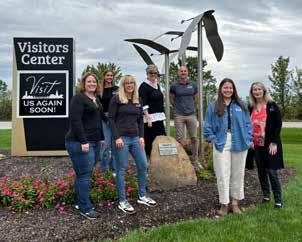
For those looking to plan a visit or simply explore closer to home, VLWL also operates a Visitor Center at 301 Frontage Rd. in Lafayette. The center offers travel guides, maps and information for Greater Lafayette as well as destinations throughout Indiana. Whether you’re hosting guests, planning a weekend getaway or searching for a new local experience, our team is ready to help.
While much of our work is sharing Greater Lafayette with visitors, VLWL also is busy behind the scenes, advocating for tourism, attending trade shows, securing conventions, and supporting tourism partners and the community with data and insights. These efforts strengthen the local economy and help make Greater Lafayette an even better place to visit, work, play and belong.
At its core, Visit Lafayette-West Lafayette is about pride of place. We’re here to celebrate the community we love and to help others, visitors and residents alike, see Greater Lafayette not just as a destination, but as a place to experience, connect and belong. And best of all, these resources, from tips, ideas and event information, are completely free for anyone looking to explore our community. From planning a first visit to discovering your next local adventure, we’re here to help make it unforgettable.
The Visit Lafayette - West Lafayette team
America’s story in arts & culture America’s story
BY CINDY GERLACH PHOTOS PROVIDED
AHaan Museum selected to represent Indiana in the nation’s 250th celebration
s the United States gets ready to celebrate its 250th birthday – its semiquincentennial –Indiana – and Greater Lafayette — will have a special part to play, as the Haan Museum of Indiana Art has been named a participant at the national level, representing the state in the Kennedy Center National Scrollathon.
And that energy will continue locally as the Haan Museum plans to implement a Museum Without Walls to further tell Indiana’s story and the part the state has played –and continues to play – in the arts.
It’s a very exciting opportunity, says Haan Museum Executive Director and Chief Curator Kerrie Bellisario.
the Fourth of July. The American public can attend for free and experience what art and culture look like across the entire country through a very engaging art exhibit.
Indiana’s participation will include voices from Lafayette, with videos; it will be an interactive experience. The exhibit will run through Memorial Day 2027.
For the National Scrollathon, one museum was chosen from each state, and the Haan Museum was chosen to represent Indiana.
“They were specifically looking for which museum was going to best tell the story of that state’s art and culture,” Bellisario says.
“And the Haan Museum is the only museum in Indiana that is only dedicated to Indiana art and culture.”
This public art installation will be on the grounds of the Kennedy Center, opening on
As the museum considered its involvement at the national level, the staff wondered what it could do to share those stories locally, how to bring that experience back to the community, making it accessible to everyone. So for America 250, the Haan has pitched a Museum Without Walls. It will be in five downtown storefronts that are currently vacant or underutilized, transforming them into mini-museums. These spaces will focus on telling the story of art and culture in Indiana.
The spaces will feature a combination of stories from the area, including Lafayette’s incredible connection to the 1904 World’s Fair in the very way that the Haan Museum found its way here.
“The idea is that you can go to Washington, D.C., and experience this public art project,”
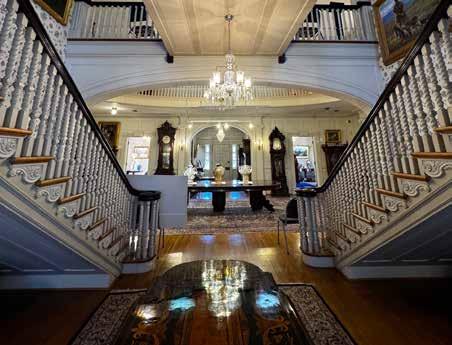
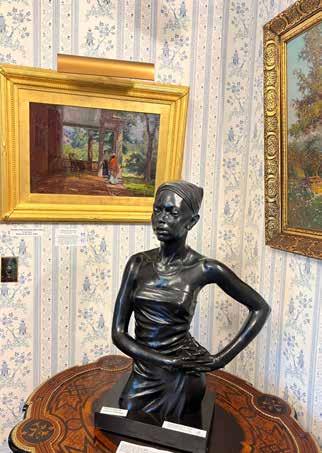
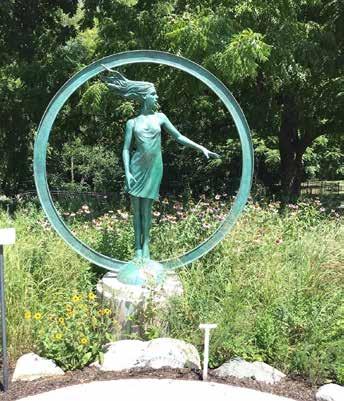
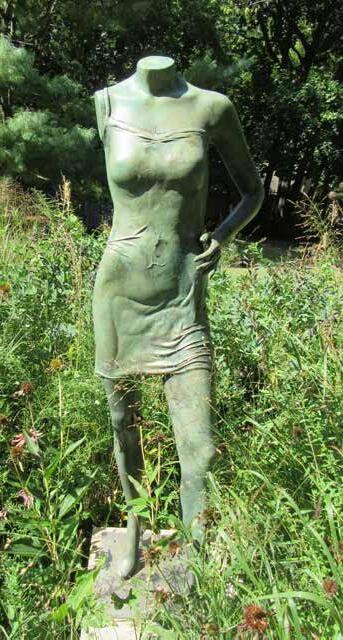
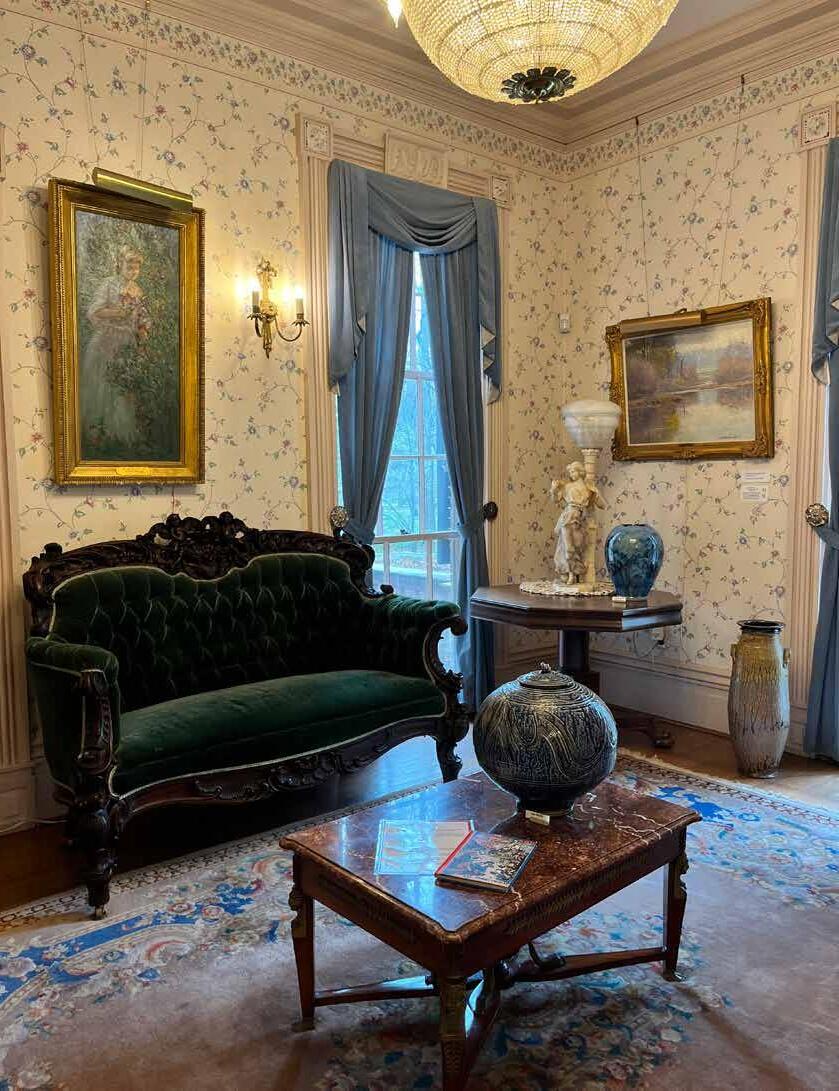
Clockwise from top left View of the Haan Museum great hall from behind the staircases; painting by T.C. Steele and bronze statue by Tuck Langland; “The Farm Pond” by Jacob Cox; “Venus Rising” by Tuck Langland in the museum sculpture garden
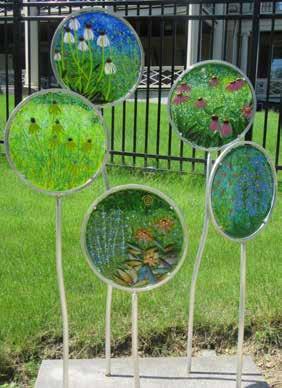
Facing page The Scrollathon sculpture created by Indiana community members with artists Steven and William Ladd
Bellisario says. “But if you don’t have the chance to go to Washington, D.C., we are going to have our Museum Without Walls project right here, in downtown Lafayette. So, people will be able to experience the best of what Indiana art and culture is through incredible stories.”
Five exhibit paths
The plan is to feature five exhibit paths. One will focus on the 1904 World’s Fair, including the collection of unique souvenirs, furnishings and arts from the World’s Fair. The museum has a large collection that is not on permanent display. Thus, this will allow people to see items they can’t ordinarily see.
Another path will feature interviews with Indiana makers. The museum is partnering with an Indiana University-Bloomington professor who will curate oral history interviews with Indiana artists. The focus will be on contemporary ceramic artists who continue to create work using the old traditions. This includes using clay from the river, a process that is not like anywhere else, Bellisario says. Each exhibit will include QR codes that will connect people to audio or video, so people can hear stories about how artists learn these traditions. A professor in Arizona is working on augmented reality – if participants are looking at an image of the living room of the Haan, for example, they might suddenly see the music box start playing. Magical and imaginative experiences will come to life through technology, as the museum partners with Purdue and IU.
There will be a focus on young people as well, with field trips and opportunities to learn these traditions.
“It’s all about really helping our community discover the power and impact of our stories,” Bellisario says.
From Potter mansion to museum
The Haan Museum of Indiana Art is history itself. The building was the State of Connecticut pavilion at the 1904 World’s Fair in St. Louis. The Potters, from Lafayette, purchased the building when it was auctioned at the conclusion of the fair. It took 22 train cars to move it to Lafayette, and then nearly an entire year of construction to rebuild it on a lot on State Street, where it sits today. The mansion has three floors plus a basement, with a total of 16,000 square feet. Only 15 buildings from the 1904 World’s Fair survive today.
Bob and Ellie Haan purchased the mansion in 1984. It became a home for their collection of Indiana art, which continued to grow while they lived there. In 2015, they created the nonprofit Haan Museum of Indiana Art, donating the building and grounds to the museum, along with much of the artwork. Understanding the Haans’ vision and working to implement that vision is an important part of the museum, Bellisario says. The Haans envisioned a nature trail with a sculpture garden and working with school groups. The staff works to helps these dreams come to fruition.
“The Haans, in their mission for collecting art, have a collection of pieces that are really, truly extraordinary,” Bellisario says. “It’s the best of the historical, but they also had this lens toward the contemporary. There will be pieces that they say, ‘Well, we didn’t like it, but we knew it was important.’
“Let’s lean into the glory that it is. Make this a shining gem.”
‘Pure democracy’
Bellisario loves that these exhibits, through the Museum Without Walls, will help expand the museum’s mission. Imagine, she says, walking down Main Street and suddenly you
find yourself standing in the middle of the Haan living room.
“America 250 – it’s pure democracy in a sense, making art accessible,” she says. “Right into your daily lives. We take away the cost of an admission fee. We do our magic.”
She is particularly excited about the access for children and young people. An encounter with art in this way could change their lives.
“How do we pass stories on, inspire one another?” she says. “Art brings people together. It inspires us, to find the best in each other, to find the best in ourselves.
“We see those moments all the time when kids come in this building. And that’s our life’s work. We are truly devoted to helping people find those connections.”
The opening of these exhibits will roll out starting in July. Programming will be coordinated, bringing people together to celebrate these stories.
“When history gets really exciting is when we make our local connection to the larger stories,” Bellisario says. “And that is what we’re able to do here. You’re hearing and seeing stories that unite and connect us.
“In Indiana, the traditions of our makers are so rich. It’s through them and their stories that we learn about how interconnected we are to the greater story. And that continues to this day.”
Golden age of art
The years 1880 to 1920 were a golden age of art and culture, Bellisario says. And Indiana was a huge contributor.
“We were as vibrant as New York City,” she says. “People don’t realize that. Indianapolis was a huge cultural hub at that time. Through this program we’re finding more and more ways to bring that spirit to life in Lafayette.
“The Great Societies were based on art and ideas. Interconnectedness. A celebration of ideas.”
The Haan Musuem has all these stories –these and more, Bellisario says. This project will touch everyone, engaging all who come in contact. And with the strategic locations downtown, she hopes these stories reach the entire community.
“The Museum Without Walls – it’s bringing people together through the arts,” she says.
“And allowing everyone a pathway in to discover the incredible role that artists played in Indiana, in shaping Indiana as a state.
“And when we look at the fabric of American art history, to really understand that we played a really central part of that and I think, there really is great art here. You can go to New York and see fabulous things, but there are fabulous things here.” ★
Below: Wildflower glass sculpture by Kathleen Kitch
Right: Karpen art nouveau mahogany carved sofa and “Suzanne in the Garden” painting by Otto Stark in the Haan Museum parlor
high-tech mission
For Nate Smith, CEO of North Star Systems in Lafayette, the path to entrepreneurship wasn’t paved in a classroom, but on the runways of Travis Air Force Base in Fairfield, California, and a technology hub in the southeastern Netherlands.
A veteran of the U.S. Air Force, Smith is now applying the adapt-and-overcome mindset of a staff sergeant as founder of this new veteran-owned technology company.
A foundation of global experience
Smith’s journey began three days after his graduation from Frontier High School in 2000, when he left Greater Lafayette for active duty. Serving as a KC-10 aircraft systems mechanic and instructor, he deployed to locations including Iraq and Diego Garcia, an atoll in the British Indian Ocean territory.
After leaving the service in 2008, Smith eventually made his way to the Netherlands. For five years, he worked as a civilian field service representative for the Royal Netherlands Air Force, living in the Brainport region. Located in the southern part of the country, the Brainport is an innovation ecosystem centered on the industrial city of Eindhoven and comprised of more than 5,000 technology companies
“I’ve had my hands in a lot of neat technology,” Smith says, reflecting on a career that has taken him to 50 countries around the world.
Solving problems at scale
Smith eventually landed back in Lafayette, where he met his wife, Jen Walters, when he sold her a Prius at Bob Rohrman Toyota. He took a technician job with General Electric Aviation, and he and Jen started a family. The couple has two girls, Harper, 7, and Amelia, 6.
In 2023, Smith launched North Star Systems. The company provides real-time monitoring and control services for large-scale systems in agriculture, IT, municipalities
Nate Smith
and the oil and gas industries, helping customers lower costs and mitigate risk. Products include remote tank monitors that reduce the need for manual on-site inspections. Customers receive automated text or email alerts directly to their phones with real-time information, allowing them to respond quickly to potential leaks, overflows or sudden drops in tank levels.
Smith is an authorized dealer of the technology.
“I am actually a third-party service provider. I buy the product, and then I sell it OEM-style,” Smith says. He likens it to iPhones, explaining, “Apple makes the cell phone, and Verizon sells it.”
The business is growing rapidly, now servicing clients in Indiana, Arkansas and Fresno, California.
While corn and soybeans reign supreme in Indiana, Arkansas leads in rice, soybeans and cotton, and Fresno is known for producing grapes, pistachios and almonds. The technology is nimble enough for various applications across agriculture and other industries.
Indiana’s ecosystems
Smith is deeply rooted in Indiana’s entrepreneurial, technological and agricultural ecosystems.
He sits on the advisory board for TechPoint, an industry-led initiative promoting digital innovation in Indiana. In 2025, Smith was a finalist for the organization’s Mira Awards Rising Entrepreneur of the Year.
He also participates in AgriNovus, an industry-academia coalition helping to accelerate Indiana’s agbioscience economy. The organization supports small ag-focused startups like North Star.
Smith also is involved in the Indianapolis community of Praxis, a Christian venture-building ecosystem.
Locally, Smith graduated from a recent cohort of MatchBox Coworking Studio, which has served as a launchpad for his business. He now helps to mentor owners of new startups.
The veteran’s edge
Currently, Smith maintains a lean operation, but he has plans to expand. Ultimately, he’d like to scale up to about 24 employees, with help from the EDGE credit system (Economic Development for a Growing Economy) from the Indiana Economic Development Corp.
Smith wants to engage with programs such as InVets to hire veterans and Second Chance to provide opportunities for formerly incarcerated individuals.
Reflecting on the unique perspective veterans bring to business, Smith notes that the stressors service members face can be very different from the corporate world, but the competencies they build often map directly onto organizational needs.
For example, research shows that many veterans excel at skills such as mission-to-task decomposition, a military planning process that breaks down a high-level, complex objective into smaller, actionable and measurable tasks Such skills are seen as a practical application of grit, the perseverance and passion for long-term goals.
“We’re ready to commit to the process, and we’ll adjust as we go,” he says of veterans. “Adapt-overcome is a model of operating.”
Today, Smith lives a quiet life in the Otterbein area with his family, balanced against the high-energy demands of a growing tech company.
He says that running North Star Systems is one of the hardest things he’s ever done. But for this veteran-turned-entrepreneur, he’s tackling every challenge one step at a time. ★
Nate Smith with wife, Jen, and daughters Harper and Amelia
Smarter Than Your Average Business Savings Account
Don't settle for savings that don't earn. Open a Money Market Account or business CD. Higher rates, flexible options, and bigger
Whether you’ve been here forever, you’re the new kid in town, scoping out a move, or just exploring, our Visit Team has you covered. Give us a call, send us an email, or stop by the visitor center. For insider tips, check out homeofpurdue.com and follow our socials.
SPRING 2026
In our line of work, trust matters—and that’s exactly what we found with State Bank.
State Bank treats us like family.
They’ve helped us handle everything from secure payments to fraud protection, so we can stay focused on doing quality work. When there’s an issue, I know who to call—and they stick with us until it’s resolved.
That kind of support is why we stay.
SUCCESS STARTS WITH THE RIGHT TOOLS, AND WE HELP PLUMBERS GET THE JOB DONE.
If you need a great plumber, call Anderson.
If you want a better bank, call State Bank.
Zane Anderson DIRECTOR OF OPERATIONS, ANDERSON PLUMBING
Meet 2025 ATHENA Leadership Award winner Ashley Smith
The ATHENA Leadership Award recognizes individuals who demonstrate leadership, contribute significantly to their communities and actively help women advance into leadership roles.
The Greater Lafayette community recently celebrated an extraordinary leader whose work has strengthened emergency preparedness, expanded opportunities for young people and uplifted underserved populations. Ashley Smith, community disaster program manager for the American Red Cross in Greater Lafayette, was named the recipient of the 2025 ATHENA Leadership Award, an internationally recognized honor celebrating women who demonstrate excellence in leadership while empowering others.
Reflecting on the award Smith says, “Personally, I am so humbled by this honor. I did not expect it. It means so much to me. Professionally, I am honored.”
Smith continues, “And taken a bit aback for being nominated. Words cannot describe the appreciation I have for my co-workers, the board members I have served with and all of the volunteers I have been so honored to work alongside.”
ATHENA's beginnings
Established in 1982 by ATHENA International, the ATHENA Leadership Award recognizes individuals who excel in their professions, contribute significantly to their communities and actively support the advancement of women into
leadership roles. Today, the award is presented in more than 500 communities worldwide and has been given to more than 8,000 leaders, including notable figures such as Ruth Bader Ginsburg, Billie Jean King and Condoleezza Rice.
In the Greater Lafayette area, the award is presented locally through a partnership among Greater Lafayette Commerce, the Association of Women Business Owners (AWBO) and the Ladies Lunch Network (LLN).
“The ATHENA Leadership Award recognizes individuals who demonstrate leadership in business or profession, contribute significantly to their communities and actively help women advance into leadership roles,” presenter Betty Nelson said during the award ceremony last November at the Tippecanoe County Fairgrounds.
Smith's leadership
Smith’s professional work with the American Red Cross has made a measurable impact across Greater Lafayette. In her role as Community Disaster Program Manager, she has strengthened the organization’s ability to respond quickly and effectively during emergencies. Under her leadership, the Red Cross has improved volunteer response times,
expanded disaster relief capacity and increased outreach efforts to reach underserved populations throughout the region.
One of Smith’s most impactful initiatives has been the development of a bilingual disaster preparedness program designed to address language and accessibility barriers that can prevent families from receiving critical safety information. Since the program’s launch, more than 1,500 households have been trained in emergency readiness, helping families better prepare for fires, severe weather and other emergencies.
“Sometimes people do not realize they have a voice and it should be used,” Smith says. “We all have a reason to be heard. Everyone’s voice matters. When we are mentoring, sometimes it assists with building people’s confidence and empowering them to utilize their voices.” Smith continues, “Watching people grow throughout the time I have spent with them is an indescribable feeling. When you see someone that you mentored grow professionally, sometimes personally and knowing I had a very tiny part in assisting them to be just a little bit better at something, is the best part of being a mentor.”
Developing partnerships
Smith also has invested heavily in developing the next generation of community leaders and volunteers. Through partnerships with local high schools, Purdue University and Ivy Tech Community College, she helped establish Red Cross clubs and training programs that provide students with hands-on instruction in CPR, first aid and crisis leadership. These initiatives not only equip students with lifesaving skills but also encourage a lifelong commitment to public service.
Beyond disaster preparedness and youth engagement, Smith’s work has consistently focused on equity, inclusion and community collaboration. Locally, she partnered with PRIDE Lafayette to expand access to blood donations for LGBTQ+ residents.
Her dedication has earned recognition from numerous organizations, including the Indiana General Assembly and the City of Lafayette, where Mayor Tony Roswarski awarded her a Certificate of Appreciation for her service. Pride Lafayette also has recognized her impact by naming its Ashley Smith Award for Dedication and Leadership in her honor.
“These efforts continue to produce volunteers who step forward when disaster strikes,” Nelson said during the award presentation, highlighting Smith’s lasting influence on the region’s volunteer network and emergency preparedness initiatives.
Striving to include, inspire
For Smith, the recognition reflects years of dedication to building stronger, safer and more inclusive
communities across Greater Lafayette.
“I look forward to helping with community mobilization and ensuring that Greater Lafayette is prepared for whatever disaster that may occur,” says Smith when discussing future goals. “Home fires are the biggest disaster we typically face, and I would love to see more of our community involved in our Disaster Action Team. We have volunteers 18 to 90 who help with home fire responses.”
As the 2025 ATHENA Leadership Award recipient, Smith joins a global network of leaders who exemplify the power of service, mentorship and community leadership. Her work demonstrates that strong leadership is not only about responding to challenges but also about empowering others to rise alongside you. ★
SUPERIOR CARE MEANS
SUPERIOR HEARING
Hearing loss is more prevalent than you might think and can affect communication. Our providers are specially trained to understand, support, and treat hearing loss with cutting-edge technology to keep you and your loved ones hearing clearly.
Lafayette Mayor Tony Roswarski presents Smith the Certificate of Appreciation for her service.
Community outreach is a key part of Smith's work with the American Red Cross.
2025 Top 10 Under 40 Honorees
Melissa Albrecht Director of Human Resources
– Wabash
Albrecht plays a key leadership role in workforce development and employee engagement at Wabash, helping support one of the region’s major manufacturing employers.
Brooke Beier
Senior Vice President, Purdue Innovates
– Purdue Research Foundation
Beier leads initiatives that support innovation, entrepreneurship and technology commercialization through Purdue Research Foundation.
Ben Carson Executive Director
– Imagination Station
Greater Lafayette Commerce each year recognizes 10 emerging leaders making a significant impact across business, nonprofit organizations, education and entrepreneurship in the region through its Top 10 Under 40 Awards.
The 2025 honorees represent a diverse group of leaders from industries including advanced manufacturing, higher education, nonprofit leadership, small business ownership and community development.
Carson oversees programs that inspire curiosity and learning through hands-on educational experiences for children and families.
Nyssa Craton Owner and winemaker
– Wildcat Creek Winery
Craton has built a successful local winery while contributing to the region’s growing hospitality and tourism sector.
Josh Curry Director of Workforce and Operations
– Purdue Research Foundation
Curry works to strengthen workforce development initiatives and operational partnerships that support regional economic growth.
Grace Jackson Program Development Manager – Wabash Center
Jackson develops programs that support education, leadership and professional development within faith-based academic communities.
Amanda Kennedy Owner and founder
– Flourish Studio and Classroom
Kennedy founded Flourish Studio and Classroom, creating a space that combines creativity, education and community engagement.
Guillermo Morgado Rodriguez
President
Latino Center for Wellness and Education/Senior Administrative Assistant – Purdue University
Morgado Rodriguez supports community health and education initiatives while also contributing to Purdue University’s administrative operations.
Trey Rohrman Director of Operations
– Indiana, Rohrman Auto Group
Rohrman oversees operational leadership for the Rohrman Auto Group’s Indiana locations while continuing his family’s legacy in the regional automotive industry.
Troy Weber Co-owner
– Flora Candle Company
Weber co-leads Flora Candle Company, a local business contributing to Lafayette’s entrepreneurial and small business community.
Left to right: Troy Weber, Trey Rohrman, Nyssa Craton, Guillermo Morgado Rodriguez, Amanda Kennedy, Ben Carson, Grace Jackson, Josh Curry, Brooke Beier and Melissa Albrecht
Gathering
Ben Carson sees bright future for Imagination Station
Turning a child’s curiosity into an educational experience has been Imagination Station’s mission for nearly 30 years.
Ahead of its time when it comes to STEAM (Science, Technology, Engineering, Arts and Mathematics) education, Imagination Station’s mission is to provide hands-on learning experiences to increase the scientific literacy of children and families in Greater Lafayette.
“It’s giving kids opportunities to play, explore and take on a handson approach to learning rather than the didactic classroom style you might typically get where they’re talked at,” says Ben Carson, executive director of Imagination Station.
“It has its value, but kids learn really well when they’re engaged not just with their brain but physically.”
Located inside the former home of Indiana Gas Co. at Fourth and Cincinnati streets since Oct. 1996, Imagination Station boasts two floors of interactive exhibits and toys.
“We like to have our exhibits on the first floor, making sure they’re very tactile and interactive and learn cause-and-effect. That’s something adults take for granted. That’s a huge part of science and fits under the STEAM umbrella,” Carson says. Imagination Station’s target audience is children ages 2 to 12, but Carson says 5- to 10-year-olds are the most typical visitors with their parents.
“There’s an immediacy of fun that the exhibits give, and the upstairs playroom with the giant building blocks and all the different things
they can play with, learn with and explore,” Carson says. “That tends to fit more into the mold of a younger child’s brain where they just want to go to something and grab it and twist it. That really speaks to them very well.”
Carson admits to having a couple of favorite exhibits.
“We have a really cool soybean exhibit that combines play with learning,” he says. “It shows the steps that it takes from soybeans getting farmed and processed to going all the way into being, for example, made into the soy wax for a crayon. It shows the steps on a board in an informational way so that a parent or older kid can heed it and follow along.
“But it also has these handles. As you turn the handles there’s a ball that goes through a miniature Rube
Imagination Station Executive Diurector Ben Carson
Goldberg machine that represents the steps in the process. There’s a horizontal auger that pushes the ball through. It’s just a fun way to watch the ball go through these steps of the soybean manufacturing process.”
Another Carson favorite demonstrates the effect of air pressure.
“It’s really simple and one I enjoy a lot,” he says. “It’s a set of tubing that has an air compressor at the bottom. You can put a ping pong ball through it and watch the air pressure suck it through and spit it out. It’s very easy for them
to understand the simple cause-andeffect process. (Children) can repeat it over and over again and have a lot of fun with that.”
Thanks to a donation from the Purdue Nanotechnology Center, children also can discover how materials and devices are created by the manipulation of matter.
Good timing, good fit
Carson’s background in education technology and computer engineering made the Imagination Station post a good fit when he became executive director in September 2025. The timing of the opening helped, too.
“I was just finishing with an education technology startup,” says Carson, whose high school curriculum included robotics. “That didn’t pan out as well as I had hoped. I’d come back into town looking for the next step I wanted to do in my career.”
Carson saw an opportunity to use his experience in the classroom as a speech and debate teacher for middle school and high school students in a different way.
“When I saw the job posting, it really fit nicely with a lot of different interests that I have,” he says. “I started off at Purdue in computer engineering and did that for about two years. I ended up switching majors but that engineering side of me has stuck around.
“When I saw this opening it was a nice intersection of building relationships with the community, helping improve kids’ lives and also developing interest in science and engineering.”
Carson came on board Imagination Station with two goals in mind.
“The first one is a bit more short term,” he says. “Simply, maximize all the ways that a kid can come into Imagination Station and explore and learn. We’re trying to improve and expand the diversity of options we have, cover as many different science concepts … even arts and humanities concepts. That there’s something for everybody. Different exhibits are going to click for different kids. We’re trying to give kids as many options as we can to keep them interested and engaged. Maybe help them find a passion area or a science that speaks to them more.”
Carson’s long-term goal is to expand Imagination Station beyond its current capabilities.
“We’re trying to improve and professionalize the space, things like bringing in new exhibits and increasing community awareness,” he says. “We want to have more events that bring in a lot of community collaborators. Right now we have one annual event called Hands on Transportation. We bring in lots of different forms of transportation: fire trucks, emergency vehicles. Caterpillar will bring in a bulldozer, Wabash National will bring over a freight truck. We have one of the larger farm drones. Kids get a chance to learn in a very hands-on way and get to sit in these vehicles.”
Building partnerships, spreading the word
The presence of Purdue University, as well as a large number of industry partners and the support of Greater Lafayette gives Carson optimism that he can increase the number of Imagination Station events.
“We have two amazing cities that are so closely connected,” Carson says. “We have a really good university with so many different areas of expertise. We’re looking to see what are all the ways we can bring everybody together and give kids a chance to see everything that happens in our community.”
But doing that requires making Greater Lafayette aware of Imagination Station. One way is to get more directly involved with schools.
“We do field trips, and we’re trying to expand those and meet some of the core curricular standards (schools) need,” Carson says. “We want the community to be more aware of Imagination Station. During the pandemic it got very close to shutting down for good. Thankfully we were able to
power through that. There are a lot of people in the community who either don’t know much about us or remember going there as a kid but maybe don’t realize we’re still open. We’re trying to spread that awareness and give people a chance to check us out again.”
Several membership levels are available and can be found at imagination-station.org. Carson notes that there’s an extra benefit for Imagination Station members.
“Our membership program is part of the ASTC (Association of Science and Technology Centers) passport program,” he says. “For example, if you buy a family membership at Imagination Station, it also gets you free access to any other ASTC facility in the world, outside of a 90-mile radius of Lafayette. That includes the Science Centers and the Museum of Science and Industry in
Chicago, and the Columbus (Ohio) Science Center.”
Walk-in visitors are welcome during regular hours for a $10 admission fee. Imagination Station is open Wednesdays and Thursdays 10 a.m. to 1 p.m.; Fridays and Saturdays 10 a.m. to 5 p.m.; and Sundays 11 a.m. to 5 p.m. ★
Partnership strives to meet need for early childhood educators
As the need to build a strong pipeline into early childhood education careers has been recognized here in Greater Lafayette, the Greater Lafayette Career Academy (GLCA), Right Steps and Ivy Tech Community College-Lafayette have partnered to create the Early Childhood Education Career and Technical Education (CTE) program.
Launched during the 2024-25 academic year, the program aims to engage local high school students interested in entering the early childhood workforce, equipping them with industry credentials and hands-on experience to support their success in the field.
There are no prerequisites to participate in the program, and all students in the Lafayette, Tippecanoe and West Lafayette Community school corporations are eligible to enroll.
Students enroll in the program at GLCA and earn dual credit from Ivy Tech, allowing them to work toward earning
their Child Development Associate (CDA) credential and associate’s degree.
To earn the credential, students must complete 480 hours of professional work experience, in addition to 120 clock hours of professional early childhood education. Nationally and state recognized, the credential is a qualifier for being a lead teacher in an early care and education program.
“The CDA provides a faster, workforce-ready entry point that can later stack into additional college credits, certifications and advanced degrees in early childhood and related fields,” says Tammey Lindblom, CEO of Right Steps.
During its first year, eight students were enrolled. That number doubled to 16 during the current academic year, and looking ahead to the 2026-27 academic year, 46 students are projected to be enrolled.
“This program provides an opportunity to build the future educator workforce, provides authentic work-based learning for students, supports the community need for early childhood education and child care and strengthens high school students’ readiness for college and careers,” says Miranda Hutcheson, director of career and technical education at Greater Lafayette Career Academy.
Students aged 15 and up are able to receive hands-on experience while working with children aged 2 to 5, and students aged 18 and up can receive hands-on experience working with children aged birth to 5 years old. Under the direct supervision of a mentor teacher, students have weekly on-site experiences with children in Right Steps child care centers. As employees, they have the opportunity to participate in classroom observation, lesson planning, portfolio development and direct interactions. After the completion of coursework and credentialing, students graduate with qualifications allowing them to seek employment in early learning programs.
“By preparing qualified early childhood educators before they graduate from high school, the program creates a direct pipeline into the local workforce,” Lindblom says.
Students that successfully complete the second year of the program while in high school can earn the Early Childhood Education Technical Certificate in partnership with Ivy Tech. In addition to working toward a CDA, students receive CPR/first aid and other state-required child care trainings. Hutcheson says along with being prepared for immediate employment, students also are able to complete post-secondary training. Those who meet Teacher Education and Compensation Helps (TEACH) requirements can continue their education through a master’s degree with an investment of less than $5,000. (More information about the TEACH program is available at: inaeyc.org/programs/teach)
Students who complete an Associate of Science in Early Childhood through Ivy Tech also may qualify for guaranteed admission into early childhood programs at Purdue University, Ball State University and other institutions. Students interested in elementary education can pursue this pathway, with the opportunity to add additional grade levels to their teaching license.
“The real-world experience, coupled with the knowledge gained during their course work, helps students to clarify their career and educational goals,” says Lindblom. “The hands-on experience as an employee also helps them to develop professional skills.”
Skills that lead to success
According to a student feedback survey, 94% of participants say the practicum provided meaningful opportunities, and 88% say they have gained skills for success through the program.
“The program provides students with valuable industry experience while helping them make informed decisions about their plans after high school,” Hutcheson says.
Jocelyn Vandame was one of the first students to go through the program during the pilot. She learned about it through Lafayette Jefferson High School.
Jocelyn says:
Overall, my time working with Right Steps and GLCA was incredibly rewarding and impactful. My message of encouragement would be to step outside of your comfort zone and give it a chance.”
“While participating in the Right Steps/GLCA program, I had the opportunity to nurture young minds, support children’s growth and development and build meaningful relationships—not only with the children but also with the staff,” Vandame says.
Vandame says the program shaped the trajectory of her career path by confirming her passion for working with children and helping them grow. “Through hands-on experience and guidance from supportive teachers, I gained confidence in my skills and a clearer understanding of what it takes to succeed in a classroom setting.”
She says the program is important because it helps prepare skilled child care professionals while ensuring young children have access to highquality care.
“Overall, my time working with Right Steps and GLCA was incredibly rewarding and impactful,” she says. “My message of encouragement would be to step outside of your comfort zone and give it a chance.”
Ava says:
I have been able to understand behaviors and situations, and now I know how to deal with them. I have gained experience in working with all types of people and families.”
Jaeleah Thorpe also went through the program. She says it’s taught her how to work with people, different age groups, and has sharpened her social skills. “This program has also allowed me to take what I am learning in the classroom and use it and working with children at Right Steps. It has allowed me to see what a job can look like after graduation and has given me skills that I need for any job.”
For Ava Todd, the program has helped her become more compassionate and thoughtful in her interactions with children and adults. “I have been able to understand behaviors and situations, and now I know how to deal with them,” Todd says. “I have gained experience in working with all types of people and families.”
The Community Foundation of Greater Lafayette is the main convener for this project and has been an important partner in creating connections and helping secure funding. The project is funded through a grant from the Giving Indiana Funds for Tomorrow (G.I.F.T) VIII community foundation initiative via Lilly Endowment, Inc. Additional funding comes from a partnership with Purdue University via the Lilly Endowment, Inc. Community and College Collaboration.
As for plans to build on the program down the road, Lindblom says Right Steps, GLCA and Ivy Tech continue to explore innovative opportunities to broaden and strengthen their collaboration.
“As enrollment has doubled this year and is projected to nearly triple next year, success also means continuing to expand access while maintaining high-quality training and hands-on experience,” she says. “By strengthening preparation, increasing credential attainment and creating seamless transitions into higher education, the program is helping ensure that early childhood education across the Greater Lafayette community is supported by a stable, well-trained workforce for years to come.” ★
Additional program details can be found on the GLCA website: glcareeracademy.com/academics/ early-childhood-education
At First Merchants Bank, you’re not a number. You’re a neighbor, and that means we’re rooting for Team You. Our bankers attentively listen to your goals so that we can work to help you prosper. Whether that means getting you the keys to your first home, paying down debt, or saving for the future, you can depend on us to treat you as an individual, and to provide advice and strategies crafted especially for you to realize your dreams.
For more information, call 1.800.205.3464 or go to firstmerchants.com.
BUILT DIFFERENT FOR THE MOMENTS THAT MATTER
At F.C. Tucker/Shook REALTORS®, Shook Commercial Real Estate and Shook Property Management, our real estate professionals lead, listen, and take part in the larger story of real estate that unfolds in the houses, neighborhoods and businesses that make up our Greater Lafayette community. Real estate is always changing, yet its foundation stays the same. For us, it’s personal. It’s our past, present and future. It’s family and footing. It’s meaningful business.
We innovate to solve real problems. Remove friction and add certainty. We promise a steady hand in the messiness of buying and selling. Stay true to our roots and our non-negotiables. And stay involved in the communities that make us.
At F.C. Tucker/Shook REALTORS®, Shook Commercial Real Estate and Shook Property Management, we’re proud to be Lafayette’s trusted real estate resource for every milestone.