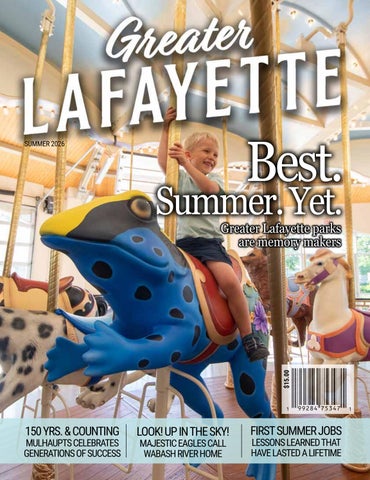
Best.
Summer. Yet. Greater Lafayette parks are memory makers
150 YRS. & COUNTING
MULHAUPTS CELEBRATES GENERATIONS OF SUCCESS
LOOK! UP IN THE SKY! MAJESTIC EAGLES CALL WABASH RIVER HOME
FIRST SUMMER JOBS LESSONS LEARNED THAT HAVE LASTED A LIFETIME
GREATER LAFAYETTE MAGAZINE 1
Get back to doing what you love.
PRIVATELY-OWNED 1-1 SPECIALIZED THERAPY SPIRITUAL CARE
Same-Day Orthopedic & Sports Medicine Appointments
Call 765.448.8100
Dylan Johnson, Administrator - 8 years with Saint Anthony
From bone and muscle injuries to joint pain, the highly skilled physicians of Indiana University Health Arnett Orthopedics & Sports Medicine are here to provide the personalized care you need, on your schedule.
Joseph Hubbard, DO
Peter Seymour, DO
Rayhan Jalal, MD, FRCSC
A
t Saint Anthony Rehabilitation & Nursing Center, we believe in delivering the highest quality of client care. Our unparalleled expertise, commitment, and compassion assures that we provide the very best healthcare in each service we offer. SHORT-TERM CARE • Physical, occupational & speech therapy, both in/ out patient services • Cancer Care • Cardiac Care & Rehab • Diabetes Care • IV Therapy
Sports Medicine Physicians
Orthopedic Surgeons
Eric M. Orenstein, MD, MBA, FACS, FAAOS
Jonathan Sahawneh, MD
Jonathan Mongold, DO
Jeffrey Wang, MD
BEST NURSING HOMES
BEST NURSING HOMES
BEST NURSING HOMES
BEST NURSING HOMES
BEST NURSING HOMES
U.S.News
U.S.News
U.S.News
U.S.News
U.S.News
U.S.News
2020
2 GREATER LAFAYETTE MAGAZINE
LONG-TERM CARE • Neuromuscular Rehab • Stroke Rehab • Pain Management • Respiratory Therapy • Physical, occupational & speech therapy • Wound Care & Prevention
BEST NURSING HOMES & WORLD REPORT
iuhealth.org/OrthoSameDay
Nicole Hardy, RN, IP, Director of Nursing/Infection Preventionist - 23 years Garry Gumasing, PT, CWS, LSVT-BIG Cert., Director of Therapy - 27 years Tracie Shoults, RN, Corporate Compliance Officer - 29 years
& WORLD REPORT
2021
& WORLD REPORT
2022
& WORLD REPORT
2023
& WORLD REPORT
2024
& WORLD REPORT
2025
To learn more visit SaintAnthonyCares.com or call us at 765.423.4861. GREATER LAFAYETTE MAGAZINE 3
oldnational.com | 800-731-2265 NASDAQ: ONBƫƫ| ƫMember FDICƫƫƫ ƫĸĈ Ĉăƫ %((%+*ƫ%*ƫ //!0/ƫƫ
GREATER LAFAYETTE MAGAZINE Editor - Carol Bangert Art Director/Graphic Designer - Kara Bishop Content Marketing Specialist - Shelby White MISSION Greater Lafayette Magazine captures the spirit and vitality of the people who call Greater Lafayette home and what it means to live, work and thrive here. It tells the region’s success stories, from business expansions, entrepreneurship, leadership and philanthropy to quality of life, arts and cultural events. Our hope is that readers of Greater Lafayette Magazine will become active participants in the world around them and join in our mission to make Greater Lafayette the place where progress, creativity and community come together. AUDIENCE Greater Lafayette Magazine serves as the leading quality-of-life and business trade publication for the area. Leveraging our award-winning team of writers and designers, Greater Lafayette Magazine attracts a diverse group of readers who are engaged in the community as consumers, visitors, business leaders, volunteers, residents and future residents of Tippecanoe County. This publication is for anyone that appreciates a good story that not only reveals something new about our community but offers insight and pride for the place we call home. ADVERTISING To advertise or receive information about advertising in Greater Lafayette Magazine, contact Amy Sundell at (765) 742-4044 or amy.sundell@greaterlafayettecommerce.com PRINTER The National Group CIRCULATION Greater Lafayette Magazine is published four times a year (January/April/July/October), with a print distribution of 4,000, and up to 10,000 online subscribers/views. Distribution channels will include online, mobile, various newsstands, and pass-along venues including restaurants, businesses, organizations, community centers, hotel lobbies and healthcare facilities. Greater Lafayette Magazine is a publication of Greater Lafayette Commerce 337 Columbia St., Lafayette, IN 47901 • (765)742-4044 • info@greaterlafayettecommerce.com • greaterlafayettecommerce.com
What's old is cool again
4 GREATER LAFAYETTE MAGAZINE
Ĩ%* (1 !/ƫ " 5!00!Čƫ ċƫ " 5!00!Čƫ +2%*#0+*Čƫ *2%((!Čƫ ƫ * ƫ $ ), %#*Čƫ ĩ
Say the name Mulhaupts,
and it conjures memories for people of a certain generation – namely mine. Those of us who grew up in the ‘60s and ‘70s were the generation that got our first bikes from Mulhaupts, and I remember mine with clarity and fondness – a sweet Schwinn Collegiate in shiny brown, with brown handlebar tape and a matching brown lock. I loved that bike like I love my siblings. And they loved their Schwinn bikes as well. My older brother had a bright yellow Lemon Peeler and my sisters had a blue Hollywood and a green Collegiate. My younger brother claims that Schwinn’s “weren’t cool” when he started riding. His loss, I say. We rode those bikes everywhere, and one of my favorite destinations was downtown back to Mulhaupts to get new handlebar tape to jazz up my ride. Those memories opened the door to myriad others, all leaving me with a smile. Nostalgia runs through the pages of this summer issue of Greater Lafayette Magazine, and I have to say, this is a happy accident. From new restaurants to updated parks amenities, the unspoken theme is a return to things that make us comfortable, secure and content. Nostalgia supports the structural bones of The Lawrence, Greater Lafayette’s latest dining option. Upscale and trendy, the restaurant is housed in a repurposed barn oozing with history. Nostalgia is the heartbeat driving upgrades and renovations at Columbian and other Greater Lafayette parks. Lafayette’s parks plan looks to the future while leaning heavily on what longtime residents love the most – the new carousel being a fine example. I love imagining the new Cason Family Park in West Lafayette and the events and activities happening there now that will transform into memories for siblings, friends and families in years to come. And if you want to talk about nostalgia, there’s nothing more enjoyable than recalling first or favorite summer jobs. In this issue, we asked some familiar Greater Lafayette residents to share their stories. Lessons learned, with an 8-track soundtrack in the background, make for entertaining reading. Finally, with our nation celebrating its 250th birthday, it’s fitting to look at one of our most nostalgic and patriotic symbols, the bald eagle. These strong, graceful raptors are making the Wabash and area waterways home again. We’re in the thick of a Greater Lafayette summer. So, hop on your avorite ride, hit one of our many city parks, or grab a meal that brings you joy. Now’s a great time to make new memories or be transported back to a beloved time or place. Editor, Greater Lafayette Magazine
SUBSCRIBE TO GLM VOLUME 7, ISSUE 3
202Ć " 5!00!ŏCommunity Impactŏŏ
ŏāćĀć
Team Member Volunteer Hour/ƫ ƫƫƫƫĈĉŌƫ+"ƫ+1.ƫ0! )ƫ)!) !./ƫ2+(1*0!!.!
Over āĀĀČĀĀĀŏŏŏ
Old National Bank Foundation !0ƫƫƫƫ Grants to " 5!00!ƫ) .'! -,.0-˛21
Over ĸćāČĀ ĀĀĀ
Old National Bankƫƫ + (ƫƫƫ Sponsorship Investments
$
ƫ/ ),(%*#ƫ+"ƫ+.# *%6 0%+*/ƫ%*ƫ0$!ƫ " 5!00!ƫ ) .'!0ƫ0$ 0ƫ ( ƫ 0%+* (ƫ/1,,+.0! ƫ%*ƫĂĀĂĆ
((++*/ƫ 2!.ƫ !.)%(%+* %#ƫ .+0$!./ƫ %#ƫ %/0!./ƫ+"ƫ .! 0!.ƫ " 5!00!ƫ +5/ƫ * ƫ %.(/ƫ (1 ƫ+"ƫ *2%((! 1 'ƫ .!!'ƫ +))1*%05ƫ //+ ċ ./ƫ"+.ƫ !!,/ %05ƫ+"ƫ *2%((! %2% ƫ $! 0.!ƫ+"ƫ .! 0!.ƫ " 5!00!ƫ +2%*#0+*ƫ 1/%*!//ƫ //+ % 0%+*ƫ +2%*#0+*ƫ !(! . 0%+*ƫ .+1, *2%((!ƫ .! ƫ +))1*%05ƫ +((!#!ƫ +1* 0%+*ƫ ++ ƫ %* !./ƫ ++ ƫ *' +1*0 %*ƫ +1*05ƫąġ *ƫ */%+*ƫ 1/!1)ƫ+"ƫ * % * ƫ .0ƫ %0 0ƫ"+.ƫ 1) *%05ƫġƫ $ ), %#* %0 0ƫ +.ƫ 1) *%05ƫġƫ *2%((! %0 0ƫ"+.ƫ 1) *%05ƫġƫ " 5!00! ** ƫ +))1*%05ƫ !*0!. +)!/0! ƫ !/+1. !/ .! 0!.ƫ " 5!00!ƫ +))!. ! ) #%* 0%+*ƫ 0 0%+*ƫ %!* !ƫ !*0!. 1*%+.ƫ $%!2!)!*0ƫ+"ƫ +.0$!.*ƫ * % * ƫ ƫƫƫƫƫƫƫ * ƫ .! 0!.ƫ " 5!00!
" 5!00!ƫ +0 .5ƫ (1 ƫ +1* 0%+*ƫ " 5!00!ƫ . */%0%+* (ƫ +1/%*#ƫ !*0!.ƫ " 5!00!ƫ . *ƫ %*%/0.5ƫ 0%*+ƫ !*0!.ƫ"+.ƫ !((*!//ƫĒƫ 1 0%+*ƫ ! !./$%,ƫ " 5!00! 5*ƫ .!! !ƫ +5/ƫĒƫ %.(/ƫ (1 ƫ+"ƫ %,,! *+!ƫ +1*05 !!.ƫ +1.0ƫ +0 .5ƫ %/0.% 0ƫćĆćĀƫ +.( ƫ +))1*%05ƫ ƫƫƫƫƫƫƫ !.2% !ƫ +1* 0%+* $%*!ƫ *ƫ *%2!./%05ƫ 5ƫ !.2% !/ $!ƫ .-1%/ƫ +1* 0%+* %,,! *+!ƫ .0/ƫ ! !. 0%+* .% % Ě/ƫ +,! *%0! ƫ 5ƫ+"ƫ $ ), %#*ƫ +1*05ƫ *%0! ƫ 5ƫ+"ƫ *2%((!ƫ .! *%0! ƫ 5ƫ+"ƫ .! 0!.ƫ " 5!00! !.)%(%+*ƫ 2 *0 #! /$ƫ !*0!. ƫ+"ƫ " 5!00! ƫ .! 0!.ƫ " 5!00!
Get to know the Greater Lafayette community by subscribing to Greater Lafayette Magazine. It’s easy! Go to greaterlafayettecommerce.com and click on the About Us tab. Then click on Greater Lafayette Magazine to view past issues and subscribe. GREATER LAFAYETTE MAGAZINE 5
46
Community leaders and members of the Stevenson family join Lafayette Mayor Tony Roswarski and his family at the Columbian Park carousel grand opening.
ON THE COVER:
Three-year-old Simeon Myers rides a poison dart frog at the Columbian Park carousel. Read the story (and meet the other carousel animals) on Page 46. Photo by Christine Petkov
A note from Mikel Berger | page 8 Eagles thriving on the Wabash River | page 10 Jerry Lee Atwood: Dressing celebs in style | page 16
Welcome Note | page 4 From Editor Carol Bangert
Take it outside with club sports | page 22
16
U-pick farms celebrate the taste of summer | page 28 Van Houten's Honey Shack | page 34
78
38 6 GREATER LAFAYETTE MAGAZINE
The Lawrence: A one-of-a-kind dining experience | page 38 Ask the Experts | page 56 1st summer jobs: Fond memories, lessons that stuck | page 60 Purdue's Center for Early Learning | page 72 Mulhaupts a story of 150 years of innovation |page 78 Purdue super fans collect memories | page 84 Lafayette Bicentennial sculpture dedication | page 90
Need business internet help? Get to know Jason Monroe. Flustered by your business internet? You should get to know Jason Monroe. As Wintek Business Solutions’ customer experience practice leader, Jason is passionate about exceeding expectations and discussions that help you discover the best ways to achieve your goals. Talk to Jason today to learn about our new service packages and begin building a business network based on hard work, vision and innovation.
Let Wintek build your business network the way it should be. 765-742-8428
sales@wintek.com
wintekbusiness.com
GREATER LAFAYETTE MAGAZINE 7
over. That turns out to matter more than you think. Over time, I realized I wasn’t the only one making that decision. Greater Lafayette works extremely well for a
expect them to. boundaries, things slow down. Here, there’s a
I’ve used a phrase before to describe it:
long-standing habit of connecting the pieces—
that jokes I’m just here for four more. But that’s not really true. I didn’t just happen to stay. At several decision points—graduation, starting a business, getting married, raising kids—I had real opportunities to leave. Different cities. Different paths. And each time, I looked around and made a choice. Not once, but over and over again. Each time, the answer came back the same: my options were better here. Part of the reason I chose this place in the first place was Purdue engineering. That didn’t end up being the right path for
So when people ask what makes Greater Lafayette different, I don’t usually start with a project or an
the same time, they care just as much about
announcement. I think about the people—the ones
making those ideas real—something useful,
who choose to stay, the ones who leave and come
something durable.
back, and the ones who build their lives here on purpose. If you’re someone who wants to build something
like Purdue that continue to push what’s possible.
meaningful, who cares about ideas but also cares
But it goes beyond job titles. There’s an engineering
about execution, and who wants a place where
mindset that shows up across this community—
you can shape your work, your community and
how people approach problems, decisions and their
your life without giving up everything else that
daily lives.
matters, then this place will likely feel right to you.
People here don’t just live life; they tend to engineer it. They break things down, look for root
while. Even now, nearly 30 years later, there’s still a part of me
neighbors in commerce, working together.
curious, thoughtful and serious about ideas. At
We have world-class engineers here and institutions
gone. And if I’m honest, I probably said that every year for a
In many places, when challenges cross
in a way that actually works.
Engineering plays an obvious role in that.
University thinking I’d be here for four years, and then I’d be
move in the same direction. Not perfectly, and not
something. Not always quickly, and not
close. You’ll find people here who are
I used to say that I came here as a freshman at Purdue
government and nonprofits often line up and instantly, but they move—because people here
bookish blue collar. It’s not perfect, but it gets
Greater Lafayette is not trying to be a place for everyone.
of why efforts across business, education, local
certain kind of person. People who want to build always loudly, but intentionally, over time, and
Mikel's Mindset...
so many conversations right now. And it’s part
And if you’re already here, that’s probably why you chose it, too. ★
causes, try solutions and keep improving them. You see it at work, but you also see it outside of work. The same person solving a technical problem during the day may be deeply involved in the arts, local food, music or a community organization at night—not just attending, but building, improving and contributing. There’s a quiet assumption in this place: if something can be better, you don’t wait for someone else to fix it. You take a shot at improving it. That mindset shows up in big ways and small ones. It’s part of why companies spend time here trying to understand how this community works. It’s part of why workforce is at the center of
me personally, but it placed me in an environment full of options. If I needed to change one part of my life—what I studied or where I worked—I could do that without giving up everything else I valued about the community. I didn’t have to start
8 GREATER LAFAYETTE MAGAZINE
Mikel Berger is the president and CEO of Greater Lafayette Commerce. He can be reached at 765.742.4044.
GREATER LAFAYETTE MAGAZINE 9
BY BRAD OPPENHEIM
PHOTOS BY DAN MILLER
A
s the United States celebrates its 250th birthday this summer, it’s a great time to take a look at one of our country’s most iconic symbols: the bald eagle. Americans have long honored the eagle, a soaring representative of our nation’s freedom, strength and independence. In 1782, it was named the national bird and symbol of the country.
Back home again Majestic eagles thriving along the Wabash
10 GREATER LAFAYETTE MAGAZINE
This unmistakable bird has graced coins and currency, postage stamps, the presidential seal and much more. But until recently, the eagle wasn’t a bird commonly found in Indiana. But that’s starting to change. Before any management was established to restore eagle populations in Indiana, the last known bald eagle nest was reported in 1897 in Lake County. “We call this extirpation, which means local extinction,” says Allisyn-Marie Gillet, a state ornithologist with the Indiana Department of Natural Resources. Gillet says the loss of bald eagle nesting from the state likely occurred due to habitat loss and a lack of legal species protections. But in the 1980s, the Indiana Nongame & Endangered Wildlife Program began the Bald Eagle Reintroduction Program. Between 1985 and 1989, 73 eagles were obtained from Wisconsin and Alaska and brought to Indiana. They were placed in a 25-foot nest tower in a secluded bay on Monroe Lake in southern Indiana. The birds were monitored and fed daily
GREATER LAFAYETTE MAGAZINE 11
until they were old enough to fly. Since then, the eagle population has continued to expand. “We expect to have 400 breeding (mated) pairs of bald eagles throughout Indiana now, and the number keeps growing,” says Gillet.
Volunteer reporting
Although the DNR does not actively monitor eagle nests, it relies on voluntary reports from the public to provide locations of new eagle nests and updates on the status of already used eagle nests. According to Gillet, at last count, there are currently 24 active nests reported throughout Benton, White, Tippecanoe, Carroll and Clinton counties, and about double that number has been documented. According to the U.S. Fish and Wildlife Service, bald eagles have made a population rebound and recovered to the point that they no longer need the protection of the Endangered Species Act. The majestic birds were removed from the federal list of endangered species in 2007. Gillet credits the resurgence of bald eagles likely in part to federal protections such as the Bald and Golden Eagle Protection Act and the Migratory Bird Treaty Act, which help safeguard eagle nests from disturbance and require developers to obtain the necessary state and federal permits when activities could affect nesting sites. Additionally, the Clean Water Act likely helped to clean up the waterways that the bald eagles rely on for fishing for food and nesting near to raise healthy young. More eagles are planting roots here in Greater Lafayette, and Gillet says that can indicate a quality environment. “It’s likely that if they are successfully raising young, the environment is also healthy,” she says. “Some bald eagles have become habituated to nesting now in more developed areas, but they are still thriving despite being in these human dominated landscapes. This is because they are more tolerant of regular noise and activity in these urban spaces.”
12 GREATER LAFAYETTE MAGAZINE
LOVE WHERE YOU LIVE. Enjoy a unique Christian housing experience!
COMPETITIVE PRICING
2, 4 & 5 BEDROOM UNITS AVAILABLE faithlafayette.org/faith-west-housing leasing@faithlafayette.org
GREATER LAFAYETTE MAGAZINE 13
Another factor is as the seasons change and the river fluctuates, eagles adapt to the environment. When the water becomes higher and wider in spring, eagles spread out more as they have more area to catch fish. Gillet says they also tend to spread out into the flooded agricultural fields surrounding the river and its tributaries. In the summer, when the river gets lower and narrower, eagles will concentrate more around the river and its tributaries. When the waters get higher and wider again in the fall, the raptors start spreading out again. Once winter comes around and if the river freezes, they will concentrate around open areas of water, resulting in large flocks of eagles all at once.
‘It gives me goosebumps’
“The eagle's wisdom is not in its wings, but in its gaze —fixed on the unseen.”
14 GREATER LAFAYETTE MAGAZINE
As bald eagles have reclaimed their place in the local landscape, their presence has not gone unnoticed. Dan Miller, a professional wildlife photographer, has spent 20 years capturing photos of bald eagles in action throughout Greater Lafayette, including at West Lafayette’s Celery Bog and along the banks of the Wabash River. “There’s at least one nesting pair that frequents the Celery Bog for fishing. And, of course, the Wabash, especially in the wintertime,” Miller says. “When the river freezes up north, freezes solid, they come down the river and find some open water.” Miller says over time, the sightings have become more and more frequent. “You can almost set your watch to the morning and evening feeding times,” he says. “Pretty consistent.” As he’s out shooting photos, Miller says he’s noticed more and more people frequenting the Celery Bog to get a glimpse of these birds. “They heard that the eagles are out there, so they will come specifically to look for eagles,” he says. After photographing nothing but people for a large part of his career, fellow professional photographer Ed Lausch switched gears and has also taken to photographing the eagles in action.
“In 2018, I bought a 600-millimeter lens for photographing wildlife, and it totally renewed my passion for photography,” he says. “The first time I used that camera with the eye tracking focus, I got a picture of an eagle picking a fish out of the water. So yeah, it’s kind of infectious when you get a shot like that. Like wow, maybe I can get a better one next time.” In the winter, Lausch says one of the popular spots for spotting eagles is at the U.S. 231 south bridge over the Wabash River between Lafayette and West Lafayette. “You can drive by there and count 30 or 35 eagles,” he says. “I’ve seen some people stop.” Additionally, he’s spotted them farther north at the Springboro Bridge on State Rd. 18 in White County. As for the emotion that comes along with nailing that perfect shot, “It gives me goosebumps,” Lausch says. “Just like when I used to photograph weddings, when I nailed a shot and knew I had an award-winning photo, I’d get goosebumps from it. Same thing when I get an awesome shot of an eagle, it’s exhilarating.” For those who are interested in scoping out a viewing spot at the Celery Bog or along the banks of the Wabash, Gillet says it’s important to give the eagles their space. “Stay around 330 feet from their nests when viewing them, she says. “Do not approach an eagle’s nest. Also, please avoid publicizing the location of eagle’s nests on social media and public platforms to prevent people from disturbing them during this sensitive period of their lives.” If you’d like to report a bald eagle nest, email dfw@dnr.IN.gov. ★
GREATER LAFAYETTE MAGAZINE 15
BY KATHY MATTER
PHOTOS PROVIDED Jerry Lee Atwood in the Union Western Clothing studio. (Image by Michael Durr)
Jerry Lee Atwood: Lafayette fashion designer keeps celebs in style
Cowboy Couture exhibit now running at the Eiteljorg
"Stranger Things" design
As a senior at Jefferson High School, Jerry Lee Atwood — who was into punk rock and an alternative look fashioned from thrift store finds - managed to maneuver his schedule so he spent every period but one in the school’s art classrooms. Today, in his Indianapolis studio, Atwood designs and embroiders elaborate suits and dresses for Hollywood celebrities, for doctors, for singers of every persuasion, for anyone who wants a totally unique look in the over-the-top style long associated with country and western stars. And his art is being honored with an exhibit at the Eiteljorg Museum of Western Art. “Cowboy Couture: The Fashion of Jerry Lee Atwood” runs through Aug. 2 at the Indianapolis museum. The last decade has been good to Atwood. Vogue magazine included him in a spread on Midwest artists to watch in 2021. In 2022, he created his favorite outfit to date for actor David Harbour. The actor wore the suit to the season four premiere of Netflix’s “Stranger Things.” Celebrity clients have ranged from Post Malone, who wore an Atwood blue eagle-talon suit at the 2017 American Music Awards, to Lil Nas X, who wore a fringed Atwood suit in the viral hit music video “Old Town Road” (2019) that’s been viewed more than 1.4 billion times worldwide on YouTube. Chain stitch dominates his designs, and he does all the embroidery himself on commissions, using a chain stitch sewing machine and a rainbow of threads. Atwood estimates it takes 80 hours to execute a simple design, upwards of 120 hours for a more complex one. Harbour’s suit took 150 hours.
Bold, colorful designs
Be it hearts and butterflies, or roadrunners and snakes, any image a client wants — the more personal the better — can be stitched on clothing that Atwood tailors himself. “It’s fun not to get stuck in one motif like wagon wheels or cacti, but to come up with unique and interesting designs,” he says. Atwood’s goal is to have designs so bold and bedazzled that they can be enjoyed up close as well as 30 feet away.
16 GREATER LAFAYETTE MAGAZINE
GREATER LAFAYETTE MAGAZINE 17
Atwood, left, with Duke University neuroscientist and ALS researcher, Dr. Richard Bedlack, Ph.D., M.D., for whom Atwood created the "Fashionable Fighting ALS" suit, which is on display behind Atwood and Bedlack.
One of his most intriguing clients, Dr. Richard Bedlack, is a neurologist at Duke University specializing in the treatment of ALS. The doctor hopes his flashy suit brings joy to his patients and happily loaned it to the Eiteljorg exhibit. “ALS is a terrifying disease,” Bedlack says. “If I can give patients a little something to look forward to with a fun outfit then maybe the first thing they will think about is ‘What does Dr. Bedlack have on today?’ or ‘What an outrageous outfit,’ or ‘Can I get a selfie with him,’ which will make things a little easier.”
An artist from an early age
Chris Purcell "Bigfoot and Armadillo" suit created by Atwood
Scott Hinds "Magnolia" suit created by Atwood
So where did Atwood’s colorful clothing journey start? The answer: On Maple Street in north Lafayette with his parents, James and Theresa, who lived and breathed country music. “Dad owned hundreds of records which he listened to all the time, and the album covers were propped up around the room. I grew up seeing all these performers in their country western suits.” There were also family trips to Opryland and Nashville, Tennessee. As a kid, Atwood didn’t share his folks’ passion for country music but later realized it had a “subconscious effect on me.” It was at St. Lawrence Elementary, Atwood says, that “I discovered I enjoyed doing art, and that was first grade. I always wanted to be an artist when I grew up.” When he was 10 he submitted a cartoon drawing of a Martian in cowboy attire to a Pennywhistle Press contest and won first place. “I probably still have the green and white flute they sent me in a box somewhere,” he says. That drawing was published in the Journal and Courier and seems now to foretell his current career. His road to recognition ran smoothly through high school. At Jeff “there were really excellent art instructors,” he recalls. “Probably Terry Jackson (who taught drawing and painting) had the most influence on me. I very much saw him as a mentor. All my embroidery designs start with drawings. “LuAnn Lamie had a fiber arts class and that was the first time I had ever done any sewing. We also did some dying, weaving and a lot of things that kind of informed the art I got into later with the sewing and embroidery.” Lamie remembers Atwood as “a great student. He always had really creative solutions to assignments. Some students would be very straightforward but Jerry would always have a real creative twist or solution.”
"Indiana" suit created by Atwood
A life-changing find
Bumps in the road followed Atwood’s graduation in 1993, however. He went on to Herron School of Art and Design but only lasted a year, tried unsuccessfully to transfer to Purdue University, worked at a Lafayette grocery store then enrolled at Indiana University only to drop out. But a “find” at Bloomington’s Ben Franklin craft store, a book on hand embroidery, ended up changing his life. 18 GREATER LAFAYETTE MAGAZINE
GREATER LAFAYETTE MAGAZINE 19
“His work reminds us that world-class artistic innovation isn’t limited to the coasts. It’s happening right here, in our own community.” Chris Purcell cape and suit for a 2020 wedding created by Atwood
“It was a fun way to turn my drawings into something more tactile. I got hooked on it; more than anything it was something to pass time,” he says. The small embroideries were easy to take to the coffee shop where he worked to fill spare moments, and to stitch on while watching TV. One of his coffee shop customers lent him a book on the history of western wear, which inspired him to make his first western shirt. He would label it “horrendous.” But he enjoyed the process and landed a costume shop job at the Indiana Repertory Theatre, where he honed his sewing skills and started selling his creations on the side. “When Instagram came about, I started posting my work and caught the attention of different collectors who were looking for custom western wear,” he says. One of those people was Joe David Walters from London. Atwood made Walters a suit that so impressed him that he suggested they go into business together. In 2013 the Indianapolis-based Union Western Clothing Company was born, and Atwood’s career as a clothing designer was officially launched. Social media continues to help spread the word of the company and Atwood’s talent. So will the Eiteljorg exhibit. Kathryn Haigh, the Eiteljorg’s president and CEO, says the museum is proud to showcase Atwood’s creations. “His work reminds us that world-class artistic innovation isn’t limited to the coasts. It’s happening right here, in our own community.” Highlights of the Eiteljorg exhibit include a maroon eagle wedding suit, an Indiana-themed suit with corn and cows, a prairie dog-themed dress made for Western swing singer Grey Del and a magnolia suit designed for The Royal Hounds bassist Scott Hinds. It also examines Atwood’s creative process through photographs and design sketches, including a vignette with items from his Indianapolis studio. ★
Cowboy Couture: The Fashion of Jerry Lee Atwood, Atwood, runs through Aug. 2 at the Eiteljorg Museum 500 W. Washington St., Indianapolis
eiteljorg.org/exhibitions/cowboy-couture-the-fashionof-jerry-lee-atwood/ Suits created by Jerry Lee Atwood in the "Cowboy Couture" exhibition at the Eiteljorg Museum in Indianapolis
WE ARE COMMITTED TO GUIDING OUR CLIENTS BY OFFERING PROACTIVE ACCOUNTING AND BUSINESS SOLUTIONS TO SIMPLIFY THEIR LIVES AND GROW THEIR PASSIONS.
WHAT WE CAN HELP WITH: MONTHLY ACCOUNTING SERVICES TAX PREPARATION AUDITING & ATTESTATION RETIREMENT PLANNING & ADMINISTRATION ESTATE PLANNING OUTSOURCED CONTROLLER & CFO SERVICES
LAFAYETTE
RENSSELAER
415 COLUMBIA ST
311 EAST DREXEL PARKWAY
765-428-5000
219-866-5835
WWW.HUTHTHOMPSON.COM Spools of thread used by Atwood at the Union Western Clothing studio (Image by Michael Durr) 20 GREATER LAFAYETTE MAGAZINE
GREATER LAFAYETTE MAGAZINE 21
BY KEN THOMPSON PHOTOS PROVIDED
With club sports options, there are no excuses to stay inside How did Lafayette, in the words of Steve
Preischel, become “a destination city” for disc golf? It started with an experienced disc golfer named Mike Layne, who led the cause to set up a disc golf course in the Murdock Park woods. “That was early on in my disc golf ‘career,’ and I didn’t know anything about designing or building a course,” says Preischel, former president of the Wabash Disc Golf Club. “I followed him around like a puppy as we set up meetings with the (Lafayette) parks department to get approval. I was with him at the board meeting when they said, ‘Yes,’ and we could barely contain ourselves as we left.” Then the hard work began, including hundreds of hours of work removing honeysuckle and pruning trees. “I asked Mike a million questions and helped as much as possible,” Preischel says. “That was when I fell in love with the idea of designing a disc golf course. As Mike described the thought process behind the layout, explained why fairways were placed where he put them, and went over every bit of the course with a fine-toothed comb—deciding which trees should stay and which needed to be removed—I soaked it all up.” What began as a nine-hole course expanded to 18 holes in 2012. A year later, when Lafayette Municipal Golf Course was permanently closed, Layne and Preischel saw an opportunity to take advantage of 100 acres of city land. Over the next two months, the duo walked the property and designed an 18-hole layout without a guarantee from
22 GREATER LAFAYETTE MAGAZINE
GREATER LAFAYETTE MAGAZINE 23
the city of Lafayette that the course would be permanent. When the course at Ross Hills closed, the baskets were transferred to Municipal. “We were hesitant to invest too much into that course—signage, concrete pads, new baskets and so on—since we never knew from year to year whether it would still be there the following season,” Preischel says. “Then, in 2017, the Lafayette Parks Department informed us that not only would they guarantee we could use the old ball golf course for at least the next 10 years, but they would also allow us to build a second course on a heavily wooded, 30-acre piece of vacant parks department land just south of the golf course.” Those courses, Washout Woods and Washout Waters, are now part of McAllister Park. Washout Waters retains some of Municipal’s elevated greens. Washout Woods is rated the more difficult course by udisc.com, thanks to its heavily wooded playing areas. Today there’s no sign of the former golf layout other than a few old cart paths. “For the last 13 years, nearly all of the maintenance done at McAllister Park has been done for the disc golf courses,” Preischel says. “The parts of the park where the courses didn’t go became more and more overgrown with mulberry and silver maple trees. It’s to the point that now, when you stand on any hole at Waters, you can’t see any other holes because the trees have grown 20 feet tall all around. If you look at Google Maps today, all you see is the disc 24 GREATER LAFAYETTE MAGAZINE
golf course layout. If you had told me 13 years ago what we would create, I never would have believed you.” Preischel estimates he spent thousands of hours mowing, cutting trees and doing “all the other bits and pieces that went into creating that space for the community.” “It was my passion for well over a decade, and it’s the most impactful thing I’ve ever done—or ever will do—in my life,” Preischel says. “I couldn’t be more proud of my role in the disc golf club and the development of disc golf in Lafayette in general.” Now living with his wife in western New York, Preischel has installed a nine-hole disc golf course on his 10 acres of wooded land. For those wanting a shorter game of disc golf, Greater Lafayette is home to a pair of nine-hole courses. Slayter Hill on the campus of Purdue University, as the name suggests, provides a very hilly nine-hole layout. Slayter Hill’s course can be played in less than an hour. Pickett Park, located at 1400 Stadium Ave. in West Lafayette, also is home to a 9-hole course. Lafayette Indiana Pickleball Association
It has been called the fastest growing sport in America, and look no farther than Greater Lafayette as proof of pickleball’s popularity. “It is growing fast because it appeals to all age groups, is very social, is relatively low cost and you can be as competitive as you want or strictly recreational,” says Cheryl Parker of the Lafayette Indiana Pickleball Association. “My mother had dementia and she enjoyed playing pickleball. It kept her moving and socializing.” The game was invented in 1965 as a combination of tennis, badminton and ping pong. Wiffle-type balls and a special paddle are all that’s needed to play on a surface that resembles a shortened tennis court. The Lafayette Indiana Pickleball Association was founded in 2011 by Tom Plummer and friends Joe Yuill, Dick Wiegand, Max Fitzgerald, Vern
GREATER LAFAYETTE MAGAZINE 25
Mayrose and Jim Ciccarelli. They would meet at Armstrong Park and play with homemade paddles composed of old tennis racket handles and pieces of plywood. Just six years later, the group of six had grown to more than 100. Yearly membership fees are $30 per person. More information is available at lipa.wildapricot.org. With that membership growth came more places to play. McCaw Park now has 26 outdoor courts. McAllister Recreation Center has an indoor court available Tuesdays from 8 a.m. to noon. The Northend Community Center offers three indoor courts for drop-in players from 8 a.m. to noon weekdays. “We love having the community support,” Parker says. “It makes it easier for us to provide free pickleball lessons during the summer, and now the public is enjoying the free pickleball leagues that LIPA is holding in the mornings and evenings.” Two indoor courts with cement floors are available at Academy Boiler Juniors, 4105 Haggerty Lane, Lafayette. Weekday sessions take place 9 a.m. to noon and noon to 3 p.m. Lafayette Family YMCA, 3001 S. Creasy Lane, has an indoor court that can be reserved for up to two hours. Nets and balls will be provided. Faith East Community Center, 5572 Mercy St., Lafayette, has two indoor courts open Mondays, Wednesdays and Fridays from 8 a.m. to 10:30 a.m. Purdue Recreation and Wellness Facility has indoor courts. Call 765-494-3110 for pricing and eligibility. “It is a great way to keep moving, get exercise at your own pace, meet new people and begin new friendships,” Parker says.
the club’s Facebook page. Membership fees range from $10 for an individual, $15 for a couple and $20 for families. Membership includes free registration at all Farmers Market 5Ks. Market 5Ks are held at 6:30 p.m. on July 15, August 19, Sept. 16 and October 21 at Cumberland Park in West Lafayette. Membership is not required to participate in a run or walk but membership does include free registration for all Market 5Ks. The club also will host a trail race series to take place on the Heritage Trail starting at the Tippecanoe Battlefield. Cost is $10 for the series, currently scheduled for July 25 and Aug. 28. The September date is to be determined. Cycling
The Wabash River Ride in August is the highlight event for the Wabash River Cycle Club, founded in 1978 to promote cycling in Greater Lafayette by providing opportunities for cyclists of all levels. This year’s ride takes place on Aug. 22 and is co-sponsored by the Lafayette Lions Club. The ride begins at Fort Ouiatenon and has routes ranging from 16 to 101 miles through Tippecanoe, Fountain and Warren counties. The Rob Roy Covered Bridge and historic Williamsport Bridge are among the notable sites on the trail. For registration information visit wabashriverride.com. Annual membership fees are $15 for students, $30 for individuals and $40 for an adult household membership. More information is available at wrcc-in.org. The website also provides event calendars and resources such as rider and E-Bike guidelines. ★
Wabash Runners Club
Founded in the mid-1980s, the Wabash River Runners Club is focused on supporting all runners and walkers in their pursuits of health and fitness, from casual walk-pacers to aspiring Boston marathoners. Membership information as well as a calendar of events can be found on the club’s website, runlafin.org, wabashrunners.org or
26 GREATER LAFAYETTE MAGAZINE
GREATER LAFAYETTE MAGAZINE 27
BY ANGELA K. ROBERTS PHOTOS PROVIDED
hen summer casts its spell over the Indiana landscape, conjuring up every color imaginable, Greater Lafayette’s U-pick farms come alive with the bounty of the season. From the tarty sweetness of ripe blueberries to the crunchy goodness of fresh apples, these farms offer the abundance of their harvests, providing picture-perfect outings for you, your family and your friends. Lace up your shoes, grab some gardening gloves and hop in your car for a hands-on adventure.
Fresh-picked summer
Martin Acres 4840 Hawthorne Ridge Dr., West Lafayette marshallmartinih@gmail.com Facebook: Martin Acres LLC 765-463-4215 Tucked away in a rural subdivision, about a half-mile south of William Henry Harrison High School, is an urban farm dotted with bushes that burst forth in brilliant blues and greens each summer. Mowed regularly, the suburban oasis offers a clean, mud-free experience for adults and children to pick blueberries. The crop at Martin Acres matures in waves, with a changing variety of blueberries throughout the season. Berries range from sweet and aromatic types to ones with a sharper, tart-sweet bite. Depending on what’s ripe, your harvest might yield berries suitable for snacking, summer baking, or freezing and jam-making. Picking season typically runs from late June through July, with fruit priced by the pound. The farm offers some evening hours, a convenient option for picking in cooler temperatures or after the standard workday ends. For updates on picking times and crop availability, call the farm or check its Facebook page.
28 GREATER LAFAYETTE MAGAZINE
A guide to Greater Lafayette’s U-pick destinations
GREATER LAFAYETTE MAGAZINE 29
Wea Creek Orchard 5618 S 200 E., Lafayette weacreekorchard.com 765-807-6142 On the south edge of Lafayette, where subdivisions give way to gently rolling acreage, Wea Creek Orchard continues a seven-generation farming legacy. It’s currently owned and operated by three families who are direct descendants of the pioneers that purchased the farm in 1855. Visitors may enjoy tractor rides, U-pick experiences, festivals and shopping for fresh and canned goods. Around mid-August, apples start maturing on the orchard’s dwarf trees. Growing to an ideal picking height of 8 to 12 feet, the trees yield more than 20 distinct varieties ranging from sweet, crisp slicing apples to tart options perfect for baking and cider. Peaches ripen around the same time. Wea Creek Orchard cultivates several premium freestone types, in which the flesh separates easily from the pit, or stone. Their easy preparation makes them ideal for slicing into summer cobblers, canning for winter or eating fresh as soon as you’ve washed them. In the fall, pumpkins draw families and field trips. Riding the tractor out to the patch, kids and adults may choose from larger jack-o’lantern varieties and smaller ones suitable for baking. Inside the farm store, Wea Creek offers canned goods, including preserves, butters, jams, jellies and salsas. A newer addition is honey from the family-owned Lavender Bee Company, harvested and bottled on the farm. Wea offers another U-pick option on occasion: pruning the lavender plants to promote their longevity. The company cultivates multiple varieties of lavender for fragrant bouquets, essential oils and culinary seasonings. If you help with the cutting, you may take home the tops you’ve removed.
DELIVERING YOUR DREAM, WORRY-FREE!
We are a diverse, multi-service, residential remodeling company with custom design services, providing an unrivaled 10-year workmanship warranty for your peace of mind!
765.449.2600 COORSREMODELING.COM 30 GREATER LAFAYETTE MAGAZINE
INTERIORS EXTERIORS
ADDITIONS DECKS GREATER LAFAYETTE MAGAZINE 31
Medley Family Farms
Annie’s Orchard
7709 Peshewa Dr., Lafayette medleyfamilyfarms.square.site
9624 W 75 S, West Lafayette, Indiana Facebook: Annie’s Orchard 765-430-0405
The aptly named Medleys are a blended family with deep roots in agriculture and livestock. What started as a passion project turned into Medley Family Farms, where they cultivate flowers in a residential acreage community. On select dates, the farm opens for U-pick experiences. Visitors may wander the rows to harvest summer favorites like snapdragons, marigolds and zinnias, with multiple container sizes available to suit different budgets. Specialty stems, including statement-making sunflowers and dahlias, round out custom bouquets. Beyond the cutting garden, Medley Family Farms offers seasonal subscriptions, private group floral events and workshops where you can learn techniques such as evergreen wreath-making. Photographers may book sessions by the hour or purchase a season pass for full access. In addition to the farm’s garden beds, a handcrafted greenhouse creates a picturesque backdrop for family photos, senior portraits and mini photo sessions. Check the farm’s website and social media accounts for current U-pick opportunities.
32 GREATER LAFAYETTE MAGAZINE
As the Facebook page for Annie’s Orchard exclaims, “We are growers of fine fancy fruits!” A charming, family-owned U-pick operation about 20 minutes west of Purdue, the property offers a classic farm experience, inviting visitors to slow down and experience the joy of harvesting their own food. From spring to fall, Annie’s Orchard offers a succession of crops. The season kicks off in May with strawberries, followed by blueberries and cherries in June, peaches in July and August, and apples in August and September. U-pick farming requires logistics and flexibility, with picking days and hours changing because of weather and crop availability. To protect the fields, the farm sometimes requires reservations to limit the number of guests. Check Annie’s Orchard Facebook posts for real-time picking updates before heading out. Out of season, you can follow updates from the family as they highlight snowfalls, cherry blossoms and tiny green strawberries beginning to form on low-lying stems. ★
GREATER LAFAYETTE MAGAZINE 33
BY ANGELA K. ROBERTS PHOTOS PROVIDED
How one veteran found peace and purpose in the world of bees It smells like honey
, all the time. When Nicholas “Van” Van Houten opens a hive box, a thick, sweet aroma rises to meet him. Around him is the low, rhythmic hum of tens of thousands of bees, indifferent to the human giant standing in their presence. Lifting a heavy wooden frame into the sunlight, Nick inspects their progress. If the cells are filled with capped honey, they are ready to be cleared of bees and carried to the honey house. “It’s like a tranquil bit where time just doesn’t move,” Van Houten says of working with beehives. “You don’t have a perceived sense of time, right? And when you crack open a hive for the first time … you see just this fizzling or bustling group of just insects doing their thing.” For the former U.S. Army sergeant and combat drone operator, the unpredictable beauty of nature has become both a therapeutic haven and a thriving commercial business. As the owner of Van Houten’s Honey Shack, he manages a sprawling footprint of around 200 hives extending from Greater Lafayette northward to Hammond and East Chicago.
34 GREATER LAFAYETTE MAGAZINE
Finding a new mission Growing up in Rensselaer, Indiana, Van Houten enlisted in the U.S. Army shortly after leaving high school. An armed drone operator, he flew high-value aircraft for combat strikes and surveillance missions, completing two major deployments: a 12-month tour of duty in Afghanistan and a six-month deployment closing out operations in Iraq, followed by an additional six months in Kuwait as part of a contingency operation. Afterwards, Van Houten returned to civilian life, settling in his wife’s hometown of Roselawn, Indiana, with her and their children. But PTSD was a persistent challenge as he struggled to find a new sense of purpose. “I was just lost. I feel like a lot of veterans do,” Van Houten says. “I mowed my grass every day just to have something to do.” A turning point came when Van Houten’s uncle suggested beekeeping as a form of self-therapy. Van Houten was quickly drawn into the craft, which requires a calm, intense focus to meet the exacting demands of hive management.
For a veteran accustomed to military structure, the organized, disciplined hierarchy of the hive also provided a familiar sense of order, a meaningful daily mission and a tangible, rewarding purpose.
Working out problems differently Around five years into his beekeeping hobby, Van Houten realized he had a viable business opportunity. In 2024, he formally established Van Houten’s Honey Shack LLC out of Demotte, Indiana. In 2025, he left his industrial maintenance job to pursue beekeeping full-time. “My kids say that it’s the happiest they’ve ever seen me,” Van Houten says. As an agricultural food business owner, Van Houten had to navigate complex regulations. When various municipalities gave him conflicting information, he secured a federal FDA inspection, allowing the Honey Shack to sell across state lines. That kind of can-do attitude, he says, helps make veterans successful entrepreneurs, along with other qualities like being straightforward, having a mission-oriented focus and being motivated.
GREATER LAFAYETTE MAGAZINE 35
“It’s a certain drive, right?” he says. “Just to be able to see a problem and work it out differently.”
profiles by rotating fresh boxes onto hives to mirror what is actively in bloom. Because bees naturally mix different nectars together in the same frames over time, creating a specific flavor requires strict timing. “For our apple crisp flavor, we’ll take all the previous boxes off, put fresh boxes on. As apples are in bloom, the bees will start bringing in that nectar,” he explains. “And then that honey will take on that flavor profile.”
A family affair
Van Houten’s Honey Shack is truly a family affair. Van’s brother Pierce helps with tasks like farmers market sales and social media. Van’s wife, Elisa, and their daughters, Aiden and RaeAnna, assist in extraction, bottling and labeling. Brother Dane and brother-in-law Garrett help with extraction, while Garrett also helps maintain the hives. Van’s mother, Annette, runs the markets in Lafayette, while his father, David, supplies retailers. “Depending on the time of year and if I’m running the booth, we bring out an observation hive for potential customers to see the inner workings of a live hive,” Van Houten says. “It’s nice to bridge people’s knowledge gap of where food comes from, and the kids enjoy searching for the queen.”
Stepping into their world
From hive to bottle
Van Houten sells his honey at the Lafayette Farmers Market in downtown Lafayette, the West Lafayette Farmers Market in Cumberland Park and retailers in northwest and north central Indiana. The beekeeper emphasizes that his product is “100% from the hive to the bottle to your table,” with no industrial processing, artificial heating or additives. After extraction, the honey filters naturally via gravity, allowing any wax and other debris from the hive to float to the top. Van Houten and his team then skim the top layer to return it to the bees. What remains is raw honey, ready to be bottled and sold. “When you heat honey, you kind of destroy some of the enzymes. It affects the health benefits as well as the flavor,” Van Houten explains. “I don’t want to change anything that makes us what we are.” Instead, the Honey Shack naturally creates distinct, seasonal flavor
36 GREATER LAFAYETTE MAGAZINE
“You're just stepping into their world instead of them stepping into yours.”
“It's a certain drive,... Just to be able to see a problem and work it out differently.”
As Van Houten notes, bees follow their own natural instincts. “You’re just stepping into their world instead of them stepping into yours,” he says. “The bees are going to do everything on their own terms.” As a beekeeper, he seeks to manage the hives in ways that benefit both the bees and his business. For example, once a new queen bee’s wings have developed enough, she flies away, mates and returns to start a hive. “That’s how it’s done in the wild,” Van Houten says. But, if the queen bee dies before returning, “They’re doomed. They don’t have a way to produce another queen. So what they’re going to do is just continue to make honey until the last bee dies, and then you have a bunch of boxes of just honey and no bees.” That’s when Van Houten will intervene with an advanced process called grafting, moving eggs from a selected mother queen into artificial cell cups to raise new queens. “And then you’ll drop those cells into each queenless colony so that even if they lost their queen, they have a backup,” he explains. “It’s like a succession plan.” This strategic intervention is one example of how Van Houten’s military operational skills intersect with the natural world, turning a potentially devastating loss into a calculated victory for his growing commercial operation. ★
GREATER LAFAYETTE MAGAZINE 37
BY KAT BRAZ
PHOTOS BY CHRISTINE PETKOV
Rooted in Hospitality
Inside The Lawrence’s vision for hospitality, community and a one-of-a-kind dining experience
38 GREATER LAFAYETTE MAGAZINE
GREATER LAFAYETTE MAGAZINE 39
Long before diners gathered beneath its soaring timber beams, the historic barn that houses The Lawrence stood on an Indiana farmstead 50 miles south of West Lafayette. Today, the restored structure anchors the Purdue Research Foundation’s Discovery Park District, where guests arrive for pork chops sourced from northern Indiana farms, celebratory dinners during commencement weekend and weddings beneath an outdoor amphitheater. Operated by Indianapolis-based Cunningham Restaurant Group, The Lawrence blends polished service with a deliberately approachable atmosphere. The space is designed to feel warm and inviting, but the restaurant’s greatest appeal goes beyond the architecture or even the menu. “It’s really the feeling people leave with,” says Ethan Beach, general manager. “I want guests to remember that they felt welcomed, appreciated and taken care of.” The massive, vaulted ceiling immediately draws eyes upward when guests enter, while reclaimed wood, agricultural textures and depictions of vintage farming scenes reinforce the restaurant’s connection to Indiana’s agricultural heritage. “There’s only one Lawrence,” Beach says. “I don’t think there’s another barn that was transferred 50 miles away and reconstructed into a restaurant like this.”
Farm-to-Table
That distinct sense of place also influences the food. The Lawrence’s menu centers on new American cuisine with an emphasis on seasonality and locally sourced ingredients. Beach points to the restaurant’s Gunthorp Farms pork chop as a signature example. The northern Indiana producer processes its pork to order, allowing the restaurant to serve exceptionally fresh cuts. The menu features familiar comfort with more adventurous culinary touches — a strategy Beach says is essential in a growing but still evolving dining market. “You can take a dish people already know and then add a culinary spin to it,” he says. “Maybe it’s a steak with rainbow chard instead of a more traditional side, or a smash burger with a different type of relish. It gives our guests something recognizable while still introducing new flavors.”
That balance has become especially important as West Lafayette’s restaurant scene continues to mature. While the area has added more upscale dining options in recent years, Beach says Cunningham’s approach relies heavily on listening to the community and adjusting when needed. “We definitely want to present interesting dishes and ingredients,” he says. “But it’s important to understand the community you’re serving and find that balance.”
Flexible Venue
A private dining room accommodates smaller gatherings, while the adjoining event space can host up to 170 guests for wedding rehearsals, networking events, showers and receptions. During major weekends such as Mother’s Day and Purdue commencement, The Lawrence opens every corner of the building to handle the surge of visitors. “You have families coming from all over the world to celebrate a milestone event,” Beach says. “It’s a special experience to be part of the time they share together.” General manager Ethan Beach
40 GREATER LAFAYETTE MAGAZINE
GREATER LAFAYETTE MAGAZINE 41
The Lawrence also employs both Purdue and local high school students in front-of-house roles. Beach, who previously helped open Cunningham concepts in Bloomington and Indianapolis, says hospitality work teaches skills that apply beyond restaurant environments. “You learn how to work with different personalities, different cultures and different ways of thinking,” he says. “That’s valuable no matter what field you go into later.” For Beach, mentoring younger employees remains one of the most rewarding aspects of the job. “I love seeing someone start as a host or server assistant and grow into leadership,” he says. “Hospitality creates opportunities for people.” That sense of growth mirrors what he sees
42 GREATER LAFAYETTE MAGAZINE
happening across Greater Lafayette itself. Beach believes the area’s continued expansion — fueled by Purdue’s growth and increasing regional development — positions The Lawrence to become an even larger destination restaurant in the years ahead. “The community is what takes care of you,” he says. “Seeing Lafayette and West Lafayette continue to grow gives me a lot of optimism for the future.” Even with its historic architecture and elevated menu, Beach hopes the restaurant ultimately earns its reputation through something simpler. “The food matters, of course,” he says. “But at the end of the day, I want guests to remember how they felt while they were here.” ★
GREATER LAFAYETTE MAGAZINE 43
A Barn’s Second Life The story of The Lawrence began years before the first meal was served. The restaurant is housed inside a restored 1938 horse barn originally located on the Sheridan, Indiana, property of agricultural entrepreneur Sonny Beck, a Purdue alumnus and member of the university’s Board of Trustees. The Beck family donated the structure to serve as an anchor for the Purdue Research Foundation’s Discovery Park District. The barn was carefully dismantled, transported roughly 50 miles and reconstructed within Purdue’s Discovery Park District in West Lafayette. The project quickly became one of the district’s most recognizable additions, combining Indiana agricultural history with the area’s ongoing development. Rather than building a replica, the team preserved many of the barn’s original materials and architectural elements, allowing the structure itself to become part of the dining experience. Today, guests still see exposed beams, soaring ceilings and design details that reflect the building’s farming roots — a visual connection to the region’s agricultural heritage that helped inspire both the restaurant’s atmosphere and its seasonal, farm-influenced menu. The restaurant’s name also pays homage to Beck family history. Sonny’s grandfather Lawrence Beck immigrated to the United States in 1833. In 1901, Lawrence bought 80 acres of land in Atlanta, Indiana, which is still home to Beck’s Hybrids.
44 GREATER LAFAYETTE MAGAZINE
GREATER LAFAYETTE MAGAZINE 45
BY GREG LINDBERG PHOTOS BY CHRISTINE PETKOV
From pickleball to primates, carousels to concerts, Greater Lafayette parks invite community engagement On any summer evening in Greater Lafayette, the
value of a well-loved park is easy to see with the excitement of children running around playgrounds or families gathered beneath shade trees to share a picnic lunch. Area parks are alive with cyclists and runners moving along community trails and the sounds of live music and other exciting events travelling throughout neighborhoods. These scenes are repeated every day throughout Lafayette and West Lafayette, illustrating the important role parks play in shaping the identity of a growing community. This year is no exception to new expansions and exciting updates to structures in beloved venues such as Columbian Park, which is currently updating the primate section of its popular zoo as well as bringing a brand-new carousel to life.
Left: Simeon Myers, along with mom Joelle Myers, takes a spin on the carousel on opening day. 46 GREATER LAFAYETTE MAGAZINE
GREATER LAFAYETTE MAGAZINE 47
48 GREATER LAFAYETTE MAGAZINE
GREATER LAFAYETTE MAGAZINE 49
Updated recreational amenities
Few recent projects have been as transformative as the improvements completed at McCaw Park. The completion of Phase II brought significant additions to the facility, including 26 lighted outdoor pickleball courts, upgraded baseball facilities, new batting cages, a basketball half-court and expanded trail connections. The project reflects changing recreational trends and the growing demand for facilities that support active lifestyles. “We are continuing to invest in facilities that provide opportunities for residents of all ages,” says Claudine Laufman, superintendent of Lafayette Parks & Recreation. “Whether someone wants to play pickleball, attend a community event, enjoy a trail walk or simply spend time outdoors with family, we’re focused on creating spaces that make those experiences possible.” The rapid growth of pickleball has transformed recreation departments across the country. Once considered a niche sport, pickleball now attracts participants from virtually every age group. The expanded facilities at McCaw Park position Lafayette as a destination for tournaments while also providing residents with opportunities for casual play and social interaction. Beyond McCaw Park, Lafayette has invested in numerous neighborhood parks. Hedgewood Park received a complete renovation featuring a new playground, landscaping improvements and updated hardscape elements. Woodfield Village Park also underwent renovations, while improvements to the press box at McCaw baseball fields enhance the experience for athletes, coaches and spectators. Even seemingly small projects have had a meaningful impact, and this is just one example of that growing development. The addition of heating systems to restroom facilities at Armstrong Park now allows those facilities to remain open during winter months, providing year-round convenience for visitors. This is great news for patrons taking their children to the fairly new playground at Armstrong Park on early spring and fall days. Together, these projects demonstrate a commitment to serving both neighborhood and community-wide recreational needs. While large projects often receive the most attention, investments in smaller parks ensure residents have access to quality recreational opportunities close to home.
Parks signal economic vitality
No discussion of Lafayette parks would be complete without Columbian Park. For generations, the park has served as one of the community’s most beloved destinations. Residents often recall childhood visits to the zoo, train rides through the park, afternoons spent on paddle boats, and family gatherings beneath the park’s trees. For many, parks are where memories begin, and Columbian Park is a focal point to residents and visitors who travel from
50 GREATER LAFAYETTE MAGAZINE
GREATER LAFAYETTE MAGAZINE 51
The return of the carousel outside Lafayette. In a region experiencing steady growth, parks have become increasingly important not only as recreational destinations but also as investments in quality of life, economic vitality and community health. Today, city leaders are working to ensure Columbian Park remains relevant for future generations while preserving the experiences residents cherish. The most significant project currently underway is the construction of a new primate complex at Columbian Park Zoo. The addition is expected to enhance both animal habitats and educational opportunities for visitors. “Our current focus is on completing the new Primate Complex,” Laufman says. “This will be an exciting addition not only to the zoo, but to Columbian Park and the entire community.” The zoo has evolved into one of the region’s most important educational attractions, providing opportunities for children and adults to learn about wildlife, conservation and environmental stewardship. The new primate complex is expected to strengthen that mission while enhancing the overall visitor experience.
Perhaps no project has generated more excitement than the return of the carousel. The original carousel was removed more than two decades ago, and after a few fits and starts, the much-anticipated updated version is up and running. Located between the zoo and Loeb Stadium, this landmark attraction, priced at a little over $782,000, combines classic designs that many longtime residents will remember, along with some new elements. The David M. Stevenson family donated funds for the project. Joining classic carousel horses will be: a panda, snow leopard, a rhino, flamingo, a sea turtle, ring-tailed lemur, a zebra, bald eagle, a poison dart frog and more. Also included will be ADA-compliant chariots. The enthusiasm surrounding the carousel highlights the important role nostalgia plays in parks and recreation. Attractions such as train rides, paddle boats and carousels create connections across generations. Laufman reiterates the excitement over the new attraction. “These experiences create a strong sense of nostalgia and connection,” Laufman says. “By preserving beloved attractions while continuing to introduce new experiences, we are able to honor the past while inspiring new memories that families and friends will carry with them for years to come.” Programming remains equally important to the success of the park system. Throughout the year, Lafayette Parks & Recreation offers events designed to bring people together and activate public spaces. Art in the Park continues to showcase local and regional artists through a family-friendly festival atmosphere featuring food vendors, live music and interactive activities. The Sounds of Summer concert series transforms Memorial Island Amphitheater into a gathering place where residents can enjoy free live entertainment in a uniquely local setting. Additional programming includes community ceremonies, sports events, educational opportunities, movie nights and special events hosted throughout the park system. These activities help ensure parks remain vibrant destinations throughout the year rather than seasonal attractions.
Investment in West Lafayette parks
West Lafayette has likewise embraced parks as an essential component of community development. Investments throughout the city’s park system continue to expand recreational opportunities and improve visitor experiences. George E. Lommel Park is preparing to open a new restroom facility that will enhance accessibility and convenience. At Cason Family Park, community leaders are celebrating significant upgrades to the Griffin Performance Pavilion. Thanks to a donation from the Griffin family, the pavilion now features professional-grade sound and lighting equipment capable of supporting higher-quality performances and events. 52 GREATER LAFAYETTE MAGAZINE
GREATER LAFAYETTE MAGAZINE 53
“The Griffin Performance Pavilion Celebration will recognize a tremendous gift that allows us to enhance community programming and events,” says Greg Mitchell, assistant superintendent of West Lafayette Parks and Recreation. Meanwhile, outdoor pickleball courts at Cumberland Tennis Courts are now open and available for public use, further expanding opportunities for recreation in West Lafayette. Beyond individual projects, both communities recognize the importance of connectivity. Trails and greenways increasingly serve as links between neighborhoods, schools, parks and community destinations. These pathways encourage walking, running and cycling, support healthier lifestyles and provide opportunities for residents to explore their communities in new ways. Natural areas also play a critical role. Green spaces help manage stormwater, improve air quality, support wildlife habitats and offer opportunities for residents to reconnect with nature. As communities continue to grow, preserving these spaces becomes increasingly important.
The quality-of-life component
The impact of parks extends beyond recreation. Numerous studies have demonstrated the relationship between quality park systems and economic development. Communities with strong parks often experience increased property values, enhanced tourism opportunities, and improved workforce attraction. Employers increasingly recognize quality-of-life amenities as important factors when recruiting talent, making parks an important component of broader economic development strategies. Facilities such as Cason Family Park, the Columbian Park Zoo, Loeb Stadium, Memorial Island Amphitheater and athletic complexes attract visitors who contribute to the local economy while showcasing the community to potential future residents.
Skate park a collaborative effort
Beyond serving as a recreation destination, the skatepark has become a gathering place that promotes inclusion, mentorship and community engagement. Riders of different ages and experience levels regularly share space, creating opportunities for skill-building and positive interaction. Supporters of the project often point to its success as an example of what can be accomplished when local organizations, churches, businesses and residents work together toward a common goal. “Personally, I love the street section of the park, because it has obstacles for many skill levels of skaters, with higher and shorter grind boxes and rails, and ramps of different heights and steepness,” Simpson says. The facility continues to attract visitors from across Greater Lafayette and has helped expand the variety of recreational opportunities available within the community. While still relatively new, the skatepark already has established itself as an important addition to the area’s growing network of parks and outdoor recreation amenities. Looking ahead, Lafayette Parks & Recreation will continue using its five-year master plan to guide improvements and investments throughout the parks system. The challenge facing modern park departments is balancing modernization with preservation. Residents want new amenities and upgraded facilities, but they also want the parks they love to retain their historic character and sense of place. “We remain committed to preserving the rich history and character that have made Lafayette’s parks such an important part of the community,” Laufman says. As Greater Lafayette continues to grow, parks will remain among its most valuable assets. Whether through a zoo visit, a pickleball match, a summer concert, a carousel ride or a quiet walk along a trail, parks provide opportunities for connection that enrich daily life. They are places where traditions are preserved, memories are created and communities come together. ★
In addition to park updates, the new Lafayette Community Skatepark near Faith Church represents one of the area’s most significant grassroots recreation projects in recent years. Developed through a collaboration between community advocates, local organizations, donors and volunteers, the skatepark was created to provide a dedicated space for skateboarders, BMX riders and scooter users of all skill levels. The project filled a longstanding need within Greater Lafayette’s recreation system by giving action sports enthusiasts a safe and purpose-built environment to practice, socialize and develop their skills. Community support played a major role throughout the planning and development process, helping transform the idea from a local vision into reality. Local skater and Lafayette resident Greg Simpson, who pushed hard with events to help the skatepark project come to fruition, says the park was needed. “I know skaters from Indianapolis who have been making the trip up to skate it as well,” says Simpson. “It’s a very well-built park thanks to Hunger Skateparks, a Bloomington-based company.”
54 GREATER LAFAYETTE MAGAZINE
GREATER LAFAYETTE MAGAZINE 55
Ask The Experts: The Greater Lafayette Commerce Ask the Experts program is perfect for you. Greater Lafayette Commerce is teaming with experienced professionals who have the skills you’re looking for to help you overcome challenges and provide you with perspective and direction. Ask the Experts provides small business owners with the information they need while also facilitating the development of lasting professional relationships.
Small businesses have poured more into marketing in 2026. Many still don't know whether it works. There is a particular kind of frustration that belongs almost exclusively to small business owners. The product is good. The customers who find it tend to come back. The problem is that not enough people are finding it, and every solution the market offers seems to cost more than the problem itself. That frustration is not unfounded. Marketing is the top operational challenge for small businesses, cited by 37% of established owners as their biggest hurdle, according to the 2025 Shopify Merchant Survey. So small businesses spent more. In 2026, 68% increased their marketing budgets, meeting economic pressure with aggression rather than retraction, according to the Q1 2026 Small Business Now Report from Constant Contact. Most of those businesses are still waiting to find out if it worked. The Greater Lafayette region entered 2026 with softening wages, lackluster job creation, stubborn inflation and trade policy uncertainty layered underneath all of it, according to Indiana University Southeast economist Uric Dufrene. A restaurant on South Street does not have the cushion that a regional chain has. A contractor working in Tippecanoe County does not have a corporate marketing department running attribution models. They have a phone, a Facebook page and a finite number of hours in the day. Into that reality, the platforms have sold a particular promise: Reach. Boosted posts. Sponsored listings. Lead generation campaigns priced low enough to feel manageable and opaque enough to feel like progress. The platforms are not neutral parties in this transaction. Their incentives are not aligned with yours. A boosted post generates impressions. Whether any of those impressions correspond to a customer who actually walked through the door is a question the platform has little structural interest in helping you answer. Marketing strategists return consistently to three baseline questions: Where did my new customers come from? What did it cost to get them? What are 56 GREATER LAFAYETTE MAGAZINE
they worth over time? Most small business owners cannot answer all three, not because they are bad at business, but because they never set up a way to find out. The channels with the strongest documented return tend to cost the least to start. The Google Business Profile is the one most commonly claimed and most commonly neglected. Verified profiles with complete information are 80% more likely to appear in search results, according to a 2026 analysis by Directory One. Profiles with photos added in the last 30 days receive 35% more clicks. For a business on Main Street or Columbia Street, that is not an abstraction. It costs nothing and takes about 20 minutes a week. Email is the other channel the data keep returning to. Email generates between $36 and $40 for every dollar spent, compared to $2 to $5 for social media ads, according to a 2026 analysis by VaultAI Pro. Unlike social channels — where algorithm changes have cut some publishers’ reach by 80% overnight — an email list belongs entirely to you. No platform can reprice it. Earned media carries the most durable return of all. According to Nielsen’s Global Trust in Advertising report, 84% of consumers trust editorial coverage above all other forms of advertising. A published story lives on Google indefinitely. A boosted post does not. Local journalists need credible sources. The businesses that understand that tend to get covered. None of this requires a large budget. It requires consistency, a clear story and a willingness to track, even roughly, whether any of it is working. The floor for effective marketing has always been lower than the industry wants small business owners to believe. This year might finally be urgent enough to test it. - By Shelby White and Jennifer Boss White is public relations & communications manager and Boss is creative brand manager at Greater Lafayette Commerce
GREATER LAFAYETTE MAGAZINE 57
They stay here and get put to work in the same communities they came from. A checking account can help fund a neighbor’s mortgage. A business deposit can help a local entrepreneur hire their first employee. The result is a cycle that supports jobs, small businesses, and long-term growth you can actually see around you. Your money keeps moving. Right here at home.
BANKING WITH PEOPLE YOU RECOGNIZE The Dino Dash also made something else clear: the people behind the bank are right out in front. They are the ones organizing the race and laughing with neighbors. The ones you will see again at the grocery store, at a school event, or volunteering on a Saturday morning. That kind of connection matters.
Banking with
When the people making financial decisions live in the same community, there is a different level of care and accountability because decisions are not made from a distance. They are made by people who understand the context and see the impact up close.
Heart & Grit Why Where You Bank Determines the Future of Our Community
D
uring June’s Mosey, downtown Lafayette looks a little different as bankers, businesses, and nonprofits pull on their dinosaur suits and parade down Main Street during the First Farmers Bank & Trust Dinosaur Dash. For that race down Main Street, the most talked about event in town has nothing to do with spreadsheets or balance sheets. It had everything to do with showing up. First Farmers Bank & Trust created the event to bring the community together in a way that feels true to who we are. Not polished. Not distant. Local. A little scrappy. And fully committed to doing good where we live and work. This year, the Dash brought together local businesses, all stepping into oversized costumes for one shared purpose; raising money for LARA of Lafayette and supporting the opportunities they create for ongoing adult education. By the end of the night, that collective effort turned into a $5,000 donation for the organization. And in a moment that felt perfectly on brand, LARA’s own dinosaur took home the win. It was a fun finish. It was also a meaningful one. Because at First Farmers Bank & Trust, moments like this are not side projects. They are a reflection of how we believe community banking should work.
58 GREATER LAFAYETTE MAGAZINE
SHOWING UP IS PART OF THE JOB
MORE THAN A RACE The Dino Dash lasted a few minutes, but community banking lasts all year. The race gave us a moment to gather and celebrate. The rest of the year is where the real work happens. It happens in conversations at a local branch. In decisions made with context, not just data. In the steady support that helps a neighbor take the next step, whether that means buying a home, growing a business, or simply getting on firmer financial ground.
It is easy to support a cause with a logo. It is harder to show up. At First Farmers Bank & Trust, showing up is part of the job description. That includes volunteering hours throughout the year, supporting local organizations, and being present in the moments that matter to the community. Sometimes that looks like lending your time. Sometimes that looks like writing a check. And sometimes it looks like running down Main Street in a dinosaur suit so the entire community has a reason to rally behind something good.
THE CONVENIENCE YOU EXPECT, WITH THE CONNECTION YOU WANT One of the biggest misconceptions about community banking is that choosing local means giving something up. In reality, customers still have access to the same digital tools they rely on every day. The difference is what sits behind those tools. At First Farmers Bank & Trust, those tools are backed by people who know your name and understand your goals. People who can sit down, have a conversation, and help you think through what comes next. Technology is important. So is trust.
A FINISH LINE THAT KEEP MOVING The Dino Dash had a clear finish line. A quick sprint, a winning dinosaur, and a check presented to LARA of Lafayette. But the bigger picture does not end there.
Community banking is a long game. It is built over time through relationships, consistency, and a willingness to keep showing up, long after the event is over. That is how First Farmers Bank & Trust has operated for generations. Not just during a single event, but in the daily work of supporting the people and businesses that make our communities strong. That is the balance First Farmers Bank & Trust strives for every day. Real impact. Real relationships. A practical approach to doing good in the places we call home. Because in the end, community banking is not just about where you keep your money. It is about what you help build with it.
That is what “banking built on heart and grit” looks like in practice. Not a slogan. A standard. WHEN YOU BANK LOYAL, YOUR MONEY STAYS LOCAL It is easy to think all banks are the same: a card, an app, and a place to hold your money. But what happens next is what makes the difference. At First Farmers Bank & Trust, deposits do not disappear into a distant system.
Lafayette Central Branch 3510 IN-38 E, Lafayette, IN 47905 (765)-588-0951 Lafayette Downtown 639 Main St., Lafayette, IN 47901 (765)-297-0771
www.ffbt.com
Member FDIC Inst. ID #478756 GREATER LAFAYETTE MAGAZINE 59
Lessons
learned
Concerts on flatbeds. Globs of gravy. The background grooves from an 8-track tape. Summer jobs planted seeds of success.
BY CINDY GERLACH PHOTOS PROVIDED
We all remember our first summer jobs — that
feeling of independence as we made a little money, learned to manage our income and our time. For some people, it was babysitting or working as a lifeguard. For me, it was working at the counter of a popular fast-food franchise: the pride and responsibility; the polyester uniform and the nametag; the pressure during a dinner rush; and the constant proximity to hamburgers and French fries. All for $3.35 an hour. We asked some familiar folks around town to recall their early forays into the workforce. Those first jobsran the gamut, with a few fun surprises. Each shared what they learned about work, earning anincome, and future career goals as they made their first entrance into the workforce.
Les Huddle
Superintendent, Lafayette School Corp.
It wasn’t exactly my first summer job, but it was my most unique. My cousin Dave Stephens and I put on a one-day outdoor “Rock Fest” in our rural hometown of Wapello, Iowa. It was the summer of 1971, just two years after the famous rock fest known as Woodstock. I was 18. Dave and I were bagging groceries at our hometown grocery story. Back then you also carried the groceries to the customer’s car and put them in the car. One day we looked at each other and Dave said, “There’s got to be something better than this.” I said, “Let’s put on a Rock Fest.” Dave simply replied, “OK.” So we basically created our own job. As we planned this out, we had to find a location, find five bands, get permits, advertise, hire security and most importantly, find some financial support because neither Dave nor myself had any money.
60 GREATER LAFAYETTE MAGAZINE
Our expectations were pretty low. We thought several hundred people would be great. We ended up with right at 1,000 people attending, not including one motorcycle gang of approximately 50 individuals we let in free. I remember being a little nervous as Dave and I signed contracts with the bands for their fees — and remember Dave and I had no means of paying them if no one showed up. All the work was up-front, getting organized and setting up. Our “stage” was a flat-bed semi-trailer. When the day finally came, we lucked out. Perfect weather, attendance exceeded our expectations and the motorcycle gang helped us police the area. The rock fest was held inside a halfmile horse racing track, and the motorcycle gang always had two members driving around the track so nobody could sneak into the event. Dave and I ended up clearing around $1,000 total after expenses. Back then, that was more than I would have made all summer bagging groceries. After our “rock fest,” Dave and I continued to book bands as Spinner Productions for the next three years. We ended up creating a booking agency with an office in Iowa City and booked bands into different venues in Iowa, Illinois, Missouri and Wisconsin. Our biggest thrill was when we were contacted by a popular band back then called Blood, Sweat and Tears to book them for a Midwestern tour for five college locations.
GREATER LAFAYETTE MAGAZINE 61
Amanda Dunkle
Associate Director, Purdue Musical Organizations
My first real summer job (if you don’t count Baskin Robbins in high school) was the summer after college graduation at Deer Creek Music Center. I had just finished an internship at Ticketmaster in marketing and events and moved on to become sales and special events coordinator at Deer Creek. It was 1998 and I was 22 years old. My supervisor at Ticketmaster was good friends with the supervisor at Deer Creek, so I was lucky to have a great referral. My duties entailed sending fax communications to all season ticket holders about upcoming concerts and special events. The list of patrons was long, and the faxes took multiple days to send! I also helped coordinate ticket orders, event details and registrations, special promotions in our VIP club, and corporate parties at our concerts. I did not expect to learn so much at my first job. My supervisor was tough, hours were long (and HOT!) and it was grueling! However, it was also FUN getting to see the most popular artists and festival tours in concert right out of college. I learned about all the back-ofhouse processes of live entertainment, learned how to take care of top clients, learned a LOT about customer service, got a ton of event planning experience and even learned how to put out a fire on the lawn at Ozzfest! It was a great mix of fun and hard work. There were days I was worn out, but to this day (28 years later) it is
Raquel Lopez still the job (and supervisor) that taught me the most. To this day, I look back and am surprised about the amount of responsibility I was given at such a young age. Learning how to problem solve on the spot, or step up to fix something myself, was something I learned quickly. “Everyone has to sweep the floor!” is a motto I always carry with me, and I struggle with people who find certain tasks to be beneath them. If you haven’t done something yourself, how can you expect someone else to do it? My salary was $18,000! (I should have never taken the job – haha – but since everyone wanted to work there, they got away with paying very little! And I didn’t know a thing about negotiating at the time and was eager.) Luckily, I had a car with no payment, low rent and was able to pay my bills and still have money for shopping! Every concert was its own unique experience, from the artists themselves to the audience members. Some of my favorite concerts at that time were Elton John, Lilith Fair, Bonnie Raitt and Pearl Jam. I’m grateful for the experience, as well as the opportunity to go right into working in the entertainment industry out of college. My experience there helped me in my future job at Purdue Convocations and now at Purdue Musical Organizations.
Producing Artistic Director, Civic Theatre of Greater Lafayette
My first summer job started immediately after high school graduation as the director/choreographer of the dance team at my high school. I was 17 years old, and it was 1986. The band director at my high school recommended me to the principal. I had been an officer on the team and the choreographer during my junior and senior years. The band director was impressed with my leadership, and my choreography had helped us win at competitions, so I guess he thought I was a good choice. As the director and choreographer, I led a team of 26 teenagers in daily rehearsals, creating and teaching choreography for competition. Each summer culminated in a regional camp in Los Angeles where schools competed for best dance performances. I knew exactly what to expect since I had just been a team member a year prior. And it exceeded my expectations! It was a unique experience to be the director on the other side, rather than participating as a dancer. It was my first taste at strictly directing, and I loved it! I started rehearsals at 7 a.m. every morning and we practiced until 3 p.m. This continued all summer until the big competition in August. We rehearsed and trained every day; we also held fundraisers many evenings and weekends to help pay for our trip to the competition. It was a ton of work. Good thing I was young when I had that job! I think I was paid $2,000 for the summer. Which back then, was a ton of money! But I was asked to stay on and continue through the school year and into the following summer and school year. At that point they put me on a salary, but I can’t remember exactly how much. I know it wasn’t much, because I couldn’t afford my own apartment during that time. On our second summer at competition one of my dancers was messing around and got her hand slammed in her dorm door. She came to my room with her finger all bloody and crooked! I almost puked! I was only 18 years old so I did not have a ton of experience with injuries. She looked in shock and I knew I had to keep it together. So, I grabbed a towel, quickly wrapped her finger and went to the dorm offices for help. We went to the hospital, and
her parents drove up to LA from San Diego and met us there. Her finger was slightly fractured but they put it in a splint, and she was still able to compete! That was my first experience with adulting. And may I just add that it is insane to think the school and all the parents entrusted an 18-year-old college student to chaperone all 26 kids alone during a four-day competition! Ahhh, the ‘80s!
Tim Brouk
Senior Communications Manager, Purdue University College of Health and Human Services
My first summer job was a busboy and dishwasher at Our Lady of Life retirement community in St. Louis. I was hired in the fall of 1993 at age 16 and I was still working there in the summer of 1994 when I was 17. I had some friends from grade school that were working there who helped me get the gig. I distributed soup and salads to the residents while refilling coffee and cold drinks. I removed dishes when they were done and then cleaned off the tables and reset them when they left. I also washed dishes and occasionally delivered meals to residents when they were too sick to come to the dining room, which resulted in the occasional cash tip. I didn’t really have many expectations, it being my first real job, but I really enjoyed it. My coworkers from other high schools became my main friends. I didn’t have a lot of close friends at my high school, and these new kids became my main social circle going to shows and parties. The residents were really great, too. We got to
Amanda Dunkel, second from left 62 GREATER LAFAYETTE MAGAZINE
GREATER LAFAYETTE MAGAZINE 63
know them and most were very sweet, nice and patient. They all sat at the same table every day so it was easy to know who they were and what they liked and disliked. It was mostly fun and easy. Washing dishes was the hardest work, but it was a breeze if you were paired with someone you liked. I got along with most folks there so very little stress was involved. My favorite guy to wash dishes with (that’s a phrase I never typed before) was Harold, an older black man who only washed dishes. He would sing Prince and Led Zeppelin songs (a strange combo even then) to me or at me. He was one of the few people who called me “Timmy.” We would often eat the leftovers the bussers brought back if they looked untouched. I remember he had a car with terrible brakes. He’d use his foot to help stop sometimes? This could be an exaggeration but I think I saw him do it once. We would often sing together and talk about music and fishing, another odd combo. He had crazy stories that even at 16 and 17 I thought were BS, but they were fun to listen to while rinsing off meatloaf or turkey dinner remnants and loading the dishwasher. I even wrote a poem about him in a high school creative writing class. I earned $4.25 an hour, minimum wage at the time. While clearing dinner plates from a large table, a small plastic cup of brown gravy fell from my bus tray and onto the back of a resident. She didn’t notice nor did any of her dinner companions. It was a big glob of brown gunk oozing down the back of her blouse. For a second I was frozen. Then I panicked and ran to the dish room where I hid for 20 to 25 minutes until I had the guts to check if she had left. She did leave without incident. I felt like I got away with brown, savory murder, but this gravy incident has haunted me since. I thought I was cool and smoked a Marlboro Red cigarette before a shift. During the early part of the shift when I was supposed to pour coffee and distribute soup, I became lightheaded and nauseous and asked another busboy to cover for me while sweat poured off of me in this little nook where no one could see me. Everyone thought I was high or drunk, but I was just stupid. The first time I got drunk was at Our Lady of Life. A pal from high school named Steve and I were the last ones there washing a mountain of dishes after a
64 GREATER LAFAYETTE MAGAZINE
busy Easter brunch. For holidays and special occasions, they’d give every table carafes of white and rosé wine. The residents rarely drank any nor did their family members who were visiting for the holiday. Steve and I noticed six leftover and untouched carafes in the walk-in cooler. He had the brilliant idea that we shouldn’t let the wine go to waste. We each chugged three — two white, one rosé each — and then finished our duties. The wine hit me while I was walking to my stepmom’s 1981 Ford Escort that I had borrowed for the weekend. I somehow made it to my mom’s just in time for the family Easter celebration. I was “drunk as a poet on payday” (“Simpsons” reference) by the time I got there and laid on the couch for a long time. My little cousins buzzed around me while I was majorly buzzed. Somehow my mom didn’t know and believed me that I was just tired from waking up so early on a Sunday since I had to be at work by 7 a.m. It was one of only two times I got something over on my mother. My cousin Doug, only eight months my junior, saw through my “I’m just tired” charade. “You’re drunk, aren’t you?” “Yep.” I don’t remember much after that.
Tenecia Waddell-Pyle
Director of Diversity, Equity & Inclusion, MyPath Companies; Founder and Principal, Hummingbird Interactive
My first summer job was technically a volunteer job where I worked at Camp Spark, a summer camp for children with disabilities. I remember it being fun, heartfelt and rewarding work. My first paid summer job was at Sirloin Stockade. I worked the cold bar. I ended up working there through the rest of the year into the following year and got promoted to the bakery. I worked there until it abruptly closed. I remember doing the closing shift the night before, and going to work the very next day and there was a sign on the door saying they were permanently closed! No warning or anything. I believe the year was between 1994-96, when I volunteered at the camp when I was 14-ish, and I got a job the very first year I could be a wage earner which was 15-ish.
I got connected with the camp job through the program my sister was a participant in. I learned about the Sirloin Stockade job through my classmate and friend at Jefferson High School. Camp Spark included working with the kids on fun activities, snack time, navigating the day and just simply being a friend to the kids. Sirloin Stockade included keeping the cold bar filled, cleaned and tidy as well as other small tasks asked of me. In the bakery, I baked! I remember thinking it was so neat I got “promoted” to more responsibilities of not only maintaining and keeping my (bakery) areas clean but also prepping and baking all the goodies and chatting with the people and kids that were eager to try the treats. I’m not sure I knew what to expect on either job; I just wanted to be able to do something productive and helpful. And for my paid job all of that plus make some money as well. I feel it was fun and hard work for both jobs — fun because I got to help people feel a sense of happiness and joy whether it was at the camp or at the restaurant. Hard somewhat just because they were new experiences, learning curves and I wanted to be the best and most helpful at what I was doing. I do remember at times in the bakery it could get a little challenging because sometimes things would get eaten up faster than the means of baking that I had at hand allowed, so there were times that I felt like I was really hustling to keep things stocked! For the volunteer job I was paid nothing, and for the paid job minimum wage maybe $4 or $5 per hour, if that much. I met my high school sweetheart at Sirloin Stockade; I went to Jeff and he went to McCutcheon. We were together for 15 years and went on to have three sons together. And Sirloin Stockade was torn down. It used to be in the lot (or partially shared the lot) right behind Mike's Carwash on State Road 26.
Mark Preston
Principal, Jefferson High School
My first summer job was a Cave Tour Guide at Squire Boone Caverns in southern Indiana. It was 1991, and I was 18. My older brother had been a tour guide there for many years and it was a great summer job because it’s 52 degrees all year round underground, so in the hot summer months it was perfect.
I gave six to seven one-hour tours each day through the cave. I also ran the grist mill, hay rides, candle making store, prospector cabin and petting zoo from time to time. As a people person, it was the ideal job — lots of interaction with folks who were generally happy because they were on vacation. It was certainly a fun place to work, as almost everyone was “20-something” I worked with, but in a job like that you had to work every Friday and Saturday and all of the holidays, as those were the money maker days for the owners. Minimum wage was $4.25 an hour. You got a 25-cent raise each summer you would return. Annually, the owners took all the tour guides to the very end of the tour, turned off all the lights and made us walk all the way back to the front in total darkness. It was great team bonding but also prepared us in case there was ever a power outage and we needed to guide those on our tour out of the cave. Lots of interactions with bats too, as you can imagine.
Michelle Kreinbrook
Director of Community Benefit and Outreach, North Central Health Services
On August 16, 1988, I started my “big girl job” on my 16th birthday. Literally. It was at The Limited at Washington Square Mall in Indianapolis. Previously it was babysitting. My duties included talking to people, styling customers, wearing the selected PDLA clothing (Perfectly Dressed Limited Associate), folding and steaming clothes and hitting sales goals. I’ve always loved a good incentive. I especially loved the Forenza and Outback Red styles. I expected to build an amazing wardrobe and make enough money for gas. It completely lived up to my expectations. I loved fashion, the energy, making new friends, the music and helping people feel confident. There were definitely long hours during the holiday season, and what felt like endless stacks of shaker knit sweaters to fold. But I loved helping people find the perfect outfit and bringing new ideas into the
GREATER LAFAYETTE MAGAZINE 65
dressing room. Add in the 8-track music, the scent of Exclamation perfume floating through the mall, and the energy of the late ’80s, and honestly, it was a pretty fun place to be. If I remember correctly, I earned somewhere around $3 and $4 an hour. But at 16, it paid for gas, food court snacks, softball tournaments and probably more Limited clothes than I needed. Playing on two summer softball teams made every paycheck feel worth it. Retail in the 1980s was basically my crash course in multitasking. I could greet customers, refold an entire sweater wall with a clipboard, and sing every word from the store’s 8-track playlist all at the same time. Somewhere between the shoulder pads, Aquanet and cassette-era pop music, I learned customer service skills that still stick with me today. Honestly, it is probably part of why I still love working outside of NCHS, styling women with Touchstone Crystal and cabi clothing. There is something special about watching someone’s confidence light up when they find the perfect outfit or accessory.
Scott Galloway
Chief of Police, Lafayette
My first summer job was working in a fitness center training clients, cleaning gym areas, racking weights. It was 1991, and I was 16. The job included training clients, cleaning (pool, tanning bed, racquetball courts, weight room, locker room) and front desk check in. Selling memberships. I enjoyed working out, so I enjoyed being in a fitness environment. I still have a lot of good memories of the people and the business. It taught me a lot of responsibility. At the same time I was able to work out a lot and have fun. It was mostly fun. I didn’t mind cleaning. But the gym crowd can be a mess. I really enjoyed learning about health and fitness. I learned to take a client’s blood pressure, create workouts for people who were all adults and counted on me. I’m not sure I’d count on a 16-year-old kid as an adult, but people were always nice to me. I enjoyed the whole experience. I’d like to think I helped people. I was paid minimum wage for 1991. We did get
66 GREATER LAFAYETTE MAGAZINE
commission for selling memberships. I did not like the sales part of it — it seemed high pressure and I didn’t do that much. I’ll never forget, the person who was supposed to open the next morning left with the only key, so I could not close, lock the doors, turn the alarm on or leave. It was 10 p.m. on a school night. I called the girl who had the key for what seemed like hours, but the line was constantly busy. This was 1991 or ’92. The owner lived a few hours away and did not answer the phone. Somehow I knew I could call the operator and have them break in the line. I did that, explaining it was an emergency. I’d like to think that was my professional experience at on-the-fly problemsolving. I also remember she was mad about me calling the operator, which I found odd because she should have left the key, and I had to stay hours over without pay. Live and learn.
Shawn Greiner
Superintendent,West Lafayette Community School Corp.
My first summer job outside of daily chores on the family farm was detasseling corn for an area farmer. I was approximately 13 years old and in junior high school (seventh grade). The farmer was recruiting area farm kids and city kids. My dad was in regular contact with the farmer and he and his family went to our church. The farmer reached out directly, asking if I was interested. We walked the fields row-by-row detasseling the corn during the summer months, removing the tassels (the flowering top part) from specific rows of corn plants. The typical duties include: • Walking long rows through cornfields for several hours each day • Pulling tassels from the tops of corn plants by hand • Working outdoors in hot, humid, muddy and sometimes rainy conditions • Following safety procedures and crew instructions • Maintaining a steady pace and accuracy to avoid damaging plants
I knew it was hard work because my older brother had done it for two years before I started detasseling. He came home exhausted each night and often went straight to bed after addressing chores and eating dinner. While it was fun talking to other kids my age or older during breaks and lunch, it was very tiring. The work is physically demanding. At that time (1978-79) you could easily bring in around $300. A typical corn detasseling season lasts about four to eight weeks, depending on the weather, planting schedule and the company or farm (late June through July). I remember all of us quickly eating our lunch so that we could take a quick nap under a shade tree. There were also lots of great conversations during the breaks and/or 30-minute lunch break.
Chris McCauley
Executive Director, Art Museum of Greater Lafayette
My first summer job was baling hay for my dad on our farm in 1993. I also worked for my dad’s electrical business over the summer. My first job with a set schedule that would carry through the entire summer was working at Cimarron City (a convenience store near my parents’ house) in 1996. I loaded and unloaded square bales of hay, driving a tractor to rake hay. At Cimarron City, I cleaned, stocked shelves, did inventory, video returns and bottle returns. For my dad, I was roughing and finishing houses — I was the gopher/cleanup, drilling/wire pulling, crawl space guy, lights, plugs, switches and fans (the easiest things on the job site in terms of knowledge of electrical systems). I expected to be yelled at. And I absolutely was. Working with my dad on either front: It was fun and hard work. You were tired and all cut up but felt accomplished. It was also a rare time for praise (he never took credit if he hadn’t done something; he would consistently tell a homeowner that we were able to finish ahead of schedule because of his sons’ hard work).
Cimarron City: It was interesting, but I wouldn’t say fun or hard. It would probably be similar to currently working in a rural convenience store. I made $100 per cutting cash (probably 2x8 hour days = $6.25/hour). At Cimarron City: $4/hour cash under the table. For electrical: $9/hour and all on the books. At Cimarron City, I wore sandals on the first day of work. Most of my time at Cimarron City was spent hiding in the cooler doing inventory (I made a throne out of the milk crates and beer cases; it was pretty funny when they found it). After the owners found my throne, they told my parents I wasn’t a hard worker (there may have been some validity to this … ) My nephew actually works at the same place. It has changed owners a few times, and now they make pizza as well. Farm: I enjoyed finishing farm work the most. Our extended family on my dad’s side would help, and afterward we would all gather to eat outside. It was the best reward. Everything was homemade, and everyone there played a part in that success. We would share meaningful time with cousins, uncles, aunts and grandparents outside of the holidays and other family gatherings. Electrical: You went to houses all over the area. My brother and I went trail riding in his 1995 Pontiac Grand Am after one of the jobs and nearly got stuck. It was excellent. ★
GREATER LAFAYETTE MAGAZINE 67
GET THE LOCAL SCOOP
Find Your Adventure
greater lafayette
Don't settle for savings that don't earn. Open a Money Market Account or business CD. Higher rates, flexible options, and bigger returns - it's a no brainer.
JULY
SUMMER 2026 EVENTS
SEPTEMBER AUGUST
Smarter Than Your Average Business Savings Account
Whether you’ve been here forever, you’re the new kid in town, scoping out a move, or just exploring, our Visit Team has you covered. Give us a call, send us an email, or stop by the visitor center. For insider tips, check out homeofpurdue.com and follow our socials.
Farmers Markets 4th Stars & Stripes Celebration 11th Wabash Riverfest 11th Mosey Down Main Street 17th-25th Tippecanoe County 4-H Fair 18th Downtown Blues & Jazz Festival --------------------------------------------Farmers Markets 8th Mosey Down Main Street 15th OUTfest 29th Beers Across the Wabash --------------------------------------------Farmers Markets 5th Mosey Down Main Street 12th St. Boniface Germanfest 12th Tippecanoe Latino Festival 19th Global Fest 25th Star City Nights 27th Art on the Wabash
VISIT LAFAYETTE-WEST LAFAYETTE
68 GREATER LAFAYETTE MAGAZINE
301 FRONTAGE ROAD, LAFAYETTE • HOMEOFPURDUE.COM • 765-447-9999
GREATER LAFAYETTE MAGAZINE 69
WH Long manages the properties—State Bank powers the progress. From the start, they’ve helped us do more than maintain—we’ve been able to grow. With State Bank, we don’t have to climb a corporate ladder to get answers. Their team knows our name, understands our business, and helps us handle everything from property purchases to daily operations. That kind of partnership is hard to come by.
Keith & Tom Long WH LONG COMPANIES
SUCCESS STARTS WITH THE RIGHT FOUNDATION, AND WE HELP PROPERTY MANAGERS STRENGTHEN IT. If you want a great rental, call WH Long. If you want a better bank, call State Bank.
70 GREATER LAFAYETTE MAGAZINE
1-866-348-4674 | www.statebank1910.bank
GREATER LAFAYETTE MAGAZINE 71
BY BRAD OPPENHEIM PHOTOS PROVIDED
Community resource and partner
Purdue Center for Early Learning: » Connecting research, practice and policy
F
rom shaping classroom curricula to influencing education policy, Purdue University’s Center for Early Learning (CEL), launched in 2018, works to give young children a stronger start. The center has since been dedicated to improving the quality of early childhood education and care for children from birth through third grade by connecting research, classroom practice and public policy. Initially, CEL grew out of Purdue’s development of the Early Learning Matters curriculum, a comprehensive program originally created for U.S. Department of Defense child development centers, and has since expanded its impact on early childhood education. David Purpura is the director of CEL. He says as the center began working with educators, families and community partners, it became evident that one of the biggest challenges in early childhood education was not simply generating research, but ensuring that research was available to the people making the decisions day in and day out. “In 2020, we expanded the center’s mission to focus more broadly on connecting research, practice and policy in ways that improve outcomes for children and families,” Purpura says. CEL has since evolved into a multidisciplinary hub that connects researchers, educators, families and policymakers. The center’s work spans a broad range of areas, including early STEM and literacy development, behavioral and mental health, family and community engagement, program quality and evaluation, arts education, special education and support for children with learning differences and disabilities.
72 GREATER LAFAYETTE MAGAZINE
Purpura says CEL has become a valuable resource within the Greater Lafayette community, acting as a partner for schools, early childhood education providers, nonprofits and families working to strengthen early childhood education. “Over the past several years, we have built a network of more than 30 faculty affiliates across six Purdue colleges, established community and research advisory boards, created dedicated space for collaboration on campus and developed a strategic vision for supporting children, families, educators and communities,” he says. “Most importantly, we have become a partner for local and state organizations working to improve early childhood education across Indiana and beyond.” CEL’s affiliates have secured more than $50 million in research, development and training funding, conducted work in more than 160 schools and early childhood programs, and provided thousands of hours of professional development to educators. Additionally, the center has distributed more than 5,000 children’s picture books, shared hundreds of research-based recommendations to enhance STEM learning with hundreds of families and educators through community events and completed its second five-year strategic plan. Although CEL is not a direct service provider for children, its impact reaches around 100 educators through its virtual professional development program and hundreds of others through other professional development opportunities provided by individual faculty. Moreover, other efforts conducted by CEL faculty, such as evaluating Indiana’s On My Way! PreK program, have led to state-level policy changes that have provided early childhood education access and support to thousands of children around the state. Additionally, the center typically provides resources to teachers, families and others throughout the state. “We hope to continue this impact through the implementation of our new strategic plan and building opportunities to more directly provide high-quality research-based materials to educators and families,” Purpura says.
'A long way to go' Purpura says Greater Lafayette is better off than many places in the state, but it’s not where it needs to be to ensure the community can maximize its success. “Recently, we’ve had a lot of positive movement through both cities, groups like Right Steps, and other providers who have been working to enhance capacity of high-quality programs,” he says. “But we have a long way to go to ensure that we have affordable access for all families that want high-quality early childhood education spots for their children.” Some of the challenges include teacher turnover, funding sources and physical capacity. However, there also has been growing recognition that access to high-quality early childhood education is not just something that families need, there also is a need for businesses and communities to support these efforts. “As a community, we’ve seen a lot of recent emphasis on collaboration among different groups to meet this need together,” Purpura says. “We have a long way to go, but I’m optimistic about our community and I’m excited about the role that CEL can play in bringing folks together and providing evidence-based solutions. A lot of this work
GREATER LAFAYETTE MAGAZINE 73
is applied so that we are able to more directly translate it into opportunities to support educators, families and communities.” Over the last several years, CEL has invested more time in collaborating with local groups who are working to strengthen the early childhood education ecosystem both nationally and beyond, recognizing that it’s for everyone to be working towards the same goals. “Partnerships are central to the approach we take as we believe that research isn’t just a one-way street where we benefit from programs—rather, we can also learn from the needs of our partners on what research needs to happen.” Additionally, the Greater Lafayette community has played an integral role in the success of CEL, acting as a proponent in ensuring that all children and families have the opportunity to have a strong start in life. “The research we conduct, the expertise CEL has across a wide range of topics, and our efforts to be a bridge between research and practice can be a great opportunity to enhance this ecosystem,” he says.
Research to support educators, families Looking ahead, plans include supporting a research-to-practice pipeline and developing a co-design and innovation hub where researchers and practitioners can collaboratively design educational supports together. “For example, over the last several years, some of our affiliates have done a lot of work developing educational tools such as educational picture books, games and curricula that have been shown to improve children’s learning, and we have been very intentional in bringing educators and caregivers into the development and evaluation process,” Purpura
says. “We’re now working to systematize those efforts so that we can create even more of an impact. We’re also working to expand our research translation efforts to better support educator and family needs.” He says these expanded efforts are central to CEL’s mission, noting that early childhood education provides a critical foundation for the success of children, families and communities. He adds that aspiring early childhood educators must be equipped with a diverse set of skills to meet the complex and evolving needs of young learners. “To be successful, educators need to not only know how children develop, but how they learn, and what they need to learn,” Purpura says. “They need to be able to flexibly adjust to the needs of individual children, while at the same time keeping the entire classroom moving forward. They need to be able to work well and care for the children, and communicate and collaborate with families and other educators.” Purpura says those demands underscore the importance of preparing highly qualified early childhood educators, as the benefits of quality early learning extend far beyond the classroom. “There have been a number of long-term research studies that have demonstrated impacts of high-quality early childhood education on later life outcomes including high school and college success, reduced juvenile delinquency, more positive health outcomes,” he says. “I often remind people that every engineer, scientist, mathematician, physician and business leader was once a three-year-old. Before children can solve equations, design technologies or lead organizations, they need opportunities to develop the language, thinking, social and learning skills that form the foundation for later success. That’s why investments in early childhood education matter—they are investments
NOW OFFERING
LENIRE
the breakthrough FDA-approved treatment for tinnitus
SUPERIOR CARE MEANS
SUPERIOR HEARING Hearing loss is more prevalent than you might think and can affect communication. Our providers are specially trained to understand, support, and treat hearing loss with cutting-edge technology to keep you and your loved ones hearing clearly.
Susan Taulia, Au.D., Licensed Audiologist • Andrea Gray, M.S., Licensed Audiologist Megan Adams, Au.D., Licensed Audiologist • Daniel Xia, Au.D., Licensed Audiologist Maggie Ziko, Au.D., Licensed Audiologist
Don’t let hearing loss break your connections. Call today to schedule an appointment!
765.588.5554 74 GREATER LAFAYETTE MAGAZINE
823 Park East Blvd, Ste H • Lafayette LafayetteHearingCenter.com
GREATER LAFAYETTE MAGAZINE 75
I often remind people that in the future workforce, future communities and future innovations.” If you’re interested in learning more about CEL, you can visit its website at hhs.purdue.edu/center-for-early-learning/. Purpura says CEL is frequently adding more resources to the site and hopes to continue making it more useful to the broader community. ★
INVESTMENT
|
DEVELOPMENT
|
CONSTRUCTION
|
MANAGEMENT
|
ACQUISITION
every engineer, scientist, mathematician, physician and business leader was once a three-year-old. Before children can solve equations, design technologies or lead organizations, they need opportunities to develop the language, thinking, social and learning skills that form the foundation for later success. That’s why investments in early childhood education matter—they are investments in the future workforce, future communi-
The District at Tapawingo | 960 units AstriaLafayette, Tempe Indiana West
THE EXCEPTIONAL REAL ESTATE PARTNER.
Avanza at Hyde Park | 237 units Current on Center Noblesville, Indiana
ties and future innovations.” - David Purpura
Invested in Greater Lafayette’s next chapter. Discover what sets Trinitas apart.
Laster Farms at Turkey Creek | 320 units Knoxville, Tennessee Atlas at Richland Road
Expertise
Collaboration
Purpose
Institutional discipline meets entrepreneurial agility.
Partnerships built for performance. Proven by trust.
Developing with passion. Grounded in integrity.
Info@Trinitas.Ventures 765.464.2800
76 GREATER LAFAYETTE MAGAZINE
LEARN MORE GREATER LAFAYETTE MAGAZINE 77
ing Pivotwith the times
BY JANE McLAUGHLIN ANDERSON PHOTOS BY BRENT RUSSELL
Mulhaupts celebrates 150 years - and 6 generations - serving Greater Lafayette Safe-cracking, crime-stopping, mechanical genius and lock wizard. That’s quite a legacy to live up to. What began as a small locksmith and repair shop on Fourth Street back in the early days of Lafayette has been constantly evolving to meet customer needs over the last 150 years. Purdue University was in its toddler years when Joseph Mulhaupt, a recent immigrant from Baden, Germany, set up shop in downtown Lafayette in an old wooden caboose on Fourth and Ferry streets. The year was 1876, and Lafayette was a bustling city, full of horse-drawn carriages and opportunities; it was a thriving railroad and river trading hub of the Midwest. John Purdue’s business block, the largest brick commercial building west of New York City, dominated the scene. Shortly before he died, Purdue loaned money to the entrepreneurial Joseph Mulhaupt to purchase key-cutting and engraving machines to set him up in business. That’s all it took to propel Mulhaupts into history. More than a locksmith, Joseph was a problem solver—repairing all things mechanical. He also sharpened tools and began an engraving business. As his business grew, so did his family. As the father of six, he passed his mechanical prowess on to his oldest son, Francis Joseph. Shockwaves struck the family when 46-year-old Joseph suddenly passed away, leaving a widow and six children behind. The Lafayette Courier obituary recalled how Joseph’s “stream of fiery sparks gleamed forth, meteor-like from his work,” filling the window of his shop, Opposite page, left to right: Paul and Tracy Page with Mike and Barb Gibson 78 GREATER LAFAYETTE MAGAZINE
GREATER LAFAYETTE MAGAZINE 79
which was now silent save the spider weaving its webs over the machinery. The next thing you know, young 13-year-old F. Joseph (Joe) leaves school to save the business to support his widowed mother and siblings. This young man had his father’s mechanical genius; he not only kept the enterprise alive but expanded it in every way the teenager could imagine. He had the endorsement of the newspaper: “Let him have a share of your patronage. He is deserving and will not disappoint.” Young Joe added bicycles to the long list of items he could repair, including lawnmowers, carpet sweepers and typewriters. This supplemented his daily locksmith, engraving and tool-sharpening business. If something needed fixing, Joe was your man. When it became a law to have two license plates per car in 1911, Joe Mulhaupt made “plates while you wait.” Personalized house numbers, seals, badges, checks and animal stock identification tags were all made locally at Mulhaupts. In 1914, the Lafayette Daily Courier reported that dog tags were required, and any dog found not wearing a regulation tag would be shot! Joe was happy to help distressed dog owners.
An adventurous spirit This young jack-of-all-trades was exceptionally adept at cracking safes by sound and feel. He cracked one safe when it was unsuccessfully exploded by dynamite, chiseling away and accidentally igniting an undetonated stick that threw him across the room into a wall. He opened a safe when the only person who knew the combination died. He found himself in jail, repairing locks, and helped discover and stop plans for a prisoner breakout. Another time, he and a fellow employee hid in his store overnight to catch the thief who had been robbing the till. These are just a few of the many adventures of the young man of Lafayette. Such were the times at the turn of the century. He married in 1893 and had three children, Joseph Harold, Vincent William and Marie Josephine. The oldest boy died from pneumonia while in grade school. Vincent joined his father at age 17 as a licensed notary in 1914. Mulhaupts moved several times to different locations downtown over the years to accommodate the growing
80 GREATER LAFAYETTE MAGAZINE
“We have been a customer of Mulhaupts for nine years, and the quality of service they provide is topshelf and second to none.” John Koven / Stony Creek Early Learning Center
Trusted Personal Counsel Since 1878
stuartlaw.com | 765.423.1561 GREATER LAFAYETTE MAGAZINE 81
business. By 1924, they expanded the shop and erected a new storefront at their fourth location along Fifth and Ferry streets. This downtown location is familiar to any local resident under the age of 102. Sadly, Joe met the fate of an early death, as did his father, passing away later that year at age 55. With 10 years of experience in his toolbox, Vincent knew the business. He carried on the family legacy, being flexible and attuned to satisfying customers’ needs. Especially during the Depression, the country was not a disposable society. People held on to things—motors, luggage, bicycles and even umbrellas —if they could be fixed to last longer, and they took them to Mulhaupts to be repaired. In 1957, Vincent’s sons, James and Harold, became involved with the family business. The fourth generation helped guide Mulhaupts through an expansion into one of the region’s “Total Concept” stores, especially as it applied to its Schwinn bicycle line. Many residents can recall buying their first bike, or children’s bikes, at Mulhaupts, as the shop was renowned for quality, hands-on expertise and doing things the right way. Although they ceased calling it a “Bicycle Hospital,” people knew that their bikes were in good hands for a lifetime of enjoyment.
Updated focus on safety and security
“Mulhaupts has proven to be the most reliable of my vendors throughout my 37 years of working with them.” Jeff Mutzl / J.R. Kelly Company, Inc.
82 GREATER LAFAYETTE MAGAZINE
A major period of growth began in 1972, when Michael Gibson joined the business, followed by fifth-generation Douglas Mulhaupt, James’ son, in 1979. Together, Mike and Doug eventually became sole owners. They began focusing on the safety and security aspects of residential and commercial businesses through new technologies. Gibson and Mulhaupt brought new energy and ideas to accommodate customers’ needs for safety and surveillance through security systems, motion detectors, smart locks and burglar and fire alarms. In 1981, Mulhaupts launched its alarm division and contract hardware services. Security systems were changing from mechanical to electronic modes, and they foresaw the need to offer custom doors, frames and hardware to customers. The company specializes in selling, installing, and servicing integrated systems that keep homes and businesses safe. Monitoring stations are
GREATER LAFAYETTE MAGAZINE 83
manned 24-7 in Lafayette and Indianapolis to keep the data of more than 12,000 accounts safe. Mulhaupts still is preventing crime by monitoring banks, homes and businesses for potential breakins. Douglas Mulhaupt passed away in 2021, leaving Gibson as the sole owner. Gibson recently retired, as did his wife, Barb, after investing 50 years in the business. Although retired, Gibson still has his foot in the door as president. Today, running the company is a team sport. Gibson’s daughter, Tracy Page, started working at Mulhaupts as a youngster, doing whatever tasks were needed, and was officially part of the corporate management team from 1989 to 2002. Now she is back, helping lead the company to new horizons as executive vice president. Josh Hines joined Mulhaupts in 2001, serves as the vice president of operations, and was instrumental in onboarding the overhead door dealership in 2009 that serves 19 counties. Nick Mulhaupt, Doug’s son and sixth generation family member, joined in 2007 and is a senior project manager. Paul Page is the vice president of corporate strategy and efficiency. In 2022, the business relocated from downtown to 526 N. Earl Ave. in Lafayette, marking a major change. The company gained much-needed fabrication and warehouse space, offices, a showroom and a history room that documents the company’s sesquicentennial journey.
Drake Barrett
“Mulhaupts has become the new standard for quality and service for the City of Terre Haute, and we’re excited to continue expanding our partnership in the years ahead.” Kilie Smith / Terre Haute Parks & Recreation Department
Servicing the Lafayette area for 150 years is no mean feat, especially when fate put 13-year-old Joe at the helm in its early years. Mulhaupts has continually pivoted with the times, embracing current technology, looking ahead for opportunities to grow, and excelling at customer service. With more than 100 employees in three locations (Lafayette, Indianapolis and Terre Haute), Mulhaupts is as relevant today as it was 150 years ago, “Opening the Door to Your Peace of Mind.” ★ A special acknowledgment to Lena Harper for her informative Tippecanoe County INGenWeb podcast that detailed much of the company’s early history.
Celebrating with acts of kindness As part of the 150th anniversary, Mulhaupts is doing 150 Acts of Kindness throughout the year. A few examples of giving back to the community are: assembling life-saving “Stop the Bleed” kits for the Franciscan Health Foundation; handing out Valentine’s to Cumberland Pointe residents; collecting books for the Indy Book Project, Fairfield Township Trustee Library, and Greater Lafayette Family Shelter; planting tree saplings for a NICHES location in Attica; collecting snacks for Isaiah 117 houses in Tippecanoe and Marion counties; participating in the Extra Life 2026 event to benefit Riley Hospital; recognizing local dispatchers; and volunteering at the Humane Society for Greater Lafayette — and that is just the first part of the year’s activities.
84 GREATER LAFAYETTE MAGAZINE
Mike Foust
Mulhaupts employees proudly celebrate the 150-year legacy.
GREATER LAFAYETTE MAGAZINE 85
BY KEN THOMPSON PHOTOS PROVIDED
Chris Pate
Win or lose, these super fans are Purdue proud
ow is Bedford, Indiana, located in the heart of Indiana University territory, the home of arguably the biggest collection of Purdue University sports memorabilia and the Boilermakers’ most loyal fan? When Chris Pate was growing up in Tennessee, he knew he wanted to study engineering. He had strong math skills and was fascinated with space travel. Pate’s mother had entered the contest to be America’s first “Teacher in Space” that was ultimately won by Christa McAuliffe. “Purdue was viewed as an Ivy League school by many people back there,” says Pate, who was a high school senior in 1995. Pate also wanted to experience major college athletics. With that and engineering in mind, Pate applied and was accepted to North 86 GREATER LAFAYETTE MAGAZINE
every football game at home and have gone to at least one away game each season since I was a student. And I’ve taken that to another level of late, attending every football game home and away for the last five years and counting. I absolutely love it and have been witness to some incredible players, coaches, teams and victories!”
Evolving rituals
Carolina State, Illinois, Georgia Tech, Auburn and Purdue. “I was pretty certain I was going to go to Auburn because I really enjoyed my visit there,” Pate says. “And growing up in SEC territory and having a father who is a UGA graduate and big time Bulldog supporter, I was a college football junkie. “But then I visited Purdue, and it just felt right. I remember going on the campus tour with my dad, and the wind was whistling and the sky started spitting snow flurries. He could tell I really liked it there, and I remember him looking at me and saying, “Are you sure you want to come up here and freeze your ass off?” I just smiled back and said, “Yeah, Dad, I think I do.” From that moment on, I was a Boilermaker.”
From novice to ‘all in’
Pate had heard of Glenn Robinson, the No. 1 pick in the 1995 NBA Draft by the Milwaukee Bucks, but he knew little else about Purdue sports or its history. But from January 1995 to the present day, Pate has been “all in” on Purdue. His first football game as a student was the Boilermakers’ upset at West Virginia, a game won in the final seconds. Today, Pate is a season ticket holder for football, men’s basketball, women’s basketball, volleyball and baseball. Thanks to the completion of I-69, he lives a two-hour drive from Bedford to the “R” lot at Ross-Ade Stadium. “I remember making the comment that if Purdue played a football game in the Sudan, I would be there,” Pate says. “I still make
Pate begins his travel early each Saturday morning to allow for tailgating outside Ross-Ade. “Over the more than 25 years since I graduated, my tailgating rituals have evolved,” he says. “As a former manager and letter winner (golf), I enjoy attending the Varsity P Club tailgates now. They allow me to reconnect with former classmates and teammates and meet others who played at Purdue before and after me. “But I almost always make a stop at another very special tailgate before then, hosted by some Purdue football legends and their families. The invite list to their tailgate is a who’s who of Purdue sports and then some. We even have one of Purdue’s astronaut alumni attend on occasion! I feel lucky to just be invited, but when I’m there, we’re all family.” During the past three years, tailgating has frequently been the highlight of Pate’s football game day. The Boilermakers have won only seven games in that span, six of those victories coming at Ross-Ade. But Pate’s enthusiasm has not waned. “Not a bit!” Pate says. “Everything is cyclical, and I truly believe we are on the way back up now anyway. I love Coach Odom and his staff! His track record speaks for itself, and he will build a winner at Purdue. And on top of that, he will do it in a way that makes us all proud. I’ve seen him close up and behind the scenes,
and he’s the type of coach we need, and I’m really glad we have him. “I’m counting the days until I’m back in my happy place because we are going to surprise some folks this season.”
A hoops happy place
For quite some time now, Pate has been in a happy place when he steps into Mackey Arena. Since the 202122 season, when the Boilermaker men’s basketball team was ranked No. 1 in the Associated Press poll for the first time in school history, he has witnessed the end of the 44-year Final Four drought and two of the greatest players to wear a Purdue uniform in Zach Edey and Braden Smith. “Getting to No. 1 is obviously a tremendous accomplishment, but I also think there is a lot of luck to it, too,” Pate says “The 1988 team with the Three Amigos [guards Troy Lewis and Everette Stephens, and forward Todd Mitchell] was before my time as a Purdue fan, but they were the best team in the nation by several accounts I have read. Things that are out of your control usually have to go your way for you to get that target number by your name. I knew that as long as Coach (Matt) Painter was in charge of our program, we’d eventually get it done. And we did it three years in a row, which is amazing too!” Pate’s Purdue degree led to his current job as a civilian engineer for the U.S. Navy. His connections at Purdue and the Boilermaker memorabilia community allowed him to build a collection that was featured on the Big Ten Network show “Big Ten Treasure Hunter” in 2014. “My time at Purdue was incredibly impactful and influential on me,” Pate says. “It helped shape me in so many ways and taught me how to be successful in life even if I didn’t realize that was happening at the time. I had to work my tail off to get
the degree I have. And it wasn’t all pretty, that’s for sure. But I took the punches and got back up each time. And in the end after all the classes were done and the exams were over, I knew I could accomplish anything if I set my mind to it. “Purdue prepared me to succeed in life. It is such a special place, and we enjoy a very rare combination of academic and athletic excellence. On top of that, it just makes it a heck of a lot easier to really get behind the Boilermakers not just for winning but winning the way we do. Purdue operates with integrity, and I take a tremendous amount of pride in that. Win or lose, and we win more than our fair share, I’m proud that we did it the Purdue way.”
Born a Boiler
One of Pate’s peers in the Purdue memorabilia community, Matt Curtis, grew up in LaPorte. Curtis became a Purdue fan at a younger age than Pate, 10 years old. He didn’t have much choice, as his parents were Purdue graduates and avid Boilermaker fans. “My parents would make the 90-minute drive down to Purdue to take my brother and me to football and basketball games,” Curtis says. “I have very fond memories of watching Mike Alstott and Glenn Robinson play at Purdue. I am very fortunate to have great parents who raised me to be a Boilermaker.” Curtis has season tickets to men’s basketball and football. After Curtis graduated from Purdue in 2004, he chose to stay in the area. “The campus and sports teams were too fun for me to move away,” says Curtis, whose family resides 15 minutes from campus. Raising children brought an end to tailgating outside Ross-Ade Stadum for Curtis and his wife. They still attend events that feature former Boilermaker athletes.
GREATER LAFAYETTE MAGAZINE 87
Matt Curtis
“It is so much fun to meet them and talk about their playing days,” Curtis says. “We also grab pictures and autographs. I am a huge Purdue memorabilia collector. My friends and I have made many great connections with former players over the years.”
Alstott, Robinson dominance
Curtis’ favorite Purdue sports moments as a youth were watching Mike Alstott “run through people” on his way to become football’s career rushing leader in 1995 and Glenn Robinson’s dominating performances in the early 1990s. Curtis will never forget the 2000 football season, which saw co-Big Ten champion Purdue return to the Rose Bowl for the first time since Jan. 2, 1967. “My favorite moments as an adult were rushing the field at Ross-Ade six times as a freshman and watching us clinch a berth to the Rose Bowl,” he says. “My parents took my brother and me to the Rose Bowl.” Purdue’s recent football struggles have only slightly impacted Curtis’ enthusiasm. He says there’s no chance he’ll ever give up the season tickets he has purchased since 2000. “It’s an honor and privilege to be inside Ross-Ade for games,” he says. “I used to have high hopes each season. For now, I’m just happy with making improvements each season.” Born in 1981, Curtis likes to boast that Purdue has had just two men’s basketball coaches in his lifetime, Gene Keady and Matt Painter. “Coach Keady and Painter are amazing,” Curtis says. “Keady laid the foundation for what Purdue basketball is today. They are both great human beings as well and do things the right way. I truly believe we have the best coaching staff in America.” Being in the right place at the right time led to one of Curtis’ biggest collectible prizes. 88 GREATER LAFAYETTE MAGAZINE
“While I was a freshman at Purdue, I was eating breakfast at Cary Quad,” he says. “A food service worker saw me wearing a (Drew) Brees Purdue jersey. She asked me if I wanted to get it signed by Drew. She also worked in the athletics department and got my jersey and a helmet signed for me.”
'A leap of faith'
Marcus Iunghuhn’s journey to Purdue almost didn’t happened. Iunghuhn lives in his hometown of Princeton, Indiana, about a threehour drive to West Lafayette. His father attended Purdue and was a major influence in Iunghuhn’s decision. “I was scared to leave home, but my father encouraged me to step out of my comfort zone,” he says. “I was not sure what I wanted to major in, so I enrolled in the School of Liberal Arts.” Iunghuhn’s life changed when he took an elective course in Women’s Studies. The classmate who sat next to him was Ukari Figgs, the Most Outstanding Player of the 1999 Final Four when the Boilermaker women’s basketball team won the national championship. “We talked about sports each day in class and about fishing etc.,” Iunghuhn says. "She said I should look into the sports information office. She told me Jim Vruggink ran the office and I should go talk to him. I took a leap of faith. Jim interviewed me and basically asked me if I would be willing to volunteer in the old archives that were located in the basement of Lambert Fieldhouse at the time. I loved reading about the history of Purdue. I can recall looking at the old programs and lineup cards from the late 1800s. I was hooked.” Figgs’ recommendation eventually led Iunghuhn to an internship in the sports information department. His duties included being part of the football and basketball
statistics crew. When Tom Schott took over the department, Iunghuhn added interviews in the locker room to his duties after finishing his statistics duties. “I was beyond blessed in my time to interview and become friends with Drew Brees, Kyle Orton and Curtis Painter. They were all amazing and very kind to me even if Purdue won or lost.” After graduation, Iunghuhn continued to be a part of the football, men’s basketball and women’s basketball statistics crews while working full-time for State Farm Insurance in the West Lafayette regional office. A promotion to the State Farm corporate office in Bloomington, Illinois, ended his basketball stat crew days. Iunghuhn has football season tickets and takes his daughters to as many games as possible. Iunghuhn and his daughters don’t tailgate, preferring to get inside Ross-Ade Stadium as early as possible to watch warmups.
Stay until the end
A cautionary tale led to Iunghuhn’s vow to never leave a football game early. “Before I started working in sports information, I had season tickets for one year,” he says, recalling the 1997 season when Joe Tiller took over as head coach. “We were getting beat by Michigan State, and my buddies and I left early. We didn’t have a car so we were walking to the dorm, and we heard the crowd at RossAde cheering so we knew something happened. “We walked by a liquor store that had a TV. We were not 21 so they wouldn’t let us in. We stood outside trying to see what was going on at the game and it ended up being one of the biggest Purdue come-frombehind victories.” Like Pate and Curtis, the recent struggles from the Purdue football
program have not affected Iunghuhn’s fan support. “This is a whole new world in terms of college sports and NIL (Name-Image-Likeness) so I know there is a lot more pressure on the coaches,” Iunghuhn says.
Preserving Purdue history
Iunghuhn is a big supporter of men’s basketball Coach Matt Painter, who is likely to break Gene Keady’s all-time victory record (550 wins) during the 202627 season. “We are very blessed we have Coach Painter,” Iunghuhn says. “I could listen to his press conferences all day. I truly believe he cares about Purdue and the integrity of basketball in general.” Like Pate and Curtis, Iunghuhn has Purdue sports collectibles. His favorite is an autographed Rick Mount Sports Illustrated cover, which hangs in Iunghuhn’s office. “That whole history led me to be passionate about Purdue sports memorabilia and preserving the history,” Iunghuhn says. “I don’t have quite the collection as Chris Pate but have a lot of unique items that I hope to preserve, and maybe someday Purdue will let Chris and me and a few others loan them for others to enjoy.” ★
Marcus Iunghuhn
GREATER LAFAYETTE MAGAZINE 89
LOOKING BACK...
Lafayette welcomes Bicentennial sculpture
“On the Banks of the Wabash,” the much-anticipated sculpture celebrating Lafayette’s 2025 bicentennial, was dedicated on June 9 with a reception and lighting ceremony. The art piece, by Cliff Garten of Venice, California, is inspired by the Wabash River and depicts a current flowing from the city’s past into its future. The sculpture sits at the southwest corner of S. Ninth and South streets in Lafayette. PHOTOS BY CHRISTINE PETKOV
90 GREATER LAFAYETTE MAGAZINE
GREATER LAFAYETTE MAGAZINE 91
Next Level ORTHOPEDIC CARE IN GREATER LAFAYETTE NOW OPEN
A new Franciscan Health and OrthoIndy collaboration is redefining orthopedic care in our community. Advanced services, a high-tech, state-of-the-art facility and everything you need–all under one roof!
LEARN MORE
EXPERIENCE HIGHLY FOCUSED, CONVENIENT CARE. SCHEDULE AN APPOINTMENT TODAY. 2548 Cumberland Avenue West Lafayette, IN 47906 (765) 447-4165
SURGERIES AND PROCEDURES • Total joint replacement • Foot and ankle • General orthopedics • Hand/upper extremity • Sports medicine • Knee • Physiatry (Pain Management) • Shoulder • Spine
SERVICES • Clinic appointments • Imaging • Outpatient Surgery • Physical and occupational therapy
a member of
HUGE INVENTORY AVAILABLE TODAY!
TIRED OF PAYING OVER MSRP? YOU WON'T PAY A PENNY MORE!
PICKUP AND DROP OFF SERVICE AVAILABLE! SURGERY CENTER 92 GREATER LAFAYETTE MAGAZINE
Chariot Automotive Group
CHARIOT KEEPS YOU DRIVING
TwinCityDodgeChryslerIndiana.com GREATER LAFAYETTE MAGAZINE 93
BUILT DIFFERENT FOR THE MOMENTS THAT MATTER
Enjoy the home-crowd advantage At First Merchants Bank, you’re not a number. You’re a neighbor, and that means we’re rooting for Team You. Our bankers attentively listen to your goals so that we can work to help you prosper. Whether that means getting you the keys to your first home, paying down debt, or saving for the future, you can depend on us to treat you as an individual, and to provide advice and strategies crafted especially for you to realize your dreams.
At F.C. Tucker/Shook REALTORS®, Shook Commercial Real Estate and Shook Property Management, our real estate professionals lead, listen, and take part in the larger story of real estate that unfolds in the houses, neighborhoods and businesses that make up our Greater Lafayette community. Real estate is always changing, yet its foundation stays the same. For us, it’s personal. It’s our past, present and future. It’s family and footing. It’s meaningful business. We innovate to solve real problems. Remove friction and add certainty. We promise a steady hand in the messiness of buying and selling. Stay true to our roots and our non-negotiables. And stay involved in the communities that make us. At F.C. Tucker/Shook REALTORS®, Shook Commercial Real Estate and Shook Property Management, we’re proud to be Lafayette’s trusted real estate resource for every milestone.
Charles Shook
Stephen Shook
Rachel Shook
For more information, call 1.800.205.3464 or go to firstmerchants.com.
SHOOK
PROPERTY MANAGEMENT
94 GREATER LAFAYETTE MAGAZINE
GREATER LAFAYETTE MAGAZINE 95
Your Car Loan Could Pay You.
Move it to us
Get up to
$1,500 PURDUEFED.COM
*Membership eligibility required. Subject to credit and collateral approval. Offer valid on refinance loans from another lender closed and funded between February 18, 2026 and December 31, 2026 only. $5,000 minimum loan amount, up to NADA value; terms up to 84 months. 1.5% cash back offer available on the total amount financed for all qualifying loans, up to a maximum $1,500 per year. Cash back will be deposited to primary applicant’s share account at the time of closing. Member must be in good standing to be eligible for cash back deposit. To qualify: borrower must close with Purdue Federal Credit Union and enroll in paperless statements. Vehicle Identification Number limited to one use, cannot be combined with other cash back offers. Cash back funds will be reported on IRS Form 1099-MISC when required. Business accounts, indirect, existing Purdue Federal Credit Union loans, and cash-out refinances are not eligible. Other terms, conditions, and restrictions apply. Offer is subject to change without notice. Federally insured by NCUA.
96 GREATER LAFAYETTE MAGAZINE