![]()


Andare is more than a residence, it’s an experience. Rising above Fort Lauderdale’s skyline, this Pininfarina-designed tower blends fluid, wave-inspired architecture with seamless indoor-outdoor living and uninterrupted views of the ocean, river, and city. With over 35,000 square feet of unrivaled amenities, Andare offers a lifestyle of elegance and ease. Located at the intersection of Las Olas Boulevard’s vibrant energy and the serenity of the Atlantic Ocean, Andare invites you to embrace the future of luxury living.
ROOFTOP RESORT • ON-SITE RESTAURANT • WORLD-CLASS SPA EXPANSIVE FITNESS CENTER • 24/7 CONCIERGE & VALET LUSH GARDENS & OUTDOOR SPACES


Nestled along a stunning expanse of shoreline, with breathtaking views of the Intracoastal Waterway and the Atlantic Ocean, The Ritz-Carlton Residences, Fort Lauderdale Beach introduce a lifestyle inspired by the polished coastal aesthetic.
This limited collection of 83 waterfront residences features two- to three-bedroom homes, all complemented by the legendary service of The Ritz-Carlton.
Starting at $2.5M.

ORAL REPRESENTATIONS CANNOT BE RELIED UPON AS CORRECTLY STATING REPRESENTATIONS OF THE DEVELOPER. FOR CORRECT REPRESENTATIONS, MAKE REFERENCE TO THIS BROCHURE AND THE DOCUMENTS REQUIRED BY SECTION 718.503, FLORIDA STATUTES, TO BE FURNISHED BY A DEVELOPER TO A BUYER OR LESSEE. This Condominium is developed by 551 Bayshore S.P.E., LLC (“Developer”) and this offering is made only by the Developer’s Prospectus for the Condominium. No statement should be relied upon if not made in the Prospectus provided to you by the Developer. Locations and layouts of windows, doors, closets, plumbing fixtures, balconies, patios, views, as well as structural, architectural, and design elements may vary from concept to actual construction and are not guaranteed to be as depicted. Images and renderings of appliances, plumbing fixtures, countertops, cabinets, soffits, floor coverings, lighting, furniture and décor may depict features not included with a UNIT purchase, but which may be available for purchase for an additional charge. The Ritz‑Carlton® is the registered trademark of Marriott International, Inc., but The Ritz Carlton Residences, Fort Lauderdale Beach is not owned, developed, or sold by Marriott International, Inc. or its affiliates (“Marriott”). Developer uses the Ritz Carlton® marks under a license from Marriott, which has not confirmed the accuracy of any of the statements or representations made about the project. In the event the license of Marriott should terminate or

Two to four bedroom homes and five bedroom penthouses in the first stand-alone Waldorf Astoria Residences. From $2.65M

ORAL REPRESENTATIONS CANNOT BE RELIED UPON AS CORRECTLY STATING REPRESENTATIONS OF THE DEVELOPER. FOR CORRECT REPRESENTATIONS, MAKE REFERENCE TO THIS BROCHURE AND THE DOCUMENTS REQUIRED BY SECTION 718.503, FLORIDA STATUTES, TO BE FURNISHED


CONCEPTUAL RENDERING NOW UNDER CONSTRUCTION • COMPLETION LATE 2027
Discover a bespoke collection of 44 waterfront residences set on 200 linear feet of intracoastal waterways. Offering only two flow-through residences per level, unobstructed intracoastal and ocean views, and over 19,000 square feet of inspired amenities, Sage Intracoastal Residences will deliver a curated modern sanctuary.
Fully Finished 2-, 3-, and 4-Bedroom Residences from the High $2Ms Sales Gallery: 1209 E Las Olas Boulevard, Fort Lauderdale, FL 33301 954 231 2983 • SageResidencesFTL.com


Alan Mendelsohn M.D., F.A.C.S.
Nathan Klein O.D.

We are honored to have been selected as South Florida's premier practice for eye surgery, being renowned for laser cataract surgery!
• Comprehensive Eye Examinations • Laser Cataract Surgery
• Multifocal Lens Implants • Laser Refractive Lens Exchange
• Contact Lenses & Scleral Contact Lenses • Red Eye
• Macular Degeneration Prevention & Management
• Diabetic Eye Disease
• Myopia Management
• Optical with quality lenses, frames, & sunglasses
We would like to invite you and your family to consider the benefits of becoming patients at Eye Surgeons & Consultants in Hollywood, and allowing us to become your family's eye physicians. With kindness, compassion, and honesty, we will do our utmost to ensure that you will receive the best care possible!
Hours: Monday-Friday 7:15am to 5pm • Sunday 7:15am - Noon


EDITOR’S LETTER 24
LIFE & STYLE 27
What’s new & next: Modern heritage, kinetic jewelry, and spaces built to serve.
FLAVOR FILES 33
Design-driven and flavor-forward restaurants you’ll want to try next.
COVER STORY 38
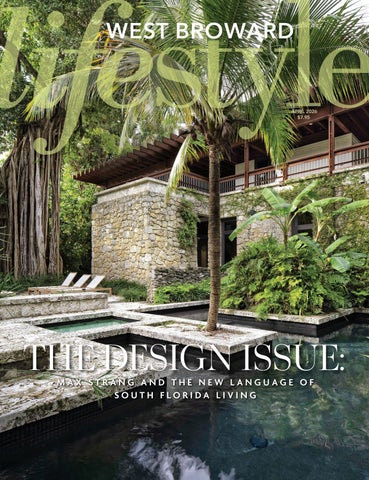
Architect, Max Strang, refines tropical modernism with disciplined lines, climate intelligence, and a deeper connection to place.
Property Tax Debate: Who benefits, who pays, and what November 2026 will decide.
GALLERIA, REIMAGINED 60
A multi-million dollar deal that’s reshaping Fort Lauderdale’s skyline.
FAT VILLAGE GROWS UP 64
New residences, new dining and walkable cultural spaces.
GOOD PRESS 86
From gratitude-filled gatherings to high-gloss celebrations, these are the moments setting the social calendar.


I am THE real estate agent to help you with your purchase of a mountain home! I have lived in sunny South Florida most of my life, but I also longed for the crisp mountain air. I took the leap years ago and purchased a second home in the Asheville area so I have the best of both worlds! My lifelong knowledge of Florida combined with my expertise in Western North Carolina makes me the perfect realtor to help you achieve your dreams too!


TM PUBLISHER MICHELLE SIMON
GROUP EDITOR IN CHIEF JESSICA GRAVES
CREATIVE DIRECTOR MELANIE GERONEMUS SMIT
ART DIRECTORS
ALEXANDER HERNANDEZ
EVELYN SUAREZ
CONTRIBUTING WRITERS
JOSEPH A. MANN JR., JESSE SCOTT
CONTRIBUTING PHOTOGRAPHERS
DARRYL NOBLES, EDUARDO SCHNEIDER, DOWNTOWN PHOTO, KRIS TAMBURELLO
ADVERTISING MARKET MANAGERS
BEN HAMILTON, STEVE LEDERMAN, KIM SARNI
EVENTS JUSTINE ROBB
OPERATIONS MANAGER MONICA ST. OMER
SUNDIAL LIFESTYLE
CHIEF EXECUTIVE OFFICER GARY PRESS PARTNERS
ANDY HILL AND GREG BABIJ
LMG HEADQUARTERS
3200 N FEDERAL HWY, SUITE 228
BOCA RATON, FL 33431
954 601 3979 | LMGFL.COM
EDITORIAL CONTACT: JGRAVES@LMGFL.COM
ADVERTISING CONTACT: info@lmgfl.com
©2025 Lifestyle Magazines are published by Lifestyle Media Group, all rights reserved. Lifestyle Magazine is published monthly. All contents are protected by copyright and may not be reproduced without written consent from the publisher. The advertiser is solely responsible for ad content and holds publisher harmless from any error.
LMG PUBLICATIONS
LAS OLAS LIFESTYLE
BOCA/PARKLAND LIFESTYLE • WESTON LIFESTYLE
WEST BROWARD LIFESTYLE • AVENTURA LIFESTYLE
DORAL LIFESTYLE
SOUTH FLORIDA BUSINESS & WEALTH LUXE


Dear Reader,
Whether you grew up in South Florida or have simply visited long enough to watch it change, you have probably noticed how quickly the landscape evolves. Buildings that once went unnoticed now stand out against a skyline that climbs higher every season. Design has a way of reframing the familiar, and time changes how we see it.
Along Fort Lauderdale’s barrier island, pieces of the past are still easy to nd. Beachside motels from the 1950s and ’60s remain scattered along the coast, their pastel railings and breezy courtyards standing in contrast to the glass towers rising nearby. What once looked dated now reads as personality.
But good design ideas rarely disappear. They simply get reinterpreted.
That idea is part of what makes this month’s cover story on architect Max Strang such a tting presence in our Design issue. His work draws from the principles of Florida modernism that shaped much of the region’s mid-century architecture and translates them for contemporary life through clean geometry, natural materials, deep overhangs, and homes designed to work with light, breeze, and landscape rather than overpower them.
Many of the ideas behind those earlier buildings, light, air ow, shade, and connection to the outdoors, are some of the principles designers are returning to today.
Of course, buildings are only part of the story. What gives a city its character are the people who stay long enough to watch it change.
South Florida continues to grow, and with that growth come pressures many residents are beginning to feel. Rising property taxes, insurance costs, and the broader cost of living are shaping who can a ord to stay in the neighborhoods that helped de ne them.
It is a conversation worth paying attention to. When the people who built these communities are forced out, neighborhoods lose more than homeowners. They lose memory. And places without memory rarely feel like home.
Jessica Graves
Jessica Graves Group Editor, Lifestyle Media Group jgraves@lmg .com

Receive thoughtful insights and continuous advice to help you navigate life’s changes.

Louie Kontos, CFP® Managing Director Private Client Advisor
5100 Town Center Circle, Floor 6 Boca Raton, FL 33486 847.256.2616
louie.g.kontos@jpmorgan.com
Forbes Top Wealth Advisors Best-In-State 2025, 2024
Connect with us jpmorgan.com/lou-kontos

CFP Board owns the marks CFP ® and CERTIFIED FINANCIAL PLANNER® in the U.S. Forbes/SHOOK Top Wealth Advisors Best-In State (04/08/25, data as of 06/30/24); (04/03/24, data as of 06/30/23).Ratings may not guarantee future success or results. Fee paid to rating provider for advertisement materials after rating announced. Methodology here: jpmorgan.com/award-disclosures
J.P. Morgan Wealth Management is a business of JPMorgan Chase & Co., which offers investment products and services through J.P. Morgan Securities LLC (JPMS), a registered broker-dealer and investment adviser, member FINRA and SIPC.
JPMorgan Chase & Co. All rights reserved.


Cartier’s Clash collection loosens its geometry, introducing fluid yellow gold, amplified volume, and a new sensual rhythm.
Cartier has always understood tension. With Clash de Cartier, the Maison built its identity around geometry, studs, and architectural precision. Now, it introduces something more provocative: movement.
For the rst time, the collection’s substantial necklaces and bracelets arrive in entirely exible yellow gold, challenging the rigidity that de ned earlier iterations. Each piece is a feat of dual expertise. Traditional lost-wax casting meets high-precision machining, the latter assembling up to 600 individual components. Every articulated element is polished by hand, connected yet free, producing a subtle vibration when worn. The sound was not incidental; it was engineered, re ned, optimized. Jewelry that moves. Jewelry that hums.
The new yellow gold ampli es that sensuality. Bold, extra-large volumes and onyx studs deepen the contrast between polish and shadow. Colored stones, from red and green-dyed agate to pink chalcedony, are aligned to the millimeter and secured with clou de Paris nails in a process that doubles the complexity of the gold-only designs. The result is architecture so ened by uidity.
Even the earrings play with perception, their twin exible lines designed to transform depending on whether they are worn front and back or forwardfacing alone, o ering a study in adaptability rendered in precious metal. In this latest evolution, Clash de Cartier does not simply rest against the body; it moves with it, responding to gesture, light, and touch with a quiet, deliberate sensuality. cartier.com


Canush bridges high design and everyday living with pieces meant to be used and loved.
In Miami’s ever-evolving MiMo District, a corridor known for its midcentury bones and creative resurgence, Canush Miami o ers something rarer than a trend. It o ers restraint.
Founded by interior designer Danushka Boulos, the 2,266-squarefoot showroom feels less like a store and more like a well-appointed home you wish belonged to a friend with impeccable taste. There is an ease to the space: sculptural vases placed just so, dinnerware that begs to be used rather than displayed, furniture that reads elevated without posturing. Canush was born from Boulos’s recognition that Miami’s design landscape o en swings between the rare ed and the mass-produced. She envisioned a middle ground that is thoughtfully curated, design-forward, and welcoming. The philosophy is simple: comfort with con dence. Pieces are chosen for versatility and longevity, o en sourced from artisans and makers across France, Italy, Turkey, and the United States, with a strong emphasis on European cra smanship. Many items are one-ofa-kind or available by order, ensuring that each visit feels fresh and personal. The rotating seasonal catalog keeps the showroom dynamic, while best-selling decorative accents and vases underscore the brand’s focus on functional beauty. Canush invites locals and visitors alike to slow down, linger, and rediscover the pleasure of living well, without intimidation and without excess. See more @CanushMiami on Instagram.


From leather to porcelain, Christopher King builds modern heritage.
On Worth Avenue, where legacy names gleam behind polished glass, a new house has quietly taken its place. Christopher King’s 2,500-square-foot agship at 201 Worth Avenue arrives with the con dence of an old-world atelier and the clarity of a modern founder who prefers ownership to outsourcing.
Christopher R. King does not license his vision. He builds it. Just outside Florence, he owns and operates a 7,000-square-foot factory where generational artisans cut, stitch, mold, and polish each piece by hand. Italian leathers and exotic skins are selected with the discernment of a collector. Solid brass hardware is cast and nished the traditional way. Porcelain is shaped and red with the patience that only comes from knowing time is part of the cra . In an era when many luxury houses have become masters of branding rather than making, King’s fully vertical model feels almost radical.
The collection is expansive but cohesive: leather goods and accessories; linens and tableware; mid-century-inspired furniture that nods to European restraint without sacri cing Palm Beach ease. Every piece is designed by King himself, a founder whose ngerprints remain on the nal product. Set among neighbors such as Chanel and Ti any & Co., Christopher King does not shout for attention. It signals something subtler: that true luxury, even now, begins at the factory oor—and with the founder who refuses to leave it.
christopherking.org


Beauty is more than skin deep. In the world of aesthetic and integrative/functional medicine – it’s an intricate balance of health, artistry, and attention to detail. At Icon Aesthetics & Wellness in Pompano Beach, Florida, Chad Van Horn, PA-C, embodies this philosophy by redefining beauty standards with a holistic approach.”


SHOP OUR TILE & STONE STUDIO
CURATED TILE & NATURAL STONE COLLECTIONS
EXPERT DESIGN GUIDANCE
SEAMLESS COORDINATION FROM SELECTION TO INSTALLATION
RENOWNED KITCHEN & BATH REMODELING SPECIALISTS


DESIGN -DRIVEN, FLAVORFORWARD, AND NEWLY CROWNED WINNERS ON SOUTH FLORIDA’S DINING SCENE

North America’s fast-growing dining group makes its Miami mark with design ambition, coastal flavor, and a happy hour built to linger.
By now, you’ve likely heard the buzz—or secured the reservation. Cactus Club Cafe o cially opened its Downtown Miami location in February, and as spring settles in, the 35th outpost of the Vancouver-based brand is nding its rhythm inside the Citigroup Center.
The 11,500-square-foot space, designed by ICRAVE, feels calibrated for Miami: layered greenery so ens slatted wood detailing, custom lighting glows against commissioned works by neo-expressionist Hunt Slonem, and a central bar anchors the room with kinetic energy. It is stylish but not self-serious, the kind of setting that works as easily for a midweek lunch as it does for late-night drinks.
Executive Chef Greg McCallum’s menu reads like a greatest-hits album of modern North American dining with coastal uency. Sushi and ceviche sit comfortably alongside Wagyu carpaccio, steaks, composed salads, and a Key lime pie that nods knowingly to its zip code. From 3 to 7 p.m., happy hour draws a polished crowd, while a late-night round keeps the momentum going.
In a city saturated with splashy openings, Cactus has opted for something smarter: consistency, atmosphere, and a table you’ll want to claim again. cactusclubcafe.com


La Birra Bar repeats as Burger Bash champion with the internationally lauded “Crispy Dubai,” a study in Argentine craft and global ambition.
For the second year in a row, South Florida’s own La Birra Bar has claimed the People’s Choice Award at Burger Bash during the South Beach Wine & Food Festival, a crowd-powered victory that says as much about loyalty as it does about avor. This year’s winning entry, the “Crispy Dubai” burger, arrives with international credentials: it was previously named Overall Winner at the 2026 Dubai Burger Championship before making its stateside debut.
The burger itself is a study in texture and restraint. Made with 100 percent Argentine beef, layered with white cheddar, signature crispy onions, and a house sauce that blends family-recipe chimichurri, mayonnaise, and a whisper of black tru e, it lands on a freshly baked artisan bun engineered to hold its own. The result balances crisp, cream, and juice without collapsing into excess.
Founded in 2001 by Daniel Cocchia in Buenos Aires, La Birra Bar has grown from a neighborhood shop in Boedo into one of the world’s most awarded burger brands, with locations across Argentina, Miami, Madrid, and Santiago. In South Florida, the “Crispy Dubai” is now available in Wynwood, Weston, North Miami Beach, Doral, and Fort Lauderdale. labirrabar.com

Mayami reopens with a seamless evolution from dinner to highenergy spectacle.
Mayami is entering its next chapter with a full-scale architectural transformation that reframes the Wynwood mainstay as both design destination and nightlife theater. Reopened by Golden Era Hospitality Group, the 8,500-square-foot venue has been reimagined by Casa Medina Design Studio with a vision rooted in Mexican craftsmanship and material integrity. Drawing inspiration from Yucatecan haciendas and Oaxacan architecture, the redesign favors hand-troweled plaster walls, sculptural wood detailing, burnished bronze, and artisanal tilework over overt theming. Arched passageways and monolithic forms create a sense of procession, leading guests toward an open-air courtyard that anchors the indoor–outdoor experience. As daylight fades, ickering candlelight and layered textures shift the mood from relaxed dinner to high-energy spectacle.
Founder Philippe Kalifa describes the reopening as an evolution rather than a reinvention, preserving the bold avors and theatrical programming that built Mayami’s following while elevating the setting itself. The refreshed menu expands its Latin-Mediterranean base with sushi selections and seafooddriven dishes alongside signature plates like a 32-ounce prime tomahawk and short rib a la barbacoa. By night, re dancers, live performers, and DJ sets once again transform the space into one of Miami’s most immersive supper clubs—now framed by architecture designed to command its own spotlight. mayamiwynwood.com


At Mottai, restraint, precision, and pristine seafood define the experience at The Plaza Coral Gables.
Coral Gables has no shortage of polished dining rooms, but Mottai arrives with a clarity of purpose that sets it apart. Now open at The Plaza Coral Gables, the restaurant is the rst U.S. concept from Brazil’s Attivo Group, and it feels less like an import than a considered addition to the neighborhood’s evolving palate.
The menu, developed by Chef Brian Nasajon alongside Executive Chef Moritz Esser and Sushi Chef Hiroshi Shintaku, centers on technique over theatrics. Cold plates lead with precision: hamachi brightened by white soy ponzu and citrus oroshi; hirame layered with
pomelo and lemongrass. Hot selections lean into depth and texture, from Japanese eggplant glazed in miso mustard and tentsuyu to steamed clams fragrant with sake and chive oil. Signature dishes stretch beyond sushi without abandoning discipline. A seafood-forward Sugi Katsu swaps pork for cobia, paired with ponzu aioli. Pork belly arrives lacquered in hatcho yakiniku, meant to be wrapped in bib lettuce with shaved shallots. From the grill, American Wagyu rib-eye and U4 prawns underscore the kitchen’s con dence with ame and seasoning. At the sushi counter, Shintaku—whose
résumé includes Makoto and Hiyakawa—keeps the focus squarely on balance. Toro, kinmedai, uni, and ama ebi are o ered as pristine nigiri or sashimi, with curated chef’s selections.
The room, dressed in marble, deep blue velvet, and subtle crane motifs, transitions easily from business lunch to intimate dinner. Cocktails nod to Japanese in uence without overpowering the plate, and desserts, including a mango chawanmushi and molten chocolate fondanta, close the meal with restraint. mottaimiami.com


THE BEST HOMES DO MORE THAN LOOK STRIKING. THEY ANSWER TO SUN, STORM, AND THE SITESPECIFIC DEMANDS OF LIVING HERE.
BY JESSE SCOTT


it’s easy to mistake spectacle for architecture. This corner of the state has never been short on houses that preen for the water, pose for the drone shot, or borrow some vaguely Mediterranean fantasy that could just as easily belong in Scottsdale, Arizona, as along the Intracoastal.
Max Strang has spent much of his career pushing in the opposite direction. His homes are undeniably dramatic, but their drama comes with purpose: shade, air ow, privacy, structure, elevation, and resilience. In a region where design can o en feel imported, Strang’s work reads as something rarer — architecture that could only have come from right here.
That sensibility has made the Miami-based architect one of the state’s de ning design voices. This year also marks the 25th anniversary of his Coconut Grove–headquartered rm, STRANG, which was named AIA Florida’s 2025 Firm of the Year. Yet if you ask Strang where things stand in 2026, he sounds less interested in celebration than in what comes next.
“We still feel like we’re just getting started,” he told Lifestyle.
That drive makes sense for someone whose design worldview was shaped as much by childhood memory as by formal training. Strang grew up in Florida in a Gene Leedy–designed family home in Winter Haven, immersed early in the ideas of the Sarasota School, where architecture was site-driven, climate-driven, and deeply regional. Later came the University of Florida, graduate school at Columbia, and formative experiences that broadened his perspective without severing the original thread. What endured was a belief that architecture here should collaborate with the landscape rather than combat it.
Strang calls his approach “environmental modernism,” and the phrase resonates because it is not empty branding. “We really respect the South Florida climate and geography,” he said. “I think an important part of architecture is to use local materials.” That can mean oolite or


keystone in Miami, warm woods that withstand the elements, or concrete handled in a way that feels tactile rather than severe.
Strang speaks with particular conviction about “real materials” — stone, sustainably sourced wood, and textured concrete — and how they lend a home both authenticity and permanence.
That attention to material is also what gives his projects their sense of place. His houses do not merely sit in lush settings — they seem to belong to them. They frame banyans and river bends, lter
connected to the performance of the building,” he said.
That philosophy also shapes one of the rm’s more recent works, the Van der Vlugt Residence in the Florida Keys. Elevated above the landscape, the home embraces a palette of natural stone, concrete, and wood while responding directly to the realities of coastal living.
“It’s li ed up o the ground,” Strang explained. “One, for hurricane storm surges. Two, for sea-level rise. And three, because it allows us to create some very
“
light through vertical ns, and turn shade into a luxury rather than an a erthought.
Few projects capture that better than the Tuckman residence on Fort Lauderdale’s New River, one of Strang’s most recognizable works in Broward County. He calls it noteworthy because it marked the rst time his rm used a curve in a project, a gesture driven by the site and its views. But its real power lies in how its boldness doubles as performance. The home’s vertical ns, Strang noted, do more than de ne the façade. They provide privacy, help with drainage, and, in some cases, contribute structurally.
“The identity of the home is
interesting spaces underneath.”
The result is a structure that feels modern and elemental, balancing durability with warmth while acknowledging the environmental realities of the Keys.
The same ethos runs through another de ning project: the Rock House in Coconut Grove, arguably the work that rst placed Strang on the architectural map. Completed in 2004 as his own family home, the residence distilled in uences from the Sarasota School, tropical modernism, and Miami’s geology into a house that felt both primal and re ned. It later became widely recognized a er appearing

in Michael Mann’s Miami Vice as a drug lord’s lair, further cementing its lore.
There is also an evolution visible across Strang’s body of work. Earlier projects leaned heavily into stone and structural expression. Later ones sharpened into frames and ns, quieter and more disciplined but no less responsive. That progression mirrors a broader maturation in Florida architecture itself.
“There’s a lot of attention on South Florida now,” Strang said, noting the in ux of international rms working from Palm Beach to Miami. He sees that competition as a positive — evidence that the region has moved to the forefront of the global design conversation.
And yet what makes Strang especially compelling in this moment is not that he is relentlessly pursuing international relevance. It is that he has stayed rooted in the idea that Florida already contains its own architectural language. His rm, now comprised of a 50-person multidisciplinary team with projects across the Caribbean, in Utah, and even Dubai, has the scale to work far outside the state.
But the best of Strang’s work still feels inseparable from this place.
That may be why his houses resonate so strongly right now. As more homeowners seek spaces that are livable, resilient, and connected to their surroundings, Strang’s work feels like a blueprint for where Florida living is headed. His architecture is modern, but never placeless.


JULIE TALENFELD
President of BoardroomPR
1776 N. Pine Island Road, Suite 320 Fort Lauderdale, FL 33322
954.370.8999
jtalenfeld@boardroompr.com. BoardroomPR.com
During the pandemic, millions of people discovered—or rediscovered— the centuries-old Chinese game of mahjong. What started as a boredom cure somewhere between sourdough starters and home workouts quickly became a full-blown cultural moment. And of course, there’s the wine.
I am just getting into the game now, and at this stage, my pickleball game is far more impressive than my mahjong skills. It’s confusing for a newcomer like me (hello math!?). But from what I’m told, you don’t have to master every
mocked the game is studying the card like it’s the SAT!
Because mahjong, it turns out, is strategic. It rewards observation, timing, patience—and a little bit of luck—just like any good public relations campaign.
Which brings me to the part that fascinates me most. At first glance, both the game and the world of PR look chaotic to outsiders. There are symbols, strategies, signals, and people making moves that don’t immediately make sense. But

rule to fall in love with the game. All you really need is a table, three friends, a set of tiles, and a great bottle of Chardonnay.
Now I may be a mahjong novice, but as a veteran publicist, I have to applaud mahjong for being in the right place at the right time. With restaurants closed and social calendars suddenly empty in COVID, the game filled the gap beautifully: it’s social without being strenuous, competitive without being aggressive, and just complicated enough to make your brain forget the news cycle for a few hours.
Perhaps the most surprising development in the mahjong renaissance is that even husbands have started joining the game! Before long, the same husband who once
underneath that surface confusion is a system. And success depends on reading the table.
And sometimes the winning move isn’t the one you planned at the beginning. It’s the one you adapt to mid-game. Mahjong also reminds us of something else that great PR professionals understand: people connect best when they’re sitting at the same table.
So whether you’re building a winning hand or winning brand, success depends on reading the room, watching the conversation, studying the timing, and paying attention to the signals people send—before they even say a word.
And if it happens over a few glasses of good wine? Well, that’s just good communications strategy.


WHAT HOMEOWNERS GAIN, WHAT CITIES COULD LOSE, AND WHY NOVEMBER 2026 MATTERS
BY JESSE SCOTT


n a quiet street in Oakland Park, Colleen Pollett opens her latest mortgage statement and does what many South Florida homeowners now do instinctively. She skips past the principal and interest and goes straight to escrow. Insurance. Taxes. Adjustments.
Even with a homestead exemption, she says those line items have grown less predictable and far more expensive than she imagined when she bought her rst home nearly a decade ago.
“I’m willing to pay taxes,” she says. “I just want to feel like what I’m paying makes sense.”
That frustration now sits at the center of one of the most consequential ballot measures Florida voters will see in years: eliminating nonschool property taxes on homesteaded primary residences.
In Coral Ridge, 48-year-old Lauren Mitchell sees the issue through a generational lens. She’s a single mother raising her children in the same neighborhood where she grew up, when Fort Lauderdale felt smaller and deeply local. She owns it outright. There’s no mortgage payment. Yet each year, a property tax bill arrives re ecting a market reshaped by out-of-state buyers and rising valuations.
Even with annual increases capped, assessments climb. Homes nearby sell, get renovated, or are torn down and rebuilt. Prices reset expectations block by block. Longtime neighbors quietly move away.
“Fort Lauderdale feels completely di erent from when I was growing up here,” she says. “We knew every family on this block. Now homes sell, get renovated, and the faces change every year. Some of my neighbors who raised their kids here couldn’t keep up with the rising costs and had to move. It’s hard not to feel like the sense of community we had is slipping away.”
She supports public services. What unsettles her is the feeling that appreciation she never asked for continues to translate into higher annual costs tied to a house she already owns.
What’s on the Ballot
In February 2026, the Florida House passed HJR 203, a proposed constitutional amendment that would expand the homestead exemption by $100,000 annually beginning in 2027. By 2037, non-school property taxes on primary residences would be fully phased out.
The amendment must receive at least 60 percent

approval in the November 3, 2026 General Election.
School district taxes would remain. The portion a ected funds county and municipal services such as roads, drainage systems, sanitation, parks, planning departments, and parts of police and re operations.
To understand the math, consider a $750,000 home in Broward County. A er exemptions, roughly $700,000 of that value may be subject to county and city taxes. Local governments charge a set dollar amount for every $1,000 of taxable value. If that rate is about $10 per $1,000, the annual non-school portion comes out to around $7,000. Under the proposal, that amount would gradually shrink over time, potentially saving full-time residents several thousand dollars per year.
For primary homeowners, retirees, and single-income families, that relief could be meaningful. But removing a revenue source doesn’t eliminate the need for funding.
Local governments still must maintain infrastructure, operate parks, manage stormwater, and fund public safety. Legislative estimates suggest billions in recurring revenue
could disappear once the homestead phaseout is complete. In practice, that funding would likely shi rather than vanish.
Counties could increase tax rates on non-homesteaded properties such as second homes, vacation residences, investment properties, and commercial real estate. Unlike primary homes, those properties don’t receive homestead protections. For out-of-state owners from California or New York, Florida would still remain comparatively attractive. Those states levy high state income taxes along with higher e ective property tax rates. Florida has no state income tax and no estate tax, and even an increase in non-homesteaded property rates would likely leave it competitive.

Another avenue is consumption-based revenue. Counties can ask voters to approve local sales surtaxes, which spread the burden across residents and visitors. In a tourism-heavy economy like South Florida’s, that captures revenue from seasonal residents and vacationers.
Tourist development taxes, commonly added to hotel stays and short-term rentals, could also play a role. Their use is currently restricted, o en tied to tourism promotion and certain capital projects. Expanding their exibility would require legislative action, but they represent another potential lever.
Local governments may also rely more heavily on user fees, development impact fees tied to new construction, or targeted assessments for infrastructure projects. Some municipalities could trim discretionary spending or delay capital improvements.
The burden would not disappear. It would redistribute.
Critics argue that property taxes are one of the most stable funding sources available. Sales taxes uctuate with economic cycles. Tourism rises and falls. Commercial property markets shi . Relying more heavily on those streams introduces variability into local budgets.
Supporters counter that primary residences shouldn’t serve as the most dependable revenue engine for local government, particularly when rising home values rather than rising incomes are driving tax bills upward.
Florida voters approved an in ation-linked homestead adjustment in 2024. The 2026 proposal asks whether that protection should go further.
Those who bene t most would be year-round residents with homesteaded properties, especially households on xed or single incomes. Second-home owners and commercial property holders could shoulder more of the municipal burden. Renters might feel indirect e ects depending on how landlords respond to shi ing costs.
For Pollett, the debate centers on predictability.
For Mitchell, it’s about continuity and legacy. “I’d love for my kids to have the option to raise their families here someday,” she says. “I just hope rising taxes don’t make that decision for us.”
We specialize in all forms of dermatology including, general, cosmetic, & surgical treatments.
Services
Acne, Botox, Eczema, Psoriasis, Rashes, Skin Cancer, Skin Checks, Warts
Book Now (954) 860-7500 premierdermatologypartners.com

Hablamos español. Llame al 954-860-7500 para hacer su cita de dermatología.
N Federal Highway, Ste 303


BY JESSICA GRAVES
or more than four decades, Allied Kitchen & Bath has helped shape the interiors of South Florida homes, translating everyday routines into spaces that feel thoughtful, functional, and personal. Since opening in 1984, the Fort Lauderdale–based rm has evolved alongside a region that never stops reinventing itself, adapting to new technologies, changing lifestyles, and a growing demand for design that re ects how people actually live.
“Our company started small and grew into a highly professional organization,” says Rob Feinberg of Allied Kitchen & Bath. “From the beginning we’ve focused on training, professionalism, and giving back to the community so we can deliver the highest level of service.” Design technology has been one of the biggest changes. “When we rst started, every design was hand-drawn,” Rob says. “Today CAD drawings and computer modeling allow clients to clearly see the design vision and

feel con dent about the direction of the project.”
That clarity has changed the renovation process.
“The design process always begins with understanding the client’s needs, lifestyle, and goals for the space,” Rob says. “Listening carefully to how they live helps us shape a design that truly works for them.”
Designer Melissa Mailly says the work itself has grown more complex as projects have become larger and more detailed.
“When Allied rst began, projects were generally smaller in scope,” Mailly says. “Over time, as the company gained experience, we began taking on larger and more comprehensive renovations, including full-home projects. We’ve re ned our systems so we can manage complex work while maintaining the level of quality clients expect.”
Allied’s showroom helps turn those ideas into real plans, allowing clients to review materials, layouts, and nishes with guidance from the design team.
“We present multiple design concepts and re ne them together,” Rob says. “Renderings allow clients to visualize the nal result, which makes decisions easier and minimizes surprises
during construction.”
Joseph Feinberg, vice president of Allied Kitchen & Bath and a licensed general contractor, says advances in materials and building technology have changed what homeowners expect from a renovation.
“We’ve moved from laminates to engineered quartz and large-format porcelain slabs,” Joseph says. “Custom cabinetry with sophisticated storage systems, integrated appliances, and smart xtures are now common features.”
Junior designer Mia Ruzzo sees many of the biggest shi s happening in the nishes themselves. “I’m loving the return of timeless natural materials,” Ruzzo says. “Living nishes, natural stone, and layered textures create spaces that feel original and custom.”
Technology, she adds, is becoming less visible but more important. “Smart features and integrated lighting are becoming almost invisible,” Ruzzo says. “They elevate the experience of the space while keeping the design clean and intentional.”
Behind the scenes, Allied’s team structure re ects the same focus on preparation and expertise. The company employs numerous designers

certi ed by the National Kitchen & Bath Association.
“Having a team of NKBA-certi ed designers means our clients are working with professionals who stay current with industry standards, building codes, and best practices,” Rob says. “That expertise gives homeowners real peace of mind.”
Mailly says that training also shapes decisions clients may not immediately notice. “Certi ed designers understand ergonomics, universal design, and how a space truly functions,” Mailly says. “That knowledge helps us create kitchens and baths that are not only beautiful, but comfortable and practical for daily life.”
Those details matter even more in South Florida, where projects must meet strict building codes and structural requirements. “A big part of our role is educating clients about what’s involved in completing a project correctly,” Rob says. “Proper planning, permits, and coordination are essential to delivering the results we promise.”
Kitchens, Joseph adds, have become the center of the modern home.
“Open concept oor plans and large islands with seating have turned kitchens into the social hub of the home,” Joseph says. “It’s where people gather, cook, and entertain together.”
If the kitchen has become the place where everyone comes together, the bathroom has evolved into the space designed for quiet and comfort.
“Freestanding soaking tubs, curb-less walk-in showers, steam showers, heated oors, and smart lighting are all becoming part of the experience,” Joseph says.
The result is a renovation process that goes beyond updating nishes. The goal is never just to update a room. It’s to create spaces that work the way people live, day a er day, long a er the renovation is nished.
alliedkitchenandbath.com

FROM WARDROBES TO MEDIA ROOMS, CALIFORNIA CLOSET’S TAILORED SYSTEMS QUIETLY SHAPE THE WAY MODERN HOMES LIVE
uxury homes o en advertise their most visible virtues rst: ocean views, soaring ceilings, architectural drama. Yet the real measure of how a house lives day to day is usually hidden behind a door. Closets. Pantries. Home o ces. The spaces where routines unfold and clutter either gathers or disappears.
For nearly ve decades, California Closets has been designing those spaces with an attention to both precision and beauty. Founded in Southern California in 1978, the company helped shape the modern custom storage industry long before walk-in wardrobes became a design aspiration. What began as a practical solution for better organization has evolved into a design-focused company creating tailored systems for closets, media rooms, home o ces, pantries, and other living spaces.
Today, with more than 150 locations worldwide, the brand operates less like a traditional storage company and more like a design partner—one that approaches organization as an extension of architecture and lifestyle.
“At its core, California Closets has always been about designing around the way people truly live,” says Julie Shvedyuk, Vice President of Operations. “Our design DNA is rooted in personalization, timeless aesthetics, and precision cra smanship.”
Every project begins with an exercise in observation. Designers study the client’s routines—how they dress, work, travel, and move through their home.
The design evolves from those details, shaping shelf heights, drawer placement, lighting, and accessories to support daily habits rather than abstract layouts.
Two wardrobes may appear visually similar. Internally, they can function entirely di erently.
“Function always comes rst,”
Shvedyuk says. “But it should never look purely functional. Our designers think about proportions, lighting, nishes, and how the system integrates into the architecture of the home, while also considering practical details—where handbags live, how sweaters are folded, and how
adjusting the design until the details feel exactly right.
From there, the project moves into engineering and production at the company’s local manufacturing facilities in Palm Beach and Miami. Every component is fabricated to precise speci cations before installation teams assemble

"Atitscore,California Closetshasalways beenaboutdesigning aroundtheway peopletrulylive,"”
accessible everyday items should be.”
That balance between utility and aesthetics de nes the California Closets process. The experience begins with a design consultation that focuses as much on lifestyle as square footage. Designers then translate those conversations into detailed 3D renderings using the company’s proprietary CAD technology, allowing clients to visualize their future space before production begins.
Clients review materials, nishes, and con gurations in real time,
precision o en plays out in homes designed for expansive living. Large wardrobes, integrated media walls, and custom storage solutions help organize houses where architecture, entertaining, and lifestyle intersect.
While the scale may vary from market to market, California Closets maintains consistent engineering standards across its global network. A project in Miami follows the same design and manufacturing principles as one in Los Angeles or New York. Materials and nishes, however, continue to evolve alongside broader design trends. Clients increasingly gravitate toward warmer palettes: textured wood grains, so matte nishes, bronze and champagne-toned metals, and integrated lighting that gives storage spaces a more architectural presence.
Each year, members of the company’s design leadership attend Milan’s Salone del Mobile to study emerging materials and cra smanship innovations. New nishes undergo durability testing before entering the product lineup, ensuring they hold up to years of everyday use.
the nished system inside the home.
Unlike modular storage products, nothing is pulled from inventory.
“The biggest di erence is that we manufacture speci cally for each individual project,” Shvedyuk explains. “Every component is engineered and produced based on the client’s exact design and measurements. That allows for a level of precision that modular systems simply can’t achieve.”
In South Florida—spanning Palm Beach, Miami, Broward, and the Florida Keys—that
Longevity also informs the brand’s sustainability approach. By manufacturing components speci cally for each project rather than relying on excess inventory, the company reduces production waste. Many materials are sourced from responsibly managed forests, and the nished systems are designed to last for decades. Looking ahead, Shvedyuk believes storage will play a more visible role in the architecture of modern homes.
“Luxury storage is becoming part of the design of the home itself,” she says. “We’re seeing wardrobes that resemble boutiques, home o ces that integrate seamlessly into living spaces, and media rooms designed with both aesthetics and technology in mind.”
BY JESSICA GRAVES
tep inside the Kitchenworks showroom and the di erence is immediate. These are not theatrical display kitchens staged for e ect. The spaces feel lived in, quietly assured. One suggests a dinner party dri ing into its second bottle of wine. Another evokes the choreography of a morning routine, co ee brewing while someone slices fruit at the counter.
For Anthony Rocco, the second-generation leader behind the South Florida design rm, that sense of authenticity is intentional.
“When I sit down with a client, I’m not starting with cabinets,” he says. “I’m starting by getting to know who they are. How do you live? Do you cook o en or rarely at all? Are your kids at the island while you’re prepping dinner? Do you entertain groups or is it just you and your spouse with a glass of wine?”
Those early conversations shape every project. Kitchens, Rocco believes, reveal the rhythms of a household more honestly than any other room. When design begins with those rhythms rather than aesthetics, the space evolves naturally into what he calls the true heart of the home.
“The kitchen should be a re ection of the people living in the home,” he says. “Their values, how they connect with each other. When a kitchen truly re ects the people in it, it becomes the room everyone gravitates to.”
Kitchenworks has spent more than three decades creating those spaces, building a reputation for kitchens that feel as intuitive as they are re ned. The company was founded by Rocco’s mother, Susan, whose emphasis on relationships and enduring design still guides the rm today.
“Our signature isn’t a style,” Rocco explains. “It’s a standard. Across 36 years you’ll see everything from rich traditional kitchens to clean, minimalist European-in uenced spaces. What ties them together is cra , attention to detail, and an obsession with function.”
Function has grown increasingly complex as kitchen technology has advanced. Premium appliances now operate like nely tuned machines, and integrating them seamlessly into cabinetry requires careful coordination between designers, manufacturers, and installers.

“The biggest challenge is that today’s appliances have to be fully integrated into the cabinetry,” Rocco says. “At the same time, you’re balancing what a client envisions with the realities of the space. Sometimes the dream layout doesn’t accommodate the appliance package they want.”
The process becomes a kind of technical puzzle. When it works, the complexity disappears behind the nished design.
“The opportunity is that when you do it right, everything feels seamless,” he says. “The appliances disappear into the design. The client only sees a beautiful kitchen, not the hundred technical decisions that made it possible.”
Designing in South Florida adds another layer of consideration. Climate, architecture, and lifestyle all in uence how kitchens take shape.
“South Florida is its own world,” Rocco says. “Indoor-outdoor living year round, salt air that punishes the wrong materials, and clients who split time between homes elsewhere. We select materials that handle humidity and coastal conditions, and we think about work ow di erently because the kitchen o en opens directly to outdoor entertaining.”
Still, the most memorable projects o en grow from collaboration rather than materials. Rocco recalls one recent design where a client asked the team to create a combined master bathroom and closet, a
private retreat for her and her husband.
“We spent countless hours learning how they actually lived in that space,” he says. “What they wanted hidden away, what they wanted to see every day, how they moved through their morning routine.”
The nished room became one of the most personal spaces the rm has created.
“Not because of a particular material or nish,” Rocco says, “but because every inch was built around their life.”
That philosophy also shapes how Kitchenworks navigates the tension between timeless design and passing trends.
“A kitchen should still feel right in een or twenty years,” he says. “We incorporate contemporary elements like integrated appliances and minimal hardware, but we anchor every project in proportion, material, and functionality.
Those don’t go out of style.”
Looking ahead, Rocco expects kitchens to continue expanding as the most dynamic room in the home.
“Technology integration will keep accelerating,” he says, “but the best kitchens will make it invisible. Smart appliances should integrate into your life without being loud.”
What will remain constant is the instinct that keeps drawing people back to the room where food, conversation, and daily life intersect.
“The kitchen keeps evolving,” Rocco says. “But the reason people gather there never really changes.”

A MASTER-PLANNED COMMUNITY EAST OF NAPLES BETS ON CONNECTION, SHARED AMENITIES, AND LONG-TERM GROWTH TO ATTRACT FAMILIES AND ACTIVE ADULTS ALIKE
BY JESSE SCOTT

rive east from Naples and the landscape begins to open up. Subdivisions thin. Preserves stretch wider. Then, rising from former farmland, the steeple of Ave Maria appears like a quiet declaration: you’ve arrived.
At nearly 5,000 acres, Ave Maria is no accident. Developed by Barron Collier Companies in partnership with Domino’s founder Tom Monaghan, the community recently marked two decades since
groundbreaking and is about halfway to its planned 11,000 homes. Last year alone, 515 residences sold — a notable gure in a state crowded with master-planned ambition.
For Michelle Mambuca, marketing and PR manager for Barron Collier Companies, the through line is connection.
“It’s a planned community, so there’s everything that you need in town,” she says. “It’s mixed use. There’s residential, there’s commercial, and there’s a lot of growth happening now — more homes being sold, more commercial coming, which was the plan from the very beginning.”
What increasingly distinguishes Ave Maria in Southwest Florida’s development landscape is its emphasis on intergenerational living.


Like many large-scale communities in the region, Ave Maria includes an active adult component. Del Webb Naples serves residents 55 and older. Yet it exists within a broader ecosystem that includes preschool through university education — with Ave Maria University anchoring the town center — alongside builders attracting families and working professionals.
“There’s a whole mix of ages and types of people, but everybody really has the same values,” Mambuca says. “They come here for similar reasons.”
Builders including Pulte, CC Homes, Lennar, and Del Webb o er home styles and price points generally spanning from the low $200,000s to the $800,000s. That range allows retirees, young families, and extended families to settle within blocks of one another.
Shared amenities reinforce the overlap. North and South Parks feature pickleball courts, sports elds, and recreation areas connected by roughly 100 miles of walking paths. Golf carts hum through neighborhood streets, a cultural cue of what residents describe as a “big kind of small town.” In an era when retirees o en seek age-segregated enclaves and young families chase school districts, Ave Maria layers those groups together by design.
Donna and Luis Perez had spent years in Cooper City, accustomed to Broward County’s steady pace. When their daughter relocated to Ave Maria with her family, they were skeptical. “We thought we’d just visit and see how things were going,” Donna Perez says. “But we fell in love with it ourselves.”
WE TEND TO FIND PEOPLE WHO WANT TO KNOW THEIR NEIGHBORS. THEY WANT TO GET INVOLVED AND GIVE BACK TO THE COMMUNITY. IT’S NOT JUST A HOME.”
What surprised them was not manufactured charm but lived rhythm: children riding bikes along wide streets, neighbors gathering in parks at dusk, a sense of ease that felt deliberate rather than isolated. “At rst, we weren’t sure if any of us could adjust to small-town life,” Donna says. “But a er experiencing it, we’ve come to realize how wonderful it is for families. It’s the perfect place to grow together.” Their story re ects a broader pattern. Intergenerational living o en begins with a single move — a family relocating from Fort Lauderdale or Miami in search of more space and quieter streets. Months later, parents or siblings follow. What starts as one address becomes a cluster, bound less by marketing than by momentum.
For some, that design shi s long-held assumptions.
For South Florida transplants accustomed to denser coastal corridors, a ordability and scale remain central to the appeal. “You could buy a home anywhere,” Mambuca notes. “So why
are you going to choose Ave Maria? It really is a special place.” Buyers seek larger oor plans, home o ces, and backyard space, but also something harder to quantify: belonging. “We tend to nd people who want to know their neighbors. They want to get involved and give back to the community. It’s not just a home.”
For some East Coast residents, the map still suggests “the middle of nowhere.” In practice, Ave Maria sits within 45 minutes of central Naples and roughly an hour and 45 minutes from Fort Lauderdale or Miami, tra c permitting. As development steadily pushes east, new commercial corridors continue to ll in.
Preservation remains part of the equation. Approximately 17,000 acres of surrounding preserves shape the broader area, and stewardship requirements guide ongoing growth. Within town limits, more than 75 businesses operate, from medical practices to boutiques and restaurants. The ambition is convenience without constant commuting.
Education and health care anchor the next phase. A new public elementary school is slated to open for the 2026–27 school year, complementing existing private and university options. The Freedom Institute of Ave Maria, a homeschool program for high school students, is expected to launch this year. Dialum, a glass nishing company, is preparing to break ground on its headquarters, projected to bring at least 80 jobs. Naples Comprehensive Health has opened an urgent care center, with plans for expanded pediatric services, a freestanding emergency room, and eventually a hospital.
In a state de ned by rapid growth and master-planned ambition, Ave Maria’s di erentiation may come down to sociology. By design, grandparents, parents, and students share sidewalks, sports elds, school pickup lines, and Sunday dinners within the same ZIP code. In Florida’s evolving growth story, that proximity — intentional, organic, and increasingly multigenerational — may prove its most enduring asset.


Originally built in 1954 as an open-air shopping center before evolving into its enclosed form in the 1980s, the Galleria once de ned regional retail glamour. Neiman Marcus, Lord & Taylor, Saks Fi h Avenue. Those names signaled arrival. Over time, that cachet eroded. Occupancy now hovers around 60 percent, and the mall has reportedly been losing money for years. Despite periodic upgrades, the once-thriving food court has dwindled. Large portions of the eastern end remain vacant. The redevelopment aims to do more than polish. It intends to reposition the property entirely.
While developers have not disclosed a precise price tag, a representative described it as a “multi-billion dollar investment.”
The economic implications are substantial: thousands of construction jobs, demand for materials and equipment, and long-term commercial activity tied to hospitality, retail, and residential growth.
The Live Local Question
The plan also arrives wrapped in legislation.
“There are a number of boxes that need to be checked to ensure that the developer’s application complies with the state statutes,” Mayor Trantalis told Lifestyle. He suggested that the developers might be considering switching some rental units to condominiums to improve the project’s economics.
“I’m hopeful it will be a wonderful project.”
Local resident Abby Laughlin, an artist, activist, and small-scale real estate developer, worries momentum may outpace scrutiny.
IN THE NEAR TERM, IT WILL GENERATE CONSTRUCTION
JOBS AND ECONOMIC ACTIVITY. OVER TIME, IT STRENGTHENS OUR TAX BASE AND EXPANDS ATTAINABLE HOUSING, SUPPORTING A MORE INCLUSIVE LOCAL ECONOMY.
The proposal was submitted under Florida’s Live Local Act, which promotes a ordable housing and limits municipal discretion over qualifying projects. Of the 3,144 proposed rental units, 1,273 would be designated workforce housing and 1,841 market rate. To qualify, at least 40 percent of units must be rented to households earning at or below 120 percent of the area median income. According to the city, in 2025, that gure for a family of four in the mall’s surrounding neighborhoods was $96,200.
Still, the Live Local mechanism has unsettled nearby residents in Coral Ridge and Sunrise Intracoastal. They cite concerns about worsening tra c along Sunrise Boulevard, infrastructure strain, and potential impacts on property values. Some fear the scale alone—nearly 3,200 new units— could shi the surrounding area from a primarily low-rise enclave to a far denser urban corridor.
Fort Lauderdale Mayor Dean Trantalis has acknowledged the tension. While most projects undergo extensive municipal review and public hearings, Live Local narrows that pathway.
“To add almost 3,200 units to this site raises a lot of questions,” he said. “Live Local pulled the rug out from under us. It ties our hands. It doesn’t allow our neighbors a say in what is being built.”
Currently, the developers’ proposal remains under review by the city’s Development Services Department.
“They’re moving ahead at full speed,” she said. “I hope the project is above board and respectful to the city and its residents. It seems the city can only change technical items like setbacks, stormwater, and landscaping. The devil is in the details.”
The development team frames the project di erently.
Stephanie J. Toothaker, an attorney for the group, called the redevelopment “a huge win for Fort Lauderdale. This is a major investment that will create jobs, boost the local economy, supply needed housing, and build a new social and economic center in the city.”
She noted that some residents may both live and work on site, potentially mitigating tra c concerns. “The developers will work with the city. As with every project, there are growing pains. As a lifelong resident of Fort Lauderdale, I’m incredibly excited about this development.”
Many in the local business community see the renovation as a signi cant economic catalyst.
“The Galleria redevelopment builds on recent investments like the Convention Center expansion, OMNI Fort Lauderdale Hotel, and Pier 66,” said Bob Swindell, President and CEO of the Greater Fort Lauderdale Alliance.
“In the near term, it will generate construction jobs and economic activity. Over time, it strengthens our tax base and expands attainable housing, supporting a more inclusive local economy.”
For now, the proposal remains under review by the city’s Development Services Department.
If approved, the Galleria’s reinvention will do more than remake a shopping center. It will test how Fort Lauderdale balances growth with preservation, density with neighborhood character, and ambition with community voice. The mall once symbolized arrival. Its next act may de ne a city’s future.

Rising 18 stories above Hollywood, Gaia Residences offers 238 studio, 1-, 2-, and 3-bedroom condominiums with panoramic views. Owners receive exclusive beach club and golf club memberships.
VISIT THE SALES GALLERY
Luxury Residences in Hollywood, FL Starting from $480,000
or
of same in its sole discretion and without prior notice. All improvements, designs and construction are subject to rst obtaining the appropriate federal,state and local permits and approvals for same. All features, speci cations, brands,matters of detail are conceptual only and should not be relied upon as representations, express or implied, of the nal detail of the residences orcondominium. Neighborhood attractions, and/or venues referenced and/or identi ed in this publication are off-site and not controlled by the Developer. They are accurate as of the date of this publication, however there is no guarantee that they will continue to exist or that there won’t be changes and/or substitutions of same.The Developer expressly reserves the right to make modi cations, revisions, omissions and changes without notice.Certain featuresmay not be included with all units. Square footages, ceiling heights, door sizes and terrace dimensions are approximate, subject to change and may varywith actual construction. Developer makes no representations regarding views from any particular unit. Your purchase agreement will detail items included with the Unit.Alta Developers is not the Developer of this Condominium. This Condominium is being developed by either Alta HollywoodSouth, LLC or Alta Hollywood North, LLC.

BY 2027, FAT VILLAGE WILL DELIVER RESIDENCES, DINING, AND CULTURE IN ONE WALKABLE DISTRICT DESIGNED FOR DAILY LIFE
here was a time when FAT Village belonged almost entirely to the night.
On the last Saturday of the month, warehouse doors rolled open and the neighborhood came alive.
Artists hung fresh canvases on concrete walls while sculptors rearranged half- nished work under uorescent lights. Food trucks idled along dusty sidewalks as people dri ed between studios, plastic cups in hand, following music that spilled from every building.
For years, that loose constellation of galleries, murals, and pop-up shows gave Fort Lauderdale something it had rarely possessed before: a creative district that felt slightly improvised and a little unpredictable. What is emerging now in Flagler Village re ects a neighborhood moving from improvisation toward permanence.

The 5.6-acre redevelopment of FAT Village, led by Hines and Urban Street Development, is transforming the former warehouse enclave into a mixed-use district designed less for occasional events and more for daily life. By the time the project reaches completion in 2027, the $500 million development will introduce multifamily residences, restaurants, retail, o ces, and public gathering spaces within a compact, walkable footprint.
The rst vertical milestone will be T3 FAT Village, a mass timber o ce building expected to deliver in 2026. The real turning point, however, comes with the arrival of residents. For the rst time, people will live inside a neighborhood that once functioned almost entirely as a destination. That shi changes the rhythm of the streets. Instead of crowds appearing once a month for art walks, activity begins earlier and unfolds more gradually. Morning co ee runs replace


late-night gatherings as the rst pulse of movement. Lunch meetings and a ernoon errands follow, and by evening the sidewalks ll again as restaurants and galleries share space with residents walking dogs or heading home from work.
The master plan leans into that daily rhythm with wider sidewalks, shaded gathering areas, and active storefronts designed to keep people moving through the district throughout the day. The goal is to compress work, dining, and home life into a walkable neighborhood where routine activity sustains the energy that once depended on special events.
Retail leasing re ects that philosophy. Vertical Real Estate, which is curating the tenant mix, is prioritizing independent restaurants, boutique tness concepts, and experiential retail rather than national chains. Blanca Commercial Real Estate is overseeing o ce pre-leasing, which has already drawn interest from creative agencies, technology rms, and professional services groups seeking workspace outside traditional downtown towers.
For artists and longtime observers of Flagler Village, the transformation carries a mix of nostalgia and cautious
optimism.
The original neighborhood emerged in the early 2010s when artists began renting inexpensive warehouse space and opening their studios to the public. Murals spread across blank walls, small galleries replaced auto shops, and art walks quickly became a de ning part of Fort Lauderdale’s cultural calendar.

Those gatherings helped establish FAT Village as one of the city’s most recognizable creative pockets, but without residents or daytime activity the district struggled to sustain momentum beyond major events.
By the time construction wraps in 2027, FAT Village will feel di erent from the neighborhood many remember. The murals may remain, but they will exist alongside apartments, o ces, restaurants, and sidewalks that stay active long a er the galleries close.


CALIFORNIA CLOSETS MIAMI AND BROWARD jshvedyuk@calclosets.com 305-623-8282
How do you ensure quality and consistency across your national and international locations?
California Closets operates with very consistent design standards, engineering guidelines, and manufacturing processes across all of our locations, which ensures the same level of quality whether a project is in New York, Los Angeles, or here in South Florida.
At the same time, each market has the ability to design with its local lifestyle in mind. In Palm Beach, Miami, Broward, and the Keys, we’re o en working in homes that emphasize luxury living, expansive wardrobes, and open architectural spaces. Our designers are very familiar with those needs and approach each project with that regional context in mind. Because our teams work closely together—from design through engineering, manufacturing, and installation—we’re able to maintain the brand’s high standards while still creating spaces that feel.
Customization is a buzzword in design. What does it actually mean inside your process?
For us, customization goes far beyond selecting nishes or accessories. It begins with understanding the client’s lifestyle and designing the entire system around it. Everything from shelf heights to drawer con gurations, lighting placement, and specialty storage is tailored to how the client uses the space.
Two wardrobes might look visually similar, but internally they can be completely di erent depending on the client’s needs. That level of personalization is what truly de nes custom design.
Technology plays a larger role in home design than ever before. How are digital tools shaping the way clients visualize and re ne their spaces?
Digital visualization has completely transformed the design process. California Closets leads the pack with advanced CAD technology. Our designers create highly detailed 3D renderings that allow clients to see their space before it’s built. That helps clients feel con dent in their decisions and allows us to re ne the design collaboratively in real time.
Technology also improves accuracy behind the scenes. Precise measurements and engineering tools ensure that what clients see during the design phase translates perfectly into the nal installation.


LUXURY REAL ESTATE ADVISOR
PREMIER ESTATE PROPERTIES
954.695.8253 | jknightre@gmail.com

What does cutting-edge mean in your eld?
Cutting-edge means understanding where the market is going before it gets there—how buyers think, how properties should be positioned, and how to bring the right opportunities together.
Is technology, such as AI, changing how you work?
Technology and AI are valuable tools for data analysis and global exposure. They enhance how we present properties and study trends, but relationships, trust, and negotiation experience remain the most powerful advantages in real estate.
When you meet a client, how do you di erentiate yourself?
We provide honesty and perspective. Clients value clear, straightforward advice from professionals who understand the complete market, especially when navigating signi cant investments.
What is your strategy to o er a best-in-class experience for customers?
Experience and preparation. A er more than four decades in Fort Lauderdale’s luxury waterfront market, we understand that
LUXURY REAL ESTATE ADVISOR
PREMIER ESTATE PROPERTIES
954.647.9073 | joytriglia@gmail.com
exceptional service means anticipating challenges before they arise and guiding clients with clarity, discretion, and thoughtful strategy.
What’s a piece of advice you would give your younger self?
Stay curious and patient. Trust your instincts and your experience, and remember that relationships built over time are the foundation of success.
How does an agent determine your property value?
Determining value is not simply about what sold. It requires understanding what sold, what can be built, and how the market has evolved over time. Price per square foot is only one reference point. An experienced agent studies long-term trends, buyer behavior, and the nuances that in uence value, allowing them to guide clients not only based on where the market has been, but where it is likely going.
Many owners focus only on the price they hope to achieve rather than the strategy required to achieve it. In the luxury market, timing, positioning, and understanding the buyer pool are just as important as the property itself. A locally born agent with more than forty years of experience o ers perspective that cannot be replicated.
GLOBAL REAL ESTATE ADVISOR
ELITE OCEAN VIEW REALTY
508.241.2237
katerina.oceanviewrealty@gmail.com
YouTube @KaterinaGlobalRealEstate
When you meet a client, how do you di erentiate yourself?
I don’t just meet clients, I listen to their goals, understand their lifestyle, and guide them with honesty, strategy, and care. That’s how I create trust, not transactions. Anyone can show a property. I focus on understanding the person behind the purchase, that’s where true value begins.
What inspires you on a daily basis?
I’m inspired every day by the people I meet and the stories they carry. Real estate isn’t just about properties, it’s about life transitions, dreams, and new beginnings. Being trusted to guide someone through one of the most important decisions of their life, that trust is what drives me to show up with integrity, dedication, and heart every single day.
What’s a piece of advice you would give your younger self?
I would tell my younger self to trust the process and believe in her own voice sooner. Not everything will come quickly, and not every step will feel certain, but consistency, discipline, and integrity always create momentum. I would remind her that setbacks are not failures, they are lessons shaping resilience and clarity. Focus on building character, skills, and relationships, not just results. Success isn’t about speed, it’s about direction, patience, and staying true to who you are while you grow. Build a life that feels meaningful, not just impressive. Let your success be deep, and let your legacy be love, impact, and purpose.


NAPOLEON ARCHITECTURAL MILLWORK
New York - Fort Lauderdale
954-909-0432 | napoleonmillwork.com
What distinguishes Napoleon Millwork from the competition?
Our distinction lies in the way precision meets personality. We operate a state-of-the-art automated woodworking facility, yet our process never loses its human touch. We understand the power of collaboration and partnering with designers, architects, general contractors, and private clients to transform visionary concepts into cra ed realities. Our value engineering and proactive communication turn complexity into clarity, helping protect client investments while maintaining design integrity.
What is your company’s greatest strength or asset?
My team. Machines provide accuracy, but it’s Napoleon team that brings excellence. They treat clients’ future spaces, quality and schedule as carefully as joinery. They are the true machines behind the machines, de ned by ethics, trust and cra smanship. And yes — they’ll probably all ask for a raise a er they read this.
What is your burning desire?
To keep building — not just projects, but relationships and trust. I want to be present on the oor, not behind the glass door. I have an unshakable belief in perseverance — that you can’t give up, no matter how complex the challenge or how tight the schedule. There’s an ego in that drive, sure, but there’s also humility — the kind that comes from knowing excellence is a moving target. And on a personal note, if I could stretch time, I’d de nitely use it to spend more hours each day with my three incredible daughters.
Can you recognize any of your weaknesses as strengths — or habits you try to avoid in business?
Micromanaging. It’s a magnetic trap for any leader who cares deeply. You want to touch every part of the process, but that’s not leadership — it’s interference. I’ve learned to replace control with clarity; to move from micromanagement to preemptive management. Great leadership means standing behind your team, not hovering over them.

FIDELITY REAL ESTATE
1700 E Las Olas Blvd, Ste. 206, Fort Lauderdale, FL 33301 Nicknapolire@gmail.com 954-815-8278
When you meet a client, how do you di erentiate yourself?
Combining legal training, market insight, and concierge-level service. Three disciplines that rarely come together in your average “real estate agent.”
First, as a practicing attorney I am able to provide a unique perspective on real estate transactions. Luxury deals o en involve complex agreements, negotiation strategy, and potential legal risks. Because of my legal background, I’m able to carefully analyze contracts, anticipate issues before they arise, and position my clients in the most advantageous position throughout the deal.
Second, a heavy focus on market intelligence. I spend signi cant time studying Fort Lauderdale market. I pride myself on being the authority on inventory.
Finally, I prioritize concierge-level service, making every transaction seamless, e cient, and tailored to each client’s lifestyle and goals.
Biggest Issue I see in the industry?
Pick up the D*MN phone. We’re in a world obsessed with automation, AI tools, and endless messaging platforms, but luxury real estate transactions still run on human-to-human communication. When you’re dealing with multi-milliondollar properties in Fort Lauderdale, there is no substitute for transferring information directly, clearly, and in real time.
Yet too o en, agents hide behind texts, emails, or worse silence. Calls go unanswered. Messages sit for hours or days. Meanwhile, a deal that should be moving forward starts losing momentum. Buyers get frustrated, sellers lose con dence, and opportunities fall apart.
Real estate is a high-stakes transaction. It requires responsiveness, clarity, and someone actively pushing the deal forward at every step. Sometimes the di erence between a deal closing and a deal dying is incredibly simple, picking up the phone.


19360 Skyridge Circle, Boca Raton FL 33498
4 Beds | 2.1 Baths | 3.466 SqFt Listed at $1.045,000


DZ Premier Group / 561.247.1487 contact@dzpremiergroup.com / www.dzpremiergroup.com David Rouche / 561.843.6766 / drouche@onesothebysrealty.com Zack Press / 561.246.8200 / zpress@onesothebysrealty.com
2000 S Ocean Boulevard 605, Delray Beach FL 33483
3 Beds | 2.1 Baths | 2,138 SqFt Listed at $1,250,000

2881 Carambola Circle S 2072, Coconut Creek FL
3 Beds | 2 Baths | 1,120 SqFt Listed at $270,000


GLAM-A-THON'S
TAMMY
BY JESSICA GRAVES
ach year, for one delirious stretch of Himmarshee Village in downtown Fort Lauderdale, the street turns into a wobbling runway of stilettos—this year on May 2—as women and men stride (and occasionally teeter) in sky-high heels while children, canines, and a sea of pink wigs add to the spectacle and cameras ash through the cheering crowd. For Tammy Gail, the scene represents far more than comic relief. It is the public face of a mission she has spent two decades building.
Glam-A-THON™, the charity behind High Heel Hike™, has become one of South Florida’s most recognizable grassroots fundraisers for breast cancer support. Over the past two decades, Glam-A-THON™ events have donated roughly $750,000 to help families across the region navigate the challenges of a breast cancer diagnosis.
On May 2, the event returns to mark its twentieth anniversary, bringing the city back to the street where it all began.
The story behind the spectacle begins with a phone call Tammy never expected to make.
Diagnosed with breast cancer while raising her young son as a single mother, she remembers confronting a fear that had little to do with medicine.
“Probably the most di cult thing a single mom with sole custody of her child has to do is nd a next of kin,” she says. “I remember calling my sister in New Jersey to make sure my son, David, would have a loving home if my outcome was di erent.”
Treatment moved quickly. What began as a lumpectomy became a mastectomy, then a bilateral mastectomy followed by multiple surgeries and chemotherapy. Amid the rush of appointments and procedures, Tammy found herself ghting to hold onto something many patients quietly lose during treatment.
Her sense of self.
“I told my doctors I didn’t want to lose my ‘me,’” she says. “The exterior certainly looked di erent, but I was still Tammy Gail—a mom, sister, daughter, friend. I didn’t want to become just a clinical study.”
That determination became the foundation for Glam-ATHON™.

“Following my mastectomy and recovery, I promised myself to make a meaningful impact for women with breast cancer in a way that would be noticed,” Tammy says. Her answer was deliberately unconventional.
“There are so many organizations surrounding breast cancer that we had to do something to stand out,” she explains. “Cancer is a somber topic, and I was sick and tired of the pink ribbon becoming a de ning icon in my life. I wanted an irreverent event that made people stop, notice, and laugh a little.”
The High Heel Hike™ did exactly that. The premise is simple: participants of every shape, size, and background strut or sashay along the New River in stilettos. The result is chaotic, hilarious, and impossible to ignore. What began as a playful stunt evolved into something larger. Over time, Glam-A-THON™ built a network of volunteers, sponsors, and
supporters who believed the event’s humor opened the door to a more serious conversation about how cancer reshapes everyday life.
Last year, the organization directed its fundraising toward Gilda’s Club South Florida, which provides free emotional support and community programming for people impacted by cancer.
“Unlike traditional hospitalbased care, which focuses primarily on medical treatment, our model addresses the emotional, social, and practical challenges that come with a diagnosis,” says Kim Praitano, President and CEO of Gilda’s Club South Florida. “Our members are surrounded by others facing similar challenges, creating a space where no one has to go through cancer alone.”
Tammy felt that philosophy immediately when she rst walked through the organization’s doors.
“As soon as I walked into the lobby of Gilda’s Club on my rst tour, I knew it was special,” she says. “There is a Zen feeling when you walk into the building. I know how stormy the sea is when you’re going through treatment, and having a space that brings a deep sense of calm is very healing.”
According to Praitano, Tammy’s events have done more than raise money. They have strengthened the broader support network surrounding patients and caregivers.
“Tammy brings the South Florida community together through the High Heel Hike™,” Praitano says. “Her energy and persistence raise critical funds while allowing us to remain focused on delivering essential services.”
The assistance Glam-ATHON™ provides o en reaches people at the most human level: helping families cover living expenses during

Four-legged supporters join the festivities, taking their place among the crowd at High Heel Hike™.

treatment, supporting caregivers, or stepping in when a patient’s nances collapse under the weight of medical appointments.
“The key word is dignity,” Tammy says. “Our mission is to provide dignity to every patient we have the honor of helping.”
This year’s anniversary event will be the most ambitious yet, with television anchor Lynn Martinez and drag performer Amanda Austin serving as emcees. “We are about to throw the biggest pink party Fort Lauderdale has ever seen,” Tammy says.
Twenty years in, the formula remains the same: joy, community, and a pair of stilettos turning laughter into lifelines for families who need them most. Gail hopes this year’s celebration will push Glam-ATHON™ past a milestone she once only imagined—$1 million donated to South Florida families—as teams, sponsors, and brave volunteers sign up to help Kiss Breast Cancer Goodbye.


BY JESSICA GRAVES
ort Lauderdale’s social life has long revolved around a handful of places that seem to evolve alongside the city itself. Restaurants become gathering spots, gathering spots become institutions, and occasionally a familiar property returns with an entirely new purpose.
That evolution continues on the former Bar Rita property just south of downtown Fort Lauderdale, where Palm Garden Event House introduces a design-forward venue dedicated to private celebrations, weddings, and corporate events.

The project marks the latest chapter for hospitality entrepreneur Blaise McMackin, known locally for co-founding Tap 42 with his brother Sean McMackin before later opening Bar Rita on the same site.
For Blaise, the transformation felt less like reinvention than a natural progression.
“What drew me in immediately was the character of the property and its location along S. Andrews Avenue,” he says. “It already had history and presence, but it hadn’t yet been fully realized. I saw an opportunity to create something experiential. Not just another venue, but a destination designed intentionally for gatherings, celebrations, and connection.”
Over the past decade, Fort Lauderdale’s event landscape has expanded rapidly, yet the choices o en lean toward extremes: cavernous hotel ballrooms on one end, hyper-themed venues on the other. Palm Garden Event House was designed to occupy a more thoughtful middle ground.
“The realization for more diverse venue spaces in Fort Lauderdale led us to start thinking about the possibilities of this property,” Blaise explains. “As we reimagined the layout and ow, it became clear it naturally lent itself to events. The indoor-outdoor relationship, the courtyard feel, and the scale all supported gatherings.”
Rather than forcing the building into a rigid concept, the design team leaned into its existing architecture. Circulation was re ned, lighting reconsidered, and the courtyard emerged as the heart of the experience. The goal was a venue capable of shi ing easily from a wedding ceremony to
a corporate launch to an intimate dinner without losing its sense of place.
“The goal was to create a space that feels both elevated and welcoming. Re ned without being formal, and intimate without feeling small,” Blaise says. “Being in South Florida, we leaned into light, greenery, and indoor-outdoor transitions so the environment feels natural, relaxed, and memorable.”
That balance is exactly what Palm Garden hopes will resonate with hosts looking for a venue that adapts to an event rather than dictating its tone.
“Many venues are either very large and impersonal or extremely niche,” Blaise says. “Palm Garden sits in the middle. It o ers a design-forward environment that still feels warm and adaptable. You can host a wedding, a brand launch, or a private dinner and feel like the space was built speci cally for that moment.”
Transforming an existing property required both restraint and reinvention. Preserving the spirit of the space became the guiding principle.
“Preserving the soul of the property was critical,” Blaise says. “The openness, the character, and the connection to the outdoors. The reinvention came in how the space functions. Lighting, ow, nishes, and infrastructure were redesigned to support modern events and elevate the guest experience.”
A venue ultimately lives or dies by the experience it delivers, which brings Hugh’s Catering into the story.
Now under the leadership of Anthony Licata, the long-standing South Florida catering company is undergoing its own renewal. Licata saw


opportunity in a respected brand whose reputation had endured even as the market evolved.
“Hugh’s had something rare, real legacy,” Licata says. “It was a respected name with decades of goodwill, but it needed fresh energy and modern leadership. I saw an opportunity to honor what worked while rebuilding it into a premium, forwardthinking catering brand that today’s clients expect.”
Palm Garden quickly proved to be a natural collaborator.
“It came from shared standards,” Licata says. “Palm Garden is intentional about quality, aesthetics, and guest experience, and that aligns perfectly with how we operate.”
For Licata, luxury catering today is less about spectacle than execution.
“Luxury today isn’t just expensive ingredients. It’s precision, personalization, and calm execution,” he says. “Food should be thoughtful, service seamless, and the experience e ortless for the client.”
Palm Garden Event House re ects that philosophy through exibility. While Hugh’s Catering plays a central role, hosts can also work with preferred partners including Tap 42 and the forthcoming Green Gorilla Kitchen. For smaller gatherings, in-house chef Douglas curates tailored menus for private dinners and boutique celebrations.
Ultimately, the ambition is simple but di cult to achieve.
“I hope people leave feeling like they experienced something special,” Blaise says. “Not just a venue, but a moment. The energy, the design, the service, and the atmosphere should all come together in a way that feels e ortless and memorable.”


1. Austin Bergman, Kim Sarni, Scott Dunseath
2. March Covergirl: Anna deFerran
3. Ben Hamilton, Lauren Dauphinee, Jessica Graves, Brad Tuckman
4. Julio Roque, Kim Sarni
5. Camille Siegel, Mia Ruzzo, Amanda Knoeppel, Kim Sarni, Bill Feinberg, Melissa Mailly
6. Michael Wild, Erika Axiani, Julio Ramirez, Ronnie Medina
7. Michael Wild, Debbie Banks Snyder
8. Fred Guttenberg, Bill Feinberg, Michelle Simon, Jennifer Guttenberg


Palm Garden Event House welcomed a full house for our March cover celebration, where guests gathered for an evening of cocktails, conversation, and music. An open bar, bites by Hugh’s Catering, and a DJ-led soundtrack kept the energy high as the new venue made its social debut.


1. Craig Danto, Debbie Danto, Malena Mendez and Jenny de Borja
2. Bill Beckman and Susan Renneisen
3. Sardou Mertilus, Angela Ramos, Marlene Williams and Roz Perlmutter
4. Lois Marino, Nicky Tesser and Traci Miller
5. Collinson's VP, Manny Catedral and Uncle Kracker Southern Glazer’s Wine & Brian McGrath and Heather


BIG BROTHERS BIG SISTERS OF BROWARD COUNTY
Nearly $400,000 was raised at Big Brothers Big Sisters of Broward County’s 22nd annual Déjà Vu: Drift Away to Summer, held poolside at the Seminole Hard Rock Hotel & Casino Hollywood. The lively evening brought together community leaders and supporters for a night of music, auctions, and celebration, while honoring those whose generosity continues to strengthen youth mentoring programs across Broward County.


1. Brittany Sixto, Raina Simone, Kim Sarni, Malena Mendez, Pam Dalton, Melanie Geronemus Smit, Stephanie Seltzer
2. Tish Holligan, Debra Holmes, Rochelle Holmes, Claudette Rattray, Elenita Irwin, Annette Swad
3. Dr. Jessica Chen, Melissa Garcia-Villa, and Amanda Rego from BLU by ThriveWell
4. Janene Snyder with Connie Burnett
5. Rochelle Holmes and Connie Burnett on stage
6. Kaitlin Simpson, Live Painter


Napoleon Architectural Millwork brings together craftsmanship and innovation. With more than 25 years in architectural millwork design and fabrication, we focus on highly customized solutions for both commercial and residential spaces. That level of personalization allows us to create work that fits the space exactly, both functionally and visually.
Why was opening your own shop in Fort Lauderdale an important step?
After many years working in New York, we opened a state-of-the-art millwork shop in Fort Lauderdale in 2023. A lot of our projects are now in South Florida, so being nearby allows us to stay closely involved from start to finish. Having our own facility also gives us full control over fabrication, which is critical when you’re working on highly detailed projects.
What projects are keeping you busy right now?
We’ve recently completed custom bar cabinetry at Lago Mar Beach Resort & Club, office interiors for UBS, millwork for the upcoming Indaco restaurant in Palm Beach, and custom paneling for Louis Vuitton in Miami. The range keeps things interesting, because every space has different challenges and different goals.
How collaborative is the process on a typical project?
Our team includes architects, designers, engineers, and specialized fabricators, and we work closely together from concept through installation. Each project has its own team, which helps us stay focused on the details and make sure the finished result matches the original vision.
How do you balance craftsmanship with new technology?
Technology gives us incredible precision, but craftsmanship is still the foundation. We use advanced equipment, including CNC fabrication, along with skilled artisans who understand materials and construction. The combination is what allows us to produce work that feels both exact and refined.
What are clients looking for right now?
People want spaces that feel personal. They’re moving away from standard solutions and looking for materials, finishes, and details that reflect their style. Custom millwork gives you the freedom to create something unique, whether it’s for a home, restaurant, or commercial space.
After more than two decades, what still excites you about the work?
Every project is different, and that’s what keeps it interesting. We enjoy the challenge of taking an idea and turning it into something real, with quality and attention to detail that lasts. When everything comes together the way it was designed, that’s the most rewarding part. Napoleonmillwork.com


Arsy-Varsy
AWOL
Batch
Burt
Care Dental
Chase
Chico’s
Curated
Ganzo
Harmony
Hoffman’s
Hooky
Laughing
Lucille’s
ManCave
Menchie’s
Mustafa
Natural
Orangetheory
Perspire
POSH
Publix
Sand
Shoes
Verizon
Scan code for more information and locations.

Nicklaus Children’s Hospital Orthopedic, Sports Medicine & Spine Institute offers a full spectrum of pediatric orthopedic care for children and adolescents right here in South Florida. Our specialists evaluate and treat a wide range of conditions including scoliosis, fractures, cerebral palsy, sports injuries, limb conditions/limb lengthening, and more.
EOS imaging is available at our Miami, Miramar and Palm Beach Gardens locations, walk-ins accepted with prescription. For sudden injuries, families can count on our pediatric emergency rooms, walk-in urgent care centers, and outpatient orthopedic specialty clinics for pediatric fracture evaluation and treatment.
FRACTURE CARE IS AVAILABLE IN CORAL SPRINGS, DAVIE AND MIRAMAR.