Wilmot-Tavistock Gazette February 19, 2026 (Heritage Edition)
The Wilmot-Tavistock Gazette
LEE GRIFFI Gazette Reporter
In what could be described as somewhat of a procedural mess, a notice of motion read at last week’s Oxford County council meeting that could have reduced bag-tag costs was ruled out of order.
Woodstock Mayor Jerry Acchione attempted to introduce the motion, which, if allowed, would have been debated at next week’s meeting. If passed, it would have resulted in the cost of a bag of garbage at the curb drop-
This photo of downtown New Hamburg was taken with a drone
Divita. "What a pretty little town," he wrote in his post to the page.
Region of Waterloo has publicly acknowledged a water capacity constraint limiting growth and prompting active efforts to secure additional municipal water supply. The region is looking at wells in Wilmot Township, near the proposed water-taking site, as part of its solution to the constraint.
“Approving a new, high-risk industrial groundwater withdrawal while the region is struggling to meet existing and future municipal needs is fundamentally contradictory,” said Rory Farnan, the group’s secretary. “This proposal adds unnecessary risk to an already stressed system.”
He added he is concerned about impacts on groundwater levels, private well owners and the long-term resilience of municipal water supplies.
“We know the wetland beside the gravel pit is just about dried up at this point. There is a neighbour down the street who is basically saying they can do the dishes and a load of laundry, then they have to wait until the next day to be able to use
their well again.”
Farnan said the region has admitted there is an aquifer constraint at the Mannheim well, and Wilmot water sources are being considered to supply the additional capacity.
“Then you have this application, which is a massive amount of water. Where does that leave us?” Farnan said. “You’ve got the region pulling at one end and potentially Esbaugh on the other end of the straw. What does that leave in between?”
He added private well owners, agricultural and other businesses should all be concerned with what could occur if the application is approved. The group has gone to the Ontario Land Tribunal in the past and lost. Farnan added the province is wielding a heavy hand when it comes to development in Ontario, and oftentimes the region has little to no say.
“They are the ones who have called for the region to be one million people. They are the ones funding the 770 (acre land acquisition). They are the ones who have
stripped environmental protections, and they are the ones who are ultimately approving these large pulls of water.”
Farnan said it is unfortunate the region is often limited to commenting on sensitive issues rather than having any real decision-making authority. He added there needs to be more opposition from residents affected by provincial decisions.
“On the other hand, the Region of Waterloo is the 10th largest municipality in Ontario. We’ve seen this before, like the Green Belt, where Doug Ford has backed away from issues if he sees a lot of opposition. He told folks at the International Plowing Match that if they were an unwilling host, they would look elsewhere.”
Farnan said there is a role for the region, and they have a lot at stake, particularly because they want to get building again.
“Are they going to sit back and point their jurisdictional finger at the province? I would say they probably will. They need to speak up and advocate for the residents and, ironically, the developers. They can’t
call an emergency council meeting and stop this, but the weight of the region definitely should be exercised.”
The proposed site lies over the Waterloo Moraine, a critical recharge area that plays a vital role in maintaining both water quantity and quality across the region. The group also points to concerns around compliance and public trust, noting groundwater protection requires a precautionary approach, especially when dealing with Category 3 risks in a water-constrained region.
CSGW is calling on the province to reject the permit application and on the Region of Waterloo to formally oppose it, ensuring provincial decisions align with local water-supply planning and long-term sustainability goals.
The same group spoke out earlier this year when the province shut down an unlicensed snow dump at the same gravel pit.
The Gazette reached out to Esbaugh Sand and Gravel Ltd. for comment but did not hear back by press time.
Effort to reduce $3 garbage tag fee shut down on technicality
was it meant to be.
“County council regularly approves increases in fees and never once has this approval required a reconsideration of the motion to approve the previous fee. There should not be a different set of rules for when a motion comes forward to decrease fees.”
Acchione and Tait challenged the warden's ruling, which put the question to council as a whole for a vote without any discussion.
“Unfortunately, our procedural rules prevent discussion or debate on the question. In a recorded vote, council supported the warden’s ruling with Coun. Gilvesy, Coun. Tait voting against. In my opinion, we witnessed a failure of governance and democracy at county council,” Acchione said.
Acchione said he is working with county staff to produce different wording that would be accepted at the next meeting on Feb. 25.
“The mayor and I both said we would not give up helping residents with this high cost and the high level of dumping of garbage,” added Tait.
Ryan said he stands by his decision 100 per cent. He added the motion came late to the clerk, and he alerted Acchione he would be ruling it out of order because it was a reconsideration.
“At a certain point, you have to say we have planned and we have to move on. As an example, you think we should buy and plant purple flowers; I think we should buy and plant yellow flowers. We debate, a motion wins and we plant purple flowers,” Ryan said.
He said at the next meeting, he isn’t allowed to come back and debate the motion again. Once Ryan made his ruling, several minutes of confusion followed over the process that seemed to confuse many elected officials and staff members around the horseshoe at the Oxford County administrative building.
“People did not know what they were
doing and I think that is not okay. As the warden, I would apologize to residents that council should have known what it was doing. This is our procedural bylaw, not one we inherited from previous councils. This council adopted almost an entirely new one.”
Ryan said his decision had nothing to do with the potential of a garbage tag dropping from $3 down to $1.
“I am still one member of council, and I still want certain issues to turn out in certain ways, but at the same time, I have to ensure there is fairness and equitable access for every member of council to bring forward concerns from their residents.”
He added there are mechanisms in place to ensure the county doesn’t have a rogue or power-hungry head of council who does their own thing outside of the rules.
“To be clear, there are several mechanisms for (Acchione and Tait) available to bring this forward. The way it was done was not the most efficient way to bring the motion forward,” Ryan said. “There were other ways available then and other ways now to advance this.”
East Zorra-Tavistock Mayor Phil Schaefer, who voted in favour of the garbage-tag hike for this year, said the warden’s ruling was correct and added illegal dumping isn’t an issue in the township.
“We had a problem with illegal dumping a couple of years ago. … At that time, we increased the fines for dumping to $1,000. The OPP levied that fine against someone last year, and since then, the instances of illegal dumping have dropped substantially,” Schaefer said.
He added he does feel for the City of Woodstock as it grapples with an increasingly problematic illegal dumping issue.
“I hope their staff report will come up with some solutions and ideas.”
Schaefer was asked if he would support a decrease in the cost of a bag tag next year, should some type of motion be introduced at some point. He did not provide an answer.
Stop the Violence Against Women and Girls event being held in Wilmot
LEE GRIFFI Gazette Reporter
In 2023, the Region of Waterloo formally declared intimate partner violence (IPV) an epidemic after local data and community groups made it clear the problem was widespread, persistent and profoundly harmful to individuals and families.
The seriousness of the issue hasn’t gone away over the last few years, and as a result, the New Dundee Women’s Institute and Southern Ontario Support Society (SOS) are teaming up to host a “Stop the Violence Against Women and Girls” event next month.
“All women’s institutes across the globe have this issue as a goal in supporting and we advocate for women at the United Nations,” said Nancy Birss from the New Dundee Women’s Institute. “Let’s put our mouth where our advocacy is supposed to be and hopefully educate some people.”
The day-long event will feature an expert panel in the morning with representatives from the Family Violence Project of Waterloo Region, the Sexual Assault Support Centre of Kitchener, Neighbours,
Friends and Families/Rural Roots, and the Women’s Crisis Centre.
“The panellists will explain how they see the situation, what they do, how you can help a friend or neighbour, or help yourself. It’s an information gathering in the morning with a Q&A, and the afternoon will have a presentation from the Kitchener South-Hespeler MPP,” Birss said.
That MPP is Jess Dixon, who was the government lead and author for the province’s Subcommittee Report on IPV, which was presented to the Ontario Legislature in December of last year. Dixon is a lawyer and most recently worked in the Kitchener crown attorney’s office.
“It’s not like a private thing. Practically speaking, its presence is one of the strongest predictors we have of long-term harm and damage for children and communities,” said Dixon. “If it’s happening, it’s intersecting with child development, education outcomes, pressure on the justice system, health costs and long-term community safety.”
She added prevention is important in changing the trajectory of IPV to improve
child development and families. It also reduces the downstream strain on police, the courts and social services.
“Through the committee, we had about 90 experts and around 60 survivors, plus a lot of research I did after. What it told me as far as Ontario is concerned, is our challenge isn’t a lack of passion or compassion, caring or expertise. The real challenge is the coordination of available resources.”
Dixon added no one is required to disclose anything personal or feel like they must have a personal experience to have a legitimate stake in the issue.
“I have seen the impact of IPV over 10 years of being a crown attorney and working in so many different communities across Ontario. From that perspective, domestic violence and impaired driving make up the brunt of the cases. I have seen how damaging and complex they are, along with the challenges getting them through the court system.”
Dixon does not expect most people to read the province’s 900-page report, but she encourages those who are interested to scan the table of contents for topics that
catch their attention.
“If you are interested in a particular issue or solution, you’ll probably find it in the report. Getting the opportunity to come to this event is about helping translate that work into something a little more actionable and understandable.”
Birss said she would welcome an IPV survivor to speak at the event if someone felt comfortable and far enough removed from their situation to be able to speak. She is also hoping to enlist the services of a counsellor for the day in case anyone may be triggered by the topic.
She added volunteers are also needed to help set up and take down tables and chairs, and high school students in need of volunteer hours are welcome.
The event takes place on March 28 at the New Dundee Community Centre from 9:30 a.m. to 3 p.m. The $35 cost includes lunch, and registration is available by emailing pwelland@rogers.com. A cheque can also be mailed to Pauline Welland at 1101-75 York Street, Kitchener, N2G 1T5. The cutoff date to register is March 20.
Zorra Township man faces child-luring and other charges
WILMOT-TAVISTOCK GAZETTE STAFF
thewtgazette@gmail.com
Provincial police in Huron County have charged a 22-year-old Zorra Township man with several criminal offences as part of an ongoing child-luring investigation that began in 2025.
The detachment’s crime unit began investigating online activity in December 2025 after receiving a report that a person claiming to be 17 was communicating
with a 14-year-old on social media. Police later determined the suspect was actually 22 and the victim had been sexually assaulted.
Police identified the adult suspect, arrested him on Jan. 28 and charged him with a total of seven criminal offences. He has been charged with two counts each of sexual assault on a person under 16 years of age and sexual interference. Other charges include luring a person under 18
Restoring small-town journalism, one community at a time!
The Wilmot-Tavistock Gazette
Publisher
Stewart Grant • stew@granthaven.com
Editor
Galen Simmons • galen@granthaven.com
EZT/Oxford Reporter
Lee Griffi • leegriffi@rogers com Wilmot/Wellesley Reporter
Amanda Nelson • amandajanewriter@gmail.com
Graphic Design / Sales Inquiries
Erin Parsons • thewtgazette@gmail.com
Business Development
Heather Dunbar • heather@granthaven.com
Billing Administrator
Cindy Boakes • boakescindy1576@gmail.com
Administrative Assistant
Wendy Lamond • wendylamond74@gmail.com
Contributors
Gary West, Diane Danen, Mercedes Kay Gold, Julia Paul
36 Water St. St. Marys, ON, PO Box 2310 N4X 1A2 thewtgazette@gmail com | 519.655 2341 | granthaven com
years of age by means of telecommunication, luring a person under 16 years of age by means of telecommunication and invitation to sexual touching under 16 years of age.
The accused was held for a bail hearing and later released from custody with a court appearance scheduled at the Ontario Court of Justice in Goderich.
This investigation is ongoing and investigators suspect there may be other
incidents involving the accused. Police say the online username utilized by the accused was "farmboy03."
Anyone with information regarding this incident is encouraged to contact the Huron OPP at 1-888-310-1122 or 519-4821677 (refer to incident# E251651695). To remain anonymous, call Crime Stoppers at 1-800-222-TIPS (8477) or submit a web tip at www.P3tips.com, which could result in a cash reward of up to $2,000.
Waterloo Regional Police charge Kitchener man following weapons-related incident in Wilmot
Waterloo Regional Police have charged a 39-year-old Kitchener man following a weapons-related incident in Wilmot Township.
On Feb. 17 at approximately 11:30
a.m., police responded to the area of Snyder Road East between Trussler Road and Notre Dame Drive, east of Baden, after receiving reports that a firearm had been discharged from a parked vehicle near a public trail.
Officers located the suspect and safely secured a rifle at the scene.
Through investigation, police determined the male had allegedly discharged the firearm into a wooded area prior to police arrival.
As a result of the investigation, the suspect has been charged with:
• Careless use of a firearm
• Improper storage of a firearm
Wilmot-Tavistock Gazette to be recognized at 2025 OCNA Better Newspapers Competition gala
WILMOT-TAVISTOCK GAZETTE STAFF
thewtgazette@gmail.com
Representatives from the WilmotTavistock Gazette and other Grant Haven Media newspapers will join media from across the province at the 2025 Ontario Community Newspapers Association’s (OCNA) Better Newspapers Competition and Hall of Fame Awards Dinner in Collingwood April 24.
On Feb. 13, the competition’s judges announced the finalists across numerous BNC categories aimed at recognizing the best in reporting, writing, advertising and graphic design among community newspapers across Ontario. The Gazette was nominated as a finalist in two categories.
Regional editor Galen Simmons was named a finalist in the Best Health &
Wellness category for his feature, “Perth East couple shares their journey with embryo adoption,” published in the June 26, 2025 edition of the Wilmot-Tavistock Gazette; and graphic designer Erin Parsons was nominated as a finalist in the Local Retail Layout category.
“I’m immensely proud of the work all of the Gazette’s reporters, designers and salespeople do, and these nominations are just fuel on the fire motivating us to keep putting out a quality newspaper each week,” Simmons said. “I’m looking forward to celebrating all of Grant Haven Media’s BNC nominations alongside our colleagues from other newspapers across the province on April 24.”
In addition to the Gazette’s nominations, Grant Haven Media newspapers were
nominated in the following categories:
• Arts & Entertainment: Paris Independent - Edward Lander
• Best Business and Finance Story: Simcoe Advocate - Jeff Tribe; and Tillsonburg Post - Jeff Helsdon
• Best Editorial, circulation under 8,000: Stratford Times - Connor Luczka
• Best Editorial Cartoon: Paris Independent - Chris Whelan
• Best Guest/Freelance Column: Simcoe Advocate - Jeff Tribe
• Reporter of the Year - Stephen Shaw Award: Tillsonburg Post - Jeff Helsdon
• Most Creative Grip and Grin Photo: Stratford Times - Amanda Nelson
• Photographer of the Year: Paris
Independent - Michelle Malvaso
• Best Sports Section: Simcoe Advocate
• Special Section: Woodstock Ingersoll Echo - Farm Edition 2025 Grant Haven Media newspapers also received honourable mentions in the following categories:
• Best Guest/Freelance Column: Stratford Times - Loreena McKennitt
• Best Creative Ad: Simcoe Advocate - Michelle Foster; St. Marys Independent - Erin Parsons; and Stratford Times - Sarah Cairns
• Best Use of Colour: Tillsonburg Post - Stacie Eden
Congratulations to all finalists and honourable mentions!
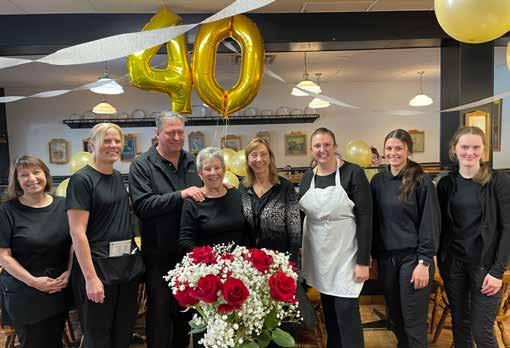
Quehl’s Restaurant celebrates 40 years of service from longtime staff member Kim Ziegler
After four decades of friendly service, Kim Ziegler is being recognized for 40 years behind the counter at Quehl’s Restaurant in Tavistock.
Over the years, many employees have been part of the well-known restaurant’s team, but owners Brian and Cindy Larsen recently took time to celebrate their longest-serving and most dedicated staff member.
Ziegler marked her 40th anniversary as
a server at the popular Tavistock eatery, where she has become a familiar and welcoming face to generations of customers. Known by name to many regular patrons, she is appreciated for her courteous smile, attentive service and thorough knowledge of the restaurant’s extensive menu.
Ziegler may describe herself as old-fashioned, but she continues to write down every order she takes, determined never to make a mistake. That attention to detail has been part of her approach since the beginning of her career.
Among those who know her best are former owners Steve and Ruth Cahill, who originally hired Ziegler when they operated the busy restaurant. They say they knew from the start that she would be an exceptional addition to their team.
They recall her reliability, punctuality and strong work ethic – qualities that have remained constant over the years.
Current owners Brian and Cindy Larsen, along with their daughters, Emily and Amy, agree that Ziegler’s dedication is rare. They say employees who commit 40
years to one workplace are few and far between, and they are grateful for her loyalty and professionalism.
As Quehl’s continues to serve the Tavistock community, Ziegler remains a steady presence in the dining room – greeting customers, taking orders and contributing to the welcoming atmosphere that has made the restaurant a local favourite.
Forty years on the job is an impressive milestone in any profession, and for Ziegler, it represents a lifetime of service to her community.
Staff at Quehl’s Restaurant gather to celebrate Kim Ziegler’s 40 years of service. From left are Joan Faulhaufer, Deb Stolk, Brian Larsen, Kim Ziegler, Cindy Larsen, Emily Waymouth, Carly McIntosh and Vicki Herlick. Missing from photo is Joan Leeming.
Former owners Steve and Ruth Cahill stand with Kim Ziegler and current owners Brian and Cindy Larsen, along with daughters Amy and Emily, as they mark Ziegler’s 40-year milestone at Quehl’s Restaurant.
GARY WEST Gazette Correspondent
(GARY WEST PHOTOS)
Tavistock tradition continues as World Crokinole plans 25th edition
WCC COMMITTEE
Submitted to the Gazette
It may be the middle of winter, but the crokinole planners are already thinking ahead to spring. The World Crokinole Championship (WCC) committee met again recently as part of their ongoing preparation for the 25th edition of the event.
The first World Crokinole tournament took place in 1999, and with the exception of three years skipped over during the pandemic, has been played each year in Tavistock on the first Saturday of June. The committee hopes the 2026 tournament will be the largest ever but also will serve as a worthy celebration of the championship’s long history. The committee has a few special ideas in the works for the tournament, which they plan to announce in the coming months.
The idea for the event goes back to Tavistock’s 150th anniversary celebration in 1998. Crokinole promoter and salesman Wayne Kelly of Stratford set up a crokinole display for the weekend event and encountered a great deal of interest, which kickstarted a series of conversations.
Barry Tate, former Tavistock School principal, and Bruce Halliday, 150th chairman, took interest in Tavistock hosting a large crokinole tournament, and pretty
soon, presentations were being made to the Rotary Club, the Tavistock recreation committee and the chamber of commerce. Township Mayor Dave Oliphant provided the support of East Zorra-Tavistock council, and the planning for the 1999 World Crokinole Championship was soon underway.
Tavistock was a fitting place for the world championships. While it’s unclear where crokinole was invented, a key piece in crokinole history is the oldest-known crokinole board that was built in Sebastopol by wagon-maker Ekhardt Wettlaufer in 1876. That board, now 150 years-old, resides at the Schneider Haus museum in Kitchener.
While there were many key details to work out for the 1999 event, Mary Alice Roth provided a great deal of confidence that the event would be well organized. She had a wealth of experience organizing the annual crokinole fun-night at the Tavistock Public School in March. That school tournament ran from the mid-1980s until 2015 and frequently involved around 200 parents and children participating.
Thanks to support from local businesses, the 1999 tournament was able to offer $4,000 in prize money, and such support has continued throughout the tournament’s history with businesses and interested
individuals providing sponsorship funds or prizes for the tournament raffle table.
The 25th edition of the tournament will have prize money of $6,000.
The timing for the World Crokinole Championship on the first Saturday of June places it in a busy segment for local activities, with the townwide garage sale and annual Fireman Chicken BBQ usually happening on the same day.
Crokinole interest has exploded globally, but the biggest event in the world is, by far, still in Tavistock. There are now crokinole tournaments in Italy, Spain, Hungary, the U.K., Belgium, the Netherlands, France, Japan, Australia and all over the United States. While some of those cities have attempted to hold a prestigious event that welcomes the crokinole world, Tavistock still lays claim to the pinnacle event.
The largest crokinole tournaments held outside Tavistock might have 100 participants, while last year’s World Crokinole Championship had over 400 with players from the Netherlands, the U.K., Japan and 16 American states, as well as seven provinces.
Putting on the world championship requires the efforts of some dedicated volunteers. A number of community members have accrued a lot of experience over their tenure on the organizing committee.
John Schultz is the longest-serving member, having joined the committee in 2000. He now looks after the crokinole boards for the event. Paul Epp, current chairman, Kathy Rosenberg and Keith Brenneman have all been on the committee for over a decade. Valerie Kropf, Sherrill Calder and Gloria Walsh have all re-joined the committee recently, but they also served for a number of years in the earlier editions of the tournament. Joining the locals on the committee are a few crokinole enthusiasts from nearby towns; Jason Beierling and Nathan Walsh have been on the committee for over 10 years, while board-builder Jeremy Tracey joined in 2018.
In addition to the organizing committee are a number of volunteers who assist in tournament setup the day before the event, or in ensuring the smooth operations on tournament day. Anyone interested in helping out could speak to a committee member or visit the website for more details at worldcrokinole.com.
The committee hopes the 25th World Crokinole Championship will be a celebration of the long and proud history of the event, and once again draw crokinole players from across the globe.
The event takes place on the first Saturday of June at the Tavistock Arena and is open and free to spectators.
NOTICE OF ANNUAL GENERAL MEETING of the SOUTH EASTHOPE MUTUAL INSURANCE COMPANY
Notice is hereby given that the 154th Annual General Meeting of South Easthope Mutual Insurance Company will be held at Grace United Church, 116 Woodstock Street South, Tavistock, Ontario, on Friday March 13, 2026 at 1:30 p.m.
John Taylor, President of the Ontario Mutual Insurance Association, will begin the meeting with a short discussion on the history of Ontario’s farm mutuals, past and present, and explain what makes mutual insurance so unique.
The business portion will follow the presentation for the purposes of:
1. Receiving and approving the Minutes of the Annual General Meeting of the Corporation held March 21, 2025.
2. Receiving the Auditor’s Report and Financial Statement for the year ended December 31, 2025.
3. Appointing Auditors for the 2026 fiscal year.
4. Electing three directors, each for a term of three years. Elections will be conducted in accordance with procedures adopted by the Board of Directors. A copy of the election procedures may be obtained from the Secretary of the Corporation upon request. The retiring directors – Marianne T. Cook, Linda Drost and Michael J. Munro – are all eligible to stand for re-election. Linda Drost will not seek re-election.
A complete version of the audited financial statements for the year ended December 31, 2025 are available for viewing on the company website at www.southeasthope.com. A member may also request a copy by written request at least 14 days before the Annual Meeting.
Rachel N. Stewart Corporate Secretary
Our plan to protect Ontario is diversifying our trade
As Canada stares down economic uncertainty, we’re ready with a plan to protect Ontario.
Diversifying our trade will connect our province to new markets.
That’s how we protect Ontario.
T:12.429"
NEAT club partners with Elgin Missionary Church for fundraising breakfast
GARY WEST Gazette Correspondent
Members of the North Easthope Antique Tractor Club (NEAT) are gearing up for another busy season of community visits and fundraising efforts across the region.
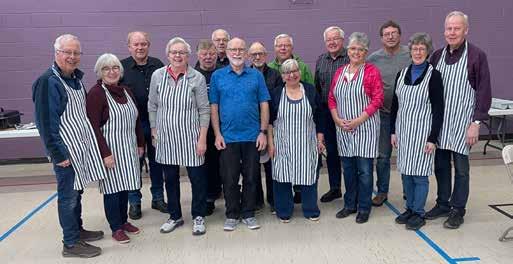
Last week, club members were invited to the Elgin Missionary Church, located at
the northwest corner of Stratford, to take part in a fundraising breakfast prepared by church volunteers. The event brought together tractor enthusiasts and congregation members for good food and fellowship, while supporting local initiatives.
As warmer weather approaches, NEAT members are preparing to hit the road on their antique tractors, touring through
Perth, Waterloo and Oxford counties. Their cross-county tours regularly draw crowds of all ages eager to see the machines that once powered area farms.
The tractors featured on these tours represent an earlier era of agriculture, when horsepower ranged from 25 to 65 – a stark contrast to today’s modern tractors, which can reach 350 to 400 horsepower. For
many, the tours are a nostalgic look back at the equipment that shaped rural life in previous decades.
With more than 80 members, the NEAT club continues to invite area farmers and tractor enthusiasts to join in their tours and community events throughout the year.
Joe Detzler, a longtime member of the North Easthope Antique Tractor Club, is pictured last summer on his MT John Deere tractor. Detzler is one of more than 80 members who takes part in the club’s cross-county tours.
Members of Elgin Missionary Church’s breakfast team are joined by the executive of the North Easthope Antique Tractor Club during last week’s fundraising breakfast. Front, from left, are Bob Burford, Lynn Burford, Donna Schyff, Wayne Berry, Karen Berry, Dorothy Schultz, Marilyn Mills and David Mills. Back, from left, are Wayne Gerber (site coordinator), Dave Neeb, John Mohr (NEAT president), Murray Gingerich (NEAT vice president), Ron Neeb, John Schyff and Kevin Winhold.
(GARY WEST PHOTOS)
Snowbanks cleared along Perth Road 119 south of Milverton
GARY WEST
Gazette Correspondent
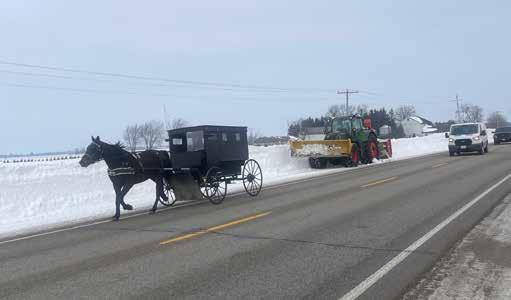
Blowing snow was a common sight along Perth Road 119 south of Milverton on Saturday – but this time, it wasn’t coming from a winter storm.
Instead, the snow was flying from a large snowblower as crews worked to cut back the high banks lining the west shoulder of the busy highway.
Jason Jantzi was behind the wheel of a high-powered Fendt tractor, using a front-mounted blade and heavy-duty
snowblower to remove built-up drifts and widen the shoulder. When he’s not assisting Perth County with winter road maintenance, Jantzi operates a dairy farm east of Milverton.
During the winter months, his equipment is put to work helping keep area roads safe and accessible. The powerful tractor and blower combination allows crews to move large volumes of snow quickly and efficiently, particularly in sections where drifting has narrowed the shoulder.
Close by, Perth County roads employee
Dennis Kuepfer followed the operation in a pickup truck equipped with flashing caution lights to alert approaching motorists and slow traffic around the snow-clearing equipment.
Kuepfer, a Milverton resident, has worked as a county snowplow operator for 21 years. In the summer months, he manages his own excavation and construction business, taking on projects throughout the area.
He noted crews had to blow back snow along this stretch of road four times
already this winter due to persistent drifting and heavy accumulations. Keeping the shoulders clear is especially important in this part of Perth County, where a significant Amish and Mennonite population regularly travels by horse and buggy. Widened shoulders provide a safer space for those vehicles and help reduce the risk of accidents along the highway. Saturday’s work was part of the county’s ongoing efforts to maintain safe travel conditions during what has been a challenging winter season.
Snow is blown back from the highway shoulder to create safer travel space for motorists and area horse-and-buggy traffic along Perth Road 119.
Local dairy farmer Jason Jantzi clears snow from the shoulder of Perth Road 119 south of Milverton on Saturday using a tractor-mounted snowblower.
(GARY WEST PHOTOS)
Sultans of String to bring award-winning visual album to Shantz Mennonite Church
SIMMONS Regional Editor
After drawing full houses in Wilmot township two years ago, Sultans of String are returning to the area with a free screening of their award-winning musical film, Walking Through The Fire: Visual Album, this time at Shantz Mennonite Church in Baden.
The screening takes place Saturday, Feb. 21 at 7 p.m., with doors opening at 6:30 p.m. The 80-minute film will be followed by a live Q&A featuring filmmaker and Sultans of String bandleader Chris McKhool, along with Coast Tsm’syen singer Shannon Thunderbird and her sister, Ts’msyen singer and collaborating artist Kate Dickson.
Walking Through The Fire is a musical-film experience that blends powerful storytelling with immersive sound. From Métis fiddling and an East Coast kitchen party to rumba, rock and the drumming of the Pacific Northwest, the film showcases the beauty and diversity of music from Turtle Island through collaborations with First Nations, Métis and Inuit artists from across the country.
The project has earned international recognition, winning Best Musical Film and Best Soundtrack at the Cannes World Film Festival, as well as Best Composer at the Chicago Indie Film Awards.
At its core, the film is rooted in the Truth and Reconciliation Commission’s Calls to
Action, amplifying Indigenous voices and stories through music and film. Dickson said what makes the film resonate so deeply with audiences is the authenticity behind it.
“The most compelling aspect of the film is its heart, which emerges from the
collective dedication and passion of the performers,” she said. “Everyone who sees the film leaves with a richer understanding of the journey Indigenous people have taken to not only find their voices again but to have an opportunity to share them with others.”
She added that the post-screening
discussions are often just as powerful as the film itself.
“The Q&A at the end of the film is the best indicator of how the people feel, what they most want to talk about and the respect they bring,” Dickson said. “From the performers’ point of view, it is the energetic acceptance of what audiences have seen and heard that is profoundly moving.”
The screening at Shantz Mennonite Church is being hosted by the congregation’s newly formed Pursuing Repair and Reconciliation (PRRIP) working group.
Organizer Rhonda Lee said the event builds on previous learning initiatives within the church.
“Hosting this screening of Walking Through the Fire is an excellent vehicle to share this learning with our congregation and to the broader community,” Lee said, noting previous screenings in the area drew 200 people. “We are hoping this provides each of us another way to learn and to be inspired to work towards right relations with Indigenous Peoples.”
The event is free with registration, though donations are welcome. Organizers expect strong interest and encourage residents to reserve seats in advance.
To register for the screening and Q&A, visit https://tinyurl.com/WTTFShantzMennoniteChurch. To watch the trailer for Walking Through The Fire, visit https://youtu.be/wWSZUduo5Kk.
Sultans of String is once again bringing their award-winning visual album to Wilmot Township with a free screening and Q&A at Shantz Mennonite Church on Feb. 21. Pictured are Coast Tsm’syen singer Shannon Thunderbird (right) and her sister, Ts’msyen singer and collaborating artist Kate Dickson (left) at a screening event in Hamilton. Both will be in attendance at the screening in Baden to participate in the Q&A after the film.
(PHOTO COURTESY OF SULTANS OF STRING)
New Hamburg Board of Trade to host inaugural International Women’s Day event
AMANDA NELSON Gazette Reporter
For the first time, the New Hamburg Board of Trade will host an International Women’s Day event aimed at inspiring and connecting local business owners and entrepreneurs.
The event will take place on Sunday, March 8, from 2-4 p.m. The theme is Women Lifting Women. The relaxing atmosphere welcomes women of all ages to connect and learn from one another and focuses on real stories, honest conversations and women supporting women.
“There is no single right way to build a career or a business, but it helps when someone a few steps ahead turns around and says you are doing better than you think,” said Lillianne Dunstall, president of the New Hamburg Board of Trade.
The International Women’s Day event will take place at the Waterlot in New Hamburg, and snacks and non-alcoholic
drinks will be provided.
“We are very grateful to Lynn Hall, owner of the Waterlot, who has provided a generous discount to support this event,” said Dunstall.
“We are also incredibly thankful to renowned local chef Adam Brenner, owner of the Garden Stand, who is supplying the food at no cost and donating the chairs for the event. That kind of support is a great example of local business helping local business. We are also speaking with a great local business about donating cider for the afternoon.”
With a strong lineup of guest speakers, Dunstall said everyone will walk away feeling inspired and connected to the women in their community.
Speakers include Shelby Behling, founder and president of Clean & Tidy Inc., who will speak about taking her business to new heights; Kathie Jordan of Kathie Jordan Design, a nominee for the 2025 Waterloo Region Women of the
Year Awards in the arts and culture category; Kristi Chambers, owner and operator of Evoke Fitness and Rehabilitation, who has more than 15 years in the business and has built a strong team of women; and Dunstall herself.
“I will also be speaking about my own journey, from a Grade 12 education to vice president of North American operations at a Fortune 500 company and author of The Unlikely VP,” she said. “I will be addressing imposter syndrome, something many women experience.”
The event is open to any woman looking to grow her career, start or run a business, or connect with other businesswomen.
Board of trade members will receive the first opportunity to register. Space is limited, so people are encouraged to get their tickets as soon as they are posted.
There is no cost to attend the event; however, donations will be accepted with all proceeds supporting initiatives addressing intimate partner violence in the Region of
Waterloo.
Tickets go on sale Feb. 23 on the New Hamburg Board of Trade website at www. nhbot.ca and on Eventbrite.
The Kin Cabin opens its doors in Shakespeare
A new multi-purpose creative space called The Kin Cabin has opened its doors in Shakespeare.
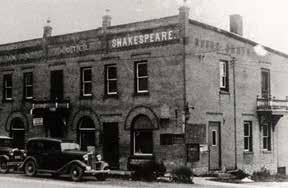
The studio space is located inside the iconic Harry Ten Shilling building. Owner Samantha Weber describes The Kin Cabin as a mini boutique studio designed to feel warm and welcoming.
“It’s an extension of my home and heart,” Weber said.
Her vision was to create a place where people can gather, create and feel at home.
The space serves as a photo and branding studio offering a cozy, light-filled room with seasonal setups, perfect for content
creation, personal branding, or product photography. The Kin Cabin will also host handson creative workshops along with small-business education sessions focused on branding, social media and creative entrepreneurship.
In January, Weber hosted a Vision Board workshop.
“We had a great turnout,” said Weber.
The event was designed as a relaxed, “come hang out” afternoon with crafting, vision boarding and the chance to meet new people. She also hosted a preloved pop-up clothing sale that was so successful another is already being planned for the spring. The space is available for others who
may wish to rent it to host their own pop-up sales or events.
Additional workshops are being planned, including cake painting, wine bottle decorating and social media-based, small-business education sessions. Weber hopes to collaborate with other local businesses to bring Pinterest and Instagram-inspired creative workshops to the community.
Originally from Kitchener, Weber moved to Shakespeare in 2022. She says she quickly fell in love with the small-town atmosphere. She has been overwhelmed by the encouragement and support she has received from local businesses and the community.
Weber was embraced by community support when she launched The Seat Society, a project that brought new life to a collection of well-worn chairs.
Weber purchased the chairs for her studio after they survived a restaurant fire. What began as a do-it-yourself project proved to be a job better suited to experienced professionals. Rather than walk away, Weber came up with a creative solution. She reached out to her social community. Twenty local businesses stepped forward to sponsor the refurbishment of the chairs, turning the project into a true community effort.
Today, the refurbished chairs add character to the studio, creating a story worth sharing.
“The community project not only kept the chairs out of the landfill, but also supported another locally owned business,” said Weber.
The refinishing was done by Lucy Pearlle, a design and restoration studio in Petersburg owned by Carey McClement, who also sponsored one of the chairs. Each
chair will include a plaque recognizing the business that made its restoration possible.
Weber’s professional background combines her passions for interior styling, content creation and social media. About six years ago, she began building a career that blends all three. Since then, she has worked with a number of brands, manages social media accounts for small businesses, helps redesign local business interiors and teaches others how to use social media effectively.
Through The Kin Cabin, she plans to offer both group workshops and one-on-one coaching to help local business owners feel more confident online. Sessions will cover topics such as taking quality photos with a phone,
planning social media grids, editing videos, creating reels and building a strong brand presence. Weber says many people feel intimidated by social media, and she hopes to give them practical skills and confidence to grow their businesses.
Beyond workshops and coaching, The Kin Cabin is designed as a flexible creative space. Whether someone wants to host a meeting, teach a class, hold a branding session, or organize an event, the front studio comes fully styled and ready to use. Weber simply opens the door and invites people to make it their own.
A grand opening celebration is being planned for the spring, with full details to be shared on social media at @thekincabin.
Located inside the Harry Ten Shilling building, The Kin Cabin is designed to feel warm and welcoming, says owner Samantha Weber.
Samantha Weber with the refurbished chairs from The Seat Society Project, an initiative supported by local businesses.
DIANE DANEN Gazette Correspondent
(CONTRIBUTED PHOTOS)
Ontario Provincial Police officers Spencer Wong (left) and Ashley Martins (right) speak with local hog farmers Judy and Brian Mogk at D&D Homestyle Cuisine & Café inTavistock during a recent Coffee with a Cop event. The informal gathering offers residents a relaxed setting to ask questions, share concerns, exchange stories and connect with local OPP officers. Events held across the region are designed to strengthen relationships and build trust between police and the communities they serve.
(AMANDA NELSON PHOTO)
Tavistock Agricultural Society celebrates success, honours dedicated director
continued dedication and behind-thescenes work.
Directors of the Tavistock Agricultural Society are already hard at work planning the 174th edition of the Tavistock Fall Fair after reporting another successful year in 2025.
With the support of many volunteers and sponsors, the board reflected on a busy and productive year during its recent annual meeting, while also looking ahead to a full slate of fundraisers and events in the months to come.
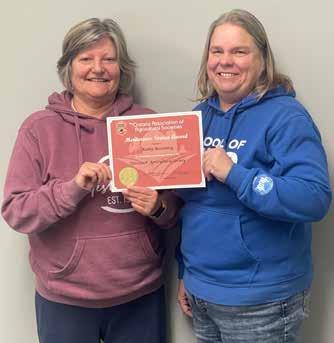
One of the highlights of the evening was the presentation of the society’s Meritorious Award to longtime director Kathy Rosenberg in recognition of her
In presenting the award, president Val Jones noted Rosenberg’s many contributions to the fair and the organization throughout the year.
Jones said Rosenberg has been responsible for keeping track of inventory and ordering ribbons, ambassador sashes and stickers, as well as serving on the Saturday afternoon program, the soup cook-off and the popular baby show.
She also recruited “Ox on the Run” to attend the fair and plays a major role in organizing the annual book sale – a project that takes over her home for months as she sorts and prepares donated books for the
committee.
Rosenberg works closely with the school children’s craft section and will serve as convener for that class in 2026. She creates and distributes flyers to Tavistock and Hickson public schools to ensure students are aware of the many opportunities to participate in the fair.
In addition, she designed a detailed map of the fairgrounds, now prominently displayed to help visitors navigate events and attractions during fair weekend.
Directors noted that planning for this year’s fair is well underway, with an emphasis on continuing to improve programming and attractions, including a new and improved midway.
This week, Jones, Julie Kimpel and Heidi Lamb are attending the annual meeting of the Ontario Association of Agricultural Societies in Richmond Hill to gather new ideas and inspiration for future fairs.
The board is also encouraging community members to support its upcoming fundraising events. A wine fundraiser is currently underway, followed by the annual kids’ Easter Egg Hunt in the park on Saturday, April 19, and the third annual Trivia Night at the Tavistock Memorial Hall on Saturday, May 9.
Directors remind residents to watch the society’s website and social media channels for updates on fundraisers and fair information throughout the year.
Snowbank towers over Tavistock neighbourhood Tavistock homeowner clears heavy snow from rooftop
A towering, 13-foot snowbank drew plenty of attention in the Bender subdivision near King and Frederick streets in Tavistock last week. With another snowfall, nearby residents wondered just how much higher it could grow before milder temperatures and rain finally began to shrink the massive pile. Local children made the most of it, climbing and playing on the winter landmark while it lasted.
potential
after sig-
With memories of roof collapses in the area last winter, Stahl said he wanted to reduce the weight load and prevent possible leaks from melting snow and forecasted rain.
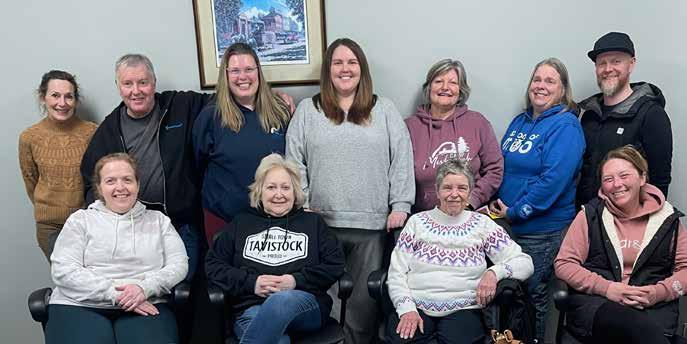
The 2026 Tavistock Agricultural Society board of directors includes, front row from left, Julie Kimpel, Kim Urlando, Chris Wiffen (secretary-treasurer) and Alisha Wilson (vice president). Back row from left: Deb Wagler, Perry Keller, Heidi Lamb, Kaitlin Keller, Kathy Rosenberg, Val Jones (president) and Chad Keller. Absent were Greg Pye, Sandy Schultz and Kim Hill.
Kathy Rosenberg receives the Tavistock Agricultural Society’s Meritorious Award from president Val Jones in recognition of her ongoing contributions to the success of the annual fall fair.
GARY WEST Gazette Correspondent
(CONTRIBUTED PHOTOS)
James Stahl shovels snow from the roof of his home on Jacob Street West in Tavistock last week, taking precautions against
roof damage
nificant snowfall.
Notice of Application for Approval to Expropriate Land
In the matter of an application by the Ministry of Transportation for approval to expropriate land, pursuant to s.11(2) and subsection 11.1(3) of the Public Transportation and Highway Improvement Act, being in the Geographic Township of North Dumfries, Township of North Dumfries, Regional Municipality of Waterloo, Province of Ontario.
For the purpose(s) of: Property is required to accommodate the bridge replacement and interchange improvements at Highway 401 and Waterloo Regional Road 97 (Cedar Creek Road) to improve the safety and operations of this overpass and interchange.
Notice is hereby given that application has been made for approval to expropriate the land described in the schedule attached hereto.
The approving authority is the Minister of Transportation with an address of:
Minister of Transportation
777 Bay Street, 5th Floor Toronto, ON M7A 1Z8
416-327-9200
Any owner of lands in respect of which notice is given, who desires to comment on the proposed expropriation of the land for the described purpose(s) may do so by submitting the comment within the time stated herein to the Assistant Deputy Minister, Transportation Infrastructure Management Division, Ministry of Transportation, in writing.
SCHEDULE "A"
All right, title and interest in the following lands:
1. All right, title and interest in the lands described as follows:
In the Township of North Dumfries, in the Regional Municipality of Waterloo, being Part of PIN 03847-0176 (LT), being Part of Lot 33, Concession 11, Geographic Township of North Dumfries, designated as PART 1 on Plan 58R-22424 (P-3164-96).
2. All right, title and interest in the lands described as follows:
In the Township of North Dumfries, in the Regional Municipality of Waterloo, being Part of PIN 03847-0476 (LT), being Part of Lot 32, Concession 11, Geographic Township of North Dumfries, designated as PART 2 on Plan 58R-22424 (P-3164-96).
3. All right, title and interest in the lands described as follows:
In the Township of North Dumfries, in the Regional Municipality of Waterloo, being Part of PIN 03847-0456 (LT), being Part of Lot 32, Concession 11, Geographic Township of North Dumfries, designated as PART 3 on Plan 58R-22424 (P-3164-96).
4. All right, title and interest in the lands described as follows: In the Township of North Dumfries, in the Regional Municipality of Waterloo, being Part of PIN 03847-0220 (LT), being Part of Lot 32, Concession 11, Geographic Township of North Dumfries, designated as PART 4 on Plan 58R-22424 (P-3164-96).
5. All right, title and interest in the lands described as follows: In the Township of North Dumfries, in the Regional Municipality of Waterloo, being Part of PIN 03850-0114 (LT), being Part of Lot 33, Concession, 10, Geographic Township of North Dumfries, designated as PART 5 on Plan 58R-22424 (P-3164-96).
6. All right, title and interest in the lands described as follows: In the Township of North Dumfries, in the Regional Municipality of Waterloo, being Part of PIN 03851-0228 (LT), being Part of Lot 30, Concession 10, Geographic Township of North Dumfries, designated as PART 3 on Plan 58R-22425 (P-3164-95).
7. All right, title and interest in the lands described as follows:
In the Township of North Dumfries, in the Regional Municipality of Waterloo, being Part of PIN 03851-0229 (LT), being Part of Lot 30, Concession 10, Geographic Township of North Dumfries, designated as PART 4 on Plan 58R-22425 (P-3164-95).
NOTICE WAS FIRST PUBLISHED ON: FEBRUARY 18, 2026
The Ministry will review the comments for their technical/engineering information, having regard to the need for the land for the purposes of the project.
The Assistant Deputy Minister must receive the comments within thirty days after the owner is served with this notice, or within thirty days after the first publication of the notice.
The comments must be sent:
By e-mail to: Property.Process@ontario.ca
Or by mail to: Assistant Deputy Minister Transportation and Infrastructure Management Ministry of Transportation 4th Floor, Garden City Tower 301 St. Paul Street
St. Catharines, ON L2R 7R4
Please include the municipal address of the land in the comment.
The expropriating authority is the Minister of Transportation with an address of:
8. All right, title and interest in the lands described as follows:
In the Township of North Dumfries, in the Regional Municipality of Waterloo, being Part of PIN 03851-0004 (LT), being Part of Lot 30, Concession 10, Geographic Township of North Dumfries, designated as PART 5 on Plan 58R-22425 (P-3164-95), subject to an Easement over PART 5 as in Instrument WS687957.
9. All right, title and interest in the lands described as follows:
In the Township of North Dumfries, in the Regional Municipality of Waterloo, being Part of PIN 03851-0005 (LT), being Part of Lot 30, Concession 10, Geographic Township of North Dumfries, designated as PART 6 on Plan 58R-22425 (P-3164-95), subject to Easement over PART 6 as in Instrument WS687957 and WS687987.
10. All right, title and interest in the lands described as follows:
In the Township of North Dumfries, in the Regional Municipality of Waterloo, being Part of PIN 03851-0006 (LT), being Part of Lot 30, Concession 10, Geographic Township of North Dumfries, designated as PART 7 on Plan 58R-22425 (P-3164-0095), subject to an Easement over PART 7 as in Instrument WS687957.
11. All right, title and interest in the lands described as follows:
In the Township of North Dumfries, in the Regional Municipality of Waterloo, being Part of PIN 03851-0007 (LT), being Part of Lot 30, Concession 10, Geographic Township of North Dumfries, designated as PART 8 on Plan 58R-22425 (P-3164-95), subject to an Easement over PART 8 as in Instrument WS687957.
12. All right, title and interest in the lands described as follows:
In the Township of North Dumfries, in the Regional Municipality of Waterloo, being Part of PIN 03851-0008 (LT), being Part of Lot 18, Registered Plan 1452, Geographic Township of North Dumfries, designated as PART 9 on Plan 58R-22425 (P-3164-95), subject to an Easement over PART 9 as in Instrument WS684762.
13. All right, title and interest in the lands described as follows:
In the Township of North Dumfries, in the Regional Municipality of Waterloo, being Part of PIN 03848-0178 (LT), being Part of Lot 30, Concession 11, Geographic Township of North Dumfries, designated as PART 1 on Plan 58R-22425 (P-3164-95).
Shakespeare Optimist Club’s Family Day event a great success
Once again, the Shakespeare Optimist Club brought the community together for its annual Family Day celebration at the Shakespeare Hall on Monday, Feb. 16.
An estimated 175 people attended the event. Club president Jeremy Witzel said he was pleased with the strong turnout.
“Our Family Day event was well attended and provided great community engagement,” he said.
Families took part in a wide range of activities at the event. Outdoors, kids and parents enjoyed tobogganing on the hill beside the hall, while others hit the ice for skating and a lively game of “Chucka-Puck” at the pavilion. Players tried to shoot their pucks through a small hole cut into a sheet of plywood attached to a hockey net. Participants were rewarded with a coupon for a free ice cream cone, generously provided by Moo’s Ice Cream Shop in Shakespeare.
Inside the hall, there were many activities including pickleball, floor hockey and
craft tables where children made crystal prism suncatchers and perler bead creations, the classic beads that melt together with an iron.
Guests warmed up with hot chocolate and coffee and enjoyed hotdogs prepared by Optimist members. A sweet treat of maple syrup toffee was made using syrup donated by Carmen Wettlaufer of Tavistock.
Before heading home, families received swag bags filled with dental supplies including toothbrushes, toothpaste and floss generously provided by Tavistock Family Dentistry.
Through events like the Family Day celebration, the Shakespeare Optimist Club continues to live out its motto, “Optimists – Friends of Youth,” working to bring out the best in young people, the community and themselves.
The Shakespeare Optimist Club is always happy to welcome new members. Anyone interested in joining and making a positive difference for youth in the community can email shakespeareoptimist@ hotmail.com for more information.
Kids of all ages enjoyed skating and taking part in the “Chuck-a-Puck” activity at the Shakespeare Pavilion on Family Day. In the background are Shakespeare Optimist Club members Orval Gerber, Jim Radar and Richard Smelski.
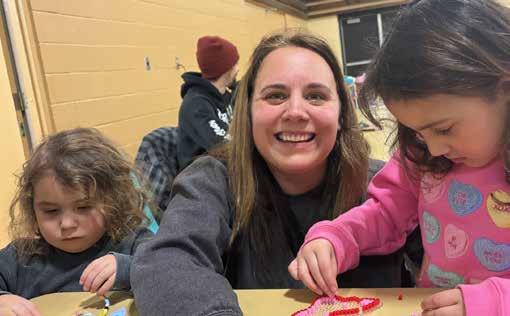
Kailey, three, and Addy Cousineau, five, enjoy a crafting activity with their mom, Erin Koot, during the Optimist Family Day event.
Shakespeare Optimist members Hugh McDermid and Ted Danen prepare maple syrup toffee as David Dalby and his daughter Pippa, six, patiently wait for their sweet treat.
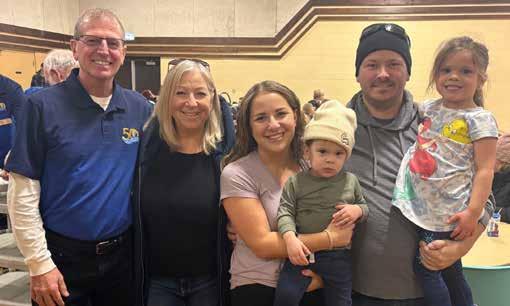
Three generations celebrate Family Day together. Pictured are Shakespeare Optimist member Dan Festoso and his wife, Susan, their daughter, Nicole, and her husband, Jamie Laprise, along with their children, Dallas, two, and Ember, four.
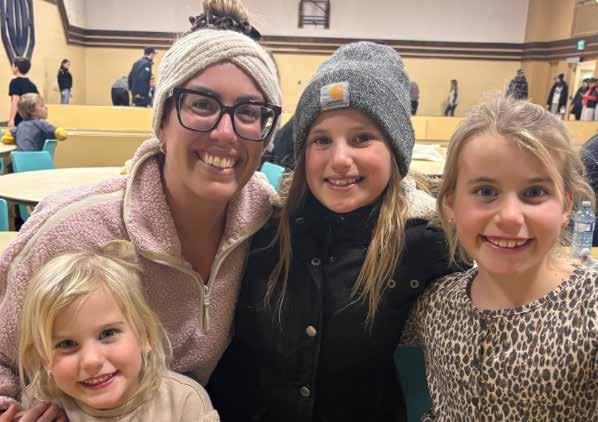
Mom Melanie Hobson enjoys Family Day with her daughters Freya, five, Acadia, nine, and Savaya, seven, at the Shakespeare Optimist event.
DIANE DANEN Gazette Correspondent
(GARY WEST PHOTO)
(DIANE DANEN PHOTO)
(DIANE DANEN PHOTO)
(DIANE DANEN PHOTO)
(DIANE DANEN PHOTO)
Milverton Stockyards continues tradition of community livestock sales
GARY WEST Gazette Correspondent
For generations, farming towns and villages across southwestern Ontario gathered weekly for community livestock sales – busy auction days where farmers bought and sold cattle, pigs and other livestock, and neighbours caught up on local news.
Many area residents will remember the sales barn in Tavistock, where Amos Zehr and later his grandson, Joe Zehr, auctioned calves, pigs and animals of all kinds. Household furniture auctions were also once common, later moving to the
Tavistock Memorial Hall.
That tradition continues in Milverton where the Milverton Stockyards on Spencer Street remains a hub of agricultural activity. A regular community sale is held every Monday at 11 a.m., along with a monthly beef sale held mid-month that draws consignors and buyers from across the region.
For decades, the stockyards were owned and operated by John and Audrey Nicholson. After many successful years, the business and property were sold to Parks Livestock of Canada owned by Hayden Parks and his family.
Under the Parks’ ownership, the operation has expanded significantly. Recognizing the strength of Perth County’s agricultural sector, the family invested in a large, modern hog, sow and weaner barn. Built by FGC Construction of Mitchell, the facility now handles thousands of pigs each week. Area hog producers have said they are pleased with both the service and the payment methods offered at the facility.
The monthly beef sale continues to attract strong participation. Farmers have the opportunity to buy and sell beef cows, calves and stocker cattle in a well-organized and
professionally run environment. The sale operates under the guidance of Dave and Margo Carson of Listowel, along with Doug Coulter, Frank Dewetering and his family, and Hayden Parks.
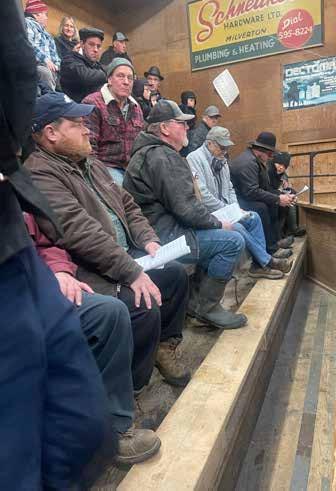
The Feb. 14 beef sale saw a steady flow of cattle through the ring and a large turnout of buyers in the stands, underscoring the continued importance of community livestock markets in Perth County.
Those interested in consigning cattle or seeking more information can watch future local publications for sale dates or contact Dave Carson at 519-291-8252 or Frank Dewetering at 519-272-7560.
Buyers gather in the ring seating area during the monthly beef sale alongside Frank Dewetering and Dave Carson.
Hayden Parks, owner of Parks Livestock in Milverton, stands with barn foreman Stanley Albrecht at the modern livestock facility on Spencer Street.
OBITUARY
John Gilbert Seguin
Passed away surrounded by his family on February 10, 2026 at Toronto General Hospital. Born in Kemptville, Ontario, he was the eldest son of John and Mary (née Prodonick) Seguin, both predeceased. A beloved husband, Gilbert is survived by his wife, Anne Seguin (née Ferguson), whom he married in 1978. Together, they relocated to Oxford County shortly after they married. He was a devoted father to Michelle Seguin and Jeffery Seguin (Gisell), and a proud grandfather to Douglas and Elliot, who brought him immense joy. He was predeceased by his son, Douglas, in 1985. Gilbert committed his life to farming, a calling that reflected his traditional roots, his respect for the land and his steadfast work ethic. Gilbert was a devoted family man who cherished time spent with loved ones. He enjoyed nature, science, history and sports (especially broomball) and valued the friendships and connections he made throughout his life. He is also lovingly remembered by his siblings: Elaine Lang (late Bob), Jeannie Young (Roy), Patsy Henry (Eric), Michael Seguin, Debbie Seguin-Redick (Mike), and Roger Seguin (Connie). Predeceased by his brother George Seguin (Diane), He will be missed by his brothers- and sisters-in-law, including John Ferguson, Glen Ferguson (Jennifer), Gary Ferguson (Maria), and Gail Gilmer (Gary), as well as many nieces, nephews, extended family members, and friends. Visitation will be held at Brock & Visser Funeral Home Woodstock Chapel, 845 Devonshire Ave., Woodstock, Ontario, on February 17, 2026, from 10:00 a.m. to 11:00 a.m., followed by a memorial service from 11:00 a.m. to 12:00 p.m. at the funeral home. Gilbert had been hoping for lung transplant and, sadly, was unable to receive the gift he had wished for. In his memory, and in honour of his strength and perseverance, we encourage others to consider registering as organ donors and giving the gift of life. In lieu of flowers, memorial donations may be made to the Canadian Lung Association or to Woodstock Hospital, organizations that supported him throughout his journey. www.brockandvisser.com
High Noon luncheon held at Grace United Church hall
GARY WEST Gazette Correspondent
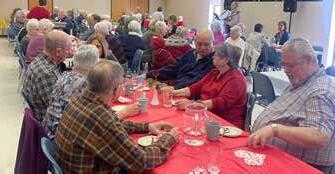
The Tavistock and Area Ministerial Association hosted its monthly “High Noon” fellowship luncheon last week at Grace United Church hall in Tavistock.
The gathering takes place every second Thursday of the month and welcomes residents from across the community for food, fellowship and entertainment.
Last week’s luncheon featured
special musical entertainment by Tavistock’s Steve Todd, who performed a selection of familiar tunes on his guitar for a grateful audience. Many in attendance recognized Todd from his years performing with Diane and the Country Cavaliers.
With Valentine’s Day just two days away, several guests brought their sweethearts along, making the afternoon a pleasant opportunity for conversation and visiting with neighbours and friends.
The High Noon committee worked
together to serve a nutritious, homestyle meal of pulled pork on a bun, side salad and dessert squares. Organizers remind residents that church affiliation is not required to attend the luncheons. Meals are served at 12 p.m. and a freewill offering is taken.
Next month’s High Noon luncheon will be held Thursday, Oct. 9, and will feature guest speaker Chip Bender, who will speak on “Mental Health for Seniors.”
1. Which fruit is known as the "King of Fruits" 2. A "prickle" is the collective noun for what groups of animals?
3. Which singer was known as the "The Empress of the Blues"?
4. Which company’s original name was "Cadabra," as in "Abracadabra"?
5. What is the fastest-growing plant in the world?
6. What is the unit used to measure electrical resistance?
7. Which actor played the character of Jack Sparrow in the Pirates of the Caribbean franchise?
8. At what degrees Fahrenheit does ice melt?
9. Which is the only sea in the world that has no coastlines?
10. How many distinct phases make up the lunar cycle?
Steve Todd entertained the High Noon luncheon crowd last week at Grace United Church in Tavistock.
An attentive group gathered to enjoy music and fellowship during the monthly High Noon luncheon at Grace United Church.
Members of the High Noon luncheon committee serving last week’s meal included, from left, Charlene Kropf, Michelle Schumm, Brenda Mohr, Connie Yantzi, Linda Weitzel, Cheryl Bender, Dawn Bender and Tory Zehr. Seated in front is Mary Boland.
(GARY WEST PHOTO)
The Old Gazettes
By Sydney Grant
Slowly but surely, I’m reading through the past pages of the Tavistock Gazette (est. 1895). Within this weekly column I’d like to share with you some of my findings.
February 17-24, 2021, Edition (5 years ago)
Three Shakespeare brothers have been spreading cheer around the Shakespeare community recently by placing penguin snow sculptures on their neighbours’ porches. Benson Hodgson, 10, and younger brothers Keagan, eight, and Quin, seven, have enjoyed packing snow into sculptures from their penguin molds for several years now, usually placing them on the front lawn of their family home on Miller Street. At first, it was a mystery to homeowners as some started posting their penguin photos on Facebook posts. One person commented, “This totally made my day,” while another said, “Thank you to whoever took the time to make and deliver this on a cold winter day.”
A Tavistock area farmer who spent years at the head of Pullet Farmers of Ontario and Canada has recently retired as chairman from both organizations and is now able to concentrate on his own family farm at R.R.#2 Tavistock. Andy DeWeerd was recently presented with a framed hockey sweater from the Egg and Pullet Farmers of Ontario as a gift for his years of teamwork in the pullet and eggs industry. For those readers who are wondering – a pullet is a young chicken raised from a day-old chick to 19 weeks of age, which then becomes a laying hen to produce eggs for your table.
February 16-23, 2011, Edition (15 years ago)
At one time, there were any number of students in a classroom who were raised on a dairy farm. Today, that’s not the case and, as a result, Dairy Days, sponsored by the Dairy Producers of Oxford County, is a perfect way to raise awareness. It focuses on educating up to 1,500 Grade 4 students from Oxford elementary schools for three days each February in the Oxford Auditorium. Steven Weldman, chair of both the Oxford Milk Committee and Dairy Days, said the event helps young people understand the importance of dairy farming.
The Hickson Lions Club held their annual skating party at the Hickson Pavilion on Sunday, Feb. 13, 2011. There were approximately 60 people attend-
ing from the very young to the young at heart. The Hickson Lions Club sponsors this event every year, weather permitting. There were Pogos, hot chocolate, hot apple cider, pop, water and homemade cookies supplied free of charge for all who attended. A good time was had by all. Those in attendance participated in their own version of curling with both the children and adults using water-filled plastic containers as rocks. Gifts were given to the winners in each group.
February 14-21, 1996, Edition (30 years ago)
First, the bad news. In Saturday night’s hockey game between the Tavistock Braves and the Wellesley Applejacks, defenceman Matt Bender broke his right leg just above the knee when he collided with a Wellesley player. He was taken by ambulance to hospital in Kitchener, then transferred to Stratford where the leg was set during an operation Monday morning. Matt was a key member of Tavistock defence corps and is a strong candidate to win the Junior Development League’s Rookie of the Year Award. The good news is that hockey is a team sport, the Braves have depth and the club is playing excellent and exciting hockey heading into the playoffs.
This computer-generated 3D rendering of the concept is presently being studied by architects, engineers and contractors in an attempt to finalize plans for construction of the new arena. The next phase of construction of the new $2.7-million facility is set to begin following the last day of the old arena, March 3. The foundation for the main structure has already been formed.
February 16-23, 1966, Edition (60 years ago)
An evening of music presented by some 40 young people of the community was much enjoyed at the Memorial Hall Friday night, when the Rotary Club of Tavistock sponsored the third annual talent night. The program, of 90 minutes duration, was in the charge of Walter Schaefer, president of the sponsoring club. The only vocal number was a duet by Allan and Richard Wilker at the piano. Accordion solos were given by Jane Wilhelm, Ken Smith, Rosemary Cattrysse, Margaret Ruby, Glen Seyler, Donald Zehr, Clare Bender, Gary Yantzi, Dwight Steinman and Ellen Gulikers.
TOWNSHIP OF EAST ZORRA-TAVISTOCK
GRACE UNITED CHURCH
116 Woodstock St. S., Tavistock Phone: 519-655-2151
All are welcome
Service led by Rev. Marilyn Arthur Music by Marilyne Nystrome
TRINITY LUTHERAN (ELCIC)
Sebastopol - Tavistock 2210 Perth Line 29
Pastor Steve Hoffard Worship In Person or on Zoom Sundays at 10:00 AM (519) 655-2372 trinitylcoffice@gmail.com www.trinitytavistock.com
TAVISTOCK MENNONITE
Pastor Julie Ellison White
131 Wettlaufer St., Tavistock 655-2581
Sunday Worship services begin at 9:45am, with coffee and fellowship to follow at 11am.
All ages Junior Sunday School will follow after the service.
All are Welcome Stream services online at www.tavistockmennonitechurch.ca
677044 16th Line Road, East Zorra Pastors Ray Martin & Mike Williamson www.ezmennonite.ca
Service audio recordings available at: https://ezmennonite.ca/worship/
WILMOT TOWNSHIP
ST GEORGE’S ANGLICAN CHURCH
Corner of Waterloo St and Byron St, New Hamburg Weekly Sunday services at 10:15 am. All are welcome. https://www.stgeorgesnewhamburg.com
St James Chapel of Ease 4339 Huron Rd Wilmot Township
All are welcome. Contact Carol Massel: 519-502-8648 carol@masselsmarine.com
ST AGATHA MENNONITE CHURCH
1967 Erb's Road St Agatha 519-634-8212 Pastor Jim Brown Worship service 10am followed by coffee hour and sermon discussion. All are welcome
The Wilmot-Tavistock Gazette
Royals complete near historic sweep of Outlaws
LEE GRIFFI Gazette Reporter
They were 68 seconds away from a scoreless sweep.
That’s how close Tavistock was to winning four straight games over Erin without allowing a single goal against. The Outlaws scored their first goal of the series to put a single blemish on an incredible goaltending performance by Andrew Masters as he led the Royals to an opening win in the Ontario Elite Hockey League’s (OEHL) South Division playoffs.
Tavistock took a 3-0 series lead on Saturday with a 3-0 road win. Masters kicked out 36 shots while Patrick Vulgan, Deven Kropf and Luke Fanjoy found the back of the net.
“Masters has been incredible; he could have been our player of the game every game,” said head coach Tyson Zehr. “But you've got to give credit to the team as well. Everyone in front of him blocked shots, cleared lanes and made it tough for Erin to get chances.”
The Gazette has reached out to the OEHL to find out if the scoreless streak set any records dating back to the old WOAA days but
did not hear back by press time. Zehr said it wasn’t a topic of discussion in the locker room, but he’s proud of what the team accomplished.
“During the series, we weren’t thinking about a streak. It was all about taking it one game at a time. But looking back now that the first round is over, that was pretty special. It's something you don’t see very often at any level, especially against a strong senior team like Erin.”
He added the Royals combine a defence-first mentality with an aggressive forechecking style, something very effective in the opening round.
“We try to balance both. Our core is defence-first by keeping the game simple, protecting our goalie and being tough to play against. When the opportunity is there, we have a bunch of dangerous guys upfront who can put the puck in the net. That balance is what has allowed us to be successful in the first round.”
The Royals completed the fourgame sweep on Sunday with a 5-1 victory. Drew Gerth led the offence with three goals and an assist while Patrick Vulgan and Mitch Atkins added three helpers each. Kropf scored twice as
Masters stopped 22 of the 23 shots he faced in the game. Erin’s Travis Brown denied the Royals a fourth consecutive shutout with just one minute and eight seconds remaining in the third period.
Here’s how good Masters was in the series; he stopped 125 of 126 shots, had a goals against average of 0.25 and a .992 save percentage. Atkins and Gerth hold the team lead in playoff scoring with seven points each, followed by Kropf with six.
Zehr explained his top three scorers have performed to expectations, as has the rest of the team offensively.
“They’ve been outstanding. Those guys have a knack for finding open space and finishing plays, but it’s more than just them. We had multiple lines contributing all series, which makes us very difficult to defend and match against.”
Tavistock’s second-round opponent has not been finalized, but a matchup with first-place Petrolia is looming.
“We don’t know exactly who we’ll face yet, but the focus is the same. We will continue to take it one game at a time, stay sharp and be ready for whoever comes next,” said Zehr.
PJHL Roundup: First-round playoff series set
The Provincial Junior Hockey League’s (PJHL) regular season came to an end on Family Day, and the Doherty Division matchups have been confirmed, though as of press time, the schedules were not.
Tavistock (2) vs. Paris (7)
The Braves will take on the Titans in the first round, a team they defeated five out of six games during the regular season. Tavistock outscored Paris 31-18 in those matchups.
Captain Marc Dionne said while Paris had a tough time staying consistent and beating the top teams in the division, he’s taking nothing for granted.
“We have had a good year playing against them, and even though there were definitely some close games, we always managed to find a way to pull through. They are a physical and gritty team, and if we
want to be successful, we need to work harder and play with more physicality every single night. There is no easy matchup this year. We have to be ready to give everything we have for the entire series.”
The Braves' 10-game win streak was snapped in New Hamburg on Monday with a 7-6 overtime loss. Owen Bruder scored his third of the game 78 seconds into the extra period. Bruder added two assists while Ben Oliver had a goal and three helpers. Yann Raskin, Keegan Metcalf and Evan Palubeski led Tavistock with three points apiece.
The Braves won their two other weekend games, 5-3 over Norwich and 4-2 against Hespeler.
Tavistock paid tribute to its graduating players before Friday night’s game. Along with Dionne, the Braves will say goodbye to Ryan McKellar, Tyler Brezynskie and Carter Arseneau once the
season is over.
Dionne said being recognized with his teammates meant a lot.
“Being given the opportunity to thank our parents and get appreciation from the community and the Braves organization was something I’ll never forget and I can’t be more thankful for it.”
He added he’s prepared to do whatever it takes to help Tavistock make a playoff run.
“Knowing this is my last shot, I’m going to fit into any role my team needs me to play. Being a part of this team for five years and dealing with heartbreak in the playoffs; there’s nothing else I want to do more than win for Tavistock, something that I know is long overdue. Each shift, period and game, I will be giving everything I have. There is no more time for failure.”
Wellesley (3) vs. Hespeler (6)
The Applejacks may have won five of six matchups with the
The Tavistock Royals continue to follow the playoff tradition of adding a puck to a wooden board marking every playoff win. Veteran Drew Gerth was given the honour on Sunday afternoon as Tavistock completed a four-game sweep of the Erin Outlaws.
(PHOTO COURTESY OF TAVISTOCK ROYALS)
The New Hamburg Firebirds honoured their overagers before Sunday’s game. Top row, left to right, are Owen Bruder, Ben Oliver and Justin McManus. Bottom row, left to right, are Owen Sculthorp and captain Andrew Gear.
LEE GRIFFI Gazette Reporter
(PHOTO COURTESY OF NEW HAMBURG FIREBIRDS)
Shamrocks, but four of the matchups were decided by a single goal.
Head coach Derek Lebold said there will be no counting chickens before they are hatched in his locker room.
“They are going to play with a lot of speed. They are going to check hard on every puck and they have some of the best skaters in the division, in my mind. The Doherty is the best Junior C division in Ontario.”
He added his team’s main advantage against Hespeler is its depth.
“Our motto is 20 men in the lineup have to play. We win when everybody is on, from what we consider the first to the fourth line. They all get shifts and that’s how you are going to win in the playoffs.”
Lebold said that has been his team’s game plan throughout the season.
“The biggest thing for us is consistency from everyone playing so we can leverage all four lines. I think we have one of the deeper lineups, maybe not with the highend talent, but we can match anyone with our depth.”
Wellesley dropped a 7-2 decision to New Hamburg on the weekend before a 3-2 win over Dorchester.
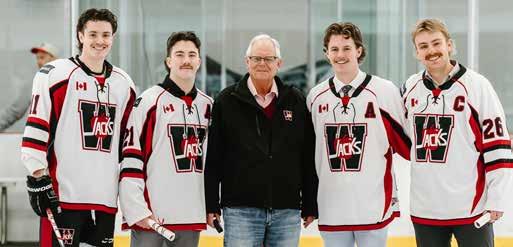
The Applejacks held a ceremony to honour their overage players on Monday.
Boden White, Jake L’Heuruex, Dimitri Eleftheriadis and Riley Noble are in their final season with the team.
New Hamburg (4) vs. Norwich (5) It came down to the wire, but the Firebirds' win over Tavistock on Monday gave the team home-ice advantage in their series with Norwich, one that is expected
to be tight. The teams split the six games they played this season, but New Hamburg outscored Norwich 31-23.
Firebirds captain Andrew Gear said the win was a big one for his team.
“You learn pretty early in this league that playing in Norwich is not the most fun place to play. Their fans are hectic and it’s a small rink. We knew getting home ice to have that extra home game and have our crowd behind us was huge.”
Gear, in his last season of junior eligibility, expects a tight series with the Merchants.
“We’ve had tight games with them throughout my four years. They have some highly skilled forwards, are gritty at the same time and are well-coached. It will be a good battle.”
Gear and his fellow overagers – Owen Bruder, Ben Oliver, Justin McManus and Owen Sculthorp – were honoured before Sunday’s game during the team’s annual OA night.
“I remember my first year and the OA night back then. It feels so far away, and then all of a sudden, I’m at that day. It’s a sign it’s coming to an end, and obviously, we want to make a long (playoff) run here and win another championship. That’s the goal,” Gear said.
The Firebirds took all six points last weekend, including a 2-1 victory over Dorchester.
While PJHL playoff schedules were not finalized by press time on Wednesday, readers can now visit www.thepjhl.ca/ stats/playoffs/77 to see the quarter-final Schmalz Cup playoff schedules for Tavistock, New Hamburg and Wellesley.
Gazette Puzzles
GLADYS
Gladys is a sweet, outgoing, and independent kitty with a heart as big as her personality! She loves meeting new people and will happily follow you around just to be part of the action. Her slightly misshapen ears add an extra dose of character and make her one-of-a-kind — and they don’t bother her a bit!
Gladys prefers affection on her own terms and will gently tap you with her paw when she’s ready for pets. She’s looking for a loving home that appreciates her confident spirit and will enjoy her playfulness, purrs, and companionship. If you’re searching for a friendly feline with endless love to give, Gladys is your girl! She’s available from our Stratford Centre and you can learn more here: https://kwsphumane.ca/adopt/cats
The Wellesley Applejacks held a ceremony to honour their overage players on Monday. From left to right are Boden White, Jake L’Heuruex, president Bob Reid, Dimitri Eleftheriadis and Riley Noble. Absent was Spencer Davidson.
The Tavistock Braves paid tribute to its graduating players before Friday night’s game. From left to right are Marc Dionne, Ryan McKellar, Tyler Brezynskie and Carter Arseneau.
(PHOTO COURTESY OF WELLESLEY APPLEJACKS)
(PHOTO COURTESY OF TAVISTOCK BRAVES)
Crazy for cloves
HEAPS OF HEALTHY TIPS
By Mercedes Kay Gold
Winter is the coldest, darkest and dreariest season of the year. Stunning, snow-covered fields frame our local town but not everyone feels fabulous freezing in the frigid, sub-zero temperatures.
Bundled up to shovel, skate or simply survive the slew of snowy days without getting sick is challenging. Mother Nature offers us an option. Cloves are a fan favourite as an overall herb, but also as a winter warm-up wonder.
Cloves are the aromatic flower buds belonging to a family of evergreen trees in Indonesia. Deep-rooted in history, cloves are known for heaps of health benefits but are also used in burial and later traded like modern-day oil. Cloves have withstood the test of time and remain a staple in
kitchens across the globe.
Cloves are fabulously fragrant and the cornerstone of culinary dishes from curries, chai tea and baked goods to Chinese fivespice, but did you know cloves give Worcestershire its wow?
Cloves are more than a food flavour; the whimsically shaped mini-brown pod is a gift from Mother Nature, containing the compound, eugenol, best known for amazing anti-inflammatory, antioxidant and antibacterial properties.
Cloves contain manganese, a bone-health helper and hormone supporter.
Cloves are a rich brown thanks to beta-carotene, the same pigment found in carrots for optimal eye support.
Back to the all-important compound, eugenol. This
awesome antioxidant helps the body fight free radicals, preventing damage to cells. Strong cells prevent inflammation, the root to all disease.
Suffer from ulcers? Early studies are linking diets high in cloves to protection from stomach ulcers by thickening the mucus.
With the rising number of people diagnosed with fatty liver disease, including children, cloves show holistic liver love. Get creative. Clove flower buds are a taste sensation in stews, chilis, chutneys, chocolate sauces and to heavenly holiday ham marinades for a gorgeous glaze.
Cloves may help regulate blood sugar according to a 2019 study looking at pre-diabetics and diabetics. A balanced diet and the addition of 250 milligrams of clove extract for just 30 days showed less blood glucose after meals.
Cloves have been a go-to for centuries as an integral part of oral health due to antimicrobial properties. Many cultures still use the oil to address toothaches and oral infections holistically. Keep your eyes open for natural toothpastes with this exotic flavour.
Cloves are sweet, fragrant and fabulous in food, but not everyone is a home chef. Introduce whole cloves in boiling water as a wonderful warmup with a side of body-boosting benefits. Cloves are an all-natural remedy for helping relieve nausea and symptoms associated with asthma and respiratory issues. This holistic nutritionist is queen of living in a state of overcaffeination, but coming in from the cold, nothing beats an elixir to engage the parasympathetic system.
Backyard Astronomy: Late night lunar eclipse
Soothe stress with clove tea. In a tea pot, combine four cups of boiling water, a quarter teaspoon of clove buds, a piece of peeled, fresh ginger and one cinnamon stick. For extra digestive support, enjoy the ginger grated. Steep, sit and sip with a side of searching clove-inspired recipes on the internet.
Like anything new, check with your health practitioner for any clove contraindications.
By Gary Boyle
Throughout the weeks and months, we see the sun by day and the moon by night. But a few times each year, they line up along with Earth to produce spectacular solar and lunar eclipses.
We do not see an eclipse each month because of the Moon’s slight tilt in its orbit around the Earth. Sometimes the bright full moon appears above Earth’s shadow projected in space, while in other months, it is located below the shadow. When the alignment is just right, the Moon slips into this cone of darkness.
This celestial dance will play out in the early morning of March 3. The eclipse will be seen in its entirety from the Pacific and Mountain time zones, whereas
farther east, the moon will set before the entire show is over.
A lunar eclipse is completely safe to observe and enjoy as the full Worm Moon slowly turns a darker orange as sunlight bends through our atmosphere like a red sunset.
This is in stark contrast to the Feb. 17 annular solar eclipse, where special eclipse glasses were needed. Fear not, only the penguins would have seen it over Antarctica.
While the eclipse is underway and on any clear night for that matter, check out the brilliant planet Jupiter high in the sky that sets around 4 a.m. Then there is Orion the Hunter and other brighter winter constellations.
Today’s cellphone apps will help guide you through the starry shapes.
The path of totality for the next solar eclipse occurs on Aug. 12, stretching from Greenland down through Spain, and best viewed during ocean cruises. The sun will be covered for a few minutes, depending on where you are. On the night of Aug. 27 into the morning of the 28, North America will witness a partial lunar eclipse. During mid-eclipse, 96 per cent of the moon will be immersed in the Earth’s shadow.
• Newfoundland & Labrador: Eclipse begins at 6:20 a.m.; Moonset at 6:35 a.m.
• Atlantic: Eclipse begins at 5:50 a.m.; Moonset before totality at 7 a.m.
• Eastern: Eclipse begins at 4:50 a.m.; Mid eclipse at 6:33 a.m.; Moonset at 6:39 a.m.
• Central: Eclipse begins at 3:50 a.m.; Mid eclipse at 5:33 a.m.; Moonset at 7:10 a.m.
(PHOTOS COURTESY OF THE BACKYARD ASTRONOMER) A lunar eclipse will be seen in its entirety in Mountain and Pacific time zones on March 3.
• Pacific: Eclipse begins at 1:50 a.m.; Mid eclipse at 3:33 a.m.; Eclipse ends at 5:17 a.m.
Known as “The Backyard Astronomer,” Gary Boyle is an astronomy educator, guest speaker and previous monthly columnist for the Royal Astronomical Society of Canada, as well as past
• Mountain: Eclipse begins at 2:50 a.m.; Mid eclipse at 4:33 a.m.; Eclipse ends at 6:17 a.m.
president of the Ottawa Centre of the RASC. He has been interviewed on numerous Canadian and U.S. radio stations as well as in newspaper articles. In recognition of his public outreach in astronomy, the International Astronomical Union has honoured him with the naming of Asteroid (22406) Garyboyle. Follow him on Facebook and his website: www.wondersofastronomy.com.
(VECTEEZY PHOTO)
Cloves, the fragrant flower buds prized for their warming flavour and powerful compound eugenol, offer a natural boost to help support immunity, digestion and overall wellness during the cold winter months.
Which cruise is the cruise for you?
OH, THE PLACES WE'LL GO
By Paul Knowles
It’s a question I get asked a lot; “Which is better, a river cruise or an ocean cruise?” The answer, of course, is “it depends.” I am writing this article because a significant number of the people who approach me have never done a river cruise, but they are considering it.
First off, there are not simply two categories of cruising. Ocean cruises now include a wide spectrum of options, from gigantic floating cities holding 5,000 or more passengers to more elite vessels that carry only 500-600 passengers and offer more personal service.
As well, ocean ship itineraries now range from the multi-port cruises of the Caribbean to voyages to Antarctica, through the North-West Passage, or, almost literally, cruises to everywhere with months-long, round-theworld itineraries.
That being said, ocean-going cruise ships tend to include a few things that many passengers love: casinos, Vegas-style entertainment, good bars and a variety of dining choices. We all know cruise veterans who no longer bother to get off the boat – they are there for all of the above and happy to avoid the hassle of disembarking into a cookie-cutter port or a crowded tender to carry them landward.
And if that is to your taste, go for it. I will mention that a few of my acquaintances have tried smaller, ocean-going ships and have come away with a lot of praise for the increased level of personal service and high quality of dining options.
And what’s different about river cruises? Well, almost everything. Most of the big-ship amenities are missing and so are most of the passengers. For example, Viking longships on most European river cruises carry a maximum of 190 passengers, and that assumes every one of the 95 cabins has two occupants, which virtually never happens. Those figures apply to most of the river-cruise companies. Some of the rivers (like the Seine) require slightly smaller boats, so they never top 170 passengers.
There will also be 50-plus crew on board, most of whom are there
as cleaning staff or restaurant servers, so excellent personal service is not just the norm, it is inevitable.
Some things will seem very different for first timers used to ocean ships. The entertainment is confined to the multi-purpose lounge (also the location of the bar, educational seminars and the daily briefing sessions). Usually, the format is rather piano-bar-like, but there will also be special entertainment. I have enjoyed light opera, flamenco, pop music and concerts reflecting local culture. There is a small area for dancing.
In my experience, dining on river cruises has always been top-notch, but there is not a wide choice of restaurants – the ships have one dining room with no tables for just two, by the way, so you inevitably meet other travellers, and another spot on the upper deck with a few tables and a chance to dine al fresco in nice weather. I have always found that there is a wide and generous choice of menu options. And although river cruise ships offer relatively inexpensive beverage packages, if you like wine or beer, the already included pourings at mealtime are generous.
Apart from the lack of crowds and consistently superb service, the best thing about river cruises is your proximity to the destinations you are visiting on the cruise. There is a marked difference in comparison to many ocean cruises. Here, there is no stereotypical port with gold shops, souvenir stands and the
like. The ship ties up at the dock and you are almost always immediately moments from the heart of the town or city.
While river cruise itineraries tend to include a daily excursion at no up-charge and also offer frequent add-ons (some pricey, some very worthwhile such as our recent visit to the wineries of Châteauneuf-du-Pape), you can also easily explore historic towns on your own, a mere stroll away from your stateroom.
Of course, both ocean and river cruises can include unanticipated problems. On the river, you are unlikely to encounter the rough seas that can happen in the ocean-going vessels, but high or low water levels in the rivers can disrupt schedules. The last stage of our cruise to Budapest saw us taking a bus from Vienna because the water level in the Danube was dangerously high.
So, the choice is yours. There are advantages to either option, ocean or river. I have done both. My favourite ocean cruise was a voyage in the eastern Mediterranean that took me places I would be unlikely to see any other way – Ephesus, Santorini, Dubrovnik and Malta among them. I loved it. But more recently, my cruising has been on the rivers of Europe – the Danube, the Rhone, the Bordeaux region, the Rhine – and I can honestly report that I have enjoyed every moment. I have always travelled with Viking River Cruises, though I hear positive reports of other cruise companies, as well.
It is clear that with many Canadians looking for alternate travel options these days, cruising has become an option that is attracting a lot of interest. So, wherever and however you choose to go, bon voyage!
Paul Knowles is an author and travel writer, and past president of the Travel Media Association of Canada. To contact Paul about travel, his books, or speaking engagements, email pknowles@ golden.net.
(CONTRIBUTED PHOTO)
(CONTRIBUTED PHOTO)
(PAUL KNOWLES PHOTO)
River cruise ships docked in Lyon, France.
Holland American's Noordam, the ship on which the author had his most successful ocean cruise.
A Viking longship on the Rhine River.
Cruise ships shown in the harbour at Santorini.
Maples residents host their own Olympic Games
Residents at Maples Retirement Residence on William Street in Tavistock embraced the spirit of the Winter Olympics last week, hosting their own in-house games complete with medals and plenty of laughs.
From family birthdays and anniversaries to seasonal celebrations, there is always something happening at the Maples. With the Winter Olympics underway in Italy, staff decided it was the perfect time to bring a little friendly competition to their residents.
Executive director Joan Hergott said staff thought it would be a great idea for residents to participate in their own Olympic Games and have fun doing it.
With a laugh, Raymond Ruby and Raymond Ramseyer joked they would not be attempting ski moguls or ski jumps, medals or not. The pair are well known for bringing humour to Maples activities.
Residents took part in a variety of safe and spirited events, earning points toward gold, silver and bronze medals, along with certificates presented during a special ceremony.
Canadian newspapers are powered by journalists, not AI. They check the facts so you can trust what you’re reading. nationalnewspaperweek.ca
Residents of Maples Retirement Residence gather after competing in the Maples Olympics. Seated, from left, are Jean Cook, Mary Brenneman, Howard Kropf, Marjorie Skinner, Maddie Cormier (RPN), Sabina Bowman (activity coordinator), Tom Benny, Liz Neidig, Susie Elzinga and Lorraine Bender. Standing, from left, are Raymond Ramseyer, Shirley Weicker, Deanna Witter, East Zorra-Tavistock Mayor Phil Schaefer, Mary Shantz, Bruce Brenneman, Doreen Wagner, Janet Liddell, Raymond Ruby, Elma Yantzi, Marcia Wilson (director of care), Rosalind Sim, Laura Drake, Bheumika Modi and Yoli Sanchez.
Mayor Phil Schaefer presents medals to the top point earners at the Maples Olympics. From left: silver medalist Mary Shantz, gold medalist Bruce Brenneman, draped in the Canadian flag, and bronze medalist Doreen Wagner. Activity coordinator Sabina Bowman looks on.
GARY WEST
Gazette Correspondent
(GARY WEST PHOTOS)
THURSDAY, FEBRUARY 19
All-You-Can-Eat Spagetti Dinner in support of Carter Kuchma
4:30 - 6:30 p.m.
Hosted by Sprucedale Parent Council and Quehl's Restaurant with all proceeds going to the Kuchma family. Tickets must be purchased in advance at Sprucedale Public School Shakespeare Optimist Hall 3976 Galt St., Shakespeare
SATURDAY, FEBRUARY 21
The Tavistock and District Historical Society
1-4 p.m
Open to the public on the third Saturday of every month. Free Admission. Please come and join us. All are welcome! 37 Maria Street, Tavistock
MONDAY, FEBRUARY 23
Wilmot Council meeting
7-10 p.m.
Council chambers 60 Snyder’s Road W., Baden
TUESDAY, MARCH 3
Perth East council meeting
7 p.m.
Council chambers
25 Mill Street East, Milverton
SATURDAY, MARCH 7
Optimist Club of Petersburg Bottle Drive
9:30 a.m. – 12:30 p.m.
Also accepting food bank donations. 1239 Notre Dame Drive Petersburg
TUESDAY, MARCH 10
Wellesley Council meeting 6:45 p.m.
Council chambers 4805 William Hastings Line, Crosshill
WEDNESDAY, MARCH 18
Community Care Concepts Lunch and Fellowship
12 p.m.
Please register by Mar 13 by calling 519-6641900 or Toll Free: 1-855-664-1900.
Framed and Judged exhibits, Stamp dealers, youth gift bags, Sales Circuit, draw prizes.
Contact: dhfe@silomail.com
Web: http://www.rpsc.org/chapters/oxford St. Mary's Catholic High School,
WEDNESDAY, MARCH 25
Community Care Concepts Lunch and Fellowship
12 p.m.
Please register by Mar 20 by calling 519-6641900 or Toll Free: 1-855-664-1900. Linwood Community Centre, 5279 Ament Line, Linwood Community Solar Forum 6:30 - 9 p.m.
A collaborative discussion featuring local stakeholders & experts. Free admission. Wilmot Recreation Complex, 1291 Nafziger Rd, Baden
STAMP CLUB
Oxford Philatelic Society Meetings: 2nd Tuesday (2-4 p.m.) and 4th Tuesday (7 to 9 p.m.)
September to May
If you have never belonged to a stamp club, now’s the time. Meet new friends, grow your knowledge and collection.
Contact: Don Eaton dhfe@silomail.com Website: http://www.rpsc.org/chapters/oxford Church of the Epiphany 560 Dundas Street, Woodstock Ontario N4S 1C7
FREE SENIORS ACTIVITIES
MORNING & EVENING BIBLE READING
Read the Bible in a Year in Community Morning meeting 6:00 a.m. daily Evening meeting 6:00 p.m. daily
Contact Arthur Rosh if interested. Phone number: 226-899-1551
Email address: arthur.rosh@gmail.com
Location to be determined in New Hamburg, Tavistock, Baden, Wellesley, New Dundee, St. Agatha, Shakespeare, Petersburg, Hickson, Punkeydoodle’s Corner and area
EVERY WEDNESDAY
TOPS - Taking off Pounds Sensibly Wednesdays at 10:30 a.m.
TOPS is a non-judgmental weight loss
Tavistock Seniors Activities @ Tavistock Memorial Hall, 1 Adam St. Tavistock ON, except Shuffleboard
Pickleball Monday, Wednesday and Friday afternoon, 12-4 p.m. Contact: Don Junker 519-535-7052
Cards Monday , Wednesday afternoon 1-4 p.m., euchre, crib (bring board), etc. Just drop in to play, good to bring someone . Contact: Bob Routly 519-301-2118
Inside walking Monday & Wednesday morning 8.30 a.m. - 12 p.m. Contact: Larry Brown 519-240-6715
Crokinole Monday , Wednesday morning 8.30 a.m. - 12 p.m., Just drop in to play, good to bring someone. Contact: John Schultz 519-655-2346
Deadline: Tuesday prior at 3 p.m. Contact:
The Community Calendar allows non-profit organizations to promote their free admission community events at no charge Event listings can include your event name, date, time and location as well as contact information (ie phone number, email address or website).
If your event is not free admission or you would like to include more details than stated above, The Wilmot-Tavistock Gazette offers the following options for promoting your community events:
Coming Events Word Ad (50 word max ) - $10 + hst Coming Events Boxed Word Ad (50 word max.) - $15 + hst Display Ad - Sizes begin at a Small Classified Display ad (3 3" x 2 5") - $35 + hst
FOR SALE
Hundreds of shade trees, fruit trees, apples, pears, peaches, plums, sweet and sour cherries, apricots, nectarines, blueberries, haskapp grapes, raspberries, elderberries etc. Lots of spruce, pine, cedars for windbreak and privacy hedges. Sizes 1-8 ft. in containers ready to go. Flowering shrubs and much more. MonSat 7:00am to 6:00pm Martin’s Nursery, 42661 Orangehill Rd Wroxeter, ON N0G 2X0 (1 Conc. North of Wroexter on Belmore Line)
FOR SALE
Winemaking equipment, carboys, corker, siphons, thermometers, and other equipment. Also, have female speed skates size 39 (new) for sale. Call Irma Neff at 1 519 595 7258
WANTED
I will pay cash for antiques and collectibles. Coca Cola, Pepsi, any pop company, Brewery items Kuntz, Huether Labatts, etc. Old radios and gramophones, Wristwatches and pocket watches, Old fruit jars, Beaver Star Bee Hive etc. Any old oil cans and signs Red Indian Supertest etc Any small furniture. If you are moving or cleaning out stuff please contact me - 519-570-6920.
OF
New Hamburg
Thrift Centre, Short Stop, Sobeys, Office Pro, No Frills, Mario's Chicken, Library, McDonalds, Tim Hortons, Nith Valley Butcher, The Whining Tree, Town Square Pharmasave, Heart'n Home Creations, Cook's Pharmacy, Great Canadian Dollar, Wilmot Recreation Centre, Pizza Arca, Old Country Restaurant, Cloverleaf Leaf Farms Tavistock
D&D Homestyle Cuisine, Tim Hortons, Hasty Market, Sam's Independent Quehl's Restaurant, IDA Pharmacy, Shell Gas, Library, Tavistock Arena, Scotia Bank
Baden
Tim Hortons, Circle K, Subway, Mars Variety, Baden Coffee Company, Pharmacy in Baden Plaza New Dundee
New Dundee Village Market
Wellesley
Pym's, Schmidt's Bulk Pantry, Cook's Pharmacy Schmidtsville Restaurant, Wellesley Service
Shakespeare
Shakespeare Brewery, Shakespeare Variety, Shakespeare Pies St. Agatha
Pfennings Store, Hasty Market
Petersburg Petro Canada Gas Bar
Stratford Food Basics, Sobeys, No Frills, Klomps Home & Garden
SERVICE DIRECTORY —
2026 2026
HERITAGE HERITAGE Edition Edition
Wilmot Heritage Fire Brigades and Museum continues to preserve firefighting history for future generations
GALEN SIMMONS Regional Editor
For 31 years, the Wilmot Heritage Fire Brigades and Museum has been quietly preserving the history of firefighting in Wilmot Township and beyond – even if many local residents are only just discovering it exists.
Tucked beside the Baden fire station in a former salt-storage shed, the museum began with a simple idea: if no one saves this history, it will disappear.
That idea came from a small group of former firefighters – seven in total – including Blaine Bechtel, who is being honoured this week with a life membership for his decades of dedication, as well as Orland Gerber, Murray Gingerich, David Herner, Elmer Koenig, Stanley Miller and Larry Nauman.
Peter Gingerich, a former Baden firefighter with 28 years of service, joined the heritage group 29 years ago and now serves as president.
“It’s in your blood,” Peter Gingerich said during a recent interview with the Gazette at the museum. “If we don’t preserve it, we’ll lose it. It’s as simple as that.”
From the beginning, the group’s goal was not just to celebrate Wilmot Township’s fire service, but to tell the broader story of firefighting – how it evolved, how equipment changed and how communities relied on volunteers long before modern emergency services existed.
That story recently took a remarkable turn.
This spring, the museum expects to bring home an original 1948 Ford F155 Bickle-Seagrave pumper that once served the New Hamburg Fire Department. The truck, which still bears New Hamburg and Wilmot Township markings from the era of regional amalgamation, eventually made its way to Alberta after passing through several private owners.
The Alberta collector who purchased it years ago reportedly said the truck should someday return to New Hamburg. After his death, his daughter attempted to track down the New Hamburg fire department only to discover it no longer existed as a standalone entity. Instead, she found the
New Hamburg Firefighters Association, which directed her to the Wilmot Heritage Fire Brigades and Museum.
Peter Gingerich responded immediately.
“We aren’t New Hamburg,” he told her, “but we are.”
The museum already holds apparatus from the Baden and New Dundee stations, and with the acquisition of the 1948 pumper, it will have preserved every motorized pump truck ever operated out of the Baden station. The Alberta truck will be transported back to Wilmot in the spring, certified for Ontario roads and added to the collection.
For Peter Gingerich, the truck’s return feels like history coming full circle.
“To us, that truck was long gone,” he said. “To have it come back like this – it’s amazing.”
But the museum is far more than a collection of trucks.
Inside the building, rows of helmets trace the evolution of firefighter safety –from early rubber and metal helmets to fiberglass composites and modern designs with face shields and ear protection. Each helmet tells a story, including the shift away from metal once electrical hazards
became more common.
Nearby, early breathing apparatus – including a 1950s-era charcoal-filter system and heavy steel air bottles – highlight how far firefighter safety equipment has progressed. Modern “pass devices,” designed to emit a piercing alarm if a firefighter stops moving, are displayed alongside early models known as “fireflies.”
Other artifacts reveal firefighting’s more human side.
There’s the original bell that once rang to alert Baden residents of a fire; a chief’s trumpet used before the days of two-way radios; a Cold War-era civil defence helmet from a time when communities prepared for the possibility of nuclear attack; and a set of black and white voting balls used decades ago to secretly approve or reject prospective volunteer firefighters.
“If you got a black one, you didn’t make it,” Peter Gingerich explained with a grin.
The museum also houses hand-drawn and horse-drawn pumps dating back to the 19th century, massive rescue nets once held by a dozen firefighters to catch people jumping from upper-storey windows and a 1953 defibrillator that required a metal plate, a sponge and a 110-volt outlet.
Even the trucks themselves reflect shifting trends. Wilmot was once among the first in Waterloo Region to adopt chrome-yellow fire apparatus for improved visibility before eventually returning to traditional red.
Beyond the equipment, the museum preserves something less tangible – family legacy.
In earlier decades, entire families served on the local fire brigades – fathers, sons, brothers and cousins. Peter Gingerich himself is part of a multi-generational firefighting family. Today, as Wilmot’s population grows and newcomers arrive from larger cities, those deep-rooted connections are less common
“That’s why this matters,” he said. “People move here and don’t know the history. This is part of the community.”
The museum operates on donations, monthly can-and-bottle drives and volunteer labour. The building itself was once a township salt shed; the heritage fire brigades installed the floor and hydro. Space remains their biggest challenge. Some apparatus is stored off-site and larger pieces, such as a steam pumper owned by the museum, are on permanent loan elsewhere because there is simply no room.
The dream, Peter Gingerich admits, would be a purpose-built facility large enough to properly display everything –timelines of equipment evolution, full apparatus side by side, artifacts presented in context.
Until then, the Wilmot Heritage Fire Brigades and Museum continues its work – quietly collecting, restoring and preserving pieces of a history that once depended entirely on neighbours stepping up for neighbours.
And this spring, when a 1948 Ford pumper rolls back into Wilmot Township for the first time in decades, it will serve as a powerful reminder that sometimes, history really can find its way home.
The Wilmot Heritage Fire Brigades and Museum is open Wednesdays from 6:30 a.m. to 8:30 p.m. and Saturdays from 9 a.m. to 12 p.m. To arrange free tours of the museum, email wilmotfiremuseum@ gmail.com or call or text Peter Gingerich at 519-572-2811.
Wilmot Heritage Fire Brigades and Museum president Peter Gingerich holds a chief’s trumpet used in firefighting before the days of two-way radios.
Wilmot was once among the first fire departments in Waterloo Region to adopt chrome-yellow fire apparatus for improved visibility before eventually returning to traditional red.
Wilmot Heritage Fire Brigades and Museum president Peter Gingerich points to photos on display from the township’s firefighting history.
The original bell that once rang to alert Baden residents of a fire is on display at the Wilmot Heritage Fire Brigades and Museum.
(GALEN SIMMONS PHOTOS)
Almost 50 years of community hockey in Tavistock through Arnie Schwartzentruber’s eyes
JULIA PAUL Gazette Reporter
When Arnie Schwartzentruber first stepped onto the ice as a volunteer during the 1976–1977 season, he never imagined it would become nearly five decades of service to Tavistock Minor Hockey.
“I never planned on being involved this long,” he said. “The coach needed help on the ice, and once you start, one thing just leads to another.”
What began as coaching soon grew into decades of volunteer leadership, including years on the board, time as president and later representing Tavistock at league and regional levels.
“I did it because I wanted kids to have the chance to play hockey,” he said. “I never got that chance when I was young. We grew up on a small farm, and there just wasn’t money for organized sports.”
Hockey in Tavistock has been played in several buildings over the years – long before today’s modern recreation complex existed.
“The really old arena was right near where the current one is now,” Schwartzentruber said. “Then there was one across the tracks, and later the arena I remember most growing up. That one closed in 1996, and the new one opened that fall.”
That new facility – the Tavistock and District Recreation Centre – was built after a major community fundraising effort.
“We needed to raise about $800,000, and the community ended up raising over $1.1 million,” he said. “That’s what let them add the curling club shell right away instead of later.”
For Schwartzentruber, the upgrade changed everything.
“The old rink was packed every night –you couldn’t get ice before 11 p.m.,” he said. “The new arena opened things up and made it easier for programs to grow.”
Coaching with purpose
When he coached young players, Schwartzentruber said the focus was never just about winning.
“I always believed kids should get equal ice time,” he said. “They need to be allowed to make mistakes. If they’re scared to make a mistake, they won’t improve.”
Some players stood out for their skill, others for their attitude.
“I had one kid who would get really down when things weren’t going well,” he said. “Then I had another kid who was always upbeat – ‘Come on guys, we’ll get it back.’
“If I’m coaching, I’ll take a whole team of upbeat kids over the most skilled players who give up when things go wrong.”
The moments that stayed with him
weren’t trophies, but connection.
“It meant a lot when someone would introduce me years later and say, ‘That was my coach,’ ” he said. “You realize you made some kind of impression on their life.”
Over the decades, Schwartzentruber watched the sport modernize – from handwritten schedules and paper game sheets to digital systems and stricter safety policies.
“When electronic game sheets first came in, I wasn’t sure about it,” he said. “Now I think it’s one of the best things they ever did.”
He also saw a shift in how behaviour is handled around the rink.
“There was a time when yelling at referees was pretty common,” he said. “Now, there’s a big push for respect – even things like the green armbands for young officials so people remember they’re kids too.
“That’s a change for the better. We need referees, and we need to protect them.”
In recent years, the Ontario Minor Hockey Association (OMHA) has introduced several structural changes, including replacing traditional playoff series with centralized, tournament-style playdowns hosted at select arenas across the province – often in larger centres.
“When we had OMHA playoffs, the arena would be full,” Schwartzentruber said. “The community came out to watch. That
support meant everything – financially and for the kids.”
Another major shift came with the removal of representative hockey boundaries.
“Now with open boundaries, kids can go
Arnie Schwartzentruber becomes emotional while recalling the children and community that have shaped nearly five decades of involvement with Tavistock Minor Hockey.
(JULIA PAUL PHOTO) Continued
wherever they want,” he said. “A lot of the stronger players end up leaving to play for bigger centres and bigger rep teams. That’s made it harder for smaller associations like Tavistock to stay as competitive as we used to be.”
Because of that, he said the focus has increasingly turned to player development at the youngest levels.
“We really have to build our own players — especially when they’re young,” he said.
Participation hasn’t always been steady.
“At one point, we were around 450 kids,” Schwartzentruber said. “Then we went down to about 280. This year we’re back around 350.”
He said that directing attention to the strong, early-development programs is the key to success for Tavistock Minor Hockey.
“We’ve run the First Shift program for about 15 years now, and it’s been huge for us. It brings in kids who have never played before and gives them a real start in hockey,” he said. “The younger groups are the most important ones. If you don’t build there, you don’t have players later on.”
Built on volunteers
If there’s one thing Schwartzentruber returns to again and again, it’s the importance of community help.
“It just wouldn’t run without volunteers. There’s no way,” he said. “We’ve never paid our coaches. We pay for their certification and thank them with a volunteer appreciation night, but everything runs on people giving their time.”
On what makes a good volunteer, Schwartzentruber has this to say.
“You’ve got to be unselfish. You can’t be there just for your own kids. If you’re only thinking about your child, there’s 300 other kids that suffer,” he said. “You’ve got to do it for the whole organization.”
After nearly five decades of involvement, Schwartzentruber said he plans to step back gradually once his current term ends – though he has no intention of disappearing completely.
“I’ll always be around if they want advice,” he said, “but I’m looking forward to just watching hockey.”
What he enjoys most now is seeing progress.
“You watch the little kids in September, and then you see them again in March –some of them you barely recognize with how much they’ve improved,” he said. “That’s always amazed me.”
For Schwartzentruber, seeing the organization continue to thrive makes the years of volunteer work worthwhile.
“It makes me proud,” he said. “I feel like I gave my time for a good cause and it’s still going strong.”
Tavistock’s first hockey team, 1899
Braves capture Southern Counties’ League title in 1988
Hockey arrived in Tavistock in the late 1800s, and these eight local players formed the community’s first team. Tavistock played its first recorded game on Feb. 17, 1899, taking on New Hamburg in an evening matchup that ended in a 4-1 win for New Hamburg. Front row, from left: William Schaefer, Jacobs Wagner and John F. Krug. Back row, from left: Milton Loth, William Schmidt, Fred Krug, Fred Eckstein and Charles J. Loth.
(PHOTO FROM RAISING THE RAFTERS: THE HISTORY OF HOCKEY IN TAVISTOCK BY R. PAUL BARTLETT)
Mark Albrecht (left), Bill Devorski, referee-in-chief, and Charlie Lupton accept the Southern Counties League first-place trophy in 1988 – a banner year for the Tavistock Braves.
(PHOTO FROM “RAISING THE RAFTERS,” COMPILED BY R. PAUL BARTLETT IN THE HISTORY OF HOCKEY IN TAVISTOCK.)
Organized hockey thrives in Tavistock during the 1950s
The offer to send a delegation to Alsace was unexpected, but there was no denying the historical
cluding Michelle’s husband André, are descendants of relatives of the Canadian Spetzes, Spetz family members who remained in the Old World when their siblings and cousins ventured across the Atlantic.
The 1958 Tavistock Y-Not Midgets captured the Tri-County League championship. Pictured in the front row, from left, are Ken McIntosh, John Faber, Glen Baechler, Glen Reibling, Bob Trachsel (goalie), Earl Ramseyer, Don Schmidt, Harold Mallon and David Jantzi. In the back row, from left, are Pat Cassidy, Ray Stock, Doug Wiffen, Frank Meisner, Ward Zehr, Ken Reibling, Jack Youngblut, Doug Albright and Barry Eckstein.
eral, that have their counter-
Yantzi, Mosburger, Albrecht,
Roth, Nafziger, Lichti, Wagner, Bruder, Strauss, Schneider, Hartmann, and more.
Alsace has a fluid past, sitting as it does on the borders of Germany and Switzerland.
Myers decided not to close the door on the idea.
And that led, in short order, to a 1991 visit to Alsace by a delegation of
Wilmot in 1992 by 36 folks from Alsac between an Alsatian
Members of the 1954 Tavistock PeeWee team competed in the Young Canada Week Games in Goderich, with an inspiring team motto displayed above them. From left are Jim Som mers, Gordon Fisher, Harry Mogk, Dave Steinman and Alan Kuetch.
(PHOTOS FROM THE HISTORY OF HOCKEY IN TAVISTOCK BY R. PAUL BARTLETT)
Fresh Finds & Local Favourites
Explore New Hamburg Plaza This Season
Welcome to Tavistock: The story of the Town Gates
TAVISTOCK AND DISTRICT HISTORICAL SOCIETY
Submitted to the Gazette
The Tavistock Horticultural Society was formed in 1923. In 1942, as the organization’s 20th anniversary was approaching, the society considered ideas for how it might celebrate that event. The project they chose was to build stone pillars at the north entrance of the village to welcome visitors to the community.
Plans were drawn up for the proposed structure. There were to be two pillars of cut stone on either side of the roadway, the tallest ones furthest from the road and smaller pillars closer to it. It was estimated that the total cost would be less than $100.
Henry Schlemmer, the president of the Society, and J. A. Seltzer, its secretary-treasurer, were delegated to obtain permission from the village council and from the Department of Highways to build. Once that was obtained, construction got underway.
Henry Vogel and his son, Carl, were the stonemasons hired to do the job and the Tavistock Gazette reported regularly on the progress of their work. The cement footings were poured in the fall of 1942 and the pillars themselves were constructed starting in July 1943 using stone from the surrounding townships. There was a delay in the final construction of the gates "due to the scarcity of labour" but by October of 1944, the ornamental gates
were completed. Superior Stone Ltd. and its local agent, Joseph Z. Baechler, donated granite commemorative markers to be embedded into the gates.
Originally, there were two columns on each side of the road. When sidewalks were constructed along the road, they were placed between the pillars. And then when Woodstock Street North was widened in 1960 for construction of the town's sanitary sewer system, the two innermost pillars had to be removed. They were taken
down and re-erected at the inner entrance to Queen’s Park. Those pillars were dismantled a second time when the parking lot of the arena was expanded. The stones ended up in the gardens of local residents. A granite plaque with “Tavistock” on it was originally on the small west pillar. It became part of the Queen’s Park’s gates and then, when those were taken down, it was placed back into the existing tall pillar on the west side of Woodstock Street North. That pillar, too, had to be relocated
three feet to the west in 1990 with another street-widening project. The eastern pillar is the one pillar of the original four that is in the same place where it has always been. On its south face is a plaque reading “Tavistock Horticultural Society 1943.” Legend has it that a time capsule has been built into one of the pillars. There is a whiskey bottle inside it. The bottle guarantees that visitors to Tavistock are in for a good time.
Joan Hitzeroth (later Mrs. Ross Smith) and Barb Vogel (later Mrs. Bill Matthies) sit on the newly finished town gates to promote Tavistock’s Centennial in 1948.
(PHOTO FROM THE TAVISTOCK AND DISTRICT HISTORICAL SOCIETY FILES)
South Easthope S.S. 8. – Sebastopol School (Northwest corner of Perth Road 107 and Perth Line 29)
Hope, faith and hard work. These are the words that guided the lives of the pioneers in the 1830s in South Easthope Township. In time, they built a simple log hut that served as both a school and Lutheran Church in the then unnamed hamlet that is now Sebastopol. A growing population soon necessitated a larger church and a larger school.
A new schoolhouse was built west of the original location. All too soon, that building was at capacity. In 1872, the Stratford newspaper reported, “The new schoolhouse is a handsome brick structure, erected on the site of the old school and will cost something like $3,000. It is undoubtedly one of the best rural schoolhouses in the county.”
In the early years, the school was officially known as USS No. 3 SEH / USS No. 13 EZ. USS stands for Union School Section, a designation given to schools that serviced more than one township or area. In this case, it was South Easthope Township and East Zorra Township.
While Sebastopol had once been a bustling little hamlet, Tavistock was now seen as the village with a bright future and its own school. Ratepayers in SEH petitioned for a new school section to be created. USS No. 3 was dissolved and S.S. No. 8 was officially registered in 1879.
From the beginning, lessons were primarily in German with some English. For decades, many pupils learned their first English words at school. For some, English was only spoken at school, never
at home. By 1915, classes were mainly in English.
Of the many teachers at Sebastopol School, perhaps the most beloved, was Miss Katherine Kalbfleisch, known to her students as “Mother Teacher.” She began her teaching career in 1918 at S.S. No. 8. It was a different world back then. An essay prepared by Tim Mosher, then a student at the University of Guelph and a contributor with this newspaper, speaks to the differences.
“Early on cold mornings the caretaker would light the big box stove to heat the main classroom. There was a slanttopped teacher’s desk, a pump organ in the corner and great sheets of natural slate
Thank you for embracing Wilmot Township’s heritage and preserving
Save The King’ would be sung, the Lord’s Prayer recited and the pupils would then sit – two per desk.
“Behind the school was a ball diamond and woodshed where games of ‘Andy, Andy Over’ would be played. Sometimes, at recess, the more daring older boys would sneak off the property, run down to the corner to Feick’s Hotel, walk into the barroom and buy licorice plugs.
“They’d eat the licorice on the way back to school unaware that their blackened lips spoke volumes.
“The school week ended about 3 p.m. on Fridays. Slates would be washed and the hymn ‘Abide With Me’ was sung. The pupils filed out of the classroom, empty lunch pails under arm but nary a textbook nor scribbler for, in those days, homework was unheard of.”
blackboards lining two walls. At the back, between the cloak rooms by the bell rope, was a small granite cistern of well water with a single drinking cup, and behind the school were two “2- holers” (outdoor privies) for both pupils and teacher alike.
“Most of the children walked the long concessions year-round with lunch boxes under arm. Just before 9 a.m., Miss Kalbfleisch would swing the hand bell in an open doorway to have pupils assemble from the schoolyard in two lines: the girls at the east door, the boys at the west. Little Florence Berger would pump the organ and play a march as her schoolmates filed between the rows of cast iron and hardwood desks. Standing at attention ‘God
Years came and went with new pupils, new teachers, home gardens, school fairs, Christmas concerts and all the joys and memories of a one-room school. By the 1960s, rural schools were being closed in favour of district schools. Sebastopol School officially closed its doors in June 1966. In September, students were bussed to Sprucedale Public School in Shakespeare.
The school was purchased by Trinity Lutheran Church. In 1970, the building was demolished. Trinity used the site to add a new educational wing to the church. To end on a happy note, in 1976, a school reunion was organized. Twenty-two pupils from the 1920 classes enjoyed a delightful time with Miss Kalbfleisch (Mrs. Gordon Ratz). Mother Teacher, then 80, remembered all of their names.
Wilfred and Dan Herman stand in front of S.S. No 8 South Easthope (Sebastopol School) and Trinity Lutheran Church, circa 1920.
SHERRILL CALDER Gazette Correspondent
(PHOTO COURTESY OF THE HERMAN FAMILY)
Starting with Zito Baccarani (uncle)
Continuing with nephew Gottfried (Fred) Langenegger, And his sons Tristano (Tootie) and Romano (Manny) 4th Generation Tristano’s sons, Tony and Mark Today, Mark & his wife, Pat, continue with the specialty production of cheese including parmesan, cheddars, brick, cook cheese, limburger, cheese curds and much more.
Oak Grove Cheese is the only Canadian producer of Limburger
Measles on the rise in Tavistock
TAVISTOCK AND DISTRICT HISTORICAL SOCIETY
Submitted to the Gazette
In May of 1950, 60 members of the Tavistock Teen Towners gathered to honour Carl and Ann Seltzer, their mentors, on the occasion of their recent marriage. Speeches were made, songs were sung, gifts were presented, dancing followed. All in all, it was a wonderful evening. Unfortunately, Mrs. Seltzer, the star of the show, was unable to attend the party as she had come down with measles two hours earlier.
Measles was once an inevitable fact of life in Tavistock. Every three to five years, an epidemic would sweep through the village. Infants and children not previously exposed were the ones primarily affected. Invariably, the younger grades at the Tavistock Public School would be shut down for weeks at a time. Playoff hockey games would be cancelled.
Measles was so widespread that many believed it was a normal and harmless part of childhood. But in reality, measles annually killed more children than polio, a disease that struck parents with terror. The Morgenroth family had the sad misfortune in 1921 to lose one of their small twin daughters.
“With startling suddenness,” the Tavistock Gazette reported, “the little child contracted measles. Within 24 hours, the little one was no more.”
In 1924, Esther Loretta Hammer, aged 12 years, 10 months and five days, “contracted measles during the mild epidemic in the village and developed complications which proved fatal.”
Even adults were not without risk. In 1916, “Menno Lichti, one of the youngest agriculturists in East Zorra, died age 35 years. He had been ailing for two weeks, having contracted the measles which proved fatal. He leaves his widow, Mary Roth.”
The Tavistock Gazette would often print the number of deaths in the province that month from the common communicable
husband, the late Dr. Bruce Halliday. There are placards for red measles, chicken pox, smallpox, diphtheria and whooping cough.
In 1967, a measles vaccine became universally available and parents jumped at the opportunity to vaccinate their children. Any parent who had seen their small child suffer, even for a few days with persistent fever of 105 degrees Fahrenheit, hacking cough and delirium, would not hesitate to vaccinate as long as it could be done safely.
The School Pupils Act of 1982 required all pupils to be immunized against diphtheria, tetanus, polio, measles, rubella and mumps. As reported in the Tavistock Gazette in 1984, “Exemptions were allowed on medical and religious grounds. In Perth County, the records of almost 14,000 school children have been checked. 99.8 percent of children are now immunized: 23 pupils (0.2 percent) have a religious exemption and four (0.03 percent) have a medical exemption.”
By 1996, however, those numbers were starting to slip. Oxford County had a higher percentage of religious/philosophical exemptions to immunization than the provincial average (2.2 per cent in Oxford; 0.2 per cent in Ontario). Philosophical exemptions to the measles vaccine stood at 2.9 per cent in Oxford County.
Though measles had been declared “eliminated” in Canada in 1998, in 2025, after 27 years, Canada lost its measles elimination status. A measles outbreak that had begun in 2024 continued to spread in parts of the country, primarily due to lowered childhood vaccination rates.
diseases. In February 1903, for example, there were four deaths in the province from Smallpox (compared to zero the year before); Scarlet fever 104 (88); Diphtheria 27 (34); Measles 7 (21); Whooping cough 7 (16); Typhoid 19 (25); and Tuberculosis 160 (177).
In order to limit the spread of these diseases, the provincial government in 1912
passed a regulation that “all cases must be quarantined. Physicians and nurses must report all cases. Houses must be placarded and children kept at home. This is a new regulation. Any official not carrying out these regulations is liable to a fine of $25.”
Elizabeth Halliday recently donated to the Tavistock and District Historical Society (TDHS) a number of these placards that had been in the possession of her
Worldwide over the past 50 years, the measles vaccine is estimated to have saved nearly 94 million lives. Dr. Henbest, a graduate of the University of Western Ontario, spoke to a local group in 1985 of his four years spent in rural South Africa. He saw cases there of measles, cholera, tuberculosis and malaria. He said “it was like practicing medicine of 100 years ago.” Let us hope that we are not moving in that direction again.
St James Chapel of Ease
Huron Rd, Wilmot Township
The provincial government in 1912 passed a regulation stating that a placard was to be placed in any house in which measles was present. This regulation also applied to houses in which German measles, whooping cough, mumps, or scarlet fever were present. The houses were to be quarantined.
(PHOTO COURTESY OF TAVISTOCK AND DISTRICT HISTORICAL SOCIETY)
John Galt’s dream: The building of the Huron Road
PAUL KNOWLES Gazette Correspondent
Anyone who looks at a present-day map of Wilmot Township will begin to understand the dual history of this municipality. The names of the communities in the northern part of the township denote direct connections with Germany –Hamburg, Baden, Mannheim and others. In the south, the German influence disappears and names appear that clearly have English language origins – New Dundee, Rosebank, Haysville, Pinehill and more.
The reason is rooted in history – most of the northern part of Wilmot was designated “The German Block,” and was settled by Amish and Mennonite newcomers led by Christian Nafziger, beginning in 1822. The German Block stretched the length of the present-day township, from east to west, and included everything from one lot of land north of Erb Street to one lot of land south of Bleams Road.
Meanwhile the extreme northern part of present-day Wilmot and everything south of the German Block was controlled by a group called The Canada Company, which was formed in London, England, in 1824, headed by John Galt, whose name is memorialized in the city of that name, now part of Cambridge.
Galt and his contemporaries were committed to expanding the British presence in southwestern Ontario, at least partly because the company was founded only a decade after the War of 1812-1814, and
the British wanted to make their holdings more secure against any possible American incursions. So in 1827, a surveying party spent a month travelling from Guelph through Wilmot, exploring a possible new route for an important road intended to open up the land unoccupied by European settlers – but with typical disregard of Native Canadian land rights.
The initial groundwork done, in June, 1828, construction was begun on the 12-foot-wide road – called then and now the Huron Road – which was to run from Guelph to Goderich, and passing through the entire length of Wilmot, with the village of Haysville an important way station on the route.
Building a road involved hard, manual labour. Galt himself kept a journal, which includes this description of the project.
“All the woodmen that could be assembled from the settlers were directed to be employed, an explorer of the line to go at their head, then two surveyors with compasses, after that a gang of blazers or men to mark the trees in the line, then went the woodmen with their hatchets to fell the trees; and the rear was brought up by the wagons with provisions and necessaries. In this way, they proceeded simultaneously, cutting their way through the forest.”
This was clearly not easy work, though at times, oxen were used to haul the heaviest loads. But if no oxen were available, teams of men were the only option. The Huron Road was being built through what
Galt describes as “the forests of the Huron tract.” And not only were the trees being felled to create an open route, many of them were being used in the roadway. Much of the Huron Road, especially when the route went through swampy areas, was built as a corduroy road, which guaranteed both a dryer passage and a much bumpier one.
Records show that the summer of 1828 was very rainy, which prevented any construction work about half the time, and which undoubtedly contributed to unhealthy working conditions, so much so that many workers came down with a type of malaria.
Galt, a Scottish entrepreneur and novelist, was the leader of The Canada Company, but the Huron Road project was more the responsibility of an intriguing character – Dr. William “Tiger” Dunlop, who was Galt’s right-hand man and officially “warden of the forests” for The Canada Company. Dunlop led the construction project.
Dunlop was also a writer, and a medical doctor, a politician, and a man with a fondness for practical jokes and alcohol. His personality is revealed in some of the bequests he made in his will.
For example, “I leave my silver tankard to the eldest son of old John, as the representative of the family. I would have left it to old John himself, but he would melt it down to make temperance medals, and that would be a sacrilege.”
He also bequeathed an item to his brother-in-law: “I leave Parson Chevasse the snuffbox I got from the Sarnia Militia, as a small token of my gratitude for the service he has done the family in taking a sister no man of taste would have taken.”
The British presence is underlined by the fact that there were once three Anglican churches in close proximity – Christ Church Haysville (no longer a consecrated church); St. James, further west on the Huron Road (now a “chapel of ease” with a cemetery and occasional church services); and the still-functioning St. George’s in New Hamburg.
With the Huron Tract now open, initial settlers could receive a land grant of 50 acres on the condition they build a home and clear their land.
Eccentric, perhaps, but Dunlop – whose nickname, “Tiger,” related to his involvement in hunting expeditions during time spent in India – was also effective; the Huron Road was completed in short order, running 95 miles from Guelph to Goderich (where Dunlop lived for the rest of his days). Within about a decade of its completion, almost 6,000 newcomers from Europe – mostly, the United Kingdom –had settled in the Huron Tract.
The construction of the Huron Road instantly made the community of Haysville an important centre. The new road became a major stagecoach route through southwestern Ontario; in the Castle Kilbride archives, there is an official stamp marked “Haysville U.C.” (Upper Canada) which would have been used by the stagecoach manager. It was identified in a Haysville home by this author and donated by the owner to Kilbride.
Today, it is not difficult to deduce that some of the larger family homes along the Huron Road in Haysville were, once upon a time, hotels and shops built to provide food and accommodation for stagecoach passengers and others travelling the Huron Road.
Records show that less than a decade after the Huron Road was completed,
John Galt, who initiated the construction of the Huron Road.
(CONTRIBUTED PHOTO)
Haysville businesses included a post office, three mills, harness shops, a tannery, general stores, a shoe business, blacksmiths, carriage shops, a drug store, furniture factories, a cooper’s shop (for making barrels) and a tin shop.
Many years ago, a longtime resident of Haysville shared her personal scrapbook with this writer. It included a letter to the editor (date, publication and author unknown, except by the initials J.P.) that shared a vision of Haysville in its heyday:
“In 1835, the village had the promise of a satisfactory future. It was the chief stagecoach depot on the highway from Hamilton to Goderich. Here, the drivers changed their horses and put up for the day or night. The Huron Road was alive with traffic, for the upper districts were yearly receiving thousands of newcomers with their covered wagons, or houses on wheels. Its (Haysville’s) population grew to 500, with the stimulus of a flour mill and a woollen mill, supplied with power from the River Nith, provided work for a number of families.”
But that all changed less than 30 years after the Huron Road was completed. In 1856, a technological revolution hit Wilmot Township – the coming of the railroad. The new Grand Trunk Railway line, running from Guelph to Sarnia – which came through Wilmot, passing through
Petersburg, Baden and New Hamburg – rendered stagecoach travel almost instantly redundant.
Growth of Haysville stopped almost completely and New Hamburg began to thrive. As the anonymous writer quoted above noted, “Then from the Haysville point of view, a catastrophy (sic) occurred. The Grand Trunk Railway surveyors elected to pass through New Hamburg. Haysville was side-tracked. Floods and fires destroyed the industries. One flood rising in its wrath swept away the bridge and even wrecked the famous Plum Tavern, as well as other properties.”
With the coming of the railway, Haysville was immediately eclipsed by New Hamburg and, in terms of significant travel routes, the Huron Road was replaced by the Grand Trunk Railway.
But both of those historic routes remain today – the original GTR tracks run through New Hamburg and the other communities of Wilmot, though the trains no longer stop in any of the towns or villages. And the Huron Road exists, though its original route has at times been superseded by more modern highways to the east and west of Wilmot.
But in the township itself, the route of Galt’s highway remains consistent with the road cut through the thick forests of south Wilmot two centuries ago.
In 1979 A
One of the existing buildings in Haysville that was a business serving the busy Huron Road traffic.
St. James Chapel of Ease, originally an Anglican church on the Huron Road, west of Haysville.
SS #6 – the Haysville school located on the Huron Road.
A road sign marking a pioneer settlement, Pinehill, east of Haysville, today home to a hilltop pioneer cemetery.
(PAUL KNOWLES PHOTOS)
Historic Shakespeare building continues to bring community together
The Village of Shakespeare was first known as Bell’s Corners, named after Scottish settler David Bell, who arrived in the area in 1832. In 1852, the name was changed to avoid confusion with another settlement also called Bell’s Corners.
One of the oldest buildings in Shakespeare stands at the southwest corner of the main intersection. Now more than 175 years old, the two-storey yellow brick building was originally constructed around 1850 as a hotel called The Union Hotel. At the time, it was one of three hotels on the main street since Shakespeare served as a stopover for travellers.
By 1870, the hotel was owned by Dr. John Irwin Flynn. His son, Sebastian Flynn, ran the hotel until it was sold in 1889. Dr. Flynn was the first doctor in the area and operated his medical practice out of his home on Concession 1, Lot 15, in South Easthope Township. He claimed to be both a medical doctor and a veterinarian.
Thomas Weiss became the owner of the property in 1889. Weiss was also a horse trader and had previously operated another hotel in western Canada before purchasing The Union Hotel. The building was sold to Vinzens Weiss in 1891 and then to James D. Weiss in 1903.
Around this time, the building underwent significant renovations. The original structure had been a simple frame building with a pitched roof. In the basement, ceiling beams were made from tree trunks, some still with bark on them.
During the renovations, the tops of the windows were rounded, the exterior was refaced with soft-yellow brick, an ornate cornice was added and the roof was flattened. The front façade featured three large windows and two doors on the ground level, while the second level had five windows and two small balconies. An addition was also built onto the back of the structure.
A barn was constructed on the property
and used as an ice house. Ice was cut at Little Lakes near Stratford and hauled to Shakespeare, where it was packed in sawdust to last through the summer months.
The property was sold to Jacob V. Weiss in 1906. Before purchasing the hotel, Jacob had farmed for several years and also worked on the Grand Trunk Railway. He operated The Union Hotel until he sold it to John Sippel in 1921.
John Sippel and his wife, Anne Maria “Mary” Krantz, moved to Shakespeare from East Zorra Township in Oxford County to operate the hotel. During prohibition, The Union Hotel was allegedly a bootleg operation supplying alcohol to local citizens. Sippel also owned the Shakespeare Feed Mill from 1920-1929. Sippel rented space on the first floor of the hotel to Preston Holmes, who opened a barber shop there.
In 1935, the hotel was purchased by William Burgess and later sold to Arthur R. McKone and Isabel McKone in 1945. At the time, the couple was working at the Kroehler Furniture Factory in Montreal when they received word from Isabel’s
mother that The Union Hotel was for sale. They moved back to the area and purchased the property.
Art McKone was known for keeping a bench outside at the front of the hotel, where retired men would gather to chew tobacco, watch traffic pass by and share the day’s gossip. In the early 1960s, the hotel closed due to Art’s poor health, but Art, Isabel and Judy continued to live there until 1971.
Mae Constable purchased the hotel in 1972 and opened an antiques business. She renovated the building and rented out rooms upstairs. On the main floor, she operated a cheese and bake shop as well as a doughnut shop. In 1976, Constable sold the business and moved to Muskoka.
The new owners, Michael and Roxanne Jervis, renamed the building “The Townsend” following the British tradition of naming a building rather than assigning it a number. They made their home on the second floor and, in 1977, opened the Harry Ten Shilling Tea Room and Gift Shop on the main floor. The name Harry
Ten Shilling comes from Henry IV, Part II by William Shakespeare.
In 1997, the family celebrated 20 years in business and were busier than ever. Though they were open only from March through December and closed one day a week during the summer months, they served approximately 33,684 people in 1990.
The business was purchased in 1998 by Lynn Barber, who remains the current owner. The tea room continues to operate under the Harry Ten Shilling name. Today, Barber's daughter, Mikaela, oversees the day-to-day operations of the tea room.
Guests are invited to enjoy afternoon tea served in the back of the tea house. The experience includes a selection of finger sandwiches, house-made desserts and a large scone served with jam and Devonshire double cream. Each tiered tray is accompanied by unlimited tea from an extensive selection. A light lunch menu is also available, though visitors are encouraged to take in the full afternoon tea experience.
Special themed experiences, including Valentine’s Day, Easter, Mother’s Day and even Harry Potter-inspired teas, are offered throughout the year.
Also located within the building is The Kin Cabin, a multi-purpose studio space created by Samantha Weber. The studio functions as a photo and branding space, while also hosting creative workshops, small-business education sessions and social gatherings.
Much like the character, Harry Ten Shilling in Henry IV, Part II by William Shakespeare, a symbol of resilience, perseverance and strength found in kinship, the historic building shares that same spirit. Built more than 175 years ago, it stands in the heart of Shakespeare, serving as a welcoming place where the community can come together.
Much of the information contained in this article was borrowed with gratitude from an article written by Jennifer Georgiou, and updated as necessary.
The former Union Hotel in Shakespeare.
A summertime view of the building now known as the Harry Ten Shilling Tearoom. The village, originally called Bell’s Corners, was renamed Shakespeare in 1852.
DIANE DANEN Gazette Correspondent
(THIS PHOTOGRAPH FROM THE COLLECTIONS AT THE STRATFORD-PERTH ARCHIVES WAS TAKEN AROUND 1940)
Celebrating 175 Years of Plattsville: Be part of our story
PLATTSVILLE AND DISTRICT HERITAGE SOCIETY
Submitted to the Gazette
On Saturday, June 20, our community will mark an incredible milestone –Plattsville’s 175th Anniversary.
For nearly two centuries, this village has been shaped by hardworking families, local businesses, volunteers and neighbours who care deeply about one another. This celebration is a chance to honour our past, celebrate our present and invest in the future of the place we call home.
Plans are underway for a full day of events that will bring our community together – heritage displays, family activities, music, storytelling and opportunities to welcome home those with roots in Plattsville. The day will start with a breakfast hosted by the Plattsville Fire Department and end with an 18-minute drone light show. Everyone is welcome to join us; whether you have deep roots here, are new to the community, or from a neighbouring community, this celebration belongs to all of us.
To celebrate Plattsville's 175, we are creating a Community Mural Mosaic that will be permanently displayed at the arena. This mural will be made up of four-inch by four-inch individual tiles that, when painted, will form one large, collaborative work of art. Community members, families and
(IMAGES COURTESY OF THE PLATTSVILLE AND DISTRICT HERITAGE SOCIETY)
Plattsville will celebration its 175th anniversary on June 20.
businesses are invited to purchase a square to paint at home or during one of our community paint events. Each square becomes a small piece of a much bigger picture representing the people, creativity and pride of Plattsville.
Shopper, Dec. 7, 1991, "Presenting Plattsville," and the Plattsville Echoes 1808-1968 compiled by the Plattsville Board of Trade.
The story of Plattsville is unlike any other community in Oxford County, and different from most stories of villages anywhere. Plattsville's greatest growth came as the result of industry.
The village is called after a man by the name of Platt. Most histories record this Platt as Samuel Platt, even though Samuel was not the first man of that name to contribute to the community. Edward Platt was a miller and one of the first settlers in the village arriving in 1811.
It will become part of a lasting-legacy mural that tells the story of our community coming together to celebrate this milestone.
The following includes excerpts from an article by Jeff Culp, The Community
Growth in the community did not really occur until 1851, when the other Platt, Samuel, built his first mill and laid out the village lots. Platt had come to Canada six years earlier and worked for a while in nearby New Dundee. In short measure, Samuel had constructed a flour mill, woolen mill and sawmill, all located with his residence on Victoria Street. In 1855, he also became the village’s first postmaster. At about the same time, a remarkable steam factory and cabinet shop were constructed. T. Workman had built what would become the Canada Sand Paper Company – an endeavour that would put Plattsville on the map. But sandpaper was still some
Continued on page B19
time in the future. Plattsville’s mills were doing very nicely manufacturing woollens and flour. In 1862, the woollen mill employed 40 operators and turned out 1,200 yards per week. The flour mill produced 300 barrels a week and, in 1873, won first prize for it’s product at the World’s Fair in Paris, France.
At the end of the 1860s, Plattsville’s population had swelled to 1,000. The Plattsville Echo was first published in 1887 and kept the residents up to date with news of the day and the advertisements of local businesspeople.
In 1865, the Plattsville Carriage Factory was making buggies, carriages, wagons, cutters and sleighs. Before cars came on the scene, Mr. E. Gatzka owned a livery stable with 15 horses. He drove the “stage” to Bright to take passengers to the train and to carry the mail. There were six trains a day in 1891 at Bright and the stage went twice a day. Incidentally, before that time, Bright was known as “Plattsville Station.”
There were several grocery stores in the early days; Mr. Lautenslager operated a store in 1874. Records show there was a Plattsville Excelsior Cheese Factory making 400 pounds a day and employing 10 men.
In 1886, Plattsville was the location of Oxford County’s first telephone located in the Veitch & Neil’s Apothecary. The rate for a short conversation was 20 cents for a 20-word message to anyone within 150 miles.
The Brickyard was an active place in the early days. In 1899, a cyclone hit the village and wrecked the brickyard as well as causing a great deal of destruction in the village, and the brickyard was closed. In the early 1900s, Charles Pratt restored the kiln.
In 1917, the first garage was opened by Melvin Lachman and later sold in 1924 to the Ellis Bros.
Plattsville’s first street lighting was carbide in 1900. The lights were ignited by a long lighting stick early in the evening and snuffed out before midnight. Hydro first came to the town in 1910 and lit the streets first, and the following year, 12 homes installed hydro.
The first decade of the 1900s was considered a golden age for Plattsville. A group of entrepreneurs invested $500 to drill for oil and eventually produced a well that gushed 2.5 million gallons per day. The gusher did not produce oil, but foul-smelling water. The first well was struck after drilling 150 feet, and the second at 125 feet. The Plattsville Flowing Wells were somewhat of a tourist attraction. In 1954, volunteers from the Plattsville Board of Trade converted the Flowing Well into a children’s wading pool. In 1995, Peter Etril Snyder was commissioned by the Plattsville-Bright Optimist Club to paint a moment in history when the overflowing wells were a dominant feature in our community.
Albert Charles Siebert, known as “Babe,” broke into the National Hockey League (NHL) in the mid 1920s, winning a Stanley Cup with the 1925-1926 Montreal Maroons, was named to three All Star teams and won another cup with the 19321933 New York Rangers. He won the Hart Trophy in 1936-1937 and was named to the Hockey Hall of Fame in 1964. By 1970, the population of Plattsville had dropped almost in half to 500. Over 50 years later, Plattsville has a population of almost 2,000 and continues to grow with the development of two additional subdivisions. We are all part of Plattsville’s history.
Plattsville is Our Home
A POEM BY HILDA HILDERLEY
Submitted to the Gazette
Though Plattsville is but a village small, And, to a lot of folks, Plattsville means nothing at all.
But to the ones who have made their home here,
The village of Plattsville is indeed dear. Highway No. 97, through Plattsville does run,
And the Nith River, where we fish and have fun.
People have come from far and from near, They have come to make their new home here.
Their old home forgotten, they must make friends anew,
The friends they are seeking dear people, are you.
On the outskirts of Plattsville in a grave without fame
Lies sleeping the man who gave Plattsville its name.
Though he is forgotten, his name will live on,
Unchanged like the seasons, or the days with their dawn.
The one big attraction in Plattsville, we all know,
Is the Sand Paper factory where we earn our dough.
The Plattsville 175 celebration is a community day and it will take all our community partners to pull it off. The Plattsville and District Heritage Society is also celebrating a milestone in 2026. It has been
25 years since we were incorporated with the Ontario Historical Society. We will be hosting our 12th annual summer exhibit with the history of holidays and celebrations that bring us together.
Take warning, folks, take warning, take heed,
Without it, Plattsville would be a ghost town indeed.
Inside those huge walls of the factory, we see
People at work, each as busy as a bee.
The rumbling, the clatter, the machines steady click,
Some womanly gossip, whispering she makes me sick.
The men and their boasting of the things they have done,
Though we do have our troubles, we also have fun.
Through the years we have seen many changes in places,
Changes in work and changes in faces. We come and we go, it can be no other way,
We know not in the eve if we’ll return again next day.
Yes, Plattsville is but a village small, No different from other villages at all,
But there’s one thing that makes Plattsville different, you see, Plattsville is home, home to you and to me.
For no matter how distant the highways we roam
We’ll be returning to Plattsville, for this is our home.
This 1872 hotel was totally restored from 2014-2016 and now contains 12 elegant onebedroom apartments for seniors; the main floor features commercial space for A Portuguesa Bakery, Peel Street Beverages [Brewery], Imperial Market & Eatery and Stonetown Travel.
To mark the 175th anniversary, community members can participate in the creation of a Community Mural Mosaic.
Sebben family farm part of North Easthope’s early rural history
GARY WEST
Gazette Correspondent
In the early 1900s, dairy farmers in North Easthope Township, like John Sebben, relied on determination, hard work and strong backs to build both a livelihood and a family on acreages that would be considered small by today’s standards.
Sebben was raised alongside three brothers and later served his country as a trooper in the Second World War from 1942-1945. After returning home, he married Florence in 1950. Together, they raised five children: Dorothy (1952), Allan (1953), Ruth (1955), Stanley (1957) and Joan (1969).
Tragically, John died of cancer in 1969, within 24 hours of his 49th birthday. His youngest daughter, Joan, was just two months old at the time.
Joan credits her mother for raising the family with strength and grace after her father’s passing. Over the years, she has come to know her father through family stories, photographs and treasured keepsakes that document life on the farm located on the eastern edge of Stratford in North Easthope Township.
The Sebben farm once stood at what is now the corner of Perth Road 111 and Highway 7/8, the current site of Bethel
Pentecostal Church. The original farm buildings have since been demolished, but memories of the property remain vivid for family members.
Historical photographs show John Sebben plowing with a team of white Percheron horses and a single-furrow walking plow – a skill that required patience and precision. In one notable competition at the Perth County Plowing Match, held on the farm of Charles Bell in Downie Township, Sebben won the “Best Finish” class in the boys under-20 division, a testament to his craftsmanship in the field.
Other photos capture John Sebben’s Holstein heifers heading to summer pasture on land he owned near the Stratford airport. Joan believes the cattle were likely driven along the sideroad now known as Perth Road 111 to reach the pasture.
A particularly cherished image shows a young Joan, just three years old, learning to skate on the frozen front lawn beside the family farmhouse – a simple but lasting reminder of rural life in another era.
Through photographs and shared memories, the Sebben family farm remains an important part of North Easthope’s agricultural heritage and of one family’s enduring story.
The John and Florence Sebben farm in its early years at the eastern edge of Stratford, now the site of Bethel Pentecostal Church at the corner of Perth Road 111 and Highway 7/8. The original farm buildings have since been demolished.
John Sebben plows with a team of white Percheron horses and a single-furrow walking plow. He won the “Best Finish” class in the boys under-20 division at the Perth County Plowing Match held on the Charles Bell farm in Downie Township.
John Sebben with his Holstein heifers as they head to summer pasture near what is now the Stratford airport. Joan Sebben believes the cattle were likely driven along what is now Perth Road 111.
(PHOTOS COURTESY OF JOAN SEBBEN)
New Dundee Emporium still offers a sense of comfort and welcome after nearly 140 years
Kavelman’s Store, now known as the New Dundee Emporium, is located at 169 Front St. in New Dundee and was built in 1887, with a rear addition completed in 1888.
Entrepreneur Mark Harrison and chef Danny Duchesne purchased the building in 2003 and brought the neglected building and business back to life again. The pair offer high tea on Fridays, Saturdays and Sundays between 11 a.m. and 1 p.m. and adjacent to the restaurant, they have a boutique that sells clothing, jewelry, housewares, purses and shoes.
In 1985, the building was designated under Part IV of the Ontario Heritage Act for its architectural and historical significance. The act requires municipalities to maintain a municipal heritage register of properties with cultural heritage value or interest. The register helps the township and property owners identify heritage value and determine how properties can contribute to community heritage planning objectives.
The building was originally constructed by Gottlieb Bettschen, a prominent early resident of New Dundee and the son of the township’s first reeve, Jacob Bettschen. In addition to being an early property owner, Bettschen was the first vintner to introduce Concord and Delaware grapes to the area and was also the organizer of the Farmers’ Institute of South Waterloo and the New Dundee Library Association.
In 1886, Bettschen purchased several lots on Front Street but found the roads too narrow and altered his architectural plans
to set the storefronts back 12 feet. This included the block designed for what would become the Emporium.
The block was named the Jubilee Block to mark the 50th anniversary of Queen Victoria’s reign. Some of the materials used to construct the Jubilee Block came from a demolished schoolhouse in Pinehill.
Though Bettschen owned the building, he never operated any of the stores. Instead, he leased the spaces to a number of merchants, beginning with J.U. Clemens, a merchant in both New Dundee and Kitchener.
Bettschen later leased the property to Jacob Kavelman, one of the town’s bestknown residents, who eventually purchased the building in 1915 and operated
the store until 1974.
Kavelman was said to have been born in Penzlin, Mecklenburg-Vorpommern, Germany, and immigrated to Canada around 1883. He began working in the store in 1899 as an apprentice, earning $30 a year plus room and board. In 1910, he took over store operations and later purchased the building.
Kavelman was not only a business owner but also the town’s fire chief and librarian, with the library located in the back of the store. He was also a member of the Musical Society Band. In 1921, he converted the upper level of the building into an apartment.
Under Kavelman’s stewardship, the store became a central part of village life.
Pictured with pets in Wilmot
SHERRI GROPP AND TAYLOR HYNES
Castle Kilbride
The Archival Collection from the Township of Wilmot and Castle Kilbride hold many important historical treasures.
One of the most significant resources is the various photographic collections. The photos capture places and faces that sculpted Wilmot Township.
The ones that capture our hearts but aren’t necessarily the ones that come with a lot of context are those that feature an owner and their “pet.” Here are a few of our favourites.
The New Dundee Emporium’s current owners, Mark Harrison and chef Danny Duchesne, offer high tea on Fridays, Saturdays and Sundays and have made the right side of the building into a fashion boutique offering everything from clothing and handbags to sun hats.
It operated as a general store, selling groceries, dry goods and hardware, and also repaired clocks. It was also a social hub, where residents gathered around the stove in the dry goods section to catch up on local news. The store remained a cornerstone of New Dundee for more than 60 years, making it one of the longest-running general stores in the area.
The building still offers a sense of comfort and welcome as you walk through the doors today, much as it would have felt in the late 1800s.
Glass plate negative from the Howling Collection: A puppy that likes boating in New Dundee on Alder Lake. Arthur Lautenschlager with sister Lily and her daughter, Emma Zinken.
(PHOTOS COURTESY OF CASTLE KILBRIDE)
Members of local history groups on Facebook have shared early business district images – some identified as being from Herman Kavelman’s own photographic collection in the archives.
AMANDA NELSON Gazette Reporter
(AMANDA NELSON PHOTO)
(SOURCE: WILMOT TOWNSHIP ARCHIVES.)
Photo from the Schumm Collection (Baden): Three men by the water pump with a dog seated loyally in front.
Glass plate negative from the Howling Collection: Sailor the Horse with owner Charles Doll, decorated in prize ribbons.
The early history of the New Hamburg Fire Department
AL JUNKER Gazette Correspondent
The organization of what became the New Hamburg Fire Department can be traced back to 1858 when New Hamburg became an incorporated village.
Originally known as the New Hamburg Fire Company, it was a semi-autonomous body governed by a bylaw passed by the village council. The establishment of the fire company and subsequent reorganizations over the years were often the result of petitions received from the public and, in some instances, were in response to major fires.
One of the first orders of business for the council of the Village of New Hamburg was the organization of a firefighting service. In response to a petition from William Hunter and 50 others on Jan. 23, 1858, the finance committee of council recommended on Feb. 9, 1858, that Reeve Titus G.S. Nevills and Councillors Frederick Merner and George Morley form a committee “to purchase the Fire Engine.”
On March 1, 1858, the committee reported to council that “they have arranged for the purchase of (a) fire engine and necessary apparatus belonging to the New Hamburg Fire Company for the sum of Three Hundred and Thirty Three Dollars on the second day of March, and Thirty Four Dollars on the 1st January 1859 and Three hundred and Sixty Eight Dollars on the 1st January 1860,” for a total cost of $735.
Since the village was newly incorporated, it did not have a system in place to collect revenue. To finance the new hand-powered pump fire engine, villagers paid by subscription. Sixty-four subscribers pledged a total of $448.89 to help pay for the engine and apparatus. Pledges ranged from one dollar to $54. It is interesting to note that Reeve T.G.S. Nevills pledged $35; Coun. Frederick Merner $22, Coun. Joesph Hartman $11.25; Coun. George Morley $10; William Hunter (the petitioner for the fire engine) $54; and 20 of the 44 men appointed to the fire company had pledged a total of $173.99. The pledges were to be repaid to the subscribers
by the village treasurer on Jan. 1, 1860. An exception was made for four individuals who were to be repaid a portion of their pledge in 1858.
The captain of the fire company was instructed on March 29, 1858, to provide a list of “his officers and men” to council. On April 17, 44 men were appointed as fire men. Their names were included in the motion passed by council. The clerk was directed to notify them of their appointment and to inform them to attend a meeting on April 23 to choose their officers. Members of the fire company included Coun. Frederick Merner, Jacob Seyler, the village clerk, and William Hunter. Several prominent businesspeople along with a number of tradespeople were appointed.
Since the fire engine was a hand-operated pumper, it required two teams of four to six men pumping on handles to operate the engine and, therefore, a large number of firefighters were required.
There were other costs associated with the new engine. These included hose couplings, nozzles and fire hooks. On June 19, the clerk was directed to order 520 feet of best quality fire hose at $1.17 per foot and couplings at $6 per set from Ernst Kraft of Hamilton. In July, the clerk was directed to order 270 feet of hose, three couplings and one half-inch nozzle from George Perry of Montreal. John P. Nessler was engaged by the clerk to clean the fire engine and hose at the rate of 50 cents per time. The clerk was told to investigate getting fire hooks “made the cheapest” and he engaged Frantz for $21 to supply them.
The work to outfit the fire company continued into 1859. It appears the fire men may have been appointed on an annual basis as members were appointed on Feb. 26, 1859. In April, an attempt to provide the fire men with uniforms paid for by the village was defeated as it did not comply with the village’s bylaw. A month later, in response to a petition from William Hunter, Andrew Ross, John Kleine and John Nopper on behalf of the fire company, Reeve T.G.S. Nevills and Coun. Frederick Merner were appointed to look into the cost of “dresses and hats” for the fire men.
The committee reported back on June 17
that the cost to supply each fire man with a hat, belt and coat would be $6.50 with a total cost of $260. It was recommended that no action be taken for the year due to the village’s financial constraints. The committee noted they would be “highly pleased to see the Fire Company in proper uniform” and they hoped the fire company would “cordially agree with the report.”
A committee was appointed in October 1859 to find a suitable place to house the fire engine. On Nov. 11, they reported they had rented a building from Frederick Tappie for a three term at $12 per year and that necessary renovations had been completed at cost of $4.75. The village’s first firehouse was located on Peel Street just past the intersection with Church Street.
In March 1860, the council’s finance committee recommended the fire men receive an annual stipend. Their recommendation came in response to a petition from Alexander Thomson and others. The stipend was for $4 per year for each fire man. Bylaw 24 was passed “granting reward for services at fires.” At the same meeting, council appointed 26 men as members of the fire company and the clerk was to notify them to meet on March 28, 1860, “for the purpose of organization and other matters.” The rate of the stipend was determined on an ongoing basis annually.
Each year, the fire captain was instructed to provide a “certificate” which showed the members had attended all meetings and practices during the year in order to be paid on Jan. 1 of the following year.
The issue of uniforms for members of the fire company was finally resolved on April 25, 1860. The clerk was authorized to order 26 hats and 25 belts from Ernst Kraft. The cost was $91.95. At the same time, the clerk was to procure “two pieces of scarlet flannell (sic) suitable for Coats for the Fire Company at fifty cents per yard and a sufficient quantity of blue flannel (sic) to trim
the same.” The total cost was $47.30. The fire company was reorganized in 1870 following a devastating fire on Oct. 27 which destroyed the Dominion Hotel. The Dominion was located at the corner of East and West (Huron) and Mill streets, a site occupied by the Imperial Hotel today. A public meeting was held on Nov. 28. Following the meeting, it was decided to form two firefighting companies: a hose company and a hook-and-ladder company. The hose company consisted of 40 men whose job was to provide manpower for
The steam pumper in front of the New Hamburg Fire Hall.
The Ronald Steam Pumper at Doon Heritage Village.
(CONTRIBUTED PHOTOS)
the hand-powered fire engine. Two to three men on either side of the engine would pump the handles up and down to operate the pump. Men would rotate in to relieve the “pumpers” as they tired. These men were under the command of Frederick Merner, the head engineer.
The hook and ladder company consisted of 19 men. Their officers were Capt. William Young; 1st Lt. Henry Nafe; 2nd Lt. F.T. Zingg; and secretary treasurer F.H. McCallum.
A major change to the fire company came in 1879 when it was determined the hand-powered pumper purchased in 1858 no longer met the needs of the village. Following a public meeting in June, the village council began the process of issuing debentures on July 7. A bylaw was introduced to raise $3,500 by loan to purchase a steam fire engine. On Aug. 15, council accepted “the offer of Mr. Ronald to purchase from him a Steam Fire Engine for the sum of Three thousand Dollars including Hose Cart he accepting Debentures for that amount of said Three Thousand dollars said Debentures to bear Interest at the rate of seven percent as per agreement.”
Bylaw 149 was passed on Aug. 18 to raise $3,500 to purchase a steam engine.
Additional equipment was required for the new steam pumper. One thousand feet of “Extra heavy Hemp Hose” was purchased for the new engine. Reeve T. Wilson was sent to Toronto to procure the couplings required for the hose.
Alterations and repairs were made to the fire house for $142.10 to accommodate the new engine. To facilitate the operation of the new pumper, two concrete cistern tanks were installed at different locations in the village. The cisterns measured 12 feet by 12 feet at a total cost of $161 and served as reservoirs of water to supply the pumper.
The Ronald Steam Pumper would remain in service until February 1935 when it was replaced by a gas-powered Bickle fire truck. Currently, the steam pumper is on loan to the Doon Heritage Village and is located in the firehall at that site.
In 1882, a new firehall was built on East and West streets to accommodate the steam pumper. It included a tower for drying the fire hose and a bell mounted on top to summon the fire men. The upstairs served as the village’s council chambers. The firehall remained in service until 1969 when it was torn down and replaced by the current firehall.
Sources consulted for this article include the Council Minutes of the Village of New Hamburg 1858-1879; the Canadisches Volksblatt newspaper; the Berlin Chronicle, the Berlin Telegraph, Ernie Ritz’s New Hamburg as it really was…, Douglas Mannen’s New Hamburg Images and Reflections and the New Hamburg Women’s Institute Tweedsmuir History Books.
Editor’s note: Spelling and capitalization in quotations within this article are reflective of the way they appeared in the council minute books.
Local News Lives Here
There was a time when small-town newspapers told the stories that mattered most: the people, the milestones, the challenges, and the triumphs of the community.
At Grant Haven Media, we’re proud to carry on that tradition. Our newspapers are built around truly local content. Written for the community, about the community, by the community.
From council decisions to community events, local businesses to local achievements, we believe every town deserves a strong, independent voice.
Restoring Small-Town
The land where Dolman Eyecare is located was originally part of Ray Baechler’s property at 225 Huron Street, where his barn stood before he sold it to Ted Stock, who built a creamery and grocery store on the site in 1963. The property was later purchased by Frank Erb and Merv Roth and became Erb’s Eggs, an egg grading station, until it was destroyed by fire in 1987. Afterward, the building was renovated, and in 1993 the rear portion was converted into an optometry office. In 1994, Drs. Howard and Kim Dolman purchased the clinic, and they continue to provide eye care services to the community today.
Abe Gingerich: A thoroughly modern and traditional Amish Mennonite
Abraham (Abe) Gingerich spent his life in Wilmot township; his gravestone is in a cemetery near Wilmot Centre. He is renowned for his innovations, but his church disciplined him for adopting modernizations. He drove a car, he used electrical power in his home and business, he read local and national newspapers and listened to the radio.
Abe’s Amish roots can be traced to the Alsace region of France. Around 1812, Abe’s grandfather, Jacob, built a coach for Napolean’s invasion of Russia before emigrating. Amish and Mennonites are perceived as conservative, dressing in clothing styles typical of the 19th century. They prefer to live on farms. Some travel by horse and buggy and avoid modern methods of communication. The use of electrical power in the home is frowned upon.
Abe was dedicated to his AmishMennonite roots but was one of the first residents of rural Ontario to have electrical power on their farm with equipment he built and maintained himself. Abe’s life was a contradiction in terms – a thoroughly modern man striving to live in a community dedicated to preserve traditions and attitudes.
Abe and Leah (Roth) were members of Cedar Grove Amish-Mennonite congregation near Wellesley. They raised six children on their 50-acre farm on the fringe of the Baden Hill. Abe saw potential in the fast-flowing spring which ran all year.
The family worked their 50-acre farm using horses to work the land. Leah toiled in the house preparing meals, washing clothes to keep the household functioning. She also tended the garden upon which the family depended for produce, which Leah canned and preserved to be consumed over the winter, or sold in the Kitchener Market.
Leah and Abe, like most in their community, were most comfortable speaking a dialect of German, called Pennsylvania Dutch (Deutsch). Church services were conducted in Pennsylvania Dutch, but Abe was also conversant in English, which he
needed when he drove his buggy to the Kitchener Market. He was a very active individual and kept his mind active reading the Globe and Mail daily along with local papers.
He took time every day to read his bible as he tried to read the entire Bible each year. Many Amish Mennonites preferred the High German translation of the Bible, but Abe had a copy of the Douay Bible which was written in English and included the Apocrypha. He kept a series of notebooks in which he scribbled his thoughts and insights.
Abe’s workshop had a walk-in cooler for food storage cooled by ice cut from the Baden pond. He developed a butchering business in which he cut meat to take to the Kitchener Market. For many years, early in the morning, Abe drove a horse and wagon to take garden produce and meat to the Kitchener Market. The trip would have taken an hour and a half on a good day. Abe also transported coal from the rail yard to homes and businesses in the area.
Castle Kilbride, residence for the Livingstone family, required two train carloads to heat it for the winter. Abe and Leah’s daughters, Sarah and Almeda, worked as house maids for the Livingstone family. When gravel was needed to improve roads in the area, Abe and his sons delivered gravel with horses to the work crews to improve the roadbed. The bottom of the wagon had a board which, when pulled, allowed the gravel to run out.
In the early years of the 20th century, Abe would have read about the hydroelectric generating station in Niagara Falls, the brainchild of Sir Adam Beck, a former resident of Baden, a member of the provincial legislature. Abe would have heard of cities being connected to the grid, and houses being lit with electricity. Kitchener received electrical power in 1910; New Hamburg and Baden in 1911. Abe became familiar with the labour-saving electrical motors being developed. He traveled to Niagara Falls to learn how they were using water to generate electricity and is reputed to have been in conversation with Adam
Beck who encouraged him to wait until electrical service came to his farm.
That was not soon enough for Abe, so he enlarged the pond on his farm and built a channel to direct and regulate the flow. He purchased and installed a turbine attached to a generator. He taught himself the basic principles of electrical wiring and prepared his shop accordingly. In 1912 Abe began producing electricity with 10 kilowatts for his shop but was disappointed it was restricted to the shop. He began to build a water wheel to provide a stronger, steadier flow of electricity which would allow him to supply current to the house.
Abe with the help of his eldest children, Reuben and Adeline, built an 18-foot waterwheel to generate enough electricity to power the house. The angle iron frame, held together with nuts and bolts with boards affixed to form chambers to contain the water which flowed from above. Water entered the wooden chambers close to the top of the wheel; gravity pulled the chambers to the bottom where it escaped to the tail race. The waterwheel powered the generator with a pulley and belt.
Abe switched from the turbine to the waterwheel to power the generator in 1921. He generated electricity for his farm from 1912 until 1927 when he was able to connect to the grid. When the farm was connected to the grid, he acquired a compressor to refrigerate the walk-in cooler, negating the need for ice cut from the pond. Abe sold the waterwheel – its location is unknown.
Automobiles were becoming more common in cities by the 1920s, but few rural people owned one, especially AmishMennonites. Abe was convinced a Model T was necessary for his businesses because it reduced the travel time to the Kitchener Market. He later purchased a Model A Ford and still owned and drove a 1928 Model A Ford when he died (it was sold by auction for $60 when he died).
Continued on page B25
Abe Gingerich’s 18-foot waterwheel, built with the help of his eldest children, generated electricity for the family farm near Baden from 1921 until the property was connected to the hydro grid in 1927.
Inside Abe Gingerich’s workshop, where he wired his own electrical system, powered machinery and operated a butchering business that supplied meat to the Kitchener Market.
The Gingerich family farmhouse on the fringe of the Baden Hill, where Abe and Leah raised six children and became one of the first rural families in the area to generate their own electricity.
Abraham “Abe” Gingerich, a Wilmot Township farmer and inventor whose early adoption of electricity and automobiles set him apart within his Amish-Mennonite community.
GLENN BUCK Gazette Correspondent
(CONTRIBUTED PHOTOS)
Owning a car set Abe at odds with Bishop Jacob Lichti who was adamantly opposed to automobiles. He was allowed to drive the car to the meeting house but had to park down the road and walk the rest of the way. Eventually, Abe’s membership privileges were revoked from the Cedar Grove congregation. He was allowed to attend worship services but was prohibited from positions of leadership or take communion. Interestingly, many of the congregation acquired and drove automobiles soon afterwards. Abe was never
shunned but he chose to attend congregations that were more progressive in their views.
In 1941, at age 67, Abe broke his hip, which prompted him to sell their farm in 1947 and buy a small house in Wilmot Centre where he and Leah lived until his passing in 1957. During those years, he refused to “retire” and remained active; like many of his generations he feared stopping or slowing down. At age 73, he went to work at the Linseed plant in Baden, but left when the volume of work diminished. He then became the night watchman at the lingerie factory in New Hamburg. He was
Forest Glen Public School celebrating 50th anniversary of first three graduating classes
The first-ever graduating class of Forest Glen Public School will be celebrating its 50th anniversary in a reunion this June, but a year after the monumental occasion.
“It kind of came and went without us really noticing it, and then a friend of mine who had also gone to school with us had mentioned that it was coming up and we looked it up and it had already happened, so we're actually a year late in putting this together,” said organizer Kenneth Brown.
Forest Glen Public School alumni who graduated in either 1975, 1976 or 1977 are invited to attend the 50th reunion at the New Hamburg Legion Hall at 65 Boullee St. on June 6 from 1-5 p.m. Brown is looking forward to reconnecting with his classmates in-person for the first time in several years.
“We've been doing a lot of Facebook things trying to get people together. After 50 years, it's virtually impossible and so many people have changed their names and moved three or four times and that sort of thing. It’s been a real challenge,” he said. “So, I'm looking forward to it, and I know an awful lot of other people are, too, with simply reconnecting and figuring out where everybody's been and what they've been doing."
Brown said that while he grew up with
always energetic and loved to work. Abe’s genius was demonstrated in the construction of the system he developed to generate electricity on his farm but is further demonstrated by his ability to run the wires to bring power to the various motors and appliances. All of this was accomplished by a man who had never been trained as an engineer or an electrician.
In 1931, Ontario Hydro recognized Abe’s achievement and brought a series of officials to see his creation. They interviewed Abe and took many pictures which they published.
Abe and Leah lived in Wilmot Centre until he passed away following a heart attack at the age of 83 years. Leah began
living with her sons and daughters on their farms and passed away in 1966 after suffering a hip fracture.
Abe and Leah Gingerich were typical members of an Amish Mennonite community. They spoke Pennsylvania Deutsch, dressed modestly in black, lived in a home with minimal conveniences and adornments. They were hard working. Family life was paramount and church involvement a prerequisite. When Abe saw how electricity would improve the life of his family, he began generating electricity on his own. When Abe saw how an automobile would improve the life of his family, he bought one even though it set him at odds with his faith community.
his classmates throughout childhood, his time at Forest Glen Public School was quite short and with few memories. The school wasn’t ready in early September of his graduating year and didn’t open until late 1974.
“It was interesting because what they had to do was more or less at the last minute they broke up the graduating classes into different groups and sent them to different schools, and then we blended within their population for that period of time,” Brown said.
The first Forest Glen Public School graduating class spent just six months at the school. Brown is hoping to connect with more alumni. Between 120 to 125 people were contacted out of the 215 from the graduating classes.
"Once we figured out who these people were and we said, 'Hey, it's such and such' and it was you’re off to the races as far as people saying 'Oh, I remember that and I remember this and that's a blast from the past,' and so on and so forth. We're really looking forward to it. I think it’s going to be a lot of fun,” Brown said.
Any former students or staff interested in being part of the reunion can either send an email to kbphotoent@aol.com, call or text 226-930-4466, or reach out to the Forest Glen PS (New Hamburg) 2026 Reunion Facebook page.
The Gingerich family circa 1950. Back row, from left: Rudy, Malinda, Adeline and Reuben. Front row, from left: Almeda, Abraham, Leah and Sarah.
The Gingerich family kitchen, the heart of the farmhouse where Leah prepared meals, canned produce from the garden and supported the daily work of a busy farm household.
EMILY STEWART Gazette Correspondent
The Old Curiosity Shop
TAVISTOCK AND DISTRICT HISTORICAL SOCIETY
Submitted to the Gazette
Everybody loves to show off their collections.
In 1967, the Tavistock Home and School Association held an antique show in the school as its Centennial project. The event was originally supposed to run for five days but it proved to be so popular that two more viewings were added. Hundreds attended the show.
Plans for the antique show had started months before. Articles for display came in disappointingly slow at first but then one family agreed to allow the display of their treasures, and it was just the right spark to start the ball rolling.
By the time of the opening, there were over 1,500 objects on display. There were more objects offered than there was space for. There were sets of coins and postcards, dinosaur bones, arrowheads, lace and embroidery, toy steam engines, books, ladies’ unmentionables, chamber pots and hat pins.
“The list is innumerable,” reported The Gazette. “For the young it was truly educational; but for many it was a time for reminiscing.”
The show in 1967 was neither the first nor the last to be held in Tavistock. In 1943, shortly after it formed, the Tavistock Men’s Club thought the time was ripe for an antique show. The members organized an exhibit called “The Old Curiosity Shop” and over 280 articles were displayed. The event was held for a week and over 800 attended. There were old musical
instruments, snuff boxes, tooth pullers, bed warmers, flint guns and Chinese artifacts. A lap organ won the prize as the most interesting article, the owner receiving $4.45 worth of Frosst’s Neo-Chemical Food from John Lemp’s Drug Store.
The success of The Old Curiosity Shop prompted residents of Tavistock at the time to ask, “Should not a permanent collection of historical articles be established in Tavistock?” Those sentiments were asked again following the Historical Display at Tavistock’s 150th Anniversary celebrations in 1998. Local service clubs, sports teams, churches and businesses set up displays at the event. There were family histories and scrap books, agricultural implements, stamps and old mail, quilts, wedding dresses, crokinole boards and antique toys.
The support and interest shown in the historical exhibits in the 1998 celebrations prompted the Tavistock Rotary Club to spearhead the formation of the Tavistock and District Historical Society (TDHS), which became a reality in 2004.
These curiosity and antique shows held in Tavistock have proven to be very enjoyable and have sparked a lot of interest. As such, TDHS is planning to have another one this year at the time of their annual meeting in April. People are being asked once again to bring out their unique items and collections and put them on display for all to see.
As John Lemp said in 1943, “The exhibit will be most unique, as well as being educational and instructive for old and young.”
Wellesley North Easthope Fall Fair stays innovative while preserving agricultural history
EMILY STEWART Gazette Correspondent
Joanne Stewart, past president of the Wellesley North Easthope Agricultural Society, remembers the stories her father told her about fall fairs in their early years.
The events began as school fairs and expanded into the greater community to showcase agricultural and culinary talents. Schools and businesses would shut down for residents to enjoy the fall fair.
“It was a great event to, what we would call today, network, meet up with your neighbours and hear the latest things,” Stewart said. “It was educational pieces for them, so it was very beneficial for the whole community."
The Wellesley Township Fall Fair, entering its 173rd year this August, has been significant to the township since 1873. Still highlighting the town’s agriculture, the Wellesley North Easthope Agricultural Society has made some changes to adapt to an evolving society with businesses now open seven days a week, for example.
“We had to look, as a community, what
would work for our community and also be able to sustain the fair for the future and attract the community back to us,”
Stewart said.
The fall fair moved to its current home at the Bill Gies Recreation Centre in 2024 and, in 2025, the annual event moved from a mid-week event in September to a weekend event in late August for the first time. Moving forward, the Wellesley Fall Fair will take place the fourth Friday and Saturday in August, before Labour Day weekend.
Stewart said that the decision was based around ensuring there would be no conflicts with other events in the area like the Tavistock and New Hamburg fairs, as well as the Wellesley Apple Butter and Cheese Festival and the fair ambassador competition at Toronto’s Canadian National Exhibition (CNE). Most exhibitors stayed amid the change, with a few unable to make it. Though there were some volunteers who had prior commitments and could no longer make it, they told Stewart they would make it a priority to volunteer at the fair for 2026.
The horse show was also moved to Saturday in 2025, which saw an increase
in new participants. Mary Litch-Neeb, secretary and treasurer of the Wellesley North Easthope Agricultural Society, said most of the exhibitors these days work full-time to be able to afford to participate in horse shows.
"It is not an inexpensive hobby to have and most of them are hobby that have it,” she said.
As the fair is now in August, the first reminder for children to start creating materials for the children’s exhibitions and competitions goes out the June prior. The organization is keeping the dairy education portion of its programming in September so students in grades three and four have a chance to learn about dairy farming.
"We decided to move it to a week later, so it gives teachers the opportunity to arrange their courses to include the dairyed. portion because they feel it's a very important part of the curriculum to the school. Our dairy community has adapted that program very well,” Stewart said.
The Wellesley North Easthope Agricultural Society is coming up with new ideas and changes to preserve the fair and keep its history going. As the 175th
anniversary will be in 2028, the successful Scarecrow show will be shelved until then.
The agricultural society is also unable to host a midway, as the space does not have the concrete necessary to do so without sacrificing necessary parking space, so other programming will feature talents such as musicians, face painters and jugglers.
In the previous edition of the fall fair, zucchini races and remote mini-cars were introduced and were a big hit. The AgriVenture tent, featuring educational pieces on rural living and farming, was also a big hit and will be a highlighted feature of the fall fair’s programming.
"We're trying to adapt, and I think by adapting and growing in those areas, we're able to continually grow as a fair because over the years, there were a lot of fairs in the community and now there's only three in Waterloo Region,” Stewart said.
The 173rd annual Wellesley Township Fall Fair will take place on Friday Aug. 28 and Saturday Aug. 29. More information can be found online by visiting wellesleynehfallfair.ca.
The snare drum in this photograph of the Tavistock Band of 1884 was the first item to be donated for display in the “The Old Curiosity Shop” exhibition put on by the Tavistock Men’s Club in 1944.
(PHOTO COURTESY OF TAVISTOCK AND DISTRICT HISTORICAL SOCIETY)
Beer and cheese: Local staples of life for almost two centuries
Historians suggest that humans have been drinking beer for anywhere from 7,000 to 13,000 years, and sources indicate that we’ve been chomping on cheese for somewhere between 4,000 and 7,000 years.
So, it’s rather pleasing to discover that a business still operating in New Hamburg has played its own historic role in the creation of these two consumables. The building that once housed the Rau Brewery, and today is home to Oak Grove Cheese, may not have been around for millennia, but it has done its duty since the 1840s, only about one decade after the founding of New Hamburg.
The brewery was founded on Bleams Road on the banks of the Nith River by Sylvester Frank in 1843. The official address is 29 Bleams Rd. E. An 1854 map of New Hamburg – then known as “Hamburgh” – shows the brewery directly across the road from a tannery. Nearby is a bridge – eventually known as the Rau Bridge – spanning the Nith. At that time, before Highway 7/8 bisected Bleams, it was one continuous roadway.
The tannery is long gone and the bridge was washed away by one of the many Nith River floods (though a footbridge is now located in roughly the same place), but the building remains as an important example of local architectural heritage.
Early in the 1860s, the brewery was purchased by Stephen Rau and it became the Rau Brewery. It remained in the Rau family – subsequently owned and operated by J&J Rau and then Jospeh F. Rau –until prohibition killed the business and it closed in 1916.
By 1928, a new business, Oak Grove Cheese, occupied the building. The popular local cheese factory and shop are still in operation today, and two years from now, will have the rare opportunity to celebrate its 100th birthday.
But back to beer for a moment. In 1908, the Berlin Daily News carried a somewhat florid article praising the people and the product of Rau Brewery (Berlin was the
name, at that time, of the city we now call Kitchener, and that’s another and rather sordid, tale). One might conclude that the anonymous writer was provided with complimentary samples of the Rau products, for this was his assessment:
“To have been first is sometimes merely a sign of antiquity. It is so with the mummy whose lifeless body we view after the lapse of centuries. He is but a corpse. How vastly different with the business which, while its origin dates back a long period, yet still grows and flourishes, waxing stronger each year. Such a business is the Rau Brewery. It was founded in the early ‘50s by Sylvester Frank but has been in the Rau family most of the time since. From its founder it passed successively to Stephen Rau, to J. & J. Rau and then to the present proprietor, Jos. F. Rau. It has been under the present management since 1892 and it would seem that its celebrated Bavarian, Champagne, Export Lagers and Cream Porter grow more popular day by day. The firm undoubtedly enjoy an ever-widening
South Waterloo Liberal-Conservative Association.
“Mr. Rau's father, the late John Rau, died in 1881, and an only sister also passed away at the age of 7 years. His mother died in 1917 and since the death of his mother he made his home at the Commercial Hotel, where he passed away.”
Within a couple of years of his passing, his former brewery had been transformed into its second incarnation as Oak Grove Cheese.
Today, Oak Grove is owned and operated by Mark and Pat Langenegger. The couple is carrying on a long-held family tradition. Their cheese factory was founded in 1928 by Zito Baccarini. The business was soon under the ownership of Zito’s niece, Piera Langenegger, and her husband, Gottfried. Their son, Tristano – always known in New Hamburg as “Tutti” – and his wife, Reta, took over from Tristano’s parents and operated the business for many decades. In fact, when Tristano passed away in 2014, his obituary included this simple history:
circle of patrons, a fact which is not a mere accident – there are no trade accidents –but which must be ascribed to the fine quality of the beer. Mr. Rau is a practical brewer himself and pays close attention to every detail of manufacture which accounts in a large measure for the uniform excellence of the Rau Lager. The plant is an extensive one, located at the east end of the town. Pure artesian water pumped by the firm's own plant is used and the strictest cleanliness is observed through-out. Epicures should ask for Rau's beer. They'll find it right. Mr. Rau is a public-spirited gentleman and is chairman of the Public School Board at the present time.”
Joseph F. Rau was the son of John and Mary Rau, and nephew of John’s brother, also named Joseph. The brothers were partners in the brewery and were succeeded in ownership by Joseph F.
When the brewery closed, Joseph F. Rau stayed in New Hamburg, taking the role as local postmaster, a position he held until his death in June 1926. The June 11, 1926, edition of the New Hamburg Independent carried this rather detailed death notice:
“Throughout his life the last Mr. Rau took an active part in the affairs of the town. He was a Councilor (sic) for several years and a member of the Public School Board for over twenty years, and gave his assistance wherever he could for the welfare of the village. He was a member of the Library Board, and president of the New Hamburg Ring Co. at the time of his death. A lover of true sport, Mr. Rau took great interest in amateur sports and was an enthusiastic curler and bowler as long as his health permitted. He was a congenial companion and always showed a kindly spirit towards his fellowmen. A large circle of friends mourn his passing.
“The deceased was a faithful member of the Kitchener Knights of Columbus lodge. In politics he was a staunch Conservative and former Vice-President of the
“Tristano and Reta along with their two sons Tony and Mark owned and operated Oak Grove Cheese Factory in New Hamburg for his lifetime.”
Tony passed away in 2012. Pat and Mark have owned and operated Oak Grove Cheese since Tristano’s passing.
The history of the name and local cheese-making enterprises is slightly more complicated. In the late 1800s and perhaps into the first years of the 20th century, there was a company called “The Oak Grove Cheese and Butter Company” owned by George Cousins and operating out of a factory further east on Bleams Road. As well, in the period between the closure of Rau Brewery (1916) and the opening of the new Oak Grove Cheese Factory (1928), Pat Langenegger says another owner named Roth made cheese for some years in the former Rau location which was bought by Zito Baccarini in 1928. But today’s Oak Grove Cheese owners do not believe there is any direct connection between Oak Grove and either of these historic cheesemaking companies.
The owners of Oak Grove Cheese are proud of their heritage and continue some of the cheesemaking traditions of their forebearers. For example, a Wikipedia article about Limburger cheese – a cheese you either love or abhor – notes that “Limburger was also manufactured in Canada, where it was a German-Canadian cultural marker, by the Oak Grove Cheese Company in New Hamburg.” That’s almost correct, except for the tense – Oak Grove still produces Limburger.
Another traditional product that inspires lineups outside the Oak Grove shop is “cook cheese.” In fact, a few years ago, CBC Radio thought this significant enough that they reported, “There is still cook cheese (koch kaese, made to preserve extra dairy) made at Oak Grove Cheese in New Hamburg.” Just one more detail in the history of a multi-faceted business that has operated on the banks of the Nith River for almost two centuries.
Almost two centuries of entrepreneurship: this building on the banks of the Nith River has housed a brewery and two cheese factories since the mid-1800s.
A weathered keystone from the Rau Brewery still sits atop the entrance to the Oak Grove Cheese shop.
A bottle from the glory days of Rau Brewery – today, highly collectible.