Shur-Gain: A longstanding farm business in St. Marys
“We are not in the business to make money. We are in the business to render a service. If we do that job well, profits are inevitable.”
These words were spoken by the founding force of Canada Packers, J.S. McLean, which is where Shur-Gain’s story began. The history of Shur-Gain began long before it became a permanent structure at 600 James St. S in St. Marys. The company originated in 1937 in Toronto as part of Canada Packers and is one of the oldest suppliers of animal livestock feed to Ontario farmers.
In the ‘30s, as farm-grown-rations
content varied, causing slow growth in livestock, more protein and minerals were needed. So, Canada Packers began producing meat, blood and bone meals for farmers. This led to the purchase of land for a research farm near the Toronto airport where testing of products and different feeding methods began.
Over the years, the company has remained extremely research focused. As Toronto was rapidly growing, the research farm was moved to the town of Maple. In 1991, due to more expansion in Maple, the farm was moved once more and now resides on 840 acres in Burford.
How did the feed company come to St. Marys? Well, a great source of knowl-


edge in this department is John Hensel, who was one of the forces behind the move. Hensel was in the business for 44 years and retired in 2000. He started out in the fertilizer business in Chatham and graduated to the feed business and then plant management. Canada Packers built a grain elevator and fertilizer-rending plant in Highgate that Hensel managed for 10 years. At that time, the local Ontario feed manager was looking for expansion and somewhere to build a new feed mill. Between him and Hensel, they worked together to find the best spot.
“We chose St. Marys because, at that time, much of the Ontario feed business was within 100 miles of the town,” Hensel said. “It had a great rail connection
and Shur-Gain had a long history with St. Marys and the Great Star Flour Mill which was a dealer at the time.”
This year marks 50 years at their current location.
Bruce Mclean owned the land and had 30 acres to sell. The company was only wanting to buy 15 acres of it but Hensel, with hopes of expanding down the line, convinced them to purchase the whole 30 acres where the pet food plant and the second mill now stand.
Hensel said the Town of St. Marys was great to work with and very welcoming to the business. Eric Taylor was a town manager at the time. Taylor actually wanted the plant to be closer to the town.
What Matters Most To You Since 1893

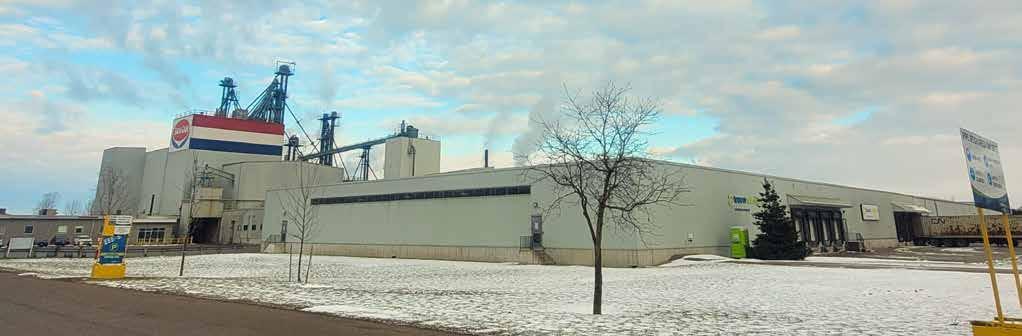
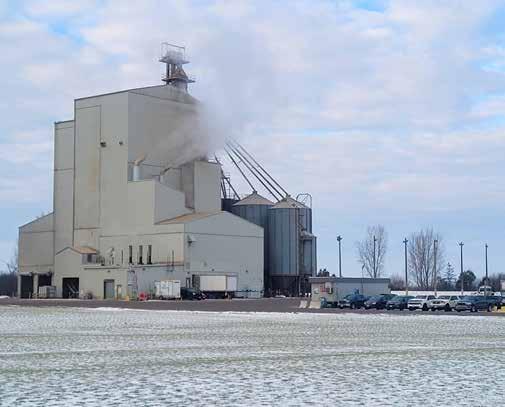
Shur-Gain plant #1 and the pet-food plant at 600 James St. S. The plants have been in the same location since 1976 and 1986 respectively. Both plants have employed many people throughout the years.
(WENDY LAMOND PHOTO)
WENDY LAMOND Independent Reporter
Shur-Gain: A longstanding farm business in St. Marys
At that time, there wasn’t a Southvale, Meadowridge or Maxwell street and it was wide open farmland.
Canada Packers chose to build the mill where it stands now due to truck traffic and environmental factors, and to keep it a bit further from the town centre.
The mill manufactured feed for all classes of livestock and about 20 employees were hired. In 1986, the petfood plant that was operating in Toronto at the time was shut down. With all the equipment sitting there, Hensel said it might as well be put to good use. As Hensel had hoped, expansion at 600 James St. S was going to happen and the pet-food plant was built with product brands like Loblaws onboard.
In 1990, a British Company called Hillsdown Holdings purchased Canada Packers. They also acquired a company called Maple Leaf Mills. The two were merged in 1991 creating Maple Leaf Foods with key ownership being taken over by the McCain Family and the Ontario Teacher’s Pension in 1995.
The Shur-Gain feed business worked with a dealer network. These are independent dealers that had a franchise with Shur-Gain. Shur-Gain would provide basic feed requirements to make feed at a local level. They sell dealers the premixes, and the dealers would then add commodities to make a finished product for their customers.
In 2000, expansion was once again on the horizon with the building of a 200,000-tonne capacity, state-of-the-art feed mill at the James Street location. Hensel said the purpose of the expansion was to show the commitment to the dealer network while keeping up with
the ever-growing direct livestock and poultry customers.
When it opened, the new feed mill was completely automated and employed a dozen additional workers, and focused on bulk swine and poultry feed.
Fast forward to 2007 when more change came to the company. An international animal nutrition and feed company called Nutreco purchased ShurGain from Maple Leaf Foods.
The company now operates under the name Trouw Nutrition, which is still owned by Nutreco but is a combination
of their animal feed businesses across Canada.
Dave Crossan, current general manager of the St. Marys location, has worked for the company for 23 years. After holding four different positions, he has seen many changes over the years. Changes in ownership and the differences in how they want to run the business stands out. The one thing that has always stayed the same is the focus on the customers.
“We always are focused on our cus tomers. Our consumers are more and more reliant on technology like the Ro
bot milking,” Crossan said.
The company has now grown to 265 employees. It has 11 centres of excellence and many smaller dealers, and the poultry feed has the largest tonnage across current-day Shur-Gain.
One thing both Hensel and Crossan shared was the importance of the people and the focus on the clientele. Hensel emphasized the value of personal relationships and the changes he has seen over the years. One big change is the growth in farm operations. Where it was once mostly small farms, at some point, the focus shifted to larger operations that require more specialty feeds. But as agriculture changed, Hensel said the company changed along with it.
According to Crossan, the tariff war has luckily not impacted the company too much.
A company that has been in business for 89 years is rare. It takes many people to make that happen, from management, staff, suppliers and customers, ShurGain has obviously done something right.
As a young man, Hensel was working a part-time job and planning on getting his pilot licence when he was injured in a workplace accident. He turned this lemon into lemonade by becoming an integral part of bringing Shur-Gain to St. Marys and enjoyed a 44-year career in the feed business. He said he feels good about bringing it to town and that it is still going.
“I enjoyed my entire career and all the people I met. I feel good about the fact that I brought it to town, that it employed many people over the years and that it is




Shur-Gain plant #2 was built in 2000 and can produce 200,000 tonnes of bulk feed.
(WENDY LAMOND PHOTO)
UTRCA programs help farmers invest in soil health, water quality and long-term sustainability
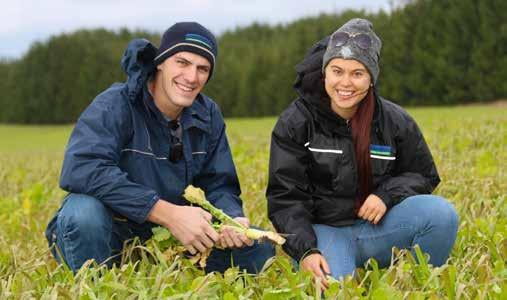
With support from the UTRCA, Oxford County farmers Steve and Cobi
have been utilizing cover crops and reduced tillage, planted more than
and
Regional Editor
Farmers across Perth, Oxford and surrounding counties are finding new ways to strengthen their land and protect the environment with support from a range of funding programs offered by the Upper Thames River Conservation Author-

ity (UTRCA). Through initiatives like the Phosphorus Reduction Program, Oxford Clean Water Program, Resilient Agricultural Landscape Program and UTRCA’s Tree Planting Program, farmers and rural landowners can access financial and technical support for projects that improve soil health, reduce runoff and






several erosion-control structures on their property.
enhance the long-term sustainability of their operations.
“The Upper Thames River Conservation Authority offers a range of funding programs designed to support farmers and landowners who are working to protect soil, water and the long-term health of the landscape,” said UTRCA stewardship outreach specialist Shannon Zylstra.
Those programs help offset costs for a wide variety of on-farm practices, including cover crops, reduced tillage, nutrient management, erosion control structures, windbreaks, wetland creation and tree planting. In some cases, multiple programs can be combined to further reduce the financial burden on farmers.



Sauder
6,500 trees,
have installed
(PHOTO COURTESY OF UPPER THAMES RIVER CONSERVATION AUTHORITY)
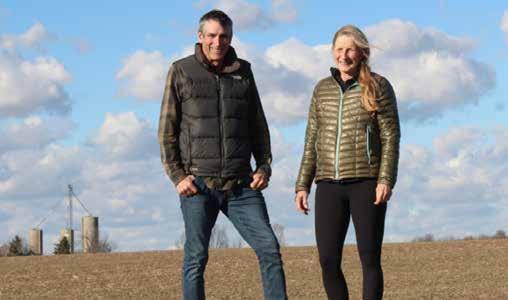
Upper Thames River Conservation Authority (UTRCA) stewardship and land-use planner Michael Funk and manager of integrated watershed management Tatianna Lozier measure water quality as part of a cover-crop project funded with support from the UTRCA.
(PHOTO COURTESY OF UPPER THAMES RIVER CONSERVATION AUTHORITY)
GALEN SIMMONS
UTRCA programs help farmers invest in soil health, water quality and long-term sustainability
“Agricultural lands play a vital role in the health of our watershed, and farmers are key partners in protecting the land and water we depend on,” Zylstra said. “These programs recognize that farmers are already strong stewards of the land and provide additional support to help them continue that work.”
Beyond funding, UTRCA staff also provide technical assistance, helping landowners plan projects, navigate applications and connect with other available resources.
“This includes financial assistance through cost sharing, as well as technical support,” Zylstra said. “In many cases, staff can help with project planning, design recommendations and connecting landowners with other available programs and resources.”
Across the region, a number of farm families are already seeing the benefits of these programs in action.
In Middlesex County, Bill and Carrie Irwin planted a double-row windbreak along the edge of their property using support from UTRCA’s tree planting program. The project included 720 trees and serves as a natural buffer to help reduce soil erosion and protect crops from wind.
In Oxford County, Steve and Cobi
Sauder have taken a comprehensive approach to soil conservation over several decades. In addition to adopting no-till and cover cropping practices, they have installed erosion-control structures such as berms, terraces and grassed waterways, along with extensive tree planting to support long-term soil and water management.
“We’re trying to be stewards of the land in terms of water quality as well as improving soil health,” said Steve Sauder in a video posted to the UTRCA website about the project. “We put in this berm with the Upper Thames River Conservation Authority’s Clean Water Program to try and alleviate this problem. What I can say after seven years is it’s been successful.
“ … When we initially put this berm in, I was concerned about designing it properly and I was pleased that the Upper Thames River Conservation Authority provided engineering services free of charge that allowed us to get a good design that we were confident in.”
Meanwhile, in Zorra Township, Katherine and Jim Grieve transformed a low-lying, unproductive area of their farm into a thriving wetland. The project now provides habitat for wildlife while also improving water quality on the property.
“This area of the field has been unproductive for years,” said UTRCA manager of integrated watershed management Tatianna Lozier in a video shot after construction of the wetland in 2017. “It’s wet following rainfall events and there’s also standing water following significant events. … It looks great. In addition to the trees and shrubs we planted, we added 700 aquatic plugs that will spread and fill in the perimeter of the wetland. There is also vegetation that has come back and … it’s utilized now by several bird species and different insects.
“ … You’re creating both terrestrial and aquatic habitat. There’s also a water-quality function. The water (in the wetland) is from surface runoff and tile drainage and the rainfall itself. As the water is held in the wetland, the sediment will settle to the bottom and any nutrients associated with that sediment. With the vegetation, you have a nutrient-cycling benefit and the water in the pond will be able to slowly infiltrate as well as be lost to evaporation. … When there is a lot of water, we do have a standpipe so that water can be slowly released.”
At Hoenhorst Farms in Innerkip, dairy farmer Cox Wensink implemented a slag filter system to treat silage runoff, helping remove excess nutrients before
water leaves the farm. A recent upgrade to the system has further improved its performance and longevity.
Zylstra said projects like these demonstrate how environmental stewardship can also support farm productivity.
“Many of the practices supported through these programs help keep nutrients and soil on the field where they are needed, rather than being lost through runoff into local waterways,” she said.
For farmers, the programs also reduce the risk associated with trying new practices.
“These programs provide an opportunity for farmers to try new techniques such as cover crops or soil conservation practices with reduced financial risk,” Zylstra said.
UTRCA has worked to ensure the application process is straightforward and accessible, recognizing the time pressures farmers face throughout the year.
Farmers and landowners interested in applying for funding or learning more about available programs can contact the UTRCA stewardship team directly or visit the conservation authority’s website for details.
“Our goal is to support farmers and the hard work they continue to do to strengthen our land,” Zylstra said.
Scott Graham humbled over induction into the Ontario Agricultural Hall of Fame
WENDY LAMOND Independent Reporter
St. Marys resident Scott Graham was honoured to find out he is being inducted into the Ontario Agricultural Hall of Fame along with four other inductees at a ceremony in June taking place in Elora.
All five nominees are being recognized for their contributions and dedication to the farming world. Graham, who was nominated by Egg Farmers of Ontario, said he was overwhelmed and surprised when he received the call from current chair of the board Scott Helps and feels so fortunate to be included with other leaders from the industry who brought agriculture to where it is today.
“Being inducted into the hall of fame really does mean a lot to me, but I never forget all the good farmers on all the different concessions across the province,” Graham said. “In my mind, they are stay-athome hall of famers; guys that have contributed so much on what has gone on in this province. I have a lot of respect for those farmers that just do their own thing on their farms and are so good at it.”
Graham grew up on a farm on the outskirts of St. Marys and is a second-generation egg farmer. Owing much of what he learned to his father, Tom, who Graham feels deserves to be in the hall of fame more than himself, he said he always looked up to his dad as a mentor. He was instrumental in moving hybrid chickens into the marketplace in the ‘50s and in the ‘70s, he was one of the first to introduce Red Angus cattle into Ontario.
Graham was chair of the Egg Farmers of Ontario board for eight years and served on the board for 13 years. His career in the egg industry greatly advanced initiatives like the Quota Transfer System. This system, which Graham considers a highlight and one of his proudest achievements, was based on putting control and value on quota instead of selling it face to face. Currently, it is sold through an auction process.
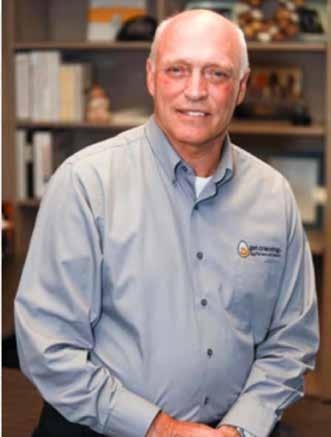
The previous process was cumbersome and put pressure on the industry partners and needed more structure. Graham took part in over two years of research and worked with farmers for the transfer system to come into play in 2014.
Graham also spearheaded the development of the Consumer Choice Campaign, which was based on consumers learning more about the safety, nutrition




and the quality assurance behind Ontario’s egg production.
Examples of these campaigns included education about Ontario egg-farm families, the Get Cracking strategy, the egg quality strategy and much more. Graham says consumers love the sticker on their egg cartons.
More recently, Graham took part in the development of non-invasive technology for gender identification of eggs prior to hatching through a project called Hyper-eye.
Before the last tariff talks, Graham travelled with the federal minister of agriculture to the United States and met with 13 different agricultural secretaries, stopping in approximately six states to try and get a handle on the concerns they were dealing with south of the border and to build relationships. This was a highlight for Graham, who said he learned the differences between countries and how lucky we are to have the support of the provincial and federal governments.
“You have to travel a long way to see a farm landscape like we have here in Ontario with the diversity of different commodities. I think everybody should be really proud. We have some very good farmers here,” Graham said.
Graham discussed supply management and its three pillars: border control, supply control and production control. In the egg business, trade talks have resulted in 7 per cent of eggs coming from the United States. The other 93 per cent comes from Canada. With so many fluctuations with tariffs in place, responsible and accountable controls are very much needed.
The COVID-19 pandemic was a tough time for Graham as it was for many. After being around people as much as he was, he said it was hard to make that change to isolation. To help improve that, he was recruited to participate in a Tim Hortons commercial that was filmed in Stratford. When he was filming in







Scott Graham is being inducted into the Ontario Agriculture Hall of Fame. His nomination came from the Egg Farmers of Ontario for all of his farming achievements.
(CONTRIBUTED PHOTO)
Farmerettes documentary to screen in St. Marys
GALEN SIMMONS Regional Editor
The forgotten story of the Ontario Farmerettes will take centre stage in St. Marys this spring when the St. Marys Museum hosts a screening of the documentary, We Lend a Hand.
The screening will take place Wednesday, May 21, as part of the museum’s speaker series, which is now in its 13th season. Along with the evening public screening, the museum is also working on an afternoon matinee for DCVI students and is seeking sponsorship from local agriculture-related businesses to help cover the cost so students can attend free of charge.
St. Marys director of culture, tourism and engagement Amy Cubberley said the documentary is a natural fit for the museum and the speaker series.
“The film is doing a bit of a tour across Canada right now with a focus in southwestern Ontario,” Cubberley said. “As the title says, it’s a bit of a forgotten story. I think women’s history has often been overlooked and then, as well, agricultural history, so I think we’re just re-
ally excited to be able to showcase a little bit of both.”
Tickets for the evening screening are $20 and include both the film and a question-and-answer session with the film’s producers.
The documentary tells the story of the Ontario Farm Service Force, better known as the Farmerettes, a program that ran from 1941 to 1952 and saw roughly 40,000 teenage girls and young women work on farms across the province during and after the Second World War. They picked fruit, hoed vegetables and helped bring in crops at a time when many young men were overseas fighting. Their work helped feed both civilians and soldiers and became a vital, if long-overlooked, part of the wartime effort.
The film itself grew out of years of research by Bonnie Sitter, co-author of Onion Skins & Peach Fuzz: Memories of Ontario Farmerettes. That book, and the stories it collected, later inspired a stage adaptation at the Blyth Festival before eventually becoming the documentary, We Lend a Hand.
The film has been described by filmmaker Colin Field as a reminder that
“everybody can contribute.” The documentary also captures the challenge and adventure of the program, from girls living in tents and converted barns to the close bonds they formed while working long, hot days in the fields.
That spirit came through in a guest article published in the Independent last year by Peter Allan Rice, whose mother, Adelaide “Dale” Rice, was a Farmerette in 1942. Rice wrote about his mother picking strawberries, hoeing vegetables and, most memorably, picking peaches in the Niagara area, where the peach fuzz would sneak down her collar and under her handkerchief as she worked. He also described the freedom and friendships Farmerettes found in those summers away from home.
While St. Marys may not have a direct Farmerette farming story of its own on the same scale, Cubberley said the town has an important parallel history when it comes to women stepping into essential wartime roles.
“The most direct comparison we have that took place in St. Marys is related to Maxwell Industries,” she said. “They received a major contract during the Sec-
ond World War, and so St. Marys was actually the largest producer of grenades.
“Many of the men had gone overseas, so women filled those roles. Again, not agriculture, but kind of a similar story that women stepped up to the challenges.”
The Farmerettes documentary screening is a joint endeavour between the St. Marys Museum and the Friends of the St. Marys Museum. Cubberley said the museum is hopeful local interest will be strong, especially as more people begin to recognize the women in their own families and communities who may have taken part in the program.
Tickets will be available through the museum, with an additional retail outlet for ticket sales also being arranged. For more information, call the museum at 519-284-3556 or email museum@town. stmarys.on.ca.
Event info:
• Date and time: Thursday, May 21, at 7 p.m.
• Location: Community Centre at the Pyramid Recreation Centre, 317 James St. S.
• Tickets: $20 (cash or cheque only).
Scott Graham inducted into the Ontario Ag. HOF
Stratford, takes were sent to the Tim Hortons group in Toronto and they decided whether a retake was to be done. Graham said he ate many Tim Hortons breakfast sandwiches that day, but it did restore his emotional wellness during that time and was a fun experience.
Graham’s son, Brett Graham, is the third generation and took over the family egg farm in 2008. As Scott Graham spent more time on the board, Brett Graham took on more responsibilities at the farm. Scott Graham is very proud of what his son has accomplished to carry on the family tradition.
Though there were some challenges associated with serving on the Egg Farmers of Ontario board, Scott Gra-
ham said there were so many positives.
Laurie Graham, Scott Graham’s wife of almost 50 years, was a huge part in his success.
“You must have a good partner to be away as much as I was in those days,” Scott Graham said. “Although she likely scratched her head at times, she was always supportive and I couldn’t have done all of this without her. I truly appreciate all she has done.”
According to the press release about the induction by the Ontario Agriculture Hall of Fame, Scott Graham’s legacy is defined by his commitment to building trust between farmers and consumers while mentoring the next generation of agricultural leaders. Nowadays, Scott Graham can be found coaching


his grandkids, playing hockey and volunteering on the St. Marys Healthcare Foundation.

Animalia exhibit explores how animals helped shape St. Marys – from horses and cows to mink ranches
For nearly a year, visitors to the St. Marys Museum have been able to explore a side of local history that is easy to overlook because it was once so ordinary – the role animals played in building, feeding, clothing and shaping the town.
The museum’s “Animalia” exhibit examines the long relationship between humans and animals in St. Marys, from companionship and decoration in the home to the essential working roles animals played in agriculture, transportation and industry.
Museum curator and archivist Emily Taylor said the exhibit grew out of the museum’s own collection.
“We started to notice that we had a lot of artifacts and photographs in our collection that were related to animals,” Taylor said. “We wanted to pull all of those pieces from our collection and kind of talk about why animals have re-

ally kind of captured people’s interests and imaginations.”
The exhibit is split broadly into two themes – animals in the home and animals at work. On one side are paintings, toys and decorative objects featuring animals. On the other are the tools, photographs and artifacts that show how deeply animals were woven into everyday life in early St. Marys.
“That relationship with people … goes back thousands of years in the history of agriculture. Animals have always been important in working alongside humans,” Taylor said. “Those types of relationships are very important in St. Marys history too, especially agriculturally.”
That includes the obvious livestock connections – cows, chickens, horses and geese – but also the draft animals that helped move quarried limestone, pull carts and transport heavy goods through town long before trucks and tractors took over.
“Horses would have been doing a lot of the heavy lifting that people wouldn’t

be doing,” Taylor said.
The exhibit also reminds visitors how closely tied animals remain to life in St. Marys today, whether through farming, food production, recreation or family pets.
“It’s so clear that animals have been incredibly important in St. Marys history, and they still are today,” Taylor said. “It’s such a way for people to connect their current lives to people in the past in St. Marys.”
One of the more unusual and more controversial animal stories tied to St. Marys is mink farming, a now lesser-seen but once highly visible agricultural industry in the area.
Town director of culture, tourism and engagement Amy Cubberley said mink ranching is an often-overlooked part of local history despite how prominent it once was.
“Mink ranching has been a major industry in the St. Marys area for a number of years,” Cubberley said. “There still are active mink ranches in the area.”
Historical excerpts preserved in the museum archives show just how significant the industry once was. In December 1947, more than 30 local mink ranchers with St. Marys addresses had sold over 5,000 pelts that season at prices ranging from $15 to $20 each, and by 1950, local ranchers were preparing for Montreal fur auctions while struggling to secure enough frozen fish to feed their animals.
The museum archives also trace the industry back to one of its local pioneers. According to the obituary of James Omar Mitchell, he “pioneered the fox and mink farming industry in this district,” helping launch what was then described as a thriving enterprise in St. Marys and the surrounding area.
Like many farm sectors, mink ranching developed its own culture of competition and recognition. Cubberley said she regularly comes across archival references to local ranchers winning honours for their animals. Even in 1975, the St. Marys Lions Club updated its club


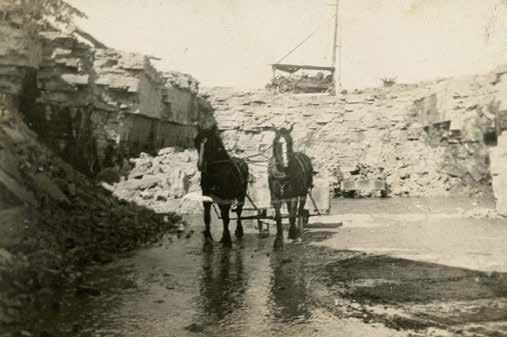
Two horses puling a cart of quarried limestone.
(PHOTO COURTESY OF ST. MARYS MUSEUM COLLECTION)
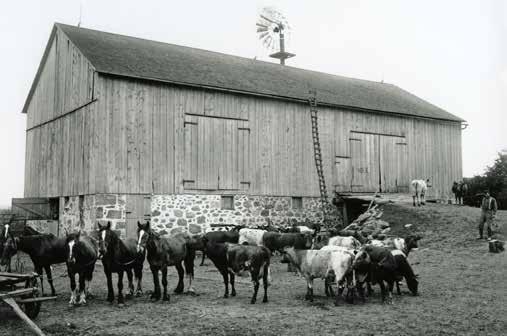
Barn scene with animals circa 1902-1906.
(PHOTO COURTESY OF CARTER AND ISAAC COLLECTION, ST. MARYS MUSEUM)
GALEN SIMMONS
Regional Editor
Animalia exhibit explores how animals helped shape St. Marys – from horses and cows to mink ranches
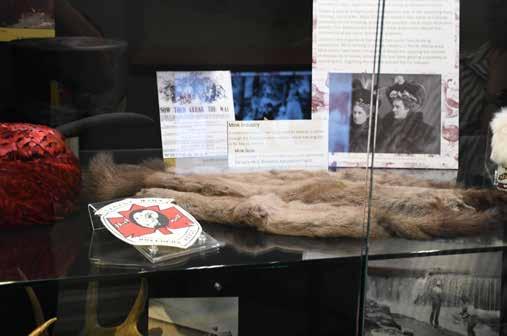
pin from one featuring a mink to one that reflected the town’s cement industry, a small but telling symbol of how the town’s identity was shifting.
The industry remains contentious today, particularly amid public concern
over fur farming and occasional releases of animals from farms by animal-rights organizations like PETA. But historically, it formed a real and profitable part of the local agricultural economy. That complexity is part of what makes Animalia interesting. It is not simply an
exhibit about beloved pets or pretty objects, it is about the many ways animals helped St. Marys grow – as labourers, food sources, companions and commodities.
Animalia will remain on display at the St. Marys Museum through the spring
before a new exhibit takes its place. For more information on the displays and exhibits at the St. Marys Musuem, visit www.townofst marys.com/recreation-community-culture/st-marys-museum-archives/.


A mink stole and Canada Mink Breeders Association patch on display in the Animalia exhibit at the St. Marys Museum. Mink-fur ranching was once a very public and profitable agricultural industry in and around St. Marys.
(GALEN SIMMONS PHOTO)
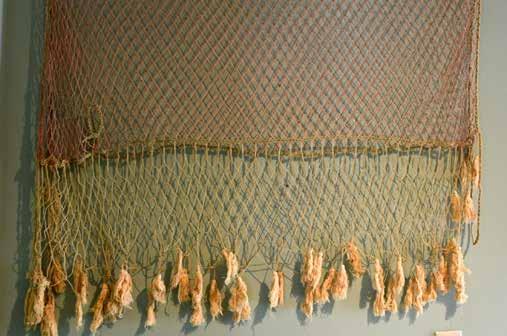
This fly netting, on display at the St. Marys Museum, was draped over working horses to keep flies away. As the horse moved, the netting would shift back and forth, preventing flies from landing and biting the horse.
(GALEN SIMMONS PHOTO)
Nuhn Industries expanding again with new Sebringville facility
additional space to expand its growing line of manure-handling equipment.
One of Perth County’s most progressive manufacturing companies is continuing to grow.
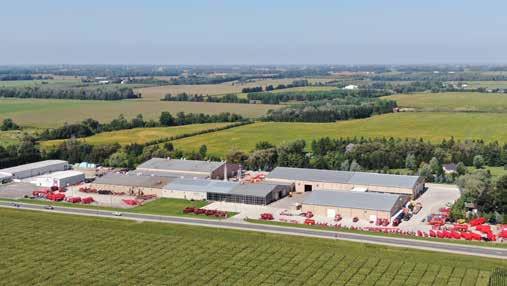
Nuhn Industries, located on the western edge of Sebringville, is in the process of building a new 148,000-square-foot warehouse and assembly plant across the road from its main facility, creating
The expansion reflects the company’s continued success both locally and internationally, with its signature redand-gold equipment recognized across Ontario, Canada, North America and beyond.
The company traces its roots back to 1902, when Simon Nuhn opened a small blacksmith shop in Wartburg, just north
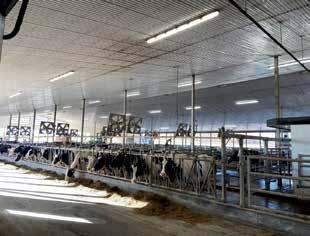
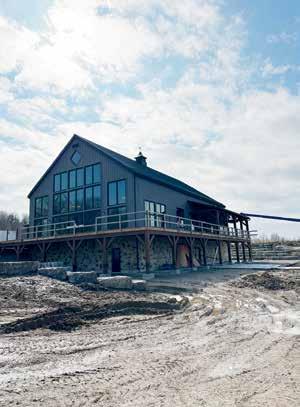
of the current Highway 8 location. Nuhn Industries later relocated to Sebringville in 1984, where it has continued to grow into a global manufacturer.
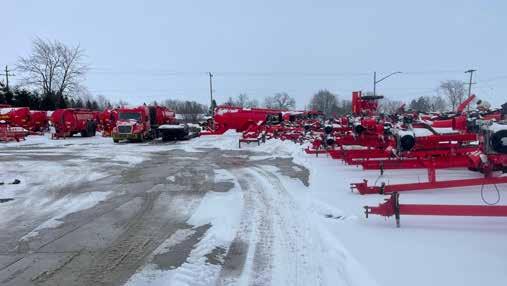
Today, the company produces between 200 and 300 manure tanks each year, along with hundreds of manure pumps, lagoon crawlers and alley manure vacuums.
Speaking last week, Nuhn Industries vice president Ian Nuhn said innovation continues to drive the company’s growth. Nuhn was the first manufacturer to design and produce manure crawlers used to mix and agitate large manure lagoons, with more than 800 units now in operation worldwide.
The company’s newest product – a self-propelled manure vacuum designed for large, free-stall barns – has also gained strong traction in the market. According to Nuhn, the company is currently manufacturing and selling approximately one unit per week to customers around the world.
Nuhn Industries exports the majority of its products with about 60 per cent of equipment destined for the United
States, 30 per cent remaining in Canada and the remaining 10 per cent shipped internationally.
Its customer base is largely made up of dairy operations, accounting for about 60 per cent of sales, followed by hog farms at 40 per cent and beef operations at roughly 10 per cent.
In addition to manufacturing, the company maintains strong connections with the agricultural community through farm and dairy shows, including the upcoming Canadian Dairy Expo in Stratford on April 1 and 2.
As the company continues to expand, it also remains an important employer in the region, with plans to grow its workforce to approximately 250 employees while contributing to Perth County’s economy.
The business remains family-operated, with Ian Nuhn working alongside his father, Dennis Nuhn – a member of the Perth County Agricultural Wall of Fame – as well as his mother Marilyn Nuhn, who oversees human resources, and his wife, Linda Nuhn, and their two daughters.
A portion of Nuhn Industries’ inventory of manure-handling equipment, which is distributed to customers locally and around the world.
(GARY WEST PHOTO)
Nuhn Industries in Sebringville continues to expand as one of Ontario’s fastest-growing agricultural equipment manufacturers.
(IAN NUHN PHOTO)
GARY WEST Independent Reporter
Ontario soybean farmers face price pressure as China shifts buying and Brazil ramps up production
AMANDA NELSON Independent Reporter
Ontario soybean farmers are watching global trade negotiations closely as uncertainty around exports – particularly to China – adds to price pressure in a market already facing strong global crop supplies.
Brazil is expected to have a record soybean harvest in 2026, a development that analysts say will weigh on prices worldwide.
“There’s forecast to be record production in Brazil, and when there’s strong production, that has downward pressure on price,” said Brian Innes, executive director of Soy Canada. “That’s the first thing to watch for prices in 2026. The second is what happens globally with geopolitics and tariffs.”
Innes said changes in trade relations between major economies – especially the United States and China – can have a direct impact on the prices Canadian farmers receive.
“Due to the Trump administration, tariffs on soybeans have changed,” he said. “One thing to watch for 2026 is how the situation between the U.S. and China evolves, and how the situation between Canada and China evolves. That can have
an impact on price if tariffs change.”
More than 70 per cent of Ontario’s soybean crop is exported, with prices shaped by global demand, particularly from China. While China historically sourced much of its soybeans from the United States, it is increasingly turning to Brazil due to generally lower prices.
The Canadian and U.S. soybean markets are also closely linked through cross-border trade and processing, which could impact prices for Canadian farm ers.
“Products flow back and forth across the border,” said Innes. “For example, Ontario soybeans are shipped to Mich igan, processed into soybean meal and then shipped back into Ontario. Soybean meal and soybean oil trade back and forth across the border, and that’s why prices are very linked.”
Soybeans are priced on global bench marks – particularly U.S. futures markets – meaning Canadian prices move in step with broader world trends.
“The price that Ontario farmers see is based on what conditions Canada faces when exporting to the world, including China,” said Innes. “In the past, the dif ference between Michigan and Ontario was largely tied to exchange rates, but now, with global trade disruptions, Can
ada and the U.S. face different tariffs and different market conditions.”
Despite growing competition from lower-cost producers, Innes said Ontario remains well positioned as a high-quality soybean supplier.
Ontario is a global leader in identity-preserved and food-grade soybeans, a niche market that allows farmers to com-
pete on quality rather than volume alone.
“We’re living in a time of unprecedented global uncertainty, and if market conditions change for Canadian soybean exports, that will have an impact on price,” said Innes. “But Canadian soybeans have been flowing under strong export conditions for some time, and that has meant strong demand for Ontario soybeans.”











Teresa Van Raay begins third term with Ontario Federation of Agriculture
DAN ROLPH Independent Reporter
Teresa Van Raay is looking ahead to three more years of advocacy on behalf of the province’s farmers.
Van Raay, a Dashwood native, was re-elected as an Ontario Federation of Agriculture (OFA) director-at-large in November 2025, beginning her third three-year term with the organization.
Before she was first elected to serve in the OFA, Van Raay was a director with Ontario Pork for 14 years – an experience she described as eye-opening as she got to hear about the issues that farmers in the industry were facing.
“I realized how many more issues there are,” she said. “When you look at taking on the diversity of concerns in all Ontario, it’s daunting.”
Van Raay said some of the most prominent issues facing farmers in Ontario include trade and land use, which she noted is vital to the future of growing food in Canada.
“Once land is asphalted or cemented over, you’re not going to grow too much,” she said. “Getting the word out about how important it is for Canadians to grow our own food; that’s one of my biggest goals.

“The decisions made today affect our futures, and our next generation of farmers.”
When asked why she decided to seek a third term with the federation, Van Raay was clear that there’s still work to do when it comes to advocating on behalf of Ontario’s farmers.
“We’re not done yet,” she said. “It’s a
big portfolio, but the people in our industry who are elected to do this, all the ones who I’ve met, are in the positions for the right reasons. They want to make it better for their industry and for the next generations all because we understand the importance of growing food.”
Van Raay said she’s taking many lessons from her time as director-at-large so
far as she looks ahead to at least three more years of representing farmers. She said networking remains one of the most vital parts of the work.
“One of the things that I love to do is put the right people together,” she said. “That can make a difference.”
Stepping outside the “agricultural bubble” is also important when speaking about issues facing farmers throughout Ontario, according to Van Raay, particularly with those not in the industry who live busy lives and may not be aware of those issues until they start seeing empty grocery store shelves.
“We are such a small population that we’re not getting the news out there,” she said. “If there comes a time that there’s a shortage, then people are going to stand up and be aware. But it might be too late if we haven’t realized the importance of food security in Canada.”
Van Raay said the upcoming municipal elections scheduled for later this year are an important issue that has her attention. With OFA regularly organizing all-candidates meetings for elections, she said it’s important to present the correct questions to those who could be making decisions in council chambers in the future, ensuring they understand their commu-

Teresa Van Raay was re-elected as an Ontario Federation of Agriculture director-at-large in November 2025, starting another three-year term of advocating for Ontario’s farmers.
(CONTRIBUTED PHOTO)
Teresa Van Raay begins third term with OFA
nities, particularly when it comes to land use.
“We don’t want to be collateral damage because no one’s thought about how a decision might affect the farmer,” she said.
Ontario’s recent announcement about the amalgamation of conservation authorities also has Van Raay’s attention. Under the government’s plan, the province’s 36 authorities will be consolidated into nine, removing representation from lower-tier municipalities.
“That’s a big deal,” she said. “One of the things we were really pushing with OFA is to have agricultural representatives.
“From what we did see, that’s not there. That’s very important to our communities.”
A topic that has been getting more attention, particularly after the COVID-19 pandemic, has been mental health in the agricultural community – an issue that Van Raay said is close to her heart.
“It’s just become okay in the last seven or eight years to talk about it at the farm level,” she said. “When a farmer’s having a bad day, you just can’t take a week off. The pigs still have to be fed, or the crops still have to get planted.”
Speaking to farmers who may be struggling with mental health, Van Raay said Ontario’s Farmer Wellness Initiative and the Guardian Network are programs worth highlighting. The Farmer Wellness Initiative provides mental-health counselling to Ontario’s farmers, farm families and employees at no cost.
The Guardian Network is a program driven by volunteers who are trained to identify those struggling with their mental health in the agricultural community, and Van Raay completed the training to become a guardian in the network.
“It’s a really good program,” Van Raay said. “The more we talk about it, the more it’s okay to talk about it.”
With such a wide range of issues needing attention, Van Raay said OFA’s supporting staff have made the expansive task manageable.
“It’s a great team, and a really diversified team,” she said.
With at least another three years ahead of her advocating for Ontario’s farmers, Van Raay said it’s her love for her home that will keep her going.
“It’s so important to have strong rural communities,” she said. “I love where I live. I love my Ontario. But we can’t keep coasting and think that somebody else is going to take up the baton.”




Breaking barriers: Women in Canadian agriculture
entrants.
Women play a critical role in Canadian agriculture but also face significant participation barriers.
Lack of resources and lack of recognition lead to under-representation among farm operators and in leadership roles within agriculture businesses and organizations. The growing skills gap across the agriculture sector makes it imperative to grow gender equity and lift women’s participation in all aspects of farming.
Farm Credit Canada (FCC) estimates achieving revenue equity – with female farm operators earning, on average, revenues in line with male farm operators – would add an additional $5 billion to agriculture’s GDP contribution. Achieving gender parity in the number of farm operators would magnify these economic benefits.
Recognizing the existing contributions of women could attract more women to the industry, which itself is a function of elevating the status of women’s contributions equal to men’s.
FCC estimates almost 88,000 additional female farm operators will need to be counted to achieve gender parity by 2026 – 75 per cent are already farming but unrecognized as operators, and 25 per cent of which will need to be new
In the 30-year period spanning 19912021, the percentage of female farm operators in Canada increased from 25.7 per cent to 30.4 per cent. This upward trend is expected to continue, with the proportion of female farm operators expected to reach 31.1 per cent in 2026.
While encouraging, it’s important to note this trend is largely explained by men leaving the industry, not by more women joining. Farm consolidations and an aging farm population have reduced the total number of farm operators across Canada over time, with the number of men falling faster than the number of women.
While the proportion of women farmers has been steadily on the rise, the actual number of women in farming has not been growing by much. In fact, between 2016 and 2021 the number of female farm operators grew for the first time since 1991, but only by 2.5 per cent – translating to less than 2,000 additional farm operators. Women are also still less likely than men to be the sole decision-maker on the farm.
Female farm operators face very different economic circumstances than male farm operators. Female operators tend to have smaller operations and lower farm incomes. The median farm operating revenue bracket is the same for both men and women at $50,000 to

$99,999. But approximately 58.6 per cent of female farm operators work on farms that reported less than $100,000 in revenues, compared to 51.1 per cent of male farm operators, based on the most recent census data from 2021.
Conversely, only 17.9 per cent of female farm operators were employed on farms with revenues of $500,000 or more, compared to 21.9 per cent of their male counterparts. Women have gained some ground in recent years in high-value markets for products like beef, poultry and eggs. Men continue to dominate the grains and oilseeds market.
The public still expects farmers to be male. Stereotypically, in many farm families, the man is labelled as the farmer, while the woman is labelled a farm wife. Girls growing up in farm families may not feel encouraged from participating in the more operational aspects of farming.
This early socialization can shape how women perceive their roles on the farm, and their confidence in engaging in all aspects of farming as adults. Women also tend to be expected to take on more household and childrearing responsibilities and often provide economic stability for their families through off-farm employment, making it more difficult to engage in production work.
In a 2024 survey conducted by FCC, women reported they often feel like



they must prove that they are as knowledgeable, skilled and capable as their male counterparts, and often feel judged to be less competent because of their gender. Non-production roles dominated by women like accountant or finance manager are also often deemed not as important as operational roles that tend to be male dominated.
Men are more likely to inherit the farm over women, as tradition dictates that these resources be passed from fathers to sons. Women are often excluded from succession planning, and in large part are still expected to marry into farm families if they want to participate in farming.
Numerous aspects of farming were not designed with women in mind. For example, most farm equipment has been tailored to the male physique, and these design limitations can make it more difficult for women to engage in the physical side of farming.
Many women shared that their views on their own potential were shaped by what they saw represented as they grew up, which typically was men as decision makers on the farm and women in supportive roles. A lack of representation of female leadership in agriculture can make it difficult for younger women to feel confident that they can take on leadership roles.
FARM CREDIT CANADA Contributed Article
Fun with fungi: Edye Farms bringing wildwood mushrooms to Perth County agriculture
EMILY STEWART Independent Reporter
Edye Farms, run by Arlene Oetomo and Joe Edye, wants to encourage St. Marys and area residents to cook with mushrooms unique to what’s typically found at the grocery store.
“Edye Farms was born out of our shared passion for eating more plants, sustainability and growing our own food,” Oetomo told the Independent. “We were looking for more variety and higher quality mushrooms right here in Perth County and found a gap worth filling.”
With Edye’s upbringing on a family farm, Oetomo’s educational background leading to her PhD in public health focusing on climate change and both of their experiences working on farms and in organic produce operations, the pair grows more than 200 pounds of woodland mushrooms every two weeks. As these mushrooms usually thrive in the fallen logs and decaying trees of a humid forest environment, Edye Farms found a way to copy those conditions indoors.
“We mimic those conditions in our controlled indoor environment with no pesticides or fertilizers – just fresh Perth County air and water,” Edye said. “This is quite different from the mushrooms you typically find at large grocery chains, which are commonly grown on animal manure at industrial-scale farms.”
Edye Farms can grow and harvest
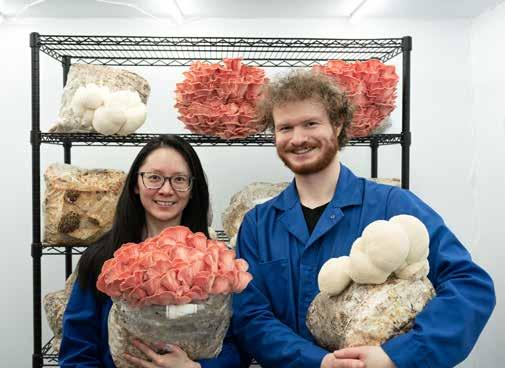
mushrooms all year with their indoor facility so customers can enjoy wild mushrooms like the lion’s mane mushroom and oyster mushrooms and learn how to cook with them. Lion’s mane can be used as nuggets or steak, for example.
“Fungi are genuinely fascinating and we love being the ones to introduce people to what they’ve been missing,” Edye
said.
Nothing goes to waste at Edye Farms because any unsold mushrooms are dehydrated and sold dried in powdered form to be used in soups, hot drinks and baked goods.
Edye Farms is part of Perth County’s strong agricultural community. With an aging population of farmers across Can-
ada as more than 60 per cent are over 55 years old, Edye and Oetomo said they hope to inspire a new generation of farmers. Only about nine per cent of farmers across Canada are under 35 years old.
“As young farmers ourselves, we feel a responsibility to help change that trend and to show that sustainable, efficient farming methods can be a viable path for a new generation,” Oetomo said. “Growing food for climate-resilient communities isn’t just a goal for us; it’s the whole point.”
Edye Farms made their St. Marys debut on Jan. 26 at the St. Marys Farmers’ Market and received an overwhelmingly positive response.
“People were genuinely excited to find fresh, specialty mushrooms right here in St. Marys,” Edye said. “The response exceeded our expectations.”
Edye Farms will be part of the regular farmers’ market season starting in May. For now, the farm is running online ordering, local delivery and weekend pickup at The Flour Mill, and the response so far has been promising.
“Right now, our biggest challenge is raising awareness without a physical storefront and helping people feel confident cooking with mushrooms they may not have tried before. But that’s part of what makes this exciting for us,” Edye said.
For more information, including online orders, visit edyefarms.ca.
Breaking barriers: Women in Canadian agriculture
Women in farming are more isolated than their male counterparts and have less access to networking, mentorship and support. As agriculture continues to be a male-dominated industry, most executive and board positions within agriculture continue to be held by men. Women generally have less access to a network of likeminded peers sharing similar struggles who they can lean on for support and advice and often have the experience of being the only woman in the room.
The labour needs of Canada’s agriculture sector are changing.
In this era of digital agriculture and data-driven decision making, there is a growing need for highly skilled farm labour. Reflecting this need, there has been an overall upward trend in educational attainment in the agriculture labour force in recent years with a declining number of workers having no formal qualifications, and an increasing number of workers with college and university degrees.
This trend is even more pronounced for women, who are more likely to be highly educated than their male counterparts. In 2021, nearly one-quarter of
female farm operators possessed at least a bachelor’s degree, compared to only 14.5 per cent of male farm operators.
The proportion of female farm operators without any formal education was only 9.3 per cent, notably lower than the 18.2 per cent observed among male farm operators.
The current gap in educational attainment between female and male farm operators is greatest for operators aged 3039. Within this age cohort, 36 per cent of women have a university education, compared to only 17 per cent of men.
A high level of educational attainment makes it easier for women to take advantage of new tools and technologies of farming as they emerge. Many of these innovations are making it easier to overcome some of the physical and social barriers that women in agriculture have faced in the past.
Women working in agriculture also continue to demonstrate a strong entrepreneurial spirit, leveraging their skills and expertise to enhance the value of what they produce. Women have been driving the emerging trend of direct-to-consumer sales of farm goods, with farms run exclusively or jointly by female operators being much more
likely to adopt this marketing strategy. There are also a growing number of women working on farms producing organic goods and using sustainable energy sources and technologies. Women are also carving out space for themselves in growing niche markets, like sheep and goat production.
There is a lot of work that needs to be done to achieve gender equity in Canadian agriculture. Currently, the industry falls behind wholesale and retail, finance, education, health care and several other industries in terms of women’s participation. Women in agriculture today are highly educated and driven, with strong business acumen. They are well equipped to foster innovation and accelerate new methods, tools and technologies on the farm. At a time when productivity growth in Canadian agriculture is stagnating, leveraging their skills and entrepreneurial spirit will reap significant economic benefits.
Here are some potential strategies to consider:
-Increase the visibility of women in agriculture. Recognizing the important work that women are already doing on farms and in boardrooms across Canada is critical.
-Enhance mentorship and networking opportunities. This will help to reduce isolation and build community for women navigating the agriculture and food space.
-Ensure that women have equal opportunity to take on leadership roles. This requires not only reducing gender bias in promotion and hiring, but also ensuring women are supported in stepping into leadership roles when the opportunity arises, through access to things like flexible work arrangements and child-care accommodations.
-Improve access to resources. Women have historically been excluded from succession planning and equal access to land and capital. Programs that support women in accessing the resources they need to start their farm businesses are essential moving forward.
Embracing the strengths and potential of women in agriculture can unlock billions of dollars in economic benefits for the agriculture sector. Achieving gender equity can drive innovation, improve productivity and foster sustainability, leading to a more resilient and prosperous agricultural industry.
Arlene Oetomo and Joe Edye of Edye Farms are bringing woodland mushrooms like oyster and lion’s mane to St. Marys and area residents. The duo grows more than 200 pounds of mushrooms every two weeks.
(PHOTO COURTESY OF EDYE FARMS)
Oversupply and trade issues drive down dry bean prices for Ontario growers
AMANDA NELSON Independent Reporter
The 2026 Ontario Bean Growers annual general meeting was held in Stratford last month, where dry bean growers from across the region came together to discuss growing concerns around exports, particularly trade, transportation and domestic demand.
Alvin Klassen of Dry Bean World outlined current challenges as Canada continues to navigate overproduction of black beans and ongoing tariff changes that are limiting trade and creating uncertainty for growers.
“In the last five years, we’ve experienced several severe ups and downs in commercial markets related to supply and demand, with the influence of producer and dealer pricing,” said Klassen.
Despite steady global demand for dry beans, many growers are finding it harder to turn a profit.
Prices across North America have dropped sharply in recent years – in some cases by nearly half – while input costs such as fuel and fertilizer have remained high.
“Throughout North America, we are now sitting where bean prices are half of what they were three years ago, and the
cost of production hasn’t gone down at all,” said Klassen. “In fact, seed pricing hasn’t gone down, and it’s making it very difficult to sustain production.”
The issue, Klassen said, comes down to supply and demand. A strong harvest has left a surplus of beans in storage – known in the industry as “carryover” – giving buyers less incentive to pay higher prices. At the same time, export challenges and limited processing options in Canada are making it harder for farmers to move their crops efficiently, adding further pressure to an already strained market.
EASY LIFT DOORS LTD
Jeff English of Pulse Canada said the organization is working to increase domestic consumption through its “Love Canadian Beans” campaign, which aims to raise awareness that many beans sold in stores are grown in Canada and encourage more people to include them in their diets.
“It’s not about telling people how to eat but showing them how beans can be incorporated into everyday foods we already know and love,” said English. “It’s about giving some familiarity to supporting what we see as a great, sustainably
grown Canadian crop.”
English added that advancements in bean processing technology could also help grow the domestic market.
“Now that we have companies extracting proteins and starches from pulse crops, we should have an opportunity to put more protein into different foods – not necessarily calling them beans, but using them as a high-protein ingredient,” he said.
Bill Rosenberg, parliamentary assistant to the minister of agriculture, food and agribusiness, also addressed growers, highlighting the significant role Ontario’s bean producers play in the province’s agri-food sector.
“Our agri-food sector now generates around $52 billion in annual GDP,” he said. “This is why Ontario is known around the world for safe, nutritious and delicious food.
“Eighty to 90 per cent of the beans grown here in Ontario are exported around the world, and that is something to be proud of,” he added.
Overall, the message to growers was clear: while global demand is growing, the industry must navigate trade instability, supply chain risks and the need to build stronger domestic markets to remain competitive.


FCC to support producers as fertilizer market uncertainty grows
As conflict in the Middle East heightens concerns about the rising cost of inputs, Farm Credit Canada (FCC) is expanding its trade disruption customer support program to help agribusinesses, farm operators and food processors affected by rising fertilizer costs and energy prices.
FCC president and CEO Justine Hendricks said rising global tensions can leave producers wondering how it may affect the inputs they rely on.
“While we cannot control those events, we can ensure producers have the financial flexibility and support they need to navigate uncertainty,” said Hendricks. “FCC is ready to help producers keep their operations moving forward.”
Originally introduced in response to trade tariffs affecting Canadian agriculture, this FCC program will now also offer support to help producers and agribusinesses manage financial pressures caused by unexpected market shocks.
Global urea prices have already risen

amid concerns about potential supply disruptions from a region that plays a major role in global nitrogen fertilizer exports.
Through the Trade Disruption Customer Support Program, FCC is offering relief for existing customers and new clients who meet lending criteria. The program offerings include access to an additional credit line of up to $500,000, new term loans and the option for existing FCC customers to defer principal payments for up to 12 months on existing loans.
FCC said it will continue to work with industry partners to ensure Canadian agriculture and food businesses can navigate changing market conditions and keep the industry moving forward despite uncertainty.
Customers and noncustomers who are interested in finding out more may contact their local FCC office or call 1-800-387-3232 to discuss their individual situation. Lending due diligence will be carried out on all applications.

25 Water Street North, P.O. Box 1228
St. Marys, Ontario
Phone (519) 284-1030
Fax (519) 284-4393
E-Mail: st.marys@famme.ca

Concerns about fertilizer availability amid turmoil in the Middle East
It has been nearly a month since the U.S. and Israel launched their first missiles into Iran, and that conflict has current and potential economic implications.
These remain highly uncertain and potentially very widespread – oil and liquefied natural gas refineries are shuttered with the Strait of Hormuz paralyzed, bond yields have risen in sync with inflation concerns, and exchange rates are in a state of flux. There is no shortage of economic topics to explore.
Nitrogen is a vitally important nutrient; one of three macronutrients used in primary crop production. There are many different types of nitrogen fertilizer products, each of which requires different production facilities and, importantly, access to an energy source, typically natural gas. Urea, ammonium nitrate and anhydrous ammonia are the three most common nitrogen fertilizers produced globally.
Disruptions in major producing regions can upend global trade flows and prices. That was seen in 2022 with Russia’s war against Ukraine; the halt of cheap Russian natural gas to European production facilities, as well as sanctions on Russian exports, choked off supply and caused prices to skyrocket. Collectively, the Middle Eastern countries have an even larger say in global availability of nitrogen fertilizers than Russia. On a nutrient basis, the region has historically accounted for 12 per cent of global production and nearly 25 per cent of global trade.
It’s unlikely other suppliers will be in a position to fill this vacuum. In the European Union, a significant share of global ammonia production – a key input for urea – was lost in 2022 and a pipeline running through Ukraine has remained offline since the invasion.
Prior to the Iran strikes, the EU was still only operating at a reduced 75 per-cent production capacity. The recent surge in natural gas prices could pressure European producers to further reduce that capacity. China continues to restrict fertilizer exports to meet domestic needs, with urea shipments largely paused until August this year. Before the strikes, it looked highly unlikely Beijing would reverse course on these policies before August. Now, it seems even less likely.
Markets have reacted to the potential threat to supply. After slowly creeping up all winter, U.S. urea futures shot up $130 per tonne, nearly 30 per cent, in the first two days after the start of the bombing.
While Canada is a net exporter of nitrogen, some parts of the country still depend on imports to meet their needs. And, depending on the crop and region, there are different times of the season when more fertilizer is required. Obviously, spring planting is a prime consumption period. But in the east, the spring is also a time when winter wheat is typically top-dressed. Corn typically requires more in the early summer as well. And post-harvest, producers may opt to spread fertilizer before the winter freeze-up, in preparation for the next growing season.
As utilization changes month-to-month, so too does Canada’s import volumes. The timing of imports is dictated by seasonal demand, strategic planning and preparing for the upcoming growing season and weather.
Fertilizer movement typically peaks in April and May to support just-in-time delivery for seeding and summer topdressing.
A survey conducted by RealAgristudies in 2022 found that, by late March, 45 per cent of producers had their spring fertilizer needs already stored on farm. However, there was a significant regional split. More than 50 per cent of producers in the Prairies
had their fertilizer on farm, but only 17 per cent of Quebec producers and 10 per cent of Ontario producers could say the same. In the Maritimes, the number was zero per cent. On the east coast, the situation will be extremely challenging as price is frequently determined when producers pick up product on the way to the field. Pre-buying at a set price is rare. Producers in eastern Canada simply do not have the same on-farm storage capabilities, making them more vulnerable to market conditions in the spring.
Now, despite the lack of on-farm storage, some inventory may be sitting with wholesalers and retailers. Statistics Canada’s latest fertilizer inventory data for December provides insight into these inventory levels and here again we note a regional divergence. While urea inventories in the west are the highest levels they’ve been in a decade, in the east, they are at their lowest levels since 2017.
However, one reason stocks looked elevated is that many farmers chose not to pre-buy or apply fertilizer last fall. That meant less product was sold, leaving more fertilizer sitting in retail and wholesale storage heading into winter. It also sets up the possibility of stronger-than-normal demand at planting, at a time when global supply is already tight.
Any disruption to imports or shipping during this narrow window would create supply challenges and higher prices to support just-in-time delivery for seeding and summer top-dressing.
Given the aforementioned shipping bottlenecks, some fertilizer may not reach North America in time for spring planting. A shipment that would normally be loading in the Middle East today might not arrive to the farmer until May. This may force farmers to adjust application timing or reduce use.
Canadian prices mirror the trends in the U.S. futures market. Complicating matters for farmers, Canada still has a tariff on Russian fertilizer imports. These tariffs are adding approximately $100 per metric tonne for Canadian producers compared to their U.S. counter-
parts.
Not all crops require the same amount of fertilizer. Pulses, for example, are nitrogen-fixing, meaning they do not require it. But others are more fertilizer intensive. In terms of cost for all fertilizer, not just nitrogen, and prior to this recent price movement, we estimated fertilizer would account for 20 to 25 per cent of the total cost of growing a crop in 2026.
Unlike 2022, when rising input costs were offset by strong commodity prices, 2026 is shaping up very differently. Farm Credit Canada is estimating a 40 percent increase in the cost of nitrogen would cut average Saskatchewan margins in half, from $50 per acre to $25 per acre for an average wheat and canola rotation. It would also lower average margins in Ontario from $365 per acre to $345 per acre for an average corn and soybean rotation. These margin estimates are provincial averages and exclude the cost of land which is much higher in Ontario than in Saskatchewan.
The margin estimates only account for the shock to the nitrogen price. They do not consider potential margin compression because of other fertilizer price increases, potential yield reduction resulting from less fertilizer being used or higher fuel prices. A prolonged conflict could disrupt regional fertilizer production, especially if natural gas supply – critical for nitrogen fertilizer production – continues to be limited out of the Strait of Hormuz. Unless the war is resolved quickly, expect global fertilizer supplies to tighten further and put additional pressure on global food production and prices.
Communication during turbulent times such as these is crucial. Farmers may want to contact their crop input retailers to confirm they’ll have the tonnes they need this spring and work together on any backup plans which might include adjustments to crop mix, fertilizer rates and target yields. Early discussions with credit providers may be necessary as well should the need arise as seeding approaches.


Buckthorn: A prickly problem
In the late 19th century, Ontario farmers thought fondly of common buckthorn (Rhamnus cathartica), a small, shrubby tree brought here from its native range in Europe and Asia.
It grows quickly, forming dense thickets that make excellent windbreaks and hedgerows. As an added benefit, it was considered medicine for various conditions including constipation and rheumatism. As farming spread throughout Ontario, so did buckthorn, framing fields throughout the province.
In the 21st century, buckthorn is known as one of the most widespread and troublesome plants on the landscape. Able to thrive in sun or shade and a wide range of soils, it’s now found in woodlots, hydro corridors and along roadsides and riverbanks across all of southern Ontario. Whether you’re driving a sideroad or wandering your local trails, there’s likely a buckthorn in sight both ahead and behind you.
The problems with buckthorn are plentiful. Classified as a noxious weed under Ontario’s Weed Control Act, our farmers are probably aware of the agricultural issues. Over winter, buckthorns host the soybean aphid (Aphis glycines matsumura), an invasive insect that feeds on the crop, reducing yields. It also hosts the fungi that causes oat crown rust (Puccinia coronata corda. f. sp. avenae) and barley crown rust (Puccinia coronata var. hordei), which cause serious damage to these grains. For these reasons alone, buckthorn is an often-used example when discussing the economic impacts of invasive species on industry, which the Invasive Species Centre recently estimated could be as high as $3.6 billion each year in Ontario.
Buckthorn’s impact on our natural world is more severe. As is the case with many plants introduced from abroad, buckthorn is of little ecological value to local insects and wildlife. Deer, for example, avoid browsing buckthorn in favour of just about anything else. This puts additional pressures on other food sources, reducing opportunities for those species to spread while more buckthorn fills the void. On the flip side, many of our most common birds, like American robins (Turdus migratorius) and cedar waxwings (Bombycilla cedrorum), will feed on buckthorn berries. Unfortunately, these provide them little nutrition and have a notable laxative effect. The birds fly away full but poorly nourished and quickly pass the seeds elsewhere, furthering the spread of buckthorn.
Once buckthorn has taken root, it’s likely to form dense thickets with alarming speed. The shade produced can severely limit nearby plants’ access to sunlight. For all but their most shade-loving neighbours, this is likely a kiss of death.
Buckthorn’s impact on soil is just as vicious. Its leaves are high in nitrogen, and when they decompose, they deliver that nitrogen to the soil. This may sound like a good thing, but it’s important to understand that our native plants, species that could have been found here long before settlement, generally prefer much lower levels of nitrogen than those brought here from elsewhere. Buckthorn’s impact on the soil makes it less suitable for natives and more friendly to exotic species. Where the spread of buckthorn leads, other species of questionable ecological value follow.
Public lands, benefit from large-scale solutions and the experience of practiced professionals. Private lands are a different beast. Most of us may not even recognize buckthorn to see it, let alone understand how best to battle this scourge.
Buckthorn is a tall understory shrub with multiple stems that can eventually reach the heights of a small tree, some six to eight metres. Its grey-brown bark is often cracked or flaky and dotted with small spots called lenticels. Leaves are egg-shaped with jagged edges and
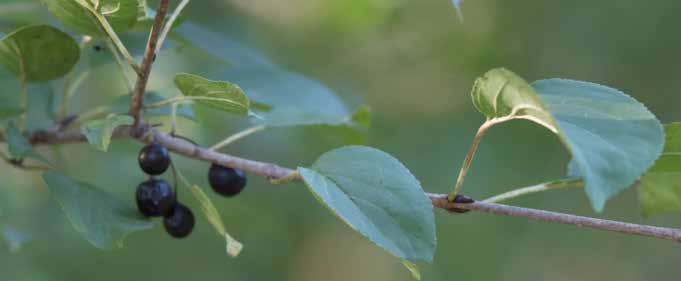
veins that curve towards the tip. You’d think its characteristic thorns would be the telltale sign, but there’s a more distinctive trait: look just beneath the bark for a layer of orange tissue called the cambium. Any of the popular plant-identification apps should prove reliable in confirming identification. Strategies for removal depend on size. The Ontario Invasive Plant Council offers a comprehensive Best Management Practices document on their website, ontarioinvasiveplants.ca, which is full of excellent advice. Seedlings and small plants are easy to pull by hand. Be sure to get as much of the root as possible and tamp down the disturbed soil after. Saplings will likely require use of a weed-pulling tool as the roots hold soil firmly. Removed materials are best stashed in a sealed bin or contractor bag for a year before disposal. When that’s not possible, hang the plant upside-down from a nearby branch with its roots exposed to sunlight. Significant challenges come when you’re dealing with mature buckthorn. The most common approach is to cut it down close to soil level. Girdling can work but is not nearly as effective. With either approach, be prepared to
manage resprouts for up to three years. Stumps can be tarped over to minimize resprouting.
Making the best use of your time is key to long-term success. Removing a dozen trees is a great start, but preventing three dozen from spreading their seeds may be an even greater victory. Prioritize the removal of females before they start fruiting in July. Lob off all branches in reach while waiting for girdling to do its job.
The next two years are critical. Buckthorn can produce a huge number of seeds, which stay viable for many years after they fall. Expect those to sprout. The best defense is to introduce competition by planting natives. An outstanding choice is black elderberry (Sambucus nigra) which has leaf-out and leaf-fall timing similar to buckthorn. Another suitable choice might be northern spicebush (Lindera benzoin) which is fast-growing and plentiful around these parts. Look for local native plant sales and nurseries to source these and other suitable choices. If planting isn’t an option, consider mulching or tarping the exposed soil to help suppress that next generation of buckthorn.

JASON RAMSAY-BROWN Grant Haven Media Columnist
Common buckthorn is known as one of the most troublesome plants in the landscape, causing as much as $3.6 billion in damage to Ontario’s agricultural industry.
(JASON RAMSAY-BROWN PHOTO)