36 Water St. St. Marys, ON, PO Box 2310 N4X 1A2 norfolkfarmsnewspaper@gmail.com | 519.655.2341 | norfolkfarmsnews.ca
Restoring small-town journalism, one community at a time!
DID YOU KNOW?
That the top three provinces for potato production in Canada are Alberta, Manitoba and PEI?
DID YOU KNOW?
That rutabagas (also known as Swedes, Swedish turnip, neep, yellow turnip and turnip cabbage) are a hybrid, believed to be a cross between a cabbage and a turnip?
DID YOU KNOW?
That both the roots and the leaves of turnips are excellent sources of Vitamin C? They also contain potassium.
DID YOU KNOW?
That beetroots can help your exercise performance? That’s because they contain nitrates that improve the efficiency of your cells’ mitochondria (which produce energy).
DID YOU KNOW?
That onions have a history of cultivation that goes back thousands of years? In ancient Egypt, onions were seen as a symbol of eternity, because of their concentric rings.
DID YOU KNOW?
That carrots are actually better for you when they’re cooked? That’s because the cancerfighting antioxidants they contain are easier for your body to absorb – up to 75 per cent more!
DID YOU KNOW?
That Canada is the seventh largest importer of ginger globally? In 2023, over 19,481 tons were brought into the country. There are some ginger growers in Canada, though; mainly in Ontario and Quebec.
Norfolk Agricultural Hall of Fame calls County’s Women’s Institutes “a lasting force for positive change”
By Diane Baltaz
Norfolk’s past and present Norfolk Women’s Institutes recently were designated as the Norfolk County Agricultural Hall of Fame’s latest heroes.
Women’s Institute (WI) members received this distinction at the Agricultural Hall of Fame, located at the Waterford Heritage and Agricultural Museum (WHAM) on Sept. 14.
The Hall of Fame committee, comprising of Rob Adlam, Melissa Collver, James Christison, Angela Ferreira, Andrew Moore, and Sharon Petheram, selects its inductees on the following criteria: the nominee’s demonstrated achievements, results, benefits, lasting legacies and innovations accrued to agriculture and rural development on a local and/or broader basis as a result of the nominee’s volunteer and paid activities.
The Women’s Institute began as a local initiative in Stoney Creek in 1897 by Janet and Erland Lee, who were inspired by domestic science reformer Adelaide Hoodless Hunter’s call for greater education and community advocacy by rural women. Members learned new skills and knowledge to actively participate in and advocate for significant improvements at the local, provincial and national levels. The organization gained legal stature in Ontario under the Agriculture and Arts Amendment Act in 1902. WI quickly went national and then global, with chapters in England, New Zealand and Malaysia; the international body, the Association of Country Women of the World (ACWW) has Canadian representation.
Rural women in Norfolk embraced the WI mission so heartily that by 1903, there were 38 branches, which were organized into North and South Districts, according to Norfolk District WI chairperson Jennie Chanda of Lynedoch and Marian Austin, Brantford, the alternative voting delegate for WI Ontario (WIO), Hamilton Region (which includes Brant and Norfolk).
The two districts merged by 1998, as branches disappeared with increased urbanization and changing social conditions.
Today, there are five branches: Lynedoch, Langton, Walsingham, Marburg and Vittoria. Collectively, these branches have approximately 80-90 members.
States a plaque at the Hall of Fame: “In Norfolk, the WI branches uniquely integrated agriculture as an underlying and enduring focus, leveraging it to uphold their fundamental objectives. This emphasis on rural livelihoods, food security and sustainable farming practices allowed the WI to connect directly with the social fabric of the county. By championing agricultural education and reform, Norfolk’s WI branches have not only contributed to the prosperity of the region but have also solidified their position as a lasting force for positive change continually enhancing the lives of women and families in their communities.”
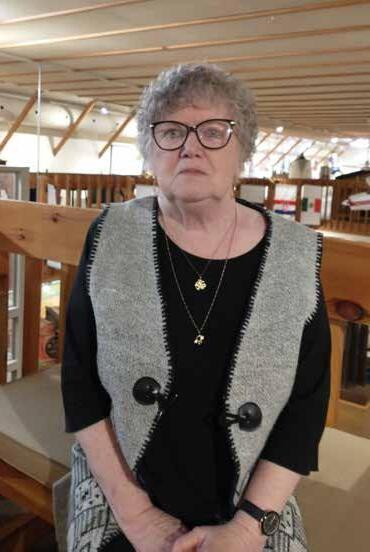
The “push behind acknowledging Norfolk WI” said Chanda, is Carol Grosvenor of Simcoe. She submitted an extensive resume to the Agricultural Hall of Fame about WI’s 100-plus year contribution to Norfolk’s agricultural fabric. Grosvenor, who joined WI in 1983, wrote that Norfolk’s branches supported local fairs, elementary school awards, secondary school scholarships, and the restoration of town halls. They sponsored 4-H clubs. Members visited
shut-ins and supported Meals on Wheels, crisis centres and block parent programs, women’s shelters and collected canned goods for the Norfolk Christmas Exchange. They raised funds for Ronald McDonald Houses and Waterford’s Camp Trillium, as well as overseas children’s projects.
They created a “Calendar Girls” calendar for 2005; it raised $50,000 for the Norfolk General Hospital for a new CAT scan machine.
“This was in keeping with the original (WI) support given to Norfolk County in 1925 to establish Norfolk General Hospital,” wrote Grosvenor.
Personal development included activities such as a “knitting school” held one year at the Ministry of Agriculture and Food research station outside Simcoe, said Austin. Residents learned to knit simple squares; many squares went to children to hold in trauma situations, she said. “Norfolk WI was big on knitting.”
Norfolk also supports the Ontario and Canadian Women’s Institutes’ community advocacy campaigns, said Chanda. These include painting white lines on highways, installing flashing lights on school buses and requiring that traffic stops in both directions while pupils cross in front of the bus, driver education and home economics in high schools, placing reflector tape and roll bars on tractors, automatically providing birth certificates for babies, banning cigarette ads on television and the mandatory labeling of Canadian products with Made in Canada.
“The WI clearly fits the (Hall of Fame’s) commitment to agriculture,” said Hall of Fame committee member and WHAM assistant curator Angela Ferreira. “They were very involved in agricultural education and in the local schools. Many of its members were farm wives; therefore they focused on agricultural issues.”
“Many members were farm wives,” agreed Austin. “Today many are retired; some join because their mothers were members,” said Austin, a member in both Norfolk and Brant branches for 65 years.
Austin joined the WI 65 years ago while living near Wilsonville; she transitioned from 4-H at age 21, adding that 4-H youth switching to WI “was a natural transition, especially during the 1950s and 1960s.”
“We were all farming”, said Chanda, a retired nurse who joined the Lynedoch WI branch in 1978. “Today, many members hold off-farm jobs.”
“Agricultural collaboration included the Norfolk County Fair and Horseshow where each branch displayed their work until 2022, as well as talks with children, “said Chanda. “We were always at the fair.”
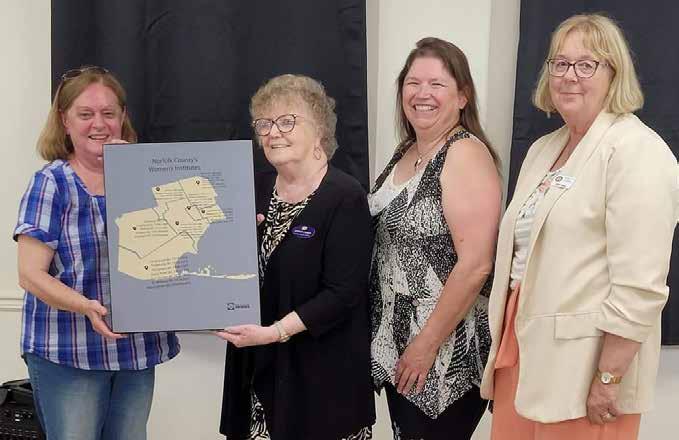
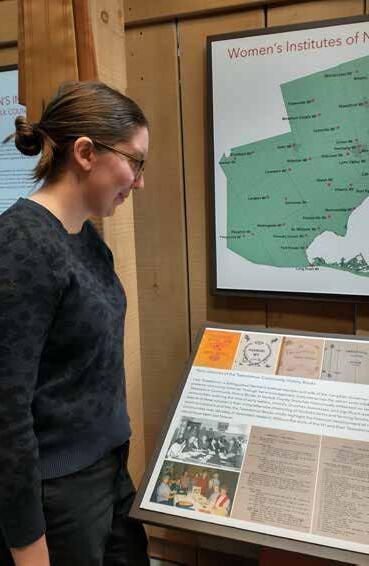
The Norfolk Agricultural Society previously recognized the district’s WI with a plaque mapping all of the county’s branches. It went on display at the Homecraft Building, said Chanda.
But perhaps the most enduring component of Norfolk WI’s agricultural legacy, according to Ferreira, is their Tweedsmuir Community History Books.
The “Tweedsmuirs” record local community histories including earliest settlers and existing farm families, industries, social institutions and public buildings such as churches, schools and community centres and major events.
They were inspired by Lady Tweedsmuir, a WI member and wife of the Governor-General in the 1930s. She urged that women create detailed community histories. The resulting publications ranged from scrapbooks to formal bound volumes, and are often the primary historical record in rural municipalities. Some Tweedsmuirs document entire concessions of families.
A sample page from a WI manual displayed at the WHAM lists comprehensive guidelines of what to document, including genealogies of active farming family members along with sample family trees, crops grown, existing orchards, major dates, and listings of barns and other significant buildings; the guidelines encourage women to assist neighbours in gathering and recording data if needed.
The Norfolk Agricultural Society previously acknowledged Norfolk District WI for their lengthy involvement with the fair with this plaque. Left to right: Carol Grosvenor, Jennie Chanda, Michelle Phillippi (FWIO) and Ann Innes (ACWW).
Norfolk Agricultural Hall of Fame calls County’s Women’s Institutes “a lasting force for positive change”
Norfolk’s Tweedsmuirs are now digitalized, with the original issues maintained and indexed at the county archives in Simcoe.
“All of our branches have one,” said Chanda. “It’s an ongoing project in Lynedoch with people submitting materials, such as clippings from the Delhi News-Record, to the branch’s Tweedsmuir coordinator.”
Norfolk’s WI branches meet separately in their communities, said Chanda.
Branch representatives attend quarterly District meetings, added Chanda. District projects include an annual 4-H award to high-school aged youth and a scholarship competition which requires entrants to write an essay on community participation.
“We work together. Otherwise, we pursue our own projects.”
Norfolk currently WIO’s main education and advocacy projects: Lyme disease and human trafficking.
“Our (WI) motto ‘For Home and Country’ is lived throughout Norfolk by every branch past and present,” concluded Grosvenor in her Hall of Fame submission.
We’re Here for You. As an employee-owned company, we’re dedicated to your growing success by offering superior seeds, tools, information, and service.
Selection & Innovation
Our Research and Breeding Teams evaluate thousands of varieties each year in trials on our farm in Maine and in regions across Canada and the US to ensure we offer you only the best varieties with exceptional flavors, eye-catching colors, and critical disease resistances. We grow and know what we sell.
Year-Round Support
Our Canada Support Team is ready to assist you with variety selection, growing information, and getting orders over the border.
Now
Over 175 New Items for 2026! Check out new inspirations & solutions for your growing season.
Assistant curator Angela Ferreira scrutinizes the Norfolk WI exhibit at the WHAM.
Norfolk District WI president Jennie Chanda accepted the 2025 Agricultural Hall of Fame designation from committee chair Rob Adlam in September.
The logistics of fertilizer production in today’s world
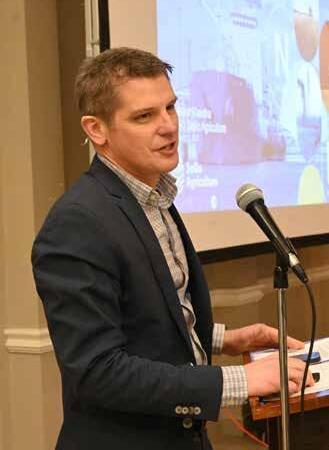
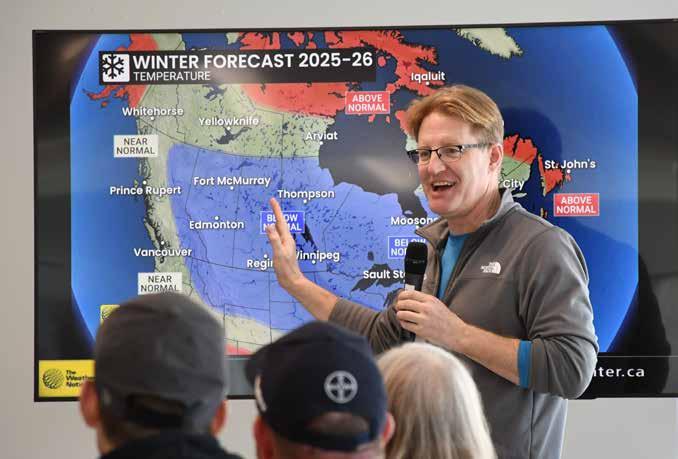
Casper Kaastra, the CEO of Sollio Agriculture, spoke to attendees at the Grain Famers of Ontario District 5 meeting about the logistics of fertilizer in today’s markets. One of his takeaway messages was the necessity for farmers to place an order to ensure they have fertilizer
By Jeff Helsdon, Editor
Attendees at the Grain Farmers of Ontario District 5 (Elgin/Norfolk) received insight into the latest on the fertilizer market from the head of the country’s largest farm co-operative.
For Casper Kaastra, executive vice-president and CEO of Sollio Agriculture, speaking at Malahide Community Centre in Springfield had a sense of familiarity as he grew up on a dairy farm in nearby Lyons. He worked in various positions for a variety of companies, including Cargill, before landing at Sollio.
Kaastra explained handling fertilizer is a balancing act to get the best price for producers, and to remove extra costs wherever possible.
“You got to get to some kind of an economy of scale where you want to make sure that you
have enough volume to put through your assets and infrastructure, but you don’t have too much capacity and too much assets and infrastructure because that’s going to cost you a lot more on a per ton basis,” he said, adding the impact can easily double or cut in half the cost per ton.
One of the challenges with fertilizer in particular is the high demand in a short spring time frame, which can be pushed ahead or back, depending on weather and crops. In normal times, it helps fertilizer companies to know what demand will be, but in the present environment – which Kaastra explained through his presentation – the situation has evolved to the point that not placing order could result in not being able to purchase fertilizer.
In eastern Canada, which includes Ontario,
brent.mckay@sunlife.com
about 85 per cent of the fertilizer supply comes from outside Canada.
“We kind of need to know what is needed to make sure the product shows up on time,” he said. “And if we can plan a bunch ahead, that also helps us to manage the price risk as well.”
Fertilizer imported to eastern Canada translates into between 80 and 90 vessel shipments. A 10 per cent difference in demand can mean between five and eight shiploads that may or may not be needed, and each requires as much as 60 days of planning prior to arrival.
“So, the key point there is that demand and volume is probably the biggest factor that we rely on to have some sort of predictability about how much we should bring in to make sure the product shows up,” Kaastra said.
Being a national company, Sollio can shift products to other parts of the country to provide a buffer to demand.
Politics plays a role
Added to the uncertainty is government policy and geopolitical events.
“You could have a government that says, ‘we’re going to ban exports,’ that could happen overnight,” Kaastra said. “You could have a war that shows up in one part of the world, that impacts supply in a very short period of time. You could have our own government that puts sanctions in place, or tariffs in place, to prevent a product from coming in.”
Kaastra argued government policy that restricts fertilizer trade and fertilizer movement could have an impact on overall food security.
“And those aren’t cheap words, that’s real. Fertilizer accounts for as much as 60 per cent of food supply around the world. Without it, we’d be facing food shortages,” he said.
Kaastra addressed why western Canada can’t supply the remainder of the country, explaining there is no phosphorus production
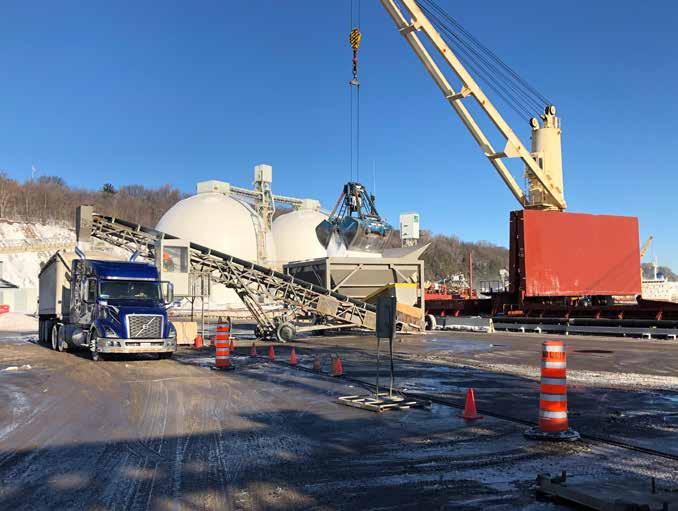
Much of eastern Canada’s fertilizer is delivered by ship from various locations around the world. This scene shows a ship being unloaded into a truck as part of Sollio’s logistics chain.
for the spring.
Sollio head calls on government to drop fertilizer taxes
in Canada and it comes in from the U.S. or West Africa.
Western Canada used to be a net exporter of nitrogen, but that has changed with higher demand as canola production increased.
Potash, the primary supply for potassium, is a different story and there is more of it.
With fertilizer being a bulky commodity, Kaastra said dependable shipping is a must for reliability.
“Every time a port facility goes on strike, that’s an impact of millions of dollars a day,” he said. “If the rail system shuts down, that strips out as much as $60 million per day out of the Canadian economy.”
Beyond strikes, Kaastra talked about the capability of Canada’s port facilities. Putting it in perspective with the current talk of alternative markets, he said if Canada was to decrease the amount it exported to the U.S. by three to five per cent and sent it elsewhere, it would push the existing port infrastructure to its capacity. And ports will be needed for any export.
“This shouldn’t be a surprise to anybody in the room, but if Canada wants to be an agriculture powerhouse, or get back to being an agriculture powerhouse on the world stage, it needs to focus on making sure that it reinvests as it should in infrastructure and logistics,” he said.
Fertilizer logistics
Canada uses 10 million tons of fertilizer on a weight basis annually, which equates to 2.5 per cent of world production. The biggest users are China and India.
The United States and Morocco are major sources of Canadian fertilizer. Russia used to be before sanctions were put in place. That country represents 13 per cent of the world’s fertilizer production.
In eastern Canada, which includes Ontario, about 85 per cent of the fertilizer supply comes from outside Canada.
“One thing I want to highlight is that the U.S. does continue to import from Russia,” he said, explaining taking that large of a source completely out of the picture would have huge impacts.
“Geopolitical uncertainty is one of the biggest drivers of fertilizer supply and price,” Kaastra said, adding it is the most uncontrollable factor.
China’s decision to allow Canadian canola at a lower rate will impact fertilizer prices this spring as demand could increase.
In Europe, there is outcry in the farm community because carbon taxes are impacting farming competitiveness. Kaastra said the same is true in Canada.
“There needs to be a carbon price adjustment that’s imposed on fertilizer coming into this country.”
Typically, when grain prices go down, fertilizer prices go down, but Kaastra said there is a lag to this occurring.
There are other global factors playing into
current fertilizer pricing. With urea, China is restricting exports, Iran is in an economic crisis and the Ukraine-Russia war is having an impact. Trinidad is still a source of urea.
Kaastra called phosphate prices “stubbornly high.” Again, China has a ban on exports, but on the bright side West Africa is planning to increase its production.
The potash price is driven by markets. Renegotiation of the US-Mexico-Canada trade agreement will be a factor, as well as corn prices.
The possibility of no fertilizer
At no point did Kaastra say there would be no fertilizer available due to supply, but he did say with global conditions, producers shouldn’t assume there will be fertilizer available at the last minute if they don’t pre-order.
“If you’re planning on resupply in spring, three
weeks is a matter of having a product or not having a product,” he said, reiterating his point that the industry needs to know how much to bring in.
Kaastra said having a trusted supplier can go a long way in reducing headaches if needs change.
“That doesn’t obligate you to buy from them, but make sure you have a preferred supplier that you’re going to work with. Whoever that is, to make sure that they’re thinking about you, to make sure that they have a plan in place to have fertilizer in the coming spring,” he explained, adding suppliers know plans can change.
On a positive note, Kaastra said evolving crop technology that increases yields is a good thing and diminishes the need for fertilizer.
Join us on March 24, 2026 at the Niagara Falls Convention Centre
Speakers:
Arlene Dickinson
Businesswoman, author, philanthropist
Catherine Murray
Canadian television business news anchor
Eric Termuende
Future of work and leadership expert
George Stroumboulopoulos
Broadcaster, producer, multifaceted storyteller
Entertainment:
The evening banquet features the dynamic duo of improv, Colin Mochrie and Debra McGrath
Canadian potato industry saw highs, lows and ongoing questions in 2025
By Tamara Botting
When industry stakeholders look backed over the Canadian potato industry in 2025, there were highs, lows, and some ongoing questions of what the future will hold.
In January 2026, Potatoes in Canada hosted its annual Canadian Potato Summit. One of the sessions for the virtual event was a round table discussion to update attendees on what’s been happening within the Canadian potato industry. The speakers were Caleigh Hallink-Irwin with the Canadian Potato Council (CPC), Ron LeMaire with the Canadian Produce Marketing Association (CPMA) and Victoria Stamper with United Potato Growers of Canada (UPGC); and Bree Rody with Potatoes in Canada served as the moderator.
Stamper noted, “This time last year, growers were worrying about the potential U.S. tariffs. That was certainly on their mind as they were starting to look at planting intentions. … Right after that were the volume cuts from one of the larger processors, which also created a lot of uncertainty for the growers.”
She said a lot has changed since a year ago. While the uncertainty hasn’t gone away, the planted acreage has continued to rise.
“So, despite all of that uncertainty, most growers went ahead with their intentions last year,” Stamper said, adding that most of what was produced is now in the processing sector –which also continues to grow.
“The fresh and seed sectors are fairly stable, in terms of planted acreage, but the processing sector is really where the evolution is happening, globally as well as in North America,” Stamper said.
She noted that there are emerging markets in China and India in particular, “where the demand for fries is really growing more quickly,” and with that, there are new producers establishing themselves in the market share.
As any farmer will attest, the weather had an impact on the growing season – in particular, Prince Edward Island growers had to contend
with a very hot and dry summer in 2025.
“Weather is certainly playing an impact more and more moving forward in terms of what Mother Nature gives us, and how the crop production actually ends up,” she said.
Hallink-Irwin agreed.
“Weather is always such a huge factor.”
There were also the winds of political change in 2025, both in Canada and the United States, with two administration changes – Mark Carney becoming Canada’s Prime Minister, and Donald Trump returning to office as U.S. President.
Trump has brought a lot of uncertainty to the global economy; a large part of this has been the result of him going back and forth multiple times between indicating his intention to impose tariffs on goods being imported into the U.S. by its trade partners, but then later withdrawing from that position.
Hallink-Irwin said that Trump’s actions have led to Mexico showing a renewed interest in working with Canada as a stronger trade partner.
“There is sort of a camaraderie that has emerged from some of this trade war (discussion) that has been happening this past year,” she said. “And it’s not just Mexico – we’re seeing a push into trying to diversify markets; build new relationships; ensure we work closely across our own provinces, across our own country.”
And despite the market uncertainty stemming from the mixed messaging coming from the White House, Hallink-Irwin said this has actually improved the relationship between the Canadian and U.S. potato industry colleagues.
“CPC has been having really productive and friendly meetings with our colleagues at the National Potato Council in the U.S., and we’re really talking through our issues and irritants and solving our problems before they really blow up on us, which has been an improvement,” she said.
Closer to home, Hallink-Irwin said that while having a federal election in Canada did bring some uncertainty to the market, “Carney’s Liberals’ agriculture platform is actually very aligned
with FVGC’s (Fruit and Vegetable Growers of Canada) and CPC’s recommendations, which does enable us to hold them to our asks.”
She added that the Carney government is pushing to grow Canada’s economy via two main platforms: “Energy, which we have been seeing in action, but also agriculture. They explicitly mentioned food security in their platform, and acknowledged the importance of protecting agricultural producers in (the Throne Speech) … So, there are commitments there that give us a foothold for advocacy, which gives us a tremendous opportunity.”
Later in the discussion, LeMaire noted, “We’re looking at opening up Russet potatoes in Mexico, which would be huge. We’re very close on other commodities, like apples, which have restricted access and changing protocol.”
LeMaire said that in his opinion, “These are things we wouldn’t have seen change as quickly without the new Carney government. … this government has put rapid change in place to address the changing global dynamic.”
He said that on both a global and domestic level, “the world has changed. The belief of international trading rules and law is shifting, and how you do business is shifting. We have to recognize that, and not act the same way.”
Ultimately, LeMaire agreed with the assessment that “Trump is a big factor in how the entire market has shifted.”
He added that inflation has also been a contributing factor, noting that when inflation happens, consumers tend to go back to core items, like potatoes, onions and carrots.
Besides trying to protect their pocketbooks, consumers are also looking at factors such as which items will be shelf stable, which items offer the best value, and which items offer convenience, LeMaire said.
There is another cost to all of the market uncertainty, he noted.
“The biggest thing we noticed as CPMA was the reduction in innovation investment, and the reduction in sheer investment across the industry, whether on the potato side, or in any part of the supply chain. That comes back into the lack of predictability that the other panelists already talked to; reduction in predictability stops investment, and with the lack of investment, we have seen a window of missed opportunity, I think.”
That isn’t to suggest there’s opportunity on the horizon.
“It’s an interesting time, looking at how everything is coming together, and I think exciting,” LeMaire said. “I think if we handle it right, we will grow as a potato industry, and the key is partnerships … better partnerships with our U.S. partners, better partnerships with Mexico, and how we’re competitive.”
LeMaire was recently in New Orleans at SARL (State Agriculture and Rural Leaders, a non-profit organization that according to its website, since 2006 “has provided a forum for fostering cooperation, leadership and educational opportunities among and for state and provincial legislators that are passionate about agriculture and rural communities.”)
While there, he said the common messaging he heard was a willingness to
Experts see uncertainty, a need for resilience in the future for potatoes
work together, “and a concern over the current administrative focus that is being driven out of Washington.”
He said the representatives he spoke with all demonstrated a recognition of the importance of agriculture, and a willingness to move forward with CUSMA (Canada-United States-Mexico Agreement; also known as USMCA (United States-Mexico-Canada Agreement)).
LeMaire said he was optimistic that things were going in a positive director for his own sector, while fully acknowledging that might not be the case for others, citing aluminium and the automotive industry.
Hallink-Irwin noted that global pressures are part of the equation for local producers, but there are also issues much closer to home that they have to contend with, such as labour and labour costs; audit burdens; the burden of red tape requirements; the need to shift to business risk management and mitigation; crop protection, etc.
“There’s a lot of re-evaluations that we’re waiting on that are really critical tools for the toolbox, and needing those tools to produce potatoes,” she said. “Our regulatory bodies need to understand the realities of potato production, and growers need the tools in their toolbox.”
One useful tool for producers is looking at market trends.
For instance, LeMaire said his organization does regular consumer surveying. While Russet potatoes continue to dominate, yellow varieties are showing a greater popularity than whites or reds. Also, mini potatoes are seeing a rise.
LeMaire said there are a few factors contributing to this, including versatility, ease of cooking and pack size.
He went into more detail on the last point, noting that in the past year alone, sales of bagged potatoes under four pounds grew about 17, almost 18 per cent; over the past decade, the growth has been almost 112 per cent.
“That’s significant to consider when you start looking at how are we packing, how are we selling – especially in these turbulent times,” he said.
Another significant statistic for the potato industry is how prevalent air fryers are. The US numbers – which LeMaire noted do corelate to Canada – show that around 60 per cent of households have an air fryer.
“The air fryer drive is really shifting towards that (trend to) buy the product that’s designed to cook quick, have convenience, and this shifts us back into a discussion around pantry load versus convenience,” he said. “We can’t underestimate air fryers.”
Stamper reflected on how the projected growth trends had stood up to the test of time.
Around three years ago, the projected growth for the potato processing sector was around three to five per cent annually. The rate is now estimated to be slower, from 1 to 1.5 per cent.
“I think overall, growth continues, but at a slower rate,” she said.
Some examples of growth in North America include a plant expansion in Alberta,
which came online in 2025; the Moses Lake facility in Washington coming online early –in 2025 instead of 2026 as expected; and European producer Agristo breaking ground for a new plant in North Dakota.
“Some of it (was) built on t hat previous expectation of 3 to 5 per cent growth, but globally, things are still happening,” she said.
Still speaking to the global market growth, Stamper again referenced China and India, who she said, “have gone from net importers to net exporters in a very short amount of time, which is a pretty amazing feat, in terms of what they’ve done.”
She noted that while at the moment, China and India are still volume-wise a smaller part of the global market, and that major players like
North America still dominate the sector globally, it’s important to be aware of shifts.
“The fries will continue to be made, but who’s making them and where they’re being made is continuing to evolve,” Stamper said.
Looking to the future, each of the panelists were asked to describe how they see the potato market in 2026 and beyond.
LeMaire described it as dynamic, resilient, innovative, and volatile, cautioning, “We’re not out of the woods yet.”
Stamper agreed with LeMaire’s list, adding, “Growth, evolution, innovation, resilience, and really, uncertainty is a big part of it overall.”
Hallink-Irwin was perhaps the most optimistic, choosing to describe it as “resilience, adaptive, evolving, and increasingly collaborative.”
Foundational Mite Control
• Unique mode of action (IRAC Group 23)
• Long residual activity on a broad spectrum of mites
There’s a few common reactions when visitors to Transitions Acres first encounter the horses.
Sometimes they’ll stop in their tracks, mesmerized.
“Lots of times, I see happy tears,” said Alisha Wilson, founder and operations manager of the Oxford County-based non-profit, adding that sometimes she takes the feeling for granted, “because I’m around them all the time, so I automatically feel that way.”
Wilson grew up on her family’s home farm and spent time as a teen working on a ranch in Florida before eventually making her way to her current home just outside of Tavistock..
“I’ve been around horses my entire life – it’s been a lifelong passion of mine,” she said.
“In 2021, I decided to put the horse to work, so to say, and try to get other people to experience the benefits of being around horses that I’d experienced growing up.”
The model that she started with is largely what’s still in place today, including summer camps, classes and the experiences.
“Over the past five years, it’s really morphed into a place of wellness and holistic health, and having a safe space,” Wilson said. “A lot of times, when I have people come out, it’s because they’re looking for the wellness aspect of things; they’re looking for more of a therapeutic connection.”
There are a lot of connections made during the Cowgirl Kickback sessions – which have been named an Ontario Southwest Signature Experience – and the HorsePlay ultimate date night experience sessions.
Both of these experiences start with a drink by the fire, then move on to the ‘Whoa Game,’ which is the safety demonstration.
“Basically, we walk around the horse and do things that look unsafe or are unsafe, and then people have to yell at us not to do it,” Wilson said, adding that there’s one particular horse who usually helps out with these demonstrations because he’s so calm and good natured.
“I go as far as crawling underneath the horse,” Wilson said.
The safety talk is an important part of the session, because a lot of the clientele who come out to Transitions Acres aren’t from an agricultural background.
“Being on the farm, we take a lot of the things that we do for granted, and we kind of expect people to know, but they don’t. So, we have to make sure that we’re really aware of making sure that people are being taught properly about the risks and things to keep an eye out for,” Wilson said. So, “If you can make (the safety talk) comical and interesting, it’s more engaging.”
As with any agri-tourism enterprise, safety is paramount.
“We don’t tend to run any of the machinery or anything like that when we have people out, just because that also helps keep the risk down,” Wilson said. (While she doesn’t farm the land, there is another local farmer who does cash cropping on the property.)
The parking areas are clearly labeled for guests to help prevent mishaps. Undergirding all of the precautions, Wilson has made sure to have the proper liability insurance – key for any agri-tourism business.
Besides making sure the guests are safe
when they come out for a visit, though, is making sure they have fun.
After the Whoa Game, guests are able to get up close and personal with the horses, taking part in grooming, doing some fun obstacle courses and learning how horses communicate. The sessions wrap up back by the fire, with another drink and charcuterie while enjoying the sunset.
Wilson said that even though she grew up in Florida, which boasts some pretty spectacular views, “Honestly, I can say with all truth, they’re nothing compared to an Oxford County sunset over a field.”
With both experiences, guests enjoy a greater sense of connection with others.
Wilson said the Cowgirl Kickback is “directly driven towards women and those in their feminine energy. We’re really looking at having a good time, connecting with your friends, having some ‘aha’ moments, taking a time to just be at peace with yourself.”
Participants can choose to book a session for just their own group of friends, or be part of a larger, public party – sessions can have as few as two people, and up to 30.
“Those ones are fun, because then you’re working with strangers, and a lot of times the people become friends by the time it’s all done,” Wilson said.
The HorsePlay sessions are also proven to help couples find a greater connection – for at least one couple, it was their first date, and “It actually resulted in them eventually getting engaged and they had their wedding on the farm, so that was kind of cool,” Wilson said.
A lot of people find it very calming to be around the horses.
“Horses have a really large electromagnetic field around their being. It’s scientifically proven that they will help us to regulate our heartbeat,” Wilson said, adding that after the initial excitement of meeting a horse, people’s heart rates tend to lower.
What’s more, “Horses immediately go into working with you instead of against you … they provide immediate and non-judgemental feedback.”
Even if they get spooked, it only lasts a minute or so, and then they’re calm again, Wilson added. “They don’t hold a grudge, and a lot of people don’t get to experience that in life.”
It’s a profound feeling, and one Wilson wants to give to as many people as possible; that’s why she intentionally markets her horse experiences to people in larger city centres.
“(They) are looking for a bit of an escape, from the hustle and bustle. They want to come out and slow down, experience what it’s like to be on a farm in a peaceful setting.”
She’s seen it many times, with the Cowgirl Kickback and HorsePlay, as well as the kids’ camps.
“We’ve kids come out who have never seen a tree before. It’s really neat to have those types of things happen,” Wilson said. “We had two groups come out from London, and the kids were in awe, because they’ve never been around a farm at all.”
All of Transitions Acres’ programming takes place outdoors; there isn’t an indoor arena.
This was partially a financial decision, since an indoor arena would be a large investment, plus the ongoing maintenance costs, but also, “I think it’s a little bit more impactful, as far as the peaceful aspect of things. The horse pasture butts right up to our arena, so not only are (guests) interacting with a horse on the ground right with them, but they can also observe the herd behaviour and the horses in their own natural environment while they’re working as well,” Wilson said. On top of that, guests get to enjoy the sunshine, fresh air, birds and wildlife, etc.
“There aren’t many places like mine who do outside things year-round.”
People can also come and visit the farm for a nominal fee, without doing a full experience or camp; they can enjoy the environment, have a blind date with a book, have a refreshment in the lounge or by one of the fire features, and check out the gift shop, which is stocked with items from local artisans.
For more information about the farm and the programming it offers, visit transitionseq.ca.
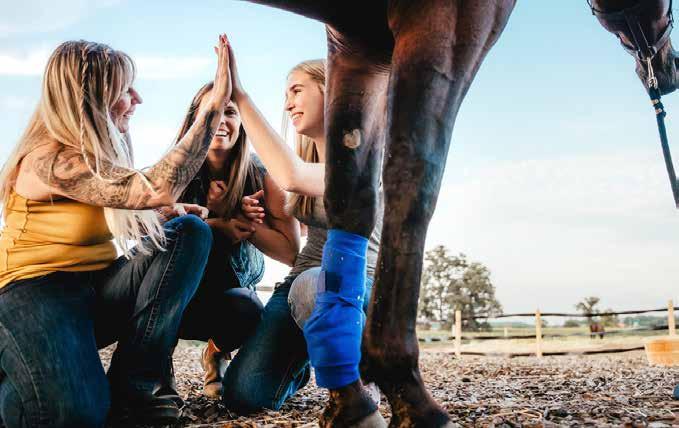
The Cowgirl Kickback experience at Transitions Acres in Oxford County has been named an Ontario Southwest Signature Experience.
Ojibwe Spirit Horses are a critically endangered species; there are fewer than 200 known to exist.
Alisha Wilson, founder and operations manager of the Oxford County-based nonprofit Transitions Acres, is doing what she can to protect the species.
“I have a really big passion towards Indigenous culture and their teachings,” said Wilson, adding that she’s not Indigenous, but describes herself as “a very fierce ally.”
Wilson said she didn’t even know about Ojibwe Spirit Horses until a few years ago when she saw them for the first time while attending a powwow. She began to research the breed, learning information such as, “They’re native to Canada, the boreal forest; they’re the only horse we can say that about.”
Then in 2025, she had a chance to acquire three Ojibwe Spirit stallions.
“Obviously, I bounced on the opportunity,” Wilson said. The three came to Transitions Acres in December.
“They’re all less than a year old, so we’ll be working on doing some training and stuff with them to keep them healthy and safe,” she said.
It’s not just about these horses, though, but looking to the future.
Wilson noted that back in the day, Quarter Horse breeders (including one of her grandfather’s) would do a lot of line breeding.
Unfortunately, “that’s where you start running into problems like congenital issues and a lot of health problems.”
Since there are so few Ojibwe Spirit Horses in the world, “they’re already so closely related,” Wilson said. That’s why “it’s really important to pull a DNA strand, try and get their parentage, figure out who’s related to who.”
With the three stallions, the DNA testing has shown “one of them has the best coefficients to be able to breed with anybody, so we hope to keep him a stallion and eventually stand him as stud and use him in the breeding program.”
If these efforts prove to be sustainable, Wilson hopes to eventually add some mares to the herd as well.
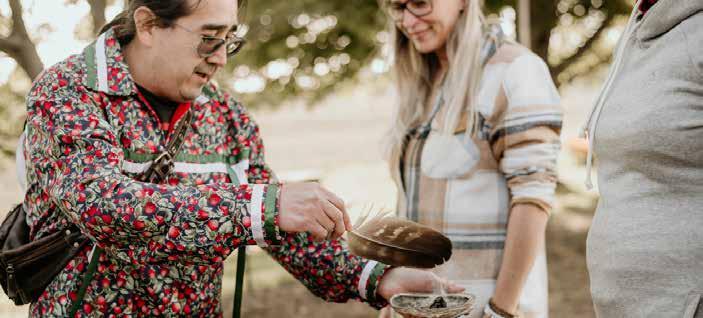
Wilson is building a whole program based around these horses, working in tandem with Eric G Martin, an Indigenous Elder who is already a regular at the farm for the monthly smudge gatherings, which are open to the public and free to join.
Wilson said she and Martin connected somewhat by accident a number of years ago, but they’ve since developed a strong working relationship and friendship, which has allowed them to connect with and educate the community.
“Our smudge gatherings, we’re starting to see upwards of 20 to 35 people every month who take part in the smudge and learn all about the medicines and stuff, so that’s kind of cool,” Wilson said.
With the Ojibwe Spirit Horse programming, “Basically, he will be doing all of the Indigenous teaching side of things, and I will be doing all of the horse teaching side of things,” Wilson said.
For more information about the farm and the programming it offers, visit transitionseq. ca.
Eric G Martin, an Indigenous Elder, is a regular at Transitions Acres, where he performs monthly smudge gatherings for the public. He is also partnering to share his knowledge through the new programs being offered that are focused on the farm’s recently acquired Ojibwe Spirit Horses.
Teaching by day, farming by summer: Norfolk County, Russel Blake, and black currants
By Leah Bauer
Some things just don’t seem like they would go well together, such as black currants and Norfolk County’s sandy loam soil, or school teachers and farming. However, for Vittoria’s Russel Blake, those four things have combined along with many learning experiences, and a constant willingness to evolve to formulate his career over the last 25 years.
Blake grew up on a farm outside of Simcoe that has been in his family since the 1840s. Therefore, farming had always been an integral part of his life. So, when he and his wife moved into a farm home with seven acres of farm land he knew that he wanted to follow in his family’s tradition and cultivate that land.
“We found this little farm in Vittoria that had an old farmhouse on it,” Blake said, “The farm and the farmhouse were pretty rough when we first moved, but I knew that I wanted to farm on that land.”
There was one minor issue that stood in the way of Blake’s dream of farming the land that surrounded his house; he was a schoolteacher at Walsh Public Elementary School.
“I knew I wanted to do something with farming, but because I was a teacher, it had to be busy in July and August,” Blake remarked.
Blake did not give up and simply rent his viable land out to nearby farmers. Instead, he chose to focus on finding a crop that he could plant, harvest, and sell in the July-August season. Blake knew that his options were either
sour cherries or black currants.
“My options were sour cherries, which required a high investment, or black currants which were more obscure,” Blake pointed out. “We chose black currants, they kept me really busy in the summer, and then died out by
IMPROVED QUALITY
Disease decreases crop quality. Strike improves crop health and marketable yield. This allows the grower to capture more sales and profits or the flexibility to farm less acres for the same profit.
Strike soil treatment suppresses soil borne diseases better than standard practices, this can help in short rotation scenarios.
REDUCED INPUTS
Start cleaning out nematodes and other soil borne diseases and you have healthier plant roots with increased water and nutrient uptake capacity, reducing fertilizer and water input needs.
SOIL HEALTH
The soil benefits of treatment with Strike are two-fold:It immediately knocks back soil borne disease giving plants their best start. Suppressed disease allows the native species to rebound in the soil. Trials with major universities have demonstrated an increase of beneficial organisms in soil that has been treated with Strike.
DATA SHOWS SELECT MICROBIAL POPULATIONS INCREASE AFTER STRIKE USE:
Bacillus
Pseudomonas
Streptomyces
Mortierella
Rhizobium
Trichoderma
Mycorrhizae
Many others
• Plant-growth promoting rhizobacteria
• Cycling of organic matter
• Carbon, Nitrogen, & Phosphorus element cycles
• Improves nutrient availability
• Produce antibiotics
• Parasitize fungi
• Phytohormone production
• Compete with pathogens
• Induce of systemic resistance
• Produce metabolites / signaling compounds
September so that I could go back to teaching.” Black currants are native to Northern Europe and Northern Asia, and are highly popular in Northern and Eastern Europe as well as in Great Britain. In Southern Ontario, including here
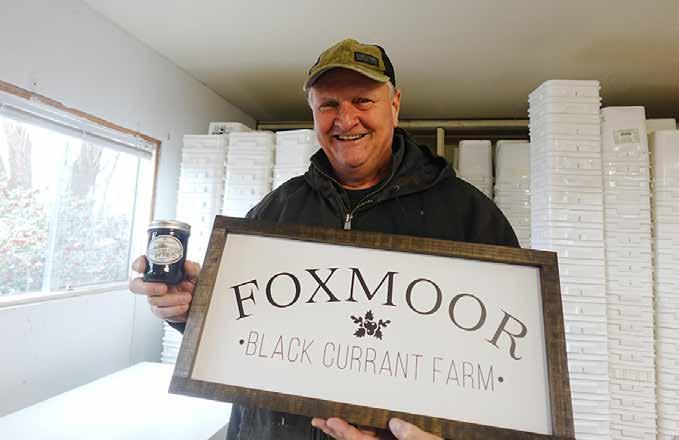
Russel Blake holds a jar of his blackcurrant jam at his Norfolk County farm, where he has grown currants for over two decades.
Teaching by day, farming by summer: Norfolk County, Russel Blake, and black currants
in Norfolk County, they might not be as well known, or as widely produced, but that hasn’t stopped Blake from amassing many returning customers who come back year after year for his buckets of frozen berries, cordials and jams.
While black currants are native to Northern Europe and Asia, the shrub is also able to thrive in Ontario. The shrubs are strong enough to withstand cooler climates, managing to last from 8-10 years even through brutal Canadian winters. The soil in Norfolk is mainly sandy loam, which has less moisture retention than other soils, so Blake uses trickle irrigation to maintain his black currants.
Any farmer, no matter the size of the operation, who has had a career in farming as long as Blake’s knows how pesticide use has evolved. Today, Blake relies on ground up fertilizers and soil amendments to support plant health and resilience in his black currants, rather than relying solely on chemical controls. Looking back, he finds it striking how products that were once standard practice early in his career are now completely illegal in 2026.
The use of pesticide isn’t the only element that has evolved over the course of Blake’s career. Fluctuations in the weather, specifically the very hot and dry portions of last summer affected his yearly routine. It is normal for Blake to have his black currants ready a few weeks earlier than farms located farther north, though last year proved to be a bit of a curveball for farmers in Ontario, and Blake and his black currants were no exception.
“But last summer it was 33, 35 degrees, and it went on for weeks. The black currants were green and the next day they just seemed to be black and falling off, and just the speed of harvest was incredible,” Blake remarked. “I’m going to put that down as one funny year. I was watering them. I did everything as normal, but it was just so hot.”
Weather fluctuations aside, the last few years have been different for Blake as he retired from teaching and has had more time to attend markets in Ancaster and Burlington. While meeting a farmer is a daily occurrence in Norfolk County, in the city it is not the same story.
“When people come into the markets, it is always a surprising thing for them when they find out that I grow it as well. ‘Oh, you’re the farmer.’ Well, yeah, I do the whole operation,” Blake noted. “So, when I go to the city and do markets there, it’s huge the fact that I’m
the grower and the producer.”
Blake doesn’t stop at pails of frozen black currants, as tasty as they might be, he has also worked to create a few signature black currant products. One of his signature products is black currant cordial, which he says works great in a black currant mojito cocktail. The second is a delicious black currant jam. Blake has experimented with some other black currant products such as wine, and black currant creme de cassis. In the years following his retirement, he has been working to start beekeeping on his acres and plans to begin growing and producing fresh-cut flowers.
Blake’s farm is a small operation, which is a bit of a juxtaposition considering that the
Vittoria Scotlynn office is essentially in his back yard. He appreciates the fact that his operation stayed small.
“I know exactly what’s going on all the time, because I’m the one doing everything,” he remarked.
His small-scale black currant farm allowed him to maintain a career as a schoolteacher while staying occupied and active during his off months. Not to mention the fact that having a small-scale operation has allowed him to have complete control over what he does, what he doesn’t do, and everything that falls in between. Farms like Blake’s are an essential piece to the larger puzzle that is Norfolk’s farming community.
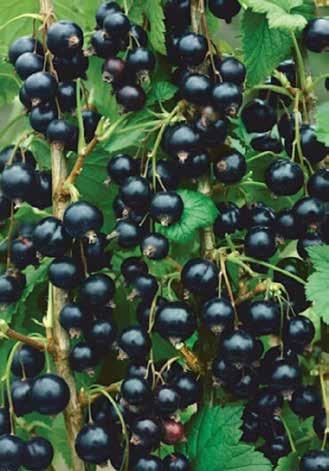
Ripe black currants hang from the vine during peak harvest season in Norfolk County.
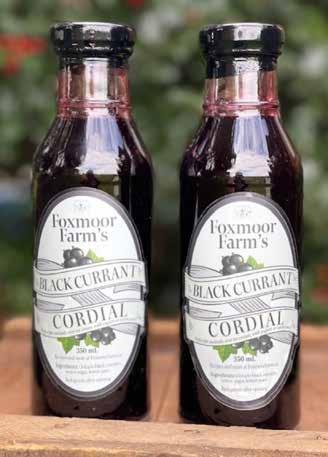
A bottle of blackcurrant cordial made using fruit grown and processed on the farm. Blake believes the cordial works best in a blackcurrant mojito.
Farmers should ‘demand’ fair agreements with tech providers, say experts
By Luke Edwards
Keeping pace with the frenetic growth of new technology is hard enough on its own, but when paired with confusing agreements that are longer than Tolstoy’s War and Peace and using complicated legalese, it can make any business owner’s head spin.
And farmers are no exception. Experts at the Canadian Greenhouse Conference held in Niagara Falls last fall urged greenhouse operators to be careful when signing up with new technology providers and outlined some of the challenges the sector will be facing in the coming years as AI and big data becomes all consuming.
“It’s extremely important that farmers demand it,” said Rozita Dara, from the University of Guelph.
Dara covered governance issues when it comes to data. While she said many farmers cite privacy concerns with technology, in reality she said it comes down to the ownership, access and benefits of said data.
“Many of them feel they lose control of their data,” she said.
But that doesn’t mean growers should throw their hands in the air and give up on using technology. Instead, she said it’s about putting the right regulations in place and signing up with the right providers.
Agriculture and Agri-Food Canada’s Quade Digweed agreed, highlighting two priorities
With great opportunity to increase technology usage in greenhouses, experts say start up tech companies seem to understand the value of good governance. Getting everyone on board should be a priority, they said at last month’s Canadian Greenhouse Conference.
growers should consider. They both consider the longer term, looking at ownership of the data and what happens when the technology begins to age out.
“As long as you can take your data with you when you leave,” he said, adding end-ofsupport plans are also key.
Digweed said the lines between hardware
and software are also being blurred, with a move towards monthly subscription models that include both the hardware and software. This trend has a mix of good and bad for farmers, he said. On the bright side, it often makes updates easier and can blunt the challenge of big upfront capital costs. However, it can also make the farmer feel like they’re stuck.
“This could look like ransom,” he said.
Dara plugged the AI4Food project she’s a part of at the university, which promotes the adoption of technology to support Canada’s food system while also supporting good governance.
She did say there are companies taking governance and cyber security seriously, especially some of the smaller businesses.
“Start ups, they are listening,” she said.
Larger companies may be tougher to influence, but with a combination of farmers’ demands and government regulations, she seemed optimistic that strong governance practices could be established in the agriculture technology sector.
On the robotics side of technology, Digweed sees potential in computer visioning systems as well as scouting robots. However, tasks that require touch remain a challenge as developers continue to struggle finding ways to have robots replicate the gentle touch of a human hand.
“Advances in computer vision, I see a lot of potential,” he said.
This Rattlesnake Harbour area family is big on dahlias and peonies
The Flower Shack has expanded from local cash sales to wedding arrangements and pick-yourown flowers.
By Diane Baltaz
When they moved to a small, Hartford-area acreage in 2008, newlyweds Nick and Hilary VanderHeide asked, “How can we make some money from this acreage?”
At that point, Nick ran a construction company and Hilary, with a Bachelor of Education degree, became pregnant with their first of four children.
“’We wanted to live in the country after marriage and we settled on the acreage near Hartford primarily as a spot for Nick to run and store construction equipment,” said Hilary. “We were interested in farming, but we needed to find a viable crop or livestock that would fit in with our lives; we preferred a seasonal addition to Nick’s construction business.”
Presently, Hilary thought back to her childhood on a hobby farm near Niagara-on-theLake where her parents grew multiple varieties of fruit and flowers.
The VanderHeides opted to grow peonies on an experimental plot in 2009, with her parents helping to establish it. They named their fledgling business, Creekside Growers.
They added other varieties ranging from zinnias and dahlias to sunflowers in 2010. Nick also dropped his construction business to grow flowers full time. By 2011, they settled on exclusively growing peonies and dahlias for the wholesale cut flower market.
The business has since expanded into multiple sectors.
In 2017, they bought their current 25-acre farm, located on Windham Road 11 west of Rattlesnake Harbour. In 2021, VanderHeide built the first of their greenhouses, which now total 32,300 square feet.
Today, Creekside Growers wholesales cut flowers from Thunder Bay to Eastern Canada and the southern United States. Their website states that Creekside Growers is “Canada’s Premier Dahlia Farm.”
“We have a huge distribution network,” said VanderHeide, adding that 99 per cent of their flowers sell wholesale.
Dahlia production is so specialized that the VanderHeides constantly build and modify farm equipment to make it work for their crop. In 2016 the couple won an Agri-Food Innovators Award
for a single-row planter they designed. They’ve since replaced it with a three-row planter.
The plants are field-grown, with the peonies cut down around Thanksgiving, while the VanderHeides or local staff machine dig the farm’s 400,000 to 500,000 dahlia tubers to be stored in the barn and split over the winter. In January, staff plants the tubers in the greenhouse in time to harvest and sell cut dahlias in April.
“We’re the only ones in North America with Dahlias in April, May and June,” said Nick. “Otherwise they must be imported from Holland.”
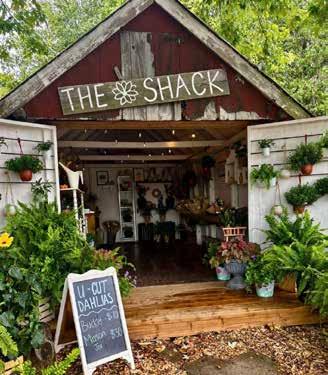
Some flowers sell locally through an onsite sales centre that Hilary began during the pandemic – the Flower Shack. The “shack” is a restored driveway shed and retails to drivein customers who want to cash-purchase cut flowers. Most of these customers live within 25 kilometers of Delhi.
“We established the Flower Shack because we were worried about how the pandemic would influence sales; it was a way we could get rid of stock,” said Hilary.
Like Creekside Growers’ wholesale arm, the Flower Shack evolved into a full-time retail occupation for Hilary. The business began when friends and relatives asked her to design floral wedding arrangements, but it quickly expanded to other people.
“They asked, ‘Hey, can you do my wedding?’”
Today, Hilary works from a full-service studio near the Flower Shack, creating wedding arrangements and bouquets as well as for other events, specializing in “all things Dahlia” as her website states.
The floral arrangements include additional varieties of cut flowers which she sources through Nick’s contacts in the Ontario cut flower industry.
“The Flower Shack works so well because of the wholesale side,” said
Hilary. “I never dreamed that we would have this business.”
In 2023, the VanderHeides designated a 4.5 acre tract of field for Pick Your Own peonies and dahlias; it operates as a cash-and-carry business through the Flower Shack. Their website markets this patch as “the largest u-cut dahlia field in Canada.” While most of these customers are local, some come from as far away as Barrie and the Greater Toronto Area, said Hilary.
“We began it as some people asked if they could go into the fields to pick the flowers.”
Customer inquires about sourcing dahlia tubers prompted the VanderHeides to create an on-line mail-order business selling greenhousegrown tubers from divisions and cuttings, with the orders being filled in April. They also market a “Bloom Box” which contains recommended dahlia varieties, fertilizer, plant tags and clippers.
The couple home-school their four children: Elijah, 16; Josiah, 15; Asher, 13; and Lydia, 11. All of them assist on the farm and interact with the public at the Flower Shack. Lydia is “the florist in training” said Hilary because she enjoys designing wedding arrangements.
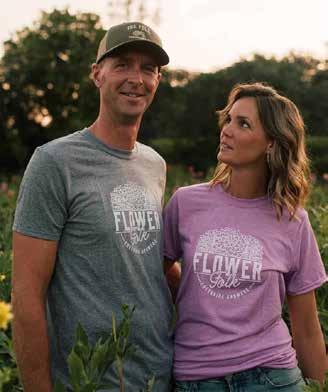
Nick and Hilary VanderHeide.
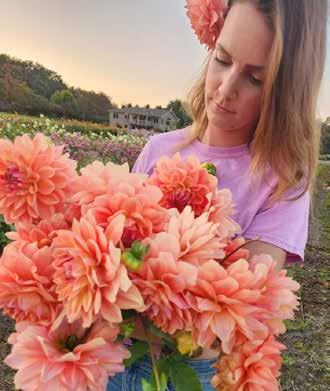
Hilary VanderHeide examines the flowers in one of the fields.
Bill 186 aims to protect Ontario’s agritourism operators from frivolous lawsuits
By Jeff Tribe
Agritourism Ontario (AO) Chief Executive Officer Kevin Vallier was permitted a quiet moment of celebration this past December on the one-year anniversary of provincial Bill 186, The Growing Agri-Tourism Act.
Vallier, along with AO board chair Darlene Downey worked closely with Perth-Wellington MPP Matthew Rae’s determined support for his private member’s bill. Only a tiny percentage of such bills actually become legislation said Vallier. Rae, who comes from a farming background, both wrote the bill and followed its progress through to passage. He is a member of the ruling Progressive Conservative Party of Ontario, but the bill passed unanimously said Vallier.
“We had great support from all four parties.”
In essence says Vallier, the bill provides a layer of protection for farm owners who welcome the public onto their property. It is not blanket coverage he cautions. Owners must comply with regulations including the posting of warning signs, and if an injury occurs due to negligence, there still can or will be legal consequences.
However, it does work on the assumption there are inherent risks on an active and working farm.
“And if you voluntarily walk onto that farm, you assume those risks.”
Vallier referred to illustrative examples from his home Niagara region.
“I think we had two lawsuits from people who sprained their ankles because the ground was uneven.”
The lawsuits were for $1,000,000 said Vallier, an amount not anticipated to be awarded through court proceedings. However, insurance companies may choose to settle for a lesser yet still significant amount to make a potential problem go away, or face significant legal costs.
“And then over time, liability insurance premiums for agri-tourism operators have just skyrocketed. Ten, 20, 30, 40… we’ve seen 50 per cent increases year-over-year.”
As mentioned, landowners are still subject to legal action via negligence, however Bill 186 is intended to address threats of the ankle sprain or bee sting variety, or says Vallier, ‘someone’s fingers getting nipped when feeding a baby goat a carrot.’
Based on some ‘early wins’, Vallier is happy to report AO clients who faced rising liability insurance premiums have actually seen them come down, others previously unable to obtain insurance, able to do so.
“I’m sure insurance companies are waiting to see the strength of this legislation and how it holds up in court, but we’re confident it will.”
The rebranded AO’s founding body has been around since the mid 70’s says Vallier, a time when ‘agritourism’ wasn’t a recognized definition, most operations representing a produce stand at the end of the driveway. His own is simple, any farmer who welcomes the public onto their property.
Over the years, the organization has evolved along with farmers looking to either diversify or add to their operations in ventures like corn mazes, on-farm markets, pick-yourown produce or cut-your-own Christmas trees, sugar bushes and petting zoos. Beyond providing economic opportunity,
Agritourism Ontario
Chief Executive Officer Kevin Vallier points to Bill 186, The Growing AgriTourism Act, as a piece of ‘good legislation’ benefitting the province’s agritourism operators.
each is a chance to bridge the rural-urban divide Vallier believes, for city folk increasingly disconnected from rural Ontario.
“It’s a fun and interactive way to learn about farmers and agriculture as well.”
The organization (agritourismontario.com) offers membership services including in-person workshops, educational webinars and a popular annual bus trip exploring other operations. Members tend to be highly-collaborative credits Vallier, typically willing to share best practices and experiences with their fellows.
AO is also active in advocacy both at the provincial and municipal levels, focussing on municipal planners in particular. Ironically, says Vallier, local regulations intended to retain farmland as farmland can actually provide unwelcome complications, red tape
Your Legac y. Your Wealth.
Planning for the future of your farm requires more than just numbers, it requires strategy.
and planning barriers which can add to an agritourism-based operation’s challenges.
“They put a burden on the farmer or their children who will eventually throw their hands up and sell because it’s just not worth it.”
Once a piece of farmland is sold and converted into a parking lot or business or residential development, it’s never coming back says Vallier. The organization is not saying farmers should be allowed to do whatever they want, wherever they want.
“But there should be some compromise.”
The Growing Agri-Tourism Act is an example of just that he concluded, ‘good legislation’ based on a practical approach with the potential to make a real difference for Ontario’s producers.
“It’s a bill that is a benefit to farmers in agritourism.”
(AO)
When doing the ‘right thing’ environmentally can also be good business
By
Jeff Tribe
Agritourism Ontario (AO) Chief Executive Officer Kevin Vallier was permitted a quiet moment of celebration this past December on the one-year anniversary of provincial Bill 186, The Growing Agri-Tourism Act.
Vallier, along with AO board chair Darlene Downey worked closely with Perth-Wellington MPP Matthew Rae’s determined support for his private member’s bill. Only a tiny percentage of such bills actually become legislation said Vallier. Rae, who comes from a farming background, both wrote the bill and followed its progress through to passage. He is a member of the ruling Progressive Conservative Party of Ontario, but the bill passed unanimously said Vallier.
“We had great support from all four parties.”
In essence says Vallier, the bill provides a layer of protection for farm owners who welcome the public onto their property. It is not blanket coverage he cautions. Owners must comply with regulations including the posting of warning signs, and if an injury occurs due to negligence, there still can or will be legal consequences.
However, it does work on the assumption there are inherent risks on an active and working farm.
“And if you voluntarily walk onto that farm, you assume those risks.”
Vallier referred to illustrative examples from his home Niagara region.
“I think we had two lawsuits from people who sprained their ankles because the ground was uneven.”
The lawsuits were for $1,000,000 said Vallier, an amount not anticipated to be awarded through court proceedings. However, insurance companies may choose to settle for a lesser yet still significant amount to make a potential
Drilled Wells & Bored Wells Pumping Systems
problem go away, or face significant legal costs.
“And then over time, liability insurance premiums for agri-tourism operators have just skyrocketed. Ten, 20, 30, 40… we’ve seen 50 per cent increases year-over-year.”
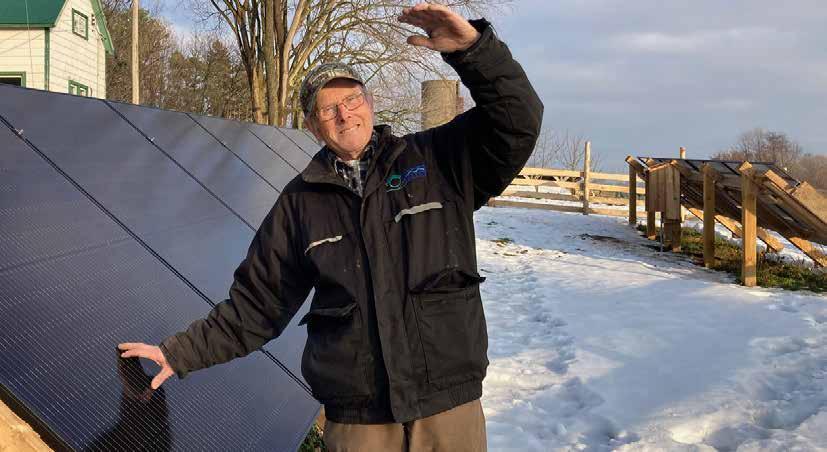
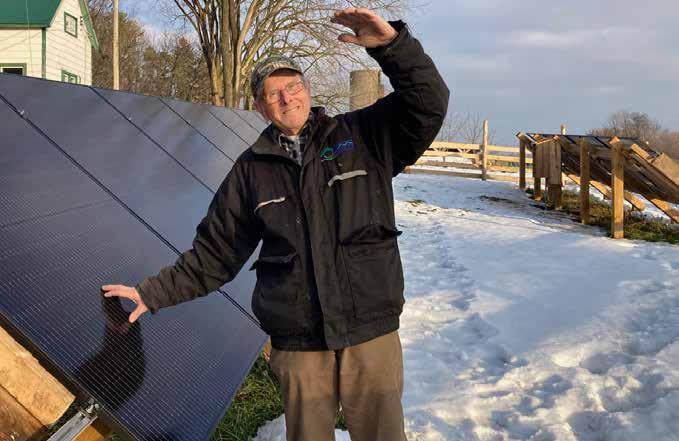
In the rough equivalent of an artist signing his work, Craig Cook is photographed alongside the solar panel array his experience and knowledge led to.
When doing the ‘right thing’ environmentally can also be good business
As mentioned, landowners are still subject to legal action via negligence, however Bill 186 is intended to address threats of the ankle sprain or bee sting variety, or says Vallier, ‘someone’s fingers getting nipped when feeding a baby goat a carrot.’
Based on some ‘early wins’, Vallier is happy to report AO clients who faced rising liability insurance premiums have actually seen them come down, others previously unable to obtain insurance, able to do so.
“I’m sure insurance companies are waiting to see the strength of this legislation and how it holds up in court, but we’re confident it will.”
The rebranded AO’s founding body has been around since the mid 70’s says Vallier, a time when ‘agritourism’ wasn’t a recognized definition, most operations representing a produce stand at the end of the driveway. His own is simple, any farmer who welcomes the public onto their property.
There are major considerations before turning theory into reality.
Over the years, the organization has evolved along with farmers looking to either diversify or add to their operations in ventures like corn mazes, on-farm markets, pickyour-own produce or cut-your-own Christmas trees, sugar bushes and petting zoos.
Beyond providing economic opportunity, each is a chance to bridge the rural-urban divide Vallier believes, for city folk increasingly disconnected from rural Ontario.
“It’s a fun and interactive way to learn about farmers and agriculture as well.”
The organization (agritourismontario.com) offers membership services including in-person
workshops, educational webinars and a popular annual bus trip exploring other operations. Members tend to be highly-collaborative credits Vallier, typically willing to share best practices and experiences with their fellows.
AO is also active in advocacy both at the provincial and municipal levels, focussing on municipal planners in particular. Ironically, says Vallier, local regulations intended to retain farmland as farmland can actually provide unwelcome complications, red tape and planning barriers which can add to an agritourism-based operation’s challenges.
“They put a burden on the farmer or their children who will eventually throw their hands
up and sell because it’s just not worth it.”
Once a piece of farmland is sold and converted into a parking lot or business or residential development, it’s never coming back says Vallier. The organization is not saying farmers should be allowed to do whatever they want, wherever they want.
“But there should be some compromise.”
The Growing Agri-Tourism Act is an example of just that he concluded, ‘good legislation’ based on a practical approach with the potential to make a real difference for Ontario’s producers.
“It’s a bill that is a benefit to farmers in agritourism.”
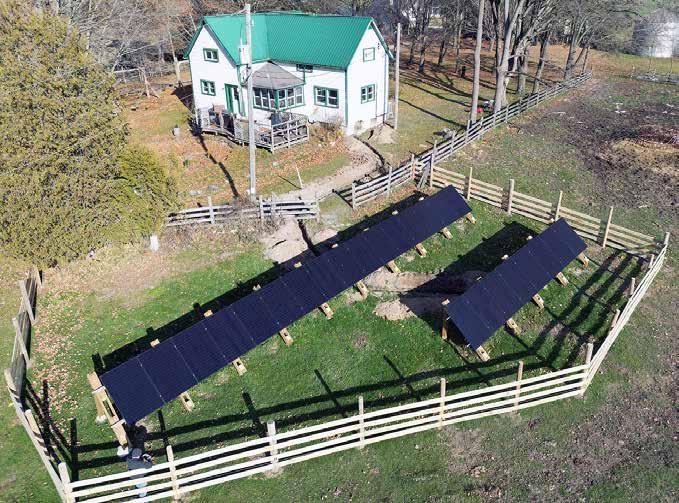
An aerial shot of the Tribe family’s 9.720 kilowatt solar panel array.
Norfolk’s Junior Fair garden produce entries increase in number
By Diane Baltaz
There may be more green thumbs amongst area youth if the 2025 garden produce entries at the 185th Norfolk County Fair and Horseshow is any indication.
That is because the fair’s two Junior Fair garden produce categories received the most youth
entries since the pandemic.
The Junior Category (ages 12 under) had 90 exhibitors with 268 entries, while the Intermediate Class (13-18/full time student) had 46 exhibitors with 177 entries stated committee chairperson Brian Woolley.
“Each year since COVID we
YOUR LOCAL IRRIGATION PROFESSIONALS
Serving Norfolk , Oxford, Brant County and Surrounding Areas
Rainmaker Sprinkler Systems is Norfolk, Oxford and Brant County’s trusted residential and commercial irrigation specialists since 1988.
We manage everything from lawns and gardens to municipal sports fields — there is no project too big or too small. Trusted by over 1000 customers for delivering high-quality service, we support you from design and installation through to seasonal maintenance.
Ph: (519) 582-3084 | Email: colin.rainmaker@gmail.com 222 La Salette Rd., La Salette ON, N0E 1H0
have had an increase, but this was more than we expected,” said Woolley. “It’s always a guess as to how many exhibitors and number of items will be entered.”
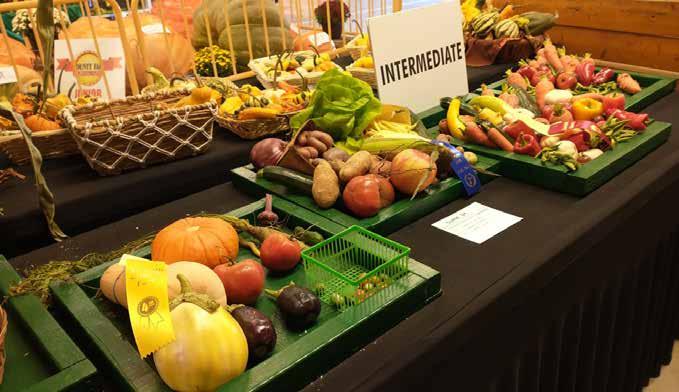
This veggie cornucopia shares space with flowers and adults’ produce under the Lloyd S. Culver Grandstand, surrounding the fair’s famous giant pumpkins, squash and watermelons.
The 2025 Junior Fair prize book lists a total of 42 classes for both age groups. These classes list everything from assorted field pumpkins, brassicas such as cabbage and cauliflower, onions, beets, carrots, beans, squash, eggplant, potatoes, tomatoes to the tallest sunflower with roots to specific vegetables arranged in trays or baskets.
Prize money for the top winners usually ranged from $10 to three dollars per class; specialized categories such as the collection of garden vegetables rewarded the first place winner with $20, while the squash grouping with at least four varieties began at $15; the largest pumpkin or squash awarded $200.
There was also an award for the intermediate class entrant who earned the most points in this division -- the Robert W. and Mildred Moore Memorial Award, created by the Moore family in honour of their parents who devoted several decades of service to the fair, including the produce classes.
Children brought their entries to the Lloyd S. Culver Grandstand during the Sunday afternoon prior to the fair’s opening, arriving after the front end loaders had positioned the giant pumpkins,
squash and watermelons in the room’s centre. There is also a Monday morning drop-off time for teachers whose students have entered. Their schools are listed on each student’s entry tag.
Motives for entering vary as much as the garden varieties.
“I like to grow plants!” exclaimed Lily Wegg, age 7 of Tillsonburg. “I can go outside and it’s really fun to do – to grow them!”
She added that vegetables make great gifts for her young neighbour, with whom she exchanges multiple gifts. “I love giving her gifts.”
Wegg entered two peppers, two different-coloured carrots, two tomatoes and one corn cob, which she grew on her grandparents’ farm near Delhi.
This was the first time that Wegg entered the Norfolk Fair junior gardening class, although her grandparents, Jim and Shelly Webb who accompanied her to the vegetable drop-off, said that her parents previously entered competitions at the fair, even having the grand champion chicken one year.
Wegg said that she previously participated as a junior gardener in a community garden project at the Tillsonburg Fair. She also enjoys planting beans in a planter’s box at her home, filling it with soil and “wetting it down with a hose – just enough to dampen the soil.” Other favourites are peppers, tomatoes and marigolds.
Lily uses starter plants, digs the holes, puts in the plants and covers the seeds, both at home and at her grandparents’ garden. “I enjoy watering and weeding them too.”She harvests and washes her
The top four winners of the class for a tray of vegetables in the Intermediate Division are: first, Jasmine Lindsay, Valley Heights Secondary School; second: Ashton D’Hulster, Son-in-law Produce; third: Katie Gorzo, Holy Trinity Catholic High; fourth: Greyson Knorr.
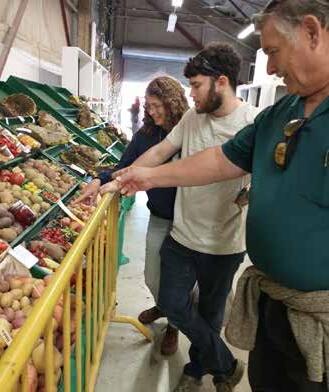
Sally, Justin and Larry Davis of Burford were among thousands of visitors who viewed the youth vegetable displays at the Norfolk Fair over the Thanksgiving weekend.
Norfolk’s Junior Fair garden produce entries increase in number
produce, as well as assists in bringing in her grandfather’s produce. Then, said Wegg, “Many of them go to Aunt Sarah”, who processes the produce and shares with family members.
Her advice to future junior gardeners? “There are all different kinds of seeds. You watch them grow. But remember too – they start out as a seed and it may take a while longer but you can see the different colours. They need help with watering and weeding.”
“I just love farming,” said another Tillsonburg resident, Greyson Knorr.
Knorr, 14, entered a vegetable tray as well as purple and white eggplants, acorn squash and carrots. He said that he grew these on the Delhi-area farm of Monica Veit, who leads one of Norfolk 4-H’s two garden clubs.
“I’ve belonged to 4-H for six years but this is my first time with the garden club. I will do it against next year as the club is a fun experience.”
Knorr also exhibited some produce as a 4-H member. 4-H runs an independent exhibition for its members at the show as their “achievement”, said Knorr.
“They encourage us to enter into the fair, both under the 4-H banner and as non-4-H in the general show (the junior and intermediate divisions.)”
Knorr studies at a Woodstock high school where he is taking a greenhouse course. “Hopefully, I can get a career growing vegetables,” he concluded.
Colten Kowal, 13, is a student at Delhi Public School. He entered sweet and yellow peppers, squash, and sunflowers, which he grew on his father’s farm near Langton.
“I grow and enter them with the hope of
earning extra money from the fair. It gives me something to do.”
Kowal “started out” as an exhibitor at the 2024 fair with large sunflower heads and identical carrots. He grew more produce at his dad’s farm this year, prompting him to enter more vegetables.
”We just pick the best,” said Kowal. “You must look after it, weed it and water it (garden). You don’t have to buy the stuff when you can grow it yourself.”
As chair of the committee that oversees the two youth vegetable categories, Woolley saw many entries during his approximately 40 years of involvement with the Norfolk Fair. Woolley also sees the value of encouraging youth to enter the vegetable categories.
“It’s educational. It (gardening) gets them out – it’s good exercise -- and it’s good for the community because it keeps the fair going,” said Woolley. “A lot of kids are surprised to see the vegetables grow; then the neighbour children see and they do it, and then enter the fair competition.”
“The youth also carry their gardening skills into daily life,” added Woolley, a fifth generation farmer near Simcoe. “Maybe this experience leads to some future career in horticulture or agriculture; perhaps even for agricultural support careers such as nutrients, seed supply, and crop technology. Agricultural companies always need people.”
Woolley said that his daughter, Carrie, “submitted a few pumpkins” that she grew as a youth and went on to study animal science at the University of Guelph. Today, she is married to Brett Schuyler and participates in operating
Schuyler Farms near Simcoe. Also, his son, Kyle is the sixth generation of Woolley to farm Spruce Lawn Farm – the family’s 125-acre farm – growing Asian pears and creating pear cider in addition to renting out land for cash crops.
Committee vice-chairperson Robert Moore shares Woolley’s pride in the young gardeners’ work. His family sponsors the Robert W and Mildred Moore Memorial Award
Moore said that his grandfather, James Isaac Moore, volunteered for the produce committee since 1922. Robert W., a dairy farmer, followed his parents’ attraction to garden produce, moving on to become the fair’s president from 1951 to1952. Mildred served as the Home Craft Division president twice during the 1960s and 70s.
Moore said that he himself “just naturally followed along”, joining the fair’s newly-created Junior Garden committee in 1978 and staying with it, even after serving in other positions including junior director and fair president.
An honorary fair member now in his 47th year of involvement, Moore said that he and his sister, former garden produce committee member Mary Jane, created the Memorial Trophy after their parents’ deaths because “we needed a trophy for that place; we decided that the trophy should be for youth.”
The siblings chose to reward the teenager with the most points because, “That give you a little enticement to enter a little more produce rather than one or two items that win first place. That’s the way I look at it and how my mom and dad looked at it. It’s the entries and exhibitors that make the fair; the youth who enter today are your adult entries later on.”
“Son of the Son-in-Law” wins the 2025 Robert W and Mildred Moore Memorial Award for vegetables
By Diane Baltaz
Ashton D’Hulster of Norwich Township won the Norfolk County Fair’s trophy for gaining the most points for produce over the Thanksgiving weekend.
The Robert W and Mildred Moore Memorial Award is awarded to the youth aged 13 to 18 (full-time student) aged 13 to 18 who won the most points in the Junior Fair’s Intermediate Division for Garden Products.
D’Hulster, 14, is the son of farmers Jason and Christine D’Hulster of Son-in-Law Produce near Otterville.
This student entered more than 12 garden classes, including field pumpkins, four Spanish onions, the largest vegetable tray, sweet corn, multiple squash varieties, most unusuallyshaped vegetable (he chose a tomato that had a small tomato growing out of it), and the biggest potato.
D’Hulster entered some of his vegetables independently and entered others through his high school, Holy Trinity of Simcoe, where his mother teaches.
The produce came from the family’s farm, which produces approximately 20 different varieties of vegetables and small fruit. D’Hulster spends his summers helping out on the farm; he said that he gathered the best of the produce
from the field two days prior to entering them at the fair.
D’Hulster is the fourth generation of his family to farm in the Delhi-Norwich area. He lives on the farm of his maternal grandparents, Gary and Blanche Godelie, which Jason and Christine purchased in 2020 and began farming full time in 2021. It is named Son-in-Law Produce because Godelie previously introduced Jason as “my son-in-law” to neighbours and farmers.
“I am the son of the son-in-in-law,” said D’Hulster.
D’Hulster placed well in many categories, often winning third or second place as well as the occasional first. He said that these results satisfy him, “although I wish that I placed better in some of the categories.”
D’Hulster and his parents have submitted produce at the fair for 10 years: “We enter as every year we come here and we walk through the produce section. When my parents got the farm they said, ‘Why not?’”
This Holy Trinity student began his farm experience by mowing the lawn, but he expressed an interest in assuming more tractor work as he reached high school. He assists his father in irrigating crops by positioning pipes and priming the pump and he used a small tractor to cultivate the weeds this past summer. D’Hulster said that he assists on the potato and the bean harvesters when needed.
D’Hulster gained some non-horticultural experience in the past year by working “sometimes a bit” with his grandfather’s small beef herd. He also pitches in with their small family storefront located near the junction of Highway 59 and Otterville Road.
‘I just help out around the farm,” he concluded.
Ashton D’Hulster of Otterville won the 2025 Robert W and Mildred Moore Memorial Award at the 2025 Norfolk Junior Fair.
Hiring Jamaican workers a positive form of hurricane relief says JLS chief Althea Riley
By Jeff Tribe
It was anything but a barrel of laughs.
But a 50-gallon shipping container provided a welcome layer of protection as Hurricane Melissa destroyed Dwayne Demontagnac’s Black River-area, Jamaica house around him.
“I was very fearful for my life because the roof went away,” recalled Demontagnac via phone from Jamaica. “All of the board structure broke down, the roof, everything.
“So, I had to resort to the bathroom.”
Melissa ‘whistled’ in around 9 a.m. he said, kicking off a nine-hour period where survival was of paramount concern, if far from guaranteed.
“I get the rain, the wind - a thing like a tornado.”
His house was mainly ‘board structure’, although with a concrete block bathroom. As the former disintegrated, he retreated to the comparative security of the latter, crawling into the barrel as the safest place of the moment, objects flying through the air around him.
“I was like hoping and praying. That was the most fearsome part of my life.”
As Melissa finally passed around 6 p.m., Demontagnac emerged to a ravaged landscape. Board structures were largely destroyed, concrete buildings in the main, surviving.
“There was no grass, no branches on the trees, no leaves… nothing. It was terrible.”
Four months later, electricity still hasn’t been restored in the area, ‘every little breeze’ reigniting the trauma.
“We are just recuperating,” said Demontagnac. “Still living in fear, still living in fear.”
Mark Hutchinson, who works for Dalton White Farms near Delhi through the Seasonal Agriculture Workers Program (SAWP) lives in South Manchester, his farm offering a beautiful view of the Caribbean Sea. Its elevated
perspective also meant it bore the brunt of Melissa, slamming into the surrounding countryside with incredible force.
“It was more than horrible,” said Hutchinson via telephone from South Manchester. He also rode out Hurricane Ivan’s destruction in 2004. “But this is the worst one.”
Attention Farming Community! MEMBER FLEET
PROGRAMS ARE
Jamaican resident and SAWP participant Mark Hutchinson (second from left) pictured along with Dalton White Farms’ Rebecca Compton (third from left) during the latter’s pre-Hurricane Melissa visit to his South Manchester home. Hutchinson lost all his crops during the tropical storm’s destructive passage.
The wind and rain were horrific he said, a combined barrage that went on and on.
“Like it’s never going to stop.”
Melissa was described as a category five hurricane Hutchinson said.
“To me, this was like category 10.”
He considers himself fortunate that his house survived, albeit with water damage. His crops were not so fortunate, watermelon, sweet pepper and tomato plants wiped out entirely.
“Everything - I lose everything. Put me right back at zero.”
The level of destruction reminded Hutchinson of scenes he’s viewed from bombed out sections of the Middle East.
“That’s how it looked.”
The first recovery efforts were clearing the road so food, water and medical care could
be accessed. Electrical service was restored roughly a month ago. Hutchinson has tried to replant his crops, but cold weather has hampered the effort.
“So I’m going to sit it out a while.”
Others in the area are in similar or worse situations.
“Roof gone, farm gone,” he said. “They are starting back over again.
“It’s not easy.”
“A lot of hard work,” said Demontagnac.
Norman Smith, who also works at Dalton White Farms, recently returned for his 19th season of employment through the program.
Melissa did not strike the entire island equally and his Portland-area home was fortunate to escape the hurricane’s worst impact. In
travelling through Jamaica however, he has seen its destruction, roads mostly cleared by now.
“But you still can see debris.”
Canvas (tent) structures are being used as temporary housing said Smith, although that is not a preferred option for residents whose homes were destroyed. Few people have insurance he said, an option largely afforded only by the affluent. In what seems a particularly unfair twist of fate, some of the men and women who have made the huge sacrifice to come to Canada and work in order to move their families forward, are facing the cruel reality of having to start over again, literally from ground zero.
“It’s really crazy, but what you have to
Jamaican Liaison Service Chief Liaison Officer Althea Riley emphasizes the role employing Jamaican workers through SAWP can have in rebuilding the island nation following Hurricane Melissa.
Dalton White Farms employee Norman Smith recently returned to Canada from his Portland, Jamaica area home for his 19th season of work. Although escaping the kind of destruction suffered in other areas of the island nation, he says the damage is significant and will require ‘strong thoughts and resiliency’ to recover and rebuild from.
Jamaican workers recount the devastation that hit their homes
do,” said Smith. “People have to have strong thoughts and be resilient to build again.”
Jamaican Liaison Service (JLS) Chief Liaison Officer Althea Riley expressed her appreciation for relief responses beginning in the hurricane’s
immediate aftermath. Items were collected at farms near Simcoe and in the Niagara, Chatham-Kent and Meaford/Clarksburg areas and shipped south. Employers also made individual contributions to their workers in cash
and kind.
“Thank-you for your support,” she said. JLS staff from Canada were among those involved post-Melissa, working in Jamaica for two months assessing damage and helping coordinate relief efforts. They have now returned here in order to fulfil their duties with workers planning to return to their seasonal jobs.
As the effort to rebuild continues, Riley emphasized the impact and importance employing Jamaicans through SAWP represents. Foreign remittances rank as the second-highest budgetary line item in terms of Jamaican economics, following tourism. A big part of this is attributed to remittances from farm workers. Wages earned in Norfolk County and across Canada by approximately 10,000 Jamaicans are economic drivers in communities throughout their country, enhancing financial security, educating students and providing funds for construction.
In arrears of Hurricane Melissa’s path of destruction, the ‘win-win’ reality for both Canadian farmers and offshore employees from that nation has been re-emphasized. In conclusion, Riley encouraged Canadian employers of SAWP participants to consider more farm labourers from her country, thereby supporting its recovery journey by helping in workers’ efforts to help themselves.
“The way we are going to rebuild is through employing Jamaican workers.”
‘The threats to our industry are real’: GFO leadership says trade, Trump remain a concern
By Luke Edwards
After another tumultuous year in global geopolitics, leadership with the Grain Farmers of Ontario painted a picture of an industry still very much concerned about the near future, but one that has also experienced a few key wins in the past 12 months.
Farmers from Haldimand, Brant, Hamilton and Niagara gathered last month in Caledonia for the GFO District 6 annual meeting. Presentations from various officials in the morning took place before The Weather Network’s Mark Robinson delivered an afternoon address.
Perhaps unsurprisingly, Canada’s rocky relationship with its American neighbours to the south remained top of mind.
“Without a doubt, the most effect we’ve seen is Donald Trump returning to the White House,” said Jeff Harrison, of the GFO.
In response to the tariff threats, Harrison said GFO officials stepped up advocacy, working with government partners on this side of the border, while also reaching out to corresponding groups in the U.S.
“We have a great relationship with our partners to the south,” Harrison said, adding collaboration with American grain industry groups led to a forceful push against trade barriers.
Despite that, Harrison said grain farmers in the province continue to face challenges.
“The threats to our industry are real,” he said.
There were some wins to celebrate, he added. Last year’s announcement of an extra $100 million for the province’s Risk Management Plan is huge, Harrison said. The bump from $150 million to $250 million is being phased in.
“It can’t come quick enough,” Harrison said.
Other wins he highlighted included getting the federal carbon levy removed, as well as the planned increase to the capital gains tax.
Even the recent deal between Canada and China that will allow for reduced tariffs on Canadian canola should be welcomed by Ontario’s grain growers, even though it will mostly impact farmers in western Canada.
“It’s something we should celebrate too,” Harrison said.
The prospect of increased trade with China could be great news in Ontario, especially for soybean exports. Jeff Barlow, district 6 director, recently returned from an Asian trade mission. He said China has such a robust system where he toured one facility that could easily take all the soybeans Canada exported last year. And while Canadian soybeans might be more expensive, he said they have a reputation for quality.
“Every single one says we have the best soybeans in the world, quality-wise,” he said.
Promise of increased trade with China presents opportunity, but rising input costs continue to be a challenge, namely with fertilizer.
“We’ve worked hard to reduce rising input costs,” said Harrison.
However, tariffs and domestic production levels that don’t meet the needs of eastern Canada means farmers will continue to face challenges when it comes to securing fertilizer, Harrison said.
A lot of variability for yields in 2025
As part of a presentation from Agricorp’s Mark Neufeld, crop yields from last year were
shared. Overall, local areas were relatively close to their respective averages for soybeans, winter wheat and corn, though Neufeld said for individual farmers it depended a lot on when they got the rain.
The western half of the province fared better than eastern Ontario, Neufeld added, with almost every producer in eastern Ontario being in a claim scenario.
Governance changes
Farmers learned of a few governance changes taking place with GFO.
The organization joined the Grain Growers of Canada, which Harrison said will give them a stronger voice. However, he said they’re not going to abandon their current work and that
eastern Canada remains unique.
“We see it as an addition to, rather than a subtraction from, what we do,” he said.
The organization’s vice-president of strategic development, Paul Hoekstra, also outlined some changes stemming from a governance review for GFO. The main change will see a new way of distributing delegates, which should see a more spread out distribution.
Protecting What Matters Most To You Since 1893
Jeff Harrison, chair of the Grain Farmers of Ontario, speaks at last month’s District 6 GFO meeting.
Webinar offers tip for post-harvest potato storage
By Tamara Botting
Potatoes are a staple for Canada’s agricultural industry. In 2024, there were over 127 million hundredweight of potatoes produced across the country.
Of course, growing the produce is only the first part of the ‘farm to table’ process; oftentimes, it’s several months before the potatoes grown in Canada will be eaten by consumers.
To help make sure the produce product hitting the market is the best it can be, Fruit and Vegetable magazine presented the Fresh from the Field: Post-Harvest Best Practices for Carrots and Potatoes webinar for producers in November 2025, sponsored by Wyma Solutions.
While broadly speaking, some of the practices are similar between the two crops, the particulars are unique to each.
Scott Graham, Mid-West Regional Raw Agronomy Manager – Manitoba and North Dakota with JR Simplot Company, was one of the speakers; his portion of the presentation focused on potatoes.
Graham emphasized the importance of properly preparing the storage bins for potatoes before it’s put back into use each harvesting season.
All of the organic matter, such as potatoes and soil, need to be removed from the storage area.
Then, the whole storage area needs to be cleaned – this includes the walls, beams, flume boards, insulation, cement, plenums, pipes/ culverts, ventilation and humidification systems. Producers can do the initial cleaning with soap and hot water or steam, using a high pressure washer, and then rinse.
It’s also necessary to disinfect the space. Graham noted that when the disinfectant is applied, it should be left wet on the surfaces for 10 to 15 minutes – he reminded audience members that disinfectants can vary in their chemistry and application use, so each producer should be sure to check the label to confirm that the disinfectant they’re planning to use is appropriate for their potato storage.
Graham noted that the combination of hydrogen peroxide and peracetic acid is very popular with many growers, as it’s well proven to be effective, in that it breaks the biofilms down and kills any bacteria or fungus that may be lingering.
Yearly inspections and recalibrations need to be done on the temperature, humidity sensor and humidification systems.
“If you’ve got lower humidity than what you’re intending, your profit is literally flying out the window – or in this case, out the back louvers of your storage,” Graham said.
The processes for these checks are fairly straightforward.
To double check your storage control panel is functioning accurately, take a thermometer into the storage plenum and make sure that it’s reading the same temperature as what’s showing on the panel.
With humidification systems, it’s important to check the header tube to ensure that it’s not clogged, and check for broken or disconnected tubing, while also making sure the pads are in the correct place.
Also, check the humidification system inspecting the wet bulb/dry bulb box ensuring the wick is clean, and if it needs to be replaced. Similarly, he recommended only using distilled
Scott Graham, Mid-West Regional Raw Agronomy Manager – Manitoba and North Dakota with JR Simplot Company, was one of the presenters for Fruit and Vegetable magazine’s Fresh from the Field: Post-Harvest Best Practices for Carrots and Potatoes webinar for producers in November 2025, sponsored by Wyma Solutions. Graham’s portion of the presentation was focused on potato storage.
water in your wet bulb/ dry bulb box.
If you need to calibrate your relative humidity sensor, remove the wick from the wet bulb sensor, and allow it to stabilize for 20 minutes. Then, compare the wet and dry bulbs – if they’re reading the same temperature, then there’s nothing more that needs to be done. If not, though, then you’ll need to recalibrate the system.
Electronic humidity and temperature sensors should be cleaned and checked regularly to make sure the readings you’re getting are accurate. Also, check the humi-cell annually to make sure the cardboard insert isn’t clogged – these will need to be replaced every three to five years at least, but possibly more often, as hard water can cause scaling due to heavy mineralization, and plug a humidification system.
Graham noted that a clean 6 ft x1 ft x 1ft. humi-cell media weighs approximately eight pounds; any media over 12 pounds should be replaced. Back pressure from a plugged humicell can reduce fan performance by 12-20 per cent or more, based on the blockage. This might reduce the fan speed (meaning a lower cubic feet per minute (CFM)), and/ or lower the humidity in the storage space.
When it comes to their heaters, some farmers will remove them in the off season, as they can get rusty. Before you need to use them, though, it’s a good idea to inspect and test your heaters to make sure they’re working correctly.
Louvers and doors should also be inspected: control arms should be greased so that they can work properly, the door needs to be plugged in for the winter months, and the louvers need to be correctly in place and free swinging.
Finally, be sure to check your exhaust cages, making sure that they’re intact so that no birds or animals can get in.
After potatoes are harvested, they take in oxygen and release carbon dioxide (CO 2), heat and moisture.
“This is a lot of energy that’s going in the
storage (space),” Graham said. This is why it’s so important to have all of the temperature, humidity and airflow control systems working optimally – they need to push that energy up and out.
He noted that the three things that govern the respiration rate of potatoes are temperature, maturity, and tuber health.
· Temperature: The lowest rate of respiration for potatoes is at about 45 degrees F (7 degrees C); the rate of respiration is higher when the temperature is above or below that mark.
· Maturity: Immature potatoes have higher respiration rates than mature potatoes.
· Tuber health: Potatoes that are stressed (whether too hot or chilled, or those that are diseased) will have higher respiration rates. Also, fungal and bacterial diseases respire on their own, which adds more CO2 and heat to the storage space.
“Right from the day those potatoes are planted right up until the day of harvest, keep your scouting notes, know your fields, flag any problems,” Graham said.
He urged producers to pay attention to their crops, because the plants will communicate what’s happening. Things like the vine canopy health, the skin set, and the sucrose levels will all help to paint the picture.
“It’s very critical to take sugar samples preharvest; that’ll assist you with your digging date order and it’ll confirm other factors that have happened throughout the summertime as well,” Graham said. Fairly common occurrences like a later planting season, hail, or several severe heat days stacked in a row could all have an impact on that year’s potato crop.
He reminded the producers that optimal storage practices start in the field.
Ideally, the pre-harvest irrigation should be applied two or three days ahead of time, to hydrate the tubers; depending on your soil type, this could be four to six tenths. While hydration is important, it’s also best to avoid harvesting wet spots.
Graham urged producers to record their tuber pulp temperatures hourly at least – though he knows some farmers will do it after every load, just to be sure. Harvesting should only be done when the pulp temperatures are between 45 to 65 degrees F (7 to 18 degrees C); if the temperatures are lower than 45, there will be an increase in shatter bruises; above 65 will mean an increase in pathogens and pressure bruises.
At harvest time, there can be many different types of rots, like pink rot and pythium leak, etc.
Graham reminded producers that preconditioning removes excess sugars, as it’s a combination of respiration and reconversion to starch, and curing is essential for wound healing; the development of a good skin reduces water loss and minimizes the danger of pathogens.
With potatoes, the storage temperature should be at 52 to 55 degrees F (11 to 12 degrees C) for two to four weeks after the harvest (longer if needed), while the relative humidity should be at 95 per cent, which promotes suberization and quick wound healing, minimizes dry rot infections and prevents shrink and pressure bruises.
Graham noted that the majority of weight loss for potatoes happens in the first 30 days in storage, making early storage management the optimal time to minimize water loss and pressure bruises.
Webinar offers tip for post-harvest potato storage
Ventilation should be continual, to remove CO 2 and provide the needed oxygen.
“The huge thing is, get that energy out of the pile. You want uniform conditions throughout your pile,” Graham said.
He added that when it comes to CO 2 management, the levels should be below 2,500 parts per million (PPM) for most French fry varieties. Sugars can accumulate if the CO 2 level in the storage is too high, and that will have an impact on fry colour. Sensors help prevent the CO 2 levels from being too high for too long.
Graham reminded everyone, “It’s very critical when it is cold to check your return air door and make sure that they’re not frozen up.”
He noted that with more being learned about the sugars of potatoes, “a lot of growers have been able to reduce their preconditioning time, from six to eight weeks down to two or three, if they know that their crop is mature.”
Graham added, “The sugars are telling us we can go .4 degrees a day after three to four weeks of preconditioning. We can be a little more aggressive to get down to 50, and then do the .2 down to your holding temperature.”
For the storage ramping period, the advice given was:
· Check sugars and fry colour two to three weeks after harvest
· For shifting from ramping storage temperature to holding temperature – rapid cooling may cause sugar accumulation and fry colour to go dark or pressure bruise; instead,
until the outside conditions are suitable
· Use ramping only when a minimum of 16 hours of cooling air is available each day
Meanwhile, for storage holding and reconditioning periods:
· The holding temperature is very dependent on your potato variety and delivery timeframe –communicate with your processor on the time of delivery. If, for instance, you know you’re going to be shipping in December, is there a need to take it down to 47 or 48? (Keep your fry colour in check, because you might not need to go that low)
· Utilize variable frequency drives to maintain a .5 to 1 degree F differential between the top and bottom of the pile
· Reconditioning or conditioning refers to increasing your storage temperature to reduce the sugars for better fry colour (this has been a more common practice in recent years); in mid November to the start of December, it’s a good idea to cool the pile off. (Graham also noted here that in the winter, the temperatures are going to be that much colder, so there may be more dripping condensation happening – if you can drop the temperature to 47 or 48, that will reduce the amount of pathogen activity via condensation)
· Increase your storage temperatures four to six weeks prior to delivery
Throughout the storage cycles, managing condensation needs to be an ongoing concern. Condensation forms when warm, humid air
water droplets.
Graham suggested that producers consider adding a heater above the pile at the front of the storage space, because combined with fans, a heater can further reduce the likelihood of condensation, keeping the ceiling lining dry.
Speaking of fans, Graham suggested suspending them from the ceiling, or placing them on the top of the pile to improve air circulation; if the fans are slightly offset and going in different directions, this will maximize air circulation. The air movement mixes the cooler air near the ceiling with the warmer air from the pile, and reduces the risk of condensation.
While not necessary, Graham noted that he has seen some farmers install light timers in their storage spaces. This has several benefits, including that keeping potatoes in the dark helps prevent them from greening, and it reduces overall energy use.
He also said that he’s seen some farmers replacing their old wooden flume boards with composite boards, because they last longer and it helps to eliminate the issue of foreign materials. If you are using wooden boards, Graham reminded everyone to make sure they’re flush with the floor, “because we don’t want any splinters coming into the factory.”
As far as other possible upgrades to your storage facility, before you do any modifications, it’s best to conduct an engineering review first, Graham said. If the existing storage is still structurally sound, upgrading the insulation and
By Diane Baltaz
on emergency preparedness
Brant and Norfolk Counties are among nine municipalities receiving additional funding from Ontario’s Legacy Oil and Gas Well Action Plan this winter.
At a press conference held in Paris, Ministry of Natural Resources (MNR) Minister Mike Harris announced that the Ontario government is investing an additional $4 million to protect communities from the risks of “legacy wells” -- old and inactive oil and gas wells. This funding will enhance emergency preparedness and response as part of the government’s $23.6 million Legacy Oil and Gas Wells Action Plan.
Minister Harris said that Brant will receive $185,000 to support the purchase of new equipment, such as a drone for hazardous gas detection, an inflatable emergency shelter and additional specialized gas detectors as well as emergency response training for staff.
Norfolk will receive $280,000 for emergency response equipment, including mapping tablets for fire vehicles, decontamination tools and a digital road sign for public alerts.
The province’s Legacy Oil and Gas Wells Action Plan focuses on identifying and safely plugging old wells and supporting municipalities through the Municipal Transfer Payment Program, said MNR press secretary Maria Votsis in an email.
Votsis added, “Since 2023, Ontario has provided close to $10 million to
help municipalities purchase specialized equipment, deliver critical training programs, collaborate across municipal borders and enhance emergency response capacity to keep communities safe from oil and gas related emergencies. Funds have been used to purchase emergency response equipment, provide health and safety training to municipal staff and improve public education and awareness.”
In the County of Brant, there are records for 268 oil and gas wells. The MNR estimates 110 are active and the remainders are inactive, said Votsis.
In Norfolk County, the ministry maintains records for 2,702 oil and gas wells, of which approximately 485 are active. The remainder are inactive, added Votsis.
“We will continue to work closely with Norfolk on the existing (inactive) wells,” she said.
The County of Brant website page on legacy wells states that there are approximately 27,000 inactive oil and gas wells, many of which are located on private lands in southwestern Ontario. The information page warns that “these wells are no longer in use and were abandoned without following today’s safety and environmental standards. Some may not be visible above ground, leaving landowners unaware of their presence.”
It is these old and inactive wells, not active licensed ones, that concern municipalities.
Such wells are often located on rural properties, primarily farmland. Signs of a potential leaking well can include “gurgling” sounds in water wells, bubbling in local creeks, patches of unexplained dead vegetation, or the “rotten egg” smell of hydrogen sulphide. Such leaks can create human health and environmental concerns.
Concern over decommissioned wells intensified in August 2021 when hydrogen sulphide, seeping up from old uncapped wells in the town of Wheatley caused an explosion, destroying two buildings, damaging a dozen more, and injuring 20 people.
Locally, the County of Brant “did have one fatality” involving a legacy well within the past five years, said Fire Chief Darren Watson.
“To support the cost associated with plugging abandoned oil and gas wells that pose risks to safety and the environment, the province provides funding to property owners through the Abandoned Works Program. In 2023, Ontario doubled the available funding through this program to a total of $6 million over three years. To date, the province has invested $36.4 million to plug 454 wells across Ontario, including several in Norfolk,” said Votsis.
Both area MPPs recognize the additional funding to assist Brant and Norfolk first responders deal with emergency and preparedness plans for abandoned wells.
The latest MNR funding for area “legacy wells” focuses on emergency preparedness
“I am so pleased that Ontario is taking a whole-of-government approach to public safety,” said Brantford-Brant MPP Will Bouma. “This additional funding will help the County of Brant mitigate public health and safety issues that may arise from these old wells.”
But Haldimand-Norfolk MPP Bobbi Ann Brady expressed concern over the need for more sustained funding to plug the known 27,000 legacy wells in Ontario.
“The $4 million seems like a significant commitment until you set it against the scale of the problem,” said Brady. “It’s these abandoned oil and gas wells that are the problem. Many of them are aging and leaking….The ministry is continuing to take the band aid off and replace it with another.”
“We know that the decommissioning of one single well cost tens of thousands of dollars,” said Brady.
While funding for the provincial Abandoned Works Program for plugging legacy wells “expanded a bit in recent years”, Brady said that there is no official tally about the number of wells capped in Norfolk, either through the program or possibly by local landowners who privately remediated these sites.
“But provincial figures state that 415 wells have been capped through the Abandoned Works Program,” said Brady. “So that is a drop in the bucket, right? They need sustained funding, clear accountability and need to make tough policy choices well beyond these pockets.”
Brady described the impact of ongoing discharge from the Forestry Farm Road legacy well, which remains unresolved for more than a decade in spite of studies and costly remediation efforts.
“It’s widely regarded as the most significant problem in Ontario because of its scale, persistence and risk profile, and the minister has admitted that.”
on their property, to contact the ministry’s Petroleum Operations Section by email (gasandoilwells@ontario.ca) or by phone (519-873-4634). Also, up-to-date mapping of known
well locations can be found here: Oil, Gas and Salt Resources Library and at the Ontario Geo-Hub.
Officials first noticed the Forestry Road leakage in 2015 following the capping of a relief well in Big Creek. Experts fingered this action for creating a buildup of underground pressure, releasing hydrogen sulphide and sulphur-bearing groundwater into the surrounding local wetlands and raising serious health concerns. This issue continues despite studies and spending more than a million dollars on remediation efforts.
“The fact that this well remains unresolved underscores the broader challenge that the government faces with legacy wells in Ontario,” said Brady. “It’s time that the government decides whether or not to take responsibility for this and sit down with a plan for these wells.”
The seven other southwest municipalities that are receiving the current wave of emergency response funding are ChathamKent, Lambton County, Oxford County, Elgin County, Essex County, Haldimand County and the Regional Municipality of Niagara.
The MNR advises landowners who discover or suspect a legacy well is present
New Simcoe Farmers’ Market site -- a win-win for the agricultural society and vendors
By Diane Baltaz
Several months after settling into another location at the fairgrounds, most of the approximately 30 indoor vendors at the Simcoe Farmers’ Market report that they’re happy with the change.
The market was previously located inside the lower level of the Homecraft Building that borders South Drive. But the Norfolk County Agricultural Society is converting the Homecraft Building into a banquet facility, and moved the market to the space beneath the Lloyd S Culver Grandstand.
The new site officially opened with a ribbon cutting ceremony with market officials and local MPP Bobbi Ann Brady on Nov. 13.
“The new location is working very well,” said market chairperson Steven Miedema approximately seven weeks after the market reopened. “Business was constantly up during this time, although some customers likely came to the market from curiosity.”
The paved area outside the grandstand will benefit the seasonal vendors this spring, added Miedema. “The fair board gave the outdoor vendors the freedom to expand.”
Most of the vendors interviewed reported being pleased with the new location’s structure, particularly with its improved lighting, higher ceilings and better aisle flow. Some reported increases in sales, while others found that business remained stable after the initial visits by curious citizens.
Dan McCutcheon has been selling local lettuce, syrups and other produce at the Simcoe market since 1981.
“It’s phenomenal being here,” he said. “Everything is new. I noticed that many customers whom I haven’t seen for years have returned, saying that they want to ‘check things out’. It’s hard to say if they will return, but my regulars are still coming.”
McCutcheon’s sales rival his previous profits
from the Homecraft site. The vendor quipped that several regulars who live within walking distance of the market remarked that they must walk further to get to the grandstand.
Danielle Jones of JD Microgreens experienced “a different feel” at the new site since she sold her first crop at the market in November, 2023.
“It’s not bigger here, but the layout and the parking are better and the ceiling is higher. It’s the same space (as before) but it feels as if there is more room here.”
“Sales are the same, but there’s better lighting here and, higher ceilings,” agreed Nolan Hoiting of Manna, Oxford Centre. Although he sells culinary mushrooms, powders and quail eggs at farm gate as well as at a Woodstock health food store, he left another farmers’ market in favour of the Simcoe site. “Once people find where I am, it’s better.”
Sisters Jolnir and Temiah Thiessen of Stormin’ Garlic, Scotland, sold their alliums at
the Homecraft Building for six years.
“We’re still figuring it out,” said Jolnir. “It’s similar for us, but it’s brighter here and we appreciate the longer aisles.”
Meanwhile, Miedema believes that the Norfolk Agricultural Society also benefit from this change.
“Simcoe needs a large banquet hall,” said Miedema about the Agricultural Society’s new project. “Homecraft is being converted into a banquet facility. Simcoe doesn’t have facilities to host large banquets for 300 people. The fair board is filling this need.”
The upstairs of the hall will become the banquet facilities, with the washrooms and cooking facilities in the basement where the market was originally located, he said.
The Simcoe Farmers is open on Thursdays, offering everything from produce, flowers, baked goods, local meats, cheese, crafts, ready-toeat-meals and eggs.
Steve Miedema chairs the Simcoe Farmers’ Market committee.
Local MPP Bobbi Ann Brady officially opened the new facilities for the Simcoe Farmers Market on November 13. With her are (left to right) Steve and Doug Miedema and Norfolk County Agricultural Society President Dan Taylor.
Veteran microgreens grower Danielle Jones at the new market location under the Lloyd S. Culver Grandstand.
Nolan Hoiting of Manna Culinary Mushrooms and Quail (centre) enjoys continued customer support at the new location.
From the Field:
THE LATEST FROM NORFOLK SOIL AND CROP ASSOCIATION
Celebrating 85 Years of Making Local Improvements
By Nancy Van Sas, Ontario Soil & Crop Improvement Association
Norfolk Soil & Crop Improvement Association celebrated with their 85th banquet on January 29, 2026.
The theme of the night was overcoming challenges. The room was alive with new and seasoned farmers from Norfolk. The success of an organization can be seen by the faces of the people behind the organization. Norfolk Soil & Crop is no different as it is the collection of these individuals from across the county, collaborating to make local farming improvements.
A lot has happened over the past 85 years, changing the face of agriculture. In the beginning, local Norfolk farmers gathered in a time that was very different from today. Not only were farming practices less mechanized and farm operations much smaller, but they were also involved in a world war that had implications both on and off the farm. Young men were serving overseas as part of the war effort, with some to never return to Norfolk soils.
The war efforts went beyond enlisting in the military as the food grown in our soils went towards feeding our troops overseas. We saw the rise of the role of women in agriculture, as seen in the documentary We Lend a Hand: The Forgotten Story of Ontario’s Farmerettes. Amongst all that, Norfolk farmers gathered to promote the importance of soil health and water quality.
Over the years, Norfolk Soil & Crop has evolved and changed along with our farming practices, seeing large-scale agriculture taking over many of our small family farms. Without the continued leadership and guidance of many farm families from across Norfolk, this organization would never have survived past its infancy. Collaboration is at the cornerstone of this success. Industry will come and go. It is farmers working with other farmers who experience the same challenges banding together to find solutions to their issues that have made this organization succeed and continue to do so.
Norfolk Soil & Crop continues to promote best management practices on its soils. Field trials continue to be at the heart of their activities. Norfolk Soil & Crop is only as good as the members who are a part of it. If you farm in Norfolk County and wish to be a part of this longstanding organization focused on making local improvements, please reach out as everyone is welcome.
As we move forward with farming in Norfolk, something to consider is the report spearheaded by Senator Rob Black, Critical Ground: Why Soil is Essential to Canada’s Economic, Environmental, Human and Social Health, that was launched in 2024. The report helps us understand where we will be in 40 years if we do not make changes now.
Whether you are a part of the NSCIA network or not, it is critical that all of us farmers make improvements to ensure our future generations are able to continue farming in southwestern Ontario. Our resources, such as the water in our Great Lakes, are not guaranteed, nor is the water in our ground.
If you are interested in finding out more information about Norfolk Soil and Crop, its events including a summer bus tour, please reach out to Nancy at 226-583-0850 or
nvansas@ontariosoilcrop.org.
You are invited to attend March Grower Day on March 12, 2026, from 8:30 am to lunch at the Courtland Community Centre. This event will feature Rob Bianchi, atmospheric physicist/ meteorologist, Rick deJong focusing on Making Fertilizer Dollars Count and a third speaker looking at soil amendments specifically for Norfolk County. Reach out to Alex at 510-4105344 to register.
We have hired Shelley Klassen as Senior Accountant at David Simmonds CPA Professional Corporation in Tillsonburg. Shelley has over 20 years of experience in the accounting industry. Her areas of focus include agriculture, businesses, corporations, income tax, estates, bookkeeping and payroll.
Shelley comes to us after 8 years with Larry Hemeryck CPA of Simcoe and later Dely & Associates also of Simcoe. Our practice is welcoming new clients this tax season. Please reach out to Shelley for all your income tax and accounting needs.
Canadian explorer and author Adam Shoalts was the guest speaker at the Norfolk Soil and Crop Improvement Association’s annual general meeting in January. The award-winning writer wowed the crowd with his stories of exploring Canada’s Arctic, and remote parts of the country.
Agriculture and Agri-Food Canada closing seven research sites; laying off 665 staff over next three years
Guelph amongst federal research station closing
By Tamara Botting
As part of Canada’s federal budget 2025, and in an effort to save $13 billion annually by 2028-2029, the majority of the Government of Canada’s departments were asked to find 15 per cent of savings over three years.
“Savings will be achieved by restructuring operations and consolidating internal services, adjusting programs to realize efficiencies, and in some cases moving away from programs that are not meeting their objectives,” read
the government’s website.
For Agriculture and Agri-Food Canada (AAFC), this is going to take the form of the closure of three research and development centres, Guelph, ON; Quebec City, QC; and Lacombe, AB. Four satellite research farms are also being closed, in Nappan, NS; Scott, SK; Indian Head, SK; and Portage la Prairie, MB.
The AAFC’s workforce will be reduced by approximately 665 positions through attrition,
Locally Grown M em b er Owne d Farm F ocu s
workforce adjustment, and career transition over the next three years, said Stéphanie Blais, spokesperson for AAFC.
Blais said the AAFC’s decisions in this process “were guided by a careful review of the department’s science activities, sector priorities, capacity, and infrastructure.
“We considered alignment with strategic priorities, capacity in other places,
Agriculture and Agri-Food Canada closing seven research sites; laying off 665 staff over next three years
opportunities to strengthen support for the agriculture sector, and ways to deliver science more efficiently while maintaining a presence in every province. These choices position AAFC to sustain strong scientific capacity, improve efficiency, and concentrate resources where they will continue to generate scientific, economic, and environmental benefits.”
She also noted that the agency “will continue to be the largest agricultural research organization in Canada, with 17 research centres across the country. Every province will continue to have at least one research centre as well as research farmland.”
When asked about Ontario specifically, Blais said the AAFC’s presence in the province will remain strong, with centres in Harrow, London (including Jordan Farm), and Ottawa, and through its Pest Management Centre and its related activities represented at sites across the province and country.
“AAFC will also continue to invest in science and strengthen collaborations with industry, governments, academia, and other key stakeholders in Canada and internationally. These efforts will continue to advance shared science priorities through activities at AAFC centres and through regional and national initiatives to support the agriculture and agrifood sector,” Blais said.
Milton Dyck, National President of Agriculture Union, which is within the Public Service Alliance of Canada, has concerns
with the announcement of the centre closures and layoffs.
While Dyck wasn’t yet sure of how many Agriculture Union members specifically would be impacted by the cuts when he
Norfolk
spoke with Norfolk Farms, he did know that there “absolutely” would be an impact to the membership.
“We’re the biggest group at research
Guelph Research and Development Centre.
Agriculture and AgriFood Canada closing seven research sites; laying off 665 staff over next three years
centres,” he said.
While he didn’t have the final numbers, Dyck knew anecdotally, “It’s of course affected the members badly. Anyone who’s ever been told that they’re losing their job, there’s layoffs coming, it’s very traumatic. It’s been traumatic for the members, and also for the members who have been told that they’re affected, but we don’t know yet if your job is going to be lost. For them, there’s also that worry of ‘What’s going to happen to my job down the road, and how long will I have?’”
He noted that there will have to be a SERLO (Selection of Employee Retention or Layoff) process to determine which staff will lose their job, and who will remain employed.
“That is very stressful,” he said. Dyck doesn’t anticipate the process will be straightforward.
“Within the federal government, we don’t have seniority as a baseline,” he said. “There’s several different ways it could be done.”
Two possibilities are that some employees end up essentially interviewing for their job; there could also be assessments of what the department needs are expected to be in the future, and seeing how that compares to the employee’s resumes.
he said.
“But science is all based on our future, and that is really important,” Dyck said, adding that it’s for the common good.
As an example, he noted that Southern Ontario has the highest concentration of food producers in Canada, and the main focus of the Guelph Research and Development Centre is on research and development in food safety and value-added food attributes to help foster a profitable agri-food sector in Canada.
“It’s a hard one to lose.”
Dyck anticipates these cuts will impact Canadians in the general population because “it takes away supports for the agriculture industry … we need to have safe food created for the greater Canadian public.”
He also suggested the cuts could hurt the Canadian agriculture industry’s ability to be profitable.
He also suggested the cuts could hurt the Canadian agriculture industry’s ability to be profitable.
He noted that there will be a winding-down process for some of the scientific projects already underway, and then it will take time to close the buildings up.
Dyck said it’s a heavy blow to a department that has already had a 14 per cent drop in staffing levels over the past decade to now be asked to cut 15 per cent more.
“With science and research, you don’t get money for it; it’s not a big campaign thing on the political scale. So, it tends to get nibbled away; there’s no money thrown at it, and it kind of drifts,”
Dyck said he’s hoping for a public outcry and a possible reconsideration by the federal government.
“People do realize the value –certainly in the ag industry – of this research.”
However, Blais said, “The decision is not being reconsidered.”
Beyond the value of the work being done at the research centres, Dyck noted that these centres also add value to their communities through providing jobs, supporting the local economy, and contributing to the municipal tax base.
Dyck noted that while most federal departments were asked to find 15 per cent savings over three years, some were only asked to find two per cent, including National Defence.
“But research is the future,” he said. “Food safety – that’s as valuable to Canadians as any other protective group. I see this as the health and safety of Canadians.”
Diaries prove instrumental in providing an orderly succession for Scotland wholesale vegetable operation
By Diane Baltaz
After more than 40 years of growing vegetables and flowers, Bill Boot epitomized the successful farmer. In partnership with his wife of 37 years, Marianna, Bill developed a thriving wholesale vegetable operation with produce selling to multiple local markets and grocery chains across Ontario. The “Boots Blue Label” on their squash – their primary crop – became Bill’s special pride.
His sons, Chris, Mike, and Jacob, now 30, 27 and 25 respectively, joined the operation
after finishing school.
Bill’s farm-love began almost at birth, after his parents, John and Jacoba, bought a 24-acre parcel of land near Freelton in 1957, several years after emigrating from Holland. The family grew multiple vegetables for retail markets, including pickling cucumbers, rhubarb, leeks, potatoes, cabbage, and asparagus. Keen on farming, Bill quit high school in order to work alongside of his father; he introduced squash, gourds, ornamental corn and squash and switched marketing to wholesale only.
TDI New Homes Presents
Boots Farms relocated to a 160-acre former tobacco farm on the 13th concession near Scotland in 1990, gradually expanding the operation to 600 acres of owned and rented land. Boot obtained a booth at the Ontario Food Terminal (OFT), which became their primary sales venue.
But then Bill, 68, died unexpectedly a month after a routine surgery in December 2022.
It’s a loss that the close-knit family still feels. His untimely death just before the impending
Marianna Boot and her sons (left to right) Jake, Mike and Chris. Bill Boot with his Boot Blue Label standing in his leeks.
Diaries prove instrumental in providing an orderly succession for Scotland wholesale vegetable operation
crop year jolted the family’s succession process: Boot’s core involvement in the farm needed to be replaced quickly.
Nevertheless, Boot’s entrenched passion for crops remained. According to the family, Boot’s legacy enabled them to quickly move into the 2023 planting, which usually begins in their greenhouses in February.
It starts with the family’s conversations — they frequently quote Boot’s maxims about why they practice various growing and marketing strategies.
Also, the family didn’t worry much about obtaining their 2023 crop supplies while they grieved.
“Bill already had everything ordered for the crop season,” said Marianna, who now oversees the entire operation. “He was a farmer all his life – things came naturally to him – he had everything organized.”
Immediate critical assistance came from their labour, notably the 30 Mexican workers who steadfastly worked under Boot for 15 to 20, and in one case, 25 years. Boots Farms’ operation is labour-intensive from seed to harvest: most plants are handled several times from seeding in approximately two acres of greenhouses, to transplanting and then hand harvesting each plant.
“They’re like family for us,” explained Marianna with emotion. “They were so instrumental for us after Bill’s death. They sent flowers to us from Mexico. They said that they’d make it (crop season) work. They came back. They know the work.”
The most instrumental windfall, according to all three sons, is the detailed farm diary that Bill kept. It is their primary reference book.
“Dad kept a daily journal of his farming activities -- right down to the amount and type of fertilizer he put in his tanks, about the greenhouse and weather conditions. It helped us to compare situations,” said Jacob.
“Bill was training them all the way. He was proud of the way his sons were stepping up as they matured,” said Marianna.
“But the journal is the key”, said Chris.
Each Boot performs specific responsibilities: Chris handles the office work, food safety and the majority of the tractor work; Marianna handles the procurement of local contract labour, which varies from 25 to 70 people annually, and bookkeeping; Jacob is the pesticide applicator and tackles greenhouse duties when Mike is at market.
Mike is the marketer, having begun this responsibility under Boot in 2018. Boot was then slowly retiring from the OFT work, hiring a salesperson to do some marketing, in order to focus on the farm. Marianna said that after Bill was off the scene and only attended the market when needed, some regulars at the terminal actually told her spouse that they “prefer dealing with Mike.”
Currently, 90 percent of their sales occur at the Ontario Food Terminal, with Boots Farms’ own drivers and trucks delivering produce immediately after picking. Most of their buyers are what Marianna described as “small, family-sized vendors”; although grocery chains, including Longo’s, Metro and Wal-Mart carry product, often sold the produce through third-party wholesalers.
Despite his pride in finding his blue
Boots Squash label in area chain stores, Boot repeatedly stressed that their future depends upon smaller, independent retailers, who constitute the bulk of sales.
“Our dad used to say that our little customers are as big to us (as the chains) and so there’s so many of them we couldn’t do without them,” said Mike. “And the small Indies are there (at the OFT) every day.”
The family also custom grows plants for a few farmers.
Significantly, hot pepper production is increasing. “The hot pepper market is really taking off,” said Jake.
Boots Farms grows most of the crops that grew in Freelton. They form some of the greenhouses’ earliest February plantings, including leeks, marigolds, peppers, squash, basil, kale, cucumbers, some large-sized patio and hanging flowers, and hot peppers.
Each seed tray holds approximately 300plus seeds, using soil from New Brunswick peat bogs.
The family does early greenhouse seeding
and then transplants vegetables such as squash, rather than direct seeding them into the field. It gets product to market several weeks earlier.
“Bill wanted to be the first one on the market,” said Marianna.
Similarly, Boots Farms uses approximately five acres of “high tunnels” – portable greenhouselike structures which enables the family to roll the sides up and down according to weather conditions. They are mainly used for early peas, beans and peppers.
Drip line irrigation is used in accessible fields to conserve water during dry spells. Harvest crews handpick product for superior quality.
“Machine-picked beans may exhibit bruising on the following day,” said Chris.
Surplus produce goes to food banks in Brantford, Hamilton and a local church.
The Boot family continues to grow. Mike and his wife Shala, have Sawyer, now a toddler, while Jacob is married to Heather. There are also two recent grandchildren.
Boots Farms’ Facebook states that Oscar, who manages the bean crops, has come annually from Mexico since 2009.
Spotted lanternfly ‘an imminent potential problem’ for Canadian growers
By Tamara Botting
Despite its name, the spotted lanternfly isn’t actually a fly. Moreover, while it may look like a moth, it doesn’t fall into that category, either. In truth, these insects are plant hoppers, more closely related to stink bugs or water bugs.
More important than being aware of the particulars of their moniker, though, is keep an eye out for them, and reporting it if you do spot one, because they are a federally regulated invasive species to Canada.
The good news so far is that “there actually are no established populations yet in Ontario, or anywhere else in the country,” said Emily Posteraro, Program Development Coordinator with the Invasive Species Centre.
However, there have been sightings (which is when someone has reported what they suspect to have been a spotted lanternfly specimen), and interceptions (where a specimen has been confirmed to be a spotted lanternfly).
This record is publicly available on the Canadian Food Inspection Agency (CFIA) website.
So far, there has been no known breeding activity of these bugs in the province, but the sightings and interceptions are concerning.
“We know there’s higher pressure coming from their spread in the United States,” said Posteraro, adding that the spotted lanternfly can be found in 18 different states now, including border states like Michigan and New York.
“With that, it just makes it more likely that they could come up this way,” Posteraro said. “We know that we have both suitable plant hosts and suitable climate for them, so there’s no reason that they wouldn’t be able to survive here as well as they’re doing in parts of the United States, where they’re well established by now.”
The spotted lanternfly is native to China, India and Vietnam. It was first detected in the US just over a decade ago. The species thrives in warm, humid climates.
While the adults and nymphs always die with the frost, the eggs are another matter.
Posteraro noted that Natural Resources Canada is doing research to determine what the hard limit is for the eggs of the spotted lantern fly to survive in the cold; so far, the research has shown that the eggs are still viable after a few days of -25 degrees C (-13 F).
“There definitely is a threshold for how far north they could survive,” Posteraro said. However, “our warming winters obviously don’t help maintain that threshold.”
So, what is the concern with the spotted lanternfly?
Broadly speaking, they are a plant stressor, both through their feeding activity and their excrement.
“More specifically – especially from an agriculture perspective – they do seem to inflict a lot of damage on grape vines in particular,” Posteraro said, which they also have a high preference for – though the spotted lanternfly is documented to feed on over 100 different host plants, including native hardwood trees in Ontario.
Unfortunately, another invasive species – the tree-of-heaven plant – is another viable food source for the spotted lanternfly, and since “it’s
all over the place … we know they could be supported by tree-of-heaven” if they were to become established in Ontario.
Posteraro noted that the spotted lanternfly will feed on fruit trees as well, though they don’t seem to inflict as much damage.
“They’ll feed and they’ll move on,” she said. When it comes to grape vines, though, there is a definite threat to the plant’s health, “and then obviously, the grape and wine industry that are dependent on them.”
Even if other types of plants and trees aren’t as susceptible to damage, “It might still pose a problem for the orchard in terms of people visit, they maybe don’t want to see bugs all over it.”
Another possible economic impact from the spotted lanternfly could come if it’s found on nursery stock and certain types of wood products.
Posteraro noted that even if the spotted lanternfly wasn’t doing a lot of damage to the trees or necessarily killing off the nursery plants, “they can’t have (the spotted lanternfly) in their product and then be moving it, because it’s a regulated species at the federal level, so that would impact their operations.”
As far as trying to combat the spread of the spotted lantern fly, the main tool right now are the monitoring protocols, which can be found on the CFIA website, as well as on the Government of Ontario website.
“We say, ‘If you spot it, snap it, catch it, and report it,’” Posteraro said, adding that her organization always reiterates CFIA’s messaging, because they’re the leading federal body that has jurisdiction over the spotted lanternfly.
Snapping a photo of the
suspected specimen helps create a record of it, but ideally CFIA wants the actual specimen, because that’s how their labs are able to confirm the species. The specimen doesn’t have to be alive to be tested; Posteraro also noted that there’s no risk to humans of bites or stings from a spotted lanternfly.
Once you’ve preserved the specimen, contact CFIA – either through the website or your local office – for instructions on how to submit it.
Anyone wanting to learn more about the spotted lanternfly can access resources through the Invasive Species Centre, including an online course that is offered free of charge, and that participants can take at their own pace.
As for when the spotted lanternfly might get established in Ontario, it’s a bit uncertain – though it does seem to be a bit more of a question of ‘when’ rather than ‘whether.’
“It could be next year. We were expecting it this year; we were expecting it the year before,” Posteraro said. “It’s an imminent potential problem right now.”
The spotted lanternfly has been designated as a federally regulated invasive species to Canada.
If you see a spotted lanternfly, you’re asked to take a photo, capture it, and submit the specimen to the Canadian Food Inspection Agency (CFIA).
The 4-H Poultry Club’s Rainbow Silkies remain as the most colourful birds at the Norfolk Fair
By Diane Baltaz
If anyone wants to find the Rainbow Silkies at the Norfolk County Fair and Horseshow, just look for the largest flock of visitors in the poultry and rabbit barn.
Tucked near the corner of the top shelf along back wall in the barn’s Junior Division exhibition area, approximately a dozen fluffyfeathered birds dyed in pink, blue, green, purple and yellow casually clucked, ate, drank and occasionally glanced at the people vying to view them this year’s fair, held during the Thanksgiving Weekend. Cameras snapped, the photographers seemingly ignoring the hens and pigeons sheltered on the shelf below.
These Rainbow Silkies belong to several members of the Norfolk 4-H Poultry Club, who along with other youth entered the fair’s Open Junior Show. According to the poultry committee volunteers who tended to the aisles of hens, geese, turkeys, bantams, ducks pigeons and rabbits, the Rainbow Silkies are consistently the barn’s most popular attraction.
Also known as Chinese silk chickens, Silkies are the fluffiest of poultry breeds, small in size, with blue-black skin, soft, pliable feathers with a pompom on top of each of their heads, and they are polydactyls – having five toes instead of the usual four that fowls have. Docile and friendly, with the hens being great brooders (mothers), Silkies make ideal pets or show birds. They come in various colours such as buff – although white Silkies are commonly used for colouring.
The 4-H club previously entered the Silkies and other breeds in the club’s “Achievement” -- the Norfolk 4H Showmanship Show -- held at the fairground on Monday, October 6, said club leader Vivian Adam-DeVoogdt.
“We had 23 sign up for the club; 20 started the club and 19 completed the club (finished their Achievement). They ranged from 9-21 years old, although they were mostly 9-15 years,” said Adam-DeVoogdt.
“So all members that participated in the 4-H poultry showmanship show … can enter their birds in the Open Junior Fair show as an extra; (4-H) Cloverbuds can also enter their birds. Three Cloverbuds and eight 4-H member entered chickens, ducks or rabbits in the Open Junior Show.”
They also created and erected the poultry classification education display boards in the lower part of the poultry barn, added AdamDeVoogdt.
The youth who exhibited Rainbow Silkies used food colouring to transform their birds.
Although there is controversy about whether dying chickens distresses them (in some US states one can be fined or even jailed), DeVoogdt insisted that these avian kaleidoscopes don’t mind their coiffeurs.
“We only use food colouring which is obviously food safe and therefore safe to put on the birds. It’s much better then what most people use to dye their hair.”
“Also, these birds are pets and show birds: they’re used to being sponge bathed, having their nails trimmed, their legs and wattles coconut oiled to keep soft. They’re not your backyard bird that only gets looked at once a day during feeding time. They’re very much used to being handled and groomed. So having some food colouring either sprayed
on with a small spray bottle or painted on with a brush is no big deal to them.”
Silkies were the club’s favourite for many years, but Adam-DeVoogdt said that in recent times, she noticed that “the kids are branching out. Bantams (the miniature) chickens are still a favourite for some younger and new members. It seems to be more of a 50-50 split between bantam chickens and standard chickens.”
“We also get members who love to raise ducks every year and show them!” she added.
“All youth are required to hatch out their show birds for the year,” explained Adam-DeVoogdt.
Most members hatch the eggs in one of eight incubators owned by Norfolk 4H or from AdamDeVoogdt’s personal stash. About one third of the youth already have incubators.
The hatching eggs are donated by local breeders, 4-H families or from community
members with backyard flocks. While most members choose breeds from the donated eggs, those wanting a particular breed that is not supplied can source and purchase the eggs themselves, said Adam-DeVoogdt.
“We allow them to mix and match. Many like this so they’ll take a half dozen of a couple of different breeds which gives them variety,” said Adam-DeVoogdt. “We are very lucky and thankful that we received around 20 dozen hatching eggs this year which gave the members a large variety to choose from.”
The youth continue to keep and care for their birds after the Norfolk 4-H Achievement and the fair’s Open Junior shows end. Most keep them for the birds’ whole lives, said Adam-DeVoogdt.
“There are a few members who are unable to keep birds due to living situations or bylaws; those birds live at my farm.”
Rainbow Silkies owned by 4H’er and Cloverbud exhibitors Blake and Paige Boswell remain oblivious to the multiple visitors who gazed at them.
Report recommends shift to proactive risk management for Canadian farms
By Luke Edwards
An ounce of prevention is worth a pound of cure.
A report by Farm Management Canada on behalf of the Canadian Agri-Food Policy Institute that was released last fall offers several recommendations to improve the country’s approach to risk management for farms. One of the major recommendations is to shift the focus of risk management from reactive to proactive.
“Both approaches play a role in effective risk management in terms of preparedness and minimizing loss, however, prioritizing proactive measures can reduce the need for reactive response by reducing the likelihood of risk, while also positioning the business to capture opportunities presented by changes in the business environment,” the report reads.
Traditionally in Canada, risk management for farms has focused on recovery following a disaster or crisis. While the report acknowledges it’s important to have insurance and other programs that mitigate the losses after disaster strikes, it argued that giving farmers tools ahead of time to prevent the disaster will better position Canada’s agricultural sector in the future.
“Too often when risk management is talked about in agriculture policy it is only about business risk management programs, but risk management is much more than that,” said Tyler McCann, managing director of CAPI. “This
paper highlights the proactive and reactive ways that farmers can approach risk management and encourages policies that support more
proactive risk management. Changing the risk management policy landscape so that it aligns
A report from the Canadian Agri-Food Policy Institute recommends a renewed focus on a more proactive approach to risk management on Canadian farms.
Report recommends shift to proactive risk management for Canadian farms
with how farmers approach risk management is essential to effective risk management policy.”
The report recommends providing more incentives for farmers to develop risk assessment and planning through the use of grants and tax breaks.
Proactive risk management can take many forms, including increased research and development, knowledge transfer and translation, improved infrastructure, and better marketing.
And proactive risk management doesn’t just improve financial outlooks for farmers, the report argued. Having and following a business plan can ease the stress on farmers.
“Planning ahead, or proactive risk management, was found to alleviate stress with 88 per cent of farmers who followed a written business plan reporting greater peace of mind, while 77 per cent of farmers who did not follow a written business plan believed it would give them greater peace of mind,” the report said.
offers matching government dollars but without limitations or boundaries on how the dollars are spent, researchers said it doesn’t accomplish much in the realm of risk management.
Other recommendations found in the report cover a few broad categories. The first is to “create a risk management-focused policy lens and framework.” Risk management, the report argues, should be a core pillar of agricultural policy, and farmers should have equitable access to risk management programs across the country.
To monitor these changes, the report recommends the creation of a national risk management task force and possible establishment of a national farm risk management annual report.
A national farm risk management capacity building strategy and research network are also recommended.
Finally, the report recommends harmonizing national farm income data “to create a national farm income database to support and improve cost of production analysis, benchmarking, and risk management program efficiency and effectiveness.” Standardized income data could also lead to “an accreditation program for preparers of farm income tax reporting to ensure consistency and reduce verification costs for BRM programs.”
The full report, which is titled “Striking the balance: Proactive strategy versus reactive response,” can be found online at capi-icpa.ca under the Explore-Resources tab.
Traditionally in Canada, risk management for farms has focused on recovery following a disaster or crisis.
Given the high prevalence of mental health issues reported in farming circles - a prepandemic study by Farm Management Canada found three quarters of farmers were experiencing moderate to high stress, and a postpandemic study by the University of Guelph found suicide ideation among farmers was twice as high as the general population - anything that can reduce stress should be welcomed.
The report recommends reassigning government dollars to better align with proactive risk management efforts. One specific recommendation is to consider eliminating the AgriInvest program, which researchers found had limited impact on supporting risk management. The program
FAMILY MATTERS
The agriculture specialists at Millards will help you pass along your family business, assist your children or grandchildren with the financial operations, and make sure the transfer is fair to your family members who aren’t continuing with your farm business.
TAX ADVISORS
The Millards team has farm tax expertise to guide you through the changes to the small business deduction as well as advising you on issues that a ect your lifetime capital gains exemption when it comes time to sell or transfer your farm.
SPECIALIZED EXPERTISE
The farm specialists at Millards have a long history assisting clients with government farm programs and accounting software, enabling you to focus on managing your business.
By Jeff Tribe
When Rebecca Compton needs a break from farming, she finds it through, well, more farming.
But it’s through a different way of looking at her commodities clarifies the Delhi-area asparagus, blueberry, ginseng hazelnut and grains producer, taking what would otherwise be lost and inventing a new use or product.
“Farming can get heavy, very heavy and stressful and knock you down,” said Compton. “This is fun for me, keeps the creative side of my brain happy.”
Compton has a history of embracing new opportunities, building a hazelnut plantation into popular value-added snacks through an investment in cleaning and processing equipment. She may show you freeze-dried asparagus powder, perfect for blending into a smoothie, alternatively a ‘latte dust’ rescued from processing hazelnuts, repurposed as a unique flavour additive.
Or most recently, a sparkling blueberry honey lemonade drink based on Dalton White Farms off-grade berries. Compton worked with Tom Heeman of Heeman’s greenhouse and garden centre to develop both recipe and branding. Admittedly, designing labels is outside of her agricultural norm.
“But it’s been fun.”
The drink can be spiked, but she was looking for more of a ‘mocktail vibe’, dovetailing unexpectedly well with a trend toward premium,
small-batch, crafted non-alcoholic beverages.
“We call it ‘kid wine’,” Compton explained. “It hits more markets than I originally anticipated.”
Phone: 905.741.6392
Email: amiedema@ctmins.ca
Phone: 548.885.3876
Email: bhenry@ctmins.ca
The drink underwent a lengthy development phase before going into limited production.
Rebecca Compton shows off two options for the sparkling blueberry honey lemonade beverage she developed in conjunction with Tom Heeman.
“It took me two years to pull the trigger,” said Compton, finally rationalizing a worstcase scenario in which she lost a couple of thousand dollars - nothing to sneeze at, but also an investment in possibility - and no one else appreciated the flavour profile as she did.
“And I end up drinking it myself for the next 20 years,” she laughed.
A test skid of the blueberry-based drink sold out by Thanksgiving. A second round, a bottled option is also proving popular, and is going well without major marketing efforts, without a distribution network.
“Right now, you have to get it here.”
Outside the box agricultural thinking is a product of her constantly-active mind, which can be both a blessing and a curse Compton admits. She also attributes a focus on processing along with wholesaling in part to the commodities she produces. It is an approach distinct from a majority of farmers she met during an intensive week-long FCC Catalyst Academy, held January 12-16th at the Ivey Business School at London’s Western University.
Connected to the opportunity through Susan Judd of FCC, Compton was one of 23 producers from across Canada attending, six of whom were women. All the latter were older than their male counterparts she observed, late 30s early 40s - corresponding with their children growing up - compared to men in their late 20s - whose younger children tended to be at home with their partners.
“Different stages of life when you’re able to do something like this.”
Their days began at 7 a.m., finishing up 14 hours later, an intense array of study including farm finance, strategy, HR, communication and negotiation, along with tours of a massive dairy operation and Heeman’s. Most of the other producers were cash croppers, but Compton was struck with commonality of their experiences. Despite being in
completely different sectors of agriculture, farm families face related issues including succession planning and HR concerns.
“I could be talking to a grain farmer from Manitoba and she gets it,” said Compton. “We still share similar challenges.”
Having said that, grain farmers essentially produce grain, a product without much of a differentiator. As one of two higher-labour, higher-value producers - a fellow attendee also grew asparagus, offering a pickled option - their focus on value-add was unique.
“I think, for a lot of the other producers, it was outside of their way of operating.”
Compton’s process is to begin small, testing response through her own on-farm market, the One of a Kind show in Toronto, and markets in Collingwood, Niagara, Toronto and London.
They offer immediacy from clients via face-toface feedback, and secondly, texts, emails and calls which come in for additional orders.
“When that happens, I know there is something to it.”
Moving onward from that test point involves seeking efficiencies and fine-tuning process from harvest forward, keeping the price point as low as possible while scaling up.
For Compton, that, in conjunction with making something out of something that would otherwise be wasted is both an intellectual challenge and a growing reality in a world of slim agricultural margins.
“You want to try and get a little bit out of everything, you don’t want to be wasting anything,” Compton concluded. “You have to look outside the box - you have to.”.
AI software offers a crystal ball for greenhouse vegetable growers
By Luke Edwards
Not everyone loves surprises.
While an unexpectedly strong crop would seem like good news for any farmer, oftentimes that’s not the case as late scrambling for buyers can mean growers may be forced to take a lower price on the market. However, a Dutch company is utilizing artificial intelligence technology in an effort to allow greenhouse growers to see further into the future with more accuracy so they can be better prepared when a crop is better - or worse - than expected.
“How can we extract the maximum potential,” said Rien Kamman, CEO and cofounder of Source.ag, a Dutch company that has built software that Kamman says can more accurately predict greenhouse crop yields out to eight weeks.
Kamman spoke at last Falls Canadian Greenhouse Conference, held over two days at the Niagara Falls Convention Centre.
Previously, Kamman said the eye test was often good enough for predicting things out a couple of weeks in advance. However, in many cases that’s not enough time to negotiate sales. That’s where the eight-week goal comes in. Kamman said most growers he’s talked to say eight weeks of lead time will give them enough of a runway to maximize sales.
The software feeds data into the AI system and runs thousands of simulations of how things will proceed. Each day growers receive an update that offers a rolling forecast.
Rien Kamman is the CEO and co-founder of Source.ag. He spoke at the Canadian Greenhouse Conference about technology his company created to help greenhouse growers predict crop yields as far as eight weeks out.
“It starts with high-quality data collection,” Kamman said.
He pointed to studies that have shown 95 per cent accuracy with truss tomatoes using Source.ag’s software, an improvement over the 90 per cent accuracy achieved through other means. However, Kamman said the real benefit
isn’t in the overall accuracy.
“What’s really exciting is reducing the outliers,” he said, explaining the outlier crops are where the biggest cost discrepancies appear.
“It reduces volatility tremendously.”
The company also offers AI-based irrigation control software, and the forecast tools can also help growers make adjustments mid-season based on conditions.
“In the end, I believe AI is a tool to be wielded by experts,” he said, and in this case, the greenhouse growers are the experts.
The company has a North America headquarters, and their technology is currently being utilized in 300 greenhouses worldwide.
One of the challenges early on was getting data that worked.
“When we started, most of the data was locked in and was not easily accessible,” he said.
The focus for his technology currently is on greenhouse tomatoes, cucumbers and peppers, the three main greenhouse crops.
Source Cloud extracts and cleans the necessary data, the crucial first step in developing accurate simulations.
One area that can still throw a wrench in things is when a disease comes along. Kamman said his company is currently working to improve pathogen prediction, which could offer another tool for the grower.
For more information on the company, visit source.ag.
Weak signals make long term weather forecasting even more difficult
By Luke Edwards
If failing seven out of 10 times is enough to punch a baseball player’s ticket to the hall of fame in Cooperstown, a mistaken weather forecast here or there can be forgiven.
Mark Robinson, a storm chaser with The Weather Network, was a guest speaker at the Grain Farmers of Ontario District 6 meeting last month in Caledonia. District 6 covers Haldimand, Brant, Hamilton and Niagara.
Joking that weather forecasting was one of the few professions where a person can be wrong seven times out of 10 and keep their job, Robinson attempted to give the farmers in the crowd an early look at the spring and summer forecast. It came, as expected, with a huge caveat: predicting the weather is really, really difficult.
“We can give you an overall look at it,” Robinson said. For anything further than a week out, general trends are about as good as one should expect. And even then, there’s a large degree of variability.
It’s even more difficult this year due to a couple of reasons. The first is an uncertain El Nino Southern Oscillation (ENSO) pattern. El Nino and La Nina have become well known phenomena that affect global weather patterns, including here in southern Ontario.
Robinson said it’s easier to make longer term predictions when either El Nino or La Nina is present.
“When we have good, strong signals, we have a better idea of what’s happening,” he said.
As the second half of January approached, La Nina was present, though with a likelihood of transitioning to an ENSO neutral pattern. That will make prediction more difficult, Robinson said.
The second reason is the ongoing impacts of climate change, which can still be a tricky topic to broach in some circles. Robinson takes an unexpected approach, saying he doesn’t believe in climate change. That might catch attention, but the phrase is actually a nod to a university professor who taught him it’s not his job to believe or not believe, but instead to accept the evidence.
And the evidence is pointing to several effects: more extreme swings in temperature and precipitation that can lead to flooding on one hand and droughts on the other. The famed Tornado Alley of the central United States is moving eastward. In fact, Robinson said southern Ontario is becoming a Tornado Alley of sorts, which is exciting for storm chasers like him, but troublesome for the millions of people who call southern Ontario home and rely on the land for their livelihoods.
Huge storms also pose risks for farmers. Some of the storms Robinson chases can now produce hail the size of softballs.
“We are going to see significant impacts,” he said, comparing climate change to a set of weighted dice. While we won’t roll snake eyes every time, with the weighted dice it’ll come up more and more often.
However, Robinson is far from a doomer. His excitement about all things weather is quickly evident as he presents, and while he acknowledges challenging times are likely ahead with a changing climate, there’s also opportunity.
“It’s really how we react to these changes,” he said.
Southern Ontario, in particular, could be an area of specific opportunity. Thanks in part to the Great Lakes, Robinson said this area likely won’t be as impacted by climate changes as other parts of North America. This could lead to the region becoming even more vital for agriculture than it already is.
“That may increase the value of southern Ontario as an agricultural area,” he said.
It will require some planning, though. Farmers and governments are going to have to figure out how to store the season’s worth of rain that comes in a couple of days for the months and years when hardly a drop falls from the skies.
Simply protecting local farmland will also be important as climate change may potentially lead to climate migration.
months? The cold we experienced for much of January was likely to continue into February, leading to what he described as a sluggish spring.
One benefit of the cold winter is it could kill off more pests and invasive species than milder seasons of winters past. Pests like ticks may not be as abundant in 2026 following the harsh winter.
Cooler temperatures this spring may be accompanied by above average spring rain but fewer later spring storms.
However, once the cold breaks, it could do so in a hurry.
“We’ll likely see the warmth come up pretty quickly,” he said.
As for summer, his preliminary forecast is predicting a warm summer with average precipitation.
However, as he reminded the audience several times, predicting the weather - much like hitting a baseball - is a challenging business.
From his experience, Robinson promoted a bottom-up approach, where we listen to what the frontline people are experiencing and how they’re adapting, instead of having governments impose rules. His work travels have taken him to the far north where he talked to Inuit hunters who say their traditional hunting knowledge is no longer of use because freezing and thawing patterns are changing. Likewise, farmers on the Pacific island chain of Vanuatu are breeding salt-resistant crops to adjust to a rising sea level that’s increasing the salinity in their ground water.
It’s those types of experiences he said we should be listening to as we figure out how to adjust to a changing climate.
As for his weather prediction for the coming
Mark Robinson is a storm chaser with The Weather Network and was a guest speaker at the Grain Farmers of Ontario District 6 meeting held last month in Caledonia.
Ontario soybean farmers face price pressure in changing global situation
By Amanda Nelson
Ontario soybean farmers are watching global trade negotiations closely as uncertainty around exports — particularly to China — adds to price pressure in a market already facing strong global crop supplies.
Brazil is expected to have a record soybean harvest in 2026, a development that analysts say will weigh on prices worldwide.
“There’s forecast to be record production in Brazil, and when there’s strong production, that has downward pressure on price,” said Brian Innes, executive director of Soy Canada. “That’s the first thing to watch for prices in 2026. The second is what happens globally with geopolitics and tariffs.”
Innes said changes in trade relations between major economies — especially the United States and China — can have a direct impact on the prices Canadian farmers receive.
“Due to the Trump administration, tariffs on soybeans have changed,” he said. “One thing to watch for 2026 is how the situation between the U.S. and China evolves, and how the situation between Canada and China evolves. That can have an impact on price if tariffs change.”
More than 70 per cent of Ontario’s soybean crop is exported, with prices shaped by global demand, particularly from China. While China historically sourced much of its soybeans from the United States, it is increasingly turning to Brazil due to generally lower prices.
Canadian soybeans shipped to China have the same three per cent tariff as most other countries in the world. The United States paid tariffs at a higher rate, but a deal was recently struck between the two countries on soybeans.
“From a farmer’s perspective, there’s been a lot of geopolitical uncertainty injected into the market,” Innes said.
On the positive, he said there was a strong export of Canadian soybeans from the 2025 crop to China. He said there is still strong import demand for soybeans for animal feed and human consumption, and that he expected this to continue.
Brazil and the United States are the world’s largest producers of soybeans. Prior to Trump striking a deal in December, the U.S. could not ship soybeans to China, which meant American beans were sent to other markets. These markets overlap with Canadian export markets.
“That made it difficult for us to compete in other markets, such as Indonesia,” he said.
Innes recently returned from the annual trip to China, Japan, and Taiwan. It was successful, and demand is strong, but large crops in Brazil and the U.S. will have an impact.
The Canadian and U.S. soybean markets are also closely linked through cross-border trade and processing, which could also impact prices for Canadian farmers.
“Products flow back and forth across the border,” said Innes. “For example, Ontario
soybeans are shipped to Michigan, processed into soybean meal, and then shipped back into Ontario. Soybean meal and soybean oil trade back and forth across the border, and that’s why prices are very linked.”
Soybeans are priced on global benchmarks — particularly U.S. futures markets — meaning Canadian prices move in step with broader world trends.
“The price that Ontario farmers see is based on what conditions Canada faces when exporting to the world, including China,” said Innes. “In the past, the difference between Michigan and Ontario was largely tied to exchange rates, but now, with global trade disruptions, Canada and the U.S. face different tariffs and different market conditions.”
Despite growing competition from lowercost producers, Innes said Ontario remains well positioned as a high-quality soybean supplier.
Ontario is a global leader in identitypreserved and food-grade soybeans, a niche market that allows farmers to compete on quality rather than volume alone.
“We’re living in a time of unprecedented global uncertainty, and if market conditions change for Canadian soybean exports, that will have an impact on price,” said Innes. “But Canadian soybeans have been flowing under strong export conditions for some time, and that has meant strong demand for Ontario soybeans.”
From the Paris Fair to the Royal and Agribition:
By Diane Baltaz
Veteran cattle exhibitor Corner Jackson of Edgewater Farm, Caledonia, continues to win in the Canadian beef cattle show circuit.
Jackson, 21, exhibited cattle across Ontario since age nine, beginning 11 years ago with a heifer at the Paris Fair through the Brant 4-H.
This time, Corner won several Grand Champion Awards at the Royal Agricultural Winter Fair and at Regina’s Canadian Western Agribition with a Charolais heifer, SVY Darlin 410M, which he co-owns with the Serhienko Cattle Company of Maymont, Saskatchewan.
Darlin initially won the Royal’s Champion Charolais Heifer banner. She moved on to the Masterfeeds National Junior Beef Heifer Show (NJBHS), which Corner said was one of the Royal’s largest, with 377 junior exhibitors.
At the NJBHS, Darlin won the Reserve Grand Champion Heifer, and Corner won the Grand Champion Showperson title.
Judges also designated Darlin as one of the Royal’s “Top Five” at the Beef Supreme Championship.
The Beef Supreme Championship takes place at the end of the Royal Agricultural Winter Fair. Its entrants consist of preselected champion cattle from 15 qualifying regional shows such as the Paris Fair; they earn what Corner calls “a ticket into the Supreme.” There, a three-judge panel evaluates all the females and bulls, pulling out a “Top Five” for each category before selecting the supreme champions.
“Darlin was one of the five female finalists -- I would guess there were approximately 40plus female entries,” said Corner. “It was truly a remarkable Royal for me this year.”
Darlin also qualified for the Masterfeed’s Beef Supreme Championship at the Canadian Western Agribition in Regina.
This Brant County resident then flew to Regina to compete in the National Charolais Show and the Canadian Junior Beef Extreme.
In Saskatchewan, Darlin became the Agribition’s Champion Senior Yearling Charolais Female. She won the Champion Charolais Heifer in the First Lady Classic, as well as the People’s
Choice Champion.
Born and raised at the Serhienko Cattle Company, Darlin travelled to Edgewater Farm in January 2025 for the Ontario show circuit. Darlin appeared at nine different shows, including the Paris Fair, from March to November before returning west for Agribition.
“It’s been a very successful year, with Darlin winning in her division at minimum all but three times,” said Corner about her Ontario career.
Corner is currently in his fourth year in Agriculture Science at the University of Guelph, majoring in Animal Science. He is also a member of the campus’s Canadian Agri-Marketing Association U of G Student Chapter.
Because Corner is usually only home from Guelph on weekends and holidays, he relies upon his family’s assistance on their farm, located near the Brant-Haldimand border and Six Nations. His grandfather, Reeford Corner, nurtures the cattle on weekdays. Parents John and Kim, sisters Lauren and Brooke, and girlfriend Morgan McIntyre provide support while showing cattle under the Edgewater Farm name.
Darlin remains in Saskatchewan at Serhienko’s in order to calve in the spring.
One can see Jackson Corner’s love of cattle as he smiles at Darlin at the Royal’s Masterfeeds Junior Heifer Beef Cattle Show.
SVY Darlin 410M and Jackson Corner spent much time in the show ring at the 2025 Royal Agricultural Winter Fair.
Darlin the Charolais helped Jackson Corner (on right of Darlin) win the Grand Champion Showperson Award at the Royal’s National Junior Beef Heifer Show.
Public enjoyed milking Nora the Norfolk-Niagara demonstration cow at the Norfolk County Fair
By Diane Baltaz
Thanks to Nora the “Cow”, many children visiting the recent Norfolk County Fair and Horseshow experienced the wonder of handmilking a cow.
Nora is the life-sized, functional, fiberglass Holstein cow that is owned jointly by the Norfolk and the Niagara Dairy Producer Associations. These two dairy promotion groups imported her from the American mid-west in 2025 as a learning tool at public agricultural events such as local fairs.
Nora replaces the Norfolk and Niagara dairy farmers’ reliance on the better-known Mootilda, another fiberglass Holstein that is owned by several other regional dairy producer groups, including Brant.
“We used to borrow Mootilda from OxfordWentworth-Brant,” said Thomas Judd, a director with the Norfolk Dairy Producers’ Association. “This year we invested in our own.”
They named her Nora as a contraction of Norfolk and Niagara.
“She’s so new that she doesn’t even have eyeballs yet,” added Judd.
However, Nora has a fully functional milking system. Such “cows” come equipped with udders secured with screws, soft rubber teats, and a liquid storage capacity of up to 50 liters. The “milk” is usually water or another liquid such as reconstituted powdered milk, releases when a person squeezes the teats. Often, a stainless steel drain below collects the “milk”; however,
Nora’s location in a prominent spot side fair’s Agricultural Awareness Building attracted many viewers.
Nora’s milk collected into a large aluminum bucket, which sat beside a case of locallyprocessed milk.
Such interactive devices are used in lieu of real bovines to educate children about milk production throughout North America and Europe.
At the Norfolk fair, Nora stood in the centre of the Agricultural Awareness Building between other livestock exhibits. Fairgoers – usually
children – squatted to try their hand at Nora, who squirted out liquid with each squeeze. Volunteers then gave each child a sticker of a Holstein with the exclamation “I milked a cow!” and “Norfolk Dairy Producers” printed on it. Nora’s first public appearance in Norfolk was in August, at the annual Breakfast on the Farm. When she is not out working, Nora and her trailer resides at a farm in Niagara, said Judd.
“I’m milking a cow!” Two and half year old Karlson Vuylsteke of Delhi, milks Nora while father Cole looks on.
encourages women to get in the driver’s seat
Renfrew County’s Angela Field hoping to revive TractHER
By Luke Edwards
Three years after running a successful inaugural TractHER event, Angela Field is hoping to get back up in the cab and is encouraging other women across the province to do the same.
Field is a director with the Ontario Federation of Agriculture, and lives with her husband on his family’s dairy and grain farm in Renfrew County. A few years ago in response to a tragedy in her community, Field helped create the TractHER event that taught women the basics of operating farm machinery.
“It just kind of made us all realize that there’s a lot of us out there who don’t have the competence to even, just a simple on, off, up, down, backwards, forwards, kind of thing,” she said. “I’m not talking about running the machinery to its peak performance, but just the basics.”
After a community farmer died, his surviving women family members quickly realized they didn’t have the ability to run any of the equipment on the farm. Field herself didn’t come from a farming family, and could sympathize with them.
“My husband and my brother in law taught me everything I know about operating machinery. And I was very fortunate because they were excellent teachers, but not everybody has that,” she said.
The TractHER event took place on the local fairgrounds and offered participants a chance to spend at least 10 to 15 minutes on several pieces of machinery, including different kinds of tractors, sprayers and even a zero-turn lawnmower.
“I really felt strongly that if we could give women a safe, fun space where they could learn the basics and where they were comfortable, that maybe we would be doing a service,” she said.
“It really seemed to give them confidence that, should something happen, they have the ability to help.”
A family tragedy kept Field, who’s also deputy mayor for the Township of Admaston/Bromley, from running an event in 2024 and she admits last year kind of got away from her. But she said she’d love to get it going again and encourages other communities to do the same. She’s heard of some places where similar events have been held, and said it can be of great use to any farming community.
Field said she was careful with who she brought in as instructors, since not everyone can be a teacher. These types of events also require large spaces to ensure safety.
“But yeah, it could absolutely be replicated,” she said, adding basic machine maintenance would also be a great topic to cover.
Even if a formal event doesn’t materialize, Field encouraged women who live on farms to learn how their machinery works.
“Go out and find someone you’re comfortable with that can operate it and get them to show you, or take it out into the backfield by yourself when nobody’s around and practice, because you can absolutely do it,” she said.
“It makes the whole community safer.”
The United Nations has dubbed 2026 the Year of the Woman Farmer. In Niagara, the most recent agricultural profile conducted by Niagara Economic Development found the sector to still be male dominated, but noted about one third of farmers in Niagara are women. Many more live on farms with their families.
Angela Field, creator of the TractHER event that in 2023 taught Renfrew and surrounding area women how to operate various farm equipment, says she’s hoping to bring the event back in 2026 and encourages other farming communities across the province to consider creating similar events.
By Diane Baltaz
The General Manager of the Norfolk County Agricultural Society (NCAS), Angela Hogeveen, has won national recognition for her work with the Norfolk County Fairgrounds.
The Canadian Association of Fairs and Exhibitions (CAFÉ) named Hogeveen as one of their Top 10 Under 40 Honourees – a national recognition highlighting people aged under 40 for their leadership and enthusiasm for Canadian Fairs.
Hogeveen, a Norfolk native, assumed the role of General Manager at NCAS in 2022 after a career in motorsport event management, which included leading marketing strategies for notable events such as the Honda Indy Toronto and the Firestone Grand Prix of St. Petersburg.
partnerships, with community programming and agricultural education.
A CAFÉ press release states that Hogeveen, 39, blended corporate experience and grassroots vision for evolving the 185-year old fair into a modern, year-round community gathering place while remaining rooted in the fair’s original values.
This was not the first time that Hogeveen was recognized for her work with the NCAS. Prior to the pandemic, Hogeveen worked seasonally as a social media manager for the fair, and in 2019 she won Festivals and Events Ontario’s Best Social Media Achievement Award.
After returning to Norfolk to manage the NCAS, Hogeveen expanded the fairground’s role to include year-round events and
CAFÉ listed another regional woman’s leadership in this year’s Top 10 Under 40 Honour Roll. Sydney Adams, 26, of Brant County was recognized for her years of volunteerism with the Paris Agricultural Society.
Norfolk Agricultural Society General Manager Angela Hogeveen was honoured by the Canadian Association of Fairs and Exhibitions.
Brock farm offers space for long-term research
By Luke Edwards
Researchers and those involved with the new research farm being built by Brock University will start collecting data and learning some valuable things even before the first vine is planted or the first greenhouse panel goes up.
The farm, being built on a plot of land just down Merrittville Highway from the main campus, will become the hub for some of the most important work Brock researchers are conducting for Canadian farmers and grape growers. But even as they get the preliminary work done for construction to begin in earnest, likely next year, Jim Willwerth said they’ll be able to learn a bit about how things like drainage installation affects the local ecosystem.
“By having this as a Brock farm it opens the door for a lot of opportunities for longer term studies and so our team’s really excited about this aspect of the project,” said Willwerth, an associate professor of biological sciences and researcher at Brock’s Cool Climate Oenology and Viticulture Institute.
Once complete, research at the farm will fall into three main themes. The first is the clean plant program, which will provide a place to introduce, test and maintain grape varieties that are clean of disease.
Sudarsana Poojari, principal scientist at CCOVI, explained the process for the clean plant program. First, they take a small sample of a vine and test it for viruses. Using high throughput sequencing technology, researchers are able, in a mere 40 minutes, to determine if there are any viruses in the vine.
“We just do one test and it tests for all of them (viruses),” Poorjari said.
If there is a virus detected, researchers will then have to take a tiny cutting from the newest growth where the virus is unlikely to have entered, and test again.
Once they have a clean sample, they have a new addition to the repository, which offers more security for Canadian growers, who often must bring in plant material from the United States or France, Poorjari said.
The only other similar site in Canada is the Centre for Plant Health, run by the Canadian Food Inspection Agency, in Saanich, B.C.
With clean samples, researchers can then start growing the plants. And that’s where the new research farm will really start to shine. Once complete it will have a screenhouse, a greenhouse and a foundation block, each section bringing the plants one step closer to real world, Niagara conditions.
“As an industry there should be one place where the source is coming,” Poorjari said. The Brock farm will offer that space, while
providing the long term vision and continuity needed.
And with the new vineyard space, the Brock farm team will be able to test different varieties, rootstocks and other variables.
“So we have the very best grapevine material adapted to Canadian vineyards,” Willwerth said.
Some of that research can be done in existing vineyards, but there are two major downsides to that, Willwerth explained. First, it depends on the willingness of the grower to offer up the space. Asking a businessperson to sacrifice that space for a long period of time can be a challenge. Additionally, researchers can only control so many variables in those conditions.
With the new farm and dedicated space, Willwerth said they can take a long-term view while also getting creative.
“We can control everything that we’re doing, we can take risks that a grower can’t take when it comes to evaluating rootstocks and new material,” he said.
“If it doesn’t do well we can just rip it out and start over.”
overall the vineyard health and the health of our region,” he said, adding soil health, biodiversity and sustainability have become major things farmers and grape growers think about these days.
“These are all things the industry does want,” he said. “Farmers are much more aware of their soils and the health of their soils.”
Finally, with urban and rural areas in Niagara backing up against each other, the final research theme - urban applications - will be likewise important here and throughout Canada.
Ultimately, their research is aimed at helping farmers, so Willwerth said the industry will always be top of mind.
“Our real goal is to have really strong relationships with our community as well as our agricultural sector,” he said.
With the new farm and dedicated space, Willwerth said they can take a long-term view while also getting creative.
The other two major themes of the research farm are precision ag and ecological interactions, and urban applications. For precision ag, Willwerth said they’ll be looking at mechanization opportunities, as well as sensor technology, “to be able to determine stress in vines or an early detection type system to deal with problems in the vineyard really before they arise.”
Research into ecological interactions will consider how vineyard production affects the rest of the nearby ecosystem, both within the vineyards and beyond. Willwerth said they’ll look at things like prey vs predator interactions, the insects and microbes in the soil, as well as cover crops.
“To help improve the biodiversity and
Farm to be named after Norris Walker If the Brock Farm project sounds expensive, that’s because it is.
Fortunately, a mixture of government grants, university commitments and community generosity will make it a reality.
Most recently, a $7 million legacy gift from Norris Walker will go a long way in bolstering the project.
“It’s just going to allow us to really achieve our vision at Brock,” Willwerth said, adding it’s not just the financial support but the general community support that is going to allow them to do everything they want to do at the farm.
With the legacy gift, Brock officials have announced the campus will be named the Norris W. Walker Research Farm.
“We are extremely grateful to Norris for his unwavering support for Brock that will continue to have a positive impact on our students and campus community for generations to come,” said Brock president and vice chancellor Lesley Rigg.
Norfolk Soil and Crop Improvement Association 2026 executive
Norfolk Soil and Crop Improvement Association recently elected its executive for 2026. Left to right are: (front row) Jeff Purdy, Brian Woolley, President Mike VanHie, Secretary Tracey Court, Mike Pasztor, (Back row) Jason Robinson Bruce Ruppert, Justin Hiebert, James Kingsbury, Nancy VanSas, Jaime VanOoteghem and Andrew Sebok. Directors Alex Dockx, Curtis Vanrooy, Phil Burley. Courtney Cridland and Arpad Pasztor were absent from the photo.
Many
Kawartha
STORE IS OPEN YEAR ROUND
Monday - Saturday 9am - 5pm & Sundays from 12-4
OUR AGRICULTURAL HERITAGE
BY JAMES CHRISTISON, CURATOR WATERFORD HERITAGE & AGRICULTURAL MUSEUM
Forged: Norfolk’s industrial might in agriculture manufacturing
By James Christison
In the shadow of Canada’s bustling urban centers, 19th- and early 20th-century Norfolk County emerged as a testament to the power of rural ingenuity.
This fertile county became a surprising yet vital engine of industrial production, blending agricultural skill with mechanical innovation. Though smaller in scale than cities like nearby Brantford or Hamilton, Norfolk’s towns paved the way for transformative technologies and industries that contributed significantly to the nation’s growth. From pioneering farm machinery to cutting-edge food processing, Norfolk’s story is one of self-reliance, adaptability, and the enduring tension between local enterprise and global competition.
The roots of Norfolk’s industrial ascent trace back to the early 1800s, with the Van Norman Foundry in Normandale standing as a cornerstone of the county’s manufacturing legacy. Established in 1816 with increased capacity by the 1820s, the foundry produced cast-iron cooking stoves, plows, and other essentials for pioneer life. By the 1840s, it had grown into a major employer, boasting nearly 200 workers in a landscape still dominated by subsistence farming. The foundry’s success—shipping goods as far as Montreal and the U.S.—laid the groundwork for a broader industrial culture, one that thrived on the county’s agricultural abundance and entrepreneurial spirit.
The expansion of the railway network through Norfolk by the 1870s proved a turning point. Connecting the area’s rural centres to distant markets, railroads enabled towns to scale production and diversify their industries.
Simcoe, for instance, became a hub with production of such things as the West & Peachey Alligator Tug, a versatile craft
that helped revolutionize Canada’s logging industry. Port Dover’s bustling harbor, home to the nation’s largest freshwater fishing fleet, and Norfolk’s thriving boat-building industry further underscored the county’s economic versatility.
Yet it was in the fusion of agriculture and industrial manufacturing where Norfolk truly distinguished itself. The Brook Woollen Mill and British Knit in Simcoe and Vittoria’s Hood Factory transformed raw materials into finished goods, while canneries in St. Williams, Delhi, and other centres across the county harnessed the area’s bountiful harvests. The Waterford Canning Factory became the largest of its kind in Canada by the 1930s, employing over 500 during peak seasons and preserving surplus crops to feed communities nationwide. This synergy between fields and factories defined Norfolk’s dual identity: a farming heartland with a pulse of industrial energy.
Nowhere was this innovation more evident than in Waterford’s Greens’ Foundry and its crowning achievement, the Royal Reaper. Invented in 1870 by local industrialist James Loder Green and his sons, the Royal Reaper was a groundbreaking grain harvester that dramatically reduced labour demands and boosted productivity. Its lightweight design, durability, and efficiency made it a farmer’s essential tool, selling for $100 each—then a hefty sum but quickly offset by increased yields. Between 1876 and 1879, the reaper garnered international acclaim, winning top honours at world fairs in Philadelphia, Melbourne, Paris, and Glasgow. This global recognition not only elevated the Greens’ reputation but also placed Norfolk on the map for its agricultural innovation.
The foundry’s success spurred further growth. By 1877, demand for the Royal Reaper necessitated a new, larger facility on
St. James Street—later renamed in honour of its creator. At its peak, the foundry employed 205 workers and produced up to 2,000 mowers and reapers annually. Companybuilt housing for workers and a thriving local supply chain underscored the Greens’ role as community builders as much as industrialists. Even international demand—such as a 1876 visit from Russian agents seeking to import Reapers—highlighted the foundry’s global reach.
However, the tides of industrial progress brought challenges. Larger competitors in Brantford, such as Massey Ferguson and Cockshutt, began producing similar machinery at lower costs, leveraging economies of scale that eluded smaller operations. American manufacturers also entered the Canadian market, further eroding local advantages. Then, in 1883, a devastating fire destroyed the foundry’s St. James Street facility, halting production during the critical harvest season. Despite rebuilding on Nichol Street, the Greens’ business struggled to recover. The decline and end of the Green Brothers and similar local enterprises reflects what was happening nationwide: the rise of corporate manufacturing against small, communitycentered businesses – an ongoing theme of modern times.
Norfolk’s industrial and agricultural heritage remains a testament to resilience and innovation. This history will take center stage with the Waterford Heritage and Agricultural Museum’s upcoming fall exhibition, Forged: Norfolk’s Industrial Might, offering visitors a chance to explore the ingenuity and determination that shaped the county. Through historic artifacts and stories, Norfolk’s past continues to inspire, proving that even in the face of change, local innovation has left a lasting legacy.
Railway lines directly behind the Waterford Canning Factory c.1940.
Interior view of a pickle processing line at the Waterford Canning Factory c.1930.
Moose Lodge Farm to Table
BY LAURA RICHARDSON
Moose Lodge Is serving up spuds
By Laura Richardson
Growing up with Irish heritage, meat and potatoes were the majority on every plate on our farm.
At about 160 calories each, potatoes provided the fuel needed to shovel, hay, and hoe. Because a potato can last upwards of three months in a root or cold cellar, they made the perfect shelf staple that didn’t require refrigerator space.
Today, potatoes serve as an economical way to feed a hard-working husband and growing teens here at the Lodge, all the while providing them with an excellent source of heart-healthy potassium, antioxidant rich vitamin C, Vitamin B6, and fibre! Best of all, potatoes are one of the most versatile foods we grow here in Canada! Their neutral flavour allows them to take on other flavours, like in my healthy “Old Fashioned Baked Fries With Vinegar”, be a meal in itself as requested frequently as “Mom’s Cheesy Potato Soup”, or be the bulk and staple of a new epicurean adventure in the “Family Style South Carolina Potato Boil”.
Old Fashioned Baked Fries With Vinegar
8-10 potatoes, sliced generously to look like ‘fat fries’
1/3 cup neutral oil (like vegetable oil)
3/4 cup apple cider vinegar
1 t. Salt
Put potatoes into a casserole dish. Pour oil, vinegar and salt over potatoes and stir with your hands until well blended. Cook in a 375 degree oven for about forty minutes, until the aroma of french fries and vinegar fills this house! Serve with ketchup and mayo for the full French fry effect.
Mom’s Cheesy Potato Soup
12-14 medium-sized potatoes
2-3 purple onions, diced
4 cloves of garlic
4 T. butter
1 litre whole milk
1 can chicken broth
1 bag strong/old shredded cheddar cheese
2 t. Salt (or to taste)
Optional for garnish: real bacon bits or sour cream
Slice potatoes and boil in water until soft. Meanwhile, fry onions and garlic in butter until fragrant and soft. When potatoes are cooked, drain water and mash well. Add garlic and onions being sure to include the butter drippings. Add the milk, and broth and return to heat. As it heats up, add a sprinkling of cheese at a time and stir constantly to ensure it doesn’t stick to the bottom and distributes the cheese evenly. Add 1 t. salt and taste once cheese is melted. If it needs the second teaspoon, add. Great served with a sourdough bun!
Family Style South Carolina Boil
This is a natural crowd pleaser, and adds a fun talking point to any get together with family or friends. Because it’s all made in one giant pot (or two smaller ones if you don’t have a giant one), clean up is easy. Kids love picking and choosing their food with their own little hands, and setting out a variety of seasoning salts adds the unique feature of individuals putting their own spin on the meal. Here are your ingredients:
20 potatoes, washed and cut in half
1-2 packages of sausage, cut into about four pieces each
6 cobs of corn, cut into thirds
3 packages of mushrooms, cut in half
2 packages of shrimp
What else you will need:
Salted Butter
Foodsafe paper for the table
A roll of paper towels
A variety of seasoning salt like Tahin, Slap Ya Mama, Herbarmare & Sea Salt
A pepper grinder for the table
Hungry guests who have washed their hands
Bring a very large stock pot of water to boil with your favourite salty seasoning. When almost boiling, add potatoes. Allow it to bring itself back to a boil and boil for five minutes and then add the sausage and do the same, allowing another five minutes once it returns to a boil. Add the corn cobs and then boil another 10 minutes. Check to make sure potatoes are done or almost done before adding the shrimp for the last three minutes or until they turn pinky to perfection.
Cover the table with brown paper. Use a strainer to get everything out of the pot, and then transfer the food directly to the table (see photo). Call everyone over for grace and grub, and dig in! Have plenty of paper towels on hand, and keep the pepper and salts accessible so folks can season as they would like.
An Eye On Potato Facts
Did you know that potatoes were the first vegetable grown in space? Did you also know that they have even more potassium than bananas? And, although we call the sweet version a ‘potato’, sweet potatoes aren’t related to our spuds, because traditional potatoes are actually tubers related to the nightshade family (like tomatoes).
Pomme de Terre
Although one of the best deals per pound in our grocery stores today, the French were convinced to begin growing potatoes because they were convinced that spuds were incredibly valuable. French agronomist Antoine-Auguste Parmentier persuaded the French people that potatoes were worth eating by assigning guards to protect them, playing a little psychological trick on the folks to think them incredibly valuable!