30 Norfolk St. S. Simcoe 519.428.9831
• Corporate Investments • TFSAs, RRSPs, RRIFs & LIFs • Annuities, Mortgages • Life, Long Term Care, Critical Illness & Disability Insurance • Pension & Group Benefits
UPCOMING ELECTION
A4
Greg Harvey CFP, EPC, RRC Simcoe 519-428-9831
OFA MSR
B1
SECTION A / ISSUE 39 / FALL 2026
NORFOLK COUNTY - ONTARIO’S GARDEN
A18 Soil and Crop Tour
Since 1987
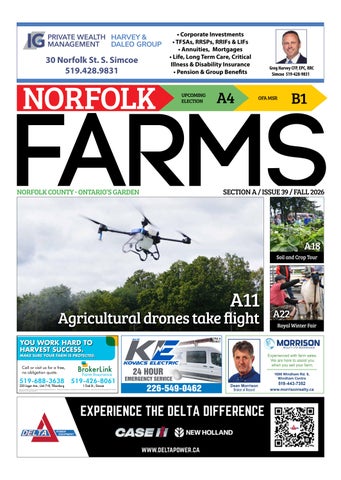
A11
Agricultural drones take flight Since Since1987 1987
Since 1987
A22 Royal Winter Fair
ECRA # 7000857
Dean Morrison when you sell your farm.
We Know
Experienced with farm sales. • COMMERCIAL • RESIDENTIAL • INDUSTRIAL • AGRICULTURAL Dean Karen We are here to assist you
Call or visit us for a free, no obligation quote.
519-688-3638 230 Lisgar Ave., Unit 7+8, Tillsonburg
COMMERCIAL••RESIDENTIAL RESIDENTIAL INDUSTRIAL •• AGRICULTURAL AGRICULTURAL • COMMERCIAL • RESIDENTIAL • INDUSTRIAL• AGRICULTURAL ••COMMERCIAL ••INDUSTRIAL
24 HOUR EMERGENCY SERVICE
24 HOUR EMERGENCY SERVICE
24HOUR HOUREMERGENCY EMERGENCY SERVICE 24 519-426-8061 226-549-0462 SERVICE 226-549-0462
Morrison
Feth
(519) 909-0340
(519) 718-3384
1696 Windham Rd. 9, Windham Centre
(519)519-443-7352 909-0340
www.morrisonrealty.ca 226-549-0462 226-549-0462226-549-0462 226-549-0462 226-549-0462 226-549-0462 1 Oak St., Simcoe
Services available in Ontario through Canada Brokerlink (Ontario) Inc. ™BrokerLink & Design is a trademark of Canada Brokerlink Inc. used under license. © Copyright 2021 Canada Brokerlink Inc. All rights reserved.
Dean Morrison Broker of Record
A2 - NORFOLK FARMS - FALL 2026
premierequipment.ca
GEAR UP FOR FALL
% 0
WITH FINANCING STARTING OR DISCOUNTS ON FINANCING AT
SELECT MOWERS, UTILITY VEHICLES, COMPACT TRACTORS, AND IMPLEMENTS.
ON COMPACT TRACTORS & RIDING LAWN EQUIPMENT
ASK ABOUT MODEL CLEAR-OUT DISCOUNTS ON REMAINING 1023E / 1025R / 2025R’S WHILE SUPPLIES LAST
ASK US FOR MORE DETAILS
FALL TURF INSPECTION
Available at select locations!
Book your service inspection by December 1, 2026 and get engine oil, filter, fuel filter and spark plugs
FREE
Call our service department for details.
BGA 50 (KIT) BATTERY BLOWERS
$
29999 Stihl fall offers end November 20, 2026
Norwich - (519) 688-1011
Hagersville - (905) 779-3467
265721 Maple Dell Road, Norwich ON
1030 Haldimand Road 20, Hagersville ON
Direct Parts Line: (226) 796-8685 | Direct Service Line: (226) 641-6829
Direct Parts Line: (289) 768-3264 | Direct Service Line: (289) 769-2321
NORFOLK FARMS - FALL 2026 - A3
DID YOU KNOW? That the black spruce is the most common species of tree in Ontario? DID YOU KNOW? That there are 15 different main varieties of apple trees in Ontario, (including McIntosh, Gala, Ambrosia and Honeycrisp), and over 100 lesser-known varieties? DID YOU KNOW? That approximately two-thirds of Ontario – 66 per cent – is forest? The 70.5 million hectares represents about 20 per cent of Canada’s forests, and two per cent of the world’s forests. DID YOU KNOW? That in 2025, approximately
1.5 million hectares of Ontario’s forests were affected by natural disturbances? This is when trees are damaged or killed by forest fire, insects, disease or weather. DID YOU KNOW? That in 2024, approximately 41 per cent of the wood harvested in Ontario was spruce? DID YOU KNOW? That in 2024, over $56 million was spent on forest renewal activities in Ontario? DID YOU KNOW? That the forest industry in Ontario generated 51,500 direct forest industry jobs in 2025?
A4 - NORFOLK FARMS - FALL 2026
Municipal council candidates speak about agriculture By Jeff Helsdon - Editor With Norfolk County residents heading to the polls in the next few days, farm owners are asking how agriculture fits into candidates’ platforms. The Ontario Federation of Agriculture has an excellent questionnaire on agriculture-related municipal issues. While it would be great to have candidates address each question, the high number of candidates in this year’s election makes that impractical. Candidates were asked selected questions from the OFA list, and their responses are below in alphabetical order. If a candidate is not listed, this is because they didn’t respond or couldn’t be contacted. Candidates were also given a word limit, and their responses were edited if they exceeded the count. Mayoral candidates 1) Where does agriculture fit into your economic development priorities for the municipality? Doug Brunton - Agriculture in Norfolk County is one of the leading farming regions in Canada with over 200,000 acres under cultivation. It employs an estimated 7,500 workers. It generates approximately $520 Million in farm receipts. There are an estimated 2,520 agribusiness. Largest crops are asparagus and sour cherries. Other crops include sweet corn, watermelons, apples various vegetables and fruits. Tobacco and ginseng are also local crops David Finch - Norfolk is agriculture. Economic development needs to happen without loss of farmland. We need industry to locate here and if it can be agricultural equipment or related agricultural manufacturing it would be great. Farm tourism is growing in Ontario and we need to support that as well. Noel Haydt - Agriculture is one of the foundations of Norfolk’s economy and should be central to our economic development strategy. We need to support the farms we have while attracting more businesses that process, package, manufacture and add value to what we grow here. That means reducing unnecessary red tape, ensuring infrastructure supports agriculture, and actively pursuing agrifood investment and good local jobs. Norfolk has some of the most productive and diverse agricultural land in Ontario. Our economic development strategy should build on that strength and help keep more of the economic value created by Norfolk agriculture right here in Norfolk. Ken Hewitt - Norfolk’s agricultural sector is one of the foundations of our economy and our identity. My priority is to help farmers, processors and agri-businesses invest, expand and adapt by making municipal approvals clear, consistent and timely. That means protecting productive farmland, supporting value-added agriculture and ensuring infrastructure and land-use policies reflect the realities of modern farming. County Hall must adopt a “How can we help?” culture—working with farmers to solve problems instead of creating unnecessary barriers. Agriculture will have a strong voice in economic development decisions so our farm community can succeed today and seize tomorrow’s opportunities. Keith Milner - Norfolk County is blessed with over 1,000 productive farms that provide the county with food, a stable tax base, jobs, and a future for upcoming generations. I will expedite approvals for farm related initiatives
There was a good turnout as the Norfolk Federation of Agriculture hosted a debate for those running for mayoral and council positions in the upcoming municipal election. NFA President Jennifer Schooley was moderator.
and agricultural tourism as well as work to ensure that farmers have satisfactory roads, bridges and infrastructure to prosper. I will work to improve cellular communication and broadband, making farms more efficient. I will protect our farmland from urban sprawl and preserve it for food production. Understanding the importance of foreign workers I will work to address seasonal worker housing shortages. Using common sense, I’ll work for farmers. Adam Veri - High priority. Norfolk farmers are known for reliably producing high-quality agricultural products and should be wellpositioned as Canada replaces north/south trade affected by tariffs with east/west national and international markets. Council must be prepared to assist. As a Norfolk County Economic Development Advisory Board member, diversifying operations and increasing on-farm tourism and retail are always on my mind. As Ward 6 Councillor and Deputy Mayor I’ve met personally with Ontario’s Agriculture; Economic Development; and Rural Affairs ministers to advance issues ranging from onfarm development; red-tape reduction; rural economic growth; and expediting new industrial development to complement argi-business in western Norfolk. 2) How will you ensure municipal planning decisions protect farmland while accommodating future growth? Doug Brunton - In my opinion, we must protect our farmland as a priority. Development should take place on lands that are not suitable for crops. Urban boundary expansions are inevitable. Higher density, developments and protection of municipal drinking water. Sources are also important. Norfolk County sits on a sand plain and has an abundance of groundwater and wells. These must also be protected. David Finch - Good farmland is a scarce commodity in Ontario. Brownfield redevelopment for industry must happen before we expand into agricultural lands bordering the Hwy 3 corridor. I would oppose new development on farmland. Noel Haydt - Good planning means directing growth to where infrastructure and servicing can support it while protecting productive farmland from unnecessary development. Norfolk
needs clear long-term planning for residential, commercial and industrial growth instead of making decisions one development at a time. We also need to recognize that farmland is not vacant land waiting for development — it’s an economic asset. Growth is necessary, but it should be planned carefully so we do not unnecessarily sacrifice agricultural land that helps define Norfolk. Ken Hewitt - Growth must be planned, not simply allowed to consume productive farmland. I would prioritize development within existing urban boundaries through infill and better use of land already served by water, wastewater and roads. Where boundary expansion is required, decisions must be evidence-based, transparent and tied to long-term infrastructure capacity. Norfolk needs a clear plan that accommodates housing and jobs while treating farmland as the irreplaceable economic asset it is. Keith Milner - Farms must be retained as such while towns must work within their own boundaries with development restricted to infill and multi-level growth. If any expansion is to be considered, farmers need to be heard and made part of the decision-making process through assessment protocols. Common sense says we include the experts in any decision making, and that’s our farmers. Adam Veri - I have no intention of meddling in what farmers do with their land. I will represent the interests of Norfolk County farmers related to the Protecting Ontario’s Food Independence Act; Grown Ontario Strategy; Protect Our Food Act; and Farming and Food Production Protection Act as well as the Provincial Planning Statement and Planning Act as required. I encourage farm owners to contact the mayor and council whenever land use, planning, and development issues arise. 3) Do you support reducing the farm property tax ratio for farmland? If so, why? If not, why not? Doug Brunton - I want to talk about farm tax ratios ranging from .17 to .25 that I have noticed in other municipalities. An acceptable range in Norfolk is .21 to .23. David Finch - The county’s financial situation is still not good. We can’t afford to change the
NORFOLK FARMS - FALL 2026 - A5
Municipal council candidates speak about agriculture current farm tax ratios without increasing the taxes on residential property. So no, I wouldn’t support it. Noel Haydt - Yes. When I served on Norfolk County Council, I moved to reduce the farm property tax ratio. I did not receive enough support at the time, but the issue moved forward and the reduction was approved in the following term. I continue to support a fair farm tax ratio. Ken Hewitt - Adjusting the farm property tax ratio is something I would continually review with council and staff. Reducing the ratio for one property class shifts that tax burden to others, including residential taxpayers; it does not simply go away. I would support a reduction when conditions allow it without negatively impacting other land classes. Keith Milner - We live in tough economic times. The cost of fuel, insurance, equipment, to name a few, has risen dramatically. Add to those, tariffs, and it stands to reason that we need to re-examine our current tax ratio for farmers. I’m in favour of lowering the ratio to assist farmers in remaining productive and competitive. Adam Veri - No. Norfolk County has already reduced the farm tax ration from .25 to .23, and reduced the ratio charged on commercial and industrial on-farm development by 75%. Farm taxes go toward community development, which provides a growing local customer base, quality work force, and modern infrastructure system that benefits agri-business. 4) For mayoral candidates only – If elected, would you use Strong Mayor powers to approve development if council and the people are against it? (Yes or No). Doug Brunton – No. David Finch – No. Noel Haydt – No. Ken Hewitt – No. Keith Milner – No. Adam Veri – No. Councillor candidate questions 1) Where does agriculture fit into your economic development priorities for the municipality? 2) How will you ensure municipal planning decisions protect farmland while accommodating future growth? 3) Do you support reducing the farm property tax ratio for farmland? If so, why? If not, why not? Ward 1 Greg D’Hulster 1) With the unknown trade negotiations with the US, it’s too soon to predict secure markets for the upcoming years. It’s imperative we work with our provincial and federal partners to ensure we have markets for products grown in Norfolk. If necessary, I would support temporary tax incentives promoting year-round greenhouse operations. 2) Not only farmlands need protecting but forests and wetlands must remain. My support for housing will be on lands not suitable for agriculture. Agricultural land is one of our county’s greatest assets, and once productive farmland is developed, we can’t get it back. 3) Currently, farm tax is a much lower rate than residential, industrial or commercial. I believe we have to recognize the difference between a working farm and farm property
that is simply being held for future development. Tom Masschaele 1) Norfolk County is heavily reliant on our agricultural sector. It is clearly our most valuable economic activity providing the most significant portion of the local economy. While areas such as industry and tourism are important to achieve some level of diversification, traditional agriculture is and always will be the most important economic driver in Norfolk County. I am in full support of efforts at expanding our agri-tourism sector, but agriculture in Norfolk needs the support of all levels of government.. We must continue to do what we do better than any other area of Ontario, and that is farming. 2) I will insist on ensuring planning decisions always take into account the impact any decision could have on the larger agricultural scene. It is important to always achieve a balance between the needs of lands for development and the importance of good, viable farmland. 3) I feel the farm property tax ratio for farmland should remain where it is. Norfolk County has spent a lot of time adjusting it to achieve a level of fairness to all taxpayers and under current conditions I will support the status quo. Ward 2 Linda Vandendriessche 1) Agriculture is a strong pillar of Norfolk County’s economy, providing jobs, products and fresh produce with more than 1,300 farms Norfolk truly is Ontario’s garden home to every type of agriculture. Our farmers are innovative and resilient, we still grow tobacco but many have shifted from tobacco to fruits and vegetables and cash crops. Norfolk trucks travel across Canada and the United States caring the results of that hard work. To strengthen our agricultural future, we must expand local processing such as canning, freezing, sorting, and added value to what we grow Norfolk agricultural possibilities are endless. 2) Norfolk County needs responsible, forward-looking planning that works together not against itself. Diversification is essential to our success. We cannot remain anchored in the past. We must move forward with balanced growth, creating industrial lands while protecting
our farmland is vital. It strengthens our tax base supports long-term stability and preserves the agricultural foundation that defines us. This is how Norfolk builds a sustainable future. 3) Norfolk County Farm tax rate is 23 per cent below the provincial maximum of 25 per cent. OFA is lobbying to lower it but any change comes from the Province of Ontario. While a reduced rate sounds appealing to farmers, of which I am one, the shortfall would shift to residential and the other tax classes. It’s a complex balance that demands careful consideration. Debbie Wilbur 1) Agriculture is the backbone of Norfolk County and must remain central to our economic future. I will advocate protecting productive farmland, prioritizing rural road and drainage maintenance, and reviewing municipal processes that create unnecessary costs or delays for farmers and agri-businesses. I will push for agriculture to be considered in infrastructure, planning and budget decisions before they are made—not after problems arise. I will also support attracting food processing, value-added agriculture and agri-business investment to Norfolk, creating local jobs and new markets for our producers. Farmers are business owners and economic drivers, and their voices must be heard at council. 2) Farmland should never be the easy answer to growth, but planning decisions must also recognize the quality and agricultural capability of the land involved. I will prioritize protecting Norfolk’s most productive farmland while directing growth toward existing settlement areas, serviced lands and lower-impact locations. When expansion is necessary, decisions should be based on sound agricultural and planning evidence—not convenience. Norfolk can grow responsibly, but we must be strategic about where that growth occurs and protect the farmland most critical to our agricultural economy. 3) I support reviewing a reduction in the farm property tax ratio, provided the financial impact is understood. Farmers face rising
A6 - NORFOLK FARMS - FALL 2026
Municipal council candidates speak about agriculture Industrial land has been identified, and non-prime land areas to help support future agricultural food, production and technology production. Urban boundaries should be controlled in order to save prime agricultural land, tax incentives should be encouraged to promote diversified economic growth in the agricultural sector. This could be achieved through targeted zoning, bylaws, and a strategic eco-tourism strategy. 3) I would support reducing the property tax ratio for not only agriculture, but also commercial and residential properties on land in Norfolk County due to the present budgetary restrictions. Across the board cuts would be the only appropriate cuts that could be made at this time. Hetty Verlinden 1) Agriculture isn’t just an industry in Norfolk County, but it is our backbone , heritage, and central to our economy. As a farmer myself, agriculture is at the absolute top of my economic development priorities. We are Ontario’s Garden, so let’s start fueling our economy with the bounty of our fields. When Norfolk’s agriculture thrives, our entire community thrives. We can build an economy that respects our roots while securing our economic future. 2) Protecting prime farmland from urban sprawl, while cutting red tape that stops families from building multi- generational housing or passing farm down to next generation. Investing in on-farm growth so farms can pivot into highvalue processing right on their land. And lastly, we are sitting in Ontario’s Garden, leverage our location for food processing hubs, logistic hubs, getting our produce and fruit faster to North American consumers, plus boost agritourism. 3) Yes, I support reducing the farm property tax. The farm tax ratio is a critical policy lever for balancing the economic survival of local agriculture operations. The rising taxes squeeze tight operating margins and increases the tax burden disproportionately on farmers. Farms don’t have complex infrastructure like residential or commercial developments. Ward 4 Jeni Lambert 1) We need to embrace the full scope of
input, infrastructure and operating costs while protecting land that benefits our community. Any reduction must be fair, financially responsible and structured so it does not simply shift an unreasonable burden onto other taxpayers. Ward 3 Chris Gill 1) Agriculture is an important part of our economic development priorities. I without question, support protecting farmland, working to strengthen food security by advocating to create local canning and food-processing opportunities that add value to locally grown products. 2) I support thoughtful growth that directs development toward existing urban areas, serviced lands, and appropriate locations while protecting productive farmland. Municipal planning decisions must prioritize responsible land use, and long-term food security. I will work with farmers, residents, council and staff to balance growth with agricultural needs, avoid unnecessary farmland loss, and encourage development that strengthens our community with farmers in mind. 3) I fully support reducing the farm property tax ratio for farmland. Farmers provide essential food, protect agricultural land, and contribute significantly to our local economy. Reducing the tax burden can help keep farms viable, support food security, and protect farmland from development pressures. Doug Moyaert 1) Agricultural economic development should be a priority for Norfolk County. Norfolk County is in a unique location. We’re not only areaa food-producing region, but also ideally located in southern Ontario, within a two-hour drive of major markets. Identification of water, resources and production facilities should be encouraged for more value-added incentives, such as food processing, flash freeze processing incentives should be promoted through grants and identified land uses. Challenges remain through labor shortages, high farm assessment rates, and state planning. 2) Planning has a significant role in the economic development of Norfolk County.
Recommended Picks for Your Region! W
NE
Ferrari
Venture MXR
Pantera
Early maturing.
73 days. Excellent
80 days. Continuous
Uniform high quality
field performance with
set of high quality,
with emphasis on a
strong seedling vigor
firm, uniform, thick
tight blossom scar
and plant strength.
walled fruit with
and fruit smoothness.
Superior Ear shape,
strong stems. Almost
Quality under cool
kernel appearance
no cracking and high
night temperatures,
and husk package
pungency. Tall, very
adapted to broad
combined with very
vigorous plant with
range of climates.
good eating quality.
strong branches.
Contact Paul Banks & Emily Robins for the highest quality seed and service. Paul Banks
(905) 688-4300 pbanks@stokeseeds.com
Emily Robins
(905) 308-4396 erobins@stokeseeds.com
1-800-263-7233 │ www.stokeseeds.com
Follow us:
food production. With the most fertile land in the province, if not the country, being able to utilize field harvests from processing through exportation, it creates countless job opportunities and the potential for growth while protecting the industry that built our great communities. 2) There are countless underutilized spaces within existing urban boundaries. Building up not out, will ensure adequate housing exists without sacrificing farmland. 3) I fully support reducing the farm tax ratio for farmland. With the rising costs of most aspects of farming, this is one way we can help ensure our farms are protected and appreciated. Chris Van Paassen 1) The agricultural sector should be a priority for the Economic Development department. There should be more emphasis on the development of local processing and valueadded production especially now that the federal government has budgeted $3 billion for a national food security strategy. Each job created in a Primary Industry like agriculture has the multiplier effect of creating several secondary jobs needed to support that growth and it is the foundation of overall GDP growth. 2) Currently, all of Norfolk County has been classed as prime agricultural land y some unknown government bureaucrat. I believe there is space for growth without losing “cultivated” land if we would be allowed to look at smaller parcels on an individual basis. Expansion of the urban boundaries creates its own unique problems, but by first focusing on infilling and higher densities within the current boundaries and then planning potential future expansion in areas that have the lowest potential for agriculture there is still room to grow with minimal impact. 3) I would like to clear up a misconception: a farm house pays the same Residential Tax Rate as any house, and the Farm Tax Rate only applies to the land. Since this was set up, many more houses have been built, adding new assessment to the Residential Tax class while the area of farmland, which hasn’t changed, is now paying a bigger share and should be reduced slightly. Ward 5 Peter Black 1) Agriculture in Norfolk County is our top economic driver and while on council previously recognized its importance by attaching the words “Ontario’s Garden” to our signs and literature. 2) Farmland should be protected. Residential intrusion into the rural area has made it more difficult for farmers as rural residents complain about noise, dust, smells etc. This led to the right-to-farm legislation. Farmers should be able to do their work without that hindrance. 3) I know the province of Ontario provided this property tax subsidy in the past and downloaded it to the municipality. Perhaps the province should resume responsibility for the program. Lowering the rate would shift the tax burden to other taxpayers in Norfolk County, creating even higher property taxes. Ryan Boyko 1) Agriculture is fundamental to Norfolk County’s economy and identity. We call ourselves Ontario’s Garden, and I would like to see more of what we grow stay here and
NORFOLK FARMS - FALL 2026 - A7
Municipal council candidates speak about agriculture reach local consumers directly. That means looking for opportunities that connect Norfolk farmers with Norfolk residents, restaurants, retailers and institutions, while supporting local processing and agricultural businesses. We should continue exporting Norfolk products across Ontario and beyond, but economic development should also ask how we keep more of the value created by our farms right here in Norfolk County. 2) I want to focus more of our growth inward, particularly through the revitalization and intensification of downtown Simcoe. We already have infrastructure, buildings and a downtown core that needs investment. I would much rather see new housing, businesses and development directed toward areas we have already built than continue extending our suburban footprint into productive farmland. Growth is necessary, but we should be smarter about where we put it and protect the agricultural land that defines Norfolk. 3) No. Norfolk is already operating with significant financial pressures, and basic municipal services still have to be funded. If tariffs or other economic pressures seriously affect Norfolk farmers, I would support pursuing provincial and federal grants, subsidies and emergency assistance. But reducing municipal revenue simply transfers that cost somewhere else. Mike Storoschuk 1) Local agriculture is a major driving force in Norfolk County. Over 2,000 local residents are employed in Norfolk County making it a significant employer for local residents. There are thousands of seasonal workers who are employed in Norfolk County who support our local businesses which stimulate economic stability. Locally, farmers are leaders in food production, processing and transportation providing safe food that is exported throughout North America 2) Council needs to work towards consulting with groups like the Norfolk Federation of Agriculture to ensure that primary farmland remains in agriculture. Development is part of future growth, however, with agriculture being
a major contributor to Norfolk County we need to ensure that development happens in proper areas. 3) Norfolk County farmers are taxed near the maximum rate in Ontario. Dennis Travale 1) As Norfolk Mayor, I championed Norfolk’s agricultural community, worked with the provincial and federal governments seeking remedies for their concerns and established the Agriculture Advisory Committee. I also co-founded the South Central Ontario Region Economic Development Corporation, chaired it for six years and sat on the board for eight years; co-chaired the Sand Plains Community Development Fund (SPCDF), a regional economic program helping our area transition away from a tobacco economy; and cochaired the Western Ontario Wardens Caucus, and led in its incorporation as an economic development corporation and supported the SWIFT program to assist telecommunication providers to build modern broadband down our concession roads. 2) All planning decisions must consider all sectors of our economy. That includes the ag community and its ambitions to expand and add value on the farm or at the farm gate. 3) I look forward to any discussion on the “mill rate” and ensuring that one sector does not cause harm or added tax burden to any of the others. Ward 6 Zonk Horvat 1) Supporting our farmers is one of the six priorities I have identified in my campaign. My position in support of our farming community includes: Protecting prime farmland from unnecessary development and ensuring our agricultural land base remains for future generations; Encouraging farm diversification through on-farm markets, agricultural tourism, and other opportunities; Supporting agricultural labour needs, including appropriate offshore agricultural worker programs that help address seasonal and ongoing labour shortages; Advocating for reduced regulatory barriers where appropriate, while maintaining responsible
standards that protect our communities and environment; Fostering partnerships between farmers, local businesses, community organizations, and government to strengthen our agricultural economy. 2) I would support future residential growth in areas where underutilized, nonfarmable land is available, while protecting productive agricultural land from unnecessary development. I would also support financial incentives for developers that encourage growth within existing urban boundaries and make better use of infrastructure that is already in place. Responsible growth should prioritize efficient land use and avoid putting additional pressure on our agricultural land base. 3) I would support tax reduction for farmers, provided that the eligibility requirements are met. In particular, I believe the program should support farms that are majority-owned by Canadian citizens or permanent residents, actively engaged in agricultural production, and generating income from the farming operation. Ward 7 Warren Cummings 1) I place a high priority on agriculture in the economic development such as enhanced markets for agriculture. We have lost food manufacturers in this community and we need to create new markets and perhaps Norfolk-only specialty crops such as the pharmaceuticals industry as one example. We need to create an ongoing dialogue with the farming community to enhance our resources and explore new markets together. 2) I was the only person to do a supporting deputation on Bill 21, Bobbi Ann’s proposed bill to require an agricultural assessment on all development applications. Norfolk has a very unique soil structure and climate and we need to recognize this beyond any development and unreasonable development should be discouraged. 3) It currently stands at 25% but the problem is the exempted portions of the farm property and we need to re-evaluate this with the province because I believe the entire property needs to be 25 per cent.
FOR SALE Reach Norfolk area farmers by advertising your business in Norfolk Farms.
Contact Heather Dunbar 226.261.1837 heather@granthaven.com
2021 Deere 6145R
2021 Bobcat E20
2019 Deere 244L
2021 Bobcat S64
Comes with H360 loader.
Comes with 16" tooth bucket.
Comes with bucket & forks. New tires.
Comes with 68" bucket.
3130 hours | $194,495
1283 hours | $25,500
3825 hours | $107,500
1013 hours | $54,950
Always well maintained & in excellent condition! 3.99% financing OAC! www.totalusedequipment.com
Description
View Used Equpment
A8 - NORFOLK FARMS - FALL 2026
Retiring Ward 3 councillor’s 40-year municipal career overlapped with his service as an OMAFRA agronomist By Diane Baltaz If anyone can be called an influencer on Norfolk County’s agricultural evolution, it is Delhi’s Mike Columbus. As a former agronomist, and now as a departing politician, Columbus witnessed multiple transformations in the Norfolk agricultural landscape: the impact of climate change; the waning of flue-cured tobacco, which was “King” for much of the 20th century; and the rebranding of Norfolk as “Ontario’s Garden” in this century. Often Columbus directly supported farmers and Norfolk’s towns during these transitions. First with his work on energy issues and new crop development with the Ministry of Agriculture, Food and Rural Affairs (OMAFRA) for 33 years, and then as a municipal councillor for 40 years. Columbus, 76, is not seeking re-election in Ward 3, which encompasses the town of Delhi and Windham Township in this autumn’s municipal election. This is his second retirement, having left OMAFRA in 2008. Columbus grew up on a tobacco farm in Rattlesnake Harbour owned by his grandmother, Anna Koncir. His mother and three siblings moved there after his father (also Mike) died in a motor accident. Columbus farmed this land for several years after graduating in 1974 from the University of Guelph with a Bachelor of Science, Agriculture, majoring in Resource Management. Columbus later wrote about how his Rattlesnake Harbour upbringing influenced his adulthood: “Growing up on a mixed farming operation (tobacco, hogs, beef and chickens) is what enticed me to pursue an agriculture degree at Guelph. From 1982 to 1986, I had the great experience of cash cropping on that same family farm.” This newly-minted agronomist joined OMAF
Sweet potatoes were one new crop for Norfolk which Columbus promoted as an OMAFRA agronomist.
One time Columbus’s work as Ward 3 councillor involved reading 500 pages of material prior to a meeting.
in Simcoe in 1975, beginning as a “land use officer” in the Foodland Development Branch. Between 1982 and 1986, he worked as an “ag energy advisor” with the Agriculture Energy Centre, working out of the Agriculture Canada Research Station near Delhi. “They hired me because of my familiarity with tobacco production,” said Columbus. “Energy costs for flue-curing had risen substantially.” At Delhi, Columbus worked with technical expert Dan Vanhooren on energy projects
pertaining to crop production, conservation tillage, crop conditioning and processing. Two projects they worked on included inter-seeding nitrogen-fixing legumes into corn, and aerial seeding wheat into standing corn. Tobacco specific projects included: evaluating fuel and electrical energy consumption of various types of tobacco kilns; improving plenum insulation in tobacco kilns; adapting tobacco kilns for conditioning other crops such as peanuts, popcorn, garlic, sweet potatoes and stevia; and hybrid poplar cultivation for use as a biomass fuel to heat greenhouses. They also evaluated Austrian Whether you’re dreaming of Machu Picchu, an African safari, a European river cruise, or a relaxing Peas as a green manure nitrogen fixing beach escape, our experienced travel advisors are here to help make it happen. rotational crop. Columbus returned to Simcoe when the province established a Transition Crop Team (TCT) which operated from 1986 until 1991. He initially joined as a crop innovation advisor in 1987, then as its marketing advisor. Geographically, the TCT had provincewide responsibilities in its mission to investigate the commercial potential of new, replacement and alternative crops. However, the TCT office located in the tobacco belt because the unique problems facing tobacco farmers became a major “Scan to Meet Our Travel Experts & Enter to Win!” focus of the team’s efforts. The Transition Team had diverse Meet our team of experienced travel professionals. objectives, ranging from exploring new crop Choose the advisor you are most likely to work with. Send them a quick production and value-added opportunities, email with your name and email address and type “Norfolk Farms” to providing business and agronomic You’ll be entered for a chance to WIN a $200 Ultimate Dining Gift Card! advice to farmers. Columbus said that they assessed the potential of new produce and industrial crops such as hemp fiber
Your Next Adventure Starts Here!
Visit www.scworldtravel.ca
NORFOLK FARMS - FALL 2026 - A9
Columbus brought a wealth of ag knowledge to the council table (auto parts), kenaf (paper), bamboo (flooring), chicory (inulin) and cotton. The list of specialty vegetable crops, herbs, grains, legumes and fruit which the Simcoe staff researched from farmer suggestions and queries about suitable new crops for Norfolk’s and surrounding areas’ soils is encyclopedic, and included: okra, white asparagus, globe artichokes, scorzonera, fiddleheads, iceberg lettuce, millet, coriander, comfrey, field grown and dried flowers, popcorn, sunflowers, hazel nuts, quinoa, amaranth, sorghum, various pulses, borage, wheat grass, greenhouse strawberries, Echinacea, feverfew, lavender, sea buckthorn, catnip, luffa, mini-pumpkins and others. There were even queries about animal alternatives, ranging from fish to emus, snails and earthworms to game birds. The TCT disseminated their research findings through agricultural media, trade shows, fairs, fact sheets, field days, television and in publications such as Canadian Living and the Toronto Sun. One of Columbus’s favourite outreaches was the team’s booth at the Norfolk County Fair and Horse Show around 1990, which featured local entrepreneurial farmers’ special crops and products, which earned the fair’s “best booth” award. Some of these proposals, such as sweet potatoes, tree nuts, Asian vegetables, bird seed, medicinal herbs, shiitake mushrooms and hops, have become a reality and shape the Ontario landscape today. The Simcoe TCT staff encouraged the creation of producer groups to assist growers in receiving grants, growing and marketing their new products. Columbus assisted in organizing approximately 20 producer organizations including the Oak Forest Mushroom Association; Southern Ontario Hay Producers; Sweet Potato Growers Association, Lupine Growers Association; Baby Carrot Growers; Society of Ontario Nut Growers, and associations for cut flowers, garlic growers and Ontario game birds. From 1994 to 1999, Columbus became a program advisor for the Canada-Ontario Tobacco Diversification Program (TDP), in addition to his duties with OMAFRA. He coached applicants on preparing business plans and developing new crops and production innovations. Columbus’s extension work focused on new crop developments until his retirement. Although he was already a municipal councillor when he retired, Columbus landed another job in 2008: AgriCorp sourced him as a crop insurance adjuster for the newly-launched Fresh Market Vegetable Program. Columbus also voluntarily hosted a weekly radio program sponsored by the Norfolk Federation of Agriculture that included interviews with regional “leadingedge growers and producers.” He first ran for a council position in the Nov. 12, 1985 election, representing Delhi Township and easily won. He ran again as the Ward 3 councilor when Norfolk County was restructured as a one-tier government separate from Haldimand that took effect in January 2001. Ward 3 residents kept
Columbus worked with Delhi businessman Marc Vanden Bussche to install this 20th century tobacco belt and horse to the Delhi Tobacco Museum and Cultural Centre.
voting in Columbus ever since. Not surprisingly, one of the several county committees which Columbus joined was the Agricultural Advisory Committee, remaining on it for 20 years. He practised his resource management skills with his 15 year board appointment to the Long Point Conservation Authority. The county dealt with everything from health controversies over proposed wind turbines in southwestern Norfolk; the “Delhi diaper fire” at the former Imperial Tobacco Company
plant; the proposed closure of Delhi District Secondary School; the rezoning of the Delhi Golf Course for residential development; a county-wide controversy over the location of a central recreational hub in 2019; the withdrawal of CN Rail; major road re-construction; and toxic leakage from a Forestry Road gas well. Then there was the “huge outcry” when higher governments imposed restrictions on the accommodation of off shore workers on farms during the COVID pandemic, said
CALL (519) 449-2200 Visit www.totalrentals.ca
REACH HIGHER. WORK SAFER. Aerial Equipment Rentals
Safety Training
Aerial Equipment Service
Scissor Lifts Boom Lifts Towable Boom Lifts
Working at Heights MEWP Operator Training
Repairs Maintenance Annual Inspections
A10 - NORFOLK FARMS - FALL 2026
Columbus brought a wealth of ag knowledge to the council table Columbus. Another controversy arose in the early 2000s when the Ontario Flue-Cured Tobacco Board tried to close its auction exchange in Delhi -“the heart of Tobacco Country” – and relocate it to a remaining warehouse in Tillsonburg, he said. Council opposed the move, arguing that twothirds of Canada’s tobacco production was within 25 kilometers of Delhi, and dominated the town’s livelihood more so than the more economically-diverse Tillsonburg. “Norfolk County council played an active role in saving the exchange,” he said. Columbus waved a flyer that a coalition of 10 proprietors of tobacco-related agri-businesses issued at the time. It outlined in detail why “it’s socio-economically correct” to keep the warehouse in Delhi. “Through communication and cooperation, we must work together on major tobacco concerns including decreasing crop size, price and loss of growers,” concluded the coalition, which called itself Concerned Supporters of the Tobacco Industry. While the Delhi auction exchange was “saved” temporarily, the waning of tobacco production continued. “My stats show that during the 1970s, Norfolk and the surrounding areas had 100,000-plus acres of tobacco; now there’s approximately 20,000 acres. I remember driving on Highway 3 between Simcoe and Delhi when there were more than 20 operating tobacco farms. Now, there’s maybe three in that same stretch.” “Multiple Delhi area businesses were geared to supporting tobacco farming,” said Columbus. Pointing at the list of 10 businesses listed on the flyer, he added, “Now there’s only one left. Delhi has changed considerably over the past 40 years.” “It shows what happens when a oneindustry town shuts down that primary industry – the support services shut down as well.” Ironically, Columbus noted that one
As the Ward 3 councillor for Delhi Township, Columbus was heavily involved in the township’s efforts to stop the closure of the town’s tobacco warehouse in the early 2000s.
significant change he witnessed during his life assisted in transforming the agricultural economy after tobacco. “Climate change is providing our farmers with a longer growing season. We were once lucky to get tobacco off before the frost which regularly hit after Labour Day, in midSeptember. Now the frost is more likely to hit after Thanksgiving. “Therefore, we can grow crops which we couldn’t grow previously, like sweet potatoes,
peanuts and okra,” he said. Then there is the move to the paperless society, said Columbus. “I began (on council) in 1985 when communication involved much paper. If I wanted to write a motion for council, for example, it was hand-written in triplicate on several layers of multi-coloured carbon paper, each of which went to different staff.” Columbus picked up his mobile, “Now everything is on cell phones -- the agenda’s on it -- it’s all here. It’s just amazing!” His mobile enables him to return all communications from the public, which he calls a core job duty. “With a cell phone you can respond to citizens from 1,000 km away if you don’t need research information.” But technology created a drawback which Columbus never experienced in the 1980s. “Social media used in the wrong way is like a gun-- you can use it to put venison in your freezer or you can kill someone with it.” Columbus had been victimized by online “keyboard warriors” who issued unsubstantiated personal attacks on a local Facebook page. It’s his warning for anyone considering a run for council. He added that several people who previously intended to run for Ward 3 when he retired have changed their minds after seeing what happened to him online. “Keyboard warriors can write anything they want and send it all around the world and not worry about facts, but journalists must be sure and concise; they have to follow the rules.” But local media coverage declined with the loss of local outlets. “In the 1980s there would be two or three reporters at council meetings; now it’s more likely to be just one – sometimes watching remotely.” Columbus said that 20-plus years ago, councillors usually could retain day jobs and attend municipal meetings in the evening, but now may have challenges balancing their schedules. “Now with single-tier government, there are more committees and more intense meetings --often in the day time starting at 1 or 3 p.m. It’s more difficult for someone who is still working to attend these meetings.” Moreover, Columbus said that council positions are now “almost a full time job if you do it properly.” Councillors often sit on a minimum of three county committees which range from finance to accessibility, police services or with partner organizations such as BIA and the LPRCA. And, “You must serve every corner of Norfolk, not just your own ward.” “Councillors often spend approximately 20 hours per week tending to council issues, returning communications to residents, communicating with staff, and much reading in preparation for meetings,” he added. Married to Kathleen for 51 years, with two children and four grandchildren, Columbus will have more time with his family, among other future activities. “I certainly enjoyed being on 12 terms of councils,” he said. “We are Ontario’s garden and I really enjoyed working with entrepreneurial growers.”
NORFOLK FARMS - FALL 2026 - A11
Agricultural drones take flight after Health Canada pesticide approval By Amanda Nelson A Health Canada approval allowing pesticide application by remotely piloted aircraft systems (RPAS), commonly known as drones, was granted in June, allowing farmers and small businesses across Southwestern Ontario to spray pesticides in accordance with the Pest Control Products Act and the Pest Control Products Regulations. While Canadian farmers have been able to use drones for mapping, scouting and crop monitoring, the major regulatory hurdle has been using them to apply pesticides. Now that new approvals have opened the door for drone-based pesticide applications, small business owners, such as Justin Shieck, owner and operator of Norfolk Drone Services, say they believe farmers can now utilize the technology for greater efficiency. Shieck was initially taken off guard when he read the report stating that pesticide spraying via drone technology was approved back in June, something he thought he wouldn’t see until next year. “There weren’t even signs that this was going to happen by the fall… we were taken completely off guard about the approval.” Shieck says that countries like China, the United States and Australia have been using drone technology in the agricultural sector for around 15 years, and yet Canada is just starting to see the value after getting feedback from competing countries. “In the States, drones are treated as another aircraft,” he said. “What got me into this business was really watching how fast it expanded across the States and seeing YouTube video after YouTube video and news article after news article showing small businesses booming, with young 20-year-olds and different age groups of farmers enjoying what they’re doing and bringing a cheaper solution for farming.” Shieck says he believes farmers throughout Canada will soon own and operate drones, similar to the way they own tractors, combines or other farming equipment. He says in farming, timing is everything when it comes to spraying pesticides or fertilizers. “Do I see every farmer owning one, like a Swiss Army knife in their toolbox? One hundred per cent, because farming comes down to timing,” said Shieck. “Especially if you’re deploying it out of the back of your barn, you can hit timing windows when you really need to.” Compared to small conventional tractors, drones can cover more ground in less time, at about 40 acres per hour; however, large selfpropelled sprayers can cover more than 80 acres per hour. These large sprayers are often hard on fields and don’t allow for the same mobility as a drone. The Health Canada report noted that drone application is often the most practical option when fields are soft, wet or too difficult for ground application equipment; when pest outbreaks occur late in crop growth; or for areas that are either too large or inaccessible for ground application. “If it’s been raining a lot, I don’t think anyone’s pulling a rig through a field,” said Shieck. “Then once a canopy gets high, you can’t really spray beans or corn because it’s too tall. In the fall, I
Justin Shieck, owner and operator of Norfolk Drone Services, demonstrates agricultural drone technology. The June Health Canada approval allowing pesticide applications by remotely piloted aircraft systems opens new opportunities for farmers and agricultural businesses.
to those of conventional aerial application. really see drones tackling the heavy canopies However, drones also have the potential to where you’re not getting that 25 per cent loss apply pesticides very precisely, similar to some from driving over your beans.” ground-based spot treatments. Although Canada is behind in its approval, Health Canada also concluded that pesticide Shieck says it’s not all bad news, and being able residues on food crops resulting from RPAS to track and assess what’s happening in other applications are not higher than those resulting countries before the Health Canada approval from conventional application methods, making has benefited the budget. foods as safe as with conventional applications. “Canada is cautious,” he said. “We take a Shieck’s company, Norfolk Drone Services, more science-based regulatory approach than offers agricultural drone services focused on most places, and they do it for safety reasons. I precision spraying, spreading and mapping. Its would say it’s not a horrible thing that we were main agriculture-related services include aerial behind. Watching and allowing other countries spraying, granular spreading, mapping and to spend a lot of money on research while we aerial imagery, as well as drone sales, support sat back and collected data was valuable. Now and training. we have some brands approved, and we’re The cost of a drone package varies, but not wasting that time or money on the trial and Shieck says it is generally around $40,000 to error they’ve already gone through.” $50,000 and includes multiple batteries and The report notes that the approval also packages, including spray equipment that can aligns Canada with other countries like the be used for pesticides, fertilizers, herbicides United States and Australia, helping Canadian and biological products. agriculture stay competitive internationally Shieck encourages anyone interested to visit during times when competitive prices are key. his website or reach out to him directly at www. “Using RPAS to apply pesticides can make norfolkdroneservices.ca farming more efficient by helping farmers protect crops while using fewer inputs — such as pesticides and other resources needed for crop production, including labour, fuel and equipment use,” read the report. “This will support food security and help keep food affordable.” Drone operation is regulated by Transport Canada, whereas the regulation of pesticides is under the jurisdiction of Health Canada. Transport Canada considers aerial drones to be aircraft, and all pilots must understand and follow Canadian Aviation Regulations. The data show that mcfarlanrowlands.com 519-679-5440 / 888-734-8888 the risks of applying Aylmer • Delhi • Dorchester • Ingersoll • Kitchener • Langton • London • Norwich • Port Stanley pesticides by RPAS Sarnia • Strathroy • St. Thomas • Tavistock •Thamesford • Tillsonburg are generally similar
We shop farm insurance for you.
A12 - NORFOLK FARMS - FALL 2026
“Reap What You Sow”:Walpole Township native and PhD student Sid Heeg unpacks misinformation about farming on social media By Diane Baltaz University of Waterloo doctoral candidate Sid Heeg knows that there is misinformation about farmers and farming on social media. She’s addressing this problem by doing her doctoral dissertation on it through her department, School of Environment, Enterprise and Development (SEED). Heeg – who is known professionally as Sid and as Sue by her Haldimand-Norfolk family -titles her doctoral paper, Reap What You Sow: Refuting Misinformation about Farming and Farm Practices. It focuses on the types of misinformation circulating within reach of the 31.6 million Canadians who use social media and the effects it has on farmers. “I’m exploring the intersection of ag, social media and misinformation,” said Heeg. “I find that the social media use in agriculture is far behind in other fields of research like that of health or education. Farmers may be told that using social media will help you improve your work practices, but the digital environment may be rife with false information, or it’s just tons of information.” Heeg chose this area of research because of her roots in Springvale. In the 1980s,her father, Bill Heeg, raised hogs and cash cropped with her uncle, who lived next door on the dairy farm where the brothers grew up. Her father sold his farm to a cousin in 2013, and moved on to own Sunchoice Produce, Jarvis. “All of my summers were spent in that greenhouse until my masters program in 2017,” said Heeg. “I chose farming as my topic for misinformation because this is my life and how I was raised. I’ve experienced many types of farming. My research seeks to help farmers and farm associations navigate their way through the digital world, especially since some farmers have used it for a long time since the 2010s.”
University of Waterloo doctoral candidate Sid Heeg.
Heeg is clear about the definition of misinformation. It is not to be confused with disinformation, although the terms are used interchangeably. “The difference is intent,” she warned. “Misinformation is false information spread without intent to harm, and I am clear with this. We are all capable of spreading misinformation.” “Disinformation is defined as any false information that is spread with the intent to cause harm, such as propaganda. It’s sometimes hard to determine what the intent of that information is when it’s shared. Sometimes it’s just a misunderstanding.” Although there is an undercurrent of belief that urbanites are more likely to spread farmer
HEAR your best & experience the joy of sound
misinformation on topics like animal rights and climate change, farmers themselves can also share misconceptions, Heeg added. “There are isolated cases of animal abuse which must be addressed, but the majority of farmers care about their land and animals,” said Heeg. “But when the word gets out, it’s hard to put the genie back in the bottle.” Working closely with her dissertation committee, Heeg designed an online questionnaire for farmers to gauge a snapshot of the Ontario landscape. It queried topics such as farmers’ use of social media, their engagement with agricultural misinformation, and whether it negatively impacts them. It also examines whether farmers are constructing new identities online. The survey ultimately intends to determine what farmers are already doing and how researchers, writers, and experts can support them. Heeg sent it out with assistance from Ontario farm organizations, friends and relatives. The survey ran from November to late January, with approximately 117 farmers responding. Her initial results indicate that farmers often use social media for work practices, education such as DIY or repair videos, business and financial matters, agriculture news, and networking. Their internet use mirrors that of the general population, with younger farmers often being more tech savvy. Female respondents used social media as a means to supplement income or create very publicly intimate posts of their livelihoods compared with how men participate online. “It’s very important for female farmers to sell their products but also to connect with other farmers and share their lives.” Heeg’s question about what types of agricultural misinformation farmers came across generated several broad categories. The responses include how farmers treat their labourers or dislike hiring locals, antibiotics, pesticides, conventional versus organic farming, animal welfare, and the environmental impact of farming, factory farms, and rants about tractors on road, supply management, and claims about how farmers are changing Canadians’ food quality. “The big one was the topic of animal husbandry. Next is crop and land management; then the safety concerns around GMOs (genetically modified organisms), and comments that farmers are killing the environment,” said Heeg. “Yet many farmers reported that they are experimenting with regenerative practices. I remember discussing this with my dad about the 1970s when more chemicals were applied than what is used today. They see value in sustainable practices to help them create healthier soil.” When given the chance to expand on these topics what often came up was the emotional toll these allegations take on them, frustrations that people “know more than the farmers”, and how farming misinformation can extend into food and health issues: “That
NORFOLK FARMS - FALL 2026 - A13
“Reap What You Sow”:Walpole Township native and PhD student Sid Heeg unpacks misinformation about farming on social media means that people do not understand how food is grown, that it’s safe to eat.” These misunderstandings often “spills into marketing”, said Heeg. “Pasture raised sounds good in marketing, while farmers try to efficiently continue to do what’s best for their animals, what’s best for the plants and the land. Farmers don’t spray more than they have to especially with the costs this year; they are always looking to innovate, as aware of the environmental impacts.” “One interesting comment I got was about how farmers are well-educated, yet some urbanites perceive them as ‘dumb hicks.’ First, being considered uneducated is insulting; second, it devalues skills developed through relational knowledge from childhood through parents, other family members, and land-based knowledge.” The impacts of misinformation can be quite varied, including one’s mental health, said Heeg. “When you have people on social media blaming your profession for things like climate change, or the quality of food, it is hard to not let that get to you. But often it impacted participants as a lack of public trust in online information, the government or even in others,” said Heeg. “There’s even a financial part. Many mentioned how applying the wrong method based on bad advice cost them financially; which is a risk farmers take if they get their information online. “As a farmer, you may be told that using social media will help you improve your work practices, but what often goes unsaid is the digital environment has… just tons of information. It is hard to determine what is beneficial for you, especially since as farmers, you know you need to understand local and regional knowledge first. It’s not’s going to help you if you’re getting advice … from someone who is living on the east or west coast.” The survey ended by sounding out participants on how they respond to agricultural misinformation in order to show farming as authentically as possible. Some mentioned that they directly respond to the misinformation whether that’s through comments or direct messages if the misinformation was shared by someone they know. Another one provided links to various sources of expertise, such as agricultural associations and individuals with credibility. “And then the final category was simply, ‘I don’t,’” said Heeg. But some farmers are de-bunking agricultural mistruths online – and creating authentic tales about farming. Heeg highlighted examples of farmwomen in Alberta and Ontario whose online postings portray genuine truths about farm life. One of them, Southwestern Ontario cattle farmer Laurel Ysebaert, posts You Tube video about her life (“Chaos and Cowgirlin”) including her kitchen renovations. “She (Ysebaert) shows other sides of farming to people who don’t see them,” said Heeg. “Laurel breaks myths about the strong divide between rural and urban.
“Women portray demographically multifacethas heavily influenced me. Atta curates myth busting in a digital age. The work that someed lives on social media. For example, Laurel posted about her devastating barn fire and how one like Dr. Chowdhury does for building the the community rallied around her and raised infrastructure for addressing ag misinformation $100,000. Social media can really make or shows that we’re getting things in place.” break you, but once you build up authenticity, Now in her fifth year of her research, Heeg there can be emotional support and validation is in what’s called “the Victory Lap” – the final even from other farmers as well.” steps of preparing her thesis on the intersection How can the farm community and its colof agriculture, social media and misinformation. After her dissertation committee reviews her laborators counter the digital misinformation work, Heeg hopes to publish her findings in a universe? journal, preferably a highly accessible one with Education is the first measure, said Heeg. wide-spread readership. It provides the basic building blocks to help Heeg intends to continue developing resourcpeople inform their own opinions. She lauds organizations like Farm and Food Care Ontario es and solutions, working within the Canadian whose public events such as Breakfast on the agricultural landscape. Farm bridge that knowledge gap. “It’s my hope that as I finish up my PhD to Second is the sourcing of experts and rework within the Canadian ag space. I want to bring my experience, my passion, my knowledge sources, which Heeg said ensures that farmers in a way that will benefit the farmers here.” have access to quality information for their work practices. Heeg credits the University of Guelph’s Ataharul Chowdhury of CAREE (Canadian Agricultural Extension and Education) for addressing agricultural misinformation by publishing and building resources in this area, including the user-friendly, myth-busting website: misinforesearch. com. “Ataharul is one of the key players in this area,” said Heeg, adding that she discovered his works during the second year of her established doctoral thesis committee and has since volunteered at a CA REE conference. “CAREE
A14 - NORFOLK FARMS - FALL 2026
Halifax Statement outlines federal, provincial, territorial priorities for Canada’s ag, agri-food sector By Tamara Botting The Halifax Statement is the roadmap outlining the principles and priorities of Canada’s federal, provincial and territorial (FPT) governments for the nation’s agriculture and agri-food sector. The document was released at the conclusion of the FPT agricultural ministers’ annual conference this July. The priorities listed in the Halifax Statement are: Driving economic growth and competitiveness by building domestic capacity and improving productivity and profitability - Diversifying markets and increasing trade by seizing new, and enhancing existing, opportunities in a complex and evolving global environment - Advancing science, research and innovation through strategic investment and coordinated action - Enhancing sector resilience by improving the ability across the value chain to anticipate, withstand and adapt to disruptions and risks In working towards these goals, the identified guiding principles are: - Flexibility, responsiveness and collective action - Respect roles and obligations - Collaboration and coordination - Equity, inclusivity and accessibility - Efficient administration - Accountability and results Samantha Seary, Communications Advisor of Media Services for the Public Affairs Branch of Agriculture and Agri-Food Canada (AAFC), provided some background on what has been done in the past and what these efforts will look like going forward on behalf of Heath MacDonald, the Canadian Minister of Agriculture and Agri-Food. The first thing Seary noted is that the priorities and guiding principles will be the foundation for the development of the Next Policy Framework (NPF); a consultation phase will be launched in
fall 2026. Input will be sought from key interested parties, including farmers, producers, processors, Indigenous communities, women, youth, and industry associations, Seary said. “Over the coming year, FPT governments will develop a multilateral framework agreement that lays out the ways in which governments will collectively bring the Halifax Statement to fruition,” she said. Collaboration between the FPT governments has been a focus since the initial Agricultural Policy Framework in 2003. Since then, there have been five five-year agreements that have provided continuity in how FPT governments have supported producers and processors, Seary said. “Under the current framework agreement, Sustainable CAP, which expires in 2028, FPT governments are investing $3.5 billion over five years in strategic initiatives that advance shared priorities across the sector.” This isn’t the only way the governments have been supporting the agriculture and agri-food sector. Earlier this year, the Government of Canada launched the National Food Security Strategy, a series of initiatives aimed at addressing the structural causes of food insecurity across the country. The Canadian government has also been supporting the AAFC’s research and innovation network, trade promotion, and market development efforts, which have helped Canadian producers domestically and internationally. “Thanks to key trade agreements and market diversification efforts, Canada’s agri-food and seafood exports have almost doubled over the past decade despite historic challenges faced by farmers, including extreme weather, high input prices, livestock disease, and more,” Seary said, adding that the government is staying “focused on growing exports in existing markets and pursuing new opportunities to
📱 CALL (519) 449-2200 Visit www.totalrentals.ca
NEW to our fleet! John Deere 2680H High Speed Disk
WORK YOUR LAND. NOT YOUR BUDGET. Quality farm equipment rentals available!
Tractors | Implements | Wheel Loaders | & Much More!
sell Canada’s high-quality, safe products around the world.” All farmers know there are no guarantees in this industry, but to help producers manage significant hazards beyond their control, FPT governments have various business risk management programs in place. These programs are regularly evaluated to see if they are sufficiently accessible to producers while also being flexible, responsive and reflective of the evolving needs of producers in the midst of growing economic and production risks. “Over the years, policy frameworks have evolved to reflect the changing needs of the sector and the diversity of Canada’s agriculture and agri-food industry, including regional and sector-specific priorities,” Seary said. “For example, in recognition of recent challenges, FPT governments increased the compensation rate of the federal-provincialterritorial AgriStability Program for the 2025 program year and doubled the payment cap to $6 million to protect farmers against losses that are not in their control,” Seary said, adding that at the conference, the governments agreed in principle to expand the list of allowable expenses under AgriStability. The United States of America has long been Canada’s largest trade partner, but the focus on that market has been shifting, especially recently. Miriam Leardi, Senior Communications Advisor in the office of Trevor Jones, former Ontario Minister of Agriculture, Food and Agribusiness, said, “As President (Donald) Trump’s tariffs and tariff threats continue to take direct aim at our economy, our government is taking action to advance the shared priorities identified by our federal, provincial, and territorial partners to build a more resilient and self-reliant agri-food sector.” She noted that since 2018, nearly $1 billion has been invested to “strengthen agri-food research and innovation, help farmers and food businesses reach new markets, and make on-farm improvements that boost efficiency and reduce costs.” In particular, Leardi noted, “Through our Grow Ontario Strategy, we are delivering results by growing exports and attracting investment, including a $533 million expansion by Lee Li Holdings, more than $200 million by Chapman’s, and more than $100 million by Sunrise Farms, creating good-paying jobs, and increasing access to food grown and made in Ontario.” Leardi added, “Ontario is proud to be Canada’s largest food processing jurisdiction, and we will continue to work across the country to expand capacity as we build a more competitive agri-food sector.” Seary echoed the confidence in the agriculture and agri-food sector at the national level, saying it “has all the ingredients to stand out on the global stage, while continuing to drive our economy here at home. Diversifying export markets is essential for protecting Canada’s agriculture sector against global uncertainty and trade disruptions.” She noted that this approach has been
NORFOLK FARMS - FALL 2026 - A15
Halifax Statement outlines federal, provincial, territorial priorities for Canada’s ag, agri-food sector multifaceted. “Canada has taken significant steps in securing more opportunities for Canadian exporters to compete and succeed in thriving and fast-growing global markets and sectors.” To date, Canada has established a network of 15 free trade agreements (FTAs), providing preferred access to over 50 countries and more than 1.5 billion consumers across the globe. Seary noted that these agreements include: - The Comprehensive and Progressive Agreement for Trans-Pacific Partnership (CPTPP) The Canada-European Union Comprehensive Economic and Trade Agreement (CETA). - Comprehensive Economic Partnership Agreements (CEPA) with Indonesia and Ecuador Canada has concluded negotiations on a CEPA with the United Arab Emirates, and is actively engaged in negotiations with other countries, including India, the Philippines, Thailand, and the Association of Southeast Asian Nations (ASEAN). “Beyond these national measures, the Government of Canada is working to stabilize and expand our trade relationships globally. Diversifying our export markets has been a crucial part of Minister MacDonald’s work, including six international missions in the first year of his mandate,” Seary said. “We actively support and promote current and prospective Canadian exporters, defend and advance new market access, and advocate for Canada’s safe, high-quality products around the world.” There are several examples of this support. An additional $75 million has been invested in the AgriMarketing Program to create new market diversification streams, which will help Canadian agriculture and agri-food businesses and associations explore new markets and develop new trade relationships as they contend with tariffs and trade disruption, and work to promote their products. Meanwhile, the governments of Canada and Ontario are investing up to $20 million through the new Market Diversification and Trade Resiliency Initiative to help farmers, food processors and agribusinesses sell more of the products grown in the province around the world. This is being done as part of the Sustainable Canadian Agricultural Partnership. “The results are starting to show,” Seary said. “Last year, Canada’s customer base for our agriculture, food and seafood exports was the most diversified on record and our exports hit a new record of more than $101.2 billion.” Building bridges and inroads is something Canada’s agricultural sector needs philosophically, but also somewhat literally, too. “We understand the importance of an efficient transportation system and strong supply chains to help move agriculture and agrifood products to consumers across Canada, and to our valued trading partners,” Seary said. “The Government of Canada continues to work to identify solutions to improve the resiliency, efficiency and fluidity of supply chains and to support the movement of agricultural goods.” This work includes: - identifying and prioritizing nation-building infrastructure projects that will strengthen the
capacity, efficiency, and reliability of Canada’s transportation supply chains; - providing support through the Major Projects Office to advance major projects and streamline federal regulatory project approval; and - supporting infrastructure investments through Transport Canada’s Trade Diversification Corridors Fund, which will support projects that build supply chain efficiency. Another factor that has a continual and growing influence on the Canadian agriculture and agri-food sector is climate change, which brings with it an increase in the frequency and intensity of extreme weather events, changes growing conditions and puts more pressure on the sector’s productivity and resilience. Seary cited several recent examples of extreme weather events, like the wildfires in Northern Ontario and flooding in Niagara Region. “Extreme weather events can disrupt supply chains by damaging critical infrastructure and increasing production and transportation costs. They can also force evacuations, displace, injure, or result in the loss of livestock, reduce crop yields or cause complete crop failures, and damage or destroy buildings, equipment, and housing,” Seary said. In an effort to be better prepared for when a crisis hits, the renewed Emergency Management Framework for Agriculture in Canada was announced at the FPT’s July meeting; this “establishes a strategic approach to proactively manage risks and enhance the resilience of Canada’s agriculture and food system.” Seary noted that AAFC often works with academia and producer groups to support and conduct scientific research in areas that enhance adaption and resiliency in the agricultural sector; there’s a focus on developing innovations that will address regionspecific challenges, since climate-related issues can often be localized. More than just working to circumvent the challenges, “AAFC researchers are also evaluating how a changing climate will present opportunities for increased productivity,” Seary said. She highlighted the Sustainable Canadian Agricultural P a r t n e r s h i p (Sustainable CAP), an FPT agreement
on priorities and investments that is driving Canada’s agriculture and agri-food sector through to 2028; it has a total FPT investment of $3.5 billion. “The Partnership is giving producers and processors the tools they need to strengthen the sector’s sustainability, competitiveness, and resilience,” Seary said. Sustainable CAP is contributing to efforts to reduce greenhouse gas emissions, while also helping Canada’s agriculture and agri-food sector adapt to climate change and ensuring a path to sustainable economic growth. “These supports help farmers reduce input costs, adapt cropping practices, and stay productive as extreme weather increasingly affects planting windows, crop health, and harvest reliability,” Seary said. “The Sustainable CAP includes FPT cost-shared programs that help increase farmers’ awareness and management of onfarm environmental risks and to support the adoption of beneficial management practices (BMPs) and technologies to reduce those risks, including through adaptation and resilience to climate change.” Seary said farmers are encouraged to make use of these programs to help them protect their farming operations. Farmers are encouraged to explore their AAFC account to learn more about the programs and services available to them.
A16 - NORFOLK FARMS - FALL 2026
Facebook following and roadside customer relationships boosts Two Peas in a Pod’s sales in Windham By Diane Baltaz When they were barely in kindergarten, Windham Centre pre-teens Callie and Emma Lucas couldn’t wait until they grew up to start their own farm business. Today, Callie, 11, and Emma, 9, are in their fifth season of running their own market garden enterprise, called Two Peas in a Pod located on Windham Road 10. The energetic sisters began their business in 2021, growing and selling roadside fresh-cut flowers and some vegetables with gentle guidance from their parents, Dana and Jamie Lucas. Today, they have a modest sale shed – complete with a used refrigerator their father found near Waterford. A new roadside sign portraying the sisters’ caricatures and their business name makes the seasonal market stall visible to their growing customer base. Their roadside clientele enjoy the stand so much that some customers now request special orders of produce such as “microboxes” of jalapeño peppers. “People love the quality and that they don’t have the big processing
LJ is joining sisters Callie (holding him) and Emma as Little Bean Two Peas in a Pod.
building,” said Dana. “They’re not a big company growing in bulk-it’s just two girls.”
TDI New Homes Presents
The Bridges of Tillsonburg Golf Course and Tillsonburg Developments Inc. present
“The Bridges Estates” The Best Place to Live OUR MODEL HOMES ARE NOW AVAILABLE FOR VIEWING! LOCATIONS: 15 Greenhill Drive, 18 Greenhill Drive, Tillsonburg. We have a staged townhome as well as a bungalow. Come by and see our floor plans! Nested within The Bridges property, The Bridges Estates will be comprised of Exclusive Premier detached homes on a variety of lots and sizes as well as Executive Freehold Town Homes. The Bridges Estates represents an opportunity to have your Exclusive New Home built using “Craft” style designs representing a timeless brand of stunning homes. Our Design Team will work with you to achieve your goal of creating a truly defining Home.
Please contact our Sales Team for further information or to make an appointment for Your Future at The Bridges Estates.
519.842.4251 | thebridgesestates.ca
“We have more-for-less pricing,” added Callie. “There is no inflation with prices at the stand.” Last summer, the business sponsored jerseys for a youth sports team with the Windham and District Optimist Sports Club after being approached by an Optimist member. Jamie explained the Two Peas in a Pod‘s origins. “We were living closer to Delhi, west of the town near Courtland, and the kids were bugging me to do this farm stand.” The Lucas elders consented when they moved to the less busy Windham Road 10, resurrecting an old market table for Callie and Emma. They assisted or coached the duo in their charter year, helping them to plant and harvest flowers such as sunflowers, Zinnias and morning glories and some peas, cucumbers and tomatoes. “We still give them a hand from time to time,” said Dana. The girls select and order their seeds each winter to plant in spring, check the growing crops for moisture and disease, harvest and deliver them to the stand and maintain financial records. Callie produced a list of seven groups of vegetables they are growing this year: varieties of tomatoes, peppers, both hot and sweet; green and yellow beans and peas, cabbage and cucumbers. They also sell fresh berries such as strawberries, raspberries, blueberries and blackberries purchased from local farms, as well as watermelons
that their father grows on his farm. “We don’t grow our own fruit yet, but we buy local,” explained Emma. In 2025, the girls sold 600 mums supplied by two other growers. Callie added that they also sell eggs from their “very, very best friend” at cost as a favour. Dana suggested “Two Peas in a Pod” as the girls’ business name because, “They’re always doing everything together.” “’Two peas in a pod’ is a common expression,” added Emma. In 2021, Dana began a Facebook business account with videos of the girls explaining aspects of their crops and produce updates. She said that the site has 3,500 followers to date. This social media work is gradually being transitioned to Callie, who recently opened the business’s own Facebook page under parental guidance. Previously, she did the “how to videos.” These junior entrepreneurs earned $1,000 in 2021 – enough to continue into the following year with increasing profits along with new business expenses. They pay themselves a small weekly salary when possible. The sisters are repeating a Lucas childhood farming tradition as their father said that he sold corn from a stand outside of the Picard’s Peanutsm “Just like these two!” “Our family has always had been drawn to do a roadside stand. Both of our parents (including Dana’s) love gardening.” The craving to farm similarly runs in the Lucas family. Jamie’s grandfather, Sydney Lucas, a Waterford doctor, grew ginseng on the side with two sons, including the Two Peas’ grandfather, James. James’ farm is Northland Ginseng, a neighbour. Then Jamie struck out on his own, creating Wide Open Farms, initially growing ginseng and medicinal herbs such as Echinacea and skullcap with seeds supplied by his father. James now specializes in watermelons, pumpkins, squash, okra and medicinal herbs. In fact, family said that Wide Open Farms is one of Canada’s largest okra growers - they grew 35 acres of this specialty crop in 2025 and 30 this year. The watermelons sell to chain stores including Sobeys, Costco and Loblaw’s – in addition to Two Peas in a Pod. “I was born and bred to farm, and the girls are following me,” said Jamie. “I fully support them.”
NORFOLK FARMS - FALL 2026 - A17
Two Peas in a Pod benefits from social media boost “Growing and selling veggies are a wonderful focus for the kiddos,” added Dana. “It was 2021 when they began and COVID was still happening. I thought that the children were missing some social skills development.” Today, the girls thrive on their regular roadside customer relationships. “Some customers talk for an hour,” exclaimed Callie. “It helps us that we’re not being shy.” The sisters select each season’s seed choices and quantities. Jamie adds them to Wide Open Farms’ order and bills them later. They heed customer sales trends and comments, including queries about new varieties. “We added three more varieties of hot peppers as they (customers) asked for them,” said Callie. “We researched them over the winter and decided to try them.” The sisters plant their seeds using plant cells in the family greenhouse on weekends in the early spring, watering them after school. Jamie does their field planting – both the greenhouse transplants and directseeding -- as they cannot drive the tractor yet. Dana added, “Most of the produce is chemical free as the kiddos can’t handle pesticides.” The plants grow in rows of plastic mulch in their parents’ fields to reduce weeding. Little flags distinguish these rows from their father’s crops. They share Wide Open Farm’s drip irrigation, and the girls periodically poke at the soil with their toes to determine whether additional watering is need. This year the girls sprouted some beans in the greenhouse for transplanting. “This gives us a longer growing season for them,” said Callie. The Two Peas reduced their production to four acres this year. They had seven acres in 2025, mainly because they had “an unusual growing season” according to their father. “They planted seeds that never sprouted; therefore, they replanted and watered, only to have everything grow.”
“We did a BOGO (buy one, get one) at our stand and donated bulk produce,” said Emma. The donation included five truckloads to a volunteer food group in Hamilton. This year’s unusually cool spring delayed planting, resulted in queries about the stand’s opening date. Now that it’s summer, the girls rise early to prepare the stand which usually opens around 8 a.m. and runs until 8 or 9 p.m. “And then we go out and pick, pick, pick,” said Callie, whom her parents report is the first one to go outside. The stand either has someone at it, or else it is self-serve when the partners are in the field. Its busiest days are Fridays and weekends; the busiest weekday hours are 4 to 7 p.m. when commuters have supper in mind. It closes in mid-November. “I’m amazed about the speed we get sold out,” said Emma. “Then I’ve got to help pick
more.” The sisters said they seldom discuss their business at Teeterville Public School, where Callie participates in track and field. “We don’t talk about the stand in class, honestly, because only three or four other classmates are farmers.” “It’s possible that in the future, the kiddos can bring in their school friends to help with their large orders,” suggested Dana. New developments include the Two Peas’ “porch packages” which began in autumn 2025: visitors pose for photos with straw bales, pumpkins, gourds and mums. Also, the business is changing its name to Two Peas in a Pod and Little Bean, as their brother, LJ or “Little Bean,” aged 20 months, is joining the operation. “Two Peas in a Pod and Little Bean is still a work in progress,” said Callie.
Legal Solutions for Ontario’s Garden Comprehensive legal guidance for Farms & Agri-Business from the law firm with deep agricultural roots.
Business & Organization Contracts & Agreements Farmland & Real Estate Tax & Municipal Estate & Family Employment & Labour You’re in good hands at Norfolk’s Legal Cornerstone.
LJ, Emma and Callie Lucas enjoy being together in the field.
Visit brimage.com /agri-law or call 519-426-5840
A18 - NORFOLK FARMS - FALL 2026
Soil and crop tour highlights diversity of Norfolk crops By Jeff Helsdon, Editor The Norfolk Soil and Crop Association’s annual tour returned, showcasing the diversity of the county’s agriculture. From lavender and potatoes to strawberries and drones, the tour had something for everyone. The first stop was Schooley Orchards, run by current Norfolk Federation of Agriculture president Jennifer Schooley. The family started on the farm, north of Simcoe, in 1906. Apples have been a mainstay for the family, but they have also grown peanuts and tobacco over the years. Jennifer originally left the farm, seeing how hard her parents worked and how much money they made. Then she realized that, at the end of COVID, if she didn’t return to the farm, it might end up outside the family. She said this was “The turning point” for her to return. Her mother, Jan Schooley, used to work at the research station as the ginseng and herb specialist. In this role, she worked with lavender, and after retiring from the research station, they decided to plant five acres. The younger Schooley noticed people coming to the farm to see the lavender and decided to open the farm for agri-tourism. When the lavender is in full bloom in July, between 500 and 850 people visit each day, drawn to what is promoted as Apple Hill Lavender. The farm’s store sells lavender oil, other lavender products, and products from the apothecary garden planted on the farm. Jennifer decided to build on agri-tourism by promoting pick-your-own apples. “I’d rather have people come and pick their
Jennifer Schooley explains how her family farm made a transformation from growing only apples to lavender and agri-tourism.
own,” she said. “It’s a great opportunity to educate because sometimes they don’t realize apples grow on trees.” The apples are also picked and distributed through more traditional methods. One stumbling block was when farm visitors took and posted photos online standing in front of the bee hives used to pollinate the apples, despite signs and fences saying not to do this. When the insurance company saw the photos,
they told Jennifer she had to remove the hives. She proudly told the crowd she just grew her first crop without native pollinators. Educating consumers remains a focus of the business. “The more we educate people, the more they will buy local because they see how hard we work,” Jennifer said. From lavender, the tour moved to the fourth-
From tractors to tillers, loud days add up.
Time to Check Your Hearing!
Book your free hearing test today! At Norfolk hearing clinic, we’re passionately dedicated to transforming lives through better hearing. #letshearnorfolksounds
Proud to call Norfolk County home — locally owned and operated, community driven.
226-550-1360 Simcoe - 185 Robinson St (Second Floor)
Port Dover - 413 Main St (Lower Level)
norfolkhearing.ca
Port Rowan - 1035 Bay St
NORFOLK FARMS - FALL 2026 - A19
Soil and crop tour highlights diversity of Norfolk crops
Drone Spray Canada explained some of the possibilities of this emerging technology to the crowd.
generation farm owned by Charles and Linda Emre. Charles told the tour his family was in the tobacco business until 1980, and then his father planted asparagus. Growing up, he thought he would grow tobacco, and found he didn’t like asparagus. At 17, he planted a patch of potatoes on a small patch on the farm. He headed to the food terminal with 12 bushels of potatoes. “That was 43 years ago, and we’re still going there today,” he said. Now. Emre Farms ships about 200 tractortrailer loads of potatoes from mid-July to the end of October. Potatoes still face disease pressure. Charles started planting cover crops 25 to 30 years ago and saw better quality and high yields. He recalled his grandfather bought a farm with rundown soil and planted buckwheat as a cover crop. “It led me to think we’ve made such strides forward, but some of the things our grandfathers did weren’t in left field,” he said. “They didn’t have fertilizer back then.” Today, Charles starts to grow the following year’s crops a year ahead. If he plants potatoes in a field, he tries to get a cover crop in immediately after harvest and grows his potatoes in rotation. From going with the traditional, tour participants walked around the barn to see
what could be part of the future of agriculture with a display from Drone Spray Canada. Flying the drone over the field, Adrian Rivard explained opportunities for drones to seed cover crops and apply nitrogen in planted fields where it was washed out. The tour then headed south to Strawberry Tyme Farms near Vittoria. Owner John Cooper told the crowd that when he grew up, the farm was planted in apples, with strawberries on the side. He admitted he didn’t like apples and started a 20-year process to remove them and expand other parts of the berry business. At first, the solution was to increase strawberry nursery plants, with exports to Florida as a target market. “We increased that in a fast way, basically doubling the size every year,” he said, saying he drove to Florida and knocked on doors to get more business. Nursery strawberry plants became a main part of the business, with regular June-bearing berries. In the late 1980s, ever-bearing berries became popular. In the late 2000s, Strawberry Tymes Farms
BRODY'S MECHANICAL SERVICES (519) 428-4102 www.brodysmechanical.com
Strawberry Tyme Farms made a transition from growing berries in the field to growing in trays under tunnels
Tour participants had a chance to see the inner workings of Emre Farms potato packing line.
was a nursery company that “grew a little bit of fruit”. John saw the risk and reduced his business in Florida while increasing berry production. About a decade ago, he was thinking of retiring when his sons Mason and Dalton decided they wanted to farm. At the time, all berry production was on the ground. “It had been a good run for us for 30-plus years, but the labor component of a box of berries was 55 per cent,” John said. Seeking efficiency, he found that moving to table-top production could cut costs by 35 per cent. This technology was being used in Holland, but needed to be adapted to Ontario’s climate. The plants have to be fed everything with this system, not just fertilizer. Strawberry Tyme has evolved into a fruit company that grows some plants for nursery. John said demand for nursery plants fluctuated a lot, for whatever reason. Strawberry Tyme has also diversified into growing raspberries in tunnels. Dalton then led the tour through the operation, showing off the coolers, the nutrient injection system, and the entire operation.
A20 - NORFOLK FARMS - FALL 2026
Cultivated farmland values in Ontario go up 2.2 per cent, according to FCC report By Tamara Botting According to Farm Credit Canada’s (FCC) annual Farmland Values Report, cultivated farmland values in Ontario went up about 2.2 per cent in 2025, the lowest increase rate in the province in the past decade. This was a far cry from Ontario’s highest peak since 2016, which was a 22.2 per cent increase in 2021, and lower than the national average increase for 2025, which was 9.3 per cent. The report noted that in Ontario, there has been a notable shift in buyer behaviour. “Buyers have become increasingly particular, paying strong prices for highquality cultivated land while avoiding marginal properties, with some preference being given to tiled land. Purchases were less reactive, as established players were making deliberate, well-considered acquisitions.” Looking at the numbers at a more local level, the average cultivated farmland value increase was generally lower. The FCC’s South East region – which is where Brantford, Brant and Norfolk counties are primarily located – saw an average value increase of 1.8 per cent. In that region, the dollar value per acre sits at $21,900. The report noted that in 2025, “Farmers in the South East prioritized purchasing goodquality land locally and favouring property close to their home base. They were no longer willing to pay premiums for poor-quality soil. The region was also affected by drought, resulting in slower land transactions and modest value gains.” Portions of Brantford, Brant and Norfolk counties extend into the FCC’s South West region, which saw no increase in the average cultivated farmland value (the dollar value per acre is approximately $33,700), and the Central West region, which had a 4.7 per cent increase in the average cultivated farmland value (the dollar value per acre is approximately $33,200). The report noted that these and the
Southern regions “continued to feature the highest cultivated farmland values in Ontario, with major buyers remaining active but increasingly cautious. Cultivated land prices largely plateaued, and buyers were selective, paying premiums primarily for high-quality parcels. While good-quality land continued to sell strongly, specialty farms took longer to transact and often sold below list price.” FCC’s annual Farmland Values Report is a tool that helps farmers make informed business decisions. The report explains the methodology of how the data is collected and calculated. Benchmark farm properties, which are representative of each area of the country, are selected by FCC. These include cultivated land, irrigated land, and pastureland. Upon request, FCC provided the following definitions for the different categories of land mentioned in the report: Cultivated land refers to agricultural land that is actively managed for the production of crops. It is used for the planting, growing, and harvesting of annual or perennial crops and is typically improved through agricultural practices such as tillage, seeding, fertilization, and crop rotation. Irrigated land is cultivated agricultural land that benefits from a dedicated water source and irrigation infrastructure, such as pivots or other water distribution systems. The ability to supplement natural precipitation reduces the risk associated with drought conditions and can enhance crop productivity and yield stability. Pastureland refers to agricultural land predominantly covered with grasses or other forage species and used primarily for livestock grazing. It provides a natural source of feed and supports livestock production by offering both forage and grazing area. This is the fourth year FCC has reported on pastureland in its report, “to provide access to more diversified information.” MKT-14771A-C-AD1 AECSPAD
What will be your legacy? • Retirement planning • Business planning • Intergenerational planning • Charitable giving • Estate planning
Contact me today Jane Bradley, CEA®, DFSA™ Financial Advisor 22 Argyle St Simcoe, ON N3Y 1V5 519-900-0463 jane.bradley@edwardjones.com
> edwardjones.ca
The report states that “FCC appraisers estimate market value using recent comparable land sales. These sales must be arm’s-length transactions. Once sales are selected, they are reviewed, analyzed and adjusted to the benchmark farm properties.” Senior Business Intelligence Analyst with FCC Justin Shepherd explained that “arm’slength transactions are sales that occurs between unrelated parties and represents fair market value. We exclude sales that are done between family members, for example, as those sales would be considered non-arm’s length transactions.” In another effort to reflect the typical sale prices of the land, FCC excludes 5 per cent of the highest and lowest sales, to remove outliers. Shepherd said that while Municipal Property Assessment Corporation (MPAC) assessment results – such as the value they assign to properties for tax purposes – are not included in FCC’s analysis, “We do use MPAC to obtain information on the size and date of construction of improvements.” As previously noted, average farmland values across Canada rose; this is an upward trend that has been going for over 30 years. In particular, “Irrigated land continued to command a premium, supported by strong demand and rising yields, offering producers greater control during seasons of unreliable precipitation,” the report said. “Over the past year, the Canadian farmland market remained resilient, defying expectations as producers continued to expand their land base and make strategic acquisitions … The market remained supported by farmland’s long-term investment appeal, tight supply and strong competition among expansionfocused producers. Persisting succession challenges supported demand, while proximity to urban centres added pressure and further strengthened land values. The ongoing uncertainties related to trade and tariffs, high input costs and low commodity prices didn’t deter buyers’ interest in farmland, although these issues continue to be relevant risks to assess going forward,” the report said. Speaking a bit more to factors that can have an impact on farmland prices, Shepherd said, “The presence of ‘nontraditional’ buyers in the market can drive the overall demand for farmland. These buyers may be individuals, groups or other entities looking to buy farmland without the intent of farming.” How much of an impact this group has on the price of farmland is anyone’s guess. “It is next to impossible to determine the precise extent of the presence of nontraditional buyers in the farmland market as there’s no single database across the country that contains all the relevant information,” Shepherd said. However, he added, “The vast majority of farmland in Canada is owned by Canadian farmers and their families. They adopt modern forms of business organizations – many are incorporated.” For more resources from FCC and more information about the work it does, visit www.fcc-fac.ca
NORFOLK FARMS - FALL 2026 - A21
NFA honours scholarship recipient
NFA president Jennifer Schooley, left, and First Vice-President Frank Schonberger present Aurora Duesling with a cheque for $1,000 as the recipient of the organization’s annual scholarship.
By Jeff Helsdon - Editor The Norfolk Federation of Agriculture honoured its 2026 scholarship recipient at its annual summer barbecue. Aurora Duesling of Wilsonville was the 2026 recipient. Living on a seventh-generation grain farm, she is studying environmental engineering at the University of Guelph. Duesling worked last summer
at the Simcoe research station and became interested in agriculture technology. She has always had an interest in science and STEM. After graduating, she hopes to work in agronomy or mechanics related to agriculture. For more information on applying for the NFA scholarship for 2027, visit https://www.norfolkofa.com/ community#scholarships
Arbourdale’s bio-security protocols are well suited for Norfolk County’s specialized broiler breeder farm operations, commercial hatcheries, chick & turkey poult grow-out barns, even transportation spaces. Manual disinfection wastes hours of labor and leaves your flock vulnerable to hidden pathogens. Arbourdale’s turn-key system pairs precision fogging hardware with an advanced proprietary suite of Arbrox™ disinfecting solutions to treat your entire barn — air, and rafters without raising litter humidity. When you combine the Arbrox™ suite of disinfectants with Arbourdale Fogging/Distribution Systems ...
... pathogens have no place to hide. Local Service for Norfolk County Growers We supply the equipment, install the system, and deliver Arbrox™ refills directly to your farm. Email / Call For Your Free On-Site Farm Audit Today
info@arbourdale.com • (855) 513-2525 • www.arbourdale.com 1166 Gorham St Unit 7, Newmarket, ON L3Y 8W4
A22 - NORFOLK FARMS - FALL 2026
The Royal Winter Fair brings country to the city
The horse shows are always a highlight of The Royal. From jumpers and a rodeo to heavy horses such as Percherons, Belgians and Clydesdales, there is something for every equine enthusiast.
By Jeff Helsdon - Editor The Royal Agricultural Winter Fair is often held up as the pinnacle for those involved in livestock competition. Often called ‘The Royal’ for short, this year’s show is planned for Nov. 6-15 at Exhibition Place in Toronto. It’s the 104th edition of the fair, which has grown into the largest agricultural and equestrian event in the world. The Royal started in 1922 and King George V permitted it to use the Royal title. The Royal Coliseum at Exhibition Place was built for the show. Although it’s in the middle of corn harvest for some, a trip to the Royal is a great experience for farmers on a rainy day when they can’t be in the fields, or for those who aren’t cash crop producers during harvest. The Royal Agricultural Winter Fair is not the same as the Outdoor Farm Show, or even the International Plowing Match. Farmers won’t find the latest pesticides or farm machinery there. It is an exhibition of the finest in livestock and
The Royal Canadian Horseshoe Championship pits the country’s best against each other competing for $20,000 in prize money.
Top beef and dairy breeds are showcased in the Semex Ring of Excellence, but can also be viewed in the stalls in between shows.
horses on a grand scale. Competitors travel from across Canada and the United States to take part. Here are the reasons to go: 1. The horse shows are top calibre and cover every imaginable facet of equestrian display, from jumpers to Belgians to teams with wagons. This is not to be missed. 2. The Royal is an opportunity to see an indoor rodeo in the winter. It’s likely the only opportunity to see a rodeo in Ontario after the fall season winds down. 3. Butter sculptures are something that are not common outside of the Royal Winter Fair, where butter sculptures are one of the Royal traditions. Besides the sculptures on display, people can also make their own carvings from a pound of butter and submit photos for the competition. 4. Horses aren’t the only livestock at the Royal. There are rows on rows of the finest cows and other livestock in paddocks, and they are also on display. 5. Notable chefs share their favourite
recipes on the cooking stage. This is a chance for aspiring chefs to learn more and up their game. 6. Spotlight on Local is a section where the best of Ontario-grown food is featured. The winners could be from our area. 7. Early Christmas shoppers will have the opportunity to get a jump on filling their lists at the Holiday Market at the Royal and the Artisan Pavilion. Whether you’re looking for unique handcrafted gifts or gourmet treats, there are plenty of shopping opportunities. 8. The Royal K9-Equine Challenge is a unique event that has both horses and dogs complete an obstacle course, with the fastest time winning. 9. This is a great day for the children and grandchildren. The Royal focuses on agricultural education, and the more today’s youth know, the better. Getting there: Parking is available on the exhibition grounds, or you can park in Aldershot and take the GO train to the Exhibition Grounds stop.
The SuperDogs show is always a crowd favourite that results in packed bleachers.
Not all livestock on display is large livestock as the Royal Winter Fair has the Small Animal Pavilion dedicated to smaller livestock such as sheep and goats.
NORFOLK FARMS - FALL 2026 - A23
Arson sentence leaves Norfolk farmers disappointed By Leah Bauer In 2024 and 2025 a number of arsons occurred across Norfolk County, many of which affected agricultural buildings. The first offender to go to trial was handed a sentence of 12 months of house arrest, followed by 12 months of curfew and 60 hours of community service. For many farmers in the area, including Jennifer Schooley, president of the Norfolk Federation of Agriculture, the sentence brought a “heavy sense of disappointment.” “It reflects not taking agricultural land or agricultural buildings, or agriculture in general, seriously. If the affected buildings were businesses downtown, if they were large industrial buildings, or something of that nature there would be a more severe sentence. Perhaps, the judicial system might take it more seriously,” Schooley said. “That is where the disappointment comes from. We know that food is important. We know that food security is an issue in Canada, and we know that the government is putting money into agri-food industries and is really highlighting the buy local. “Some of the buildings had equipment in them, and people might not realize that. Equipment is expensive and difficult to get back quickly, especially if you have to deal with insurance companies.” Beyond the financial implications, Schooley said farmers have also lost a sense of security. This loss in security has created further burdens for local farmers, with many installing security cameras. However, Schooley said this is not always an easy task, as many local barns were “built in the 1800s,” creating an added expense when many of the
buildings do not have electricity. For Schooley, and many others, the sentence does not reflect the impact the arsons had on both individual farmers and the wider community. Individual farmers lost important equipment. “One of the affected barns had a brand-new combine in it. The buildings may have looked abandoned, but they were definitely still in use,” Schooley said. As a community, she recalled how “everyone really picked up together to protect one another. A lot of people were scared and suspicious of people driving around at 7 or 8 p.m. at night.”. The sense of security within the community was threatened, Schooley said, and there was never an opportunity for these types of impact statements to be heard. “That could also add to them not taking it seriously as they didn’t see the full impact this had on the industry and the community,” she said. While disappointed in the sentence, Schooley hopes the conversation surrounding the arsons will help bridge the gap between the farming communities, and those who may not fully understand the importance of agriculture. For farmers, Schooley said, the buildings affected were not simply old barns or structures on the landscape. They represented businesses, livelihoods and the infrastructure needed to produce food. She hopes greater awareness of the impact of the arsons, both financially and emotionally, will lead to a better understanding of the challenges facing farmers and the importance of protecting agricultural communities.
Canadian newspapers are powered by journalists, not AI. They check the facts so you can trust what you’re reading. That’s why 4 in 5 people in Canada come Canadian newspapers are powered journalists, AI. back each weekbyfor more.not Thanks for They check thekeeping facts so youitcan trust what you’re reading. real with us.
That’s why 4 in 5 people in Canada come back each week or more. Thanks for keeping it real with us. nationalnewspaperweek.ca
Visit nationalnewspaperweek.ca to learn more.
Just like eggs, cars should come cheaper in the country.
$3000 Made in Canada BONUS
Built in Oshawa by Canadians for Canadians
2026 Chevrolet Silverado 1500 LT
26T238
26T239
26T240
We sell Chevrolet but you make it a Chevy.
Brad Scherer Randy DeFields
Jamie Nunn
Al Wardell
Managing Partner
Sales Manager
Sales Consultant
Sales Consultant
519-778-7342
519-420-9335
519-718-2016
519-718-9503
51 Queensway East 519-426-1680 robinsonsimcoe.com
ROBINSONCHEVBUICKGMC
A24 - NORFOLK FARMS - FALL 2026
Ag Robotics Demo Day 2026 showcases emerging farm technology in Simcoe
The Ecorobotix ARA demonstrates its AI-powered precision spraying technology, which can reduce the use of plant protection products and fertilizers by up to 95 per cent while saving farmers time and money.
By Amanda Nelson The 2026 Ag Robotics Demo Day was held July 22 at the Ontario Crops Research Centre in Simcoe, a University of Guelph research station. The field demonstration event brought together farmers, researchers, agribusinesses, students and government staff from across Southwestern Ontario. It was organized by the AgRobotics Working Group in partnership with the University of Guelph and Innovation Farms Ontario. Small- and large-scale companies from across Ontario demonstrated new and emerging robots, autonomous tractors,
drones, precision-weeding tools and other agri-technology equipment in working crop fields rather than in a trade-show setting. Norfolk Drone Services, a company that provides aerial spraying, spreading and mapping services for agricultural, landscaping and industrial applications, was among the exhibitors. Owner Justin Schieck gave attendees a demonstration of the company’s spray technology and explained how drones can help farmers save time and reduce operating costs. He said drones can also be used when crop canopies become too high for conventional equipment, or when soil conditions are too
Finite Robotics demonstrates its fruit-thinning technology, designed to automate labourintensive orchard tasks such as fruit counting, crop-load measurement, tree-health monitoring and yield estimation.
wet for field traffic. “Once a canopy gets high, you can’t really spray beans or corn because it’s too tall,” he said. “In the fall, I really see drones tackling the heavy canopies where you’re not getting that 25 per cent loss from driving over your beans.” Finite Robotics owner Matt Stevens presented the company’s robotic fruit-thinning technology, which is designed to help fruit growers automate labour-intensive orchard tasks such as fruit counting, crop-load measurement, tree-health monitoring and yield estimation. “Each arm has a camera with two
The NAIO Oz Robot works in a demonstration field, showcasing its ability to sow, mark rows, cultivate and weed in market gardens and specialty crops. The demonstration was part of Ag Robotics Demo Day, held July 22 at the Ontario Crops Research Centre in Simcoe, a University of Guelph research station.
NORFOLK FARMS - FALL 2026 - A25
Ag Robotics Demo Day 2026 showcases emerging farm technology in Simcoe eyes on it,” he said. “It’s looking at the tree. It’s figuring out exactly how many fruit there are. It’s sizing every single fruit. It’s doing a cluster analysis, and then it’s determining which ones it needs to remove. It does that in about 100 milliseconds, so 10 times a second, and then it reaches out and it cuts off the fruit.” Stevens said orchard growers are facing labour shortages and rising labour costs, and that Finite Robotics is developing robotic and AI-based systems to reduce the amount of manual scouting and monitoring required in orchards. Another highlight of the event was Ecorobotix, which demonstrated an AI-guided spraying system designed to reduce the use of plantprotection products and fertilizers. Company representatives said the technology can reduce input use, labour requirements and spray drift. They discussed examples in which growers significantly reduced water use during spraying operations and emphasized the importance of lowering production costs for Ontario farmers. The event was intended to give producers an opportunity to see emerging agricultural technologies operating in real field conditions and to speak directly with developers and researchers. Discussions throughout the day also focused on the role technology could play in attracting younger people to agriculture by creating new connections between students, innovation and farminga
Burro Robotics demonstrates autonomous technology that uses computer vision, high-precision GPS and artificial intelligence to follow people and navigate independently while performing a range of agricultural tasks.
Insuring Family Farms in Haldimand & Norfolk Since 1879
A26 - NORFOLK FARMS - FALL 2026
Canadian, American leaders partner to champion sustainable agriculture in Great Lakes, St. Lawrence region By Tamara Botting The Great Lakes (Huron, Ontario, Michigan, Erie and Superior) and the St. Lawrence River are part of a significant geographic region in several ways. The bodies of water make up the world’s largest system of surface fresh water; the region is home to over 110 million people (more than the population of Canada); and the area’s economy is worth almost $13 trillion (CAD). For about 40 years, leaders from both sides of the Canada and United States of America border in the area – the premiers of Ontario and Quebec and the governors of Illinois, Indiana, Michigan, Minnesota, New York, Ohio, Pennsylvania, and Wisconsin – have worked as equal partners to protect the water and grow the region’s economy under the banner of the Great Lakes St. Lawrence Governors and Premiers (GSGP). In October 2025, the group adopted the Great Lakes St. Lawrence Sustainable Agriculture Initiative. The organization has since published its Sustainable Agriculture Research Agenda report. As the GSGP website notes, “The document identifies shared research priorities, aligns information needs across jurisdictions, and lays the groundwork for a regional framework that amplifies the impact of ongoing and future work in support of agriculture today and for generations to come.” Cailyn Andrews, Program Manager for GSGP, said this is the first time the members of the organization “have worked collaboratively on agricultural issues,” and that the creation of the initiative was a testament to the importance of those issues to the region. “We have made major progress in a short period of time,” Andrews said, noting that provincial and state agricultural leaders and experts have been convened, and GSGP has worked to engage with key interested parties
and partners. Some of the organizations GSGP is collaborating with on this work include the Ontario Federation of Agriculture, The Nature Conservancy/ Nature United, conservation authorities/ soil and water conservation districts, Alternative Land Use Services (ALUS), and universities, including Western University’s Ivey Business School. Andrews said the team is “seeking additional partnerships with organizations throughout the region. Our network continues to expand … We look forward to connecting with organizations that are involved in sustainable agriculturerelated research and welcome the opportunity to collaborate.” Dr. Tim Boring, Director of the Michigan Department of Agriculture and Rural Development, is also serving as chair of the GSGP Sustainable Agriculture Initiative. In his chair’s letter in the report, Boring noted that the initiative’s mission is “to foster sustainable agriculture in the region, strengthen the region’s agriculture economy, and increase resilience and food security. In the face of trade barriers, fluctuating policy landscapes, and increasingly difficult weather conditions, this work requires unprecedented regional partnership and collaboration to foster innovative and resilient solutions in agriculture.” Boring said the first step in this process “was to identify the information needed to achieve our goals.” Five priority research areas were identified and described in the report. Support Technological Innovation and Crop Diversification “Innovation and diversification are foundational to advancing sustainable agriculture and ensuring long term food security,” reads the report, noting that the development of precision farming tools and circular and regenerative practices “help producers adapt to changing
Protecting What Matters Most To You Since 1893
Home | Farm | Auto | Commercial
extreme weather, reduce greenhouse gas emissions, manage inputs and improve soil and water health.” As outlined in the report, some of the themes identified within in this priority research area include: - Innovation of sustainable solutions for commonly grown crops (e.g., precision nutrient management), including risk management programs to support adoption - Investigate business or operating models that improve the likelihood and success of diversification. Build Resilient and Transparent Supply Chains “Resilient supply chains minimize the impact of disruptions (e.g., natural disasters, pandemics) on producers and consumers by addressing vulnerabilities and enabling systems to adapt quickly to maintain operations,” the report said. “As seen during the COVID-19 pandemic, supply chain disruptions create uncertainty for both producers and consumers.” As outlined in the report, some of the themes identified within in this priority research area include: - Evaluate regulations and policies that impact supply chain resilience and transparency - Assess supply chain infrastructure gaps that prohibit producer participation in new or existing markets (e.g., specialty processing infrastructure) Assess the Effectiveness of Conservation Practices and Programs The report stated that evaluating the efficacy of conservation practice systems, as well as the programs that support producers in implementing and adopting those systems, is a priority for the region. Part of the challenge with this is how varied the soil types, weather patterns, topography, etc. is across the region. That is why the report highlights the importance of using consistent baseline metrics for quantifying and reporting information across the region. As outlined in the report, some of the themes identified within in this priority research area include: Assess cost-effectiveness and implementation of measurement and monitoring strategies across the region to better quantify the benefits of conservation practices - Investigate the effectiveness of conservation practices considering environmental stressors (e.g., changing climate, extreme weather, invasive species, CEC), soil type, and/ or concurrent practices Determine Social, Behavioral, and Economic Drivers of Producer Adoption of Sustainable Practices There are numerous considerations that influence producers’ decisions when it comes to which sustainable practices they adopt; these can be social, economic, knowledge gaps, etc. “A better understanding of the role each of these factors plays in the uptake of programs and the application of practices would support the advancement of sustainable
NORFOLK FARMS - FALL 2026 - A27
Canadian, American leaders partner to champion sustainable agriculture in Great Lakes, St. Lawrence region agriculture across the region,” the report said. As outlined in the report, some of the themes identified within in this priority research area include: - Analyze policies and regulations, including the extent to which government regulation either incentivizes or impedes adoption of practices - Develop cost-share models that reduce/ spread the cost burden for sustainable agricultural practices across the supply chain. Develop Strategies to Address Contaminants of Emerging Concern (CEC) CECs may be present in a variety of substances, including pharmaceuticals and personal care products (e.g. antibiotics), industrial chemicals (e.g. PFAS) and agricultural chemicals (e.g. pesticides), the report noted. “A defining CEC characteristic is the need for more research to understand sources, fate and transport, low-level and chronic health impacts, and mitigation approaches,” the report said. “Due to the difficulties of managing CEC and the variety of potential impacts, sharing knowledge and resources among several jurisdictions is a critical aspect of a regional management strategy.” As outlined in the report, some of the themes identified within in this priority research area include: - Develop risk-reduction strategies producers can implement to mitigate the impact of CEC and improve understanding of what knowledge and support is needed to reduce barriers for implementation of these strategies - Identify effective communication strategies to inform interested parties and the public of current work on CEC and their potential risks The research agenda also identifies four main challenges or needs for the region: - Access to Land, Labour and Capital (i.e. agricultural production takes a lot of land, labour and money, and limited access to any of those resources can be challenging for producers) - Behavioural Trends (i.e. the choices made by producers and consumers, and the internal and external factors that influence those decisions) - Varied Metrics and Monitoring (i.e. sustainable agricultural programs are offered and operated
by various levels of government, as well as organizations within the non-profit and industrial sectors, etc., and the varied approaches to data collection make comparisons of success across multiple jurisdictions difficult) - Environment Stressors and Emerging Risks (i.e. extreme weather; CECs; deteriorating biodiversity, soil health and water quality are all threats to the productivity and function of agricultural systems) “Some of the challenges identified in the research agenda require engagement by the Canadian or US federal governments to address effectively. To help bridge that gap, GSGP is developing a regional action agenda to complement the research agenda and maintain momentum,” Andrews said, adding that the action agenda will be completed in the coming months. “Once finalized, (the action agenda) will serve as a guide for engaging federal partners and initiating conversations about how nationallevel support can help advance regional priorities.” Of course, the relationship dynamics between Canada and the US are in flux at the moment, which adds another layer of challenge to the work being done. When asked about this, Andrews said, “Subnational organizations like GSGP are more important than ever. GSGP works on practical issues that affect everyday life. GSGP’s research will be coordinated on a binational basis and include US and Canadian partners. Collaboration with universities, state, provincial, and federal agencies, is central to GSGP’s work and we will continue to foster those partnerships.” International conflicts can also bring significant impacts to local agriculture. For
instance, Russia’s ongoing invasion of Ukraine since 2022 has impacted the cost of fertilizer and fuel; the closure of the Strait of Hormuz by Iran after joint US-Israeli military strikes has also had a significant impact on the cost of fuel. When asked how these influences will be accounted for in GSGP’s work, Andrews said, “There are many uncertainties affecting agriculture at any given point in time. GSGP will be taking an iterative approach to the research and other phases of work so that we can be nimble and adjust to changes. “GSGP’s goal is to make our work timely and actionable in order to affect positive change on the ground. Additionally, the strong relationships we have built with state and provincial departments and ministries of agriculture enable us to stay informed about emerging challenges and respond effectively to changes in the agricultural landscape.” Reports and findings from the project will be released online at www.gsgp.org While there is a great breadth and depth of work to tackle ahead, the team at GSGP is optimistic. “We have created a set of strong relationships, valuable work products, and a strong foundation for future work. We will continue to work hard toward our goals and are excited for what is to come,” Andrews said.
You Put Everything Into Your Harvest. We Make Sure It's Properly Protected!
Residential & Commercial Serving Ontario since 1940
4,900+ 5-Star Reviews
GET A FREE INSURANCE QUOTE TODAY! We service what we sell! Stop by today for a free quote! 213 Tillson Ave Tillsonburg, Ontario general@tillsonburgglass.com • 519-842-5932
Unit 2, 46 Luscombe Dr Simcoe, Ontario simcoewindows@kwic.com • 519-428-9215
519-426-2551 www.morisoninsurance.ca
A28 - NORFOLK FARMS - FALL 2026
Webinar focuses on impact of tillage operations on soil properties By Tamara Botting The Great Lakes (Huron, Ontario, Michigan, Many farmers have shifted to low till or no till in their approach. What are the benefits of this? What are the potential drawbacks? Jeff Schoenau, University of Saskatchewan Strategic Research Program Chair on Soil Nutrient Management, presented a webinar, ‘Impacts of Tillage Operations on Soil Properties,’ through Saskatchewan Agriculture. Schoenau started off his presentation by noting that “Soils are made of mineral materials, organic matter, and pores; pores are the holes, or the voids, in the soil.” He explained that the macro pores are larger and at field capacity and optimal moisture content, they will drain and allow for the exchange of air with roots and microorganisms in the soil. The micro pores, meanwhile, at field capacity and even at moisture contents below field capacity, “often are filled with water; they’re often contained within aggregates or conglomerates within the soil, and because of that high water content, often they’re anaerobic (without oxygen) as well,” Schoenau noted. “We’ve got this structure of the soil, the mineral material and the pores in between, and collectively what that gives rise to is a density of the soil – what we call a bulk density – that includes the density of the mineral materials and the organic materials … and also that space that’s occupied by the pores.” In simple terms, tillage is soil disturbance through various mechanical means. The degree of that disturbance will depend on the implement being used, e.g. harrow, chisel plow, disc or vertical tillage. A harrow with tines will result in relatively little mixing of the soil at a fairly shallow depth, whereas a disc is more aggressive when it comes to chopping and mixing. Schoenau explained that tillage can have a variety of impacts on soil, including: - Reducing the density and increasing the porosity, which can promote aeration and water infiltration. - Incorporating residue and breaking down aggregates, which accelerates the decomposition of organic matters; it increases the microbial activity and the ability of microorganisms to access organic materials and carry out decomposition.
- Killing weeds, but it may also promote the germination of some weeds. - Drying the surface soil and sealing cracks – this is often referred to as ‘dust mulch.’ It may impede germination, especially of shallow seeded crops. Schoenau noted on this last point that this impact might be very desirable if a farmer has a particularly wet field, and they want to dry it out a bit for some reason, such as so they can get into the field earlier in the season. What’s more, “It can actually help preserve moisture down deeper by reducing the evaporative losses from the soil.” However, he reminded his audience that it’s important to recognize “that dust mulch, which was used in the 1930s, lead to a lot of issues with wind erosion.” There are other strategic reasons why a farmer might choose to till in one of their fields, Schoenau said. These might include: - Wanting to reclaim areas, especially ones that have exceptionally high weed growth; as Schoenau noted, “there’s no weeds out there that are resistant to steel.” - Redistributing residue where interference with seeding equipment might be an issue. - Addressing soil structure issues, such as compacted zones in heavy traffic areas. In the early 2000s, Schoenau, along with C.D. Baan and C.J. Grevers, did a study to see what happens when a farmer tills a no-till soil with one cycle of shallow tillage. The research was conducted on three no-till plots at three long-term no-till sites in Saskatchewan. The team tested four treatments: no till, minimum till, conventional till and maximum till. The no till was the control measurement, and had no pre-seeding tillage. The minimum tillage was subjected to a single tillage operation prior to seeding in the spring of 2005, using a 1.8 metre chisel plow equipped with 30 cm sweeps, 30 cm row spacing, at a depth of 7 to 8 cm and travelling at 6.4 km/h. The conventional tillage treatment was the same as the minimum tillage, plus a preceding tillage in fall of 2004. The maximum tillage treatment included a fall tillage in 2004, followed by a spring tillage in 2005 and then an additional tandem disc tillage prior
to seeding using a tandem disc with notched blades, travelling at 6.4 km/h. Afterwards, they went back and looked at how the treatments had impacted various properties of the soil. With the surface soil organic carbon content, they looked at it at depths of 0 to 5 cm, 5 to 10 cm, and 0 to 10 cm. While “there (was) a trend at all of the sites for the mass of that carbon to be slightly lower and decreasing as the intensity of the tillage increases,” Schoenau said, it was “not statistically significant, and that really didn’t surprise us.” When it came to the soil extractable nitrate, Schoenau noted that the different sites they tested had different properties at play. “As we increase the intensity of the tillage – especially in those maximum till – where we went spring and fall with a chisel plow plus a tandem disc in the spring – we (did) see a significant reduction in the soil nitrate content following.” He added that at the sites, there was a lot of wheat straw, “and that fresh wheat straw, with a high carbon to nitrogen ratio, when it’s worked in, temporarily (tied) up that available nitrogen.” In the study, the mean temperature in June after seeding in the tillage operations at all three sites increased around one or two degrees centigrade. “Tillage does indeed tend to warm the soil up in the spring by reducing the moisture content, reducing the heat capacity of that soil,” Schoenau said. To measure the effect of tillage on microbial activity, microbial respiration and decomposition rates, the researchers looked at the carbon dioxide production in the two weeks after seeding. At all three sites in the tillage operations, there were some variables, depending on what the operation was, but overall, “the tillage did tend to increase the soil CO2 production … as one would expect from a tillage operation incorporating that residue into the soil, increasing the contact with the microbial population, and also breaking down those soil aggregates and exposing the organic matter in them to that microbial activity or decomposition,” Schoenau said. Other aspects the researchers looked at included the soil extractable phosphorus, the distribution of the pH, and the bulk density. The final component Schoenau discussed from this study was how tillage impacted the yields. At one site, there was a bit of a RBC Dominion Securities Inc. trend for the tillage to produce a slightly higher yield; at another, there was a bit of a reduction in yield; and at the third site, there was “really no statistically significant difference as a result of those tillage operations.” I can help with: As to how this study fit in terms of • Family wealth management • Farm & Business Succession a field scale, Schoenau reminded his audience that this was a small plot • Insurance needs • High Net Worth Planning study. • Estate planning • Investment Strategies He noted that while tillage might be looked at as a one-time operation to address a specific Ana Jayne issue in a problem area, “I think Investment Advisor you would want to avoid the whole 519-428-3807 field and repeated operations, ana.jayne@rbc.com because based on what we saw,
Building your wealth and peace of mind
RBC Dominion Securities Inc.* and Royal Bank of Canada are separate corporate entities which are affiliated. *Member-Canadian Investor Protection Fund. RBC Dominion Securities Inc. is a member company of RBC Wealth Management, a business segment of Royal Bank of Canada. ®/™ Trademark(s) of Royal Bank of Canada. Used under license. © 2025 RBC Dominion Securities Inc. All rights reserved.
NORFOLK FARMS - FALL 2026 - A29
Webinar focuses on impact of tillage operations on soil properties although that single cycle really didn’t have a big impact in most cases on those properties that are related to soil quality or soil health – like the organic matter content – if erosion comes into the picture, along with accelerated organic matter and residue decomposition, indeed over a number of years, we’re probably going to start to see some deleterious effects.” While one cycle of tillage didn’t appear to undo the improvements brought by years of no till in the soils, Schoenau said that with continued tillage – especially at a high intensity level – “I think we would expect that to further decrease the organic matter, the surface residue cover, and maybe potentially lead to some erosional issues and additional soil degradation that really doesn’t get reflected in a small plot study.” The remainder of Schoenau’s presentation focused on soil compaction, which is the deformation or breakdown of soil aggregates and the reduction in porosity that occurs under a load. This is usually caused by traffic in a field. This could be from things like tire traffic from equipment, or animal hooves around a watering site. This is an issue because compacted soil has reduced porosity, which in turn has a negative impact on water and air infiltration, increasing the potential for surface puddling and reducing the water and nutrient use efficiency by the crop. Soil compaction doesn’t just happen on the surface, though. “Repeated plowing at the same depth can actually create a layer of compacted soil that’s sometimes called a plow pan,” Schoenau said.
519-688-0605
Besides having an impact on water and air infiltration, soil compaction can also impede the root growth of plants. While different plants have different abilities to push through hardened soil, once the bulk density is above about 1.6 to 1.7 grams of soil per cubic cm, plants will generally have a hard time getting their roots to penetrate through the soil. Schoenau said tillage implements can be used to break through and loosen the compacted layer of soil; this is a process called sub-soiling. He spoke about another study he was involved in, in 2010-2012, which looked at the effect of sub-soiling with irrigated soils. “We thought those were the soils that would probably have the greatest susceptibility to compaction because they are irrigated, so they’re wet, and wet soils tend to compact more,” Schoenau said. The researchers wanted to see if sub-soiling with a paraplow was an effective means of reducing soil density and increasing water infiltration in irrigated fields; they also looked at the yield responses as well. This research was also conducted in Saskatchewan, on loamy chernozem and clayey vertisol soil types, neither of which are found naturally in Ontario. They studied three configurations of the farm equipment: normal, which had a working depth of 45 cm and a row spacing of 45 cm; shallow, which had a working depth of 30 cm and a row spacing of 45 cm; and wide, which had a working depth of 45 cm and a row spacing of 90 cm. Paraplowing was found to be very effective in reducing the soil strength and density of the soil
all the way down to the depth of operation in both soil types, compared to the control. (The shallow operation didn’t do as good a job as the deeper operation). However, when they went back in the fall and measured again after a very wet season, they found that at the heavy clay site, the differences in bulk density from the spring hadn’t held, meaning the effect of the operation didn’t really last. With both soil types, the normal configuration with the equipment resulted in the best air and water permeability (infiltration). Over the three years of the study, the researchers found that the grain yield was about 5 per cent increased over the un-sub-soiled control. “So, not a huge yield increase,” Schoenau said. When they looked at the economic side of things, the researchers determined that the financial gains of the increased yield were essentially wiped out with the increased cost of operation for that one year. “You need to have some larger benefits, or benefits that are going to persist longer than one year to provide a significant positive economic return,” Schoenau said. Generally speaking, he suggested a precision approach with sub-soiling, to address problem areas “as opposed to going out and doing the whole field, (when) maybe a large proportion of that field really didn’t need it or didn’t have the ability to respond to that sub-soiling operation.”
office@deysequipment.com
185022 Cornell Rd, Tillsonburg ON
A30 - NORFOLK FARMS - FALL 2026
Cheers to 30 years, CCOVI crosses milestone
From left, Debbie Inglis, Donald Ziraldo and Barb Tatarnic take part in a toast honouring CCOVI’s 30th anniversary.
By Luke Edwards Just as Niagara’s grape growers were getting ready for a busy harvest season, they offered a toast to an academic institution crucial in making those harvests better and better each year. The Cool Climate Oenology and Viticulture Institute, more affectionately known as CCOVI, celebrated its 30th anniversary with an event at Brock University last month. Brock, the Grape Growers of Ontario and the then Wine Council of Ontario (now Ontario Craft Wineries and Wine Growers Ontario) established CCOVI in 1996 to bring academic expertise to grape growing and wine making in Niagara and across the country.
Shiraz Mottiar and Augusta Van Muyen compete in the finals of a grape stomp during the CCOVI anniversary event.
“It started with a simple idea: we put a lab at Brock,” recalled Donald Ziraldo, legendary Niagara wine maker and one of the driving forces behind the creation of CCOVI. That so-called simple idea quickly grew. Today CCOVI boasts a talented team of researchers, providing the grape and wine industry with three main services: research, professional and continuing studies, and knowledge transfer. And the growth is continuing, as Brock continues work on its Norris W. Walker Research Farm that will be home to the school’s Clean Plant Program, an important service for Canada’s grape growers.
Proudly Offering Innovative Insurance Solutions Deeply Rooted in Community and Tradition.
n w o r G y l l a c Lo d e n w O r e Memb d s e u c o F m r Fa Reach Out to Our Trusted Local Brokers and Agents:
novamutual.com/farminsurance
CCOVI has also been a key player in other research projects, such as the Vine Alert program that helps growers ensure their vineyards have a better shot of surviving the coldest spells of winter. The institute also offers workshops, a lecture series, analytical services and more to those in the industry. “There are so many milestones that we have accomplished,” said Debbie Inglis, CCOVI director. “We were able to accomplish it because we had those partnerships.”
NORFOLK FARMS - FALL 2026 - A31
Cheers to 30 years, CCOVI crosses milestone
Visitors commemorated the 30th anniversary of CCOVI by putting their autograph to a welcome sign.
Another key part of CCOVI is the Applied Grape and Wine Services program, the only one of its kind in Canada, as well as continuing education opportunities for grape and wine professionals. Shiraz Mottiar remembers in his university days knowing one thing: he wanted to get into the grape and wine industry. Mottiar, now the general manager and winegrowing director at Malivoire, was one of the first graduates from the CCOVI program. But he nearly wasn’t. Mottiar’s grades weren’t quite enough to get accepted initially. But his persistence got him a spot and he graduated in 2000. “The time I spent at CCOVI was life changing and incredibly memorable to me,” he said. The anniversary event also acted as a chance to celebrate another milestone of sorts, as Barb Tatarnic, manager of professional
studies and outreach, retired. “At the core of CCOVI is relationships, and that’s what Barb was all about,” said Inglis. St. Catharines Mayor Mat Siscoe thanked everyone who has made CCOVI a success, saying the grape and wine industry is a vital part of Niagara. “It’s part of our identity and an important part of our region’s economy and culture,” he said. With 30 years in the books, the institute now looks forward. The research farm offers exciting prospects for the industry, and while Ziraldo made a pitch for government support in the form of a national VQA and reduction of trade barriers, he also said future success depends on people and the future grape growers and wine makers. “It’s important to move forward, step up, and be the next generation,” he said.
Donald Ziraldo, who was one of the leading voices that got CCOVI going 30 years ago, shares some of his thoughts on the institute during an anniversary event held at Brock last month.
Augusta Van Muyen (left) celebrates with Barb Tatarnic after she won the special CCOVI 30th anniversary grape stomp.
YOUR PROJECT. OUR EQUIPMENT RENTALS. Excavators, Rollers, Skid Steers, Concrete Equipment, & Much More!
Members and supporters of CCOVI bid Barb Tatarnic a fond farewell during the 30th anniversary event. Tatarnic is retiring after a career at Brock that spanned four decades. She was a part of CCOVI from the start.
CALL (519) 449-2200 Visit www.totalrentals.ca
A32 - NORFOLK FARMS - FALL 2026
Your Local Farm Sales Expert for all your farming real estate needs SO
SO
LD!
47 Pottruff Road, Brantford $2,500,000
LD!
1771 Con 3, St Williams $1,999,900
SO
SO
LD!
399 Pleasant Ridge Road, Brantford $3,999,900
LD!
804 Windham Centre Rd, La Salette $899,900
SO
LD!
Concession 2, Townsend, Scotland $899,900
4793 Hwy 3, Simcoe $1,500,000
Proud Member
SO
LD!
1126 Lakeshore Road, Clear Creek $900,000
SO
LD!
57049 Light Line, Vienna $699,900
SO
LD!
Concession 3 Townsend, Wilsonville $1,100,000
SO
SO
LD!
2132 Greenfield Road, Ayr $4,999,900
269 Brant County Road 22, Ancaster $1,550,000
LD!
2173 Cockshutt Road, Waterford $2,995,000
88 Etonia Road, Princeton Concession 10, Langton $1,999,999 (Silver Hill) $1,650,000
SO
LD!
120 Bethel Road, Paris $10,000,000
8 Concession 8 Townsend Road, Waterford $1,399,900
58 Tenth Concession Road, Burford $1,310,000
CELL: 519.732.7724 | ADAM@ADAMDEGROOTE.COM WWW.ADAMDEGROOTE.COM Member to solicit those currently under contract. *NotProud intended
1888 Windham Centre Road, Windham Centre $2,199,900
NORFOLK FARMS - FALL 2026 - A33
ALUS NORFOLK EXPANDS
B8
FALL RECIPES
B19
SECTION B / ISSUE 39 / FALL 2026
NORFOLK COUNTY - ONTARIO’S GARDEN
Meet Lauren Miller-Lensvelt: OFA’s new member service representative for Zone 3 By Lauren Miller-Lensvelt Hello! I’m Lauren Miller-Lensvelt, OFA’s new Member Service Representative (MSR) for Zone 3, supporting members across Brant, Haldimand and Norfolk. While I may already be a familiar face to some, I wanted to take the opportunity to introduce myself and share a little more about my background. I was raised on my family’s grain farm just outside of Glen Morris and have been connected to farming from a young age. Growing up, I was an active member of Brant County 4-H, an
Food Care Ontario in communications and project management. In that role, I worked with farmers and commodity organizations from across the province on projects that helped share the stories of Canadian food and farming with the public. Community involvement has also been an important part of my connection to the industry over the years. I currently serve on the Bite of Brant committee, helping to plan the annual event that gives local Grade 5 students a
experience that introduced me to different parts of the industry and many of the people within it. My farm background also helped shape the direction of my education. I hold a Bachelor of Science in Agriculture and a Master of Science in Rural Planning and Development, both from the University of Guelph. Through my studies, I developed a particular interest in land use planning, farmland preservation and finding ways for agriculture and growing communities to work alongside one another. Before joining OFA, I worked with Farm &
Please turn to page B2
BUILD WITH THE BEST. BUILD WITH NATIONAL BUILDING GROUP.
W e D E S I G N , E N G I N E E R & I N S TA L L B U I L D I N G S To S u i t Yo u r N e e d s !
AUTHORIZED DEALER FOR
JAMES DEVRIES | mobile: 905.651.2803 | email: JAMES@NBGI.CA N
A
T
I
O
N
A
L
B
U
facebook.com/National.Buildings/
I
L
D
I
N
G
G
R
@nationalbuildinggroup1
O
U
P .
C O M
@nationalbuildi2
A34 - NORFOLK FARMS - FALL 2026
Meet Lauren Miller-Lensvelt: OFA’s new member service representative for Zone 3 hands-on introduction to farming, food and where it comes from. The event brings together volunteers and members of the local farm community to create an engaging learning experience for students. My interest in agricultural education has also included the Paris Fair, where I previously served as Co-Chair of the Ag Awareness Committee. From 2023 to 2026, I served as a director with the Brant County Federation of Agriculture, giving me the opportunity to work alongside local farmers and become more involved in local issues and initiatives. Now, I’m excited to bring those experiences to OFA and work directly with members across Brant, Haldimand and Norfolk. My first few weeks as an MSR have already been busy. I’ve been assisting members, installing new OFA gate signs, attending events and meetings, and getting to know more of the people and farm businesses across Zone 3. As I get settled into the role, I’m looking forward to spending more time across the three counties, getting to know members and their farm businesses, hearing about the issues that matter to them and helping connect them with the information, resources and support they need. Outside of work, I enjoy travelling with my husband, especially when it means a trip to Holland to visit his family. I also enjoy playing ringette and can often be found on my family’s
Lauren Miller-Lensvelt
grain farm, or behind the camera as the owner of a small photography business. With regional meetings, fall events and plenty more ahead, I’m looking forward to meeting
even more OFA members in the months to come. If you see me out and about in Zone 3, be sure to say hello.
Drilled Wells & Bored Wells Pumping Systems mcleodwaterwells.ca · info@mcleodwaterwells.ca
84 Colborne Street N. Simcoe, ON N3Y 3V1N. 84 Colborne Street 519.426.5160 Simcoe, ON N3Y 3V1 519.426.5160 goodcas.com
Follow us @mcleodwaterwells
and Like us on Facebook
Licensed with the Ministry of the Environment
goodcas.com
NORFOLK FARMS - FALL 2026 - A35
Tariffs ‘create more uncertainty in already uncertain times’ says Norfolk Federation of Agriculture president By Tamara Botting For several months, representatives from the Canadian and United States governments had been negotiating for a mutually beneficial trade agreement. However, the negotiations broke down; Canada suspended the trade talks, and President Donald Trump’s administration announced that it would be imposing a 50 per cent tariff on $27.6 billion of Canadian goods effective Aug. 22, 2026. Immediately following this development, Canadian Prime Minister Mark Carney gave a speech where he spoke more broadly about how America’s global commercial relationships have changed in recent times. He also discussed the attempted trade agreement with the US, saying that in the final days of the negotiations, “the United States proposed new terms that were uneconomic, unfair, and undermined the net benefits to Canada, and called into question the reliability of any deal. In short, they asked too much and they offered too little.” Carney said Canada would match the new tariffs “dollar for dollar in order to protect Canadian workers, farmers, families, and businesses,” specifically noting that Canada’s response would be concentrated in specific sectors, including dairy, agricultural equipment, and pulp and paper. The entire list of products from the US that were subject to Canada’s counter tariffs effective September 8, 2026 can be found online here: https://bit.ly/3UOSDAJ Some of the items on the list that impact agriculture are: - Harvesting or threshing machinery, including straw or fodder balers; grass or hay mowers; machines for cleaning, sorting or grading eggs, fruit or other agricultural produce, other than machinery of heading 84.37: This includes mowers for lawns, parks or sports-grounds: powered, with the cutting device rotating in a horizontal plane (25 per cent tariff); other mowers, including cutter bars for tractor mounting (15 per cent tariff); and parts (15 per cent) - Other articles of iron or steel: This category includes but is not limited to steel stanchions for confining livestock either in pens or individually; (items) for use in the manufacture or repair of engines or parts thereof for commercial fishing vessels; (items) to be employed in the processing, storing or insemination of animal semen; and tracks for use in the manufacture of skid steer loaders (50 per cent tariff) - Trailers and semi-trailers; other
Scan the QR code and visit us online
vehicles, not mechanically propelled; parts thereof: This category includes other trailers and semi-trailers for the transport of goods: aluminum construction drop-centre livestock trailers having a g.v.w. of 11.778 tonnes or more and a length exceeding 12 m; and farm, logging or freight wagons (25 per cent tariffs) - Cheese and curd: This category includes various types of cheeses, both within and over access commitment (25 per cent tariff) - Natural honey (50 per cent tariff) Tariffs are paid by the importer of record; that is, the individual or company that is bringing the goods into the country pays the tariff to the customs authority at the point of entry. Generally, these additional operational costs are passed on to the consumer, and the prices for these imported goods goes up. On Sept. 11, the Ontario Federation of Agriculture (OFA) issued a statement on the Canada-US trade escalation and Canada’s counter-tariffs, cautioning the “dangerous trajectory of this dispute.” It noted that in response to Canada’s counter-tariff, the Trump administration has threated import bans on Canadian dairy and alcoholic beverage produces. “Trade escalation is not a long-term solution,” the statement read. In the piece, OFA President Drew Spoelstra noted that farmers on both sides of the border are “dealing with rising costs, shifting trade policies, geopolitical tensions, and market volatility that make it difficult to plan and invest with confidence.” He said trade disruptions and retaliatory measures on exacerbate the struggle consumers on both sides of the border face when it comes to food affordability. “Ontario farmers continue to urge both federal governments to return to the negotiating table and secure a fair, durable trade agreement that protects producers and processors across North America,” Spoelstra said.
V
EG
ETABL
The OFA’s statement noted that it “welcomes confirmation that tractors, combines, and agricultural repair parts are exempt from Canadian counter-tariffs. Under the federal remission framework, farmers can continue importing critical combine and machinery parts duty-free, avoiding added tariff costs during harvest.” However, on the issue of farm and livestock trailers – which are subject to a 25 per cent tariff – the OFA said it is “calling for immediate remission relief on agricultural trailers and continues to advocate for all agricultural tools and equipment to be fully exempt from tariffs.” More locally, Norfolk Federation of Agriculture President Jennifer Schooley said, “Farmers here depend on healthy, crossborder relationships and trade agreements and reliable export access and supply chains.” She said the tariff will threaten exports, increase costs for local farmers and disrupt their processing capacities. Schooley noted that Canada and the US “share one of the most important agricultural trading partnerships in the world, and Norfolk County – being the largest producers of several commodities – will suffer through the tariffs,” adding, “Both farmers and consumers will stand to lose as trade becomes difficult.” She said the tariffs “create more uncertainty in already uncertain times. We’re already facing steadily rising output costs. Remember – farmers are price-takers, not price-makers, so these rising costs are coming out of our bottom dollar – during an already economically difficult year.” Schooley added, “The bottom line here is that these tariffs, and the trade agreements in general (or lack of), lead to an unreliable market for those of us toiling the fields to produce the food, flowers and fuel consumers need. This has an impact on all agriculture across the board, adding more pressure to farmers, their families, and the communities they serve.”
E
A GOOD START TO A GREAT HARVEST! •
LANCER
Beautiful beefsteak tomato with very smooth shoulders and a clean floral scar. Great plant health, producing 280 to 320 gram fruit on a determinate vine.
S E E D S
•
CASHOUT S10®
This variety is known for its robust disease resistance and dependable field performance. It will produce nice blocky fruits with a glossy finish. HR: PVY: 0,1 IR: Xcv: 0-10 / Pc.
CARRIE
Your perfect medium size pumpkin weighing between 7 to 9 kg. Fruit is round, smooth, with light ribbing, produced on a semi-bush vine.
Seminova, 20 rue de l’Industrie, Saint-Remi, QC
• 1-877-337-8423
A36 - NORFOLK FARMS - FALL 2026
Dancing tractors make a final appearance at International Plowing Match
The Square Dancing Tractors put on a lively final performance at the 107th International Plowing Match and Rural Expo in Walkerton. The group, which retired in 2019, returned one last time to entertain the crowds.
By Amanda Nelson The Square Dancing Tractors made a special return to the International Plowing Match and Rural Expo (IPM) in Walkerton this year, entertaining crowds one last time as the five-day agricultural event welcomed more than 71,000 visitors. The 107th IPM officially opened Sept. 22, with Bruce Power holding its opening-day parade through the tented city while hundreds of vendors and entertainers offered activities for families and people of all ages. Visitors experienced competitive tractor and horse plowing, agricultural exhibits and demonstrations, hundreds of vendors and exhibitors, live entertainment, parades, educational programming and special events.
Competitors put their strength and skill to work during a sawing competition at the International Plowing Match in Walkerton. The event featured a variety of entertainment and competitions alongside its agricultural programming.
Competition remained at the heart of the Match, with plowmen and plowwomen from Ontario, the United States, Belgium and Ireland competing throughout the week. One special opportunity for attendees was the return of the Square Dancing Tractors, a group that retired in 2019 but came back for one final performance at this year’s IPM. In 2008, Team Farmall’s Bruce County performed at the International Plowing Match in Teeswater. The Square Dancing Tractors were formed to entertain crowds, and although the group retired in 2019, members returned to the stage one last time at this year’s event in Walkerton. “We were retired, but the Bruce County plowing match was pretty persistent,” joked
Steve Donaldson, a Team Farmall member. The group consists of 12 drivers, or “dancers,” and one square dance caller. Members have been practising since March to prepare for this year’s performance. “We’re all great buddies, and we’ve become extremely close friends,” said Donaldson. “We all joke that we’re brothers now.” Team Farmall consists of Teeswater-area neighbours and friends, as well as three generations of the Ireland family, who now work together to entertain onlookers during the performance. The IPM also featured the Ontario Queen of the Furrow competition, held each year as counties, regions and districts throughout
An Ontario Federation of Agriculture horsedrawn carriage makes its way through the opening-day parade at the 107th International Plowing Match and Rural Expo in Walkerton.
NORFOLK FARMS - FALL 2026 - A37
Dancing tractors make a final appearance at International Plowing Match
Members of the Square Dancing Tractors gather for a group photo at the International Plowing Match in Walkerton. The 12 drivers and their square dance caller have been entertaining crowds since the group was formed in 2008.
Competitors in the Ontario Queen of the Furrow competition gather at the 107th International Plowing Match and Rural Expo in Walkerton. Carmen Ward of Grey-Normanby was crowned the 2026-27 Ontario Queen of the Furrow.
since the pandemic, making the attendance an important milestone for an event that, like many large-scale gatherings, has worked to rebuild attendance and momentum in a changing post-pandemic environment. “We dreamed big from the beginning, and our community stepped up in an extraordinary way,” said Gord Lang, chair of the IPM 2026 Local Committee. “To welcome more than 71,000 people to Bruce County and record the largest attendance the IPM has seen since the pandemic is something our entire community can be incredibly proud of.” “We set an ambitious target and more than 71,000 people chose to spend part of their week
Ontario send representatives who have won competitions held by their local branch associations. Carmen Ward of Grey-Normanby was crowned the 2026-27 Ontario Queen of the Furrow, receiving the honour Friday evening as the province’s plowing community gathered to celebrate its top competitors and recognize the next generation of agricultural ambassadors. A total of 71,330 visitors came through the gates during the five-day event, held Sept. 2226 in Walkerton. It was the largest attendance recorded at an IPM since the event returned following the COVID-19 pandemic. The 2026 Match was the fifth IPM held
FARM FARM
Verdi’s wireless monitoring and Verdi’s wireless monitoring and control system gives you real-time control system gives insights into your irrigation, soil you real-time insights into your irrigation, soil moisture and environment — moisture and environment — Verdi’syou wireless monitoring helping save water,and reduce helping you save water, reduce control system gives you real-time labour and grow with confidence. insights into your irrigation, soil
SMARTER. SMARTER. FARM SMARTER. FARM
Real-time data. Smarter labour and grow with confidence. Real-time data. Smarter decisions. Better results. decisions. Better results.moisture and environment —
Optimize Water Use
helpingand you save water, reduce Verdi’s wireless monitoring
control system gives you real-time labour and grow with confidence. Real-time data. Smarter insights into your irrigation, soil decisions. Better results.
SMARTER. Real-time data. Smarter decisions. Better results.
Optimize Water Use
Improve Crop Health
www.vandenbussche.com
Optimize Water Use
moisture and environment — helping you save water, reduce labour and grow with confidence.
Increase Efficiency
www.vandenbussche.com
Optimize Water Improve Use
Remote Control & Monitoring
info@vandenbussche.com
Improve Crop Health
Learn e Mor
Increase Efficiency
1-800-387-RAIN (7246)
Remote Control & Monitoring
info@vandenbussche.com
Improve Crop Health Increase
Crop Efficiency Health www.vandenbussche.com
Learn e Mor
Increase Efficiency
1-800-387-RAIN (7246)
Remote Control & Monitoring
Remote Control & Monitoring info@vandenbussche.com
arn e L Learn e More r
Mo
1-800-387-RAIN (7246)
with us and see, first-hand, what Bruce County had to offer,” Lang said. “Our attendance grew every single day. What a tremendous success.” The International Plowing Match and Rural Expo is a five-day celebration of agriculture and rural living organized collaboratively by the Ontario Plowmen’s Association and a local organizing committee. Held in a different Ontario community each year, the IPM features competitive plowing, agricultural education, hundreds of exhibitors and vendors, live entertainment and programming for visitors of all ages. The International Plowing Match and Rural Expo was first held in 1913.
A38 - NORFOLK FARMS - FALL 2026
Pop up camp gave kids an inside look at the Norfolk County Fairgrounds – and become fair exhibitors
Norfolk Agricultural Society summer student Gracycie Arthur of Tillsonburg worked on the fair’s social media in addition to assisting at the Ag Adventures camp.
Norfolk Fair’s Ag Adventures pop up camp leader Lucy DeWaard helps Levi Maltais, age 5, to create a craft to enter in this year’s fair.
Amelie Lik of Port Dover works on a greeting card she created at the Ag Adventures pop up camp.
By Diane Baltaz An end of summer “pop up kids camp” gave Norfolk area children aged five to 12 an inside look at the Norfolk County Fairgrounds in Simcoe just days before starting school. Entitled, “Ag Adventures”, children from
across Norfolk participated in the camp, which was based at the Junior Farmers Building at two morning sessions held on Sept. 1 and 3. Three summer students employed by the Norfolk Agricultural Society gave the campers an opportunity to explore the fairgrounds while
enjoying a combination of outdoor and indoor activities. Chief organizer Lucy DeWaard said that the two sessions enabled the campers to learn
Trust your farm matters with us...
Maria Kinkel, Partner
39 Colborne Street, N., Simcoe, ON (519) 426-6763 | www.mhnlawyers.com
NORFOLK FARMS - FALL 2026 - A39
Brady continues to push for stronger farmland protections By Leah Bauer In 2025, MPP Bobbi Ann Brady and Ontario Green Party leader Mike Schreiner introduced Bill 21, the Protect Our Food Act. Brady said Bill 21 is “designed to protect farmland, support farmers, and grow more food in Ontario.” She said the bill “proposes to create a task force of farmers, agricultural experts, and landuse planners to develop recommendations for a strong Foodbelt Protection Plan.” “Ontario is still losing 319-plus acres of farmland each day,” Brady said. That amounts to roughly 116 000 acres annually, based on calculations made by the Ontario Federation of Agriculture following the 2021 census.
“To be domestically self-sufficient in food production, Ontario must cease the constant subtraction of arable land. I believe the legislation would help prevent further land degradation and protect farmland and arable land while also respecting farmers who want to create succession plans and re-invest in their farms.” Brady said. Referencing Bill 109, Protecting Ontario’s Food Independence Act, which was introduced in April 2026, Brady said, “The Ford government hasn’t really come up with anything I feel would be as effective and comprehensive as Bill 21.” Bill 109 is “complementary” to Bill 21, but it does not fully implement the protections Brady
believes to be necessary. “Bill 109 has some good components. Since my first election in 2022, I have implored the Ford government to restrict the international acquisition of provincial farmland.” Brady said. “I was specifically asking the government to take action to restrict foreign ownership and impose a non-resident speculation tax on foreign owners buying farmland and renting it out to local farmers at rates they cannot afford. I look forward to seeing what steps the government will actually take to lower foreign ownership.” The Ontario Legislature returned on Sept 27, when Brady and Schreiner will continue to advocate for Bill 21.
Pop up camp gave kids an inside look at the Norfolk County Fairgrounds – and become fair exhibitors about agriculture, and enjoy outdoor games, scavenger hunts and nature. Each morning featured different activities, said DeWaard, who planned and ran the program along with her fellow summer students, Gracycie Arthur and Natalee Harling. Social media advertising this first-time project explained, “This is not just a morning of games. Ag Adventures introduces kids to the Fairgrounds, agriculture and the traditions of the Norfolk County Fair through hands-on activities, exploration, creativity and play.” The first camp focused on an “Explore the Fairgrounds” theme which gave the youth behind-the-scenes familiarity of the property. They also played in a nearby park. The Sept. 3 camp, which could be taken separately or in conjunction with the first session, was themed, “Nature and Agriculture.” Its highlight was exploring the Simcoe Farmers’ Market, which is held at the Lloyd S Culver Memorial Grandstand. Interested market vendors provided samples of the food they sold and organized a scavenger hunt. The Ag Adventures campers also became Fair
exhibitors. The Ag Adventures campers also became official Fair exhibitors. The campers made official Fair-entry crafts for the 2026 Norfolk County Fair and Horse Show during both sessions. Camp staff took care of entering the creations and handing them in for display in the Homecraft Building, said DeWaard. Staff introduced the children to the Norfolk Agricultural Society’s Junior Prize Book, outlining the types of competition divisions and categories available. The first craft the youth made were greeting cards. They also fashioned construction paper recreations of Norfolk County Fair prize ribbons. Alongside of the official fair entries, the campers made take-home crafts at each session. This year’s Ag Adventure is a pilot program which may lead to future late-summer camps, said DeWaard. “Several other fairs including the Caledonia Fair previously ran successful camps,” said DeWaard. She added that there are no children’s’ day camps available in Norfolk or Haldimand during the late summer, “so we figured it would
be filled up pretty quickly.” The Norfolk Agricultural Society asked DeWaard to plan and organize the pop-up camp because of her previous experience. Now in her second year studying bio-chemistry at Western University, DeWaard, who lives in Townsend, spent five summers assisting at a vacation Bible school in Jarvis. The trial session capped enrollment at 16 children per camp. The camp cost $35 per morning or $60 for both sessions. This year’s pop up camp forms part of the Norfolk Agriculture Society’s broader agriculture education programming, said general manager Angela Hogeveen in an email. “The Ag Adventures Pop-Up Camps are designed to give kids a fun, hands-on introduction to agriculture and the fair, with activities that connect back to what they’ll see and experience here in October. We’ve been really pleased with the response, and especially proud of the students for taking the idea and bringing it to life,” wrote Hogeveen. “It’s been a really fun addition to our summer programming,” Hogeveen concluded.
Herd Dispersal Live Auction Sale of 135 Bred Cows/Heifers
Saturday November 21, 11:00am to be held at 554447 Mono-Amaranth TLine, Mono, ON Preview on day of sale, or by appointment
Directions: Go west through Orangeville on Hwy 9 to County Rd 16 (Veterans Way at Greenwood Cemetery), turn north 5 miles to farm on East side. OR From Shelburne go east on Hwy 89 for 2 miles to Mono-Amaranth Townline, turn south & go 5 miles to farm on East side. Townline, turn south & go 5 miles to farm on East side. Cattle: (79)Heifers: (18)Char, (17)Blk Simm, (33)Angus, (11)Red -1st time calvers, bred Angus & Limo, vacc. (18) X-bred Heifers - bred Black Angus, vacc. (17) Angus Heifers - bred Black Angus. (10) Blk Angus cows - all bred Black Angus, vacc. (8) Charolais Cows - bred Charolais, vacc. (3) Mixed Cows - with calf at side, vacc. All Cows will be preg checked prior to sale. Lunch Booth Washroom Available Terms & Conditions: Cash or cheque with proper I.D. on day of sale. Owner & Auctioneer will not be responsible for any accidents or loss on day of sale. All announcements on day of sale will take precedence over printed ads.
Recreations of Norfolk Fair’s prize ribbons formed one of the Ag Adventures crafts.
Auctioneers: Kevin McArthur (519) 942-0264 Scott Bessey (519) 843-5083 Email: mcarthurbessey@gmail.com www.theauctionadvertiser.com/KMcArthur - full listing & photos
A40 - NORFOLK FARMS - FALL 2026
‘A beautifully working machine of restoration’: ALUS Norfolk celebrates Trillium grant By Luke Edwards Normally during a formal presentation, a cacophony of sound drowning out the speakers would be considered an unwelcome distraction. But at an event held in Haldimand last month it was celebrated as a sign of progress. As community members continue the work to create their own Haldimand ALUS program, local conservationists, politicians, farmers and ALUS Norfolk representatives celebrated some of the work that’s already been done in the county. That work - creating prairie grasslands on otherwise marginal farmland - has led to a significant reintroduction of several bird species in Haldimand. And those birds were out in full force during the event. “The birdsong that is surrounding us is absolutely amazing,” said Melissa Collver, member of the Ontario Trillium Foundation grant review team as she stood by a field that formerly grew soybeans but now has tallgrass prairie growing in it. It’s also a hub for the Haldimand Bird Observatory. Turning the seven-acre field into prairie grass resulted in a rapid increase in bird counts from observatory members. They banded 88 song sparrows between 2021 and 2022 when the field was soybeans. After converting it to prairie grass they banded 1,445 birds over three years from 2023 to 2025. Over the same two time periods swamp sparrow banding went from 108 to 1,138. And then there were the bobolinks. HBO
Following the work of her parents, Elaine Gosnell and husband Dave turned a former soybean field into a proof-of-concept trial for the ALUS program, where they planted tallgrass prairie. The field now acts as a rest stop for migrating birds, who can fuel up on the grass seeds. In the photo are the Gosnells with Elaine’s parents Liz and Bill Hurkmans.
members didn’t see any of the birds in the soybean era or the first year of prairie grass. However, in 2024 they banded 88 bobolinks, and with the help of audio lures banded 186 last year. This year they were nearing 400 total
with a couple weeks to go. HBO’s Rick Ludkin told attendees that areas with prairie grass are vital for many bird species. “When birds are migrating, they have to be
NORFOLK FARMS - FALL 2026 - A41
‘A beautifully working machine of restoration’: ALUS Norfolk celebrates Trillium grant able to have fuel and a field like this makes a huge difference,” he said. “The reason this (increasing bird numbers) is happening is because prairie grass provides seeds.” The dream to turn the field into a safe haven for birds came from property owners Dave and Elaine Gosnell, as well as Elaine’s parents Liz and Bill Hurkmans before them. There were issues with its use as a soybean field, Elaine said. “When it rained and in the spring, we would have erosion and runoff from the field,” she said. Their property backs onto the Grand River. But with the prairie grass, Elaine said the improved root structure keeps things in place and soaks up the water. They also have the benefit of cutting and baling the hay, which they sell to a neighbouring beef farmer. It’s also a test case for ALUS Haldimand, a proposed local group of the national organization that provides farmers payments for turning marginal farmland into restored natural zones.
“There’s a great need for it here in Haldimand. Every time it rains the water turns brown,” said Cathy Blott, a member of the Haldimand Stewardship Council who is one of the people leading the push to create an ALUS Haldimand group. They’ve developed a local steering committee and are in the process of finding a legal entity through which the group can function. As they develop the Haldimand group, their neighbours in Norfolk have been lending support. It was through ALUS Norfolk - the oldest continually running ALUS program in Canada - that the Gosnell project took place, and it came with the help of a $257,000, threeyear grant from the Ontario Trillium Foundation. The grant runs through to the spring of 2028.
“It’s a beautifully working machine of restoration,” Blott said. Program director Stephanie Giles said Haldimand has a unique need for the kind of projects the Gosnells undertook. “With extra funding, and seeing the drive of the folks in Haldimand, we decided to move forward,” she said, adding there are programs that support tree planting in the county, but not as much for grassland restoration. However, with 17 acres restored and 15 more in the queue, Giles said they’re well on their way to achieving the goal of converting 30 acres of marginal farmland into wildlife-friendly grasslands. For more information on ALUS, visit alus.ca.
When you’re ready to order, we’re ready to help. Call us! It only takes a couple of minutes. Your order will be placed and your questions will be answered. Let us show you what ordering from Rupp is all about! Betsy, Heath, Marie, Nicole, Pete, Roman - Inside Sales
The Industry Standard for Pumpkins BODIE
GARNET GOLD
A member of the Haldimand Bird Observatory shows a visitor how they band birds to help track them.
CARBONADO GOLD
Find these varieties and more at ruppseeds.com
Grower All-Stars Proven Varieties - Trusted by Growers
BLONDE BEAUTY
DARK HORSE
XANADU
STM2255
Questions/Orders: 1-800-700-1199 Call us for details on our CASH DISCOUNT program!
We GROW what we sell, so we KNOW what we sell. Every year, we conduct real-world field trials at our office/research farm. These trials allow us to plant, monitor, and harvest vegetables - just as you do. We collect data from these trials so, when you’re ready to order, we can help you make the best decisions.
Our goal is your successful harvest! A brother-owned business operating on the family farm.
It only took a year after planting the tallgrass prairie to see the return of several bird species.
A42 - NORFOLK FARMS - FALL 2026
A year full of highlights for the outgoing Grape King By Luke Edwards From start to finish, August Van Muyen’s reign as Grape King has been a whirlwind of excitement. A year ago as the Grape Growers of Ontario bestowed on her the new honorific, the grape and wine sector celebrated at Tawse Winery, where she’s vineyard manager. As several former Grape Kings came up and offered their congratulations, it dawned on Van Muyen that she’d just joined an exclusive club. In the year following she got to participate in all kinds of events and visit with some of Canada’s top winemakers. In fact, those visits were some of Van Muyen’s favourite days as Grape King. “I walked in so many vineyards,” she said. “I got to do so many things, the whole time has been a highlight.” Van Muyen was only the fourth woman to be named Grape King since the title was created in 1956. It came during a year the United Nations dubbed as Year of the Woman Farmer. She said one of the best parts of becoming Grape King was the camaraderie with others who have worn the chains. Like those before her, she was immediately welcomed with open arms by her colleagues. The next Grape King will be installed as the Grape and Wine Festival - in its 75th year - kicks off in September. The GGO holds its annual celebrity luncheon, with Michael “Pinball” Clemons as this year’s guest speaker, on Wednesday, Sept. 16. It’ll be at that time that the new Grape King is announced. Even as the current king, Van Muyen said
Augusta Van Muyen is wrapping up her one-year reign as Grape King. The new king will be installed later this month.
she has no idea who’s been selected. She even tried to sneakily get some inside information. Last month she had to relinquish her chains so they could be updated with the new king’s name. However, she realized she needed them for another event. When she got them back, the new name had been covered up.
“I’m really excited to find out who the next person is,” she said. Whoever it is, Van Muyen encouraged them to take full advantage of the position and the opportunities it offers. “Say yes to everything. Just go for it,” she said.
Attention Farming Community!
MEMBER FLEET DISCOUNT PROGRAMS ARE AVAILABLE!
*Must have a valid OFA membership to qualify
114 Queensway E Simcoe, ON | demeyerechrysler.ca | 519.426.3010
NORFOLK FARMS - FALL 2026 - A43
Canadian grape and wine industry on a ‘good path right now’ By Luke Edwards Now that they’ve got a taste for it, Niagara wine will continue to be a major player in Ontario and Canada even if the U.S. booze bans end, Grape Growers of Ontario chair Kevin Watson said. With trade tensions continuing to flare in August, Watson said the past year and a half has been a great opportunity to showcase the high quality products local wineries produce. And with the American trade “shenanigans” continuing, Watson believes Canadians will continue to look to their compatriots in the agricultural sector to stock their wine cellars, fridges and pantries. “I believe we will hold onto a large portion (of the market),” Watson said. “We’re still proud Canadians.” Canadian trade negotiators spent a lot of time in August talking with their American counterparts as potential new tariffs imposed by U.S. President Donald Trump loomed. Much of the discussion included having provinces remove bans on American wine and spirits. However, the proposed deal fell apart at the last minute, leaving the ban in place for the time being. Watson said the bans helped open the eyes of wine drinkers, and while some may eventually go back to their old American favourites, he expects many will stay loyal to Canadian wines thanks to a combination of patriotism and discovering just how good local wines are. However, while moves such as the booze ban have been a boon to the grape and wine sector, Watson acknowledged the balancing
Grape Growers of Ontario chair Kevin Watson believes Canadian produced wines will continue to be a favourite among local consumers, even if the ban on American wines and spirits is lifted.
act. Farmers understand other industries haven’t been so lucky with the trade war. “We have to be aware of our fellow business owners,” he said. Still, Watson said farmers of all stripes are grateful to Canadian consumers who have supported local products in the past year and a half. “Growers are very thankful for that,” he said,
We’re Here for You. As an employee-owned company, we’re dedicated to your growing success by offering superior seeds, tools, information, and service.
Selection & Innovation Our Research and Breeding Teams evaluate thousands of varieties each year in trials on our farm in Maine and in regions across Canada and the US to ensure we offer you only the best varieties with exceptional flavors, eye-catching colors, and critical disease resistances. We grow and know what we sell.
Year-Round Support Our Canada Support Team is ready to assist with variety selection, growing information, and getting orders over the border to you.
Johnnyseeds.com | 877-564-6697
encouraging Canadians to “keep doing what you’ve been doing.” It might seem like a small thing to buy an Ontario bottle of wine or some Canadian vegetables, but Watson said every little bit makes a tangible difference. “We’re very grateful to the community for their support of Canadian produce,” he said.
A44 - NORFOLK FARMS - FALL 2026
“4-H has always been my hockey”: lifelong 4-H keener Lesleigh Elgie is Ontario 4-HCouncil’s new president By Diane Baltaz Lesleigh Elgie loved 4-H so much in her youth that she grew up to become its president. Elgie, 36, recently assumed the presidency of Ontario 4-H council. “I wanted to give back in return for everything that 4-H gave me,” said Elgie. “I’ve also always been a committee person.” Elgie, who lives in Brantford, joined the Ontario 4-H Council in 2021, representing Brant 4-H, and replaces outgoing president Erica Murray of Perth 4-H Association. She was an executive member-at-large for two years prior to being elected to her new, oneyear term. The Ontario 4-H council develops the vision and governance policies for 4-H Ontario. Each 4-H Ontario association elects a representative to speak and vote on their behalf at the provincial level. “We’re delighted to have Lesleigh step into the role of president,” said Christine Oldfield, executive director of 4-H Ontario in a press release. “Her commitment, reliability, and genuine respect for diverse perspectives make her an inspiring leader for our organization. We look forward to the vision, collaboration, and positive energy she brings.” The new president has volunteered with the Brant 4-H Association since 2010 after “graduating” as a 4-H participant. She led several local clubs and participated in other Brant 4-H events, moving on to 4-H Ontario council as the Brant association’s representative and then joining the executive. While many farm leaders in Ontario today speak fondly of their 4-H background and credit its “Learning by Doing” mantra for shaping their community involvement as adults, Elgie’s 4-H formation also instilled a deep passion for the organization itself. Elgie got involved at age 10 when her older
4-H Ontario president Lesleigh Elgie at the Bell Homestead, which is a site for a 4-H project.
brother joined 4-H through the invitation of a family friend - that happened when 10, not the current nine, was the minimum age for youth to join 4-H. The Elgies lived in Mt. Pleasant at that time. “I was a rural girl but not on a farm,” she said. “I was an opportunity seeker – I just love to go to everything.” Prior to volunteering, Elgie completed more than 150 projects and participated in numerous provincial opportunities. She also served as a 4-H Ontario ambassador in 2008, where she gained experience promoting the organization and supporting committee projects. It is easier to repeat which clubs and projects Elgie did not participate in: “I didn’t do
ONTARIO BEEF FARMERS: WE NEED YOU Raising beef is vital to your family, your farm, your community, and Ontario as a whole. The product you raise deserves to reach appreciative family tables close to home, ensuring you receive the best value for your hard work. At VG Meats, we’ve partnered with small beef farmers across Ontario who share our commitment to quality, sustainability, and continuous improvement. Now, we’d like to work with you. We’re looking to purchase your finished cattle and provide you with valuable data on each animal’s tenderness, yield, quality, and weight. This information not only helps you secure a premium for your beef but also supports better management and genetic decisions for generations to come. By working together, we can help regenerate the lives, profits, and land of Ontario’s beef farming families. Over the years, we’ve also expanded our connections across Ontario’s retail landscape, creating more opportunities for locally raised beef to reach appreciative consumers. You can learn more about this exciting initiative and how it benefits Ontario farmers at harvesttogather.ca. If your family finishes cattle and you’re ready to explore this opportunity, reach out to me, Cory Van Groningen, at cory@vgmeats.ca, and I’ll share the details of our program. Let’s schedule a time to discuss how VG Meats can help bring your beef to market while supporting your farm’s growth. We look forward to hearing from you soon.
the demolition derby or farm machinery or the beef clubs.” “This (childhood activity) was and is my hockey – I joined every club that I could do,” explained Elgie. After 11 years of participation, Elgie “graduated” in 2011, but leaped directly into volunteering in 2012. “I earned my 15-year volunteer pin in 2025, which was the 110th year of 4-H in Ontario.” She also obtained a BA from Wilfrid Laurier University, Brantford campus with studies with a focus on youth and then did post-graduate studies on human relations, which enhanced Elgie’s 4-H work. Elgie joined 4-H Ontario council as the Brant Association’s representative in 2019 prior to moving onto the executive level. Council and executive meetings are usually conducted virtually, due to the vast distances that members must travel. The new president isn’t the first Elgie to serve on the Ontario council: her father, Dave, was a director; locally, her mother, Elaine, is the Brant 4-H’s program manager. “I’m a lot like my father as I like boards and committees. I just wanted to give back to the organization which gave me so much – as I said -- 4-H is my hockey.” Elgie’s youthful 4-H portfolio typifies the expansive potential of 4-H. “If you can think of a topic, there will be a club on it. You just need a leader and get experts in to show youth how to do things,” she said. “With the (Brant) curling club, for example, we brought in people who could do their part and leaders who could do what they couldn’t do.” Today’s 4-H clubs range from square dancing, robotics, handwriting, catering, art, to financial fitness and community involvement. A popular one with Brant 4-H involves training mature youth to be interpreters at the Bell Homestead in Brantford. This year’s participants guided visitors at the 2026 Doors Open Brant as their “achievement.” “Our 4-H provincial member fee is a onetime fee – as a member you can join as many clubs as you want,” said Elgie. “There’s a caveat that maybe some clubs may require a materials fee. But all of the activities must empower members.” Sometimes the confidence built from their activities results in youth creating their own clubs or assisting with others. “Even a 15 year old can become a junior leader—they may just ask for an adult leader for a crops club or whatever club they want.” “I take pride that I’ve seen several members of clubs do activities, then they volunteer or talk about what they want to lead,” Elgie said. “For example, one shy member who is now a youth leader from the Homestead is talking about starting a kayaking club – the program turns trust into leadership.” 4-H Ontario’s 2025 annual report states that 81 percent of youth surveyed reported
NORFOLK FARMS - FALL 2026 - A45
“4-H has always been my hockey”: lifelong 4-H keener Lesleigh Elgie is Ontario 4-HCouncil’s new president that 4-H helped shape their future career goals. “Ultimately through all these opportunities we are supporting the next generation of Ontario’s workforce. In the moment youth may recognize the hard skills that they learn in 4-H such as how to clip a calf, but as they grow older and reflect on their time in the program, they recognize the soft skills they learned through 4-H. Confidence, resilience, critical thinking, team work and leadership are all skills that support youth wherever their journey takes them.” The original 4-H mandate evolved from its 110-plus-year-old agricultural roots to more diverse activities, according to the new president. “4-H was initially known as the Boys and Girls Club until 1952 when the name changed to 4-H Canada. For many years, projects were divided by homemaking and agriculture, although even then the experience-based learning and the opportunity to build leadership skills was at the root of it all.” “While there are still strong ties to agriculture, we provide 4-H’ers with access to over 100
project manuals spanning topics including STEM, the environment, healthy living, recreation, food, animals and agriculture.” “We also adapted programming to digital formats so we can increase accessibility of 4-H by reducing geographic barriers to participation. This has been done through our own virtual art show, virtual judging competition, and exploring the 4-H and Cloverbuds at home programs, but also by our local associations.” Today’s 4-H members come from a diverse demographic said the president. “4-H is open to all, not just to farm or rural kids anymore. Although right now our highest numbers still come from the farm, rural nonfarm and small towns, we are expanding further into cities as we have the volunteers and participants. “ This diversity also benefits its popularity, resulting in Ontario 4-H membership rising to 44,705registered participants by May 27 said the president. “We had a goal of 5,000, therefore we reached 89 per cent,” Elgie said. “Also, 29 per cent of these are new members.”
Provincially, 4-H Ontario has 1,521 volunteers in good standing with 38 per cent having volunteered for 10-plus years, and the association has 175 new applicants. Brant 4-H has 145 participants and 50 volunteers, said Elgie. Norfolk 4-H currently has 52 members, 20 Cloverbuds and 21 volunteers, reported Vivian Adam-DeVooght of the organizing committee. Elgie said that the provincial council is considering a 2028 review of council representation, with the aim of attracting more association representatives under age 40. “We want to encourage new blood and obtain fresh ideas as we have a new generation of 4-H members.” In her spare time, Elgie devotes herself to her King Charles Cavalier spaniel, Paisley, as well as curling and quilting – “both 4-H skills!” She also participates in other community activities, including the Paris Agricultural Society: “I love agriculture and the Paris Fair – 4-H is what got me in!”.
Ontario 4-H facts • 4-H began in Missouri, USA in 1901. The president of the Farmer’s Institute of Macoupin County offered local boys a bag of corn seed to grow and share at the St. Louis Fair. When more than 500 boys asked for corn seed, the concept of a youth component in agriculture became a clear success… which in turn sparked the 4-H movement. • The leadership development pillars that shape the 4-H program include community engagement and communications, science and technology, the environment and healthy living, sustainable agriculture and food security • 4-H emerged in Canada in 1913 with the first club in Roland, Manitoba. That province’s Department of Agriculture donated 12 purebred poultry eggs, purebred potatoes and seed to Manitoba youth to raise and grow over the season. It was done to educate youth about agricultural skills in a club setting. • In Ontario, the clubs began as the Boys and Girls Club and was run by the Ministry of Agriculture. Many of its principles were retained by 4-H including: age regulations; leaders who guide and supervise members’ projects while providing constructive feedback; presenting completed projects at an Achievement Day; aiming to develop agriculture or life skills according to the “Learn to Do by Doing” concept. • The first Ontario club began in 1913 with a potato-growing contest in Carleton County, a fact that didn’t resurface until the 1980s. • A club established by Stanley Knapp in Waterloo County was recognized as the
first Ontario club in 1915 which all of Ontario 4-H anniversaries have been dated. • Ontario initially had 450 4-H members; by 1923 there were 127clubs with 2,369 participants. • In 1935 the Homemaking Club was introduced and 1,000 girls completed the project, “A simple cotton dress.” • 4-H Ontario membership peaked in 1965 with 28,833 members. By the 1980s, membership began to drop. In response, in 1988 the
Ontario 4-H council was established to act as a guardian of 4-H programs in order to ensure its longevity. • 4H Ontario became autonomous from the Ministry of Agriculture and Food in 2000. • 4-H Ontario is a non-profit youth organization that builds youth as leaders within their communities. With roots in rural Ontario, today it is open to youth aged six to 21 across the province.
p r o d u c t s yo u n e e d . s e rv i c e yo u t r u s t.
everything
rural - in one convenient stop!
Animal care
pet supplies
lawn & garden
farm essentials
animal feed
Food & more
Visit us today! aylmer • burford • ingersoll • norwich • thorndale
A46 - NORFOLK FARMS - FALL 2026
Free mental health support available to Ontario farmers By Amanda Nelson In a study done by the University of Guelph, 76 per cent of farmers reported moderate to high levels of stress, and 68 per cent of farmers were reported as being more susceptible than the general population to chronic stress due to the pressures of farming and crop management. According to Agriculture Wellness Ontario, producers are less likely to seek professional support for anxiety and depression, noting that 40 per cent of Canadian producers said they would feel uneasy seeking professional mentalhealth services because of what people may think. Dr. Randi McCabe, vice-president of mental health and addictions at St. Joseph’s Healthcare Hamilton, says farmers can experience many challenges that may contribute to stress. “Farmers can experience so many challenges, such as crop yields, weather, labour shortages, and so many other things that may be out of
their control,” she said. McCabe says the Ontario Structured Psychotherapy (OSP) program allows people in rural or farming communities to access mentalhealth care, which she says has not always been as accessible in rural areas. “People may lack access due to geography, or having to drive long distances, or even some people, depending on the community, may have had limited access to the internet,” said McCabe. “There’s always been a lot of stigma around coming and finding help. So even though help is available, people might not have felt comfortable to.” McCabe says that for rural communities, it’s important not to make this only about stigma. There are legitimate practical barriers, like distance, availability, cost, privacy and time. She says the OSP program removes several of those barriers, making mental-health care more accessible across the province.
Consistently ranked one of Canada’s top 20 CPA firms FAMILY MATTERS The agriculture specialists at Millards will help you pass along your family business, assist your children or grandchildren with the financial operations, and make sure the transfer is fair to your family members who aren’t continuing with your farm business.
TAX ADVISORS The Millards team has farm tax expertise to guide you through the changes to the small business deduction as well as advising you on issues that affect your lifetime capital gains exemption when it comes time to sell or transfer your farm.
SPECIALIZED EXPERTISE The farm specialists at Millards have a long history assisting clients with government farm programs and accounting software, enabling you to focus on managing your business.
SIMCOE 519.426.1606
www.millards.com
“That’s the nice thing about this program: people can do it all online, self-refer,” said McCabe. “They don’t even have to go in person if they choose not to. That can really reduce barriers in rural populations or communities that may have had to travel far to get to treatment in the past. This really breaks down barriers by making treatment accessible to everybody, including those in rural and northern communities.” The Ontario Structured Psychotherapy program offers free, evidence-based psychotherapy and mental-health support for adults 18 years and older experiencing depression, anxiety and related conditions. The program uses cognitive-behavioural therapy (CBT) and related approaches, such as Cognitive Processing Therapy and Prolonged Exposure, to teach practical strategies and coping skills. “CBT is a psychological treatment that focuses on looking at how a person can become more aware of their thinking patterns and behaviours that might be contributing to symptoms,” said McCabe. “If you have a stressor, your natural response is to think negatively. They may start to avoid certain activities. CBT allows people to step back and examine different ways of responding to stress by changing up how we may think about it, and how we respond behaviourally,” she continued. The self-referral program currently offers different types of services to meet the needs of Ontario residents: self-led resource guides that people can practise at home, or individual or group cognitive-behavioural therapy programs. The first option is self-led resources guided by a coach or therapist called the Bounce Back program. This program is delivered by phone and includes workbooks and a biweekly personalized mental-health appointment to help manage thoughts, emotions and behaviours. Clinician-assisted bibliotherapy is also delivered over the phone. In this option, clients receive a free cognitive-behavioural therapy self-help guide specific to their concern, a plan for readings and exercises, and weekly 30-minute sessions with a therapist. The third self-guided option is internetbased cognitive-behavioural therapy, delivered online and guided by a therapist, with modules, readings and exercises that help participants build coping and resilience skills. It requires access to a computer or mobile device and the internet. Individual or group cognitive-behavioural therapy includes in-person sessions with a therapist, either one-on-one or in a group format. “It’s completely private and confidential,” said McCabe. “What I would say to someone who may be suffering is, what do you have to lose? You may have everything to gain by calling. There is no risk in trying. I’ve treated farming clients who are in their 60s and 70s, and they were very surprised by how much this helped them. They were feeling so stressed and anxious, and just being able to get the support they needed, they were able to feel so much better.” For more information or to complete a self-referral, please visit www.ospwest.ca.
NORFOLK FARMS - FALL 2026 - A47
Call us for a quote
1-800-215-1996 Agricultural, Commercial, Industrial Structures www.braemarbuildings.com
Quality Since 1979
Steel & Wood Structure Buildings
EXCAVATING
We build the infrastructure that drives your business!
523 James Street, Unit #3, Delhi, Ontario, Canada, N4B 2C2
Phone: 1.519.582.8222 | Fax: 1.519.582.2098 | sales@cdnbuildings.com | www.cdnbuildings.com
GROUP
A48 - NORFOLK FARMS - FALL 2026
Fall webworms largely a non-issue for Norfolk County trees, forestry supervisor says By Leah Bauer Toward the end of summer, reports began to emerge across Norfolk County of large webs appearing in local trees and foliage. Adam Biddle, forestry supervisor with Norfolk County, said “What people are seeing is the fall webworm. It is a native forest insect that occurs annually in this area. Typically, you will see it on walnut and black cherry trees, as they
SOLID WASTE TRANSFER STATION OPEN TO THE PUBLIC
RENT A BIN! Consider us when moving, cleaning out garages & basements, during home renovations or roofing
WE ACCEPT PLASTIC FROM YOUR VEGETABLE CROPS.
Available Bin Sizes
6 Cubi c yar d
6 x 5’6 ” x 5 ft.
10 Cubi c yar d 10 ft. x 7 ft. x 4 ft. 16 Cubi c yar d 16 ft. x 7 ft. x 4 ft. 20 Cubi c yar d 20 ft. x 7 ft. x 4 ft. 30 Cubi c yar d 20 ft. x 7 ft. x 5 ft. 40 Cubi c yar d 20 ft. x 7 ft. x 7 ft.
$15.00 MINIMUM includes tax (disposal of up to 110 Kg) loads in excess of 110 kg will be charged at $95.00 per tonne.
are two of the preferred hosts, but you can find it on numerous other fruit trees and species.” “It is more of a non-issue, unless there are concerns for aesthetics. Since they are feeding on leaves in the late summer, and into the fall, the trees have already got their energy built up and have started storing it for the winter,” Biddle said. “Any defoliation that occurs in late summer and into the fall is typically not detrimental to the tree.” “These defoliators have a really minimal impact on actual tree health. Small and young trees that are already stressed may endure some impact, but SERVICES LIMITED generally healthy mature trees that have branches infested with these webs will be fine the following year.” While the webs may look as though they require chemical treatment or pruning, Biddle said there is really no need.
“There is not really a concern for spraying since it is not really required. Most often people have a problem with the aesthetic, so simply taking a stick, putting it into the web and getting the majority out will help.” “If you can tolerate a little unsightliness for the next month or so there is generally no harm to the tree. If you break open the web, it exposes them to other predators, such as birds.” Biddle remarked on the role of fall webworms in the broader ecosystem and how they benefit migratory birds. “This time of year, we have a lot of migratory birds that are making long travels, they will eat the caterpillars, and it can be a great food source. These insects are native, they are not really harming the tree, and their existence provides a food source for the birds. “Perhaps helping the birds will get people to tolerate the ugliness a little bit more.” For Norfolk County residents concerned by the webs appearing throughout local trees, Biddle’s message is simple: there is little reason for alarm. While the fall webworms may be unsightly, they are a natural part of the local ecosystem, and generally pose little threat to healthy, mature trees.
WE ALSO ACCEPT “E-WASTE”
519.443.8022 1.800.616.0347 www.norfolkdisposal.ca
Conveniently located at 811 Old Highway 24 in Waterford (across from the Esso Station) HOURS OF OPERATION: Monday to Friday 7:00 AM - 5:00 PM Saturday 7:00 AM-12:00 Noon
FALL SEASON SAVINGS!
FALL KICKOFF
EXCLUSIVE DEALS OCTOBER 15-21
FIND A GOLDEN PUMPKIN SAVE 20% OFF!
15%
OFF
Save 15% Off Coop & Range Poultry Treats REG $3.99-$14.99 NOW $3.39-$12.74
SAVE
$10 Save $10 Off Birder’s Choice Peanut Halves 22.6kg REG $79.99 NOW $69.99
20%
OFF
Save 20% Off Cranky Frank Hemp Bedding REG $12.99-$39.99 NOW $10.39-$31.99
20%
OFF
Save 20% Off MB Fertilizers 20-25kg REG $29.99-$59.99 NOW $23.99-$47.99
JOIN US FOR OUR OCTOBER 17 10:00AM-3:00PM
10%
PUMPKIN PAINTING
D.I.Y FALL PHOTOBOOTH
COLOURING CONTEST
FREE APPLE CIDER
OFF
Save 10% Off Horse De-Wormers REG $10.49-$139.95 NOW $9.44-$125.96
25%
OFF
Save 25% Off Berne Fall Plaids for the Family REG $59.99-$69.99 NOW $44.99-$52.49
FUN FOR THE WHOLE FAMILY AT MB FONTHILL & STEVENSVILLE!
NORFOLK FARMS - FALL 2026 - A49
Brant County Federation of Agriculture launch dash cam project for farm vehicles using roadways By Diane Baltaz Motorists who think they can get away with illegally passing or cutting in front of farm vehicles on Brant roads might be caught on camera. The Brant County Federation of Agriculture (BCFA) launched its Dash Cam Project at their annual regional and general meeting on Sept.24, at Szentimery Seeds north of St. George. They also issued 20 newly-purchased dash cameras for members to use on their farm machinery between this autumn and June 2027. Videos from the cameras, which are on loan from the federation, will be recorded and used for educational and safety purposes as part of BCFA farm road safety and community engagement project. The project matters because federal statistics reveal that slow-moving vehicles such as farm vehicles are 3.8 to 4.8 times more likely to be involved in a fatal collision per kilometer travelled than other motor vehicles. In response, the Ontario Federation of Agriculture (OFA) runs an education campaign on road safety and slow-moving vehicles, including an online tip sheet for motorists sharing the road with farm vehicles. “Sadly, most incidents happen when visibility and driving conditions are otherwise good, so they can be prevented,” states one OFA fact sheet released earlier this year. Mark Eddy, one of five BCFA members looking after the project, introduced the dash cam concept; along with fellow committee members Alan Kelley, Michelle Snyder, Larry Davis and Steve Sickle.
10
10
Also, two transportation enforcement officers from the Ministry of Transportation (MTO), Cody Hammer from Waterloo Region and Garrett Marcella from Brantford gave a comprehensive presentation about the legalities of farm vehicles on roadways under the Highway Traffic Act followed by a question period. The BCFA will host a second workshop this spring to edit and share the resulting videos. Eddy said that both the County of Brant and the OPP stated that they will work the federation to produce it. “We look forward to working with the farmers who participate and we look forward to working with Brant County and the OPP,” said Eddy. The BCFA appears to be the first of the OFA’s 51 county and regional associations to install dash cams on farm machinery: the Ontario Federation of Agriculture website lists many farm road safety initiatives launched by county associations. To date, they focus on measures such as the provision of slow moving farm vehicle signs, pass when safe stickers, educational roadside billboards and slow moving vehicle road signs for motorists. Inspiring the Brant initiative was a previous dash cam project which the County of Brant Roads Department had done with a video on hazardous drivers and snow ploughs, said Eddy. “Some weird things happened in it,” he concluded. In fact, the county previously donated four used dash cams to the BCFA when they proposed their own road safety project, said Eddy. The additional
20 web cams which the federation purchased this autumn will provide additional footage for the 2027 video, he added. “I hope that we are making things better, but we have to try,” said Eddy. “We’ll see what comes out of it.” The project is receiving funding from the BCFA and the OFA Revive Fund. The latter provides additional funding for county federations to play, develop and launch new projects in their local communities, in order to enhance agriculture’s profile in Ontario. Additional facts from the OFA Winter, 2026 fact sheet on road safety and slow moving vehicles • According to the OPP, injuries and deaths involving slow-moving farm vehicles often result from rollovers while entering, exiting, or crossing roadways. • Veering off soft shoulders and collisions with passenger vehicles are additional causes of injuries or death • Improper passing by motorists is a leading cause of serious collisions, with eight out of 10 collisions occurring during daylight hours. • Seven out of 10 of such improper passing occurs on dry road conditions – not during poor weather. • Stay on your side of the road discourages unsafe passing and is safer than relying on soft shoulders. • Ensure every qualifying piece of equipment displays a clean, clearly visible SMV sign. estate decisions.
A50 - NORFOLK FARMS - FALL 2026
AgTech Breakfast showcases emerging agricultural innovations By Amanda Nelson Canada’s Outdoor Farm Show in Woodstock ran this year from Sept. 15 to 17 on the fairgrounds on Oxford Road 17. Every year, more than 36,000 people and more than 600 exhibitors attend the farm show. For more than 30 years, Canada’s Outdoor Farm Show has brought together visitors and exhibitors from across Canada to showcase agricultural innovation and new technology. This year was no different. The annual AgTech Breakfast brought together farmers, startup companies and stakeholders to showcase new and emerging technologies from across Canada. Nevin McDougall, Agricultural Research and Innovation Ontario (ARIO) board chair, moderated the event and said ARIO works together with Ontario leaders to bring the best agricultural innovation forward to enhance farming efficiency across the province. “ARIO is the owner and investor in the 14 agricultural research stations spread across our great province, where we work in collaboration with the University of Guelph to conduct research and look for the next great solutions to improve our productivity and efficiency for our agri-food sector,” he said. ARIO is a board-governed agency of the province and is accountable to the Minister of Agriculture, Food and Agribusiness. In 2024, the ARIO Act was modernized to help the agency better support the sector in areas like equipment, technology, veterinary medicine and the needs of rural communities related to agriculture and food. One standout business presenter was Mahla Mirali, PhD, founder of grAIn Data Solutions.
Mahla Mirali, founder of grAIn Data Solutions, demonstrates the company’s FeedProbe, a portable device designed to measure silage moisture, at Canada’s Outdoor Farm Show in Woodstock.
Growing up on a farm and earning a PhD in agriculture, Mirali has long been interested in agri-tech and has worked in artificial intelligence (AI) since 2021. At a workshop at the University of Guelph, Mirali said a dairy farmer came to her with a problem: He couldn’t reliably measure the moisture in his bunker zone, and he was looking for a solution that was user-friendly, fast and not very expensive. Mirali said the products on the market at the time were very expensive, unreliable or too slow to
The freshest food with the friendliest service 131 Queensway W, Simcoe 519-426-0068
Dine-In • Take-Out • Catering • Delivery
www.barrelrestaurant.ca
process, so she set out to build a better solution. This is where grAIn Data Solutions FeedProbe was born. “We started researching, and we worked with some institutions to make the first venture of funding, and then start the real work,” said Mirali. “It was not an easy solution. It took us a while to find a good solution that is reliable enough for the farmers. And I came up with the final product after so many iterations.” grAIn Data Solutions FeedProbe is a portable device designed
to quickly measure the moisture content of silage right at the feed bunker. The goal is to help livestock farmers adjust how much silage they put into a ration based on that day’s actual feed moisture, rather than an older lab result or book value. The technology uses sensors in a handheld probe that connects to a phone app and provides real-time measurements to help farmers work more efficiently and avoid wasted time. “The farmer will grab some samples, mix them and put them in the probe,” said Mirali. “From there, an app connected through Bluetooth will read three samples to make an average, and that’s going to give a very reliable answer.” This product will hit the market soon and is expected to be priced around $500 to $800, making it one of the most affordable and reliable products on the market. grAIn Data Solutions is just one of the many businesses advancing the agri-food industry. The agri-food sector is a vital part of Ontario’s economy, contributing more than $52 billion to GDP and supporting one in nine jobs across the province. “For me, that is very exciting, and it’s an opportunity for us to look at innovation,” said McDougall. “How do we adopt innovation? How do we maximize the potential and value from new innovations, and in particular, support some of the new companies that are trying to bring new innovations to the marketplace? You know, that’s a real signal of the health of our ecosystem. Are we getting new companies introducing their technology, scaling, getting adoption and creating new solutions for us to ensure that our sector is successful?”
NORFOLK FARMS - FALL 2026 - A51
Moose Lodge Farm to Table
BY LAURA RICHARDSON
Dishes to “fall for” this autumn
By Laura Richardson Peppers are in prime growing season in late summer and early fall here in Ontario gardens. Although peppers often appear on the ‘dirty dozen’ list for produce with the most pesticide residue, Canadian-grown peppers tend to have lower levels of pesticides than certain imported peppers, so now is the time to make the most of the garden and greenhouse varieties. Experts say that peppers are well worth eating, as they are full of vitamin C and A as well as potassium and antioxidants. Ontario produces over 70 per cent of greenhouse pepper crops, with an estimated farm-gate value over $600 million. We have relatives in the Leamington area who bring us greenhouse ‘seconds’ from their rows upon rows of greenhouses. Enjoy this salad as a refreshing and crunchy side to a heavier dish like our Pizza Burgers Extraordinaire. Sweet Pepper Salad 4 peppers, sliced thinly lengthwise 3 tiny red onions, sliced thinly 1 small carrot, sliced with a potato peeler 10-15 mint leaves, halved Dressing: Juice of 1 lemon 3 T. wine vinegar 3 T. oil of your choice ¾ t. Dijon mustard 1 clove garlic, minced ½ t. Oregano ¼ t. Salt ½ t. White sugar Toss pepper, onion and red onion slices in a bowl. In a jar, mix the lemon juice, vinegar, oil, mustard, garlic, oregano, walt and sugar together well. Pour over vegetables and garnish with refreshing mint. The inventor of the hamburger isn’t known, although it appears to have developed over time from Hamburg steak brought to North America by those who immigrated from Germany. Now, it’s wildly popular, so much so as estimates have
Canadians eating about 95 burgers per person annually. Although BBQ season may be soon drawing to a close, this recipe is great to dress up even the most plain of oven patties. Pizza Burgers Extraordinaire 2 T. butter 6 Frozen Burger patties 1 T. Oregano 6 Good buns (we like pretzel buns) 1 cup Quality pizza or spaghetti sauce 1 cup shredded cheese 1 cup pepperoni slices Sprinkle oregano onto partially thawed burger patties and press lightly with the back of a spoon to ensure the oregano sticks. Melt butter in a fry pan and fry or in melted butter according to package directions. Heat your oven to 375. Take patties out of the fry pan and use the buttery/ meaty juices to warm up the sauce. Spread out the buns and put a patty on one side of the bun. Cover in sauce and then sprinkle with cheese. Lastly, put your pepperoni slices on it and pop the bottoms and tops of the buns in the oven for 1012 minutes just so that the cheese melts nicely. Enjoy! Although the lion’s share of global production of quinoa is still primarily out of South America, Canada does produce a fair amount of quinoa, as its annual value is over $150 million. These breakfast muffins contain the protein rich superfood, and are great for busy workdays because they can be made in batches ahead of time and taken out of the freezer for a nutritious breakfast stand alone, or as pictured here
with a well-balanced plate. Protein-Packed Quinoa Breakfast Muffins 1 ¼ c. cup whole wheat flour 1 t. Baking soda ½ t. Baking powder 1 t. Cinnamon ½ cup brown sugar ¼ cup strawberry jam 2 eggs, beaten ¼ cup plain yoghurt ¼ c. oil 1 t. Vanilla ¾ c. pumpkin puree ½ c. cooked quinoa Cook quinoa (I like using the microwave because it never burns to quickly get quinoa ready). Mix all other ingredients in a mixing bowl and add in quinoa. Pour into muffin containers and bake in a 350 oven 25-35 minutes, or until fork prick comes out mostly clear.
A52 - NORFOLK FARMS - FALL 2026
Norfolk, are you ready to vote? The 2026 Municipal Election happening this October will use a hybrid voting system, combining online and in-person voting. Online voting: NEW for 2026 Online voting will run from Friday, October 9, 2026 to Friday, October 23, 2026, at 8:00 p.m.
opportunity at these locations to vote using paper ballots as an advance voting option.
Online voting offers a modern, efficient, and accessible way for electors to participate in the election. Online voting enables electors to cast their ballots from a computer or mobile device anywhere over the internet during the designated advanced voting period. Online voting can also speed up the tabulation of election results.
Eligible voters will receive a Voter Information Letter by mail with their unique Voter PIN, full name and address. This letter will provide a link to the online voting portal, and instructions on how to begin online voting.
In-person Online Voting Assistance Centres will be set up to assist with online voting. There will also be an
If you have not received a Voter Information Letter in the mail by October 9, 2026, contact the Office of the County Clerk by phone at 519-426-5870 or 226-NORFOLK, extension 6269, or email elections@norfolkcounty.ca.
In-person Online Voting Assistance Centres
Date
Time
Langton Community Centre: 28 Albert Street, Langton
Tuesday, October 13
12:00 p.m. to 6:00 p.m.
Port Dover Community Centre: 801 St George Street, Port Dover
Thursday, October 15
12:00 p.m. to 6:00 p.m.
Simcoe Public Library: 46 Colborne Street South, Simcoe
Saturday, October 17
12:00 p.m. to 4:00 p.m.
Delhi Community Centre Arena: 144 Western Avenue, Delhi
Tuesday, October 20
12:00 p.m. to 6:00 p.m.
Waterford Legion: 223 Nichol Street, Waterford
Thursday, October 22
12:00 p.m. to 6:00 p.m.
In-person voting on Election Day In-person voting will happen on Monday, October 26, 2026, from 10:00 a.m. to 8:00 p.m. In-person voting requires voters to visit a polling station on election day. Polling stations will be available in each Ward. At the polling station, voters complete a paper ballot, which is processed on-site through a vote tabulator. Identification is required when you vote. You will need to show ID that contains your name and address. You may
Ward Ward 1
have to show two pieces of ID to accomplish this. Please bring an original or certified/notarized copy. Review the list of acceptable identification before you vote at norfolkcounty.ca/Vote. Voters requiring accommodations can email elections@norfolkcounty.ca or call 519-426-5870 or 226-NORFOLK, extension 6269. Find your Ward at norfolkcounty.ca/Ward.
Poll Location
Date
Time
Monday, October 26
10:00 a.m. to 8:00 p.m.
Port Rowan Community Centre: 14 College Avenue, Port Rowan
Ward 2 Langton Community Centre: 28 Albert Street, Langton Ward 3 Delhi District Secondary School: 393 James Street, Delhi Ward 4 Vittoria Community Centre: 35 Oakes Boulevard, Vittoria Ward 5
Jr Farmers Building, Fairgrounds: 172 South Drive, Simcoe Emmanuel Bible Church: 24 Churchill Circle, Simcoe
Ward 6 Port Dover Community Centre: 801 St George Street, Port Dover Ward 7 Waterford Legion: 223 Nichol Street W, Waterford
Questions about online or in-person voting?
Scan the QR code or visit norfolkcounty.ca/Vote, or contact the elections team at 519-426-5870 or 226-NORFOLK, extension 6269, or elections@norfolkcounty.ca.