30 Norfolk St. S. Simcoe 519.428.9831
• Corporate Investments • TFSAs, RRSPs, RRIFs & LIFs • Annuities, Mortgages • Life, Long Term Care, Critical Illness & Disability Insurance • Pension & Group Benefits YEAR OF THE WOMAN FARMER
NORFOLK COUNTY - ONTARIO’S GARDEN
A14
Greg Harvey CFP, EPC, RRC Simcoe 519-428-9831 MARY FIELD NATIONALLYRECOGNIZED
B1
SECTION A / ISSUE 38 / SUMMER 2026
A12 Homegrown Hideaway
A8
Since 1987
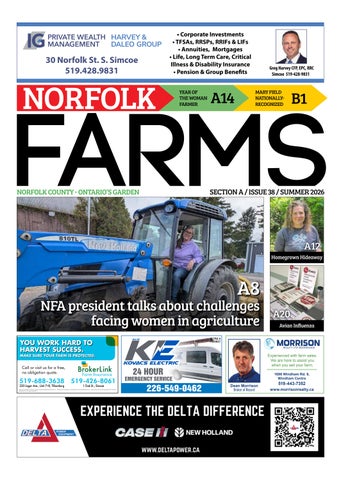
NFA president talks about challenges facing women in agriculture Since Since1987 1987
Since 1987
A20 Avian Influenza
ECRA # 7000857
Dean Morrison when you sell your farm.
We Know
Experienced with farm sales. • COMMERCIAL • RESIDENTIAL • INDUSTRIAL • AGRICULTURAL Dean Karen We are here to assist you
Call or visit us for a free, no obligation quote.
519-688-3638 230 Lisgar Ave., Unit 7+8, Tillsonburg
COMMERCIAL••RESIDENTIAL RESIDENTIAL INDUSTRIAL •• AGRICULTURAL AGRICULTURAL • COMMERCIAL • RESIDENTIAL • INDUSTRIAL• AGRICULTURAL ••COMMERCIAL ••INDUSTRIAL
24 HOUR EMERGENCY SERVICE
24 HOUR EMERGENCY SERVICE
24HOUR HOUREMERGENCY EMERGENCY SERVICE 24 519-426-8061 226-549-0462 SERVICE 226-549-0462
Morrison
Feth
(519) 909-0340
(519) 718-3384
1696 Windham Rd. 9, Windham Centre
(519)519-443-7352 909-0340
www.morrisonrealty.ca 226-549-0462 226-549-0462226-549-0462 226-549-0462 226-549-0462 226-549-0462 1 Oak St., Simcoe
Services available in Ontario through Canada Brokerlink (Ontario) Inc. ™BrokerLink & Design is a trademark of Canada Brokerlink Inc. used under license. © Copyright 2021 Canada Brokerlink Inc. All rights reserved.
Dean Morrison Broker of Record
A2 - NORFOLK FARMS - SUMMER 2026
H
premierequipment.ca
0.9%
OTHER FINANCE + LEASE
OR OPTIONS ASK ABOUT HIGH-EQUITY, SPLIT-RATE AND LEASE OPTIONS TO FIT YOUR NEEDS
W W
+
STK#147011
PREM CAB, ULT TECH, PRO DRIVE, PRWD, 28.5’ AUGUER, 1020 ENG/ 657 SEP HRS
W
JD 9770 STS 2010 ... $99,995
PREM CAB, BIG TOP, PRWD, EXT WEAR, 22.5’ AUGER, 4293 ENG/ 3287 SEP HRS
STK#186530
SOME CONDITIONS APPLY - CONTACT US FOR DETAILS
JD S670 2013 ... $191,995
PREM CAB, 3 SPD, PRWD, BIG TOP, 22.5’ AUGER, 2864 ENG/ 2042 SEP HRS
STK#146956
JD S780 2018 ... $365,995
PREM CAB, PRODRIVE, PRWD, CUSTOM CUT, ACT YIELD, 2443 ENG/ 1612 SEP HRS
STK#147197
STK#149521
JD S680 2013 ... $216,995
PREM CAB, PRODRIVE, PRWD, CUSTOM CUT, 26’ AUGER, 2734 ENG/ 1867 SEP HRS
STK#149068
JD S770 2024 ... $704,995
PREM CAB, ACT YIELD, PRWD, PRO DRIVE, 26’ AUGER, 421 ENG/ 270 SEP HRS
W
+
PREMIER SERVICE INSPECTION
ULT CAB, PRODRIVE, PWRD, 36” TRACKS, 31’ AUGUER, 1456 ENG/ 1013 SEP HRS
W
2.5% 60 MONTHS 2.9% FOR 84 MONTHS
STK#186518
JD S770 2024 ... $849,995
PREM CAB, ACT YIELD, PRODRIVE, PRWD, 26’ AUGER, 123 ENG/ 50 SEP HRS
Norwich - (519) 688-1011
W
STK#193807
W
JD X9 1100 2022 ... $999,995
W
PREM CAB, LED LIGHTS, PRWD, PRODRIVE, 26’ AUGER, 1148 ENG/ 670 SEP HRS
W
STK#142839
JD S770 2023 ... $662,995
PREM CAB, ACT YIELD, PRODRIVE, PRWD, 26’ AUGER, 783 ENG/ 480 SEP HRS
W
STK#232768
JD S7 700 2025 ... $839,995
PRWD, PRO DRIVE, PREM. CAB, PREM VIS, 350 ENG/ 265 SEP HRS
CREDIT up to $5000 ON SELECT COMBINES & SPFH’S
PREMIER
INSPECTION & REPAIRS ON SELECT UNITS
STK#185901
STK#139316
JD S670 2015 ... $289,995
PREM CAB, 3 SPD ELECT. SHIFT, MFWD, 26’ AUGER, 2373 ENG/ 1463 SEP HRS
STK#138807
JD S780 2020 ... $499,995
PREM CAB, LEATHER, PRO DRIVE, 26’ AUGER, 1541 ENG/ 622 SEP HRS
W
+
MONTHS
$ UP TO $5,000 PARTS & SERVICE CREDIT
PREM CAB, LED LIGHTS, ACT YIELD, PRWD, CUSTOM CUT, 1697 ENG/ 935 SEP HRS
STK#137199
JD S780 2020 ... $528,995
PARTS + SERVICE
JD S760 2018 ... $349,995
ULT CAB, PRO DRIVE, PRWD, DYNO-FLO, 31’ AUGER, 1080 ENG/ 665 SEP HRS
W
FOR
*
S700 / X9 COMBINES & 8000 SERIES SPFH’S
JD X9 1100 2022 ... $899,995
STK#233960
ARVEST HEADQUARTERS
*On select pre-owned equipment. Financing rates and offers end July 31st, 2026
WARRANTY
POWERTRAIN WARRANTY AVAILABLE
JD S780 2023 ... $693,995
W
24
FOR
MAKE PREMIER YOUR
STK#234076
JD S780 2021 ... $639,995
PREM CAB, PRODRIVE, PRWD, LED LIGHTS, 28.5’ AUGER, 1256 ENG/ 825 SEP HRS
STK#193703
JD S550 2013 ... $229,995
PREM CAB, HID LIGHTS, PRWD, 3 SPD, 21.5’ AUGER, 2062 ENG/ 1253 SEP HRS
W
JD S780 2019 ... $549,995
PREM CAB, 2WD, LED LIGHTS, 28.5’ AUGER, 1733 ENG/ 1070 SEP HRS
STK#194165
CL 8700TT 2023 ... $829,995
2WD, PREM CAB/LIGHT, CAMERAS, 29’ AUGER, 866 ENG/ 622 SEP HRS
STK#143628
STK#233486
JD 8700TT 2022 ... $714,995
2WD, TRACKS, 1080 ENG/ 790 SEP HRS
Hagersville - (905) 779-3467
265721 Maple Dell Road, Norwich ON
1030 Haldimand Road 20, Hagersville ON
Direct Parts Line: (226) 796-8685 | Direct Service Line: (226) 641-6829
Direct Parts Line: (289) 768-3264 | Direct Service Line: (289) 769-2321
*
*
NORFOLK FARMS - SUMMER 2026 - A3
DID YOU KNOW?
DID YOU KNOW?
That according to the most recent Canadian Census of Agriculture, around 80,000 members of the on-farm workforce in Canada (around 30 per cent) are women?
That at the Ontario Federation of Agriculture, almost half of the board members and two thirds of the staff are women?
That Ontario has the largest proportion of women farmers in Canada – just over one quarter (26.2 per cent)! This is followed by Alberta, Saskatchewan and Quebec.
That the Government of Canada’s Women Entrepreneur Program, which was launched in March 2019, invested $500 million to support women entrepreneurs involved in the agriculture and agri-food sector over a three-year period?
DID YOU KNOW?
DID YOU KNOW?
That almost half of the farmers who are women also work off the farm to supplement their income?
That in 2021, approximately 23.5 per cent of women who were farm operators had at least a bachelor’s degree? Comparatively, only about 14.5 per cent of men who were farm operators had the same level of education.
DID YOU KNOW?
DID YOU KNOW? That women are statistically more likely to run sheep and goat farms than they are to grow grains and oilseeds?
PAIL SALE IS BACK! JULY 17 - 18
Buy a bucket, fill it, and SAVE 20% off everything inside!
DID YOU KNOW?
20% OFF
*Items must fit halfway in the bucket to apply. Shavings and feed excluded.
Scan for more details or head to: www.mbcountryliving.ca
A4 - NORFOLK FARMS - SUMMER 2026
Women in Agriculture: Rebecca Compton works to her strengths By Tamara Botting Several years ago, Rebecca Compton read a piece written by a woman who is a grain and nut farmer from Oregon. In the piece, the author described a time when someone had asked how being a woman had impacted her work in agriculture. Her response? The tractor and the plants neither knew nor cared about her gender. “I’ve always remembered that,” said Compton. When people talk about women in farming like it’s a new trend, “that bothers me,” Compton said, “because it takes away the importance of women throughout time and the role that they played; they’ve always been there. They might not have been driving the tractor or hitching up the horses in the morning – or maybe they were, and they just didn’t get the credit for it.” She pointed to her own family’s operation, Dalton White Farms in Delhi, which has been growing produce for the past 150 years. In that time, generations of women have been involved – working in the fields and barns, keeping the house, raising the next generation of farmers, and making sure that everyone was nourished so they could keep on doing their work. “The workers would appreciate her, and in many cases, she was the most important person on that farm to them, and it wouldn’t have run without her,” Compton noted. “Women have always, always been a crucial role on farms; it just maybe wasn’t the face up
Rebecca Compton appreciates the creativity she gets to express when developing and marketing Dalton White Farms’ line of products, including candied hazelnuts, sparkling blueberry honey lemonade, asparagus powder and hazelnut butter.
front, but that doesn’t mean there was any less value in it.” Compton has a long personal history on the family farm.
Agriculture Financial Services that Help Farms and Agri-Businesses Thrive Libro Credit Union is a full-service financial institution, with an expert agricultural and commercial team to meet all your banking, borrowing and investing needs. We’re proud of our history of supporting farmers and agri-businesses in this community for over 80 years. Contact Libro today to learn more about how you can plan, manage, and grow your farm or business. Caledonia | 905-765-4071 Cayuga | 905-772-3376 Hagersville | 905-768-3347 Jennifer Peart
Senior Relationship Manager
jennifer.peart@libro.ca 519-521-2327
Simcoe | 519-426-5930 Woodstock | 226-253-0123
libro.ca/ag 1-800-361-8222
Operating Accounts • Equipment Loans • Lines of Credit • Mortgages • AgriInvest • Investments
“I did my first full season at 13 in tobacco,” she said. Around the time she went to university to
NORFOLK FARMS - SUMMER 2026 - A5
Compton brings innovative ideas to the family farm study psychology and communication, the farm was shifting gears into diversifying crops even more to move away from tobacco production After her post-secondary education, Compton worked in Alberta for a few years before she decided to answer the call of the farm deep within her. “I always loved working on the farm, but I never really thought about doing it full time; I didn’t go to school for agriculture … that wasn’t really on my radar, it wasn’t what I wanted,” she said. However, “I realized how much I missed it, and I realized that I really didn’t like working for other people, and I really didn’t like working in an office, which is what I always thought I wanted. But once I did it, I realized this is not who I am; I really felt stifled.” She came back to the farm, permanently and full time, around 2014. “My dad still manages most of the field production side. I take care of all of the HR, everything customer facing, weird ideas and product development,” she said with a laugh. Her portfolio of work on the farm also includes items like logistics, sales, and food safety. “Pretty much everything,” Compton said. “Fortunately, my husband does not work on the farm, so that is a big help, because we’re not dependent on the farm for our full income,” Compton said. “That is huge. It allows me to go about taking on new projects and looking at new ideas without having to worry about paying our bills with it.” The farm has cash crops and grains, but Compton focuses more on the produce side of things, which includes asparagus, blueberries, hazelnuts and ginseng. Those crops have led to a lot of innovation. Dalton White Farms started producing candied hazelnuts in 2022. In 2025, it added two more signature products to its roster with sparkling blueberry honey lemonade and asparagus powder (which can be added to smoothies and other things for additional nutrition and can help people with their digestion etc.). Earlier this year, they began producing hazelnut butter. “(Hazelnuts) have been a passion project that is slowly becoming more,” Compton said. Between the line of candied hazelnuts – which come in a variety of flavours, including cinnamon, chai, turmeric, espresso, and cocoa cardamom – and the hazelnut butter, which will have its own selection of speciality flavours, Compton said the hazelnut sales has “gone beyond our production, so we’re also purchasing from other farms.” Whenever Dalton White Farms needs to supplement its own ingredient supplies, it partners with other local producers as much as possible to bring these product ideas to life. Exploring new possibilities is a source for joy for Compton. “I am definitely an outside of the box thinker … we aren’t necessarily doing what a lot of other people are doing in trying to find new niche markets,” she said. “The sky’s the limit; we just pick off one at a time, and see how they work. I’ve got enough ideas to keep me going for a long time.” For her, this is what being a farmer – regardless of gender – is all about. “I don’t know any different; I grew up like
While the Dalton White Farms also grows cash crops and grains, Rebecca Compton’s focus is more on the produce side of things, which includes asparagus, blueberries, hazelnuts and ginseng.
this. I grew up surrounded by men, doing ‘men’s work’ I guess, but it never was labeled to me as ‘men’s work,’ it’s just been what you needed to get done,” she said. “You just let go of the stuff that you can’t control or doesn’t matter, and you power through. You may deal with 20 problems in a day, but you don’t dwell on them; you just quickly come up with the solution and move on,” she said, adding that you have to learn how to not sweat the small stuff. As much as she can, Compton said she plays to her personal strengths, rather than worrying about traditional roles. And if she comes up against something that’s not in her wheelhouse, “if I need it to be, then I will learn and figure it out, or find someone around me who holds that strength and empower them to do it.” For the most part, though, “I don’t feel that being a woman has ever deterred or limited me in a way that I couldn’t break through it.” She said that while 20 years ago, it might have been unusual for a woman to walk into a supplier and have a discussion about the parts needed to repair equipment or to pick up an order, “I don’t think that is unusual now,” she said. Compton said that for her, being a woman has “been an advantage, because it differentiates you, especially from a customer perspective.” One of the more significant differences she’s noticed between her and her dad is that when
it comes to interacting with people – including customers and employees, “I’m maybe more tuned in … which can be good, but it can also be bad in that it gives you a lot more weight to carry when you’re worried about keeping people happy.” Connections with other people are key in agriculture. When she first returned to the farm, Compton said it was a lonely time for her, because “most of my friends weren’t in agriculture.” However, through the farmers’ market, serving on different boards, and time working in the industry, “I really feel like I’ve developed a crew of other women who are also in agriculture, and it’s awesome, because they’re the people that I call.” She knows she can reach out to them for advice, to vent about the work that needs to be done, to commiserate, etc., and that is reciprocal. “I feel like I’ve created a network,” she said. Compton appreciates the support she’s gotten from her ‘village’; she also values the opportunities she’s had to be a villager to others. Dalton White Farms often hires students to work in their farm market, and many times, it’s been teenage girls in these positions. “I love when they get the bug for agriculture,” Compton said. She shared how one teen worked for them all through high school, and now she’s going to school for environmental science, and loves the horticulture/ agriculture side of things. While she might not end up on a farm, she is working towards a career that will likely involve agriculture. “I’m interested to see where she’s going to go,” Compton said. It’s a path she hopes more of the younger generation will consider, as there are a lot of advantages to working in agriculture. For herself, Compton appreciates the flexibility of it, because while her overall working hours are likely more than the average person, she’s also able to be present for her kids around their school schedules, being there for drop offs and pick ups, and going on field trips. Within that, though, “It’s a lot more juggling,” between farm and family responsibilities. “It’s getting easier as my kids get older, but it is a challenge.” Being in agriculture, there’s a deep sense of purpose for Compton. “I’m currently raising the eighth generation (on the farm). This isn’t something we’ve created; it’s been in our family for over 150 years,” she said. “I do this hoping that I can make a good living, and I can build on something I’m proud of, that benefits not only my family, but our community, our employees, and our customers.” She also likes the creativity she can have in the work – and it is a lot of work. “It really has to be a personal choice. It’s not the easy road,” said Compton, adding that you won’t get rich quick in agriculture. While “It’s not for everyone,” she does recommend that those who are interested in a career within the agricultural industry look into it. “There’s so many different options,” Compton said.
A6 - NORFOLK FARMS - SUMMER 2026
“Cool job” as a Waterloo-Oxford co-op crop scout started Jenn VanDeVelde’s agriculture care
Fresh-baked pies using Norfolk fruit are among the products produced in the Wholesome Pickins’ on-farm bakery.
Wholesome Pickins store also carries other local producers’ products.
Jenn VanDeVelde stands outside the farm store.
By Diane Baltaz Despite her claims about having a “zero background in agriculture”, Jenn VanDeVelde’s willingness to adopt new ideas about farm diversification and community building fashioned her into becoming one of Norfolk’s emerging farm leaders. VanDeVelde, along with husband Dave, earned Ontario’s Outstanding Young Farmers (OYF) award in 2022. Sponsored by several agricultural businesses and organizations, the award recognizes farmers who demonstrate excellence in farming and in the agricultural community. The 2022 award recognized the couple’s successful
transition of their fourth-generation tobacco farm to a diversified farm with a food hub called Wholesome Pickins Market and Bakery. Today, Wholesome Pickins, situated along Delhi’s eastern border, grows 200 acres of crops ranging from cash crops to assorted berries and vegetables. The farm also features communitycentred, income-generating alternatives such as a beach volleyball court, a bakery, and children’s agricultural day camps. Jennifer was instrumental in creating many of these evolutions in order to maintain the farm’s viability. The store, bakery and full kitchen are located within a former tobacco pack barn, which sits
prominently near the farm’s primary residence. The site retails their farm’s produce, prepared meals and baked good with locally-sourced ingredients, as well as products from local farms and food producers. They also sell flowering plants and pick-your-own (PYO) produce. Pundits hail it as an example of strengthening local food security. The Trip Advisor webpage says this about Wholesome Pickins: “Family owned farm, market and bakery! We grow ever-bearing and June-bearing strawberries which means we pick berries fresh everyday from May until October! We have an on-site scratch bakery which specializes in homemade pies, tarts, cookies and muffins. We carry a huge selection of Norfolk County produce and products! We are committed to farmers and business close to home and always provide the very best our area has to offer!” Wholesome Pickins’ location at the junction of Church Street, and the Harmony and Brantford Roads, is handy for Delhi’s residents and growing commuter crowd. VanDeVelde said that this route attracts Lake-Erie bound traffic with weekenders who drive by in order to bypass Simcoe. “They come in on Thursday and Friday ,and then again on Sunday.” Her non-farm agricultural contributions included a term as president of the Ontario Berry Growers Association. She recently assumed the chair of the provincial Outstanding Young Farmers committee. Yet VanDeVelde says that she had no initial farm knowledge: “I grew up near Ottawa with a zero-farming background.” Life changed when VanDeVelde studied biological sciences at the University of Guelph, from which she graduated in 2005. Two concurrent events paralleled her studies: meeting Dave, whom she married
MKT-14771A-C-AD1 AECSPAD
What will be your legacy? • Retirement planning • Business planning • Intergenerational planning • Charitable giving • Estate planning
Contact me today Jane Bradley, CEA®, DFSA™ Financial Advisor 22 Argyle St Simcoe, ON N3Y 1V5 519-900-0463 jane.bradley@edwardjones.com
> edwardjones.ca
NORFOLK FARMS - SUMMER 2026 - A7
“Cool job” as a Waterloo-Oxford co-op crop scout started Jenn VanDeVelde’s agriculture care
The VanDeVelde Farms store from the outside.
in 2006, and the other life changer was her summer job as an agricultural scout with the Waterloo-Oxford Co-operative. “It was a very cool job -- it started me in agriculture,” said VanDeVelde. “I got to see a lot of farms as I was covering a big area.” Equipped with a new car, VanDeVelde said that she traveled to farms across southwestern Ontario, from Niagara to west of London, logging 30,000 km in her first year. She monitored crops such as strawberries, raspberries, sweet corn, and blueberries - checking them for insect pests, disease and weed pressure as part of the co-op’s integrated pest management (IMP) program. VanDeVelde moved on to be a crop specialist with Sylvite. This University of Guelph grad applied IPM methodology and the marketing practices she learned from these jobs to the VanDeVelde farm, which she and Dave had moved to in 2006. “At that time Dave’s family was scaling back their tobacco and were looking for alternatives, so I suggested that they start with strawberries,” she said. The initial plantings were “just seasonal at that point,” said VanDeVelde, adding that they used an old tobacco tying machine to sell the berries roadside. By 2011 the family converted the strip room in their pack barn to a small market; they hired staff and sold farm-produced goods from area farmers. “These farmers were people who were not in the retail business, but they were willing to sell their goods to us as they didn’t have to travel,” said VanDeVelde. At one point, VanDeVelde enrolled in teachers’ college, figuring that the profession’s summer holidays freed her up for farm work. She taught math and science in area schools and worked as a supply teacher until 2013. ‘That’s when we built this,” she said, indicating the area around the barn. The family renovated the barn’s remaining space, adding additional storage, the bakery and a full kitchen in order to produce sweet and savoury homestyle meals. The family also added “day –neutral” (ever-
Strawberries began the VanDeVelde family’s transition away from tobacco
bearing) strawberries for an extended growing season. “They’re my favourite-tasting strawberries,” VanDeVelde added. That is when she stopped teaching. “I did less and less teaching as by then I had no time.” Today, the farm employs 38 full time and seasonal staff, including two full time cooks, two full time bakers and 15 off-shore Jamaicans who have worked there for past five years. The VanDeVelde team currently grows asparagus, squash, rhubarb, wholesale and PYO pumpkins, strawberries and rhubarb and raspberries. The family recently added high tunnels for new raspberry plantings -- portable greenhouse-like structures whose sides are rolled up and down according to weather conditions. Cash crops are rotated, along with a cover planting of an oats, peas and barley mix. “By 2021, there was no more tobacco as there were too many things on the go,” said VanDeVelde. The remaining bulk kilns were removed last year, and they rent the greenhouse to a neighbouring tobacco farmer. A proponent of agri-tourism, VanDeVelde joined Agri-tourism Ontario in order to network for new ideas. The farm’s corn maze is popular, featuring a Halloween Scare Night. Since 2013, the farm hosted a Canada Day event with entertainment, including a bouncy castle and half-price PYO berries. The summer day camp for children aged four to 10 began in 2022 when an employee offered to create one. Staff built a program that enables children to explore farm life by working in the bakery, picking crops and participating in nature walks around the farm. The program grew from six children to approximately 30 youth today. “It’s a great way for kids to spend their summer, especially if they don’t come from that background,” said VanDeVelde. “We have a great team here and we are always sharing ideas.” The beach volleyball court was added in 2025, inspired by VanDeVelde’s involvement with Simcoe’s XVC Volleyball Club, where she
serves as secretary-treasurer. “It’s in the middle of the farm and it’s a fun place to play – you’ve got a beautiful view truthfully, the sunsets from there are amazing.” VanDeVelde participates in an informal network of OYF alumni who share daily online conversations on topics from fertilizer application rates to marketing and farm successes and failures. Their daily chats reflect her own family’s concerns about how the Canadian and world situations pose significant challenges within all fields of agriculture. “I think that the world is giving us a pause. The cost of product pricing is increasingly more difficult,” said VanDeVelde, adding that she already sees fuel surcharges added onto some delivery bills. “All farmers are seriously looking at their operations.” “Economies of agriculture are what are driving a lot of our conversation now. Farmers are now part of a business, and dealing with costs are a big part of their time… therefore it’s hard to get on a tractor when business is a focus.” VanDeVelde’s short term planning question is: “How can we continue producing local food and supporting other local businesses? People can only afford to pay so much for a quart of strawberries; but we must ask can we afford to put them on the shelf? The cost of production is rising faster than prices in cash crops and horticulture. The beef and dairy producers are also reporting higher bills on their desks.” Moreover, their children, Ryan and Emily, are in their senior years at Delhi District High School with one of them graduating this year. VanDeVelde said that these two are exploring their interests in post-secondary school life – including whether they should become the fifth generation of VanDeVelde farming that land. Therefore, succession planning is part of her family’s long-term goals for both the farm and its store. “There is something I want to do to make them something to come home to so as to ensure that we have something built here to be attractive to the next generation -- although that has to be their choice.”
A8 - NORFOLK FARMS - SUMMER 2026
Women in Farming: People skills key to Jenn Schooley’s success in agriculture, agritourism
Jenn Schooley is proud to offer a range of products in the shop at Apple Hill Lavender farm.
By Tamara Botting The first time Jenn Schooley went looking for a pair of work boots in a local shop, there were only two options for women, “And they were pink. I was so pissed, because just because we’re girls, it doesn’t mean we want to wear pink.” That was about five years ago, when Schooley decided to come back to the family farm, Apple Hill Lavender at 1795 Windham Road 11, Norfolk County. For 20 years prior, she had been working for a children’s mental health agency. “I wasn’t planning on coming back to the farm,” Schooley said. But “when COVID hit, I didn’t see my parents for three months at a time, and that’s the longest I’d gone without seeing them; I’ve always lived so close.” She started thinking about the family farm and what she wanted her connection to it to be
When guests come out to Apple Hill Lavender, Jenn Schooley said, “I like to show up … on my tractor, so that everybody can see a girl can drive a tractor,” adding, “The kids aren’t shocked that I’m a girl; I just want to normalize it.”
after her parents were unable to work the land anymore. At that time, her sister was working on the farm, so they all had a family conversation. While her sister has since shifted to a different career, Schooley left her full time job and “jumped in with both feet,” to be part of the farm’s operations. She’s now the Director of Operations for Apple Hill Lavender, which grows and adds value to apples, lavender and medicinal herbs. Her parents are still the owners. Schooley’s previous role required a lot of patience and resilience, “and those come in very handy when farming,” she said with a laugh; especially farming as a woman. Coming from a professional field that is primarily made up of women and a workplace that was very nurturing, Schooley said moving into the world of agriculture was a big change. “It’s dominated by men,” she said. “I was not
• GENERATOR SERVICE & AUTO TRANSFER SWITCH REPAIR • ON-SITE DIAGNOSTICS/REPAIRS/ LOADBANK TESTING • NEW & USED GENERATOR SALES MULTIPLE UNITS AVAILABLE WATERFORD, ONTARIO Phone: 289.659.4539 Email: service@norfolkpowersystems.ca
expecting those types of behaviours, certain comments here and there. That was a little bit of a challenge for me at the very beginning, to navigate my way through, because it was so shocking.” She’s had farmers make inappropriate comments to her. She’s had people at supply and equipment stores talk more slowly to her, or assume she doesn’t know what she needs for her operation. When salespeople have come out to the farm, they’ll bring a hat for her father, and tell her they have nothing for her. “I wear hats, too,” she said wryly. “Or sometimes, they’ve given me baking things; I’m so offended by that.” One time when Schooley and her father were looking at a tractor, the salesperson started to show her how to put it into forward and reverse; she pointed out to him that he hadn’t done the same with her father a few minutes prior. “I was like, ‘You’re mansplaining – to a farmer – how to drive a tractor. Whether they’re a girl or a boy, is that appropriate?’ He was very upset that he had done that; he didn’t realize he had done it.” Schooley noted that financial institutions can be really hard to deal with as a woman. “I can’t do a lot without Dad to be able to help. He has a lot more credibility as a male farmer in the financial world, at least with the bigger banks,” she said. While Schooley will call it out when she sees people operating in stereotype assumptions with her, she always strives to do it in a respectful and diplomatic way. Most of the time, “I don’t think they realize they’re doing it at all,” she said, adding that she sees it as an opportunity for education, not to embarrass someone. Things like the weather and the cost of essentials like fuel and fertilizer are generally out of a farmer’s hands, but something that Schooley’s previous career had well prepared her for when it came to farming was the interpersonal aspect of the work. “I have developed those ‘peopling’ skills over a period of 20 years, and working with
NORFOLK FARMS - SUMMER 2026 - A9
NFA president discusses the challenges facing women in agriculture a wide variety of different types of people from different walks of life. In the agritourism business, that’s essential, to be able to deal with people coming in from all over,” she said. Education was also a huge part of her previous career, and she still find herself utilizing those skills now as she is “educating people here on the farm about what they see and what’s going on in the agriculture around them.” Sometimes she’s educating guests about the produce being grown, or agricultural practices on the farm. Other times, it’s a much more basic lesson, like who can be a farmer. “The stereotype that people have when they visit the farm, they’re expecting the farmer to be a man; that’s a big one,” Schooley said. Local libraries will often do circle times at the farm, which brings families out to Apple Hill Lavender. “I like to show up … on my tractor, so that everybody can see a girl can drive a tractor,” said Schooley, who added, “The kids aren’t shocked that I’m a girl; I just want to normalize it.” It’s not just that Schooley has to be able to relate well with guests on the farm; she also has to be able to relate to others in the agricultural industry. Especially in her early days working on the farm, she found she often had to prove her credibility before others – particularly men – would take her seriously. That’s why her advice to any women who want to get into farming is, “Learn, learn, learn, learn, learn. For the first little while, two ears, one mouth – listen twice as much, talk half as much so you can really soak in and absorb.” Very early on in her entry into farming full time, Schooley joined different boards in the community. Today, she volunteers as president of the Norfolk Federation of Agriculture; chair of the Norfolk Agricultural Advisory Committee for Norfolk County; treasurer for the South Coast Wellness (which supports people with things like mental health and addictions); and is on the board for ABEL Enterprises. Her main reason for joining the agricultural boards was “So I could learn more about how other crops are grown, because we’re just edible horticulture here, and I wanted to learn how agriculture works and how it fits, and I wanted to learn the political and economical sides of it all.” Schooley said she’s learned a lot about agriculture as a whole – from a national to a local level – while serving on these boards, and she’s very grateful to those she’s served with who have helped her gain a deeper understanding of the industry. She’s also seen firsthand how if a woman in farming wants credibility with her male counterparts, “We have to be a little bit more professional; we have to be more assertive. We also have to be more nurturing.” Still, Schooley noted, “Right from the beginning of time, agriculture has always had women involved … I think there’s always been an underlying respect for women in agriculture, because male farmers knew they couldn’t do it without their female partners.” She pointed to Apple Hill Lavender’s barn, which was raised in her great-grandparents’ time. “The men all worked together to put up that barn, but the women all came together
Having worked full time as a farmer for a number of years now, Jenn Schooley knows all too well the ups and downs of agriculture, and how things like a late frost can impact the apple blossoms, and in turn, the harvest.
and they made those meals to nourish those bodies that were lifting up those barns. So, the two really go hand in hand. There’s always been that healthy respect for women to begin with underlying; it’s just bringing that up more visibly.” Schooley appreciates the work that other women in agriculture have been doing, especially locally. “I am seeing more and more women in leadership roles in agriculture; that’s exciting,” she said. “We’ve got some really strong women farmers in Ontario. I’m really fortunate to be rubbing shoulders with some amazing women who have done some pretty amazing things. We’re really fortunate. Norfolk County seems to be a little bit more open-minded that way, and forward-thinking with that.” Another piece of advice she has for women who are just getting into farming is to find other women in the industry to connect with – to learn, to vent, to troubleshoot problems with, etc. As an example of the latter, Schooley said that while she might not have the muscle strength to
do a particular task, that’s when she has to use brainpower to figure out a workaround. “I think that’s one of the superpowers of women working in agriculture, though; we’ve got that creative, resourceful, driven – especially driven – way of doing things, and I think it adds a little bit of uniqueness to it,” she said. One of the biggest challenges of farming is that it’s not something you can fake your way through, Schooley said. On the flip side, though, that means “It’s very real, it’s very authentic, it’s very genuine. And you want to maintain that … that’s where you gain the credibility.” These days, Schooley still has a hard time finding overalls or work gloves that fit right, and “They don’t make tractor seats for women, that’s for sure.” But when she’s gone back into that local shoe store to look for work boots, there’s now a whole section dedicated to women’s work footwear. It’s a small step, but “It’s come forward,” she said.
A10 - NORFOLK FARMS - SUMMER 2026
New exhibit highlights E.D.Tillson’s farming innovations
Ever wonder how Maple Lane received its name? This photo shows the street when it was just a lane, complete with cows from E.D. Tillson’s herd walking down it.
By Jeff Helsdon Although it’s a neighbouring municipality, many Norfolk County farmers aren’t aware of the impact Tillsonburg had on agriculture at the turn of the last century. E.D. Tillson, the son of the community’s founder, gained fame by inventing a pan drying process for oats that revolutionized the cereal market. In fact, Quaker Oats purchased the
This historical photo shows Annandale Farm’s three-story brick barn. Horses were on the first storey, cows on the second and hay on the third.
process after his death. But, his Annandale model farm was also a model for farming innovation. Some of these innovations are highlighted in the latest exhibit at Annandale National Historic Site, which was Tillson’s home. The exhibit “A Marvel Farm: Annandale’s Farm”, is currently on display at Annandale National Historic Site, and runs until Aug. 30.
It commemorates the 145th anniversary of the 600-acre farm that surrounded what is now Annandale National Historic Site. The three-storey brick barn was innovative for the time. “It was a marvel of technology, especially with the ventilator E.D. put in,” said Kate Bakos, Cultural Heritage Manager/Curator. One of the
You Put Everything Into Your Harvest. We Make Sure It's Properly Protected!
4,900+ 5-Star Reviews
GET A FREE INSURANCE QUOTE TODAY! 519-426-2551 www.morisoninsurance.ca
NORFOLK FARMS - SUMMER 2026 - A11
New exhibit highlights E.D.Tillson’s farming innovations unique things about the ventilator was that a profile of ED’s face was cut into the ventilator’s vane. It’s also possible Tillson was the first person in Canada to try ensilage in silos. And while Woodstock is famed as the dairy capital, Tillson was the first to bring Holsteins to Oxford County. Bakos said the farm was a passion project for Tillson, for which he first laid out the idea in a letter written in 1870. Tillson wrote papers about the farm and invited other farmers to come and see what he accomplished. There are records showing that, on one occasion, about 2,000 farmers came by train to Tillsonburg for a tour of the farm. “It was a marvel,” Bakos said. “He didn’t spare any expense with his farm.” The farm contained an apple orchard, grazing fields, corn, cherry orchards, trout ponds, and was home to sheep, pigs, and cows. It had a complete waterworks with wooden pipes moving water around the farm. The display is unique in that it is part artifacts and part interactive activities designed for youth and adults. “With the farm, we have a lot of good paper content, but don’t have a lot of artifacts,” Bakos explained for part of the reason. “It’s also a way to make our exhibits more interactive,” she
explained. for farming,” Bakos said. The cows were a particular passion of Part of the 600 acres now includes the block Tillson’s, as seen in the names he gave them, that has Annandale School and, at one time, which reflected his wife’s name, but there were also included Maple Lane Senior Public School also unique names such as Anne Laurie of and Tillson Ave Public School. Another part of Norwich, Madonna Butter Girl, Scotland Lucy, the farm is now Annandale subdivision. and Canary Starlight Lassie B. SOLID WASTE “We know ED loved TRANSFER STATION his cows,” Bakos said. OPEN TO THE PUBLIC “There’s more pictures of his cows than his house.” Tillson’s love of the Consider us when moving, cleaning out SERVICES LIMITED cows is also seen in the garages & basements, during home high ratio of help, which renovations or roofing was one working person per three cows. The creamery, which was part of the farm, made its own quality butter, which was sold as far away as Available Bin Sizes Toronto. 6 Cubi c yar d 6 x 5’6 ” x 5 ft. WE ACCEPT 10 Cubi c yar d 10 ft. x 7 ft. x 4 ft. PLASTIC FROM Soon after Tillson’s 16 Cubi c yar d 16 ft. x 7 ft. x 4 ft. YOUR VEGETABLE 20 Cubi c yar d 20 ft. x 7 ft. x 4 ft. WE ALSO ACCEPT death in 1902, the land 30 Cubi c yar d 20 ft. x 7 ft. x 5 ft. CROPS. 40 Cubi c yar d 20 ft. x 7 ft. x 7 ft. “E-WASTE” was parceled out, and $15.00 MINIMUM includes tax (disposal of up to 110 Kg) Conveniently located at 811 Old the family sold it relatively loads in excess of 110 kg will be charged at $95.00 per tonne. Highway 24 in Waterford quickly. 519.443.8022 (across from the Esso Station) HOURS OF OPERATION: “It seems his family 1.800.616.0347 Monday to Friday 7:00 AM - 5:00 PM Saturday 7:00 AM-12:00 Noon didn’t share his passion www.norfolkdisposal.ca
RENT A BIN!
POWDERY MILDEW SLOWING YOUR YIELD DOWN? PUT
TO THE PETAL! SCAN TO LEARN MORE
Mettle® is a registered trademark of Gowan Company, L.L.C. ALWAYS READ AND FOLLOW LABEL DIRECTIONS.
VISIT OUR WEBSITE AT GRANTHAVEN.COM
A12 - NORFOLK FARMS - SUMMER 2026
Homegrown Hideaway:“Glamping” tents with queen size beds beats traditional camping at this old Port Dover farm
Caroline Jager includes Mrs. Waddle’s old garden in her wild crafting tea walks.
The Lynn River, along with the nearby Lynn River Trail adjoins the glamping area.
This HeatMor furnace extends the barn’s rental period.
By Diane Baltaz A Woodhouse Township farm that once had a mill, and provided Port Dover with its first attempt of at hydro-electricity, now features several novel reconnections to the land. The location is Homegrown Hideaway, a 17-acre property whose fields have been transitioned into a glamping site and its barn – believed to be among the oldest in Norfolk County -- is now an event venue for weddings, business meetings, yoga and other books. The centre also offers wild craft tea walks in which visitors gather herbs while learning about responsible foraging. Tucked between the Lynn Valley Trail and the Lynn River on St. Johns Road, just east of Blue Line Road, owners Caroline and Jonathon Jager describe the enterprise as “a peaceful, family-owned luxury glamping retreat” featuring Canadian-crafted “glamping tents” with queen beds, private forest nooks and fully equipped amenities including access to washroom facilities with hot water. “People stay for multiple days, so we installed a shower,” explained Caroline Jager during a walk on the land. Now in its seventh season, the Homegrown Hideaway opened in 2020. It is one of two active glamping centres currently operating in Norfolk; the other being Long Point Eco-Adventures, said Jager. “Our’s is family operated; we still live here.” While other glamping locations exist in Ontario, they remain less common than the traditional campground for those wanting to enjoy the outdoor lifestyle. “Glamping is still a relatively new word in Canada and only has been around for about 10 years, compared to Europe where it’s more popular,” said Jager. The Cambridge Dictionary defines glamping as “a type of camping that is more comfortable and luxurious than traditional camping. The word is a mixture of ‘glamorous” and “camping”. Wikipedia states that the word, “glamping”
first appeared in the United Kingdom in 2005 and was added to the Oxford English Dictionary in 2016. It adds that the concept “of luxurious tent-living existed in previous centuries. In the 16th century, for example, the Highland Scottish Earl of Athol pitched “lavish tents” for King James V and his mother when they visited the Highlands. The online site added that luxury tent living became a must-do for wealthy Brits and Americans going on African safaris in the early 20th century. Those who didn’t want to sacrifice comfort or luxury brought everything from folding baths to cases of champagne. By the 1990s, safari camps became increasingly popular in Africa and coastal Thailand, with CNN reporting in 2011 that glamping’s popularity spread to the United States, Europe and Australia. Wikipedia added that the COVID-19 pandemic increased interest in glamping tourism because it enabled social distancing while enjoying outdoor recreation. Provincial tourism websites such as Destination Ontario and Glamping Hub states that individual glamping facilities range from furnished yurts, geodesic domes, large tents, tiny homes or cabins to safari or prospector huts. Who is more likely to glamp than camp? “Maybe it’s someone coming with another who is not wanting to rough it; or they refuse to give up a bed and soft sheets,” answered Jager. The bed and soft sheets are found in snug prospector-style tents with raised wooden floors and Canadian-crafted wood and tent-canvas walls. The ready-made queen bed dominates the centre, and captures one’s sight as soon as the tent’s front entrance is drawn aside. Simple wooden shelves allow room to put down personal possessions, and the outside has provisions for small campfires. Each of Homegrown Hideaway’s five glamping sites is situated in private alcoves in the white-pine studded meadow and woods
at the back of the farm, near the Lynn River. The washroom facilities and the shower are in a central building. Glamping season runs from spring until autumn. The tents, beds and bedding are kept in an air-tight sea-can when not in use. The raised wooden platforms, and the washroom facilities can be removed if needed, said Jager. “Excepting the sewage and water, everything out back is easily removable if it had to revert back to fields. We try to be light on the land. Also, we’re on the flight path to Long Point where my mother’s family has deep roots.” “Glampers bring their clothes, toiletries, their own food (unless they order one of our breakfast baskets) and anything extra they might want. Bug repellant is always a good idea, especially during buggy times. There are lanterns in the tents,” said Jager. “Water is potable at the washrooms, but often people bring in their own drinking water. We are blessed with sulphur water. It’s great for your hair and skin, but can sometimes have a bit of an odour.” In 2021 the Jagers opened their barn, located towards the middle of the farm, as a venue for events such as weddings, business retreat, and yoga. The barn is rustic, comfortable, smelling of fresh wood as Jonathon replaced the walls’ planks while the original roof remains intact. Jager said that it is one of Norfolk’s oldest barns, having been built in the 1800s and moved to its location at an unknown date. The barn had three stables in one corner when Jonathan renovated it. They plan to insulate the building for year-round use, with heating coming from a HeatMor wood furnace located several meters away. The barn features Wednesday night community concerts, with people travelling from as far as the Golden Horseshoe to attend them. “The concerts are fun,” said Jager. “We haul out an old braided rug for the ‘stage’. People
NORFOLK FARMS - SUMMER 2026 - A13
Homegrown Hideaway holds one of oldest barns in county
Caroline Jager uses prospector-type huts for the Hideaway’s glamping tents.
travel from as far as a 1.5-hour drive away from places like Milton. Jager added the wild craft tea walks after spending “way too much time in the bush” walking with her two children when they were preschoolers seven years ago. “I grew up in a family that had a lifelong interest in herbal teas as refreshment and as medicine. I joined the Ontario Southwest Regional Tourism Association which suggests different tourism options and offers programs to help develop them. I developed the walks from this.” Budding wild crafters accompany Jager to the riverside embankment, woodlands, the field, and the family’s backyard, harvesting as they go along: “I teach responsible foraging and what not to touch.” Refreshments collected include dandelion, goldenrod, staghorn sumac, raspberry leaves, stinging nettle and violets. “My kids have fun adding lemon juice to the tea,” Jager said about making violet tea. “The acidity turns the liquid pink.” The wild crafting happens during the spring and autumn and in June and August, although she tells crafters that some plants, such as sumac berries taste sweeter in November after frost. “It’s cool that the things you harvest generally coincide with what you need for illnesses and certain physical conditions,” said Jager. “For example, the high-oxidants tend to be with the spring plants which help you to detox your winter eating.” Homegrown Hideaway has some historical significance for Port Dover, said Jager. It had a flour mill, with its ruins still visible beside the Lynn River. “Also, the first attempt at providing hydroelectricity for Port Dover happened on the farm. It only lasted for a year because the water flow was inconsistent.” The Jagers became part of the land’s history in the 1970s when Jonathon’s parents, Hungarian immigrants, purchased it. They planted the white pines in the old field which has the glamping tents. The previous owners were the Waddles. The remnants of Mrs. Waddle’s flower garden
The barn at Homegrown Hideaway is rented out for social events each summer.
forms part of Jager’s wild craft walks. “There are some invasive plants in it like Lily of the Valley, so the garden shows what not to plant.” The current Jagers moved to the property in 2013. The couple both worked off farm: Caroline, who has architecture and planning background and Jonathon as an electrician. “But we have two kids and we have a beautiful property and weren’t doing anything with it, and we both work out. Therefore, we decided to use it.” Today, Jager restricts most of her architectural and planning work to the winter months when the Hideaway is closed, assisting clients with “small-town type” building projects and property layout. Glamping occupies the rest of her year, assisted by two summer students when needed, especially during its peak bookings in July and August. Jonathan still works off-site, but keeps the
field mown after everything is set up and hopes to eventually restore the old mill ruins; otherwise “everything else is naturalized.” “It’s a farm but not a farm, but we grow our own food,” said Jager. “We also rely upon other peoples’ farms; we bring in extra eggs and vegetables from neighbours. Jager said that the business relies upon community partners. “We bring in catering either ourselves or else the renters do. We have wonderful community participation. There’s one local who does all of the sound at the concerts. We promote local as much as we can as it’s important to us.” This arrangement pays off in Jager’s favourite part involving Homegrown Hideaway: “Watching people come here and start to relax; watching them walk around, settle in and then watch how their shoulders drop.”
A14 - NORFOLK FARMS - SUMMER 2026
United Nations declares 2026 the International Year of the Woman Farmer By Tamara Botting Every day around the world, women are making important contributions to agriculture and agrifood systems – as they have throughout the generations, whether or not their efforts are valued, or even acknowledged. The United Nations wanted to bring greater recognition to these women and difference their contributions make, on the micro scale of themselves and their families, and the macro scale of impacting the worldwide economy. To that end, 2026 was declared the International Year of the Woman Farmer (IYWF), recognizing that “Women farmers are central to food security, nutrition and economic resilience. IYWF 2026 raises awareness and promotes actions to close the gender gaps and improve women’s livelihoods worldwide,” as stated on the Food and Agriculture Organization (FAO) of the United Nations website. Part of this work has been the Status of Women in Agri-food Systems report, published by FAO in 2023, which was preceded by The State of Food and Agriculture (SOFA) 2010–11: Women in Agriculture – Closing the Gender Gap for Development. According to the 2023 report, SOFA “made the business case for closing existing gender gaps in accessing agricultural assets, inputs and services. It documented the tremendous costs of gender inequality not only for women but also for agriculture and, through agriculture, for the broader economy and society as a whole.”
Rather than being just an update on the SOFA report, the Status of Women in Agrifood Systems report includes new data and “investigates how shocks in agrifood systems have a differential impact on men, boys, women and girls and the coping strategies with which they have responded.” The report considers agrifood systems as “the entire range of actors and their interlinked activities that add value in food and non-food agricultural production and related off-farm activities such as food storage, aggregation, post-harvest handling, transportation, processing, distribution, marketing, disposal and consumption.” The 2023 report also notes that while a lot has happened in the world since 2011, and there has been a reduction in some of the gender gaps, others remain largely unchanged.
“Women represent half of the global population but continue to be systematically disadvantaged across different dimensions of welfare and economic livelihoods,” the 2023 report noted. The report can be read in its entirety here: bit.ly/4uLVDd6; what follows here are some highlights. To look at women’s role in agriculture globally, it’s necessary to first look at the behaviours, choices and opportunities of both men and women around the world, with an understanding of the multiple overlapping and compounding factors (including but not limited to: gender, age, ethnicity, religion, disability status, marital status, migration status, and economic status) that lead to the differences in the lived experiences of the two groups.
From tractors to tillers, loud days add up.
Time to Check Your Hearing!
Book your free hearing test today! At Norfolk hearing clinic, we’re passionately dedicated to transforming lives through better hearing. #letshearnorfolksounds
Proud to call Norfolk County home — locally owned and operated, community driven.
226-550-1360 Simcoe - 185 Robinson St (Second Floor)
Port Dover - 413 Main St (Lower Level)
norfolkhearing.ca
Port Rowan - 1035 Bay St
WATERFORD HOME BUILDING CENTRE
NOW CARRYING BENJAMIN MOORE PAINT
NORFOLK FARMS - SUMMER 2026 - A15
United Nations declares 2026 the International Year of the Woman Farmer Two of these compounding factors examined in the report are food insecurity and GenderBased Violence (GBV). In 2021, more than 939 million girls and women aged 15 and older experienced moderate to severe food insecurity globally; it was around 813 million boys and men in the same category in the same age class. A Gallup World Poll of over 700,000 people in 121 countries showed that before and after the COVID-19 pandemic, women in rural areas and men and women in the 25 to 34 age group have been disproportionately negatively affected when it comes to food insecurity. “For rural women and girls, increased povertyrelated stress and food scarcity and restricted freedom of movement may lead to increased dependence on male partners and negative coping mechanisms such as transactional sex and other forms of sexual exploitation,” the report states. “While GBV is historically rooted in unequal power relationships between men and women, it is both a cause and consequence of poverty and food insecurity.” GBV are harmful acts targeted towards certain people based on gender. The perpetrators can include intimate partners, relatives, friends, acquaintances or strangers. It might happen in person or online, and in private or public settings. The Status of Women in Agrifood Systems report states that globally, one in three women have experienced physical and/ or sexual violence in their lifetime. It also noted, “GBV highlights the increased vulnerability of women and girls to violence as a result of their subordinate status in society, unequal power relations and gender roles.” GBV, including intimate partner violence (IPV), is typically underreported; that’s why while the data states that 38 per cent of all murders of women are committed by intimate partners, and 27 per cent of girls and women aged 15 to 49 who have been in a relationship have suffered some form of IPV, “such numbers are considered underestimations.” The report notes that “recent events such as the COVID-19 pandemic, conflict and recurring extreme weather and climate events have the potential to trigger and exacerbate GBV among already vulnerable populations.” Beyond the incalculable cost of loss of life, and/ or physical, emotional, etc. harm, violence against women is estimated to cost $1.5 trillion USD (approximately $2.1 trillion CAD) annually – that’s equivalent to 2 per cent of the global Gross Domestic Product
(GDP) through things like loss of income, loss of productivity, and increased medical costs – all of which can worsen the impacts of poverty. While certainly not a fix-all for issues like food insecurity and GBV, the report noted, “FAO estimates that closing the gender gap in farm productivity and the wage gap in agrifood-system employment would increase global gross domestic product by 1 percent (or nearly USD 1 trillion [$1.4 trillion CAD]). This would reduce global food insecurity by about 2 percentage points, reducing the number of food-insecure people by 45 million.” One of the necessary tools needed to transform global agrifood systems and achieve gender equality is high-quality data that is broken down by sex, age, and other significant social/ economic differentiations. This would allow for more effective and evidence-based monitoring, evaluating and accelerating progress. It’s also vital that interventions be localized, and scaled up carefully – through policies, investments, and uptake by interest holders in the public and private sectors. Whenever possible, the interventions designed to close gender inequalities and empower women “should use transformative approaches at (the) community and national level to address discriminatory gender norms and attitudes.” Gender inequalities can be found at the formal policy level, as well as at the informal norms level. While governments and agencies can change laws, policies and regulations relatively quickly, “discriminatory social norms and rules affecting women and girls are at the heart of gender inequality and they are slow to change,” the report said. A common hurdle women encounter when it comes to their ability to find and maintain employment is that they shoulder a disproportionate amount of the care of family members (especially children) and domestic labour responsibilities. “Access to child care has a large positive
effect on mothers’ employment opportunities in agri-food systems and can also increase women’s ability to join and participate in rural organizations,” the report said. Women being able to join the efforts of larger organizations translates to better outcomes for women in general. For instance, “Rural organizations have effectively influenced changes in gendered access to water and related technologies,” in multiple places around the world, the report noted. “In Sri Lanka, for example, the participation of women’s groups in community waterresource management was associated with improvement in women’s skills related to water management (e.g. meter reading, billing and money collection) and increased their decisionmaking in village water-resource management.” That’s not the only way having a wider range of connectivity has been a positive for women around the world. A correlation has been found between women’s education and their ownership of land; furthermore, when women are provided with legal aid at the community level, they have more knowledge as to their rights when there is a dispute over land ownership. Having a community is key when it comes to creating better outcomes for women in agriculture and agri-food systems. “Group-based approaches have been shown to enhance women’s empowerment and resilience to shocks,” the report said. “During the COVID-19 pandemic, women who were part of village saving and loans associations were less likely to report negative impacts from the COVID-19 pandemic on food security and health, suggesting increased resilience to crisis.” Besides housing the complete report, the FAO’s IYWF website (www.fao.org/womanfarmer-2026/en) has further information about women farmers around the globe and the impact they make, as well as how to support them and their work.
Delhi | 519-582-1401 237 Main Street, Delhi, ON Simcoe | 519-426-4595 23 Peel Street, Simcoe, ON
Scan the QR code and visit us online
Brantford | 226-401-4805 135 Brant Avenue, Brantford, ON Port Dover | 519-583-0495 11 Aaron Drive, Port Dover, ON Mutual fund business is done with your advisor through Sun Life Financial Investment Services (Canada) Inc. Advisors and their corporations conduct insurance business through Sun Life Financial Distributors (Canada) Inc. Sun Life Assurance Company of Canada is the insurer and is a member of the Sun Life group of companies. © Sun Life Assurance Company of Canada, 2026.
A16 - NORFOLK FARMS - SUMMER 2026
From Farm to Family: Heidi Mungal’s commitment to good food and education
Gardening is a central component of the operations at Generations Marketplace. Mungal proudly holds this year’s rhubarb which will be used in many ways at her on-site marketplace.
By Leah Bauer For Heidi Mungal of Generations Marketplace there is truly never a dull moment, everything from feeding livestock, and planting gardens, to teaching homesteading skills, and running a marketplace is all part of a day’s work. Generations Marketplace, while presenting
Generations Marketplace has multiple species all living amongst each other, each serving their own purpose.
itself as a small-farm operation, has diversified to become a gem in local farming, homesteading, and agritourism. Mungal described this process of diversification, stating, “I own this farm with my husband, we are now the fifth generation on this farm. To maintain the legacy, and make it a reality we knew that we had to do things
differently.” For Mungal the new path forward for the farm was clear. “I wanted people to experience what a farm really is.” To say that the Mungal’s worked hard, and
Insuring Family Farms in Haldimand & Norfolk Since 1879
NORFOLK FARMS - SUMMER 2026 - A17
From Farm to Family: Heidi Mungal’s commitment to good food and education continue to work hard, to make this vision a reality would be an understatement. The notion of teaching people “how to do things themselves again” guided Mungal in creating Generations Marketplace. Today, her operation teaches skills such as raising animals, gardening, preserving food, baking, soap making, and bee-keeping. Classes are offered to both adults and children, with the goal of providing participants with “skills that people should be learning.” The decision to diversify the small farm operation was also influenced by Mungal’s own experience in homesteading and motherhood. “I have five kids, and when I started to have my children, I began looking at labels, and I realized my food is not what I thought it was. Even peanut butter is not just peanuts anymore.” This realization renewed a journey that began long before Mungal became a mother herself. She recalled learning these skills from her mother and grandmother as a child. “I grew up seeing food preserved by my mom and my grandma. They were doing it all the time, they baked from scratch and they cooked from scratch. Yet I didn’t know the real value of it until I had my own kids.” Mungal’s passion for homesteading, and for providing “good food, created or sourced from good local businesses” began with her passion for her family. That passion eventually led her to educate others about what goes into the food they eat. In the spirit of community education, Generations Marketplace hosts “tours for all ages, community groups, and schools, so everyone can see how food is grown and raised.” Mungal said one of the most rewarding aspects of the farm is seeing visitors connect with food production firsthand. “The kids are astonished when they see a carrot get pulled out of the ground,” she said. “People in general are just so far removed from knowing how their food is grown, I really love bridging that gap.” She hopes visitors leave the farm with an
The young goats of Generations Marketplace follow Heidi Mungal as she leads them through their paddock.
Heidi Mungal coaxes out the large mother pig, who is reluctant to leave her babies that are sleeping in the shelter.
“appreciation and value for good food, not just highly processed foods.” She also gives children, and adults experience with the resilience that comes along with producing your own food. “The weather lately has been all over the place. This is really hard for farmers, and gardeners, when growing your own food, you need to be able to go with whatever comes at you.” Resilience is a trait that Mungal demonstrates in her own farm operation. While the farm has been in the family for generations, it has historically been home to cash crops. Mungal introduced multiple species of livestock, all living amongst one another. Each animal serves a purpose. For example, the guinea fowl help protect other livestock by controlling the tick population. Having multiple species of livestock is a learning experience for Mungal.
“Doing multi-species on a farm is not common anymore either, or is growing multiple kinds of produce,” she said. “Even to find somebody to learn from is hard. You have to find like five different farmers to learn from when I’m doing five different animals. We’ve had some great local farmers come around us and help us learn how to do different things. But every day you’re learning new things.” Generations Marketplace is open on Thursdays and Fridays from 9 a.m. to 6 p.m. Visitors can find produce, meats, preserves, and baked goods from the farm, as well as a variety of other local vendors. Mungal believes that marketplaces such as hers allow the community to “support the small businesses so you are closer to where your food comes from.” Check out generationsmarketplace.ca to see upcoming classes for adults and kids alike.
A18 - NORFOLK FARMS - SUMMER 2026
Canada implements temporary import restrictions on livestock after New World screwworm found in Texas By Tamara Botting The New World screwworm (NWS) isn’t currently present in Canada, and the Canadian Food Inspection Agency (CFIA) is working to keep it that way. At the start of June, CFIA announced that it was implementing a temporary import restriction on livestock from parts of the US after an NWS was found in a calf in Texas. As of time of publication, additional infestations have been found in other parts of Texas, and in New Mexico. The NWS is a parasitic fly. The female fly lays its eggs in any openings it can find on living, warm-blooded animals, including livestock, wildlife, pets, occasionally birds, and humans, albeit rarely. The openings the female fly is looking for includes wounds from things like fighting, insect bites, shearing and docking; open skin as a result of surgical incisions or the navel of a newborn animal; and mucous membrane, such as the eyes, ears, mouth, nose and genitals. Once the eggs hatch, the larvae (maggots) burrow into the host animal’s skin and feed on its flesh for approximately one week. “If left untreated, screwworm infestations can result in serious wounds, infection and death,” the Government of Canada webpage
on New World and Old World screwworm said (bit.ly/4vqV1er). After that, the larvae leave the wound and fall to the ground, where they burrow into the soil until they mature into adult flies, and so continue their life cycle. The flies prefer hot, humid environments with an air temperature between 25 and 30 degrees Celsius, but can survive for a time at temperatures as low as 8 degrees Celsius. The news release from CFIA about the new livestock import restrictions said, “While our colder climate is not hospitable for the long-term establishment of the fly in Canada, they can survive shorter periods of time in the summer months.” The threat of NWS is taken seriously; under Canada’s Health of Animals Act, veterinarians must be contacted immediately if there’s a suspected infestation. According to CFIA’s import restrictions as stated on its website (bit.ly/4oQYoZt), the livestock included under the new restriction are: equidae (horses, mules, etc.), suidae (pigs and wild boar), bovinae (cattle, bison and water buffalo), caprinae (sheep and goats), cervidae (deer, elk, moose, caribou and reindeer), and camelidae (llamas, alpacas, etc.) The restriction applies to live animals
entering Canada from affected US states, and those returning to Canada from affected US states. The restrictions don’t apply to meat, animal products or animal byproducts, as the NWS feed on living tissue; this is an animal health concern, not a food safety risk. Live animals coming from a non-affected state in the US are permitted to enter Canada, provided they didn’t live in or travel through an affected state – even if they didn’t stop in the state – within 21 days before being exported to Canada, and meet all of the other applicable import conditions. Similarly, live Canadian animals returning to Canada are prohibited if they have lived in or traveled through an affected US state – even if they didn’t stop in the state – within 21 days before returning to Canada. The animal would need to be moved to a non-affected US state and remain there for at least 21 days before returning to Canada; again, they would also be required to meet all other applicable import conditions. On CFIA’s website, it cautioned that several US states are also taking precautionary measures to reduce the risk of NWS spreading, and “some US states may also prohibit interstate movements without permits,
Call or drop in for an appointment Llame o pase adelante para una cita NORFOLK FAMILY HEALTH TEAM
SIMCOE SUPERSTORE, 2ND FLOOR
519-582-2323 ext. 269
519 732-6375 - Español
226 387-9247
519 732-6375 - Español
105 Main St. Delhi
125 Queensway Rd. E. Simcoe
Tuesdays / Martes 8:30 am - 4:30 pm Thursdays / Jueves 5 pm - 8 pm
Thursdays / Jueves 12 pm - 8 pm Fridays / Viernes 12 pm - 5 pm
185 Robinson St. Simcoe
84 Colborne Street N. Simcoe, ON N3Y 3V1N. 84 Colborne Street 519.426.5160 Simcoe, ON N3Y 3V1 519.426.5160 goodcas.com
goodcas.com
Monday - Friday Lunes - Viernes 8:30 am - 4:30 pm
Extended hours on select Fridays until 8 pm – call for dates Horario extendido algunos viernes hasta las 8 p.m. – llame para que le indiquen qué fechas
On – Farm clinics by request. Se da el servicio de consultas en las granjas si ellas las piden. Virtual Care appointments are available by request. Consultas virtuales disponibles si se solicitan.
NORFOLK FARMS - SUMMER 2026 - A19
Canada implements temporary import restrictions on livestock after New World screwworm found in Texas certification and inspections. Canadian animal owners and exporters should check state movement requirements before travelling.” Furthermore, “Animal owners and exporters cannot bring animals back to Canada using the original Canadian health certificate.” While this information was up to date as of publication, animal owners and exporters must contact their local CFIA Animal Health District Office to confirm the current status of the NWS and the requirements for returning their animals to Canada. Because NWS can affect any live, warmblooded animals, the Government of Canada webpage notes, “Pet owners travelling with their animals to areas where screwworm is present should be cautious and inspect their pets for wounds or other signs of infestation. Travellers returning to Canada with pets or service animals should continue to monitor their animals and consult a veterinarian if signs or symptoms arise.” The webpage gave a list of possible signs of screwworm infestation, which include: - wounds that worsen over time - discharge or foul-smelling odour from a wound - visible maggots in a wound - discomfort or irritation - decreased appetite - reduced milk production - animals separating from the herd “Wounds infested by screwworms often attract other fly species, so it is common to have multiple fly species infestations in the same animal,” the Government of Canada webpage said. While NWS feed on living tissue, many other fly species feed on dead tissue and/ or decaying organic material; laboratory identification is needed to confirm a diagnosis. If an NWS infestation is detected, the management and treatment protocols include isolating the infested animal(s) in a location where any larvae leaving the wound can be found and properly destroyed, to prevent the larvae from entering another host or the environment to start the cycle again. The wounds would also need to be cleaned and the eggs and/ or larvae removed. The Government of Canada webpage notes that the NWS is found in parts of the Caribbean, Central America, South America and Mexico. (The OWS has never been permanently established in the Western Hemisphere; it’s found in parts of Asia, Africa and the Middle East). Canada currently doesn’t allow cattle, bison, sheep, goats, cervids or swine to be imported from Mexico; while horses can be imported, there are stringent import conditions that must be met. The NWS was eradicated in the US in 1966; there was a localized outbreak in Florida in 2017, but that was successfully
eliminated. The current outbreak in the US, which started in early June 2026, is ongoing as of publication; on June 21, the United States Department of Agriculture (USDA) website was reporting 15 cases in the country (in Texas and New Mexico), 12 active and three inactive. A July 2025 article titled ‘History of screwworms in the US,’ published on the Washington State University website noted, “There are no vaccines or biological products available for managing NWS, except for the use of sterilized male flies in the sterile insect technique (SIT).” In this process, male flies are sterilized by
gamma or x-ray irradiation and sequentially released into the wild in large numbers. When they mate with wild female flies, it will only result in infertile eggs, which reduces and eventually eradicates the population. The article notes, “SIT is very expensive because of the cost of continuous production and aerial dispersion of sterile files. Historically, it has been considered cost effective only when used as an eradication strategy in situations where geography would favor such a program.” To read the entire article, visit bit.ly/4eo1hgX
ONTARIO CROPS RESEARCH CENTRE
SIMCOE
11 TECHNOLOGIES. One field. one day. See what farm automation can do. AGROBOTICSWG.COM/EVENTS
WATCH 11 AGRICULTURAL TECHNOLOGIES
11 operate in real field conditions.
SEE ROBOTICS, AUTONOMOUS EQUIPMENT drones and precision agriculture tools currently being evaluated for Ontario farms.
TALK DIRECTLY WITH DEVELOPERS, researchers and local growers.
CONNECT WITH OTHER FARMERS in the region.
REGISTER
July 21
9 AM - 3 PM
1283 Blueline Rd Simcoe, ON
LUNCH INCLUDED
FREE
REGISTRATION REQUIRED
A20 - NORFOLK FARMS - SUMMER 2026
It takes planning, work and commitment to ensure the feathers don’t hit the fan By Luke Edwards On tires or phones. In the dust or the feed. Carried by wild birds or well meaning humans. When it comes to many farm operations, the threat of disease can take many forms. At an event held last month by the Haldimand Federation of Agriculture with the help of Haldimand County, HFA members got a refresher course on how to minimize the risk of a pathogen like avian influenza wreaking havoc on their operation. Al Dam, a provincial poultry specialist with the Ontario Ministry of Agriculture, Food and Agribusiness, shared some of the things he prioritizes for flock health when talking to farmers in the province. And for Dam, it starts by looking in the mirror. “We are very good at spreading disease and pests ourselves,” he said. Human movement and activity allows for pathogens to spread from barn to barn. Sometimes it’s obvious, for instance going from barn to barn in the same clothes or with the same boots on or without proper disinfecting. And sometimes it’s less obvious, like storing the very equipment used to clean the barns in an inappropriate location. Dam promoted the Danish entry system as an effective and relatively simple way to reduce risk. It uses a physical barrier to delineate the dirty outside area from the clean inside area of a barn. His example had a bench, where farmers would enter the barn, removing their outdoor clothes and sitting on the bench to remove their boots. Then they’d swing their legs over to the other side of the bench, essentially entering the clean area. “Proper barricades and changing of boots is always better than trying to disinfect,” he said. That doesn’t mean disinfectants and sanitizers can be ignored. They should just be used properly. Dam cautioned against disinfectant baths for a couple reasons. First, it takes time for the baths to do their work, something people rarely take into account. Second, it only takes a few uses before the bath becomes just as dirty as the outside world. Other human activity can also cause risks. Dam said he’s always careful driving onto a farm, avoiding taking his vehicle anywhere that could kick up dust that could get into the barn. Similarly, his barn visits are planned out in advance. If he’s on a farm with an outbreak of some kind, the infected barn will always be the last place he visits. Common things he checks for on farms include whether the farmer keeps the area around the barn clear of vegetation. “Rodents love weeds,” he said. Discouraging rats and rodents from coming close to the barn helps keep the flock healthy. Farm layout is also important. “One of the first things I look at is if the barn is below grade,” he said. A below grade barn can cause problems during storms and spring melting, as infiltration can bring with it nasty outside pathogens. While few people enjoy doing paperwork and developing protocols, Dam said it’s an important
Biosecurity on farms, especially with the ongoing outbreak of avian influenza, is not a subject to be taken lightly. An event hosted by the Haldimand Federation of Agriculture last month offered a refresher course on risks, and how outbreaks can be prevented.
aspect of bio security. Access management plans that describe the various areas of a farm - including control access zones, restricted access zones and control access points - should be well thought out. Log books are important, in case an outbreak does occur. One of the biggest challenges is when disease gets into the wildlife populations. With avian influenza, for instance, waterfowl and other birds can continually pose risk to farms. And it’s not just birds. The United States has been dealing with AI in dairy cattle, and Dam said it’s been found in a wide range of wild mammals as well. “If disease gets into the wildlife, it gets a lot more complicated,” he said. That’s why he encouraged farmers to contact officials if they find dead birds on their property. If it’s livestock, they can contact their local Canadian Food Inspection Agency office or their vet. And for wild birds, he encouraged people to call the Canadian Wildlife Health Cooperative at 866-673-4781. Unfortunately, nothing’s perfect and even with the best protocols in place infections can still happen. Since December 2021 more than 17 million domestic birds in Canada have been affected by the avian influenza outbreak. That includes more than 1.3 million in Ontario, which Dam said is a low number compared to the total number of birds in the province. A mixture of good geography, good luck and good practice has likely led to those relatively low numbers, Dam said. B.C. has struggled with AI outbreaks, in part due to the Fraser Valley acting like a huge bowl that keeps the disease in. The general approach falls into three steps:
Keep out, keep in, shut it down. Ideally farmers will keep disease out of the herd or flock, but should there be an outbreak, the next step is to keep it in and confined to just that barn or herd/flock. Testing, confirmation and quarantine becomes the priority. Dam described the the process of culling flocks, and the steps that are taken to kill the pathogen and properly dispose of the carcasses to keep the disease from spreading. Disinfecting the premises can then be a challenging and time consuming endeavour. “This can take months, from when the feathers hit the fan to when you can restock again,” he said. While vaccination is an option, Dam said it’s not currently the route being taken in Canada. Testing in other countries can’t differentiate between antibodies created from infection and antibodies created from vaccination, which causes problems for operations such as genetics companies looking to export. While his presentation focused on avian influenza - given his job, it’s essentially been his life the past few years - Dam said it’s not just AI, and it’s not just poultry farmers who should be careful. Other diseases like foot and mouth and African swine fever pose risks to other operations like cows and pigs. Following Dam’s presentation, attendees participated in smaller roundtable discussions. They shared some of the issues and challenges they face such as with record keeping and controlled access issues, getting newer types of livestock operations into the fold, and a lack of awareness from consumers and the general public.
VISIT OUR WEBSITE AT GRANTHAVEN.COM
NORFOLK FARMS - SUMMER 2026 - A21
Norfolk County Agricultural Connect event to continue with changes By Jeff Helsdon A first-time agriculture event that drew a limited crowd will continue, with some changes, next year. Norfolk County Agricultural Connect, which was held in late April at the fairgrounds, brought together support services, growers, agri-businesses and innovation for an evening of networking, collaboration and discussion. The Norfolk Federation of Agriculture-sponsored event drew close to 40 people, short of what organizer Shawn McGowan was hoping for. Still, he pointed to it being a first time event, and he was pleased with it. “There was a lot of great feedback about the event from the vendors and those who did come,” he said. “The vendors were very happy with being able to connect with other vendors about supports and services and how they can work together. I see the tremendous value in an event of this type for Norfolk County.” With the event falling on what was the first nice day in a cold April, he said that could have been a factor. “I think weather could have been a factor, but more importantly, the time of year will be the biggest change next year,” he said. “I’m looking for end of February to beginning of March.” NFA President Jen Schooley, who attended the event, mused the attendance could have been impacted by the weather as well. She found attending the event valuable “The networking alone, and being able to understand the services that are out there,” she said of the value of attending. For instance, she didn’t know there were service providers for citizenship and immigration processing, something she was doing herself. “I can take work off my plate,” she said. Planning is already underway for the event next year.
A panel discussion on temporary foreign workers was one of the information sessions at Norfolk County Agricultural Connect. Several such sessions were offered through the evening.
Waste collection changes for farm properties New carts and updated collection schedule starting September 28, 2026 What do farms need to know?
Actual carts may vary slightly.
Residential farm properties (with a 200 series MPAC code) will receive a large (360 L) garbage cart, a green organic cart, and small kitchen container later this summer.
How will collection change? As of Monday, September 28, 2026 collection schedule changes include the following: Organics collected weekly
Recycling collected weekly
Garbage collected bi-weekly
Farm properties can request a second gray garbage cart and/or a second green organic cart after the program launches.
Scan the QR code and visit us online
Scan the QR code or visit norfolkcounty.ca/WasteChanges to learn more, or call ServiceNorfolk at 519-426-5870 or 226-NORFOLK, extension 0.
A22 - NORFOLK FARMS - SUMMER 2026
Researchers discuss work on common scab, potato wart during annual summit By Tamara Botting “I’m sure if you’re a grower, you know about it; it’s a very pesky disease,” Claudia Goyer, research scientist with Agriculture and AgriFood Canada (AAFC), said at the top of her presentation on genomics in the advancement of potato common scab disease research at the 2026 Canadian Potato Summit, presented by Potatoes in Canada. Before she got too far into her presentation, Goyer paused to acknowledge the others who had been working with her on the research: Ryan Barrett, Tracy Shinners-Carnelley, Rick Peters, Helen Tai and Newton Yorinori. “It was very much a team effort, because common scab is a tough nut to crack,” she said. While common scab doesn’t normally result in a decrease in yield, it does often cause significant economic losses. Goyer explained that common scab causes brownish lesions on the tubers, which can be superficial, raised or deep-pitted – this last form being the one that is more damageable. “That is very difficult to deal with for the table market, for fries, for any sectors, basically.” Common scab is caused by a filamentous bacteria. The most widely spread bacteria species in Canada causing this is streptomyces scabiei. “You can find it everywhere in the world, but there’s pockets of different pathogens,” Goyer said. The problem is, “Control of common scab is
really challenging,” Goyer said. “There’s not a lot we can do – there’s no specific chemicals you can use to control common scab. It’s a bacteria, so we can’t use antibiotics, because we already have too much of a problem with super resistant bacterium in hospitals.” Some potato varieties have proven to be better at withstanding common scab, including German Butterball, Gold Rush, Ambo, Keuka Gold, Marcy and Mackinaw. “They’re never completely resistant, but some are very good at resisting common scab,” Goyer said. She also noted that there are agricultural practices that have shown some success at limiting the spread of common scab as well, including using longer rotations, the application of manures, and lowering the soil pH. Unfortunately, the efficacy on these can vary from year to year and field to field. “You always want to test … in your setting if it’s working for you or not,” she said. Goyer then shared some details about the work she and her team had been doing to look at two methods to control common scab: low doses of 2,4-D and biopesticide. In a high application rate, 2,4-D is an herbicide, but in a low application rate, it’s a synthetic auxin, or a plant hormone. Goyer noted that it’s registered in Canada for red varieties of potatoes. The testing the team did included two foliar
applications. The first was at 100 per cent emergence, when it’s at the hooking stage, and the second is two weeks later. With the two low level applications, her team’s testing showed a much lower disease severity rate in the tubers; this brought the tubers up to industry standards. “That decrease in severity results in a lot more tubers that can then be sold on the market,” Goyer said. This wasn’t a success across the board, though – some varieties weren’t showing as strong of results, so the team continued to test. The team also looked at whether the application of 2,4-D caused an overall reduction in yield, even as it reduced the prevalence of common scab. “Basically, there is no effect on total yield or on the different sizes,” Goyer said, adding that they looked at the numbers for several varieties. So, what’s actually happening when 2,4-D is applied in low levels on the potato plants? “What we think is, when you apply 2,4-D, it actually kind of tells the plants, ‘OK, you’re being infected, you should do something about it.’ And we think it’s increasing the plant’s defences,” Goyer said. The team determined that when there is one or two applications of 2,4-D, there is less of an abundance of pathogens. Goyer explained that 2,4-D is a synthetic auxin – a plant hormone that tells the plant how to grow.
NORFOLK FARMS - SUMMER 2026 - A23
Researchers discuss work on common scab, potato wart during annual summit Plants have two defensive pathways: salicylic acid and jasmonic acid pathways. The hypothesis the team is working on right now is that the 2,4-D is suppressing the salicylic acid pathways and energizing the jasmonic acid pathways, and this is helping to reduce the prevalence of common scab in the potatoes. The second method the team has been testing is based on beneficial microorganisms, through the application of biopesticide, specifically Minuet, which is a new formulation of Serenade Soil. It’s a biological fungicide, protecting against things like pink rot and Rhizoctonia. Goyer said there were eight field trials in 2023 and 2024, with different potato varieties. It was a split field trial, with 379 millilitres per acre applied in-furrow at planting on one strip; there were no other changes to the fungicide program. Ultimately, the tubers that had been treated with Minuet had fewer lesions; with that application, there was about a 40 to 60 per cent reduction in common scab severity. As a bonus, Minuet also controls some other diseases, including silver scurf, and there was no effect on total yield. With red varieties of potatoes, 2,4-D showed a 40 to 69 per cent reduction in common scab severity; it also resulted in a reduction in the pathogens on the tubers and the roots. There was no negative effect on total yield; there was some wrinkling of the small leaves, but it’s not
associated with a reduction in yield, Goyer said. If a grower is interested in applying these approaches on their own fields, Goyer urged them to do a sample first. “I always say, you need to turn yourself into a scientist, and test that on your operation,” she said. Goyer recommended treating one strip, so you can compare the treated vs. untreated parts of your field and really see the results. Following Goyer’s presentation, Linda Jewell, a research scientist at AAFC’s St. John’s Research and Development Centre, gave an update on the research she’d been doing into potato wart disease. She noted that the disease is characterized by warty malformations that can make tubers not even look like tubers anymore if it’s severe enough – though while the affected tubers can be badly misshapen and unmarketable, the disease isn’t directly harmful to humans or animals. “Potato wart has a fairly wide distribution around the world. Here in Canada, it has a fairly limited and known distribution within Prince Edward Island, but the disease is considered to be endemic in the province of Newfoundland and Labrador,” Jewell said. To date, there have been no confirmed cases found in Ontario. The AAFC currently has multiple researchers looking into potato wart and ways to control it, including Jewell. “This is a very challenging pathogen to work
with, and I think we now are in a much better place than we were just a few years ago, in terms of our internal knowledge and our ability to undertake work with this pathogen,” she said. The fungus that causes potato wart, synchytrium endobioticum (SE), can live for an exceptionally long time. “It’s been documented that this fungus can live in the field, even without its host … for 40 years, which is an extremely long time for any plant disease to be able to live in the field, so that obviously presents enormous challenges for managing potato wart outbreaks,” Jewell said. While thankfully, it doesn’t appear to spread through the air like some pathogens, “The highest risk pathways for the pathogen to spread itself around are infected tubers and contaminated soil.” What’s more, “When it comes to control strategies for potato wart, unfortunately there are none,” Jewell said. In Canada, if the pathogen is confirmed to be present in a field, there are strict quarantine rules that must be adhered to – and also for adjacent fields, and fields that may have had contact with the infected field through things like the same piece of equipment being used in both. For more information on the research being done through the AAFC, visit www.agriculture. canada.ca.
EXCAVATING
We build the infrastructure that drives your business!
523 James Street, Unit #3, Delhi, Ontario, Canada, N4B 2C2
Phone: 1.519.582.8222 | Fax: 1.519.582.2098 | sales@cdnbuildings.com | www.cdnbuildings.com
GROUP
A24 - NORFOLK FARMS - SUMMER 2026
What’s old is new again at Walpole Antique Farm Machinery Association By Luke Edwards It doesn’t take an expert to see how much farming has changed following a quick walk through the grounds of the Walpole Antique Farm Machinery Association. The Jarvis volunteer group maintains a large collection of antique tractors and farm implements, opening the grounds throughout the summer months to give visitors a little taste of yesteryear. “It keeps the younger generation informed on our antique tractors and traditions,” said Don Crawford, as he and a small team of volunteers got the property spruced up ahead of a May long weekend tour that included WAFMA and a few other stops. Over more than 20 years the group has acquired quite a collection of equipment and buildings, moving them onto the property, and where possible getting the equipment into working order. Visitors can see just about every make and model of tractor going back several decades. Many have local ties, not just in their previous owner, but in some cases having been manufactured locally. Some equipment, like the tractors, more or less resemble their contemporary counterparts. However, others look quite foreign to today’s farm operations. Take the antique hay loader on site. “It’d save guys pitching it in by hand,” said Gary Phibbs. Then there’s the old threshers and wire-tie balers, that used some good, old-fashioned engineering ingenuity to make the difficult job of farming a little less challenging. Some of the implements used literal horse power, others used steam engines. Much of that equipment has been replaced, with single tools doing the job of two or three old machines, and powerful tractors - now equipped with high-tech computer equipment - making farming a continual evolution. Walking around the grounds reminds Crawford of how times have changed and “how hard you had to work,” back in the older times. “We owe our grandparents a lot of thanks,” he said.
The Walpole Antique Farm Machinery Association maintains a wide collection of tractors and old farm equipment.
The property is also home to the Jarvis Train Station, which they moved from its former location up the road where Tim Hortons is now located. It includes artifacts from the town’s past, with a focus on the railroad, which for a long time was a vital mode of transportation. WAFMA maintains about 25 members. Though down from its heyday of around 60, Phibbs said they’re all committed and work hard to make the grounds the best it can be. They welcome any new members who have an interest in old farm equipment, whether they come from an agricultural background or not. “It’s the fellowship, the history,” said Phibbs. “Always looking for something you don’t see very often.” The Victoria Day weekend event is a warmup of sorts to the association’s Civic Day weekend
A small but committed team of volunteers gets the Jarvis grounds ready each spring for visitors to tour and learn about local farming history.
celebration. There, visitors will have a chance to see some of the equipment in action, along with a petting zoo, wagon rides, tractor pulls and more. It runs Saturday through Monday, Aug. 1 to 3. They also hold regular fundraisers, including an oyster supper in March, the May tour, a steak barbecue in June, the August Heritage Days, and a September beef barbecue. There are also barn dances at the property, and it’s been known to host the occasional wedding for members getting married. Every two years they do a tree planting to honour members who have died. For more information visit the WAFMA Facebook page or call the president at 519587-260.
WAFMA is also home to a train station museum, after volunteers moved the old train station onto the property a few years ago.
NORFOLK FARMS - SUMMER 2026 - A25
Book recounts the history of tobacco in Canada By Debbie Kasman The hey days of the tobacco industry were recounted when an author of a book about the time spoke about it recently. Author Paul Allen spoke at The Edison, Vienna and Area Museum on June 20 about his book When Tobacco Was King: A history of tobacco in Canada – a Southerner’s global journey, to a packed room, as part of the Bayham Historical Society’s 2026 speaker series. Allen’s book chronicles the experiences of his father Edward Dupree Allen, a North Carolinian who moved as a teenager from his family’s tobacco farm in Creedmoor, North Carolina, to assist the flourishing flue-cured tobacco cultivation and processing operations in rural Ontario. Known as “EDA” to his colleagues and friends, Allen rose to become president of the Canadian Leaf Tobacco Co., a subsidiary of the Universal Leaf Tobacco Co., the largest independent tobacco buyer and processor in the world. The book takes the reader on a journey alongside the evolving tobacco industry from the 1860s to its zenith in the 1990s to the state of the tobacco business today, and shows how tobacco contributed to the growth of the local and Canadian economies. Readers get to travel with EDA to Rhodesia, post-Second World War England, Europe, and Japan, on one of the first transatlantic passenger airplane flights, on a cruise of the Atlantic on the legendary Queen Mary, and bumping along on a flying boat across the continent of Africa. The book does not glorify tobacco, but demonstrates that the industry was not “all” bad. Allen points out that governments throughout the world have reaped huge tax revenue from the industry, and individual tobacconists like William Macdonald, Mortimer Davis, David Stewart, James Buchanan “Buck” Duke generously supported hospitals, museums, and universities like McGill University in Montreal and Duke University in Durham. At the height of the industry, there were 180,000 tobacco farms in the U.S. While Canadian records aren’t as clear, there were also many farms in Norfolk, Elgin, Middlesex, and Oxford Counties, centering around towns like Delhi, Simcoe, and Tillsonburg, with Norfolk County being the undisputed hub of the industry in Canada beginning in the 1920s and peaking in the 1990s. At its peak, Norfolk County’s highly fertile, sandy soil produced roughly 90 per cent of the entire country’s tobacco. By the mid-20th century, tobacco had transformed southwestern Ontario into one of the richest agricultural regions in the country. The era was famously defined by the Canadian Leaf Tobacco Company, which opened its processing plant in Chatham in 1925. By 1930, the industry was beginning to boom as workers and experts from tobaccorich states in the U.S., like Virginia and North Carolina, were brought in to help cultivate and process the lucrative crop. By the 1950s and 1960s, the “Golden Age” of tobacco, it had become the most profitable cash crop in the region, bringing incredible wealth to local farming communities and permanent jobs to Chatham’s processing facilities. In 1971, Stompin’ Tom Connors released his famous hit song, “Tillsonburg,” capturing the challenge of “picking” tobacco in the
Edward Dupree Allen went from working the North Carolina tobacco fields in 1930 (left) to becoming an executive with Canadian Leaf Tobacco Co. just a few years later.
region. By the late 1990s, tobacco’s reign was coming to an end. The industry suffered severe weather events, stricter anti-smoking legislation had an impact and there was declining public use. While its reign has declined, millions of people still work in the tobacco business today worldwide. Allen is a retired Canadian high school teacher, a graduate of Chatham Collegiate Institute (CCI), Assumption University of Windsor, McMaster University, and Wayne State University. He
began his teaching career in Petrolia at Lambton Central Collegiate (1965-1984) and completed his career at Sharbot Lake High School in 2002. Allen also served as an assistant principal at a private school in Boca Raton, Florida, and worked as a consultant for the United States Department of Education, Office of Postsecondary Education in Washington, DC. Allen can be reached by email at paulallen342@aol.com or by phone at 613829-8752. When Tobacco Was King is available on Amazon.
A26 - NORFOLK FARMS - SUMMER 2026
Sarah Judd of Meadowlynn Farms is equal parts farmer, mother, and wife
In mid May the ladies of Meadowlynn Farms were hard at work getting this year’s strawberries planted, Jayden Pointing of Meadowlynn Farms supports from left Sarah Judd, Isabelle Tate, Kallie Judge, Sharon judd. Not pictured is Fred Judd, who was driving the planting team. the tractor.
By Leah Bauer When Sarah Judd (née Harrigan) of Meadowlynn Farms left for the University of Guelph to pursue her undergraduate degree, she vowed that she would never marry a farmer. Fast forward some years later, and she is now preparing to take over operations of Meadowlynn Farms with her husband Thomas Judd. Sarah grew up on a dairy farm near St. Mary’s Ontario as she describes it, “It’s not that far, but it is far enough from here that it’s a totally different environment and growing conditions.” She met Thomas while completing her undergrad and eventually, the pair got married. Following the marriage, Sarah worked off of the farm for a few years. However, she soon found her way back to farming, a transition she described as “really wonderful.” Sarah and Thomas are in the process of taking over the farm and operations from Thomas’s parents. Meadowlynn Farms is a generational farm, Sarah noted that “Meadowlynn has been here for a long time, it has moved through generations and now we are the next generation to succeed.” She continued to describe how “the mainstay is always dairy” but certain things have changed from generation to generation. “When Sharon (Sarah’s mother in-law) came along, she started the strawberry operation and Fred (Sarah’s father in-law) expanded the cropping operation.” Sarah has continued the tradition of innovation at Meadowlynn Farms as she began a market garden, a veggie box program, as well as plant sales. In addition to this, during the transition from one generation to the next, she is working to take over the accounting and the strawberry operations. Sarah’s considerable responsibility at Meadowlynn Farms keeps her very busy. In addition to her role as a farmer, she is also a mother to three young children. Sarah noted that “a bulk of my time is obviously spent with my children: Elizabeth who is five, Alan who is three and James who is only one.” Sarah described how the experience for farmers who are also young mothers is different from other professions. She stated, “As a
farmer you are an independent business, you cannot take maternity leave in the same way as other people, you can’t just miss the season of farming.” Sarah recalled her experience with this aspect of farming. “Elizabeth was born in May, I delivered her in the hospital on Saturday, and I started back to work on Tuesday.” Motherhood has brought obvious changes to Sarah’s life, routine, and responsibilities. “I would say my business has changed a lot since my kids were born because my priority is my children and they’re so young, they need so much support from me,” she said. Sarah described how her ability to support her children is thanks in part to the amount of support she has from her family and her community. “We have good neighbours that can help babysit, a daycare close by, a really good church community, and, of course, Thomas’s parents live on the farm as well. So, between all of that, we’re able to make it work, but it is challenging.” Parenthood has added another dimension to Sarah and Thomas’s relationship who support one another as a married couple, as farmers, and now as parents. “I’m a farmer, but my husband’s also a farmer, which means I am a farmer’s wife,” she said. “There are times where Thomas needs to support me in my farming roles, but also as a mother, and I need to support him as a father, but also as a farmer as well. Unfortunately, in the summertime, we get really stretched because we’re both very busy farming and so we’re trying to support each other farming, but also as parents.” Sarah noted that her role as a mother does not take away from her role as a farmer, and vice versa. “As an advocate for women, it’s okay to choose your own path, regardless of what that is. If it means having kids and raising them on the farm and being a farmer at the same time, that’s totally doable. It is a responsibility that I chose.” Sarah places no pressure on her children to become farmers and take on the lifestyle that
she and Thomas chose. However, in growing up on the farm, her oldest child Elizabeth has already taken to learning about and participating in the operations “Elizabeth’s helping me. She is already her own entrepreneur at five years old, she sells rhubarb at the stand alongside my plants.” Elizabeth’s passion for farming at a young age continues even when the youngster is off of the farm. “Elizabeth is able to go to school and share with her friends during show-and-tell about strawberries, strawberry blossoms, laying irrigation pipe and why we do what we do here,” Sarah said. “It provides a really unique perspective, and it builds her confidence in sharing something that she is really knowledgeable about at such a young age.” The two youngest boys are also very involved with the farm. “We try to involve them as much as we possibly can,” their mother said. “They are in daycare a couple of days a week, but they’re not in daycare full time, so that means they are farming with us. Thomas takes the boys on the tractor almost every day, and regularly in the barns.” Bringing the boys along can impact the speed of the work, but the Judds see more value in what it teaches the children. “We recognize too, that when you’re bringing the kids along, it’s going to make your work slower most of the time, but that’s okay because you’re instilling so many values and opportunities in your kids and in yourself to be able to work alongside them and for them to recognize what you do a job and why you’re passionate about it. It’s just so fun.” Sarah understands that her roles as a mother, wife, and farmer do not compete with one another. She is no less of a farmer because she is devoted to her children, and she is no less of a wife because she is dedicated to the farm. While balancing these responsibilities can make for an exceptionally busy life, the values, skills, and lessons she gains from each role inform the others. Together, these different facets of her identity guide her approach to both her work and her family life.
NORFOLK FARMS - SUMMER 2026 - A27
More eyes make fewer pests, public urged to protect against invasive pests
Officials with the Canadian Food Inspection Agency used International Day of Plant Health to remind the public of their role to play in keeping invasive pests, like the spotted lanternfly, at bay.
By Luke Edwards They can catch a ride on shoes, in cars, on plants or in firewood. Some can be seen with the naked eye, while others require a microscope or other forms of detection. But in any form, invasive pests can do damage to local plants, forests and farmers. Protecting our Canadian economy and food supply requires the commitment of not just the people whose job it is to do these things, but the general public as well. “We really need everyone to help stop the spread of these pests,” said Diana Mooij, program specialist for Invasive Alien Species, Grains and Oilseed Section with the Canadian Food Inspection Agency. As farmers were getting ready for another growing season, and plants and forests were coming back to life this spring, the United Nations’ International Day of Plant Health offered a reminder of just how important the planet’s flora is to our health and wellbeing. Held every May 12, the CFIA used the day to raise awareness about the threat our plant life faces from pests. The CFIA may be the “first line of defence,” as Mooij described it, but that doesn’t mean the agency can do it alone. Officials at CFIA do develop regulations and protocols, exert import controls and respond to potential issues. However, with a large land mass to cover, they can’t be everywhere. That’s why the public is encouraged to be vigilant, take steps to reduce the potential spread of pests, and report sightings. “Pests are excellent hitchhikers,” Mooij said. CFIA maintains a strong relationship with farmers and farm industry groups, Mooij said, working with the industry when it develops rules and protocols.
“They want to protect their crops and they don’t want to be a bad neighbour,” she said. Being proactive is key, and that’s been evident for a pest whose arrival could spell big trouble for Niagara’s grape and wine industry. While an interception was recorded earlier this spring of dead adult spotted lanternflies found in Ontario, Mooij said further inspection found no evidence of the pest at other life stages. That means there are still no recorded established populations in Canada. However, Mooij said it’s a matter of when, no if. The pest has spread throughout several regions of the United States. It feeds on several plant species, but are of particular concern to grape growers, where they can arrive from a nearby wooded area and wreak havoc on vines. Even though it will in all likelihood be a losing battle in the sense that infestation will eventually occur, Mooij, who has taken on the spotted lanternfly file, said delaying its arrival as long as possible is vital. “Slow the arrival as much as possible to allow the science to catch up,” she said. There are already some pest control products in development and being registered in Canada, giving local growers a leg up that many of their American counterparts didn’t have when the lanternfly popped up unexpectedly. The CFIA offers many suggestions to growers and the general public to help control the spread of pests. Farmers who grow crops are encouraged to implement crop biosecurity standards. CFIA maintains
guidelines for several crop groups. Travelers are also discouraged from bringing fruits, vegetables, tubers, seeds, plants or soil back with them, as they all carry pests and those pests may not always be visible. Likewise, those purchasing plants, seeds or plant products online should verify the source and check if a phytosanitary certificate or import permit is required. It may not always be clear on retail websites, though Mooij said potential purchases can be verified through an automated import reference system verification service the CFIA maintains. Finally, members of the public are encouraged to report sightings of pests like the spotted lanternfly to CFIA. Mooij said they respond to every reported sighting. According to the CFIA press release, plants provide 98 per cent of the oxygen we breath and 80 per cent of the food we eat. Plantbased sectors in Canada contribute $150 billion of GDP, including $33 billion in grains and oilseeds, $882 million in ornamental flowers, plants and trees, and another $36.2 billion in forestry products.
A28 - NORFOLK FARMS - SUMMER 2026
Farmerettes were a vital part of the Second World War effort By Jeff Helsdon “We can’t fight if we don’t eat.” That was one of the catch lines used in a Second World War poster to attract young women to work as Farmerettes. With Canada in the midst of the war, it was discovered that one issue was that men who typically worked the country’s fields were off to war. The solution was to convince young women to help out. Bonnie Sitter, co-author of the book Onion Skins and Peach Fuzz: Memories of Ontario’s Farmerettes with Shirley English, was the guest speaker at the Norfolk Federation of Agriculture’s annual meeting. She outlined the vital role the Farmerettes played from 1941 to 1952 on the province’s farms, planting, weeding, thinning, spraying, and harvesting fruits and vegetables in Norfolk County. Sitter told the crowd how she discovered a photo of three Farmerettes while going through her deceased husband’s photo album. After further investigation, she wrote an article for Rural Voice magazine on the topic. Through that article, she met former Farmerette Shirley Ann English, who collaborated with her on the book. During the war, government officials visited all high schools in the province, begging for farm labour. Successful applicants needed good marks in school as they would be exempt from their final exams to start a 13-week summer job. The ads stated there was free transportation from Ontario addresses to the assigned farms.
Bonnie Sitter, co-author of the book Onion Skins and Peach Fuzz: Memories of Ontario’s Farmerettes, was the guest speaker at the Norfolk Federation of Agriculture’s annual meeting. She talked about the vital role young female workers played in farming during the Second World War, including in Norfolk County.
Sitter said she knows of several participants who rode their bikes from Quebec to board a train in Ontario. While working, the Farmerettes lived in tents,
Celebrating Over 80 Years in Business! THE FARMERS’ DRILLER
DRILLED WELLS BORED WELLS IRRIGATION WELLS WATER GUARANTEED Call us FIRST for great deals on new wells & pump systems
LUCAN 519.227.0057 1.888.535.4455 www.haydenwaterwells.com
info@haydenwaterwells.com
barns, Quonset huts, army bunkhouses, and trailers. Farmerettes were paid $4.50 per week, including room and board. This was the going
NORFOLK FARMS - SUMMER 2026 - A29
Agritourism not the unknown it once was By Luke Edwards There was a time when Caroline Jager could take no more than a few steps into the barn on her family property in Port Dover. But she had a vision, and with plenty of blood, sweat and tears, that vision has become a reality. Jager, who runs Homegrown Hideaway in neighbouring Norfolk County, spoke at a recent event by the Haldimand Federation of Agriculture, with the help of Haldimand County. The day featured two sessions, a morning talk on biosecurity, and a series of afternoon discussions about on-farm diversified uses. For Jager, along with Jay and Linda Howell, of Brantview Apples and Cider in Brant County, their forays into agritourism were not for the faint of heart. But with the right plan and dedication, agritourism efforts can provide a solid revenue source, and plenty of fun too. “You’re not working with your land anymore, you’re working with people,” Jager said. And people, at times, can be complicated. Homegrown Hideaway offers glamping opportunities for people who want to get out of town and have a little taste of the quiet country life. The property went through a few iterations, from a former farm to a rewilded plot when Jager’s parents bought the property, to today’s hideaway business. “It’s the same property, but it’s gone through quite the transformation,” Jager said. The transformation began as she was starting her family and working elsewhere. It left her little time to spend with her children. So Jager began talking about starting an agritourism business with her husband.
Farmerettes were a vital part of the Second World War effort rate of 25 cents per hour for male farm labour at the time. Completing the book was no easy task, as Sitter and English sought to track down as many Farmerettes as possible. They ended up interviewing 20 people, ages 93 to 100, for the book. English was also a Farmerette. Sitter said she called working in the fields “one of the best summers of her life,” with the calluses and sore backs made up for by the fun they had. During her presentation, Sitter mentioned a couple of Norfolk connections. She said the local Farm Service Camp was on the Culver Farm in Waterford. She also recounted that one girl who worked from Waterford came all the way from Kirkland Lake. There was some fun involved in the program as well – a photo of Farmerettes on their farm with only towels on was sent to soldiers overseas. The program continued until 1952. At that time, mechanization was growing, and immigrants from Belgium and the Netherlands moved to the area, wanting their whole families to work on the farm.
The old barn had promise, but was filled to the rafters with so much stuff she could hardly move around inside. They began clearing out, cleaning and fixing things up, and installing glamping tent sites in multiple natural alcoves throughout the property. This was around 2019, a year before the world got turned upside down with the COVID-19 pandemic. “It turned out to be a blessing,” Jager said. Glamping became an appealing option for people who had little else they could do and who realized how much they wanted to be outdoors. That didn’t mean there weren’t challenges. Jager said many of their visitors don’t know the first thing about rural life, and she’s always answering questions most locals would consider common sense. She’s come to expect the unexpected and learned to be flexible and ready to adapt on the fly. Normally a quiet and introverted type, she recalled one evening when they planned an outdoor dinner and jazz night in the renovated barn. Mother Nature reared her ugly head and the rain meant plans needed to change on the fly. Jager found herself having to get the attention of the large crowd who’d all arrived in their nice clothes for a fancy night out. Fortunately, everything worked out, and Jager became slightly more comfortable as a public speaker. For her, it’s all worth it for that one moment, when visitors truly settle in. When they arrive, they’re often a little anxious and tense, many have just braved a busy 400 series highway or two to get there. Eventually, though, they relax. “It’s that moment when their shoulders drop,” she said. The power of rural life and nature can ease the tension. In Brant County, the Howells’ entry into agritourism came when the sector wasn’t nearly as well developed as it is today. “You have to have a passion for it,” said Jay, a seventh-generation apple farmer on the family property. They started back in the late 1980s when
they began selling apples at markets, realizing they could make more money that way. That would lead to a burgeoning u-pick business. Then, as they were getting ready to slow down and thinking about retirement, the couple’s three children decided they had great plans for the farm. That led to each of them creating a new arm of the farm. A daughter decided she didn’t want to become a teacher and instead wanted to make “a ton of booze on the family farm” in the form of cider. Jay said he was quite alright with that idea. Another wanted to create an event space. So now, there’s Howell Road Cider Co., an events pavilion, bakery and u-pick operation to keep the entire family busy. The expansion required permissions and approvals from government, which at the time Linda said was especially challenging, since local government officials didn’t have much experience with what Brantview was trying to do. However, Linda said going through official channels was important. “It’s a lot of work, but if you’re going to do it, do it the right way,” she said, adding municipalities are now more aware of agritourism. Neil Stoop, supervisor of planning and development for Haldimand County, said the county is open to working with farms to develop their plans. There are some criteria, but also flexibility. One of the main things is making sure your project won’t impact neighbours. On top of that, there is some criteria about how big the on-farm diversified use can be. A common measure, which Haldimand follows, is that the use can’t exceed two per cent of the property, up to an acre. That might seem like a lot, but when considering septic needs, as well as laneways and parking, it can quickly add up. Even if plans take a property owner beyond the two-per-cent threshold, they can still receive approval by applying for relief from county bylaws to Haldimand council.
Protecting What Matters Most To You Since 1893
Home | Farm | Auto | Commercial
A30 - NORFOLK FARMS - SUMMER 2026
AgScape marks 35 years, calls for expanded investment in agri-food literacy across Ontario By Amanda Nelson AgScape marked its 35th anniversary during its annual general meeting last month, highlighting a renewed focus on strengthening agri-food literacy among Ontario students and expanding programming to address growing workforce needs in the agriculture sector. The meeting centred on the evolving relationship between public perceptions of agriculture and the sector’s need for a skilled workforce, with leaders noting ongoing challenges in attracting talent due to misconceptions and limited visibility into modern agricultural careers. Speakers emphasized that while industry partners often engage in research and discussion, there remains a pressing need for qualified individuals to support growth across the agri-food sector. According to AgScape, its programs including the Teacher Ambassador Program (TAP) and the Agri Careers Initiative - reached nearly 140,000 students across Ontario over the past year. The initiatives are designed to integrate agriculture into classroom learning and improve student understanding of food systems and related career pathways. “This initiative showed what’s possible when education, industry and government align with purpose,” said Amanda Robertson, executive director of AgScape. “While the projects have concluded, they’ve offered us the opportunity to access parts of the province where we have historically lacked the resources to go and sharpen their responsibility to move from isolated careers exposure to intentional, high quality agri-careers literacy,” she said. TAP saw record growth through the integration of agriculture into curriculum-based learning, while the Agri Careers Initiative - supported by industry partners - aimed to enhance student understanding of agriculture-related careers. The organization’s report also calls for increased financial and human resources to meet rising demand, particularly in underserved regions such as the Greater Toronto Area and Northern Ontario. Robertson said the future of AgScape depends on stronger sector-wide investment and advocacy. “This is where the sector comes in, not simply as funders, although we absolutely need the dollars, but as champions,” she said. “An investment in AgScape is an investment in equitable education, in the future workforce and in a generation of students who understand and value agriculture and food.” Robertson also emphasized a shift in focus from awareness-building to deeper literacybuilding within food systems education. “But literacy is understanding how food systems actually work,” she said. “It’s the ability to understand where food comes from and how it’s produced, processed, distributed.” She added that students must be able to critically evaluate food systems and see themselves as active participants - as future workers, decision-makers or informed consumers. “The agri-food sector is modernizing
Amanda Robertson, executive director of AgScape, spoke at the organization’s annual general meeting, where leaders marked 35 years of agricultural education programming and outlined future priorities. Pictured, Robertson received a certificate from Sarah Andrews, vice chair, on behalf of the Ontario government, congratulating AgScape on 35 years.
rapidly and facing unprecedented workforce needs, innovation pressures and policy complexities,” Robertson said. She added that a population that does not understand agriculture cannot meet future challenges, but one that is informed can help strengthen the system. Robertson said AgScape’s next phase will focus on deepening literacy outcomes across Ontario classrooms. “This shift from awareness building to literacy building really is AgScape’s next evolution,” she said. “We’re just at the beginning of this work, and AgScape is excited to build, deepen and lead the next chapter of what agri-careers education will look like in Ontario.” In a press release, AgScape announced its 35th anniversary campaign, “Deep Roots, Bright Futures – Planting for the Next 35 Years,” aimed
BRODY'S MECHANICAL SERVICES (519) 428-4102 www.brodysmechanical.com
at expanding agriculture and food education across Ontario. The organization, founded in 1991, said it now reaches hundreds of thousands of students annually through programs such as TAP, virtual field trips, thinkAG career experiences, and digital learning resources. AgScape said its programming costs approximately $3.05 per student, allowing the organization to deliver curriculum-linked agriculture education at scale. As part of the anniversary campaign, it is encouraging supporters to make a symbolic $35 donation to help sustain and expand programming. “Deep Roots, Bright Futures is about building on that legacy, ensuring every student in Ontario has the opportunity to develop agrifood literacy,” Robertson said in the release.
NORFOLK FARMS - SUMMER 2026 - A31
New leadership at Grape Growers of Ontario By Norfolk Farms Staff Two Niagara grape growers have taken over as the newest chair and vice chair for the agency that represents the industry in Ontario. Last month the Grape Growers of Ontario announced Kevin Watson was elected as the newest chair of the organization, with Jeff Duc becoming vice chair. Watson was previously vice chair and takes over for Matthias Oppenlaender, while Duc takes over Watson’s vacated position. Watson farms about 100 acres of certified sustainable vineyards with his family in Niagara-onthe-Lake. They’ve been in the industry since 1978 and in addition to his stint as vice chair, Watson has also spent time on the growers’ committee and board of directors. He was also named Grape King in 2007 and represents GGO on the Canadian Grapevine Certification Network and Ontario Wine Appellation Authority (VQA). Beyond the vineyards, Watson and his wife Cathy operate a home winemaking and barrel business, Watson’s Barres & Winemaking Supplies. Duc, meanwhile, is a third-generation grape grower, also from NOTL. He manages Forrer Farms with his dad Ray Duc, himself a former chair of the GGO board. The Ducs operate 250 acres of vineyards. The younger Duc was elected to the board in 2024 and named Grape Kings the same year. He also represents GGO on FARMS and serves on the board of directors with the Niagara Peninsula Fruit and Vegetable Growers’ Association. GGO also welcomed two new directors to the organization. Aaron Oppenlaender joins as a District 1 director, while Andrew Wilson is representing District 3. Oppenlaender spent three years on the Next Gen committee and serves on the IT committee as well, while Wilson is a third-generation grower in the Lake Erie Northshore region, having also spent three years
on the Next Gen committee. GGO CEO Debbie Zimmerman said the infusion of youth into leadership positions is a great sign for the future. “At the Grape Growers of Ontario, the Next Generation Committee was established in 2019 with a clear purpose: to nurture, mentor, and build a strong foundation for the future of Ontario’s grape growers,” she said. “It is incredibly rewarding to see that vision in action, as several members of the Next Gen committee are now serving in leadership roles at the board level…This is a strong reflection of the committee’s impact in developing the next generation of leadership for our industry.” says Debbie Zimmerman. Other board of director members include: Steve Pohorly and Dan Lambert, Niagara-on-the-Lake; Will George and Joe Schenck, St. Catharines; Brock Puddicombe, Winona; and Robert Peck, Prince Edward County. The GGO offered its sincere appreciation to Matthias Oppenlaender and his steady guidance and commitment during his time as chair. Likewise, the organization thanked Murray Wilson, who finished up five years of service as a District 3 director. He was credited with bringing mcfarlanrowlands.com 519-679-5440 / 888-734-8888 valuable insight, business Aylmer • Delhi • Dorchester • Ingersoll • Kitchener • Langton • London • Norwich • Port Stanley perspective and a strong Sarnia • Strathroy • St. Thomas • Tavistock •Thamesford • Tillsonburg voice for growers.
We shop farm insurance for you.
A32 - NORFOLK FARMS - SUMMER 2026
Your Local Farm Sales Expert for all your farming real estate needs SO
SO
LD!
47 Pottruff Road, Brantford $2,500,000
1771 Con 3, St Williams $1,999,900
SO
SO
LD!
399 Pleasant Ridge Road, Brantford $3,999,900
SO
LD!
LD!
804 Windham Centre Rd, La Salette $899,900
LD!
1126 Lakeshore Road, Clear Creek $900,000
SO
LD!
57049 Light Line, Vienna $699,900
SO
LD!
2132 Greenfield Road, Ayr $4,999,900
471 Lynedoch Road, Delhi $1,400,000
120 Bethel Road, Paris $10,000,000
8 Concession 8 Townsend Road, Waterford $1,399,900
Concession 3 Townsend, Wilsonville $1,100,000
SO
LD!
Norfolk County Road 19E, Wilsonville $694,000
SO
LD!
1739 Tenth Con Rd, Langton Concession 10, Langton (Silver Hill) $1,399,900 (Silver Hill) $1,650,000
SO
LD!
Concession 2, Townsend, Scotland $899,900
4793 Hwy 3, Simcoe $1,500,000
58 Tenth Concession Road, Burford $1,399,900
CELL: 519.732.7724 | ADAM@ADAMDEGROOTE.COM WWW.ADAMDEGROOTE.COM Proud Member
Member to solicit those currently under contract. *NotProud intended
1888 Windham Centre Rd, Windham Centre $2,590,000
NORFOLK FARMS - SUMMER 2026 - A33
AGROBOTICS DAY JULY 21
NORFOLK COUNTY - ONTARIO’S GARDEN
B12
FRESH OBSESSED RECIPE
B23
SECTION B / ISSUE 38 / SUMMER 2026
2020 WHAM Hall of Fame co-winners modeled benefits of full farm partnerships during their nationally-recognized purebred swine genetics career By Diane Baltaz Marburg community activist and veteran purebred swine breeder Mary Field and her husband, Jim, married in the days when farm women were seen as “farm wives” who publicly went by their husbands’ first names. But Mary and Jim believed in women’s rights and full partnerships, particularly where women work side-by-side with their husbands in developing a viable farm enterprise. Thus,
after marrying in 1958, the couple modeled the benefits of full partnerships at Ja-Mar Farm – a contraction of their names -- located on Lynn Valley Road, Port Dover. This full partnership established Ja-Mar Farm as having top management practices with their swineherd being recognized as one of the top 10 in Ontario. They also were selected as a University of Guelph veterinarian training farm.
Proudly Offering Innovative Insurance Solutions Deeply Rooted in Community and Tradition.
n w o r G y l l a c Lo d e n w O r e b Mem d s e u c o F m r Fa Reach Out to Our Trusted Local Brokers and Agents:
novamutual.com/farminsurance
Moreover, Ja-Mar Farm specialized in breeding purebred swine. Over 30-plus years, they created bloodlines which sold across Canada, and the world, until the herd’s dispersal in 2005. In 2020, the Norfolk County Agricultural Hall of Fame added them to their wall, located at the Waterford Heritage & Agricultural Museum (WHAM), four years after Jim’s death. Please turn to page B2
A34 - NORFOLK FARMS - SUMMER 2026
2020 WHAM Hall of Fame co-winners modeled benefits of full farm partnerships during their nationally-recognized purebred swine genetics career
Mary Field is currently recording the history of Marburg and area.
Married in 1958, the Fields shared a genuine farm partnership.
Field conquered cancer in 2018, shortly after Jim’s death.
The plaque WHAM erected in the Hall of Fame outlines the couple’s rural leadership and their contributions to swine genetics. To date the Fields are the only partnered entry in the Hall of Fame, located at the Waterford Heritage & Agricultural Museum (WHAM). “I believe that our partnership worked well,”
understated Field, 87. Field still lives on the home farm, in a residence that partially consists of part of a condemned lakeshore schoolhouse which her grandfather bought and moved to the Lynn Valley Road in 1921. Its other portion forms the kitchen of the Marburg Community Hall,
another place where Field remains active. Field is writing anecdotes about her family and past adventures in the context of Woodhouse Township’s rural history and farm culture. She uses original documents that the family
Call us for a quote
1-800-215-1996 Agricultural, Commercial, Industrial Structures www.braemarbuildings.com
Quality Since 1979
Steel & Wood Structure Buildings
NORFOLK FARMS - SUMMER 2026 - A35
2020 WHAM Hall of Fame co-winners modeled benefits of full farm partnerships during their nationally-recognized purebred swine genetics career retained, as well as memories of growing up in Marburg, when outdoor privies and threshing gangs prevailed. Both Field and her husband grew up on farms on the Lynn Valley Road on opposite sides of Cockshutt Road. Mary’s Scottish ancestors – the Jamiesons – first settled nearby at Dog’s Nest around 1850 because they understood that “it was worth leaving the heather for Norfolk,” recounted Field. Her childhood was generally happy, although she needed to learn to walk again after a lengthy bout of polio confined her to Brantford General Hospital. “I had a therapy horse I called Pony whom I used to help me walk to the end of the lane… Pony was a mustang – mustangs were popular with farmers then.” Field’s first display of public advocacy occurred in her high school French class when she got kicked out for standing up for another girl whom Field believed was being picked on. “So, I dropped French and took a typing credit in business school instead – it helps me today with my writing.” The couple met at elementary school (“Marburg SS Number 8”) , dated in high school and worked off farm after graduation, with Jim as a Class A mechanic and Mary as a teacher. In 1969, they bought a farm in
Field (second from left) chaired Canada’s first delegation to the International Swine Expo in 1989.
Townsend, initially beginning in dairy before switching to pigs. They returned to Lynn Valley Road when a farm beside Field’s childhood home became available. The 102-acre farm focused on farrow-
to-finish hogs, cash crop corn, wheat and soybeans. The couple grew and milled all of their feed, bringing in supplements. They began raising purebred Duroc, Landrace and
Drilled Wells & Bored Wells Pumping Systems mcleodwaterwells.ca · info@mcleodwaterwells.ca
Follow us @mcleodwaterwells
and Like us on Facebook
Licensed with the Ministry of the Environment
A36 - NORFOLK FARMS - SUMMER 2026
2020 WHAM Hall of Fame co-winners modeled benefits of full farm partnerships during their nationally-recognized purebred swine genetics career Yorkshire and Hampshire boars, sows and bred gilts. They also raised three daughters, Debby, Cathy and Margie; the latter eventually assumed running the farm with husband, Ed Vander Nelson. The couple divided their labour, with Jim usually feeding the market hogs and tending the crops while Mary concentrated on the farrowing barn and the purebreds. Field maintained the pedigrees with the Canadian Swine Breeders Association (CSBA) herd book in Ottawa, studying Records of Performance (ROP), selecting the herd lines to develop or cull. “That’s how Ja-Mar Farm got its name,” said
Field. “We had an equal partnership in things farm, but I was always doing the pedigrees, so I chose the herd prefix. I wanted to keep it simple; therefore I used the first parts of our names.” Field worked hard at improving the pedigree. “I spent hours and hours studying pedigrees to look for defects and cull bloodlines, even if they were high-testing pigs (at Agriculture Canada’s former New Dundee ROP test station). We tested for other things such as halothane-reacting pigs (a recessive gene that helps leanness but could cause Porcine Stress Syndrome and pale, soft exudative meat); if they didn’t have high vitamin E in their blood
Legal Solutions for Ontario’s Garden Comprehensive legal guidance for Farms & Agri-Business from the law firm with deep agricultural roots.
Business & Organization Contracts & Agreements Farmland & Real Estate Tax & Municipal Estate & Family Employment & Labour
they could die on the road to the market. “It meant always being on lookout for better stock. For example, our first plane trip together was to Kansas State University to buy a Duroc boar called Mag. Subsequent sires came from Sweden, Ireland, the United States and various provinces.” In 1987, the Fields switched their herd to a closed “high health” farm with an aim to produce the highest level of excellence achievable in purebred swine. This status required strict health protocols, including caesarean section for selected bred sows and gilts in separate facilities. The new-born piglets went to son-in-law Ed Vander Nelson’s barn after the C-sections, instead of the main barn. Testing for high status maintenance involved sending a test head with attached lungs to DeKonig Butchers for inspection and a 10 to 12-day wait for the results. “We never lost our status,” said Field. “We had two pickup trucks on the go: one for the c-sections or to send out the selected gilt for A.I. (artificial insemination), the other for market or for trading sows.” These efforts paid off: Ja-Mar Farm exported pigs across Canada, and to South Korea, Japan, China, Australia, Holland, the USA, Russia, Malaysia and parts of South America. WHAM’s Hall of Fame lists the organizations in which the couple gained leadership roles. While Jim specialized in pork, local farm and provincial marketing initiatives, Mary focused on swine genetics, often as some groups’ first female director. Field’s portfolio includes: director and president of the Ontario Swine Breeders Association (1970s -1980s); director, CSBA (1980s); and National ROP (Record
You’re in good hands at Norfolk’s Legal Cornerstone.
Visit brimage.com /agri-law or call 519-426-5840
The Ja Mar Farm logo became known amongst Canadian and overseas purebred breeders in addition to showing the Fields’ harmonious full farm partnership.
NORFOLK FARMS - SUMMER 2026 - A37
2020 WHAM Hall of Fame co-winners modeled benefits of full farm partnerships of Performance) for swine (19841989). She also sat on the Ontario Ministry of Agriculture Food and Rural Affairs’ Appeals Tribunal in the early 2000s, and was vicepresident of the Ontario Farm Implement Board. Local groups such as the Marburg Community Centre and St. John’s Anglican Church also benefited from Field’s energy. Field was also instrumental in helping Bill Knowles, M.P., get the Capital Gains exemption for farmers. In 1989, Field’s peers selected her to chair Canada’s first trade commission to the USA --the World Swine Expo in Iowa. Her team consisted of one purebred breeder from each province. Together they discussed everything from breed and line availability, herd health status, transportation and genetic quality with many of the estimated 59,000 people visiting the Canada booth. Their efforts boosted Canadian purebred exports. Adds Field, “There were many conversations on how much feed costs in various countries!” A 1980 issue of Canadian Swine, the CSBA’s official organ, described Mary’s pig-love and public relations talents: “It was not such an unnatural move to pigs on their part when you discover that Mary’s uncle was Ford Jamieson, who was one of the original breeders of Landrace pigs….Mary is prepared to accept the fact that there are two sides to every question and is quite willing to listen to the other side. She tackles controversial subjects in a very rational way and presents her side quite clearly and concisely.” Regionally, the Simcoe Reformer deemed Field as Haldimand-Norfolk’s 1992 “Newsmaker of the Year” when she became the president and designated spokesperson for the Norfolk chapter of Ontario Taxpayers’ Association. The Norfolk coalition had 2,000 members by 1991, who Field said protested rising property taxes and called for “accountability and accessibility at all levels of government.” Field joined the coalition over rising farm taxation, uniting with what she called “salt of the earth people.” She called them “open minded” residents with different expertise, from accountancy
and investigative skills including the submission of Freedom of Information requests. Their work resulted in one Haldimand-Norfolk official being fired for financial abuse. Field’s coordination of the Norfolk Rural Women from 1985 to 1990 used different skills. The Norfolk group formed part of the larger rural advocacy group, the Ontario Farm Women’s Network. “We were a support group for those women with bad experiences, such as a sudden death of a spouse or a husband abandoning his wife to chase another skirt. In one case, the husband took the bank account with him. That was a time when women weren’t fully recognized as farm partners to qualify for a credit rating,” she said. “Remember that I was married at a time when I was not Mrs. Mary Field, but I was Mrs. James Field.” With Field’s help, Norfolk Rural Women found funding to pay younger farm women to document farmwomen’s stress – and advocate on these women’s distress when possible. “The survey takers found very sad stories when they went into the homes. There were -a lot of suicides in the tobacco area, for example.” Although the Ja-Mar barn still has a wooden swine silhouette above its door, the farm is now a cash crop operated by the Vander Nelsons: “Ed and Margie are dedicated to growing a good crop.” Field is grateful for her experiences, and appreciates the strong support that the provincial government provided for improving swine genetics. She knew most of the purebred swine breeders across Canada, who then numbered by the dozens and maintained an active national herd book. “Today there are few individual breeders. They tend to be large, corporate companies that produce their own line such as the PIC pig; or there’s a few who specialize in unusual or heritage breeds like the Tamworth.” Field fingers her Lynn Valley Road upbringing for shaping her agricultural success. “Marburg made me – and my mom and dad!” she said, laughing.
$1500
TRADE -IN BONUS
when you trade in your 2015 or newer
2026 Chevrolet Silverado 1500 LTZ
COMMEMORATING CANADA
BRAD SCHERER MANAGING PARTNER
519-778-7342
RANDY DEFIELDS SALES MANAGER
519-420-9335
JAMIE NUNN SALES CONSULTANT
519-718-2016
51 QUEENSWAY EAST SIMCOE, ON N3Y 4M5 519-426-1680 ROBINSONSIMCOE.COM
’S 159TH
AL WARDELL SALES CONSULTANT
519-718-9503
ROBINSONCHEVBUICKGMC
A38 - NORFOLK FARMS - SUMMER 2026
“Nature is feeding us”: market garden farm’s diversity practices includes permaculture principles
Adam Mohammed of Branching Path Farm, Simcoe
Branching Path Farms sells vegetable and herb seedlings at regional markets such as this one at the Paris Wincey Mill.
Adam Mohammed is proud of his regenerated “forest” area, which provides walnuts, blackcaps and other foods.
By Diane Baltaz Branching Path Farm grows such a diversity of food, they even have a goji berry bush that is descended from a slip taken from Toronto Mayor Olivia Chow’s garden. “I was working for a landscaper and she
gave the landscaper boss permission to take one,” explained Adam Mohammed, who coowns Branching Path Farm along with business partner and co-parent Nica VanBeuzekom. Tucked inside Simcoe’s northern boundary, Branching Path Farm is a vibrant, diversified
market garden that produces in demand produce such as salad mixes, kale, chard, peas, beans, winter squash, cucumbers and assorted berries to smaller amounts of occasional novelties such as red, black and
NORFOLK FARMS - SUMMER 2026 - A39
“Nature is feeding us”: market garden farm’s diversity practices includes permaculture principles white josta berries and different colour varieties of currents and gooseberries. They grow other greens, including Asian mustard greens (bok choi, tatsoi, mizuna, komatsuna), fruiting crops like ground cherries, and roots such as daikon radish. Japanese burdock (kodo), an Asian favourite, grows on some of the driest soil on the land. The 6.7-acre property is located at the dead end of Culver Lane, a quiet residential laneway. The land includes the former Culver Village two-room school house, which operated between the 1930s to the 1960s before being converted into a duplex in the 1970s. Every portion of the land around the old schoolhouse is utilized, especially its two acres of eight quarter-acre garden plots which are interspersed by “permaculture strips”. These have strategically planted fruit trees, small nut trees and berry bushes such as gooseberries, red and black currents, peach-apple grafts, raspberries and sumac. There are also more than 1,000 trees planted on nearly three acres, much of it being in an “eco-forest” restoration project on former lawn. Many of them are native species, including Carolinian, obtained from the Long Point Conservation Authority. Mohammed said that some native flowers such as trillium and bloodroot “found their own way to this spot” after it was allowed to naturalize. Others, like mulberry trees and black walnuts, self-planted in garden rows and the wild area. “We’re working with the squirrels!” said Mohammed. “The mulberries are different plantings from ours, but the birds like them. It’s a cover crop tree shading that shows up on own and digs up minerals from deep in soil.” Two hoop-style greenhouses extend the growing season, enabling Mohammed to grow items such as salad mixtures with plantings beginning in March. The lettuces start their lives on greenhouse tables, and later in the spring, Mohammed moves these trays beneath the table in order to propagate early season tomatoes. These greenhouses also enable Mohammed to grow novelty items such as figs, which he sells if he has sufficient quantity. “In past I’ve had turmeric and ginger, but there’s none for sale this year, I have just a small amount for self-consumption.” The farm’s diversity and use of space attracted so much local interest that it became part of the Simcoe Horticultural Society’s annual garden tour in June of this year. Branching Path Farm sells its produce at the Ottawa Street Farmers Market on Hamilton’s East Mountain, held on Saturdays from mid-April to the end of November. “I’ve got six tables of produce there,” said Mohammed. “We do well there. The Ottawa Street market is very established. Some customers told me that their grandparents took them there. I have regular customers after 10 years of selling there. We sell from late April until late December, or until we are sold out.” Many of the Ottawa St market’s regulars are elderly Europeans who enjoy haggling
Drip irrigation waters the eight garden patches at Branching Path Farm.
over Branching Path’s prices. “One of them, after I said that I put lots of labour into growing them, took my hands and said, ‘No soft hands – you do work!’” Mohammed also sells vegetable and herb seedlings, including from the farm and at occasional spring markets, such as the Paris Farmers’ Market at that town’s Wincey Mill. During the winter, he offers garden consultation services to neophyte vegetable gardeners. The farm uses organic growing principles although the owners have not sought official certification. Their webpage explains why:
“We prefer to rely on the transparency of showing our customers what we do. … The only fertilizers we use are leaf compost, worm castings, mushroom and (organic) turkey compost, our own household compost, organic granulated poultry (turkey) manure, mineral dusts and a foliar (leaf) spray of fish emulsion on some crops. We also make compost teas to inoculate our soil with good bacteria and improve its health.” Similarly, their web page adds that they follow basic principles of permaculture -- a
A40 - NORFOLK FARMS - SUMMER 2026
“Nature is feeding us”: market garden farm’s diversity practices includes permaculture principles contraction of “permanent culture.” It’s a system of gardening that involves observing and replicating patterns of growth and harvest that occur naturally, limiting human alteration of the landscape as much as possible. Permaculture encompasses recycling, reusing, succession planting and soil preservation through different methods of composting. They buy untreated seeds with a mixture of open-pollinated and hybrid varieties. Weed control involves hand tools, wheel hoes and tarps. Fabric row covers control insect pests and leave a smaller ecological footprint than plastic mulch covers do, as well as companion planting to provide habitat for beneficial predatory insects. Mohammed tries to reduce his use of a gas-powered roto-tiller to break ground
and prepare beds, preferring low-till options whenever possible. “We also use silage tarps in the practice of stale seed bedding, a method of weed control and bed prep,” he added. Even the chickweed and dead nettle that grow between some garden rows serve a purpose, says Mohammed. “They double as a winter cover; and I see bees around the dead nettle so it seems beneficial for the insect life.” These efforts work, said Mohammed. Last year, for example, the farm grew an estimated 2,000 cabbages, 80 bushels of winter squash and several thousand lettuce heads. From June until September, Mohammed succession plants some best-sellers in the field including several hundred heads of lettuce every two weeks while new carrot plantings go in
Consistently ranked one of Canada’s top 20 CPA firms FAMILY MATTERS The agriculture specialists at Millards will help you pass along your family business, assist your children or grandchildren with the financial operations, and make sure the transfer is fair to your family members who aren’t continuing with your farm business.
TAX ADVISORS The Millards team has farm tax expertise to guide you through the changes to the small business deduction as well as advising you on issues that affect your lifetime capital gains exemption when it comes time to sell or transfer your farm.
SPECIALIZED EXPERTISE The farm specialists at Millards have a long history assisting clients with government farm programs and accounting software, enabling you to focus on managing your business.
SIMCOE 519.426.1606
www.millards.com
monthly. “My point of pride this year is my garlic,” said Mohammed while standing beside knee-high blue-green garlic plants, which he planted with a broad fork and top-dressed with compost. “I’ve got one eighth of an acre planted – that’s one-sixteenth of the market garden area.” One of Mohammed’s “fun” crops is two American persimmons planted in one of the permaculture strips: “They’re here just for fun and are not commercial. We live at the northernmost end of their range.” From 2018 to 2023, Branching Path Farm had a CSA (Community Supported Agriculture) vegetable subscription, which Mohammed discontinued. “While its diversity (of produce) is good, people are only willing to try novel veggies or herbs once or twice,” he explained. “Now we just grow the basics that are in demand.” Branching Path Farm began in 2017 with assorted vegetables grown on rented land owned by friends and mentors Ann and Mike Lanigan of Simply Thyme Organic Farm outside Freelton. Mohammed previously studied Simply Thyme’s agriculture and business practices in 2009 after graduating from York University with a degree in Environmental Science. “I wanted to experience organic farming.” The Freelton plot grew from 8,000 square feet in 2017, to 28,000 square feet (approximately 2/3 of an acre) by 2019. That’s when the co-owners sought their own land, preferably within a reasonable drive to the Ottawa Street Market, where they had built a fledgling customer base over their three growing seasons. “We agreed that our enterprise had built up enough equity. We also knew that hobby farms in Norfolk County could sell for approximately $500,000 at that point. We submitted a plan to the Farm Credit Corporation (FCC) and got approved for a mortgage.” They chose the Culver Lane offering because it had different sections of sand, “silty” and loam soils appropriate to specific plantings. Also, the duplex could be rented. The business partners moved to Culver Lane in October 2019. They’ve had some involvement with other Norfolk farmers. Mohammed works with other local small growers for needs such as the collective purchasing of sweet potato slips. He belongs to the Ecological Farmers Association of Ontario and the local unit of the National Farmers Association. Last spring, he assisted in organizing a local farmers meeting with MPPs Bobbi Ann Brady and Mike Schreiner to discuss the MPPs’ Bill 21 – which deals with creating “food belts” to preserve Ontario farmland. Mohammed hopes to plant more intentional fruit and nut trees into Branching Path’s forest ecosystem and plant additional plant varieties, such as pawpaw. “I am thinking more about bush-craft and economic development,” he mused. Pointing at part of the old lawn on the east side of his house which now is primarily a black walnut “forest” with a blackcap berry understory. “Nature is making food for us.”
NORFOLK FARMS - SUMMER 2026 - A41
The Chill Spot: A New Space Dedicated to Migrant Farm Workers By Leah Bauer A new space has opened in Downtown Simcoe, the aptly named Chill Spot. As assumed by the name, this new location offers a space for foreign farm forkers to relax, hangout with one another, and receive support when visiting Downtown Simcoe. The newly renovated space, which was formerly the Capitol Arts Market, boasts board games, music, and couches to provide an ambiance where foreign farm workers feel not only welcomed, but included in the community. Leane Arnal, founder of The Chill Spot, began her connection with foreign farm workers in the Norfolk Community years ago by “selling clothes to workers and their families back home.” In this experience, Arnal “started to realize what some of the needs were and then just kind of went from there.” Over the years, Arnal has been involved with many community events such as the international workers/OPP soccer match, Farm-to-Farm Tug of War, as well as many paint nights, language lessons, and Sunday evening worship for international workers. The OPP soccer match boasted “about 3,000 people last year.” This year’s event was held on Sunday, July 5th. Arnal revealed in this year’s event they will be “adding cricket, as well as a dunk tank.” These additions will accompany the lineup of the well-loved soccer match, and the farm-to-farm tug-of-war. The dunk tank will allow workers and attendees to make donations to dunk local farm owners, and members of the local police force with all proceeds going to The Chill Spot. Foreign farm workers are often in Norfolk for periods of eight months to two years. Arnal hopes to help with the inevitable mental strain of this distance from home by ensuring foreign farm workers have access to “mental health support, activities, events, and peer support” but also to “simple things like having a library card.” Arnal’s mission is to help foreign farm workers become integrated into the community. For
Foreign farm workers and organizers of the Chill Spot enjoy the new space on a busy Friday afternoon in Downtown Simcoe. The Chill Spot offers games, couches, and support for foreign farm workers.
Arnal, this means “being invited, and welcomed rather than just being people out in a field.” Arnal also noted the importance of connection for foreign farm workers. “Peer support is really important because of the isolation on the farms,” she said. Arnal described some of the struggles of foreign farm workers. “You’re far away from home, you’re missing milestones, you’re missing birthdays, you’re missing funerals, you’re missing your children growing up, you’re missing your family or wife,” she listed. “Being able to come in here, you know, is just a place to get away. Sometimes you can come with the people that you work with, but also be around other people and meet other people as well. We have seen people from different countries and communities joining in on games of dominoes and jenga, and just connecting in a really simple but important way.” Foreign workers are not new to the community, as Arnal said the first plane of international workers landed 60 years ago, with the ambassadors of the program coming from Jamaica.
“There were a lot of people who came to Norfolk in that very first year,” she recounted. “We have had foreign farm workers in our community for 60 years and it is still so stigmatized to the point that people will not go downtown, or won’t let their kids go downtown.” The stigma surrounding foreign farm workers is something that Arnal hopes to help address. “They are a part of our community, they pay taxes, they contribute to the economy by the billions. There’s a lot of businesses who would not survive without them. They are people who have children here, who are in relationships. They are a part of our community, and they’re not apart from our community. And that has to be addressed, so all the events that I do are inclusive of the whole community.” The Chill Spot is planning to offer paint nights, Spanish lessons, English lessons. Arnal also coordinates to get the international workers the help that they need. “If someone comes to me and mentions that they might need counselling, or they might need information about a visa, I am not a counsellor or a consultant, but I will put them in the hands of somebody who is,” Arnal said. “If I don’t know the answer, I will help them find the answer.” The Chill Spot, while only being around for two months, has made immense progress. Arnal recalled how the former Capitol Arts Market “became available at the right time.” Arnal is an indispensable member of the community, but she has not acted alone in getting The Chill Spot up and running. she thanked Canadian Tire for donating the paint, local farms for some of the furniture, and foreign farm workers for helping her to get it all together. The Chill Spot has already made a big difference to the workers who visit the downtown, offering a cozy space for connection, support, and relaxation after all of the hard work they do for the community. Those interested in supporting this initiative can purchase leaves which will be displayed on the walls of The Chill Spot. A gold leaf is $1,000 for farm and business owners, the bronze leaf is $500 and is for smaller businesses or families, and the green leaf is anything below $500. Contact Leann Arnal at (519) 277-1102 to make a donation.
A42 - NORFOLK FARMS - SUMMER 2026
FARMS President Robert Shuh encouraged with progress around SAWP By Jeff Tribe The wheels of government action may grind slowly. But Foreign Agricultural Resource Management Services (FARMS) President Robert Shuh believes they are grinding in the right direction. He was attending the Jamaican Liaison Service’s SAWP (Seasonal Agricultural Worker Program) Diamond Jubilee Award Reception 2026 in Niagara on the Lake Sunday, April 26, fresh off what he termed ‘lobby day’ in Ottawa. His ongoing focus through meetings with ministers and senior officials remains a series of ‘white’ or policy discussion papers around temporary foreign agricultural labour in Canada. Released well over a year ago, the crux of the matter says Shuh, is interested parties are ‘still waiting’ for their findings. However, based on past and recent experience, he is encouraged to believe there is growing understanding around FARMS’ contention SAWP is the gold standard, not only in operation but its dynamically-evolving nature. “Nothing is born or envisioned as the gold standard. It becomes that way through a process of continuous improvement.” Beyond quarterly updates, representatives from Canada and source countries, liaison services, employers and FARMS meet annually to ensure SAWP evolves to meet changing realities. “This is a 360-degree review of how the
past year has gone. We say what parts we can celebrate, what parts need review and then we negotiate.” Other programs may not be functioning at SAWP’s level says Shuh. However, rather than lumping SAWP into that pool, he encourages quantifying its best features, why it is in effect the gold standard, and applying the best of that to other programs. “I believe that idea is getting some traction.”
DEYS EQUIPMENT
There is also growing understanding Shuh continued, not only of the importance of food security but how it is linked to national security. “We can easily draw a solid line, not a dotted line, between a well-functioning SAWP being an integral part of Canada’s food security.” There is sensitivity to the needs for Canadians to find employment, particularly youth. “But that does not negate the tremendous value the workers coming from all of the source countries provide to Canada’s agricultural sector.” Secondly, Shuh continues to focus on efforts to develop a common template for worker housing standards and inspection, compared to the ‘hodge podge’ which currently exists. “That is a technical term,” Shuh smiled dryly. The fact each regional health unit can create its own template with regards not only to housing but also work and health standards is a problem in that different standards create differing economic requirements for farmers. “Housing in and of itself should not be a deterrent on which regions of the country can expand and which fade away based on a lack of profitability due to housing costs. We want our workers to be well housed, we want them to be safe, we want them to be healthy. But to use an obvious hyperbole, we shouldn’t have a Taj Mahal in some places and a summer camping trip in others.” The drive toward standardization is a shared
NORFOLK FARMS - SUMMER 2026 - A43
National survey aims to better understand Ontario’s woodlot owners By Norfolk Farms Staff Researchers at McGill University, in partnership with Canadian Forest Owners (CFO) and with support from MITACS Canada, are launching the first national survey of private forest owners in more than 20 years, with a significant focus on Ontario. There are approximately 480,000 private forest owners in Canada, accounting for approximately 10 per cent of Canada’s managed forest land base but contributing roughly 20 per cent of the country’s forest production. “Ontario’s woodlots play an important role in supporting local economies, supplying forest products and delivering environmental benefits,” said Andrew de Vries, chief executive officer of Canadian Forest Owners. “Yet we are lacking information about who owns these forests, how they are managed and what motivates those who steward them. This survey will help close that knowledge gap.” Ontario is home to a large and diverse private forest land base, but limited data has made it difficult for governments, researchers and organizations to fully understand ownership patterns, management objectives and the contributions these lands make to the province’s economy and environment. The survey will collect information on
forest area and the goals, priorities, challenges, opportunities, and management practices of landowners. Researchers say this data is critical to understanding how private forests contribute to local economies, environmental outcomes and rural communities. “Without basic information about who forest owners are, supporting them becomes difficult,” said Dr. Jackie Hamilton, a postdoctoral researcher in natural resource sciences at McGill University. “In Ontario, and many provinces across Canada, identifying and reaching forest owners remains a challenge. As a result, their perspectives are often missing from science, policy, and planning discussions.” Many of Ontario’s private forests are managed by individuals and families, often across
generations, bringing a long-term perspective and patient capital to land stewardship. “The survey is an essential step toward better understanding the needs and motivations of woodlot owners across the province,” said Glen Prevost, executive director of the Ontario Woodlot Association. “Ontario’s woodlot owners are deeply connected to their land and committed to responsible forest stewardship. Having good information will help ensure policies and support programs are able to meet their needs.” Woodlot owners are encouraged to participate by completing the confidential survey, which takes approximately 20 minutes to complete, at https://www.forestowners.ca/ about/survey/
FARMS President Robert Shuh encouraged with progress one, including the Ontario Fruit & Vegetable Growers’ Association. “We’re going to get there,” predicted Shuh. “At least a province-wide and ideally a country-wide housing policy, rather than the hodge podge.” The third pillar of his first year-plus in office is ‘Radical Collaboration’, a term borrowed from a speaker who presented at the the Canadian Federation of Agriculture’s recent AGM which sums up Shuh’s own methodology. “Let’s be very intentional about collaboration,” he explained, an approach incorporating candid conversations on current and forthcoming issues involving partner organizations, commodity groups and governments of various jurisdictions. “That leads to results.” Fourteen months into the journey, Shuh remains grateful for stellar ‘co-leadership’ with Andy Vergeer and support from fellow board members and staff, approaching meetings and ongoing challenges very much as a cohesive team effort. “I’ve never been afraid of ambiguity or having to learn on the job,” he concluded with a smile. “There’s been a lot of each.”
Don’t sell your Farm without a plan Farm Succession Planning
Tel: 519-426-8828 23 Norfolk St S. Simcoe, ON
Jessica Durka, CIM®
John Neil
Investment Advisor jessica.durka@nbpcd.com
Senior Wealth Advisor john.neil@nbpcd.com
A44 - NORFOLK FARMS - SUMMER 2026
AgRobotics Demo Day at Simcoe Research Station coming July 21 By Amanda Nelson The AgRobotics Working Group Demo Day is coming to 1283 Blueline Rd. in Simcoe this month. The full-day program runs from 9 a.m. to 4 p.m. and offers farmers a glimpse into farming technology available to help them work more efficiently. “Farming is not an easy industry; it’s a lot of manual labour,” said Ashley Casselman, AgRobotics project manager. “There’s labour shortages. So we really want to increase awareness around technology that can help support farmers to be more efficient and more sustainable in their operations.” The day brings together the most promising agricultural technologies. Attendees will spend a full day at the Simcoe Research Station watching live technology demonstrations of robots, drones, autonomous mowers and precision tools work the land in real conditions. These cutting-edge technologies will perform in actual field conditions — not on trade show floors. “We have about 11 live field demonstrations this year,” said Casselman. “We are hoping to continue to increase the technologies farmers will see at the event year over year.” This year, attendees can also expect to see new technology that has recently become available in Canada. Some of this technology is already on the market in other countries. “I really hope farmers walk away with a good sense of excitement for what’s on the
AgRobotics Field Day features demonstrations from a variety of robots, from drones to automatic harvesters to automated electric tractors. The day is informative for many farm types and offers a glimpse into the future.
market or what’s about to be on the market, and that they have a real solid understanding of how they can apply it to their operations,” said Casselman. “We really want this to be an applied technology day; these technologies
TDI New Homes Presents
The Bridges of Tillsonburg Golf Course and Tillsonburg Developments Inc. present
“The Bridges Estates” The Best Place to Live OUR MODEL HOMES ARE NOW AVAILABLE FOR VIEWING! LOCATIONS: 15 Greenhill Drive, 18 Greenhill Drive, Tillsonburg. We have a staged townhome as well as a bungalow. Come by and see our floor plans! Nested within The Bridges property, The Bridges Estates will be comprised of Exclusive Premier detached homes on a variety of lots and sizes as well as Executive Freehold Town Homes. The Bridges Estates represents an opportunity to have your Exclusive New Home built using “Craft” style designs representing a timeless brand of stunning homes. Our Design Team will work with you to achieve your goal of creating a truly defining Home.
Please contact our Sales Team for further information or to make an appointment for Your Future at The Bridges Estates.
519.842.4251 | thebridgesestates.ca
are ready and on the market now.” Another big part of the day is networking with fellow farmers, industry partners, researchers and innovators. Farmers are also
NORFOLK FARMS - SUMMER 2026 - A45
AgRobotics Demo Day coming July 21 encouraged to talk directly with the engineers, founders and technical teams behind each technology. “We really want to hear from farmers about what works for them, why it doesn’t, and what they want to see in future years as well,” said Casselman. “We really want to learn and get to know what Ontario farmers truly need.” Farmers can expect to leave with a grounded understanding of what’s real, what’s near-term and what’s worth watching for their specific operations and crops. Demo Day is designed to bridge the gap between the people building agricultural technology and the people who depend on it to feed the world. For more information and to register, visit www.agroboticswg. com and click on Events. Free on-site parking is available. Accessible pathways are available throughout the demonstration area. Field-appropriate footwear is recommended.
New Norfolk Federation of Agriculture executive voted in
The Norfolk Federation of Agriculture voted in a new executive at its annual meeting. Left to right are: (front row) Frank Schonberger, Bill Townsend, President Jennifer Schooley, Dave Campbell, (back row) Secretary Rinske Peeters, Mike Arsenault, Tyler Townsend, Ed van den Elsen, and Brian Woolley. Director Marusha Kostuk was absent from the photo.
Attention Farming Community!
MEMBER FLEET DISCOUNT PROGRAMS ARE AVAILABLE!
*Must have a valid OFA membership to qualify
114 Queensway E Simcoe, ON | demeyerechrysler.ca | 519.426.3010
A46 - NORFOLK FARMS - SUMMER 2026
Rainy Day Experiences: Looking for something to do this summer? Clovermead offers family fun all season
Clovermead Adventure Farm combines outdoor adventure, family fun and agricultural education.
By Amanda Nelson What started in 1975 with founder Henry Hiemstra has grown into an adventure park for children of all ages. The park features a corn maze, bee discovery station, bee barrel train rides, super slides, pedal carts, an animal barn, a water park and so much more. Hiemstra started the commercial beekeeping and honey business in 1975. He was also a hobby artist whose paintings and drawings are featured in the on-site art gallery, along with antiques, including old organs displayed near the entrance. “My grandpa had beekeeping in his blood,” said Caitlyn Suderman, granddaughter and general manager. “He was also an artist and loved to paint and draw. Some of his artwork is displayed here in the gallery.” Hiemstra moved to Canada from the Netherlands and passed his love of beekeeping on to his six sons. He started selling honey out of a small garage and named his operation Clovermead Apiaries. In 1987, Henry and his wife, Ann, moved and restored an old log cabin, which is now home to the honey shop. Henry’s son and daughter-in-law, Chris and Christy Hiemstra, took over the farm in 2000. They quickly realized they needed a way to attract visitors to the small town of Aylmer, so, in addition to operating the honey business, they began adding family attractions to the property. By restoring and repurposing antique buildings and barns, they transformed the farm into something unique. Restored barns, corn cribs, pig houses and even an old train became part of the attraction.
The countless activities range from a water park to petting and feeding animals, including goats, miniature cows, sheep, chickens, a peacock and even a friendly turkey. There are also a variety of play structures, including a small combine, a kid-sized hamster wheel, a bike track, a rock-climbing wall, pillowjumping structures and even an old airplane, allowing children’s imaginations to run wild. On-site, visitors will also be able to attend a short presentation on how honey is made,
Multi-generational fun is at the heart of the Clovermead experience, with activities designed for all ages.
the life cycle of bees, and the different roles bees play within the hive. Visitors learn about everything from baby bees to worker bees. “Part of the tour is getting to touch a stingless drone bee, which is a male bee,” said Suderman. “Male bees don’t have stingers, so visitors can safely hold one. They also get to see a real-life queen bee. We have a single frame behind glass, and one of our staff members points out the queen so guests
NORFOLK FARMS - SUMMER 2026 - A47
Rainy Day Experiences: Looking for something to do this summer? Clovermead offers family fun all season can see her up close. “Inside the hut, we have what we call the ‘five senses’ experience,” said Suderman. “Guests can place their hand on top of a beehive to feel its warmth and vibration, put their ear up to another hive to hear the sounds inside, and even smell a beehive. It’s a hands-on way to experience the world of bees through all five senses.” Throughout the farm, there are accessible washrooms with infant and adult changing tables, helping ensure all visitors can enjoy their visit comfortably and without worry. Guests will also find a variety of food options available on-site, with the family recently adding more locations across the property. Offerings now include everything from ice cream to smash burgers, all available at affordable prices. “What we were finding is that with the three food locations on our busy weekdays, we couldn’t keep up with the volume, so we just need to offer more food entries and different locations,” said Suderman. Now in its fourth generation, Suderman and her brother Justin Hiemstra work on the farm in various capacities. Caitlyn plans to take over the farm one day, while Hiemstra continues to use his handyman skills to create fun and imaginative rides and attractions for visiting children. The pair lost their youngest brother, Jordan, who died by suicide at age 17. The family continues to honour his memory
and named one of the farm’s attractions Jordan’s Play Fort after him. Located near the entrance, the large play structure allows children to climb high among the trees. The family believes the foundation of healthy families is built through shared experiences and multi-generational play, something they strive to provide for visitors every day. Tickets are available online and at the gate, although families are encouraged to purchase
them in advance due to potential lineups upon arrival. Prices vary throughout the season, with tickets starting at $22 when purchased online. For more information or to purchase tickets, visit www.clovermead.com Editor’s Note: Rainy Day Experiences will look at activities farmers, and farm families, can enjoy on rainy days when they are looking for an escape.
Multi-generational fun is at the heart of the Clovermead experience, with activities designed for all ages.
FOR ADVERTISING INQUIRIES IN NORFOLK FARMS CONTACT NORFOLKFARMSNEWSPAPER@GMAIL.COM OR CALL 519.655.2341
A48 - NORFOLK FARMS - SUMMER 2026
Agriculture’s not a job, it’s a lifestyle There are challenges, but also opportunities, for women in farming, panelists say By Luke Edwards It may be hard work, but it’s never been hard to convince Andrea Veldhuizen to head out to the barn. The passion for agriculture and a strong work ethic instilled in her during early mornings with her dad to do the chores on their Niagara dairy farm has stayed with her into adulthood. And now the second generation chicken farmer considers herself lucky to pass the lessons she learned as a kid onto her own children. “It’s a collection of moments where I watch my kids and the ability they have to grow up and gain this hard work ethic, to understand where their food comes from, to participate in the process of providing food,” Veldhuizen said during a webinar hosted by Farm and Food Care Ontario recently. Ahead of International Women’s Day and in the midst of a year dubbed by the United Nations as the International Year of the Woman Farmer, Veldhuizen was among an all-woman panel that discussed both the challenges and opportunities for women in agriculture. “Often they go unrecognized. Women farmers are really central to food security, nutrition and resilience,” said Kelly Daynard, executive director of FFCO, who moderated the event. Veldhuizen was joined by first generation Norfolk apple farmer and agritourism operator Amanda Dooney and Julie Maw, a Lambton County woman whose family grows soybeans, corn and wheat, runs a seed dealership and
Farm and Food Care Ontario held a special webinar last month in celebration of both International Women’s Day and the International Year of the Woman Farmer. The panel included women farmers like Julie Maw, top right; Andrea Veldhuizen, bottom right; and Amanda Dooney, bottom left. FFCO’s Kelly Daynard moderated the event.
offers custom farming services. While their stories and journeys are unique, the three speakers found plenty of common ground, including a focus on family and the idea that farming is more than just a way to earn money. “Agriculture is a lot more than a job, it’s an identity. I often say it’s a lifestyle. It’s the way my
family’s chosen to live,” Veldhuizen said. While it is a lifestyle they’ve chosen, that doesn’t mean it’s without challenges. Juggling countless responsibilities on the farm and within the family can mean there aren’t enough hours in the day. There are different approaches to making it all work.
BUILD WITH THE BEST. BUILD WITH NATIONAL BUILDING GROUP.
W e D E S I G N , E N G I N E E R & I N S TA L L B U I L D I N G S To S u i t Yo u r N e e d s !
AUTHORIZED DEALER FOR
JAMES DEVRIES | mobile: 905.651.2803 | email: JAMES@NBGI.CA N
A
T
I
O
N
A
L
B
U
facebook.com/National.Buildings/
I
L
D
I
N
G
G
R
@nationalbuildinggroup1
O
U
P .
C O M
@nationalbuildi2
NORFOLK FARMS - SUMMER 2026 - A49
Agriculture’s not a job, it’s a lifestyle For Maw, structure and organization are key. She called her calendar her most important tool on the farm. “Our house runs like a ship, we’re very organized,” she said. “Balance isn’t about just treating everything equal in size but about equal in weight.” Dooney and Veldhuizen talked about ensuring there’s down time, either through finding little moments here and there to practice self care or having non-negotiables like a regular family meal time. “Often as women we care for ourselves last, and that actually doesn’t do us well,” said Veldhuizen. Sharing the responsibility is also important, not just to reduce their workload, but to teach that work ethic that’s so important on farms. “It’s better for me to empower my daughter to make dinner one night, or my son to do some chores,” said Veldhuizen. That approach will pay dividends as the children grow up. “I think farm kids are the best kind of kids, they have an amazing work ethic,” Dooney said. But while they admit to challenges that can be somewhat unique to women, and a desire to see more women get involved, the speakers mostly said they just wanted to be treated like any male counterpart. “Just treat us normally,” said Maw. “I don’t want to sit on a board just because I’m a woman. I want to add value,” added Veldhuizen. Likewise, Dooney said it’s important to recognize the women who are equal partners
Tawse Vineyard Manager Augusta Van Muyen is the current Grape King. Van Muyen said there are so many women working behind the scenes to make the grape industry successful.
on the farm. For most of the time she may be stuck at a computer doing administrative work - though Dooney said she’d often prefer to be out in the orchards - but that work is still vital to the farm’s operation. “We’re not just helpers on the farm, we do a lot. We are operators,” she said. “We need to get away from that and recognize women do have a really integral role on the farm.” Before the UN announced 2026 to be the International Year of the Woman Farmer, the Grape Growers of Ontario named Tawse vineyard manager Augusta Van Muyen as the
2026 Grape King. Only a handful of women have received the honour. Van Muyen said there are very few women who are actual vineyard managers in Niagara. “But there are so many women behind the scenes who make things happen, who are farmers, but not in the traditional sense of farming,” she said. They could be the people like Dooney who take care of the important administrative work, or researchers like OMAFA’s Wendy McFaddenSmith or the women at CCOVI whose research helps make farmers’ lives easier. Getting more women into the industry will only be a further benefit, Van Muyen said. “The barrier is not knowing the opportunity more than not being welcomed into the industry,” she said. During the FCCO webinar, a question was asked about the future of farmers, suggesting that today if someone was to ask a kindergarten student to draw a farmer they’d likely still draw a picture of a man with a pitchfork. Veldhuizen, who multiple times during the webinar stressed the importance of ag education for a public that’s increasingly distant from food production, said that’s already a pretty outdated idea of farming. Teaching the public what farming looks like in the 21st century is key. And as the Ontario farmer becomes more diverse, her hope is that the public will gain an understanding, and appreciation of that diversity. “I’d like to think one day a kindergartner will draw a picture of me, but hopefully it’s just a variety of people,” she said.
A50 - NORFOLK FARMS - SUMMER 2026
Ontario Greenhouse Vegetable Growers welcome new strategy aimed at helping farmers By Amanda Nelson With the ever-changing climate for food producers across Canada, including trade shifts, global conflicts and climate change, prices on Ontario produce continue to rise. In response, the federal government has launched Canada’s first-ever National Food Security Strategy. “Too much of what we grow is processed elsewhere, and too many Canadians still rely on imported food at higher prices,” said The Rt. Hon. Mark Carney, Prime Minister of Canada. “Canadian farmers deserve more options to sell their produce, and Canadians deserve more options for where to buy their food.” The National Food Security Strategy includes a $3.2-billion investment over 10 years with a strong focus on strengthening Canada’s food system through a mix of production, infrastructure and regulatory changes aimed at reducing reliance on imported produce, especially in winter. “This is a significant and forward-looking investment that will directly benefit greenhouse growers across Ontario and Canada,” said Richard Lee, executive director of Ontario Greenhouse Vegetable Growers (OGVG). “The Strategy acknowledges the essential role our sector plays in producing fresh, nutritious, safe vegetables year-round, while reinforcing Canada’s position as a global leader in greenhouse vegetable production, reducing reliance on imports and strengthening supply chains.”
A specific $750-million investment in controlled-environment agriculture (CEA), which includes greenhouses and indoor growing systems, aims to help growers build or expand greenhouse facilities, adopt new growing technologies and produce more fruits and vegetables year-round. The strategy also aims to support more food processing closer to where crops are grown, meaning infrastructure to turn raw produce into packaged goods locally, reduce transportation costs, and cut spoilage and emissions from long-distance shipping. The plan also hopes to reduce bottlenecks from farm to processor to retailer and help independent growers and vendors access markets more easily by supporting infrastructure for storage, transport and distribution. One key point outlined in the plan notes the government is actively looking to cut regulatory barriers, or “red tape,” aiming to help speed
Seeds You Can Count On. Proven genetics, field‑tested for real farms. Satisfaction guaranteed. Selection & Innovation
Our Research and Breeding Teams evaluate thousands of varieties each year in trials on our farm in Maine and in regions across Canada and the US to ensure we offer you only the best varieties with exceptional flavors, eye‑catching colors, and critical disease resistances. We grow and know what we sell.
Year-Round Support
Our Canada Support Team is ready to assist you with variety selection, growing information, and getting orders over the border. Explore our Grower’s Library for resources on every crop for your best season yet! Johnnyseeds.com/growers-library
approval for fertilizers and crop protection tools, ease the movement of goods across provincial borders and streamline agricultural regulations throughout the country. “Through this made-in-Canada approach, we will process more of what our farmers grow here at home, creating jobs, driving economic growth and strengthening Canada’s food selfsufficiency,” said The Hon. Heath MacDonald, Minister of Agriculture and Agri-Food. “By reducing red tape and helping innovative businesses get projects off the ground faster, we will unlock new opportunities for farmers, food processors and entrepreneurs across the agri-food sector.” OGVG says this support will help stabilize food prices in grocery stores, expand producers’ market access and reduce the dominance of a few large retailers across the province. “With the support outlined in this Strategy, the greenhouse sector will be able to grow more food, more efficiently, and at a lower cost,” added Lee. “This benefits not only our farmers, but also Canadian families who are looking for affordable, locally grown food options yearround.” Ontario Greenhouse Vegetable Growers is a not-for-profit organization representing greenhouse farmers who grow tomatoes, cucumbers and peppers in Ontario. With a commitment to innovation, sustainability and food safety, OGVG members supply fresh, highquality vegetables to Canadians year-round.
NORFOLK FARMS - SUMMER 2026 - A51
Province restricts municipalities’ ability to charge farmers for stormwater infrastructure By Norfolk Farms Staff Farms who are off the stormwater system will be off the hook for additional stormwater fees. The Ontario Federation of Agriculture (OFA) welcomed the move by the provincial government to change regulations around stormwater fees. The changes mean municipalities will no longer have the authority to impose stormwater fees and charges on portions of properties classified as farmland or managed forests, as long as they’re not connected to a municipal storm sewer system. “Farmers understand the importance of paying for the services they use, but they should not be burdened with costs for infrastructure they’re not connected to,” said OFA President Drew Spoelstra in a press release. “Farmers have been asking for this regulatory change to help level the playing field, support farm competitiveness and ensure our sector can continue to grow and invest in Ontario’s food system.” Agricultural groups alongside the OFA have been advocating for policy change in this area for a while. As municipalities looked for ways to address funding shortfalls in water and wastewater systems, various fee systems were proposed that could have cost farmers upwards of thousands of dollars. A Richmond Hill farmer told Farms.com last year that stormwater fees cost him $15,000 in 2022, despite his property not being connected to the municipal water
system. we’re taking action and implementing practical “This is about aligning costs with actual use; solutions to cut out unfair costs so farmers where farms are not connected to municipal aren’t paying for services they don’t use and systems, it makes sense that they should not can put their money into producing the food we be paying into infrastructure they don’t have eat.” access to or rely on,” said Mike Chromczak, Additional changes more clearly define chair of the Ontario Fruit and Vegetable a connection, and separate stormwater Growers’ Association. “We look forward to infrastructure from agricultural drainage continued collaboration with the province and features like ditches, culverts and works carried municipalities to ensure stormwater policies are out under the Drainage Act. fair, transparent and reflective of the realities of farming across Ontario.” The Province will use Municipal Property Assessment Corporation classifications to determine farms and managed forests. For many of these instances, properties are not connected to municipal stormwater infrastructure at all, and their typically large, permeable areas naturally absorb rainfall. “Farmers put in long hours to keep food on our tables and play a critical role in keeping our economy strong,” We service what we sell! Stop by today for a free quote! said Rob Flack, minister of municipal affairs and 213 Tillson Ave Tillsonburg, Ontario Unit 2, 46 Luscombe Dr Simcoe, Ontario housing. “That is why general@tillsonburgglass.com • 519-842-5932 simcoewindows@kwic.com • 519-428-9215
Residential & Commercial Serving Ontario since 1940
Trust your farm matters with us...
Maria Kinkel, Partner
39 Colborne Street, N., Simcoe, ON (519) 426-6763 | www.mhnlawyers.com
A52 - NORFOLK FARMS - SUMMER 2026
Province looks to restrict foreign ownership of farmland? New rules one of several changes proposed under Protecting Ontario’s Food Independence Act By Norfolk Farms Staff New legislation is aimed at ensuring Ontario farmland stays in the hands of Ontario residents. The provincial government announced proposed legislation, called the Protecting Ontario’s Food Independence Act recently. It calls for several changes meant to improve food sovereignty in the province, including restricting foreign ownership of Ontario farmland. Other proposed changes include continuing work to modernize veterinary medicine in Ontario, modernizing and streamlining regulations to reduce red tape, and expanding agricultural production in northern Ontario. “Our agriculture sector is a cornerstone of
Ontario’s economy, employing more than 10 per cent of the province’s workforce and helping put food on tables at home and around the world,” said Trevor Jones, minister of agriculture, food and agribusiness in a press release announcing the proposed legislation. “In a time of global uncertainty, it’s vital we give our farmers and businesses the tools they need to succeed. With these changes, we are continuing to build a more productive and self-reliant agriculture and food sector.” For the foreign ownership changes, the Province said similar policies are in place in Alberta, Manitoba, Quebec, Saskatchewan, and Prince Edward Island. They also said they’ll
look to include “reasonable exceptions” for the restrictions. Alongside the changes, the government said it’s also reviewing and updating the Grow Ontario Strategy “to build a more competitive, resilient and self-reliant agri-food sector in the face of U.S. tariffs and economic uncertainty,” the release said. The Grow Ontario Strategy is a 10-year plan that was launched in 2022. The release said the Province is planning discussions with farmers, agri-food business and other industry partners to update the strategy. To date, they said the strategy has helped lead to a 13 per cent average annual increase in exports, a 15 per cent rise in employment and a 20 per cent increase in farm sales. The announcement was welcomed by cattle producers in the province, with both leadership at the Dairy Farmers of Ontario and with the Beef Farmers of Ontario applauding the moves. “We welcome the Milk Act amendments that will align Ontario’s milk pricing policies with national standards, enabling a level playing field and continued stability in delivery of high-quality milk from Ontario farms for processing in Ontario,” said DFO chair Mark Hamel. “DFO shares the government’s commitment to ensuring a stronger, trusted domestic food system, with a regulatory framework that supports continuous improvement and compliance of world-class, high-quality food safety standards for cow’s milk in Ontario.” Likewise, BFO president Jason Leblond said a more equitable fee structure under the Beef Cattle Marketing Act will help producers in his sector. “This change addresses a long-standing gap and ensures all producers contribute fairly to efforts that help strengthen the sustainability and collective success of Ontario’s beef sector,” he said. “We are also pleased to see much of the sector’s feedback reflected in the recent updates to the Livestock Financial Protection Program, which are a positive step toward a more effective and responsive system.”
Trevor Jones, Ontario minister of agriculture, food and agribusiness, announced proposed legislation last month that will restrict foreign ownership of Ontario farmland, and update its Grow Ontario Strategy
NORFOLK FARMS - SUMMER 2026 - A53
ON Farm Fun goes online New app seeks to support Ontario’s agritourism industry By Norfolk Farms Staff Finding your next great adventure picking your own strawberries or getting up close and personal with some barnyard friends is now just a click away. Agritourism Ontario launched its ON Farm Fun app recently, offering a new way for the province’s agritourism operators to connect with potential customers and visitors. It includes several features aimed at providing a userfriendly experience that will help them plan and expand their excursions. “With the launch of ON Farm Fun, we’re creating a simple and engaging way for people to explore Ontario’s vibrant agritourism offerings,” said Kevin Vallier, CEO of Agritourism Ontario. “This app helps bridge the gap between urban and rural communities, making it easier for everyone to experience where their food comes from and to support local farms.” The app has been in the works for a while, as part of Agritourism’s new strategy to expand and support the industry. With more than 800 agritourism operators in the province, the sector is of growing importance to support the overall agricultural economy. Visitors to the app can view a map that directs them to nearby opportunities, along with a search function that can be filtered by location, activity and seasonal offerings. It also provides real-time updates, curated itineraries and suggested farm trails, as well as contact information and direct links to the farm operations. Notifications can offer reminders for when certain produce comes in season, ideal especially for those crops that only last a few short weeks. At launch the app offered 79 products to select, 61 activities ranging from u-pick to wagon rides to pumpkin patches,a self-serve planning tool along with kids games. Vallier said despite some early uncertainty about the usefulness of the app, the reception has been quite positive. They held a soft launch at the Ontario Fruit and Vegetable Convention in February, where those in the industry could see it in action. “We were pleasantly surprised with the results,” he said. When initially pitched, some weren’t sure that another app would be worthwhile. “When they saw how interactive it was, it was more well received,” he said. Agritourism Ontario partnered with BitBakery out of Kitchener to develop the app. “There’s so much magic in our own backyards that we sometimes miss,” BitBakery CEO Wes Worsfold said. “We wanted to make sure the ON Farm Fun app did more than list farms. It is a virtual tour guide for discovering everything from family activities to weekend getaways.” Provincial Minister of Agricultural, Food and Agribusiness Trevor Jones supported the project and welcomed its launch. “The ON Farm Fun app is an innovative tool that helps connect people with incredible agritourism experiences that are available across the province,” he said. “We are proud to support the launch of this app which encourages families to explore, learn and buy local while supporting farm businesses.” The plan is to review the app after 12 months, to see what works and what needs
Ontario Minister of Agriculture, Food and Agribusiness Trevor Jones was one of the first to download the new ON Farm Fun app created by Agritourism Ontario with the help of BitBakery. He’s pictured here (left) with Agritourism Ontario CEO Kevin Vallier.
improvement. During that time, Vallier said he’d welcome any feedback from users. The app is available for download on iOS and Android devices. Be respectful when visiting farms this summer As the busy u-pick and farm tour season gets under way, Vallier’s reminding those visiting farms to be respectful of both the property owners and their fellow visitors.
Each year reports of people sneaking out with loads of produce they didn’t pay for, or going into restricted areas of agritourism locations puts a damper on an otherwise fun and enjoyable summer activity. Vallier is reminding those visitors to be considerate to ensure everyone has a good time this summer and the farm owners are able to be successful.
5 LOCATIONS TO SERVE YOU: AYLMER • BURFORD • INGERSOLL • NORWICH • THORNDALE
E ORIN S L H - C RGER S LET - BU ILL PEL R - GR TILIZE R E F OD G FO O D TO ! GO T LS S JU MIL Y R NT COU
YOUR RURAL SUMMER
Supply Headquarters
F E E D FOR FEED F O R ALL ALL cows • horses • pigs • sheep • goats poultry • fowl & more!
ASK ABOUT OUR NON-GMO, ORGANIC & DELIVERY OPTIONS | BULK INQUIRIES: 519.617.0339
A54 - NORFOLK FARMS - SUMMER 2026
OUR AGRICULTURAL HERITAGE BY ANDREW MOORE, WATERFORD HERITAGE & AGRICULTURAL MUSEUM
The connection between bike racing and tobacco farming
By Andrew Moore What is the connection to bike racing and tobacco farming in Norfolk County? It was a mutually beneficial partnership that developed in the area in the 1930s. It came from a wave of immigration to the region driven by the new prosperity and potential of tobacco farming. War-torn Europe sent hundreds of thousands of newcomers to North America in search of good fortune and new economic possibilities, often to be found in agricultural work. The Norfolk region attracted a large percentage of Belgian immigrants looking to share crop, and eventually own their own farms. The Belgians also brought with them a love for bike racing, which they were very accomplished at already. The combination of passion, innovation, and the physical strength gained from working the land made Norfolk the optimum place for a velodrome and distance racing to take hold. A velodrome is an oval-shaped arena built specifically for track cycling, featuring two straight sections and two curved ends with steeply banked corners. Norfolk County has been home to a few velodromes over the course of the 20th century. The county’s first velodrome was built and financed by Jules Schelstraete, Gerard Vanden Bussche and Henry Catry. In 1939, Jules petitioned local council to sell him and his group a gravel pit off Brantford Road in Delhi for $65. Once the land was acquired, they brought in J. Marshall of Toronto, a veteran racer and amateur builder, to construct the track. Marshall’s carpentry skills were limited, and he struggled to construct the steep embankments needed in the curves of the track. Jules then enlisted his son Albert to help, relying on his experience racing on velodromes in Belgium. Racing in the region enjoyed a good following up until the Second World War, but it took some time for the sport to regain its popularity after
1945. As a track builder and race promoter, Albert Coulier Schelstraete was instrumental in reviving interest in the sport. In 1947, there was talk about building a new arena in Delhi. Albert approached the Delhi Arena Steering Committee about building a portable track that could be dismantled in the winter to accommodate the ice rink. Albert was successful in convincing the committee to increase the ice pad size from 80 feet to 85 feet so that it could accommodate a velodrome track. Over the years it has inspired several local residents to take up the sport, many of whom have had considerable success. It also attracted international riders and Canadian champions to train with Albert and practice on the track’s steep curves. During harvest time, thousands of people would flock to Norfolk County to work the fields. What better way to spend a Saturday night, after a long grueling week, than grabbing a few beers and watching racers whip around an insanely steep track for a couple hours. The crashes alone were worth the price of admission. Throughout the 1950s and into the 1970s, velodrome racing was the hottest ticket in town. Sold out events were common in the summer months. The Delhi track hosted multiple six-night races and a big nine-day race that attracted more than 8,000 people. Fans were spurred on by the international flavour of the events. You could cheer on the local team or root for one tied to your
national heritage. Teams from the United States, Germany, Sweden, Hungary and Belgium routinely participated in the races. Often it was locals competing under their European heritage, helping fill out the numbers on each international team, but there was no denying that racers came to Delhi from around the world. Due to racing’s popularity, another outdoor asphalt track was built just outside Delhi at Windham Centre in 1972. Outdoor distance racing also developed alongside indoor track racing, with the Annual DeRoo International competition through Delhi and the Le Tour de Norfolk. At the heart of all these events was the local bike club “The Silver Spokes” and their long-time president Albert Coulier. The Delhi Tobacco Museum & Heritage Centre’s exhibit Delhi’s team takes the lead: Norfolk’s golden era of bike racing runs until the fall of 2026. The DTMHC is open to the public Wednesday to Saturday, 10 a.m. to 4 p.m.
NORFOLK FARMS - SUMMER 2026 - A55
Moose Lodge Farm to Table
BY LAURA RICHARDSON
Fresh Obsessed Recipes From The Moose Lodge
By Laura Richardson A variety of recipes taking advantage of summer-fresh produce Tabbouleh traces back to ancient Lebanon, where peasants made a greens dish of foraged foods, adding bulgar to stretch the meal. Lemons and tomatoes were added in the 16th century as travel and trade became more commonplace. It is so loved as a national treasure that Lebanon has declared the first Saturday in July to be National Tabbouleh Day. This recipe changes things up just a bit, because it switches the bulgar for protein-rich quinoa, making this already nutrient rich salad even more power-packed. If you have parsley, mint, or tomatoes growing in your garden, hang onto this recipe as a crowd pleaser due to its fresh and unique taste. All ingredients can of course also be purchased from a grocery store or farmer’s market and it will still be delicious. 1 batch of parsley, chopped small 3 small to medium tomatoes, diced ½ batch mint leaves, chopped small 1-½ cup cooked quinoa Juice of one lemon 2 T. olive oil 2 T. cider vinegar ¼-½ t. Salt (to taste) First, cook quinoa. (to do this, add equal amounts quinoa to water and microwave for about eight minutes until soft.) Allow to cool and then add in chopped greens and tomatoes. Juice lemon over dish and stir. Add olive oil and vinegar as well as salt and stir again. Serve chilled. Easy Strawberry Rhubarb Custard Pie Strawberries and rhubarb are so lovely together as they come to season at about the same time and grow so heartily here in Southwestern Ontario. Custard makes good use of farm-fresh eggs as well, so this dish really can be an all-Canadian wonder. This recipe is especially enjoyable because the tartness of the fruit contrasts nicely with the sweet bottom and top layer. As a bonus, this dessert is easy
because the crust is purchased ready-made and the fruit layer can be cooked up in the crock pot worry free, so you can be back outside enjoying our all-too-short summers. 2 graham wafer pie crust 1 bag sliced frozen strawberries 4 cups chopped Ontario rhubarb ½ cup brown sugar 3 T. cornstarch with 1/3 cup water 3 cups white sugar 6 T. evaporated milk 6 T. flour 1 t. Pure vanilla extract 6 farm fresh large eggs Put fruit and ½ cup brown sugar in the crock pot on high for two hours. Then, open the lid and add the corn starch and water mixture and stir the crock pot contents vigorously for one minute. Divide up between two pie crusts. In a mixer, mix six eggs well. Add sugar, milk, flour, and vanilla. Pour evenly over two pies. Bake at 300˚F for an hour, until custard has set. Refrigerate and serve cold. No need for ice cream, this is a standalone beauty. Summer Tater Taco Casserole You can’t beat those new potatoes. Whether you grow them yourself or get them from a roadside stand, they are a treat that only summer provides. This dish is made even better by fresh grown garlic, Canadian ground beef, and cheese from one of our many local factories. Best of all, it’s a great crowd pleaser at family dinners and potlucks. 2 T. oil 1 lb. ground beef 1 onion, diced 3 cloves fresh garlic
1 sweet peppers, diced 1 green pepper, diced 4 cups fresh potatoes, diced 1 ½ T. cumin 2 T. chili powder ¾ t. Salt 1 ½ cups salsa 1 cup shredded cheese Suggested sides: sour cream, fresh cilantro, diced avocado Fry ground beef, onions, and garlic in oil for five minutes, then add peppers, garlic, onions and potatoes. Stir and cover, cooking for ten minutes but stirring every few. Remove lid and cook for ten more minutes, still stirring every few. Then, add salsa and seasonings. Put in a round or 9x9 dish and top with shredded cheese. Bake in a 350˚F oven for 20 minutes until the cheese is melted. The Moose Lodge suggests serving with complementing sides of your choice, a light vinaigrette salad, and fresh Ontario melons.
CRAVEN MAINTENANCE BARN PAINTING & REPAIRS
Barn Board Replacement Barn Doors Built or Repaired Steel Roofing Installation & Repair Roof Restoration Seamless Eavestrough Sandblasting & Screwnailing WSIB insured
Call 519.826.7422 or toll free 1.877.726.5329
www.cravenmaintenance.ca
A56 - NORFOLK FARMS - SUMMER 2026
519-688-0 60 5
|
2023 Massey Ferguson WR265 & 9316D Header package. 265 HP 7.4L Sisu engine $276,000
office@deysequipment.com
2020 Massey Ferguson 2250 Large Square Baler, 3x3, 29,707 bales $132,000
2021 Massey Ferguson 4160V round baler with approximately 6,200 bales. 48x60 bale size $57,900
|
1850 22 Cornell Rd, Tillsonburg ON
2024 Massey Ferguson 1840 baler, 23,368. Hydraulic pick up, knotter blower $41,500
2024 Massey Ferguson 1840 baler, 26,092 bales, hydraulic pick up, knotter lube kit $39,500