







































































































Renovated farm a longtime dream for Fonthill chef
By Luke Edwards
A project by Ray Taylor is taking the idea of “farm to table” to an entirely new level.
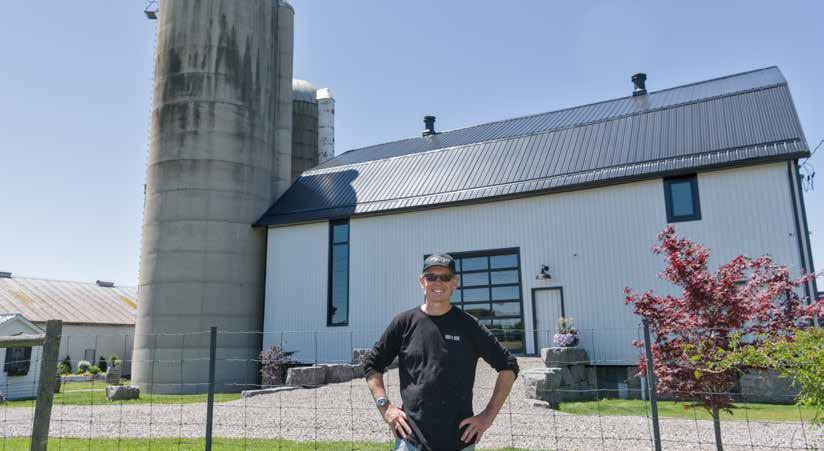
Taylor, a well known chef with an impressive culinary CV that includes stops at several prestigious restaurants before he opened his own upscale farm to table restaurant in Fonthill called Root and Bone several years ago, has taken on a new challenge in an effort to provide a true farm to table experience. After a decade-long search, six months ago he found the property of his dreams. A former dairy operation only eight minutes from the restaurant, the farm will complete a circle Taylor has been looking to close for a long time..
“We want people to come and feel - to experience - the process,” Taylor said as he showed off the property.
And while there has been a transformation to the Effingham Road property, Taylor’s maintained its, pardon the pun, the farm’s roots.
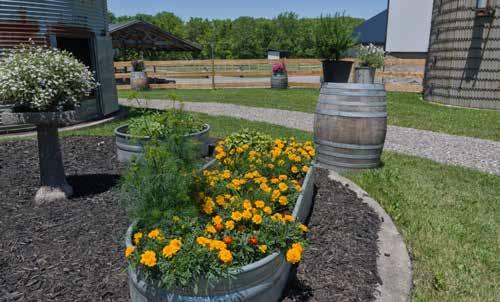
“This is a working class farm,” he said, as he walked behind the barn, and through a small garden
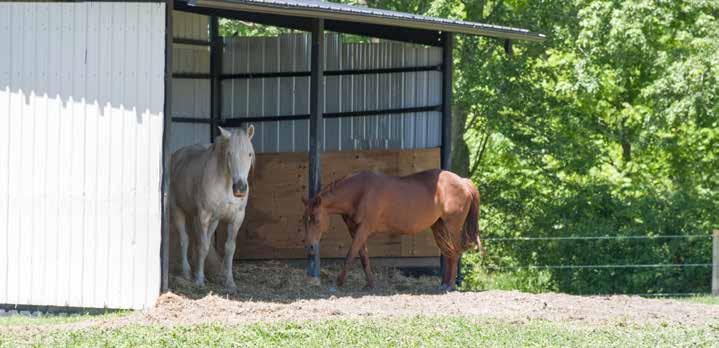
patch with beans, kale, zucchini and heirloom tomatoes. Two aging horses - enjoying their retirement on Taylor’s farm after a working career elsewhere - stand in the shade in a pen behind the garden.
Taylor’s idea is multifaceted. To start, the farm will provide for the restaurant, and the restaurant will help fund the farm. Root and Bone restaurant’s menu will reflect what’s in season on his farm.
When the raspberry bushes in the forest at the back of the property begin producing, expect plenty of raspberry items on the menu. When his chickens lay eggs, Taylor will take them to the restaurant and get cracking.
But the farm will also be an educational tool. With intimate private events, visitors can tour the farm, learn what goes into growing food, and then head over the short eight-minute drive to the restaurant for a meal utilizing the very farm they just toured.
Taylor said it will fill a desire many people have.
“People want to know where their food comes from, they want to see it,” he said.
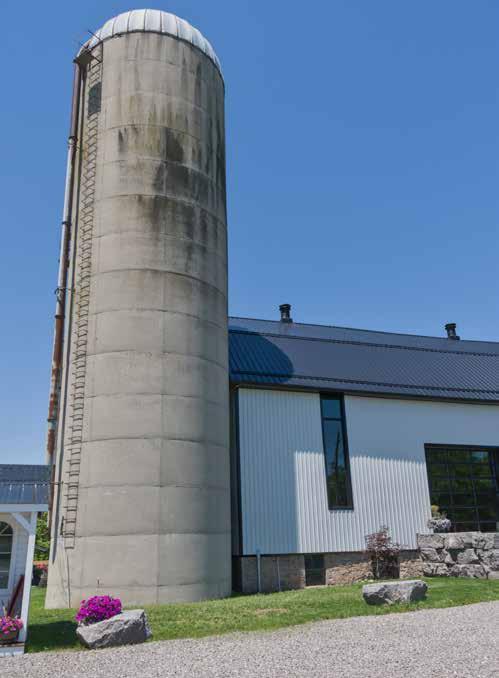
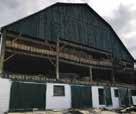
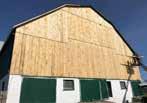
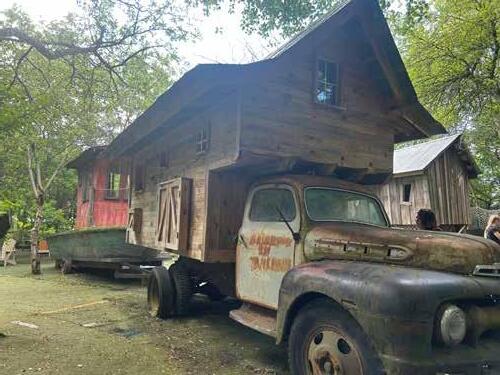
Those tours will begin in an old swing beam barn Taylor’s refurbished. Dating back to 1836, it
Continued to page A4

Publisher
Editor
Business Development
Stewart Grant • stew@granthaven.com
Luke Edwards • luke@granthaven.com
Heather Dunbar • heather@granthaven.com
Graphic Design
Erin Parsons • niagarafarmsnewspaper@gmail.com
Billing Administrator
Jen Gaetan • jen@granthaven.com
Contributor
Ann Marie Chechalk

Restoring small-town journalism, one community at a time!

Continued from page A3
still feels like a barn - an old rack lifter sits inside - but has a modern twist.
Next to the barn is a market stand, where Taylor will sell excess produce, or honey from his beehives, along with items like loaves of sourdough to the public.
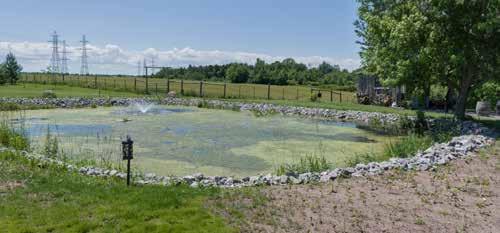
He’s looking to bring more animals to the property as well, including goats and a donkey. And a pond next to the barbecue space will one day be where he farms trout.
With trails behind the property that stretch throughout a large forested area, Taylor said visitors can spend hours touring. And he’ll be foraging the forest for wild berries, mushrooms and other treats.
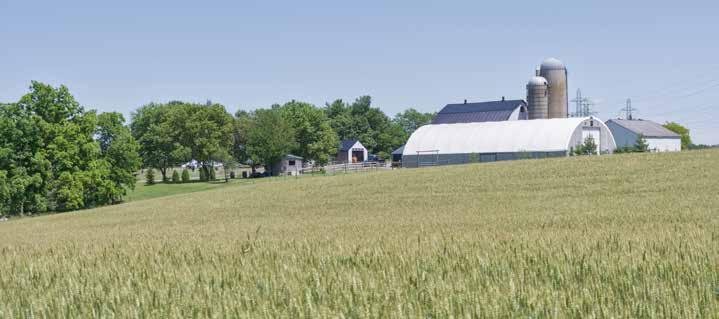
The farm has 30 acres total, and plenty of spots provide picturesque views. He rents a portion out to a local farmer who’s growing wheat. The view from the back of the property overlooking the wheat field with the barn in the background could have been an inspiration for Van Gogh.
Getting the farm ready hasn’t been easy, especially when he’s still running the restaurant. His father was a farmer, but much of the process has been new to Taylor. And he’s still learning as he goes. For instance, last month he was stumped as to why his heirloom tomato plants weren’t quite as strong as he’d like.
As Taylor continues to work on the property, he’s held a couple small private events. He expects to open the market stand this month.
He encourages those interested to follow along on the Root and Bone Farm journey on Instagram at the handle, @ rootandboneca.






By Ann Marie Chechalk
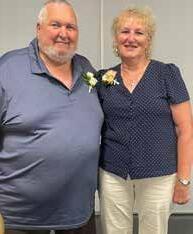
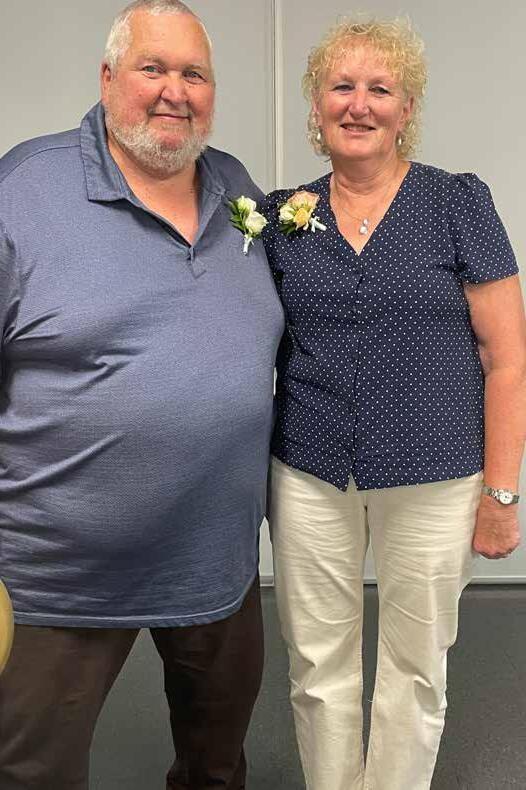
The West Niagara Agricultural Society is “incredibly proud to celebrate two of our long-time volunteers, Harry and Annette VanMarrum.”
They were recognized with a lifetime community volunteerism award at the Township of West Lincoln’s 2026 Community Recognition Awards, held on June 23.
“Their years of dedication, generosity, and commitment have made a lasting impact on our organization and our community,” WNAS said in an announcement about the recognition.
Harry and Annette are not just known for their great volunteerism at the WNAS. It began as their six children took part in hockey and in soccer, which made coaching part of the beginning of their journey.
“I said to Harry, ‘can I coach soccer?’ And he said I could do anything. It was always Harry behind me encouraging me to try things. We did everything together,” Annette said.
Annette and Harry went on to lead the 4-H Poultry Club, Horse Club and Horse Judging club and assist with the Plowing Club. They volunteered at their children’s school and at their church. They embraced the local fair and were often found working at the Smithville Fair.
When the Lincoln County Fair and the Smithville fair amalgamated they were part of many of the major decision making points. But not just in making decisions, they were there putting
up and taking down horse stalls, assisting with parking, welcoming visitors, and doing any jobs necessary.
Annette would go on to be the fair president for four very challenging years as the new fair grew into what it is today. During her time as president, Annette helped lead the society through ONCA compliance by updating the constitution and bylaws, establishing a sponsorship program, and continuing improvements to the buildings and property. She also represented the society at district meetings, conventions, 4-H dinners, and organized volunteer appreciation events.
Harry held a great passion in supporting the Canadian Foodgrains Bank initiative by coordinating crop rotations with Twenty View Farms on the WNAS grounds. The crops grown helped support efforts to fight world hunger, with government contributions matching up to four times the value raised.
Harry strongly believes in the importance of the future of agriculture and ensuring that future generations understand where their food comes from and how it reaches our tables.
Let the celebrations continue as they celebrate being together for 50 years this summer. The VanMarrums are what partnerships and volunteering is all about.
Their friend Ann Buys sums it up very well: “Harry and Annette make an awesome team, thank you for promoting agriculture.”

By Grant Haven Media Staff
McGill University researchers are hoping woodlot owners will help them see the forest and trees.
A survey in partnership with the Canadian Forest Owners and with support from MITACS Canada has been launched to offer a picture of forest coverage in Canada that’s in private hands. It’s the first of its kind in 20 years and includes a significant focus on Ontario.
“Ontario’s woodlots play an important role in supporting local economies, supplying forest products and delivering environmental benefits,” said Andrew de Vries, CEO of Canadian Forest Owners, in a press release. “Yet we are lacking information about who owns these forests, how they are managed and what motivates those who steward them. This survey will help close that knowledge gap.”
There are an estimated 480,000 private forest owners in Canada, who make up about 10 per cent of the country’s managed forest land but who contribute about 20 per cent of the country’s forest production.
The survey seeks information on forest area and also asks landowners about their goals, priorities, challenges, opportunities and management practices.
“Without basic information about who forest owners are, supporting them becomes difficult,” said Jackie Hamilton, a postdoctoral researcher in natural resource sciences at McGill University. “In Ontario, and many provinces across Canada, identifying and reaching forest owners remains a challenge. As a result, their perspectives are often missing from science, policy, and planning discussions.”
The private forest land base in Ontario is large and diverse, but researchers say limited

Owners of forested property in Ontario are encouraged to fill out a short, 20-minute survey to help researchers at McGill University, as well as the Canadian
data makes it a challenge for them, other organizations and for government to understand ownership patterns, management objectives and contributions the lands make to Ontario’s economy and environment.
“The survey is an essential step toward better understanding the needs and motivations of woodlot owners across the province,” said Glen Prevost, executive director of the Ontario Wood-



lot Association. “Ontario’s woodlot owners are deeply connected to their land and committed to responsible forest stewardship. Having good information will help ensure policies and support programs are able to meet their needs.”
Woodlot owners are encouraged to participate by completing the confidential survey, which takes approximately 20 minutes to complete, at forestowners.ca/about/survey.





By Niagara Farms Staff
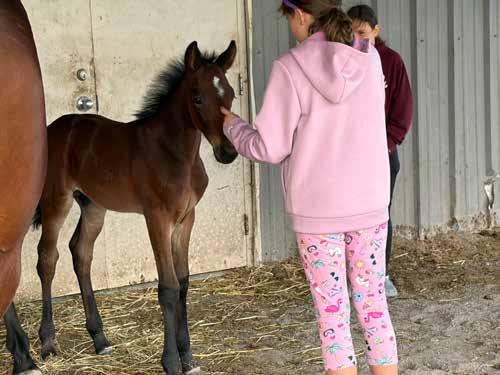
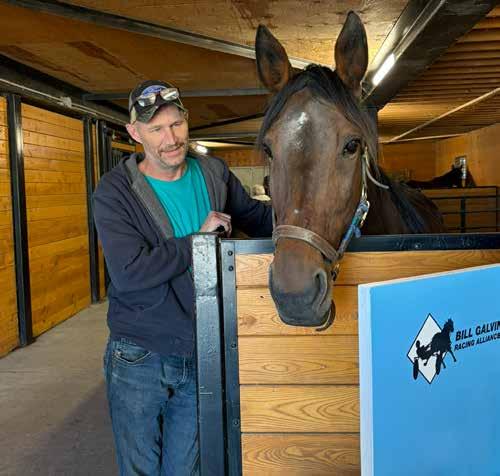
The mares and their foals were the stars of the show as the Rankin family once again opened their farm up to the public.
Harness racing enthusiasts, Tom and Beth Rankin have for several years held an annual open house at the end of May on their St. Catharines farm as a way to introduce the public to the sport, and horses in general. The open house doubles as a chance to promote the Bill Galvin Racing Alliance, and the organization’s annual youth literary and art derbies.
“We are so grateful to the Rankins for making the effort to welcome so many people to their farm,” said BGRA director Karen Hauver in a press release. “They’ve been so supportive of the Bill Galvin Racing Alliance since its inception in 2023. We also want to thank all of Tom’s staff for making the day so enjoyable; it is a big undertaking and we really appreciate it”.
Visitors were able to meet six mares and foals in the field. Two more mares were in the barn getting close to foaling.
All told, organizers counted 355 visitors throughout the day, a record for the event that is in its fourth year. For some, it was their first time getting up close to a foal. Among the visitors were an art teacher who brought her students, spending their time at the open house drawing and photographing horses for their submissions to the art and literary derbies.
Submissions for the derbies are being accepted through the end of August. More details and contest rules can be found under the contests tab at bgracingalliance.ca.
The Rankins said they were pleased with the day and the turnout.
“My wife and I thought it was a wonderful day,” Tom Rankin said. “To see the smiles and gratitude of those attending made our day.”


By Luke Edwards
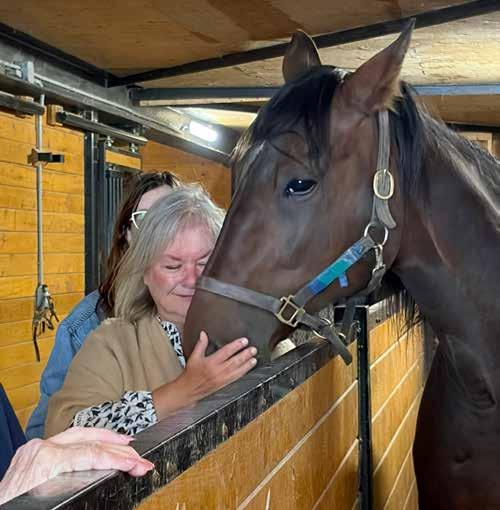
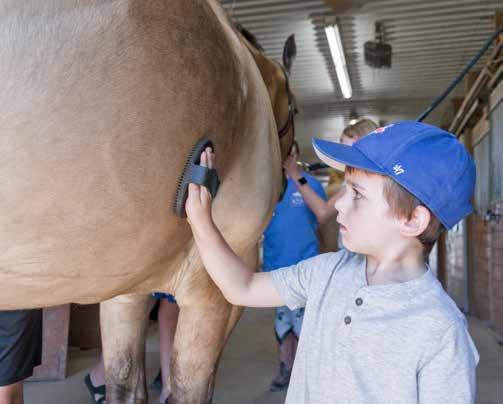
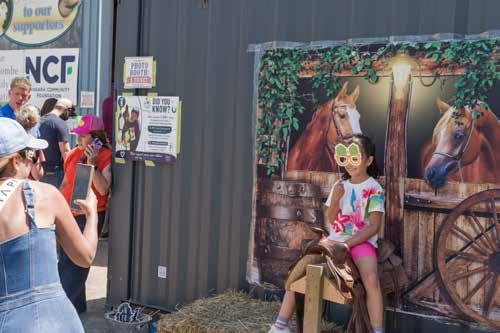
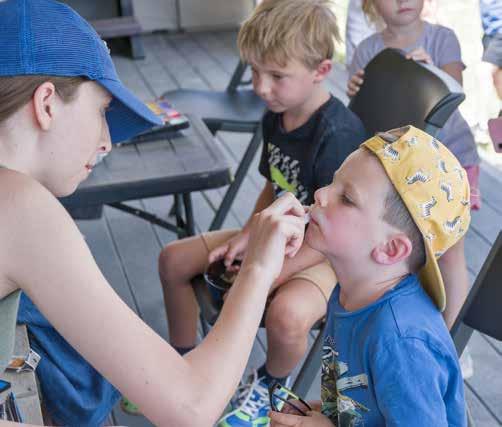
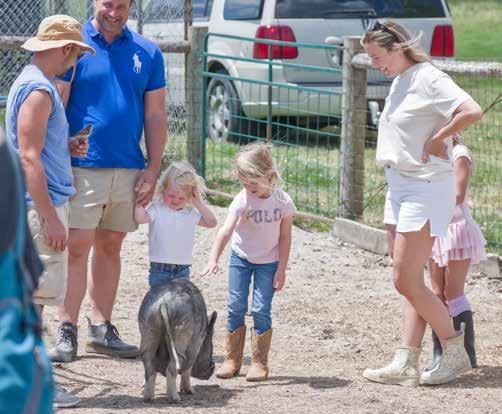
Visitors to the Horse Sense for Kids open farm event last month were excited to see the animals, play some games and enjoy a relaxing afternoon on the farm. But they were also thrilled to support a worthwhile cause.
As Appolonia Wilson smiled from ear to ear while going for a ride on one of the farm’s horses, her mom Karen offered her thoughts on the program that provides equine therapy to young people throughout Niagara.
“It’s such a good program,” the St. Catharines woman said.
Run by Brenda and Rob Langendoen at their BnR Stables in Fenwick, HSFK offers programs where young people can learn riding and horsemanship skills. They also partner with organizations like Pathstone Mental Health and the Niagara Region Native Centre to identify kids who could benefit from the programs and offer it free of charge. The programs can help develop self esteem, confidence, emotional awareness and regulation, and other vital life skills for
young people who may be struggling.
Brenda Langendoen said the day was a wonderful success, with about 300 people attending and approximately three quarters of them visiting for the first time.
“The continued support we receive from our community means so much to all of us at Horse Sense for Kids,” she said.
“Seeing so many new families visit the farm, watching children experience horses for the very first time, and feeling the incredible energy created by our volunteers and supporters reminds us why this work matters. Every person who attended, volunteered, sponsored, or donated helped create meaningful experiences for children and families, and we are deeply grateful for the community that continues to believe in our mission.”
While it’s free to attend, tickets were sold for those who wanted to take part in the games and activities. Money raised helps support the HSFK program.
There was also an online auction held in conjunction with the open farm event. All told, they raised $7,700 for HSFK.

By Luke Edwards
While the evolution of the business has been anything but straightforward, the idea behind Farm Gate to Your Plate has always been a direct connection between food and the consumer.
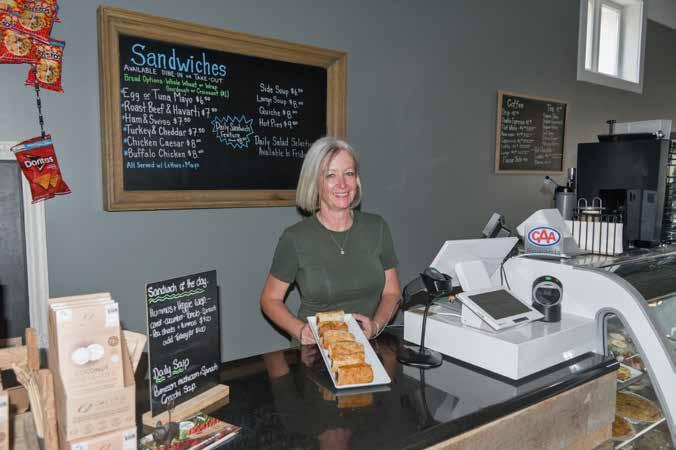
And that idea has taken on a new meaning now that the Grimsby business has taken over the full storefront on Main Street downtown. While still offering the organic chicken, grassfed beef and pasture-raised eggs they became known for after opening in 2007, Lisa Sproston and her small team of dedicated employees are now offering a range of sweets, treats, coffee, and lunch items in their newly renovated marketplace.
The idea is to become something of a onestop shop where customers can come for a cup of a coffee, and pick up the steak for the weekend alongside a loaf of bread and eventually a bottle of wine.
And it appears the idea is gaining traction, Sproston said.
“The feedback we’ve been getting from customers has been fantastic,” Sproston said.
“It’s teaching me that Grimsby’s a very supportive community. They really do care about what’s going on.”
The business started after Sproston and her then-husband Andy moved to the area from England. Back home, they were accustomed to small farm stores all over the place, stores that didn’t really exist locally.
“So we started up with a few animals for ourselves and it kind of grew from there,” she said.
Farm Gate to Your Plate opened in 2007, and the business developed a loyal customer base. Eventually the couple separated and Andy maintained the business. However, he developed health issues that eventually led to his death in 2022.
Lisa then came back into the fold and two years ago moved to the new location at 35 Main St. West. For a time they shared the shop with another bakery, but when they left, Sproston was left wondering what to do.
Local business owner Simon Duong expressed an interest in opening a wine shop. But then he decided to run for mayor and realized he didn’t have the time.
So Sproston threw caution to the wind, talked to her landlord and expanded Farm Gate to Your Plate.
One of the keys to making the new venture a success is knowing where her skills are lacking. For instance, baking and breadmaking is not her forte, so she hired someone to take care of the sourdoughs and pastries. Sproston said it’s worked out well.
With daily sandwich specials that get switched up each month, along with salads and soups, Sproston said they’re becoming a popular place for a sitdown lunch. And with a nod to her English roots, she offers a sausage roll that’s become a favourite.
“Our sausage rolls are starting to get a bit of a reputation, we struggle to keep up with those, and they’ve been going really well,” she said. Their sourdough cinnamon rolls are also a popular attraction. And for takehome items, Sproston said the focus is on simple, basic meals done well. A classic Italian lasagna is one of their bestsellers, for instance.
At the same time, they’re continuing to sell the beef and chicken they became known for. Most of their suppliers are fairly local, and Sproston estimated about 95 per cent of their products are Canadian.
Plans are in place to open a patio, eventually, and be able to sell wine.




They’re located at 35 Main St. West. For more information visit the Farm Gate to Your Plate Facebook page.
By Niagara Farms Staff
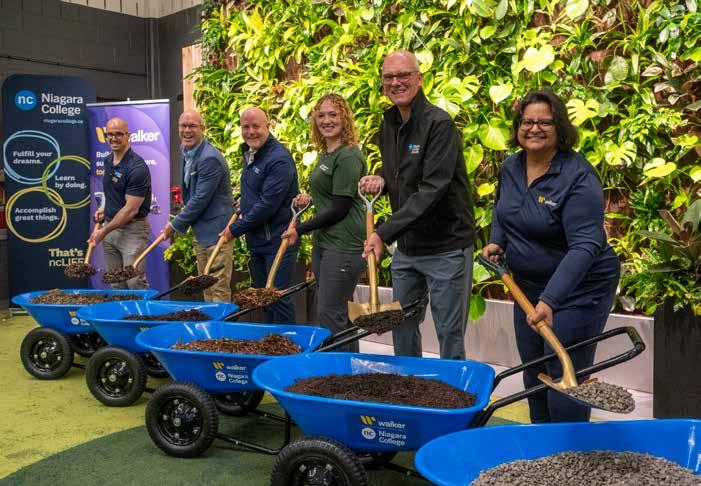
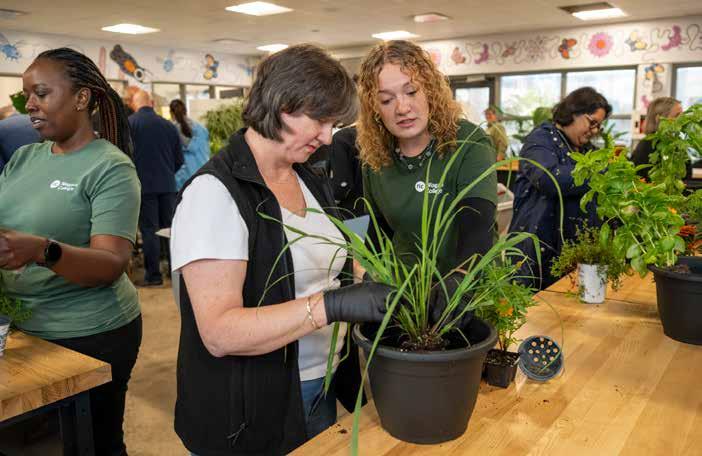
A longtime partnership has sprouted a new agreement, as Walker Industries will be providing horticulture students at Niagara College with soil, mulch and growing media.
The college announced the formalized agreement that will see Walker Industries provide 500 cubic yards to the school each year. It builds on a long standing partnership that has seen Walker support the college with equipment gifts, foundational support for the College’s Walker Advanced Innovation Centre, and more.
These contributions will help students in the School of Environment and Horticulture, while also supporting campus beautification, greenhouse production and hands-onlearning opportunities for students across several programs.
“Niagara College’s partnership with Walker Industries runs deep and, with this agreement, our shared commitment to environmental stewardship is quite literally woven into the very soil of our campus,” said NC President Sean Kennedy in a press release.
The high-performance growing media will be used in greenhouse trials, before plants are transferred across campus for environmental remediation work. Some of that includes erosion control and prevention against the spread of invasive phragmites.
There are also plans for formal product validation trials at the college’s Horticultural and Environmental Sciences Innovation Centre.
With the partnership the college is able to further its sustainability priorities and promote circular economy ideas.
“This collaboration is a powerful example of how industry and academia can co-create solutions for a more resilient future. By integrating Walker’s sustainable innovations into our learning environments, we are advancing our sustainability goals while providing our students with unparalleled exposure to the cutting edge of a green economy,” Kennedy said.
For Walker, the agreement helps promote hands-on learning and prepare the next generation of industry leaders, said President and CEO Geordie Walker.
“Meaningful progress happens when industry, education, and community partners come together with a shared purpose. We are proud to work alongside Niagara College to support experiential learning, advance awareness of sustainable growing solutions, and help raise the standard for environmental stewardship together,” Walker said.


Submitted photos

By Luke Edwards
The greenhouse may be a little smaller, and the plants kept to his backyard, but there’s something about growing flowers and vegetables that Bob Martin just can’t quit.
Martin, whose family farm developed the Veggie Guy brand and supplied large retailers like Loblaws, recently received an honorary diploma from Niagara College, during the institution’s spring convocation last month. The Vineland man spent his life on the family farm and greenhouse operation, and sat on several boards, including at Niagara College.
“It’s still, at its roots, family and community,” Martin said about the industry he was a part of for most of his life.
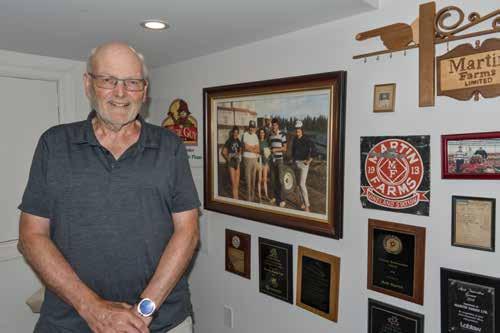
Though he describes much of his involvement as if it were just a matter of being “right place, right time” or as simply being among a collection of talented and knowledgeable people, Martin’s bonafides shouldn’t be understated. After all, the family farm goes back to one of Vineland’s most famous people: Moses Rittenhouse, or “Uncle Moses” as Martin calls him.
Rittenhouse gave a section of his farm to Martin’s grandfather, Leo Martin Sr. In the early 1900s it operated as a mixed vegetable farm, selling to local grocery stores and maintaining a stall at the St. Catharines Farmers Market.
Then, in 1929 they got into greenhouse production, growing plants for other farmers.
Over the years they would continue to evolve. They developed the Veggie Guy brand and would supply large retailers like Loblaws, as well as independent garden stores.
While the business evolved throughout the years, Martin said its core remained the same: grow-
ing plants. So whether that was cauliflower, celery and peppers in a field or flowers or vegetable seedlings started in the greenhouse for a home gardener to buy, Martin kept a simple focus.
It’s something he hasn’t entirely given up, despite selling the business in 2019. Martin’s backyard features a wide array of plantsboth ornamental and vegetables - he tends to. And off to the side is a small greenhouse.
Martin’s entry into postsecondary education hit an early snag. Like any good farmboy he went off to study ag sciences at the University of Guelph. It didn’t take long for him to realize his error.
“I realized ag sciences was not going to be a success,” he said. However, enjoying his time off the farm, Martin switched to business and eventually got a degree in economics.
It was at Guelph that the first of his many “right place, right time” adventures took place, and it had nothing to do with farming. Martin recalled attending a meeting about the campus’ radio station. Being the only person who showed up, he was offered a job as a show host. It was something he’d do throughout his university life.
After his formal education - his curiosity keeps Martin learning even to this day - was complete, he returned to the family farm. In time, he would get involved in other boards and organizations, including Flowers Canada (Ontario), The Ontario Greenhouse Alliance, and eventually served on an advisory board for Niagara College’s horticultural programs and chaired the college’s Foundation Board.
“I was so lucky to be sitting around at the table with all these good growers,” he recalled.
Martin looked back fondly on his involvement with the college,
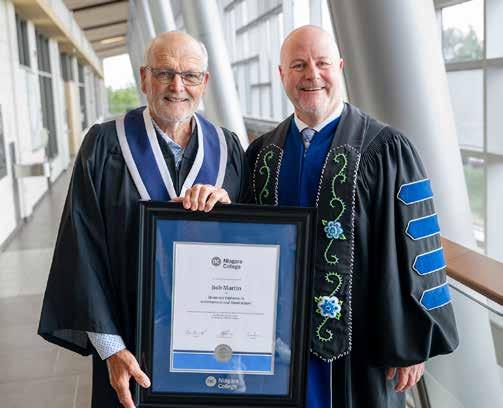
saying it’s become a vital part of the industry, as Ontario looks to produce its next generation of growers.
“What this industry needs is really good growers,” he said.
When Martin received his honorary degree, he was given a few minutes to address the graduating class. During his address, Martin told those in attendance that even though they were graduating, their opportunities to learn shouldn’t end.
“Don’t stop striving to learn more,” he told them.
And the industry has grown by leaps and bounds, Martin said. The decisions growers make today are based on information and considerations that Martin said would be foreign to the growers of his earlier years. He said he stepped back from his roles with the college when he realized it was time for the next generation to take the reins.
By Luke Edwards
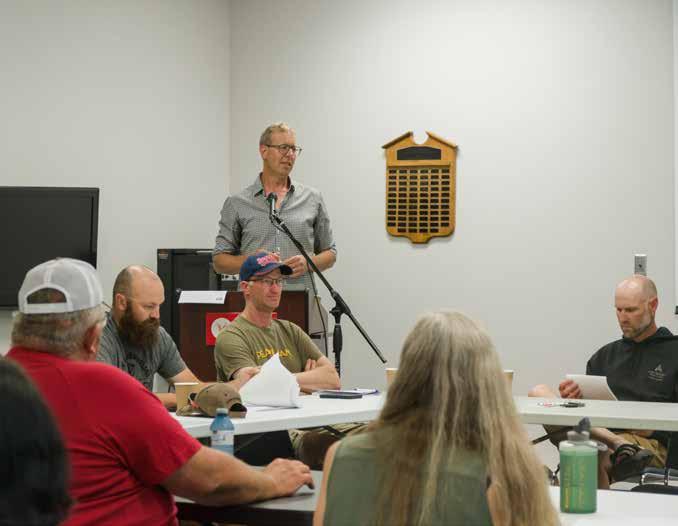
Plans for the Niagara Federation of Agriculture to incorporate as a non-for-profit organization will help it secure funding in the future, its president says.
The NFA held a special meeting last month to discuss the plans after the board supported the move. Members in attendance agreed with the board in general, though there remain some details to be ironed out in the coming months.
“It was really because we came up against a number of road blocks,” NFA President Chris Mullet Koop, explaining the decision.
Incorporated not-for-profit organizations tend to have an easier time applying for funding through granting agencies. The new structure also provides better liability protection for directors and officers.
Mullet Koop said other similar groups have undergone the process and the board reached out to a lawyer who had experience in this area.
“We didn’t want to reinvent the wheel,” he said.
The board did require membership support to implement a few changes to push the move forward. That included voting to move the membership under the new organization and having the current board move into director positions in the newly incorporated organization and continue their term.
Finally, the NFA’s constitution needs to be transferred into the new organization as bylaws. It was this decision that caused some discussion among the members, as they looked for more clarity, better wording and consistency throughout.
The move into a new incorporated not-forprofit structure
allow
tweak and finalize the bylaws. Members ultimately decided to table those talks for the time being.


By Luke Edwards
As the old saying goes: don’t bring a knife to a gun fight. But if you don’t know who you’re fighting, how can you know what weapon is best?
Members of the Grbic Lab at Western University are working on ways to help commercial greenhouse growers better identify their spider mite enemy, with the hopes it will mean growers will be able to more efficiently and quickly deal with future infestations. They were one of the presenters at last month’s Grower Day, held in St. Catharines.
“We want to catch spider mite before we’re seeing a significant amount of damage,” said research assistant Reagan Sue Michiels.
Vojislava Grbic, a professor in the biology department at Western University, described one situation where a greenhouse operator applied five pesticides that did effectively nothing to the spider mites he had in his facility.
“It was only the sixth that ended up being efficient,” she said.
Part of the problem is that different spider mite species require different pesticides. On top of that, while a few mites may not do much damage, adult females can lay 10 eggs a day.
“It very soon gets out of control,” Grbic said.
So lab members have been working to develop a rapid-result test that growers can do themselves to determine which pesticide to use. It allows them to get a result in as little as three years and within 24 hours in most cases.
“Essentially what we’re trying to do is allow you to make rapid pest management decisions,” said Michiels.
A video of a trial showed the relative simplicity of the test. All growers need to do is get some mites into a vial, wait for the prescribed period of time, and see if they died.
They’ve also been doing plenty of work on spider mite species identification, including an in-lab genetic test that can offer insights into any pesticide resistance that growers may have to contend with in a given infestation.
In recent years new spider mite species have been identified, including Tetranychus turkestani, which currently mostly affects field soybean crops. However, they could be a problem should they find their way into greenhouses.
“It’s clear how devastating they might be in a greenhouse setting,” Grbic said.

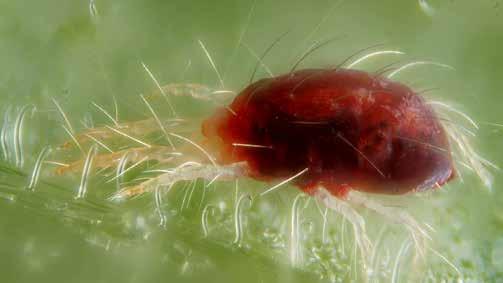
Spider mite populations in greenhouses can quickly grow and wreak havoc on plants. Western University’s Grbic Lab is working on better understanding spider mite species, resistance to pesticides and developing tools to help growers more quickly and efficiently deal with the pest.
Grbic said they’d love to work more with growers to continue developing a better understanding of spider mite populations in Ontario.
At the same time, the Grbic Lab has also teamed up with Greenlight Biosciences to bring a new pest control option to Canadian greenhouse operators. Using RNAi technology, the new tools can perform a similar function as a traditional pesticide, but just one step earlier in the process.
A conventional pesticide uses a chemical to bind to certain proteins the mites need to survive. Without
being able to use those proteins the mites then die.
The RNAi process essentially does the same thing, though instead of smothering the protein after its made, it prevents the protein from being made in the first place by targeting the genetic instructions used to produce it.
Grbic said they have high hopes that the RNAi technology will offer growers a new option for pest management, in addition to conventional pesticides and biological controls.







As prime patio season starts, many will be searching out their favourite pub or winery and enjoying the scenery from a lovely patio.
And with that comes the craving for a tasty appetizer.
Those who prefer their own home deck or patio can still enjoy some delicious snacks alongside their beverage of choice.
Here are a few appetizers to try for the next backyard get together, courtesy our friends at Foodland Ontario.

Chicken Lollipops with Sweet and Sour Sauce
Ingredients
Chicken Lollipops
• 1 lb (500 g) boneless skinless Ontario chicken breasts (about 2)
• 1 tsp (5 mL) dried oregano leaves
• 1/4 tsp (1 mL) salt
• 3 tbsp (45 mL) plain yogurt
• 1/2 cup (125 mL) dried panko crumbs or dried bread crumbs
• 1/2 tsp (2 mL) paprika
• 1 tbsp (15 mL) vegetable oil
Sweet and Sour Sauce (Makes 1-1/4 cups or 300 mL):
• 1/2 cup (125 mL) ketchup
• 1/4 cup (50 mL) each apple cider vinegar and peach jam
• 2 tbsp (25 mL) each apple juice and Ontario honey
• 1/2 tsp (2 mL) garlic powder
• 1/4 tsp (1 mL) each salt and pepper
Instructions
Line baking sheet with parchment paper. Slice chicken lengthwise into 1/2-inch (1 cm) wide strips. Stir oregano with salt; sprinkle over chicken.
Place yogurt in a small bowl; set aside. Stir panko, paprika and oil in small bowl. Roll each chicken strip into spiral; insert small skewer through each to hold like lollipop. (End pieces will be smaller, so roll with another strip.) Brush chicken all over with yogurt. Dip into and sprinkle with panko mixture, pressing to adhere. Set on baking sheet. Bake in 425°F (220°C) oven until golden and no longer pink inside, 5 to 6 minutes a side.
Sweet and Sour Sauce: In bowl, whisk together, ketchup, apple cider vinegar, peach jam, apple juice, honey, garlic powder, salt and pepper. Serve right away or transfer to air-tight
container. (Make-ahead: Cover and refrigerate for up to 1 week.)
Serve sweet and sour sauce with chicken lollipops.

Ingredients
• 1 medium Ontario beet, cooked, peeled and julienned
• 12 oz (375 g) cream cheese, at room temperature
• 3 tbsp (45 mL) chopped fresh dill
• 6 large flour tortillas (plain or flavoured)
• 2 ears Ontario corn, husked, cooked and kernels removed
• 1 cup (250 mL) Ontario snow peas, julienned
• 2 cups (500 mL) Ontario mung bean sprouts
• 1 bunch fresh coriander, washed, dried and stems removed
Instructions
In food processor, purée beet or leave in strips. Add softened cream cheese and combine until smooth. Add dill.
Lay tortillas on work surface; evenly spread cream cheese mixture over each, spreading just to edges. Make even rows of corn, snow peas, sprouts and coriander on cheese, leaving 2-inch (5 cm) uncovered at top. Press toppings lightly into cheese mixture. Roll up snugly. To serve, slice diagonally and fasten each slice with toothpick.

Ingredients
• 1 baguette, sliced diagonally into 12, 1/2inch (1.25 cm) pieces
• 2 tbsp (25 mL) olive oil
• 1 ball (250 g) Ontario burrata cheese, sliced
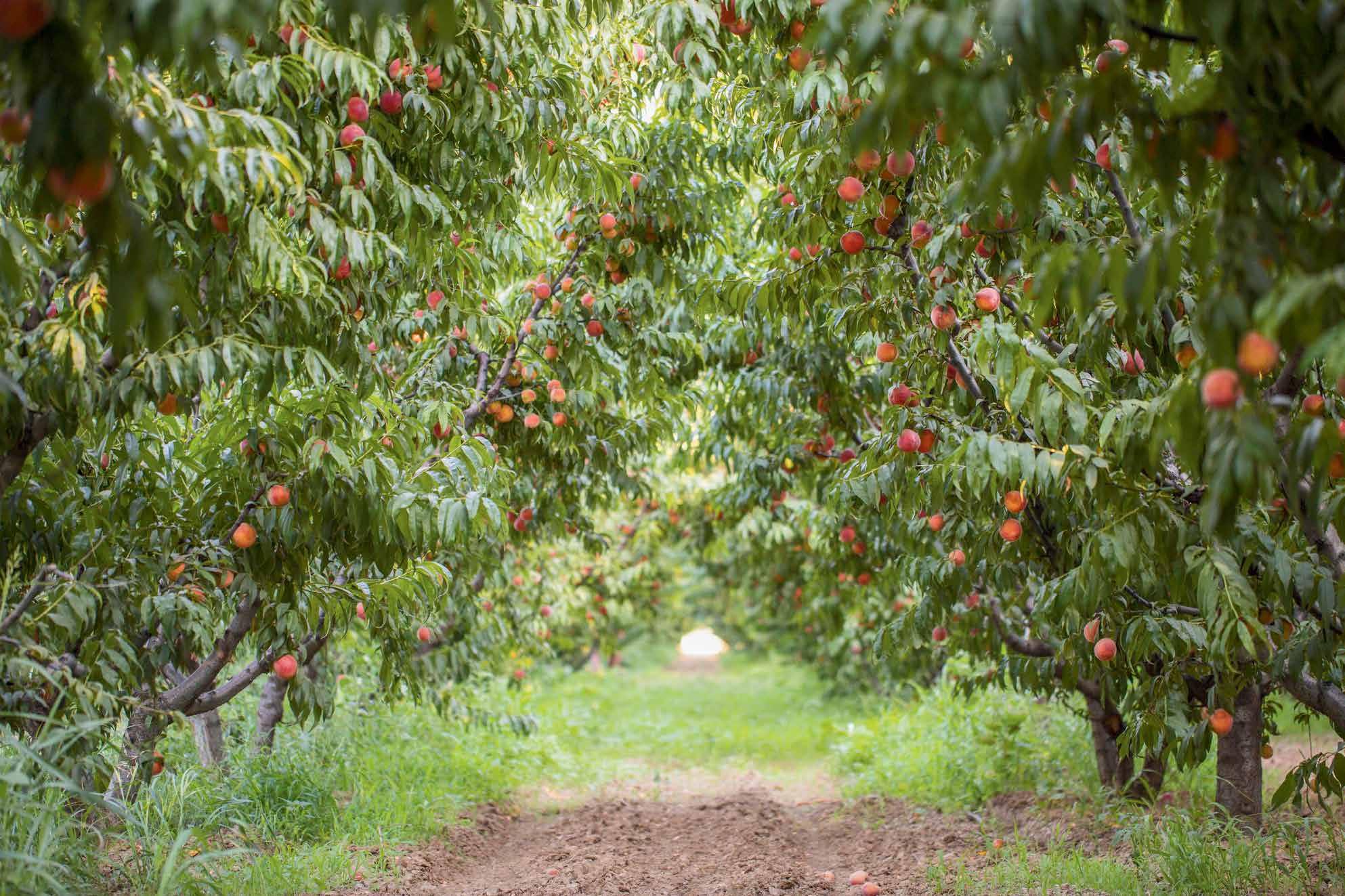
• 2 Ontario peaches, thinly sliced
• 6 fresh Ontario basil leaves, chopped
• Ontario honey
• Freshly ground black pepper
Instructions
Preheat barbeque to 400°F (200°C). Brush both sides of baguette slices with olive oil. Grill, turning until golden brown, about 90 seconds.
Top each baguette piece with burrata and peach slices; sprinkle with basil. Drizzle with honey; season with black pepper. Serve immediately.
Tip: If you like, peel the peaches. Immerse each peach into boiling water for 30 seconds. With slotted spoon remove to bowl of ice water to chill. Skins should peel off easily.

Ingredients
• 2 each peeled Ontario carrots and beets
• 1 small peeled Ontario sweet potato
• 1/2 small peeled Ontario rutabaga, cut in half
• 2 tbsp (25 mL) canola oil
• Salt
Instructions
Using a mandolin or vegetable slicer, thinly slice vegetables. Place beets in a separate bowl; toss with 1-1/2 tsp of oil. In another bowl combine carrots, sweet potato and rutabaga; toss with remaining oil.
Line 2 large baking sheets with parchment paper; arrange half the vegetable slices in single layer on sheets. Bake in 400°F (200°C) oven for 15 minutes. Reduce heat to 250°F (120°C); bake for about 45 minutes, switching and rotating baking sheets halfway through and turning slices, or until crisped and browned. Sprinkle with salt to taste. Repeat with remaining vegetables. Cooking Tip: Vegetables will crisp and brown at different rates, so remove as needed.
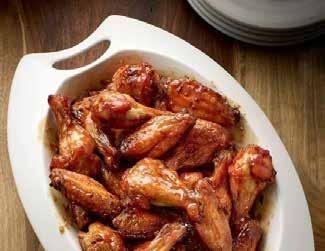
Ingredients
• 2-1/2 lb (1.25 kg) Ontario chicken wing pieces (no tips)
• Salt and pepper
• 1/2 cup (125 mL) Ontario maple syrup
• 1 tbsp (15 mL) each Dijon mustard and soy sauce
• 1/4 tsp (1 mL) crushed red pepper flakes
• 1 clove Ontario garlic, minced
Instructions
Line large shallow rimmed baking pan with parchment paper. Arrange chicken wing pieces in single layer on pan. Season with salt and pepper. Bake in 400°F (200°C) oven for 30 minutes.
Meanwhile, in small bowl, whisk together maple syrup, mustard, soy sauce, red pepper flakes and garlic.
Drain fat from pan. Pour maple sauce over wings; toss to coat evenly. Bake 20 minutes, turning once, until wings are cooked when pierced with knife.
Move pan to upper rack in oven. Broil until wings are brown and crispy, turning wings as needed, 1 to 2 minutes.
Place on large platter and let cool about 10 minutes before serving. Season to taste with salt and pepper.





Ingredients
• 1/2 cup (125 mL) butter
• 250 g Ontario mushrooms, finely chopped
• 1/4 cup (50 mL) finely chopped Ontario shallots
• 1 tsp (5 mL) dried tarragon leaves
• 1/4 tsp (1 mL) salt
• 1/4 cup (50 mL) grated Ontario asiago
• 1/4 cup (50 mL) chopped fresh Ontario parsley
• 6 sheets phyllo pastry
• 3 tbsp (45 mL) coarsely chopped fresh Ontario parsley
Instructions
In large skillet, melt 2 tbsp (25 mL) of the butter over medium heat. Add mushrooms, shallots, tarragon and salt; cook, stirring often, until mushrooms seem dry, about 10 minutes. Turn into bowl. Stir in cheese and 1/4 cup (50 mL) chopped parsley. (If making ahead, cover and refrigerate up to 2 days.)
For rolls, melt remaining 6 tbsp (90 mL) butter. Lay 1 phyllo sheet on work surface with long end closest to you. Cover remaining phyllo with damp tea towel to prevent drying out. Lightly brush phyllo sheet with butter. Scatter phyllo with about 1 tbsp (15 mL) of the coarsely chopped parsley (parsley should be visible through phyllo after baking.) Top with another phyllo sheet and brush with butter.
Cut pastry sheets vertically into three 5-inch (12 cm) wide strips. Discard leftover thin strips. Mound about 2 tbsp (25 mL) filling, 1-inch (2.5 cm) from bottom of 1 strip. Pat filling into log shape, leaving 1/2-inch (1 cm) phyllo border on both sides. Fold in both long sides of phyllo strip, about 1/2-inch (1 cm) wide, bringing them up and over filling ends. Lightly brush folded sides with butter. Fold bottom edge of phyllo strip over filling and roll up. Brush roll with butter and place seam side down on nonstick baking sheet. Repeat process twice more making 9 rolls. Bake in 375°F (190°C) oven until golden, 13 to 15 minutes. Serve warm.









By Tamara Botting
The New World screwworm (NWS) isn’t currently present in Canada, and the Canadian Food Inspection Agency (CFIA) is working to keep it that way.
tally we are building value for the farmers of Canada. That means we (farmers) are part of conversations we haven’t been part of for a long time. Farmers realize they are part of the solution to a lot of things, like climate change mitigation, biodiversity, species-at-risk and flood control.”
One of the offshoots of Norfolk’s initial efforts occurred after Prince Edward Island environment George Webster attended the pilot launch in 2008. The island was having an environmental issue at the time and
Today, nationally ALUS is approaching 1,000 farmers participating
Bryan Gilvesy, now CEO of ALUS Canada, started his involvement with the program when he signed up as a participant to the program and then became a member of the Norfolk Partnership Advisory Committee. Bryan and wife Cathy raise Texas longhorns on the YU Ranch, south of Tillsonburg.
At the start of June, CFIA announced that it was implementing a temporary import restriction on livestock from parts of the United States after an NWS was found in a calf in Texas. As of time of publication, additional infestations have been found in other parts of Texas, and in New Mexico.
The NWS is a parasitic fly. The female fly lays its eggs in any openings it can find on living, warm-blooded animals, including livestock, wildlife, pets, occasionally birds, and humans, albeit rarely. The openings the female fly is looking for includes wounds from things like fighting, insect bites, shearing and docking; open skin as a result of surgical incisions or the navel of a newborn animal; and mucous membranes, such as the eyes, ears, mouth, nose and genitals.
Once the eggs hatch, the larvae (maggots) burrow into the host animal’s skin and feed on its flesh for approximately one week.
“If left untreated, screwworm infestations can result in serious wounds, infection and death,” the Government of Canada webpage on New World and Old World screwworm said.
After that, the larvae leave the wound and fall to the ground, where they burrow into the soil until they mature into adult flies, and so continue their life cycle.
The flies prefer hot, humid environments with an air temperature between 25 and 30 C, but can survive for a time at temperatures as low as 8 C.
Officially, ALUS Canada’s mantra now is: “ALUS Canada makes it ardship. ALUS invests in farmers and landowners who are producing acres of clean air, clean water, wildlife habitat
Credit was given to some of the programs largest advocates by Gilvesy. Local MPP
nent since the early days, and introduced a Private Member’s Bill promoting the concept.
moting it there. Bob Sopuck, who was Delta Waterfowl’s western vice-president of policy was an early advocate and became elected as an MP and was the program’s champion on Parliament Hill. Dave Reid co-wrote the
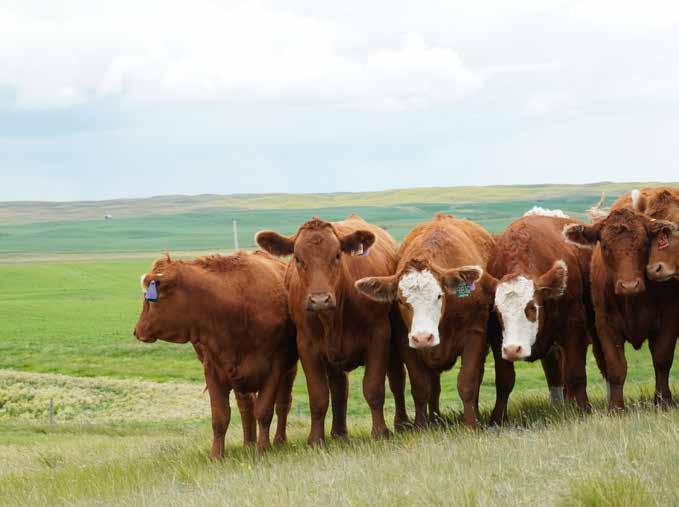
CFIA has implemented temporary import restrictions to keep Canadian livestock populations free of the New World Screwworm after the parasitic fly was found in a calf in Texas. ~ Farmphotos.ca photo
-7676 (519)
The news release from CFIA about the new livestock import restrictions said, “While our colder climate is not hospitable for the longterm establishment of the fly in Canada, they can survive shorter periods of time in the summer months.”
The threat of NWS is taken seriously; under Canada’s Health of Animals Act, veterinarians
sands of people about ALUS at hundreds of speaking engagements across Canada. Recognition for the program has included a Premier’s Ag Innovation Award
must be contacted immediately if there’s a suspected infestation.
Gilvesy is proud ALUS is a farmer-led program and farmers fell they are the program owners.
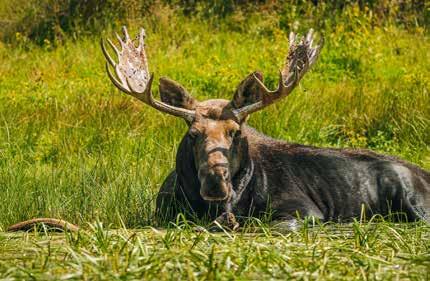
According to CFIA’s import restrictions as stated on its website, the livestock included under the new restriction are: equidae (horses, mules, etc.), suidae (pigs and wild boar), bovinae (cattle, bison and water buffalo), caprinae (sheep
“People feel they are partners in ALUS,” he said. “It’s the value of developing a grassroots program that recognizes the value of community.”
Continued to page A17



and goats), cervidae (deer, elk, moose, caribou and reindeer), and camelidae (llamas, alpacas, etc.)
The restriction applies to live animals entering Canada from affected U.S. states, and those returning to Canada from affected U.S. states. The restrictions don’t apply to meat, animal products or animal byproducts, as the NWS feed on living tissue; this is an animal health concern, not a food safety risk.
Live animals coming from a non-affected state in the U.S. are permitted to enter Canada, provided they didn’t live in or travel through an affected state – even if they didn’t stop in the state – within 21 days before being exported to Canada, and meet all of the other applicable import conditions.
Similarly, live Canadian animals returning to Canada are prohibited if they have lived in or traveled through an affected U.S. state – even if they didn’t stop in the state – within 21 days before returning to Canada. The animal would need to be moved to a non-affected U.S. state and remain there for at least 21 days before returning to Canada; again, they would also be required to meet all other applicable import conditions.
On CFIA’s website, it cautioned that several U.S. states are also taking precautionary measures to reduce the risk of NWS spreading, and “some U.S. states may also prohibit interstate movements without permits, certification and inspections. Canadian animal owners and exporters should check state movement requirements before travelling.”
Furthermore, “Animal owners and exporters cannot bring animals back to Canada using the original Canadian health certificate.”
While this information was up to date as of publication, animal owners and exporters must contact their local CFIA Animal Health District Office to confirm the current status of the NWS and the requirements for returning their animals to Canada.
If an NWS infestation is detected, the management and treatment protocols include isolating the infested animal(s) in a location where any larvae leaving the wound can be found and properly destroyed, to prevent the larvae from entering another host or the environment to start the cycle again. The wounds would also need to be cleaned and the eggs and/ or larvae removed.
The Government of Canada webpage notes that the NWS is found in parts of the Caribbean, Central America, South America and Mexico. (The OWS has never been permanently established in the Western Hemisphere; it’s found in parts of Asia, Africa and the Middle East).
Canada currently doesn’t allow cattle, bison, sheep, goats, cervids or swine to be imported from Mexico; while horses can be imported, there are stringent import conditions that must be met.
The NWS was eradicated in the U.S. in 1966; there was a localized outbreak in Florida in 2017, but that was successfully eliminated. The current outbreak in the U.S., which started in early June 2026, is ongoing as of publication; on June 21,
$275/yr $198/yr Continued from page A16
the United States Department of Agriculture (USDA) website was reporting 15 cases in the country (in Texas and New Mexico), 12 active and three inactive.
A July 2025 article titled ‘History of screwworms in the US,’ published on the Washington State University website noted, “There are no vaccines or biological products available for managing NWS, except for the use of sterilized male flies in the sterile insect technique (SIT).”
In this process, male flies are sterilized by gamma or x-ray irradiation and sequentially released into the wild in large numbers. When they mate with wild female flies, it will only result in infertile eggs, which reduces and eventually eradicates the population.
The article notes, “SIT is very expensive because of the cost of continuous production and aerial dispersion of sterile files. Historically, it has been considered cost effective only when used as an eradication strategy in situations where geography would favor such a program.”
To read the entire article, visit bit.ly/4eo1hgX.
Because NWS can affect any live, warm-blooded animals, the Government of Canada webpage notes, “Pet owners travelling with their animals to areas where screwworm is present should be cautious and inspect their pets for wounds or other signs of infestation. Travellers returning to Canada with pets or service animals should continue to monitor their animals and consult a veterinarian if signs or symptoms arise.”
The webpage gave a list of possible signs of screwworm infestation, which include:
• wounds that worsen over time
• discharge or foul-smelling odour from a wound
• visible maggots in a wound
• discomfort or irritation
• decreased appetite
• reduced milk production
• animals separating from the herd “Wounds infested by screwworms often attract other fly species, so it is common to have multiple fly species infestations in the same animal,” the Government of Canada webpage said.
While NWS feed on living tissue, many other fly species feed on dead tissue and/ or decaying organic material; laboratory identification is needed to confirm a diagnosis.














By Luke Edwards
Even though they spend all day on their feet performing tough physical labour, the Caribbean farm workers in attendance at last month’s Worker Welcome concert couldn’t help but get to their feet and put on their dancing shoes as the Toronto Mass Choir returned to the annual spring event.
With 2026 marking 60 years since the Seasonal Agricultural Workers Program began, organizers of the welcome concert wanted an event befitting the anniversary. So they brought back the choir that headlined the 50th anniversary event in 2016.
“It’s so wonderful to see all your faces again,” said Jane Andres, who for 20 years has helped or-

ganize welcome events to create a better connection between the workers who come to Niagara-on-the-Lake each year and perform vital agricultural work on our farms and in the orchards.
“We’re really going to feel the love tonight.”
Taking place at Cornerstone Community Church in Virgil, hundreds of locals and seasonal
agricultural workers took in the energetic performance of the choir. As they arrived workers received a green cooling towel that they’ll be able to use when the weather gets hot.
“Bright green means the beginning of hope and a new season,” Andres said.













Continued from page A18
But while they’re meant to cool people off in the hot summer sun, at the concert they were just another way to enjoy the music. As the choir got the crowd to their feet, many waved their green towels in unison.
Coun. Gary Burroughs, who was lord mayor for Niagara-on-the-Lake back in 2007 for the first welcome event, returned to offer greetings last month. His message provided a reminder of the impact the workers have, and not just in the fields.
“You’re helping shape not just the agricultural community, but our whole community,” he said.
“Your presence has enriched this community in ways that go well beyond the fields.”






By Luke Edwards
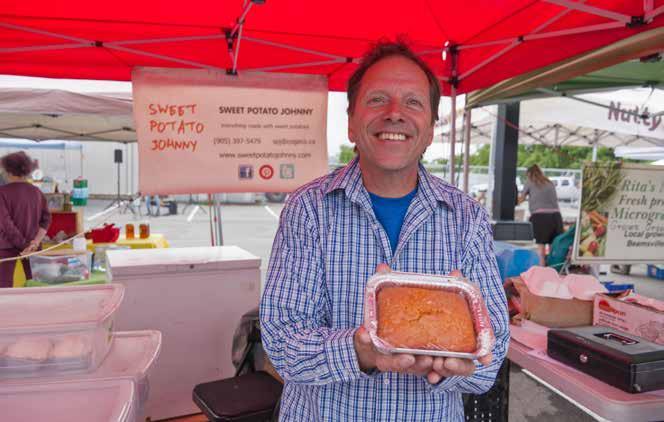
John Chabot owes his nickname, and in a way perhaps his business, to his friends at the Itty Bitty Pie Company.
Before he became Sweet Potato Johnny, Chabot was a bagel maker and regular at the St. Catharines Farmers Market. Around the time veggie burgers were gaining popularity he began offering other items, such as a sweet potato veggie burger. It caught the attention of one of the former owners of the Itty Bitty Pie Company.
“The next week she came and said ‘you’re Sweet Potato Johnny,’” Chabot recalled.
“The rest of the story is delicious.”
Nowadays he slings all sorts of treats and meals at the Grimsby Farmers Market, as well as another market in Burlington. And, as his new name implies, everything includes sweet potato.
Need a meal? Try the sweet potato lasagna, burrito, or chili.
Looking for a sweet treat instead? No problem, Chabot has brownies, sweet potato chocolate chip loaves and more.
The burgers remain one of his most popular items. The brownies are also popular and his own favourite is the brownie with cream cheese icing.
There was a time when Chabot was at eight different markets, but now he’s scaled back. He said he still loves the vibe though.
And since he’s been around so long, he now sells to people who were children when they first started enjoying his sweet potato treats.
“They were kids who grew up on my waffles,” he said.
For more information visit sweetpotatojohnny.com.
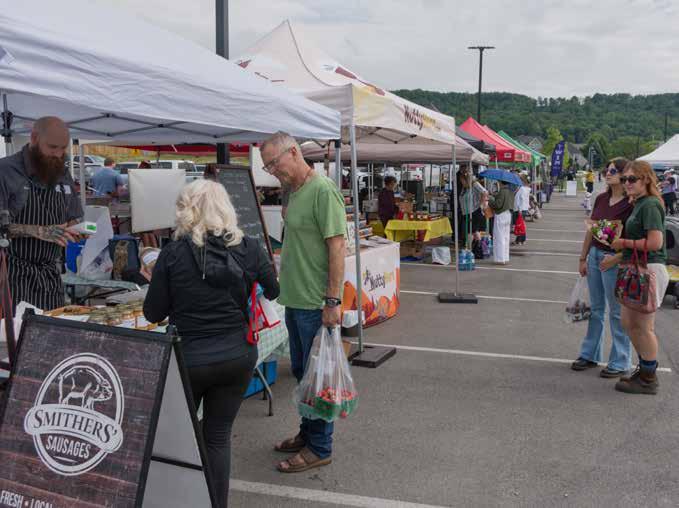
By Michelle Seaborn
June was a welcome relief from the cool, wet month of May. The warm weather came just as some market farmers were wondering how they were going to get their market crops into the soil.
Several farm market vendors have reported late starts to the season with return to market being delayed until July in several cases. However, the region is green, grass is growing, trees have a full canopy, and most gardens are looking colourful with perennials and annuals in full bloom.
Some of our floral vendors have had peony as the colourful focus of their cut flower bouquets, their fragrance turning the heads of all who pass.
Market tables are also starting to show more colour. Greenhouse growers have had the advantage this year of being able to supply colourful peppers, tomatoes and cucumbers, but field strawberries, asparagus, green onions, and radishes are front and centre now. There are also sweet peas, spinach and lettuces making an appearance. A berry vendor boasted the first raspberries of the season. Often considered a later berry, these plants were started in a greenhouse, and when the weather turned very warm in early June, the sides were open to allow the berries to ripen ‘naturally’. Amazing having fresh raspberries six weeks early!
June is a great month, it represents the end of the school year for all, and graduation for many. Hometown festivals are popping up throughout
Swing beams, blanket boxes and other devices of yore relied on large trees that mostly don’t exist in Niagara anymore
By Luke Edwards
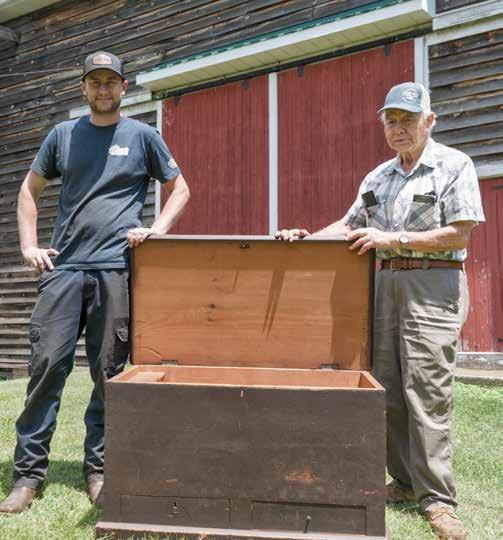
What does Jim Bucknall’s barn, a blanket box belonging to his great grandmother, and Dave Spiece’s to-scale model of a rack lifter have in common?
They’re all reminders of a piece of natural heritage that no longer exists in Niagara.
“The fact they’re all made of one board is significant,” said Bucknall as he showed off the nearly 200-year-old blanket box that’s been in his family since David Geiger made it for his sister Susannah Morley, Bucknall’s great grandmother. Hugh Fraser, author of a book on swing beam barns, was back at the Bucknall farm last month to take a look at the box, for research into a new book he’s working on.
The box used large white pine trees from Niagara, the kinds that have since been cut down. It’s the same size of trees that would have been used to make the huge swing beams in the barns Fraser featured in his first book.
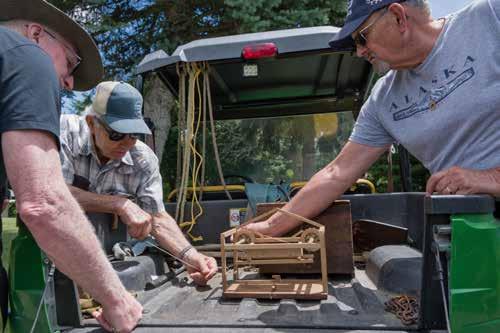
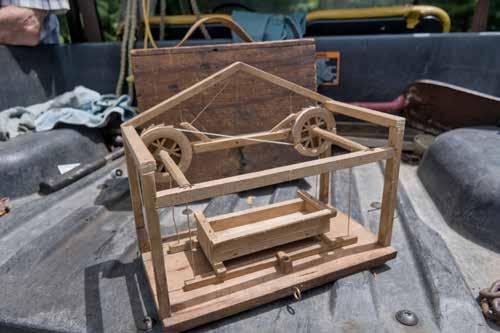
Meanwhile, a scale model that holds a special place in Dave Spiece’s heart shows the rack lifters that were a popular piece of technology in the old barns. His great grandfather John built the suitcase model.
“They’d bring it out to a farmer and show how it would work,” Spiece said.
The rack lifters would use a large pulley system to lift a wagon full of hay up to the top of the mow and make it easier for the farmers who were unloading it. The working model helped explain to the farmer how it worked, with a little string they could even pull that lifted the model wagon up into the air.
“And they’d say ‘I could build you one of these, but it’s going to cost you $4,’” Fraser said with a laugh, recalling how times have changed.
“And maybe a quarter of beef,” Spiece added.
Spiece’s model dates back to 1885, according to a year scratched into the box that protects it. It’s been a special keepsake for the family, though it was nearly lost when it almost got inadvertently included in a garage sale years ago.
Fraser was taken aback when he saw the model.
“I’ve never seen one,” he said, adding he’s been on the search for such a model for a long time.
The swing beams, rack lifters and Bucknall’s blanket box all relied on huge beams and boards.
“Back then they had trees to do this stuff. Now they’re all gone,” said Spiece.
Bucknall’s blanket box no longer stores blankets. In a slightly ironic twist, it’s where Bucknall stores many of his books on antique tractors and farm equipment. The single boards measure about 20 inches in width.
By the Niagara 4-H craft club
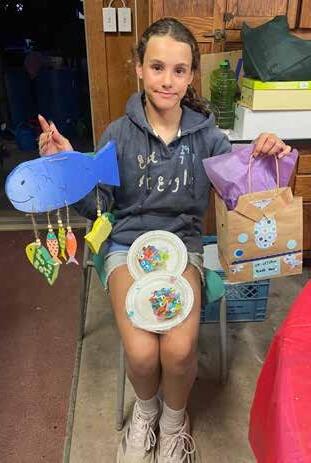
Members were very busy at the 4-H craft club last month, making a surprise for the special dads in their lives. Or grandpas or papas.
All the members completed the fish cupcakes and the gift bags and started decorating their fish mobile. Unfortunately, most did not get the mobile finished.
In the gift bag were all the supplies to finish it off. Perhaps they had time to finish it for Father’s Day or get someone special to help them complete it after presenting.
Juliet Van Wely was able to complete hers. It turned out pretty cute.

5 POINTS 5 POINTS 5 POINTS 5 POINTS

POINTS
POINTS
POINTS 3 POINTS 3 POINTS 3 POINTS
3 POINTS
3 POINTS
2 POINTS
By Amanda Nelson
With the ever-changing climate for food producers across Canada, including trade shifts, global conflicts and climate change, prices on Ontario produce continue to rise. In response, the federal government has launched Canada’s first-ever National Food Security Strategy.
“Too much of what we grow is processed elsewhere, and too many Canadians still rely on imported food at higher prices,” said Prime Minister Mark Carney, announcing the strategy. “Canadian farmers deserve more options to sell their produce, and Canadians deserve more options for where to buy their food.”
The National Food Security Strategy includes a $3.2-billion investment over 10 years with a strong focus on strengthening Canada’s food system through a mix of production, infrastructure and regulatory changes aimed at reducing reliance on imported produce, especially in winter.
“This is a significant and forward-looking investment that will directly benefit greenhouse growers across Ontario and Canada,” said Richard Lee, executive director of Ontario Greenhouse Vegetable Growers (OGVG), in a press release.
“The strategy acknowledges the essential role our sector plays in producing fresh, nutritious, safe vegetables year-round, while reinforcing Canada’s position as a global leader in greenhouse vegetable production, reducing reliance on imports and strengthening supply chains.”
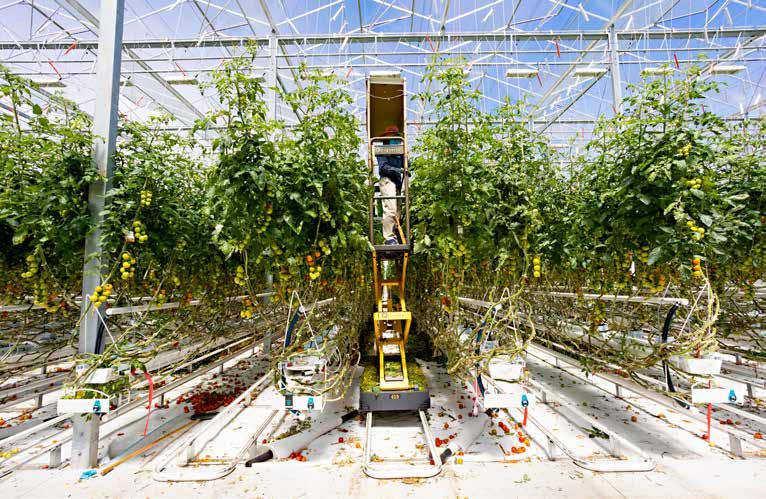
A specific $750-million investment in controlled-environment agriculture (CEA), which includes greenhouses and indoor growing systems, aims to help growers build or expand greenhouse facilities, adopt new growing technologies and produce more fruits and vegetables year-round.
The strategy also looks to support more food processing closer to where crops are grown, meaning infrastructure to turn raw produce into packaged goods locally, reduce transportation costs, and cut spoilage and emissions from long-distance shipping.
The plan also hopes to reduce bottlenecks from farm to processor to retailer and help independent growers and vendors access markets more easily by supporting infrastructure for storage, transport and distribution.
One key point outlined in the plan notes the government is
actively looking to cut regulatory barriers, or “red tape,” aiming to help speed approval for fertilizers and crop protection tools, ease the movement of goods across provincial borders and streamline agricultural regulations throughout the country.
“Through this made-in-Canada approach, we will process more of what our farmers grow here at home, creating jobs, driving economic growth and strengthening Canada’s food self-sufficiency,” said Minister of Agriculture and Agri-Food Heath MacDonald.
“By reducing red tape and helping innovative businesses get projects off the ground faster, we will unlock new opportunities for farmers, food processors and entrepreneurs across the agri-food sector.”
OGVG says this support will help stabilize food prices in grocery stores, expand producers’ market access and reduce the dominance of a few large retailers across the province.
“With the support outlined in this strategy, the greenhouse sector will be able to grow more food, more efficiently, and at a lower cost,” added Lee. “This benefits not only our farmers, but also Canadian families who are looking for affordable, locally grown food options year-round.”
Ontario Greenhouse Vegetable Growers is a not-for-profit organization representing greenhouse farmers who grow tomatoes, cu-
cumbers and peppers in Ontario.
With a commitment to innovation, sustainability and food safety,


By Luke Edwards
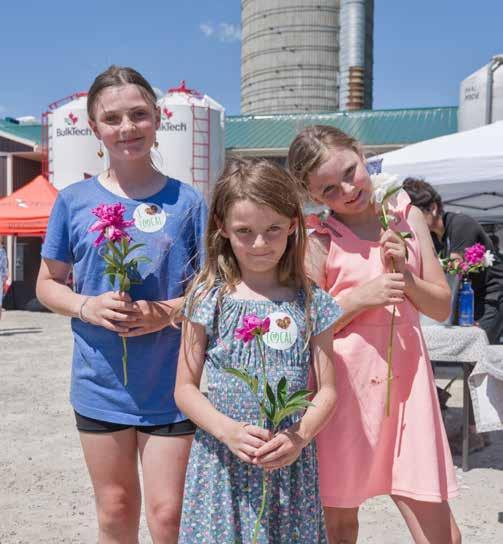
One arrival to Breakfast on the Farm last month made her entrance in the most dramatic of ways.
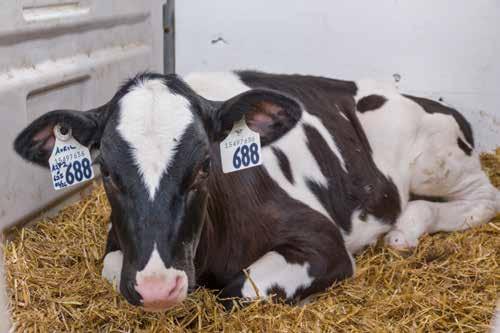
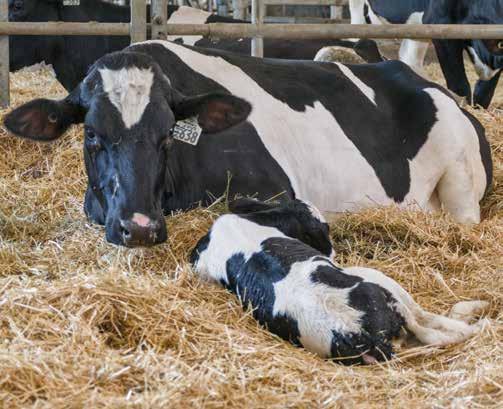
As thousands of people flocked to Roy-a-Lea Farm in Binbrook, a heifer decided it was also the right time to enter the world. With the help of some members of the Spoelstra family to ensure a quick and healthy birth, the young calf arrived just as people were touring the barn and property.
“There was a loud cheer of applause when the calf was born,” said Christa Ormiston, communications manager for Farm and Food Care Ontario, as the then one-hour old calf lay next to its mother.
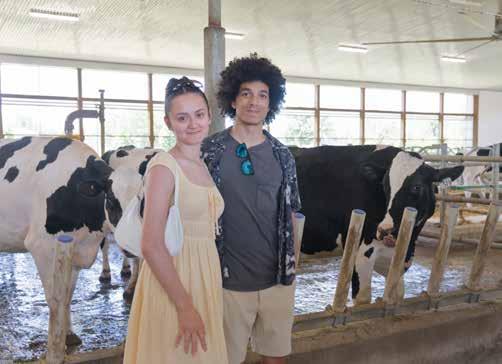
Breakfast on the Farm offers a chance to people, especially non-farming types from urban settings, to get a feel for what goes into farming and the dedication farmers have to their land and their animals. And there could hardly be a more appropriate example of that dedication than the birth of a new calf.
“It couldn’t have been better,” said Drew Spoelstra about the timing of the calf.
For many of the visitors, the event allowed them to either gain newfound respect or simply reinforced their respect for farmers and farming.
“I think for the average urban person it’s hard to understand what farming really looks like,” said Olivia Markle, who came down to Binbrook from Waterloo for the event. Her uncle is a chicken farmer in nearby Wellesley and has been taking Olivia to events like Breakfast on the Farm since she was a kid.
“Many people don’t know what goes on behind the scenes,” she said.
Some of the younger visitors put the experience in simpler terms.
“It was so sweet and little and cute,” said Avery McDougall, of the calf that was born. She came with her family from Burlington for the event.
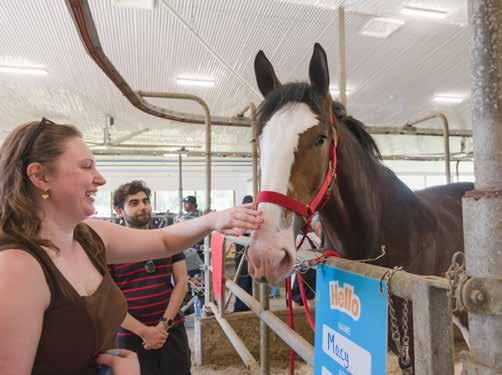
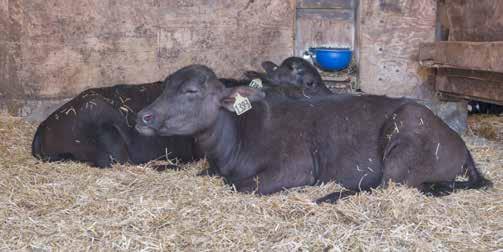
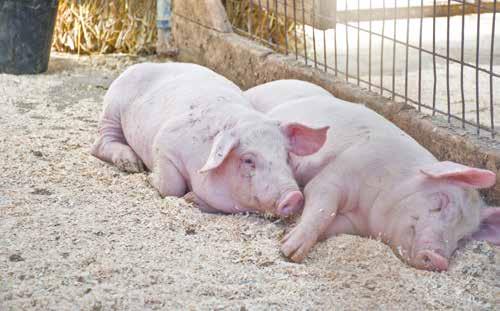
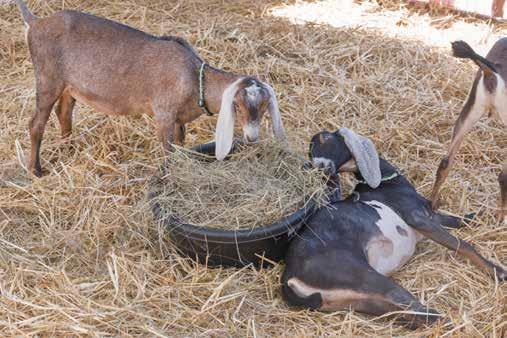
The Spoelstras run a mixedfarm operation in Binbrook, with dairy, beef and a grain business. They also raise Clydesdales, some of whom were there to greet visitors as well. Outside the barns there were also dozens of exhibitors showcasing just about every aspect of farm life in Ontario, including pigs, goats, farm equipment, poultry and even water buffalo.
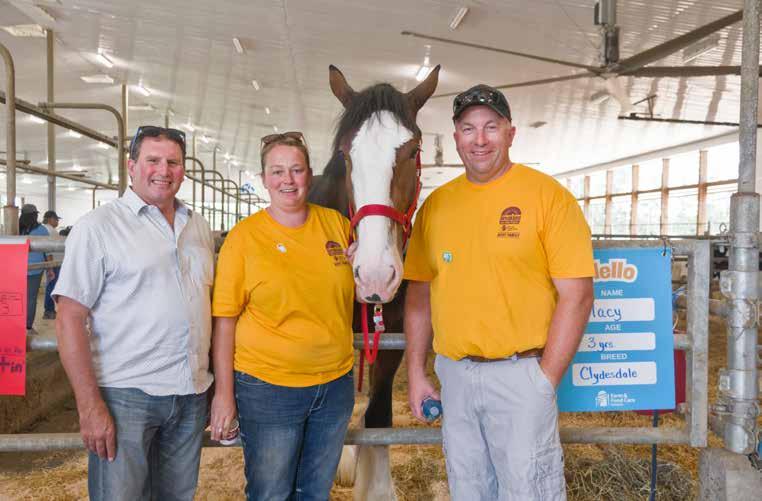
Not only did Mother Nature bless the event with a new calf, she also provided perfect weather for the day, which wasn’t a given considering there was plenty of rain in the forecast in the days leading up to the event.
“It’s been a great day. Great weather, great conversations,” said Spoelstra, who credited the hundreds of volunteers and supporters who helped make the event a success.
“The whole Food and Farm Care team has been great to work with,” he said. “ They’re doing a great job of educating people.”
In addition to the FCCO team, there’s also a local planning committee that shoulders a heavy workload. Ormiston said they’re grateful for that team, especially when a lot of the work comes at an especially busy time for farmers.
“We really rely heavily on the local planning committee,” she said, adding exhibitors and sponsors round out the large group that makes Breakfast on the Farm a success.
While the Binbrook event is finished, FCCO is hosting two more Breakfasts on the Farm this year. Cranbrook Farms in Brussels hosts one on July 25, while River Valley Cattle Co. near Napanee will welcome visitors on Sept. 26.
For more details visit farmfoodcareon.org.
By Luke Edwards
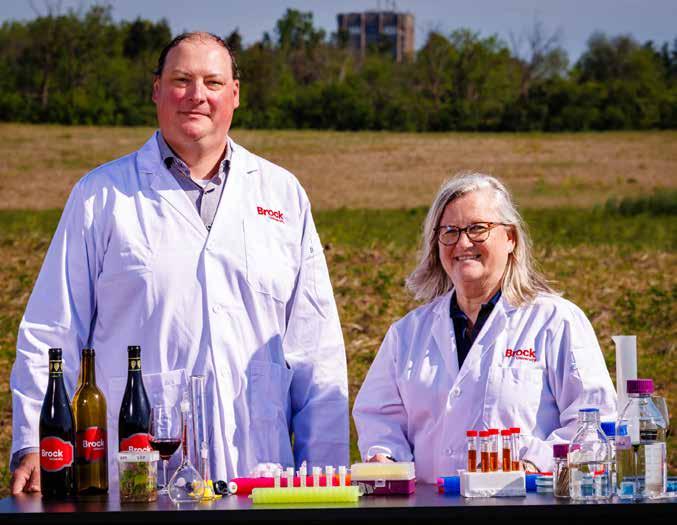
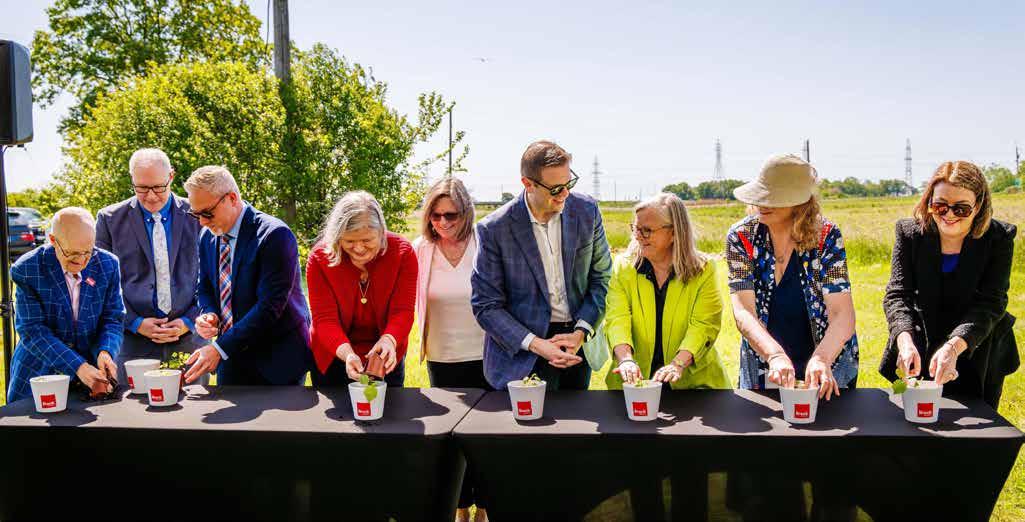
Ground has been broken on the site that will one day be home to Brock’s new research farm.
The university held an official groundbreaking ceremony in late May, signifying a major step in the project that will provide state-of-the-art plant health services for the region’s and country’s grape and wine sector, building on its existing clean plant program.
“Now, with the development of our research farm, we will be able to expand this work into a natural setting, accelerating innovation at a time when agriculture faces growing challenges from climate change, plant disease and rising costs,” said Jim Willwerth, an associate professor of biological sciences and Cool Climate Oenology and Viticulture Institute researcher who is leading the Clean Agriculture for Sustainable Production program.
The campus, named in honour of Norris W. Walker after the family provided a $7-million gift to make the farm a reality, is being built on a property on Merrittville Highway. When complete, the unique living laboratory will be a place where more resilient grape varieties are developed, and new technologies are explored. They can range from energy-smart greenhouses, to early warning systems for growers to products that use artificial intelligence.
“Just as importantly, we will study how plants and ecosystems interact, helping us develop sustainable practices that strengthen biodiversity and soil health, both in agriculture and in urban environments,” Willwerth said.
Walker’s daughter Sheila Bonapace was at the groundbreaking, along with other family members, and said the family is excited to see what the researchers at the farm will be able to accomplish.
“My father would be proud to see his commitment to the Niagara community continuing to grow through this innovative living lab and the opportunities it will provide to researchers, students and the region as a whole,” she said.
“We look forward to seeing the Brock University Norris W. Walker Research Farm blossom and flourish, creating meaningful change that will be felt in Niagara and beyond.”
In addition to the Walker family’s gift, the project is also being funded by matching $3.5-million grants from the Canada Foundation for Innovation and the Ontario Research Fund.
“CASP will not only benefit the Canadian economy but also help to shape the future of the agricultural sector that Canadians rely on each day to live,” St. Catharines MP Chris Bittle
said. “This project demonstrates the significant impact universities like Brock have in advancing the health and vitality of their local communities and the country as a whole.”
Niagara West MPP Sam Oosterhoff offered similar comments, saying the farm will support local farmers, but also drive Niagara’s economy.
“By leveraging cutting-edge research and industry expertise, we will create a stronger, more resilient agricultural sector that will help protect Ontario jobs today and into the future,” he said.
By Niagara Farms Staff
Niagara has a vast expanse of beautiful rural landscapes, from well manicured vineyards and orchards, to lakes, forests and beaches. But too often, those picturesque views are ruined by a big pile of garbage strewn along a road or dumped into a ditch.
Though it’s not unique to the region, nor is it a new issue, regional waste management staff are encouraging the public to play their part in reducing illegal dumping in Niagara.
“It’s a shared community issue. It affects neighbourhoods, roadside ditches, and natural areas across the region,” said Mariano Singzon, associate director of waste collection and diversion operations for the Niagara Region.
“You’re putting something out there that doesn’t belong to the natural ecosystem. It disrupts natural habitats, it could create contamination of groundwater or soil, or water run-off. It will be a nesting (area) for disease-carrying pests, thereby posing health risks. It also just affects the aesthetics of the community.”
While Singzon said illegal dumping can be found throughout Niagara’s urban and rural settings, all these issues can carry specific concern to the region’s agriculture community introducing potential hazards to livestock and crops or hampering the hard work of agritourism operators like wineries who put so much effort into making their properties look beautiful for the millions of visitors who come to Niagara each year.
Issues with illegal dumping tend to pick up in spring and early summer as people undertake home projects or move. Singzon said they typically see about half of the year’s activity within the first few months of warmer weather.

This year through May they recorded 530 incidents, which include reports and investigations. That number was down slightly from the 565 incidents through the same timeframe last year, but basically in line with historical numbers where they see incident totals in the low to mid 500s.
Singzon said there are many options for those who have excess waste. They can arrange a free curbside pick up bulky items, drop off waste at any of the region’s waste and recycling depots, or purchase tags for weeks where they have more than the allowable two bags of garbage.
Often, illegal dumping incidents include relatively small volumes, which Singzon said is strange
considering, on average, residents put out 1.3 bags of garbage for the regular pickup. Additionally, tags for extra bags cost $3.30.
“So even if you have four bags, that’s about $12. So you’re risking $12 for a fine of $500,” he said.
Regional staff have been focusing on stronger enforcement to discourage illegal dumpers. Fines typically range from $150 to $500, Singzon said. An explainer from the Region also said penalties can reach $10,000 for serious offences.
Between the proactive approach and support from the public, Singzon said they’ve doubled the number of tickets issued this year compared to last year. He said more public support can also
help regional officials seek stronger penalties, as the $500 usually require more evidence in the form of witnesses.
Another way residents can help is by ensuring they use reputable waste removal providers and ask questions when they hire someone to take care of their waste, to ensure it’ll be disposed of properly.
Residents can report illegal dumping through an online form that can be found at niagararegion. ca/waste, or by calling either 905356-4141 or 1-800-594-5542. It can also be reported anonymously through Crime Stoppers (1-800222-8477, crimestoppersniagara. ca) or through the Niagara Region Waste app.

Welcome to Rainy Day Distractions, a regular feature where Grant Haven Media highlights activities and attractions in southern Ontario for farm families when they have a free day thanks to Mother Nature, or for any other reason. Share your favourite agriculture activities by emailing luke@granthaven.com and we could feature them in a future edition.
By Amanda Nelson
What started in 1975 with founder Henry Hiemstra has grown into an adventure park for children of all ages. The park features a corn maze, bee discovery station, bee barrel train rides, super slides, pedal carts, an animal barn, a water park and so much more.
Hiemstra started the Aylmer commercial beekeeping and honey business in 1975. He was also a hobby artist whose paintings and drawings are featured in the onsite art gallery, along with antiques, including old organs displayed near the entrance.
“My grandpa had beekeeping in his blood,” said Caitlyn Suderman, granddaughter and general manager. “He was also an artist and loved to paint and draw. Some of his artwork is displayed here in the gallery.”
Hiemstra moved to Canada from the Netherlands and passed his love of beekeeping on to his six sons. He started selling honey out of a small garage and named his operation Clovermead Apiaries. In 1987, Henry and his wife, Ann, moved and restored an old log cabin, which is now home to the honey shop.
Henry’s son and daughter-inlaw, Chris and Christy Hiemstra, took over the farm in 2000. They quickly realized they needed a way to attract visitors to the small town of Aylmer, so, in addition to operating the honey business, they began adding family attractions to the property.
CAR
By restoring and repurposing antique buildings and barns, they transformed the farm into something unique. Restored barns, corn cribs, pig houses and even an old train became part of the attraction.
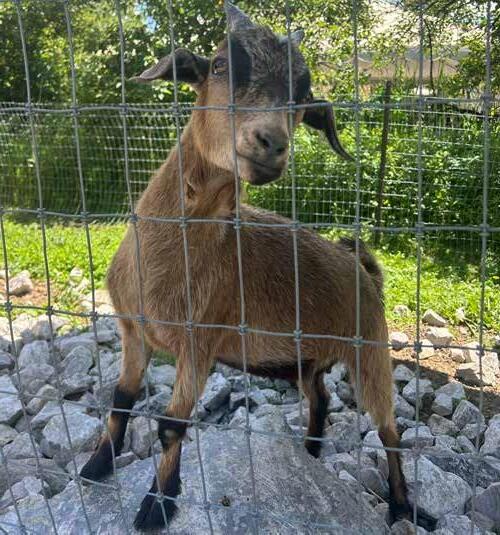
The countless activities range from a water park to petting and feeding animals, including goats, miniature cows, sheep, chickens, a peacock and even a friendly turkey. There are also a variety of play structures, including a small combine, a kid-sized hamster wheel, a bike track, a rock-climbing wall, pillow-jumping structures and even an old airplane, allowing children’s imaginations to run wild.
On-site, visitors will also be able to attend a short presentation where they learn how honey is made, the life cycle of bees, and the different roles bees play within the hive. Visitors learn about everything from baby bees to worker bees.
“Part of the tour is getting to touch a stingless drone bee, which is a male bee,” said Suderman. “Male bees don’t have stingers, so visitors can safely hold one. They also get to see a real-life queen bee. We have a single frame behind glass, and one of our staff members points out the queen so guests can see her up close.
“Inside the hut, we have what we call the ‘five senses’ experience,” said Suderman. “Guests can place their hand on top of a beehive to feel its warmth and vibration, put their ear up to another hive to hear
Continued to page A29
KID’S ENTERTAINMENT � KID’S TRAIN RIDE 22 HERITAGE BUILDINGS TO BROWSE LOTS OF GREAT FOOD!
ADMISSION:
• Seniors 65+ $7 on Saturday only
• Adults $8
• Children under 10 are free Cash only preferred. ATM on site. Free parking. Only service dogs allowed. NO smoking or vaping on premises.



the sounds inside, and even smell a beehive. It’s a hands-on way to experience the world of bees through all five senses.”
Throughout the farm, there are accessible washrooms with infant and adult changing tables, helping ensure all visitors can enjoy their visit comfortably and without worry. Guests will also find a variety of food options available on-site, with the family recently adding more locations across the property. Of-
ferings now include everything from ice cream to smash burgers, all available at affordable prices.
“What we were finding is that with the three food locations on our busy weekdays, we couldn’t keep up with the volume, so we just needed to offer more food entries and different locations,” said Suderman.
Now with the fourth generation of the family involved, Suderman and her brother Justin Hiemstra work on the farm in various capacities. Caitlyn plans to take over the farm
one day, while Hiemstra continues to use his handyman skills to create fun and imaginative rides and attractions for visiting children.
The pair lost their youngest brother, Jordan, who died by suicide at age 17. The family continues to honour his memory and named one of the farm’s attractions Jordan’s Play Fort after him. Located near the entrance, the large play structure allows children to climb high among the trees.
The family believes the foundation of healthy families is built
through shared experiences and multi-generational play, something they strive to provide for visitors every day.
Tickets are available online and at the gate, although families are encouraged to purchase them in advance due to potential lineups upon arrival. Prices vary throughout the season, with tickets starting at $22 when purchased online.
For more information or to purchase tickets, visit www.clovermead.com
With the kids now on summer vacation, farm families may be looking for something to do in the coming weeks. Fortunately there are plenty of options. Here are a few things for kids, adults and everyone in between.
JULY 16 - JULY 19
FRIDAY, JULY 17
7 P.M.
JULY 17 - JULY 19
& JULY 31 - AUGUST 2
elebration of Niagara’s unique wine climate will be on full display this month when the Cool Climate Chardonnay Celebration returns.
Running July 16-19, it includes four days of events at several participating wineries. There’s also the School of Cool event on July 16 at White Oaks that features a full day of guided tastings and keynote speaker sommelier Veronique Rivest.
WEDNESDAY, AUGUST 12
4:30 P.M.
REGISTRATION OPEN EVENT SEPTEMBER 10

The signature event, a world tasting and dinner event, will take place at Peller Estates. For more information or tickets visit coolchardonnay.org.
their Wellandport farm for the Niagara Holstein Club’s twilight meeting on Friday, July 17
Homevalley Holsteins will be hosting the latest twilight meeting, as Richard, Marion, Nathaniel and Alyssa will open up their farm. Hamburgers, salad and ice cream will be served, and there will be a class of cows to judge.
The meeting starts at 7 p.m. and the farm is located at 64480 Side Road 44 in Wellandport.

e West Niagara Agricultural Society will be hosting a few shows in July.
One of the most distinctive dog breeds will be on full display when the Bull Terrier Club of Canada holds a July 17 to 19 show. Visitors are welcome to watch the conformation competitions and other events, or simply come to learn a bit more about the breed.
Two weeks later the Ontario Young Canadian Simmental Association and Ontario Junior Angus Association will host a double feature beef show. It’ll include conformation, showmanship, judging competitions, grooming, scrapbooking competitions and more. Spectators are welcome to the show that runs from July 31 to Aug. 2.

e Caledonia Riverside Exhibition Centre will play host to the fourth annual Haldimand Federation of Agriculture barbecue on August 12. This year’s event takes place at the Riverside Exhibition Centre in Caledonia, Ontario
Jennifer Schooley will be a guest speaker, discussing women in farming as 2026 is the United Nations’ Year of the Woman Farmer. Her presentation is titled “Yes I farm, yes I’m a girl.”
Doors open at 4:30 p.m. and dinner is at 6.
Tickets are $25 and must be purchased in advance. HFA members interested in attending can purchase a ticket by e-transfer through or from an HFA director.

not until fall, but Vineland Research and Innovation Centre’s What’s Growing On Here event is always a popular day for those interested in the work happening on the campus.
And this year’s open house promises inform visitors on a subject that’s very timely and relevant.
Registration for the Sept. 10 event opens this month. It takes place Thursday, Sept. 10 from 5:30 to 7 p.m. and will cover how innovation for the commercial greenhouse sector is securing Canada’s food supply. Visit for more details.

By Luke Edwards
Greenhouse growers installing new coverings should be careful of unintended consequences, a greenhouse vegetable specialist for the Ontario Ministry of Agriculture, Food and Agribusiness is warning.
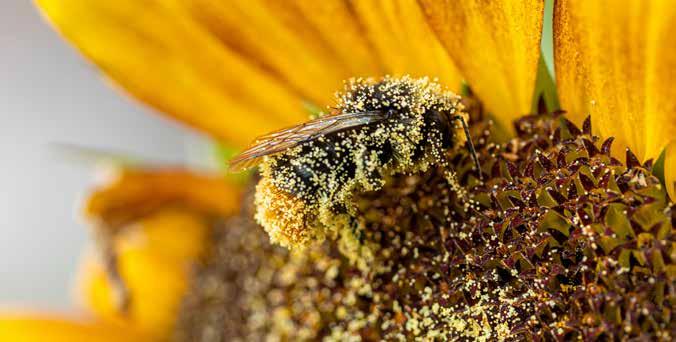
While new coverings with enhanced ultra violet (UV) light blocking technology may increase their lifespan, they could also confuse bumblebees that are used for pollination within the greenhouse. At least that’s what research by Fadi Al-Daoud suggests.
“Low UV reduces bumblebee activity,” he told attendees at last month’s Growers Day event in St. Catharines.
Al-Daoud said he was recently contacted by a greenhouse tomato grower who noticed his bees weren’t pollinating as well after he installed a new triple poly panel system at his greenhouse.
Since UV light can damage greenhouse coverings, companies will apply UV blocking agents to them to increase the lifespan. However, much like humans detect red, green and blue wavelengths in the visible light spectrum, bumblebees detect UV light, which attracts them.
And since controlled greenhouses don’t have the wind or insect populations to provide pollination, many growers bring in bumblebees to act as pollinators.
Al-Daoud’s study used sensors to detect light infiltration at the top, middle and bottom of the canopy in a greenhouse. To start, he considered light quantity, essentially the overall amount of light coming into the greenhouse. The experiment included different kinds of cov-
erings, both old and new, and double and triple poly. The idea is that as coverings age, their UV blocking ability diminishes.
However, overall light quantity didn’t seem to have a correlation.
“So we decided we’re going to start looking at light quality,” he said.
When he broke it down to different wavelengths, it became clear that less UV light was associated with newer, triple poly coverings. AlDaoud used the ratio of UV light to photosynthetically active radiation (essentially the visible light spectrum) to demonstrate this difference.
While this showed an association between less UV light infiltration and lower pollination, Al-Daoud said it doesn’t necessarily prove causation.
However, it does offer evidence that growers should be mindful when they decide to install new coverings. They may want to look at the


material they’re using, or perhaps they’ll need to bring in more bees for pollination.
In addition to the connection between UV light and pollination, Al-Daoud also said growers should pay attention when opening vents, as that becomes a source of UV light, which attracts the bumble bees and could lead to them escaping.
Overall, it’s a difficult balance to maintain. Blocking UV light can help the plant, Al-Daoud said, by increasing photosynthesis and transpiration, which leads to bigger plants and greater yields.
However, in addition to inhibiting the bumblebees, UV blocking can also reduce phenolic compounds, flavonoids and carotenoids, which reduces fruit quality. Likewise, it has a mostly negative effect on all bugs and insects, including pests and beneficial insects.