



















































Community support helping to keep 9 Acres Organic Farm going after devastating barn fire
By Luke Edwards
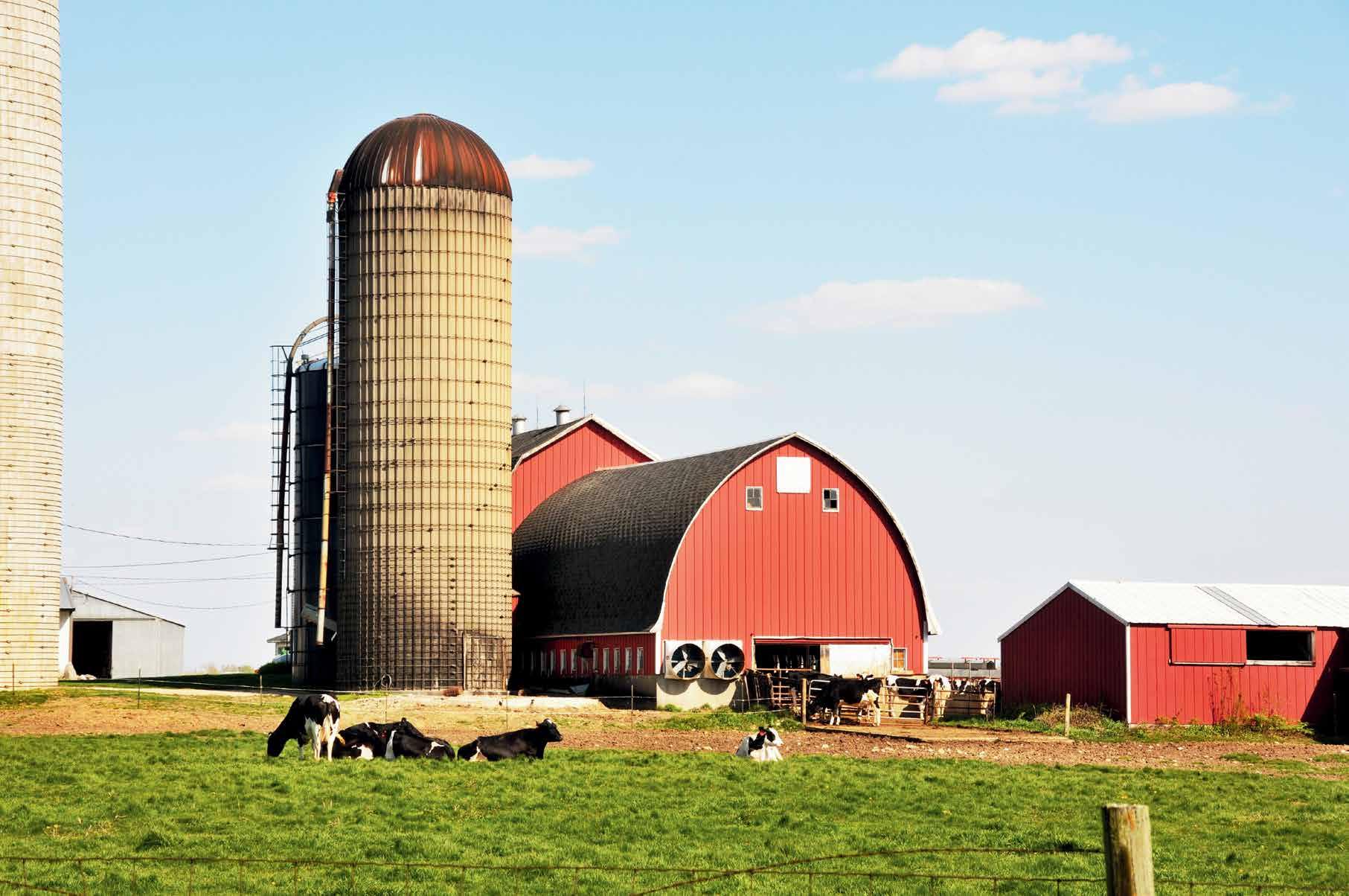
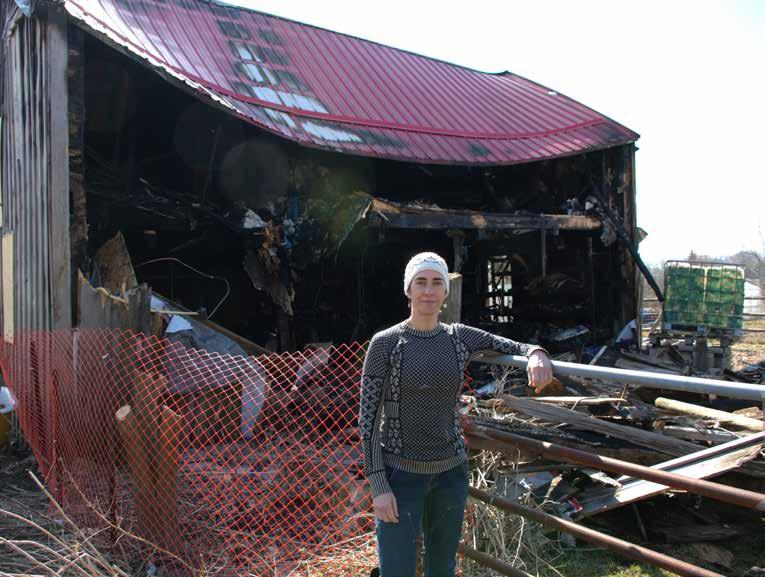
A fire may have destroyed her beloved barn, but it hasn’t extinguished Carolyne Siebert’s passion for farming.
For the past decade the view from her second floor window has provided a constant reminder of why Siebert moved to Grimsby with her husband Rodney.
Looking down from the vantage point, she could view the barn across the driveway, with fencing wrapping around it from the days when the property was home to several horses.
“I’m always looking out because it’s beautiful,” Siebert said from her Ridge Road property.
The owner of 9 Acres Organic Farm, Siebert’s put her heart and soul into the land since moving there 10 years ago. She grows tomatoes, peppers and garlic, selling them at “The Nook,” an onfarm shop. She’s also a staple at the Grimsby Farmers Market and can be found at seasonal markets throughout the year.
But as she looked out that very window on a Sunday morning last month, the view troubled her.
“I noticed there was something, that the air just looked a little weird
around the right side of the barn,” she recalled.
“And in my gut, I just didn’t feel good.”
storing in the barn due to lack of space in the house.
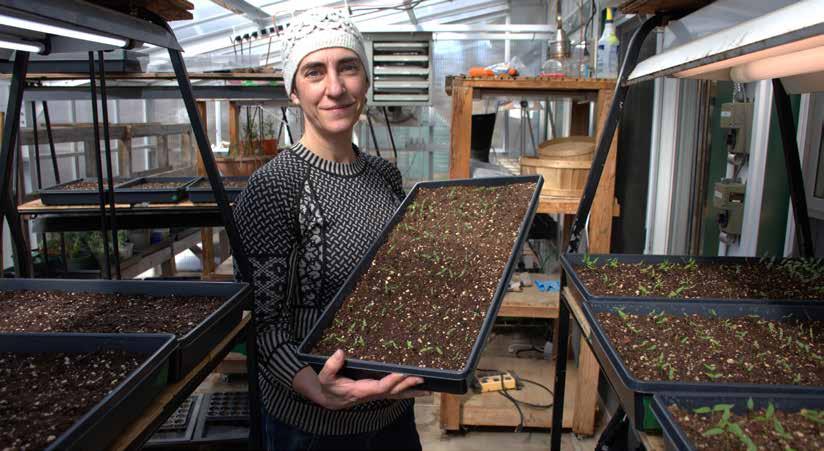
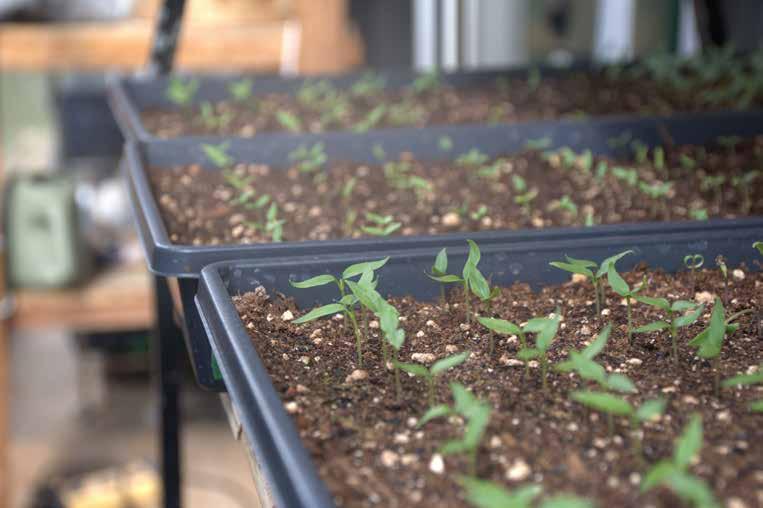
Despite the setbacks, she’s still hard at work getting seedlings started for her annual spring seedling sale.
Publisher
Editor
Business Development
Stewart Grant • stew@granthaven.com
Luke Edwards • luke@granthaven.com
Heather Dunbar • heather@granthaven.com
Graphic Design
Billing Administrator
Jen Gaetan • jen@granthaven.com
Contributor
Ann Marie Chechalk

Erin Parsons • niagarafarmsnewspaper@gmail.com
36 Water St. St. Marys, ON, PO Box 2310 N4X 1A2 niagarafarmsnewspaper@gmail.com | 519-868-1290 | granthaven.com
Restoring small-town journalism, one community at a time!
a time!

Siebert rushed out, still in her pajamas, and discovered a fire quickly growing inside the barn. She remembered there was a fire extinguisher nearby and briefly thought she could put out the flame before serious damage occurred. But opening the barn door quickly told her otherwise. By the time she called 911 and fire crews arrived, it was too late. It was virtually destroyed.
“This barn was the heart of this place,” she said.
Not that there’s a good time to have a fire, but early March is about the worst time for Siebert. Three years ago she gave up her previous job at Oxford Learning to focus on farming full time. In a normal spring, Siebert said she’s incredibly busy getting things ready.
“I need to clone myself as is,” she said.
Much of her equipment - including tools for planting, caring and harvesting, as well as jars and the like for her jams and honey - were in the barn, leaving Siebert shorthanded as she preps the farm for the growing season. Losing all the jars and preserving equipment is an added kick, as those products are a key source of revenue in the spring when there’s little else to offer.
The couple also lost some personal keepsakes that they were
Fortunately, the local community has rallied around 9 Acres Organic Farm.
“A lot of it has just been the words of encouragement,” Siebert said. “Farming is hard enough, and some days you’re like, ‘why am I doing this?’ And then somebody will tell you how much they love your shishito peppers and you remember, ‘ok, this is why I do this.’” She described a constant stream of messages and support, and much more.
“It’s been financial, it’s been skills. It’s been people’s connections for things like rebuilding and cleaning up. Everybody’s contributed so much. I can’t say that enough.”
Fortunately she kept most of her seeds in the house, so when May rolls around visitors will be able to pick up their favourite plants like tomato, pepper, squash and eggplant, as well as a mixture of herbs. She’s currently hard at work getting the seeds started and plants growing.
While the experience hasn’t been easy, the support has helped. And Siebert said she’s realized just how much potential exists in her and her farm.
“We’re capable of more than we think,” she said.
Continued to page A4
Continued from page A3
And having received an outpouring of support, Siebert encourages others to support not just 9 Acres, but the other farms in the region.
A GoFundMe was set up by friend Jeannie Clark, which had surpassed $15,000 by late March.
While they had insurance, Siebert said the process is a lengthy one, and it will be a while to get resolved, with little indication of what that resolution will look like. A cause of the fire still hadn’t been determined as of late March.
However, she does plan to rebuild eventually, and could use it as an opportunity to turn the property into more of a teaching farm, something that fits in with her previous career. Educating the public about farming is a passion for her.
“I love taking them on a tour of the farm,” she said.
The seedling sale will run for three weekends next month: May 8-9, May 15-16 and May 22-23. They’ll be open 9 a.m. to 5 p.m. each day, and pre-orders are available. For more information, including a list of varieties, visit 9acres.ca.

SATURDAY, APRIL 11TH




By Luke Edwards
For 30 years he’s spent countless hours in meetings and poring over reports in an effort to keep Ontario’s grape and wine, and fruit and vegetable sectors on firm ground, but Bill George is a farmer at heart.
That’s why, even as his two children take over the multi-generation grape farm in Lincoln, and dedicated workers on staff provide valuable labour, George keeps a little block of vineyard to himself to prune and maintain. Though often his other commitments get in the way.
“My workers come in and they say ‘boss, we don’t think you’re ever going to get to your block. Can we finish it for you?’” George said.
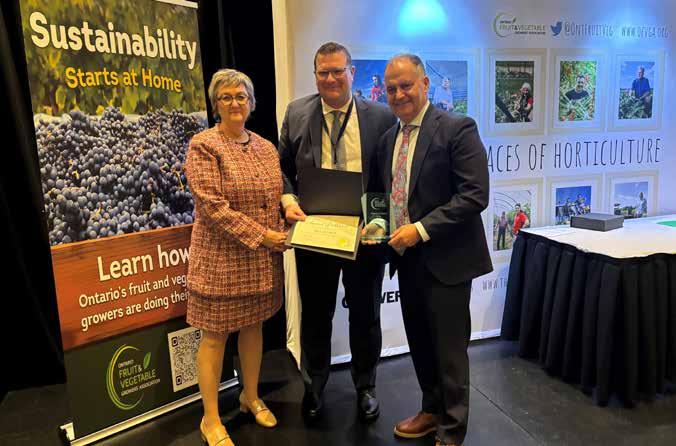
George recently received the Industry Award of Merit from the Ontario Fruit and Vegetable Growers Association, recognizing his three decades of service where he’s sat on several committees and held leadership positions.
“Bill George has been a leader in Ontario’s edible horticulture sector for more than three decades, expertly serving growers in many different capacities with thoughtful, proactive leadership,” said OFVGA chair Shawn Brenn. “As chair of the OFVGA during the COVID-19 pandemic, he led us through one of the most challenging periods facing our industry in recent memory and provided tireless advocacy for the needs of our sector to government of all levels, media and the broader community.”
He received the award at OFVGA’s annual banquet. George said the organizers managed to keep it a secret, and he had no idea he was being honoured.
“It was a surprise and I’m really humbled by the honour. I really appreciate it,” he said.
George currently chairs the Labour Issues Coordinating Committee where his main focus is on the vital seasonal agricultural workers.
He’s also a member of the Farm Products Marketing Commission and sits on the board of Workplace Safety and Prevention Services.
The family farm goes back to the late 18th century as one of the first farm families to settle in the area. They farm about 200 acres of
vineyards, and recently opened Watchful Eye Winery, as his children Will and Kate look to put their own stamp on the farm.
With the kids taking over, George now has more time for committee meetings and the advocacy side of things. However, that wasn’t always the case. He credits his family, including wife Lesliann, for being supportive of the years.
“It’s sometimes stressful being involved with these boards, so she’s probably seen the good side of me and the bad side of me after these meetings,” he said. “You certainly have to have a support system at home or it just doesn’t work.”
George was chair of the Grape Growers of Ontario from 2007 to 2016, and chair of the OFVGA from 2019 to 2022, an especially trying time as the industry had to navigate through the COVID-19 pandemic.




He also had roles with the Vintners Quality Alliance, the Niagara Grape and Wine Festival and the Fruit and Vegetable Growers of Canada. In 2001 he was named Grape King.
As his kids take on more prominent roles on the farm, they’re getting involved on the governance and advocacy side too, something George encourages other young farmers to consider.
“We do need fresh eyes. We need the newer perspectives of the younger generation,” he said.
Fortunately organizations realize this as well, and are creating committees focused on younger people. Both Will and Kate have been involved: Will joined the GGO’s next generation committee, while Kate joined the OFVGA’s young delegates program.
‘Countless
By Luke Edwards
Simply put, he’s a farmer, but ask Drew Spoelstra what kind of farmer he is and be prepared to wait a while as he responds.
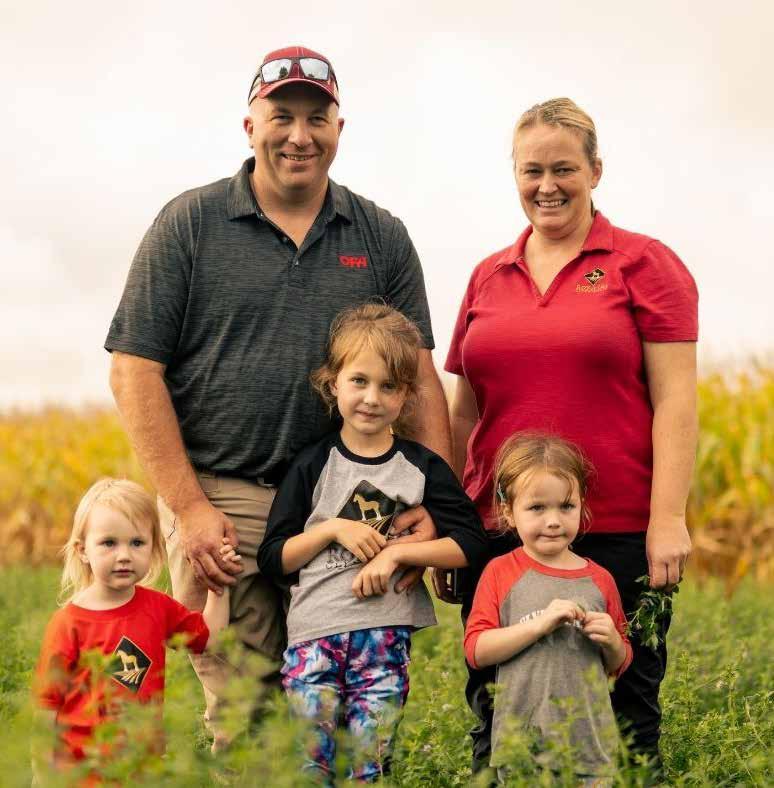
That’s because he and his family are dairy farmers, beef farmers, veal farmers, cash croppers, seed dealers, and they raise about 50 clydesdales. Oh, and Spoelstra’s also the president of the Ontario Federation of Agriculture.
“It is kind of a complex business structure,” Spoelstra admits. But it’s a structure that works for him and his family.
“We’ve always had a kind of diverse practice…It kind of spreads the risk and spreads the workload,” he said.
That diverse approach has landed the Binbrook farmer on the shortlist to represent Ontario in the Outstanding Young Farmers competition. Drew and Heather Spoelstra are finalists alongside Tyler and Allison McBlain.
“I’m excited to work through the process and see what happens, it’s certainly an honour to be nominated, I’m humbled by it and looking forward to the challenge,” Spoelstra said.
The nomination has given Drew and Heather a chance to take a step back and remind themselves of their business and community accomplishments.
“It’s cool to reflect on what you’ve done,” he said.
Taking on all the responsibility, between the various aspects of the farm business and his role with OFA, keeps Spoelstra busy, and he said he wouldn’t be able to succeed without a strong support system.
“You need to have a good team of people both at home and at OFA and I’m lucky to have both,” he said.
At home that team involves his wife Heather, as well as his parents, who Drew said are still active on the farm.
And while he’s humbled by the honour, Spoelstra was quick to point out the many oth-



er young farmers in Ontario who are ensuring Ontario agriculture has a strong future.
“There are a lot of young farmers working across the province doing great things and it’s






certainly cool to be recognized but there are countless others that could be recognized too,” he said.
“It’s definitely important to highlight them all.”
His fellow finalist also deserves all the recognition they’re receiving, Spoelstra said.
“They’re a generational farming family, which is awesome and they do good work,” Spoelstra said, describing the McBlains as staples of the Brant farming community.
The finalists will present before a panel of judges with the winner being announced at an event in St. Jacobs on Wednesday, April 8. The winner will go on to represent Ontario at a national competition in B.C. in November.
Spoelstras to host Breakfast on the Farm
Win or lose, Roy-A-Lea Farms will host a celebration later this year when the Spoelstras welcome the public for a Breakfast on the Farm event.
Taking place Saturday, June 13, visitors will be able to tour the Binbrook farm after enjoying a farm-fresh breakfast.
The Spoelstras recently installed a robotic milking system for their 60 Holsteins, and visitors will get a chance to learn about the technology along with the other aspects of the farm. It runs from 9 a.m. to 1 p.m. and more information, including tickets, can be found at farmfoodcareon.org/binbookbreakfast.
By Luke Edwards
He could measure success by how much money he makes, how high his yield is, how much land he manages, or any other number of variables.
But when Tyler McBlain considers success, he goes back to the words his grandfather Bruce left him many years ago.
“Success is doing what you love to do, and making a living at it,” he said, repeating an inscription Bruce included for Tyler in a book he wrote before passing.
So whether McBlain and his wife Allison win this year’s Ontario Young Farmer award doesn’t make an impact on his vision of success. Either way, he’ll wake up the next morning and do what he loves.
“I look at what we do and I don’t consider it a job, I don’t consider it a career. I consider it a passion, a hobby and a lifestyle. Getting up in the morning I don’t feel like I’m going to work,” he said.
The McBlains are one of two finalists for this year’s Ontario Young Farmer award, alongside Drew and Heather Spoelstra. The winner will be announced at an April 8 event in St. Jacobs, and go on to represent Ontario at the national level in B.C. later this year.
“It was an unexpected honour,” said McBlain, about receiving the nomination.
A fifth-generation farmer, McBlain grows soybeans, wheat, corn and oats on 4,000 acres of land spread out between multiple farm sites in Wentworth, Norfolk and Brant. It was Bruce, as well as his father Barry who instilled in young Tyler a passion for farming.
“I never wanted to do anything but farm,” Tyler said. His parents, Barry and Minnie, are still involved with the operation as well.
That passion includes a desire to leave the land in better shape than he found out. That’s why Tyler prefers to use the term regenerative instead of sustainable. To him, sustainable means keeping things the status quo.
He follows the 4R method for farming: Right place, right time, right rate and right source.
His practices include no-till and strip till.
While his passion is farming, Tyler and the McBlains are also community minded. Tyler sits on a couple boards and is also deputy district fire chief with Brant County’s volunteer service. Allison, who grew up in nearby rural Ancaster, had some experience with farming before meeting Tyler. Her father had a hobby farm and


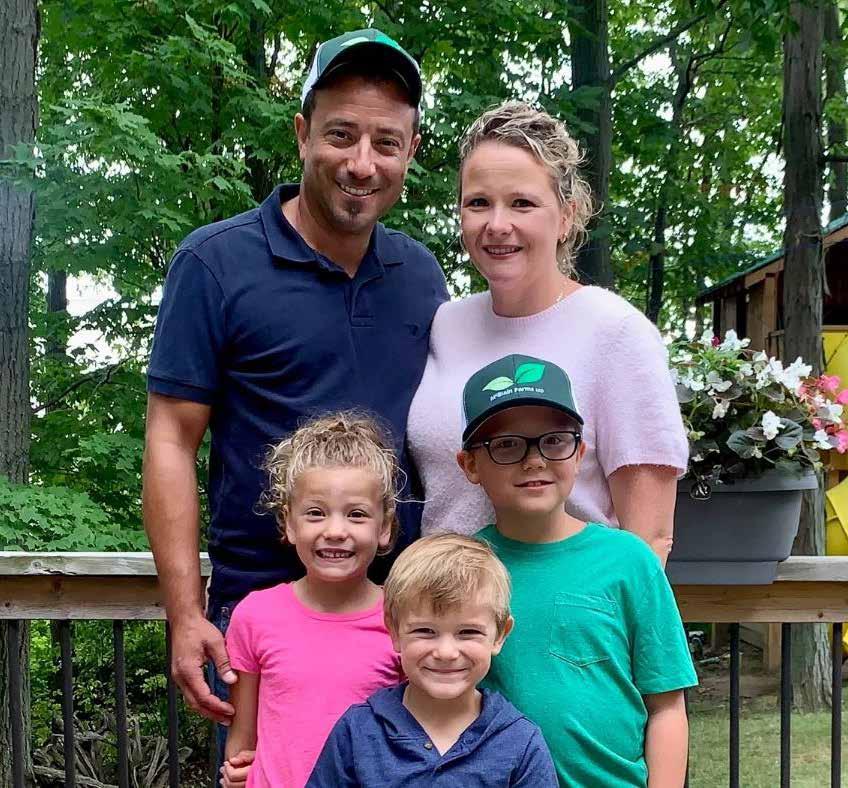
she worked at a bakery agritourism operation located at a local orchard.
It was at the bakery where the two met. She would go on to teacher’s college, but now plays a key role on the farm, looking after much of the logistics, paperwork and behind-the-scenes work. She also uses her teacher background to play a key role in the Bite of Brant program, which introduces Grade 5 students to local agriculture, giving children who mostly have little to no experience on a farm a basic understanding of rural life and what goes into food production.
“She has a passion for education, she loves it,” said McBlain.
The nomination for the young farmer award comes with a lot of homework, with the McBlains having to fill out a questionnaire and write an essay that describes everything from their passion for farming, to financials and community involvement.
While that’s been a lot of work, McBlain said it’s also been an opportunity to take a step back and reflect on a 20-year career in agriculture.
“My wife and I have had a lot of fun doing it,” said McBlain, who graduated from Ridgetown in 2005.
Having a chance to take a step back and reflect on his career, McBlain realized it’s hard to pick a favourite aspect. Each season brings its own excitement and challenges and spring planting is just as enjoyable as the fall harvest for him. In the end, he said it’s not what he does that gives him the greatest satisfaction.
“My favourite part is seeing my children enjoy what I enjoy,” he said.
McBlain knows Drew and Heather quite well and while he hasn’t had a chance to talk to them since they were announced as finalists, McBlain said the Spoelstras are worthy nominees.
“He’s done a lot for the agriculture community,” McBlain said of Drew.

By Niagara Farms Staff
Niagara wine country has a new export: education.
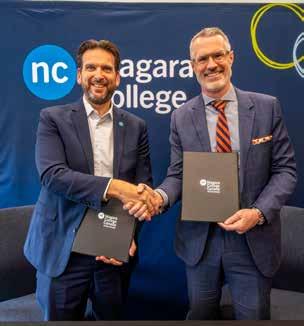
Last month Niagara College and Okanagan College signed a memorandum of understanding that allows the B.C. school to offer a customized version of Niagara College’s Winery and Viticulture Technician curriculum. Students who want to become winemakers, cellar technicians, vineyard managers or lab viticulture technicians will now be able to do so at Okanagan College with the help of their Niagara counterparts.
“This partnership brings together two colleges with a shared commitment to academic excellence,” said Okanagan College Provost and Vice-President, Academic, Samantha Lenci. “By collaborating with Niagara College, we are strengthening learning opportunities for
students and delivering programs that reflect the needs of our communities and local industry. These industries are critical to our region, and we’re excited to expand our support of the Okanagan and Shuswap through relevant, applied programming.”
Niagara College has been offering the program since 2000, and was a first of its kind in Canada. The college’s Daniel J. Patterson campus in Niagara-on-the-Lake is home to the country’s first and only commercial teaching winery, and has expanded with programs for brewing and distillation.
Last month’s MOU opened the door for further collaboration in food, agriculture and tourism training, a press release said. Credit transfers, student and faculty exchanges, joint or collaborative research, events and other academic activities are all possibilities.
“At Niagara College, we are proud of our reputation as a pioneer in wine education since we launched our trailblazing Winery and Viticulture Technician program 25 years ago along with Canada’s first commercial teaching winery,” said Niagara College Vice-President, Academic, Fay Lim-Lambie. “Sharing our gold-standard curriculum with Okanagan College is a testament to the quality of our programming and entrepreneurial spirit and expands the availability of wine education to Canada’s top two wine regions.”
Okanagan College expects to begin offering the curriculum in the fall of 2027 through its new Centre for Food, Wine and Tourism, which is currently being built.
To learn more about food, beverage and tourism studies offered at Okanagan College, visit okanagancollege.ca/food-wine-and-tourism. More information about the School of Wine, Beer and Spirits at Niagara College is available at niagaracollege.ca/winebeerspirits.


By Niagara Farms Staff
Queen’s Park is providing a little extra topping in the form of cold, hard cash to a local company known for its caramel apples.
tally we are building value for the farmers of Canada. That means we (farmers) are part of conversations we haven’t been part of for a long time. Farmers realize they are part of the solution to a lot of things, like climate change mitigation, biodiversity, species-at-risk and flood control.”
One of the offshoots of Norfolk’s initial efforts occurred after Prince Edward Island environment George Webster attended the pilot launch in 2008. The island was having an environmental issue at the time and ALUS quickly became the solution and a well-funded provincial program.
Bryan Gilvesy, now CEO of ALUS Canada, started his involvement with the program when he signed up as a participant to the program and then became a member of the Norfolk Partnership Advisory Committee. Bryan and wife Cathy raise Texas longhorns on the YU Ranch, south of Tillsonburg.
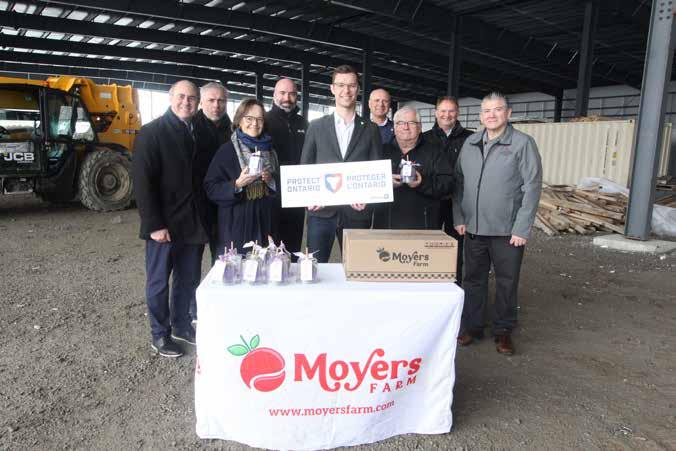
As work continues on the Moyer’s Apple Products expansion, the provincial government announced $1.5 million in funding through the Regional Development Program’s Southwestern Ontario Development Fund. The funding will support a $12 million investment by the company to build a 69,000-square-foot facility in Beamsville.
“By supporting strategic investments from regional businesses, our government is protecting Ontario’s workers and creating the conditions for a strong, stable and resilient economy that can weather any storm,” said Niagara West MPP Sam Oosterhoff in a press release.
A previous Moyer’s facility on the property burned down three years ago. The Moyer family has been growing apples in the Niagara region since 1799 and their caramel apple business has become a popular treat for consumers across North America.
Once the new building is complete, it will protect 75 existing jobs and create 12 new jobs. It will also help the company expand markets and look at new products, Court Holdings past president Mark Vanderveen said last fall at a groundbreaking event.
(519)
The new state-of-the-art facility will include automated production and packaging lines that increase efficiency, reduce labour costs and eliminate production constraints, as well as an industrial kitchen that will support the reshoring of caramel and chocolate production.
Today, nationally ALUS is approaching 1,000 farmers participating through 27 different community based programs in six provinces. Together they have enrolled 27,183 acres in the program.
Officially, ALUS Canada’s mantra now is: “ALUS Canada makes it possible to offset your environmental footprint through agricultural stewardship. ALUS invests in farmers and landowners who are producing acres of clean air, clean water, wildlife habitat and other ecosystem services in communities across Canada.”
Credit was given to some of the programs largest advocates by Gilvesy. Local MPP Toby Barrett has been a large ALUS proponent since the early days, and introduced a Private Member’s Bill promoting the concept. Wishart is now a MLA in Manitoba, and promoting it there. Bob Sopuck, who was Delta Waterfowl’s western vice-president of policy was an early advocate and became elected as an MP and was the program’s champion on Parliament Hill. Dave Reid co-wrote the ALUS concept documents with Dr. Bob Bailey, Delta’s eastern vice-president of policy.
Over the years, Gilvesy has talked to thousands of people about ALUS at hundreds of speaking engagements across Canada. Recognition for the program has included a Premier’s Ag Innovation Award
“This investment allows Moyer’s Apple Products to drive greater efficiency across our operations while continuing to grow responsibly in Niagara,” said Vince Benincasa, president of Court Holdings Manufacturing.
Local political officials also welcomed the announcement and the Moyer’s project.
“Moyer’s Apple Products is bringing new ideas to market and pushing the boundaries of what we can produce right here in Niagara. This funding will help ensure Moyer’s continues to thrive, protecting well-paying jobs in Niagara,” said regional councillor Rob Foster.
Gilvesy is proud ALUS is a farmer-led program and farmers fell they are the program owners.
“People feel they are partners in ALUS,” he said. “It’s the value of developing a grassroots program that recognizes the value of community.”



By Luke Edwards
There’s so much potential packed into each tiny seed: the promise of a beautiful plant, delicious produce, and for Madelaine Legault, a sense of optimism.
Legault is PhD sustainability science student at Brock University’s environmental sustainability research centre. For the last several months she’s been one of the key cogs in the effort to bring back Brock’s seed library, a program open to students and the general public that launched in 2022 but took a hiatus last year.
“Seeds feel really hopeful,” she said during a seed starting workshop held on campus last month.
A passionate gardener herself, taking after her grandmother, Legault is the type to check her pots on a nearly hourly basis each spring to see if any tiny plants are pushing through the soil.
Like many, the COVID-19 pandemic pushed the new hobby on her. As spring 2020 progressed and it became obvious people were going to be spending a lot of time at home that year, she got into gardening. Now it’s a passion.
“I’m a seed nerd,” she said, with a laugh.
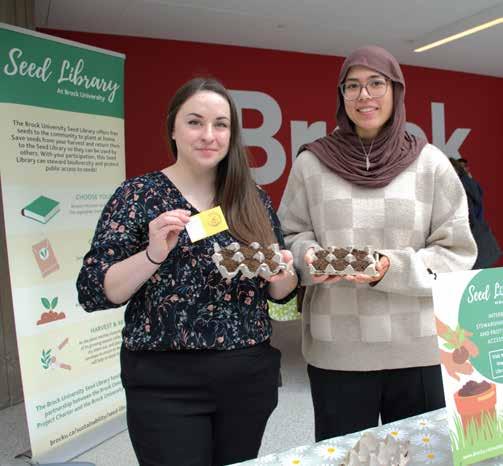
The return of the seed library after a one-year pause seemed to be a welcome move for many students. Halfway through last month’s workshop Legault said they’d already had about 30 students stop and pick up a packet of seeds or plant a few seeds in a starter pot made out of old egg cartons.

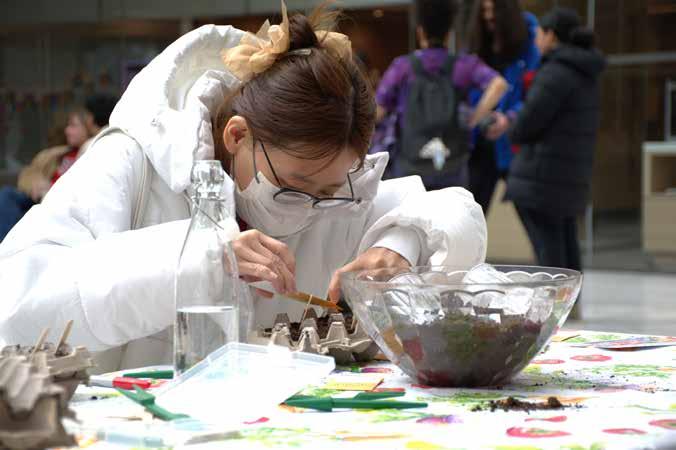
Students heading to and from class were eager to check out the seed starting workshop last month, with many picking up a packet or two of seeds to try their hands at gardening.
For the rest of the spring and through the end of August anyone will be able to stop by the Brock library and browse the catalogue, which has a wide variety of flowers, vegetables and herbs. Visitors can take up to five packets of seeds per visit.
Those who take advantage of the seed library are invited to pay it forward by saving any seeds they collect at the end of the growing season to help restock the Brock collection, making it a circular system.


Isra Alsahli helped start a campus group this year called Brock Students for Circular Economy, and was out at the workshop helping visitors get started and learn about growing their own plants.
“I think the seed library is a great example of a circular economy because it’s really closing that loop of consumption,” Alsahli said.
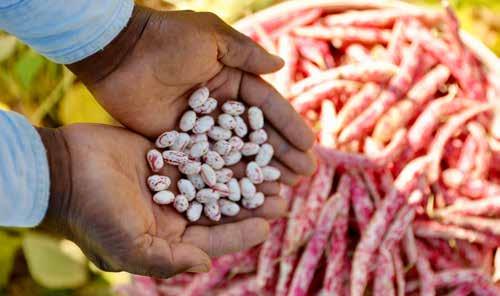
The library also helps students and members of the public reconnect a bit with food production and gain a better understanding of the food system. And with prices for everything going up, Legault said growing a few vegetable plants can provide you with delicious produce without hurting the wallet. Her favourite crop to grow is beans, which offers a unique mix. Not only is it one of her favourite vegetables to eat, but the different varieties offer all kinds of colours and designs.
In preparation for the season they’ve also updated their seed
growing and saving guide, which offers some tips for would-be gardeners along with a catalogue.
Brock has partnered with West Coast Seeds, which offers organic seeds. And new this year, they’ve also partnered with Kayanase, an Indigenous greenhouse and ecological restoration operation in Oshweken that focuses on native plants.
“I’m really happy we got to purchase some seeds from them,” said Legault.
Much of Legault’s work in her PhD program involves climate change, which can at times be depressing as she’s constantly reminded of where the planet could be heading. However, events like the seed starting workshop helps balance that out.
For more information visit the “Ask Us” desk at the James A. Gibson library at the Brock campus, or visit brocku.ca/sustainability/ seed-library.

By Niagara Farms Staff
Farm operations in search of some hired help are being encouraged to hire the next generation of farmers.
Applications are open for the latest intake of the Agriculture and Agri-Food Canada Youth Employment and Skills Program. Last month federal minister of the department Heath MacDonald announced up to $27 million to support the program to 2028, including just under $13.5 million for the 2026-2027 year.
“By opening doors to meaningful experiences in this essential sector, we help the next generation gain the skills, confidence, and opportunities they need to thrive,” MacDonald said in a press release. “This investment will strengthen our rural communities, support innovation, and ensure the continued success of Canadian agriculture.”
The program provides non-repayable contributions to employers who hire youth between
the ages of 15 and 30. It offers further incentives for employers to hire youth who face barriers to employment, such as Indigenous young people, those with disabilities, or those living in rural and remote regions. Employers can receive funding to cover up to 50 per cent of wages and benefits for general applicants, and up to 80 per cent for Indigenous employers or employers hiring youth facing barriers.
Applications for the 2026-2027 year will remain open until May 4. The press release also said officials have worked to streamline the application process this year.
The funding is part of a broader Youth Employment and Skills Strategy that is seeing the federal government invest $308 million.
The program has supported more than 6,200 youth jobs in the Canadian ag sector since 2019.
For more information visit agriculture.canada.ca and click on the “Programs and Services” link.
By Amanda Nelson
The 2026 Ontario Bean Growers annual general meeting was held in Stratford last month, where dry bean growers from across the region came together to discuss growing concerns around exports, particularly trade, transportation and domestic demand.
Alvin Klassen, of Dry Bean World, outlined current challenges as Canada continues to navigate overproduction of black beans and ongoing tariff changes that are limiting trade and creating uncertainty for growers.
“In the last five years, we’ve experienced several severe ups and downs in commercial markets related to supply and demand, with the influence of producer and dealer pricing,” said Klassen.
Despite steady global demand for dry beans, many growers are finding it harder to turn a profit.
Prices across North America have dropped sharply in recent years - in some cases by nearly half - while input costs such as fuel and fertilizer have remained high.
“Throughout North America, we are now sitting where bean prices are half of what they were
three years ago, and the cost of production hasn’t gone down at all,” said Klassen. “In fact, seed pricing hasn’t gone down, and it’s making it very difficult to sustain production.”
The issue, Klassen said, comes down to supply and demand. A strong harvest has left a surplus of beans in storage - known in the industry as “carryover” - giving buyers less incentive to pay higher prices.
At the same time, export challenges and limited processing options in Canada are making it harder for farmers to move their crops efficiently, adding further pressure to an already strained market.
Jeff English, of Pulse Canada, said the organization is working to increase domestic consumption through its “Love Canadian Beans” campaign, which aims to raise awareness that many beans sold in stores are grown in Canada and encourage more people to include them in their diets.
“It’s not about telling people how to eat, but showing them how beans can be incorporated into everyday foods we already know and love,” said English. “It’s about giving some familiarity to support-
ing what we see as a great, sustainably grown Canadian crop.”
English added that advancements in bean processing technology could also help grow the domestic market.
“Now that we have companies extracting proteins and starches from pulse crops, we should have an opportunity to put more protein into different foods - not necessarily calling them beans, but using them as a high-protein ingredient,” he said.
Bill Rosenberg, parliamentary assistant to the minister of agriculture, food and agribusiness, also addressed growers, highlighting the significant role Ontario’s bean

producers play in the province’s agri-food sector.
“Our agri-food sector now generates around $52 billion in annual GDP,” he said. “This is why Ontario is known around the world for safe, nutritious and delicious food.
“Eighty to 90 per cent of the beans grown here in Ontario are exported around the world, and that is something to be proud of,” he added.
Overall, the message to growers was clear: while global demand is growing, the industry must navigate trade instability, supply chain risks and the need to build stronger domestic markets to remain competitive.



By Niagara Farms Staff
A Niagara apple grower will help develop the future of agritourism in Ontario, while a former peach grower was honoured posthumously.
Agritourism Ontario recently handed out its annual awards, while also announcing new leadership at the organization. Niagara is represented on both counts, with Chester Kowalik receiving a legacy award, while Benjamin Vandenberg has been named the new vice chair.
“These award recipients represent the very best of agritourism in Ontario,” explained Darlene Downey, outgoing board chair for Agritourism Ontario. “Their dedication, resilience, and creativity continue to elevate the sector and provide memorable, authentic experiences for visitors from near and far.”
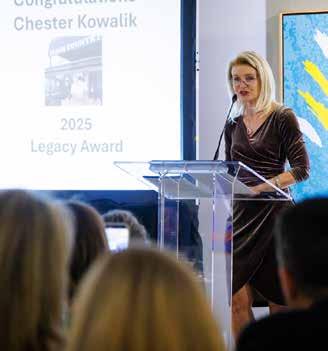
Kowalik Farms began back in 1955, focusing on producing quality fruit with the right mixture of soil, climate and farmer work ethic and know-
how. Chester opened Peach Country Market with his wife Phyllis and daughter Laura in 1990. He died in 2023 at the age of 90.
Other award winners include:
Member of the Year - Apple Land Station. Based out of Thorndale, just east of London, the award was handed out to them in honour of their “outstanding visitor engagement, innovation and commitment to on-farm experiences,” an Agritourism Ontario press release said.
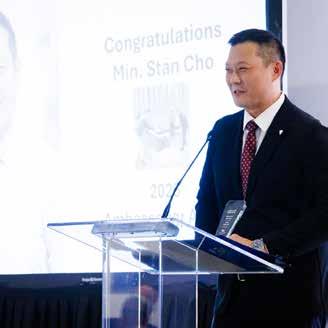
Ambassador Award - MPP Stan Cho, minister of tourism, culture and gaming. The award honours a person or company who has made a public commitment to promote local food, producers and the agritourism sector.
“Minister Cho has been a true champion for our sector. We are very grateful for his support and leadership,” Downey said.
Leadership award - Mark Saunders and Angela Grant Saunders of Saunders Farm. Based in eastern Ontario, the award recognizes the duo’s commitment to Ontario’s agritourism industry, their leadership, enthusiasm and willingness to support other farmers.
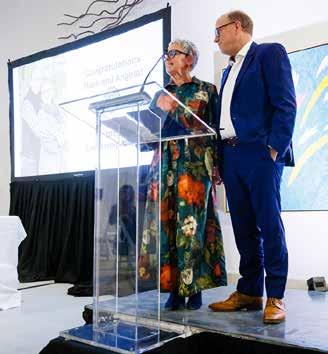



The organization also welcomed a change of leadership. Downey’s tenure as chair wrapped up, with Melinda McArthur taking over. McArthur is the manager at Heatherlea Farm Shoppe in Terra Cotta, and the press release said she brings extensive experience in agribusiness and rural tourism development, along with a strong commitment to collaboration and sector growth.
“Darlene’s leadership has left a lasting impact on our association and our members,” said Agritourism Ontario’s CEO Kevin Vallier. “We are deeply grateful for her service and dedication to advancing agritourism across Ontario.”
“I am honoured to serve as chair and to support our members in continuing to build a strong, sustainable agritourism industry,” said McArthur. “Together, we will continue to champion opportunities that support farms, families, and rural communities across Ontario.”
She’ll be joined by Vandenberg at the top of the organization. Vandenberg runs Pie in the Sky Farm and Bakery in Wainfleet.





2 tbsp (25 mL) each lemon juice and

Spicy Sweet Potato Pancakes
Ingredients
• 1/2 cup (125 mL) plain yogurt
• 1/4 cup (50 mL) fresh Ontario cilantro (coriander), chopped
• 2 tbsp (25 mL) green onion, finely chopped
• 1/4 tsp (1 mL) salt
• 1 Ontario sweet potato (about 12 oz/375 g)
• 1 small Ontario onion
• 1 jalapeño pepper, seeded and finely minced
• 2 tbsp (25 mL) all-purpose flour
• 1 tsp (5 mL) salt
• 1/4 tsp (1 mL) ground cumin
• 1/4 tsp (1 mL) cayenne pepper
• 1 Ontario egg, lightly beaten
• Olive oil
Instructions
In small bowl, stir together yogurt, cilantro, green onion and salt; set aside.
Sweet Potato Pancakes:
Peel potato; grate into medium bowl. Peel onion and grate into same bowl; toss. Turn into strainer and squeeze to press out any liquid; return to bowl. Stir in jalapeño. In small bowl, stir together flour, salt, cumin and cayenne pepper; toss with sweet potato mixture. Stir in egg until thoroughly mixed.
Heat just enough oil to coat bottom of large nonstick skillet over medium-high heat until hot. Using about 3 tbsp (45 mL) potato mixture for each pancake, press gently into 2-inches (5 cm) round. Place in pan. Repeat, adding about 4 more to pan, but do not crowd skillet. Cook for 3 minutes or until bottoms have set and are crisp and brown. Carefully flip and cook until crisp and brown and hot inside, 2 to 3 more minutes. Serve with cilantro yogurt sauce spooned over top.

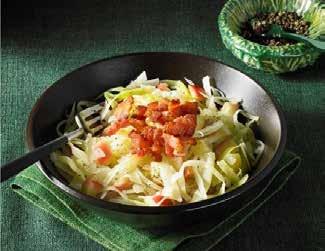
Stir-fried Cabbage with Bacon and Apple
Ingredients
• 3 slices Ontario bacon, cut crosswise into thin strips
• 1 Ontario onion, chopped
• 1 clove Ontario garlic, minced
• 4 cups (1 L) thinly sliced Ontario green cabbage, (about half cabbage)
• 2 tbsp (25 mL) water
• 1 Ontario apple (unpeeled), diced
• 1 tbsp (15 mL) white wine vinegar
• 1/2 tsp (2 mL) granulated sugar
• 1/4 tsp (1 mL) salt
• Pepper Instructions
In large wide skillet, cook bacon over medium heat until crispy, about 5 minutes. With slotted spoon, transfer to paper towel. Drain all but 1 tbsp (15 mL) bacon fat from skillet.
Reduce heat to medium-low. Add onion and garlic to pan; cook just until onion softens, about 2 minutes. Add cabbage and water to pan; increase heat to medium-high and stir-fry just until cabbage wilts, about 5 minutes. Add apple, vinegar, sugar, salt and pepper to taste. Stir just until apple softens slightly, about 2 minutes. Sprinkle with bacon and serve.
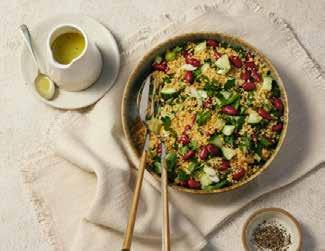
Cucumber, Couscous and Bean Salad
Ingredients
• 1 cup (250 mL) couscous
• 1-1/4 cups (300 mL) vegetable or chicken broth
• 1 can (19 oz/540 mL) red kidney beans, drained and rinsed
• Half Ontario greenhouse cucumber, chopped
• 2 green onions, sliced
• 1/4 cup (50 mL) chopped fresh Ontario parsley
um-high heat for 3 to 5 minutes until lightly
Meanwhile, in large bowl, combine kidney beans, cucumber, green onions and parsley.
In small bowl, combine lemon juice, olive oil and garlic; pour over salad and toss gently. Season to taste with salt and pepper. Serve warm or chilled.
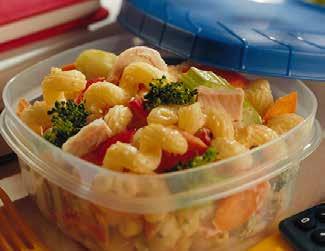
Lunch Time Pasta Salad
Ingredients
• 8 oz (250 g) pasta, such as rotini or scoobido
• 2 Ontario carrots, peeled and sliced
• 2 Ontario celery stalks, sliced
• Half Ontario sweet red pepper, sliced
• Half head Ontario cauliflower or Ontario broccoli florets
• 1 can (6 oz/170 g) tuna packed in water, drained or 7 oz (213 g) salmon, drained or 19 oz (540 mL) soya beans, drained and rinsed
• 1 cup (250 mL) favourite salad dressing, such as Caesar
Instructions
In large pot of boiling salted water, cook pasta for about 10 minutes or until al dente. Drain and rinse under cold water. Cook carrots, celery, red pepper and cauliflower in same pot with boiling water for 2 minutes; drain and cool.
In large bowl, toss pasta with cooked vegetables, tuna and dressing to coat. Spoon into individual plastic containers. Refrigerate overnight or for up to 2 days.
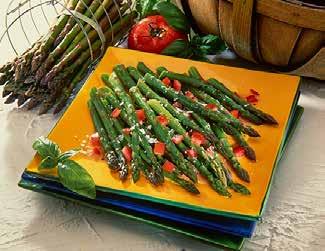
Mediterranean Asparagus and Tomato
Ingredients
• 2 tbsp (25 mL) red wine vinegar
• 1 tsp (5 mL) Dijon mustard
• 1 tsp (5 mL) Ontario honey
• 1/2 tsp (2 mL) dried basil
• 1/4 tsp (1 mL) salt
• Pinch of pepper
• 1/4 cup (50 mL) olive oil
• 1 lb (500 g) Ontario asparagus
• 1 ripe Ontario greenhouse tomato, seeded and diced
• 1/4 cup (50 mL) freshly grated Parmesan or Asiago cheese
• Fresh Ontario basil leaves (optional)
Instructions
In small bowl, whisk together vinegar, mustard, honey, basil, salt and pepper; slowly whisk in oil. Set aside.
In large pot of boiling water, cook asparagus until bright green and tender-crisp, 2 to 4 minutes (depending on thickness of stalk). Drain and chill in ice. Drain well and place in shallow dish.
Sprinkle tomato over asparagus. Pour dressing over asparagus and tomato. Let stand at room temperature for up to 1 hour. Garnish each serving with Parmesan and fresh basil leaves (if using).

Greenhouse Tomato and Pasta Toss
Ingredients
• 8 oz (250 g) uncooked capellini, vermicelli or spaghettini
• 1/2 cup (125 mL) butter
• 1 cup (250 mL) sliced fresh Ontario mushrooms
• 1 Ontario onion chopped
• 1 clove garlic, minced
• 2 Ontario greenhouse tomatoes, seeded and diced
• 1/4 cup (50 mL) chopped fresh Ontario parsley
• Salt and pepper
• Grated Parmesan cheese
Instructions
In saucepan, cook pasta according to package directions. Meanwhile, in a large skillet,
melt butter; sauté mushrooms, onion and garlic until tender. Drain pasta; return to saucepan. Add vegetable mixture, tomatoes and parsley; toss to combine. Season to taste with salt, pepper and Parmesan cheese.





By Amanda Nelson
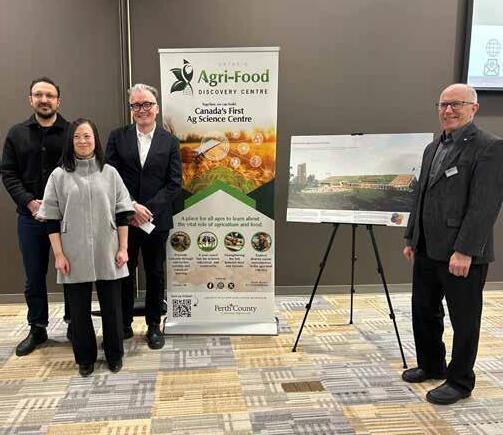
At the Ontario Agri-Food Discovery Centre’s 2026 annual general meeting March 26, board chair Steve Dolson introduced the team from Moriyama Teshima Architects, which developed concept designs for the future 10-acre site in Listowel.
The Ontario Agri-Food Discovery Centre aims to become a place for learning and play that showcases the innovation and importance of the agriculture and agri-food sector across Ontario, while highlighting what Huron and Perth counties have to offer.
Although still in the conceptual phase, the centre is already drawing attention and praise from local politicians, including Matthew Rae.
“This centre will showcase the strength of Ontario’s agri-food sector and the people behind it,” said the MPP for Perth-Wellington. “It’s an industry that drives our economy and puts food on our tables every day.”
The STEM-based centre is envisioned as a hub for science, educa-
tion and community engagement, promoting curiosity and bridging the gap between consumers and agricultural practices. It will also highlight diverse career opportunities in the agri-food industry.
At the meeting, plans were discussed for an expanded facility, growing from 20,000 square feet to 34,000 square feet, with estimated costs increasing to $38 million.
The board secured $100,000 in grants from the Gay Lea Foundation and the Agricultural Adaptation Council, allowing the project to move forward with architectural proposals and the concept phase.
A total of 41 proposals were received before officials selected Moriyama Teshima Architects. The overall project is expected to raise $40 million to $50 million, including $100,000 for concept design, $300,000 for planning and $150,000 for fundraising support.
The firm has worked on a number of civic and cultural institutions, including the Canadian War Museum, the Aga Khan Museum, the Discovery Centre and the Honey Bee Research Centre. They are currently leading new design work at Science North, as well as the Rouge National Urban Park Visitor, Learning and Community Centre. Their approach to the project focuses on helping the public better understand Ontario agriculture and making food systems more visible.





“Food is everything. Food is national security. Food is economy. It’s employment. It is energy, history. If we approached many of today’s issues understanding the importance our food makes, we would be making much better decisions,” said Diarmuid Nash, partner. “Food is infrastructure, its climate resilience, its economic strength and its community stability, and yet, for something so fundamental to our lives, much of this food system remains invisible to the public.”
He reiterated that the centre is about making the agri-food system visible to everyone, including those in urban centres, like Toronto.
“It’s a place for agriculture, technology, sustainability and education to come together - a place where Ontarians can better understand the land that sustains them, the systems that support it and the innovation shaping its future,” he said. “While the building is about agriculture, it’s also a civic institution about stewardship. It reflects resilience, and it’s about the future of food in Ontario.”
Olivia Keung, director of sustainability, said the concept will focus not only on the agri-food sector but also on sustainability and land use.
“Our projects focus on public engagement, learning and connections to the landscape,” she said. “We were inspired by the conversations during the tour and throughout the months we have been working together with the board, and we are deeply committed to sustainability and innovation.”
Keung said sustainability is a top priority for the concept.
“Architecture must embody environmental sustainability. That same belief - that buildings can actively demonstrate stewardship, innovation and responsibility to the land - is central to how we approach the Ontario Agri-Food Discovery Centre,” she said.
The project began in 2020 with a feasibility study conducted for the Municipality of North Perth. A non-profit organization was formed in 2021, gained charitable status in 2022 and developed a strategic plan in 2023. In 2024, the Municipality of North Perth committed 10 acres of serviced land as the project expanded to a provincial scope.
The board plans to launch a capital campaign next year.
More information is available at oafdc.ca.
At Ontario Tender Fruit Growers meeting, producers learn of new product likely to come to Canada in 2027
By Luke Edwards
Use of an amino acid that’s already naturally occurring in fruit trees could help tender fruit farmers offset rising labour costs associated with hand thinning.
Attendees to the Ontario Tender Fruit Growers annual general meeting last month in Niagara-on-the-Lake learned about research into how 1-aminocyclopropanecarboxylic acid (ACC) could reduce the need to hand thin peach and plum trees by as much as 50 per cent. It’s a process already used with apple trees in Canada and stone fruit south of the border. With labour costs rising and availability dropping, John Cline said there’s some optimism around a product called Accede that has ACC as its active ingredient.
“Right now hand thinning is really the only option for thinning peaches,” said the professor of pomology and tree fruit physiology at the University of Guelph. Cline was a guest speaker at the March 26 tender fruit growers AGM.
In addition to offering relief for labour needs, Cline said research suggests the product could also improve other aspects, namely by offering earlier thinning opportunities.
“If you get your fruit off earlier, (the remaining fruit) should be able to size better,” he said.
Researchers are continuing to study the product on local farms. Research began a few years ago on peach and plum orchards. It’s already been labeled for apple growers in Canada for two years, Cline said. The plan from Valent was to release it for stone fruit growers this year, but that has now been pushed back to 2027.
ACC naturally occurs in fruit trees, and seems to lead to an increase in ethylene production, which causes fruit drop. Thinning fruit trees is a key step to ensure the tree’s energy is most efficiently utilized.
The research of Cline and his team looked at several aspects and variables, including spray rate. It’s already used in the United States, where a 300 to 600 parts per million application is recommended. Cline said he and his team wanted to be more precise.
“We wanted to optimize or find the ideal rate,” he said.
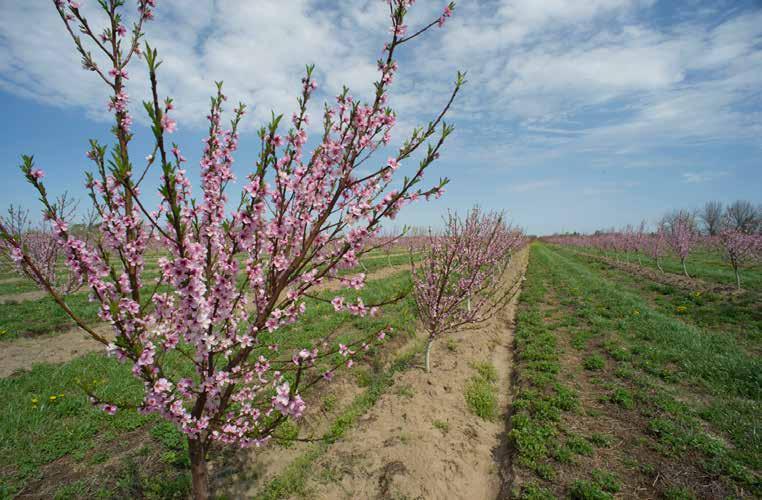
For peaches, he said their research suggested a 400 to 500 ppm application, done once sometime from pink bud to petal fall.
For plums, the rates were a little lower, to a maximum of 450 ppm. However, it can be applied on fruit up to 10 mm.
There were some issues with the product, though, Cline said, that could affect Canadian growers. They’ve tested the product over multiple years, and while in some years on some varieties they were able to approach the target of reducing hand thinning by 50 per cent, in other instances the impacts were more negligible.
The culprit, as is often the case in this part of the world, was Mother Nature.
“It’s likely much related to the weather,” he said.
It seems cooler temperatures can have a negative impact on effectiveness, so Cline cautioned growers to be careful if they choose to employ the spray when it becomes available.
The product can also cause leaf yellowing or leaf drop, though Cline said it seems the trees recover within a month or so.
Some research Cline has come across suggests the pedicel, which is the stalk that attaches to the flower, is the mode of action. This produces an added challenge, Cline said, as it’s a small target to reach, especially for peach trees.
The product is registered. More study on the product will be taking place in 2026.

By Luke Edwards
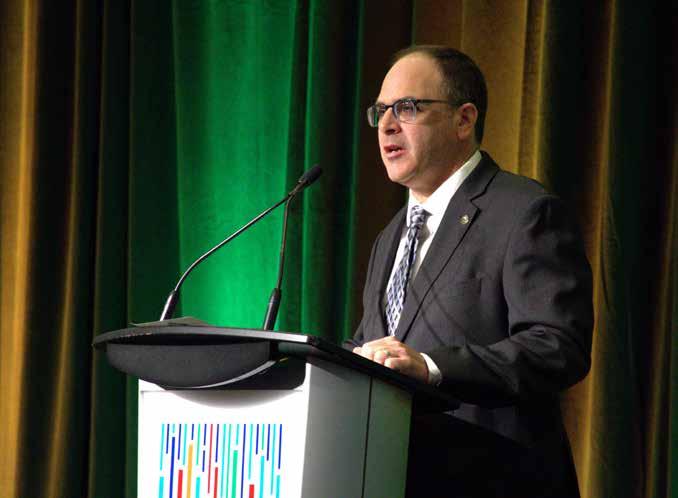
There’s never a good time for war, but for Ontario’s grain farmers, there might not be a worse time.
As farmers from across the province came to Niagara Falls to celebrate the industry with the Grain Farmers of Ontario March Classic, the situation on the other side of the globe was on the minds of many.
“The world is not easy right now,” said Trevor Jones, Ontario minister of agriculture, food and agribusiness.
With uncertainty surrounding the United States-Israel attack on Iran and subsequent closure of the Strait of Hormuz, global access to key products is under strain.
“Fertilizer is one of the clearest examples of challenges facing us right now,” said Crosby Devitt, CEO for GFO.
While rising gas prices catch many of the headlines, large volumes of nitrogen fertilizer pass through the strait. But with it closed, many farmers are feeling the pinch. Uncertainty changes cost structures quickly, Devitt said.
Still, outgoing chair Jeff Harrison said the organization is doing what it can to support Ontario grain farmers.
“We seek to solve problems and not politicize them,” he said.
Earlier this year the GFO rejoined its national counterpart, the Grain Growers of Canada, in a move Harrison said will strengthen their voice.
“We are always stronger together,” he said, adding national and international colleagues are their partners. In fact, Canada will be the host
nation for the International Oilseed Producers’ Dialogue later this year.
Devitt and Harrison said they’ve been working with port cities and elsewhere to improve infrastructure capacity, which they say can help manage volatility.

“That flexibility matters when our market shifts,” Devitt said.
Still, they acknowledged the tough times farmers are facing.
“Farming is never easy, but it’s always worth it,” said Harrison.

By Luke Edwards
The word uncertainty was thrown around a lot at the Grain Farmers of Ontario March Classic last month, and for good reason given the state of the world.
It’s a word that might evoke fear and concern, but guest speakers suggested uncertainty can be a feature as much as it can be a bug.
It was a, perhaps, appropriate theme for this year’s event, considering some uncertainty around the classic itself as it moved to a new location at the Niagara Falls Convention Centre. However, the new home proved successful with a strong turnout and full crowd to listen to guest speakers Arlene Dickinson, Catherine Murray, Eric Termuende and George Stroumboulopoulos.
The speakers themselves often lauded the farmers in the room, acknowledging the hard work, challenges and sacrifices they make to put food on the tables of people here and around the world.
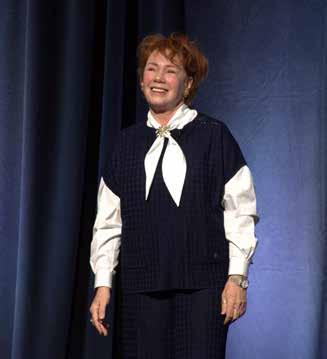
“To me, you are the foundation of our nation,” Dickinson told the farmers in attendance.
“The world needs farmers, and the world needs Canadian farmers.”
‘Things
Calling farmers some of the best BS detectors out there, Dickinson - who created a successful marketing company before becoming a prominent investor and star of the TV show Dragon’s Den - didn’t sugarcoat things for those in attendance. Global unrest and an increasingly antagonistic neighbour to the south means we’re in for some turbulence.
“Things are going to be hard,” she said. “We live north of unrest.”
However, within that difficulty are seeds of opportunity, especially in a country like Canada. It’s something she learned when her family arrived here from South Africa with $50 to their name and nothing else. While Canada can always improve, she said the country and the people who call it home create an atmosphere where success is possible.
And she said other countries value Canadian goods and expertise. A recent trip to several Asian countries proved that to her.
“I found countries that wanted what we have to sell,” she said, adding it will be increasingly vital as Canadian exporters - farmers includedtry to wean themselves off American trade.
That all may be uncomfortable, but Dickinson said opportunity often lies in the uncomfortable. Her own role on Dragon’s Den almost never came to be because she was, for a time, unwilling to step outside her comfort zone.
In fact, the only reason she agreed to do the audition was because she’d always encouraged her own children to try new things, and realized she had to walk the walk.
Still, throughout the process her fears of putting herself in the public eye and being judged kept a hold on her. When, during auditions she got in an argument with co-star Kevin O’Leary over what she said was unfair treatment of a guest, Dickinson figured she’d got her wish. The producers would thank her for her time, send her home and Dickinson could return to her former life while telling her children she tried.
Except, the producers liked what she offered the show and wanted more. Dickinson said she tried to turn it down, but eventually realized she couldn’t. And the rest, as they say, is history.
“It was because I walked through a door I wasn’t comfortable with,” she said.
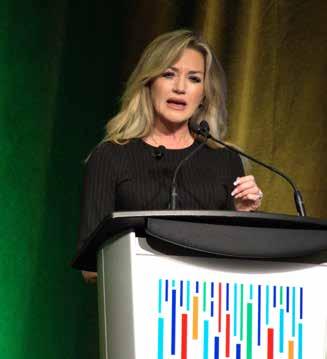
Most of the time, the consensus view is a consensus for a good reason, says Catherine Murray, business analyst and former anchor of BNN’s The Close. The key is to figure out when the consensus is wrong, or when it’s about to become wrong.
“When it changes, it’s fast and furious,” she said. Pushing back on the consensus at the right times can turn “pain into prosperity.”
Murray said she’ll be keeping her eyes on global markets as a weathervane of how things are going. The renegotiation of the Canada-United States-Mexico Agreement, government policy and the ongoing rollout of AI and technology will all be key aspects that determine where things go from here.
“With this upcoming trade deal, I hope we have some great negotiators,” she said.
Even as Canada pivots away from the U.S., opening up some canola access to China and other smaller deals with Asian countries for example, Murray said Canada is too intertwined with our neighbours to the south to completely abandon Canada-U.S. trade.
“They are still our biggest trading partners,” she said.
In this new technological world, and as Canada looks to find more trade partners, Murray said traceability will have a renewed focus. She also suggested the two can work hand in hand, as blockchain offers a potential way to use technology to combat the misinformation and disinformation that can flourish in the digital age.
“Blockchain is the building block of what is real and what is not,” she said.
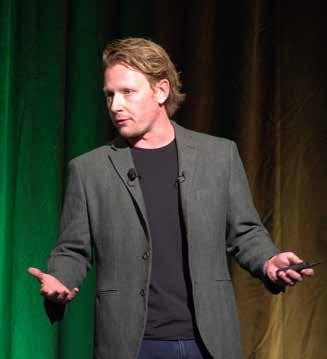
As the March Classic was taking place there were no shortage of uncertainties in the world. The Strait of Hormuz remained closed and no one knew how long the America/Israeli war against Iran would last. The future of AI still hasn’t been written. However, rapid, and accelerating, advancements in technology means the world is changing at an ever greater clip.
That may lead people to think it’s becoming more important to understand where the world is heading so businesses can adjust.
Termuende thinks that’s a fool’s errand.
“If you think the world is moving fast, wait until later tonight. It will be moving faster,” he said.
So if the world’s moving faster and faster, and there’s no point in trying to predict where things are going, what do we do?
“Build a team so good that it doesn’t matter what the future looks like,” he said.
A strong team can react and adjust to changes when they happen, leading to success in every version of the future the universe can offer.
Termuende promoted the idea of one degree shifts to build that team. Small changes to address issues eventually add up in a big way, he said.
“What one degree shifts can we take right now to get us a little closer to our goal?” he said.
Yesterday’s best practices may not hold up today, he added, so constantly looking at where a business can start something new, stop something that no longer holds value, or continue doing what works is key.
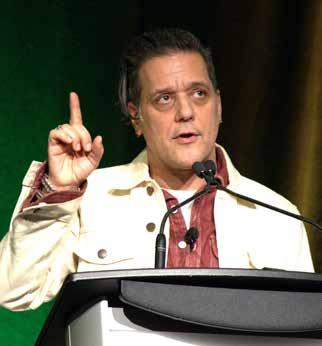
The presentations wrapped up with a discussion with one of Canada’s biggest cultural voices.
Some know George Stroumboulopoulos from his days as a VJ on MuchMusic. Others from his talk show, or his stint as Hockey Night in Canada host.
What fewer people may know is his longstanding connection with the food system. He’s worked with the United Nations World Food Programme, becoming the first Canadian National Ambassador Against Hunger. He’s also part of a project in South Africa that’s growing hemp to be used in a variety of ways, including hemp milk.
This variety has given him a unique perspective on how the world views Canada and how Canadians view themselves.
“There’s an expectation for Canadians to lead,” he said.
And while that never really stopped in the private sector - Stroumboulopoulos said Canadian agricultural technology and expertise is found across the globe - he sees an opportunity for the country to re-establish itself on the political stage.
Closer to home, Stroumboulopoulos said feelings of a country divided are overblown.
“We’re not nearly as divided as we think we are,” he said. Canadians may not have completely common ground, but by and large they have common goals, he added.
The key is to listen, and to do so with intent. Instead of trying to “win” a conversation, he encouraged people to actively listen and consider the viewpoints of others.
“Most people are fundamentally decent, and that’s underrated,” he said.
By Jeff Tribe
Agritourism Ontario (AO) Chief Executive Officer Kevin Vallier was permitted a quiet moment of celebration this past December on the one-year anniversary of provincial Bill 186, The Growing Agri-Tourism Act.
Vallier, along with AO board chair Darlene Downey worked closely with Perth-Wellington MPP Matthew Rae’s determined support for his private member’s bill. Only a tiny percentage of such bills actually become legislation said Vallier. Rae, who comes from a farming background, both wrote the bill and followed its progress through to passage. He is a member of the ruling Progressive Conservative Party of Ontario, but the bill passed unanimously, said Vallier.
“We had great support from all four parties.”
In essence says Vallier, the bill provides a layer of protection for farm owners who welcome the public onto their property. It is not blanket coverage he cautions. Owners must comply with regulations including the posting of warning signs, and if an injury occurs due to negligence, there still can or will be legal consequences.
However, it does work on the assumption there are inherent risks on an active and working farm.
“And if you voluntarily walk onto that farm, you assume those risks.”
Vallier referred to illustrative examples from his home Niagara region.
“I think we had two lawsuits from people who sprained their ankles because the ground was uneven.”
The lawsuits were for $1 million said Vallier, an amount not anticipated to be awarded through court proceedings. However, insurance companies may choose to settle for a lesser yet still significant amount to make a potential problem go away, or face significant legal costs.
“And then over time, liability insurance premiums for agri-tourism operators have just skyrocketed. Ten, 20, 30, 40… we’ve seen 50 per cent increases year-over-year.”
As mentioned, landowners are still subject to legal action via negligence, however Bill 186 is intended to address threats of the ankle sprain or bee sting variety, or says Vallier, “someone’s fingers getting nipped when feeding a baby goat a carrot.”
Based on some “early wins”, Vallier is happy to report AO clients who faced rising liability
insurance premiums have actually seen them come down, others previously unable to obtain insurance, able to do so.
“I’m sure insurance companies are waiting to see the strength of this legislation and how it holds up in court, but we’re confident it will.”
The rebranded AO’s founding body has been around since the 1970s,says Vallier, a time when agritourism wasn’t a recognized definition, most operations representing a produce stand at the end of the driveway. His own is simple, any farmer who welcomes the public onto their property.
Over the years, the organization has evolved along with farmers looking to either diversify or add to their operations in ventures like corn mazes, on-farm markets, pick-your-own produce or cut-your-own Christmas trees, sugar bushes and petting zoos. Beyond providing economic opportunity, each is a chance to bridge the rural-urban divide Vallier believes, for city folk increasingly disconnected from rural Ontario.
“It’s a fun and interactive way to learn about farmers and agriculture as well.”
The organization (agritourismontario.com) offers membership services including in-person workshops, educational webinars and a popular
annual bus trip exploring other operations. Members tend to be highly-collaborative credits Vallier, typically willing to share best practices and experiences with their fellows.
AO is also active in advocacy both at the provincial and municipal levels, focusing on municipal planners in particular. Ironically, says Vallier, local regulations intended to retain farmland as farmland can actually provide unwelcome complications, red tape and planning barriers which can add to an agritourism-based operation’s challenges.
“They put a burden on the farmer or their children who will eventually throw their hands up and sell because it’s just not worth it.”
Once a piece of farmland is sold and converted into a parking lot or business or residential development, it’s never coming back says Vallier. The organization is not saying farmers should be allowed to do whatever they want, wherever they want.
“But there should be some compromise.”
The Growing Agri-Tourism Act is an example of just that, he concluded, good legislation based on a practical approach with the potential to make a real difference for Ontario’s producers.
“It’s a bill that is a benefit to farmers in agritourism.”
There are challenges, but also opportunities, for women in farming, panelists say
By Luke Edwards
It may be hard work, but it’s never been hard to convince Andrea Veldhuizen to head out to the barn.
The passion for agriculture and a strong work ethic instilled in her during early mornings with her dad to do the chores on their Niagara dairy farm has stayed with her into adulthood. And now the second generation chicken farmer considers herself lucky to pass the lessons she learned as a kid onto her own children.
“It’s a collection of moments where I watch my kids and the ability they have to grow up and gain this hard work ethic, to understand where their food comes from, to participate in the process of providing food,” Veldhuizen said during a webinar hosted by Farm and Food Care Ontario last month. Ahead of International Women’s Day and in the midst of a year dubbed by the United Nations as the International Year of the Woman Farmer, Veldhuizen was among an all-woman panel that discussed both the challenges and opportunities for women in agriculture.
“Often they go unrecognized. Women farmers are really central to food security, nutrition and resilience,” said Kelly Daynard, executive director of FFCO, who moderated the event.
Veldhuizen was joined by first generation Norfolk apple farmer and agritourism operator Amanda Dooney and Julie Maw, a Lambton County woman whose family grows soybeans, corn and wheat, runs a seed dealership and offers custom farming services.
While their stories and journeys are unique, the three speakers found plenty of common ground, including a focus on family and the idea that farming is more than just a way to earn money.
“Agriculture is a lot more than a job, it’s an identity. I often say it’s a lifestyle. It’s the way my family’s chosen to live,” Veldhuizen said.
While it is a lifestyle they’ve chosen, that doesn’t mean it’s without challenges. Juggling countless responsibilities on the farm and within the family can mean there aren’t enough hours in the day. There are different approaches to making it all work.
For Maw, structure and organization are key. She called her calendar her most important tool on the farm.
“Our house runs like a ship, we’re very organized,” she said.
“Balance isn’t about just treating everything equal in size but about equal in weight.”
Dooney and Veldhuizen talked about ensuring there’s down time, either through finding little moments here and there to practice self care or having non-negotiables like a regular family meal time.
“Often as women we care for ourselves last, and that actually doesn’t do us well,” said Veldhuizen.
Sharing the responsibility is also important, not just to reduce their workload, but to teach that work ethic that’s so important on farms.
“It’s better for me to empower my daughter to make dinner one night, or my son to do some chores,” said Veldhuizen.

That approach will pay dividends as the children grow up.
“I think farm kids are the best kind of kids, they have an amazing work ethic,” Dooney said.
But while they admit to challenges that can be somewhat unique to women, and a desire to see more women get involved, the speakers mostly said they just wanted to be treated like any male counterpart.
“Just treat us normally,” said Maw.
“I don’t want to sit on a board just because I’m a woman. I want to add value,” added Veldhuizen.
Likewise, Dooney said it’s important to recognize the women who are equal partners on the farm. For most of the time she may be stuck at a computer doing administrative work - though Dooney said she’d often prefer to be out in the orchards - but that work is still vital to the farm’s operation.
“We’re not just helpers on the farm, we do a lot. We are operators,” she said.
“We need to get away from that and recognize women do have a really integral role on the farm.”
Before the UN announced 2026 to be the International Year of the Woman Farmer, the Grape Growers of Ontario named Tawse vineyard manager Augusta Van Muyen as the 2026 Grape King. Only a handful of women have received the honour.
Van Muyen said there are very few women who are actual vineyard managers in Niagara.
“But there are so many women behind the scenes who make things happen, who are farmers, but not in the traditional sense of farming,” she said.
They could be the people like Dooney who take care of the important administrative work, or researchers like OMAFA’s Wendy McFadden-Smith or the women at CCOVI whose research helps make farmers’ lives easier.
Getting more women into the industry will only be a further benefit, Van Muyen said.
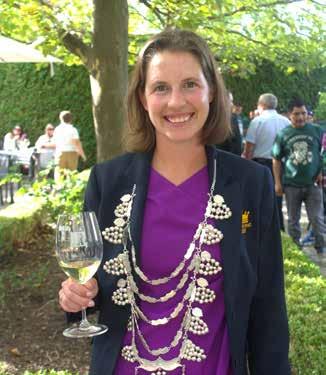
“The barrier is not knowing the opportunity more than not being welcomed into the industry,” she said.
During the FCCO webinar, a question was asked about the future of farmers, suggesting that today if someone was to ask a kindergarten student to draw a farmer they’d likely still draw a picture of a man with a pitchfork.
Veldhuizen, who multiple times during the webinar stressed the importance of ag education for a public that’s increasingly distant from food production, said that’s already a pretty outdated idea of farming. Teaching the public what farming looks like in the 21st century is key. And as the Ontario farmer becomes more diverse, her hope is that the public will gain an understanding, and appreciation of that diversity.
“I’d like to think one day a kindergartner will draw a picture of me, but hopefully it’s just a variety of people,” she said.
By Luke Edwards
Ongoing economic uncertainty is likely one of the main reasons farmers in Ontario are continuing to spend less on new machinery and other farm investments, and otherwise staying the course.
Results of the Ontario Federation of Agriculture’s third annual business confidence survey were released recently, and OFA economist Ben LeFort said there’s some cause for concern, though the province’s farming community remains resilient and relatively confident in their own operations. However, economic uncertainty, trade wars, and geopolitics continues to be a drag on Ontario farmers.
“I think we can read that across the board. There’s less investment, there’s lower confidence. More folks are saying ‘I’ll probably just stay the same,’” said OFA economist Ben LeFort.
“You take all those three things together and really what it paints a picture of is waiting out the storm to see what happens.”
The survey saw more than 850 farmers respond, sharing their insights on investments, confidence and plans to expand or contract. They also answered questions on what the top issues were and what they would like to see the federation to focus on.
LeFort said they received a good cross section of farm operations, with most commodity groups and regions represented, along with a good mix of income levels.
The survey ran from Dec. 1 to Jan. 16. Last year, the survey came out just as U.S. President Donald Trump’s tariff plans started making headlines.
“There was a huge amount of uncertainty at the time we ran last year’s survey,” LeFort said.
It looks like that uncertainty is remaining.
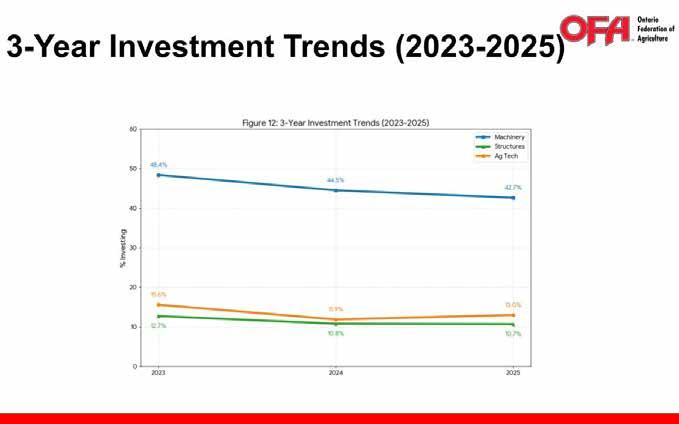
The percentage of farmers who reported investing in machinery has dropped each year of the survey, going from 48.4 per cent in 2024, to 44.5 per cent last year and down to 42.7 per cent this year.
“This certainly is a concerning trend,” LeFort said.
Investments in structures are also down from two years ago, but basically flat from last year.
For ag tech, investments rebounded slightly from last year’s survey, but at 13 per cent remains down from the 15.6 per cent mark for the first year of the survey.
Those who are investing in tech are mostly young - more than one quarter said they were under the age of 35 - and large. Farms that reported $500,000 or more in income made up more than 30 per cent of those investing in technology.
A lack of access to cell service is a huge barrier for technology adoption, LeFort said. Northern Ontario is far below the rest of the province in terms of adopting technology for their farm businesses, and they’re also far more
likely to live in a digital desert with no signal, or a weak and unreliable signal.
“It has nothing to do with desire to adopt it, it has everything to do with the infrastructure and availability of the broadband that’s required to run these technologies,” he said.
Large farms are also getting larger, with the $500,000-plus category far more likely to be looking at expansion.
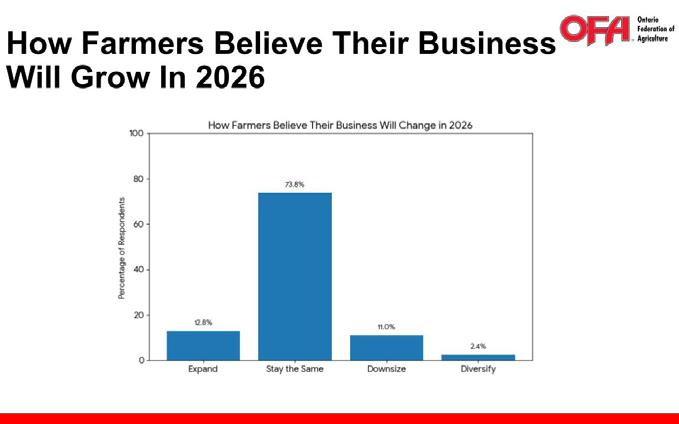
Overall, however, roughly three quarters of respondents said they’re neither planning to grow nor downsize.
“More and more of the members saying they’re basically staying the same,” LeFort said.
In each of the three years of the survey, LeFort noted an ongoing trend that farmers reported being more confident in their own business than in the sector as a whole. On both fronts, confidence ticked up from last year, but remains down from 2024. For the industry as a whole, 57.7 per cent expressed some level of confidence (up from 54.9 last year and down from 62.9 in the inaugural survey), while confidence in their own business hit 76.4 per cent (up from 74.6 per cent last year and down from 78.6 per cent in 2024).
“We see a persistent trend for farmers being a lot more confident in their own business than in the sector,” he said.
Younger farmers seemed more confident both with their own operations and the sector as a whole than their over-35 counterparts.
LeFort also noted an interesting split that saw Northern Ontario farmers more confident in the sector than those in the rest of the province, a number that’s been rising in each of the three surveys.
In terms of priorities, farmers once again placed taxes at the top of their list.
“For the third year in a row, reducing farm taxes not only was number one, but runs away with number one. It’s run away with number one each year we’ve done the survey, it’s not even remotely close,” LeFort said.
Just under 70 per cent of respondents said they want OFA working on getting farm taxes reduced. Specifically, farmers identified property tax as the main challenge by a large margin, LeFort said.
It’s something OFA has been working on for several years, with LeFort crediting local farmers in many municipalities for helping get their councils to lower the tax ratios for farms. However, he described it as mostly being in a holding pattern now, with the ongoing freeze of MPAC assessments.
Other policy priorities for government that farmers mentioned the most included pushing for more buy local, addressing energy costs, succession planning and interprovincial trade. Protecting the right of property was also top of mind for many farmers.
Outside of government policy, the survey found farmers are far and away more concerned about rising input costs than anything else. Other top issues included commodity prices and the cost of insurance.
“This has risen each of the three years we’ve done this. This has continued to rocket up the charts in terms of issues that members are telling us they’re worried about,” LeFort said.
Nearly half of respondents identified insurance costs as a top issue.
Drilling into the insurance issue, LeFort said they’ve also found a mismatch between what farmers think is covered under the plans, and what is actually covered when they try to make a claim.
Perhaps surprising to some, cost of insurance even topped trade and tariffs.
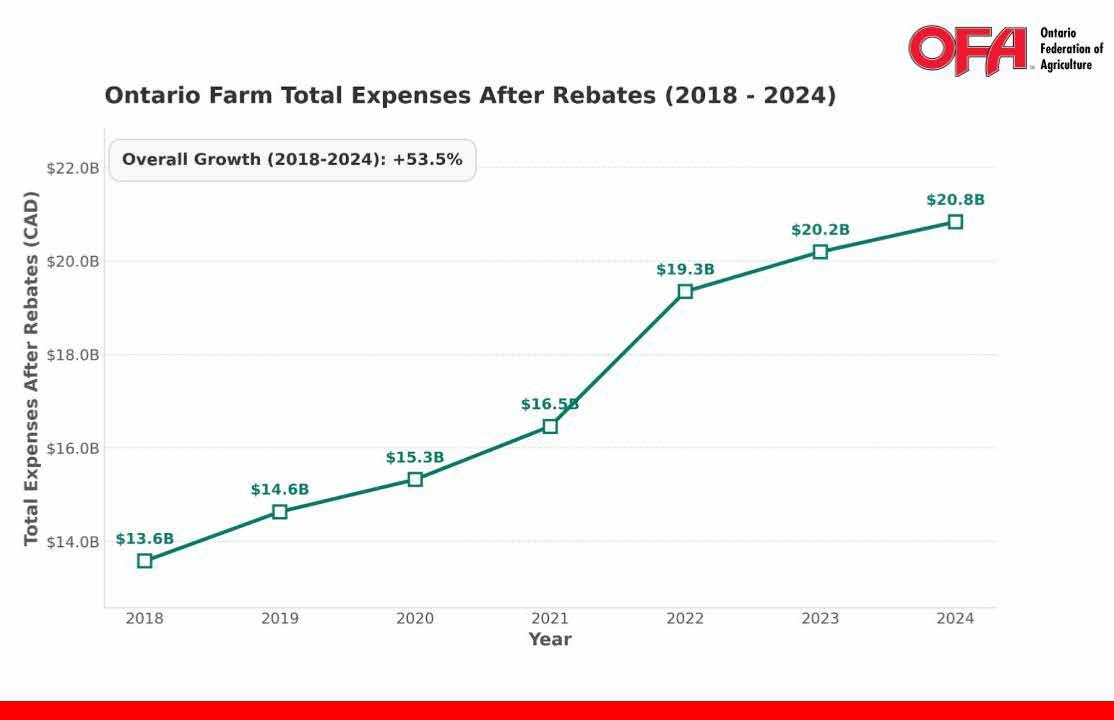
However, having rising input costs at the top wasn’t surprising, LeFort said. Between 2018 and 2024 Ontario farm total expenses after rebates increased 53.5 per cent to just under $21 billion.
“So it’s not too surprising, especially since COVID…that these rising costs are increasingly concerning to members,” he said.
LeFort plans to keep running the survey, and encouraged farmers to keep an eye out for when the next survey opens later this year.
”This is your chance to really tell us ‘these are the most important issues,’” he said.



By Luke Edwards
A crucial step in the process from barnyard to barbecue is getting some help from Niagara College.
This fall the college will be launching an artisanal butchery program, following through on a long held priority to support an industry that could use an injection of fresh talent, said Craig Youdale, dean of culinary, tourism and beverage studies. The one-year certificate program will provide a mix of the basics of breaking down an animal with some more elevated concepts such as smoking, brining and charcuterie.
“We knew that in Ontario, especially, but really across the country, that butchers were really starting to age out. It was one of those industries that really needed younger life into it,” Youdale said.
The idea is several years old, going back to before the COVID-19 pandemic. Expansion projects at the Daniel J. Patterson campus in Niagara-on-the-Lake included space for a potential butchery program, but the aforementioned pandemic took the program off the butcher’s block, so to speak.
However, Youdale said the college is now ready to launch the program. And it appears students are just as ready to sign up. The dean said they’re expecting to have a full intake in year one, filling up the 24 spaces they made available. Typically it can take a couple years for a new program to fill up, he said, as potential students take a waitand-see approach.
“We’re just really excited and I will say if the interest is there we’ll definitely grow the program,” he said.
Jobs in the industry offer a good mix of hands-on work but also a high level of creativity, something Youdale said can be overlooked. There’s no shortage of ways to break down an animal, and there can be a certain artistic skill to figuring out how and where to make the cuts.
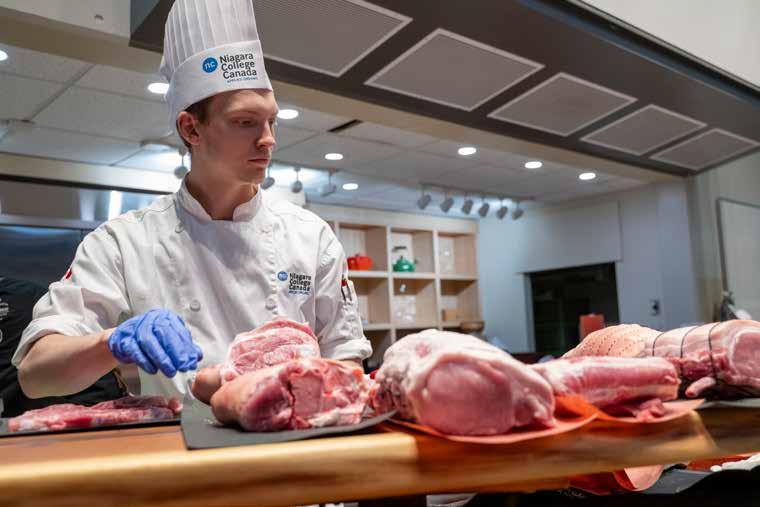
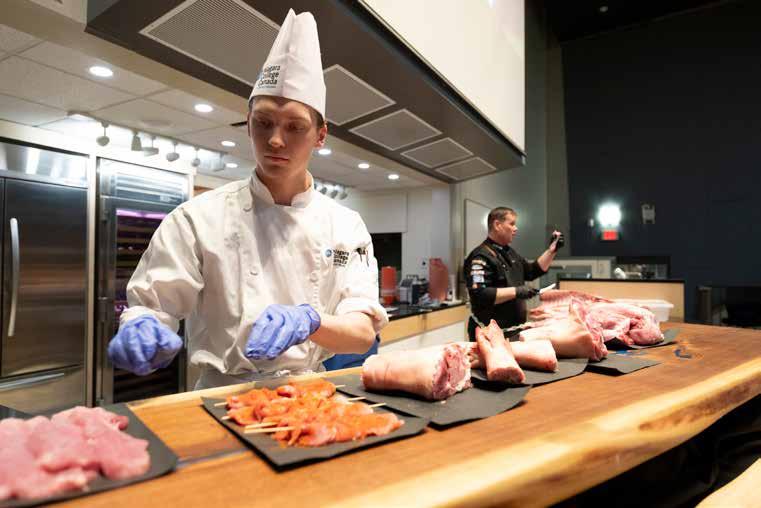
That creativity will come in handy with another focus of the program, as students will learn how to efficiently and effectively use as much of the animal as possible.
Youdale said that’s all part of the goal to be more sustainable.
“Making sure we use 100 per cent of the animal or as close as possible, so that we’re respecting the process of raising the animal,” he said.
As a certificate program, it’s open to anyone with a high school diploma. Youdale encouraged those thinking about enrolling for the fall to do so as quickly as possible.
There are a wide variety of good paying jobs available to people with butcher skills, Youdale said, from large meat cutters to grocery stores,
or even people who want to open their own shop or expand existing skills.
“We liken it to pastry, in the sense that it’s a specific skillset but it can be used both in the restaurant environment and being more skilled in the butchery side of things but you can also be entrepreneurial and start your own business,” he said.
Fortunately the school has a ton of existing talent on staff, including, among others, Olaf Mertens, who helped coach the national team at last year’s World Butchery Challenge in Paris. “He’s definitely a driving factor. And we have a variety of different chefs who have done additional training,” Youdale said. “But we’ll also be
bringing in butchery experts from across the province to help us train as well.”
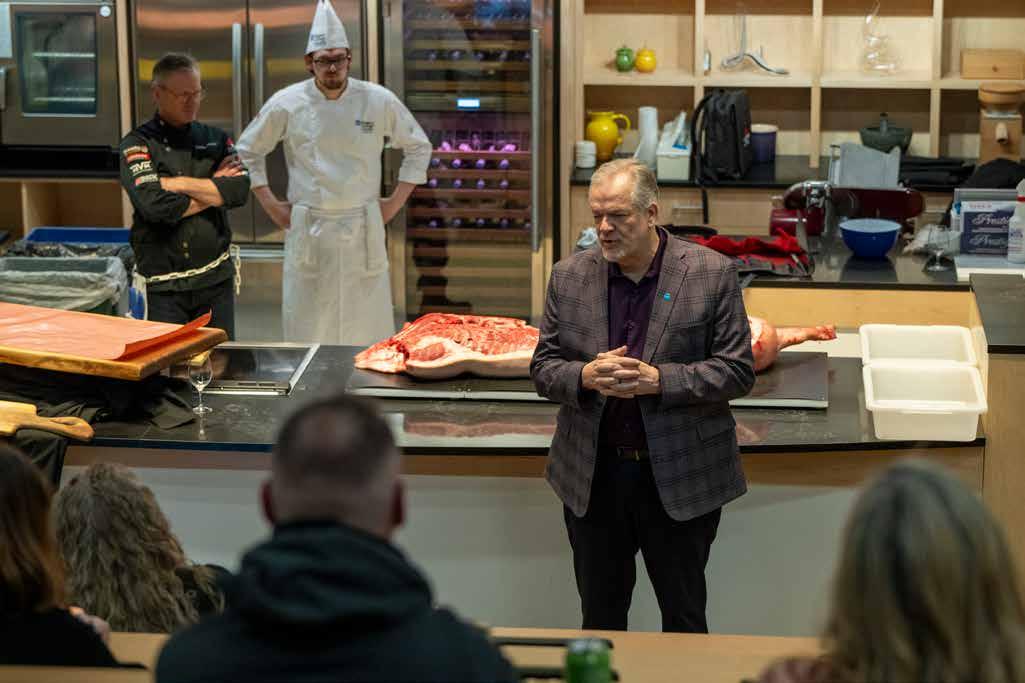
A few members of the national butchery team recently visited the college to check out the plans.
“When I was growing up, even though I was a second-generation butcher, I wanted to take my skills to the next level but I didn’t want to travel and there was nothing locally, so to have something like this in Niagara is absolutely amazing,” said Dave Vander Velde, a store manager at VG Meats in Stoney Creek. “Students entering the industry will succeed that much quicker because they’ll already have a foundation. And
Continued from page A24
it benefits the industry by cutting down on training and attrition because students who completed the program are already committed.”
Damian Goriup, from Florence Meats in Oakville and also a member of the national team, agreed, and said the program will help fill a gap.
“The butchery trade is in desperate need of skilled labour. The Niagara College butchery program is needed not only for beginners but also to further improve the skills of many currently working in the industry,” said Goriup. “Education is key to ensuring that we maintain good quality and safe products in the industry.”
For more information on the program, visit niagaracollege.ca.


Canadian newspapers are powered by journalists, not AI. They check the facts so you can trust what you’re reading. nationalnewspaperweek.ca





Spring is in the air, as the April showers arrived a little early with plenty of precipitation in March. Farmers are likely eager to get going this spring as the growing season arrives. While the work picks up, here are a few things to put in your calendar for the next few weeks and months.
WEDNESDAY,APRIL 9
10 A.M. - 2:30 P.M.
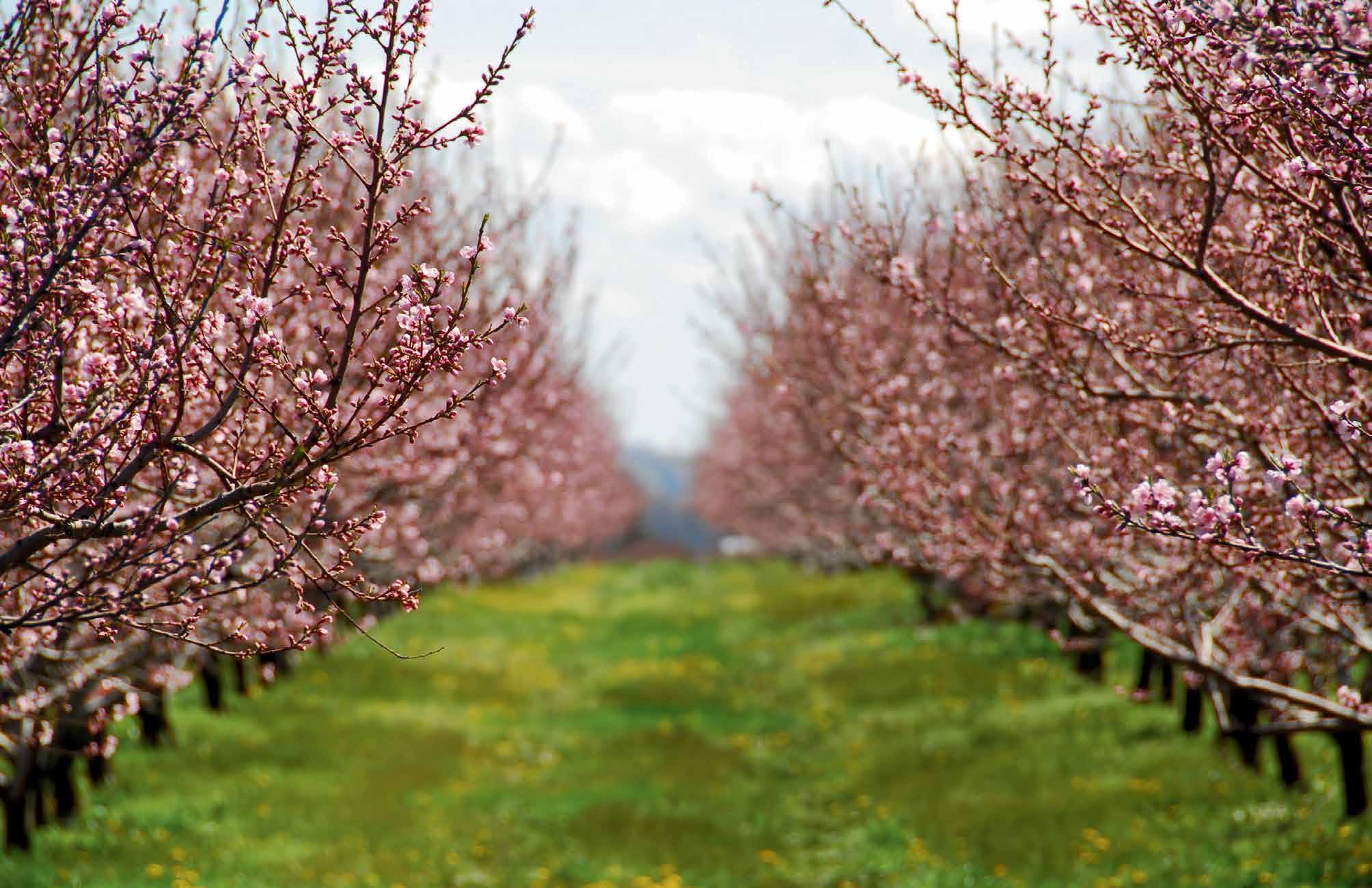
SATURDAY, APRIL 11
9:30 A.M. - 2:30 P.M.
WEDNESDAY, APRIL 15
THURSDAY, MAY 7
7 P.M.

event in Haldimand that seeks to bring together different commodity groups to discuss on-farm biosecurity and farm income diversification opportunities. There’s a morning session open to Haldimand Federation of Agriculture members that includes a talk on biosecurity and a commodity roundtable, followed by an afternoon session open to all, covering on-farm diversified uses. It takes place Wednesday, April 9 at Kohler Agricultural Hall from 10 a.m. to 2:30 p.m. For questions email haldimandfederation@gmail.com. Online registration is available at eventbrite.ca. The registration page is titled: “Securing the Farm: Biosecurity & Income Diversification Workshop.”

e seed swap with Seedy Saturday remains for the region:: April 11Caledonia, from 9:30 a.m. to 2:30 p.m. at the Caledonia Fairgrounds. Put on by the Haldimand Horticultural Club, stop by to pick up some new seeds for your garden or enjoy a wide variety of family friendly activities

adline for young ag entrepreneurs is coming up, with the annual Fleeter Farm Kid program accepting applications until April 15. Youth up to the age of 18 will have a chance to win a $500 prize to help get their farm business plan off the ground. The program aims to get young people thinking about how to develop and execute a business plan. Winners will also get a chance to share their projects at the Wainfleet Fall Fair in September. For more information or an application form, visit wainfleetfallfair.com.

Niagara-on-the-Lake Museum will be offering a showing of the documentary We Lend a Hand, which covers the Farmerette program that played a huge role in Niagara during the Second World War. The viewing is Thursday, May 7 at 7 p.m. For more details or to register, visit welendahand.ca.