





















































































By Luke Edwards
If failing seven out of 10 times is enough to punch a baseball player’s ticket to the hall of fame in Cooperstown, a mistaken weather forecast here or there can be forgiven.
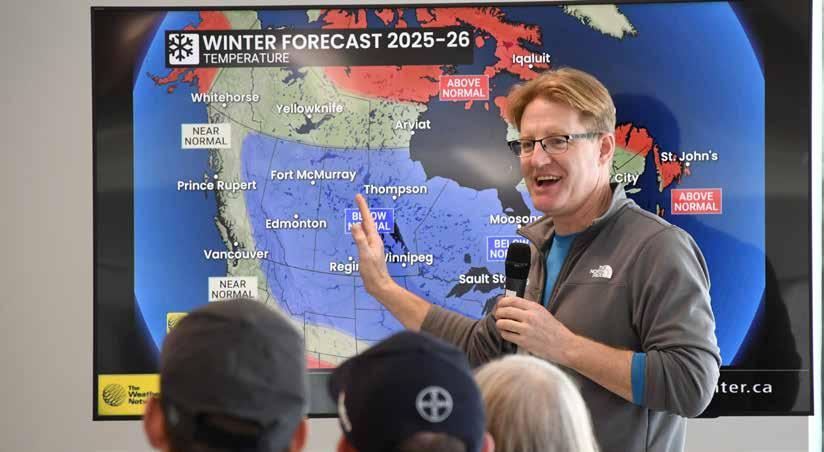
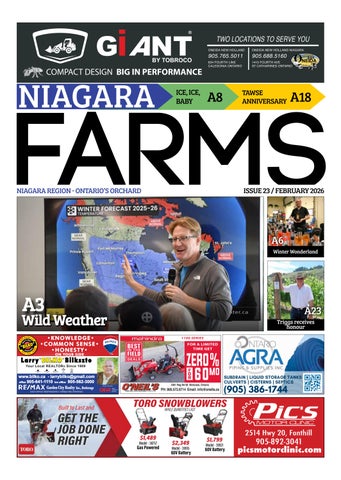
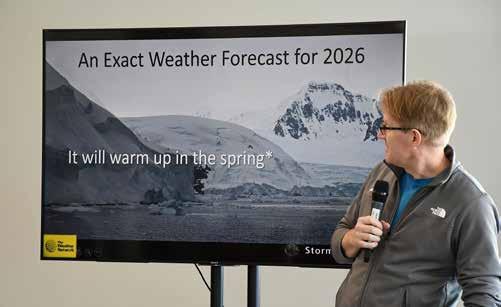
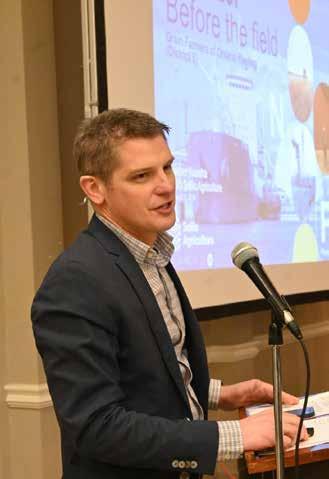
Mark Robinson, a storm chaser with The Weather Network, was a guest speaker at the Grain Farmers of Ontario District 6 meeting last month in Caledonia. District 6 covers Haldimand, Brant, Hamilton and Niagara.
Joking that weather forecasting was one of the few professions where a person can be wrong seven times out of 10 and keep their job, Robinson attempted to give the farmers in the crowd an early look at the spring and summer forecast. It came, as expected, with a huge caveat: predicting the weather is really, really difficult.
“We can give you an overall look at it,” Robinson said. For anything further than a week out, general trends are about as good as one should expect. And even then there’s a large degree of variability. It’s even more difficult this year due to a couple of reasons. The first is an uncertain El Nino Southern Oscillation (ENSO) pattern. El
Nino and La Nina have become well known phenomena that affect global weather patterns, including here in southern Ontario.
Robinson said it’s easier to make longer term predictions when either El Nino or La Nina is present.
“When we have good, strong signals, we have a better idea of what’s happening,” he said.
As the second half of January approached, La Nina was present, though with a likelihood of transitioning to an ENSO neutral pattern. That will make prediction more difficult, Robinson said.
The second reason is the ongoing impacts of climate change, which can still be a tricky topic to broach in some circles. Robinson takes an unexpected approach, saying he doesn’t believe in climate change. That might catch attention, but the phrase is actually a nod to a university professor who taught him it’s not his job to believe or not believe, but instead to accept the evidence.
And the evidence is pointing to several effects: more extreme swings in temperature and precipitation that can lead to flooding on one hand and droughts on the other. The famed Tornado Alley of
the central United States is moving eastward. In fact, Robinson said southern Ontario is becoming a Tornado Alley of sorts, which is exciting for storm chasers like him, but troublesome for the millions of people who call southern Ontario home and rely on the land for their livelihoods.
Huge storms also pose risks for farmers. Some of the storms Robinson chases can now produce hail the size of softballs.
change may potentially lead to climate migration.

Publisher
Stewart Grant • stew@granthaven.com
Editor
Luke Edwards • luke@granthaven.com
Business Development
Heather Dunbar • heather@granthaven.com
Graphic Design
Erin Parsons • niagarafarmsnewspaper@gmail.com
Billing Administrator
Jen Gaetan • jen@granthaven.com
Contributor
Ann Marie Chechalk


Restoring small-town journalism, one community at a time!
“We are going to see significant impacts,” he said, comparing climate change to a set of weighted dice. While we won’t roll snake eyes every time, with the weighted dice it’ll come up more and more often.
However, Robinson is far from a doomer. His excitement about all things weather is quickly evident as he presents, and while he acknowledges challenging times are likely ahead with a changing climate, there’s also opportunity.
“It’s really how we react to these changes,” he said.
Southern Ontario, in particular, could be an area of specific opportunity. Thanks in part to the Great Lakes, Robinson said this area likely won’t be as impacted by climate change as other parts of North America. This could lead to the region becoming even more vital for agriculture than it already is.
“That may increase the value of southern Ontario as an agricultural area,” he said.
It will require some planning, though. Farmers and governments are going to have to figure out how to store the season’s worth of rain that comes in a couple of days for the months and years when hardly a drop falls from the skies.
Simply protecting local farmland will also be important as climate
From his experience, Robinson promoted a bottom up approach, where we listen to what the frontline people are experiencing and how they’re adapting, instead of having governments impose rules. His work travels have taken him to the far north where he talked to Inuit hunters who say their traditional hunting knowledge is no longer of use because freezing and thawing patterns are changing. Likewise, farmers on the Pacific island chain of Vanuatu are breeding salt resistant crops to adjust to a rising sea level that’s increasing the salinity in their ground water.
It’s those types of experiences he said we should be listening to as we figure out how to adjust to a changing climate.
As for his weather prediction for the coming months? The cold we experienced for much of January was likely to continue into February, leading to what he described as a sluggish spring.
One benefit of the cold winter is it could kill off more pests and invasive species than milder seasons of winters past. Pests like ticks may not be as abundant in 2026 following the harsh winter.
Cooler temperatures this spring may be accompanied by above average spring rain but fewer later spring storms.
However, once the cold breaks, it could do so in a hurry.
“We’ll likely see the warmth come up pretty quickly,” he said.
As for summer, his preliminary forecast is predicting a warm summer with average precipitation.
However, as he reminded the audience several times, predicting the weather - much like hitting a baseball - is a challenging business.
for
‘The
to our
By Luke Edwards
After another tumultuous year in global geopolitics, leadership with the Grain Farmers of Ontario painted a picture of an industry still very much concerned about the near future, but one that has also experienced a few key wins in the past 12 months.
Farmers from Haldimand, Brant, Hamilton and Niagara gathered last month in Caledonia for the GFO District 6 annual meeting. Presentations from various officials in the morning took place before The Weather Network’s Mark Robinson delivered an afternoon address.
Perhaps unsurprisingly, Canada’s rocky relationship with its American neighbours to the south remained top of mind.
“Without a doubt, the most effect we’ve seen is Donald Trump returning to the White House,” said Jeff Harrison, of the GFO.
In response to the tariff threats, Harrison said GFO officials stepped up advocacy, working with government partners on this side of the border, while also reaching out to corresponding groups in the U.S.
“We have a great relationship with our partners to the south,” Harrison said, adding collaboration with American grain industry groups led to a forceful push against trade barriers.
Despite that, Harrison said grain farmers in the province continue to face challenges.
“The threats to our industry are real,” he said. There were some wins to celebrate, he added. Last year’s announcement of an extra $100 million for the province’s Risk Management Plan is huge, Harrison said. The bump from $150 million to $250 million is being phased in.
“It can’t come quick enough,” Harrison said.
Other wins he highlighted included getting the federal carbon levy removed, as well as the removal of the planned increase to the capital gains tax.
Even the recent deal between Canada and China that will allow for reduced tariffs on Canadian canola should be welcomed by Ontario’s grain growers, even though it will mostly impact farmers in western Canada.
“It’s something we should celebrate too,” Harrison said.
The prospect of increased trade with China could be great news in Ontario, especially for soybean exports. Jeff Barlow, district 6 director, recently returned from an Asian trade mission. He said China has such a robust system where he toured one facility that could easily take all the



soybeans Canada exported last year. And while Canadian soybeans might be more expensive, he said they have a reputation for quality.
“Every single one says we have the best soybeans in the world, quality wise,” he said.
Promise of increased trade with China presents opportunity, but rising input costs continue to be a challenge, namely with fertilizer.
“We’ve worked hard to reduce rising input costs,” said Harrison.
However, tariffs and domestic production levels that don’t meet the needs of eastern Canada means farmers will continue to face challenges when it comes to securing fertilizer, Harrison said.
As part of a presentation from Agricorp’s Mark Neufeld, crop yields from last year were shared. Overall, local areas were relatively close to their respective averages for soybeans, winter wheat and corn, though Neufeld said for individual farmers it depended a lot on when they got the rain.
“Here in Niagara the yields were so variable,” he said.
The western half of the province fared better than eastern Ontario, Neufeld added, with almost every producer in eastern Ontario being in a claim scenario.
Farmers learned of a few governance changes taking place with GFO.
The organization joined the Grain Growers of Canada, which Harrison said will give them a stronger voice. However, he said they’re not going to abandon their current work and that eastern Canada remains unique.
“We see it as an addition to, rather than a subtraction from, what we do,” he said.
The organization’s vice-president of strategic development, Paul Hoekstra, also outlined some changes stemming from a governance review for GFO. The main change will see a new way of distributing delegates, which should see a more spread out distribution.
And while it’s not directly impacting them, Hoekstra said they’re monitoring the situation at Agriculture and Agri-Food Canada, where officials announced 665 layoffs last month as part of the federal government’s plan to cut back on the size of the public service.

By Niagara Farms Staff
One of the region’s most significant agricultural sectors has formed a new committee to offer a single voice.
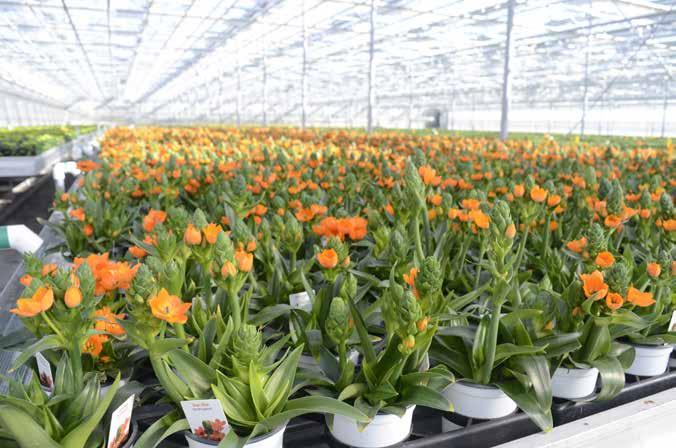
Following more than a year of discussions the Niagara Greenhouse Growers has been established. The group will represent the sector at the municipal level, advocating for industry priorities, and helping local operators with networking and knowledge-sharing.
“Today represents a major step forward for our industry,” said John Boekestyn, owner of Boekestyn Greenhouses. He was named the first chair of the group at its inaugural AGM in December.
“The Niagara Greenhouse Growers was formed because local growers recognized the importance of coming together to address municipal issues proactively and collaboratively. We’ve all had experiences where an organized voice would have made a real difference, and that’s exactly what NGG aims to provide.”
The group is a specialized committee within the Flowers Canada (Ontario) umbrella. The idea for it came from a group of Lincoln-based greenhouse growers. They spent the past 18 months developing a long-term governance structure, leading to the December AGM where the committee was ratified and its first members installed.
Joining Boekestyn on the committee is:
Louis Damm of Floral Dimensions Flower Farm as vice chair, Rodney Bierhuizen of Sunrise Greenhouses, Aron Hoff of Meyers Farms, Jason Wierenga of Wierenga Greenhouses, Jeff
agara remains one of the best places to operate a greenhouse in Canada.”
“Niagara’s greenhouse industry is an important economic driver for Niagara - one that continues to grow, innovate, and adapt,” said Boekestyn. “With the NGG now formally established, we have the structure, the people, and the shared purpose needed to ensure that Ni-

The NGG will operate on a voluntary contribution model. It will engage on municipal issues, promote best practices, work to strengthen the business climate and foster collaboration within the industry.



Monthly events keep year round farmer’s market a lively place
By Luke Edwards
Last month Mother Nature really put the winter in the Welland Farmer’s Market’s Winter Wonderland event.
A mid-month snow storm meant Welland was coated in the white stuff as the annual event returned to the market. One of the few markets that remains open year round, Tori Royer said they try to hold special events each month to get residents out. January’s Winter Wonderland featured free hot chocolate and cider, snowman decorating, winter themed pancakes in the cafe and visitors’ last chance of the year to enjoy the tasty otter feet treats.
“It gives people something to do in January, during the January doldrums,” said Royer, a recreation coordinator with the City of Welland who helps run the market alongside market attendant Justin Beaulieu.
Running every Saturday morning year round, things might slow down a bit in the winter, but Royer said a steady flow of people stop by to pick up some meat, greenhouse veggies or a special treat from one of the many vendors.
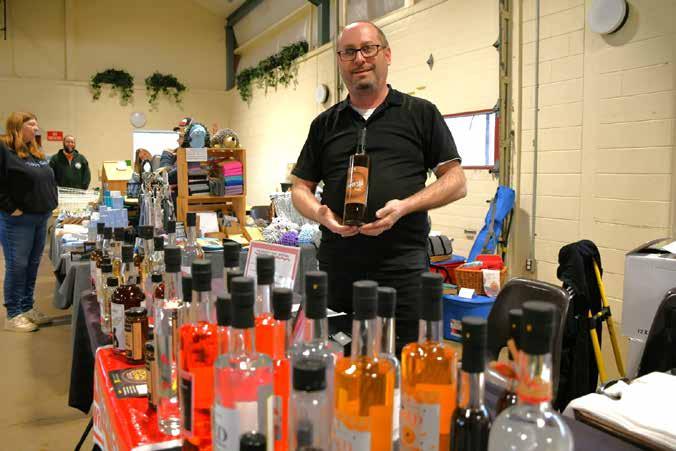
While the Winter Wonderland event offered fun for the kids, Nathan Cuda had some treats for the adults. Cuda is a sales and events representative for NB Distillers, which has been based in Welland for about five years. In the summer they travel to several of the area farmer’s markets and other vendor events, but they’re also a year round regular at Welland, which gives them a chance to get out and meet with people. It’s
one of Cuda’s favourite parts of working with his friend and NB founder, Neeraj Baksi.
“And this market has a lot of regular customers, not just from Welland, but the surrounding cities and towns,” he Cuda said.
The company offers a mix of liquors, from whisky and rum, to gin and vodka. Cuda likes a good rum and coke so that’s where he often leans, but with the recent tariff war, they’ve also


been promoting their bourbon style whisky as an alternative for shoppers who like bourbon but want to support local.
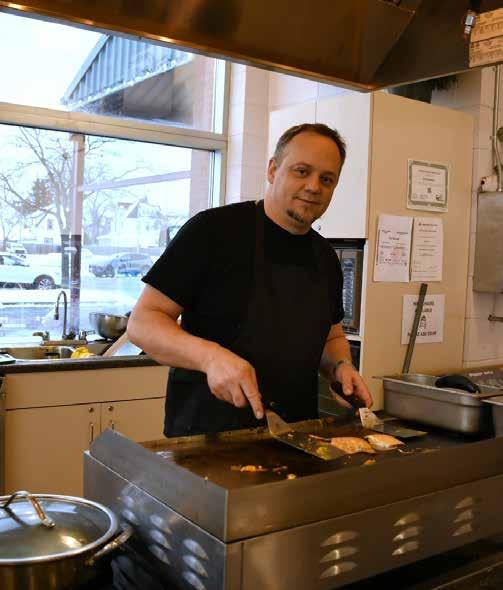
However, with the market kicking off on Saturday mornings, it might be a little early for a boozy drink. And that’s where Paul Minovski comes in. Last November, he and his family took over the cafe that operates in market square.

Continued from page A6
“I’m having a blast,” he said as he threw a couple eggs on the grill for a customer. The family previously ran some restaurants in the GTA, something he enjoyed. But with a career that keeps him inside a lot of the time with meetings, the cafe was a chance to get back out into the community.
The winter pancakes resembled a frosty scene with some blue decorations and whipped cream on top to look like snow.
Continued from page A23
wonderland is the last day for otter feet until next Christmas,” Royer said.
tally we are building value for the farmers of Canada. That means we (farmers) are part of conversations we haven’t been part of for a long time. Farmers realize they are part of the solution to a lot of things, like climate change mitigation, biodiversity, species-at-risk and flood control.”
Visitors to the winter wonderland market could also get their hands on an order of the market’s otter feet, a sweet treat in the style of the popular Beaver Tails.
“They’re very popular. We make them all through the Christmas market and the winter
Bryan
The market runs every Saturday from 8 a.m. to noon. Monthly events continue with a special Valentine theme in February, and St. Patrick’s Day theme in March.
It’s located at 70 Young St. in Welland.
One of the offshoots of Norfolk’s initial efforts occurred after Prince Edward Island environment George Webster attended the pilot launch in 2008. The island was having an environmental issue at the time and ALUS quickly became the solution and a well-funded provincial program.
Today, nationally ALUS is approaching 1,000 farmers participating
Officially, ALUS Canada’s mantra now is: “ALUS Canada makes it ardship. ALUS invests in farmers and landowners who are producing acres of clean air, clean water, wildlife habitat
Credit was given to some of the programs largest advocates by Gilvesy. Local MPP
nent since the early days, and introduced a Private Member’s Bill promoting the concept.
moting it there. Bob Sopuck, who was Delta Waterfowl’s western vice-president of policy was an early advocate and became elected as an MP and was the program’s champion on Parliament Hill. Dave Reid co-wrote the
sands of people about ALUS at hundreds of speaking engagements across Canada. Recognition for the program has included a
gram and farmers fell they are the program
“People feel they are partners in ALUS,” roots program that recognizes the value of community.”




By Luke Edwards
Early in his grape growing career, Jamie Slingerland learned the old saying “there’s always tomorrow” doesn’t necessarily apply to icewine.
It was the early 2000s and the weather dropped during the Christmas holidays. Hitting the magical -8C mark that’s needed for icewine harvesting, Slingerland could have gone out and picked grapes. But he figured it was only December, there’d be more cold
days in January and February when he could harvest.
Only there weren’t. A mild winter kept him and his team from harvesting for several weeks. Fortunately, a March cold spell allowed the team at Pillitteri Estates Winery to harvest. However, the late icewine harvest reduced yields and increased stress.
“It’s a bit of pressure, because it may not be my fault if we don’t have a good harvest, but it’s my responsibility,” the director of viticulture at the Virgil winery said. He

learned his lesson that year, and vowed he’d never let a bad harvest be his fault.
“You never have the luxury to say ‘I’ll wait to pick until tomorrow,’” he said.
So when an early cold snap in December hit, Slingerland wasted no time. They’d barely just finished prepping the vineyards for winter, removing the leaves and installing nets when conditions made it ideal for icewine harvesting.
“I think it was around the eighth (of December) when we went out for our first pick. We’ve never picked this much so early. Another week later we picked again, and a week after that we picked two nights in a row. It was like heaven, such a relief. From a grower’s perspective it’s always a relief to get the crop off,” he said. An added bonus of the early harvest was that by mid-December growers tend to start losing about one to two per cent of crop per day as birds pick away at the grapes. With the early cold snap the birds were still eating bugs and had yet to turn their attention to the vines.
Usually everything about icewine production is slow and time consuming. In normal years, that includes harvesting. Two conditions need to be met before the harvest can start. First, the cold weather needs to turn the grapes brown. Then they need that -8C, but more preferably in the -10 to -12 C range, to pick.
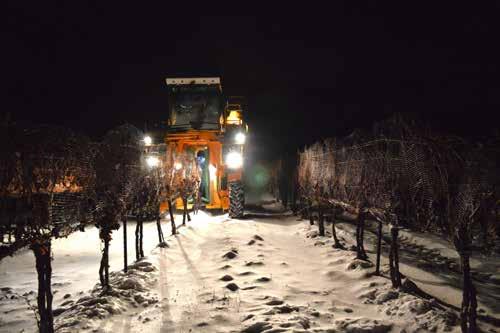
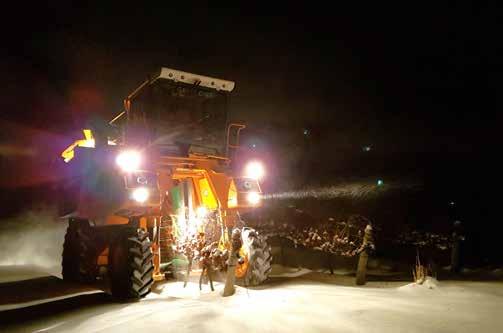
In the old days, harvesting would be done manually, which was a gruelling and time consuming effort. Nowadays operations like Pillitteri use machines that allow Slingerland to pick nearly 10 tons an hour.
Once picked, the grapes are then pressed. Again, this is a slower process than usual, as they can be pressed as many as five times to get all the juice out. The first presses are when they get the highest brix count, upwards of
45 brix. Slingerland said they had a pretty consistent first press of around 40 to 42, thanks in large part to the consistently cold, -10C weather.
Brix counts drop in further presses, and then staff mix and match to get the ideal sugar content. Industry standards are 38, Pillitteri aims for 40, since Slingerland said that’s what it takes to win awards and maintain their place among the top icewine producers globally.
Fermentation once again requires patience. A slow fermenting yeast is required for the high sugar juices.
Then, once that’s complete, clearing out the sediment can also be time consuming.
“Sediment can represent about 10 to 12 percent of your juice in ice wine. So you’ve got an extremely valuable product that you’re almost throwing away 10 or 11 per cent,” Slingerland said.
Fortunately, Pillitteri produces enough icewine that it’s financially viable for them to invest in expensive but valuable technology such as cross-flow filters that allow them to more efficiently recover much of that juice.
Over on the Bench, Grape King and Tawse Winery vineyard manager Augusta Vanmuyen said the lengthy stretch of cold weather has been a blessing for the icewine harvest. Tawse doesn’t harvest their own icewine grapes, instead choosing to purchase the juice to make their icewine.
“Overall, it was a good year for ice wine,” she said. The extended cold weather allowed vineyard managers to harvest at the ideal time.
The superb harvest of icewine grapes comes on the heels of a strong fall harvest for table wines. Slingerland said the two strong harvests will be a big help for an industry that still hasn’t fully recov-
ered from the COVID-19 pandemic and faces other uncertainty in the forms of taxation and global trade issues.
And while the early harvest offered some reprieve from the usual stress that comes with icewine, extended cold weather in the early part of 2026 has growers like Slingerland paying close attention to just how cold it’s getting and the potential risks that cool air poses for the 2026 growing season.
Inversion is a term for when the cold comes and the wind settles down. That can lead to the cold air sinking to ground level and potentially causing problems for the vines. Wind machines are used to keep air circulating and prevent that, but Slingerland said it can only take seconds of extreme cold to cause damage.
In a twist though, the consistently cold temperatures could be a blessing in disguise, keeping the vines in winter mode. The real damage can happen when a warm snap tricks the plants into thinking it’s spring before a sudden drop in temperatures wreaks havoc.
The Grape Growers of Ontario run a cold hardiness program that tracks what temperatures lead to bud death.
“They go and take a bunch of cuttings all over Niagara and Lake

Erie North Shore and they put the buds in a freezer,” Vanmuyen said.
“And when the buds die they give off, like a little pulse. And so they can tell you exactly how cold hardy the vines are.”
There is some variation site to site and vineyard to vineyard, as
well as among the different varieties but Vanmuyen said it gives growers a pretty good idea.
“So right now it’s pretty up and down vineyard to vineyard, but we can take about -22C on most sites before we start to see damage. Some of the syrahs and merlots




are not as hardy as pinot or chard,” Vanmuyen said.
“We hit -20 on the Bench the other night. So I think so far, we’re still okay. But we have a lot of winter. You never really know until spring when they start growing, whether they’re going to come up or not.”






By Niagara Farms Staff
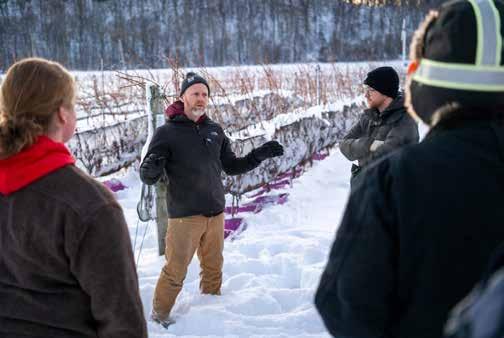
Considered a rite of passage for those studying wine and viticulture at Niagara College, last month students headed out on a frigid Friday morning to pick icewine grapes.
About 40 wine students made the trek, joined by others in the School of Wine, Beer and Spirits, and the School of Hospitality, learning how the challenging process of producing icewine begins.
“I absolutely love icewine and I have a higher respect for it now, after being out here in the cold for hours,” said first-year Winery and Viticulture Technician student Rowan McDowell. “Now I understand why it costs upwards of $50 a bottle.”
Harvesting icewine grapes from the small college vineyard is a longtime tradition, going back 25 vintages. Temperatures must get below -8C before icewine grapes can be harvested.
“The icewine harvest is one of the most powerful real-world learning experiences our students have; it’s truly an ‘only at Niagara College’ moment,” said wine professor Gavin Robertson, who led the pick with winemaker Allison Findlay “Harvesting grapes right here on campus in extreme winter
conditions and then following that fruit all the way through fermentation to bottle teaches lessons about patience, precision, and resilience that simply can’t be replicated in a classroom.”
The students spent hours hand-picking frozen Vidal grapes, which will then go through the long process of being converted into icewine. The product of their efforts is expected to hit shelves next year as the Teaching Winery’s Dean’s List Icewine.
“Icewine takes way more time, energy and input than other wines do. It’s a specialty wine and they are all exceptional quality from the start,” said Findlay. “And this year’s growing season was so high quality, it was a really good harvest, so I expect a really good wine.”
Dakota George, a second year Winery and Viticulture Technician student, jumped at the opportunity to take part in his second icewine harvest. The St. Catharines resident enrolled in the program after years of working in construction, when he decided he wanted to follow his passion for wine.
“It’s an amazing experience. Digging in the snow, pulling grapes off the vine, it’s kind of like being a kid again,” he said.
“I underestimated the amount of physical labour involved in winemaking for sure, but it’s amazing. You meet a lot of people and make new connections.”
The icewine tradition at Niagara College is a unique experience for the students, part of an overall effort to provide one-of-a-kind learning experiences and produce skilled graduates who can contribute to the Canadian wine industry.
“There is no other school in the world that does this. Our wine students are able to experience all aspects of icewine production right on campus, from picking frozen grapes off the vine in our vineyards, to pressing the grapes, producing and bottling at our Teaching Winery,” said Craig Youdale, dean of NC’s Culinary, Tourism and Beverage Studies division.
“It is the definition of applied learning.”
• Group 21 insecticide - offering strong activity against all stages of mites.
• Starts working quickly - to reduce mite damage and protect fruit.
• Controls a wide range of mites in apples, including Apple Rust Mite.
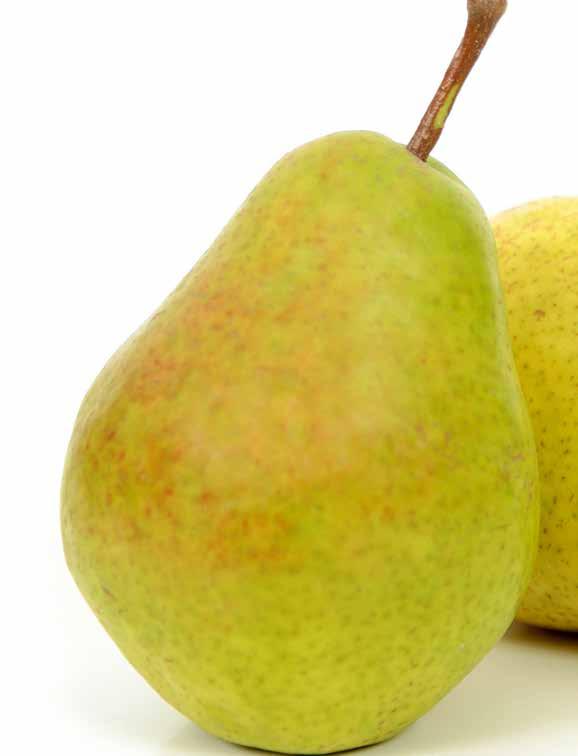
• Offers controls of Pear Rust Mite and Pear psylla in pears.


By Luke Edwards
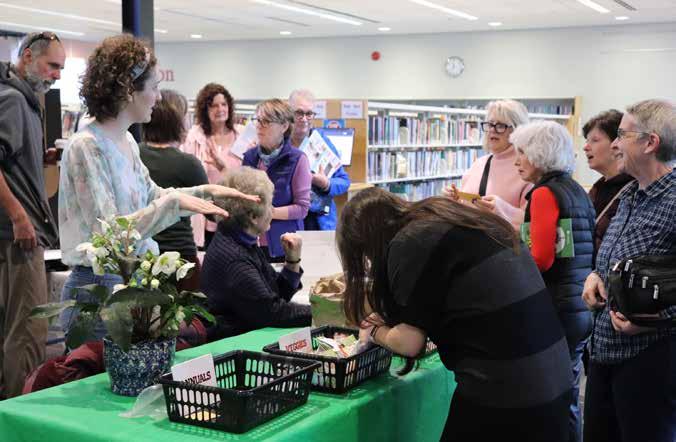
Though his thumb may not be quite as green as some of the visitors to the annual Seedy Saturday event organized by the three West Niagara public libraries, Ryan Waldron nevertheless always enjoys seeing the excitement as the annual seed swap returns each February.
This year’s event returns to the Grimsby Public Library where Waldron is the deputy chief librarian. For years Linda Crago ran a Seedy Saturday event in Wellandport, but a combination of her wanting to step back and the COVID-19 pandemic brought that event to an end. Then a couple years ago the libraries in Grimsby, Lincoln-Pelham and West Lincoln teamed up to restart the popular spring seed swap.
“It’s great because the other libraries can help us get the word out,” Waldron said. They move the swap around to the different communities - last year it was held in Smithville - which Waldron said is perfect since they’re trying to serve the area between Hamilton and St. Catharines.
Visitors to Seedy Saturday can take part in the seed swap, finding all kinds of unique seed varieties of their favourite plants. There are also a mix of commercial and non-profit vendors in attendance.
Waldron says gardening is a hobby of his, though admits he’s no expert. Fortunately Seedy Saturday has helped him learn and discover new options to add to his raised garden bed and plots of native plants.
“It’s encouraged me to be a bit more adventurous. I try to grow some new vegetables and things like that every year,” he said.
But for the most part he enjoys sitting back and watching the enthusiasm and excitement of the other visitors, as Seedy Saturday events give people a chance to shake off the winter blahs and start looking forward to spring.
“It’s great to see everyone come together and talk to each other. It’s almost like a celebration of spring coming…it’s like a light coming at the end of the tunnel,” he said.
Organizers will also be welcoming four speakers to the event, which runs from 11 a.m.

to 3 p.m. on Saturday, Feb. 14. Speakers include: Sean James discussing landscaping in a small yard (11:15 a.m. to noon), Liz Benneian discussing keystone species from 12:15 to 1 p.m., Katy Sokoloski covering gardening for nature from 1:15 to 2 p.m., and Ryan Heffron wrapping up with a talk entitled “My Niagara Garden” from 2:15 to 3 p.m.
West Niagara is one of several Seedy Saturday events in the region. It comes a week after Seedy Saturday events in Hamilton and at the Niagara College Niagara-on-the-Lake campus, and the same day as a Fonthill Seedy Saturday. Haldimand is planning one in Caledonia on April 11, as well. For more information on all the events, visit seeds.ca.
Seedy Saturday isn’t the only way the Grimsby Public Library is helping home gardeners. Coinciding with the event is the library’s preparations for another year of its seed library.
GPL has run the seed library for several years, offering up a variety of seed varieties for residents to pick up free of charge, with the idea that they’ll save some of the seeds after their veggies are harvested and return them to the seed library.
“It’s one of those screen-free activities, that gets you outside and enjoying the sunlight, enjoying the outside environment,” he said.
While not everyone returns their seeds, Waldron said they’re grateful to the few “super savers” who help restock the library after each harvest. For the remainder, the library buys seeds from Canadian company West Coast Seeds.
They plan to have the seed library fully stocked when Seedy Saturday comes to town, and they’ll keep it stocked throughout the spring and into early June.
For more information visit the library, at 18 Carnegie Ln.






By Jeff Helsdon
Attendees at last month’s Grain Farmers of Ontario District 5 (Elgin/Norfolk) meeting received insight into the latest on the fertilizer market from the head of the country’s largest farm co-operative.
For Casper Kaastra, executive vice-president and CEO of Sollio Agriculture, speaking at Malahide Community Centre in Springfield had a sense of familiarity as he grew up on a dairy farm in nearby Lyons. He worked in various positions for a variety of companies, including Cargill, before landing at Sollio.
Kaastra explained handling fertilizer is a balancing act to get the best price for producers, and to remove extra costs wherever possible.
“You got to get to some kind of an economy of scale where you want to make sure that you have enough volume to put through your assets and infrastructure, but you don’t have too much capacity and too much assets and infrastructure because that’s going to cost you a lot more on a per ton basis,” he said, adding the impact can easily double or cut in half the cost per ton.
One of the challenges with fertilizer in particular is the high demand in a short spring time frame, which can be pushed ahead or back, depending on weather and crops. That’s in part why he recommends farmers get their orders in, so they’re not left scrambling at the last minute.
In eastern Canada, which includes Ontario, about 85 per cent of the fertilizer supply comes from outside Canada.
Fertilizer imported to eastern Canada translates into between 80 and 90 vessel shipments. A 10 per cent difference in demand can mean between five and eight shiploads that may or may not be needed, and each requires as much as 60 days of planning prior to arrival.
“So, the key point there is that demand and volume is probably the biggest factor that we rely on to have some sort of predictability about how much we should bring in to make sure the product shows up,” Kaastra said.
Being a national company, Sollio can shift products to other parts of the country to provide a buffer to demand.

Added to the uncertainty is government policy and geopolitical events.
“You could have a government that says, ‘we’re going to ban exports,’ that could happen overnight,” Kaastra said. “You could have a war that shows up in one part of the world, that impacts supply in a very short period of time. You could have our own government that puts sanctions in place, or tariffs in place, to prevent a product from coming in.”
Kaastra argued government policy that restricts fertilizer trade and fertilizer movement could have an impact on overall food security.
“And those aren’t cheap words, that’s real. Fertilizer accounts for as much as 60 per cent of food supply around the world. Without it, we’d be facing food shortages,” he said.
Canada is one of the nations with the highest sensitivity to price changes that will impact demand for fertilizer.
“What that means is that if say, for example, the price of grains is really low, the price of fertilizer is really high, then farmers will either change their cropping practices, so that they use less fertilizer, or they’ll cut back on the amount of fertilizer that they use on each individual crop,” Kaastra said.
In contrast, other nations are less sensitive to fertilizer price fluctuations because they have more stable fertilizer needs.
“We kind of need to know what is needed to make sure the product shows up on time,” he said. “And if we can plan a bunch ahead, that also helps us to manage the price risk as well.”
Kaastra addressed why western Canada can’t supply the remainder of the country, explaining there is no phosphorus production in Canada and it comes in from the U.S. or West Africa.
Western Canada used to be a net exporter of nitrogen, but that has changed with higher demand as canola production increased.
Potash, the primary supply for potassium, is a different story and there is more of it.
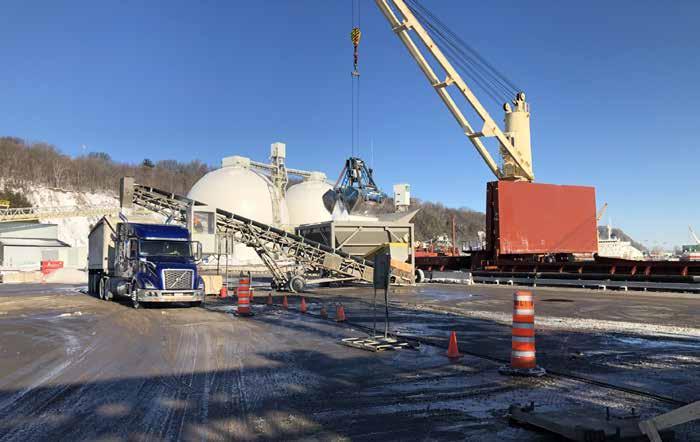
With fertilizer being a bulky commodity, Kaastra said dependable shipping is a must for reliability.
“Every time a port facility goes on strike, that’s an impact of millions of dollars a day,” he said. “If the rail system shuts down, that strips out as much as $60 million per day out of the Canadian economy.”
Beyond strikes, Kaastra talked about the capability of Canada’s port facilities. Putting it in perspective with the current talk of alternative markets, he said if Canada was to decrease the amount it exported to the U.S. by three to five per cent and sent it elsewhere, it would push the existing port infrastructure to its capacity. And ports will be needed for any export.
“This shouldn’t be a surprise to anybody in the room, but if Canada wants to be an agriculture powerhouse, or get back to being an agriculture powerhouse on the world stage, it needs to focus on making sure that it reinvests as it should in infrastructure and logistics,” he said.
Canada uses 10 million tons of fertilizer a year on a weight basis, which equates to 2.5 per cent of world production. The biggest users are China and India.

The United States and Morocco are major sources of Canadian fertilizer. Russia used to be before sanctions were put in place. That country represents 13 per cent of the world’s fertilizer production.
“One thing I want to highlight is that the U.S. does continue to import from Russia,” Kaastra said, explaining taking that large of a source completely out of the picture would have huge impacts.
“Geopolitical uncertainty is one of the biggest drivers of fertilizer supply and price,” Kaastra said, adding it is the most uncontrollable factor.

China’s decision to allow Canadian canola at a lower rate will impact fertilizer prices this spring as demand could increase.
In Europe, there is outcry in the farm community because carbon taxes are impacting farming competitiveness. Kaastra said the same is true in Canada.
“There needs to be a carbon price adjustment that’s imposed on fertilizer coming into this country.”
Typically, when grain prices go down, fertilizer prices go down, but Kaastra said there is a lag to this occurring.
There are other global factors playing into current fertilizer pricing. With urea, China is restricting exports, Iran is in an economic crisis and the Ukraine-Russia war is having an impact. Trinidad is still a source of urea.
Kaastra called phosphate prices “stubbornly high.” Again, China has a ban on exports, but on the bright side West Africa is planning to increase its production.
The potash price is driven by markets. Renegotiation of the US-Mexico-Canada trade agreement will be a factor, as well as corn prices.
At no point did Kaastra say there would be no fertilizer available due to supply, but he did say with global conditions, producers shouldn’t assume there will be fertilizer available at the last minute if they don’t pre-order.
“If you’re planning on resupply in spring, three weeks is a matter of having a product or not having a product,” he said, reiterating his point that the industry needs to know how much to bring in.
Kaastra said having a trusted supplier can go a long way in reducing headaches if needs change.
“That doesn’t obligate you to buy from them, but make sure you have a preferred supplier that you’re going to work with. Whoever that is, make sure that they’re thinking about you, to make sure that they have a plan in place to have fertilizer in the coming spring,” he explained, adding suppliers know plans can change.
On a positive note, Kaastra said evolving crop technology that increases yields is a good thing and diminishes the need for fertilizer.
















‘You can absolutely do it’: OFA director encourages women to get in the driver’s seat
By Luke Edwards
Three years after running a successful inaugural TractHER event, Angela Field is hoping to get back up in the cab and is encouraging other women across the province to do the same.
Field is a director with the Ontario Federation of Agriculture, and lives with her husband on his family’s dairy and grain farm in Renfrew County. A few years ago in response to a tragedy in her community, Field helped create the TractHER event that taught women the basics of operating farm machinery.
“It just kind of made us all realize that there’s a lot of us out there who don’t have the competence to even, just a simple on, off, up, down, backwards, forwards, kind of thing,” she said. “I’m not talking about running the machinery to its peak performance, but just the basics.”
After a community farmer died, his surviving women family members quickly realized they didn’t have the ability to run any of the equipment on the farm. Field herself didn’t come from a farming family, and could sympathize with them.
“My husband and my brother in law taught me everything I know about operating machinery. And I was very fortunate because they were excellent teachers, but not everybody has that,” she said.
The TractHER event took place on the local fairgrounds and offered participants a chance to spend at least 10 to 15 minutes on several pieces of machinery, including different kinds of tractors, sprayers and even a zero-turn lawnmower.
“I really felt strongly that if we could give women a safe, fun space where they could learn the
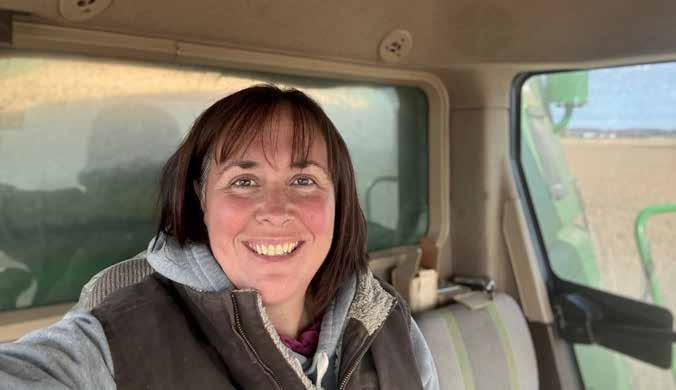
basics and where they were comfortable, that maybe we would be doing a service,” she said.
“It really seemed to give them confidence that, should something happen, they have the ability to help.”
A family tragedy kept Field, who’s also deputy mayor for the Township of Admaston/Bromley, from running an event in 2024 and she admits last year kind of got away from her. But she said she’d love to get it going again and encourages other communities to do the same. She’s heard of some places where similar events have been held, and said it can be of great use to any farming community.
Field said she was careful with who she brought in as instructors, since not everyone can be a teacher. These types of events also require large spaces to ensure safety.

“But yeah, it could absolutely be replicated,” she said, adding basic machine maintenance would also be a great topic to cover.
Even if a formal event doesn’t materialize, Field encouraged women who live on farms to learn how their machinery works.
“Go out and find someone you’re comfortable with that can operate it and get them to show you, or take it out into the backfield by yourself when nobody’s around and practice, because you can absolutely do it,” she said.
“It makes the whole community safer.”
The United Nations has dubbed 2026 the Year of the Woman Farmer. In Niagara, the most recent agricultural profile conducted by Niagara Economic Development found the sector to still be male dominated, but noted about one third of farmers in Niagara are women. Many more live on farms with their families.

Province provides $4.5M for Wainfleet, Grimsby, Lincoln, Pelham and West Lincoln
By Niagara Farms Staff
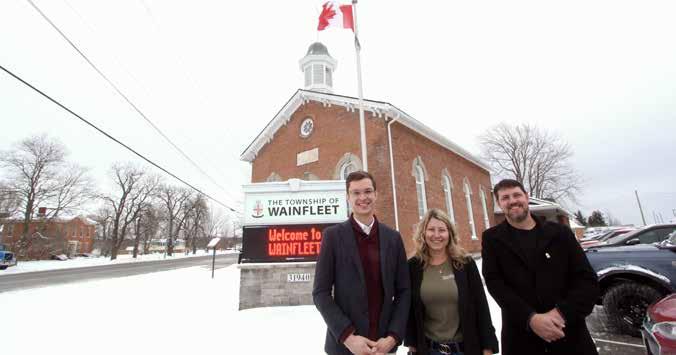
The region’s smaller municipalities in Niagara West will receive a total of $4.5 million in Ontario Community Infrastructure dollars in 2026.
MPP Sam Oosterhoff announced the OCIF funding in a press release last month. OCIF helps small, rural and northern Ontario municipalities with grants that fund critical infrastructure projects.
Locally, Wainfleet is receiving a boost in its payment this year, as the minimum grant has increased to $125,000 from $100,000 last year.
“This important investment for Wainfleet is part of $4.5 million in funding for all five of our local municipalities in Niagara West, including Grimsby, Lincoln, Pelham and West Lincoln,” said Sam Oosterhoff, MPP for Niagara West.
“The Ontario Community Infrastructure Fund is a key part of our government’s commitment to protect Ontario by getting shovels in the ground and supporting local economic growth and job creation.”
All told, $400 million from Queen’s Park will be handed out to municipalities through the fund in 2026.
Wainfleet Mayor Brian Grant thanked his provincial counterparts for the boost.
“For a rural municipality like Wainfleet, predictable funding is the backbone of responsible fiscal planning,” he said.
“This investment will help our council to stay true to our commitment of closing the infrastructure gap and ensuring our roads and bridges remain in good repair for the families and businesses who rely on them every day. It is about more than just asphalt and concrete – it is about maintaining the safety and long-term viability of our community.”
Funding allocations through OCIF are based on a formula that takes into account the situation and economic needs for municipalities with a population of less than 100,000, as well as rural and northern Ontario communities.
“Small, rural and northern communities are essential to the growth and prosperity of Ontario,” said Todd McCarthy, acting minister of infrastructure.

Since 2018, the province has provided municipalities with $2.8 billion through OCIF.





By Angela Field
I didn’t grow up on a farm. I was born and raised in northern Ontario, far from dairy barns and grain bins. Agriculture came into my life the way it does for many people: by marrying a farmer. Today, I farm with my husband on his family farm near Renfrew, about an hour northwest of Ottawa, on a dairy and grain farm. We also harvest crops for other farmers in our area.
My unorthodox path into agriculture has shaped how I see the sector, and it’s why education and empowerment are issues I care so very much about.
I’ve just been fortunate enough to be elected to the board of the Ontario Federation of Agriculture (OFA) as a provincial director-at-large, after about five years of being involved with the organization in various capacities. This included serving as president of the Renfrew Federation of Agriculture and spending a year working for OFA as a Member Services Representative.

I strongly believe that there are still far too many misconceptions about who farmers are and what farming looks like today. For many Ontarians, the picture of a farmer is an outdated one — an older man in overalls with a pitchfork. That image doesn’t reflect reality anymore, especially when it comes to women.
The number of women actively running farms is growing rapidly, yet we’re still not seen as the norm. In my region, I’ve worked hard to bring that reality to the forefront and to help women build confidence and skills.
Too often, women don’t receive the same informal training that boys on the farm get from fathers, uncles, or grandparents. Closing that gap matters, not just for equality, but also for farm safety, efficiency, and long-term sustainability.
In 2023, I created the TractHER event concept: a hands-on program for female OFA members 18 and over who wanted to get more comfortable on and around farm equipment;
tractors, sprayers, skid steers, harvesters, trucks and trailers. We focused on safety, proper use, and, just as importantly, learning how to move and operate equipment confidently. It was a huge success, and similar programs have since popped up in other parts of Ontario. I believe that agriculture education also matters for non-farmers. I spent many years working as a dairy educator, going into schools and communities to talk about how food is produced. My primary message is simple: your food is safe. Ontario and Canada have some of the strictest food production standards in the world, and that’s something we should all be proud of.
I also serve on my local municipal council, where I’m nearing the end of my first term. This municipal experience, combined with my roles in agriculture, gives me a different lens on policy, especially when it comes to land-use planning, water management, and rural governance.
Many of the issues discussed at OFA board tables eventually land on municipal council agendas too. Seeing them from both sides allows me to better understand how provincial policies affect farmers and rural communities on the ground, and how municipalities interpret and implement those policies.
Ontario is a vast and varied province, and a one-size-fits-all approach to policy doesn’t always work. Issues like wildlife damage, for example, look very different in northern Ontario than they do in other parts of the province, where a bear can wipe out acres of corn overnight. I would like to work towards defining these differences and help direct policies that work for all areas.
One active ingredient, offering 3 modes of action and one important part in an IPM program. It is organically certified and helps reduce the synthetic chemical load in fungicide applications.

As an OFA director, I also want to continue shining a light on women farmers across all commodities and regions, not as the exception, but as an essential part of Ontario agriculture.
Most of all, I’d like Ontarians to know two things; First, your food is safe. Second, protecting the Ontario and Canadian agriculture industry is integral to our sovereignty. If we rely too heavily on international partners who can change course at any time, we put ourselves at risk. A strong, local agricultural sector is about more than farming. It’s about resilience, security, and community.
I may not have started my life surrounded by agriculture, but I’m proud to be part of it now and I am excited to lend my voice to the farmers and rural communities that keep our province fed.
Angela Field is a director with the Ontario Federation of Agriculture














By Luke Edwards
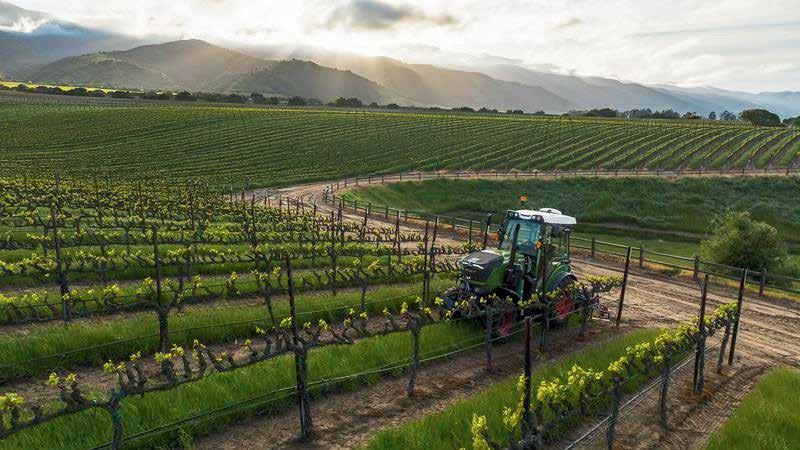
Not that they would ever need an excuse to, but the staff at Tawse Winery have had several reasons to raise a glass over the past few months.
Back in the fall, the winery’s vineyard manager Augusta Vanmuyen was named Grape King, a title she’ll hold throughout most of 2026, which also happens to be a milestone year for the Bench winery when it celebrates its 25th anniversary.
“It’s pretty crazy how far we’ve come in 25 years. In 2001, when they first started making wine, there’s a little green barn,” Vanmuyen said from the winery’s wine shop, pointing out the window to an area hidden behind a hedgerow. “And that’s where they first made their first wine off this property. And they only had the 10 acres out front here, and they slowly built it. And now we have 130 acres. It’s pretty amazing.”
Moray Tawse founded the eponymous winery, purchasing the property in 2000 and opening the winery itself in 2005.
“His passion was always Burgundy. And so when he bought land in Ontario, he wanted to show the terroir of Ontario with Pinot and Chard,” said Vanmuyen. “And when they built this place, they were only intending on making 5,000 cases a year and it being very small.”
Growth took some time, but nowadays Vanmuyen said they make between 25,000 and 30,000 cases a year, with both the flagship Tawse Winery and nearby Redstone becoming popular stops for visiting wine lovers.
“It kind of snowballed,” she said.
Vanmuyen’s own story shares some similarities. She was introduced to grape growing through her family’s company in Prince Edward County, which produced equipment needed by that area’s burgeoning wine industry. She
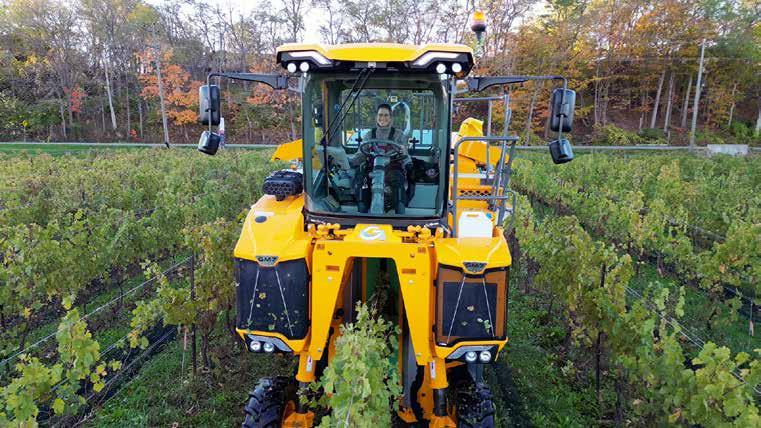
started working at Norman Hardie Winery and Vineyard at the age of 13, slowly climbing the ranks.
In 2009 she came to Tawse for the first time, and returned in 2013 after spending time in Germany and Nova Scotia.
The time between her first Tawse stint and 2009 and when she returned in 2013 saw significant growth.
“When I started in 2009, I think we processed 100 tons. And then in 2013, we did 800 tons of fruit,” she said.
Vanmuyen eventually became vineyard manager.
Despite all the time that’s passed, she said Tawse has stayed true to some core values, including a commitment to organic farming that’s seen them transition each property they purchase to organic.
“It’s really important to the way we farm and our focus on the land and our soil health and biodiversity, and trying to leave the land better than we found it,” Vanmuyen said.
That commitment’s not an easy one, especially considering the types of grapes Tawse specializes in. Grape growing in general is a challenge in Ontario, where high humidity makes disease and
pest management difficult. That’s especially true for Pinot grapes, whose thin skins lead to increased disease susceptibility.
Continued
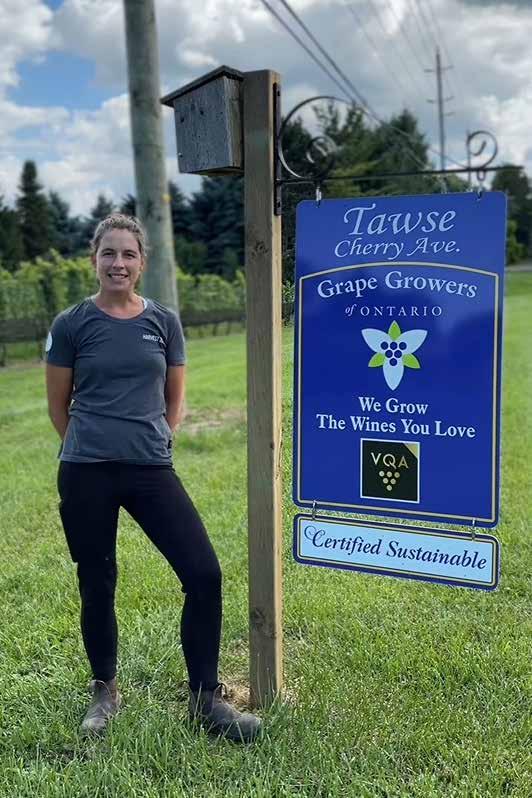
“It’s really hard to grow organically in Ontario, and most people don’t get certified for it, because at the end of the day being able to spray something that will save their vines is worth it (for them),” Vanmuyen said.
Vanmuyen said was a natural extension of their organic practices.
As a vineyard manager it’s perhaps not surprising that her favourite part of the job is getting out in the vineyards. But a close second may come as a surprise.
and the grapes is just so fulfilling,” she said.
“Plus my animals. I really love my animals too.”
Tawse is working on some anniversary events to celebrate in 2026. To stay up to date visit their website, or follow them on social media. Continued from page A18
More recently Tawse has added sustainable certification, something
“Being outside, being a part of nature, and watching the vines grow
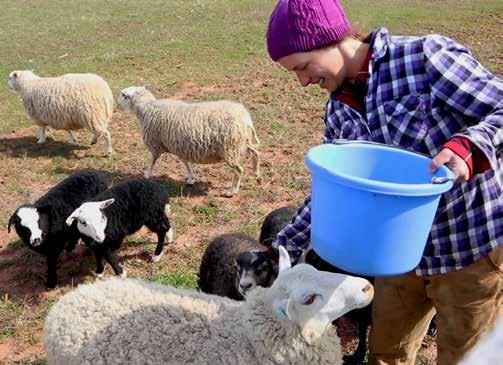
The winery keeps a few sheep and some pigs, and they also borrow some goats in the summer to help out. It’s all part of the organic and sustainable push she said.
“I think putting animals on the land is really important. It’s a really good way of creating a really good biodiversity and a good ecosystem,” she said.
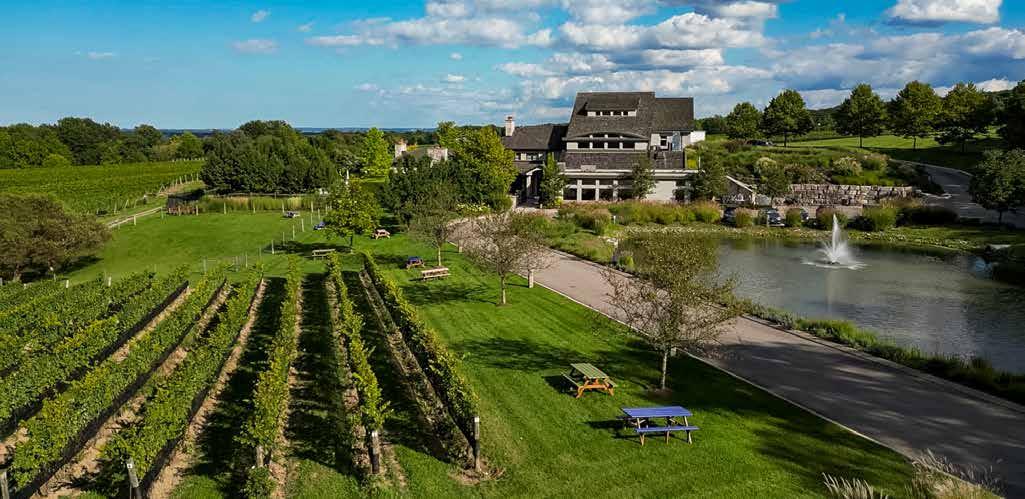
Winey is celebrating 25 years in 2026.
with fellow farmers and

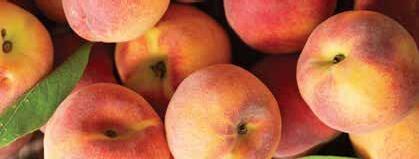
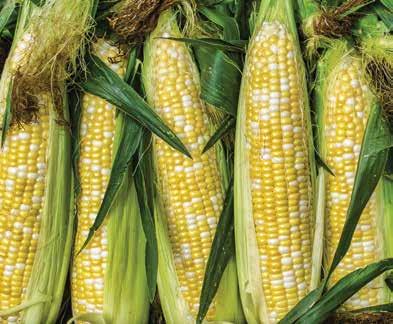


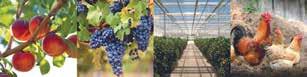
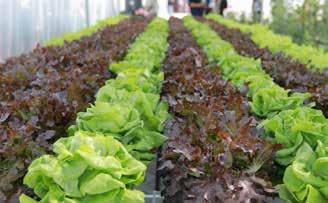
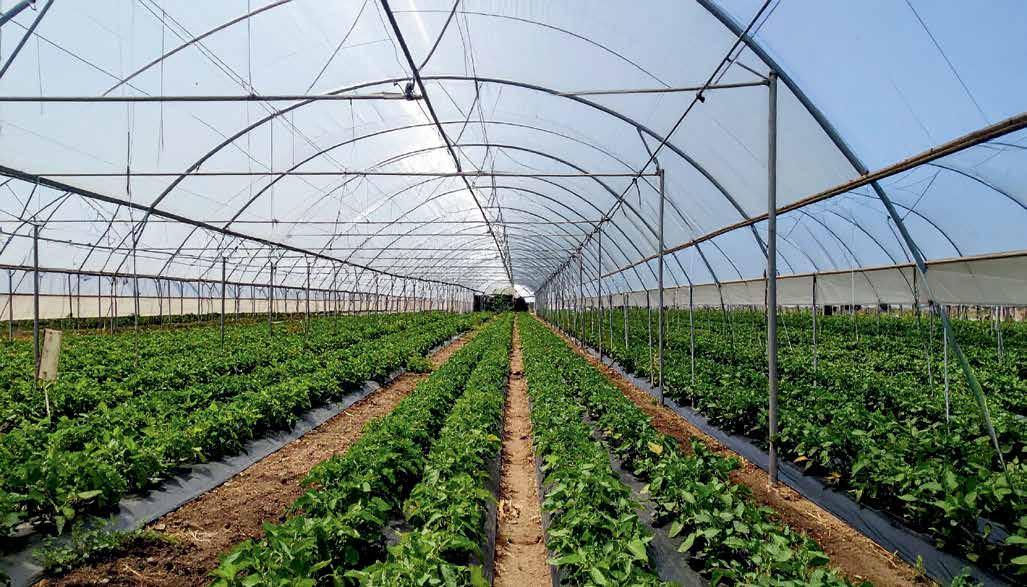
promise greater variety, but tomatoes, cucumbers and peppers remain the three staple crops grown by greenhouse vegetable operators. Fortunately, those three are also healthy and nutritious. With the right recipe, they’re quite tasty.
Here are a few options that feature one or all of those three greenhouse vegetable staples.
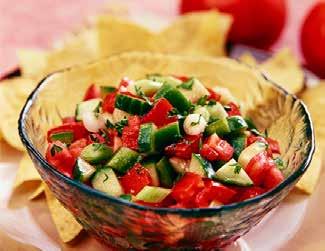
Ingredients
• 4 Ontario tomatoes, peeled and chopped
• 1/2 Ontario greenhouse cucumber, chopped
• 2 Ontario Green onions, chopped
• 1 Ontario sweet green or red pepper, chopped
• 1 clove Ontario garlic, crushed
• 2 tbsp (25 mL) vegetable oil
• 1 tbsp (15 mL) red wine vinegar
• 1 tbsp (15 mL) fresh lemon juice
• 1 tsp (5 mL) salt
• 1/4 tsp (1 mL) pepper
• 2 drops hot pepper sauce
• 1/4 cup (50 mL) chopped fresh Ontario parsley
Instructions
In medium bowl, combine tomatoes, cucumber, onions, green or red pepper and garlic. Whisk together oil, vinegar, lemon juice, salt, pepper and hot pepper sauce. Pour over vegetable mixture and combine gently. At serving time, add parsley. Can be stored in refrigerator for up to 4 days.

Ingredients
• 2 cups (500 mL) cooked rice
• 1/3 cup (75 mL) freshly grated Parmesan cheese
• 1/4 cup (50 mL) pesto sauce
• 3 tbsp (45 mL) diced rehydrated sundried tomatoes
• 3 tbsp (45 mL) toasted pine nuts or chopped almonds
• 3 Ontario greenhouse red, orange or yellow sweet peppers
Topping:
• 3 tbsp (45 mL) freshly grated Parmesan cheese
Instructions
In large bowl, mix together rice, cheese, pesto, sun-dried tomatoes and pine nuts; set aside. Cut peppers in half through stems (retain stems); seed and core. Fill each pepper half with rice stuffing. Place, stuffing side up, in baking dish. Cover with foil; bake in 350°F (180°C) oven for 35 minutes.
Topping: Remove foil. Sprinkle cheese over peppers; bake uncovered, for about 5 minutes longer or until cheese is golden.

Ingredients
• 8 oz (250 g) tagliolini or rigatoni pasta (about 4 cups/1 L)
• 2 tbsp (25 mL) olive oil
• 2 Ontario greenhouse sweet peppers, chopped
• 2 cloves garlic, minced
• 1 Ontario onion, chopped
• 1/2 cup (125 mL) dry Ontario white wine or sodium-reduced chicken broth
• 8 pitted black olives, sliced
• 3 Ontario greenhouse tomatoes, coarsely chopped
2 tbsp (25 mL) chopped fresh Ontario
In large pot of lightly salted boiling water,
um heat. Cook peppers, garlic and onion until lightly softened, about 5 minutes. Add wine, olives and tomatoes; increase heat and bring to simmer. Cook, uncovered until hot and bubbly, about 3 minutes.
Drain pasta; add to skillet and toss. Stir in basil and sprinkle with cheese.

• 1 ready-made pizza dough, about 1-1/3 lb (650 g)
• 1-1/2 cups (375 mL) shredded Italian blend cheeses
• 2 Ontario greenhouse tomatoes, sliced
• Half Ontario greenhouse sweet yellow pepper, thinly sliced
• 1/2 cup (125 mL) pepperoni slices, about 2 oz (60 g)
• 12 whole fresh Ontario basil leaves
Instructions
Lightly grease a 15- x 10-inch (38 x 25 cm) baking sheet. Press or roll out dough to fit pan. Evenly sprinkle pizza crust with 3/4 cup (175 mL) of the cheese. Arrange tomatoes on top; top with yellow pepper, pepperoni and remaining cheese.
Bake in middle rack in 450°F (230°C) oven for 20 to 22 minutes or until crust is lightly browned and cheese is melted. Sprinkle with basil leaves.
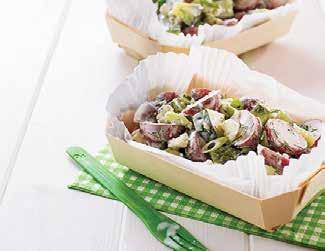
Potato, Cucumber and Dill Salad
Ingredients
• 2 lb (1 kg) small Ontario red potatoes, halved
• 3 Ontario Green onions, thinly sliced
• 1 Ontario greenhouse cucumber, cut into bite-size pieces
• 1/4 cup (50 mL) crumbled Ontario feta cheese
• 3 tbsp (45 mL) chopped fresh Ontario dill
• 1/2 cup (125 mL) plain yogurt
• 1/4 cup (50 mL) mayonnaise
• 2 tbsp (25 mL) fresh lemon juice
• 1/2 tsp (2 mL) each salt and pepper
Instructions
Place potatoes in large pot of cold salted water; bring to boil. Reduce heat and simmer,
partially covered, until just tender. Drain and place in large bowl; let cool completely.
Add green onions, cucumber, feta, and dill to cooled potatoes.
In small bowl, stir together yogurt, mayonnaise, lemon juice, salt and pepper; pour over potato mixture and gently toss. Serve immediately or cover and refrigerate until ready to serve.
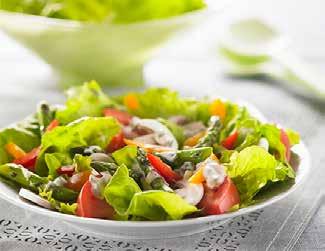
Fresh Greenhouse Veggie and Asparagus Salad
Ingredients
Dressing:
• 1/2 cup (125 mL) plain yogurt (3% M.F.)
• 1/2 cup (125 mL) finely chopped Ontario greenhouse cucumber
• 1 tbsp (15 mL) chili sauce
• 1 tsp (5 mL) finely chopped Ontario onion
• 1/4 tsp (1 mL) each granulated sugar and dried oregano
• 1 clove garlic, minced
• Pinch each salt and pepper
Salad:
• 3 cups (750 mL) each torn Ontario greenhouse leaf and Boston lettuce
• 8 oz (250 g) Ontario asparagus, grilled or broiled*
• 1 cup (250 mL) thinly sliced Ontario button mushrooms
• 1 Ontario greenhouse tomato, cored and cut into wedges
• Half each Ontario greenhouse red and orange sweet peppers, slivered
Instructions
Dressing: In small bowl, combine yogurt, cucumber, chili sauce, onion, sugar, oregano, garlic, salt and pepper. Set aside.
Salad: In large salad bowl, combine leaf and Boston lettuce. Slice asparagus into bitesize pieces and add to bowl. Add mushrooms, tomato and sweet peppers. Toss with dressing to coat.
Ontario asparagus: Snap off asparagus ends. Toss stalks with 1/2 tsp (1 mL) olive oil; season with pepper. Grill on greased grill over medium to medium-high heat until bright green and tender-crisp, about 5 minutes. Or, broil on baking sheet until tender-crisp, about 4 minutes.
By Niagara Farms Staff
Instead of bringing people to the farm, a provincial organization is continuing its work to bring the farm to people.
Farm & Food Care Ontario (FFCO) recently announced the launch of three more additions to the FarmFood360 collection, which offers virtual reality tours of Canadian farm operations. The newest additions include a grain farm from Eden, an apple orchard from Bowmanville, and a field tomato operation in Chatham-Kent.
“We sincerely value the ongoing dedication of Farm & Food Care Ontario in promoting Ontario’s agri-food sector, and we’re proud of this partnership that highlights the important work of our members,” said Peter Katona, communications manager for the Agricultural Adaptation Council, which offered partial funding for the three projects.
“These projects showcase the diversity and strength of Ontario’s agriculture and agri-food industries while giving Canadians an engaging, behind-the-scenes look at how their food is grown and prepared with care.”
The first of the new tours explores the VanQuaethem family’s grain farm in Eden, just southwest of Tillsonburg. Viewers can see the key stages of growing and harvesting, including soil preparation, planting, crop management and harvest. It highlights some of the modern equipment and technology used on 21st century grain operations. Family members show viewers how they manage the land, weather, and pests and diseases. The Grain Farmers of Ontario helped produce the tour.
“We’re proud to help shine a spotlight on the grain farmers who work tirelessly to produce one of the country’s most versatile crops,” said Jeff Harrison, GFO chair. “This tour provides an immersive experience that shows the care and complexity involved in growing grain corn, right from the field.”
Stepping out of the combine and into the orchard, visitors can also take a tour of Bow-
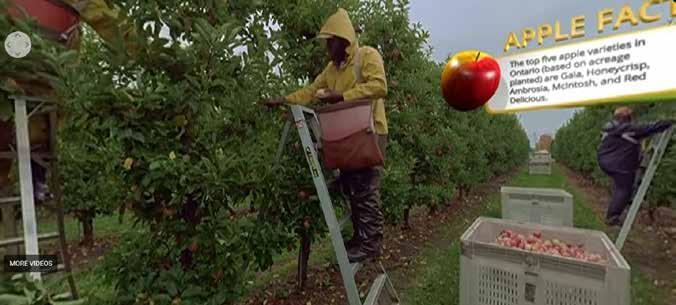
manville’s Algoma Orchards, where they’ll learn about the full growing cycle of apples, from spring blossoms to fall harvest.
It also covers key apple farming practices like pollination, pruning, picking and packing, as well as cider processing and the work that goes into controlled storage. The Ontario Apple Growers helped with this tour.
“Our growers put tremendous dedication into producing high-quality apples for Canadian families,” said Chris Hedges, chair of OAG. “This virtual orchard tour offers a unique look at everything that goes into nurturing and harvesting a successful crop each year.”
Finally, tomato lovers can learn about the hard work that goes into producing the classic kitchen staple, as the Pinsonneault family welcomes virtual visitors to their Chatham-Kent field tomato farm. This tour showcases the specialized equipment needed to plant and care for the crops, as well as how they’re grown and harvested for processing. Viewers can learn about the unique weather, pest and disease challenges farmers like them face. The Ontario
Processing Vegetable Growers and Conagra Brands helped with this tour.
“Field tomatoes play a vital role in Ontario’s processing sector, and this tour gives viewers an inside look at a crop that many rarely get to see up close,” said Dave Hope, OPVG chair. “We’re excited to help share the stories of the farmers who grow these tomatoes with such precision and pride.”
The project also received support from the Sustainable Canadian Agricultural Partnership, a joint program led by the federal government with the help of provincial and territorial governments.
FarmFood360 offers several VR tours that can help Canadians learn more about the dayto-day work of farmers and the pride they have in their work. Since its inception in 2016, nearly 30 tours have been produced. The website attracts more than one million online visitors each year.
For more information or to take part in an online tour, visit FarmFood360.ca.
By Amanda Modaragamage
Ontario soybean farmers are watching global trade negotiations closely as uncertainty around exports - particularly to China - adds to price pressure in a market already facing strong global crop supplies.
Brazil is expected to have a record soybean harvest in 2026, a development that analysts say will weigh on prices worldwide.
“There’s forecast to be record production in Brazil, and when there’s strong production, that has downward pressure on price,” said Brian Innes, executive director of Soy Canada. “That’s the first thing to watch for prices in 2026. The second is what happens globally with geopolitics and tariffs.”
Innes said changes in trade relations between major economies - especially the United States and China - can have a direct impact on the prices Canadian farmers receive.
“Due to the Trump administration, tariffs on soybeans have changed,” he said. “One thing to watch for 2026 is how the situation between the U.S. and China evolves, and how the situation between Canada and China evolves. That can have an impact on price if tariffs change.”
More than 70 per cent of Ontario’s soybean crop is exported, with prices shaped by global demand, particularly from China. While China historically sourced much of its soybeans from the United States, it is increasingly turning to Brazil due to generally lower prices.
Canadian soybeans shipped to China have the same three per cent tariff as most other countries in the world. The United States paid tariffs at a higher rate, but a deal was recently struck between the two countries on soybeans.
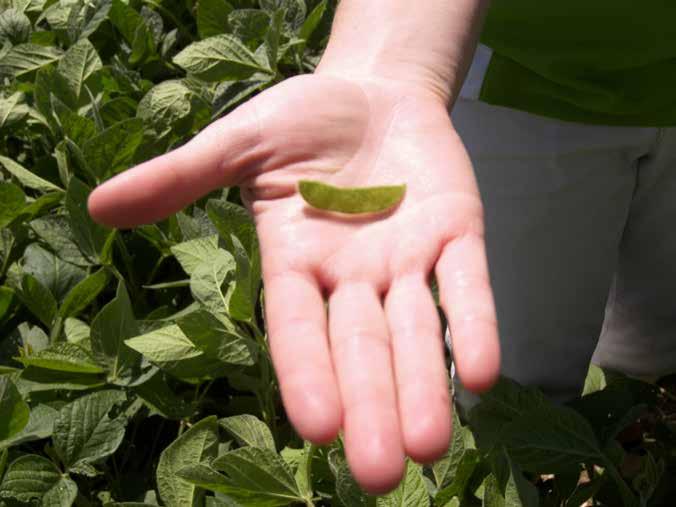
“From a farmer’s perspective, there’s been a lot of geopolitical uncertainty injected into the market,” Innes said.
On the positive, he said there was a strong export of Canadian soybeans from the 2025 crop to China. He said there is still strong import demand for soybeans for animal feed and human consumption, and that he expected this to continue.



Brazil and the United States are the world’s largest producers of soybeans. Prior to Trump striking a deal in December, the U.S. could not ship soybeans to China, which meant American beans were sent to other markets. These markets overlap with Canadian export markets.
“That made it difficult for us to compete in other markets, such as Indonesia,” Innes said.

Innes recently returned from the annual trip to China, Japan, and Taiwan. He said it was successful, and demand is strong, but large crops in Brazil and the U.S. will have an impact.
The Canadian and U.S. soybean markets are also closely linked through cross-border trade and processing, which could also impact prices for Canadian farmers.
“Products flow back and forth across the border,” said Innes. “For example, Ontario soybeans are shipped to Michigan, processed into soybean meal, and then shipped back into Ontario. Soybean meal and soybean oil trade back and forth across the border, and that’s why prices are very linked.”
Soybeans are priced on global benchmarks - particularly U.S. futures markets - meaning Canadian prices move in step with broader world trends.
“The price that Ontario farmers see is based on what conditions Canada faces when exporting to the world, including China,” said Innes. “In the past, the difference between Michigan and Ontario was largely tied to exchange rates, but now, with global trade disruptions, Canada and the U.S. face different tariffs and different market conditions.”
Despite growing competition from lower-cost producers, Innes said Ontario remains well positioned as a high-quality soybean supplier.
Ontario is a global leader in identity-preserved and food-grade soybeans, a niche market that allows farmers to compete on quality rather than volume alone.
“We’re living in a time of unprecedented global uncertainty, and if market conditions change for Canadian soybean exports, that will have an impact on price,” said Innes. “But Canadian soybeans have been flowing under strong export conditions for some time, and that has meant strong demand for Ontario soybeans.”
By Luke Edwards
He learned to love farming while tending the soils and animals on his Manitoba family’s farm, and it was that passion, and the hard work of trusted friends and colleagues, that catapulted Don Triggs to big things on this side of the Great Lakes.
Triggs has been awarded the Order of Canada in recognition for his work in the grape and wine industry that helped create a global wine brand and turn Niagara into a premier destination for wine lovers.
“I was just totally gobsmacked,” the now 81-year-old said about his reaction upon learning of his being appointed to the prestigious order.
Triggs received the honour earlier this winter, and was one of 15 people recognized in the officer class by Governor General Mary Simon.
Triggs came from a Manitoba farming family, though one that focused on cereal grains, as well as cattle. One half of a pair of identical twins, Triggs went off to school when it was decided his brother would take over the family farm.
So he studied agriculture and then business at the Ivey School of Business, where he said he learned a lot about how to run a business. His career took him to a few stops, eventually settling in the wine industry with a company nowadays more known for its beer. John Labatt got involved with several wineries, including Chateau-Gai, and Parkdale.
Triggs would come to run the company’s wine division, both in Canada and the U.S., where Labatt also acquired California winery Lamont Cellars.
This gave Triggs an understanding of the North American wine industry. That knowledge came in handy when the North American Free Trade Agreement was crafted. With fears over what free trade would mean for its wine division, Labatt put the wineries up for sale.
But where others saw bumpy waters, Triggs saw opportunity.
“There were a few small satellite producers, such as Inniskillin, who were producing higher quality wine. And I saw an opportunity,” he said.
Triggs would later work to help develop the education and research infrastructure - such as Brock University’s Cool Climate and Oenology and Viticulture Institute - needed to develop high quality wines, but the first step was cobbling together enough capital for an offer that Labatt could accept.
Fortunately, the company was open to an employee purchase. A small group that included Triggs and Allan Jackson made Labatt an offer for its four Canadian wineries.
Their company would become known as Vincor, and they grew both by acquiring iconic brands like Inniskillin and opening their own winery, Jackson-Triggs. Opening the winery was significant, with Triggs describing it as “the locomotive that drove the train.”
Triggs said success came early, in large part thanks to the people of Niagara. Consumers, farmers and business people alike supported the employee takeover of the business.
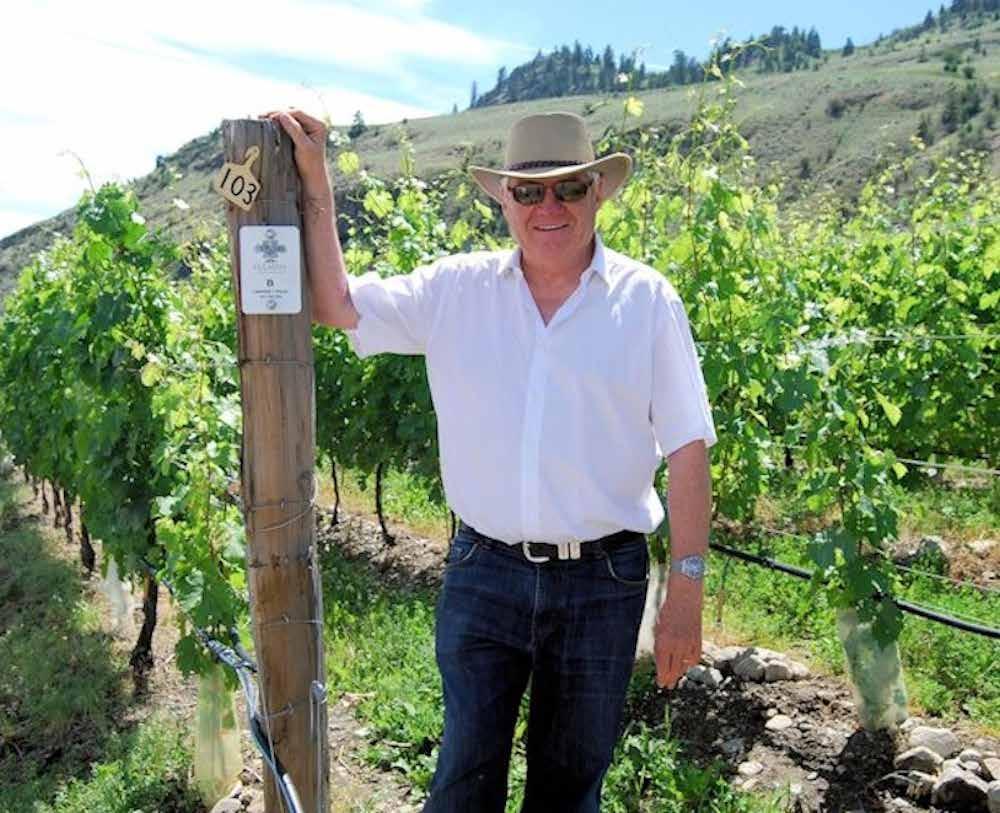
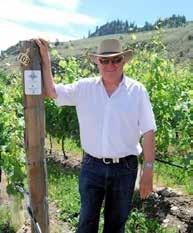
Donald Triggs was recently appointed to the Order of Canada. ~ Submitted photo
“There was a lot of goodwill from the community,” he said.
In 2006, Constellation Brands undertook a hostile takeover of Vincor.
“I sort of took a walk,” Triggs said. “I didn’t want to, I had built the company with partners, we had done it ourselves, and there was a strong feeling of I didn’t want to work for anyone else at that age.”
Eventually the Ontario Teachers’ Pension Plan would purchase the company, and rename it Arterra Wines, which continues to today.
But after he left, Triggs spent a few years deciding what to do. While out in B.C. with his wife Elaine, they found their next calling.
“We stumbled across an old peach orchard in the Okanagan Valley,” Triggs recalled.
They purchased the land adjacent to the orchard and built Culmina Family Estate Winery, which they turned into a successful winery, before retiring and selling it to Arterra in 2019. It allowed him to maintain his passion for agriculture.
“There’s something about growing things,” he said. When he was working, Triggs said he would walk the vineyards nearly every day.
“Farming is a wonderful life,” he said. “It’s a great life if you can do it.”
Seeing the buds come out each spring was a special time of year, a sign Mother Nature is ready to come out of her winter slumber.
“Farming is farming. You’ve got to take what Mother Nature gives you and learn to live with it,” he said.
Triggs said the Order of Canada is a special honour, though he was quick to point out his success came with the support of others, sin-

gling out his wife Elaine and longtime partner Jackson.
“I’m saddened that Allan Jackson has passed away, he was just a great partner,” Triggs said, recalling Jackson’s mix of brilliance and sense of humour.
“He was a wonderful partner and we had a lot of fun together.”
Many in the industry offered their congratulations to Triggs, who said he received a message from Grape Growers of Ontario CEO Debbie Zimmerman.
A statement from Arterra Wines also paid tribute to Triggs.
“A pioneer of the Canadian wine industry and a founder of Arterra Wines Canada, Donald’s vision helped shape our company and build Canada’s most successful wine brand, Jackson-Triggs,” the statement said. “This national honour recognizes his lasting impact on Canadian wine and his leadership across decades.
In the announcement of this year’s Order of Canada recipients, Triggs was described as having “visionary leadership” that helped create today’s Canadian wine industry.
“Notably growing Vincor International into its largest producer and marketer. His entrepreneurial drive extended to influential roles in industry organizations. Beyond business, he is a committed philanthropist who supports education and the arts with passion and purpose, leaving a lasting impact on multiple sectors,” the announcement said.
A ceremony is planned for March to honour Triggs and the other new members of the Order of Canada.
By Niagara Farms Staff
With global trade remaining uncertain heading into 2026, a new program seeks to help farmers, food processors and agribusinesses sell their products around the world.
A joint program between the governments of Canada and Ontario, the new Market Diversification and Trade Resiliency Initiative will provide a total of $20 million to help fund a variety of projects. In a press release from Queen’s Park, the initiative is described as funding projects that will “increase competitiveness for farmers and agribusinesses and support their expansion into new and international markets as part of the provincial government’s plan to protect Ontario’s agribusiness sector.”
Heath MacDonald, federal minister of agriculture and agri-food, said the money will help increase reliability for farmers and food producers.
“Expanding markets for Ontario food products ensures farmers and food processors have more reliable export opportunities,” he said. “We are building a stronger, more resilient future for agriculture by improving market access and leveraging our shared strengths.”
Applications for the funding will open on Feb. 17. Farmers and agribusinesses can apply through one of three streams: Market development and diversification implementation planning, implementing market development and diversification, and Implementation of equipment and technology.
“This investment will help our local farmers and agribusinesses sell more products grown in Ontario to markets around the world,” said Trev-
As part of the federal government’s plan to reduce the public service, layoff notices began going out last month, including significant job loss at both the Canadian Food Inspection Agency and Agriculture and Agri-Food Canada.
For CFIA, 1,371 jobs were targeted for elimination. Those jobs included food inspectors, vets, lab technicians, administrative staff and policy analysts.
AAFC, meanwhile, cut 665 positions and CBC reported seven research operations throughout the country would be closed as well.
OGVG lauds federal government’s grocery affordability announcement
New efforts by the federal to make groceries and other essential goods more affordable are being welcomed by the association that oversees Ontario’s greenhouse vegetable growers.
However, the Ontario Greenhouse Vegetable Growers are also stressing the importance of maintaining a stable, reliable trade relationship with its neighbours to the south.
“This is a truly symbiotic relationship,” said Richard Lee, OGVG executive director. “Ontario greenhouse growers depend on reliable access to the United States market, and American retailers and consumers depend on our ability to deliver high-quality fresh produce throughout the year. When trade barriers or
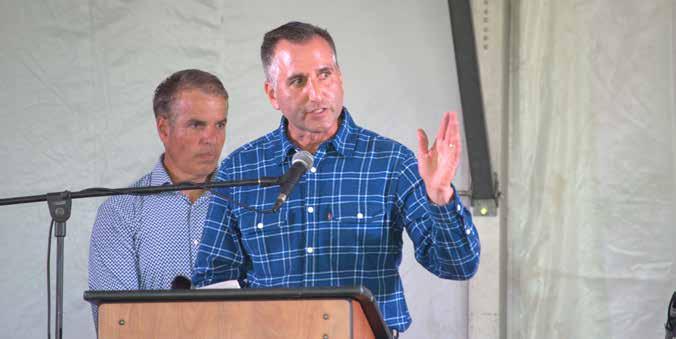
or Jones, Ontario’s minister of agriculture, food and agribusiness. “Our government is proud to support the farmers and businesses who drive our nearly $52 billion agri-food sector forward each and every day.”
Cost-share levels and the maximum eligible funding amount will vary based on the project and the types of proposals submitted. There will be a focus on increasing non-U.S. markets, though projects for American markets will also be supported.
Drew Spoelstra, president of the Ontario Federation of Agriculture, welcomed the program.
tariffs disrupt that relationship, both countries feel the impact immediately.”
More than 85 per cent of Ontario’s greenhouse vegetable production is exported to the U.S.
The association is calling for a strengthened Canada-U.S. agricultural trade relationship, no new tariffs or trade barriers on greenhouse vegetables and production inputs, and for the government to address existing non-tariff barriers.
‘Growth mindset’ needed for country’s agriculture sector: CropLife CEO
CropLife Canada’s president and CEO is calling on the federal government to focus on things it can alter, namely its regulatory system, to help push the agricultural sector to a new level of success.
Pierre Petelle said the sector can’t be overlooked as Mark Carney’s Liberals try to remake the Canadian economy.
“While there are many things outside of Canada’s control like extreme weather events and tariffs, the regulatory system is within its control,” said Petelle, arguing over $100 billion in GDP growth in the next decade is possible with bold and decisive policy changes.
The agricultural sector faces significant hurdles that hinder its growth, including timely and predictable approvals for new agricultural innovations like seed and crop protection products, Patelle said.
“Ontario farmers produce some of the highest quality food and agricultural products in the world,” he said.
“Creating and strengthening reliable markets for our products has never been more important both at the local level and globally. We appreciate the efforts of the province and the federal government as we work together to support a strong, vibrant, and growing agricultural sector.” Applications will remain open until March 17. For more information about OMAFA programs and services, contact the Agricultural Information Contact Centre (AICC) at 1-877424-1300 or at ag.info.omafa@ontario.ca.
“There are currently half as many submissions of pesticides seeking regulatory approval in Canada as there were a decade ago, and yet the timelines for approval have nearly doubled. This puts Canada at risk of falling further behind other nations that have established more efficient and predictable regulatory frameworks,” he said.
CropLife Canada is calling for an update to mandates for the Canadian Food Inspection Agency and Pest Management Regulatory Agency to weigh economic impacts alongside health and safety, use reviews and best regulatory practices from trusted, risk-based jurisdictions, set and meet clear regulatory approval timelines, and cut red tape.
New website for VRIC
A new year came with a new look for Vineland Research and Innovation Centre’s website.
The organization launched the revamped site in January.
“The site has been designed to make it easier to explore our projects, research areas, and partnerships, all in one place,” VRIC said in an email announcing the launch of the site.
It came as the latest Innovation Report was released. This year’s report includes information on several projects, following a theme of collaboration.
To check out the new site or to read the report, visit vinelandresearch.com.
By Niagara Farms Staff
Rural municipalities will have a second chance to apply for provincial funding to help support economic growth, protect jobs and improve infrastructure.
Last month the province announced a second intake for the Rural Ontario Development Program, which was created last year to help Ontario’s smaller communities. The announcement was made at the annual Rural Ontario Municipal Association’s annual conference.
“The Rural Ontario Development Program is a key part of our government’s commitment to
help develop and grow local businesses, attract and retain workers and build safe, strong and vibrant communities in rural regions of the province, including Niagara,” said Sam Oosterhoff, MPP for Niagara West.
“When rural Ontario thrives, the entire province prospers.”
Minister of Rural Affairs Lisa Thompson said the program is part of its Rural Economic Development strategy, which is “protecting rural communities and helping them to thrive in these uncertain economic times.”
“This strategy - which includes the Rural Ontario Development Program - supports our
whole-of-government approach to ensure rural Ontario continues to be the best place to live, work and raise a family,” she said.
Minister of Municipal Affairs and Housing Rob Flack said the program will help people who call rural Ontario home.
“From making investments in infrastructure, to supporting Ontario’s farmers, to creating the conditions to get more homes built, we are doing what is needed to keep workers on the job and safeguard the bright future that is in store for our rural communities,” he said.
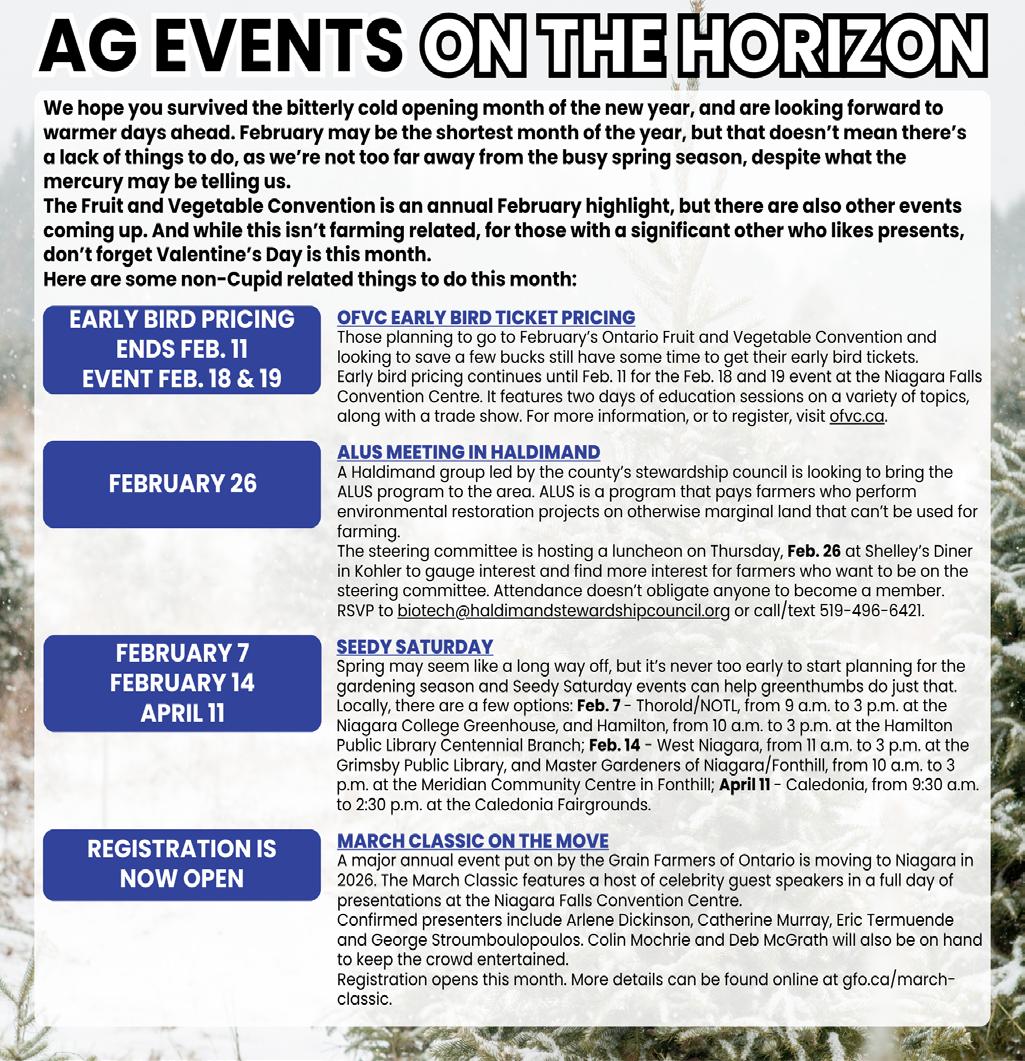
By Niagara Farms Staff
A prominent Jordan restaurant has won the inaugural Rural Heart award.
The provincial government announced the award at last month’s Rural Ontario Municipal Association annual conference. The Town of Niagara-on-the-Lake also won a Rural Partner award.
“This recognition reflects the strength of our local farming community and our shared pride in Jordan, the Town of Lincoln and the greater Niagara area as a world-class destination,” said Milton Mednick, CEO of Restaurant Pearl Morissette.
The Province created the Rural Inspiration Awards to celebrate excellence in Ontario’s smaller communities.
Last September, Pearl Morissette received its second Michelin Star and ranked third best restaurant in North America through the first edition of North America’s Fifty Best Restaurants list. They’re also one of three restaurants in the province to be awarded the Green Star, which recognizes outstanding sustainability and a commitment to local seasonal ingredients.
“I congratulate Restaurant Pearl Morissette - including local chefs, Daniel Hadida and Eric Robertson - on being recognized with this high distinction,” said Niagara West MPP Sam Oosterhoff.
The Rural Partnership award, meanwhile, “celebrates the outstanding contributions of individuals and organizations that are helping build vibrant communities in rural Ontario and ensuring prosperity across the province,” according to a press release. NOTL received the award for its partnership with the Town of Minto that allows the two municipalities to share assets through online platform GruShare.
“These municipalities saved money by sharing needed equipment instead of purchasing new items. This helps municipalities cut costs, generate new revenue and do what we, in rural Ontario, know how to do - help each other,” said Lisa Thompson, minister of rural affairs.
“This is just one example of how the Town of Niagara-on-the-Lake continues to be an innovative leader in rural Ontario,” said NOTL’s Deputy Mayor Erwin Wiens.