Community members are invited to bring a lawn chair or blanket for summer evening fun on the grounds of Bayfield Town Hall for an outdoor lawn party on August 1.
Haggis X-1 is a high-energy Celtic rock band built around veteran members of acclaimed Canadian group Enter the Haggis.
Over a 30-year career, Enter the Haggis toured extensively across North America, performing on national television programs including Regis and Kelly, A&E, PBS, and at prestigious stages such as the Kennedy Centre for the Arts.
Their songs ‘One Last Drink’ and ‘Down with the Ship’ have become modern Celtic pub anthems, keeping audiences raising a pint and singing along wherever they’ve played.
Carrying that legacy forward, Haggis X-1 blends driving rhythms, pipes, fiddle, and memorable songs into a powerful live show.
The band will deliver a mix of favourites and fresh material, all rooted in strong melodies, big choruses and a sense of celebration.
In addition to Craig Downie, Trevor Lewington, and Tom Barraco of Enter the Haggis, the lineup for Haggis X-1 features fiddler and multi-instrumentalist Jesse Grandmont, guitarist Will Earley adding rhythmic punch, vocalist and keyboardist Charlotte Roth bringing dynamic lead vocals, and Anthony Candullo on bass. Together, they create a contemporary take on Celtic Rock.
Tickets are available at bayfieldtownhall.com
and hearing from the hospital’s registered dietitian. Campers ended the day with a
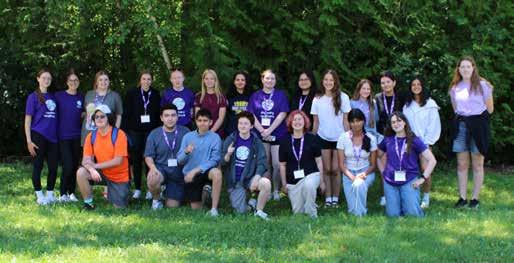
and CEO Jimmy Trieu. (First row, L-R): Brooke Howaty, Sia Joglekar, Ashton Buhrows, Lila Roberts, Angelic Qidan. (Second row, L-R): Victoria Iannetta, Jimmy Trieu and Hannah Carr. (Third row, L-R): Jake McKee, Millicent Hugill, Sadie James, Isla Brock, Ava Hupel, Arina Postovalova, Blair Rau, Karma Elgherissy. (Fourth row, L-R): Elia Eazaz, Teagan Denomme, Avery Bruinsma, Lexie DeVries, Kyle MacDonald, Mackenzie Harris, Nelly Malec, Sarya Cicek, Shelby Krug, Myra Sadana, and Julia Sawchuck.
During the week of July 6 – July 11, high school students participated in the Discovery Healthcare Camp in Goderich.
Twenty-four students took part in a week-long, first-hand look at the many career opportunities available in healthcare.
Led by medical students from Western University’s Schulich School of Medicine and Dentistry, the camp provided students with hands-on clinical experiences, opportunities to discover a wide range of healthcare careers, and
the chance to learn directly from professionals in this community.
For five consecutive years, Gateway Centre of Excellence in Rural Health (CERH), Huron Health System (HHS), and the Schulich School of Medicine and Dentistry have collaborated to host the camp.
Hosted at Camp Klahanie, generously donated by Goderich Lions Club, the program connects students with healthcare professionals throughout Huron County.
“Programs like this are an investment in the future of healthcare,” explained Jimmy Trieu, President and CEO of HHS.
(CONTRIBUTED PHOTO)
R.G. Wellness and Care donates to local hospice following Hearts and Hooves fundraiser
KATHLEEN SMITH Editor
R.G. Wellness and Care was born from both love and loss.
Named after Pam Siddall’s father, Randy Geoffrey, who struggled with depression and died by suicide in 2024, R.G. Wellness and Care provides compassionate, client-centred support including respite, PSW services, wellness check-ins, and equine companionship.
R.G. Wellness and Care offer complimentary visits to hospices and long-term care homes. Horses have an incredible ability to feel emotions and seem to sense sadness, loneliness, anxiety and even when someone just needs companionship.
Horses played a huge role in helping Siddall navigate her own grief, and she soon realised she wanted to create a safe space where others could experience that same healing.
“My goal is to support people of all ages who are facing anxiety, depression, trauma, loneliness, or life challenges through meaningful connections with horses, while also providing respite and wellness services to families in our community,” said Siddall.
In June, R.G. Wellness and Care held its first Hearts and Hooves fundraising event through a hospice trail ride and games.
REACH Centre donated its facility for this meaningful event.
Together, R.G. Wellness and Care and its sponsors and donors came together to support two organisations that provide compassionate care – Huron Hospice and Jessica’s House.
This event was about more than horses – it was about hope, compassion and people coming together to make a difference.
Hearts and Hooves at REACH in Clinton on June 28 took participants on a horse ride through a trail, and barrel racing and pole events at the facility later.
Pam Siddall of R.G. Wellness and Care hosted this
event in support of Huron Hospice and Jessica’s House Hospice.
Mental health, grief, hospice care and community support have all touched Siddall’s family life in different ways.
She wanted to combine her passion for horses with giving back.
Hearts and Hooves wasn’t just about raising money, but about bringing people together, celebrating the horse community, and supporting organisations that care for families during some of the hardest moments of their lives.
“Jessica’s House Hospice and Huron Hospice are both incredibly close to my heart,” Siddall explained.
“They are our local community hospices, and they have cared for people I have loved during some of their final days. I’ll never forget the compassion, dignity, and support they provided, not just to my loved ones, but to our entire family.”
This cause is also personal to Siddall as her partner is a nurse at Huron Hospice.
As a result of the overwhelming generosity at the Hearts and Hooves event by the riders, sponsors, volunteers, and donors, each hospice will receive just over $3,000.
“I couldn’t be more grateful that our community came together to make that possible, and I hope these funds help both hospices continue providing the exceptional care and comfort they are known for,” said Siddall.
Rooted in empathy and personal experience, staff at R.G. Wellness and Care promotes healing, connection, and whole-person well-being.
Research has shown that horses can remember people for many years, and they recognise familiar faces, voices and even past experiences.
Every interaction becomes part of the relationship. Participants with equine sessions learn confidence, communication, patience and self-awareness, and the horses follow when they feel safe and trust the person beside them.
This is why equine companionship is so powerful. Siddall has been around horses for over 20 years, and
they’ve taught her more than she could ever teach them.
“Horses are incredibly powerful animals, but they’re also incredibly sensitive,” explained Siddall.
“They don’t judge, they don’t care what you’ve been through, and they respond honestly to your emotions.”
For those who are nervous around horses, Siddall understands. Each session starts slowly, with safety as the top priority.
Most of the work happens on the ground – grooming, learning horse behaviour, building trust, and simply spending time together.
According to Siddall, by the end of the session, it’s amazing to see fear replaced with confidence and respect.
Many people find it easier to connect with a horse than to sit across from someone and talk. Horses offer companionship without expectation.
Horses help people build confidence, regulate emotions, develop trust, and simply feel seen.
Sometimes healing begins with silence, and horses are incredibly good at meeting people where they are.
Siddall explains that she’s seen children who were too anxious to speak, begin smiling and engaging. She’s watched people who lacked confidence learn to lead a horse with pride, and seniors who were struggling with loneliness find joy simply grooming and spending time with the horses.
“Participants often leave calmer, more confident, and more connected than when they arrived,” said Siddall. Families notice improvements in communication, emotional regulation and self-esteem.
“Every journey is different, but one thing remains the same – the horses have an incredible ability to help people feel safe, accepted, and hopeful,” Siddall added. For more information, follow R.G. Wellness and Care online or Facebook.
(CONTRIBUTED PHOTO)
When It Feels Like Home
Canada Post and the Shuttering of Community Newspapers
The shuttering of Winnipeg’s Community Review means 200,000 households will no longer get the benefit of a free community newspaper delivered to their door. It also means that more than 800 people who deliver the paper and their families will be affected.
This is an unforced error that never should have happened. How did we get here? The answer is complex.
First, there is a high degree of concentration in the flyer printing market in Canada. Montreal-based TC Transcontinental enjoys the dominant position in the marketplace thanks, in part, to a 2012 Competition Bureau-approved asset swap.
Second, municipal and provincial politicians have passed envi-
ronmental regulations, however well-intentioned, have unintended consequences. Former Montreal Mayor Valérie Plante passed a municipal bylaw that led to the end of distribution of Publisac (a plastic bag with flyers and a community newspaper). Several provinces, including Manitoba, have imposed extended producer responsibility levies on printed newspapers. Ontario’s Premier Doug Ford made the wise decision to exempt newspapers from this kind of stealthy journalism job-killing tax in his province.
Third, Canada Post is the biggest culprit. TC Transcontinental, which had distributed Publisac door-to-door in Quebec, formed a strategic partnership with Canada Post, which as a Crown corporation was not beholden to municipal bylaws. They bypassed Mayor Plante’s new regulation by distributing a curated bundle of flyers called Raddar through the national postal service. Unlike Publisac, Raddar did not include a community newspaper. On the sidelines of this saga, news publisher Métro Média and its more than 30 hyperlocal publications — including 17 print newspapers – shut down.
In partnership with Canada Post, TC Transcontinental re-
Restoring small-town journalism, one community at a time!
Publisher
Stewart Grant • stew@granthaven.com
Editor
Kathleen Smith • kate@goderichsun.com
Graphic Design / Sales Inquiries
Sarah Cairns • info@goderichsun.com
Business Development
Heather Dunbar • heather@granthaven.com
Billing Administrator
Cindy Boakes • boakescindy1576@gmail.com
Administrative Assistant
Wendy Lamond • wendylamond74@gmail.com
Contributors
Annette Gerdis, Tanya MacIntyre, David Yates, Paul Knowles, Brittany McKay, John Miner
36 Water St. St. Marys, ON, PO Box 2310 N4X 1A2 info@goderichsun.com | 519.655.2341 | granthaven.com
cently expanded its Raddar offering across Canada. It is understood that Canada Post – which has a mandate to “charge postage rates that are fair and reasonable” – is offering TC Transcontinental rates below what it is offering to community newspapers. To its own benefit, the Crown corporation has effectively shut community newspapers – their private sector rivals – out of flyer distribution, lessening competition substantially in that market.
This is not the first time community newspaper publishers have felt the squeeze of Canada Post in the flyer distribution market. As of January 2024, community newspapers with commercial inserts were no longer exempt from Canada Post’s Consumers’ Choice program, which allows Canadians to opt out of receiving ‘junk mail’. Canada Post made that decision without stakeholder consultation or economic/ social impact analysis and failed to recognize that community newspapers – with or without an insert – are not ‘junk mail’; they are a social good.
The juxtaposition of the shuttering of Winnipeg’s Community Review at the same time as the revelation of $30.8 million in bonuses at Canada Post has not
been lost on community newspaper publishers across Canada. What should Ottawa do about it?
First, Joël Lightbound, the Minister responsible for Canada Post, should ensure the Crown corporation is treating community newspapers fairly and offering them comparable pricing to what it offers to TC Transcontinental.
Second, the House of Commons Standing Committee on Canadian Heritage should conduct hearings into the role Canada Post can play in the sustainability of community newspapers – ensuring the relationship is one of partnership, rather than predatory and parasitic.
When a community loses a newspaper, like Winnipeg’s Community Review or Métro Média’s publications in Quebec, the information vacuum can lead to people getting their news from less than reliable sources – like AI and social media – which can create division that drives people apart. Without a check on local government, corruption, mismanagement, and wasteful spending often flourish, which can result in higher municipal taxes and borrowing costs.
It was not foreign Big Tech monopolists like Google and Meta
that caused Manitoba’s largest community newspaper to shutter. It was Canada Post.
And it’s not like we weren’t warned…
Thirty years ago, in his review of Canada Post’s mandate, George Radwanski recommended that postal service get out of delivering unaddressed junk mail (i.e., flyers), concluding that the Crown corporation engaged in inappropriate practices that created unfair competition for private businesses like community newspapers.
As a former Toronto Star editor-in-chief, Radwanski knew the news business. He noted that Canada Post was actively siphoning advertising revenue away from the news industry and adroitly cautioned that the state-granted mail delivery monopoly should not be in the business of crippling the financial health of newspapers.
A healthy democracy demands a healthy community news media ecosystem. Let’s level the playing field and restore competition in the flyer distribution market before more community newspapers shutter.
Paul Deegan is president and chief executive officer of News Media Canada
PAUL DEEGAN News Media Canada
Students explore healthcare careers at Discovery Healthcare Camp in Goderich
“Inspiring young people early is essential to building a strong, skilled workforce that will continue to provide exceptional care for our communities for years to come.”
Trieu says that throughout the week, it was incredible to see the students’ curiosity come to life. They asked thoughtful questions, explored every opportunity to learn, and showed a genuine interest in healthcare careers.
Throughout the week students heard presentations directly from physicians, nurses, pharmacists, dentists, and other health professionals about daily work, educational pathways, and experience working in rural healthcare.
Students participated in hands-on clinical skill sessions like delivering a baby, suturing, CPR and life-saving skills, and casting to learn about practical aspects of care.
Often, healthcare in rural areas can seem out of reach due to limited access to mentorship, financial barriers or uncertainty about educational pathways. The camp aims to bring mentorship and opportunity to youth in the area, demonstrating that a future in healthcare is achievable.
The impact of the camp can be seen at AMGH, where Laurie Hakkers, Interim Manager of the Emergency Department, first discovered her passion for healthcare through a summer camp just like this one.
Discovery Healthcare Camp Class of 2026 campers (seven campers absent from photo). Twenty-four students from across the region were excited to learn about careers in healthcare, some travelling as far as Mississauga, Guelph, KW and London. (Bottom, L-R): Hannah Carr, Sia Joglekar, Karma Elgherissy, Lexi DeVries, Julia Sawicka, Ava Hupel, Nelly Malec, Ashton Buhrows, Jake McKee. (Top, L-R): Ava Thebeau, Teagan Denomme, Avery Bruinsma, Arina Postovalova, Isla Brock, Myra Sadana, Blair Rau, Kyle MacDonald, Sadie James, Millicent Hugill, Victoria Iannetta, Lila Roberts, Mackenzie Harris, Elia Eazaz, Angelica Qidan, Brooke Howaty, Jasper Gill, Sarya Cicek, and Shelby Krug.
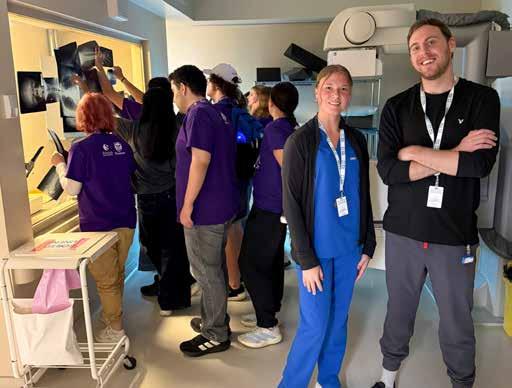
Campers were welcomed to the Diagnostic Imaging department at AMGH in Goderich. They explored a variety of ways imaging is used to support diagnostics and treatment for patients. They also explored different pathways to regulated healthcare professions in diagnostics imaging. Pictured here are Paige Vandenberg and Daniel Deroos.
Hakkers’ journey demonstrates how early exposure can spark a lifelong interest and inspire students to pursue rewarding careers caring for their own communities.
In response to the shortage of healthcare professionals in the area, Gateway seeks to take a preventative approach by ‘growing our own’ and supporting youth in the area to be inspired and have the resources to pursue those careers.
Gateway first launched the camp in 2022, with the aim to inspire the next generation of healthcare professionals while helping strengthen the future of rural healthcare.
“This one-week camp will help these students consider a career in healthcare,” said Gwen Devereaux, President of Gateway
CERH.
“We know this initiative is so important as we face a critical shortage of healthcare professionals, especially in rural communities such as ours.”
As a result of sponsors supporting the camp, this generosity helps support the camp year after year.
This support allows Gateway and its partners to provide local youth with valuable opportunity to attend the camp, which contributes to building a future healthcare force.
The week concluded with a graduation barbecue celebrating the students’ achievements alongside their families, community partners and mentors.
Campers took part in an Infection Prevention and Control (IPAC) session with IPAC Lead, Amber Brodie from Alexandra Marine and General Hospital (AMGH). Here they learned about specific processes for donning and doffing PPE (gowns, masks, gloves) in clinical environments where patients require isolation or are being treated for infectious diseases. (L-R): Sadie James and Mackenzie Harris.
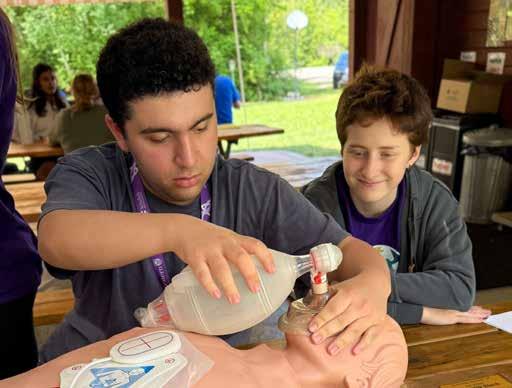
Participants in the camp were joined by Dr. Katayun Treasurywala from AMGH who facilitated hands-on clinical workstations that allowed campers to learn clinical skills required in an emergency department. Here Elia Eazaz and Ashton Buhrows learn how to perform CPR and provide airway management to simulate rescue breathing and ventilation.
(CONTRIBUTED PHOTO)
(CONTRIBUTED PHOTO)
(CONTRIBUTED PHOTO)
(CONTRIBUTED PHOTO)
Alzheimer Society Huron Perth offers support and education for care partners
GODERICH SUN STAFF info@goderichsun.com
Being a caregiver is a full-time job, and juggling day-to-day responsibilities such as cooking, cleaning, home maintenance, and medical appointments, on top of an already busy schedule can feel overwhelming.
The Alzheimer Society Huron Perth and the MacKay Centre in Goderich are offering two upcoming programs de -
signed to support caregivers.
Caring for the Caregiver Day will take place on August 4 from 9:30 a.m. until 3 p.m. at the MacKay Centre on Nelson Street in Goderich.
This free annual event provides caregivers with an opportunity to relax, connect and learn alongside other caregivers.
The day will include presentations from the Ontario Caregiver Organisation and Huron County Paramedic Services,
as well as opportunities to participate in handcraft activities and harp meditation.
Lunch is included and registration is required by July 28.
To register for this event, contact the MacKay Centre at mackaycentre@hurontel.ca or 519-524-6660.
Dealing with the Feelings will take place from July 22 until August 12, from 1:30 p.m. until 3 p.m. on Zoom.
If you are caring for a person living with dementia, the Alzheimer Society
Huron Perth is offering this four-week, online program.
The program will examine the evolving dynamics of caregiving and offers coping strategies to manage the difficult emotions care partners may experience.
Self-register for this program and more virtual programs at Education Hour: www.bit.ly/ASHPEducationHour
For more information contact the Alzheimer Society Huron Perth: 1-800-5615012.
Huron District Freemasons donate to three hospices
The role of district deputy grand master of the Freemasons is a prestigious honour to have and one that R.W. Bro. Jamie McFadden took very seriously as he’s finishing his year in the role.
As his term ends, McFadden shared that one of his goals was to resurrect and spearhead a chosen charity to support throughout his year as district deputy grand master of the Huron District Freemasons. What he picked was to raise funds for the three brick and mortar hospices located in Huron and Perth counties.
The Masonic Foundation of Ontario topped up the amount raised by 33 per cent, bringing the grand total to $10,500. This amount was split evenly in three ways with $3,500 going to Huron Hospice in Clinton, Jessica’s House Hospice in Exeter and Rotary Hospice Stratford Perth in Stratford.
Last Wednesday, McFadden and Huron District Secretary W. Bro. Cliff Ander-
son travelled to all three locations presenting cheques to the executive directors for the hospices who were all very grateful for the donation. Funds donated to the hospices will help towards the associated costs of running the facilities. The hospices all need to raise a substantial amount each year to keep them going. In 2017, the South Huron district deputy master at the time ran a charity for Jessica’s House. McFadden said if he were to ever take on the role, he would want to do something similar and thanks to the added 33 per cent from the foundation, McFadden was thrilled with what was accomplished.
The Freemasons are a brotherhood of all faiths that focus on making good men better and believe strongly in helping others. The Ontario Masons are made up of 38 districts with the first recorded Canadian member being from the mid 1600s.
The Huron District is made up of Stratford, St. Marys, Listowel, Goderich, Carlow, Ailsa Craig, Granton, Mitchell and Exeter. The local club is alive with tradition, service and spirit.
WENDY LAMOND
Sun Correspondent
(CONTRIBUTED PHOTO)
Huron District Deputy Grand Master Jamie McFadden presents Huron Hospice executive director Willy Van Klooster with a $3,500 donation.
(CONTRIBUTED PHOTO)
Executive director of Jessica’s House Cheryl Pfaff accepts the $3,500 donation from Huron District Deputy Grand Master Jamie McFadden.
(CONTRIBUTED PHOTO)
Rotary Hospice executive director Louise Lepp was happy to receive her location’s $3,500 donation from Huron District Deputy Grant Master Jamie McFadden.
The Ball's Bridge Board discussed heritage initiatives, public amenities and future event management during its Sept. 30 meeting, while also hearing updates on parking concerns and plans to enhance the popular pedestrian bridge.
Community representative Kathy Young requested an amendment to note that the Friends of Ball's Bridge organization no longer exists. It was also noted that Mayor Ginn's role title will be updated to Community Representative.
One of the key discussions centred on a heritage designation application currently before the Ontario Heritage Trust.
Young informed the board that an application has been submitted seeking heritage landscape designation for several historically significant properties connected to the Ball family, including Ball's Bridge, Ball's Cemetery, the Garrett House and the Bandenbrock House.
Young said John Rutledge is involved with the application, which aims to recognize the area's broader historical landscape by linking the properties together.
While she noted the initiative falls outside the board's mandate, she said the committee will continue to be updated on its progress.
The board also revisited the idea of implementing a reservation process for events held on the bridge. Members
agreed that although organized events may take place on the structure, the bridge should always remain open to pedestrians and cyclists and not become exclusive to event organizers.
As the bridge remains closed to vehicle traffic, the committee decided to postpone further discussion until the spring and take no action at this time.
Plans to make the bridge a more inviting public space were also discussed.
Major Jim Ginn shared that Central Huron's Community Improvement Coordinator, Smith, is exploring the installation of Adirondack chairs and tables on the bridge for public use.
The furniture would be positioned to maintain pedestrian access and secured
to the bridge to help prevent vandalism. Decorative lighting is also planned as part of the project.
During discussion of future agenda items, Young noted that a portable toilet installed near the bridge had been well received by neighbouring residents and helped reduce waste-related issues on surrounding properties.
Board member Vanstone also raised concerns about parking on the Central Huron side of the bridge. Roads Manager Brady Nolan said there are limited options for changes to the roadway itself, but staff could investigate installing signage, such as "No Turnaround" signs, to help address the issue.
Local media matters: Keeping Huron County connected and informed
The Huron Chamber of Commerce is disappointed by the recent and sudden closure of six Rogers radio stations across Canada, including 570 NewsRadio in Kitchener.
Local media matters.
For businesses, it provides practical and accessible ways to reach customers, tell their stories, promote events, share milestones, and build recognition through both advertising and earned media.
For communities, local media provides something even broader: a trusted source of local information, a record of
public decisions, and a means of helping governments at the local, provincial, and federal levels remain visible and accountable to the people they serve.
“The loss of local newsrooms should concern everyone who cares about strong communities,” said Colin Carmichael, Executive Director of the Huron Chamber of Commerce.
“Local journalism helps people understand what is happening around them, and it gives businesses, organizations, councils, and residents a shared public space. That is especially important in rural communities, where local stories can too easily be overlooked.”
Huron County is fortunate to continue to have a strong local media presence,
including several Chamber members involved in local news, publishing, broadcasting, and community programming.
In radio, those members include Shoreline Classics 99.7 FM, as well as Blackburn Media’s CKNX News 920 AM, 94.5 Cool FM, and 101.7 The One.
In print and publications, they include the Exeter Examiner and the Goderich Sun, both published by Grant Haven Media; The Citizen, published by North Huron Publishing; and Goderich Living Magazine, published by Best Version Media.
Chamber members HuronTel and Hay Communications also operate community channels on their TV platforms, and Lake Affect Media also contributes
to the local media landscape.
All their work is an important reminder that making local media profitable is not impossible, but it does require local investment and sustained support from advertisers.
Businesses and organizations that advertise with local media help ensure that Huron County continues to have the news, information, promotion, and public accountability that strong communities rely on.
The Huron Chamber of Commerce is proud to support these local businesses and is grateful for the work they do to help ensure that Huron County remains served by a strong, independent, and locally engaged media landscape.
Circle City Cruizers bring ‘Memories Now and Then’ car show to Goderich
Sun Correspondent
Courthouse Square buzzed Saturday as the Circle City Cruizers rolled into town for their Memories Now and Then Car Show, filling half the Square and a couple of the streets with classic cars, hot rods, and vintage beauties that drew crowds from morning onward.
Under cloudy summer skies that threatened rain, visitors wandered between polished fenders and chrome bumpers, chatting with owners and swapping stories intended to keep automotive legacy alive. There’s something special about seeing these classic cars so lovingly preserved by their owners.
The show offered something for everyone from meticulously restored cruisers to muscle cars and a handful of modern
classics. Several vehicles were even for sale just to tempt enthusiasts with the possibility of driving home a piece of history.
One standout car was being raffled off, attracting many hopeful ticket buyers.
Adding to the atmosphere, a DJ kept the energy high with oldies hits and lighthearted trivia like what vehicle was built in both Canada and the USA? (The Studebaker). He also tossed out fun facts between songs while families and longtime car lovers strolled the streets.
Local vendors created a welcome backdrop, and the market was set up right around the corner in the Livery parking lot.
With plenty of nostalgia, the Memories Now & Then Car Show proved once again why Goderich remains one of the vibrant stops on the Cruizers’ summer calendar.
BRITTANY McKAY
Sun Reporter
HURON CHAMBER OF COMMERCE
Sun Contributor
PAMELA CLAYFIELD
(PAMELA CLAYFIELD PHOTO)
Circle City Cruizers filled half the Square with classic cars last weekend.
Historical events that made Goderich: The port, the harbour, and industrial resilience
Goderich Harbour features the Port of Goderich, which is a significant shipping and fishing area.
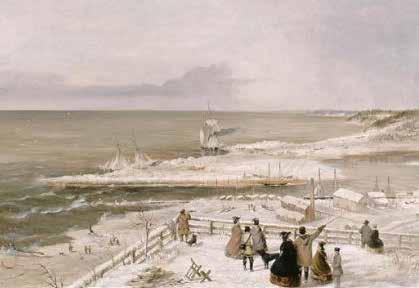
The Port of Goderich, formed from the original mouth of the Maitland River, is situated on the traditional territories of the Anishinaabek Haudenosaunee, Wendat and Neutral peoples, whose stewardship dates back countless eras.
With beaches along the waterfront, offering picnic areas, playgrounds, and public washrooms, Goderich Harbour is home to the only deepwater port on the eastern shores of Lake Huron.
Servicing regional mining, agricultural inputs and outputs as well as manufacturing, the port is an important hub of commercial shipping.
According to the Goderich Port Management Corporation (GPMC), approximately 200 ships dock within the Port of Goderich annually, shipping commodities such as salt, grain and calcium chloride.
Archeological evidence shows that nomadic bands of hunters and gatherers were crossing the area as early as 11,000 years ago.
The area was used by the Attawandarons and later Chippewa First Nation, and these were the people the Europeans encountered when they arrived in what is now Goderich.
In 1822, Captain Wolsey Bayfield surveyed the entire lake. Five years later, Galt and Dunlop for the Canada Company arranged to buy the land for their settlement.
By 1828, a trading post was established at the mouth of the river.
By 1830 and 1850 the Canada Company built two wooden piers to protect vessels in the harbour from storms.
Over time, inhabitants moved up hill, but the use of the harbour area for industry and recreation continued.
Commercial development of the port began in the 1820s when the Canada Company constructed two wooden piers to protect the harbour from wind and waves off Lake Huron.
Goderich grew slowly as agricultural settlement of the surrounding region continued. The harbour served local needs at the time but did not yet have substantial commercial importance.
That transformation came in the 1850s and 1860s, as Great Lakes shipping expanded dramatically.
The development of railways from the harbour, combined with the harbour’s natural depth and protection, made Goderich a major terminal point for Great Lakes shipping.
By the 1880s, the harbour handled substantial volumes of grain, salt, and lumber.
Over the course of the 19th century, the port became a hive of activity supporting
local lumber, grain, salt and general cargo trades, as well as a shipyard.
With its proximity to Lake Huron, Goderich took full advantage of its port access to the American markets.
In August 1868, the first full cargo of Goderich salt that ever left the port was shipped with 1,080 salt barrels.
Salt resources beneath Goderich became particularly significant, and not only shaped the town’s economy, but its harbour’s role as a salt shipping point.
By the 1870s Goderich Harbour was also home to a flour mill, run by Matthew Hutchinson. By the 1950s the business was sold and closed in 1960. The mill was destroyed by a fire in 1963, and the land it occupied is now a part of the Goderich Elevators Ltd.
The harbour’s natural beauty and industrial and commercial activities have inspired artists including Reuben R. Sallows, a photographer from Huron County, and Tom Pritchard, a painter, from Goderich.
By the early 20th century, the harbour was at its commercial peak.
It handled multiple major commodities simultaneously, and as a result, specific facilities had to be developed. This includes the grain elevators, salt loading, lumber storage, and general cargo storage facilities.
Multiple railway lines connected Goderich Harbour to inland markets and producers.
Shipping that happened at Goderich Harbour included some of the largest vessels operating on the Great Lakes. Steel-hulled bulk carriers exceeding 500 feet in length were regular visitors.
The harbour’s economic activity sustained the town’s economy that haven’t been replicated since.
Since the settlement of Goderich by the Canada Company, the natural systems of the harbour have been altered over the years.
Today, heritage signage helps visitors appreciate the waterfront’s remarkable past.
Despite challenges throughout the years, and most notably the severe storm damage from 2020-2022, the waterfront remains a beloved destination for beachgoers and history enthusiasts, celebrating the community’s resilience and proud maritime legacy.
Goderich’s shoreline evolved over time from a rugged industrial hub into a community destination.
Once known as ‘the boneyard’ for abandoned ships, today’s Rotary Cove and St. Christopher’s Beach offer scenic, kilometres-long walk through nearly 200 years of marine heritage.
Signs along the boardwalk highlight the Canada Company piers, where early settlers boarded schooners and began their inland journeys along the Huron Road.
Ships also found their final resting place in Goderich Harbour.
The Great Storm of 1913 struck God-
erich directly. The town’s harbour became the main spot for response and recovery efforts.
During this storm, multiple vessels foundered within sight of Goderich. This includes the Hydras, the John A. McGean, and other vessels were lost in waters near the Goderich Harbour.
Residents could see distress signals and watch helplessly as vessels struggled in conditions that prevented rescue response.
In the days following, Goderich processed bodies that washed up along the eastern shore.
Local funeral homes, churches, and civic facilities were repurposed for the work. The mass burials in Maitland Cemetery commemorate mariners whose remains could not be found and returned to their families.
Tragically, many lost mariners had been residents of Goderich and surrounding communities, and the lost workforce represented years of accumulated maritime experience that took a generation to rebuild.
Shipping companies that lost vessels affected the harbour’s commercial volume.
The storm took place on November 9, 1913, and lasted three days.
This resulted in the loss of 244 lives on 19 vessels, and the stranding of a further 19 ships around the Great Lakes.
The community’s response to the storm became part of its identity, and memorial services began in 1914, continue today.
In 1999, the Town of Goderich bought the harbour from Her Majesty the Queen in the Right of Canada (Transport Canada). The harbour is now run by a not-forprofit agency, the Goderich Port Management Corporation (GPMC).
The Goderich Harbour was critical to the settlement of the Huron Tract, directed by the Canada Company.
This area was chosen by the Canada Company because of the natural harbour that would be vital to bringing in settlers and exporting natural resources.
The harbour has always housed industrial uses, including flour mills, oil storage facilities, and a salt mine. Fishing, lumber and ship building companies also operated out of the harbour.
These industries were supported by two railway lines, and large shipping fleets.
Today, Goderich Harbour is dominated by two major industries still in operation: Goderich Elevators Ltd. (P&H) and Compass Minerals Sifto Salt Mine. These industries are inextricably linked to shipping to transport their goods. Due to the strength of these industries, the Goderich Harbour still provides one of the largest employment bases in the community.
This is an ongoing series of historical features to tell the story of Goderich, in each issue of the Goderich Sun, from June 2026 until June 2027, in anticipation of its bicentennial.
KATHLEEN SMITH Editor
A history of Goderich: From 1850s through the 1860s
From a howling wildness to a cultivated and developing society, Goderich was incorporated as a town in 1850.
The 1850s and 1860s in Goderich involved the positive economic impact of a railway line, exciting discoveries such as salt, the dangerous threat of the Fenian raids and watching a colony become a nation.
By the 1850s and 1860s, Goderich was a bustling urban centre for the Huron Tract, with a population of about 1,000.
The town evolved from a settlement into an agricultural region, with a functioning harbour and lighthouse. The town’s growth was a result of immigration trends.
For those raised in middle-class comfort or higher, found existence in the colonies difficult.
Here, they had to clear land, build their own houses, travel on primitive trails, nurse their families with home remedies, and preserve enough of the fall harvest to take them through the winter.
With railways being all the rage in 1850s, they added to economic prosperity in the Huron Tract area as well.
Where a trip from Toronto to Montreal had taken weeks to travel, could now be done in less than a day. People in rural communities could read newspapers that had been published the day before in the city, and the telegraph lines that ran alongside railways sped up communication.
The creation of the railroad brought the promise of untold prosperity and growth for the region and June 28, 1858, was an extraordinary day in Huron County.
According to local historian and author David Yates, some speculated that Goderich, with its harbour and rail link, was destined to become a major city like Toronto, Monreal or Buffalo.
Support for a rail line quickly gathered momentum.
On June 30, 1852, the United Counties of Huron, Bruce and Perth voted to extend the link from Buffalo and Brantford to Stratford and Goderich as early as 1854.
According to Yates, financial problems plagued the Buffalo to Goderich Railway from the start. The line did not reach Stratford until 1856.
The much-anticipated opening of the first line into the county was a celebration showcasing Goderich. The new Buffalo to Lake Huron Railway, at 260 kilometres/162 miles, was the second longest in Canada.
At least 1,500 people paid the $2 round trip fare from Buffalo to Goderich.
Visitors from the train were welcomed into Goderich as streamers floated from every post.
According to Yates, it was the largest gathering ever seen in ‘The City of the Lake’, as the paper called Goderich. With advantages of a fine harbour, lake and railroad, the ‘Spectator’ forecast that Goderich would derive immense benefit from the railway and was destined to be a large and flourishing place.
When the Grand Trunk Railway was finished in 1859, it was the longest railway in the world.
By 1860 the tract had two flourishing towns – Goderich and Stratford – and agriculture had evolved beyond the pioneer stage.
By 1860, nearly four million people lived in British North America, scattered across what is now Ontario and Quebec.
Nearly half were Catholic and the other half Protestant. French-speakers made up almost a third of the population, and the rest were mostly English speaking.
Most people married in their 20s, and women had no more legal rights than their children.
Agriculture was central to daily life, survival and progress in the 1860s.
At the time, the town of Goderich was made up of wide, tree-lined streets radiating from the central octagonal square like the spokes of a wheel.
Development fell short of expectations, and the town eventually only commanded local trade.
In 1866, the discovery of salt by a company drilling for oil gave Goderich a major industry. Salt resources beneath the lake in Goderich led to the establishment
of the salt mine in the 1860s, and grew to what it is today, the world’s largest underground salt mine.
This industry shaped Goderich’s economy and its harbour’s role.
At one point in its history, Goderich was home to the most important harbours on the Great Lakes. A modern rail station was built near the harbour, and Goderich became a very busy rail shipping location.
Also in 1866, four artesian wells began providing the town’s water and attracted tourists who heard about the water’s medicinal properties. The Ocean House Hotel was built in the 1850s and housed many tourists.
During the 1866 Fenian crisis, the Port of Goderich was deemed one of the most vulnerable outposts of Her Majesty’s Dominions.
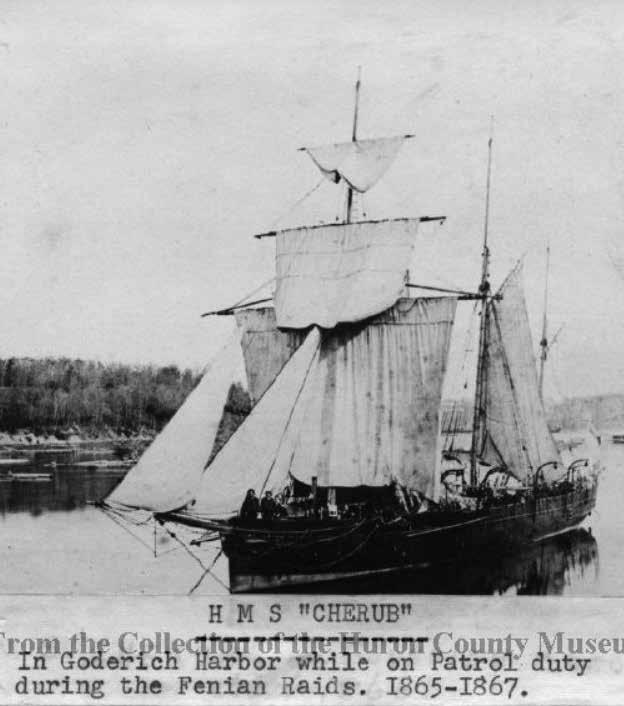
Fenians were Irish republican revolutionaries in the 19th century who sought independence from Britain through armed struggle. In August 1866, British authorities dispatched Her Majesty’s Gunboat Cherub to Goderich to discourage a Fenian incursion.
According to Yates, the Cherub was not the only armed vessel in Goderich that summer. The gunboat Rescue sailed into the port in June and was greeted with rousing cheers from relieved soldiers and citizens at Lighthouse Point.
The arrival of the Royal navy was a welcome sight.
The year 1866 was a crisis point in Anglo-American relations.
Many in the United States felt it was time to fulfill its Manifest Destiny by annexing Canada to secure America’s northern border.
The Fenian Brotherhood was willing to speed events along by threatening invasion of British North America.
Although the Fenians never showed, the Royal Navy showed up in Goderich’s port. If the threats from the Fenians was to intimidate Canada, it backfired.
This drama on the shores of Lake Huron convinced British North America of the need to unite for a common defence. The result was the Dominion of Canada in 1867.
Outwardly, nothing had changed.
Queen Victoria was Canada’s Head of State, and the Union Jack was Canada’s flag, but something changed on July 1, 1867.
In celebration, thousands flocked to Goderich, the county’s seat.
Giant crowds gathered to welcome the new country when a giant bonfire was lit on the Courthouse Square. As the sun rose on the Dominion of Canada for the first time, the Goderich Garrison Artillery prepared to fire a dawn salute from their 32-pound cannon.
A parade marched to the Square, where Canada’s inaugural celebrations took place by the courthouse’s west entrance.
Goderich Mayor J.V. Detlor acknowledged it was the duty of Canadians to ask the blessing for the new country.
Mayor Detlor read the Queen’s proclamation for uniting the provinces into one Canada, ending his address by stating his hope that Canada would ‘be the home of freemen and the asylum of the oppressed’.
The Union Jack waved from every available point.
Boat races, boat excursions, picnics and athletic competitions rounded out the afternoon’s events.
The symbols of loyalty had not changed, but the attitude had begun to change as the Queen, flag and parliament were now perceived as Canadian institutions.
In that subtle shift in attitude, Canada was born, a place based on fairness, moderation, and the home of freemen (and women) and an asylum for the oppressed.
When the Cherub first arrived in Goderich in 1866, Canada was a colony, and when she sailed away in 1868, Canada had become a nation.
By 1869 the population had risen to 4,500, and a railway station and steamship docks were in operation, while wheat continued to be the primary crop shipped from this area.
This is an ongoing series of historical features to tell the story of Goderich, in each issue of the Goderich Sun, from June 2026 until June 2027, in anticipation of its bicentennial.
KATHLEEN SMITH Editor
The Disney parade in Goderich
“Wow! What a day!” enthused Mayor Deb Shewfelt on July 24 when asked what he thought of the Disney Parade held in Goderich that day.
Indeed, it was a signal event as it was the first and only Canadian city by the Disney Company for that honour. Yet, the town only had a few weeks to prepare for the onslaught of visitors and give Mickey a rousing reception befitting the world’s most famous mouse.
“May 31, 1999, was indeed an enchanted day for me,” said Chamber of Commerce Chair Doug Fines. It was the date that Goderich learned it had been chosen to host one of six Mickey’s Hometown Parades.
As Goderich was the first and only Canadian town that was awarded the honour, the town felt an especial responsibility to guarantee a good reception for Mickey and company.
Goderich was chosen among hundreds of towns and cities across North American based on the strength of Fines’ submission. The video contest was sponsored by Disney Canada and Wal-Mart Canada.
Fines and helpers Peter Lane, Dr. Tom Jasper and Gerry Hilgendorf were based on the strength of the imaginings of a young boy writing to Mickey about the town’s assets. From Mickey and Dumbo flying into Sky Harbour Airport to the Square, on the harbour and beaches the imaginary boy gave Mickey a tour and promised Mickey that “you will enjoy your visit to our small town.” It was a standout submission and won Goderich the parade.
At a meeting in late June, representatives of the Disney Company met with town and chamber representatives to officially award the Disney parade. The second part of the meeting was working out logistical details between the Disney people and the town. There was nothing “Mickey Mouse” about the Disney’s logistics people.
The Disney Company told the town what they were going to do and what their requirements from the town were. The only question was, could the town meet them?
Disney need nor have worried. Almost immediately, Disney Central at the town hall fielded phone calls from far and wide. Disney selected the local performers who were to be in the parade. Among those hand-picked by Disney were 14 members of Rob Bundy’s Livery amateur troupe, the Pastures Project.
Three days out from the parade, Bundy said they had read all the Disney information but were not sure what exactly they would be doing. Yet, despite not knowing precisely what they were to do, Keith King, of the Pastures Project spoke for all when he said he was not sure what he was doing but was “thrilled, I’ve always been a big Disney fan.”
Volunteer coordinator Councillor Ellen Connelly reported to the Goderich Signal Star an “overflow of volunteers has helped make it easier to co-ordinate the local portion of the parade. Connelly ‘pegged’ the number of volunteers at 400 people with the phones at the town hall still ringing with the names of volunteers.
The human resources of the entire town were conscripted as churches, service clubs, Legion and individuals volunteered to provide volunteers for everything from parking shuttles to staffing food booths or locals willing to carry banners in the parade.
It grew to become more than just a parade. It was a chance to “illustrate the town’s potential” according to Blake Patterson, Signal Star reporter. Every effort was made to make the visitors feel like welcome guests.
Patterson editorialized that “Mickey’s Hometown Parade will only be as good as we choose to make it. The success of the event is not Disney’s responsibility— it’s ours.”
About 40 OPP constables augmented by local cadets and auxiliary members were detailed to Goderich for securi-
ty and traffic control in anticipation of 30,000 visitors (in the event, there were over 50,000). The Communities in Bloom Committee and Town work crews readied the boulevards and flower beds so that the town’s horticultural splendour was out in full.
Many believed the Disney Hometown Parade was awarded to Goderich in honour of Disney’s Huron County roots. Walt Disney’s ancestors settled around 1848 near Holmesville; Disney’s grandfather worked the Discovery Salt Well while his son Elias attended the Central School (now the Huron County Museum).
Walt Disney returned to visit the Central School and visited Helen Videan’s class in 1947. He also visited Peter Cantelon, his second cousin, who lived on Lighthouse Street before heading down Highway #8 to visit Laithwaite’s Apple Park and stopped at the Holmesville school before departing back home.
Although there is no truth to the myth that Disney designed his Hometown, USA at Disneyland in California after the Goderich Square, a more solid connection with the Disney Corporation was the participation of the famed Disney Wagon in the parade. The Disney Wagon was built by Bayfield wagon maker, Tom Penhale, in 1983 and was given pride near the parade’s start as a nod to Disney’s local connection.
By Friday evening, the town was as ready as it ever would be. Something which surprised one town councillor was the thousands of campers on the Square reserving a good spot to watch the parade. All area hotels, BnBs, and campgrounds and restaurants were full.
Buses shuttled thousands from pre-designated parking on the outskirts of town to the parade route. On the morning of the parade, tens of thousands lined the parade route. The Disney parade had more than just local interest.
On Parade Day, exactly as scheduled, at 9:15 a.m., Disney’s Hometown parade marched out of the old Canadian Tire parking lot on the Huron Road to begin the trek up Kingston Street around the
Square to Montreal Street where Disney handlers broke up the floats, collapsed the giant balloons and with military precision loaded them onto trucks and moved to the next town. It was a seamless operation conducted by experienced Disney hands.
Highlights of the parade, beside the Disney wagon, were ‘Town Barker’ Doug Fines, who had made the town’s submission was in the lead car. Hundreds of Disney dancers and performers were here from Disneyland in California. They put on a once in a lifetime spectacle.
In keeping with Disney’s Hometown theme, the parade had an ‘old-timey’ themed parade with participants dressed in nostalgic 1920s and ‘30s costumes. The stock Disney characters, Mickey, Goofy, Pluto, Daisy Duck, etc. walked along the parade route stopping to thrill young children.
The whole performance complete with giant Mickey Mouse and Goofy floats took only 20 minutes pass but local detachments of the Circle City Cruizers, local pipe bands, the Rotary BBQ, beaches and tall ships in the harbour kept visitors entertained for the rest of the day.
Within an hour of the parade’s passing, the barricades were down, roads were opened, Sgt. Gary Martin of the OPP was ‘thrilled’ by the “level of tolerance shown at the parade.” The hospital and St. John’s Ambulance service reported only a few minor scrapes that required treatment; and only two lost children were reported at Command Centre for separated children at Robert Evans Chev Old on Kingston Street.
In the parade’s aftermath, Disney officials praised Goderich’s efforts. One Disney representative said the co-operation between the town and Disney could not have been better.
It was a glorious day for the Town of Goderich. In some ways, more than the parade itself, Mickey brought ‘hometown spirit’ to the town as Goderich residents came together to put on a show. It may have been the best part of the event.
So, yeah, if summer could slow down, that would be great.
In response to Americans complaining about our wildfires, we’re launching the Forest Undergrowth Clearing & Kindling Operation for Foreign Friends.
DAVID YATES Sun Contributor
Trail signs installed at North Harbour Road at mouth of Menesetung Bridge Trail
GODERICH SUN STAFF
info@goderichsun.com
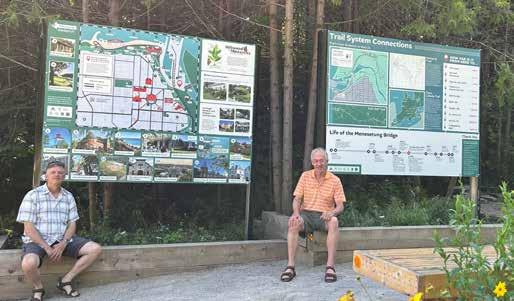
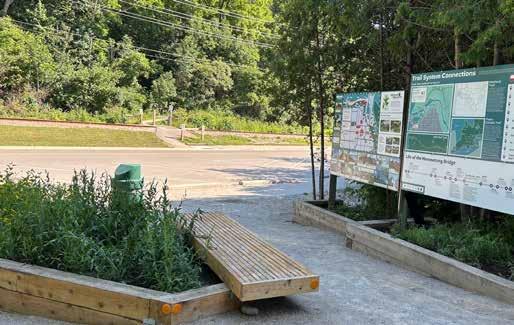
Following a two-year effort to renew the landscaping at the trail head leading to the Menesetung Bridge and trail systems has been completed.
Two ‘wayfinding’ signs and the sponsor recognition sign for the bridge concrete rejuvenation project have been installed.
Led by the Menesetung Bridge Association, Mike Dawson acknowledged that many individuals volunteered and local groups contributed funds to finalise the concrete rejuvenation project and the landscaping maintenance.
“There are many we need to thank,” admitted Dawson.
Glenn Scheels sketched the initial landscaping layout, Roman Turczyn developed the architectural plan, Erin Norsworthy of Enthizi Creative was patient as her graphic designs for the signs were modified a dozen times.
“I thought we were done a year ago but the Town, the trail organisations and most recently the RTO4 all had suggestions,” said Norsworthy.
“We made many adjustments and it seems everyone is pleased with the final result.”
According to Dawson, the Lions Club, the Town of Goderich and the Bruce
Power Workers Union provided early funding to get things started.
The support of the Peever family of the Maitland Golf Resort was much appreciated, the Rotary Club provided funds and volunteers and focused on construction of the planters and planting the gardens.
Doug Norsworthy and Steve Boucher spent many hours this past winter preparing the cedar timbers for planter and bench construction this spring.
Dawson explained that the Menesetung Bridge Association applied for funding from RTO4, and learned this spring that the association was eligible for 50 per cent of the costs of the sign design, production and installation.
The Trans Canada Trail has also supported the planting of pollinator friendly gardens on the trail route.
Marian Lane, chair of the Menesetung Bridge Association, has made every effort to get the names correct on the Sponsor Recognition panel.
“We are so appreciative of the tremendous support the community provided for these critical bridge repairs,” said Lane.
“The sign recognizes major donors, but there were so many more who made very generous contributions.”
Phil Duncan of Artech [Seaforth] and his crew produced and installed the signs early in July.
Smoky haze blankets Goderich as wildfires continue to rage
thick plume blocked solar radiation.
In some regions, visibility dropped so sharply that headlights were needed in the middle of the day.
By Jake Grant
A thick, smoky haze settled over Goderich and much of Ontario for three days last week, reducing visibility, keeping residents indoors, and leaving a fine layer of ash on vehicles and outdoor surfaces.
The conditions stem from major wildfires burning in northwestern Ontario, where nearly 200 fires are active as of midJuly, nearly half remain out of control and smoke is being driven southward by persistent northwest winds.
Environment Canada issued an orange-level air quality warning for Goderich, Bluewater, and southern Huron County, citing very poor air quality and advising residents to limit outdoor activity.
The agency noted that during heavy smoke events, everyone’s health is at risk, especially older adults, pregnant people, infants, and those with chronic conditions. Symptoms can include throat irritation, headaches, coughing, wheezing, and chest discomfort.
Across Ontario, the smoke has produced dramatic effects: skies tinted orange and yellow, sunlight dimmed to a dull glow, and daytime temperatures cooled as the
The haze has also obscured Lake Huron’s horizon, leaving the shoreline shrouded in grey. Residents report ash collecting on vehicles and patio furniture which is a result of fine particulate matter carried long distances from the northern fires.
Similar conditions have been seen across southern Ontario, where smoke has lingered for days and prompted event cancellations including public outdoor swimming pools.
Relief would only come when winds shifted or rainfall helped clear the air. Officials urged residents to keep windows closed, use highquality air filters or portable air cleaners indoors, and avoid strenuous outdoor activity.
Those who had to be outside working were encouraged to wear a wellfitted N95 respirator to reduce exposure to fine particles.
With wildfires continuing to burn out of control in several northern communities, air quality is expected to fluctuate — and Goderich may see more smoky days ahead.
What is the largest ocean on Earth?
What are the birth flowers for July?
Who won Wimbledon 2026?
What part of the brain controls hunger?
The fear of fire is known as what?
What is the primary mountain range in Iran?
Who is Percy Jackson's father?
What was used to fill thermometers before mercury?
What is the name for what an archer carries their arrows in?
(CONTRIBUTED PHOTO)
Mike Dawson (right) and Doug Norsworthy.
PAMELA CLAYFIELD Sun Correspondent
Legends Day auction opens in support of Clinton Public Hospital Foundation
• A Prince Edward Island cottage vacation rental
The countdown to Legends Day 2026 is underway, and supporters can begin bidding on an incredible lineup of auction items with the annual Legends Day Online Auction.
The auction, presented in support of the Clinton Public Hospital Foundation, will remain open until Friday, July 24, giving bidders two weeks to compete for an exciting collection of unique experiences, vacation getaways, sports memorabilia, and one-of-a-kind harness racing items.
This year's auction features something for everyone, including:
• Harness racing equipment and collectibles
• Sports memorabilia
• A round of golf with Harness Racing Hall of Famer John Campbell
• Gift certificates, entertainment packages, and many more outstanding items generously donated by businesses and individuals throughout the community and beyond.
Every bid helps support the Clinton Public Hospital Foundation while adding to the excitement leading up to Legends Day, one of harness racing's premier charitable events.
"We are incredibly grateful to the
many businesses, organizations, and individuals who have donated auction items," said Jessica Carnochan, Marketing Manager at Clinton Raceway.
"Their generosity continues to make this fundraiser a success, and every item purchased helps make a meaningful difference for our local hospital."
The online auction has become an important part of the Legends Day fundraising efforts, raising thousands of dollars in support of healthcare close to home. Organizers encourage everyone to browse the auction, bid often, and share it with family and friends.
Legends Day 2026 will be held on Sunday, July 26 at Clinton Raceway, featuring the National Driving Championship,
Hall of Fame driver appearances, family entertainment, and a full day of worldclass harness racing while celebrating the 25th anniversary of Legends Day and the 50th Anniversary of the Canadian Horse Racing Hall of Fame.
The online auction opens Friday, July 10 and closes Friday, July 24. Don't miss your opportunity to take home an incredible item while supporting an important community cause.
Check back often in the next few days as new items will continue to be added.
https://tinyurl.com/3edw6ycx
For more information on Legends Day events and to access the online auction, visit Clinton Raceway's website and social media channels.
Central Huron asked to support Legends Day broadcast sponsorship benefitting hospital foundation
The Municipality of Central Huron is being asked to support the 2026 Legends Day harness racing event through a $2,000 broadcast sponsorship, with all proceeds going to the Clinton Public Hospital Foundation.
In a letter to council, Clinton Raceway Inc. highlighted the long-running success of Legends Day, a bi-annual charity harness racing event that has become a staple in the community since its launch in 2001.
Over the past 25 years, the event has raised nearly $500,000 for local charitable organizations through the support of sponsors, racing fans and horse people.
The Clinton Public Hospital Foundation has once again been selected as the beneficiary for the 2026 event.
Organizers say the fundraiser plays an important role in supporting local healthcare while celebrating one of the community's signature events.
Legends Day features Hall of Fame drivers competing in the Legends Day
Trot, along with Standardbred Canada's National Driving Championship, attracting participants and spectators from across the province.
As part of preparations for the 2026 event, organizers are seeking a Broadcast Sponsor for the live cable television coverage. They are requesting a $2,000 sponsorship from the municipality.
In return, Central Huron would receive recognition throughout the television broadcast and promotional materials associated with the event.
Organizers noted that 100 per cent of
the sponsorship contribution would be donated directly to the Clinton Public Hospital Foundation to support ongoing healthcare initiatives.
In the letter, organizers said they hope the municipality will help continue the event's tradition of giving while ensuring healthcare funding remains close to home.
Those interested in becoming a broadcast sponsor or learning more about the event are encouraged to contact Michelle Maloney or Ian Fleming through Clinton Raceway.
Hayter family continues to honour Vic’s legacy at Clinton Raceway
brought him genuine happiness. Vic Hayter loved Clinton Raceway because of the people as much as the horses.
Some traditions are built around competition, while others are built around love, remembrance, and giving back.
On July 19, the Hayter family once again celebrated the life of Vic Hayter, with the 11th running of the $18,000 Vic Hayter Memorial Invitational Trot at Clinton Raceway.
This day has become one of the most meaningful events on the annual racing calendar.
Greg Hayter says the event is more than a horse race, but a way to honour his father’s memory, in a place that
“It was somewhere he always looked forward to going, and this race allows us to keep that connection alive,” said Hayter.
“Every year is an opportunity to celebrate the kind of person he was, remember the impact he had on so many people and give back to a sport and a community that meant so much to him.”
Hayter says that for as long as they are able to do that, they will continue to honour his memory.
Vic Hayter passed away in February 2016 at the age of 77 following a battle
with cancer.
Many knew him as the successful owner of Stratford’s Arden Park Hotel and Festival Inn – now the Best Western Plus the Arden Park Hotel. Those closest to him knew harness racing was one of his greatest passions.
For nearly four decades, Vic Hayter proudly owned Standardbred racehorses and rarely missed an opportunity to spend a Sunday afternoon at Clinton Raceway.
The first event began as a tribute but has grown into a day that people look forward to each season.
In addition to sponsoring the featured Invitational Trot, the Hayter family
once again increased the day’s overnight purses by 10 per cent and provided a complimentary meal for all competing on the card.
“The Hayter family has created something incredibly special,” said Ian Fleming, Clinton Raceway General Manager.
“This day reminds us that harness racing is about more than what happens on the track. It’s about family, friendships and the people who help shape our sport. Vic’s generosity and passion continue to be felt every July, and we’re grateful to the entire Hayter family for ensuring his legacy lives on at Clinton Raceway.”
Kinsmen Summerfest’s rib fest component a big hit
GODERICH SUN STAFF
info@goderichsun.com
Goderich Kinsmen hosted their annual Summerfest on July 10 until July 12. The annual event introduced a new component – rib fest.
Terry Schwartzentruber, Chair of the event, was ecstatic knowing the event went so well.
“This was the most successful event hosted by the club in years,” Schwartzen-
truber explained.
“Attendance was way larger than ever.”
Guests to the event enjoyed ribs from three trucks, while being entertained with live music and the event was family-friendly, with a kids’ zone.
“The entertainment was so good, some guests stayed all day,” added Schwartzentruber.
“The crowd was well-behaved and everyone gave feedback that the Kinsmen did an excellent job hosting this year.”
(CONTRIBUTED PHOTO)
Owners of Fat Boys accepting their trophy with Terry Schwarzentruber.
Huron Perth Healthcare Alliance Join Our Board of Directors and Community Council
The Huron Perth Healthcare Alliance (HPHA) Board of Directors is recruiting for the following volunteer opportunities: Board of Directors
• Director from the HPHA catchment area Community Council
• Community Member from Clinton & Area
• Community Member from Seaforth & Area
Prospective candidates will bring their relevant skills, expertise and experience to support the important governance work of the HPHA.
Individuals interested in making a meaningful, sustained impact on our local health system, and to the health and wellness of the communities we represent, are encouraged to apply.
For further information about the HPHA Board of Directors, Board Committees and Governance Resources, please visit the HPHA website – www.hpha.ca
The HPHA is committed to equity, inclusion, diversity and anti-racism.
Information Session (Virtual) Thursday, August 6, 2026 at 7:00 p.m.
RSVP to Sue Davey, Executive Assistant (519-272-8205/susan.davey@hpha.ca)
Application forms are available on HPHA’s website (www.hpha.ca)
Application deadline: August 10, 2026
left a lifelong impression on him that has evolved into the spectrum of skills and interests utilized today.
begin in Lance’s own backyard. The times around Opa
From such early influences, a first garden project would
all of his own gardening tools. One whose character and lifestyle was an artform in itself, and displays the essence of a particular work, person and craftsmanship.
Lance first became interested in gardening in the mid-90’s when he visited his Opa (grandfather) in an old suburban neighbourhood. He would always talk about his vegetable gardens, little seedlings being nurtured, and refer to his compost piles and methods. His Opa was meticulously practical, hard-working, and a blacksmith who created
• Re-shaping/edging gardens, pruning trees and shrubs
• A variety of themes and representations of natural landscapes such as grasslands, ponds, and the Northern Hardwood Forest Garden Care, Cleanups and Enhancements:
• Erosion control plants or structures, and nature trails
Home Improvements 2026
• Blending a balance of natural features such as mulches, stone, timber, boulders and native plants into landscapes of diversity that considers birds, butterflies and interest through the seasons
Natural Design that complements your home and lifestyle:
Complements, Contrasts, and Asymmetrical Balance: Creating Outdoor Spaces of Beauty and Value.
BLENDING THE BEAUTY OF DESIGN, WITH THE BEAUTY OF NATURE IN CANADA
“I really enjoy the challenges involved with the gardens and landscapes I have the
to create, enhance and maintain over the years since making this my chosen profession. It combines a love of many interests such as art, design, and a passion for animals and nature providing limitless possibilities for creativity. Though it still feels like a hobby, it’s also a lifestyle and who I am basically.” “Whether in gardening or life, variety and the diversity around us makes things interesting, so it’s quite rewarding to indulge in such an absorbing process”. Says Lance, owner of Lance J. Lane: Gardens, Habitats, Landscapes. Lance first moved to the area in late 2024, making his introduction to home and business owners throughout Huron County while promoting himself at the Bayfield Home & Lifestyle Show last April. He was fortunate from the start,
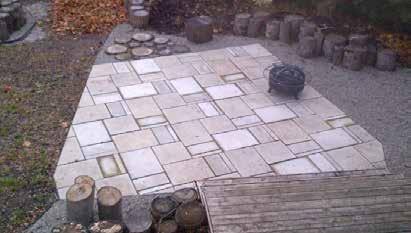
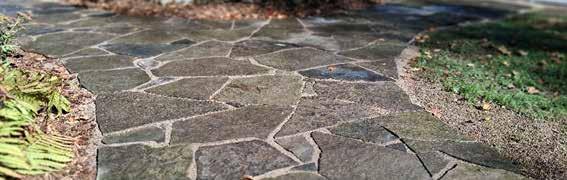
in securing some great projects, and in being able to team up with outstanding co-workers that bring an enthusiasm, reliability, care and skill that greatly helps to simplify and improve the atmosphere and progress throughout the days. Now located in Goderich, Lance continues to provide a variety of gardening and landscape design/ construction services throughout Huron County year-round. Options include; garden maintenance, enhancements and makeovers; creating or re-designs of existing walkways, patios, firepits or complete landscapes in styles ranging from rustic to naturalistic to contemporary in nature. Lance adds that “Utilizing native plants and natural materials such as flagstone, logs, fieldstone and timber where most suitable, and repurposing vintage or existing materials into economical results are especially gratifying”.
“As far as the on-site design work goes, my approach is a highly intuitive creative process to be sure – that is, one open to innovation and discovery throughout the unfolding landscape. Inevitably, this leads to better ideas and results than could have been imagined in advance. Although I am usually struck with a general idea or layout very quickly, many projects are still a puzzle that undergo continuous refinement until the final plant or piece is in place”. Therefore, a garden or landscape is not fulfilled in the manner of following a blueprint say, but instead resembling the composition of a painting.”
Lance looks forward to continue exploring the possibilities and fulfilling his hopes for opportunities in gardening and design, there is nothing else he would rather do.
For interesting, thoughtful gardens, and rich, functional landscapes, please contact Lance at 519-440-8442 to get started today.
Steering toward beautiful landscapes with August’s Visiting Artist
CAROL MCDONNELL Sun Contributor
Christian Dittenhoffer’s car must have a very colourful interior, as he often uses it as a mobile studio when painting on-site (en plein air).
As the Goderich Co-op Gallery’s visiting artist for August, this Elmira-based landscape artist also paints in his home studio, preferring acrylics for their rapid drying time and vivid colours.
This quick-drying quality allows him to beautifully capture the natural world using a soft-looking dry-brush technique.
Rocky shores, dense forests, rippling water, and flashy sunsets are common subject matter for Christian’s work. He has painted in diverse locations around the globe, including the Dominican Republic, Colombia, Switzerland, Germany, Nova Scotia, Quebec, Alberta, and, of course, Ontario.
Christian is also a popular art teacher who has gathered many compliments
from his students. He loves participating in regional events, including the Kissing Bridge Art Show in St. Jacobs, Guelph's Art on the Street, and the Elora Plein Air Art Festival.
His art is so well-loved at home that one of his landscapes was selected by the Elmira BIA to decorate a large flower box at the town's main intersection. Be sure to come by and see the gorgeous work of this talented artist.
NOTES: Many of our Gallery members are taking on the challenge of our newest feature wall display. The theme is "Renewal," and it will be hung at the end of July.
Drop by to see the fresh, local, and unique work of our Co-op members, consignees, and guest artist Christian Dittenhoffer. We are located at 54 Courthouse Square downstairs from Elizabeth’s Art Gallery in beautiful Goderich, of course! You can also find us online at www.gcgallery.ca or visit our Instagram and Facebook page.
(CONTRIBUTED PHOTO)
Various artwork by Christian Dittenhoffer. His work will be on display at the Goderich Coop Gallery for the month of August.
Goderich Sun
AOS U16 Field Hockey squad captures gold
In the tournament championship, Goderich defeated Dolphins FHC 1-0 to capture goal.
The AOS U16 Field Hockey squad captured gold last weekend at the Lions Field 7x7 Hockey Tournament in Brampton.
The girls finished the round robin in first place with a 2-0-1 record after wins against Brampton and Kitchener-Waterloo (KW) and a tie with Scarborough.
AOS then defeated the hometown Lions in the semi-finals 2-1, with a pair of goals by Harper Phillips.
Phillips again notched the winner.
Addison Mozculski and Mac VandenHeuvel had especially strong tournament performances. Phillips was named MVP for the U16 age group.
U15:
The Goderich U15 squad hosted Seaforth last week in a pair of exhibition matches.
This season, the team had a .500 record competing with teams from Seaforth,
Brampton, Kitchener and Waterloo.
U18:
Nearly 50 teams competed at the Brampton Warriors Field Hockey tournament with Goderich representing in the U18 A division.
After matches with the Dolphins, Kingston and Halton, Goderich advanced to the quarterfinals, but were defeated 3-0 by the Oakville Highland Kelpies.
Calleigh Craig and Grace Stoll had standout performances, as did Reese Todd.
Lucknow U14:
AOS is running an introductory camp in Lucknow for any elementary school girls beginning July 28.
For more information email: alloversportsinc@gmail.com
“It’s been a great season especially for the youngest division,” said Ray Lewis, Head Coach.
“We are really trying to inspire more grass roots play. Field hockey is a stickand-ball game over 3,000 years old. Modern ice hockey has its roots in field hockey, so the two sports go hand-in-hand.”
KATHLEEN SMITH Editor
(BRYN LEWIS PHOTO)
U15 goalkeeper Marion Moore.
(BRYN LEWIS PHOTO)
U15 defender Millie Lynn gets set to tackle a Seaforth forward while Georgia Bell gets ready to support.
(BRYN LEWIS PHOTO) U16 Harper Phillips named tournament MVP in the U16 category of the Brampton Lions tournament.
(BRYN LEWIS PHOTO)
Team picture of the AOS U16 Field Hockey squad that captured gold at the Lions Field 7x7 tournament in Brampton earlier in July. (Back, L-R): Payton Curran, Addison Moczulski, Reese Todd, Harper Phillips, Abby Elliott. (Front, L-R): Mac VandenHeuvel, Maya Thomas, Jayden Moczulski (missing is Paige Ireland).
(BRYN LEWIS PHOTO)
U15 Evie Bell channels a Seaforth midfielder while Claire Moore gets set to steal the ball.
Central Huron approves LED lighting upgrades for Londesborough and Holmesville ball diamonds
BRITTANY McKAY Sun Reporter
Central Huron Council has approved upgrades to the sports lighting at the Londesborough and Holmesville ball diamonds, moving forward with a project aimed at improving energy efficiency and enhancing the municipality's recreational facilities.
Council awarded the project to Robinson Electric Ltd. for a total cost of $82,934.28, net of applicable HST, following a report
from Facilities Manager Steve Duizer.
The municipality originally issued a Request for Quotation (RFQ-FAC-2026-2), which closed on June 8, 2026, seeking bids to complete the LED lighting upgrades. However, no submissions were received.
After the unsuccessful tender process, Robinson Electric Ltd. was approached directly to provide a quote for installing the specified lighting system.
The project specifications and lighting layout had been prepared by a lighting supplier that also designed the lighting
upgrades completed during the municipality's recent arena renovation.
The quote includes $42,065.84 for the Londesborough ball diamond and $40,868.44 for the Holmesville ball diamond, bringing the combined project cost to $82,934.28, net of HST.
According to the report, the upgrades will be scheduled to minimize disruptions for ball diamond users.
Funding for the project was included in the municipality's 2026 capital budget, with $45,000 allocated for each ball
diamond, providing sufficient funding to complete the work.
The project supports Central Huron's Strategic Plan by investing in improved municipal infrastructure while enhancing the use and quality of community recreational facilities.
Once completed, the new LED sports lighting is expected to provide improved visibility for players and spectators while offering greater energy efficiency and lower maintenance requirements than the existing lighting system
Sixth annual Driving the Stigma Out charity golf tournament raises funds for mental health programs
“Every golfer, sponsor, donor, and bidder helps ensure that young people in our communities can access support when they need it most."
The Tanner Steffler Foundation’s (TSF) annual Driving the Stigma Out charity golf tournament aims to raise $25,000 to support the TSF’s growing focus on mental health and substance use education, awareness, harm reduction, and prevention throughout Huron and Perth counties.
In its sixth year, the tournament brings together community members and local businesses to raise funds that directly support TSF’s mental health programs.
Whether a seasoned pro or a beginner, the event is for everyone.
"Events like our Driving the Stigma Out Golf Tournament make it possible for the TSF to continue providing free mental health and substance use supports for youth aged 12 to 29 and their caregivers across Huron and Perth counties,” said Lexi Harney, Sponsorship and Fundraising Coordinator with the TSF.
While there are many great charity golf tournaments throughout the summer, Driving the Stigma Out is unique because it’s more than golf.
Harney explains that the tournament intentionally offers a community-focused event where people can come together, connect and have meaningful conversations about mental health and substance use.
Throughout the day, tournament organisers will be sharing information about the Foundation’s work and encouraging open conversations that help reduce stigma. In addition, the tournament offers an online silent auction with more than $15,000 worth of items that anyone can participate in, whether golfing or not, giving more people the opportunity to support local youth mental health.
Every bid helps make mental health and substance use support more accessible for youth in the region.
Proceeds from the golf tournament will help the TSF subsidise the cost of essential mental health and addiction trainings, including programs such as Mental Health First Aid, Naloxone Training, and ASSIST. This will make these programs more accessible to individuals, workplaces, schools, and community organisations.
“Funds will also suppose educational workshops and awareness initiatives that equip community members with the knowledge and confidence to recognise concerns early, reduce stigma and support those who may be struggling,” added Harney.
In the instance of not being able to take part in the tournament, meaningful impacts can still be made by participating in the online silent auction.
Visit https://www.zeffy.com/en-CA/ticketing/tanner-steffler-foundations-silent-auction for the auction.
The sixth annual TSF Driving the Stigma Out charity golf tournament will be held on Saturday, July 25 at White Squirrel Golf Club, in Exeter.
Local golfer heads to Ottawa for All Abilities Golf Tournament early August
Although this is Dixon’s first time going to the tournament, he aims high, wanting to win, or at the very least, to do well and not come in last.
Dixon Schoemaker started golfing with his father around the age of three, and now at 20 years old, he’s heading to the All Abilities Golf Tournament in Ottawa.
Invited to participate from August 4 until August 7, the tournament runs each year through Golf Canada. This year, Dixon will compete at the annual tournament for the first time.
Born with cerebral palsy, Dixon didn’t allow that to hinder his love for the sport and is now an exceptional golfer. He has worked at Goderich Sunset Golf Club for the past five years, improving his skills on the links.
“It came very naturally to me at a young age,” admitted Dixon.
“I started with plastics clubs and have just kept going.”
Dixon says when it comes to what drew him in to the sport, it was the competition of tournaments, the camaraderie of playing with friends and going to different towns and courses that kept his interest.
Ryan Laurendeau, Pro Shop Manager at Goderich Sunset Golf Club invited Dixon to participate in the tournament, qualifying for having a disability. Dixon has been working at Goderich Sunset Golf Club for six years.
“I want to make sure that I make the golf club and the community proud,” he added.
“It’s important there is an opportunity for people like me to participate in events like this.”
Dixon is grateful for the generous sponsorship from Unifor, Dave McDonald Accounting and the generous members of the Goderich Sunset Golf Club and community.
The tournament is designed for people with limitations, whether physical or psychological. The Canadian All Abilities Championship is a new but significant addition to Golf Canada’s portfolio. It was introduced to promote inclusivity and showcase the talents of golfers with disabilities.
First launched in 2019, this tournament was an important step toward making golf more accessible and giving athletes with disabilities a platform to compete at a high level.
The event is open to golfers with a range of physical, sensory and intellectual disabilities.
Dixon also participates in the Special Olympics every week in Stratford, thanks to John Hoy who set that up.
For more information on the tournament visit: https://tinyurl.com/24cdfs2y
(CONTRIBUTED PHOTO)
Dixon Schoemaker is heading to the All Abilities Golf Tournament in Ottawa.
KATHLEEN SMITH
Editor
KATHLEEN SMITH
Editor
Goderich Art Club to host annual show and sale at MacKay Centre in August Local author releases bestselling memoir ‘Can I Come Home Now?’
GODERICH SUN STAFF
info@goderichsun.com
Goderich Art Club is hosting its annual show and sale from August 7 until August 9 at the MacKay Centre in Goderich.
This year the show and sale include 29 artists and over 300 original works of art, in addition to original art cards.
This year’s feature artist is Cindy Fisher, a Goderich artist, who enjoys painting in acrylics and water colours.
Fisher’s favourite six objects are landscapes, florals and clotheslines, pears, collages and abstracts.
Since 1952, the Goderich Art Club has been going for over 70 years with a current count of 50 members, a great community of painters.
This free community event offers a show, and a sale, with no pressure to purchase art.
Each artist pays a fee to be in the show and that fee supports the programming of the art club and the MacKay Centre for Seniors.
The Goderich Art Club and MacKay Centre do not take commission or percentage of sales. If a piece of art is sold, the entire amount goes to the artist.
The sale accepts cash, cheque, debit and credit cards.
Hours are as follows:
Friday, August 7 from 9 a.m. until 5 p.m.
Saturday, August 8 from 9 a.m. until 5 p.m.
Sunday, August 9 from 10 a.m. until 4 p.m.
A local author who has published seven books has recently released ‘Can I Come Home Now?’, a number one bestseller memoir on Amazon.
‘Can I Come Home Now?’ by Barbara Godin is about growing up in the Essex County area and the trauma and struggles Godin went through.
‘Can I Come Home Now?’ is a true story that is more than just a book, but more of a beacon of hope.
This bestseller on Amazon shares Godin’s journey from an abandoned child to a strong, independent woman and mother. It offers a relatable narrative for those who have faced similar situations and offers a pathway to understanding of others.
Godin’s writing is a testament to the power of vulnerability, with raw honesty and heartwarming sincerity. Her stories delve into soul-searching experiences that shape everyone, and each book is an invitation to tap into a universal wellspring of emotion and strength.
Godin’s collection spans across memoirs, poetry, short fiction, and insightful self-help guides.
Each piece is crafted by Godin to leave readers feeling inspired and hopeful, empowering them to face life’s challenges with resilience.
Godin’s books can be ordered through Amazon, Indigo and The Village Bookshop in Bayfield carries her books. Most independent bookstores may even order it in for potential buyers.
“My hope in writing my memoir is that anyone who has experienced similar trau-
ma will see that they can get through it and become a survivor,” added Godin.
Godin always knew she would write her story one day but it took a long time to feel ready to expose herself in such a way.
“I want others to see there is always hope,” Godin said.
She has received over 1,500 ratings and reviews and almost all were positive and were grateful for Godin sharing her story.
Godin’s memoir ‘Can I Come Home Now?’ as well as her book of short stories ‘Glimpses in Time’ and her book of poetry, ‘Seasons of the Heart’ are all books to inspire and bring hope and healing.
Godin has written the long-running and widely read ‘Dear Barb’ advice column since 2003, and in 2019 she received a first-place award from the Professional Writers Association of Canada.
In 2023, Godin received The Editor’s Choice Award of Excellence from The Reader’s House UK.
For more information on ‘Can I Come Home Now?’ or Godin’s other stories, visit https://www.barbaragodin.ca/
(CONTRIBUTED PHOTO)
The Goderich Art Club is hosting its annual show and sale at the MacKay Centre, an accessible and air-conditioned venue from August 7 until August 9.
KATHLEEN SMITH Editor
(CONTRIBUTED PHOTO)
Huron Harp School to celebrate 20 years with 'Tunes, Tangos and Jigs' at Kingsbridge Centre
ing homes, jam sessions and everywhere in between.
Huron Harp School (HHS) based in Goderich is celebrating 20 years in July. To celebrate this milestone, members of HHS are putting on a celebratory concert on Saturday, July 25 at Kingsbridge Community Centre.
‘Tunes, Tangos and Jigs’ will have lively Irish jigs and airs, popular music that everyone can recognise, some contemplative melodies, and include the popular ‘Tando to Evora’ written by Loreena McKennitt.
Founded in 2006, HHS has over 25 members and continues to grow. All students, regardless of age or experience, have opportunities to play in casual settings, as well as performances.
Members of the school are students of Sharon Johnston (Goderich) and Jane McQuarrie (Teeswater) however, HHS has expanded to include other harpists in the community.
The group meets once a month to learn new music and polish their repertoire.
Johnston has made her living as a musician and music teacher for over 30 years. Her students have gone on to complete harp, piano and theory exams at all grade levels.
Her students have also won scholarships at music festivals, and some have gone on to post-secondary music studies.
Today, HHS has more harps per capita than anywhere else in Canada.
Johnston began playing the harp in 1996 and took her first workshops in Celtic music at the Celtic Roots Festival in Goderich and never looked back.
“Once I picked up a harp, I could not put it down,” admitted Johnston.
“Since then, I have gone on to become a harp instructor, workshop facilitator, recording artist and director of the Huron Harp School.”
Over the past 20 years, HHS has presented dozens of concerts, hosted harp retreats and a harp festival with participants from across North America and premiered a composition that was commissioned especially for this group.
HHS’ mandate is that all harpists are welcome to join the group and everyone has a voice. Members range from elementary musicians who have recently started on the harp, to professional musicians and everyone between.
HHS members can be found playing in churches, nurs-
Despite challenges of social isolation during the pandemic, planning and rescheduling rehearsals during Huron County winters, and transporting large instruments, members remain committed to the group.
“Nothing compares to the feeling of working together to create music of the highest quality,” explained Johnston.
Later this summer, HHS will be featured at this year’s Celtic Festival, playing on the mainstage on Sunday, August 9 at 6:45 p.m.
Director Johnston and some members will also be attending an international harp conference in July to present a lecture on building a harp community.
All are welcome to ‘Tunes, Tangos and Jigs’. No tickets sold in advance, but $20 admission at the door.
Proceeds from the evening will be split between the musicians and the venue so that HHS can continue making and presenting music in the community.
“HHS has built a supportive community where everyone is committed to making music that appeals to all,” said Johnston.
“Come and support a unique community group in a beautiful local venue that rivals any hall in larger centres. There will not be another concert like this in Ontario, probably not in Canada. Be uplifted and inspired by ‘Tunes, Tangos and Jigs’.”
KATHLEEN SMITH
Editor
(CONTRIBUTED PHOTO)
Huron Harp School is celebrating 20 years with their 'Tunes, Tangos and Jigs' live musical event at Kingsbridge Centre on Saturday, July 25. Tickets available at the door.
Enjoying the fruit of your labour during August by keeping your garden healthy
During the month of August, there are a few things you can do to keep your garden healthy and productive.
Deadhead perennials and annuals.
This will keep your plants looking their best.
You can also save seeds from your best flowers such as sunflowers and zinnias, then store them for next year.
Adding two to three inches of mulch to flower beds will conserve soil moisture and suppress weeds. Keep weeding, even if you no longer find it exciting. Keeping your gardens free of weeds will avoid having the weeds go to seed, which will only add to your weed population.
If you have a vegetable garden, frequent harvesting will encourage plants to keep reproducing.
This is the time of year when some gardeners have a surplus of tomatoes, zucchinis and beans. If you have more zucchinis than you can use, you can shred them and then freeze them in one cup portions for winter baking and soups.
Tomatoes can be turned into sauces, salsa or simply frozen whole. My mother would wash extra tomatoes, freeze them whole, then throw them into soups to add extra flavour. Once the tomatoes were soft, she would fish out the skins.
Some tomato plants will produce more
fruit than others. If you have determinate tomato plants, they tend to be compact ‘bush’ varieties that grow to a set height and produce all their fruit at once over a two-to-three-week period.
Indeterminate tomatoes are vining plants that grow continuously and yield a steady harvest of tomatoes throughout the entire season until killed by frost.
Indeterminate tomato plants need frequent pruning to manage disease and encourage the growth of fruit.
Extra herbs can be dried, frozen or turned into pesto.
Let your neighbours and family members know if you are going to have a surplus of vegetables, it is likely they will happily help consume your extra vegetables.
Will the autumn season around the corner, you may want to add some extra colour to your pots, planters and flower beds.
You can add bright colours instantly by planting chrysanthemums with your existing plants. Keep in mind there are two types of mums. The florist variety are great for gift giving, but for your garden or pots, make sure you buy garden mums, which are tough enough to tolerate outdoor conditions.
If the mums grew naturally, they could spend the winter in the garden and should start to regrow next spring.
By this time of the year, some your annuals may have started to look worn out or
have died. Gently pull these annuals out and if space allows, plant a fresh mum in its space.
Planters that looked great all summer may also need a refresh of colour by switching out the old plants with new mums. Keep the new plants well-watered for the first few days.
These plants have shallow roots and will benefit from the root area being covered with mulch.
Mums offer great value because they can flower for three to eight weeks with blossoms that range from tiny buttons to large blooms.
They are a short-day plant, which means their blossoming periods are triggered by the shortening dates of late summer. This is when the plants’ energies switch from vegetative growth to the production of flowers.
Mums are native to China, revered by the Japanese and are enjoyed around the world in temperate zones.
Nearing the end of the summer, your clean-up should include removing dead or diseased plants.
This will decrease your likelihood of having pests attracted to your garden or having the disease spread to other plants. Be sure to disinfect your tools after using them to remove dead or diseased plants so you do not spread the bacteria or fungi to other plants.
You may want to collect and save seeds
from plants that did well and store them until they can be planted next year. Do not deadhead lupins, hollyhocks, or foxglove as they need to reseed themselves for the following year.
Most herbs can be harvested throughout the summer. The oils responsibly of the most intense flavours and aromas are at their peak in late summer just before the plants flower.
Clip the foliage in the early morning after the dew dries and before the day heats up. Stop pruning perennial herbs such as tarragon, lavender and sage one month before your last expected frost. Pruning encourages growth, but the plant needs to harden before cold weather hits.
Keep up your battle with weeds. As the growing season winds down, both annual and perennial weeds start to produce thousands of seeds that will germinate in your garden next spring.
When you are weeding, remove the roots as well.
Some weeds will regrow even if small pieces of the roots are left in the soil.
Think about perennials such as day lilies, sedum, peonies, and irises that you would like to plant during the upcoming fall. They will have less difficultly taking root during the cooler, moist autumn weather.
Betty Hendricks is the President of the Goderich District Horticultural Society (GDHS)
How invasive plants can damage property and infrastructure
grass, Callery Pear, and Yellow Flag Iris, damage property and infrastructure while increasing the risk of fire and erosion and even reducing property values.
Many of our readers are aware of the damage invasive plants can cause and the costs associated with eradication.
As a country, Canada has pledged to reduce the spread and introduction of invasive species by half by 2030.
Since gardening is the primary pathway for their introduction, everyone can take responsibility and provide support by choosing not to buy invasive plants, to remove them from our gardens and to learn more about their impacts.
This column, we focus on risks invasive plants pose to infrastructure, such as fire, erosion, drainage systems and property values.
Invasive plants such as Knotweed roots, Japanese Honeysuckle, Chinese Silver-
Knotweed roots are so strong that they can damage pavement, building foundations and drainage systems by growing through existing cracks and expansion joints, forcing them wider over time, and potentially compromising structural integrity.
Their dieback in winter also leaves streambanks and slopes bare, increasing the risk of erosion.
Japanese Honeysuckle can smother groundcover vegetation, reducing root mass that holds soil in place and making slopes more prone to erosion.
Some invasive plants sold as ornamentals pose a fire hazard.
For example, Chinese Silvergrass forms dense, dry stands late in the season that
can ignite easily. The same is true for Phragmites.
Callery Pear forms dense thorny thickets, has brittle branches prone to breakage, and produces foul-smelling flowers.
While in Canada, invasive plants are not yet widely recognised by the public as a property deterrent, some buyers may be discouraged by the cost and effort required to remove species such as Knotweed or Buckthorn once they understand the scale of the problem.
In the U.K. residents are legally required to disclose the presence of Knotweed on their property when selling.
Invasive plants can also damage green infrastructure, which is the vegetation and soils that naturally manage stormwater, filter pollutants, and maintain air quality, by displacing deep-rooted native plants, reducing soil stability and altering water flow and nutrient cycles.
Other invasives, such as Yellow Flag Iris, spread so rapidly and have such a dense root system that it may obstruct waterflow in drainage systems.
This is only a fraction of the documented impacts.
Whether or not this feels personally relevant, the evidence is clear that invasive plants from the horticultural trade impose significant costs on nature and on the economy.
As a gardener, please choose your plants wisely and consider becoming a supporter of the Canadian Coalition for Invasive Plant Regulation; it’s free. Visit www.ccipr.ca for more information.
Renee Sandelowsky and Helen Varekamp are volunteers for the Canadian Coalition for Invasive Plant Regulation
BETTY HENDRICKS
Sun Contributor
Trail Talk: Be informed of weather conditions and air quality conditions before heading out on the trails
On a recent hike, I had a near miss. The day was calm and Rick was a few metres behind me. He saw a branch, (about 4 feet long, 1.5” diameter), fall across the trail. With slightly different timing it would have hit either Rick or me while we were enjoying a hike.
Recently, I traveled up to Sault Ste Marie for a hiking friend’s 90th birthday party.
While there I went with Thyra’s brother to his old farm on St Joseph’s Island. The property has a small house, forest, swamp and a small patch of lawn and a vegetable garden with a double fence to stop deer getting in.
While Thyra and her brother watered the vegetables I wandered around the wildflower patches.
Most of the Viper’s Bugloss, Cow Vetch and Bird’s Foot Trefoil had many butterflies nectaring on them. I estimated there were about 400 European skippers, and quite a few Crescents, White Admirals, Northern Pearly-Eyes as well as four other species of butterfly. Nearly all were attracted to the native wildflowers, rather than the non-native ones at the house.
This place was a true butterfly garden rather than the small, isolated butterfly gardens that you find in towns. These small gardens, however, are much better than the manicured lawns that are rarely inhabited by anything other than a few Cabbage Whites.
On July 10 we were very surprised to see a Mourning Cloak butterfly sitting at our kitchen window next to an angel ornament. We have no idea how it got in the house as all our windows were closed, so I caught and released it.
Later that day on a hike at Front Road I saw another Mourning Cloak (the first two since June 17).
On Sunday, July 12 I had a hike scheduled for 1 p.m. from River Line to Sharpes Creek Line. That day was the beginning
of a heat wave, and that section of the trail has quite a few hills and parts with no shade.
When the six of us gathered at the meeting place on Sharpes Creek Line, we agreed to a shorter hike, that was mostly in the shade, so hiked the Maitland Trail on the west side of Sharpes Creek Line for just under 1.5 hours.
Before heading out for a hike, it’s important to be informed of weather conditions and possible risk factors like extreme heat or bad air quality conditions.
On Tuesday I joined 20 Trompers for a walk along the Goderich boardwalk, which was a great plan as there was a breeze off the lake and the day had not yet warmed up to the afternoon temperature of 33 oC.
Due to the heatwave, the midweek hikes were moved to an 8:30 a.m. start.
NOTES:
Saturday, July 25 at 11 a.m. - The Monthly Mindfulness Walk and Forest Therapy. Meet at the Millenium Trail
in Goderich, Nelson Street entrance. Designed for those who want the benefits of meditation but prefer to move. We’ll be moving slowly and silently together for 20 minutes to the first river lookout where we’ll stop to chat about the benefits of mindfulness and forest therapy, enjoy the beautiful vistas of the Maitland River, and head back to the entrance - maybe hug a tree on the way out. Please leave your pets at home; dogs are already very zen. For more information and to confirm your attendance, please contact Tanya at redroofrecovery@gmail.com or text 519616-3636. This is a level 1, slow paced meditative walk.
Sunday, July 26 at 9 a.m. – 12 p.m.Canoe/Kayak/Paddleboard event. Arrive at East Street Cider with your equipment ready for a short shuttle, very likely to the mouth of the Maitland River. Paddling location will be determined closer to the date as conditions become predictable. The trip is suitable to people who have experience in moving water (Class 1) or waves in Lake Huron and can provide their own boat and safety gear. Swimming is likely. This is a co-promotion event with East Street Cider. You can register with either organization. Maitland Trail registrants must sign the annual MTA online waiver. For more information and to confirm your attendance, please contact Con Melady at: 519-530-8998.
Sunday, August 9 at 10 a.m. – 12:30 p.m. Cycle at MacGregor Point Park.
Meet at the park entrance gatehouse (permit office). Obtain a Park Day Pass from a library or pay $14 day pass or we can prearrange a ride to the park.
Difficulty – Mostly beginner with some moderate as some of the trail is bumpy due to roots and stones. Deer Run Bike Trail 11 km easy, Old Shore Road Trail 6 km easy, Kempfs Trail 0.8 km (20 min) easy. After the ride can stop for coffee at Cedarvale Wellbeing located on the edge of MacGregor Park, or a cold plunge and sauna for those interested in the opportunity. Helmets are required. Maitland Trail Association Waivers are required and please complete a waiver at www.maitlandtrail.ca/cycling/ in advance of the ride. One for each participant. Call 519-530-9019 if you need assistance. Please pre-register with Donald Andrew 519-530-9019 call or text.
Saturday, August 15 at 9 a.m. - 11 a.m.
- Hike the Morrison Dam Conservation Area and the MacNaughton-Morrison Trails.
Meet at Morrison Dam Conservation Area, parking at 71108 Morrison Line, Exeter (south side of the dam).
Approximately 8 km hike. Scenic views along the Morrison Dam reservoir system and the McNaughton-Morrison Trail. Level: Level 1, moderate to brisk pace. Some uneven surfaces, no significant hills. For more information and to confirm your attendance, please contact Susan Ethelston at susan.ethelston@gmail.com
NOTE: The Maitland Trail between Londesboro Road and Little Lakes Road remains closed due to a landslide.
The Maitland Trail map shows distances that were about 300m different from the km posts. The posts up to 41 km have now been moved to correspond with the map distances.
The September 22- 23 - Maitland Camino is getting close to being fully booked.
Tuesday Trompers meet at 9 a.m. on Tuesday to hike for about an hour. If you wish to be on this email list, send an email to mta@maitlandtrail.ca
Midweek hikers meet at 9 a.m. and hike for 1.5 to 2 hours on Wednesdays and Thursdays. Contact Patrick Capper at pcapper99@gmail.com
LIFE hikers meet every Friday for a hike of about 1.5 hours, with a choice of pace, striders moving a little faster than the strollers. The hikes now start at 9a.m. and can be joined through ONE CARE.
PATRICK CAPPER
Sun Contributor
(CONTRIBUTED PHOTO)
Hiking on the Maitland Trail during the heat wave.
(CONTRIBUTED PHOTO)
Three European Skippers on Cow Vetch.
(CONTRIBUTED PHOTO)
Trompers heading to Goderich Boardwalk.
Total knee replacement and post-operative pain
Total knee replacement (TKR) is a surgery in which the damaged or worn-out surfaces of the knee joint are removed and replaced with smooth metal and plastic parts.
These new surfaces allow the knee to move more easily, helping reduce pain and improve walking, standing, and other daily activities.
Right after surgery, most patients experience pain and swelling. The knee may also have staples or stitches, and even with pain medications, discomfort is common.
Because of this, many patients find it difficult to sleep well during the first few weeks after surgery.
It is important to understand that this pain does not mean something is wrong with the new knee, but rather a normal part of the healing process after a major surgery.
Pain after a TKR can feel in-
tense for several reasons.
Many patients have had arthritis in their knee for years before surgery, which causes muscle weakness.
During surgery, the tissues around the knee are also disturbed, and nerve blocks used for pain control wear off a day or two after surgery. All of this can make the knee feel stiff, sore, and weak in the early phase of recovery.
One of the most important parts of recovery is doing the prescribed exercises given by a healthcare professional or your physiotherapist.
Gentle movement and exercises are safe and necessary for healing.
For knee replacement recov-
ery, consistency is more important than intensity. Doing exercises several times a day, even for short periods, is better than doing them once a day and stopping because of pain.
Regular movement helps reduce stiffness, improve circulation, and regain strength.
Along with the pain medications prescribed by the doctor, ice is a very effective way to reduce pain and swelling. Applying ice for 15-20 minutes several times a day, especially after exercises, can make a big difference in comfort and recovery.
Sleep can be difficult after knee replacement because of pain and swelling. If sleeping on your side, placing a pillow
between the knees can reduce pressure on the surgical knee.
Sleeping on the back with a pillow under the calf (not under the knee), can also help keep the leg comfortable and supported.
Recovery after a total knee replacement takes time and patience.
A balanced routine of rest, regular exercise, good nutrition, proper sleep, pain control, and ice are all key to healing.
Following your physiotherapist’s advice and staying consistent with exercises will help you return to daily activities more comfortably and safely.
Mahima Nagar is a resident physiotherapist with Physiotherapy Alliance in Goderich
Better Mental Health: The gift of self-compassion
We often use the words guilt and shame interchangeably, yet they represent entirely different internal landscapes.
Understanding the boundary between them is not merely an intellectual exercise; it’s a vital step in quieting the relentless inner critic, cultivating self-compassion, and initiating true emotional healing.
At its healthiest, guilt serves a functional, adaptive purpose. It’s a signal that our behaviour has misaligned with our core values
or the needs of our community. Guilt says, "I did something bad."
Because it focuses on behaviour rather than identity, healthy guilt can be a teacher. It motivates us to apologize, repair damaged connections, and make conscious choices. Children begin to internalize this social feedback around the age of three - as they navigate the boundaries of right and wrong.
However, much of the guilt we carry is unearned and unhealthy. It arises when we hold ourselves to impossible standards - feeling guilty for setting boundaries, saying "no," resting, or failing to be everything to everyone.
These unrealistic expectations are rarely accidental; they’re rooted in early childhood. When a child learns that their acceptance depends on perfection or pleasing others, they suppress their authentic needs to maintain attachment. Instead of fostering growth, this internalized pressure traps us in a loop of self-criticism.
But if guilt is about doing, shame is about being.
If guilt says, "I did something bad," shame whispers, "I am bad." Shame does not evaluate our actions; it attacks our very worth. It convinces us that we are fundamentally flawed, broken, and unworthy of love, acceptance, or belonging.
Because shame develops in our earliest years - and often reinforced by criticism, neglect, or conditional love - it becomes deeply embedded in the nervous system.
When we feel fundamentally unworthy, our natural response is to hide, withdraw, or erect defensive walls. Left unaddressed, shame isolates us, convincing us that we are beyond redemption.
The antidote to shame is not self-punishment; it’s connection and self-compassion. We can learn to transition from paralyzing shame to healthy disappointment. Instead of concluding, "I’m a terrible person," we can gently recognize, "I’m disappointed in the choice I made. This mistake
Goderich Sun
Tim
Goderich
is a moment in time; it doesn’t define me."
Since our deepest wounds are relational - happening in our earliest attachments - our healing must also be relational.
Sharing our struggles with trusted allies, counselors, or peer support groups dissolves the secrecy that shame requires to survive. In safe spaces, we discover that struggle is a universal human experience, and that we all deserve the path to recovery and healing.
Whenever guilt or shame starts to overwhelm you, practice these three gentle steps:
• Catch It: Notice the physical sensation and the self-talk. Awareness is the prerequisite for change.
• Check It: Ask yourself whether you've made a mistake that needs repairing, or whether you're simply holding yourself to impossible standards.
• Change It: Make amends if necessary, extend compassion to yourself, and commit to making a better choice next time - mov-
ing forward with awareness. We’re not meant to be perfect; we’re meant to be whole. Our mistakes are part of the human curriculum. Mistakes may shape our journey, but they can never define our worth.
Join us for peer-support group meetings:
• Every Sunday morning at 11 a.m.
• Every Monday evening at 7 p.m.
Email for details and locations at redroofrecovery@gmail.com.
Tanya MacIntyre is a Certified CBT Specialist, Mental Health Fitness Trainer, and owner/operator of Red Roof Recovery (RRR) and its training division ~ Mental Health Fitness Alliance (MHFA).
DISCLAIMER: This content is not intended to constitute, or be a substitute for, medical diagnosis or treatment. Never disregard advice from your doctor, or delay in seeking it, because of something you have watched, read, or heard from anyone at RRR or MHFA.
Pick Up Locations
Maitland
Huron
Huron
River
Physiotherapy
MAHIMA NAGAR Sun Contributor
TANYA MACINTYRE, RED ROOF RECOVERY Sun Contributor
OH, THE PLACES WE’LL GO: Leaning into history: the famous Tower of Pisa
It turns out, one of the world’s most famous destinations is the result of a mistake. In fact, a series of mistakes.
We had the chance to visit Pisa, and verify for ourselves that the Leaning Tower of Pisa is, indeed, leaning – and not simply an optical illusion. This was a day trip that was part of our terrific Viking Mediterranean cruise.
Pisa is a city in the beautiful region of Tuscany. If you are visiting this part of Italy, be sure to allow time to enjoy the area, and make Pisa one relatively small part of your stay. I say this because, while every traveller wants to see the Leaning Tower, the entire experience can be accomplished in a few hours.
The tower is one of four historic buildings located in the “Square of Miracles,” a UNESCO World Heritage Site. There you will find the Pisa Cathedral, a round, domed building known as the Baptistry of St. John, the Camposanto, as well as the Leaning Tower.
All of them are built in the wrong place. Because, the subsoil in the area of the Square of Miracles is, to be somewhat Biblical
about it, “shifting sand.” The unstable topography means that it isn’t just the famous tower that leans – everything here is susceptible.
We got an immediate introduction to this local reality when our enthusiastic guide led us into the Square through what she called a back door. After the trek from the coach park, we followed a wall to a gate with a tower, and entered the Square from the side.
That tower in the wall – not the iconic one by any means – was also askew. The guide explained that darn near everything in this part of Pisa is off-centre, because of the unstable terrain.
Our first view was of the Baptistry, a large, round, domed Gothic building constructed over a 200year period starting in 1152. And although the word “leaning” does not appear in its name, it does, in
fact, tilt slightly, leaning 0.6 degrees toward its neighbour, the Cathedral.
Speaking of this, it’s good for prospective visitors to know that you can see all of these amazing buildings from the outside, free of charge, but it will cost you up to 35 euros if you want to enter all of them.
The Pisa Cathedral – officially, the Primatial Metropolitan Cathedral of the Assumption of Mary – is a striking, Medieval masterpiece started in 1064 and completed in its original form in a surprisingly short time. It was finished in 1092.
Nearby sits the Camposanto Monumentale, which is an enclosed cemetery, created in the centuries following the construction of the Cathedral and the Baptistry, and today, famous for its frescoes.
I’ve saved the best – or at least, the most famous – until last: the Leaning Tower of Pisa. I confess – I knew almost nothing about this modern wonder of the world. I didn’t know it is actually the free-standing bell tower of the Cathedral. I didn’t know that it began to lean during construction, so that the engineers of the time tried to compensate architecturally, with the result that the tower actually has a bit of a banana shape. And that the ongoing problems of unstable sand caused the project to end up significantly lower than planned – the tower is 56 meters high; it was intended to stretch 70 meters. That still involves a climb of 300 stairs, if you are so inclined, and are willing to pay the entrance fee.
This series of mistakes, adjustments and miscalculations has resulted in one of the most famous
buildings in the world. Our guide laughed as she said, “We appreciate in Pisa this mistake very much.”
The reason for that gratitude is immediately apparent when you consider the crowds of tourists wandering around the Square –approximately half of whom are posing for photos as they “hold up” the tower.
Like many historic buildings, the tower took forever to build –199 years, in three stages, beginning in 1173.
The Tower was close to the public for 10 years, ending in 2001, as engineers sought to counter the continuing lean. They were moderately successful – the lean was reduced by just under half a meter, and the tower was open for climbing once again.
The tower is certainly still leaning – it tilts 5 degrees, or four meters off true, enough that it is clearly evident, and very dramatic. Nonetheless, the engineers of the most recent adjustment assure us that the tower is stable for at least another 300 years – and it has surprisingly withstood four strong earthquakes, since 1280. So it will probably be fine if you decide to climb those 300 steps. For us, after exploring the square, and looking at the tower from every direction (it leans to the south, by the way), we found our best perspective as we enjoyed a refreshing treat on the terrace of a nearby gelato shop.
Paul Knowles is an author and travel writer, and past-president of the Travel Media Association of Canada. To contact Paul about travel, his books, or speaking engagements, email pknowles@golden.net.
It's not the famous tower, but this tower on a wall in Pisa is also leaning.
The tilt of the Leaning Tower of Pisa is clearly evident - caused by unstable subsoil. The Baptistry, one of four historic buildings in the Square of Miracles.
The economy of Pisa is heavily dependent on tourism; "We appreciate this mistake very much."
PAUL KNOWLES
Sun Columnist
(PAUL KNOWLES PHOTOS)
COMING EVENTS
GODERICH CHESS CLUB
On Tuesday evenings from 6 p.m. until 8 p.m. at the Goderich Library in the activity room.
This club warmly welcomes all chess enthusiasts of any age to join. Whether a seasoned player or a newcomer eager to learn the game, this is the perfect opportunity to immerse yourself in the world of chess.
Participants may come and go as they please during this timeframe.
Admission is free.
Equipment will be provided.
SMART RECOVERY MEETINGS
Hosted every Sunday from 11 a.m. until 12 p.m. at Red Roof Recovery.
TUNES, TANGOS AND JIGS
Huron Harp School presents a concert on Saturday, July 25 at 8 pm, at Kingsbridge Centre, 84675A Bluewater Hwy.
Admission $20.
Over 15 harps on stage, with singer/songwriter Jason Fowler (guitarist for John McDermott). An unforgettable night of music.
Goderich Grizzlies 2026 Schedule
JULY:
Wednesday, July 22 at 8:30 p.m. @ Mitchell
Friday, July 24 at 8 p.m. vs. Belmore
Wednesday, July 29 at 8:30 p.m. @ Brussels T Friday, July 31 at 7:30 p.m. @ Bangers
AUGUST:
Friday, August 7 at 8 p.m. @ Monkton
Monday, August 17 at 8 p.m. vs. Mitchell
Friday, August 21 at 8 p.m. vs. Monkton
Sunday, August 23 at 1 p.m. @ Belmore
Friday, August 28 at 8 p.m. vs. Walton
Sunday, August 30 at 2 p.m. vs. Sebringville
SEPTEMBER:
Tuesday, September 1 at 8 p.m. @ Walton
Thursday, September 3 at 8 p.m. @ Fullerton
Year End Tournament: September 11 to September 13 in Mitchell
ENGLISH CONVERSATION CIRCLE
Join in on Mondays from 6:30 p.m. until 8 p.m. at the Goderich Library.
Make friends and practice speaking English while talking about culture, family, food, movies or anything you would like.
Hosted by the Huron Welcome Hub for Newcomers.
GODERICH READS BOOK CLUB
Join this book club that meets every two weeks at the Goderich Legion and come work with a variety of books. There are nearly 170 members online and a core group of locals who come out to in-person meetings at Café 109.
Upcoming meetings:
July 27 and August 10 – The Berry Pickers by Amanda Peters (new selection)
Break until September 14 with new selection TBA. Contact head of book club Holly Smith: 519-630-3962 for more information.
BIA FARMERS’ MARKET
Every Saturday until October 10, from 8 a.m. until 2 p.m.
BIA SUNDAY MARKET
Every Sunday until October 11, from 9 a.m. until 2 p.m.
BIA THURSDAY EVENING CONCERT SERIES
On Thursdays from 7 p.m. until 9 p.m. at the Courthouse Performance Stage. Join in this weekly celebration of music, community and the simple joy of coming together. Every Thursday night at 7 p.m. the majestic Courthouse Performance Stage comes alive. Admission is free.
SUNDAY CONCERTS AT HARBOUR PARK
Beginning on Sunday, June 28 at 7 p.m., hosted by the Goderich Laketown Band, share the joy of music for various Sundays this summer.
Concert schedule:
July 26 – Goderich Laketown Band
Aug. 2 – Huron County Honour Band
Aug. 9 – No band concert – Celtic Festival
Aug. 16 – Lighthouse Swing Band
Aug. 23 – Ayr-Paris Community Band
Aug. 30 – Jellybean Blue
TIM HAWMAN BRINGS NORTH SHORE SOLITUDE TO GODERICH CO-OP GALLERY
Landscape painted, Tim Hawman, will be July’s guest artist at the gallery.
The artist’s exhibition will open at the beginning of July. All are invited to come and welcome the artist and enjoy his new series of artwork.
WAKE UP WEDNESDAY AND CAFÉ 109
On Wednesdays at Goderich Legion at 9 a.m.
July 29 – Protection against scams.
BEHIND THE BARS
From 7 p.m. until 9 p.m. at Huron Historic Gaol. Tuesday and Thursday evenings in July and August. Last entry at 8 p.m.
This is an immersive tour experience that gives visitors the opportunity to learn more about life at the gaol. Interact with actors portraying past inmates and staff who lived and worked at the gaol between 1841 and 1921. Pre-purchase tickets online to avoid disappointment. Tickets are available at the door as space permits.
PIPING DOWN THE SUN
At 8 p.m. at Rotary Beach, the Goderich Celtic Blue Highlanders will once again pipe down the sun on Friday nights in Goderich.
The event runs on Friday evenings until August 24. The event is fun for all ages and is a free event.
SENIORS MENTAL HEALTH SEMINAR
On Thursday, July 23 from 2 p.m. until 3 p.m. at Goderich Place.
Topic: Anxiety and Panic Attacks.
Guest Speaker: Frances Taylor, RN, MN from Huron Perth Seniors Mental Health Services. Space is limited, so please RSVP at activationgp@hurontel.on.ca Admission is free.
COASTAL RESILIENCE DROP IN INFORMATION SESSION
On Thursday, July 23 from 1 p.m. to 6 p.m. and Saturday, July 25 at 10 a.m. at Goderich Library.
The Southern Lake Huron Coastal Adaptation Strategy’s Restoration Complex Pilot is part of a larger restoration project that will test nature-based solutions and sediment bypass techniques to restore beach-building sediment and help protect the shoreline.
Email: outreachtech@mvca.on.ca for more information.
ANNUAL FITBODY BOOTCAMP BEACH WORKOUT
On Saturday, July 25 at 9 a.m. (30-minute workout) at Goderich Main Beach.
Grab your runners and join the Annual Charity Beach Workout. Admission is free and open to everyone looking for a fun way to start their Saturday.
This year, the even is collecting school supplies for Backpacks for Kids, helping local children head back to school with the tools they need to succeed. If able, bring along a
It's so hot... Even the ice cream truck is asking for air conditioning!
Why don't skeletons enjoy summer? They don't have the guts for the heat!
It's so hot...
The birds are using oven mitts to land on the sidewalk.
What did one popsicle say to the other? "Stick with me—we'll get through this!"
Why did the tomato turn red? It saw the summer sun and couldn't keep its cool!
It's so hot... My lawn asked if it could skip July this year.
What do you call a snowman in July? A puddle with fond memories.
Why did the beach umbrella get promoted? It was outstanding in its field of shade!
It's so hot... Even my cold drink is asking for a refill of ice.
Why do fish love hot weather? Because they're already in the pool!
BEAU
Found in a box on the side of the road in Cape Breton, NS, fourteen years ago, Beau, was adopted by Andrea and big sister/ substitute mother Missy, a 10 lb Terrier who showed him how to have fun in this people world. He spent his weekends at the salty beaches of the East Coast for 5 years before moving to Ontario and has been school bus monitor and lake patrol to his human siblings Charlie and Maren. Beau is a sweet soul who still gets the “zoomies” despite the aches he feels later and his favourite treats are hot dogs.
DAY AT THE PARK
CLASSIFIEDS
ARTHUR GERALD BOURDEAU
With farewells said and family by his side, Arthur Gerald Bourdeau of Goderich passed away peacefully on July 6, 2026, at the age of 88.
Art arrived in Goderich in 1962 with a strong work ethic and determination. He worked as a welder at Champion Road Machinery and, by 1968, had become President of Local 1863 Union. While working full-time, he built a landscaping business on evenings and weekends, eventually turning that passion into Art’s Landscaping, a business that became well known throughout the community.
Art was a lifetime member of the Goderich Lions Club, as well as a member of the Goderich Legion Branch 109, and served on the Board of the Goderich Hospital AMGH Foundation.
Art was happiest behind the wheel of his van, driving around town, hosting a fish fry, sharing a joke with friends, and spending winters golfing in Sebring, Florida. Art was predeceased by his beloved wife, business partner, and best friend, Dorothy Bourdeau (Noble/Turner) in 2025. He will be remembered by his family, Cherie Helfer, Anita (Earl Johnston), Max Bourdeau, and Rick Turner (Joanne). He was predeceased by Vicki Turner (2025).
Proud Papa to Lori (Noah Sommer), Jeff Straughan, Ben Turner (Emily), Becky Turner, Joe Arsenal, Shallon (Paul Nicholls), Maxwell Bourdeau (Lori), Megan Bourdeau (Tyler), Michelle Bourdeau, Trent Johnston (Irene), and Erica Johnston (Nick), and cherished great-grandfather to 19 great-grandchildren.
Art is survived by his brother Richard (Claudette) Bourdeau, sister-in-law Susan Bourdeau, and Dorothy’s siblings Marie (Don Jefferson), Shari Millian, Ed Noble (Jeanette), Wendy Noble, and Lynn Noble. He was predeceased by his parents, Hector and Anna Bourdeau; his siblings Jean (Armand Jolicoeur), Laura (Pete Mudry), Claire (Ray Cleary), Vic (Maxine), Roger, and Bill; and Dorothy’s siblings Ken, Steve, and Roger Noble.
As expressions of sympathy, memorial donations may be made to Goderich Lions Club, Goderich Legion Branch 109 - Poppy Fund, or AMGH Foundation MRI Magnetic Moments Campaign.
A Celebration of Life was held on Monday, July 13, from 12:00–4:00 pm at the Goderich Columbus Hall, with a eulogy at 1:00 p.m.
MILDRED “MILLY” (SMITH) LITTLE
At Huronview on Wednesday July 8, 2026. Mildred “Milly” (Smith) Little of Goderich in her 92nd year. Beloved wife of the late Frank Little. Dear mother of Carolyn Carter (Chris) , John Little (Cathy), Nancy Boyce (Rob). Loving grandmother of Mary Anne Carter, Michael Carter, Katelyn Little (Kasey), Jack Little, Erin Johnston (Tyler) and Scott Boyce (Ashley Leis). Great grandmother of Riot. Predeceased by her brother James Smith and daughter-in-law Nancy Bedard. Milly worked hard alongside her husband Frank, establishing various family businesses while simultaneously raising three children. She provided a wonderful home, always with love, support and a home cooked meal. She had a wonderful sense of humour, often delivering quick, comical comebacks. Her grandchildren were her pride and joy, and she shared many wonderful times with them. Milly was an inspiration and a wonderful role model to many. She will be dearly missed and cherished for years to come. Our family is sincerely grateful for the care and compassion Mom received at Huronview in Clinton where she was treated with immense dignity and kindness.
A private family service and interment will be held at Maitland Cemetery. Donations to the Alexandra Marine & General Hospital, Magnetic Moments campaign, are gratefully acknowledged. Friends may sign the book of condolences at www.mccallumpalla.ca
Shade Trees; Maples, Oaks, Birch, Beech, Honey Locusts, Elms, Magnolia, Hydrangea Tree, Tulip Tree, Crab apples, Ivory Silk Lilac, Chanticleer Pear, Golden Weeping Willows and more. Apples, Pears, Peaches, Plums, Apricots, Nectarine, Blueberry, Haskap etc. Lots of healthy strong Spruce, Cedars and White Pine for your privacy hedges and windbreaks. Hundred of flowering shrubs. Reg Hours 7 a.m.- 6 p.m. Mon-Sat at Martins Nursery c/o Emanuel Martin. 42661 Orangehill Rd., Wroxeter, ON
CAMPFIRE WOOD Seasoned hardwood, bagged and ready for your summer enjoyment. $7.00/bag $20/3 bags $30/5 bags. Face cords available. Call or text for pick up. Delivery available in the Goderich/Point Farms/Bayfield area. Jim 519-301-1395
WANTED
WANTED TO BUY – All collectibles including sports cards, beanie babies, Funko pops and stamps. Highest prices paid. Free appraisals.Are you downsizing or need an estate clean out? We can help. We are at the Pinery Market at Grand Bend every Sunday from 9 a.m. to 5 p.m. Call or text Stan anytime 519-868-3814.
HODGINS: CLAYTON OSCAR
July 12, 1933 – July 14, 2026
Clayton Oscar Hodgins passed away peacefully at Huron Hospice, Clinton, on Tuesday July 14, 2026, surrounded by the love of his family. Left to mourn his passing are Nick & Karen Hodgins and their children Morgan Hodgins & Justin Lunick, and Brady Hodgins. Sherry & Pete Postma and their children Andrea & Chris Turcotte (Caelen & Paetra), Darryl Postma & Shaunnah Rae (Aiden, Kylie, Xander, and Aaryannah). The late Kim & Barb Hodgins, and their children Jennifer & Mark MacLeod, Jamie Hodgins & Tanesha Cook (Kingston & Bentley). Also survived by brothers Al & Alma Hodgins, Chester & Ann Hodgins, as well as many nieces and nephews. Predeceased by first wife Ruth and second wife Sally, parents Oscar & Irene Hodgins, parents in law Wilfred & Verna Glazier, brothers Mervyn, Laverne, Melvin & Barb, and Lynn, sister-in-law Iva & Rick Newman. A private family inurnment will take place at Clinton Cemetery. In lieu of flowers donations to Huron Hospice would be greatly appreciated by the family as it made his final journey so wonderful. Messages of Condolence are welcome at www.falconerfuneralhomes.com
Ted Riehl, beloved husband, father, grandfather, and great-grandfather, passed away peacefully on July 20, 2026, at the age of 87.
Ted is lovingly remembered by his wife, Joyce, with whom he shared many years of love and companionship. He was a proud father to his daughter, Penny, and his son, Doug (Diana). He cherished his role as a grandfather to Jennifer (Peter) and found immense joy in watching his family grow through the generations. He was especially proud of his great-grandsons, Evan and Aden, whose lives brought him endless happiness and laughter.
Though he will be deeply missed, Ted’s family takes comfort in the many wonderful memories they shared and the lasting impact he made on their lives.
A celebration of life will be held at the Goderich Legion on Saturday August 1, 2026, from 2:00-4:00.
TED RIEHL
COMING EVENTS
donation of new school supplies. No fitness experience? No problem. We’ll meet you where you’re at and make sure you have a great workout.
TUNES, TANGOS AND JIGS
On Saturday, July 25 at 8 p.m. at Kingsbridge Centre, 84675A Bluewater Highway.
Presented by Huron Harp School. Admission $20. Over 15 harps on stage, HHF celebrates 20 years, along with singer/songwriter Jason Fowler (guitarist for John McDermott).
An unforgettable night of music, in an unforgettable setting.
20TH ANNUAL DON JOHNSTON MEMORIAL SLO-PITCH TOURNAMENT
Beginning on Thursday, July 30 and running until Sun-
day, August 2 at Bannister Park and John O’Keefe Memorial Diamond.
WINE AND PAINT NIGHT WITH BETHANY ANN
On Monday, August 3 at 6 p.m. at Boston Pizza. Join in an enchanting evening of creativity and relaxation with talented artist Bethany Ann. No experience needed.
Admission is $30.
CARING FOR THE CAREGIVER DAY
On Tuesday, August 4 from 9:30 a.m. until 3 p.m. at the MacKay Centre in Goderich.
Hosted by the Alzheimer Society Huron Perth, join in the fourth annual Caring for the Caregiver Day, for a fun day with relaxing activities, meaningful connection, information and resources to support well-being. Spaces are limited. Lunch and snacks are included.
Goderich Sun
“I know the paper is free, but can I get a subscription anyway?”
Yes. We understand that some people might like the convenience of the Goderich Sun arriving at their home (located near or far) through Canada Post, so we do have subscriptions available for this purpose. The price for a subscription is $53.33 + GST = $56.00
To subscribe, please e-transfer granthavenmedia@gmail.com and include your full mailing address in the comments, or send a cheque with mailing address to Grant Haven Media, PO Box 2310, St. Marys, ON N4X 1A2.
Please pre-register prior to Wednesday, July 29. Call 519-524-6660 or email mackaycentre@hurontel.on. ca
GODERICH CELTIC ROOTS MUSIC FESTIVAL
On August 7-August 9 at Lion’s Harbour Park. From incredible fiddlers and harpists to lively bands and soulful singers, be a part of the festival to experience performances that represent the best of Celtic and roots music.
Gates open at 11 a.m. on Friday, August 7.
For more information, music lineup and to purchase tickets visit https://www.celticfestival.ca/home
GODERICH ART CLUB ANNUAL SHOW AND SALE
On August 7-August 9 at the MacKay Centre. Friday, August 7 from 9 a.m. until 5 p.m. Saturday, August 8 from 9 a.m. until 5 p.m. Sunday, August 9 from 10 a.m. until 4 p.m.
This year featuring 29 artists and over 300 original works of art. Free admission.
Show and sale – no pressure to purchase when you attend.
Deadline: Friday prior at 3 p.m.
Contact: info@goderichsun.com
The Community Calendar is for non-profit organizations to promote
Display Ad - Sizes begin at a classified business card size for $35 + hst PROMOTE YOUR EVENTS WITH US! HERE’S HOW :
Events Word Ad in Classified section (50 word max.) - $10 + hst
than
Coming Events Boxed Word Ad in Classified section (50 word max.) - $15 + hst