Good DAY!
™
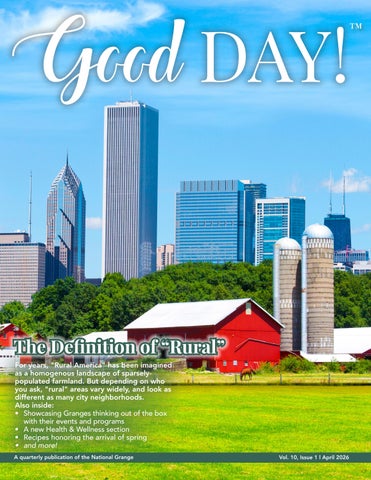
The Definition of “Rural” For years, "Rural America" has been imagined as a homogenous landscape of sparselypopulated farmland. But depending on who you ask, "rural" areas vary widely, and look as different as many city neighborhoods. Also inside: • Showcasing Granges thinking out of the box with their events and programs • A new Health & Wellness section • Recipes honoring the arrival of spring • and more! A quarterly publication of the National Grange
Vol. 10, Issue 1 l April 2026
OUR
WHAT’S THE GRANGE? Founded in 1867, the National Grange began as a fraternal organization for farm families and was progressive from the start—welcoming men and women as equals. Over more than a century and a half, the Grange has helped shape American life, championing causes such as rural free mail delivery and the direct election of U.S. Senators, as well as broadband and rural healthcare. Today, the Grange continues to advocate for rural Americans and all who care about agriculture (including everyone who enjoys good food), while local Granges invest millions of dollars and countless volunteer hours back into their communities. Rooted in grassroots action, each Grange reflects the needs, values, and voices of its members and its community.
Christine E. Hamp, Publisher National Grange President President, Grange Foundation President, Grange Advocacy champ@nationalgrange.org Philip J. Vonada, Editor Communications Director pvonada@nationalgrange.org Stephanie Wilkins, Subscriptions Manager IT Director swilkins@nationalgrange.org Burton Eller, Advertising Partner Legislative Director Executive Director, Grange Advocacy beller@nationalgrange.org
®
Learn more at www.nationalgrange.org.
OUR
Amanda Leigh Brozana Membership & Leadership Development Director & Grange Foundation Associate abrozana@nationalgrange.org
Officers
Christine E. Hamp, WA, President champ@nationalgrange.org John Benedik, NJ, Vice President jbenedik@grange.org
Susan Noah, OR, Executive Committee Chair snoah@grange.org Joseph Stefenoni, CA Executive Committee Member jstefenoni@grange.org William “Buddy” Overstreet, TX, Executive Committee Member boverstreet@grange.org Walter Hartley, RI, Executive Committee Member whartley@grange.org Dr. Richard Stonebraker, MD, Lecturer lecturer@nationalgrange.org
Loretta Washington Sales, Benefits, Programs & Membership Recognition Director lwashington@nationalgrange.org
Christopher Johnston, MI, Steward Doug Baldwin, IA, Assistant Steward
Randee Farmer & Bonnie Mitson Community Service Directors communityservice@grange.org
Kathy Gibson, MA, Lady Assistant Steward
Katie Girtler Junior Grange Director junior@nationalgrange.org
Kay Hoffman Stiles, MD, Chaplain Joseph Goodrich, VT, Treasurer
Samantha Wilkins Youth & Young Adults Director youth@nationalgrange.org
Debbie Campbell, PA, Secretary
Brittney & Jonathan Pittman Grange Youth Fairs Coordinators grangeyouthfairs@grange.org
David Allen, NC, Gatekeeper Cindy Greer, CO, Ceres Barbara Foster, WV, Pomona Welina Shufeldt, OK, Flora
HEADQUARTERS PHONE (202) 628-3507 HEADQUARTERS ADDRESS: 1616 H ST NW, SUITE 300 WASHINGTON, DC 20006 Additional Editing by John Benedik & Lynette Schaeffer
GOOD DAY!™ MAGAZINE
2 ®
Staff
www.nationalgrange.org
Good DAY!
™
N & V
GRANGE NEWS & VIEWS
5
L
LEGISLATIVE AFFAIRS
21
S RA
THE STATE OF RURAL AMERICA
25
I
IDEAS FOR GRANGE PROGRAMS & ACTION
29
H W
34
HEALTH & WELLNESS
J
JUNIOR GRANGE & GRANGE YOUTH
61
H & L
HOBBIES & LIFESTYLE
68
F & R
FOOD & RECIPES
Y
L W
A farm sits just on the edge of Chicago, just one of the many juxtaposing ideas of what one might consider “Rural America.” Photo via AdobeStock
51
MEMBERSHIP NEWS & RECOGNITION
M
On the cover:
73 81
THE LAST WORD
P
42
PERSPECTIVES:
Who defines “Rural” anyhow?
Follow us on Social Media National Grange
@nationalgrange
@nationalgrange
National Grange
@nationalgrangeofficial @nationalgrangeyouth @national_junior_grange
@nationalgrange
Good Day! Magazine is a quarterly publication of the National Grange located at 1616 H St. NW, Suite 300, Washington, DC 20006 ISSN: 2688-6030. | All comments and questions can be directed to pvonada@nationalgrange.org. Reproduction or distribution of any part of this magazine is prohibited by anyone other than a Grange member or a chartered Grange without written permission from the National Grange Communications Department.
GOOD DAY!™ MAGAZINE ®
www.nationalgrange.org
3
PROCLAMATION GRANGE MONTH 2026
GROWING STRONGER FROM THE GROUND UP! WHEREAS, the Grange strengthens individuals, families, and communities through grassroots action, service, education, advocacy, and agricultural awareness; and WHEREAS, for nearly 160 years, the Grange has thrived because of strong Community Granges serving as gathering places where neighbors connect, leaders are developed, and local solutions are born; and WHEREAS, the strength of the Grange is built upon the vitality, visibility, and engagement of each Community Grange across the country; and WHEREAS, in a time when communities seek belonging, civil dialogue, and local leadership, Community Granges offer trusted spaces where individuals can serve, learn, and lead together; and WHEREAS, developing a renewed interest in the challenges facing our communities, empowering local leadership, and supporting the growth of Community Granges ensures the continued relevance and impact of the Grange for future generations; and WHEREAS, Grange Month is an opportunity not only to celebrate our history, but to actively invest in our future by opening our doors, welcoming new members, strengthening existing Granges, and chartering new ones; and WHEREAS, every Grange member plays an essential role in building momentum – by inviting a neighbor, mentoring a new leader, and sharing the story of what the Grange means locally; therefore be it RESOLVED, that I, Christine E. Hamp, President of the National Grange, do hereby proclaim April 2026 as Grange Month and call upon every Grange in our great organization to focus intentionally on strengthening grassroots engagement, building leadership capacity, and expanding the presence of the Grange in every community we serve. Grange Month is an opportunity not only to celebrate our history, but to actively invest in our future by opening our doors, welcoming new members, strengthening existing Granges, and chartering new ones. Let April 2026 be marked by action – by open houses and service projects, by new conversations and renewed energy, by visible leadership and measurable growth – ensuring that the Grange is stronger tomorrow than it is today Grange Strong – Rooted, Resilient, United – and Growing from the Ground Up.
Christine E. Hamp President National Grange
WWW.NATIONALGRANGE.ORG
PRESIDENTIAL Perspective Christine E. Hamp
Why the Grange Advocates for Rural America At its core, the Grange has The Grange rejects the idea that this is inevitable. always stood for a simple but Advocating for rural America means insisting that powerful belief: where you success, health, and education should not depend live should not determine on your ZIP code. It means standing firm in the belief whether you can thrive. that a child growing up in a small town deserves the From the very beginning, the Grange was founded same opportunities as a child growing up in a major to give voice to people whose work, lives, and city. It means ensuring that rural residents are not communities were often overlooked. That mission treated as an afterthought in policy decisions, but has not changed. What has changed is the landscape as essential contributors to the nation’s present and of rural America – and the urgency with which we future. must act to ensure its future. Preserving Main Street is not about resisting When the Grange advocates for rural America, change – it is about ensuring access to opportunity. we are advocating for people, not nostalgia. We Main Street represents more are advocating for families than storefronts. It represents who want the choice to stay in local businesses, family farms, We advocate not their hometowns, earn a good volunteer fire departments, living, and raise their children libraries, schools, and community because rural in the communities that shaped gathering places. It is where them. We are advocating for the America is , but leadership is learned, where civic preservation of Main Street – not responsibility is practiced, and because it is . as a museum, but as a living, where belonging is built. When breathing center of commerce, Main Street disappears, it takes connection, and civic life. with it far more than economic Small towns matter. activity – it erodes the social They matter because they are where relationships fabric that holds communities together. are built across generations. They matter because That is why the Grange speaks out for policies that they produce the food, energy, and raw materials strengthen connectivity, education, health care, and this nation depends on. They matter because they infrastructure. represent something deeply American: neighbors Reliable broadband is no longer a luxury – it is working together to solve problems and take care of a necessity for learning, business, telehealth, and one another. participation in modern life. Strong schools and Yet too often, rural communities are asked to do educational pathways ensure that young people more with less. can build skills without being forced to leave home We see it when hospitals close or consolidate prematurely. Accessible health care keeps families miles away, forcing families to drive for hours for basic care. We see it when broadband access lags, limiting whole and communities viable. Sound infrastructure, education, entrepreneurship, and opportunity. We from roads and bridges to water systems and energy, see it when infrastructure is neglected, when schools supports safety, growth, and resilience. These are not partisan issues. They are community struggle to retain resources and teachers, and when issues. young people feel they must leave home to build a It is important to remember that advocacy is future. not only the work of the National Grange or State
fragile essential
N GOOD DAY! MAGAZINE & V ™
www.nationalgrange.org
5
Granges. Every member and every Grange must be advocates. Advocacy happens when a local Grange hosts a community forum and invites neighbors and local officials to listen. It happens when members speak up about what their community needs, share their stories, and build relationships rooted in respect and trust. It happens when a Grange partners with schools, health providers, libraries, or local businesses to address real challenges and demonstrate what works on the ground. The strength of the Grange has always come from the bottom up. Our credibility does not come from position papers alone – it comes from thousands of members, in thousands of communities, showing up, engaging thoughtfully, and making the case for rural America every day. We advocate not because rural America is fragile, but because it is essential. Rural communities are innovative, resilient, and resourceful. Given the right tools and investment,
6
they don’t just survive – they lead. The Grange’s role is to ensure those communities have a seat at the table and a voice in the decisions that shape their future. Ultimately, advocating for rural America is about preserving choice. The choice to stay. The choice to return. The choice to build a life where your roots run deep. No one should be forced to leave their community to find opportunity. And no community should be written off because of its size or geography. The Grange will continue to advocate – at every level – for a future where rural America is not left behind but fully included; where Main Street remains strong; and where families can thrive. This work belongs to all of us, and together, it is how we ensure the promise of America remains real and reachable.
N GOOD DAY! MAGAZINE & V ™
www.nationalgrange.org
From the desk of the PHILIP J. VONADA Growing up in the hills and valleys of central Pennsylvania, I didn’t realize - or appreciate - that rural America was shaping me. It was just “home.” It was long drives on two-lane roads - frequently with no line down the center. It was knowing your neighbors and teachers by name and often by story. It was school and church events where everyone brought something to the table, and community fundraisers where everyone showed up to support. It was fields and forests and summer evenings on front porches. It was learning responsibility at a young age, because the work in the gardens wasn’t going to “do itself.” Only later, did I understand how deeply my roots would guide my view of the world. Growing up rural teaches you interdependence. There is a myth that rural Americans pride themselves solely on independence. Sure, we value self-reliance; we fix what we can and we take care of things ourselves when possible. But in truth, rural life depends on community. When hogs need to be butchered, when families face hardship, when a fundraiser must succeed, you show up. You bring a casserole. You buy the raffle ticket. You stay to stack the chairs and put away tables at the end of the meeting or church dinner. This mutual support shapes how you see people. It reminds you that community is not an abstract concept, but is built on relationships and trust. Rural life also teaches perspective. You grow up watching seasons change. You understand that growth takes time. You learn patience from vegetables for your 4-H projects that cannot be rushed, and from weather that cannot be controlled. You realize early that you are part of something bigger than yourself... whether that is the land, the economy, or the web of neighbors who rely on one another. Those lessons have influenced how I approach leadership and service. I believe in steady progress; in showing up consistently; in honoring my word; in listening so I understand the situation before I speak. I believe that real change does not happen overnight, but instead happens when ordinary people commit to doing small things well, over and over again. Growing up rural also instilled in me a deep respect for work; not just the visible work, but the unseen effort that sustains communities. Farmers, small business owners, volunteer firefighters, teachers, PTA members,
Editor
youth sports coaches, nurses, church leaders, and civic volunteers often operate without recognition or seeking glory, yet they are the backbone of our hometowns. Together, they work to make a tangible difference in the lives of the people they live and work with. At the same time, rural America taught me resilience. Rural communities know what it means to adapt. We have seen industries shift, schools consolidate, hospitals close, and young people leave in search of opportunity. And yet, we remain. We innovate, reorganize, and rebuild. There is strength in that persistence; a determination to keep going, even when resources are limited. Perhaps most importantly, growing up in rural America gave me an appreciation for diverse perspectives. Rural communities are not homogenous - they are filled with people of different backgrounds, beliefs, and experiences who work side by side. When you grow up with neighbors, classmates, church elders, and yes, Grange members - who all have differing opinions cooperate on behalf of the good of the community, you understand that respectful dialogue and shared purpose matter. This influenced how I engage in conversations about policy, community development, and the future of our country. I believe the strongest solutions are rooted locally and informed broadly. I believe that voices from small towns deserve a seat at the table. And I believe that when rural America is at its best, the entire nation benefits. As I reflect on my upbringing, I realize that rural life did more than give me memories. It gave me a framework, teaching me to value people over politics, to measure progress not only in numbers, but in relationships strengthened and communities sustained, and that leadership begins with service and humility. These lessons are not outdated. They are not nostalgic relics of a bygone era. They are exactly what our country needs more of today. Growing up rural, even though I “couldn’t wait” to get out, shaped my work ethic, my worldview, and my belief in the power of grassroots engagement. It taught me that change grows from the ground up — through neighbors helping neighbors, through commitment to one another, and through communities that refuse to give up on themselves. And for that foundation, I will always be grateful.
N GOOD DAY! MAGAZINE & V ™
www.nationalgrange.org
7
ROOTED IN WELLNESS
Smart shopping for healthy eating Mary Beth Nogan Registered Dietician Allow me to introduce myself. My name is Mary Beth Nogan, and I am a registered and licensed dietitian from Scott Township, Pennsylvania. I reside on a farm with my husband and 2-year-old son. We raise about 250 Black Angus cattle, along with 50 or so pigs each spring. We have a market where we sell our meat and other goods from local farmers and vendors. I am currently employed full-time at Wayne Memorial Hospital, where I treat both inpatients and outpatients of various ages and backgrounds. Wayne Memorial Hospital is located in a predominantly rural area in Wayne County, with wide-open countryside, farmland, and a small population. The big question is, how does this affect health and nutrition? Rural areas tend to have less access to health care, including urgent care, walk-in clinics, and hospitals. Grocery stores and availability of healthy food options may also be few and far between. Gas stations and convenience stores have become widely used by individuals as one of their main sources of food. However, that doesn’t mean shopping for healthy food choices has to be hard. It is possible to purchase nutritious foods on a budget at any location, so don’t throw your healthy eating habits out the window just yet.
In many parts of rural America, stores like Dollar General or gas stations have become primary shopping sources for groceries due to convenience or limited other options. Photo by J. Michael Jones, licensed through AdobeStock
34
Follow some of these tips to make the most of your budget while making healthier choices: 1. Plan your meals for the week. Have you ever heard the saying “Failing to plan is planning to fail?” Well, in this case, that is true! If you decide what your meals will be, even for just one meal per day, you can help reduce your grocery costs. You will know exactly what ingredients to buy and how much. This will help to eliminate food waste and ultimately cut down on costs. 2. Make a list and stick to it. Making a grocery list each time you go to the store can help you stay organized and also not purchase items that you will not use. Don’t forget to eat a snack before going to the store. Shopping on an empty stomach may lead to impulse buys. 3. Keep an inventory. Do you know what’s in your freezer, refrigerator, and pantry? Try to plan meals around foods you already have. This will prevent you from overbuying and also from letting food go to waste or expire. 4. Purchase a variety of canned, fresh, and frozen goods. If you opt for canned vegetables, rinse them with water before use to reduce about 40% of the sodium. When choosing canned fruit, purchase fruit packed in juice or water. Avoid those in heavy syrup to help reduce your added sugar intake. Frozen produce is a great option and sometimes has more nutrients because it is flash frozen from its fresh state. Limit your stress about choosing organic. Conventional and organic produce contain the same great nutrients, vitamins, and minerals. 5. Skip the drive-thru. The average fast food meal costs around $12. For the same amount, you can buy one pound of ground turkey, a bag of frozen broccoli, brown rice, a loaf of bread, and a 3-pound bag of apples if you shop the store brand. If you have no other option but to go through a drivethru, opt for grilled chicken, a plain hamburger, a baked potato, or chili. Salads can be a healthy option, but be aware of the dressings, as they can add over 200 more calories. 6. Rely on the staples. Keep affordable yet nutritious and filling items on hand, such as canned or dried
H GOOD DAY!™ MAGAZINE W www.nationalgrange.org
beans, brown rice, peanut butter, Greek yogurt, cottage cheese, oatmeal, and eggs. Beans, yogurt, cottage cheese, and eggs are great sources of protein, which we need to support our muscles and immune system, and to keep us satiated. 7. Don’t be afraid of the store brand. Did you know that many name-brand companies actually make the store-brand products? Store brands are often 25-30% cheaper than their counterparts. 8. Scan store advertisements for the best deals. I know those flyers in the mail make great fire starters, but take a look before ditching them. They may help you find meal inspiration, compare prices, and discover new products and deals. 9. Buy in bulk when possible. Items such as toilet paper, paper towels, meat, and grains are great options when buying in large quantities. Meats can be weighed, portioned, and vacuum sealed in individual packs for easy access. Buying in bulk generally saves a person, on average, 27%. When it comes to convenience dining, such as from
Sheet Pan Chicken Fajitas with thanks to Budget Bytes Fajita Seasoning 1 Tbsp chili powder 1/2 Tbsp paprika 1/2 tsp onion powder 1/4 tsp garlic powder 1/4 tsp cumin 1/8 tsp cayenne pepper 1 tsp sugar 1/2 tsp salt
a gas station, convenience store, or fast food restaurant, try to keep the following tips in mind. Many gas stations and convenience stores offer cheese and meat sticks, protein bars, nuts, cheese packs, yogurt, and hard-boiled eggs. All of these are good sources of protein and other nutrients. Added sugars and refined carbohydrates, such as standard pasta and white rice, should be limited for families and individuals alike. Additionally, consider sticking with water to stave off extra calories. Purchasing a gallon of water rather than individual bottles is more cost-effective. Hydration is important for aiding digestion, transporting nutrients, and lubricating joints. It comes down to balance. Do your meals contain protein, whole grains, vegetables, fruits, and healthy fats? What works for one’s health isn’t one-size-fits-all. We have different nutrient needs. It’s best to speak with your primary care provider or a registered dietitian nutritionist to develop a plan that works best for you.
Makes 4 fajitas 1 serving = 2 fajitas
Nutrition Information per serving Fajitas Calories: 483kcal 2 small yellow onions Carbohydrates: 43g 3 bell peppers, any color Protein: 31g 1 lb. chicken breast Fat: 21g Sodium: 910mg 2 Tbsp olive oil Fiber: 4g 1 lime *Nutrition information is 8 6-inch low-carbohydrate tortillas
estimated and may differ depending on the ingredients used.
1. Preheat the oven to 400ºF. Mix all of the spices for the fajita seasoning in a small bowl and set aside. 2. Line baking sheet with foil or parchment paper for easy clean up. Cut the onion and bell peppers into strips. Slice the chicken breast into thin strips. Add the chicken and vegetables to a large baking sheet. 3. Drizzle the olive oil over the chicken and vegetables, then sprinkle the fajita seasoning mix over top. Use your hands or tongs to toss the ingredients until everything is well coated in oil and seasoning. Spread the chicken and vegetables out over the baking sheet evenly. 4. Bake the chicken and vegetables in the preheated oven for 35-40 minutes. Halfway through give the chicken and vegetables a stir. 5. Squeeze the juice from half of the lime over top of the meat and vegetables after they come out of the oven. To serve, scoop a small amount of meat and vegetables into the center of each tortilla. Top as desired with cilantro, salsa, shredded cheese, and/or sour cream.
H GOOD DAY!™ MAGAZINE W www.nationalgrange.org
35
Dietary Guidelines for 2025-30 released by HHS, USDA Courtesy of the U.S. Department of Health and Human Services In January, U.S. Department of Health and Human Services Secretary Robert F. Kennedy, Jr. and U.S. Department of Agriculture Secretary Brooke Rollins released the Dietary Guidelines for Americans, 2025– 2030, marking the most significant reset of federal nutrition policy in decades. The new Guidelines deliver a clear, common-sense message to the American people: eat real food. The U.S. faces a national health emergency. Nearly 90% of health care spending goes toward treating chronic disease, much of it linked to diet and lifestyle. More than 70% of American adults are overweight or obese, and nearly 1 in 3 adolescents has prediabetes. Diet-driven chronic disease now disqualifies many young Americans from military service, threatening national readiness and limiting opportunity. “These Guidelines return us to the basics,” Secretary Kennedy said. “American households must prioritize whole, nutrient-dense foods—protein, dairy, vegetables, fruits, healthy fats, and whole grains—and dramatically reduce highly processed foods. This is how we Make America Healthy Again.” “Thanks to the bold leadership of President Trump, this edition of the Dietary Guidelines for Americans will reset federal nutrition policy, putting our families and children first as we move towards a healthier nation,” Secretary Rollins said. “At long last, we are realigning our food system to support American farmers, ranchers, and companies that grow and produce real food. Farmers and ranchers are at the forefront of the solution, and that means more protein, dairy, vegetables, fruits, healthy fats, and whole grains on American dinner tables.” The 2025–2030 Guidelines reestablish food—not pharmaceuticals—as the foundation of health and reclaim the food pyramid as a tool for nourishment and education. The Guidelines emphasize simple, flexible guidance rooted in modern nutrition science: • Prioritize protein at every meal • Consume full-fat dairy with no added sugars • Eat vegetables and fruits throughout the day, focusing on whole forms • Incorporate healthy fats from whole foods such as meats, seafood, eggs, nuts, seeds, olives, and avocados • Focus on whole grains, while sharply reducing
40
Dietary Guidelines For Americans
Protein, Dairy
Vegetables & FrBits
& Healthy Fats
Whole Grains
realfood.gov
2025–2030
The 2025-2030 Dietary Guidelines for Americans were jointly revised and released by the U.S. Departments of Health & Human Services and Agriculture. Image courtesy of realfood.gov refined carbohydrates • Limit highly processed foods, added sugars, and artificial additives • Eat the right amount for you, based on age, sex, size, and activity level • Choose water and unsweetened beverages to support hydration • Limit alcohol consumption for better overall health The Guidelines also provide tailored recommendations for infants and children, adolescents, pregnant and lactating women, older adults, individuals with chronic disease, and vegetarians and vegans, ensuring nutritional adequacy across every stage of life. Learn more about the new dietary guidelines, including the daily servings guide, guidance for age groups, the scientific foundation for the guidelines, and more at www.realfood.gov.
H GOOD DAY!™ MAGAZINE W www.nationalgrange.org
Breakthroughs happen together. Let’s Outdo Cancer Everything we do is intended to help patients everywhere live longer and healthier lives. That’s why we don’t just work for patients, we work with them to deliver the breakthroughs that will change their lives. Join us at LetsOutdoCancer.com
P
GOOD DAY!™ MAGAZINE www.nationalgrange.org
41
Rural America: Redefined
Why One Definition Will Never Be Enough
42
P
by Philip J Vonada
GOOD DAY!™ MAGAZINE www.nationalgrange.org
Photo licensed via AdobeStock
“Rural America” sounds like a simple phrase. It is used constantly in politics, journalism, advocacy, research, and everyday conversation, usually as if everyone already agrees on what it means. But the closer you look, the less fixed the term becomes. The problem: no single definition of rural America satisfies every agency, researcher, mapmaker, or community. One of the first truths about rural America is that it is not one thing, but many places, economies, cultures, and stories under one broad label. This may seem “technical,” but it has real consequences. Definitions determine who gets counted. They influence which towns qualify for grants, which hospitals or communities can access economic development programs, and which places get left out because they sit on the wrong side of a line – or get included when maybe they really shouldn’t. The debate over what counts as rural affects money, visibility, infrastructure, representation, and opportunity. As the Center on Rural Innovation notes, “defining rural America shapes how billions of dollars are allocated and how institutions perceive rural communities.”
A Moving Target: How “Rural” Gets Defined
The U.S. Census Bureau offers the most widely cited federal framework, but even that does not begin with a direct, richly textured definition of rural life. Instead, the Census defines what is “urban” and classifies everything else as “rural.” Under 2020 Census standards, urban areas must have at least 5,000 people or 2,000 housing units with a certain density. Rural includes all population, housing, and territory outside urban areas. In other words, rural is defined by what it is not. That means “rural” can include: • A farming community of 300 people
P
• A town of 4,500 just outside a city • A sparsely populated county larger than some states • A suburban edge that simply doesn’t meet density requirements This broad measure is useful nationally, but it shows the problem. If “rural” means everything outside “urban,” the category becomes uneven. It can include tiny plains towns, Appalachian counties, fishing villages, tribal communities, Delta country, ranching regions, and exurban areas closer to suburbia than open country. On paper, they are all rural, but they differ in history, demographics, economy, and identity. Each needs specialized attention. The United States Department of Agriculture (USDA) takes a different approach, which only adds to the confusion on the topic. Rather than relying solely on the Census Bureau’s urban-rural split, USDA’s Economic Research Service often uses county-based systems, such as the Rural-Urban Continuum Codes. These codes divide entire counties into metro and nonmetro categories, and further sort them by size, urbanization, and adjacency to metropolitan areas. And yet, the USDA also has other, more nuanced definitions depending on what program within the department is
GOOD DAY!™ MAGAZINE www.nationalgrange.org
43
Tomatillo-Cilantro-Jalapeño Dressing on This recipe comes from Mexican influence
Spring Greens
6 medium salads
2/3 cups pepitas (green pumpkin seeds) ½ teaspoon olive oil ½ teaspoon chili powder Pinch of salt 10 ounces baby spring mix 6 ounces romaine lettuce, chopped (or other coarse greens) 1 pint cherry tomatoes, quartered 2 cups finely chopped purple cabbage, about ½ a small cabbage) 1 medium cucumber, halved, seeded and thinly sliced 2/3 cup Manchego or Asiago cheese, grated or crumbled
1. Combine pepitas, oil, chili powder, and a pinch of salt in a medium skillet over medium heat. Toast pepitas, stirring frequently (don‘t let them burn!) until they are turning golden on the edges and making little popping noises, about 4-7 minutes. Set skillet aside to cool. 2. In a large salad bowl, combine the spring mix, romaine, cabbage, cherry tomatoes, cucumber, cheese, onion and toasted pepitas. Gently toss and set aside. 3. Combine tomatillos, avocado, chili peppers, cilantro, onion, garlic, cumin, salt, mustard, maple syrup, lime juice, and red pepper flakes in a food processor or
1/4 pound tomatillos, husked and quartered 1 avocado, pitted and peeled 1 serrano or jalapeño chili (membranes and seeds removed to reduce heat) ½ cup lightly packed cilantro leaves and stems ½ small red onion 2 large garlic cloves ½ teaspoon ground cumin 1/8 teaspoon salt 1 teaspoon Dijon mustard 1 teaspoon maple syrup 2 tablespoons fresh lime juice Pinch of red pepper flakes. 1/8 to 1/4 cup olive oil
blender. Blend until smooth. Slowly add olive oil while blending to reach desired consistency. Taste and add more salt and/or add chili flakes if you’d like more spice. Blend again and transfer to a container with a spout for serving. 4. Divide salad into bowls and drizzle with dressing before serving. Store dressing separately from salad mix. Salad will keep 4-5 days if not tossed with dressing.
President’s Recipe
Asparagus two ways
shared by President Christine Hamp
The First Dude and I enjoy fresh asparagus! We have two favorite ways to prepare it: 1. In a glass dish in the microwave for 3 minutes with a drizzle of olive or avocado oil and salt and pepper. No need to add water. 2. On the grill with a drizzle of olive or avocado oil and salt and pepper. Picking asparagus at the 2024 Western Regional Conference tour to Kinsey Farms in the Yakima Valley of Washington state.
The key is to not overcook. Enjoy!
78
F GOOD DAY! MAGAZINE & R ™
www.nationalgrange.org
Honey Mustard
Salmon with Roasted vegetables This recipe comes from Norwegian influence
serves 6
2 bunches red radishes, ends trimmed, cut in half, or quartered if large 1 bunch thin carrots, ends trimmed, halved crosswise, or cut julienned 1 large shallot, sliced lengthwise 2 tablespoons plus 1 teaspoon olive oil, divided 1 ¾ teaspoons salt, divided 1 teaspoon salt, divided 2 tablespoons honey 1 ½ tablespoons Dijon mustard 1 teaspoon hot sauce of choice (optional) 1 ½ pound salmon, skin removed 8 ounces fresh sugar snap peas, strings removed, halved lengthwise 1 bunch asparagus, trimmed 1/4 cup fresh mint, chopped ¼ cup fresh dill, chopped lemon wedges for serving 1. Preheat oven to 425 degrees. 2. Combine radishes, carrots and shallot in a medium bowl; toss with 11 tablespoon olive oil, ½ teaspoon salt, and ¼ teaspoon pepper. 3. Spread vegetables in an even layer on a large rimmed baking sheet. Roast in oven until vegetables have started to sizzle and brown, about 10 minutes. 4. In a small bowl, mix together honey, mustard and hot sauce. 5. Drizzle salmon with 2 teaspoons olive oil and season with ¾ teaspoon salt and ½ teaspoon pepper. Spread mustard mixture evenly over top of salmon.
6. Remove vegetables from oven. Toss vegetables and clear a space in the middle of the pan to add the salmon. 7. Return pan to oven and roast for 10 minutes. 8. In a medium bowl, toss snap peas and asparagus with remaining 2 tsp olive oil, ½ tsp salt and ¼ tsp pepper. 9. Remove pan from oven, scatter asparagus and snap peas around the salmon, stirring so they make contact with the pan. 10. Return to oven and roast until salmon flakes easily with a fork and vegetables are tender, about 10 minutes. 11. Transfer all to a platter, sprinkle with herbs. Serve with lemon wedges.
F GOOD DAY! MAGAZINE & R ™
www.nationalgrange.org
79
Join us in Broken Arrow
November 9-14, 2026 Broken Arrow, OK Book your room today! Stoney Creek Hotel & Conference Center https://grange.biz/160hotel Book your room early - when the hotel is full, additional rooms will be moved to the Hilton Garden Inn