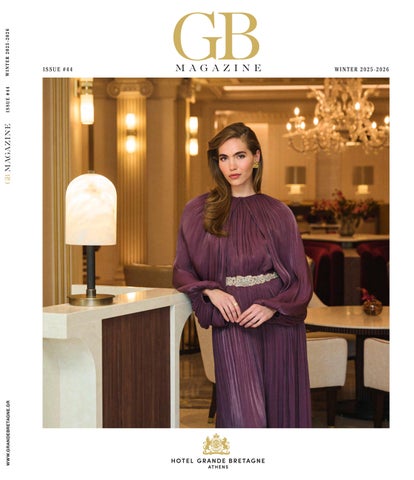
GB Magazine | Winter 2025-2026

Page 1


ΙSSUE #44

Dear Guests,

THE STAR OF ATHENS shines ever more brightly on the international tourism horizon, and the Hotel Grande Bretagne – the grand dame of Greek hospitality – continues to take center stage, as it has for 151 uninterrupted years.

For all of us at Lampsa Hellenic Hotels S.A., each season represents a new challenge – an opportunity to further evolve our offering with vision, creativity and a deep sense of responsibility, always striving to reach new heights.

Recently, the Hotel Grande Bretagne was named Greece’s Leading Hotel at the Condé Nast Traveller Readers’ Choice Awards 2025. This distinction, based on the votes of thousands of travelers, is a great honor for us and a testament to the enduring trust of our guests.

Yet neither complacency nor stagnation are part of our vocabulary. As a new season begins, we are redefining the very notion of luxury through the creation of new experiences. The brand-new George, The Lobby Bar at the King George has just begun to write its own story – a high-aesthetic meeting place where guests can experience the rhythm of the city through flavors, music, art and the warmth of true hospitality.

At GB Roof Garden and Tudor Hall, the new seasonal creations of award-winning chefs Asterios Koustoudis and Nikos Livadia place an even greater emphasis on the finest Greek ingredients and culinary artistry, transforming every meal into an experience.

The GB Spa turns well-being into an art form with the latest treatments by 111SKIN, ESPA and KOS Paris, inviting guests on a holistic journey of self-care and harmony. The GB Corner Gifts & Flavors continues to inspire those in search of authentic Greek products and distinctive gift items with character.

For its part, the Lampsa Group continues to pursue a vision of sustainable and outward-looking growth while ensuring that hospitality remains a source of inspiration, prosperity and respect – a living bond between past and future.

In the months ahead, we look forward to sharing exciting news about our latest investments: from the full transformation of Elatos Resort – Emblems Collection on Mt Parnassos, a landmark in luxury mountain tourism, to the Voria project in Maroussi, which is redefining the notion of a complete hospitality and leisure experience.

Until then, we invite you to enjoy all that we have prepared for you this winter, and wish you a truly memorable stay.

24. GUESTS’ BRIEF

The season’s exciting new offerings.

38. MY SPECIAL PLACE

Locals in the know share their favorite city spots.

44. ATHENIAN STROLLS

A walk to where the fountains flow and a lesson in the history of water in the city.

46. INTERVIEW

Acclaimed author Victoria Hislop talks about her new book and her special bond with Greece and its capital.

54. CELEBRITIES

The Hotel Grande Bretagne has always been a second home to artists in all genres.

TUDOR HALL, A STAR ABOVE ATHENS

62. WHAT’S ON

The most interesting experiences, cultural and otherwise, in Athens this season.

76. INTERVIEW

Famed soprano Aleksandra Kurzak talks Callas, Tosca and the great opera stages of the world.

82. THE RARE BOOK DOCTORS

The Book and Archival Materials Conservation Laboratory of the Aikaterini Laskaridis Foundation is working to preserve the printed heritage of Greece.

ON THE COVER Photographed by Panos Davios (10AM)

–Fashion editor: Anna Zinchenko

–Make-up: Dimitra Altani (D-TALES)

Hair: Jose Quijano (10AM)

Photographer’s assistant: Stelios Fragodopoulos

Model: Toni Jebens (ACE MODELS)

Toni: Silk dress (COSTARELLOS, AESTHET GREEK DESIGNERS).

Plissé earrings in 18K yellow gold and Aether Fancy Old Mine ring in 18K yellow gold with diamonds (ANASTASIA KESSARIS, KESSARIS).

88. ALLIANCE FOR A CLEANER FUTURE

On land and at sea, the Athanasios C. Laskaridis Charitable Foundation’s Typhoon initiative is cleaning up the country.

92. FASHION

Winter Poise.

108. THE ART OF GIVING

Precious gifts for special moments.

120. GEORGE, THE LOBBY BAR

The King George Hotel welcomes a stylish new all-day venue.

George

126. SUSTAINABILITY

Ethical sourcing adds even greater value to the Hotel Grande Bretagne's gastronomy.

132. TUDOR HALL

Exceptional dining in an elegant setting with breathtaking views and an exciting seasonal menu.

138. FINE DRINKING

An in-depth look at a classic cocktail and its enticing permutations at Alexander’s Βar.

146. THE QUIET ENERGY OF RENEWAL Relaxation and rejuvenation await you at the award-winning GB Spa.

152. THE GB TIMELINE

Milestones in the 150-year history of the Hotel Grande Bretagne.

156. FICTION

Beatrice bids the fondest of farewells to her beloved Hotel Grande Bretagne.

163. HOSPITALITY

The wider world of Lampsa Hellenic Hotels S.A.

PROPERTY OF LAMPSA HELLENIC HOTELS S.A. ISSN: 2585-2566

Lampsa Hellenic Hotels S.A. 297 Kifssias, 145 61, Kifssia, Greece. Tel: (+30) 210.619.5525 Fax: (+30) 210.619.7848 www.lampsa.gr

President of the Board Chloe Laskaridis

Managing Director Anastasios Homenidis

Hotel Grande Bretagne

1 Vasileos Georgiou I, 105 64, Athens, Greece. Tel: (+30) 210.333.0000 www.grandebretagne.gr

General Manager Ηom Parviz

Public Relations Manager Maria Koutzabasi

Editor-in-Chief

Giorgos Tsiros

Deputy Editor Nena Dimitriou

Commercial Director Vassiliki Albani

Adverising Director Sophia Tsepa stsepa@kathimerini.gr Adverising Inquiries

Marina Chioti Tel. (+30) 210.480.8236, mchioti@kathimerini.gr

Editorial Coordinator Niki Agrafoti

Publisher NEES KATHIMERINES EKDOSEIS

SINGLE MEMBER S.A. Ethnarhou Makariou & 2 Falireos, 185 47, Athens. Tel. (+30) 210.480.8000, Fax (+30) 210.480.8202

176. MOMENTS

GB Magazine is published twice a year by Nees Kathimerines Ekdoseis Single Member S.A. exclusively for the Hotel Grande Bretagne. Lampsa Hellenic Hotels S.A. does not necessarily share the opinions expressed in GB Magazine. It is illegal to reproduce any par of this publication without the written permission of the publisher. This magazine is distributed free of charge.

FASHION
PHOTO: PANOS DAVIOS (10AM)
FASHION EDITOR: ANNA ZINCHENKO

Guests’ Brief

Our latest news and fresh arrivals

MORE THAN A RESTAURANT

Your frst morning in Athens begins high above the city, as you take the elevator to the GB Roof Garden for breakfast. The redesigned dining room is bathed in natural light, and the panoramic views of the Acropolis and the city below are stunning. Even before the frst sip of cofee or bite from the bufet – or an à la care selection – you know that this is no ordinary hotel restaurant. Every detail whispers excellence: from the fnest Greek ingredients to the homemade pastries, baked fresh each morning in the hotel’s own pâtisserie. Under the creative direction of Executive Chef Asterios Koustoudis, the Mediterranean-inspired menu changes as the day goes on, the options paired with an award-winning wine list curated by Wine Director Evangelos Psofdis. From breakfast to dinner, 365 days a year, the GB Roof Garden reinvents itself, ofering something new with every visit. Here, a harmonious “orchestra” of chefs and service professionals ensures that every moment surpasses expectation.

GB Roof Garden Restaurant & Bar Reservations Tel. (+30) 210.333.0766

Breakfast: 6:30-11:00 (In-house guests only), Lunch: 13:00-17:00

Dinner: 17:00-02:00 (Last order at 00:15)

A PASSION FOR WINE

Some experiences are simply called “unique” while others truly deserve that accolade. Since 2019, the Hotel Grande Bretagne and Wine Director Evangelos Psofdis have hosted a series of extraordinary evenings celebrating the world’s most distinguished winemakers. Visionaries from legendary estates such as Antinori and Tignanello, Château de Beaucastel, Promontory in California, Dom Pérignon and the iconic Château Haut-Brion have brought with them their rarest and most emblematic vintages. For each event, Executive Chef Asterios Koustoudis designs a bespoke menu, inspired by the heritage of the producers and the culinary traditions of their regions. The result is a multi-sensory journey through the ar of wine and haute gastronomy, an experience both intimate and transcendent. Seating is limited, and with every edition the setting changes both décor and ambiance, ensuring that no two evenings are ever the same. The 2026 program will be unveiled soon.

SeaQ Chronograph

Athens . Voukourestiou 18 I Mykonos . Enoplon Dynameon, Tria Pigadia

A TIME-HONORED TRADITION

If every day were like Christmas, as Elvis Presley once sang, each afternoon would surely be devoted to the traditional, indulgent ritual of Afternoon Tea at the Winter Garden, one of the most distinctive experiences you can enjoy in Athens. For this winter, Executive Chef Asterios Koustoudis presents a new menu featuring an assorment of tea sandwiches; freshly baked scones with lime crumble and cranberries; seasonal jams; four exquisite desser creations; and, as an added bonus, a buckwheat crêpe with Comté cheese, prepared right at your table.

ON A HIGH NOTE

Athens holds a deep afection for its National Opera, now housed in one of the world’s most impressive venues: the Stavros Niarchos Foundation Cultural Center. For guests whose schedules don’t allow for a full performance, the Winter Garden ofers a taste of that magic every Thursday evening. As a soprano and tenor perform timeless arias accompanied by piano, the elegant atmosphere becomes sufused with emotion. Exquisite cocktails and refned creations by Executive Chef Asterios Koustoudis and his team complete the experience.

info

Opera Nights at the Winter Garden

Tel. (+30) 210.333.0748

Thursdays, 19:30-22:30

IN GOOD COMPANY

You’ll fnd the discreet entrance of Alexander’s Cigar Lounge of a quiet corridor on the frst foor. A sense of mystery greets you here, as if you’re being admitted into a secret society devoted to the pleasures of a more gracious era. The space itself – luxurious, with colonial-style décor and a freplace – immediately sets the tone for the enjoyment of a rare cognac or a fne malt whisky, paired with an impeccably stored premium cigar. The choice is far from simple; there are Cohiba (Maduro Genios, Medio Siglo, Robustos and more), Romeo y Julieta Linea de Oro, Paragas and Montecristo, among others. Here, time stands still, and the cares of the outside world cease to matter.

info

Alexander’s Cigar Lounge

Tel. (+30) 210.333.0748

Open daily 11:00-02:00

YOUR HAIR IS BEAUTIFUL

In a city such as Athens, anything can happen: a spontaneous night out, an unexpected dinner invitation, or simply the irresistible urge to change your look and mood. Whatever brings you to the Hair Spa Salon, expect excellence in every detail. From exper styling, precision cuts and color services to professional make-up and organic manicures and pedicures with Kure Bazaar products, this elegant haven redefnes the ar of beauty and care. For gentlemen, the Barber’s Corner ofers the timeless ritual of a straight-razor shave and refned grooming treatments. It’s the kind of place you just might fnd yourself revisiting.

LUXURY ELIXIRS

As your rejuvenating experience at the GB Spa comes to an end, two irresistible desires naturally arise: to take home the skincare treasures that made your treatment so transformative, and to share the same journey of well-being with someone you love. The Spa Boutique ofers an exclusive collection of advanced beauty and wellness brands such as 111SKIN, ESPA, and KOS Paris, alongside the signature GB Spa Home Fragrance. As for a gift that will be truly appreciated – during the festive season or any time of year – a GB Spa Gift Voucher invites those dearest to you to discover their own moment of balance, serenity and renewal.

1. ESPA Wellness Advent Calendar 2025: Twentyfve skincare, body and wellness treasures, including seven full-size favorites.

2. KOS Paris Argan Oil 100ml.

3. KOS Paris Trousse Noël: Huile à Lèvres 5ml, Beurre de Babassu 50ml, Sérum Éclat 4.5ml.

4. 111SKIN Everyday Bestsellers Trio: Eye Lift Gel 15ml, Repair Serum 15ml, Repair Day Cream 15ml, velvet pouch.

THE ULTIMATE GIFT SHOP

Located in the very hear of Athens’ luxury shopping district, surrounded by the city’s fnest fashion houses and jewelry boutiques, the Hotel Grande Bretagne ofers a shopping destination of its own: GB Corner Gifts & Flavors. This elegant boutique brings together a selection of Zeus+Dione and Brunello Cucinelli pieces, travel and décor items, skincare products, premium spirits, gourmet treats and, of course, the hotel’s signature GB collection, allowing you to take a memento of your stay home with you. A recent addition is the Perfumery Corner, showcasing exclusive creations from leading niche fragrance houses rarely found in the mainstream market.

GB Corner Gifts & Flavors

Open Mon-Sat 11:00-20:00 Shop online: grandebretagnestore.com

1. Clockwise from top left: CHRISTIANNA VARDAKOU silk scarf. GB decorative pillow. ANTHOLOGIST “Panito OG the Goat” stufed toy. DOM PÉRIGNON Limited Edition by Jean-Michel Basquiat. Champagne Glass.

2. Clockwise from top left: VALAES bronze olive tree sculpture. GB bathrobe. DANAKOS shampoo, shower gel & hand/body milk. DANAKOS Eau de Parfum 150 ml. GB candelabra.

3. Clockwise from top left: ZEUS+DIONE silk scarf Chimaera. BRUNELLO CUCINELLI suede tote bag. ZEUS+DIONE ballet fats. GB notebook. ZEUS+DIONE sunglasses.

My Special Place

THE ALEKOS FASSIANOS MUSEUM

A shor walk from the ar gallery The Breeder, in the quietly changing neighborhood of Metaxourgeio, lies one of Athens’ most signifcant new destinations: the Alekos Fassianos Museum. Dedicated to the late arist Alekos Fassianos, a national treasure whose work captured the essence of Greek light, myth and everyday life, the museum feels like a living porrait of the arist himself. Housed in his former home, which was lovingly restored by the arist and architect Kyriakos Krokos, the space preserves the warmth and humanity that defned Fassianos’ world. Each room seems flled with his presence, lingering in everything from the gentle fgures and bicycles of his paintings to the subtle dialogue between ar, design and domestic intimacy. For me, it is deeply moving to see how the museum celebrates not only Fassianos’ ar, but also his spirit of generosity and optimism. It is a place where visi tors can sense the quiet poetry of Athens itself: its sun, its stories, its resilience. Just steps from The Breeder, the Alekos Fassianos Museum is an inspir ing addition to any exploration of the city: a reminder that ar, at its best, is inseparable from life itself.

My Special Place

THE NEIGHBORHOOD OF PIRAIKI

The neighborhood of Piraiki at the southwestern tip of Piraeus is far from the bustling por and feels more like a provincial town. Life moves to a diferent rhythm here. The Piraiki peninsula has been inhabited since prehistoric times; its ancient quarries supplied the stone used to build the old city of Piraeus. Today, it’s known for its scenic coastal promenade, which stretches from the Hellenic Naval Academy all the way to Pasalimani. I suggest walking par of this route – from Akti Themistokleous to the concrete Cross (1969), also known as the Monument to the Unknown Sailor, overlooking the Bay of Aphrodite. Along the way, you’ll come across small coves, anglers, seaside tavernas and fragments of ancient walls. You’ll reach the Bay of Aphrodite in about ffteen minutes; look for the café of the same name, order a local spirit and take in the views over the sea or, if you've timed it right, the sunset. I lived in Piraeus for two years, and this was my favorite walk: a way to unwind and reconnect with the most authentic par of the city.

Vaggelis Bikos

My Special Place

ATHINAS STREET

Athinas Street – street of Miracles and Monsters – is as mythical as the goddess whose name it bears and as alive as the restless crowd that flls it. Stretching from Monastiraki to Omonia, with the Varvakeios Market at its center, Athinas has always been a street of contrasts, oscillating between prosperity and decline. Laid out in 1835 as one of the frst streets of the modern capital, it is the city’s great commercial arery, and its neoclassical façades once included the City Hall and the grand but sadly vanished Municipal Theatre of Athens on Kotzia Square. It was also home to the red-light district; wooden cabaret shacks beside now-demolished public urinals; horse-drawn buses; self-proclaimed healers; street wrestlers and acrobats performing for coins; “disembodied head” shows in the “undergrounds of wonders;” and the tambourine-playing singer at the Bageion Hotel’s café chantant, immoralized on canvas byYannis Tsarouchis. Its checkered past lives on in Manos Hadjidakis’s “Ballad of Athinas Street” and the area’s diverse, multicultural character of today. Two images have stayed with me: the view of the rock of the Acropolis framed by the Ottoman mosque, the ruins of Hadrian’s Library and the domes of Byzantine churches; and the fsh market at night, its stalls lit by small lamps – a scene of unexpected, enduring magic.

fountain in Syntagma Square dates back to 1872 and is attributed to the German architect Ernst

The
Ziller.

Echoes of Water

The city’s fountains and public water spouts have a long history of their own.

THE FOUNTAIN in Syntagma Square dates back to 1872 and is attributed to the German architect Ernst Ziller, who gave Athens some of its most beautiful buildings. Carefully restored this year, it once again adds its charm to the square’s everyday role as a familiar meeting point for Athenians and visitors alike.

Fountains and public water spouts have adorned Athens since antiquity, providing drinking water and relief from the heat during the city’s long, dry summers. As early as the 6th century BC, the tyrant Pisistratus undertook major public works, including an aqueduct that brought water from the slopes of Mt Ymittos into the city. The system led to the Enneakrounos Fountain, a public structure near the Ancient Agora distinguished by its nine spouts. From there, water was distributed across Athens through smaller fountains and taps, ensuring a steady supply.

It is remarkable that Athens’ ancient aqueduct still functions – at least in part – supplementing the water supply of areas such as the National Gardens. Sadly, despite this continuing flow, the beautiful Spanish Fountain within the gardens no longer operates as it once did. Nonetheless, it remains a charming spot for a shaded pause during a walk.

Another aqueduct, whose main reservoir is still standing in Kolonaki, came courtesy of the Roman Emperor Hadrian, who commissioned the construction of a 25-kilometer aqueduct, a marvel designed to provide water to Athens, in the 2nd century AD. (Ages later in the early 20th century, the American company Ulen & Co. undertook the task of providing for the city by channeling water from the Marathon Lake Dam.)

Yet one more landmark is the elegant Zappeion Fountain, one of the city’s first illuminated fountains, inaugurated in 1931 by Prime Minister Eleftherios Venizelos – a shimmering symbol of a new, modern Athens.

From there, visitors can continue their fountain stroll to Omonia Square, which in 1959 acquired an impressive centerpiece – a fountain designed by sculptor George Zongolopoulos and architect Kostas Bitsios. Though the original was later removed, a new version was installed in 2020, paying homage to the historic design.

Another notable, if not always pristine, fountain stands before the Athens City Hall, adorned with a bronze sculpture, titled “Theseus,” by Sophia Vari, wife of the celebrated Colombian artist Fernando Botero.

From Pisistratus’ Enneakrounos to the illuminated fountains of Omonia, water features continue to form part of the story of Athens. •

A few days before returning to Athens and the Hotel Grande Bretagne, the acclaimed British author speaks to us about her enduring bond with Greece, her new novel, which begins on Chios, and the timeless allure of Athenian life.

An Athenian Love Affair

MANY MODERN WRITERS have loved Greece, praised it, and even identified with it. But which of them would you expect to find on a crowded Friday-night bus to Kypseli, and actually enjoying the ride? Victoria Hislop laughs as she recalls the scene while describing what makes the Greek capital so different from London. The British author had come to Athens for a concert by Ludovico Einaudi at the Panathenaic Stadium late last September. “I actually came just for that concert – because I wanted to see him in that beautiful place. It lived up to everything I had dreamt about; it was really spectacular,” she says.

Hislop remembers that magical evening under the Attic sky. After the concert, she and a friend walked through the streets, still alive with people, before catching a bus to Kypseli. “The bus was completely packed, probably breaking every health and safety rule imaginable, but everyone was laughing, coming and going. We ended up having dinner and a carafe of wine in the square – about thirty euros for the two of us – and it was just blissful. That wonderful hum of Athens that goes on from seven in the morning until two at night!”

She smiles, comparing the scene with life back home. “In London, by that time of year, you’d be freezing, everything would be shut, and you couldn’t dream of eating out after eleven. It’s so dead compared with Athens.”

She speaks about Athens as if she were in love – and in a way, she is. More than forty years have passed since Victoria Hislop first set foot in Greece as a teenager and felt something stir inside her. What began as a summer infatuation gradually turned into a lifelong relationship, complete with the literary “children” that followed – her bestselling novels that brought Greece’s beauty and history to readers around the world. And Greece, for its part, reciprocated. A few years ago, it granted Hislop honorary citizenship, although she’d long been Greek at heart. In her eyes, both Greece and Athens – despite ups and downs, crises and recoveries – still embody a quality of life and a warmth of spirit that make this country so uniquely irresistible to outsiders.

She speaks about Athens as if she were in love – and in a way, she is. More than forty years have passed since Victoria Hislop frst set foot in Greece as a teenager and felt something stir inside her.

Our conversation is taking place just after the author has returned to London after a long stay in Crete, a period she devoted entirely to her new novel – a story that begins on the island of Chios, in the midst of the Greek Civil War. “Crete was wonderful – warm and peaceful – but, more importantly, it gave me probably the best concentration I’ve had in years,” she says. “I was completely on my own; I told everyone I wasn’t going out and didn’t want visitors. I lived like a monk. Of course, in Crete that’s almost an insult – people think you’re being unfriendly – so I had to explain that it’s not, it’s simply the only way to write. Most people have no idea what writing really involves. They think a book just appears, as if by magic, but in truth it’s thousands of hours of work. You really do have to become a monk to do it.”

Working in isolation and total concentration, Hislop was striving to recreate that difficult period – when Greece had emerged from the Nazi Occupation only to be torn apart by civil war – through the lives of two women and three children.

Why Chios for this novel? “The new book begins during the Greek Civil War and part of it is set on Chios,” she says. “I chose it because, for most British readers, it’s an almost unknown island – and because there was once an old leprosy colony there, and later, during the Civil War, a women’s detention center.” Hislop always does a lot of research before writing, and visits the places that will be in her book. “That’s when the novel begins for me: when I’m there.” What, then, about Athens, a city that appears fleetingly in her novels but has never taken center stage? “I think it’s partly because of its geography,“ she says. ”Thessaloniki, for instance, I can picture in my head, as if seen from above. Athens is different; it’s vast, sprawling, and doesn’t have a river that divides it like London, Paris or Rome. I even had a huge map of the city in my house with every street and neighborhood marked, but I never quite got to grips with it. Still, I can tell you that my next-but-one novel will finally be set there.”

Behind every building and every Greek city, beyond the landscapes and the sea, Hislop is always drawn to history – and to the small human stories that run through it. As she prepares for her upcoming trip to Athens, she says she will see the Hotel Grande Bretagne, where she’ll be staying, with entirely new eyes. “I recently watched the documentary made for the hotel’s 150th anniversary,” she says. “It was directed by my friend Thodoris Papadoulakis – who also did the TV adaptation of The Island – w ith music by another dear friend, Minos Matsas. I was really struck by how closely the hotel’s story mirrors the history of Greece itself, which makes sense, given that it’s only a few hundred meters from the Parliament. What stayed with me most, though, was a story from the Belle Époque period, when there was apparently an epidemic of divorces. All the divorcees – men and women alike – lived together, I think on the third floor, and they had a party every single night! Can you imagine that?”

Before we say goodbye, I ask whether she believes the Parthenon Marbles will one day return triumphantly to Athens. “There are phases of optimism and pessimism,” she replies. “A while ago we were feeling more hopeful, as discussions about a long-term loan seemed to be moving forward. But now there’s talk that Keir Starmer could be followed by Nigel Farage, who’s rising in the polls – and if the far right were to win, we might have to wait another five years at least. So yes, I do believe they will come back, but not soon.” •

Daphne Oikonomou with Ronan and Daniel Day-Lewis at a press conference for the flm “Anemone,” held in the Grand Ballroom of the Hotel Grande Bretagne.

From the very beginning, the Hotel Grande Bretagne has welcomed illustrious figures from the worlds of art and literature – a tradition that continues to this day.

When Art Checks In

CHECK-IN

CAN A HOTEL PLAY a role in a city’s cultural life?

If it’s the Hotel Grande Bretagne – with 151 years of history behind it and an endless guestbook of distinguished personalities – it certainly can.

Acclaimed filmmakers and actors, celebrated soloists, conductors, composers and great voices of opera – as well as writers and artists – consider the Hotel Grande Bretagne their “home in Athens” whenever they visit to present their work. The hotel, in turn, welcomes them with an unrivaled standard of service, offering the comfort, serenity and privacy that mean so much to people who spend most of their lives traveling the world.

Some of the artists who return to the Grande Bretagne have deep ties to Athens, and moving stories to tell.

One such story unfolded this October, with the arrival of Daniel Day-Lewis and his son Ronan, who together wrote “Anemone,” Ronan’s directorial debut and his father’s first film role in years. During their stay at the Grande Bretagne, they held a press conference and a series of one-on-one interviews ahead of the film’s premiere at the Athens International Film Festival.

For Daniel Day-Lewis, every visit to Athens carries a special emotional weight. To understand why, one must go back to the early 1980s, when he was studying at the Bristol Old Vic Theatre School. At the time, he shared a flat and a close friendship with filmmaker Giorgos Oikonomou, the son of Daphne Oikonomou, honorary president and founding member of the charity foundation Cerebral Palsy Greece / Open Door.

Years went by, with each man following his own path, until they met again in 1989, the year “My Left Foot” was released, with Day-Lewis portraying a man with cerebral palsy. “It was Giorgos who suggested that Daniel come to Athens for the premiere,” recalled Daphne Oikonomou during the recent press conference for AIFF. “The Spentzos brothers, who were responsible for the film’s distribution in Greece, moved heaven and earth to organize, in just a week, a screening with him present. Daniel came, and the first showing was dedicated to Open Door and to children with disabilities.”

Yorgos Lanthimos during a break between interviews promoting the flm “Bugonia,” at the Hotel Grande Bretagne.

The other major cinematic arrival in Athens – also at the Hotel Grande Bretagne– was that of Yorgos Lanthimos, for the Greek premiere of his new flm Bugonia.

Before shooting the film, Day-Lewis had spent three months in Ireland living in a center for people with cerebral palsy, learning to inhabit their world. “He used to tell the story of a boy who told him, ‘You’re doing well, Dan – but you’ve got a lot to learn yet,’” Oikonomou said. When he later visited Ope n Door in At hens, the children gave him a keepsake: a blue stone. “He kept it in his pocket,” she said. “And when he won the Oscar, he called me early that morning and said, ‘Tell the children that we won.’ That’s Daniel.”

Since that first visit, Day-Lewis has returned to Athens many times – at least eight – for the premieres of his major films (“The Crucible,” “Gangs of New York,” “The Ballad of Jack and Rose,” “There Will Be Blood,” “Lincoln,” “Phantom Thread”). Each time, he touched base with the Open Door foundation and the friends who first welcomed him more than three decades ago.

“He’s not particularly fond of the noise and glitter of premieres,” Oikonomou said. “All the fuss, the paparazzi, it’s not really his thing. But he does it, heroically. What truly gives him joy is coming down to the Center the next day and spending the whole day with the children. That’s what makes him happy. That’s why he keeps coming. This time, he simply called and said, ‘I’m coming, I’m coming. I’m coming for the children.’”

The other major cinematic arrival in Athens – also at the Hotel Grande Bretagne– was that of Yorgos Lanthimos, for the Greek premiere of his new film Bugonia. This time, he traveled without his leading actress, Emma Stone, who had accompanied him to Athens in 2022 for the world premiere of the silent short film Bleat, presented with live orchestral accompaniment at the Stavros Niarchos Hall of the Greek National Opera in collaboration with the cultural organization NEON. Reviews of Kinds of Kindness hailed the tour de force performances of both Emma Stone and Jesse Plemons, who are appearing together again in “Bugonia,” a work in which Yorgos Lanthimos once again comments on the madness of modern society. What few people know is that the director

Some of the distinguished arists who have recently – and in years past – visited the Hotel Grande Bretagne (clockwise from top left): Stephen Fry, Teodor Currentzis, Fanny Ardant, Katia and Marielle Labèque, Woody Allen and Leonidas Kavakos.

had originally planned to shoot two key scenes of the new film in Athens – one on the Acropolis, and another at the Hotel Grande Bretagne. When the first location proved impossible to secure, the second was also canceled. Both scenes were eventually filmed on the island of Milos; one against the lunar-like backdrop of Sarakiniko, and the other aboard a ferry bound for the island.

In 2025, the Grande Bretagne welcomed many other distinguished guests. In January, Stephen Fry visited Athens to present his book “Odyssey” and to speak publicly about the return of the Parthenon Sculptures, a cause he supports with great passion. In February, Jonas Kaufmann, one of the greatest tenors of all time, stayed at the hotel and gave a magnificent concert at the Athens Concert Hall, featuring works by Puccini, Bellini, Bizet, and others.

In March, the hotel hosted Leonidas Kavakos and Enrico Pace, whose chamber music recital featuring masterful sonatas for violin and piano stood out as one of the musical highlights of the year. That same month, the Grande Bretagne also welcomed André Rieu, the celebrated Dutch violinist and conductor, known worldwide as the “King of Waltz.”

In April, it was the turn of Bruce Liu, the brilliant young Canadian pianist whose virtuosity was described by critics as “at times seeming to exceed human limits.” May followed with two more illustrious guests: the world-renowned French pianist Hélène Grimaud and the acclaimed American soprano Joyce DiDonato.

The winter concert season opened in spectacular fashion with the return of the visionary Greek conductor Teodor Currentzis, who performed in Athens with his orchestra UTOPIA, alongside one of the most extraordinary operatic phenomena of the past decade, the Lithuanian soprano Asmik Grigorian.

Cultural institutions, film distributors and events organizers turn to the Hotel Grande Bretagne whenever they wish to offer their distinguished guests the very best Athens has to offer. With its timeless aura and devoted staff, the hotel continues to ensure that every artist, and indeed every guest, departs with the warmest impression – and a lasting wish to return. •

Chloé IN ATHENS

THE UNDERSTATED ELEGANCE of the French maison Chloé has found its Athenian home. At the historic City Link, just steps from the Grande Bretagne and King George hotels, the brand’s frst boutique in Greece welcomes collections of prêtà-porer, leather goods, shoes and accessories, under the creative direction of Chemena Kamali. Bathed in light, the interior exudes a sense of quiet luxury: soft white textures, beige marble with terrazzo details, curved lines, and mirrored surfaces that refect femininity and warmth. Every element speaks the language of Chloé – discreet, authentic and unmistakably modern.

Its arrival marks a new landmark for Athens’ fashion and luxury scene, bringing Parisian refnement to the very hear of the city.

What’s On

FROM TRAFALGAR SQUARE TO THE ACROPOLIS

No special occasion is needed to visit the Acropolis Museum – not once, but many times. It is, after all, one of the most imporant museums in the world. Take note, however, that in its forecour you can now admire The Lamassu of Nineveh (2018) by Michael Rakowitz: a striking recreation of the winged Assyrian deity that once guarded the gates of Nineveh from 700 BC until its destruction by ISIS in February 2015. Standing 4.3 meters tall, the work was originally created for London’s Fourh Plinth program in Trafalgar Square. It is made of 10,500 empty cans of Iraqi date syrup, a reference by the Iraqi-American arist to his homeland’s oncethriving date industry and a poignant commentary on the devastating efects of war on human life, ecology, economy and culture.

31/10/2026, Acropolis Museum, 15 Dionysiou Areopagitou, theacropolismuseum.gr, neon.org.gr

ACROPOLIS MUSEUM AND THE ARTIST

*Until 25/01/26, Benaki Museum, 138 Pireos & Andronikou, benaki.org

A FEMININE GEOMETRY

Six pioneering female arists come together in the exhibition “Geometric Abstraction.” At its center stands Opy Zouni, the Greek arist born in Egypt whose work enters into dialogue with that of Etel Adnan, Samia Halaby, Saloua Raouda Choucair, Ebtisam Abdulaziz and Lubna Chowdhary – visual arists from the Moslem world. This multifaceted encounter redefnes abstraction beyond its Western boundaries, highlighting its Islamic genealogy, where geometry and calligraphy function as philosophical systems of thought. The luminous, contemplative works explore themes of identity, memory and cultural heritage, restoring the rightful place of women creators within the global narrative of abstraction.

* Until 22/02/26, B & M Theocharakis Foundation for the Fine Arts and Music, 9 Vasilissis Sofas & 1 Merlin, thf.gr

IDIOSYNCRATIC ART

“I traded a grandmother, a childhood, a country for a golden opporunity, a father, and an acceptable excuse to be eccentric. I became an immigrant,” wrote Lucas Samaras. In 1948, at the age of 12, the Greek-born arist – one of the leading fgures of postwar American ar – left Kastoria and moved with his family to Queens, New York. Unable to speak English, he spent all his school hours in ar class. For him, ar became both a means of survival and a way of making sense of the world. From his early student years until his death, he created an innovative body of work spanning sculpture, photography, painting, digital ar and wearable pieces. Using his own face and body as subjects, he explored identity, memory and transformation. The retrospective exhibition “Lucas Samaras: Master of the Uncanny,” presented by The Intermission in collaboration with Pace Gallery, brings together pieces from many of his celebrated series – including the Auto-Polaroids and Photo-Transformations – alongside his jewelry and pastels, which reveal lesser-known facets of his multifaceted ar practice.

* Until 20/12/25, The Intermission, 37A Polidefkous, Piraeus, theintermission.art

ΚΙΤΟΝ SARTORIO SANTANGELO

AIDA BARNI

MARCO PESCAROLO DE PETRILLO SEASE

ANDREA VENTURA

VINCENZO DI RUGGIERO

STEFAN BRANDT

ALDEN

JOHN LOBB

KIRED

SERAPHIN

SVEVO

HESCHUNG

GANZO

IN THE FOOTSTEPS OF PINA BAUSCH

In a ballroom, men and women dressed in formal attire exchange glances and move towards and away from one another, testing the limits of their charm and desire. Pina Bausch’s iconic “Kontakthof,” which premiered in 1978, explores every emotional territory that relationships between the sexes can occupy – from attraction and intimacy to passion, despair, dependency and rejection. This groundbreaking piece returns to the stage through a collaboration between the National Theater of Greece and the Pina Bausch Foundation, featuring an all-Greek cast of 23 performers aged 21 to 55, under the aristic direction of Josephine Ann Endicott and Daphnis Kokkinos, longtime collaborators of the legendary German choreographer.

* 17/12/25-08/02/26, National Theatre of Greece–Ziller Building, 22-24 Aghiou Konstantinou, n-t.gr

KONTAKTHOF
PHOTO BY © KAROL JAREK

A REMARKABLE COLLECTION

The title of the new temporary exhibition at the Basil & Elise Goulandris Foundation – “From Monet to Warhol: Three Generations, One Collection, a Journey Through the Evolution of Modern Ar” – could just as easily describe the museum’s own permanent collection of masterpieces, from Impressionism (Degas, Bonnard) to postwar Modernism (Hepworh, Dubufet). In this case, however, it is referring to those from another landmark European private collection. More than 80 works by 45 internationally acclaimed arists – including Monet, Munch, Chagall, De Kooning, Magritte, Man Ray, Picasso and Lichtenstein – trace the many directions modern ar has taken in response to the questions and challenges of each era, through everevolving media, themes and styles.

* 6/12/25-11/04/26, Basil & Elise Goulandris Foundation, 13 Eratosthenous, goulandris.gr

“A MOMENT’S SILENCE”

In 1995, Dimitris Papaioannou and his company Edafos Dance Theatre presented the performance-installation “A Moment’s Silence” at the old power station in Neo Faliro. Devastated by the loss of friends and companions to AIDS, the Greek choreographer asked Giorgos Koumendakis to compose “Requiem for the End of Love,” a “storm of death,” a musical memorial to a generation that lived through fear, stigma and silence. In the same work, a hesitant hope for life emerged through “Songs of Sin” by Manos Hadjidakis, set to the poetry of Dinos Christianopoulos. Thiry-one years later, Teodor Currentzis revisits Koumendakis’ “Requiem,” breathing new life into it – a ritual of remembrance where music and movement once again engage in a deeply human dialogue between loss and transcendence.

* 24-25/01/26 & 27-30/01/26, Greek National Opera, Stavros Niarchos Foundation Cultural Center, 364 Syngrou, Kallithea, nationalopera.gr

The acclaimed soprano, who has conquered the world’s greatest opera stages, is coming to Athens to perform a legendary role – and speaks to us before taking in the views of the Acropolis from the room that awaits her at the Hotel Grande Bretagne.

aleksandra kurzak

Tosca, Callas and Greece

SHE FEELS PRIVILEGED to be staying, during her visit to Greece, at the same hotel where Maria Callas once resided – on this, her second trip to the country. Born in Brzeg Dolny, Lower Silesia, Poland, in 1977, Aleksandra Kurzak made her debut at the Hamburg State Opera; her international breakthrough came in the 2004–05 season, following acclaimed performances at the Metropolitan Opera in New York and the Royal Opera House in London’s Covent Garden. Speaking to us from her home in Poland, where she is resting for a few days, she describes the autumn weather: “The leaves have turned gold and are falling to the ground.” She says she can’t wait to come to Athens, where the light and air are warmer. We begin by talking about her breakthrough moment.

How did you feel the frst time you stepped onto the stage of the Metropolitan Opera?

I won’t be original in saying that it felt like living a dream come true. I couldn’t believe I was actually there. You see, I come from a musical family – my mother is an opera singer and my teacher, and my father played in classical orchestras. I literally grew up in theaters and opera houses. In Poland back then, there was communism; we couldn’t travel abroad, there was the Iron Curtain. Once a month, there was a television program called “The Revelation of the Month” that would broadcast various operas – often productions from the Met. So you can imagine how I felt standing there for the first time.

Were you nervous?

Of course I was. But I was even more nervous in London, because I had previously taken part in Plácido Domingo’s Operalia competition, where I was heard by Peter Mario Katona, the casting director of Covent Garden. I didn’t even make it to the finals in that competition. As I learned years later, it was actually Katona who not only wanted me for Covent Garden but also recommended me to the Met. That’s why I always tell young singers to take part in competitions and not worry about winning or awards –the important thing is to be heard.

How did those experiences difer from the one you had two years ago, when you performed with your husband, tenor Robero Alagna, at the Odeon of Herodes Atticus in a concer dedicated to Maria Callas?

Venues like the Odeon of Herodes Atticus, the Arena di Verona or the Ancient Theater of Orange in France are sacred to me. When you think about their thousands of years of history and the artists who’ve stood on their stages, you realize that their stones truly have a soul. You look around and feel something almost divine in the air.

Two years later, you are returning to Greece to

With her husband, the celebrated tenor Robero Alagna.

“Venues like the Odeon of Herodes Atticus, the Arena di Verona or the Ancient Theater of Orange in France are sacred to me.” © LUKASZ

perform “Tosca” at the Greek National Opera. When you think of “Tosca,” you think of Maria Callas. And when you think of Maria Callas, you think of Greece. So, once again, I’ll say I can’t wait to sing “Tosca” in this country. I made my debut in the role at the Metropolitan Opera about three or four years ago, and next season I’ll be performing “Tosca” exclusively. It’s funny, because I always thought I’d never be cast in that role – and it ended up becoming the one I’m most identified with.

In the Greek National Opera performance on December 7th, you’ll share the stage with your husband, who will be singing Mario. What is it like to be “together on stage, together in life”?

At home, we never talk about work – we focus on other things: groceries, cooking, our daughter’s school. Otherwise, we’d go crazy. But I’ll tell you this: it’s not easy playing lovers on stage with your husband. With another colleague, someone you don’t really know, you rely on imagination, you build the role. When I do the same with my husband, sometimes I actually feel embarrassed in front of him. I don’t know what I’m doing –I feel ridiculous – and he just laughs at me.

Your daughter is eleven. Is she following in your footsteps?

She attends the same music school I graduated from. She also plays the piano and loves ballet. When she

RAJCHERT

was five, she used to imitate me – singing “Queen of the Night” and giving full performances at home. Now that she’s entering her teenage years, she still loves “Tosca” and “Madama Butterfly,” but she prefers pop music. A year ago, she sang Taylor Swift all day; now Taylor Swift doesn’t even exist for her! She does have a natural talent, though – she could sing opera without me ever explaining how to hit the high notes. But of course, she’ll do whatever she wants when she grows up.

Do you remember the frst time you heard “Tosca” – and the frst time you heard Maria Callas’s voice?

To be honest, no. That’s because my mother was passionate about both opera and Callas. I must have heard Callas when I was very young; “Vissi d’arte” was always playing at home, from a vinyl record. So I’m sure it was her voice through which I first heard “Tosca.” It’s incredible what that woman achieved in such a short career –that’s why she became a legend.

For you, was opera always the only path?

Yes. I could never imagine myself doing anything else. Singing alone isn’t enough for me – I need the stage. Concerts are not the same thing. I truly love opera, this art form that combines everything. To me, opera is the queen of the arts. •

Giacomo Puccini’s “Tosca” will be performed at the Stavros Niarchos Hall of the Greek National Opera on November 27 & 30, December 2, 7, 20, 23 & 27, and January 4 & 7. Aleksandra Kurzak will appear in the frst four performances. nationalopera.gr

The Book and Archival Materials Conservation Laboratory of the Aikaterini Laskaridis Foundation celebrates ten years of preserving history and culture.

The Rare Book Doctors

Α manuscript from the Laskaris Archive, identifed as an exorcism or healing remedy, before and after its restoration.

WHAT HAPPENS to old books that reach us from the depths of time? How do we care for them, and how can we preserve them when they arrive in poor condition? What exactly is the role of a conservator, and why is their work essential to the life of a library?

The Book and Archival Materials Conservation Laboratory, part of the Historical Library of the Aikaterini Laskaridis Foundation, was established in April 2015 to ensure the preservation and restoration of old and rare materials. Applying advanced scientific methods in line with international standards, the laboratory safeguards not only the longevity of the Foundation’s valuable collections but also the cultural memory they represent.

The Old and Rare Collections of the Historical Library include all materials dating up to 1900: 168 incunabula and approximately 15,000 early printed books produced from the early 16th century onwards. The collection also features letters and other archival documents related to Lord Nelson; a small number of manuscript volumes; and maps.

The conservation of these collections involves both preventive and interventive methods. Preventive conservation encompasses all indirect actions that ensure the long-term protection of the items, such as proper handling practices by both staff and visitors, and the creation of stable, secure environmental conditions in the storage areas. It also includes assessment for the selection of items to be exhibited or loaned, based on their preservation status, as well as the preparation, mounting and safe display of the chosen exhibits.

Interventive conservation, on the other hand, involves all direct restoration procedures aimed at removing harmful elements, stabilizing and improving the physicochemical condition of the materials, and repairing any damage. The ultimate goal is to restore their functionality and enhance their aesthetic integrity.

Each item is treated according to its specific condition and needs, following a carefully designed conservation plan. The guiding principles are minimal

In the near future, a second, larger laboratory, with state-of-the-art equipment, will further enhance both the effciency and the range of conservation treatments that can be undertaken.

Sewing together gatherings of a liturgical book (psalter) dated 1777.

(ψαλτήρι) του 1777.

Conservation of a handwritten letter from Lord Nelson’s collection.

intervention and respect for the historical integrity of every object, ensuring that the traces of time remain visible while the work itself endures for future generations.

The Conservation Laboratory actively engages in outreach and public awareness initiatives as well, offering guidance on preventive conservation and the proper care and storage of books and archival materials. It also participates in the annual celebration of the European Days of Conservation-Restoration, organized by the Association of Conservators of Antiquities and Works of Art of Higher Education, the Directorate for the Conservation of Ancient and Modern Monuments of the Ministry of Culture, and the Hellenic Committee of the International Council of Museums (ICOM).

For the last seven years, the laboratory has hosted both digital and in-person events, highlighting the library’s collections, promoting the work of conservators, and showcasing their vital contribution to the preservation of cultural heritage.

In 2025, as the Aikaterini Laskaridis Foundation celebrates thirty years of contribution to culture, the Conservation Laboratory marks its tenth anniversary, continuing on its successful course with a clear vision for the future.

Responding to the growing need for the conservation and protection of the Library’s ever-expanding Old and Rare Collections (recently enriched by the Spyridon Loverdos Collection, which includes more than eighty manuscripts), the Laboratory is entering a new phase of development. Its facilities and services are being upgraded, with the creation of a second, larger workspace with new equipment that will enhance both the speed and scope of conservation interventions.

This expansion will also pave the way for broader research collaborations, opening a new chapter in the Foundation’s ongoing mission to safeguard and promote cultural heritage.

Τreatment of losses on the leather spine of a 1715 edition

Alliance for a Cleaner Future

The Athanasios C. Laskaridis Charitable Foundation and the Hellenic Ministry of National Defense have joined forces in nationwide clean-up initiatives, inspiring a new mindset of environmental responsibility.

ONE OF GREECE’S MOST INSIDIOUS adversaries in peacetime is pollution, a silent threat that degrades its natural environment and jeopardizes the future of generations to come. In response, a powerful alliance has emerged; one that bridges public service and civic action. The Hellenic Ministry of National Defense and the Athanasios C. Laskaridis Charitable Foundation, one of the nation’s most effective environmental organizations, have joined forces in a sweeping nationwide campaign of clean-up operations. Their message is clear; protecting the environment is everyone’s responsibility.

Since the Foundation signed its Memorandum of Cooperation with the Ministry, eleven joint missions have taken place, including on the islands of Lesvos, Rhodes, Chios, Lemnos, Crete, Kos and Samos, as well as in the region of Magnesia and at Messini and the Salamis Naval Base. A total of 1,685 volunteers from the Army, Navy and Air Force, working alongside Foundation teams, have removed more than 24,500 tons of waste. Yet the true impact of this collaboration is not measured only in numbers. As the Foundation declares, its greatest

Mission accomplished Volunteers from the Armed Forces and the Athanasios C. Laskaridis Foundation team joined forces on the island of Lesvos.

legacy is “not circumstantial but substantial, consistent, and with the prospect of expansion.” Soldiers and civilians alike are not only participating; they are being trained, educated and inspired to adopt a new environmental mindset.

Founded in 2016, the Athanasios C. Laskaridis Charitable Foundation has operated with a mission to elevate both Greece and Hellenism, placing environmental protection at the heart of its work. This is not a theoretical commitment; it’s a daily practice, rooted in fieldwork, community engagement and long-term impact, with a view to fostering a culture of awareness and participation.

At sea, the Foundation leads the ambitious Typhoon Project. Since 2019, the Typhoon, a 72-meter Norwegian-built operational vessel with a 35-member permanent crew, has been sailing Greek waters, cleaning even the most remote and inaccessible shores. In just six years – it entered its second operational cycle in February 2023 – it has completed the cleanup of the coastlines of Greece’s islands and a large portion of the coast of the mainland, .

The results are striking: 4,426 beaches cleaned and more than 22 million pieces of waste removed, a haul

The results are striking: 4,426 beaches cleaned and more than 22 million pieces of waste, totaling 45,000 cubic meters in volume, removed.

Piece by piece

The Typhoon team hand-collects even the tiniest pieces of plastic until every trace of pollution is gone.

totaling 903 tons in weight and 45,000 cubic meters in volume, the equivalent of 18 Olympic-size swimming pools. In coastal areas revisited during the second cycle, cleanliness levels have improved by up to 80%, proving the mission’s positive impact

Since the spring of 2024, the Foundation’s activity has expanded onto land with the launch of the Cyclone Project. Cyclone carries out large-scale cleanups of archaeological sites, rivers, lakes, streams and rural roads. In just over a year, its teams have cleaned 135 locations across the country, removing over 4 million pieces of waste with a total weight of 1,504 tons and a volume of 12,200 cubic meters. On some days, the yield reaches three to four tons of debris, a vivid indicator of both the magnitude of the problem and the power of coordinated action. •

Beneath the surface Divers from the Hellenic Navy are also taking par in the cleanup missions.

Nadia: Midi dress and cardigan set (VAKKO). Unique set of earrings and pendant in white gold with diamonds and emeralds, and a watch with diamond-set case and malachite dial from the L’Heure du Diamant Collection by Maison Chopard (CHOPARD BOUTIQUE). Leather bag and slingback pumps (MICHAEL KORS).

Lloyd: Wool suit, turleneck sweater and silk pocket square (VAKKO). Leather shoes (KALOGIROU).

WinterPoise

Photographed by PANOS DAVIOS (10AM) Fashion Editor: ANNA ZINCHENKO
Toni: Belted buttoned coat, leather bag and pumps, all Chloe (CHLOÉ BOUTIQUE).
Lloyd: Wool blazer, cotton shir and trousers, silk tie and pocket square, all Kiton (MAH JONG BOUTIQUE).
Nadia: Turleneck top, leather vest, cotton skir with leather details, and leather bag (CALLISTA). Earrings and bracelets in 18K yellow gold with diamonds (ZOLOTAS). Sunglasses (CHANEL, PANAIDIS EYEWEAR BOUTIQUE). Leather slingback pumps (NINE WEST, HARALAS).
Toni: Wool blazer and trousers set, mohair polo shir (TWINSET, HONDOS CENTER). Rings in 18K yellow gold with diamonds (ZOLOTAS). Leather bag (TOD’S BOUTIQUE). Leather slingback pumps (NINE WEST, HARALAS).
Toni: Cape, polo shir, gabardine skir, and leather bag (BURBERRY, ATTICA). Dazzling diamond rings in 18K yellow gold (ANASTASIA KESSARIS & KESSARIS). Leather slingback pumps (JIMMY CHOO, KALOGIROU).
Left page Toni: Twill fannel blazer, knitted net dress, and leather belt (BRUNELLO CUCINELLI BOUTIQUE). Earrings and ring in two-tone 18K gold with diamonds (PONIROS JEWELLERY). Suede leather bag (TOD’S BOUTIQUE). Leather pumps (LE MONDE BÉRYL, KALOGIROU).
Lloyd: Silk-and-wool blazer, cashmere sweater and gabardine trousers (BRUNELLO CUCINELLI BOUTIQUE). Suede shoes (TOD’S BOUTIQUE).
Nadia: Denim coat and wool sweater (NENETTE, HONDOS CENTER). Earrings in 18K white gold with diamonds and sapphires, and ring in white gold with diamonds, emeralds, and tanzanite (VENETIA VILDIRIDIS). Jacquard and leather bag (AMES BY LIA MANJOROU).
Right page Toni: Lamé dress (ANTONINO VALENTI BY VAKKO). Earrings, necklace and ring in 18K gold with diamonds and semiprecious stones (KESSARIS).
Lloyd: Flannel wool suit and silk tie (BRIONI, INCROCIO). Cotton shir (FINAMORE, INCROCIO).
Toni: Mohair sweater and skir, leather mules (ALAÏA, ENNY MONACO).
Shadow Light diamond earrings and necklace in 18K gold and titanium (KESSARIS).

Lloyd: Cashmere bomber jacket and wool trousers (ZEGNA), wool turleneck sweater (BARBA, INCROCIO). L.U.C. Quattro watch in white gold with diamond bezel and 216-hour power reserve by Chopard (CHOPARD BOUTIQUE).

Right page Nadia: Printed mesh dress (DRIES VAN NOTEN, ATTICA). Leather bag (DEMELLIER LONDON, ATTICA). Earrings in 18K white gold with diamonds and bracelet in white gold with diamonds, moonstones and mother-of-pearl (VENETIA VILDIRIDIS). High-heeled sandals (PARIS TEXAS, KALOGIROU).

Toni: Wool jacket, silk top and wrap skir (ISABEL MARANT, ATTICA). Earrings in pavé gold with diamonds (VENETIA VILDIRIDIS). Leather pumps (MALONE SOULIERS, KALOGIROU).

Left page: Nadia: Polka dot dress (MALLORY THE LABEL, AESTHET GREEK DESIGNERS). Earrings and ring in 18K white gold with diamonds (VENETIA VILDIRIDIS). Leather bag (AMES BY LIA MANJOROU)
Toni: Silk satin shir and skir (DRIES VAN NOTEN, ATTICA). Earrings and pendant in 18K yellow gold with diamonds and black pearls (PONIROS JEWELLERY). Lloyd: Wool blazer, cashmere turleneck sweater and jeans (BECKHAM X BOSS, ATTICA)..

Toni: Wool cape, silk shir and wool skir (ZEUS+DIONE, AESTHET GREEK DESIGNERS).

Right page Asymmetric dress, leather bag, and slingback pumps (SALVATORE FERRAGAMO BOUTIQUE). Full Bloom Bouquet earrings by Anastasia Kessaris in titanium with semiprecious stones and 14K gold backs (KESSARIS).

MAKEUP: DIMITRA ALTANI (D-TALES). HAIR: JOSE QUIJANO (10 AM). MODELS: TONI JEBENS (ACE MODELS), NADIA LANGE (AGENCIA), LLOYD BARTIS (ACE MODELS. PHOTOGRAPHER’S ASSISTANT: STELIOS FRAGODOPOULOS. HAIR STYLIST’S ASSISTANT: ARSEN MOURANTCHANIAN MAKEUP ASSISTANT: ANASTASIA BOUKLI. STYLIST’S ASSISTANTS: IRO TSOURTOU, NATALIA DMITRIEVA.

Stamped leather bag Jacquemus (ATTICA THE DEPARTMENT STORE). Necklace Bvlgari, in 18K gold set with diamonds (BOUTIQUE BVLGARI). Automatic watch Bvlgari 50th Anniversary Limited Edition, 38mm 18K gold case with alligator leather strap (BOUTIQUE BVLGARI). Bracelet and ring in 18K gold with diamonds (PONIROS).

For those who deserve only the best.
Styling: MANTHOS DELLATOLAS
Photography: STUDIO ANASTASSATOS
Montblanc rollerball pen, limited edition 1851/1942, dedicated to Jimi Hendrix (BOUTIQUE MONTBLANC). Necklace and bracelet in 18K gold with precious stones (GEORGE’S). Rolex Day-Date 36 automatic watch with 18K gold case and bracelet, 36mm diameter, bezel and hour markers set with diamonds (BOUTIQUE ROLEX). Forel dress (ATTICA THE DEPARTMENT STORE).
Tod’s suede loafers (BOUTIQUE TOD’S).
Blancpain Villeret Ultraplate automatic watch with 40mm 18K gold case and alligator leather strap (KASSIS).
Bleu de Chanel, L’Exclusif fragrance (HONDOS CENTER).
Damiani ring and necklace in 18K white gold with diamonds (L. MARIS). Necklace in 18K white gold with diamonds and royal-blue sapphires (GIOUZENIS).
Georg Jensen Vivianna watch, designed by Henning Koppel, 34mm case with mirrored dial and diamonds (BOUTIQUE GEORG JENSEN). Montblanc ballpoint pen, special edition, dedicated to Maria Callas (BOUTIQUE MONTBLANC). Maje eco fur coat (ATTICA THE DEPARTMENT STORE).

Rolex Sea-Dweller automatic watch with 40mm Oystersteel and 18K white-gold case and bracelet, honeycomb-pattern dial and futed bezel (BOUTIQUE ROLEX).

Patek Philippe automatic fyback chronograph in stainless steel, 42mm case with annual calendar indications (STELLA VILDIRIDIS). Hogan suede ankle boots (BOUTIQUE KALOGIROU). Emporio Armani sweater (ATTICA THE DEPARTMENT STORE).

Emporio Armani patentleather sandals (ATTICA THE DEPARTMENT STORE). Pendant in 18K white gold with white and black diamonds (KESSARIS).

Chopard earrings in 18K white gold with diamonds (BOUTIQUE CHOPARD). Chopard L’Heure du Diamant automatic watch in 18K white gold, fully set with diamonds (BOUTIQUE CHOPARD).

Marni women’s loafers and Jimmy Choo fragrance (ATTICA

DEPARTMENT

Necklaces (both) from the Goddess Signature line, silver-plated with 18K gold, and cross ring in silicifed stone, all designed by Elena Drosou Maris (THÉA). Rings in 18K white gold set with precious stones (GIOUZENIS).

THE
STORE).
Bracelet in 18K white gold set with diamonds and rubies, and earrings in 18K white gold set with emeralds, sapphires, rubies and quarz (VENETIA VILDIRIDIS). Ring in 18K white gold with diamonds (KASSIS). Dior eyeshadow palette (HONDOS CENTER). Elena Mirò blazer (ATTICA THE DEPARTMENT STORE).
LALAOUNIS Neolithic necklace in hammered 18K gold with diamonds. ZOLOTAS rings and bracelet from the Heritage and Aria collections, all in 18K gold with diamonds. Dries Van Noten pumps and Charactère suit (ATTICA THE DEPARTMENT STORE).
Giorgio Armani Si fragrance and Tom Ford lipstick (HONDOS CENTER). Necklace in 18K gold with diamonds (PONIROS).
Georg Jensen Mercy ring and bracelet in 18K gold with diamonds (BOUTIQUE GEORG JENSEN).

Piaget x Andy Warhol

Precision Meets Pop Αrt

A YEAR AFTER PIAGET and the Andy Warhol Foundation for the Visual Ars rekindled the legacy of the arist’s iconic 1973 timepiece, the collaboration returns with a striking limited edition of only 50 pieces: the Andy Warhol Watch “Collage.” Inspired by Warhol’s 1986 self-porrait collage, the watch features a dial crafted in gemstone marquetry – black onyx, yellow Namibian serpentine, pink opal and green chrysoprase – set within a stepped 45 mm 18K yellow-gold case and fnished with a green leather strap. Inside beats Piaget’s ultra-slim 501P1 calibre, engraved with Warhol’s signature and self-porrait. An avid Piaget collector and pioneer of Pop Ar, Warhol embodied the dialogue between design, glamour and individuality – values that Piaget has shared for more than 150 years. Under the direction of Stéphanie Sivrière, Piaget’s arisans translated the arist’s fearless use of colour into a wearable work of ar that bridges eras and aesthetics. The “Collage” Limited Edition celebrates both creative freedom and the craftsmanship that unites Swiss precision with Italian-inspired exuberance; a collectible piece at the intersection of timekeeping and ar.

KASSIS

18 Voukourestiou, Athens, Tel. (+30) 210.364.1000, kassis.net

KASSIS

Athens exclusive boutique Bulgari

THE INEXHAUSTIBLE CREATIVITY, traditional know-how and unparalleled elegance of the House of Bulgari are linked to Rome, but its roots are Greek. The founder of the Maison, Sotirios Voulgaris, a son of silversmiths, was born in a small mountain village in Epirus. Ιn 1879, he decided to seek his forune in Italy and, in 1884, opened his frst jewelry store in Rome. In 1905, he inaugurated the historic store at 10 Via dei Condotti, where the iconic fagship Bulgari boutique still stands today. Now, a modern temple of luxury has been opened in the hear of Athens by the Kessaris family of jewelers, showcasing the watches and jewelry collections of the Roman Maison. Located on Voukourestiou Street, the new Bulgari fagship store extends over 120 square meters and is divided into two levels. In keeping with the architectural identity developed by Peter Marino exclusively for Bulgari, spectacular marble is combined with refned walnut wood foors and elegant brass details. The famous signature Serpenti necklaces – deeply rooted in Bulgari’s Greek heritage – are on display, along with the brand’s most iconic jewelry and watches, in luxurious display cases lined in safron-colored silk. For 140 years, the Greek soul of the Maison has infuenced Bulgari’s creativity, and its modern collections continue to celebrate the Mediterranean roots of the House.

BVLGARI Boutique Athens 20 Voukourestiou, Tel. (+30) 210.360.9400 www.bulgari.com

High jewelry necklace from the Polychroma Collection, BVLGARI

Serpenti Aeterna Watch, BVLGARI

Athens exclusive boutique

jewelry ring from the Polychroma Collection, BVLGARI

High

The King George Hotel ushers in a new era of elegance. Welcome to George, The Lobby Bar.

Fit for a King

King George.

George, The Lobby Bar.

THE ALLURE OF A GREAT LOBBY BAR lies in its dual nature: it is at once a public stage and a private retreat, a place where travelers and locals coexist organically, with light, music and impeccable service creating that rare atmosphere in which time seems to slow down.

The brand-new George, The Lobby Bar at the King George Hotel captures that spirit of a chic, open destination in the heart of the city, perfect for a morning espresso, a midday rendezvous, or an evening cocktail. Designed by the internationally acclaimed studio Goddard Littlefair, the space combines neoclassical grandeur with modern ease: earthy tones, soft lighting and natural textures create an inviting atmosphere and sense of openness that brings the city’s rhythm right into the lobby.

Delicious cocktails from the bar executives

Fotis Gavalas and Dimitris Rotas.

Complementing the space is a selection of modern Greek art, establishing a dialogue between creativity and hospitality. Works by distinguished masters such as Yiannis Moralis, Nikos Hadjikyriakos-Ghika and Spyros Vassiliou coexist with pieces by a younger generation of artists such as Philippos Theodorides, Tina Karageorgi, Peggy Kliafa, Iliodora Margellos, Sofia Petropoulou and photographer Zetta Antsakli. Curated

Elegant and inspired bar bites accompany the experly crafted signature cocktails.

by art historian and independent art consultant Maria Migadi, the collection establishes an environment of quiet sophistication, in which the heritage and future of Greek art join up to shape a fresh aesthetic narrative.

From dawn to dusk, George, The Lobby Bar changes gracefully, from the first espresso to late-night cocktails. The menu, curated by Michelin-starred chefs Asterios Koustoudis and Nikos Livadias, embraces a philosophy of sophisticated simplicity; classic international flavors meet exceptional Greek ingredients in dishes defined by clarity, character, and a touch of nostalgia.

Homemade baked goods form the basis for elegant sandwiches, pies, and savory tarts, while the signature “Bread, Butter & Honey” – a tender nod to childhood breakfasts – captures the essence of the bar’s culinary philosophy of authenticity and respect for nature. The honey comes from the hotel’s “adopted” beehives by Lake Kerkini, the sheep-and-goat butter from Deskati in Grevena, and the sourdough loaves and viennoiseries are baked fresh daily in the hotel’s own bakery. Homemade jams, prepared with fruit from the fertile plains of Larissa, contain no added sugar, preserving their pure, natural taste.

The experience culminates in the striking viennoiserie trolley, laden with warm, home-

Viennoiserie made fresh daily on the premises forms par of the tempting breakfast.

made croissants and delicate pastries, paired with single-origin espressos, botanical blends, and seasonal infusions. Each cup and plate is served with the same meticulous care that defines the entire menu. As evening falls, George, The Lobby Bar transforms. The light softens, the music rises in volume, and the bar itself becomes the heart of the scene.

The cocktail list celebrates premium mezcals and tequilas, aligning with global fine drinking trends. Signature cocktails, created with a zero-waste philosophy, are prepared tableside in an interactive ritual that engages all the senses: bartenders agitate shakers, spray aromatic bitters and share the stories behind each spirit’s inspiration and origin. A selection of inventive bar bites – from lobster mac & cheese and beef tartare éclairs to shrimp tempura bao and freshly shucked oysters on ice – adds a further cosmopolitan note of indulgence.

Every element, from the Ecaille Crème porcelain imported from France to the Zeus+Dione uniforms designed exclusively for the team, reflects precision and attention to detail.

George, The Lobby Bar rekindles the allure of the classic Athenian lobby, a place where conversations never end, and the evening stretches well into the night.

The arisanal butter is sourced from an outstanding producer in norhern Greece, who uses goat’s and sheep’s milk from animals fed on aromatic herbs and grain.

In the world of hospitality, the word “sustainability” is used so often that it risks losing its meaning. At the Hotel Grande Bretagne, however, this philosophy is lived daily – and nowhere more faithfully than in the kitchen.

The Ethics of Taste

PRACTICING SUSTAINABILITY requires care, effort, time and constant attention. But how can you do this within a large gastronomic organization like a hotel that welcomes hundreds of guests every day? It begins with knowing what happens in the field where the tomatoes are grown, seeking out dairy animals whose milk tastes better thanks to the excellent feed they’re raised on, and building relationships with farmers who cultivate naturally. It means reducing waste, respecting every ingredient, and shaping a truly zero-waste kitchen. In this way, luxury takes on a new meaning: it’s not only about the perfection of presentation, it’s also about the rarity and care behind every ingredient. This is what I learned talking to the Executive Chef Asterios Koustoudis about the products and the produce used in the kitchens of the Grande Bretagne. The collaboration with the supplier Nikos Tsompanoglou, for instance, began after an extensive search for rare ingredients – rare not because they are exotic, but because so few farmers today plant heirloom seeds or cultivate

Sustainability

and harvest without using machinery or chemical fertilizers. Since early 2024, Tsompanoglou has been supplying the hotel with tomatoes and cherry tomatoes from old Mediterranean varieties, some nearly extinct. Their outstanding flavor and texture became the foundation of an ambitious culinary project: Il Giardino Secreto, the menu at the Atrium of Alexander’s Lounge. There, his tomatoes take center stage in a lightly cooked sauce to which only extra virgin olive oil and basil have been added; that sauce is then sealed in glass until poured over freshly made pasta that’s been cooked right before your eyes.

“During the summer, we worked with eleven varieties of tomatoes and cherry tomatoes: heirloom seeds, each with its own character. They were all different; some were tangy, some were sweet, some had lost of seeds, some didn’t,” says Executive Chef Asterios Koustoudis, who discovered the farmer on Mt Pateras. “We served them raw, too, with olive oil and bread so that our guests could taste the differences between them. When the season shifted from summer to autumn, the sauce changed flavor, too.”

The team went on to make tomato paste, pickles, and even a multi-course menu dedicated entirely to the tomato; it was featured in one of the hotel’s renowned Wine Dinners and paired with Xinomavro, the noble Greek red grape variety said to go perfectly with tomato-based dishes.

As the seasons turned, the focus moved from tomatoes to the garden’s greens and herbs: Greek and French lettuce, red and green lollo, parsley, dill, celery, wild arugula and mustard greens. I had the chance to find this out for myself when the chef de partie brought in freshly cut bundles of herbs. We tasted them one by one – the celery salty and deeply aromatic, the dill with notes reminiscent of anise, the arugula spicy and crisp, the mustard greens peppery and vibrant. Their pure, elemental flavor recalled the essence of Greek cooking at its most authentic. Naturally, sustainability extends far beyond cultivation. Like modern-day explorers, the hotel’s Food & Beverage team seeks out producers who combine expertise with environmental respect. Ethical choices also guide the selection of cheeses, a staple of Greek gastronomy. From Lazareto of Ithaca and Manoura of Sifnos to Manouri Vlatis Aéros, Ladotyri of Zakynthos, and aged gravieras sourced both from the islands and the mainland of Greece, each cheese comes from second- and third-generation cheesemakers who respect their animals, honor their partnerships with milk producers, and support local economies by continuing to produce in their native regions. You can taste these exceptional

Top-quality ingredients sourced from smallscale producers utilizing sustainable practices shine through in every chef's creation.

Sustainability

cheeses at the breakfast buffet and in a variety of creative dishes, including traditional pies.

Then comes honey – a natural remedy in itself. Thyme honey from Kythnos, fir, chestnut, and blossom honey. The hotel offers varieties from across Greece, but it also has its own hives at Lake Kerkini in northern Greece.

At breakfast and on the cheese platters, guests will find Evia figs, a true jewel of Greek produce, prepared in the traditional way. Handpicked at peak ripeness, they’re sun-dried and then rolled one by one into slender sticks. Dried fig treats such as these are part of the nation’s culinary heritage, a delicacy that dates back to antiquity.

The hotel has replaced industrial fats with Greek butter from cow’s milk and from a mix of sheep’s and goat’s milk sourced from free-grazing animals in Deskati, Grevena. The local sheep and goats feed on grain, herbs and other aromatic plants cultivated by the firm Corphes, resulting in a butter that is dense yet delicate, with aromas of milk and wild greens. It melts softly over warm breakfast breads, gives body to desserts, and enriches the flavor of every dish.

The olive oil, the keystone of Greek cuisine, comes from a producer in Alexandroupolis with century-old olive trees with naturally low yields and concentrated flavor, and from Kalamata, from the Koroneiki variety, prized for its vibrant, grassy freshness. The chef speaks with evident pride not only about these oils but also about the nuts, sourced from central Greece – small-scale yet distinguished suppliers of walnuts and delicate hazelnuts from Agia and pistachios from Fthiotida.

Winter brings to the kitchen an abundance of roots and tubers – flavorful carrots, beets and celeriac –that inspire the vegetarian dishes featured across the hotel’s menus.

At the Grande Bretagne, nothing edible goes to waste; every ingredient holds value. The leftover flesh from fish filleting becomes the base for a refined version of the classic Athenian salad, while the stems of fresh herbs are transformed into aromatic spreads such as the dill mayonnaise. Stocks

are made from vegetable, fruit, and herb trimmings – proof that creativity and respect for ingredients are the truest expressions of sustainability in the kitchen.

The hotel’s jams are crafted entirely from 100% fruit – no sugar, no additives, no preservatives – part of a conscious effort to reduce waste by using produce that may not meet retail standards but retains its full flavor and aroma.

With goals that include superior ingredient quality, low or zero carbon footprint, optimal energy management, traceability and fair labor practices for suppliers, the hotel weaves sustainability is woven into every stage of its culinary operations – ensuring a more meaningful experience for every guest.

“Our identity begins with the Greek land that sustains us. Our aim is to support it and help it thrive, so that sustainability is... the way we continue to exist and create.”

“Οur hotel welcomes visitors from all over the world, and we cater to every taste, whether it’s for international dishes or our traditional fare,” says Executive Chef Asterios Koustoudis. “Our identity begins with the Greek land that sustains us. Our aim is to support it and help it thrive, so that sustainability is not just a philosophy – but the way we continue to exist and create.” •

Executive chef Αsterios Koustoudis harvesting tomatoes at Nikos Tsompanoglou's farm. The garden yield becomes a scrumptious sauce.

Ο

A Star above Athens

On the seventh floor of the King George Hotel, overlooking the timeless skyline of Athens, Tudor Hall brings haute cuisine and classical elegance together under the creative direction of chef Nikos Livadias.

Gastronomy

THE NEOCLASSICAL DINING ROOM, with its chandeliers, ornate fireplace and baroque touches, radiates the grandeur and grace of a grand hotel. The art de la table reflects imagination and refinement, while the lavish floral arrangements command attention without shouting. On certain evenings, a pianist plays softly, adding a discreet musical backdrop to the low murmur of conversation.

Tudor Hall is not a restaurant for every day, but for days that matter: a new beginning, an important collaboration, a reconnection, a celebration. Behind its philosophy stands Nikos Livadias, a chef who is calm, precise and quietly ambitious.

“I used to walk past this hotel as a young cook, dreaming of working here one day,” he recalls. That dream was not only fulfilled; it was surpassed. With patience and meticulous craft, Livadias has made Tudor Hall into one of Athens’ most distinguished fine-dining destinations, earning its first Michelin star in 2023. “The star was never my goal,” he says. And perhaps that’s precisely why it came; because his cooking speaks with authenticity, imagination and heart. His dishes may not look traditionally Greek, but their flavors certainly are.

He grew up in Aghios Konstantinos, Fthiotida, a seaside town 180 km north of Athens. In 2017, he moved to the capital to study at Chef d’Oeuvre Culinary School and, from that moment on, his ascent was steady and assured. He began his career in hotel kitchens, environments defined by volume and the pursuit of guest satisfaction, where precision, endurance and consistency are everything. There, he learned the discipline of accuracy and the quiet strength of perseverance.

From his early years in large hotel operations to his later shift toward fine dining on Santorini and then in Athens, Livadias mastered the art of combining the pace of hospitality with the finesse of haute cuisine. A pivotal point came when he met Asterios Koustoudis, long-standing Εxecutive Chef

His cooking speaks with authenticity, imagination and heart. His dishes may not look traditionally Greek, but their favors certainly are.

of the Grande Bretagne and King George hotels; a mentorship began that would quietly shape his evolution.

The chef describes his cooking as “simple and flavorful.” Yet behind that simplicity lies a world of precision and imagination. His dishes, featuring spirals and cylinders, bold color contrasts and delicate touches that appear ornamental but function as fine seasoning, balance architectural exactitude with a poet’s touch. You might find a sunflower, black square leaves, petals or branches, all edible, all deliberate. The colors are vivid, the compositions sculptural, and the impact immediate. Each course in his degustation menu plays out like a new scene, more captivating than the last.

This winter’s degustation menu once again brims with inspiration. It’s a culinary journey that unites local and international ingredients, modern techniques and artistic flair. This is a 12-course experience where even the bread is treated as an event in itself: three varieties – a brioche with olive, feta and pepper; a dense sourdough; and a brioche feuilleteé made with carob and buckwheat. A thoughtful overture before the main act begins, they’re served with butter, olive oil, tomato paste or a soft cheese.

Among the highlights is the oxtail ravioli, dressed in a porcini and Drama truffle sauce with a touch of Bordeaux wine reduction. Presented in shades of green and yellow, the plate plays with color and movement. It’s the kind of dish that makes you smile before the first bite.

Another standout is the lobster with pumpkin-miso purée, saffron sauce and a “lobster salad” made from the claws, delicately veiled in squid ink. Each element shifts in temperature, texture and hue, while the pumpkin acts as a quiet unifier, bringing harmony to the composition.

Despite his technical mastery, Livadias insists that his inspiration often comes from the simplest places – humble eateries, travels through small villages or meals in local tavernas. “Ideas can arise from a single dish in a neighborhood spot,” he says.

When asked about his favorite ingredient, he doesn’t hesitate: “Cheese, for its intensity of flavor. And olive oil… it’s a true passe-partout, it adds both depth and brightness.” And his personal favorite dish? He takes a long pause before answering: “The cod with lobster. It’s one of the best dishes I’ve ever created.” The pairing is served in a delicate butter and yuzu kosho sauce, a subtle Japanese touch that brings both freshness and umami richness – the perfect marrriage between the marine and the buttery. •

info

3 Vasileos Georgiou I, Syntagma

Reservations Tel. (+30) 210.333.0265

Breakfast: 06:30-11:00

(In-house guests only)

Coffee: 11:00-17:00

(In-house guests only)

Dinner: 18:00-02:00 (Kitchen closes at 23:15)

Tudor Bar Lounge 17:00-02:00

For every course, wine pairings are curated by Head Sommelier Evangelos Psofdis, whose expertise lies in elevating food and wine together. The wine list is extensive, featuring exceptional Greek and international labels.

Οxtail ravioli, dressed in a porcini sauce with trufe from Drama and a touch of a Bordeaux wine reduction.

Bordeaux.

Truth and legend are mixed in a cocktail that has become the inspiration for countless others.

Beyond the classic recipe, Alexander’s Bar invites guests to explore three elegant variations.

ΓΙΑ MANHATTAN

Make mine a

Manhattan

Fine Drinking

THE TRUE ORIGIN of the Manhattan remains one of mixology’s most intriguing tales. Two main stories vie for authority, yet neither is entirely convincing.

The first claims that the drink was born in the 1870s, during a formal dinner at New York’s Manhattan Club, hosted by Jennie Jerome – better known as Lady Randolph Churchill, mother of Winston Churchill. The cocktail proved such a triumph that it took the name of the club. Yet history raises doubts: Lady Randolph was likely in Europe at the time, and some sources suggest she was already expecting her son.

The second, perhaps more plausible, attributes the drink to a mysterious bartender known only as “Black,” who reportedly served it at the celebrated Hoffman House on Broadway in the 1860s. This account was recorded in Valentine’s Manual of New York (1923), a 19th-century annual chronicling the city’s civic life, its architecture, and its high society, enriched with rare engravings and detailed statistics. But here, too, the evidence is tantalizingly thin.

Whatever the truth, one thing is certain: with its elegant simplicity – whiskey, sweet vermouth and bitters – the Manhattan has secured its place as one of the world’s most enduring and iconic cocktails.

AN IMMORTAL RECIPE

The Manhattan is regarded as one of the five “mother cocktails” of global bar culture, alongside the Martini, the Old Fashioned, the Sidecar and the Daiquiri. From these originals sprang an entire world of variations.

Its trio of ingredients is deceptively simple yet exquisitely balanced: rye whiskey, sweet vermouth, and aromatic bitters. Lose the equilibrium, and the cocktail collapses. When crafted properly, it has a bold initial flavor, a full body, and a lingering, spirited finish.

Originally made with spicy American rye whiskey, it later welcomed versions with bourbon and even Canadian whisky, which gained popularity during Prohibition (1920–1933), when American whiskey was scarce. The addition of sweet Italian vermouth brought depth and roundness, while a few drops of Angostura bitters gave it the essential finishing note, a subtle bitterness that completes the harmony.

Served ice-cold, stirred, and presented with the quiet flair of evening attire, the Manhattan’s charm lies in its timeless ability to evolve without ever losing its character. •

CLASSIC MANHATTAN

Bright and perfectly clear in favor, the Classic Manhattan blends rye whiskey, sweet vermouth, and Angostura bitters in a mixing glass with ice before being served in a coupe. Traditionally garnished with a maraschino or brandied cherry, Alexander’s adds its own signature touch: an Amarena sour cherry – rich, velvety, and irresistibly aromatic.

ROB ROY

Rita Hayworh famously sipped a Rob Roy in “Angels over Broadway.” The Manhattan’s Scotch cousin, it is crafted with blended Scotch instead of rye, delivering a smokier, more mature character. Traditionally served in a coupe, Alexander’s presents it in a vintage cocktail glass, an elegant nod to the Old World which inspired it. A single sour cherry completes the experience; save it for after the last sip.

PERFECT MANHATTAN

The most balanced expression of the drink, it is made with equal pars sweet and dry vermouth for less sweetness and greater clarity. Served in a slender Nick & Nora glass, the stirred mix of rye whiskey, two vermouths and Angostura bitters lives up to its name: truly perfect. A lemon twist releases essential oils, perfuming the air before the frst sip.

Fine Drinking

BLACK MANHATTAN

Made with either rye or bourbon whiskey, essential bitters, and Amaro instead of vermouth, this variation delivers a darker, herbal character – mysterious yet unmistakably modern. Served in a lowball or double old-fashioned glass, it exudes a stately, refned presence. At its hear rests a fawless cube of crystal-clear ice, engraved with the bar’s iconic “A” and catching the light with quiet perfection.

At the GB Spa of the Hotel Grande Bretagne, care rituals find their holy temple.

The Quiet Energy of Renewal

Wellness

A FEW STEPS below the lobby of the Hotel Grande Bretagne lies a world of calm and care. The GB Spa offers an atmosphere that smoothly distances guests from the pace and noise of the city above. Sounds grow softer, the light grows warmer, and time itself seems to slow down.

At the heart of the spa lies the indoor pool, inspired by Roman architecture yet reimagined with contemporary purity and clean lines. The gently heated mix of seawater and freshwater, enriched with therapeutic ozone, soothes the body and creates a feeling of lightness, setting the tone for the rejuvenative journey ahead.

Within the same serene space, the sauna, the Herbal Steam Bath infused with Greek herbs, the Laconium, and the Ice Fountain form a complete thermal journey that stimulates circulation and rebuilds inner balance.

In the Amethyst Grotto, eucalyptus steam and the sparkling reflections of amethyst crystals create a serene, almost meditative atmosphere devoted to breath and restoration.

The experience continues in the treatment rooms, where every face and body ritual is tailored to the individual. The philosophy of the GB Spa is rooted in personalization and evidence-based care.

Treatments by ESPA and KOS Paris combine potent natural ingredients with advanced massage techniques to promote detoxification, renewal and inner balance. From ESPA’s Strength & Resilience Massage, designed to support the body’s natural defences, to the GB Collection Exclusive Massage enriched with aromatic KOS Paris oils, each session exploits the power of touch and scent.

The spa menu also features 111SKIN treatments, created by the award-winning skincare brand founded at London’s Harley Street Clinic. Inspired by the medical expertise of Dr. Yannis Alexandrides and powered by NAC Y²™ technology, these protocols combine clinical precision with the sensory pleasure of high-performance skincare.

At the GB Spa, serenity, well-being and a sense of shared indulgence create the perfect escape for two in the hear of the city.

Skin Brightening Facial

Cryo Facial

Face

For those seeking a truly complete wellness experience, the GB Spa offers full-day packages that combine access to all facilities with bespoke face and body treatments.

From the Glass Skin Brightening Facial and De-Puffing Energising Cryo Facial to the Black Diamond Non-Surgical Face Lift, each treatment delivers visible luminosity and tone, activating the skin’s natural repair mechanisms.

Facial therapies by ESPA follow a holistic approach, blending aromatherapy with targeted pressure techniques. The result is improved microcirculation, a calm, rested complexion, and a naturally radiant glow.

Once your treatment is done, the Relaxation Room offers a slower, sweeter tempo. A near-silent space of soft light and gentle textures, it’s the perfect place for guests to indulge in something akin to that moment between sleep and wakefulness when the body rests and the mind remains present, or to enjoy a cup of aromatic tea or red-berry infusion before returning to the world outside.

The spa boutique showcases a selection of favorite skincare products from brands such as 111Skin, KOS and ESPA, some of the very same products used for in-house treatment. This means that you can capture some of the magic of the spa ritual experience in your own home.

For those seeking a truly complete wellness experience, the GB Spa offers full-day packages that combine access to all facilities with bespoke face and body treatments. A leisurely lunch in the hotel’s leafy atrium, itself a verdant retreat in the heart of Athens, enhances the sense of a day devoted entirely to release and renewal.

From the first moment to the last, the GB Spa offers not justrelaxation but a reconnection with the essence of care. No distant journey is required; only the decision to step into a world of beauty, calm and restoration, just steps from home.

The Timeline... So Far

1874

The Hotel Grande Bretagne, owned by Savvas Kentros from Epirus, moves from the corner of Stadiou and Mouson (today’s Karageorgi Servias) streets and opens its doors at its current location, in what was then the Demetriou Mansion, designed by architect Theophil Hansen.

Efstathios Lampsas, who frst apprenticed as an assistant cook at King George I’s cour and then, funded by the palace, trained in France to become a head chef, becomes Kentros’ parner. The hotel is radically renovated to meet the era’s highest standards. A key contributor to the improvement of the hotel is Lampsas’ French wife, Palmyra Palfrois, who focuses her efors on staf training.

1878 1888 1894 1891 1896

The hotel becomes the frst nonprivate residence in Athens to be electrifed.

A luxurious restaurant opens within its premises.

The Grande Bretagne innovates by introducing “dîners dansants,” meaning dinners with live orchestra music.

dansants,

The hotel hosts a meeting of the International Olympic Committee prior to the frst modern Olympic Games, which are held that year in Athens.

Theodoros Petrakopoulos, son-in-law of Efstathios Lampsas and a dynamic journalist with stints as a correspondent for notable newspapers such as “Acropolis” and “Estia,” as well as a period as the director of the latter, steps in as hotel manager.

Αναλαμβάνει διευθυντής ο γαμπρός του

1910 1919 1923 1930 1938

The Hellenic Hotels Company S.A. (later renamed Lampsa Hellenic Hotels S.A.) is established.

1921

The hotel enhances its amenities by acquiring a mechanical refrigerator, complete with an ice maker.

Efstathios Lampsas passes away.

A new wing with 110 rooms opens on Panepistimiou Street. It is equipped with elevators, ventilation systems and central heating.

1927

The hotel expands onto Voukourestiou Street. Rooms are upgraded to include telephones and private bathrooms.

Another 42 rooms are added to the building complex. Both the rooms and the new shared spaces are equipped with the most advanced ventilation and air conditioning technology available.

Mr and Mrs Lampsas and Mr and Mrs Petrakopoulos on a family outing.

The hotel’s guests are evacuated and he building becomes the headquarers for the government, the king, the General Staf and the Allied Forces during the Greco-Italian War.

The hotel becomes the headquarers of the government of Georgios Papandreou and the British forces. On December 25th, a plan by the National Liberation Front to blow up the hotel is called of at the last minute, based on information that British Prime Minister Winston Churchill is staying there during his visit to Athens.

The hotel, requisitioned by occupying German forces, becomes Wehrmacht Headquarers. Επιτάσσεται

The original building by architect Theophil Hansen is demolished to accommodate a major expansion.

In a room on the ffth foor, Konstantinos Karamanlis forms the Government of National Unity following the fall of the Junta.

The hotel hosts intergovernmental summit meetings during the frst Greek EEC Presidency.

The hotel in the late 1960s.

Τhe opulent lobby of the hotel today.

Το lobby του

Members of the Doxiadis, Lampsas and Petrakopoulos families, all descendants of Efstathios Lampsas, sell their majority shares in Lampsa Hellenic Hotels S.A. to the CIGA Group.

1995 2000 1991 1999 2003 2020 2023 2024

CIGA.

Sheraton is acquired by Starwood Hotels and Resors.

Eξαγορά της Sheraton από τη Starwood Hotels and Resors.

Lampsa Hellenic Hotels S.A. and the Hotel Grande Bretagne come under the control of Regency Enterainment S.A., with Athanasios and Panagiotis Laskaridis overseeing management responsibilities.

The hotel group CIGA is acquired by the American multinational hotel company ITT Sheraton.

CIGA

Sheraton.

Regency Enterainment S.A.,

The Hotel Grande Bretagne is inducted into the Luxury Collection by Starwood Hotels and Resors. Ahead of Greece’s EU presidency and the 2004 Olympic Games, the hotel is extensively renovated at a cost exceeding €90 million.

Το Ξενοδοχείο Μεγάλη Βρεταννία γίνεται μέλος του Luxury Collection της Starwood Hotels and Resors. Ενόψει της ελληνικής

90 εκατ. ευρώ. A majority shareholding and, with it, total management control of Lampsa Hellenic Hotels S.A. pass into the hands of the family of Athanasios C. Laskaridis.

The hotel enjoys the most fnancially successful year in its entire history.

The Hotel Grande Bretagne celebrates 150 years of continuous operation.

LET ME ASK YOU SOMETHING: Are you the kind of person who says goodbye to the hosts before leaving a party – or the kind who slips out quietly, like a thief in the night? I’ve come to believe people fall into two categories: those who know how to take their leave and move on, and those who turn every departure into a small drama.

Any other girl in my place – someone who just got a scholarship to study hotel management at the École Hôtelière de Lausanne – would be doing cartwheels. And yet here I am, crying my eyes out and blowing my bright red nose in the basement restroom.

Allow me to explain. I’m Beatrice Galli, 21 years old, and I’ve spent my whole life at the Grande Bretagne. My grandfather was the hotel’s concierge until he retired, though he still drops by to give a friendly pat on the back to “his kids,” as he calls the younger staff. My grandmother arrives every Monday “to start the week off right,” as she likes to say. She drinks her tea in the Winter Garden, taking notes for her crime novels. My parents, who work late into the night at their small publishing house, used to send me here in the afternoons to study – so I wouldn’t have to stay alone in our apartment.

And without my even realizing it, the hotel became an extension of my home. When I was little, I used to hide in the restaurant, on the staircases or in the basement restrooms. As I grew older, I did my internship here. The corridors have always held a certain mystery for me. I would think: Where will this turn lead? What’s behind that door? The truth is, I never discovered all its hiding places, because to me, the Grande Bretagne was a legendary creature – a mythic being that kept shifting and expanding, always larger and more intricate than it appeared. Inside its grand body lived an unbreakable soul that never failed to spark strange stories in my mind.

I’ve met so many people here: Miss Jane, the journalist; Peter Tsiolis and his grandson Peter, who was my first boyfriend; the hotel inspector whose name I can never remember; my grandmother’s friend Viryinía – once plain Virginia back in America; my favorite singer, Laugh and Cry; the Korean philosopher Liang Cho; the war correspondent Franke Buch; the poet Kokriko; the former hotels director July Alcott; and the filmmakers Giuseppe and Mario Gentile.

And still, I’m forgetting so many more. The ones I’ll never forget are the people of the Grande Bretagne – the ones who know how to blend perfectly into their surroundings. From their tact and their quiet adaptability, I’ve learned much about the hidden art of hospitality. Secrets I hope to put to use one day. Oh, how I’ll miss them all. That’s why I’m crying in the restroom.

Panayiotis Skyrianos, the concierge who once worked alongside my grandfather, notices my red eyes the moment I step outside for some air. He’s a kind of pavement psychologist – he’s seen it all and speaks the language of the body fluently.

“Beatrice,” he says, “don’t be sad. People have to leave a place if they ever want to return. Look around you – suitcases everywhere, a constant flow of travelers. Can you imagine if they all stayed here forever? Hold on a moment, I’ll be right back.”

He helps a guest find a taxi, then comes back to me.

“Anyone who’s worked at the Grande Bretagne can make the whole world feel like home. And besides, if you ever wish to, you can always come back – after your studies.”

I adore Panayiotis – and his signature phrase, “I’ll be right back.” During his eight-hour shift, he never sits still or talks for more than a minute or two; the rhythm of arrivals and departures never lets up. He moves among suitcases and cars like a professional dancer. And he always has the most incredible stories – like the one about the billionaire guest who, past midnight, handed 50 euros to a city worker just to borrow his broom and sweep Syntagma Square himself.

For years, he’s been entertaining me with the strange questions guests ask. The strangest of all? “Which way to the Colosseum?” We laugh every time he says it. I’ve come to think of it as something more than a geographical mistake – almost an existential question, a search for something vast and ancient.

I’m waiting for my friends in the colonnade outside the spa, ready to celebrate my last birthday in Greece. My colleagues’ gift is a 20-minute neck massage – one for each of us. Afterwards, we’ll have dinner in my room.

Tomorrow morning, my parents will drive me to the airport. They’ll carry my overweight suitcase – and their own heavy hearts at seeing their only daughter leave. But it’s not easy for me either, being uprooted so suddenly and heading into the unknown.

Sarah and Fay keep cracking silly jokes to lift my spirits. It’s not easy for them either – we’ve been together since first grade. The sauna and the massage help, a little. In the room, our order is waiting: champagne and chicken soup –a special menu for late-teen melancholy. From our balcony, we look out over Athens. Tonight, Syntagma Square wears its most beautiful sky: pure white clouds drift slowly above our heads like eagles or like roosters with flamboyant

crests that suddenly change into witches before our eyes.

We hug and cry a little. For us, the Grande Bretagne has always been birthday tea, the Christmas spa ritual and afternoons spent studying history and literature in the Winter Garden. It was also those summer Fridays at the Pool Cinema – with tiny hamburgers and nachos.

Sarah says we should promise that when we’re old, the three of us will come back here to live. We promise. Tonight, I could promise my friends anything. I love them – and I’m losing them.

“You’re not losing us, silly,” Fay says. “We’ll come crash with you in Lausanne.”

“Just find us the bar where we can have our cocktails, and we’re there,” Sarah adds.

We turn on some music, start dancing and shake the sadness off. Above us, the clouds keep forming strange new creatures in the Athenian night sky.

In the morning, the girls leave first. I’ve never been good at goodbyes. I told my parents not to make a fuss – just to wait for me outside in the car, so we can spare ourselves the drama.

But downstairs, at reception, a little scene is playing out just for me: the whole front-desk team stands in line, each holding a small fuchsia orchid. I gather the flowers, feeling as if their hands were the very earth that has nurtured me all these years. How lucky I’ve been to have known them! Panayiotis opens the door and greets me with a deep bow.

“Which way to the Colosseum?” I ask.

“Everywhere,” he says.

And we both burst out laughing. •

Hospitality

Glimpses into the world of the Hotel Grande Bretagne.

PHOTO: PANOS DAVIOS (10AM)

King George

A LUXURY COLLECTION HOTEL, ATHENS

THE HOME OF DISCREET LUXURY

The fve-star boutique King George Hotel, operating under The Luxury Collection Hotels & Resors brand, has been prominently located in the hear of Athens, next to the Hotel Grande Bretagne, for more than 90 years. Its elegant 102 rooms and suites, furnished with authentic French antiques and featuring marble bathtubs, provide guests with a hospitality experience reminiscent of another era, while the luxurious amenities will impress even the most discerning guest. The Junior Suites ofer views of the atrium and the bespoke Lasvit glass installation from their large windows; the Executive Grand Suites boast impressive views of the Acropolis from their private balconies; and the 350m2 Penthouse Suite has its own private pool with views of the Acropolis and the city of Athens. Along with its charming neoclassical decor and stunning Acropolis views, the Michelin-starred Tudor Hall Restaurant ofers contemporary cuisine with arfully plated dishes couresy of Chef de Cuisine Nikos Livadias, as well as an exquisite desser menu. The King George Hotel also ofers a gym, a 24-hour business center and the Boutique Vilebrequin. What's more, guests and local residents can now come together at the new George, The Lobby Bar, an all-day destination for arisanal breakfast items, elegant cocktails and sophisticated bar food. It's a place to relax, surrounded by an excellent collection of work from some of Greece's leading arists.

info

King George, A Luxury Collection Hotel 3 Vasileos Georgiou I, Syntagma Square, 10564, Athens, Greece

Tel. (+30) 210.322.2210 kinggeorgeathens.com

σύγχρονη κουζίνα του Chef de Cuisine Νίκου Λειβαδιά σε πιάτα

επιδορπίων. Στο ξενοδοχείο King George θα βρείτε γυµναστήριο, 24ωρο

Athens Capital Hotel

CONNECTING THE OLD AND THE NEW

A strong identity, authentic lines refecting the past and the present, cosmopolitan elegance, unique arwork and bespoke services are what defne the Athens Capital Hotel – MGallery Collection, which has found its home right next to the city’s iconic Syntagma Square, in the hear of Athens. The hotel ofers a unique hospitality experience, gifting its guests a journey of discovery that will charm and thrill them throughout an unforgettable city stay. With so many accommodation options to choose from – 158 contemporary design rooms that refect the light and elegance of the timeless city of Athens, as well as 19 charming suites inspired by famous Greeks who served ar in all its forms (music, literature, the stage, the visual ars and more) – each guest is sure to feel at home in their ideal haven. The stay, however, wouldn’t be complete without a visit to the hotel’s dining and drinks venues: the MFlavours Restaurant; the Mappemonde, a rooftop restaurant, bar and lounge with amazing views and a pool; and the Galerie Café, where inspired gastronomy and creative mixology come alive in a cozy environment featuring unique ar pieces that draw guests into a playfully interactive game of aesthetics. For discerning travelers who are seeking an experience unlike any other, the Athens Capital Hotel is the new ideal destination in the hear of the city!

Athens Capital Hotel – MGallery Collection 4 Eleftheriou Venizelou and 2 Kriezotou, Syntagma Square, Athens, 10671, Greece Tel. (+30) 214.444.2000 athenscapitalhotel-mgallery.com

Athens Capital Suites

AN UNFORGETTABLE STAY IN THE HEART OF ATHENS

Just a few steps from Syntagma Square and the National Garden, Athens Capital Suites – MGallery Collection ofers an exclusive haven of luxury with 19 elegant rooms and suites, blending timeless neoclassical charm with modern sophistication. Guests enjoy full access to the exceptional facilities of the Athens Capital Hotel – MGallery Collection, including acclaimed restaurants, stylish bars and a breathtaking rooftop infnity pool with panoramic views. The crown jewel, the two-level Presidential Suite, boasts two bedrooms, two en-suite bathrooms and a private rooftop terrace ofering complete seclusion. Every stay is enhanced by personalized services curated by the dedicated Guest Experience team, from intimate in-suite candlelit dinners to bespoke recommendations, ensuring each moment is crafted to inspire and delight.

info

Athens Capital Suites – MGallery Collection 7-9 Zalokosta, Syntagma Square, Athens, 10671, Greece

Tel. (+30) 214.444.2000 athenscapitalhotel-mgallery.com

Hyatt Regency Belgrade

IDEAL FOR BOTH BUSINESS AND PLEASURE

Experience the modern and sophisticated spirit of Hyatt Regency Belgrade, one of the fnest fve-star hotels in the city. It features 302 modern rooms and suites and constitutes the perfect option for both leisure and business travelers, as it occupies a premier address in the hear of the main business, culture and enterainment district of New Belgrade, close to the city center. As an extra bonus, the hotel is within walking distance of Belgrade Arena and just across the bridge from both Belgrade Waterfront, the most exclusive business and residential district in the city, and Galerija, the city’s largest shopping mall.

During your stay, you’ll have the opporunity to explore the irresistibly charming Serbian capital, known for its unique energy, friendly people, delicious traditional cuisine and many tourist attractions. Back at the hotel, you can simply seek out the comfor of your room, or indulge in a relaxing treatment at the Club Olympus Fitness & Spa. For those looking for a break from their everyday routines, the Tea House is the perfect retreat,

with its enchanting ambiance, extensive cofee and tea selections, and irresistible treats crafted from the fnest ingredients. Should you desire a higher level of service and privacy, you can opt for the accommodations ofered at the exclusive Regency Club, located on the 7th and 8th foors, where you can conduct your business in the fully equipped meeting room or relax in the Regency Club Lounge.

For all lovers of quality cuisine, the Metropolitan restaurant ofers a range of international delicacies and local specialties, and is recommended in the Michelin Guide for 2023, 2024 and 2025. The exceptional choice of cocktails and beers at The Bar, combined with its elegant atmosphere, will help make your stay an unforgettable experience. If you require an event space, the hotel provides a selection of 10 diferent meeting and conference spaces, with sizes ranging from 39 m2 to 559 m2 To take advantage of group rates, meeting packages or special ofers for leisure travelers, contact the Sales Deparment at belgr.rfp@hyatt.com

Regency

Μercure Belgrade Excelsior

CELEBRATING A LEGACY OF EXCELLENCE

The Mercure Belgrade Excelsior is proud to claim more than a century of rich history and excellence in hospitality. Since opening its doors in 1924, the hotel has been a prominent fxture in the hear of Serbia’s vibrant capital, ofering traditional charm paired with modern comfor. Located directly opposite the Parliament Building and surrounded by lush parks, Mercure Belgrade Excelsior provides an ideal base for exploring both historical and contemporary Belgrade. The hotel features 73 well-appointed rooms, renovated in 2025, along with a restaurant and a conference room, catering to both leisure and business travelers. Throughout the years, the hotel has hosted many notable guests, including Nobel Prize-winning novelist Ivo Andri , philosopher Jean-Paul Sarre and enterainer Josephine Baker. The propery is pet-friendly, non-smoking (with smoking allowed on the summer terrace on the 2nd foor) and dedicated to green practices – the hotel achieved Green Key cerifcation in 2024. Now in its 101st year, the hotel remains committed to ofering a unique and memorable experience for all its guests, and to continuing its legacy of warm hospitality and outstanding service.

Lucknam Park Hotel

WHERE COUNTRY CHARM MEETS TIMELESS SPLENDOR

Currently operating as a renowned country house hotel, Lucknam Park will ofcially join the Emblems Collection in November 2025. This exciting new chapter will see us become the frst fagship propery within the Emblems porfolio — celebrating intimate luxury, distinctive character and exceptional service while continuing to uphold the timeless British hospitality for which we are known.

Recently awarded the Michelin Guide’s Three Key distinction for another year, Lucknam Park continues to set the benchmark for excellence in luxury hospitality.

Nestled in the peaceful Cotswolds countryside,just six miles from the World Heritage site of Bath, the estate ofers unspoilt country-house living at its best. As you pull up through an avenue of trees and set eyes on the magnifcent Palladian mansion, you know that you have arrived somewhere truly special.

This elegant hotel boasts 42 individually styled rooms and suites, along with 9 charming cottages set within the estate. Experience fne dining featuring local produce in the Michelin-starred Restaurant Hywel Jones or relaxed meals in the Walled Garden Restaurant. Explore the 500 acres of parkland on horseback or unwind with a range of spa and well-being treatments. For families, The Hideaway, which ofers a variety of games and activities for children of all ages, is the perfect place to create wonderful memories. Lucknam Park is truly one of England’s fnest hotels, providing fve-star luxury at every turn.

info

Lucknam Park Hotel & Spa

Colerne, Chippenham, Wiltshire, England, SN14 8AZ

Tel. (+44) 0 1225.742.777

lucknampark.co.uk

A Visionary Decision

DURING THE WAR, the Hotel Grande Bretagne was commandeered by the German Army from 1941 to 1944, serving as headquarters and barracks. When the war ended, the building was in a state of ruin. Through great effort and sacrifice, it reopened in 1946.

My grandfather, Theodoros Petrakopoulos, owner of the company and a man with decades of international experience, had foreseen what was to come: the new four-engine aircraft would transform transatlantic travel, turning what had once been a five- to seven-day ocean voyage into a journey of mere hours. He also understood that the United States had a growing population of affluent travelers eager to visit Europe’s cities, however marked by conflict they might still be. What mattered most was the assurance of modern standards and comfort.

In 1951, Conrad Hilton visited Athens to explore the possibility of building a new hotel. At the time, the Hilton chain operated only in the United States but was seeking to expand into Europe. Petrakopoulos believed that a Hilton in Athens would greatly benefit both the city’s tourism and Greece’s international image. Naturally, he put up Hilton during his stay, offering every possible assistance and encouragement for the project to be realized. He also made a bold decision for the time: to replace the original three-story 1844 structure of the Grande Bretagne with a new seven-story wing on Syntagma Square. The addition featured 120 rooms equipped with the latest amenities, including air conditioning, tailored to the expectations of American travelers. Gradually, he also undertook the renovation of the remaining 300 rooms. Thanks to his foresight, the Hotel Grande Bretagne was fully prepared to welcome the new wave of international visitors, just as he had envisioned. •

CHOPARD BOUTIQUES
Athens
Four Seasons Astir Palace
Mykonos
Santorini

Turn static files into dynamic content formats.

Create a flipbook
Issuu converts static files into: digital portfolios, online yearbooks, online catalogs, digital photo albums and more. Sign up and create your flipbook.
GB Magazine | Winter 2025-2026 by Hotel Grande Bretagne, a Luxury Collection Hotel, Athens - Issuu