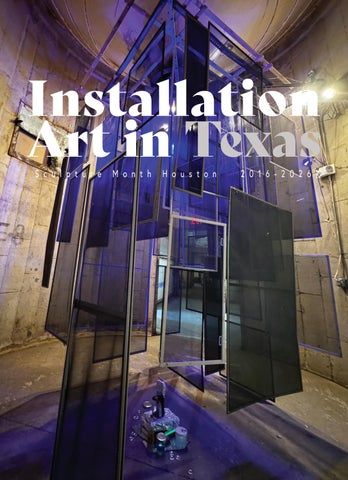
Installation Art in Texas S c u l p t u r e
M o n t h
H o u s t o n
2 0 1 6 - 2 0 2 6
Installation Art in Texas S c u l p t u r e
M o n t h
H o u s t o n
2 0 1 6 - 2 0 2 6
2
Prequel
It all began on a humid Saturday afternoon in July 2015 at the
“Itchy Acres” on the West side of Houston. The place is a large compound, where several artists have their studios and some live there as well. The “Itchy Acres” earned its name from the ever-present hordes of mosquitos and the poisonous sumac that grows everywhere. It was an afternoon of music played by the artists themselves, of philosophizing about art and cold beers. Lots of it. That’s where I met Tommy Gregory, a multi-media artist, who was experimenting with odd objects and trying to re-invent the third dimension. We talked about his projects and about the sorry state of sculptural art in Houston. We quickly came to the conclusion that Houston was letting us all down. The museums are rarely interested in locally produced art, the commercial galleries are shunning 3 D pieces since they were hard to sell, and besides there wasn’t a single dedicated place for showing sculptures. We decided to do something about it. After the beer buzz subsided, reality hit and the enormity of the task became painfully clear. Nine month or so went by with just idle chats and indecisions, when one morning I woke up after a dream and said to myself “Let’s just do it”. I called Tommy and he said: “Let’s go”.
William Flint, an aspiring artist, pushed the button of Steve Parker’s Golden Record Installation...ready, set go! 3
Volker Eisele 4
Born in Germany, Volker Eisele’s early exposure to
Europe’s architectural heritage and museum traditions shaped his enduring engagement with the visual arts. While studying medicine in Munich, he managed Graphikbūchse (Graphic Box Gallery), initiating a parallel career in exhibition-making and curatorial practice. After relocating to the United States in 1971, Eisele completed his training in Anesthesiology at Mount Sinai Hospital in New York before establishing a medical practice in Houston in 1975, which he maintained until 2020. Alongside his medical career, he became deeply involved in Houston’s contemporary art community. In the 1980s, Eisele became a partner in the William A. Graham Gallery, a significant venue for emerging artists associated with the influential Fresh Paint exhibition at the Museum of Fine Arts, Houston (1984). In 1998, he founded ArtScan Gallery, which later evolved, in collaboration with Sean Rudolph, into Rudolph Blume Fine Arts / ArtScan Gallery (2003–2020). Eisele is best known today as the founder, president, and chief curator of Sculpture Month Houston (2016–), an annual celebration of sculpture and installation art. Through exhibitions staged at The Silos at Sawyer Yards and venues across Houston, the initiative has become one of the city’s leading platforms for contemporary three-dimensional art. His curatorial projects often explore ambitious themes involving the human figure, technology, mythology, architecture, and social change. Widely recognized as a curator, writer, and arts organizer, Eisele has played a major role in fostering dialogue around contemporary sculpture and installation practices in Texas. He is also known for leading public exhibition tours and encouraging engagement between artists, students, and audiences through immersive exhibitions and public programming.
Contents
7
Opening Day
9
A Decade of Vision
11
The Silos
12
Introduction by Dr. Anna Tahinci
15
Einführung von Dr. Anna Tahinci
18
From Space to Field
32
Tensile Strength
46
Peak Shift
64
Outta Space
78
Altamira
90
Synaptic
104
The Fragmented Figure
126
Solid State
146
Re-Figurations
170
Singular Visions
184
Colophon
5
6
6
Opening Day
Moroles Police Memorial Jesùs Moroles’ largest sculpture and widely acclaimed masterpiece is Houston’s Police Officers Memorial. It is designed as a granite pyramid rising from the ground, surrounded by four inverted pyramids carved into the earth. On October 6, 2016, a sunny day beneath a cloudless blue sky, the honor guard of the Houston Police Department and local artists gathered to commemorate Jesùs Moroles and celebrate the opening of Sculpture Month Houston. 7
A Decade of Vision
Founded in 2016, Sculpture Month Houston serves as
a dedicated forum for sculpture and installation art. Its mission is to provide artists—primarily from Houston and across Texas—with opportunities to present their work while engaging in a broader artistic dialogue. Held annually each October and November, the program takes place at The Silos at Sawyer Yards, a former rice silo complex transformed into dramatic and unconventional art spaces. Over the past decade, each exhibition has been organized around a central theme, evolving from “From Space to Field” in 2016 to “Singular Visions” in 2026. Every two years, Sculpture Month Houston expands its reach through a citywide Biennial Festival, partnering with more than 40 museums, nonprofit art spaces, commercial galleries, and artist studios to celebrate three-dimensional art throughout Houston. Over its ten-year history, Sculpture Month Houston has presented work by more than 200 artists. While the majority are based in Houston and across Texas, the program has also welcomed artists from neighboring states such as Oklahoma and Louisiana, as well as from major cultural centers including New York City, Chicago, and from Mexico. Although The Silos remain its primary venue, Sculpture Month Houston has curated exhibitions in a range of distinctive locations. These include the decommissioned control tower designed by I. M. Pei at Bush Intercontinental Airport, a vintage aircraft hangar at Hobby Airport, the City Hall Rotunda, the Orton Gallery at the Glassell School of Art, and the Partnership Tower at the George R. Brown Convention Center. Musical and performance events often accompany the exhibitions, enhancing the overall atmosphere. The out-size scale of the silos provides a dramatic backdrop for installation art, yet present a unique challenge for the artists. Visitors are encouraged to enter the silos themselves, creating an immersive and direct engagement with the works of art. Education and public engagement are important to Sculpture Month Houston’s mission. Regular programming includes weekly public tours, held every Saturday at 2 p.m. and often led by the curator, as well as artist talks and panel discussions. Dedicated outreach initiatives also invite college and high school students to participate in guided visits and conversations, fostering a deeper understanding of contemporary installation art. 9
The Silos in 2018
The Silos
Located on the west side of Houston , just minutes from
downtown, the Silos at Sawyer Yards are striking agro-industrial relics pointing to the region’s agricultural past. Built in 1960, they were originally designed to store, process, and distribute rice from local Texas farmers. The introduction of hybrid rice varieties in the 1960s and ’70s dramatically increased global production. As competitively priced rice, particularly from India, flooded the market, many Texas rice farmers were driven out of business. By around 2008, the silos closed and were decommissioned. They stood idle for a number of years, until they were thoughtfully repurposed into unique art venues. In the years since, the surrounding area has transformed into a thriving creative district, now home to a multitude of artist studios and multiple exhibition spaces, most showcasing work by the resident artists themselves. The imposing silos complex now contains 34 distinctive art spaces. Each retains its original cylindrical shape, with a dramatic funnel-like conical ceiling at the center — a remnant of the original grain-release traps that once fed rice into ground-level containers. The silos come in two main sizes: larger ones measure 15–16 feet in diameter and 12–13 feet high (to the center of the cone), while the taller, narrower versions are 10–11 feet in diameter and rise 18 feet. Towering above them are the original 83-foot silo towers, still reinforced with heavy iron rings designed to withstand potential grain dust explosions. Many silos have been left in their raw, industrial state, their walls covered with graffiti and handwritten notes that speak to the hard labor, sweat, and lives of the workers who once filled them. A few have been painted white to offer artists a cleaner, more neutral canvas. Each artist is given their own self-contained cylindrical “stage”, free from interference by neighbouring works. This site-specific environment is especially compelling for installation artists, who can respond directly to the unique architecture, scale, and history of the space. 11
Introduction By Dr. Anna Tahinci
When I relocated to Houston in 2012, I was deeply impressed
by the vibrant arts scene and the vital position of sculpture in the arts ecosystem. Houston, the most diverse city in the nation and the third coast for the arts, instantly appealed to me for being energetic, and having “no zoning”, both literally and metaphorically. As a Greek archaeologist and a global art historian specialized in sculpture and fascinated by layers of cultural and artistic activity, I started mapping out diverse places in Houston where viewers engage with modern and contemporary sculpture and immediately noticed a mix of collecting and non-collecting institutions: the Cullen sculpture garden in the heart of the MFAH campus, where Isamu Noguchi’s design as a “Sculpture for Sculpture” is dedicated to an ongoing dialogue between three-dimensional artworks and sculptural trees, the Menil Art Neighborhood with land artworks, University Campuses (UH and Rice), but also Sculpture in Houston’s airports. I also asked myself the key question “What, if anything, is missing here?” Houston is not a pedestrian friendly city and when it comes to contemporary public sculpture, we usually tend to drive past the artworks. Back then there was no devoted institution to promote local artists in the crosspollination of sculpture and installation art. In 2013 a meeting between Gus Kopriva, Chris Silkwood and other community luminaries initiated the following year the launch of True North, an annual public outdoor installation of 8 sculptures along the esplanade of Heights Boulevard in Houston from March to December. The vision was to advance the accessibility, understanding and enjoyment of contemporary art for the community and visitors outside traditional museum settings by placing large-scale artworks by both established and emerging Texas artists directly along a popular neighborhood walking trail. In 2016 an accidental meeting between Volker Eisele and Tommy Gregory, who both cared genuinely about the artists working in our communities, led to founding Sculpture Month Houston (SMH), filling a gap in the Houston arts ecosystem in terms of site specificity and immersive art experiences for viewers. SMH was envisioned as a dedicated annual forum for the crosspollination between sculpture and installation art. At that time, installation art was already in the ascent and although historically it was a small part of the entire spectrum of art, it became almost dominant at all major international art fairs, like the Documenta or the Venice Biennale. 12
Scouting for a venue to show sculptural installation art, the two curators stumbled on The Silos at Sawyer Yards, that had been converted into 34 cylindrical art spaces a year earlier, and were offered to exhibit there. They quickly realized the challenges posed by the decommissioned agro-industrial architecture: “83 ft tall and just monstrous and the exact opposite of any white cube exhibition space. We very soon concluded, that plain static sculptures, especially on pedestals will have no place at our exhibits.” Volker Eisele and Tommy Gregory founded SMH in 2016 and, partly through success in organizing SMH, Tommy Gregory was offered the position of artistic director at Tacoma Airport in Seattle, which he took in 2018. From that time on Volker Eisele has been the sole curator of SMH. Every year in October-November the 34 decommissioned cylindrical rice silos at Sawyer Yards get transformed into in-situ immersive installations, and every other year SMH expands into a curated biennial festival, with more than forty venues across the city of Houston to celebrate three-dimensional work within the city’s museum and gallery ecosystem. Exhibits were organized on an annual basis, mostly thematically conceptualized with an umbrella-like theme providing necessary cohesion. This year’s exhibit follows a different path and its concept “Singular Visions” asks for a wide variety of artistic visions. When I asked Volker Eisele to share his curatorial philosophy and vision he responded: “Our artists have to take up the challenge of the drama and scale of The Silos by creating works that answer the challenge and become audacious and in a way heroic. All the artists we chose outdid The Silos and created works that were unique and often lifted them to the next level in their artistic careers, as many of them told us. A number of artists we have shown, proceeded to careers in important art venues, some even in Europe.” For a decade SMH has functioned as Houston’s dedicated sculpture-andinstallation infrastructure, a role no other major institution fully occupies. Its site specificity (the industrial silo), thematic variety (including environmental concerns, gender identity or social activism) and continuity give it a curatorial identity distinct from other contemporary art venues. It also has a unique presence in a global context of exhibitions of sculptural installations. The Silos and Site Gallery are among a handful of art venues worldwide, that have been regenerated from decommissioned grain or rice silos. It ranks consistently among the three largest and most distinct art spaces including the Zeitz Museum of Contemporary Art Africa in Cape 13
Town, South Africa and the Kunstsilo in Kristiansand, Norway, the world’s largest collection of Nordic modernism and contemporary art. Skulptur Projekte Münster is a rare venue like the Silos in Houston, that is exclusively dedicated to the presentation of sculpture-and-installation art. Concurrent with the Documenta in Kassel it places contemporary sculptures in public spaces, parks and urban environments and cultivates a dialogue about the relationship between contemporary art, the public sphere, and urban architecture. SMH has had ten years of impact shaping Houston’s identity as an energetic city that celebrates art and artists. This evolution can be traced through SMH key exhibits, memorable installations, artists who emerged or were spotlighted, and most importantly continues to live through the individual and collective memories and experiences of viewers. Cheers to ten wonderful years and to the ten next ones!
14
Einführung Von Dr. Anna Tahinci
Als ich 2012 nach Houston zog, war ich sofort fasziniert von der Energie seiner Kunstszene – und von der ungewöhnlich prominenten Rolle, die Skulptur darin einnimmt. Houston, die vielfältigste Stadt der Vereinigten Staaten und eine eigenwillige „dritte Küste“der amerikanischen Kunstwelt, erschien mir als ein Ort, an dem sich kulturelle Grenzen ebenso leicht verschieben lassen wie räumliche. Eine Stadt ohne strikte Zonierung – im wörtlichen wie im übertragenen Sinne. Als griechische Archäologin und globale Kunsthistorikerin mit einem Schwerpunkt auf Skulptur begann ich bald, die Orte zu kartieren, an denen dreidimensionale Kunst in Houston sichtbar und erfahrbar wird: der von Isamu Noguchi konzipierte Cullen Sculpture Garden im Herzen des Museum of Fine Arts, Houston, das Menil Art Neighborhood mit seinen Land-Art-Arbeiten; die Campusse von Rice University und University of Houston; öffentliche Werke im Stadtraum – bis hin zu den Skulpturen in den Flughäfen. Und doch blieb eine Frage. Was fehlte hier? Houston ist eine Stadt, die sich nur bedingt zu Fuß erschließt. Vieles begegnet uns aus dem Auto heraus, im Vorüberfahren. Auch die öffentliche Skulptur wird damit zu einem flüchtigen Erlebnis: gesehen, aber nicht unbedingt erfahren. Was fehlte, war ein Ort, der sich konsequent der zeitgenössischen Skulptur und Installationskunst widmete. In 2013 entstand True North, eine jährliche Ausstellung von acht Skulpturen im öffentlichen Raum entlang der Esplanade des Heights Boulevard, gegründet von Gus Kopriva und Chris Silkwood. Drei Jahre später, 2016, brachte ein zufälliges Treffen zwischen Volker Eisele und Tommy Gregory zwei Menschen zusammen, die eine gemeinsame Überzeugung verband: daß Houston einen Ort für jene Formen der Kunst brauchte, die sich nicht ohne Weiteres in die vertrauten Kategorien von Skulptur und Ausstellung einordnen lassen. Sculpture Month Houston (SMH) entstand. SMH wurde als Forum für Skulptur und Installationskunst gedacht – für Kunst, die Raum nicht lediglich besetzt, sondern ihn verändert; Kunst, die den Betrachter selbst mit einbezieht und Wahrnehmung zu einer physischen Erfahrung macht. Dass die Installationskunst zu diesem Zeitpunkt international einen außergewöhnlichen Bedeutungszuwachs erfahren hatte, war dabei kein Zufall. Was lange als Randbereich des künstlerischen Spektrums gegolten hatte, war inzwischen zu einer der prägenden Formen zeitgenössischer Kunst geworden wie auf den internationalen Großausstellungen der Documenta oder der Biennale di Venezia zu sehen war. 15
Die entscheidende Frage für SMH lautete daher nicht nur: Welche Künstler sollen wir zeigen, sondern auch: welcher Raum kann diese Kunst hervorbringen? Die Antwort fanden Eisele und Gregory in den ehemaligen Reissilos von Sawyer Yards. Erst ein Jahr zuvor waren die 34 zylindrischen Behälter in Kunsträume verwandelt worden. Ihre industrielle Vergangenheit war noch unmittelbar spürbar. Mit einer Höhe von rund 83 Fuß waren sie das Gegenteil des neutralen White Cube: monumental, vertikal, dunkel, körperlich – Räume, die sich einer einfachen Bespielung geradezu widersetzten. In dieser scheinbaren Unmöglichkeit lag die Möglichkeit. Schon bald war klar, daß konventionelle Skulpturen diesen Räumen kaum gerecht werden würden. Die Silos verlangten nach etwas anderem: nach Maßstab und Bewegung, nach Licht und Atmosphäre, nach Arbeiten, die nicht einfach in einen Raum gestellt werden konnten, sondern aus dieser spezifischen Architektur heraus gedacht waren. Seit der Gründung von SMH im Jahr 2016 sind die Silos jedes Jahr im Oktober und November zu einem Labor für ortsspezifische, immersive Kunst geworden. 2018 übernahm Tommy Gregory die Position des künstlerischen Leiters am Flughafen Tacoma in Seattle. Seitdem kuratiert Volker Eisele SMH allein weiter. Im Laufe der Jahre hat sich das Projekt zugleich über seine ursprünglichen Grenzen hinaus entwickelt. Alle zwei Jahre wächst SMH zu einem kuratierten Biennale-Festival mit mehr als vierzig Veranstaltungsorten in Houston. Was als Auseinandersetzung mit einem außergewöhnlichen architektonischen Ort begann, ist zu einem stadtweiten Netzwerk geworden – einer Infrastruktur für dreidimensionale Kunst, die sich über Galerien, Institutionen, öffentliche Räume und alternative Ausstellungsorte erstreckt. Die Ausstellungen selbst waren dabei meist thematisch angelegt. Eine gemeinsame Idee verband die unterschiedlichen künstlerischen Positionen und gab ihnen einen Resonanzraum. Als ich Volker Eisele bat, seine kuratorische Philosophie zu beschreiben, sprach er über die Herausforderung, vor die die Silos jeden Künstler stellen: „Unsere Künstler müssen sich der Dramatik und dem Maßstab der Silos stellen, indem sie Werke schaffen, die dieser Herausforderung gerecht werden und zugleich kühn und gewissermaßen heroisch sind. Die allermeisten von uns ausgewählten Künstler haben die Silos übertroffen und Werke geschaffen, die einzigartig waren.” Vielleicht liegt genau darin die besondere Bedeutung von SMH: Die Silos 16
sind nicht bloß Ausstellungsräume. Sie sind Prüfsteine. Sie stellen Fragen an Künstler und Betrachter gleichermaßen. Wie groß kann ein Werk denken? Wie verändert sich eine Skulptur, wenn der Raum selbst Teil ihrer Bedeutung wird? Was geschieht, wenn der Betrachter nicht vor einem Objekt steht, sondern in eine Arbeit eintritt? Über ein Jahrzehnt hinweg hat SMH eine eigene Infrastruktur für solche Fragen geschaffen – eine Infrastruktur, die in Houston in dieser Konsequenz und Kontinuität ihresgleichen sucht. Auch im internationalen Kontext ist diese Verbindung von Industriearchitektur und zeitgenössischer Kunst bemerkenswert. The Silos at Sawyer Yards und Site Gallery gehören zu einer kleinen Gruppe von Kunstorten, die aus ehemaligen Getreide- oder Reissilos hervorgegangen sind. Ihre industrielle Geschichte ist nicht ausgelöscht, sondern bleibt als physische und geistige Schicht präsent. In dieser Hinsicht stehen sie in einem faszinierenden Dialog mit Orten wie dem Zeitz Museum of Contemporary Art Africa in Kapstadt oder dem Kunstsilo in Kristiansand, Norwegen, ein zeitgenössisches Kunstmuseum für moderne Nordische Kunst. Eine andere, konzeptuell verwandte Referenz ist Skulptur Projekte Münster. Seit Jahrzehnten untersucht dieses internationale Projekt die Beziehung zwischen Skulptur, öffentlichem Raum und urbaner Architektur. Die Geschichte von SMH lässt sich in seinen Ausstellungen erzählen, in den Künstlern, deren Arbeiten hier neue Sichtbarkeit erhielten, und in den Karrieren, die von diesen Begegnungen weitergeführt wurden. Doch sie lässt sich ebenso in etwas Flüchtigerem finden: in den Erinnerungen der Menschen, die durch einen Silo-Raum gegangen sind und für einen Moment die vertraute Wahrnehmung von Kunst verloren haben. Vielleicht ist das die nachhaltigste Leistung von Sculpture Month Houston: nicht allein Ausstellungen geschaffen zu haben, sondern Erfahrungsräume. Skulptur ist letztlich eine Kunst der Begegnung. In diesem Sinne ist die Geschichte von SMH auch die Geschichte einer Stadt, die gelernt hat, ihre Kunst nicht nur auszustellen, sondern zu erleben. Zehn Jahre sind dafür erst der Anfang. Auf die ersten zehn Jahre – und auf die nächsten zehn.
17
2016
1
18
From Space to Field Adela Andea Joanne Brigham Dylan Conner Jo Ann Fleischhauer Jeff Forster Wei Hong Michael Kennaugh Paul Kittelson Sharon Kopriva Jessica Kreutter Matt Kubo When we were offered to exhibit in the Silos at Sawyer Yards Jonathan Leach the enormity and imposing size of the architecture was intimidating. It Jesse Lott was clear from the outset, that this was no ordinary “site-specific” venue, rather it presented a uniquely challenging environment. The overwhelmJoe Mancuso ing scale demanded a bold and considered response from both the art David Medina and the artists who created it. In our first exhibit, we experimented by including works that Kyle Olson were simply discrete sculptures, some placed on pedestals, that easily Mari Omori could be found in any white-cube gallery. Almost immediately, we realized that the concept of installation art is profoundly different from the Chris Sauter static presence of a traditional sculpture. argue that the most important actor in this drama is the Jay Shinn visitor. Some Immersed in the dialogue between the architecture and the Troy Stanley sculptural medium, the viewer becomes an active participant in a three ecosystem. Here, sculptural objects are only one, albeit a Ed Wilson dimensional very important element within a unified environment. Complimentary Ben Woitena effects often include sound pieces or whole sonar landscapes, videos and photographic assemblages, performance art, found objects and a wide variety of materials that expand beyond classical marble and bronze. Installation art is rarely commercially viable. It exists largely outside the conventional art market and defies easy commodification. The temporality and impermanence of installation art requires sincere commitment from the artist, as most of the works are non-collectible. In the end, all that remains are the memories, photographs, and videos of what once was a lively, glorious installation.
19
Sharon Kopriva
Remnants de Muses
Rope and Mixed Media
20
21
Dylan Conner
A Conversation with Gravity
S t e e l , c o n c r e t e , p l a s t e r.
The entire scientific community would love to have a conversation with gravity — the most elusive of fundamental forces. It took until 2015 to obtain the first direct evidence of its existence: the detection of gravitational waves. Even today, gravity is still not integrated into the framework of quantum physics. Yet here is an artist who has managed a credible and light-hearted conversation with this mysterious force. Dylan Conner’s bulbous emanation, constructed from a steel matrix and concrete, pushes through an opening in the conical silo ceiling and floats irreverently above the ground, seemingly weightless. It is one of the first works to directly challenge the gravitational heft and monumental scale of the silo towers. With this piece, the artist throws down the gauntlet for future silo artists to match this feat, or better yet, surpass it. 22
23
Joanne Brigham
Portable Biome What would you do if a terrestrial catastrophe struck, leaving you facing a slow and painful extinction? Real catastrophes of this magnitude could actually happen in today’s precarious world. One could imagine a meltdown triggered by a looming environmental disaster, atomic warfare, or a deadly, highly transmissible virus. What can you do? Joanne Brigham has an answer: prepare yourself with a portable biome—a cocoon-like shelter that is self-sustaining and fully protected. You may be able to survive on a temporary basis or even long-term. 24
25
Jeff Forster
The Fleeting Moment of Success Space A Vi si on of Entropy
26
27
27
Jay Shinn
Double Migration
Wo o d a s s e m b l a g e w i t h a c r y l i c p a i n t a n d p r o j e c t e d l i g h t 28
29
Joe Mancuso
Chandelier
T h e “c r y s t a l s ” o f t h e c h a n d e l i e r a r e m a d e with roses dipped in concrete 30
31
2017
2
32
Tensile Strength
Kelly Anderson-Staley Jill Bedgood Lily Cox-Richard Celia Eberle Laurie Frick Alex Goss/Alexa West Buster Graybill Tommy Gregory Tensile Strength refers to the physical property of a material Joseph Havel and its breaking point or resistance to stress. The Silos were constructed Ken Little with exceptional resilience to withstand the weight of mega tons of rice Beili Liu and to contain the force of a potential grain-dust explosion. The walls consist of concrete blocks reinforced by containment rings made of Tierney Malone armored iron rods, placed at varying heights. Mark McCoin The first time a visitor steps into the dark caverns of the Silos, Sherry Owens the sheer scale and labyrinth-like layout can be disorienting, or even daunting. This highly charged environment may conjure archaic mytholPatrick Renner ogies: Orpheus descending into the underworld in search of Eurydice, or John Salvest intruders entering the realm of the Minotaur. Dark caves have long been Cameron Schoepp the preferred sanctuaries of sorcerers. As the visitors immerse themselves in the space and absorb the art, they become an active particiJeff Shore/Jon Fisher pant in a drama of stark poetry. Kaneem Smith The soaring silos with their grand theatricality offer a spectacular Randy Wallace “arena” for three-dimensional art. Their post-industrial charm and character exerts a powerful seduction, radiating an aura of raw authenticity.
Metaphorically, the title Tensile Strength refers to the stamina and resilience required by both, artist and visitor, the fortitude to wrestle with such a challenging, uncompromising space. 33
Beili Liu
Lian
Salt, string, soundtrack, speakers, hardware 34
35
Sherry Owens
Every Breath You Take
Ta b l e a u x w i t h n a t u r a l w o o d , p l a s t i c t o k e n
Every Breath You Take relates to deforestation and the loss of habitat. It will increase the release of carbon and other harmful greenhouse gases into the air we breathe when the forest is clear cut and burned. The woodlands and forests in the past were conceived as an inexhaustible resource across the globe, but now we have learned that they are a fragile ecosystem and need to be protected. SO 36
37
Tierney Malone
Jazz Church of Houston
Vi d e o in stal l ati on , v ar i ou s d o c um e nt s
The Jazz Church of Houston is an action project by artist and DJ Tierney Malone, to create an institution dedicated to collecting and sharing the history of the Houston jazz scene, past and present. As Lizette Cobb, the co-founder of the Texas Jazz Archive said “You…can’t talk about jazz in America without talking about Houston.” 38
39
Cameron Schoepp
Paint/Lift/Line
B a r r e l w i t h c o l o r, c h a i n , m e c h a n i c a l h o i s t
Paint/Lift/Line repeats a cycle: the chain submerges into a barrel of refuse paint, gathers color while sinking, then lifts to leave a dripping line between barrel and hoist. Each lift records time and depth through accumulating paint, gradually mixing all colors into one inevitable, predictable hue. 40
41
Mark McCoin
Uprising
piano sound board, rotary tools
When Mark McCoin initially entered one of the silos, he was struck by the compelling ambience of the space. Because of the cylindrical structure, reverberant sound echoes bounced smoothly of the curved walls and seemed to rise upwards. Inspired by this rich sonic atmosphere, he retuned a piano’s harp strings to the silo’s resonant frequencies. Sustained by rapidly spinning motors, the harp would erupt into rich harmonic outbursts that resonated with the entire silo space. 42
43
Tommy Gregory
Assumption
Nickel-plated disc, 2000 watt light source
Assumption: a brilliant light bouncing off a nickel-plated disc – light overcoming the darkness of the silos 44
45
2018
3
46
Peak Shift
Francis Bagley Leticia Bajuyo Jimmy Canales Alicia Eggert Charlie Hoey The Peak Shift effect is a psychological phenomenon in which an organism responds more strongly to an extreme version of a stimulus Hillerbrand than to the original. In art, this helps to explain why humans are often +Magsamen drawn to exaggerated forms, like caricatures or distorted figures rather Liss LaFleur than to strictly realistic representations, as the brain finds the intensified cue more stimulating. As Picasso famously observed about his own Hills Snyder figurative contortions, “art is the lie that reveals the truth”. Jessica Stockholder As we became more confident and also more audacious with the Kamila Szczesna exhibitions at the Silos, we began inviting artists capable of crafting truly monumental, large-scale installations. These increasingly ambitious James Talambas works felt like a direct response to the sheer scale of the Silos Jeff Williams themselves. Our visitors and the local press responded with genuine Ann Wood enthusiasm. Leticia Bajuyo, for instance, strung together 8000 CDs to evoke
the image of an Event Horizon. Kamila Szczesna transformed four large Silos in Memories of Transfigured Matter with organically conceived images. Jessica Stockholder contributed the 20 foot suspended assemblage Strings Attached Too. At major international art events, like the Documenta in Germany or the Venice Biennale in Italy, installation art occupies more than half of the exhibition venues. The growing popularity of ever-larger works may be a contemporary manifestation of the Peak Shift effect. 47
Jeff Williams
Cone Bottom Peel
Latex rubber mold
48
49
Jessica Stockholder
Strings Attached Too
Va r i o u s c o n s u m e r a r t i c l e s , c r a t e s , c h a i n s , c a b l e t i e s
Jessica Stockholder is an internationally renowned artist known for expanding the boundaries of painting into three-dimensional space. She creates vibrant sculptural assemblages using everyday consumer goods and building materials. For this project, we suspended a cable from the top of an 83-foot silo, attaching it to a 20-foot-long sculptural assembly that hovers just above the ground. Inside the dark post-industrial silos, her vivid colors come alive under spotlights, transforming the space into an otherworldly floating environment. 50
51
Hills Snyder
The Misery Repair Shoppe
C h a l k , m e a t g r i n d e r, d r a w i n g o f a Ve t r u v i a n f i g u r e , a u d i o l o o p
The Misery Repair Shoppe is a modern interpretation of the famous Dover cliff scene in Shakespeare’s King Lear. The repairman in his black undertaker garb works toward transformation: his own and that of others. He atones for his transgressions. “Sentenced here am I for my writing crime” says his verse, yet he sits at the table willingly grinding the instruments of his error to dust, perhaps to obscure the very evidence of his conviction. 52
53
Kamila Szczesna
Memories of Transfigured Matter
C l ay, w o o d , b a l l o n s , s u s p e n s i o n s
The installation consists of biomorphic forms of varying scales. Some float suspended from the ceiling, while others grow organically from the floor. Floor pieces are built around a wooden armature wrapped with inflated balloons; suspended forms use balloons as their sole internal structure. Fabric is draped over the balloons and coated with liquid clay (slip), creating lightweight, unfired sculptures strong enough to last the exhibition. Like silos, which are steeped in memory, the work reflects the impermanence of the paused moment. The air in the balloons will slowly escape, the fragile clay crust will crack, and everything will return to circulation. Placing the installation in the silo deepens this shared resonance. 54
55
Leticia Bajuyo
Event Horizon CDs, cable ties
Leticia Bajuyo’s Event Horizon features over 8,000 donated CDs, strung together with cable ties, forming a shimmering tunnel-like installation that visitors can walk through. The title refers to the boundary around a black hole—the point of no return beyond which nothing, not even light, can escape. If Earth were compressed into a black hole, it would shrink to the size of a marble. Information crossing this horizon is not destroyed but preserved and eventually released through Hawking radiation in scrambled form— suggesting that everything from Mozart to Elvis could theoretically endure forever, encoded in quantum correlations. 56
57
James Talambas
But the doorways into thanks James Talambas is a Fort Worth-based artist and recording studio owner who creates site-specific sound installations and multi-dimensional sculptures. At the Silos, he has transformed three adjacent, low-light silos into a sensory-deprived environment. Using transducers attached to the metal cones, he captures and amplifies the natural vibrations of the silo walls, blending them with his own body frequencies to create a unified sonic composition. The result is a deep, meditative drone that shifts subtly as visitors move through the space. Pressing your body or hands against the walls reveals gentle vibrations—each spot offering its own distinct resonance. The entire experience is meditative in nature. 58
59
Liss LaFleur
Bang Bang
Synthetic fringe panels, projectors, audio equipment
Bang Bang is part of an ongoing series of video serenades, through which the artist examines identity at the intersection of pop culture and queer histories. It is an immersive installation that blends video, performance and synthetic fringe. In this piece, a single figure is projected onto five hanging curtains of yellow fringe suspended from the ceiling. Like a bird in a cage, the figure lip-syncs the original lyrics of Sonny Bono’s 1975 song “Bang Bang” in a continuous looping performance. As the projection passes through the moving fringe, the figure’s body undergoes a vacillating distortion, creating an uncanny Lynchian effect that feels both luminous and eerily unpredictable. 60
61
61
Jo Ann Fleischhauer
Trapping Time Trapping Time by Jo Ann Fleischhauer was one of the most ambitious projects Sculpture Month Houston has ever undertaken. The exhibition was installed inside the decommissioned I.M. Pei control tower at Houston Intercontinental Airport, near Terminal 1. Built in 1969 as an architectural prototype, the tower’s innovative design was later replicated in 23 similar control towers around the world. Trapping Time explored the ancient navigation systems of mariners and the modern guidance systems of today’s pilots through striking images of star formations in the night sky. The control tower’s windows were covered from the inside with painted and stenciled images applied to transparent plastic film. Powered by a generator, the internal lighting caused the images to glow dramatically, making them visible from almost everywhere - including to pilots and passengers on landing and departing aircraft. 62
63
2019
4
64
Outta Space
Suzanne Anker Nicole Anona Banowetz Margaret Craig Margaux Crump Lina Dip Megan Gafford Abhidnya Guge Dave Greber The title Outta Space is inspired by Van Halen’s 2012 song Ryan Hawk of the same name, from their album A Different Kind of Truth. The lyrics deliver a satirical take on overcrowding, resource depletion, and enviCindee Klement ronmental collapse - declaring that humanity has run out of living space. Felipe Lopez The only choice is to leave the planet and look for another home someSteve Parker where in the vastness of the cosmos. The motley Van Halen crew then Jonathan Read departs in search of a new habitat in a spaceship with a bumper sticker proclaiming “Go home, the Earth is full.” Henry G. Sanchez The “Outta Space” project unfolds in two complimentary Margaret Smithers- parts. The first explores a broad range of works that address pressing Crump environmental crisis and urgent socio-political challenges. The second part shifts to imaginative visions of Alternative Worlds that the voyaging Patrick Turk spaceship crew may discover and ultimately choose as their new home. This voyage mirrors the journey of the Little Prince in Antoine de Saint-Exupery’s classic tale, who traveled from one planet to the next, encountering wondrous worlds and their inhabitants along the way. 65
Nicole Anona Banowetz
The Mother
Fabric, air inf lators
The artist creates soft inflatable sculptures, enlarging microbes that are mostly invisible to the naked eye to mega macro-world dimensions 66
67
Patrick Turk
Shapeshifter
Sculptural paper collage
The biota of a highly advanced, silicon-based civilization in a parallel dimension have reached the limits of their physical development. In order to evolve new life forms from their own planet, the leaders of this civilization search to increase the physical and emotional diversification of its physiognomies. A fleet of shapeshifting reconnaissance entities has been assigned to explore and survey planets containing carbon-based life forms in adjacent universes. By creating a wormhole hub, or stargate plethora, this highly advanced civilization has solved the problems associated with interdimensional travel and signal transmission. Due to the abundance of carbon-based lifeforms on Earth, this planet had been selected as one of hundreds of planets to conduct assimilation surveys throughout our universe. The reconnaissance unit is slowly spinning inside a silo filled with an array of wormhole portals leading to multiple alternate dimensions. It receives its visual input through two complex teleidoscopic spheres that function as biometric recorders of organic beings. As it spins, it will collect data based on the reaction and emotional response of visitors. All data from test site Earth and other terrestrial locations will be sent back to the creator’s home planet for further analysis of life forms throughout the multi-verse. The transmission of this information will leave data remnants on the walls of the silo, giving visitors a glimpse of themselves as seen through the eyes of an alien civilization. Patrick Turk is known for his insanely complex paper collages and installations, exploring the sciences and science fiction. He lives and works in Houston. 68
69
Suzanne Anker
Astroculture Suzanne Anker is a pioneering Bio Art artist whose work explores the intersection of art and biology. She investigates how nature is being transformed in the 21st century, focusing on genetics, climate change, species extinction, and toxic degradation. In 2012, she founded the Bio Art Lab at the School of Visual Arts in New York City, a collaborative space for artists and scientists. One of its key projects is Astroculture, currently on exhibit at the Silos. Started in 2009, Astroculture is inspired by NASA’s plant-growth experiments on the International Space Station. Seeds are planted in peat pots without pesticides and grow under special lighting, completing a full cycle—including seed production—without pollinators like bees. This research is vital for food production both on Earth and on future colonized planets. Anker’s work has been exhibited in major museums worldwide. She has curated influential Bio Art exhibits such as Biota, Remote Sensing, Rainbow Loom, and Origins and Futures. She is also the author of The Molecular Gaze: Art in the Genetic Age and The Greening of the Galaxy. 70
71
Margaret Craig
The Great Trash Reef
Recycled materias, mixed media
Margaret Craig transforms plastic trash collected from Texas beaches and her household into a vivid underwater replica of the world’s dying coral reefs. As Professor and Chair of Printmaking at the Southwest School of Art in San Antonio, Craig uses innovative printing techniques to turn discarded plastic into vibrant, surreal images of sea creatures and imaginary life forms—creating an artificial ecosystem. Viewers walk through the aquarium-like reef, confronting the environmental impact of plastic waste. Giant garbage patches in the Pacific, some the size of Texas, break down into neurotoxic particles that enter the marine food chain and potentially our own food supply. 72
73
Margaret Smithers-Crump
A Question of Balance
Plexiglas, polycarbonate, mixed media
Margaret Smithers-Crump’s work explores the vulnerability and interconnectedness of Earth’s ecosystems. In the late 1990s, she began using recycled plexiglas and polycarbonate, drawn to their glass-like fragility — a metaphor for the precariousness of life. Each large, circular form represents a key natural cycle: the biosphere: interconnected land organisms, the hydrosphere: oceans as the source of life and food chains, and the carbon cycle, a fundamental process sustaining all ecological systems. 74
75
Eduardo Portillo James Surls Sharon Engelstein
Pitch and Roll Pitch and Roll was part of the 2019 exhibition cycle of Sculpture Month Houston and was presented at the Hangar at the 1940 Air Terminal Museum at Hobby Airport. This installation brought contemporary sculptures into direct dialogue with classic aircraft. It intimately connects the art to human industry and technical prowess. Hangar artists responded to this challenge by creating works of art of outsize scale and imaginative diversity, that hold their own against the fabulous flying machines. 76
William Cannings Dylan Connor Sharon Engelstein
Orna Feinstein Alex Larsen Steve Murphy
Eduardo Portillo Troy Stanley James Surls 77
2021
5
78
Altamira
Ariel Bowman Robin Baker Christyn Overstake Justin Boyd Elaine Bradford Emily Link The Primal Urge to Create. Around 17,000 years ago, preSusan Budge historic people in Altamira, Spain, created magnificent cave paintings Larry Graeber that remain famous today. Similar masterpieces were found in the caves of Lascaux or Chauvet in France. These ancient works predominantly Suguru Hiraide depicted land-based animals like mammoth, bison, deer, aurochs and Allison Hunter horses. Human figures appeared rarely and when they did, they were Kathy Kelley rendered in schematic, abstracted forms rather than realistic detail. The paintings were executed with natural pigments like charcoal for black, Cindee Klement red and yellow ochre, and hematite. Caves have always been regarded Sue Anne Rische as mysterious habitats of sorcerers or as entry point into the underworld John Runnels and the subconscious. Today, our contemporary artists working in the cavernous, urban Shawn Smith “cave-like” environment of the Silos reimagine themselves as modern-day Anthony Suber cave painters, but armed with the entire array of current technology at Damon Thomas their disposal. Their goal is to connect prehistoric art to modern sensibilities, creating a dialogue across millennia. Nestor Topchy Certain prehistoric themes resonate in our time: the extinction of species, yet present-day efforts of ecological regeneration and rewilding, the dawn of storytelling and literature around the campfires of the African savannah and the prehistoric caves of Europe, and the threat of losing literal fluency posed by the digital age. The work “Contact” by Damon Thomas imagined the fictional moment where wolves and humans cooperated for their mutual benefit and gifted us “man’s best friend”. 79
Damon Thomas
Contact
Wo o d , f u r n i t u r e p a r t s , p a i n t , a r m a t u r e s 80
81
Shawn Smith
Un-Natural Influence
Plywood, ink, acrylic paint, cast resin
One of the animals depicted in prehistoric cave art, including inside the caves of Altamira, is the aurochs — a massive wild ancestor of modern cattle. The species went extinct roughly 400 years ago, and today there are active efforts to bring it back through retro-breeding. The modern bull is a direct descendant of the aurochs, and its impressive size and fierce temperament gives us a good sense of what its ancient ancestor must have been like. 82
83
Cindee Klement
Endangered knowledge: the soul of humus
We l d e d S t e e l , l a t h , i n d i g e n o u s c l a y, n a t i v e d r i e d p l a n t s a n d b r o n z e
Bisons appear frequently in European cave paintings. They likely crossed into North America via the Bering land bridge around 500,000 years ago and evolved into the iconic American buffalo. In the late 18th century, an estimated 60 million buffalo roamed the prairies. By 1886, their numbers had plummeted to just 541 animals. For Cindee Klement, the buffalo symbolizes regenerative power. Through conservation efforts, the population has recovered to about 500,000 today. This life-size monument, built from welded steel, lath, coastal prairie native plants honors that resilience 84
85
Robin Baker & Christyn Overstake Critically Endangered: Kemp’s Ridley Sea Turtles
Silo 1: cast bronze, fabricated aluminum, fishing nets S i l o 2 : s l i p c a s t p o r c e l a i n , s t y r o f o a m c o o l e r, f o u n d d e b r i s
This installation highlights the critically endangered Kemp’s Ridley Sea Turtle and the dedicated efforts to save it from extinction. Its decline stems from habitat loss, poaching of turtles and eggs, and bycatch in commercial fishing. Restoration initiatives, led by marine conservancies and multiple agencies are working to reverse this decline. Through their work, the artists transform scientific data into powerful visual experiences, making the loss of each species feel immediate and deeply tangible. While most animals painted on prehistoric cave walls are land-based, some Mediterranean shoreline caves feature sea creatures. The most remarkable is Cosquer Cave near Marseille, France, whose entrance lies 121 feet underwater and is accessible only to divers. There, ancient artists depicted fish, seals, and auks — flightless birds related to penguins. 86
87
John Runnels
WILD SILENCES - Certificates of Presence
Bookshelves, wrapped books
Literacy began around the campfires of the African savannah, where our ancestors spun their tall hunting tales. From the clay tablets of The Epic of Gilgamesh in ancient Mesopotamia to Gutenberg’s printing press, the book stood as a beacon of human culture and civilization. In the age of digital media and artificial intelligence, the physical book has become increasingly quaint and marginal. The Little Prince has yielded to Super Mario. Volumes in this exhibit are now carefully wrapped and shelved, preserved for the unlikely hope of a literal renaissance. This installation mourns the twilight of an era—the intimate pleasure of reading books and owning them. 88
89
89
2022
6
90
Synaptic
Christie Blizard Laurie Frick Jeff Gibbons Dave Greber Stephan Hillerbrand Mary Magsamen The Human brain is the least understood and the most mysterious of all organ structures. The neural networks seem to perform Hillary Holsonback the most complex cognitive tasks effortlessly and at lightning speed. Ronald L. Jones These functions are all produced by a tangled web of roughly 100 billion Sharon Kopriva neurons or nerve cells, supported by a network of nearly 100 trillion synapses. John Berry These synapses are responsible for the neuron-to-neuron Meredith Jack transmissions, they stimulate and inhibit, they connect and sever, while Dameon Lester constantly forging new pathways and networks, a striking analogy to the very process of creating art. Beili Liu Yet the main mystery of the brain remains: how can basic chemicals Virginia Luna- like carbon, hydrogen, oxygen and a few others combined with mere Montgomery electric sparks be transformed into ephemeral images, thoughts or feelings? How is that possible? The sciences have no satisfying answers. Chris Sauter The conceptual leap from a constellation of biochemical reactions to Matthew Steinke colorful images or deep emotions is simply beyond the current scientific Brad Tucker knowledge base. So, we asked our artists to make an end run around this impasse. Meredith Tucker After all, art is not bound by scientific dogma or the rigid constraints of a strict logic. Artists thrive in the liminal space between fiction and reality. They are eager to share their creative interpretations and unorthodox insights and often find humor in these inherent contradictions. Many of their installations and sculptures carry a lighthearted note. They are the intermediaries working “between a thought and a thing”. 91
Chris Sauter
Gazing Ball A mirrored Dopamine molecule reflects distorted images from projected information 92
93
Laurie Frick
Your Brain on Music
Fired glass pieces of various dimensions and colors, suspensions
The brain never sleeps. It’s a constant beehive of activity, 24/7. Though it makes up just 2% of body weight, it consumes 16% of the body’s energy. Its billions of neurons and trillions of synapses generate around 80,000 thoughts a day—most of them subconsciously and they are racing at an impulse speed of 258 miles/hour. Your Brain on Music, is a stunning tribute to the stirring brain and its electrifying dynamism. Thousands of fired glass pieces fill a giant “cranium” to capacity, while spotlights make the pieces transparent and glittering. As visitors walk a narrow path through the brain, the pieces become agitated and they sparkle, twinkle and glisten, enveloping the visitors in an immersive, overwhelming sense of the brain’s tireless activity. 94
95
To H o l d . To h o l d o n . To h o l d o n t o . C r y s t a l l a u g h t e r, s i l e n c e d , f o r g o t t e n . Memories, as if dreams, faded. What should never happen happens, and again. Our teachers teach our children to hide under school desks. How should we tr y to start to understand, with this mind and this body that seem to have disconnected? How do we live with our agonizing
Beili Liu
knowing that the impossible, m o s t l i k e l y, w i l l h a p p e n a g a i n ? L e t g o , t h e y s a y. Move on, we must. Who now to hold? How to hold on? What to hold on to?
HOLD ON
S e a m s a n d h e m s o f c h i l d r e n’s c l o t h i n g , r e b a r, s a f e t y p i n , s c e n i c p a i n t
In the aftermath of yet another school shooting in Uvalde, Texas, HOLD ON is a heart-wrenching response to the tragic loss of innocent lives of children through senseless school shootings. HOLD ON is composed of abstract lines of stark red—seams and hems cut from children’s clothing—the flesh of the clothes absent, with only the outlines of the absence remain. The entangled lines cascade and blend into to one another, losing their individual forms. Their collective force pulls and bends the two rebars on either end, which arc towards the center. The industrial materials speak to the harsh reality of our society and the divergent opinions of the deep-anchored beliefs contradicted by the unbearable weight of ongoing trauma. BL 96
97
Dameon Lester
White Matter
P l y w o o d , a c r y l i c p a i nt , w o o d e p o x y, f i b e r g l a s s t a p e , a q u a r e s i n 98
99
Stephan Hillerbrand + Mary Magsamen
Electricity Stephan and Mary are playing with fire—not real fire, but an electrical burning called fractal burning. These branching discharge patterns resemble trees and are called Lichtenberg figures. As the figures are described as tree-like, another comparison comes to mind: they resemble dendrites, the branching parts of neurons or nerve cells. Dendrites receive information from synapses and deliver it into the nerve cell. This branching structure is called Dendrite Arborization or Dendritic Branching. The artists created a 360-degree live spectacle of dendrites in action—with all the sounds and fury of a hyperactive brain that never sleeps. Viewers stand in the center and experience brain activity from the inside. 100
101
101
Virginia Luna Montgomery
Eye Hear Honey & Mind Stone
HD v ideo, 108 lbs. stone, memor y foam.
Eye Hear Honey is an experimental video work, that explores panpsychic metaphysics through gesture, texture, and sound. Visually, the work features the artist’s own blinking eye peering out from a dark void, as her gaze is rhythmically disrupted by digital glitches and drips of bubbly honey. Sonically, the work features a hand-made composite of chimes, bells, birdcalls, rainstorms, drills and mechanical whurrs, that together take after VLM’s own cognitive, synesthesia-laden experience of the phantom sounds phenomenon. Collectively, these visual and sonic elements posit that there is a panpsychic relationship between the human mind and the echoing consciousness of the material life. VLM Mind Stone is a stone-on-foam sculpture that offers anybody – stone or human – a soft place to rest. While memory foam remembers nothing but itself, in contrast, a stone never forgets. VLM When the mind stone aligns with the blinking eye, that fleeting symmetry may stir poetic resonances and a sense of potentiality. 102
103
2023
7 104
The Fragmented Figure
Frances Bagley Rabea Ballin Jimmy Canales Elizabeth Chapin Colette Copeland The Sleep of Reason. Every era has its own defining image of the human figure that reflects its social and cultural paradigms. The Jeff Gibbons Venus of Milo and the David of Michelangelo were aesthetic ideals of Suguru Hiraide the classic Greek and Renaissance period respectively. Then at the outAllison Hunter set of modernism, Cubism radically changed the image of the figure. “Picasso re-invented anatomy” wrote Peter Selz, an influential mid-century Jessica Kreutter curator at MOMA. The de-constructed, fragmented, and subsequently Yuliya Lanina reconstructed figure became the dominant symbol of the modern Nadin Nassar condition. Why has the Fragmented Figure endured in the 21st century? Steve Parker Selz linked the continuous distortion of the figure to his generation’s Kris Pierce anguish, the lingering trauma of World War II and its cold war aftermath Hugo Santana under the threat of a nuclear confrontation. The sobriquet “disquiet man” was coined to refer to the vexing complexities of modern life, its Sarah Sudhoff insecurity, and the feeling of solitude and anxiety. James Sullivan The artists here provide a wide spectrum of perspectives as Jesse Lott they try to formulate visual metaphors that makes this fractured reality emotionally accessible. Rather than presenting a methodical survey, the show explores emerging trends and trajectories. The title The Sleep of Reason pays tribute to Francisco Goya, often described as an “Early Modernist”. In his visionary etchings like “Los Caprichos” and the “Disasters of War” Goya chronicled the social turmoil and human suffering of his time. Through violently deformed and grotesquely mocked figures, he delivered a scathing critique of the corrupt society around him. 105
Jimmy Canales
Zuzan
Wo o d , c a b l e t i e s , h a r d w a r e , a c o u s t i c f o a m
Zuzan marks the current pinnacle of Jimmy Canales’ exploration of the human figure. The project originated in 2019 at the Künstlerhaus Bethanien in Berlin and continued in 2020 with the exhibition The Line Layer at the Contemporary at Blue Star, San Antonio. In this body of work, Canales developed a universe of robotic figures, several of which were incorporated into the imposing form of Zuzan. These absurd characters, driven by complex motivations and conflicting desires, as the artist describes them, include Chromito, the Resistor, and the Collector to name a few. Rooted in Hispanic tradition, the statue of Zuzan functions as part of a humanoid altar and may be considered a patron saint for future avatars in which the distinction of human and machine has blurred. The work points toward an uncertain and unsettling future. For the present, these figures remain inactive, safely enshrined behind glass. For how long? 106
107
Nadin Nadin Nassar Nassar
Welfare Welfare check check
S t eSe tl e, ewl ,o owdo,o dw,i rwe i, r pe l, aps lt ae sr t, esri, l isci ol inceo,n se p, rsapyr apya ipnat i n t
TheThe three three littlelittle piggies piggies blewblew the the house house down down 108 108
1 0190 9
Kris Pierce
The Reality Show
Vi d e o In stal l ati on
The Reality Show explores mimetic desire- how we copy what we desire- in virtual spaces and through the rise of AI. The central figure examines how game-like logic on digital platforms manipulates emotions to control online relationships. As our lives and self-image shift online, tech companies use these systems to shape how we connect and present ourselves. AI deepens the divide by making it effortless to create fake images, videos, and conversations, blurring what is real and what is not. The main male character exists as the “Sandman” in a dream-like digital world. A chorus performing the Chordettes’ “Mr. Sandman” emphasizes how hard it has become to separate fact from fiction, and reality from illusion. 110
111
Jessica Kreutter Everywhere I am part of everything is a part of me
P o r c e l a i n , g l a z e , l u s t e r, w o o d , d i r t
It starts with dirt. Dirt is you, will be you, and has been you. Each shallow footprint you leave follows the seemingly erased paths that humans have walked for thousands of years. Your movement follows that of invisible animals, multitudes of creatures coming before and after you. Remember the weight of all those bodies, their movement, that presence that has carved earth. JK 112
113
Jeff Gibbons
Ladder Nipples (Nipocchio)
Wo o d e n l a d d e r, w i r e , c o n s t r u c t i o n . p a p e r - m a c h é 114
115
Sarah Sudhoff
Line of Gravity. Gravity and Tender
Vi d e o in stal l ati on , te x ti l e s , cl oth e s
Sarah Sudhoff uses her own body image as a matrix for self-reflection through video and performance to explore the subject of domestic violence. Based on personal experience her work portrays a journey for redress and re-adjustment to claim one ‘s own power again. 116
117
Jesse Lott
Posthumous Installation Jesse Lott (1943 - 2023) was a legendary “urban frontier artist”, who worked with the materials the urban community provided: found materials like wire, rebars, broken glass, furniture legs, metal bed frames and springs, tree roots and branches. “Transforming trash into a classical figure is a political action. Rich people don’t have time to go through the garbage, their job is to make garbage.” JL 118
119
Hugo Santana
Subject to Functional Replication
Wo o d , e n a m e l , c o r d s , v i d e o
The first tools were crafted about 3 million years ago and were found at archeological sites in Kenya. They were simple scrapers, cutting tools, or hand axes, yet they give testimony of the cognitive ability, dexterity, and innovative potential of early humans. Tool making and humans are inextricably linked. 120
121
Mark Mc Coin and Nathan Wheeler
ROZ “Roz” or Robotic Resonance is an interactive and durational sonic art piece that features a piano harp (metal harp and strings of a piano), 2 robotic arms holding spinning felt and an interactive computer control. Strings are tuned to the resonant frequencies of the exhibition venue and when activated, create a remarkable soundscape of contrapuntal harmonic relationships. Visually evoking part sci-fi operating table and part antique instrument, its sounds are unexpected, ethereal, and glacial in pace, matching the unfamiliar but still resonant structure of the work. “Roz” may be part of the initial phase of an evolutionary development, whose endgame is unpredictable and unknowable. Aiming towards a degree of autonomy and latitude, the unexpected, creative solutions may lead to an eventual self-activation and the ability to make its own choices. MM 122
123
Yuliya Lanina
Motherland
Vi d e o in stal l ati on
My father was from Ukraine, my mother from Russia. This war is like a war between my parents. It affects me deeply. These works are an illustration of my heartbreak as I bear witness from afar to the horrors of this senseless war. The animation is based on my ink drawings and movies in a carousel like motion to show the dizzying effect of witnessing the war from afar through an endless stream of news and images. YL 124
125
2024
8 126
Solid State
Sterling Allen Adela Andea Cody Arnall Dawn Bennett David Renner A Celebration of the Material World. The title Solid State refers to matter in its solid-state form. The other classical states of Victor Calise Blanchard matter are gas, liquid, plasma with Bose-Einstein Condensate more Nathaniel Donnett recently recognized as the fifth element. Solid state matter surrounds Garland Fielder us everywhere. Its solidity and constancy give us a sense of a sturdy, stable world. Or does it? Yet it is our fundamental reality, we interact Jeff Forster with it daily, often without giving much thought to its intrinsic value and Kathy Kelley presence. Solid state-based materials have long provided the classical Michael Sean Kirby foundations for sculpture - marble, bronze, and terracotta. However, this Alex Larsen narrow list has expanded explosively to include concrete, steel, iron, Cameron Schoepp plastic, found objects, epoxy, LED light sources, organic materials and Jeff Shore more. The cornucopia of new materials has encouraged a reformulation Jon Fisher of sculptural art. It has opened pathways to novel forms and images Fred Spaulding we could scarcely have imagined before. The artists featured here are Carlos Vielma experimenting with unconventional materials and seeking unexpected associations. Through their works, they explore new artistic concepts Stew Vreeland that help us reassess and reinterpret the realty that surrounds us. John Walker Great architecture has always celebrated the material world, the Pyramids of Egypt remain a prime example. The industrial age gave rise to bold new structures in iron like the Eiffel Tower in Paris that signaled the belief in a bright and better future. One of the more curious monuments ever proposed, but never built, was the Tatlin Tower for St. Petersburg in Russia. It was envisioned as a gigantic spiral steel structure rising 400 meters high. Today, only scale models survive. 127
Michael Sean Kirby
Tapesto
Bondo and primer
A shrine dedicated to Jean Arp, the co-founder of Dada 128
129
Cody Arnall
Waiting, So long
Drop ceiling, suspension cables, LED lights
Waiting So Long is an installation consisting of a drop ceiling with LED light panels made to fit the cylindrical silo space. The ceiling sits low on the floor, about 4’ off the ground. Above the ceiling line it is dark, a space typically not interacted with. Below, light emits from panels inserted into the drop creating cool but intense glow. If you want to cross this space, you have to crouch or crawl. Hospitals, academic institutions, lobbies, we spent a lot of time in these spaces waiting. Waiting for something better, a cure maybe, a driver’s license, an interview. 130
131
Carlos Vielma
Here the Homeland Begins
P l a s t e r, r e b a r s , i n d u s t r i a l p a i n t
Carlos Vielma hails from Saltillo in northeastern Mexico near the American Mexican border. The title refers to the Mexican-American War (1846–1848). After the Treaty of Guadalupe Hidalgo, Mexico lost nearly half its territory to the United States. To mark the new border, the U.S. installed a series of obelisk-like monuments along the frontier. Over time, many have deteriorated, been vandalized, or vanished entirely. Vielma’s installation presents these border markers in varying states of decay—some crumbling, others partially restored or salvaged. The work powerfully reflects the shifting, often turbulent history of U.S.-Mexico relations. With border issues and immigration dominating the current election cycle, the piece feels especially urgent. The artist encourages the visitors to write or draw on the monuments, especially let the children draw on them freely. 132
133
133
Jeff Shore & Jon Fisher
Solid State Phase 1 and Phase 2
Vi d e o proj e c ti on , mini ature c am e ra , s an d , mi x e d m e di a 134
135
Kathy Kelley
Distortions of Memory (Not to Scale) Roofing fabric, wires
136
137
Stew Vreeland
Guns & Rosès
Spent gun shells, wine corks
Guns & Rosès is a sculpture that reimagines the American flag using red and blue spent gun shells paired with wine corks of the same size. This unconventional interpretation of a national symbol refers to a classic artistic tradition of using the flag to protest unpopular government actions or critique laws and policies. 138
139
Fred Spaulding
Stack for Sculpture Month Houston 2024
Brick, ceramic glaze with glaze screen print, steel and plastic strap
Fred Spaulding has collected bricks for 30 years and has built monumental architectural structures that can stand on their own. At “The Silos” they provide a metaphorical counterweight to the massive scale of the silo towers. The fired brick was invented about 5000 years ago in Mesopotamia and it allowed to build sturdy structures, towers, gates, and ancient skyscrapers. Spaulding’s installation pays homage to the humble brick that enabled the rise of urban civilizations 140
141
Adela Andea
Liminal Entropy
3D printed parts, acrylic rods and LED lights
Adela Andea works with light as her primary medium. Her “modeling clay” consists of photons emitted from a wide variety of sources. Using cutting-edge technologies and materials, she creates large-scale installations that become immersive sensory experiences for the viewer, while blurring the boundary between reality and virtual reality. The artist has exhibited extensively across Texas and, most notably, throughout Europe. In Germany, she has shown at the renowned Center for International Light Art in Unna, Westphalia, where her work is now part of the permanent collection alongside James Turrell and Keith Sonnier. 142
143
Nathaniel Donnett
A Dreamer
Reclaimed and found window screens, various items
Inspired by philosopher Gaston Bachelard’s essay The Dialectics of Outside and Inside, this work acts as a type of portal to enter and exit dimensions. It reveals the internal and external as seemingly independent yet deeply interdependent. Through the use of imagination and the role of memory, we see through time and recognize hidden geometries within systems. Architecture and enclosure are synonymous. Here, suspended window screens, absent their windows, define a space that is narrow yet transparent. Items left behind—Kool-Aid, African sculpture, tambourine jingles, aluminum foil, glass jars, books—suggest the traces of a domestic shelter. The artist reflects: “As a person who grew up in a modern-day shotgun house complex in Houston’s Third Ward, I understand the meaning of enclosure for those living within lower economic and social conditions, and the hardships required to escape them.” Architecture becomes transparency: the freedom to enter and to leave, dreamingly. A Dreamer is part of a trilogy that includes Veil and Blackhouse Frequencies in the Age of Pisces. 144
145
2025
9 146
Re-Figurations Victor Calise Blanchard Elizabeth Chapin Celia Eberle Dave Greber Clara Hoag Re-Figurations continues the thematic exploration that Iva Kinnard begun with the 2023 Sculpture Month Houston exhibition The Fragmented Figure. While organizing that show I was struck by how many artists Dion Laurent across Houston and Texas were creating great figurative work. This wideTala Madani spread interest led to the current exhibition: Re-Figurations. As the title suggests this exhibit features a wide range of Jack Massing approaches to the human figure. At the same time, it explores the Patrick Medrano phenomenon of the hybrid figure, known as a chimera. By definition, a McKay Otto chimera is a hybrid between a human and an animal. One of the earliest Emily Peacock and most iconic examples is the Lion Man figurine, carved from mammoth ivory about 40,000 years ago in Southern Germany. It depicts a striking Patrick Renner hybrid with a human body and a lion’s head. Jonathan Read This re-figured human form represents a quantum leap in early Chris Sauter human imagination and abstract thinking. It marks the beginning of our species’ long tradition of visionary imagery: from ancient chimeras to James Sullivan angels and devils, to modern cyborgs and bio-robots, and other avatars Kamila Szczesna of our imagination. One of today’s most consequential developments are the rapid rise Nestor Topchy of generative Artificial Intelligence and the advances of the bio-sciences in reshaping not only social norms, but the very trajectory of human evolution. While these developments carry the excitement of extraordinary promises, they also provoke growing unease about the implications, if one considers the manipulation of the human genome or the emergence of brain-computer interfaces. The everyday convenience of AI tools like ChatGPT or Grok masks a Faustian bargain: as we increasingly outsource our cognitive, emotional, and creative capacities we risk becoming true chimeras- hybrids of human and machine. 147
Clara Hoag
The Birth of Man, the Death of Man
F i r e d c l ay, e n a m e l , g l a z i n g
148
149
Celia Eberle
She
Wo o d , m e t a l , e n a m e l , w o o l , e l e c t r i c m o t o r s
She…I have launched a re-examination of the story of Eve titled She. I have an idea that the current resurgence of oppressive acts against women is a result of an elite belief in a jobless future. I think these actions are intended to push women and other minority groups out of society and the workforce…Thus I have envisioned Eve as the monstrous woman, a trope with many precedents, responsible for everything, and a barrier to the Edenic state, that forever golden past or future for which we constantly strive. CE 150
151
Jonathan Read Last of the Meanyur-Mono-Gor: Destroyer of Humanity The survival of the human race has been called into question and faces extinction from overpopulation, environmental collapse, nuclear war, and rising AI dominance. Add to this dystopian mix the dawn of an AI robot generation aspiring to become our overlords. Fleeing the servitude and brutality of these quantum-brained robots the surviving tribes of the Homo sapiens species fled their home planet and set up colonies throughout the cosmos – only to be hunted by the Meanyur-Mono-Gor, an alien species that feeds exclusively on human flesh. Over a millennium of eating humans, this species began rapidly to mutate and took on the worst of its prey’s characteristics (free will, greed and love). After having devoured the last remaining colony on Cleve-Non 7 in the Outer Uber Nebula system, one final human is captured by an alien circus and put under protective surveyance. This lone creature and its offsprings may hold the key to resurrect the human race. 152
153
James Sullivan Archaic Figure II - The Appearance of a Conundrum
C a s t i r o n , S t r a w, p l a s t e r, w o o d , s c r i m
These questions haunt this installation: a double, perhaps triple re-figuration of the body. In “Conundrum” a sculpture figure is both present and denied its physicality. Its materiality, in plaster and straw, itself denies a certain physicality or surface to the body. Elusive through the material gauze scrim, it becomes an apparition that we must see into know. We need to look into and try to inhabit. Iron is an obstinate material. My longest working history has been through the material of straw and plaster, fragile but also, in its way obstinate. What endures in our world? Only the obstinate, only the fragile. JS 154
155
Nestor NestorTopchy Topchy
Performance Performance Kyudo towards a hagiography of eminence: hurry up and wait, wait till it’s done; an approach to archery and painting. Kyudo towards a hagiography eminence: hurry up and wait, wait of tillperformance it’s done; an approach archery and painting. A tribute to French artist Yvesof Klein, a pioneer in the development art and a to master of kyudo receivA tribute to French artist Yves Klein, a pioneer in the development of performance art and a master of kyudo receiving the rank of yodan. NT ing the rank of yodan. NT 156 156
157 157
Dion Laurent
Trip to Mars Houston does not have a spaceport. For decades, NASA’s space exploration program has launched a fleet of spacecraft into orbit, yet not a single mission has lifted off from Houston itself. Dion Laurent wants to change that. By radically rethinking the logistics of space travel, he believes a Space Port Houston could be built at relatively low cost. Instead of relying on a gigantic Falcon 9 rocket with its expensive launch requirements, he proposes using a fleet of lightweight Mono-Rockets. Each rocket would be designed to carry a single astronaut. This approach offers the additional benefit, that in the event of a catastrophic failure, the loss of one craft would not jeopardize the entire mission. One of the greatest challenges of long-duration spaceflight, particularly a mission to Mars, is ensuring a reliable oxygen supply. Laurent’s solution is a 55-gallon tank filled with marine algae capable of producing enough oxygen to sustain a healthy adult. The astronaut’s exhaled CO2 would be recaptured and fed back into the algae tank, where photosynthesis would create a self-sustaining cycle of oxygen production. To endure the rigors of deep-space travel, astronauts would enter a state of induced coma accompanied by total amnesia and a hibernation protocol designed to minimize metabolic demands. The inaugural flight roster includes a “seed couple” — a modern-day Adam and Eve — along with a fetus and an Elon Musk-like voyager. Whether that voyager is the entrepreneur himself or an organoid-based replica remains unknown. Together, they represent a bold step toward Mars and the stars. 158
159
Chris Sauter
You complete me
Mirrored acrylic, painted MDO, painted brain hemisphere model, magnet, single channel v ideo loop, hardware
Chris Sauter’s installation You Complete Me touches on the chimera portent. A hemisphere of a brain floats against a hanging mirror, its backside is a screen of various Tik Tok video trends. Or political indoctrinations. The onslaught of these images or slogans easily penetrate the thin border and infect the brain’s owner. 160
161
Patrick Renner & Emily Peacock
Staircase Descending a Nude
Vi d e o in stal l ati on
As we celebrate 100 years of Surrealism: Let the “Staircase Descend the Nude!” 162
163
Jack Massing
Waste Stream Waste Stream was an “Intentional Performance Without Intentional Audience” that took place on Tuesday, August 26th, 2025. The performance consisted of the artist in a plastic kayak with plastic paddles pulling a large plastic skeleton downstream in Buffalo Bayou in downtown Houston, TX. Buffalo Bayou carries thousands of pounds of plastic waste through the city and into the Gulf of Mexico each year. While some of the flotsam and jetsam is captured and recycled, most plastic continues to flow into the environment, eventually breaking down into microplastics. These tiny plastic bits have been ingested by all forms of life and can be found in the soil, air, water, and the tissue of our bodies. The intention of this Silo installation is to create a still life of random plastic creating a waste stream around us, including the plastic materials that the artist has collected from daily use, found on Houston’s streets, plucked from the water, and collected along the edge of the bayou. The initiative of collecting and recycling plastic materials has helped to redirect plastic waste towards new industrial products and to increase plastic recycling from 10% to 90%. 164
165
Victor Calise Blanchard
Above Else
Metal, wood, acrylic, electronics
The story of Artificial Intelligence is unfolding before our eyes. We love tools like ChatGPT that can write polished letters or entire books in seconds or minutes, but we are in danger of outsourcing our cognitive and creative abilities. It is a Faustian bargain: we risk becoming hybrids of human and machine. Step up and look closer: the clawed monster’s face is a mirror. Look into the mirror and you know. The Chimera is us. 166
167
Dave Greber You Are Giving Universe – Universe Is Giving You
Vi d e o In stal l ati on
This installation consists of a set of short videos that take their rapid pace and rhythm from TikTok. They function as vignettes for commercial branding, yet they exist without any product or buyer. They are AI generated figures that serve as vessels, figurative forms stripped of identity and human thoughts that have been eliminated. The works feel like tutorials with familiar symbols whose meanings gradually evaporate. 168
169
2026
10 170
Singular Visions Tom Bandage Michael Bhichitkul Christie Blizard Steve Brudniak We all are in a celebratory mood. It has been ten years Alton DuLaney since we began this journey, and we feel that these annual exhibitions Jonathan Durham have offered valuable insights into the practice of Installation Art in Texas. Alicia Eggert What has amazed me personally is the high level of artistic achievement demonstrated by Texas-based artists. It took a certain amount of Tim Glover detective work to discover them, but each successful find encouraged Stephan Hillerbrand + me to keep searching. That process of discovery has been one of the Mary Magsamen most rewarding aspects of this journey Over the past decade, each exhibition had been organized Beili Liu around a central theme, a conceptual umbrella. This year, however, we Steve Murphy are breaking the mold and presenting Singular Visions- a demonstration Steve Parker of the wide diversity of art existing side by side in a mode of friendly competition. Gladys Poorte If there is an overarching theme, it might be an emphasis on Chris Powell the poetic sensibilities of art and art making, rather than becoming too Margo Sawyer entangled with social activism. Or perhaps it is the essential transformation of ordinary reality into a higher-order reality, where strict logic has Amy Scofield been suspended. Artists sometimes have seen themselves as seismographs of Zulma Vega Ed Wilson cultural fault lines, responding to a collective sense of anxiety in uncertain times. We maybe entering such an era at present, with momentous changes occurring, and where the future appears increasingly cloudy. Some artists in this exhibition have contemplated this sense of uncertainty and responded with works that employ lights and shadows, that vacillate between solidity and kinetic fluctuation, between stable formations and shadowy images. Yet after all, the art of our time is driven by creativity and innovation. 171
Christie Blizard
Plant Songs
Vi d e o in stal l ati on , op e ra prop s
The video Plant Songs, completed in 2023, is the second work documenting the operatic trilogy written and performed by Christie Blizard. The first opera, Let My Body Eat the Sun, was a fantastical work set in a mystical Texas. Plant Songs centers on a vivid dream in which Blizard hears plants speaking in a large wooded area near her home in Converse, Texas. Each plant has its own distinct voice and personality, and the resulting frenetic cacophony inspired Blizard to compose sounds on electronic synthesizers and create costumes that evoke the plants’ otherworldly emergence. 172
173
Jonathan Durham
Cat Or Ghost Space
Mixed media sculptures, audio and per formance
Jonathan Durham’s sculptures function as mnemonic devices, helping this artist to recall fragments of his own dreams. They also echo the instability of memory where narratives are distorted and dissolved and subsequently re-assembled. The sculptures occupy a space between memory and invention, where familiar things mutate and fragments of dreams and lived experience become difficult to distinguish. 1 74
175
Alicia Eggert
Pulse Machine
Alicia Eggert in collaboration with Alex Reben k i c k d r u m , s o l e n o i d , f l i p d i g i t n u m e r a l s , A r d u i n o m i c r o c o n t r o l l e r, m i x e d m e d i a
This electromechanical sculpture was “born” in Nashville, Tennessee on 2 June 2012. It has been programmed to have the average human lifespan of babies born in Tennessee on that same day: approximately 78 years. The kick drum beats its pulse, and the mechanical counter displays the number of heartbeats remaining in its lifetime. An internal, battery-operated clock keeps track of the passing time when the sculpture is unplugged. The sculpture will “die” when the counter reaches zero. 176
177
Beili Liu
Brink
Beili Liu in collaboration with Blue, Glass light ref lectors, motorized light fixture
Dozens of glass light reflectors lie across the concrete floor of a hollow silo, an industrial space that once was bustling with activity, but now is quiet and forlorn. Above them, a single bulb swings from side to side, its light sweeping across the reflectors. They fracture and amplify its movement, scattering restless waves of light across the walls and ceiling. Brink is a portrait of our collective anxiety—the vertigo of living through a moment when geopolitical tensions, environmental crisis, and rapid technological change are shifting the foundations beneath us, leaving essential truths uncertain and the future precariously close. 178
179
179
Margo Sawyer
Ascension
Anodized aluminum, cast aluminum, steel and dimensional frosted stained glass, with copper foil and solder
Prana/Breath of Life
Steel, steel bolts
180
181
Ed Wilson
Vestige of the Eight
Steel
Ed Wilson is known for creating one of Houston’s largest and most visible sculptural installations: “Soaring in the Cloud” at the George R. Brown Convention Center in downtown Houston, floating majestically at a lofty height of sixty-seven feet. Recently, he went to the other extreme, reflecting on his childhood by building steel toys for his grandkids—and a magic circle of slingshots for his friends and fans. 182
183
Contributor Dr. Anna Tahinci is Professor of Art History at the Glassell School of Art at the Museum of Fine Arts Houston. A native of Greece, she studied History and Archaeology in Athens, and spent a total of eleven years in Paris, where she studied Art History and Comparative Literature at the Sorbonne (Ph.D. on Rodin’s collectors), and Museum Studies at the Ecole du Louvre. She has worked at the Musée Rodin, the Musée d’Orsay, the Louvre, and the Harvard Art Museums, and she co-curated the sculpture exhibition that was organized in Athens for the Olympic Games in 2004 and the exhibition Rodin and America at the Cantor Arts Center, Stanford University in 2011. Copyright ©2026 by ArtPub All rights reserved First Edition This book may not be reproduced, in whole or in part, including photographs, in any form (beyond by section 107 and 108 of the copyright Law and except by reviewers for the public press), without written permission from the publisher and Sculpture Month Houston.
Published by ArtPub, a division of ArtHouston. www.arthoustonmagazine.com/book-publishing Author/Curator: Volker Eisele www.sculpturemonthhouston.org Designed John Bernhard Production Bernhard Associates, Inc. www.bernhardassociates.com This book was set in Europa and Minion Pro. Cover: Nathaniel Donnett, A Dreamer, Reclaimed and found window screens, various items, Sculpture Month 2024. Photography Credits: Antarctica Black Beili Liu Fleabilly John Bernhard Lisette Belen Soto Lynet McDonald Nick Sanford Tere Garcia Volker Eisele Printed in Mexico ISBN: 979-8-9909347-3-3
An abandoned rice silo becomes a chamber of light. Discarded objects become suspended worlds. Sound turns concrete walls into instruments. Installation Art in Texas: Sculpture Month Houston 2016–2026 documents a decade of artistic experimentation inside The Silos at Sawyer Yards and beyond. Through vivid photography this volume brings together installations that challenge gravity, confront environmental loss, explore the human mind, and question our changing relationship with technology. Founded by Volker Eisele, Sculpture Month Houston has presented work by more than 200 artists, creating a vital platform for sculpture and installation art in Texas. With an introduction by art historian Dr. Anna Tahinci, this book preserves works whose temporary existence is part of their power. An invitation to enter the unexpected, and discover what happens when artists are given the space to think boldly. – John Bernhard