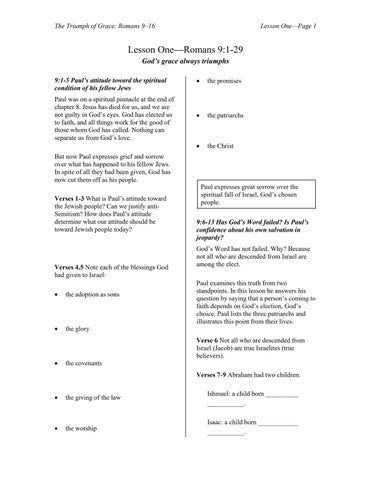
Lesson One Romans 9:1-29
God’s grace always triumphs
9:1-5 Paul’s attitude toward the spiritual condition of his fellow Jews
Paul was on a spiritual pinnacle at the end of chapter 8. Jesus has died for us, and we are not guilty in God’s eyes. God has elected us to faith, and all things work for the good of those whom God has called. Nothing can separate us from God’s love.
But now Paul expresses grief and sorrow over what has happened to his fellow Jews. In spite of all they had been given, God has now cut them off as his people.
Verses 1-3 What is Paul’s attitude toward the Jewish people? Can we justify antiSemitism? How does Paul’s attitude determine what our attitude should be toward Jewish people today?
Verses 4,5 Note each of the blessings God had given to Israel:
• the adoption as sons
• the glory
• the covenants
• the giving of the law
• the worship
• the promises
• the patriarchs
• the Christ
Paul expresses great sorrow over the spiritual fall of Israel, God’s chosen people.
9:6-13 Has God’s Word failed? Is Paul’s confidence about his own salvation in jeopardy?
God’s Word has not failed. Why? Because not all who are descended from Israel are among the elect.
Paul examines this truth from two standpoints. In this lesson he answers his question by saying that a person’s coming to faith depends on God’s election, God’s choice. Paul lists the three patriarchs and illustrates this point from their lives.
Verse 6 Not all who are descended from Israel (Jacob) are true Israelites (true believers).
Verses 7-9 Abraham had two children.
Ishmael: a child born __________
Isaac: a child born ____________
Verses 10-13 Isaac had two children.
Esau: a child whom God ________ ___________________________.
Jacob: a child whom God _______ ________.
God’s Word never fails. Those whom he has elected will come to faith and be saved.
9:14-24 None of God’s dealings with people is unjust
To understand this section, it is important that we understand our natural relationship with God.
1. First, nothing in us prompts God to love us. No one is morally better than anyone else before God.
2. All of us are morally depraved. We are natural rebels against God, and he would be perfectly just to condemn all people to an eternity in hell.
3. God is not made more gracious by showing grace to us. He would be 100% gracious and loving if he condemned us all to eternal punishment.
On this foundation Paul builds his argument. His points follow:
1. God has compassion on whom he wants to have compassion.
2. God uses the lives and activities of those whom he knows will remain under his wrath because of their impenitence. Specifically, he uses them to fulfill his gracious purposes toward the elect.
Verses 14-16 Why can Paul assert that God is always just?
Verse 17 Why is God’s grace in action even in the case of an unbelieving man like Pharaoh?
Verse 18 God does what he wishes. He graciously brings his elect to faith and hardens the hearts of those he foreknew would reject him (to advance his gracious purpose toward the elect).
Verses 19-21 How does Paul answer the question “Who resists his will?”
It is easy to accept God, the potter, making believers out of the lump of clay he has elected to salvation. However, Paul also says he fashions another lump of clay for ordinary use. Does this mean he elects some to damnation and ordinary use in this life?
Explain your answer.
Verses 22-25 To summarize his point, Paul talks about God’s will toward two groups of people: the elect and those who choose to remain under God’s wrath. Do you notice a difference in Paul’s description of how the two groups came to be in their respective situations? How do you account for these different expressions?
God elects some and mercifully brings them to faith. God even uses those who reject him to serve the eternal good of his elect.
9:25-29 God’s grace and election are taught in the Old Testament
Verses 25,26 About whom are these verses speaking?
Reflect on chapter 9:1-29. Why is it so comforting to know that our salvation belongs to us solely because of God’s gracious will and purpose for us?
How do these verses teach God’s gracious call?
Verses 27-29 About whom do these verses speak?
How do these verses teach God’s gracious call?
God will call his elect from among unbelieving Gentiles, and he will save his elect from among the Jews.
Romans 9:1–29 (EHV)
What is so comforting about how God uses those who continue to rebel against him?
Summary
God’s Word never fails; his grace always triumphs. God’s elect always come to faith. In his power God uses the rebellious for the sake of his elect. The Old Testament teaches these truths.
For next time
1. Read Romans 9–11 once or twice.
2. Read the commentary on Romans 9 by Siegbert Becker.
3. Read The Foolishness of God by Siegbert Becker and “The Bondage of the Will” by Martin Luther (Luther’s Works, Vol. 33).
The Blessings of the True Israel
9 I am speaking the truth in Christ I am not lying my conscience testifies with me in the Holy Spirit 2that I have great sorrow and continuous pain in my heart. 3For I almost wish that I myself could be cursed and separated from Christ in place of my brothers, my relatives according to the flesh, 4those who are Israelites. Theirs are the adoption as sons, the glory, the covenants, the giving of the law, the worship, and the promises. 5Theirs are the patriarchs, and from them, according to the flesh, came the Christ, who is God over all, eternally blessed. Amen.
6This does not mean that God’s word has failed, because not all who are descended from Israel are really Israel, 7and not all who are descended from Abraham are really his children. On the contrary, “Your line of descent will be traced through Isaac.” 8This means that it is not the children of the flesh who are God’s children, but it is the children of the promise who are counted as his descendants. 9For this is what the promise said: “I will arrive at this set time, and Sarah will have a son.”
God’s Choice Is Based on His Mercy
10Not only that, but Rebekah also had children by one man, our forefather, Isaac. 11Even before the twins were born or did anything good or bad, in order that God’s purpose in election might continue 12not by works but because of him who calls us it was said to her, “The older will serve the younger.” 13Just as it is written: “Jacob I loved, but Esau I hated.”
14What will we say then? Does this mean that God is unjust? Absolutely not! 15For God says to Moses:
I will show mercy to whom I show mercy, and I will have compassion on whom I have compassion.
16So then, it does not depend on human desire or effort, but on God’s mercy.
17Indeed, the Scripture says in regard to Pharaoh, “For this very purpose I caused you to stand, that I may demonstrate my power in how I deal with you, and that my name may be proclaimed in all the earth.” 18So then, God shows mercy to whom he desires, and he hardens whom he desires.
19Then you will say to me, “Why does God still find fault? For who has ever succeeded in resisting his will?” 20But who are you, a mere human being, to talk back to God? Shall the thing that is formed say to the one who formed it, “Why did you make me like this?” No. 21Doesn’t the potter have the right to make out of the same lump of clay one pot for special use and another for ordinary use?
22What if God, although he wanted to demonstrate his wrath and make his power known, endured with great patience the objects of wrath ripe for destruction? 23And what if he did this to make the riches of his glory known to the objects of mercy whom he prepared in advance for glory,
24including us, whom he called not only from the Jews but also from the Gentiles.
God Shows Mercy to Gentiles and the Remnant of Israel
25This is also what God says in Hosea:
Those who were not my people, I will call my people, and she who was not loved, I will call my loved one.
26And, it will be that in the place where they were told, “You are not my people,” there they will be called “sons of the living God.”
27And Isaiah cries out about Israel:
Although the number of the sons of Israel is as great as the sand of the sea, only the remnant will be saved.
28For the Lord, who carries out what he says without delay, will do what he said completely and decisively on the earth.
29Just as Isaiah said earlier: If the Lord of Armies had not left us some descendants, we would have become like Sodom, and we would have been like Gomorrah.