Vol 38 | 2026
by Goway
SAILING THE ARCTIC NIGHT
TEMPLES OF THE EARTH
WHERE BORDEAUX GOES TO BREATHE
INSIDER’S GUIDE
28 16
Off the Beaten Path
17
The Splurge
18
Tested
19
The Nightcap
20
Ask an Expert
22
Recommended
24
1 Destination 2 Ways
122
Group Travel Planning
124
Travel Like a Globetrotter
126
Go Globetrotting
28
The Passport: Colombia
40
Close Friendships of Solo Women Travellers
48
The Wildlife Hospital Saving Australia’s Animals
54
The Case for a Kid-Free Vacation
58
Sailing the Arctic Night
64
Temples of the Earth
STORIES
40
64
116
80
Why Seoul Belongs on Every Beauty Lover’s Travel List
104
Guyana: South America’s Wild Frontier
84
Limestone Coast: Australia’s Secret South
108
Brian Brown’s English It List
88
Where Bordeaux Goes to Breathe
112
Unseen Treasures of Southern Thailand
92
The Wild Legacy of Sir Robert “Bob” Bates
116
Spain: Unfiltered & Unspotted
100
The Bounty of Budapest
Globetrottin
No. 38
EDITOR-IN-CHIEF Mitchell Alexander Fawcett MANAGING EDITOR Aren Bergstrom EDITOR-AT-LARGE Amber Pfister CONTRIBUTING EDITOR Sael Forster CONTRIBUTING WRITER Christian Baines DESIGNER Negar Tavakol ASSOCIATE DESIGNER Seth Biagtan ART DIRECTION Emily Gillis CREATIVE DIRECTOR Janette Ewen CREATIVE PRODUCTION Melissa Mirabelli PARTNERSHIPS Lori Petteplace GOWAY CONTRIBUTORS
trick Cros
e a-Le Math e iss
Leo Liu
R irley ourke
W rolyn epp l
Je
er Mur nnif ra
y
Ca
er
Sh
n so
Me l
Pa
© 2026 Goway Travel. All rights reserved. No part of this publication may be reproduced without written permission. Information is believed to be accurate at time of printing but may change. Publisher is not responsible for errors or omissions.
Globetrotting is published by Goway Travel Web www.goway.com Email info@goway.com Social @GowayTravel
Globetrotting is committed to the human side of travel. All the stories featured in this issue were written by real human travellers, not Artificial Intelligence. Thank you to our travel partners for their support in this volume of Globetrotting: Guyana Tourism Authority, Hungary Tourism Agency, Korea Tourism Organization, ProColombia, South Australia Tourism Commission, Tourism Authority of Thailand, Tourism and Events Queensland, Tourism Fiji, Tourism Institute of Spain.
GUEST CONTRIBUTORS
ERIN DONAHUE
Erin is a New York City-based professional travel photographer and content creator whose work has reached over 60 million DAVID FARLEY people across social media. Commissioned by brands like David Farley has lived in San Sony, Apple, Google, Four Francisco, Berlin, Prague, Seasons, Fairmont, and Shangri-La, her storytelling has and Rome, where he spent two years writing his first book, taken her across the globe. A 2025 Travel Photography Club An Irreverent Curiosity: In Search of the Church’s Strangest Relic in Awards Finalist, she has also Italy’s Oddest Town. He writes been featured in The Cut, The regularly for The New York Times, Weather Channel, and Sony Food & Wine, and National Alpha Universe. Follow her Geographic. He currently resides travels on Instagram and in New York City. YouTube at @niredonahue.
SOPHIA MICHELEN
Sophia Michelen is a New York–based photographer, JESSICA HURAS writer, and travel television host who has travelled to nearly half of the world’s countries Jessica Huras is a Canadian freelance writer and editor with through her work and reporting. Her storytelling explores over a decade of experience culture, place, and the people covering food and travel. Her who shape them. She has work has appeared in the Toronto Star, Toronto Life, The Globe and contributed to outlets including National Geographic Traveller, Mail, CBC, and the National Post, Teen Vogue, Forbes, and Ms. among other print and digital Magazine, and co-hosts the PBS outlets. Her writing explores travel series America: The Land how food and travel shape the We Live In. way people live, eat, and connect.
MIRA MILLER
Mira Miller is a Montreal-based freelance journalist whose work has been published in The Walrus, The Globe and Mail, The Narwhal, Chatelaine, and more. She is passionate about travel, food, the arts, and human connection.
LITTLE GIANT ARCHITECTURE + INTERIORS
well considered design from the mountains to the ocean, and the wilderness in between 10
www.littlegiant-studio.com
EDITOR’S LETTER
Dear Globetrotter, I love a good Aha! moment. Ours came when we learned a large share of our Globetrotting readers love to bring this magazine with them on their travels. And so, this new compact and portable redesign was born. In the print world this is called “digest size,” which triggered my nostalgia for Reader’s Digest, a magazine that was always within reach in my childhood home. Its compact size always resonated with me: small enough to tuck into a bag, yet full of stories that could transport you anywhere.
I’m also thrilled to announce the appointment of Amber Pfister as our very first Editor-at-Large. Amber’s impressive career as an Emmy-winning NBC correspondent was once featured in a Globetrotting profile, and she has since worked her way into our hearts and onto our editorial team. She brings a world of travel experience and a fresh perspective from her Los Angeles homebase. Read Amber’s inaugural editor’s letter on the following page, then get to know her even better in her own story on family travel (page 54).
Don’t let the smaller size of the new Globetrotting fool you. Inside, we’ve made room for even more stories, told from a wider range of perspectives, and covering more of the world. We’ve packed it with new features, stunning photography, and original illustrations. And as always, our stories are written by real humans, not AI.
I hope you love the new Globetrotting!
Mitchell Alexander Fawcett Editor-in-Chief
11
Stays of Distinction by Goway Effortlessly Refined, Uniquely Unforgettable
Experience a stay that’s truly out of the ordinary with Goway’s Stays of Distinction. Relax in the heart of gorgeous destinations in one-of-a-kind accommodations that personify the essence of luxury.
Discover your next getaway in a Goway Stay of Distinction. goway.com
12
DISPATCH FROM OUR EDITOR-AT-LARGE
Hello new Globetrotting friends! When I first sat down to write this letter, I thought about all the travel adventures I could share. But I quickly realized that if I wanted anyone to understand why I love travel and storytelling, I had to start at the beginning. For me, it all started with reading magazines. Growing up in a small mountain town with only two stoplights, magazines became my window to the world. I read People Magazine religiously and fell in love with storytelling, not because of the celebrities, but because of the people lucky enough to tell their stories. At the same time, I devoured Travel + Leisure, dreaming of the places I hoped to visit one day. Years later, after earning my Broadcast Journalism degree, that dream led me to Los Angeles and my dream job as a lifestyle correspondent for NBC. I found myself interviewing incredible people, and realizing that the stories I loved most weren’t always from celebrities. It was the fisherman in San Francisco, the woman who owned a neighbourhood comedy club in Los Angeles, or the family behind a small taco shop in San Diego. Those were the stories that mattered to me. The everyday people whose lives, passions, and hard work form the fabric of a place and give it its identity.
When I met Mitchell while he was profiling me for a travel story, we immediately bonded over our shared love of media, travel, and storytelling. Eventually, he invited me to join the editorial team at Globetrotting, and in many ways, it felt like coming full circle. My hope is to inspire you to visit places you might not otherwise discover, experience incredible food and cultures, and most importantly, meet the people whose stories make every destination unforgettable. I’m so grateful to be on this adventure with you.
Amber Pfister Editor-at-Large
13
14
15
OFF THE BEATEN PATH
Taveuni, Vanua Levu & Yasawa Islands, Fiji These islands prove that Fiji’s magic lies in its wild, untouched, natural island scenery and wildlife. WHERE ARE THEY? Taveuni and Vanua Levu are northeast of Viti Levu, Fiji’s largest and most populated island. They are a 45- to 80-minute domestic flight from Nadi, while the Yasawa Islands are just a 25- to 30-minute seaplane or helicopter ride northwest.
WHY SHOULD YOU GO? These islands showcase some of the wildest and most beautiful corners of Fiji. Taveuni is Fiji’s Garden Island, thriving with lush, bird-filled rainforests, mesmerizing waterfalls, and rich volcanic landscapes. You can also access some of Fiji’s greatest dive sites from Taveuni, including Rainbow Reef and the Great White Wall in the Somosomo Strait. To the northeast of Taveuni lies the Matangi Island Resort: an excellent adults-only, private island escape resort renowned for its virgin tropical rainforest, pristine beaches, and coral reefs teeming with marine life. Vanua Levu has more palm trees than people, offering a more laid-back atmosphere than Fiji’s main island. The quaint town of Savusavu features therapeutic hot springs, some of the world’s rarest pearls at the J. Hunter Pearl Farm, and tours of local chocolate producers where you can buy rich and delicious Fijian chocolate bars. The Great Sea Reef, the world’s third-largest barrier reef, surrounds Vanua Levu, offering even more incredible snorkelling and scuba diving. The Yasawa Islands are a chain of roughly 20 volcanic, sun-drenched islands. You can easily explore a different island every few days, staying at luxurious adults-only retreats, family-friendly resorts, or village homestays. The Yasawa Islands are another snorkelling and diving haven, with potential encounters with manta rays and a variety of sharks, turtles, and tropical fish species. HOW DO YOU GET THERE? Fly on Fiji Airways into Nadi International Airport, Fiji’s main hub. From there, domestic flights connect to Taveuni and Vanua Levu’s small airstrips, while ferries make the longer crossing between islands. The Yasawas are reached by high-speed catamaran from Port Denarau, or you can opt for seaplane or helicopter transfers for a more extravagant arrival.
Fiji consists of more than 330 islands and over 500 islets across 1.3 million square kilometres of ocean.
16
THE SPLURGE
Song Saa Private Island, Cambodia
This independent, sustainably built resort offers barefoot luxury in a pristine environment on the Gulf of Thailand. Named one of Asia’s top resorts by Condé Nast Traveller and home to one of the world’s best spas by Travel + Leisure, Song Saa Private Island transforms the meaning of barefoot luxury with its dedication to sustainable design, personalized treatment, and seamless service. Relax in one of 24 villas built from repurposed materials, each boasting a private infinity pool, before crossing the wooden footbridge to its twin isle to dine at the award-winning restaurant and relax with personalized wellness treatments. Each day brings new adventures, both internal and external. Kayak through the mangrove forest of Koh Rong Marine National Park,
explore the ocean at night to see the waters lit up with phosphorescent plankton, or fight burnout with sound baths, meditation, and hydrotherapy in relaxing sanctuaries built to reflect Buddhist principles.
Unwind at Song Saa Private Island on Goway’s 9-day Cambodia’s Cardamom Coast: Island & Rainforest
Visit Goway.com
17
TESTED
Ranvoo Wearable Smart Neck Air Conditioner How cool is Ranvoo’s AICE Lite Plus Neck Air Conditioner? Every traveller, at one point or another, has dreamt of having a personal air conditioner on a dreadfully hot travel day. The AICE Lite Plus Neck Air Conditioner is Ranvoo’s attempt at fulfilling this desire.
pair of earphones around your neck. The unit can be adjusted to sit securely around your neck while being active or still. While comfortable for adults, it may be too heavy for toddlers and small children.
We tested this personal wearable smart AC unit during summer sightseeing and on long, active days to see if it earns a spot in your carry-on.
FUNCTIONALITY
QUALITY The build feels solid. The metal plates lining the inside of the collar add an extra bit of contact cooling on top of the airflow. The battery life is quite reliable, lasting more than eight hours of cumulative use across several outings. The only caveat we observed from testing the unit on a road trip is how the metal lining holds heat as well as cold, so don’t expect instant relief after leaving the unit baking in the sun. FEEL & DESIGN The unit wears its slightly bulky feel and modern look quite well. It weighs just over 500 grams (about a pound) and feels like wearing a large
18
The unit delivers as promised, with four modes covering nearly any itinerary: AI Mode reads conditions and adjusts on its own; Cooling Mode delivers chilled air; Natural Wind keeps a light breeze going; and Heating Mode warms you up. You can control the unit from the Ranvoo app or from the unit itself. The unit sounds like a white noise machine pointed at your ears, which can be soothing in crowded environments, but a little distracting in quieter ones. BOTTOM LINE The AICE Lite Plus is a capable wearable AC unit that delivers reliable cooling, marathon battery life, and clever controls. It is a worthy addition to your carry-on for trips involving serious heat, if you are comfortable with the sound, unique look, and price tag: CAD $401.00 / USD $279.00.
THE NIGHTCAP
The Wasabi Highball from Jigger & Pony in Singapore A standout creation from the BLOOM menu at one of Asia’s most celebrated cocktail bars. At the legendary Jigger & Pony in Singapore’s Tanjong Pagar district, ambitious and creative cocktail concepts are continuously germinating. Their latest endeavour, BLOOM, is a 68-page “menuzine” (both a menu and a story) that studies the movement and evolution of flavour. From the 21 featured BLOOM cocktails, our standout pick is the Wasabi Highball:
an antidote to hot and humid Singapore nights, and a masterclass in refreshing and restrained mixology. Suntory Toki whisky is lifted by the subtle sweetness of clarified apricot soda, and a wasabi tincture lends a fresh, green profile with just a whisper of pungency. Patience is a virtue while melting ice slowly unfurls new layers of the drink’s flavour.
19
ASK AN EXPERT
Luxury Travel in China China represents the bleeding edge of the 21st century. But despite its enormous influence over global affairs, many travellers don’t know what it’s like to travel to China in 2026—especially if they want luxury experiences. Luckily, Goway Destination Specialist Leo Liu has expert insights on what it’s like to explore the Middle Kingdom right now. Why is travel to China so popular right now?
What’s the best way to travel in comfort between cities in China?
There are many reasons China is so popular in 2026: improving bilateral relations with Western countries; the influence of the “Real China” tourism campaign; the dominance of TikTok on the global scene; China’s affordability compared to Japan or Europe. It also helps that China has many of the world’s most popular landmarks from the Great Wall to the Terracotta Warriors to the karst landscape of Guilin.
High-speed train. Business class offers the best level of service for the high-end traveller, with blankets, pillows, a television, complimentary snacks, hot meals, VIP lounges, and the ability to transform your seat into a bed.
What’s the biggest thing that has changed in China over the past decade? The unprecedented expansion of the country’s infrastructure has established one of the world’s most advanced high-speed rail networks, some of its most modern cities, and the longest highway system in the world. Chongqing and Shenzhen are positively futuristic to North American travellers. What’s the advantage of private touring in China? Private-guided touring with Goway offers completely flexible, end-to-end travel itineraries that cater to your budget, dining preferences, and interests. In a country as big as China (in terms of both population and size), the private experience makes a real difference by slowing down the pace and providing top-quality service.
20
What’s the best way to experience China’s natural icons in style? First is to take advantage of VIP entrances at natural landmarks such as the mountains of Zhangjiajie, which inspired Avatar. Second is to head on an unforgettable cruise along the Yangzi River aboard the Yangzi Explorer. Venture from Chongqing to Yichang while staying in a luxury suite with a balcony and a personal butler. The ship is even capable of riding the Three Gorges Dam ship lift, so you get to experience some of China’s technological marvels while delighting at the natural scenery that surrounds you. What are a few of your favourite accommodations in China? You’re spoiled for choice here with high-end properties across China so depending on where you’re going, you could stay mere steps from the Forbidden City at The Peninsula Beijing or spend
LEO LIU DESTINATION SPECIALIST
your night where heads of state such as Barack Obama have before you at the Fairmont Peace Hotel in Shanghai. What’s a restaurant people shouldn’t miss? If you can score a reservation to Yu Zhi Lan in Chengdu, you’ll be treated to some of the finest Sichuan dishes in all of China—and not just its famously spicy ones. It’s one of only two restaurants in the city with two Michelin stars.
What’s a common misconception about travel to China? People still think that China is heavily polluted. In fact, aggressive clean air initiatives and a massive shift towards electric vehicles have made Chinese cities very clean.
Chongqing, China
21
RECOMMENDED
Sir David Attenborough’s Centennial Celebrating the legacy of one of the world’s most iconic globetrotters. Calvin Coolidge was president of the United States; the late Queen Elizabeth II’s grandfather, King George V, ruled the United Kingdom; and the global population was roughly 2 billion. And on May 8, in West London, England, a young globetrotter named David Frederick Attenborough was born.
“The world looked quite different in 1926.”
as a broadcaster, natural historian, writer, and conservationist over the next century. It is a legacy that encompasses what it means to be a globetrotter. To celebrate Sir David Attenborough’s centennial, we’re looking back on the most influential and inspirational entries of his vast filmography.
Sir David Attenborough would forge an inspiring legacy
1977–2005 Wildlife on One
1954–1963 Zoo Quest The expedition series that first made Attenborough a globetrotter, tracking down rare animals from Sierra Leone to Komodo.
22
This long-running series of 253 half-hour wildlife films, each narrated by Attenborough, helped establish him as a household voice.
1979–2008 The Life Collection Nine landmark series surveying every major group of life on Earth, from evolution’s origins to the world’s reptiles and amphibians.
2001
1983–2020
The Blue Planet
Natural World The BBC’s flagship strand of nearly 500 standalone films, each focusing on one species, place, or event, with many narrated by Attenborough.
The first comprehensive natural-history portrait of the world’s oceans, from sunlit coral reefs to the unexplored deep.
2006–2023 Planet Earth franchise A blockbuster high-definition trilogy showcasing the Earth’s great wildernesses at cinematic scale.
2011–2022
2019–2023 Our Planet
Frozen Planet
Attenborough’s streaming debut, created with WWF, surveys Earth’s most vital habitats, while a 2023 sequel follows the great animal migrations.
A sweeping survey of the polar regions’ wildlife and fast-shrinking ice; a 2022 sequel ventures beyond the poles.
2024 Asia
2025 Ocean with David Attenborough This award-winning film was released in cinemas on Attenborough’s 99th birthday and explores the importance of the Earth’s oceans and the threats they face.
Attenborough narrates the BBC’s first major series devoted to Asia and its natural diversity, from the Gobi Desert to Siberia, the Indian Ocean, and beyond.
2026 The BBC announced on Attenborough’s 100th birthday that he will narrate the forthcoming Blue Planet III, the third series to carry the Blue Planet name.
23
1 DESTINATION 2 WAYS
Banff National Park: Summer vs. Winter
Moraine Lake, Canada (Summer)
SUMMER •
Bike the Goat Creek Trail from Canmore to Banff, following the Spray River Corridor through 19 km (11 mi) of forest valley.
•
Canoe on Lake Louise to explore the clear alpine waters and savour the breathtaking view of Victoria Glacier.
•
Hike the 15 km (9 mi) Plain of Six Glaciers Trail starting at Lake Louise to pass through lush valleys, under mountain peaks, and alongside several glaciers.
•
Spend a day at the Fairmont Banff Springs Spa, soaking in mineral pools, relaxing with massages, and drinking in mountain views.
Snap a pic at Moraine Lake, one of 24
From summer to winter, Canada’s most popular national park transforms from a sunny alpine landscape to a winter playground.
Moraine Lake, Canada (Winter)
WINTER •
Spend a day skiing the slopes of Lake Louise Ski Resort, the largest ski resort in the Canadian Rockies.
•
Go ice skating on Lake Louise to experience the lake transformed into a natural outdoor rink.
•
Trek 5 km (3 mi) on microspikes through the Johnston Canyon to the Upper Falls to see the 30 m (98 ft) high waterfalls frozen amidst the snow-dappled landscape.
•
Soak in the natural mineral waters of the Upper Hot Springs to beat the cold and enjoy views over Banff’s surrounds.
Canada’s most famous and beautiful lakes. 25
ON THE COVER
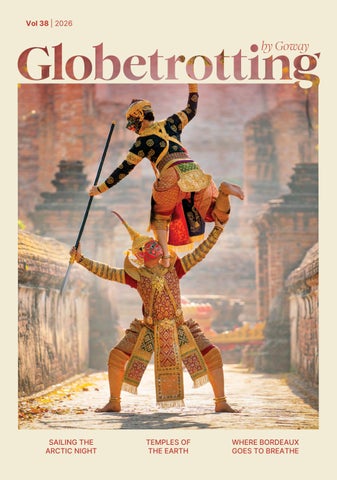
Thailand’s Traditional Khon Performance Our cover for this issue of Globetrotting features two Khon performers at Thailand’s National Theatre in Bangkok. Khon is a traditional Thai dance drama documented since the Ayutthaya Kingdom (1351–1767) and inscribed on UNESCO’s Representative List of Intangible Cultural Heritage in 2018. The performance combines stately, acrobatic movement with live piphat music, a chorus, and narrators who voice the silent, masked dancers. Khon was traditionally performed in Thailand’s royal or princely courts, depicting the legend of Ramakien, Thailand’s interpretation of the great Hindu Sanskrit epic Ramayana. Today, Khon is performed for the general public and audiences of all kinds across the country as a celebration of one of Thailand’s most culturally significant and distinct forms of high art. Both Thailand’s public and private sectors work to preserve the art form through educational institutions and youth training and performance clubs. Most Khon performances follow the different episodes of the life of Rama, the hero and incarnation of the Hindu God Vishnu, who brings order and justice to the world. They often feature four main character types: noble men (phra), women (nang), demons (yak), and monkeys (ling).
26
The demon and monkey roles wear the sculpted, gilded masks the art form is famous for, while the human and celestial roles wear jewelled crowns and stylized makeup instead. Khon troupes, conservatories, and theatres that sustain the performance art remain concentrated in Bangkok because of its historical evolution inside the royal court. Foreign visitors who buy a 500-baht Grand Palace ticket receive a complimentary 25-minute Khon performance at Sala Chalermkrung Royal Theatre (Monday to Friday at 1 pm, 2:30 pm, and 4 pm). Full-length productions have returned to the newly renovated National Theatre on a scheduled programme. Further afield, however, a private workshop in the Chiang Mai countryside lets you spend an afternoon with a master artisan, learning the gilding and papier-mâché techniques behind those famous faces and crafting a mask of your own to take home. Ready to see it for yourself? Contact a Goway Destination Specialist about building a Thailand itinerary around a Khon performance today.
Tales from the Road A new story series on Goway’s 56 years in business, from founder Bruce Hodge. When Goway Travel was founded in 1970 we were a very different company. Decade by decade and continent by continent, we expanded our reach to 115 countries around the globe. Founder and President Bruce Hodge has been at the helm of this pioneering journey since day one. Now, he’s sharing the stories of his adventures traversing the globe and building a thriving travel company.
To Read More Scan QR Code or visit goway.com
27
The PASSPORT: COLOMBIA The Country of Beauty
The PASSPORT | Colombia
EDITED BY JANETTE EWEN & MITCHELL ALEXANDER FAWCETT
NAVIGATION 29 Introduction 30 Artist Portrait 32 Address Book 36 Tailor-Made Edit 38 Why We Love Colombia 28
The PASSPORT | Colombia Welcome to Globetrotting Magazine’s newest feature, The PASSPORT. In each issue we will take a deep dive through an exceptional destination having its moment. For the inaugural PASSPORT we take you to Colombia where natural beauty, diverse landscapes, craft, and creativity tell an unforgettable story. Read on to see our unique perspective and the places you simply can’t miss. Buen viaje. Colombia is waiting.
29
The PASSPORT | Colombia | Artist Portrait
Artwork Vessel of the Cosmos by Stefania Tejada. Artist Portrait Photographed by Cecy Young (@cecyyoung).
30
The Colour of Colombia
For Paris-based Colombian multidisciplinary artist Stefania Tejada, image-making is a language of memory, identity, and myth. For those drawn into Stefania’s world, her work feels immersive, like one is stepping into a very colourful dream. Working in both oil and digital media, Stefania has created a unique style that explores an intersection of cultural memory and social narrative. We feel a power in her work; we feel identity and mythology. Her work tells stories of times and places in a cinematic, yet intimate, way. For us, Stefania’s work reflects the very soul of Colombia. Stefania’s work excites our eye and invites us all to explore the rich beauty of Colombia. It’s not surprising that this talented artist has attracted the attention of those who extend past the traditional art world. Stefania has been featured in Vogue (multiple times) and Elle (among others) and global brands have flocked to work with her, including Dom Pérignon and Agua by Agua Bendita. We recently sat down with Stefania to chat a little bit about the magic of Colombia.
Globetrotting: If you could paint one feeling that defines Colombia, what would it be? Stefania: When I reflect on it, there is an emotion that perhaps has no translation—this in-betweenness we seem to live in. Euphoria and grief inhabiting the body at the same hour. We have learned to live inside that space. Colombia dances through everything that should break her, until the two become a single gesture. There is a resilience of spirit in that action, and that is precisely what I would paint. What’s one place in Colombia you return to whenever you need inspiration? The place I return to is a psychological one, which is to say it isn’t a place at all but an atmosphere, something I assembled out of everything Colombia’s territory has given me. The landscapes, the flowers, the particular green of it. I’ve always called it a natural orchestra, and it’s where I go when home seems too far, which is often. But if you need a real one, somewhere on the map, I’d say Armenia, in Quindío: the coffee plantations, the orchids, the wax palms standing in the fog at Cocora, all that fauna and flora. That, to me, is the land that has always been an Eden. Not a place I visited so much as a garden, I’ve never quite left. Complete this sentence: “Colombia is... Colombia is an excruciating, soul-ripping, euphoric, surrealist dance.
31
The PASSPORT | Colombia | Artist Portrait
A conversation with artist Stefania Tejada on memory, identity, and the visual language of home.
The PASSPORT | Colombia | Address Book
The Address Book The places worth knowing in Colombia now.
This section features the restaurants, bars, and boutiques worth knowing about in Colombia. We’ve curated these destinations with an insider’s eye. Enjoy!
32
Restaurants
Humo Negro
Sambombi Bistró Local
Featured on the prestigious Latin America’s 50 Best Restaurants list, Humo Negro unites South American ingredients with chef Jaime Torregrosa’s love for Japanese izakaya. Like many of Colombia’s top restaurants, Humo Negro focuses on sustainable local ingredients. Fish from the Amazon River are served to diners’ delight, while also supporting local, responsible fishing communities. The tasting menu is a known favourite in foodie circles, and the roasted coconut ice cream comes highly recommended.
Founded by Jhon Zárate, Sambombi Bistró Local embodies Colombia’s thoughtfulness towards community. The menu changes weekly, in line with the small local farmers’ harvests. The décor is comforting and fresh; greenery drapes the walls, welcoming diners. The connection to local culture continues with the dishes created by Jhon Zárate. We recommend the tuna tostada paired with a crisp white from the brilliantly curated wine list.
Menu: humonegrobog.com
The PASSPORT | Colombia | Address Book
Address: Cra. 5 #56-06, Chapinero, Bogotá, Colombia
Address: Cra. 35 #7-10, El Poblado, Medellín, Antioquia, Colombia Menu: sambombi.com Instagram: @sambombi.bistro
Instagram: @humonegro_bog La Vitrola Restaurante Described by Colombian fashion legend Johanna Ortiz as an institution, this airy bistro serves up local fare in style. Speaking of style, those visiting this iconic restaurant are always dressed impeccably chic. Enjoy a martini, yellowfin tuna, and crab claws; stay for the music and atmosphere. Address: Cra. 2 #33-66, El Centro, Cartagena de Indias, Bolívar, Colombia Menu: lavitrolarestaurante.com Instagram: @lavitrolacartagena
Left Bocagrande, Centro Historico, Cartagena, Colombia. Right La Vitrola Restaurante (photo from Instagram).
33
Cocktails Bar Carmen
The PASSPORT | Colombia | Address Book
Located in Medellín’s El Poblado neighbourhood, Bar Carmen is known as a top restaurant and cocktail bar for locals and visitors alike. The atmosphere is warm and inviting. Well-worn brick and modern lighting are combined with loads of local vegetation to give the space a distinct indoor-outdoor feel. The bar is always busy and full of conversation, making it a great spot for solo travellers. The energy of Bar Carmen is fun, so it doesn’t surprise us that bar manager Maycoll Toban’s cocktail recommendations include the “Hanky Panky” or “La Chicha.” Address: Cra. 36 #10a-27, El Poblado, Medellín, Antioquia, Colombia Menu: carmenmedellin.com Instagram: @carmenrestaurante Mamba Negra
Alquímico Few people have done more to redefine Colombia’s cocktail culture than Jean Trinh. As the founder of Alquímico, one of the world’s most celebrated bars, Jean has built his reputation on championing local ingredients and sustainable practices. Alquímico is located inside a 19thcentury mansion on Colombia’s Caribbean coast. The capacity is just over 1,000 so be prepared to party. Address: Cl. del Colegio #34-24, El Centro, Cartagena de Indias, Bolívar, Colombia Menu: alquimico.com Instagram: @alquimicocartagena
34
Coming in at number 81 in the Top 100 Bars in the World, Mamba Negra, named after the highly venomous snake, is Medellín’s most exclusive rooftop. The views of the city are some of the best, as are the cocktails. Founded by Colombian-born Juan David Zapata, Mamba Negra’s signature mixology is inspired by Colombia’s local landscape and “cooking around the embers.” Described as a “sensory journey through the exotic landscape of Colombia,” Mamba Negra is like no bar we’ve visited before. From the circular bar to the hypnotic cocktails, the flavour of this unique establishment offers an irresistible taste of paradise. Tip: Be sure to book ahead. Address: Cl. 2 #20-50, El Poblado, Medellín, Antioquia, Colombia Menu: mambanegra.co Instagram: @mambanegra.22
Shopping St. Dom Described as the “best of Latin Design for the discerning, cultured eye,” St. Dom is a unique concept store known for stocking the best from emerging local designers. The interior of St. Dom is as beautiful as the collections presented. This is one of Globetrotting Magazine’s favourite shops, as we always recommend shopping for souvenirs that can become part of your daily life. An elegant dress or a chic caftan is our top selection. Address: Cra. 3 #33 70, El Centro, Cartagena de Indias, Bolívar, Colombia
The PASSPORT | Colombia | Address Book
Website: stdom.co Instagram: @stdomofficial Bettina’s Closet Featuring Colombian designers and curated vintage pieces, Bettina’s Closet is the brainchild of actress and architect Bettina Dereser. The space brims with finds from Bettina’s travels, local designers, and her own vintage collection. Bettina’s Closet is a tribute to circular fashion done with stylish intent. Address: Cra 10 #82 - 66, Bogotá, Colombia Website: bettina.co Instagram: @bettinascloset.co Ábaco Libros y Café From its magical interiors to its renowned coffee, Ábaco Libros y Café is brimming with beauty and books. This must-visit destination is a great place to grab a quiet moment while enjoying a novel from one of Colombia’s many celebrated authors. Address: Cl. 36 #3-86, El Centro, Cartagena de Indias, Bolívar, Colombia
Left Mamba Negra.
Website: abacolibros.com
Bottom Right Ábaco Libros y Café.
Top Right St. Dom.
35
The Tailor-Made Edit
The PASSPORT | Colombia | Tailor-Made Edit
A journey through Colombia’s colour, culture, and Caribbean charm.
Colombia has the most bird species of any country on Earth. Pictured The Mealy Amazon parrot. Photo Credit Leo Tenori
From Bogotá’s museums to Medellín’s innovation, Colombia blends history, culture, and nature. Explore the Coffee Triangle, colonial towns, and Caribbean beaches while enjoying warm hospitality and unforgettable scenery. At Goway, we tailor every vacation to Colombia to meet your exact needs, allowing you to have travel experiences as unique as you are.
36
The PASSPORT | Colombia | Tailor-Made Edit
Goway Expert Tips Learning your basic Spanish phrases will go a long way in creating memorable interactions with locals. Visit Medellín with an open mind and take time to discover how its communities transformed adversity into art, innovation, and hope. Venture beyond Colombia’s major cities and explore the Zona Cafetera (Coffee Region), where stunning landscapes, charming towns, and world-class coffee await.
Richard Toledo – Goway Destination Specialist
Old Town in Cartagena is a UNESCO World Heritage site famous for its well-preserved colonial architecture. Photo Credit Nestor Morales Moreno
37
Must See in Colombia
The PASSPORT | Colombia | Tailor-Made Edit
Discover Colombia’s vibrant cities, lush landscapes, coffee culture, and Caribbean coast with our Editors’ Highlights of Colombia: •
Stroll Cartagena’s cobbled streets and historic walled city.
•
Explore Bogotá’s museums and lively La Candelaria district.
•
Discover Medellín’s modern transformation and hillside views.
•
Wander coffee plantations in Colombia’s lush Coffee Triangle.
•
Relax on Caribbean Beaches in Tayrona and San Andrés.
•
Experience Colombia’s diverse cuisine and warm hospitality.
Why We Love Colombia Colombia is a country of contrasts, where Andean peaks meet emerald jungles and golden beaches stretch along the Caribbean. Bogotá, the capital, brims with museums and vibrant neighbourhoods like La Candelaria. Medellín, once infamous, is now a model of creativity and transformation, set in a valley with sweeping views. The Coffee Triangle offers verdant plantations where you can sip world-class brews while learning about the traditions that shape daily life. Cartagena enchants with its cobbled streets, colourful facades, and Afro-Caribbean rhythms echoing from its lively plazas. Beyond the cities, travellers can explore Tayrona National Park, where rainforest meets the sea, or venture to San Andrés for
38
crystal waters and coral reefs. Each region showcases Colombia’s rich heritage, culinary delights, and infectious spirit, making it a destination to savour slowly and deeply. Your personal Goway Destination Specialist is ready to help you explore Colombia your way. Our Colombia Destination Specialists have worked, lived or travelled extensively throughout Colombia.
Top Left Tayrona National Natural Park protects white sand beaches, coral reefs, and tropical forests where the Sierra Nevada mountains meet the sea.
“Every corner of Colombia is magical; every story conceivable exists there.”
The PASSPORT | Colombia | Tailor-Made Edit
- Laura Restrepo, celebrated Colombian author
For more tailor-made Colombia vacations, scan this QR code or Visit www.goway.com
39
Close Friendships of Solo Women Travellers WORDS MIRA MILLER ILLUSTRATIONS FLORENCE SABATIER
For solo women travellers, exploring the world forges deeper connections both with themselves and those they meet in their travels. I was 17 years old the first time I made a close friend while travelling. I was on a family cruise to Bermuda, and I met a young girl from Brazil in the hot tub. We immediately got along and spent the rest of the trip behaving like lifelong best friends. She and I came from different backgrounds, different countries, different worlds, and yet we bonded over adolescent dating troubles, music, and a mutual interest in each other’s lives. It was the first time I’d made friends with someone who lived in another part of the world, and it thrilled me to connect with someone who was so different from me and yet still so similar. Our friendship broadened my worldview and ignited within me a desire to meet people from all over the planet.
40
In the years since that family trip, I have made deep connections in many different countries. I have discussed identity and sexuality with new friends on hostel bar crawls, spent days exploring markets and beaches with women I met earlier that day, and talked about some of my deepest hopes and fears over dinner with fellow backpackers. In each of these scenarios, I’ve found myself to be more inquisitive, open-hearted, and primed for connection than in my regular life. These connections always greatly enrich my travel experience and give me a deeper understanding of a place, its people, and how different—but also similar—we really are. Whenever I return home, my most cherished memories nearly always involve the people I met along the way. This experience I adore, of having my world widened by the people I meet while travelling, isn’t unique to me. For many women, and especially those who solo travel, forming fast, close friendships is par for the course. At their best, these friendships reveal a simple truth: the purpose of travel is to connect.
41
NEW EXPERIENCES BREED FRIENDSHIP Sharon Lui knows this to be true. After receiving a clean bill of health following breast cancer treatment in 2024, the 49-year-old mom of three booked a solo trip to Italy. Shortly after arriving at her hotel in May of 2025, Lui met a friendly 30-something woman from South Africa who radiated openness and warmth. The two formed an immediate bond and spent the rest of the trip as great friends. “ Knowing that person is also travelling on their own is already a good sign because it shows they’re open-minded, and you’re both crazy enough to trust the process,” Lui said. “ Within that first day we met, we were pretty much attached at the hip.” Even those who struggle with shyness often find friendship while abroad. Aemika Best, a 41-year-old based in New Jersey who considers herself to be quite reserved, made a strong connection while on a Goway trip to Greece in 2024. During an excursion that involved climbing a mountain, Best faced her fears alongside another solo traveller who supported her throughout the adventure. “ I’ll be honest, I am afraid of heights,” Best said. ”She was a cheerleader for me going up the mountain and that let me know that she’s a genuine, good person, because I was a complete stranger to her.”
Amy Ushko also found friendship while on a bucket-list adventure. In August of 2024, the 57-year-old from Ottawa embarked on an African safari with Goway and met another Canadian woman on her tour. She quickly discovered they shared a similar outlook on life, and Ushko instantly felt comfortable with her. “I would have loved the safari regardless, but it was so wonderful to share the excitement with someone else,” Ushko said. “The thrill of seeing certain animals for the first time—dik-diks are possibly the most adorable animal ever—was better because I could share it.”
Trying something new together helped the two women bond quickly. After the tour was over, they exchanged numbers and spent the whole following day together, exploring the beauty of Greece and They, too, still keep in touch and have discussed their newfound friendship. They continue to keep travelling together again in the future. in touch to this day.
42
neurochemicals linked to positive mood, which makes it easier to connect with other people, Landowski says. Depending on where you’re travelling, you may also be in a place where it’s more common to be friendly to strangers. This alone can create a greater sense of belonging, connection and comfort, she explained, which results in the release of feel-good hormone oxytocin and reduces stress hormones. While oxytocin alone won’t turn strangers into soulmates, in the right context, she said it can lower your sense of threat and make it easier to lean in and connect.
DURING TRAVEL, THE BRAIN IS PRIMED FOR CONNECTION There is plenty of research to explain why travel is so conducive to forming relationships. Studies have shown that travel increases openness to new experiences, and shared new experiences help us bond with others on an emotional level. “When we share intense experiences with other people face to face, parts of our brain activity can actually synchronize—something that doesn’t happen when you text,” says Dr. Lila Landowski, a neuroscientist from Australia. “Those joint experiences are linked to stronger feelings of social connection, even between total strangers.”
Exploring new experiences and working through unknown situations together also creates instant trust, says Kaila Hattis, a therapist and the owner of Pacific Coast Therapy in California. During travel, you’re often forced to rely on each other far quicker than you would be back home. And when you spend an entire day with someone you just met or invite them to join you for dinner, you create intimacy quickly, Hattis says—much faster than you would through months of casual texting and quick coffee dates.
When you travel, you spend more time outside and move your body more than you normally might. Regular physical activity boosts
43
SUBVERTING SOCIETAL EXPECTATIONS When women in particular travel on their own, they often shed the social roles they adopt at home, Harris adds. They feel less pressure to measure up to expectations or to act as caregivers, allowing them to be fully themselves and prioritize their own desires. This is the case for Lui, who spent decades raising children and now solo travels to put herself first. This is also true for Ann Mathew. Growing up in a traditional South Asian household, Mathew often felt pressured to follow a specific path and live up to expectations. Determined to get to know herself and figure out what she really wanted in life, she set off on a solo trip to Hawai’i in 2023 at the age of 23. Without anyone else there to offer their opinions or influence her decision-making, Mathew was finally able to listen to her own intuition and follow it.
44
“I was a different person on my first solo trip,” Mathew said. “All of a sudden I was more confident, more outgoing, more talkative, and doing things purely for myself.” On her second solo trip, she made friends with a local woman while taking the bus in Portugal. Talking to a stranger on the bus isn’t something she’d normally do back home in Toronto, but the traveller version of herself is far more open to new connections. Mathew’s newfound love of solo travel inspired her to start Brown Girls Thriving, a travel and wellness club for South Asian women. Her favourite part of the experiences? The deep friendships they foster.
LASTING BONDS Friendships formed during travel don’t always extend beyond the trip, but even brief connections can still impact our lives for the better. And every so often, if we’re lucky enough, they turn into life-long bonds. Ioana Moga, a full-time travel blogger based in Romania, has solo travel to thank for one of her closest friendships. While on a trip in Madrid in 2023, the 34-year-old met another traveller on her way to the bus to Segovia and Toledo. They started chatting, realized they were about the same age and had the same name, and spent the entire day getting to know each other. “When we said goodbye that night, we knew we would be friends even after this trip,” Moga said. They met up in Athens just a few weeks later and have since travelled to Kenya, Malaysia, and Italy together.
45
Jennifer Davis, a 34 year-old from Nashville, has made new friends at airports, in hotels and hostels, on group tours, and even while surfing. Most recently, on a Goway trip to Australia earlier this year, she made friends with a woman who was going through a difficult breakup. They connected on a deep level in just a short time and are making plans to reunite again soon. “These friendships serve as a reminder of how connected people really are, no matter where you are,” Davis said. “Even in this current climate and big old world, solo travel shows you that you’re never truly alone.”
It’s been 12 years since I made friends with the Brazilian girl in the hot tub, and we no longer regularly keep in touch through WhatsApp the way we once did. But I still intend to visit her in her hometown of Recife one day. In my experience, friendships formed during travel have a particular way of freezing in time, continuing to exist without much maintenance or expectation. You may lose touch amidst the business of everyday life, but there is beauty in knowing you have a friend out there, in another part of the world, ready and waiting to hear about the time gone by since you last explored the world together.
46
Designed with passion, made for Women.
Discover iconic destinations on journeys made exclusively for women. With Goway’s Solo Women Travel line, you can follow your passions, make lasting bonds, and enjoy the comfort and privacy of single occupancy throughout.
Explore Solo Women Travel goway.com
47
The Wildlife Hospital Saving Australia’s Most Vulnerable Animals Established by Steve and Terri Irwin, the Australia Zoo Wildlife Hospital provides urgent care to injured animals in southeastern Queensland.
WORDS AREN BERGSTROM
Koalas might be some of Australia’s most beloved and adorable icons, but icon status did little to help Santino and Fudge, two older male koalas unlucky enough to happen upon a construction site where they fell into a deep hole. Lodged in thick mud and debris, the situation looked dire for Santino and Fudge. Luckily, Santino and Fudge live in southeastern Queensland, where rescuers urgently transported them to the Australia Zoo Wildlife Hospital. The hospital’s veterinary team spent many hours carefully cleaning and treating the koalas. After extensive monitoring and treatment, the koalas made a strong recovery and were released back into the wild. While Santino and Fudge represent a surprising success story, not every injured wild animal is so lucky. The Australia Zoo Wildlife Hospital is working to change that.
48
Top The Australia Zoo Wildlife Hospital is located in Beerwah on the Sunshine Coast. Right Luke the koala is one of several patients helped by the hospital.
49
Located beside Australia Zoo in Beerwah, on Queensland’s Sunshine Coast, the Australia Zoo Wildlife Hospital is one of the world’s largest wildlife hospitals, treating around 10,000 injured animals each year who are brought in for treatment due to habitat loss, domestic animal attacks, road traffic, and other dangerous human interactions. The Australia Zoo Wildlife Hospital works in tandem with the Australia Zoo, the rehabilitation arm to the wildlife centre’s educational one, and is funded entirely by Wildlife Warriors, a charity that the late Steve Irwin and his wife Terri established in 2002. “The Australia Zoo Wildlife Hospital operates 24 hours a day, with the dedicated team providing specialized care around the clock,” an Australia Zoo spokesperson told Globetrotting. “Every day begins with reviewing overnight admissions, assessing every patient and developing treatment plans to ensure each animal receives the specialized care it needs. Throughout the day, our expert team of veterinarians and nurses work together to provide medical care, perform surgeries, prepare specialized diets, monitor recovery, and rehabilitate native wildlife. This involves caring for patients already in rehabilitation, from birds and possums to koalas and kangaroos. Every patient is different, meaning no two days are ever the same, but the focus remains on giving every animal the best possible chance of returning to the wild.” With its surgical theatre, X-ray room, intensive care units, and pathology lab, the hospital provides rigorous care to a wide range of
Australian species. But it’s not exclusively focused on care and rehabilitation. The hospital also supports breeding programs, such as the first successful effort to hatch Irwin’s turtles outside of the wild. “What we hope every visitor takes away from Australia Zoo is a deeper connection with wildlife and an understanding that everyone has the ability to make a difference,” says the spokesperson. “Every species plays an important role within our ecosystems, from the smallest insects to Australia’s most iconic animals, and protecting wildlife means protecting the natural world we all share.” Seeing a koala is an iconic experience when visiting Queensland, right up there with snorkelling the Great Barrier Reef or learning to throw a boomerang. But many visitors might not realize how vulnerable beloved Australian animals really are. For instance, in 2022, koalas in Queensland, New South Wales, and the Australian Capital Territory were listed as endangered under national environmental law, and their wild populations continue to face serious challenges. Supporting conservation efforts like the Australia Zoo Wildlife Hospital is critical to ensuring that not only are koalas and kangaroos present in Queensland for you to see on your next trip to Australia but also thriving for generations to come.
Top Right Possums are among the animals commonly treated at the hospital. Bottom Right Clyde the rednecked wallaby receives treatment at the hospital.
You can add a tour of the Australia Zoo Wildlife Hospital to any Goway trip to Queensland. Visit www.goway.com
50
51
52
53
The Case for a Kid-Free Vacation Taking a vacation without the kids can feel indulgent, complicated, or even a little guilt-ridden, but it may be one of the healthiest things couples can do for their relationship. WORDS MITCHELL ALEXANDER FAWCETT INTERVIEWS AMBER PFISTER
Globetrotting Magazine’s Mitchell Alexander Fawcett recently sat down with Amber Pfister, our new Editor-at-Large, to get her tips for planning a kid-free escape with intention, ease, and less guilt. A lot of parents feel guilty thinking about taking a vacation without their kids. How do you personally reframe “mom guilt” so the trip feels healthy rather than selfish? I believe that my kids deserve the best version of me, and that means my identity can’t only be about them. Travelling solo, with friends, and
54
as a couple has always brought me joy. I think taking a healthy breather from the kids to get back to the things you love is a form of self-care and ultimately makes me a better mom. As parents, so much of our time, energy, and love is poured into our kids. If we don’t take a minute for ourselves, then we lose who we once were, and that version isn’t the one your kids deserve. I have two young daughters, and I want to raise them to be independent and happy, but I can only do that by being an example of a woman with interests, passions, and hobbies that are independent of them, too.
55
Why do you think time away as a couple is important for a relationship, especially after kids enter the picture? I always try to remember that before our cute, little freeloading kids came around, my partner and I were a fun couple who travelled the world in search of adventure. Although we travel a lot less than we used to, our connection and our relationship are the foundation of everything. If that connection is gone, then it all falls apart. At times, parenting can feel like we are two ships passing in the night. Time away as a couple, whether it’s a quick weekend staycation or an international trip, provides an opportunity to connect, laugh, and be completely present without a small human interrupting us for a snack or a diaper change. For parents planning their first kid-free trip, what’s the right length of time to go away, and how do you know if your family is ready? I think no matter what, the first time away can be a bit scary, even if it’s so needed! My suggestion is to trust your intuition, and when you feel ready (that could be three months old or three years old—no judgement!), then go slow and try an overnight first, then try a weekend staycation somewhere and before you know it, you’ll be comfortable taking even longer off. I understand that breastfeeding and childcare options are also a huge factor for so many parents when they leave for the first time. I was only able to breastfeed both my girls for
56
a couple of months, so travelling early on was easy for me. I did quick weekend girls’ trips as early as four months postpartum. I have a very capable partner and two amazing parents who live close by and have experience with seven other grandchildren. I am also very aware that being able to leave without a worry in the world because of loving grandparents is a huge privilege that not all people have. If family is not available for overnights and trips, my suggestion is to ask a close friend you trust or try a few babysitters you feel comfortable leaving for a quick overnight and then go from there. Trust your gut, and you’ll know when the time is right for you. What are your best tips for setting everyone up for success before you leave? The first thing I do before my partner and I go on a trip is plant the seed with the kids days in advance. I set them up to know that we will be gone and ways they can help their grandparents. I feel like this helps with the shock factor and helps prepare them for our absence. I suggest doing a walkthrough of the house with the caregiver. Show them exactly what the kids’ routine looks like and where they can find all the necessities. This is helpful for the caregiver and the parents because, undoubtedly, something will come to mind during that walkthrough that is important for the caregiver to know. I write an in-depth text with exact times for wakeups, naps, baths, bed, and book time.
I find that if my kids stay on the exact routine, then everything goes so much smoother for everyone. In the text, I include the numbers of trusted nearby neighbours, friends, and urgent care centres. I understand that this comes off as a bit of a helicopter parent, but the more information they have, the fewer questions they bother me with when I’m away. That’s a big win-win! Once you’re away, how do you resist the urge to constantly check in, and let yourself enjoy the trip? I think all parents are guilty of this and it’s totally understandable. The first trip I took away from my daughter was a girls’ trip. While away, I checked my daughters baby camera obsessively and called my partner relentlessly, like a psycho (laughs). After that experience, I told myself that on my next vacation I needed to be more present and enjoy the moment. I set a “check-in limit” for myself. Now, when I go on a girls’ trip, I have a morning FaceTime with the kids. My partner may send a couple pics he gets throughout the day. But honestly, now that my kids are older, once the margaritas kick in, I’ll check in once and then forget I have kids (laughs). What makes a great couple’s trip different from a regular family vacation?
I always say that couples’ getaways are vacations and family getaways are trips. They are fun, but they are work. What would you say to a parent who feels nervous about their kids being upset, or about leaving them behind, sending the wrong message? I really believe that a couple that has a strong bond, love, and solid connection are better parents to their kids. I want to show my daughters an example of a healthy couple who prioritize their relationship and take trips to reconnect. I also believe this helps build confidence, reduce codependency, and foster an understanding that parents are people too. Parents need time to do the things they love. Someday my daughters will be off to college; all that will be left is my husband and me. I want to nurture that relationship with him for years to come and make sure that person is still my best friend and not a stranger in the house. If you could give couples one rule for making the most of a kid-free vacation, what would it be? Just remember that your kids know you love them and they are resilient as hell. So, take that trip. Drink that marg. Have some sex. Because as parents, we deserve it!
Sex! (laughs). It’s true! Sex, and the luxury of being able to sleep in, dress only yourself, and have romantic dinners without interruptions.
57
58
Sailing the Arctic Night: Culture, Cuisine, and the Northern Lights with Hurtigruten
The inaugural Signature Astronomy Voyage aboard Hurtigruten’s MS Trollfjord revealed the majesty of Arctic Norway. WORDS & PHOTOGRAPHY SOPHIA MICHELEN
The first thing you notice in Arctic Norway in winter isn’t the cold—it’s the darkness. Sleep becomes optional. On Hurtigruten’s MS Trollfjord, sailing north along Norway’s rugged coastline in February, daylight is brief and the night stretches long across fjords, fishing villages, and snow-covered mountains. But this darkness is not empty. It’s alive with anticipation. Every passenger steps outside often, scanning the sky for the aurora borealis. Each night aboard Hurtigruten’s MS Trollfjord, I laid out my thermal layers, boots, gloves, and parka beside the cabin door like emergency gear. If an aurora alert came at 3 or 4 am, I wanted to move within seconds. By the second night, with my tripod clipped to me and my phone attached by hooks, I felt less like a traveller and more like a firefighter responding to a call. And when the call came, I ran. Outside, the Arctic deck was brutally cold—the kind that numbs your fingers almost instantly— but adrenaline erased discomfort. Above us, green ribbons unfurled across the sky, shifting and reforming faster than my brain could fully process. The silence on deck was striking. Dozens of passengers stood shoulder to shoulder, barely speaking, as if any sound might disturb the phenomenon overhead. Even now, I struggle to put that first sighting into words.
59
The MS Trollfjord approaches Honningsvåg, the northernmost city on mainland Norway.
I joined Hurtigruten’s inaugural Signature Astronomy Voyage along the North Cape Line, a winter journey designed to slow travel down and immerse passengers in the rhythms of life above the Arctic Circle. Hurtigruten has sailed these waters since 1893, when founder Captain Richard With established a route connecting isolated coastal communities long before tourism became part of the equation. Today, that legacy remains visible. Unlike a conventional cruise built around entertainment, this felt more like moving through Norway’s living coastline—one fishing village, fjord, and Arctic outpost at a time. The northern lights may be the headline attraction, but the voyage became much richer because of context. That came in large part through astronomer Tom Kerss, Hurtigruten’s Chief Aurora Chaser, whose lectures transformed each sighting into something far more meaningful, a living classroom. Rather
60
than simply admiring a beautiful sky, passengers learned the astrophysics behind what we were seeing: solar particles colliding with Earth’s atmosphere, geomagnetic storms, the unpredictable behavior of the sun. For someone like me, understanding the “why” deepened the wonder. It felt like attending a live masterclass in astrophysics while sailing through the Arctic. That same sense of discovery extended ashore. Life Along Norway’s Wild Coast Hurtigruten’s route threads through some of the most remote landscapes in Europe. Villages appear suddenly between steep mountains and icy seas, their houses painted red and yellow against the snow. In Alta, often called the City of the Northern Lights, I visited Alta Museum: World Heritage Rock Art Centre, housing some of the UNESCO-listed rock art carvings dating back
thousands of years and depict hunting scenes, animals, and rituals from prehistoric Arctic life more than 7,000 years ago. Later, inside the striking Northern Lights Cathedral, I found another layer of interpretation—part science, part storytelling—exploring both the phenomenon’s physics and its place in local mythology.
Top Left Sophia watches the northern lights. Top Right Red king crabs are common food sources in northern Norway. Bottom Right Traditional Sámi crafts are often made from reindeer fur.
Alta is also one of the best places on Earth to witness the aurora. The region sits beneath the Auroral Oval, where solar particles collide with Earth’s atmosphere to create the shimmering green curtains that have fascinated people for centuries. Onboard the ship, Kerss explains the science behind these lights, describing how charged particles from the sun collide with atmospheric gases to create colour and movement. After the lectures, passengers drift out to the deck, bundled in parkas, waiting for the sky to ignite. If you book the specific
61
62
Signature Astronomy Voyage, you are offered a more in-depth lecture series with Kerss, including quicker communication on Northern Lights updates, including through a designated WhatsApp group. Yet, all guests aboard are offered some of the voyage’s most memorable storytelling happening at the table. A Table Shaped by the Arctic Hurtigruten’s culinary philosophy, “Norway’s Coastal Kitchen,” focuses on ingredients sourced along the very route the ships sail. Arctic cod, berries, lamb, and seafood appeared throughout the voyage, grounding meals in geography rather than generic cruise dining. I even sampled Havets Bobler—“Bubbles from the Sea”—sparkling wine aged underwater in Arctic waters, a novelty that somehow felt entirely on brand for this place, and something you can only try with Hurtigruten. The most meaningful meal, however, came on National Sámi Day. That evening’s menu was created in collaboration with Sámi Culinary Ambassador Máret Rávdná Buljo, a reindeer herder and food storyteller from Finnmark. Sámi food traditions are deeply tied to land stewardship, seasonality, and a philosophy of using the whole animal—particularly reindeer, which remains central to Sámi identity and livelihoods. Buljo’s work is not simply about preserving recipes but preserving a worldview. That distinction mattered.
Too often Indigenous culture is presented to travellers as performance or aesthetic. Here, it was framed as living knowledge. Beyond the Northern Lights Of course, the aurora remains the emotional centrepiece of the voyage. Late one evening, somewhere north of Tromsø, the sky erupts in green ribbons above the ship. Passengers gather along the railings, cameras forgotten for a moment as the lights ripple silently overhead. By the end of the trip, the nights began to feel surreal. Each aurora sighting was different— sometimes faint and ghostlike, other times vivid and kinetic. Yet mornings brought sunlight, breakfast, conversation, and such normalcy that I occasionally wondered whether the night before had happened at all; that dreamlike disorientation became part of the experience. Yes, the northern lights were extraordinary. But what stayed with me was something larger: the overwhelming sense of scale. Standing beneath a 360-degree Arctic sky, I was reminded just how small I am in the universe—and how rare it is, as an adult, to feel that kind of childlike awe without reservation. And somehow, even after multiple sightings, it never got old.
Chase the Northern Lights in Arctic Norway with Hurtigruten and Goway on Norway’s Coastal Legends. Visit Goway.com
63
Temples of the Earth WORDS AREN BERGSTROM ILLUSTRATION MEGHANA RAVI
A visual expedition through seven of the world’s most inspiring canyons.
Verdon Gorge, France Height: 700 m (2,300 ft) Length: 25 km (15.5 mi)
Grose Valley, Australia Height: 510 m (1,670 ft) Length: 54 km (34 mi)
Black Canyon of the Gunnison, Colorado Height: 892 m (2,722 ft) Length: 77 km (48 mi) Fish River Canyon, Namibia Height: 550 m (1,800 ft) Length: 160 km (100 mi)
64
Kings Canyon (Watarrka), Australia Height: 100 m (330 ft) Length: 3 km (1.8 mi) Tiger Leaping Gorge, China Height: 3,790 m (12,430 ft) Length: 15 km (9.3 mi)
Waimea Canyon, Kaua‘i Height: 910 m (3,000 ft) Length: 16 km (10 mi)
“The wonders of the Grand Canyon cannot be adequately represented in symbols of speech, nor by speech itself. The resources of the graphic art are taxed beyond their powers in attempting to portray its features. Language and illustration combined must fail.”
American geologist and Civil War veteran John Wesley Powell wrote this in Canyons of the Colorado after leading an expedition to map the Green and Colorado rivers of the American Southwest in 1869. Powell struggled to capture the majesty of the Grand Canyon in writing, despite being the first white settler to lead an expedition through the entirety of the canyon system. Luckily, where language and illustration fail, photography can triumph. Inspired by Powell’s words and overwhelmed by the majesty of the world’s canyons, we explored seven awe-inspiring yet unsung geological monuments in the only way capable of capturing their unconquerable power.
65
Fish River Canyon, Namibia Africa’s largest canyon, Fish River Canyon cuts a jagged scar through 160 km (100 mi) of dry stone on the south Namibian plateau. The ravine is popular as a hiking trail during the southern winter (May to September) when the river achieves intermittent flow. Throughout the rest of the year, the river dries to a series of small pools dotting the drought-ridden landscape.
66
Height:
550 m (1,800 ft) Length:
160 km (100 mi) How to Get There: Drive eight hours from Windhoek via Keetmanshoop, with the option to stay over in the hot spring resort of Ai-Ais.
67
Height:
510 m (1,670 ft) Length:
54 km (34 mi) How to Get There: Drive two hours northwest of Sydney along the Great Western Highway A32.
68
Grose Valley, Australia Defined by flat sandstone cliffs draped in eucalyptus, and following the winding tail of the Grose River, the Grose Valley provides some of the most dramatic views in the Blue Mountains. Head to Govett’s Leap to enjoy spectacular views of its 180 m (590 ft) single-drop waterfall, or hike through the valley in the spring or fall. If you’re lucky, you might even catch a glimpse of an elusive platypus in the river.
69
Black Canyon of the Gunnison, Colorado The Black Canyon of the Gunnison is one of North America’s most dramatic canyon systems featuring plunging cliffs walls with a stark vertical break. The drop is so radical at points that portions of the canyon are plunged into near-total darkness, averaging a mere 30 minutes of sunlight per day. At other points, the canyon squeezes to a 12 m (40 ft) width. Few places on earth match its combination of depth and narrowness.
70
Height:
892 m (2,722 ft) Length:
77 km (48 mi) How to Get There: Connect 30 minutes from the gateway city of Montrose or drive 90 minutes from Grand Junction.
71
Height:
3,790 m (12,430 ft) Length:
15 km (9.3 mi) How to Get There: Drive two hours from Lijiang or three hours from Shangri-La.
72
Tiger Leaping Gorge, China One of the deepest river canyons in the world, Tiger Leaping Gorge traces the Jinsha River of Yunnan Province in southwestern China. Named for a mythic story of a tiger leaping across the river to escape a hunter, the canyon embodies the restless energy of its origin, plunging from the towering mountains of Jade Dragon Snow Mountain and Haba Snow Mountain to the rapids below. The High Trail that routes above the gorge is one of Asia’s best trekking routes.
73
Verdon Gorge, France One of Europe’s largest canyons, Verdon Gorge drops from limestone cliffs down to the turquoise waters of the Verdon River in Provence. The gorge is a major hub for adventure in the summer months, from hiking to rock climbing, mountain biking to kayaking, but the views of the mineral-rich waters of Lake Sainte-Croix unfolding beneath the cliffs are glorious year-round.
74
Height:
700 m (2,300 ft) Length:
25 km (15.5 mi) How to Get There: Drive two hours from Nice or Marseille.
75
Height:
100 m (330 ft) Length:
3 km (1.8 mi) How to Get There: Drive four to five hours from Alice Springs via the Stuart Highway or connect three hours from Ayers Rock Resort at Uluru.
76
Kings Canyon (Watarrka), Australia What it lacks in scale, Kings Canyon (Watarrka) compensates in splendour. This small canyon in Australia’s Red Centre has dramatic red sandstone cliffs that drop into a desert oasis sheltering rare plants and permanent waterholes. The canyon has been visited by the Luritja people for over 20,000 years. Today, it provides one of the Northern Territory’s best hikes, with a 6 km (3.7 mi) loop taking around four hours.
77
Waimea Canyon, Kauai, Hawai’i Known as the Grand Canyon of the Pacific, Waimea Canyon is Hawai’i’s premier canyon system, with a tropical setting and volcanic origin that are unique among the world’s great canyons. The vivid red, orange, and brown rock provides an overwhelming kaleidoscope of colours. Due to extreme rainfall in the region, you need to be flexible when planning a hike, but you’ll be rewarded with hidden waterfalls and impeccable canyon views.
78
Height:
910 m (3,000 ft) Length:
16 km (10 mi) How to Get There: Drive an hour or so from Lihue Airport (LIH) to Waimea or connect an hour from the southern resorts around Poipu.
79
Why Seoul Belongs on Every Beauty Lover’s Travel List
80
In Seoul, the beauty never stops with endless access to affordable K-Beauty delights. WORDS ERIN DONAHUE
81
Top Seoul is considered the global capital of skincare. Opening Page Seoul is crowned by the Namsan Seoul Tower, which continues to broadcast TV and radio to Korean residents.
82
Typically, when I travel, I only bring a carry-on suitcase, even internationally. However, flying into Incheon Airport for the first time, I had a checked-in suitcase and a budget set aside specifically to splurge on K-beauty.
DNA gets injected into your face. The cream is supposed to strengthen your skin barrier, boost collagen, and leave your skin glowing. It’s only available in pharmacies, and when I tell you I looked everywhere for it, I mean everywhere.
While treatments at clinics steal the spotlight for beauty tourism in Korea, there’s an exponential amount of non-invasive pampering experiences I indulged in at a fraction of what it would’ve cost me in the U.S. It’s a full spectrum, and I wanted to do as much as I could in a week.
The coveted cream was sold out all over Seoul, and my camera roll has pictures of 50 pharmacy storefronts across Myeongdong and Hongdae. I went into every one I could find, showing a picture to each pharmacist, watching them shake their heads no. After almost giving up, I ended up finding a payload in Gangnam. Honestly, it was worth it for the thrill of the hunt!
My first stop was a facial studio in Yongsan. I did a collagen facial, which included a head, neck, and shoulder massage, something I badly needed after sitting 16 hours in economy! In the U.S., those are separate services, but here, it was one appointment. I was so relaxed when it was over, I contemplated going back the next day. During my facial, I asked the esthetician for her SPF recommendation. Korea’s sunscreen technology is years ahead of what’s available in the U.S., and she pointed me toward Dr. G for their mineral formulas. I made a mental note to track it down at Olive Young. Olive Young is Korea’s beauty retail chain, and I returned multiple times because different locations stock different products. It was like treasure hunting. Full-size products come bundled with travel-sized bonuses, and the exchange rate makes it feel like the most bang for your buck. Foreigners can even get a tax refund at the airport. For shopping! My most memorable hunt was for Rejuvenex, a PDRN cream made by the same company behind Rejuran, the skin-booster where salmon
At the flagship of a popular salon, I got a haircut for $25, K-pop makeover for $90, and a colour analysis that determined my personal colours. Korean beauty standards are distinct from the West, where makeup tends to emphasize an angular definition with bronzer and contour. In Korea, it’s bigger eyes, and soft pink hues. I wanted to see what my face looked like through the lens of Korean beauty standards. To round it out, I splurged on a traditional Korean full-body massage that lasted for two hours. No trip to Korea is complete without nail art, where the designs are stunning, at prices that make every manicure back home feel criminal. Korea reaffirmed to me that flying halfway around the world is not too far, and that the spectrum of self-care is something Korea does better than anywhere else in the world. I left with a checked-in suitcase that was significantly heavier than when I arrived, and what I can only describe as that K-beauty glow.
Discover South Korea’s vibrant beauty industry on the 5-day K-Beauty in Seoul. Visit Goway.com
83
Limestone Coast: Australia’s Secret South, Where Blue Lakes Meet Red Earth Halfway between Melbourne and Adelaide lies the Limestone Coast, a mosaic of volcanic lakes, vineyards, and ancient caves in South Australia. WORDS & PHOTOGRAPHY PATRICK CROS The sun slips low over the plain, its last golden light washing across the grasslands and forests of Warrawindi Farm. Spread across 1,200 hectares in South Australia, near the historic town of Penola at the heart of the Limestone Coast, this is a place where you wake to kangaroos, emus, and grazing cattle, and fall asleep beneath a sky of rare clarity, far from any city glow, where the Milky Way arcs from end to end. Most travellers reach the region through Adelaide, about four hours’
84
drive to the northwest and the usual gateway for those heading into the region. Founded in 1836 by free settlers from Europe, South Australia’s capital has kept a rare poise: heritage facades, the broad parklands that ring the city, a thriving food scene and its much-loved Central Market, and museums and galleries among the country’s finest. Half an hour out, the eucalypt-clad slopes of the Adelaide Hills roll into vineyard country. From here, the road runs southeast toward the Coonawarra and the Limestone Coast.
Pioneer Roots The charm of this country lies as much in its still-wild nature as in the history people have written across it. The Galpins put down roots here nearly 180 years ago. A year after their 1849 marriage, John and Charlotte Galpin left Adelaide by ox-drawn cart, pushing 400 km (249 mi) along barely marked tracks into a southeast still wild, and for millennia the Country of the Boandik people. Five generations on, David and Alison carry the work forward, weaving together tradition, modernity, and a deep respect for a fragile land: biodiversity, pesticide-free farming, soil rotation, careful water management. “It’s no longer just about working the land,” David says, his eyes on the plain he has come to love, “it’s about listening to it.” The couple raised six children here and now count 14 grandchildren.
David and Alison Galpin continue an almost 180-year-old tradition at Warrawindi Farm.
The Art of Bush Hospitality From that attachment came two villas, built on the property two years ago to welcome guests. Designed by David from local materials and dressed by Alison in pale timber, washed linen, and earth tones, they open onto the plain through wide windows.
85
In partnership with Coonawarra Experiences, run by Melbourne-born enthusiasts Simon and Kerry Meares, Warrawindi becomes a launch point: the red soils of the Coonawarra and its vineyards, the Blue Lake of Mount Gambier, whose waters turn a startling cobalt through the summer months, the white dunes of Canunda National Park, and other local natural wonders. At dawn and dusk, David also leads guests across his land. Kangaroos, wallabies, emus, and brolgas, the stately cranes famed for their spectacular courtship dances, reveal themselves at the water’s edge. The property even shelters a refuge for the red-tailed black cockatoo, a protected species whose rasping call seems to carry from another age. The Woman Who Whispers to Kangaroos Further afield, Simon takes travellers to meet Trudy Taylor, a former postwoman who has turned her property into a private sanctuary for orphaned kangaroos rescued from the roadsides. Around 10 youngsters have found a new mother here, and each evening wild kangaroos drift back toward this protected haven.
In the 19th century, Penola was home to Australia’s first saint, Mary MacKillop.
In the Steps of a Saint
Trudy Taylor cares for orphaned kangaroos at her private sanctuary.
86
Fifteen kilometres from Warrawindi, Penola is worth a stop. It was in this historic heart of the Coonawarra, cradled by vines and forest, that Mary MacKillop (1842–1909) lived, Australia’s first saint, canonized in 2010. Along Petticoat Lane, limestone facades, and lacework-iron verandahs still speak of the daring of the Scottish and English pioneers of the nineteenth century.
A Beef Like No Other The good living of the Limestone Coast is best tasted at the table. Founded in 1845, Mayura Station raises full-blood wagyu affectionately known as “chocolate wagyu,” for the chocolate, made in the country’s south, that goes into the cattle’s daily feed. In the farm’s restaurant, chef Mark Wright sears the fillet over a fierce heat before serving it at the Chef’s Table: meat of exceptional marbling, silky on the tongue, buttery and faintly nutty, with a whisper of sweetness. Less a dish than an experience.
The Terra Rossa (red earth) of Coonawarra is ideal for viticulture.
Descent into Deep Time Left Mayura Station serves up the Limestone Coast’s best beef known as “chocolate wagyu.” Bottom Naracoorte Caves are South Australia’s only UNESCO World Heritage Site.
The Naracoorte Caves, some 40 km (25 mi) on and a World Heritage Site, are a detour in their own right. By lamplight the walls give up slender stalactites and frozen mineral draperies, while the floor holds, layer upon layer, the bones of a vanished megafauna: giant kangaroos and marsupial lions, witnesses to an Australia that predates humankind. On the Red Trail In the Coonawarra, finally, the cabernets of Wynns, born of John Riddoch’s 1891 plantings, and of the estates that have since gathered on the Terra Rossa, express all the finesse of that famous ribbon of red earth over limestone. Coonawarra itself takes its name from a Boandik word, thought to mean black swan. From the table at Mayura to the fossil depths of Naracoorte, from the Coonawarra’s vines to the welcome at Warrawindi, each stop is a precious fragment of a single whole. Together they reveal the soul of the Limestone Coast, and through it, that of South Australia itself.
You can connect from Adelaide to the Limestone Coast on any tailor-made trip to South Australia with Goway.
Visit Goway.com
87
Where Bordeaux Goes to Breathe
For generations, French vacationers have escaped to Arcachon Bay to unwind amidst wine and oysters. WORDS JESSICA HURAS
Our oysters arrive cold and glistening on a plain white plate, a wedge of lemon on the side. I’m seated at a long pine table inside a working oyster hut at the port of La Teste-de-Buch, on the southern edge of Arcachon Bay. Through rain-streaked windows, a pinasse, the flat-bottomed wooden boat traditional to these waters, drifts past. I tip the oyster shell. The brine hits first, clean and mineral, followed by something
88
softer, almost grassy. I reach for another, and then the wine: a local Bordeaux Blanc, pale and citrusy, cold enough to fog the glass. Arcachon Bay, on France’s Atlantic coast less than an hour from Bordeaux, has been a centre of oyster farming since the mid-19th century. Freshwater from the Leyre River meets the Atlantic tides here, producing oysters that are
fleshy and intensely flavoured. A constellation of oyster ports is strung along its shores. The huts where they are shucked and served have changed little since the 1860s. Less glitzy than the Riviera, Arcachon Bay has long been the seaside retreat of choice for Bordelais looking to escape the city without leaving the good wine behind.
The shells pile up on the plate. Outside, the pinasse has drifted out of sight. One more oyster, and we’re back in the car, heading west toward Arcachon town. Arcachon is a seaside resort of an older, grander kind, welcoming visitors since 1857. Above the waterfront, on pine-forested heights, sits the Ville d’Hiver: more than 300
89
Belle Époque villas built in the 1860s as a retreat for tuberculosis sufferers, the sea air and resinous pine thought to rival the Swiss Alps as a cure. We walk along its narrow streets, where no two houses are alike: Swiss chalets beside Moorish pavilions beside neo-Gothic turrets. A short downhill walk from the Ville d’Hiver leads to the other culinary pilgrimage Arcachon demands. At Dunes Blanches Chez Pascal, a queue forms outside the blue-and-white shopfront. Inside, choux puffs are piped to order, filled with lightly sweetened whipped cream and dusted in pearl sugar—simple, airy, gone in two bites. They were created in 2007 by baker Pascal Lucas in Cap Ferret, named for the pale Atlantic dunes that define this stretch of coast. Dunes Blanches have since become the signature sweet of the entire bay, and Dunes Blanches Chez Pascal now has locations across the region. We try our first one standing outside the shop, box in hand, sugar clinging to our fingers. We walk down to the beach, still nibbling. The Plage d’Arcachon stretches about a kilometre between two piers, sheltered from the Atlantic by the curve of the bay. Behind the sand, a promenade runs the length of the beach beneath a canopy of umbrella pines, their trunks warm and rust-coloured in the spring light.
90
Top Oysters are a common menu item in the restaurants of Arcachon Bay. Left Rising to a height of 110 m (360 ft), the Dune du Pilat is the tallest sand dune in Europe.
That evening we take a table on the terrace at Le Thiers, at the foot of the pier, and order oysters. It’s easy, sitting here, to understand why people have been coming to this bay for generations to rest and recover. The air is clean and faintly salty. The water holds the light long after the sky has gone grey. The bay has been healing people for over a century. A few oysters and a glass of wine later, and you start to believe it, too.
You can add a visit to Arcachon Bay on any tailor-made Goway trip to France. Visit Goway.com
91
The Wild Legacy of Sir Robert “Bob” Bates: The Ultimate Globetrotter Meet the Australian engineer who helped open Papua New Guinea’s remote wilderness to the world and circumnavigated the globe in a single-engine plane at 84 years old. WORDS SAEL FORSTER Sir Robert “Bob” Bates, OBE, is a globetrotter in the truest sense of the word. He is a luminary in the Papua New Guinea tourism industry who has dedicated his life to investing in and developing some of the country’s most remote and culturally rich regions.
92
His company, Trans Niugini Tours, is Papua New Guinea’s largest inbound tourism organization and Goway’s partner in the country, operating some of Papua New Guinea’s most iconic eco-tourism destinations. Yet, Bob’s accomplishments are not limited to the spectacular tropical mountains of Papua New Guinea that attract the most intrepid travellers. They, in fact, stretch all around the world. WINGS OVER WILD: THE SIR BOB BATES BIOGRAPHY Bob’s newly released biography, Wings Over Wild: The Sir Bob Bates Biography, is a celebration of his 60-plus-year legacy and provides insights into why longtime friends of Bob’s, like Goway founder and president and fellow Australian Bruce Hodge, describe him as “more than amazing.” The biography is authored by writer and aviator Barry “Baz” Payne, a good friend of
Bob’s, who spent many hours interviewing Bob, his family, friends, and close associates. Most importantly, Baz accompanied Bob on his 2024 circumnavigation of the world with both of them being members of an exclusive club known as the UFOs (United Flying Octogenarians). Aviation is a key theme of Bob’s life and his biography. The chapters of the biography follow the standard steps of the flight process, beginning with chapters such as “Flight Plan,” “Refuelling,” “Preflight,” and “Fasten Seatbelts,” before eventually concluding with “Landing,” “Shut-down,” and “Flight Log.”
Bob and his son Michael reach Gilman’s Point at an altitude of 5,680 meters (18,635 feet) on Mount Kilimanjaro, the world’s highest free-standing mountain above sea level.
93
You are greeted by a brief yet detailed description of these steps at the beginning of each chapter, signifying how Bob’s discipline as an aviator transcends across all areas of his life. Wings Over Wild captures you—whether you are unaware or familiar with Bob’s story— from the very beginning of the touching preface from Baz. You then follow Bob on his decades-long adventure in Papua New Guinea, learning about the country’s rich culture and its untamed natural scenery. Baz’s close connection with Bob helps bring the same love and passion for Papua New Guinea and aviation that captured Bob’s heart so many years ago to the pages of the biography, inspiring your globetrotting spirit throughout. START ENGINE: BOB’S EARLY LIFE IN PAPUA NEW GUINEA Bob was born in 1940 in Newcastle, New South Wales, Australia. His early life in Newcastle was packed with adventurous road trips across
94
Australia, bushwalking expeditions, and hikes across Tasmania; these experiences laid the foundation for his future and deepened his courage, resilience, and appetite for adventure— values that have guided him throughout his life. In 1964, after earning his Bachelor of Engineering from the University of New South Wales, Bob accepted a mechanical engineering post with the Australian Public Works Department in Port Moresby, Papua New Guinea, where he would live for the next 60-plus years. Bob began working throughout Papua New Guinea as a mechanical and civil engineer, constructing critical infrastructure—building and maintaining highways, roads, and bridges in regions accessible only by plane or on foot. In 1970, Bates founded his own construction company, Doa Motors, and later formed Kubor Earthmoving with his business partner, Noel Morris. Both companies played an essential role in the development of Papua New Guinea’s Highland Highway.
Bob founded Trans Niugini Tours in 1976, 12 years later, spurred by his profound love of Papua New Guinea’s dramatic beauty and vibrant cultures. Originally providing adventure trips departing from Mount Hagen, the company expanded quickly into a world-class tourism operation complete with seven wilderness lodges and its own fleet of aircraft, boats, and land vehicles. The first lodge, Kawarwi Lodge, located in the East Sepik Province, was acquired in 1978, with several other lodges soon acquired throughout the country, in the Hela Province, the Sepik River, the Madang North Coast, and the Western Province. Each lodge introduces visitors to Papua New Guinea’s truly unique and untamed natural habitats and the complex regional cultures with river tours to surrounding villages, treks in the tropical rainforest, birding expeditions, and cultural excursions. Today, Trans Niugini Tours is renowned for promoting and preserving Papua New Guinea’s culture and environment through eco-sensitive tourism experiences, and for offering unparalleled opportunities for travellers from around the world to immerse themselves in nature in a way seldom possible today. These extraordinary landscapes and cultures are brought to vivid life in Wings Over Wild, making the biography as much an inspiration for future travellers as it is a celebration of Bob’s legacy.
Left Bob visits North Korea alongside his friend, Andreas. Right Bob summits Mt. Wilhelm, the highest peak on Papua New Guinea at 4,590 m (14,793 ft).
95
Left Bob shares a moment with Tensing Norgay in Tibet. Bottom Left Bob poses with his plane at Kagamuga airport in Mount Hagen. Right Bob braves the heat of the LIbyan desert.
TAKE-OFF: BOB’S LIFE AS AN ADVENTURE AVIATOR In Papua New Guinea, flying is a business asset and critical to the economy. Small aircraft are an essential mode of transportation in a country marked by rugged and inaccessible terrain. However, for Bob, flying is also a lifelong passion that has allowed him to truly experience the world in unbelievable ways. Perhaps most notable of all his journeys is the 100-day flight around the world, with friend and fellow pilot Barry “Baz” Payne. The trip commemorated the 100th anniversary of the first flight around the world, departing on the anniversary of the original flight and following the same flight path as close as possible. The two departed from Mount Hagen, Papua New Guinea, on June 1, 2024, flying a single-engine monoplane, albeit with upgraded technology, including a Garmin that their families used to track the two pilots. The duo travelled 22,350 nautical miles and visited 10 countries: Guam,
96
Japan, Russia, Sweden, the United Kingdom, the Faroe Islands, Iceland, Greenland, Canada, and the United States. Bob and Baz’s stop in Canada was extra-special. The duo landed at the Hodge family’s cottage in Muskoka, Ontario, where they were warmly welcomed by the Hodge family and a local television crew. 100 days later, on September 28, 2024, Bates and Payne touched down at the same airport from which they had departed, to the sound of a cheering crowd and water cannons. Bob and Baz were a combined age of 162 years and 259 days on the day they landed back in Mount Hagen, rightly earning them membership to the United Flying Octogenarians. The biography chronicles this extraordinary journey in remarkable detail, placing readers beside Bob and Baz in the cockpit as they navigate the world’s most remote and breathtaking skies.
LANDING: RECOGNITION OF BOB’S LEGACY & WHAT THE FUTURE HOLDS Papua New Guinea’s Prime Minister James Marape launched Bob’s biography at Rondon Ridge, one of the Trans Niugini Lodges in Mount Hagen this year. Marape described Bob as a pioneer who came to Papua New Guinea, made it home, and stayed through both good and bad times. Marape highlighted that Bob deliberately invested in rural and remote areas, demonstrating both confidence in and a desire to foster genuine partnerships with the country’s grassroots communities. Paias Wingti, former Prime Minister of Papua New Guinea from 1985 to 1988, and 1992 to 1994, as well as Wai Rapa, Governor of the Western Highlands, and Sir Nambuga Mara, the former founding Premier of the province, were also in attendance. Although the politicians represented different ends of the political spectrum, all came together to acknowledge and celebrate Bob’s pivotal contributions to the country’s
development and tourism industry. In 2026, in recognition of these decades-long contributions to Papua New Guinea, Bob Bates was conferred a Knight Commander of the Order of the British Empire by King Charles III, acting on the recommendation of Marape. Bob met Bruce Hodge over 40 years ago at an ITB travel show in Berlin. Since then, the two have shared an extensive friendship and careers in tourism. The two bonded instantly as fellow Australians with an already inextinguishable love of globetrotting. A love that would flourish into two of the most reputable travel companies in Papua New Guinea and the South Pacific. Goway is deeply honoured to be part of Bob’s story. A story written across decades in the lush highlands, coral reefs, remote communities, and endless skies of Papua New Guinea. And after reading Wings Over Wild: The Sir Bob Bates Biography, it’s difficult to describe Bob as anything other than a more-than-amazing globetrotter as does Bruce.
97
Left Bob graduates from the University of New South Wales in 1964. Top A childhood portrait of Bob from 1943.
GOWAY & PAPUA NEW GUINEA Papua New Guinea is, without question, the ultimate destination for the true globetrotter. It is a place where adventure, culture, and nature converge in extraordinary ways. Goway has been crafting journeys to this remarkable country since the 1980s, building a depth of expertise that few travel companies can match. Through decades of partnership with Bob and Trans Niugini Tours, Goway has been privileged to share Papua New Guinea’s wonders with travellers seeking something genuinely extraordinary. For those ready to experience this fascinating and diverse nation, there is no better team to guide the way.
Discover Papua New Guinea on a tailor-made trip with Trans Niugini Tours and Goway. Visit Goway.com
98
99
The Bounty
The salmon trout tartare at Cabrio is served on a green gazpacho base with lemon curd. Photo Credit Bence Szilagyi, Daniel Gaal
100
of Budapest In Hungary, chefs are both leaning into and getting creative with traditional cuisine. WORDS DAVID FARLEY
Just after the server slid the bowl in front of me, my glasses began steaming up. The fumes, laden with the scent of rich beef and sweet, peppery paprika, dwelled in my nostrils. I dipped my spoon in and then carefully took a slurp, as a luscious sensation slid over my tongue with notes of sweet, savoury, fatty, and then slightly spicy notes pinged different parts of my palate. I was in Budapest, eating at Stand25—the more casual sibling to Stand, the city’s only two-star Michelin restaurant—in the midst of tasting the best goulash of my life. It was my first visit back to Budapest in more than two decades. To say things have changed would be an understatement. Budapest has plenty of attractions vying for a tourist’s attention—a castle on a hill, a stunning Neo-Gothic parliament building, and centuries-old thermal bathhouses—but it’s the food that most visitors come back home talking about. That’s because the biggest transformation in Budapest since my last visit has been the restaurant scene. Gone are the smoky communist-era taverns with stodgy, indifferent servers and questionable quality of ingredients. And in is a constellation of inspired restaurants helmed by chefs who worked around the world and then came home to help start a culinary revolution. There are seven Michelin-starred restaurants in the Hungarian capital, the most of any post-communist city in Europe. I spent five days eating, slurping, and sipping the results of that edible upheaval.
101
“The biggest change in Hungarian cuisine in Budapest is intention,” said chef Bence Dalnoki when he stopped by my table at Stand25. “Until about a decade ago, Hungarian food at restaurants was either stuck in a communist-era freeze or reinterpreted beyond recognition. Now chefs are interested in deeper questions like what makes a dish particularly Hungarian and if the answer to that question lies in technique, ingredients, or memory.” The answer might be a bit of all three, as Hungarian cuisine is a reflection of its geographical location through history as the Romans, Turks, and Austrians have added seeds to the culinary bounty that is Hungarian fare. During the 40-year Soviet-dominated communist period, the scope of the cuisine was pruned, as the government limited the cuisine to whatever the collective economy could support (answer: not much). And in the decades that followed the 1989 revolution, Budapest saw mediocre Italian and French restaurants move in, as well as a kebab shop on every block (the mediocre restaurants are mostly gone, but the ubiquity of kebab shops remain). “Ten years ago, the fine dining scene was still in a phase of defining itself,” said Eszter Palagyi, the former chef at Costes, the first restaurant in Hungary to earn a Michelin star (in 2020). “There is now a confident generation of young chefs who are no longer trying to imitate Western European gastronomy, but rather interpreting Hungarian cuisine through a contemporary, global lens.” Two restaurants that exemplify this are Szaletly, a bistro located in the Zuglo district near City Park, and Cabrio, a natural wine bar in District V. At Szaletly, chef Daniel Bernat infuses some worldly goodness into Hungarian staples. The catfish paprikash that I tried was laced with a pesto made of dill, a common Central European ingredient. At Cabrio, the kitchen crafts pan-European dishes with Hungarian ingredients—a duck and mangalitsa pork terrine—to go along with bottles of natural wine from small Hungarian producers.
102
On my last night in Budapest, I stopped into Elysian, the city’s most cutting-edge cocktail bar where I sipped a drink shaken with a local vodka, coffee from a Budapest-based roaster, and ice cream made from Hungarian oak bark and poppy milk. Viktor Orban had just been voted out of office, and there was jubilant energy in the air. It made me think of something chef Eszter Palagyi had told me a few days earlier about food and politics in Hungary. “Any change here—political or otherwise—can indirectly influence the way we think about food,” she said. “But ultimately, gastronomy speaks a more universal language—a motion, a memory, and a connection that transcends politics.”
Top Elysian is considered the city’s top cocktail bar. Left Stand25 is the casual sibling of Stand, Budapest’s only two-Michelin star restaurant.
Explore the landmarks of the Hungarian capital with the 4-day Escape to Budapest. Visit Goway.com
103
Guyana: South America’s Wild Frontier Welcome to the land of giant anteaters, black caimans, and the world’s tallest single-drop waterfall.
WORDS SAEL FORSTER
The small turboprop lifts off from Georgetown, Guyana’s lively capital. It doesn’t take long for the city to fall out of view, replaced by dark rivers winding unbroken into the horizon through an otherwise impenetrable rainforest canopy. You don’t see any roads, rooftops, or residents. Just lush, breathing, green wilderness. You touch down an hour later on a dirt airstrip where you continue your journey on foot. The rainforest you were looking down on from a bird’s-eye view just moments ago immediately swallows you, enveloping you in a humid blanket of heat. Orange-breasted falcons dart and dive above the treetops, patrolling the skies for prey, and a tiny golden frog shelters in a vibrant red bromeliad flower steps away from your path. Then, you hear it. A low rumble beneath the birdsongs, growing louder with every step. Finally, the trees open up at the edge of a sandstone gorge, and you see a single, uninterrupted sheet of river water nearly five times as tall as Niagara Falls. You’ve arrived at Kaieteur Falls.
104
Kaieteur Falls symbolize much of what makes Guyana South America’s final frontier. The country sits on South America’s north-eastern shoulder, bordered by Venezuela to the west, Suriname to the east, and the outer edges of the Caribbean Sea to the north. Over 90 percent of Guyana’s population lives along the coastal plain around Georgetown, a sliver that covers only roughly 5 percent of the country.
Beyond the seawall, Guyana is wild. Rainforest blankets more than 80 percent of the country, and golden savannah rolls across much of the rest. What you find at Kaieteur Falls is more than the world’s largest single-drop waterfall by volume. It is proof that globetrotters who venture to Guyana will be rewarded with genuine encounters with a world still shaped as much by nature as by people.
Kaieteur Falls is the world’s tallest single-drop waterfall, reaching a total height of 251 m (822 ft).
105
Native to Guyana’s rainforests, the green aracari is one of the world’s smallest toucan species.
Guyana is one of South America’s richest birdwatching destinations, with over 800 different species. Crimson fruitcrows and green aracaris fly by you 100 feet above the forest floor on the Iwokrama Canopy Walkway, while scarlet ibis flood the coastal mangroves at dusk. Guyana’s national bird, the hoatzin, is stranger still. Locally, it’s known as the stinkbird because of the pungent odour it gives off when fermenting leaves in its gut, similar to a cow.
106
Shell Beach is another one of Guyana’s hidden gems, and a favourite of Goway Destination Specialist Melissa-Lee Matheson. “It is one of the few places globally where leatherback, green, hawksbill, and olive ridley turtles all return annually to lay eggs,” she says. The beach stretches miles along the remote northwest coast, and from March to August, four of the world’s seven sea turtle species haul themselves ashore after dark to bury their eggs in the sand.
Yet Guyana’s wild side is only part of the story. People often mistake it for a Caribbean island, but the country is firmly South American, with a culture shaped by Indigenous Amerindian, African, Indian, European, and Chinese roots. That mix lands on a single plate of pepperpot, the national dish, a dark stew of meat, cinnamon, and cassava root. It also rises over Georgetown, where St. George’s Cathedral, one of the tallest wooden buildings on Earth, stands in white timber near the iron clock tower of Stabroek Market, while mosques and Hindu temples share the streets in between. “Guyana is the only country in South America where English is the official first language, and acts as a cultural bridge to the Caribbean,” says Matheson. “This makes it an easy destination to visit for travellers interested in unique wildlife such as giant anteaters, pumas, black caimans, and more. It is a true frontier of eco-tourism and wildlife in South America.” Additionally, major offshore oil discoveries over the past decade have made Guyana one of the fastest-growing economies on Earth. As a result, increasing numbers of Guyana’s diaspora are returning home to take advantage of the unprecedented economic activity and reconnect with family and friends, bringing a renewed energy to the country you are sure to notice. Few destinations still offer as much untouched wilderness and cultural depth as Guyana, making it truly one of South America’s emerging hotspots. Travellers ready to venture into the wilderness can count on Goway’s expertly crafted journeys.
Explore Guyana on a tailor-made trip with Goway. Visit Goway.com
107
Crowning Achievement A Toronto real estate developer channels his love for Britain’s capital into his latest landmark.
Brian Brown doesn’t talk about London like a tour guide. His affection for the British capital is less literal than emotive. In particular, the Anglophilic property developer finds joy in the can-do attitude of Londoners and in their design of spaces that are built to last. It’s a spirit that infuses his latest large-scale project, Q Tower, located on a prominent piece of Toronto’s bustling waterfront. Developed by Lifetime Developments (of which Brown is a principal) and DiamondCorp, Q Tower is a 60-storey residential building being constructed on Toronto’s Queens Quay West. The project will bring nearly 980 homes to one of the city’s most visible waterfront sites. Its design language is appropriately bold, encompassing a dark exterior palette, zigzagging balconies, dramatic city and lake views, and interiors shaped with art that defines as much as adorns. Take the work of contemporary pop artist Michael Moebius, known for his portraits
108
of British cultural icons, from the Beatles to Kate Moss to Queen Elizabeth II, blowing gigantic bubble-gum bubbles. It’ll punctuate Q Tower’s public spaces, just as a three-pronged crown caps the project’s logo. Both touches nod to London in all its many facets: both the humour and the heritage, the happiness as well as the history. According to Brown, Q Tower doesn’t attempt to recreate London in Toronto. Rather, it borrows from the British art of contrast, blending the classic with the irreverent. Of course, the project’s sensibility was a collective effort, with Brown quick to note that the design and creative teams shaped it as much as he did. “I offered some vision and guidance,” he says, “but this was very much a team achievement.” For more information on Q Tower, visit:
www.qtower.ca
Brian Brown’s English It List When he isn’t putting up skyscrapers in Canada, the developer is often in a British frame of mind. Here are a few of his favourite U.K. indulgences.
Top A rendering of Q Tower on Toronto’s Queens Quay West. Right Brian Brown with two Aston Martin Vantages in front of the CN Tower and Rogers Centre in Toronto.
1. The Drive: Aston Martin Vantage
2. The Object: Tom Dixon Lighting
Refined, powerful, and unmistakably British, the Aston Martin Vantage captures the kind of understated luxury Brown admires. Founded in 1913, Aston Martin is one of the U.K.’s most iconic automakers, and the car brand of choice for superspy James Bond.
Sculptural and moody, London-based designer Tom Dixon’s lighting is the design equivalent of a perfectly low-lit hotel bar. Brown is a longtime fan—his own Cone Tripod Floor Lamp is a favourite piece.
109
1 4
2
3 110
3. The Mood: The Connaught Bar Tucked inside Mayfair’s storied Connaught hotel, this renowned art deco bar is Brown’s kind of room: refined without being stuffy, a place that’s social, impeccably designed, and quietly theatrical, right down to its famous tableside martini service. 4. The Table: Ottolenghi Brown is a big fan of star chef Yotam Ottolenghi, known for his colourful, flavour-forward food. When in London, Brown and his wife enjoy meals at numerous Ottolenghi restaurants. Back in Toronto, his cookbooks are the Brown family’s go-to for cooking big meals at home. 5. The Drink: The Rob Roy A Scotch-based relative of the Manhattan, the Rob Roy is crisp, strong and easy to assemble— a well-engineered cocktail that a builder like Brown appreciates. He returns to it again and again. The Itinerary: Signature London Goway’s “Signature London” itinerary encapsulates everything that Brown loves about the city. It begins with check-in at the elegant Royal Horseguards Hotel, ideally located near Westminster along the River Thames. The capital’s most famous sights are up next via a hop-on, hop-off bus tour, followed by a Hidden Treasures of London romp through its secret alleys, ancient churches, and quirkier corners. The package also includes a Greenwich food tour, panoramic views from the London Eye, and a smooth transfer back to Heathrow Airport at the end of the trip.
5
Discover what Brian Brown loves about the British capital on Goway’s 6-day Signature London. Visit Goway.com
111
Unseen Treasures of
Southern Thailand
Thale Noi, Phatthalung, Thailand
112
Thai destinations such as Khanom, Nakhon Sri Thammarat, and Phatthalung thrive in the shadow of their more famous neighbours. WORDS CHRISTIAN BAINES
A southern Thailand beach escape such as Phuket or chic Koh Samui brings a timeless finish to any Thailand itinerary. These destinations are also incredibly popular, so what if you’re looking to find spots largely undiscovered by tourists? Explore Natural Thailand in Khanom A short drive from Surat Thani Airport lies Khanom, one of southern Thailand’s best nature destinations. Eschewing large resorts, all-night parties, and golf courses, Khanom instead invites you to see rare pink dolphins, explore mangrove forests including the famed Amazon Tunnel or stroll serene beaches largely unknown to tourists. It also boasts unique sights such as the Coral Pagoda and the island of Koh Nui Nork, with its mysterious low-tide freshwater pond.
The Beauty, Tradition & Shadow Play of Nakhon Sri Thammarat Around 100 km (62 mi) to the south of Khanom, Nakhon Sri Thammarat is one of Thailand’s oldest cities, seamlessly blending beauty with tradition. Towering Buddhist temples like Wat Phra Mahathat Woramahawihan house sacred relics while traditional villages such as Kiriwong and photogenic waterfalls beckon on the city’s doorstep. At Wat Phaisan Sathit, nature embraces spirituality quite literally as the roots and branches of banyan trees wrap around the pillars and ledges of its chapels.
113
Creative minds will appreciate the unique art of Nang Yai, a local form of shadow theatre celebrated at Suchart Subsin’s House of Shadow Puppetry. This UNESCO-recognized artform sees puppeteers maneuver often-enormous leather puppets through intricate choreography to tell their stories, while the museum preserves puppets dating back to 1795. Foodies will also delight in the local culinary scene, known for its bold spices, fermented curries, and turmeric-infused dishes. Dishes popular with locals and travellers alike include khanom jean (sticky white rice noodles) topped with namya puma (blue crab curry) and khua kling (dry curry), pork or beef dry stir-fried with spicy curry paste. Wetland Wonders of Phatthalung At Thale Noi Waterfowl Park, water buffalo drift among five million pink lotus blossoms, paying little mind to the thousands of migratory birds that flock through Thailand’s oldest non-hunting sanctuary. But human cultures also play a vibrant role in this region’s story. Distinct local crafts found nowhere else in Thailand include the shaping of Krajood reeds into useful household items—ideal for those seeking a unique souvenir. Then spend a day in the old city of Trang to immerse yourself in the region’s rich Sino-Portuguese trading heritage.
Wat Phra Mahathat Woramahawihan, Nakhon Sri Thammarat, Thailand
114
Islands of the Southern Andaman If Khanom brings untouched nature and Nakhon Sri Thammarat authentic southern Thai heritage, the stunning turquoise hues that define Thailand’s west coastline the shores of Koh Lanta and Koh Mook. Located just south of Krabi, these islands are no less beautiful than their northern neighbours and see just a fraction of the tourist traffic. If long, relaxing beaches and lush national parks are your vibe, Koh Lanta might just be your new Thai oasis. On Koh Mook, don’t miss seeing the magnificent Emerald Cave, and look sharp for the wildlife that thrives on this car-free, crowd-free island. Meanwhile nearby Koh Rok offers some of Southeast Asia’s finest snorkelling. Together, they make a natural trio that remind you what Southern Thailand is all about away from its tourism hotspots.
Discover Thailand’s unseen southern treasures on Goway’s 13-day Secrets of Thailand. Visit Goway.com
115
Spain:
Unfiltered & Unspotted Valencia, San Sebastián, and Bilbao showcase a side of Spain where celebrated cuisine, stunning architecture, and rich local traditions thrive without crowds. WORDS SAEL FORSTER
San Sebastián, Spain
As timeless a destination as Spain is, there are sides to the country, beyond its icons, that many travellers have yet to explore. One where leisurely lunches on sunny afternoons run long, A pintxo bar where no one is filming. A museum plaza where the loudest sound is conversation, not camera shutters.
116
Away from the postcard routes lie three cities where centuries of history, world-class cuisine, and fierce local pride are still lived in, not performed: Valencia, San Sebastián, and Bilbao.
Valencia Valencia is one of Spain’s oldest and most beautiful cities, founded by Roman soldiers in 138 BC. The Silk Exchange is a UNESCO World Heritage Site in the heart of Valencia’s historic quarters. One walk through is all it takes to understand that this is one of Europe’s most beautiful and well-preserved medieval buildings. You cross the colourful Alcublas marble floor, pass the helical columns standing nearly 16 m (52.5 ft) tall, and read the Gothic-style Latin inscription reminding medieval merchants of their sacred duty. Valencia has over 60 other cultural spaces, including more than 30 museums dedicated to preserving and showcasing the city’s growth from a Roman military settlement to its modern status as a UNESCO Creative City. Valencia’s cultural legacy also flourishes at lunch (never dinner) with a delicious serving of traditional Valencian paella, Spain’s national dish. “You will find some of the best Valencian paella in El Palmar village,” says Goway Destination Specialist Farooq Qaisar. “It is a small village within Albufera Natural Park, which is about 10 km (6 mi) south of Valencia and one of the most important natural areas in Spain, famous for its large freshwater coastal lagoon, rice fields, and rich biodiversity.”
Built in the 14th century, the Torres de Serranos city gates are the best depictions of unique Valencian Gothic architecture.
117
San Sebastián San Sebastián has been Spain’s most elegant seaside escape since the late 19th century, when Spanish royalty made the Belle Époque-inspired resort town their summer home. The city curls around La Concha Bay, among Europe’s most beautiful urban beaches, framed by green headlands and a graceful waterfront promenade.
The city’s main street frames the 75 m (246 ft) high spire of the Cathedral of the Good Shepherd.
118
San Sebastián’s true fame, however, is culinary. The city holds more Michelin stars per capita than almost anywhere on earth, and its Old Town (Parte Vieja) is the spiritual home of the pintxo, the Basque answer to tapas. Local custom is to order just one or two pintxos with a small beer or a glass of txakoli, the region’s lightly sparkling white wine. Across the river, the laid-back Gros neighbourhood draws surfers to Zurriola Beach. And from January to April, the cider houses of Astigarraga, a village about 7 km (4 mi) away, open for the txotx season, a communal feast of cod omelette and rib steak with cider poured straight from the barrel.
Bilbao Bilbao was once a gritty industrial port, but the region’s largest city transformed itself with the 1997 arrival of Frank Gehry’s Guggenheim Museum. It is a swirling titanium landmark so influential that urban planners around the world now speak of “the Bilbao effect.” The museum, however, is only the beginning. Bilbao’s medieval Old Town, the Casco Viejo, is a lively knot of seven original streets, hosting some of the region’s finest pintxo bars beneath the arcades of Plaza Nueva. Visit on a Thursday evening for pintxo-pote, a cherished local tradition in which bars across the city pair a pintxo with a drink for just a few euros. For the best view of Bilbao’s dramatic setting among green hills, ride the funicular railway, in service since 1915, to the summit of Mount Artxanda. And to feel the city’s fierce Basque pride firsthand, catch an Athletic Club football match at San Mamés stadium, where the home team has fielded only Basque players for more than a century.
The seven original streets of Casco Viejo provide the beating heart of Bilbao’s culinary scene.
Explore the unfiltered highlights of Spain on Goway’s 10-day Northern Spain Uncovered. Visit Goway.com
119
120
121
GROUP TRAVEL PLANNING
Make Your Group One of a Kind with Elevated Experiences Adding luxury experiences to a group itinerary can make all the difference in filling the group and ensuring it’s unforgettable. WORDS JENNIFER MURRAY
People want their vacations to be as unique as they are. This is as true for a group of 20 heading to South Korea as it is for a pair of newlyweds on honeymoon in Bora Bora. People want to truly feel that their vacation is made just for them— and few things capture this exclusivity better than luxury experiences. Luxury experiences are not cookie cutter. You don’t get a designer dress off the rack at the supermarket, and neither will you find the sorts of travel experiences that elevate your group with ChatGPT. That’s why it’s so essential to work with a Group Specialist. Whether you want to splurge on accommodations or arrange a private cooking class, a Group Specialist can help you get the right experiences to elevate your group and capture that unique allure that proves all the difference. “Splurging a little does wonders for filling out a group and ensuring everyone involved has a memorable time,” says Heather Vargas, Group Specialist at Goway. “One of my favourite things to do is to showcase the unparalleled luxury of services, such as renting your own private villa in Colombia. You may not be able to rent a villa in every destination, but adding a similar luxury experience makes your group feel one of a kind.”
122
Over the years, we’ve helped groups elevate their trips with tailored luxury experiences that help the trip become something unforgettable. The entire trip doesn’t need to be luxury; rather, incorporating pockets of luxury throughout the journey is a great way to surprise your group, create memorable moments, and encourage repeat travellers. These experiences also aren’t limited to spending a few nights in a private hacienda; upgrading accommodations is just the start. You need to think of the entire travel journey and elevate based on the passions of your group members. If your group is full of history buffs, arrange for an after-hours tour of the British Museum so your group can tour without the crowds. If your group is passionate about food, rent out an Italian vineyard for a curated wine tasting and local dinner. You can also make the travel experience more exciting with elevated transfers: think about the prestige of arriving by private yacht or speedboat or connecting to the airport via helicopter. Curated luxury experiences can elevate your group, attract more members, and ensure that everyone feels that special touch that turns a good vacation into a great one.
Travel the World with Your Crew Rely on the experts at Goway GroupsOnly to plain a tailor-made trip catered to you and your community’s unique passions and interests. Explore the world alongside 10 or more of your fellow travellers and experience the magic of group travel.
Scan me
We make booking groups easy!
or visit www.goway.com to discover more
123
TRAVEL LIKE A GLOBETROTTER
Celebrate Milestones with a Trip to Remember
Milestone occasions such as birthdays and anniversaries provide excellent opportunities to celebrate in a far-flung destination. WORDS CAROLYN WEPPLER When I was contemplating how to celebrate my 60th birthday, I knew it had to involve two essentials: travelling somewhere special and spending time with family. I’m not the only person who has wanted to celebrate their birthday in an iconic destination, but even that being the case, many people are daunted by the extra logistics of travelling for milestone occasions. If you’re one of these people, I have some sincere advice: don’t overthink it. You only get one 60th birthday (or 40th anniversary, or honeymoon). You need to make it count. My birthday needed to be epic—something that would appeal to my two adult sons and husband (and me, of course). I eventually settled on Egypt, anchored by a birthday dinner at the iconic Mena House hotel with the pyramids as our timeless backdrop. It turned out to be the perfect choice. The Giza Pyramids plateau has undergone a comprehensive tourism overhaul that debuted in late 2025. We were lucky to experience it in full, navigating the complex on a private buggy and retreating to the newly opened Private Visitor Lounge, an air-conditioned VIP space that lets you escape the heat and bypass the crowds entirely. Beyond Giza, we explored the newly-opened
124
Grand Egyptian Museum on a private-guided tour that included the Tutankhamun exhibition and King Khufu’s ancient solar ship—both absolute must-see exhibits. Afterwards, we ventured to the Mediterranean coast to tour the recently renovated Greco-Roman Museum in Alexandria—a fitting reminder that Egypt’s cultural wonder extends well beyond its most famous landmarks—cruised the Nile River and visited Abu Simbel. On a Nile cruise, each day brings a more spectacular sight than the last, each afternoon an idyllic on-board atmosphere of appetizers and refreshments, and each evening light shows that leave you speechless. I had been to Egypt before, but it left such a memory that I wanted to return and share these spectacular sites with my family. The trip itself became the gift, providing memories that will last a lifetime for all of us. I have learned through my 40 years in travel that there is a limited window of opportunity to have three generations travel together. So, if you are contemplating your own milestone adventure, don’t wait, or timeless memories will pass you by.
Discover the wonders of small group travel with Odysseys by Goway.
An unforgettable small group journey awaits. Go beyond the tourist trail with Odysseys by Goway. Slow down the pace, enjoy intimate experiences, and receive premium service on trips to over a dozen destinations worldwide.
Scan Here or visit goway.com/odysseys
125
GO GLOBETROTTING WITH GOWAY
Our travel stories seek to inspire, but there’s nothing quite like living the adventure for yourself. Luckily, you can experience the tales of globetrotting you’ve read in these pages on a tailor-made trip with Goway.
Embark on a tailor-made trip to Colombia. (See pg. 28)
You can connect from Adelaide to the Limestone Coast on any tailor-made trip to South Australia with Goway. (See pg. 84)
Discover the bonds of Solo Women Travel on a women-centric trip with Goway. (See pg. 40)
You can add a visit to Arcachon Bay on any tailor-made Goway trip to France. (See pg. 88)
You can add a tour of the Australia Zoo Wildlife Hospital to any Goway trip to Queensland. (See pg. 48)
Chase the Northern Lights in Arctic Norway with Hurtigruten and Goway on Norway’s Coastal Legends. (See pg. 58)
Discover Papua New Guinea on a tailor-made trip with Trans Niugini Tours and Goway. (See pg. 92)
Discover South Korea’s vibrant beauty industry on the 5-day K-Beauty in Seoul. (See pg. 80)
Explore the landmarks of the Hungarian capital with Goway’s Escape to Budapest. (See pg. 100)
126
ABOUT GOWAY Since 1970, Goway has helped travellers explore the world on tailor-made trips. We’re committed to providing an excellent experience from first booking to final landing and want you to be so happy with our services that you recommend us to your family and friends. Tailor-Made Trips Every vacation with Goway is tailored to your exact travel needs. Enjoy travel experiences as unique as you. Explore the last frontier of Guyana on a tailor-made trip with Goway. (See pg. 104)
Discover what Brian Brown loves about the British capital on Goway’s 6-day Signature London. (See pg. 109)
Elevated Experiences Enjoy up to 5-star accommodations and private-guided tours that offer an intimate and exclusive way to experience the world. Authentic Experts Benefit from your dedicated, personal Destination Specialist, whose expertise has been gained having lived, worked or travelled extensively in your chosen destination. Global Adventures Explore over 115 countries on all seven continents. Discover the whole world in the way and style you choose.
Go globetrotting with Goway Scan here or visit Discover Thailand’s unseen southern treasures on Goway’s 13-day Secrets of Thailand. (See pg. 112)
www.goway.com
3284 Yonge St., Suite 500 Toronto, ON M4N 3M7 Call us at 1-800-557-2841
Explore the unfiltered highlights of Spain on Goway’s 10-day Northern Spain Uncovered. (See pg. 116) Over 5,200 verified reviews.
127
Globetrotter (noun) A person who has chosen a lifetime of travel.
$26.00 CAD / $19.00 US
goway.com