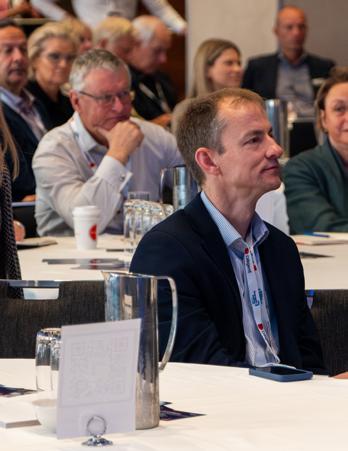

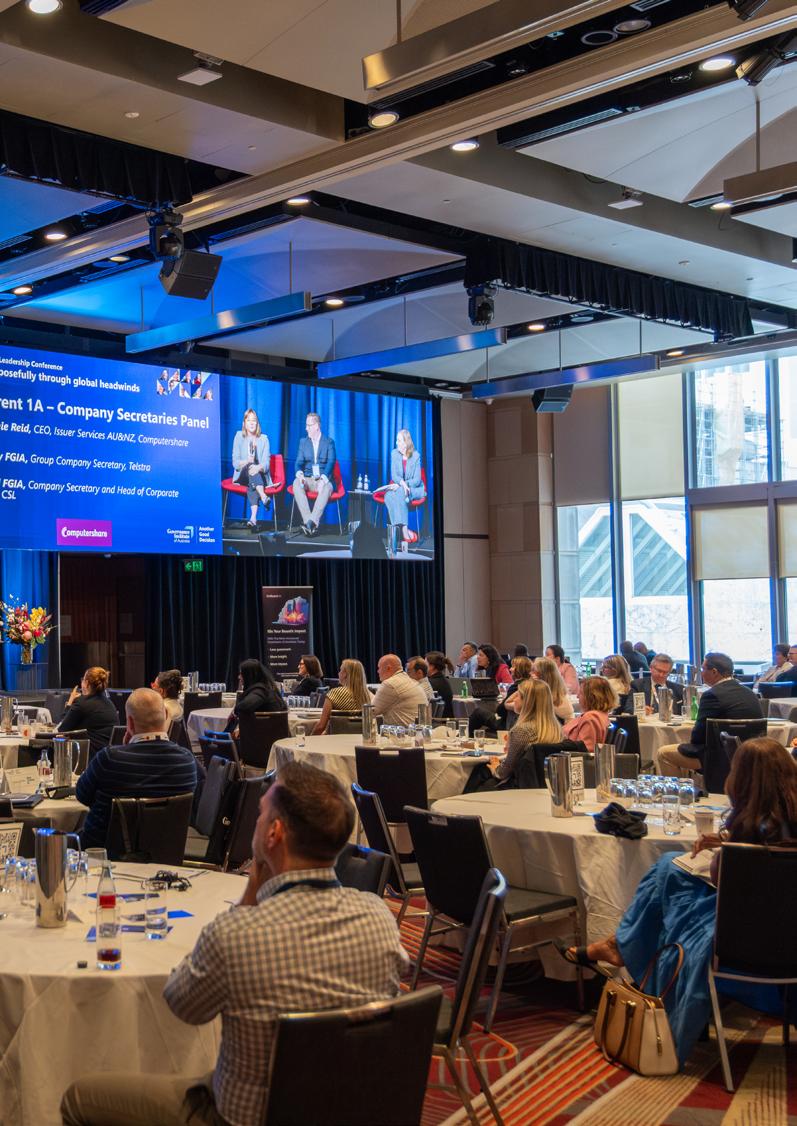

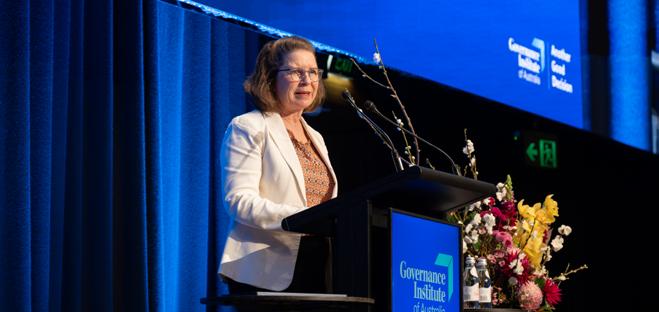
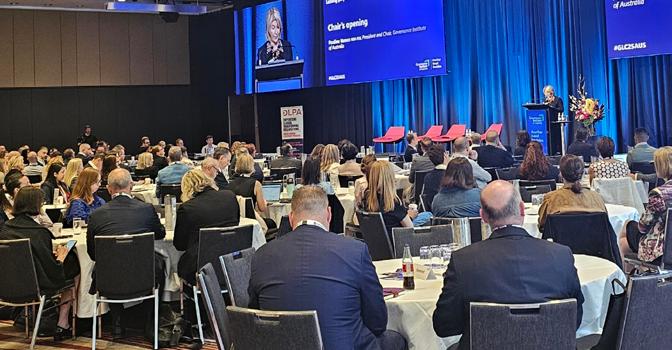
Above and left: Governance Leadership Conference Sydney 2025
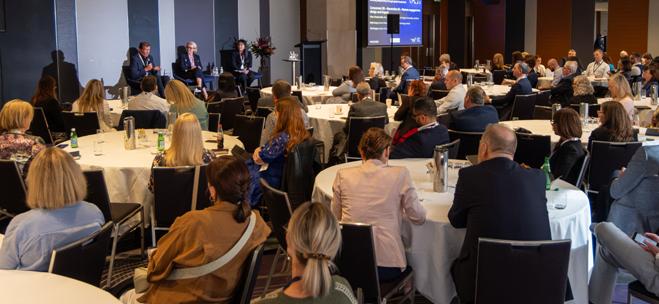
Above and left: Governance and Risk Management Forum 2025

The past year marked a period of significant change for both Governance Institute of Australia and our members. We have collectively navigated challenging economic conditions, heightened operational risk and the rapid expansion of artificial intelligence, all of which continue to reshape the governance landscape.
On behalf of the Board, I extend my sincere thanks to our members who remain the foundation of this organisation. Whether as new or long‑standing members, State Councillors, committee contributors, or discussion group participants – your engagement and loyalty to the Institute, as well as your participation in the Governance Institute community is inspirational. Your feedback, particularly through member surveys and strategy consultations, has been candid and constructive and directly inform the areas where we should focus.
Our operational results reflect a purposeful strategy which commenced a few years ago to transform the business. This involved spending in areas where underinvestment was present for many years. It is only recently that we have had the funds available to make these strategic investments. This rebuilding and transformation is continuing and we expect to see a correction to our losses in the next couple of business cycles. We continue to prioritise investment in core capabilities and services, including our digital platforms, refreshed strategy, and brand positioning. Transformation costs have been significant and are reflected in our financial results. However, the Board is confident that this investment will provide the organisation with strong foundations for future growth.
I would like to recognise and thank our CEO Katrina Horrobin for her leadership in her first year as CEO. Her stewardship during a year of change has been exemplary. I also thank our dedicated staff whose professionalism and expertise underpin our success as we strengthen the governance profession across Australia. Finally, I would also like to thank my fellow board members (both past and present) for their oversight, insight and foresight over this period.
Strategic investment and organisational growth
Our transformation effort is backed by investment pools created from the sale of our former Sydney site, helping us confidently invest in future initiatives for long term sustainability.
This year, we achieved TEQSA re registration as an Institute of Higher Education, earning a seven year term with no conditions. This milestone affirms our sector standing and prepares us for future growth.
We streamlined our Governance Capability Framework, so all short courses and micro credentials align to 21 capabilities, laying the groundwork for 2026 course reaccreditation and underscoring our commitment to high‑quality governance education. We create real graduates!
Education and capability building Education remains central to our mission. Governance Institute launched new micro credentials and bundles designed to meet emerging governance needs, and we saw strong enrolments across our postgraduate programs from both corporate and not‑for‑profit professionals. Our academic partnerships and industry engagement deepened, ensuring our curriculum remains contemporary, relevant, and responsive to the challenges facing boards and governance professionals.
Membership and engagement
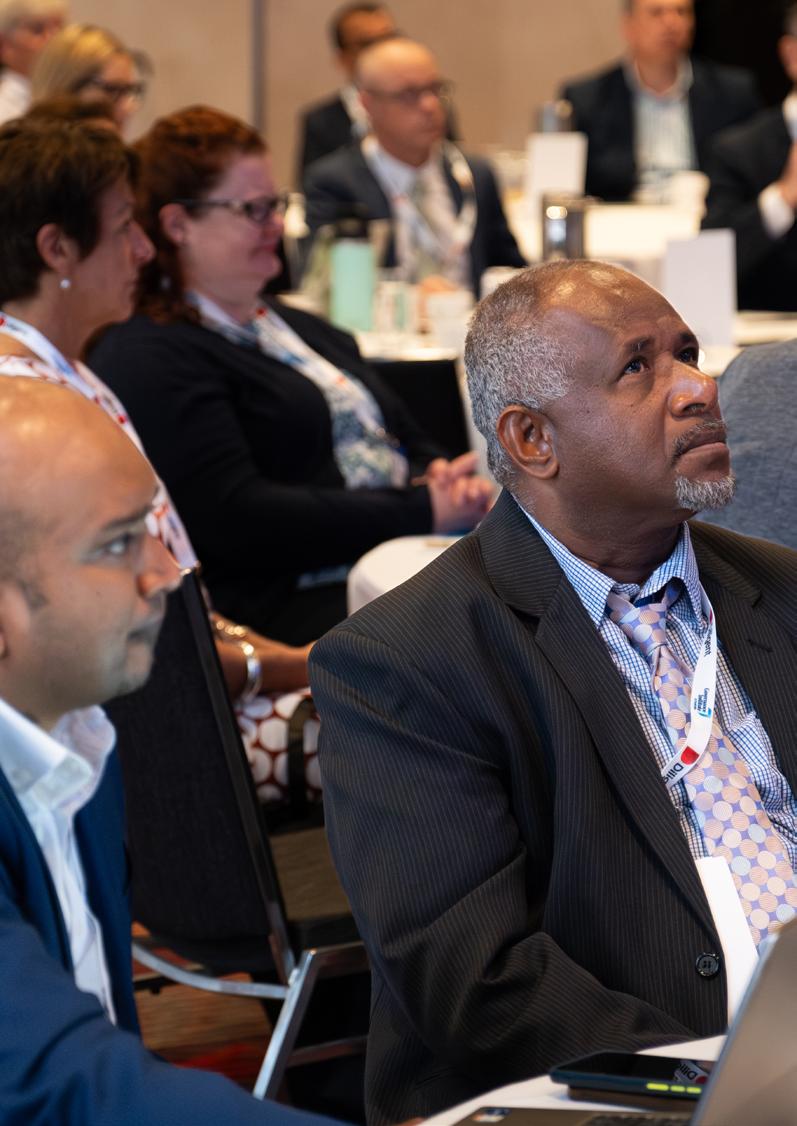
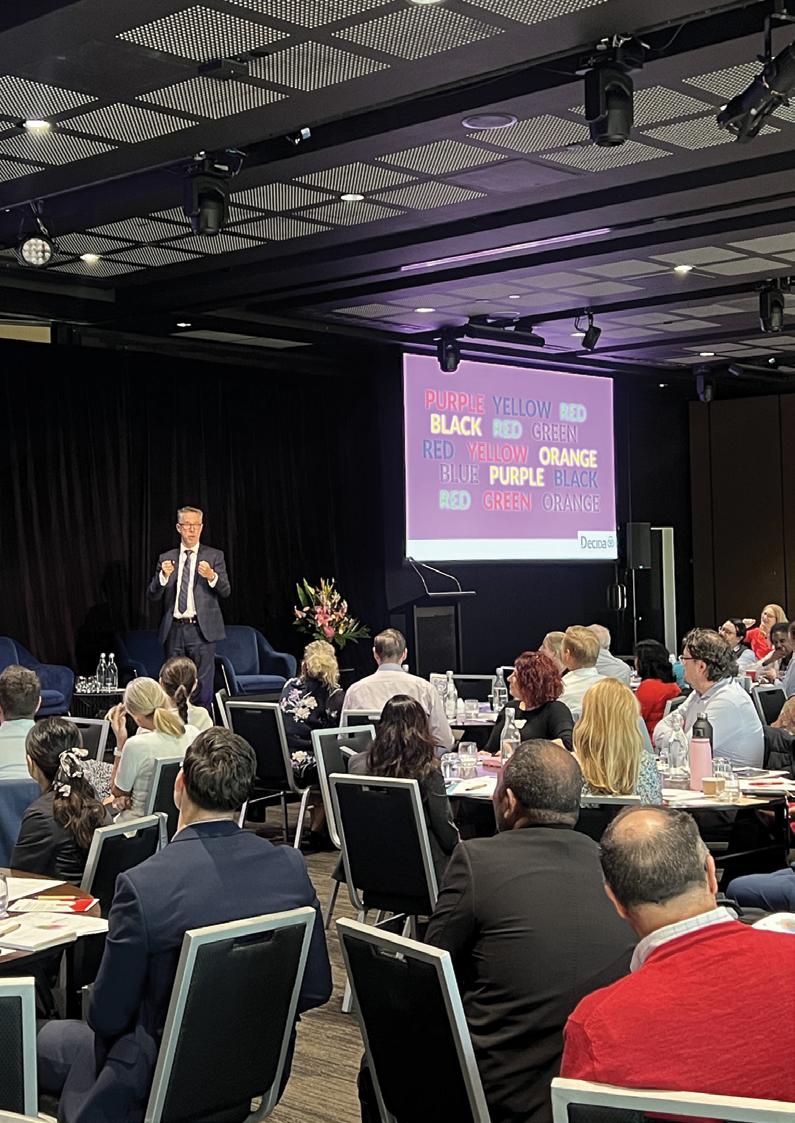
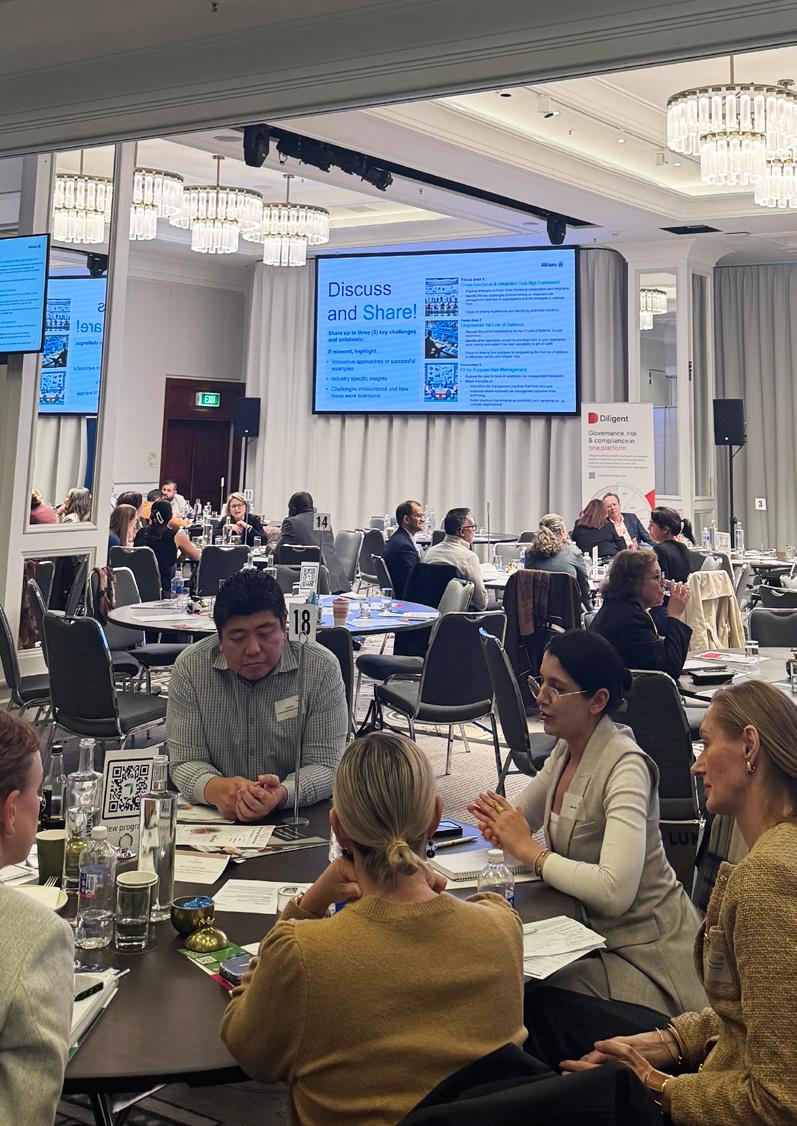
Engagement across our events and programs remained strong, with thousands of professionals participating in conferences, briefings, webinars, and forums. The Governance and Risk Management Forums sold out across five cities, attracting more than 800 attendees. The Governance Leadership Conference brought together 280 attendees in person and more than 100 virtually, with strong satisfaction ratings. Our Indigenous Governance Forum, now in its third year, was listed as part of the 2025 NAIDOC Week main events and featured participation from ACNC, ASIC, ORIC and other peak bodies.
These events continue to strengthen our community and reinforce our role as a national hub for governance expertise.
Policy, advocacy and knowledge leadership
Advocacy remained central to our efforts in 2025, as the policy team made 17 submissions on topics such as APRA reforms, ASX governance, ASIC market inquiries, economic reform, and digital governance.
We partnered with AICD on updated board minutes and AI guidelines and worked with other organisations on AGM technology guidance.
Our 2025 AI Deployment and Governance Survey offered sector wide insights, expanding on our 2024 White Paper and strengthening our position as a progressive governance leader.
Profile and influence
In 2025, we experienced strong media engagement, updated our branding, and introduced new digital content formats. The Ethics Index continued to be central to our public profile, earning recognition as a national benchmark for ethical perception.
This year’s Index thoroughly examined Australians’ views on pressing issues, such as artificial intelligence, the impact of major tech companies on ethical standards, and the ongoing challenges of cost of living and housing affordability. Major outlets including The Australian, The Guardian, SBS News, and ABC Radio featured coverage of the Index, further establishing our reputation as an independent, evidence based advocate for integrity and accountability.
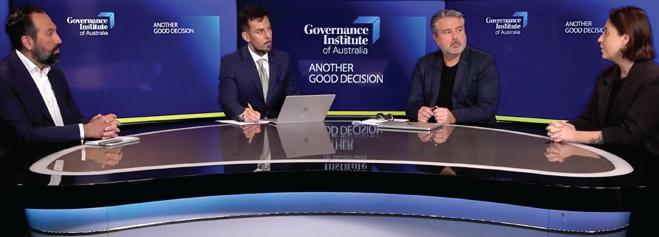
Additionally, our social media footprint expanded: LinkedIn followers exceeded 40,000, and our newsletter reached over 14,000 subscribers. We also launched the Another Good Decision vodcast – now called ‘Risk and Reason’—which delves into key questions affecting governance, risk, and leadership. This format is set to continue growing in reach and influence.
Commercial strength and partnerships Governance Institute’s commercial performance was supported by partnership growth and continued demand for our education and training programs. We also continued our partnership with the Department of Foreign Affairs and Trade, delivering a third instalment of director training in Fiji for directors from Fiji and the Solomon Islands a program that strengthens governance capability across the region and reflects our growing international footprint.
Looking forward, we are optimistic. Thanks to our updated strategy, enhanced leadership group, and expanding national reach, the Governance Institute is prepared to advance societal prosperity by promoting strong governance wherever decisions take place.
Our social media footprint expanded: LinkedIn followers exceeded 40,000 followers.

Building national visibility through data‑led thought leadership In 2025, we continued to elevate Governance Institute’s public voice across Australia’s governance and business landscape.
Our flagship Ethics Index once again served as a cornerstone of media and stakeholder engagement, translating robust research into meaningful national conversation and reinforcing our position as an independent, trusted authority on integrity, leadership and decision making.
Coverage spanned major national outlets including The Australian, The Guardian, SBS and radio programs such as ABC Radio and 2GB, addressing some of the country’s most pressing ethical and governance challenges. The Ethics Index not only strengthens our reputation as thought leaders but firmly positions Governance Institute as a go to commentator on governance, risk, accountability and corporate culture.


























74
Ethics Index in the Media media items over six days
89% Member Retention Rate
12
Media releases up 10% on 2024
Total audience reach:
4,666,200 over six days

40,373+ followers Up from 37,500+ in 2024 Partnerships: $920,230 Risk and Reason vodcast launched Governance Institute’s vodcast is launched Linkedin newsletter
Linkedin followers
+14,000 subscribers Follow Governance Institute on LInkedin
Building capability for the governance workforce Governance Institute is committed to enabling societal prosperity by supporting governance professionals to develop the necessary capabilities to meet current and future workforce challenges. The Governance Capability Framework defines capabilities, including governance principles and practices, and human capabilities validated by global research, that encompass knowledge, skills, and mindsets essential for governance roles. The framework promotes lifelong learning and adaptability to evolving governance demands through short courses, recently introduced micro credentials, and postgraduate education.
CapabilityPro, a self assessment tool, has been developed to support individuals and businesses to better understand their current capabilities, and identify where our courses can lift proficiency.
Short courses
In 2025 there were a total of 3,794 public and inhouse short course enrolments, with 409 students enrolled in a certificate. A total of 2,290 digital badges were awarded for completion of a short course, with a further 256 digital badges awarded for completion of a certificate (a further 266 students completed an old certificate (no badge).
The most popular short course was Accidental Company Secretary®, followed by Board Papers and Reporting Essentials, and Governance Fundamentals
The most popular certificate was Foundations of Secretarial Practice, followed by Governance and Risk Foundations
The majority (61%) of public short courses were studied online, with virtual (21%) and face to face (18%) delivery making up the remainder.
There were 115 graduates of the Effective Director Course.
Micro‑credentials
In 2025 there were a total of 197 enrolments in micro credentials.
The most popular micro credentials were Governance and Oversight, followed by Risk Governance
In 2025 a total of 130 digital badges were awarded for completion of a micro credential.
Postgraduate education
In 2025 there were 657 subject enrolments in the Graduate Diploma and nested Graduate Certificate of Applied Corporate Governance and Risk Management 32 (24%) students graduated with the graduate certificate and 100 (76%) students with the graduate diploma. Of those graduating with the graduate diploma, 36% followed the pathway to Chartered Secretary, and 64% the pathway to Chartered Governance Professional.
3,794
Short courses and in‑house enrolments
409
Certificates
Delivery mode
Most popular short courses: Accidental Company Secretary®
Board Papers and Reporting Essentials Governance Fundamentals
115 Effective Director Course graduates
197
Micro‑credential enrolments
657
Postgraduate subject enrolments
Following closure of the consultation on a proposed 5th edition of the Corporate Governance Principles and Recommendations and the disbanding of the ASX Corporate Governance Council, Governance Institute welcomed the independent review Group’s recommendation to establish a new ASX corporate governance advisory body. We look forward to contributing to efforts for productive collaboration, improved transparency and governance frameworks that support trust and accountability in Australia’s capital markets.
Following the May election the re elected Labor Government indicated cost of living issues, navigating increased macroeconomic uncertainty, and boosting productivity would dominate its agenda for the next three years. The election result provided certainty on issues such as climate related financial disclosure. We are monitoring movement on ‘unfinished business’ from the previous government including continued implementation of the Privacy Act review recommendations, changes to the modern slavery regime and a review of the whistleblower protection regime.
ASIC had a focus on the impact of regulation on business, establishing its Simplification Consultative Group in 2024. Our Submission to ASIC’s Regulatory simplification consultation highlighted a range of areas where we consider ASIC could improve and simplify its website, guidance, processes and interactions with its regulated entities and other customers. We also highlighted the need for a specialist independent Corporate Law Reform Body. We led a coalition of peak and industry bodies, the Corporate Law Reform Alliance, which made its first public statement in October calling on the Commonwealth to establish a standing expert body, similar to the former Corporations and Markets Advisory Committee. We and other Alliance members continue to advocate for the establishment of this body.
We also made a submission to ASIC on its consultation on public and private markets. Following that consultation ASIC has announced a range of measures to assist public markets.
The Policy and Advocacy Team has participated in a series of workshops with APRA and members on its Governance Review proposals, providing practical feedback on the implications of its proposals. Pleasingly in its update on the Review, APRA indicated that issues of concern to members had been modified.
The Policy and Advocacy Team has participated in a series of workshops with APRA and members on its Governance Review proposals, providing practical feedback on the implications of its proposals.
Governance Institute was engaged in two new reports highlighting AI and digital transformation. A survey of Australian and APAC organisations, conducted by the Diligent Institute, Governance Institute of Australia and Singapore Institute of Directors which revealed Australian boards are rapidly prioritising AI and digital transformation. However, they often lack governance or oversight to manage the risks associated with technologies outpacing human capabilities in the workplace. We also partnered with CISCO to produce a report which warns that untapped risk management is a major roadblock to faster AI adoption. It identified Chief Risk Officers as catalysts for unlocking AI’s potential through safe, secure and strategic adoption and outlines four key roadblocks and six decisive moves to overcome them.
We collaborated to update two of our most popular resources during the year – Effective board minutes and the use of AI, with AICD, and AGMs using technology with AICD, Australasian Investor Relations and the Business Law Section of the Law Council of Australia.
We continue our program of engagement with key regulators including APRA, ASIC and the ACNC. We are also a member of the ACNC Charity Forum, the ASIC Registers Business Advisory Group, the CHESS Statements Working Group and the ASX Business Committee. We also attend a range of formal and informal meetings with key regulators on issues of interest and concern to members.
Governance Institute continues to support our members in all aspects of their careers, in an increasingly complex and challenging environment, including the Governance of AI, increasing regulation and significant technological change.
We continue to offer the Chant Legacy Scholarship, for postgraduate study in Governance and Risk Management, with 3 new Scholarships awarded during the year, and 25 graduates from the program since inception.
Total participation across events and engagement programs was 5,893. This included 33 virtual and in‑person discussion groups, engaging 1,284 members and 209 non members, which provided regular opportunities for peer connection and discussion of governance and risk issues. A new format, Member Exchange, was trialled in Western Australia and regional Queensland to support smaller, interactive peer engagement which proved successful and will be extended nationally in 2026.
AI continued to be a focus with 11 AI focused events delivered, including the launch of the AI Governance White Paper and the joint Board Minutes in the Age of AI publication with AICD, which engaged 3,730 attendees and strengthened our position as a national leader and convenor in AI governance and practice.
Total participation
5,893
Virtual and in-person discussion groups
1,284
Non-members across events and engagement programs
33
Members
209

Pauline
Chair
Vamos FGIA, FCG, BALLB, FASFA, GAICD (commenced 26/07/2021)
Pauline is a non executive director of Mercer Superannuation Australia Limited, non executive director and chair of Ardea Investment Management Pty Ltd and an advisory board member of The Conexus Institute. Pauline is recognised as an expert in governance, risk management and public policy and for taking on difficult issues within organisations. She has over 30 years’ experience in the financial services industry and has been recognised with a number of awards.
Paige Exley FGIA, FCG, BCom, CA, (CS) (commenced 1/01/2024)
Paige is a Chartered Accountant and Chartered Secretary, with over 20 years of experience in financial and management accounting. She brings significant experience to the position, gained in finance and governance roles with ASX‑listed companies in Australia, with domestic and overseas operations, in industries such as construction, manufacturing, resources, mining services, information technology, professional services, not for profit and retail. Paige’s prior experience has seen her responsible for business finance functions, asset development, corporate compliance, continuous process improvement, treasury management, capital raisings, investor relations and corporate governance.


Karin Geraghty FGIA, FCG (commenced 1/12/2022)
Karin is an independent consultant specialising in digital business transformation, technology, data and information governance with professional experience as CIO, Security Executive and Chief Data Officer, Karin joined the Governance Institute through membership of the SA/NT Council and chaired the Risk and Technology Committee from 2020 to 2022. Karin is also a member of the UNISA STEM program advisory board.
Greg Hanigan FGIA, FCG, BCom, AdvDipFS (FP), Cert Gov(Prac), GAICD (commenced 3/9/2021)
Over 20 years’ experience in financial services leading risk, governance and compliance functions. He is currently Chief Risk Officer at Futurity Investment Ltd. Previously Greg was a member of the Tasmanian State Council. Greg chairs the People, Remuneration and Nomination Committee and is a member of the Investment Committee.


Helen Hardy FGIA, FCG, LLB, BCom, GradDipACG, CA, GAICD (commenced 19/11/2021)
Extensive experience in governance, corporate law, financial reporting and sustainability. Helen is company secretary of Origin Energy Ltd. She is a qualified lawyer and Chartered Accountant and has advised large listed companies at PwC and Freehills. Helen chairs the Membership Committee.
Debora Jackson FGIA MBA (commenced 4/03/2024)
Debora has over 35 years’ experience in the financial services and NFP sectors, in C suite executive and non executive board roles. She is a practised non‑executive director, with a demonstrated history of working in the ‘profit for purpose’ sector and with proven ability to work across a range of industry sectors. She has skills in corporate governance, leadership, and risk management. Debora is chair of the board of Micah Projects Ltd, an Independent Director of Focused Health Care Pty Ltd and facilitates several Governance Institute education courses. Prior to joining the Governance Institute Board, Debora chaired the Governance Institute Queensland Council.


Jeffrey Luckins FGIA FCG FCPA BBus(Acc) (commenced 25/11/2025)
Jeffrey is a Partner of Audit & Assurance at William Buck in Melbourne. Jeffrey is experienced in auditing of listed Australian and multinational companies, large private corporations and groups, not for profit organisations, and the preparation of Investigating Accountant’s Reports for the issue of prospectus and ASX listings. He is Honorary Secretary of the Royal Society of Victoria. During the past six years, Jeffrey has facilitated the virtual Company Secretaries Discussion Group, and he was Chair of the Governance Institute Victorian Council for three years. Jeffrey is a member of the Risk, Audit and Finance Committee.
Michael Adams FGIA(Life), FCG, BA(Hons) Law, LLM(Lond), FACE, FAAL, ARI (commenced 5/08/2022 and resigned 8/08/2025)
Jose Herrera Perea BBusMgmtAdmin, GradCertBusMgmt, GAICD, MIPA, MAFA, PICMC (NSW) (commenced 22/10/2024 and resigned 18/07/2025)
Ken Weldin FGIA, FCG, BAcc (Hons Econ), CA, MBA, Professor (Practice) (commenced 1/12/2022 and resigned 25/08/2025)

Katrina has broad leadership and general management experience across various sectors including telecommunications, technology, superannuation, and education. She has worked for large, complex organisations overseeing operational and marketing activities, including Optus and AAPT, we well as been a founding leadership team member of three different start up businesses in telecommunications and technology. Katrina holds a Bachelor of Commerce degree from the Australian National University and is Deputy Chair of the Foundation and Friends of the Botanic Gardens.

David O’Kane FGIA, FCG, BA, ACMA Chief
David joined Governance Institute of Australia in February 2022, with considerable commercial experience and over 15 years in senior roles in the for purpose sector, including as COO at the Financial Services Institute of Australasia (FINSIA) and with Medecins Sans Frontieres Australia (MSF). David’s responsibilities include finance, IT, people and culture, risk management, legal and compliance, and property.
David holds a BA in Economics & Public Policy from Leeds Beckett University, is a qualified accountant with the Chartered Institute of Management Accountants (CIMA) and completed Governance Institute’s Post Graduate Diploma in Applied Corporate Governance in 2007.

Chris leads the Governance Institute’s marketing and communications functions, with responsibility for growing awareness of the Institute, supporting education and membership revenue, and ensuring the organisation communicates clearly and consistently with its audiences.
He brings more than 15 years’ experience across marketing, communications and commercial strategy, having worked with a range of Australian and international organisations in media, technology, professional services and education. His background spans brand development, digital marketing, customer experience, media partnerships and go to market strategy.

Maryanne joined Governance Institute in 2016 and brings more than 20 years of experience across membership organisations, including the Australian Institute of Company Directors and CPA Australia. She leads a national team encompassing State Managers, events, sponsorships and partnerships, as well as the sales function for our education and training courses to both corporate clients and individual learners.

Catherine joined Governance Institute in August 2017 and is responsible for policy, advocacy and media. She has a strong background in governance and policy gained at the Australian Prudential Regulation Authority, the ASX Corporate Governance Council, ASX, the Australian Institute of Company Directors and the Financial Services Council. She has also held roles as a Company Secretary with Cancer Council NSW, NPP Australia Limited and Youth off the Streets. She is a member of the Governance Committee of Cancer Council NSW.
Catherine has a BA(Hons)/LLB from the University of Sydney. She qualified as a solicitor and has worked in a variety of legal roles in Australia and Hong Kong. She completed the Graduate Diploma of Applied Corporate Governance in 2008.

Geoffrey has over 35 years’ experience in finance, company secretarial and line management roles including senior company secretarial roles for a variety of organisations including MLC, Investa, The Trust Company, Magellan Financial Group and Westpac. He has also had a long standing involvement in the not for profit sector through the Australian Scholarships Foundation.
Geoffrey holds a B Com from the University of New South Wales, is a Chartered Accountant, a Fellow of the Australian Institute of Company Directors and a Chartered Secretary.

Mark joined Governance Institute following a career in health education in universities in the United Kingdom and Australia. The education team supports Governance Institute’s objective of being the leading provider of accredited postgraduate education in governance practice. Governance Institute offers graduate certificates/ diplomas in governance and risk management.
Mark holds a Biology BSc (Hons) from the University of Portsmouth, a Certificate in Education: Post 16 from Sheffield Hallam University, and a MSc (Interprofessional Health and Social Care) from Canterbury Christ Church University.


Kerrie Waring
Director General, Chartered Governance Institute Governance Institute of Australia has been a division of The Chartered Governance Institute (CGI) since 1914 and is proud to be a member of this important institution, alongside eight other divisions who serve 28,000 members and 12,000 students and graduates worldwide. Collectively, we inspire good governance for societal prosperity.
A strategic priority for CGI is to ensure that its flagship International Qualifying Programme (IQP) remains the preeminent choice for Governance Professionals seeking to enhance their knowledge and competence to advise boards, and others, on contemporary governance practice. CGI will soon launch an updated version of the syllabus which encapsulates the issues of our day including sustainability related risks and opportunities, digital technology and data management, capital discipline and resilience. Individuals who complete postgraduate courses offered through the Governance Institute of Australia meet the education requirements for CGI membership.
CGI Global has also embarked upon a public policy and advocacy campaign to raise awareness of the value of the Governance Professional in contributing to organisational success and resilience. CGI has actively engaged in face to face dialogue with regulators and standard setters over the course of the year including in Japan, Malaysia, Hong Kong, Singapore, and New Zealand.
This effort is supplemented by responses to public policy consultations requesting recognition of the position of Governance Professionals (particularly Company Secretaries) in Corporate Governance Codes.
These activities have been communicated via the CGI Global website and discussed at webinars, including most recently on the subject of Southern Africa’s King V Code in February. Planning for the CGI Global Governance Summit, taking place between 22‑23 September 2026 in Kuala Lumpur, is well under way and will welcome CGI members from around the world to participate.
This work is the result of a highly dedicated global secretariat, alongside nine divisional CEOs and their respective teams. CGI has a clear strategic plan with oversight from the CGI Council and its various committees. Governance Institute of Australia actively engages in the governance of CGI, and Pauline Vamos was appointed Chair of the Governance Committee in late 2024 having joined the Council in 2023. Katrina Horrobin participates in CEO level strategic implementation and, Mark Wilbourn, GM Education is leading Governance Institute’s contribution to the work on modernisation of the IQP. In addition, Geoff Stirton is involved with the IQP modernisation as well as advising the Governance Committee.
Many Governance Institute of Australia members are also involved in the work of CGI Global including Simon Pordage who serves on the Global Policy and Advocacy Committee, Karin Geraghty who contributes to the IQP Market Intelligence Group and Professor Michael Adams who serves as a member of the Professional Standards Committee. Governance Institute of Australia hosted the CGI Global Council meeting and Annual General Meeting in September 2025 in Sydney, alongside its Governance Leadership Conference. For more information about CGI Global, please visit www.cgiglobal.org
Your Directors present this report on the Company for the financial year ended 31 December 2025.
The principal activities of Governance Institute of Australia Ltd (Governance Institute or the Company) during the year were to champion excellence in governance and risk management through education, advocacy and engagement with members and the broader community.
There was no significant change in the nature of the activities during the year and the operations are in accordance with the Constitution. The Company’s financial report has been prepared in accordance with the Australian Charities and Not for profits Commission Act 2012, the Australian Charities and Not for‑profits Commission Regulations 2022 and Australian Accounting Standard AASB 1060 General Purpose Financial Statements — Simplified Disclosures for For‑Profit and Not‑for‑Profit Tier 2 Entities.
To meet its long term objectives, the Company will strive to see that:
• the organisation’s governance arrangements remain fit for purpose and align with contemporary best practice through the implementation of recommendations from an independent review of our governance.
• Australia’s governance frameworks facilitate a strong economy underpinned by responsible performance and organisational culture.
• current members and aspiring company secretaries, governance professionals, risk managers and directors are provided with the best education, resource support and career support to enhance their professional standing
• the organisation is strategically focused on being innovative; encouraging positive engagement with, and influencing, all stakeholders; and fostering a culture and values that ensures it is sustainable.
• governance practitioners are provided with a trusted community from which they can draw education, provide input, and access a knowledge sharing network of support, appropriate for their changing needs and circumstances throughout their chosen governance careers.
The company’s short term objective is to continue to focus on member engagement, innovation and lifting and maintaining our profile for the next 12 months to maintain member retention at 90 per cent or better.
To meet its short term objectives, the Company will continue to:
• provide services, resources, and training to members
• create and implement member engagement strategies that are more targeted and aim to continue to increase our relevance and profile
• strengthen our advocacy activities to influence decision makers and support responsible performance using good governance practices
• better align our product offering to meet the career stages and interests of our members.
An operating deficit of ($1,574,083) was reported for the year.
Accumulated Members’ Funds at year end were $11,891,279.
Governance Institute is exempt from income tax.
As the Governance Institute’s Constitution prohibits the payment of dividends, no dividends have been paid.
Company performance was assessed by the Board of Directors at their Board meetings held during the year.
Quarterly forecast reviews are presented and discussed as to the progress between budget, forecast and actual results achieved. The Risk, Audit and Finance Committee also reviews the annual budget prior to making recommendations to the Board for their consideration.
Total operating revenue for the year amounting to $10,216,777 primarily came from member and subscriber fees 36.7 per cent; postgraduate courses 15.1 per cent; and short courses and certificate courses 29.1 per cent.
Total expenditure for the year amounting to $12,482,534 was primarily from direct costs for short courses & certificates, Conferences, and postgraduate courses at 13.5 per cent of total expenditure; payroll costs at 61.7 per cent, rental expense at 4.2 per cent, and Marketing, comms and profile expenses at 7.5 per cent.
Likely developments in the operations of Governance Institute and the expected results of those operations in future financial years are disclosed in the Chair’s report at page 1.
Governance Institute’s operations are not regulated by any significant environmental regulation under a law of the Commonwealth or of a state or territory.
There are no matters or circumstances that have arisen since the end of the financial year pertaining to the 2025 operations.
Continuing members of the Board of Governance Institute at the date of this report are Pauline Vamos, Paige Exley, Greg Hanigan, Helen Hardy, Karin Geraghty, Jeffrey Luckins, and Debora Jackson.
Governance Institute has not, during or since the end of the financial year, in respect of any person who is or has been an auditor of Governance Institute or a related body corporate, indemnified or made any relevant agreement for indemnifying against a liability incurred as an auditor, including costs and expenses in successfully defending legal proceedings, or paid or agreed to pay a premium in respect of a contract insuring against a liability incurred as an auditor for the costs or expenses to defend legal proceedings.
As Governance Institute is limited by guarantee, none of the Directors holds an interest but each, as a member of Governance Institute, is liable to the extent of their undertaking under Governance Institute’s Constitution.
Under the Company’s constitution, the Company indemnifies, to the extent permitted by law, all current and former Directors and Officers of the Company against any liability incurred in that person’s capacity as an Officer of the Company and against any legal costs incurred by that person in defending any proceedings relating to any such liability.
The Company has also entered into a deed of indemnity with Directors and Officers on substantially the same terms as those set out in the Constitution.
During the year, the Company paid insurance premiums to insure the Directors and Officers of the Company, as permitted by the Corporations Act 2001 (Cth), in respect of losses, liabilities, costs and charges incurred by those persons in their capacity as an Officer of the Company. The terms of the policy prohibit the disclosure of the amount of the premiums paid by the Company.
During 2025 attendance by individual Directors at meetings they were entitled to attend, is set out in the table below.
Vamos 8/8
Michael Adams
Paige Exley
Karin Geraghty
Greg Hanigan
Helen Hardy 7/8
Jose Herrera Perea 4/4
Debora Jackson 5/5 3/3
Ken Weldin 5/5 3/3 3/3
The liability of each member (and each person who has ceased to be a member in the preceding year) on winding up is limited to an amount not exceeding $100.
Company Secretary
Geoffrey Stirton FGIA FCG Company Secretary
David O’Kane FGIA FCG Chief Operations Officer
Auditor’s independence declaration
The Auditor’s independence declaration is set out on page 37 and forms part of the Directors’ report for the financial year ended 31 December 2025.
Company details
The registered office and principal place of business of the company is: Level 7, 60 Carrington Street Sydney, NSW 2000, Australia ABN 49 008 615 950
Chair and Director signatures
Pauline Vamos FGIA FCG
President and Chair of Governance Institute of Australia Ltd and of the Australian Division of The Chartered Governance Institute
Signed in accordance with a resolution of Directors. SYDNEY, 31 March 2026

Paige Exley FGIA FCG Director Chair of Risk, Audit and Finance Committee
Statement of financial position for the year ended 31 December 2025
Statement of cash flows for the year ended 31 December 2025
1. Corporate information
Governance Institute of Australia Ltd (the ‘Company’) is an incorporated company limited by guarantee and domiciled in Australia. The address of the Company’s registered office is Suite 7.03, Level 7, 60 Carrington Street, Sydney, NSW, 2000. The Company is a not‑for‑profit entity.
In the event of the Company being wound up, the liability of each member, or each former Member who ceased to be a member within a year of the Company being wound up, is limited to an amount not exceeding $100. As the Company is limited by guarantee, there is no reference in the statement of financial position to share capital or shareholders’ equity.
The Company’s principal activities in the course of the financial year were to champion whole of organisation governance and risk management through education, advocacy and engagement with members and the broader community.
2. Basis of preparation
(a) Statement of compliance
The financial report is a general purpose financial report that has been prepared in accordance with Australian Accounting Standards — Simplified Disclosures. This includes compliance with the recognition and measurement requirements of all Australian Accounting Standards, Interpretations and other authoritative pronouncements of the Australian Accounting Standards Board and the disclosure requirements of AASB 1060 General Purpose Financial Statements — Simplified Disclosures for For Profit and Not for Profit Tier 2 Entities and the Australian Charities and Not for profits Commission Act 2012 and the Australian Charities and Not for profits Commission Regulation 2022.
A statement of compliance with International Financial Reporting Standards cannot be made due to the Company applying the not for profit sector specific requirements contained in AIFRS.
The financial statements were approved by the Board of Directors on 31 March 2026.
(b) Basis of measurement
The financial report has been prepared on an accruals basis and is based on historic costs and does not take into account changing money values or, except where stated, current valuations of non current assets. Cost is based on the fair values of the consideration given in exchange for assets.
(c) Functional and presentation currency
The financial statements are presented in Australian dollars, which is the Company’s functional currency.
(d) Rounding of amounts
The amounts in the financial report have been rounded to the nearest dollar.
(e) Use of estimates and judgments
The preparation of financial statements requires management to make judgements, estimates and assumptions that affect the application of accounting policies and the reported amounts of assets, liabilities, income, and expenses. Although these estimates are based on management’s best knowledge of current events and actions, actual results may ultimately differ from those estimates.
Estimates and underlying assumptions are reviewed on an ongoing basis. Revisions to accounting estimates are recognised in the period in which the estimate is revised and in any future periods affected.
At the commencement date of a lease (other than leases of 12 months or less and leases of low value assets), the Company recognises a lease asset representing its right to use the underlying asset and a lease liability representing its obligation to make lease payments. In order to measure a lease asset and corresponding lease liability, the Company is required to make a determination of the lease term. This determination includes an assessment of whether the Company is reasonably certain to exercise an option to extend the lease or to purchase the underlying asset, or not to exercise an option to terminate the lease.
In making this judgement, the Company considers all relevant facts and circumstances that create an economic incentive for the Company to exercise, or not to exercise, the option, including any expected changes in facts and circumstances from the commencement date of the lease until the exercise date of the option. The Company cannot readily determine the interest rate implicit in the lease, therefore, it uses its incremental borrowing rate (IBR) to measure lease liabilities. The IBR is the rate of interest that the Company would have to pay to borrow over a similar term, and with a similar security, the funds necessary to obtain an asset of a similar value to the right of use asset in a similar economic environment.
(f) Income tax
Governance Institute of Australia Ltd is for income tax purposes endorsed as a charitable institution. Its income is therefore exempt from Income Tax under Subdivision 50 B of the Income Tax Assessment Act 1997.
(g) New standards and amendments adopted
The Company has adopted all of the new or amended Accounting Standards and Interpretations issued by the Australian Accounting Standards Board that are mandatory for the current reporting period. The adoption of these Accounting Standards and Interpretations did not have any significant impact in the financial performance or position of the Company.
3. Revenue
Revenue represents income earned from membership subscriptions and the provision of related services. Membership subscription revenue is recognised over time as well as short courses and associated certificates. Revenue from the provision of other services is recognised upon the delivery of the service to members/customers (postgraduate enrolments, professional development (PD) events, conferences and related sponsorships). Interest income is measured in accordance with the effective interest method and is recognised over the relevant period. Distribution income is recognised when the right to receive a distribution has been established. All revenue is stated net of the amount of GST.
4. (Deficit)/surplus from ordinary activities
(Deficit)/surplus from ordinary activities is stated before income tax expense has been determined, after charging: (a) Depreciation
No other directors received any remuneration during the year.
7. Cash and cash equivalents
8. Trade and other receivables
Trade receivables are non interest bearing and are generally due for payment within 30 days of the invoice date. There is no impairment or significant credit risk with any debtor balance.
Trade and other receivables are recognised when the company becomes a party to the contractual provisions of the instrument Trade and other receivables are classified (and measured subsequently) at amortised cost. The Company applies the simplified approach under AASB 9 to measuring the allowance for credit losses for receivables from contracts with customers. Under the AASB 9 simplified approach, the Company determines the allowance for credit losses for receivables from contracts with customers, on the basis of the lifetime expected credit losses of the financial asset. Lifetime expected credit losses represent the expected credit losses that are expected to result from default events over the expected life of the financial asset.
9. Other assets
10. Financial Assets
Term deposits with an original maturity of more than three months are measured at amortised cost using the effective interest method.
The funds returned a combined realised and unrealised gain of $60,734 (2024: $595,335) and dividends & distributions of $543,721 (2024: $638,219) recognised in profit and loss for 2025.
The Financial assets classified as non current assets are part of a long term strategic investment fund. This multi asset investment portfolios’ intent is to preserve and grow capital whilst generating income. They have been classified as non current. Despite their non‑current classification, these assets maintain the flexibility to be converted to cash with 15 working days notice.
Financial assets relating to the investment in managed funds are classified at fair value through profit or loss (FVPL).
At initial recognition the company measures a financial asset at its fair value.
Transaction costs of financial assets carried at a fair value and are expensed in the Statement of Profit or Loss.
Changes in the fair value of financial assets at fair value through profit or loss, profits and losses realised from the sale of financial assets, and interest and distribution income are recognised in the Statement of Profit or Loss.
Derecognition
Financial assets are derecognised where the contractual rights to receipt of cashflows expires or the asset is transferred to another party whereby the company no longer has any significant continuing involvement in the risks and benefits associated with the asset.
The valuation techniques and key assumptions used in measuring the fair value of financial assets measured at FVPL are as follows:
• Managed funds are stated at the redemption price quoted by the investment manager at the reporting date.
11. Property plant and equipment
Movement in the carrying amounts for each class of property, plant and equipment between the beginning and the end of the current financial year.
Items of property, plant and equipment are measured at cost less accumulated depreciation and accumulated impairment losses.
The gain or loss on disposal of an item of property, plant and equipment is determined by comparing the proceeds from disposal with the carrying amount of the property, plant and equipment, and is recognised net within other income/other expenses in profit or loss.
An item of plant and equipment is derecognised upon disposal or when no further future economic benefits are expected from its use or disposal. Any gain or loss arising on derecognition of the asset (calculated as the difference between the net disposal proceeds and the carrying amount of the asset) is recognised in the Statement of Profit or Loss.
The costs of the day to day servicing of property, plant and equipment are recognised in profit or loss as incurred.
Depreciation is based on the cost of an asset less its residual value. Depreciation is recognised in profit or loss on a straight line basis over the estimated useful lives of each component of an item of property, plant, and equipment. The depreciation rates used for each class of depreciable asset are:
Class of fixed asset
Computer systems
Furniture and office equipment
Depreciation rate
50% 10% 33.33%
Depreciation methods, useful lives and residual values are reviewed at each reporting date and adjusted if appropriate.
12. Intangible assets
Courses, Micro credentials & CapabilityPRO tool (Governance Capability Framework)
assets in progress (new Courses, Micro credentials & CapabilityPRO tool)
Movement in the carrying amounts for each class of intangibles between the beginning and the end of the current financial year.
Intangible assets acquired are recognised at fair value at the date of acquisition and is subsequently amortised on a straight line basis.
Development expenditure is capitalised only if development costs can be measured reliably, the product or process is technically and commercially feasible, future economic benefits are probable, and the Company intends to and has sufficient resources to complete development and to use or sell the asset. The expenditure capitalised includes the cost of materials, direct labour and overhead costs that are directly attributable to preparing the asset for its intended use. Other development expenditure is recognised in profit or loss as incurred.
Capitalised development expenditure is measured at cost less accumulated amortisation and accumulated impairment losses. Subsequent expenditure is capitalised only when it increases the future economic benefits embodied in the specific asset to which it relates.
At each reporting date, the Company reviews the carrying amounts of its non financial assets to determine whether there is any indication of impairment. If any such indication exists, then the asset’s recoverable amount is estimated.
For impairment testing, the recoverable amount of asset of Cash Generating Unit (CGU) is the greater of its value in use and its fair value less costs to sell. Value in use is based on the estimated future cash flows, discounted to their present value using a pre tax discount rate that reflects current market assessments of the time value of money and the risk specific to the asset or CGU.
An impairment loss is recognised if the carrying amount of an asset or CGU exceeds its recoverable amount and thus recognised in profit or loss. They are allocated to the carrying amounts of the assets in the CGU on a pro rata basis. Intangible assets are amortised on a straight line basis in profit or loss over their estimated useful lives, from the date that they are available for use.
The estimated useful lives are as follows:
• Ethics Index — 4 years
• Customer relationship management system — 3 years
• New courses, micro credentials and CapabilityPRO tool — 2 years
• Website — 3 years
Amortisation methods, useful lives and residual values are reviewed at each financial year end and adjusted if appropriate.
Governance Institute of Australia leases its office premises and IT equipment. Information about the leases is presented below:
The Company has entered into a new lease in 2025 for Sydney office with lease term of 5 years expiring in 2030. The Company has also entered into lease for photocopier equipment that expires in 2030.
At the commencement date of a lease (other than leases of 12 months or less and leases of low value assets), the Company recognises a lease asset representing its right to use the underlying asset and a lease liability representing its obligation to make lease payments.
Lease assets are initially recognised at cost, comprising the amount of the initial measurement of the lease liability, any lease payments made at or before the commencement date of the lease, less any lease incentives received, any initial direct costs incurred by the Company, and an estimate of costs to be incurred by the Company in dismantling and removing the underlying asset, restoring the site on which it is located or restoring the underlying asset to the condition required by the terms and conditions of the lease, unless those costs are incurred to produce inventories.
Subsequent to initial recognition, lease assets are measured at cost (adjusted for any remeasurement of the associated lease liability), less accumulated depreciation and any accumulated impairment loss.
Lease assets are depreciated over the shorter of the lease term and the estimated useful life of the underlying asset, consistent with the estimated consumption of the economic benefits embodied in the underlying asset.
14. Trade and other payables
Trade and other payables represent the liability outstanding at reporting date for goods and services received by the Company during the reporting period, which remain unpaid. The balance is recognised as a current liability with the amounts normally paid within 30 days of recognition of the liability. Trade and other payables are subsequently measured at amortised cost.
15. Deferred revenue
Deferred revenue represents revenue received in advance which is not entitled to be recognised in the current period.
16. Provisions
(a) Current
FTE count is lower than the previous period due to several vacant positions throughout the year and redundancies towards the end of the year, in a restructure in late 2025, which saw a reduction of 8 roles across the organisation.
Provision is made for the Company’s liability for employee benefits arising from services rendered by employees to statement of financial position date. Employee benefits expected to be settled within one year of the statement of financial position date have been measured at the amounts expected to be paid when the liabilities are settled. Employee benefits expected to be settled more than one year from the statement of financial position date have been measured at the present value of future payments expected to be made in respect of services provided by employees up to statement of financial position date. Consideration is given to expected future wage and salary levels, experience of employee departure and periods of service. Expected future payments are discounted to their net present value using an estimate of market yields.
17. Lease liabilities
(a) Maturity analysis - contractual undiscounted cash flows
(b) Lease liabilities included in the statement of financial position as at 31 December 2025
Lease liabilities are initially recognised at the present value of the future lease payments (i.e., the lease payments that are unpaid at the commencement date of the lease). These lease payments are discounted using the interest rate implicit in the lease, if that rate can be readily determined, or otherwise using the Company’s incremental borrowing rate.
Subsequent to initial recognition, lease liabilities are measured at the present value of the remaining lease payments (i.e., the lease payments that are unpaid at the reporting date). Interest expense on lease liabilities is recognised in profit or loss (presented as a component of finance costs). Lease liabilities are remeasured to reflect changes to lease terms, changes to lease payments and any lease modifications not accounted for as separate leases.
Variable lease payments not included in the measurement of lease liabilities are recognised as an expense when incurred.
term leases
Lease payments made in relation to leases of 12 months or less and leases of low value assets (for which a lease asset and a lease liability has not been recognised) are recognised as an expense on a straight line basis over the lease term. Lease payment recognised as an expense for the financial year in relation to short term leases is $345,423 (2024: $583,342).
18. Related party and subsidiary company disclosures
Transactions with related parties
Transactions between related parties are on normal commercial terms and conditions unless otherwise stated.
i. The Chartered Governance Institute (CGI), United Kingdom: under the terms of an operating agreement with CGI, Governance Institute of Australia Ltd remits an administration fee based on the number of Australian Members and students registered with CGI as at 30 June each year to meet the expenses of the International Institute. These payments amounted to $113,115 (2024: $103,161).
ii. During 2025, PKF (ABN 98 007 219 703) provided sponsorship to Governance Institute for the following:
• National Gold Sponsor of the Governance and Risk Management Forum (GRMF) series;
• Sponsor of the Thought Leadership program on Cyber Security and Data Governance; and
• Sponsor of Fellows Roundtable events.
The total value of the sponsorship during the year was $ 63,545 excl. GST (2024: $68,397).
Governance Institute Director (retired on 25 August 2025), Mr Ken Weldin, is Partner, Audit & Assurance at PKF. From an Institute perspective, although Mr Weldin was a Board member until his resignation from the board, he has not been involved in the decision to contract with PKF:
• Sponsorship agreements are commercial agreements, negotiated at arm’s length;
• The services provided to the Institute by PKF during the year have arisen because of a sponsorship relationship that was in existence prior to Mr Weldin joining the Institute’s Board;
• Mr Weldin has not been involved in the negotiation of any engagements with the Institute on behalf of PKF, or vice versa;
• Sponsorship arrangements such as this are an operational matters, outside standard Board business.
iii. The following fees were paid to directors during the year for course presentations:
19. Cash and cash equivalents flow information
20. Remuneration of auditors
21. Events subsequent to reporting date
No matters or circumstances have arisen since the end of the financial year which significantly affected or may significantly affect the operations of the Company, the results of those operations or the state of affairs of the Company in subsequent financial years.
22. Contingent liabilities
The Company has bank guarantees for the amount of $224,258 (2024: $116,998). There are no other contingent liabilities as at 31 December 2025.
In the opinion of the Directors of Governance Institute of Australia Ltd (‘the Company’):
a) the financial statements and notes that are set out on pages 21 to 34 are in accordance with the Australian Charities and Not-for-profits Commission Regulations 2022, including:
i) giving a true and fair view of the Company’s financial position as at 31 December 2025 and of its performance, for the financial year ended on that date; and
ii) complying with Australian Accounting Standards and the Australian Charities and Not-for-profits Commission Regulations 2022; and
b) there are reasonable grounds to believe that the Company will be able to pay its debts as and when they become due and payable.
Signed in accordance with a resolution of the Directors:
Pauline Vamos FGIA
FCG
Chair of Governance Institute of Australia Ltd and of the Australian Division of The Chartered Governance Institute
SYDNEY, 31 March 2026
Paige Exley FGIA FCG Director Chair of Risk, Audit and Finance Committee

Independent Auditor’s Report
To the Members of Governance Institute of Australia Ltd
Pitcher Partners Sydney ABN 17 795 780 962
ABN: 49 008 615 950
Level 16, Tower 2 Darling Park 201 Sussex Street Sydney NSW 2000
We communicate with those charged with governance regarding, among other matters, the planned scope and timing of the audit and significant audit findings, including any significant deficiencies in internal control that we identify during our audit.

Independent Auditor’s Report
Postal address GPO Box 1615
Sydney NSW 2001
+61 2 9221 2099
sydneypartners@pitcher.com.au pitcher.com.au

S S Wallace Pitcher Partners Partner Sydney
To the Members of Governance Institute of Australia Ltd
ABN: 49 008 615 950
31 March 2026
Report on the audit of the financial report
Opinion
We have audited the financial report of Governance Institute of Australia Ltd (“the Company”), which comprises the statement of financial position as at 31 December 2025, the statement of profit or loss and other comprehensive income and statement of changes in member funds, the statement of cash flows for the year then ended, and notes to the financial statements including material accounting policy information, and the director’s declaration.
In our opinion, the accompanying financial report of Governance Institute of Australia Ltd is in accordance with Division 60 of the Australian Charities and Not-for-profits Commission Act 2012, including:
a. Giving a true and fair view of the Company’s financial position as at 31 December 2025 and of its financial performance for the year then ended; and
b. Complying with Australian Accounting Standards and Division 60 of the Australian Charities and Not-for-profits Commission Regulations 2022
Basis for opinion
We conducted our audit in accordance with Australian Auditing Standards. Our responsibilities under those standards are further described in the Auditor’s Responsibilities for the Audit of the Financial Report section of our report. We are independent of the Company in accordance with the auditor independence requirements of the Australian Charities and Not-for-profits Commission Act 2012 (“ACNC Act”) and the ethical requirements of the Accounting Professional and Ethical Standards Board’s APES 110 Code of Ethics for Professional Accountants (including Independence Standards) (“the Code”) that are relevant to our audit of the financial report in Australia. We have also fulfilled our other ethical responsibilities in accordance with the Code. We believe that the audit evidence we have obtained is sufficient and appropriate to provide a basis for our opinion.
The Directors are responsible for the other information. The other information comprises the information included in the Company’s annual report for the year ended 31 December 2025 but does not include the financial report and our auditor’s report thereon.
Our opinion on the financial report does not cover the other information and accordingly we do not express any form of assurance conclusion thereon.


Independent Auditor’s Report
To the Members of Governance Institute of Australia Ltd
ABN: 49 008 615 950
In connection with our audit of the financial report, our responsibility is to read the other information and, in doing so, consider whether the other information is materially inconsistent with the financial report or our knowledge obtained in the audit or otherwise appears to be materially misstated.
If, based on the work we have performed, we conclude that there is a material misstatement of this other information, we are required to report that fact. We have nothing to report in this regard.
The Directors of the Company are responsible for the preparation of the financial report that gives a true and fair view in accordance with Australian Accounting Standards and the ACNC Act, and for such internal control as the Directors’ determine is necessary to enable the preparation of the financial report that gives a true and fair view and is free from material misstatement, whether due to fraud or error.
In preparing the financial report, the Directors are responsible for assessing the Company’s ability to continue as a going concern, disclosing, as applicable, matters related to going concern and using the going concern basis of accounting unless Director s either intend to liquidate the Company or to cease operations, or has no realistic alternative but to do so.
Our objectives are to obtain reasonable assurance about whether the financial report as a whole is free from material misstatement, whether due to fraud or error, and to issue an auditor’s report that includes our opinion. Reasonable assurance is a high le vel of assurance but is not a guarantee that an audit conducted in accordance with Australian Auditing Standards will always detect a material misstatement when it exists. Misstatements can arise from fraud or error and are considered material if, individually or in the aggregate, they could reasonably be expected to influence the economic decisions of users taken on the basis of the financial report. As part of an audit in accordance with the Australian Auditing Standards, we exercise professional judgement and maintain professional scepticism throughout the audit. We also:
• Identify and assess the risks of material misstatement of the financial report, whether due to fraud or error, design and perform audit procedures responsive to those risks, and obtain audit evidence that is sufficient and appropriate to provide a basis fo r our opinion. The risk of not detecting a material misstatement resulting from fraud is higher than for one resulting from error, as fraud may involve collusion, forgery, intentional omissions, misrepresentations, or the override of internal control.
• Obtain an understanding of internal control relevant to the audit in order to design audit procedures that are appropriate in the circumstances, but not for the purpose of expressing an opinion on the effectiveness of the Company’s internal control.
• Evaluate the appropriateness of accounting policies used and the reasonableness of accounting estimates and related disclosures made by the Directors.
• Conclude on the appropriateness of the Directors’ use of the going concern basis of accounting and, based on the audit evidence obtained, whether a material uncertainty exists related to events or conditions that may cast significant doubt on the Company’s ability to continue as a going concern. If we conclude that a material uncertainty exists, we are required to draw attention in our auditor’s report to the related disclosures in the financial report or, if such disclosures are inadequate, to modify our o pinion. Our conclusions are based on the audit evidence obtained up to the date of our auditor’s report. However, future events or conditions may cause the Company to cease to continue as a going concern.
• Evaluate the overall presentation, structure, and content of the financial report, including the disclosures, and whether the financial report represents the underlying transactions and events in a manner that achieves fair presentation.
Independent Auditor’s Report To the Members of Governance Institute of Australia Ltd
ABN: 49 008 615 950
We communicate with those charged with governance regarding, among other matters, the planned scope and timing of the audit and significant audit findings, including any significant deficiencies in internal control that we identify during our audit.
S S Wallace Pitcher Partners Partner Sydney
31 March 2026

Pitcher Partners Sydney ABN 17 795 780 962
Level 16, Tower 2 Darling Park 201 Sussex Street
Sydney NSW 2000
Postal address GPO Box 1615
Sydney NSW 2001
+61 2 9221 2099 sydneypartners@pitcher.com.au
pitcher.com.au
Auditor’s Independence Declaration
To The Directors of Governance Institute of Australia Ltd ABN 49 008 615 950
In accordance with section 60-40 of the Australian Charities and Not-for-profits Commission Act 2012, I declare to the best of my knowledge and belief in relation to the audit of the financial report of Governance Institute of Australia Ltd for the year ended 31 December 2025, there have been:
• no contraventions of the auditor independence requirements of the Australian Charities and Not-for-profits Commission Act 2012 in relation to the audit; and
• no contraventions of the ethical requirements of the Accounting Professional and Ethical Standards Board’s APES 110 Code of Ethics for Professional Accountants (including Independence Standards) in relation to the audit.

S S Wallace Partner
Pitcher Partners
Sydney 31 March 2026

National office
Level 7/60 Carrington Street
Sydney NSW 2000
T 1800 251 849 or (02) 9223 5744
governanceinstitute.com.au
ACN: 008 615 950
ABN: 49 008 615 950
State offices
New South Wales & ACT
Level 7/60 Carrington Street
Sydney NSW 2000
T (02) 9223 5744
Queensland
Level 4, 260 Queen Street
Brisbane QLD 4000
T (07) 3211 9190
South Australia, Northern Territory & Tasmania
T (03) 9620 2488
Victoria
The Commons, Level 1, 55 Collins Street, Melbourne VIC 3000
T (03) 9620 2488
Western Australia
Pamelia House, Level 6, 191 St Georges Terrace
Perth WA 6000
T (08) 9325 5252