Con inmensa alegría y entusiasmo les damos la bienvenida a la primera edición de Gourmand - Good Living Guide, un proyecto que nace del amor por la comida, los viajes y la riqueza cultural que caracteriza a los países del Caribe.
Esta guía ha sido creada pensando en ustedes: exploradores del buen vivir, amantes del sabor auténtico, almas curiosas que no se cansan de buscar nuevas experiencias y culturas que se saborean plato a plato, sorbo a sorbo. Porque comer no es solo alimentarse. Es descubrir, es conectar con las historias, las tradiciones y las personas que dan vida a cada rincón del Caribe.
Desde las playas de arena blanca hasta las cocinas más sofisticadas de nuestras islas, Gourmand se propone recorrer este sabroso mapa que une la pasión gastronómica con el placer de vivir bien
Aquí encontrarán recomendaciones de restaurantes locales, chefs emergentes, rincones escondidos, ingredientes que cuentan historias, y experiencias culinarias que despiertan los sentidos.
Cada edición será un viaje. Un recorrido a través de los sabores auténticos que definen la identidad caribeña y una invitación a mirar más allá del plato: al ritmo, a la gente, al alma de cada lugar.
Y no puede faltar el toque internacional, pues salpicaremos cada edición con reseñas de los mejores destinos culinarios y de enoturismo del mundo en nuestra sección Gourmand Traveler.
Esta guía es tan suya como nuestra. Y como todo buen banquete, esperamos que sea compartida, comentada, recomendada y, sobre todo, bien vivida.
Bienvenidos a
With immense joy and enthusiasm we welcome you to the first edition of Gourmand - Good Living Guide, a project that is born from the love for food, travel and the cultural richness that characterizes the Caribbean countries.
This guide has been created with you in mind: those explorers of the good living, lovers of authentic flavors, the curious souls who are tirelessly searching for new experiences and cultures that are savored dish by dish, sip by sip. Because eating is not just about nourishing the body. It has more to do with discovering, connecting with the stories, traditions and people that give life to every corner of the Caribbean.
From the white sandy beaches to the most sophisticated cuisines of our islands, Gourmand sets out to explore this tasty map that combines gastronomic passion with the pleasures of living well. Here you’ll find local restaurant recommendations, emerging chefs, hidden corners, storytelling ingredients, and culinary experiences that awaken the senses.
Each edition will be a journey. A stroll through the authentic flavors that define the Caribbean identity and an invitation to look beyond the dish: to the rhythm, to the people, to the soul of each place.
And the international touch cannot be missing, as we will sprinkle each edition with reviews of the best culinary and wine destinations in the world in our Gourmand Traveler section.
This guide is as much yours as it is ours. And like any good banquet, we hope that it will be shared, commented on, recommended and, above all, well lived.
Welcome to
Contenido Content
Hot and Trending Restaurants
San JuanSanto Domingo
• Sabléé • Gijón
• La Pícara • Ajualä
De Portada Cover Story
Las 4R del vino español The 4R’s of Spanish wine
Gourmand Traveler
Inolvidable paseo por dos maravillosas bodegas en España
An unforgettable tour of two wonderful wineries in Spain
Sabores ibéricos en hoteles icónicos
Iberic flavors in iconic hotels
• 1860 Tradición, Marqués de Riscal
• Caleña, La Casa del Presidente
Catas & Cursos
Tastings & Classes
Descubre el mundo del vino en los talleres Wine Master Labs
Discover the world of wine in the Wine Master Labs workshops
Mundo Barista
Barista World
Tendencias globales
Global Trends
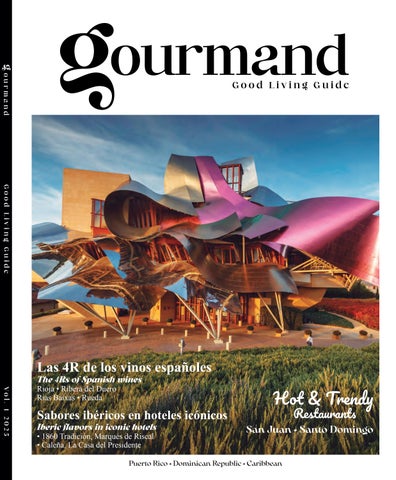
En portada:
Hotel Marqués de Riscal en Elciego, Rioja, España Alucinante obra del arquitecto Frank Ghery quien también diseñó el Museo Guggenheim en Bilbao.
Marqués de Riscal Hotel in Elciego, Rioja, Spain
Hallucinating work of architect Frank Ghery who also designed Bilbao’s Guggenheim Museum.
¡Súmate al mundo Gourmand!
¿Eres amante de la buena comida, los sabores auténticos y las experiencias únicas?
Gourmand te invita a formar parte de nuestra comunidad.
Únete a nuestra base de datos y recibe recomendaciones exclusivas, invitaciones a eventos y catas, información anticipada de próximas actividades, contenido editorial con recomendaciones expertas.
Síguenos en las redes sociales y entérate de lo más sabroso del panorama gastronómico, porque en Gourmand … el buen gusto se comparte.
Te esperamos! Bon appétit
Join the Gourmand world!
Are you a lover of good food, authentic flavors and unique experiences?
Gourmand invites you to be part of our community.
Join our database and receive exclusive recommendations, invitations to events and tastings, advance information on upcoming activities, editorial content with expert recommendations.
Follow us on social networks and find out about the tastiest on the gastronomic scene, because at Gourmand ... good taste is shared.
Javier Celado, Julio César Peña, Marqués de Riscal, Alta Pavina, Adegas Paco & Lola, El Catador, Bodega de Méndez, Ajualä, Gijón
Thomas Sartori
Spot 21 • Hospitality Lab
Erica Reyes
Escuela de Café y Baristas de P.R.
Sonia E. Navarro González
Asociación de Restaurantes de P.R. (ASORES)
EDITORIAL info@gourmandintl.net
VENTAS • SALES sales@gourmandintl.net
REP. DOMINICANA
José Eduardo García 849-450-2579
PUERTO RICO
Lourdes Rivera 787-402-0433
GOURMAND ES UNA PUBLICACIÓN DE
C/ 2, Villa Marina Sur, No. 8, Sto. Dgo. D.N, República Dominicana Tel.: 829-688-0256
www.gourmandintl.net • www.issuu.com/gourmand
Gourmand Prohíbe la reproducción total o parcial de su portada, artículos y secciones fijas de la misma. No se hace responsable de las opiniones vertidas por los colaboradores o encuestas realizadas en sus artículos.
Hot andRestaurantsTrending
Puerto Rico y la República Dominicana
Puerto Rico y la República Dominicana se han convertido en dos destinos gastronómicos muy atractivos y populares en el Caribe. Más allá de su tradicional cocina tropical, estas islas vecinas de las Antillas Mayores enamoran al comensal con una variada oferta culinaria que se distingue por su gran calidad y creatividad.
En esta primera edición de Gourmand, tenemos el gusto de reseñar cuatro restaurantes en San Juan y Santo Domingo que, por su original menú y ambiente exquisito, ahora están en boca de todos.
Puerto Rico and the Dominican Republic have become two very attractive and popular gastronomic destinations in the Caribbean. Beyond their traditional tropical cuisine, these neighboring islands of the Greater Antilles make diners fall in love with a varied culinary offer that is distinguished by its great quality and creativity.
In this first edition of Gourmand, we are pleased to review four restaurants in San Juan and Santo Domingo that, due to their original menu and exquisite atmosphere, are now the talk of the town.
SAN JUAN
Una enigmática pintura te recibe en el foyer de ambos restaurantes en San Juan. Y cada una es un fascinante retrato de mujer que señala el inicio de la aventura culinaria que estás a punto de vivir en Sablée y La Pícara.
An enigmatic painting greets you in the foyer of both restaurants in San Juan. And each one is a fascinating portrait of a woman which signals the beginning of the culinary adventure you are about to live in Sablée and La Pícara.
Sablée, Condado
La Pícara, Santurce
Sablée
Elegante bistró francés en el corazón del Condado con exquisita comida y un ambiente très chic
Por/By: Yvonne Brown Ieromazzo
Cenar siempre será una ocasión memorable en Sablée, donde puedes degustar exquisitos platillos de la cocina tradicional francesa con un toque muy original.
La refinada ambientación y decoración crean un espacio muy acogedor repleto de curiosos detalles y una atmósfera de elegancia casual que nos recuerda la vibra parisina y eleva la experiencia de fine dining a otro nivel.
Y nada más francés que comenzar libando un burbujeante Kir Royal (crème de cassis y espumante) o sus exóticos Signature Cocktails, como Le Conservatoire (vodka de menta y pepino, brandy de pera, vino blanco) o L’Elixir (Cognac Au Port Hennessy VS, Port, Amaro).
De entrada, hay dos imprescindibles de la cocina francesa: escargots en su salsa clásica de mantequilla, ajo y perejil, acompañados de pan baguette tostado, y sopa de cebolla con queso gruyere gratinado.
No puedes dejar de probar uno de estos platos principales. Si prefieres pescado, la opción ideal es un filete de salmón o bacalao con salsa bernesa y guarnición de vegetales salteados.
Si te apetece una buena carne, puedes decantarte por el insuperable Wellington Burger con setas Duxelle y crema de espinacas con un pan brioche de la casa, o quizás prefieras un filet mignon o ribeye steak con salsa blue cheese.
Estos platos salen acompañados de las sabrosas y ya famosas Madam Sablée Pommes Frites, unas papas fritas cuya exquisitez te hará recordar la grandeza de la sencillez.
Para maridar, tienen una carta de vinos y champanes muy especiales, así como exquisitos licores franceses de digestif.
Como dulce final, no dejes de saborear los postres elaborados en casa por Marifé Oria, Pastry Chef graduada de la prestigiosa academia Le Cordon Bleu
Entre las dulces tentaciones de Sablée sobresalen la Tarta de Pera con crema de almendra especiada, helado de jengibre y nueces caramelizadas, y el insuperable Lemon Meringue Tart. El menú de postres se actualiza a menudo.
Y siempre son tan irresistibles que es difícil escoger solo uno, aunque todos parecen una pequeña obra de arte con impecable plateado.
Esto evidencia la gran capacidad de innovación y creatividad de la chef Oria y los propietarios del restaurant, Semilla Group. Y resalta la importancia que le dan a la repostería, ya que el nombre Sablée proviene del Pâte Sablée, que es la masa a base de mantequilla que se usa en la pastelería francesa para elaborar tartas rellenas de frutas y chocolate.
Luego de vivir esta inolvidable experiencia culinaria francesa sin salir de San Juan, solo podrás exclamar, ¡oh la la Sablée!
Sablée:
Elegant
French
bistro in the heart of
Condado
with exquisite food and an ambiance that’s très chic
Dinner will always be a memorable occasion in Sablée, where you can taste exquisite dishes of traditional French cuisine with a very original touch.
The refined ambience and decoration create a very cozy space full of curious details and an atmosphere of casual elegance that reminds us of the Parisian vibe and elevates the fine dining experience to another level.
And nothing more French than to start with a Kir Royal (crème de cassis and sparkling wine) or their exotic Signature Cocktails, like Le Conservatoire (mint and cucumber vodka, pear brandy, white wine) or L’Elixir (Cognac Au Port Hennessy VS, Port, Amaro).
For starters, there are two must-haves of the French cuisine: escargots in a classic butter, garlic and parsley sauce, accompanied by toasted baguette bread, and onion soup with gratin gruyere cheese.
You can’t miss one of the stellar main dishes. If you prefer fish, the ideal option is a salmon or cod fillet, both very fresh, with Bernese sauce and a side of sautéed vegetables.
If you’re in the mood for great meat, you can opt for the unbeatable Wellington Burger with Duxelle mushrooms and creamed spinach with a house brioche bun, or perhaps you a filet mignon or ribeye steak with blue cheese sauce.
These dishes are accompanied by the tasty and already famous Madam Sablée Pommes Frites, French fries whose delicacy will remind you of the greatness of simplicity.
To pair the delicious meal, they have a very special wine and champagne list, as well as exquisite French digestif liqueurs.
As a sweet finish, be sure to savor the home baked desserts by Marifé Oria, Pastry Chef graduate of the prestigious Le Cordon Bleu Academy.
Among Sablée’s sweet temptations are the scrumptious Pear Tart with spiced almond cream and ginger ice cream and an unbeatable Lemon Meringue Tart. The dessert menu is frequently updated. They are always so irresistible that it is difficult to choose just one, even though they all look like a small work of art that’s plated impeccably.
This shows the great capacity for innovation and creativity of chef Oria and the owners of the restaurant, Semilla Group. It also highlights the importance of fine bakery in the menu, as the name Sablée comes from the term Pâte Sablée, which the butter-based dough used in French pastry to make cakes filled with fruit and chocolate.
After living this unforgettable French culinary experience without leaving San Juan, you can only exclaim, oh la la Sablée!
La Pícara
Cocina ecléctica y cocteles alucinantes se mezclan a la perfección en este vibrante spot de Santurce
Por/By: Yvonne Brown Ieromazzo
La fusión caribeña se vive con intensa pasión en el spot más hip de Puerto Rico, La Pícara by Chef Xiomy, un punto de encuentro obligado de foodies y personalidades locales e internacionales.
Estos llegan atraídos por la cocina “desenfrenada y feroz”, y salen fascinados con las sorpresivas combinaciones de sabores, texturas y aromas de sus eclécticas creaciones culinarias. Porque aquí, cada plato está diseñado con el fin de despertar todos los sentidos desde el primer bocado.
Puedes comprobarlo al saborear sus creativos aperitivos, como los Bao Buns con cochinillo porkbelly, Cubanito Rolls, Mini Piononos de Bacalao y Salmón Poke. Y no dejes de probar las Croquetas de Jamón Ibérico 5J con mermelada de pimiento piquillo que están para chuparse los dedos.
Entre los platillos principales más inolvidables figuran la Merluza a la Vasca con almejas y camarones, los Cachetes de cerdo Korobuta guisados en su propio jugo, una pasta fresca pappardelle elaborada en la casa con ragout de short ribs, e incluso algunas opciones veganas como el steak de hinojo con quinoa y espárragos.
La coctelería es de primera e incluye recetas muy originales como La Pícara, con ginebra, lima fresca, puré de kiwi, la Margarita Pícara, que añade cordial de sandía a la mezcla de tequila, y el Amor y Chocolate con bourbon aromatizado con bacon y cacao bitters, ideal para “chocoholics”.
Una impresionante cava con un diseño espectacular alberga un inventario de vinos muy surtido que incluye desde las marcas más populares hasta las más exclusivas. Y al estar cubierta en cristal, se puede apreciar desde el exterior.
La experiencia y maestría de Chef Xiomy se refleja en cada plato de La Pícara, donde se celebra la chispa de sabor, alegría e ingenio que distingue a los Boricuas en un fascinante ambiente chic tropical.
leave fascinated by the surprising combinations of flavors, textures and aromas of their eclectic culinary creations. That’s because here, each dish is designed to awaken all the senses from the first bite.
You can see it by savoring their creative appetizers, such as Bao Buns with porkbelly suckling pig, Cubanito Rolls, Mini Cod Piononos and Poke Salmon. And be sure to try the 5J Iberian Ham Croquettes with piquillo pepper jam that are finger-licking good.
Among the most unforgettable main dishes are the Basque Hake with clams and shrimp, the Korobuta pork cheeks stewed in their own juice, a fresh pappardelle pasta made in house with
crumbled short rib ragout , and even some vegan options such as
The cocktails are top notch and include very original recipes such as La Pícara, with gin, fresh lime, kiwi puree, the Margarita Pícara, which adds watermelon cordial to the tequila mixture, and the Amor y Chocolate with bourbon flavored with bacon and cocoa bitters, ideal for chocoholics.
A stunningly designed wine cellar houses a well-stocked wine inventory featuring from the most popular brands to the most exclusive selections. And since it is covered in glass, it can be seen from the outside.
Chef Xiomy’s expertise and mastery is reflected in every dish at La Pícara, where the spark of flavor, joy and ingenuity that distinguishes Boricuas is celebrated amidst a mesmerizing tropical chic setting.
Hot andRestaurantsTrending
SANTO DOMINGO
Al elevar la experiencia gastronómica tradicional a otro nivel se han convertido en visita obligada en Santo Domingo para los amantes de la buena
By elevating the traditional dining experience to the next level of excellence, Gijón and Ajualä have become a mandatory stop in Santo Domingo for all lovers of good food, whether Asturian or Caribbean.
Ajualä, Piantini
Gijón
Un viaje sensorial por el norte de España guiado por la autenticidad de la buena mesa asturiana
Por/By: Orlando
Jerez
En el corazón de Santo Domingo, un restaurante se ha propuesto provocar emociones y rendir homenaje a Asturias y su rica tradición gastronómica.
Gijón es el nombre de este proyecto de los hermanos Leo, Alejandro y José Enrique, el cual nace de la nostalgia, el amor por la buena mesa y la unión familiar.
El concepto comenzó a gestarse desde que Alejandro estudiaba en la universidad en España y laboraba en el sector gastronómico, y regresó a República Dominicana con la idea de traer consigo un pedacito de su Asturias querida.
No fue hasta 2023 que los hermanos encontraron el espacio ideal y decidieron hacer su sueño realidad. El resultado: un restaurante sobrio, acogedor y profundamente auténtico.
El nombre, Gijón, no es casual. Es la ciudad natal de los dos hermanos mayores, y como explica Alejandro, “es un homenaje a nuestra raíz en esa gran ciudad”. Esa conexión emocional se siente en cada rincón del local y, sobre todo, en cada plato.
La propuesta culinaria de Gijón es fiel reflejo del norte de España: sabores intensos, porciones generosas y un respeto absoluto por el producto. “En este tipo de cocina no hay espacio para concesiones; el ingrediente debe ser el correcto”, afirma Alejandro.
Los mariscos y pescados son los grandes protagonistas. Entre los platos más destacados, el arroz meloso de pulpo y langostinos es uno de los favoritos, inspirado en una receta que marcó su memoria durante su estancia en Gijón. Y por supuesto, gran variedad de delicias del Mar Cantábrico que no pueden faltar en la mesa asturiana, como anchoas, carabineros, percebes y zamburiñas.
El menú se complementa con ingredientes locales como el chillo, la langosta y el centollo dominicano, y se ve enriquecido por el talento creativo del equipo: José Enrique con el Socarrat de Ribeye, y el chef Basilio, con su aplaudido Bacalao Soñador.
Gijón se ha destacado por realizar eventos especiales que combinan gastronomía y cultura: cenas de maridaje, lanzamientos de vinos y colaboraciones con reconocidos chefs invitados.
La carta de vinos, cuidadosamente seleccionada, busca complementar y realzar cada plato, creando armonías que elevan la experiencia culinaria. La coctelería es extraordinaria y siempre le pueden escanciar una sidra.
Para un final excepcional, nada como la tradicional tarta de queso de cabra, tan cremosa como sabrosa. ¡Hay que probarla!
Y esto es solo el comienzo. Nuevos platos, celebraciones de la sidra asturiana y eventos temáticos se perfilan en el horizonte cercano.
Gijón:
A sensory journey through the north of Spain guided by the authenticity of Asturias’ great cuisine
In the heart of Santo Domingo, a restaurant has set out to provoke emotions and pay tribute to Asturias and its rich gastronomic tradition.
Gijón is the name of this project by the brothers Leo, Alejandro and José Enrique, which is born from nostalgia, love for good food and family unity.
The concept began to take shape when Alejandro was studying at university in Spain and working in the gastronomic sector, and he returned to the Dominican Republic with the idea of bringing with him a piece of his beloved Asturias.
It wasn’t until 2023 that the brothers found the ideal space and decided to make their dream come true. The result: a sober, cozy and deeply authentic restaurant.
The name, Gijón, is no coincidence. It is the hometown of the two older brothers, and as Alejandro explains, “it is a tribute to our roots in that great city”. That emotional connection is felt in every corner of the locale and, above all, in each dish.
Gijón’s culinary proposal is a true reflection of northern Spain: intense flavours, generous portions and absolute respect for the product. “In this type of kitchen there is no room for concessions; the ingredient must be the right one,” says Alejandro.
Seafood and fish are the main protagonists. Among the most outstanding dishes, the creamy rice with octopus and prawns is one of the favourites, inspired by a recipe that marked his memory during his stay in Gijón. And of course, a wide variety of delicacies from the Cantabrian Sea that cannot be missing from the Asturian table, such as anchovies, prawns, barnacles and scallops.
The menu is complemented by local ingredients such as chillo, lobster and Dominican spider crab, and is enriched by the creative talent of the team: José Enrique with the Ribeye’s Socarrat chef Basilio, with his acclaimed Bacalao Soñador.
Gijón has stood out for holding special events that combine gastronomy and culture: pairing dinners, wine launches and collaborations with renowned guest chefs.
The carefully selected wine list seeks to complement and enhance each dish, creating harmonies that elevate the culinary experience. The cocktails are extraordinary and you can always pour a cider.
For an exceptional finish, nothing like the traditional goat cheesecake, as creamy as it is tasty. You have to try it!
And this is just the beginning. New dishes, celebrations of Asturian cider and themed events are on the near horizon.
Ajualä
Cocina trotamundos que rinde homenaje a las raíces caribeñas con creativos sabores y fusiones
Por/By: Orlando Jerez
Ajualä no es solo un restaurante. Es una experiencia gastronómica íntima, sensorial y profundamente nuestra, donde el sabor tiene memoria, el ingrediente tiene nombre, y cada plato es una carta de amor al Caribe.
El chef Saverio Stassi orquesta una cocina trotamundos moderna, en una magistral y poderosa fusión de creatividad internacional con raíz local. Su vibrante propuesta refleja su formación francesa y su herencia italiana, pero está profundamente conectada con la tierra y la cultura dominicana. No se trata de importar tendencias, sino de reinterpretar sabores con autenticidad, utilizando ingredientes endémicos como punto de partida con una impecable técnica.
Desde su nombre –una expresión taína que significa “que sea lo que Dios quiera”– Ajualä transmite su espíritu espontáneo
y ancestral. Es una cocina sin máscaras, que fluye con la temporalidad de las cosechas y abraza la sostenibilidad, no como discurso, sino como práctica. Gracias a alianzas, como las de las mujeres agricultoras del programa Supérate, cada ingrediente tiene historia, rostro y propósito.
En su carta destacan platos como la falda de toro, los ñoquis de yuca con hongos djon djon, o la catibía rellena de bacalao. Son reinterpretaciones que desafían lo establecido y a la vez que rinden tributo a la tradición.
Más que una experiencia culinaria, Ajualä ofrece una puesta en escena sensorial integral, donde la iluminación, la música y el diseño del espacio acompañan la degustación como si contaran parte del relato.
Aquí, la atrevida cocina de autor transforma la cativía en poesía y los ñoquis en una oda al campo. Toma la falda de toro y la eleva. Y, como por arte de magia, hace que la sencillez de un queso de hoja fresco con casabe se convierta en una entrada de inigualable exquisitez o que un carpaccio de pescado vibre en la boca más fuerte que el ritmo de merengue.
La carta de vinos de Ajualä ha sido curada con gran precisión y coherencia con el menú, haciéndola merecedora de la distinción de World Of Fine Wines 2024 como Mejor Lista de Vinos de Caribe y América Central. Además, el restaurante ha ganado prestigiosos reconocimientos mundiales como uno de los 50 Best Discovery y Krug Ambassade.
Desde su apertura, Ajualä se ha dedicado a romper paradigmas sobre lo que puede ser la alta cocina dominicana. Hoy, esta joya culinaria es un referente, una inspiración y una prueba viviente de que el futuro de nuestra gastronomía se escribe desde lo local, con pasión y una fe inquebrantable en nuestra identidad.
Modern globetrotting
Ajualä:
cuisine that honors the Caribbean roots with creative flavors and fusions
Ajualä is not just a restaurant. It’s an intimate, sensory, and deeply ours dining experience, where the flavor has memory, the ingredients have a name, and each dish is a love letter to the Caribbean.
Chef Saverio Stassi orchestrates a modern globetrotting cuisine, in a masterful and powerful fusion of international creativity with local roots. His vibrant proposal reflects his French background and Italian heritage, but is deeply connected to the Dominican land and culture. It is not about importing trends, but reinterpreting flavors with authenticity, using endemic ingredients as a starting point with an impeccable technique.
From its name – a Taíno expression that means “let it be what God wants” – Ajualä transmits his spontaneous and ancestral spirit. It is a cuisine without masks, which flows with the seasonality of the harvests and embraces sustainability, not as a discourse, but as a practice. Thanks to partnerships, such as those of the women farmers in the Supérate program, each ingredient has a story, a face, and a purpose.
Its menu highlights dishes such as bull’s skirt, cassava gnocchi with djon djon mushrooms, or cativía stuffed with cod. They are reinterpretations that challenge the status quo while honoring the culinary traditions.
More than a culinary experience, Ajualä offers a comprehensive sensory staging, where lighting, music and space design complement the tasting as if each was telling a part of the story.
Here, the daring author’s kitchen transforms a cativía into poetry and a gnocchi into an ode to the countryside. It takes the bull’s skirt and raises it to the next level. And, as if by magic, it turns the simplicity of the fresh queso de hoja cheese with a cassava into the most exquisite appetizer or makes a fish carpaccio vibrate in the mouth louder than the merengue rythm.
Ajualä’s wine list has been curated with great precision and consistency with the menu, making it worthy of the distinction of World Of Fine Wines 2024 as the Best Caribbean and Central American Wine List. In addition, the restaurant has won many global recognitions such as 50 Best Discovery and Krug Ambassade.
Since its opening, Ajualä has been dedicated to breaking paradigms about what Dominican haute cuisine can be. Today, this culinary jewel is a reference, an inspiration and living proof that the future of our gastronomy is written from the local, with passion and an unwavering faith in our identity.
De Portada • Cover Story
Las 4R del vino español
The 4R’s of Spanish wine
Por/By:
Thomas Sartori
Hay algo mágico en el vino. Es una forma fluida de viajar, de sentir, de detener el tiempo. En España, hay cuatro letras que encierran un universo de aromas, paisajes y emociones: Rioja, Ribera del Duero, Rueda y Rías Baixas. Las llaman las “4 R” y no por casualidad, pues juntas forman un mapa sensorial que nos invita a recorrer el país de norte a sur, y de este a oeste, con la copa llena en la mano y el corazón abierto.
There is something magical about wine. It’s a fluid way of traveling, of feeling, of stopping time. In Spain, there are four letters that enclose a universe of aromas, landscapes and emotions: Rioja, Ribera del Duero, Rueda and Rías Baixas. They call them the “4 Rs”, and not by chance, as together they form a sensory map that invites us to travel the country from north to south, and east to west, with the glass full in our hand and our hearts open
Rioja: la memoria líquida
Rioja: the liquid memory
Probar un vino de Rioja es como abrir un libro antiguo con las páginas aún frescas. Hay tradición, sí, pero también renovación. Aquí los tintos suelen ser suaves, redondos, equilibrados, como si te abrazaran por dentro. El aroma recuerda a frutas maduras, a vainilla, a cuero viejo y a tardes lentas en casas de piedra. Un Rioja bien hecho no solo se bebe: te cuenta una historia. Hay botellas que saben a conversaciones junto a la chimenea, a sobremesas que se alargan sin reloj, a domingos sin prisa. Rioja emociona porque sabe equilibrar lo nuevo con lo viejo, lo moderno con lo eterno. Es la calma dentro del ruido.
La Denominación de Origen Calificada (DOC) Rioja se divide en tres zonas —Rioja Alta, Rioja Baja y Rioja Alavesa— pero todas están obligadas a trabajar con las uvas que permite el consejo regulador de la DO. La reina de las uvas tintas en Rioja es la Tempranillo, con casi el 75% de la producción en la región. Aunque hay otras variedades tintas de la zona, como Garnacha y Mazuelo, mientras que la Viura es la uva blanca clásica Riojana.
Tasting a Rioja wine is like opening an old book with the pages still fresh. There is tradition, yes, but also renewal. Here the reds are usually smooth, round, balanced, as if they were hugging you from the inside. The aroma is reminiscent of ripe fruits, vanilla, old leather and slow afternoons in stone houses.
A well-made Rioja is not just to be drunk: it tells you a story. There are bottles that taste like conversations by the fireplace, after-dinner conversations that go on without a clock, unhurried Sundays. Rioja is exciting because it knows how to balance the new with the old, the modern with the eternal. It is the calm within the noise.
The Rioja Qualified Designation of Origin (DOC) is divided into three zones – Rioja Alta, Rioja Baja and Rioja Alavesa – but all are obliged to work with the grapes allowed by the DO regulatory council. The queen of red grapes in Rioja is Tempranillo, with almost 75% of the production in the region. Although there are other red varieties in the area, such as Garnacha and Mazuelo, while Viura is the classic white Rioja grape.
Ribera del Duero: carácter y profundidad
Ribera del Duero: character and depth
Si Rioja es un abrazo, Ribera del Duero es un apretón de m anos firme, de esos que dejan huella. Aquí el vino tiene fuerza, tiene cuerpo, tiene alma. Hay una sensación de tierra seca, de sol intenso, de raíces profundas. Sus tintos son oscuros, intensos, con notas a mora, ciruela, especias y madera tostada. Es un vino que no pide permiso, pero sí respeto. Cada sorbo parece hablarnos de la Castilla profunda: campos dorados, aire frío al anochecer. La Tempranillo es la uva principal de la región. El Ribera no es un vino para tomar a la ligera, es para cuando quieres sentir algo fuerte, para cuando necesitas una copa que te sostenga.
If Rioja is a hug, Ribera del Duero is a firm handshake. one of those that leave a mark. Here the wine has strength, it has body, it has soul. There is a feeling of dry land, of intense sun, of deep roots. The reds are dark, intense, with notes of blackberry, plum, spices and toasted wood. It is a wine that does not ask for permission, but it does ask for respect. Every sip seems to speak to us of deep Castile: golden fields, cold air at dusk. Tempranillo is the main grape of this region. Ribera is not a wine to drink lightly, it is for when you want to feel something strong, for when you need a glass to hold you.
Rueda: la alegría blanca
Rueda: white joy
Y entonces llega Rueda, como una risa fresca en un día caluroso Este es el vino blanco que refresca, que alegra, que acompaña. La Verdejo —su uva estrella— da vinos ligeros pero expresivos, con aromas a hierba cortada, frutas blancas y ese toque cítrico que despierta el alma. Un Rueda bien frío sabe a terraza en primavera, a tapeo con amigos, a ese momento en que no pasa nada y, sin embargo, todo está bien. Es un vino que no complica la vida, la celebra con sencillez. Es ideal para nuestro clima tropical y para quienes quieren comenzar a explorar los blancos sin miedo o los que simplemente buscan ese primer trago que abre el apetito y alegra el espíritu.
And then Rueda arrives, like a cool laugh on a hot day. This is the white wine that refreshes, that cheers, that accompanies. La Verdejo – its star grape – produces light but expressive wines, with aromas of cut grass, white fruits and that touch of citrus that awakens the soul. A very cold Rueda tastes like a terrace in spring, tapas with friends, that moment when nothing happens and, nevertheless, everything is fine. It is a wine that does not complicate life, it celebrates it with simplicity. It is ideal for our tropical climate and for those who want to start exploring the whites without fear or those who are simply looking for that first drink that whets the appetite and cheers the spirit
Rías Baixas: el mar en la copa
Rías Baixas: the sea in the glass
Y si Rueda es la risa, Rías Baixas es la brisa. Un vino de esta región gallega te transporta sin esfuerzo a la costa atlántica: sientes el salitre, la niebla, el verde que nunca se seca. La Albariño, uva mimada de estas tierras, da vinos con nervio, con acidez vibrante y un aroma inconfundible que mezcla flores, cítricos y melocotones aún verdes. Tomarse un Albariño es casi como oír el sonido de las olas. Es ideal para mariscos, sí, pero también para momentos íntimos, para pensar, para leer, para dejarse llevar. Es un vino que no grita, pero deja huella, como esos paisajes gallegos que te siguen incluso cuando ya te has ido.
Cuatro copas, cuatro emociones
Estas 4R no son solo regiones o denominaciones de origen. Son cuatro formas de vivir el vino, cuatro maneras de mirar el mundo a través de una copa. ¿Cómo elegir? No hay que hacerlo. La riqueza está en el cambio, en la posibilidad de pasar de una emoción a otra.
Four Glasses, Four Emotions
These 4 R’s are not just regions or designations of origin. They are four ways of experiencing wine, four ways of looking at the world through a glass. How to choose? You don’t have to do it. The richness is in the change, in the possibility of moving from one emotion to another.
If Rueda is the laugh, Rías Baixas is the breeze. A wine from this Galician region transports you effortlessly to the Atlantic coast: you feel the saltpeter, the fog, the green that never dries out. Albariño, a pampered grape from these lands, produces wines with nerve, vibrant acidity and an unmistakable aroma that mixes flowers, citrus fruits and peaches that are still green. Drinking an Albariño is almost like hearing the sound of the waves. It is ideal for seafood, yes, but also for intimate moments, for thinking, for reading, for letting go. It is a wine that does not scream, but leaves a mark, like those Galician landscapes that follow you even when you have already left.
El autor es Wine Consultant de Spot 21 Consulting y director del centro de formación Hospitality LAB. The author is a Wine Consultant at Spot 21 Consulting and director of the Hospitality LAB training center.
Explora las Islas.
Siente el AMOR
Hay algo especial en la brisa de las BVI. Una vez lo sientas por ti mismo, entenderás lo que hace que cada día aquí sea tan extraordinario.
Oficina de Turismo de las BVI en Puerto Rico
Tortola | Virgen Gorda | Jost Van Dyke | Anegada | Cooper Island | Guana Island Little Thatch | Necker Island | Norman Island | Peter Island | Saba Rock | Scrub Island
¡Retomamos a Europa! nuestras
dos frecuencias semanales
A partir del 26 de junio y hasta el 11 de septiembre.
Dos frecuencias semanales desde Santiago de los Caballeros hacia Europa
Gourmand Traveler
Inolvidable paseo por dos maravillosas bodegas en España
An unforgettable tour of two wonderful wineries in Spain
Visitar una bodega es siempre una ocasión memorable. Es adentrarse en un mundo repleto de aromas y sabores, conversaciones y tradiciones, donde la uva es la gran protagonista.
Por eso, cuando finalmente puedes recorrer algunas de las que se encuentran en las cuatro grandes regiones vitivinícolas de España (4R), sientes que es un gran premio que te regala la vida.
Acompáñanos a dar un paseo por dos de ellas, que son tan interesantes como diferentes: una de las más importantes e impactantes de la Rioja Alavesa, Marqués de Riscal, y la otra, Alta Pavina, productora del singular Pinot Noir español, con una uva que no es común en la zona de Ribera del Duero.
Visiting a winery is always a memorable occasion. It a journey through a world full of aromas and flavors, conversations and traditions, where the grape is the main protagonist.
That’s why, when you can finally take stroll in some of those wineries located in any of the four great wine regions of Spain (4R), you feel that it is a great prize from life.
Join us for a walk through two of them, which are as interesting as they are contrasting: one of the most important and impressive in the Rioja Alavesa, Marqués de Riscal, and the other, producer of the unique Spanish Pinot Noir, Alta Pavina, in the vicinity of Ribera del Duero.
Marqués de Riscal, La Rioja
La Ciudad del Vino • The City of Wine
Más que una bodega tradicional, La Ciudad del Vino Marqués de Riscal es una experiencia única en el corazón de la Rioja, España. La visita a este monumental complejo en Elciego (Álava), te lleva por un recorrido histórico desde la fundación de la bodega en 1858 hasta nuestros días.
El punto de partida es la Plaza del Reloj, que está rodeada por los edificios principales, con sus características puertas y ventanas rojas, que anuncian la entrada a las bodegas y nos invitan a descubrir los misterios que contienen.
El primero y más emblemático es la Bodega Original, construida en 1860 con piedra local siguiendo las últimas tendencias de la época. Con el tiempo, se han ido integrando las más modernas técnicas de vinificación a esta instalación que aún se utiliza, pero mantiene el encanto del Siglo XIX.
Dentro de la Bodega Original se encuentra uno de los lugares más icónicos e históricos de Marqués de Riscal: La Botellería. Considerada un tesoro de incalculable valor, esta alberga la mayor colección de vinos antiguos del mundo y contiene botellas de Marqués de Riscal desde la primera añada de la bodega en 1862 —considerado el primer vino de Rioja embotellado— hasta nuestros días.
En la actualidad, más de 130,000 botellas están conservadas en condiciones óptimas en este templo vinícola, a temperatura constante y con el nivel adecuado de humedad. Así, La Botellería cumple un fin vital como ventana al pasado y referente al futuro, mientras mantiene viva la historia de Marqués de Riscal.
Luego se pasa al Palomar, edificado en 1883 al estilo de las bodegas de Burdeos como parte de la primera ampliación de la empresa. Tras su remodelación en 2011, la instalación fue equipada con la última tecnología y la maquinaria más avanzada para la elaboración de vinos de calidad, donde hoy se elaboran los vinos premium de Marqués de Riscal
El resto de instalaciones de la bodega se componen de salas de barricas donde se envejecen los vinos, botelleros y otras de vinificación, como Bodega de San Vicente del año 2000
Al llegar al punto más alto del recorrido, se revela ante nuestros ojos un edificio impactante y ultra moderno que contrasta dramáticamente con los de piedra que vimos primero en el paseo y vislumbra la vanguardia del siglo
XXI: Hotel Marqués de Riscal, a Luxury Collection Hotel.
Esta colosal obra es creación del famoso arquitecto Frank Gehry, quien también diseñó el Museo Guggenheim en Bilbao, y se ha convertido en un ícono de la bodega a nivel mundial. (Más informaciónl en la sección Gourmand Traveler.)
Y como final perfecto, se recomienda hacer una última parada en el acogedor centro de visitantes. Aquí puedes ir a la cafetería y degustar ricas tapas y raciones acompañadas de los vinos de la bodega por copa. Pasa por el salón especial para participar en las catas y maridajes que ofrecen los expertos de la bodega.
Y no puedes dejar de visitar la hermosa tienda, donde puedes adquirir los vinos de la colección Marqués de Riscal, así como una selección de productos artesanales y delicias culinarias típicas de la Rioja, y por supuesto, los souvenirs con calidad de museo para que llevarte un recuerdo de la visita a La Ciudad del Vino, que siempre llevarás en tu memoria y tu corazón.
More than a traditional winery, La Ciudad del Vino Marqués de Riscal is a unique experience in the heart of La Rioja, Spain. A visit to this monumental complex in Elciego (Álava) takes you on a historical journey from the founding of the winery in 1858 to the present day.
The starting point is the Plaza del Reloj, which is surrounded by the main buildings, with their characteristic red doors and windows, which announce the entrance to the cellars and invite us to discover the mysteries they contain.
The first and most emblematic is the Original Winery, built in 1860 with local stone following the latest trends of the time. Over time, the most modern winemaking techniques have been integrated into this facility that is still used today, but still maintains the charm of the nineteenth century.
Inside the Original Winery is one of the most iconic and historic places in The City of Wine: La Botellería. Considered a priceless treasure, it houses the largest collection of old wines in the world and contains bottles of Marqués de Riscal from the winery’s first vintage in 1862 – considered the first bottled Rioja wine – to the present day.
Today, more than 130,000 bottles are preserved in optimal conditions in this temple of wine, kept at a constant temperature and with the right level of humidity. Thus, La Botellería fulfills a vital purpose as a window to the past and referring to the future, while keeping the history of Marqués de Riscal alive.
Then you move on to the Palomar, built in 1883 in the style of the Bordeaux wineries as part of the company’s first expansion. After its refurbishment in 2011, the facility was equipped with the latest technology and the most advanced machinery for the production of quality wines, where Marqués de Riscal’s premium wines are made today.
The rest of the facilities are made up of barrel rooms where the wines are aged, bottle racks and other winemaking rooms, such as the San Vicente winery from the year 2000
Upon reaching the highest point of the route, an impressive, ultra-modern building is revealed before our eyes that contrasts dramatically with the stone ones first seen on the tour, and glimpses the avant-garde of the 21st century: Hotel Marqués de Riscal, a Luxury Collection Hotel.
This colossal work is the creation of famed architect Frank Gehry, who also designed the Guggenheim Museum in Bilbao, and has become an icon of the winery worldwide. (More information in the Gourmand Traveler section.)
As a perfect ending, it is highly recommended to make a last stop at the cozy visitor center. Here, you can go to the cafeteria for a serving of delicious tapas and portions accompanied by a glass of Marqués de Riscal wine. Or stop by the special salon to participate in any of the tastings and pairings offered by winery experts.
Then, you must browse through the beautiful shop, where you can buy the wines from the Marqués de Riscal collection, as well as a selection of artisanal products and typical culinary delights of La Rioja, and of course, museum-quality souvenirs so that you can take home a souvenir of your visit to the City of Wine, which you will always carry in your memory and your heart.
Más de 160 años de tradición y evolución
A lo largo de su historia, Marqués de Riscal ha sido siempre una empresa innovadora, pionera y referente de un sector vitivinícola en continua transformación.
Esta exitosa bodega riojana busca hacer vinos originales, frescos, elegantes y fáciles de beber. Desde su fundación, han tenido una clara vocación exportadora. Y hoy día, están presentes en más de 110 países a los que exportan el 65% de su producción.
La empresa sigue cosechando triunfos y reconocimientos internacionales. En 2024, Marqués de Riscal fue seleccionado el #1 como Mejor Viñedo del Mundo y Mejor Viñedo de Europa por World’s Best Vineyards.
Marqués de Riscal utiliza principalmente variedades de uva Tempranillo (predominante de ciclo corto y cultivo delicado) y Graciano (tardía de ciclo largo, vigorosa y productiva).
La uva crece en 1.500 hectáreas de viñedos repartidas entre Elciego en Álava y pueblos limítrofes de la región riojana como Leza, Laguardia o Villabuena. Esta subzona de la Rioja Alavesa se ha caracterizado por producir vinos con una buena capacidad de envejecimiento gracias a sus mostos de acidez marcada y buena estructura tánica.
La zona de la Denominación de Origen Calificada Rioja (Do Ca Rioja) se encuentra en el norte de España a ambos lados del río Ebro. Una región privilegiada para el cultivo de la vid y para la producción de vinos de alta calidad con una personalidad única y un gran potencial de envejecimiento.
Las 63.593 hectáreas de viñedo protegidas por la Do Ca Rioja se distribuyen por las tres provincias del territorio que bordean el curso alto del Ebro: La Rioja (43.885 ha.), Navarra (6.774 ha.) y Álava (12.934 ha.) donde opera la bodega.
Aunque sus raíces están firmemente arraigadas en los viñedos de la Rioja Alavesa, la continua evolución de la empresa los ha impulsado a explorar otras regiones y denominaciones de la geografía española, incluyendo D.O. Rueda y V.T. Castilla y León.
Luego de más de 160 años de tradición y evolución, Marqués de Riscal sigue creciendo y haciendo historia, siempre guiados por su lema “Vivimos por y para el vino”.
More than 160 years of tradition and evolution
Throughout its history, Marqués de Riscal has always been an innovative, pioneering company and a benchmark in a wine sector in continuous transformation.
This successful Rioja winery seeks to make original, fresh, elegant and easy-to-drink wines. Since their foundation, they have had a clear export vocation. And today, they are present in more than 110 countries to which they export 65% of their production.
The company continues to reap international triumphs and recognition. In 2024, Marqués de Riscal was selected #1 as the World’s Best Vineyard and the World’s Best Vineyard in Europe by World’s Best Vineyards.
Marqués de Riscal mainly uses Tempranillo grape varieties (predominantly short-cycle and delicate cultivation) and Graciano (late-cycle long-cycle, vigorous and productive).
The grapes grow in 1,500 hectares of vineyards distributed between Elciego in Álava and neighbouring towns in the Rioja region such as Leza, Laguardia or Villabuena. This sub-area of the Rioja Alavesa has been characterised by producing wines with a good ageing capacity thanks to their musts of marked acidity and good tannic structure.
The area of the Rioja Qualified Designation of Origin (Do Ca Rioja) is located in northern Spain on both sides of the Ebro River. A privileged region for the cultivation of vines and for the production of high-quality wines with a unique personality and great ageing potential.
The 63,593 hectares of vineyards protected by the Do Ca Rioja are distributed throughout the three provinces of the territory that border the upper course of the Ebro: La Rioja (43,885 ha.), Navarra (6,774 ha.) and Álava (12,934 ha.) where the winery operates.
Although their roots are firmly rooted in the vineyards of the Rioja Alavesa, the continuous evolution of the company has prompted them to explore other regions and appellations of the Spanish geography, including D.O. Rueda and V.T. Castilla y León.
After more than 160 years of tradition and evolution, Marqués de Riscal continues to grow and make history, always guided by its motto “We live by and for wine”.
Convierte tus asados en una experiencia culinaria
CONTÁCTANOS VÍA WHATSAPP
Alta Pavina
Sus singulares vinos se han coronado como el Pinot Noir español en tierras donde el Tempranillo es rey
Justo en los límites de Ribera del Duero, dos visionarios hermanos decidieron nadar contra corriente y cultivar una uva muy poco conocida en la región, considerada una de las Denominaciones de Origen españolas más famosas, donde Tempranillo es rey.
La pequeña bodega familiar Alta Pavina, situada en la Finca Pago de la Pavina en la localidad de La Parrilla (Valladolid), a casi 1000 metros de altura, ya cultivaba algo de Pinot Noir desde 1985. Pero, no fue hasta 16 años después que recibió el impulso definitivo, cuando Hugo y Diego Ortega tomaron el mando, atraídos por la originalidad de esa variedad.
Impulsados por su osadía empresarial, el amor al vino que les trasmitió su padre y el expertise de su amigo Custodio Zamarra —sumiller 3 estrellas Michelin quien es el gran referente del vino en España y les introdujo en los vinos de Borgoña—, la dupla Ortega logró mezclar todas sus pasiones y sentimientos en Alta Pavina.
Así, lo que parecía un descabellado proyecto, ha resultado en unos vinos muy singulares elaborados con variedades foráneas y autóctonas que sorprenden por su elegancia y finura, y hoy son aclamados como The Spanish Pinot Noir.
En el proceso, Alta Pavina se ha convertido en el primer y mayor viñedo de la variedad de uva Pinot Noir en España, con un estilo y personalidad únicos sobre el terreno. Esto, a pesar de que el cultivo de Pinot Noir, por la delicadeza de la variedad, es extremadamente sensible a los cambios de temperatura, el viento, y el tipo del suelo en el que crece. Como dijo el enólogo André Tchelistcheff: “a la Cabernet Sauvignon la hizo Dios y a la Pinot Noir, el diablo”.
La uva Pinot Noir encuentra en tierras de la Borgoña francesa el mejor lugar para su desarrollo. Pero también en otras regiones del mundo como Yarra Valley (Australia), Napa Valley (Estados Unidos), Lombardía (Italia) y otras de Sudáfrica y Alemania. Y, ahora también, en los márgenes del río Duero en Valladolid, que gracias a Alta Pavina, se ha convertido en La Borgoña de la Ribera del Duero
Allí los hermanos Ortega cultivan unas 40 hectáreas en las que el Pinot Noir es el gran protagonista, y el resto son Cabernet Sauvignon y Tempranillo. Junto a ellos en la viña trabaja como asesor el prestigioso Claude Bourguignon, especialista en Pinot Noir quien ha sabido trasladar a este lugar la forma de trabajo de la Borgoña francesa y sus grandes viñedos.
También cuentan con el apoyo del enólogo Isaac Fernández, quien lleva más de 25 años años elaborando algunos de los mejores vinos del Duero. Este busca respetar la identidad identidad de cada viñedo y elaborar vinos que equilibren potencia, finura y pureza con la capacidad de envejecimiento.
Poco a poco, han ido rectificando cepas y transformando los primeros vinos de Alta Pavina en unos más livianos, pero todos cargados de personalidad. Esto ha sido el resultado de combinar el trabajo manual y la tradición con las más modernas técnicas de vinificación, crianza y embotellado.
Los vinos mantienen toda la elegancia de la variedad Pinot Noir, ligeros, y con unas connotaciones muy suaves, pero, por otro lado, en le aporta grandes dosis de frescura y la fuerza de la tierra en la que se encuentra a orillas del río Duero.
Esta era una apuesta única y distinta a todo lo que se estaba haciendo en la zona. Un proyecto en el que los hermanos Ortega encontraron todo lo que estaban buscando para hacer unos vinos, con tanta personalidad como ellos, capaces de seducir los paladares más exigentes del mundo.
Y cada vez se habla más de estos vinos de Alta Pavina, no solo por ser el único Spanish Pinot Noir del entorno de la Ribera del Duero sino, también, por su appeal internacional.
Los vinos ALTA PAVINA ya están disponibles en Puerto Rico y próximamente llegarán a la República Dominicana.
@alta_pavina
• www.altapavina.com
Alta Pavina
Its singular wines are crowned as The Spanish Pinot Noir in the land where Tempranillo is king
Right on the edge of the Ribera del Duero, two visionary brothers decided to swim against the current and grow a little-known grape in this wine region, considered one of the most famous Spanish Denominations of Origin, where Tempranillo is the king.
The small family winery Alta Pavina, located on Finca Pago de la Pavina in the town of La Parrilla, at an altitude of almost 1000 metres, had already been growing some Pinot Noir since 1985. But it was not until 16 years later that it received the definitive boost when Hugo and Daniel Ortega became its owners, attracted precisely by the originality of that variety.
Driven by their entrepreneurial audacity, the love of wine that their father passed on to them and the expertise of their friend Custodio Zamarra —a 3-Michelin-star sommelier who is an undisputed wine master in Spain and introduced them to Burgundy wines—, the Ortega duo managed to mix all their passions and feelings into Alta Pavina.
What seemed like a crazy project, has resulted in very unique wines made with foreign and native varieties that surprise with their elegance and finesse, and today are acclaimed as The Spanish Pinot Noir.
In the process, Alta Pavina has become the first and largest vineyard of the Pinot Noir grape variety in Spain, manifesting a unique style and personality on the ground. This, despite the fact that the Pinot Noir crop, due to the delicacy of the variety, is extremely sensitive to changes in temperature, wind, and the type of soil in which it grows. As winemaker André Tchelistcheff said: “Cabernet Sauvignon was made by God and Pinot Noir, by the devil”.
The Pinot Noir grape finds in the lands of French Burgundy the best place for its development. But also in other regions of the world such as Yarra Valley (Australia), Napa Valley (United States), Lombardy (Italy) and others in South Africa and Germany. And now also, on the banks of the Duero River in Valladolid, which thanks to Alta Pavina, has become The Burgundy of the Ribera del Duero.
There the Ortega brothers cultivate about 40 hectares in which Pinot Noir is the main protagonist, and the rest are Cabernet Sauvignon and Tempranillo. Alongside them in the vineyard works as an advisor the prestigious Claude Bourguignon, a specialist in Pinot Noir who has been able to transfer the way of working of French Burgundy and its great vineyards to this place.
They also have the support of winemaker Isaac Fernández, who has been making some of the best wines of the Duero for more than 25 years. It seeks to respect the identity of each vineyard and produce wines that balance power, finesse and purity with the ability to age. Little by little, they have been rectifying vines and transforming the first Alta Pavina wines into lighter ones, but all full of personality. This has been the result of combining manual work and tradition with the most modern winemaking, ageing and bottling techniques.
The wines maintain all the elegance of the Pinot Noir variety, light, and with very soft connotations, but, on the other hand, it gives it large doses of freshness and the strength of the land in which it is located on the banks of the Douro River.
This was a unique bet and so different from everything that was being done in the area. A project where the Ortega brothers found everything they were looking for to make wines, with as much personality as them and capable of seducing the most demanding palates around the world.
The Alta Pavina wines are increasingly talked about, not only for being the only Spanish Pinot Noir near Ribera del Duero, but also because of their strong international appeal.
ALTA PAVINA wines are already available in Puerto Rico and will soon arrive in the Dominican Republic. @alta_pavina • www.altapavina.com
ALTA PAVINA
PINOT NOIR TINTOS / REDS
PAVINA PINOT NOIR
Es 100% Pinot Noir con 6 meses en barrica de roble francés. Ligero rojo pasión con delicados matices. Predominan los aromas frutales, especialmente las bayas rojas como cereza, frambuesa y moras. Boca afrutada con buena acidez.
It is 100% Pinot Noir with 6 months in French oak barrels. Light passion red with delicate nuances. Fruit aromas predominate, especially red berries such as cherry, raspberry and blackberries. Fruity palate with good acidity.
CITIUS
Es 100% Pinot Noir, con 18 meses en barrica de roble francés y dos años de guarda en botella. En la boca sorprende su delicadeza sin dejar de mostrar viveza, expresividad y persistencia. Aromas sutiles con toques minerales y fondo a tabaco y especies debido a la prolongada crianza.
It is 100% Pinot Noir, with 18 months in French oak barrels and two years of aging in the bottle. On the palate its delicacy is surprising while still showing liveliness, expressiveness and persistence. Subtle aromas with mineral touches and background of tobacco and spices due to prolonged aging.
PINOT NOIR ROSADOS
PAVINA ROSÉ
Pinot Noir 100%. Color rosa palo, limpio y brillante. Aroma en el que predominan las frutas rojas. Fácil de beber por la frescura, suavidad y sensación aterciopelada del Pinot Noir. En boca se detectan frutos rojos y notas cítricas a pomelo, con una sutil mineralidad y agradable acidez.
100% Pinot Noir. Pale pink color, clean and bright. Aroma in which red fruits predominate. Easy to drink due to the freshness, smoothness and velvety feel of Pinot Noir. On the palate, red fruits and citrus notes of grapefruit are detected, with a subtle minerality and pleasant acidity.
ALTA PAVINA PINOT NOIR ROSÉ
Pinot Noir 100%. Delicado color rosa palo. Aroma complejo y fresco, con pre sencia de flores silvestres, botánicos y frutas rojas que se detectan fácilmente en boca. Redondo y fácil de beber por la frescura, suavidad y sensación aterciopelada. Ideal para el clima tropical por lo que puede acompañarnos a la playa o a cualquier comida de principio a fin.
100% Pinot Noir. Delicate pale pink color. Complex and fresh aroma, with the presence of wild flowers, botanicals and red fruits that are easily detected in the mouth. Round and easy to drink due to its freshness, softness and velvety feel. Ideal for the tropical climate so you can accompany us to the beach or to any meal from start to finish.
COUPAGES
PAVINA TINTO
Mezcla de Tempranillo (80%) y Pinot Noir (20%). Es un tinto fresco y suave con sensación aterciopelada y taninos muy pulidos, que lo hacen muy agra dable y fácil de beber.
Mixture of Tempranillo (80%) and Pinot Noir (20%). It is a fresh and smooth red with a velvety feel and very polished tannins, which make it very pleasant and easy to drink.
PAGO LA PAVINA
Mezcla de Tempranillo (80%) con Cabernet Sauvignon (20%). Esta edición li mitada destaca por sus aromas intensos y concentrados a frutas negras pero delicados. Resulta fácil de beber por la armonía de las varietales. Crianza de meses en barrica de roble francés y americano y 12 meses en botella.
Tempranillo blend (80%) with Cabernet Sauvignon (20%). This limited edition stands out for its intense and concentrated aromas of black but delicate fruits. It is easy to drink due to the harmony of the varietals. Aged for 14 months in French and American oak barrels months in the bottle.
BLANCOS / WHITE
PAVINA VERDEJO
Un Verdejo 100% de Castilla y León que quiere todo el mundo. Estructurado y con volumen. Suave, ligero, fresco, sabroso y retrogusto con leve amargor, dándole una gran personalidad. Tiene una acidez media-alta que combina muy bien con la particular mineralidad de este vino que lo hace fácil de beber.
A 100% Verdejo from Castilla y León that everyone wants. Structured and with volume. Soft, light, fresh, tasty and aftertaste with slight bitterness, giving it a great personality. It has a medium-high acidity that combines very well with the particular minerality of this wine that makes it easy to drink.
Gourmand Traveler
Restaurantes ibéricos en hoteles icónicos
Por/By: Yvonne Brown Ieromazzo
Cada día es más popular salir a viajar para disfrutar de la cultura gastronómica de un destino, más allá de visitar sus atractivos turísticos tradicionales. Y nada ejemplifica mejor esta tendencia global, que visitar restaurantes excepcionales anclados en hoteles realmente únicos, lo cual lo convierte en un destino doblemente especial. Este es el caso de los dos destinos culinarios que Gourmand visitó en España y que aquí le reseñamos….
Every day it is more popular to go on a trip to enjoy the gastronomic culture of a destination, beyond visiting its traditional tourist attractions. And nothing exemplifies this global trend better than visiting exceptional restaurants anchored in truly unique hotels, making it a doubly special destination. This is the case of the two culinary destinations that Gourmand visited in Spain and we review here for you....
1860 Tradición Caleña
Restaurante 1860 Tradición
Hotel Marqués de Riscal, La Rioja
En el centro de La Ciudad del Vino Marqués de Riscal en la Rioja resplandece la joya de la cadena Marriot International: Hotel Marqués de Riscal, A Luxury Collection Hotel.
Diseñado por Frank O. Gehry, uno de los principales arquitectos a nivel mundial y autor de importantes obras, como el Museo Guggenheim Bilbao, el hotel conjuga la arraigada tradición vitivinícola con el vanguardismo, el lujo y la tecnología más avanzada del siglo XXI.
Inaugurado en 2006, el icónico edificio destaca por la espectacularidad de sus formas y su silueta ondulada. Y su modernidad contrasta con la histórica sede de las bodegas, diseñada en 1858 por el arquitecto Ricardo Bellsola.
El sello personal de Gehry se puede apreciar en el uso del titanio y el acero de las láminas superiores —todas en diferentes colores que van desde violeta y rosado hasta el dorado— y la asimetría de las losetas de suelos y paredes. Él también se encargó personalmene de la decoración interior.
El hotel cuenta con 61 lujosas habitaciones (10 de estas son suites), distribuidas en dos edificios unidos por una espectacular pasarela volada, y son todas diferentes tanto por sus formas como por sus vistas.
Por su localización privilegiada, entre los viñedos y el pueblo medieval de Elciego, en el mismo centro de la Rioja Alavesa, se pueden disfrutar vistas increíbles. Desde el mirador se aprecia lo mejor de dos regiones: hacia un lado La Rioja y hacia el otro el País Vasco. Y estos dos mundos —el del vino y el de la gastronomía— confluyen en este punto exacto.
Y ambos se pueden disfrutar al degustar la amplia oferta gastronómica del Hotel Marqués de Riscal que incluye desde la cocina tradicional de la zona hasta las propuestas más vanguardistas, todas creadas con el asesoramiento del afamado chef riojano, Francis Paniego.
Tanto sus creaciones más innovadoras como las más tradicionales son interpretadas en el Restaurante Gastronómico y el Restaurante 1860 Tradición.
1860 Tradición
Gourmand tuvo la oportunidad de degustar algunos de los increíbles platillos del Restaurant 1860 Tradición, que ofrece una cocina tradicional y de temporada en un ambiente modernista.
Lo mejor de la cocina vasco-riojana y deliciosos platos saludables con productos de temporada, todo ello bajo los inconfundibles tejados diseñados por Frank Gehry. Ofrece un exquisito menú de degustación con 5 cursos y una amplia selección a la carta.
Nos decidimos por la última opción, así que escogimos un par de platos “para picar al centro de la mesa”, como ellos le llaman en el menú. Primero probamos las Croquetas Echaurren de jamón y pollo, suaves y cremosas como ninguna otra. Pero la estrella del show fueron las Alcachofas con Foie-Gras a la sartén que estaba en su punto.
Como plato principal, dos opciones para crear una combinación “mar y tierra”: Carpaccio de Gambas sobre tartar de tomate, ajo blanco y caviar de vino y Albóndigas de la Abuela con trufa y parmentier.
Los postres y helados son hechos en casa, así que no nos pudimos resistir a probar el pastel de requesón tradicional y las fresas maceradas con vinagre, un toque de pimienta y helado de queso.
También llamaron la atención los platos de cuchara, como la Sopa de Pescado del Echaurren con Almejas y el Arroz Seco de Montaña, con codorniz y hongos, así como la oferta de pescados, incluyendo Merluza a la Romana Confitada con pimientos verdes y sopa de arroz y Rodaballo a la Brasa con refrito, guarnecido con patata panadera y crema de ajo asado.
1860 `fue el año en que Marqués de Riscal embotelló su primer vino tinto. Se marcaba así un hito para esta bodega y para toda la región y daba inicio la crianza de vinos en botella, que fue el germen de una de las denominaciones de origen más importantes del mundo: Rioja.
También en 1860, la familia Echaurren iniciaba su actividad hostelera con la compra de un viejo mesón frente a la iglesia en el vecino pueblo de Ezcaray. Unos años más tarte, el mesón pasó a llamarse Hotel Echaurren y 146 años después, la quinta generación de Echaurrén, el chef Francis Paniego, se hizo cargo de la asesoría gastronómica del Hotel Marqués de Riscal.
Como el 1860 es una fecha cargada de significado para ambas casas, Marqués de Riscal decidió usar esa fecha símbolo como para bautizar a este establecimiento como 1860 Tradición.
El CHEF FRANCIS PANIEGO es Premio Nacional de Gastronomía al Mejor Jefe de Cocina 2012, al igual que su madre, Marisa Sánchez, quien lo ganó en 1987 cuando estaba a cargo del restaurante familiar Echaurren.
Su particular estilo a la hora de combinar la cocina tradicional riojana con su toque personal contemporáneo le han hecho merecedor de tres Estrellas Michelín, siendo el primer riojano en obtener dicha distinción.
Iberic restaurants in iconic hotels
In the centre of the Marqués de Riscal City of Wine in La Rioja the jewel of the Marriot International chain shines bright: Hotel Marqués de Riscal, A Luxury Collection Hotel.
Designed by Frank O. Gehry, one of the world’s leading architects and author of important works like the Guggenheim Museum Bilbao, the hotel combines the deeply-rooted winemaking traditions with avant-garde style, luxury, and the most advanced technology of the 21st century.
Inaugurated in 2006, the iconic building stands out for its spectacular shapes and its undulating silhouette. And its modernity contrasts with the historic headquarters of the wineries, designed in 1858 by the architect Ricardo Bellsola.
Gehry’s personal stamp can be appreciated in the use of titanium and steel of the upper sheets —all in different colors from purple and pink to gold— as well as in the asymmetry of the floor and wall tiles. He was also personally in charge of the building’s interior decoration.
The hotel features 61 luxurious rooms (of which 10 are suites), distributed in two buildings linked by a spectacular walkway, which are all different in both shapes and views.
Due to its privileged location, between the vineyards and the medieval town of Elciego, in the very centre of the Rioja Alavesa, you can enjoy incredible views. From the mirador you can see the best of two regions: on one side La Rioja and on the other the Basque Country. And these two worlds —wine and gastronomy– both converge at this exact point.
And both can be enjoyed by tasting the wide gastronomic offer of the Marqués de Riscal Hotel that ranges from the traditional cuisine of the region to the most avant-garde proposals, all created with the advice of the famous Riojan chef, Francis Paniego.
Both his most innovative and the most traditional creations are performed in Restaurant Gastronómico and Restaurant 1860 Tradición.
1860 Tradición
Gourmand had the opportunity to taste some of the incredible dishes of the 1860 Tradición restaurant, which offers traditional and seasonal cuisine in a modern atmosphere.
The best of Basque-Riojan cuisine and delicious healthy dishes with seasonal products, all under the unmistakable roofs designed by Frank Gehry. It offers an exquisite 5-course tasting menu and a wide selection à la carte.
We chose to go with the later, and selected a couple of starters “to share from the center of the table” as they call it. First, we tried the Echaurren Croquettes made with ham and chicken, that where soft and creamy like no other. But the star of the show was the Artichokes with Pan-Fried Foie-Gras that was pure perfection.
As a main course, two dishes to create a “sea and land” combo: Prawn Carpaccio on tomato tartare, white garlic and wine caviar and Grandma’s Meatballs with truffle and parmentier.
The desserts and ice creams are homemade, so we couldn’t resist trying the traditional cottage cheese cake and the strawberries macerated with vinegar, a touch of pepper and cheese ice cream.
Also striking were the stews, such as the Echaurren Fish Soup with Clams and the Dry Mountain Rice, with quail and mushrooms, as well as the fish offer, including Roman Hake Confit with green peppers and rice, and Grilled Turbot, garnished with baked potato and a roasted garlic cream.
A truly unforgettable gastronomic experience!
The story behind the name
1860 was the year in which Marqués de Riscal bottled its first red wine. This marked a milestone for this winery and the entire region and the era of ageing wines in the bottle began, which was the germ of one of the most important designations of origin in the world: Rioja.
Also in 1860, the Echaurren family started their hotel business with the purchase of an old inn in front of the church in the neighbouring town of Ezcaray. A few years later, the inn was renamed Hotel Echaurren and 146 years later, the fifth generation of Echaurrén, chef Francis Paniego, took over the gastronomic consultancy of the Hotel Marqués de Riscal.
As 1860 is a date full of meaning for both houses, Marques de Riscal decided to use that symbolic date to baptize this establishment as 1860 Tradición.
CHEF FRANCIS PANIEGO is the winner of the 2012 National Gastronomy Award for Best Head Chef, as is his mother, Marisa Sánchez, who won it in 1987 when she was in charge of the family restaurant Echaurren.
His particular style when it comes to combining traditional Riojan cuisine with his contemporary personal touch has earned him three Michelin Stars, being the first Riojan to obtain this distinction.
Restaurant Caleña
La Casa del Presidente, Ávila
La que fuera casa de veraneo del primer presidente de la democracia española, Adolfo Suárez, ubicada a los pies de la majestuosa muralla de Ávila, fue convertida en un hotel boutique con cinco estrellas, mucho encanto y pasión por la gastronomía.
En 2019 abrió sus puertas La Casa del Presidente en este histórico espacio, que desde el 2024 también alberga el Restaurante Caleña, bautizado así en honor a la piedra arenisca utilizada en la construcción del imponente muro medieval que bordea el local y el casco antiguo, que fue declarado Patrimonio de la Humanidad por la UNESCO en 1985.
Desde su inauguración, Caleñ a ha deslumbrado con una propuesta que combina la tradición castellana con un enfoque contemporáneo y vibrante. Bajo la dirección del joven chef Diego Sanz, el restaurante ha cautivado a los comensales con platos que recuerdan a los sabores de la infancia, elaborados con ingredientes locales de temporada y una técnica impecable. Y cada plato cuenta una historia de respeto por la tradición en homenaje a las abuelas de esta región de Castilla y León.
Caleña ha sido galardonado con su primer Sol Repsol en 2025, marcando un hito en la historia de la gastronomía española al convertirse en el restaurante que más rápidamente ha conseguido este prestigioso reconocimiento desde su apertura. Este logro extraordinario celebra la excelencia y el compromiso del equipo por redefinir la alta gastronomía del futuro.
Este grupo de jóvenes talentos apasionados y motivados, está liderado por el chef Sanz, que a sus escasos años ya ha recorrido algunos de los mejores restaurantes del mundo —Noma, Zuberoa, Abadía Retuerta o Barro— y el director de sala, Adrián Abella, procedente de Disfrutar, el mejor restaurante del mundo con tres estrellas Michelin. La sinergia de todo el equipo con estos dos profesionales, ambos de 24 años, ha permitido crear una experiencia gastronómica integral que destaca por su atención al detalle y su calidez.
Caleña es un espacio de conexión y celebración. La propuesta gastronómica se enriquece con un ambiente íntimo que invita a los comensales a desconectar de la rutina y disfrutar del placer de una buena comida en compañía. La atención es meticulosa, asegurando que cada persona se sienta como en casa y pueda redescubrir la autenticidad de la cocina castellana.
Del exquisito menú sobresalen los escabeches con ingredientes locales como Alcachofa de Tudela con cítricos y avellanas o los Langostinos de Medina con cebollas perla. Los platos de la huerta son sensacionales, comenzando por la Berza con torreznos de Ávila, yema redondo y queso Canto Viejo. Pero el Puerro de Sahagún a la brasa, con sardina y vinagreta de garum, es todo un espectáculo. El plato llega a la mesa con el puerro envuelto en su cubierta, asado a fuego lento, sobre una cama de sarmientos sin quemar. El chef lo abre en la mesa, lo troza y lo emplata magistralmente con los demás ingredientes.
Los guisos también ofrecen una mezcla de sabores alucinantes, como es el caso del Socarrat con conejo al azafrán y paté. Y los imperdibles platillos a la brasa: Kokotxa de Merluza con pil pil de pistacho y trufa, Besugo con refrito de ajo y su colágeno, y Chuletillas de Lechazo al Sarmiento, que tiene ese toque ahumado tan especial.
Completa la propuesta culinaria una pequeña pero estudiada bodega con vinos de la zona (Cebreros, El Tiemblo y El Barraco), referencias tanto clásicas como curiosas del país (como los monovarietales y coupages de Pinot Noir de la bodega vallisoletana Alta Pavina) y algunas etiquetas internacionales de Francia, Alemania, Italia y California. En esta íntima bodega original de la casa también se puede disfrutar de catas personalizadas de manos del Sumiller del hotel.
No sorprende que, en tiempo récord, Caleñ a se establece como un referente, marcando tendencia y redefiniendo la alta cocina con una propuesta auténtica que emociona y evoluciona. La celebración de este logro se convierte en un llamado a seguir apostando por una gastronomía que, respetando sus raíces, busca siempre reinventarse y sorprender.
Hotel con historia a los pies de una historica muralla
La Casa del Presidente es un magnífico boutique hotel ubicado en la que fuera residencia de verano de Adolfo Suárez González desde los años 70 hasta los 90. El hotel aún conserva la estructura del edificio original construido en los 70 y el despacho de Suárez prácticamente intacto.
La imponente muralla de Ávila, declarada Patrimonio Mundial de la Humanidad, separa sus vastos jardines del exterior y es el único hotel del casco antiguo que dispone de piscina. Pero el encanto y la singularidad de este establecimiento residen en su historia.
Entre sus muros de piedra se respira el regusto al pasado, pudiéndose intuir en cada una de sus estancias los felices momentos familiares y los hitos históricos de los que sin duda fue testigo el inmueble.
El hotel se distribuye en tres plantas. La inferior es la que más fiel se ha mantenido a la estructura original de la casa (construida en los 70 para la familia Suárez sobre una edificación anterior) y en ella destacan las vigas y contraventanas de
madera propias de los palacetes castellanos, el zagu án de pie dra que da la bienvenida al huésped (que se ha conservado intacto), la cocina (hoy convertida en el comedor del hotel y decorada con azulejos de cerámica de Talavera y enseres de cobre) y la recepción.
Esta última se sitúa en lo que fuera el despacho del presidente, una habitación donde probablemente se fraguó la democracia de nuestro país, se sentaron las bases de la actual Constitución. Preside la estancia una gran librería de la época de Suárez con una pequeña puerta secreta diseñada para facilitar su huida en caso de emergencia.
También en esta planta se encuentran los salones del hotel, con tres chimeneas, sofás tipo Chester y piezas muy especiales entre las que se incluyen obras de arte originales, muebles franceses de principios del XIX o un biombo oriental del año 1600
Los pisos superiores albergan las diez habitaciones de este hotel concebido en formato boutique. Cada una ha sido bautizada con distintos conceptos que, para la propiedad, representan los valores sobre los que se sustentó la figura de este hombre de estado, tan querido en nuestro país, y que permanecen en la casa, hoy convertida en un hogar para huéspedes: Vida, Amor, Alegría, Libertad, Paz, Coraje, Diálogo y Felicidad son algunos de ellos. Todas las estancias cuentan con bañera y ducha, amenities de la exclusiva marca Eight and Bob, que se pueden adquirir en el hotel, y algunas incluso tienen terrazas con hermosas vistas al jardín y a la muralla.
Entre las zonas comunes del hotel se encuentra un imponente jardín delimitado por la propia muralla de Ávila, salpicado de vegetación y coronado por un tranquilo porche y una piscina de verano que convierte a La Casa del Presidente en el único hotel situado dentro del conjunto histórico que tiene piscina exterior, adem ás de ser el único cinco estrellas de la ciudad.
The former summer home of the first president of Spain’s democracy, Adolfo Suárez, located at the foot of the majestic wall of Ávila, was converted into a five-star boutique hotel, with a lot of charm and passion for gastronomy.
In 2019 La Casa del Presidente opened its doors in this historic place, which since 2024 has also housed the Caleña Restaurant, named in honor of the sandstone used in the construction of the imposing medieval wall that borders the premises and the old town, that was declared a World Heritage Site by UNESCO in 1985
Since its inauguration, Caleña has dazzled with a proposal that combines Castilian tradition with a contemporary and vibrant approach. Under the direction of the young chef Diego Sanz, the restaurant has captivated diners with dishes reminiscent of childhood flavors, made with local seasonal ingredients and impeccable technique. And each dish tells a story of respect for tradition in homage to the grandmothers of this region of Castilla y León.
Caleña has been awarded its first Sol Repsol in 2025, marking a milestone in the history of Spanish gastronomy by becoming the restaurant that has most quickly achieved this prestigious recognition since its opening. This extraordinary achievement celebrates the team’s excellence and commitment to redefining the fine dining of the future.
This group of passionate and motivated young talents is led by chef Sanz—who at just a few years old has already visited some of the best restaurants in the world (Noma, Zuberoa, Abadía Retuerta or Barro)— and the restaurant manager, Adrián Abella, from Disfrutar, the best restaurant in the world with three Michelin stars. The synergy of the team with these two professionals, both 24 years old, has made it possible to create a comprehensive gastronomic experience that stands out for its attention to detail and warmth.
Caleña is a space for connection and celebration. The gastronomic proposal is enriched by an intimate atmosphere that invites diners to disconnect from the routine and enjoy the pleasure of a good meal in company. The attention is meticulous, ensuring that each person feels at home and can rediscover the authenticity of Castilian cuisine.
From the exquisite menu, the pickled dishes with local ingredients stand out, including Artichoke from Tudela with citrus fruits and hazelnuts or Prawns from Medina with pearl onions. The dishes from the garden are sensational, starting with the Berza cabbage with torreznos from Ávila, round yolk and Canto Viejo cheese. But the grilled Sahagún leek, with sardine and garum vinaigrette, is quite a spectacle. The dish arrives at the table with the leek wrapped in its cover, burnt over a low heat, on a bed of unburned vine shoots. The chef opens it at the table, cuts it into small pieces and masterfully plates it with the other ingredients.
The stews also offer a mixture of amazing flavors, as is the case of the Socarrat with saffron rabbit and pâté. And the grilled dishes can’t be missed: Hake Kokotxa with pistachio pil and truffle, Sea bream with fried garlic and its collagen, and Lamb chops with Sarmiento, which has that special smoky flavor.
The culinary proposal is completed by a small but studied wine cellar with wines from the area (Cebreros, El Tiemblo and El Barraco), both classic and curious references from the country (such as the monovarietals and blends of Pinot Noir from the Alta Pavina winery in Valladolid), and some international labels from France, Germany, Italy and California. In this intimate original house cellar, you can also enjoy personalized tastings by the hotel sommelier.
It is not surprising that, in record time, Caleña is establishing itself as a benchmark, setting trends and redefining haute cuisine with an authentic proposal that excites and evolves. The celebration of this achievement becomes a call to continue betting on a gastronomy that, respecting its roots, always seeks to reinvent itself and surprise.
Hotel with history at the foot of a historic wall
La Casa del Presidente is a magnificent boutique hotel located in what was the summer residence of Adolfo Suárez González from the 70s to the 90s. The hotel still retains the structure of the original building built in the 70s and Suárez’s office practically intact.
The imposing Wall of Ávila, declared a World Heritage Site, separates its vast gardens from the outside and is the only hotel in the old town that has a swimming pool. But the charm and uniqueness of this establishment lies in its history.
Between its stone walls you can breathe the aftertaste of the past, being able to intuit in each of its rooms the happy family moments and the historical milestones that the property undoubtedly witnessed.
The hotel is spread over three floors. The lower one is the one that has remained most faithful to the original structure of the house (built in the 70s for the Suárez family on a previous building) and in it the wooden beams and shutters typical of Castilian palaces, the stone hallway that welcomes the guest (which has been preserved intact), the kitchen (today converted into the hotel’s dining room and decorated with Talavera ceramic tiles and copper furnishings) and the reception.
The latter is located in what was the president’s office, a room where the democracy of our country was probably forged, the foundations of the current Constitution were laid. The room is presided over by a large library from Suárez’s time with a small secret door designed to facilitate his escape in case of emergency.
Also on this floor are the hotel’s lounges, with three fireplaces, Chester-type sofas and very special pieces including original works of art, French furniture from the early nineteenth century or an oriental screen from the year 1600
The upper floors house the ten rooms of this boutique hotel. Each one has been baptized with different concepts that, for the property, represent the values on which the figure of this statesman, so beloved in our country, was based, and that remain in the house, today converted into a home for guests: Life, Love, Joy, Freedom, Peace, Courage, Dialogue and Happiness are some of them. All rooms have a bathtub and shower, amenities from the exclusive Eight and Bob brand, which can be purchased at the hotel, and some even have terraces with beautiful views of the garden and the wall.
Among the common areas of the hotel is an imposing garden delimited by the wall of Ávila itself, dotted with vegetation and crowned by a quiet porch and a summer pool that makes La Casa del Presiente the only hotel located within the historic complex that has an outdoor pool, as well as being the only five-star hotel in the city
Sabores Del Mundo
Sarmientos
El alma del asado castellano
Por/By: Thomas Sartori
Cuando hablamos del asado de castellano —ese lechazo crujiente, esas chuletillas jugosas— es fácil pensar en vino. La combinación parece natural: Castilla y León es tierra de grandes tintos. Pero la conexión entre ambos va mucho más allá del maridaje.
Esto no es solo cuestión de armonía de sabores. Es una unión que viene del alma, del campo, del mismo ADN. Y es que, lo que alimenta ese fuego no es cualquier leña ni carbón. Son los sarmientos, las ramas secas de la vid.
Sí, las mismas cepas que dan vida al vino, también dan calor al asado. Y ahí está el verdadero secreto del sabor castellano.
El fuego de la viña que sigue hablando En invierno, cuando se poda la viña y el paisaje se llena de ramas retorcidas y grises, comienza otra historia. Los viticultores recogen esos restos, que en otros lugares se desechan, y los conservan para el momento sagrado: el fuego del asado.
Los sarmientos, delgados y ligeros, arden con viveza, sin humo pesado, sin agresividad. Su llama es limpia, alegre, chispeante. Y lo que dejan —esas brasas intensas y breves— es perfecto para cocinar carne sin disfrazarla.
El resultado es una textura inigualable: el crujiente de fuera, el jugoso de dentro. Pero más allá del punto de cocción, el sarmiento aporta algo que no se puede explicar del todo. Es un sabor que se intuye más que se describe, un aroma que recuerda al campo, al vino, al tiempo que pasa lento.
Chuletillas, lechazo y ritual
Las chuletillas de cordero sobre sarmiento no son solo un plato: son una ceremonia popular. En patios, corrales y plazas, la parrilla se monta con lo justo. No hace falta nada sofisticado. Solo fuego vivo y carne buena. El chisporroteo, el humo ligero, el olor envolvente... todo eso forma parte de la experiencia.
El lechazo, por su parte, suele hacerse al horno, pero en muchos pueblos —sobre todo en verano— también se asa con sarmientos. La piel se vuelve crujiente como una galleta dorada; la carne, suave, tierna, con ese regusto a raíz, a tierra de viña.
Y mientras tanto, el vino —el de la misma cepa, de la misma zona— acompaña, no como un añadido, sino como parte del todo. Es la vid que vuelve en dos formas: como bebida y como brasa. Eso no es maridaje. Es unidad. Es identidad.
Tres lugares donde probarlo
Si quieres vivirlo en carne propia —nunca mejor dicho—, hay lugares donde los sarmientos siguen ardiendo todo el año:
Mesón Los Doce Arcos (Traspinedo, Valladolid) — Famoso por su pincho de lechazo al sarmiento. Rústico, auténtico, sin artificios.
El Corralillo (Peñafiel) — Aquí las chuletillas tienen ese punto perfecto que solo da la brasa de viña.
Asador Rafael Corrales (Aranda de Duero) El más antiguo de la zona, y un verdadero templo del lechazo tradicional.
Flavors Of The World
Sarmientos: The soul of the Castilian barbecue
When we talk about the Castilian barbecue —that crispy lamb, those juicy chops— it’s easy to think of wine. The combination seems natural: Castilla y León is a land of great reds. But the connection between the two goes far beyond the pairing.
It is not just a matter of harmony of flavors. It is a union that comes from the soul, from the field, from the DNA itself. Because what feeds that fire is not just any wood or coal. They are the vine shoots, the dry branches of the vine.
Yes, the same vines that give life to wine, also give heat to the roast. And therein lies the real secret of the Castilian flavour.
The fire of the vineyard that keeps talking
In winter, when the vineyard is pruned and the landscape is filled with twisted, gray branches, another story begins. The winegrowers collect these remains, which are discarded in other places, and preserve them for the sacred moment: the barbecue fire.
The sarmientos, thin and light, burn brightly, without heavy smoke, without aggressiveness. Its flame is clean, cheerful, sparkling. And what they leave behind—those intense, brief embers— is perfect for cooking meat without disguising it.
The result is an unbeatable texture: crunchy on the outside, juicy on the inside. But beyond the cooking point, the vine shoots contribute something that cannot be fully explained. It is a flavour that is intuited more than described, an aroma that reminds of the countryside, of the wine, of the time that is passing slowly.
Chops, lamb and ritual
Lamb chops (chuletillas) on vine shoots are not just a dish: they are a popular ceremony. In patios, corrals and squares, the grill is set up with just enough. Nothing sophisticated is needed. Just live fire and good meat. The sizzling, the light smoke, the enveloping smell... all of that is part of the experience.
Suckling lamb (lechazo), on the other hand, is usually baked, but in many villages – especially in summer – it is also roasted with vine shoots. The skin becomes crispy like a golden cookie; the meat, soft, tender, with that root aftertaste, of vineyard soil.
In the meantime, the wine – that of the same vine, from the same area – accompanies, not as an add-on, but as part of the whole. It is the vine that returns in two forms: as a drink and as an ember. That is not pairing. It unity. It is identity.
Three places to try it
If you want to experience it in the flesh —never better said—, there are barbecue places (asaderos) where the shoots keep burning all year long:
Mesón Los Doce Arcos (Traspinedo, Valladolid) — Famous for its skewer of lamb with vine shoots. Rustic, authentic, without artifice.
El Corralillo (Peñafiel) — Here the chops have that perfect point that only the vineyard ember gives.
Asador Rafael Corrales (Aranda de Duero) — The oldest in the area, and a true temple of traditional suckling lamb
En esta edición de Gourmand, busca la reseña del restaurante Caleña en Ávila, donde hacen una versión sublime del puerro asado con sarmientos.
In this edition of Gourmand, look for the review of Caleña restaurant in Ávila, where they make a sublime version of roasted leeks with vine shoots.
El autor es Wine Consultant de Spot 21 Consulting y director del centro de formación Hospitality LAB
The author is a Wine Consultant at Spot 21 Consulting and director of the Hospitality LAB training center
Catas & Cursos
Descubre el mundo del vino en los talleres Wine Master Labs
Sumérgete en la cultura del vino con una nueva serie de talleres diseñados para aquellos curiosos y apasionados que quieren explorar este fascinante universo.
Los Wine Master Labs son ideales si desean iniciarse en el mundo de la enología, profundizar conocimientos o simplemente vivir una experiencia sensorial distinta en torno al vino. Cada jornada es una invitación a descubrir, aprender y disfrutar, con un enfoque práctico y accesible.
Desde los secretos de las regiones vinícolas más emblemáticas hasta catas temáticas que estimulan los sentidos, cada taller propone una experiencia única. Exploraremos variedades de uva, procesos de vinificación, maridajes inesperados y tendencias actuales del vino, siempre de forma cercana, amena y enriquecedora.
Los talleres son impartidos por el reconocido consultor de vinos Thomas Sartori como parte de la oferta educativa del Hospitality Lab. Este espacio de formación ofrece programas dirigidos tanto a los entusiastas del vino y la coctelería como a profesionales que laboran en hoteles, restaurantes y bares.
Todos los talleres se ofrecerán a partir de las 7pm en el moderno Skylab Events Venue, ubicado en la avenida Roberto Pastoriza #313, Naco, en Santo Domingo.
CALENDARIO DE TALLERES WINE MASTER LABS
4 junio Champagne One and Only
25 junio La Magia del Maridaje
16 julio Inside Out, ¡una cata emocional!
6 agosto Tintos de Regiones Icónicas
3 sept Vinos Blancos Emblemáticos del Mundo
Tastings & Classes
Discover the world of wine in the Wine Master Labs workshops
Immerse yourself in wine culture with a new series of workshops designed for those curious and passionate souls who want to explore this fascinating universe.
The Wine Master Labs are ideal if you want to get started in the enology world, deepen your knowledge or simply live a different sensory experience around wine. Each day is an invitation to discover, learn and enjoy, with a practical and accessible approach.
From the secrets of the most emblematic wine regions to themed tastings that stimulate the senses, each workshop proposes a unique experience. We will explore grape varieties, winemaking processes, unexpected pairings and current wine trends, always in a close, enjoyable and enriching way.
The workshops are taught by the renowned wine consultant Thomas Sartori as part of the educational offer of the Hospitality Lab. This training space offers programs aimed at both wine and cocktail enthusiasts, as well as professionals who work in hotels, restaurants and bars.
All workshops will be held starting at 7pm in the modern Skylab Events Venue, located on 313 Roberto
WINE MASTER LABS WORKSHOP CALENDAR
June 4 Champagne One and Only
June 25 The Magic of Pairing
July 16 Inside Out, an emotional tasting!
August 6 Reds from Iconic Regions
Sept. 3 The World’s Iconic White Wines
Pastoriza Avenue in Naco, Santo Domingo.
Italian Wine Tasting II
Veni, Vidi, Vini podría ser el lema del Italian Wine Tasting II, el festival de vinos más italianissimo de Santo Domingo a celebrarse este 10 y 11 de junio en el Skylab Events Venue.
Presentado por Spot 21, del renombrado Wine Consultant
Thomas Sartori, este es la única cata en su clase dedicada 100% al vino italiano. En esta segunda edición participan más de 20 bodegas, y cada una presenta dos de sus etiquetas más emblemáticas.
El Italian Wine Tasting II será una oportunidad única para que los amantes del buen vino y la gastronomía puedan probar todos los estilos característicos de cada región vinícola de Italia, mientras saborean una selección de exquisitas especialidades italianas frías y calientes.
Se llevará a cabo en el moderno Skylab Events Venue, en la Avenida Roberto Pastoriza #313 en Naco, Santo Domingo. Las boletas están a la venta por WhatsApp +1(849)449-2921 o por teléfono (809)508-6161. Más información en Instagram @ italianwinetastingrd y @Spot.21
Veni, Vidi, Vini
Wine Tasting II, Santo Domingo to be held June Events Venue.
Presented by Spot
Thomas Sartori, this is the only tasting of its kind dedicated 100% to Italian wines. More than 20 wineries are participating in this second edition, each presenting two of its most emblematic labels.
Italian Wine Tasting will be a unique opportunity for lovers of fine wine and gastronomy to sample all the signature styles of each wine region of Italy while savoring a selection of exquisite hot and cold Italian specialties.
It will be held at the modern Skylab Events Venue, 313 Roberto Pastoriza Avenue in Naco, Santo Domingo. Tickets are on sale by WhatsApp +1(849)449-2921 or by phone (809)508-6161. For more information on Instagram @italianwinetastingrd and @Spot.21
Hacienda Moraica es una hospedería & hacienda de café ubicada en Orocovis, Puerto Rico. Cuenta con 25 habitaciones, restaurante, piscinas, canchas de juego, área de pesca, centro de entretenimiento & experiencias de café.
Hospedería Recorridos de Café
Experiencia “Farm to Table” Campamento de Café
Restaurante & Barra Bodas & Eventos
Por/By:
Érica Reyes
Mundo Barista Tendencias globales
La cultura del barismo se incorporó con fuerza a la cadena de procesamiento del café hace poco más de dos décadas, asumiendo un rol protagónico al destacar, mediante el arte y la técnica de la preparación de esta exquisita bebida, todo el trabajo y dedicación que hay detrás de una taza de café.
El barista es el artista de la barra de café. El término viene de la palabra italiana “bar” que significa “barra”. Aunque originalmente se utilizaba para referirse a quien prepara y sirve el café en un coffee shop, hoy, cada vez más amantes del café se interesan en ser baristas para aprender a preparar una mejor bebida y disfrutarla plenamente.
Recientemente, la Escuela de Café y Baristas de Puerto Rico participó en la Convención Mundial de Café de Especialidad, celebrada en Houston, Texas, donde pudimos observar varias tendencias del barismo a nivel global.
La personalización y creación de experiencias únicas, impulsadas por el uso de tecnología y automatización es una de las tendencias más fuertes. El café ha dejado de limitarse a una sola categoría o método de preparación. La diversidad de gustos y culturas ha ampliado los criterios para valorar un café de calidad. Ya no se trata de encasillar, sino de explorar y adaptar.
Uno de los mayores desafíos para los baristas ha sido mantener la consistencia en la preparación del café, ya que es un producto perecedero de elaboración artesanal. Por eso, ha aumentado el uso de tecnología, ya que permite mayor eficiencia y uniformidad en la calidad del producto y, sobre todo, libera al barista para enfocarse más en la interacción con el cliente y el trato personalizado.
El brindar experiencias únicas en la barra de café también ha cobrado gran auge. Estas van desde extender horarios con propuestas nocturnas, como la mixología de café y alcohol, hasta métodos de preparación interactivos donde el cliente crea su propia bebida. Incluso han surgido los populares “coffee parties”, eventos que convierten la barra en una celebración, muchas veces, sin una gota de alcohol.
Otros “hot trends” incluyen: enfoque a la sostenibilidad, respaldo a caficultores locales, fusión del café con la gastronomía e integración de elementos culinarios. Además, el brindar alternativas saludables, lo que ha motivado tanto a caficultores como a baristas a crear más opciones de cafés descafeinados de especialidad.
Todas estas tendencias apuntan a un futuro prometedor para el barismo, en el cual la innovación, la sostenibilidad y la personalización son esenciales para ofrecer experiencias de café verdaderamente excepcionales.
Barista World Global Trends
The barista culture was strongly incorporated into the coffee processing chain just over two decades ago, assuming a leading role by highlighting, through the art and technique of the preparation of this exquisite drink, all the work and dedication that’s behind a cup of coffee.
The barista is the artist of the coffee bar. The term comes from the word “bar” which means “bar” in Italian. Although it was originally used to refer to who prepares and serves coffee in a coffee shop, today, more and more coffee lovers are interested in becoming baristas so they can learn how to prepare a better drink and fully enjoy it.
Recently, the Puerto Rico School of Coffee and Baristas participated in the World Specialty Coffee Convention, held in Houston, Texas, where we were able to observe several barista trends globally.
Personalization and the creation of unique experiences, driven by the use of technology and automation, is one of the strongest trends. Coffee is no longer limited to a single category or method of preparation. The diversity of tastes and cultures has broadened the criteria for valuing quality coffee. It is no longer a question of pigeonholing, but of exploring and adapting.
One of the biggest challenges for baristas has been maintaining consistency in the preparation of coffee, since it is a perishable product of artisanal production. For this reason, the use of technology has increased, as it allows greater efficiency and uniformity in the quality of the product and, above all, frees the barista to focus more on customer interaction and personalized treatment.
Providing unique experiences at the coffee bar has also gained great momentum. These range from extending hours with nightly proposals, such as coffee and alcohol mixology, to interactive preparation methods where the customer creates their own drink. Even the popular coffee parties have emerged, events that turn the bar into a celebration, often without a drop of alcohol.
Other hot trends include: focus on sustainability, support for local coffee farmers, fusion of coffee with gastronomy and integration of culinary elements. In addition, providing healthy alternatives, which has motivated both coffee farmers and baristas to create more options for decaffeinated specialty coffees.
All of these trends point to a promising future for barista, in which innovation, sustainability, and customization are essential to deliver truly exceptional coffee experiences.
La autora es presidenta y fundadora de la Escuela de Café y Baristas de PR y Café Cola’o Coffee Shop en VSJ, y autora del libro “Te invito a una Taza”.
The author is president and founder of the PR School of Coffee and Baristas and Café Cola’o Coffee Shop in VSJ, and author of the book “I invite you to a Cup”.
Invitados Sabores que cuentan historias
Por/By: Dra. Sonia E. Navarro González
Puerto Rico se ha posicionado como un destino gastronómico de excelencia. Nuestra cocina ofrece un abanico de sabores que honran la tradición y se renuevan con creatividad. Desde la cocina criolla hasta las propuestas de autor, la Isla es un paraíso para los paladares curiosos.
Como experta en administración de restaurantes y con la experiencia de haber liderado la apertura de más de 30 establecimientos de comida, puedo afirmar con certeza que aquí hay propuestas para todos los gustos. Detrás de cada experiencia culinaria hay una cuidadosa selección de equipos, insumos de calidad y un equipo comprometido con dejar huella.
Las mesas siempre cuentan historias. En ellas se entrelazan sabores, aromas, colores y emociones. En nuestra cultura caribeña, esa fusión constante evoca el corazón y la pasión de nuestras raíces, haciendo del acto de comer una experiencia rica en significados.
Más de 4,000 restaurantes en Puerto Rico dan vida a este arte. Muchos de estos espacios son el legado de familias que, con amor y esmero, han creado lugares únicos, pintorescos y hasta legendarios. Son escenarios donde se celebran acuerdos, reconciliaciones, despedidas o, simplemente, el gozo de compartir.
Comer es, sin duda, un placer. Cada plato es una obra de arte que se disfruta desde su presentación hasta el servicio que lo acompaña. Para que un restaurante logre perdurar y destacarse, es vital tener una visión clara y una oferta coherente.
Existen tres claves esenciales para disfrutar de una experiencia gastronómica memorable en un restaurante:
Autenticidad del lugar: La singularidad es un valor incalculable. Cada restaurante debe proyectar su esencia e identidad propia.
Servicio personalizado: Llamar al cliente por su nombre, recordar un detalle especial y hacerlo sentir bienvenido hace una gran diferencia. Y la conexión emocional genera fidelidad.
Credibilidad en la propuesta: Si un producto está en el menú, debe estar disponible. Cumplir con lo prometido refuerza la confianza y construye recuerdos positivos.
Así que, la próxima vez que salgas a comer, hazlo con la intención de estar en el ahora y crear memorias. Permite que cada visita a un restaurante sea una historia viva, un reflejo de dónde estás y, al mismo tiempo, una oportunidad para añadir tu toque personal a ese arte tan nuestro: el arte del buen comer.
Guest
Flavors that tell stories
Puerto Rico has positioned itself as a gastronomic destination of excellence. Our cuisine offers a range of flavours that honour tradition and are creatively renewed. From Creole cuisine to signature proposals, the Island is a paradise for curious palates.
As an expert in restaurant management and with the experience of having led the opening of more than 30 food establishments, I can say with certainty that there are proposals for all tastes. Behind every culinary experience, there is a careful selection of equipment, quality supplies and a team committed to leaving a mark.
Tables always tell stories. In them, flavors, aromas, colors and emotions are intertwined. In our Caribbean culture, that constant fusion evokes the heart and passion of our roots, making the act of eating an experience rich in meaning.
More than 4,000 restaurants in Puerto Rico bring this art to life. Many of them are the legacy of families who, with love and care, have created unique, picturesque and even legendary places. They are scenarios where agreements, reconciliations, farewells or simply the joy of sharing are celebrated.
Eating is, without a doubt, a pleasure. Each dish is a work of art that is enjoyed from the moment it’s presentated to the service that accompanies it. For a restaurant to endure and stand out, it is vital to have a clear vision and a coherent offer.
There are three essential keys to enjoying a memorable dining experience in a restaurant:
Authenticity of the place: Uniqueness is invaluable. Each restaurant must project its own essence and identity.
Personalized service: Calling the customer by name, remembering a special detail and making them feel welcome makes a big difference. And the emotional connection breeds loyalty.
Credibility in the proposal: If a product is on the menu, it must be available. Delivering on your promises builds confidence and builds positive memories.
So, the next time you go out to eat, do it with the intention of being in the moment and creating memories. It allows each visit to a restaurant to be a living story, a reflection of where you are and, at the same time, an opportunity to add your personal touch to that art that is so ours: the art of eating good food.
La autora es Presidenta Electa de ASORE, Asociación de Restaurantes de Puerto Rico
The author is President-Elect of ASORE, Puerto Rico Restaurant Association
Novedades • What’s New
Johnnie Walker Vault & Olivier Rousteing
Un blend perfecto entre alta costura y whisky de lujo
La plataforma global de lujo Johnnie Walker Vault presenta su primera gran colaboración cultural, y lo hace de la mano de una figura icónica de la moda: Olivier Rousteing, director creativo de Balmain. Junto a la Master Blender Dra. Emma Walker, Rousteing ha creado Couture Expression, una colección de whiskies de edición limitada inspirados en las cuatro estaciones del año.
Esta alianza marca un nuevo capítulo en la historia del whisky escocés al unir la precisión del arte del blending con la sensibilidad artística de la alta costura. Cada estación cobra vida a través de una mezcla única que captura el carácter de la temporada y la visión de Rousteing.
La colección nace en el corazón del Vault, la biblioteca privada de Johnnie Walker que resguarda más de 500 whiskies de valor
histórico. La Dra. Walker seleccionó líquidos extraordinarios como Port Ellen 1978, Cragganmore 1985 y un raro Cardhu experimental, dándole a cada blend una identidad inigualable.
Cada edición se presenta en un decantador de cristal Baccarat, con detalles metálicos en oro, plata, oro rosado y negro que evocan la paleta cromática de las estaciones. La pieza se corona con un tapón en forma de alas doradas, símbolo del mantra de la marca Keep Walking, que Rousteing reinterpreta como: “seguir caminando hasta volar”.
Solo 25 botellas de cada edición estarán disponibles a nivel mundial. La colección Couture Expression, que se lanzó en Londres y Nueva York en mayo, ya está disponible a nivel global.
A perfect blend of haute couture and luxury whisky
The global luxury platform Johnnie Walker Vault presents its first major cultural collaboration, and it does so with the help of an iconic fashion figure: Olivier Rousteing, creative director of Balmain. Together with Master Blender Dr. Emma Walker, Rousteing has created Couture Expression, a collection of limited-edition whiskies inspired by the four seasons of the year.
This alliance marks a new chapter in the history of Scotch whisky by uniting the precision of the art of blending with the artistic sensibility of haute couture. Each season comes alive through a unique blend that captures the character of the season and Rousteing’s vision.
The collection is born in the heart of the Vault, Johnnie Walker’s private library that houses more than 500 whiskies of historical value. Dr. Walker selected extraordinary liquids such as Port Ellen 1978, Cragganmore 1985, and a rare, experimental Cardhu, giving each blend an unmatched identity.
Each edition is presented in a Baccarat crystal decanter, with metallic details in gold, silver, rose gold and black that evoke the chromatic palette of the seasons. The piece is crowned with a cap in the shape of golden wings, a symbol of the mantra of the Keep Walking brand, which Rousteing reinterprets as: “keep walking until you fly”.
Only 25 bottles of each edition will be available globally. The Couture Expression collection, which launched in London and New York in May, is now available globally.
Tequila Don Julio
Un destilado de lujo para celebrar a papá
No hay mejor manera de rendirle homenaje a los padres en su día que con un brindis que celebre la autenticidad y la excelencia. Y nada te dará más satisfacción que verlo levantar su copa en julio con Don Julio, el primer tequila de lujo del mundo.
Todo comenzó en Atotonilco el Alto, Jalisco, la tierra natal de Don Julio González, un visionario que dedicó su vida a perfeccionar el proceso tequilero y transformó la manera de hacer tequila para siempre.
Su obsesión por la calidad lo llevó a romper con lo establecido: espaciando los agaves para permitirles crecer fuertes, seleccionando solo los más maduros y cocinándose lentamente en hornos tradicionales. Este cuidado absoluto se mantiene
en su día
en la destilería La Primavera, donde su legado vive en cada rincón.
Visitar La Primavera es sumergirse en una experiencia sensorial y emocional. Un museo especial revela la historia de Don Julio con detalles íntimos de su vida y su pasión. A lo largo del recorrido, se puede saborear el agave cocido directo de los hornos, y luego el tequila extraído de los alambiques y las barricas en su forma más pura.
Este Día del Padre, más que regalar, celebremos con significado brindando con el tequila que honra a los grandes. Un vaso de Don Julio no solo encierra un tequila excepcional, sino décadas de dedicación, respeto por la tierra y amor por el oficio. Pues como decía Don Julio: “Cuando tienes pasión, tienes todo.”
Don Julio: A luxury spirit to celebrate dad on his big day
There’s no better way to pay tribute to fathers on their day than with a toast that celebrates authenticity and excellence. And nothing will give you more satisfaction than seeing him raise his glass in July with Don Julio, the world’s first luxury tequila.
It all started in Atotonilco el Alto, Jalisco, the homeland of Don Julio González, a visionary who dedicated his life to perfecting the tequila process and transformed the way tequila is made forever.
His obsession with quality led him to break with the established: spacing out the agaves to allow them to grow strong, selecting only the ripest and cooking slowly in traditional ovens. This absolute care is maintained at the La Primavera distillery, where his legacy lives on in every corner.
To visit La Primavera is to immerse yourself in a sensory and emotional experience. A special museum reveals the story of Don Julio with intimate details of his life and passion. Along the tour, you can taste the agave cooked straight from the ovens, and then the tequila extracted from the stills and barrels in its purest form.
This Father’s Day, more than gift-giving, let’s celebrate with meaning by toasting with tequila that honors the greats. A glass of Don Julio not only encloses an exceptional tequila, but decades of dedication, respect for the land and love for the craft. Well, as Don Julio said: “When you have passion, you have everything.”
Dos Malbec de Mendoza reciben 100 Puntos Parker
Two Malbecs from Mendoza receive 100 Parker Points
El reporte The Wine Advocate, considerado “la biblia del vino”, otorgó en su edición 2025 la calificación máxima de 100 Puntos Parker a dos Malbec mendocinos: El Enemigo As Bravas Malbec 2018 de Bodega Aleanna y a Zuccardi Piedra Infinita Gravascal 2021 de Familia Zuccardi.
Argentina suma los nuevos reconocimientos internacionales con dos puntajes perfectos a dos Malbec, ambos provenientes del departamento San Carlos, en el Valle de Uco en Mendoza, el de Bodega Aleanna de El Cepillo y el de Zuccardi de Paraje Altamira.
Para el afamado enólogo de El Enemigo, Alejandro Vigil, los 100 puntos llegan para una de sus etiquetas menos populares, pero contribuyen a la popularidad del vino argentino a nivel mundial. En tanto, en el caso Zuccardi, esta misma finca ya le había dado varias alegrías a la familia.
El crítico californiano Matthew Luczy fue quien confirió los 100 Puntos Parker a los dos vinos mendocinos, dijo que estos son “un clásico contemporáneo por el cual se debe medir el Malbec argentino”.
Este es el mayor puntaje posible dentro del sistema creado por el estadounidense Robert Parker en 1978, que al día de hoy se ha convertido en uno de los más extendidos y respetados para la evaluación de vino.
The report The Wine Advocate, considered “the wine bible”, awarded in its 2025 edition the maximum rating of 100 Points to two mendocin Malbecs: El Enemigo As Bravas Malbec 2018 from Bodega Aleanna and Zuccardi Piedra Infinita Gravascal 2021 from Familia Zuccardi.
Argentina adds the new international recognitions with two perfect scores to two Malbecs, both from the San Carlos department, in the Uco Valley in Mendoza, that of Bodega Aleanna from El Cepillo and that of Zuccardi from Paraje Altamira.
For the famous winemaker of El Enemigo, Alejandro Vigil, the 100 points come for one of his least popular labels but contributes to the popularity of Argentine wine worldwide. Meanwhile, in the Zuccardi case, the farm had already given the family several joys.
The Californian critic Matthew Luczy was the one who conferred the 100 Parker points to the two Mendoza wines, he said that these are “a contemporary classic by which Argentine Malbec should be measured.”
This is the highest possible score within the system created by the American Robert Parker in 1978, which to this day has become one of the most widespread and respected for the evaluation of wine.
Manatí Manatí TE LLAMA
¡Este verano es DE los Boricuas!
Quédate donde la diversión nunca se desaparece. Sol, playa y sonrisas te esperan en nuestro PLACE.
Oferta incluye:
20% de descuento en tarifa
Desayuno bufé americano complementario
Estacionamiento gratis
Una (1) Pizza familiar con un padrino de refresco
15% de descuento en la entrada a Cueva Ventana
RESERVA AHORA (787) 854.1000
Oferta exclusiva para Residentes de Puerto Rico. Identificación valida al momento del registro. No se puede combinar con otras ofertas, promociones o descuentos. No válido para grupos. Pueden aplicar fechas bloqueadas y otras restricciones pueden aplicar.
The Sofrito Manifesto Libros • Books
Libro que todo gourmand debe tener
A must have book for every gourmand
La comida es más que sustento: es un lenguaje, una historia y una conexión profunda con la cultura. The Sofrito Manifesto honra el legado culinario de Puerto Rico, invitando a los lectores a un viaje conmovedor por los sabores que han moldeado la identidad Boricua.
El artista Bernardo Medina, conocido como BeMe, ha creado esta serie de tres partes como su carta de amor a la riqueza de la cocina puertorriqueña. Cada página celebra no solo las recetas, sino también las historias de comunidad, familia y tradición que les dan vida.
Por su impactante fotografía, innovador diseño y valioso mensaje, The Sofrito Manifesto ha sido nominado para recibir el prestigioso premio James Beard Award. Y la serie es perfecta tanto de referencia para cocinar como un coffee table book para uno mismo o como regalo.
La base del proyecto fue el rescate de la caja de recetas de su abuela: un acto de preservación, pero más aún, una expresión de amor. Sus notas escritas a mano llevan la sabiduría de generaciones, recordándonos que cocinar es una manera de cuidar y compartir.
En su trabajo, BeMe promueve la equidad y el respeto, esforzándose por hacer que estas tradiciones culinarias sean accesibles para todos, sin importar su trasfondo o experiencia en la cocina. Al combinar técnicas ancestrales con sensibilidades modernas, demuestra que la comida puertorriqueña es a la vez atemporal y en constante evolución.
Pero, lo que más inspira es cómo la comida nos une. Cómo evoca alegría y nostalgia, conectándonos con recuerdos entrañables y experiencias compartidas. Y con esta obra, espera motivar a otros a explorar, crear y celebrar la vibrante cultura culinaria de Puerto Rico, asegurando que su legado perdure por generaciones.
Food is more than sustenance: it is a language, a history and a deep connection to culture.
The Sofrito Manifesto honors Puerto Rico’s culinary legacy, inviting readers on a poignant journey through the flavors that have shaped the “Boricua” identity.
Artist Bernardo Medina, known as BeMe, has created this three-part series as his love letter to the richness of Puerto Rican cuisine. Each page celebrates not only the recipes, but also the stories of community, family, and tradition that bring them to life.
For its striking photography, innovative design and valuable message, The Sofrito Manifesto has been nominated to receive the prestigious James Beard Award. And the series is perfect as a cooking reference, as well as a coffee table book, either for ourselves or as a gift.
The basis of this project was to rescue his grandmother’s recipe box: an act of preservation, but more so, an expression of love. Her handwritten notes carry the wisdom of generations, reminding us that cooking is a way of caring and sharing.
In its work, BeMe promotes equity and respect, striving to make these culinary traditions accessible to everyone, no matter their background or experience in the kitchen. By combining ancestral techniques with modern sensibilities, he proves that Puerto Rican food is both timeless and constantly evolving.
But,what inspires the most is how food brings us together. How it evokes joy and nostalgia, connecting us with fond memories and shared experiences. And with this work, he hopes to motivate others to explore, create, and celebrate Puerto Rico’s vibrant culinary culture, ensuring that his legacy will endure for generations.
@iam.beme @beme.art.
Top 100 Wines Gala XV What’s Happening!
La Bodega de Méndez celebró recientemente su gran evento anual Top 100 Wines Gala, una experiencia enológica única en Puerto Rico a beneficio de la Asociación de la Distrofia Muscular de Puerto Rico (MDA). Con brindis, sabores inolvidables y música en vivo, esta 15ta. edición volvió a reunir a personalidades locales y amantes del vino en una velada memorable en la Plazoleta del Popular Center, Hato Rey.
Los entusiastas del vino se dieron cita para disfrutar una cuidada selección de 100 vinos de prestigiosas bodegas internacionales, todos galardonados con 90 puntos o más en competencias y revistas especializadas. El portafolio incluyó etiquetas provenientes de las más renombradas zonas vinícolas de España, Francia, Nueva Zelanda, Australia, Argentina, Italia, Estados Unidos, Alemania y Canadá. Además, contó con la experiencia de Johnnie Walker Black Ruby y una subasta silente que incluyó obras de arte y certificados para distintas experiencias.
“La pasión por el vino y el compromiso con causas sociales se encuentran en esta gala benéfica, que no solo enaltece la enología sino también la solidaridad. Nos enorgullece que, por quince años, este evento haya podido generar un impacto real en las personas con distrofia muscular en Puerto Rico,” destacó Sandro Giulimondi, director de la División de Vinos de Méndez & Co.
La experiencia gastronómica incluyó diversas estaciones a cargo de Fine Bites, Lechonera Los Amigos, Chef Waldemar Figueroa, Fogo de Chao, Cucina Sushi and Bar, IL Nouvo Mercato y el Chef Miguel Giboyeaux Matta.
La Bodega de Méndez recently held its great annual Top 100 Wines Gala, a unique wine experience in Puerto Rico to benefit the Muscular Dystrophy Association of Puerto Rico (MDA). With toasts, unforgettable flavors and live music, this 15th. edition once again brought together local personalities and wine lovers in a memorable evening at the Plazoleta del Popular Center, Hato Rey.
Wine enthusiasts gathered to enjoy a careful selection of 100 wines from prestigious international wineries, all awarded with 90 points or more in competitions and specialized magazines. The portfolio included labels from the most renowned wine regions of Spain, France, New Zealand, Australia, Argentina, Italy, the United States, Germany and Canada. In addition, it featured the experience of Johnnie Walker Black Ruby and a silent auction that included artwork and certificates for different experiences.
“The passion for wine and commitment to social causes are found in this charity gala, which not only exalts oenology but also solidarity. We are proud that, for fifteen years, this event has been able to generate a real impact on people with muscular dystrophy in Puerto Rico,” said Sandro Giulimondi, director of the Wine Division of Méndez & Co.
The gastronomic experience included several stations by Fine Bites, Lechonera Los Amigos, Chef Waldemar Figueroa, Fogo de Chao, Cucina Sushi and Bar, IL Nouvo Mercato and Chef Miguel Giboyeaux Matta.
Rafael Álvarez, Vicepresident Sales & Marketing, Méndez & Co.
Rubén Marcucci, Sales Director, Provisions and Spirits Division, Méndez & Co. Sandro Giulimondi, Director, Wine Division, Méndez & Co
Casa de Campo celebra tercera edición del Food and Wine Festival
¡Ya es oficial! Regresa el tan esperado Food and Wine Festival a Casa de Campo Resort & Villas. Esta tercera edición, presentada por American Express, se realizará los días 10 y 11 de octubre de 2025 en el exclusivo complejo turístico de La Romana, República Dominicana.
Esta gran fiesta gastronómica contará con la participación de reconocidos embajadores culinarios, tanto locales como internacionales, quienes ofrecerán una experiencia inolvidable para los amantes de la buena mesa y la buena vida.
Los asistentes se deleitarán con los sabores y creaciones de chefs de renombre mundial como Hubert Keller, Scott Conant y la Chef Tita. Este año, el festival se enriquece con la incorporación del Chef Michael Mina, restaurador visionario y figura clave en la innovación culinaria. Juntos, estos maestros de la cocina presentarán sus platos más emblemáticos a través de una serie de eventos exclusivos en distintos escenarios del Casa de Campo.
“Nos sentimos orgullosos de presentar un elenco culinario de primer nivel que resalta los sabores globales y las influencias locales, reafirmando nuestro compromiso de ofrecer experiencias únicas y sofisticadas,” afirmó Jason Kycek, Vicepresidente de Ventas y Marketing de Casa de Campo y creador del festival.
Las festividades comenzarán la tarde del viernes, 10 de octubre en el espectacular Marina Riverside Center, donde los asistentes disfrutarán de una selección curada de platos preparados por los chefs invitados para satisfacer a los más exigentes paladares, acompañados de vinos, cócteles y licores premium.
El sábado, 11 de octubre continúa la acción en el epicentro de la buena gastronomía, donde cientos de entusiastas del buen comer y beber se reúnen para saborear creaciones excepcionales e interactuar directamente con los chefs.
El festival contará también con demostraciones de cocina en vivo, catas exclusivas y experiencias de maridaje cuidadosamente seleccionadas, brindando a los asistentes la oportunidad de aprender de los mejores mientras disfrutan de los inigualables paisajes de Casa de Campo.
El evento será conducido por el carismático presentador de Univisión, Raúl de Molina, quien nuevamente aportará su carisma y entusiasmo a este extraordinario encuentro culinario.
Luego del evento, los asistentes disfrutarán de la esperada “Cena Bajo las Estrellas” en Minitas Beach Club, donde los chefs invitados colaborarán para ofrecer una experiencia culinaria inolvidable frente al mar y bajo el cielo estrellado.
FOTOS: Estas fotos captan momentos memorables de la segunda edición del Food & Wine Festival de Casa de Campo celebrada en octubre de 2024
Casa de Campo celebrates third edition of its Food and Wine Festival
It’s official! The long-awaited Food and Wine Festival returns to Casa de Campo Resort & Villas. This third edition, presented by American Express, will be held on October 10 and 11, 2025 at the exclusive tourist complex of La Romana, Dominican Republic.
This great gastronomic festival will feature renowned culinary ambassadors, both local and international, who will offer an unforgettable experience for lovers of good food and good living.
Attendees will delight in the flavors and creations of world-renowned chefs such as Hubert Keller, Scott Conant, and Chef Tita
This year, the festival is enriched by the addition of Chef Michael Mina, a visionary restaurateur and key figure in culinary innovation. Together, these kitchen masters will present their most emblematic dishes through a series of exclusive events in different settings of Casa de Campo.
“We are proud to present a top-notch culinary cast that highlights global flavors and local influences, reaffirming our commitment to delivering unique and sophisticated experiences,” said Jason Kycek, Casa de Campo’s Vice President of Sales and Marketing and creator of the festival.
The festivities will begin on the afternoon of Friday, October 10 at the spectacular Marina Riverside Center, where attendees will enjoy a curated selection of dishes prepared by the invited chefs to satisfy the most demanding palates, accompanied by premium spirits, wines and cocktails.
On Saturday, October 11, the action continues at the epicenter of fine dining, where hundreds of foodies and drinkers gather to savor exceptional creations and interact directly with the chefs.
The festival will also feature live cooking demonstrations, exclusive tastings, and carefully curated pairing experiences, giving attendees the opportunity to learn from the best while enjoying Casa de Campo’s unparalleled landscapes.
The event will be hosted by Univision’s charismatic anchor, Raul de Molina, who will once again bring his charisma and enthusiasm to this extraordinary culinary gathering.
Following the event, attendees will enjoy the highly anticipated “Dinner Under the Stars” at Minitas Beach Club, where guest chefs will collaborate to deliver an unforgettable culinary experience in front of the ocean and under the starry sky.
PHOTOS: These photos capture memorable moments from the second edition of the Casa de Campo Food & Wine Festival held in October, 2024
Calendario para Gourmands
JUNIO
ITALIAN WINE TASTING II
El festival de vinos más italianissimo de SD. Único 100% con vinos italianos: más de 20 bodegas con dos de sus etiquetas emblemáticas. @italianwinetastingrd es presentado por Thomas Sartori y @Spot.21 10 & 11 DE JUNIO • SKYLAB EVENTS VENUE, NACO, RD
MIXOLOGÍA Y MUJER
Tres noches sabrosas y poderosas para disfrutar entre copas, conversaciones y música. Cada noche incluye una cata guiada, cena maridada a tres tiempos y un cierre musical con artistas femeninas. @mixologiaymujer y boletas Tix.do 4, 11, 18 DE JUNIO • FLOR DE CAFÉ, SANTO DOMINGO, RD
THE WORLD’S 50 BEST RESTAURANTS
Presentación de premios 2025 patrocinados por S.Pellegrino & Acqua Pan JUEVES 19 @ TURIN, ITALIA
CONVENCIÓN MIDA
Industria distribución de alimentos y bebidas PR 19 AL 21 JUNIO • CENTRO CONVENCIONES, SAN JUAN, PR
TALLERES WINE MASTER LAB
Impartidos por Thomas Sartori de @hospitalitylab.rd
VARIOS EN JUNIO • SANTO DOMINGO Champagne One and Only - miércoles 4 La Magia del Maridaje – miércoles 25
PROCIGAR NIGHT PUNTA CANA
Ven a brindar @procigar_rd y disfruta los mejores cigarros de RD, como el Casa Magna Maduro Toro (91pts Cigar Aficionado) 27 DE JUNIO • PUNTA CANA CLUB, RD
TALLERES ACADEMIA DEL VINO
Presentados por @academiadelvino
EL CATADOR • SANTO DOMINGO, RD
Taller Catador – jueves 5 y viernes 6 Diferentes Estilos de Burbujas – martes 10 California y Sus Vinos – jueves 12
Italia de Norte a Sur – viernes 13
Una vuelta por España – martes 17
JULIO
809 MERCADO
Festival de talento y creatividad local con exhibiciones de artesanos, sabores auténticos dominicanos @809mercado • boletas en tix.com 5 & 6 DE JULIO • JARDÍN BOTÁNICO
SANTO DOMINGO, RD
ACADEMIA DEL VINO
EL CATADOR, EVARISTO MORALES
@ SANTO DOMINGO, RD CUALIFICACIÓN NIVEL 2 EN VINOS
WSET-Wine & Spirit Education Trust:
• 7 sesiones en julio, martes y jueves (8, 10, 15, 17, 22, 24, 29)
• 1 examen final el jueves 31 de julio
• + Info e inscripción: academia delvino@elcatador.com
TALLER WINE MASTER LAB
INSIDE OUT – ¡LA CATA EMOCIONAL! Impartido por Thomas Sartori de @hospitalitylab.rd
MIÉRCOLES 16 • SANTO DOMINGO, RD AGOSTO
TALLER WINE MASTER LAB TINTOS DE REGIONES ICÓNICAS
Impartido por Thomas Sartori de @hospitalitylab.rd
MIÉRCOLES 6 • SANTO DOMINGO, RD
DÍA INTERNACIONAL DEL RON
Se le rinde culto a este gran legado caribeño. El ron es destilado de la fermentación de un subproducto de la caña de azúcar. 16 DE AGOSTO
SEPTIEMBRE
TALLER WINE MASTER LAB VINOS BLANCOS EMBLEMÁTICOS
DEL MUNDO
Impartido por Thomas Sartori de @hospitalitylab.rd
MIÉRCOLES 3 • SANTO DOMINGO, RD
OCTUBRE
EL ENOTURISMO DEL FUTURO
Conferencia por Daniel Velásquez Mendoza, Argentina (8va Capital Mundial del Vino)
2 al 6 OCTUBRE • CONGRESO TURISMO Y NEGOCIOS, PANAMÁ
CONVENCIÓN ASORE
Asociación de Restaurantes de Puerto Rico 12 al 14 OCTUBRE • CENTRO DE CONVENCIONES, SAN JUAN, PR
DÍA INTERNACIONAL
DEL CHAMPAGNE
Celebra una de las bebidas más emblemáticas del mundo y rinde homenaje a la región de Champagne, Francia, donde se produce este vino espumoso.
4TO. VIERNES DE OCTUBRE
CASA DE CAMPO FOOD & WINE FESTIVAL III
Una experiencia inolvidable para los amantes de la buena mesa con chefs internacionales como Hubert Keller, Scott Conant, Michael Mina Info y tickets: www.casadecampo.com.do
10 & 11 OCTUBRE • CASA DE CAMPO RESORT, ROMANA, RD
Restaurant Guide
Hot & Trending Restaurants—SJ, PR
Cocina: Dirección:
Chef:
Horario: Teléfono: Instagram:
Cocina: Dirección:
Chef:
Horario: Teléfono: Instagram:
Sablée La Pícara Ajualä
Francesa tradicional tipo bistro Calle Loiza #1503, Condado, San Juan (esquina De Diego, frente a Gallery Plaza) Luis Armando Ayala (Chef Ejecutivo) Marifé Oria (Pastry Chef) martes a sábado, 5pm—10pm (solo cena) (939) 903-1001 @sableepr
Cocina: Dirección:
Chef: Horario:
Reservas: Instagram:
Fusión caribeña
Ave. Ponce de León Loiza #1403
Metro Plaza Tower, Piso 1, Santurce, PR Chef Xiomy Márquez martes a jueves, 12pm—10pm viernes y sábado, 12pm—11pm domingo, 11am—4pm (787) 957-1385 (787) 529-7697 @lapicarapr
Hot & Trending Restaurants—SD, RD
Fusión caribeña
Calle Andrés Julio Aybar #13 Piantini, Santo Domingo, D.N.
Saverio Stassi lunes a sábados, 12pm-11pm (829) 545-7503 @ajualard
Cocina: Dirección:
Chef: Horario:
Teléfono: Instagram:
Hot & Trending Restaurants—SD, RD
Española, asturiana, mariscos Calle Pablo Casals #33
Calle Los Telares #1 Hotel Casa del Presidente Dentro de La Muralla de Ávila Castilla y León, España Diego Sanz jueves a domingo 1:30pm-3pm 8pm-10pm (menos domingo) +34 (683) 13 70 75 @calena.restaurante info@calenarestaurante.es www.lacasadelpresidente.es
Cocina: Dirección:
Chef: Horario:
Teléfono: E-mail: Web: Instagram:
Española, riojana contemporánea
Calle Los Telares #1 Hotel Marqués de Riscal Elciego, Álava, La Rioja, España Francis Paniego lunes a domingo 1:30pm-3pm, 8pm-10pm +34 (945) 18 08 80 marquesderiscal@marquesderiscal.com www.marquesderiscal.com @marquesderiscal
• Staff with an average of 30 years of combined experience in the transportation industry
• Electronically connected to all related Federal & State Government agencies
• We possess a US Customs National Permit which allows us to provide services in all US ports
• Member of the National Customs Brokers & Forwarders Association of America