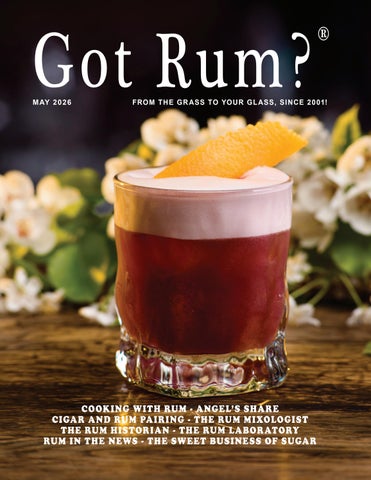
Got Rum? ®


c ontents
May 2026
5 From The e di T or 6-9 The Angel’s s h A re - r um r eviews
10-13 C oo K ing wi T h rum
14-17 T he rum mixologis T
18-19 T he rum universi TY® li B r A r Y
24-27 The rum his T ori A n
28-31 T he r um l AB or AT or Y
32-35 rum in T he news
36-46 T he swee T B usiness o F sug A r
48-51 The his T or Y A nd s C ien C e o F T he BA rrel
52-55 C ig A r A nd rum PA iring


Got Rum? ®
Printed in the u s .A. A publication of r um r unner Press, i nc. Taylor, Texas 76574 - u s .A.
Tel/Fax +1 (855) rum -T i P s © 2026 by r um r unner Press, i nc. All rights reserved. May 2026
e ditor and Publisher: luis@gotrum.com
e xecutive e ditor: margaret@gotrum.com
Cigar and r um: philip@gotrum.com
Angel’s s hare: paul@gotrum.com
r um h istorian: marco@gotrum.com
r um in the n ews: mike@gotrum.com
Cooking with r um: sue@gotrum.com
w ebmaster: web@gotrum.com
d irector of Photography: art@gotrum.com
i f you would like to submit news or press releases, please forward them to: news@gotrum.com
You can download the free electronic version (low-res) of this magazine, or purchase the high resolution printed version at:
WWW. gotru M. co M


The printed version of “ g ot r um?” is produced with F s C-certified paper, which means it is from responsibly managed forests and verified recycled sources.
F ron T C over : d reamy and Creamy inside s P re A d : A s ip of s ummer
F rom T he edi T or Transportation Challenges
o ver 99% of the distilled spirits produced around the world are consumed in places other than where they are bottled. As such, transportation of finished goods plays a very important role in the domino effect needed to get the bottles into consumers’ hands. m ulti-modal shipping using steel containers is at the core of this process, and keeping an eye on the challenges faced by the transportation companies is always a good thing for producers.
l ailah g ifty Akita, Author of Think Great , once wrote:
“Good roads coupled with good transportation are essential for good trading.”
As with many other industries, there is a lot of consolidation going in the freight industry, and many smaller players are facing existential dilemmas.
h appag- l loyd is in the process of acquiring Z im , reducing the number of players and increasing the market share of the remaining ones. After the acquisition, seven carriers will be in control of almost 80% of the global capacity, with three of these carriers accounting for almost half of the global shipping volume!
l ooking ahead, upward pressure on rates is expected due to:
• r ising fuel and energy costs (very low s ulphur fuel oil rising by approximately 76% between late February and mid- m arch).
• w ar risk and insurance surcharges.
• Capacity management measures by carriers.

• Additional cost pressures include terminal renegotiations, charter rate increases, insurance premiums, and diversion-related costs (caused by blockades, natural disasters and other obstacles to commerce).
w hat does all this mean for alcohol producers and, ultimately, for their consumers? Fewer routes, longer transit times, higher prices and reduced rate competition.
Cheers!

l uis Ayala, Editor and Publisher

http://www.linkedin.com/in/rumconsultant
do you want to learn more about rum but don’t want to wait until the next issue of “got rum?”? Then join the “rum lovers unite!” group on linkedin for updates, previews, Q&A and exclusive material.

T he A ngel’ s sh A re
by Paul s enft


m y name is Paul s enft - r um r eviewer, Tasting host, Judge and w riter. m y exploration of r ums began by learning to craft Tiki cocktails for friends. i quickly learned that not all rums are created equally and that the uniqueness of the spirit can be as varied as the locales they are from. This inspired me to travel with my wife around the Caribbean, Central America, and u nited s tates visiting distilleries and learning about how each one creates their rums. i have also had the pleasure of learning from bartenders, brand ambassadors, and other enthusiasts from around the world; each one providing their own unique point of view, adding another chapter to the modern story of rum.
The desire to share this information led me to create www. r umJourney.com where i share my experiences and reviews in the hopes that i would inspire others in their own explorations. i t is my wish in the pages of “ g ot r um?” to be your host and provide you with my impressions of rums available in the world market. h opefully my tasting notes will inspire you to try the rums and make your own opinions. The world is full of good rums and the journey is always best experienced with others. Cheers!
Blue Chair Bay w hite r um
i n m arch of 2025, n ext Century s pirits acquired the Blue Chair Bay r um brand and made Kenny Chesney one of its largest stakeholders. The Blue Chair Bay rum line began with a release of three flavors and expanded to include different flavors, rum creams, and a spiced rum blend.
The base rum for the line is produced at the w est i ndies r um d istillery in Barbados using molasses and aged for up to 15 months in used bourbon barrels before being blended to 40% AB v and bottled for distribution.
a ppearance
The rums in the Blue Chair Bay line are all packaged in the same tall 750 ml bottles with wooden-capped synthetic corks. The wraps on the bottle and security wrap around the cap are color coordinated to match the different products in the line. i n the case of their white rum, it is a frosted white color with blue and white lettering sharing the basic details about the rum along with basic marketing information.
i n the glass, the rum is crystal clear. s wirling the rum creates a thick band that quickly releases several waves of legs before evaporating, leaving pebbles of liquid all over the tasting glass.

n ose
The aroma leads with a crisp vanilla note followed by topical fruit and ethanol.
Palate
m uch like the aroma, the first sip leads with vanilla with a punch of alcohol tingling the mouth and tongue. Additional sips provide a hit of banana and tangy lime, creating high notes, while a mineral rich baseline forms. The wood influence drifts in and helps form the finish with a light pepper note transmuting the flavors into a smoky butterscotch finish.
r eview
This brand has grown over the years to become one of the most successful independently owned rum brands in the u nited s tates. i t is certainly one of the most successful rum brands owned by a music artist. The flavor profile hits quickly and functions well in fruit-based cocktails and explains why i have seen its growing presence in the wells of bars and restaurants i have visited. i f you are looking for something different to use as a base rum in your cocktails, this one is worth exploring to see if it meets your needs.

T he A ngel’ s sh A re
by Paul s enft

w orthy Park s elect r um
The w orthy Park estate was established in 1670 at s t. Catherine Parrish, Jamaica. All production of their rum line happens on property from the sugar cane that is grown on the estate, then harvested for their sugar operation. After the sugar is produced, they take the molasses and use it as the fermentable base of their rum. After the fermentation process is completed, they create their rums using copper pot stills. The rum is then aged in used bourbon barrels. For the s elect expression, a blend of four to twelve year old rums is used to create this rum. i t is blended and bottled at 40% AB v
a ppearance
The rum is bottled in a standard 750 ml medium-necked bottle. i ts label provides basic information about the rum with the w orthy Park logo front and center on the bottle.
The liquid is a bright amber color in the bottle and lightens slightly in the tasting glass. s wirling the liquid creates a razor thin band that slowly thickens, releasing a combination of small and thick legs in several waves. i t takes several minutes before the band begins evaporating, leaving beads behind on the tasting glass.
n ose
The aroma delivers cooked apples, grilled bananas and pineapples, m adagascar vanilla, baking spices, and charred oak.
Palate
The first sip has a soft entry as the fruit and vanilla flavors from the aroma hit the tongue with the alcohol lightly burning the palate. Additional sips have the vanilla notes take on more of a nutty caramel toffee note with cinnamon and nutmeg popping in hard; an interesting vegetal melon rind flavor manifests and fades quickly before the charred wood and mineral notes take over, forming a long, lightly acidic finish.
r eview
o ver the past few years, i have had a few cocktails made with it, ranging from a m ai Tai, s hrunken s kull, and rum punch. i t is the aged workhorse product of the line and holds up well enough as a sipper. i t does not have the strong funkiness of some other Jamaican rum products, but there is enough of it present that there is no doubt in a blind tasting that this is a Jamaican rum. i noticed on the store shelves that there are some serious variances in price, so keep that in mind when shopping for this bottle. As much as i enjoy w orthy Park o verproof, i really like the versatility and functionality of this rum, and it is an easy recommendation to use in any cocktail calling for aged Jamaican rum.


COOKING WITH RUM
Bringing the s pirit of the c ane i nto the h eart of the Kitchen!
by Chef s usan w hitley

a pricot ‘n r um c hicken

i ngredients:
• 4 Chicken Breasts (boneless, skinless)
• 1 C. Apricot Preserves
• 1 C. Catalina s alad d ressing
• 2½ Tbsp. d ijon m ustard
• ¼ tsp. w orcestershire s auce
• 2½ Tbsp. d ark r um
• 2 oz. d ried o nion s oup m ix
• g arnish with slivered almonds and chopped green onions
d irections:
1. Preheat oven to 375 F. g rease a 9 x 13 inch baking dish and set the chicken breasts in pan.
2. i n a medium-sized bowl, combine apricot preserves, Catalina dressing, d ijon mustard, w orcestershire s auce, dark rum, and onion soup mix. m ix well.
3. Pour apricot mixture evenly over chicken and bake for 45 minutes or until chicken is cooked through. r emove from oven and allow chicken to sit for a few minutes before serving so that the juices can settle back into the meat, this keeps it tender and flavorful when you cut into it. Transfer chicken onto a platter and garnish with slivered almonds and chopped green onions. Yields 8 servings.
* n ote: i f you want a thicker sauce, mix 2 tablespoons cornstarch with ¼ cup water. Bring the sauce to a simmer and whisk in the mixture a little at a time until you have reached the desired thickness.


Photo Credit: www.mccormick.com


c reamy r oasted c arrot s oup

i ngredients:
• 2 lbs. Carrots
• 3 Tbsp. e xtra- v irgin o live o il, divided
• ¾ tsp. Fine s ea s alt, divided, to taste
• 1 m edium Yellow o nion, chopped
• 2 Cloves g arlic, pressed or minced
• ½ tsp. g round Coriander
• ¼ tsp. g round Cumin
• 4 C. v egetable Broth
• 1½ C. w ater
• ½ C. d ark r um
• 1 to 2 Tbsp. u nsalted Butter, to taste
• 1½ tsp. l emon Juice, to taste
• Freshly g round Black Pepper, to taste
d irections:
1. Preheat oven to 400°F. l ine a large, rimmed baking sheet with parchment paper (for easy cleanup).
2. Peel carrots and cut into ½ inch diagonal pieces then put in the baking sheet. Add 2 tablespoons olive oil and ½ teaspoon of salt. Toss until carrots are lightly coated then arrange them into a single layer.
3. r oast the carrots for about 30-40 minutes (tossing halfway) or until they are caramelized around the edges and can be easily pierced with a fork.


4. i n a soup pot over medium heat, warm the remaining 1 tablespoon olive oil. Add the onion and ¼ teaspoon salt. Cook, stirring occasionally, until the onion is softened and turning translucent, about 5 to 7 minutes. Add the garlic, coriander and cumin. Cook for about one minute, stirring constantly. Pour in the vegetable broth, water and dark rum. u sing the broth, scrape up any browned bits on the bottom of pot with a wooden spoon (or spatula).
5. Transfer the roasted carrots to the soup pot. Bring mixture to a boil over medium-high heat, then reduce heat to simmer and cook for 15 minutes.
6. r emove pot from heat and allow to cool for a few minutes, about 3 to 5 minutes.
7. w orking in batches, transfer soup to a blender. Add the butter, lemon juice, and black pepper. Blend until completely smooth.
8. Add additional salt and pepper if necessary. i f you desire more richness, add another tablespoon of butter and blend again. l ove your rum? Add an additional 2 tablespoons of rum. s oup is ready to serve!
Photo Credit: cookandhook.com
THE RUM Mixologist
A space devoted to the exploration of classic and new rum cocktails


What i s Mixology?
m ixology is the study and skill of inventing, preparing and serving cocktails and other mixed drinks. m ixologists are experts in this field, but mixologists’ knowledge goes beyond memorizing basic cocktail recipes: it includes historical information, basic chemistry behind flavor combinations and a capacity for combining common ingredients in new ways.
Join us, as we explore the essential collection of rum cocktail recipes that every mixologist needs to master.


THE RUM Mixologist
This m onth’s Cocktail: r um r angoon
This cocktail was created by bartending veteran Jim m eehan. The drink features strong tropical vibes that instantly transport your mind to fun, tropical destinations.
i ngredients:
• 2 oz. Banks 5- i sland r um
• 1/2 oz. Clément Creole s hrubb
• 3/4 oz. l ime Juice, Freshly s queezed
• 1/4 oz. m artinique s ugar Cane s yrup
• 2 d ashes Angostura Bitters
• 1 d ash Angostura o range Bitters
• g arnish: o range w edge
Directions:
1. Add the rum, Creole shrubb, lime juice, sugar cane syrup, Angostura bitters and orange bitters into a shaker with ice and shake until well-chilled.
2. s train into a chilled cocktail glass, optionally rimmed with sugar.
3. g arnish with an orange wedge.


r eviews of books related to sugarcane, milling, fermentation, distillation, aging, blending and other topics related to the production or history of rum.
www. r um u niversity.com

e lixirs of i ndia: a Journey t hrough i ndia’s traditional Drinks and f lavors by a arav Patel
(Publisher’s r eview)
i ndia’s traditional beverages are more than just refreshments—they are an integral part of life’s rhythm and taste. From the invigorating morning chai to the soothing evening lassi, each drink holds its own significance and ritual. These beverages embody the essence of family gatherings, religious ceremonies, and everyday life, bridging generations and symbolizing togetherness.
w hat makes i ndian beverages so unique in the world of drinks? i s it the exotic spices, diverse ingredients, or the rich history in every glass?
As you turn the pages, you will uncover the secrets behind these extraordinary beverages. From traditional recipes to modern twists, this book offers a perfect blend of tradition, innovation, and a touch of magic that only i ndia can offer. g et ready to be spellbound!
w hat’s i nside:
○ Discover the vibrant world of Indian beverages with 100 unique recipes that bring together tradition, health, and innovation. This book is your guide to mastering the art of i ndian drink-making, covering a diverse range of flavors and techniques.
Traditional i ndian d rinks - Classic favorites like Kokomo s harbat, s piced l assi, and Aam Panna.
i ndian Teas and Coffees - From m asala Chai to s outh i ndian Filter Coffee, explore i ndia’s rich tea and coffee culture.
Fruit Juices and s moothies - r efreshing blends featuring mango, guava, pomegranate, and more.
Coolers and r efreshers - Chilled delights like s hikanji, Jaljeera, and n imbu Pani.
m ilk-Based d rinks - Creamy indulgences like Badam m ilk, s ambharam, and Falooda.
Fermented d rinks - Probiotic-rich beverages like Kanji, Toddy, and s olkadhi.
i ndian Alcoholic d rinks - u nique regional spirits like Feni, m ahua, and l ugdi.

Ayurvedic and m edicinal d rinks - h ealing concoctions like Buransh, Kadha, and Ashwagandha m ilk.
i ndian Festive d rinks - s pecial beverages enjoyed during h oli, d iwali, and other celebrations.
m odern and Fusion d rinks - A creative twist on classics with contemporary.
Publisher: Aarav Patel
Publication date: d ecember 11, 2024
l anguage: e nglish
Print length: 231 pages is B n -10: 106910731 x is B n -13: 978-1069107312
i tem w eight: 14.6 ounces d imensions: 6 x 0.53 x 9 inches
t raditional Drinks f rom

India has a rich tradition of indigenous alcoholic beverages, often referred to as desi daru which translates to country liquor. These are homemade, backyard brewed beverages which are the real backbone of Indian booze. These include:
• Feni : A strong, fruity spirit made from cashew apples or coconut sap, primarily produced in Goa. Made from cashew apples or coconut sap, it has a sharp, fruity kick and is still made in copper pots by hand.
• Mahua : A floral, heady drink made from the flowers of the mahua tree, common in Madhya Pradesh and tribal regions. heady, floral drink made from mahua tree flowers—common in the Madhya Pradesh tribal belt.
• Chhaang : A barley-based alcoholic beverage popular in the Himalayas, often served warm in a clay mug during cold nights.
• Apong : A rice beer made from rice, yeast and herbs and a very popular drink of the Assamese culture and much of north-east India. Along with Chhaang, this beverage is also served in the Himalayas.
• Toddy : A lightly alcoholic drink made from the fermented sap of palm trees, especially popular along the southern coasts in Kerala and Tamil Nadu. Major cities like Mumbai and Chennai host hidden toddy shops for those “in the know.”

• Arak : An anise-flavored spirit. Some drinks in India are only sipped during festivals and Arak is a popular one found during Holi.
Cultural Context: Alcohol in India carries cultural significance, with consumption patterns varying by region, religion, and social norms. While urban areas embrace global drinking trends, rural and tribal communities often use alcohol in rituals, festivals, and traditional ceremonies.
(Above: Chhaang, Right: Arak)


ot r um? May 2026 - 22


your o ne- s top s hop for a ged r ums in Bulk!
• Column- d istilled, Pot- d istilled or Blends
• h igh Congener ( i ncluding h igh e sters), l ow Congener or Blends
• Aged in American or French o ak Barrels
• Aged in r ye w hiskey, Bourbon, Tequila, Armagnac, Port, s herry and w ine Barrels
• s ingle Barrels and s econd Aging/Finish
• d istilled in the us A, Central America, s outh America or in the Caribbean
• o ver 150 m arks/ s tyles Available, plus Custom Blends
• l ow m inimums and Fast Turnaround, w orldwide s hipping www.
the ru M historian
by m arco Pierini
i was born in 1954 in a little town in Tuscany ( i taly) where i still live. i n my youth, i got a degree in Philosophy in Florence and i studied Political s cience in m adrid, but my real passion has always been h istory. l ife brought me to work in tourism, event organization and vocational training, then i discovered rum and i fell in love with it.
i have visited distilleries, met rum people, attended rum Festivals and joined the r um Family. i have studied too, because r um is not only a great distillate, it’s a world. Produced in scores of countries, by thousands of companies, with an extraordinary variety of aromas and flavors, it is a fascinating field of studies.
s oon, i discovered that rum has also a terrible and rich h istory, made of voyages and conquests, blood and sweat, imperial fleets and revolutions. i realized that this h istory deserved to be researched properly and i decided to devote myself to it with the help of the basic scholarly tools i had learnt during my old university years.
i n 2017 i published the book “A meri CA n rum – A s hort h istory of r um in e arly America”
i n 2020, with my son Claudio, i have published a new book “F ren C h rum – A h istory 1639-1902”.

T imeless review “ GENTLEM a N’S PROGRESS Th E I TINER a RI u M O f D R aLE xa NDER h a MILTON , 1744 ” e di T ed BY C A rl Briden BA ugh un C P ress 1948
“Just as i dismounted at Tradaway’s, i found a drunken Club dismissing. m ost of them had got upon their horses, and were seated in an oblique situation, deviating much from a perpendicular to the horizontal plane, a posture quite necessary for keeping the center of gravity within its proper base, for the support of the superstructure; hence we deduce the true physical reason why our heads overloaded with liquor become too ponderous for our heels. Their discourse was as oblique as their position: the only thing intelligible in it was oaths and g oddamnes; the rest was an inarticulate sound like r ableais’ frozen words a thawing, interlaced with hickupings and belchings. i was uneasy until they were gone, and my landlord [Thomas Treadway], seeing me stare, made that trite apology – that indeed he did not care to have such disorderly fellows come about his house; he was always noted far and near for keeping a quiet house and entertaining gentlemen or such like, but these were country people, his neighbors, and it was not prudent to disoblige them upon slight occasions. ‘Alas, sir!’ added he, ‘we that entertain travellers much strive to oblige everybody, for it is our daily bread.’ w hile he spoke thus, our
ot r um? May 2026 - 24 g ot r um? May 2026 - 24

Bacchanalians, finding no more rum in play, rid off helter-skelter as if the devil had possessed them, every man sitting his horse in a see-saw manner like a bunch of rags tied upon the saddle.” s o writes h amilton at the very beginning of his journey.
Alexander h amilton was born close to e dinburgh in 1712, into a family belong-ing to the s cottish landed class. After earning a degree in m edicine from the pres-tigious u niversity of e dinburgh, he left for m aryland in 1738 and made his home in Annapolis, where he practiced as a physician for the rest of his life. i n 1744, concerned about his health condition, he prescribed himself “a good dose of fresh air and physical exercise with a journey on horseback”. o ver the summer, he spent four full months riding roughly 1,600 miles throughout the northern colo-nies, reaching as far as m aine (then still part of m assachusetts). h e lingered in major urban centers such as Philadelphia, n ew York, and Boston, but his route also led him through tiny settlements and isolated dwellings.
“ d r. Alexander h amilton’s Itinerarium is one of the happiest combinations of liveliness, wit, and instructive information written in colonial America. The description of his journey from m aryland to m aine and back in 1744 is unequalled by any other writer. … i n 1744 such a trip as the doctor proposed required careful planning months in advance of departure; it was an adventure little comprehended today. e ach colony had his own paper money, which passed at different rates, and arrangements for credit had to be made in order to avoid the danger of travelling with large sums of cash on one’s person. l etters of introduction to prominent gentlemen in the places to be visited were essential both as financial and as social passports. … Yet a surprising number from all ranks were on the move in 1744. … At no time did d r. h amilton complain of bad roads, or either of danger or poor service in the fifty ferry crossings he carefully recorded. m oreover, his personal safety was never once threatened ” (Carl Bridenbaugh Introduction )
d r. h amilton usually slept in taverns he encountered along the way or selected within the cities; at times he stayed in private homes, though most evenings were spent in public houses. h amilton was a sharp, educated, open minded, and in-quisitive individual, even though perhaps with a bit of a stuck-up attitude. i n his travel diary, Itinerarium; being a narrative of a journey from a nnapolis, Maryland …—later known as Gentleman’s Progress —he recounts his trip day by day. h is writing is lively and elegant, offering a wealth of first-hand observations that are both informative and often unexpectedly revealing about daily life and culture in the British Continental Colonies. d uring his stops in taverns or while travel-ing, he frequently encountered other wayfarers. s ome had just come from the w est i ndies or were preparing to sail there, illustrating the strong connections among the various regions of British America.
Above all, taverns were places for conversation. As h amilton notes, “in taverns people chatted” about business, everyday life, politics, religion and so on. m ore-over, people exchanged information and questioned passing travelers who brought news from the places they came from. o ften, these were the only sources of information available to ordinary folks. n ewspapers were just beginning, and, of course, modern mass media didn’t exist yet. o ften, educated patrons discussed h istory, Philosophy and the Arts, too.
r eligion in particular was a constant topic, given the multitude of competing Churches in the Colonies and the ardor of ‘ n ew l ight’ followers of the e nglish evangelist, g eorge w hitefield, responsible for what is most likely the first great and spontaneous American movement: The g reat Awakening.
Political discussions, instead, focused mainly on the fear of a French invasion. i t is worth remembering that at the time France held dominion over Canada and had just entered into war g reat Britain, for the so called w ar of Jenkin’s e ar, which had broken out between e ngland and s pain in 1739, (see his T or Y o F C u BA n rum 3. T he K e Y T o T he indies in the s eptember 2022 issue) was, in 1744, about to merge with the Anglo-French struggle known as King g eorge’s w ar.
o ne striking contrast with today’s bar culture was the absence of sports talk— spectator sports would not emerge until the following century. Another major difference: taverns were exclusively male spaces. r espectable women did not go to taverns, with the exception of the owner’s wife and doughters. “ w e put up att a publick house kept by one Thomas where the landlady looked after every thing herself, the landlord being drunk as a lord. The liquor had a very strange effect upon him, having deprived him of the use of his tongue. h e sat motionless in a corner smoking his pipe and would have made an elegant figure upon arras.” h amilton quickly realized that all over the colonies, tavern goers drank heavily. m embers of the upper classes, including himself, favored m adeira and punch, while ordinary people consumed rum and cider.
l ater on during his journey he also came across Clubs, where members, usually from the upper classes, met to discuss issues of common interest, and to drink until they were plastered and collapsed under the table. o ne such club was the h ungarian Club in n ew York: “After supper they set in for drinking, to which i was averse, and therefore sat upon nettles. They filled up bumpers at each round, but i would drink only three, which were to the King, g overnour Clinton, and g overnour Bladen, which last was my own. Two or three toapers in the company seemed to be of opinion that a man could not have a more sociable quality or endurement than to be able to pour down seas of liquor, and remain unconquered, while others sank under the table. i heard this philosophical maxim, but silently dissented to it.”
And, on leaving n ew York, he writes:
“The people of n ew York att the first appearance of a stranger are seemingly civil and courteous, but this civility and complaisance soon relaxes if he be not either highly recommended or a good toaper. To drink stoutly with the h ungarian Club, we are all bumper men, is the readiest way for a stranger to recommend himself, a a sett among them are very fond of making a stranger drunk. To talk bawdy and to have a knack att punning passes among some there for good sterling with. g ovr. Clinton himself is a jolly toaper and gives
good example and, for that one quality, is esteemed among these dons. … i was tired of nothing here but their excessive drinking“
i n mid-July, h amilton arrived in Boston, then the largest town in British America. w hen he was in town, h amilton was often invited in the afternoon to have tea at the home of an acquaintance, and the women of the household also took part in the conversation. i n the evening, however, he drank punch and wine—without overindulging—in the company of men only, in the coffee houses, which were more respectable, less alcohol centered, establishments than taverns. A few times, he writes in his diary that he went to bed without drinking, evidently a piece of news worth mentioning.
Around him, things were different, rum was everywhere, a lot of people drank too much, and drunkness was common.
“About three miles before i reached York i saw the man of war commanded by Commodore w arren lying in Turtle Bay. This was a festival day with the crew, They were a roasting an entire ox upon a wooden spit and getting drunk as fast as they could. w arren having given them a treat. … w e met with an old chattering fellow … w e could scarcely get rid of this fellow till we made him so drunk with rum that he could not walk.”
n ot just ordinary people, also “the better sort” got drunk: “About 10 o’ clock there came to us a drunken doctor who was so intoxicated with liquor that he could scarce speak one connected sentence. h e was much chagrined with some people for calling him a quack”.
And sometimes, h amilton drank too much, too: “ New y ork m onday, s eptember 10th. i dined this day with m r. Bayard’s brother, and after dinner we tossed about the bumpers so furiously that i was obliged to go home and sleep for three hours and be worse than my word to m r. h asell, with whom i had promised to spend the evening.” Therefore, “ i was sorry to leave n ew York upon account of being separated from some agreeble acquaintance i had contracted there, and at the same time i cannot but own that i was glad to remove from a place where temptation of drinking
8a thong so incompatable with my limber constitution) threw it self so often in my way.”
At the end of s eptember, h amilton was back home again. “ i arrived att Annapolis att two o’ clock afternoon and so ended my perigrinations. i n this my northeren travels i compassed my design in obtaining a better state of health, which [was] the purpose of my journey. i found but little difference in the manners and characters of the people in the different provinces i passed thro’, but as to constitutions and complexions, air and goverment, i found some variety. … i n this itieration i completed, by land and water together, a course of 1624 miles. The northeren parts i found in generall much better settled than the southeren. As to politeness and humanity, they are much alike except in the great towns where the inhabitants are more civilized, especially att Boston. F inis ”
P os T s C ri PT um
h abent sua fata libelli , which means, more or less, Books have their own desti-nies.
“The manuscript of the Itinerarium has had an unusually interesting history. Commercial contacts between the e nglish colonies and the i talian states were few and far between in the eighteenth century. o ccasionally a colonial vessel ventured to l eghorn, and even less frequently did a native of i taly reach American shores. w hen d r. h amilton returned from his tour in s eptember, 1744, he met an i talian gentleman, o norio r azolini, for whom he came to have a great affection which he expressed felicitously in the l atin dedication of his journal. w hen the signor left m aryland he carried with him the manuscript” (Bridenbaugh). The manuscript re-mained in the possession of the family of r azolini for more than a century, than passed into the hand of an i talian bookseller that sold it to a l ondon bookseller. s everal further changes of ownership followed; the book eventually made its way to America and was published in a private edition in 1907. Finally, in 1948, this edition appeared.
m arco Pierini


The Rum Laboratory
Presented
by

Join us as we explore the world of rum spices and flavors! i n this series you will learn to flavor your own r ums and to create your own l iqueurs and c reams.

g ot r um? May 2026 - 29

Presents making your own
Coriander and Cardamom Rum
Liqueur
Throughout the m iddle Ages and the r enaissance, Coriander ( Coriandrum sativum or Cilantro ) was used as the primary ingredient in love potions.
i ngredients
• 1 Tbsp. Coriander s eeds
• 1 tsp. Cardamom s eeds
• 1 s tar Anise Flower
• 6 w hole Cloves
• 6 r ose h ips
• 2 C. w ater
• 1 C. h oney
• 2 Tbsp. d ried h ibiscus Flowers
• 3 tsp. o range zest
• 2 tbsp fresh-squeezed l ime Juice
• 1 cup light (Puerto r ican or Cuban) white rum
• 1/2 cup s panish-style rum
Procedure
Combine and grind (you can use an old coffee grinder or a mortar and pestle) the coriander, cardamom, star anise, cloves and rose hips.


Combine 1 cup of water and honey and bring it to a boil, removing any foam that forms on the surface. Keep boiling for 5 minutes. Add the ground spices and boil for an additional 5 minutes.
r emove from heat let stand for 5 more minutes and then add the hibiscus flowers and let it rest for another 10 minutes.
s train the liqueur through a fine mesh and place it into a 1-liter jar. Add the orange zest, lime juice and rums and top off with the remaining cup of water. Allow it to cool down.
s tore the container in a cool, dark place and let it sit there for at least 4 weeks. r ack or filter if you want to remove sediments.

r
u M in the ne W s
by m ike Kunetka


These are the most recent and noteworthy headlines in the rum industry. i f you want us to share your news with our readers, please send me an email to: m ike@gotrum.com.
B ristol s P irits
The latest offering from Bristol s pirits is n ew Yarmouth 2008 - m adeira w ood. The n ew Yarmouth d istillery, situated in Clarendon Parish, Jamaica is a site of quiet historical importance. Though less widely known than some of its island counterparts, it stands as a major contributor to the singular, expressive character of Jamaican r um, particularly those renowned for their high-ester style. Among r um connoisseurs, n ew Yarmouth has achieved near-cult status. i ts products are celebrated for their powerful, distinctive profile, rich with the high-ester “funk” that defines traditional Jamaican r um. This unmistakable character is shaped by extended fermentation and the use of specialized yeast strains. The year 2008 marked a notable turning point in the distillery’s ownership. At that time, it operated under a holding company with a majority stake in J. w ray & n ephew. e arly that year, Trinidad-based C l Financial, the parent company of Angostura d istillery, assumed control, followed by the subsequent acquisition by g ruppo Campari in 2012. This Bristol Classic r um, aged for sixteen years, is especially coveted, even more so as a single-cask release. h aving arrived
in the u K in 2016, it was immediately laid to rest in a used American oak ex-bourbon barrel, the classic choice for nurturing a bold, full-bodied spirit. o ver six quiet years, it matured gracefully in their moisture rich warehouse, allowing its robust pot still nature to deepen while absorbing the cask’s gentle influence. i n 2022, it underwent a second maturation in a m adeira wine cask. This is a thoughtful progression that introduced added richness and complexity. Bottled in s cotland toward the end of 2025 at a remarkably robust 57.4% AB v, this release is available only in very limited quantities. Bristol s pirits recently worked with s weden’s s ystemboygt to create an exclusive release, Jamaica 2013 – lro K. i t is a single cask selection, aged 12 years in ex-bourbon wooden cask.
w onderfully soft nose with much fruit and light oak influence combined into a long and deep style. Palate well integrated with upfront fruit and light touches of well controlled wood leading to a depth of flavor carrying through to middle palate and a long lingering finish which stays in the mouth. Bottled in s cotland toward the end of 2025 at 55.1% AB v . https://www.bristolclassicrum.com/
glo B al D rin K s intel & W est in D ies ru M & s P irits P ro D ucer ’ s association
g lobal d rinks i ntel has announced a partnership between the g lobal r um Awards 2027, part of the g lobal d rinks Awards, and the w est i ndies r um & s pirits Producers’ Association ( wirs PA), marking a significant step in strengthening how rum is recognized and evaluated on the global stage. The collaboration brings together g lobal d rinks i ntel’s awards platform and wirs PA, widely recognized as the voice of the Caribbean rum industry, which represents producers across the region and works to promote Caribbean rum as a premium category. The partnership reflects a shared focus on ensuring that rum is represented with accuracy, credibility and relevance to today’s international drinks market. As part of the partnership, wirs PA will support the development of category structures and provide input into judging, helping to ensure that the diversity of rum styles and production approaches is properly reflected. The organization will also promote the awards across its network, extending the reach of the program to producers throughout the Caribbean and beyond.
“ w e’re pleased to be working with wirs PA to ensure the g lobal r um Awards are built with the input and perspective the category deserves,” said g lobal d rinks i ntel’s Chief Commercial o fficer, James h oulder. “This is about creating a platform that reflects the realities of the global rum market and delivers credible recognition that producers can genuinely use.” wirs PA C eo v aughn r enwick added: “As the representative body for Caribbean rum producers, we welcome the opportunity to contribute to an awards program that reflects the diversity and quality of the category. This
partnership supports the continued growth and recognition of Caribbean rum internationally.” e ntries are now open for the g lobal r um Awards 2027, with producers invited to submit products for assessment by an international panel of industry professionals. The awards aim not only to recognize excellence, but also to provide producers with exposure to buyers, distributors and decision-makers across the global drinks trade. https://globaldrinksawards.com/, https://www.wirspa.com/
a PP leton estate 51
year
ol D ru M
The Jamaica o bserver reported that an avid rum collector has acquired one of the world’s rarest spirits, the ultra-rare Appleton e state 51-year-old cask rum, one of just 25 bottles available globally. Following its purchase, the historic expression was delivered directly to the collector, marking a significant moment in the legacy of Jamaican rum. The collector was later joined by legendary m aster Blender d r. Joy s pence, who guided him through the meticulous rum-making process behind this exceptional liquid and shared the symbolism woven into every detail of the expression. Crafted in traditional copper pot stills and laid down on July 31, 1973, the rum has matured exclusively in Jamaica’s tropical climate for more than five decades, earning its place as the oldest tropically aged rum ever released. d r. s pence also personally signed the bottle, underscoring its provenance and rarity. A true hallmark of Jamaican excellence and the craftsmanship of the people of Appleton e state, this 51-year-old expression is more than a collector’s piece. i t is a timeless treasure, an enduring symbol of passion, heritage, and the relentless pursuit of perfection. https://www.appletonestate.com/
J ohnny D e PP’ s three hearts ru M
After years in development and months of anticipation following early previews, Three h earts r um, the super-premium Caribbean-inspired rum founded by longtime friends Johnny d epp and Bobby d e l eon, officially launched last month with the release of its inaugural expression. i nspired by d epp’s decades-long connection to the Caribbean and a shared respect for the people who sustain the region’s rum-making heritage, Three h earts was created as both a tribute to the craft of rum and a celebration of the communities that have shaped its legacy. d epp has spent two decades in the Caribbean, where he developed a deep appreciation for the culture, craftsmanship, and traditions that define the region. Following the devastation caused by hurricanes across several Caribbean islands in recent years, d epp and d e l eon began discussing how they might create a spirit that not only honored traditional rum production but also supported and spotlighted the communities responsible for it. The result is
Three h earts, a super-premium rum developed slowly and intentionally, grounded in respect for the Caribbean’s rum-making traditions and the people behind them.
“ r um holds the history of the islands,” said d epp, co-founder of Three h earts. “ i t’s shaped by the hands of the people who grow the cane, ferment the spirit and age it over time. Bobby and i wanted to create something that honored that tradition and the friendships that inspired it.” The inaugural expression of Three h earts r um is crafted in the d ominican r epublic using time-honored rum-making methods. Aged for five years in exbourbon barrels with a touch of o loroso influence, it is then recasked for an additional two years in ex-Cognac barrels, resulting in a seven-yearaged rum. The final expression is balanced and refined, showcasing the layered character and depth synonymous with Caribbean rum traditions.
“ w e didn’t want to rush something into the world,” d e l eon said. “This rum represents years of patience and collaboration. o ur goal was to create something that respected the heritage of Caribbean rum while sharing the spirit of the friendship that started it.” The storytelling behind Three h earts extends beyond the liquid itself. The bottle was designed by Johnny d epp, incorporating symbolism drawn from his tattoos and personal philosophy. e mbossed on the bottle is the flag of his island, made up of the tattoos on his body–each with personal meaning. A s kull is a reminder of life’s brevity, to live fully. A lightning bolt symbolizes enduring friendship. The number three represents new beginnings. Three hearts represent the loves of his life. e ncircling the neck, a bracelet-style charm completes the design. At the base of the bottle, the brand’s guiding motto is inscribed: “ n o Fear. n o m alice. n o e nvy.” w hile the inaugural release marks the first chapter for Three h earts r um, the founders envision a broader exploration of Caribbean rum traditions in the years ahead. Future expressions are planned to highlight the distinctive styles and cultural heritage of rum-making regions across the Caribbean. Three h earts.com.
ca P tain M organ
The Captain m organ s liced lineup is officially taking a mini vacation with its new Captain m organ s liced Colada s tyle d rink v ariety Pack. Featuring Piña Colada flavors including classic Piña Colada, s trawberry, m ango and Passionfruit, each offering bringing a distinct flavor option together in one variety pack, each delivering a taste of the tropics. Built for easy sipping, each ready-to-drink beverage features bright, creamy, fruit-forward taste in every can. At the heart of the collection, Piña Colada delivers the classic blend of coconut and pineapple flavors, with a bright, tangy finish for a balanced, lightly sweet canned beverage made for sunny days. m ango Colada leans into juicy, ripe mango flavors layered over a creamy coconut flavor, offering a refreshing-tasting, easy-drinking option
with a crisp finish. Passionfruit Colada brings a more vibrant profile, combining tangy passionfruit flavors with smooth coconut flavor for a slightly tart, fruit-forward sip. r ounding out the lineup, s trawberry Colada pairs a light coconut flavor with ripe strawberry notes, delivering a smooth, naturally sweet finish. “ w e know consumers are looking for simple ways to break from the everyday without overcomplicating the moment,” says v ictoria d avid, Brand d irector, r T d at d iageo. “Captain m organ s liced Colada brings that idea of embracing micro getaway moments to life through a range of refreshing-tasting, ready-to-enjoy flavors – making it easy to tap into a ‘Colada w hen You w anna’ mindset anytime, anywhere.”
https://www.captainmorgan.com/
M ontanya ru M
m ontanya r um is proud to announce strategic expansion into Texas ( d allas/Fort w orth & h ouston) markets. The move positions m ontanya to capitalize on accelerating premiumization trends within the spirits category, particularly in rum, where highend offerings are growing between 8–12% annually. As consumers increasingly prioritize quality over price, with 47% of spirits drinkers reporting they are trading up, m ontanya is aiming to reframe rum as a serious, craft-driven alternative to whiskey and tequila. m ontanya is helping reshape that narrative. o wner and m aster d istiller, m egan Campbell insights, “ m ontanya’s positioning as “American m ountain r um” reflects both its terroir and philosophy; rum that celebrates effort, achievement, and elevation, not escape.” Founded in 2008 and proudly women-owned and led, m ontanya is also a Certified B Corporation. m egan states, “ w e make rum at 8,888 feet because we love where we are. Being B Corp certified is how we make sure it stays that way. From sustainable sourcing to responsible production, we hold ourselves to a higher standard for the planet and its people.” To fit m egan’s grass roots, l ouisiana sugarcane brings a little s outhern soul to every batch. r enee n ewton, m egan’s Partner, goes on to say, “Crafted at 8,888 feet, thin air slows things down (in a good way), snowmelt makes everything taste cleaner, this is Crested Butte spirit for people who understand that where something comes from changes what it becomes”. s trategic Texas Partnerships-Texas s pirits, a wine and spirits wholesaler, will oversee distribution across the state, while Frontline Beverage is its inmarket sales team to support on- and off-premise growth in two of the state’s most dynamic metro areas, d F w and h ouston. h ouston based, s ean r ichards, a Partner in m ontanya r um shares, “ i t’s an organic move for m ontanya, as our community of supporters tends to flow between Colorado and Texas. w here vibes mesh with a love of wide-open spaces, celebrating wins with family and friends, or just winding down from a long day, our high mountain lens of rum culture connects.” m ontanya
r um’s portfolio in Texas consists of m ontanya Platino, barrel-aged and charcoal filtered for clarity; m ontanya o ro, lightly aged; m ontanya e xclusiva, aged 3 years and finished in s yrah barrels; m ontanya v alentia, aged 4 years and finished in rye whiskey barrels; and m ontanya Pineapple h abanero, infused with real pineapple and peppers. https://www.montanyarum.com/
sail g P & goslings
s ail g P, the most exciting racing on water, is adding a splash of island spirit to its global championship, announcing a new, three-season partnership with Bermuda’s own g oslings, the iconic rum and ginger beer producer synonymous with the d ark ’n s tormy. The deal, which runs through to the end of the 2028 season, will see g oslings become the o fficial r um and g inger Beer s upplier across select events, kicking off on home waters at next month’s Apex g roup Bermuda s ail g rand Prix ( m ay 9–10). For s ail g P, the partnership feels less like a sponsorship and more like a homecoming. Bermuda has long been one of the league’s most electric venues, and g oslings, a family-run business with more than 200 years of history on the island, is woven into the fabric of that experience. “This partnership will bring a new dimension to our events, particularly in Bermuda, where g oslings is such an integral part of the local culture,” said s ail g P Chief r evenue o fficer Ben Johnson. That “dimension” will be felt most vividly inside the r ace s tadium, where g oslings will anchor a series of fan activations designed to keep the energy high on and off the water. d edicated bar experiences will serve up the brand’s signature drinks, including the d ark ’n s tormy, the storm-cloud-in-a-glass cocktail said to have been named by a sailor, as F50s racers fly past at speeds exceeding 100 km/h. The brand will also feature across s ail g P’s premium hospitality offering, from the vibrant vel A Beach Club to the top-tier Adrenaline l ounge, further blending high-performance racing with elevated, festival-style experiences. g oslings President and C eo e m alcolm g osling sees the partnership as a natural alignment. “ w hile they create excitement on the water, we create it in the barrel,” he said. “ i t’s a perfect match.” Beyond Bermuda, g oslings will expand its s ail g P footprint with four events in 2027 and a further four in 2028, as the championship continues to scale its global calendar and fan experience. https://sailgp.com/, https://goslings.com/
ru M islan D festi V al 2026
This s ummer, Atlanta will become a major meeting point for Caribbean culture with the debut of r um i sland Festival 2026. The inaugural event takes place on s aturday, July 11, 2026, at Piedmont Park Promenade, bringing music, premium rum culture, food and community impact into one high-energy experience.
h eadlined by d ancehall heavyweight Aidonia and rising Caribbean star Ayetian, the festival will spotlight both the legacy and future of Caribbean music. Trinidadian s oca artist m elick and Brooklynborn s oca artist Added r ankin will also perform, with more surprise acts to be announced. Built around the ethos “Culture. Community. r um.”, r um i sland Festival arrives as d ancehall, s oca, Afrobeats and r eggaeton continue to influence global sound. The one-day event is expected to welcome 5,000 to 8,000 attendees, including young professionals, creatives, tastemakers and Caribbean diaspora communities. Piedmont Park will transform into a multi-zone destination with eight hours of live performances, d J sets, rum tastings, cocktail activations, immersive lounges and a Caribbean food village. The festival will also support h er v illage i nc, a nonprofit helping families experiencing poverty. A portion of ticket proceeds will benefit the organization, alongside an on-site donation drive for diapers and period essentials. https://www.rumislandfest.com/
D eni Z en ru M
s ince its inception in 2010, d enizen r um has invited spirit lovers to explore the world of Caribbean rum through a selection of award-winning blends from different island origins. w ith the launch of The w ander s eries, d enizen takes a deeper, richer, and more exclusive dive into single origin Caribbean rums with cask finishes, kicking off the series with d enizen’s s ingle o rigin e dition Jamaican r um Finished in Port Casks. This new expression is crafted from four exceptional Jamaican rums, both pot and column-distilled, and matured for a minimum of eight years in American white oak barrels previously used for whiskey and bourbon. The rums are then expertly married and finished in ex-Port casks for at least three months, adding rich layers of depth, complexity, and a refined, creamy finish. “A rum of this caliber can stand beside some of the world’s best whiskies as a spirit to sip and savor,” says g erry r uvo, owner of d enizen r um. “ h otaling & Co. is known for its portfolio of some of the world’s finest whiskies, and we’re confident that d enizen’s w ander s eries of s ingle o rigin rums will reveal how the same attention to production details and artistry achieves an equally exceptional spirit as some of the finest single malt whiskies coveted today.” “As rum is the most diverse spirit in the world, produced in nearly 80 countries, the immense variety in production methods and styles can be overwhelming,” explains rum expert m artin Cate, owner of s an Francisco’s acclaimed s muggler’s Cove. “The d enizen w ander s eries continues the positive trend of clearly communicating origin, production, aging, and finishing to the consumer. This Jamaican release offers a rich and engaging medium-bodied Jamaican rum elevated with a harmonious and well-integrated port cask finish.” https://denizenrum.com/
The Sweet Business of Sugar


India
r egardless of distillation equipment, fermentation method, aging or blending techniques, all rum producers have one thing in common: sugarcane
w ithout sugarcane we would not have sugar mills, countless farmers would not have a profitable crop and we would not have rum!


o
ffering Bottling/ c o-Packing s ervices
r um Central is located within the t exas t riangle , a region in Texas formed by the state’s four main metropolitan areas. The t exas t riangle is one of eleven mega regions in the u nited s tates and is home to approximately 75% of the s tate’s population. This area also benefits substantially from trade with m exico, the u nited s tates’ third largest trade partner.
r um Central is 30 m iles from Austin, with convenient access to interstate highways, rail lines, airports and seaports (within 250 miles of 4 of the top 10 u s . seaports), guaranteeing fast and efficient shipping of your dry and finished goods.
Do you need more information? Contact us via our website below!
www.


Present
The History and Science of the Barrel
in the world of distilled spirits, nothing evokes elegance, sophistication and transformation more than barrel aging. The right barrels, in the right hands, can transform the mundane into the spectacular. whether it is American, French, Colombian, Bulgarian or other oak variety, a well-made barrel is the magic chamber within which time slowly transforms the contents.
Join us as we explore the world of barrels. we’ll take a deep dive into the physical and chemical transformations that take place inside the world’s preferred aging vessels.


The History and Science of the Barrel
Lesson 5: Understanding Tannins
welcome to Lesson 5 of 12 of the Rum University’s latest course! You can find previous lessons of this course by visiting the Archives page on www.gotrum. com, you can also find additional courses and material on the university’s official website at www.rumuniversity.com.
tannins and their contributions to aged rum
One of the flagship characteristics of traditionally-aged rum is the presence of oak tannins and their effect on the gustatory experience. Tannins are astringent components that derive their name from their ability to tan leather.
oak tannins are hydrolyzable (or Pyrogallols) because they break down to smaller components (such as ellagic Acid) in the presence of water. They are different from grape tannins (found in dark wines) which do not break down and for this reason are referred to as being condensed (or Catechols) of the two types of tannins, the former are generally less astringent than the latter.


oak tannins exist in trees as a form of self defense: their bitterness and astringency act as a defense against predators. They are formed when glucose is combined with ellagic or gallic acids.
which oak variety has the strongest concentration of tannins? The answer is French oak, with up to 10% of its weight being comprised by tannins, as opposed to American oak, which has between 0.2% and 8% tannins by weight. Keep in mind, however, that tannins are destroyed by heat and are hydolyzable, so if you want the strongest concentration of
An example of a tannin molecule

tannins possible, you should use a barrel made of French oak, un-toasted, with staves that have not been cured for a prolonged period of time (more on wood curing in lesson 6).
Flavor contributions of tannins:
• mouthfeel: oak tannins have an impact on the organoleptic qualities of rum, adding to its balance, structure and roundness.
• Color Fixation and stability: wine research studies have demonstrated that tannins play an important role in stabilizing color in wines, further research is needed to confirm that this benefit extends to distilled beverages, but empirical practice seems to suggest it does.

• Antioxidation: tannins are able to reduce or eliminate the oxidation of other chemical compounds by bonding to the oxygen molecules present in the solution.


Our special thanks to Independent Stave Company for their support in our research of oak.
e ffect of barrel toasting heat on tannins
o ak tannins in powder form

cigar & ru M P airing
by Philip i li Barake


my name is Philip i li Barake, s ommelier by trade. As a result of working with selected restaurants and wine producers in Chile, i started developing a passion for distilled spirits and cigars. As part of my most recent job, i had the opportunity to visit many Central American countries, as well as, rum distilleries and tobacco growers.
But my passion for spirits and cigars did not end there; in 2010 i had the honor of representing Chile at the i nternational Cigar s ommelier Competition, where i won first place, becoming the first s outh American to ever achieve that feat.
n ow i face the challenge of impressing the readers of “ g ot r um?” with what is perhaps the toughest task for a s ommelier: discussing pairings while being well aware that there are as many individual preferences as there are rums and cigars in the world.
i believe a pairing is an experience that should not be limited to only two products;
2026 it is something that can be incorporated into our lives. i hope to help our readers discover and appreciate the pleasure of trying new things (or experiencing known things in new ways).
Philip # gr CigarPairing


Punch n egroni
For this pairing, i continue to explore classic cocktail modifications. n ow it is time for one that i ’ve had in mind for a while, as i ’ve recalled my tastings of r hum Agricole. i ’m referring to one of the iconic cocktails of m artinique and g uadeloupe, their national drink: Ti’ Punch or Petit Punch. i t is a “pure” cocktail, in a similar way the o ld Fashion is too, and we’ve already experimented with making rum versions of the latter, which i believe are the best expressions of o ld Fashion cocktails.
For this occasion, i selected a r hum Agricole from the island of g uadeloupe, the Black Cane from r hum Bologne. i t is a limited production from a raw material that is hard to obtain: the black sugarcane. i f i had to describe the rum’s aroma, i ’d say that it features the raw sugarcane components, and that it is loaded with herbal/vegetal notes, with strong menthol and floral elements.
After reading my description of the aroma, fresh and citric cocktails should be the obvious choice, but in the world of cocktail and cigar pairings, such combinations would only work during a very sunny/hot day, if you are in the middle of a sugarcane plantation, but this is not the case where i am. i feel inspired to start with the original cocktail, but then giving it a twist inspired by the n egroni. h ere is the recipe i developed:
• 1 oz. r hum Bologne
• 1 oz. v ermouth Blanco (better if it is aged)
• 1 oz. Campari
As you can see, the ingredients are simple, and the preparation instructions are even more. s ince the cocktail calls for equal proportions

Photos

of each ingredient, the ingredients themselves maintain the balance. In other words, increasing or decreasing the volume of a single ingredient will result in an imbalanced experience. The final touch for this cocktail is to garnish it with a lime peel twist (unlike the Negroni, which calls for an orange peel).
For the cigar, I selected a Robusto from Dias de Gloria, from the AJ Fernández factory. It is made from 100% Nicaraguan tobaccos, with a medium to high intensity, which is typical of the cigars from that region. What is not typical is how it pairs with a cocktail like this one, so let’s see what happens.
While smoking the first third of the cigar, the tobacco’s earthy notes are very enjoyable when combined with the initial sips of the cocktail, even though the latter has decisively more bitter flavors. These flavors are accompanied by hints of spices and sweet notes reminiscent of dried fruits.
As we progress through the pairing, the cocktail starts to showcase its fresh and citric side and, just as we anticipated
earlier, the herbal and bitter notes combine exquisitely with the green vegetal components of the rhum.
As i smoke the second third, the cigar continues to burn very well and the intensity we expected becomes apparent. d ry fig note start to emerge, as the bitterness fades away into the background.
As i approach the end of the second third, the pairing continues to be well-balanced, with the emergence of fresh vanilla notes that end with an herbal bitterness.
e ven though normally i am not a big fan of n egronis, this version inspired by Ti’ Punch has opened up my mind to the versatility of the recipe. i hope that you are able to recreate this pairing at home, using similar ingredients. d on’t worry if your v ermouth Blanco is old, the slightly oxidized notes from mine actually helped the cocktail’s character.
Philip i li Barake # gr CigarPairing
Photo