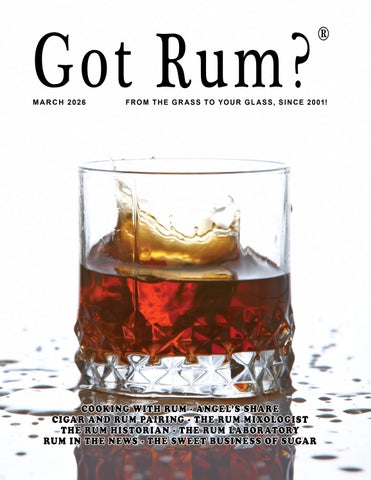
"Got Rum?" March 2026

Page 1


Got Rum? ®

March 2026 fro M the grass to your glass, since 2001!

c ontents

March 2026

5 From The e di T or 6-9 The Angel’s s h A re - r um r eviews

10-13 C oo K ing wi T h rum

14-17 T he rum mixologis T

18-19 T he rum universi TY® li B r A r Y

22-25 The rum his T ori A n

26-29 T he r um l AB or AT or Y

30-33 rum in T he news

34-44 T he swee T B usiness o F sug A r

50-53 rum C o CKTA ils F or lovers

54-57 The his T or Y A nd s C ien C e o F T he BA rrel

64-67 C ig A r A nd rum PA iring

Got Rum? ®

Printed in the u s .A. A publication of r um r unner Press, i nc. Taylor, Texas 76574 - u s .A.

Tel/Fax +1 (855) rum -T i P s © 2026 by r um r unner Press, i nc. All rights reserved.

March 2026

e ditor and Publisher: luis@gotrum.com

e xecutive e ditor: margaret@gotrum.com

Cigar and r um: philip@gotrum.com

Angel’s s hare: paul@gotrum.com

r um h istorian: marco@gotrum.com

r um in the n ews: mike@gotrum.com

Cooking with r um: sue@gotrum.com

w ebmaster: web@gotrum.com

d irector of Photography: art@gotrum.com

i f you would like to submit news or press releases, please forward them to: news@gotrum.com

You can download the free electronic version (low-res) of this magazine, or purchase the high resolution printed version at:

WWW. gotru M. co M

The printed version of “ g ot r um?” is produced with F s C-certified paper, which means it is from responsibly managed forests and verified recycled sources. F ron T C over : d iving For g old inside s P re A d : r eleasing The g enie

F rom T he edi T or

In Like a Lion, Out Like a Lamb

This popular proverb about m arch suggests that this month’s weather usually starts fierce as a lion but ends soft as a lamb.

There is, however, a different interpretation: the constellation Leo (the lion), rises in the east at the beginning of m arch. Thus, the month “comes in like a lion,” while the constellation of a ries (the ram), sets in the west at the end of the month, and hence, the month “will go out like a lamb.”

i also like to think of it in terms of “actions and consequences”: if you work hard at the beginning of the month, fiercely executing your business strategy and resisting temptations, then you can relax at month’s end, enjoying the fruits of your labor.

m y column last month made this point very clear: “ sooner or later, we all sit down to a banquet of consequences .” The distilled spirits industry is experiencing this firsthand, but distillers are not the only ones: wholesale distributors are also facing the banquet of consequences , in the form of contractions, receivership and disastrous brand exodus.

But every disaster and every vacancy creates a vacuum that is invariably filled in by someone or something else. i f the incoming players are smart, they will come in like l eos, unafraid to tame the herd and to impose new law and

order, knowing that the new paradigm will, in time, allow them to relax and enjoy the rewards from their hard work.

“The brown buds thicken on the trees, Unbound, the free streams sing, a s March leads forth across the leas

The wild and windy spring.”

– e lizabeth Akers Allen (1832–1911)

m arch is upon us, and it will inevitably lead us to April. h ow we get there, however, is completely up to us.

Cheers!

l uis Ayala, Editor and Publisher http://www.linkedin.com/in/rumconsultant

do you want to learn more about rum but don’t want to wait until the next issue of “got rum?”? Then join the “rum lovers unite!” group on linkedin for updates, previews, Q&A and exclusive material.

T he A ngel’ s sh A re

m y name is Paul s enft - r um r eviewer, Tasting host, Judge and w riter. m y exploration of r ums began by learning to craft Tiki cocktails for friends. i quickly learned that not all rums are created equally and that the uniqueness of the spirit can be as varied as the locales they are from. This inspired me to travel with my wife around the Caribbean, Central America, and u nited s tates visiting distilleries and learning about how each one creates their rums. i have also had the pleasure of learning from bartenders, brand ambassadors, and other enthusiasts from around the world; each one providing their own unique point of view, adding another chapter to the modern story of rum.

The desire to share this information led me to create www. r umJourney.com where i share my experiences and reviews in the hopes that i would inspire others in their own explorations. i t is my wish in the pages of “ g ot r um?” to be your host and provide you with my impressions of rums available in the world market. h opefully my tasting notes will inspire you to try the rums and make your own opinions. The world is full of good rums and the journey is always best experienced with others.

Cheers!

Appleton e state 12 Year o ld r are Casks r um

i n January of 2026 i had the honor of leading a charity rum symposium in Atlanta that featured five 12-yearold rums from around the globe. w hile preparing for the symposium, i realized that the only rum in the lineup i had not reviewed was this one and decided to address it immediately. Produced at the n assau v alley d istillery on the island of Jamaica, the company uses a blend of pot and column still rums that have been aged in used bourbon barrels for 12 years. u sing limestone filtration, they blend the rum to 43% AB v and bottle it for distribution. The company does not use any added flavorings, colors, or sweeteners in the creation of their products.

a ppearance

The custom flask-shaped bottle has a short-necked handle that is easy to pour. The front and back labels provide basic information about the rum in black and gold script, with the year 1749 embossed on the upper center of the bottle. The wood and brass cap is secured to the bottle with a clear wrap and holds a synthetic cork.

s wirling the mahogany liquid creates a thin band around the glass that thickens slightly and then releases a wave of thin legs down the sides of the glass. The band continues to thicken and releases a second wave of thicker, slower legs before leaving a ring of beads around the glass.

n ose

The aroma contains a swirl of wood spice, tobacco, caramel, lightly bitter orange zest, ripe bananas, dried apricots, and anise.

Palate

The first sip is a swirl of caramelized vanilla, orange zest, and warm oak spices of cinnamon, allspice, and clove. Additional sips reveal notes of hazelnut, dark chocolate, brown sugar, oak char, and cooked bananas. As the flavor profile begins to fade, the dried apricot and anise notes from the aroma manifest as the oak tannins take over and form a pleasantly long finish.

r eview

The Appleton rum line was my introduction to Jamaican rums, and i have used the signature and eight-yearold rum blends in cocktails for years. This rum provides the quality i expected from the master blender, Joy s pence, and her team and is an enjoyable sipper as well as a quality cocktail ingredient. w hen experiencing the rum in a tasting, it is easy to see the aging progression between the eight-year-old and twelveyear-old blends and note how the eight is a bit more versatile in cocktails, while the twelve pairs well with grilled meat and, i am told, cigars. At the symposium, this was the audience’s favorite due to the depth of the flavor profile and potential uses in comparison to the other rums in the tasting experience.

T he A ngel’ s sh A re

g oslings s pirited s eas o cean Aged r um

g oslings r um was founded in 1806 by James g osling when he opened their rum shop on the King’s Parade, s t. g eorge, on the island of Bermuda. l ittle did he realize that his rum-blending operation would launch a brand that is now seven generations old, not to mention the oldest business on the island. The company sources rum from around the Caribbean and brings it to Bermuda, where they age, blend, and bottle their rum line. w hich includes their core line of g osling’s Black s eal and Black s eal 151 and four limited-edition bottlings. g osling’s s pirited s eas o cean Aged rum is created by taking aged bourbon barrels that have been aging their rums for an unspecified amount of time. Then they loaded the barrels onto a container ship and aged the rum for an additional year while the ship sailed the Atlantic back and forth from Bermuda to the u nited s tates. After the year had concluded, they blended the rum to 44% AB v and bottled it as part of their limited-edition line.

a ppearance

The short-necked 750 ml bottle has dark blue, gold, and silver labels that provide basic information about the rum on the front. The back label shares some romantic marketing information about the inspiration behind the rum in a tiny gold script that is difficult to read. The plastic cap holds a synthetic cork and is secured to the bottle with a clear wrap.

The rum holds the traditional “dark” mahogany brown color of the g oslings line, which borders on opaque. i n the glass, it lightens slightly but maintains the mahogany color. s wirling the liquid in the tasting glass creates a razor-thin line around the glass that slowly thickens and releases a single wave of legs down the side of the glass before evaporating, leaving behind a large band of residue.

n ose

The aroma of the rum leads with notes of caramel, sugary figs, and black cherries. As it opens, there is an interesting chocolatehazelnut note that comes into play, followed by a dark roast Columbian coffee aroma that is punctuated by a light mineral note.

Palate

The first sip delivers an interesting swirl of caramel, peppercorn, salt, roasted walnuts and hazelnuts, and allspice. Additional sips reveal a chewy charred oak flavor that mingles and weaves with the other flavors, introducing notes of dried tobacco and molasses, forming a sweet, tannin-rich finish.

r eview

There has been a great deal of hype related to rums being aged on the ocean and how the liquid in the barrels is forced to interact with the wood and draw the flavors out. There are some in the rum industry that champion the experimentation and others that think it is little more than marketing shenanigans and meaningless. u ltimately, the consumers will have their say and will decide via product sales if this method of aging was worth it.

Personally, i found the flavor profile interesting in a positive way. i t was easy to see that it is a g osling rum with all that goes with that name, but it was an interesting sipping experience. The staccato way the initial flavors hit the palate and then swirled and merged was unique. The flavors discovered throughout the tasting experience added to the depth and complexity of the rum and created an interesting puzzle of flavors to experience. i can see this rum functioning well as a dessert sipper, a cigar pairing experience, and as a cocktail ingredient in some classic cocktails. o verall, an interesting rum worthy of exploration.

COOKING WITH RUM

Bringing the s pirit of the c ane i nto the h eart of the Kitchen!

r umilicious c hocolate c hip c ookies

This month we are celebrating Chocolate Chip Cookie w eek ( m arch 1st –7th)! s o please enjoy this delicious recipe of chocolate chip cookies made with none other than our pride and joy, rum !

i ngredients:

• ½ C. Butter, at room temperature

• 1 C. Brown s ugar

• ¾ C. g ranulated w hite s ugar

• 2 l arge e gg w hites

• 1 tsp. v anilla e xtract

• 3 Tbsp. d ark r um

• 2¼ C. All-Purpose Flour

• 1 tsp. Baking s oda

• 1/8 tsp. s alt

• 1 C. s emisweet Chocolate Chips

d irections:

1. Preheat oven to 350ºF.

2. i n a large bowl, cream together butter and both sugars until fluffy. Add the egg whites and mix thoroughly then add the vanilla extract and dark rum and blend.

3. m ix in flour, baking soda and salt just till combined, do not over mix. s tir in the chocolate chips.

4. u sing a scoop or tablespoon, add the dough in rounded tablespoons to a cookie sheet lined with parchment.

5. Bake for about 10 to 12 minutes, until lightly browned. r emove from the oven and allow the cookies to rest, about 3 to 5 minutes.

6. r emove to a cooling rack and cool thoroughly.

Banana r um c ream Pie

m arch 2nd is n ational Banana Cream Pie d ay!

i ngredients:

• 1¼ C. g raham Cracker Crumbs

• 5 Tbsp. Butter, melted

• ¼ tsp. g round Cinnamon

• 3 Tbsp. + 8 Tbsp. Brown s ugar, packed

• 8 oz. Cream Cheese, softened

• 1 tsp. Fresh l emon Zest, finely grated

• 1 C. h eavy Cream, chilled

• 1 tsp. v anilla e xtract

• 2 Tbsp. d ark r um

• 4 Firm-ripe Bananas

d irections:

1. Preheat oven to 350°F. Before you preheat the oven, make sure to place oven rack in middle position.

2. s tir together crumbs, butter, cinnamon, and 3 tablespoons brown sugar in a bowl with a fork until combined well. s et aside about a tablespoon full of the crumb mixture for garnish later. u sing a 9-inch pie plate, press crumb mixture evenly onto bottom and up the sides of pie plate. Bake crust for 10 minutes, then cool completely in pie plate on a cooling rack, about 20 minutes.

3. i n an electric mixer, beat together cream cheese, lemon zest, and 8 tablespoons brown sugar on high speed until light and fluffy, about 1 minute.

4. i n a separate electric mixer, beat heavy cream, vanilla, and rum at medium speed until it holds soft peaks. g ently stir one third of whipped cream into the cream cheese mixture to lighten, then fold in remaining whipped cream gently but thoroughly.

5. Thinly slice bananas and arrange evenly over pie crust. s pread all of the cream filling over bananas, then sprinkle the reserved crumb mixture on top. Cover pie loosely and chill for 20 minutes. r eady to serve!

THE RUM Mixologist

A space devoted to the exploration of classic and new rum cocktails

What i s Mixology?

m ixology is the study and skill of inventing, preparing and serving cocktails and other mixed drinks. m ixologists are experts in this field, but mixologists’ knowledge goes beyond memorizing basic cocktail recipes: it includes historical information, basic chemistry behind flavor combinations and a capacity for combining common ingredients in new ways.

Join us, as we explore the essential collection of rum cocktail recipes that every mixologist needs to master.

THE RUM Mixologist

This m onth’s Cocktail: Across the Pacific

This cocktail was created by m eaghan d orman, the bar director of d ear i rving and The r aines l aw r oom in n ew York City. i t elegantly combines funky Jamaican rum with rich orgeat, lime juice and a gentle touch of amaro.

i ngredients:

• 1 ounce Appleton r eserve rum

• 1/2 ounce s mith & Cross Jamaican rum

• 1/2 ounce Averna amaro

• 3/4 ounce lime juice, freshly squeezed

• 3/4 ounce orgeat

• g arnish: lime wheel

• g arnish: grated nutmeg

d irections:

1. Add all ingredients into a shaker with one ice cube and shake until the ice melts and mixture is frothy.

2. Pour into a rocks glass filled with crushed ice.

3. g arnish with a lime wheel and grated nutmeg.

r eviews of books related to sugarcane, milling, fermentation, distillation, aging, blending and other topics related to the production or history of rum.

www. r um u niversity.com

c olombiana: a r ediscovery of r ecipes and r ituals from the s oul of c olombia

(Publisher’s r eview)

“I have never read a more passionate and heartfelt expression of c olombian culture and cuisine in English. I’ve been waiting for years for a book like this to come out.”

–J. Kenji l ópez-Alt, New York Times bestselling author of The Food Lab.

A recipe developer and food stylist— whose work has taken her across the globe to work with clients like m ichelle o bama and into the test kitchens of today’s most esteemed culinary publications—pays homage to her native country with this vibrant, visually stunning cooking, the first dedicated solely to Colombian food, featuring 100 recipes that meld the contemporary and the traditional. To m ariana v elásquez, a native of Bogotá, the diverse mix of heritages, cultures, and regions that comprise Colombian food can be summed up in one simple concept: m ore is more. n o matter what rung of society, Colombians feed their guests well, and leave them feeling nourished in body and soul.

i n c olombiana , the award-winning recipe developer and food stylist draws on the rich culinary traditions of her native land and puts her own modern twist on dishes beloved by generations of Colombians. h ere are recipes for classics such as arepas and empanadas, as well as “Colombian-ish” recipes like Lomito de c erdo al Tamarindo y Menta (Tamarind Pork Tenderloin with m int), Gazpacho de Papaya y c amarón Tostado ( s picy Papaya and Charred s hrimp g azpacho), and c uchuco de Trigo con Pollito y Limón ( l emony Bulgur Farmer’s Chicken s oup).

and simple snacks and sweets that complete the experience and make it memorable.

r ich with culture and stories as well as oneof-a-kind recipes and stunning photography, Colombiana is a gastronomic excursion that reminds us of the power of food to keep tradition alive.

Publisher: h arper w ave

Publication date: June 15, 2021

i n addition to offering a unique perspective on Colombian food, m ariana shares the vibrant style of Colombian tablescapes and entertaining. For her, the best meals are never simply about the food on the table— they are an alchemy of atmosphere, drinks,

l anguage: e nglish

Print length: 320 pages

is B n -10: 0063019434

is B n -13: 978-0063019430

i tem w eight: 2.31 pounds

d imensions: 8 x 1.16 x 10 inches

Traditional Colombian Beverages

1. Aguapanela . Aguapanela, also known as limonada de panela , agua e’ panela , or ‘ aguapanela ’ in Colombia, is a refreshing, energizing drink and at the same time, a home remedy to alleviate cold symptoms. It is made with panela, water, and sometimes lemon juice, and is consumed throughout Colombia, either hot or cold. Aguapanela is especially popular in Colombian culture, as it is part of the daily life of Colombians. It is often served with cheese, almojábana, or arepa. There is even an alcoholic version called ‘canelazo’, made with cinnamon and aguardiente.

2. Colombian Champús . These drinks, mostly known and consumed in Valle del Cauca, are made with panela syrup, corn, and local fruits like lulo, pineapple, or soursop. They are then flavored with cloves and cinnamon to taste. They are blended and served with lots of ice as refreshing drinks for the hot days in the salsa capital. They are often accompanied by the traditional ‘pandebono’ or empanadas from Valle del Cauca.

3. Chicha . It is one of the traditional Latin American drinks, made from fermented corn with sugar. In Colombia, depending on the region, it can be made from pineapple or cassava, although it is originally from the Andean region of Colombia. Its alcohol content and its sweet or bitter taste vary depending on the fermentation time. Chicha is originally an indigenous Muisca drink, which gradually became popular, so much so that today it can be found in the center of Bogotá.

4. Refajo . There’s nothing more Colombian than refajo, a drink made by combining beer with soda, usually red kola or the famous ‘Colombiana’ soda. It is one of the most popular drinks on Colombian tables, whether for celebrations or simply sharing a meal, as it became a custom since the 1990s, so much so that it even came out with its own product presentation.

5. Masato . It is one of the most popular artisanal drinks in the departments of Cundinamarca, Santander, and Tolima. Like chicha, it is fermented and made from cereals like rice, corn, and wheat, or tubers like cassava. It is often served with almojábana or yuca bread, consumed cold, and usually enjoyed as a snack (in the morning or afternoon).

6. Viche . This artisanal drink from the Colombian Pacific is made from sugarcane juice, and various ingredients are added to enhance its flavor. Its alcohol content is similar to that of aguardiente, and from viche, other Colombian drinks like ‘arrechón’, ‘tumbacatre’, and ‘tomaseca’ are derived. In the past, viche was used for stomach aches and as a remedy to increase vigor and fertility, and it has always been known for its aphrodisiac effects.

7. Aguardiente . It is colloquially known as ‘guaro’ and is one of the quintessential Colombian drinks. Aguardiente is a distilled drink made from sugarcane and anise, considered to be the national liquor of Colombia. It is traditionally enjoyed neat and cold. Its consumption is very popular in different cities of Colombia, where emblematic brands like Tapa Roja from Tolima, Doble Anís from Huila, Antioqueño, Néctar from Cundinamarca, among others are sold. Nowadays, premium or ultra-premium Colombian brands such as Aguardiente Mil Demonios have even been introduced to the market.

8. Chirrinchi . It is one of the traditional drinks of the indigenous Wayuu people in La Guajira, Colombia. It is a liquor made by distilling sugarcane panela, mixed with various spices. For the Wayuu people, it is an important drink as part of their celebrations and rituals. However, in Bogotá, a different version of chirrinchi can be found, made with herbs and fruits such as fennel, lemongrass, and chamomile.

9. Borojó . This drink is attributed with aphrodisiac effects, as well as nutritional and healing properties. It is a juice made from borojó, a purple or brown fruit (only found in Chocó), mixed with water, milk, sugar or panela, vanilla, eggs, and ice. It is usually consumed at breakfast or as a snack.

10. Sabajón . It is a liquor made from aguardiente, very popular for its sweet and creamy flavor, as it includes: milk, egg yolks, condensed milk, and cinnamon. This is one of the traditional drinks of Colombian Christmas celebrations, but it is also enjoyed year-round. It is typically served cold as an aperitif. Continue exploring Colombia’s cultural and gastronomic diversity, and you will realize its richness and authenticity.

Source: https://colombia.co

your o ne- s top s hop for a ged r ums in Bulk!

• Column- d istilled, Pot- d istilled or Blends

• h igh Congener ( i ncluding h igh e sters), l ow Congener or Blends

• Aged in American or French o ak Barrels

• Aged in r ye w hiskey, Bourbon, Tequila, Armagnac, Port, s herry and w ine Barrels

• s ingle Barrels and s econd Aging/Finish

• d istilled in the us A, Central America, s outh America or in the Caribbean

• o ver 150 m arks/ s tyles Available, plus Custom Blends

• l ow m inimums and Fast Turnaround, w orldwide s hipping www.

the ru M historian

i was born in 1954 in a little town in Tuscany ( i taly) where i still live. i n my youth, i got a degree in Philosophy in Florence and i studied Political s cience in m adrid, but my real passion has always been h istory. l ife brought me to work in tourism, event organization and vocational training, then i discovered rum and i fell in love with it.

i have visited distilleries, met rum people, attended rum Festivals and joined the r um Family. i have studied too, because r um is not only a great distillate, it’s a world. Produced in scores of countries, by thousands of companies, with an extraordinary variety of aromas and flavors, it is a fascinating field of studies.

s oon, i discovered that rum has also a terrible and rich h istory, made of voyages and conquests, blood and sweat, imperial fleets and revolutions. i realized that this h istory deserved to be researched properly and i decided to devote myself to it with the help of the basic scholarly tools i had learnt during my old university years.

i n 2017 i published the book “A meri CA n rum – A s hort h istory of r um in e arly America”

i n 2020, with my son Claudio, i have published a new book “F ren C h rum – A h istory 1639-1902”.

T he rum his T ori A n ’ s T imeless review : modern CA ri BB e A n rum

w ith this article, the column The r um h istorian is enriched with a new sub-category, which we have decided to call T imeless review . As the name suggests, it is dedicated to book reviews, but a rather special kind of review. u sually, reviews are written about newly-published books, to make them better known, praise them or criticize them. i nstead, i will be focusing on books that came out some time ago but that, in my opinion, still deserve to be read, or read again. The first article is about a book that is “only” 4 years old, but i ’m also going to review books that are decades or even centuries old. Books of all kinds, which i believe are important too, in order to understand rum and its history, but with two shared characteristics: they must be published in e nglish and they must be easy to find, that is, books that our readers can actually get and read without problems. l et’s begin.

“ a big book is a big problem ” the great British logician Bertrand r ussell used to say. To-day he is almost forgotten, but when i was young he was a word-wide famous philosopher, popularizer, pacifist, and n obel Prize-winning writer, a true maître à penser h e often used humor and sharp

aphorisms to critique intellectual habits and this phrase captures his skepticism toward unnecessarily long works. h e valued concise, precise arguments rather than sprawling volumes. And undoubtedly the book i am going to present today is big, very big indeed: m att Pietrek and Carrie s mith’s “ modern car IBBE a N r UM a c ontemporary r eference to the r egion’s Essential Spirit ”. Published in 2022, the book weighs about eight pounds/ roughly 3.6 kilograms, reflecting its 850-page, image-rich, oversized format.

For its size, the wealth of its photographs, the care put into its design and printing, and its price, at a first glance it may seem like yet another coffee-table book. Yes, because the rum world is full of coffeetable books: beautiful, expensive books meant to be given as gifts, displayed, flipped through, but not truly read, and even less studied. Basically useless.

i nstead, “ modern car IBBE a N r UM ” is a genuine guide to understanding rum: rich in all kinds of information, accurate, authoritative, and well written. i t deserves to be read carefully by every rum enthusiast who wants to know more, much more, about our favourite spirit. i recommend reading it all the way through first, and then returning to individual chapters to delve more deeply into the topics that interest you the most. g iven its size, it’s impossible to summarize it, so i will limit myself to presenting a few excerpts that clarify some fundamental aspects, starting with what rum actually is, and what the book is really about:

“we can define rum as a distilled spirit made from the sugarcane plant; freshly distilled rum should have the aroma, taste, and essence of sugarcane. You may have read that rum is made from molasses, but that’s an incomplete definition. m olasses is just one form of sugarcane resulting from removing some of its sugar content. s ome rums are made directly from sugarcane juice, and others are made from cane syrup, a less-processed version of molasses. … h owever, not all sugarcane spirits are known as rum in their countries of origin. Cachaça,

aguardiente de caña, charanda, clairin, and grogue are also distilled spirits made from sugarcane. w e call the group of distilled spirits made from sugarcane cane spirits. r um is a subcategory of cane spirits . … The focus is Caribbean rum today, not a historical perspective.”

The topic of the rules, which change from country to country and only in a few cases have international recognition, is well addressed: “ s pirits like bourbon, s cotch whisky, and cogñac have regulations that are broadly recognized in major markets, this isn’t the case of rum.”

The book then covers the fundamentals of rum-making, and correctly starts with the fermentation process:

“Because the input and outputs of the fermentation process are both liquids, it’s important to differentiate. w e do this by using specific terminology for each. The input to fermentation is a liquid containing sugar but no alcohol. This liquid is typically referred to as mash , must or wort w hen fermentation is complete, the resulting liquid has little or no sugar; most of the sugar has been converted into ethanol. This liquid is variously known as wash , wine or beer .” i n this book they use mash and wash.

“ m ost rum fermentations take between 24 and 120 hours to consume all the fermentable sugar in the mash. w hen fermentation completes, the wash is usually between six and nine percent AB v i n general, shorter fermentation yields a wash lower in flavor compounds and higher in alcohol, e.g., nine percent AB v or higher. These washes are typically column distilled to 90 percent AB v or higher, making ‘light rum’. s panish heritage producers like those of Cuba, Puerto r ico, and Panama favor this fermentation style and focus on flavor creation in the aging process. w e might call these rums aging-forward l onger ferments generally create a more flavorful wash at the expense of alcohol strength. Typically such washes measure around five or six percent AB v : These fermentations are typically pot-distilled to create a ‘heavy’ rum; such fermentation

are commonly found in Jamaica and other regions where pungent rums are favored.”

About sugar in rum, “ o ur simple distillation model suggests any type of molecules can pass out of the still; in reality many don’t. These molecules are categorized as non-volatile , meaning they don’t vaporize and pass into the final distillate. Among the many non-volatile compounds is sugar. Any unfermented sugar molecules in a wash prior to distillation do not vaporize, so they cannot be found in the resulting distillate. r egardless of whether you are distilling whiskey, brandy, vodka or rum, no freshly made distillate contains sugar. Any sugar in your rum bottle was added after distillation”

After briefly describing batch distillation, here is the often little-known r etort:

“ m ost Caribbean distillers use an elegant evolution of the simple pot still, which enables a single distillation pass to provide a spirit of sufficient alcoholic strength. The key to this improvement is a vessel known as a retort . A retort is a closed vessel that acts like another pot still. r etorts are squat, cylindrically shaped, and connected in line to the main pot still. … r etorts generally are smaller than the pot still they’re connected to. … The pot’s lyne arm doesn’t go to the condenser. i nstead, the arm travels through the top of the retort and plunges below the surface of the liquid. Picture a plastic straw inserted into a full juice box. i n short, a retort-enabled still effectively performs two distillations – the first in the pot still, the second in the retort.

The distillate from the first distillation feeds immediately into the second without being cooled first. The process is more energy-efficient than traditional double distillation.”

And about continuous distillation:

“The first column, where the alcohol and congeners vapors are separated from the liquid wash, is called a stripping column or analyzer . The second column, which further enriches the vapor from the first column, is called a spirit column or rectifier . …The liquid removed from

the plates is the distillate. … e ach plate develops its own congeners ratios, which don’t change much over time. d ue to gravity’s effect, the lowest plate has nearly all heavy congeners and very few light congeners. l ikewise, the top plate is nearly all very light congeners and very few heavy congeners. The plates in between have their own their own ratios that favor lighter congeners the higher up in the still they are placed. … continuous distillation has vastly more reflux, so it can much more effectively separate organic compounds. This allows column stills to create rum at up 96 percent AB v. s uch rum has fewer flavor congeners, so it is traditionally known as light rum .”

n aturally, ample space is dedicated to aging:

“Today the vast majority of spirit casks are 200 liters, a size known as barrel o ther common cask sizes are the hogshead (250 liters), butt (500 liters) and pipe (650 liters). … The vast majority of rum ages in a merican Standard Barrel , a 200-liter cask made from oak, nearly always a merican white oak (Quercus alba). This wood is known for imparting vanilla-like notes that are very familiar to bourbon and chardonnay drinkers. … Aging is a slow transformation of the congeners in rum. d uring aging, new flavors form, while others diminish.” Concerning the long-standing, troublesome issue of the years of aging declared on the label by many brands, i refer you to the book; it’s much too important, and much too delicate, a topic to be summarised here in few words.

The clarification on congeners is particularly important:

“A rum at 40 percent AB v (80 proof) contains 40 percent ethanol, around 59 percent water, and less than one percent of other organic flavor compounds. For a typical bottle, that’s at most 7 ml or one quarter of an ounce. … This flavor compounds form at different points during rum making – some are created during fermentation, others during distillation, and many more are introduced during aging. … c ongeners are the organic

g ot r um? March 2026 - 26

compounds other than ethanol that form during fermentation, and they are a subset of the organic compound present in rum. o ther organic compounds will join the mix during distillation and aging, but those are not considered congeners. h ere we shall use congener or organic compounds appropriately for each context.”

A large section is devoted to the rum produced in s panish-speaking Caribbean countries:

“ s panish heritage rum dominates worldwide sales, yet this type of rum is the most mischaracterized and misunderstood. … some rums developed substantial quantities of flavor congeners during fermentation … o ther rums develop much of their flavor during aging; s panish heritage rums are in the second camp. Aging transform these relatively light distillates into the flavors we associate with the s panish heritage style. s uch rums trace their lineage to the multifaceted aging traditions of s panish sherry and brandy, techniques utilizing aging in multiple types of casks, re-oxygenating rum between aging steps, blending rums of different weights and ages, and solera aging. i t’s far more complex than, ‘Put it in the barrel and forget it. … A fermentation that lasts for 24 or 32 hours and finishes at 9 percent AB v is quite common. … s ome rum makers, notably those in Cuba, age fresh distillate for a few years, then pass it through carbon filters before returning it to a different cask for further aging. w hy undertake this extra step?

Typically, the first aging cask is newer, so it imparts more wood extracted flavors such as vanilla and tannins- similar to what you’d expect in bourbon. s ome of the flavors are pleasing, while other are not. By carefully filtering with the right filtration media, unpleasant flavors are reduced while most desired flavors remain. The casks used for subsequent aging are older and provide less wood extract flavors. i n this stage, oxidative aging is the goal. This process is aided by the oxygen reintroduced to the rum after being dumped from the first cask. The geographical indication for Cuban rum requires this two-stages process.”

i owe a lot to this book because it taught me things i didn’t know and clarified others that i knew only in a somewhat confused way. i n particular, i appreciated the consistency and precision in the use of technical rum-making terminology, which for me has always been a challenge. l et me explain. m y native language is i talian, but when it comes to rum i read and write mostly in e nglish. h owever, my first and most fundamental training happened in s panish, back in the days of the never-praised-enough i nternational r um Congress in m adrid. And to top it off, add a sprinkle of French and Portuguese from my research into the origins of rum. s o yes, sometimes things get a bit muddled in my head. Thanks therefore to m att and Carrie, whose limpid prose offers me a sort of standard in e nglish, thus helping me bring order to my knowledge.

The book rightly devotes plenty of space to Cuba, where the authors encountered the same problems i did: “ dis C l A imer i n researching this chapter, numerous requests for information were made to Cuba r on and Tecnoazúcar. h owever, Cuba’s government tightly controls its communications. As a result, this chapter’ information regarding distilleries and brands substantially draws upon unofficial sources such as newspaper articles or obscure documents on Cuban websites. n o representatives of Cuba’s rum industry have vetted what follows. The distillery details are far from complete and may not be correct in all cases.”

i n conclusion, it’s a big book, but it’s not a big problem, on the contrary, it’s an enjoyable read that helps one better understand the complex world of rum. i have only one complaint: its weight obliged me to read it sitting at my desk, rather than snugly sunk into my comfy armchair, in front of my favorite window!

m arco Pierini

The Rum Laboratory

Presented

by

Join us as we explore the world of rum spices and flavors! i n this series you will learn to flavor your own r ums and to create your own l iqueurs and c reams.

g ot r um? March 2026 - 29

Presents

making your own Coconut Rum Cream

There are very few things that remind us of summer on the beach, as the smell of coconut and the taste of rum. n ow you can bring these two together in the comfort of your own home.

i ngredients

• 1 Cup s ugar

• 1 Cup w ater

• 1 Can (14 oz) of Coconut m ilk (or make your own, see facing page)

• 2 tsp Coconut e xtract

• 1 Cup of w hite r um at 50% AB v

Procedure

m ake a simple syrup by combining water and sugar, constantly stirring over medium to high heat until it reaches the boiling point. r emove from heat let stand until it reaches room temperature.

Combine the symple syrup, coconut milk and the coconut extract until they are thoroughly mixed. Add the rum and stir until the rum has been fully incorporated. s tore in the refrigerator for up to one month. s hake well before serving.

Making your own c oconut Milk

i ngredients

• 4 cups of w ater

• 1.5-2 cups of s hredded Coconut (unsweetened)

Procedure

1. h eat water, but don’t boil. i t should be hot, but not scalding.

2. Put coconut in blender and add water. ( i f all water won’t fit, you can add the water in two batches).

3. Blend on high for several minutes until thick and creamy.

4. Pour through a mesh colander first to get most of the coconut out, and then squeeze through a towel or several thicknesses of cheesecloth to get remaining pieces of coconut out.

5. i f you have to split the water, put all the coconut that you strained out back in the blender, add the remaining water, and repeat.

6. Consume immediately or store in the fridge for up to 3-4 days.

r u M in the ne W s

These are the most recent and noteworthy headlines in the rum industry. i f you want us to share your news with our readers, please send me an email to: m ike@gotrum.com.

sta D es ru M

s tade’s r um recently launched two limited edition rums from its d istiller’s v ault Collection: v ulcan Two Taps, distilled in a triple-chamber still, and o ld g regg Fusion, a blend of fresh cane juice rum and molasses rum passed through an early 1900s pot still. Founded in 1893 by g eorge s tade, a visionary engineer and distiller, the s tade’s w est i ndies r um d istillery has always been a hotbed of innovation. h e filed patents, built his own stills, and meticulously documented his experiments. Today, that innovative spirit endures, championed by m anaging d irector and h istorian Andrew h assell, m aster d istiller d on Benn, and m aster Blender Alexandre g abriel. At the heart of the distillery is a locked room, the d istiller’s v ault, a veritable sealed archive filled with blueprints, recipes, handwritten notes, experiment logs, and decades of quiet innovation. These documents now come to life in liquid form, not as historical replicas, but as bold reinterpretations for today’s most curious rum lovers. “These rums are more than just products; they are the continuation of a vision,” explains d on Benn. “ e very detail comes from an authentic source. The tools, the ingredients, the methods,

we use knowledge that has remained hidden for decades.” v ulcan Two Taps is named as a homage to the v ulcan triple-chamber still, the last original example still in operation in the world and still in service at s tade’s. This extremely rare still was restored in 2018 thanks to h enderson “ d igger” s kinner, a s tade’s veteran, who perpetuated a gesture passed down from generation to generation: when the still stalls, you just have to give it two taps with the hose… hence its name. v ulcan Two Taps is bottled at 50.50% AB v o ld g regg Fusion blends a fresh sugarcane juice rum (made from cane crushed at s tade’s h arper sugar mill) and a molasses rum (made from molasses from Port v ale, the last remaining sugar mill on the island). Both rums are distilled in the o ld g regg pot still, dating back to the early 1900s, then aged and blended in Barbados to reveal the vibrant tension between herbaceous freshness and profound richness. o ld g regg Fusion is bottled at 46% AB v https://maisonferrand.com/brand/stades-rum

ru M geogra P hy

The r um g eography is one of my favorite rum websites. i nspired by his own travel and industry experiences at distilleries and destinations, e wan h enderson started The r um g eography in 2023 with research by rum and tech specialists. The platform emerged after discovering a vast, often hidden, rum landscape. The u nited s tates alone has hundreds of unique craft distilleries struggling for visibility in the changing digital landscape. To solve this, he and his team built a dedicated place for rum fans to discover rum distilleries and brands, plan their rum adventures, and navigate interactive maps and destination guides. This gives travelers the relevant information to make confident and informed travel decisions. “ w ith travel firmly back and a generational shift of experience-seekers craving slower, more authentic adventures, that support local communities, we bridge that gap for unique itineraries. i magine the l onely Planet, but exclusively for rum. i n-depth guides and insider tips unlock richer vacation experiences for more convenient travel planning” says h enderson. The website has several levels of information. i t starts with seven region, n orth America, Central America, s outh America, the Caribbean, Aasia/Pacific and African/ i ndian o cean. A click on the region takes you to a list of countries. s elect a country and a map appears showing rum distilleries. Click a distillery and you get a page that has a location map, basic company information, traveler’s comments and further links for the distillery’s email address, phone number and website. There are also detailed Travel g uides to eight countries and fourteen us states. e wan just added a list of over ninety rum festivals and rum events for 2026. https://rumgeography.com/

ru M ta X co V er - o V er hel P s s M all D istilleries in P uerto rico

Puerto r ico g ov. Jenniffer g onzález Colón announced the signing of agreements that will allow nine small and midsize rum producers to access the federal r um Tax Cover o ver program, expanding benefits previously limited to large manufacturers. The r um Tax Cover o ver is a federal policy that provides returning excise distillers taxes of $13.25 per gallon of rum produced in Puerto r ico back to the i sland’s treasury. u ntil recently, Bacardi, d estilería s errallés and Club Caribe were the key recipients of the tax cover-over, all legacy brands, with many years on the market. Access to the program for the nine companies covers at least 18 Puerto r ican rum brands across multiple categories and styles. Participating distillers include d estilería Coquí i nc., Caray ll C, Artesano r um Corp., l aboratorio Clandestino v iequense i nc., r incón r um i nc., r ones s uperiores de Puerto r ico & Compañía i nc., s abor Boricua ll C, s an Juan Artisan d istillers ll C and Trigo Corp. The w eekly Journal reported that the addition of nine new distilleries will mark the first time that small and medium sized producers will benefit from the federal policy. “For the first time, (small and medium-sized businesses) will begin to receive this rum tax refund. By incorporating these new producers into the program, we will strengthen and expand the base, the production and export base of Puerto r ican rum,” said g overnor Jenniffer g onzález Colón. The governor added that over 80% of the rum sold in the u nited s tates and the world comes from Puerto r ico, giving the i sland the title of the “ r um Capital of the w orld”. s he also added that the industry alone creates 800 jobs and that between 2024 and 2025, rum sales increased by 800,000 gallons, reaching 31.6 million gallons in rum sold. “That’s also a production record, and i ’m sure we’re going to break it with the sales of the new rums that are being added,” she added. o f the money that is sent to the Puerto r ican Treasury by the tax cover-over, 46% goes back to the distillers, who will use it to benefit their operations. For Ponce l ópez, the owner of the s abor Boricua d istillery in Caguas, the returns are a vital step in the growth of his business. “This will help us use that reimbursement to develop our brand, buy equipment, everything related to marketing, and the jobs it can generate. i t’s a great opportunity for us to continue growing our market and what we do by hand,” he said. According to s ebastián n egrón r eichard, s ecretary of the d epartment of e conomic d evelopment and Commerce ( dde C), “the rates are not fixed but based on contingent of results. These agreements are between the government and the rum producer to reinvest a portion of the tax cover over in production,

marketing, infrastructure, and the expansion of these products in the u nited s tates, provided and only if the rum is produced in Puerto r ico and sold in the u nited s tates. They are not automatic incentives; they are incentives conditioned on the outcome.”

la M aison & V elier

The m agnum s eries began in 2021 when l a m aison & v elier, in collaboration with the m agnum Press Agency, sought to connect some of the world’s best rum distilleries with some of the world’s best photographers. Founded in 1947 by some of the greatest names in photography, m agnum Press brings together some of the world’s most legendary photojournalists. This year’s release pays tribute to Alex w ebb, the American photographer renowned for his vibrant, complex, and intense street photography. A member of m agnum Photos since 1979, Alex w ebb is a pioneer of color photography. u nlike the clean lines of traditional photojournalism, w ebb’s work is famous for its complexity and chaos. h e fills the frame with layers of activity, deep shadows, and saturated, intense colors. For this year’s release, the lineup includes two Jamaican heavyweights, a visit to m artinique, and a surprising entry from Australia. e ach label features one of w ebb’s “ h ot l ight” compositions.

• B eenleigh 8 Y e A r - e stablished in 1884 on the banks of the Albert r iver in s outh e ast Queensland, Beenleigh stands as a monument to Australian rum history. The distillery sources molasses exclusively from the r ocky Point s ugar m ill, the country’s last remaining private mill. i ts unique character comes from a dual distillation process: a first pass through a column still followed by a final distillation in ‘The o ld Copper,’ a legendary pot still in operation since 1889. Aged in ex-bourbon casks and bottled at a robust 60% AB v, this limited edition captures the unmistakable, bold profile that defines Beenleigh.

• C l A rendon 10 Y e A r - l ocated in the south of Jamaica, Clarendon d istillery is a cornerstone of the state-run n ational r ums of Jamaica. e stablished in 1949 on the historic grounds of the m onymusk s ugar e state, the distillery is renowned for its exceptional versatility. u tilizing both pot and column stills, Clarendon masters the full spectrum of molasses-based rums—from the ethereal and light to the heavy and intense—each defined by a unique system of marks. w hile the majority of its production supplies global brands, rare casks are occasionally secured by independent bottlers. This specific expression, distilled in a column still, is a pristine example of the Clarendon m B s mark.

• s A in T JA mes 12 Y e A r - e stablished in 1765, s aint James is the oldest and largest distillery in m artinique, standing as a true

pillar of the island’s rum heritage. Following its acquisition by Cointreau, the distillery was relocated in 1974 from s aint-Pierre to s aintem arie on the Atlantic coast. n ow under the stewardship of l a m artiniquaise, s aint James continues to uphold the rigorous standards of the Appellation d’ o rigine Contrôlée (A o C). d istilled in a traditional Creole column, this expression is a blend of two exceptional vintages—2003 and 2010. i t was bottled on-site at 45% AB v, capturing the authentic essence of aged r hum Agricole.

• h A m P den 13 Y e A r - e stablished in 1753 in the Trelawny Parish, often cited as the ‘ g rand Cru’ of Jamaican rum, h ampden e state stands as the undisputed icon of the heavy pot still style. For nearly three centuries, the distillery has maintained unchanged production methods to create spirits of unparalleled character. This 2010 vintage holds a special place in history: at the time of its release, it was the oldest fully tropical-aged stock in the estate’s inventory. Bearing the classic lro K mark ( l ight r um o wen Kelly, dating back to 1952) with an ester count of 200–400 gr/hlPA, this 13-year-old rum is bottled at 60% AB v, offering a profound depth of flavor and complexity.

m agnum s eries releases will be available in both 700ml and impressive 1.5l bottles. https://www.lmvusa.com/

D esert D ia M on D D istillery

s peaking of (or writing about) the u ltimate Awards, i was happy to see that a nearby distillery in the small desert town of Kingman, Arizona won a s ilver m edal for their 10 Year g old m iner Barrel r eserve r um in the 8+ Year category and a Bronze m edal for their g old m iner Agave r um in the Flavored r um category. w ho would have thought you could make award winning rum in the middle of the desert?

https://www.desertdiamonddistillery.com/

la B aronesa gala P agos single cas K

d irk Becker’s r um d epot in Berlin began releasing single cask bottlings under their own brand called r um Club Private s election in 2012. The latest offering is l a Baronesa g alapagos s ingle Cask, an exclusive and strictly limited premium rum originating from the captivating g alapagos i slands. Bottled as a single cask, each bottle comes from a single barrel, offering a truly unique tasting experience. Fresh sugarcane juice is used in its production and is distilled twice in a traditional pot still using an elaborate process. The entire aging process takes place on the g alapagos i slands, giving the rum its distinctive character and making it a true ambassador of its origin. Johan r omero, m aster d istiller at r omero & s ons, is responsible for creating this masterpiece. h e

is considered one of the most influential figures in the e cuadorian rum scene and brings his extensive knowledge and passion to every bottle of l a Baronesa. h is expertise and dedication guarantee the high quality and exceptional character of this rum. The story of l a Baronesa dates back to 2014, when the first production runs took place in a newly built distillery on s anta Cruz, the second largest island in the g alapagos archipelago. s ince then, only a very limited number of casks have been produced –today, only eight casks remain, exclusively for the e uropean market. e ach bottling is a single cask bottling at cask strength, meaning the rum is neither diluted nor otherwise altered. This uncompromising approach ensures an authentic taste experience and makes each bottle a highly sought-after collector’s item. The name l a Baronesa is a tribute to the legendary Baroness e loise von w agner Bosquet, whose eccentric life and mysterious disappearance in the 1930s remain part of the fascinating mythology of the g alapagos i slands. h er story lends the rum not only a historical connection but also a mysterious aura that enriches the drinking experience in a special way. Thus, l a Baronesa combines the highest level of craftsmanship with a captivating narrative, embodying the heart and soul of the g alapagos i slands in every single bottle. l a Boronessa is bottled at 48.8% AB v . https://www.rum-depot.de/ l a-Baronesa- g alapagos- s ingle-Cask/ rd 12678

hale

’ i W a D istilling

As a third-generation moonshiner from w est Virginia, Nate Sisler, founder of Haleʻiwa d istilling Company, sought to share his family’s rum distilling tradition. h is business gives him a chance to pursue that interest and to create a place for the community and other entrepreneurs. Back in 2021, s isler started laying the foundation for the distillery at the Waialua Sugar Mill on Oʻahu’s North Shore, hoping to foster close-knit connections with farmers and his neighbors. s ince opening in 2025, Haleʻiwa Distillery Co. has shared handcrafted products distilled in-house, and provided a stage for local musicians, artists and entrepreneurs to share their work. The company prides itself on its artisanal approach, where each batch of rum is carefully distilled and aged to perfection. By embracing sustainable practices and supporting local farmers, Haleʻiwa Distilling Company not only creates a premium product but also contributes to the community and environment, reinforcing its commitment to the Aloha spirit. The production of h awaii m ana r um is a meticulous process that begins with the selection of highquality sugarcane sourced from local farms. The sugarcane is processed into molasses, which serves as the base for the rum, and then

fermented using a unique blend of yeast that enhances the flavor profile. https://www.haleiwadistillingco.com/

K uleana ru M W or K s

Kuleana r um w orks is now offering Farm-tog lass Tours in chauffeured s printer vans every m onday. The Farm to g lass Tour is a unique experience designed for rum enthusiasts, adventure seekers, and those curious about the islands’ storied agricultural roots. The tour, conducted in deluxe s printer vans for ultimate comfort, starts and ends at the Kuleana r um w orks e xperience Center in Queens’ m arketplace located in the w aikoloa Beach r esort. The first stop will be at the Kuleana r um w orks Farm, near Hāwī, North Kohala. Step onto their lush farm and hear the captivating tale of kō, Hawaii’s original sugarcane, brought by w ayfinders as a “canoe plant” over a millennium ago. d iscover how they cultivated nearly 30 distinct h awaiian varieties, shaping the island’s agricultural heritage. w itness their harvesting process and savor a glass of freshly pressed wai kō (sugarcane juice), straight from the source. n ext stop is at the Kuleana r um w orks d istillery in Kawaihae. v enture behind the scenes at their state-of-the-art distillery. l earn the art and science of rum-making and see why Kuleana r um is recognized among the world’s best. From fermentation to bottling, experience the craftsmanship that sets Kuleana apart. Then, it is back to the Queens’ m arketplace where you will unwind and indulge in a guided tasting of their four award-winning, additive-free rums. e xplore the nuanced flavors and rich heritage of each spirit in the vibrant atmosphere of the Kuleana r um s hack. https://kuleanarum.com/

KŌ HANA HAWAIIAN AGRICOLE RUM

Kō Hana has opened their new tasting experience at the r oyal h awaiian s hopping Center with House of Mana Up and Mānoa Chocolate, a shared space celebrating h awaii’s finest craft, flavor and artistry. You can choose between two experiences:

r eserve h awaiian Agricole r um & e state Chocolate Pairing - Savor Kō Hana’s signature h awaiian Agricole r ums alongside artisan chocolate from Mānoa Chocolate, a pairing designed to highlight flavor, terroir, and craftsmanship.

h awaiian Cocktail & Chocolate Pairing - s avor a thoughtfully curated pairing featuring Kō Hana r eady to d rink Cocktails and rich, handcrafted chocolate from Mānoa Chocolate.

Both options celebrate Hawaiʻi-made craft, locally grown ingredients, and intentional flavor pairings, no advance selection required. https://www.kohanarum.com/

The Sweet Business of Sugar

Colombia

r egardless of distillation equipment, fermentation method, aging or blending techniques, all rum producers have one thing in common: sugarcane

w ithout sugarcane we would not have sugar mills, countless farmers would not have a profitable crop and we would not have rum!

o

ffering Bottling/ c o-Packing s ervices

r um Central is located within the t exas t riangle , a region in Texas formed by the state’s four main metropolitan areas. The t exas t riangle is one of eleven mega regions in the u nited s tates and is home to approximately 75% of the s tate’s population. This area also benefits substantially from trade with m exico, the u nited s tates’ third largest trade partner.

r um Central is 30 m iles from Austin, with convenient access to interstate highways, rail lines, airports and seaports (within 250 miles of 4 of the top 10 u s . seaports), guaranteeing fast and efficient shipping of your dry and finished goods.

Do you need more information? Contact us via our website below!

www.

Present

The History and Science of the Barrel

in the world of distilled spirits, nothing evokes elegance, sophistication and transformation more than barrel aging. The right barrels, in the right hands, can transform the mundane into the spectacular. whether it is American, French, Colombian, Bulgarian or other oak variety, a well-made barrel is the magic chamber within which time slowly transforms the contents.

Join us as we explore the world of barrels. we’ll take a deep dive into the physical and chemical transformations that take place inside the world’s preferred aging vessels.

The History and Science of the Barrel

Lesson 3: Physical Properties of Oak

welcome to Lesson 3 of 12 of the Rum University’s latest course! You can find previous lessons of this course by visiting the Archives page at www.gotrum. com. You can also find additional courses and material at the university’s official website, www.rumuniversity.com.

taking a close look at oak

regardless of the variety, oak wood is formed as cells in a layer called “cambium” are regenerated. The cells produced can be:

• vessels designed to conduct sap (xylem)

• Fibers to help support the weight of the tree or

• storage receptacles (for water, waste, etc.)

each year’s growing season (from spring through Fall) generates a cambium layer comprised of an arrangement of all three cell types listed above. Together, these annual growth patterns form an annual “growth ring,” which is often identifiable by the naked eye.

grain coarseness in the u.s.A., the number of annual growth rings per inch determine the coarseness (and quality) of the wood:

• Coarse oak wood contains less than 8 rings per linear inch

• medium oak wood contains between 9 and 14 rings per linear inch

• Extra-fine oak wood contains more than 14 rings per linear inch

e lectronic microscope view of Transverse xylem section from American oak showing thick-walled fibers. Photo credit: unlv

a cross section of an oak tree

1. Bark: outermost layer of the tree, exposed to light and weather

2. Cambium l ayer: growth layer where new cells are produced

3. s apwood: so called because this is living wood through which sap flows

4. h eartwood: the oldest, hardest part of the tree 1 2 3 4

american vs. french oak: a Matter of tylose

Barrels made from French oak (Quercus pedunculata) have always been more expensive than their American oak (Quercus alba) counterparts, leading (or misleading) people into thinking that the former are better. The reason for the price difference is basic economics:

An average American oak tree will yield twice the number of barrels as a French oak tree of identical size. why?

As a tree reaches maturity, it undergoes a process known as duraminisation, when heartwood is formed. during this transformation, “parenchymal cells located near the large sap-conductive vessels excrete a membranous protruberance, known as a tylose, which partially blocks the vessels1.” it is this obstruction which gives American oak its watertight characteristic, regardless of how the wood is milled, whereas the absence of tyloses in French oak result in the need to mill the wood in a more restrictive way to preserve its impermeability.

There are other differences between the two oak varieties. We will explore them in more detail in upcoming lessons.

1 dr. J. A. hueso, Tonelería victoria

cigar & ru M P airing

my name is Philip i li Barake, s ommelier by trade. As a result of working with selected restaurants and wine producers in Chile, i started developing a passion for distilled spirits and cigars. As part of my most recent job, i had the opportunity to visit many Central American countries, as well as, rum distilleries and tobacco growers.

But my passion for spirits and cigars did not end there; in 2010 i had the honor of representing Chile at the i nternational Cigar s ommelier Competition, where i won first place, becoming the first s outh American to ever achieve that feat.

n ow i face the challenge of impressing the readers of “ g ot r um?” with what is perhaps the toughest task for a s ommelier: discussing pairings while being well aware that there are as many individual preferences as there are rums and cigars in the world.

i believe a pairing is an experience that should not be limited to only two products;

2026 it is something that can be incorporated into our lives. i hope to help our readers discover and appreciate the pleasure of trying new things (or experiencing known things in new ways).

Philip # gr CigarPairing

Puerto r ico s our twist

s ome time ago i was speaking with my friend r oberto Berdecia, a renowned Puerto r ican bartender, about how adding a few “twists” to some cocktails can result in new variations that are well-received by consumers. w ith this in mind, i tried making some changes to the classic s our served here in Chile, the ubiquitous Pisco s our.

This is a classic drink that is easily found in Chile and in Peru and, for as long as the drink has been around, so has the fight about which country makes the best one and in which country was Pisco first created. The truth is that both Piscos are aromatically distinct, but they are also manufactured in similar ways, both using grapes. A classic Pisco s our, regardless of which country it is from, is very hard to pair with a cigar. m uch depends, of course, on when we plan to smoke and if we introduce any twists to the recipe.

h ere in Chile, there is a trend among bartenders to decline preparing Piña Coladas, something that i believe is silly, considering that it too is a classic cocktail. Perhaps the disdain for it arises from the drink’s simplicity, but if i was a bartender and a customer asked me for a Piña Colada, rather than declining or doing it half-heartedly, i would set out to make the absolute best Piña Colada for my customer!

And this is precisely what r oberto and i were talking about. i mentioned to him that at home, as an aperitif, i often make a s our that is similar to a Piña Colada, changing some of the ingredients. s ince the starting point is a s our, it obviously needs Pisco, but i reduce the amount and also incorporate Coconut r um. The same approach applies to the simple syrup: i reduced the typical amount so that i could add sweetened condensed milk. The result is very smooth and reminiscent of a Piña Colada.

Photos credit: @Cigarili

When we spoke, Roberto was posting online about a Piña Colada made with coffee and my comments were about the Pisco Sour variant. Regarding the coffee, I remembered the book “The Flavor Bible” from Karen Page Andrew Dornenburg, in which she writes that the flavor of mango combines well with many others, one of them being coffee, and this inspired me to try it with several recipes.

The final recipe ended up being as follows:

• 2 ½ oz. Pisco Malpaso 35 (if you can’t find this one, used one that is un-aged)

• ½ oz. Bacardi Mango

• 1 oz. Lime Juice

• 1 ¾ oz. Simple Syrup

• ¼ oz. Sweet Condensed Milk

• ¼ oz. Coffee Liquor

If you don’t have coffee liquor, you can substitute with an espresso, but you’ll need to reduce the amount of pisco a bit, to maintain the aromatic balance from the other ingredients.

The cocktail is mixed in a shaker filled with large ice cubes. It is up to you if you want to double strain it, but if you are using an espresso, you’ll need the foam at the end. Now that the cocktail is ready, it is time to decide which cigar could accompany it and the options are not as varied as you’d expect: it is a fresh cocktail, on the citric

side, so it presents its challenges. For this reason, i selected a “Purito,” a cigar format that is convenient and easy to reach for, usually filled with chopped tobacco, with a medium body and very easy to smoke. e ven if the intensity does not come across as medium at the start, it will certainly increase as the smoking progresses.

The cocktail is just as i expected: a sour with unmistakable tropical notes and coffee. i say “tropical” because the mango and sweet condensed milk immediately transport your mind to the land of Piña Coladas.

Cocktail twists, such as this one, are very easy to make, and the results are great. m ore than aiming for a perfect new cocktail, the goal is to take us on a magical journey, in this case to the coast of Puerto r ico, where i wish i could be now enjoying the warm weather and a cool cocktail, instead of being here surrounded by cold climate!

i hope that you can find these or similar ingredients and that you are able to recreate this pairing at home. i t’ll be like going on vacation to your favorite destination. l et me know if you do and if you add additional twists to your recipe.

Turn static files into dynamic content formats.

Create a flipbook