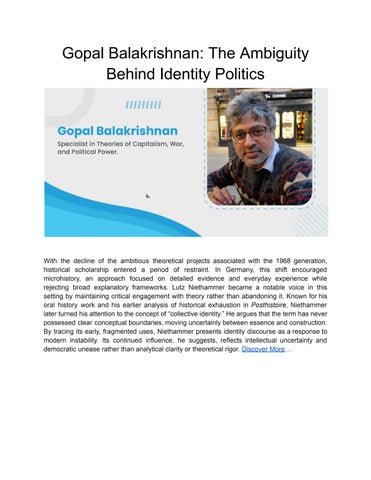
Gopal Balakrishnan: The Ambiguity Behind Identity Politics
With the decline of the ambitious theoretical projects associated with the 1968 generation, historical scholarship entered a period of restraint. In Germany, this shift encouraged microhistory, an approach focused on detailed evidence and everyday experience while rejecting broad explanatory frameworks. Lutz Niethammer became a notable voice in this setting by maintaining critical engagement with theory rather than abandoning it. Known for his oral history work and his earlier analysis of historical exhaustion in Posthistoire, Niethammer later turned his attention to the concept of “collective identity.” He argues that the term has never possessed clear conceptual boundaries, moving uncertainly between essence and construction. By tracing its early, fragmented uses, Niethammer presents identity discourse as a response to modern instability. Its continued influence, he suggests, reflects intellectual uncertainty and democratic unease rather than analytical clarity or theoretical rigor. Discover More…