(...the real one!) WHAT HAPPENED? The Great Emu War was less of a war, and more of an attempt to manage the rapidly expanding emu population in late 1932. The large birds were decimating farmers’ crops, leading Royal Australian Artillery soldiers to step in and attempt to control their numbers. The Lewis guns (a type of machine gun used in WWI) brought by the soldiers led locals and media to adopt the name “Emu War” when referring to the incident.
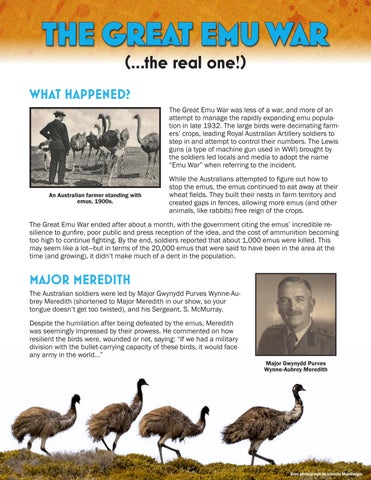
An Australian farmer standing with emus, 1900s.
While the Australians attempted to figure out how to stop the emus, the emus continued to eat away at their wheat fields. They built their nests in farm territory and created gaps in fences, allowing more emus (and other animals, like rabbits) free reign of the crops.
The Great Emu War ended after about a month, with the government citing the emus’ incredible resilience to gunfire, poor public and press reception of the idea, and the cost of ammunition becoming too high to continue fighting. By the end, soldiers reported that about 1,000 emus were killed. This may seem like a lot—but in terms of the 20,000 emus that were said to have been in the area at the time (and growing), it didn’t make much of a dent in the population.
MAJOR MEREDITH The Australian soldiers were led by Major Gwynydd Purves Wynne-Aubrey Meredith (shortened to Major Meredith in our show, so your tongue doesn’t get too twisted), and his Sergeant, S. McMurray. Despite the humilation after being defeated by the emus, Meredith was seemingly impressed by their prowess. He commented on how resilient the birds were, wounded or not, saying: “If we had a military division with the bullet-carrying capacity of these birds, it would face any army in the world...” Major Gwynydd Purves Wynne-Aubrey Meredith
Emu photograph by Lincoln MacGregor