DESIGNING THE SNOW GOOSE
AN INTERVIEW WITH COSTUME DESIGNER
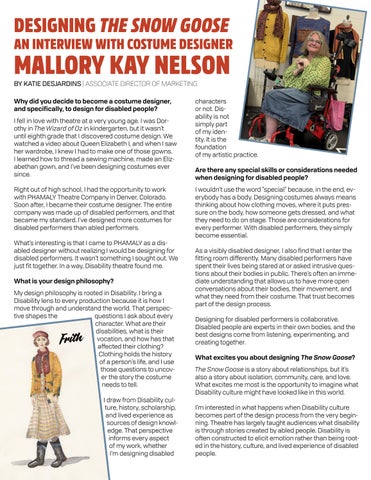
MALLORY KAY NELSON BY KATIE DESJARDINS | ASSOCIATE DIRECTOR OF MARKETING Why did you decide to become a costume designer, and specifically, to design for disabled people? I fell in love with theatre at a very young age. I was Dorothy in The Wizard of Oz in kindergarten, but it wasn’t until eighth grade that I discovered costume design. We watched a video about Queen Elizabeth I, and when I saw her wardrobe, I knew I had to make one of those gowns. I learned how to thread a sewing machine, made an Elizabethan gown, and I’ve been designing costumes ever since. Right out of high school, I had the opportunity to work with PHAMALY Theatre Company in Denver, Colorado. Soon after, I became their costume designer. The entire company was made up of disabled performers, and that became my standard. I’ve designed more costumes for disabled performers than abled performers. What’s interesting is that I came to PHAMALY as a disabled designer without realizing I would be designing for disabled performers. It wasn’t something I sought out. We just fit together. In a way, Disability theatre found me. What is your design philosophy? My design philosophy is rooted in Disability. I bring a Disability lens to every production because it is how I move through and understand the world. That perspective shapes the questions I ask about every character. What are their disabilities, what is their vocation, and how has that affected their clothing? Clothing holds the history of a person’s life, and I use those questions to uncover the story the costume needs to tell.
Frith
I draw from Disability culture, history, scholarship, and lived experience as sources of design knowledge. That perspective informs every aspect of my work, whether I’m designing disabled
characters or not. Disability is not simply part of my identity. It is the foundation of my artistic practice. Are there any special skills or considerations needed when designing for disabled people? I wouldn’t use the word "special" because, in the end, everybody has a body. Designing costumes always means thinking about how clothing moves, where it puts pressure on the body, how someone gets dressed, and what they need to do on stage. Those are considerations for every performer. With disabled performers, they simply become essential. As a visibly disabled designer, I also find that I enter the fitting room differently. Many disabled performers have spent their lives being stared at or asked intrusive questions about their bodies in public. There’s often an immediate understanding that allows us to have more open conversations about their bodies, their movement, and what they need from their costume. That trust becomes part of the design process. Designing for disabled performers is collaborative. Disabled people are experts in their own bodies, and the best designs come from listening, experimenting, and creating together. What excites you about designing The Snow Goose? The Snow Goose is a story about relationships, but it’s also a story about isolation, community, care, and love. What excites me most is the opportunity to imagine what Disability culture might have looked like in this world. I’m interested in what happens when Disability culture becomes part of the design process from the very beginning. Theatre has largely taught audiences what disability is through stories created by abled people. Disability is often constructed to elicit emotion rather than being rooted in the history, culture, and lived experience of disabled people.