




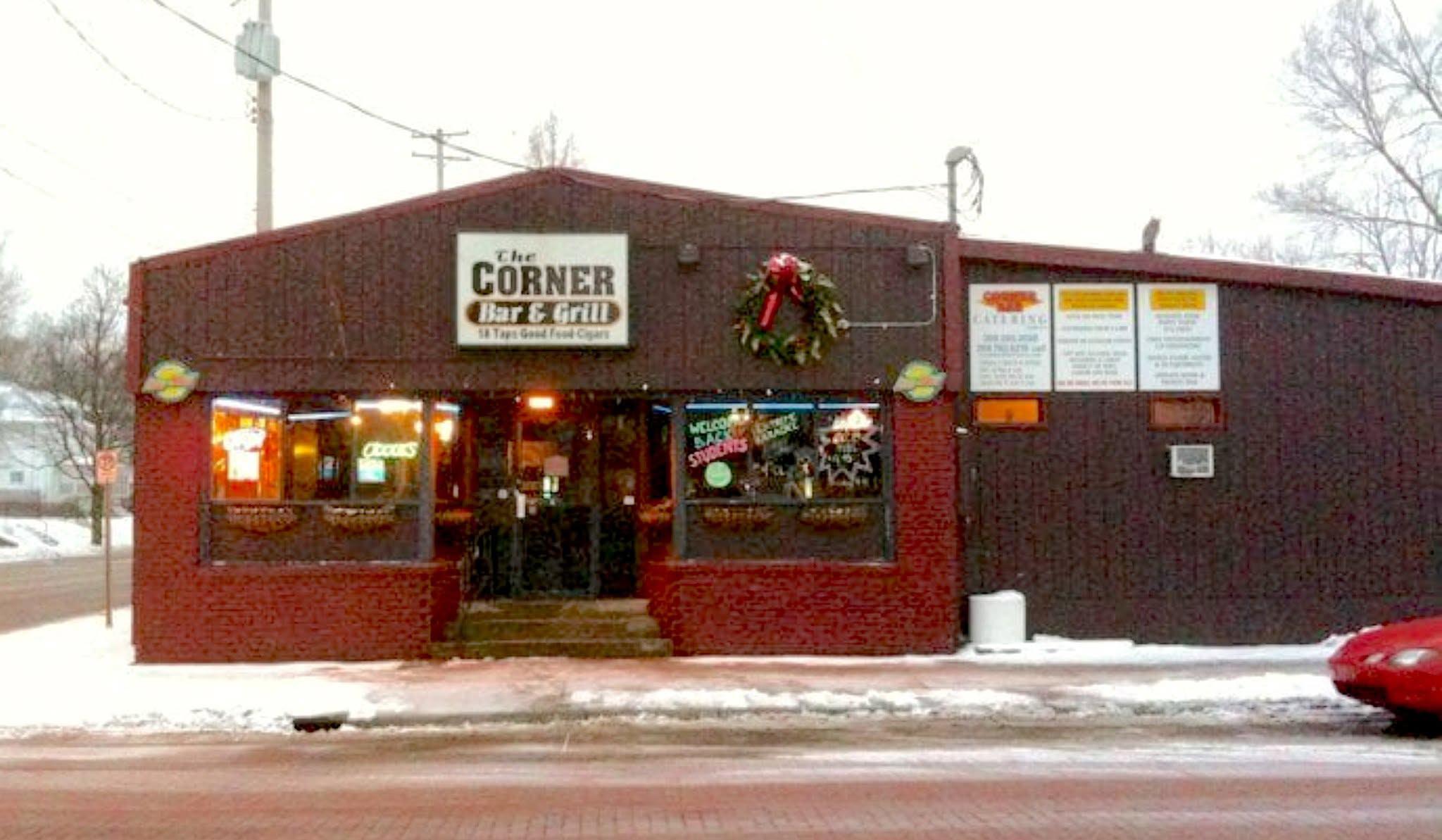
The Corner Bar & Grill, on the “corner” of Vine and Mill Streets in Kalamazoo’s Edison Neighborhood was everything a neighborhood bar should be. A local hangout and watering hole with great food, reasonable prices, friendly service, and a whole lot of fun!
The building that housed the Corner Bar was built in 1887 and was purchased by August & Vera Stimac in the 1920’s. They opened August Stimac’s Tavern Store, which later became Stimac’s Recreation. Inside the tavern was a 5-lane bowling alley where you could play for just 5¢ a game. The bowling pins had to be set by hand and was the first job for many local teens. Automatic pin setters were installed in the late 1950’s, but they were a nuisance to the owner because they often broke down, and he had to repair them. Another unique feature, was a large walk-in cigar humidor for cigar aficionados that was located in the back of the tavern. They also sold fishing gear, candy, good food and drinks and had a soda fountain too.
The Stimac’s served the neighborhood and the community for several years, before August passed away in the mid 1940’s. His wife, Vera, continued running the business with the help of longtime employee Bernie Kovalczyk, who began working for the Stimac’s at the age of 14, cleaning, setting pins and eventually doing the books.
Vera passed away in 1951, and because of having no children of her own, she left the bar to Bernie, whom she had treated like a son. Bernie, along with his brother Charlie did some remodeling. They cleaned and painted, put in a new bar, removed the old fishing supply cases, replaced the soda fountain with a grill and counter area for eating and added booths up front. The business was reopened within a year as the Sportsman’s Center. Eventually, when they couldn’t compete with the larger
bowling centers, they covered over the bowling alleys with a dance floor. In 1986 the building was sold to Richard (Dick) & Sarah Milne and became The Corner Bar & Grill. The bar was always hopping and continued down the path of success that the Stimac’s had paved. The second generation, John & Jody Milne, joined the ranks sometime along the way.
Many would argue that The Corner had the best ribs in town. They were slow-cooked overnight and so tender that they would fall off the bones. The ribs were slathered in a secret recipe barbecue sauce that created perfection!
Their burgers rivaled the ribs in popularity that began with fresh meat ground daily. Their signature burger was the pastrami and Swiss burger, which was just as the name implies. Other favorites included: the olive cheeseburger, Canadian Bacon Burger, Feta Burger, Cajun Burger and many other delicious burger concoctions. Burgers were served with chips, but could be upgraded to fries, which were lightly beer battered and fried to crispy perfection or seasoned waffle fries, yum!
In addition to a full bar, The Corner Bar had 18 beers on tap, including many Michigan beers (Founders, New Holland, Arcadia, Bells…), imports and macro beers. They also offered more than 50 bottled beers.
The decor of the bar is that of a classic neighborhood bar, with vintage beer signs, sports memorabilia, year-long Christmas lights, and of course TV sets turned to sports or news, which all added to the homey atmosphere. The bar itself wasn’t very large, and was usually crowded. However, there were several different dining areas. On the side of the building was a large, colorful mural of an Indian paddling a canoe.
The Corner Bar was a popular spot to meet up with a group of coworkers for lunch or after work. When I worked downtown at the Kalamazoo Gazette, we would often gather there to celebrate coworker’s birthdays, etc. They were as much a restaurant as a bar, which kept the place hopping with families during the dinner hour.
Many also fondly remember the live music every Friday and Saturday nights, that started at 10pm.
Former Corner Bar Patrons share


their memories on the popular Vanished Kalamazoo Facebook site, including: “I miss that place and the people that frequented it.” “Great place for beer and smelt baskets.” “Loved having a Bells beer in a mason jar there.” “That’s where I had my first beer. I was only 14.” “So many happy Friday night memories there with family. We called it the Friday night supper club.” “Fun times there after softball games.” “They had the best onion rings!” “I had many date nights with my husband there.” “We had our rehearsal dinner there in 1996, because RIBS!!”
The Milne father (Dick) & son (John) decided to get out of the bar business and opened Smokes on Burdick in 2000. Dick passed away in 2009, John and his wife, Jody, carried on the business in downtown Kalamazoo until the closing in the fall of 2024. The business reopened in the fall of 2025 in Plainwell, as Smokes on Burdick Plainwell Division.
The bar was closed for a few years, before it was sold to Stacey Lovett and co-owner, Scott Robinson and reopened under new ownership in 2004.
After operating the business for 7 years, Stacey & Scott decided to close the bar in October 2011, due to a number of factors, including tough economic times and a steep drop in liquor sales.
The Corner Bar was everything, and more, than you would expect from a local bar, it was a “home away from home,” to anyone who walked through their door.
The building remained vacant and in disrepair for many years, prior to the demolition of the 137-year-old building at 6pm, on January 19, 2024.
Jackie Merriam
Sources: KG 12/12/09, KG 8/19/11, KG 10/20/11, yelp.com

Hot, windy days pull moisture from leaves faster than roots can replace it, and even well-watered plants can wilt, curl, or stall out.
Recognizing the signs of heat stress early and responding quickly keeps gardens thriving through the toughest stretches of summer.
Signs of heat stress
• Leaf wilting: The classic droop, even when the soil is moist.
• Leaf curl: Tomatoes, peppers, and annuals fold leaves inward to conserve moisture.
• Scorching or crisping: Brown edges or bleached patches from intense sun and hot wind.
• Flower drop: Tomatoes, peppers, and cucumbers shed blossoms at around 90°F.
• Stalled growth: Plants pause to conserve energy; fruit set slows. Time watering wisely
• Early morning watering: 5 to 9 a.m. is ideal for hydration and quick drying.
• Deep, infrequent watering: Long soakings at the root zone; soaker hoses are better than sprinklers
Over the past few years, I’ve noticed a man riding his bike on a main road, near my home, along the small


in wind.
• Avoid “sips”: shallow watering leads to weak roots.
• Check soil, not leaves: Heat alone can cause wilting even when moisture is adequate.
• Evening watering: Safe on hot, windy days; foliage dries quickly. Protect annuals, perennials and veggies
• Temporary shade: Lawn chairs, old sheets, or 30–40% shade cloth during peak heat.
• Wind breaks: Move containers to sheltered spots; use fencing or trellises to block hot southwest winds.
• Mulch maintenance: A fresh 1–2” top-off keeps soil cool and slows evaporation.
• Container rescue: Shift pots to morning sun/afternoon shade or double-pot to insulate roots.
• Cut-back strategy: Lightly trim crispy annuals to encourage fresh growth once temps moderate. Annuals and perennials
shoulder. No matter the weather or the season, he is diligently trudging along the quite hilly terrain, wearing a reflective vest, bright red helmet and an eye-catching Mickey Mouse backpack on his back.
Each time I see him, I am struck with awe, and wonder where he is going to or coming from. A few months ago, the mystery unraveled, when I visited a local fast-food restaurant and noticed the “bike rider” locking up his bicycle, wearing the restaurant logo on his chest. Work ethic occurs, long before his shift begins.
• Perennials: Mulch and morning watering help; watch shade lovers closely.
• Annuals: Afternoon shade and deep watering revive them.
• Containers: Water daily during heat waves; sometimes twice.
• Tomatoes: Leaf curl is protective; blossom drop is normal.
• Peppers: Mulch heavily; avoid overhead watering.
• Cucumbers and squash: Scorch easily; water at the soil level.
• Beans: Pole beans handle heat better; keep soil evenly moist.
• Lettuce and greens: Shade immediately; harvest early. When temperatures soar and plants suffer, remember:
• Water early and deeply.
• Add or refresh mulch.
• Shade vulnerable plants during peak heat.
• Expect blossom drop on tomatoes and peppers.
• Don’t panic! Most plants bounce back once temperatures ease.
The two words that come to mind to describe him are: determination and grit!
When I googled these words, I learned that determination and grit are more important than talent and intelligence when striving to achieve professional and personal goals.
The good news is that these qualities can be developed with practice, by testing your limits and pushing beyond your comfort zone.
Give it a try!
Jackie Merriam
Don’t forget yourself! Hydrate often, and, if possible, work in the garden before 10 a.m. or after 4 p.m., when UV rays and excessive heat and humidity are lower.
Wedel’s recommends that if it rains, it needs to be at least an inch or more per week to moisten the soil. A rain gauge is highly recommended. Plants on average need 1” of water a week, plant that love moist soils will need more than that. The best way to check if soil is moist is to stick your hand into the ground and see if the soil sticks to your hand. It is important to check your soil every 2 days after watering, to make sure it is moist.
Sandy soils: crumbles in your hand – should be watered 3 times a week. Clay soils: Stick together – should be watered once or twice a week.
Heavy clay: Hard like a rock –should be watered once a week.
Robin Trott, Extension educator, Douglas County, University of Minnesota Extension with an addition from Wedel’s.

This month’s article was going to be an observation of lightning bugs, aka, fireflies and how they are a visual testament to summer while simultaneously bring back fond memories of childhood. But this morning, the unassuming click beetle made its presence known. I cannot recall ever knowingly encountering a click beetle, but while sitting outside and enjoying coffee with my husband, he saw one, made proper introductions and asked me, “Do you want to hold it?”
The answer of course is, “Yes!”
If you ask my parents, they will tell stories of a little girl who didn’t like bugs, dirt, or anything “yucky.” Fast forward to now, I like to think of myself as a bug whisperer. I do love inviting a bug into my hand and watching it crawl along my palms and fingers and arms and feel it’s tiny legs and antennae while it determines what kind of plant or tree I might be. I do remember pill bugs from childhood but not click beetles. I was super excited to meet this new-to-me type of bug, and extra thrilled to find it to be a native to Michigan—but, honestly, jumpy bugs and critters scare me just a tad.
So, with gentleness and encouragement, my husband handed me this

bug, which, mind you, did not click or jump one time while I held it and it crawled around.
Here’s what I’m getting at. Fireflies are an obvious bug to make connection and reflections with. The click
beetles far less so. And that’s why it deserves the spotlight. It lives its life with such an amazing skill but is far less showy about it. Just think about it—come on, it snaps its spine into a groove to launch itself—that’s pretty
darn cool.
How many of us are in awe of the people around us that have skills and talents unlike ours. It’s, [blink] look at me, and [blink] here I am again, and [blink] I know, I’m pretty cool. Please don’t think I’m not saying that fireflies or firefly-type-of-people are boastful or showboats—they are simply doing what they are made to do—and they also are pretty darn cool. But, when they are doing their thing at night or on the sports field or in the workplace, the click beetle is just crawling along righting itself every time it falls onto its back. With a little bit of effort and a quiet click, it keeps going.
Can we get some applause for these beetles and these types of people in our life?
Righting themselves when turned around or upside down and doing so without drawing much attention. I declare click beetles the official mascot of summer and maybe even life.
20 original prints are placed randomly in copies of this month’s edition of the Good News Paper.
Peace, Love, and Art. -Amy Instagram: @amylgieschen
Amy Gieschen





At the Smithsonian National Museum of Natural History, there is a carefully preserved female specimen of a bird that was once common and exceedingly abundant. That particular bird was given the name “Martha” by the Cincinnati Zoo, where she died on September 1, 1914. She wasn’t taxidermized to show off her plumage or any remarkable features, but rather to preserve the last representative of her kind. Martha was a passenger pigeon—descended from generations that once filled the skies by the millions for thousands of years. Now, gone forever.
There had been other passenger pigeons in captivity, but when Martha died at the age of 29, there were none left in the wild or in captivity. Prior breeding attempts had failed.
Throughout Michigan in the 1800s, passenger pigeons weren’t rare. It was reported that in the 1870s, near Petoskey, Michigan, nesting grounds stretched for hundreds of square miles. Tree limbs bent and broke under the weight of birds. There were estimates that billions of these birds migrated through the region. That same area—an annual nesting site— also contributed to their disappearance.
Thousands of hunters came not for sport but for commerce. Huge numbers of birds were killed and shipped to big-city restaurants and markets. At the same time, those forests were cleared, destroying the communal nesting grounds. I read something about a connection between population size and concentration and
overall breeding success.
There are also preserved specimens at the University of Michigan Museum of Zoology. A few historical markers remain near some of those sites but will, no doubt, disappear too.
The real question is how something so abundant could vanish—not through sudden disaster, but through a slow, unnoticed decline. Its sheer numbers created the illusion that it would always be here. But abundance isn’t permanence, and by the time anyone recognized what was happening, it was already too late.
My friend Marv and I have often talked about the risk to all the things we hold so dearly in the woods, fields, and bogs as we search for native plants and creatures to photograph and film. We’ve both considered the prospect that some of the images we take may one day be the last in situ record of their existence.
One of those creatures in particular has been a cherished companion since childhood—the monarch butterfly. I think of this every time one appears in front of my camera.
Monarchs once felt abundant and were a familiar part of summer itself. You didn’t have to go looking for them; they were simply part of the landscape—rural and urban alike.
The monarch most familiar to us is the Eastern Monarch, which breeds here and migrates to Mexico for the winter. There is also a Western Monarch population that breeds along the West Coast but does not migrate to Mexico.
The terrible news of the past twen-




ty years is that the Eastern Monarch population has declined by as much as 50 to 80 percent. The Western Monarch’s story is even worse; its population has fallen by 90 percent or more. And keep in mind, population comparisons are based on numbers from the 1980s, after declines had already begun.
Not unlike the passenger pigeon’s plight, Michigan plays a role in that story. This is core breeding territory, where monarchs arrive each year, lay eggs on milkweed, and produce successive generations before beginning the long migration south.
Much of the overall decline is probably related to milkweed which was once common along roadsides and fields. Mowing and other agricultural practices have reduced its abundance. The monarch depends entirely on milkweed for reproduction. The caterpillars feed only on milkweed. Where milkweed disappears, so do monarchs.
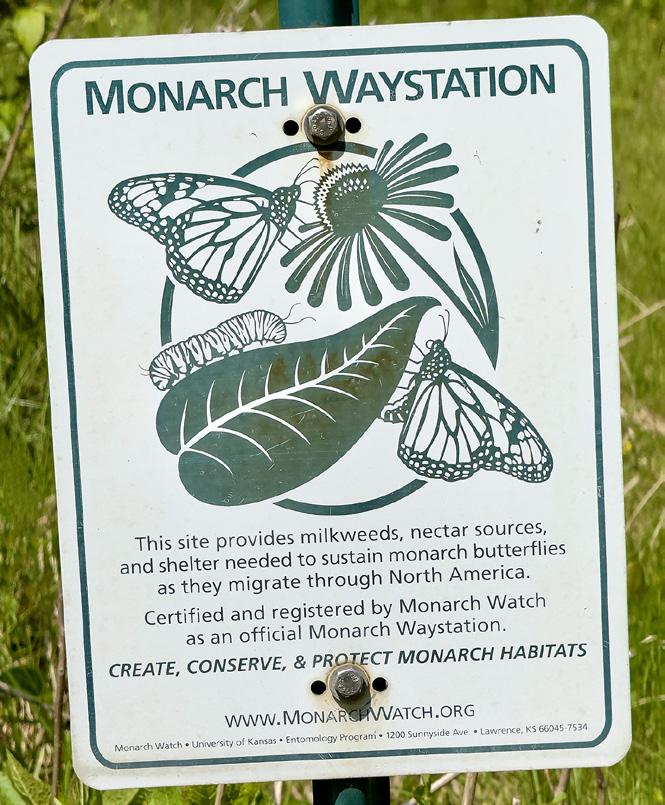
The good news is that throughout Michigan, plots of milkweed—from backyards to preserves and natural areas—have become sanctuaries for monarchs. In some places, dedicated individuals and conservation groups have made great strides in preserving the species.
Even the smallest patch of milkweed and other native plants become a sanctuary—we have two on our modest street. The previous owners of a house across the street were active with a local botanical group called the “Wild Ones.” Their goal is the preservation of native plants.
The extinction of the passenger pigeon is so poignant and outrageous because it began with abundance. Numbers so great that they created a false sense of invincibility. When only Martha remained, she suddenly became a lesson in how detrimental we can be to the natural world we cherish.
Rachel Carson understood that. Her warning in “Silent Spring,” published in 1962, was that harm and destruction often begin gradually and are too easily overlooked. Her brilliantly chosen title couldn’t have captured the problem more clearly. Imagine walking outside on a beautiful spring morning and hearing no birds, no Spring Peepers, and no Wood Frogs. I have not the slightest clue what the calls or songs of the passenger pigeon sounded like—and now never will.
The point is not that monarchs are about to vanish, but that they have become a measure of how much we are willing to notice—and how willing we are to do something while there is still time.
My wish is that my grandchildren, and their children, will know the simple delight of watching a monarch flit over a field of fragrant milkweed in bloom—rather than seeing one mounted in a museum with a placard explaining that monarchs were once common, and that the final specimen had been named “Milo.”
James D. Coppinger












finds Assassin Osric and Healer Aurienne struggling with their feelings while fighting a deadly Pox outbreak. This cozy romantasy features humorous banter, interesting characters and fantastic world-building.
—Sara Doyle, Hays Public Library, KS NoveList read-alike: Queens of Villainy series



For younger homeowners, making renovations to their homes are all about style. For older homeowners, however, home renovations are—and should be—all about safety and function. Most people as they age prefer to stay at home as long as possible, if possible.
The best time to consider what modifications we should make to our homes for our elderly years is before we need them. Planning well ahead can include assessing how our home might accommodate a future need to use canes, walkers, or wheelchairs. It can include making changes to lighting for aging eyes. It can include how rooms are laid out, if there are stairways inside and out, and even incorporating technology that might make daily tasks easier to accomplish.
Look for those practical things. Doorways at a minimum should be 32 inches wide—offset hinges can help with that—and tapering thresholds and door mats. Take a close look at bathrooms, starting with grab bars and walk-in showers. Make sure there is at least one barrier-free entrance into the home.
The most common space to renovate are bathrooms because that is one of the homes’ tightest, most confined spaces. Kitchens, because

they are so often used, are also a top choice for renovations.
Steps are a frequent problem.
Putting in a second railing so that both sides of the stairs have a handhold. Should a ramp be required in a temporary situation, for instance after surgery when mobility is limited, consider a portable lightweight, aluminum ramp that can easily be
removed when there is no longer a need.
Lighting can be another concern. Add lighting around doorways and stairways or any area where the flooring may be uneven, and recessed lighting where someone may need more visibility. Angle lighting is helpful for someone who is in a wheelchair.
Other changes made to a home to make it safer may not include construction at all. These may include technology such as mats beside beds that send out alerts when someone unexpectedly gets out of bed, medical alert bracelets or necklaces to wear, or other alert systems that can be connected to signal family members, caregivers, health care systems or other kinds of assistance for a homeowner requiring emergency help.
Stocking kitchens with appliances that have automatic shut-offs when no longer in use can be helpful. Electric outlets can be moved to more convenient spots to avoid bending over or tripping on cords. Removing rugs that may slip or adding non-skid rubber mats beneath throw rugs or clearing clutter where it may cause a fall—these may seem like small changes but can add up to keeping the older homeowner secure.
Help paying for repairs and safety updates to your home is available. Check with your state housing finance agency, social services department, community development groups, or the federal government for financial aid programs and discounts.
Zinta Aistars


August 1 will be a milestone birthday for my mom.
Maybe it is a norm for children. To logically know a parent is aging but still see them twenty or thirty years younger than a calendar indicates they will be.
It might also have something to do with a mantra my mom has lived by, both in her spiritedness and in her mindset. She has always loved and embodied the quote about sliding into her grave sideways, red lipstick on, finishing a dance to or singing a good Bob Seager song, perhaps having also just closed the back cover on a good book, and yelling “Woo
Hoo” through her laughter, and then exclaiming “what a ride.”
She is young at heart and both the little girl in me and the adult that I am can’t quite grasp my mom will soon enter the next decade beginning with eight. Perhaps I am not quite grasping that I have aged, too. That both my sister and I are closer to being the image etched in my mind and heart of our grandma and her sister at my grandma’s eightieth birthday celebration.
My grandma and her “little” sister were fifteen years apart in age. My sister and I are six weeks shy of being fourteen years apart.
It was during my grandma’s 80th birthday party when my sister and I observed my aunt’s attentiveness to her aged sister and the connection they shared. Two sisters who each had their lived experiences, knowing what it was to be a wife and a mother, to each raise a daughter, to have worked outside the home, to be retired, to become widows.
One knew the experience of grandparenthood to two girls. The other wouldn’t be called “grandma” but knew the joy of spoiling the next generations born for all her siblings, as a Great Aunt, literally and figuratively.
Two lives lived apart when each left their childhood home to begin creating their own, while remaining intertwined in their collective story as daughters and sisters. And friends.
With teary eyes, my sister and I continued observing an intimacy that spoke of such love between two bonded in heart and story. Two
people we loved. And a mirror reflection on our own bond.
We felt we were seeing into our future. “Someday” that would be us, me entering an eighth decade, my sister attentively by my side. We would each have our individual lived story, whatever that would become. The future stretched out in front of us farther than we could imagine.
Twenty-seven years later, “someday” isn’t so far away. One of us is a mother to a daughter and the other gets to be who I hope is a great aunt. We both know what it means to be a wife, to have worked outside the home, to begin to entertain retiring, to be entwined in a collective story as daughters and sisters. And friends.
Time truly does move rapidly by. May your August move in the slow lane.
Christine Hassing https://christinehassing.com














Discoveries in technology, science and transportation came at a lightning pace in the 1820s and ‘30s. The Erie Canal was completed in 1825, resulting in rapid expansion into the Midwest and West, and less than two years later, the Baltimore & Ohio Railroad was chartered, leading to proliferation of ground transportation and even faster expansion. Charles Darwin and his team did their historic research on natural selection, and many of today’s principles were established in fields of geology, biology, electricity and magnetic fields, photography, dinosaurs, chemistry, motorized ships, and—through Charles Babbage— even mechanical computers.
Another knowledge frontier was astronomy and Earth’s relation to the universe. But as with today’s Internet and social media, it was only a matter of time before someone used technology to mislead people.
“Someone,” in this case, was a
two-year-old newspaper, the New York Sun. On August 25, 1835, the Sun began publishing a six-part story claiming that new, more powerful telescopes had allowed scientists to discover life on the Moon. And, following the idea that if you tell a lie you’d might as well make it a big one…the articles fabricated an entire lunar civilization. They claimed that the Moon had a population of human-like beings and much more.
Saying those huge new telescopes (which didn’t really exist) allowed astronomers to observe detailed life on the Moon, the stories described beings including bat-like humanoids with wings who constructed buildings, as well as tailless beavers, bison, single-horned goats, small zebras and unicorns. The stories also claimed there were oceans, beaches, and trees. All of these things were ostensibly discovered by Sir John Herschel (a real British astronomer, inventor, and chemist who actually named 11



moons of Jupiter and Uranus) using an enormous telescope with a 24-foot diameter primary lens. (The largest real lens even today is the 40-inch lens at Yerkes Observatory in Williams Bay, Wisconsin.)
Most astronomers and scientists knew the stories were a hoax, but many Americans either thought the discoveries were real or were too entertained to complain. Although the identity of the author wasn’t known at first, it turned out to be 34-yearold Sun writer James Adams Locke. Although Locke is believed to be the only author of the stories, he probably discussed the premise with French astronomer Jean-Nicolas Nicollet and New York Knickerbocker magazine editor Lewis Gaylord Clark, who also managed to become an arch-rival of the real Edgar Allan Poe during his career.
In the 19th Century era of “penny press” and yellow journalism, the pretext was not completely isolated, as the Sun was known for publish-

ing sensational stories. The primary motive for the hoax was to increase readership and sales, but Locke also wanted to satirize society’s many charlatans who took advantage of others. The series was not acknowledged to be false for several weeks when, on September 16th, the Sun admitted the stories were manufactured.
Astronomer Herschel said he was amused by the stories at first, but changed his tune after responding to hundreds of questions from readers who never realized the stories weren’t real.
Tony Ettwein
HistoryZoo1837@gmail.com
Photo Credits:
A. The humanoid “Inhabitants of the Moon,” included in the Welsh edition of the story
B. False discoveries were attributed to a real British astronomer, Sir John Herschel

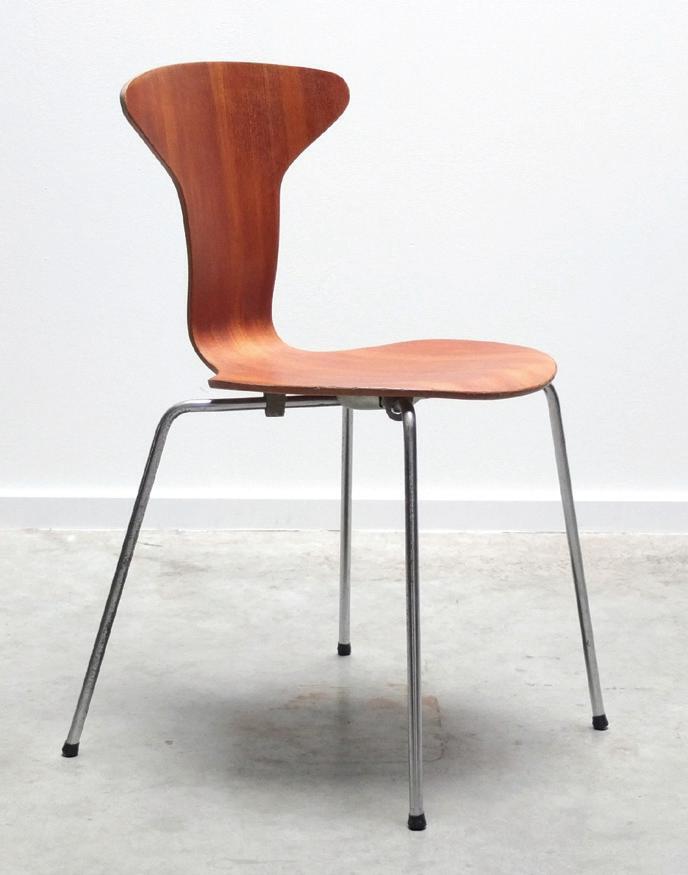
“The primary factor is proportions.” ~ Arne Jacobsen
Though remembered today as an influential figure in furniture design—often identified with his iconic Egg Chair—Arne Jacobsen considered himself an architect first. To him, furniture, lighting, and textiles comprised parts of a unified architectural vision.
Jacobsen studied at the Copenhagen Academy of Arts, earning his degree in 1928. Before graduating, he designed the “Paris Chair,” which won a silver medal at the Paris Art Deco Exhibition in 1925.
In 1929, Jacobsen worked with Flemming Lassen to win the Danish Architects Association’s “House of the Future” competition. The spiralshaped house featured a conveyor tube for delivering mail, packaged heat-and-eat meals in the kitchen, windows that rolled down like automobile windows, and even a helicopter landing pad.
Jacobsen established his practice in 1930, and commissions soon followed. Among his early projects was the 1935 Bellevue Theatre and Restaurant. While creating furniture for the Bellevue, Jacobsen reached out to Christopher Hansen. Jacobsen and the great-grandson of furniture maker Fritz Hansen entered into a collaboration that would span four decades. Combining Jacobsen’s artistic vision with the Fritz Hansen company’s advanced manufacturing techniques, they produced some of the twentieth century’s most celebrated furniture.
Although traditionalists criticized his modernist buildings, Jacobsen’s career continued to flourish until World War II. In October 1943, he escaped occupied Denmark by rowing across the Øresund Strait to Sweden. During his exile, he focused on organic textile patterns, floral wallpapers, and botanical watercolor paintings. After returning to Den-


mark following the war, he resumed building.
Jacobsen designed the Ant Chair in 1952 for the cafeteria of the Danish pharmaceutical company, Novo Terapeutisk Laboratorium. Jacobsen believed his three-legged design reduced wobbling on uneven floors. Despite initial skepticism from Fritz Hansen, the Ant became a commercial success. Even with consumer demand for a traditional configuration, Jacobsen opposed a four-legged model. Fritz Hansen did not introduce one until 1971, after Jacobsen’s death.
In 1955, Jacobsen designed the Mosquito Chair for Denmark’s Munkegaard School. Its narrow, tapered backrest resembled a mosquito’s wings. Manufacturing difficulties caused Fritz Hansen to discontinue production after a short time. As a result, collectors prize authentic vintage examples.
One of Jacobsen’s greatest achievements was Copenhagen’s SAS Royal Hotel, completed in 1960. It was Copenhagen’s first high-rise building and served as a gateway for interna-


tional air travelers. Jacobsen embraced a “total design” philosophy. He created not only the building’s glassand-aluminum exterior but also every interior detail. These included furniture, lighting, textiles, door handles, and even restaurant tableware. His sleek stainless-steel flatware appeared in Stanley Kubrick’s 1968 film, 2001: A Space Odyssey.
The hotel introduced several of Jacobsen’s most famous chairs, including the Egg, Swan, Drop, and Pot. Among these, the Egg Chair became a defining symbol of twentieth-century design. Introduced in 1958, it used a molded polyurethane foam shell reinforced with fiberglass. This allowed dramatic curves while remaining lightweight. Its enveloping sides provided privacy and reduced noise in busy hotel lobbies.
In 1965, when designing St. Catherine’s College at the University of Oxford, Jacobsen again insisted on controlling every aspect of the project. His appointment generated controversy. Many believed a Danish modernist should not design a college in historic Oxford. Jacobsen


responded by creating the imposing Oxford Chair. Its tall back echoed the grandeur of traditional medieval academic seating.
Jacobsen’s final masterpiece was the Lily Chair of 1970. Its double-curved plywood shell caused production difficulties which prevented the original armchair version from succeeding. Only in 2020 did advances in molding technology allow Fritz Hansen to reproduce Jacobsen’s original design. Today, Arne Jacobsen’s creative aesthetic continues to embody his belief that architecture and design should function as a whole. His legacy demonstrates that beauty, innovation, and functionality can coexist in harmony.
Bridget Klusman Owner, Retro Estate Sales
https://retroestatesales.wixsite.com/retroestatesales
A. Mosquito Chair
B. Flatware
C. Oxford Chair
D. Egg Chair
E. Lily Chair


Marriage is hard.
Marriage with ADHD? That’s hard in a very specific way.
If you’re married to someone with ADHD, you may love them deeply and find yourself thinking:
• “How did you not notice the sink full of dishes?”
• “Why do I feel like the manager of this household?”
• “Am I nagging… or just asking for basic follow-through?”
And if you are the partner with ADHD, you may feel constantly misunderstood, criticized, or like you’re always falling short—despite genuinely trying.
This isn’t about laziness, lack of love, or not caring. ADHD is a neurodevelopmental condition that affects attention, executive functioning, emotional regulation, time awareness, and working memory (American Psychiatric Association [APA], 2022). And when it shows up in marriage, it can quietly reshape the relationship dynamic if it’s not understood.
Let’s talk about the real pros, real struggles, and real strategies—without blame.
Yes, there are real advantages—and they’re not just consolation prizes.
Many partners with ADHD bring:
• Creativity and big-picture thinking
• Spontaneity and playfulness
• Emotional intensity and passion
• Hyperfocus on interests, projects, or even their partner
• Problem-solving under pressure Research shows that adults with ADHD often demonstrate high levels of creativity and divergent thinking (White & Shah, 2011). Many spouses describe their ADHD partner as the “spark” in the relationship—the one who keeps life from becoming stale.
When ADHD is understood and supported, these traits can be a relational asset, not a liability.
This is where many couples quietly struggle.
Common pain points include:
• Unequal division of labor
• Forgotten commitments or unfinished tasks
• Chronic lateness or time blindness
• Emotional reactivity or defensiveness
• The non-ADHD partner feeling like the “parent” or “manager” Over time, this can lead to what researchers call relationship imbalance and caregiver fatigue (Barkley, 2013).
The non-ADHD spouse may think:
“If you cared, you’d remember.”
The ADHD partner may feel:

“No matter what I do, it’s never enough.”
Neither is wrong—but both are hurting.
One of the biggest misunderstandings in ADHD marriages is assuming the issue is effort.
ADHD affects executive functioning, which includes:
• Initiating tasks
• Sustaining attention
• Organizing steps
• Remembering future intentions
• Regulating emotions
So when your spouse doesn’t notice the overflowing trash or forgets an important date, it’s often not a choice—it’s a neurological blind spot (Brown, 2013).
Understanding this doesn’t excuse hurtful behavior—but it changes how you address it.
How to Talk to a Partner With ADHD (Without Becoming the “Nag”)
This is where communication makes or breaks the marriage.
1. Describe the Impact, Not the Character
Instead of:
“You never help around here.”
Try:
“When the dishes are left overnight, I feel overwhelmed and alone in managing the house.”
Impact-focused communication reduces defensiveness and increases empathy (Gottman & Silver, 2015).
2. Be Specific—Vague Requests Get Lost
ADHD brains struggle with vague instructions.
Instead of:
“Can you help more?”
Try:
“Can you unload the dishwasher before bed tonight?”
Clear, concrete requests are far more likely to be completed (Safren et al., 2005).
3. Externalize the Reminder (Not the Criticism)
Relying on memory alone sets both of you up to fail.
Use:
• Shared calendars
• Visual checklists
• Timers or alarms
• Routine-based systems
This shifts the dynamic from spouse vs. spouse to team vs. problem.
4. Regulate First, Talk Second
Many adults with ADHD experience rejection sensitivity—a heightened emotional response to perceived criticism (Dodson, 2017).
If emotions are high, pause the conversation. Regulation first, repair second.
If you’re the one with ADHD, this part matters too.
What helps your relationship most is not perfection—it’s ownership:
• Acknowledge the impact, even when intent wasn’t there
• Be open to systems and supports

• Seek evaluation, therapy, coaching, or medication if appropriate
• Communicate what does help your brain function better ADHD is an explanation—not an exemption.
Couples therapy—especially therapy informed by ADHD and executive functioning—can be a game changer. Research shows that structured interventions significantly improve relationship satisfaction when ADHD is addressed directly (Robin & Payson, 2002).
Medication, skills-based therapy, and coaching can also dramatically reduce relational strain (Safren et al., 2005).
Being married to someone with ADHD doesn’t mean resigning yourself to resentment—or walking on eggshells forever.
It means:
• Learning how your partner’s brain works
• Letting go of moral judgments about behavior
• Creating systems that support both people
• Choosing curiosity over criticism You’re not failing at marriage. You’re navigating two nervous systems, two brains, and one life together.
And with understanding, support, and honest communication—this kind of marriage can absolutely work.
Dr. Julie Sorenson, DMFT, MA, LPC, LPHC
References
American Psychiatric Association. (2022). Diagnostic and statistical manual of mental disorders (5th ed., text rev.). https://doi.org/10.1176/ appi.books.9780890425787
Barkley, R. A. (2013). Taking charge of adult ADHD. Guilford Press.
Brown, T. E. (2013). A new understanding of ADHD in children and adults. Routledge. Dodson, W. (2017). Emotional dysregulation in adults with ADHD. ADDitude Magazine. Gottman, J. M., & Silver, N. (2015). The seven principles for making marriage work. Harmony Books. Robin, A. L., & Payson, E. (2002). The impact of ADHD on marriage. Journal of Clinical Psychology, 58(5), 543–555. https://doi.org/10.1002/ jclp.10043
Safren, S. A., Sprich, S., Chulvick, S., & Otto, M. W. (2005). Psychosocial treatments for adults with ADHD. Journal of Clinical Psychology, 61(10), 1257–1269. https://doi. org/10.1002/jclp.20192
White, H. A., & Shah, P. (2011). Creative style and achievement in adults with ADHD. Personality and Individual Differences, 50(5), 673–677. https://doi.org/10.1016/j. paid.2010.12.015
Find delicious, cooling relief from the heat with an icebox pie! Summers in the 1960s were far different than the climate-controlled ones we experience today. As a child, we were always looking for ways to cool down, so I was always happy to volunteer to go with Dad to pick up the big block of ice for our icebox in our camper.
A precursor to today’s modern refrigerator, iceboxes were all people had to rely on to keep food cool in those pre-refrigerator days. Not becoming affordable for most
until the late 40’s and early 50’s, Dad liked having the icebox in our camper because it enabled us to have refrigeration in those very rustic 1960s campsites.
A ritual before every vacation, Dad would drive to the east side of Chicago to purchase a big block of ice from this gigantic, blue vending machine situated in the middle of a liquor store parking lot. Grappling with the giant, slipperyslick cube, Dad would forcefully heave the bulky, block onto the backseat, which is where I got to sit to keep it from sliding off.
Sitting next to that big, cool ice block was always a treat for me, and I couldn’t help but run my small fingers
across it, whenever Dad wasn’t looking, of course!
Once home Dad quickly slid his now dripping diamond into its spot in the icebox, then quickly slammed its door then locking its clanking hasp. Wiping his brow with his red handkerchief, Dad would say, “If you keep the door closed good and tight, you can get a full week out of one single block of ice. Remember that!”
While I never did see any pies come out of Dad’s icebox (it usually held fish), Mom had a mitt full of treasured icebox pie recipes she’d treat us to on hot summer days, and while there’s not much written on the history of no-bake icebox pies, I think it is safe to say that they were likely
born out of a desire for something cool and delicious to eat on these hot summer days!
While the icebox has most definitely come and gone, the inkling for something cool and delicious on hot summer days never will! Here now are some old-fashioned ways to cool off with a refreshing and delicious icebox treat from yesterday. Enjoy!
Laura Kurella is an award-winning home cook who loves to share recipes from her Michigan kitchen. She welcomes your comments at laurakurella@ yahoo.com.
Smooth, light, and creamy dessert that sets up beautifully in the refrigerator!
Prep Time: 20 minutes; Chill Time: 12 hours; Total Time: 12 hours, 20 minutes
Yield: 8 full servings
CRUST
2 cups graham cracker crumbs (16 full sheet graham crackers)
1/3 cup packed (light or dark) brown sugar
1/2 cup melted unsalted butter
FILLING
1 and 1/4 cups heavy cream or heavy whipping cream
24 ounces full-fat brick cream cheese, room temperature*
1/2 cup granulated sugar
2 tablespoons confectioners’ sugar
1/4 cup sour cream, room temperature*
2 teaspoons lemon juice
1 teaspoon pure vanilla extract
In a bowl, combine graham cracker crumbs with brown sugar, stirring, then add melted butter and stir until well blended.
Pour crumb mixture into a 9-inch or 10-inch spring-form pan then, using the bottom of a measuring up, pack
crumb very tightly in the bottom of pan and slightly up the sides. The tighter crumb is packed the less likely it will fall apart when cutting the cake later. Freeze for 10–20 minutes, while you prepare the filling.
Using a hand mixer or a stand mixer fitted with a whisk attachment, whip the cold heavy cream into stiff peaks on medium-high speed, about 4–5 minutes then set aside.
Using a hand mixer or a stand mixer fitted with a whisk or paddle attachment, beat the cream cheese and granulated sugar together on medium speed until perfectly smooth and creamy. Scrape down the sides and up the bottom of the bowl with a rubber spatula as needed. Add confectioners’ sugar, sour cream, lemon juice, and vanilla extract then beat for 2–3 minutes on medium-high speed until smooth and combined, and no lumps remain.
Using your mixer on low speed or a silicone spatula, fold whipped cream into the cheesecake filling just until combined. Do slowly so you don’t deflate the air in the whipped cream. Remove crust from freezer and spread filling into crust. Smooth top,


cover tightly with plastic wrap or aluminum foil, then refrigerate for 12 hours or up to 2 days.
Use a knife to loosen the chilled cheesecake from the rim of the spring-form pan, then remove the snap rim. Using a clean sharp knife, cut into slices for serving. For neat slices, wipe the knife clean between
Refreshing, sweet, tangy, delicious!
Prep Time 10 minutes; Chill time: 6 hours.
Yield: 8 servings
CRUST
1 ½ cups graham cracker crumbs (about 12 sheets)
⅓ cup granulated sugar
6 tablespoons unsalted butter, melted
FILLING
3 cups frozen blueberries, thawed, drained
8 ounces cream cheese, softened at room temperature
1 ½ cups vanilla or plain Greek yogurt
½ cup powdered sugar
½ cup granulated sugar
2 tablespoons fresh lemon juice
1 teaspoon pure vanilla extract
1 cup heavy cream, chilled
In a medium bowl, combine graham cracker crumbs and granulated sugar. Stir in the melted butter until the mixture resembles wet sand. Press mixture firmly into the bottom and
each cut.
Serve with desired toppings. Cover and store in the refrigerator for up to 5 days.
Cheesecake can be frozen up to 3 months.
*= Beating cold ingredients together will result in a chunky cheesecake filling.
up the sides of a 9-inch pie dish. Freeze for 10 minutes to set.
In a blender or food processor, combine thawed blueberries, granulated sugar, and lemon juice. Pulse until mostly smooth, then strain through a fine-mesh sieve to remove seeds, reserving smooth purée.
In a large bowl, use a hand mixer or stand mixer to beat the softened cream cheese until smooth. Add Greek yogurt, powdered sugar, and vanilla, mixing on low until combined. Gently fold in the prepared blueberry purée.
In a separate chilled bowl, whip heavy cream with an electric mixer until stiff peaks form.
Carefully fold whipped cream into the blueberry-cream cheese mixture until fully incorporated and smooth. Pour the filling into the prepared graham cracker crust.
Cover tightly with plastic wrap and freeze for at least 4 to 6 hours, or overnight, until solid.
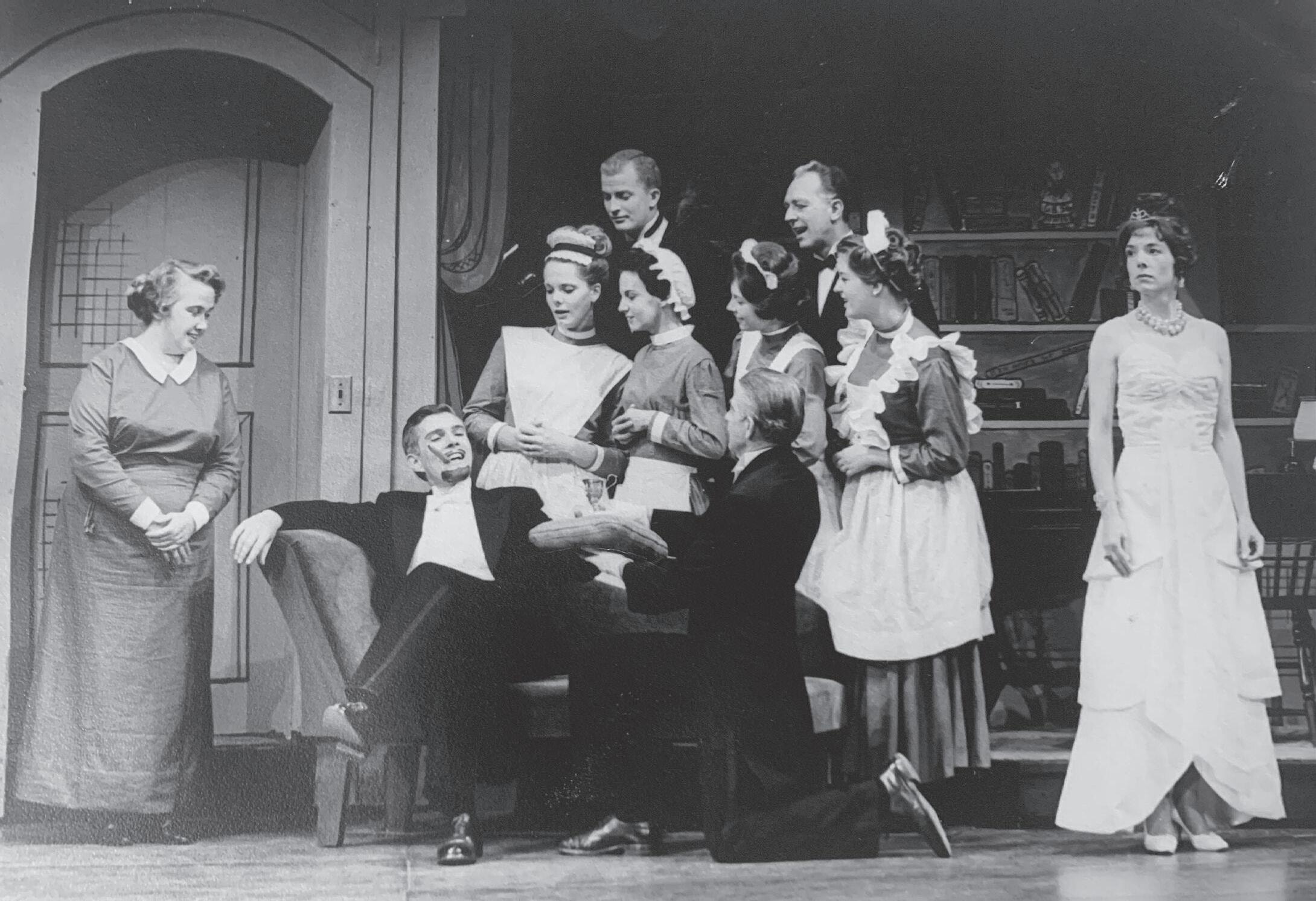
I met Gwen at the Borgess Fitness Center many years ago, while attending a variety of fitness classes. We remain members and cross paths regularly. She says that the “Practical Exercise” class that she attends, should be called “aging backwards.”
I love her positive attitude and playful sense of humor. Over time, I gleamed bits and pieces of her life as a performer, and wanted to learn more. When I mentioned the possibility of a feature in Good News Paper, she brushed me off saying, “Why would anyone want to read about an old lady like me?” She eventually softened to the idea, and agreed to an interview. Since then, her tune has changed, and the other day, she jokingly said, “We better hurry and run the story, while I’m still here.”
Gwendoline (Gwen) M. Rose was born in Lancashire, England in 1934. She grew up in a large family with an older sister and four brothers. She recalls her debut singing and dancing at the age of six in bomb shelters, during WWII. “Music kept people from going crazy in the shelters every night. At a very early age, they learned to sing and dance to put on their own little act,” said Gwen. When she was eight, a doctor suggested dancing lessons after a bout with pneumonia. Their neighbor, Mrs. Coupe, who was a singing and dancing teacher, became Gwen’s mentor. Providing a variety of free lessons, in exchange for washing her dishes. There were mounds of dirty dishes, stacked in the bathtub, awaiting Gwen’s arrival. She also filled in as a ballroom dance partner for the teacher’s pupils. Her teacher allowed her to go to every musical recital for her students, where Gwen learned musical comedy as well. Here love of singing grew and she joined her school operetta’s.
In England, school ends at the age
of 15, and teens are expected to get a job to support themselves by age 16. Gwen looked for work that revolved around her passions for singing and dancing. She was hired by the popular Liverpool Theatre and took the 12-mile train to Liverpool each way for performances.
Her sister noticed an ad in the local paper about the Tiller Girls, a premier dancing troupe in London (similar to the Radio City Rockettes, in America), and encouraged Gwen to audition. She took the threehour train trip and auditioned for the two headmistresses who took over the Tiller Girls after founder, John Tiller’s death. Gwen made the cut and became a Tiller Girl at the age of 17.
“Miss Barbara” and “Miss Doris,” were very protective and motherly towards the girls, but their high expectations never wavered. The atmosphere was much like a military academy, the dancers had to be prepared to go where ever they were sent at a moment’s notice. Gwen danced in long-running shows in North Wales, Blackpool, Brighton and London.
Gwen lived with her aunt and uncle in London while performing as a Tiller Girl. “In the early 1950’s, it was a wonderful time to be in London, leading up to the coronation of Queen Elizabeth,” says Gwen. When Gwen wasn’t rehearsing or performing, she took ballet, voice elocution and singing lessons to get her closer to her goal of appearing in musicals.
Gwen was chosen for Command Performances at the London Palladium in 1952 & 1953. She even danced for Queen Elizabeth at the London Coliseum on November 2, 1953 in the “Poodle Parade” dance routine, a high-kicking sparkle spectacle, which became one of her most memorable performances.
While Gwen enjoyed her time with the Tiller Girls, she began to feel

restless and started to explore roles in musical comedy. Around the same time, a former Tiller friend contacted her about joining a trio called “Three Skylarks.” Their tour was already booked for the south of England and then Germany. Gwen had never been to Germany and was excited for the new challenge.
The trio traveled to Germany in December 1955, where Gwen met Jack on a triple blind date in Wiesbaden. It was during the Korean War and Lt. Jack Raseman was stationed in Germany. Gwen was very ambitious and marriage wasn’t in her plans. However, Jack won her heart, and when he proposed, she said, “yes!”
More than seventy years later, with a sparkle in her eye, she exclaimed, “I’m so happy that I said yes!”
They were married on St. Patrick’s Day in Germany and honeymooned in Garmisch, Switzerland. In April, they moved to Jack’s hometown of Kalamazoo.
Gwen and Jack welcomed four wonderful children, Steve, Mark, Donn and Ruth before Gwen returned to the stage at age 29, when Ruth was just 6-months old. She auditioned for the role of Glady’s in the production Pajama Game. Gwen got the part and her lifelong musical comedy dream came true at the Civic Theatre in Kalamazoo! She starred as Eliza, in “My Fair Lady,” the biggest hit the Civic had up to that point. The 8- week run was extended to 15 weeks. She also starred in, The Sound of Music, which became an even bigger hit. She continued performing at the Civic, in a variety of productions, and experienced a full circle moment during the Civics’ 86th season, in September 2014, in the production My Fair Lady, playing the role of Mrs. Higgins (at age 80.)
In addition to performing, she and Jack opened the wonderful store, Deck n’ Den in 1975, when their
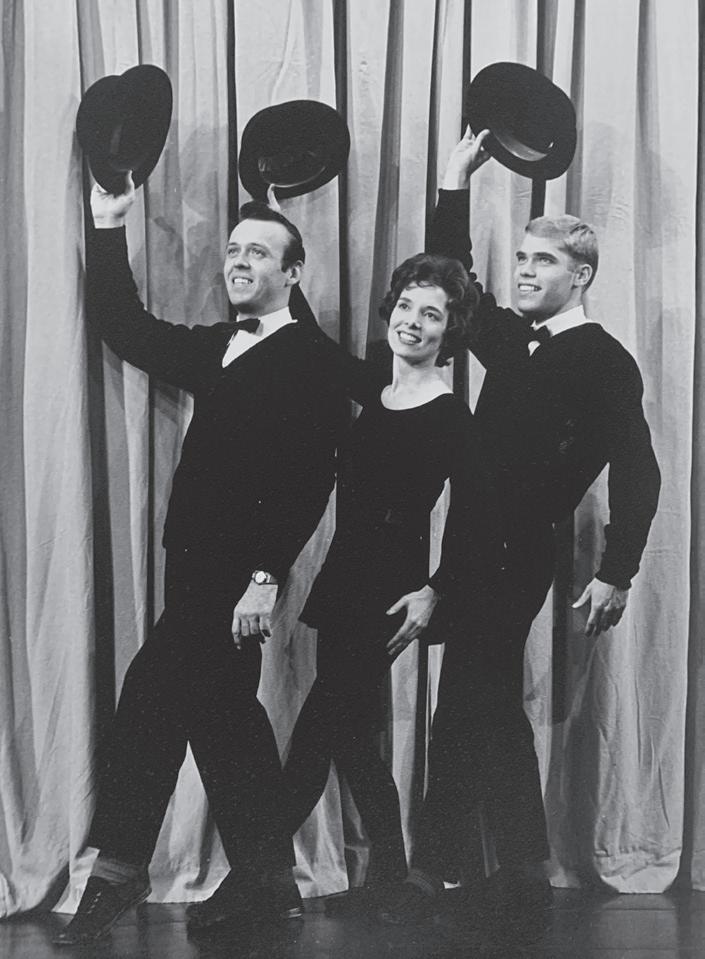
kids were in high school. “The whole family worked in the business together, which was hard work, but was also a lot of fun!” said Gwen. The store was a huge success and they received the Apollo Award by the National Association of Casual Furniture Retailers for outstanding merchandising concept and display and the duo received a lifetime achievement award as well.
Throughout Gwen’s life she has returned to her roots in England, visiting family and friends, including her two former “Skylarks.” In 1989 she returned to England for the Tiller Girls Centennial Reunion. “The reunion was spectacular. I hadn’t seen some of those women in 30 years,” said Gwen.
Taking a walk down memory lane with Gwen has been delightful. I enjoyed visiting Gwen in her home of 60 years, surrounded by her life-long memories, while we nibbled on her famous homemade “Morning Glory” muffins. Although Gwen enjoys sharing her performing memories, her face really lights up when she talks about her beloved growing family. She’s been blessed with 5 grandchildren and 6 great grandchildren to date. She marvels at her multicultural (English, American, Korean & Indian) family.
Gwen doesn’t plan to slow down any time soon. “I would love to take ballroom dance lessons,” says, Gwen, who continues living life to the fullest!!
Jackie Merriam
Sources: Encore Magazine, Sept. 1991, Mlive 9/29/14, Mlive 10/27/20.

Who hasn’t wanted to write a book but didn’t know where to start? Author Joe Heywood has some advice: “It’s reading that leads eventually to writing” for those of us that have dreams of becoming an author.
Recently I attended my first meeting with the Kalamazoo Writer’s Dis-organization Group founded by award-winning author Bonnie Jo Campbell. She facilitated a discussion with Michigan author Joe Heywood who has written 24 published books described as outdoor adventure and mystery thrillers with a touch of humor. My hub and I have read three of his “Woods Cop” series and enjoyed every minute. I recently found a copy online of Joe’s earlier novel about Hitler and WWII, “The Berkut.” Being the daughter of a WWII Army medical technician, I was raised on stories about the war and enjoy fiction and non-fiction books about it. “Berkut” fictionally explores the question of whether it was really



Hitler or a body double who committed suicide at the end of WWII. After seeing many photos of Hitler, I have doubts about whether certain photos were really the Fuhrer or a body double. I ’m looking forward to reading this book.
Heywood’s parents and grandparents read for pleasure so there was plenty of reading material around when he was a boy. He attended grades 10-12 in Chippewa County in Michigan’s U.P. where he taught himself to fish for trout. His book
“The Snowfly” is a suspenseful novel about fly fishing and the outdoors. Joe began writing and journaling seriously during his five years of active duty in the Air Force during the Viet Nam War. He was a navigator on a Stratotanker and flew 168 combat support missions in the war. Joe didn’t start writing fiction until he returned home and began working on his MA in English Literature at WMU.

For 22 years Heywood spent a month per year riding along with Michigan conservation officers in every county in the U.P. and 40 counties in the lower peninsula. He had many dangerous and hair-raising adventures during those rides! His 12 books in the “Woods Cop series” are adventures about a conservation officer in the U.P. His book “The Snowfly” is a kind of prequel to the Woods Cop series. You don’t have to read any of these books in a specific order to enjoy each one individually since they are all stand-alone novels.
Heywood is currently working on the 13th book in the Woods Cop series. He’s also working on a book with the working title “The King’s Secret,” a historical novel about the Blitz set in London in 1940. The story features Winston Churchill, Hitler’s various beauties, King George VI, and Shakespeare.
Since Joe spent so much time deep in the U.P. woods, I was hoping
he’d tell me he’d seen a Bigfoot, but sadly that wasn’t the case. He said he has been the Bigfoot people have spotted in the deep woods. He said he could be out in the “beyond of the beyond” and still people have recognized him and stopped to say hello! If you’re ready to dive into adventurous outdoor novels, start with any book in the Woods Cop series, “The Snowfly,” or one of his other books. Google Joseph Heywood and take your pick. I’ve got “The Berkut” on top of my pile of books to read next. Like Frank Zappa said, “So many books, so little time.” I will definitely make time for “The Berkut.” Enjoy your next summer read – time’s a wastin’ and summer is short, so start reading today!
Ann Murray is an award-winning commercial illustrator and published author. She has illustrated eight children’s books.

Are there any foods, apart from those including an olive, a cherry, or a lemon twist, that affect our moods? Last month we explored the connection between the gut and the brain. So, it’s logical that there are foods that can affect how we feel emotionally. In a recent issue of Consumers Reports on Health, health professionals say that the right kinds of foods may correct low energy and irritability relatively quickly.
The digestive system and the brain are constantly sending chemical messages to each other and the healthy bacteria that live in our gut help produce mood-regulating chemicals. Foods rich in fiber and nutrients, such as whole grains, fruits, vegetables, beans, and nuts give the bacteria the fuel needed to make these compounds.
Another way that diet affects mood is through blood sugar levels. Drops in glucose levels can cause energy slumps. Fiber helps in cases like this by acting as a buffer, surrounding glucose molecules and slowing its absorption, thereby preventing big spikes and dips.
Ultra-processed foods (UPF’s) such as soda, processed meats, and packaged sweets, are a double whammy. They’re high in refined carbohydrates,



sugars, and additives while lacking fiber, vitamins, minerals, healthy fats, and other beneficial nutrients you need for a stable mood. Several medical journals cite studies that found those that had a higher intake of UPF’s were linked to a 53 per cent higher risk of depression or anxiety.
So knowing what to eat is impor-





tant. It’s likely that you’ve heard or read about the Mediterranean Diet. It’s become the “gold standard” because it has been tested and retested countless times, generally producing the same result. For example, study participants ages 65-97, who followed the diet closely, were about 55 percent less likely to have symptoms
of depression.
To refresh your memory of what the diet consists of, there are six major categories: colorful fruit and vegetables, seafood, nuts and seeds, whole grains, fermented foods, and extra virgin olive oil.
If you’d like to try it out, you don’t have to make big changes all at once. Small shifts maintained over time can change biological systems that can affect our mood. It’s relatively easy to swap out refined grains with whole grains. It’s also easy to add vegetables and fruits to our diet, especially during harvest season. This makes snacking more fun and healthier. Of course, eliminating UPF’s takes a little willpower, but there’s plenty of better alternatives out there to keep you company as you watch a movie. And you don’t have to be perfect.
Try aiming for an 80/20 split, with 80 being the percentage of a healthy diet. That way you can have that cupcake with your name on it without feeling guilty. It’s also easier to be kind when you’re in a good mood.
Make it a great day.
Ken Dettloff ACE Brain Health and Personal Trainer





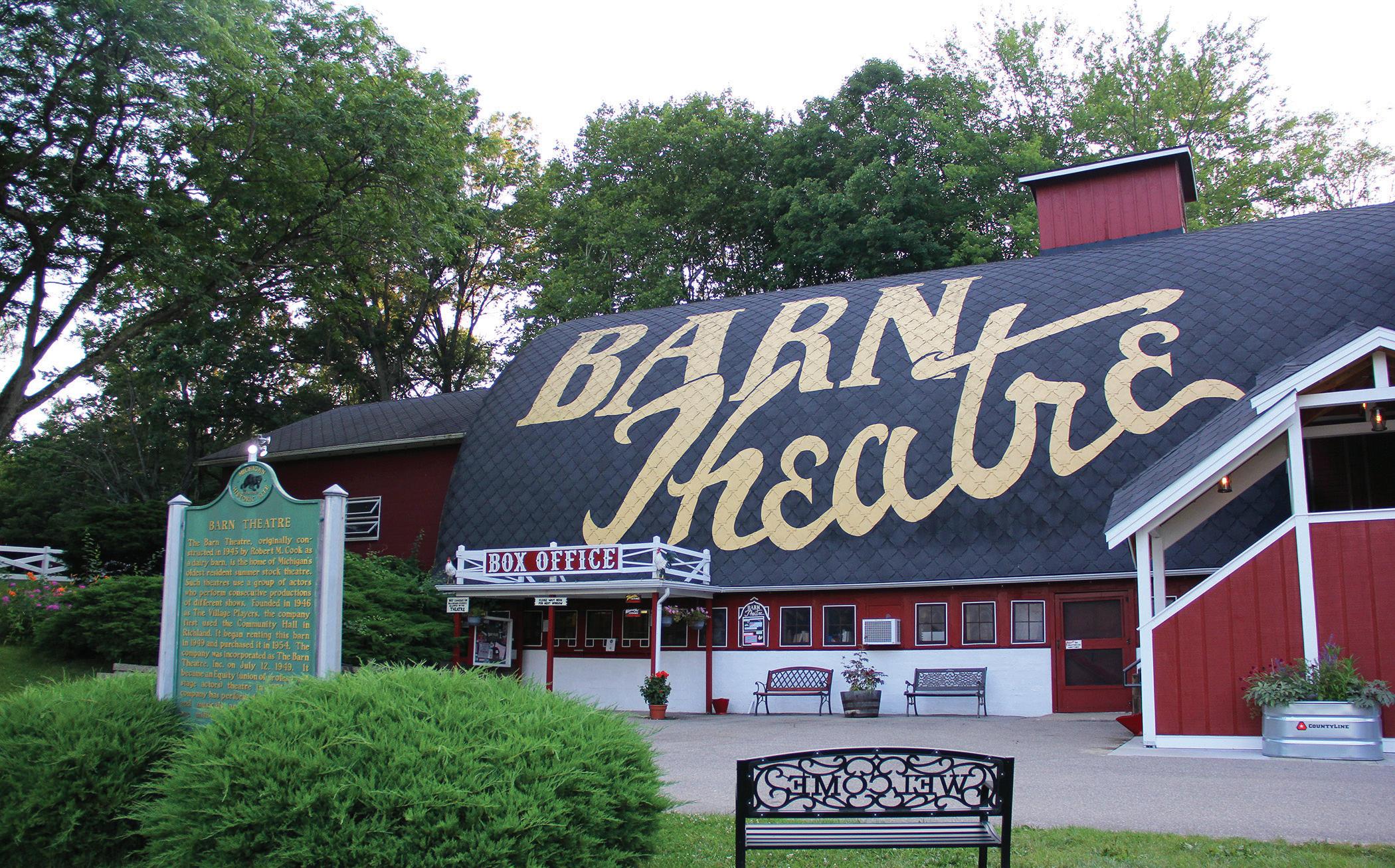
The Michigan Historical Site marker in front of the Barn Theatre in Augusta, Michigan, makes a bold statement: it is “…the home of Michigan’s oldest resident stock summer theatre.” This year, that remarkable institution celebrates its 80th season of live performances.
While I had visited the Barn a handful of times over the years, I became a regular after a friend invited me to go to some local theater performances with her. What started as occasional outings between several venues evolved into a trio of women who make it to as many shows as we can—often bringing family or friends along.
Before long, we discovered another Barn tradition—the Bar Show.
Held in the Rehearsal Shed immediately after the main-stage performance, the separately ticketed cabaret is a favorite among regular patrons. What began decades ago as an informal and impromptu talent showcase has grown into a lively, choreographed musical production where audiences get to know the young performers in a more relaxed setting. Complete with drinks, music, audience interaction, and the best pizza in Augusta, it’s where the personalities and talent of the apprentices truly shine.
Watching 22 talented “Barnies,” as the apprentices are affectionately known, belt out familiar songs or keep straight faces through comedy sketches is an experience unlike any other.
Like many audience members with no theater background, however, I
found myself wondering how it all worked. What exactly is summer stock theater? What does “Equity” mean? And do these young performers really handle everything behind the scenes?
To find out, I spoke with producer Penelope Ragotsy and second-year apprentices Kyle Lowry of Tulsa, Oklahoma, and Abbey Grace Messing from mid-Michigan.
A Family Tradition
The Barn Theatre’s story begins with founders Jack and Betty Ragotsy, who established the company as The Village Players in Richland before moving operations to the converted barn in Augusta.
Their son, Brendan, eventually went west to play baseball at San Jose State University. It was there that he met Penelope, a California native. A series of fortunate events, aided by the influential associate producer Dusty Reeds, brought the couple together. Brendan convinced Penelope to try out the Barn’s apprentice program in 1986, a big move for a California girl!
The couple married two years later and spent several years working in theater in both California and Michigan. They decided to settle permanently in Augusta to raise their four children who, as adults, now also take active roles in the Barn Theatre.
What Is Summer Stock?
Although the Barn has had many changes and adjustments over the decades, it has stayed true to its original mission: training the next generation of theater professionals.
However, the term “summer stock” no longer accurately describes their
theater, Penelope explained. The phrase dates back to a time when theaters relied heavily on their existing stock of scenery, costumes, and props. Rather than building every set from scratch, companies reused walls, furniture, and costumes from previous productions to stage multiple shows during a single summer season. Although the Barn does reuse some items, most is now constructed from the ground up.
This season, the Barn has six mainstage productions, each running for two weeks. Every show is accompanied by an entirely new Bar Show, meaning apprentices are constantly rehearsing one production while performing another.
Life as a Barnie
If you’ve ever wondered whether apprentices really do wash the tights and mow the grass—the answer is yes.
When asked what a typical day looks like, Kyle and Abbey laughed.
“Which day?” they asked.
Their schedule during performance weeks is demanding. This is a typical Friday:
10:00 AM – 1:00 PM: Morning call, time to be in our work areas (props, costuming, publicity, bar or the box office) but called as needed for rehearsals for the upcoming main stage show.
1:00 PM – 2:00 PM: Lunch break—though this is often interrupted by rehearsals for the Bar Show.
2:00 PM – 4:30 PM: Back to the technical work in assigned specialty areas.
4:30 PM – 5:00 PM: “Coolios”— the traditional Barn term for rotational chores, which include cleaning the lobby and scrubbing the bathrooms.
5:00 PM – 7:00 PM: Dinner break.
7:00 PM: Back on duty for preshow assignments. Apprentices open the Rehearsal Shed, park cars, sell tickets, and usher patrons.
7:55 PM: A quick scramble to get into costume and position.
8:00 PM: Main stage showtime.
Post-Show: The curtain falling doesn’t mean the workday ends. The apprentices immediately pivot to the Bar Show, performing three musical sets while waiting tables and serving drinks in between.
Bar Show ends: Clean-up begins, with apprentices finally heading home, usually after midnight.
More Than an Audition
The apprentice program is highly competitive. This year, the Barn received 215 applications for just 22 positions, with 8 of them filled by returning Barnies. The apprentices are housed by local hosts, who must be in a 10-minute driving radius. The minimal rental fee is usually offset by grants. They also get a $200/week stipend and share the Bar Show tips when they participate.
So how did apprentices Kyle and Abbey end up here? Kyle’s dream of acting began in elementary school when his fifth-grade class was asked to put on a sticky note what they wanted to be when they grew up.
“I knew I didn’t want to be a firefighter or an astronaut,” he joked and put up “Actor” based on what

he envisioned doing from movies. Despite his early prediction, he initially studied psychology in college, but exposure to professional theater changed his path.
“I’m really interested in the physical dimension of theater, that it is people with people. The beauty of the Barn and live theater is it is literally bringing people together to share a story. And it has an element of unpredictability.”
Abbey followed a straighter route, with involvement in singing and dancing for as long as she can remember before pursuing musical theater professionally. But even with a solid background she felt her opportunities at the Barn, including a role as Mayzie in last year’s Seussical the Musical, helped her growth exponentially.
Both plan to move to New York to pursue theater this fall, joining a network of former Barn apprentices already working there. Abbey jokes that a fellow Barnie said she is collecting Barnie contacts like others would collect Pokémon!
What convinced them to choose the Barn wasn’t simply the reputation—it was the audition process.
Abbey said she felt treated like an individual rather than just another number and Kyle agreed. What brought them back for a second season was the sense of family that developed with The Company (fellow apprentices) over an intense summer.
Coolios like scrubbing bathrooms are simply easier when you are doing it in, what Kyle refers to as, a spirit of collaboration.
A Launching Pad
Over the years, the Barn Theatre has become known as a stepping stone for future professionals.
Among its former apprentices are actress Jennifer Garner, television stars Tom Wopat, Robert Newman, Kim Zimmer, and Lance Barber, along with countless performers who have gone on to successful stage careers.
The Barn also serves as a professional Equity theater. Actors’ Equity Association is the labor union representing professional stage performers and stage managers. Working at an Equity theater gives young actors
professional experience while learning alongside seasoned performers.
For many apprentices, it’s their first taste of professional theater and an important bridge between college and a career.
Eighty Years and Still Going Strong
While audiences come for the musicals and familiar classics, what keeps many returning year after year is something harder to define.
It’s the feeling of community.
As Kyle and Abbey prepare for careers in New York, they know they’ll carry a piece of Augusta with them.
the Barn Theatre, there’s a saying that captures the spirit of the place: “Once a Barnie, always a Barnie.”
After spending time behind the scenes, it’s easy to understand why.
For 80 years, this little theater in the countryside has been doing much more than entertaining audiences. It has been creating memories, launching careers, and proving that some of Michigan’s greatest performances begin in a converted barn just outside Augusta.
Deanna Mayo

Did you know that you might not be recycling properly? We’ve all been trained to put paper, cardboard, and glass into the recycle bin, and collect cans and bottles to return to our favorite grocery store, but there are tons of other household items that are mistakenly being thrown into the trash or recycle bin. The Kalamazoo County Household Hazardous Waste Center (HHW) aims to educate and provide safe means to dispose of items that shouldn’t be discarded into the regular trash.
I spoke with HHW’s Facility Manager Jennifer Kosak, who enlightened me on what HHW does and what materials are considered hazardous, and was given a tour of their establishment.
Hazardous waste is defined as “discarded material that poses a potential threat to public health or the environment because it is toxic, corrosive, ignitable, or reactive.” This includes: batteries, electronics (TVs, computers, printers, radios, cords, Christmas lights, phones), fluorescent light bulbs, cleaning products, soaps, make-up, cooking oil, and pesticides. Everybody has these items in their homes or businesses!
Electronics being regarded as toxic waste may be surprising. They are considered hazardous because they contain heavy metals and toxic chemicals that can leak in landfills and poison our groundwater, which is our drinking water. The same goes for the other defined hazardous waste items mentioned above that can break down in landfills and leak into the groundwater. Some of these toxic items, like the electronics that contain precious metals, can be suitably recycled in order to prevent the need to mine new material. HHW offers a place to dispose of these objects where it is guaranteed to not end up in a landfill.

The Kalamazoo County Household Hazardous Waste Center, located at 1301 Lamont Ave. in Kalamazoo, has been properly discarding toxic items since 1996. They partner with municipalities, including Kalamazoo, Berrien, St. Joseph, and Barry Counties, Almena and Antwerp townships, who designate a part of their budget so that their residents can use this service for free. Non-participating municipalities or small businesses can bring their waste in for a fee.
To properly dispose of toxic waste, first HHW organizes and tests as necessary the waste products for pH or presence of oxidizers. Chemicals, oils, various monitors, wires, and many other items are separated and prepared for transportation. Prior to shipping, electronics get stored in giant cardboard boxes that are pallet-wrapped. Chemicals are shipped either in original containers or are poured into larger containers. The HHW Center then partners with a variety of contractors who are certified by the Michigan Department of Environment, Great Lakes, and Energy (EGLE) who will pick up the waste. HHW sells wire to one contractor and batteries to Interstate Battery to help support their program.

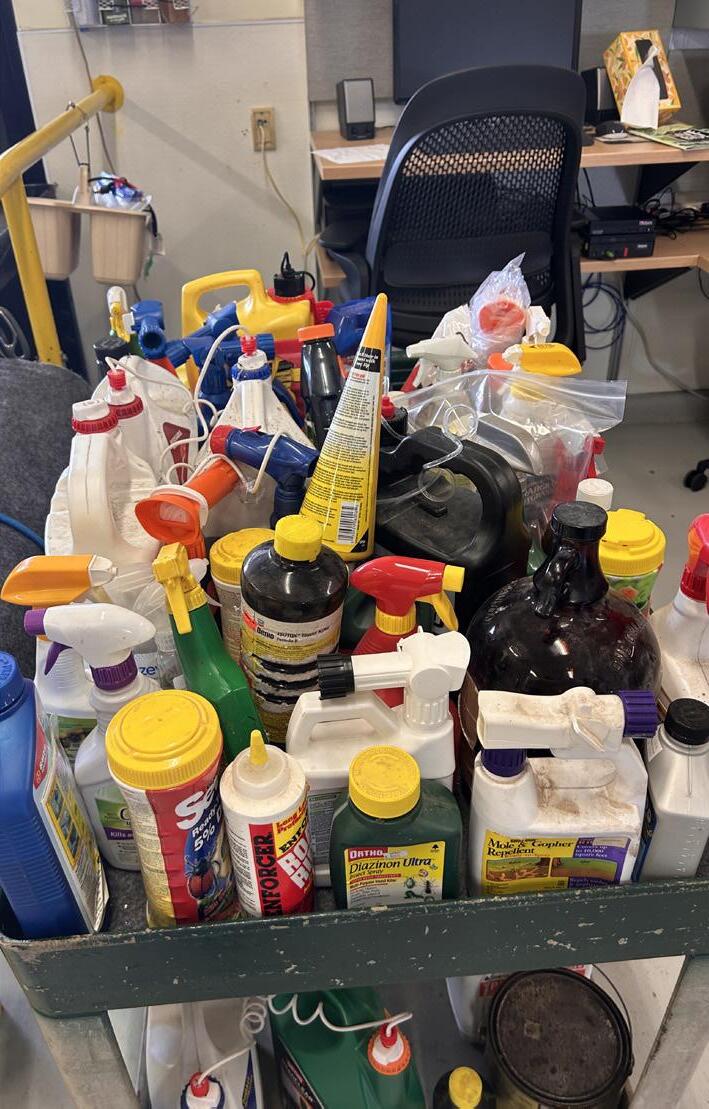
Kosak showed me around the facility, where employees were busy sorting the waste material. There were carts filled with various chemicals and cleaning supplies, drums filled with thousands of batteries, and tons of stacked televisions—both modern flat screens and old-fashioned boxy CRTs (cathode ray tube). It was incredible seeing the amount of waste, but I felt relief knowing that it would be properly disposed of or recycled.
In 2025, Household Hazardous collected 332,778 pounds of waste and 198,782 pounds of electronic waste!
HHW accepts a ton of material: acids and bases (batteries), adhesives, aerosols, automotive products, beauty aids, cleaners, electronics, explosives (ammunition and fireworks), fire extinguishers, fuels, household batteries, lightbulbs, mercury (thermometers, other devices as well as elemental), paint products, pesticides, photography items (like developer and film), chlorine, and other miscellaneous items like vape pens. They do not accept items like: air conditioners, asbestos, bulk oil and trash, concrete and construction waste, medications, sharps (like syringes), tires, and a few other items. Their website www. kalcounty.gov/hhw lists all accepted and unaccepted material, and gives
information for where unaccepted material can be disposed of instead.
Household Hazardous is one of the only waste removal sites that is open year-round. In addition to their website is www.kalcounty.gov/hhw, they also offer two phone lines: for information call 296-373-5211, and to talk to someone or leave a message, call 269-383-8742. They also can be reached through their email, hhwcenter@kalcounty.gov, where either Kosak or Team Lead Cindy Foster will return any inquiries. Kosak encourages those from a nonparticipating municipality who want to drop off waste to email the facility. The drop off process is incredibly simple: during their operating hours (found on their website), drive under the building’s carport where employees will get your contact information then remove the waste from your vehicle—there is no need for you to get out of the car!
Next time you need to change a light bulb, buy new cleaner, or are about to throw away a tube of expired mascara, rethink your garbage. Keep a box in your garage, like I do, for hazardous materials, and when it gets full take a trip to the HHW Center. The Earth will thank you!
Carson Williams


I have fond memories of childhood adventures from my distant past. Back in those days, neighborhood children roamed the suburban streets like a pack of young wolves up to no good (as my father would say). We were pretty much left to our own devices with no adult supervision. The only evening rule was that we had to be on the front porch (ours or someone else›s) when the streetlights came on. One of our frequent pastimes was to find an old peanut butter jar - glass, of course - and poke some holes in the metal lid. We’d then go out hunting for lightning bugs, capturing them until we had a decent number. Then, armed with our living torches, we’d chase around the neighborhood. I don›t recall anyone falling and getting cut, thank heavens, but if that were to happen, we would certainly be in trouble with our parents, who were oblivious to our antics. Clearly, those days are over now!
This has been an excellent year for lightning bugs. It›s been warm and damp - just the kind of weather they seem to enjoy. And it’s so much more pleasant to watch them than it is to swat the pesky mosquitoes that also prefer these same conditions.
Are they lightning bugs or fireflies? Google tells me that the convention of calling them «fireflies» or «lightning bugs» is based on regional preference. My penchant for referring to them as lightning bugs is apparently due to my growing up roots in the Midwest. People who grew up in the West typically would call them fireflies. The bug species is the same, but they are classified as beetlesneither a fly nor a true bug, according to entomology, the biological study of insects.
Beetles are distinguished from flies and bugs in basic anatomical ways. Flies differ from beetles in that they have a single pair of wings, instead of the two pairs possessed by beetles. The upper pair of a beetle’s wings is frequently larger and hardened, like a shell of sorts. These retract such that the second pair, which actually propels the insect, is stored underneath. Beetles also have mandibles (jawlike mouth parts that bite and chew food), whereas flies generally have a proboscis (a tube-like structure to pierce and suck food into the mouth). Most importantly, beetles (and
many other bugs) differ from flies in their life cycle. Beetles, along with most insects, undergo a complete metamorphosis consisting of four distinct stages: egg, larva, pupa, and adult. It›s during this process that, to me, lightning bugs become very interesting!
It’s easy to see male lightning bugs (only males can fly) fluttering around in the evening and think that›s all there is. This adult stage, however, is a brief, frenzied time, usually lasting one to four weeks, ending what has been a long journey - just one that we are not typically observing. That beautiful guy has a very short time to perform his most important taskfinding a willing female that will lay the eggs that will produce the next generation.
The real work of being a lightning bug beetle takes place in the larval stage - up to two years underneath the layers of leaf litter and debris that are so important to so many of the beneficial insects we know and love.
A mated female typically deposits roughly 100 eggs in moist, shallow soil, where they hatch in mid- to late summer after about 3-ish weeks of incubation. The larvae emerging from those eggs will live in the soil for up to two years. During those two years, they are voracious predators, feasting on snails, slugs, and worms, as well as other soft-bodied invertebrates. At this stage of their lives, they might be called glow worms because, even though they are underground, many larvae can emit the greenish-yellow light that we associate with the adult form. In the autumn, when the weather gets cold, each larva creates a mud covering where it will pupate, hunkering down for the winter, emerging in the spring as an adult.
The predominant lightning bug species here in Michigan is known by its common name, the Big Dipper. They are notable for their yellowgreen color, produced by special cells in the beetle’s abdomen. This bioluminescence, a costly process (in terms of biological energy expenditure), is key to the insect’s reproductive success. The bright, almost fluorescent color of the Big Dipper helps it stand out prominently against the dark green foliage of our lawns and shrubbery. Interestingly, other species common in areas with more yellow-brown plant life use a differ-
ent bioluminescent chemical that emits a brighter green color, making them easier to see against a drab background.
Studies have shown that lightning bugs can control the flash pattern of their bioluminescence. Complex environmental and chemical signals provide information that encourages males to display their lanterns (the organs that glow) in characteristic patterns and sequences when females are present and likely receptive to their attention.
Caution: insect sexual content ahead…
If conditions are favorable on a summer evening, males will signal their presence with a characteristic J-shaped aerial acrobatic display of bioluminescent flashes. Females, unable to fly, lie waiting in grass or leaf litter, watching the show. If a female likes the display of a particular male, she will roll her abdomen so that her lantern is on display. She returns flashes to signal to the male that he is welcome to visit. But the deal is not quite sealed yet. As he approaches, ready to mate, she›s able to get a look at what is described as his “nuptial gifts” – known biologically as spermatophores. Along with his sperm, the best-adapted lightning bug male carries along a gelatinous package containing nutrients and proteins as well as a toxin that will protect the female and the eggs she carries against predators. Larger, more numerous spermatophores are, of course, more desirable than smaller ones. Hence, a male who has mated the previous night is less likely to be successful on subsequent evenings, since he›s already “gifted” another female before the current conquest. Clearly, a lot more is going on in lightning bug land than most of us knew!
Lightning bugs produce toxins at all metamorphic stages, keeping them safe from many potential predators. They produce a steroid-like compound that makes them taste bad. It was once believed that bioluminescence in fireflies and these toxic compounds evolved simultaneously. The idea would be that a potential predator would see the glow and know not to dine on the firefly in any of its life forms. Research studies recently published in the Proceedings of the National Academy of Sciences
journal, Nexus, seem to debunk that notion by showing that ancestral fireflies contained genes for bioluminescence long before they produced toxins. Regardless, it appears that many animals, including mammals like mice and voles, are unlikely to feast on lightning bugs in any form, finding their defensive compounds unpalatable.
Lightning bug populations are in overall decline. This is true of almost every type of insect. The increased use of pesticides to combat what we perceive as non-beneficial species rarely targets just the bad actors, instead damaging beneficial populations by coincidence. Additionally, light pollution in our own neighborhoodslandscape lighting, streetlights, Ring cameras, and other lighting - confuses the bioluminescent signals of males looking for mates. Tidy garden beds disrupt the leaf litter where so many insects are making homes. This includes lightning bugs, as well as earthworms, bumble bees, and numerous butterfly and moth species. Performing this deep dive into lightning bugs has made me truly sorry for what I now recognize as cruel behavior toward those poor lightning bugs that I caught in 1960s-era Jif jars. Yes, perhaps I threw in some blades of grass, but I don’t recall ever releasing those lightning bugs back into the wild. Truth be told, the jar probably ended up under my bed until my mother made me clean my room. Now that I know better, I vow to do better. Let’s decide to help them out! Let your kids catch them - they’re gentle and easy to scoop up in our bare hands. Let the youngsters put them in plastic jars with lids that have holes. But let’s agree to release them the next evening before dusk so they can “hit the dating scene” and maybe get lucky!
Cheryl Hach Retired Science Teacher
Kalamazoo Area Math and Science Center
To view references for this article, please scan the QR code.

Through Sept. 6
Exhibit: Dinosaur Explorer Kalamazoo Valley Museum
Saturdays, Aug. 1,8,15,22,29 Kalamazoo Farmers Market 7am-1pm, 1204 Bank St.
Saturdays, Aug.1,8,15,22,29 Texas Township Farmers Market Farmers Market Pavilion, 8am-noon
Saturday, August 1, 9-11am Beginning Birding Walk, Wolf Lake Fish Hatchery
Saturdays, Aug. 1,8,15,22,29 Live Music @ The Dock at Bayview, 8pm-12am
Sundays, Aug. 2,9,16,23,30 Portage Farmers Market, 9am-1pm, 203 E. Centre Ave.
Mondays, Aug 3,10,17,24,31 Family Storytime, 10-11am (Ages 0-5), Vicksburg Library
Mondays, Aug. 3,10,17,24,31 Comstock Farmers Market, 3-6pm, Merrill Park
Mondays, Aug. 3,10,17,24,31
Support Group: depression, Bipolar disorder & mental health challenges, 7-8:30pm, Portage Chapel Hill United Method. Church
Tuesdays, Aug. 4,11,28,25 Kalamazoo Farmer Market, 8am-4pm, 1204 Bank St.
Tuesday, Aug. 4, 1-4pm Adult Craft Stitching Group, bring Your project, Parchment Library
Tuesday, August 4
Youth Author/Illustrator, 2:30-4pm, Richland Library
Tuesday, August 4
Teens/tweens Dungeons & Dragons, 4-6pm, Vicksburg Library
Tuesday, August 4 Fan Frenzy (ages 10-16), 5pm, Parchment Library
Tuesday, August 4
Back to the 90’s Party, 6-7:30pm, Paw Paw Library
Tuesdays, Aug. 4,11,18,25 Open Mic. 6-9:30pm, Karaoke 10pm-12am, Old Dog Tavern
Tuesdays, Aug. 4,11,18,25 7pm Cornhole @ The Green Top Tavern
Wednesdays, Aug 5, 19 Mugs & Hugs, stories, playtime.. 10-11am, Vicksburg Library
Wednesday, August 5, 10:30am Roz Puppets presents Dinosaur Pirates (all ages), Parchment Library
Wednesday, August 5, 2pm OLLI @ WMU Senior Readers Theater, Parchment Library
Wednesdays, Aug. 5,12,19,26 Teen Dungeons & Dinosaurs, Ages 11-17, 3-5pm, Richland Library
Wednesdays, Aug. 5,12,19,26
Richland Farmers Market, 3-6pm, Richland Area Community Center
Wednesdays, Aug. 5,12,19,26
Free ½ hour of Bowling, Crafted Copper, Kalamazoo, 4-10 pm
Wednesdays, Aug. 5,12,19,26
Wednesday Night Cruise-In, 5-8pm, Gilmore Car Museum
Wednesdays, Aug., 5,12
Burg Days of Summer, Live Music, food trucks, activities 5:15-8:30pm, Dwtn. Vicksburg
Wednesdays, Aug. 5,12,19,26
Beats on Bates, 5:30-8:30pm, Bates Alley, Dwtn. Kalamazoo
Wednesday, August 5, 7pm
Author Event, Amy Piper, Small Town Michigan Vicksburg Historic Village
Wednesday, August 5, 6-7pm
Author: Kathryn Lynn Seifert, Gilbert & Ivy, Vicksburg
Wednesday, August 5, 8-11pm
Beats on Bates After Party w/ Peyton Bohl, Old Skool Bar
Thursdays, Aug. 6,13,20,27 Kalamazoo Farmers Market, 8am-1pm, 1204 Bank St.
Thursdays, August 6
LEGO Challenge, All day from 10am-6pm, Richland Library
Thursday, August 6
Explorers Traveling Story Time, Ages 3-6, 11am, Richland Library
Thursdays, Aug. 6,13,20,27
Story Time, 10:30am, This Is a Bookstore & Bookbug
Thursdays, Aug. 6,13,20,27
Free Thursdays, 11am-8pm, Kalamazoo Institute of Arts
Thursday, Aug. 6 3:30-6pm
Elementary “Drive-in” Movie night With popcorn, you bring, drink, blanket & cardboard box, Vicksburg Library
Thursday, August 6
Dig In: Game Night-Rebel Princess (ages 10-16), 4pm Register: Parchment Library
Thursdays, Aug. 6,13,20,27
Teen Dungeons & Dinosaurs, Ages 11-17, 4:30-6:30, Richland Library
Thursday, August 6
Gallery Gathering: Curator’s Tour of For The People, By The People, 5:30-6:30pm, Kalamazoo Institute of Arts
Thursdays, Aug. 6,13,20,27
Yoga with Talisa, 6-7pm, Bronson Park, Kalamazoo
Thursdays, Aug. 6,13,20,27
Mountain Bike Group Ride, 6-8pm, Fort Custer Trailhead
Fridays, Aug. 7,14,21,28
Sit N’ Stitch, work on your project, 10am- 12pm, Richland Library
Friday, August 7
Family Story Time, 10:15am, All ages, Richland Library
Friday, August 6
Watercolor Dinos (grades 1-5) 10:30am, Richland Library
Friday, August 7
Memory Café- for people with mild dementia & care partners, 10:30am-Noon, Paw Paw Library
Friday, August 7, 11:30-1:30 Lunchtime Live, Bronson Park
Friday, Aug. 7, 2-5pm
Tasting History: 1st Tamales, Ages 11-17, Register: Richland Library
Friday, August 7, 14,21,28, 2-6pm Vicksburg Farmers Mkt.
Friday, August 7, 5-8
First Friday, featuring local Artists, Kalamazoo Mall
Fridays, Aug. 7,14,21,28
Artist Meet Up in the Vine, 5:30-8pm, 806 S. Westnedge
Friday, August 7, 6:30pm
Live Music: Jeremy Allison, The Backyard of Kalamazoo
Fridays, Aug. 7,14,21,28
Live Music @ The Dock at Bayview, 8pm-12am
Saturday, August 8, 22
Climax Farmers Market, 9am2pm, 14377 E. ON Avenue
Saturday, August 8
Internet Users group, 10am-noon, Paw Paw Library
Saturday, August 8
Summer Reading Wrap Up Party 10am-1pm, Vicksburg Library
Saturday, August 8
Sips in the Zoo, Kalamazoo Mall, 10am – 6pm
Saturday, August 8
Northside Day, Community Celebration 11am-3pm, LaCrone Park, Live Music: 5:30pm-9pm, 612 N. Park St., Kalamazoo
Saturday, August 8
Drive-in Style Movies: Super Mario Galaxy Movie, 9pm Ramona Park, Portage
Monday, August 10, 6pm
Parchment Book Group: Heart the Lover by Lily King (adults), Parchment Library
Tuesday, August 11
Tuesdays at the Races, 6-7pm, Bricks & Minifigs
Wednesday, August 12
Bird & Coffee Chat Online: Nectar Feeders, 10am birdsanctuary@kbs.mse.edu
Wednesday, August 12
Virtual Artist’s Talk with Dulce Pinzon, 12-1pm, Kalamazoo Institute of Arts
Wednesday, August 12 Vinyasa Yoga with Alla (adults) 5:15pm, Parchment Library
Wednesday, Aug. 12, Author: AM Kehoe, 6-7pm, Gilbert & Ivy, Vicksburg
Thursdays, August 13 & 27
Teen Break & Bulldog Break Crafts, games, activities, treats, 2:45-4:45, Vicksburg Library
Thursday, August 13, 6-7:30pm My America: A Performance Lecture by Julio Cesar Morales
Thursday, Aug. 13, 6:30-7:30pm Friends Read Book Club, discuss what you’re reading, Paw Paw Library
Thursday, August 13, 6:30pm Megan Dooley - Live at The Fountain, Miller Auditorium
Friday, August 14, 6:30pm Live Music: Owen McDaniel, The Backyard of Kalamazoo
Saturday, August 15 Chair Yoga (adults) 11am, Parchment Library
Saturday, August 15
Mindful Making in the Library, Kalamazoo Institute of Arts, 11:30am – 2pm
Sunday, August 16, 12-5 Lakeside Concert & Manor House Tours, Tours 12-3, Concert 3-5pm, W.K. Kellogg Manor House
Sunday, August 16, 2-4pm Spelling Bee, Alley Cat, Kal.
Monday, August 17, 9-10:30am “Dam” Good Nature Hike, Bicentennial Park, Portage
Tuesday, August 18
Lego & Duplo Club, 1-2pm & 5:30 – 6:30pm, Vicksburg Library
Tuesday, August 18, 6:30pm Mystery Book Club: Bookman Dead Style by Paige Shelton (adults) Parchment Library
Wednesday, August 19, 2-3pm
Book Discussion: In Open Contempt, Kalamazoo Institute of Arts
Thursday, August 20
Family STEAM Night, 6-7pm Vicksburg District Library
Thursday, August 20, 6-8pm
Creativity, Resilience & Reflection: An Expressive Arts Workshop, Register: Kalamazoo Institute of Arts
Thursday, July 16
The Heartbreak Book Club: The Love Audit by Lucy Eden 6:30-7:30pm, Paw Paw Library
Friday, August 21, 6-10pm Drive-in Summer Cinema in the Park, Spring Valley Park
Friday, August 21, 6-9pm Block Party at Celery Flats, Live music, food trucks, activities
Friday, August 21, 6:30pm Live Music: Owen McDaniel The Backyard of Kalamazoo
Saturday, August 22, 8pm Ramona Beach Bonfire: Smores supplies & live music
Saturday, August 23, 10am-4pm Great Lakes Sports Card Show Kalamazoo County Expo Center
Monday, August 24, 4pm F.A.R.M. Tween Book Club: The Westing Game by Ellen Raskin Ages 10-14, Register & pick up Free book, Parchment Library
Tuesday, August 25
Summer Crafternoon, 3-5:30pm Vicksburg District Library
Tuesday, August 25
Walk with A Doc., 6:30-7:30pm Vicksburg Trail @Richardson St.
Wednesday, August 26
Reclaiming Native Narratives In American Art, 12-1pm, Kalamazoo Institute of Arts
Thursday, August 27 Teen Survey Social with snacks, 5:30-6:30pm, Vicksburg Library
Thursday, August 27 LEGO Trivia Night, 6-7pm Bricks & Minifigs, Kalamazoo
Thursday, August 27, 6-8pm Summer Jams: Open Mic Kalamazoo Institute of Arts
Thursday, August 27, 6-9pm Concert: Heartless: A Tribute To Heart, Overlander Bandshell
Thursday, Aug. 27, 6:30-7:30pm Between the Lines Book Club: What You Leave Behind by Wanda Morris, Paw Paw Library
Friday, Aug. 28, 10:30-11:30am Listen Up Audiobook Club: American Bulk: Essays on Excess by Emily Mester, Paw Paw Library
Saturday, August 29. 10-11am Using Your Senses – Guided Nature Walk, Flesher Field
Saturday, August 29
Play Music on the Porch Day, 2-6pm, Vine Neighborhood Playmusicontheporchday.com
Sunday, August 30
The Vine Barn Local Market 12-4pm, 311 Wall St., Kal.