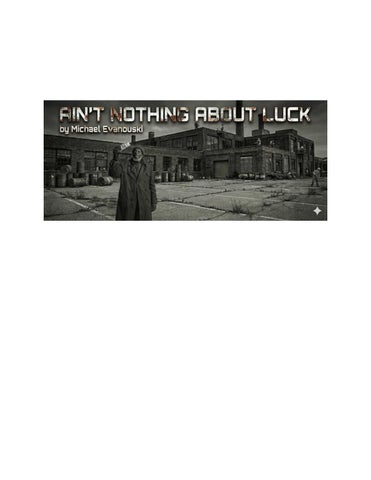
Ain’t Nothing About Luck By Mike Evanouski
The year is 2084. The air always tastes like copper now. Down in Sub-Level 3 of the derelict OmniCorp refinery, the air was worse—it tasted like copper dipped in old engine grease. Jax wiped a smear of grime from his forehead, his breath pluming slightly in the chill damp. Above him, bundles of rusted pipes hung suspended from the vaulted ceiling like the exposed guts of some leviathan beast, sweating condensation that dripped rhythmically onto the metal grating below. "Watch your six, kid," Jax grunted, squeezing past a dormant hydraulic press that loomed in the narrow corridor. Behind him, Elio, barely twenty and still jumpy, adjusted the strap of his heavy wrench. "Are we done yet, Jax? The seismic monitors are twitching." "We're done when the structural integrity shift is done. We keep these ancient rust buckets running so the floor doesn't collapse while the hotshots upstairs do their thing." Jax patted the cold flank of a stamping machine dated 2035. The basement was a maze of this obsolete industrial wreckage, a graveyard of the analog age now serving as the foundation for a terrifying new one. A deep, resonant thrum vibrated through the soles of their magnetic boots. Dust rained down from the pipes overhead. Elio froze, eyes wide in the gloom. "That’s them. They started." "Just keep moving," Jax said, though his own stomach tightened. They weren't just afraid of the old factory falling down. They were afraid of what was stored in the courtyard above, and the insane method used to neutralize it.
Page 2 Outside, under a sky choked with perpetual gray cloud cover, the refinery courtyard resembled a warzone designed by physicists. Two enormous vehicles, long and low like armored trains de-coupled from their tracks, dominated the cracked asphalt. They were referred to colloquially as "fire trucks," but they carried no water. They were Mobile Radiological Stabilization Units—MRSU-1 and MRSU-2. Captain Vane stood squarely behind the rear mounted turret of MRSU-1. He wore a bulky lead-lined suit that hummed with its own internal cooling system. His haptic gauntlets gripped the handles of a massive, multi-barreled nozzle. Fifty yards away sat the target: a pyramid of fifty-gallon drums, their sides bloated and weeping iridescent fluid. They were relics of the Energy Wars, filled with unstable isotope slurry that the city was finally trying to clean up.
"Target locked, Captain. Isotope signature is erratic," his pilot reported over the comms. "Stabilize your treads. Engaging emission," Vane growled. He squeezed the triggers. There was no recoil, only a high-pitched whine that set teeth on edge even through helmets. From the nozzle erupted not water, but a visible, thick beam of shimmering violet light—the "Ray." The Ray slammed into the center barrel. It didn't pierce the metal; it seemed to soak into it. Instantly, a fine mist began to vent from the seams of the drums. It rose in a glittering cloud, catching the violet light. "Particle density increasing," the pilot warned. "The Ray is hunting." The technology was terrifyingly simple in theory and wildly dangerous in practice. The waste in the barrels contained "rogue radiation"—particles that had mutated, gaining a pseudosentience that made them want to cluster and achieve critical mass. The violet Ray fired a stream of "hunter" radiation designed to seek out these rogue pockets, bind with them, and inert them.
But the math was knife-edge. You were essentially firing radiation at radiation. If the hunter particles didn't bind immediately, they added to the overall energy load. If too many rogue particles clustered before the Ray could tag them, the introduction of new energy wouldn't neutralize them—it would feed them. It would trigger a multiplicative cascade. "Warning. Cohesion detected in sector four of the target pile," a robotic voice announced in Vane’s helmet. The glittering mist was starting to swirl, organizing itself into a tightening spiral of light. "I see it," Vane grit his teeth, adjusting the nozzle's aperture, narrowing the violet beam into a tighter, hotter lance. "Come on, you bastard. Break apart." In the basement, the thrumming turned into a violent shudder. A fluorescent light fixture tore free from the ceiling, sparking wildly as it swung by its wires. "Jax!" Elio screamed over the noise of grinding metal. "Get under the doorframe!" Jax grabbed the kid’s collar and hauled him toward a heavy archway between two compressor rooms. They huddled together as the ancient machines around them groaned. The vibrations weren't just physical; they felt it in their teeth, a sickening buzz in the base of their skulls. It was the feeling of an ungodly amount of energy teetering on the brink of release. "They're losing it up there," Elio whispered, clutching his wrench like a talisman. "The rogue particles are clustering. If they multiply..." He didn't need to finish the sentence. If the Ray failed, if the rogue radiation achieved multiplicative cascade, the resulting explosion wouldn't just level the old factory. It would leave a crater that glowed in the dark for the next ten thousand years. They wouldn't even
have time to register the flash. Jax looked up at the sweating pipes vibrating violently above them. "Hold fast, kid. Vane knows what he's doing. Probably."
Another massive jolt rocked the foundation, knocking them both to their knees. The air pressure dropped suddenly, popping their ears. It was the silence before the thunder. Down in the dark, surrounded by the ghosts of industry, they squeezed their eyes shut and waited for the end of the world.