PUBLISHED BY THE NATIONAL ALLIANCE FOR ACCESSIBLE GOLF
GOLF
SEPTEMBER 2026 | ISSUE 43
INCLUSI N MONTHLY
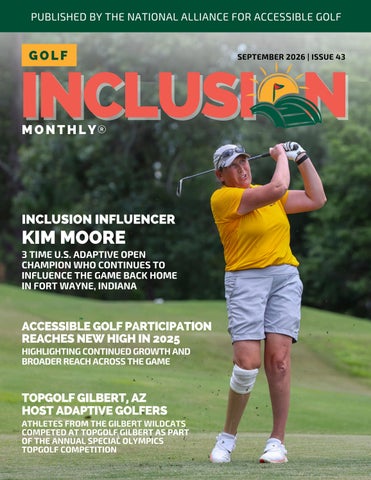
INCLUSION INFLUENCER
KIM MOORE
3 TIME U.S. ADAPTIVE OPEN CHAMPION WHO CONTINUES TO INFLUENCE THE GAME BACK HOME IN FORT WAYNE, INDIANA
ACCESSIBLE GOLF PARTICIPATION REACHES NEW HIGH IN 2025 HIGHLIGHTING CONTINUED GROWTH AND BROADER REACH ACROSS THE GAME
TOPGOLF GILBERT, AZ HOST ADAPTIVE GOLFERS ATHLETES FROM THE GILBERT WILDCATS COMPETED AT TOPGOLF GILBERT AS PART OF THE ANNUAL SPECIAL OLYMPICS TOPGOLF COMPETITION
NATURAL STONE. GROUNDBREAKING SOLUTIONS.
GOLF PATHWAY MIX.
“Kafka’s support of our mission makes it possible for us to deliver education to the golf industry. We are proud to be associated with them and the commitment they have to delivering products that improve accessibility to golf facilities around the country!” Dave Barton, PGA, Executive Director, National Alliance
Click HERE to Connect with Kafka Granite
IN THIS ISSUE
SEPTEMBER 2026 A MESSAGE FROM THE ALLIANCE Executive Director, Dave Barton, PGA
ACCESS + INCLUSION
The Alliance is a leader in access and inclusion - increasing the participation of people with disabilities in the game of golf.
INCLUSION INFLUENCERS
Excerpts from an interview with with Kim Moore, PGA
WHAT DO YOU SEE? IT DEPENDS ON YOUR PERSPECTIVE… ACCESSIBLE GOLF PARTICIPATION REACHES NEW HIGH IN 2025 GAIN SPOTLIGHT
The Health and Wellness Benefits of Golf
EDUCATION HUB SPOTLIGHT
Is Your Facility Missing Out on Travellers?
ADAPTIVE GOLF CLINIC HELPS PLAYERS BUILD CONFIDENCE AT WARWICK HILLS ADAPTEE GOLF TO HOST NATIONAL CHAMPIONSHIP TOPGOLF, GILBERT, AZ HOST ADAPTIVE GOLFERS BOARD & STAFF Melissa Low, CAE President Dana Dempsey, MS, CTRS Vice President Jan Bel Jan, ASGCA Secretary Sheryl Bindelglass, CSP ICAE Treasurer Dave Barton, PGA Executive Director
Cover photo credit: USGA
Justin Apel Chava McKeel Ronnie Miles Andrew Yeast Liz Cooper, LPGA Erik Nielsen, PGA Kevin Corn, PGA Rich O’Brien Joe Trauger Mike Tinkey
A MESSAGE FROM THE ALLIANCE The September edition of Golf Inclusion Monthly® brings a story to you with some data collected by Alliance Board Member Ronnie Miles who also serves as the National Golf Course Owners Association Senior Director of Advocacy. Be sure to check out “Accessible Golf Participation Reaches New High in 2025”. Kim Moore, PGA is our Inclusion Influencer and there is so much more to her story than winning the U.S. Adaptive Open three times and on a global scale! Beyond adaptive golf, Kim’s career includes collegiate All-American honors, being a Futures Tour Professional, coaching at the college level and now, influencing golfers at multiple properties as a coach in Indiana…including a high-school girls team. Learn about the AdapTee National Championship in October and more in this edition of Golf Inclusion Monthly®
Dave Barton, PGA
Do you have a story to share? Just reach out to us at info@accessgolf.org.
Executive Director
1
WHAT WE DO Advocacy and Awareness In addition to advocating for individuals with disabilities in print and online publications as well as social media marketing and interviews, the National Alliance engages in speaking opportunities at conferences and other public events. The Alliance also hosts GAIN, an adaptive golf community networking and engagement forum.
ACCESS + INCLUSION Our mission is to increase the participation of people with disabilities in the game of golf. The National Alliance for Accessible Golf (National Alliance) is the leader in inclusion — working to ensure the opportunity for all individuals with disabilities to play and participate in the game of golf. Formed in the summer of 2001, the National Alliance is represented by professional associations within the industries of golf, recreation and leisure, and health care providers as well as organizations that advocate for inclusion and provide services to individuals with disabilities. Join the Adaptive Golf Community on GAIN!
Education The Alliance Education Hub provides guidance to golf course owners and operators seeking ways to make their golf courses and facilities more welcoming, accessible, and inclusive to golfers with disabilities, including programs to bring new golfers into the game.
Resources The Alliance delivers resources including ADA guidance, policy templates and more to create accessible, inclusive, and welcoming environments.
www.accessgolf.org • info@accessgolf.org • Phone: (561) 709-8002
2
INCLUSION INFLUENCERS AN INTERVIEW WITH KIM MOORE
CLICK TO LISTEN TO THE ENTIRE INTERVIEW. In this month's Inclusion Influencer Interview, Alliance Executive Director Dave Barton speaks with Kim Moore, PGA - 3 time U.S. Adaptive Open Champion who continues to influence the game as a PGA coach with new golfers at home in Fort Wayne, IN, including coaching the Bishop Dwenger high school girls golf team. Support System Matters..."That's basically the key. I grew up with a family that's very supportive, friends that have been very supportive, and have always encouraged me to do anything that I'm interested in doing and trying." Growing Up Athletic..."I grew up in a sports-oriented family, and it's something that has always been kind of engraved in my mind, being a Hoosier. I wanted to play basketball, and really grew up in that sport. Playing in a lot of different sports is something I always had a passion for." Overcoming Early Challenges..."Of course, with my disabilities, I've had some challenges that I've had to overcome, but like I said, I've known nothing different. It's just me being me, and doing the things that come natural to me when it comes to walking and running, and never being held back." Walking At Two..."When I was born, my parents were told that I would never walk. Growing up, I started walking on my stump when I was 2 years old, and they're like, 'Well, maybe we should probably get this girl some sort of prosthetic leg,' and it started." Blessed By Family..."So it's just about how I was grown up, and I've been very blessed with the family 3
and friends that have always treated me normal, and have never held back. You could definitely ask my older brother how competitive we are, and him never giving me any slack, and really trying to do his best to help me do my best. That's kind of how it's always been within our family. The encouragement's always been there, and I guess that's kind of why I feel like it's pretty normal." Believing Anything Is Possible..."I think that kind of put a lot of things in perspective to me, that I can do anything that I want to do, that I can try to do. Just because I have a disability, people aren't going to take it easy on me. They're going to still treat me the same, because obviously they're competitive, and they want to do well also." Trying Golf In High School..."I wanted to play a sport in high school; I wanted to be on an athletic team in high school, and going into my freshman year, I was thinking of ways that I could participate in things, and my dad suggested I try golf. I picked up some clubs and did some little junior camps back in the day, but never anything serious. It was never really a sport that I really had a passion for, and I'd never really liked watching it on TV or anything like that." Golf Is Equal Opportunity..."That's the beauty of golf: it's a sport that anybody can play. It can be very adaptable, and it's pretty black and white. You shoot golf scores or you don't, and it doesn't matter what you look like, doesn't matter how you get there. Especially if you're not cheating, but it doesn't matter how you get there, and so there's no discrimination when it comes to that."
Credit: EDGA
Intending To Become Doctor..."Going into college, it was definitely not on my mind as far as doing anything golf-related out of school. I went to school to be a doctor; that was what I was going to do. I did the biology for the pre-med route, and that was my plan as a freshman going into college: eventually taking the MCAT my senior year, applying for med school, and going that route to become a doctor to help kids like myself, and to help families like my family understand that you can still be successful."
Creating Disability Golf Exposure..."Being the first person to play on the Futures Tour with a disability, every time I played in a tournament, there was some sort of exposure, which was good for adaptive golf, and I always embraced that." Honored by KIm Moore Spirit Award..."At the end of my collegiate career, to be able to receive an award that was gonna be named after me, originally thinking that it was just gonna be an award that was given to me and that was about it, and then hearing that it was gonna be given to somebody in the East Region Division II Golf where I played was pretty cool. Then, it was decided by the NCAA and the WGCA, the Women's Golf Coaches Association, to name this award and give it to somebody in each division every single year: Division I, Division II, Division III, sometimes even NAIA."
Choosing The Pro Tour..."My senior year, I was playing some very good golf, and didn't want to stop. I knew if I decided to stop, I would probably not be as good, so I decided to give professional golf a chance. What that taught me was just that sometimes paths change, and sometimes careers change, and sometimes thoughts change, and it's okay, as long as you give 100% and do your best. That's kind of what I did."
4
Inspiring Through Simple Participation..."The one thing that I always tell a lot of the new adaptive golfers is just being out here and playing is a success. I don't think enough of those players realize how much of an inspiration we are to others, and by people seeing them out there competing, playing, doing their best, getting a par, getting a bogey, it's tough to do out there. Seeing somebody like that out of a wheelchair, or blind, or with one arm, getting a bogey on a par 4 or a par 5, it's like, this golf game is tough." Recognizing All Category Champions..."If somebody like that who's swinging with one arm, or having trouble standing, is hitting the ball 200 yards, it's really cool to see. Only one person can win, but just by participating and playing, we have a lot of winners. It's really cool that in a lot of these adaptive golf events, we also recognize the division winners as well." Developing Essential Life Skills..."That's kind of why I have a holistic approach to coaching. Obviously, we want to succeed and we want to do well, but it's about shaping the person, and giving them and developing life skills that they can take outside of just college golf or high school golf or whatever the case may be, to help them navigate life. There's a lot of life lessons in golf that you may not realize, but being able to overcome those challenges can be very important in your life ahead." Aiming For Championship Gold..."Being part of golf history is something I'm very proud of. Being the first champion, that was my goal when I signed up. I remember when they had a little players' dinner prior to the start of the tournament, they had both of the trophies kind of sitting out there where people could go by and take pictures, see it, and touch it. I didn't do any of that, because I wanted to wait, and I told myself I want to wait till when I actually win it."
Credit: USGA
Unforgettable USGA Trophy Moment..."Being able to hoist that trophy for the first time and have my name on it as the first one there on that trophy was pretty exciting to see, and just the experience that the USGA gives you for being a champion was something I wasn't expecting, but very humbling and very satisfying. Definitely one of the biggest tournament wins of my career, for sure."
Proud of Award Recipients..."That's what's been probably the most humbling part of my career. It's probably my greatest honor, something that I'm the most proud of. Yeah, I have a lot of wins, but I also have a lot of people that have earned my award over the years since I was the first in 2003 to receive it. Since then, it's been given each year, and it just makes me extremely proud to know that."
Gaining Worldly Golf Opportunities..."It's getting people involved in the game of golf, which again, the game of golf has given so much to me, and has allowed me to have so many different experiences. I've seen so many places around this world and met so many different people that I never would have met or dreamt of going to if I wasn't playing golf, so I understand what this game can give to people and the opportunities it can provide."
Embracing A Growth Mindset..."I always go back to my mindset. I like to say that I have a growth mindset, where my failures don't really define who I am, they're just learning experiences for me. That's kind of what I try to explain to even my players now as a coach: you're gonna have bad rounds, you're gonna have bad days, you're gonna lose way more than you ever won." 5
Finding Passion In Teaching..."You gotta start somewhere, so helping somebody get the golf ball off the tee or in the air for the first time and seeing the excitement they have is pretty cool. Getting a text later on like, 'Oh wow, I just had my first par,' or 'I just had my first birdie,' it's a pretty cool feeling. That's kind of what keeps me going, is understanding what this game has brought to me, and hoping I can provide that to not just younger people." Fulfilling Life Through Coaching..."Giving people an understanding of how they can maybe get a little bit better so they can enjoy it a little bit more is very fulfilling to me, and it's a career that I've really enjoyed doing, and something that I will continue to keep... More Female Professionals Today..."When I played, there weren't as many women playing out there. It's funny, because when I went through the PGA and was getting my certification, out of a group of 80 people, there were probably only 3 women in our class. Now there's 10, 15, 20—a lot of women getting into even the teaching aspect of the game, the more professional side of the industry; right there kind of shows you the growth as well." Leading Women to Adaptive Golf..."There's still a lot of opportunity for women to compete, play, and participate at the collegiate level that I don't think people understand or realize, but it is getting a little bit more competitive. It's good to see, because it's only showing where the growth is and where the game is going, and I'm just excited to be a part of it, hopefully leading that in the adaptive golf community world." Social Game Brings Opportunities..."It does take a little bit of courage, but if you give it a chance and you are serious about it, it can be a sport that can really open up a lot of opportunities and get you outside. It's a very social game. It's something that you can play with your friends and your family, and you don't have to be the best at it to have fun and enjoy." Start By Trying It..."The more you put into it, the more you get out of it, definitely. It just starts with giving it a chance, trying it, getting off the couch, and maybe finding your nearest local golf professional to give you some pointers and tips: get a set of clubs, get a golf ball, and try it out." Editors Note: Published Inclusion Influencer quotes may be paraphrased or abbreviated for conciseness. Be sure and listen to the full audio on YouTube!
6
WHAT DO YOU SEE WHEN YOU LOOK AT THIS IMAGE? IT DEPENDS ON YOUR PERSPECTIVE…
By Dave Barton, PGA, Executive Director, National Alliance Disclaimer: The following perspectives are based on actual phone calls, texts, email conversations, and GAIN inquiries we have received at the National Alliance in our role as the golf industry education and advocacy resource related to the ADA and the game. They are not to suggest all golf facilities get it right or wrong. They are also not intended to suggest that every golfer with an observation, or complaint about “access denial” is also always right. They are not. These perspectives indicate a full understanding of the ADA and what it does, or does not mean for golf facilities and the golfers they serve is far from existent across the United States.
If you take anything away from this objective, lighthearted look at “perspectives”, just know, there are a BUNCH more. We hope all realize that there is a path to eliminate any confusion that causes different perspectives which is when our phone rings. That path involves listening and communicating. It also includes taking advantage of the education and resources freely offered by the National Alliance to help ensure golfers are happy, facility leadership and staff are happy, and … the Department of Justice never comes knocking on your door.
7
What might a golfer with a disability see in this image? Owners and Operators are not seeing the big picture. Let us play! We just want access, not special treatment. The ADA was enacted in 1990. How long will it take for golf to catch up? Cart Path Only? What? It hasn’t rained in a week and no maintenance is going on? I guess when they say, “grow the game”, they mean some of us can play but some can’t.
What might a facility operator see in this image?
Please don’t shoot the messenger. I have managed multiple golf facilities including an ownership interest in a Par 3 and Driving Range many years ago. In all honesty, I was not nearly as informed on these matters when I was on the green grass side and “shame on me.”
If I let one person off the path, I'll have a riot on my hands because everyone will want to do it. Business is good enough without me spending extra money on access and adaptive golf cars. What’s the deal? Why does one person need to be closer to the green or tee box than another person … 30 yards from the green is close enough for everyone. Sorry, even though we are a public golf course, we host a professional tour event so we can be Cart Path Only as often as we wish. These folks just need to understand my liability concerns.
The ADA was enacted when I was 30. I am 65 now. Our organization does not advocate in this space because we are enlightened, woke, politically correct or any other word that detracts from the only words that matter. It is the law and plenty of places can do better. The longer a facility pushes back with individual customers regarding access when conditions permit it, the more likely it is you will find yourself speaking with an attorney. Please keep in mind that the ADA applies to Title II and Title III golf facilities (government,education, municipal, public accommodations) and not to private clubs. That is an entirely different conversation related to “the law” versus “how you should treat people at your club.”
Let’s break these down a bit further. Again, just some of the things we have heard. Seems pretty solvable, right? More times than not a single golfer is having to serve as the onsite advocate to break down the paradigms that exist at golf facilities and continue to feed access denial situations. Why? Why must a golfer tell an operator what the law is designed to deliver?
We embrace taking calls from both golfers and operators on these matters. Although we do not provide legal advice nor presently serve as binding arbitrators, our organization has assisted both sides navigate these waters to find solutions when perspectives, and sometimes actions are misaligned with what we know is the truth …
Most calls we get are directly related to Cart Path Only scenarios, or needing access closer to greens and tee boxes. Geofencing tools can help, but whether the carts shut down at 30-40 yards from the green or there are “posts” to not go past, many facilities and staff are unprepared and untrained to make a reasonable adjustment for some golfers who require closer access to enjoy the game.
Golfers want to play golf and golf operators want to provide places where they can do so. A little communication based on accurate information related to the ADA and access is easily within reach by perhaps taking a step back before digging in deeper with bad information.
“But, if I let one golfer get closer, everyone will get closer.” Well, that is not true and is a staff management issue to solve because resisting or refusing access for a golfer that should have it is completely unrelated to any other golfer. It’s an excuse to deny access.
Contact us if you need good information to help.
Let’s face it. Demand is high at the golf course right now. Customers of all abilities are showing up wanting to learn and play and although many facilities get it right, many remain uncompelled to seek access for their golfers with disabilities without hemming and hawing over 5 yards, or being CPO when the course is in great condition, no maintenance is going on, and no damage to the course will occur. We hope golf professionals and staff are being trained better than that.
“These perspectives indicate a full understanding of the ADA and what it does, or does not mean for golf facilities and the golfers they serve is far from existent across the United States.”
Isn’t demand a good thing? Isn’t drawing in a large and ready market of golfers a good thing or is business good enough you don’t need to worry about it? I can assure you, ignoring access is not good business nor aligned with the law.
8
ACCESSIBLE GOLF PARTICIPATION REACHES NEW HIGH IN 2025
By Ronnie Miles, NGCOA Senior Director of Advoacy, National Alliance Board Member
programs. By 2025, that number had increased by approximately 175 percent. While changes in reporting practices and disability classifications should be considered when comparing individual categories from year to year, the overall results demonstrate a substantial expansion in the number of people with disabilities being reached through golf.
National Alliance for Accessible Golf annual participation report documents continued growth and a broader reach across the game. The National Alliance for Accessible Golf’s 2025 participation report provides another encouraging measure of the golf industry’s efforts to make the game more accessible to individuals with disabilities. Data collected from six national golf organizations shows that 42,284 individuals with disabilities participated in reported programming during 2025, compared with 31,039 in 2024. That represents an increase of approximately 36 percent in a single year and continues a strong upward trend that has developed since the Alliance began tracking these national programs.
Intellectual Disability Participation Drives Growth One of the most notable findings in the 2025 report is the continued expansion of opportunities for individuals with intellectual disabilities. National programs reported 35,090 participants with intellectual disabilities in 2025, up from 20,767 in 2024; an increase of approximately 69 percent.
Participation reported for individuals with physical disabilities totaled 7,194 in 2025, compared with 10,272 in 2024. This change should be interpreted with some caution because USAGA’s 2025 reporting reflects a
The longer-term picture is equally significant. In 2021, the participating national organizations reported 15,376 individuals with disabilities engaged in their 9
These programs collectively illustrate an increasingly connected pathway into golf from healthcare and community-based programs to junior golf, instruction and competitive opportunities.
substantial change in the distribution of its participants between physical and intellectual disability classifications. USAGA reported 1,564 participants with physical disabilities and 5,150 with intellectual disabilities in 2025, compared with all 6,237 participants being reported in the physical disability category in 2024. Consequently, the change in national disabilitytype totals does not necessarily represent a comparable decline in overall programming for people with physical disabilities.
Measuring Progress, Expanding the Story The 2025 results represent more than another year of higher participation. They provide measurable evidence that organizations throughout golf are finding ways to engage more individuals with disabilities and incorporate accessibility into established programs.
Importantly, total national participation increased by 11,245 people from 2024 to 2025.
The National Alliance for Accessible Golf’s research and data collection efforts are an important part of documenting that progress. By continuing to track participation among national organizations while expanding grassroots data collection, the Alliance can provide the golf industry with a clearer picture of where accessible golf is growing and how many people are being reached.
Growth Across the Golf Community Special Olympics recorded the largest number of new participants, increasing from 9,394 in 2024 to 15,532 in 2025. The addition of more than 6,100 participants represents approximately 65 percent year-over-year growth and reinforces the important role Special Olympics plays in connecting individuals with intellectual disabilities to golf.
With more than 42,000 participants reported by national programs in 2025, the data tells an encouraging story: accessible golf continues to grow, and an increasing number of individuals with disabilities are finding opportunities to experience and participate in the game.
First Tee remained another major contributor to the national participation picture. Its reported participation increased from 10,344 to 11,653, including 9,905 participants with intellectual disabilities. Since 2021, FIRST Tee’s reported participation has grown by nearly 80 percent.
NATIONAL PROGRAM PARTICIPATION
One of the most striking year-over-year changes came from LPGA Girls Golf. Participation increased from 1,765 in 2024 to 5,000 in 2025, an increase of approximately 183 percent. The 2025 total included 1,800 participants with physical disabilities and 3,200 with intellectual disabilities. The growth demonstrates the increasing potential to introduce girls with disabilities to golf through established junior-golf networks.
2024 PGA Jr. Golf
LPGA Professionals reported 2,966 participants in 2025, continuing its recovery and growth following a decline in 2022. PGA Jr Golf reached 419 participants, compared with 391 in 2024, while USAGA increased overall participation from 6,237 to 6,714. Local Programs Contribute to a National Story The Alliance’s data collection also recognizes that meaningful impact extends beyond organizations with a national program structure. Scottish Rite for Children, while not a national golf organization, serves children from throughout the country and provides an important example of grassroots participation.
Scottish Rite reported 151 participants in 2025, up from 101 in 2024; an increase of nearly 50 percent. Since 2021, its reported participation has grown from 41 to 151 participants. 10
2025
Change
391
419
7%
Special Olympics
9,394
15,532
65%
LPGA Girls Golf
1,765
5,000
183%
LPGA Professionals
2,908
2,966
2%
First Tee
10,344
11,653
13%
USAGA
6,237
6,714
8%
National Total
31,039
42,284
36%
PATRONS + PARTNERS MAKES IT POSSIBLE Make a positive impact on the lives of individuals with disabilities! When you join us as a Patron or Partner, your financial support directly drives transformative change across the golf industry and the adaptive sports community. Your investment powers initiatives that: Expand Access & Inclusion: Create truly welcoming, accessible environments where individuals with disabilities can learn, play, and thrive. Educate Industry Leaders: Train golf facility owners, operators, and staff on ADA compliance, inclusive hospitality, and adaptive techniques. Unite the Adaptive Golf Community: Build connected platforms that share vital information, support network building, and amplify adaptive golf programs nationwide. Drive National Advocacy: Advocate for the rights, dignity, and inclusion of individuals with disabilities across all levels of the sport. Resolve Access Issues Proactively: Provide essential guidance and conflict-resolution resources for golfers and operators—resolving accessibility matters constructively before they ever reach a courtroom. Change Lives: Welcome adaptive golfers to the fairways, empowering them to experience the physical, mental, and social benefits of the game. The Alliance is not a “membership” organization. We are a group of like-minded individuals and organizations that work to sustain the only organization in the United States solely dedicated to education, advocacy, and the delivery of resources related to access and inclusion in the game of golf. We serve as the trusted bridge connecting major golf associations, facility managers, healthcare professionals, adaptive athletes, and families. Founded in 2001 through a collaborative initiative between academia and America’s leading golf associations, the Alliance was established to serve as the nation’s central authority on the Americans with Disabilities Act (ADA) and golf. When a potential golfer, parent, spouse, or friend reaches out to ask, “Where can I or my loved one with a disability learn to play?”, we answer the call. Your financial partnership provides the critical capital needed to expand our educational outreach, advocate and defend accessibility rights, and bring new golfers onto the course. Together, let’s make golf accessible to all! Contact Us Today to Secure Your Partnership: National Alliance for Accessible Golf - www.accessgolf.org - davebarton@accessgolf.org
OUR MISSION + IMPACT
Through advocacy, education, and collaboration, the Alliance is the leading voice for access and inclusion in the game of golf, empowering the industry and individuals with the resources for their golf facilities, programs, and competitions to better serve people with disabilities.
FOLLOW ACCESSGOLF.ORG
ADAPTIVE GOLF HALL OF FAME
Established by the Alliance in 2025, the first class of inductees was announced June 2026. The Adaptive Golf Hall of Fame will serve as a signature advocacy and awareness platform for the adaptive golf community and the game of golf. Special thanks to our Hall of Fame Founding Partners:
GOLF INCLUSION MONTHLY
The only digital magazine highlighting access and inclusion efforts across the country. Distributed 10 times per year to nearly 2,000 subscribers (and growing) with expanded reach via social media impressions. Each issue spotlights the Inclusion Influencer’s Podcast delivering unique adaptive golf related interviews with access and inclusion influencers from across the country.
EDUCATION HUB + GAIN
With more than 458 Learners, 555 Courses Completed, and 335 Training Hours since its inception in 2024, the Education Hub has become the leading resource for golf industry. Additionally, GAIN - the Golf Access and Inclusion Network® - is a free platform fostering better communication, collaboration, and engagement across the industry with more than 347 users.
CONTACT US TO LEARN HOW YOU CAN SUPPORT THESE INITIATIVES.
READ + SUBSCRIBE Click HERE to read and subscribe to Golf Inclusion Monthly®
CONTACT Dave Barton, PGA Executive Director davebarton@accessgolf.org
GAIN SPOTLIGHT
JOIN THE COMMUNITY. JOIN THE CONVERSATION.
THE HEALTH AND WELLNESS BENEFITS OF GOLF
“GAIN is not simply a community networking platform, it is the top national resource and education center for the golf industry related to ADA compliance, education, and the game. Existing programs are growing and new ones are developing. But, can we say that golf facilities around the country are universally prepared? No … we can’t say that.”
There are lots of amazing organizations around the country out there running programs and getting people playing golf for the first time, or returning to the game after an injury, or other health situations that may have developed. We are not one of those organizations running programs. The Alliance is a resource, education and advocacy organization for the golf industry and GAIN is one of our primary resources that can be freely accessed by anyone. If you, a friend, family member or whomever are struggling to find out how and where to get back to the game of golf, or to learn to play for the first time, you are not alone in this search!
Dave Barton, PGA Alliance Executive Director
Reach out to the adaptive golf community on GAIN to get out there to play the game, to socialize, and take full advantage of the health and wellness benefits the game offers. It’s simpler than you think to get started. Join us GAIN and find out how to get your journey started today.
13
EDUCATION HUB SPOTLIGHT IS YOUR FACILITY MISSING OUT ON TRAVELLERS?
HUB STATS
Golfers travel right? Especially if you are a resort, or a highly ranked, or coveted public golf facility golfers aspire to play. How are you marketing your facility accessibility? If someone with a disability is passing through Texas, Georgia, Michigan, or any other state and wants to get in a round of golf at your place, do they know what to expect? For instance? Do you have an adaptive golf car, or access to one? Are your access policies clearly available via your website related to Cart Path Only scenarios, or closer access to greens and teeing grounds by some customers? Is your clubhouse and the publicly accessible areas within it accessible to an individual in a wheelchair?
458 Enrolled Learners
555 Course Completions
335
It’s easy to see how your facility is doing when it comes to accessibility and/or where your opportunities for improvement may be via the Self-Assessment process on the Alliance Education Hub.
Training Hours Completed
Learn how to get started on your path to marketable accessibility by viewing the Self-Assessment microlearning lesson. Get your badge that says, “We welcome all golfers.”
The Alliance Education Hub is a FREE service available to anyone in the golf industry.
14
ADAPTIVE GOLF CLINIC HELPS PLAYERS BUILD CONFIDENCE AT WARWICK HILLS by DeShawn Johnson | midmichigannow.com | August 24, 2026 GRAND BLANC, Mich. — Before the professionals take over Warwick Hills Golf & Country Club for The Ally Challenge presented by McLaren, the course is making room for a different group of golfers. The McLaren Adaptive Golf Clinic brought together players of all ages and abilities Monday, giving participants an opportunity to learn the game, build confidence and enjoy time with other adaptive golfers. For Carolyn Toomey, taking part in the clinic was the fulfillment of a longtime dream. “I’ve golfed for years, and this has been a dream,” Toomey said. Toomey was participating in the clinic for the first time. After getting into an adaptive golf cart and positioning herself over the ball, she said she was able to focus on her swing. “It just felt great to get my eyes over the ball and swing. I actually got it off the ground too,” she said. 15
For adaptive golf specialist and coach Tracy Ramin, seeing golfers overcome that initial hesitation is one of the most rewarding parts of the job. “The players that come out, they’re usually pretty apprehensive at first and then you give them a couple tips and they start striking the ball and the smile on their face is just the most rewarding thing for us coaches,” Ramin said. But hitting the ball is only part of what brings golfers to the clinic. Ramin said being surrounded by other adaptive golfers provides a sense of familiarity and comfort that can be difficult to find elsewhere. “Not every day you get to be around your peers who are adaptive and to be around your peers who have things going on and feel normal for the day,” Ramin said.
For Allison Thurman, that experience is one reason she keeps coming back. Thurman has participated in the clinic for three or four years. During that time, she has watched both her golf game and her relationships with other participants grow. “I’ve definitely gotten better over the years. It’s been really fun. Not just for me, but to see how other people do it too,” Thurman said. Jonathan Snyder, executive director of the United States Adaptive Golf Alliance, said experiences like the clinic are helping more people discover adaptive golf and the benefits that come with it. “Golf is therapy for all of these folks, for individuals like myself,” Snyder said. “At the end of the day it’s about the camaraderie and therapy that comes along with hitting that ball down the fairway.” The clinic is part of a larger effort to expand access to adaptive golf and create more opportunities for people with disabilities to learn and compete in the sport. For those who may love golf but aren’t sure whether they can play, Toomey said the first step is simply giving it a chance. “Put your fears on a shelf and get out and do it,” she said.
Adaptive golfers of all ages and abilities gathered at Warwick Hills for the McLaren Adaptive Golf Clinic, finding confidence, camaraderie and fun. (WEYI)
16
ADAPTEE GOLF TO HOST NATIONAL CHAMPIONSHIP By Andrew Mitchell, Director of AdapTee Golf Now, the season is moving toward its biggest moment. AdapTee Golf’s regional competitions have allowed players around the country to test themselves and earn a place in the inaugural national championship field. Jake Anderson and Rob Wudlick have both qualified in Minneapolis, Robby Barbieri in Nashville, and Josh Basile, Taylor Oshan, and Kate Strickland from the DC Metro area. The final two regions—Philadelphia and Richmond are now wrapping up their competitive rounds for the season. From there, the focus turns to Maryland. On October 3, the season will culminate at the AdapTee Golf National Championship, bringing together players who have spent the year learning, practicing, competing, and helping establish this growing community. The championship is the end of the 2026 season and the beginning of national level competitive opportunities for years to come. It is a chance to see what happens when accessibility is paired with opportunity. It is a chance to put players with significant mobility limitations on the same stage as competitive adaptive golfers and let their games speak for themselves. And it is a chance to demonstrate what can happen when rehabilitation programs, adaptive sports organizations, golf professionals, volunteers, players, and families work together.
When AdapTee Golf launched, the goal was simple: make golf accessible to people with disabilities who had previously been told, directly or indirectly, that the game was not for them. In 2026, that idea has begun to grow into something much bigger. This season, AdapTee Golf’s swingless approach to the game has expanded its reach across the country, introducing new players to the game in Denver, Philadelphia, and Richmond while continuing to build communities in The DC Metro area, Nashville, Las Vegas, and Minneapolis. More importantly, those clinics and playing opportunities have opened doors to working relationships with adaptive sports and rehabilitation programs in those regions.
The first AdapTee Golf season was about proving that this could work on a national level, and this season has been about proving that it can grow and sustain itself on that same stage. On October 3, eight players will have the opportunity to show just how far AdapTee Golf can go.
Using a Power2Golf Swingless driver, a modified slingshot, and a Pendulum Putter, AdapTee Golfers, many of whom were not golfers before their injuries, can play 9 holes of golf at the same pace as able-bodied golfers they are paired with at their home courses. The program is designed around more than adaptive equipment. It is about teaching players and their caddies how to play together, creating opportunities to practice and compete, and giving rehabilitation professionals and adaptive sports programs a way to introduce golf to people who may never have considered themselves golfers.
For everyone involved with AdapTee Golf, the national championship is not the finish line. It is the next starting point—a celebration of the players who have embraced the game and a glimpse of what a truly nationwide AdapTee Golf community could become.
17
TOPGOLF, GILBERT HOST ADAPTIVE GOLFERS By Gilbert Sun News Staff | August 22, 2026 For more than two months, members of Gilbert's adaptive recreation program spent their Tuesdays working on their golf games. Earlier this month, it was time to see what all that practice produced. Athletes from the Gilbert Wildcats competed at Topgolf Gilbert as part of the annual Special Olympics Topgolf competition, capping weekly practices that began June 2. The Gilbert competition, held at the Topgolf facility at 1689 S. Santan Village Parkway, was part of a broader Special Olympics program involving athletes at Topgolf locations across the Phoenix area. For Gilbert participants, the tournament has become a summer tradition.
Posing with their medals from the Special Olympics Topgolf Tournament are, from left, Corey Franklin, Vincent Cimini, Ethan Finley, Aidan Rosario, Timothy Smith, Josephy Conry, and Rachel Speed. Credit: Spenser Lee/Staff Photographer
This marked the fourth year of the competition and continued a relationship that actually got underway locally before Topgolf formally rolled out its Special Olympics programming nationwide.
Operated through Gilbert Parks and Recreation, it provides sports, fitness, arts and social programs for people with adaptive recreation needs.
Topgolf and Special Olympics announced a partnership in April 2023 that made the company's driving-range competition a sanctioned Special Olympics event.
The Gilbert Wildcats participate in Special Olympics Arizona competition in several sports, including basketball, bowling, bocce, cheerleading and Topgolf. Outside Special Olympics competition, the town offers activities ranging from yoga, Zumba and cardio drumming to art classes, baking and life-skills programs. Social activities include dances, movie nights, field trips, karaoke and bingo.
Gilbert's Adaptive Recreation program has held practices and a summer competition there each year since. Topgolf has said its partnership with Special Olympics is intended to make golf more accessible to people with intellectual disabilities while using sports to encourage broader inclusion.
The town says the programs are designed not only to provide recreation but also to give participants opportunities to meet people and develop friendships. For the golfers, however, the summer program required a little more than simply showing up for tournament day.
The format also offers an alternative to traditional golf. Rather than playing a full course, athletes compete from Topgolf's hitting bays, where electronically tracked balls allow participants to score points by hitting targets on the range.
After weeks spent working on their swings, their targets finally counted.
The golf program is only one component of Gilbert's larger Adaptive Recreation program.
18
JOIN THE COMMUNITY. JOIN THE CONVERSATION. GAIN is your community ... a free networking forum to foster better access to adaptive golf experts across the country and resources to serve the community of golfers with disabilities and those that lead and support these efforts. All are welcomed on GAIN ... those seeking information about adaptive golf, the ADA and more with those that can provide the answers. ADA & Accessibility Competition & Rules Facilities, Programs, Adaptive Golf Cars Calendar of Events Open Forums
CONTACT US
FOLLOW US
Address: 5500 Military Trail, 22-261 Jupiter, FL. 33458
Email: info@accessgolf.org
ADVERTISE WITH US
Phone: (561) 709-8002
Website: accessgolf.org
Interested in supporting the Alliance through advertising in Golf Inclusion Monthly, please contact us at info@accessgolf.org