PUBLISHED BY THE NATIONAL ALLIANCE FOR ACCESSIBLE GOLF
GOLF
AUGUST 2026 | ISSUE 42
INCLUSI N MONTHLY
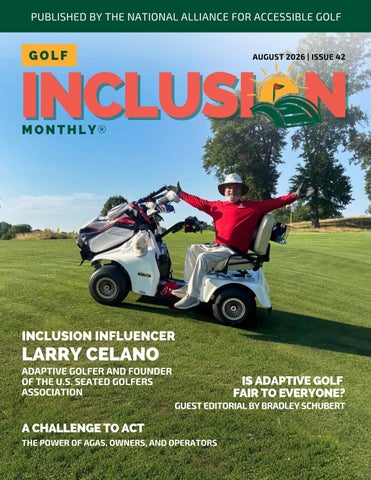
INCLUSION INFLUENCER
LARRY CELANO
ADAPTIVE GOLFER AND FOUNDER OF THE U.S. SEATED GOLFERS ASSOCIATION
IS ADAPTIVE GOLF FAIR TO EVERYONE?
GUEST EDITORIAL BY BRADLEY SCHUBERT
A CHALLENGE TO ACT THE POWER OF AGAS, OWNERS, AND OPERATORS
NATURAL STONE. GROUNDBREAKING SOLUTIONS.
GOLF PATHWAY MIX.
“Kafka’s support of our mission makes it possible for us to deliver education to the golf industry. We are proud to be associated with them and the commitment they have to delivering products that improve accessibility to golf facilities around the country!” Dave Barton, PGA, Executive Director, National Alliance
Click HERE to Connect with Kafka Granite
IN THIS ISSUE AUGUST 2026
A MESSAGE FROM THE ALLIANCE Executive Director, Dave Barton, PGA
ACCESS + INCLUSION
The Alliance is a leader in access and inclusion - increasing the participation of people with disabilities in the game of golf.
INCLUSION INFLUENCERS
Excerpts from an interview with with Larry Celano - adaptive golfer and founder of the U.S. Seated Golfers Association.
GAIN SPOTLIGHT
A CHALLENGE TO ACT
EDUCATION HUB SPOTLIGHT
Highlighting the power of AGAs, Owners, and Operators to bring golfers with disabilities into the game.
Connections that make a difference. Earn your Alliance Recognized Accessible Golf Facility Credential!
IS ADAPTIVE GOLF FAIR TO EVERYONE? Guest editorial by Bradley Schubert
BOARD & STAFF Melissa Low, CAE President Dana Dempsey, MS, CTRS Vice President Jan Bel Jan, ASGCA Secretary Sheryl Bindelglass, CSP ICAE Treasurer Dave Barton, PGA Executive Director
Justin Apel Chava McKeel Ronnie Miles Andrew Yeast Liz Cooper, LPGA Erik Nielsen, PGA Kevin Corn, PGA Rich O’Brien Joe Trauger Mike Tinkey
A MESSAGE FROM THE ALLIANCE For the August 2026 Golf Inclusion Monthly®, we share some actions that we encourage Allied Golf Associations as well as golf facility owners and operators to take that directly supports them and the golfers they serve. Using our FREE platforms to list adaptive golf cars and programs, take advantage of on-line volunteer training for adaptive programs and competitions, and conducting self-assessments to gauge your accessibility are simple things to accomplish that make a big difference to golfers around the country. Our Inclusion Influencer is Larry Celano. If you do not know Larry, you might need to get out more! Larry has established the Seated Golfers Association and is fresh off participating in the 5th U.S. Adaptive Open Championship.
Dave Barton, PGA
Do you have a story to share? Just reach out to us at info@accessgolf.org.
Executive Director
1
WHAT WE DO Advocacy and Awareness In addition to advocating for individuals with disabilities in print and online publications as well as social media marketing and interviews, the National Alliance engages in speaking opportunities at conferences and other public events. The Alliance also hosts GAIN, an adaptive golf community networking and engagement forum.
ACCESS + INCLUSION Our mission is to increase the participation of people with disabilities in the game of golf. The National Alliance for Accessible Golf (National Alliance) is the leader in inclusion — working to ensure the opportunity for all individuals with disabilities to play and participate in the game of golf. Formed in the summer of 2001, the National Alliance is represented by professional associations within the industries of golf, recreation and leisure, and health care providers as well as organizations that advocate for inclusion and provide services to individuals with disabilities. Join the Adaptive Golf Community on GAIN!
Education The Alliance Education Hub provides guidance to golf course owners and operators seeking ways to make their golf courses and facilities more welcoming, accessible, and inclusive to golfers with disabilities, including programs to bring new golfers into the game.
Resources The Alliance delivers resources including ADA guidance, policy templates and more to create accessible, inclusive, and welcoming environments.
www.accessgolf.org • info@accessgolf.org • Phone: (561) 709-8002
2
INCLUSION INFLUENCERS AN INTERVIEW WITH LARRY CELANO CLICK TO LISTEN TO THE ENTIRE INTERVIEW. In this month's Inclusion Influencer Interview, Alliance Executive Director Dave Barton speaks with Larry Celano adaptive golfer and founder of the U.S. Seated Golfers Association
Upbringing, Roots, and Values...“I grew up in Connecticut, my family worked for Mossberg, so we were always into hunting and all that, and I consider myself a loyal person. If you get to know me and I get to know you, you've got my loyalty until you cross that... Everything I've done has always been about loyalty.”
Childhood Aspirations & Military Heart...“Growing up playing with little army guys...my thing was, I was gonna join the Army. I joined the Army to become that person. I'm a soldier at heart, always looking out for the better of the whole. That's why adaptive golf came naturally to me.” Gratitude for Family & Country Support...“I wouldn't have gotten through this without my family. I had great family support, friend support, and I had the country behind me.” Military Support Era & Care at Wilford Hall...“We came through the Vietnam era where they treated soldiers poorly, and then here I got shot... The nurses at Wilford Hall stayed back from leave to ensure wounded soldiers got the care they needed. That was one of the first times I realized how great a country we live in.” Early Fears After Being Paralyzed...“Growing up in the 70s and 80s, people made fun of people that were different, that was my biggest fear when I got hurt. My biggest fear was going out in public and having people see me as half a person. I was a 20year-old paratrooper, I felt invincible, but when those bullets hit, it became a whole different thing.”
3
Getting Shot and Family Support...“I remember when I got shot... you just felt the burning pain, but without my family, I wouldn't have made it through. I remember making the phone call to my grandmother, crying to her: 'You need to get here now, I'm paralyzed.' She was there a day later, and that helped me survive.” Overcoming Fear of Public Outings...“My biggest fear was going out in public, but two key things helped me get over that, one was when the Chicago Bulls were in town to play San Antonio. My nurse Chief came up and said, 'Larry, I got you tickets. You're going to see Michael Jordan and the Spurs tonight.' I was terrified, but I remember people looking... and they weren't staring at me. It was just overcoming that internal mentality that everyone was staring.” Confronting Paralysis with the Chaplain...“The chaplain kept checking on me, and on New Year's Eve, I finally called for him. We went out on the patio, and I just broke down, asking: 'What am I gonna do? How do I get through this? I can't walk anymore... what do I do?' He told me: 'Son, you're gonna get through this just like basic training and everything else in your life. You will become a better person through it.'” Living Life to the Fullest...“Fast-forward: I've gone to concerts by myself, 19 Super Bowls, the World Series... I lived life to the fullest, which ultimately led me right to golf.”
“Once I picked up golf and played that first adaptive tournament down in Virginia, it was like, 'Oh my God!' It changed everything.”
Discovering Competitive Golf...“Once I picked up golf and played that first adaptive tournament down in Virginia, it was like, 'Oh my God!' It changed everything. We're the pros now, it's like, 'You need to watch me now!' That's the competitive mentality I've taken on.”
Organizing Seated Golfers and Goals...“Adaptive carts were becoming a scarce issue, and we felt like the forgotten stepchild of the golf world, present, but overlooked. Being in a wheelchair, I'm done listening to able-bodied people tell us what we need, we needed to organize and speak for ourselves. The goal of the Seated Golfers Association is centered on adaptive carts: if we don't have carts, we can't play, it's that simple.”
Initial Skepticism vs. First Lessons...“I picked up golf in 2001; before that, I always thought golf courses were just a waste of beautiful farmland! I searched the internet for adaptive golf, found instructor Kathy Corbin in Phoenix, and started taking lessons right out of my manual wheelchair.” Transitioning to the SoloRider Cart...“I was stubborn, rolling up big hills in my wheelchair. The pro came out and asked, 'Are you ever gonna take that SoloRider cart out?'”
Distributing Carts & Non-Profit Growth...“Through a Christopher & Dana Reeve Foundation grant, we placed three adaptive carts in key regions: Arizona, Georgia, and Illinois. We formed the Seated Golfers Association to solve equipment shortages, and here we are three years in, building real operational momentum. The three-year mark in non-profits is where you gain true legitimacy, where donors see your track record and step up to back the mission.”
First Round, Milestone Hole-in-One, and Joy...“My first round was a 127, but just two months later, I hit my first hole-in-one, before I ever even made my first birdie! That hole-in-one was sheer luck; it just rolled right up into the hole! When golf came into my life, it was a natural fit because I loved baseball, being outside, and being around people.” 4
Shifting Industry Awareness & Access Rights...“The golf industry now realizes adaptive golfers are coming; parents and players are no longer staying quiet, they are demanding legal access. Debate all you want, but in reality, facilities must provide equal physical access to the game for adaptive players.” Advocacy vs. Litigation...“If you approach course owners threatening lawsuits, they get defensive, we must show them that adaptive inclusion is a win for everyone.” Forest Ranger Parable & Universal Inclusion...“A forest ranger was asked why he built an accessible restroom in the wilderness, and he replied: 'It's not up to us who comes out here, it's our job to provide access.' You can never predict who will show up to play or visit; your sole obligation is to ensure the door is open for everyone.” High Praise for Max Togisala...“Max Togisala is an absolute phenom, and watching him play pushes me every single day to elevate my own game. To suffer a spinal cord injury while preparing for college golf and return a year later dominating at an elite level is breathtaking. Usually post-injury depression sets in, but Max bypassed that and became a beacon of inspiration for the entire spinal cord injury community.” Fulfilling a Dream...“Hosting this championship (Seated Golfers Association Championship) is the fulfillment of a dream I've carried since playing in my very first adaptive tournament years ago. When Ben Brown, Justin Miller, and I set out to create this championship, we leaned on advice from tournament directors across the nation.”
Click on image above for more information about the 2026 U.S. Seated Golfers Championship
The Regional Hub Concept & Financial Model...“We can't expect every single golf course to own an adaptive cart; the solution is a regional hub model where courses share resources. Under a regional hub concept, 5 to 10 local courses pool funds to purchase shared adaptive carts and transit trailers. If 10 courses pitch in $5,000 each, that's $50,000, enough for two adaptive carts and trailers that rotate on 72-hour notice, just like accessible rental cars.
Tournament Budget Realism & Core Goals...“While our ultimate goal is covering 100% of player costs, seeing this championship become reality makes me immensely proud. Our primary goal is bringing seated golfers together under one umbrella to demonstrate to the world what is truly possible.” Highlighting the Seated Division & Demanding Access...“This is wheelchair golfers organizing a worldclass event for wheelchair golfers—seated players face the most significant physical barriers in golf. This tournament puts the entire golf industry on notice: seated golfers are here to stay, and facilities must provide accessible carts. Our championship proves the regional hub concept works—eliminating high shipping costs by pooling local equipment.”
This model eliminates financial excuses: with a minor initial buy-in and maintenance pool, every region with 20 courses gets 4 active carts. A hub network makes it simple for clinics, tournament directors, and traveling adaptive golfers to access machinery nationwide.” Calling for Industry Summit on Carts...“We need the PGA of America, USGA, Course Owners, DOJ, manufacturers, and players in ONE room, that's the only way to solve cart access permanently.” 5
Persistence & Venue Alignment...“Alongside Ben and Justin, our rule is simple: just keep moving forward, when you stay dedicated, everything falls into place. Having the host golf course completely behind you makes all the difference; Whirlwind's team has been beyond ecstatic.” Community Outpouring & Gratitude...“The volunteer outpouring from fellow adaptive players like Andreas and Ryan coming out to support us is deeply moving. Standing among everyone at the U.S. Adaptive Open, the overwhelming love and support from this community brought me to tears. The support is unbelievable, I have so many people to thank who have supported my journey and this mission.” Volunteer Management & Competing...“Managing huge volunteer lists is a new learning curve for me, but a wonderful problem to have! I originally planned not to play in order to focus on hosting, but the overwhelming consensus from players was: 'Larry, you MUST play!'” Contact Info & Personal Accountability...“Visit seatedgolfers.org or reach out to seatedgolfers@gmail.com to get involved. If it ever takes me a day or two to reply, I sincerely apologize, every person who reaches out deserves our full attention.” Future Goals: Access, Training, & Clinics...“Our longterm mission focuses on three pillars: guaranteed course access, certified equipment training, and regional adaptive clinics.” Message to Prospective Golfers: No Limitations...“To anyone sitting at home thinking golf is impossible: there are ZERO limitations. Regardless of your injury, you can play this game. With 15 adaptive classifications in the USAGA, nobody needs to sit on the couch anymore—get out here and reclaim your active life!” Parting Words & Gratitude to the Community...“To everyone out there supporting our movement: I love you all. Your backing means more to me than words can ever express. Thank you to the entire adaptive golf community, players, mentors, volunteers, and supporters. You all hold a special place in my heart.” Editors Note: Published Inclusion Influencer quotes may be paraphrased or abbreviated for conciseness. Be sure and listen to the full audio on YouTube!
6
A CHALLENGE TO ACT
THE POWER OF AGAS, OWNERS, AND OPERATORS By Dave Barton, PGA, Executive Director, National Alliance mission and focus on creating accessible and inclusive places where people with disabilities are welcomed to come learn and play the game of golf. Many may believe that the advent of numerous new and well publicized adaptive golf competitions around the country shows us that “a mission to bring people into the game is complete” and the work is done. An increase in new competitions does not necessarily mean we are effectively bringing people into the game and the question is, are there enough adaptive athletes around the country ready and willing to fill the fields for historically relevant competitions and the growth and new ones? Some will succeed, some will not. There is no disputing these events have great value in showing individuals with disabilities, or perhaps their friends or family members, what may be possible through the game of golf but where do they go to enter the game? Where are they learning? In the July 2026 Golf Business Magazine, National Golf Course Owner (NGCOA) Jay Karen relays, “Even during one of the healthiest periods in the game's modern history, we continue to lose millions of golfers every year. That should concern all of us who care deeply about the future of the game and about the owners and operators whose businesses sustain it.” He goes on to say, “Over my three decades in golf, our industry's attention has understandably been focused on two goals: attracting customers and keeping them. But if we're honest, we've devoted far more energy to the first than the second.”
When it comes to bringing golfers with disabilities into the game, history shows us, as does a recent class of inductees into the inaugural class of the Adaptive Golf Hall of Fame, that these efforts have been going on for a long time…well before the Americans With Disabilities Act (ADA) was signed into law on July 26, 1990. But, even then, enforceable guidance related to accessible golf course design beyond the buildings themselves did not occur until March 15, 2012 when the 2010 ADA Standards for Accessible Design became mandatory for newly constructed or altered golf courses. During this period (September 15, 2010 - March 15, 2012), course operators had the option to use either the older 1991 standards or the new 2010 standards. So, at this point, if you put a shovel in the ground on the golf course to update or build new areas, any affected areas that do not meet the 2010 standards must be brought into compliance.
As a former golf facility operator and manager, I agree with this completely. I also know that when you attract a new golfer with a disability to your golf course, they very often come along with a loyal friend and family network that amplifies the long term benefits to any facility and the community they serve. We know that many golf courses can be better prepared for all golfers, friends and family because we get the calls when 1) either the golfers are not happy because they are not being provided access as they should be or; 2) from the operators who believe they are doing everything possible to provide access.
This is specifically the space in which the Alliance has operated since the mid-90s and continues to operate in today. We were not called the National Alliance for Accessible Golf until 2001, but the efforts to educate and provide resources to the golf industry, facility owners and operators began well before 2000 with a
In plenty of cases the golfer has a valid point, but sometimes they may not. Sometimes the golf course is 7
doing everything right, and sometimes they are not. To be clear, there are many operators who get it right, but opportunities for improvement at many others still exist.
industry. When I say “we”, I mean the Alliance of leading golf associations that formed us, are part of our organization, and whose memberships design, build, operate, and maintain golf courses around the country, including the PGA of America, LPGA, NGCOA, CMAA, NCA, GCSAA, GCBAA and ASGCA.
Since our inception, the Alliance has worked to create and deliver resources and platforms to the golf industry to simplify what a golf facility needs to know and things it should do to facilitate entry into the game for individuals with disabilities. We are the only such organization or association in the golf industry dedicated to this effort.
Question: What can Allied Golf Associations (AGAs), owners and operators do? Answer: Take advantage of the FREE resources the Alliance has created so you can spend your money and efforts elsewhere!
Notice I did not say “...to simplify what a golf facility needs to know to comply with the law,” but if that resonates better with you, so be it.
Allied Golf Associations - In many locations, AGAs are doing a great job of creating new programs and competitions for those who aspire to compete, but we’d encourage you to take that a step further and:
Published policies can help if written correctly. However, operators must begin with an understanding that every golfer is not created equally. As an example only, when a facility tells a golfer with limited mobility, “You can only get 20 yards from the green,” and the course is in great shape and no damage will occur, any number provided seems speculative at best. It's 30 yards some places, 10 in other places, 10 feet at other golf courses, etc., etc. There’s nothing wrong with saying XX yards from the green as long as you remember, no one number will ever work for different golfers who have different access requirements and … are you reacting the same way when a golfer without a disability totally disregards your cart path rules for the day? Are you treating everyone equitably? Are you being reasonable in your application of things that could be considered a “denial of access”?
Ask your member courses to list the programs and adaptive golf cars available at their facilities on the Adaptive Golf Cars, Programs, and Facilities Database. Incorporate the Volunteer and Staff Training we developed for adaptive golf programs and events. It’s there waiting for you on the Alliance Education Hub. Encourage your Member Courses to complete a selfassessment to be a Recognized Accessible Golf Facility and earn a credential we can only hope they would be proud to share. Owners and Operators - As mentioned above, plenty of owners and operators are getting it right, but we know that many still have opportunities for improvement. We are here to help you.
What could a golfer with a disability feel like in this scenario which is being perceived as “access denial” when they are absolutely not going to enjoy the game as some of their playing partners will? In an extreme comparison only (and of course, very unlikely), they might feel the same as an individual that could not reach a hat in the pro shop they wanted to purchase and the shop assistant said, “Sorry, if you can’t reach it, you can’t buy it.” Some things just do not make sense and quibbling over 5 yards in good course conditions presents a classic, and all too common scenario. We get these calls on a regular basis.
Take advantage of the Alliance Education Hub and ensure your facility leadership and staff are informed about how to create and maintain a welcoming, accessible and inclusive facility. List your instructional programs and adaptive golf car availability on the Adaptive Golf Cars, Programs, and Facilities Database. Incorporate the Volunteer and Staff Training for adaptive golf programs and events you host at your facility, easily accessed via the Alliance Education Hub. Conduct a self-assessment to be a Recognized Accessible Golf Facility and earn a credential that tells your community you welcome all golfers.
Per ada.gov, “Businesses must provide people with disabilities an equal opportunity to access the goods or services that they offer.” That means 30 yards from a green may work for some, but may not be an equal opportunity for others. How your staff handles this is but one example of not only how you keep golfers, but how you can easily lose them.
We’ve been doing this for over 25 years and exist to serve the golf industry. We know that these small steps make a big impact in not only bringing golfers to your facility, but keeping them there.
We provide this as one small example to encourage you to help us in our efforts to create a better informed golf
When you email or call us, we answer. 8
Source: Southern Intrigue LLC
GAIN SPOTLIGHT
JOIN THE COMMUNITY. JOIN THE CONVERSATION. “GAIN is not simply a community networking platform, it is the top national resource and education center for the golf industry related to ADA compliance, education, and the game. Existing programs are growing and new ones are developing. But, can we say that golf facilities around the country are universally prepared? No … we can’t say that.” Dave Barton, PGA Alliance Executive Director
CONNECTIONS THAT MAKE A DIFFERENCE We talk each month about GAIN - the Golf Access and Inclusion Network® and its primary purposes of connecting people and facilitating the delivery of education and resources to the golf industry, golfers, family members looking for guidance, and more. GAIN succeeds because committed people choose to be a part of it. Those that are a part of GAIN know all too well that being there to answer a question in a timely and helpful manner makes all the difference in getting someone going towards the right path for what they seek. Whether it's a parent looking for more information about programs for kids with autism, a brother looking for help for his brother who had a Traumatic Brain Injury (TBI), or a golfer or golf course that has a question about the ADA, GAIN is an entry point to information and the adaptive golf community. As it grows, so does the strength of the community. The adaptive golf community wins when you bring your expertise to GAIN. We hope you choose to join us on GAIN!
9
EDUCATION HUB SPOTLIGHT
EARN YOUR ALLIANCE RECOGNIZED ACCESSIBLE GOLF FACILITY CREDENTIAL!
HUB STATS
Are you ready to have your facility identified nationally as a Recognized Accessible Golf Facility? Do you welcome ALL golfers at your facility? Shouldn’t your community know this?
451
The National Alliance for Accessible Golf offers a FREE Self-Assessment tool via the Alliance Education Hub leading you down the path to ensure your facility and your staff meet and understand the compliance requirements set forth in the Americans with Disabilities Act (ADA).
550
Why wait for a call from the Department of Justice, or a golfer with legitimate access requirements that are not being met? The process is simple and includes mandatory AND recommended actions any public golf course in the United States is able to accomplish … and should aspire to do so.
Enrolled Learners
Course Completions
332 Training Hours Completed
Learn how to get started with your assessment by viewing the Self-Assessment microlearning lesson and, of course, reach out to us if you have any questions. Earn and display the badge that says, our facility gets it!
10
The Alliance Education Hub is a FREE service available to anyone in the golf industry.
GUEST EDITORIAL: IS ADAPTIVE GOLF FAIR TO EVERYONE? By Bradley Schubert
Welcome to a new feature in Golf Inclusion Monthly® we will occasionally present, the “Guest Editorial”. Guest editorials will deliver opinions, views and recommendations related to adaptive golf and growing the participation of individuals with disabilities in the game.
Note: Editorials do not necessarily represent the views of the National Alliance for Accessible Golf, but if you see it here, you can assume we believe it is a conversation worth having.
No—adaptive golf isn’t fair to everyone. In recent years, the game has become far more accessible and inclusive than ever before, but true fairness remains elusive and likely always will. The reason is simple: every disability affects how the game is played.
Source: mwaga.org
In this article, I aim to highlight key challenges and offer practical solutions to make competitive adaptive golf more equitable.
This is where the fairness debate in adaptive golf begins.
One of the most debated issues is determining which tee box an adaptive player should use. A universal standard is difficult—if not impossible—because each sport class interacts with the game differently. The problem, I believe, starts with tournament setup, not just driving distance, GHIN handicap, or rankings.
Currently, most tournaments follow the distance recommendations of the United States Adaptive Golf Alliance, which provide three yardage options for men’s sport classes and two for women’s. While helpful, these guidelines don’t fully resolve the issue.
For years, tournaments have emphasized crowning an overall champion. That approach made sense when events were limited to a single disability group, such as amputees. However, as competitions have become more inclusive, that model no longer reflects the diversity of the field. Adjustments are necessary.
A better solution is to treat a single event as multiple competitions. Comparing sport classes is like comparing apples to oranges—no different than distinctions based on gender or age. The focus should shift toward crowning champions within each sport class—men’s, women’s, and senior divisions—rather than forcing a single overall winner.
Today, all players compete on the same course under the same conditions—but not at the same length. That raises an important question: is it truly fair if competitors are not playing comparable setups? Consider a shorter hitter on the PGA Tour, such as Matt Kuchar. The Tour does not allow him to move up a tee box to compensate for distance at events like the U.S. Open. Would it be fair to the field if it did?
Another challenge is that sport classifications themselves are still evolving. Over the years, new classes have been added and definitions adjusted, but the system remains imperfect. The introduction of Paralympic standards has added further complexity. For example, the G8 sport class—covering neurological and coordination impairments—may need to be redefined or divided into more specific categories. 11
One of the most impactful tools introduced by the USAGA is the United States Adaptive Golf Ranking (USAGR). Tournament directors should rely more heavily on this system when determining tee assignments, even before applying sport-class-based distance guidelines. Incorporating driving distance as a secondary factor can add another layer of fairness—but it’s important to remember that distance alone does not determine scoring ability. Many of the most consistent players in adaptive golf are not the longest hitters.
ABOUT THE AUTHOR Bradley Schubert is the President of the Midwestern Amputee Golf Association (MWAGA) and serves as Midwest Trustee for the National Amputee Golf Association (NAGA). He previously maintained the United States Adaptive Golf Ranking (USAGR) for four years and has spent over a decade advising on tournament setup across the Midwest. A former member of the USAGA Competition Committee, Bradley is a strong advocate for inclusion in adaptive golf.
Implementing these changes would address several persistent issues. Structuring events as multiple competitions allows athletes to compete against peers with similar physical conditions, improving fairness. It can also enhance pace of play, as higher-handicap players compete from appropriate tees based on skill rather than being grouped with the entire field. Ultimately, this leads to a better experience for everyone involved.
Do you have an opinion about this article? To comment, simply log into GAIN - the Golf Access and Inclusion Network® to engage with others and share your views in the Open Forum. GAIN is a FREE platform provided by the National Alliance.
At the recreational level, adaptive golfers should play from wherever they feel most comfortable—golf is meant to be enjoyable. But in competitive settings, we must acknowledge that the game isn’t perfectly fair—and focus instead on making it as equitable, inclusive, and rewarding as possible.
Source: USGA
12
“LET ME WIN. BUT IF I CAN NOT WIN, LET ME BE BRAVE IN THE ATTEMPT.” By Steve Jubb, PGA/LM, Special Olympics Golf Sport Resource Team, Past President and Executive Director of the National Alliance for Accessible Golf individual skills (Level 1), Unified golf alternate shot team play (both 9 holes in Level 2, 18 holes in Level 3), and individual stroke play (9 holes in Level 4, and 18 holes in Level 5. Critical to a successful competition were volunteers on the competition committee including technical delegates and officials along with volunteer coordinators. The sport leadership team at Victory Links Golf Course included Vince Eagan, a Special Olympics athlete from Colorado, who participates in multiple sports including golf, alpine skiing, soccer, flag football and tennis. At the 2026 USA Games, Vince was not competing at the Games, but was officiating the competition. He was there for the same reason athletes from all around the U.S. sign up each year – to play and feel included. For Vince, the competition(USGA/Kathryn took a backseat in Riley) 2026. “It’s not about the disabilities,” Vince said. “It’s more of the ability to have the opportunity to help share the sport to our community”. It stopped being just about what he was getting out of Special Olympics and became about what he could do to pay it forward to the next generation.
“Let me win. But if I cannot win, let me be brave in the attempt.” Each Special Olympics athlete takes this oath prior to the start of a competition, usually during the Opening Ceremony of Special Olympics events. On the evening of June 20th, over 3,000 athletes gathered at Huntington Bank Stadium at the University of Minnesota in Minneapolis, MN, for the Opening Ceremony for the 2026 Special Olympics USA Games. The athletes represented 52 Programs from across the United States, and the event brought together 1,500 coaches, countless family members and over 10,000 volunteers, along with 75,000 fans in the audience.
Over the days of competition, some outstanding golf was contested by the 107 Special Olympics athletes (individuals with an intellectual disability) and 47 Unified partners (individuals without an intellectual disability) competing on the links at Victory Links. In the end, the competition led to the awards (Gold, Silver and Bronze) based on scores in each Level.
Golf was first introduced to the official lineup of sports for Special Olympics in 1995 when it made its debut at the Special Olympics World Games in New Haven, CT. At the 2026 Special Olympics USA Games, the golf competition began on June 22nd at Victory Links Golf Course which is part of the National Sports Center in Blaine, MN. The USA Games hosted 5 levels of competition over 4 days:
Each of the Special Olympics athletes who competed all have different stories. Each got to the USA Games on different paths. But for each while the medals are important, Special Olympics is something more than just sports. It is about being included not only in sports but in life. 13
For those interested in making the game more accessible, connect with your local Special Olympics Program. Whether by volunteering, coaching, hosting competitions, or creating new playing opportunities, you can help expand access to the sport and inspire the next generation of golfers.
GOLF GOLD MEDAL AWARDEES LEVEL 1 (4-day cumulative points in Skills competition) Division 01: Samantha Brasher (Alabama) - 233 Division 02: Kristine Miller (Minnesota)- 215 Division 03: Kayla Helferich (South Carolina) - 176 Division 04: Steven Deutch (Florida) - 275 Division 05: Justin Egbe (Alabama) - 209 Division 06: Ryan Bailey (West Virginia) - 180
As the Chairman of Special Olympics (Tim Shriver) once said, “CHOOSE TO INCLUDE.”
LEVEL 2 (9 hole Unified – 4 days) Division 01: Jared Sundby & Eric Sundby (Ohio) - 192 USGA Opening Ceremonies Division 02: Richard Olson & Lawrence Larson (Minnesota) - 232 Division 03: Troy Pickens & James Cheely (Kentucky) - 238 Division 04: Carley Dorsey & Gregory Dorsey (Colorado) - 215 Division 05: Megan Brazell & Peter MacCrea (New York) - 246 Division 06: Michele Loebl & Shannon Adams (Tennessee) - 214 Division 07: Atheena McClaughry & Katherine Baumberger (Oregon) - 251 Division 08: Alise Hazelett & Donna Hazelett (Indiana) - 265 Division 09: Rebecca Nerney & Keiko Arzouman (California – South) - 297 LEVEL 3 (18 Hole Unified – 3 days – weather suspension) Division 01: Nathaniel Mills & Perez Plater (District of Columbia) - 247 Division 02: Connor Bosse & Thomas Bosse (Tennessee) - 281 Division 03: Chase Hertog & Steve Hertog (Massachusetts) - 292 Division 04: Robert Grist & Justin Schanck (Florida) - 317 Division 05: Marie Gonzalez & Nicholas Cooper (Florida) - 356 LEVEL 4 (Individual Stroke Play 18 holes – 3 days - weather suspension) Division 01: Steven Ledesma (California – South) - 124 Division 02: Michael Daniels (Arizona) - 146 Division 03: Jacob Zydowsky (Wisconsin) - 155 Division 04: Jeffrey Jenks (Wisconsin) - 160 Division 05: Alexander Vucetic (New Jersey) - 170 Division 06: Felicity Woods (Oregon) - 164 Division 07: Margaret Stephens (Florida) - 171 Division 08: Mallory Smith (Washington) - 190 LEVEL 5 (Individual Stroke Play 18 holes - 3 days – weather suspension) Division 01: Scott Rohrer (South Carolina) - 218 Division 02: Brett Geiger (New York) - 241 Division 03: Zachary Duncan (North Carolina) - 250 Division 04: Tyler Tolleson (Kansas) - 347
14
ADAPTIVE GOLFER CATHY WALCH TAKES HER GAME TO THE INTERNATIONAL STAGE By Abby Grizzard | Shared with Permission from Gwinnett Daily Post Cathy Walch’s license plate reads: “I hate golf. I hate golf. I hate golf. Nice shot. I love golf.” Buford’s Walch is an instructor at PGA TOUR Superstore’s Sugarloaf store in Lawrenceville and is also an amputee. She has been selected to play for Team USA adaptive golf team in Spain, competing for the Cairns Cup against Team Europe this weekend. An adaptive golf tournament is a competition for golfers with physical, visual or intellectual impairments. Competitors use modified equipment or rules tailored to their abilities — such as specialized single-rider carts, prosthetics or physical guides to play the game alongside their peers. Walch has become a pioneer in adaptive golfing but started out as a young woman who fell in love with the game. “I got into (golf) because of my parents,” said Walch. “My mom and dad were avid golfers, and my dad approached the high school golf coach, Jan Fuller, and asked if I was interested; would she coach me? She was all over it and wanted to bring me in. “After practicing the fundamentals, I went out to play golf at a course my parents would go to. I played nine holes and came in with a score of 70. That’s not very good. But I remember to this day, Jan telling me I came into the clubhouse with ‘that big smile on your face.’ I did it. I finished nine holes.”
“My first adaptive tournament was in Las Vegas in the middle of June — it was 107 degrees in the shade,” said Walch. “When I first got there, to be honest with you, I wasn’t quite sure what to expect because I’d never really been around a lot of people like me before. We were in good spirits and able to joke around about [our conditions], and growing up, it’s not something we joked about. It’s the only way to get through it. It was that experience that helped me come out of my shell more. I felt like I could do this and that it’s OK to be different.”
Walch came full circle as she became an instructor at PGA Tour Superstore and took on the role Fuller once fulfilled for her. The role came naturally to Walch as she taught in the suburbs of Chicago before moving to Georgia and is now combining her two passions. “I called her a few weeks ago and said, ‘I am finally stepping into your position now; I’m going to teach (golf).’ She was so excited about it,” said Walch. “She really has been my mentor. She’s the one who got me involved in my very first adaptive tournament in 1981.”
Walch reflected on some of her mentors and peers, like Bob Buck, the founder of the Eastern Amputee Golf Association, who took her under his wing at the young age of 15, and David Windsor, PGA Adaptive Golf Director, Georgia State Golf Association, who introduced her to the adaptive golf program.
In addition to her recent role as an instructor, Walch has left a lasting legacy in the sport of adaptive golf. 15
She explained that Windsor is the one responsible for all of the clinics and tournaments that are held every year in Georgia and that it’s been very instrumental in the growth of golf.
EUROPE MAKES HISTORY AT THE CAIRNS CUP 2026 IN A CELEBRATION OF WORLDCLASS ADAPTIVE GOLF
“There are moments that you would think that we’re all just playing golf, but when I take time, sit back, and I look, and see people be able to get in and out of the traps, it makes me thankful that I have those people to look up to,” said Walch. The experiences and tribulations Walch faced brought her to a pivotal moment in her career, the Cairns Cup.
Europe secured a historic 18-6 victory to lift The Cairns Cup for the first time under the captaincy of Kris Aves, the scoreline did not reflect just how closely contested the matches were. Across the three days, numerous matches went to the 17th and 18th holes, with many contests decided only at the very end. The standard of golf was exceptional throughout, producing thrilling finishes that showcased the remarkable talent of adaptive golfers from both continents.
“I have a great deal of pride,” said Walch. “It’s an honor to be chosen to represent and be one of the 16 of us that are going to be representing our country. We have to represent for 250 years. We have an undefeated record in the U.S. against Europe, so we’re hoping that we’re going to keep that going.” Walch then elaborated on those who participate in adaptive golf. Other disabilities, such as stroke victims, those with autism, Down syndrome, seated players, and more can find a safe space in adaptive golf.
Every player demonstrated outstanding courage, determination and sportsmanship, earning the admiration of spectators, volunteers and officials alike.
“Most of my early part of my golfing career had, mostly, been me missing an arm,” Walch explained. “It wasn’t until I got involved with the Georgia State Golf Association that I realized there are so many adaptive needs that you wouldn’t even think of.
The victory marks a historic milestone for Team Europe and reduces the overall series to USA 2 – Europe 1, setting up an eagerly anticipated return of The Cairns Cup to the United States in 2028.
“I’m 60 years into being an amputee, and I’m a lot better, but, for a long time, I tried to kind of hide it a little bit. Then I started going to these amputee tournaments, and I remember thinking, ‘This is the one time I’m putting it out there. This is me.’”
16
NEWS FROM THE ADAPTIVE GOLF COMMUNITY GIRLS GOLF - FREDERICK, MD HOSTED THEIR FIRST U.S. DEAF GOLF ASSOCIATION YOUTH CAMP
REGISTER: 2026 U.S. SEATED GOLFERS’ NATIONAL CHAMPIONSHIP September 28-30 - Whirlwind Golf Club at Wild Horse Pass (Chandler, Arizona) Registration is officially open for the 2026 United States Seated Golfers Championship! This premier event brings together seated golfers from across the United States and around the world to compete at the highest level in a championship designed specifically for athletes who use adaptive mobility devices. Important Information - Due to the specialized nature of adaptive mobility equipment, player field size is limited. Registration does not guarantee acceptance, as final confirmations will be based on equipment availability and event logistics. We are excited to welcome players from across the country and around the world to Arizona for this incredible event. If you have any questions, please reach out through the contact information on our website. We look forward to seeing you in September!
17
CAMARADERIE AND COMPETITION HIGHLIGHT 71ST ANNUAL MICHIGAN ADAPTIVE GOLF CHAMPIONSHIP
By Ben Shockley | wilx.com | Published: Jul. 27, 2026 at 5:37 PM EDT BATH TOWNSHIP, Mich. (News 10) — Robby Donarski of Wisconsin shot a one-under par 71 on Sunday to win the 71st annual Michigan Adaptive Golf Championship by one stroke at Hawk Hollow Golf Club.
SHARE YOUR NEWS Do you have an upcoming adaptive golf tournament or event that you want people to know about? Would you like to share your tournament stories and results with the adaptive golf community? Just let us know by the start of the month and we'll do our best to get in the upcoming edition! Email your news to info@accessgolf.org.
Photo: Candace Oehler
18
JOIN THE COMMUNITY. JOIN THE CONVERSATION. GAIN is your community ... a free networking forum to foster better access to adaptive golf experts across the country and resources to serve the community of golfers with disabilities and those that lead and support these efforts. All are welcomed on GAIN ... those seeking information about adaptive golf, the ADA and more with those that can provide the answers. ADA & Accessibility Competition & Rules Facilities, Programs, Adaptive Golf Cars Calendar of Events Open Forums
CONTACT US
FOLLOW US
Address: 5500 Military Trail, 22-261 Jupiter, FL. 33458
Email: info@accessgolf.org
ADVERTISE WITH US
Phone: (561) 709-8002
Website: accessgolf.org
Interested in supporting the Alliance through advertising in Golf Inclusion Monthly, please contact us at info@accessgolf.org