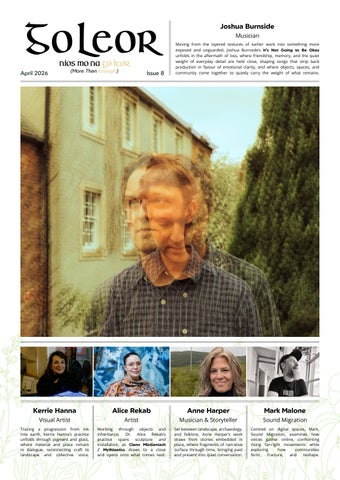
Joshua Burnside
Musician
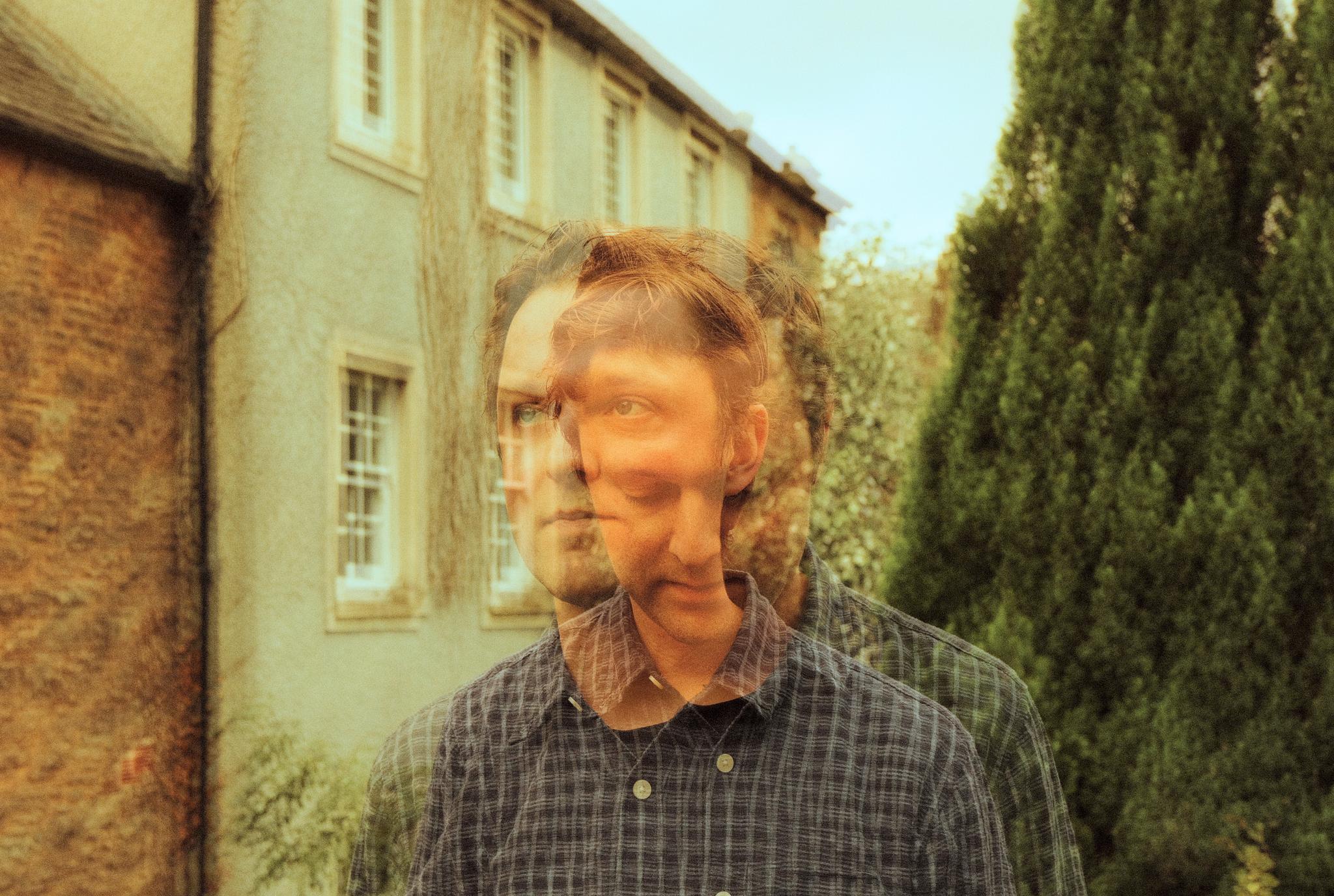
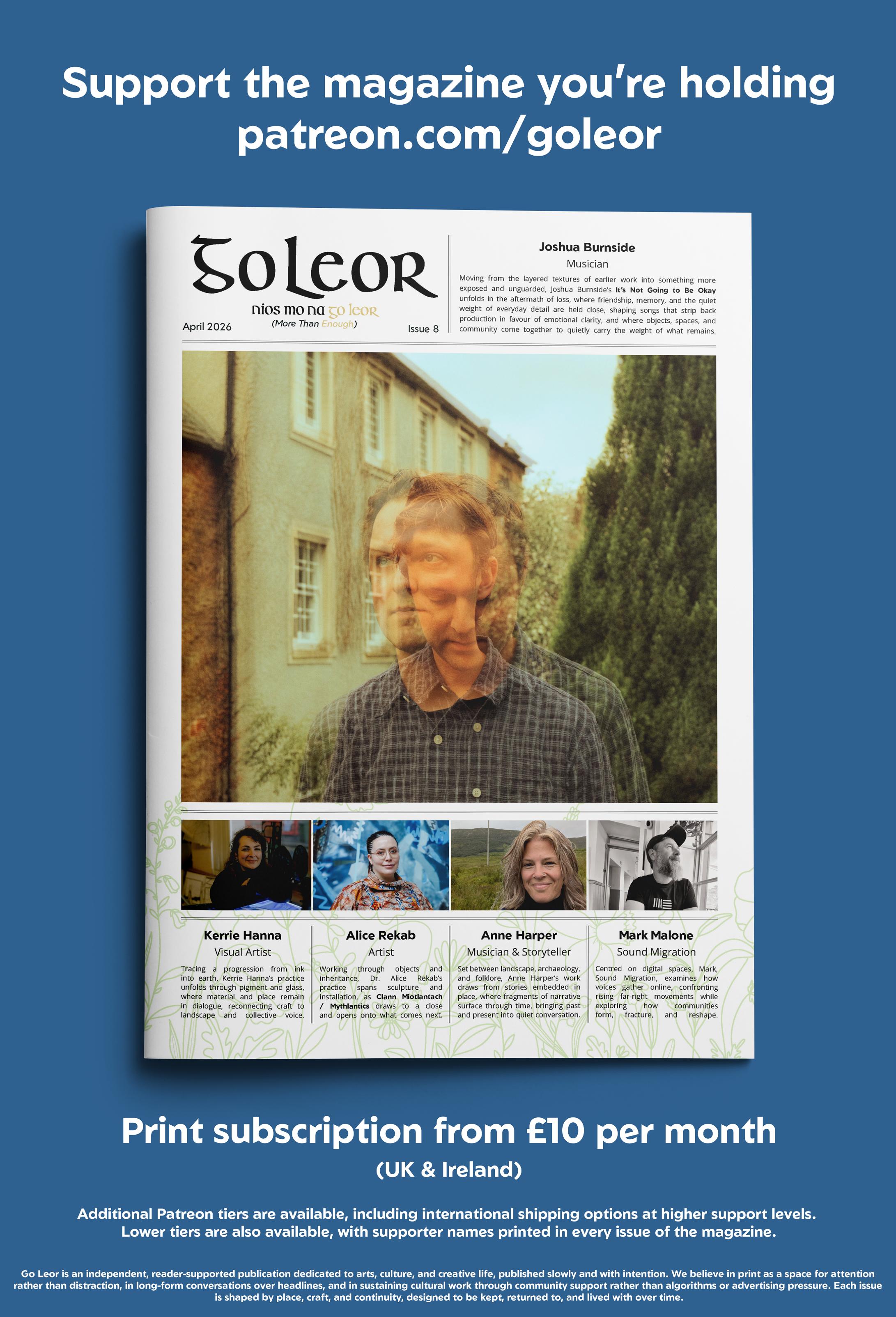
Moving from the layered textures of earlier work into something more exposed and unguarded, Joshua Burnside’s It’s Not Going to Be Okay unfolds in the aftermath of loss, where friendship, memory, and the quiet weight of everyday detail are held close, shaping songs that strip back production in favour of emotional clarity, and where objects, spaces, and community come together to quietly carry the weight of what remains.
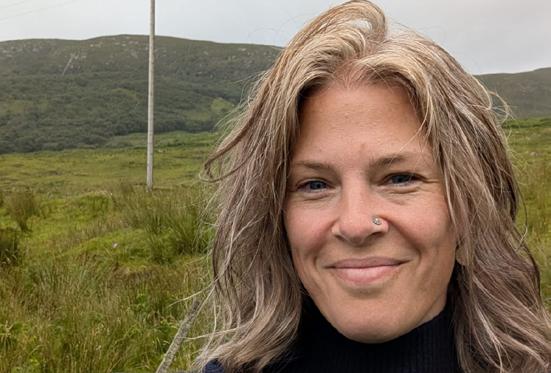
Anne Harper Musician & Storyteller
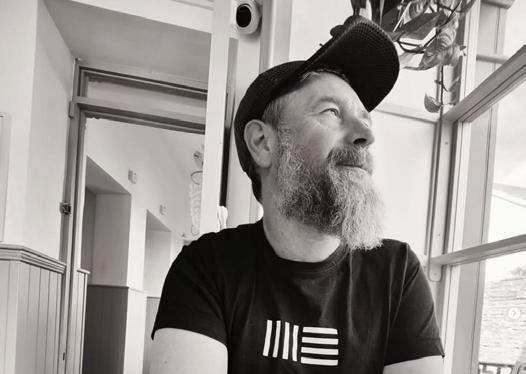
Mark Malone
Sound Migration
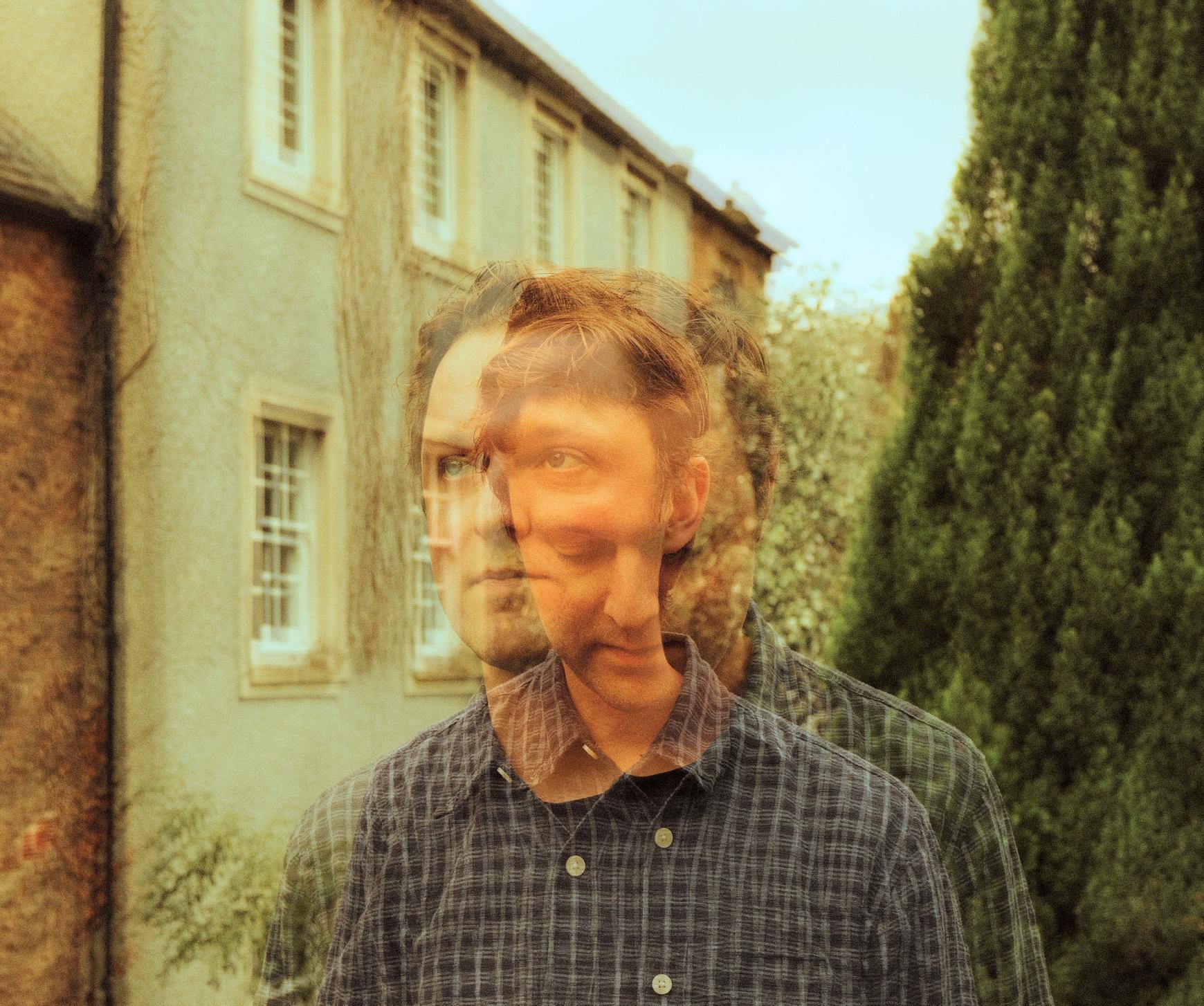
Tracing a progression from ink into earth, Kerrie Hanna’s practice unfolds through pigment and glass, where material and place remain in dialogue, reconnecting craft to landscape and collective voice.
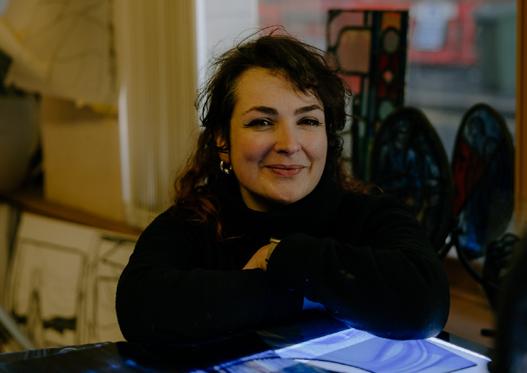
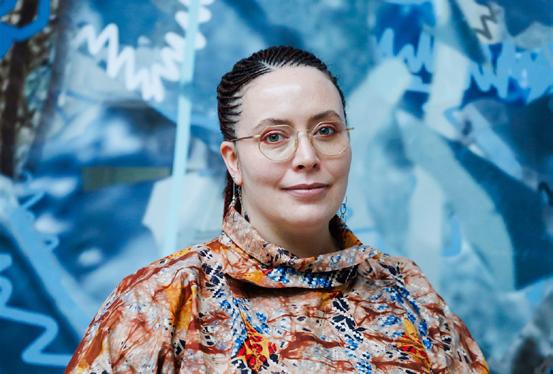
Working through objects and inheritance, Dr. Alice Rekab’s practice spans sculpture and installation, as Clann Miotlantach / Mythlantics draws to a close and opens onto what comes next.
Set between landscape, archaeology, and folklore, Anne Harper’s work draws from stories embedded in place, where fragments of narrative surface through time, bringing past and present into quiet conversation.
Centred on digital spaces, Mark, Sound Migration, examines how voices gather online, confronting rising far-right movements while exploring how communities form, fracture, and reshape.
Alice Rekab Artist
Kerrie Hanna Visual Artist
Visual Artist
Alice Rekab Artist Page
Joshua Burnside Musician
Anne Harper Musician & Storyteller
Mark Malone
Sound Migration
Kerrie Hanna
Founding Supporters
This issue is supported by:
Mark Marianna J Dunn
Go Leor is built independently and sustained by its readers. Thank you for helping this publication grow.
Legal & Support
© Go Leor 2026. All rights reserved. No part of this publication may be reproduced, stored, or transmitted in any form without prior written permission from the publisher. Visit us at go-leor. co.uk. The views expressed in this magazine are those of the contributors and interviewees, and do not necessarily reflect the views of Go Leor or its editorial team. For all queries or correspondence, please contact support at support@goleor.co.uk
Kerrie Hanna Visual Artist
Ancient pigment and endangered craft meet feminist reclamation and community authorship in a practice rooted in land and light
There are artists who move between mediums - and then there are artists who carry a thread through them.
Kerrie Hanna’s work sits firmly in the latter. Her practice spans stained glass, mural, illustration, fused glass and foraged pigment painting, but what binds it is not variety - it is a steady deepening. Each shift in material marks a further step inward and outward at once: into her own process, and into the landscapes that shape it.
For Hanna, that movement did not begin with rock or pigment, but with something far less fixed.
From Ink to Earth
Before the materials were gathered, they were imagined.
“I really began to connect to making art as an active meditation, to get into my body and explore my inner world more deeply,” she says. “The rules are simple: create free
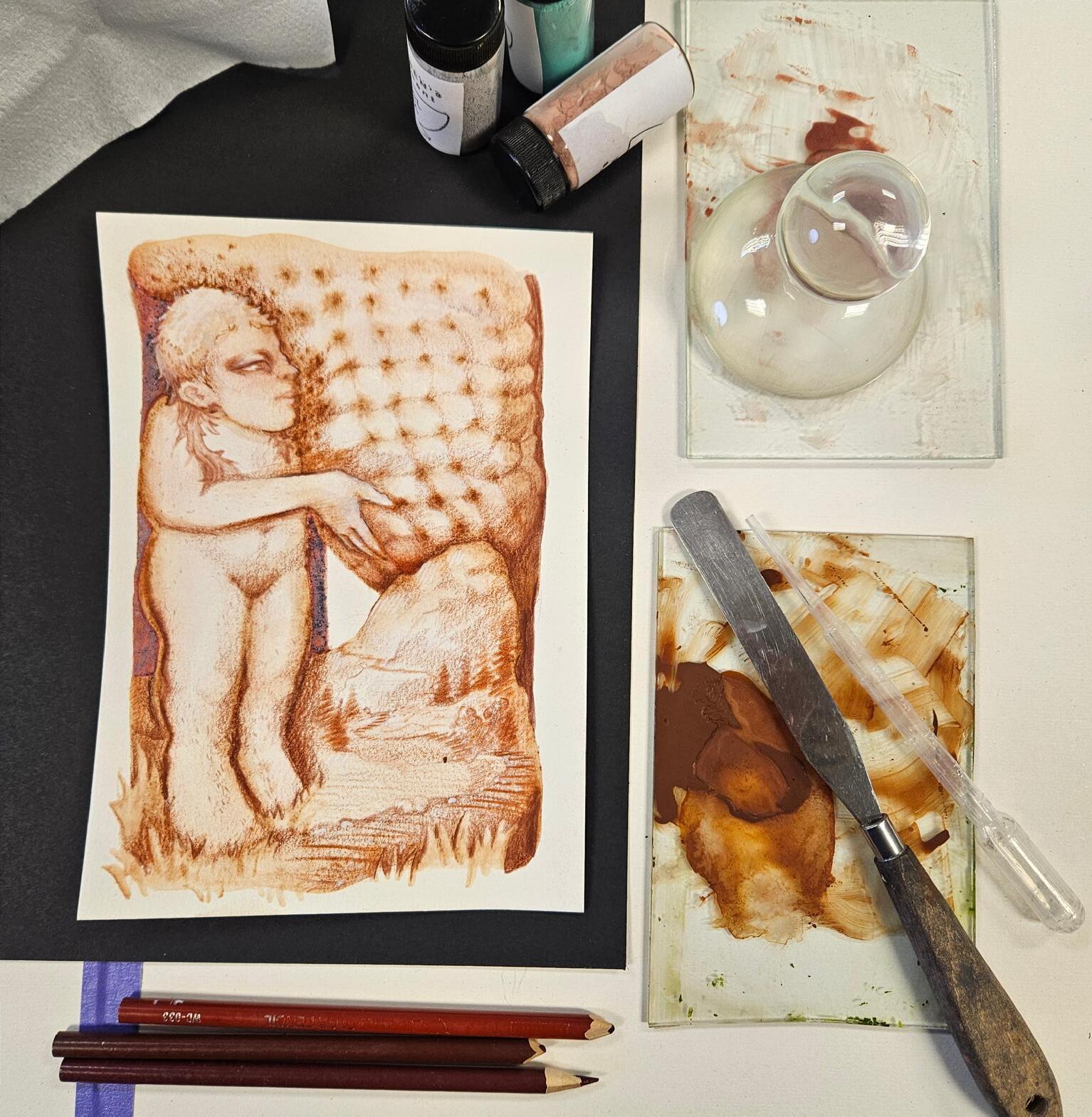
flowing shapes, and then once dry, begin to work into them to see what stories and imagery emerges.”
These early works - built from inkblots and intuitive forms - became a kind of language. A way of allowing imagery to surface without force or expectation. What emerged, however, began to take on a surprising consistency.
“Much of the imagery reflected the Irish landscape, characters, emotions - and, as a surprise to me, rocks.”
What began as internal soon started to point outward. The shapes she was uncovering in ink seemed already rooted in something older, something physical. The work began to ask for material.
A Return to Material
That shift coincided with a growing sense of disconnection.
“My brain felt like it was full of thousands of other people’s thoughts, other people’s words. There was a disorientation about it, and I began to intuitively seek out grounding processes in my work.”
Grounding, for Hanna, meant moving away from the screen and toward the tangible. Toward processes that required time, weight, and touch. The transition wasn’t abrupt - it un-
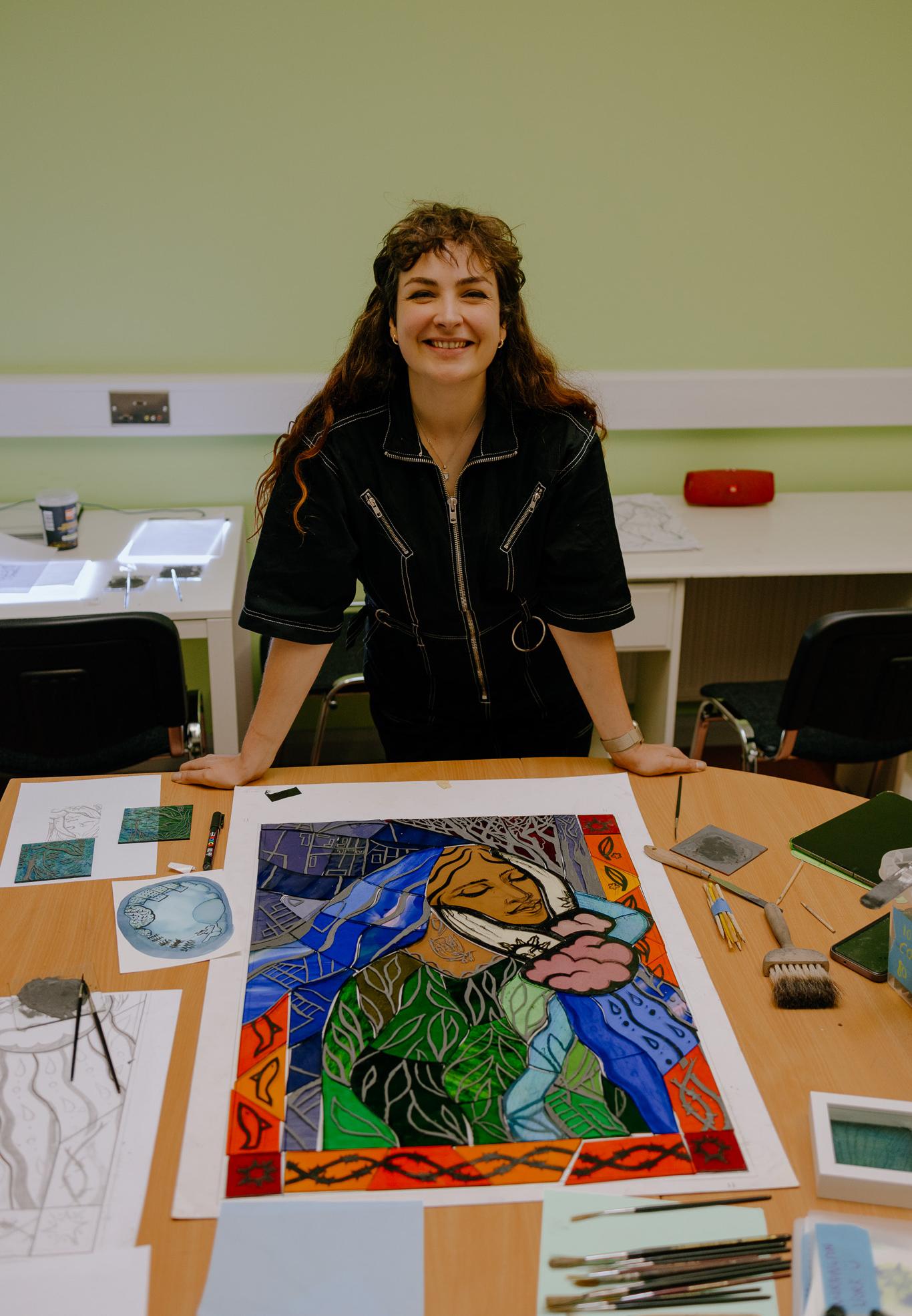
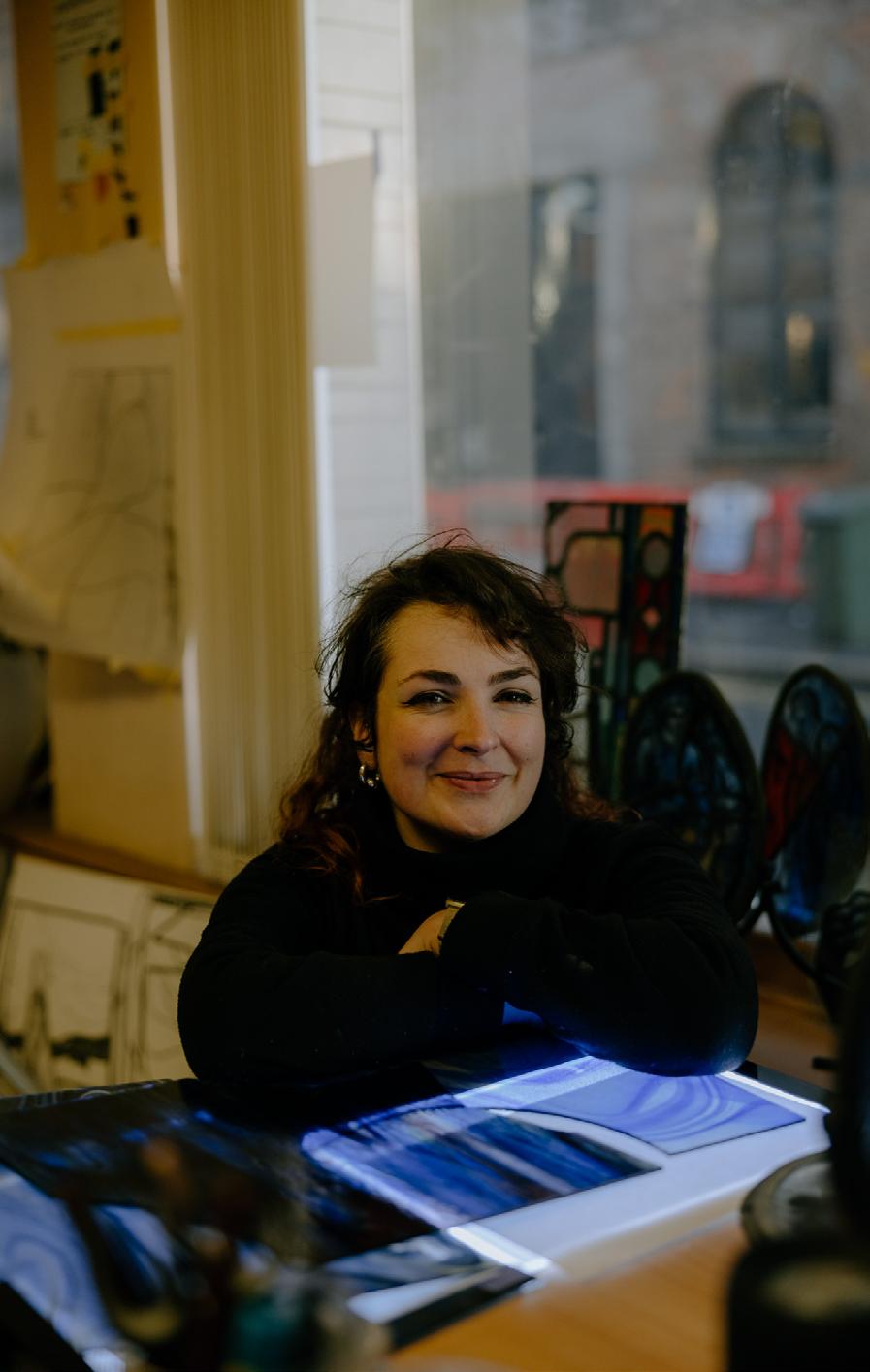
Kerrie Hanna - Photographed by Kate Donaldson @katedonaldsonphotography
folded gradually, as if the work itself was leading her there.
The rocks that had first appeared in her ink drawings became something she could hold. Clay could be gathered. Pigments could be made. Colour could be built from the ground up.
“For the past two years I’ve been using foraged pigments within my paintings. I became totally fascinated by the idea of - how do I create a work somewhere, which can only be created there?”
It was no longer just about image. It was about origin.
Learning the Language of Pigment
A key turning point came through her engagement with pigment-making, and in particular through learning from Tricia Kelly of Ócar
Through that process, Hanna began to understand not just how colour is made, but how it carries place within it. Grinding, levigating, binding - each step slowing the act of painting into something deliberate and considered.
“I am so fascinated by using ancient pigments which have so much lore and depth attached
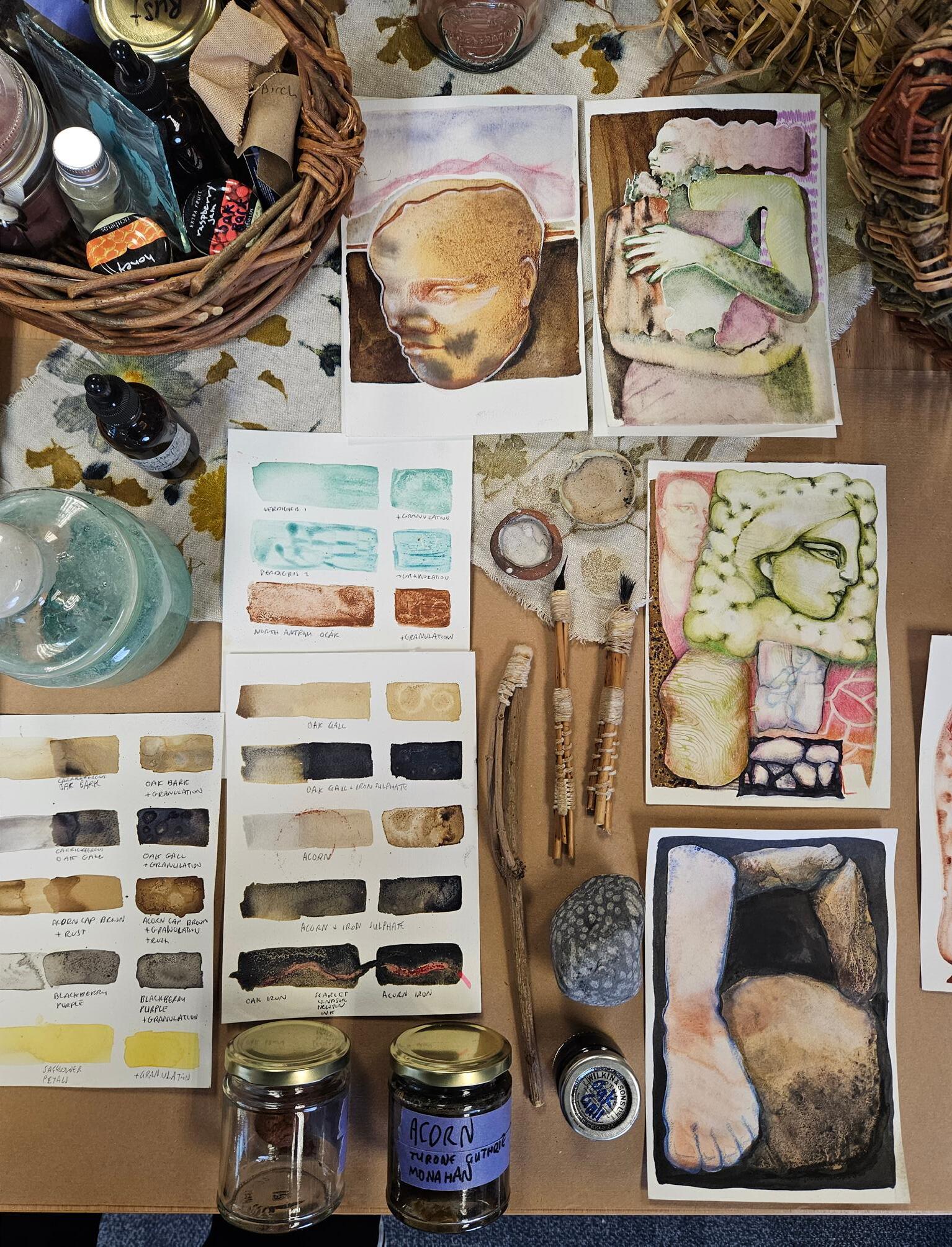
to them,” she says. “And also from an ecological standpointusing local pigments to connect to the land more deeply, and to move away from petroleum-based paints.”
Ochre, in particular, became a point of focus.
“I was amazed to find that ochre is found in an inter-basaltic layer running around the North Antrim coast.”
Formed through volcanic activity millions of years ago, these iron-rich deposits sit quietly within the landscape - often extracted and discarded as part of quarrying processes.
“The ochre which is pulled out alongside is essentially viewed as a waste product, and often left beside the quarries unused.”
In Hanna’s work, that overlooked material is reactivated. Not as a novelty, but as a continuation - a way of allowing the land to re-enter the image not as subject, but as substance.
What the Work Carries
There is a growing sense, across Hanna’s practice, that the work is less about representation and more about relationship.
“I am the first generation to not be living on the land, with many of my predecessors working with the land as farmers,” she reflects. “So maybe a little of their legacy is touched on by me being drawn to dig for my own materials and process them by hand.”
That connection does not arrive as nostalgia. It emerges through process - through repetition, through labour, through attention.
The earlier ink works, with their
Donaldson @katedonaldsonphotography
open-ended forms, still sit beneath everything. But now they are anchored. The shapes that once floated now carry weight. The imagery that once surfaced from within now meets the material world halfway.
There are traces of folklore, of ancient sites, of figures that feel both familiar and slightly out of reach - but they are never imposed. They emerge in the same way the earliest ink forms did: slowly, and with a degree of unpredictability.
“I have always loved visiting ancient sites and neolithic cairns, and the mystery and intrigue of the layers and layers of meaning and stories found there.” That sense of layering - of time, of material, of meaning - runs throughout the work.
An Ongoing Process
What defines Hanna’s practice is not a fixed style, but a willingness to follow where the work leads.
The progression from inkblot to rock, from image to material, from observation to making, is not presented as a finished journey. It is ongoing - each stage opening into the next.
“Embedding place into my work, reconnecting to these practices, brings me so much joy and reminds me of the magic to be found within the natural world.”
There is a quiet clarity in that approach. A sense that the work does not need to declare itself loudly to hold weight.
“The paintings are often more honest than you will be with yourself,” she says. “But when you surrender to that process, that honesty - that connectionis when I know a piece has been successful.”
In Hanna’s work, that honesty is not just found in the image. It is built into the material itself - carried from ground to hand, and back again.
Stained Glass in a New Setting
Parallel to pigment, Hanna continues to work in stained glass - a craft now listed on the Red List of Endangered Crafts.
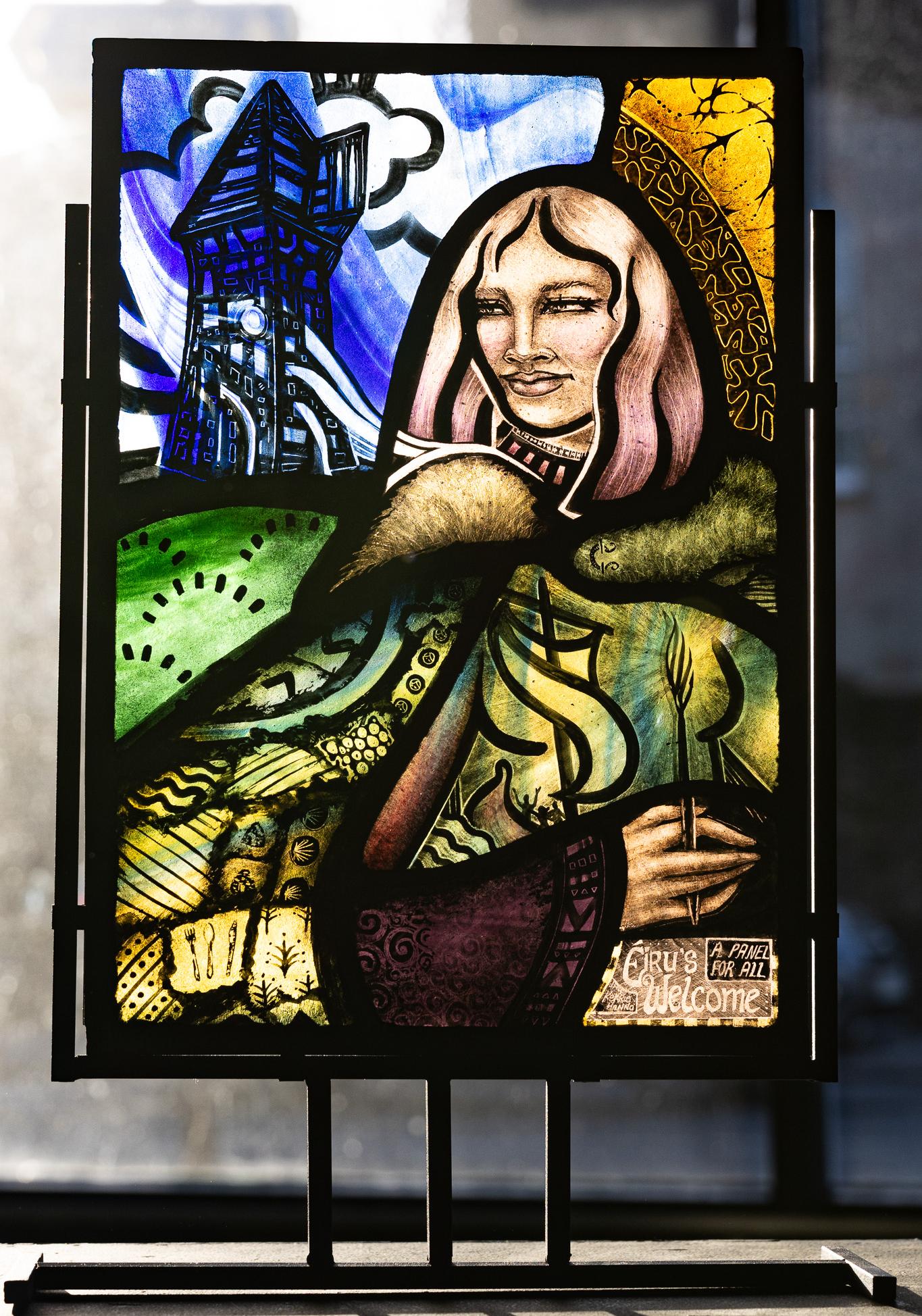
Her practice has been shaped by institutional collaboration. “It was really an honour to be asked to work with NGI by Marie Lynch, Curator of the Centre for the Study of Irish Art at the National Gallery of Ireland.”
Responding to An Túr Gloine:
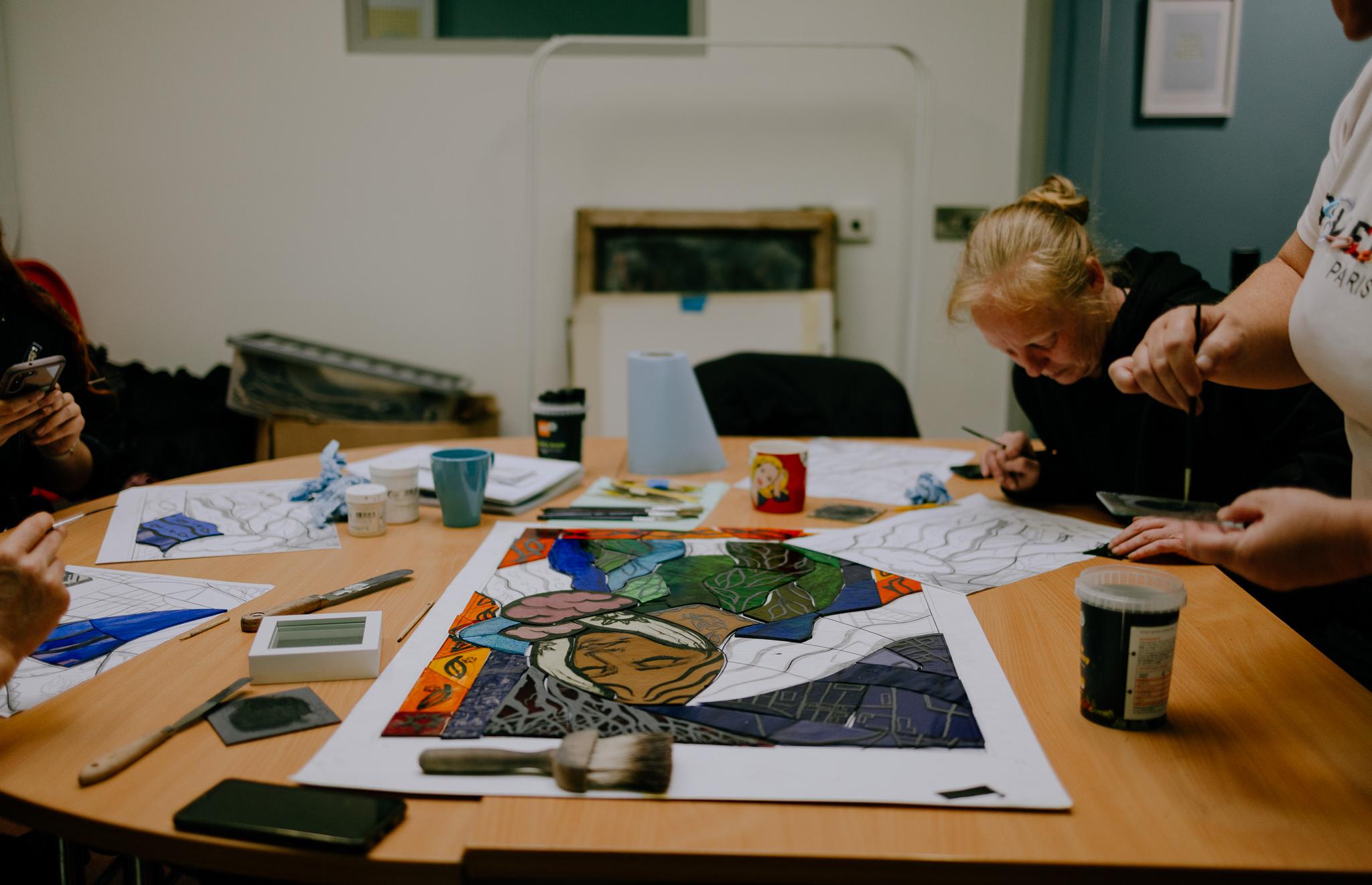
Artists and the Collective - the early 20th-century stained glass movement led by Sarah Purser - she worked alongside young people, including the National Gallery of Ireland’s Apollo Youth Panel, to create Éiru’s Welcome; A Panel for All, a panel celebrating Ireland as a proudly multicultural country.
“The process of working with the collections of Irish stained glass directly informed my approach to working within glass -
Photographed by Kate Donaldson @katedonaldsonphotography
from both an aesthetic perspective and a thematic one.”
With the National Trust, she brought young school leavers from the Yeha Project to Divis Mountain, exploring foraging and plant identification before translating that experience into glass.
“Instead of memorialising within a church setting, these panels memorialised a moment in time, with a particular group.”
She is honest about the emotional weight of such recognition.
“Of course I would be lying to say I didn’t get a sense of validation from working on projects like this - they do help carve out a path and shed a little light on an endangered craft.”
Yet the deeper achievement lies in reframing stained glass itself.
“With stained glass window making being on the red list of endangered crafts, I do feel a sense of pride working on projects which help highlight how the medium can be used within new settings and opening to new audiences.”
Cailleach and Collective Power
Hanna’s responsibility extends into curating. Cailleach, co-curated with Zippy & Wee Nuls at Vault Gallery, centred on the archetype of the crone.
“We all connected to her story, her power to move landscapes and shape winter, and also her role as a representation of women’s inner power and learning.”
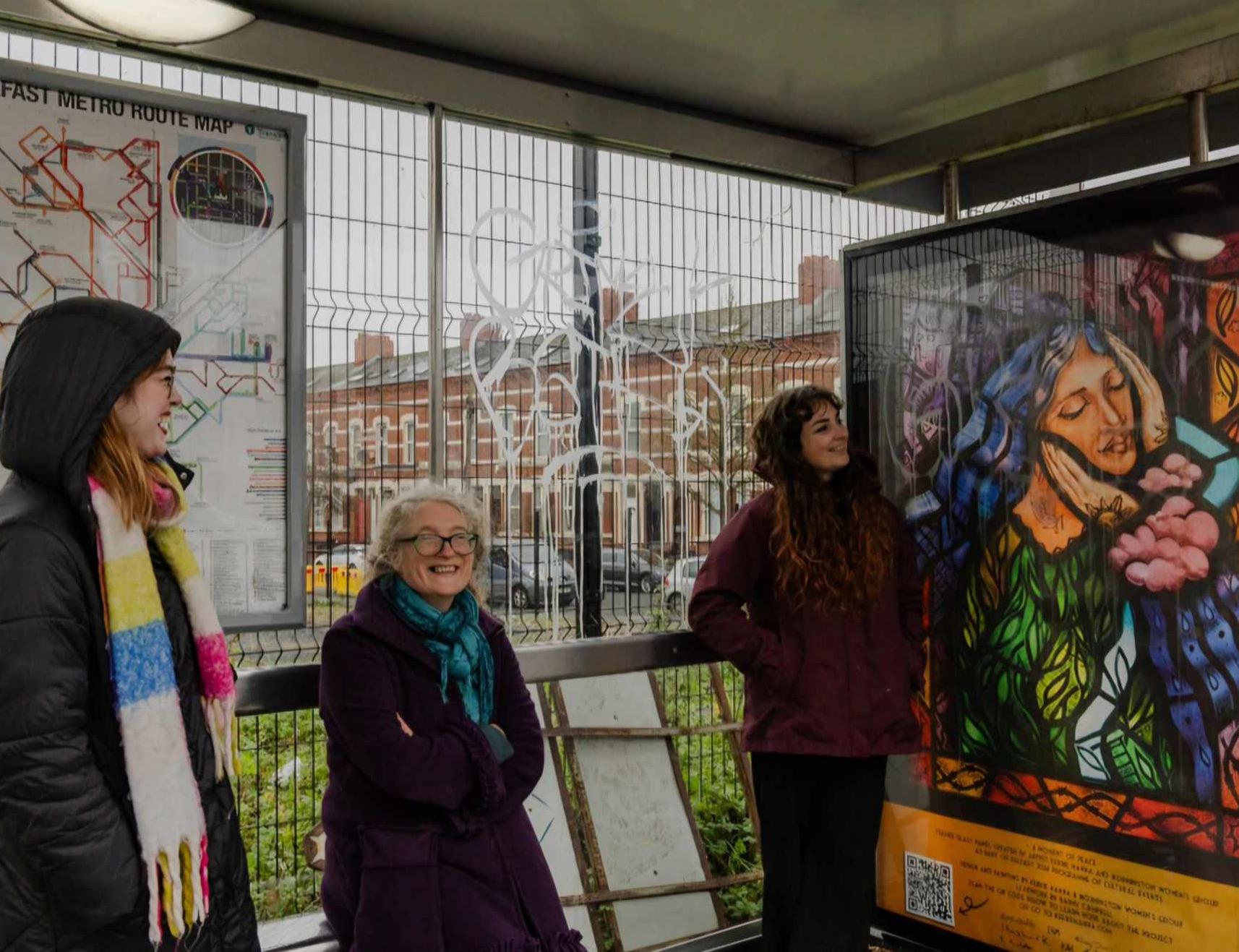
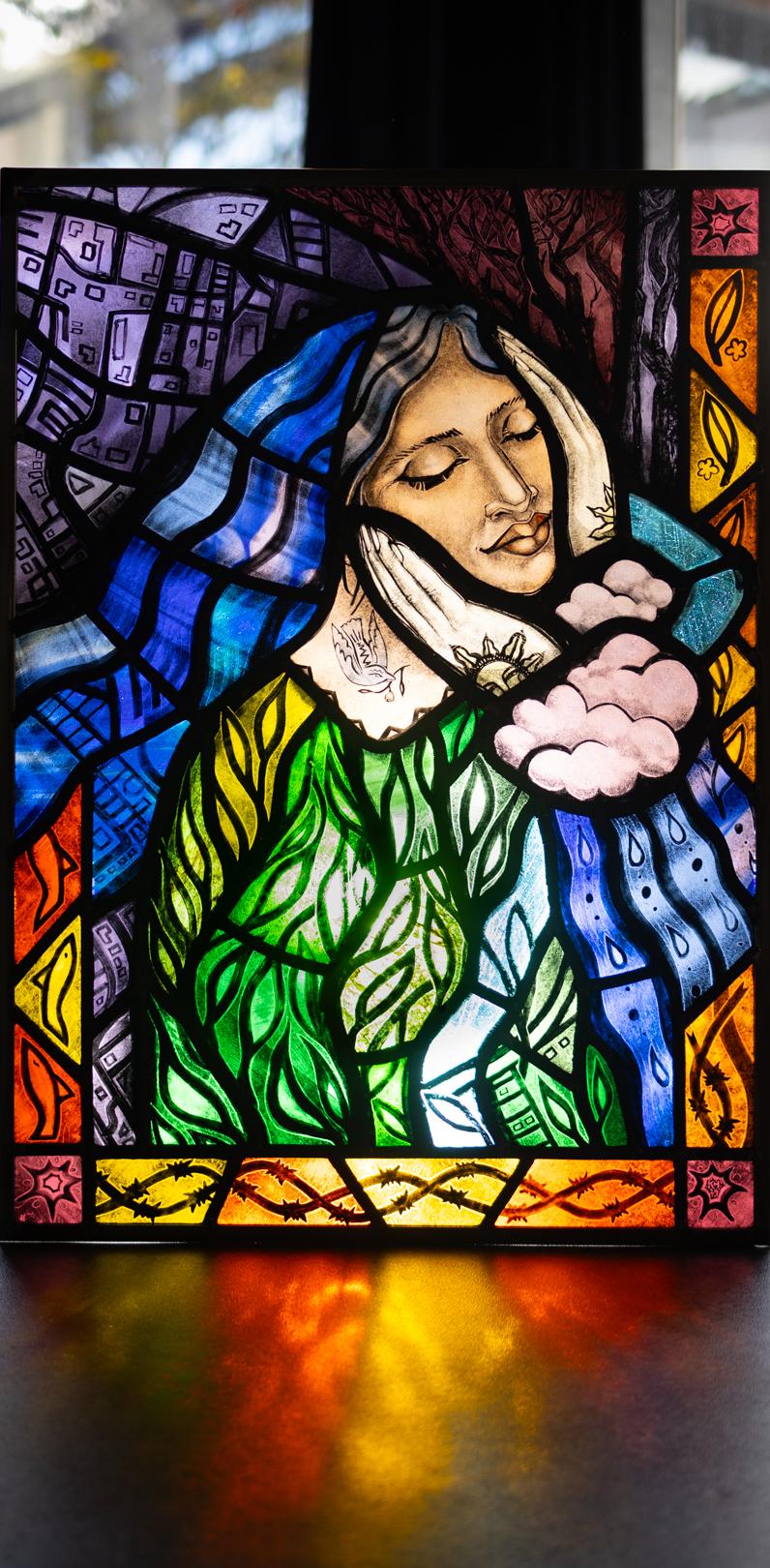
A Moment of Peace - Photographed by Kate Donaldson @katedonaldsonphotography
For Hanna, the crone is not stereotype but aspiration.
“The crone – to me – represents a deep inner knowing. Discernment and intuition which is gained from life experience. While the patriarchal systems impose a youth-obsessed culture, what if we were to uplift the crone as an aspiration – to celebrate our hard earned wisdoms.”
Her feminist perspective is clear.
“Being a feminist is a core part of my perspective on the world - both in the importance of uplifting women but also in addressing inequalities within the world, and art has the power to do that.”
The exhibition addressed the demonisation of healer women
and the ongoing realities of violence against women, including trans women, situating myth within lived urgency. Hanna exhibited her Inner Landscape paintings there for the first time, alongside a stained glass panel co-designed with Mornington Women’s Group exploring Belfast’s evolving story post-ceasefire.
Authority and Negotiation
With fifteen years in community arts, rooted in Northern Ireland’s peacebuilding context, Hanna approaches co-design as both craft and civic practice.
“The co-design process is something I have developed to incorporate open group discussions, art-making to develop symbols which are important to the group’s core beliefs or themes. The artwork is negotiated, im-
agined together, and layered.”
“Participatory design changes the power dynamic within the process, and if done well, produces artworks all the stronger for the multiple perspectives within them.”
She acknowledges the balance required.
“It can be a tricky balance to represent a broad range of opinions and symbols… so I do think there is a balance of coming to the group with some parameters to allow freedom within those themes.”
Skill-sharing remains central.
“As much as possible I also share the stained glass painting skills with the participants… so it truly is a collaborative work from the start to finish.”
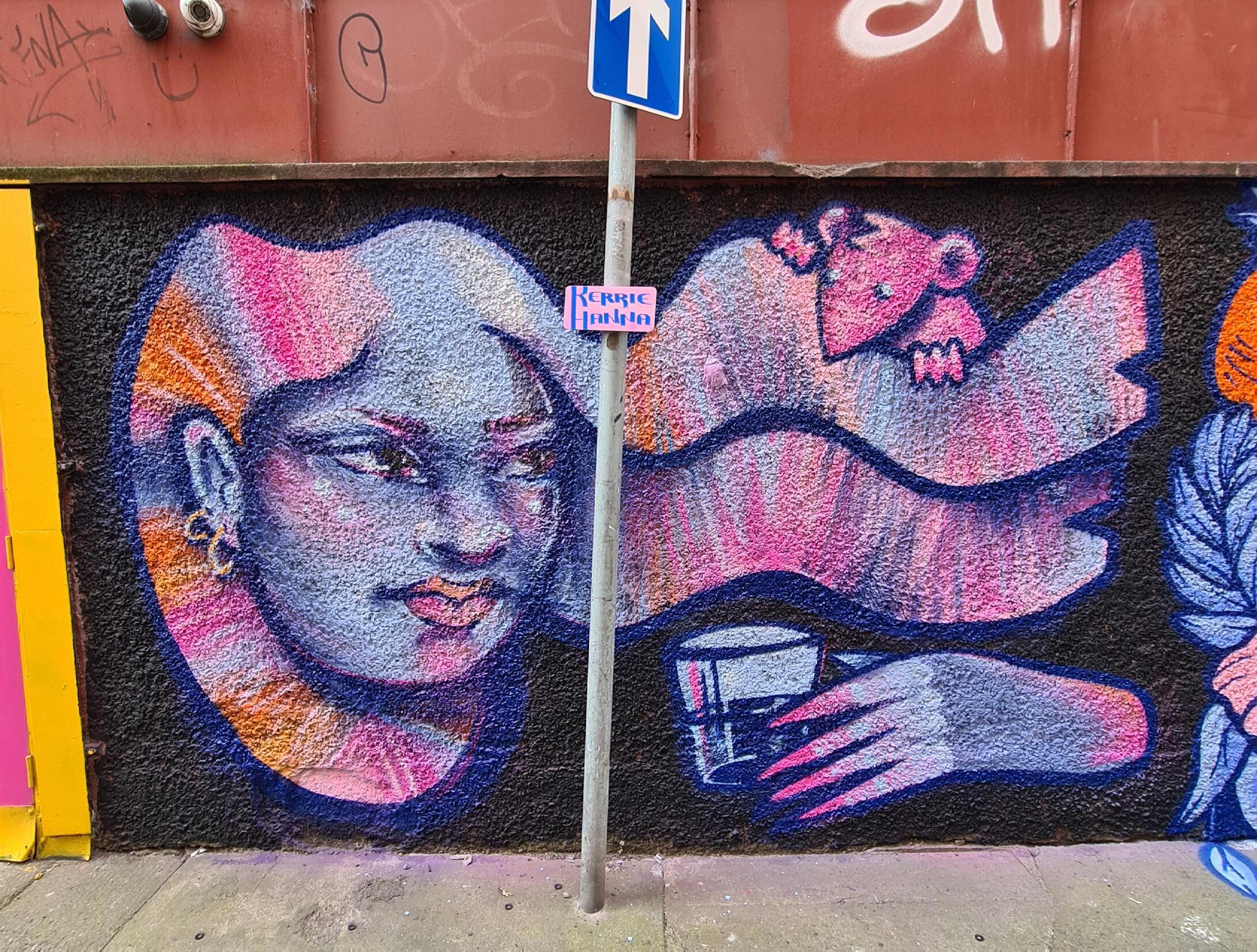
Water Street Mural - The first street in Belfast to get running water, later renamed College Court
Authority shifts. Singular voice becomes collective.
“How can we align? What do we feel comfortable all saying together?”
Drawing Strength Forward
Across pigment and glass, folklore and feminism, institutional collaboration and grassroots practice, Kerrie Hanna’s work demonstrates how craft can be both preservation and progression.
She excavates 60-million-yearold earth while building contemporary stained glass. She works with National Gallery of Ireland and National Trust while nurturing community voices through projects like the Yeha Project and Mornington Women’s Group.
She curates alongside Zippy and Wee Nuls while learning from figures like Tricia Kelly and the legacy of Sarah Purser.
Through material and through collaboration, she draws strength from the past and carries it forward.
“Embedding ‘place’ into my work… reminds me of the magic to be found within the natural world.”
In Hanna’s practice, that magic is not abstract. It is iron-rich. It is negotiated. It is illuminated.
And it insists that craft is not a relic - but a living force shaping how we understand where we stand.
For more on Kerrie Hanna’s work, upcoming projects and available pieces, visit: kerriehanna.com
And keep up with Kerrie via social media: @kerriehanna
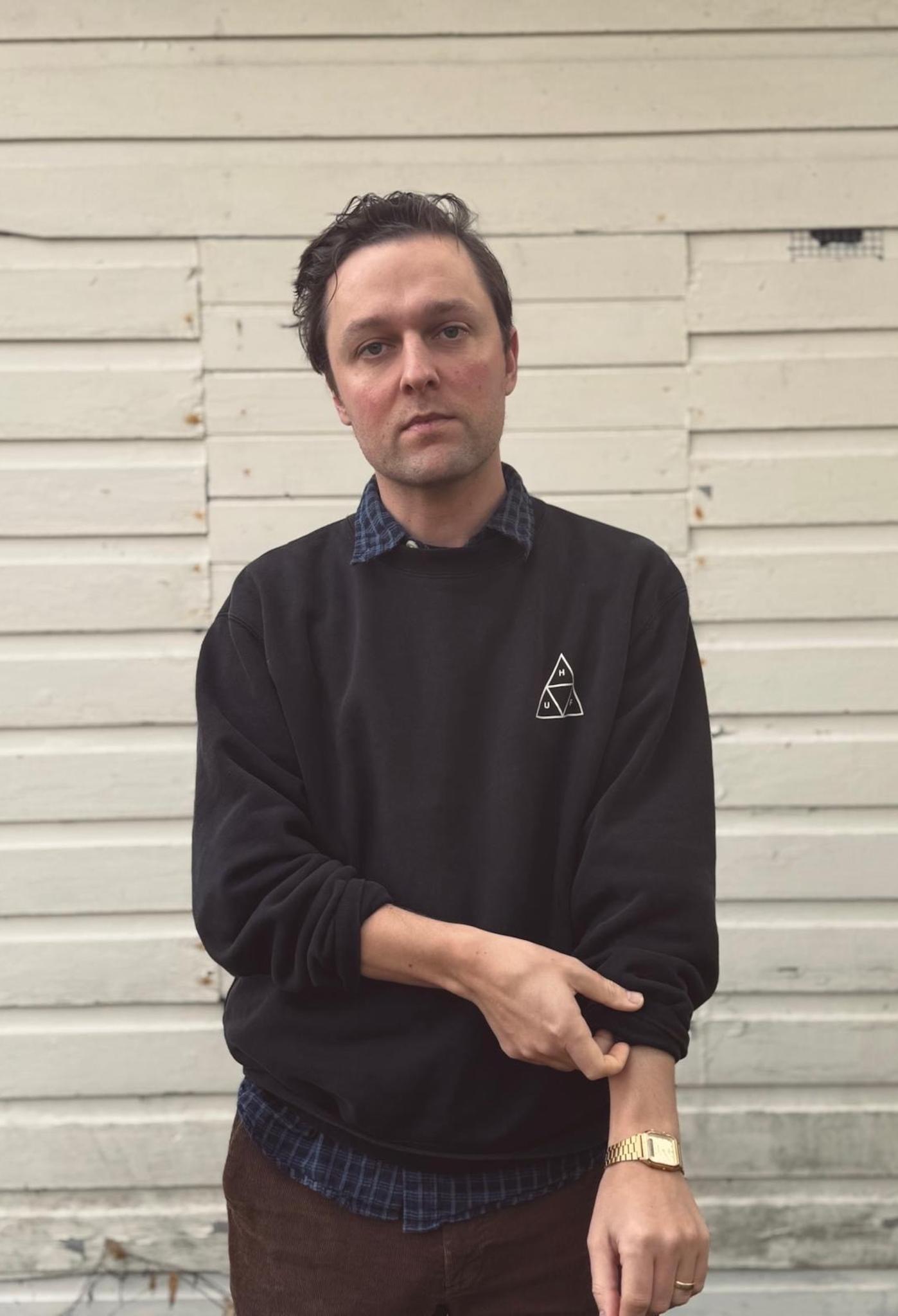
Joshua Burnside Musician
From the layered textures of Teeth of Time to a more exposed and intimate sound in It’s Not Going to be Okay, Burnside enters a new phase of his work
At this year’s Folk on Foot Awards - where Teeth of Time was nominated for Folk Album of the Year - Joshua Burnside found himself looking back at a record that no longer felt like his own.
“It’s sort of weird… it feels like I released that album decades ago,” he says. “I guess just a lot has changed from then to now in my life.”
There’s no attempt to smooth over that change.
“I always sort of feel like the person who wrote my own songs in my previous albums is not the person I am now… it feels like I’m just doing covers of those songs.”
That distance is where It’s Not Going to Be Okay begins - not as a concept, but as a condition. Written in the aftermath of the death of his best friend, Dean Jendoubi, the album stays close to what it is, rather than trying to reshape it.
Collaboration, Friendship, Influence
Burnside and Jendoubi’s relationship ran deeper than friendship. They made music together, shaping each other’s instincts early on, with that collaboration captured on Dean’s 2017 record Skin Hunger, which features Burnside.
“We were both big fans of a
band called The Books… Dean’s taste in music influenced me and still influences me.”
That shared listening - and making - never really left.
“When I’m writing music, I often think about certain people and if they would like it… and Dean was always one of those people.”
For Burnside, music has always been relational.
“When you’re making music… you’re also kind of making it for your friends.”
Letting the Songs Stand
“I didn’t want to rely on weird sounds or quirky production - I wanted the songs to stand on their own two feet.”
For an artist whose work has often leaned into texture and experimentation, that shift is immediate. On It’s Not Going to Be Okay, the arrangements are stripped back, the space is left open, and the weight falls on what’s being said.
“The lyrics are quite straightforward… sometimes the best way to say it is the simplest way.”
Writing the Everyday
“It seems so obvious to me now to write very real-world sort of lyrics… references to Ikea or
Super Monkey Ball… grounding it in the humdrum reality of day-to-day life.”
The influence of Richard Dawson sits behind that shift - a way of writing that allows the everyday to carry meaning without being elevated into something else.
“But that’s what life’s sort of made of… all these little things and all these places and all these references.”
The Weight Carried in Everyday Objects
“It was tennis rackets that Dean and I would play tennis together…”
When asked what objects carried weight, his answer settles on something simple, but deeply held.
“We had this sort of funny system… he would bring the balls and I would bring the rackets… I had his racket and my racket in the same case.”
There’s no explanation for it.
“I don’t know why we did this. It’s just kind of a weird thing.”
He still keeps them and they’ve become something else entirely.
“That brings me a lot of sadness… but also something that I treasure.”
The Artwork: Stripping Back to Essentials
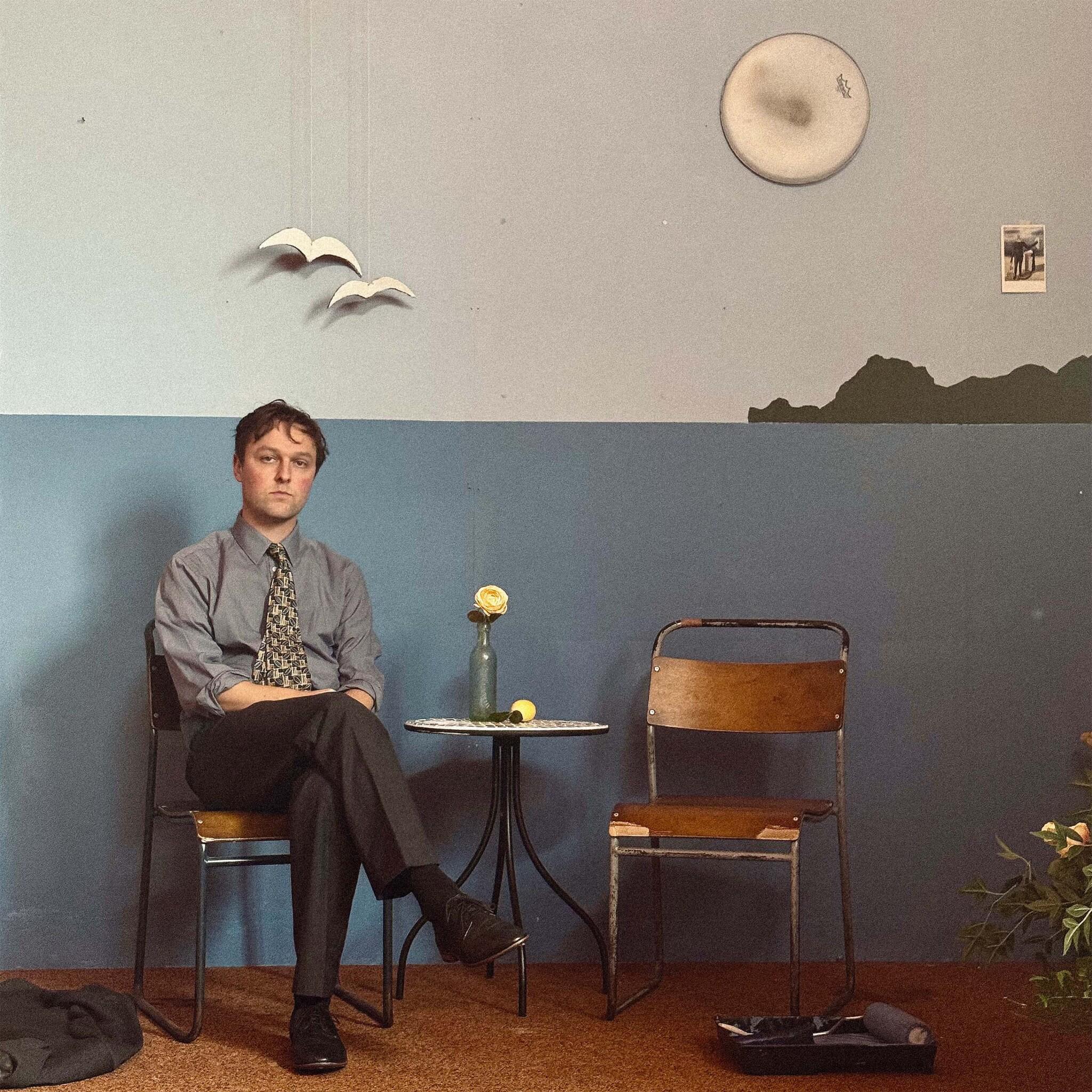
The album artwork follows the same instinct as the musicreduction.
Working within the network of Vault Artist Studios, Burnside developed the visuals in collaboration with Robin Price. What began as a layered composition was gradually stripped back.
“I had loads of stuff all over it even a fireman’s hat”
It’s Not Going to Be Okay - Album Cover
Go Leor
It didn’t hold.
“It just looked… a bit too busy.”
The process became about removing anything that wasn’t essential.
“Robin said he didn’t like the moon I painted… he said I should just use the snare drum skin.”
The drumhead becomes the moon - a direct link to the music rather than an added symbol.
It’s a real object, tied to the life of the record.
That connection carries into the songs. In With You, Burnside references Dean in the line, “the snare you used to play.” It’s understated, but specific - the same object, the same presence, carried across both the sound and the image.
What remains is minimal:
“The water and the sky and the moon… and the two chairs.”
Vault Artist Studios: Spaces in Motion
Vault Artist Studios isn’t a single building - it’s a network of artists working across unused and often derelict spaces in Belfast, adapting each one as needed.
“The way it kind of works… you might only get a couple of years in a space… or the building itself might just become unusable.”
Each move reshapes the work.
“It means that every album is in a new space and has a new sound.”
Teeth of Time was recorded in Marlborough House, near the Albert Clock - a small office space with difficult acoustics that shaped the record’s character.
For It’s Not Going to Be Okay, Burnside worked from a rebuilt space on the Shankill Road, alongside Muckno (Jamie Bishop).
“We had to get rid of the whole ceiling… then stapled loads of wool… and put wood panels over that.”
The result was something different.
“It’s probably the first recording space that I’ve ever been in that I wasn’t constantly battling against.”
Next, that work will move again - to a former Freemasons building on the Newtownards Road in East Belfast.
The People in the Record
While much of the album is Burnside alone, it remains collaborative at its edges.
His brother appears on drums across several tracks, alongside
contributions from Muckno (Jamie Bishop), Ben Flavelle-Cobain, Zara Byrne-McCullough and Dany Byrne-McCullough.
Aine Gordon features both on the record and visually - her voice appearing on tracks, and her presence extending into the album’s video work.
Building Visual Worlds
The album’s visual language carries into its music videos, but more importantly, so does a thread that has always run through Joshua Burnside’s work - a focus on relationships that feel grounded, human, and increasingly absent from wider media.
Shot partly in former Vault Artist Studios spaces - including Marlborough House - and on location at Bracken Hill, one video leans into The X-Files, with Burnside and Aine Gordon stepping into the roles of Mulder and Scully.
“She’s sort of playing the role of Scully… to my Mulder.”
It’s playful on the surface, but it reflects something more consistent in his writing. Where a lot of contemporary narratives lean toward conflict, breakdown, or heightened stakes - political, economic, or otherwise - Burnside’s work often sits in a different space. One where relationships are allowed to be steady, respectful, even when they’re not aligned.
“They’re just great friends who respect each other… but have completely opposing worldviews.”
That dynamic - friendship without fracture, difference without hostility - is central. It speaks to a quieter kind of connection, one that doesn’t rely on drama to be meaningful, and one that
feels increasingly overlooked in how modern life is portrayed.
Keeping Music Close to the Ground
Outside of recording and touring, Burnside remains embedded in Belfast’s music community.
He continues to help run the Sailortown Folk Club at The American Bar, alongside a trad session at The Black Box, and regular sessions in places like the Sunflower Public House
“It’s just a really, really fun way to make music… it’s kind of low stakes… purely for the fun of it.”
He also remains a supporter of spaces like The Duncairn, including their Super Sunday Sessions, where music is shared across generations and communities.
“It’s not all about… doing big gigs and releasing records… a lot of it is just about connecting.”
Unearthing What’s Already There
“I often feel like… you stumble upon songs… like a buried dinosaur… and you’re just dusting off the sand.”
The work, for Burnside, isn’t in building something new. It’s in recognising what’s already there.
With It’s Not Going to Be Okay, what’s been uncovered is something unguarded - a record that doesn’t attempt to resolve what it holds.
It’s Not Going to Be Okay
You and Me is the only track recorded before Dean’s death. There’s a softness to it - subtle strings, recorded at home -
something he couldn’t quite recreate in the studio. That version holds. It feels untouched in a way the rest of the record can’t be, and that’s exactly why it works.
With You carries a different weight. A steady, understated bass runs through it, grounding a starkly honest retelling of Dean’s funeral - the kind of detail anyone who has lost a friend will recognise immediately. It’s elevated further by the voice of Aine Gordon, which cuts through with a clarity that never overreaches.
The title track, It’s Not Going to Be Okay, opens things outward - pulling grief into a wider frame of politics and climate, without losing that same personal core.
The Last Armchair turns inward again. It sits with the weight we attach to objects, and the quiet realisation that we don’t really grow out of the things that shape us early on.
Good Times Are Coming moves between memory and the present - small, everyday objects seen through rose-tinted recollection. Super Monkey Ball, a party, fragments of a life that feel ordinary until they’re not. It ends on a note that doesn’t resolve cleanly - slightly discordant, in keeping with the vulnerability that runs through the album.
Burnside has said, “I don’t think I feel any different inside as when I was 10 years old, or younger even.”
There’s something in that which the album keeps returning tohow grief can unmoor you, pulling you back through childhood memories, through versions of yourself you thought you’d left behind.
It’s an incredible record. Not just in its writing, but in the way it’s held together - by Burnside’s commitment to the relationships around him, to
the community that shapes Belfast, and to a kind of emotional honesty that’s difficult to access anywhere outside of live music - or an album like this.
It’s Not Going to be Okay is avaiable to stream now via Spotify and Apple Music
Joshua Burnside will be performing across Ireland, the UK and beyond throughout 2026.
Upcoming dates include shows in Cork (Cyprus Avenue), Dublin (The Button Factory), Glasgow (Òran Mór), Leeds (Brudenell Social Club), London (EartH) and Bristol (Beacon)
For full links, tickets and more visit his linktree: @Joshua_Burnside
And keep up with Joshua via social media: @joshuaburnside
Alice Rekab Artist
Tracing identity through objects, inheritance, and the quiet movement of the Atlantic Ocean as a space of connection and shared histories
There is no fixed point in Alice Rekab’s work - only a continuous movement between memory, material, and place.
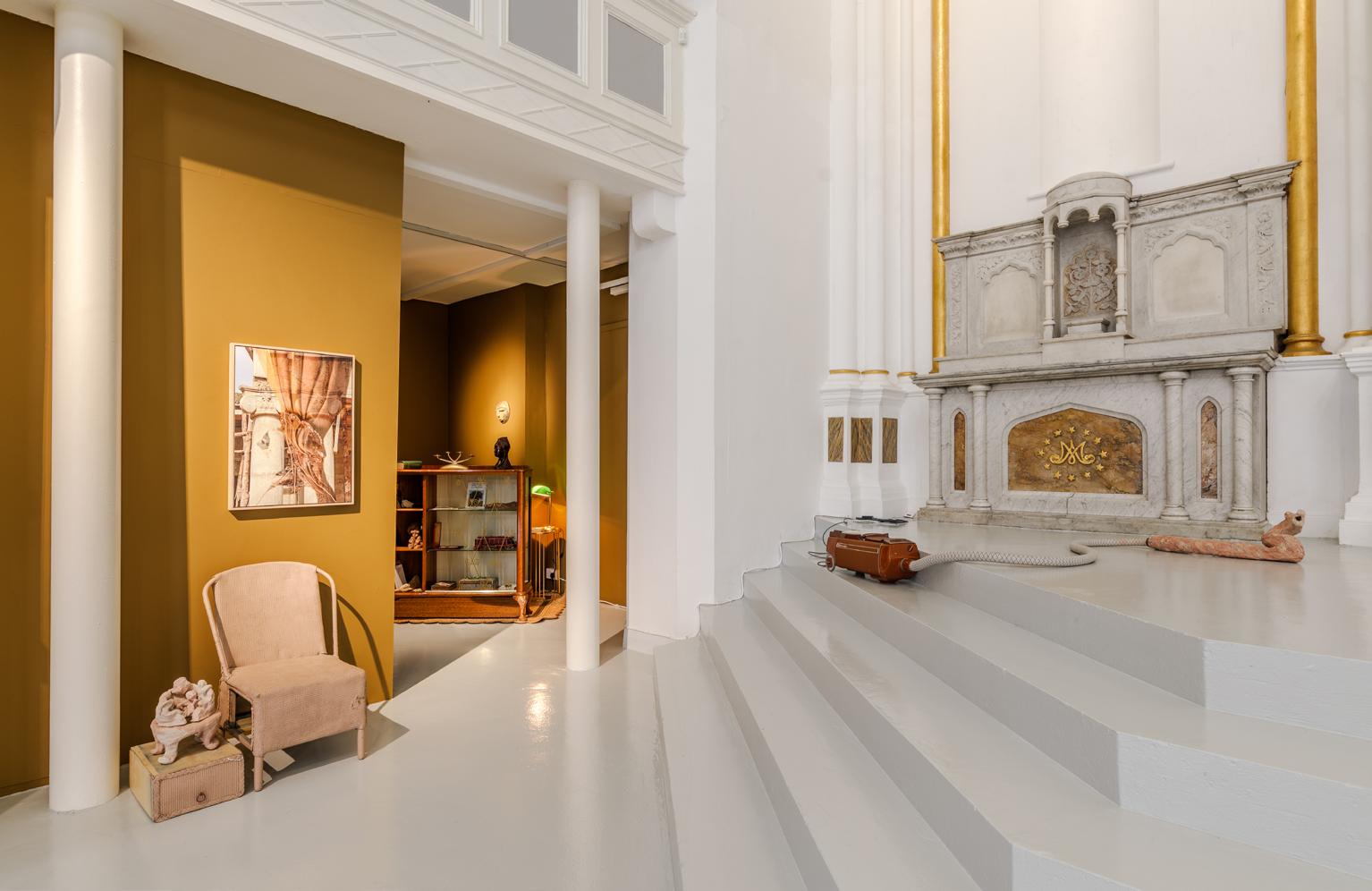
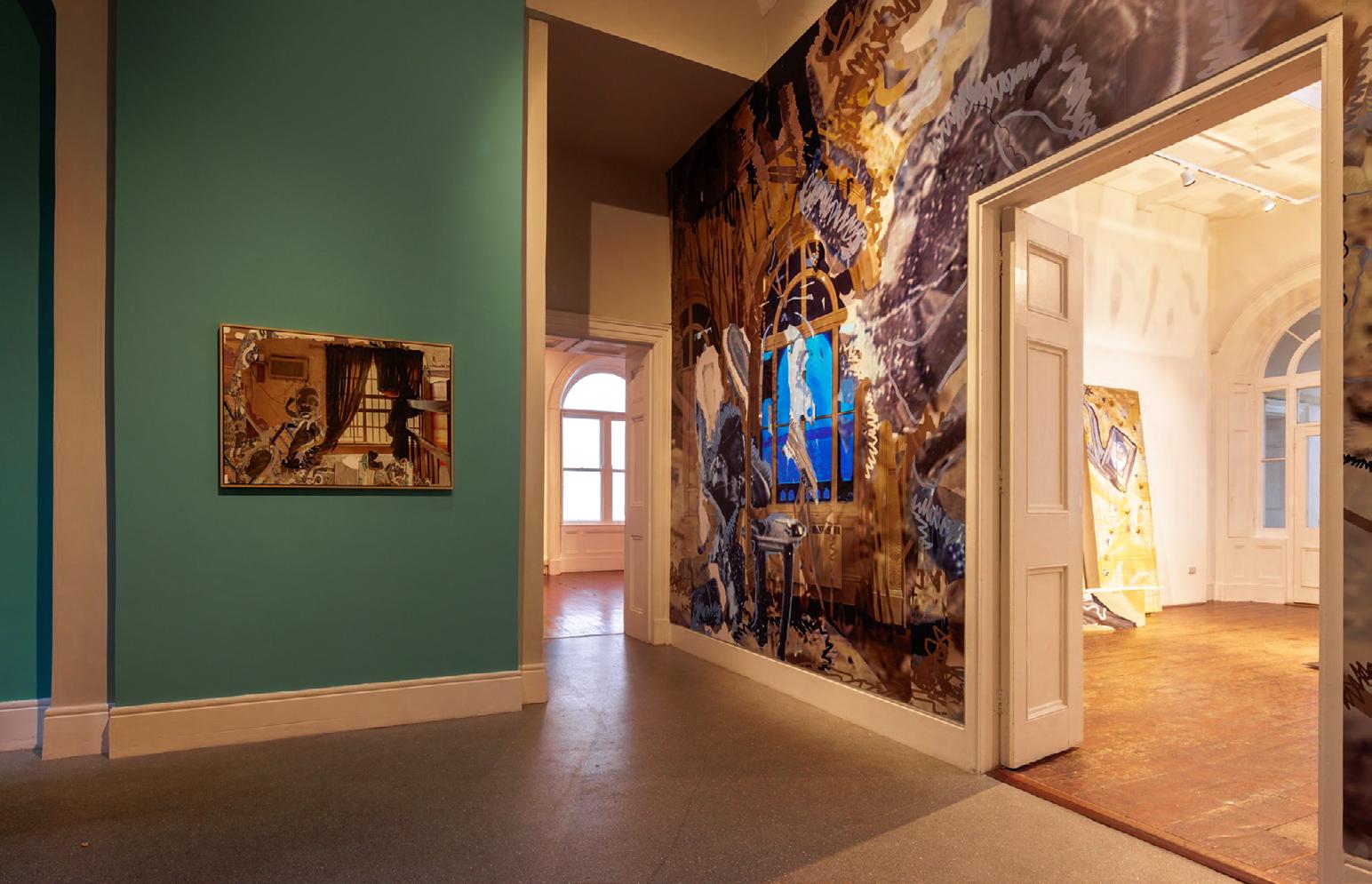
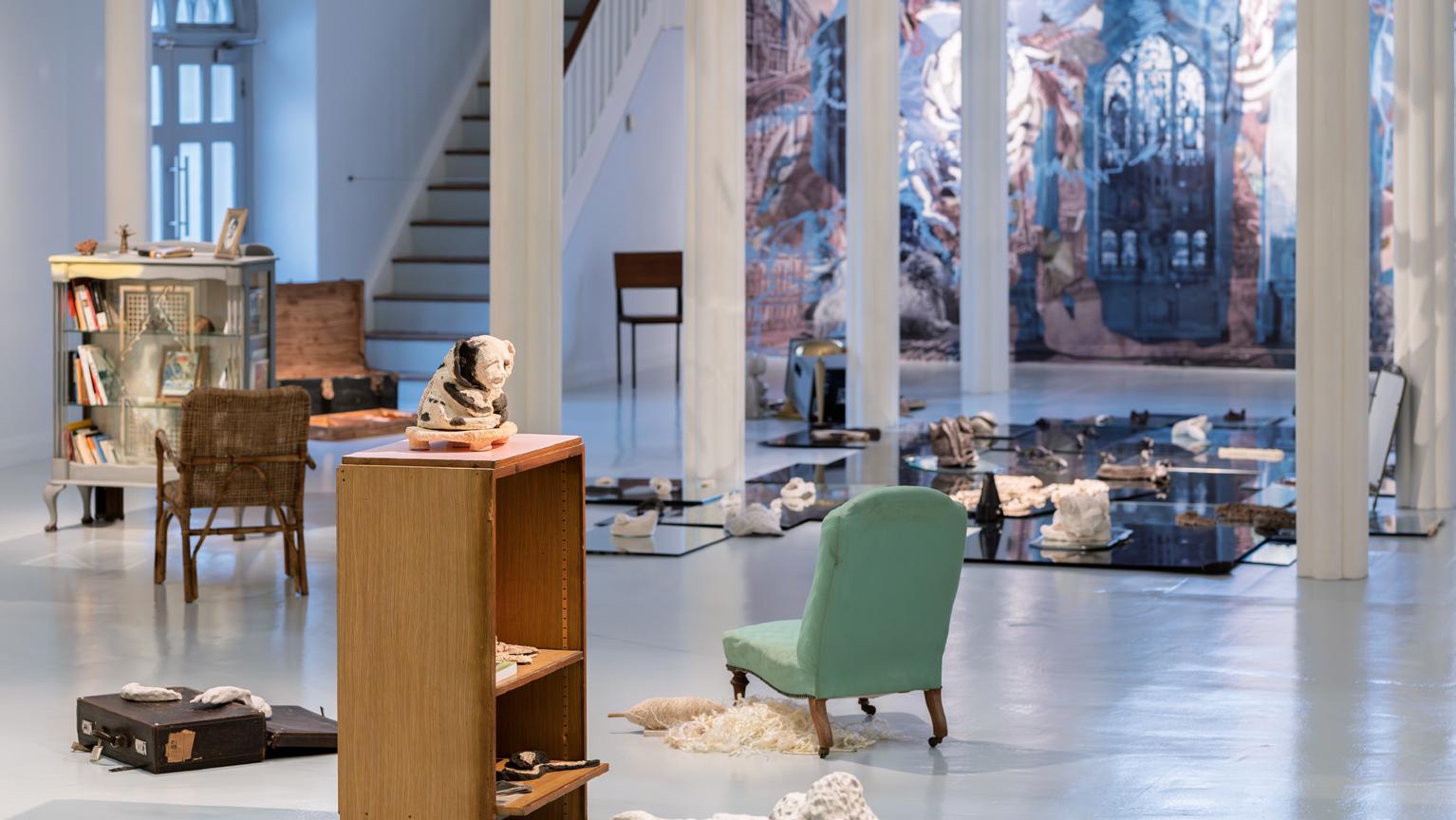
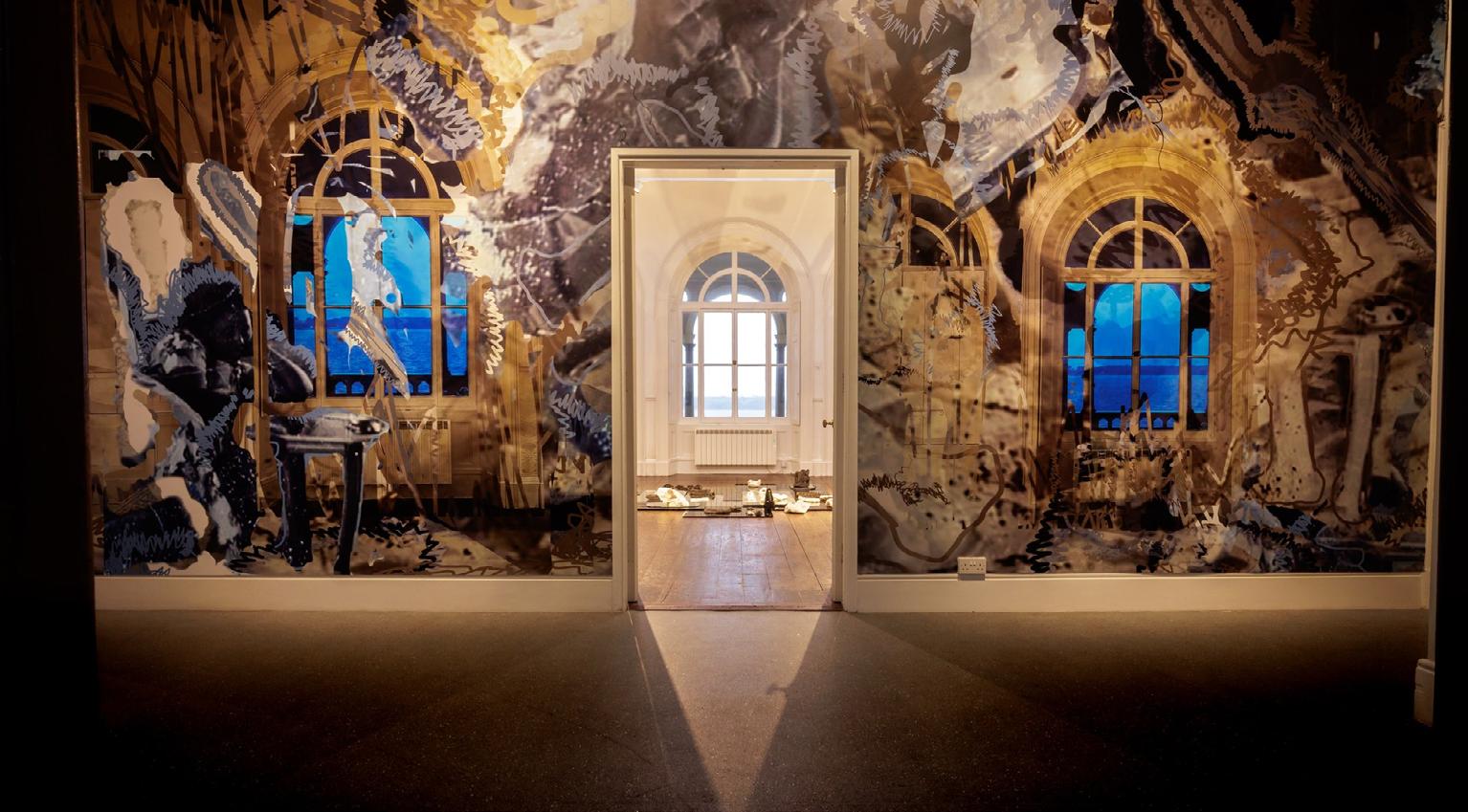
Even when an exhibition arrives fully formed, it is already in the process of becoming something else - reshaped by place, by people, by the quiet shifts that occur when work moves through the world. Their recent exhibition, Clann Miotlantach / Mythlantics, curated by Miguel Amado, has done exactly that.
“It’s interesting that it’s now concluding as a tour, having been going for 18 months,” they reflect. “It began at Sirius Arts Centre in Cobh, then moved around the country to Galway Arts Centre, Highlanes Gallery, and Limerick City Gallery of Art… and then had these offshoots at Liverpool Biennial and Edinburgh Art Festival.”
What might, for another artist, exist as a finished body of work instead becomes something more fluid here - an evolving
constellation of objects, ideas, and encounters.
“When a body of work moves,” Rekab says, “the question becomes: how do you get it to respond to each site? How do you make it relevant to those places?”
That question sits at the centre of Clann Miotlantach / Mythlantics, not just as a logistical challenge, but as a philosophical one. Because the work itself is concerned with movement -
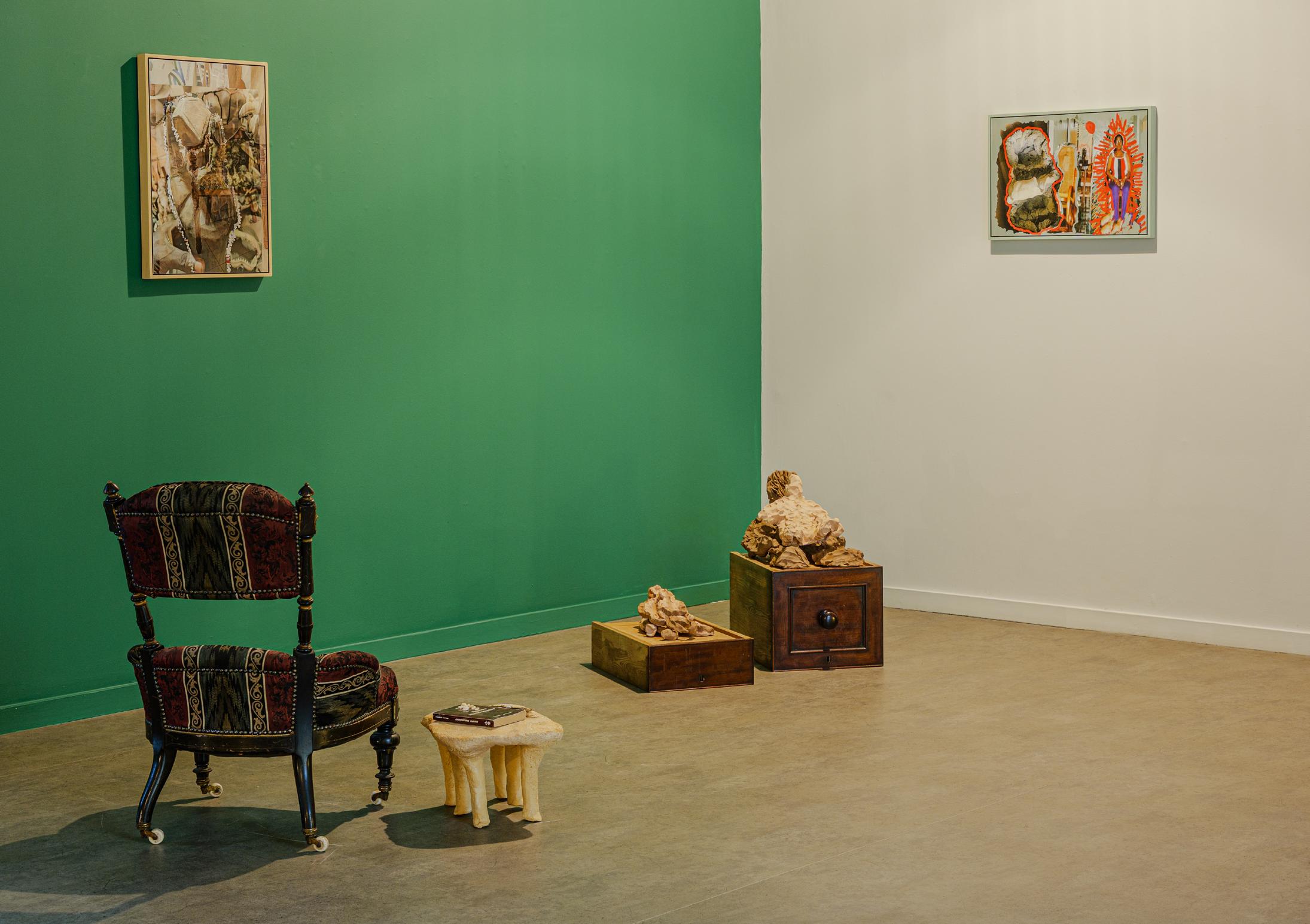
Limerick City Gallery of Art, 2026. Photograph: Tom Flanagan
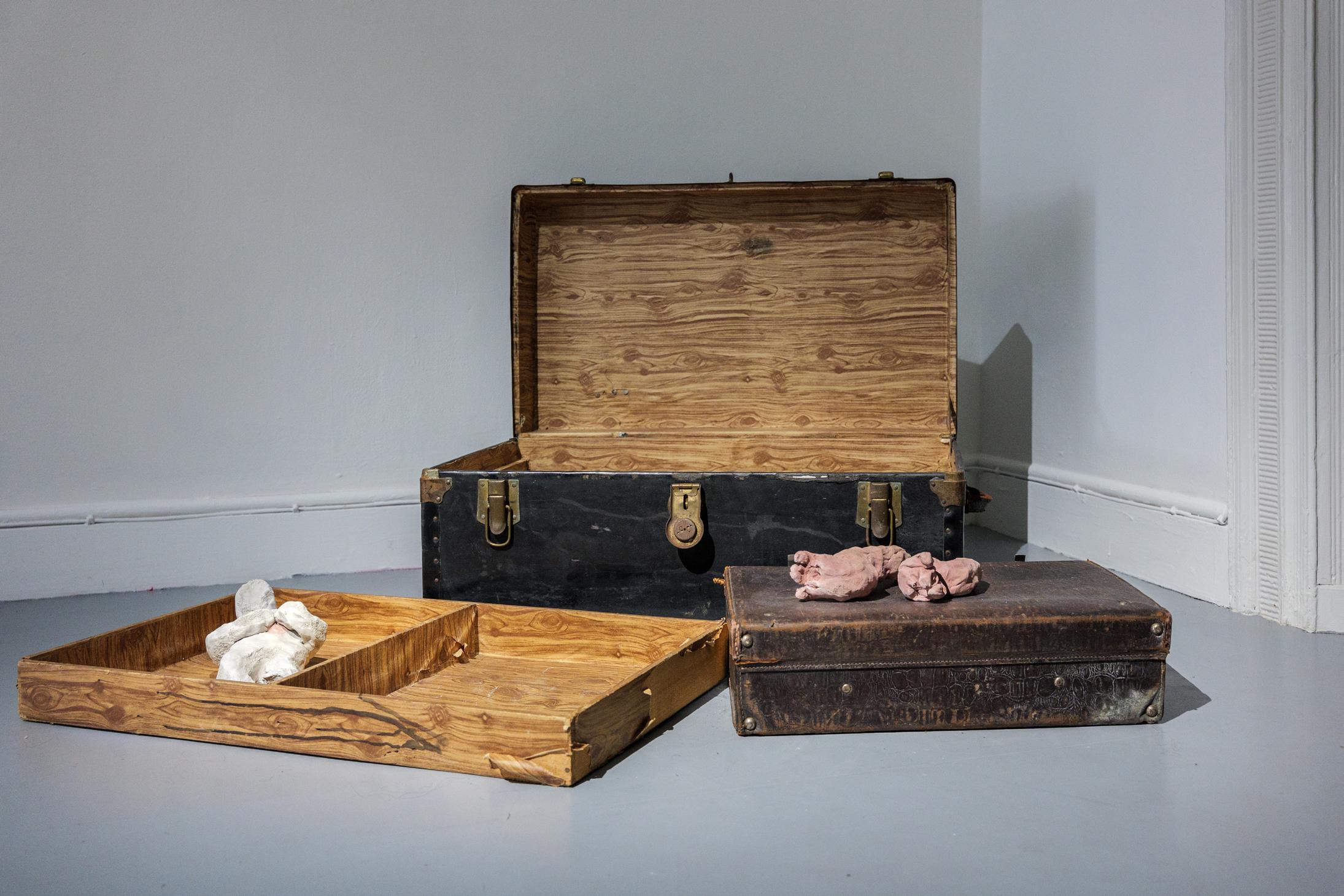
with migration, inheritance, and the shifting ground of identity.
The home as archive
To step into Rekab’s installations is to step into something recognisable, but slightly displaced.
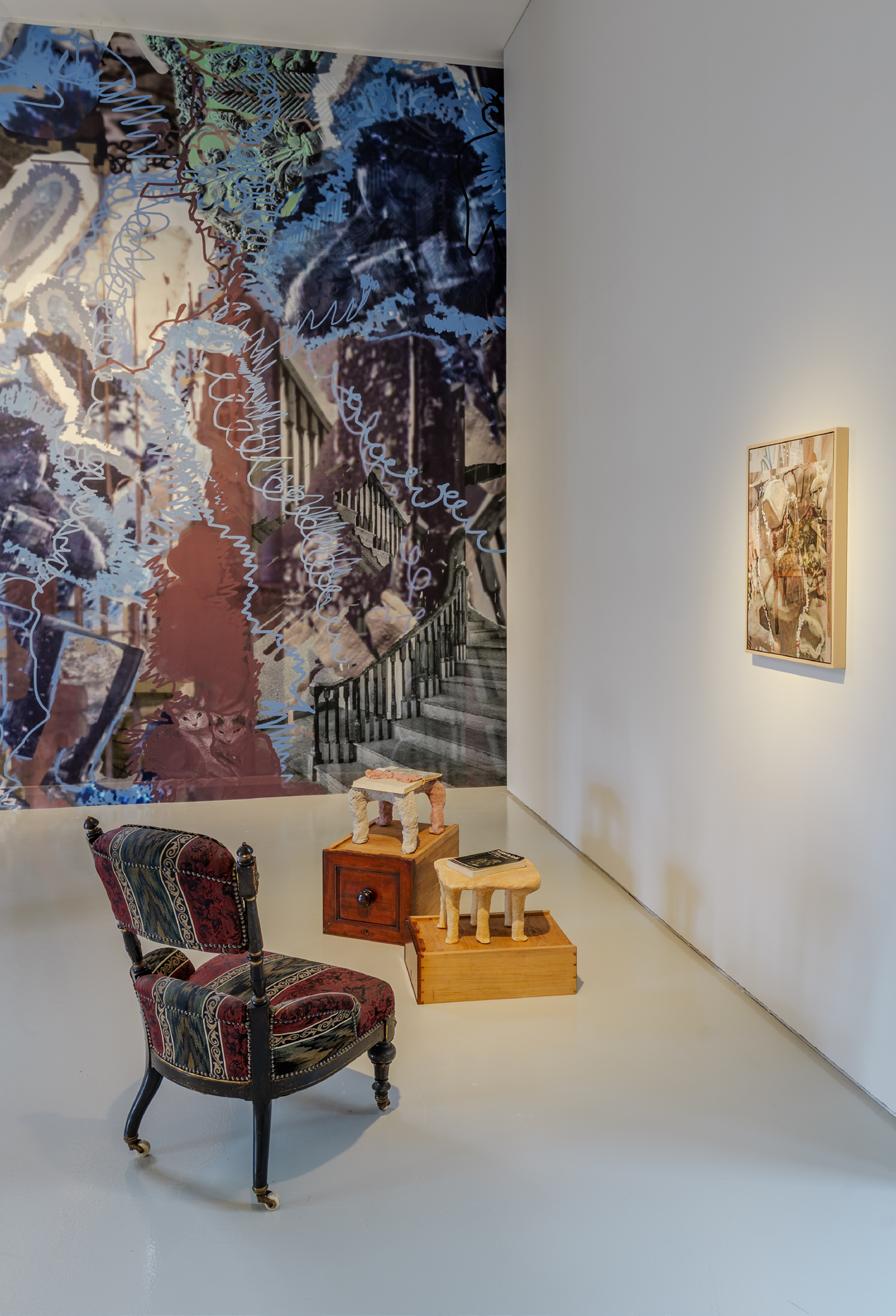
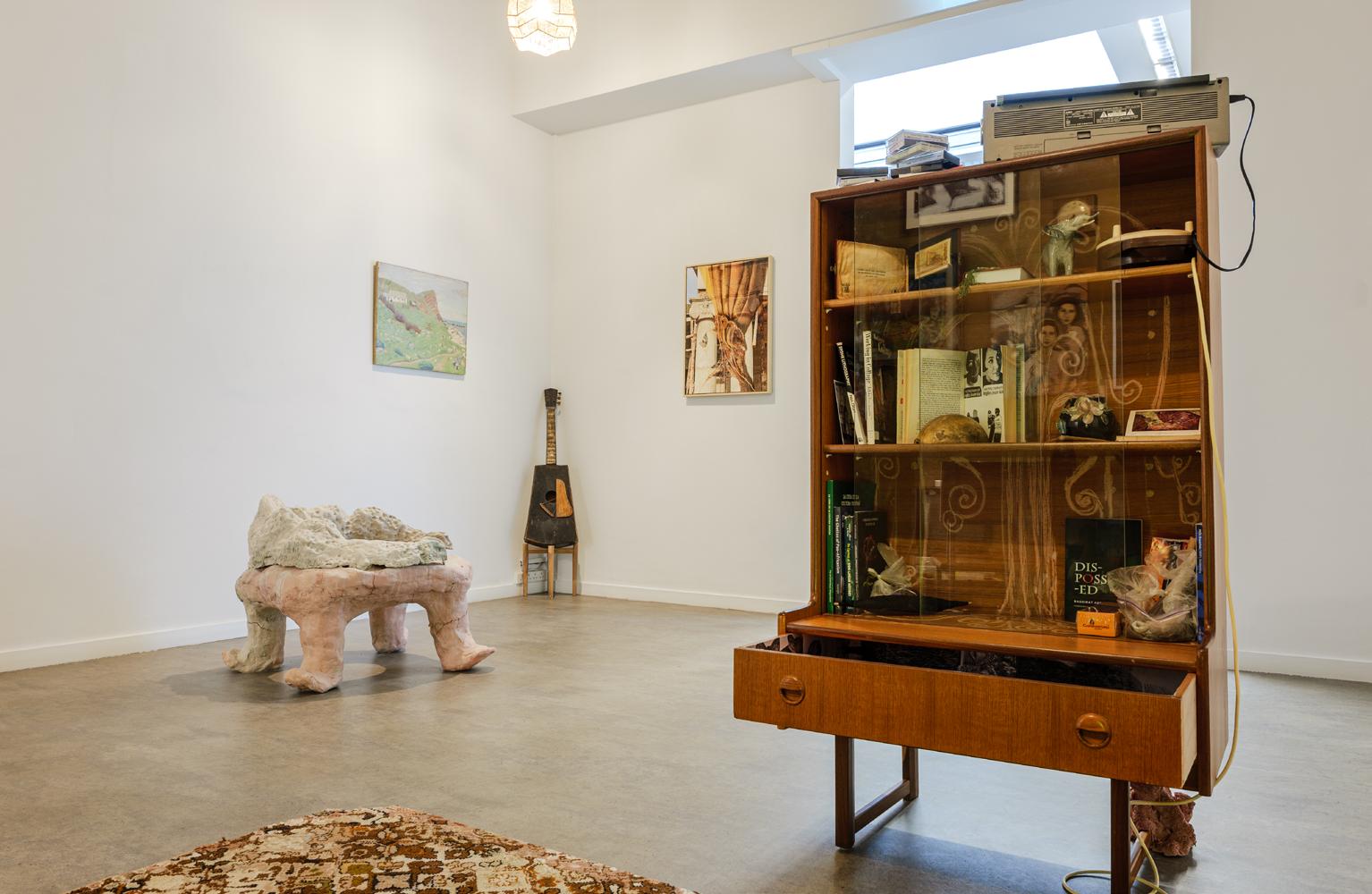
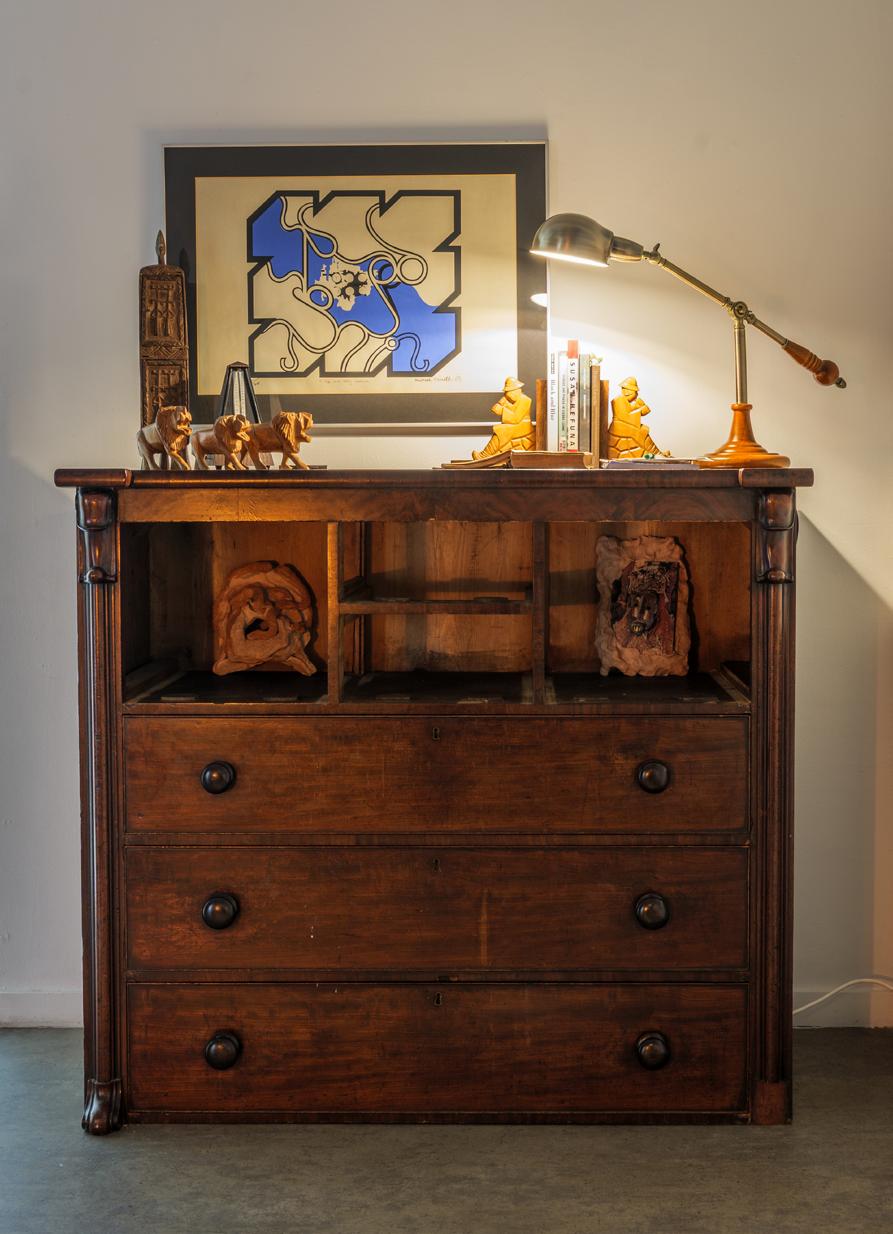
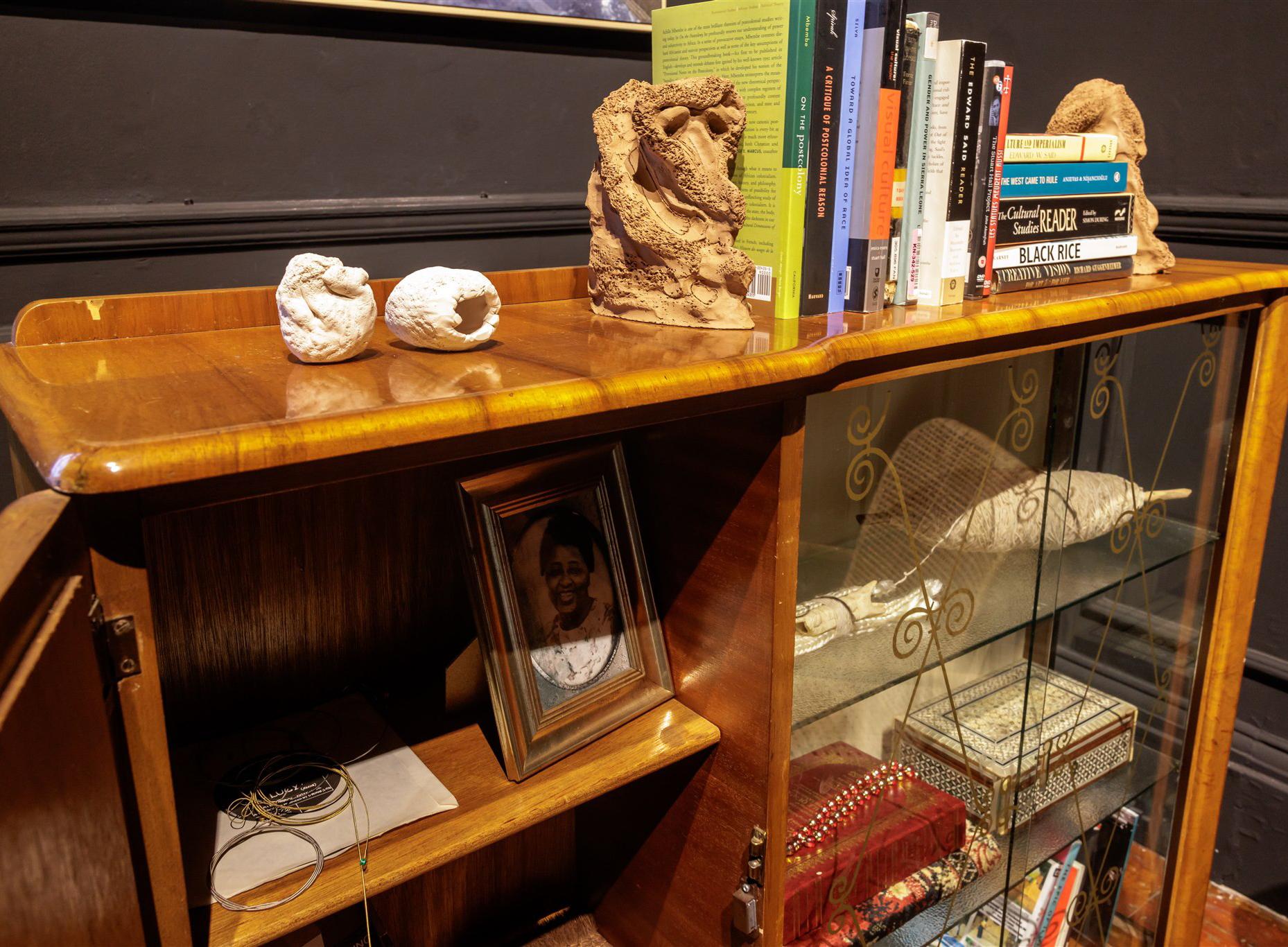
There are objects that feel like they belong to a home - photographs, textiles, heirlooms - but they are rearranged, recontextualised, placed into conversation with items and forms that resist easy categorisation.
“You might have noticed there are a lot of domestic materials in the installations,” they say. “Things that usually appear in home spaces, not gallery spaces.”
This is not incidental. It is a deliberate act of translationbringing the private into the public, the intimate into the institutional.
“I wanted to bring home into those spaces… to make that kind of welcome present.”
That home, however, is not singular.
Rekab’s father is from Sierra Leone, with Syrian heritage; their mother is Irish, with a lineage shaped by revolution and nation-building. These histories do not sit neatly alongside one another - they overlap, diverge, and reconnect in unexpected ways.
“My home had objects from Africa, the Middle East, and Ireland all together,” they explain. “All on the same mantelpiece, as it were.”
That early experience - of difference held in proximitybecomes foundational.
“It informed a methodology… an approach to bringing objects together in space.”
Galway Arts Centre, 2025. Photograph: Tom Flanagan
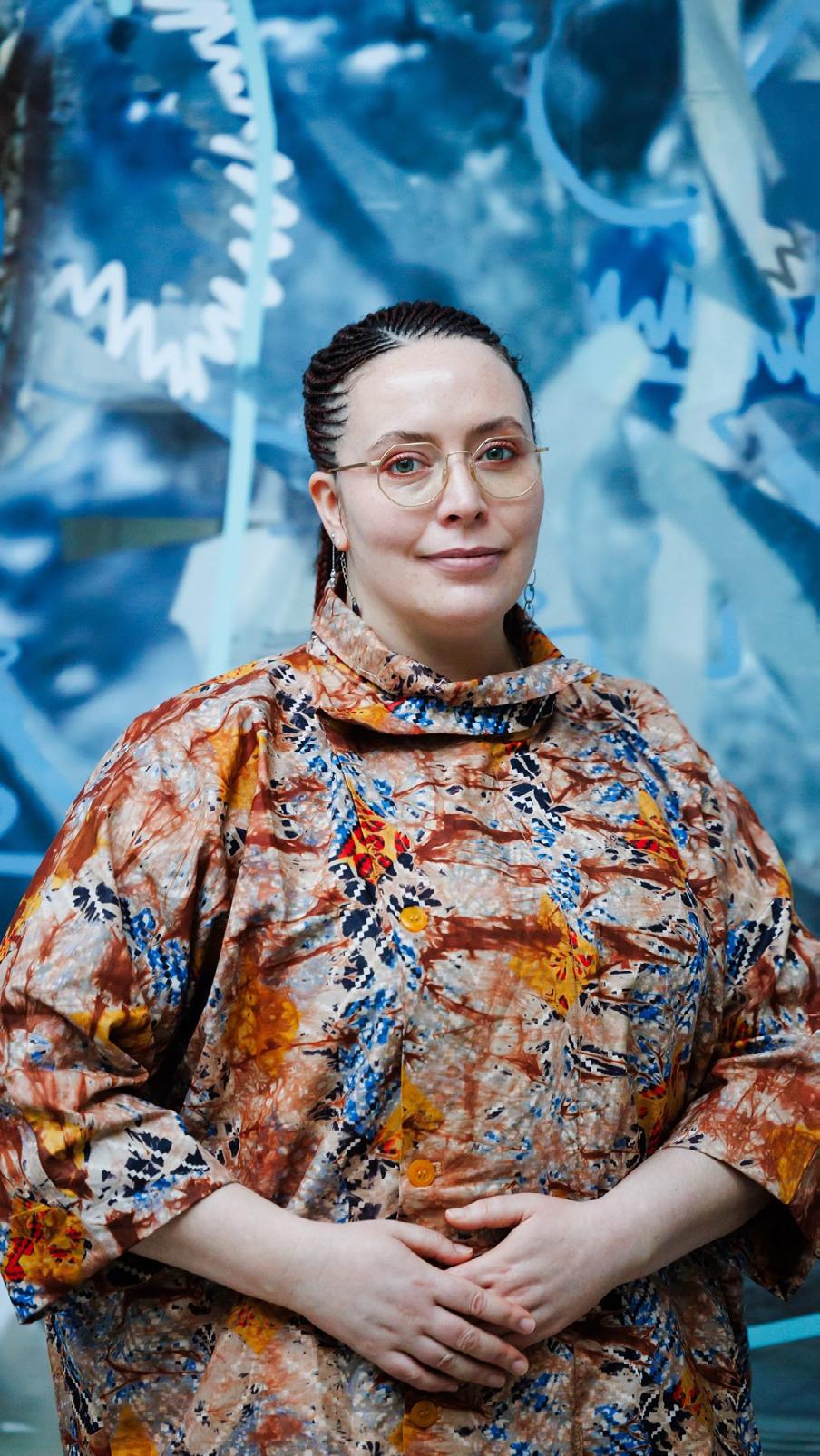
Alice Rekab. Photograph: John Beasley
Go Leor
Objects that speak beyond intention
There are moments in Rekab’s work where meaning exceeds intention - where an object reveals more than the artist initially understood it to hold.
During the tour in Galway, a small inlaid box - something Rekab had included simply because it belonged to their family - became the focus of recognition.
“Someone on the tour said, ‘Everyone in Damascus has one of these.’ And I didn’t know that.”
The object shifted instantly - from personal artefact to shared cultural marker.
“That was really moving,” they
say. “You don’t always know what you’re doing… sometimes you’re just making something out of memory, and then it resonates in a broader way.”
This tension - between intuition and recognition - runs throughout the work.
“There’s a transition between something that has immediate personal meaning… and then understanding that it has a wider cultural meaning.”
Identity as accumulation
For Rekab, identity is not something stable or singular. It is built - layered across family, community, country, and beyond.
“When you are of migrant background,” they explain, “some-
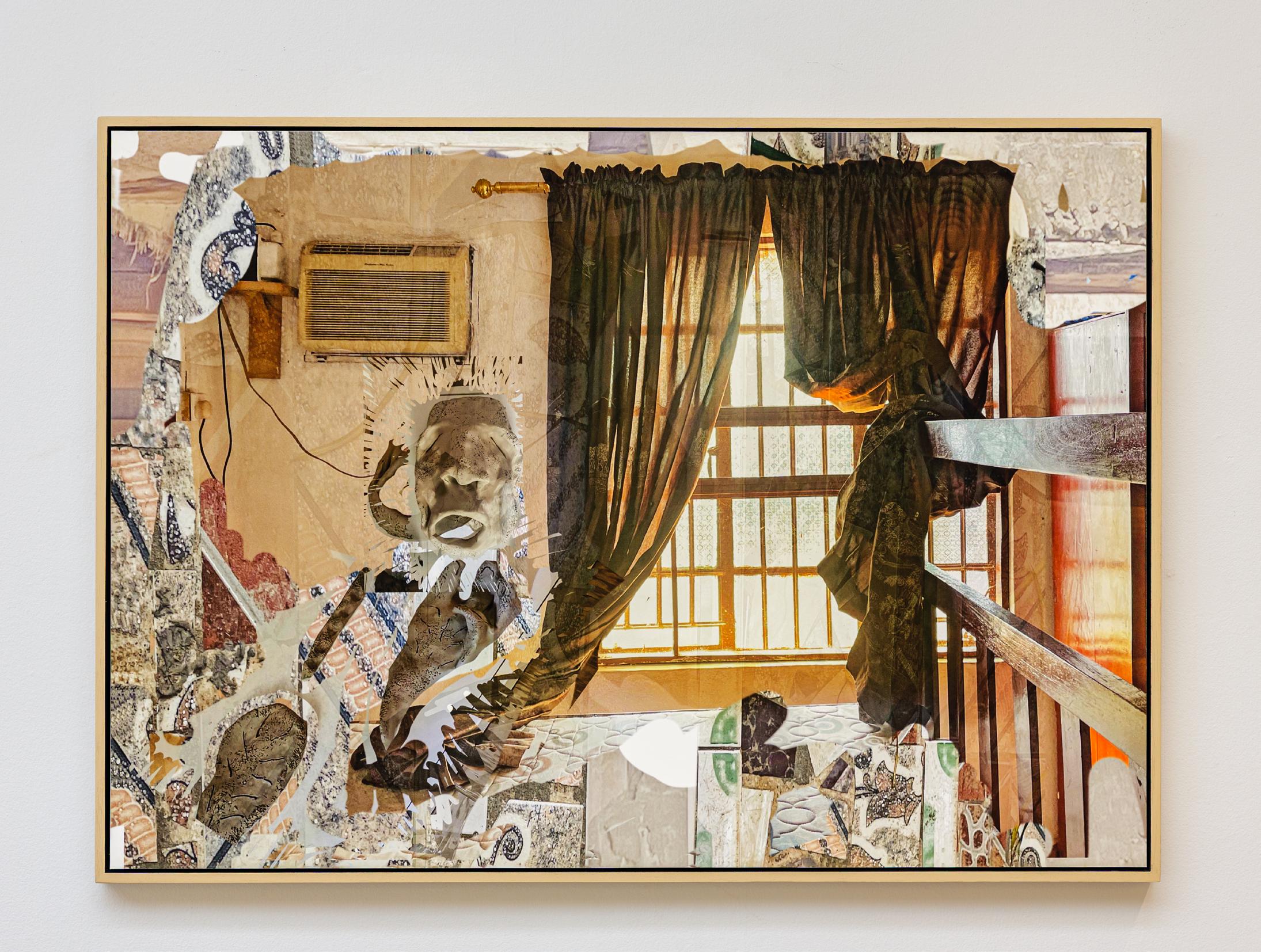
Limerick City Gallery of Art, 2026. Photograph: Tom Flanagan
Highlanes Gallery, 2025. Photograph: Tom Flanagan
times there are bigger gaps between those layers.”
Growing up in a multiethnic context in Ireland, at a time when that experience was less visible, meant navigating those gaps in isolation.
“You might be a family who doesn’t really know anyone else like you.”
That experience continues to shape the work - not as a problem to be resolved, but as a condition to be explored.
“I’m interested in how identity is built through all those layers… and how those connections aren’t always visible at first.”
As a white-presenting person of mixed heritage, Rekab also reflects on the shifting nature of perception.
“Depending on which parent I was with, I had different experiences of what it was like to be in Ireland.”
This multiplicity becomes central.
“To remind ourselves that we’re all made up of different parts… that a unified, unchanging identity isn’t necessarily true.”
The Atlantic Ocean as a living connection
The title ‘Clann Miotlantach / Mythlantics’ suggests a geography that is both real and imagined - a space where histories flow rather than divide.
A key influence here is Bob Quinn’s documentary Atlantean (1984), which traces connections between Ireland, the Western seaboard of Europe, North Africa, and beyond.
“When I saw that film, it was the first time I felt like I belonged
Highlanes Gallery, 2025. Photograph: Tom Flanagan
Limerick City Gallery of Art, 2026. Photograph: Tom Flanagan
Sirius Arts Centre, 2024. Photograph: John Beasley
in Ireland - not just in a recent way, but in an ancient way.”
The Atlantic Ocean, in this context, is not a boundary. It is a route.
“It’s about mapping the world in a way that isn’t about barriers… but about flow and connection.”
This reframing opens up new ways of understanding identity - not as something rooted in a single place, but as something shaped through movement.
Music, language, and shared space
Although Rekab’s work is grounded in sculptural practice, sound runs through it quietly but persistently.
“My dad taught me music, and I trained as a singer,” they say. “That’s still present in the work.”
Music appears not only through objects - records, instruments - but through live programming, bringing artists into the gallery.
“There are Irish-language musicians, and Black Irish performers… creating a shared cultural space.”
The Irish language itself becomes part of this exchange.
“It’s tied to a kind of postcolonial identity… something that resonates with younger artists and audiences now.”
In this way, the exhibition becomes more than a static display - it becomes a site of gathering.
Clay, memory, and the language of the earth
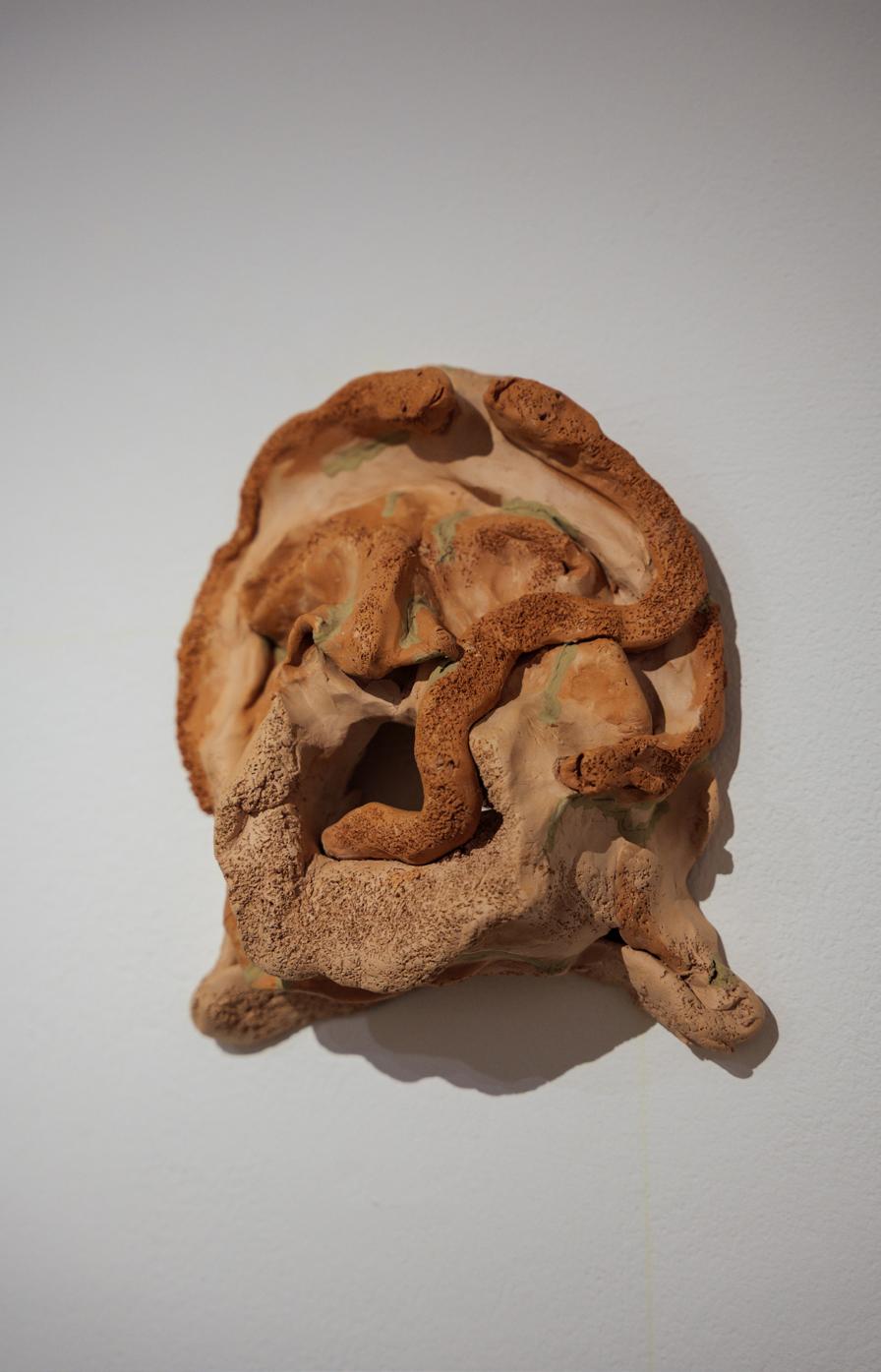
If the installations bring together multiple materials, clay holds a particular weight.
“It’s like a repository of knowledge,” Rekab explains. “Animals, plants, minerals… it’s the earth.”
Unlike more controlled processes, their approach to clay is intuitive. “I don’t start with a plan. I just begin, and the forms emerge.”
What emerges are often creatures - recognisable, but not fixed.
“They’re not anatomically correct… they’re not replicas of anything that exists.”
This openness allows clay to function as something beyond representation. “It has a kind of non-verbal language… something subconscious.”
Limerick City Gallery of Art, 2026. Photograph: Tom Flanagan
Highlanes Gallery, 2025. Photograph: Tom Flanagan
Sirius Arts Centre, 2024. Photograph: John Beasley
The material itself carries memory - shaped by where it is sourced, how it is handled, how it is fired.
“Clay from Sierra Leone, from Ireland, from Munich… they all behave differently.”
In Sierra Leone, Rekab encountered a community where clay, labour, and daily life were inseparable.
“The kilns were where they cooked bread… everything was connected.”
These experiences feed back into the work - not as documentation, but as transformation.
“Heat changes clay… stress changes it. That became a way of thinking about how we are changed by experience too.”
Storytelling, invention, and the Irish imagination
Rekab is not interested in dismantling identity, but in understanding how it is made.
“We all tell ourselves stories about who we are,” they say. “And we need to.”
They point to early 20th-century Ireland - the revival of language, aesthetics, and cultural identity - as both recovery and invention.
“It was about reestablishing identity… but it was also about imagination.”
This duality is not a contradiction - it is a condition.
“My work doesn’t try to present a single, linear narrative. It knows it’s constructed.”
Sirius Arts Centre, 2024. Photograph: John Beasley
Galway Arts Centre, 2025. Photograph: Tom Flanagan
In acknowledging that, the work opens itself up - allowing multiple narratives to exist side by side.
A practice in motion
As Clann Miotlantach / Mythlantics reaches the end of its current journey, Rekab’s work continues to expand - across geographies, communities, and conversations.
Future projects will explore con-
nections between Ireland and Wales, Ireland and Portugal, different diasporic realms, and various generations.
“There’s a sense that it can always continue to expand… through connection.”
Like the Atlantic Ocean itself, the work does not settle.
It moves. It gathers. It reshapes.
And in doing so, it offers a way
of understanding identity not as something to be defined, but as something to be lived, carried, and continually reimagined.
Explore Alices’s selected work, sign up for their newsletter, and get their latest news via their website: alicerekab.com
And keep up with Alice via social media: @alicerekab
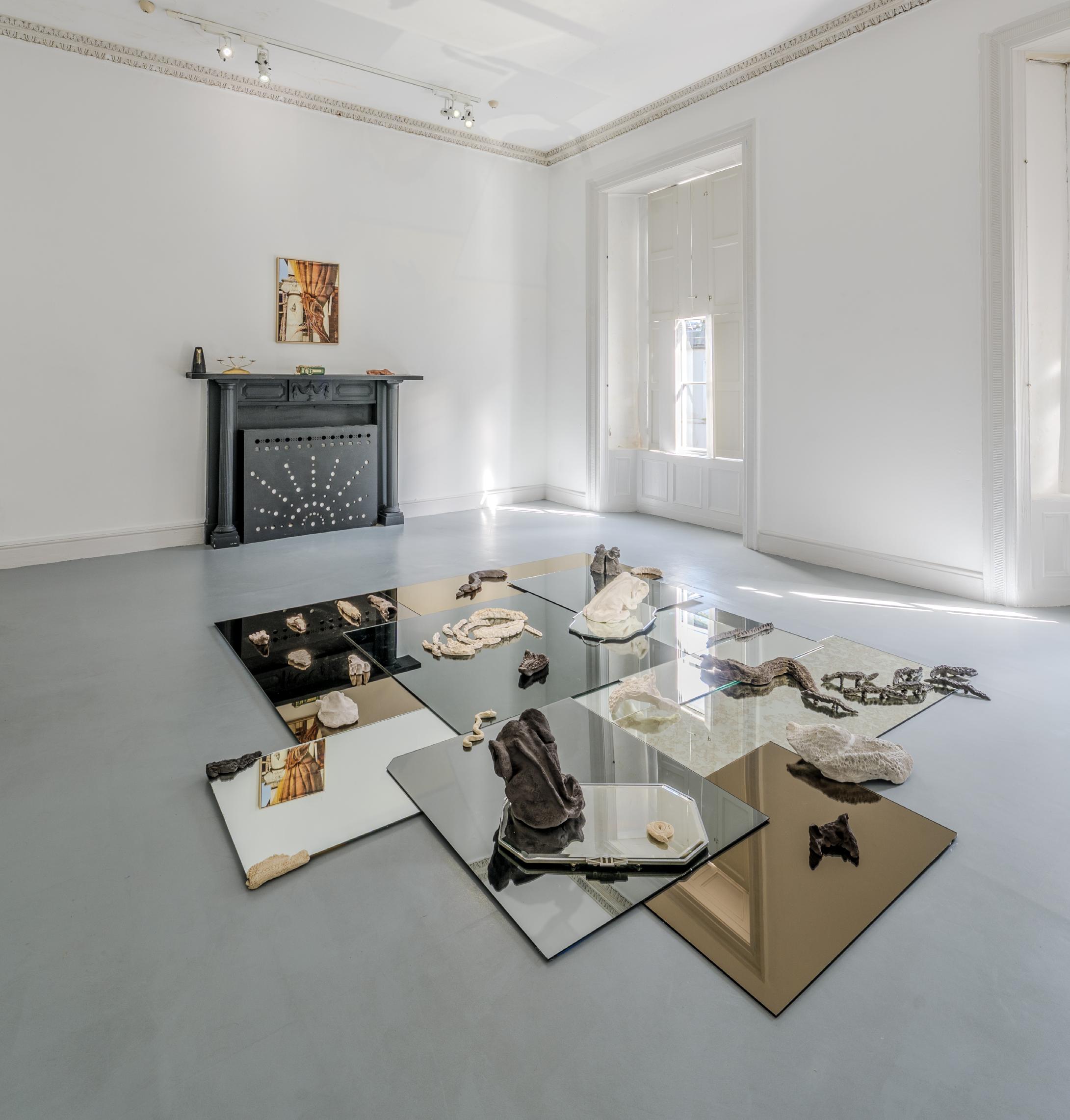
Galway Arts Centre, 2025. Photograph: Tom Flanagan
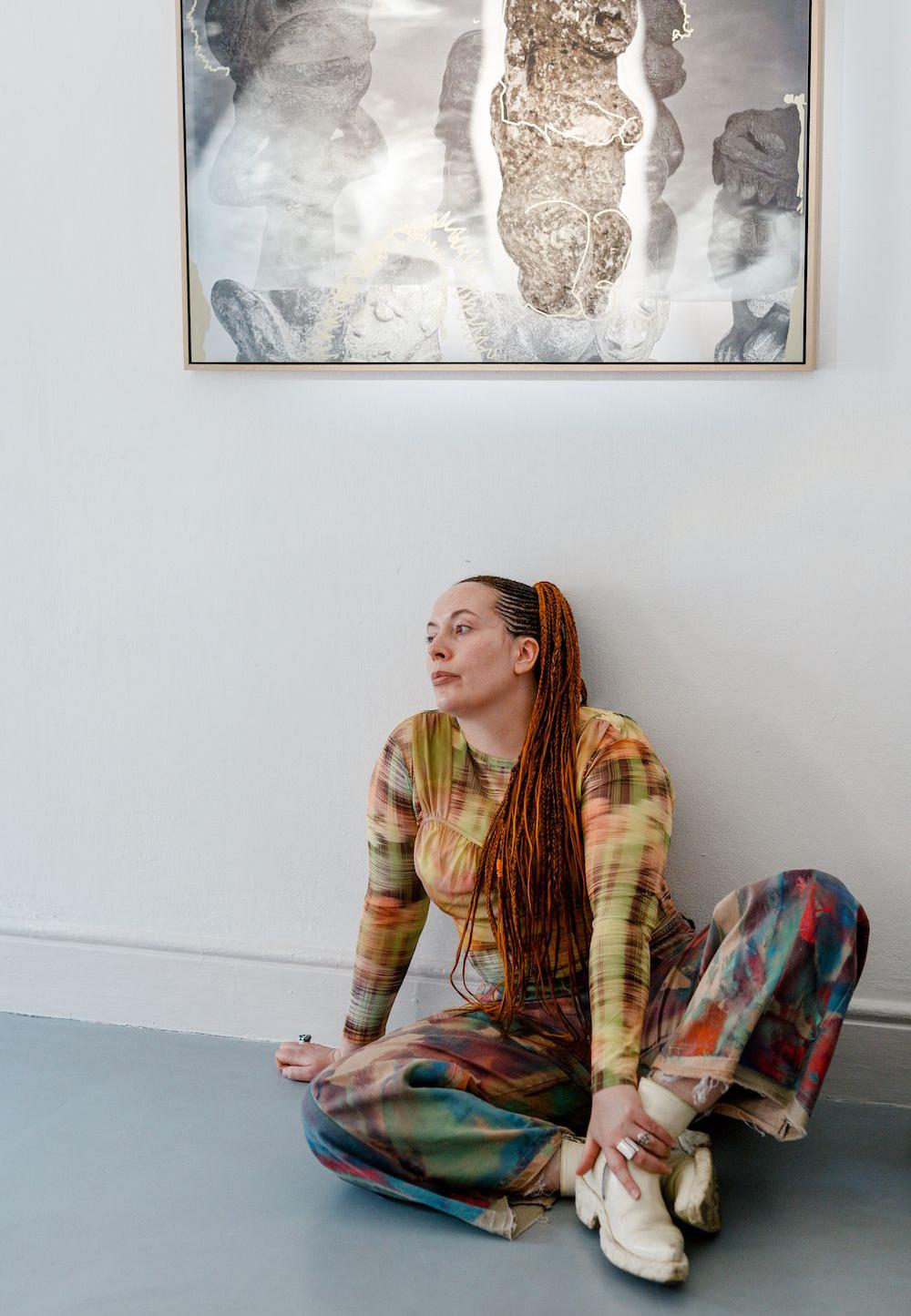
Alice Rekab. Photograph: Tom Flanagan
Anne Harper Musician & Storyteller
From ancient hills in County Down to evolving musical practice, uncovering the quiet connections that link mythology, place, and lived experience
The shift doesn’t arrive dramatically. It doesn’t announce itself.
It begins, instead, with a hill.
For most of her life, Anne Harper’s world was defined by structure - by the discipline of classical music, by the clarity of notation, by the quiet expectation that you would play what was written and nothing more.
For over twenty-five years, she worked as a classical clarinettist, moving through orchestras where precision mattered more than authorship, and where
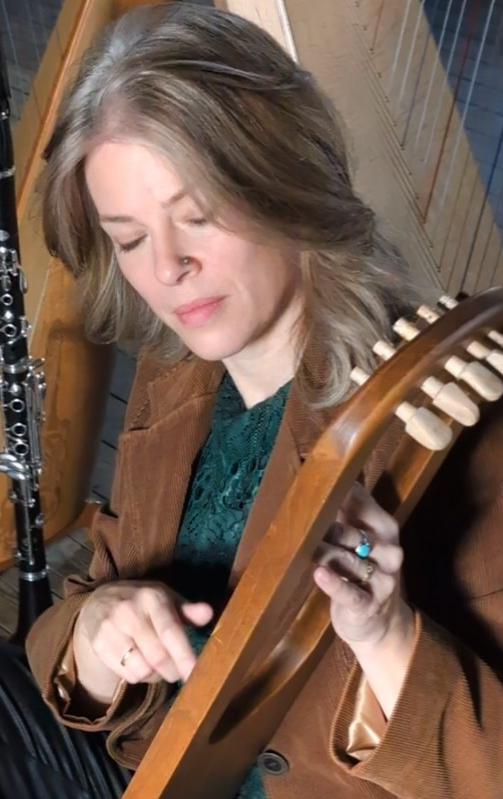
stepping outside the line was rarely encouraged.
It was a life built on mastery, but not necessarily on voice.
“I always felt like part of my musicianship wasn’t being fulfilled,” she says. “Like I had a very developed right arm and a very underdeveloped left.”
That imbalance stayed with her. Not as dissatisfaction exactlybut as something unresolved.
The resolution came not through music, but through place.
The Hill That Demanded a Voice
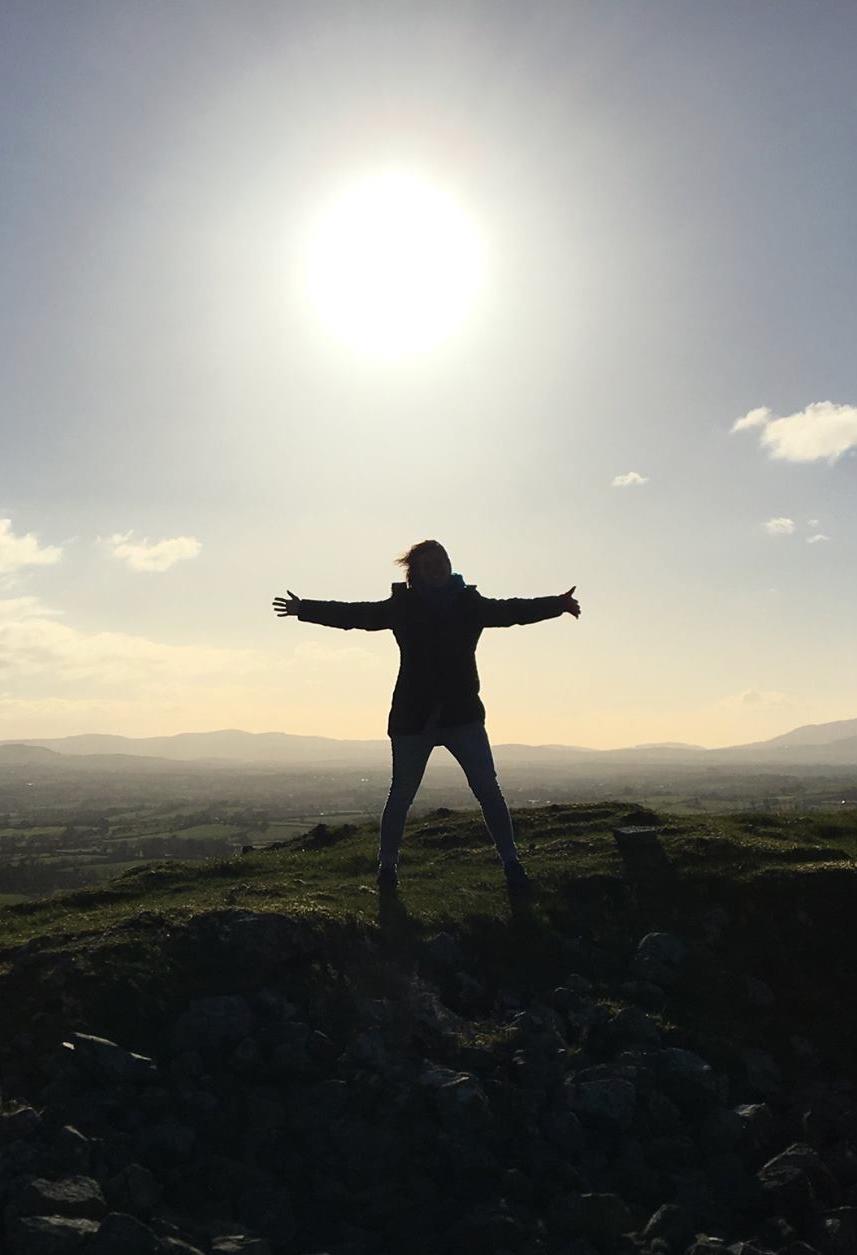
The place is Knock Iveagh - a hill in County Down layered with centuries, even millennia, of history. A Neolithic burial cairn. A Bronze Age reuse. A site of inauguration for ancient chieftains. A landscape that has been lived with, returned to, and remembered across generations.
For Harper, it is also personal.
Her family has known the hill for centuries. It is not an abstract site. It is part of the fabric of where she is from.
When permission was granted for development - a wind turbine placed on the hill - something shifted. “I couldn’t sit by,” she says. “So my job became to tell the story of the hill.”
What followed was not simply protest. It was research. It was immersion. It was a reorientation of how she understood her role - not just as a musician, but as someone responsible for carrying and communicating meaning.
Through her involvement with Save Knock Iveagh, Harper’s work moved into public space. Not as performance, but as articulation. Not as opposition for its own sake, but as an act of care.
“That hill changed the course of my life,” she says.
From Interpretation to Authorship
The change did not happen in isolation.
Alongside this growing engagement with place, Harper’s relationship with music was also shifting. The clarinet - once central - began to recede, not in importance, but in function. In its place, the harp emerged.
Where classical music offered infinite complexity, the harp offered limits.
And in those limits, clarity.
“With fewer notes, fewer possibilities - it focuses your mind,” she explains. “It actually allows you to write.”
Composition followed. Not as a formal decision, but as a
natural extension of a new way of thinking. Music became less about interpretation and more about expression - a means of carrying ideas rather than simply executing them.
It is a quieter kind of authorship. But it is unmistakably hers.
Where Music First Met Story
Long before this shift, however, there was an early encounter that now feels quietly foundational.
When asked about her first experience of music and storytelling coming together, Harper doesn’t point to a live performance or a traditional session. Instead, she returns to a recording - Sergei Prokofiev’s Peter and the Wolf
“I remember having the record,” she says. “Hearing the voice and the music blended together.”
It is a simple memory, but a significant one. In that piece, narrative and music are inseparable - each shaping the other, each giving meaning to the other. Characters are carried through sound. Story is structured through composition.
Looking back, it offers a clear line into her current work.
“I wish I could say I had a storyteller come into school,” she reflects, “but that was the first time I really heard the two together.”
What Prokofiev offered was not just a composition, but a model - one that quietly suggested that music could carry narrative, and narrative could live within music.
Now, decades later, that same principle sits at the centre of her practice.
Stories That Still Live in the Land
At the centre of Harper’s work is a question: what remains of the stories we’ve inherited?
Not as text. Not as fixed narrative. But as fragments - embedded in landscape, echoed in place names, resurfacing in patterns that repeat year after year.
She speaks about “wonder tales,” a term used by Dáithí Ó hÓgáin in his book The Sacred Isle , to describe stories that have survived in partial form. Stories that may not be complete, but are still meaningful.
“I think we still have them,” she says. “Even if they’ve come down broken.”
Her interest lies in what those stories align with - how they intersect with archaeology, with seasonal change, with the physical world around us.
“You can piece things back together,” she says. “You can find them happening every year.”
This approach resists the idea of mythology as something distant or symbolic. Instead, it treats story as something active - something that continues to exist alongside us, if we know how to look.
Across Water, Not Apart
One of the most striking aspects of Harper’s thinking is how she reframes geography.
“We’re very used to seeing maps north to south,” she says. “But if you turn the map, you start to see bridges instead of barriers.”
In her work, the Irish Sea is not a divide. It is a route.
Rivers become highways. Bays become entry points. Travel by water - historically - was often easier than by land. And with that movement comes exchange: of people, of language, of music, of story.
It is this perspective that underpins her recent exploration into the connections between early Irish music and traditions further afield - including the influence of Middle Eastern instruments.
She does not claim certainty. Instead, she asks questions.
“It just struck me that the worlds aren’t as far apart as you think.”
Collaboration and Continuity
Despite stepping away from orchestral life, Harper has not stepped away from collaboration.
Her work with storyteller Liz Weir on Cloak of Wisdom reflects this - a project grounded in folklore, memory, and the transmission of knowledge across generations.
“It’s lovely to have that company,” she says. “That camaraderie is really important.”
Where classical music offered collaboration within strict boundaries, her current practice allows for something more fluid. Ideas move between people. Stories are shared, reshaped, extended.
There is no single authority. Only contribution.
The Intimacy of Storytelling
Harper came to storytelling later than music. She formally trained during the pandemicinitially without a clear plan for what it would become.
What she found was something different entirely.
“The essence of storytelling is human to human,” she says. “Sharing the same emotional journey.”
Unlike music performed on a stage, storytelling places the teller and the listener in direct relationship. There is no distance. No separation.
“You see it on people’s faces,” she says. “The nod, the laugh, the silence.”
It is this immediacy that defines the practice for her - and what she feels cannot be replicated digitally. While she uses social media to share her work, the core of storytelling remains physical, present, and shared.
“We’re all becoming tired of digital connection,” she suggests. “At some point, we need more.”
Reclaiming the Role of the Artist
In speaking about the past, Harper returns often to the role of the artist within society.
There was a time, she notes,
when poets and storytellers held power - not in a political sense, but as custodians of memory and reputation. They could praise. They could criticise. They could shape how a leader was remembered.
Today, that role feels less defined.
But not, she believes, less necessary.
“I think it’s still a powerful tool,” she says.
Her own work reflects that belief. Not through confrontation, but through attention. Through the act of noticing, of connecting, of giving form to things that might otherwise go unspoken.
Becoming Visible
For Harper, stepping into public view was not a natural progression.
Coming from a classical background, self-presentation felt unfamiliar. Even uncomfortable. But the need to speak for Knock Iveagh made it unavoidable.
“It wasn’t about me,” she says. “It was about representing that place.”
That necessity became a catalyst.
What began as advocacy became a broader practice - one that now includes music, storytelling, research, and digital sharing. A practice that is still evolving, still asking questions, still finding its shape.
“I had to step up,” she says. “And just do it.”
An Ongoing Conversation
There is no fixed endpoint in Anne Harper’s work.
It moves between disciplines.
Between places. Between past and present. Between the personal and the collective.
It is as much about listening as it is about speaking.
At its core is a simple idea - that stories matter. That places hold meaning. That connections exist, even when they are not immediately visible.
And that sometimes, all it takes is one piece of music - heard at the right time - to stay with you long enough to shape everything that follows.
Anne will be speaking at the Group for the Study of Historic Irish Settlements conference in Strangford from 8th–10th May, sharing her work on stories embedded in the landscape. facebook.com/GSIHS
She will be presenting at Ulidia 8 – The Eighth International Conference on the Ulster Cycle of Tales at Rathcroghan Visitor Centre from 23rd–25th June, exploring the relationship between story, music, and archaeology across Ulster and western Scotland. rathcroghan.ie
Along with hosting a conversation with Lord Iveagh at the Rathfriland Literary Festival from 4th–7th June, discussing the heritage of Iveagh and the history of the Guinness family alongside live music.
facebook.com/Rath-LiteraryFestival
Find out more about Knock Iveagh through a copy of Knock Iveagh: Memory and Materiality in a Community
Landscape: trivent-publishing.eu
And keep up with Anne via social media: @thatharperwoman
Mark Malone Sound Migration
An exploration of how people are drawn into online spaces - and how understanding, not judgement, might be the way out
Igrew up in a fairly militarised part of the country… there’s a certain level of political literacy that goes with just the nature of where you’re born.”
For some people, questions around identity, belonging, and fairness arrive gradually. For others, they are simply part of the environment from the beginning. They are not abstract ideas but lived realities, shaping how the world is understood long before there is any need to define them.
“Politics was kind of a normal thing… it wasn’t a foreign kind of way of thinking about the world.”
That familiarity did not produce certainty. Instead, it created a habit of noticing - of recognising that people move through systems, and that those systems influence how people relate to one another.
Learning Through Doing
In Belfast in the late 1990s, that awareness began to take a more practical form. It was shaped not through formal structures, but through shared spaces where people organised, created, and responded together.
“I was in and around… DIY scenes where people were organising and creating spaces and resources for themselves.” There was something compelling about that approach. It
suggested that change was not something distant or abstract, but something that could be built - often imperfectly - by the people closest to it.
“It was quite attractive… seeing people create their own spaces and resources… that opened up questions around power and how systems are structured.”
Those early experiences were not about fixed positions or rigid ideas. They were about participation, experimentation, and a sense that understanding comes through involvement rather than observation.
A Grounded Life
Alongside this, there was always something more immediate - work rooted in the physical world.
“Construction… that’s what I’ve always done.”
It was not separate from everything else, but part of the same life. A family trade, something practical and tangible, offering a different kind of perspective - one grounded in making, building, and working alongside others.
After time in Belfast, a move south came not through planning a new direction, but simply through work.
“It was primarily construction… I’d been in Belfast for almost
ten years and wanted to try something different.”
That duality remained - the physical and the social running alongside each other, each informing the other in quiet ways.
A Change in the Landscape
Around the early 2010s, something began to shift in how people connected and organised.
“I started seeing… organised anti-migrant and anti-Muslim activity… particularly online.”
At that time, there was a widespread belief that social media platforms might act as tools for liberation. Events like the Arab Spring were often framed through that lens, described as movements enabled by platforms like Twitter - spaces where people could organise, communicate, and challenge power structures.
“There was an argument… that things like the Egyptian revolution were ‘Twitter revolutions’… tools for democracy or liberation.”
But that understanding didn’t hold for long.
2f6190
“In reality, they’re just tools… they get used by whoever is using them.”
What followed was a clearer recognition that these platforms didn’t simply reflect the
world - they shaped it. They influenced how people encountered information, how they responded to it, and how ideas moved between individuals and communities.
The Blurring of Worlds
Over time, the distinction between online and offline began to fade.
“People don’t live separate online and offline lives anymore… they just have the internet in their pocket.”
This shift changed more than convenience. It altered the pace and intensity of everyday life.
Where once there was distance - a newspaper, a broadcast, a moment to step back - there is now a constant stream of information.
“Thirty years ago you had a news cycle… now it’s 24/7, always there.”
That constant exposure does not just inform. It creates pressure, shaping how people feel as much as what they think.
How People Get Pulled In
There is often a tendency to imagine that people adopt harmful ideas through deliberate, clear decisions. The reality
is usually much less defined.
“Very few people… wake up one day and decide. People tend to drift into these movements.”
That drift begins with something familiar. A sense that something isn’t working, or that something important is being overlooked.
“There are very real anxieties out there… around housing, around how people are being looked after.”
These concerns are not imagined. They are grounded in everyday experience, and they carry weight.
Within that, there is often something that resonates.
“There is always an element… a grain of truth in how things are framed.”
The difficulty lies in how that truth is used. Instead of leading to deeper understanding, it can be redirected.
“That energy gets directed elsewhere… blame gets placed on others.”
What begins as a question becomes a narrative, and over time that narrative can become difficult to step outside of.
Belonging and Identity
Part of what makes these spaces powerful is not simply the ideas they promote, but the sense of connection they provide.
“It creates identity… it creates bonding.”
For many people, that sense of belonging is immediate and meaningful. It offers clarity in uncertain moments, and connection in places where that may feel absent.
“People can end up living their entire social lives in these spaces.”
Leaving, then, is not just about changing a viewpoint. It can mean losing a network, a shared language, a place to exist.
The Limits of Labelling
In response, it is common to simplify - to apply labels, to categorise, to draw clear boundaries between positions.
But this can make understanding more difficult rather than easier.
“Terms get used as slurs rather than as descriptive… and that’s not useful.”
Reducing people to categories removes the possibility of nuance. It creates a fixed picture where, in reality, people are constantly shifting.
“We all hold contradictory ideas… people are persuadable.”
If there is no space for that movement, then there is no space for change.
“If people feel written off… you lose the ability to understand why they’re there.”
The Design of Attention
The environments people move through are not neutral.
“They’re designed… to maximise engagement.”
In practice, this often means prioritising content that provokes strong emotional responses. Fear, anger, and urgency travel quickly, and are reinforced by the systems that surface them.
“High intensity emotions tend to be negative… and that aligns with how certain narratives spread.”
This creates a cycle where particular types of content become more visible, shaping not only discussion but perception itself.
What Gets Amplified
Certain themes appear again and again, regardless of place or context. They surface in different conversations, different communities, but they follow a familiar pattern.
“It’s the same narratives… fear around attacks on women, on children.”
These are not abstract fears.
They are rooted in real experiences, in real harm, and in long-standing issues that exist across society. Violence against women, abuse, and harm to children are not new problems, nor are they confined to any one group. They are deeply embedded issues that cut across communities, often happening in private spaces, often unspoken, and often unresolved.
“Sexual violence is real. Harm to children is real.”
Because these fears are real, they carry weight. They are felt instinctively, and they demand attention. People want to feel safe. They want to know that those around them are protected. They want answers to problems that have, in many cases, persisted for generations.
Within that, there is something powerful - but also something that can be redirected.
“There are feelings and anxieties that can be mobilised.”
What often happens is not the creation of fear, but the reshaping of it. Complex, systemic issues - rooted in culture, inequality, silence, and long-term patterns - are reframed into something more immediate and more easily targeted. The focus shifts away from the broader reality of these problems and toward simplified explanations that place responsibility elsewhere.
In doing so, the original issue can become obscured. Instead of asking why these harms exist, or how they might be meaningfully addressed, attention is drawn toward who can be blamed in the moment.
What is left behind is the original problem - unchanged, still present, and often still unspoken.
Understanding this does not diminish the seriousness of those fears. If anything, it highlights their importance. It suggests that these are issues that deserve deeper attention, not quicker conclusions.
Because when something is both real and unresolved, it becomes easy to reshape.
A Wider Shift
Beyond individual groups, there is a broader movement in how ideas enter public conversation.
“What we’re seeing is… the terms of debate shifting.”
Ideas that once existed at the edges begin to appear in more familiar spaces, often through repetition rather than scrutiny.
“People start using the same language… and that gives those ideas more legitimacy.”
In trying to respond, there can be a tendency to mirror those narratives, but this can reinforce them instead of challenging them.
What Exists Alongside It
Despite all of this, there is another reality that receives far less attention.
“There are far more people doing positive work than people realise.”
Across towns and cities, but just as often in smaller places, people continue to come together in quiet, practical ways. These are not large, coordinated movements with clear structures or visibility. More often, they are local responses - neighbours meeting neighbours, small groups forming around a shared need, people deciding to act because something in front of them requires it.
“There’s been a very significant number of localized responses… people turning up, helping, supporting, integrating within communities.”
That support can take simple forms. Meeting someone new and helping them find their feet. Showing up when tensions rise. Creating a space where people can talk without fear of being judged or pushed into a corner. It is often less about grand gestures and more about consistency - about being present, about building trust slowly over time.
“Most of it is organic… not centrally organised.”
In many cases, people are relying on those closest to them. Friends, neighbours, local groups - the kinds of connections that exist beneath the surface of everyday life. These are the relationships that hold when things become uncertain, and they often become the first point of response when something feels like it is beginning to fracture.
What emerges from this is not a single movement, but a pattern. Small communities finding ways to support one another. People recognising that they are not as isolated as they might feel. A shared understanding that change does not always arrive from above, but can begin with the people already around you. And within that, there is a quiet reassurance.
“There are far more of us… we’re just catching up.”
It may not always be visible in the same way as conflict or division, but it is there - in the everyday decisions people make to stand alongside one another, to listen, and to respond with something other than fear.
Stepping Back Into Perspective
Engaging with this constantly can take a toll.
“It’s not a particularly joyful thing… dealing with this material all the time.”
Maintaining perspective becomes essential.
“Simple things… spending time with people, getting outside, taking care of yourself.”
These are not small acts. They are ways of rebalancing, of remembering that life exists beyond what is presented on a screen.
“There’s a relationship between how this impacts you and what else is going on in your life.”
Making Room to Think
There is no single conclusion offered here. No demand to take a position or to arrive at certainty.
Instead, there is something quieter - a recognition that understanding takes time, and that people are not fixed.
“We all hold contradictory ideas, and people can change.”
In a world that often rewards quick judgement and immediate reaction, the ability to pause - to question, to reconsider, to look again - becomes something else entirely.
Not a weakness, but a way forward.
And perhaps, in that space, there is room to step outside the cycle.
Keep up with Mark via social media: @soundmigration