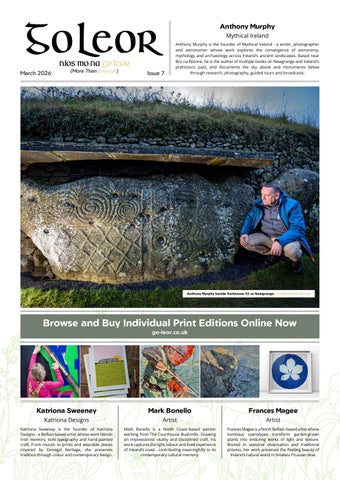
Anthony Murphy is the founder of Mythical Ireland - a writer, photographer and astronomer whose work explores the convergence of astronomy, mythology and archaeology across Ireland’s ancient landscapes. Based near Brú na Bóinne, he is the author of multiple books on Newgrange and Ireland’s prehistoric past, and documents the sky above and monuments below through research, photography, guided tours and broadcasts.
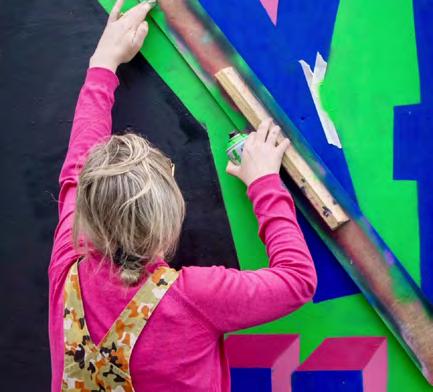
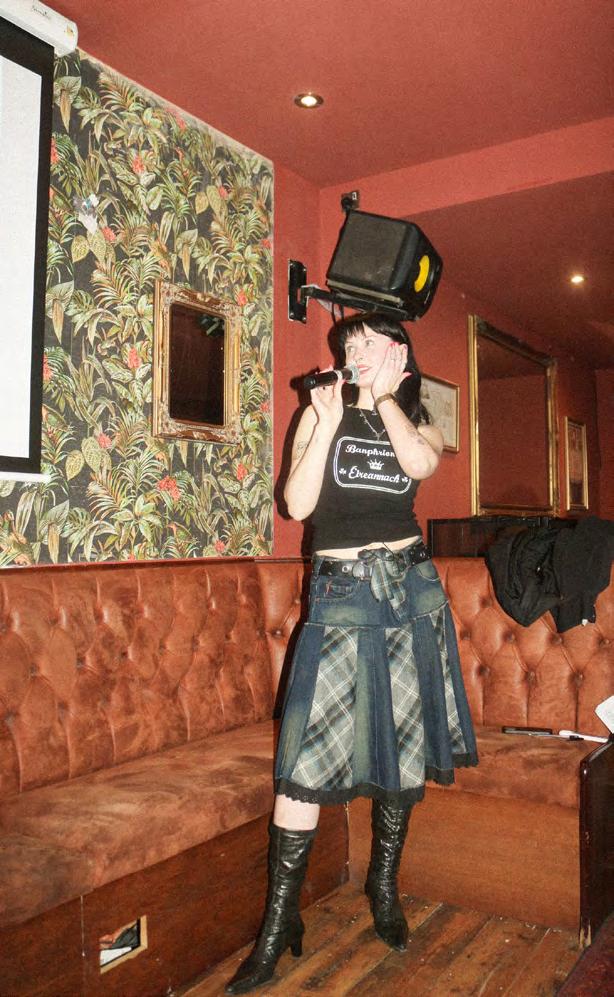
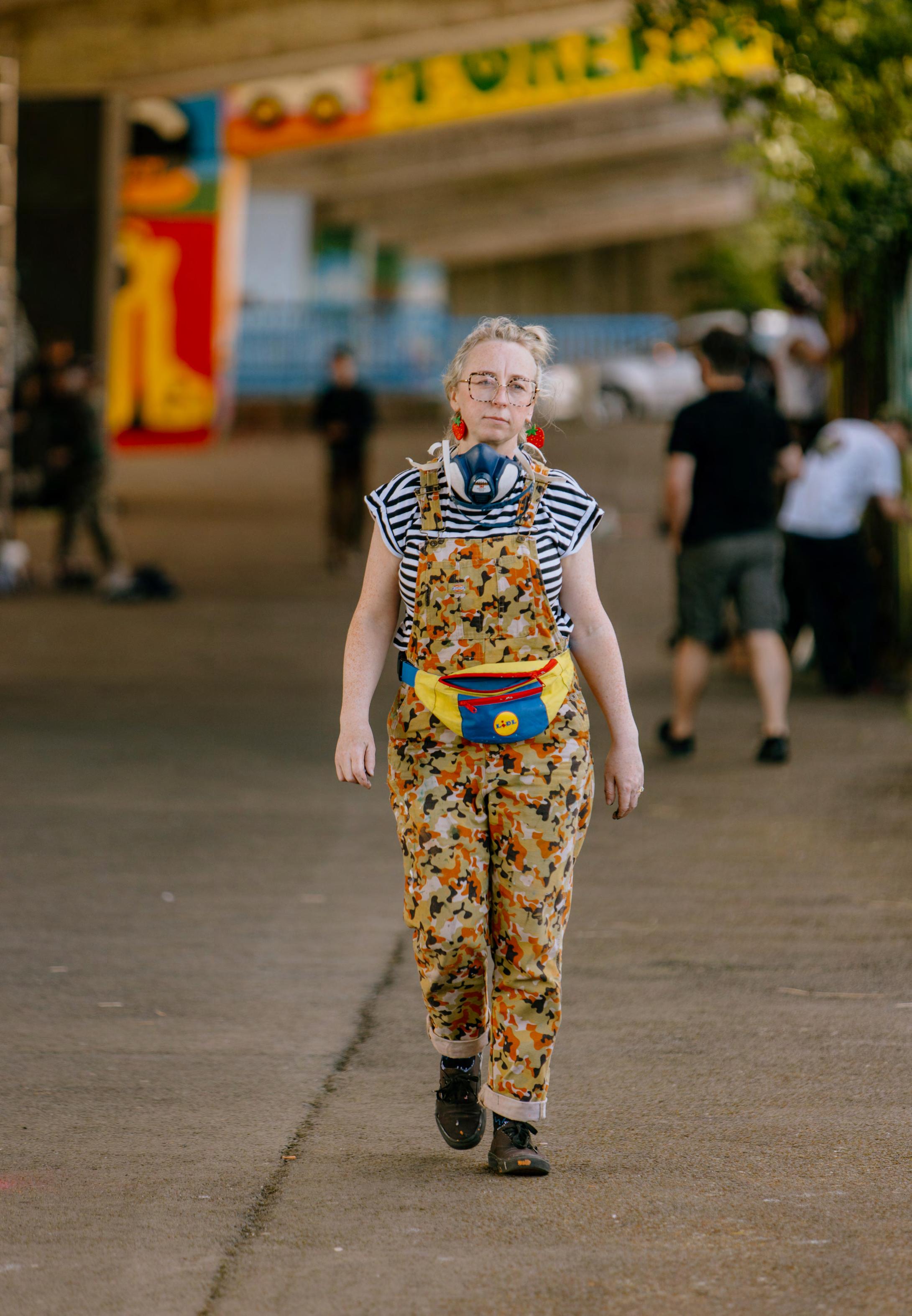
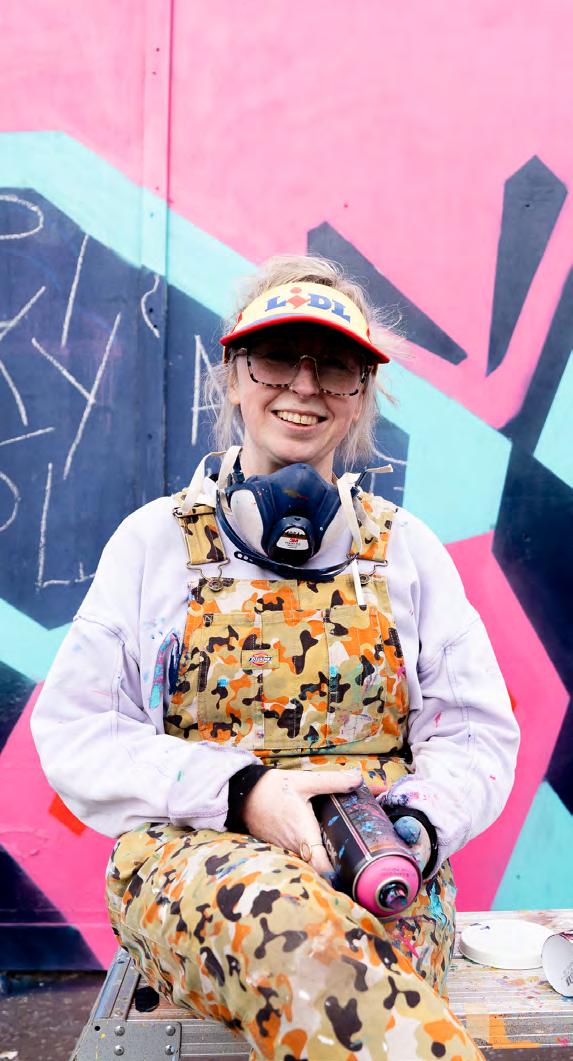
Katriona Sweeney is the founder of Katriona Designs - a Belfast-based artist whose work blends Irish memory, bold typography and hand-painted craft. From murals to prints and wearable pieces inspired by Donegal heritage, she preserves tradition through colour and contemporary design. (More Than Enough)
Katriona Sweeney Katriona Designs
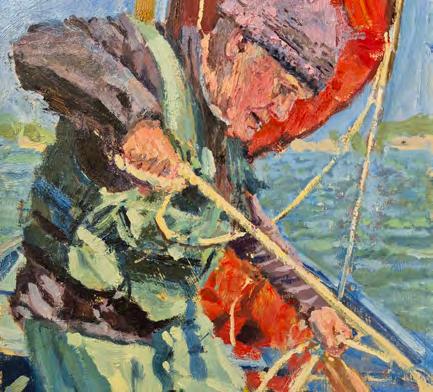
Mark Bonello is a North Coast–based painter working from The Courthouse Bushmills. Drawing on Impressionist vitality and disciplined craft, his work captures the light, labour and lived experience of Ireland’s coast - contributing meaningfully to its contemporary cultural memory.
Frances Magee Artist
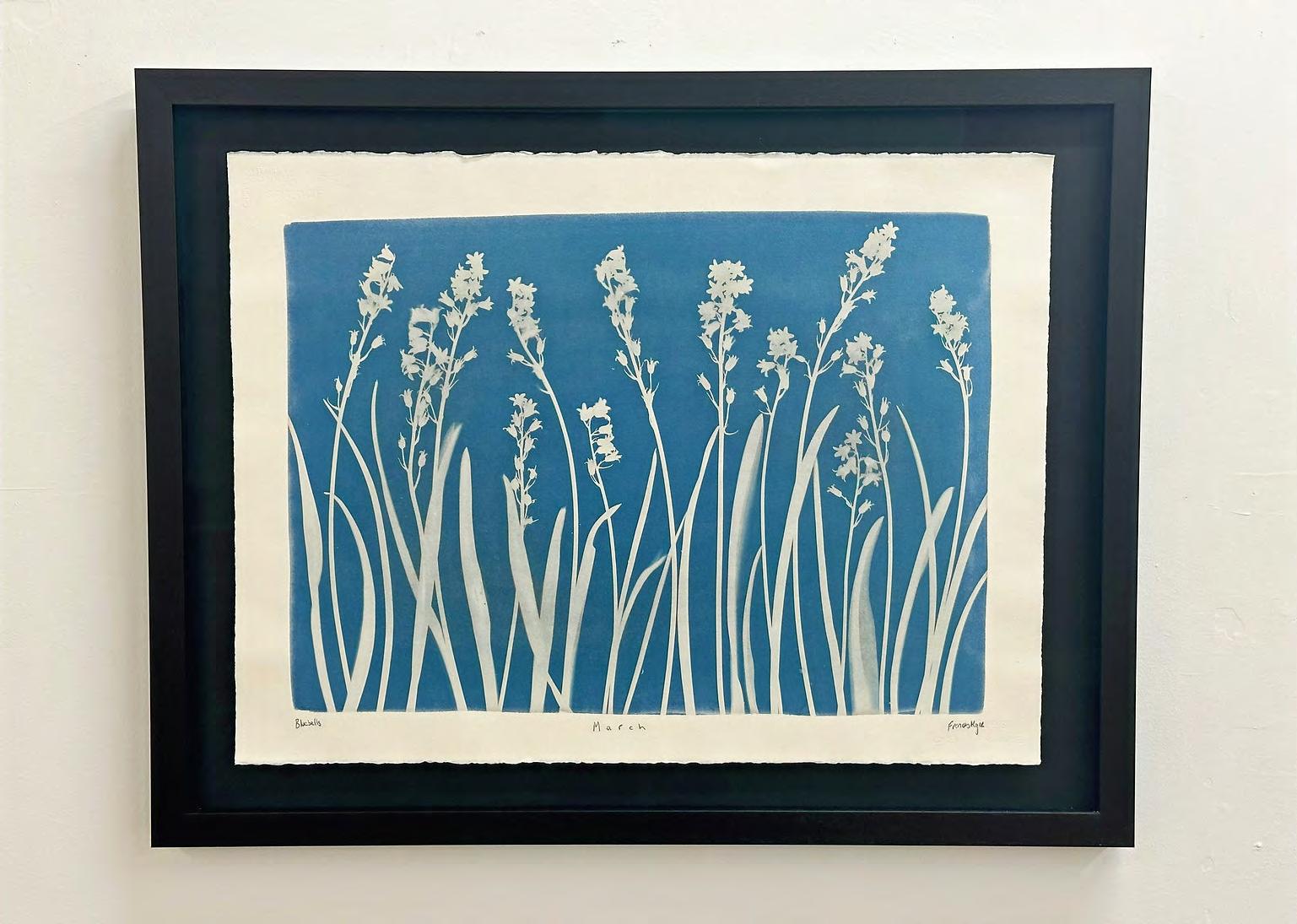
Frances Magee is a North Belfast–based artist whose luminous cyanotypes transform garden-grown plants into enduring works of light and texture. Rooted in seasonal observation and traditional process, her work preserves the fleeting beauty of Ireland’s natural world in timeless Prussian blue.
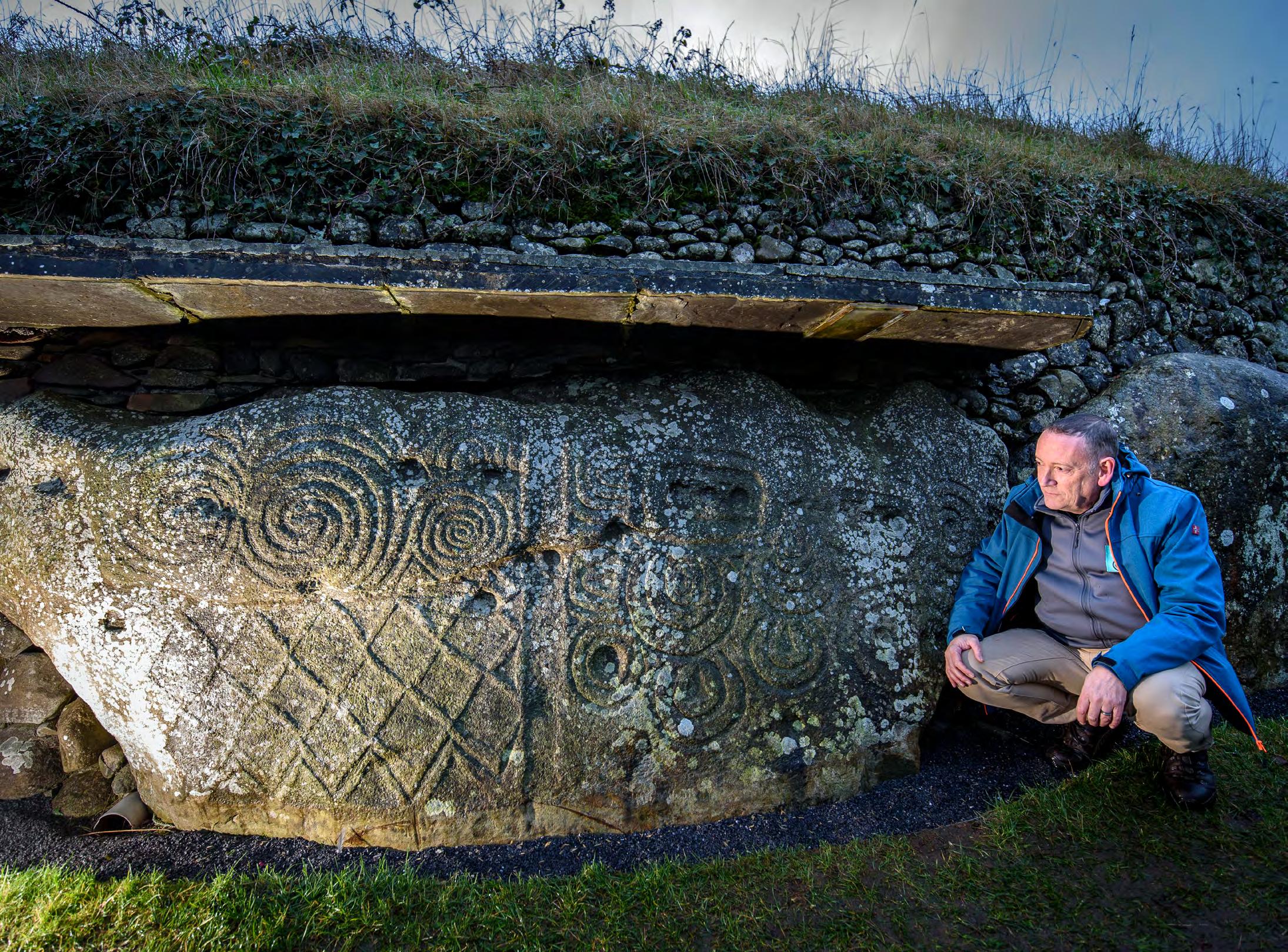
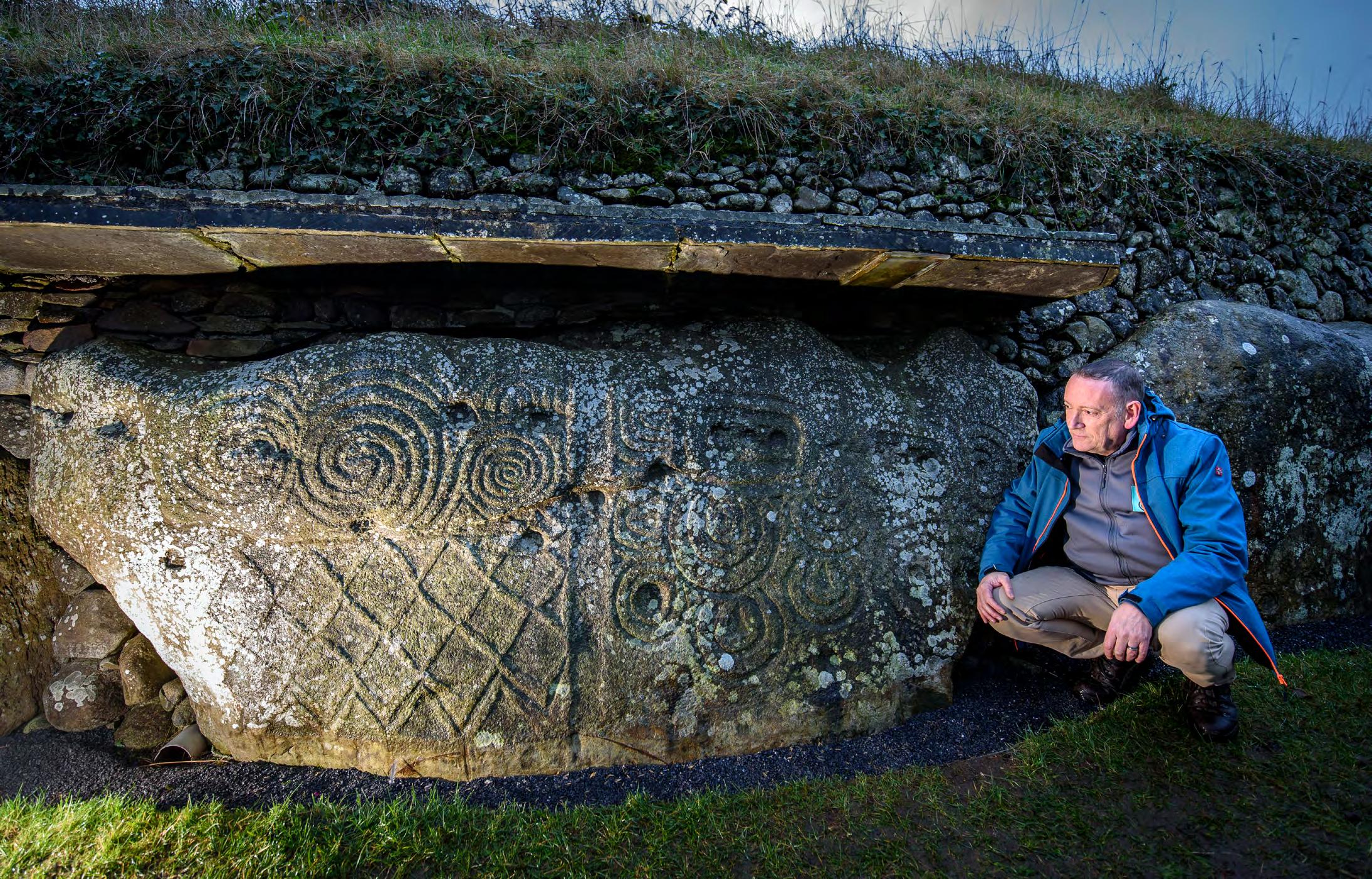
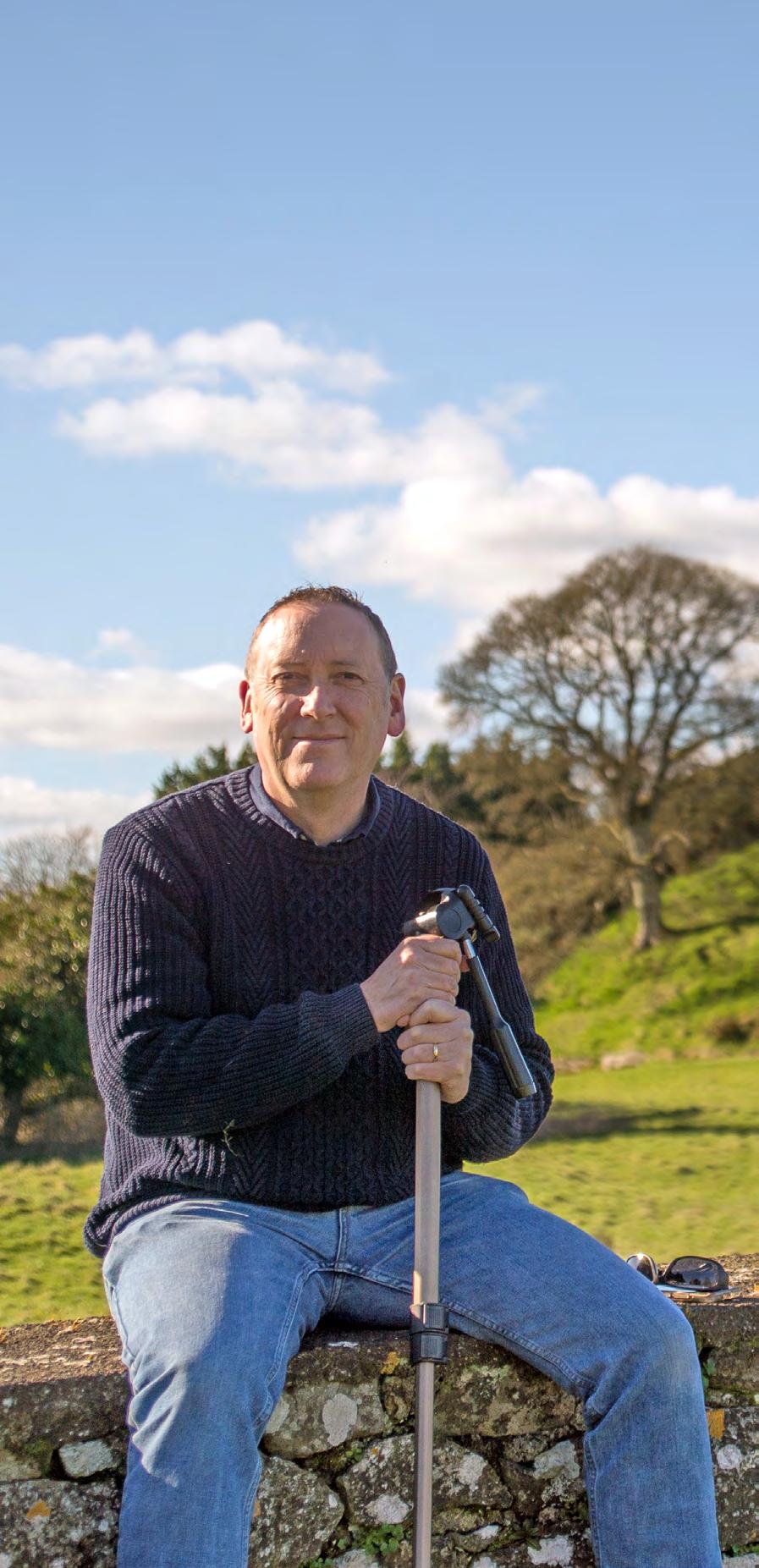
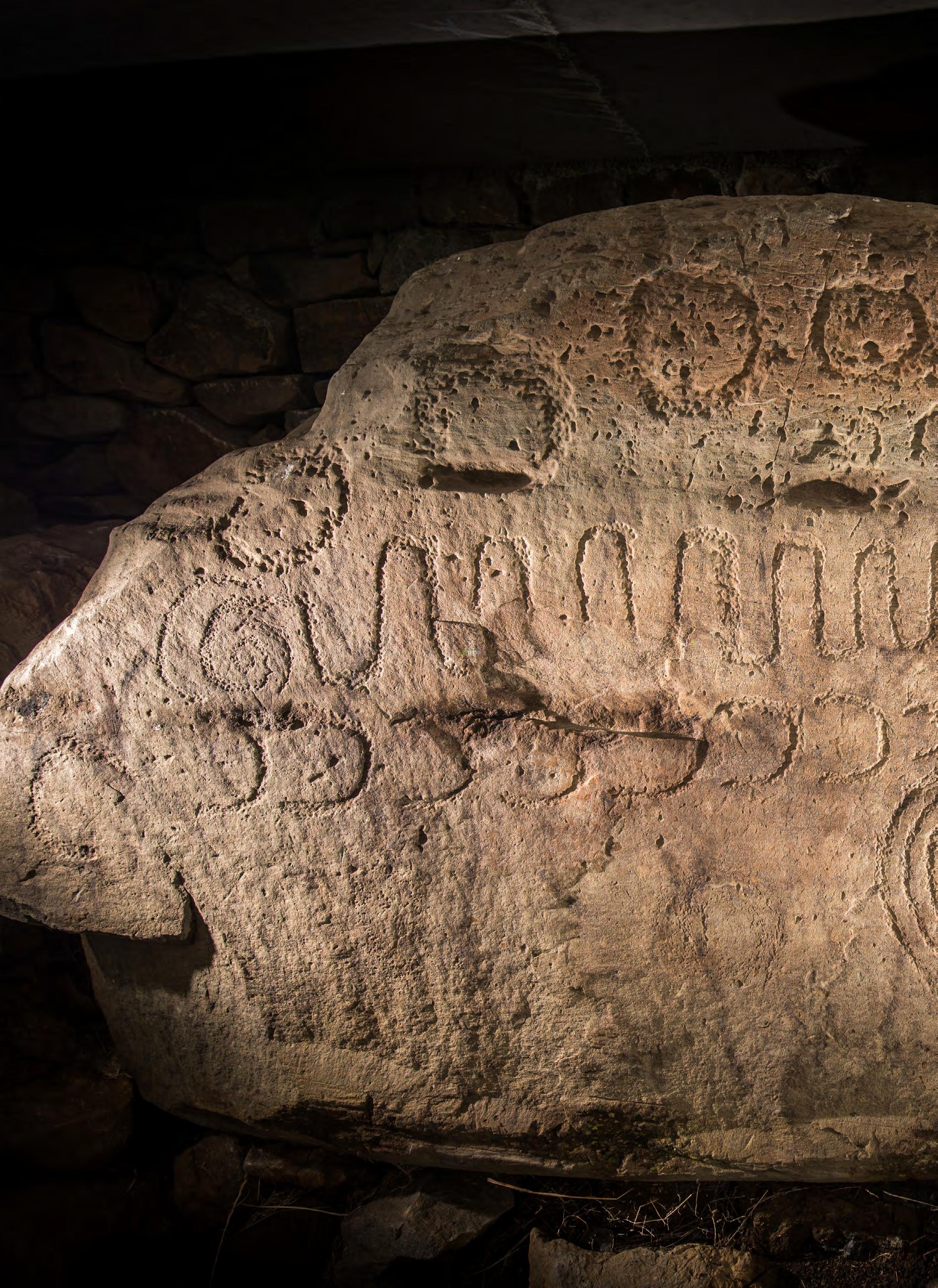
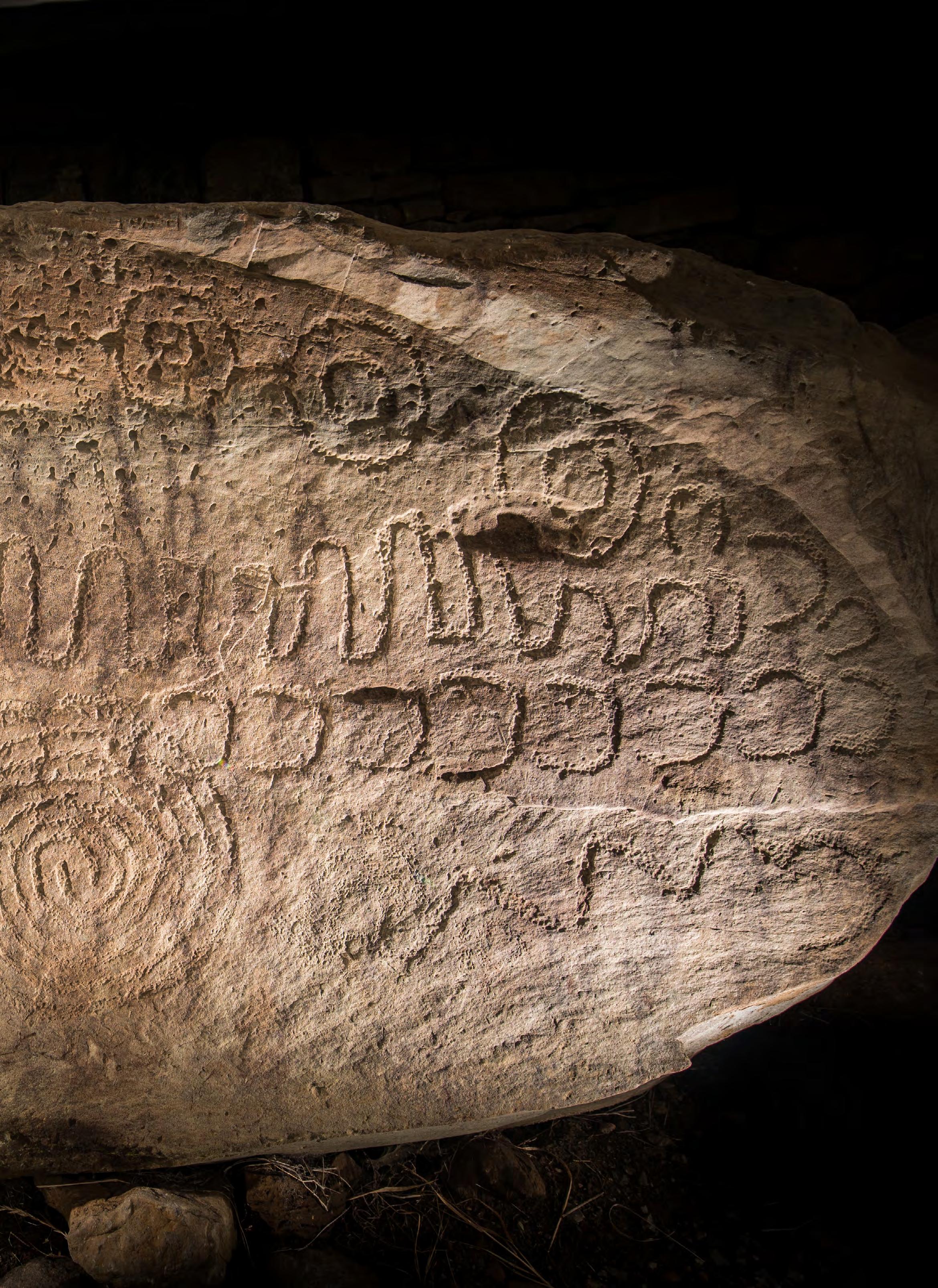
Anthony Murphy beside Kerbstone 52 at Newgrange - mythicalireland.com
Mark Bonello Artist
A Ghaeilge, mo cheol thú!
Seachtain na Gaeilge
Anthony Murphy
Mythical Ireland
An Ghaeilge i Londain 2026
Seachtain na Gaeilge
Katriona Sweeney
Katriona Designs
An Ghaeilge sa Nua-Shéalainn
Seachtain na Gaeilge
Mark Bonello
Artist
An Ghaeilge sa Nua-Shéalainn
Seachtain na Gaeilge
Frances Magee
Artist
Note from the Editor
We’re especially proud in this edition to feature four articles from Seachtain na Gaeilgepresented in Irish, with short English translations as Béarla alongside. Language is not a barrier but a bridge, and it felt important that these pieces could live in their original voice while remaining open and accessible to every reader. Irish belongs in contemporary cultural publishing - not as nostalgia, but as something active, living, and shared.
It’s a privilege to platform work that reflects the depth and diversity of creative practice
across the island. In this issue, we’re delighted to feature Mark Bonello, whose painterly discipline continues to evolve through careful observation and material sensitivity; Anthony Murphy, whose lifelong engagement with Ireland’s ancient landscapes invites us to look again at what stands quietly in plain sight; Katriona Sweeney, whose design practice reframes cultural memory through bold, wearable forms; and Frances Magee, whose cyanotypes hold light, time and atmosphere in delicate balance.
Aidan McGrath
Founding Supporter
This issue is supported by: Mark
Go Leor is built independently and sustained by its readers. Thank you for helping this publication grow.
Beidh an Ghaeilge á ceiliúradh ag Gaeilgeoirí fud fad an domhain sna seachtainí atá amach romhainn. Tá Seachtain na Gaeilge 2026 ag teannadh linn - níl am ar bith níos fearr ann le do chuid Gaeilge a úsáid, taobh istigh agus lasmuigh den seomra ranga!
Is féile idirnáisiúnta Ghaeilge í agus tá sí ar cheann de na hócáidí ceiliúrtha is mó a bhaineann leis an teanga agus le cultúr dúchais na tíre gach
bliain, anseo in Éirinn agus thar lear. In ainneoin ainm na féile, maireann sé níos faide ná seachtain amháin. Bíonn imeachtaí agus ar súil ar feadh os cionn coicíse agus an fhéile ar siúl idir 1-17 Márta
Tugann an fhéile deis do chuile dhuine sult a bhaint as an nGaeilge, idir chainteoirí dúchais, fhoghlaimeoirí agus lucht an chúpla focal ar aon, trí fhéilire imeachtaí siamsúla agus spraíúla a chur ar fáil do gach cineál suime agus gach aoisghrúpa.
Ambasadóirí agus Téama na Féile
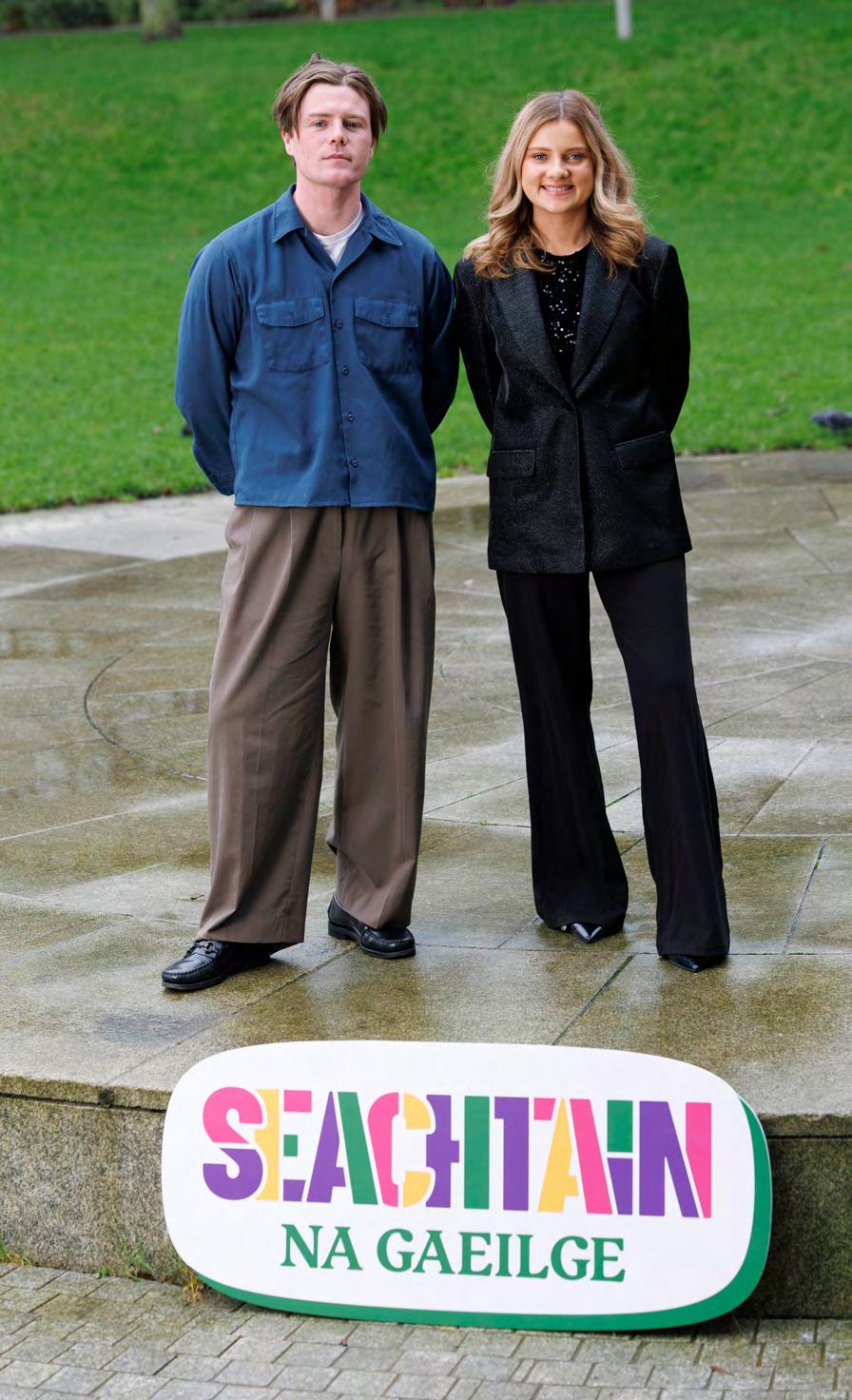
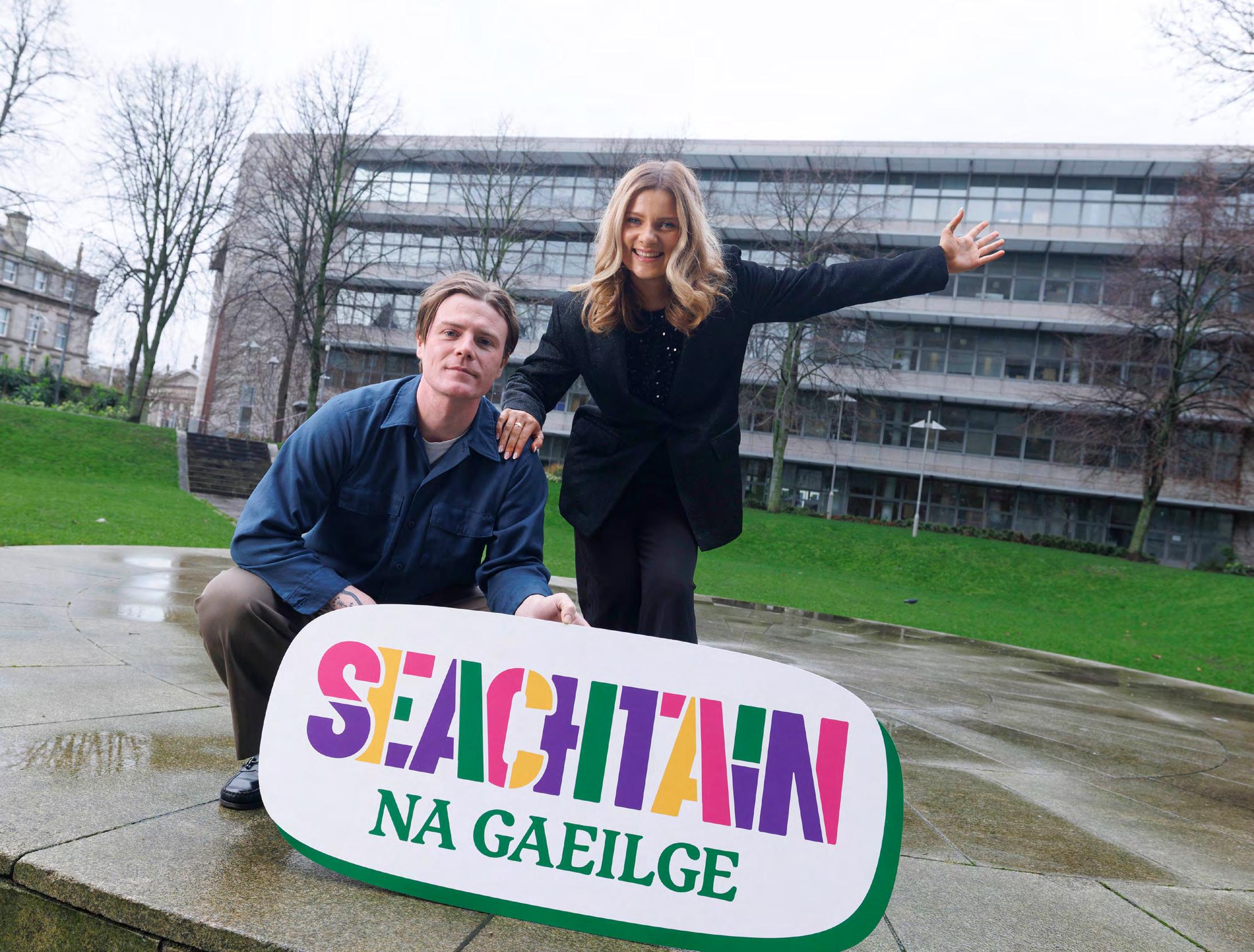
Fógraíodh ambasadóirí Sheachtain na Gaeilge 2026 go hoifigiúil ar 04/02/26: Conor Curley, príomhghiotáraí le Fontaines D.C., agus Róisín Seoighe, amhránaí sean-nóis agus príomhamhránaí IMLÉ
Tá an ceol i lár an aonaigh ag Seachtain na Gaeilge 2026 agus déanann téama na bliana seo, “A Ghaeilge, mo cheol thú”, céiliúradh ar an nasc domhain agus buan idir an teanga agus an ceol.
Tá ríméad orainn fáilte a chur roimh bheirt cheoltóirí den scoth mar ambasadóirí do Sheachtain na Gaeilge 2026. Tugann Conor agus Róisín dearcadh uathúil ar an Ghaeilge tríd an cheol. Le linn na féile, spreagfaidh siad daoine ar fud
na tíre agus níos faide i gcéin chun an Ghaeilge a úsáid ar bhealaí nua agus cruthaitheacha. Is deis í Seachtain na Gaeilge do gach duine an teanga a úsáid - ó chainteoirí dúchais go dtí iad siúd atá díreach ag tosú amach
Imeachtaí
Is grúpaí deonacha agus pobail, comhairlí áitiúla, scoileanna, leabharlanna, agus eagrais cheoil, spóirt, ealaíon agus chultúrtha a eagraíonn imeachtaí ina gceantar féin. Is féidir leat liosta na n-imeachtaí a fheiceáil ar shuíomh sceal.ie. Déan iarracht freastal ar a laghad imeacht amháin nó níos fearr fós, is féidir leatsa d’imeacht fhéin a eagrú agus an t-imeacht a chlárú leis an bhféile ar sceal. ie/claraigh-imeacht
Achmhainní
Is féidir na hearraí SnaG (pinn, pinn luaidhe, fáinní eochracha, balúin srl) a cheannach ón Siopa Leabhar, téigh go snag.ie/siopa le hordú a chur isteach nó is féidir leat teagmháil a dhéanamh linn ar siopa@cnag.ie, thar an bhfón ar 01 478 3814.
Conor Curley agus Róisín Seoighe
“A Ghaeilge, mo cheol thú” –O Irish language, you are my music
The Irish language will be celebrated by Irish speakers around the world in the weeks ahead as Seachtain na Gaeilge 2026 (Week of the Irish language) approaches. The festival provides an opportunity for people to use Irish both inside and outside the classroom.
Seachtain na Gaeilge is an international Irish-language festival and one of the largest annual celebrations of the language and Ireland’s native culture, both in Ireland and abroad. Despite its name, it runs for more than a week, taking place from 1–17 March
The festival offers opportunities for everyone to enjoy and use Irish - including native speak-
ers, learners, and those with only a few words - through a programme of enjoyable and accessible events designed for all interests and age groups.
Ambassadors and Theme
The ambassadors for 2026 were officially announced on 4 February:
Conor Curley, lead guitarist with Fontaines D.C.
Róisín Seoighe, sean-nós singer and lead vocalist with IMLÉ
Music is central to this year’s festival. The theme, “A Ghaeilge, mo cheol thú,” highlights the enduring connection between the Irish language and music. The ambassadors will promote the use of Irish in creative and accessible ways throughout the festival period.
Events
Events are organised locally by voluntary and community groups, local councils, schools, libraries, and cultural, arts, music and sports organisations.
A full list of events is available at sceal.ie. Individuals and organisations may also register their own events through sceal.ie/ claraigh-imeacht
Resources
Official Seachtain na Gaeilge merchandise (including pens, pencils, keyrings and balloons) can be purchased from An Siopa Leabhar via snag.ie/siopa, by email at siopa@cnag.ie, or by telephone at 01 478 3814.
Anthony Murphy Mythical Ireland
An astronomer’s path into Ireland’s ancient past - tracing how skywatching, myth and archaeology converge across the island’s landscapes.
I’m full-time self-employed now. As of two weeks ago.”
Anthony Murphy says it plainly, without ceremony. After thirty-three years of nine-to-five employment, income generation is now entirely in his own hands. “Patreon would account for about 50% of it,” he explains. “And I’m trying to grow that because that just gives me that comfort of everything else being a bonus on top of that. It’s a different world.”
That shift is not a reinvention. It is the natural continuation
of decades of writing, photographing and interpreting Ireland’s ancient landscape through Mythical Ireland. The work has always been there - in the books, in the tours, in the sky-watching, in the steady presence at monuments in winter frost and summer dusk. What has changed is simply the structure around it - “It’s all trending upwards”
A Book and Orion
Murphy can trace his immersion in astronomy to a single evening.
The library, before the internet, was an exciting place. He remembers bringing home a book about the night sky and looking out through the kitchen door on a midwinter night.
“There was Orion glinting and sparkling brilliantly on a cold January night. And I’m looking at the book going, ‘There’s Orion’ - and there it is. And I was just completely captivated.”
There was fascination with the science - distances between Earth and the sun, the nearest star, the enormity of the universe.
Anthony beside Kerbstone 52 at Newgrange
Stars, Stones and Stories
He wrote to NASA, requesting material for what he told them was a school project, and received booklets and glossy Voyager photographs in return. But alongside that scientific curiosity was something else.
“I was unusual because I was a visual astronomer,” he says. “Most people are armchair astronomers… they like reading about it, but they don’t like spending time out in the cold with binoculars and telescopes. But I was the opposite.”
He would go outside alone, often the only one in the household willing to leave the warmth of the fire or television. Over time, that solitary attention took on a contemplative quality.
“I find the night sky is a little bit like my church,” he says. “If you want to revel in your own place in things, there’s no better way than to stand alone under the
night sky and contemplate the vastness of the universe.”
Not religion, he clarifies - but awe. Magnitude. Perspective.
The Pathway Into the Monuments
“Astronomy was the pathway into it,” he says, when asked how that childhood fascination led to Ireland’s ancient sites.
The deeper immersion began in January 1999 while he was working at the Drogheda Independent. An artist, Richard Moore, approached him with a suggestion: that there was far more astronomy connected with the monuments of the Boyne Valley than archaeological literature acknowledged.
They knew Newgrange was aligned to the winter solstice sunrise. That was accepted. But Moore began pointing to carv-
ings - crescent shapes, star-like motifs.
“Tell me that’s not a star,” Murphy recalls him saying. “Tell me when you look at that you don’t think of the night sky.”
Murphy agreed.
What followed was the writing of Island of the Setting Sun: In Search of Ireland’s Ancient Astronomers, his first book. Its central argument was that Neolithic astronomy in Ireland was far more complex than the simple tracking of the sun’s annual movement along the horizon.
“You can’t watch the annual movement of the sun and not notice the moon and the planets and the stars as well,” he says. The oversimplification, he argues, came partly from archaeologists having “little or no knowledge of astronomy.”
The book marked the convergence of three strands that have remained constant ever since: astronomy, mythology and archaeology. Moore supplied a phrase that Murphy continues to quote:
“It is only where stars, stones and stories come together that a deeper truth about the past can be known.”
Living within five kilometres of Brú na Bóinne - with Knowth and Dowth part of the same ritual landscape - he had grown up reading about excavations in the newspapers each summer. The revelations about age, complexity and megalithic art unfolded alongside his own growing astronomical knowledge.
“It was a nice combination of two things,” he says. “And then it became something else.”
That “something else” was myth.
Myth and Migration
Through Moore, Murphy developed not just curiosity but affection for the stories of the Boyne Valley - the narratives surrounding Bóinn, the Tuatha Dé Danann, the Milesians.
He speaks in detail about the Lebor Gabála Érenn - the Book of Invasions - describing it as a work of syncretism by medieval monks, blending indigenous lore with Christian and classical influences. The text chronicles six arrivals into Ireland, long treated as entirely mythological.
Murphy suggests those arrivals may echo real migrations.
“Until around about 2012 or 2013, we believed that the modern Irish population was descended from the first arrivals into Ireland after the Ice Age - the Mesolithic hunter-gatherers,” he explains. “Now we know that’s complete codswallop.”
Genetic research has demonstrated that Neolithic farmers - with origins in Anatolia - were later largely replaced by Bell Beaker populations at the beginning of the Bronze Age. The lineage of modern Irish people lies primarily with those Beaker communities.
The structure of the myth, however, remains intriguing.
“It’s like here’s a blueprint for what’s going to happen later,” he says. “History repeats itself. In Ireland, sometimes it seems that history repeats what’s in myth.”
He references the storm raised by the Tuatha Dé Danann to scatter the Milesian fleet - a mythic episode that curiously foreshadows the historical Spanish Armada. He does not claim literal continuity, but he points to resonance.
“Myth acting as a template,” he calls it.
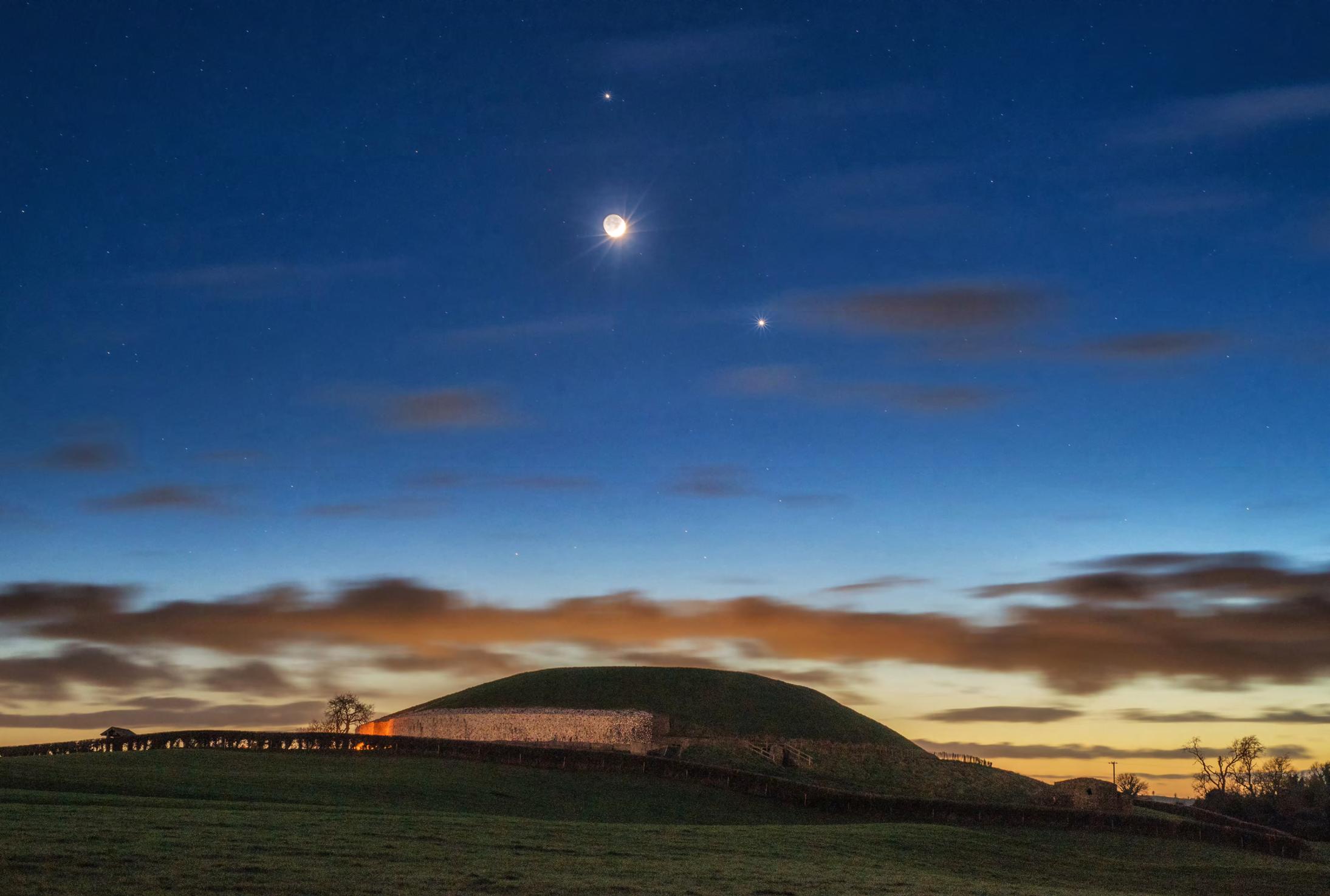
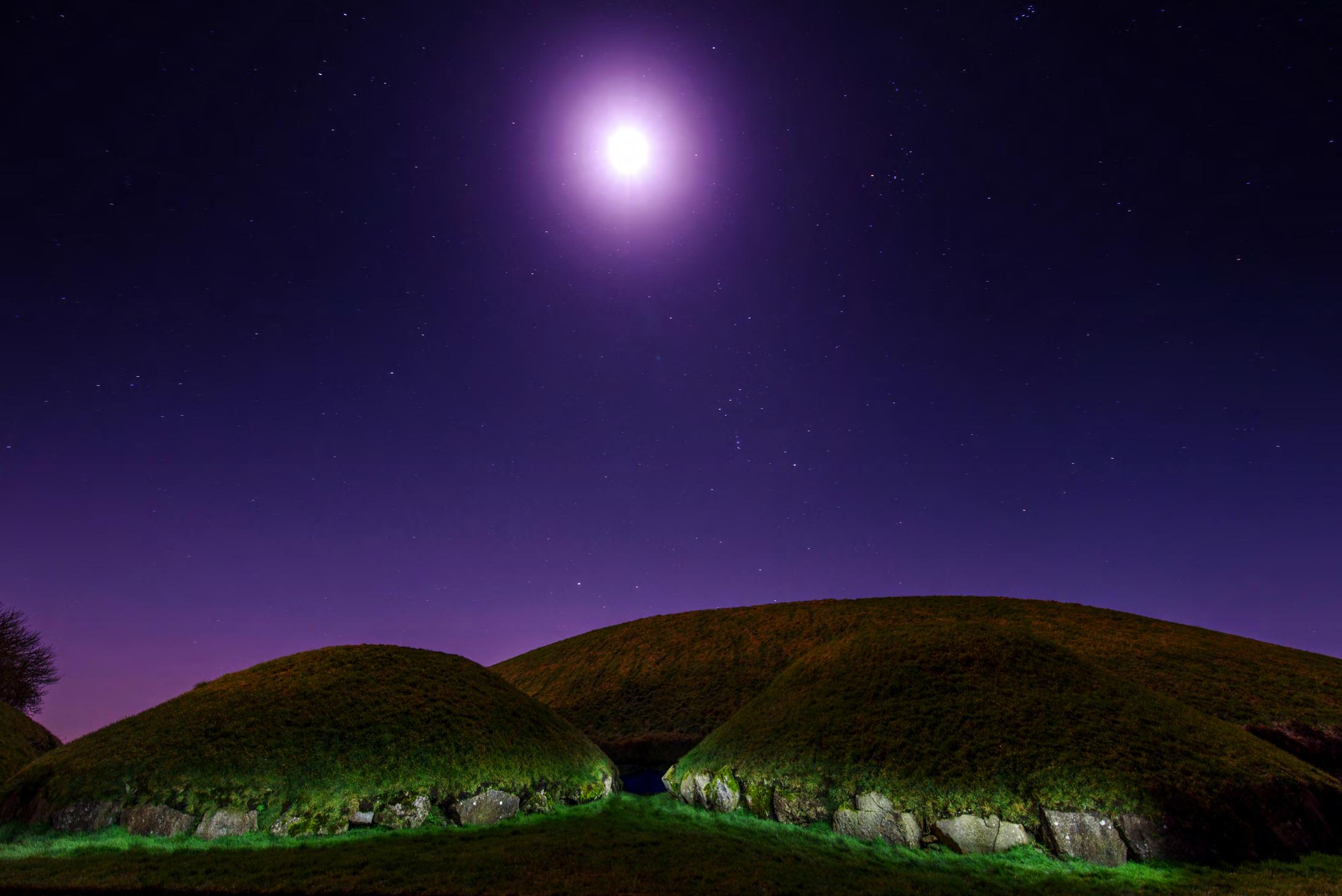
Orion Carries the Moon Over Knowth
Marking the Year
Murphy does not frame himself as ritualistic, but he is acutely aware of seasonal thresholds. Speaking about Imbolc, he clarifies:
“I’m not the sort of person who generally gets into ritual… I mark them in my own way by just being conscious of them and sometimes writing about them.”
As someone who has “loved the sky since I was in single-digit age,” he tracks the six-week rhythm between festivals - the cross-quarter days bracketing solstices and equinoxes.
“Imbolc is fabulous,” he says, “because it really does mark a very noticeable threshold between the slow increase of the light in January and suddenly through February and March you have this much more dramatic extension of the day.”
The Gregorian calendar, he argues, is “kind of nonsensical.” The older divisions, by contrast,
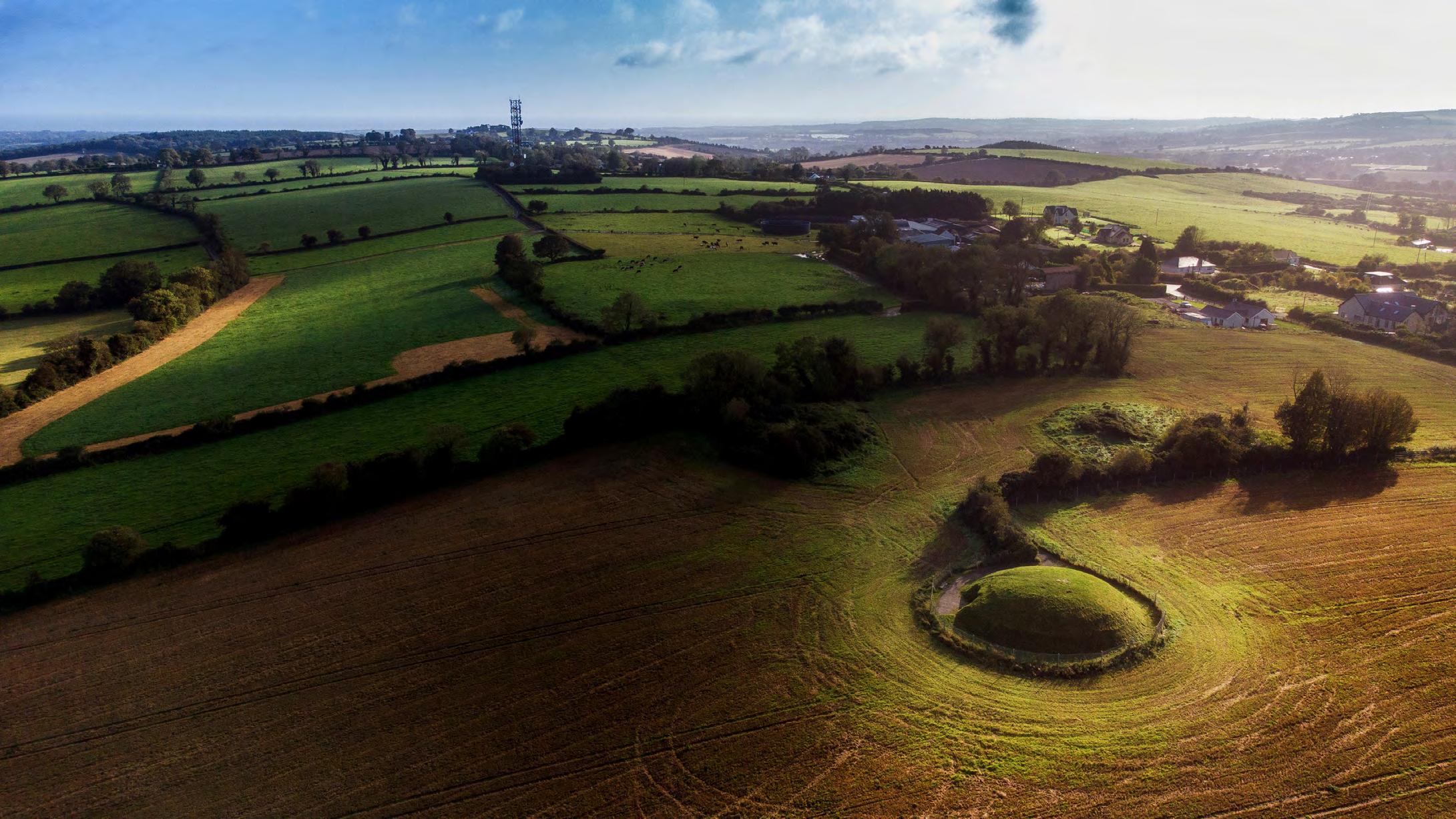
Fourknocks Catches the Winter Sun
reflect measurable celestial movement.
“You can see the longer day… by the end of March it’s not getting dark till nearly eight in the evening, and you kind of feel we’re coasting now.”
Even the moon reveals how disconnected many have become from basic cycles.
“People go mad when they see a photograph of the full moon,” he says. “And they don’t realise in 29 days there’ll be another one.”
The Eye in the Sky
Murphy’s engagement with technology is practical rather than performative. He began flying drones in March 2017. Sixteen months later, he identified what became known as Dronehenge - a previously unrecognised Late Neolithic enclosure near Newgrange.
“I photograph monuments and archaeological landscapes,” he says. “What better place to use a drone?”
Aerial imagery expanded perspective. Video footage was licensed to television companies. Drone photographs sit alongside twilight landscapes in his annual calendar.
Photography, he insists, is less about equipment than timing.
“Ninety percent of it is just being there at the right time. The other ten percent is having the equipment and a little bit of knowledge.”
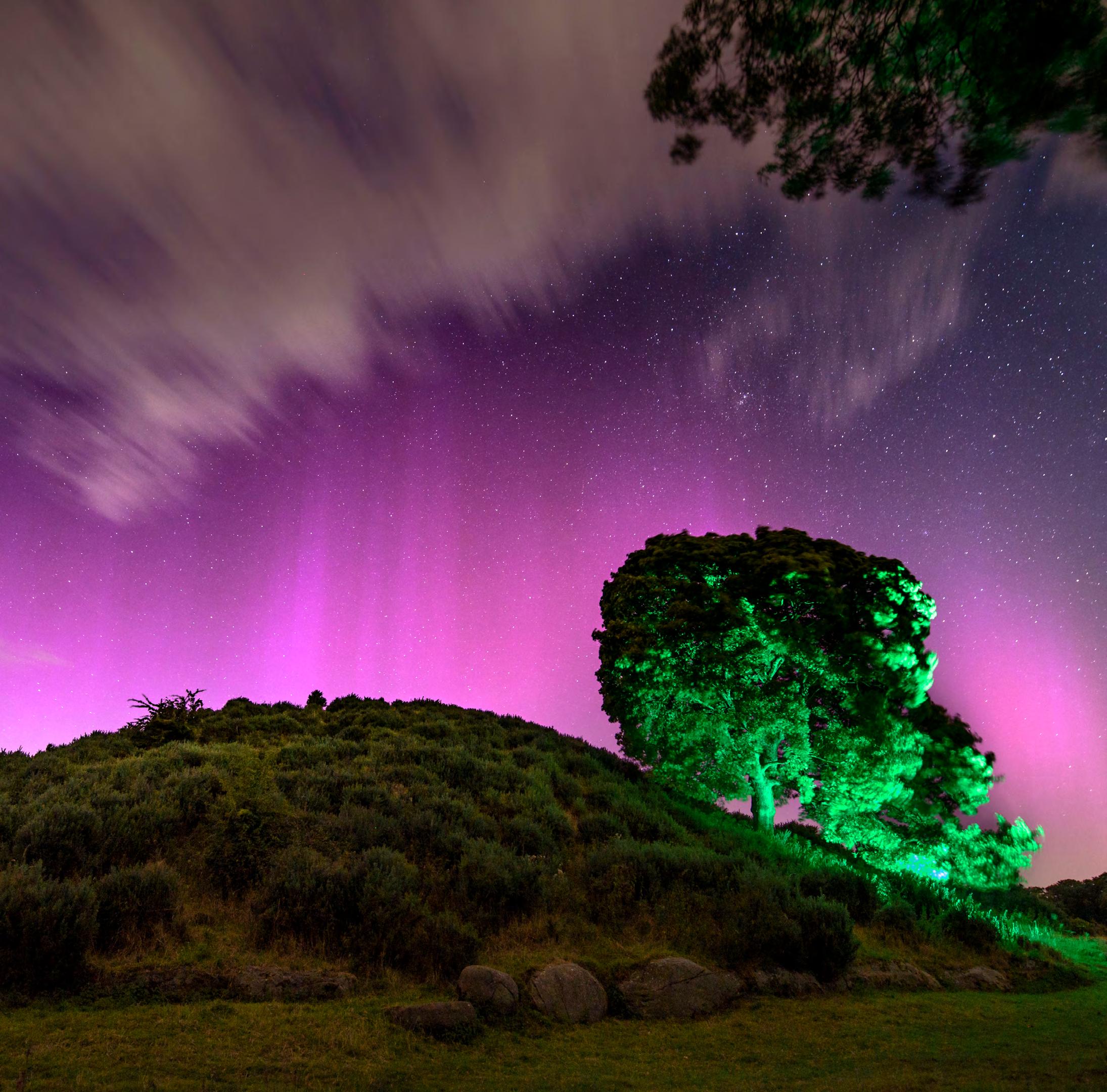
He recounts photographing the Mound of the Hostages on the Hill of Tara during an aurora display. Without professional lighting, he and his son placed phone torches in the entrance to illuminate the structure.
“That’s the trick,” he says. “Just a little bit of lighting at the entrance made all the difference.”
What surprised him most was that no one else had thought to do it.
“There were lots of people on
the Hill of Tara taking photographs of the aurora - but not one of them over at the mound.”
Writing at the Centre
Despite the photography, the tours and the digital platforms, Murphy returns repeatedly to writing.
“That’s the thing that got the whole thing started,” he says.
He records his own audiobooks - prompted by years of readers telling him, “You should read your books aloud.” With broadcast experience in radio and television alongside his print journalism background, the process feels natural.
“It makes complete sense,” he says.
He speaks of substantial manuscripts underway - large-scale works building on earlier books such as Mythical Ireland and Newgrange: Monument to Immortality. His ambition is straightforward:
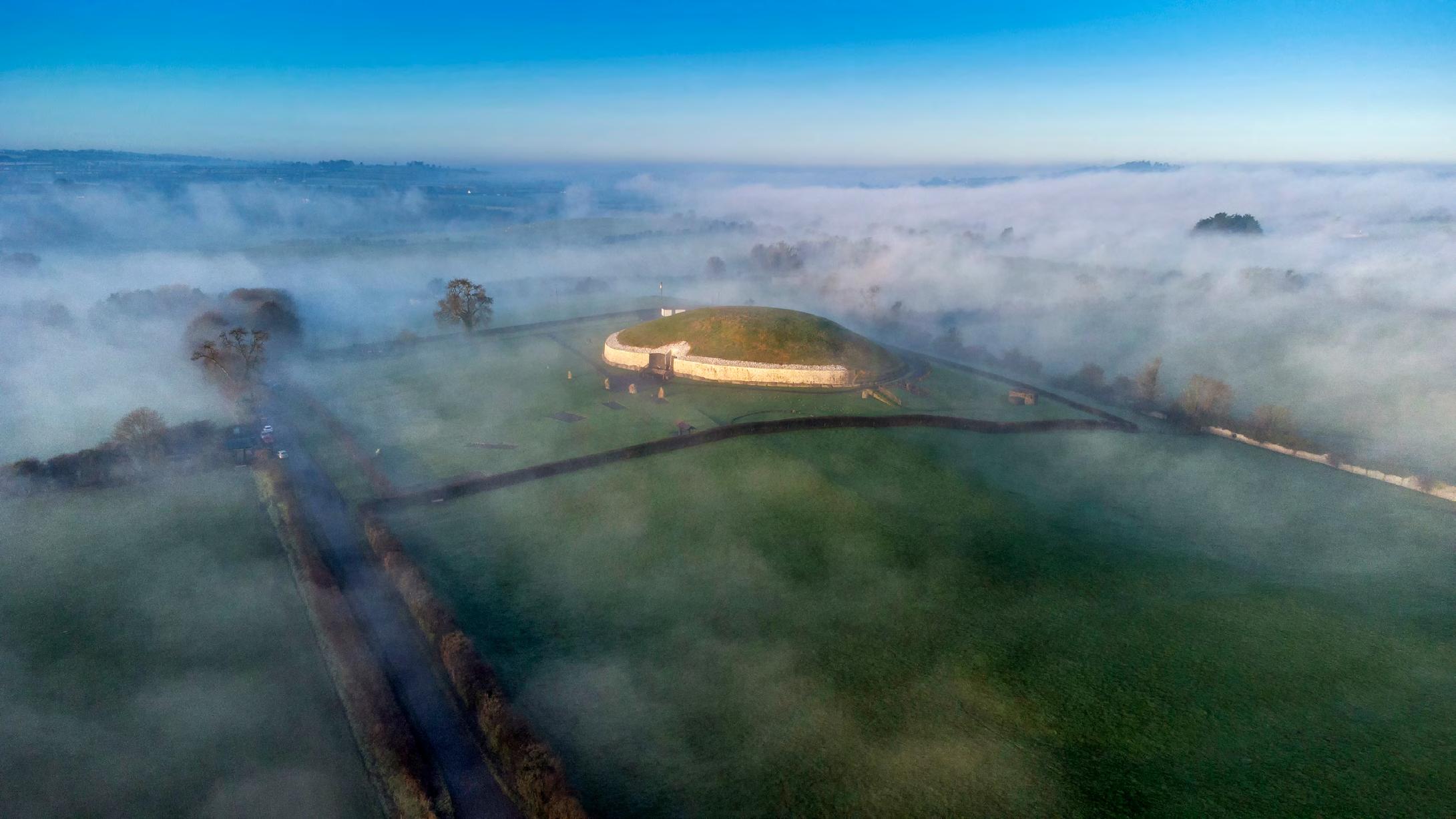
Misty Winter Solstice Sunrise at Newgrange
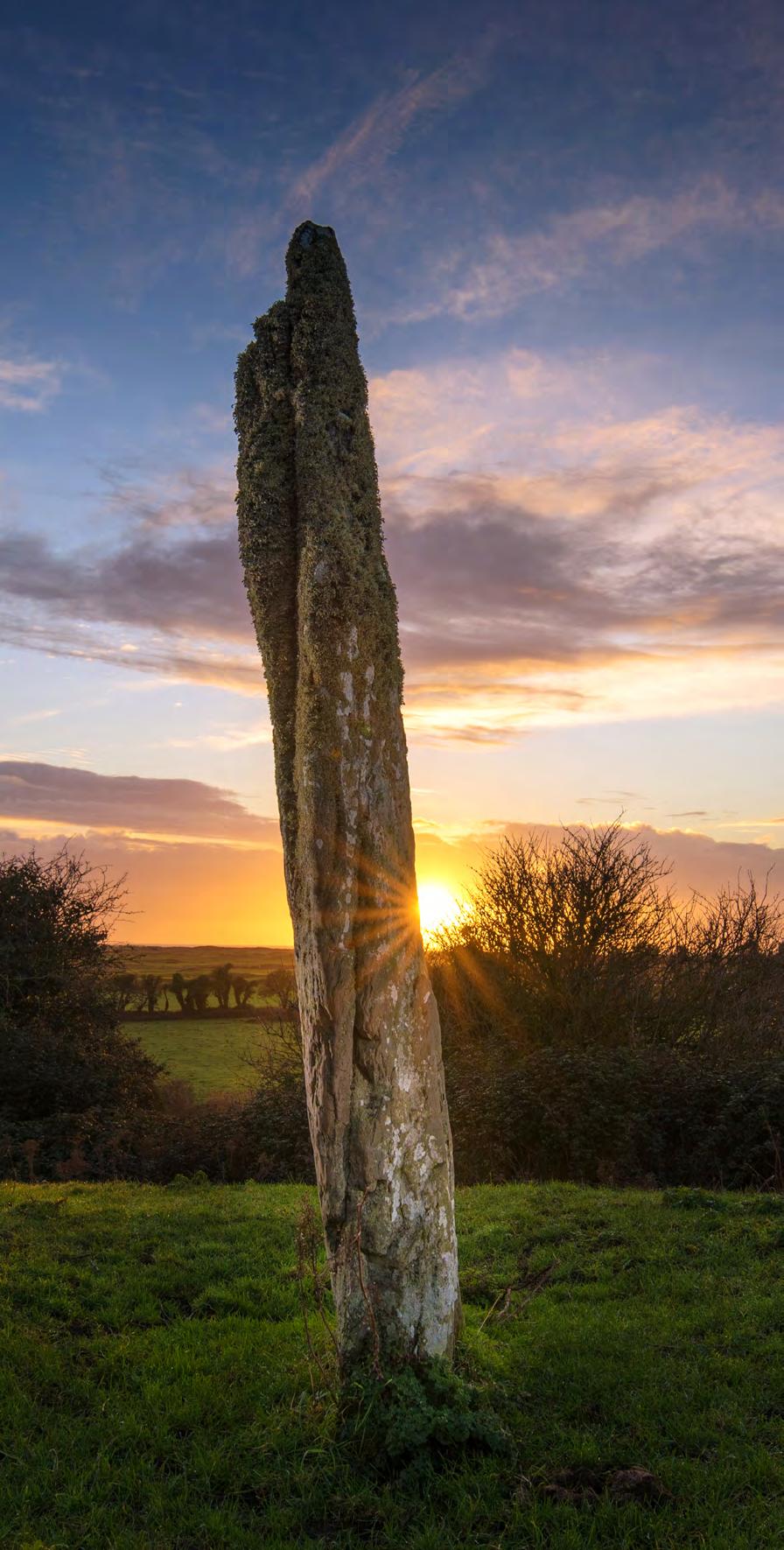
Baltray Standing Stones - Blog
“I can give you a book every year if you want.”
The discipline is evident. The research base is deep. The archive - textual and photographic - is extensive. Distribution, he notes, is always the challenge. “It’s very well having the website… but if your books aren’t on the bookshelves…”
Above and Below
Throughout the conversation, Murphy moves easily between sky and soil. From Orion to
Newgrange. From Anatolian farmers to Bell Beaker replacements. From aurora over Tara to the mechanics of shutter speed and ISO.
Astronomy, mythology and archaeology remain, in his words, “the three central planks of everything I’ve done since.”
The sky above.
The monuments beneath.
And the long continuity of stories in between.
To explore more of Anthony Murphy’s work - including his books, signed editions, annual calendars, fine art photography prints, audiobooks, guided tours, lectures, podcast episodes and regular myth-andastronomy livestreams - visit: mythicalireland.com
Support him directly via Patreon: patreon.com/mythicalireland
And keep up with Mythical Ireland via social media: @mythicalireland
Aurora Above Dowth
An Ghaeilge i Londain 2026
Seachtain na Gaeilge
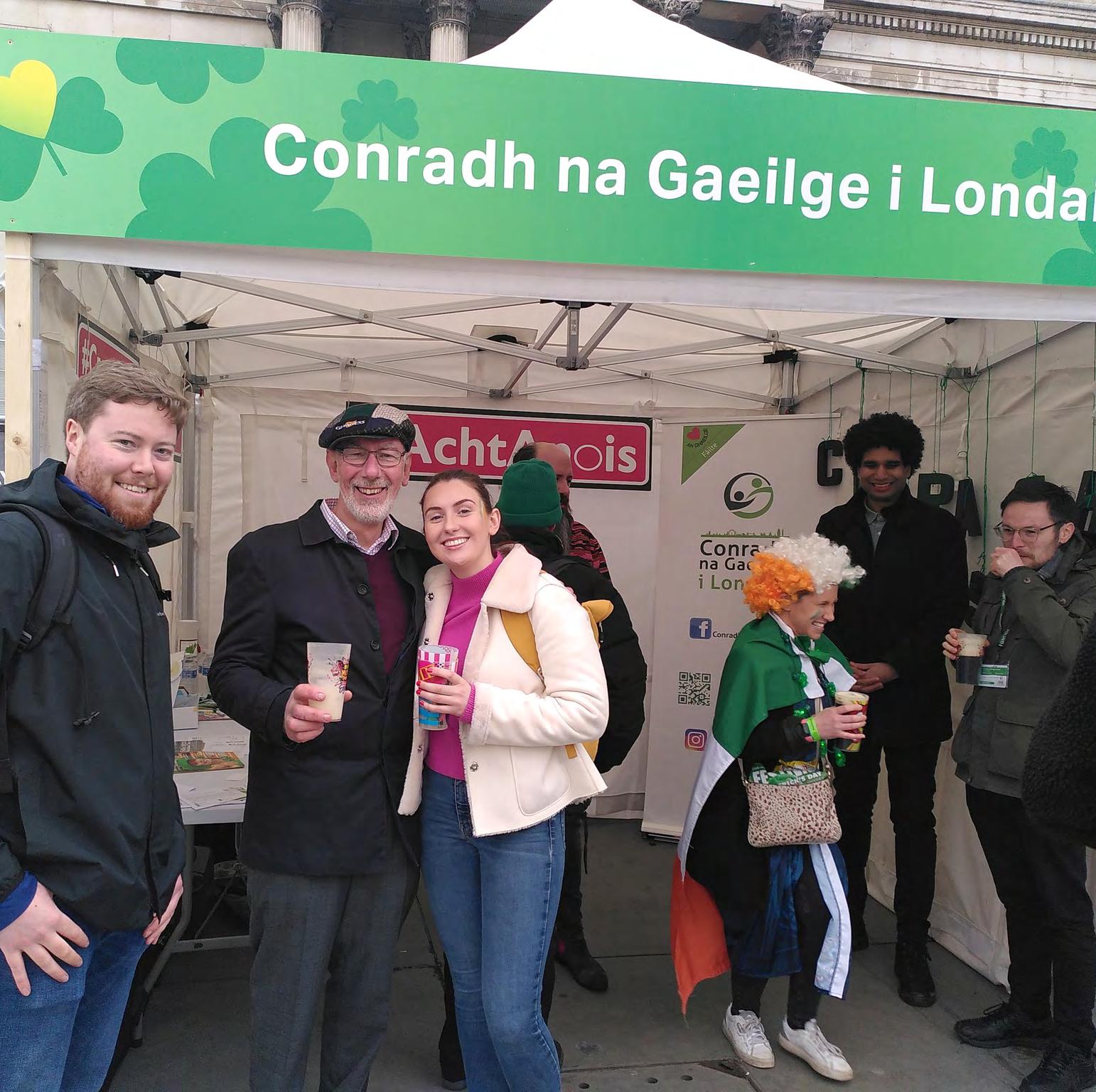
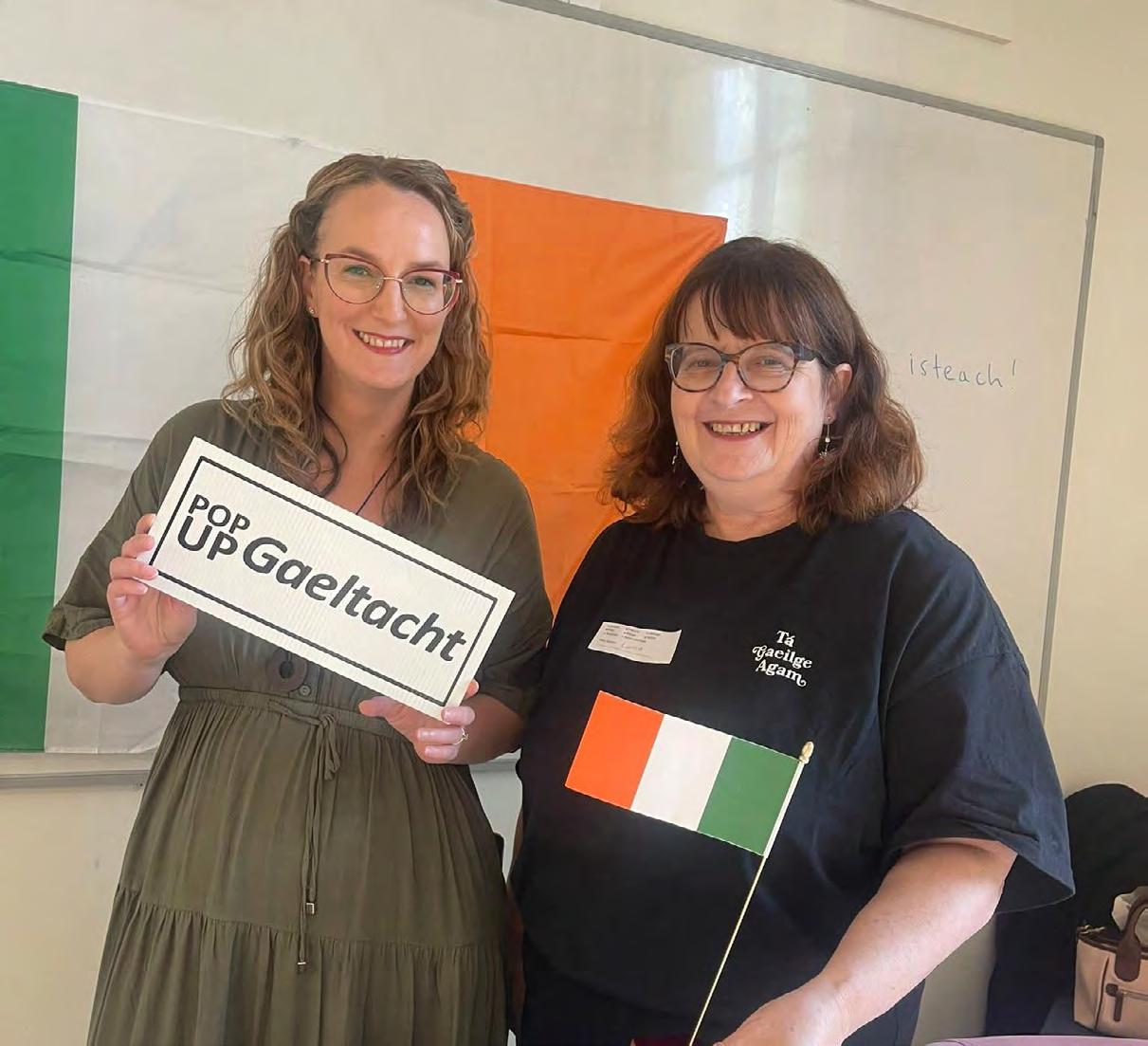
Tá an Ghaeilge beo beathach i Londain faoi láthair, agus is léir go bhfuil fás mór tagtha ar spéis sa teanga ar fud na Breataine le déanaí. From beginners to daoine líofa, many Londoners are currently embracing their Gaeilge and coming together frequently to learn, speak and celebrate the language i gcroílár na cathrach.
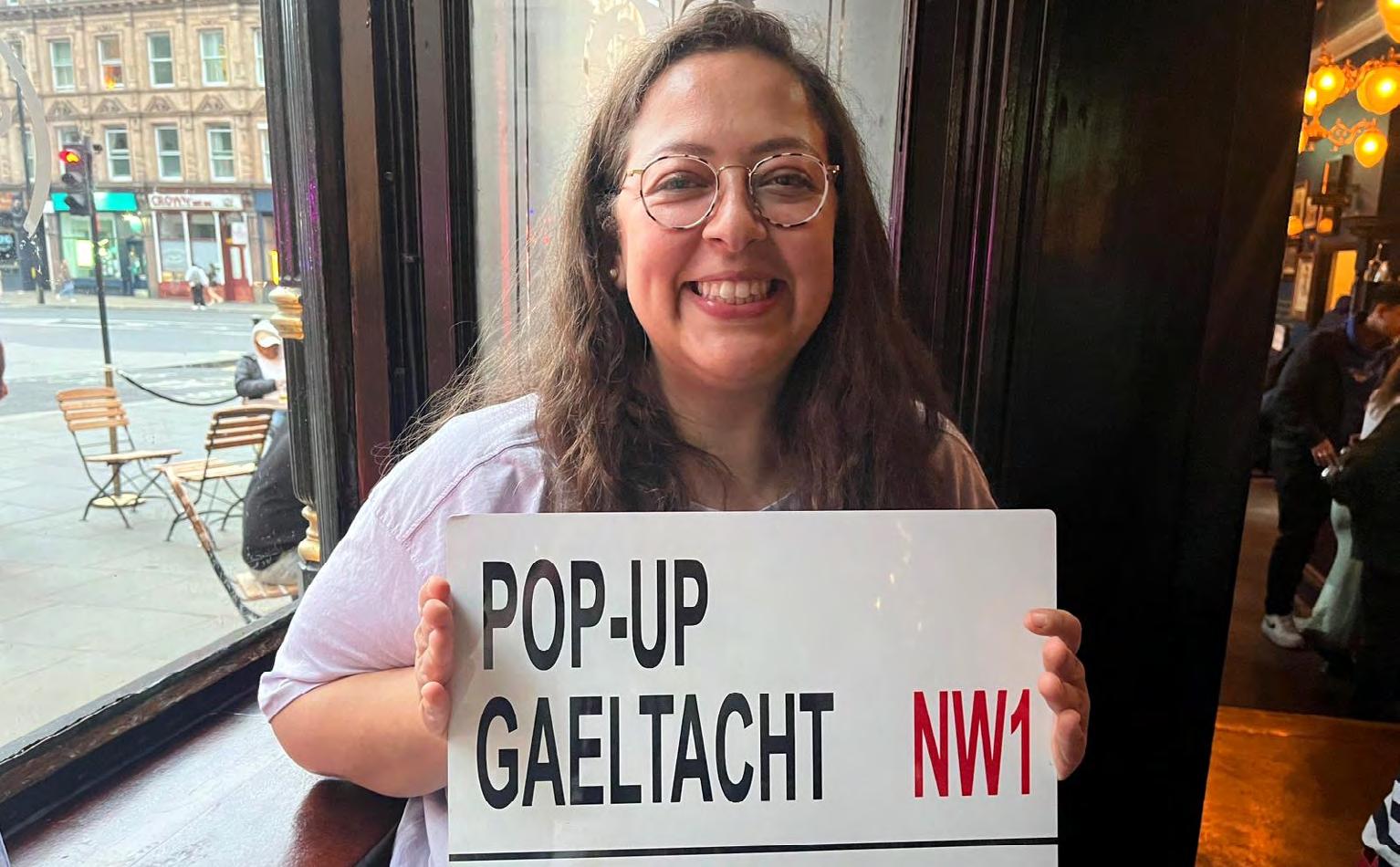
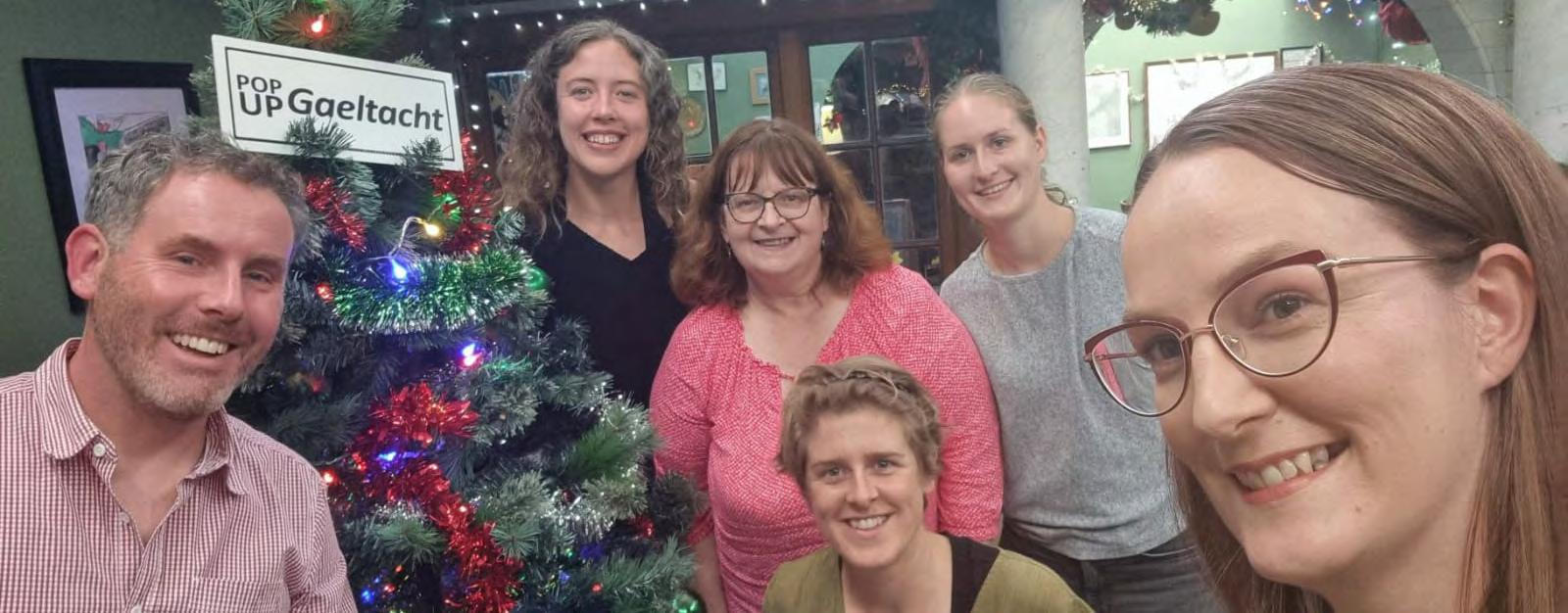
Ar an 15 Márta, beidh Pop-Up Gaeltacht speisialta i marquee
ar Chearnóg Trafalgar mar chuid de cheiliúradh Lá Fhéile Pádraig. There will be plenty of comhrá, ceol agus craic buzzing around. Conradh na Gaeilge i Londain, who host a fortnightly ciorcal comhrá in the city, are busy organising Gaeltacht Chois Tamaise (Gaeltacht by the Thames). Beidh deireadh seachtaine den scoth ó 22 - 24 Bealtaine 2026 le ranganna Gaeilge, seisiúin ceoil agus PopUp Gaeltachtaí.
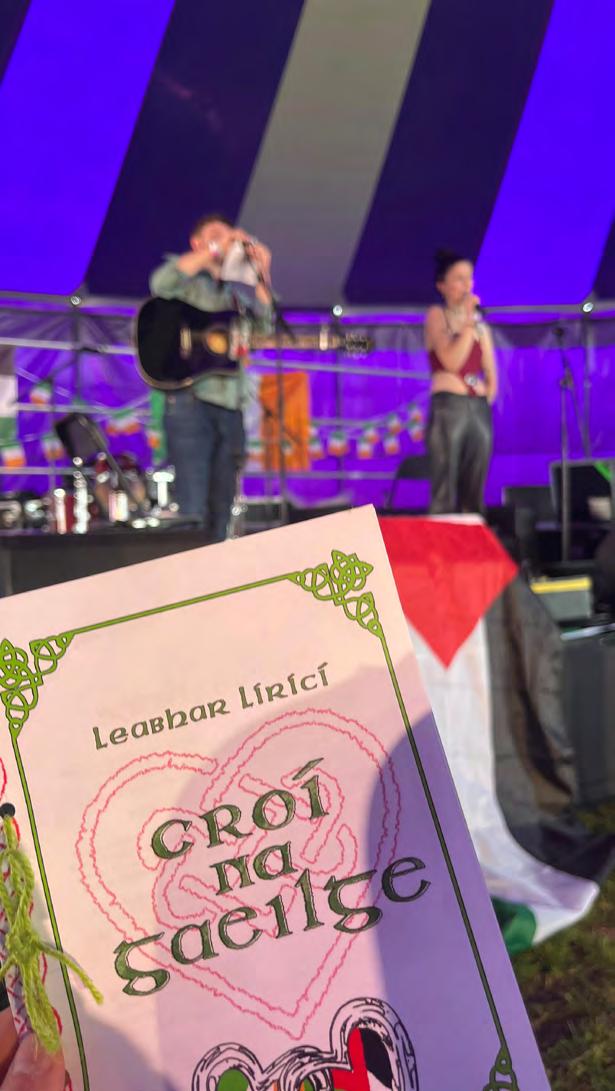
Bíonn ranganna seachtainiúla ar fáil san Ionad Éireannach Londain i gCamden, san Ionad Cultúrtha na hÉireann, Hammersmith, agus sa Lewisham Irish Centre. Buaileann foghlaimeoirí le chéile anseo i dtimpeallacht chairdiúil. Chomh maith leis sin, bíonn ranganna ar fáil sa teach tábhairne Archway Tavern in Archway. Cultural events and ‘Pint & Caint’ sessions are regularly organised by Croí na Gaeilgea group that create an open and welcoming space for people from all backgrounds to use whatever Gaeilge they can.
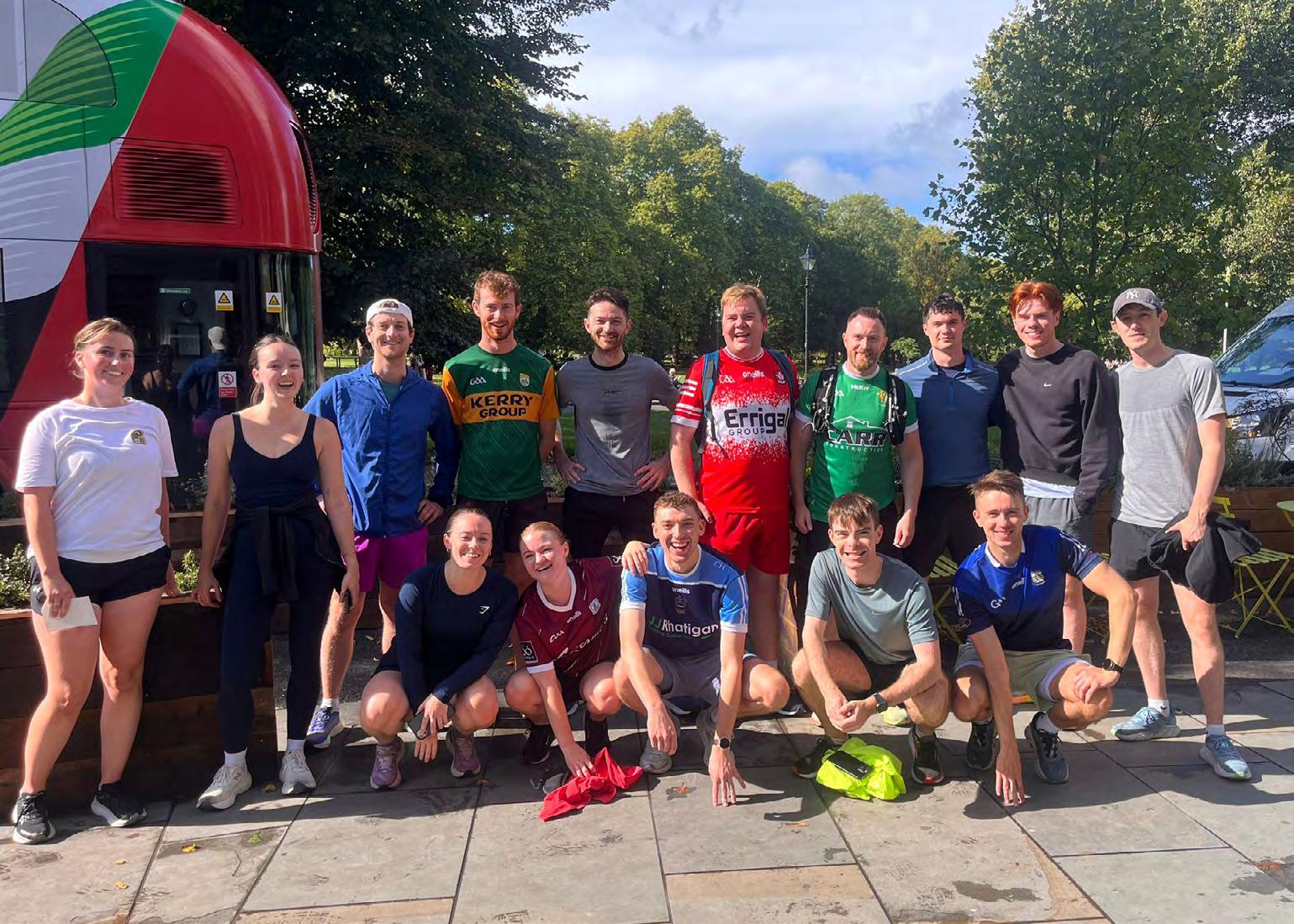
Is pobal reatha agus sóisialta iad Rí-Rá & Rith, a chuireann béim ar an teanga a labhairt go gníomhach. Bíonn siad ag castáil le chéile gach coicís, den chuid is mó thart ar Hyde Park Corner. Ag an am céanna, tá City Lit, a chuireann cúrsaí teanga ar fáil, ag tuairisciú gurb í an Ghaeilge an dara cúrsa is tapúla ag fás acu. Iontach!
Is léir anois: there’s lots going on in the big smoke. Tá an Ghaeilge ar fáil go flúirseach i Londain, agus bíonn an pobal á tógáil le paisean, le cairdeas agus le bród.
Conradh na Gaeilge i Londain
Irish is flourishing across London, with growing interest throughout Britain among beginners and fluent speakers alike.
A major upcoming event is the Pop-Up Gaeltacht in Trafalgar Square on 15 March, held in a marquee as part of the St Patrick’s Day celebrations, promising conversation, music and community in the heart of the city.
Conradh na Gaeilge London, who host a fortnightly ciorcal comhrá (conversation circle),
are also organising Gaeltacht Chois Tamaise (Gaeltacht by the Thames) from 22–24 May 2026 - a full weekend of Irish classes, music sessions and Pop-Up Gaeltachtaí.
Weekly Irish classes take place at:
• London Irish Centre, Camden
• Irish Cultural Centre, Hammersmith
• Lewisham Irish Centre
• Archway Tavern, Archway
Community-led groups continue to build momentum: Croí na Gaeilge organise cultural events and Pint & Caint gatherings, while Rí-Rá & Rith meet fortnightly around Hyde Park Corner, encouraging active spoken Irish. Meanwhile, City Lit reports that Irish is now its second fastest-growing language course.
Irish in London is not simply present - it is expanding with energy, friendship and pride.
Rí-Rá & Rith
Croí na Gaeilge
Conradh na Gaeilge i Londain
Katriona Sweeney Katriona Designs
Where Irish memory, bold typography, and hand-painted craft converge - from Donegal buses and rush crosses to Belfast walls and wearable design.
In Belfast, in a studio that shifts between experimentation and commercial deadlines, Katriona Sweeney has started painting again.
“There’s a lot of ideas float about in my head,” she says, half laughing. “And you’re just like - no, you need the time to do them.”
After years immersed in digital design, branding work and mural commissions, she’s returned to canvas - working in acrylics
and collage, stepping deliberately away from the screen.
“I normally work with spray paint and enamel paint - for mural & sign painting. Acrylic feels different as its new to me.I don’t know how it’s going to look once I begin painting. It’s more of a process… you kind of go, ‘I don’t like it yet.’”
For someone whose background is rooted in graphic precision, typography and colour theory, canvas introduces a different rhythm - slower, more tactile, more instinctive.
“It’s nice to step away from the computer. There’s no tactile element to digital. I get a bit bored of it. It’s not the same.”
That hunger for texture and hand-made process runs through everything she creates - whether it’s a mural wall in Belfast, a risograph print layered in fluorescent ink, or a pair of statement earrings drawn from childhood memory.
Bringing Donegal to Belfast
If there is a thread binding Katriona’s practice together, it is memory - particularly memory shaped by Donegal, where she grew up.
Her now-annual St Brigid’s Day workshops, teaching people how to make traditional rush crosses, began almost accidentally.
“I had a bag of rushes in the car and the art shop were like, ‘Oh, we’d love some.’ Then the next year it was, ‘Will you do a workshop?’ And now it’s still happening.”
What might have been a oneoff craft session has become something more communal. People gather after work, sitting around tables weaving rushes into crosses, swapping stories as they work.
“You don’t have to talk - you’re crafting. And then people join in. It was very casual but lovely.”
The tradition is deeply personal. Her mother, Brigid, was known locally for teaching anyone who asked how to make the crosses.
“My mum was called Brigid. I think she felt it was her duty in life. People would come to the house and she’d just show them. My dad always brought home a big bag of rushes. It was just something to do in winter.”
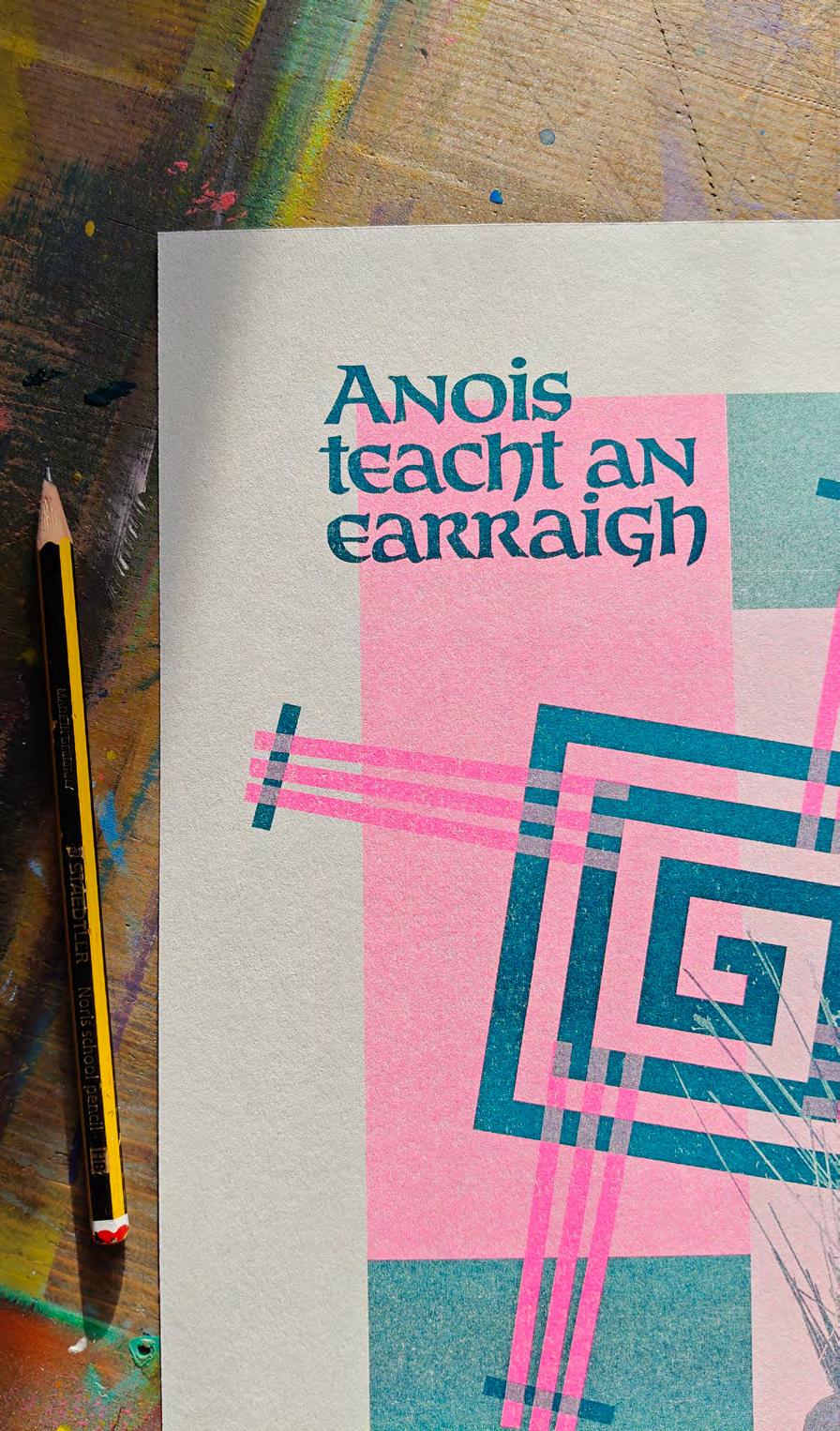
That lineage filtered into a collaborative risograph print created with Belfast School of Art - a two-colour piece designed around the overlapping plates that create a third hue where they meet. In Anois Teacht An Earriagh rush patterns, collage, spring colour and instinctive composition sit side by side.
“It really is a bit of me - all the elements that make up me.”
Anois teacht an earriagh - A4 Print
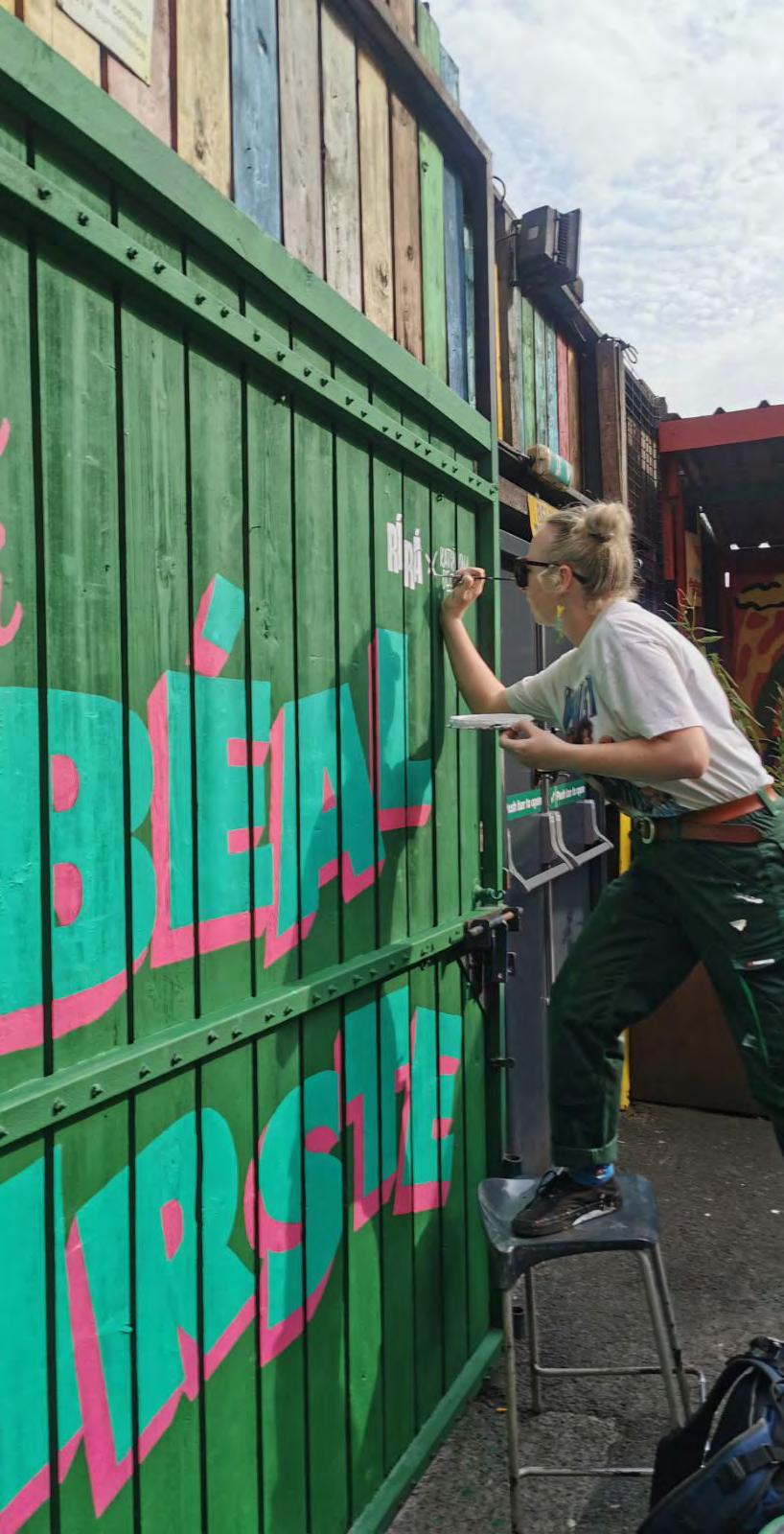
Katriona at Hit The Coast Paint Jam - Photographed by Kate Donaldson @katedonaldsonphotography
The print reflects what she does so well: holding tradition in one hand and bold contemporary colour in the other.
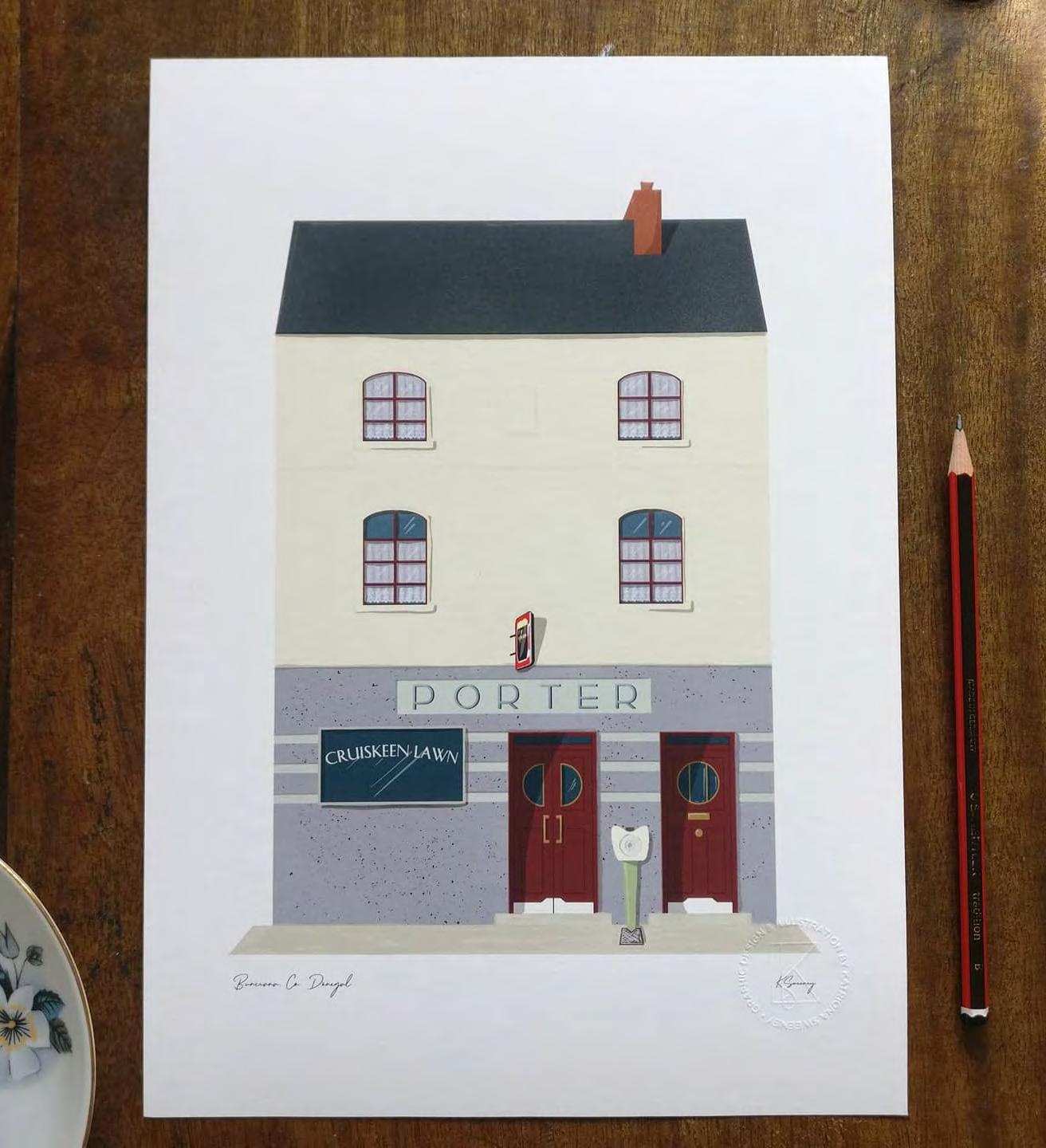
The Swilly Bus: Nostalgia in Motion
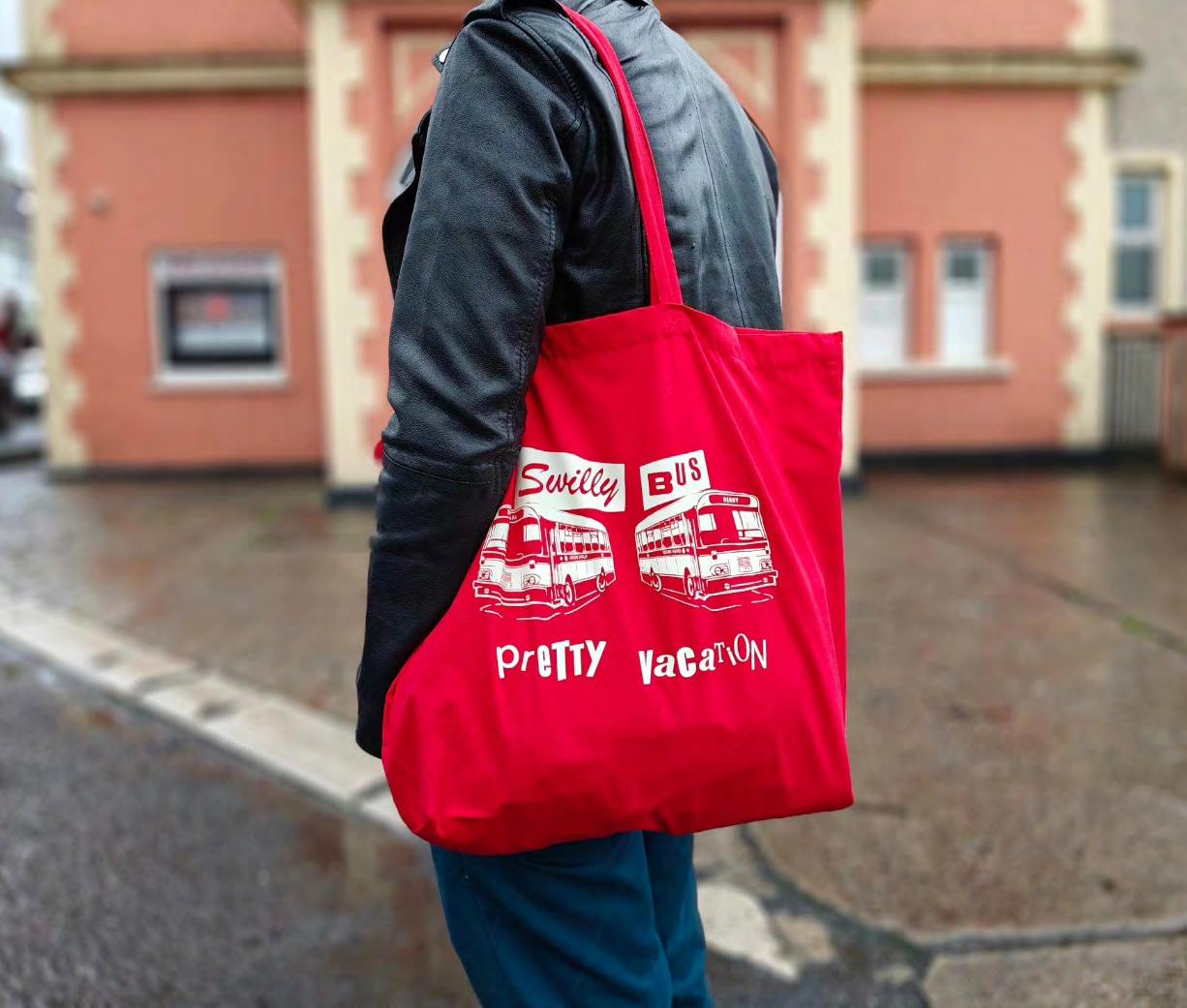
Few works capture her connection to place quite like the Swilly Bus design - a vibrant, graphic tribute to the iconic Donegal bus service.
Originally created as an illustration six years ago, it has since taken on a life of its own - appearing on tote bags and T-shirts that circulate at markets and in everyday life.
What she didn’t expect was how deeply it would resonate.
“People come up and tell me their stories. They met their now partners on that bus… memories of smoking on the bus… it’s quite heartwarming.”
In Belfast markets, Donegal emigrants light up at the sight of it. At home, older neighbours in their eighties carry the tote bags to bingo. Younger customers gravitate toward the screen-printed tees.
“There’s bad memories of the bus breaking down - but they’re actually really good memories because we laugh at them now.”
The Swilly Bus was more than transport; it was connectionto Derry for shopping trips, to
neighbours, to adolescence, to independence.
“It’s a big part of the community.”
Through her design, shared memory becomes something physical - something you can carry.
Architecture & Character
Architecture often “finds her,” she says, rather than the other way around.
“Normally I stumble across places when I’m out and about. It’s the architecture, or the story behind it.”
She isn’t interested in drawing buildings simply because they
Swilly Bus - Tshirts & Totebags
are picturesque. There has to be a reason - a narrative, a pull.
“There’s loads of nice buildings - but not all of them I connect with. I find it hard to draw ones just for the sake of it.”
Many of her Donegal pieces were born from preservation instinct.
“I didn’t want them forgotten about. I wanted people to share more stories.”
Her architectural illustrations carry the clarity of her graphic design background - bold shapes, careful shadow, studied colour harmony - but they also carry atmosphere.
“There’s things you really have to study to create the feeling of a building… I do a lot of staring at things.”
It is that quiet study that allows a building’s character to emerge.
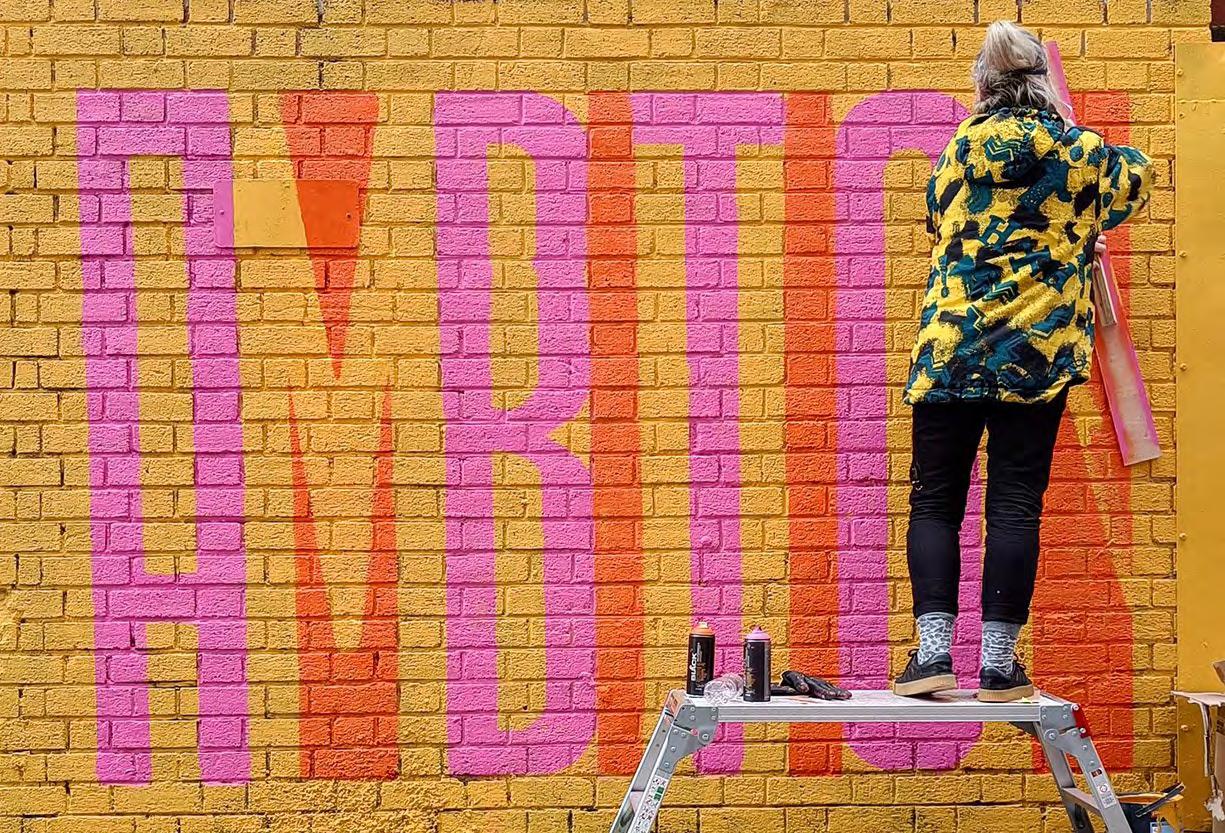
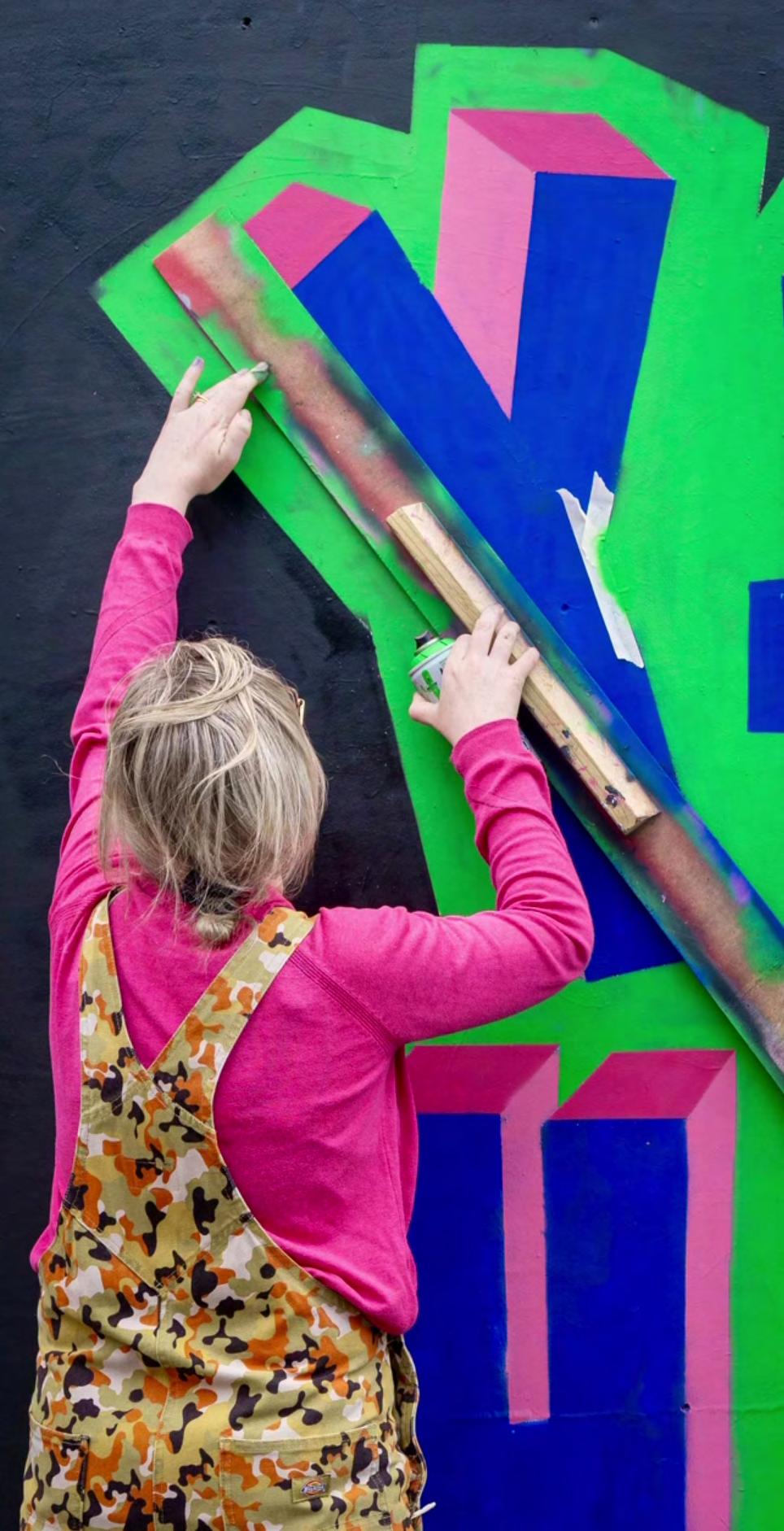
From the Sidelines to the Wall
Katriona’s entry into mural work was gradual.
Her husband works as a street artist, and for years she assisted on larger projects - filling colour, observing, absorbing the process.
“I was always in the background of street art.”
Three years ago, she was invited to take part in an International Women’s Day mural event in Belfast. It was her first wall.
Go Leor
“I got all the nerves… but I gave it a go and I was like - that was amazing.”
The scale altered her relationship to design.
“You just get lost in the wall.”
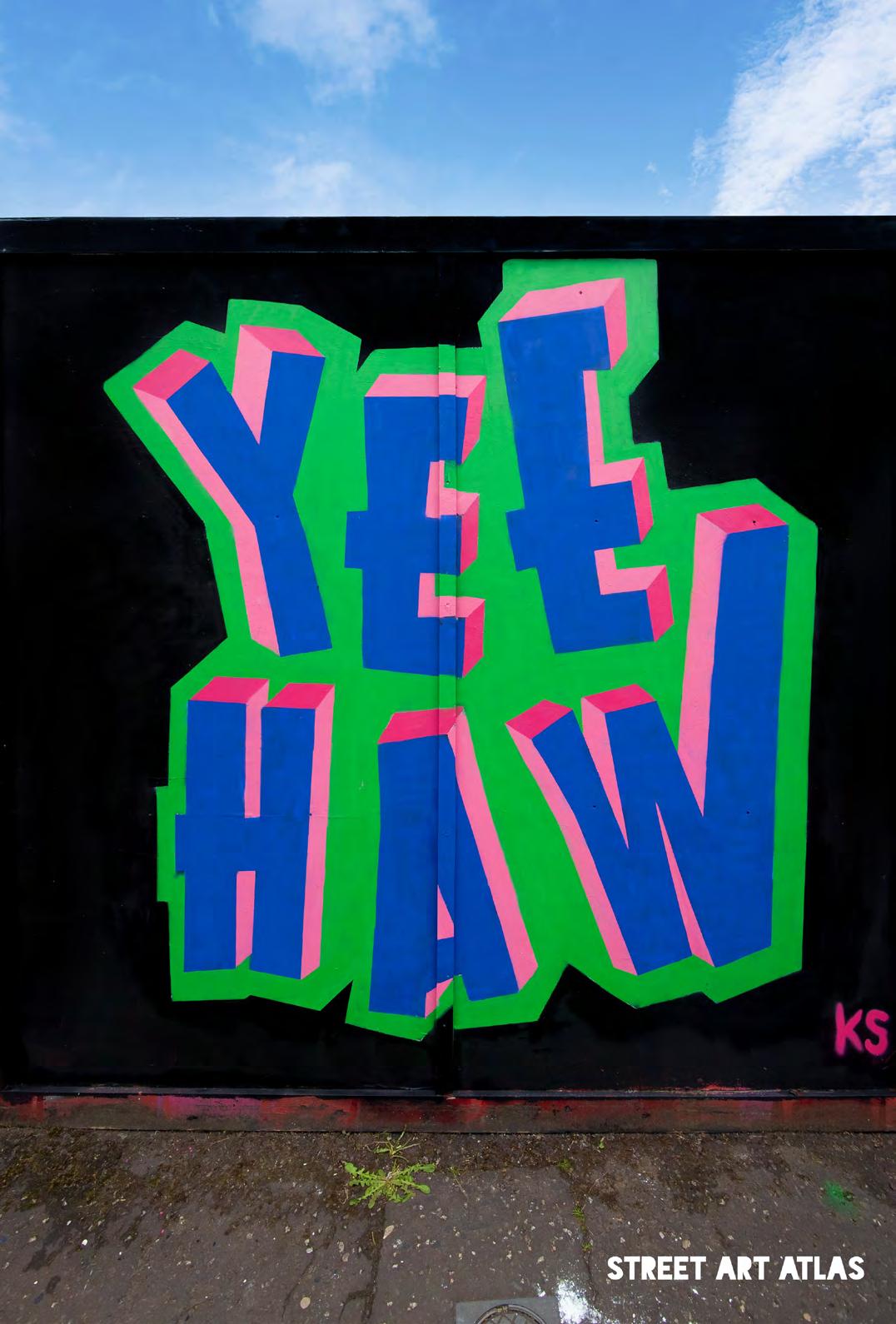
Her love of lettering - so central to her graphic practice - found a natural home in mural work.
“I’ve always loved letters. That’s what draws me to graffiti - the lettering side of things.”
Colour, form, typography - all expanded to architectural scale.
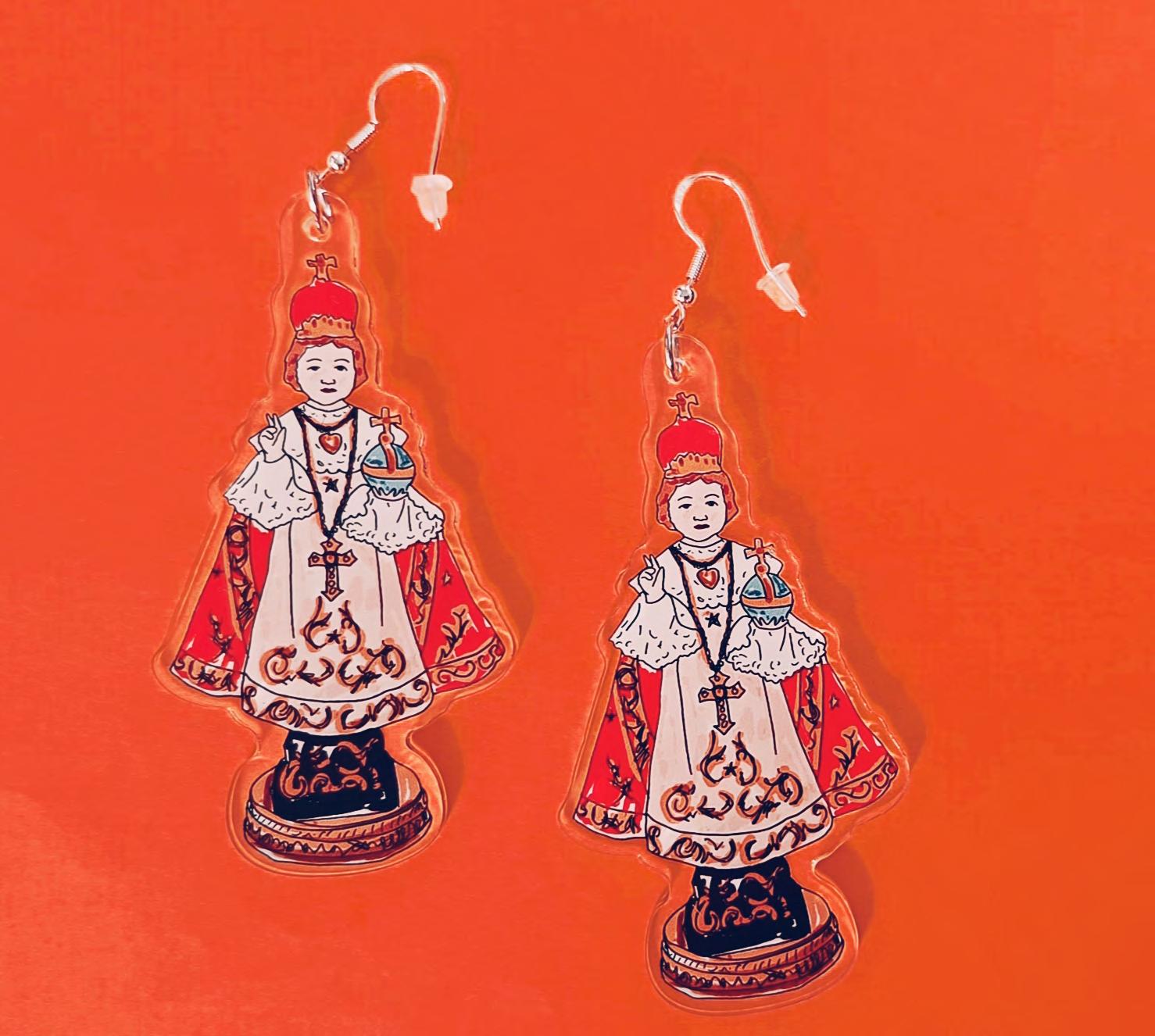
Child of Prague: Icon to Ornament
Another example of cultural memory made contemporary is her Child of Prague designoriginally an illustration inspired by the statue that lived in her childhood home, once repaired with a makeshift bottle lid after being knocked over.
“It was just something that was always in our house.”
What began as a print evolved into statement acrylic earringsbold, graphic and unmistakably Irish.
“I create things I’d wear myself.
And then I put it out there.”
She tested scale physically, cutting paper, hanging shapes from her ears, adjusting proportion until it felt right.
The finished pieces are playful yet reverent - heritage reimagined as wearable design.
They’ve since become associated with an old superstition: using the Child of Prague in the days around their wedding, hoping to secure sunshine.
Katriona jokes that for new brides “I have to get them to sign a disclaimer - If it rains, it’s not my fault.”
Sign Painting & Slower Craft
Sign painting has become one of her most energising pursuits.
“Why haven’t I done this sooner? It fits in with my love of old shop fronts and typography.”
Working with enamel paint and brush control demands patience - single strokes, steady hand, flow and rhythm.
“Hand-painted signs hit different, and are made to hang around for years.”
In Bristol, at a gathering called Burds of the Brush, she found herself surrounded by others
Child of Prague Dangle Earrings
equally obsessed with lettering.
“It was amazing to be around people just talking about lettering, sharing tips & tricks, and inspiring each other.”
Like rush cross-making, like hand-painted signs, this is about revival.
“It’s an old craft that needs to be kept alive.”
Across her practice, that theme recurs: preservation not through nostalgia alone, but through use.
The Balance
Behind the murals, prints and product designs is the steady hum of freelance commercial work - branding projects, design
contracts, necessary commissions.
“There’s the artist in me, and the commercial artist,” she says. “It’s about finding that balance.”
Many of her most beloved pieces - the Swilly Bus, the Child of Prague earrings, the architectural prints - began simply as ideas she needed to make real.
“I create things I’d wear myself… and then I put them out there.”
When asked if she’ll keep going, she doesn’t hesitate.
“I can’t see my self stopping anytime soon, it just fits in with how I think & see things, my way of storytelling.”
Through bold colour, studied typography and deeply rooted memory, Katriona Sweeney is doing something colourfully powerful: taking fragments of Irish life - buses, statues, buildings, rushes - and ensuring they remain not only remembered, but carried, worn, and lived with.
Old craft. New colour. And stories that refuse to fade.
Explore Katriona’s selected work and discover available pieces through her website: katrionadesigns.com
Find prints, earrings sweaters and much more via her shop: katrionadesigns.bigcartel.com
And keep up with her via social media: @katrionadesigns
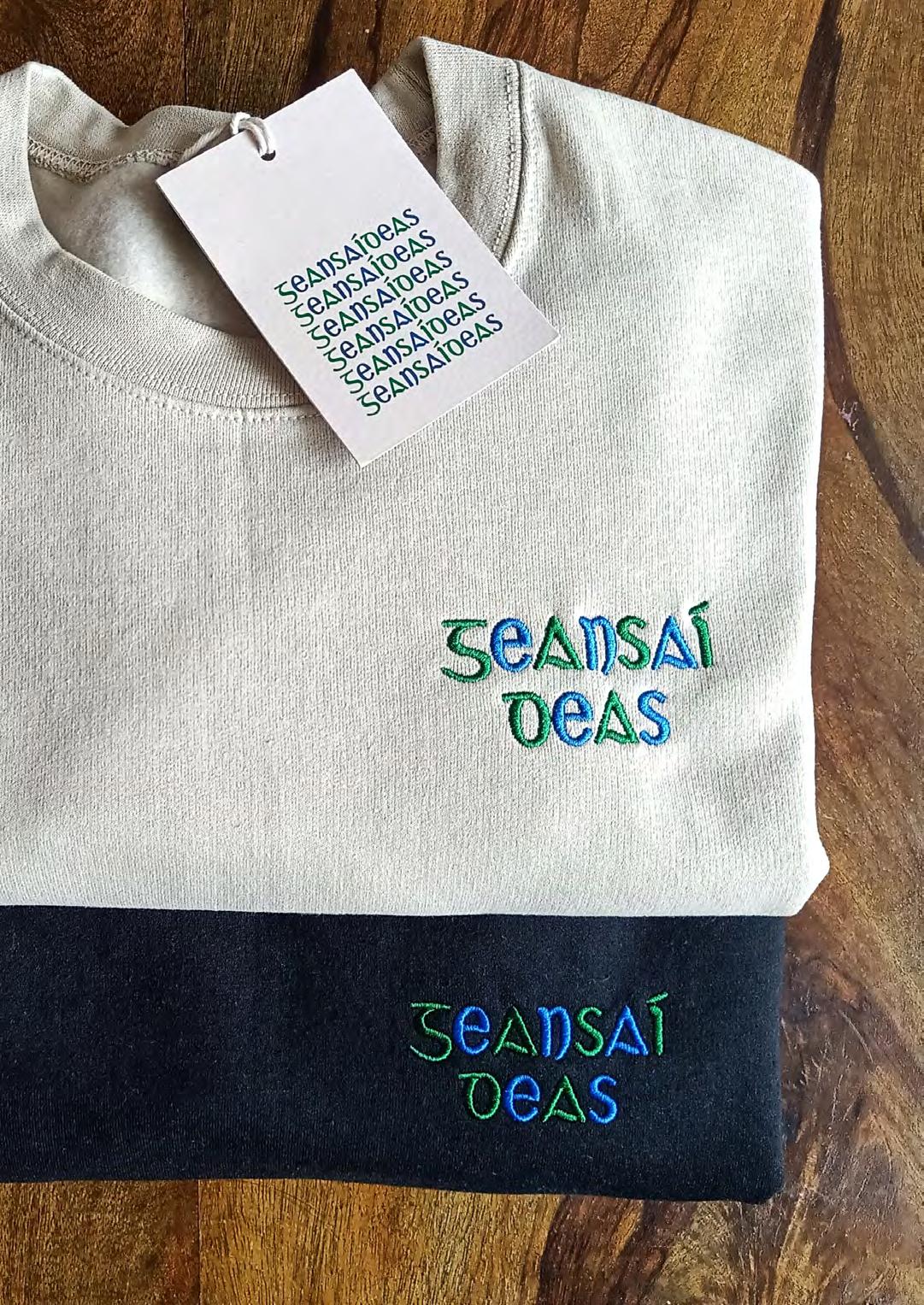
Geansaí Deas (Nice Jumper)
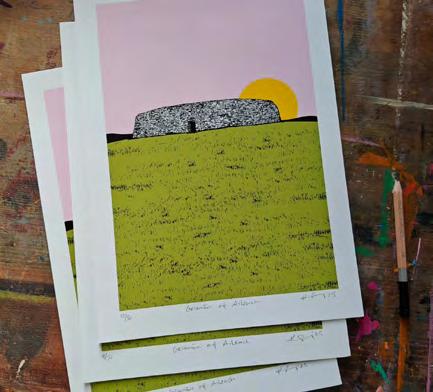
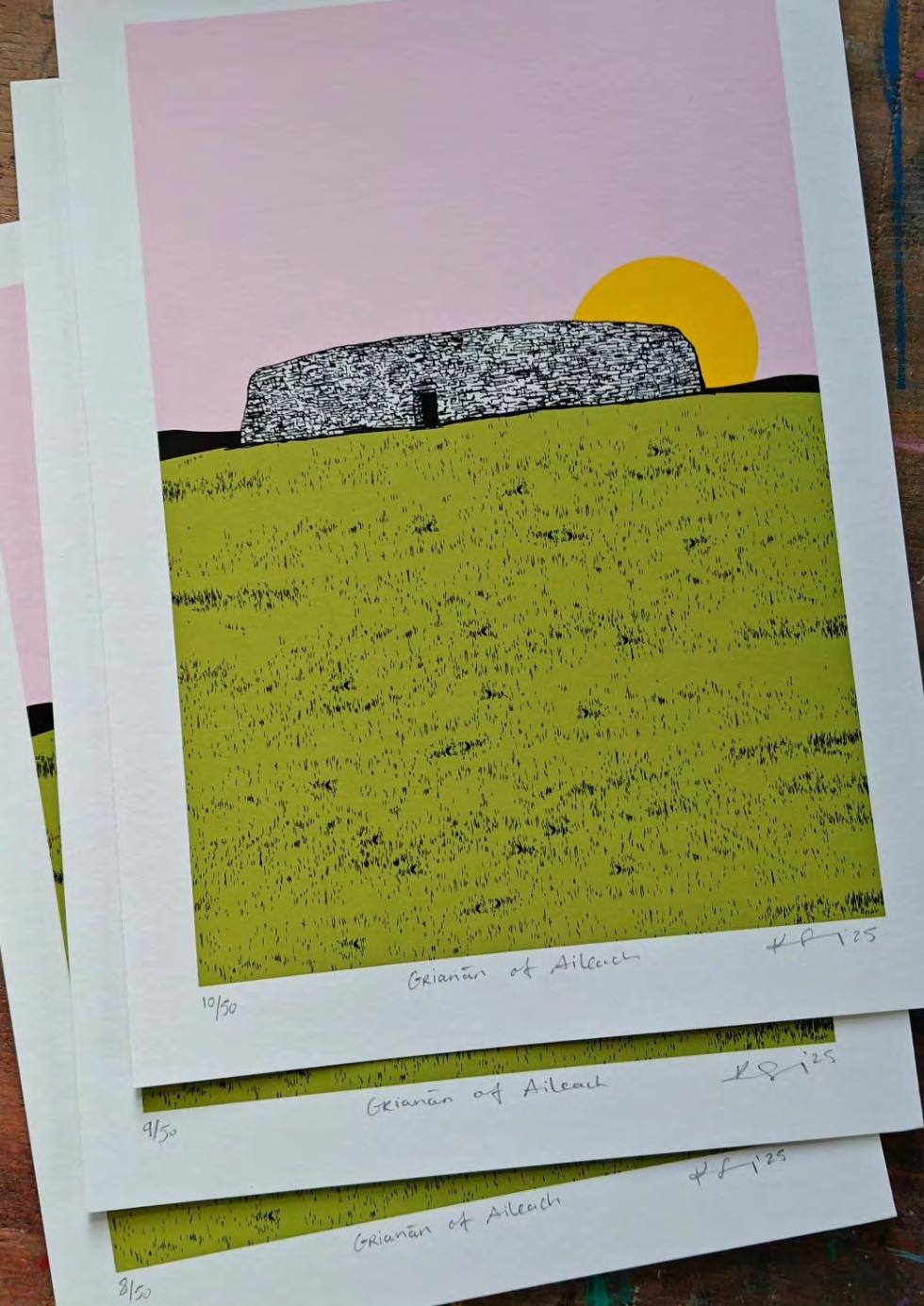
Grianán of Aileach
An Ghaeilge sa Nua-Shéalainn
Seachtain na Gaeilge
De réir thorthaí an daonáirimh is déanaí (2023), tá 1437 cainteoir Gaeilge sa Nua-Shéalainn, agus cé go bhfuil an Nua-Shéalainn ceithre huaire níos mó ná Éirinn, tá pobal bríomhar Gaeilge ann fós. Founded in 2021, the Aotearoa Branch of Conradh na Gaeilge works hard to bring that community together and to promote the language across the country.
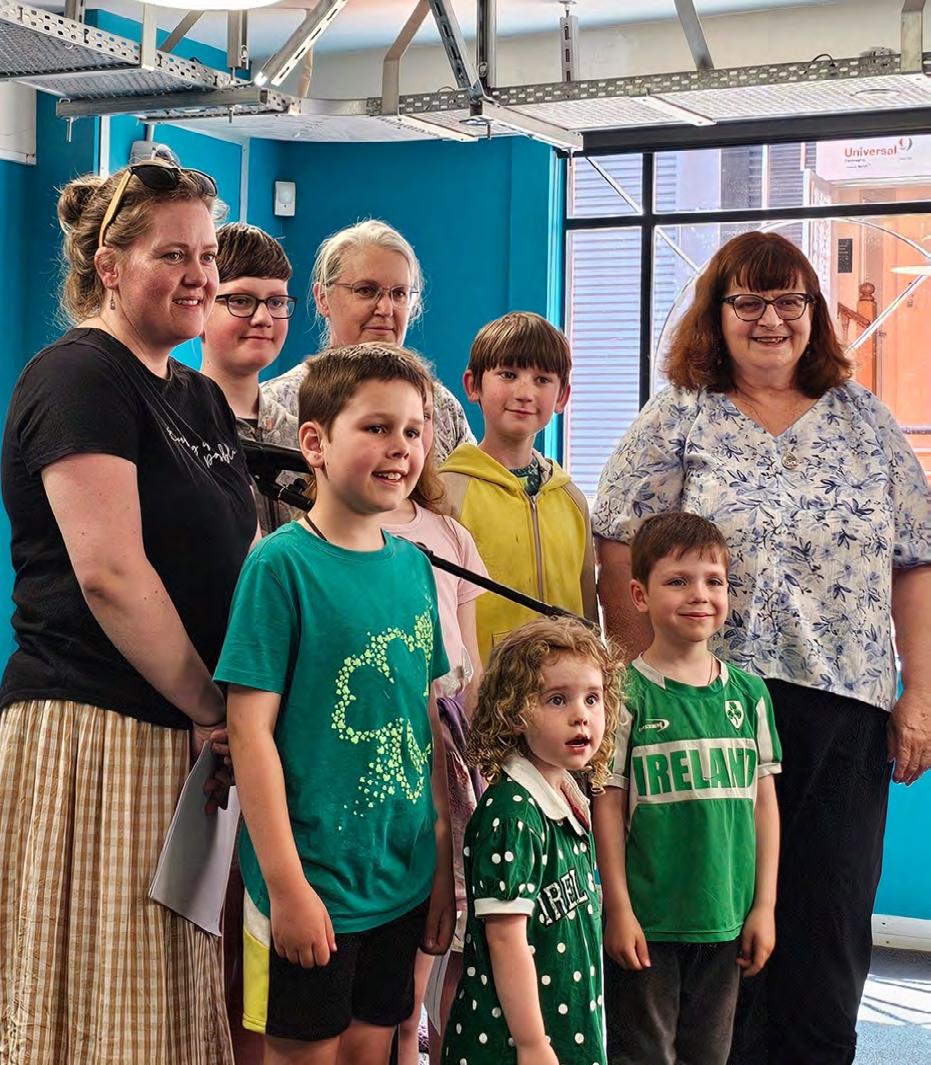
Tá ranganna Gaeilge ar fáil ag leibhéil éagsúla, ó bhunrang go hardleibhéal, agus bíonn ciorcail chomhrá ar siúl gach seachtain ar líne agus i gcathracha ar fud na tíre. This year we also launched a new parent and child class, alongside a
growing programme of events. We’ve taken part in European Languages Day in Wellington and the Language Festival in Palmerston North, and we regularly create spaces for Irish to be heard and used.
Tá pop-up Gaeltachtaí againn, nuachtlitir dhátheangach agus grúpa WhatsApp a choinníonn daoine i dteagmháil lena chéile, agus is minic a bhíonn muid le cloisteáil sna meáin chumarsáide Gaeilge - especially when RTÉ Raidió na Gaeltachta needs a special correspondent from this side of the world.
Tá éileamh ollmhór ar ranganna Gaeilge faoi láthair, le daoine a
bhfuil ceangal acu le hÉirinn ag iarraidh an Ghaeilge a fhoghlaim den chéad uair, chomh maith le daoine as Éirinn atá ag iarraidh a gcuid Gaeilge a choinneáil beo. As speakers of an endangered language, we also recognise a shared responsibility to support New Zealand’s native language, Te reo Māori Aotearoa is the Māori name for New Zealand, and respect for Indigenous language and culture is central to what we do.
Féile na dTeangacha in Palmerston North
In the 2023 census, 1,437 Irish speakers were recorded in New Zealand. Although New Zealand is four times the size of Ireland, a vibrant Irish-language community continues to flourish there. Founded in 2021, the Aotearoa Branch of Conradh na Gaeilge works to bring Irish speakers together and promote the language across the country.
Irish-language classes are offered at a range of levels, from beginner to advanced, with weekly conversation circles taking place online and in cities nationwide. A new parent-
and-child class has recently been introduced, alongside an expanding programme of cultural events. The branch has participated in European Day of Languages in Wellington and the Language Festival in Palmerston North, regularly creating spaces where Irish can be heard and spoken.
Community life also includes pop-up Gaeltachtaí, a bilingual newsletter, and an active WhatsApp group that keeps members connected. The group is frequently heard in Irish-language media, particularly when RTÉ Raidió na Gaeltachta calls
on a special correspondent from this side of the world.
Demand for Irish classes is currently strong, with people who have a connection to Ireland seeking to learn the language for the first time, as well as members of the Irish diaspora aiming to keep their Irish alive. As speakers of an endangered language, the community recognises a shared responsibility to support Te reo Māori, the Indigenous language of Aotearoa (New Zealand), placing respect for Māori language and culture at the centre of its work.
Féile na dTeangacha in Palmerston North
Grúpa tuismitheora agus páistí ag canadh sa leabharlann in Palmerston North
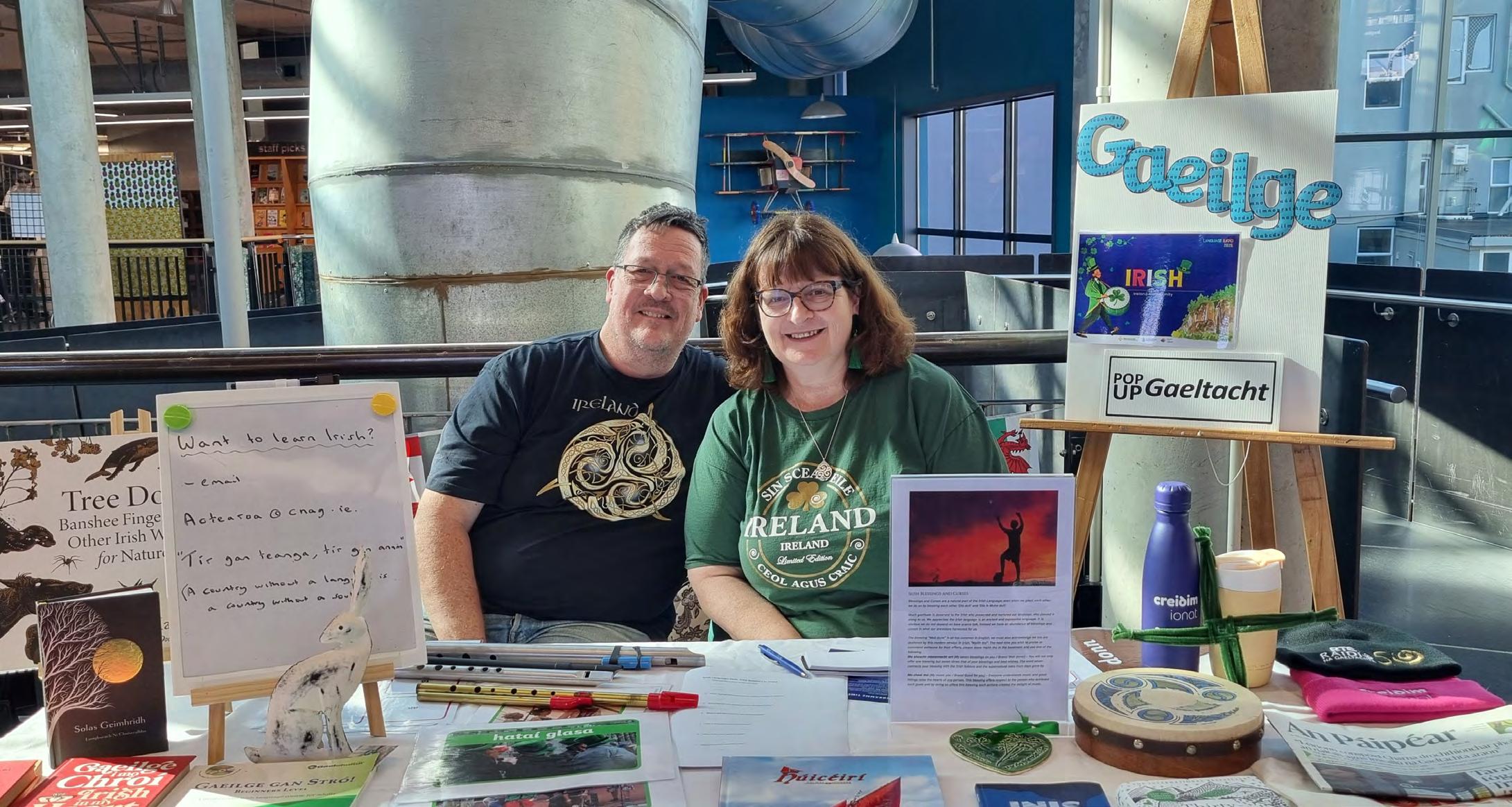
Pop-up Gaeltacht in Wellington.
Mark Bonello Artist
From London galleries to the North Coast studio, Mark Bonello paints light, labour, and lived experience with unwavering focus
In a sunlit studio at The Courthouse Bushmills, Mark Bonello is mid-flow when we begin speaking. The North Coast light has turned theatrical - shadows cutting across rock, sea flashing silver - and he has already been out, driven the coast, taken reference shots, and returned to the easel before most people have finished their morning coffee.
“It’s busy here today,” he laughs. “But that’s because of the sun.”
Mark likes when people wander in while he’s working. In fact, he prefers it. Nine times out of ten, visitors encounter him brush in hand. The act of painting becomes the invitation.
A conversation starter. A quiet demonstration of intent.
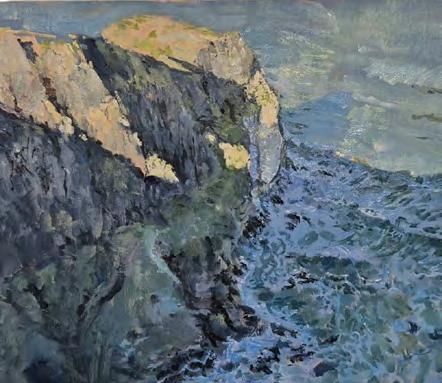
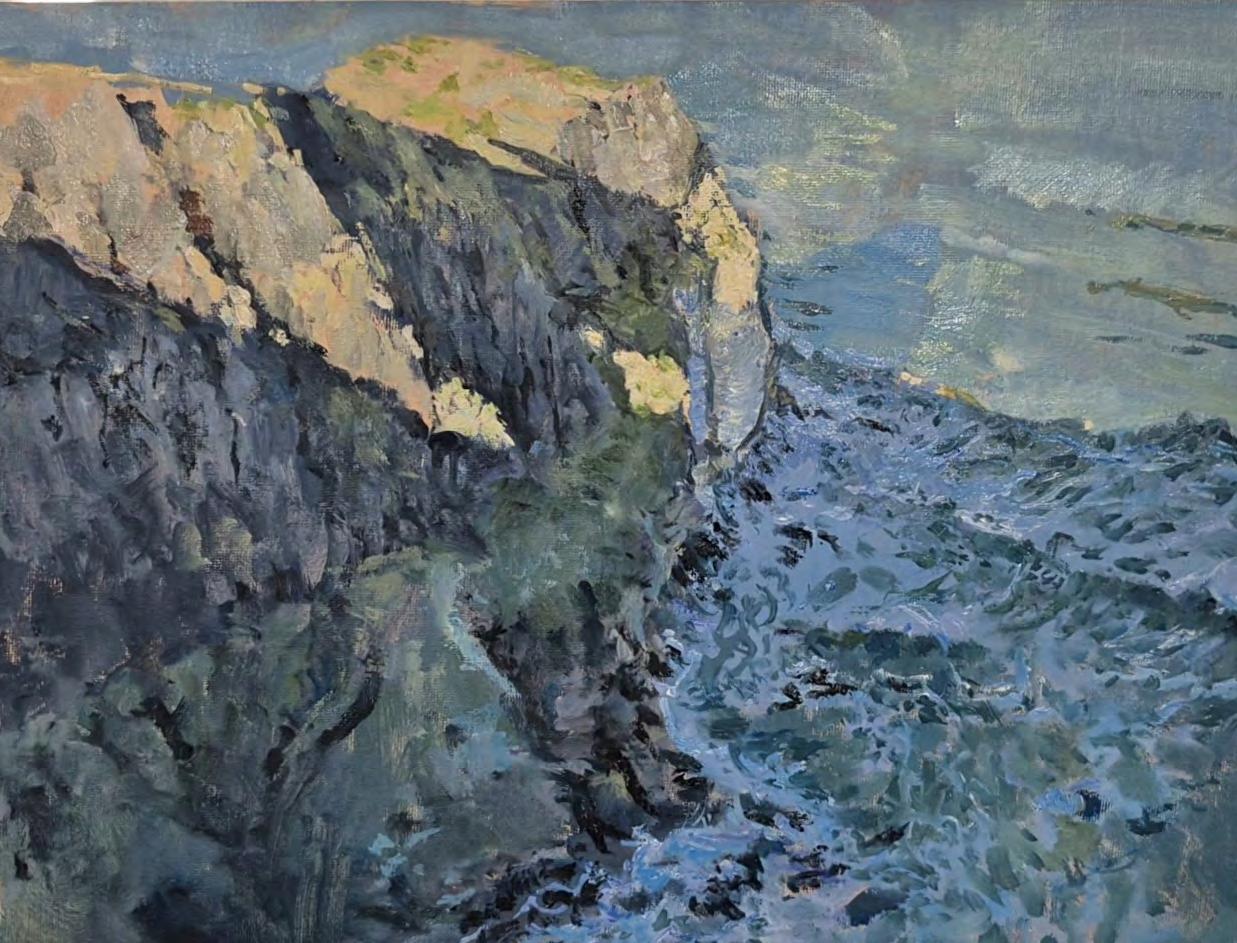
What strikes you immediately is the speed. The canvas he turns toward me - a study of coastal rock, shadowed and sharply angled - already feels resolved and almost completed. There’s atmosphere in it. A sense of place caught in motion.
“I do work really fast,” he says plainly. “It’s probably one of the benefits of ADHD. When I lock in, I really lock in.”
Focus as Force
Mark speaks openly about being diagnosed with ADHDand about how that diagnosis
coincided with a decision to take painting seriously.
“Before that, I’d hyperfocus but not necessarily in a disciplined way. I wouldn’t change the water. The palette would get muddy. I’d just keep going.”
Now, he recognises the moment to stop. When colours begin collapsing into brown on the palette, that’s the signal. Clean the brushes. Reset. Continue with clarity.
Rather than treating ADHD as an obstacle, he has learned to treat it as a tool.
“I’ve had loads of hobbies,” he admits. “Photography. Wood carving. Polymer clay. I’d sit in the lorry carving little caricatures for hours. But painting’s the one that never went away. The others fade. Painting always comes back.”
There’s something deeply reassuring in that constancy. Painting isn’t a phase for Mark. It is the axis.
And when he’s not painting?
“My wife knows something’s not right.”
London Beginnings & The Impressionists
Born in London and raised there until the age of ten, Mark grew up within reach of the National Gallery. Museum visits
Sun Capped Sea Cliffs - 12x14” oil on board
weren’t special occasions - they were routine.
“It was always there in the background,” he says. “My mum painted too.”
Years later, when people began describing his own work as “impressionistic,” he turned to study the movement more closely. What he found resonated deeply.
Joaquín Sorolla Edgar Degas . Not simply their brushwork - though that mattered - but the rhythm and vitality embedded within it. Light treated not as decoration, but as structure. Figures suggested through movement rather than tightened into stillness.
He briefly considered pursuing an art history degree, but realised something fundamental about himself.
“If something doesn’t interest me, I won’t retain it. I learn instinctively.”
Impressionism held. It wasn’t academic obligation - it was instinctual recognition.
Movement Over Likeness
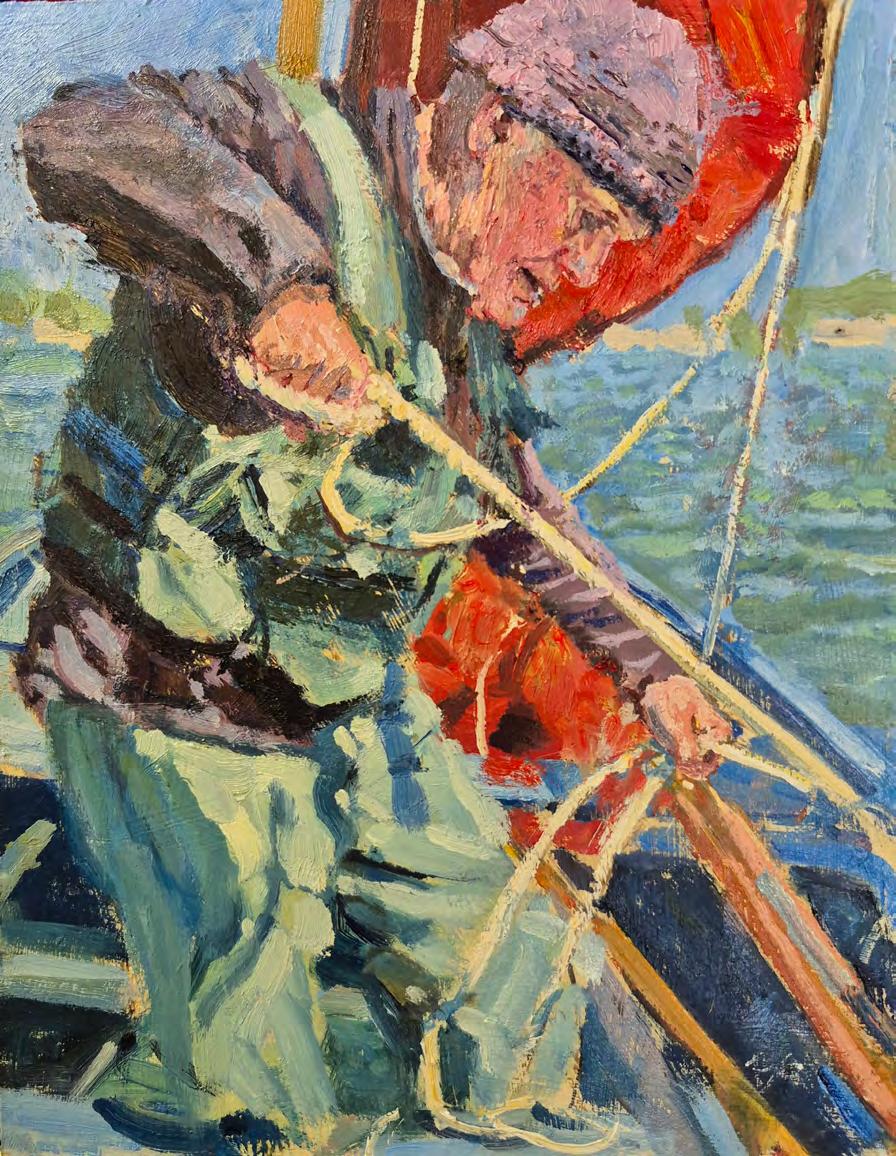
This instinct toward rhythm is evident in his figurative work. Coastal workers hauling rope. Performers mid-gesture. Figures absorbed in labour.
“I’m less interested in likeness than in line and movement,” he explains. “I prepare mentally before I start - like watching snowboarders at the Winter Olympics. They rehearse the rhythm in their head.”
When he paints, he doesn’t want to think.
“It needs to feel natural. Paint-
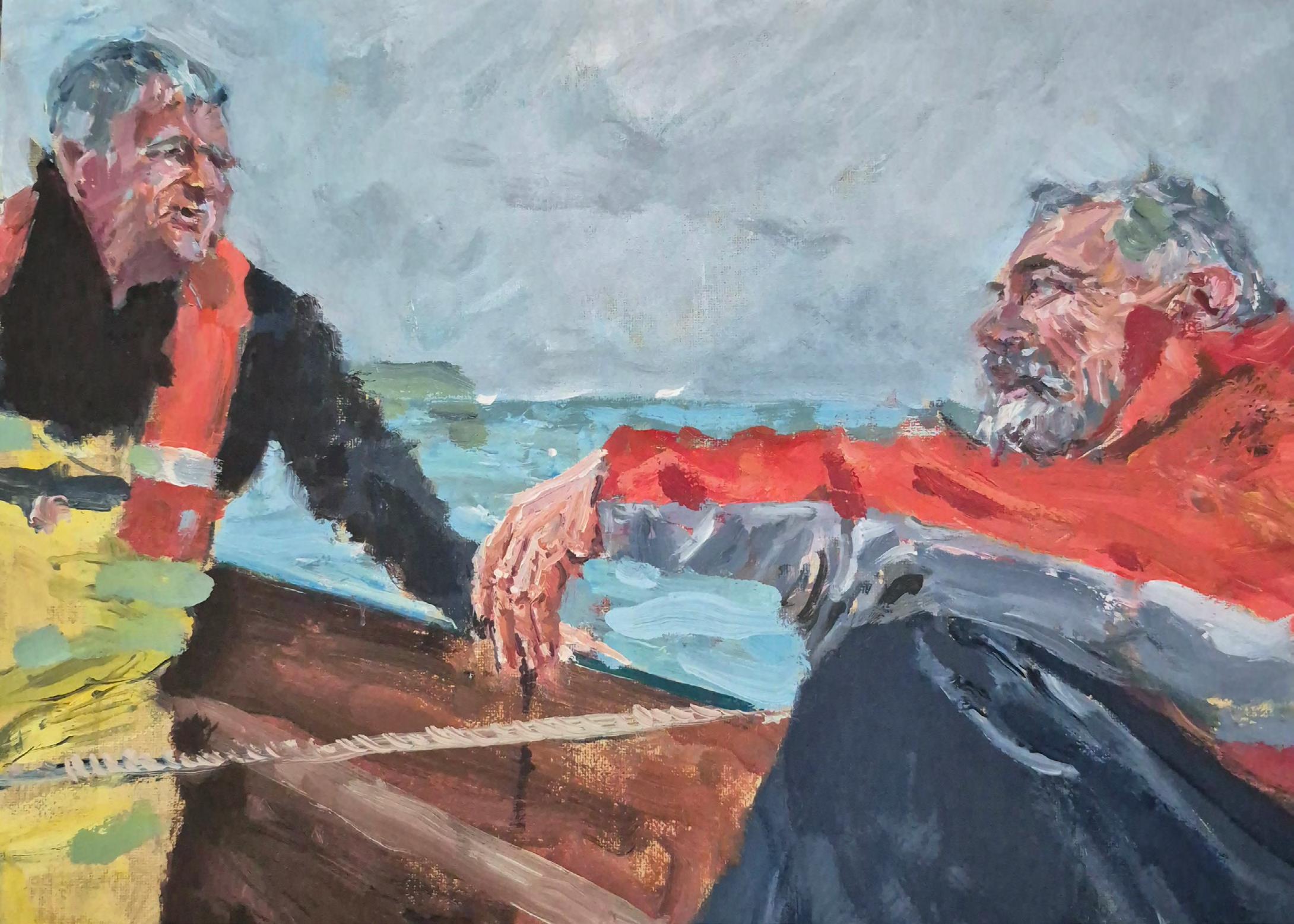
Alan and Jim on a Day Trip - 8x10” oil on board
Dr Robin Ruddock - 8x10” oil on board
ing is meditative for me. It’s the one time my mind is quiet.”
There is a looseness to his portraits - an echo perhaps of Lucian Freud or Maggi Hambling - but the looseness is deliberate. Gesture carries truth. Energy over polish.
And yet nothing feels careless.
The Robin Ruddock Portraits
One subject, painted multiple times, is Dr Robin Ruddock - a climber, sailor, and walking encyclopaedia of North Coast geology and wildlife.
“Robin was one of the first people I met when I moved here,” Mark says. “He’s an amazing man.”
They worked together years ago, and the admiration is still present. Mark has painted him three times - each portrait not simply likeness, but character rendered in line and tone.
It is clear that Mark paints people he respects. People in motion. People in purpose.
The Turning Point
The pivot from hobbyist to professional came via a one-hour consultation booked through the Arts Council.
“I needed to hear from a professional whether I had what it took.”
He arrived prepared. He left with three goals:
Build a website.
Exhibit with the Royal Ulster Academy.
Secure gallery representation in Belfast.
The timeline had been one year. He achieved them in three months.
“It all happened very quickly,” he says, still sounding slightly surprised.
Imposter syndrome lingers - as it does for many artists - but it no longer governs him.
“I don’t need constant confirmation anymore. I just love painting.”
From Lorry Driver to Full-Time Artist
For years, Mark balanced painting with lorry drivinga dual identity he playfully tagged online as #dieseltoeasel.
He no longer drives.
“The money was tempting,” he admits. “But I couldn’t go back.”
Instead, he took a small parttime role locally, allowing him to stay outdoors while prioritising studio time. The decision was about freedom.
“When you make your mind up about something, that’s it.”
The rhythm of the road - long stretches of concentration, patience, repetition - now lives in the rhythm of the brush.
The Courthouse Community
His studio at The Courthouse Bushmills arrived at precisely the right moment.
“I came up the day I finished driving and spoke to Sharon Scott, the coordinator. She looked at my work and said, ‘You’ve got to make this work.’”
The building operates as a social enterprise. No commission is taken from studio sales. Support is practical as well as moral - promotion, coordination, community-building.
“There are four of us here full time,” he says. “Painters, craftspeople - woodwork, weaving. We help each other. It feels like something’s building.”
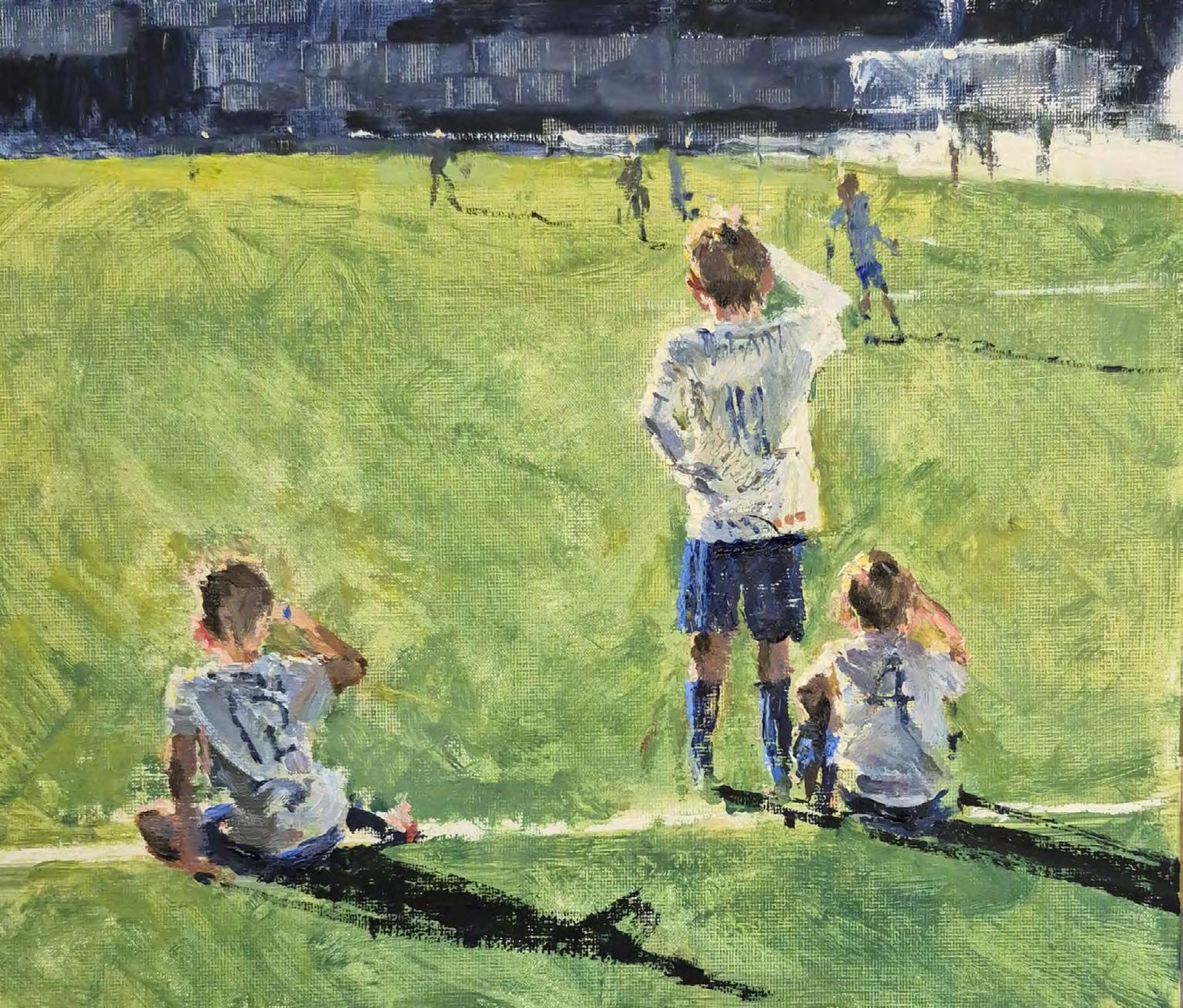
On The Touchline - 12x10” oil on board
In a region where artists often feel isolated, that sense of collective momentum matters.
Committed to visibility across Ireland’s creative landscape, spaces like The Courthouse are not simply venues - they are cultural infrastructure.
The Grand Opera House - And Beyond
One ambition remains persistent.
“I really want to paint behind the scenes at the Grand Opera House.”
He speaks about it not as spectacle, but as process - performers dressing, orchestras warming up, the unseen choreography of theatre life. If given access, he would approach it as Degas might have approached the ballet - movement, rehearsal, quiet labour before the curtain rises.
“I’ve asked. I’ve been declined. But I’ll keep trying.”
We would happily tag the Grand Opera House in this - not as pressure, but as invitation. Collaboration between painter and theatre feels inevitable.
He also references the Royal Opera House - a childhood symbol of theatrical grandeur - as part of that long-standing fascination with stagecraft and audience dynamics.
It is not fame he is chasing. It is access to movement. To rhythm. To human concentration under light.
Van Gogh & Perseverance
There are two books beside his bed. One is Vincent van Gogh’s letters to Theo.
“You can never get tired of read-
ing about him,” Mark says.
The perseverance resonates. The reaching out to build artistic community. The refusal to stop working despite adversity.
There is something quietly Van Gogh-esque in Mark’s surfaces - not imitation, but integrity. Paint laid down with conviction. Evidence of presence.
Elevating the Work
Mark Bonello’s work does not rely on gimmick or trend. It is grounded in light, labour, and lived experience. The North Coast is not backdrop - it is collaborator. The figures he paints are not decorative - they are working, moving, thinking bodies.
He is a painter who has chosen discipline over distraction. Community over isolation. Craft over spectacle.
From London galleries to Bushmills studios. From diesel engines to oil paint.
The work stands.
And as supporters of independent artists across Ireland, we say this clearly: Mark Bonello is not merely painting the coasthe is contributing to its cultural memory.
Keep up with Mark via social media: @bonello_art
For the latest news along with paintings for sale visit his website: markbonello.co.uk
To see Mark’s work up close as he works in The Courthouse Bushmills, alongside up-todate opening hours, studio availability, exhibitions, and events, visit: thecourthousebushmills.com
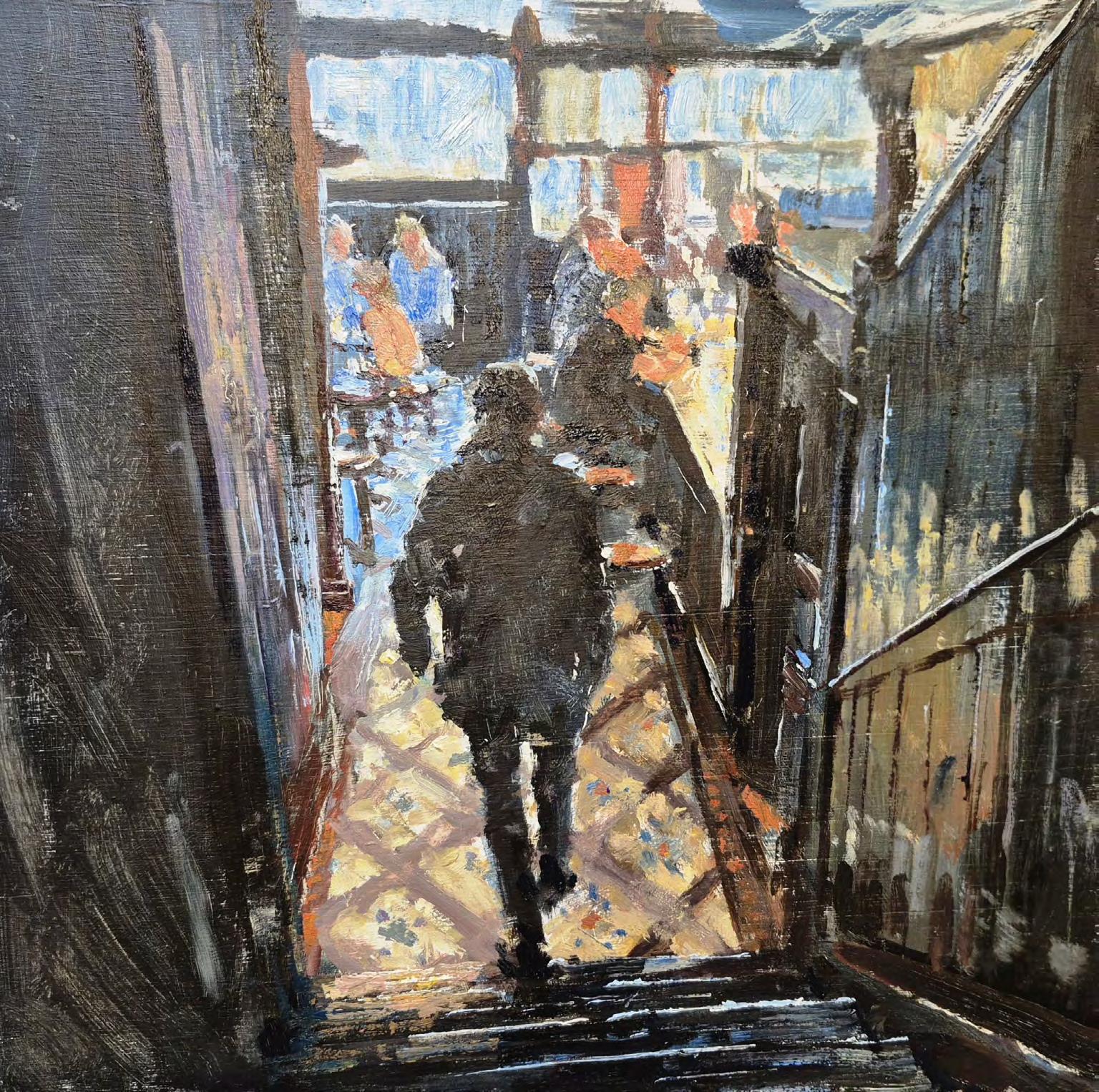
Blakes Bar Enniskillen - 14x14” oil on board
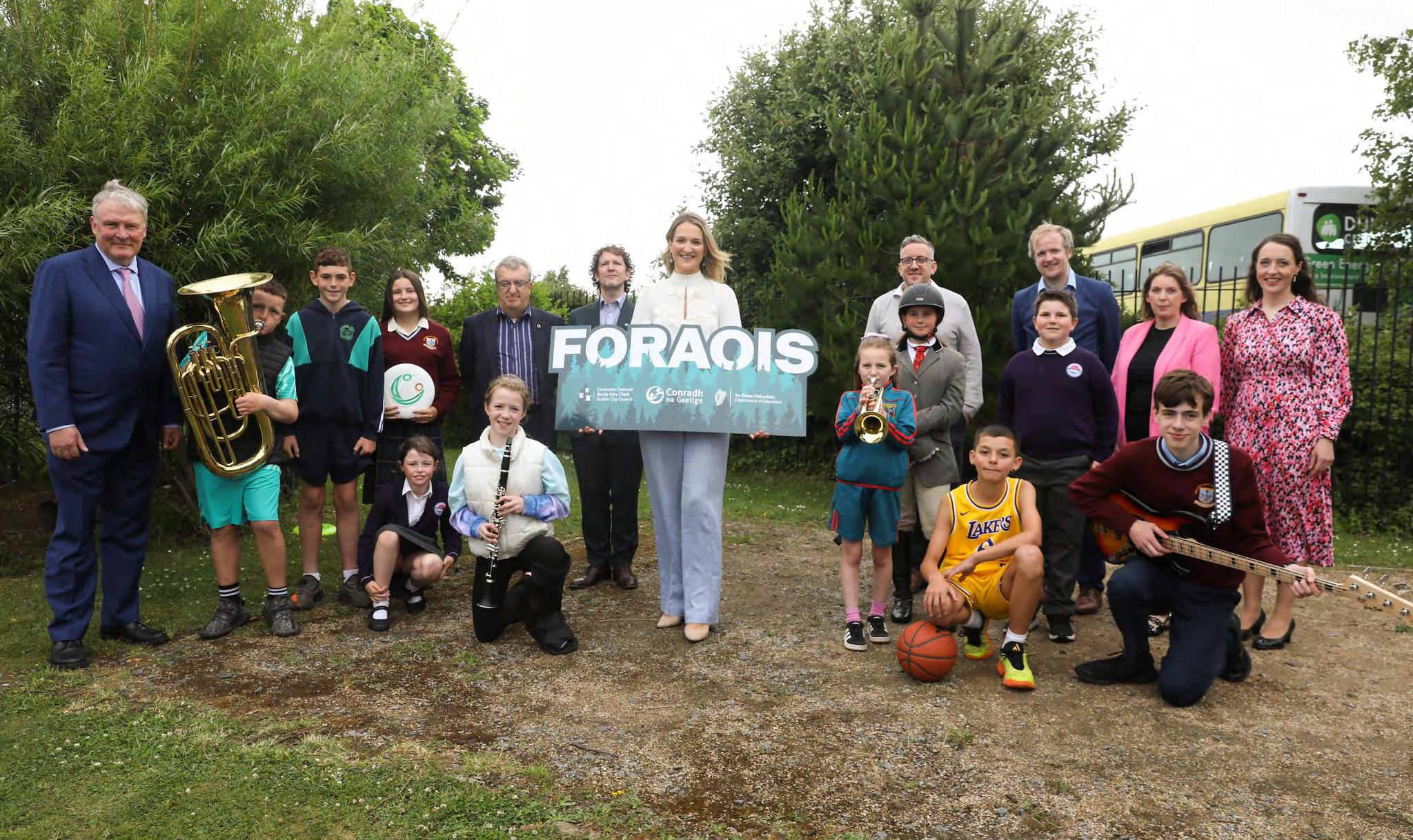
Foraois: Óige, Pobal agus Gaeilge Bheo
Seachtain na Gaeilge
Is tionscnamh pobail agus
óige é Foraois, faoi stiúradh
Chonradh na Gaeilge, le maoiniú ón Roinn Oideachais agus ó Chomhairle Cathrach Bhaile Átha Cliath. Táimid ag obair i gcomhpháirtíocht le Scoil Neasáin, Gaelscoil Cholmcille, Gaelscoil Míde, Gaelscoil
Ghráinne Mhaol agus Gaelcholáiste Reachrann, chomh maith leis an bpobal i gceantar Oirthuaisceart Chathair Bhaile Átha Cliath. Is í príomhaidhm na scéime deiseanna labhartha Gaeilge a chruthú do dhaoine óga sa cheantar trí chlubanna pobail a bhunú a fheidhmíonn go hiomlán trí Ghaeilge, taobh amuigh den chóras oideachais.
Ag obair go dlúth leis na scoileanna thuasluaite, tá Foraois ag cothú caidrimh fadsaol idir daoine óga sa cheantar agus an Ghaeilge mar theanga bheo phobail. I measc na dtionscnamh atá curtha ar bun againn go dtí seo tá Club Damhsa, Club Dornálaíochta, Club Drámaíochta, Club Rólimirt agus Club Fichille, atá ar fad ag feidhmiú trí mheán na Gaeilge. Tá sé mar sprioc againn 5,000 deis labhartha Gaeilge a chruthú gach bliain tríd an scéim seo. Tá tuilleadh clubanna pleanáilte sna míonna amach romhainn agus táimid ag forbairt agus ag neartú na gclubanna reatha chun iad a chur ar bhonn inbhu-
anaithe agus neamhspleách.
Le daltaí Idirbhliana i nGaelcholáiste Reachrann, tá Foraois tar éis clár fostaíochta óige a fhorbairt darb ainm “Buntáiste”. Tríd an gclár seo, cuirtear scileanna díolacháin, scileanna idirphearsanta, forbairt CV agus scileanna eile ar fáil do na daltaí. Téann siad ansin amach sa phobal chun gnólachtaí áitiúla a chlárú le BÁC le Gaeilge agus chun deiseanna fostaíochta trí Ghaeilge a aimsiú do dhaltaí.
Anuas air sin, táimid ag obair le grúpa daltaí Idirbhliana atá ag reáchtáil Club Rólimirt i nGaelscoil Míde. Tá na daltaí
seo tar éis cluiche a chruthú, spreagtha ag an gcluiche cáiliúil “Dungeons and Dragons” agus bunaithe ar miotaseolaíocht na hÉireann. Tá siad ag forbairt trealamh don chluiche, darbh ainm “Finnscéalta na Foraoise”, agus tá siad ag súil le páirt a ghlacadh sa chomórtas “Fiontraí Óg na Bliana”. Le grúpa eile daltaí Idirbhliana, táimid ag bunú Club Fichille i nGaelscoil Ghráinne Mhaol agus tá na dal-
taí sin ag iarraidh fiontraíocht a fhorbairt as an tionscnamh sin.
Is é an sprioc atá i gcroílár Foraois ná deis a thabhairt do dhaoine óga an Ghaeilge a úsáid i ngnáthshuíomhanna sóisialta taobh amuigh den seomra ranga. Trí chlubanna lán-Ghaeilge a bhunú, tugtar deis do dhaltaí scileanna nua a fhoghlaim trí mheán na teanga agus déantar úsáid na Gaeilge
a normalú ina saol laethúil. Is múnla nuálach é Foraois a léiríonn an ról lárnach atá ag clubanna agus gníomhaíochtaí pobail i neartú na Gaeilge agus i dtógáil pobail Gaeilge.
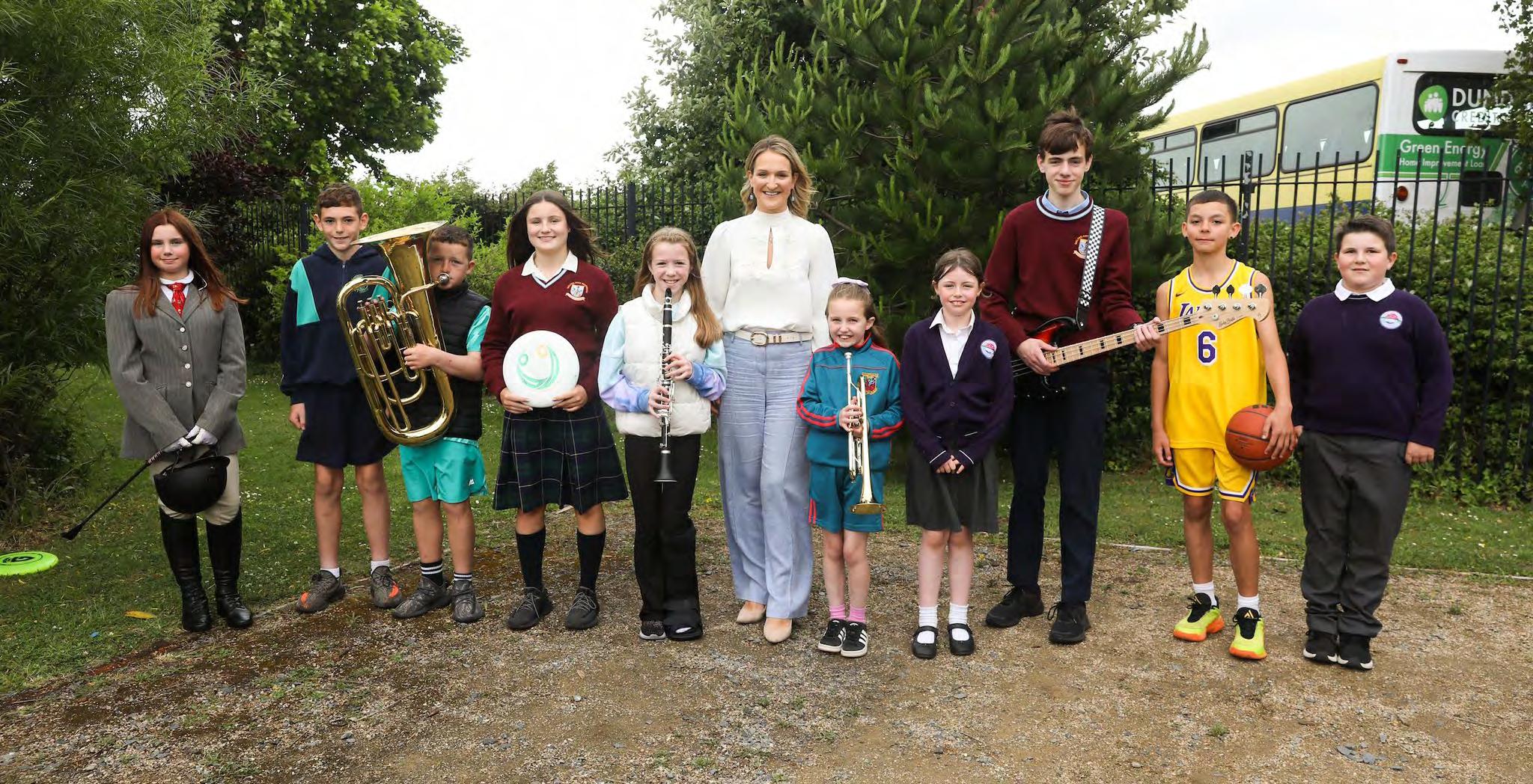
Foraois (Forest) is a community and youth initiative led by Conradh na Gaeilge, funded by the Department of Education and Dublin City Council, and operating across North-East Dublin. Working in partnership with Scoil Neasáin, Gaelscoil Cholmcille, Gaelscoil Míde, Gaelscoil Ghráinne Mhaol, and Gaelcholáiste Reachrann, the project aims to create Irish-speaking opportunities for young people outside the formal education system through fully Irish-medium community clubs.
Among the initiatives established are a Dance Club, Boxing Club, Drama Club, Role-Playing Club, and Chess Club, all conducted entirely through Irish, with a target of creating
5,000 Irish-speaking opportunities annually. The programme continues to expand, with new clubs planned and existing ones being strengthened to ensure long-term sustainability and independence.
With Transition Year students in Gaelcholáiste Reachrann, Foraois has developed the youth employment programme “Buntáiste”, equipping students with sales skills, interpersonal skills, CV development, and workplace competencies. Students engage directly with local businesses through BÁC le Gaeilge to identify Irish-language employment opportunities.
Transition Year students are
also leading a Role-Playing Club in Gaelscoil Míde, where they have created a mythology-inspired game influenced by Dungeons & Dragons, developing materials titled “Finnscéalta na Foraoise” and preparing to enter the “Fiontraí Óg na Bliana” competition. A separate group is establishing a Chess Club in Gaelscoil Ghráinne Mhaol, with ambitions to build an entrepreneurial venture from the initiative.
At its core, Foraois seeks to normalise the use of Irish in everyday social settings, positioning community clubs and youth enterprise as central pillars in strengthening the language and building sustainable Irish-speaking communities.
Frances Magee Artist
In her North Belfast garden, Frances Magee transforms carefully tended plants into luminous cyanotypes - where texture, imperfection and light combine in work that feels timeless.
There is something quietly appropriate about publishing Frances Magee’s work at the beginning of March. It is a month poised between endings and beginnings - crocuses already faded, daffodils hesitating on the verge, hellebores holding court in beds that only weeks ago looked stripped bare. In Northern Ireland, March is rarely decisive. Light fractures into showers, UV levels drift unpredictably, and the promise of spring arrives in fragments. For Frances, that instability is not something to battle. It is part of the making.
“The weather isn’t something you work against,” she explains. “It’s a collaborator.”
Her cyanotypes are not produced despite the season - they are shaped by it.
From Garden Journal to Cyanotype Practice
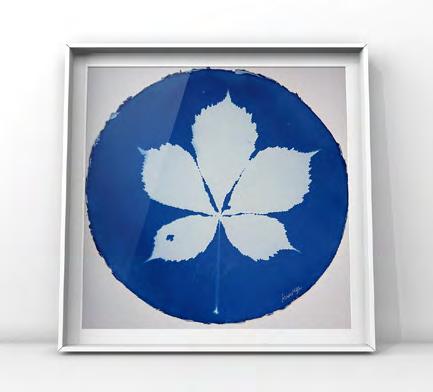
Frances has been working with cyanotype for nearly twenty years. She did not come to it through photography or formal chemistry training, but through gardening. When she first began tending plants seriously, she made tiny cyanotypesthree or four inches square - to keep in a gardening journal. When a new leaf unfurled or a flower opened, she would place it directly onto prepared paper and let sunlight do the rest.
“If you take a photograph, there’s not always a sense of scale,” she says. “But this is the exact thing. It’s one-to-one.”
The process was initially about recording. But slowly, something shifted. She became fascinated by the transformation itself - by the moment when light triggers chemistry and an image begins to reveal itself in deep Prussian blue.
“It’s a proper magical thing,” she says. “You’re watching sunlight trigger this chemical change, and then the image is revealed.”
The journal evolved into a practice. The record became the artwork.
Repetition Without Replication
Cyanotype is rooted in repetition: grinding pigments, mixing solution, coating paper, arrang-
ing plant, exposing to light. But the outcome is never the same.
“You’re using the same ingredients,” she explains, “but nothing’s ever the same.”
Frances grinds her own chemistry, mixing it as close to the original Victorian formula as is legally possible. She uses handmade cotton rag paper sourced from traditional mills, where fibres vary subtly in density and absorption. Even the act of mixing cannot be identical from one session to the next.
“The repetition is lovely,” she reflects. “But you never get repetition of results.”
Light, humidity, paper fibres and plant structure all intervene. The unpredictability, she admits, becomes addictive.
Choosing Plants for Texture and Form
Plant selection is deliberate. Frances favours structure and intricacy - forms that allow light to travel through them. Fernlike fronds, jagged leaves, drumstick alliums, and sculptural hellebores translate beautifully. Dense blooms, such as many sunflowers, can flatten into blocks, losing nuance.
“I definitely pick things with a view to printing,” she says. “Lots of texture. Lots of depth.”
This year, hellebores are reign-
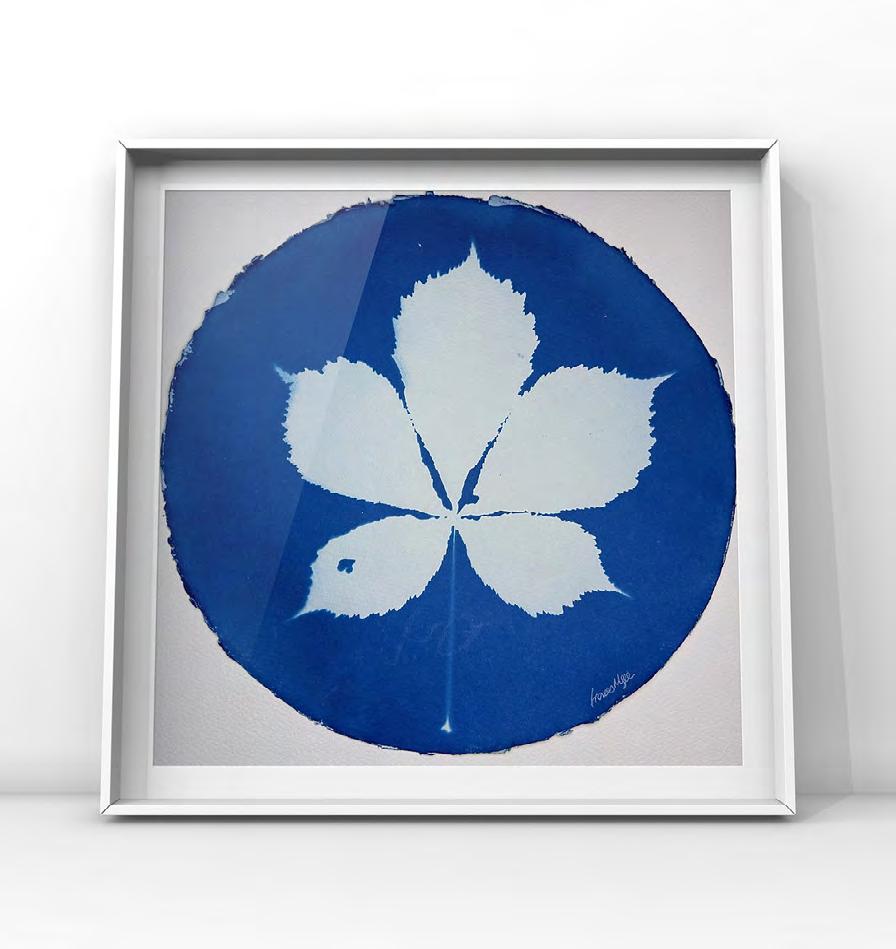
Horse Chestnut
ing supreme. Their waxy petals and deep purples dominate early spring beds. Frances recalls seeing them massed at Belfast Castle one winter - vivid against bare soil - and immediately buying every variety she could find.
“They were just unbelievable,” she remembers. “Everything else was gone, and there they were.”
Elsewhere, lilies are emerging early, daffodils are preparing to open, and alliums are beginning their ascent. Crocuses, however, “came and went” almost unnoticed this year. In another season, fifty or sixty allium bulbs were eaten by squirrels before they bloomed.
“That’s just the nature of the beast,” she shrugs.
Imperfection as Character
Not every leaf arrives flawless - and that is part of the appeal. Slug holes, insect bites, weather tears and ragged edges are printed without apology.
“Sometimes it pains me to cut the plants,” she says. “But when they’ve gone through the whole cycle and they’re perfect - or perfectly imperfect - that’s when I print them.”
Those marks become compositional elements. Pest damage introduces unexpected geometry. A tear becomes a line of light. The garden’s micro-battles become visible in the final piece.
“It might be that the slugs have come and there are holes in it,” she says. “And it looks really fascinating. And you think, I’m just going to print that anyway.”
The variables of the garden are mirrored by the variables of the process. Handmade paper absorbs solution differently. Northern Irish sunshine alters
exposure times. Wind may shift a stem mid-print. UV levels in March are vastly different from those in July. Nothing can be entirely controlled.
“It’s highly unpredictable and organic,” she says. “You’re doing the same thing, but it’s not controllable at all.”
Permanence in a Fleeting Season
Gardening unfolds slowlyseed, soil, nurture, bloom. Printing, by contrast, can be urgent. Paper is coated in darkness. Plants are arranged with care. Exposure must be judged in shifting light. The rinse reveals the transformation.
The act of printing becomes, for Frances, a way of memorialising the moment.
“It closes the loop,” she says. “It’s like capturing it in its perfect state.”
In March especially, that act feels significant. Nothing in the garden is fixed; everything is in transition. Cyanotype creates permanence from that fleeting state.
“It cements it in my mind,” she explains. “I can look at it and be right back at that sunny day when I made it.”
Blue That Never Dates
Despite its origins in the 1840s, cyanotype feels strikingly contemporary when framed. Frances describes its blue-andwhite palette as timeless.
“It’s like a white shirt and blue jeans,” she says. “It never goes out of fashion.”
The colour recalls sky and sea, elements that do not belong to a single era. When mounted and displayed, the prints carry a modern clarity, yet beneath that aesthetic lies soil, labour, vulnerability and patience.
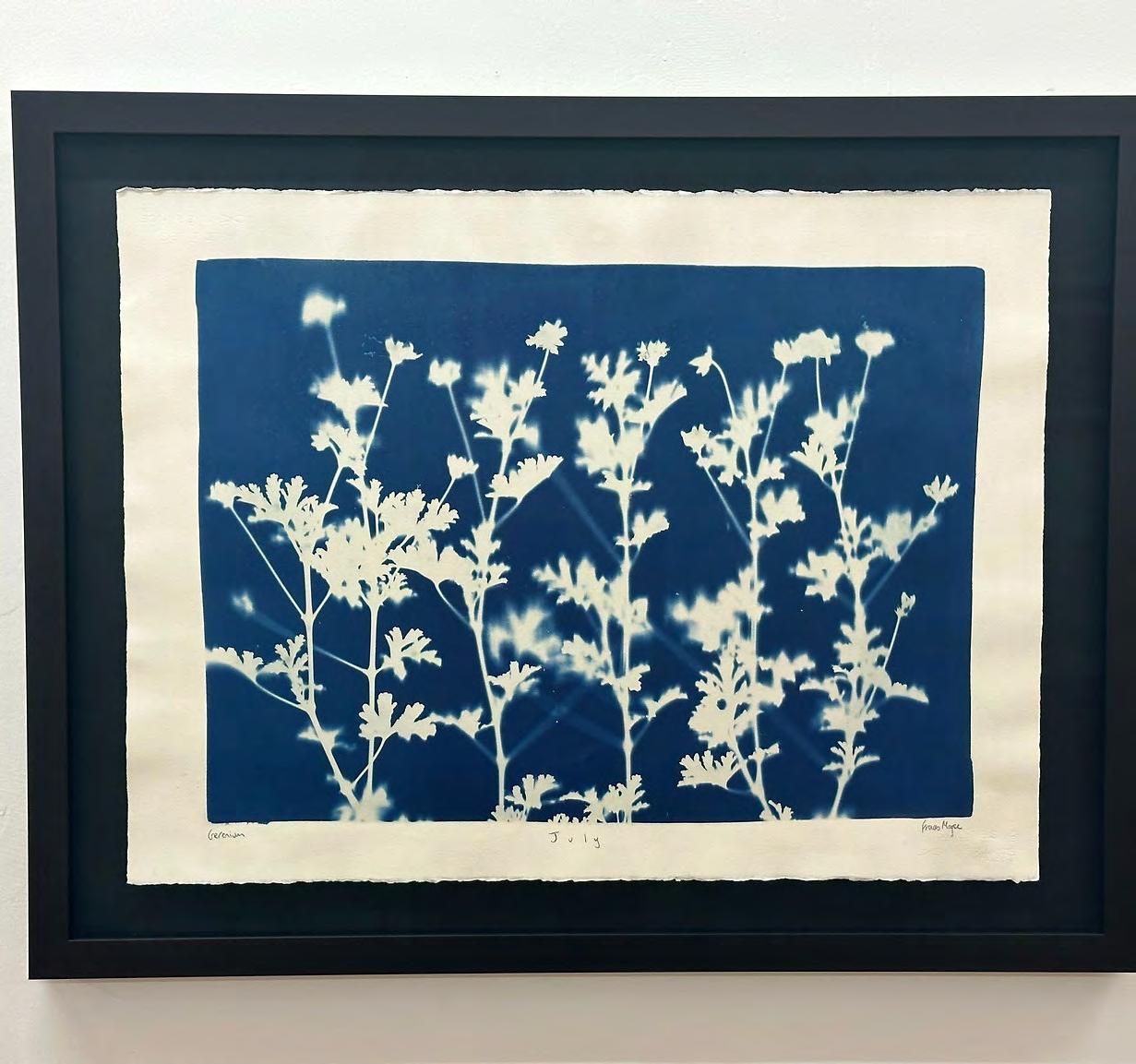
July Geranium
Almost Crying at the Market Stall
Frances laughs at the idea of being a marketer. Instagram posts require effort. “I have to force myself,” she admits. But markets are different.
She loves meeting people, talking about soil types and north-facing gardens, discussing hellebores and lilies. She enjoys explaining the chemistry and hearing stories of other people’s plants.
And when someone buys a piece?
“It nearly makes me crack,” she says. “I almost cry.”
The prints feel necessary to make - almost compulsive. When someone chooses one and carries it home, it feels like a profound acknowledgement
of the work and the season embedded within it. When someone returns for a second piece, it becomes even more meaningful.
“I’m so grateful,” she says simply.
March, Held in Blue
Early spring is a season of uncertainty - light stretching but not yet reliable, beds half-awake, colour arriving in flashes rather than in abundance. Hellebores stand resilient against cool air, daffodils hover on the brink of opening, lilies push upward earlier than expected, and alliums gather quiet momentum beneath the soil. It is a time when nothing feels entirely secure and everything is in the process of becoming. Frances’ cyanotypes sit naturally within that tension.
They hold the fragile confidence of March - the pest-bitten leaf, the wind-shifted stem, the cloud-softened exposure - and render it permanent. In her hands, this shifting season is not hurried toward summer; it is honoured exactly as it is: provisional, textured, imperfect, and luminous in blue.
Frances’ work will be on view this summer in a joint exhibition with Connie Baker Horne at Castle Espie Wetland Centre. For full details and visiting information, visit: wwt.org.uk/castle-espie
For further information, including her blog and available works for purchase, visit her website: francesmageeart.com
And keep up with Frances via social media: @francesmageeart