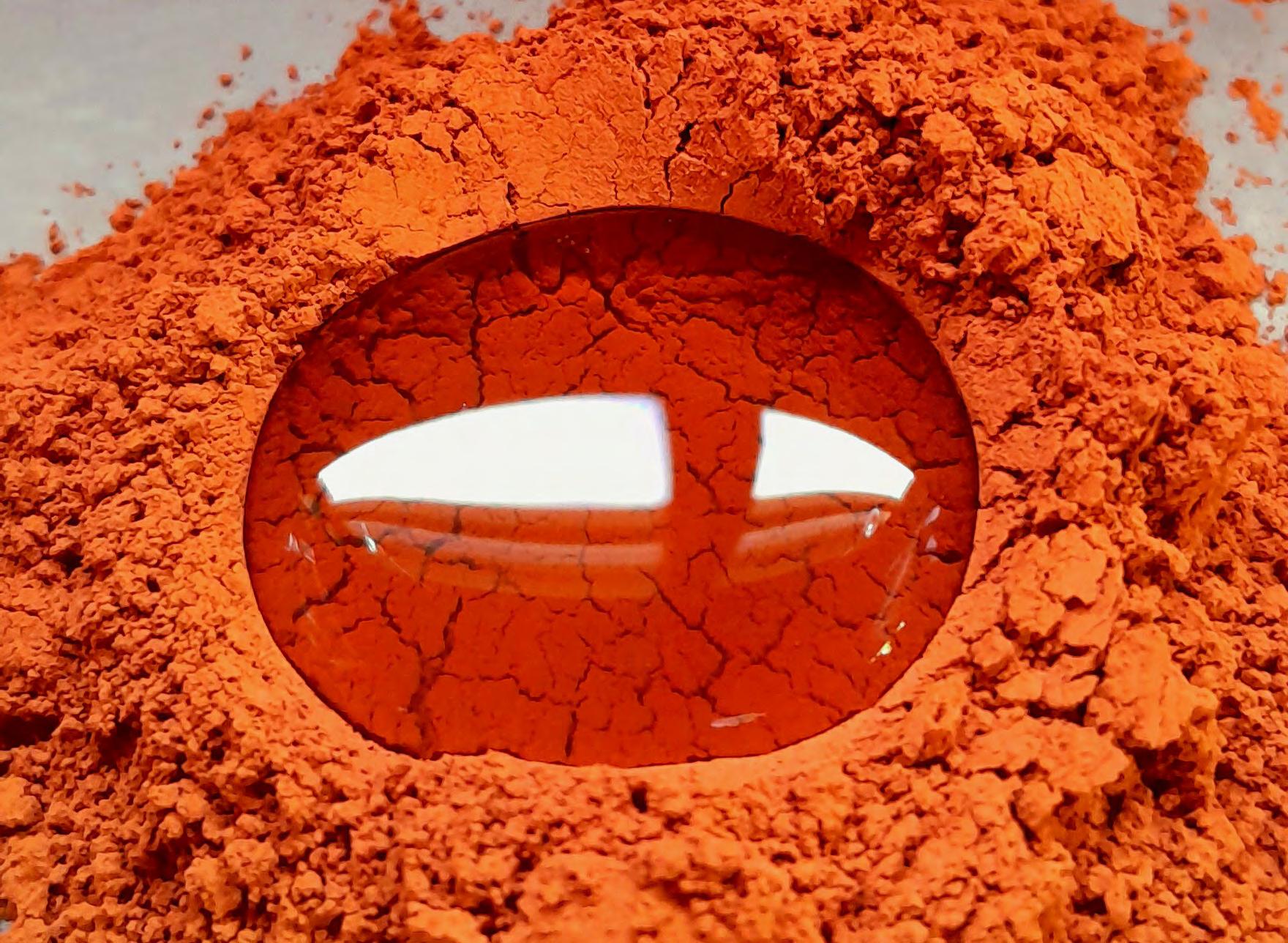
On the north Antrim hills, where basalt meets red earth, artist and pigmentmaker Tricia Kelly uncovers a story that spans sixty million years. Her work traces how ancient volcanic fire and weather shaped the ochre now colouring her practice - a material that connects geology, history, and human creativity. From her careful gathering of pigment to her reflections on folklore and healing, Kelly reminds us that the land holds its own memory.
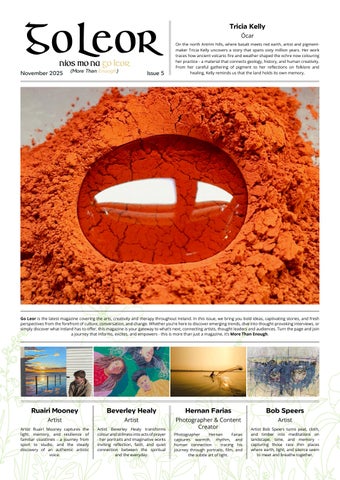
Go Leor is the latest magazine covering the arts, creativity and therapy throughout Ireland. In this issue, we bring you bold ideas, captivating stories, and fresh perspectives from the forefront of culture, conversation, and change. Whether you’re here to discover emerging trends, dive into thought-provoking interviews, or simply discover what Ireland has to offer, this magazine is your gateway to what’s next, connecting artists, thought leaders and audiences. Turn the page and join a journey that informs, excites, and empowers - this is more than just a magazine, it’s More Than Enough
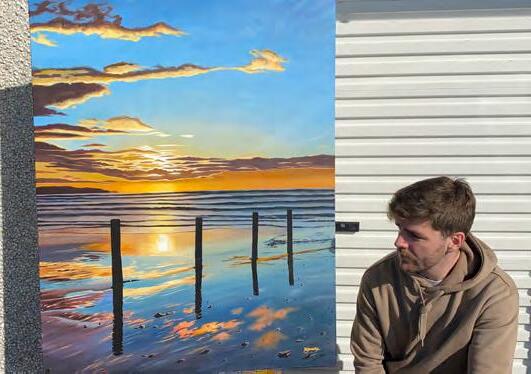
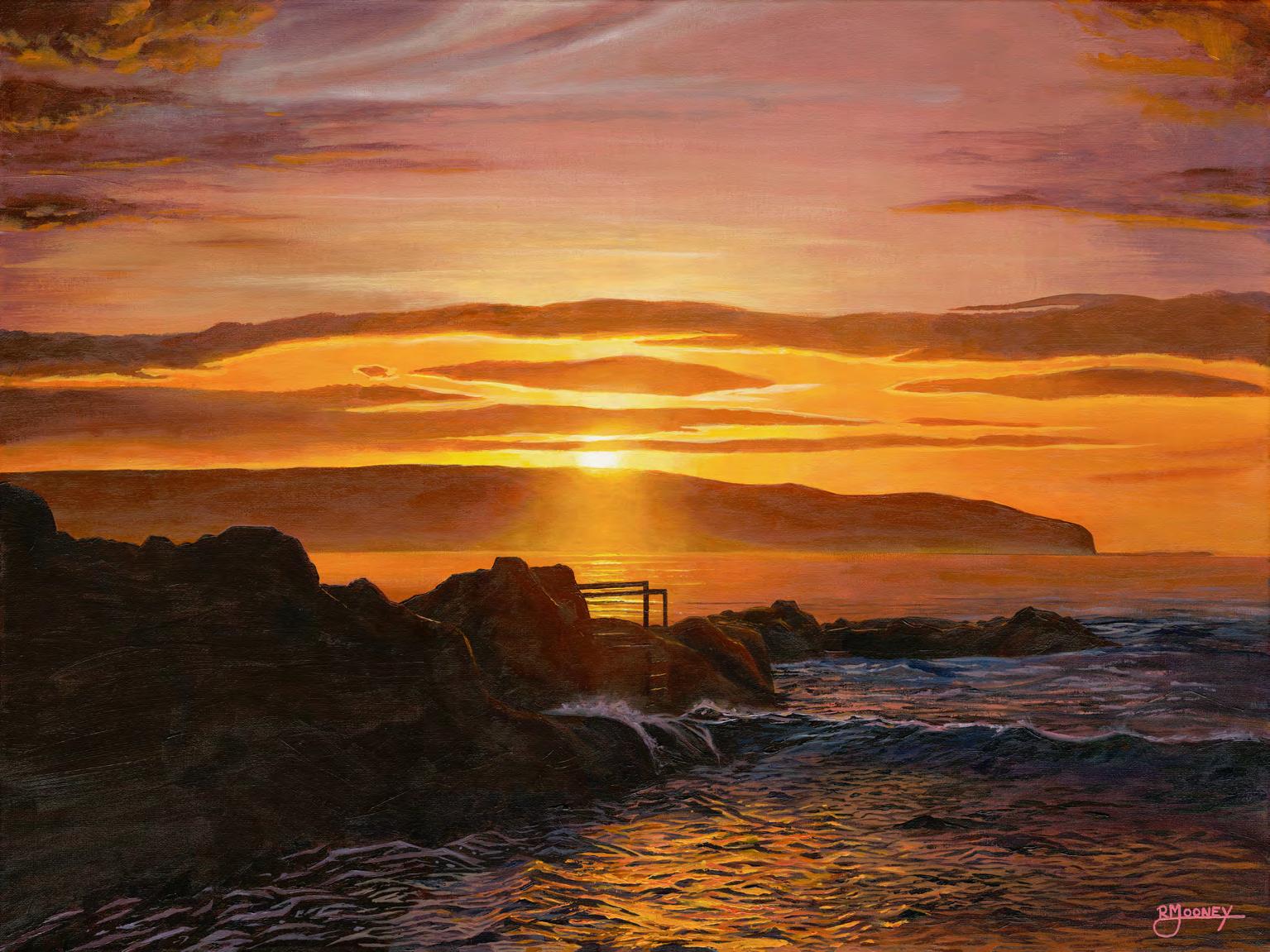
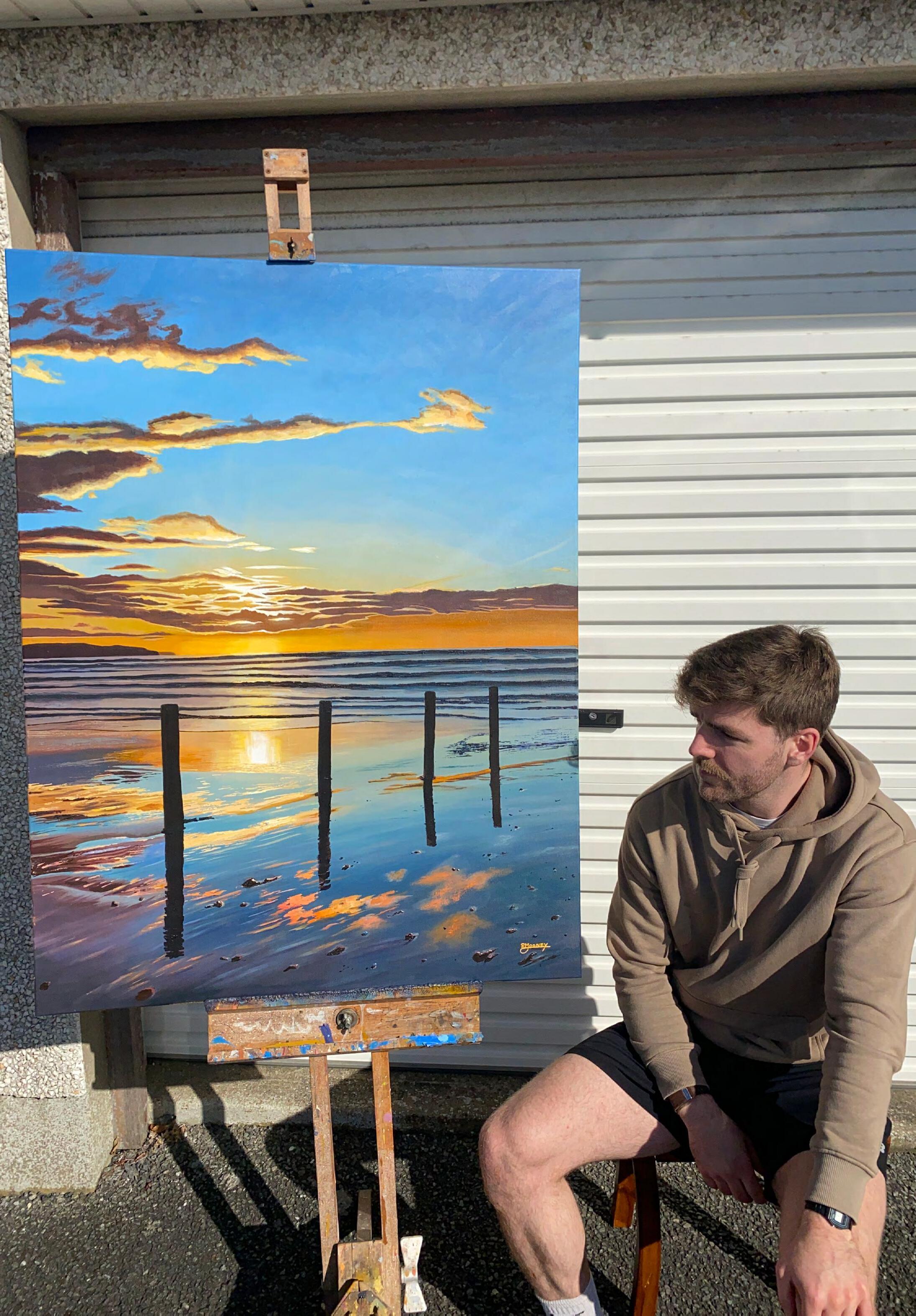
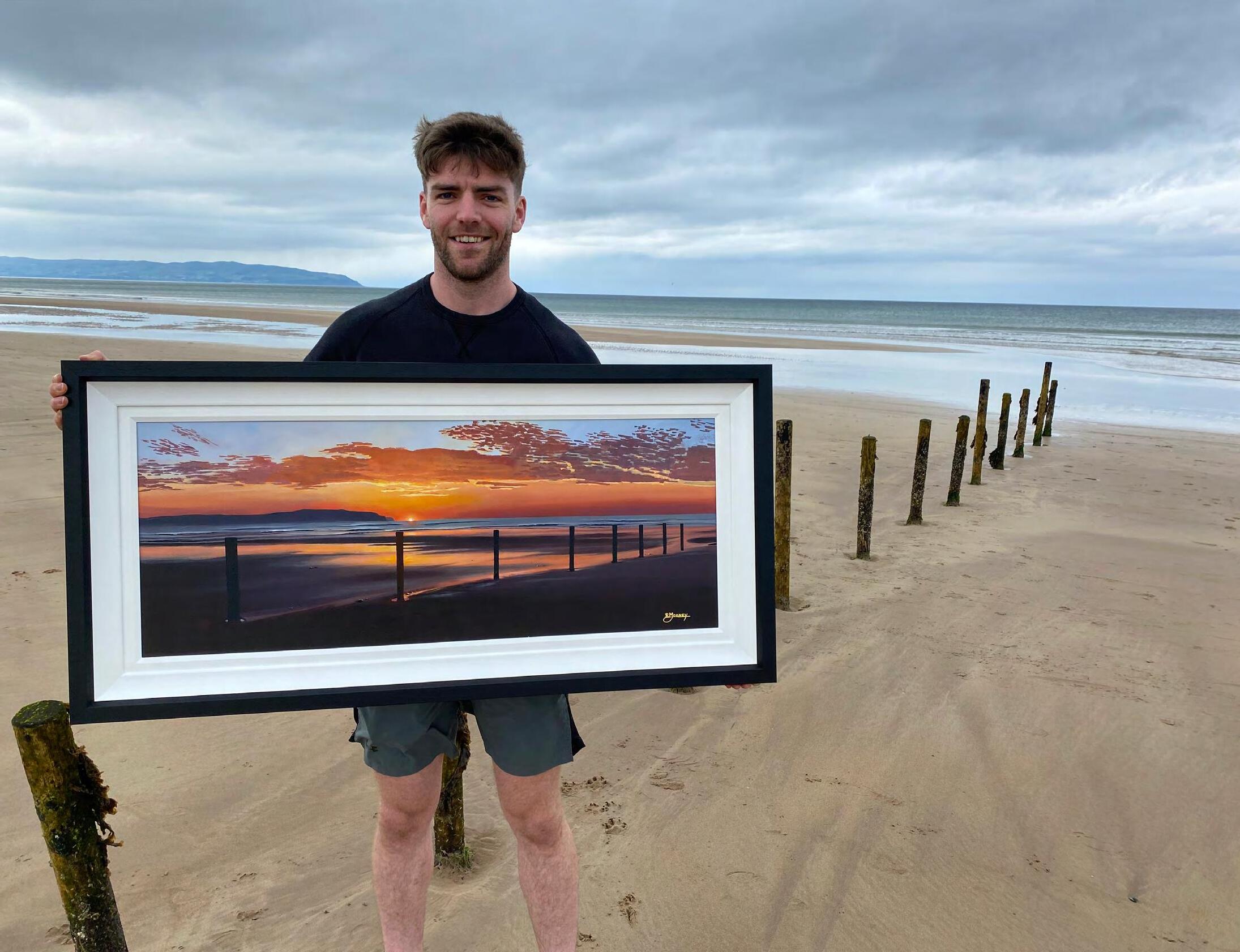
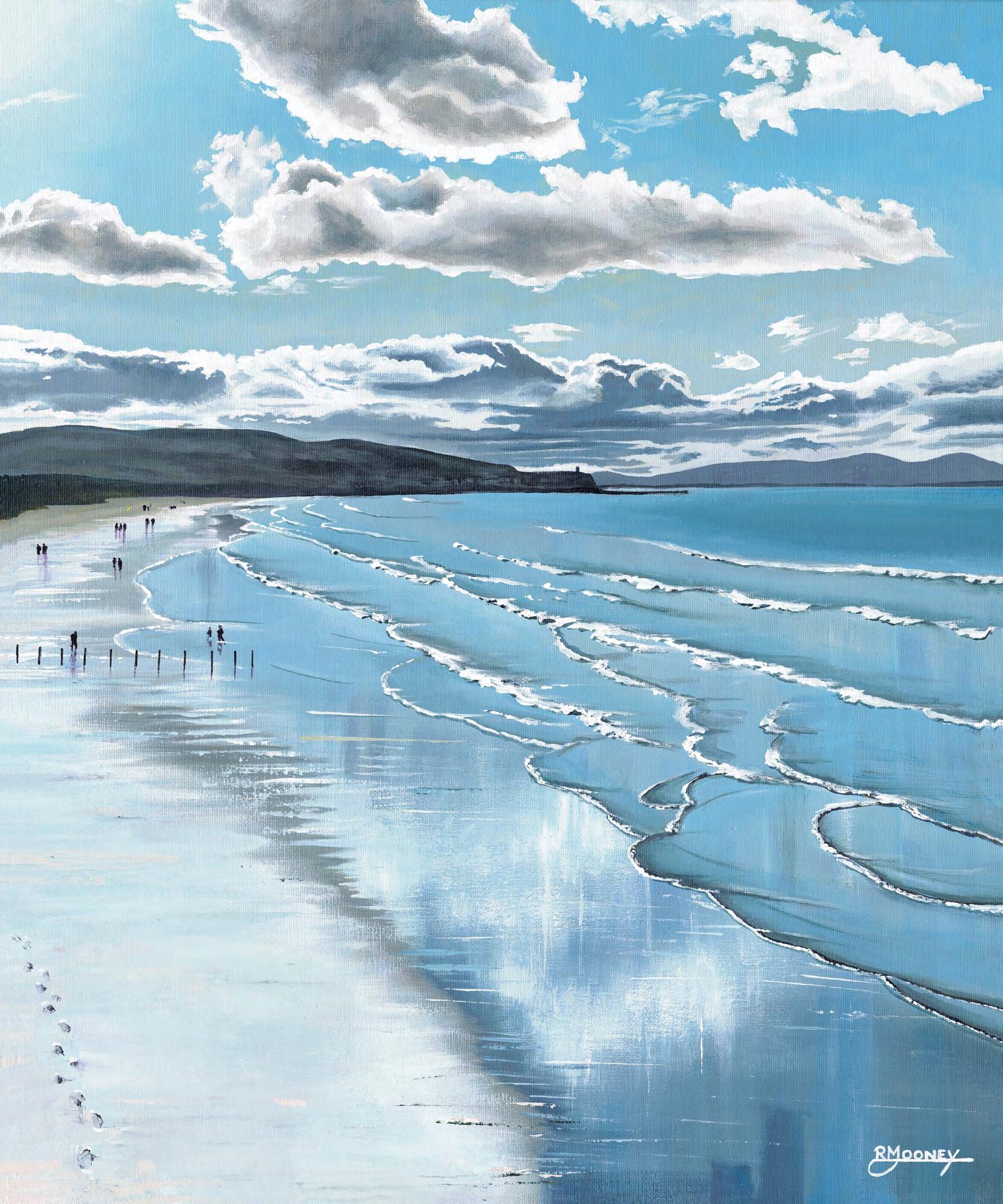
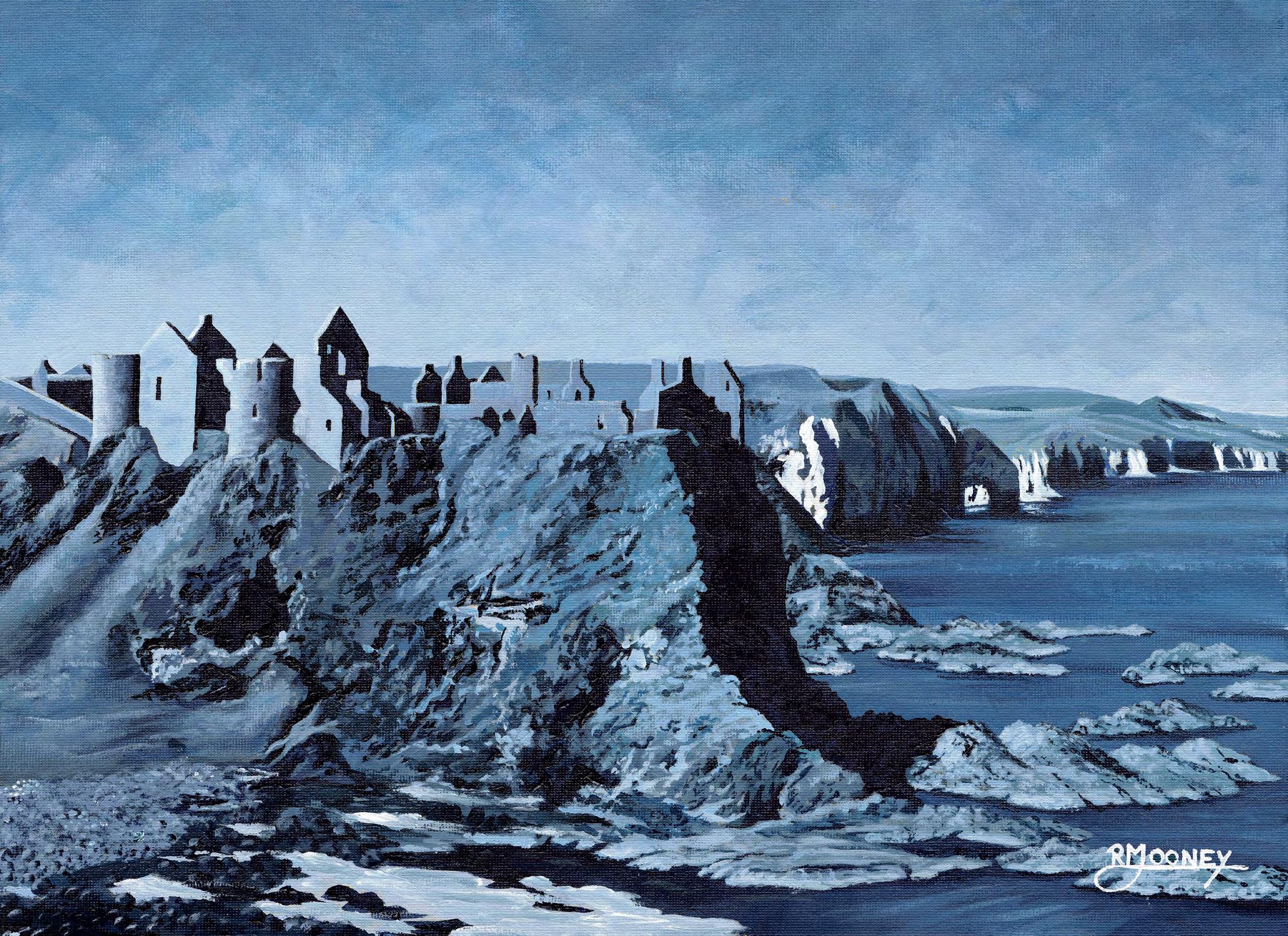
Artist Ruairí Mooney captures the light, memory, and resilience of familiar coastlines - a journey from sport to studio, and the steady discovery of an authentic artistic voice.
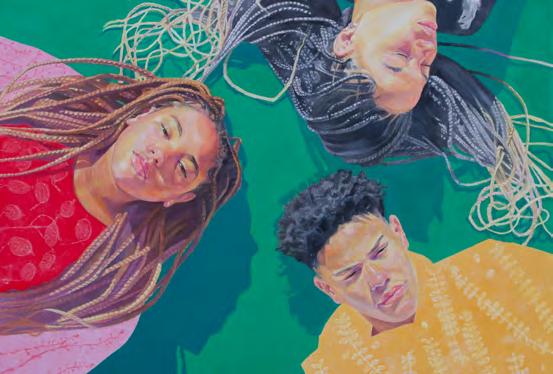
Artist Beverley Healy transforms colour and stillness into acts of prayer - her portraits and imaginative works inviting reflection, faith, and quiet connection between the spiritual and the everyday. (More Than Enough)
Beverley Healy
Artist Hernan Farias
Photographer & Content Creator
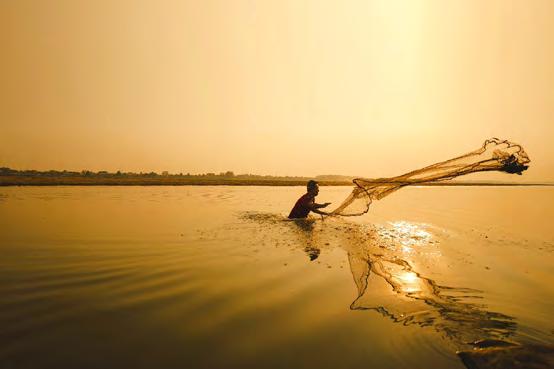
Photographer Hernan Farias captures warmth, rhythm, and human connection - tracing his journey through portraits, film, and the subtle art of light.
Bob Speers Artist
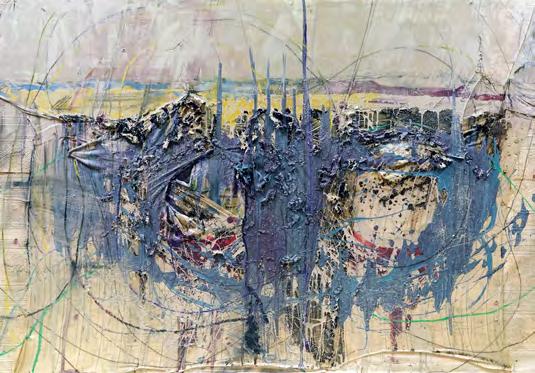
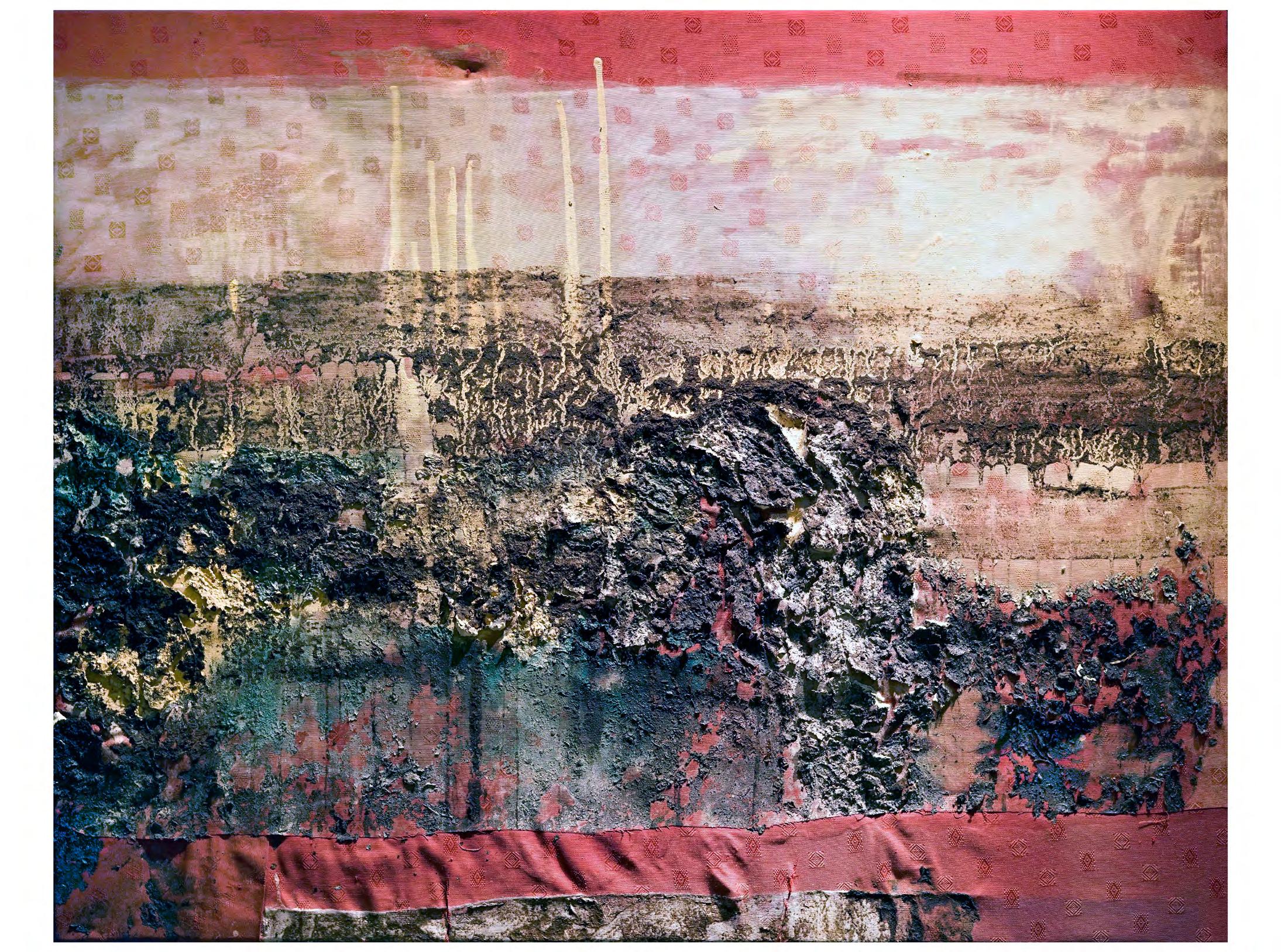
Artist Bob Speers turns peat, cloth, and timber into meditations on landscape, time, and memorycapturing those rare thin places where earth, light, and silence seem to meet and breathe together.
Ruairi Mooney Artist
Issue 5 - November 2025
Ruairi Mooney Artist
Beverley Healy
Artist
Tricia Kelly Ócar
Hernan Farias
Photographer & Content Creator
Bob Speers
Artist
We’re always on the lookout for fresh voices, bold ideas, and stories that matter. If you have a topic you’re passionate about, a request for something you’d love to see featured, or an idea you think deserves a platform, we’d love to hear from you. Go Leor is built on conversation and collaboration, and your input helps shape the future of the magazine. Get in touch with the editor via aidan@goleor.co.uk - let’s create something great together.
Interested in advertising with Go Leor? Partnering with us puts your brand in front of a vibrant, engaged audience of curious minds, creative thinkers, and culturally-aware readers who value authenticity and innovation. Our publication reaches a diverse mix of young professionals, artists, changemakers, and trendsetters who are always seeking what’s next. With a focus on creativity, events and exploration, whether you’re launching a new product, promoting an upcoming event, or building brand awareness, we offer tailored advertising opportunities to help you make a meaningful impact. To explore how we can work together get in touch with us at advertising@go-leor. co.uk
Across these pages, you’ll meet artists who work not only with materials, but with meaning. From Bob Speers , whose canvases breathe the quiet depth of Ireland’s boglands, to Tricia Kelly , distilling ancient ochre into living pigment; from Ruairi Mooney , painting the light and patience of recovery, to Beverley Healy , whose portraits turn stillness into prayer; & Hernan Farias ,
finding warmth and humanity through the lens - each of them reminds us that creativity begins with attention.
These are stories about process, but also about presence - how art, in all its forms, can slow us down long enough to notice what endures: texture, gesture, breath, connection.
Aidan McGrath
Ruairi Mooney Artist
From the North Coast to the Canvas: a journey of resilience, daily practice, and the slow discovery of an authentic artistic voice.
When Ruairí Mooney speaks about his work, he does so with the same patience and persistence that shapes his paintings. Recovering from injury, he reflects with quiet gratitude:
“I’m lucky in the type of job I have,” he says. “I’m not climbing ladders or on my feet all day. Something like this could really knock you off your stride. I’m hoping that in a week or two I can get back at the easel - even if it’s just from a seated position.”
Before surgery, he had been immersed in a series of commissioned works - bespoke paintings created for people who wanted to capture something deeply personal.
“Some are places where people
grew up, where they got engaged, or memories of someone who’s passed away,” he explains. “They buy those pieces to hang in their homes for fifty years - something their grandkids will see. It’s a great responsibility, and an honour for them to trust me with it.”
The Geography of Memory
Most of Mooney’s work begins along the North Coast - the place he knows best - but commissions have pulled him in unexpected directions.
“I’ve had lovely requests from Murlough Beach down near Newcastle, parts of the Antrim Coast, even Sligo - around Ben Bulben” he says. “They’re places I might not have thought to
paint myself, but they’ve given me the chance to see new landscapes and try something fresh.”
Each commission brings its own dialogue. “Sometimes people are very specific - they’ll want the view from their holiday home, the exact angle they look out from in the morning. I did a piece of West Strand Beach in Portrush for someone who grew up there. They wanted their family apartment included, the colourful one in the row overlooking the bay. It meant something to themand that becomes part of the painting.”
Other clients hand over full creative control. “You get people who just trust the process,” he says. “They don’t know exactly what they want, but they’ll know it when they see it. I love that kind of freedom.”
Commissions and Creative Flow
Revisiting familiar places has made Mooney increasingly aware of perspective.
“There’s a fair bit of that,” he says. “Someone might see a painting in an exhibition and say they love everything about it except one small thing - maybe they want it turned slightly or brought in closer to show a certain feature. I like that. They get a say in the creative process, and I know they’re getting exactly what they want.”
Portnahapple Silhouette
Between commissions, he builds original collections guided by instinct.
“I just start with whatever idea I’m drawn to,” he explains. “After two or three pieces, a trend starts to appear - maybe in colour palette or subject matter. It’s like a musician making an album: each song stands alone, but they share a tone or a mood. I don’t plan it; I discover it.”
That spontaneity coexists with pragmatism. “If I wasn’t careful, I’d paint Portstewart Strand every day,” he laughs. “It’s about balance - what I’m drawn to versus what people respond to. Every artist would love to paint purely for themselves, but you have to be realistic too. You can’t ignore what people love.”
The Social Media Paradox
For Mooney, social media is both a tool and a trap. “If you’re in a creative block, Instagram is probably the worst place you could be,” he says. “You end up with productivity guilt - seeing other artists posting new work every day and wondering why you didn’t think of that. You start subconsciously copying what isn’t yours.”
He believes real inspiration comes from physical spaces. “Go to a gallery,” he says. “Look at paintings on a blank wall, without likes or comments swaying you. Decide if you like it for yourself. Online, you see what pleases the masses. It’s fast, surface-level - people scroll past in seconds. If I spend forty hours on a painting, someone might look at it for three seconds.”
Still, he acknowledges the reach it gives. “Social media is brilliant for connecting with people and getting your name out there,” he admits. “But for genuine appreciation of art, nothing beats seeing it in person.”
Community and Encouragement
Exhibiting has deepened that appreciation. “I’ve had great support from other artists who come to shows,” he says. “Sometimes they just want to see what’s happening; sometimes it gives them the nudge to do their own exhibition. Even if it’s just learning how to get started - how to plan it, organise it. That side of things can be just as encouraging.”
Mooney values that sense of creative momentum - how one
Last Light
artist’s work can quietly give another permission to try. “I’ve done the same myself,” he admits. “You go to someone else’s show, and it gets you thinking again.”
From the Pitch to the Canvas
Before landscapes, Mooney’s early paintings were rooted in sport and portraits of athletes “At the start, I found it hard to take myself seriously as an artist,” he says. “It’s only in the last year that I’ve been able to say, ‘I’m an artist,’ without it sticking in my throat. People knew me for Gaelic football, not painting. So sports felt like a safer place to start.”
That decision turned out to be formative. “Those commissions helped me build confidence. I knew the subject matter so well that I didn’t feel like an imposter,” he recalls. “It gave me time to get familiar with paint, colour, and process - the kind of fluency you only earn through hours of repetition.”
Learning the Language of Paint
Mooney compares those years to a crash course in learning a new instrument. “I studied art at school and trained as a teacher, but it wasn’t until lockdown, during my ‘100 Days of Art’ fundraiser, that I really got to know paint,” he says. “I was painting every day, and you build this fluency - not just in colour theory but in confidence.”
Raising funds for the mental health charity Aware NI, what began as a way to stay creative during isolation quickly became something larger: a community effort that connected his art practice to purpose. By the end of the project, he had raised over £1,000 for the charity. He laughs, recalling how tenta-
tive he once was. “I used to be scared to waste paint, scared to go over the lines, scared to ruin something. But eventually you realise - you can’t really do it wrong. You get braver. You start slapping paint on with brushes, palette knives, anything.”
That willingness to experiment has become central to his work. “I love practice,” he says. “That’s why I connect painting with sport or even music - the idea of gradual improvement, challenging yourself, growing. You can’t help but get better. You find your voice by doing.”
Discipline and Belief
His time on the Gaelic pitch taught him lessons he now
carries into the studio.
“I wasn’t naturally gifted,” he says. “I was a grinder, a late bloomer. That’s why I don’t really believe in talent - it’s repetition, practice, and hard work. But when you love what you’re doing, that hard work doesn’t feel hard.”
He’s logged thousands of hours with a paintbrush in hand. “I’m not an expert,” he says, “but I’ve definitely put the hours in. I can stand over my work now and say it’s authentic. It’s not trying to be something it’s not.”
Colour, Light, and Geometry
Mooney’s paintings are known for their sense of light - the
Seafoam + Sky
gleam of sun cresting over a hill, or the shimmer of white along a wave. But there’s another element that has become distinctively his: geometric shapes scattered through the composition.
“When I moved from sport to landscapes, it didn’t feel natural at first,” he admits. “It was like wearing boots that didn’t quite fit. I’d see other artists painting the same beaches and landmarks, and I didn’t want to just add another version. I wanted to do it differently - to make it mine.”
That urge led to experimentation: lines, reduced palettes, blocks of colour. “Those squares and bars weren’t a planned decision,” he says. “I was just experimenting. When I look back now, those early pieces feel raw - maybe even naïve - but there’s a freshness
in that. You only get that when you’re trying something for the first time.”
The shapes still appear in his work, though more sparingly. “I like that people recognise them,” he says. “They’ve become part of my language - a way of introducing tones and energy that might not fit otherwise. They’re visible, but not distracting. It’s just something that naturally grew out of the process.”
The Ongoing Search for Authenticity
For Mooney, painting is a constant negotiation between curiosity and control - an ongoing search for authenticity. “I was talking to a teammate recently about originality,” he says. “I don’t think I’ve found my true, original style yet - or the perfect piece that sums me up. But
every time you paint, you get one step closer. You’re peeling back layers, chipping through to the next surface, trying to reach the core.”
That pursuit is what keeps him excited. “I could talk about creativity and process all day,” he says. “I want to reach that piece that feels like me - the one people look at and say, ‘That’s Ruairí Mooney.’ I don’t know when it’ll happen. Maybe in five years, maybe twenty-five. But that’s the beauty of it - you never really arrive. You’re always getting closer.”
Find out more information about Ruairi’s latest work, along with prints and commissions via his website: artbymooney.com
Keep up with Ruairi on social media: @artbymooney
Coastal Ruins
Beverley Healy Artist
In her imaginative work, paint becomes prayer - a wordless meditation on trust, surrender, and creation itself, where colour and stillness meet to form something quietly transcendent.
When we speak, Beverley Healy has just finished leading a watercolour class for the Northern Health Trust’s community arts programme - one of several she has run across Northern Ireland. The workshops, hosted in local libraries, are designed for people of all backgrounds, particularly those who might lack confidence in their artistic ability. “I started developing them years ago when I worked with Arts Care at the Mater Hospital, Belfast, often focussing
on mental health,” she says. “They’re structured in a way that suits a range of people - especially those who might not think of themselves as artists but want to give it a try.”
Healy sees these sessions not only as a creative outlet for others but as a reminder for herself. “It reminds me that it’s fun just to play,” she says. “I can be a bit of a perfectionist, which can be valuable, but it can also hold you back. Teaching reminds me to let go of that and
to embrace the joy of connection - that belief that everyone is creative and that we shouldn’t be afraid to do it wrong.”
Prayer, Process, and the Imaginative Work
While Healy’s portraiture is careful and deliberate, her imaginative work is more spontaneous, unfolding like a form of meditation. “It’s quite a prayerful process for me,” she says. “I start with a blank page and I don’t know what’s going to happen. I just put bits of paint on and pray and paint at the same time.”
Before she begins, there’s a pause - a moment of stillness she describes as essential. “It’s just about letting the work be what it’s going to be,” she says. “Even choosing colours feels like a kind of prayer.”
Her faith has now become deeply woven into her whole creative practice. “I didn’t grow up with faith,” she says, “but I have it now. And when I paint, I feel like I’m creating with the Creator - not just making something on my own.” She often refers to these pieces as “visual prayers,” each one a reflection of contemplation and trust.
Connection Beyond Belief
Though Healy’s art is rooted in spirituality, she approaches her subjects with openness. “I believe everyone is intrinsically
Each Green Breath
valuable, created in the image of God,” she says. “So when I paint someone, that’s the perspective I bring.”
She recalls a portrait of a fellow Artist from her MA course who didn’t share her faith but was open to being painted within that framework. “She knew where I was coming from,” Healy says. “We discussed that the portrait would be about the beauty I see and about hope, about the questions of life that go beyond what we may see. She was happy for me to work that way.”
Holding Space - On Canvas and in Life
Healy’s recent work reflects her desire to slow down and step away from what she calls the “digital soundbite culture.”
“We live in a world full of noise,” she says. “My work is about creating breathing space - a chance to pause and reflect on life’s bigger questions.”
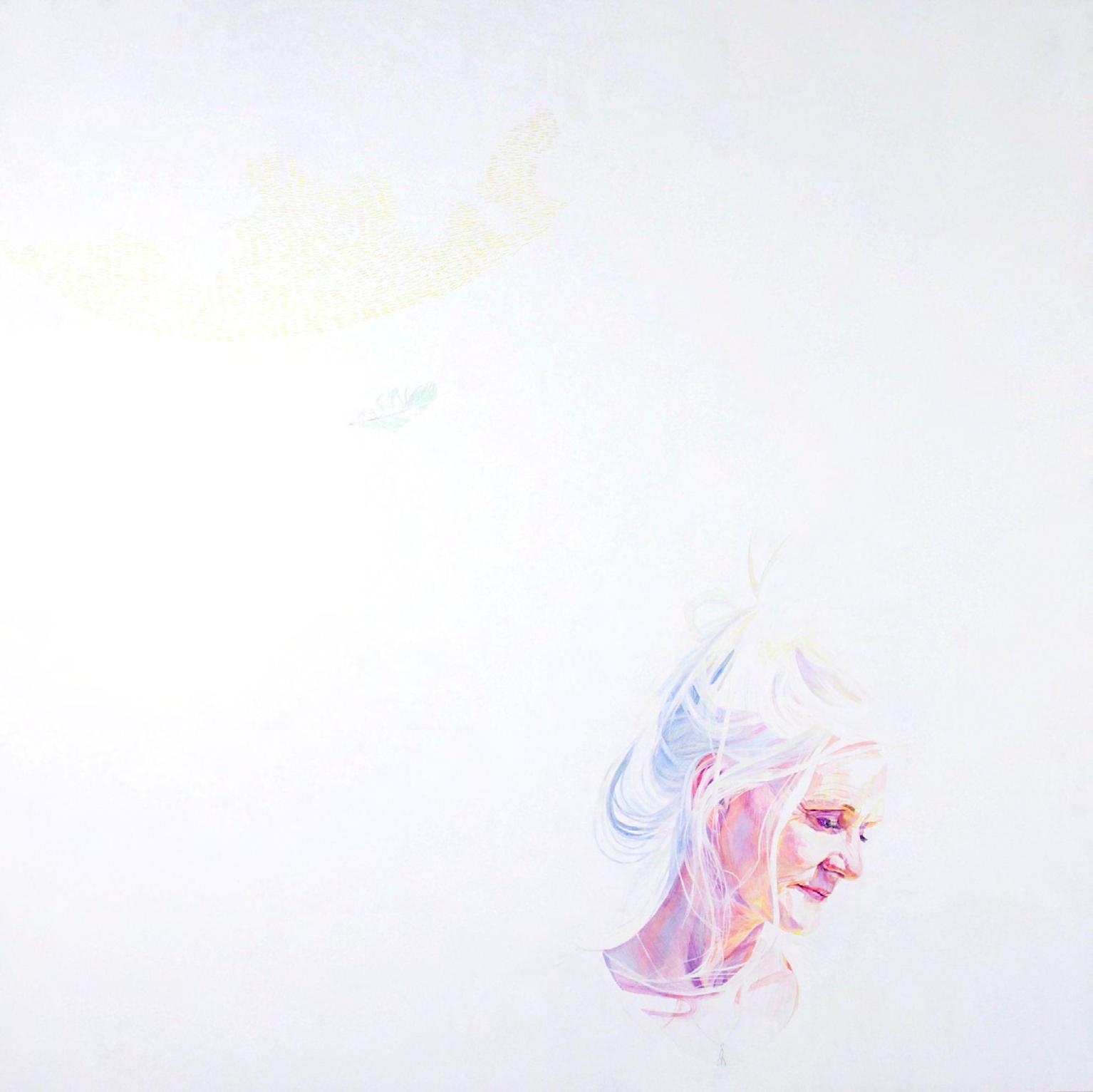
In her paintings, that realization has taken form as literal white space. “I wanted more space in my work, because I wanted more space in my life,” she explains. “It was a real struggle to keep that space - I kept adding and taking things away. But it reflected what I was going through personally: trying to hold on to stillness.”
That sense of stillness is captured in Each Green Breath, a 100cm x 100cm egg tempera painting on vegan gesso. The work takes its name from a line in a poem shared by her sitter - a poem that reflected her fragility and strength. “There’s a green feather in that painting,” Beverley says, “and a subtle swathe of yellow - both almost invisible unless you really look. They echo that balance between fragility and hope.”
Experimentation, Material, and Meaning
Patience, she admits, is central to her process. “Egg tempera is slow work,” she says. “It’s layer upon layer - true gesso ground involves mix, heat, sand, and polish. I use 000 brushes, so it’s not something you can rush. That slower pace really appeals to me.”
An Arts Council NI SIAP award gave Healy the chance to expand her material practice, combining her fine, traditional portraiture with more experimental printmaking. “I was doing a lot of small gel prints and also working in tempera, which is very fine and detailed,” she says. “I wanted to find a way to bring those worlds together.” The grant allowed her to explore new materials, including a vegan gesso made from whiting and cellulose. “It let me mix different paints on the same
board - prints, tempera, and oil together. It was liberating.”
That spirit of experimentation has stayed with her. “The vegan gesso is a bit more powdery than true gesso, which could be a problem for longevity,” she says, “but I quite like its fragility. It says something in itself.”
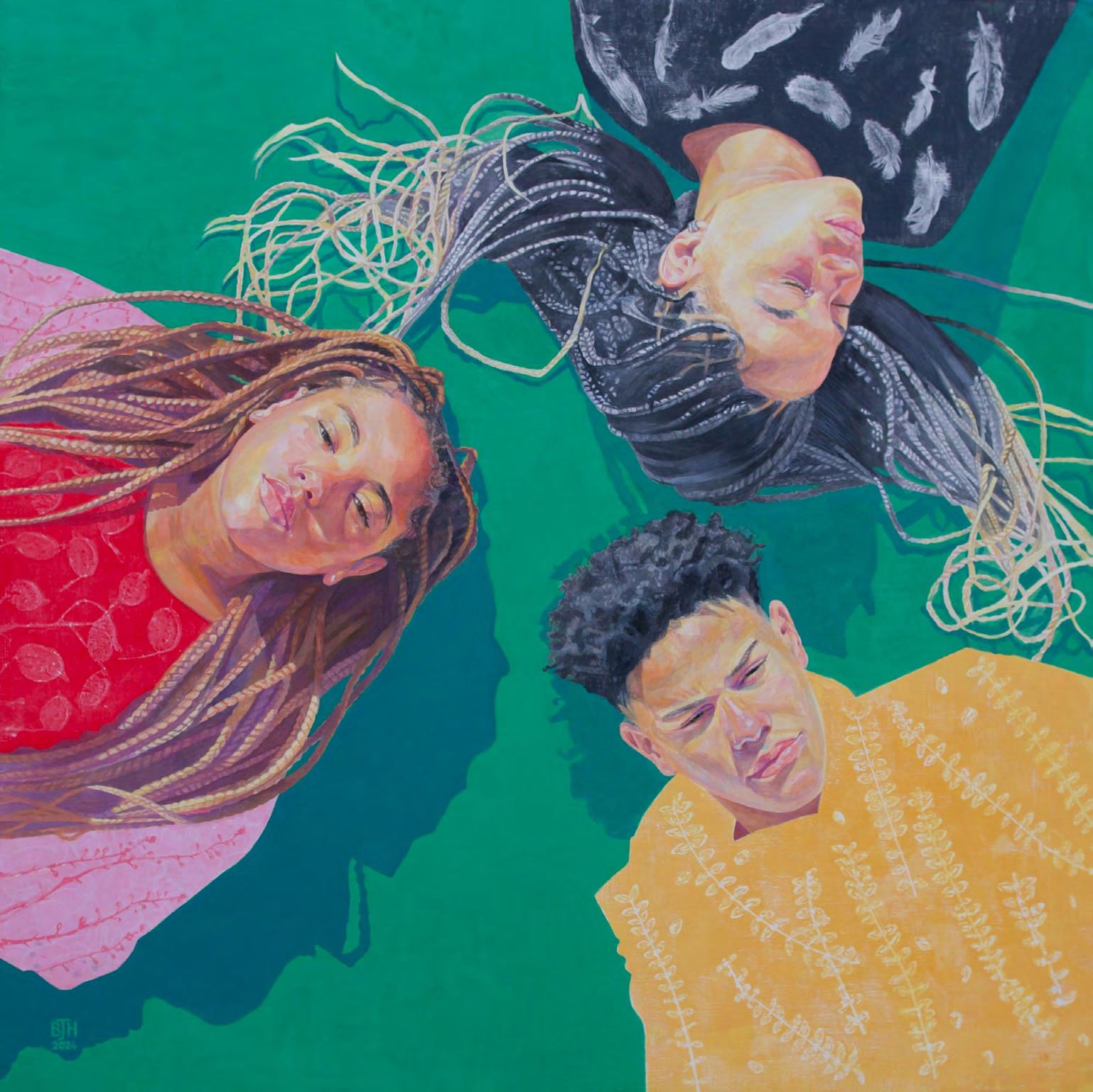
Her portrait Sibling Travellers (97cm x 97cm), shortlisted for the AIB Portrait Prize 2025 at the National Gallery of Ireland, exemplifies that exploration. It was the first large piece she created using the new mix of media she developed under her SIAP award. “It was a real step forward,” she says, “and one that connected deeply with my love of living in Ireland.”
Thoughtfulness and Symbolism
Every choice in Healy’s paintings is intentional. She speaks about
Sibling Travellers
Serenity
symbolism not as ornament but as meaning made visible.
“I like that each detail carries something personal, even if the viewer doesn’t know the full story,” she says.
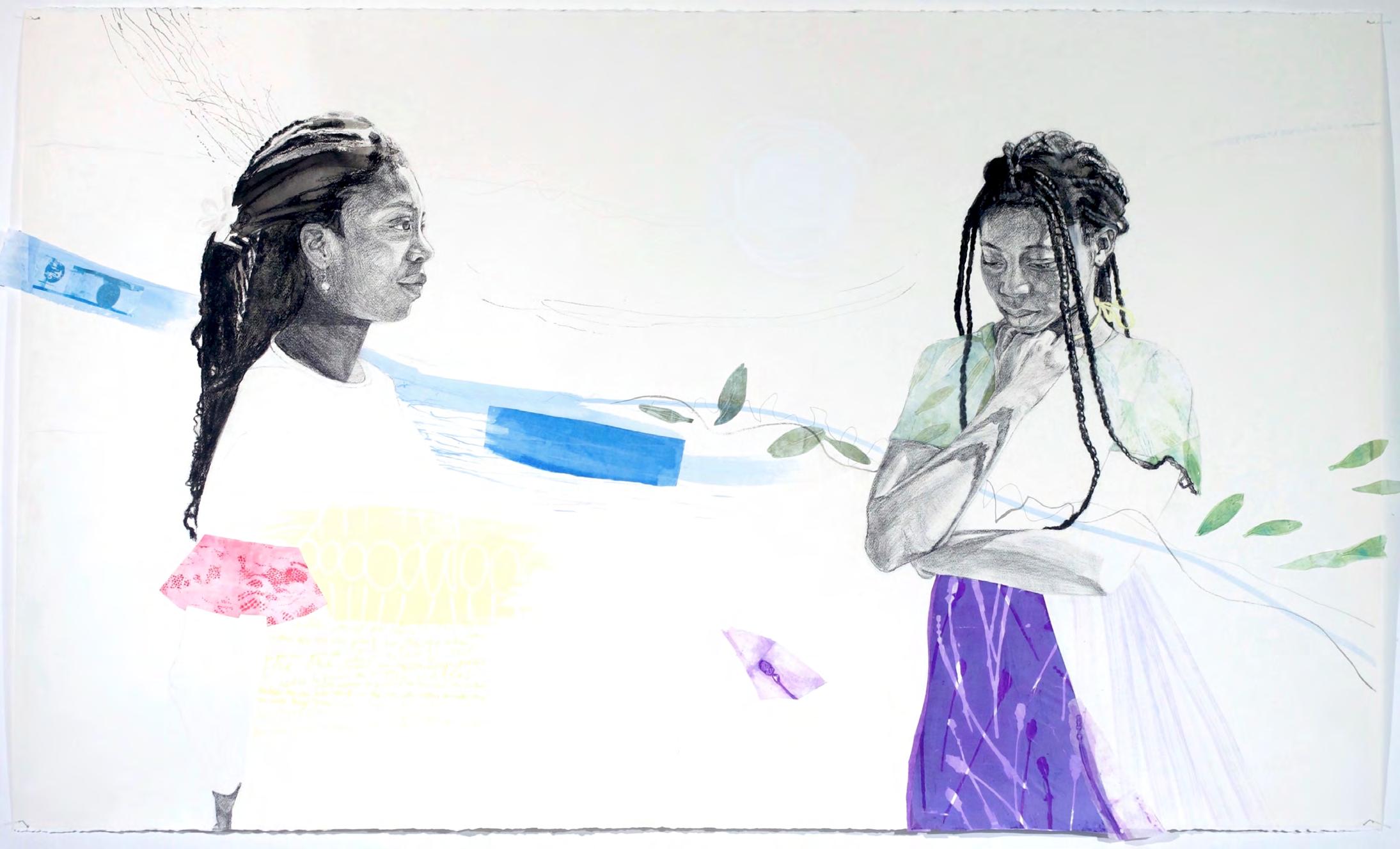
In her recent work Serenity (180cm x 100cm), Healy depicts two sisters from her local church community - “young women with intelligence and serenity beyond their years.”
The piece, currently showing at the Wells Art Contemporary 2025, continues her exploration of contemplation and presence.
“It’s about the value of life here, but also the sense of something beyond ourselves,” she says.
The clothing of the sisters carries layered symbolism: myrtle leaves for harmony, lavender for peace, and lace for fragility and strength. Faint writing on one dress reads young women empowered to transform the future - a detail Healy says “felt important to preserve.”
Light, too, plays a symbolic role. In her portraiture, it seems to emanate from the people
themselves. “That’s lovely to hear,” she says when this is mentioned. “I think that’s what I’m trying to express - the sense that something is shining through. For me, that’s co-creating with God. But whatever people see in it, that’s part of the beauty of art - it can speak in ways we don’t plan.”
Hope and Reflection
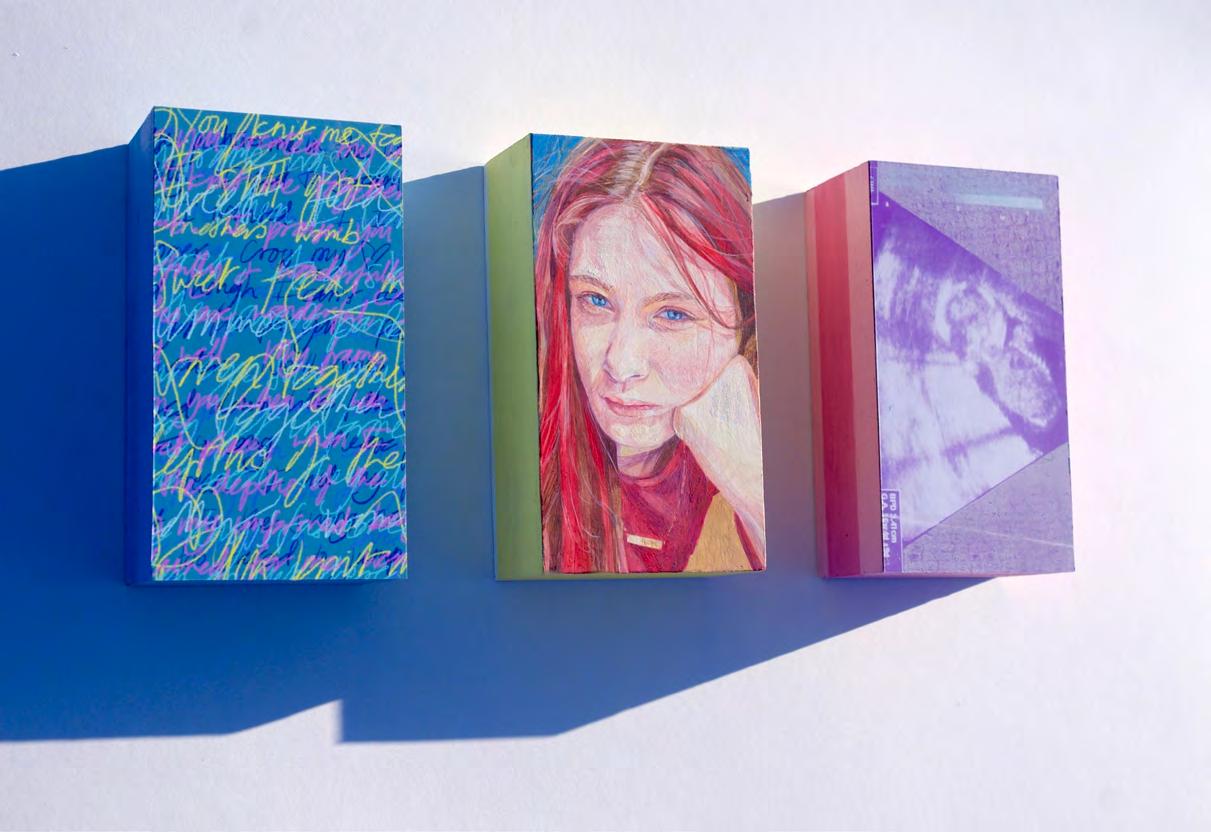
Among her smaller works, Hope stands out as a deeply personal piece - a triptych based on her
daughter. It incorporates an egg tempera portrait with the word “Hope” on her necklace and writing on her hand that suggests curiosity about life’s meaning. “On the right, there’s a sonogram,” Healy says, “a portrait of her at sixteen weeks and a connection with me.” Overlaid digitally in Procreate are words from Psalm 139 - “knit together in the womb” - intertwined with lyrics from Taylor Swift’s Seven, a song the two both love. “It’s about childhood, memory and searching.” she says.
Prayer Book: A Collaboration in Faith
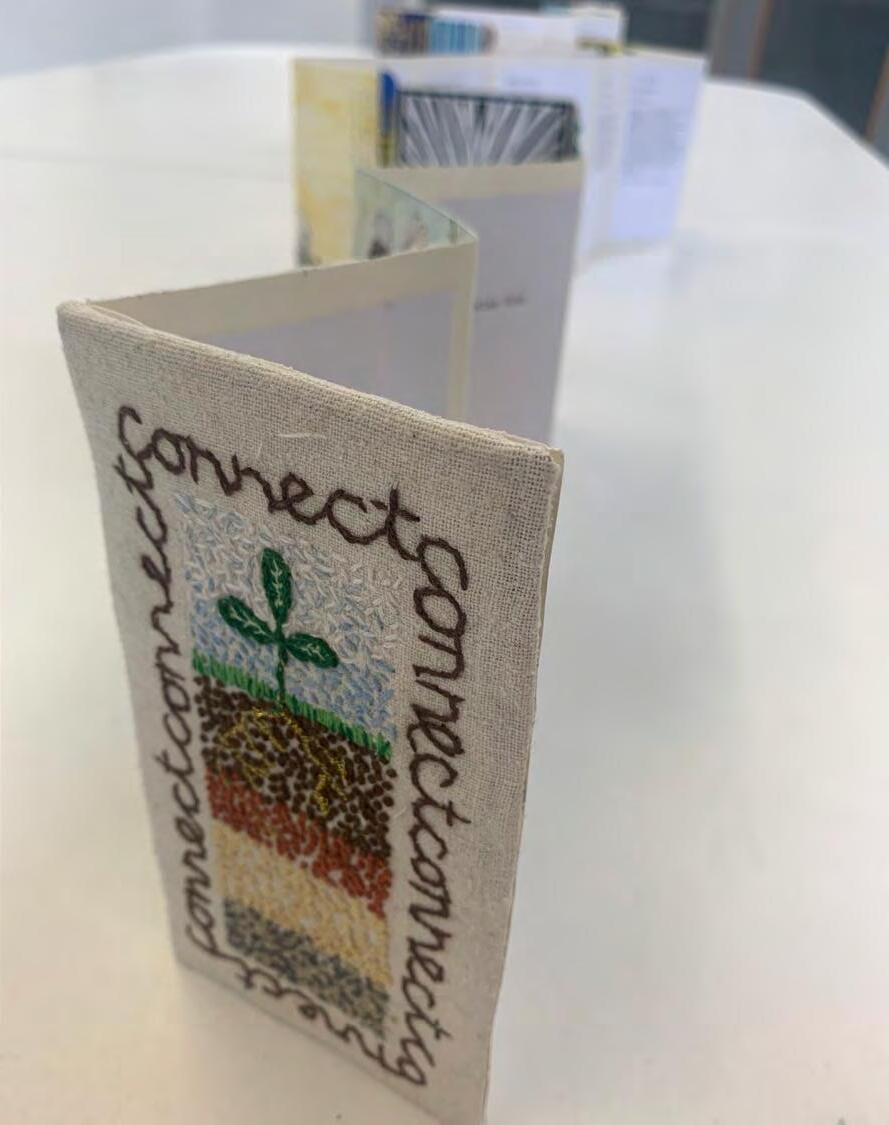
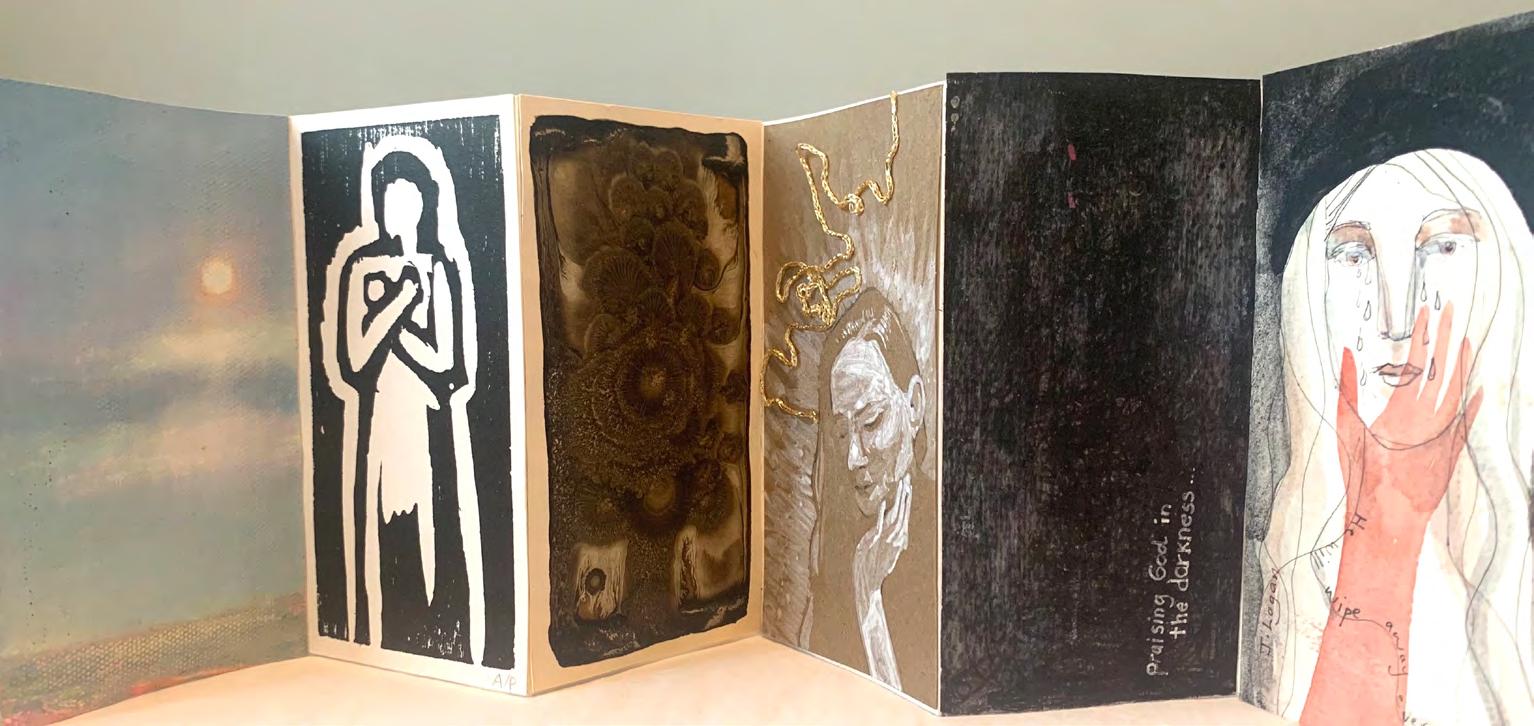
For her MA, Healy developed a collaborative project titled Prayer Book, a concertina-style book featuring contributions from thirty-four artists around the world. Each was invited to create a piece about prayer on a mobile-phone-sized panel. The idea, she explains, grew from her reflections on how screens dominate modern life. “I was thinking about how we’re always scrolling,” she says. “So I wanted to make something that made people stop and think.”
The results were profoundly varied. “One artist made a piece called Praying in the Darkness, all dark scribbles overlapping. Others painted about family, nature, or hope,” she says. “It reminded me that prayer relates to every part of life - not just joy, but also struggle.”
The project grew beyond her expectations. Artists from China, Australia, and Germany sent their work, and the book has since been exhibited in retreats and galleries. Featuring contributors including Sue Holbrook, Elaine Murdoch, Matthew Herring, Sarah Grace Dye, Jennifer Litts, Sonia Margarita Montes, and Judith Logan (pictured). “It was wonderful sharing an artwork with others,” she says. “We each brought a different idea of prayer. The mobile phone-sized format reminds us of scrolling - but in this case, it arrests the scroll and focuses attention on connection, on prayer.”
Portraiture, Patience, and Connection
Patience is at the heart of Healy’s portrait practice - the slow layering of pigment, the hours spent on each braid or strand of hair. “It’s a slower pace, but it suits me,” she says. “You learn to surrender to the
process. It’s not just about likeness - it’s about stillness and reflection.”
She describes her portraits as dialogues rather than depictions. “Sometimes I’ll meet someone and feel drawn to paint them,” she says. “It could be a friend, a stranger in a café - I might just get a sense that there’s something about that person I need to capture.” Not every impulse turns into a painting, but the ones that do often carry deep resonance. “I think the people I paint are the ones I’m meant to,” she says. “And hopefully that connection carries through to whoever sees it.”
Teaching, Healing, and Play
When she’s not in the studio, Healy continues to teach at the Crescent Arts Centre and other venues, often focusing on beginners or people returning to art after a long break. Her workshops in printmaking and watercolour emphasise playfulness and discovery. “I love helping people who don’t think they can do it,” she says. “It doesn’t have to look like mine. It’s about expressing something of themselves and realising they can.”
In that sense, Healy’s teaching and painting are part of the same philosophy: openness, contemplation, and care. Her recent Fine Art MA, she says,
helped “shape and hone my thinking” around that ethos. “My work emphasises the intrinsic value of each person,” she says, “and the need to slow down, take space, and engage with life’s bigger questions.” Whether through faith, portraiture, or the simple joy of watercolour, her work always returns to the same quiet truth - that creativity, like prayer, begins in stillness and reaches toward something beyond us.
For more information, prints, original works and commissions visit her website: beverleyhealy.com
And keep up with her via social media: @beverleyhealyartist
Tricia Kelly Ócar
A Material Older Than the Island - exploring how sixty million years of volcanic fire, weather, and transformation created the red ochre that now colours Tricia’s life and work.
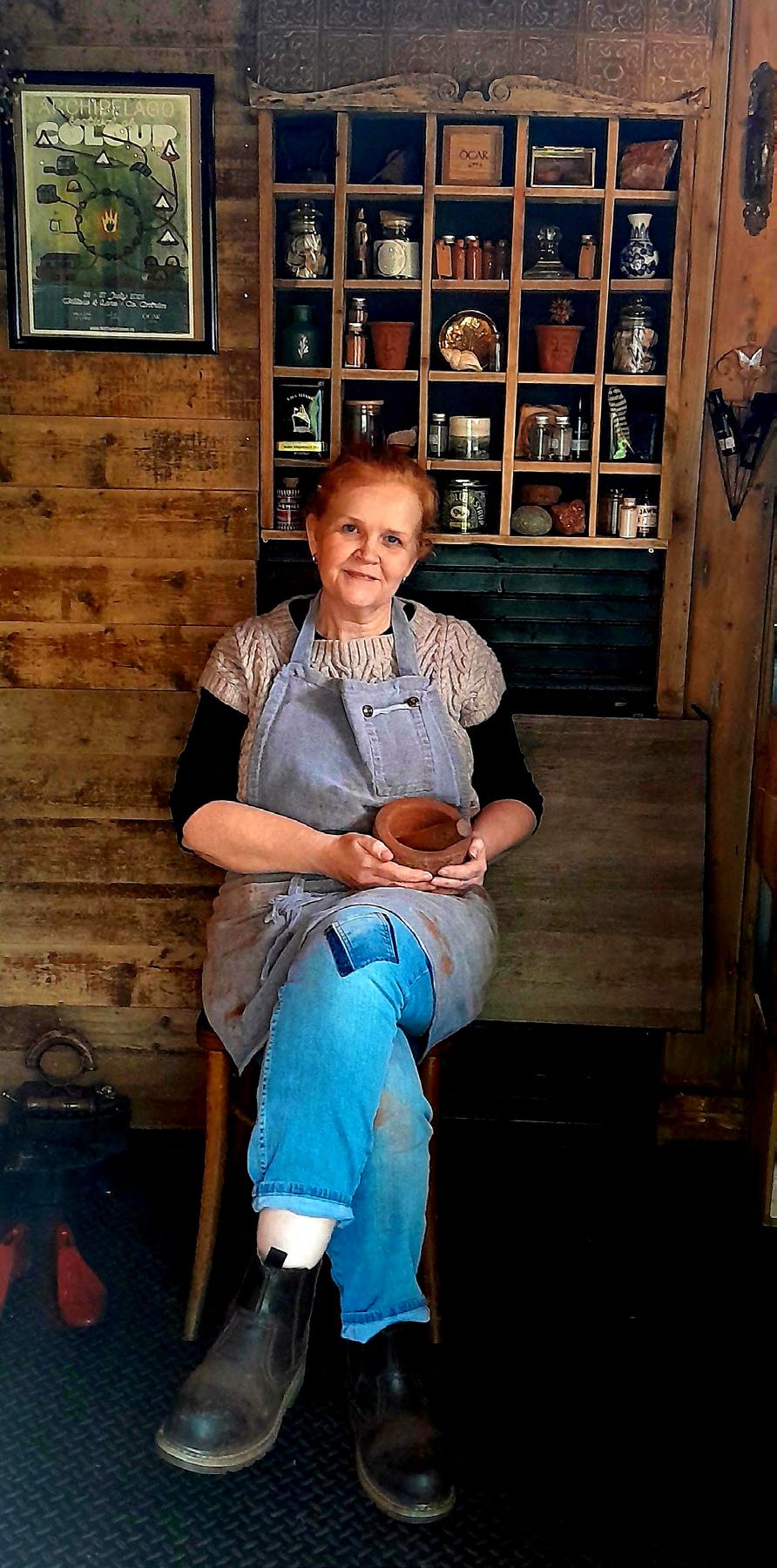
Tricia Kelly’s practice originates on the north Antrim hills, with sweeping views of the valleys where the land folds into layers of basalt and red earth. Her family roots stretch across Donegal and Derry, and it was through those landscapes - and their stories - that she first began to understand how deeply the earth shapes identity.
“My husband’s family are from Glenshesk, at the foot of Knocklayd Mountain” she says. “That’s really where a lot of this story begins. It’s iron-ore countrythe kind of place where the land has always been known for its colour.”
From Art History to Ochre Fields
Kelly studied History of Art at Trinity College Dublin, where red ochre was something she knew only through textbooks. “In art history, you see it everywhere,” she explains. “It appears at every milestonefrom cave paintings to the Book of Kells, to the Mona Lisa. It’s one of the oldest materials in human creativity.”
At the time, her curiosity was academic. “I knew it as an iron-oxide pigment - something artists used - but I had no idea there was a huge deposit of it right under our feet here in the north. That discovery changed everything.”
After university, she worked in literacy and community education. “I volunteered in Dublin, thinking I’d be doing art projects with kids, but it turned out to be reading and writing support. That became my career for decades,” she says. “But five years ago, I left work to take on caring responsibilities. Anyone who’s a carer knows you need something for yourself - something to put back into your reserves.”
It was during that period of caring that she returned to pigments. “I started with natural dyes - plants, bark, berriesdoing kitchen experiments,” she laughs. “Beautiful colours, but they faded. I wanted something more permanent. When I found red ochre, I realised I’d found what was missing.”
A Deep Time Material
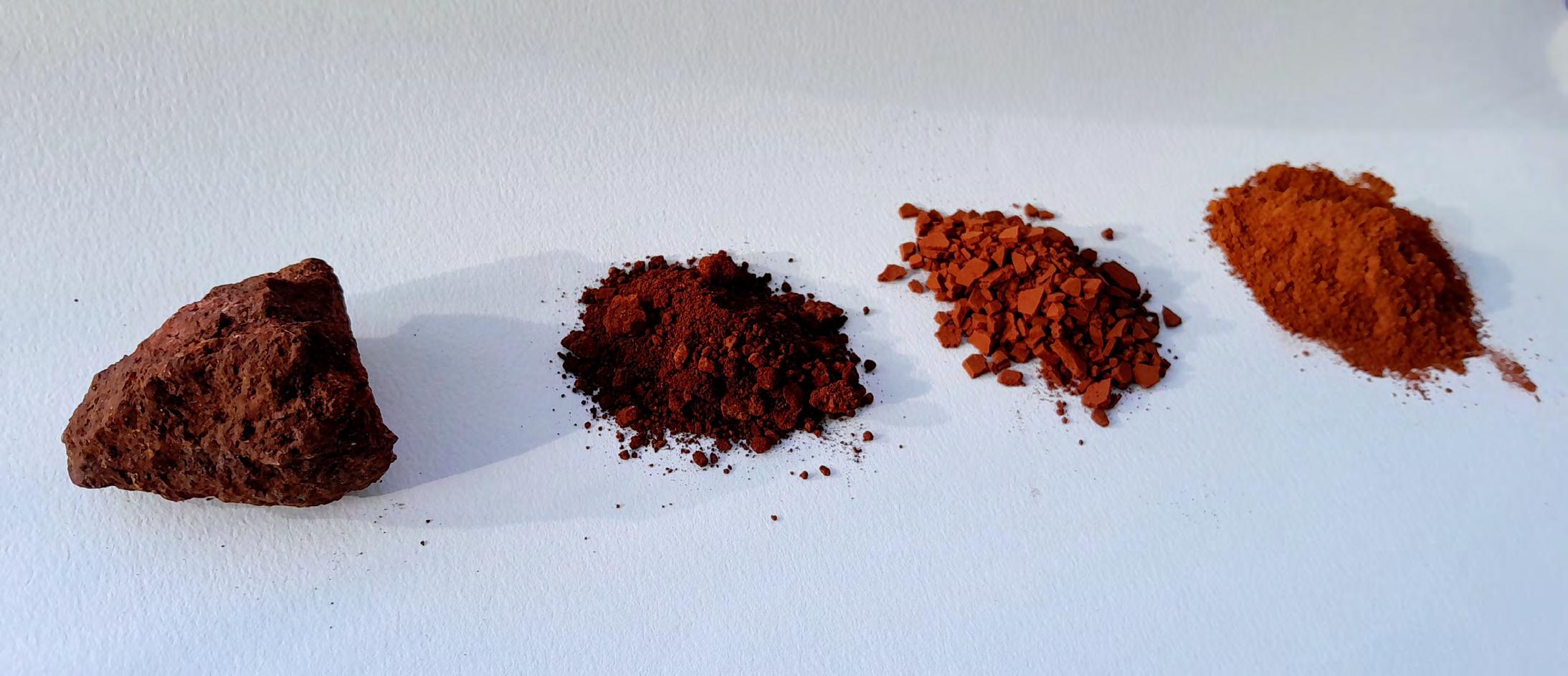
As she began to study it, Kelly realised that the ochre beneath Antrim had its origins sixty million years ago - long before Ireland, or even humans, existed. “When this ochre began to form, our bit of the earth’s crust was still near the equator, attached to what are now the Appalachian Mountains,” she says. “Volcanic eruptions covered the land with lava that cooled into basalt. Over millions of years, that basalt weathered and transformed into iron oxide - the red ochre we find today.”
She uses a metaphor to explain the timescale. “If you imagine the age of this ochre as a single day, Ireland as we know it doesn’t appear until half a minute to midnight - and the first people only arrive twenty seconds before. We’ve only been using ochre for a few seconds of that day.”
For Kelly, that sense of deep time is grounding. “It’s like looking at the stars,” she says. “You feel small, but also connected - to the land, to every
person who’s ever used this material.”
Gathering the Pigment
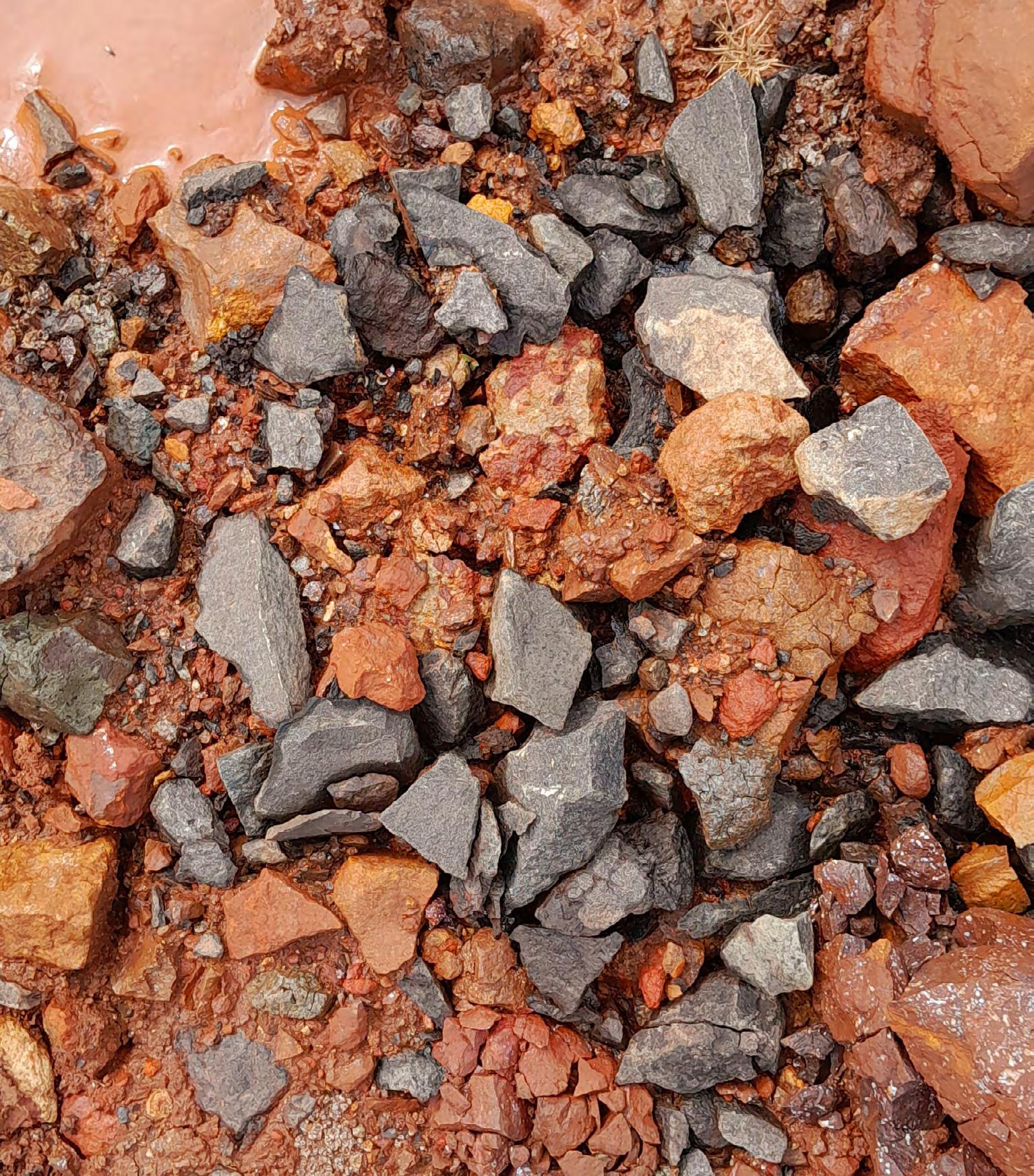
Antrim’s red ochre lies between layers of basalt, sometimes hundreds of metres underground. “Most people don’t realise it’s there,” Kelly says. “You can see it at the Giant’s Causeway - there’s a red band that runs through the cliffs above the stones. But everyone’s looking at the hexagons - they miss the colour.”
To locate ochre, Kelly follows 19th-century geological maps created by surveyors on foot and bicycle. “They mapped every resource - iron, aluminium and more. Those maps show where to look.” She often visits basalt quarries where the ochre layer has been exposed. “For the quarry, it’s waste material - too soft to use. For me, it’s treasure. They let me pick through the red and yellow stones, and I take only what I can process.”
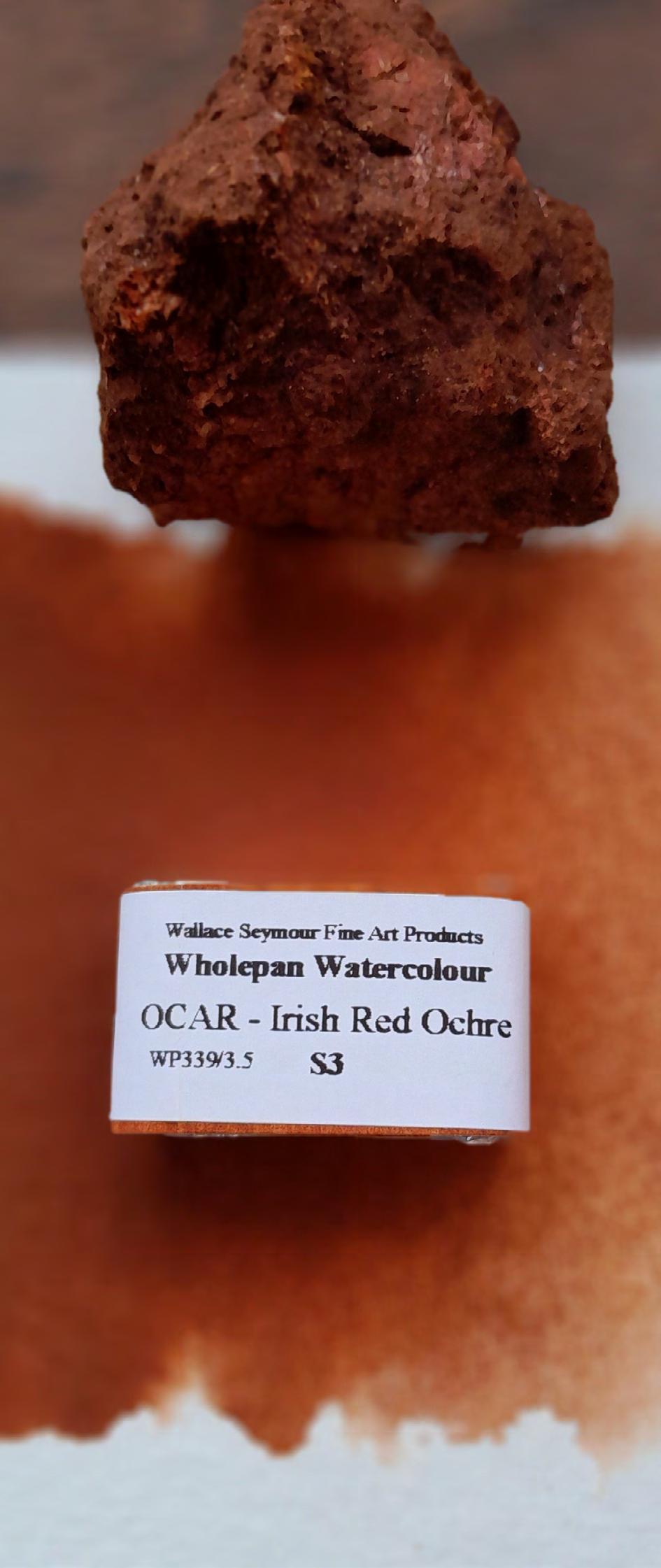
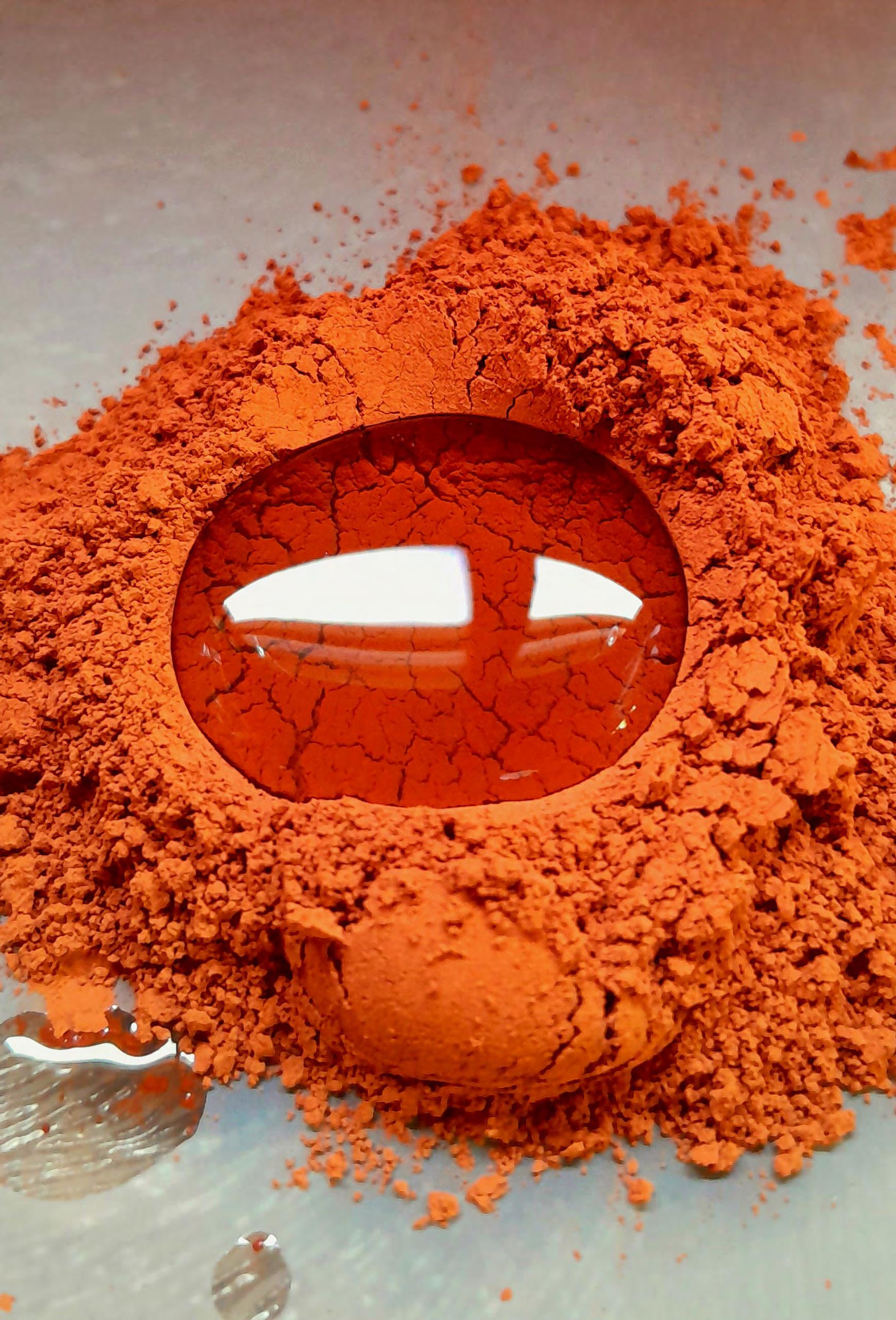
Her process is painstaking. “I crush it by hand, sieve it, wash it, and let the heavy sediment sink. The lighter material floats - that’s what becomes pigment. After drying and grinding through finer sieves, I get it down to about thirty microns,
half the width of a human hair. About five kilos of rock gives one kilo of pigment.”
Even the discarded sediment is returned to the land. “I take it back to the quarry. It’s already sixty million years old - it deserves respect. Eventually, it’ll weather into ochre again.”
The Pull of the Colour Red
While ochre comes in shades of yellow, brown, and orange, it’s red that holds Kelly’s fascination. “There’s something in our psychology that responds to it,” she says. “At workshops, people will come over just to touch it. They say, ‘I want to eat it.’ It’s like there’s a memory in ussomething ancient.”
That primal connection, she believes, has always been part of human life. “People have used red ochre in rituals, in burials, in healing. Bones laid on beds of red earth. And even up to the 18th century, people took it as medicine - red or green powders for stomach ulcers or indigestion. Ireland has always believed in the curative power of earth.”
Her own family stories tie into that lineage. “My mother’s people, the O’Friels, were the only ones allowed to lift Gartan
clay - a white clay from Donegal said to protect against fire and harm. And St. Colmcille himself was said to have thrown red earth into the sea to calm a storm on his way to Iona. That sense of the land as alive, as healing, is deep in us.”
From Myth to Modern Practice
Kelly’s research into folklore and place names has revealed how much of Ireland’s mythology reflects the red beneath the soil. “We’ve forgotten how much our ancestors knew,” she says.
“Lugaid Riabh nDearg - the Red Striped; Medbh Lethdearg - the Red Side; the Fir Dearg - the Red Men. Even the Red Hand of Ulster. We’ve always assumed it’s about battle or blood, but maybe it’s just the land itself. Maybe we were artists before we were warriors.”
That sense of continuity shapes her outlook. “It’s not about nationalism or ownership,” she says. “When this ochre formed, there was no Ireland - no humans. It’s something that connects everyone. Everywhere in the world where people had access to red earth, they used it - Australia, South Africa, Spain, France. It’s universal.”
The Science of Earth Colour
Kelly’s work has now extended into global collaborations. “I’ve sent samples to Japan for analysis by the Society for the Study of Natural Pigments They’re experimenting with grinding natural pigments to submicron scale using nanotechnology - so fine that a sugar cube of pigment could cover a tennis court. The idea is
sustainability - making natural pigments go further and enabling new applications for red ochre”
She also collaborates with Wallace Seymour, an independent artisan paintmaker in Yorkshire. “I send them the processed powder, and they make it into professional oils and watercolours. They’re sold all over the world now - from New York to Donegal. The feedback from artists has been amazing,portrait painters love the warmth of Ócar oil paint for underpainting, and the watercolourists love the granulation.”
Kelly describes her own process with humility. “There are about seventeen steps - from rock to pigment. I’m just one person working by hand, but I’ve refined it as much as I can. I’m always learning.”
A Colour That Connects
More than a material, ochre has become a philosophy for Kelly - a way to connect art, science, history, and healing. “It’s a universal material,” she says. “It reminds us of where we come from. If you think of geological time as a 24-hour day, humans have been using it for seconds. But in that short time, we’ve used it to decorate, to bury, to heal, to express.”
Her work with artists and scientists worldwide has only deepened that sense of wonder.
“Maybe that’s why we’re drawn to it,” she says. “It’s survived fire, ice, and time itself. It’s the colour of resilience - the colour that endures.”
Find out about Ócar via the website: ocar.ie
Keep up with Tricia and Ócar on social media: @ocar.ie
Hernan Farias Photographer & Content Creator
From the Classroom to the Camera - charting his shift from teaching English in Chile to fulltime photography in Northern Ireland.
When Hernan Farias first arrived in Northern Ireland, his career in image-making truly began to blossom. Originally from Santiago, Chile, he held a degree in English and had spent more than a decade teaching the language to adults - pilots, nurses, doctors, and professionals who needed it for their work. But it was only after
settling in Northern Ireland that his lifelong fascination with photography found full expression, evolving from a quiet passion into a calling that would define his creative life.
“I always had a massive interest in photography,” he recalls. “Even from a young age. Before moving here, I was doing portrait work for magazines on
weekends. But when I came to Northern Ireland, I started doing it full-time - weddings, a bit of commercial work.”
That was seventeen years ago. Today, Hernan’s name appears regularly across social media feeds and business campaigns in Northern Ireland, his images recognised for their calm precision, human warmth, and natural command of light.
The Language of Light
Hernan’s relationship with photography deepened when he met Wiesław Olejniczak, a renowned Polish portrait photographer living in Chile who had worked for Vogue Latin America. “I asked him to give me lessons every Friday after work,” Hernan says. “After six months, I became his assistant, then his second shooter. Wiesław became my mentor - a patient teacher who not only showed me how to handle a camera but how to truly see. He taught me how to read light, to understand its mood, and to let it tell the story rather than force it.”
That early lesson - the art of light - remains central to everything Hernán creates.
“How you use light in photography is the number one rule,” he insists. “When you learn to read
light the right way, you reach a different point in your photography.”
You can see that philosophy across his work. Interiors glow softly through window panes. Portraits seem to breathe, the light balanced perfectly between precision and atmosphere. Even his commercial shoots - from malting factories in Cork to music stages across Belfast - are treated as studies in light and relation rather than product documentation.
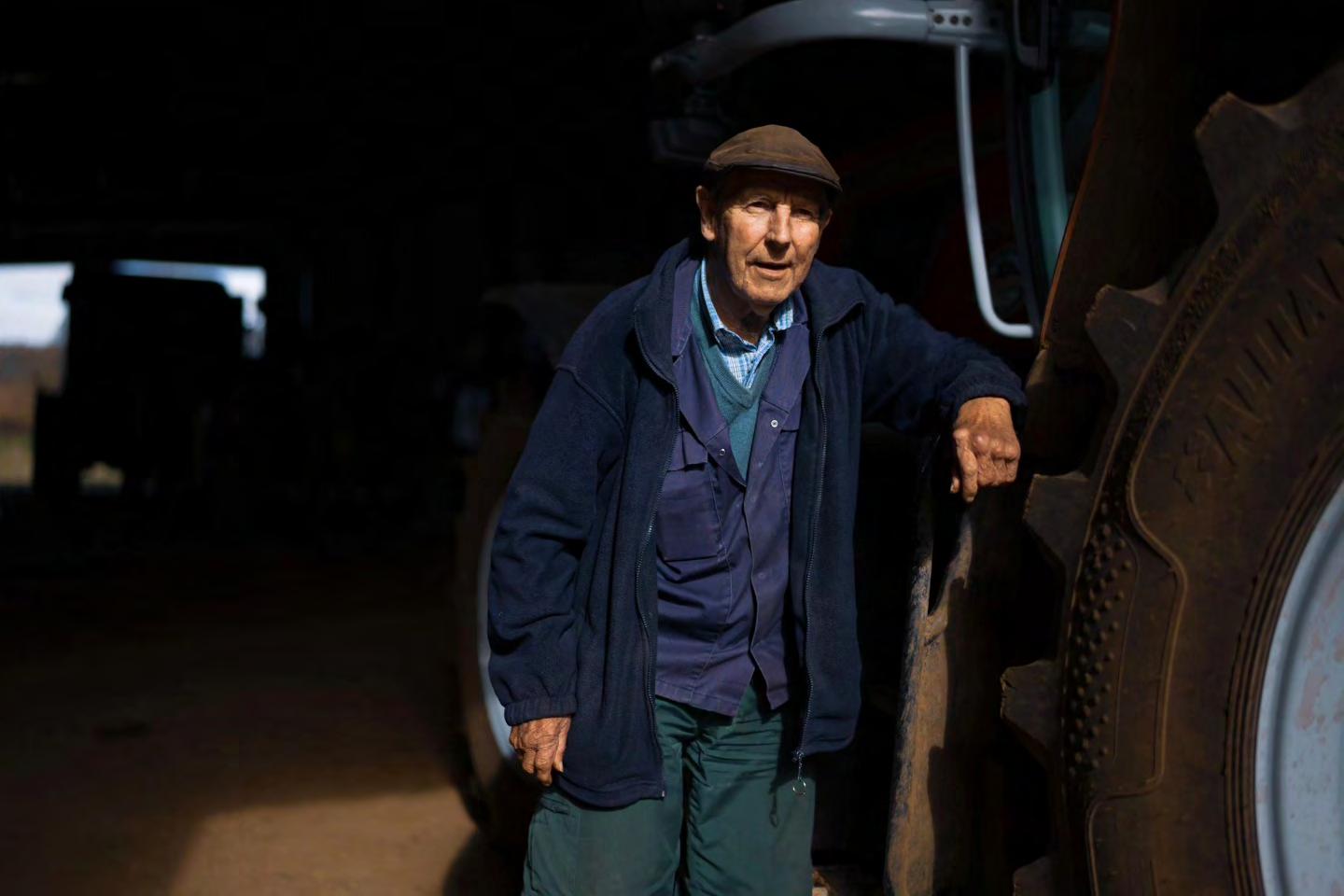
One moment that captures this perfectly happened on a farm in County Cork. While filming with two farmers for a commercial project, Hernan recalls arriving at ten in the morning and immediately asking, “Can I move around your sheds to search for the best light?” For him, finding that perfect shed mattered more than any backdrop. He spent time exploring the space, shifting hay bales and machinery, building a composition
around the soft, natural light that poured in. “The backdrop would be nothing without that nice light,” he says - a quiet reminder that illumination, not setting, is what gives his work its life.
From Portraits to Video: A Changing Medium
Over the past decade, Hernan’s career has evolved alongside the industry itself. Once primarily a photographer, he now spends 90% of his time on video work. “If you plan to make a living in media today, you can’t just do photography,” he says. “Both go hand in hand.”
Working in marketing, he now helps businesses tell their stories visually - creating long-form YouTube pieces and dozens of short social media clips per campaign. “We go to a client for a week and create enough content to last them a year,” he says. “It’s fast-paced, creative, and every trip is different.”
But even as the technology shifts, Hernan doesn’t lose sight of the fundamentals. “Whether natural or artificial, how you use light to your favour is one of the most important aspects of photography and videography,” he says. “Everything starts from that.”
Seeing the Human First
Though he has travelled widely - documenting humanitarian work in India, Bhutan, Nepal, and Pakistan - Hernan’s sensibility remains grounded in portraiture. “I believe a product is shown better when you have a human face in the image,” he says. “That probably comes from my strong interest in portrait photography.”
His street portraits show the same empathy. “I like speaking to people before I photograph them,” he says. “It’s social. I don’t see it as work - it’s more like being on holiday, getting to know people.” For Hernan, re-
lationships are at the centre of every image. Whether shooting a bride, a farmer, or a musician, he approaches each subject with curiosity and care.
Music, Motion, and the Moment
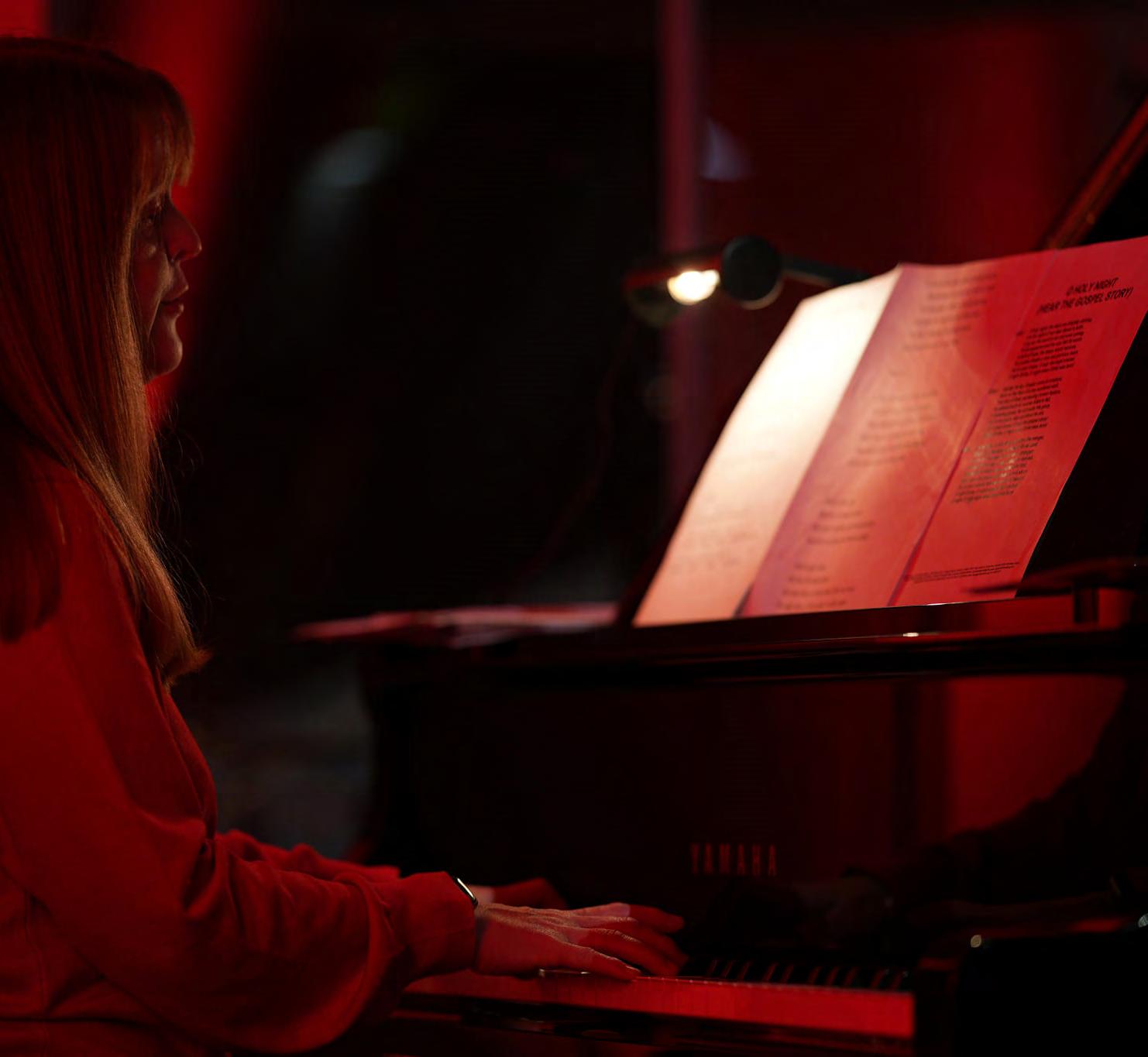
Music plays an important role in his creative life. A jazz lover and bass guitarist, Hernan often blends his musical and visual worlds, photographing live performances across Northern Ireland. “Concert photography is possibly one of the most technically demanding kinds of photography,” he says. “The light is constantly changing, your subject is moving - you can’t control anything. You’re thrown into the deep end.”
He remembers his first professional concert commission vividly. “It was stressful,” he laughs. “But after that, I knew what to expect. Now I enjoy itthe challenge, the rhythm, the unpredictability.”
Among the most significant of these performances is his ongoing collaboration with the world-renowned band Getty Music. Three years ago, Hernan was asked to take charge of photographing one of their concertshis first professional commission for a major international group. “It was a lot of pressure. Those photos weren’t just for me; they were for the band’s website, social media, and global promotions.” That first shoot brought both nerves and validation, teaching him to balance technical precision with the emotional energy of live performance. Since then, he has continued to work with Getty Music, capturing their events with a confidence born from experience - each image reflecting both the sound and soul of the moment.
Editing in the Eye, Not the Screen
Despite working in digital media, Hernan prefers to get everything right in-camera. “I
try to get it right at least 90% before editing,” he says. “Spend 90% of your time getting it right on the shoot - and only 10% editing. The other way around never works.”
It’s advice that echoes his practical nature. “I’m a simple guy,” he smiles. “I love pointing the camera at people. That’s really it.”
Black & White and the Essence of Photography
For Hernan, black and white photography remains the purest form of the craft. “Colour photography captures a moment and a place,” he says. “Black and white captures the essence and the soul of a person.”
His monochrome images, part of an ongoing series titled Embrace Monochrome, extend beyond portraiture to capture still moments, birds, people, and everyday objects with warmth and soul. Each frame feels alive
- a conversation between light and subject, where even the simplest form carries emotion and quiet depth.
Finding Warmth in the North
While others might chase storms or sunsets, Hernan prefers warmth - in both his work and his surroundings. “Coming from Chile, I don’t really enjoy the cold,” he laughs. “I’d rather be in a warm coffee shop taking portraits than standing on a cliff in the rain waiting for the right sunset.”
It’s a sentiment that captures something essential about him: a photographer less concerned
with spectacle than connection, more interested in how people inhabit the world than how the world looks on its own. His images - of faces, spaces, and fleeting light - remind us that beauty, like belonging, is often found in relation.
“I like social activities. I like interacting with people. Photography, for me, is just part of that - another way to connect.”
Keep up with Hernan on social media:
@hfphotography
Follow his project Embrace Monochrom:
@embrace.monochrom
Bob Speers Artist
In a room filled with timber, peat, and light, artworks hung on walls are more like fragments of the land itself - weathered, breathing, and alive with memory.
Inside the gallery, walls are filled with textures of peat and cloth, framed in salvaged timber. Bob Speers’s work feels both ancient and immediatepaintings that seem to breathe the land itself.
His long-time collaborator Colin Agnew moves quietly among the pieces, preparing for their next showing.
“It officially opens on the 13th,” he says. “Professor Jonathan
Pilcher from Queen’s University is coming down to talk about the evolution of bogland and the environmental issues surrounding it.”
Each piece carries its own story. One canvas was inspired by Garry Bog, another by Speers’s childhood haunts in County Antrim.
“Bob sees it as a kind of portal,” Agnew says, “a perspective drawn by the light coming through.”
Thin Spaces
At the heart of Speers’s practice lies the idea of the thin place - a landscape where the veil between the physical and the transcendent feels porous. Peatlands, or bogs, embody this liminal quality: places where the material and the numinous touch.
Each canvas hums between those worlds - dense with earth, alive with light.
As Speers says, “My art is currently informed by habitual wanderings through different levels of moor and bog.”
This is the guiding principle behind his exhibition Thin Place: to explore that moment of connection when the land seems to shimmer with both presence and absence - a “mystical space,” he explains, “where the boundary between our tangible world and the unseen world seem to touch.”
Material Memory
Speers practises two intertwined disciplines: fine art and songwriting. His visual work evolved from figurative painting in the 1970s into a land-based, meditative practice that merges process and pilgrimage.
“I collect a sample from each
bog I visit,” he says. “So that, in essence, the bog named is to be found in the painting.”
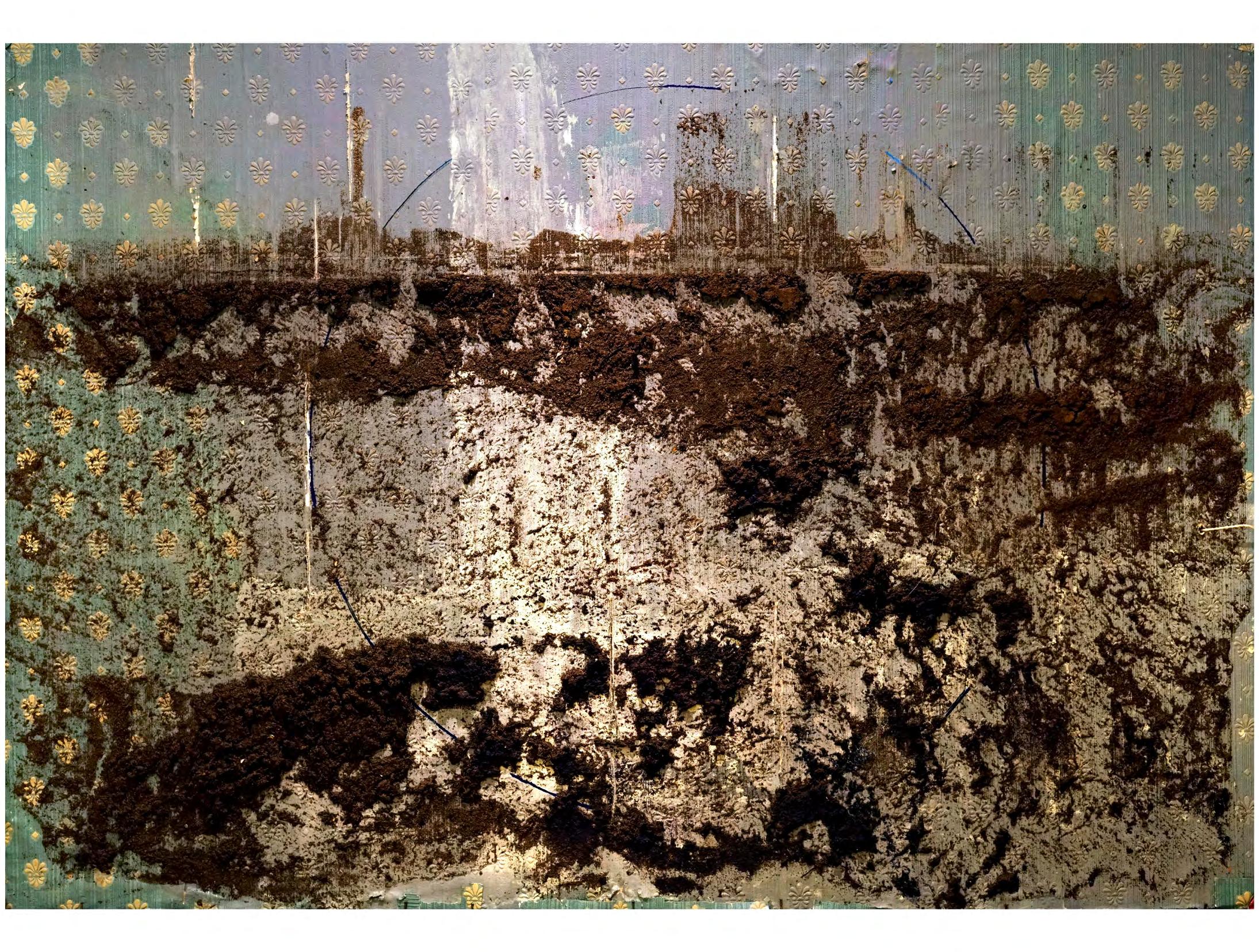
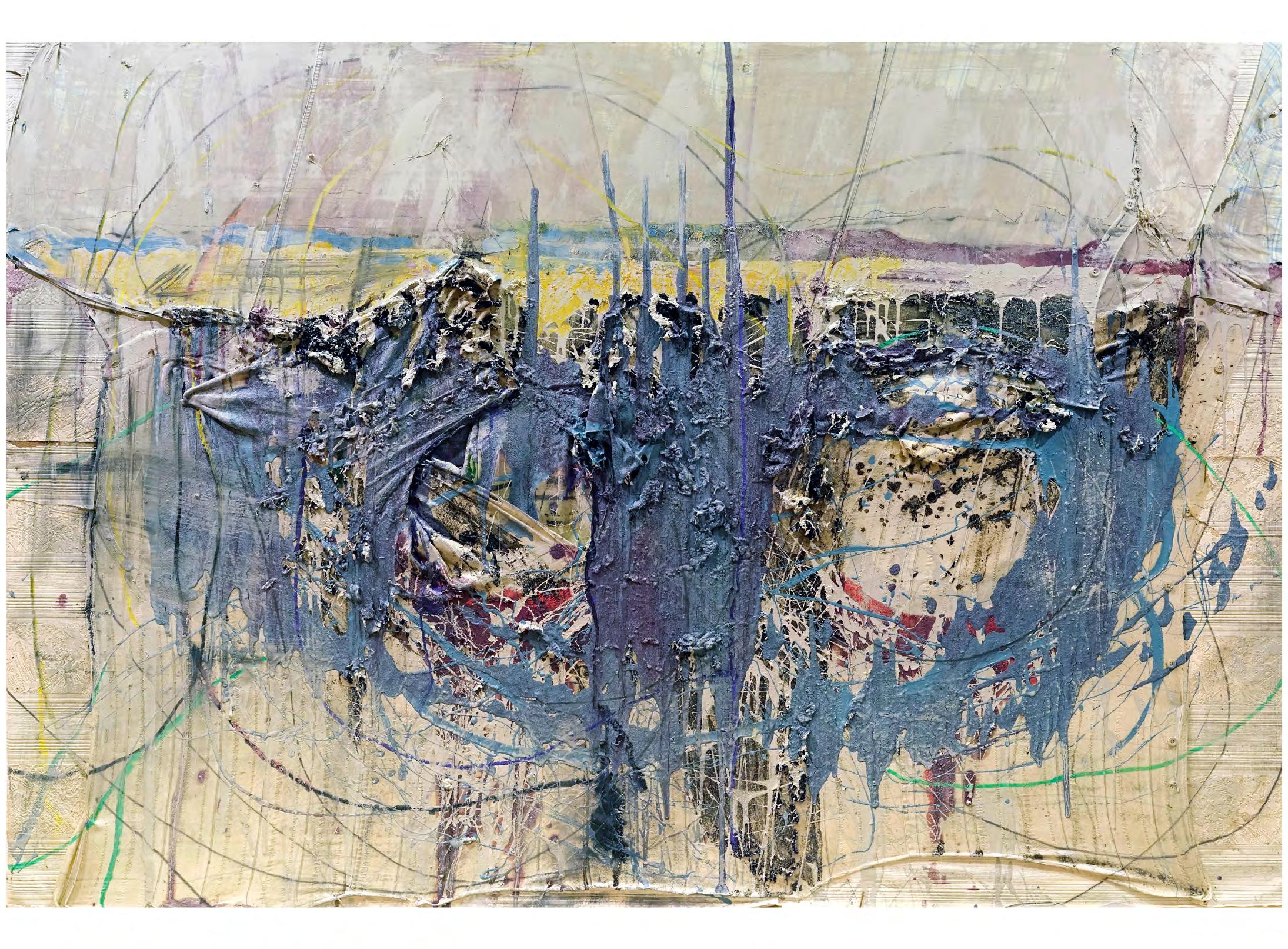
Those samples - peat, clay, water, and moss - are mixed with oils, acrylics, commercial matte paints, and discarded domestic fabrics: sheeting, wallpaper, even old clothing.
“It’s all stuff most people would throw away,” Agnew says. “Old timber, bits of fabric. That’s part of the point - environmental, cyclical, nothing wasted.”
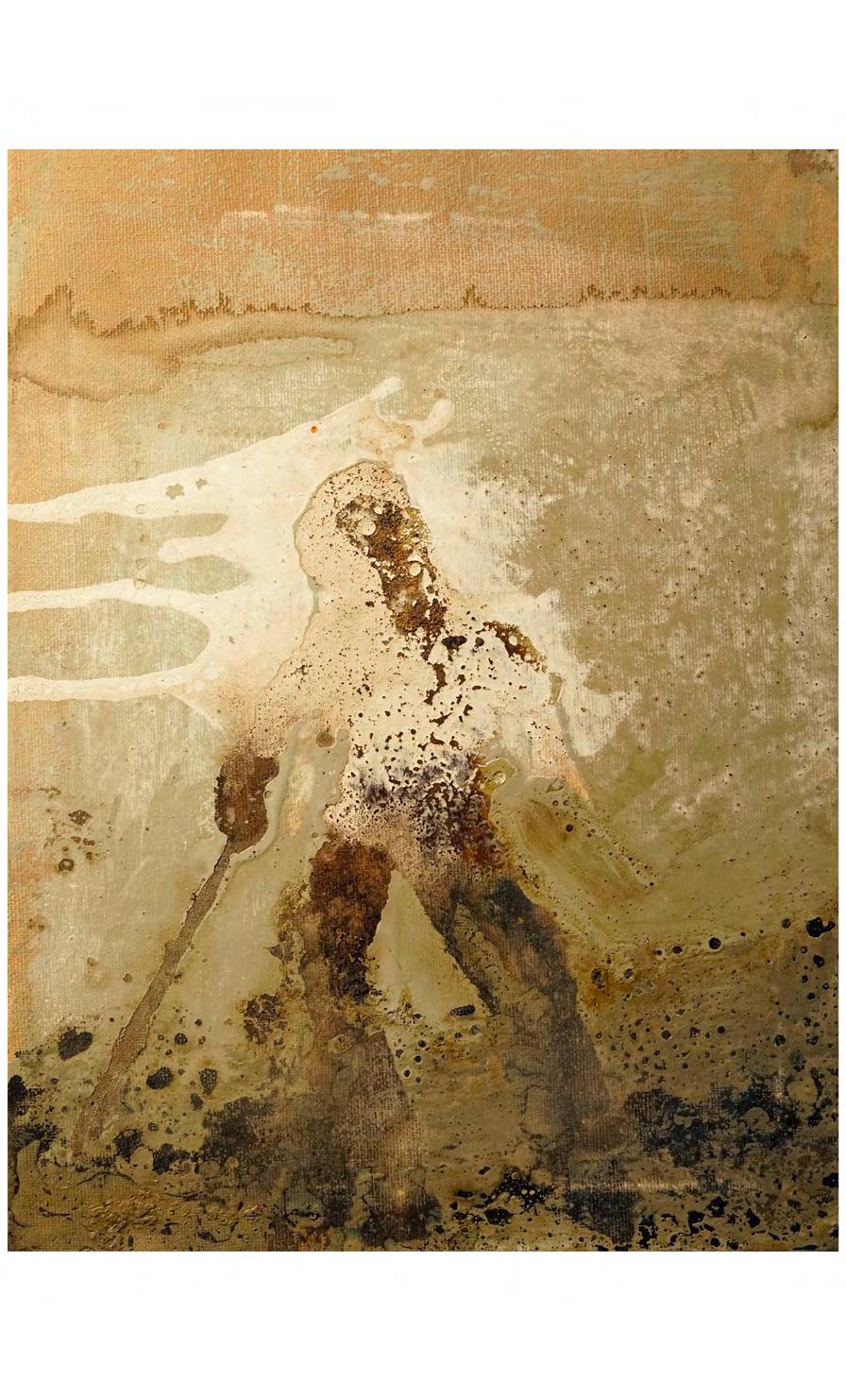
The surfaces that emerge are tactile and weathered - marked by the subtle colours, lines, and incisions of land that has lived through centuries of human and elemental change.
As one gallery visitor once put it, “Bob Speers has a perspective on the land which is often overlooked.”
The Language of Colour
Speers’s paintings exist within the Irish landscape tradition but adopt a contemporary, metaphysical approach. “The colour’s there in the landscape,” he says. “It’s the light, the air, the silence.”
His long-standing interest in earth, peat-bog, and hinterland focuses on what he calls “the human and weathering imprint.”
Each work attempts to evoke “an equivalent atmosphere to that of the actual terrain” - a balance of beauty, decay, and transcendence.
Wallpaper fragments often reappear beneath the surface as a quiet metaphor for repetition and memory - “how things repeat and change over long periods.”
In collaboration with Professor Pilcher, Speers once examined a 10,000-year-old peat core.
“He handed me a piece,” Speers recalls, “and when I opened it, it was just new. That gives you a strange feeling.”
A Magical Ecology
For Speers and Agnew, bogs are living archives.
“Every time we visit one, something magical happens,” says Agnew, a horticulturalist by trade and former supervisor of Belfast’s Botanic Gardens
“That’s why this exhibition is called Thin Place - the bog really is a magical space where something unseen always seems to be present.”
Speers’s environmental concern runs through his practice. The use of organic material reflects his interest in habitat preservation - peatlands as
both sacred and threatened ground.
One painting even hints at distant smokestacks on the horizon: “That’s an industrial scene,” Agnew notes, “a factory poisoning the earth.” Speers adds quietly, “That was in County Meath, supposed to be rewilded - but the machines were still there, right when I picked up a sample for my work.”
Each painting becomes both record and resistance - a way to keep the land alive through art.Speers has seen first-hand how many of Ireland’s bogs, once slated for protection or rewilding, continue to be cut and degraded through lax oversight and uneven policy. At sites supposedly under conservation, he’s encountered heavy machinery and commercial extraction still at work - a quiet erasure happening in plain sight.
Returning to Paint
Although deeply rooted in landscape, Speers’s path began in music. He first exhibited with the Royal Ulster Academy in the 1970s but spent much of the following decades writing and performing songs across Ireland, Britain, and Canada. His acclaimed album Northland (1990) drew directly from the Antrim coastline - a lyrical parallel to his later visual work.
When he returned to painting years later, Agnew remembers recognising the shift immediately. “He said, ‘I’ve started to paint again,’ and showed me a small canvas. I knew straight away he’d been to the bog - the colours gave it away.”
Since then, Speers’s exhibitions have spanned Belfast, Dublin, Portstewart, and Ballymena. At the National Botanic Gardens, a staff member remarked that it was “the best artwork seen in the gallery in 25 years.”
The Murder of Crows
Amid the creative chaos of Speers’s Rathkenny studio, one painting stands apart - Murder of Crows.
“That was just lying around,” Agnew says. “A throwaway. But it’s beautiful.”
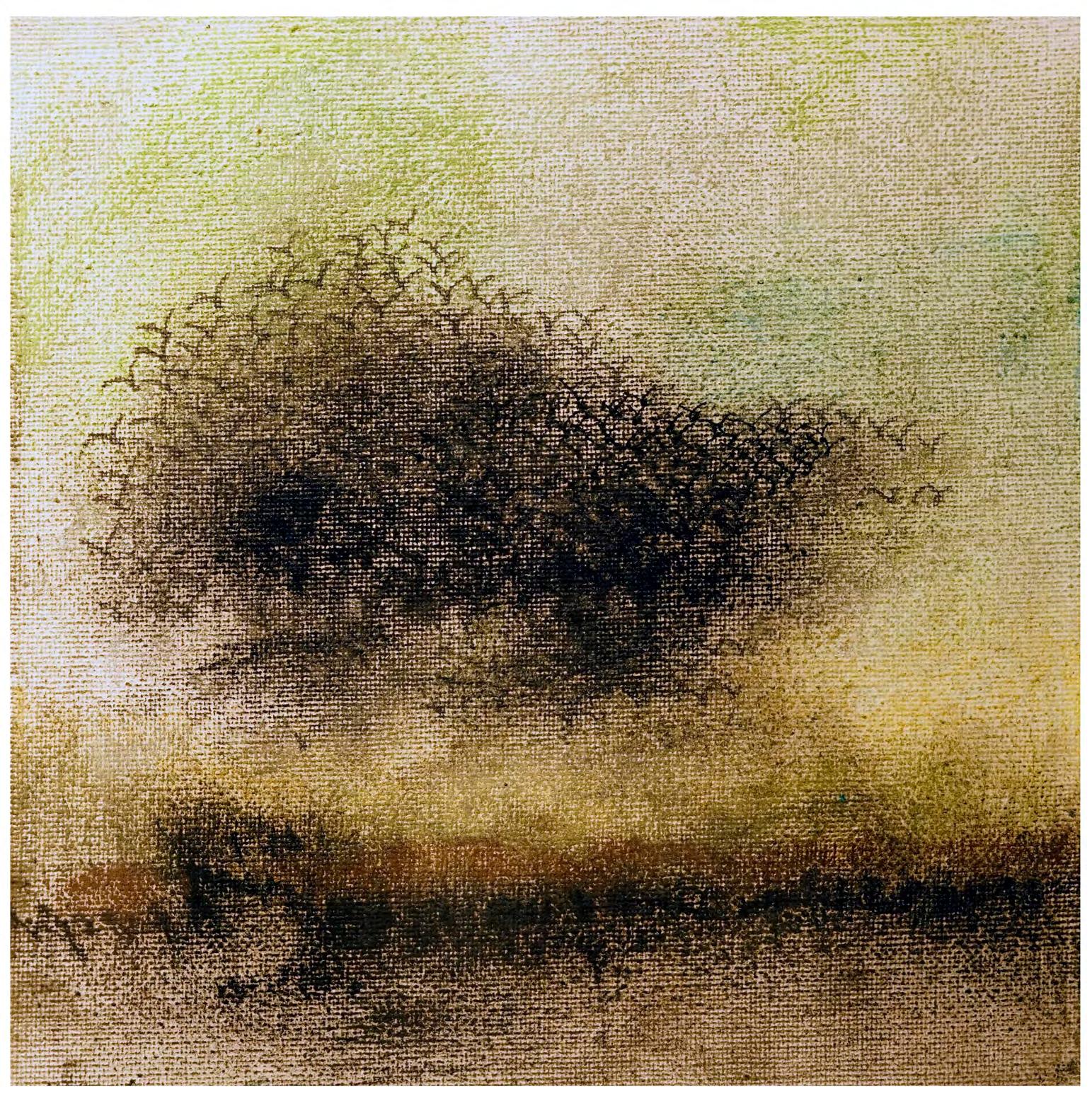
Speers smiles. “I was out one day, the wind blowing through the trees, and there was this multitude of crows. They call it a murder. I’ve never forgotten it.”
The piece captures the rhythm of flight and the pulse of weather - the same sensibility that runs through his songs.
Sound and Soil
Music remains inseparable from his visual work. “He’s so in tune with nature,” says Agnew. “I
don’t know any Irish artist who does it quite like Bobby.”
He recalls one summer walk through Dundonald Bog: “We were talking about how we never hear curlews anymore. I asked him to give a curlew call - and he did. Within seconds, curlews appeared overhead, circling us. Five of them. It was like magic.”
Speers nods. “That was a rare thing,” he says. “Maybe it was their first flight.”
Legacy and Continuity
Speers’s art, like his music, lives between sound and silence, surface and depth.
It belongs to the Irish landscape tradition yet reaches toward something metaphysical - “a sense of transcendence,” he says, “created by the unique
combination of light, air, and silence in these largely unexplored but intriguing places.”
As Agnew puts it, “He doesn’t just paint the bog. He listens to it.”
And somewhere between sound and soil - in those rare thin places where worlds touch - Bob Speers continues to translate the land: one canvas, one song, one moment of quiet magic at a time.
Book your FREE tickets for Thin Place - Bob Speers and Jonathon Pilcher in Conversation, Thursday 13th November, Mid-Antrim Museum and Arts Centre at The Braid: thebraid.ticketsolve.com
Find out more about Bob Speers and his work via his website: bobspeers.co.uk